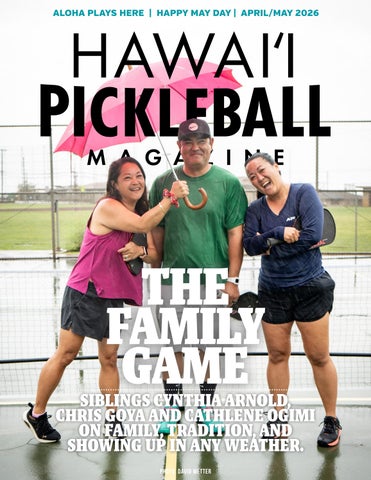
ALOHA PLAYS HERE | HAPPY MAY DAY | APRIL/MAY 2026
THE FAMILY GAME
SIBLINGS CYNTHIA ARNOLD, CHRIS GOYA AND CATHLENE OGIMI ON FAMILY, TRADITION, AND SHOWING UP IN ANY WEATHER. Photo: David Wetter
Photo: David Wetter
2
hawa i i p i ck l e b a ll magazi n e | AP R I L / M AY 2 0 2 6
FROM THE EDITOR
April 2026 The Kona Low storms hit hard this season. If your ‘ohana was affected, we're thinking of you, and reminded, once again, how this community shows up for itself.
We're keeping most of the details close for now. What I can tell you is that it's designed to close out the year together, with community and aloha at the center of it all.
On a lighter note: I just wrapped my first season in a pickleball league, and I loved it. But I also noticed something. Not everyone out there is playing the same game. Some are chasing a rating, and some are simply chasing a good afternoon.
Mark your calendars — trust us on this one.
All of it belongs. The courts are big enough for every philosophy, every skill level, every age, every reason for showing up. Which is why I'm excited to tell you: we're officially announcing our first signature HPM event. It's called City Showdown, and it's coming this winter.
And finally, it’s fitting, perhaps, that this issue arrives in the middle of April showers. The family at the center of this issue knows something about showing up in any weather. About the traditions that get folded into everyday life and passed down with intention and love. We were invited into their world. I left moved. I think you will be too. A hui hou. Jen Wilson Editor, Hawaii Pickleball Magazine HPM
Birthdays on the court, Lihue style. hawai i p i c kl ebal l magaz i ne | AP RI L/MAY 2 0 2 6
3
HAWAI‘I EDITION | ISSUE #16 | APRIL/MAY 2026
ALOHA PLAYS HERE. ALL LOCAL. ALWAYS. PROUDLY PUBLISHED BY HAWAII PICKLEBALL MEDIA GROUP
WITH GRATITUDE TO THIS MONTH’S CONTRIBUTORS: Tracey Bennett, Ref Column Kyle Paredes & Kylena Paredes, Tips with a Pro Dr. Dan Munkley, PT Playbook David Wetter Photography MAHALO TO EVERYONE WHO HELPED BRING THIS EDITION TO LIFE!
4
hawa i i p i ck l e b a ll magazi n e | AP R I L / M AY 2 0 2 6
Plates that say everything! Pickleball fanatics (L-R): Joanne Shimadoi, Oahu Pickleball Association President Donna Ching, and Irene White
IN THIS ISSUE: 3 FROM THE EDITOR 7 MIXED PLATE
14 COVER FEATURE
THE LONG GAME:
THREE CHOICE MIX
FOR THE GOYA SIBLINGS, THE COURT HAS ALWAYS BEEN HOME
8 REF CORNER
32 BRONZE AND BUILDING
NOT-READY SIGNALS
10 TIPS WITH A PRO
UH PICKLEBALL CLUB MAKES ITS MARK IN SILICON VALLEY
12 PT PLAYBOOK
38 BUILT FOR THE MODERN GAME
DROP SHOTS DECODED
PLAY AT EVERY AGE
CHRIS OLSON ON HOW PADDLE TECHNOLOGY IS CHANGING PLAY… AND WHAT’S COMING NEXT
© 2026 Hawaii Pickleball Magazine. All rights reserved. We love sharing our community’s stories — please don’t reuse without permission.
40 HPM GOES TO TENNESSEE: SPOTLIGHT ON NASHVILLE
56 THEN & NOW
THE HEART OF PICKLEBALL IN HAWAI’I
58 HAWAII STATE FCU PICKLEBALL AT HQ
74 MAYOR'S CUP
HAWAII MEETS ITS SISTER CITY
85 UPCOMING EVENTS
hawai i p i c kl ebal l magaz i ne | AP RI L/MAY 2 0 2 6
5
NOVEMBER
NOVEMBER
20 21 P I C K L E S
T H E
A T
F O R T É
E X P E R I E N C E
C O M I N G
T H I S
W I N T E R
MIXED PLATE
Squad #Ch Goals illax A inSmchieved ash
s Dink t e e M n Gridiro kleball #NFL
Pic
Just like the classic local plate lunch, this feature is a blend of flavors, stories, and the people who make this community feel like home.
Meeting Paddle
#SelkirkFound Royalty er
1. NFL linebacker Darius Muasau trades the gridiron for the pickleball courts of Mililani. 2. When your league team just gets it. 3. Aloha Pickleball (from Maui) visited with Steve Paranto, one of the founders of Selkirk Sport. hawai i p i c kl ebal l magaz i ne | AP RI L/MAY 2 0 2 6
7
ADVICE REFEREE CORNER
REFEREE CORNER WITH LEVEL 2 REFEREE TRACEY BENNETT I reffed the Hawaii Senior Games in 2018. (Four days with too little sleep. Bleary. Ugh.) Got my L1 badge in 2022. By mid-2023 I'd reffed 400 games in rec play and tournaments from Mililani to Kailua. Earned my L2 ranking in September 2023.
Check out Tracey’s spotlight feature HERE.
8
hawa i i p i ck l e b a ll magazi n e | AP R I L / M AY 2 0 2 6
YOUR BURNING COURT QUESTIONS ANSWERED TOPIC:
NOT-READY SIGNALS Let’s start with something you know: Rulebook 6.B Calling the Score. The score must not be called until the server and receiver are (or should be) in position and all players are (or should be) ready to play.
Now test yourself on this true-or-false quiz. The not-ready signals are:
Here’s a question for you, dear reader: Before you serve in a doubles match, do you check out the receiver AND the receiver’s partner?
3. T or F? Raising the paddle in front of your face
I do. Most of the time. (Yeah, yeah, I’m a referee and ought to do it 100% of the time. I’m working on it. Maybe this column will help me focus.) Next question: How do you know when the receiver’s partner is ready? This is a little trickier since the partner can stand anywhere on their end of the net. The answer lies not in where they’re standing, but in what they’re doing. Rulebook 6.A Readiness. Before the start of the score call, any player may signal they are not ready to start play. The key word is “signal.”
1. T or F? Talking to your partner 2. T or F? Raising the paddle above your head
4. T or F? Raising your nonpaddle hand above your head 5. T or F? Holding your arm straight with your palm facing the server, signaling “stop” 6. T or F? Completely turning your back to the net 6.A.1 “Not Ready” Signals. Players must use one of the following signals to indicate “not ready” 1. Raising the paddle above the head. 2 Raising the non-paddle hand above the head. 3. Completely turning their back to the net. Answers: 1. F, 2. T, 3. F, 4. T, 5. F, 6. T
Let’s highlight the language in 6.A.1: “Players must use one of the following….” Does that mean you can’t say, “Wait! I’m not ready”? It appears so, at least when you have a referee. [This is a rule I disagree with, but one I must follow.] I doubt that rec players will be so strict. When I was training in Las Vegas to become an L2 ref, one of the players complained he wasn’t ready when I called the score. My mentor came to my rescue: “He wasn’t showing a not-ready signal.” FYI: This column was inspired by something that happened at my court last week: My back was to the net, but the server, Anon, hit the ball to my partner anyway. Anon didn’t understand my signal. Now he does. And so do you. Get your FREE 2026 USA Pickleball Official Rulebook. Email me your questions about PB rules or ask how you can become a ref: Tracey2@hawaii.rr.com
hawai i p i c kl ebal l magaz i ne | AP RI L/MAY 2 0 2 6
9
PRO TIPS
10 hawa i i p i ck l e b a ll magazi n e | AP R I L / M AY 2 0 2 6
DROP SHOTS, DECODED — PART 2
The drop shot is hard to execute and knowing when to use it is equally so. In Part 2 of Drop Shots, Decoded, Coach breaks down the decision, so your drops feel intentional instead of hopeful. Watch the full tutorial, spoof included, by clicking on the image above. HPM Want more tips like this? Subscribe to our channel and join the Hawaii Pickleball Magazine community for weekly stories, player spotlights, and pro-level insights.
Get the newsletter: Sign up for free (link below) to get exclusive videos, gear guides, and local pickleball news delivered straight to your inbox. https://view.flodesk.com/pages/64bed9e4625f255f0de6fb84
Follow us on social: Instagram: https://www.instagram.com/ hawaiipickleballmagazine/ Facebook: https://www.facebook.com/ HawaiiPickleballMagazine/
PicklePro
SporTech-USA
Website: https://www.hawaiipickleballmagazine.com/latestissues #pickleball #pickleballtips #hawaiipickleball #pickleballtraining
hawai i p i c kl ebal l magaz i ne | AP RI L/MAY 2 0 2 6
11
THE REFEREE PT PLAYBOOK CORNER
FROM KEIKI TO KUPUNA:
PLAYING STRONG THROUGH EVERY STAGE OF LIFE
On any given day, a pickleball court in Hawai‘i tells a beautiful story—one where generations move, learn, and play—side by side. But while the game connects us, how we care for our bodies should evolve with us.
What helps a teenager stay explosive isn’t the same strategy that keeps a 60+ player steady and strong. The good news? With a few thoughtful adjustments, every stage of life can be your best stage on the court.
HERE ARE A FEW AGE-SPECIFIC CONSIDERATIONS TO HELP YOU PLAY STRONGER AND RECOVER SMARTER:
UNDER 18
20s–30s
Strengths: Younger athletes often have incredible agility, coordination, and speedy recovery. Common injuries: knee pain (especially during growth spurts) and ankle sprains. (Their challenge is volume management. Because they feel good, they may overtrain without realizing it). Recommendations: • Emphasize movement quality — learn proper lunging and landing mechanics. • Limit year-round play - mix in other sports • Take a minimum of 1-2 days off each week.
Strength: This group tends to play fast and aggressively, often stacking leagues, tournaments, and open play into one week. Common injuries: include hamstring strains as well as lower back tightness. (Performance/capacity is high — but so is cumulative fatigue). Recommendations: • Consistently perform abdominal and posterior chain strength training. • Periodize play — not every week needs to be maximal.
12 hawa i i p i ck l e b a ll magazi n e | AP R I L / M AY 2 0 2 6
40–50s
UNIVERSAL PRINCIPLES
Strength: Players here often rely on strategy and shot selection rather than speed alone. The focus shifts from pushing limits to preserving durability. Common injuries: tendonitis (elbow or achilles), hip stiffness, and slower recovery between matches. Recommendations: • Increased focus on dynamic warm-up • Consistently perform eccentric strength exercises (slowing the speed of the stretching component) for tendon health. • Respect recovery windows after tournaments.
Across all generations, three pillars remain constant: strength supports joints, mobility preserves movement, and recovery sustains longevity. To maintain strength and mobility: perform resistance training 1-2x weekly covering a variety of muscle groups, movement patterns, and positions. To maintain longevity: despite the addictive qualities of Pickleball, remember to periodize play and schedule weekly recovery days! Pickleball is a lifelong game. With smart habits, you can keep competing, connecting, and thriving on the court! Reach out for a free consultation and guidance in setting up a personalized strength training routine. Aloha, Dr. Dan Munkley InspireMVMT Personal Training 617-759-0525
60+ Strength: Consistency and accuracy is the superpower of this group. Common Injuries: Falls due to balance deficits, joint stiffness or muscle loss. Recommendations: • Include balance training as well as lifting light-to-moderate weights 2x weekly to maintain muscle.
hawai i p i c kl ebal l magaz i ne | AP RI L/MAY 2 0 2 6
13
COVER FEATURE
THE LONG GAME
FOR THE GOYA SIBLINGS, THE COURT HAS ALWAYS BEEN HOME BY JEN WILSON 14 hawa i i p i ck l e b a ll magazi n e | AP R I L / M AY 2 0 2 6
Photo: David Wetter
hawai i p i c kl ebal l magaz i ne | AP RI L/MAY 2 0 2 6
15
COVER FEATURE
16 hawa i i p i ck l e b a ll magazi n e | AP R I L / M AY 2 0 2 6
Photo: David Wetter
Photo: David Wetter
Spend a few minutes around Cynthia, Chris and Cat, and one thing becomes clear pretty quickly: competition runs in the family. Not the cutthroat kind. The playful kind, where siblings tease each other about missed shots, argue about who’s the most competitive, and then line up for the next game anyway. “She wants to win every game. It could be a pick-up game for fun—she wants to win every game,” Cynthia and Chris joke about Cat. But the truth is, they’re all competitive, in their own way. When I first reached out to interview them, I suggested a Zoom call. Cynthia said it’d be much better to meet in person. That way, she explained, I could actually see how they interact. She was right.
We met on a stormy Sunday afternoon. The courts were soaked, it was windy and cold, and it rained on and off throughout our time together. For our cover shoot, I asked them to line up in age order. Easy enough. Then I asked them to line up again, this time by perceived age order. Cue the groans, the protests, the accusations, and the sibling ribbing. It was a beautiful, unscripted, spontaneous moment. It was one of the most fun afternoons I’ve had on assignment. The photos from that day show you why. “Tennis and now pickleball is what our family does to have fun,” one of them says.
hawai i p i c kl ebal l magaz i ne | AP RI L/MAY 2 0 2 6
17
COVER FEATURE
Photo: David Wetter
18 hawa i i p i ck l e b a ll magazi n e | AP R I L / M AY 2 0 2 6
MEET TEAM CTG
CYNTHIA
They didn’t grow up together in the traditional sense. Cynthia is 11 years older than Cat, 7 years older than Chris. They grew up in shifts, in different seasons of the same family.
Cynthia leads with heart. Everything she feels, she feels fully.
In fact, ask them about it and Cynthia puts it perfectly: “We all have different parents, except we have the same parents.” Their parents were in their 20s when they had Cynthia. Strict, cautious, first-time parents with rules for everything. By the time Chris came along they were older, and he was the only boy, which didn’t hurt. By Cat’s arrival, they’d mellowed considerably. “They were very strict with me,” Cynthia says. “I had rules. And then he was the only boy, he could do whatever. And then with her (Cat), they kind of leaned off a little.” The three of them moved through childhood in different orbits. The fact that they’re as close as they are today isn’t accidental. “You would think we’d be kind of separated because of the age difference,” Cat says. “But as adults, I think we’re much closer than when we were kids.”
“I feel everything. I cry a lot,” she says. Her siblings nod in agreement. They’ve seen it play out more times than they can count. “It’s just so touching,” Cat says, recalling the times Cynthia has gotten emotional over complete strangers, kids none of them even knew. Chris says, “Whether it’s crying or laughing... everything.” Ask Cat for one word to describe her sister, and she doesn’t hesitate: passionate. “The reason she cries all the time is because she’s so passionate,” Cat says. “Everything she does, she does with her whole heart.” That emotional depth has always been part of who she is. But earlier in life, especially in tennis, those same emotions could feel like a lot to carry. The moment that broke it came on a weekend at Punahou. Her team needed to win to qualify for states, a match everyone assumed they’d come out on top. Nobody thought twice about it. Her family wasn’t there; they were at her younger siblings’ soccer game. They lost. She cried the entire way home, alone. After tough matches, she’d run, sometimes for miles, working through the weight of her own expectations. “I didn’t want to play in college. I didn’t want to pick up a racket for a while,” she says. hawai i p i c kl ebal l magaz i ne | AP RI L/MAY 2 0 2 6
19
COVER FEATURE
Cynthia with her daughter medaling at a tournament on Kaua‘i (2026)
Over time, something shifted. The emotions didn’t go away, but she learned how to carry them differently. And even when she stepped away from playing, the game never really left her. At 19, she began coaching. She spent nearly two decades coaching tennis at St. Andrew’s Priory, helping guide players through the same highs, lows, and breakthroughs she’d once navigated herself. That even included coaching Cat for a stretch, a season she recalls without hesitation: “I probably pushed her more because she was my sister.” By their own account, it was rocky. “We were arguing all the time,” they recall. But it didn’t stay that way. The same person who pushed Cat on the court, who cared, invested, and showed up even when it was hard, was already becoming someone whose greatest gift was doing exactly that for others. In her grandparents’ final years, Cynthia made a decision that says everything about her priorities: she took a year off from work to simply be present with them. “I still do things for them,” she says. “That’s why I do what I do.” That capacity to feel deeply, to connect, to care, found its fullest expression in her work as editor and owner of Generations Magazine, a local publication for kūpuna. “I like hanging out with my grandma, so I might as well work with other grandmas,” she says.
20 hawa i i p i ck l e b a ll magazi n e | AP R I L / M AY 2 0 2 6
hawai i p i c kl ebal l magaz i ne | AP RI L/MAY 2 0 2 6
21
COVER FEATURE
22 hawa i i p i ck l e b a ll magazi n e | AP R I L / M AY 2 0 2 6
CHRIS
For Chris, the real separator has never been talent or technique.
Chris sees the world through a different lens, one shaped by possibility, and by what he believes people can become. Cat’s word for him is critical, and she means it entirely as a compliment.
“One thing that separates people is confidence. It’s not the mechanics, it’s the mind. If you can control your mind, you can control your competitiveness.”
“He has very high expectations of people,” she says. “And if they can’t get there, he’ll help them get there.” He’s serious about it, she adds, even though he’s cracking jokes all the time. Chris agrees. “I have very high expectations of people,” he says. “But the reason I have that is because I believe you have the potential to get there. And if I can get you there, the expectation is going to go up. It’s always going to go up.” “I get more satisfaction when other people learn and do well,” he continues. “That’s just how I’m wired.” That philosophy was already taking shape during his years as a Division I baseball player at Chicago State University, far from home, cold winters, competing at the highest level of college ball. Even then, losing wasn’t something to dwell on. It was something to answer. “If we lost, I needed to work harder,” he says. “I needed to practice harder. Take that extra day. Whatever it is.”
Chris believes confidence is built deliberately and repeatedly, over time. “You have to do it over and over again. That’s why you drill. Because when the moment comes, you’re not guessing. You know you can do it because you’ve already done it a hundred times. Yesterday.” He sees it play out closest to home. He works with his niece, Cynthia’s daughter, on her softball game. Cynthia tells him the same thing every time: her daughter hits better when she works with Chris than with anyone else. He knows exactly why. “It’s not her mechanics,” he says. “It’s not physical. For her, it’s the mind.” It’s always the mind. Whether it’s at the shipyard leading teams, or developing baseball players at Moanalua High School, the common thread in everything Chris does is his ability to help people get out of their own way and believe in what they’re already capable of. And that’s a gift.
What he learned from doing it himself became the foundation for how he develops others. hawai i p i c kl ebal l magaz i ne | AP RI L/MAY 2 0 2 6
23
COVER FEATURE
24 hawa i i p i ck l e b a ll magazi n e | AP R I L / M AY 2 0 2 6
Photo: David Wetter
CAT
Show up and do the work anyway.
And then there’s Cat.
And somewhere along the way, her relationship with competition changed.
So she did.
Chris’s word for her is immediate, vivid, and perfect: security detail. “Like a celebrity’s security detail,” he explains. “They’re always behind you. And if something happens, they’re the first one to stand up for you. That’s Cat.” Loyal. Protective. And always in your corner. But to stand up that fiercely for people requires knowing exactly who you are. At Pacific University, she built an exceptional collegiate tennis career, earning first-team recognition all four years, a distinction she was the first to achieve in the program and one she held for years. But the accolades didn’t come easily. “In college, I almost quit,” she says. “There were some mean girls on our team.” She called home often, leaning on Cynthia and her mom as she worked through it. What kept her there was a conversation with her coach, someone who helped her zoom out beyond the immediate noise. The message: people are going to say what they want.
“I learned how to lose. If I played my best, then it didn’t matter. The other person was better than me on that specific day. Because anyone can win on any given day.” It’s a lesson that shows up on the pickleball court today, where she regularly medals in tournaments. That clarity didn’t just save her tennis career. It shapes everything she does today. “You can be competitive, but still be yourself,” she says. “Some people get mean when they’re competitive, and I don’t like that. You can want to win, but you don’t have to be rude. It doesn’t change who you are.” For Cat, knowing who you are, and staying there, is everything. It’s what kept her on the court in college. And it’s what guides her as a vice principal in Hawaiʻi’s public school system, where she shows up every day for kids the same way she shows up for the people she loves, fully, and without hesitation.
cat’s wedding hawai i p i c kl ebal l magaz i ne | AP RI L/MAY 2 0 2 6
25
COVER FEATURE
26 hawa i i p i ck l e b a ll magazi n e | AP R I L / M AY 2 0 2 6
All in the family: Cynthia, her daughter, Cat and their father medal in a recent tournament on Kaua‘i.
SAME SUNDAY, DIFFERENT DECADE To understand these three, you have to understand where they come from. And that means going back a generation, to a grandfather who built things with his hands, organized family trips for 50 people, played card games like the stakes were real, and played tennis until he was 89 years old. He only stopped because COVID shut down the courts. It wasn’t his body or his age. A global pandemic closed the courts, and that’s what finally kept him off them. “A lot of the values and the way we were brought up stems from them,” Cynthia says of her grandparents, both of whom passed away in recent years. “Even the competitiveness.” Their dad learned tennis from their grandpa. Every Sunday, for as long as they can remember, the family gathered to play. And it was never just their immediate family. It included grandparents, parents, cousins, family friends, with up to 20 kids running around at times. They started at Kalaeloa, moved to Subbase until 9/11, and eventually landed where they play today. Their parents are now in their 70s and still play every week. “If it wasn’t raining, they’d all be here,” Cat says, about the courts on the day we met. Family trips were the same. Their grandpa organized them, first for 30 people, then 50, and wherever they went, if there was a tennis court, there was a tournament. Card games got just as competitive. “He
hated to lose,” one of them laughs. The last big trip was to Las Vegas for his 90th birthday. He took the entire family. And the work ethic behind all of it? That came from their grandpa too. Chris spent time alongside him well into his late 70s, putting up fences, clearing banana trees, doing the kind of physical work most people hire out. “He made me work hard,” Chris says. “But he never said, ‘do this, do that.’ He was right there next to you, his own carpenter, his own plumber, his own electrician.” Now their mom carries the torch. She organizes the annual family trip and is now four years in. Every Saturday, there’s family dinner. And after dinner, the board games come out. Unsurprisingly, no one plays casually. Favorites include Blank Slate and Cranium, and their board game sessions get loud and run long. “It takes forever,” one of them admits, “but it’s also the funniest.” Sometimes the answers give them away entirely. They’ll look at a response and know immediately—that one’s Cat. And there’s one more detail that pulls it all together, something that isn’t obvious until you know to look for it. Their father’s initials are C, T, and G. So are all three of theirs, same middle initial, same last name. Cynthia. Chris. Cat. Their mom calls herself Sherry and the four C’s. They are, in every sense, Team CTG.
Photo: David Wetter
hawai i p i c kl ebal l magaz i ne | AP RI L/MAY 2 0 2 6
27
COVER FEATURE
28 hawa i i p i ck l e b a ll magazi n e | AP R I L / M AY 2 0 2 6
hawai i p i c kl ebal l magaz i ne | AP RI L/MAY 2 0 2 6
29
COVER FEATURE
30 hawa i i p i ck l e b a ll magazi n e | AP R I L / M AY 2 0 2 6
Photo: David Wetter
CTG (&P): WHERE CONNECTION, TRADITION AND GENERATIONS MEET PICKLEBALL Same initials. It’s also who they are. Cat and her husband started playing when they first began dating, looking for something to do together. She introduced it to Cynthia. Chris came in some time later. Their dad got swept up in it too. He’d travel with Cat and her husband to tournaments to help with the grandkids, and somewhere along the way, he caught the bug himself. And it’s carrying into the next generation. Cynthia stepping onto the court with her teenage daughter in a tournament on Kaua’i. Cat competing alongside her husband while her young son watches from the sideline. Chris on the court with his niece and nephew, doing what comes naturally, helping them find their game. Pickleball, for this family, isn’t just a new sport. It’s where connection lives now, where tradition continues and generations grow. But the truest expression of who they are had nothing to do with a paddle or a court. It happened when I asked them to line up by perceived age order. What followed was pure and unfiltered, just them, exactly as they’ve always been with each other, and exactly as they’ll always be. And there it was—a family that has quietly and consistently chosen connection over convenience, togetherness over distance, each other over everything else. For decades. The court may look different. The game may have changed. But the reason they show up hasn’t. They said it themselves: “We like each other.” In a world where that’s not always a given, even among family, that might be the most remarkable thing of all. HPM
DINK, DRIVE AND FAMILY TIES We put the three siblings on the spot. Here's what they said. What paddle are you playing with? Cynthia: Cat's old hand me down. I think it’s a HEAD, but I don't know what kind of paddle it is. Honestly, besides me purchasing an Alabama logo'd paddle, I have gotten all of Cat's hand me downs. They’re still good, so I use it and it is FREE for me. Chris: The new Callaway paddle. Cat: 6.0 Coral.
Favorite shot? Cynthia: I don't think I have a favorite shot--I don't play enough to have a favorite shot. But my normal favorite shot in tennis and I guess now in pickleball is the down the line shot. That was my "winner" shot when I played tennis. Hahahaha. Chris: Up the line drive. Cat: 3rd shot drop roll on the ad side.
Dink or drive? Cynthia: As I play more and especially with Cat and the better players, I try to play the dink game, soft touch hands, etc. But I love to drive and slam... hahahaha. Chris: Drive. Cat: Dink.
Out of the three of you, who trash talks the most? Cynthia: CHRIS! Chris: I do. Cat: Cat.
One word your siblings would use to describe your on-court personality? Cynthia: Probably loud. I scream, laugh and make noises when I play. Not in anger or anything, but that’s just my reactions to things. And as I get old, it's like my body is making noises as well, like ahhhh....that hurts. Chris: Relaxed.
One word YOU would use? Cynthia: I would probably say loud as well. Chris: Composed. Cat: Yours.
Dream doubles partner? Cynthia: Because Cat and I are so many years apart, we've never been in the same age group or ever really played together. I did wish that my younger self and my sister would play tennis together as a doubles team--I think we would have won lots of games if we did. I think I would still say Cat, because I like playing with her. She makes me play harder, when she gets mad at me, but I also learn from her. When I make a mistake, I like to ask them what I should have done instead. Always wanting to learn to be better. In my head, I can do it, just got to get my body to do what I want it to do. Plus, when I play with Cat, she covers a lot of the court, and I like to be the less dominant player on the court. Chris: Roger Federer. Cat: Roger Federer.
What would Grandpa think of pickleball? Cynthia: It's funny because we actually took my Grandpa out to play a few times. He didn't like that he had to bend over to pick up the ball, unlike a tennis ball, you can hit your racket on it and it’ll bounce so you can pick it up easier. I think he was okay with it. He had fun. We took him out with all of us and he laughed and enjoyed it. I don't think he would change from tennis to pickleball though. He was a really good tennis player, even into his late 80's. Chris: He would say "the ball doesn't bounce as high as a tennis ball so I have to bend down more to hit it." Cat: “This is not like tennis.”
Cat: Loud.
hawai i p i c kl ebal l magaz i ne | AP RI L/MAY 2 0 2 6
31
COLLEGE PICKLEBALL: COMMUNITY HIGHLIGHTS
UH Pickleball Club players (L-R): Kira Tobita, Tristan Simmons, Conner Koga, and Jada Igawa
32 hawa i i p i ck l e b a ll magazi n e | AP R I L / M AY 2 0 2 6
BRONZE AND BUILDING UH PICKLEBALL CLUB MAKES ITS MARK IN SILICON VALLEY
A growing program, a tight-knit team, and a podium finish that signals what’s ahead There’s something special about a brand-new club in a brand-new sport. The University of Hawai‘i Pickleball Club is charting uncharted waters—building something from the ground up, without a long-standing blueprint to follow. It takes vision and grit to step into that space and represent your school on a national stage. And that’s exactly what Jada Igawa, Conner Koga, Tristan Simmons, and Kira Tobita did. At the California Super Regional in Silicon Valley on March 7–8, the four UH players competed against collegiate programs from across the country and came home with a bronze medal. From there, the team set its sights on the Collegiate National Championship (CNC) in Georgia, held April 9–12. By the time this issue reaches you, those matches will already be in the books. But regardless of the outcome, one thing is certain—the entire state of Hawai‘i is proud.
Describe the team vibe during the tournament in three words: Conner: Family, hungry (for food), and resilient Jada: Hype, fun, driven Kira: Supportive, positive, high-energy Tristan: Fun, hype, exciting
What does bringing home Bronze mean for UH Pickleball right now? Conner: Bringing home bronze means a lot for our program. This was the first tournament where we finished in the top five. About a year ago we were placing around 50th among collegiate teams, and since then we’ve slowly been climbing the ladder. Now we’re bringing home medals. It shows that our team is on the rise and continuing to improve every tournament. It also proves that even though we are far from the mainland and based on an island, we can still compete at a high level and make our presence known.
We asked them for a glimpse into that weekend in Silicon Valley. Here’s what they said:
hawai i p i c kl ebal l magaz i ne | AP RI L/MAY 2 0 2 6
33
COLLEGE PICKLEBALL: COMMUNITY HIGHLIGHTS
Jada: I’m so proud of our team! My teammates and I have been working really hard over the past couple of months to prepare for this tournament. Because of the distance and cost, we aren’t able to travel to many tournaments, so whenever we do compete, we train hard and show up ready to win. It’s amazing to see all of that hard work start to pay off. This is only my first year with the club, so hopefully it’s the first of many great finishes for us. I’m extremely proud to represent our school, and earning bronze will hopefully help put our program on the map in the pickleball community and bring more funding to support our team. Go ’Bows! Kira: It really shows how far we’ve come since we first started in 2024. In fall 2024, we entered our first collegiate pickleball tournament at the NCPA California Regional Tournament and placed 21 out of 27 teams. In spring 2025, we were offered a wildcard to nationals where we tied for last place with Harvard. We weren’t the best and there was room for improvement. We continued to train and with the support of our sponsors and guidance from local pros, we improved tremendously. Big shoutout to Jaume Martinez Vich and Bobbi Oshiro for helping our program secure sponsorships from Six Zero and Joola. This past tournament we were very close to the finals. We lost in the semifinals in a dreambreaker with a score of 21-23. Even though we didn’t get the outcome we wanted, we have come a long way since the start of our program. We hope that our showing at the most recent tournament brings attention to collegiate pickleball in Hawaii and helps the sport possibly become a part of NCAA. Tristan: I think that it means that we are close to being able to compete with the other top collegiate programs.
34 hawa i i p i ck l e b a ll magazi n e | AP R I L / M AY 2 0 2 6
hawai i p i c kl ebal l magaz i ne | AP RI L/MAY 2 0 2 6
35
COLLEGE PICKLEBALL: COMMUNITY HIGHLIGHTS
What’s something people might not realize about collegiate pickleball tournaments? Conner: A lot of people might think collegiate pickleball is just for fun, but it’s actually very competitive and exciting, similar to NCAA sports. One big difference is that we aren’t separated by conferences, so we get to compete against top schools from all over the country like UCLA, USC, Florida, and Duke at the same tournaments. Another thing people might not realize is how familyoriented the community is. Hundreds of college players travel to these tournaments, and by the end of the weekend everyone has met each other and built friendships across schools. Jada: A lot of people don’t realize that collegiate pickleball is much more than just intramurals—its a competitive sport. The atmosphere is loud and intense, with teams cheering each other on and every match feeling high stakes.
36 hawa i i p i ck l e b a ll magazi n e | AP R I L / M AY 2 0 2 6
Players take a lot of pride in representing both their team and their school, and with so many colleges from across the country competing, everyone shows up ready to win. Kira: As of right now, collegiate pickleball is not an NCAA sport. This means that our players pay everything out of pocket including travel fees, hotels, and the cost to train at our local indoor pickleball facility (Pickles at Forté). It is even more expensive to fly to these tournaments from Hawaii. We recently qualified for all three collegiate national pickleball tournaments this year but deferred two due to financial reasons. Tristan: There was so much heckling from the other teams and it was a new experience for me so it added some pressure and distraction, but it was a ton of fun.
ALOHA PL AYS
HERE | HAPPY
MAY DAY | APRI
THE FAMILY GAME
L/MAY 2026
SIBLINGS CYNTHIA ARNOLD, CHRIS GOYA AND C A T ON FAMILY, TRAD HLENE OGIMI SHOWING UP IN A ITION, AND NY WEATHER. Pho to: Dav id We tte
r
TECH SPOTLIGHT
Built for the Modern Game Chris Olson on how paddle technology is changing play… and what’s coming next 38 hawa i i p i ck l e b a ll magazi n e | AP R I L / M AY 2 0 2 6
As we chatted during the shoot for our cover feature, Cat Ogimi mentioned she began playing pickleball with a wooden paddle. Interesting, I thought. It’s clear we’ve come a long way from wooden paddles—when I first started playing, I remember feeling heartburn paying $180 for my Joola paddle. It was “advanced,” everyone said. It got me wondering—how much has paddle technology really changed and reshaped the way we play today? And where is it headed? Enter Chris Olson—the perfect person to help us make sense of it all. Known for his thoughtful, datadriven approach to paddle technology, Chris has become one of the most trusted voices in the space. We sent over two quick questions, and true to the spirit of the pickleball community, he graciously said yes.
Q: Has modern paddle technology fundamentally changed the way the game is played, or simply amplified existing player strengths? A: Modern paddle technology has definitely changed the fundamentals of the game. Years ago the game was much slower and you couldn’t simply hit through people with big drives and serves. With more power and spin, the game has become so much faster, and allows for people to do things to the ball that simply just weren’t possible 3–4 years ago. Q: Looking ahead, where do you see paddle innovation heading? A: I think the biggest innovations over the next couple years will be in the form of durability. Particularly when it comes to grit on the paddle face. This is still one of the weakest points of modern paddles, and some companies are starting to come up with solutions. Now that power and spin are starting to have real caps on them, companies will have to focus on other aspects like durability.
From wooden paddles to today’s high-performance builds, the evolution of equipment is really a reflection of how quickly the game itself is growing. And if Chris is right, the next chapter won’t just be about hitting harder or spinning more—it’ll be about building paddles that can keep up…not just with performance, but with performance that lasts.
About Chris Olson Chris Olson is a leading voice in pickleball paddle technology and the creator of the popular YouTube channel Pickleball Studio. Through in-depth reviews, hands-on testing, and thoughtful breakdowns of materials and construction, he helps players understand the innovation driving today’s game. Known for his objective, datainformed analysis, Chris has become a trusted resource for players looking to make smarter equipment decisions.
hawai i p i c kl ebal l magaz i ne | AP RI L/MAY 2 0 2 6
39
NASHVILLE: BENEATH THE SURFACE
Nashvil 40 hawa i i p i ck l e b a ll magazi n e | AP R I L / M AY 2 0 2 6
lle
Beneath the Surface
Where you come for one thing— and leave with something more hawai i p i c kl ebal l magaz i ne | AP RI L/MAY 2 0 2 6
41
NASHVILLE: BENEATH THE SURFACE
Nashville wasn’t ever r BY JEN WILSON In my mind, Nashville was about country music and honky tonks and admittedly, I didn’t consider myself a country music fan. And then I went. Turns out, Nashville is about country music and honky tonks. But if you scratch just below the surface, you’ll find that the city pulls you in and stays with you in a wonderfully unexpected way. Reinvention in Motion: The Gulch We arrived and were plopped right into the center of The Gulch—less by design, and more because it was recommended as a “central” place to stay. What is now one of Nashville’s most walkable neighborhoods was once a working rail yard. The Gulch feels distinctly modern. Ubermodern condos with trendy new eateries, bars, and rooftop spots tucked into nearly every block. And they’re still building—there was new construction in every direction.
But, if you stroll for just half an hour, you’ll find yourself in the historic Broadway Downtown area. Instead of young, hip professionals out jogging or walking their dogs, you’ll see cowboy hats, boots and rhinestones. Everywhere.
After a few honky tonks and a handful of songs, we turned and made our way back to The Gulch.
Broadway, In Full Swing
Traffic was gridlocked. Streets were blocked off for the weekend.
About fifteen minutes into our walk toward Broadway, we walked over a bridge and happened to look down. There was a bar below. Very cool, we thought. We snapped a few photos from above, mentally filed it away, and kept moving.
We saw a sea of Predators jerseys and thought we might catch a game—only to realize it had just ended.
Later that night, on our way back, my husband ducked into that same spot to use the restroom. I stayed up on the bridge.
The closer we got, the denser it became.
A few minutes later, he came back up.
Lines wrapped outside the iconic Tootsies Orchid Lounge. Jason Aldean’s Kitchen + Rooftop Bar, where we’d originally planned to have a late lunch, was packed. Step into a shop or bar, and when you came back out, you’d be waiting a while to merge into the wave of people moving along the sidewalk.
“There’s pickleball courts down there,” he said.
We headed to Broadway on our first full day, which just happened to be a Saturday over Spring Break.
42 hawa i i p i ck l e b a ll magazi n e | AP R I L / M AY 2 0 2 6
Beneath the Surface We had actually passed it earlier that day.
Eight beautiful, brand-new courts— beneath the street we had walked over hours earlier, without a clue what was just below the surface.
really on the radar.
hawai i p i c kl ebal l magaz i ne | AP RI L/MAY 2 0 2 6
43
NASHVILLE: BENEATH THE SURFACE
Down Below: Dink Under The courts are part of Dink Under Broad, operated by Dinkville— tucked just beneath Broadway, a setup that feels equal parts hidden and intentional. You can’t see the courts from the street—you have to know it’s there. When we visited, it was quiet. Around 7:30– 8:00 PM on a Saturday night, the courts sat empty for a stretch before a few groups trickled in. We chatted for a bit with Seth, who was helping run things, and he mentioned that most visitors head to Broadway at night. During the day, though, it’s a different story— courts are typically full, with open play running daily. You can sign up for open play or reserve a court through the Dinkville app. If you don’t have gear, paddles are available for $10 for a group (though I know—you probably travel with your own). Court rentals run $25 for a half hour. The bar sits right next to the courts, with plenty of places to sit, lounge, and stay awhile. You can get in a few games, take a break, and just hang out—it’s a really cool way to spend some time in Nashville.
44 hawa i i p i ck l e b a ll magazi n e | AP R I L / M AY 2 0 2 6
r Broad
hawai i p i c kl ebal l magaz i ne | AP RI L/MAY 2 0 2 6
45
NASHVILLE: BENEATH THE SURFACE
the city of music I didn’t come to Nashville as a country music fan. We bought tickets to a Monday night show—a writers’ round. We read that it featured songwriters performing their own work, but we didn’t really know what to expect. And we didn’t recognize any of the three names headlining the show. It didn’t matter. A writers’ round is simple—songwriters take turns sharing the songs they’ve written, often telling the story behind them before they play. With just a guitar and mic. The moment we walked in, we knew it was going to be special. The building housing The Listening Room Café is unassuming. The café attached to it, equally so. Nothing about it hints at what’s waiting inside. One of the songwriters performed a song called “Knowing You.” I didn’t know it. But hearing it for the first time moved me in a way that’s hard to describe. It felt raw and personal, like you were sitting in on something you weren’t supposed to be part of. Turns out, that song was recorded by Kenny Chesney, one of the biggest names in country music, and went on to become a #1 hit. It became obvious—the people on that stage aren’t just writers. They’re incredibly talented performers in their own right. I recorded a small portion of that song on my phone and later looked it up on Spotify. And while the recorded version is polished and beautifully produced, hearing it live just hit different. It was in that room that I fell for Nashville. The next day, we packed our bags—reluctantly— already knowing the window to experience more writers’ rounds had come and gone. We headed to Opryland, where we would end our trip at the Grand Ole Opry. What a finale. I loved this too. If the Grand Ole Opry is the polished, iconic stage— award-winning performances under bright lights— then The Listening Room Café is its quieter counterpart. Two very different experiences—both part of what makes Nashville, Nashville.
46 hawa i i p i ck l e b a ll magazi n e | AP R I L / M AY 2 0 2 6
hawai i p i c kl ebal l magaz i ne | AP RI L/MAY 2 0 2 6
47
NASHVILLE: BENEATH THE SURFACE
A City That Holds Both Locals call Nashville their “little big city.” You start to understand why. It’s a city of opposites. Of juxtaposition. A big city with a small-town feel. Grand Ole Opry stages and writers’ rounds. Travel has a way of nudging you—to be curious, to stay open, to let your assumptions be challenged… even gently undone. Because when you do, you never quite know what you’ll find. Maybe it’s a song that grips you and doesn’t let go. Maybe it’s something as unexpected as a set of pickleball courts tucked beneath the street— waiting to be stumbled upon. Music City—I can’t wait to return. ’Til next time, y’all...! HPM
Don’t Miss + Writers rounds at The Listening Room Cafe (and, if you can snag tickets, The Bluebird Cafe) + Staying in The Gulch + Shopping at 12 South and White’s Mercantile
Nice, But Not Mandatory + Milk & Honey + The Mockingbird + Broadway (once)
Skip (In Our Opinion) - Farmers Market - Bicentennial Park
48 hawa i i p i ck l e b a ll magazi n e | AP R I L / M AY 2 0 2 6
NASHVILLE, ACCORDING TO A LOCAL I had planned to play a few games while I was visiting. Our Tennessee pickleball friend, Stephanie Lane, had lined up a session for us at Pickleball Kingdom Nashville. But a lingering hamstring injury, and then a back tweak—had other plans. So, we pivoted and asked her a few quick questions instead:
Favorite Nashville food? Martin’s Bar-B-Que Joint One place to try? Baja Burrito Writers round or concert? Bluebird Cafe (writers’ round) Dream Opry artist? CeCe Winans One word to describe Nashville: Welcoming Tip from a local: Wear mosquito repellent if visiting during the summer/fall A Tennessee-only treat? Goo Goo Cluster (G.O.O. stands for Grand Ole Opry)
hawai i p i c kl ebal l magaz i ne | AP RI L/MAY 2 0 2 6
49
THREE GENERATIONS ONE COURT
Reed and three generations 50 hawa i i p i ck l e b a ll magazi n e | AP R I L / M AY 2 0 2 6
THREE GENERATIONS, ONE COURT
Reed and family If you’ve been around the Mililani courts, there’s a good chance you’ve crossed paths with Reed Kano. A familiar face in the local pickleball scene, he’s also been one of those quietly supportive members of the Hawaii Pickleball Magazine community—always keeping us in the loop, helping us capture moments (including some of our 12 Days of Christmas footage), and recently, generously extending an invitation to come play with his group.
jaxon
So I took him up on it. Six games later, I was winded, spent, and quietly wondering how everyone else was still going. Reed, meanwhile, looked like he was just getting warmed up. But Reed’s story doesn’t stop at the court playing with his regular group…pickleball is something he’s passed on to his son and his grandsons. Three generations, connected through the game. We asked Reed to share more about his family’s pickleball journey.
For me, pickleball is my life....my friends are all picklers, it keeps me healthy, and a way to meet other like-minded people.
hawai i p i c kl ebal l magaz i ne | AP RI L/MAY 2 0 2 6
51
THREE GENERATIONS, ONE COURT
brayden and davin HPM: Tell us about your pickleball family. Who plays and how did each of you get started? Reed: My son Davin (44), my grandsons Brayden (10— Davin’s son) and Jaxon (6—Kalen’s son), and myself (71). I got my grandson Brayden playing during summer 2025 to get him off the electronics and to exercise...he lost about 20 pounds. I started him playing with our Kaneohe family and friends. I took him on the side and drilled his strokes to make solid contact. Then he started playing games and that’s when he was hooked. He is probably an advanced beginner or beginner intermediate player now. My son Davin plays because Brayden plays and just likes to spend quality time together. He is probably the same level as Brayden. Brayden got a portable pickleball rebounder/trainer net for Christmas so my daughter’s son Jaxon started to hit some balls. I also took him to the Mililani Rec 3 courts to drill ground strokes, serves, and dinks. He already can serve from the baseline and hit the ball over the net with his forehand ...so he will be able to play soon and we will have a family foursome.
52 hawa i i p i ck l e b a ll magazi n e | AP R I L / M AY 2 0 2 6
Jaxon, Kalen, Brayden and Davin
Reed and friends
Brayden and Jaxon
HPM: Who first discovered pickleball, and how did the rest of the family start playing? Reed: I discovered pickleball about 9-10 years ago when I retired. At that time, I got the whole family (except the wife) to take beginner lessons from Jason Fujinaka, but because of life events like marriages, kids, etc., pickleball for everyone took a back seat except for me. I’m the instigator in getting the grandsons to play. HPM: What is it like sharing the court with both your son and your grandson? Reed: When we play together, we play two of them against Papa for money lol...and they play hard cause they don’t want to lose to Papa.....it makes them play smart i.e. keep the ball in play and hit the open court. (My unspoken lesson since they don’t listen to me anymore haha). I think we are even at this point. HPM: Do you ever partner together or compete against each other? If so, who usually comes out on top? Reed: My son and grandson play a lot with and against each other since I’m usually babysitting. Brayden is very serious on the court and rarely smiles, however one thing that makes him laugh and smile ear-to-ear is if he tags dad. Between them, Brayden comes out on top.
Davin and Brayden hawai i p i c kl ebal l magaz i ne | AP RI L/MAY 2 0 2 6
53
THREE GENERATIONS, ONE COURT
HPM: What does each generation bring to the game? Reed: Davin plays exclusively for fun and exercise. He does not care if he wins or loses. He enjoys talking story and cracking jokes with fellow picklers. For Brayden, pickleball is not his life. He shares his time bowling in Leeward Junior Bowling Club. Mililani Middle School is now offering pickleball in their PE curriculum so I am sure he will continue playing when he goes to 6th grade next school year. For me, pickleball is my life....my friends are all picklers, it keeps me healthy, and a way to meet other like-minded people. HPM: Do you have a favorite memory of the three of you playing pickleball together?
Brayden — Silver Medal 54 hawa i i p i ck l e b a ll magazi n e | AP R I L / M AY 2 0 2 6
We all enjoy playin you change partners ea
RAPID FIRE WITH THE THREE GENERATIONS: Best player in the family: Papa Most competitive: Brayden Who gives the most advice: Nobody listens Hardest person to beat: Papa Favorite place to play: Mililani Rec 7
Reed: Not playing together but watching Brayden play in the Leilehua HS tournament....he and his partner Maddox (12) won silver. They were leading 12-5 in the gold medal match but couldn’t pull it off.
Signature shot: Brayden - favorite shot is the topspin cross-court dink; Davin - overhead smash; Reed - it’s a secret, haha
We all enjoy playing in those fundraisers since you change partners each round and it’s not so serious. We played in the K2 fundraiser for Kyle Kaneshiro, however, Davin and Brayden played in 2.5-3.0 and I played in 4.0-4.5.
Who talks the most trash: Brayden
Brayden's Birthday Celebration
We plan to play in the Roosevelt Fundraiser at King Intermediate with one pool, no age and skill levels, random draw, so we may get to play together or against each other, and the Big Brothers Big Sisters Fundraiser at Palama Settlement. HPM: What does pickleball mean to your family beyond just the game? Reed: It is just a way to enjoy and spend time together as well as to maintain our physical and mental health.
ng in those fundraisers since ach round and it’s not so serious.
One word that describes playing pickleball with family: Davin - Proud; Brayden - Fun; Reed - Keepsake or Frappucino (when we are together, we always have our Fraps after playing)
hawai i p i c kl ebal l magaz i ne | AP RI L/MAY 2 0 2 6
55
THEN & NOW The Heart of Pickleball in Hawai‘i
What’s changed, what’s stayed, and what we carry forward Pickleball’s growth in Hawai‘i was built court by court, player by player, by a community that showed up, welcomed others in, and kept the game moving forward. We asked three women to reflect on those early days—what it felt like, what’s changed, and what has stayed beautifully the same. Their answers remind us that while the game continues to evolve, its foundation has always been rooted in something deeper than competition.
HERE ARE THE THREE PLAYERS AND WHAT THEY SAID:
Donna Fouts (at left) pl ay i n g si n c e 2015
56 hawa i i p i ck l e b a ll magazi n e | AP R I L / M AY 2 0 2 6
Margie Kartras p l ay ing s ince 2 0 1 8
Laurie Loney
playing since the late 1960’s
WHEN YOU THINK BACK TO THE EARLY DAYS OF PICKLEBALL IN HAWAI‘I, WHAT DID IT FEEL LIKE? Donna: It was one of the few activities could do during COVID - it filled a real void. Margie: When pickleball started on Oahu court space was so limited. We had to get along and play together because there was no other choice. We were like a family with ten kids living in a one bedroom apartment! We were desperate to get more courts! As a community we felt the only way to get more courts was to show city and county that our levels were busting, because they were!
We welcomed any new players, no matter their skill level, as we thought it was more people to show the city the need for courts. Most the people who played were in the 50 and over division, so we really loved new young faces. I came from tennis, so most of my tennis friends were like me in age and skill level. When I switched over to pickleball my new friends were pretty much anyone that played pickleball!
The community was definitely an Ohana. Everyone knew everyone. Everyone knew each others strengths, and during events (which were far and few between) we all gathered to help out with the event. Laurie: I was young and a tennis player. Seems like paddle tennis was popular at the time. The visiting founders of the game conformed a paddle tennis court to a Pickleball court with chalk. We were almost instantly addicted. We all had racquet experience so it was easy to learn and so much fun.
WHAT’S CHANGED THE MOST, AND WHAT HAS STAYED BEAUTIFULLY THE SAME? Donna: Appreciate how the sport is no longer a way to pass time for retirees - it now encompasses all ages and is truly innergenerational in so many ways. What’s stayed the same—it’s a happy sport that is open, friendly and embraces everyone.
aspect of the game (equipment, facilities, instruction, and pro tournaments) accessible to everyone.
Margie: What’s changed, is the game!
Laurie: I recall the game being more loopy and slow back then. We would just play for laughs and at parties with homemade wooden paddles. Very few people knew of pickleball (which we called Pukaball).
Wow, has it changed, and so has the age and levels of the players. Money changed the game, as everyone is looking at how to make a buck off the sport they love. Social media has made every
Throughout history money and greed seem to ruin everything, so I really hope that doesn’t happen to the game I love.
It’s gotten a lot more serious and popular now. The game just got faster and faster. The rallies are longer and super amazing. We only had one serve for so long then they added the bounce serve. We also used to re-serve lets. Now we play them. I don’t like when they talk about changing the game and rules. It’s an amazing sport just the way it is.
WHAT DO YOU HOPE THE NEXT GENERATION UNDERSTANDS ABOUT WHERE THIS SPORT CAME FROM? Donna: Hope folks will remember people play for lots of different reasons- socialization, exercise (get their steps in), family activity, easy to pack and participating when traveling or all out competition. All are wonderful reasons to play. Pickleball is a sport for “all”!!!!! Margie: I hope the next generation realizes that pickleball became
popular because of the people that played and worked to grow the sport. It was a very welcoming and diverse community. Appreciate everyone for their love of the game. Keep trying to learn and make yourself better on the court, whether it’s a skill or a shot you develop, or your ability to accept defeat with a smile on your face.
Laurie: I hope they continue to love it and welcome new players as we do. I’m happy young players have come to love it. It’s a game for everyone. It keeps us active and social. I hope it doesn’t get too cliquey. We all just want to have fun.
hawai i p i c kl ebal l magaz i ne | AP RI L/MAY 2 0 2 6
57
GAME CHANGER: HAWAII STATE FCU
HOW PICKLEBALL FOUND ITS PLACE INSIDE A DOWNTOWN HEADQUARTERS A Look Inside Hawaii State Federal Credit Union By Jen Wilson
Pickleball and a financial institution might not seem to have much in common. But that’s exactly what brought me to the lobby of Hawaii State Federal Credit Union. I’d heard their employees were playing pickleball in the parking garage. So I went to see it.
Built With Intention My first thought walking in: my bank doesn’t look like this. It felt more like a hotel lobby—open, airy, full of natural light. The doors open automatically as you approach, as if they’d been expecting you. Before you’ve fully taken it all in, someone’s already greeting you. Large self-service kiosks handle almost everything on your own terms, with traditional tellers just a few steps away if you want them. Instead of digging through your wallet, you can sign in with your handprint. Around the corner, a sitting area offers a place to wait, or just recharge. That same care extends to the people who work there. The headquarters you see today came out of a major renovation, completed in 2023—not just an update to the building, but a deliberate effort to bring teams that had been scattered across multiple locations into one place. Before the move, back-office teams were spread across three buildings within half a mile of each other, which sounds close until you realize how much it limited the small, everyday moments. Now, employees cross paths more naturally—in elevators, stairwells, and common areas. The 10th-floor dining area has become a hub, hosting everything from pau hana gatherings to potlucks and mid-day celebrations. I was lucky enough to get a tour.
58 hawa i i p i ck l e b a ll magazi n e | AP R I L / M AY 2 0 2 6
hawai i p i c kl ebal l magaz i ne | AP RI L/MAY 2 0 2 6
59
GAME CHANGER: HAWAII STATE FCU There’s a quiet room set aside for meditation. A dedicated space for nursing mothers. A fitness studio where outside trainers come in for employees. The kitchen is expansive—a full row of refrigerators, microwaves, a cooktop. On the executive floor, monthly cooking demos bring people together, and a bar is being built out. Tucked throughout the building are corner nooks where you can step away for a few quiet minutes. It just feels considered. Like someone asked, How do we make people feel taken care of here? — and then actually followed through.
Pickleball Thursdays That’s what I’d come to see. It didn’t start here—it started at their South King location, where two makeshift courts were set up in the parking lot. It was a hit from the start. Even the executive team jumped in. A few months after moving into the new headquarters, the idea resurfaced to bring pickleball to the Level 5 parking garage. Leadership approved two nets and a Pickleball Pau Hana followed in June 2024. After a strong response, weekly sessions became a thing. By the time I arrived, Pickleball Thursday was already in full swing. Games were running across two courts. Off to the side, a table was set with pizza, fruit, and snacks. Players rotated in and out, and even with people waiting, no one seemed in a hurry. It felt easy, social, and open, like anyone could step in at any time. I had my paddle with me, so I jumped in. There was laughter, the occasional shout, and one player who yelled every time he hit a great shot. It was hard not to smile watching it. Most players are new to the sport, which makes the whole thing approachable from the start. People learn together, and a handful of more experienced players step in with tips and encouragement along the way. Players come from across departments, and sometimes entire teams show up together. Spouses and friends occasionally join in too. But some of the best moments happen between games. On the sidelines, waiting for a court to open up, people who might never cross paths during the workday end up talking, laughing, cheering each other on. And just like anywhere pickleball takes hold, it opens the door to more. Hiking groups. Book clubs. Movie and Trivia Nights. And even a music group.
60 hawa i i p i ck l e b a ll magazi n e | AP R I L / M AY 2 0 2 6
hawai i p i c kl ebal l magaz i ne | AP RI L/MAY 2 0 2 6
61
GAME CHANGER: HAWAII STATE FCU
In a Parking Garage Upstairs, it looks like a beautifully designed headquarters. Downstairs, it sounds like a game. Somewhere in between, you realize it’s not really about the building at all—it’s about how a space can make it easier for people to just be together. Pickleball has a way of doing that too. You hear it in the laughter and in that familiar pop of paddle to ball at your neighborhood court. Here, it’s happening a few floors down—in a parking garage. HPM
62 hawa i i p i ck l e b a ll magazi n e | AP R I L / M AY 2 0 2 6
hawai i p i c kl ebal l magaz i ne | AP RI L/MAY 2 0 2 6
63
GAME CHANGER: HAWAII STATE FCU
64 hawa i i p i ck l e b a ll magazi n e | AP R I L / M AY 2 0 2 6
hawai i p i c kl ebal l magaz i ne | AP RI L/MAY 2 0 2 6
65
GAME CHANGER: HAWAII STATE FCU
66 hawa i i p i ck l e b a ll magazi n e | AP R I L / M AY 2 0 2 6
hawai i p i c kl ebal l magaz i ne | AP RI L/MAY 2 0 2 6
67
GAME CHANGER: HAWAII STATE FCU
68 hawa i i p i ck l e b a ll magazi n e | AP R I L / M AY 2 0 2 6
hawai i p i c kl ebal l magaz i ne | AP RI L/MAY 2 0 2 6
69
GAME CHANGER: HAWAII STATE FCU
70 hawa i i p i ck l e b a ll magazi n e | AP R I L / M AY 2 0 2 6
hawai i p i c kl ebal l magaz i ne | AP RI L/MAY 2 0 2 6
71
GAME CHANGER: HAWAII STATE FCU
72 hawa i i p i ck l e b a ll magazi n e | AP R I L / M AY 2 0 2 6
hawai i p i c kl ebal l magaz i ne | AP RI L/MAY 2 0 2 6
73
PHOTO GALLERY: HONOLULU MAYOR’S CUP 2026 EVENT RECAP: THE HONOLULU MAYOR’S CUP BRINGS HAWAI‘I AND JAPAN TOGETHER ON COURT 244 players. 14 courts. One powerful reminder of what this sport can do. The inaugural Honolulu Mayor’s Cup at Pickles at Forté welcomed players from across Hawai‘i and 30 players from Japan’s sister cities—Shibuya-ku (Tokyo), Sakai Town (Ibaraki), Nagaoka City (Niigata), and Chigasaki City (Kagoshima)—turning a day of pickleball into a celebration of connection, culture, and community. I don’t make it out to every event, but this was one worth showing up for. From Rick Blangiardi, Mayor of Honolulu, stopping by to games and conversations happening across every court, there was a different kind of energy in the room. Here’s a look at some of the moments from the event.
74 hawa i i p i ck l e b a ll magazi n e | AP R I L / M AY 2 0 2 6
hawai i p i c kl ebal l magaz i ne | AP RI L/MAY 2 0 2 6
75
PHOTO GALLERY: HONOLULU MAYOR’S CUP 2026
76 hawa i i p i ck l e b a ll magazi n e | AP R I L / M AY 2 0 2 6
hawai i p i c kl ebal l magaz i ne | AP RI L/MAY 2 0 2 6
77
PHOTO GALLERY: HONOLULU MAYOR’S CUP 2026
78 hawa i i p i ck l e b a ll magazi n e | AP R I L / M AY 2 0 2 6
hawai i p i c kl ebal l magaz i ne | AP RI L/MAY 2 0 2 6
79
PHOTO GALLERY: HONOLULU MAYOR’S CUP 2026
80 hawa i i p i ck l e b a ll magazi n e | AP R I L / M AY 2 0 2 6
hawai i p i c kl ebal l magaz i ne | AP RI L/MAY 2 0 2 6
81
PHOTO GALLERY: HONOLULU MAYOR’S CUP 2026
82 hawa i i p i ck l e b a ll magazi n e | AP R I L / M AY 2 0 2 6
hawai i p i c kl ebal l magaz i ne | AP RI L/MAY 2 0 2 6
83
HAWAII PICKLEBALL MAGAZINE
73 CALENDAR
UPCOMING PICKLEBALL EVENTS
HAWAII PICKLEBALL MAG
73
April 2026 Monday
May 2026
Su 26 3 10 17 24 31
Tuesday
Wednesday
29
30
31
1
5
6
7
12
13
19
26
Thursday
Mo 27 4 11 18 25 1
Friday
Tu 28 5 12 19 26 2
We 29 6 13 20 27 3
Th 30 7 14 21 28 4
Fr 1 8 15 22 29 5
Sa 2 9 16 23 30 6
Saturday
2
3
4
8
9
10
11
14
15
16
17
18
20
21
22
23
24
25
27
28
29
30
1
2
© Calendar-12.com
Sunday
UPCOMING PICKLEBALL EVENTS
* If the event is unlinked, registration may be closed. May 17: Oahu: Hookuku Pickleball Tournament, Schofield Barracks HAWAII ISLAND: April 24–26, 2026: May 24: Oahu: King Intermediate Pickleball Fundraiser, Mauna Kea Resort Luxury Pickleball Vacation (with Kaneohe Pros): Register May 31: Oahu: Maui Wildfire Disaster Relief Pickleball Fundraiser, Honolulu O‘AHU: April 25, 2026:
May 17: Oahu: Hookuku Pickleball Tournament, Schofield Barracks Hawaii Baptist Academy Alumni Association Pickleball Tournament: Register May 24: Oahu: King Intermediate Pickleball Fundraiser, Kaneohe O‘AHU: April 26, 2026: May 31: Oahu: Maui Wildfire Disaster Relief Pickleball Fundraiser, Honolulu The complete list of all Roosevelt High School Project Grad Pickleball Fundraiser: Register upcoming tournaments and events in Hawaii The complete list of all upcoming tournaments and events in Hawaii
hawai i p i c kl ebal l magaz i ne | AP RI L/MAY 2 0 2 6
85
HAWAII PICKLEBALL MAGAZINE
73 CALENDAR
UPCOMING PICKLEBALL EVENTS UPCOMING
HAWAII PICKLEBALL
73
PICKLEBALL EVENTS
* If the event is unlinked, registration may be closed.
O‘AHU: June 27-28, 2026: Hawaii Pickleball Open™ Singles, Mixed & Doubles Championship Series 2026: Register O‘AHU: June 27–28, 2026: 2026 Hawaii Active Seniors Expo Summer Pickleball Tournament – Round Robin Mixer: Register HAWAII ISLAND: July 11-12, 2026: 17th Annual Fil-Am Fundraiser Tennis and Pickleball Tournament: Register
MAUI: September 10–13, 2026: 2026 PKOLL Maui Open @ Royal Lahaina Tennis Ranch by PIG: Register O‘AHU: November 20-21, 2026: City Showdown May 17: Oahu: Hookuku Pickleball Tournament, Schofield Barracks May 24: Oahu: King Intermediate Pickleball Fundraiser, Kaneohe May 17: Oahu: Hookuku Pickleball Tournament, Schofield Barracks May 31: Oahu: Maui Wildfire Disaster Relief Pickleball Fundraiser, Honolulu May 24: Oahu: King Intermediate Pickleball Fundraiser, Kaneohe May 31: Oahu: Maui Wildfire Disaster Relief Pickleball Fundraiser, Honolulu
The complete list of all upcoming tournaments and events in Hawaii
86 hawa i i p i ck l e b a ll magazi n e | AP R I L / M AY 2 0 2 6
The complete list of all upcoming tournaments and events in Hawaii
HAVE YOU… • Played a sunrise match this week • • Cheered for your opponent’s point • • Tried a new court • • Forgot your water bottle • • Made a new friend on the courts • • Read this magazine cover to cover • • Subscribed to our newsletter (right?) • • Told a friend to do the same • • Got a story or a player we should feature? Let us know! • • Know someone who’d love to connect with this community? We’d love to hear from them!
Want to get involved? Become an ambassador or contributor— we’re always looking forpeople who love the game and our Hawaii PB community. Not getting our emails? Check your spam, promotions, or updates folder— and move us to your Primary inbox so you never miss a beat.
© 2025 Hawaii Pickleball Magazine. All rights reserved. We love sharing our community’s stories — please don’t reuse without permission. hawai i p i c kl ebal l magaz i ne | AP RI L/MAY 2 0 2 6
87
PARTING SHOT All games welcome here.
ALWAYS FREE: Never miss an issue! Subscribe to get Hawaii Pickleball Magazine delivered straight to your inbox every month. LET’S GROW TOGETHER: We welcome aligned partners who share our love for pickleball and community. Want to get your brand in front of our readers? Let’s connect!