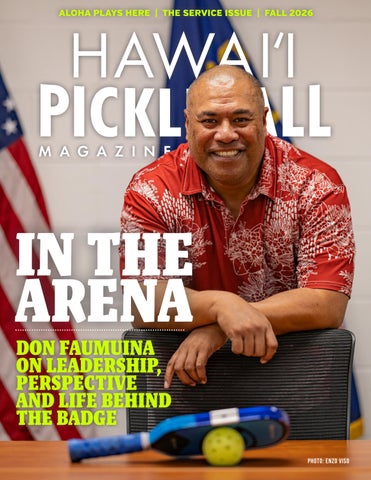
ALOHA PLAYS HERE | THE SERVICE ISSUE | FALL 2026
IN THE ARENA DON FAUMUINA ON LEADERSHIP, PERSPECTIVE AND LIFE BEHIND THE BADGE
Photo: Enzo Viso
YOUR CITY. YOUR TEAM. WHO WILL OWN THE COURT? CITY SHOWDOWN
TM
HONOLULU 2026
Hawaiʻi’s f irst city-vs-city pickleball competition November 20-21, 2026 | Pickles at Forté • DOHO
REPRESENT YOUR CITY CLICK TO REGISTER NOW
FROM THE EDITOR
Fall 2026 I’ve been thinking a lot lately about the people behind the things we enjoy, the ones who organize, mentor, referee, volunteer, and take on the work that often goes unseen. This issue is about them. On our cover, Don Faumuina wears a lot of hats; police officer, union president, father, pickleball player and even DJ. The roles are different, but the thread running through them is the same: service. Inside, you’ll meet others who bring that same spirit to our pickleball community in their own ways. I’ve seen it firsthand while preparing for our inaugural City Showdown™. Our ambassador team has not only helped to promote the event; they helped shape it. They questioned ideas, challenged assumptions, and wrestled through details with me. City Showdown will continue to evolve, but what you see today is better because of the people who cared enough to help build it. So, as you read this issue, I hope you think about the people who make a difference in your own corner of the game, and maybe about where you might step in, too. Service doesn’t always make headlines, but it always makes a difference. Let’s carry that spirit forward together. Aloha, Jen Wilson Editor, Hawaii Pickleball Magazine HPM hawai i p i c kl ebal l magaz i ne | FALL 2 0 2 6
3
HAWAI‘I EDITION | ISSUE #17 | FALL 2026
ALOHA PLAYS HERE. ALL LOCAL. ALWAYS. PROUDLY PUBLISHED BY HAWAII PICKLEBALL MEDIA GROUP
WITH GRATITUDE TO THIS MONTH’S CONTRIBUTORS: Tracey Bennett, Referee Column Christine Lynders, PT Playbook Dr. Mel Ona, Gut Check Jana Chang, Keiki Court Eland Tsubata, Pickleball Passport Shari Dang, Recipe Enzo Viso, Cover Photographer @shotby.ozne Spenser Jaye, Feature Photographer @sjayephotography
MAHALO TO EVERYONE WHO HELPED BRING THIS EDITION TO LIFE!
4
hawa i i p i ck l e b a ll magazi n e | FAL L 2 0 2 6
IN THIS ISSUE: 3 FROM THE EDITOR 6 REF CORNER NOT CALLING THE SCORE
8 PT PLAYBOOK
WHY POSTURE BELONGS IN YOUR GAME PLAN
10 GUT CHECK
5 THINGS THAT A GASTROENTEROLOGIST WANTS EVERY PICKLEBALL PLAYER TO KNOW
12 COVER FEATURE
BUILT TO SERVE From Kalihi public housing to patrol to SHOPO president, Don Faumuina has built a life around showing up for people.
30 CITY SHOWDOWN™ IN A NUTSHELL FOUNDER Q&A
32 KEIKI COURT
OUR NEW KEIKI COLUMN AND A Q&A
36 RECIPE
ISLAND-STYLE FURIKAKE BAKED SALMON
38 GAME CHANGERS
JAMIE DELGADILLO
44 READY TO COMPETE
Q&A WITH GAMEDAY MEN’S HEALTH KAILUA
46 BAG BREAKDOWN A CLOSER LOOK AT REFLECTSPORT
48 DINKING AROUND THE WORLD
WHERE WE’VE PLAYED
50 PICKLEBALL PASSPORT FROM HONOLULU TO KUALA LUMPUR
54 BEYOND THE ISLANDS HAWAII ON TOUR
58 GEAR GUIDE
BEAT THE HEAT Twelve picks for playing well when it's hot out there.
62 PALAMA SETTLEMENT
HISTORY AT THE COURTS
70 NEXT SERVE: FAMILY, FAITH AND A NEW BEGINNING A HUI HOU, AIRI KURIHARA
77 BEYOND THE GAME
OUR HAWAI‘I PICKLEBALL COMMUNITY MAKING AN IMPACT FAR BEYOND THE SCORE.
90 GAME CHANGER: DONJA MORTON
CALLED BACK TO SERVE
94 EVENT RECAP:
JOINT LEGISLATIVE PICKLEBALL FUN EVENT
104 UPCOMING EVENTS
56 AROUND THE 808
LIHUE'S PICKLEBALL OHANA SUITS UP
© 2026 Hawaii Pickleball Magazine. All rights reserved. We love sharing our community’s stories — please don’t reuse without permission.
hawai i p i c kl ebal l magaz i ne | FALL 2 0 2 6
5
ADVICE REFEREE CORNER
REFEREE CORNER WITH LEVEL 2 REFEREE TRACEY BENNETT I reffed the Hawaii Senior Games in 2018. (Four days with too little sleep. Bleary. Ugh.) Got my L1 badge in 2022. By mid-2023 I'd reffed 400 games in rec play and tournaments from Mililani to Kailua. Earned my L2 ranking in September 2023.
6
hawa i i p i ck l e b a ll magazi n e | FAL L 2 0 2 6
YOUR BURNING COURT QUESTIONS ANSWERED Q: There’s one in every pickleball group: a player who serves without calling the score. What can you do about that? What *should* you do? A: In pickleball, calling the score before every serve isn’t just etiquette, it’s part of the rules. It keeps everyone aligned and prevents disputes. So when the server skips it—especially when their team racks up points—it’s not just a quirky habit: it can rattle your grip on what the correct score is. What can you do? No need to treat it like an Olympic fault. Keep it light: a simple “Score?” or “What’s the score?” before they serve. You could address it casually after a game: “Hey, could you call the score before serving? It really helps everyone stay on the same page.” Frame it as a group benefit, not a personal criticism. A spoonful of sugar, and all that…. [Please tell me you recognize this reference to “Mary Poppins.”] If scorelessness (new word!) bugs you, toss the ball back. “Score, please.” After a rally say, “Hey, can you call the score before serving? Helps me keep track.” What should you do, especially if it’s a player’s habit? Maybe nothing. If the previous suggestions haven’t worked, decide if it’s worth ruffling someone’s feathers in rec play. Some folks are touchy, right?
What you shouldn't do: don’t escalate mid-rally or argue a point because of it—that creates more friction than the original issue. Don’t assume bad intent. Some players are used to informal games. And some are adorably set in their ways. FYI: Someone introduced a rules amendment last year that scorecalling is required. It didn’t pass, but maybe this year it will. One final note: When starting a match, I once called the score “zero-zero-four.” Players still tease me about it.
FYI: When starting a match, I once called the score “zerozero-four.” Players still tease me about it.
PSA: Got mold and germs in your water bottle? (Do pickleballs have holes?) How to Clean a Water Bottle the Right Way
Have you had an interesting rules issue on the pickleball court? Email me: Tracey2@hawaii.rr.com Oh, you haven’t read the rules? It’s time. Get your red-hot rules here: 2026 USA Pickleball Official Rulebook.
hawai i p i c kl ebal l magaz i ne | FALL 2 0 2 6
7
THE PT PLAYBOOK
THE HIDDEN FACTOR AFFECTING YOUR GAME WHY POSTURE BELONGS IN YOUR GAME PLAN Most pickleball players focus on their paddle, footwork, or strategy, but many overlook one of the biggest factors affecting performance and injury prevention: posture. Your posture is the foundation your body moves from during every reaction on the court. When your body is aligned well, you move more efficiently. You rotate better. You balance better. You generate power more easily. And perhaps more
importantly, you reduce stress on your neck, shoulders, hips, and lower back. Unfortunately, many of us spend hours sitting or looking down at devices, which can gradually pull the shoulders forward and place the body in a less-thanoptimal position for movement and sport. The good news? Small changes make a big difference.
Try My Wall Posture Test Stand with your upper back, and buttocks against a wall. Now check: can the back of your head comfortably touch the wall without lifting your chin to get it there? If not, count how many fingers you can fit between your head and the wall. Are your shoulders rounded forward or can you squeeze them back to touch the wall? If getting your head to the wall isn't possible, your posture may be limiting your movement and placing extra stress on your body during pickleball.
8
hawa i i p i ck l e b a ll magazi n e | FAL L 2 0 2 6
Why Posture Matters in Pickleball Rounded posture can reduce neck and shoulder mobility and limit your precision with overhead shots and serves. Forward head posture can strain the neck and upper back muscles. This poor alignment may affect balance and power transfer throughout the body. Simply put, your body performs best when it is stacked and aligned well.
Three Simple Exercises to Improve Posture 1. Doorway Pec Stretch Stand in a doorway with your forearms resting on the sides of the frame. Step one foot forward gently until you feel a stretch across the front of your chest. Inhale deeply three times to enhance the stretch. This helps open tight chest muscles that pull the shoulders forward.
2. "W" Shoulder Blade Squeeze Stand tall with your arms in the shape of a "W" as shown. Move your hands back and squeeze your shoulder blades together. Repeat 10–15 times. This helps wake up the muscles that support good posture and spinal alignment.
3. Chin tuck Nod your chin down towards your chest to stretch the back of your neck and improve your head alignment. Now, retry the wall test to see if you're closer!
Final Thoughts Posture is about creating better alignment so your body can move efficiently and powerfully. Posture can improve at any age. Small posture changes practiced consistently can dramatically improve how you move, feel, and play on the court. Your best pickleball may start right now! Pickleball is a lifelong game. With smart habits, you can keep competing, connecting, and thriving on the court! Reach out for a free consultation and guidance in setting up a personalized strength training routine.
Aloha, Christine Lynders, PT, OCS, CAFS, PCES Physical Therapist, Author, Speaker 858-829-3901 yourvirtualphysicaltherapist.com clyndersrun@gmail.com
hawai i p i c kl ebal l magaz i ne | FALL 2 0 2 6
9
GUT CHECK BY MEL A. ONA, MD, MS, MPH, MA
YOUR GUT
5 THINGS THAT A GASTROENTEROLOGIST WANTS EVERY PICKLEBALL PLAYER TO KNOW
Disclaimer: This article is for informational and educational purposes only and is not intended as medical advice. Always consult with your healthcare provider before making changes to your diet, supplement regimen, or health routine—especially if you have existing health conditions.
Aloha, Hawai‘i Pickleball ‘ohana! Pickleball is a game of quick decisions, sustained energy, and mental sharpness under pressure. Most players focus on drills, paddle upgrades (my favorite!), and court time. But here’s something I see every week in clinic: Your gut may be the hidden factor affecting your energy, focus, and recovery, especially as we move through our 40s, 50s, and beyond. After treating thousands of patients and performing thousands of procedures, here are five things I wish every pickleball player understood about their gut health, and how it impacts your game.
1. Your Gut Symptoms Are Not “Normal” Bloating after meals. Reflux before or after a match. Irregular bowel habits. These symptoms are common, but not normal. Too many people accept digestive issues as “just part of getting older” or “just how my body is.” I regularly see patients who have lived with symptoms for years that were never properly evaluated, and are often treatable once we look deeper. Think of gut symptoms as your body’s warning signals. Ignoring them doesn’t make them go away, it just delays the solution. If symptoms persist for more than a few weeks, it’s worth getting checked. Not panicking, just evaluating.
2. Supplements Won’t Fix What You Haven’t Diagnosed Walk into any store and you’ll see shelves filled with probiotics, powders, enzymes, and “gut health” products. Here’s the reality: If you don’t know what problem you’re trying to solve, supplements become guesswork.
10 hawa i i p i ck l e b a ll magazi n e | FAL L 2 0 2 6
I routinely see patients spending hundreds of dollars on products they found online, without ever identifying the root cause of their symptoms. Once we diagnose the actual issue, the plan becomes simpler, more targeted, and far more effective. Before taking a supplement, ask yourself: “What specific problem is this treating, and has that problem been diagnosed?” If not, you’re guessing.
3. Probiotics Are Not One-Size-Fits-All Probiotics are one of the most overhyped tools in gut health. They can be helpful, but only in specific situations, with specific strains, for specific conditions. For example, certain probiotics like Saccharomyces boulardii may help reduce the risk for antibioticassociated diarrhea when taken during a course of antibiotics. Other targeted strains may be useful in select cases of irritable bowel syndrome (IBS) or after certain gastrointestinal infections. Taking a random probiotic because “it’s good for your gut” often does very little, and in some cases, can actually worsen symptoms like bloating. I’ve had patients feel significantly better simply by stopping unnecessary probiotics and addressing the real issue. If you’re taking a probiotic, ask: ■ Do I know which strain I’m taking? ■ Do I know what it’s supposed to treat? ■ Has it actually helped me? If not, it may not be doing what you think.
4. Fiber Is the Most Underrated Performance Tool If there’s one thing I wish more players focused on, it’s this: Fiber. And not just more of it, more variety of it. Fiber feeds beneficial gut bacteria, supports regularity, stabilizes blood sugar, and is linked to reduced risk for colorectal cancer, heart disease, and metabolic disease. Yet most people don’t get enough, and tend to eat the same few foods repeatedly. For pickleball players, this matters: ■ Stable blood sugar = more consistent energy during matches ■ Better gut function = less bloating and discomfort ■ A healthier microbiome = better long-term performance and longevity A simple starting point: Add one new plant-based food to your diet each week.
The Bottom Line If you want to play well, and keep playing for years to come, your gut health matters. Start with the basics: ■ Don’t ignore symptoms ■ Don’t guess with supplements ■ Be thoughtful about probiotics ■ Increase fiber diversity ■ Stay up to date with screening You don’t need a complicated plan. You need a consistent one. (Just like winning pickleball, consistency is everything!) Your gut isn’t just about digestion. It’s part of your performance system. Take care of it, and it will take care of you. Mahalo, and I’ll see you on the court!
Here in Hawai‘i, we’re fortunate to have incredible options: sweet potato, taro, tropical fruits, local greens, and nuts. The goal isn’t perfection, it’s diversity.
About the Author:
5. Screening Saves Lives... And Many People Are Overdue
Dr. Mel Ona is a board-certified gastroenterologist, educator, and founder of ʻOhana Gastroenterology and ʻOhana Endoscopy Center in Kapolei, Hawai‘i. He serves as Chair of Gastroenterology at Pali Momi Medical Center and is a Clinical Assistant Professor at the University of Hawai‘i John A. Burns School of Medicine.
This is the most important one. Colorectal cancer is one of the most preventable cancers we have, yet too many people delay screening. Current guidelines recommend starting at age 45 for average-risk individuals, earlier if you have risk factors. I’ve performed thousands of colonoscopies. Just last month, I removed a precancerous polyp from a patient who felt completely fine, no symptoms, and no warning signs. That’s exactly why screening matters. Colonoscopy doesn’t just detect cancer...it prevents it by removing precancerous polyps before they become colorectal cancer. If you’re 45 or older, don’t overthink it: schedule it this month. If you’re younger, know your family history and talk to your doctor. One phone call can change your life.
Beyond his clinical work, Dr. Ona, alongside his wife, Jennifer, has been actively building the local pickleball community by hosting open play at Kamiloiki Community Park since 2023, bringing people together on and off the court. He is also the creator of “Gastro Truth,” a platform dedicated to cutting through misinformation and delivering evidence-based gut health guidance. Subscribe for weekly insights: www.youtube.com/@ DrMelOnaGI Side note: Dr. Mel is one-half of the very first feature in Hawaii Pickleball Magazine.
hawai i p i c kl ebal l magaz i ne | FALL 2 0 2 6
11
COVER FEATURE
BUILT TO SERVE FROM KALIHI PUBLIC HOUSING TO PATROL TO SHOPO PRESIDENT, DON FAUMUINA HAS BUILT A LIFE AROUND SHOWING UP FOR PEOPLE. BY JEN WILSON 12 hawa i i p i ck l e b a ll magazi n e | FAL L 2 0 2 6
Photo: Enzo Viso hawai i p i c kl ebal l magaz i ne | FALL 2 0 2 6
13
COVER FEATURE: DON FAUMUINA
DON FAUMUINA HASN’T SLEPT. He got off a 13.5-hour patrol shift at 7:30 this morning. By 10:30, he’s due at a promotion ceremony. In between, he plays pickleball for two hours, not to relax, he says, but to reset. “Dump all that opala from work,” he calls it. Then he’ll shower, put on a clean shirt, and show up for the next thing. 14 hawa i i p i ck l e b a ll magazi n e | FAL L 2 0 2 6
Photo: David Wetter
hawai i p i c kl ebal l magaz i ne | FALL 2 0 2 6
15
COVER COVERFEATURE: FEATURE DON FAUMUINA
16 hawa i i p i ck l e b a ll magazi n e | FAL L 2 0 2 6
Don is the president of SHOPO, the union representing roughly 2,500 police officers across all four Hawaii counties. But unlike many union presidents, he hasn’t been released from his regular assignment. He’s still working patrol: three days on, four off, 13.5 hours a shift, with the demands of the presidency layered on top. In some ways, that puts him exactly where he said he wanted to be when he campaigned for the job: alongside the officers he represents. He told members he wanted to lead from the front, not from an office. So when a contract issue or complaint comes up, Don isn’t hearing about it from a distance. He’s living it too. “I’m right there in the arena,” he says. “Right next to everybody, the one that just graduated, the 25-year veteran. We’re taking care of business together.”
WHERE IT STARTED When Don speaks to groups, he often starts with the same sentence: “I’m a product of the welfare system.” He grew up in Palolo public housing, moved to Kuhio Park Terrace around the sixth grade and later to Kam IV Housing. Most of his teenage and adult life, he says, was spent in Kalihi.
Growing up in public housing, Don says, he was surrounded by a “lack mentality”; the “I gotta get mine before you get yours.” His parents wanted something different for their children. He was the oldest of seven kids, the only one of his siblings born in Samoa. His parents immigrated when he was three and a half, looking for a better life. His mother was barely five feet tall and ran the household like she was daring anyone to test her. His father stood six-foot-three and rarely raised his voice, which was somehow worse. “When he speaks,” Don says, “that’s it.” In that neighborhood, a police car pulling up never meant anything good. Don knew that from the inside; not as a kid in trouble, but as a kid who watched what happened to the ones who were. He stayed out of it, mostly because his mother left him no room to do otherwise, and because at 14, he was introduced to a mentor named Faatea Faatea. Faatea brought kids from Kam IV and KPT together at a gym next to the Kalihi fire station. The two housing areas had an unspoken gang line between them. Bloods on one side, Crips on the other. The two groups didn’t mix.
hawai i p i c kl ebal l magaz i ne | FALL 2 0 2 6
17
COVER COVERFEATURE: FEATURE DON FAUMUINA
“I’ve learned this beautiful lesson that there’s abundance everywhere,” he says. “You just gotta know how to look for it.”And then share it, “because we get plenty.” Photo: David Wetter
18 hawa i i p i ck l e b a ll magazi n e | FAL L 2 0 2 6
Faatea brought them together anyway, through sports—first for basketball, then volleyball. “We found that common ground,” Don says. “We saw sports rather than color. Or territory.” It happened at exactly the age when the direction of a kid’s life can go one way or another. He’s stayed close with Faatea ever since.
THE OTHER SIDE OF THE SQUAD CAR The mentor, the neighborhood and the gym would shape Don’s understanding of community. But none of them were the reason he became a police officer. Don was working as a messenger at a law firm, one of a group of eight who got to know each other as they ran documents between law firms and the courthouse. Someone mentioned the police department was hiring. They all applied on a dare. Don was the first to make it through the academy. Three more followed, years later, once they saw it could be done. Twenty-six years in, Don is still working patrol, and his upbringing still shapes the way he approaches the people he encounters on the job. When someone gets arrested and mutters an apology afterward, he tells them he understands more than they might think; he knows what it’s like to grow up on their side of that divide.
“I’m not the enemy,” he says. “I’m here to show kids out there that look like me, to think…if he can do it, this boy from Kalihi, I probably have a chance.”
THE BLUE ’OHANA For four years, Don served on HPD’s peer support unit, a role he volunteered for and still calls his favorite assignment in more than 25 years on the job. The unit was there for officers, civilian staff, retirees and their families when life went sideways: a personal crisis, trouble at home, a death in the family, an officerinvolved shooting or, at its worst, the loss of an officer in the line of duty. Sometimes that meant showing up for a family. Sometimes it meant gathering officers in a room after an incident and talking story. The hardest part, Don says, was getting police officers to open up. “They’ve been trained to serve the community,” he says. But when they were the ones who needed help, asking for it didn’t come naturally. “It’s the trust that I think they had in me to say, ‘Alright, I’ll talk story with you.’” The work was 24/7. Don could be at a family party when the call came. He’d leave. “My job was to take care of our officers,” he says, “and their job was to take care of the community.” hawai i p i c kl ebal l magaz i ne | FALL 2 0 2 6
19
COVER FEATURE: DON FAUMUINA
The dedicated unit eventually disbanded, replaced by a larger rotating team of trained volunteers.
He says it took four years to prepare him for the position, and that meant looking inward first.
For Don, volunteering for peer support came back to something deeply ingrained.
“I had to change all these different things inside of me first,” he says.
He did it because, as he puts it, his “blue ohana” deserved the same care he would give his own family.
Even after the loss, members still reached out to Don when they needed help, and he kept showing up for them.
THE LESSON IN LOSING He’s president now, but it took losing first. Four years before he won, Don ran for the same position, against a classmate from his own recruit school, on nearly identical platforms. He lost. So did everyone on his ticket; not one of them got a seat. He was hurt, and he says so plainly: his ego took it hard. His wife was the one who put words to it; perhaps the members weren’t ready yet for his style of leadership. He didn’t like hearing it at the time, but he believes it now. Looking back, Don calls the loss a blessing in disguise. It humbled him. “It was the best thing that ever happened to me,” he says.
20 hawa i i p i ck l e b a ll magazi n e | FAL L 2 0 2 6
Then he picked himself up, dusted himself off, and got back at it. He didn’t wait for another election season to begin. He campaigned for three straight years, deliberate about the message he wanted to put out and thoughtful about the person he wanted members to see. When he ran again, he brought back the same team that had lost with him the first time. Everyone got in this time except two, and both of those seats went to officers from the opposing ticket whom Don now calls a blessing. He teaches a version of this story when he mentors younger officers now: in every setback, there’s a lesson and a blessing. The lesson, for him, was simple. He didn’t walk on water.
hawai i p i c kl ebal l magaz i ne | FALL 2 0 2 6
21
COVER FEATURE: DON FAUMUINA
22 hawa i i p i ck l e b a ll magazi n e | FAL L 2 0 2 6
hawai i p i c kl ebal l magaz i ne | FALL 2 0 2 6
23
COVER FEATURE: DON FAUMUINA
STILL IN THE ARENA As SHOPO president, Don’s job is to look out for roughly 2,500 officers across the state.
He brought that same clarity to cadets when he taught at the academy: treat everyone with aloha until they give you a reason not to. Then go do your job.
Every few years, SHOPO heads into fresh contract talks over pay, benefits, schedules, overtime and leave: the things that make officers’ lives better.
But for Don, taking care of officers also means recognizing the people who carry the weight of that job alongside them.
But representing officers also means stepping in when individual careers are on the line. There are members with pending discipline cases, badges and guns taken away, futures in limbo.
At a recent promotion ceremony, newly promoted officers’ families were invited onstage, with a loved one pinning on the new badge. The moment stayed with Don.
And sometimes, supporting an officer means acknowledging when that officer should no longer be on the job.
“You’re the one sacrificing too,” he told the families that day.
Not everyone gets to stay. “Some of them are a liability to the department and to the community,” Don says, without flinching. “I have to look at the big picture.” For Don, advocacy and accountability aren’t opposites. Both are part of taking care of the organization and the community it serves. His standard is simple: right is right, and wrong is wrong.
It’s the part of police work the public rarely sees: the family that absorbs the missed dinners, changed plans, long shifts and phone calls that pull someone away. Asked what keeps him up at night as SHOPO president, his answer comes quickly: receiving “that call” that one of their members has passed in the line of duty. Don says it took a few months in office before he fully understood “the magnitude, the kuleana of this position, and how much weight it holds.” And for Don, that kuleana is ultimately measured in people.
24 hawa i i p i ck l e b a ll magazi n e | FAL L 2 0 2 6
hawai i p i c kl ebal l magaz i ne | FALL 2 0 2 6
25
COVER FEATURE: DON FAUMUINA
Photo: Enzo Viso
26 hawa i i p i ck l e b a ll magazi n e | FAL L 2 0 2 6
A DIFFERENT KIND OF RESET
He tells the story almost as an aside, as though it barely registers as anything worth mentioning.
And then there’s pickleball.
“I’ve learned this beautiful lesson that there’s abundance everywhere,” he says. “You just gotta know how to look for it.”
It found him two years ago, on a night a friend’s volleyball scrimmage got cancelled. He didn’t own a paddle. He borrowed one, played for two hours, and ordered his own before he’d even left the parking lot. What hooked him was how quickly the game can upend your assumptions about the person standing across the net. He remembers an eighty-year-old aunty at Keehi Lagoon handing him an 11-1 loss and a body bag, then teaching him her tips afterward. You genuinely can’t judge a book by its cover in pickleball, he says.
And then share it, “because we get plenty.” For Don, service is less a role than a reflex.
LEAVING IT BETTER Don says he wants to leave SHOPO better than he found it. Better wages. Officers taken care of. A department that trains its own leaders instead of importing them.
He plays regularly with his son Jonah, who has bilateral hearing loss, the two of them trading trash talk that Jonah doesn’t always hear, which somehow makes it funnier.
Asked what he wishes the public better understood about today’s police officer, he comes back to empathy and perspective. Wrong is wrong, he says, but understanding also requires seeing things through a different set of lenses.
And after a long night on patrol, those hours on the court give Don a place to clear his head before moving on to whatever comes next.
Don knows that the view from the outside often doesn’t tell the whole story. “Anybody can talk when they’re not in the arena.”
Dump the opala. Reset. Show up again.
For Don, service has always started in the same place: close enough to see what people need, and willing enough to stay beside them. -HPM
Off the clock, Don calls himself a “mess”: a procrastinator, sentimental, quick to laugh at his own expense. On a recent flight home from Seattle, noticing a solo traveler stuck in a late boarding group, he used his own frequent-flyer status to get the stranger on board early.
hawai i p i c kl ebal l magaz i ne | FALL 2 0 2 6
27
COVER FEATURE: DON FAUMUINA
RAPID FIRE WITH DON No overthinking, straight from the hip. Morning or night? Morning. Even working nights, a 20-minute nap is enough, and I’m up happy. Dink or drive? Drive. Backhand or forehand? Backhand, the twoey. Dream doubles partner? Tama (Shimabukuro). And Keven (Wong). Favorite food? Every day steak. I’m a carnivore. Something people would be surprised to learn about him? I’m sensitive, I get hurt easily. Perfect day off? Small breakfast, morning pickleball, lunch, a nap, afternoon pickleball, drinks with friends, then more pickleball. Paddle? The Selkirk Omni, for the control.
28 hawa i i p i ck l e b a ll magazi n e | FAL L 2 0 2 6
Patrol officer. SHOPO president. Pickleball player. And, as it turns out, longtime DJ. Don has been DJ-ing for decades, and soon, he’ll be behind the music at the City Showdown celebration. We asked what’s making the playlist: If you could DJ one perfect set, what genre or era would dominate it? 80s. Think It Takes Two, Push It, Candy Girl. What’s one song you already know has to make the Friday night City Showdown playlist? Play At Your Own Risk by Planet Patrol.
hawai i p i c kl ebal l magaz i ne | FALL 2 0 2 6
29
CITY SHOWDOWN IN A NUTSHELL
™
WITH FOUNDER JEN WILSON City Showdown is new, and new things come with questions. So, we thought we’d address some of the questions we’ve been hearing, Q&A style—why we started it, why it’s built the way it is, and what makes it different from anything else on the Hawaii pickleball calendar. Q: What made you start City Showdown? We spent three years telling this community’s stories. Readers got to know the players, but only from behind the page. Last year, we brought a bunch of our people together for our anniversary celebration, and having everyone in the same room, in person, was pretty incredible. That’s what we wanted to build on. A few things kept coming up for me. Where you grew up, where you live, where you play—it all matters in Hawaii. Every neighborhood has its own character, its own court, its own crew, and we wanted an event that highlighted that culture and, at the same time, celebrated our entire community. I also started playing in a league, on a team. Spending time with my teammates is the highlight of my week, and most of all, I love how my team’s got my back no matter how I play. That feeling of competing alongside and with your crew was the thing I wanted to create. It’s different from a bracket of players who may or may not know each other, trying to find the best partner to chase a medal.
30 hawa i i p i ck l e b a ll magazi n e | FAL L 2 0 2 6
Put all of that together: celebrating a room full of people who’d only existed on a page, a competition where you play for your home court, with a crew that believes in you on your worst day. That’s City Showdown.
Q: What happens at City Showdown that doesn’t happen anywhere else? Let’s recalibrate first: City Showdown isn’t a tournament. It’s an event with a tournament inside it. Home court pride is one of the main reasons it exists, so we built a full evening around it. On Friday night, there’s a red carpet opening ceremony where we celebrate all of the teams. Then, the whole room will raise a glass together for the City Showdown toast. We’ll have raffles, a festive vendor village, mixer games that push crews from different courts to actually meet each other. But here’s the part that matters most. Your team might be four players, but your home court crew is ten, fifteen, maybe more. When you compete, you’re competing for that whole crew. If your team wins, the prize goes home with you--a mini celebratory home court picnic for you and your home court crew.
Q: The tournament caps at 4.0 skill level. What’s the reason behind that decision? We wanted City Showdown to serve the broadest section of our community, and we felt that advanced beginners through intermediate levels is where most of Hawaii’s pickleball players actually are. We also decided to build it intentionally small, in order to get it right before going broader. Give the players who show up an exceptional experience, learn everything we can from running it, and use that intel to grow it thoughtfully.
Q: Why can’t you add another mixed game to emulate a true MLP-style format (WD, MD, MXD, MXD)? We talked about it. But every game is another block of time, and a second mixed game adds real minutes to every single matchup. When we set out to build City Showdown, one of the main goals was to respect players’ time. That’s how we landed on three games per match.
FRIDAY NIGHT: WHAT TO EXPECT City Showdown doesn’t start on the court on Saturday. It starts the night before, with the whole community in one room. ■ Red carpet opening ceremony: we celebrate every team as they walk up on stage ■ The City Showdown toast with the entire room, together
■ Mixer games: because players told us the best part of playing outside their own court is meeting the crews on the other side of the net ■ Deck the Courts Holiday Vendor Village: local vendors and celebratory holiday market energy
■ A curated bar and DJ, because a celebration should feel like one ■ Registration is open. REGISTER FOR CITY SHOWDOWN Watch how we announced it: NOW BOARDING: CITY SHOWDOWN
CITY SHOWDOWN™ — THE FORMAT, AT A GLANCE Here’s how it works.
WHEN & WHERE ■ November 20–21, 2026
SATURDAY: THE TOURNAMENT
■ Pickles at Forté, Downtown Honolulu
■ Two divisions
FRIDAY NIGHT: THE EXPERIENCE
■ Intermediate Division: PM start
■ 5:00–9:00 PM ■ Red carpet opening ceremony ■ The City Showdown toast
■ Advanced Beginner Division: AM start
■ Each match: 3 games: WD, MD, MXD ■ Three matches = 9 guaranteed games ■ Round robin pool play
YOUR TEAM
■ Top four teams in each division advance to medal matches
■ 4–6 players (4 players = 2M/2W minimum)
REGISTRATION
■ Mixer games
■ Up to two extra roster spots
■ Deck the Courts Holiday Vendor Village
REPRESENTATION
■ A curated bar and DJ
HOW YOU PLAY
■ Each team represents a city, neighborhood, home court, facility or club
■ $100/player early bird ■ $125/player standard ■ Build your team. Rep your city. See you in November. CLICK TO REGISTER YOUR TEAM
hawai i p i c kl ebal l magaz i ne | FALL 2 0 2 6
31
KEIKI COURT
32 hawa i i p i ck l e b a ll magazi n e | FAL L 2 0 2 6
KEIKI COURT
MEET JANA CHANG, HPM'S KEIKI COURT COLUMNIST Jana didn't set out to coach kids. She was teaching adult clinics when two students, ages 7 and 10, changed her mind about what she was supposed to be doing. Jana has a Ph.D. and decades of experience in education, and now, she brings it all to the court. Each issue, she'll cover coaching, tips, and the people making keiki pickleball happen in Hawai‘i.
How do you teach pickleball differently to kids than to adults? As learners, kids are very different from adults. They tend to process things more kinesthetically (with their bodies) and visually, so we break down what we'd like them to do and then set up drills to help them to be successful. Their attention spans tend to be shorter, so we keep everyone moving and try to minimize wait time. Kids tend to have an abundance of energy and love doing footwork and agility drills. When we can, we teach as a team and take turns in different roles: ball feeder, safety monitor, hype person, coach and cheerleader. As coaches, it's important to observe what's working and to be flexible enough to adjust if something isn't getting the result you intended. Aside from that, something that might make me unique as a coach is that I see pickleball as an opportunity to build leadership on and off the court. All of our students are role models and have kuleana to exhibit outstanding sportsmanship, build positive relationships, and play with a sense of purpose that contributes to a vibrant community. We represent a sport that brings out the best in people.
hawai i p i c kl ebal l magaz i ne | FALL 2 0 2 6
33
KEIKI COURT I'd like to get my 10-year-old started in pickleball. Where do I begin? I think the best way to get kids interested in pickleball is to figure out a way to expose him/her to the game in the most engaging and fun way possible! Kids love playing with their ʻohana so get out there and have some fun. Look for family pickleball events and participate as a family. And once they think it's the most fun thing in the world, find a coach who can transform that interest into a love for the game. Most 10-year-olds can manage a lightweight adult paddle but I like to start kids off with a keiki paddle that weighs less than 7 ounces. Once they can execute a swing that leverages their whole body, there's less risk of a shoulder or arm injury. Ask the coach how you can support your child's growth and success. One way to do that is to learn different ways to feed balls to keiki. A five-year-old can hit a forehand drive over the net; it starts with a low feed that allows him to hold the paddle horizontally, bend his knees, and accelerate through the ball with a big smile!
ABOUT JANA CHANG: Coach Jana is the founder of Conscious Pickleball and teaches at Pickles at Forté. A certified IPTPA junior coach with a PhD in Education, her approach to keiki learning emphasizes high engagement, sound mechanics, and progressive improvement.
34 hawa i i p i ck l e b a ll magazi n e | FAL L 2 0 2 6
Kahanu’s uncle learned to drop the ball low and slow. Notice how Kahanu’s knees are bent and his eyes are focused on the ball.
ALOHA PL AYS
HERE | THE SE
RVICE ISSUE |
FALL 2026
IN THE ARENA
DON FAUMUINA ON LEADERSHIP, PERSPECTIVE AND LIFE BEHIND THE BADGE
Pho to: Enz o Vis o
RECIPE: ISLAND-STYLE FURIKAKE BAKED SALMON
36 hawa i i p i ck l e b a ll magazi n e | FAL L 2 0 2 6
Island-Style Furikake Baked Salmon Reader Shari Dang sent us this one, and we knew immediately it had to run. This is pure island comfort, straight from her kitchen to yours. INGREDIENTS ■ ■ ■ ■ ■ ■ ■
Kewpie mayonnaise Furikake Wasabi sauce Unagi sauce Shichimi powder Green onions Salmon (slab or slices)
INSTRUCTIONS 1. Preheat oven to 350°F 2. Place the salmon on a baking sheet lined with tin foil, leaving it uncovered 3. Mix the wasabi and Kewpie mayonnaise to your preferred spice level. Spread the mixture evenly over the salmon 4. Apply a light drizzle of unagi sauce over the top
5. Bake for 20–25 minutes, depending on the size of the salmon. Be careful not to overbake. Check the fish at the 18-minute mark with a fork to see if it flakes easily 6. Remove from the oven and liberally sprinkle with nori furikake 7. Top with fresh chopped green onions and sprinkle shichimi powder if desired
Have a recipe to share? Email us your island-inspired recipe here.
hawai i p i c kl ebal l magaz i ne | FALL 2 0 2 6
37
GAME CHANGERS
38 hawa i i p i ck l e b a ll magazi n e | FAL L 2 0 2 6
PLAYING WITH PURPOSE
JAMIE DELGADILLO ON COMPETITION, LEADERSHIP, GIVING BACK AND BRINGING HAWAII’S PICKLEBALL COMMUNITY TOGETHER FOR A CAUSE. BY JEN WILSON
Jamie and I are league teammates and truth be told, I was a little scared of him when we first met. Now? I’m so glad that he’s on my team. I discovered that underneath that serious game face is someone who is encouraging, generous and deeply committed to the people around him. And, as I learned while working on this story, that extends far beyond the pickleball court. By day, Jamie Delgadillo is Managing Partner of Northwestern Mutual Hawai‘i, and after hours and on most weekends, you can find him on the pickleball courts. I sat down with Jamie to talk about business, life, giving back and, of course, pickleball.
PICKLEBALL When did pickleball come into your life, and what pulled you in? 2021. I was at the Hawai’i Chapter retreat for Entrepreneur’s Organization at the Four Seasons KoʻOlina and we had a pickleball clinic and a fun tournament. I was partnered with a friend. We played with wooden paddles and won the tournament. I was hooked!
What were you expecting, and what actually happened? I was expecting to be a great player quickly. Instead, I had a lot to learn and then I partially tore my calf, setting my progress back.
THE WORK You’re the Managing Partner of Northwestern Mutual Hawai‘i. For readers who may not know what that means, what do you actually do? My job is complex but can be simplified in this way: I am responsible for finding talent, developing that talent and leading the firm to a vision.
What would you want someone who's never heard of Northwestern Mutual Hawai‘i to understand about what you're actually building here? The mission of our firm is, “elevating the trajectory of people’s lives.” I love how that encompasses all that we do across our entire ecosystem – our clients, the people in our firm, our families and our community. 80% of the Financial Advisors we bring into our firm are like I was 20 years ago, in a completely different career and dissatisfied in some way. They want a bigger opportunity to grow professionally, to grow in their financial opportunity. They want to have a big positive impact on others with the work they do. They want to earn to ability to have more control and more freedom and flexibility in their lives and career. Our job is to help them to achieve all of that, thereby elevating the trajectory of their lives and that of their families, doing the same for their clients and ultimately lifting our community. hawai i p i c kl ebal l magaz i ne | FALL 2 0 2 6
39
GAME CHANGERS What does it take to build something people trust with their financial future? Be genuine. Provide a great experience. Be knowledgeable.
You're in the business of helping people plan for what they can't see coming. How does that shape how you think about your own life? A big aspect of leadership is helping others to see the potential in themselves that they can’t see quite yet. Another is setting an audacious vision for the organization and then making it come to life. I want to accomplish things others would never have thought possible.
WHERE PICKLEBALL FITS You're managing a demanding practice. Where does pickleball fit: escape, outlet, something else? I love pickleball because it is something where I can’t afford to allow my mind to wander and I can’t dwell on the last mistake or the last success. I need to be fully present in each moment or it doesn’t work.
How would your league teammates describe your game? I hope they experience me as both fiercely competitive and very supportive. I’m an optimist. I know, regardless of the score, we can always get on a run and win. When a teammate gets down about a mistake they have made, I like to say “Don’t worry about it. The next shot is the only one that matters.”
What part of your game are you still working on? In pickleball, as in life, I am working on patience. I naturally want to find the opening to take advantage of. Nothing wrong with that, but I sometimes lose patience and force the wrong shot.
40 hawa i i p i ck l e b a ll magazi n e | FAL L 2 0 2 6
hawai i p i c kl ebal l magaz i ne | FALL 2 0 2 6
41
GAME CHANGERS PICKLING WITH PURPOSE Jamie’s professional world and his pickleball world might seem separate. This year, they’re coming together around a cause that hits close to home.
Tell me about Pickling with Purpose. Where did the idea come from? As a firm, Northwestern Mutual Hawai’i set a goal for 2026 of raising $100,000 for the new Martha B Smith Cancer and Infusion Center at Kapiʻolani Medical Center for Women and Children. It’s such a great organization and cause. For the work they do, this new center is sorely needed. We were thinking of ways we could bring the community together with a portion of our fundraising efforts and doing a fun tournament seemed like a natural fit.
What does it mean to you personally to put this event on? My father is in remission from Hodgkins Lymphoma. I vividly remember the day he told me. He would tell you that his Oncologist is the best physician he has ever worked with and how grateful he is for her. I’m excited we can help our community and bring people together to have fun while doing it.
What do you hope someone feels walking off that court at the end of the day? I hope people have a blast competing, enjoy the extra touches we created with lunch, a lucky draw, and a pau hana, love that they are contributing to a great cause and walk away thinking that’s the best fun tournament they have ever participated in!
Why this cause? Cancer, especially childhood cancer, is an issue that touches all of us in some way. We all know someone who has had cancer or we have been directly impacted ourselves.
WANT TO PLAY? To register for our tournament benefiting Kapi‘olani Medical Center, visit our Eventbrite site here:
PICKLING WITH PURPOSE - PICKLEBALL TOURNAMENT
FBO Kapiolani Medical Center • Saturday, September 26, 8 AM - 5 PM We also have a limited number of sponsorships still available, please reach out for details.
42 hawa i i p i ck l e b a ll magazi n e | FAL L 2 0 2 6
hawai i p i c kl ebal l magaz i ne | FALL 2 0 2 6
43
GAMEDAY MEN’S HEALTH KAILUA
READY TO COMPETE
You take your game seriously. You train. You prepare. You want to perform when it counts. But performance isn’t just about what happens on the court – recovery, energy and what’s happening inside your body matter too. 44 hawa i i p i ck l e b a ll magazi n e | FAL L 2 0 2 6
SPONSORED CONTENT This Q&A was produced in partnership with Gameday Men’s Health Kailua, a City Showdown™ sponsor.
Tournament competition asks more of your body than even a hard practice session: more matches, shorter recovery windows and the pressure to perform when the score gets tight.
laterally, stopping, starting, reaching and accelerating over and over again. Add competition and adrenaline, and people tend to push past fatigue that they might normally listen to.
HPM: When someone says, “My energy is down, I’m not recovering like I used to, and I assume it’s just age,” how do you determine whether there’s something else going on?
We caught up with Mark Ball, owner of Gameday Men’s Health Kailua, about how serious players can prepare, recover and give themselves the best chance to perform when it counts.
Everyone thinks about their paddle, their shoes and whether they’ve practiced enough. But the work you do between matches and between playing days matters too.
Mark: Age is certainly a factor, but it isn’t the only or even main reason you feel that way. Our testosterone is 50% lower than it was 40 years ago; this impacts energy, recovery, and performance in all facets of life.
HPM: Before we talk performance and recovery, tell us a little about you. How did you end up in men’s health? Mark: I’m a Navy veteran, and after the military I worked at companies including Airbnb and Meta. Ten years in the Navy and time in Big Tech will teach you a lot about performing under pressure, often without enough sleep or recovery.
Come in rested. Hydrate. Eat enough. Warm up. Don’t suddenly triple the amount of pickleball you’re playing the week before the tournament. And if your body has been sending you a warning sign for three weeks, tournament adrenaline isn’t going to magically fix it. The goal isn’t just to play hard this weekend. It’s to still be playing next weekend, and years from now.
Mark: Drive, every time. The Navy doesn’t teach patience. Also, I’m still bad at dinking.
If you want to compete at your best, the game plan is pretty simple: show up rested, hydrate, eat enough, warm up, don’t overtrain in the days leading up to the event and don’t ignore something your body has been trying to tell you.
That experience is a big part of why I got into men’s health. A lot of men feel a change in their energy, recovery or overall performance and simply assume that’s what getting older feels like. I became interested in helping people ask more questions instead of just guessing.
Because the goal isn’t only to compete hard at City Showdown. It’s to give yourself the best chance to compete well, and to keep showing up for a long time after the final point is played.
ABOUT GAMEDAY MEN’S HEALTH KAILUA
HPM: City Showdown means multiple matches, shorter recovery windows and a little extra adrenaline. If someone wants to compete hard and play their best, what should they be thinking about before tournament day and between matches?
In a tournament, you’re playing multiple matches with less recovery time in between. You’re moving
HPM: Last one. Dink or drive?
THE TAKEAWAY
In my 30s, I hit a point where I felt like I was doing everything right. I was training, eating well and trying to sleep enough, but I wasn’t bouncing back the way I used to. I eventually had bloodwork done and started looking more closely at what was happening inside my body.
Mark: That recovery is part of performance.
Our job (at Gameday) is to look under the hood, so to speak, and see if there is a hormonal imbalance. And if there is, treat it with a professional.
Gameday Men’s Health Kailua provides men’s health services including comprehensive lab testing, hormone evaluation and treatment, sexual wellness, weightmanagement programs, and physician-guided therapies.
WATCH:
Inside Gameday Kailua: A 60-Second Tour hawai i p i c kl ebal l magaz i ne | FALL 2 0 2 6
45
BAG BREAKDOWN
A closer look at ReflectSport
Donna Slagill, founder of Hawaiian Style Pickleball and organizer of the epic Saturday night open play at Ewa Mahiko, gives us a closer look at her favorite pickleball bag, walking through the storage, compartments and thoughtful details that make it work for her. 46 hawa i i p i ck l e b a ll magazi n e | FAL L 2 0 2 6
WATCH THE BAG BREAKDOWN... Take a closer look inside
SMART STORAGE Adjustable interior compartments allow you to customize the space for balls, clothing, injury supplies and whatever else you bring to the court.
PADDLE SPACE Dedicated slots hold up to four paddles, keeping them separated and protected.
THE LITTLE DETAILS A small pocket useful for small items, like sunscreen, hand sanitizer, or lip gloss.
HER FAVORITE FEATURE A separate lower shoe compartment keeps footwear away from the rest of your gear.
INTERESTED IN THE BAG? Donna has an affiliate discount available. Contact her directly at (888) 555-1234 for her code. Retail price: $169.90. DISCLOSURE: Donna is an affiliate for ReflectSport and may earn a commission from purchases made using her code. She chose to represent the brand after becoming a fan of the bag herself. Hawaii Pickleball Magazine does not receive any affiliate income from purchases. hawai i p i c kl ebal l magaz i ne | FALL 2 0 2 6
47
DINKING AROUND THE WHERE WE’VE PLAYED
BAINBRIDGE ISLAND, WASHINGTON Aloha Pickleball
NAIROBI, KENYA Lihue PB Ohana
48 hawa i i p i ck l e b a ll magazi n e | FAL L 2 0 2 6
WORLD
Pin Yourself on the Map!
Playing pickleball somewhere amazing? We'd love to see it. Submit a photo of yourself on the court anywhere on the mainland or abroad, and we'll feature you right next to your pin on our world map. Submit your photo HERE.
HOKKAIDO, JAPAN Jen Wilson TOKYO, JAPAN Toshiko Jager
TOKYO, JAPAN Rick Komori
KUALA LUMPUR, MALAYSIA Eland and Xiao Yi
ROSALES, PHILIPPINES Rommel and Amy Ventura
SINGAPORE Eka McClelland
SYDNEY, AUSTRALIA Eka McClelland hawai i p i c kl ebal l magaz i ne | FALL 2 0 2 6
49
PICKLEBALL PASSPORT
Eland and Xiao Yi
50 hawa i i p i ck l e b a ll magazi n e | FAL L 2 0 2 6
FROM HONOLULU TO KUALA LUMPUR ONE COACH, ONE PRO, AND A PICKLEBALL SCENE THAT FEELS A LOT LIKE HOME By Eland Tsubata Xiao Yi (who graced this magazine’s cover and is now competing on the professional tour in Asia) and I moved to Kuala Lumpur in the end of January. She's chasing the pro tour. I am her pickleball coach and trainer. Oh, and I also have the honor of being her entire support team, including but not limited to: nutritionist, physical therapist, therapist, coach, travel agent, grocery manager, Grab aficionado, and most importantly, luggage mule. I had never been to KL before. There are a few reasons we chose it—English is widely spoken here, so we're able to talk and connect with everyone, and pickleball is surging in Malaysia, which puts us in a great location full of opportunities. Growing up in Hawaii means that wherever you relocate, it will not be Hawaii. You will miss the beach, the food, the weather, and the people. But for those who have been fortunate enough to travel or live in Malaysia, I think they would agree—luckily, it is not too different. The food is great, the weather is
good enough, the people are warm and welcoming. The beaches have sand and salt water. What more can I ask for? There are other small things that feel familiar too. Haole koa, monkeypod trees, and plumeria are everywhere. There's an aboveground rail that took a while to build and was quite expensive. And traffic jams—all day, every day, even with the rail running. So what is pickleball like in Malaysia? One of the amazing aspects about the sport is that, in all of my travels, the culture and community has been consistently positive and kind. I think it's an inherent core trait of pickleball—its ability to consistently produce a positive, enthusiastic, friendly community. It doesn't matter where you go. The people who love this game will welcome you to open plays and social games as if you were a local. Sure it helps to get invites if you are an above average player, but I can guarantee you there is a group out there just waiting to welcome you in. hawai i p i c kl ebal l magaz i ne | FALL 2 0 2 6
51
PICKLEBALL PASSPORT
52 hawa i i p i ck l e b a ll magazi n e | FAL L 2 0 2 6
There are similarities in the game between here and back home. Beginners are reluctant to come up to the net after returning a serve and too many balls bounce instead of being taken out of the air. Not only are the communities very similar—people make the same old beginner mistakes too. Isn't that comforting to hear? For any pickleballers heading to Malaysia: players here use an app called Reclub to join open play sessions. Anyone can host by booking a court and posting the session on the app—it's a simple, well-organized system. One thing I genuinely appreciate about the scene here is how many competitive local tournaments there are to play in. If there's one thing Oahu is missing, it's more tournaments for competitive local players. If any of my KL pickleball friends are reading this—mahalo for being so kind and welcoming to us. And if you ever make it to Hawaii, we will be ready to welcome you with aloha.
ABOUT ELAND: Aloha, my name is Eland Tsubata and I am proudly born and raised in Honolulu. After graduating from Willamette University in 2015, I continued playing baseball abroad in Australia, Sweden, and South Africa. Had it not been for the pandemic I would have kept traveling and playing. Before leaving for Malaysia I had been working in the boarding program at Iolani school since 2020. I am now a full-time pickleball coach and trainer. If you play pickleball and are looking to level up your game, you can follow me on Instagram @alohapickleballcoach.
hawai i p i c kl ebal l magaz i ne | FALL 2 0 2 6
53
BEYOND THE ISLANDS
54 hawa i i p i ck l e b a ll magazi n e | FAL L 2 0 2 6
BEYOND THE ISLANDS
Homegrown: Islanders on Tour Maui State of Mind:
Oahu Represent:
Maui was well represented on the winner’s podium at MLP Chicago! Kimmie Ouchi and Jeff Giesea, both members of the Houston Hammers, helped their team capture the MLP Champions Series Premier Division title—the highest level of senior pro pickleball competition.
Tama Shimabukuro is having a banner year on the pro tour. The 15-year-old Honolulu phenom made his first PPA Championship Sunday at the Veolia Atlanta Pickleball Championships, taking silver in men’s singles after wins over Federico Staksrud and Hunter Johnson. He followed that with mixed doubles gold and men’s doubles silver in Kuala Lumpur, then double gold in men’s singles and men’s doubles at the Macao Open.
FBI (From Big Island): Hilo’s Kiora Kunimoto continues her breakout season. The 18-year-old reached the women’s singles semifinals at the Veolia Atlanta Pickleball Championships, knocking off No. 4 seed Brooke Buckner before pushing world No. 1 Anna Leigh Waters to three games. She followed that run with women’s singles bronze at the PPA Asia 500 Sansan Tokyo Open.
Jamie and Prycen Haas, the Kailua-based husband-andwife duo, captured mixed doubles gold at the inaugural Base X Pickleball Austrian Open, with Jamie adding bronze in women’s doubles. Earlier in the season, Jamie also won women’s doubles gold at the PPA Tour Asia Macao Open. Honolulu’s Xiao Yi WangBeckvall added another international medal, teaming with Nok Yiu Tang to capture women’s doubles silver at the PPA Asia 500 MB Ho Chi Minh City Open in Vietnam.
hawai i p i c kl ebal l magaz i ne | FALL 2 0 2 6
55
AROUND THE 808
LIHUE'S PICKLEBALL OHANA SUITS UP TEN YEARS IN, A KAUAI CLUB MARKS A DECADE OF ALOHA WITH ITS VERY FIRST MATCHING SHIRTS. As shared by Lori Uyeda from the Lihue Pickleball Ohana For more than a decade, the Lihue Pickleball Ohana has been bringing people together through a shared love of pickleball, friendship, and the spirit of aloha. What began as a small group of enthusiasts has grown into a thriving community of players ranging from beginners learning the game to intermediate players sharpening their skills and competitive athletes enjoying spirited matches. Our August 1st potluck was especially memorable as members proudly unveiled and wore the new Lihue Pickleball Ohana
56 hawa i i p i ck l e b a ll magazi n e | FAL L 2 0 2 6
shirt for the very first time. The matching shirts symbolized the group's unity, pride, and the friendships that have flourished over the past ten years. It was a wonderful celebration of how far the Ohana has come and an exciting look toward the future. Whether you're a Kauai resident looking for a friendly place to play or a visitor hoping to enjoy pickleball during your island vacation, the Lihue Pickleball Ohana welcomes you. No matter your skill level, you'll find competitive play, encouragement, laughter, and the true meaning of ohana.
hawai i p i c kl ebal l magaz i ne | FALL 2 0 2 6
57
GEAR GUIDE
BEAT THE HEAT. TWELVE PICKS FOR PLAYING WELL WHEN IT'S HOT OUT THERE. The weather's been doing whatever it wants lately--storms, wind, random stretches of sun. It's been H-O-T and sticky, and you know it when you’re out there at 8 a.m., already sweating like crazy. If you're going to keep showing up, heat or not, and we know you are... your gear should be working as hard as you are.
MELIN HYDRO ODYSEA STACKED SNAPBACK Built for people who sweat buckets during a match.
$79
Here's what's on HPM's wish list this season.
*affiliate link Just a heads-up: this is an Amazon affiliate link, which means I may earn a small commission if you decide to buy (at no extra cost to you). We only share stuff we personally like or think you’ll love too!
58 hawa i i p i ck l e b a ll magazi n e | FAL L 2 0 2 6
VUORI CROSSCOURT SHORT UNLINED 7”
The short you wear to the court and don’t change out of for the rest of the day.
$94
RHONE REIGN LONG SLEEVE
The counterintuitive move: cover up. UPF 50+, moisturewicking, and light enough that you’ll run cooler than the guy in a tank top.
$78
EVIAN FACIAL MIST 5 OZ
Tuck one in the Yeti, pull it out between games and mist away. The most luxurious $15 you’ll spend this season.
$15
ALO PERFORMANCE DISTRICT TRUCKER HAT
Sweat-wicking, perforated in the back, and a crisp white that looks good with everything.
PURIST COLLECTIVE FOUNDER 32 OZ
Minimal, modern, and chic enough to carry off the court. Features a glass-lined interior so your water has zero aftertaste.
$58
$78 hawai i p i c kl ebal l magaz i ne | FALL 2 0 2 6
59
GEAR GUIDE
LMNT ELECTROLYTES
Dehydration will give you the worst headache of your week. Head it off. Zero sugar with a cult following among people who actually sweat.
$45 for 30 packets
VARLEY DALTON COURT DRESS
PA‘I PICKLEBALL UPF SLEEVE
Slip them on over bare arms for instant sun coverage without the layer. UPF 50+. Support local and protect your skin while you’re at it.
$20 60 hawa i i p i ck l e b a ll magazi n e | FAL L 2 0 2 6
The dress you reach for when you want to feel put together before the first point is played.
$138
GEARBOX 3-PACK DRY PICKLEBALL OVERGRIP IN WHITE Designed specifically for hot and humid conditions.
$8.99
YETI DAYTRIP 14L INSULATED TOTE
Fresh fruit, cold drinks, something to share at the end of a long morning. Fits 20 cans, snaps shut and looks nothing like a cooler.
$135
COUNTER COUNTERSUN DAILY SHEER DEFENSE SPF 25 Mineral-only, no white cast, and feels like skincare.
$45 hawai i p i c kl ebal l magaz i ne | FALL 2 0 2 6
61
PALAMA SETTLEMENT
More Than a Place to Play BY JEN WILSON • PHOTOS BY SPENSER JAYE @SJAYEPHOTOGRAPHY
A walk through Palama Settlement reveals more than a century of listening, service, and community, with pickleball as its newest chapter. Pickleball has brought me to Palama Settlement enough times that I no longer need directions, and I know where to slow down so I don’t overshoot the one-way road in. My routine: drive in, park out back, duck into the gym, play, and drive home. It never occurred to me that “settlement” might mean something specific. I figured it was just the name of the place. Turns out, it means almost everything.
Palama’s story began with a small chapel, funded by a Honolulu businessman in 1896 and run by Central Union Church. In January 1900, a fire set in an effort to contain a bubonic plague outbreak in Chinatown burned out of control, leaving some 4,000 people in the surrounding area without homes. The chapel did what it could, but by 1904, the needs surrounding it had grown beyond what the chapel could meet.
A walk around the campus with Paula Rath and her husband, Jerry, is where I learned that. Most of what follows, I owe to that afternoon.
That’s when a Central Union Church minister reached back to his contacts in Massachusetts, looking for someone trained in social work.
Paula spent decades as a journalist, writing for the Honolulu Advertiser and appearing on local morning television. In recent years, she’s turned that reporter’s eye toward her family’s extraordinary place in Hawaii history. Today, she serves as trustee emeritus of Palama Settlement’s board, the institution her grandparents founded.
By the following year, the chapel had a new name: Palama Settlement.
62 hawa i i p i ck l e b a ll magazi n e | FAL L 2 0 2 6
James Arthur Rath, the India-born son of an army doctor, was studying social work in Springfield, Massachusetts, when he met Ragna Helsher. They married, and in 1905 accepted an invitation to come to a place neither had ever heard of: Hawaii.
hawai i p i c kl ebal l magaz i ne | FALL 2 0 2 6
63
PALAMA SETTLEMENT Turns out, the “settlement” in Palama Settlement has a real definition. Paula explained that it means living inside the community you’re trying to understand—not, as she put it, “an executive somewhere…on Bishop Street.” Her grandmother went door to door to learn what families needed. She checked homes for hygiene and monitored for tuberculosis. She asked what people were eating. That was the job. That was also the philosophy: settle in. Live close enough to learn what people actually need. Earn enough trust that they’ll let you help. Then build the program to fit. What the community needed was almost everything. They began with medical care, and over the years Palama Settlement would operate numerous clinics and employ more than 30 public health nurses. They provided decades of low-cost dental care and organized “fresh air camps” that gave mothers and children a chance to leave the crowded neighborhood for time outdoors. Some of what James and Ragna Rath did, they never made much noise about. Mabel Leilani Smyth came to work in the Rath household as a nanny, helping care for their five children after her own father died and her family moved to Palama. James and Ragna
64 hawa i i p i ck l e b a ll magazi n e | FAL L 2 0 2 6
hawai i p i c kl ebal l magaz i ne | FALL 2 0 2 6
65
PALAMA SETTLEMENT noticed something in her, and in 1912 they brought her along on a trip to Massachusetts, where she began nursing training. Mabel Smyth returned home a nurse, and by 1918 she was Palama Settlement’s first head nurse. She went on to organize Hawaii’s first well-baby clinic, helped raise midwifery standards, and eventually became the first director of Public Health Nursing for the Territory of Hawaii. She was the first Native Hawaiian nurse to hold the post, and history remembers her today as the Florence Nightingale of Hawaii. That way of being—do the work, skip the credit, is more than a hundred years old at Palama now.
A NEW WAY TO SERVE Paula brought the idea of pickleball to Palama’s board sometime around 2017. No one on the board had heard of pickleball. She patiently waited, bringing up the subject occasionally, until eventually she pointed out something practical: the gym sat empty in the late morning, after the senior program ended and before the kids arrived after school. Pickleball could fill it. The board said yes. The first class was full, and it’s been full ever since. But pickleball is only one part of a much bigger schedule.
66 hawa i i p i ck l e b a ll magazi n e | FAL L 2 0 2 6
hawai i p i c kl ebal l magaz i ne | FALL 2 0 2 6
67
PALAMA SETTLEMENT
Palama’s senior program alone serves roughly 250 people through activities including chair yoga, water aerobics and balance work. After school, kids fill the gym and game room, playing ping-pong and billiards or simply being kids in a space built for them. Swimming lessons still run in the pool, while flag football and volleyball fill the gym on other days.
Fresh air camps in 1914.
Upstairs, programs have evolved with the times. Coding classes that began roughly a decade ago have expanded into robotics. Students explore digital arts, anime and photography. Tutoring is available for kids who need extra help, and adults can take computer classes.
Paula’s father once told her that his favorite memory of the settlement’s centennial celebration in 1996 had nothing to do with the 2,000 people who showed up, the television crews or the luau that took over the campus.
I had no idea.
A handful of men stood off in a corner, unnoticed, unwinding decades of boyhood spent on that ground. No one had planned it and no one was filming it. That’s the memory he carried with him for the rest of his life.
Pickleball happens in the gaps—the late-morning window between the senior program and the afterschool rush, or on weekend mornings before youth sports take over the gym for practice. It’s simply the newest name on a very long list of things the settlement has already said yes to, and, as Paula says, “is just one more way of making sports available to people of all ages.” The specific activities may change from decade to decade. What doesn’t change is why any of them exist in the first place: find out what the community actually needs, then build around it.
68 hawa i i p i ck l e b a ll magazi n e | FAL L 2 0 2 6
A coding class in the 2010s. Weekday morning pickleball clinics. That’s the mission Paula’s grandparents built into Palama Settlement more than a century ago, and remarkably, it hasn’t drifted.
What stayed with him was something smaller.
I think about that now when I pull up to the gym. There are murals on the walls I’ve looked at dozens of times without really looking at them at all. I still don’t know who painted them or whether any of it connects to the settlement’s history. But knowing what this place actually is doesn’t hand you an answer. It changes how you occupy the space. You stop passing through it, and start standing in it. HPM
hawai i p i c kl ebal l magaz i ne | FALL 2 0 2 6
69
NEW COURT, NEW CHAPTER For Airi Kurihara, the next serve is about family, faith and a new beginning.
70 hawa i i p i ck l e b a ll magazi n e | FAL L 2 0 2 6
Womens' Group brought together by Airi Sometimes the next serve isn’t about starting over. It’s about recognizing when life is asking you to move in a new direction. For roughly four years, Airi Kurihara has helped create something special inside an indoor church gym in Honolulu: a pickleball community built around meaningful connection.
Airi and Jody
It began near the tail end of the pandemic, when she was looking for a way to move again. A former soccer player with a little tennis experience, she discovered pickleball at local parks and quickly realized the draw: the people. It didn’t take long for Airi to see that pickleball could do more than get people moving. It could bring people together. With access to the gym, Airi began organizing opportunities to play. Over time, several groups took shape, including a women’s group. “I’ve always loved having a group of women together,” she says. “Just having that fellowship.” The women’s group became something uniquely its own. The women came from different backgrounds and different faiths. Some were religious; some weren’t. None of that mattered once they walked through the doors. What mattered was how they treated one another. hawai i p i c kl ebal l magaz i ne | FALL 2 0 2 6
71
NEXT SERVE
Airi set the tone from the beginning: play hard, be kind, make room for each other. Be competitive without losing sight of the person on the other side of the net. And over time, the pickleball group became a community. A family. They celebrated birthdays. They supported each other through difficult seasons. When someone was hurting, they prayed for her. Friendships that began across a pickleball net began extending far beyond it. Play begins with a short prayer. It might be for safety, for someone going through a difficult time or simply for a good morning together. Anyone can offer it, in whatever way feels natural to them. Then, it’s paddles up. “We need to play pickleball,” Airi says. “It’s not a sermon.” Perhaps that’s why it works. She created a space where people could bring who they were, care for one another and find common ground in a game they loved. “It brings me joy,” she says. “Everybody’s laughing and smiling.” Now, Airi is the one stepping into a new season. She and her husband are leaving Hawaii for Utah, a decision that hasn’t come easily. Hawaii has been
72 hawa i i p i ck l e b a ll magazi n e | FAL L 2 0 2 6
Farewell to Airi hawai i p i c kl ebal l magaz i ne | FALL 2 0 2 6
73
NEXT SERVE
74 hawa i i p i ck l e b a ll magazi n e | FAL L 2 0 2 6
Airi and family
woven through much of her life—she lived here as a child, returned as a college student, met her husband here and raised their eight children here. “This is our home,” she says. But with several of their older children and grandchildren now in Utah, and three younger children still at home, the family began to feel the pull toward something different. After a great deal of thought and prayer, she and her husband decided that Utah was where their family needed to be next. There is sadness in leaving, but there is something beautifully full-circle about where she’s headed. Her youngest may attend the same elementary school in Orem that Airi attended as a child. Even as she looks ahead, part of her is still thinking about the community she’s leaving behind. In Utah, there will be new courts, new routines and a new chapter with family. But the spirit of what Airi built in Honolulu will remain, carried forward by the women who found something more than pickleball inside that gym. HPM
hawai i p i c kl ebal l magaz i ne | FALL 2 0 2 6
75
YOUR CITY. YOUR TEAM. WHO WILL OWN THE COURT? CITY SHOWDOWN
TM
HONOLULU 2026
Hawaiʻi’s f irst city-vs-city pickleball competition November 20-21, 2026 | Pickles at Forté • DOHO
REPRESENT YOUR CITY CLICK TO REGISTER NOW
76 hawa i i p i ck l e b a ll magazi n e | FAL L 2 0 2 6
MAKING AN IMPACT
BEYOND THE GAME THE PEOPLE WE KNOW FROM THE COURTS ARE COACHES, ADVOCATES, MENTORS, PUBLIC SERVANTS, VOLUNTEERS AND NEIGHBORS, TOO.
W
e know them with paddles in their hands, but the people who make up Hawai‘i’s pickleball community bring a whole lot more to the table than their serves, drives and dinks.
They’re teaching beginners and opening doors for keiki. They’re advocating for people who need a voice, improving public spaces, mentoring others, serving their communities and quietly putting in hours of work most people will never see. Some of that service happens because of pickleball. Some of it has absolutely nothing to do with the game. These are people we play alongside and see around the courts, and we wanted to know what they’re doing when the paddles are put away.
MEET A FEW MEMBERS OF OUR HAWAI‘I PICKLEBALL COMMUNITY MAKING AN IMPACT FAR BEYOND THE SCORE. hawai i p i c kl ebal l magaz i ne | FALL 2 0 2 6
77
78 hawa i i p i ck l e b a ll magazi n e | FAL L 2 0 2 6
MAKING AN IMPACT
HITOMI SHIMODA For Hitomi Shimoda, giving back through pickleball began close to home. After seeing how much joy the game brought her own parents, she found a way to help other older adults experience that same sense of movement, connection and fun through a weekly Pickleball Study Group. When did you first pick up a paddle? In August 2022, one of my friends invited me to Mother Waldron Park, even though I had absolutely no idea what pickleball was at the time. That’s the famous park where “that Tama” started playing pickleball too! (LOL) What hooked you? At first, I felt very discouraged because even the simple serve that everyone else made look easy was incredibly difficult for me. I could barely do it at all. But at the same time, for some reason, I was having so much fun. Back then, I didn’t even understand why it felt so fun, and I became curious about that feeling. I wanted to know what this excitement was. So that same day, I immediately went on Amazon and bought my first paddle. What’s your favorite thing about the pickleball community? I love that age truly doesn’t matter in pickleball. I never imagined I would find a sport where I could laugh, compete, and get out of breath together with my aging parents. Also, because English is not my first language, I honestly don’t think I would have met such wonderful friends from so many different generations without pickleball. It created connections for me that I probably never would have experienced otherwise. How did you get started working with the community? After I fell in love with pickleball myself, I introduced it to my parents. Even if they didn’t become as obsessed as I did, I simply wanted them to spend a little less time sitting inside watching TV and eating snacks, and a little more time moving their bodies, staying healthy, and feeling excited about meeting new people. But they ended up loving it far more than I ever expected. Watching my 69-year-old parents light up with excitement and joy made me realize that there are probably many people who still want to feel active, energized, and connected, no matter their age. Through a recommendation from my primary doctor, I became connected with an association that has many older members. Since then, we’ve been holding a weekly “Pickleball Study Group” for members and their guests. Some people are trying pickleball for the very first time,
some continue coming regularly, and some visit from Japan occasionally. I try my best to encourage everyone at their own level and offer advice in a way that makes them feel comfortable and welcomed. Describe a moment that reminded you why you keep showing up. The moment a first-time player finishes sweating, smiling, and says, “That was so fun!” — that moment makes me incredibly happy every time. One person’s joy becomes everyone’s happiness. And of course, seeing people improve little by little is also very rewarding. I want to keep creating that chain of “fun” and “happiness” for as long as possible. What’s your superpower when it comes to serving the community? When I just started to play pickleball, as a beginner, I was so nervous and there were times when I went to the courts and felt unwelcome and honestly I had some sad experiences. But at the same time, there were also many kind people who helped me. I still carry gratitude for the warmth they gave me. So especially for beginners, I never want them to feel lonely or intimidated. If there’s anything I can do to help, I would love to do it. I always try not to look at things only from my current perspective. Instead, I try to remember the feelings of someone who is thinking, “I don’t understand this,” or hawai i p i c kl ebal l magaz i ne | FALL 2 0 2 6
79
MAKING AN IMPACT “What does this mean?” My goal is to meet people where they are emotionally and give advice that truly fits their situation and feelings. What’s the hardest part of the job that nobody sees? Honestly… nothing feels especially hard to me. I’m surrounded by people who share the same heart and mission to the students and I’m incredibly grateful that they help teach and support alongside me. If anything, I sometimes feel bad asking them to come out under the hot sun, run around, and shout encouragement with me! Maybe that’s the hardest part? (LOL) What would you say to someone who wants to give back but hasn’t taken that step yet? Some people may think helping others or giving back is “fake kindness” or something like that. But personally, I believe doing something is better than doing nothing. I always picture my parents happily holding their paddles and enjoying themselves. That image fills my heart with warmth.
loved ones happy as well — that thought warms my heart even more. So in many ways, I feel like I’m the one who needs this place the most. Anything else on your mind? Pickleball truly changed my life in a big way — and it changed the lives of my precious family members too. Because this community is also a small society, there are times when relationships become complicated or painful in ways we don’t expect. But even so, the value and joy this sport brings are far greater than those difficult moments. My amazing friends are always beside me. We grow together, laugh together, and sometimes even cry together. Pickleball taught me that excitement, friendship, and emotional connection have nothing to do with age. Without pickleball, I never would have met the people who are now some of my closest friends in life. I am so thankful to every pickleball player who has crossed paths with me — and especially to the special players who spend time with me every single day.
And if our small actions can help someone else’s parents smile and enjoy life too — and then make their
I really Thank “pickleball” for giving me a place where I can truly be myself, and for bringing me these amazing friends and memories.
REP. DEE MORIKAWA
Getting the pickleball and tennis courts resurfaced.
For Hawai‘i House Majority Floor Leader Dee Morikawa, public service has been a lifelong pursuit—beginning with a Kaua‘i County job at 18 and spanning 36 years before she entered the State Legislature. We caught up with her at the annual House vs. Senate pickleball event, where she shared how becoming a player herself gave her a new perspective on Kaua’i’s aging courts, and another opportunity to put her experience to work for her community.
The Waimea High School tennis courts were recently resurfaced, and everybody plays there. Now the Hanapēpē and Kekaha courts are being done too. They’ll be completely resurfaced, so they’ll be like new. What did it take to make that happen?
About two years ago.
The courts were in bad shape. When I worked in Parks and Recreation, we had them resurfaced before, but that was probably 20-something years ago, so they were in need of resurfacing. Playing pickleball made me see how badly damaged they were. I had a conversation with the County because they had to match the State funding—it was 50-50. When they said they would match us, we pooled the funding, and that’s how we did it.
How did you get into pickleball?
You make that sound pretty easy.
I saw people playing in my community, and then we just started going out and playing.
It’s experience. Working in county government and then coming to the State Legislature, you understand how the funding works.
When did you first pick up a paddle?
You started your career in county government. Was that what first drew you toward public service? Right after high school, I worked for the County. I’ve been working since I was 18. At first I was a clerk. I went into what was called the Civil Service office back then, and then I worked at the golf course, in purchasing, Public Works and Parks and Recreation. When I left the County, I had 36 years of service. What’s one pickleball-related accomplishment you’re especially proud of?
80 hawa i i p i ck l e b a ll magazi n e | FAL L 2 0 2 6
So, who’s going to win tonight? Oh, we always win! They don’t want to play against us anymore. They decided to make it more friendly, so now it’s more about competition with each other. They’ll have a Senate and a House partner. (This year House and Senate members were mixed together as partners rather than competing strictly by chamber). So no one gets angry!
hawai i p i c kl ebal l magaz i ne | FALL 2 0 2 6
81
MAKING AN IMPACT
SPENSER JAYE
What drew you to building something for others out of your own hardest experience?
For Spenser Jaye, service grew from her own experience living with epilepsy. Diagnosed at 13 and once told she would have to give up the sport she loved, she found a way to keep competing—eventually playing Division I soccer at the University of Hawai‘i. Today, through the 1 in 26 Athlete Foundation, she uses that journey to support individuals and families affected by epilepsy through awareness, education, research and active living.
One of the hardest moments for me was being told I had to stop playing soccer, which was the sport I loved most. At that age, it felt like my identity, confidence, and future were all being taken away from me. Living with epilepsy also made me realize how misunderstood seizures can be and how many people don’t know how to respond when someone needs help.
When did you first pick up a paddle? I first picked up a paddle about three years ago after a former soccer teammate from the University of Hawai‘i invited me to play with her family. I was honestly pretty nervous at first, but they made me feel comfortable right away and helped me learn the game. From that very first day, I fell in love with the sport and the community that comes with it!
Being diagnosed with epilepsy at 13 years old completely changed my life.
Over time, I decided I didn’t want my diagnosis to define me or stop me from continuing to move, compete, and be part of a community. Through determination and perseverance, I was able to overcome many of those obstacles, and today I’m proud to be seizure-free for three years. That journey inspired me to create the 1 in 26 Athlete Foundation because I wanted others to know they are not alone. I wanted to build something that turns fear into empowerment and creates opportunities for people with and without disabilities to come together through sports and movement.
What hooked you?
We not only spread epilepsy awareness, but also teach seizure first aid and life-saving skills so people can feel prepared to help someone in a time of need.
What really hooked me about pickleball was how fun and welcoming it was from the very beginning. After finishing my soccer career, I still wanted something competitive that kept me active and moving which is so important for your physical and mental health.
My hardest experience became my motivation to create a positive impact for others who may be going through similar challenges. What do you want the people you serve to walk away feeling?
Pickleball became the perfect balance for me. I can still compete, move around, and enjoy the athletic side of sports without putting the same level of stress on my body as playing full field sports now.
I want the people we serve to walk away feeling empowered, included, and understood.
Living with epilepsy, movement and exercise have always played a huge role in helping me feel strong, confident, and connected to others. There are so many talented players who push me to keep improving while still having a great time on the court! What’s your favorite thing about the pickleball community? My favorite thing about the pickleball community is that it truly feels like a space for everyone. You see people of all ages, backgrounds, and skill levels out on the court together, and there is something really special about that. It is one of the few sports where beginners, experienced athletes, younger players, and older generations can all connect and enjoy the game together by staying active can bring people together in such a powerful way. That sense of inclusivity really aligns with what we try to create through the 1 in 26 Athlete Foundation. I love environments where people feel welcomed, supported, and encouraged regardless of ability level.
82 hawa i i p i ck l e b a ll magazi n e | FAL L 2 0 2 6
Whether someone has epilepsy, another disability, or no medical condition at all, I want them to feel like they belong and that they are capable of continuing to do the things they love. My own journey with epilepsy taught me that perseverance, community, and support can help you overcome obstacles and continue pursuing your passions. Through the 1 in 26 Athlete Foundation, we try to create an environment where people feel safe to move, compete, learn, and connect with others. I also want people to leave with more awareness and confidence especially when it comes to seizure first aid—because knowing how to help someone in a critical moment can truly save a life. Most importantly, at our events we welcome everyone from keiki to kupuna. I want people to leave inspired and them to see that challenges do not have to define you. What keeps you showing up for this work? What keeps me showing up for this work is knowing that there are so many people out there who feel alone, misunderstood, or limited because of epilepsy or other challenges.
hawai i p i c kl ebal l magaz i ne | FALL 2 0 2 6
83
MAKING AN IMPACT I know that feeling personally. Seeing people come to our events, learn seizure first aid, get active again, or simply feel accepted in an inclusive environment is what motivates me every day. Through the 1 in 26 Athlete Foundation, we are building a community where people feel supported, encouraged, and empowered to keep moving forward no matter what obstacles they face. What also keeps me going is the opportunity to be the person I needed when I was younger. If sharing my story can help even one person feel hopeful, confident, or understood, then the work is worth it. What’s your service superpower? I think my service superpower is the ability to connect with people through authenticity and lived experience. Because I personally live with epilepsy and have gone through the challenges of being told I had to give up the sport I loved, people know that I truly understand what it feels like to face obstacles, fear, and uncertainty. That allows me to connect with others on a real and meaningful level. At the end of the day, I want people to feel seen, capable, and inspired—and I think my ability to turn personal adversity into community impact is what helps make that possible. What’s the hardest part of the job that nobody sees? One of the hardest parts of this work that people do not always see is carrying the emotional responsibility that comes with advocacy and leadership. A lot of people see the events, community gatherings, and positive moments, but behind the scenes there are constant challenges with managing my own health and epilepsy journey. There is also an emotional side that people may not realize.
84 hawa i i p i ck l e b a ll magazi n e | FAL L 2 0 2 6
Sharing my story publicly means being vulnerable about some of the hardest moments of my life, and at times that can be mentally exhausting. But I continue to do it because I know there are others who may need hope or someone they can relate to. Another difficult part is trying to change the misconceptions around epilepsy. Many people still do not understand seizures or know how to respond in a moment of crisis, which is why seizure first aid education is such a big part of the 1 in 26 Athlete Foundation. Even though the work can be challenging, seeing the impact on individuals and the community makes it all worth it. What would you say to someone thinking about serving/volunteering/starting their own non-profit but hasn’t taken the step yet? I would say that you do not have to have everything figured out before you start. A lot of people wait until the timing feels perfect or until they feel fully prepared, but the most important step is simply beginning. If you have a passion for helping others and a genuine purpose behind what you want to do, that passion will guide you through the challenges along the way. Starting the 1 in 26 Athlete Foundation came from my own life experiences and from wanting to create something positive out of adversity. I did not have all the answers at the beginning, but I knew I wanted to make a difference for others living with epilepsy and create a more inclusive community through sports and movement. I would also encourage people not to underestimate the impact they can make. Sometimes even a small act of service can change someone’s life. Serving others is not always about doing something huge, it is about showing up consistently, caring about people, and being willing to take that first step even when it feels uncomfortable.
BILL SKIENDIEL Bill Skiendiel didn’t fall for pickleball right away—but once he found his footing, he found a way to help others find theirs too. Through A‘Ali‘i Mentoring, he brings patience, humor and encouragement to the court, making sure learning the game feels as fun as playing it. When did you first pick up a paddle? The first time I picked up a paddle would be in 2018 at Diamond Head Tennis courts. What hooked you? I was not hooked at the start! I didn’t understand the kitchen rules coming from a tennis background. I was a serve and volley style tennis player, so the 2-bounce rule and kitchen were a tough rule for me to understand. What is your favorite thing about the pickleball community? I would say at the beginning it was simple to play. You could have a paddle in your car, see someone playing and just jump right in. There is more open play areas now where you can find all levels of play. Anyone just starting can just jump right in. How did you get started volunteering?
Describe a moment that reminded you why you keep showing up. When I see the people who want to learn...I appreciate them coming and looking for help or guidance on their game. It is so great to see the smile when they hit a new shot. What is your volunteer superpower? I like to make this fun and have them laughing as they learn! I would to make them laugh! What’s the hardest part of your job that nobody sees? I think the hardest part is to let them know we will not have a lesson when they want one! In Hawaii and where I teach the weather plays a huge role in if we will have lessons or not. What would you say to someone thinking about volunteering but hasn’t taken the step yet? I would say go for it ! If you are truly supportive about volunteering then jump right in! The people you are helping will always appreciate the help! Anything else on your mind? I think the best part of volunteering is the friends and experience you both give and receive is priceless! You will not only teach someone who is looking to learn but you will also meet someone new and learn from them.
I started volunteering with A’Ali‘i Mentoring about 3 years ago. I am the Pickleball Director at WI 5 and the Cathy and Grace who ran it asked me to help them.
hawai i p i c kl ebal l magaz i ne | FALL 2 0 2 6
85
MAKING AN IMPACT
86 hawa i i p i ck l e b a ll magazi n e | FAL L 2 0 2 6
MAKING AN IMPACT
NANCY MCMAHON For Nancy McMahon, President of the Pickleball Association Kauai, pickleball has become both a passport and a way to serve. What began with a parks and recreation conference on O‘ahu has taken her to courts around the world—and closer to home, into the behind-the-scenes work of helping Kauaʻi’s pickleball community grow. When did you first pick up a paddle? I first picked up a paddle a few years ago in 2016, mostly out of curiosity. I signed up for session on pickleball at Manoa Gym during the annual Hawaii Recreation & Parks Society conference [I worked then for the County of Kauai, Department of Parks and Recreation]. In 2017, I did a clinic on Kauai with Mark Renneson that the recreation folks set up and I got hooked. Like a lot of people, I thought I was just trying a fun new activity. I did not realize how quickly it would become part of my life. My first tournament was in 2018 on Kauai at the Hawaii State Pickleball Senior Games. In 2019, I went to Japan on a pickleball trip with the Moore family to play in Japan’s first international tournament. I have been playing pickleball in Thailand, Japan, Italy and Kenya.
How did you get started volunteering with Pickleball Association Kauai? I got started because I cared about seeing pickleball grow in a positive way and I wanted to help create more opportunities for people to play. Like many volunteer roles, one small thing led to another — helping with organization, fund raise, communication, planning, problem-solving — and before long I was more involved than I expected. But it mattered, so I kept showing up. Describe a moment that reminded you why you keep showing up. Anytime I see new players feel welcomed, or I see people out on the courts laughing, learning, and building friendships, it reminds me why the work matters. Sometimes the behind-the-scenes effort is invisible, but then you see the community actually using what you helped build, and it feels worth it. What’s your volunteer superpower? Probably persistence. I am willing to keep working through the details, even when things are messy or complicated. I also care about making sure people feel included and that the community has some structure behind it, not just good intentions.
I plan to play around the world.
What’s the hardest part of the job that nobody sees?
What hooked you?
The amount of behind-the-scenes coordination.
The combination of movement, strategy, laughter, and connection.
People see the play, the events, and the courts, but they may not see the emails, planning, problemsolving, personality management, follow-up, and decision-making that happens in the background.
Pickleball is easy to start, but it keeps challenging you. There is always something to improve — your shot selection, patience, placement, footwork, or mental game.
Volunteer work can be rewarding, but it also takes patience and a thick skin sometimes.
I played lots of sports my whole life, so I am kind of competitive. I like to play the game by the inches.
What would you say to someone thinking about volunteering but hasn’t taken the step yet?
But what really hooked me was the people. Social connections, some exercise and movement and mental challenge is what will keep us all healthier and living longer.
Start small. You do not have to take on everything.
What’s your favorite thing about the pickleball community? The way pickleball brings people together who might not otherwise meet. Different ages, backgrounds, skill levels, and life experiences all end up on the same courts. There is competition, but there is also a lot of encouragement, humor, and generosity. That community piece is what makes it special. I have been traveling around the world with many of my friends from the pickleball community here on Kauai.
Offer to help with one task, one event, one sign-up table, one cleanup, or one piece of communication. Communities are built by people doing small useful things consistently. If you care about the game and the people, there is a place for you. Anything else on your mind? I am grateful to be part of a community that continues to grow. Pickleball gives people more than exercise — it gives them connection, confidence, and a reason to show up. My hope is that as the sport grows, we keep the heart of it intact: welcoming new players, respecting each other, taking care of our courts, and remembering that community is the real win.
hawai i p i c kl ebal l magaz i ne | FALL 2 0 2 6
87
MAKING AN IMPACT
NANCY BEACH Nancy Beach’s connection to pickleball stretches back more than 50 years, to the game’s earliest days in Washington. Today on Maui, that same sense of connection has grown into service—creating opportunities for keiki and helping move pickleball forward for the next generation. How did you first discover pickleball? I first picked up a pickleball paddle in 1972 while attending Queen Anne High School in Seattle. Some of my classmates came from the McCallum and Pritchard families, who helped invent the game. One of my earliest pickleball memories was playing at a friend’s island cabin on Puget Sound, and I was immediately hooked. The game created such an easy and joyful way for teenagers to connect — it brought laughter, friendship, and a sense of community that stayed with me. What is your favorite thing about pickleball? My favorite thing about pickleball is twofold. First, I genuinely love playing the game and continuing to learn new skills. Second, and even more meaningful, are the incredible friendships the sport creates among people of all ages and backgrounds from around the world. Pickleball is also something my husband, Mark, and I deeply enjoy together. The friendships and community we’ve built through the sport have enriched our lives in extremely positive ways. What inspired your volunteer work in pickleball? I come from a family that has always valued volunteering and community involvement. My parents, grandparents, aunts, uncles, cousins, siblings — and now our own children — have all believed in giving back through time, service, and shared skills. Pickleball has an amazing ability to bring people together, regardless of age or background, because it is so welcoming and accessible. Through our nonprofit, Paddle Forward Pickleball, we’ve partnered with organizations like the Boys & Girls Clubs of America on Maui to host youth events and introductory clinics. Spending time with the keiki and experiencing their enthusiasm, confidence, and joy reinforces for us that this sport truly has a special kind of magic for young people as well. Seeing that impact keeps us motivated and moving full speed ahead. What is your volunteer “superpower”? I believe my volunteer superpower is understanding the importance of exposing youth to positive experiences while also listening to them and respecting their individuality.
88 hawa i i p i ck l e b a ll magazi n e | FAL L 2 0 2 6
I also know that Paddle Forward Pickleball is making a meaningful difference because of the incredible people who support our mission. Our dedicated board members, volunteers, and donors generously contribute their time, talents, and resources to help us create opportunities for youth and strengthen our community. What has been the biggest challenge in organizing youth pickleball programs? One of the biggest challenges in organizing youth pickleball camps and clinics is managing all the preparation and logistics beforehand. It takes careful planning to ensure we have equipment, courts, shade, hydration, snacks, and activities that keep participants engaged while they learn and have fun. Thankfully, the pickleball community is filled with generous people who have donated paddles, nets, supplies, and countless volunteer hours to help make these programs successful. What advice would you give to someone interested in volunteering? My advice would be to pay attention to what truly matters to you and then connect with others who share that same passion. Working together to bring positivity into our communities is incredibly rewarding and enriching. Whether someone contributes time, skills, encouragement, or financial support, every effort matters. When people come together to help others, it creates hope and strengthens the entire community.
I wish I’d gotten her phone number because I’d take her to lunch. [Elaine, come back on a Tuesday afternoon! And thanks for the fruit basket you left me this week.]
TRACEY BENNETT Hawaii Pickleball Magazine readers know Tracey Bennett as our resident referee, the trusted voice behind the rules and regulations she shares in every newsletter and magazine issue. But away from the courts, she’s spent more than 15 years serving another community she loves—sorting books, swapping recommendations and helping support the Hawaii Kai Library one Tuesday at a time.
What’s your volunteer superpower? My favorite question from patrons is “What do you recommend?”
How did you get started volunteering with the Hawaii Kai Library? I went to a weekend book sale at the Hawaii Kai library, and thought it would be fun to join Friends of the Library. We didn’t have a bookstore then. Now we do, and it’s open 5 days a week. One week a month everything is 50% off, and prices are already cheap. We also have games, puzzles, CD s, DVDs and cards. Magazines are free. What do you do at the bookstore? I sort, clean and price all kinds of donated books. How do you decide what’s worthwhile? I check their Amazon rating, looking for books with more than 4 stars. After a few months of volunteering, I had to buy another bookcase. Do I keep them all? No, most go back to the bookstore for recycling at its best. Sometimes I rescue books from the trash bin, including a Hawaiian Bible. Trash? Hardly! Amazon’s used-book price? $187! Our central Friends organization sells pricey books online. The bookstore contributes about $40,000 a year to our library. Where does the money go? Furniture, shelving, conferences for our librarians, special programs for kids & adults and, of course, new books, DVDs, etc. Describe a moment that reminded you why you keep showing up. Our patrons are so appreciative! Last week a new-tome patron asked for “I Am Malala.” I couldn’t find it, but we chatted a while about books and life.
I say, “What authors and genres do you like?” I read few murder mysteries, but I’m strong on self-help (“The 5 Love Languages” changed my relationship), memoirs (“West with the Night” by a woman pilot in Africa is a gem) and historical fiction (“Buddha in the Attic”). Downton Abbey fans would like the 7 Clifton Chronicles by Jeffrey Archer. I could go on and on. Readers, email me for a list of my favorites. What’s the hardest part of the job that nobody sees? Throwing out books that aren’t in good enough condition to sell, but they’re good enough to read. We don’t have room for them, so to the dumpster they go. What would you say to someone thinking about volunteering but hasn’t taken the step yet? Got some extra time? Want to spend it joyfully, with a sense of purpose? Want to make new friends? Lots of organizations need you as much as you need them. My volunteer gig at the library has been going on more than 15 years. I don’t *have* to go; I *get* to go there every week. Anything else on your mind? Yes, I wonder why people donate odd things to the library—for example, clothes, glassware and a 2-pound chub of ground beef, which was warm when I found it at the back door. The clothes I washed and donated to Big Brothers Big Sisters.
A PLACE TO PITCH IN You don’t have to start a nonprofit, lead an organization or commit every weekend to make a difference. Sometimes service begins with one small yes. As City Showdown comes together, we’ll need plenty of helping hands—people willing to pitch in before, during and around the event to help create the kind of experience our pickleball community will remember. If that sounds like you, we’d love to have you on the team. Click to Volunteer with City Showdown hawai i p i c kl ebal l magaz i ne | FALL 2 0 2 6
89
GAME CHANGER: DONJA MORTON
90 hawa i i p i ck l e b a ll magazi n e | FAL L 2 0 2 6
SHE COULD HAVE WALKED AWAY. SHE DIDN’T. BY JEN WILSON
D
onja Morton spent forty years shaping young lives in early childhood education. The last eleven were as Center Director at a privately owned preschool, and this past December, she retired. Then a former employee needed a reference. Somewhere in that conversation, a Seagull Schools administrator mentioned that they were looking for a Center Director at their Ocean Pointe campus. Two weeks later, Donja took a tour. “Right place, right time,” she says. She’s been at the helm of Seagull Schools Ocean Pointe for a few months now…her retirement lasted exactly as long as it needed to. But school and work aren’t the only places Donja keeps showing up.
hawai i p i c kl ebal l magaz i ne | FALL 2 0 2 6
91
GAME CHANGER: DONJA MORTON
THE WORK What does a three-year-old teach you that a room full of adults can’t? A three-year-old can teach you how to have fun, be silly, and imagine the world is yours! What does “doing good work” look like to you on an ordinary Tuesday? Doing good work on an ordinary Tuesday is one that I’m happily present with all the employees and teaching staff, children, and their family members. This is first and foremost. The relationships are what drive me and how I can be of help for them. Then it’s the important and steady, consistent work of the business. Leading an entire school is a responsibility and an honor. What do you want the kids who pass through Seagull Schools to remember? I want the kids who pass through Seagull Schools to remember they had so many opportunities to learn through so many hands-on experiences and play! They experienced field trips, visitors from the Butterfly Experience, the Taiko Drums, theaters and plays, and so many more additional excursions. But most importantly, that they were loved. It truly takes a very special person to do the work we do—but we love it! Who showed you how to show up for a community? Mrs. Jean Reagan, my mentor. Albeit small in stature, she has made the greatest impact on how to show up for your community. A few months ago, her pickleball friend Val invited her to volunteer at Shriners Hospital, where patients,
92 hawa i i p i ck l e b a ll magazi n e | FAL L 2 0 2 6
many of them children recovering from surgery, get a chance to pick up a paddle. Donja said yes.
THE SHRINER’S COURT When you were at Shriners watching those kids try their hand at pickleball — what exactly did you see? The open-door courtyard had a few nets set up—full size and half size. Nursing staff everywhere, pickleball volunteers, and then the patients. The young children had various apparatuses, pre- and post-surgery. Some were in wheelchairs or on gurneys. Some had braces on their limbs, or other parts of their body such as head and spine. I had the opportunity to stand on the other side of the net and toss or softly paddle balls over to them. If they could hit the ball—just a little—they deserved a round of
What paddle are you playing with, and why that one? Currently the Joola Collin Johns Scorpeus IV—though I still swap in my Vatic Saga from time to time. I like the Scorpeus because it has more power than the Saga and the ball reacts quicker. If you could pick anyone in the world as your doubles partner, who is it and why? It would be our son, Chad. Chad is a very good player and can cover a lot of court where I try but, reasonably, can’t. He’s also very patient and teaches me how to make improvements afterward. Too bad he lives so far away. Goals — where do you want to take your game?
applause and lots of cheering! A couple of the kids were able to paddle the ball back over the net a couple of times in a row, while others were able to ‘sling’ the ball off their paddle when we placed the ball on the paddle for them. Some of the patients’ parents were there too. Lots of energy, lots of applause and cheers for the kids! One mother, in her tongue, asked me to do this every day. Her son was smiling and happy. To hear the kids laugh and see them smile was so beautiful. It touched me in a deep way that for that hour in their life, they could forget about their pain and fear of what they are going through. When it was done and goodbyes were said, I asked Val to snap a picture of me in front of the Shriners sign—all sweaty and tears flowing! Once we were driving away, the impact it made on me was emotional and life-changing. It’s these types of experiences that, if not for pickleball, I would never have had.
I would like to take my game in the direction of more control and softer touches. I love to play these types of games but rarely do. I enjoy watching fast-paced games that are the majority of dinks and angles.
THE GAME When did you start playing, and what got you out there? About three years ago. We were visiting our kids in Las Vegas, where they live, and our son invited us out to play. Grudgingly, I did—and I was hooked. I spent the whole week playing pickleball as a family and didn’t gamble, didn’t go to the outlets, etc. What do you love about it? What I love about pickleball is tri-fold for me. I love the social aspect of it and meeting so many new people, the competition even though it’s pick-up play, and the exercise. I’m thankful pickleball came into my life in my late 50s because it has allowed for this next chapter of life to be physical and social. I only hope I’ll be able to play through the next ten-plus years!
Ask her what she’s like on the court and she’ll tell you herself. While on the court I’m a crazy person!! It allows me to purge any stress and be healthy. I ‘m able to hoot and holler and occasionally growl! Outside of work and volunteering, you’ll find Donja showing up at Mililani District Gym, Pearl City Highlands Gym, Mahiko Park, Ke‘ehi Lagoon, and the Kroc Center—hooting, hollering, and occasionally growling.
Favorite shot? Any quick put-away up at the kitchen.
hawai i p i c kl ebal l magaz i ne | FALL 2 0 2 6
93
EVENT RECAP: JOINT LEGISLATIVE PICKLEBALL FUN EVENT
Across the Aisle, Across the Net The Joint Legislative Pickleball Fun Event, held May 5, brought lawmakers together on the court for a little friendly competition and a lot of camaraderie. According to Rep. Dee Morikawa, this year’s format was a bit different from the traditional Senatevs.-House matchup, but the purpose remained the same: connect, have fun and strengthen relationships beyond the Capitol.
94 hawa i i p i ck l e b a ll magazi n e | FAL L 2 0 2 6
hawai i p i c kl ebal l magaz i ne | FALL 2 0 2 6
95
EVENT RECAP: JOINT LEGISLATIVE PICKLEBALL FUN EVENT
96 hawa i i p i ck l e b a ll magazi n e | FAL L 2 0 2 6
hawai i p i c kl ebal l magaz i ne | FALL 2 0 2 6
97
EVENT RECAP: JOINT LEGISLATIVE PICKLEBALL FUN EVENT
98 hawa i i p i ck l e b a ll magazi n e | FAL L 2 0 2 6
hawai i p i c kl ebal l magaz i ne | FALL 2 0 2 6
99
EVENT RECAP: JOINT LEGISLATIVE PICKLEBALL FUN EVENT
100 hawa i i p i ck l e b a ll magazi n e | FAL L 2 0 2 6
hawai i p i c kl ebal l magaz i ne | FALL 2 0 2 6
101
EVENT RECAP: JOINT LEGISLATIVE PICKLEBALL FUN EVENT
102 hawa i i p i ck l e b a ll magazi n e | FAL L 2 0 2 6
hawai i p i c kl ebal l magaz i ne | FALL 2 0 2 6
103
HAWAII PICKLEBALL MAGAZINE
73 CALENDAR
UPCOMING PICKLEBALL EVENTS 73
HAWAII PICKLEBALL
UPCOMING PICKLEBALL EVENTS
* If the event is unlinked, registration may be closed.
O‘AHU: August 29–30, 2026: Hawaii Pickleball Open™ Men’s & Women’s Doubles Championship
MAUI: September 10–13, 2026: 2026 PKOLL Maui Open @ Royal Lahaina Tennis Ranch by PIG Register O‘AHU: September 26, 2026: Pickling With Purpose Pickleball Tournament Register O‘AHU: October 8–11, 2026: 2026 Hawaii Pacific Health ESPN Honolulu Open Register HAWAII ISLAND: October 10–11, 2026: 4th Annual PicklePaw For K9's Pickleball Tournament May 17: Oahu: Hookuku Pickleball Tournament, Schofield Barracks Register May 24: Oahu: King Intermediate Pickleball Fundraiser, Kaneohe May 31: Oahu: Maui Wildfire Disaster Relief Pickleball Fundraiser, Honolulu
O‘AHU: November 20–21, 2026: City Showdown 2026 May Honolulu 17: Oahu: Hookuku Pickleball Tournament, Schofield Barracks May 24: Oahu: King Intermediate Pickleball Fundraiser, Kaneohe Register The complete list of all
May 31: Oahu: Maui Wildfire Disaster Relief Pickleball Fundraiser, Honolulu
upcoming tournaments and events in Hawaii
The complete list of all upcoming tournaments and events in Hawaii
104 hawa i i p i ck l e b a ll magazi n e | J U N E/ J U LY 2 0 2 6
HAVE YOU… • Played a sunrise match this week • • Cheered for your opponent’s point • • Tried a new court • • Forgot your water bottle • • Made a new friend on the courts • • Read this magazine cover to cover • • Subscribed to our newsletter (right?) • • Told a friend to do the same • • Got a story or a player we should feature? Let us know! • • Know someone who’d love to connect with this community? We’d love to hear from them!
Want to get involved? Become an ambassador or contributor— we’re always looking forpeople who love the game and our Hawaii PB community. Not getting our emails? Check your spam, promotions, or updates folder— and move us to your Primary inbox so you never miss a beat.
© 2025 Hawaii Pickleball Magazine. All rights reserved. We love sharing our community’s stories — please don’t reuse without permission. hawai i p i c kl ebal l magaz i ne | FALL 2 0 2 6
105
PARTING SHOT All in a day’s work.
ALWAYS FREE: Never miss an issue! Subscribe to get Hawaii Pickleball Magazine delivered straight to your inbox every month. LET’S GROW TOGETHER: We welcome aligned partners who share our love for pickleball and community. Want to get your brand in front of our readers? Let’s connect!