COMMUNITY HEALTH & WELLNESS Supplement MAY 6, 2017
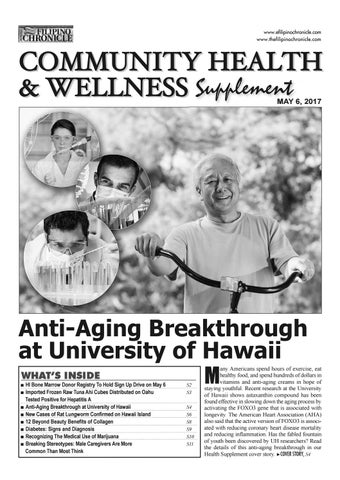
Anti-Aging Breakthrough at University of Hawaii WHAT’S INSIDE
■ HI Bone Marrow Donor Registry To Hold Sign Up Drive on May 6 ■ Imported Frozen Raw Tuna Ahi Cubes Distributed on Oahu Tested Positive for Hepatitis A ■ Anti-Aging Breakthrough at University of Hawaii ■ New Cases of Rat Lungworm Confirmed on Hawaii Island ■ 12 Beyond Beauty Benefits of Collagen ■ Diabetes: Signs and Diagnosis ■ Recognizing The Medical Use of Marijuana ■ Breaking Stereotypes: Male Caregivers Are More Common Than Most Think
S2 S3 S4 S6 S8 S9 S10 S11
M
any Americans spend hours of exercise, eat healthy food, and spend hundreds of dollars in vitamins and anti-aging creams in hope of staying youthful. Recent research at the University of Hawaii shows astaxanthin compound has been found effective in slowing down the aging process by activating the FOXO3 gene that is associated with longevity. The American Heart Association (AHA) also said that the active version of FOXO3 is associated with reducing coronary heart disease mortality and reducing inflammation. Has the fabled fountain of youth been discovered by UH researchers? Read the details of this anti-aging breakthrough in our Health Supplement cover story. ►COVER STORY, S4
S2 HAWAII FILIPINO CHRONICLE SUPPLEMENT
HEALTH NEWS |
COMMUNITY HEALTH & WELLNESS SUPPLEMENT 2017
Hawaii Bone Marrow Donor Registry to Hold Sign Up Drive on May 6
T
he Hawaii Bone Marrow Donor Registry will be hosting an onsite drive to register potential donors at the 2017 Wahiawa Pineapple Festival, Saturday, May 6, 10 a.m. to 4 p.m. at the Wahiawa District Park on California Avenue. Admission to the Festival is free. “It only takes a few minutes to help save a life,” said Kim Huber, Community Engagement Representative for the Hawaii Bone Marrow
Donor Registry. Huber explained that every year, more than 12,000 patients in the U.S. are diagnosed with life-threatening diseases such as leukemia or lymphoma for which a marrow or umbilical cord blood transplant from an unrelated donor may be their best or only hope of a cure. Among the people being helped by the Hawaii Bone Marrow Donor Registry are Emily Mitchell, who is 9 years old and lives in Wahiawa. She
Emily Mitchell
has been diagnosed with Fanconi Anemia. In addition, Luke Kaahaaina is a 15-yearold freshman at Moanalua High School. He was diagnosed with Acute Leukemia. About 70 percent of patients in need of a transplant do not have a matching donor in their family. They depend on the Hawaii Bone Marrow Donor Registry, an affiliate of the Be The Match Registry to find an unrelated donor or umbilical cord blood unit. Matches are found with those of the same ethnic backgrounds, so Hawaii residents have great
potential in helping not only patients from Hawaii, but from all over the world. Only 1 out of every 540 registered donors will be chosen as a match and be asked to donate. To join the registry you must be between 18 and 44 years old and be committed to helping a patient in need. All you need to do is: • Complete a registration form with contact information, health information and a signed agreement to join the Be The Match Registry. To help you complete the form, bring along: • Personal identification (such as a driver's license or passport) • Contact information for two family members or friends who would know how to reach you in the future if your contact information changes • Complete a buccal swap kit. A buccal (mouth) swab process collects tissue samples using four cotton swabs on the inside of your mouth cheek. No blood is collected. Note: If you are between the ages of 45 and 60, you will not be able to join the registry at a community event. You
must join the registry online. To achieve the mission for all patients in need of a marrow transplant to have the best outcome possible, the focus in the community is to register donors ages 18-44. R e s e a r c h s h o w s t h a t younger donors are best for patients because they provide the greatest chance for transplant success. Doctors request donors in the 18-44 age group more than 95 percent of the time. People can register online or at the upcoming drive event at the Wahiawa Pineapple Festival. For more information on the registry, visit their Faceb o o k p a g e . www.facebook/com/hawaiibonemarrowdonorregistry or www.bonemarrowhawaii.com The Wahiawa Pineapple Festival event will include a parade at 9 a.m., cultural and educational booths, an exciting array of food booths, the 2017 Festival T-shirt, a country store, vendors, handc r a f t e r s , t h r i l l i n g entertainment and keiki activities. The Wahiawa Pineapple Festival is sponsored by the Wahiawa Historical Society. For more information on the Wahiawa Historical Society, contact P.O. Box 861500, Wahiawa, HI 96786 or visit t h e w e b s i t e w w w. w a h i awahistoricalsoc.com.
Medicare Removes Social Security Numbers in New 2018 Cards
M
edicare will be updating Medicare cards by removing Social Security numbers in 2018 as required by law to discourage identity theft. New cards will be sent to patients with Medicare ID numbers. The agency will begin to mail new cards with Medicare beneficiary identifiers (MBIs) in April 2018. During a transition period through 2019, providers can use the MBIs or health insurance claim numbers (which are based on Social Security numbers) on transactions such as billing and claims. “We're now figuring out the best way to mail the cards,” the agency advised
providers. “We'll keep you posted about critical information so you can be ready to ask your Medicare patients at the time of service if they have a new card with an MBI,” said Frank Abagnale, AARP’s Fraud Watch Network ambassador. “And don’t carry your Medicare card unless you are on your way to a health care appointment,” he said.
SUPPLEMENT HAWAII FILIPINO CHRONICLE S3
HEALTH NEWS |
COMMUNITY HEALTH & WELLNESS SUPPLEMENT 2017
Imported Frozen Raw Tuna and Ahi Cubes Distributed On Oahu Tested Positive for Hepatitis A
I
f you have purchased frozen raw tuna or ahi cubes recently, the Hawaii State Department of Health (DOH) is warning the public that it has been notified that frozen raw tuna and ahi cubes distributed by Tropic Fish Hawaii, LLC on Oahu has tested positive for hepatitis A. The product, imported from Indonesia, was used to prepare poke sold between April 27 – May 1 by food establishments on Oahu. The imported frozen fish was used to prepare poke sold at Times Supermarket and Shima’s locations in Aiea, Kailua, Kaneohe, Kunia, Liliha, Mililani, Waipahu, and Waimanalo. The product was also used to prepare food served or sold by GP Hawaiian Food Catering, the Crab Shack Kapolei (also known as Maile Sunset Bar & Grill in Kapolei),
Aloha Sushi at 3131 N. Nimitz, and the ABC store at 205 Lewers St. Customers who purchased and consumed the product and are not vaccinated for hepatitis A are advised to consult with their doctor about vaccination. “Times Supermarket and Tropic Fish notified the department as soon as they learned of the test results on the imported fish,” said Peter Oshiro, chief of the DOH Food Safety Program. “All of the product is being traced, collected and held by the distributor. Fortunately, in this case, Tropic Fish Hawaii kept excellent records and has been contacting all retailers and pulling the product quickly.” “Because it generally takes two weeks for those in-
fected to develop symptoms of hepatitis A, vaccination or immune globulin can still provide some protection against the disease for those who may have been exposed in the last week,” said Dr. Sarah Park, state epidemiologist. “We remind those who received their first dose of hepatitis A vaccination during an earlier outbreak on Oahu to obtain their second dose for long term immunity.” Persons who consumed poke from the affected food establishments between April 28 and May 1 may have been exposed to hepatitis A and are advised to: 1. Contact their health-
should stay home and contact their healthcare provider. care provider about receiving Testing of individuals hepatitis A vaccine or im- who do not have symptoms of mune globulin (IG), which hepatitis A is not recommay provide some protection mended, with the exception against the disease if admin- of food handlers who have istered within two weeks after been exposed to the disease, exposure. as required by Hawaii State 2. Monitor their health for law. Hepatitis A vaccine or symptoms of hepatitis A in- IG, if indicated, should be adfection up to 50 days after ex- ministered after results of the posure. testing are received. 3. Wash hands with soap DOH is working with the and warm water frequently distributor and visiting all afand thoroughly, especially fected facilities to ensure after using the bathroom and proper sanitation and decontbefore preparing food. amination procedures are 4. Stay at home and con- taken. The product is embartact their healthcare provider goed by the state until further immediately if symptoms of testing is determined and cohepatitis A infection develop. ordination with federal authorities is completed. Symptoms of hepatitis A While vaccination proinfection usually appear 2–6 vides the best protection, freweeks after exposure and in- quent handwashing with soap clude fever, fatigue, loss of and water after using the appetite, abdominal discom- bathroom, changing a diaper, fort, dark urine, diarrhea, and and before preparing food can yellow skin and eyes. Indi- help prevent the spread of viduals, including food serv- hepatitis A. Appropriately ice employees, exhibiting cooking foods can also help symptoms of hepatitis A to prevent infection.
S4 HAWAII FILIPINO CHRONICLE
COVER STORY |
COMMUNITY HEALTH & WELLNESS SUPPLEMENT 2017
ANTI-AgINg BrEAkTHrougH AT uNIvErSITy of HAWAII By HFC Staff
Astaxanthin Compound from Hawaii Company Cardax Activates Longevity Gene
U
n i v e r s i t y o f Hawaii (“UH”) researchers reported recently that CDX085, a patented astaxanthin compound from local life sciences company Cardax, activated the well accepted
anti-aging gene FOXO3. This research was conducted by UH scientists Dr. Bradley Willcox, M.D., Professor and Director of Research at the Department of Geriatric Medicine, John A. Burns School of Medicine,
University of Hawaii (“JABSOM”) and Principal Investigator of the National Institutes of Health funded Kuakini Hawaii Lifespan and Healthspan Studies, and Dr. Richard Allsopp, Ph.D., Associate Professor, Insti-
tute of Biogenesis Research at JABSOM. Previously in humans, Dr. Willcox and colleagues discovered versions of FOXO3 in humans that protect against aging. While all humans have the FOXO3 gene, those with the most active version are 3x more likely to live to 100. This observation has since been replicated in >20 independent studies. At the American Heart Association Meeting in 2015, it was announced that the most active version of FOXO3 is strongly associated with both reduced coronary heart disease mortality and reduced inflammation. In this latest study at UH, CDX-085 increased— for the first time in mammals—the “activation” of FOXO3 by almost 90%. “All of us have the FOXO3 gene, which protects against aging in humans,” said Dr. Willcox. “But about one in three persons carry a particularly active version of the FOXO3 gene that is associated with longevity. By ‘activating’ the FOXO3 gene common in all humans, we can make it act like the ‘longevity’ ver-
sion. And through this research, we have shown that the astaxanthin compound CDX-085 activates the FOXO3 gene.” CDX-085 is the patented ingredient in Cardax’s second generation product and like its first generation dietary supplement, Zant h o S y n ™ , d e l i v e r s astaxanthin to the blood stream with excellent absorption and purity. For example, ZanthoSyn supplied nearly 3x more astaxanthin to the bloodstream than the leading astaxanthin competitor. CDX-085 will be a more concentrated form of astaxanthin, allowing higher doses per capsule for improved dosing convenience. This research builds on earlier work done elsewhere in which astaxanthin increased lifespan by 30% in roundworms, a scientifically well-accepted model of aging. Interestingly, if the FOXO3 gene is removed from these animals by genetic engineering (a genetic “knock-out”), astaxanthin conferred no life extension benefit, confirming that astaxanthin provides its anti(continued on S5)
SUPPLEMENT HAWAII FILIPINO CHRONICLE S5
COVER STORY |
COMMUNITY HEALTH & WELLNESS SUPPLEMENT 2017
ANTI-AGING... (from page S4)
aging effects through FOXO3. Astaxanthin is a naturally occurring compound found in algae, krill, salmon, shrimp, and lobster, and can be sourced naturally by extraction from algae, krill, or salmon or manufactured by natural product synthesis in high purity, as Cardax does with CDX-085 and ZanthoSyn. In addition, astaxanthin is a powerful, exceptionally safe dietary supplement that provides anti-inflammatory health benefits without the side effects of currently marketed anti-inflammatories. Unlike these products it has qualified for GRAS (“Generally Recognized as Safe”) designation, a rigorous safety process defined by the FDA and has more than 1,400 peer reviewed papers and 50 human clinical trials supporting its safety and efficacy. “This exciting new evidence from UH provides yet another reason for physicians and patients to consider an astaxanthin dietary supplement such as ZanthoSyn as the foundation of an anti-aging, longevity program,” said David G. Watumull, Cardax CEO. Dr. Charlie Y. Sonido, M.D., a well-respected physician in the Filipino community has been utilizing ZanthoSyn in his practice and commented, “We recommend ZanthoSyn to our patients for its anti-aging a n d a n t i - i n f l a m m a t o r y health benefits and are very pleased with the results.” Cardax was founded in Hawaii in 2006. $40 million has been raised for the development and commercialization of its proprietary astaxanthin compounds and related products. Its management team includes former key executives from Novartis, Boehringer Ingelheim, and Amgen. Its scientific team includes scientists and physicians from Harvard, Mayo Clinic, Cleveland Clinic, Fred Hutchinson Cancer Re-
search Center, UCSD, and UH. The Kuakini Hawaii Lifespan and Healthspan Studies, funded by the National Institute on Aging, are ancillary studies on aging from the Kuakini Honolulu Heart Program, formed to study why so many Japanese and Okinawan men in Hawaii live much longer than the national average and are in good health. Researchers followed over 8,000 Japanese-American men from the 1960s as part Charlie Y. Sonido, M.D. of the Honolulu Heart Program and examined what netic and environmental facfactors contributed to tors (diet, physical activity, and healthy aging, including ge- other lifestyle factors).
Richard Allsopp, Ph.D. (left), David G. Watumull (center), and Bradley Willcox, M.D. (right)
S6 HAWAII FILIPINO CHRONICLE SUPPLEMENT
HEALTH NEWS |
COMMUNITY HEALTH & WELLNESS SUPPLEMENT 2017
New Cases of Rat Lungworm Confirmed On Hawaii Island
T
wo new cases of individuals with rat lungworm illness on Hawaii Island has been confirmed by the Hawaii State Department of Health (DOH). In addition, four related cases are considered highly probable based on clinical indications, a common discrete exposure, and symptoms consistent with the illness. All six cases are adults who were hospitalized and their illnesses reported to the department over the past weekend. The adults became infected with the parasite Angiostrongylus cantonensis at a home in Keaau on Hawaii Island a few weeks after drinking homemade kava which they had left out in uncovered buckets after preparing the drink at the home. The kava was poured into a large bowl and after consuming most of the contents, the individuals noticed a slug at the bottom of the bowl. The department’s investigation determined the source of the infections was
likely the homemade kava tainted by slugs. “The department is continuing to monitor this serious illness spread to individuals by infected slugs and snails,” said Health Director Dr. Virginia Pressler. “Cases like this recent cluster are especially concerning because they can be prevented with basic precautions such as storing food in covered containers and properly inspecting and washing food before eating. These healthy habits can protect against food contamination and prevent serious illnesses.” With the addition of the two illnesses confirmed today, there have been a total of 11 confirmed cases of rat lungworm infection this year in the state. Earlier this year, four Maui resident cases, two nonresident cases who were visitors to Maui, and three Hawaii Island resident cases were confirmed. The two cases confirmed today were Hawaii Island residents and of the four
probable cases, three were Hawaii Island residents and one was a resident of Maui who traveled to Hawaii Island. The Hawaii Department of Health advises everyone to carefully store, inspect and wash produce, especially leafy greens. Always store food in covered containers, wash all produce thoroughly and supervise young children playing outdoors to prevent them from putting snails or slugs into their mouths. Controlling snail, slug, and rat populations is one of the most important steps in fighting the spread of rat lungworm disease. Take precau-
tions to control slugs, snails, and rats around properties, and especially around home gardens. Farmers as well as food handlers and processors should increase diligence in controlling slugs, snails, and rats on the farm. The Department of Health’s Food Safety Program continues to inspect and educate food establishments statewide on safe food handling and preparation to prevent contamination and food borne illness. Food establishments statewide are reminded to use only approved and licensed sources and carefully
inspect and wash all produce during food preparation. The most common symptoms of angiostrongyliasis or rat lungworm include severe headache and neck stiffness, but symptoms may vary widely among cases. Seek medical attention for headache, fever, stiff neck, tingling or painful feelings in the skin or extremities. The most serious cases experience neurological problems, pain and severe disability. Healthcare providers should monitor and support patients’ symptoms, and report any persons they suspect may be infected.
SUPPLEMENT HAWAII FILIPINO CHRONICLE S7
S8 HAWAII FILIPINO CHRONICLE SUPPLEMENT
HEALTH & FAMILY |
COMMUNITY HEALTH & WELLNESS SUPPLEMENT 2017
12 Beyond Beauty Benefits of
COLLAGEN By Deni Rose M. Afinidad-Bernardo
M
ANILA, Philippines — When it comes to health, the big C’s are usually Vitamin C, cancer and lately, medicinal cannabis. Often, people forget another important C: collagen. This summer, increased sun exposure leads to aging and depletion of collagen, the building blocks of protein and the skin’s main structure that is also found in the eyes, heart, kidneys, tendons, ligaments, liver, and even in stomach and hair, said esthetics and rejuvenation expert Dr. Cecilia Catapang. “At a certain point, the body stops producing collagen,” the doctor warned during the recent launch of food supplement Novuskin Lift,
claimed to be the first in the market to have 18 natural ingredients, including marine fish collagen. Collagen comprises 80 percent of skin, but due to free radicals, when one reaches 20, one loses collagen at the rate of is 1.8 percent per year, and 20 to 25 percent annually by age 30, said Catapang. If you are feeling sluggish and having many wrinkles by age 40, that is because collagen has rapidly depleted in one's body, she said. Since collagen is in over 100 parts of the body, 14 of which are the most important. Catapang stressed the value of taking collagen supplements not only for beauty but also for health. According to her, here are
other beyond beauty benefits collagen can give: 1. Bone healing 2. Anti-aging 3. Wound healing 4. Increased protein intake 5. Antibacterial 6. Collagen has aspirinlike properties that can prevent heart attack and stroke 7. Marine fish collagen and peptide are widely used as supplements because of their similarity to human collagen. These have a good safety profile and high bioavailability through the gastrointestinal tract, promoting skin repair. The intake of this must be combined with antioxidants. 8. Marine fish collagen is absorbed up to 1.5 times more effectively into the body and has superior bioavailability over bovine or porcine colla-
Red, dark green, and orange vegetables; berries, soy, white tea, and citrus fruits are natural sources of collagen.
gens, thus, fish collagen is considered the best collagen for medicinal purposes. 9. When completely digested, fish collagen stimulates cells in skin, joints and bones, leading to collagen synthesis through cell activation and growth. 10. Other fish collagen benefits include anti-aging, bone healing and rejuvenation, wound healing, increased protein intake and antibacterial properties. 11. Fish collagen is high in
essential and non-essential amino acids. 12. Every 10 grams of fish collagen has protein, potassium, sodium and iron White sugar, said Catapang, weakens collagen, so she suggested using other healthier sweeteners like muscovado or brown sugar. “To effectively slow down aging, do measures that will have a lasting impact not only to skin but the entire wellb e i n g , ” s h e n o t e d . (www.philstar.com)
SUPPLEMENT HAWAII FILIPINO CHRONICLE S9
HEALTHLINE |
COMMUNITY HEALTH & WELLNESS SUPPLEMENT 2017
Diabetes: Signs and Diagnosis By National Institutes of Health
D
iabetes is often called a "silent" disease because it can cause serious complications even before you have symptoms. Symptoms can also be so mild that you don’t notice them. An estimated 8 million people in the United States have type 2 diabetes and don’t know it, according to 2012 estimates by the Centers for Disease Control and Prevention (CDC).
Common Signs Some common symptoms of diabetes are: • being very thirsty • frequent urination • feeling very hungry or tired • losing weight without trying • having sores that heal slowly • having dry, itchy skin • loss of feeling or tingling in the feet
and overweight, getting tested is strongly recommended. If you are younger than 45, overweight, and have one or more risk factors, you also should talk with your doctor about being tested. See risk factors for type 2 diabetes.
•
having blurry eyesight. Signs of type 1 diabetes usually develop over a short period of time. The signs for type 2 diabetes develop more gradually.
Tests for Diabetes The following tests are used to diagnose diabetes or prediabetes. • An A1C test measures your average blood glucose levels over the past 3 months. It can be used to diagnose type 2 diabetes and prediabetes. It does not require fasting and blood can be drawn for the test any time of the day. • A fasting plasma glucose, or FPG test, measures • your blood glucose after you have gone at least 8 hours without eating. Doctors use this test to detect diabetes or prediabetes. • In a random plasma glu-
cose test, your doctor checks your blood glucose without regard to when you ate your last meal. This test, along with an assessment of symptoms, is used to diagnose diabetes but not prediabetes. An oral glucose tolerance test, or OGTT, measures your blood glucose after you have gone at least 8 hours without eating and 2 hours after you drink a sweet beverage. Doctors also use the oral glucose
tolerance test to diagnose gestational diabetes in pregnant women. If any of these tests show that you might have diabetes, your doctor will need to repeat the test with a second measurement unless there are clear symptoms of diabetes.
Who Should Get Tested? Because type 2 diabetes is more common in older people, anyone who is 45 or older should consider getting tested. If you are 45 or older
Why Early Detection is Important Diabetes is a serious disease that can lead to a number of health problems such as heart disease, stroke, vision problems, kidney disease and even death. Sometimes people have symptoms but do not suspect diabetes. They delay scheduling a checkup because they do not feel sick. Many people do not find out they have the disease until they have diabetes complications, such as a heart attack or stroke. Finding out early if you have diabetes is important because treatment can prevent or delay the complications of the disease.
S10 ď ˇ HAWAII FILIPINO CHRONICLE ď ˇ SUPPLEMENT
OPEN FORUM |
COMMUNITY HEALTH & WELLNESS SUPPLEMENT 2017
Recognizing the Medical Use of Marijuana By Clifton Otto, MD
T
he Lowdown Some folks still believe that marijuana is a Schedule I controlled substance. However, in order to be regulated as a controlled substance, there must be a valid scheduling provision in place at the state or federal level. Currently, in Hawaii, we have neither. To be classified as a Hawaii state Schedule I controlled substance, state law requires that marijuana have the "highest degree of danger." However, the Administrator of the Drug Enforcement Administration (DEA) has already informed us, by way of his denial of the Rhode Island-Washington Rescheduling Petition, that marijuana is not as dangerous as other controlled substances in lower schedules. Furthermore, there are about 10,000 patients a year who have engaged in the medical use of marijuana in Hawaii over the past 16 years. That's 160,000 patient-years of medical use without a single marijuana-related death. And yet, the Hawaii State Department of
Health (DOH) has reported that prescription opioid pain relievers, which are scheduled lower than marijuana, have caused about 50 patient deaths a year in Hawaii over nearly the same time period. These facts confirm that marijuana does not qualify as a Hawaii state Schedule I controlled substance. To be classified as a federal Schedule I controlled substance, federal law requires that marijuana must have "no currently accepted medical use in treatment in the United States." However, Hawaii has already accepted the medical use of marijuana, by way of its authority to accept the medical use of controlled substances. Federal law says that marijuana cannot be in federal Schedule I if it has accepted medical use, and the State of Hawaii has already accepted the medical use of marijuana under state law.
Recognizing Medical Use THE CON Somewhere along the way, the State of Hawaii lost its political will to stand up for the state accepted medical use of marijuana. Maybe it started at the very beginning, when
Hawaii's Medical Use of Marijuana Program was created and put under the administration of the Department of Public Safety (PSD), rather than DOH, as was originally intended. In addition, without a state that's willing to stand up for its own state-accepted medical use of marijuana, it's easy to understand why the DEA continues to employ an outdated interpretative rule that it adopted before any state had accepted the medical use of marijuana. THE CONSEQUENCES The current situation has created an unnecessary conflict between the state and federal regulation of marijuana, which in turn has created a host of unintended consequences: 1. In order to engage in the state-accepted medical use of marijuana in Hawaii, patients must violate the federal regulation that still has marijuana in federal Schedule I, creating the appearance of violating federal law, which exposes patients to criminal prosecution under the federal Controlled Substances Act (CSA). Fear of violating federal law is keeping many law-abiding patients, including those with terminal cancer, from enrolling in Hawaii's Medical Use of Marijuana Program. 2. In order to engage in the state-licensed production and dispensing of marijuana for medical use in Hawaii, Dispensaries must violate the same federal regulation, creating the appearance of violating federal law, which also exposes Dispensaries to criminal prosecution under the federal CSA. This puts Dispensaries at risk of property confiscation and forfeiture, even when funding to the DEA for investigating state-licensed operations is being restricted. This is because the High Intensity Drug Trafficking Areas Program (HIDTA), a branch of the Office of National Drug Control
Policy (ONDCP), and not the DOJ, can still investigate organizations that it believes are violating federal regulation. 3. Local banks cannot create accounts with or receive cash from Dispensaries because of the perceived conflict with federal banking laws. 4. Physicians cannot be associated with Dispensaries without appearing to be aiding and abetting patients in gaining access to a Schedule I controlled substance, which means that their DEA controlled substance prescribing license could be revoked, which would trigger revocation THE SOLUTION Aside from a Congressional bill such as the Compassionate Access Act, the solution for the current situation regarding the conflict between the state-accepted medical use and the federal scheduling of marijuana rests with the state. Hawaii needs to stand up for its right to accept the medical use of marijuana, not only to change the attitude of our state and local law enforcement agencies, but also to recognize the impact that state-accepted medical use has upon federal scheduling and to ultimately allow patients and legitimate businesses to engage in the medical use of marijuana in Hawaii without the threat of federal interference. The problem is that we don't have time to wait for Congress or our new President
to act on this issue. In the very near future, Dispensaries in Hawaii will be crossing that fateful line of commercial sale of a Schedule I controlled substance. The state needs to take action to protect the accepted medical use of marijuana in Hawaii before the first Dispensary opens its doors to patients, which could be as soon as the fall of 2017. Standing up for the accepted medical use in Hawaii means amending Hawaii's Medical Use of Marijuana Act to specifically recognize that the state-accepted medical use of marijuana in Hawaii is accepted medical use in treatment in the United States, and that the current federal classification of marijuana does not apply to Hawaii's Medical Use of Marijuana Program. Standing up for the accepted medical use of marijuana in Hawaii also means recognizing that marijuana cannot be in a state schedule that requires the highest degree of danger. One would think that our state Attorney General would be willing to alert PSD of its administrative duty to notify the Legislature that marijuana cannot be in Hawaii state Schedule I. Unfortunately, federal scheduling continues to be placed above state law in Hawaii, and the mantra that federal law trumps state law continues to suppress a recognition of how state-accepted medical use impacts the state and federal regulation of marijuana.
SUPPLEMENT HAWAII FILIPINO CHRONICLE S11
HEALTHLINE |
COMMUNITY HEALTH & WELLNESS SUPPLEMENT 2017
Breaking Stereotypes: Male Caregivers Are More Common Than Most Think By Bonnie Kwong
M
en represent 2 out of 5 of the more than 40 million unpaid family caregivers in the U.S., but very few reach out for support. To help male caregivers get the tools and resources they need to take care of themselves and their adult loved ones, AARP and the Ad Council are refreshing their Caregiver Assistance campaign. Today they are releasing their first-ever PSAs targeting male caregivers, created pro bono by DDB New York and featuring character actor Danny Trejo. As men continue to take on caregiving roles, they are looking for specific information and support tailored to their needs. According to AARP’s report “Breaking Stereotypes: Spotlight on Male Family Caregivers,” more than half (63%) of male caregivers are the primary caregiver for their loved one. Due to cultural pressures and a lack of prior experience, more than half (54%) of all male caregivers report finding it difficult to help loved ones with intimate care needs such as feeding, dressing and bathing. “Many male family caregivers see themselves simply as sons, spouses and friends
caring for someone they love,” said AARP Public Policy Institute Vice President Jean Accius, PhD. “Through this campaign, we want to recognize and provide the tools and support these male family caregivers need in this vital role.” The latest evolution of the Caregiver Assistance campaign, created by DDB New York, aims to help men recognize themselves as caregivers. The PSAs direct viewers to AARP’s online Caregiving Resource Center at www.aarp.org/caregiving, where caregivers can access Care Guides tailored to specific topics and challenges, such as caring for a loved one with dementia, as well as other practical tips and tools. “Through research with male caregivers, we unearthed the insight that being a caregiver requires a unique kind of strength—like stoicism and inner fortitude—that goes beyond the traditional expectations of male toughness,” said Icaro Doria, Chief Creative Officer of DDB New York. The PSAs celebrate this strength and re-examine what it means to be tough by featuring Danny Trejo, who is known for his “tough” persona. As Trejo shaves his face with a machete, lifts a car, and unflinchingly faces a kitchen fire, a caregiver shaves his fa-
roes, and they shouldn’t have to undertake this journey alone,” said Lisa Sherman, President and CEO of the Ad Council. “We’re thrilled to continue this campaign to help ease the burden of caregiving and shine a light on the amazing, tough, and loving work done by caregivers.” The PSAs will be distributed to more than 33,000 media outlets nationwide and will run exclusively in donated time and space, per the Ad Council’s model. They are available in TV, radio, print, outdoor and digital formats. Social media creative will also soon debut on Facebook, courtesy of Facebook’s donated media support for the Ad Council. Since the Caregiver Assistance Campaign launched in August 2012, the campaign
ther’s face, lifts his father from his chair, and lovingly prepares a meal – earning Trejo’s admiration as “the toughest guy on the planet.” “I’ve helped care for a friend of mine who had cancer, so I know how hard it can be,” said Trejo. “Being a caregiver takes total dedication, absolute love, and unbelievable toughness. I’m proud to do what I can to support them.” The PSAs include the tagline “Caregiving is tougher than tough,” unhe Hawaii Department of derscoring Commerce and Consumer the message Affairs (DCCA), Profesthat caregivsional and Vocational Licensing is a demanding job, ing Division (PVL) and the Board of and care- Nursing are reminding the more than givers de- 32,000 Hawaii licensed nurses -- RNs, serve help LPNs, and advanced practice registered nurse recognition (APRNs) -- to renew and support. “ C a r e - their licenses online at MyPVL givers are (https://pvl.ehawaii.gov/mypvl). Renewals are being accepted online everyday hefrom April 17, 2017 until midnight on June 30, 2017. To better ensure receipt of the license pocket ID card by the license expiration date, it is recom-
has received over $193.3 million in donated media and the Caregiving Resource Center has received more than 35 million visits. For more information about caregiving resources, please visit www.aarp.org/caregiving or call 1-877-333-5885. AARP is the nation’s largest nonprofit, nonpartisan organization dedicated to empowering Americans 50 and older to choose how they live as they age. The Ad Council is a nonprofit organization with a rich history of marshaling volunteer talent from the advertising and media industries to deliver crucial messages to the American public. DDB U.S., part of the Omnicom Group (NYSE), is one of the country’s leading and most influential advertising agencies, with offices in New York, Chicago and San Francisco.
Reminder: Nurses to Renew License Online
T
mended that renewals be submitted before May 31, 2017. Renewals received or postmarked after June 30, 2017 will be subject to a late renewal fee. MyPVL service enables 24/7 access to information and services from a single dashboard for all PVL licensees. It was created through a partnership with PVL and the state’s internet portal manager, Hawaii Information Consortium, LLC. The service is one of many online services for citizens and businesses offered through the state’s official website, eHawaii.gov.
S12 HAWAII FILIPINO CHRONICLE SUPPLEMENT