NEWS FEATURE filiPino fiesta features “rice” to tell stories of cultural unity
AS I SEE IT
Meet the 1st fil-aM Mayor of cerritos, ca: lynda P. Johnson
FEATURE hard Work, faith & huMility in dle’s Jared k. redulla
BIBLE REFLECTIONS
Miracle in the Midst of crisis
Community Health and Wellness Supplement
haWaii healthcare crossroads: the debate over one health integration
The Spirit of Bayanihan After the Kona Low Storms Is Precious Assistance to Get Affected Communities
Back on Their Feet
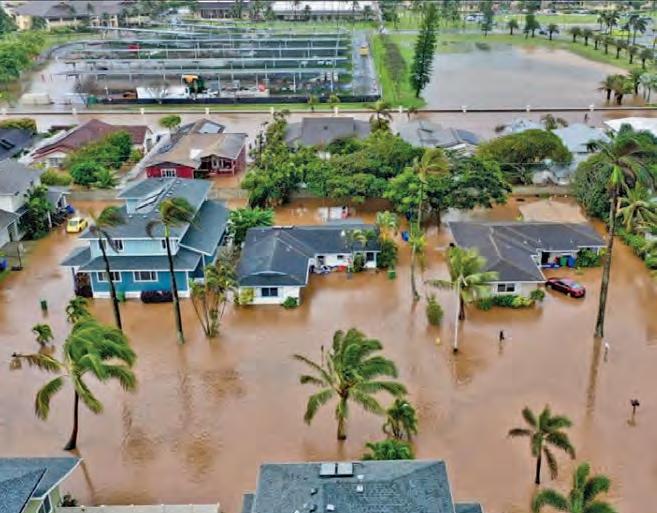
Two Kona low storms, days apart, turned parts of Hawaii into disaster zones which affected communities are still recovering from and rebuilding. Survivors had their homes flooded, farmers’ crops ruined, cars wrecked, and in some cases their homes completely unlivable.
Hawaii’s Filipino community has leaned into their cultural instinct of “bayanihan” -- people helping their neighbors in time of need – assisting in myriad ways like gifting direct funds to providing hot meals, transportation and childcare. Hawaii’s greater community – government, non-profits, civic organizations -- has also come together in remarkable and charitable ways to help storm survivors.
The Hawaii Filipinos for Trust, Justice and Democracy, Hawaii Workers Center, Anakbayan Hawaii, Hawaii Committee for Human Rights in the Philippines, Filipino Association of University Women and Bayanihan Clinic Without Walls are just a few of the Filipino groups helping with the Kona low storms rebuilding efforts.
It takes stamina to recover from natural disasters. There is endless clean up, navigating to find government assistance and lots of paperwork, financial strain and in some cases financial collapse. What’s crucial is that people receive relief funds and assistance fast enough before worsening conditions take a toll. There’s also the emotional support that’s needed to get survivors back to normalcy. Simply calling in to check on neighbors’ well-being and listening to them can make a difference.
What can we do?
Do the immediate work: donate to credible relief funds, volunteer where organizers ask and buy local as farms restart. Farmers on Oahu’s North Shore were hit particularly hard.
And government needs to do the harder work: fund mitigation, modernize drainage and stream capacity, strengthen emergency communications, and simplify aid so survivors aren’t forced to become their own case managers.
Helping farmers
What farmers – many of whom are Filipinos -also need from our Filipino community is helping them navigate to find the various government assistance to get funds without attachments, funds as loans, the applications process and required documentations. Some farmers might also need assistance with translation to fill out forms and meet deadlines that various agencies set.
All of these would help immensely as farmers could spend more time working to save their crops and prepare for the next harvest season.
Farmers have expressed gratitude for the community’s help. Farmers say they’ve met with government
(continue on page 3)
arlier this year in May, we were all shocked and saddened by the devastation caused by the backto-back Kona low storms which produced torrential rain and widespread flooding in Oahu’s North Shore, Maui and other parts of our state. Today, communities hit hard by the storms, like many of our Filipino farmers, are in a state of rebuilding. For our cover story this issue, associate editor Edwin Quinabo, reports on how many in our Filipino community -- in the spirit of our cultural value “bayanihan” – have been doing great work assisting those still vulnerable from the storms. At the end of the article, there is also a list of resources for government and non-profit assistance for those needing help.
We have an eclectic mix of other articles in this issue. Have you heard of the “Bebot” Social Media Trend?
Most of you have already seen some of those short clips on your social media feed. HFC contributor Edna R. Bautista, Ed.D. writes about the origins of the “bebot” sensation which dates back to the 1980s.
From social media pop culture, we move on to sports. HFC contributors Julian and Dylan Bothamley submit “Three Stars and a Sun: Filipino Heritage Shines in the NBA Playoffs,” featuring Filipino American stars Jalen Green, Dylan Harper and Jared McCain.
We have another feature on a mainland Filipino but this time in politics. HFC columnist Elpido Estioko contributes “Meet the First Filipina-American Mayor of Cerritos, California: Lynda P. Johnson,” who also happens to have Hawaii roots.
On matters in the Philippines, we have two serious topics: 1) HFC columnist Dr. Arcelita Imasa writes about the April 19, 2026, incident where 19 people were killed in a military operation in Toboso, Negros Occidental. At least 167 families were displaced from their homes. 2) HFC columnist Seneca Moraleda-Puguan contributes an evocative piece “Land of Contradictions.” Find out what they are.
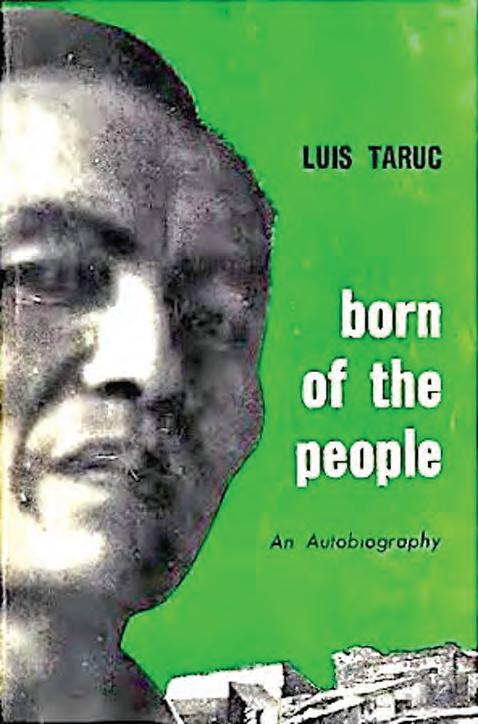
As usual, HFC columnist Rose Cruz Churma has another fascinating book review – this time, “Born of the People,” the 1953 autobiography of labor leader and revolutionary Luis Taruc, who led the HUKBALAHAP (Hukbong Bayan Laban sa Hapon) in the Philippines soon after the end of World War II.
Keli‘i Akina, president of the Grassroot Institute of Hawaii, discusses “Building New Homes Expands Affordable Options for All” in our Open Forum section.
We are also pleased to present this issue with a Community and Wellness Supplement. Here are some of the highlights: 1) “A Proposed One Health Hawai’i Aims to Reshape the State’s Health Care System but Concerns Remain in the Medical Community and General Public” cover story; 2) “Renal Replacement Therapy, When the Kidneys Fail” by Dr. Valerie Tan; 3) “Thyroid Cancer: A Common but Highly Treatable Condition” by Dr. Anna Melissa S. Lo; 4) “The Silent Wounds We Carry: How Domestic Violence Harms the Body” by Dr. Rainier Dennis D. Bautista; 5) “Understanding the Threat of Respiratory Syncytial Virus in Hawaii” by Dr. John Avery Go; 6) “Embracing Whole-Person Health” by Dr. Marcel Ver; and 7) “How to Choose the Right Health Insurance Plan in Hawaii” by Dr. Rhea Bautista
Lastly, our Primary Election Supplement will be coming out on the July 18, 2026, issue. We’d like to invite those seeking public office to make your campaign stand out by advertising in the Hawaii Filipino Chronicle.
We hope you enjoy these articles as well as our other columns and news. Have a Happy and Safe Memorial Day. Thank you for supporting the HFC. Visit our website thefilipinochronicle.com to get your free e-copy of each issue. For your advertising needs, email us at filipinochronicle@ gmail.com. Until the next issue, Aloha and Mabuhay!
Charlie Y. Sonido, M.D.
Publisher & Managing Editor
Chona A. Montesines-Sonido
Associate Editors
Edwin QuinaboDennis Galolo
Contributing
Editor
Belinda Aquino, Ph.D.
Design Junggoi Peralta
Photography
Tim Llena
Administrative Assistant
Lilia Capalad
Editorial & Production Assistant
Jim Bea Sampaga
Columnists
Carlota Hufana Ader
Rose Cruz Churma
Elpidio R. Estioko
Willie Espero
Emil Guillermo
Gary Hooser
Arcelita Imasa, M.D.
Seneca Moraleda-Puguan
J.P. Orias
Charlie Sonido, M.D.
Emmanuel S. Tipon, Esq.
Contributing Writers
Clement Bautista
Edna Bautista, Ed.D.
Teresita Bernales, Ed.D.
Sheryll Bonilla, Esq.
Dr. Dylan Bothamley
Serafin Colmenares Jr., Ph.D.
Linda Dela Cruz
Carolyn Weygan-Hildebrand
Amelia Jacang, M.D.
Caroline Julian
Max Levin
Raymond Ll. Liongson, Ph.D.
Federico Magdalena, Ph.D.
Matthew Mettias
Maita Millalos
Paul Melvin Palalay, M.D.
Renelaine Bontol-Pfister
Seneca Moraleda-Puguan
Jay Valdez, Psy.D.
Amado Yoro
Philippine Correspondent:
Greg Garcia
Neighbor Island Correspondents:
Big Island (Hilo and Kona)
Grace LarsonDitas Udani
Kauai
Millicent Wellington
Maui
Christine Sabado
Big Island Distributors
Grace LarsonDitas Udani
Kauai Distributors
Amylou Aguinaldo
Nestor Aguinaldo
Maui Distributors
Cecille PirosRey Piros
Molokai Distributor
Maria Watanabe
Oahu Distributors
Yoshimasa Kaneko
Shalimar / Jonathan Pagulayan
Advertising / Marketing Director
Chona A. Montesines-Sonido
Account Executives
Carlota Hufana Ader
JP Orias
SB 2471 Is A Bold Workaround of Citizens United, Kudos to the Hawaii Legislature for Passing It
Hawaii’s future elections could put voters back in charge over corporate special interests with the passing of Senate Bill 2471, a landmark state-level response to the US Supreme Court’s Citizens United decision that gave corporations unlimited spending power to influence elections.
Citizens United included corporations and unions under the umbrella of free speech. This decision treated unlimited independent spending by corporations and unions as protected political speech under the Constitution. Since its ruling in 2010, it helped fuel super PAC and dark-money ecosystems that amplified wealthy interests over ordinary voters.
How Hawaii’s SB 2471 worked around the Supreme Court’s Citizens United is by defining corporations as creations of state law, and the privileges the state grants to do business should not include the power to spend money to sway elections. A corporation is not a human being with a conscience, a vote, or a life in our community. It is an “artificial person” created by the state and empowered by the state to conduct lawful business, not automatically include the power to spend money—directly or indirectly—to influence elections or ballot measures.
SB 2471 draws a clear line between legitimate business activity and electioneering. It aims to protect the integrity of local elections. It could also set a precedent for other states to challenge and work around Cit -
(The Spirit....from page 2) officials at both the state and city levels, offering suggestions for long-term structural improvements to prevent future flooding. We hope these officials are taking those infrastructural suggestions seriously.
Why Bayanihan works Bayanihan is a proven strategy for getting through hard times. When people show up for
izens United. Restoring trust starts with restoring a simple rule: political power should not be for sale to the highest-bidding artificial person.
Senate Bill 2471 is a direct attempt to push back—not by telling anyone what they can say, but by asking a foundational question about who, exactly, gets to wield political power in a constitutional democracy.
Expect a legal challenge
Certainly, if Gov Josh Green signs the bill and it becomes law, there will be a legal court fight. But kudos to Hawaii state lawmakers to not stand by and accept the status quo of Citizens United, but to actively seek a measured democratic test to silence dark money.
If Hawaii can show that state-created entities may be limited to state-granted purposes, it can offer a pathway for other states to challenge Citizens United. Hawaii is not alone in looking for a path around Citizens United.
Measures such as Maine’s 2024 ballot initiative to limit corporate contributions reflect a
one another, communities recover faster, fewer families fall through the cracks, and disasters don’t become permanent displacement.
Our Filipino bayanihan tradition also replaces the “shame of asking for help” often typical in western tradition. Our culture turns “charity” into solidarity — people helping because they belong to the same community and the same future.
growing appetite for state-level experimentation. Hawaii is one of the first states to attempt a full legal workaround to Citizens United.
Hawaii lawmakers acted boldly to challenge a national status quo as entrenched as Citizens United.
Harms of Citizens United
At the federal level, Citizens United has been disastrous to democracy. Enormous sums of outside money have been poured into elections to independently (no coordination with campaigns) support or oppose candidates. Since Citizens United, Congress has become far more corrupt as politicians have been forced to work with these mega donors with special interests to fund their campaigns.
After Citizens United, the ability of outside groups to spend unlimited sums made it easier for heavily regulated industries to amplify their preferred candidates who would pass legislation and support their wishes.
It can be argued that super Pacs made possible by Citizens
The bayanihan spirit builds resilience and civic muscle. Bayanihan reminds us that strong communities are built in everyday choices: check on a neighbor, buy local, volunteer when asked, and share what you can. Bayanihan ultimately is neighbors acting as a strong and caring network.
We hope our Filipino community and greater Hawaii community continue to reach
United is why reforms demanded by ordinary voters in heath care, insurance, energy, affordable housing, and so on, have not been able to push through in Congress as big money buys off career politicians in DC.
It helps explain why prescription drugs remain unaffordable, why clean energy progress has stalled, why consumer protections are weak, why banking regulations are laxed and high interest rates persists, why grocery shelves still carry ingredients banned in other countries, and why higher education is exorbitantly priced. It has been easier for war profiteers to influence foreign policy and aggrandize the nation’s military budget. The pattern is familiar: money and power too often outweigh the voices of everyday Americans in shaping policy.
Since Citizens United, studies show that Congress has adopted more corporate-friendly policies.
How SB 2417 will translate into shaping Hawaii’s local policies remains to be seen. Its overwhelming passage shows at the very least Hawaii lawmakers are in favor of limiting special interest in local politics. And more importantly, listening to their local voters who also support fairer elections and people-powered representation.
It’s high time this country dismantled this system of influence by the powerful or what really could be called legal corruption. And Hawaii lawmakers sparked a start for hopefully what will be a national movement for state legislatures across the nation to do the same. Well done, Hawaii lawmakers.
out to those in need caused by the Kona low storms. It’s common that immediately after a natural crisis, there is an outpouring of immediate aid, then quickly after people forget about the tragedy. But as government officials and experts say, this disaster will take months to recover. Let’s remember the bayanihan spirit and be there for our neighbors.
Filipino Community, Government, Non-profits and Neighbors Lean on Bayanihan Spirit as Recovery from Kona Low Storms Continues
By Edwin Quinabo
ayanihan — the Filipino tradition of neighbors coming together to help one another — is still in full effect as the Filipino and greater Hawaii communities come together to help those hurt by the back-to-back Kona low storms in March that caused severe flooding, landslides, and mudslides across multiple islands, most notably on Oʻahu’s North Shore, Maui and Hawaiʻi Island.
BGov Josh Green estimates damage caused by the Kona low storms to be $1 billion ($700 million in damage alone, plus $300 million in lost economic activity). AccuWeather cites a damage figure closer to $2 billion. Civic groups, non-profits, churches, and businesses continue to pool donations for cleaning supplies and temporary lodging.
State officials say cleanup is expected to take months and officials warn that saturated ground can keep streams and hillsides dangerous even after the storms have long passed. The City and County of Honolulu said its damage-report dashboards showed at least 1,074 properties were damaged or temporarily inaccessible on Oʻahu, including 22 destroyed and 257 needing extensive repairs. Over 260 homes are no longer habitable.
Waialua, Mokulēʻia, and Haleʻiwa were repeatedly cited as among the most devastated areas, with catastrophic flooding and a high concentration of major damage, total losses. It’s estimated that 16% of Waialua’s population is Filipino, some of whom work as farmers.
Farmers hit hard
Farmers on Oʻahu’s North Shore in Waialua suffered major losses. More than $9.4 million in agricultural losses have been reported. Muddy water lines still stain the walls of homes and tarps ripple over broken roofs. Soaked drywall lay to the side of garages. Farmers describe powerful winds and rain tore through their farms. Crops that they had planted and nurtured were blown over, snapped, and damaged beyond recovery. Leaves were shredded, stems were broken, and weeks of their hard
work were lost in just hours.
This happened in just the first storm. When the second storm came, what wasn’t broken was now submerged. The soil became oversaturated, roots began to rot, and entire rows of crops were wiped out, farmers said.
Al Medrano, a farmer who also leases his land to several other farmers describes the aftermath of the storms. “These farmer-tenants really took a hit. The flood wiped out their crops. Now they have to start from ground zero. They plant okea, dry taro, red taro, sayote, toge, singkamas, bittermelon leaves and fruits, long beans, banana. They are slowly plowing. Some are growing back now, hopefully soon they will be harvesting. They are doing their best until they can get back on their feet. They are not selling produce yet,” Medrano said.
He elaborates farmers are not just trying to get back to normalcy but looking at ways to control flooding in the future. Farmers have been meeting with city council members and state representatives. “We’re not sure how they’re going to follow through exactly but I’m thinking it will have to be a big project. We can’t control mother nature, but we can control our response. We need to direct the outflow to the ocean, which is, at this time, there is nothing like that,” Medrano said.
State and county officials have opened recovery centers and urged storm survivors to document
COVER STORY
damage and apply for help (resources are at the of article). The Hawaiʻi Department of Agriculture and Biosecurity through its Emergency Farmer Relief Program has set up a one-time $1,500 grant for eligible farmers and Ag businesses statewide impacted by Kona Low 1 and Kona Low 2 storms. The state authorized $500,000 for the program and required proof such as a GET license.
The City & County of Honolulu, County-led recovery hub and coordination has a Department of Emergency Management “Kona Low Storm Recovery” page that describes how city departments and partner agencies are coordinating to assess damage, address safety, and connect residents with help, plus directions for reporting storm damage (important for documenting impacts and unlocking/targeting recovery resources). [honolulu.gov]. The city also has in-person assistance. It is continuing large-scale debris removal, and crews have been clearing stream channels and drainage systems and removing blockage materials to reduce the chance of repeat flooding, including around North Shore stream crossings, officials said.
Another farmer on Oʻahu’s North Shore in Waialua who chose to remain anonymous said nearly two months later the challenges they face are still very real and evolving every day. “The
He adds, “most of us Hawaii farmers don’t have federal crop insurance because I think it’s not designed well for our small, diversified operations. Cash flow is tight, with no income from lost harvests, but bills for inputs, fuel, and rents continue. It’s a lot, physically tiring cleanup, constant worry about finances and the emotional weight of seeing months of work erased. But the community support from volunteers, other farmers, and groups has been a lifeline.” He encourages the public to buy local when their harvests rebound or support farm recovery funds. “It makes a big difference,” he said.
Unified front for recovery
Easing the path to recovery, a coalition of advocacy and service organizations joined forces to provide a “safety net” for the affected families. Last month, the groups met at the Waialua
Agricultural Building to deliver critical financial and moral support to local farmers for a relief event hosted by the Haleiwa-Waialua Historical Society.
Participating organizations included the Hawaii Filipinos for Trust, Justice and Democracy, Hawaii Workers Center, Anakbayan Hawaii, Hawaii Committee for Human Rights in the Philippines, Filipino Association of University Women and Bayanihan Clinic Without Walls.
“Seeing the community come together at the Waialua Agricultural Building gives us hope,” noted organizers.
“By combining our resources, we can provide more than just money; we provide the solidarity needed to rebuild,” said Margaret Sagaysay of the Haleiwa-Waialua Historical Society in her report to the organization.
For many of the farmers present—many of whom are part of the vibrant Filipino
“These farmer-tenants really took a hit. The flood wiped out their crops. Now they have to start from ground zero. They plant okea, dry taro, red taro, sayote, toge, singkamas, bittermelon leaves and fruits, long beans, banana. They are slowly plowing. Some are growing back now, hopefully soon they will be harvesting. They are doing their best until they can get back on their feet. They are not selling produce yet. Farmers are not just trying to get back to normalcy but looking at ways to control flooding in the future. Farmers have been meeting with city council members and state representatives. We’re not sure how they’re going to follow through exactly but I’m thinking it will have to be a big project. We can’t control mother nature, but we can control our response. We need to direct the outflow to the ocean, which is, at this time, there is nothing like that.”
– Al Medrano Farmer affected by the 2026 Kona Low storms
initial destruction was bad, but the long tail of recovery is where it gets especially tough for small operations like mine like the ongoing soil and field recovery issues because floodwaters left behind thick layers of mud, silt, rocks, and debris across the fields. In some places, several inches of topsoil were completely stripped away. Entire rotations of vegetable crops were lost, and delayed planting schedules were behind by weeks to months.”
agricultural community—the assistance serves as a vital step in easing the pain and suffering caused by the loss of crops and equipment, the report stated.
Dr. Arcy Imasa and her group Hawaii Filipinos for Truth, Justice and Democracy are helping to raise funds for the flood victims. “We are supporting impacted communities by providing education on the effects of the Kona low disaster, particularly for local farmers and residents. We are also raising awareness of the deeper structural issues that make our communities vulnerable to disasters, including land and water rights, food sustainability, and environmental justice. In addition, we are raising funds to help supplement lost income and support recovery efforts during this challenging time,” Imasa said.
Besides monetary donations, organizers say people
can help in other ways like providing storm survivors transportation, preparing hot meals now and then, helping with temporary childcare or moving debris and mud buildup. They say elderly or people who are not savvy with computers might also need special help navigating for resource assistance.
The Bayanihan with North Shore Farmers Project, which is supported through Bayanihan Clinic Without Walls’s (BCWW) donation campaign raised a total of $4,390 since the Project started a few weeks ago. They are now delivering the kōkua to the farmers.
President of BCWW Jay Flores said last month they were at the old Waialua General Store, which now houses the Haleiwa Waialua Historical Society, to distribute care packages and financial assistance to five farmers who were affected by the Kona Low storms.
“From the inundation of
their farms to the contamination of their source of water with e-coli, these farmers are facing multiple challenges related to their main source of livelihood. Without the assistance of the government and other charitable organizations, it will be very difficult for them to recover back from the devastation that the Kona Low storms have caused,” Flores said.
The Katatagan Pondo Program of Kaibigan ng Lāhaina was established to provide immediate financial assistance to individuals and families impacted by the recent Kona Low Storm.
Ryan Corpuz, founding member and current vice president of Kaibigan ng Lahaina, said their organization created a one-time financial assistance program that is currently on going. It’s called Katatagan Pondo with financial assistance for up to $250.
Building New Homes Expands Affordable Options for All
By Keli‘i Akina
Anew report from economists at the University of Hawai‘i (UH) makes a point that many of us have known all along: If we want to end the housing crisis, we need to build more homes.
That’s because each new unit creates a chain of housing openings.
A family that moves into a new house leaves behind an older one that is slightly less expensive, which another family moves into, freeing up another home at a lower price
point, and so on.
This is often referred to as a “filtering effect,” and it’s not just an optimistic theory — research has revealed it to be true.
Most recently, the UH economists studied the impact of a particular condominium building next to Ala Moana Center.
By tracking who moved into the building, who moved into the units they vacated, and so on down the chain, they found that the houses people left were “substantially cheaper than the new units and spanned diverse locations and housing types.”
What’s more, they determined that the income-re-
(COVER STORY: Filipino Community ....from page 5)
He said applications are available on their website at Kaibigannglahaina.org. To ensure assistance reaches those directly affected, all applicants are required to submit documentation and proof of impact as part of the verification process. So far, they have received 88 applications, 42 of which have been approved. A total of $10,500 has been distributed with immediate assistance.
Matthew Aqui, through Servco, volunteered as one of the “Navigators,” helping connect community members with the right organizations for their specific needs.
“It was meaningful work, and I was proud to be part of a team that showed up for our neighbors when it mat-
available on their website at Kaibigannglahaina.org. To ensure assistance reaches those directly affected, all applicants are required to submit documentation and proof of impact as part of the verification process. So far, they have received 88 applications, 42 of which have been approved. A total of $10,500 has been distrib uted with immediate assis tance.
Servco, volunteered as one of the “Navigators,” help ing connect community
stricted units in the building led to fewer so-called secondary vacancies.
Likewise, a 2019 study published by the Michigan-based Upjohn Institute found that new housing construction “reduces demand and loosens the housing market in low- and middle-income areas, even in the short run.”
Additionally, a 2023 study published in the NYU Law and Economics Journal — aimed at “supply skeptics” — found this chain of moves also benefits renters by making more rental properties available and reducing or slowing rental rate increases. These results run con-
tered most,” he said.
Servco mobilized more than 90 volunteers who logged over 550 hours, delivering cleaning supplies and water to flood-hit homes in the storm’s immediate aftermath. He said the company also helped receive and distribute donations at the Waialua distribution hub and assisted with transporting supplies to residents in need.
Servco also is partnering with the Hawaiian Council and Bank of Hawaii to launch the Wheels in Action program, an initiative designed to restore access to reliable transportation for families during recovery. Servco is helping families with safe, reliable transportation, immediately available from its
inventory at no cost to participating families.
Eligible individuals and families may receive temporary no-cost use of the vehicle for short-term, everyday use through this program. This support is available to O‘ahu residents whose vehicles were destroyed by the storms. Priority will be given to households with kūpuna or children.
“Transportation quickly becomes one of the biggest hurdles after a disaster, and we’re proud to be part of a solution that’s practical and rooted in the immediate needs of the community,” said Bank of Hawai‘i President and CEO Jim Polk. “We hope this helps families regain some stability during a very difficult time.”
trary to the belief that addressing the housing crisis requires more controls, bans, restrictions, taxes, and other burdensome measures that have been shown over decades to only exacerbate the problem.
So why are we still debating what is the best way to ease Hawaii’s housing crisis?
I believe that too many lawmakers are focused more on the definition of affordability than simply allowing people to build more homes.
The current state legislative session has unfortunately seen the death of many good housing bills, but some promising measures are still alive.
The remaining reforms
like temporary housing and certain home repairs, when not covered by insurance is currently available and a crucial June 7, 2026 is approaching for application deadline. Apply at DisasterAssistance. gov, via the FEMA app, or call 1-800-621-3362.
*Aloha United Way “211” (statewide help line): all 2-1-1 (or visit auw211. org) to get connected to housing, food, supplies, transportation, charging sites, and to enroll in Disaster Case Management.
propose repealing school impact fees, allowing accessory dwelling units in agricultural districts, adding reforms for expedited permits, implementing a “shot clock” for historic preservation reviews, and eliminating or severely restricting the use of ineffective inclusionary zoning rules.
Enacting all or any of these bills would result in more housing in Hawaii at all levels, without spending a dime of taxpayer money. All that is needed is the political will and courage to get harmful regulations out of the way.
KELI‘I AKINA is president of the Grassroot Institute of Hawaii.
nonprofits can apply at sba. gov/disaster or call 1-800659-2955.
* State emergency agricultural loan program (planned/ being activated): DAB indicated it would seek Board approval to activate emergency agricultural loans, with proposed terms including up to $100,000 at 3% interest, with some requirements (like “credit elsewhere”) proposed to be waived/relaxed for smaller loans, and an application window proposed through Sept. 30, 2026. [dab.hawaii.gov]
Kona Low Storms Donation
*Hawaii Filipinos for Truth, Justice and Democracy. Donations may be sent thru:
Rare occurrence
ful work, and I was proud part of a team that showed up for our neighbors when it mattered most,” he
ed by the recent Kona Low Ryan Corpuz, founding member and current vice president of Kaibigan ng
zation created a one-time financial assistance program that is currently on going. It’s called Katatagan Pondo with financial assistance for
Officials say the Kona low storms caused the worst flooding in over 20 years, with over 100,000 customers losing power. Some areas saw an unprecedented 30 inches of rain. The Wahiawa Dam on Oahu was at risk of failure. Kona low storms are seasonal, weather experts say, but back-to-back, high-intensity systems are rare. Some residents have complained that emergency alerts did not come early enough and put them at high risk.
RESOURCES, Kona Low Storms’ Assistance
*FEMA Individual Assistance help with essentials
*Hawaiʻi Emergency Management (HI-EMA) recovery hub: The HI-EMA “March 2026 Kona Low Storms” page links to county recovery websites, temporary shelter info, health guidance, and road-closure/travel info. (Search: “HI-EMA March 2026 Kona Low Storms”.)
*Food help / SNAP replacements (Hawaiʻi DHS): If SNAP food was lost due to outages, contact any DHS Processing Center or call the Public Assistance Information Line: 1-855-643-1643 (deadlines/eligibility vary by area).
*Emergency Conservation Program (ECP): USDA approved ECP for all Hawaiʻi counties, offering cost-share (up to 75%, max $500,000/ event) for eligible restoration practices (debris removal, grading, fence repair, etc.) for damage.
HFTJD’s Venmo handle: @hawaiitruthwarriors (“last 4 digits” is 0274). For tax-deductible donations via checks, write in memo “Bayanihan for Farmers” and send to: Hawaii Workers Center P.O. Box 29969, Honolulu, HI 96820.
*Bayanihan Clinic Without Walls: For those who would like to help the victims of the Kona Low storms or contribute financially to the work of BCWW, go to https://pmah-hawaii. org/donation-for-bayanihan and make your tax-deductible contribution or you may write a check payable to BCWW and mail it to P. O. Box 1294, Pearl City, Hawaii 96782.
Why I Call For Justice for The Negros 19
By Arcelita Imasa, MD
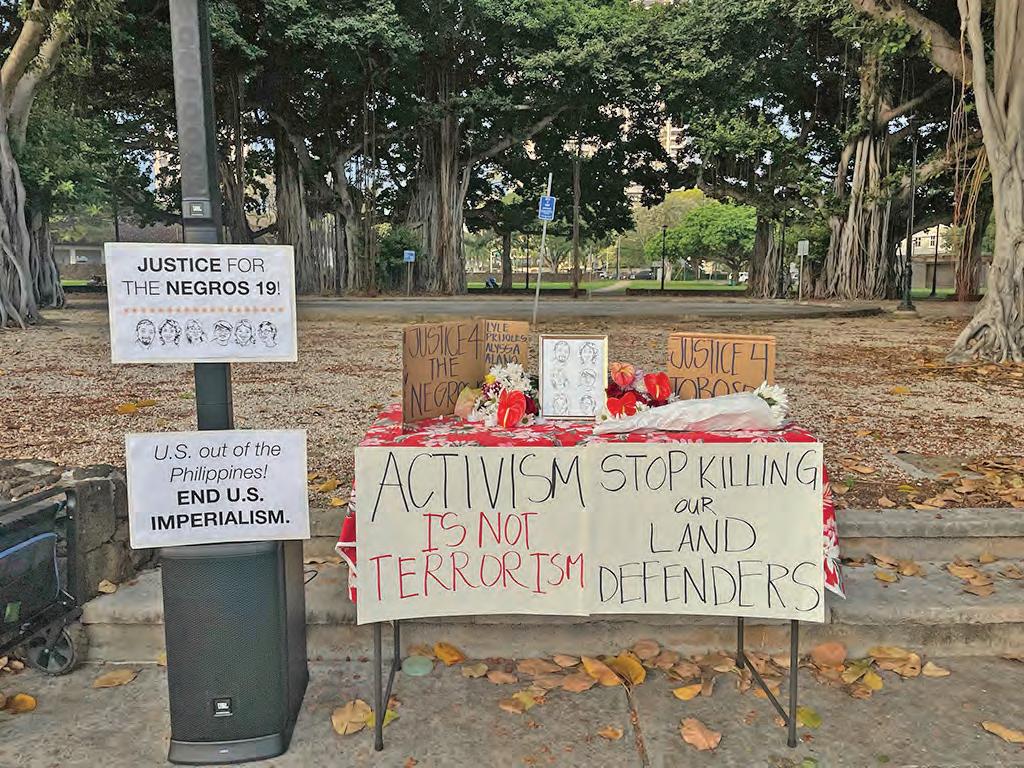
On April 19, 2026, 19 people were killed in a military operation in Toboso, Negros Occidental, in our beloved homeland, the Philippines. At least 167 families were displaced from their homes.
The Philippine military has framed the incident as a clash with communist rebels, but human rights groups, parliamentarians, and labor organizations describe it as a massacre, or possible massacre, involving peasant activists, youth, and other civilians.
For so many of us in the Filipino diaspora, Negros is not just a place on a map; it is the homeland of our families, relatives, and friends who may still be sugar workers, small farmers, or community organizers at risk.
As a Filipino activist in Hawaii, I support the Campaign for Justice for the Negros 19 with all my grieving and fighting heart, both because of my diaspora responsibility and because I condemn the US government’s direct complicity in what happened in Negros.
Negros has long symbolized extreme inequality in the Philippines: vast haciendas, foreign corporate interests, and land grabbing through projects such as so-called solar farms, quarries, malls, and bottling plants that enrich landlords while leaving farmworkers and most of the region poor.
These patterns of land use and development have pushed peasants, workers, and communities to organize to defend their livelihoods and demand change, which I believe is only just.
For so many of us Filipinos in the diaspora, our country’s reality of poverty and corruption and stark inequality between the poor and the wealthy is deeply personal, not
abstract. Negros is where our families come from, where our remittances go, and where loved ones may still be living in conditions shaped by these same political and economic forces.
The violence in Negros, and the conditions that perpetrate it is not only a domestic Philippine issue; it is entangled with US policy and funding.
The US government has authorized up to 500 million dollars a year in security and military assistance to the Philippines from 2026 to 2030, totaling 2.5 billion dollars over five years.
Through our taxes, US residents, including those of us living in Hawaii, are helping fund these operations and the broader counterinsurgency program in which they take place.
Our taxes end up funding the NTF-ELCAC, which is known for its brutal and inhumane practice of red-tagging and targeting those who oppose the unjust and anti-people policies of the Philippine government.
Our taxes helped fund the Duterte administration’s so-called “war on drugs,” which claimed the lives of thousands of most-
ly poor Filipinos and has been widely condemned, even internationally, for grave human rights abuses.
US money has long played a role in war and repression around the world, including the ongoing genocide of Palestinians, and it now risks further enabling human rights abuses in the Philippines.
Our taxes are also being used to build US military bases in the Philippines, justified in the media as providing “security” against China’s aggression.
If US military aid, training, and political support help sustain Philippine counterinsurgency operations, then residents of the US and Hawaii have a responsibility to push for investigations into, and demand accountability for, the Negros 19 massacre.
It also means residents of the US and Hawaii have a responsibility to demand that aid to the Philippine state forces be cut.
I am speaking out against these killings of my fellow Filipinos and these grave human rights violations, and I join others in demanding an impartial probe into what happened in Negros.
ers, not just ourselves, we have a duty to support the struggles of people everywhere for their democratic rights and against systemic oppression, exploitation, and violations of human rights.
This is one of the ways we can help protect people on the ground in places like Negros: by amplifying their demands and refusing to let these killings pass in silence. In our own ways, through our actions, we make it clear that activism is not terrorism.
I join others in building international pressure. ASEAN Parliamentarians for Human Rights (APHR), in an April 29, 2026, statement, already condemned the operation and raised concerns about extrajudicial killings, red-tagging, and abuses in counterinsurgency operations in the Philippines.
I stand with the international community in urging the Philippine government to allow independent investigations, stop red-tagging of activists and community organizers, and curb abuses committed under the banner of “security.”
In the US and here in Hawaii, the struggle for justice for the Negros 19 is linked to other movements for demilitarization, dignity, and life.
Community campaigns are calling for an end to US military occupation of Hawaii, for the protection of the dignity and health of migrants, and for the redirection of public funds away from the military and ICE terror and toward essential public services such as health, housing, food security, and more.
As activists who desire the well-being of oth-
As a Filipino activist based in Hawaii, I see the victims of the Negros 19 as fellow peasants, youth, workers, and organizers, not “collateral damage.” They are not terrorists.
As an activist, I recognize that the US government is deeply entangled in Philippine militarization and is complicit in the human rights violations against my people.
Living in the diaspora means confronting that complicity and acting on it: by speaking out, organizing, and insisting that our communities and elected officials in Hawaii and across the US demand transparency, accountability, and justice for the Negros 19.
International solidarity is one of the few tools available to those of us far from home. Still, it can be powerful when we use it to insist that lives in Negros and everywhere are not expendable.
We should demand the protection of human lives and dignity anywhere we are.
We should demand justice for the Negros 19.
DR. ARCELITA IMASA is a practicing family physician and the secretary of the Hawaii Workers Center’s Executive Committee of the Board. She grew up in the Philippines before migrating to Hawaii with her family more than a decade ago.
Filipino Fiesta Features “rice” to Tell Stories of Cultural Unity
By Edna Bautista, Ed.D.
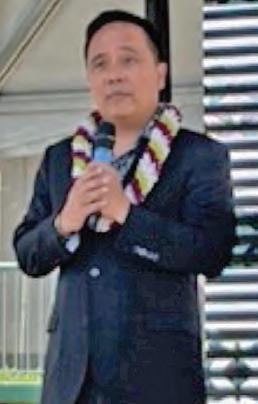
Like the numerous grains of rice, thousands came to enjoy the free 14th Flores de Mayo & 34th Filipino Fiesta on Saturday, May 2, 2026, at the Filipino Community Center in Waipahu. Notable attendees included Philippine Consul General Arman R. Talbo, L&L Hawaiian Barbecue Founder Eddie Flores, Filipino Community Center Chairman of the Board Edmund Aczon, several Filipino and local VIPs and pageant royalty.
This year’s Fiesta theme focused on “Rice— Where Every Grain Tells a Story.” Rice, which symbolizes perseverance, abundance and unity, and has sustained Filipino families and communities for generations, even in times of hardship, was featured prominently throughout Fiesta through rice-inspired dishes, decorations and artistry, cultural performances and workshops, educational activities, interactive games and creative vendor offerings.
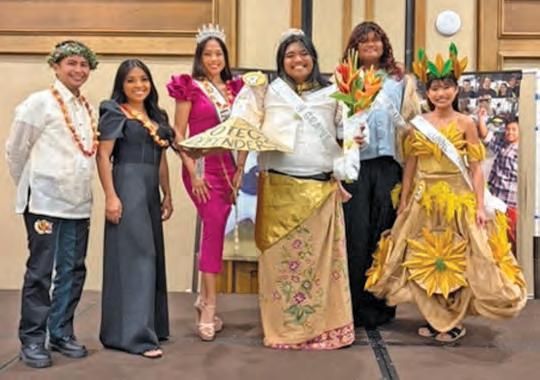
Geral Asuncion was crowned “The Chosen
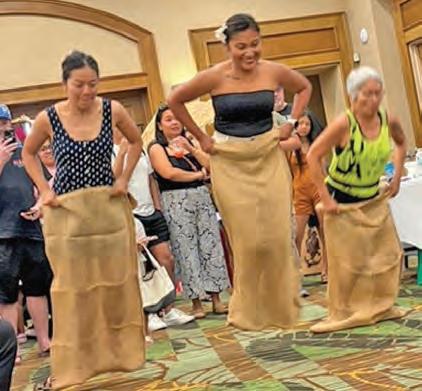
Grain” at “Crowns of Grain: An Inapoy Showcase,” a rice-themed fashion, talent and dialogue competition. The audience also cheered on participants in “Bilao Blitz,” a rice sack race and rice impurity challenge.
A new program at this year’s Fiesta was the “Tawag ng Entablado,” an online talent show where contestants submitted an audition video and the public voted on Facebook. Finalists were then invited to perform live on the main stage at Fiesta. Singer Kyrie Aguilar won 1st place, singer Christina Blay came in 2nd place and flutist Jathryn Racas was 3rd place.
Other signature programs returned, as these favorite traditions make Fiesta special every year: Santacruzan (a royal and religious court procession commemorating the search for the Holy Cross by Queen Helena and her son Constantine the Great); Cultural Village (immersive experiences showcasing Filipino heritage, regional food, traditions, language and performances); Filipiniana clothing market; Street Food Ex-
perience; Kabataan Barangay (Keiki/Children’s Village); Ligaya’s Sari-Sari store for snacks; and balut eating and ube ice cream eating contests.
There were lucky draw prizes for roundtrip flights from Southwest Airlines and Philippine Airlines.
International Filipino star/singer/actor Jake Zyrus was the headline entertainer at the event’s finale.
The annual Fiesta is the largest celebration of Filipino culture on O’ahu
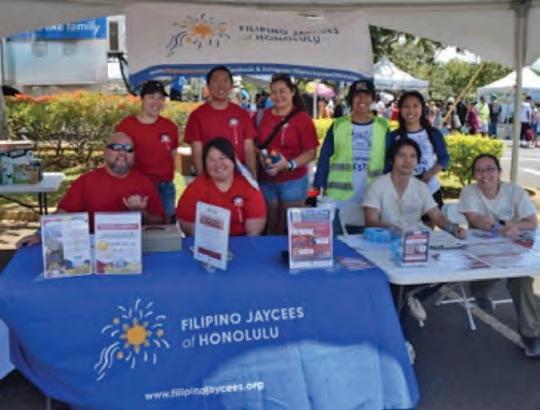
and a flagship project of the Filipino Community Center. This year’s event was spearheaded by the Filipino Jaycees of Honolulu in partnership with the Filipino community.
The 2026 Fiesta was sponsored by L&L Hawaiian Barbecue and Southwest Airlines, with the generous support of the Hawaiʻi Tourism Authority.
For more 2026 Fiesta photos, see the online album at https://flic.kr/s/aHBqjCSJhg
Philippine Consul General Arman R. Talbo welcomed everyone at the Fiesta opening ceremony.
Nine-year old Kyrie Aguilar won 1st place in the Tawag ng Entablado talent competition by singing “Patuloy ang Pangarap.”
International star Jake Zyrus gave an intimate performance for fans at the Fiesta finale.
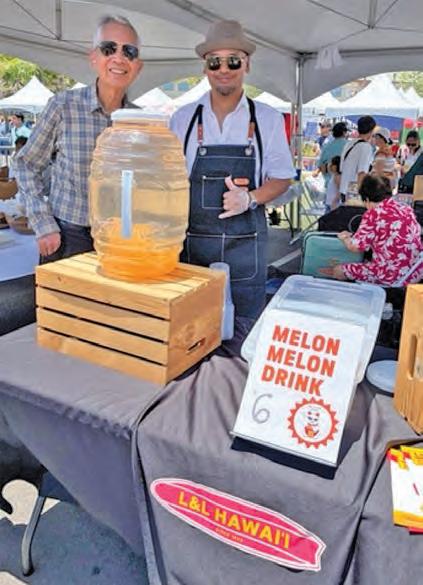
Eddie Flores and Jeff Guira greeted guests at the L&L Hawaiian Barbecue booth. Flores’ international company was one of the main sponsors of Fiesta.
Fiesta attendees cheered on the participants racing in rice sacks at the Bilao Blitz.
The tinikling and several traditional and contemporary Filipino performances kept Fiesta lively and fun throughout the day.
“Crowns of Grain: An Inapoy Showcase” featured creative ricethemed Filipino fashion.
Fiesta was spearheaded by the hardworking Filipino Jaycees of Honolulu in partnership with the Filipino community.
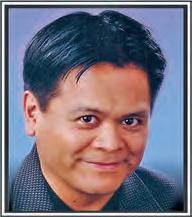
Jared K. Redulla
FEATURE
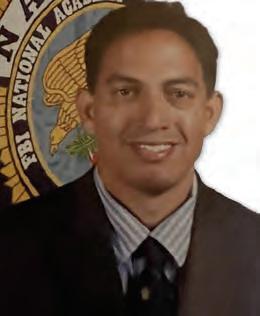
Hard Work, Faith, and Humility in DLE’s Jared K. Redulla
By Renelaine Bontol Pfister
The Hawaiʻi State Department of Law Enforcement (DLE) received the 2025 Western States Information Network (WSIN) Agency of the Year award.
The WSIN region includes Hawaiʻi, California, Oregon, Washington, and Alaska, as well as Canada, New Zealand, and Guam.
According to Jared K. Redulla, who is Deputy Director for Law Enforcement, the DLE was created in 2024 to centralize law enforcement functions in the state government.
“The DLE also administers statewide programs to ensure public safety, safeguard state property, and enforce laws. Additionally, the department is responsible for the development, coordination, and implementation of a comprehensive Homeland Security program for the state,” he shared.
As for his role as Deputy Director, Redulla explained that he administers all “the DLE’s law enforcement operations, including law enforcement support for the Hawaii Judiciary, providing law enforcement and protection at Hawaii’s airports and seaports, narcotics enforcement, criminal investigations, and providing law enforcement services to all state buildings, facilities, and properties.”
A graduate of the 251st session of the FBI National Academy in Quantico, Virginia, Redulla grew up in Kalihi, Honolulu, in a Filipino household that valued hard work and faith.
His Filipino grandparents lived next door to their house, and his great-grandmother lived in a house in front. He feels “very fortunate to have learned very traditional cultural values from them.”
He recalls his grand-
mother working at Dole Cannery and his Filipino great-grandmother taking care of the household chores while his parents worked. His father was a truck driver, and his mother was a waitress.
He commends his family for their hard work, which they instilled in him. His family frequented the church in Kalihi, and he attributes this to “the beginnings of a strong moral compass for my career in law enforcement,” he remarked.
After graduating from Kamehameha High School in 1990, he attended the University of Hawaii at Manoa, where he worked weekends for the State of Hawaii as a radio dispatcher for the Department of Land and Natural Resources.
Redulla said, “That experience would unlock a future in law enforcement for me.”
After a year at UH Manoa, he moved and studied
at Colorado State University, graduating magna cum laude with a degree in Sociology in 1994.
Meanwhile, he remained connected to DLNR, working during summer breaks for them. After graduating from college, DLNR hired him as a volunteer reserve conservation law enforcement officer. His next positions include being a harbor police officer with the Department of Transportation, then a fulltime conservation officer with the Department of Land and Natural Resources. In 2004, he worked as a plainclothes criminal investigator for the City and County of Honolulu, Department of the Prosecut-
SPORTS FEATURE
ing Attorney.
In 2006, he became a narcotics agent with the Hawaii Narcotics Enforcement Division, was promoted to supervisor of a narcotics squad in 2011, and then Chief of the Narcotics Enforcement Division in 2016.
He remained in this role until December 2023, when he was appointed as Deputy Director for the Hawaii Department of Law Enforcement.
When asked what the WSIN Agency of the Year award means to the whole team at DLE, Redulla replied:
“It is an honor. Receiving the award validates the hard work of every employee in the Department, and the award represents excellence in law enforcement. I am proud of all our employees who work hard for the community every day.”
Hard work and faith are evident in Redulla’s career and life, but in addition to that, there is also humility. He shines the spotlight on Hawaii DLE’s hard-working employees.
Three Stars and a Sun: Filipino Heritage Shines in the NBA Playoffs
By Julian Bothamley and Dylan Bothamley
The 2026 NBA playoffs have seen the emergence of three promising young players whose roots trace to the great basketball tradition of the Philippines.
Jalen Green, Jared McCain, and Dylan Harper have played important roles in each of their teams’ efforts to survive the NBA playoff gauntlet.
Jalen Green traces his Filipino roots through his mother, Bree Purganan, and has spoken proudly about representing Filipino fans on the NBA stage.
Green was one of the most exciting prospects of his generation: a McDonald’s All-American and the first player to sign with the G League Ignite pathway before the Houston Rock-
ets took him No. 2 overall in the 2021 NBA Draft. In 2025, he was traded to the Phoenix Suns as the centerpiece of a package for superstar Kevin Durant.
In the 2026 postseason, Green had one of Phoenix’s brightest moments, scoring 36 points in the play-in win over the Golden State Warriors that pushed the Suns into the playoff bracket. He scored in high volumes against the league’s best team in a first-round matchup against the Oklahoma City Thunder, but the Suns fell short of advancing.
Jared McCain was on the other side of the Suns-Thunder matchup. McCain traces his Filipino heritage to his mother Jina.
The Thunder guard entered the NBA out of Duke, where he’d earned a Kyle Macy Freshman All-America selection before the Philadelphia 76ers drafted him No. 16 overall in 2024.
Green is only 24, and his talent is undeniable.º
Philadelphia traded him to Oklahoma City this
February, where he joined the defending champion Thunder team. McCain added much-needed shooting to an otherwise extremely deep roster that has a good chance to repeat as champions.
McCain played a supporting role in Oklahoma City’s sweep of Green’s Suns. His future is promising as he’s already established himself as a contributor on a championship-level team, and his shooting gives him a clear route toward a bigger role in the years ahead.
Dylan Harper, meanwhile, may be the most exciting active story for Filipino fans right now.
As the No. 2 pick of the 2025 NBA Draft by the San Antonio Spurs, Harper had a very efficient rookie season and is playing a significant role in the Spurs’ ongoing quest to unseat the Thunder as NBA champs.
Harper was born to play basketball, and championships run in his blood. His mother, Maria, hails from Bataan, Philippines, and played college basketball for the University of New Orleans. His father is the great Ron Harper, who played alongside Michael Jordan for the legendary 1990’s Chicago Bulls.
Harper’s older brother, Ron Harper Jr., also found a home on the Boston Celtics this season in a supporting role for one of the best teams in the Eastern Conference with a good chance to make the NBA Finals.
It’s almost certain that either the Spurs or the Thunder will win the Western Conference. And this raises the real possibility that the NBA Finals could see a matchup with both teams featuring a member of the Filipino diaspora.
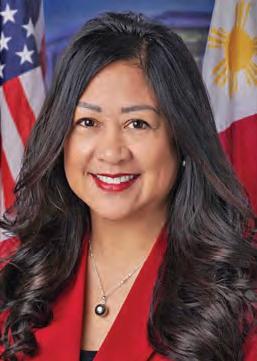
Meet the First Filipina-American Mayor of Cerritos, California: Lynda P. Johnson
Did you know that Lynda P. Johnson, the new mayor of Cerritos City, California, has Filipino roots and a Hawaii connection?
Johnson was born in Japan to her Filipino mother, Delia, and her American father, Samuel Johnson, a member of the US Navy, who was assigned to a Naval Station based in Yokosuka, Japan. Then they moved to Hawaii and lived there for six years when his father was assigned to Pearl Harbor, Honolulu.
Her father was reassigned to Illinois when she was only six years old. At the age of seven, her father retired, and the whole family settled in Cerritos, California in 1971, where they made it their home for a lifetime.
On April 8, 2026, Johnson was sworn in as Cerritos City’s first Filipino-American mayor during the city’s 70th anniversary. While there have been women mayors in Cerritos before 2026, Johnson’s mayoral term highlights the growing representation of Filipino Americans in leadership roles in local governance and public service.
This historic milestone in the closely-knit and diverse Cerritos community of about 50,000 residents was unanimous in framing this new set of City Council members as an All-Asian American council, and a majority of women, led by three Filipino Americans.
When asked what it means to be the first Filipina Mayor of Cerritos, Mayor Johnson said:
“When my fami-
ly moved to Cerritos in 1971, I was the only Filipino in my second-grade class. Today, I am deeply honored to serve as Mayor of a city that reflects the richness of diversity, where 60% of our residents are Asian, and Filipinos represent the largest share of that community. This moment is profoundly meaningful to me. It represents a full-circle journey, from a young girl finding her place, to the privilege of serving as the first Filipina Mayor of the city I have proudly called home my entire life, the City of Cerritos.”
Johnson also added:
“I am grateful to my City Council colleagues for their selection and for the opportunity to serve as the first Filipina Mayor for my hometown of Cerritos. I grew up here when there were still dairy farms and cows. Looking back, I’m proud to have witnessed our city’s extraordinary progress and now be helping contribute to our high-quality services, amenities, and a strong business climate.”
Her term as mayor reflects a full circle moment on how far the community has come and the future the city residents have to continue to build together.
Johnson took over the post from another Filipino, Mayor Frank Aurelio Yokohama, who remains a City Council member. She is the third Filipino mayor of Cerritos after Mark Pulido and Yokohama.
Johnson’s first involvement in public service occurred when she
started becoming active in the Parent-Teacher Association in her children’s school.
Through this experience, she was able to hone and develop her leadership skills, knowledge in governance, and participation in community service. Thereafter, she served as a board member of the ABC Unified School District from 2011 to 2017.
In her professional career, she was a field deputy to Los Angeles County Supervisor Janice Hahn and transitioned to being a field deputy to Los Angeles County Sheriff Alex Villanueva. In April 2022, she was elected to the city council.
When Pulido, another son of a US Navy Pinoy, vacated his position as Trustee of the Education Board and won as a member of the city council, she ran for the position and won. That was the start of her political career, she said.
She was elected to the City Council in 2022 and has a strong focus on community service. Her appointment is viewed as a major milestone for Filipina representation in local Southern California leadership.
To get in touch with
her constituents, Johnson writes the column, “From the Mayor’s Desk,” on the city’s social media outlet City News Category, where she highlights recent initiatives and upcoming events in the city. This is her way of reaching out to the community on a closer level.
Johnson is not new to public service because she worked on the following Internal Ad Hoc Working Groups before becoming the mayor of the city in the areas of: Arts Program; Chamber of Commerce; City Charter Review; Legislative; Library; Personnel; Policy and Procedure; Sister Cities; and Ube Fest.
She also served on several community-based organizations. In addition, she previously served on the following committees: California League of Cities Revenue and Taxation Policy Committee (2023); and League of California Cities Governance, Transparency, and Labor Relations Policy Committee (2024-2025).
Johnson also served as a Governing Member of the ABC Unified School District Board of Education from 2011 through 2017, taking over the slot vacated by a fellow FilAm, Mark Pulido, who ran and won as a member of the city council
A 39-year employee of the County of Los Angeles, Johnson was a Paralegal with the L.A. County District Attorney’s Office for 20 years. She also served as the Field Deputy to Los Angeles County Sheriff Alex Villanueva from 2021 to 2022. She also served as
the Special Assistant to Los Angeles County Supervisor Janice Hahn. Johnson attended ABC Unified School District schools, including Patricia Nixon Elementary School, Haskell Junior High School, and Artesia High School. She has a Paralegal degree from Cerritos College. As early as her college days, she always dreamed of her agricultural community becoming the jewel of the region.
She has roots in Cebu and Iloilo (her mother, Delia, is from Iloilo) in the Philippines, which she hopes to visit regularly. She was with the VIP Consulate Group that visited the Ilocos Region last year, and this year, she will be with a group visiting Cebu, Bohol, and Dumaguete.
Johnson, who has been in Cerritos for 50 years, has no aspirations to go anywhere else. She aims to give the best that she can for the residents, to continue giving back to her community, and to recognize diversity and bring it to a higher level.
I would like to thank Cerritos City Manager Trisha Murphy and Cerritos Communications Manager Steve Harvey for their help in arranging the phone interview with Mayor Johnson, among others.
More power to you, Trisha and Steve!
Mabuhay ka, Johnson!
ELPIDIO R. ESTIOKO was a veteran journalist in the Philippines and a multi-awarded journalist here in the US. For feedbacks, comments… please email the author at estiokoelpidio@gmail.com
By Elpidio R. Estioko
Mayor Lynda P. Johnson
By Emil Guillermo
n the first Saturday of Asian American Pacific Islander Native Hawaiian Heritage Month, ‘Saturday Night Live” featured the Filipino American pop star Olivia Rodrigo singing and acting up a storm (even pratfalling down a staircase).
But how many people only saw her as white and not Asian America? Does it matter?
The show opened auspiciously with comedian Aziz Ansari, a South Asian born in South Carolina, playing the only Asian American declared exempt by the alleged WHCD shooter—Kashyap Patel. With bulging eyes, Aziz as FBI Director Patel proclaims: “I’m the first Indian person to suck at their job.”
That’s a big anti-model minority laugh. Honesty is debilitatingly funny.
But there’s more.
”Everyone says Indian people are smart, hard working, and incredibly intelligent,” he added. Then he pivoted. “ I prove without a shadow of a doubt that we can be just as incapable and incompetent as the whites.”
Big laugh as Colin Jost as Defense Sec. Pete Hegseth ducks into the shot.
So we’re high up in the culture and in life. And we can take a joke. All is good, right?
Not so fast.
Are we so cool, or are we anxious?
Axios calls us “America’s Most Anxious Demographic” as it reports Asian Americans say they are suffering from high levels of anxiety.
The findings are from the annual STAATUS Index (Social Tracking of Asian Americans in the U.S.), that came out just last week.
Asian Americans aren’t laughing. They’re worried. 44 percent of Asian Americans said they’re worried about life right now.
And we’re the only group where our worry outweighs our hope (40 percent). We’ve got a hope deficit of 4 percent. No matter how many songs Olivia Rodrigo sang on SNL on Saturday.
What me worry? You better. STAATUS highlights how the general public’s attitudes toward Asian Americans have worsened over time.
CANDID PERSPECTIVES
On Voting Rights, Identity Politics, And the State Of Asian America
More than one in five adults (21 percent) say Chinese Americans pose a threat to society, the survey said.
Wait, remember Pearl Harbor? When Japanese Americans were seen in the U.S. as the enemy. What did Filipinos and Chinese in America do? As the groups attempted to climb in U.S. society they wore buttons that said, “I am not a Jap.”
Will we see “I am not Chinese” buttons in 2026? Passed out by non-Chinese Asians?
One other survey finding should cause alarm. Nearly one in 4 U.S. adults believe Asian Americans are more loyal to their ancestral home country. About half the adults asked were unsure.
But there’s enough negative sentiment out there to suggest that when people see Asian Americans they still see “foreigner.”
Not American. Foreigner.
So what has happened since the 1965 Immigration Act ended racist quotas and allowed for the formation of Asian American communities?
While many of us have thrived as Americans in society, the anti-Asian sentiment that has been present for centuries has not been fully eradicated.
Remember how the Pearl Harbor experience disproved the idea of a solid Asian American community. Are we better and more unified now? When identity politics is essentially being condemned for being anti-American?
As we celebrate Asian American Heritage Month this year, let’s use the month to get beyond the food and cultural shows that will abound.
Let’s begin to build and maintain the coalitions needed to thwart the anti-Asian elements in our present day.
Voting Rights Act Diminished
There’s plenty to worry about after seeing the Voting Rights Act gutted last week.
‘The Voting Rights Act— which
was part of the winning trifecta of LBJ’s “Great Society” that included the Civil Rights Act and the Immigration Act— was already a shell of what it was.
But now it’s a tool to go backwards in time.
The law used to help rectify the exclusion of Blacks and people of color in politics. Now Justice Sam Alito, leading the charge in the court’s 6-3 decision, declared bluntly that race could not be used when drawing up congressional districts.
It’s the “colorblind” myth applied to electoral politics.
And it’s the reason Politico and Civil Rights Leader Andrew Young said the Supreme Court will “go to hell” for that decision.
Of course it will.
When the law dictates you can’t use race to ameliorate a racial problem, you are in the strange immoral universe that perpetrates injustice by leaving mitigation up to chance. There’s a bias against the aggrieved. Already there are states planning to rejigger the districts so that we go back in time and people of color lose representation.
It’s the same thing that happened with affirmative action when the court barred race from admissions.
Visiting my Alma Mater
Recently I visited Harvard, where final official numbers have not been released for the incoming class yet. But the school did feel like it was heading toward being 40 percent Asian.
Some of you will say what’s wrong with that? But don’t you think there’s something wrong when Asian Americans get more than our fair share?
I happened to be grabbing a quick bite of hand-pulled noodles at a Cambridge restaurant when a diner at the next table engaged in conversation.
He was a Filipino who immigrated in the ’80s, naturalized and became a successful lawyer. He was
at Harvard because his son was attending an event for those accepted into the fall class, but had not made a final decision.
The man was worried about cost. I told him that if the family income was less than around $200,000, then essentially the tuition was free.
The man, modest of his success, politely said that provision did not apply to his family.
It made me see how far Filipinos had come. When I was a student in the ‘70s, Filipinos were mostly from the Philippines and wealthy. A small group. They were not like me, the son of a fry-cook who came to America in 1928.
That’s progress! After 50 years, Filipino Harvard students are smarter, and more successful than ever.
Then the father said his Lolo was named Emilio from the Visayas, and his son was named for him. The fact that I was an Emiliano with Philippine roots talking to him during this trip was seen as a kind of omen.
Forget science and physics and all that. Filipino juju was in play!
The father later emailed me and said his son had made a decision. He chose Harvard.
I’m sure he’ll be a success in a class that is predominantly Asian.
Lampoon
I was at Harvard for a reunion of the humor organization, the Lampoon.
When I looked at the book of classes, the membership was allwhite until just the late ‘60s and early ‘70s when I became a member.
Look at the 1974 picture. I’m in the front.
For 100 years, the picture looked like the 1954 photo.
That couldn’t have happened without the aforementioned trifecta during the “Great Society” years that allowed for such breakthroughs.
A milestone of sorts, as one ponders AAPINH Heritage Month.
EMIL GUILLERMO is a journalist and commentator. His talk show is on www.amok.com.
Born of the People
By Rose Cruz Churma
“B
orn of the People” is the 1953 autobiography of labor leader and revolutionary Luis Taruc, who led the HUKBALAHAP (Hukbong Bayan Laban sa Hapon) in the Philippines soon after the end of World War II.
It is widely known that this autobiography was ghostwritten by William Pomeroy, an American communist, poet, author, and ghostwriter who served the American army in the Pacific during World War II and had connections with the Philippine guerrillas during that war. He had married a Filipina who was a member of the Hukbalahap.
As a child growing up in the rural town of San Marcelino, Zambales, the terms “Huks,” “Taruc,” and “Pomeroy” were words I’ve heard often at the dinner table or when my grandfather would comment on an article he read in the weekly Free Press (he was the distributor for the town’s six subscribers).
This was often coupled with mention of Ramon Magsaysay, my grandmother’s nephew, who, as the Philippines’ Secretary of Defense (before he became the president), was able to get Luis Taruc and
his Huks to surrender.
Last week, it was a pleasant surprise to get a phone call from Susan Halas of Maui that she was sending me an auto graphed copy of the Luis Taruc autobiography—a book that the revolutionary had gifted her parents when he visited Detroit in 1974.
Susan’s parents, Jock and Petra Netzorg, were book dealers based in Detroit and owned Cellar Book Shop. They were our mentors who encouraged us to establish Kalamansi Books in 1993. Jock was born in Naga City, the son of Thomasites, teachers sent by the U.S. government to establish public schools in the Philippines.
(Part 1)
Taruc’s rise from a peasant background in Pampanga to the head of a massive agrarian revolution.
artist, actor, professional football player, and activist who became famous both for his cultural accomplishments and for his political stances.
In the first paragraph of Robeson’s foreword, he mentions Hawai’i:
Jock, a prolific writer and collector, selected the books to be acquired, and Petra managed the business side. By the time both passed away, their collection of Filipiniana materials was the most extensive outside of the Philippines.
Published by International Publishers of India, the book details the history and struggles of the Huk movement, framing it as a peasant-led fight against feudalism and U.S. control.
It includes a foreword by Paul Robeson, an African American concert
The first few pages describe the particulars of Taruc’s young life. But most parts of the book are dedicated to the history and workings of the Huk movement.
One of Taruc’s early mentors was Pedro Abad Santos, founder of the Philippine socialist movement, who felt that the peasants’ chances of gaining concessions would increase if they could draw strength from one another and use their collective voice to demand their rights.
for agrarian reform. Taruc, as well as seven colleagues, were elected to the House of Representatives in the Philippine Congress, but the Philippine government disallowed them to take their seats in Congress.
The Taruc faction opposed the parity rights that the U.S.demanded from the newly “independent” Philippines as a condition for rehabilitation funding. Taruc gave up on pushing for reforms via the parliamentary struggle and took up arms instead.
“When I was in Hawai’i a few years ago, it was my privilege to sing for, and with the sugar and pineapple workers, to clasp their hands in firm friendship, and to share for a short time their way of life.”
Invited by the Hawai’i labor unions, he had the opportunity to talk with the Filipino workers of Hawai’i, who shared their views on Hukbalahap and their fight to survive the Japanese fascism during the war, and later against American imperialism and its Filipino collaborators.
It is in this context that Robeson read Luis Taruc’s story to write his foreword and he notes that:
“This is an intensely moving story, full of the warmth, courage…Here is certainly proof that the richest humanist tradition is inherited and will be continuously enriched by the working class…How necessary that we learn the simple yet profound lessons of united action, based upon the deepest respect for the people’s wisdom, understanding, and creative capacity.”
Written in the early 1950s while Taruc was still leading an underground rebellion, the book chronicles
By 1929, Pedro Abad Santos had founded a workers’ union and encouraged the peasants to be more militant, well-organized, and able to articulate their demands and grievances. He formed his own indigenous theory of socialism, which Taruc likely absorbed and influenced his beliefs.
In May 1935, among Pedro Abad-Santos’ party co-founders and loyal cadres of the movement was Luis Taruc, and by the late 1939, the workers gained militancy and labor unions emerged throughout the country.
With the certainty of a Japanese invasion, the movement had one basic theme, which was preparing against the Japanese invasion.
In Chapter 8, Taruc notes that Hukbalahap was born on March 28, 1942, a few months after the Japanese invasion of the Philippines, in a clearing of the forest that joined the corners of the provinces of Pampanga, Nueva Ecija and Tarlac.
A few months before the end of the war, his mentor Pedro Abad Santos was brought from detention at Fort Santiago to Luis Taruc’s base in Pampanga for medical treatment but passed away in January 1945.
After the war against Japan, the Hukbalahap continued their demands
At the height of its popularity, the Hukbalahap reached a fighting strength estimated at between 10,000 and 30,000.
After months of negotiations, Taruc surrendered unconditionally to the government in May 1954. This effectively ended the Huk rebellion. Taruc met with then President Ramon Magsaysay in June 1954 where he agreed to a trial.
The trial started in August 1954, where he pleaded guilty to rebellion. On September 11, 1968, more than a decade since his trial, Taruc was pardoned by President Ferdinand Marcos who gained the former Huk leader’s support. Taruc continued to work for agrarian reforms after his pardon.
In September 1972, Marcos declared Martial Law, and with it the directive to implement Land Reform. The first on the list to be “land reformed” was my grandparent’s lands in Zambales in 1973. As the oldest grandchild, I witnessed the “turn-over” as I helped my grandmother (my grandfather had passed away that year) navigate the changing landscape. (continuation on Part 2)
ROSE CRUZ CHURMA established Kalamansi Books & Things three decades ago. It has evolved from a mail-order bookstore into an online advocacy with the intent of helping global Pinoys discover their heritage by promoting books of value from the Philippines and those written by Filipinos in the Diaspora. We can be reached at kalamansibooks@gmail.com.
PERSONAL REFLECTIONS
Land of Contradictions
By Seneca Moraleda-Puguan
Ten months in the Philippines after being away for more than a decade, and now confronted once again with the realities our country faces, I have come to a sobering realization.
This nation, we deeply love, is a land of contradictions and irony.
We are a predominantly Christian nation in Asia, and yet we are among the most corrupt in the region.
According to the latest Corruption Perceptions Index, the Philippines ranks among the most corrupt out of 11 Southeast Asian countries.
We are a country that professes to worship Jesus, yet so often contradicts His teachings of honesty, humility, and integrity. Leaders who publicly declare their faith on Sundays seem
to abandon these values on Mondays, engaging in dishonesty and corruption.
It is a painful reality, one that not only damages governance but also weakens our moral witness as a people.
We take pride in having some of the best nurses and doctors in the world, yet our healthcare system remains weak and deeply flawed.
Filipino healthcare professionals are globally recognized for their competence, compassion, and resilience. They are in high demand worldwide. And yet, back home, many Filipinos struggle to access even basic healthcare services.
Distance, cost, and lack of health education prevent countless families from receiving proper care.
Rural areas face severe shortages of medical professionals, while issues of mismanagement and ques-
tionable use of public funds continue to plague institutions like PhilHealth.
Many of our nurses and doctors are compelled to leave the country in search of better opportunities, places where they are valued, fairly compensated, and supported. In doing so, the nation loses the very people it needs most.
We boast of world-class talent, intelligence, and creativity. Yet, paradoxically, we continue to see patterns of poor decision-making, particularly in the way we choose our leaders.
Election after election,
COMMENTARY
many voters place their trust in individuals who have already proven themselves unworthy… leaders tainted by corruption, inefficiency, incompetence, and self-interest.
It is a frustrating cycle that seems to repeat across generations
Despite past scandals, impeachments, and broken promises, the same names and political dynasties resurface and reclaim power. Instead of solving the nation’s problems, some leaders become the very problems we struggle to overcome.
It’s disappointing and
truly heartbreaking.
These contradictions, and many more, continue to shape the story of our beloved Philippines.
It is a place we call home, yet it feels like one we want to escape, as it becomes increasingly difficult and disheartening to endure its challenges.
But like I always say, though it’s easier said than done, I cling to hope.
I long for the day when I can return to the Philippines and truly feel at home, not just in a physical sense, but with a deep sense of pride and peace.
I pray for a future where we can trust and respect the leaders we elect, where healthcare is not a privilege but a right accessible to all, and where our identity as a Christian nation is reflected not only in our words but in our actions.
Until then, may we not grow weary in hoping, in speaking truth, and in striving to turn these contradictions into transformation.
Civic Sickness - The Cause and The Cure
By Gary Hooser
If the health of our community is measured in terms of “faith and confidence in government” - we have a serious illness in need of immediate attention.
There were 839,618 Hawaii residents registered to vote in 2024.
Only 271,345 or 32.3% actually voted in the 2024 primary election.
568,273 or 68% received ballots in the mail, but couldn’t be bothered to open the envelope, place a mark next to their preferred candidates, and walk it out to their mail box.
Clearly the “body politic” is sick.
People are sick and tired of government corruption, legislators taking bribes, “pay to play” campaign spending abuse, SuperPacs spending millions in “dark money”, and a political cul-
ture driven by the almighty dollar.
68% of of our friends and neighbors are saying, “Why bother to vote at all?”
The cure for our civic illness is the same as for any other malady.
We need to eliminate the root cause.
It is our own damn fault that we are sick.
Blaming the politicians is an easy way out.
The truth is that too many of us aren’t willing to take the time.
We are too busy for “civic engagement”. We don’t have time to go to meetings, to make the calls, to send the emails, or help candidates.
We have bills to pay, jobs we must show up for, grass to cut, shopping to do, and sometimes family and friends to care for.
Cry me a river. Too bad, too sad.
We gotta make the time.
It’s not going to get better until we put on our big girl/
boy pants and make the extra effort to pay attention, be involved, and take ownership of our own local government.
We can beat the big money AND we can create the government we need and deserve. But to get there, we must show up.
This means attending public hearings, sending in testimony, making the phone calls to our elected officials, and VOTING.
It also means making small dollar donations, actively helping in the campaigns of candidates who share our values and concerns AND possibly running for office ourselves.
There is a cure for our illness and it is us.
You and me.
We are all in this together and together we must take action and work together to build the healthy democracy we deserve.
Let’s start the process now.
Let’s each of us take the time TODAY to call our
Governor, Dr. Green - (808) 586-0034.
Dr. Green has the power to bring all of our government leaders together and to extend the legislative session or call a special session if necessary to ensure key good governance and anti-corruption legislation is passed into law- THIS YEAR.
There are bills on the table at this moment that could stop the campaign donation “pay to play” culture of corruption that now exists in that big square building on Beretania Street. But those bills have been sidelined.
There are bills that would stop the “two tickets” to a fundraiser charade (IYKYK) - also awaiting attention and final votes.
Also sitting in the darkness of some conference room on the 4th floor are bills that would make “failure to report bribery” a crime for elected officials who witness of have knowledge of such conduct.
The kicker, the plum,
and the cherry on topwould be passage of a strong SB2471 - stripping the power and influence from corporate SuperPacs and “Citizens United”.
With the stroke of a pen, a few phone calls, and a meeting or two among those at the top of our political food chain - our Governor could make this happen. If he truly wanted to, he could ensure the passage of these 4 measures and significantly heal the civic sickness, distrust, and cynicism that currently envelops the entire culture of government and politics in Hawaii.
Waiting still yet another year, for another legislative session, to do a repeat of what’s happened every year for the past few years, is unacceptable.
Please. Today, right now - call Governor Green, tell him we need his help.
GARY HOOSER is ta former Hawaiʻi State Senator and Majority Leader.
“Bebot” Social Media Trend Highlights Filipina Beauty
By Edna R. Bautista, Ed.D.
The “bebots” are back!
Two decades after the global hip hop/dance-pop group
Black Eyed Peas (BEP) released “Bebot,” a music clip from that song has become the soundtrack to viral videos on TikTok, Facebook, and Instagram, where fresh-faced Filipinas (as well as women and men of other ethnicities) are instantly transformed into glamorous girls.
Originating from the 1980s, “bebot” is Tagalog slang for “hot chick, “babe,” or “baddie,” according to UrbanDictionary.com. In general, “bebot” refers to an “attractive woman.”
However, “bebot” style makeup itself dates to the mid-2000s, coinciding with the release of BEP’s music video featuring plenty of pretty Pinays with thin and sculpted eyebrows, black eyeliner, frosted or metallic eyeshadow, shimmery lip gloss and bronze facial contours that proudly highlight brown skin. Sexy clothing and big hoop earrings reflect the decade’s fashion and Y2K aesthetic.
Now, a new generation around the world is rediscovering Filipino culture and celebrating the “Pinay Morena Glow” through the “#bebot” social media trend.
BEP’s “Bebot” on the
Global Stage
Allan Pineda Lindo (a Filipino American known by his stage name apl.de.ap) co-wrote “Bebot” with his best friend and fellow BEP bandmate William Adams (will.i.am) and released the track 20 years ago on “Monkey Business,” the group’s fourth studio album.
Even though Pineda,
who was born in Pampanga, Philippines, raps entirely in Tagalog, its catchy beat and rhythms have made the song a huge hit at weddings, birthdays, and dance parties all over the world, catapulting Filipino culture onto the global stage and transcending language barriers.
Adams once asked Pineda how to say “hot chick” in his language. When he replied “bebot,” Adams started rapping what would become the opening lines and title of the track.
“Filipino” is also proudly chanted throughout the song. Other lyrics give specific cultural examples, such as eating with hands (“kamayan”), chicken adobo, and balut, working hard and supporting the family, and praising the beauty of Filipinas.
On April 25 in Makati, Philippines, Pineda invited all to celebrate the official 20th anniversary of “Bebot” at a dance party and concert at Annex House. Attendees were encouraged to dress in iconic “bebot” style.
Music Videos with Generational Appeal
Two music videos were produced for “Bebot” and released online (watch them on YouTube). California-based Fil-Am filmmaker and director Patricio Ginelsa of Kid Heroes
Productions had conceptualized one “historical” video to showcase Filipino life in America during the 1930s and in the mid2000s. But a low budget and lack of support from the record label led to BEP independently financing two separate versions.
The first music video, “Bebot: Generation One,” was set in “Little Manila” (Stockton, California) in the 1930s and featured Filipino immigrants’ social life at dance halls and community clubs in the district. The video won the President’s Award from the California Preservation Foundation in 2007.
The second music video, “Bebot: Generation Two,” was approved for public release by the record label in 2006. It showed Filipino friends having fun in a contemporary setting and at a house party.
Jasmine Trias—The Original “Bebot”
Two American Idol runners-up from Season 3 (2004) appear in the videos. Camile Velasco from Haʻikū, Maui, whose stage name is Eli-Mac, the 9th runner-up, makes a cameo.
Jasmine Trias, 3rd runner up, had a more prominent role, playing Pineda’s baby sister in the second version.
Trias, who grew up in Mililani, O’ahu, and now
themselves—confidently and unapologetically—on a global stage.”
“Growing up in Hawaii, during my experiences on American Idol, and later traveling to perform in the Philippines, I saw firsthand how much that visibility and representation meant to our Filipino community,” she said.
“Today, it still matters. Seeing a new generation embrace the viral ‘Bebot’ beauty trend on social media shows just how far we’ve come—from seeking representation to now influencing mainstream culture. At its heart, it’s about Pinoy pride.”
resides and works in Las Vegas, is the original “bebot;” the pink t-shirt she wore in the video is imprinted with the word itself.
She said that “Bebot” has endured for 20 years because it was “more than a song—it was a cultural moment.”
“In 2006, when I was asked by the BEP and apl. de.ap to be in their music video, Filipino representation in mainstream media was still limited, so it really meant something and seemed significant, even back then,” Trias said.
“I felt that same Pinoy pride during my journey on American Idol in 2004, when Filipinos around the world showed me such incredible love and support.
“Looking back, I realize how important that was and the positive change it represented. Competing and becoming a Top 3 finalist on a global hit TV show was bigger than me—I was carrying the flag for Filipinos everywhere,” she continued.
“‘Bebot’ carried that same energy of celebrating who we are. Seeing it resurface now shows that message of representation is truly timeless.”
Like Pineda, who wanted the Filipino culture represented more in the mainstream, Trias said that “‘Bebot’…was important then because it gave Filipinos a chance to see
In today’s chaotic world, people are feeling nostalgic for simpler times. “Bebot” brings back fun memories as well as celebrates Filipino culture.
“Being part of ‘Bebot’ is something I’ll always be proud of. Getting tagged on social media and receiving so much love—with people calling me the original ‘Bebot’—always puts a big smile on my face,” Trias said.
“I’m grateful to the Black Eyed Peas, apl.de.ap, and director Patricio Ginelsa for asking me to be part of what has become a Filipino anthem. Seeing this recent wave of love has been so special—it’s amazing to watch a new generation connect with ‘Bebot’ in their own way. And yes, I still have the original ‘Bebot’ tee shirt from the music video! It’s a beautiful reminder of a moment in time that continues to inspire and celebrate Filipinos around the world.”
Trias, a Hawaii-born and raised Filipina American, is an American Idol star and international platinum-selling recording artist. She is currently a headliner in Las Vegas, Nevada, where she regularly performs with her husband Ben Stone, a British singer and entertainer.
Follow Trias on Instagram @jasminetrias to stay updated.
Original “Bebot” Jasmine Trias on set with music video director Patricio Ginelsa (left) and members of the Black Eyed Peas—Fergie, Taboo and apl.de.ap (Allan Pineda Lindo)—in 2006. Photo courtesy of @JasmineTrias on Instagram.
57th Annual Barrio Fiesta
The 57th Annual Barrio Fiesta will take place on May 22–23 at the Binhi at Ani Filipino Community Center at 780 Onehee Avenue, Kahului, Maui, running Friday from 5–10 p.m. and Saturday from 10 a.m.–10 p.m.
Event Chairperson Nora Cabanilla-Takushi notes that Maui has celebrated Filipino culture, food, and traditions for 57 years, even virtually
during the pandemic. She emphasizes that the Barrio Fiesta is the longest-running Filipino fiesta in the United States, first held in 1970. With Filipinos and part-Filipinos making up 25% of Hawai‘i’s population, the Fiesta continues its mission of cultural sharing. Binhi at Ani President Arnel Alvarez highlights the importance of preserving heritage for youth and fostering
appreciation across Maui.
A major attraction is the wide variety of Filipino foods, offered by community organizations. Dishes include balut, banana lumpia, beef inasal, Bicol express, dinuguan, empanada, halo-halo, lechon manok, palabok, pansit, pinakbet, pork adobo, sisig, and more. Local favorites such as chow fun, hamburger steak, matcha latte, and shoyu chicken
will also be available.
This year’s Miss Barrio Fiesta® candidates are Keighlyn Jayne Ollero Failano and Daezah-Lynn Latayada‑Starmer, with the 2026 queen crowned Friday evening. Cultural entertainment includes performances by Angelina Rosaro Abapo, Miss Maui Filipina, Naragsak, Oni Foundation, and others.
Inside the Center, visitors can explore a replica Bahay Kubo and cultural villages representing Cebu, Cordillera, Ilocos Norte, Metro Ma-
BIBLE REFLECTIONS
nila, Mindanao, Pangasinan, and Visayas. The best village earns a $500 prize.
Special events include the Santa Cruzan, Veterans Memorial Service, Miss Maui Filipina presentation, and the Outstanding Housekeepers Awards. A lechon demonstration will also be held Saturday, May 23.
Each evening ends with Zumba at 9:30 p.m., followed by two major drawings on Saturday at 10 p.m., including one for travel to the Philippines.
From Crisis to Miracle: A Father and Son’s Testimony of Faith, Prayer, and Healing
By Rolly and Caleb Dela Cruz
What began as an ordinary evening turned into a life-and-death battle, one that would ultimately reveal God’s power, faithfulness, and the strength of a praying community.
On the evening of Nov. 16, 2024, while my wife and I were attending a DG Leaders’ Assembly at CCF Angono, Caleb sent a reassuring message: “Bahay na po.” (“I’m home now.”)
As a family growing in faith and serving God together, we never expected that our faith would soon be tested in such a profound way.
When we arrived home around 9:00 PM, we were met with a terrifying scene.
Caleb was lying on his bed, unresponsive, with dried blood on his nose and signs of vomiting. He was incoherent.
Without hesitation, I called Caleb’s DGroup leader, and together we rushed him to the nearest hospital. Due to the severity of his condition, he was transferred to a larger medical facility.
During the ambulance ride and upon arrival at the emergency room, Caleb began experiencing violent seizures—screaming, convulsing, and repeatedly losing consciousness. It took six people to restrain him.
He was immediately admitted to the Intensive Care Unit. Doctors delivered devastating news: Caleb had only a slim chance of survival.
An emergency openbrain surgery was performed to relieve pressure caused by severe internal bleeding. The injuries were extensive—swelling, multiple areas of bleeding in the brain, and a skull fracture. For nearly a week, the bleeding persisted. He also developed ICU-acquired pneumonia.
We were overwhelmed, gripped by fear, uncertainty, and the growing burden of hospital bills that had already exceeded one million pesos.
In the midst of despair, God moved through His people.
Caleb’s DGroup leaders and our church community initiated a corporate prayer and fasting movement.
Beginning Nov. 19, a daily “Pray O’Clock” via Zoom was held at noon, continuing for 16 days until Caleb’s discharge. Family, friends, church members, and even strangers joined together in prayer.
At the same time, financial provision came in unexpected ways. Fundraising efforts were launched, and assistance was sought
from foundations and government agencies. Each time payment was due, funds or guarantee letters arrived just in time.
Eleven days after surgery, Caleb was taken off the ventilator and sedation. The following day, he was transferred to a regular room.
When he regained full awareness, he was surprised to find himself in the hospital. His last memory suggested that he may have slipped and hit his head.
As his parents, our greatest fear, that he might not recognize us, was quickly replaced with relief and gratitude.
By God’s grace, Caleb recognized everyone. After just 20 days in the hospital, Caleb was discharged.
Despite a total bill reaching millions, our family was only required to sign a promissory note for ₱200,000. Shortly after, we received news that the remaining balance had been fully covered through
a guarantee letter.
As Caleb continued his recovery, doctors observed something remarkable— his locomotor skills were completely intact.
What would normally take six months of recovery after open-brain surgery was accelerated. Within three months, his skull replacement procedure was successfully completed.
While speech therapy remained part of his healing journey, Caleb stood once again—strong, restored, and able to testify.
He has since shared his story on a radio program and continues to speak in various church gatherings. Even his academic journey
continued uninterrupted, as his professors extended special consideration to support his recovery.
One of my colleagues, who had not yet personally known Christ, remarked that Caleb’s healing was a result of the church’s faith and prayers.
Indeed, countless prayers were lifted—not only by family and friends, but by an entire community of believers.
As written in James 5:14–15, “The prayer offered in faith will restore the one who is sick, and the Lord will raise him up.”
This testimony is living proof that God hears and answers prayer. All glory and praise to our Almighty God!
ROLLY DELA CRUZ, a devoted husband to his wife Lanie for 22 years, is a father who has faithfully committed his family to the Lord since joining Christ’s Commission Fellowship in 2019.
CALEB DELA CRUZ, their 21-year-old son, serves as a DGroup member and leader, and is part of the core leadership of Elevate Angono, as well as the Exalt and Host Team Ministries of CCF Angono.
Pastor Bong Saquing prayed over the family, Caleb, Rolly & Lanie Dela Cruz, who were joined on stage by DGroup leaders Tiffany & Weng del Rosario.