Food Bank Support and Emergency Assistance Scheme - 18
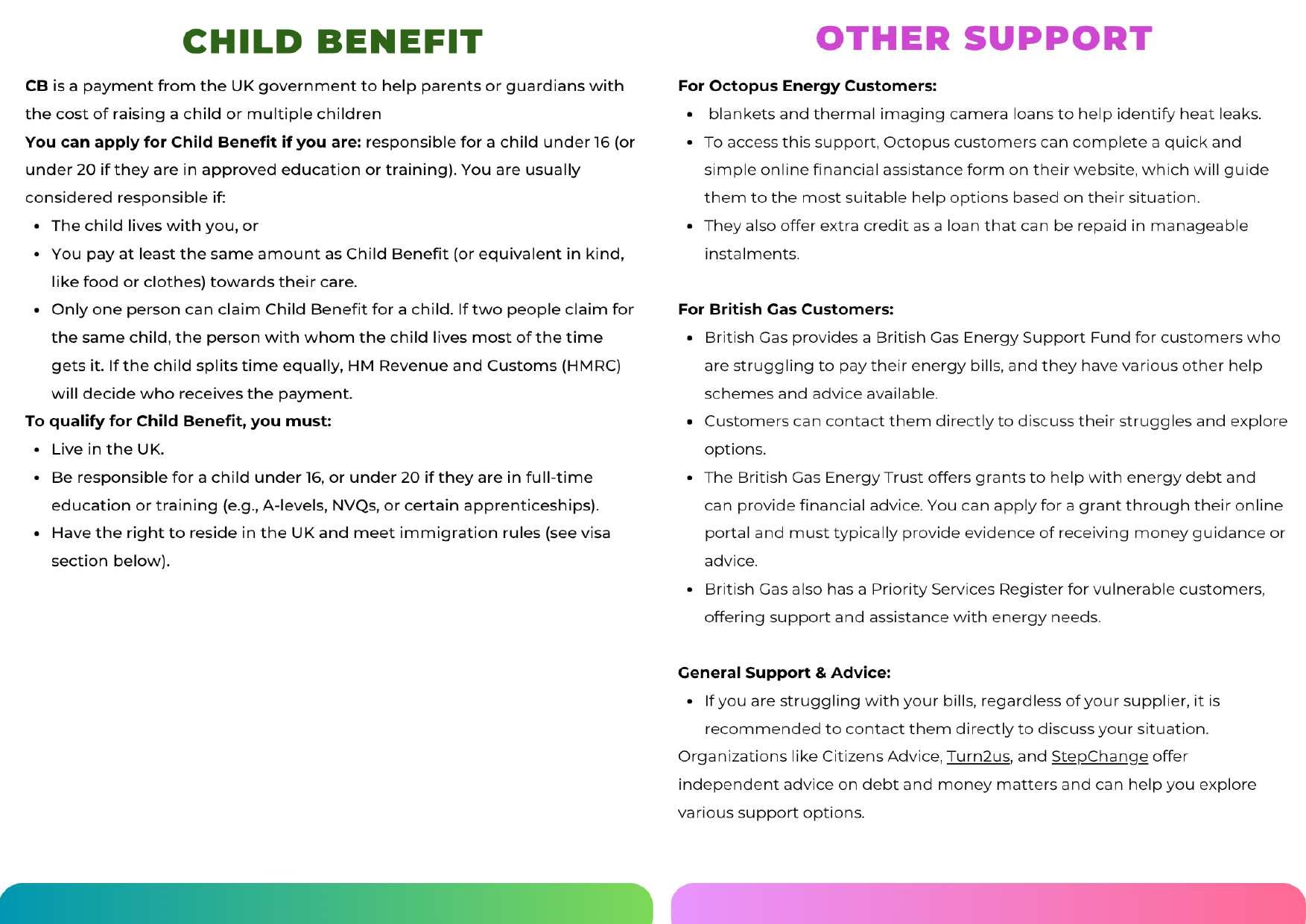
Other Support - 19
Havering phone numbers - 20
Useful phone numbers - 21
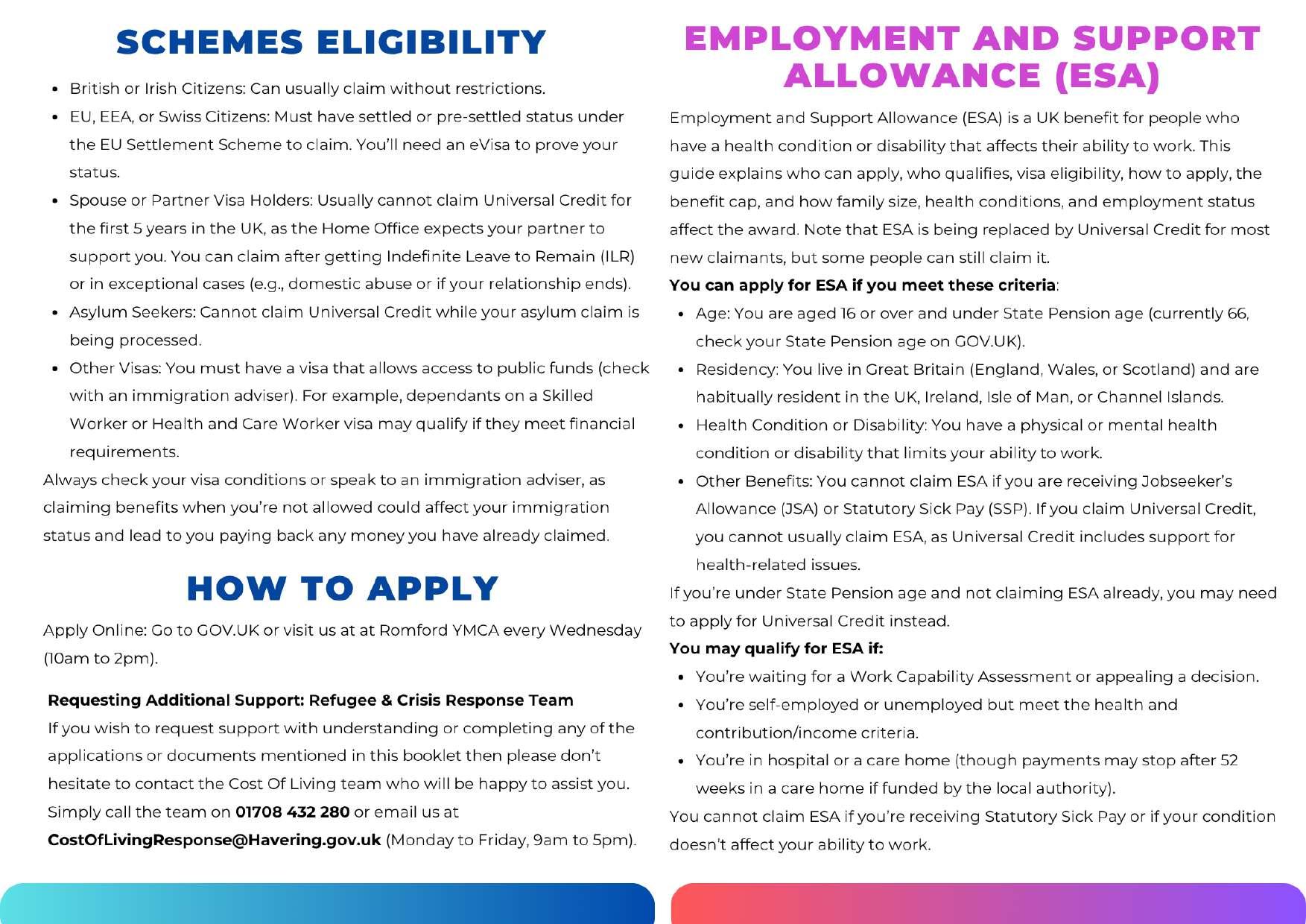
Schemes eligibility - 22
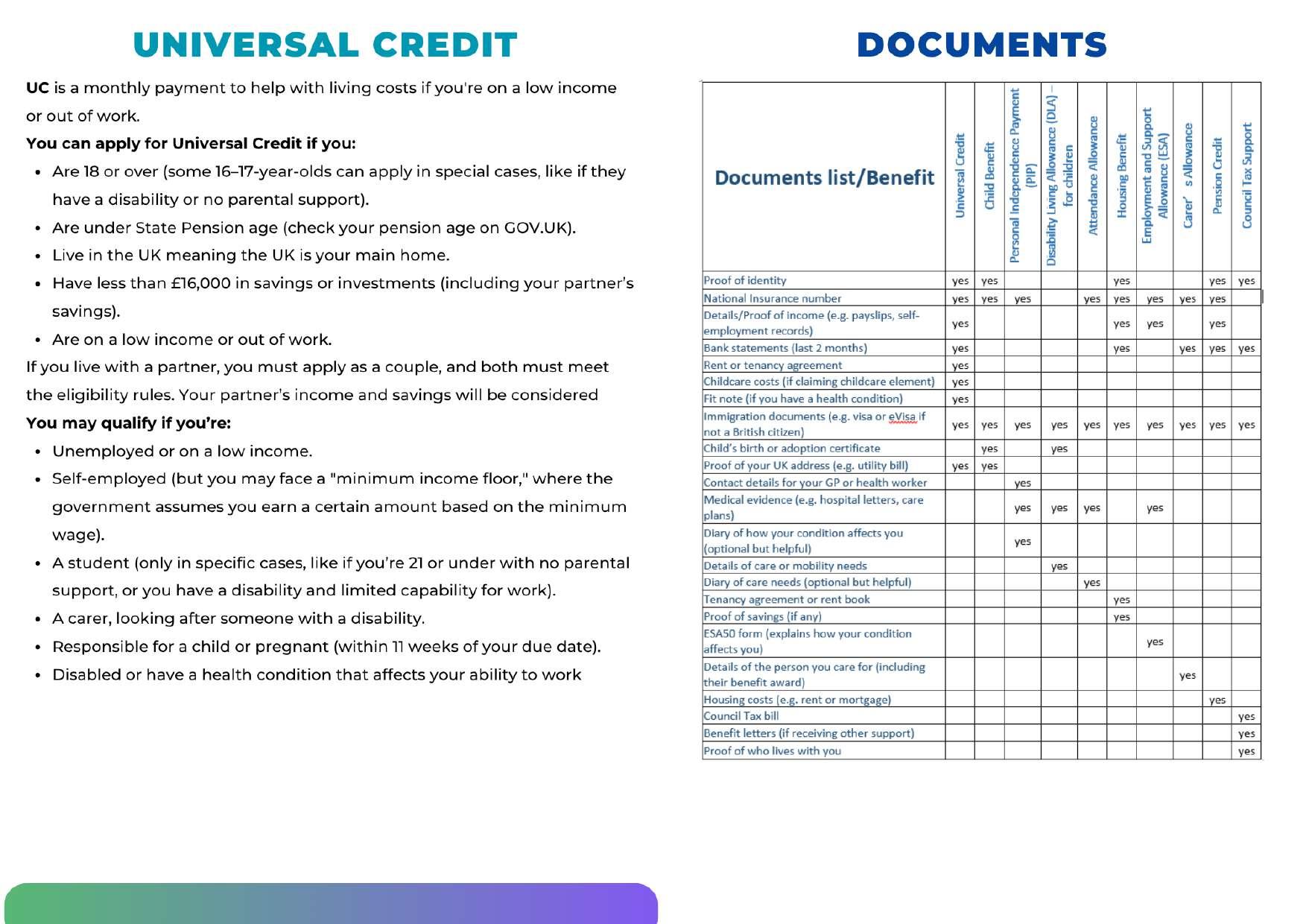
Documents - 23
Citizens Advice
Citizens Advice provides free, confidential, and impartial advice to help people resolve legal, financial, housing, employment, and other problems. They aim to empower individuals to understand their rights and responsibilities and find a way forward.
Visit Citizens Advice by clicking here
Local Citizens Advice Bureau
• Address: First Floor, Romford Central Library, St Edward Way, Romford, RM1 3AR
• Phone: 0808 189 8273
• Opening Times (Phone Support):
• Monday: 10am - 12.30pm
• Tuesday: 10am - 4pm
• Wednesday: 10am - 12.30pm
• Thursday: 1pm - 4pm
• Friday: 10am - 12.30pm
National Citizens Advice Bureau:
• Advice line (England): 0800 144 8848
• Opening Hours:
• Monday to Saturday: 9am - 5pm
• Closed on public holidays
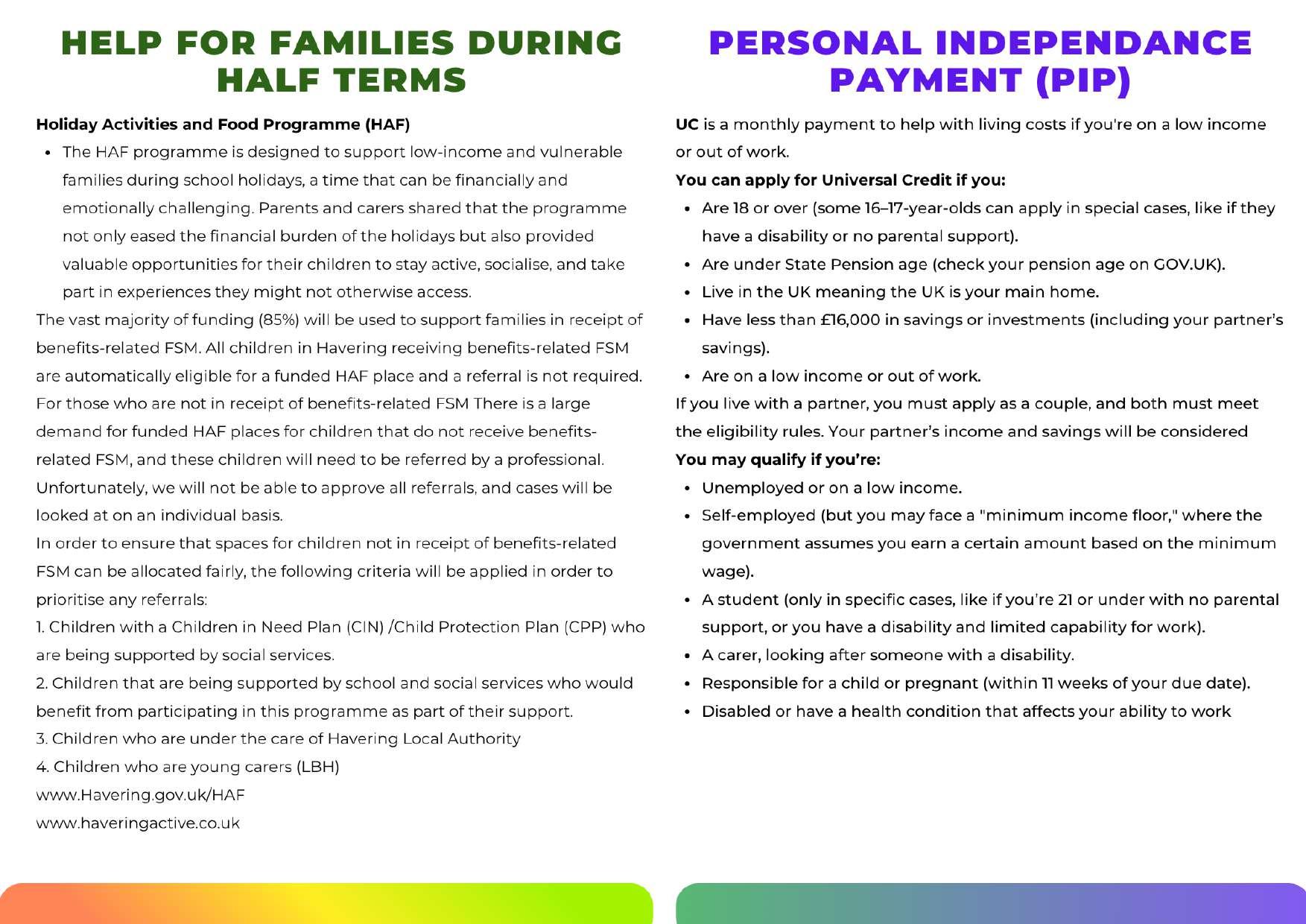
Universal Credit
Universal Credit (UC) is a monthly payment to help with living costs if you’re on a low income or out of work.
You can apply for Universal Credit if you:
• Are 18 or over (some 16-17-year-olds can apply in special cases, like if they have a disability or no parental support).
• Are under State Pension age (check your pension age here).
• Live in the UK meaning the UK is your main home.
• Have less than £16,000 in savings or investments (including your partner’s savings).
• Are on a low income or out of work.
If you live with a partner, you must apply as a couple, and both must meet the eligibility rules. Your partner’s income and savings will be considered.
You may qualify if you’re:
• Unemployed or on a low income.
• Self-employed (but you may face a “minimum income floor,” where the government assumes you earn a certain amount based on the minimum wage).
• A student (only in specific cases, like if you’re 21 or under with no parental support, or you have a disability and limited capability for work).
• A carer, looking after someone with a disability.
• Responsible for a child or pregnant (within 11 weeks of your due date).
• Disabled or have a health condition that affects your ability to work.
All information and figures included in this document are correct at the time of writing, please ensure you check eligibility criteria independently.
Employment and Support Allowance (ESA)
Employment and Support Allowance (ESA) - is a UK benefit for people who have a health condition or disability that affects their ability to work. This guide explains who can apply, who qualifies, visa eligibility, how to apply, the benefit cap, and how family size, health conditions, and employment status affect the award. Note that ESA is being replaced by Universal Credit for most new claimants, but some people can still claim it.
You can apply for ESA if you meet these criteria:
• Age: You are aged 16 or over and under State Pension age (currently 66, check your State Pension age here).
• Residency: You live in Great Britain (England, Wales, or Scotland) and are habitually resident in the UK, Ireland, Isle of Man, or Channel Islands.
• Health Condition or Disability: You have a physical or mental health condition or disability that limits your ability to work.
• Other Benefits: You cannot claim ESA if you are receiving Jobseeker’s Allowance (JSA) or Statutory Sick Pay (SSP). If you claim Universal Credit, you cannot usually claim ESA, as Universal Credit includes support for health-related issues.
If you’re under State Pension age and not claiming ESA already, you may need to apply for Universal Credit instead.
You may qualify for ESA if:
• You’re waiting for a Work Capability Assessment or appealing a decision.
• You’re self-employed or unemployed but meet the health and contribution/income criteria.
• You’re in hospital or a care home (though payments may stop after 52 weeks in a care home if funded by the local authority).
You cannot claim ESA if you’re receiving Statutory Sick Pay or if your condition doesn’t affect your ability to work.
Child Benefit
Child Benefit (CB) is a payment from the UK government to help parents or guardians with the cost of raising a child or multiple children.
You can apply for Child Benefit if you are:
• responsible for a child under 16 (or under 20 if they are in approved education or training).
You are usually considered responsible if:
• The child lives with you, or
• You pay at least the same amount as Child Benefit (or equivalent in kind, like food or clothes) towards their care.
• Only one person can claim Child Benefit for a child. If two people claim for the same child, the person with whom the child lives most of the time gets it. If the child splits time equally, HM Revenue and Customs (HMRC) will decide who receives the payment.
To qualify for Child Benefit, you must:
• Live in the UK.
• Be responsible for a child under 16, or under 20 if they are in full-time education or training (e.g., A-levels, NVQs, or certain apprenticeships).
• Have the right to reside in the UK and meet immigration rules (see visa section page 22).
All information and figures included in this document are correct at the time of writing, please ensure you check eligibility criteria independently.
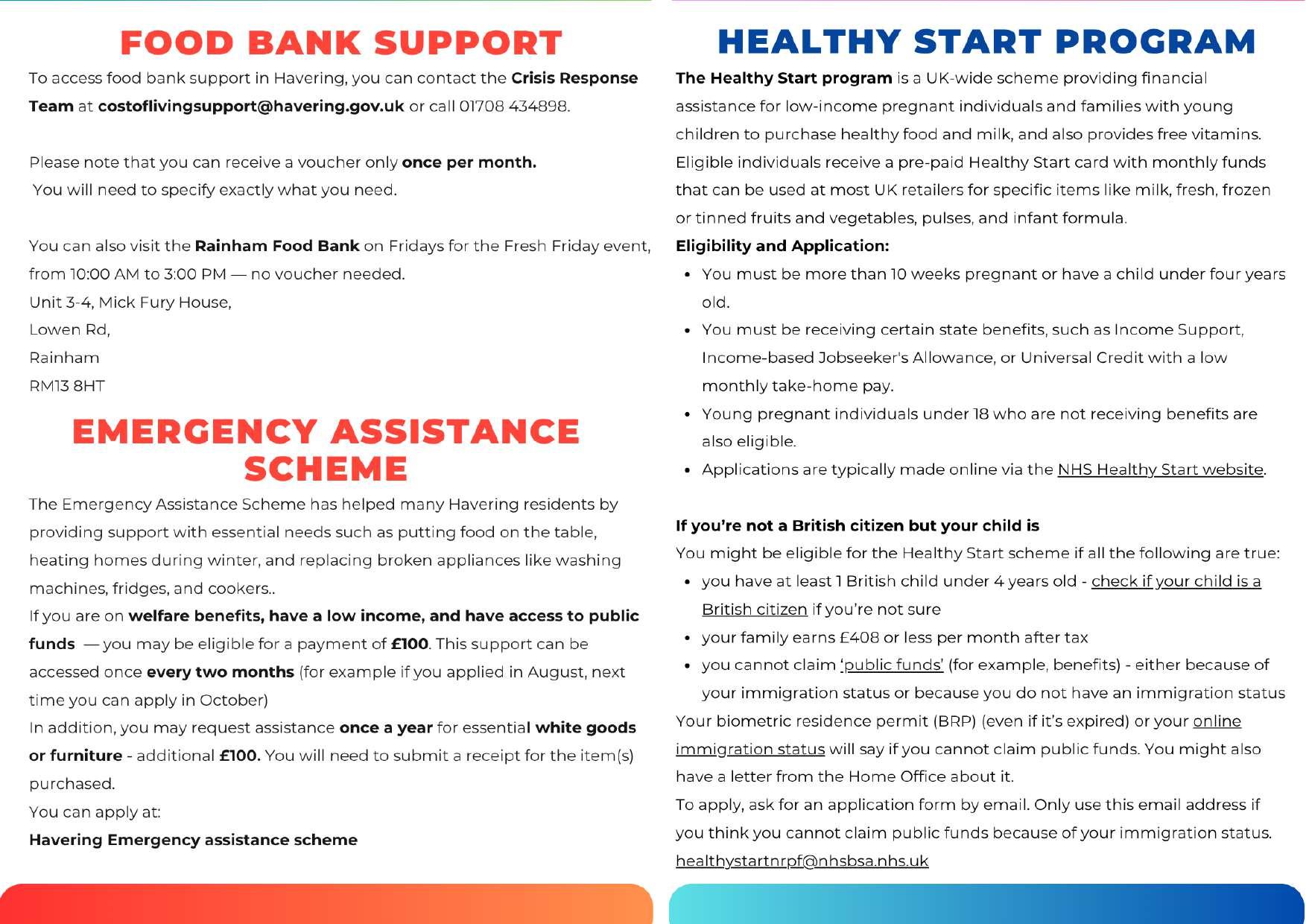
Healthy Start Programme
The Healthy Start Programme is a UK-wide scheme providing financial assistance for low-income pregnant individuals and families with young children to purchase healthy food and milk, and also provides free vitamins. Eligible individuals receive a pre-paid Healthy Start card with monthly funds that can be used at most UK retailers for specific items like milk, fresh, frozen or tinned fruits and vegetables, pulses, and infant formula.
Eligibility and Application:
• You must be more than 10 weeks pregnant or have a child under four years old.
• You must be receiving certain state benefits, such as Income Support, Income-based Jobseeker’s Allowance, or Universal Credit with a low monthly take-home pay.
• Young pregnant individuals under 18 who are not receiving benefits are also eligible.
• Applications are typically made at the NHS Healthy Start website. If you’re not a British citizen but your child is: You might be eligible for the Healthy Start scheme if all the following are true:
• you have at least one British child under 4 years old - check if your child is a British citizen if you’re not sure.
• your family earns £408 or less per month after tax.
• you cannot claim ‘public funds’ (for example, benefits) - either because of your immigration status or because you do not have an immigration status.
Your biometric residence permit (BRP) (even if it’s expired) or your online immigration status will say if you cannot claim public funds. You might also have a letter from the Home Office about it.
To apply, ask for an application form by email. Only use this email address if you think you cannot claim public funds because of your immigration status. Email: healthystartnrpf@nhsbsa.nhs.uk
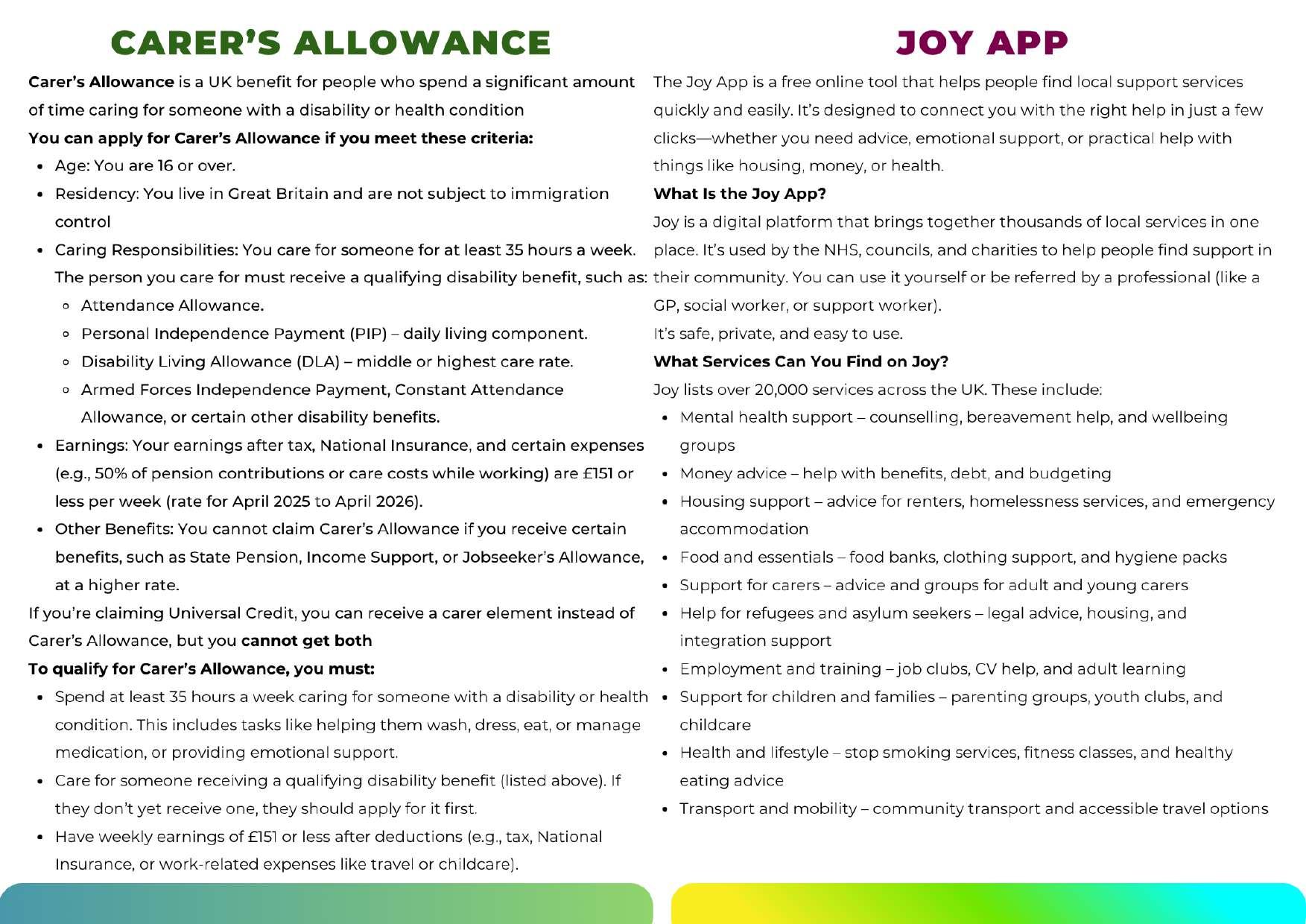
Carer’s Allowance
Carer’s Allowance is a UK benefit for people who spend a significant amount of time caring for someone with a disability or health condition. You can apply for Carer’s Allowance if you meet these criteria:
• Age: You are 16 or over.
• Residency: You live in Great Britain and are not subject to immigration control.
• Caring Responsibilities: You care for someone for at least 35 hours a week.
• The person you care for must receive a qualifying disability benefit, such as:
• Attendance Allowance.
• Personal Independence Payment (PIP) - daily living component.
• Disability Living Allowance (DLA) -middle or highest care rate.
• Armed Forces Independence Payment, Constant Attendance Allowance, or certain other disability benefits.
• Earnings: Your earnings after tax, National Insurance, and certain expenses (e.g., 50% of pension contributions or care costs while working) are £151 or less per week (rate for April 2025 to April 2026).
• Other benefits: You cannot claim Carer’s Allowance if you receive certain benefits, such as State Pension, Income Support, or Jobseeker’s Allowance, at a higher rate.
If you’re claiming Universal Credit, you can receive a carer element instead of Carer’s Allowance, but you cannot get both.
To qualify for Carer’s Allowance, you must:
• Spend at least 35 hours a week caring for someone with a disability or health condition. This includes tasks like helping them wash, dress, eat, or manage medication, or providing emotional support.
• Care for someone receiving a qualifying disability benefit (listed above). If they don’t yet receive one, they should apply for it first.
• Have weekly earnings of £151 or less after deductions (e.g., tax, National Insurance, or work-related expenses like travel or childcare).
Personal Independance Payment (PIP)
Personal Independance Payment PIP has two components: daily living and mobility. You may qualify for one or both, depending on your needs. Each component has a standard and enhanced rate, and the amount you receive depends on your condition. As of 2025, weekly rates are:
• Daily Living: Standard rate £73.90, Enhanced rate £110.40.
• Mobility Component: Standard rate £29.20per week, Enhanced rate £77.05.
Health Conditions
The amount you receive depends on how your condition affects you, not the specific condition. For example:
• Physical Conditions: If arthritis makes dressing or walking difficult.
• Mental Health Conditions: If anxiety or depression affects your ability to plan journeys or socialise.
• Terminal Illness: If you have a prognosis of 12 months or less, you automatically get the enhanced daily living rate.
Employment Status
PIP is not means-tested, so your employment status or income does not affect eligibility or the amount you receive. You can claim PIP if you’re:
• Working (full-time or part-time).
• Unemployed or unable to work.
• Self-employed or in education.
Additional Information
• Payment Frequency: PIP is paid every 4 weeks directly into your bank account.
• Other Benefits: PIP can qualify you for extra support, such as the Motability Scheme (for leasing a car or scooter with the enhanced mobility rate) or a Blue Badge for parking.
• Changes in Circumstances: Report changes in your condition, residence, or time spent abroad (over 4 weeks) to the DWP, as these may affect your award.
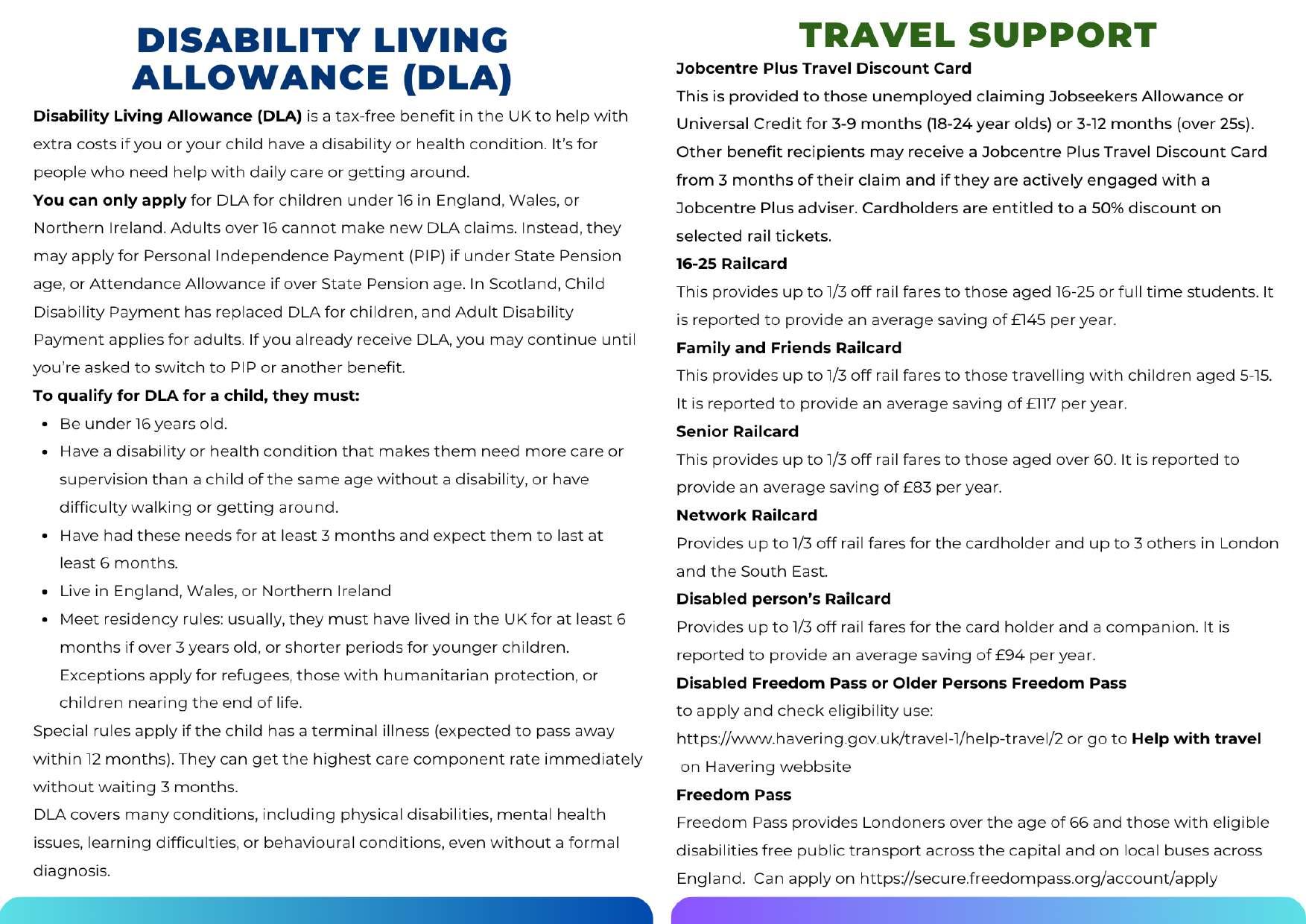
Disability Living Allowance (DLA)
Disability Living Allowance (DLA) is a tax-free benefit in the UK to help with extra costs if you or your child have a disability or health condition. It’s for people who need help with daily care or getting around.
You can only apply for DLA for children under 16 in England, Wales, or Northern Ireland. Adults over 16 cannot make new DLA claims. Instead, they may apply for Personal Independence Payment (PIP) if under State Pension age, or Attendance Allowance if over State Pension age. In Scotland, Child Disability Payment has replaced DLA for children, and Adult Disability Payment applies for adults. If you already receive DLA, you may continue until you’re asked to switch to PIP or another benefit.
To qualify for DLA for a child, they must:
• Be under 16 years old.
• Have a disability or health condition that makes them need more care or supervision than a child of the same age without a disability, or have difficulty walking or getting around.
• Have had these needs for at least 3 months and expect them to last at least 6 months.
• Live in England, Wales, or Northern Ireland.
• Meet residency rules: usually, they must have lived in the UK for at least 6 months if over 3 years old, or shorter periods for younger children. Exceptions apply for refugees, those with humanitarian protection, or children nearing the end of life.
Special rules apply if the child has a terminal illness (expected to pass away within 12 months). They can get the highest care component rate immediately without waiting 3 months.
DLA covers many conditions, including physical disabilities, mental health issues, learning difficulties, or behavioural conditions, even without a formal diagnosis.
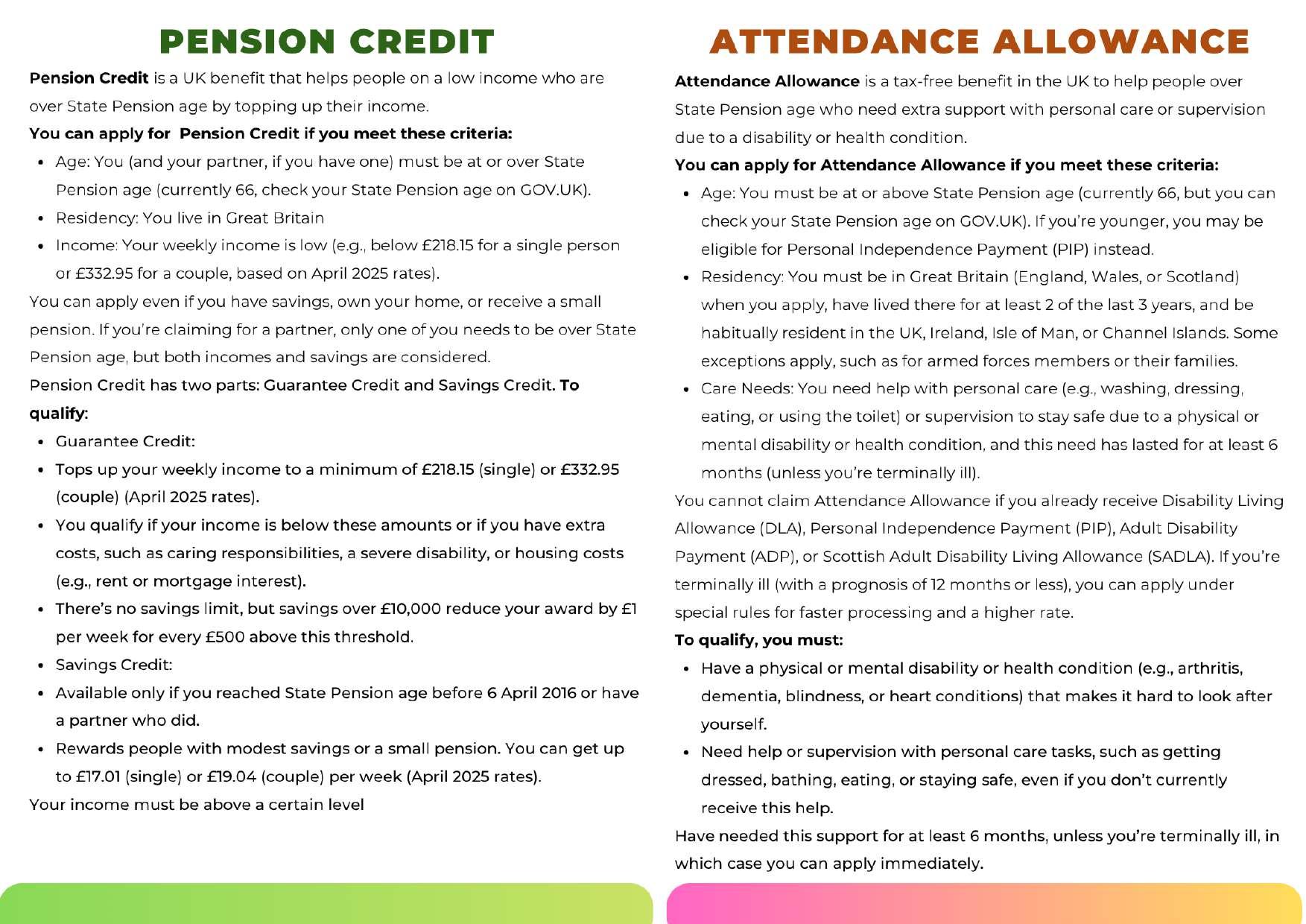
Attendance Allowance
Attendance Allowance is a tax-free benefit in the UK to help people over State Pension age who need extra support with personal care or supervision due to a disability or health condition.
You can apply for Attendance Allowance if you meet these criteria:
• Age: You must be at or above State Pension age (currently 66, but you can check your State Pension age here). If you’re younger, you may be eligible for Personal Independence Payment (PIP) instead.
• Residency: You must be in Great Britain (England, Wales, or Scotland) when you apply, have lived there for at least 2 of the last 3 years, and be habitually resident in the UK, Ireland, Isle of Man, or Channel Islands. Some exceptions apply, such as for armed forces members or their families.
• Care Needs: You need help with personal care (e.g., washing, dressing, eating, or using the toilet) or supervision to stay safe due to a physical or mental disability or health condition, and this need has lasted for at least 6 months (unless you’re terminally ill).
You cannot claim Attendance Allowance if you already receive Disability Living Allowance (DLA), Personal Independence Payment (PIP), Adult Disability Payment (ADP), or Scottish Adult Disability Living Allowance (SADLA). If you’re terminally ill (with a prognosis of 12 months or less), you can apply under special rules for faster processing and a higher rate.
To qualify, you must:
• Have a physical or mental disability or health condition (e.g., arthritis, dementia, blindness, or heart conditions) that makes it hard to look after yourself.
• Need help or supervision with personal care tasks, such as getting dressed, bathing, eating, or staying safe, even if you don’t currently receive this help.
Have needed this support for at least 6 months, unless you’re terminally ill, in which case you can apply immediately.
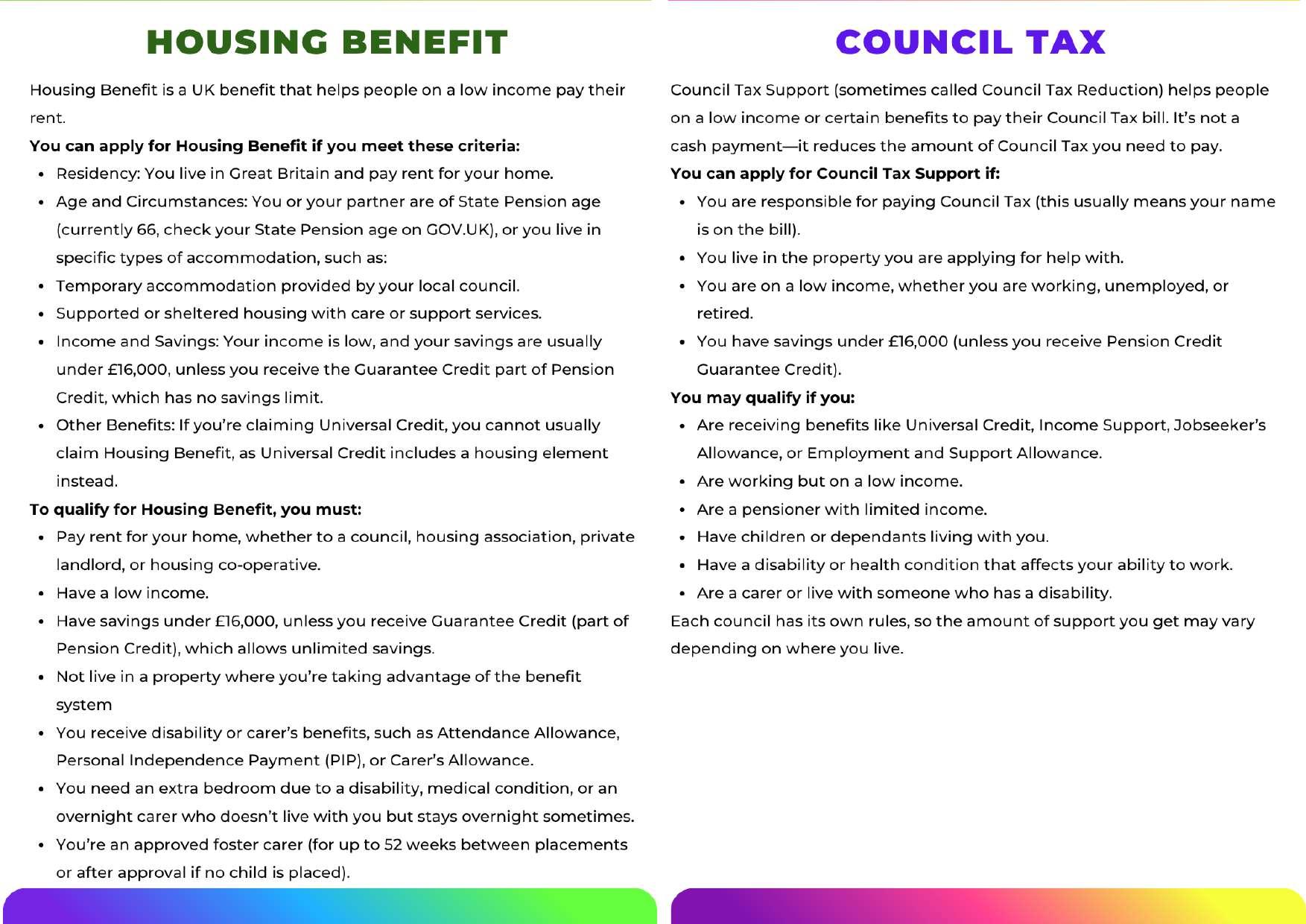
Housing Benefit
Housing Benefit is a UK benefit that helps people on a low income pay their rent.
You can apply for Housing Benefit if you meet these criteria:
• Residency: You live in Great Britain and pay rent for your home.
• Age and Circumstances: You or your partner are of State Pension age (currently 66, check your State Pension age here), or you live in specific types of accommodation, such as:
• Temporary accommodation provided by your local council.
• Supported or sheltered housing with care or support services.
• Income and Savings: Your income is low, and your savings are usually under £16,000, unless you receive the Guarantee Credit part of Pension Credit, which has no savings limit.
• Other Benefits: If you’re claiming Universal Credit, you cannot usually claim Housing Benefit, as Universal Credit includes a housing element instead.
To qualify for Housing Benefit, you must:
• Pay rent for your home, whether to a council, housing association, private landlord, or housing co-operative.
• Have a low income.
• Have savings under £16,000, unless you receive Guarantee Credit (part of Pension Credit), which allows unlimited savings.
• Not live in a property where you’re taking advantage of the benefit system.
• You receive disability or carer’s benefits, such as Attendance Allowance, Personal Independence Payment (PIP), or Carer’s Allowance.
• You need an extra bedroom due to a disability, medical condition, or an overnight carer who doesn’t live with you but stays overnight sometimes.
• You’re an approved foster carer (for up to 52 weeks between placements or after approval if no child is placed).
Council Tax
Council Tax Support (sometimes called Council Tax Reduction) helps people on a low income or certain benefits to pay their Council Tax bill. It’s not a cash payment-it reduces the amount of Council Tax you need to pay.
You can apply for Council Tax Support if:
• You are responsible for paying Council Tax (this usually means your name is on the bill).
• You live in the property you are applying for help with.
• You are on a low income, whether you are working, unemployed, or retired.
• You have savings under £16,000 (unless you receive Pension Credit Guarantee Credit).
You may qualify if you:
• Are receiving benefits like Universal Credit, Income Support, Jobseeker’s Allowance, or Employment and Support Allowance.
• Are working but on a low income.
• Are a pensioner with limited income.
• Have children or dependants living with you.
• Have a disability or health condition that affects your ability to work.
• Are a carer or live with someone who has a disability. Each council has its own rules, so the amount of support you get may vary depending on where you live.
All information and figures included in this document are correct at the time of writing, please ensure you check eligibility criteria independently.
Pension Credit
Pension Credit is a UK benefit that helps people on a low income who are over State Pension age by topping up their income. You can apply for Pension Credit if you meet these criteria:
• Age: You (and your partner, if you have one) must be at or over State Pension age (currently 66, check your State Pension age here).
• Residency: You live in Great Britain.
• Income: Your weekly income is below £227.10 per week (single person) or £346.60 per week (couple). You can apply even if you have savings, own your home, or receive a small pension. If you’re claiming for a partner, only one of you needs to be over State Pension age, but both incomes and savings are considered.
Pension Credit has two parts: Guarantee Credit and Savings Credit. To qualify:
Guarantee Credit:
• Tops up your weekly income to a minimum of £218.15 (single) or £332.95 (couple) (April 2025 rates).
• You qualify if your income is below these amounts or if you have extra costs, such as caring responsibilities, a severe disability, or housing costs (e.g., rent or mortgage interest).
• There’s no savings limit, but savings over £10,000 reduce your award by £1 per week for every £500 above this threshold.
Savings Credit:
• Available only if you reached State Pension age before 6 April 2016 or have a partner who did.
• Rewards people with modest savings or a small pension. You can get up to £17.30 (single) or £19.36 (couple) per week. Your income must be above a certain level.
Travel Support
Help for Families During Half Terms
Holiday Activities and Food Programme (HAF)
The HAF programme is designed to support low-income and vulnerable families during school holidays, a time that can be financially and emotionally challenging. Parents and carers shared that the programme not only eased the financial burden of the holidays but also provided valuable opportunities for their children to stay active, socialise, and take part in experiences they might not otherwise access.
The vast majority of funding (85%) will be used to support families in receipt of benefits-related FSM. All children in Havering receiving benefits-related FSM are automatically eligible for a funded HAF place and a referral is not required. For those who are not in receipt of benefits-related FSM, there is a large demand for funded HAF places for children that do not receive benefits-related FSM, and these children will need to be referred by a professional. Unfortunately, we will not be able to approve all referrals, and cases will be looked at on an individual basis.
In order to ensure that spaces for children not in receipt of benefitsrelated FSM can be allocated fairly, the following criteria will be applied in order to prioritise any referrals:
1. Children with a Children in Need Plan (CIN) /Child Protection Plan [CPP) who are being supported by social services.
2. Children that are being supported by school and social services who would benefit from participating in this programme as part of their support.
3. Children who are under the care of Havering Local Authority.
4. Children who are young carers (LBH).
For information and to apply to the HAF programme, visit here. For details on Havering Active, visit here.
Joy App
The Joy App is a free on line tool that helps people find local support services quickly and easily. It’s designed to connect you with the right help in just a few clicks-whether you need advice, emotional support, or practical help with things like housing, money, or health.
What Is the Joy App?
Joy is a digital platform that brings together thousands of local services in one place. It’s used by the NHS, councils, and charities to help people find support in their community. You can use it yourself or be referred by a professional (like a GP, social worker, or support worker).
It’s safe, private, and easy to use.
What Services Can You Find on Joy?
Joy lists over 20,000 services across the UK. These include:
• Mental health support – counselling, bereavement help, and wellbeing groups.
• Money advice – help with benefits, debt, and budgeting.
• Housing support – advice for renters, homelessness services, and emergency accommodation.
• Food and essentials – food banks, clothing support, and hygiene packs.
• Support for carers – advice and groups for adult and young carers.
• Help for refugees and asylum seekers – legal advice, housing, and integration support.
• Employment and training – job clubs, CV help, and adult learning.
• Support for children and families – parenting groups, youth clubs, and childcare.
• Health and lifestyle – stop smoking services, fitness classes, and healthy eating advice.
• Transport and mobility – community transport and accessible travel options.
Food Bank Support
To access food bank support in Havering, you can contact the Crisis Response Team by email or by calling 01708 432 280.
If you require any extra items, such as toiletries or hygiene products, please let us know and we will request these in your referral. If stocks support this request, then the food bank will try to provide these items. You can also visit the Rainham Food Bank on Fridays for the Fresh Friday event, from 10am to 3pm - no voucher needed.
Unit 3-4, Mick Fury House, Lowen Rd, Rainham RM13 8HT
Emergency Assistance Scheme
The Emergency Assistance Scheme has helped many Havering residents by providing support with essential needs such as putting food on the table, heating homes during winter, and replacing broken appliances like washing machines, fridges, and cookers.
If you are on welfare benefits, have a low income, and have access to public funds -you may be eligible for a payment of £100. This support can be accessed once every two months (for example if you applied in August, next time you can apply in October).
In addition, you may request an extra £100 of assistance each financial year for essential white goods or furniture. You will need to submit a receipt for the item(s) purchased.
Apply here.
Other Support
For Octopus Energy Customers
• blankets and thermal imaging camera loans to help identify heat leaks.
• To access this support, Octopus customers can complete a quick and simple online financial assistance form on their website, which will guide them to the most suitable help options based on their situation.
• They also offer extra credit as a loan that can be repaid in manageable instalments.
For British Gas Customers:
• British Gas provides a British Gas Energy Support Fund for customers who are struggling to pay their energy bills, and they have various other help schemes and advice available.
• Customers can contact them directly to discuss their struggles and explore options.
• The British Gas Energy Trust offers grants to help with energy debt and can provide financial advice. You can apply for a grant through their on line portal and must typically provide evidence of receiving money guidance or advice.
• British Gas also has a Priority Services Register for vulnerable customers, offering support and assistance with energy needs.
General Support & Advice:
• If you are struggling with your bills, regardless of your supplier, it is recommended to contact them directly to discuss your situation.
Organizations like Citizens Advice, Turn2us and StepChange offer independent advice on debt and money matters and can help you explore various support options.
General Enquiries:
01708 434 343 (Mon-Fri, 9am-5pm)
01708 433 999 (Emergency – Out of hours)
Housing General Enquiries:
01708 432 824
Housing Repairs, Rents, and PSL:
01708 434 000
Housing Benefit & Council Tax Support:
01708 433 996
Council Tax:
01708 433 997
Adult Social Services:
01708 432 000
Children’s Social Services / Safeguarding Team:
01708 433 222
Homelessness Enquiries:
01708 432 824
01708 433 999 (Emergency – Out of hours)
Government Departments and Benefit Providers
Universal Credit Service Centre: 0800 328 5644
Child Benefit Office (HMRC): 0300 200 3100
Personal Independence Payment (PIP) enquiry line: 0800 121 4433
Personal Independence Payment (PIP) new claim line: 0800 917 2222
Disability and Carers Service (DLA) born before: 08/04/1948
0800 121 4600
Disability and Carers Service (DLA) born after: 08/04/1948
0800 731 0122
Attendance Allowance Helpline: 0800 731 0122
Carer’s Allowance Unit: 0800 731 0297
Pension Credit Helpline: 0800 99 1234
ESA Helpline (Existing Claims): 0800 169 0310
ESA Helpline (New Style ESA): 0800 328 5644
ESA Helpline (Contribution/Income based ESA): 0800 055 6688
Citizens Advice Romford office: 0808 189 8273
Age UK: 01708 733 191
Cost of Living Team (Havering Council): 01708 432 280
Schemes Eligibility
• British or Irish Citizens: Can usually claim without restrictions.
• EU, EEA, or Swiss Citizens: Must have settled or pre-settled status under the EU Settlement Scheme to claim. You’ll need an eVisa to prove your status.
• Spouse or Partner Visa Holders: Usually cannot claim Universal Credit for the first 5 years in the UK, as the Home Office expects your partner to support you. You can claim after getting Indefinite Leave to Remain (ILR) or in exceptional cases (e.g., domestic abuse or if your relationship ends).
• Asylum Seekers: Cannot claim Universal Credit while your asylum claim is being processed.
• Other Visas: You must have a visa that allows access to public funds (check with an immigration adviser). For example, dependants on a Skilled Worker or Health and Care Worker visa may qualify if they meet financial requirements.
Always check your visa conditions or speak to an immigration adviser, as claiming benefits when you’re not allowed could affect your immigration status and lead to you paying back any money you have already claimed.
How to Apply
Apply Online: Go to GOV.UK or visit us at at Romford YMCA every Wednesday (10am to 2pm).
Requesting Additional Support: Refugee & Crisis Response Team
If you wish to request support with understanding or completing any of the applications or documents mentioned in this booklet then please don’t hesitate to contact the Cost Of Living team who will be happy to assist you.
Contact the Crisis Response Team by email or by calling 01708 432 280. (Monday to Friday, 9am to 5pm).
Documents list
/Benefit
of identity
Details/Proof of income (e.g. payslips, self-employment records)