15 Bermondsey Square, Tower Bridge Road, London SE1 3UN www.purcelluk.com
A team of experienced consultants from Purcell jointly contributed to the completion of this Conservation Area Appraisal and Management Plan.
Date Issue Revision Reviewed Approved
November 2024 01 First Draft
February 2025 02 Second Draft
June 2025 03 Final
GIDEA PARK CONSERVATION AREA
1.0 Introduction
1.0 Introduction
This section provides information about what conservation area designation means and its implications for development. It also gives an overview of the Gidea Park Conservation Area, sets out the purpose of the Conservation Area Appraisal and Management Plan (CAAMP) and outlines the consultation process that has been undertaken to prepare it.
1.1 W hat is a Conservation Area?
A conservation area is defined as an ‘area of special architectural or historic interest the character or appearance of which it is desirable to preserve or enhance’. 01
Designation of a conservation area recognises the unique quality of the heritage of that area as a whole. This quality is derived not only from individual buildings but also other features, including (but not limited to) topography, grain, materials, thoroughfares, views, open spaces and landscape. These all contribute to the historic character and appearance of an area, resulting in a distinctive local identity and sense of place.
The extent to which a building, or group of buildings or structures, positively shapes the character of a conservation area is derived from its exterior – principally those elevations which are street-facing but also side and rear elevations, the integrity of its historic fabric, overall scale and massing, detailing and materials. Open spaces, whether they are public or private, green or hard landscaped, can all contribute to the special interest of an area. Furthermore, the spaces between buildings, such as alleys, streets, paths and yards, all contribute to a conservation area’s appearance and character, as does the setting of a Conservation Area.
1.2 W hat Does Conservation Area Designation Mean?
The aim of conservation area designation is to preserve or enhance the character and appearance which makes the area special. To ensure this, changes to the external appearance of buildings in a conservation area may require planning permission from the Local Planning Authority, as certain permitted development rights are curtailed. For example, full or substantial demolition of a building will require planning permission and works to trees within conservation areas must be notified to the Local Planning Authority in advance. There are often further restrictions in place in conservation areas through Article 4 directions, which remove certain permitted development rights; refer to Section 7.3 for details regarding the Article 4 direction which currently applies to the Gidea Park Conservation Area.
Under the National Planning Policy Framework (NPPF), conservation areas are designated heritage assets, and their conservation is to be given great weight when determining planning applications.02 Further details can be found in
Section 7.
The 2016-2031 Havering Local Plan (adopted in 2021) includes Policy 28, Heritage Assets, which sets out the Council’s approach to development impacting heritage assets, including conservation areas and their settings.
1.3
1.3.1
G idea Park Conservation Area
Overview
The Gidea Park Conservation Area is one of 11 conservation areas in the London Borough of Havering, each distinctly individual in character and representing a variety of the surviving areas from different periods of the borough’s past. It was designated in June 1970 following an extensive report and survey undertaken by the Gidea Park & District Civic Society. Its boundary was then extended in 1989 to include Gidea Park railway station.
Gidea Park is an attractive London suburb east of the commercial centre of Romford. Its earliest development dates to a Roman road which extended between Colchester and London, though the area remained largely rural until the early20th century when Sir Herbert Raphael, then-owner of Gidea Hall, devised a plan to develop the house’s estate as a garden suburb rooted in the ideals of the Arts and Crafts movement.
A subsequent architectural competition and exhibition in 191011 delivered 159 new homes by the nation’s leading architects, situated in generous plots across a designed townscape. A second exhibition of homes added were added to the northern end of the development in 1934. These buildings and streets form the focus of the Gidea Park Conservation Area, which also includes some subsequent development, the key green spaces of Raphael Park and Romford Golf Course and the commercial thoroughfare of Main Road at the heart of the conservation area.
1.0 Introduction
1.3.2 Conservation Area Boundary
The conservation area encompasses the buildings and plots which comprised the 1911 Romford Garden Suburb Exhibition of Houses and Cottages erected across the former Gidea Hall estate, as well as those included in a second exhibition in 1934. It extends northward from Main Road to Eastern Avenue, incorporating Raphael Park to the west and a section of the Romford Golf Course to the east. A narrower section extends south of Main Road between Balgores Lane and Crossways. The conservation area was extended further southward to include Gidea Park Station in 1989. One change to the boundary has been made as part of the preparation of this CAAMP, see 1.4 below for details.
1.4 B oundary Review
Understanding or appreciation of what is special about an area can change over time. Therefore it is important to review and take stock of the boundaries and character of a conservation area at intervals to ensure that the reasons for its designation are still relevant and evident, and that the proper management of change is in place.
A review of the boundary alongside any accompanying guidance and assessments should generally take place every five to ten years or in response to a notable change (positive or negative), including changes in policy or legislation.
As part of the CAAMP review process, the former Gidea Park Character Area formerly identified by the London Borough of Havering within the setting of the conservation area was assessed as to whether it merited inclusion within the conservation area. Following a review of its historical and architectural interest via desk-based research and undertaking site inspection, it is the conclusion of this report that the conservation area should not be extended to include the former Gidea Park Character Area, as the latter lacks the historic interest and townscape and architectural qualities that give the conservation area its special interest.
In addition, based on the findings of archival research, a site inspection of the area and feedback from stakeholder consultation, the boundary of the conservation area has been amended to include the Interwar (erected between 1921 and 1938) parade of shops with flats above at 142-156 Balgores Lane, to more effectively encompass the townscape composition at the base of the conservation area where Balgores Lane and Crossways meet. This update is reflected on the Gidea Park Conservation Area Boundary map on the following page.
1.0 Introduction
Eastern Avenue East Reed Pond Walk Heath Drive
Romford Golf Course
Main Road Balgores Lane
Gidea Park Railway Station
Existing conservation area boundary
This plan is not to scale
Raphael Park Parkway
Gidea Park Conservation Area boundary
1.0 Introduction
1.5 Purpose and Scope of the Conservation Area Appraisal and Management Plan
Understanding the character and significance of conservation areas is essential for managing change within them. It is therefore a requirement under the Planning (Listed Buildings and Conservation Areas) Act 1990 that all Local Planning Authorities ‘formulate and publish proposals for the preservation and enhancement’ of conservation areas within their jurisdiction, and that conservation areas are periodically reviewed.
These proposals are normally presented in the form of a CAAMP, which defines and documents the special interest of a conservation area (see Section 2), analyses the characteristics that make it special (see Sections 3, 4 and 5), as well as current issues and opportunities for enhancement (see Section 6) and sets out a plan for managing change to ensure its ongoing protection and enhancement (see Section 7).
This CAAMP has been prepared in line with current best practice guidance published by Historic England, the government’s heritage advisor and the public body which manages the care and protection of the nation’s historic environment.
This document is intended to be comprehensive; however, the omission of any building, structure, feature or space does not imply that the element is not significant or does not positively contribute to the character and special interest of the conservation area. The protocols and guidance provided in Section 7 are applicable in every instance.
The assessments which provide the baseline information for this CAAMP have been carried out using publicly available resources and thorough on-site analysis from the publicly accessible parts of the Gidea Park Conservation Area.
1.6 C onsultation and Engagement
It is a statutory requirement under Section 71 of the Planning (Listed Buildings and Conservation Areas) Act 1990 that conservation area guidance produced by or on behalf of the Local Planning Authority be subject to public consultation, and for the Local Planning Authority to have regard of the views expressed by consultees.
Informal consultation was undertaken with key stakeholders, including members of the Gidea Park Civic Society and the London Borough of Havering Planning Team, at early stages of the CAAMP drafting process to raise awareness of the conservation area review, utilise local understanding of the area’s special interest and gather feedback on opportunities for enhancing this special interest and on the proposed conservation area boundary.
A draft of this CAAMP underwent public consultation from 28th April to 9th June 2025 including a public event. Comments received from this consultation have been incorporated into the final CAAMP as appropriate.
2.0 Summary of Special Interest
2.0 Summary of Special Interest
The special interest of the Gidea Park Conservation Area is principally drawn from its conception as an early 20th century garden suburb, and its presentation of a varied and characterful collection of residential dwellings that showcases the work of leading Arts and Crafts architects of the period, set within green and generous plots.
The development was originally envisaged via a competition and subsequent exhibition of houses in 1910-11, taking inspiration from north London’s Hampstead Garden Suburb established a few years prior. Gidea Park was not ultimately executed to the same extent in regard to formal layout and the provision of community amenities. However, a uniquely verdant and architecturally diverse townscape of high quality homes founded on the ideals of the Arts and Crafts movement was achieved, and the result is of high architectural and historic interest.
The new suburb incorporated some historic features and buildings already present within Gidea Park, including the garden walls and gate posts, fish ponds and other parkland
elements originally associated with the 18th century Gidea Hall. Buildings forming part of an 17th century settlement along today’s Main Road known as Hare Street were also retained, and now contribute an additional layer of architectural and historic interest.
A second exhibition of houses in 1934 added a further genre of residential development to the northern part of the conservation area, which, whilst of somewhat lesser architectural interest, complements the form and grain of the original housing scheme. Subsequent infill of later housing has remained sensitive to the original development’s scaling and arrangement for the most part, employing degrees of characterful individuality through varied massing, materials and architectural detail. External alterations to historic homes across the conservation area have been generally modest and/or sympathetically undertaken, though some insensitive modifications, replacements and redevelopments have eroded the character of the area to a minor degree.
The presence of mature greenery, and trees within verges, open spaces and private gardens softens the landscape and forms a verdant backdrop that is a fundamental part of the area’s historic garden suburb character. In some cases, preexisting trees and landscape elements were deliberately integrated into the original townscape design and remain legible features today. As most houses have remained in their original use as single-family dwellings, front gardens and the visible presence of boundary treatments have largely survived intact and make a strong contribution to the character of the conservation area.
Other historic ancillary uses remain evident in commercial areas along Main Road and adjacent to the railway station at the conservation area’s southern edge, and in recreational spaces. These add variety to the townscape whilst maintaining a legible historic relationship with the domestic neighbourhood. Whilst architectural and townscape features in these areas have undergone more substantial change over time, they retain historic interest.
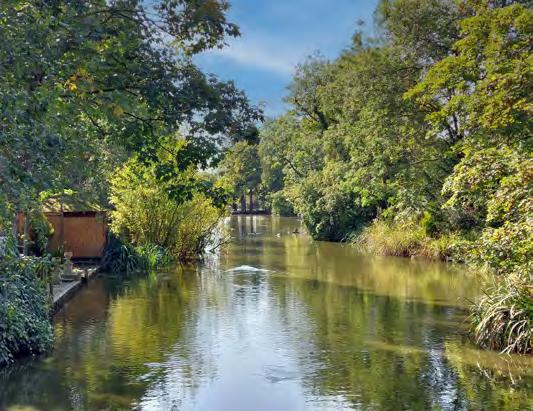
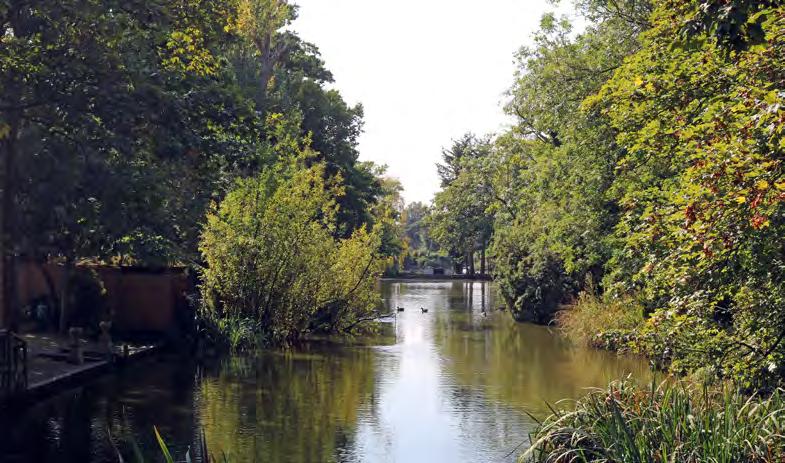
Former Gidea Hall Fish Ponds.
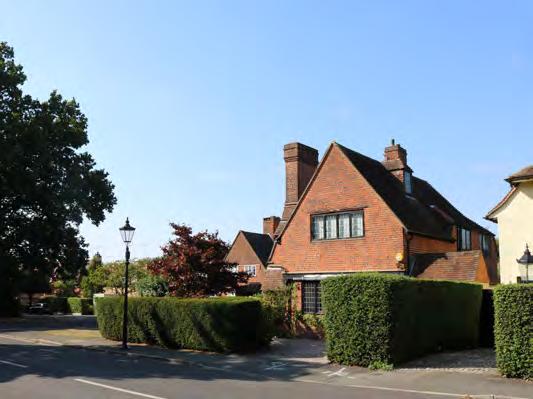
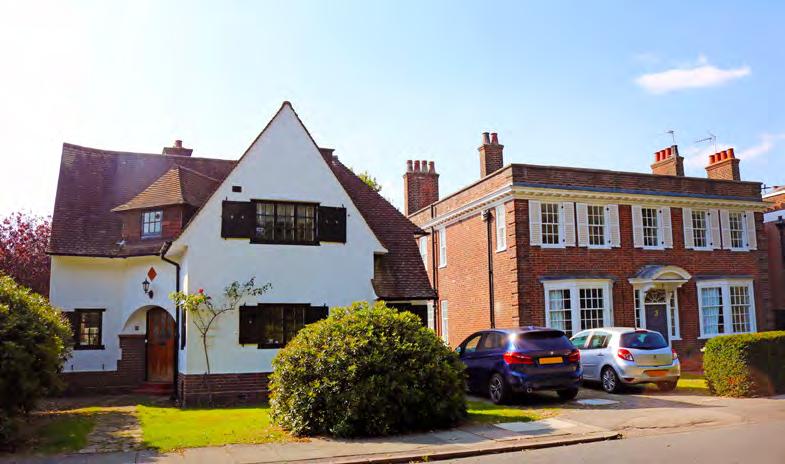
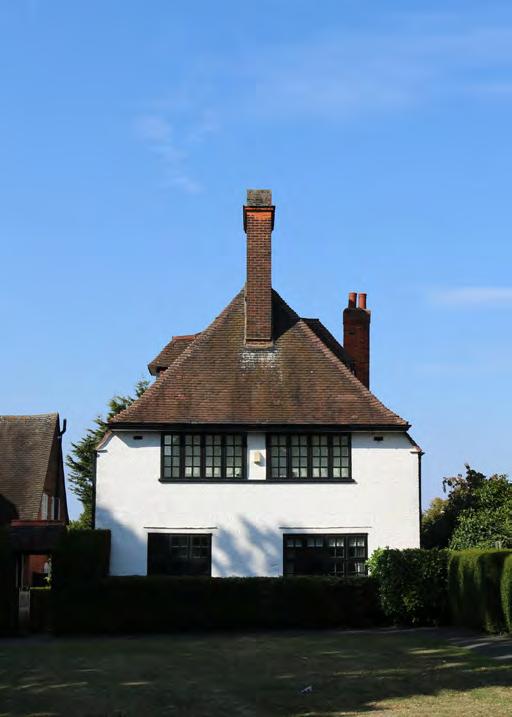
Two dwellings, typical of the architectural individuality of the area.
2.0 Summary of Special Interest
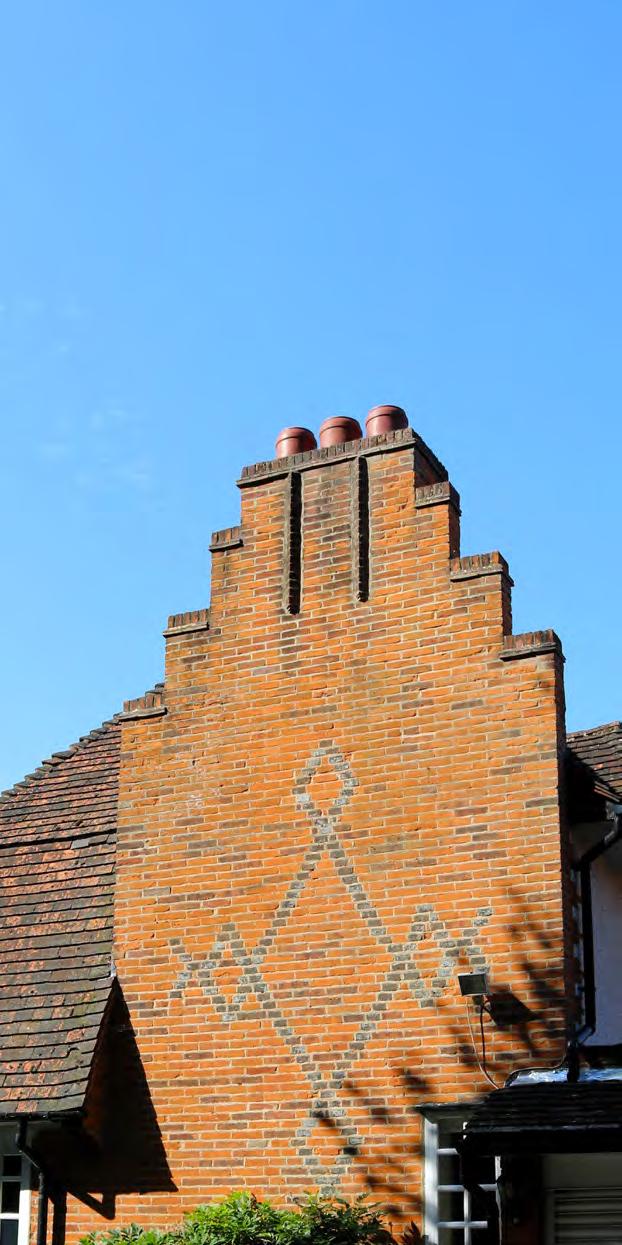
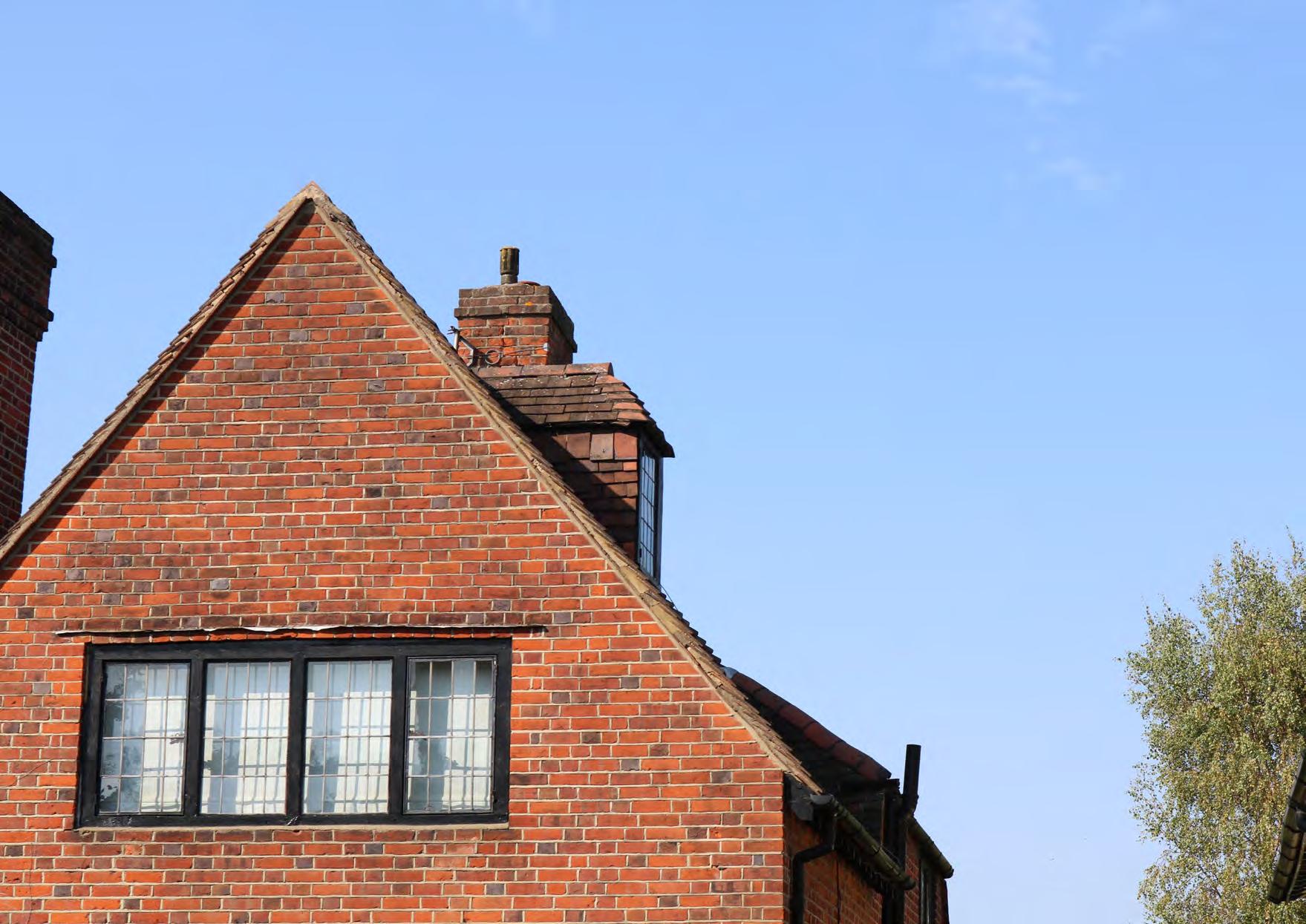
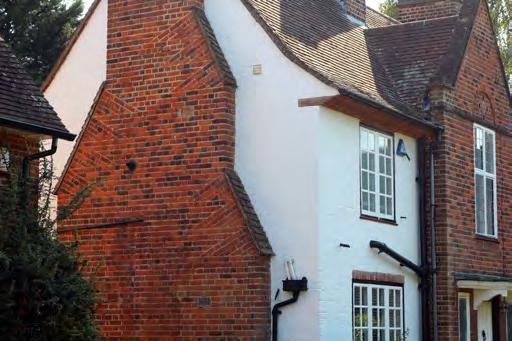
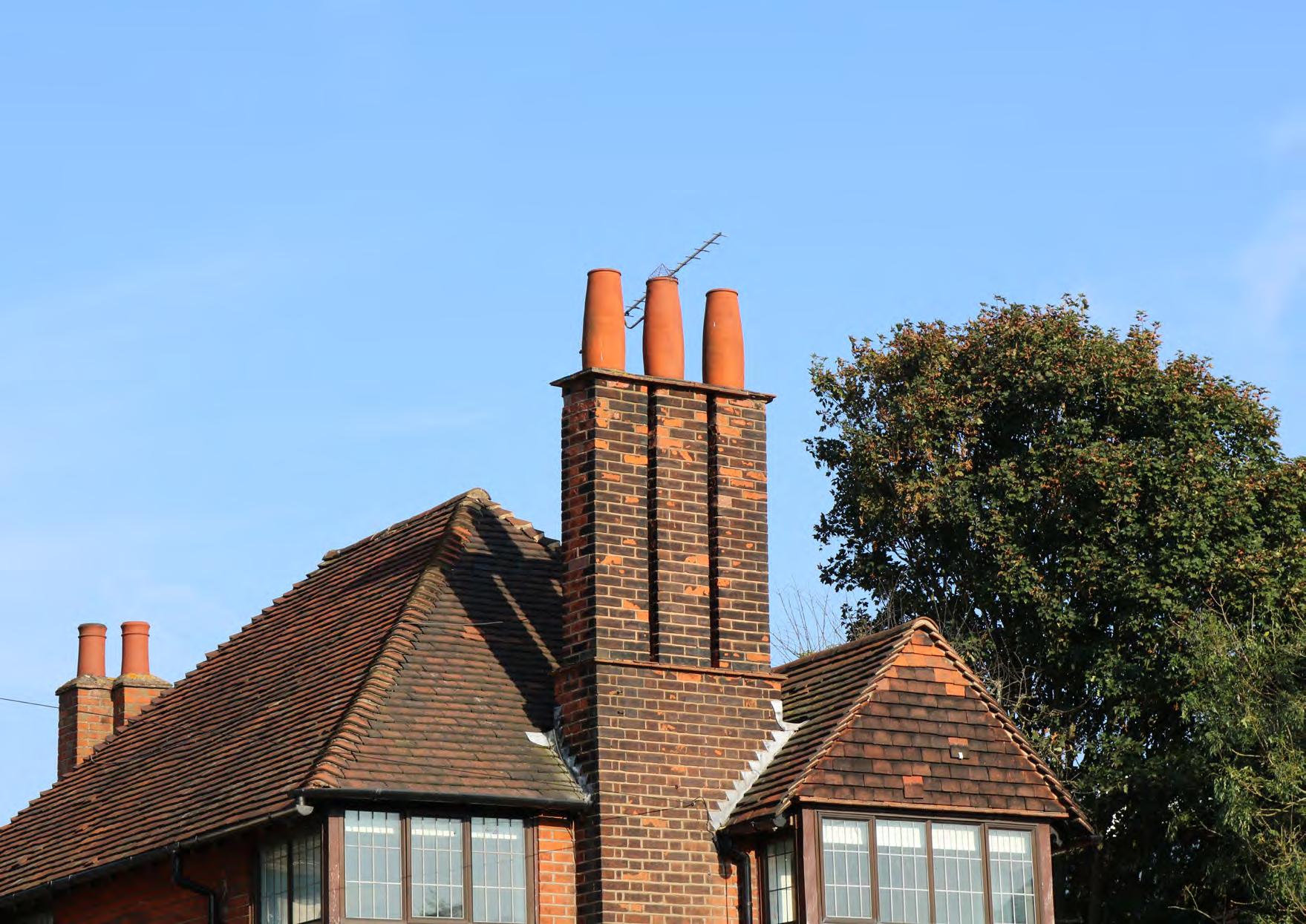
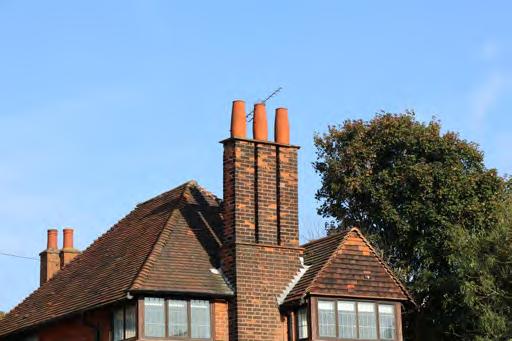
Detail of chimney brickwork.
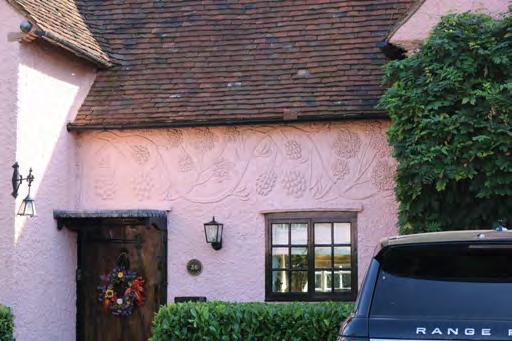
Detail of front elevation plasterwork.
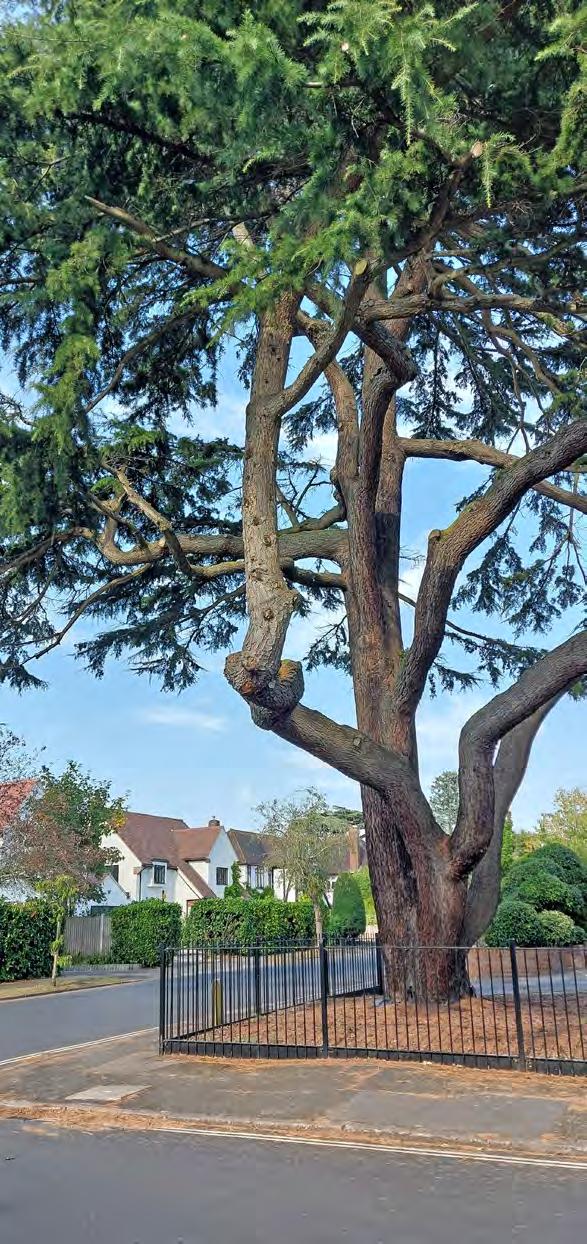
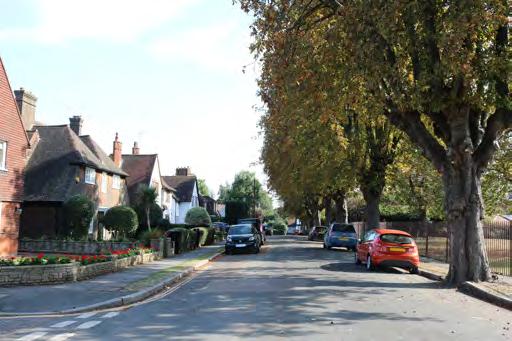
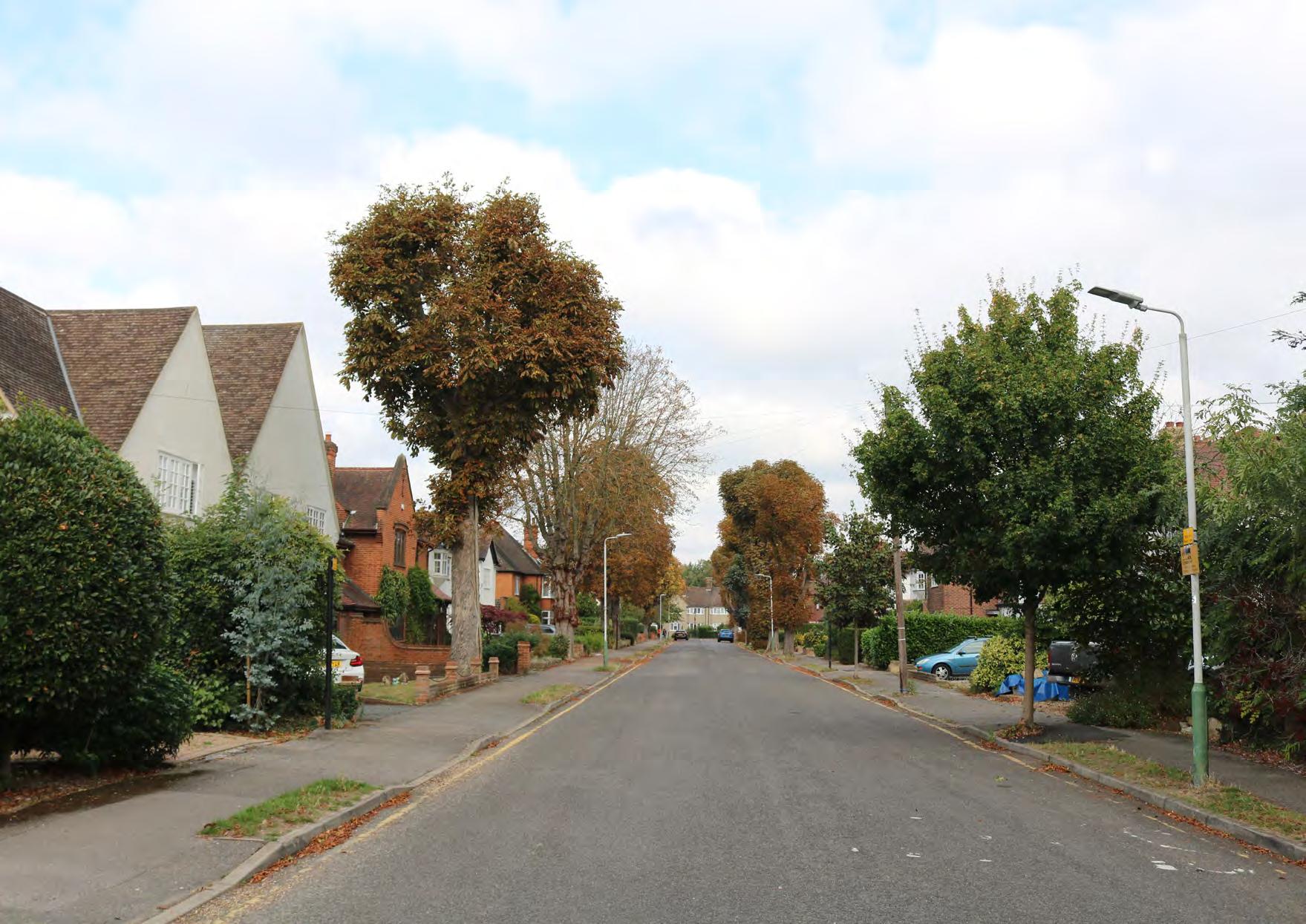
Streetview, with housing and mature foliage.
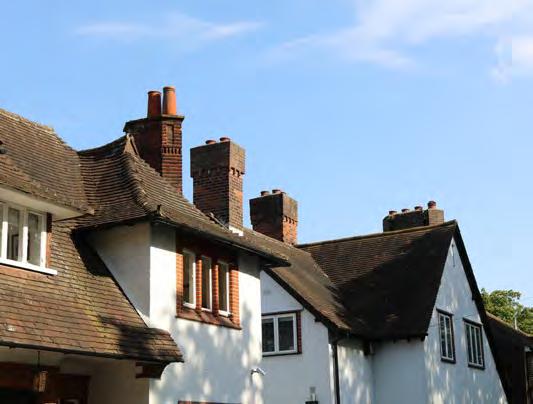
Dwelling with characterful roofline.
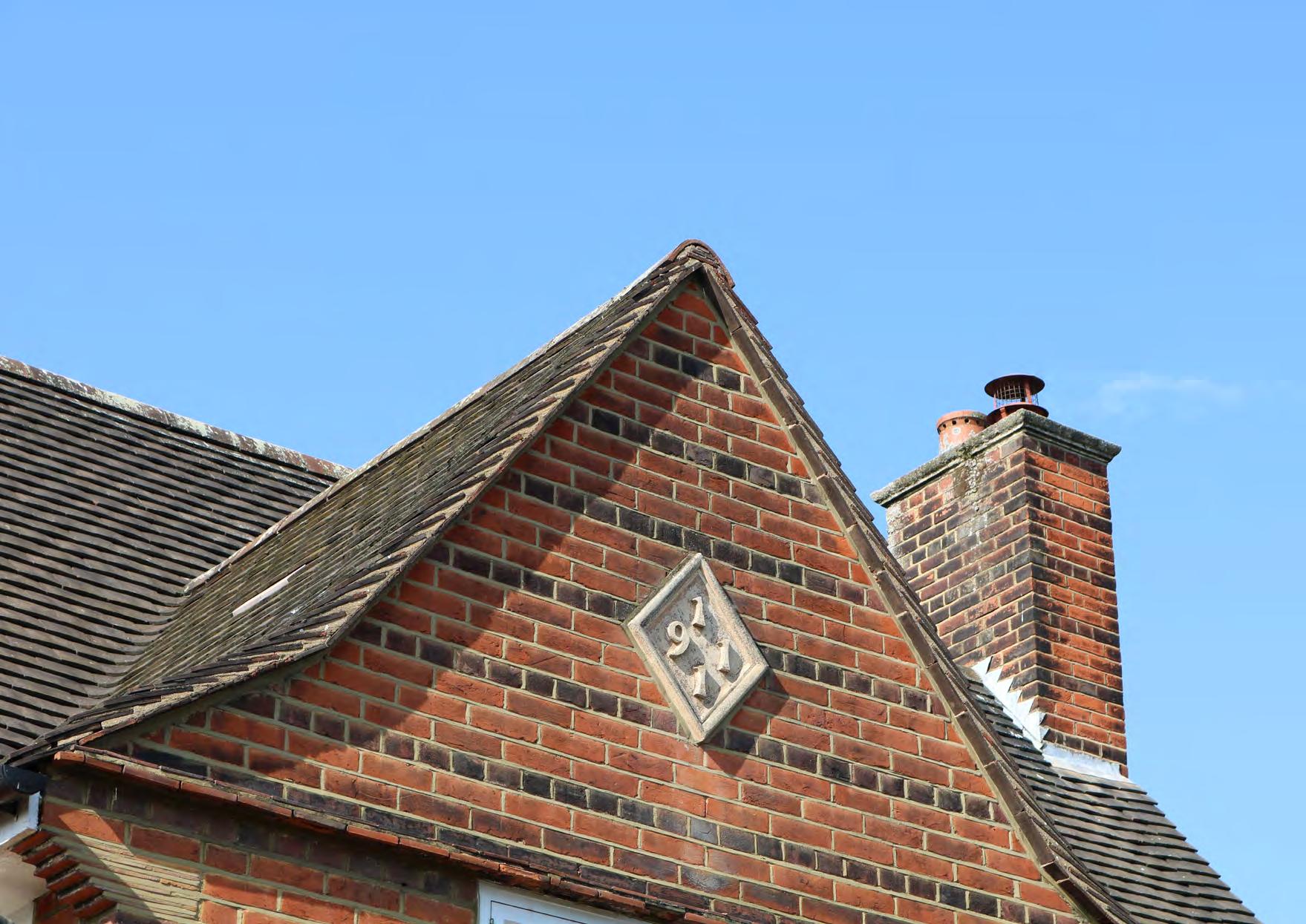
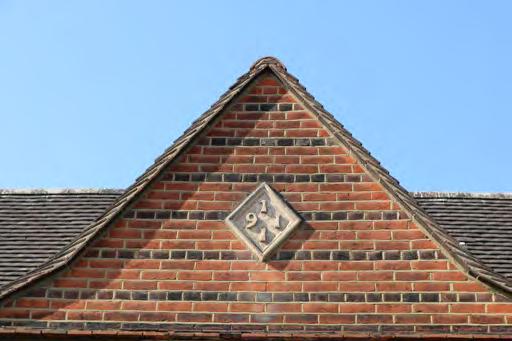
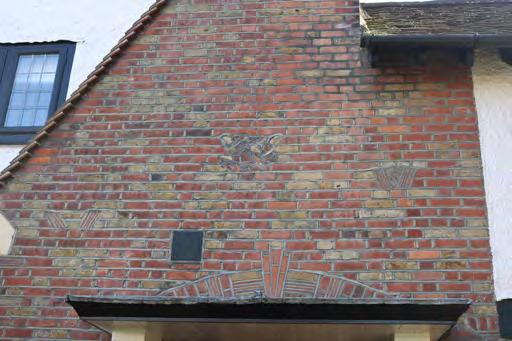
Detail of 1911 datestone and gable.
3.0 Summary Historic Development
3.0 Summary Historic Development
3.1 Su mmary Historic Development Timeline
Roman road between Colchester and London encouraged settlement development including Romford, granted a market charter in 1247.
Wealthy estates and villages were established near Romford; Hare Street inns were maintained by frequent travelers, and Gidea Park had a house as early as the 13th century.
Gidea Hall and its formal gardens rebuilt in 1720 to the east of Romford north of the Roman road; Hare House erected to the south of the road in the 1760s.
Railway line laid in 1839, cutting across the Hare Hall estate south of Gidea Hall; no local station was built.
1897 Gidea Hall sold to Sir Herbert Raphael. Raphael, who donated land to found the Romford Golf Club to the east, and a public park to the west, the latter today’s Raphael Park.
1910 Development company formed to build a garden city suburb around Gidea Hall.
1911 Exhibition of 159 homes built northwest of the new railway station station and around Gidea Hall, with prospective buyers offered completed homes or plots to build on. Building continued until outbreak of WWI in 1914.
1930 Gidea Hall was demolished.
1934 A second “modern homes” exhibition led to construction of further 35 houses to the north of the estate.
London Borough of Havering established in 1965
1970 Gidea Park designated a Conservation Area.
3.2 G idea Park Before the 20th Century
The ancient Roman road from Colchester to London established the first infrastructure within the Gidea Park area. This continued to be used as a major trade route, and as centuries extended into the late medieval period (1066-1540) major settlements such as Romford grew up along the roadway.
The wealthy established large estates near the growing market town, including at Gidea Park where a manor house was in situ as early as the 13th century.01 The Gidea Hall estate which grew up from this was also accompanied by the nearby Hare Hall, positioned south of the main road to the southeast of today’s conservation area..
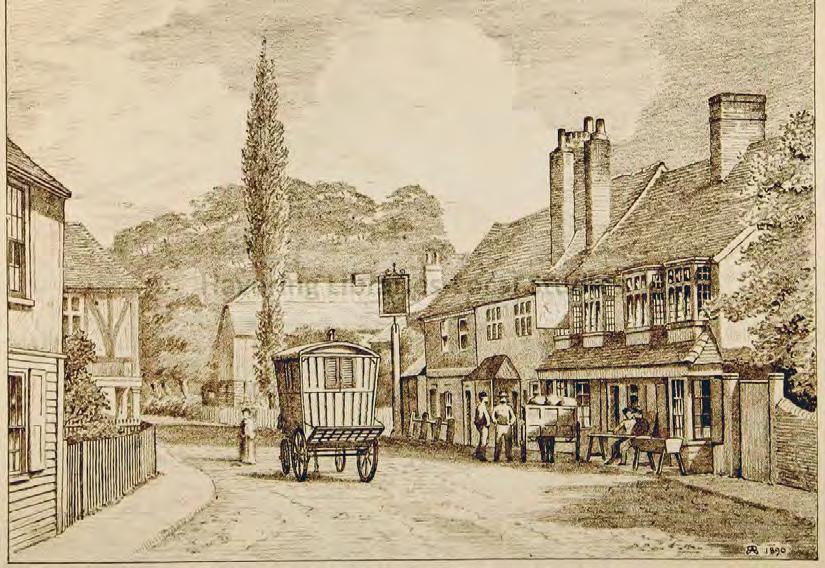
On the Main Road between the two major estates a development known as Hare Street flourished, supported both by local wealthy landowners and the trade traffic to and from Romford. A series of inns on the Main Road that survive today, if much altered, were established in the 17th century: the White Hart Inn (today known as The Archers) and the Ship Inn. The adjoining buildings to the White Hart, Nos.202-210 Main Road, likely date to the late 18th or early 19th century, and no.224 Main Road dates to the early 18th century, all with established shop fronts at ground floor level.
Lithograph of Hare Street 1890, by Alfred Bennett Bamford. The White Hart, now The Archers, is on the right. (Havering LibrariesLocal Studies)
3.0 Summary Historic Development
Gidea Hall was rebuilt in 1720 by Sir John Eyles, who also created a formal ornamental parkland for the estate, including a lake, fishponds and large water feature known as Spoon Pond. In 1776 the Benyon family, then-owners of Gidea Hall, commissioned James Wyatt to design Black’s Bridge over Black’s Canal where it met the road as part of the growing estate.
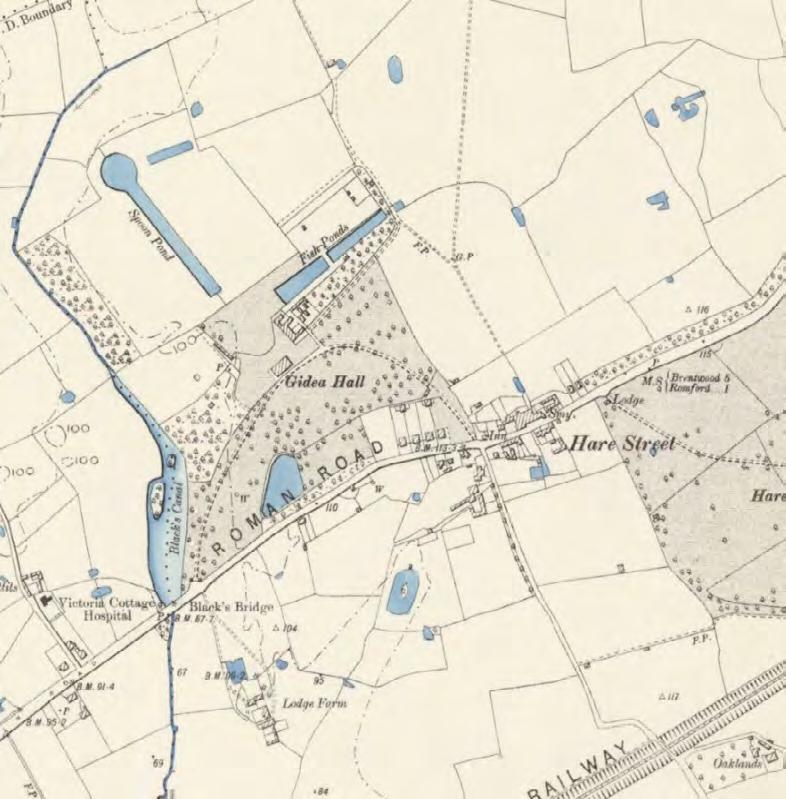
In 1839 the Eastern Counties Railway was laid, cutting through the Hare Hall estate land south of the Main Road, but no station was built and the area remained largely rural, dominated by estate parkland even as the nearby Romford expanded ever more rapidly. However, with the coming of the railway the value of land for suburban development would soon outstrip the value of country estates, and Gidea Hall was sold to a development company in 1883. The below 1895 Ordnance Survey map illustrates the extent of development by the end of the 19th century.
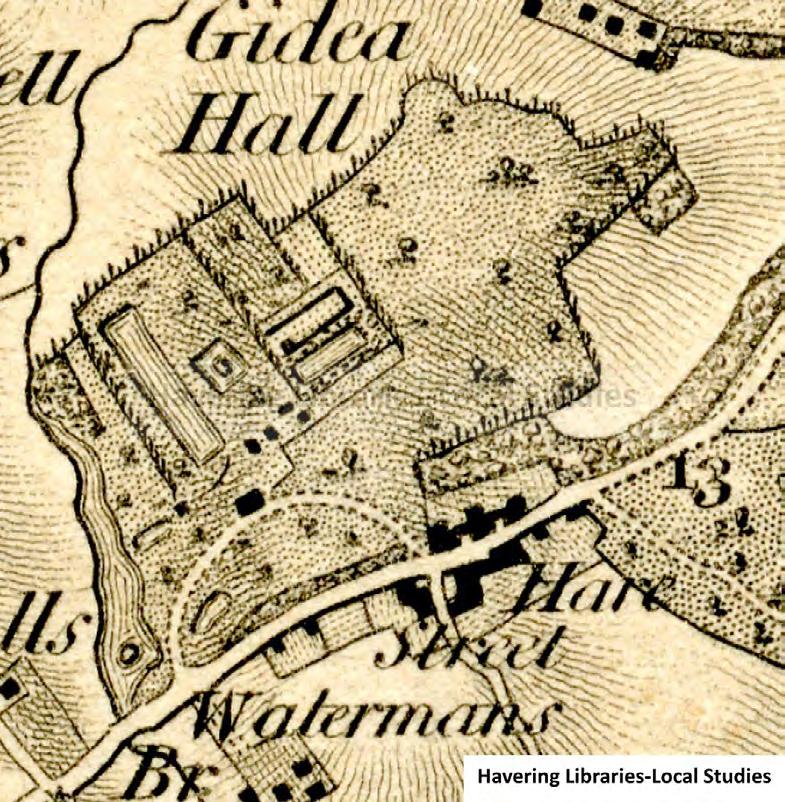
Extract of the 1805 OS map, surveyed in 1790, showing Gidea Hall and Hare Street. The western perimeter of Hare Hall can be seen to the right of the image. (Havering Libraries-Local Studies)
1895 OS map (surveyed). The distinctive Spoon Pond can be seen in the upper left corner of the map, and the railway line in the lower right corner. The 2024 conservation area boundary is indicated in red. (National Library of Scotland)
3.0 Summary Historic Development
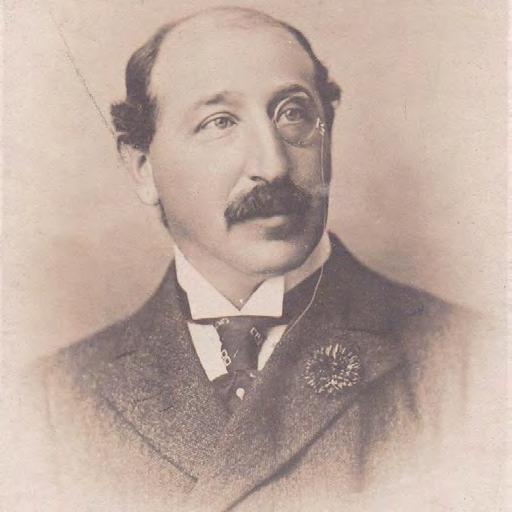
Sir Herbert Raphael bought the estate following its second failed auction in 1897. Raphael, a prominent liberal politician and member of the newly formed Romford Golf Club, had trained as a barrister and had twice failed to be elected as the Liberal MP for Romford in 1892 and 1897, subsequently winning a seat in Derbyshire (south) 1906-1918.
Upon purchase of Gidea Hall, Raphael immediately donated 90 acres to the east of the estate to the Romford Golf Club as a course, donating a further 15 acres of the northwestern corner to the council in 1902 and selling an additional section of land, including the Spoon Pond, which formed the presentday Raphael Park.
3.3 The Garden City Concept
The rapid urbanisation of the late-19th century had led to unprecedented social and economic problems in towns and cities laid out over haphazardly adapted plots and crowded streets, or long, uniform terraces of high density and low individual character. The growing population of middle-class families also presented a demographic who could afford to rent a new kind of housing, but without the capital wherewithal to build it themselves.
The concept of a Garden City was one of the radical urban planning concepts to emerge in response to this, a movement founded by Ebenezer Howard in 1898, which promoted a vision of well-ordered, spacious, satellite communities outside
of town centres. Its founding theories were tied closely to ideas of the Arts and Crafts architectural movement and the revival of vernacular architecture. Gaining worldwide acclaim, important models emerged in the early decades of the 20th century, including Hampstead Garden Suburb in 1907.
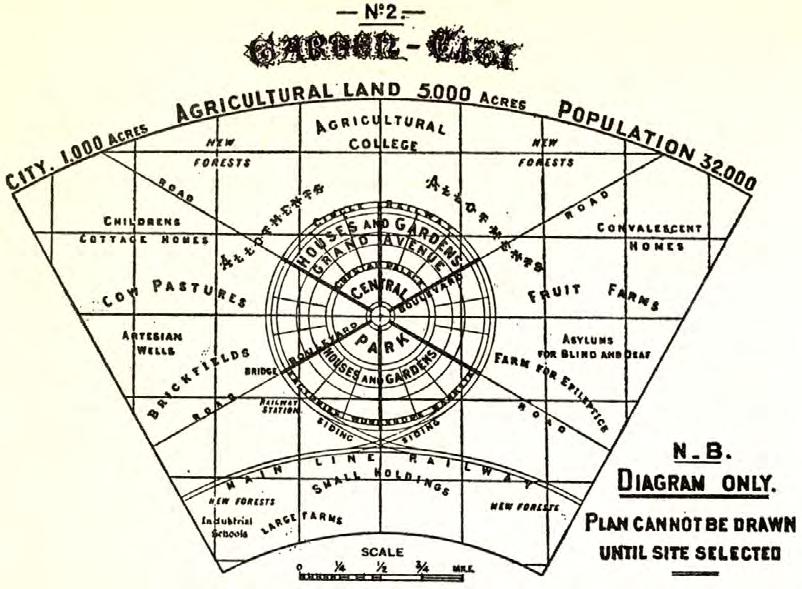
Models of plans for neighbourhoods of quality, affordable homes shared a few key elements, as illustrated in the diagram below; often circular, they centred on a civic nucleus of a public park, buildings and shopping facilities, local employment, accessible transport and strong cultural, recreational and shopping facilities, resulting in a suburb as self-sufficient as possible.
Sir Herbert Raphael, 1906. (Wiki Commons)
Diagram of the Garden City by Ebenezer Howard, 1898 (Wiki Commons)
3.0 Summary Historic Development
3.4 The Gidea Park Estate
A development company was set up by Raphael and two fellow Liberal MPs, Charles McCurdy and Tudor Walters, with the goal of developing a Garden Suburb akin to Hampstead Garden on the remaining Gidea Hall estateland.
One hundred and twenty-one architects answered the developer’s call for designs for the Romford Garden Suburb Gidea Park, each providing a three or four bedroom house that could meet the following brief:
“to demonstrate to housing and public authorities, to builders and to the public generally, the improvement in modern housing and building due to scientific knowledge, the revival of the Arts and Crafts and the progress of the garden city movement, and by doing so to assist the raising of the standard of living not only in the outer metropolis but throughout Britain.”02
This group included most of the influential figures of the later Arts & Crafts movement – Barry Parker, Raymond Unwin, M. H. Baillie Scott, Philip Tilden, and Clough Williams-Ellis. The planned development comprised an informal townscape grid varied by the deliberate kinking of roads to avoid important trees, and the incorporation of existing estate features like the Fish Ponds at Gidea Hall.
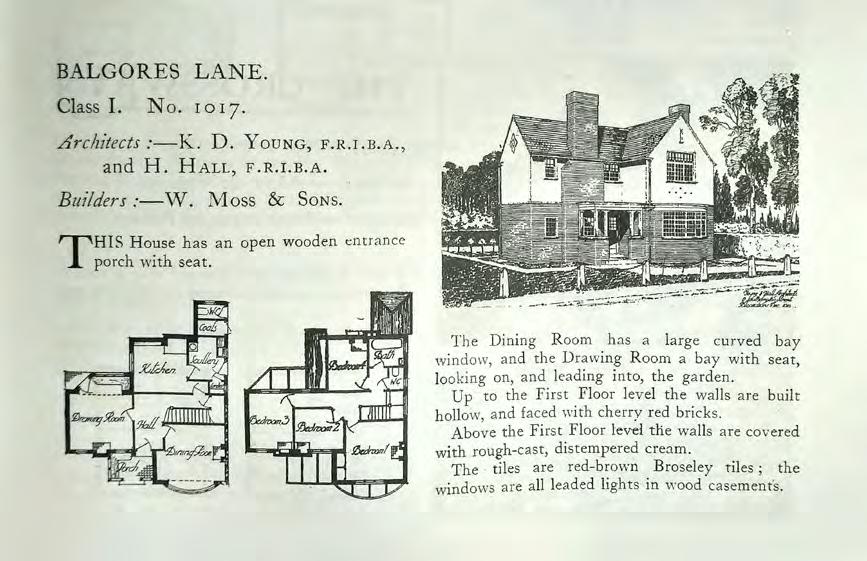
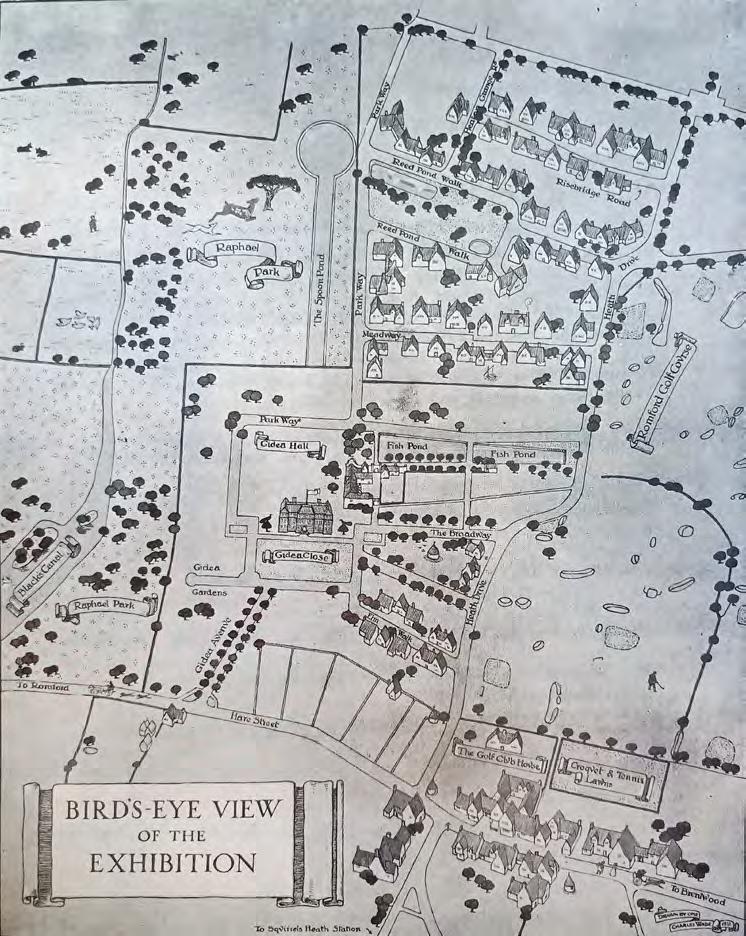
Between July 1910 and June 1911 159 houses and cottages were built to the design of these architects, and in 1911 an exhibition was run, drawing investors, house hunters and developers in via the newly built Gidea Park railway station. A map of the exhibition on the following page illustrates how houses had been constructed on plots spaced across the entire area, including streets south of Main Road as evidenced by plans detailing specific houses along Balgores Lane. Buyers could buy one of these houses, one of the generously sized building plots or have a house designed for them.
Styles of building varied, but nevertheless tended towards the picturesque Tudor or neo-Georgian, with the occasional exaggerated vernacular detail.
02 The Hundred Best Houses (1911), p. 7.
31 Balgores Lane, Design and artists impression from the exhibition catalogue, 1911. (Havering Libraries-Local Studies)
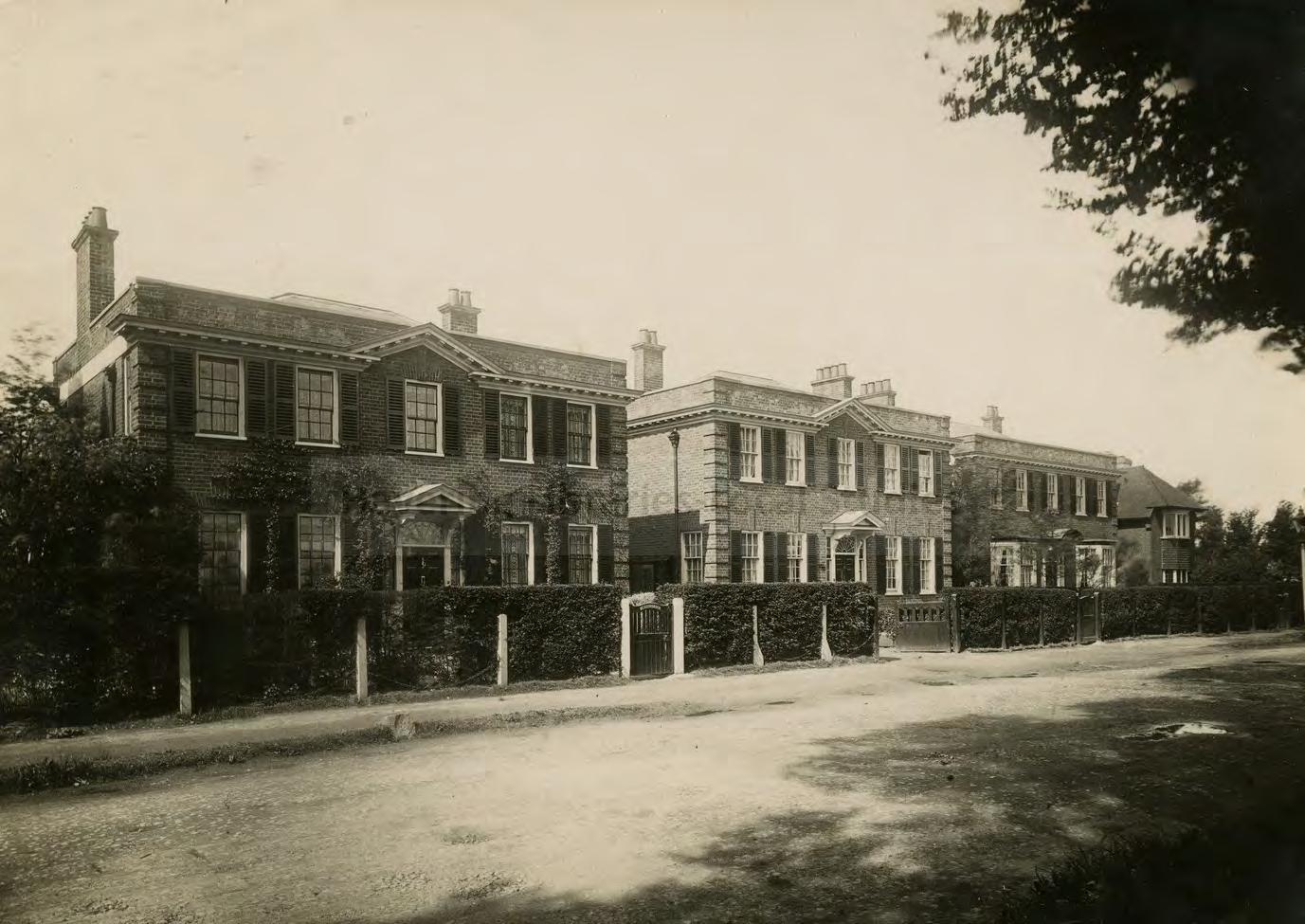
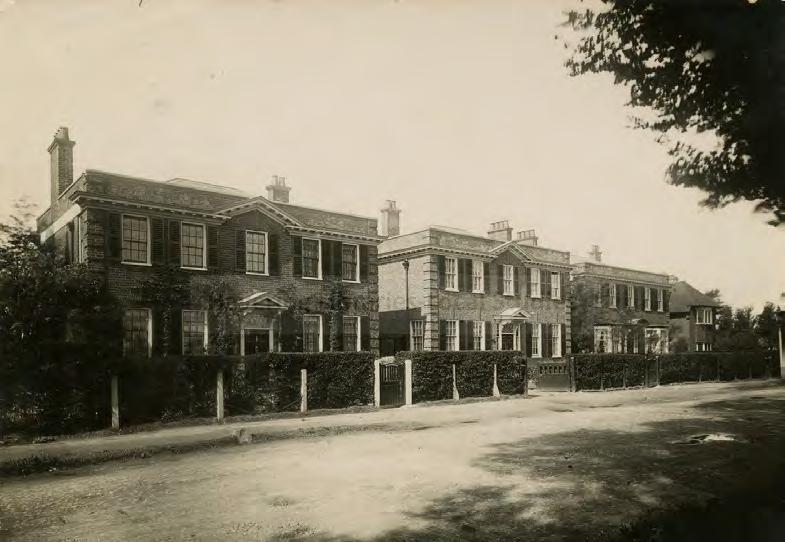
45-48 Heath Drive, 1911. Photos of four large Neo-Georgian houses by Ronald P. Jones. (Havering Libraries-Local Studies)
Bird’s eye view of the exhibition, 1911 map of the built houses. (The Book of the House & Cottage Exhibition 1911)
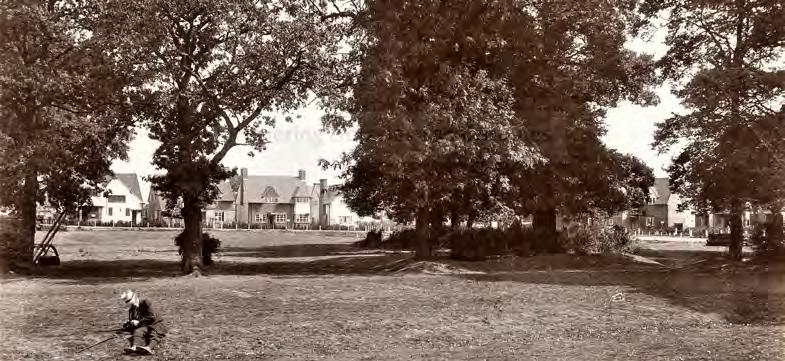
The village green at Reed Pond Walk’ (Havering Libraries-Local Studies)
3.0 Summary Historic Development
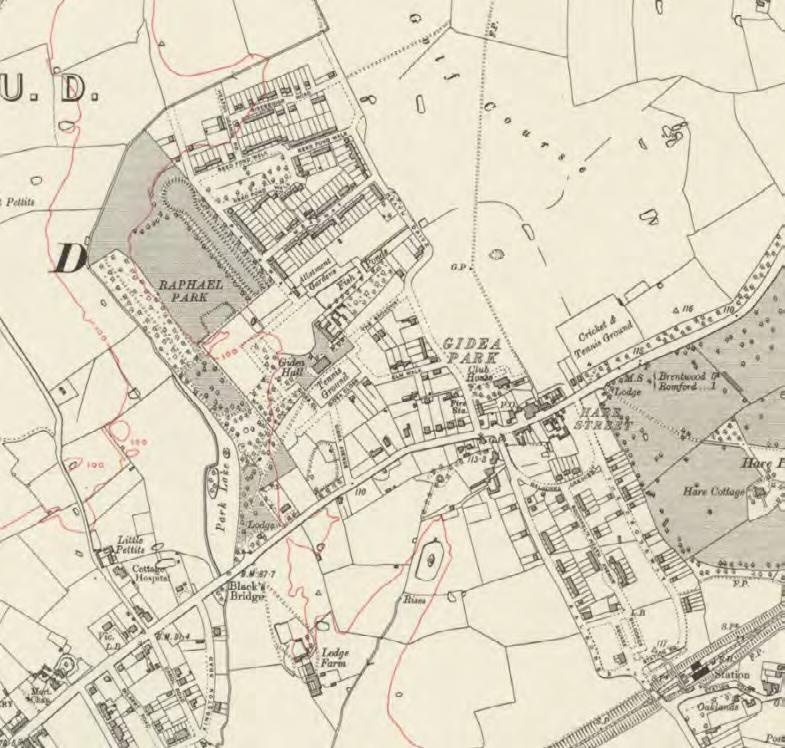
The garden’s suburb’s original plan included a nucleus around the existing historic hamlet of Hare Street, and a new church and shopping centre. The latter was never fully realised, nor were plans to extend the development northwards beyond the newly built Eastern Avenue roadway, or eastwards beyond the Golf Course. The outbreak of WWI interrupted the full development plan of the estate; the below Ordnance Survey map illustrates the extent of development by 1914.
While the early plan had incorporated Gidea Hall as part of the estate, by the 1920s following its sporadic use by the War Office and as a resident’s club, it had fallen into disrepair. Following a failed bid to sell it as a residential property it was demolished in 1930, leaving only the wall, railings and gate from its 18th century park entrance.
1914 (surveyed) OS map. The conservation area boundary is indicated in red. (National Library of Scotland)
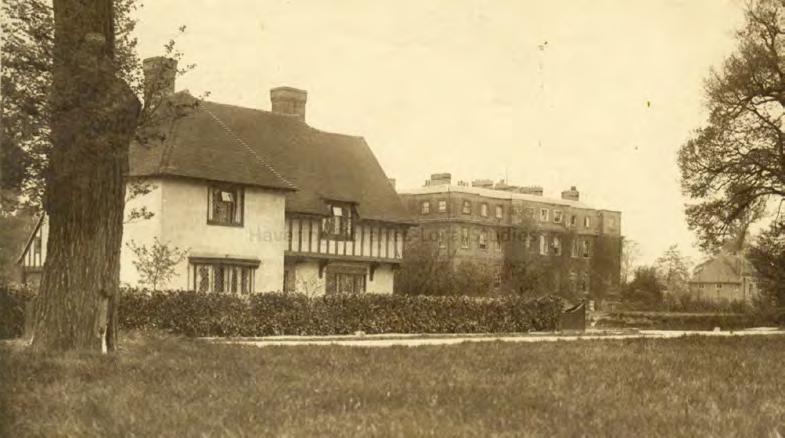
Contrasting view of 3 Gidea Close and Gidea Hall to the east, 1920s, prior to its demolition. (Havering Libraries-Local Studies)
3.0 Summary Historic Development
A second “modern homes” competition and exhibition held in 1934 intended to sell plots south of Eastern Avenue and produced 35 houses, with one genuinely contemporary design by Francis Skinner of Tecton at 64 Heath Drive. By this time the concept of a garden suburb had waned in favour of the merits of ribbon development, with smaller scale speculative housing – some comprising conventional inter-war designs – infilling the remaining unused plots. Whilst this was reflected in the 1934 linear arrangement of building frontages
along new streets, the importance of the site’s verdant setting on the outskirts of town and its direct relationship to the ideals of quality suburban living remained a key consideration in the new development’s design.
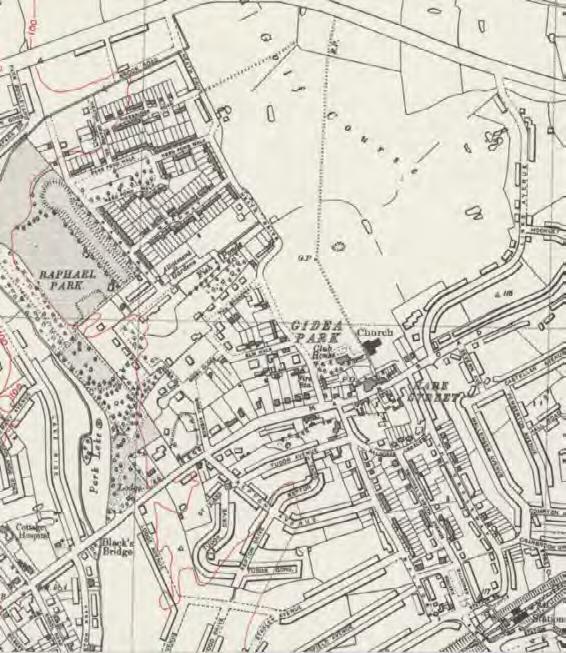
The 1938 Ordnance Survey map below illustrates this second wave of construction, as well as new streets of ribbon development around the Gidea Park core to the south.
The general trend of modernising town centres and “zoning” development pressures of the latter 20th century likely drove the formation of the Gidea Park and District Civic Society in 1968, which undertook an extensive survey and report of the area. In 1970 the areas comprising the 1911 Romford Garden Suburb Exhibition and the 1934 Modern Homes Exhibition were adopted as the Gidea Park Conservation Area.
1938 (surveyed) OS map, showing many of the 1934 exhibition homes in situ. The conservation area boundary is indicated in red. (National Library of Scotland)
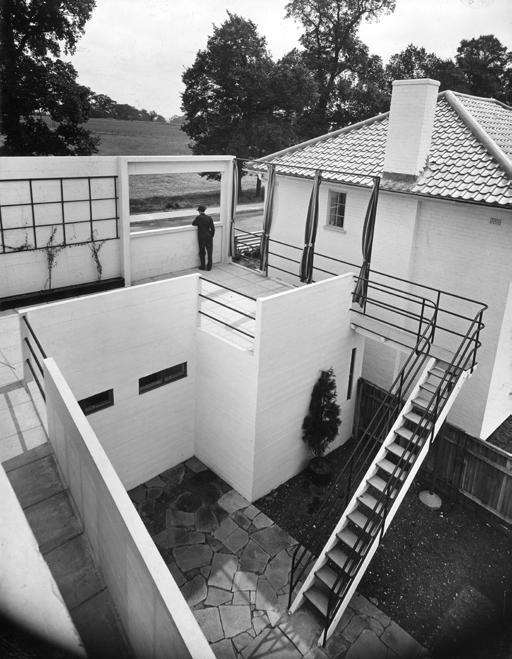
View from 64 Heath Drive, 1934
4.0 Character Assessment
4.0 Character Assessment
This section provides analysis and assessment of the character and appearance of the conservation area and the way this contributes to its special interest. It considers the character of the conservation area as a whole, addressing different elements of character including spatial analysis, setting and views, public realm, and architectural forms, materials and details.
4.1 Location, Topography and Geology
Gidea Park is situated in the centre-north of the London Borough of Havering, approximately 28km east of London centre and 10km north of the River Thames. Hare Street, the estimated centre of Gidea Park, is approximately 1.5km east of Romford, the medieval market town.
The A118, known as the Main Road runs through the centre of the conservation area from southwest to northeast, and is one of the principal and historic throughfares between Essex and London. The Great Eastern Main Line railway is located to the south of the conservation area, also extending southwest to northeast; its railway station, Gidea Park, forms the southernmost point of the conservation area. There is one local waterway, the Black’s Canal or Black’s Brook, a small tributary which forms a large water feature within Raphael Park and feeds the Fish Ponds.
Area topography is relatively flat, but with gentle hills towards the north. The northern part of Havering is a diverse landscape with an agricultural character, interspersed with woodland, dissected by rivers and influenced by urban areas. Gidea Park forms part of the historic estate of Gidea Hall and was largely used as fertile parkland up until the early 20th century. The bedrock geology of the borough is largely London Clay Formation which is overlain by a series of gravel terraces.01
London (~28km)
River Thames (~10km) ROMFORD CENTRE
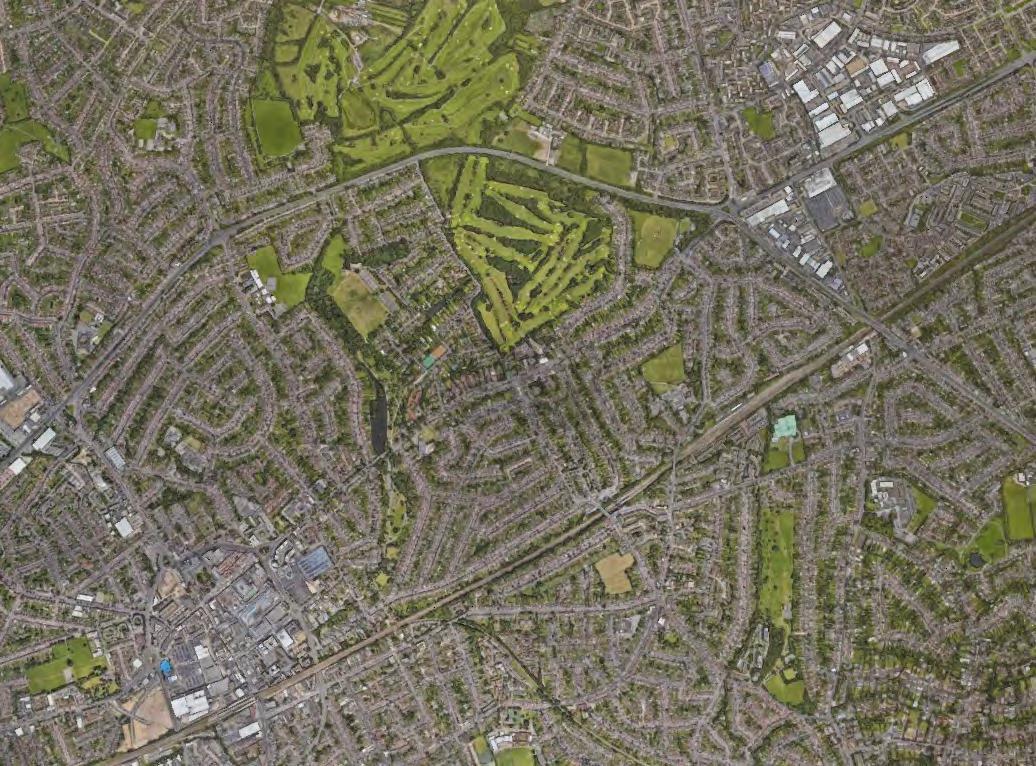
Aerial image of Gidea Park’s location in its wider surrounding context. The conservation area is outlined in red.
4.0 Character Assessment
4.2
Archaeology
Although not always a visible part of the conservation area, archaeological remains can contribute considerably to our understanding of how the area has developed.
Due to the area’s historic proximity to the Roman road and the medieval market town of Romford, there remains significant potential for further discoveries. Additional finds may provide further knowledge relating to the area’s pre-20th century evolution and development, which would possibly contribute to the special interest of the conservation area.
There is one scheduled monument within the conservation area, a section of Roman Road within Gidea Park Golf Course. It is considered a designated heritage asset of the highest significance, and the impact that a proposed development may have on a Scheduled Monument and its setting is a material consideration in the planning process. Works physically affecting a Scheduled Monument require Scheduled Monument Consent from the Secretary of State for Digital, Culture, Media and Sport via Historic England.
The Roman Road scheduled monument is also classed as a Tier 1 Archaeological Priority Area (Havering APA 1.2), as it main contain nationally-important remains of a Roman Road, though excavation in 2002 uncovered post-medieval material which suggests the road may form part of the former drive associated with Gidea Hall.
The conservation also comprises two Tier 2 APAs, or areas which hold specific evidence indicating the presence or likely presence of heritage assets of archaeological interest. These include Havering APA 2.8, comprising the site of the former Gidea Hall and its estate, and Havering APA 2.24, comprising the site of the former London to Colchester Roman Road.
Further information about these APAs can be found by consulting the Archaeological Priority Area Appraisal for the London Borough of Havering (2024), available online.
Map showing the coverage of Archaeological Priority Areas within the Gidea Park Conservation Area, indicated in yellow.
4.0 Character Assessment
4.3 The Setting of the Conservation Area
The setting of the Gidea Park Conservation Area has been considerably shaped by transport infrastructure and the continued suburban development.
Suburban Setting
It is surrounded to the west, south and southeast by slightly later suburban housing, comprising mostly semi or detached villas with a comparatively tighter plot pattern and more urban public realm than the generous spatial arrangement which forms a hallmark of the conservation area. Whilst generally of more standard architectural detail and massing, these later streets do much to maintain the conservation area’s quiet, largely residential character, often to an insular effect.
The Romford Golf Club extends from the conservation area boundary to the east, forming a key feature of townscape highly visible from Heath Drive. It provides openness interspersed with verdant planting which contribute strongly to the character of the historic garden suburb.
The Eastern Avenue (A12) dominates the conservation area’s setting to the north and northeast, presenting a hard stop to its network of streets and parkway. The noise from the busy roadway considerably impacts the area at its outer limits, and from across Romford Golf Club. The railway line also forms a key element of setting to the south of the conservation area, but as this predated much of the area’s development and adjacent streets were designed with it in mind, its impact is less abrupt.
Open Setting
There is an appreciable shift between the suburban character of the conservation area and areas of open, semi-rural character further afield to the north where a slight rise allows for long views to mature woodland and the distant Grade I listed Bower House, an early 18th century red brick country house set within its own parkland.
View north out of Gidea Park Conservation Area from Parkway, including view of Bower House in the distance.
4.0 Character Assessment
4.4
Important Views
All views which take in heritage assets, whether designated or not, are important and contribute to the understanding and experience of the Conservation Area. As a consequence, the views considered in this section are not intended to be a comprehensive set. Local views are identified on the map included in Section 4.5.
Views across the conservation area are often limited by its historic layout along meandering street lines and tree-lined avenues. Thus, the conservation area is generally experienced through incidental, kinetic and transitional views which constantly change as one moves along streets.
Some longer vistas along relatively straight stretches of road illustrate the juxtaposition between development and open land as designed, including views looking roughly north and south along Heath Drive, with the golf course to the east, and Parkway, with Raphael Park to the west. The streets connecting the two were laid out in a informal, meandering pattern which echoes their historic variety of buildings styles and architectural details across a network of picturesque, intimate neighbourhood views.
South of Main Road, longer-range views north and south along the key corridors of Balgores Lane, Squirrels Heath Avenue and Crossways are also picturesque, featuring treelined verges.
Views leading out of and into the conservation area are also important as they help to orient and delineate the conservation area within and from its setting. Due to the level topography of the immediate setting these views are generally limited to southwest and northeast views along Main Road, looking onto Heath Drive and the historic Hare Street.
View northeast into Romford Golf Course, from the junction of Heath Drive and the entrance driveway.
View from east end of Main Road, looking west into the conservation area.
View from west corner of Balgores Lane’s junction with Main Road, looking east.
4.0 Character Assessment
4.5 Architectural Interest and Heritage Assets
The character of the conservation area is best expressed through the group value of its many qualities, and due in part to its incomplete historic development, there are few individual buildings which play a leading role in establishing the character of the area. Rather, the conservation area’s group of locally and statutorily listed buildings are most representative of the its qualities.
There are 13 statutorily listed buildings in the conservation area, 19 locally listed buildings (Nos.1-6 and 7-12 Hare Lane counted as one) and one scheduled monument. Additional buildings are identified as positive contributors to the conservation area for their architectural or historic interest, the latter comprising exhibition buildings or those by exhibition architects. Sites presenting opportunities for enhancement are also indicated.02 These, together with key views identified in Section 5 are marked on the adjacent plan.
A Raphael Park
B 37 Reed Pond Walk
C 33 Reed Pond Walk
D 31 Reed Pond Walk
E 29 Reed Pond Walk
F 23 Reed Pond Walk
G 36 Meadway
Boundary Wall, Railings, Gates and Gate Piers to Former Gidea Hall (Grade II) 09 16 Meadway (Grade II) 10 The Ship Public House (Grade II)
H 1 Meadway
I 54 Parkway
J 40 Parkway
K 75 Main Road
L 224 Main Road
M 202-210 Main Road
N Gidea Park Preparatory School and Nursery (Balgores House)
O 1-6 and 7-12 Hare Hall Lane
Section of Roman Road on Romford Golf Club course
4.0 Character Assessment
4.6 Townscape and Spatial Analysis
The spatial character of Gidea Park is one of generous suburban spaciousness; roads with wide verges frame generous plots, with houses often set back behind front gardens. The historic Main Road divides the conservation area into two sections, with development to the south characterised by a large loop and three, long parallel avenues culminating at the railway station. Plots in this southern section are regularly laid out in a grid pattern, generally smaller than those to the north but maintaining a sense of spaciousness thanks to wide roads, planted verges and modest front gardens.
Street pattern north of Main Road is bounded by Heath Drive and Parkway, two avenues running roughly north to south between the golf course to the east and Raphael Park to the west. Other roads run between these two avenues indirectly, with deliberate, meandering changes in direction. Houses within this northern segment tend to occupy generous plots. The plot grain north of Risebridge Road becomes slightly tighter, the 1930s houses facing Eastern Avenue with the smallest plots. The conservation area ends somewhat abruptly at Eastern Avenue, a four-lane A-road, though mature greenery of the Risebridge Golf Course to the north of the A-road opposite the conservation area softens the impact of this to a degree.
The street layout as designed in 1910 incorporated some existing natural and architectural features into the townscape, and added others. These elements, including the former parkland walls and gate piers to Gidea Hall, the Hall’s former fish ponds appreciable from Heath Drive, the tennis club on the site of the Hall’s former tennis courts and the copse at Reed Pond Walk, remain legible and add substantial interest to the townscape.
Main Road continues to follow its historic path as an arterial route at the heart of the conservation area. Its spatial character is linear, with a mixed clusters of historic and modern development dispersed along both sides.
Crossways looking south from Main Road
Meanders at Reed Pond Walk
Curve at base of Balgores Lane and Crossways
4.0 Character Assessment
4.7
Open Space, Parks and Trees
The conservation area’s green spaces and trees form a key part of its history and significance as an early-20th century garden suburb. Greenery features across the conservation area, in front and rear gardens, street verges and open spaces, and makes a highly positive contribution to its character and appearance.
The area’s largest green space is Raphael Park, which forms much of conservation area’s western boundary and serves as an important community amenity. It features mature trees, open space, sports and recreational facilities, pathways and Black’s Canal at its southern end terminating at Black’s Bridge. The park also adds historic interest as a remnant of the former Gidea Hall parkland which predates the conservation area.
Romford Golf Course is an open space which forms much of the conservation area’s eastern boundary and setting. It also enjoys active use by the community.
There are a significant number of high-quality mature trees within these green spaces as well as in a series of other private and public spaces across the conservation area. This includes those within the densely wooded corpse bounded by Reed Pond Walk, planted on wide verges to create tree lined avenues and within private gardens. These make a significant contribution to the character and appearance of the conservation area.
4.0 Character Assessment
While views across Romford Golf Course open space from within the conservation area are curtailed to a degree by its wooded western boundary, a sense of openness remains undiminished which adds a significant contrast to the adjacent urban grain of residential streets. Views across the open space and water features within Raphael Park are long, appreciable both from streets bounding the space as well as within it. Public realm within the park such as seating and play areas encourages dwell time within the space.
The copse at Reed Pond Walk is identified as a village green by the London Borough of Havering, and is an original feature of the 1910-11 Gidea Park exhibition development.
There are several protected open spaces within the immediate setting of and visible from the conservation area which add to the character of a green environment, including Risebridge Golf Course to the north, the full expanse of Romford Golf Course to the east, and Lodge Farm Park to the south of Raphael Park.
Tree Preservation Order (TPO) areas are designated across full plots throughout the conservation area, indicating the importance of trees in both front and rear gardens. Designated Tree Preservation Order (TPO) areas in Gidea Park may be seen on page 27 and further details of the individual TPOS can be found on the Council’s interactive planning map, see the Further Information and Resources section.
The copse at Reed Pond Walk, a village green
Raphael Park from Parkway
South end of Raphael Park overlooking Black’s Canal
4.0 Character Assessment
4.8 Public Realm
Street and Pavement Surfaces
Street surfaces throughout the conservation area are tarmac, with granite or concrete kerbs. No historic pavement surfaces appear to survive. Most are in tarmac; simple square concrete pavers are also found throughout the conservation area, but sporadically. An exception to this is a recently refreshed area of public realm at the intersection of Balgores Lane and Crossways which has been laid in granite pavers.
Pavements are lined with narrow bands of grass verge between walkway and road in some residential streets to the south and north of Main Road, but this is not consistent.
Street Furniture, Lighting and Wayfinding
Street lamps are prevalent throughout the conservation area modern but in a largely uniform historic profile. There are some instances of modern, more utilitarian lighting in higher traffic areas such as roads near the station and Main Road, and sections of Balgores Square.
Seating and planters are limited to commercial areas at the southern end of Balgores Lane and Main Road. These occur in occasional clusters which encourage dwell time and generally make a positive contribution to the character of the space, though profiles and materials lack consistency.
There are a series of park benches within Raphael Park, of a uniform design that contribute positively to the character and dwelling time of the open space.
Other elements of street furniture include bollards, which are found throughout the conservation area and are particularly prevalent along Main Road, in modern, utilitarian profiles. There is little to no cycle parking.
Some modest wayfinding signage has been implemented by way of double-sided signboards near Balgores Lane and along Main Road which illustrate the boundaries and history of the conservation area. Street signs are at a mix of heights; those at low height are often situated near hedges at corners.
Street and pavement surfacing on Balgores Crescent.
Seating and amenity space within Raphael Park.
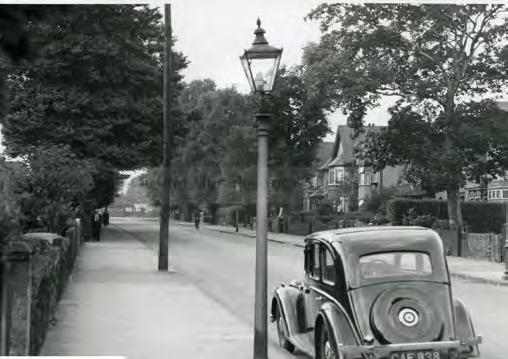
View of public realm on Balgores Lane, near to the train station.
4.0 Character Assessment
4.9 Building Uses
The conservation area’s buildings are principally in residential use. A concentration of buildings in commercial and office use is present along Main Road and near Gidea Park railway station at the south end of the conservation area, which are representative of the area’s conception as a garden suburb. Individual or small clusters of buildings in other uses are also scattered throughout the conservation area. Each use type is described below.
Residential Buildings
Residential buildings across the conservation area vary in size and decorative style, owing to the broad range of styles deployed by the 122 architects responsible for designing houses for the Gidea Park exhibition. These comprise mostly semi-detached and detached houses, with slightly larger dwellings found to the north of the Main Road, and generally smaller to the south.
A small number of residential buildings within the conservation area have been erected from the late-20th century onward, including the developments of Sycamore Grove and Mead Close, which have infilled plots northwest of the Gidea Hall fish ponds between Meadway to the northwest and Heath Drive to the east, though these are generally concealed from wider conservation area views. Several larger residential buildings in multiple occupancy are situated along the north side of Main Road, as well as Gidea Lodge, a complex of retirements apartments between Balgores Crescent and Main Road, also largely concealed. The majority of these later residential buildings lack the character of the conservation area’s historic homes, but have a neutral visual impact for the most part.
Semi-detached houses on Crossways
Detached houses, Squirrels Heath Avenue
Detached house, Reed Pond Walk
Detached houses, Parkway
4.0 Character Assessment
Retail and Commercial Leisure Buildings
Retail and commercial leisure buildings are contained to Main Road, and to the section of Balgores Lane adjacent to the railway station, with the exception of recreational facilities which are embedded within or adjacent to residential streets.
Commercial buildings on Main Road are of mixed scale of three stories or lower, and mixed dates, featuring the oldest buildings within the conservation area dating from the 17th century up to those of the present day. A small number are in office use, or with offices at upper floors. Together this creates a lively corridor with an active footfall alongside the busy traffic of Main Road.
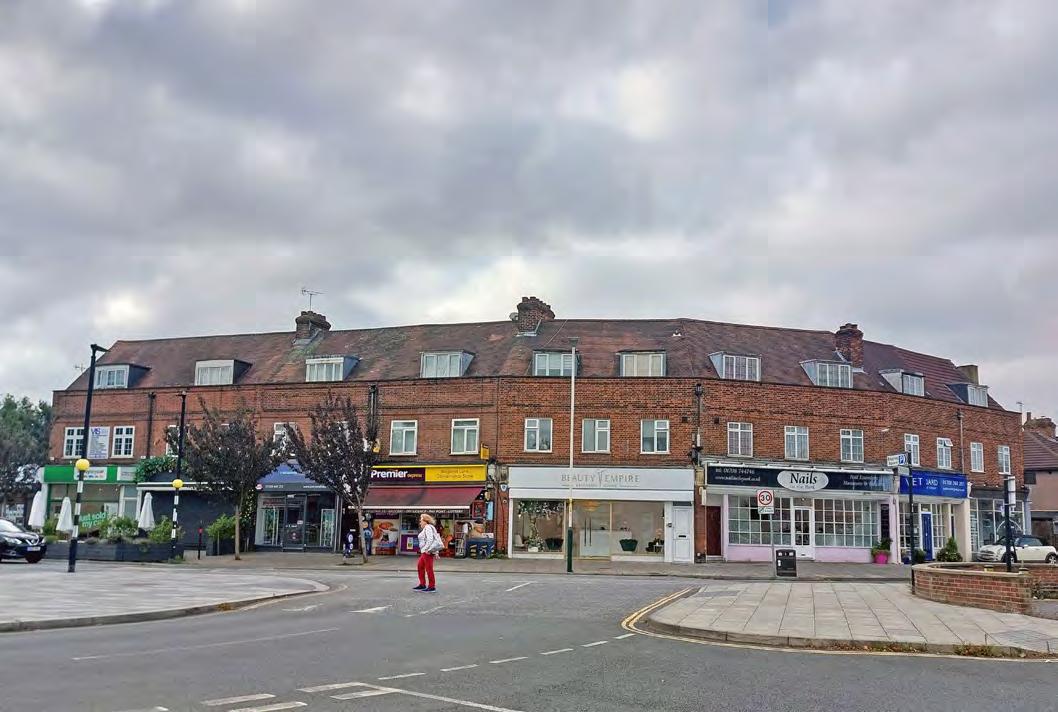
Commercial buildings on Balgores Lane near the station include a small number of purposebuilt commercial buildings dating to 1911, a curved inter-war terrace including ground floor shopfronts with flats or offices above, a single building with a ground floor arcade, and a purpose-built garage.
Recreational (commercial leisure) facilities are the only commercial buildings found outside of these two areas. The Romford Golf Club Clubhouse retains its original use from its founding in 1894 and is a landmark property at the southern edge of the golf course, close to Heath Drive. Gidea Park Lawn tennis club is situated within the former front lawn of Gidea Hall, and the small contemporary building and tennis courts are framed by tall, mature evergreen hedges, providing a pleasant break within the suburban plan. Another tennis club and courts within Raphael Park are situated within the Gidea Hall landscape feature Spoon Pond, since drained and repurposed.
The Ship public house, listed at Grade II, on the north side of Main Road. It is presumed to date to the 17th century, if much altered.
Romford Golf Club Clubhouse.
4.0 Character Assessment
Education Buildings
There are several schools within the Conservation Area, near to the Main Road. The Gidea Park Preparatory School and Nursery School resides within the locally listed Balgores House, a converted Victorian country house. It presents an important local landmark, as a highly visible and attractive Victorian building near a principal intersection.
A pre-school is located within the Friends Meeting House at 7 Balgores Crescent, a mid-20th century single storey building set discreetly off Balgores Crescent. A nursery school at 69 Main Road is within a heavily altered 20th century house set behind large front car park.
Balgores Lane façade of the Gidea Park Preparatory School.
4.0 Character Assessment
Places of Worship
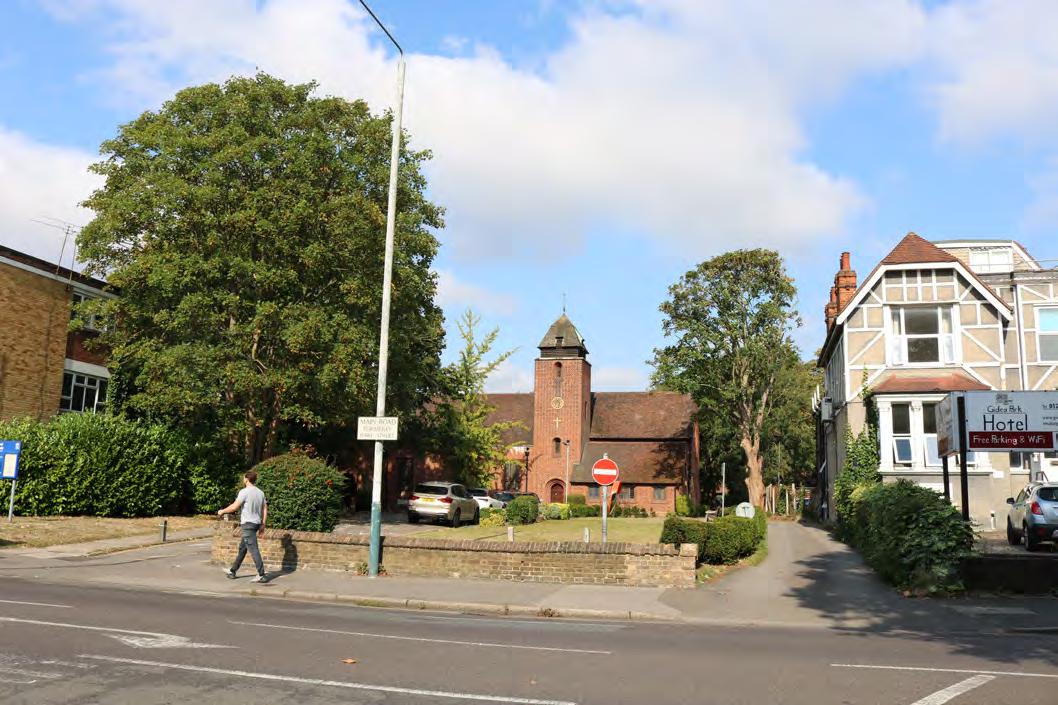
Gidea Park contains two places of worship, both near to the Main Road; the Friends Meeting House at 7 Balgores Crescent, and the Anglican church St Michael & All Angels set north of Main Road behind a large drive and lawn court.
St Michael & All Angels is a large, Inter-war red brick building with a prominent bell tower, visible from Main Road but set back by a long drive, lawn and mature greenery. A rear courtyard contains a series of community spaces managed by the church including the Main Hall, a large, single volume community space dating to the interwar period with a characterful façade, heavily damaged by fire in 2022.
View of St Michael & All Angels from Main Road
4.0 Character Assessment
4.10 Scale and Massing
Residential houses, which comprise most of the conservation area’s buildings, are generally two-storeys beneath pitched roofs, with some additional attic storeys and dormers, or single storey extensions. These rows of villas are spaced evenly within their own plots, often set back from the road by a generous front lawn and with a gap between neighbouring properties. A historic exception is 1-6 and 7-12 Hare Hall Lane, a robust four-storey block of flats with offices at ground floor, of 1912 with later 1930s infill. This rises prominently against a backdrop of smaller houses.
Commercial and professional buildings within the two centres on Main Road and near to the station feature a handful of terraced buildings. These are two to three storeys in height and varied in date and style. On Main Road, these terraces are interspersed with detached or semi detached buildings of generally two storeys, with an equally broad range of dates and architectural styles, some set back from the pavement by a paved forecourt, others with frontages flush with the pavement edge. Near to the station the buildings are a similar mixture of terraced or block buildings, of one- to three-storey storeys, dating to the early decades of the 20th century. This rich mix of forms creates a lively street scene, in sharp contrast to the relatively consistent residential plots throughout the rest of the conservation area.
View of Inter-war parade at intersection of Balgores Lane and Crossways.
4.0 Character Assessment
4.11 M aterials
Dwelling houses share elements of a common palette of materials, despite the architectural individuality that characterizes the area. The use of red brick or render is common, as are instances where the two treatments are combined to articulate different storeys or bays of a dwelling.
The use of timber casement windows is prevalent, often with small pane glazing, with examples of small stainedglass feature windows found across the group. Decorative brickwork has also been used frequently to add interest to features such as window surrounds chimney breasts or entranceways, using polychromatic, rubbed or broken brick mosaic. Clay tiles are often integrated into brickwork or to gables for decorative effect, as are panels of timber board or untreated wood.
Roofs are clay tile, with occasional use of grey slate. Modern tile has replaced historic in places, however historic roof tiles remain prevalent.
Front gardens would have originally been soft landscaped with hedged or low fenced boundaries. Front gardens have increasingly been adapted for car parking with boundaries also consequently eroded.
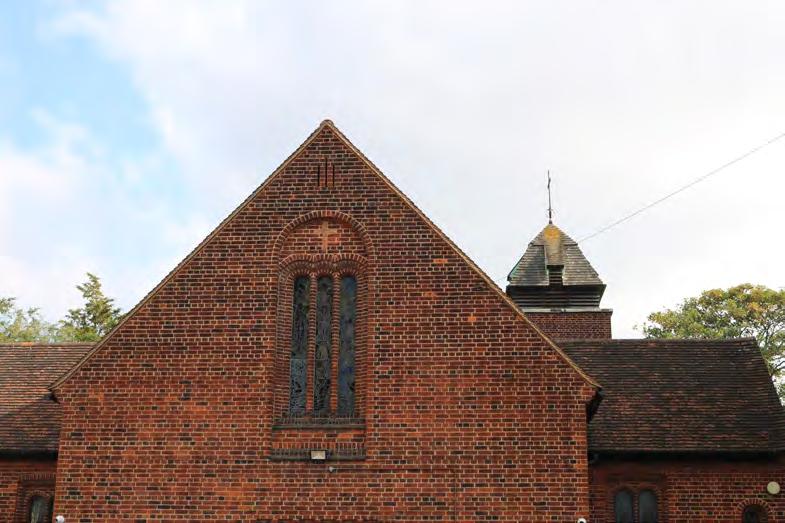
Detail of brickwork at St Michael and All Angels church
Detail of window, roof and façade materials used on Reed Pond Walk
4.0 Character Assessment
4.12 Architectural Details
Architectural Details
A substantial amount of original early 20th century architectural detail survives to principal elevations across the conservation area. These details are enormously varied, according to the variety in architectural type.
Rooflines
Complex roof profiles are created with steep or irregular pitches, as well as prominent and characterful chimney stacks, gables and dormer windows.
Decorative Façade Treatments
Ornamentation has been applied to the principal façades of individual buildings which adds considerably to their individual character, provides an attractive variety to the street scene, and a tangible reminder of the area’s historic development as a showpiece of architectural style.
Polychromatic brickwork, rubbed brick, hung tiles, timber partition frontages and decorative plaster moulding are some of the many techniques used to ornament façades.
Detail of chimney stack of No.57 Balgores Lane
Detail of decorative plasterwork to No.36 Reed Pond Walk
Detail of subtle decorative brickwork above main entrance at No.32 Reed Pond Walk
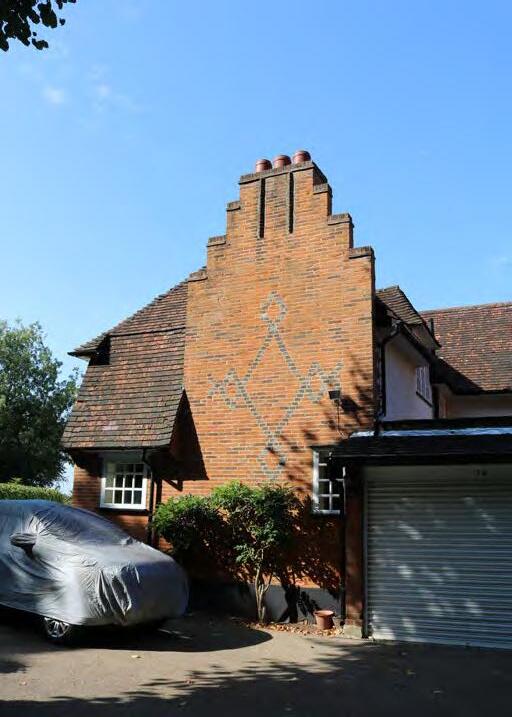
Detail of polychromatic brickwork set within the chimney breast at No.74 Parkway
5.0 Character Areas
5.0 Character Areas
5.1 Introduction
Whilst the majority of buildings within the Gidea Park Conservation Area principally relate to the area’s development as an early20th century residential garden suburb, there are differences in architectural detail, arrangement and townscape which form distinct character areas.
The following identifies and provides analysis of each of the different character areas within the conservation area, as shown on the adjacent plan.
The contribution made by individual buildings or sites is described in the map and key provided for each character area assessment on the following pages. A description of the key categories is as follows:
Statutorily Listed Buildings are buildings that are recognised by central government for their special architectural and historic interest and thus are provided statutory protection under the Planning (Listed Buildings and Conservation Areas) Act 1990.
Scheduled Monuments are nationally-important archaeological sites included on the National Heritage List for England, and thus are provided statutory protection as designated heritage assets.
Locally Listed Assets are designated by the local planning authority for the positive contribution they make to local character and sense of place. They are not offered the same protection as statutorily listed buildings, but are material considerations in planning applications.
Positive Contributors are buildings which are not statutorily nor locally listed, but nevertheless make a notably positive contribution to historic townscape. These buildings may merit consideration in planning applications that impact them directly or indirectly.
Opportunities for Enhancement are buildings or sites that comprise elements which detract from the character and appearance of the conservation area. Their improvement or replacement is encouraged. Source:
2024 Proposed Conservation Area
Character Area 01: Gidea Park North
Character Area 02: Gidea Park South
Character Area 03: Eastern Avenue, Brook Road and Heath Drive North
Character Area 04: Main Road
Corridor
This plan is not to scale
5.0 Character Areas
2024 Proposed Conservation Area
Key Views
Scheduled Monument
Statutorily Listed Building
Locally Listed Asset
Positive Contributor
Opportunity for Enhancement
5.2.1 Street and Plot Pattern
Gidea Park North comprises the area north of Main Road which was laid out as part of the 1910-1911 garden suburb exhibition. Its principal access from the south is via Heath Drive, which continues northwest, bound by the Romford Golf Club course to the east. Ancillary streets extend in a loose grid as they make their way southwest toward Raphael Park from Heath Drive, often meandering, turning at right angles or, in the case of Reed Pond Walk, fully looping, to create an informal townscape pattern and sense of intimacy. By contrast, Parkway and Heath Drive face outward over open space, reflected in their generous frontages.
Plot sizes north of Main Road are generous, featuring deep rear gardens, front gardens and mature planting; this promotes a cohesion of setting and townscape character. Area features which predated the 1910-11 townscape plan were incorporated into its layout, including the walls and gates to the parkland of Gidea Hall, its fish ponds, tennis courts and several trees; bends in streets were deliberately made to circumvent the latter. Most remain legible today and are important fixtures within the townscape that contribute to the understanding of the site.
5.2.2 Important Views
Long-range views are generally limited by the informal street pattern; instead, the character area is generally experienced via incidental and kinetic views appreciated as one moves through the townscape. These views at closer range help to draw attention to the character area’s buildings and architectural details.
Source: Airbus,USGS,NGA,NASA,CGIAR,NLS,OS,NMA,Geodatastyrelsen,GSA,GSI and the GIS User Community
This plan is not to scale
The long and mid-range views that do occur, including up and down Parkway, looking outward (to the southwest) and inward (to the northeast) across the expanse of Raphael Park and southwest across the fish ponds from Heath Drive are important, as they help establish the context of conservation area within open spaces. Similarly, outward views looking north and east across the Romford Golf Club course, itself an original feature of the 1910-11 townscape, are also key.
5.2 Character Area 1: Gidea Park North
Meanders at Reed Pond Walk View looking northwest along Parkway
Character Area 01: Gidea Park North
5.0 Character Areas
5.2.3 Open Spaces, Trees and Public Realm
Both Raphael Park to the west of the character area and the Romford Golf Club course to the east are designated open spaces which allow views outward and provide buffer from development and traffic within the immediate setting of the conservation area. Both comprise features of active recreation grounds and mature planting; within the golf course informal clusters of trees in the near, middle and long distance provide a countryside-like, outer-fringe feel that is key to understanding the conservation area’s context as a garden suburb.
The copse at the west end of Reed Pond Walk, designated a town green, provides a swathe of verdant landscape within the urban grain of the street pattern that adds an air of seclusion; the green is an original feature of the 1910-11 plan of high historic interest. The prevalence of Tree Preservation Orders (TPOs) to full plots reflects the importance of mature trees in front and rear gardens to area character.
Streets are generally broad, paved in tarmac with granite or concrete kerbs. Pavements are also generally in tarmac with modern concrete pavers in places; patchwork repairs of varying quality are evident. Narrow grass verges commonly run between streets and pavements, though not consistently. Signage is generally limited to street signs at high or low level, the latter often adjacent to corner hedges; this goes far to keep visual clutter within the street scene at bay. Streetlights throughout the area are metal, in a traditional profile with glazed lanterns; consultation has indicated that a number of these are in poor condition and in need of repair. Seating is only found in Raphael Park, and there is no provision of cycle parking within the character area.
Looking west over Raphael Park from Parkway
Copse at Reed Pond Walk
Character Area 1: Gidea Park North
5.0 Character Areas
5.2.4 Building Types and Uses
Buildings within Gidea Park North are principally residential, comprising mostly detached but some semi-detached houses and some larger buildings in multiple occupancy along the north side of Main Road, including a modern development at Royal Jubilee Court. A cluster of large, Victorian and Interwar houses (some rebuilt) west of the junction of Main Road and Heath Drive have been converted for use as a nursery, social club and care home.
A handful of buildings, including the Romford Golf Club clubhouse – an original fixture of the garden suburb development – and a modern clubhouse for the Gidea Park Lawn Tennis Club along Gidea Close are in recreational/leisure use. A modern single-storey building at the southern end of Raphael Park functions as a restaurant with additional access from Main Road.
5.2.5 Scale, Materials and Architectural Details
The houses within Gidea Park North erected as part of the 1910-11 exhibition competition were largely designed as either large detached houses of Class I, or as detached cottages of Class II. This difference in massing and scale remains legible, with Class I houses mostly constructed along Heath Drive, Reed Pond Walk and Parkway, and Class II cottages of a more modest scale principally built in Meadway and Risebridge Road. Later infill and modern development has generally reflected the scale of neighbouring houses, with some exceptions.
House in multiple occupancy, Main Road
Class I detached houses in Parkway
Character Area 1: Gidea Park North
5.0 Character Areas
The architectural styles applied in 1910-11 were indicative of the period, from Arts and Crafts to Neo-Tudor and Georgian; no two houses were alike, and the eclectic sampling of early20th century domestic design which survives today is of high significance.
Houses are generally of two storeys beneath pitched or hipped roofs; a mansard-style roof at 23 Reed Pond Walk is an exception. Roofs are predominantly in clay tiles apart from 45-48 Heath Drive, which are in slate and largely concealed behind parapets, and often feature dormers and sometimes gables. The variety employed across rooflines, forms and chimneys adds substantial interest to this character area,
and makes a strong contribution to the character of the wider conservation area as a whole. Fenestration is often arranged horizontally, with window openings and glazing bar patterns often modestly-sized in proportion to their wider elevations. Most windows are timber casements; these have been inappropriately replaced with sashes or modern window arrangements in places. Fenestration pattern is on occasion broken up by exaggerated, tall window openings, or with striking decorative windows in leaded glass.
Materials are of notably good quality and generally comprise painted render, principally in white or cream but other colours have been applied in places, and handmade brick. Brickwork also is often employed to accent architectural features within otherwise rendered elevations, whilst decorative tilework draws the eye to doorways, porches and gables to a pleasingly bespoke effect.
Horizontal window arrangement with brick mullions, Parkway
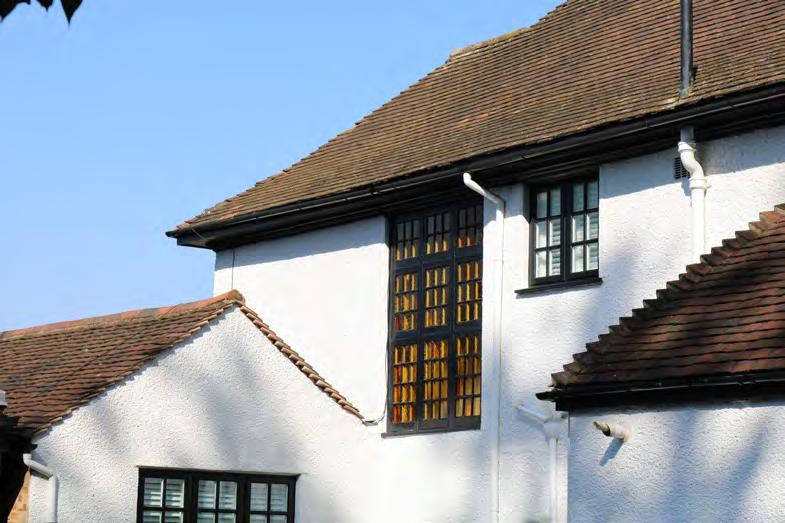
Decorative window to return elevation, Heath Drive
Elevation treatments, Reed Pond Walk
Character Area 1: Gidea Park North
5.0 Character Areas
5.2.6 Boundary Treatments
Boundary treatments vary by plot, but all convey the importance of front gardens to the suburb’s historic design. They often comprise high or low hedges which contribute to a sense of enclosure; high hedges often continue between plots in rear gardens. In some cases traditional hedges have been replaced by modern planting. Low brick walls and timber fencing are also common; many of these are later replacements. Some cast-iron entrance gates survive within front gardens, replaced with inferior black-painted modern metal gates in places.
The historic garden walls to the form Gidea Hall demarcate the boundary between historic houses in Meadway and modern development to the south in Mead Close and Sycamore Grove. Gates and railings to Raphael Park along the Main Road entrance are also historic, in a charmingly eclectic profile.
5.2.7 Audit of Heritage Assets
Statutorily listed buildings within Gidea Park North are all listed at Grade II and include 16 Meadway by Philip Tilden; 27 Meadway by van ‘t Hoff and Maxwell; 41 Heath Drive by
Raymond Unwin and Barry Parker; 43 Heath Drive by W. Curtis Green; 36 and 38 Reed Pond Walk by M.H. Baillie Scott; the sundial in front of 36 Reed Pond Walk; and the sections of boundary wall, railings, gates and gate piers to the former Gidea Hall along and to the west of Heath Drive. A section of Roman road which survives within the Romford Golf Club course is a scheduled monument.
Locally listed assets include Raphael Park; 23, 29, 31, 33 and 37 Reed Pond Walk; 1 and 36 Meadway, and 40 and 54 Parkway.
Hedge boundaries, Gidea Close
Raphael Park entrance gates and railings, Main Road
Character Area 1: Gidea Park North
5.0 Character Areas
5.3
Character Area 2: Gidea Park South
5.3.1 Street and Plot Pattern
The street pattern across the Gidea Park South character area comprises a grid formed of the three long north-south corridors of Balgores Lane, Squirrels Heath Avenue and Crossways, bookended by curves at Balgores Crescent to the north and the intersection of Crossways and Balgores Lane to the south, before the latter continues over the railway to Gidea Park Station. Hare Hall Lane is the only other cross-street, continuing between Squirrels Heath Avenue and Crossways as a footpath. Balgores Square remains an incomplete townscape feature at the base of Squirrels Heath Avenue, originally intended as a commercial and retail centre for the garden suburb. It now serves as a car park, encircled by tall hedges.
Balgores Lane is a key north-south vehicle route with some of the heaviest traffic in the conservation area. A number of residential streets lead west from Balgores Lane into the neighbourhoods forming the conservation area’s setting. There is less permeability along the east side of the character area, with only Wallenger Avenue leading into eastern neighbourhoods.
Plots are generally narrower in this part of the conservation area in comparison to the residential area north of Main Road, with shallower front gardens. Plots in Squirrels Heath Avenue are somewhat more generous than those to the flanking streets, while those south of Hare Hall Lane are the most compact.
Character Area 02: Gidea Park South
2024 Proposed Conservation Area
Key Views
Scheduled Monument
Statutorily Listed Building
Locally Listed Asset
Positive Contributor
Opportunity for Enhancement
This plan is not to scale
Footpath connecting Squirrels Heath Avenue and Crossways
5.0 Character Areas
5.3.2 Important Views
The longer grid pattern of early-20th century and Interwar housing offers contrast to the more informal townscape to the north of Main Road. Important views comprise those which provide vistas across this townscape arrangement of residential areas characteristic of Gidea Park, including north and south views along Balgores Lane, Squirrels Heath Avenue and Crossways.
5.3.3 Open Spaces, Trees and Public Realm
The Gidea Park South character area has a more urban feel than the neighbourhoods to the north, in part due to the lack of open spaces. Two modest triangular greens flank either end of Balgores Crescent, but otherwise there is no publicly accessible green space. Tree Preservation Orders (TPOs) are in place across full plots in Balgores Lane and Crossways, and one in Squirrels Heath Avenue. Mature trees are prevalent to all streets, however, framing views across the townscape and conveying the importance of greenery to the historic character of the garden suburb.
A seating area with planters and young trees implemented at the southeast corner of Crossways and Balgores Lane north of the railway line provides a place to comfortably dwell as one enters the conservation area from the south. This is paved in granite pavers that continue eastward along Crossways to the Gidea Park station car park. Otherwise pavements are overlaid in a mix of modern concrete pavers within commercial zones. Residential area pavements are mostly in tarmac, interspersed with concrete pavers in places; no historic pavements remain. Streets are in tarmac, with concrete or granite kerbs. Narrow strips of grass verges remain in some residential streets, though often in fragments.
Streetlamps modern and utilitarian in profile within the commercial area at the southern end of the character area, around Balgores Square, along Squirrels Heath Avenue and along Balgores Lane. This has been replaced by streetlamps in a historic profile with glazed lanterns in Balgores Crescent and Crossways. There are two cycle hoops along Balgores Lane before it crosses the railway line at the southern end of the conservation area; otherwise these are limited to the area adjacent to the railway station entrance.
View south down Crossways, flanked by mature trees
Mix of modern pavement, Crossways
Character Area 2: Gidea Park South
5.0 Character Areas
5.3.4 Building Types and Uses
The Gidea Park South character area comprises mostly residential buildings comprising detached and semi-detached houses of two storeys. Detached houses dating to the 191011 exhibition are situated across Balgores Lane and Squirrels Heath Avenue interspersed with later Interwar houses, comprising some later houses by exhibition architects. A few larger buildings are in multiple occupancy as modest blocks of flats.
Commercial buildings are focused near the station and include a gently curving Interwar parade of ground floor shops with flats or offices above at the western corner of Balgores Lane where it meets Crossways. Though generally nondescript, it reads strongly of the period in red brick; shopfronts are modern but most historic corbelled pilasters remain.
A c.1911 arcaded range at the southwest corner of Balgores Square with shops at ground floor makes a strong visual impression at the southern entrance to the conservation area; this is the only part of an original commercial development dating to the first exhibition which was meant surround the square to ultimately be completed. The broad mixed-use block comprising 1-6 and 7-11 Hare Hall Lane to the north of Balgores Square dates to c.1912 and is another incomplete commercial range with flats above, infilled by a 1930s block of flats. Ground floor units are much altered and are currently in office use.
A single-storey auto repair garage and dealership is located at the northeast corner of Balgores Lane at Nos.77 and 142, an odd insertion within an area of principally residential character. Another single-storey range immediately north of the railway line currently comprises three units in restaurant use.
5.3.5 Scale, Materials and Architectural Details
Houses comprise the majority of buildings across the Gidea Park South character area. There is a lesser concentration of exhibition houses here, where they are principally found in Balgores Lane and Squirrels Heath Avenue, than in Gidea Park North, and therefore less cohesion. But a considerable number of homes date to roughly the same period and share similar materials and attention to detail. The contrast in form and architectural detailing is perhaps sharpest in Balgores Lane, where most houses along the west side south of Repton Avenue were erected after 1934.
Houses are principally of two storeys beneath hipped roofs in tile, which sometimes feature gables or dormers. Chimneys add liveliness to rooflines, but they are not as prevalent or robust here as in other parts of the conservation area; an exception is the composition of exhibition houses at 27-37 Squirrels Heath Avenue, where chimneys make a powerful impression.
Houses are principally in brick or in render, sometimes in a mix of both. Render is usually painted though occasionally left plain, and brickwork details are often employed to emphasise architectural features in otherwise rendered elevations. Windows traditionally comprised multi-pane timber casements; some survive, but most appear to have been replaced, sometimes in uPVC or with inappropriate glazing bar patterns. Some later accretions, including side wing extensions and enclosed front porches, detract from area character.
Prominent roofline at 27-37 Squirrels Heath Avenue
Mismatched window replacement, Balgores Crescent
Character Area 2: Gidea Park South
5.0 Character Areas
5.3.6 Shopfronts
Shopfronts are located in the south part of the character area near the station. Most shopfronts are modern apart from 142 Balgores Lane within the corner Interwar range which is in its historic arrangement with an appropriately-scaled fascia and some period glazing, but other elements appear to be modern replacements. Original brick pilasters and fluted capitals survive between most units within the corner range. Some shopfronts here comprise traditional elements including stall risers, cornices and vertical elements to shopfront windows, but others are in full-height glazing with overlarge fascias and internally-lit plastic signage. Surface-mounted cabling and services also detract from the building’s appearance.
Delicate brick pilasters appear to survive between the three units at the single-storey commercial block opposite but are obscured by awnings and overlarge fascias; surface-mounted services and rooftop plant are highly visible.
Shopfronts within the c.1911 arcaded range at 2, 3 and 4 Balgores Square also retain historic elements, including fluted pilasters, timber stall risers and recessed entrances; the entrance to No.3 has been brought forward. Shopfronts to the office units in Hare Hall Lane are fully modern insertions of little character.
5.3.7 Boundary Treatments
Boundary treatments provide a sense of enclosure and protection to front gardens from the street and are an important historic characteristic of the area, particularly in longer street views; houses often appear over-exposed in instances where they are missing completely. Treatments often comprise low brick walls to front gardens, sometimes with stone coping and gates, and sometimes combined with hedges. Full metal railings are traditional but miss the mark within the context of the early-20th century development, where brick, timber or hedge treatments were more typical.
Long stretches of tall timber fencing to rear and side gardens present a hard, utilitarian frontage and detract from the street scene, as found in Hare Hall Lane, Balgores Crescent and at the southern end of Crossways.
Rear gardens are also often demarcated by hedges and mature trees.
5.3.8 Audit of Heritage Assets
Whilst there are no statutorily listed buildings within Gidea Park South, 1-6 and 7-12 Hare Hall Lane, sections of a mixed-use commercial block that dates to the original garden suburb but was never completed, is a locally listed asset and prominent feature of the townscape along Hare Hall Lane and Balgores Lane.
5.4 Character Area 3: Eastern Avenue, Brook Road and Heath Drive North
5.4.1 Street and Plot Pattern
The townscape in this northernmost part of the conservation area is dominated by Eastern Avenue and its four lanes of traffic, which abruptly severs it from its setting to the north. Pairs of semi-detached houses in Eastern Avenue are set back behind modest front gardens which slope down from street level and a lane for street parking. Gaps between pairs allow views of greenery to the rear.
The street scene changes as one turns south into Heath Drive, with the expanse of the Romford Golf Club open space to the east. Streets and pavements are generous, but otherwise the earlier ideals of the garden suburb are largely absent, replaced with ribbon development across tighter plots. Rear gardens, however, are spacious.
5.4.2 Important Views
South and north-facing views into and out of the conservation area are appreciated from the northern end of Heath Drive, and take in the open space of Romford Golf Club to the east which is a key feature of its setting. This relationship to setting is also made legible in east-facing views from Brook Road. Kinetic views are more limited in this part of the conservation area due to the narrow plot grain.
5.4.3 Open Spaces, Trees and Public Realm
Character Area 03: Eastern Avenue, Brook Road and Heath Drive North
2024 Proposed Conservation Area
Key Views
Scheduled Monument
Statutorily Listed Building
Locally Listed Asset
Positive Contributor
Opportunity for Enhancement
This plan is not to scale
The Romford Golf Club open space continues along the east side of Heath Drive as informal grassland with smaller trees, screened from view by larger trees along the roadside. No plots within the character area have Tree Preservation Orders (TPOs) applied. While mature trees are less prevalent here than in the southern parts of the conservation area, individual or small clusters of trees soften its more open feel, in some instances providing verdant backdrops when planted in rear gardens.
Roads are paved in tarmac with concrete kerbs, granite kerbs along Eastern Avenue. A strip of parking has replaced the grass verge in Eastern Avenue, demarcated from the pavement by a stretch of granite setts. Pavements along Eastern Avenue are in tarmac; others are in concrete pavers, interspersed with stretches of plain concrete.
Streetlamps in Eastern Avenue are tall and utilitarian, and relate to the A road. This changes at the north end of Heath Drive, where traditionally-profiled streetlights help to demarcate entrance into the conservation area.
5.4.4 Building Types and Uses
All buildings within this northernmost part of the conservation area are residential, comprising mostly detached houses in Brook Road and Heath Drive, and semi-detached pairs in Eastern Avenue.
Semi-detached 1934 houses, Eastern Avenue
5.0 Character Areas
Character Area 3: Eastern Avenue, Brook Road and Heath Drive North
5.4.5 Scale, Materials and Architectural Details
The houses along Heath Drive between Risebridge Road and Brook Road are all of two storeys, in render or painted brick. Massing and hipped and pitched roofs in tile relate to the buildings of the first exhibition to the south; otherwise historic details are clearly of the 1930s, including the modernist dual frontages at 64 Heath Drive. All but No.64 have later additions or accretions.
The 1934 exhibition houses in Brook Road form a striking composition, rising two storeys beneath flat roofs in render, brick or painted brick. Frontages are deliberately austere, though their simplicity has been considerably impacted by the loss of their original windows, as replacements are generally of inappropriate profiles and materials. Later extensions and accretions such as porches and columns have also diminished original character. Later buildings in Brook Road and the north end of Heath Drive do little to relate to the original group.
Exhibition houses along Eastern Avenue are semi-detached pairs, also rising two storeys beneath flat roofs. Most are in red, yellow or cream-coloured brick, and some have been rendered. Original windows were in metal, but nearly all have been replaced in unsympathetic materials and profiles. Later accretions have obscured the legibility of original frontages across the range with a handful of exceptions, including 314 Eastern Avenue which survives largely intact to the front.
5.4.6 Boundary Treatments
Historic photographs show that the 1934 exhibition houses were provided with simple timber fences as boundary treatments, none of which survive apart from a section of fence between 64 and 63 Heath Drive in its original profile. Most existing boundary treatments in Brook Road are lowlevel brick walls or hedges; in several cases, none exist altogether. The result is a much more open character to front gardens which considerably contrasts with the intimacy created by boundary treatments featured within the earlier part of the garden suburb. Hedges and low brick walls are employed along frontages in Eastern Avenue, offering a degree of privacy from the heavy traffic of the A road but without consistency.
5.4.7 Audit of Heritage Assets
No.64 Heath Drive, a modernist dwelling of 1933-4 in reinforced concrete by Francis Skinner and Tecton is listed at Grade II.
1930s front elevation detailing, Heath
5.0 Character Areas
5.5 Character Area 4: Main Road Corridor
5.5.1 Street and Plot Pattern
Main Road runs roughly east to west as a key thoroughfare which predates the conservation area and runs through its heart, connecting Romford in the west to Brentwood in the east. Frontages generally infill the majority of their plots. Narrow access lanes between buildings lead in from Main Road to rear parking or service yards, whilst several plots have space for parking at the fronts of buildings which detracts from the street scene.
The character area also includes plots to the north and south of Main Road for buildings situated behind the street frontages. These are more irregular in shape and size and do not follow a historic pattern, apart from the plot surrounding Gidea Park Preparatory School at 2 Balgores Lane, a former country house that retains a broad front garden.
5.5.2
Important Views
Character Area 04: Main Road Corridor
2024 Proposed Conservation Area
Key Views
Scheduled Monument
Statutorily Listed Building
Locally Listed Asset
Positive Contributor
Opportunity for Enhancement
This plan is not to scale
Views into and out of the conservation area along Main Road to the east and west are key to understanding the relationship between the conservation area and its setting, and the historic importance of this arterial route. Mature trees feature in longerrange vistas in either direction and contribute to the area’s edge-of-town character. Views from Main Road through to rear yards and later development are generally of modern spaces of little interest.
Views southward down Balgores Lane and Crossways clearly illustrate the transition in townscape between commercial and residential quarters.
5.5.3 Open Spaces, Trees and Public Realm
The designated open space formed by the Romford Golf Club course is only visible from the northern edge of the character area in glimpses. There are Tree Preservation Orders (TPOs) in place for the grounds to St Michael and All Angels church, which contains some large trees, as well as to plots to the south that include mature foliage; these help to form a green backdrop to Main Road frontages in places. A group of mature trees within the plot of Gidea Park Preparatory School in Balgores Lane are also protected.
The building line to the south side of Main Road sits close to the pavement, limiting space for trees. Some smaller trees are interspersed with planters along the north side of the road east of the intersection with Balgores Lane where pavements are generous. Otherwise greenery is generally limited to planters put out by local businesses.
Area roads are in tarmac with kerbs in concrete and granite kerbs. Pavements are also largely in tarmac with some modern pavers, with some tarmac extending up to building frontages to provide parking. Tall utilitarian streetlamps flank either side of Main Road and continue down Balgores Lane. Street furniture is generally limited to bollards which are found along both sides of Main Road with modern, utilitarian profiles. Some benches are provided in front of St Michael and All Angels church; otherwise no public seating is provided, though some cafés and restaurants put out seating in warmer months. There is no provision for cycle parking.
5.0 Character Areas
5.5.4 Building Types and Uses
Main Road serves as the conservation area’s principal commercial and retail thoroughfare, and most buildings facing directly onto Main Road, whilst of mixed dates, appear purpose-built for this use. Commercial frontages wrap around along the east side of Balgores Lane. Several buildings have access to service yards or parking to the rear, though this is largely concealed in views in from the street.
Multi-storey buildings are generally in mixed use with ground floors occupied by retail or commercial units or restaurants, with offices or flats above. Some are solely under single use, including 224 Main Road, an 18th century timber-framed building fully in office use, Links House, a mid/late-20th century office block at Nos.109-113A, and The Ship and Archers public houses. An auto sales and repair centre at Nos.226-232 and a recently redeveloped Co-op building opposite are both modern insertions with street-facing car parking.
Other uses within the character area include that of St Michael and All Angels church, consecrated in 1938 to serve the newly-created Parish of Gidea Park; the robust character of the ecclesiastical building is handsome, but set back to the north of Main Road it lacks strong presence within the street scene. This is adjacent to the 1928 Bishop Chadwick Hall, a smaller building previously used as the church, and the c.1933 church hall. A mid/late-20th century building is in use as a Quaker Friends Meeting House between Main Road and Balgores Crescent and is largely concealed from street views; this also houses a preschool. Gidea Lodge to the east of this is a retirement housing complex erected in 1999 within a generous garden, also largely concealed from views in from the conservation area. Gidea Park Preparatory School occupies Balgores House at 2 Balgores Lane, which has been in educational use since 1921.
5.5.5
Scale, Materials and Architectural Details
Main Road comprises a mix of massing, dates and styles, from a pair of two-storey 17th century public houses to late20th century nondescript office buildings. Building heights are generally of two or three storeys, with some single-storey modern development.
Pitched roofs in tile, robust chimneys and gables lend character to the road’s historic buildings. A c. 1912 terrace of shops with flats above at Nos.184-192 at the corner of Balgores Lane makes a strong visual impression in the eastbound approach to the area, followed by the 17th century timber-framed range occupied by The Archers public house. The Ship public house, also of 17th construction, offers a characterful, timber-framed frontage to the north side of the street.
No.75 is a handsome c.1913 building of the ‘old English’ style which was brought to Gidea Park from White City following the first exhibition and forms the terminus in northward views in from Balgores Lane. The character area includes a modest range of single and two-storey commercial frontages along the east side of Balgores Lane north of Balgores Crescent which retain some historic details and massing. The Gidea Park Preparatory School opposite at 2 Balgores Lane presents a robust and attractive Victorian frontage, rising two storeys in cream and yellow brick over seven bays. Early-20th century ranges also flank Crossways to the east before it continues into the residential neighbourhood to the south.
Modern infill is generally nondescript in style, often in brick but with little detail and no relationship to the surrounding conservation area. The utilitarian commercial frontage to the auto sales and repair centre at Nos.226-232 is particularly incongruous to the context of historic commercial buildings, as is the Co-op building.
A single-storey range of shops at 214-218 appears to have some interesting details, but these are obscured by overlarge fascias and modern shopfronts.
Character Area 4: Main Road Corridor
Modern development often does not relate to historic context in Main Road
5.0 Character Areas
5.5.6 Shopfronts
There is little consistency across shopfronts within the character area. Some historic shopfronts survive in Main Road; the corner shopfront at the eastern corner of Main Road and Crossways is a particularly attractive example. Others are sympathetic replacements incorporating stall risers, vertical elements, corbelled pilasters and appropriately proportioned shopfront windows.
Other modern shopfronts employ full-height glazing, internally lit signage and overlarge fascias in inappropriate materials which are incongruous to the character of the conservation area. Roller shutters are also a common feature that detract from the character of the conservation area when left closed in daylight hours. Most signage is fixed to frontages; a few businesses employ tall standalone signage near the pavement which add clutter to the street scene.
5.5.7 Boundary Treatments
Few boundary treatments are legible within this commercial part of the conservation area apart from a few modern, low brick walls and timber fencing which separate building plots from the pavement, usually to enclose front parking areas or restaurant seating. However, there is no consistency in design or materials. Modern brick walls and metal gates mark the entrance to the Gidea Lodge retirement facility along the south side of Main Road. A low brick wall demarcates the front churchyard to St Michael and All Angels church; this appears to be contemporary to the building and neatly frames its garden.
Utilitarian metal guard railings protect the northern corner pavements of Balgores Lane where it meets Main Road. A brick boundary wall with piers and stone coping protects the front and return garden space of Gidea Park Preparatory School in Balgores Lane; this appears to be largely contemporary to the building and adds an attractive historic feature to the street scene.
5.5.8 Audit of Heritage Assets
Two c.17th-century public house buildings are listed at Grade II within the Main Road Corridor: 198-200 Main Road, currently occupied by The Archers, and The Ship public house at 93 Main Road.
Locally listed assets include 75 Main Road, 202-210 Main Road and Gidea Park Preparatory School (Balgores House) at the north end of Balgores Lane.
Character Area 4: Main Road Corridor
75 Main Road at north terminus of Balgores Lane
Shopfronts along south side of Main Road
6.0 Issues and Opportunities
6.0 Issues and Opportunities
6.1 I ntroduction
This section of the Conservation Area Appraisal and Management Plan provides analysis of the current issues and opportunities facing the Gidea Park Conservation Area and reflects the findings of a detailed site survey and internal stakeholder consultation. It will be reviewed and updated following public consultation to ensure holistic coverage. The issues and opportunities are set out around the below themes: 6.2
6.2.1 Detracting Buildings
There are few instances in which entire buildings or sites detract from the special interest of the conservation area, and these are limited to commercial areas in Main Road and at the south end of Balgores Lane. The buildings are considered opportunities for enhancement largely due to their scale, massing or materiality which is particularly incongruous to area character, as well as their location near entrances into the conservation area.
The utilitarian character of the auto repair and sales shop at 226-232 Main Road visually dominates this end of the commercial corridor due to its size, materiality and particularly overlarge fascia signage. The retail units at 97-101 and 107 Main Road opposite also detract from the conservation area’s special interest due to their size and the scale and materiality of their modern frontages, which fail to relate to area character and adjacent listed and historic buildings. These sites also comprise tall, fixed street signage which adds clutter to the street scene, and unsightly street-facing car parks.
6.2.2 Unsympathetic Additions
There are instances of modern elements added to residential building exteriors across the conservation area that are unsympathetic. These elements, and particularly the cumulative impact of incremental additions, can detract from the appearance of historic elevations and thus conservation area character.
These tend to be less intrusive elements in the case of exhibition buildings, related to surface-mounted services including cables, conduit, security systems and television aerials. These are modern elements alien within a historic streetscape, and therefore cause intrusion. There is opportunity to reduce visual clutter across frontages by removing or rationalising these elements, or by relocating them to more discreet locations. It is recommended that installation of any new external devices or technology be limited to rear elevations so that they remain concealed from the public realm.
6.2 Detracting
The majority of the conservation area’s buildings and townscape are of good quality, and relate to Gidea Park’s development as a garden suburb in the early decades of the 20th century. However, there are some instances of detracting elements which present opportunities for enhancement, from whole buildings to smaller-scale alterations or unsympathetic accretions.
The nondescript office blocks at 73 and 109-113A Main Road are of Postwar construction. Their plain, austere façades fail to relate to their setting within the context of historic buildings, while their location adjacent to conservation area boundaries mean they are some of the first visible buildings on the approach into the conservation area.
To the south, the broad massing and utilitarian character of the auto repair and sales shop at 77 Balgores Lane is unsightly and out of context within the neighbouring residential area. A large street-facing car park at a key intersection also detracts from conservation area appearance.
If the opportunity arises to replace or alter these buildings, there is potential to enhance the conservation area by ensuring that proposals are sensitively designed and respond to the area’s historic context.
Other unsympathetic additions are more common to later houses throughout the conservation area, including the infilling of front porches (though there is evidence of this across the 1934 exhibition houses), the addition of porch canopies, and in fewer cases, the insertion of rooflights which are visible from the street; these elements are generally incongruous to the character of early-20th century and Interwar housing, and should be removed or redesigned when the opportunity arises. New rooflights should be limited to roof pitches which are concealed in views from the public realm, and where rooflights are considered appropriate, they should be conservationstyle rooflights to ensure they are unobtrusive. It is noted that construction of new porches is in part controlled by the Article 4 Direction already in place for the conservation area.
Externally, the installation of artificial grass detracts from the character and appearance of the conservation area as well as not constituting an appropriately permeable surface for landscaping. Likewise large areas of hard-standing both within residential properties and in front of commercial buildings, often used for car parking, greatly detract from the appearance of the conservation area.
6.0 Issues and Opportunities
6.2.3 Windows and Doors
There is evidence of the unsympathetic replacement of traditional timber and metal windows in historic buildings with uPVC units across the conservation area. This has had a detrimental impact on the appearance of the conservation area, as plastic features are generally incongruous additions to the historic environment, and new profiles are rarely appropriate to the context of historic elevations. Their installation often constitutes loss of original or historic building fabric, which incrementally reduces the special interest of the area. The use of plastic windows (and doors) can also reduce breathability within traditionally constructed buildings by preventing moisture egress, which can cause wider damage to building fabric over time. Changes to historic window opening sizes within elevations that are visible from the street are generally not considered appropriate interventions.
Traditional timber doors have also been replaced in inappropriate materials and profiles in places; insensitive change to principal entrances is particularly conspicuous within the street scene.
When opportunities arise, returning windows and doors which have been insensitively replaced to their traditional material and appearance is strongly encouraged and would be of benefit to the special interest of the character area. There is also opportunity to update the existing Article 4 Direction to better control changes to windows and doors should the Council wish to do so. It is noted that the process would be undertaken at a future date, separate from the adoption of this CAAMP.
6.2.4 Extensions
Stakeholder consultation has raised concerns over increasing pressures to enlarge the area’s historic houses, which often comprise modest original footprints, through extensions, and there is evidence of insensitive extensions appreciable in street views throughout the conservation area. As proposed
extensions are subject to the conservation area’s existing Article 4 Direction, there are controls in place to safeguard against insensitive extensions. Sympathetic extensions to houses may be acceptable if they are sited appropriately and out of view from the public realm, are of high quality, complementary design and materials, and of a scale that is appropriate and sensitive, ensuring they do not obscure or otherwise impact legible historic external details or features.
Where insensitive extensions are already in place, there is opportunity to improve their design, proportion and impact on historic fabric when change is proposed.
Garden outbuildings can present alternatives for increased interior space when main house extensions are not feasible. It is important that proposed outbuildings remain concealed in views in from the street and are of sympathetic design and materials to minimise their impact on the appearance of the conservation area. As the legibility of the area’s generous plot sizes and layout are important to understanding the special interest of the historic garden suburb, this should also be taken into account when considering the addition of new outbuildings.
Insensitive window replacement, Balgores Crescent
Historic timber door & arrangement, Reed Pond Walk
6.0 Issues and Opportunities
6.3 Boundary Treatments
Boundary treatments across the conservation area, whilst prevalent, were traditionally modest, and comprised low brick walls, metal or timber pedestrian gates, low timber fencing and hedges. Many of these remain intact, however over time some traditional boundary treatments have been eroded or lost, or unsympathetically replaced, which detracts from the area’s historic appearance and from the rhythm of the street scene. There is opportunity to return boundary treatments to their traditional material and appearance in cases where they have been altered or inappropriately replaced, or to reinstate them where they have been lost; this would benefit the special interest of the conservation area.
Some front gardens have been partially converted for car parking, which detracts from the verdant character of the conservation area. Hard-surfacing for car parking should be kept to a minimum with gravel finishes are more appropriate than tarmac and soft landscaping retained as much as possible. It is also noted that overlarge or full-height front boundary gates for vehicle access are generally not in keeping with the early-20th century character of the conservation area.
Boundary treatments enclosing open spaces are generally of an appropriate profile and materiality, which allows views through across the spaces.
Mix of low brick walls and hedges in Elm Walk
Hedges demarcating boundaries in Meadway
6.0 Issues and Opportunities
6.4 Maintenance and Repair of Buildings
The condition of buildings within the conservation area is generally good, however there are a number of buildings which are suffering from a lack of maintenance or are in need of repair. Issues include peeling paint to render, deteriorated render, slipped or moss-covered roof tiles, and peeling paint to timber windows. It is critical that the causes of these issues are resolved to prevent reoccurrence and further damage.
As well as having an impact on physical building fabric, these maintenance and repair issues harm the appearance of both individual buildings and the wider conservation area. There is guidance on good practice maintenance and repair methods in Section 7.0 and further sources of guidance in Further Information and Sources.
6.5 Shopfronts
Retail trade has long played an important role at the heart of the conservation area, and this continues today. Whilst there are some historic shopfronts surviving and others which are designed in a traditional style, some have been unsympathetically altered or replaced over the years. This can be seen in Main Road and Balgores Lane, where it has a detrimental impact on the character and appearance of the conservation area.
Oversized, poorly positioned and internally-lit fascia signs and the use of plastic materials are particular issues.
Shopfronts have also had their traditional glazing and stall riser arrangements replaced with large full height windows which have no subdivision, and some employ unsightly, full-width security shutters outside of opening hours. The colour and design of some shop signage does not respect the character of either the building or of the historic townscape as a whole.
When opportunities arise, shopfronts and shop signage should be returned to a more traditional appearance or utilise design features or patterns that are in keeping with historic shopfront design and materiality where appropriate; it is noted that a historic shopfront profile may not be appropriate for a Postwar or modern building. Guidance on shopfront design is included in Section 7.0.
6.6 Public Realm
Street furniture throughout the conservation area is generally minimal, apart from elements within Raphael Park. A newly improved area of public realm north of the railway at the south end of Balgores Lane has provided new seating and planters, increasing dwell time adjacent to local businesses. There is opportunity to also introduce public seating along the commercial corridor of Main Road to improve the pedestrian experience and increase footfall, whilst an improved scheme for planters could help soften the urban character of the area and the impact of passing traffic. The utilitarian bollards found throughout the conservation area could also be replaced in a more traditional profile, and arranged to avoid unnecessary clutter. The design and materiality of any proposed street furniture should be of high quality and remain sensitive to the character of the conservation area. The introduction of cycle hoops could also encourage environmentally-friendly travel along Main Road and to areas near Gidea Park station (see Section 6.7.2).
No historic paving remains within the conservation are apart from granite kerbs which survive in places. Apart from the recently refreshed area of public realm adjacent to the railway station, existing paving finishes are utilitarian in a mix of tarmac and concrete. There is opportunity to introduce improved, high-quality pavement treatments throughout the conservation area, and rationalise the appearance of patchwork repairs. It is noted that new surfaces would need to complement area character, particularly in residential streets.
Streetlamps have been introduced in several streets in a profile matching the area’s previous historic lampposts, and help to demarcate the conservation area from its setting. There is opportunity to also introduce this profile within Main Road, Balgores Lane and Squirrels Heath Avenue, where inappropriately utilitarian lampposts remain. Stakeholder consultation has indicated that a number of replacement lampposts are currently in poor condition or in need of repair; lampposts should undergo regular maintenance and inspection, and repair when needed.
Shopfront with historic character at corner of Main Road & Crossways
6.0 Issues and Opportunities
6.7 Sustainable Development and Climate Change
The London Borough of Havering intends to be carbon neutral by 2040, and in March 2023 declared a climate and ecological emergency recognising the threats of climate change to the borough. This issue interacts with the conservation area in a number of ways, including changes to buildings and the way people move around the area.
Havering Council have embedded climate change mitigation and minimising carbon emissions throughout the Local Plan, including within its Strategic Objectives and in Policy 12, Healthy communities and Policy 36, Low carbon design and renewable energy.
6.7.1 Changes to Buildings
Whilst the maintenance and continued use of historic buildings is inherently sustainable, there is likely to be both a desire amongst residents and pressure from government over coming decades to improve the energy efficiency and reduce the carbon footprint of Gidea Park’s historic building stock. Reducing heating requirements combined with using more sustainable sources of heat and power are the two main aspects to consider.
There are many opportunities to improve the energy efficiency and reduce the carbon footprint of historic buildings which will have no impact on the character and appearance of the conservation area. These include improving the thermal performance of the building stock through insulating lofts and suspended ground floors, draught exclusion and introducing secondary glazing. Historic and traditionally constructed buildings were designed to be breathable, allowing moisture to naturally exit building fabric. Care needs to be taken to make sure buildings of this type remain breathable, rather than air-tight, through choosing appropriate materials as retaining moisture will harm the fabric of the building.
Care also needs to be taken if external changes are proposed, to ensure they remain sensitive to their historic context. This could include the addition of solar photovoltaic panels on south or east/west facing roofs as an additional heating or hot water source. However, these must not detract from the historic character of the building and are likely to be only acceptable when positioned on rear roof slopes not visible from the public realm. Where solar panels would be on a wall or roof slopes facing the public highway, or on a flat roof, planning permission is required.
6.7.2 Changes in the Public Realm
Reducing petrol and diesel car use is critical to reducing carbon emissions and there is government commitment to phasing out their sale over the next decade. Petrol and diesel car use will be replaced by a combination of electric (or other carbon-free) vehicles and active, car less travel. Both will require infrastructure changes that will need to be considered in the context of the conservation area designation to ensure they are implemented appropriately.
Electric vehicles require charging points which can be installed within existing car parks and adjacent to street parking bays. Although these are relatively unobtrusive, they are likely to increase visual street clutter to a degree and should therefore be considered alongside other reductions in street furniture clutter.
Charging electric vehicles in resident parking areas, on the street outside of dwellings, presents a greater challenge with the current technology as personal charging points are expensive and could add considerable additional clutter to the conservation area. However, lamppost charging points and wireless charging may become viable in the future which and are likely to be compatible with a conservation area environment.
Encouraging active travel, cycling, walking and the use of e-scooters is also key to reducing carbon emissions. Reducing vehicle movement in the conservation area will improve air quality and make active travel more pleasant and safer. There is a cycle lane to Main Road; there is opportunity to extend this down Balgores Lane to provide safe access to Gidea Park station. Improved signposting for cycling and walking routes could be introduced whilst taking care not to add to visual clutter through excessive increased signage. There are few cycle stands within the Gidea Park; new additions should be simple Sheffield hoops as these are most sympathetic to the character of the conservation area.
6.7.3 Trees and Open Green Spaces
Maintaining existing trees and replacing lost or dying trees are an important part of the strategy to tackle climate change and trees also contribute considerably to the special interest of the conservation area. Street trees are a particularly important characteristic of the residential garden suburbs such as Gidea Park. These combined with trees in private gardens contribute to the sense of place.
Permission is needed for any works to trees above a certain size in the conservation area (see Section 7.3) and justification is required for the loss of any street trees, which should be also be replaced with new trees. A succession planting strategy would be beneficial to ensure existing tree coverage is maintained into the future and opportunities for new trees should also be considered. There are limited opportunities for new green public spaces within the conservation area, with the greening of existing routes through trees likely to be the most appropriate means of improving green infrastructure. However, there may be opportunities to green some of the car parks along Main Road using carefully-designed planting.
6.0 Issues and Opportunities
Both of the conservation area’s key open spaces – Raphael Park and the Romford Golf Club course – appear to be well maintained and in good condition, and both continue to serve as important features of the conservation area and its setting. The copse at Reed Pond Walk is a designated village green which once had a more open, traditional green character. It has since become densely wooded over time, and, whilst this now contributes to a highly verdant character and likely to ecological habitats within Reed Pond Walk, there is opportunity to explore options for its maintenance, planting and overall character in the future.
6.8 Development Opportunity
Gidea Park is an affluent and attractive historic garden suburb within greater London, and therefore the area is a desirable place in which to live and work. This means that there is an inevitable desire for new development, both within the conservation area and its setting. In addition, the nationwide housing shortage puts local authorities under pressure to permit new residential developments.
New development can present a challenge in historic areas such as Gidea Park, which are adjacent to areas of dense development and where there are few vacant sites and, therefore, limited development opportunity. There are a limited number of sites which have been identified as detracting from the special interest of the conservation area in Section 6.2, along Main Road and nearer to Gidea Park station; these have significance enhancement potential through sensitive redevelopment.
Any proposals for new development both within the conservation area and within its setting should be carefully considered and well designed to ensure that the special interest and character of the conservation area are preserved.
6.9 Interpretation and Raising Awareness
Thanks to the efforts of the Gidea Park and District Civic Society and local community advocacy there is a good level of appreciation for the historic character of Gidea Park, which is one of the main reasons the suburb is so desirable. In addition to this there are opportunities to increase awareness of the special interest of the conservation area, of the responsibilities and benefits of owning a building in the conservation area and the implications when proposing changes to buildings. There are also opportunities to raise awareness of the importance of building maintenance to prevent degradation amongst local owners and occupiers.
Mature street trees soften the impact of traffic in Main Road
Historic open spaces are an integral part of the conservation area’s special interest
7.0 Managing Change
7.0: Managing Change
7.1 I ntroduction
Section 7 provides a framework to guide change within the Gidea Park Conservation Area, based on the understanding of its special interest set out in earlier sections of this document. The overarching ambition for the conservation area is to preserve and enhance what is special about it, and thus this is the statutory duty of the Council. Preserving and enhancing the special interest of the conservation area is achieved by ensuring that change and development take place in a considered and sympathetic way, and by raising awareness of and promoting shared responsibility for looking after the conservation area.
The long-term objectives of conservation area management are to phase out past ill-considered changes and additions, and to ensure that new development is of high quality and responds to the conservation area’s special character. This applies to very small changes, such as reinstating lost historic features, to proposals for new development both within the conservation area and its setting. In addition, the regular maintenance of buildings is a vital part of preserving both their special interest and physical fabric. Repairs can often be necessary; ensuring that these are undertaken sensitively is an important part of looking after historic buildings and the conservation area as a whole.
The following sections set out how and why change within the conservation area is controlled, good practice advice on maintenance and repair and specific guidance on alterations, extension and new development. Specific recommendations can be found in Section 7.8
7.2 Planning Legislation, Policy and Guidance
Planning legislation, policy and guidance is utilised when determining applications for development or other changes within the conservation area. This is to ensure that proposals seek to preserve or enhance the area’s special interest including the contribution made by its setting.
The primary legislation governing conservation areas is the Planning (Listed Buildings and Conservation Areas) Act 1990. This sets out statutory duties for local planning authorities in managing change within conservation areas. Regional and local planning policy reflect this legislation in the protection and enhancement of conservation areas. See the London Borough of Havering’s website for details regarding current national policy regarding the historic environment and the relevant policies set out within the Havering Local Plan.
In addition to legislative and policy requirements there is a wealth of best practice guidance and advice available from Historic England and other heritage organisations. When changes are being considered to buildings within and in the setting of the conservation area, it is often helpful to first seek pre-application advice from the Council to gain early guidance on proposals and discuss any constraints or opportunities; details for this can be found on the London Borough of Havering’s website.
Links and details of all the relevant policy, guidance and advice can be found in Further Information and Sources.
7.3 Control Measures Brought About by Conservation Area Designation
7.3.1
Restrictions on Permitted Development
In order to protect and enhance the Gidea Park Conservation Area, any changes that take place must preserve, respect or contribute to the character and appearance which makes the conservation area of special interest. Permitted Development Rights, as defined by The Town and Country Planning (General Permitted Development) (England) Order 2015, are works which can be undertaken without the need to gain planning permission. Permitted Development Rights are different in a conservation area, meaning that planning permission is needed for works which materially affect the external appearance of a building.
This includes, but is not restricted to:
• The total or substantial demolition of buildings or structures (including walls of over 1 metre in height, gate piers and chimneys);
• Other partial demolition including new openings in external elevations;
• Works to trees with a diameter of 75 mm or greater, measured at 1.5 metres from soil level;
• Changes to the external finish of a building (including rendering, pebble dash or other cladding);
• Changes to the roof shape including installation of new dormer windows and chimneys;
• Any extension other than a single-storey rear extension of 4 metres or less (3 metres or less if the house is detached or semi-detached);
• Extensions to the side of buildings;
• Any two-storey extensions;
• Erection of an outbuilding to the side of a property;
• Aerials and satellite dishes on chimneys or elevations visible from the street;
• Putting up advertisements and other commercial signage (advertising consent may also be required);
• Changing the use of a building (e.g. from residential to commercial); and
• Installing solar panels that are wall-mounted on a wall or roof facing the highway.
For further information and advice about when planning permission is required within a conservation area, see the guidance on the Government’s Planning Portal or contact the London Borough of Havering Planning Department. It should be noted that proposals which impact listed buildings, including changes to their setting, may also require listed building consent.
7.3.2 Article 4 Directions
The Council can develop bespoke controls to ensure that specific elements of a conservation area are protected from harmful change. This is done through the application of an Article 4 Direction. These provide additional control by specifically revoking certain permitted development rights, meaning that planning permission needs to be sought before work can be undertaken.
An Article 4(1) direction implemented to control permitted development within the Conservation Area was first adopted in 1986. Five previous Article 4 Directions applicable to the conservation area were replaced by a new Article 4 Direction (Art 4/4/2015) by the London Borough of Havering, confirmed in June 2016. The current Article 4 Direction is applicable to all houses within the conservation area and the Gidea Park railway station. These buildings are divided into two ‘Control Levels,’ each with their own set of planning controls that relate to external changes to buildings and their plots, including extensions, roof alterations, outbuildings, hard surfacing, boundary treatments, lanes, exterior painting, etc.
Refer to the Article 4 Direction notice available on the London Borough of Havering website for details; a link to this is provided under Further Information and Sources
7.4 Conservation and the Repair of Buildings
All buildings require maintenance and repair regardless of their age, designation (or lack therefore) or significance. In conservation areas, it is important that such works are carried out sensitively to protect the historic fabric of buildings and preserve the established character of the wider area. The following sections provide a summary of best practice advice on maintenance and repair. Historic England and other heritage bodies, including the Society for the Protection of Ancient Buildings (SPAB), provide a wide range of advice and guidance on how to care for and protect historic places, including advice on the maintenance and repair. See Further Information and Sources for details.
7.4.1 Maintenance
Maintenance is defined as routine work necessary to keep the fabric of a place in good order. It differs from repair in that it is a pre-planned, regular activity intended to reduce the instances where remedial or unforeseen work is needed. Regular maintenance ensures that small problems do not escalate into larger issues, lessening the need for repairs, and is therefore cost effective in the long-term. In general maintenance work does not require consent from the Council, however some maintenance works may require consent.
Regular inspection of building fabric and services will help identify specific maintenance tasks relevant to each building. These could include but are not limited to:
• Regularly clearing gutters and drain grilles of debris, particularly leaves;
• Clearing any blockages in downpipes;
• Sweeping of chimneys;
• Removal of vegetation growth on or abutting a building; and
• Repainting or treating timber windows and other external timberwork.
7.4.2 Repair
Repair is defined as work that is beyond the scope of maintenance, to remedy defects caused by decay, damage or use, including minor adaptation to achieve a sustainable outcome, but not involving alteration or restoration. Identification of repairs may arise during regular inspection of buildings or following extreme weather events and could include repairing damage to roof coverings, repointing of brickwork or repairs to windows.
It is important to understand the cause of any damage or defects both to ensure that the repair is successful and to minimise the work that is required. It is also important to understand the significance of the built fabric affected in order to minimise harm when enacting a repair. As with maintenance, consent may be required for some types of repair work; it is advisable to discuss with the Council before any work is undertaken.
The following should be considered when planning repair works:
• Repairs should always be considered on a case-bycase basis. A method of repair which is suitable for one building may not be suitable for another.
• Only undertaking the minimum intervention required for any given repair.
• Use materials and construction techniques which match the existing fabric to maintain the appearance and character of the building. The exception to this is when existing materials or techniques are detrimental to the built fabric – for example, cement pointing on a historic brick building.
• Repair is always preferable over the wholesale replacement of a historic feature.
• If replacement of a historic feature is required – for example, if it has degraded beyond repair – the replacement should be carried out on a like-for-like basis using the same materials and construction techniques. The replaced element should be the same as the original in terms of material, dimensions, method of construction and finish (condition notwithstanding) in order to be classed as like-for-like.
• Like-for-like replacement should not be applied in cases where a historic feature has previously been repaired using inappropriate materials or techniques. When seeking to improve failing modern features or past unsuitable repairs, a traditionally-designed alternative using appropriate materials is preferable, such as breathable, lime-based renders and paints. In such cases planning permission, and in the case of a listed building, listed building consent, may be required.
• Repairs should, where possible, be reversible, as better alternatives may become available in the future.
• Repointing should always be carried out using a limebased mortar. Within historic and traditionally constructed buildings, cement-based pointing is damaging to brickwork and stonework as it is an impermeable material. Periodic renewal of pointing will extend the lifetime of building fabric.
7.5 Proposing Change to Buildings
7.5.1 Alteration, Extension and Demolition
The appropriateness of demolition, alteration or extension will be considered on a case-by-case basis, as what is appropriate in one location will not necessarily be acceptable in another. In all cases it is vital to consider the impact of the proposed change on the special interest of the conservation area ensuring that this is preserved or enhanced.
Demolition of buildings that detract from the character and appearance of the conservation area may be beneficial. However, gap sites can also detract from the character of the conservation area, and therefore demolition of whole buildings may only be permitted in instances when rebuilding is proposed, when the site was historically open and this remains appropriate, or when an alternative suitable future use for the site is planned.
Alterations should preserve or enhance the character of the conservation area, and changes should be sensitive to its prevailing architectural and visual character. Alterations may comprise of the removal of detracting features such as uPVC windows, and where appropriate, their replacement with more historically appropriate versions. Alterations should therefore use appropriate materials for their context, and ideally those that are typically found within the conservation area. This may include timber for windows and doors and brickwork for structural elements. New materials may be appropriate as long as they are complementary to the appearance of the area.
Extensions should be subordinate to the existing buildings in their scale, massing and design, and should ensure that any existing historic features remain legible. Extension to the side and front of buildings is unlikely to be appropriate as this would change the visual appearance of the streetscape, whereas extension to the rear is likely to be more acceptable. All extensions should be of high quality design and construction. Whilst the design may use materials and finishes which are characteristic to the conservation area, including local brick, there may be scope for use of a wider, less traditional material palette where these are part of a high quality, sensitively-designed extension that complements or enhances the appearance of the original building.
7.5.2 Alterations Proposed in Response to Climate Change
There are many opportunities to make changes to historic buildings in the conservation area which will assist in improving their thermal performance and, as a result, tackle climate change. Internal works in unlisted buildings will not require planning permission; however, for any works which affect the exterior of a building it will be required. Any works to listed buildings, both internal and external, will require listed building consent and those to the exterior will also require planning permission.
Internally, adding insulation to lofts and below suspended ground floors will improve thermal efficiency, and draft exclusion around windows, doors and vents will also be beneficial. Installing secondary glazing, thick curtains and internal shutters (if appropriate to the period of the property) will also improve thermal performance. Care should be taken to ensure that traditionally constructed buildings remain sufficiently breathable to avoid causing harm to the fabric of the building.
Externally, solar panels could be installed on rear roof slopes not visible from the public realm. Where solar panels are proposed to be installed to listed buildings, even on rear roof slopes, listed building consent will be required. Other renewable energy sources could be considered, such as ground, air or water-sourced heat pumps, so long as they do not detract from the character or appearance of the conservation area.
When planning the installation of electric vehicle charging points (EVCPs) care should be taken when installing any outlets, conduit, etc. in historic building fabric to avoid unnecessary fabric loss and minimise the visual impact of the EVCP in views from the street. EVCPs often require vehicles to be parked at close range; should new hardstanding for parking in a front garden be required, the impact of the potential loss of garden space, soft landscaping and boundary treatments on the character and appearance of the street and wider conservation area should be carefully considered. Whilst the installation of an EVCP does not require planning permission, new areas of hard landscaping are subject to planning permission under the existing Article 4 Directions covering the conservation area.
7.5.3 Modern Additions to Historic Buildings
Proposed modern additions to buildings should be carefully considered to ensure they are both necessary and appropriate to the character and appearance of the conservation area. The removal of unsympathetic features such as redundant external wiring, satellite dishes and television aerials should be undertaken proactively, as this will remove visual clutter and thus enhance the appearance of the conservation area. The installation of new television aerials and satellite dishes on a wall, chimney or roof slope that faces onto and is visible from the conservation area public realm (generally to front and side elevations) requires planning permission and is discouraged. The visibility of such features detracts from the appearance of the conservation area; therefore care should be taken to locate these items discreetly, ideally to the rear of buildings.
7.5.4 Windows, Doors and Drainage Goods
Whilst the majority of buildings in the conservation area contain traditional timber sash or casement windows, there have been instances of replacement with uPVC units. uPVC doors and plastic gutters and drainpipes also found on historic buildings in places throughout the conservation area. Plastic or uPVC elements are not in keeping with the appearance or character of a historic building, and thus detract from the special interest of the conservation area. Therefore, replacement of historic or traditional windows, doors and drainage goods is strongly discouraged unless they are damaged beyond repair. Where such replacement is necessary this should be in traditional and appropriate materials and styles. Where inappropriate replacement has already been undertaken, returning these features back to their traditional appearance is encouraged. The proportions and type of window will be dependant upon the age and style of an individual building.
Timber doors and windows should be painted in appropriate colours. Changes in colour beyond a shade lighter or darker of the existing colours will likely require planning permission, with decisions based on surrounding context and appropriate historic precedent. Drainage goods would have historically been painted cast iron or lead; however other metals may be appropriate subject to their detailed design.
7.0: Managing Change
7.5.5 Boundary Treatments
The majority of residential buildings in the conservation area are set back behind front gardens. Loss, alteration and replacement of historic boundary treatments, in particular those demarcating front gardens, has been identified and this has caused harm to the appearance and character of the conservation area. Where historic boundary treatments have been lost or altered, their reintroduction will be encouraged where the proposed materials and design are appropriate to the character of the conservation area. Historically front boundaries would have comprised low brick boundary walls, timber fencing, hedges or other soft landscaping. Other inappropriate existing boundary treatments should be replaced when opportunities arise. Further detrimental alteration and loss of historic and traditional boundary treatments should be discouraged.
7.5.6 Shopfronts and Signage
Retail is an important function at the heart of the conservation area, and therefore the design and appearance of shopfronts is important to the preserving and enhancing its character. Changes to shopfronts will require planning permission, and, if part of a listed building, listed building consent. Changes to signage and advertising will require advertisement consent.
A shopfront is part of a building as a whole, rather than being a separate entity. The design of shopfronts therefore needs to reflect the style, proportions, vertical or horizontal emphasis and detailing of the rest of the building, particularly the principal elevation. This is the case for both buildings which historically contained retail at ground floor and where a shopfront has been a later insertion.
Where historic shopfronts survive or existing shopfronts contribute to the character and appearance of the conservation area, these should be retained and enhanced where possible. Any historic shopfront features which survive should be retained, repaired as necessary, and incorporated into new schemes, rather than being replaced. It would be desirable to reinstate historic features, such as corbels and pilasters where these have been lost and the placement of them, or vestiges of their original design, remain.
Where it is appropriate to replace all or parts of a shopfront, traditional styles and materials are likely to be most appropriate in historic buildings, but nontraditional, sympathetically designed shopfronts would be appropriate in modern and new buildings. The replacement of inappropriate
modern alterations to shopfronts with suitably-designed traditional alternatives is encouraged. The use of plastic and metal is not considered to be appropriate in historic contexts.
Pilasters, corbels, cornices, fascias and stall risers are all important elements in creating the visual proportions of traditional shopfronts. Fascias are of notable importance and should be in proportion to the rest of the shopfront; they should not be overly large or extend above cornice level or beyond the corbels on either side. Full height glazing is a modern feature and does not reflect the character of historic buildings. Smaller windows with stall risers, transoms and mullions are typical traditional features and more appropriate in historic contexts.
The design and detailing of advertising and signage content, both on fascias, hanging signs and any free-standing signage, are also important in the conservation area. The signage should complement the design of the shopfront and building, conveying a sense of permanence and quality. Colour palettes, lettering style and illumination need to be considered in the design of a complementary shopfront. With regards to illumination, internally lit signage is inappropriate within the conservation area; subtle external lighting is more appropriate. Careful consideration needs to be given to the appropriateness of free-standing signage such as A-boards as these can cause visual clutter and physical impediment to pedestrian movement.
There are examples of fabric canopies within the conservation area and such features can add interest to the street scene if of an appropriate design. Canopies should avoid obscuring historic features, should be retractable and be made of canvas. Canopies would have traditionally been positioned above fascia signage and this is therefore the most appropriate position for replacement or new canopies; projecting hanging signage will allow the shop name and advertising to remain visible when the canopy is down. Installation of canopies will require consent from the Council. Security shutters should comprise open grilles rather than solid, roller shutters.
7.6 N ew Development
7.6.1
New Development within the Conservation Area
Although there are very few empty sites or opportunities for infill there are a small number of detracting buildings, the sensitive replacement or redevelopment of which could enhance the conservation area’s appearance. There may also be opportunities to redevelop buildings which make a neutral contribution to the conservation area.
Any new or replacement development needs to take account of, and remain sensitive to, the following:
• The significance of any building proposed for demolition;
• The significance of the relationship between any building to be removed and adjacent structures and spaces;
• The potential to draw inspiration from the historic use and character of a site and the designed uses within a garden suburb (residential and amenity);
• The significance or contribution of any gap site; is it a historic gap within the street frontage or does it detract?;
• The potential impact of proposals on known or potential archaeological remains;
• The potential impact of proposals on the setting of any neighbouring listed buildings;
• The materials and architectural detailing characteristic of the area - these should be a key point of reference in the choice of materials and detailing for proposed new development;
• The scale and grain of the surrounding area, including historic plot boundaries;
• The proposed height of new development in relation to neighbouring buildings and the surrounding context; and
• The potential impact of proposals on important views and the prominence of landmark buildings within the conservation area.
The above list is not exhaustive; each location will present its own unique requirements for sensitive and appropriate proposed development. In all cases, new development must be of high quality design, construction and detailing. The principal aim of new development should be to preserve or enhance the character of its immediate setting and the conservation area as a whole.
7.6.2 New Development in the Setting of the Conservation Area
The setting of the conservation area contributes considerably to its special interest. The open space to the east and west and rural setting further afield to the north are particularly important in interpreting this special interest and historic character. New development should remain sensitive to its location within the setting of the conservation area as a designated heritage asset and enhance or preserve, rather than harm, its special interest. Proposed new development should be of the highest quality design and execution in order to preserve and enhance the character of the conservation area and, where relevant, help phase out ill-considered and unsympathetic interventions from the past. The development of tall buildings within the setting of the conservation area would not be considered appropriate to its context as a heritage asset.
7.0: Managing Change
7.7 Public Realm
The public realm, namely publicly accessible streets and open spaces, is the area from which the majority of people will experience the conservation area. Preserving and enhancing its character and appearance is therefore of considerable importance for maintaining the special interest of the area. The public realm consists not only of street surfaces, but the street furniture, street signs and interpretation.
A sensitive and holistic approach to change and improvement to the public realm within an overarching strategy is needed, including changes to road infrastructure to encourage cycling and walking. Any additions or amendments to the public realm will also need to take account of highways and other relevant regulations.
There are areas where surface finishes are in a poor condition and others which could benefit from replacement with more sympathetic and durable surface treatments. Care should be taken to ensure future public realm works are considered for the longer term and materials both for street furniture and surface treatments are durable, are of high quality and are maintained appropriately.
In addition to street furniture, road signage, freestanding shop signage, commercial street advertising (digital panels, billboards etc.), broadband cabinets and items such as inappropriately located café seating can collectively cause excessive clutter within the public realm and detract physically and visually from the pedestrian experience of the conservation area. Applications associated with features within the public realm will be carefully considered to make certain that public streets remain pleasant and attractive places to be whilst ensuring that commercial activities can continue successfully.
With specific regard to lampposts, historically appropriate models appear in the conservation area and where opportunities arise to replace those of less appropriate design this would be desirable.
Installation of vehicle e-charging points are likely to become a feature of the street scene in the near future. Although these are relatively unobtrusive, they are likely to increase visual street clutter to a degree and should therefore be considered alongside other elements of street furniture.
7.8 S pecific Recommendations
The following recommendations have been developed in response to the issues and opportunities within the conservation area identified in Section 6, and in light of the guidance on managing change provided in Section 7 over previous pages. These recommendations are designed to ensure the preservation and enhancement of the special interest of the Gidea Park Conservation Area.
01 The historic environment of Gidea Park, in particular that which contributes to the character and appearance of the conservation area, should be maintained to ensure the town remains a desirable place to live, work and visit.
02 Proposals for extension, alteration and new development should preserve or enhance the special interest of the conservation area, or where the public benefits would outweigh any harm.
03 The design, construction and materials of any new development, extension, alteration or repair should be of the highest quality and respect their local context.
04 Development within the setting of the conservation area should be sympathetic to its special interest in terms of its scale, massing, proportions, materials and detailing.
05 Development within the setting of the conservation area should ensure that its green and open character and domestic scale, which contribute to its special interest, is maintained.
06 Trees and other greening which contribute to the character of the conservation area should be retained, replaced as necessary and succession planting planned.
07 Changes to buildings in response to climate change are encouraged but should take into consideration the character and appearance of the conservation area.
08 Careful removal of inappropriate and unsympathetic additions to buildings and the street scene is encouraged.
09 Reinstatement of lost historic features, such as timber casement windows or corbels on shopfronts within historic frontages is encouraged.
10 Replacement of inappropriate modern alterations to shopfronts with suitably designed traditional or sympathetically designed alternatives is encouraged.
11 Restoring historic boundary treatments to residential properties where they have been lost or heavily altered is encouraged.
12 Proposals for updated or new public realm features should avoid causing clutter, and be carefully designed to remain sensitive to the historic context of the conservation area.
13 The condition of the conservation area should be monitored and reviewed periodically.
Further Information and Resources
Further Information and Resources
BIBLIOGRAPHY
Adshead, S.D. 1911. ‘The Romford Garden Suburb, Gidea Park: Cottage Exhibition and Town Plan’ in Town Planning Review. Vol. 2, No.2. Liverpool University Press.
Cherry, B., O’Brien, C. and Pevsner, N. 2005. The Buildings of England London 5: East. London and New Haven: Yale University Press.
Gidea Park and District Civic Society. 2024. ‘Conservation Area History’. Available online at https://gpadcs.org/
Howard, E. 1902. Garden Cities of To-morrow. London: Swan Sonnenschein & Co.
London Borough of Havering and Place Services. 2024. Local Heritage List London Borough of Havering. Available online at https://www.havering.gov.uk/downloads/download/531/ havering-heritage
Meacham, S. 1999. Regaining Paradise: Englishness and the Early Garden City Movement. London and New Haven: Yale University Press.
Oxford Archaeology. 2024. Archaeological Priority Area Appraisal: London Borough of Havering. Available online at https://www.havering.gov.uk/downloads/file/6708/haveringarchaeological- priority-areas-report
Powell, W. R. (ed.) 1978. A History of the County of Essex: Volume 7. London. Available online at https://www.britishhistory.ac.uk/vch/essex/vol7
The Hundred Best Houses. 1911, reprinted 2015 by the Gidea Park and District Civic Society. Available at Havering Library and Local Studies.
Consulted Archives
Havering Library and Local Studies
Historic England archive
RIBA image library
FURTHER SOURCES OF INFORMATION
For further study, the following archives hold material that may be of relevance to the history and significance of Gidea Park:
• Havering Library and Local Studies
• London Metropolitan Archives
• Essex Record Office
• RIBA Library
• The National Archives
• Historic England Archive
In addition, the Gidea Park and District Civic Society offer walks, maps and publications about the area’s rich history. More information can be found on their website: www.gpadcs.org
The following book has photographs and further historical detail on the area:
Timothy Brittain-Caitlin, The Edwardians and Their Houses (2020)
London Borough of Havering Interactive Planning Map (Aurora): https://havering.statmap.co.uk/ map/Aurora.svc/run?script=%5CAurora%20 Cloud%5CAuroraScripts%5CMain%20Aurora%20Web%20 Site%20Scripts.AuroraScript%24&nocache=465d16f4-5f4b7896-b614-1d1ed855f571&resize=always
LEGISLATION, POLICY AND GUIDANCE
Legislation, Planning Policy and Best Practice Guidance
The following legislation, policy documents and guidance have been utilised in undertaking the conservation area review and preparing this report.
a Planning (Listed Buildings and Conservation Areas) Act 1990
b Ministry of Housing, Communities and Local Government, National Planning Policy Framework (2023) (specifically Section 16: Conserving and Enhancing the Historic Environment)
c London Borough of Havering, Havering Local Plan (20162031)
d London Borough of Havering, Havering Character Study (August 2024)
e London Borough of Havering Archaeological Priority Area Appraisal (May 2024)
f Ministry of Housing, Communities and Local Government, Planning Practice Guidance
g Historic England, Conservation Area Appraisal, Designation and Management: Advice Note 1 (Second Edition, 2019)
h Historic England, Conservation Principles, Policies and Guidance for the Sustainable Management of the Historic Environment (2008)
i Historic England, Historic Environment Good Practice Advice in Planning Note 3: The Setting of Heritage Assets (Second Edition, 2017)
j Historic England Advice Note 18. Adapting Historic Buildings for Energy Carbon Efficiency (July 2024)
Planning (Listed Buildings and Conservation Areas) Act 1990
Listed buildings and conservation areas are designated under the Planning (Listed Buildings and Conservation Areas) Act 1990 for their special architectural or historic interest. Designation gives conservation areas protection as alterations, additions or demolitions are controlled by the need for planning permission, which is required by local planning authorities when change is proposed. Section 69 of the Act details the protection of conservation areas and is reproduced below, of specific reference is section (1):
‘Section 69 Designation of Conservation Areas
(1) Every local planning authority:
(a) shall from time to time determine which parts of their area are areas of special architectural or historic interest the character or appearance of which it is desirable to preserve or enhance, and
(b) shall designate those areas as Conservation Areas.
(2) It shall be the duty of a local planning authority from time to time to review the past exercise of functions under this section and to determine whether any parts or any further parts of their area should be designated as Conservation Areas; and, if they so determine, they shall designate those parts accordingly.
(3) The Secretary of State may from time to time determine that any part of a local planning authority’s area which is not for the time being designated as a Conservation Area is an area of special architectural or historic interest the character or appearance of which it is desirable to preserve or enhance; and, if he so determines, he may designate that part as a Conservation Area.
(4) The designation of any area as a Conservation Area shall be a local land charge.’
National Planning Policy Framework (2023)
The National Planning Policy Framework (NPPF) sets out the government’s planning policies for new development within England and how these are expected to be applied. At the heart of the NPPF ‘is a presumption in favour of sustainable development’. The most recent version of the NPPF was published in 2023 and of relevance to the current review is Section 16 – ‘Conserving and enhancing the historic environment’, in particular paragraph 197:
‘When considering the designation of conservation areas, local planning authorities should ensure that an area justifies such status because of its special architectural or historic interest, and that the concept of conservation is not devalued through the designation of areas that lack special interest.’
Also of relevance are paragraphs 212 and 213:
‘Local planning authorities should look for opportunities for new development within Conservation Areas and World Heritage Sites, and within the setting of heritage assets, to enhance or better reveal their significance. Proposals that preserve those elements of the setting that make a positive contribution to the asset (or which better reveal its significance) should be treated favourably.
Not all elements of a Conservation Area or World Heritage Site will necessarily contribute to its significance. Loss of a building (or other element) which makes a positive contribution to the significance of the Conservation Area or World Heritage Site should be treated either as substantial harm under paragraph 207 or less than substantial harm under paragraph 208, as appropriate, taking into account the relative significance of the element affected and its contribution to the significance of the Conservation Area or World Heritage Site as a whole.’
Planning Practice Guidance
In 2014 the government launched the Planning Practice Guidance website (https://www.gov.uk/government/ collections/planning-practice-guidance). The guidance is a live document intended to provide further detailed information with regard to the implementation of the NPPF. It includes the section ‘Historic environment’, which advises on enhancing and conserving the historic environment.
Conservation Area Designation, Appraisal and Management Historic England Advice Note 1 (Second Edition)
This Historic England advice note, published in 2019, supports the management of change in a way that conserves and enhances the character and appearance of historic areas through conservation area appraisal, designation and management. Of great relevance to the review of Gidea Park Conservation Area are the following paragraphs:
’10 Conservation area designation is undertaken to recognise the historic character of an area and/or in answer to the impact of development, neglect and other threats, on areas which are considered to have special architectural or historic interest. The appraisal is the vehicle for understanding both the significance of an area and the effect of those impacts bearing negatively on its significance. It will form part of the local planning authority’s Historic Environment Record and will be part of the evidence base for the local plan and a material consideration in planning decisions.’
Further Information and Resources
‘77
Under section 71 of the Planning (Listed Buildings and Conservation Areas) Act 1990 local planning authorities have a statutory duty to draw up and publish proposals for the preservation and enhancement of Conservation Areas in their districts from time to time. Regularly reviewed appraisals, or shorter condition surveys, identifying threats and opportunities can be developed into a management plan that is specific to the area’s needs. In turn, this can channel development to conserve the Conservation Area’s special qualities. Both areas in relative economic decline and those under pressure for development can benefit from management proposals that promote positive change.’
Conservation Principles, Policies and Guidance
Conservation Principles was published by English Heritage (now Historic England) in 2008. It provides a comprehensive framework for the sustainable management of the historic environment, wherein ‘Conservation is defined as the process of managing change to a significant place in its setting in ways that will best sustain its heritage values, while recognising opportunities to reveal or reinforce those values for present and future generations’. The guidance also provides a set of four heritage values, which are used to assess significance. The values are evidential, historical, aesthetic and communal.
Historic Environment Good Practice Advice in Planning Note 3: The Setting of Heritage Assets (Second Edition)
The significance of a heritage asset is not only derived from its physical presence but also from its setting and the surroundings in which it is experienced. The Setting of Heritage Assets (2nd Edition) published in 2017 by Historic England provides guidance on managing change within the setting of a heritage asset. It recommends the following staged approach to the assessment of proposals during design evolution under Part 2: Setting and Views:
Step 1: Identify which heritage assets and their settings are affected.
Step 2: Assess the degree to which these settings make a contribution to the significance of the heritage asset(s) or allow significance to be appreciated.
Step 3: Assess the effects of the proposed development, whether beneficial or harmful, on that significance or on the ability to appreciate it.
Step 4: Explore ways to maximise enhancement and avoid or minimise harm.
Step 5: Make and document the decision and monitor outcomes.
CONTACT DETAILS
London Borough of Havering Planning Department: developmentplanning@havering.gov.uk
All rights in this work are reserved. No part of this work may be reproduced, stored or transmitted in any form or by any means (including without limitation by photocopying or placing on a website) without the prior permission in writing of Purcell except in accordance with the provisions of the Copyright, Designs and Patents Act 1988. Applications for permission to reproduce any part of this work should be addressed to Purcell at info@purcelluk.com.
Undertaking any unauthorised act in relation to this work may result in a civil claim for damages and/or criminal prosecution. Any materials used in this work which are subject to third party copyright have been reproduced under licence from the copyright owner except in the case of works of unknown authorship as defined by the Copyright, Designs and Patents Act 1988. Any person wishing to assert rights in relation to works which have been reproduced as works of unknown authorship should contact Purcell at info@purcelluk.com.
Purcell asserts its moral rights to be identified as the author of this work under the Copyright, Designs and Patents Act 1988.
Purcell® is the trading name of Purcell Architecture Ltd.