AUGUST 2026
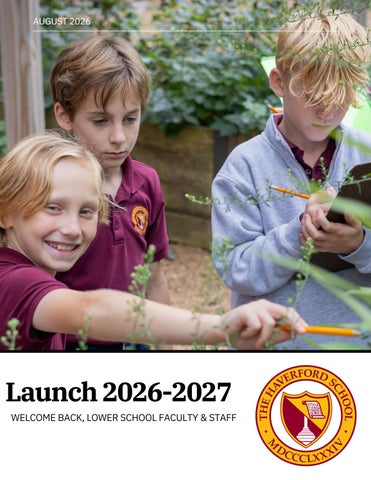
Launch 2026-2027 WELCOME BACK, LOWER SCHOOL FACULTY & STAFF
LAUNCH 2026-2027
Table Of Contents 03 Welcome back , faculty and staff!
05 Forge & House Program Launch
07 Behavior Plan, Disciplinary Flow Chart
08 Strengthening our Student Support
Letter from Jenni
2026-2027 is the year we fully launch our House proram
Overview of student support for 2026-2027
10 FAQ Find logisitcs and info to start the 2026-2027 school year
14 Professional Growth: Beginning with Reflection Introduction to setting goals for 2026-2027 school year
21 2026-2027 LS Meeting Summary
11 LS Faculty & Staff 20262027 15 LS Committee Work Read about our important committee work
LISTEN HERE: Jenni & JP Launch Podcast
Letter From Jenni WELCOME BACK (WELL, ALMOST) Dear Lower School Faculty and Staff, Welcome to a new school year. I hope your summer brought opportunities to rest, recharge, and spend time with the people who matter most to you. One of my favorite parts of the summer was slowing down enough to enjoy time with my family. We made our way to Busch Gardens, where we somehow convinced ourselves that riding one roller coaster wasn't enough! Between the twists, turns, and a few rides that definitely pushed my comfort zone, there were lots of laughs and memories that reminded me how important it is to make space for joy and connection. As much as I enjoyed the adventures of summer, I also found myself thinking often about our Lower School community. One of the gifts of summer is the opportunity to step away from the pace of school life and reflect. Over the past several weeks, I have spent time thinking about last year—celebrating what we accomplished together, reading through your end-of-year feedback, and considering how we continue building a Lower School where our faculty and staff feel supported and our boys are known, challenged, and deeply cared for. Thank you for your honesty, your commitment, and your willingness to continually grow. Your feedback has shaped my thinking throughout the summer and has reaffirmed something I believe deeply: when we intentionally care for the adults in our community, we create the conditions for our boys to flourish. As I reflected on our strategic plan and the work ahead, I found myself returning to one question: How do we stay focused on what matters most? While there are many exciting opportunities before us, I hope we can rally around three shared commitments this year. 1. Build Belonging through the House System (Anchor Pillar - Strategic Vision) This year marks the official launch of our House Program—a vision that has been thoughtfully
developed over the past two years. More than a new tradition, our Houses are an investment in brotherhood, leadership, belonging, and character. They will provide every boy with another place to be known, another opportunity to lead, and another reminder that he is part of something bigger than himself. Our goal is not simply to implement a program, but to cultivate a culture where our Haverford virtues are lived every day through meaningful relationships and shared experiences. 2. Strengthen Learning through Evidence-Based Literacy (Achieve Pillar - Strategic Vision) Our commitment to literacy continues as we deepen the implementation of Heggerty Writing across Kindergarten through Fourth Grade. This work reflects our strategic commitment to providing evidence-based instruction, strengthening vertical alignment, and continually refining our practice in service of our boys. As always, this is not about perfection—it is about learning together. We will continue to collaborate, reflect, and support one another as we strengthen our instructional practices so every boy has the opportunity to become a confident reader, writer, and communicator. 3. Grow the Whole Boy through a Whole-Child Approach (Anchor) Every boy who walks through our doors brings a unique combination of strengths, challenges, interests, and experiences. This year, we will continue strengthening our systems of support by intentionally looking at each boy through a whole-child lens. As we engage in conversations about student growth, we will consider the complete picture— academic progress, behavior, social and emotional well-being, and health. Rather than viewing these areas in isolation, we will recognize that they are deeply interconnected and that meaningful growth happens when we thoughtfully consider how each aspect influences the others. This whole-child approach will continue to shape our support systems, our collaboration with one another, and our partnerships with families. By working together to understand each boy fully, we can provide the right support at the right time, celebrate strengths, remove barriers, engage in timely and supportive conversations with families—including when those conversations are difficult—and help every student experience success and belonging within our community. I am excited for what lies ahead and grateful to be on this journey with each of you. Here's to a wonderful year of learning, laughter, growth, and brotherhood. With gratitude,
Jenni
05
Forge & House Program Launch
As we prepare for the next school year, the Haverford House System is transitioning from its successful pilot phase to a fully operational, high-energy program designed to make character education "practiced, not preached". The following summary outlines the core components faculty will need to implement and lead the program effectively. The Core Philosophy: Transformational, Not Transactional The House System is a forge for character, not a classroom management tool. The Floor (Expected Behaviors): Baseline behaviors like walking in line or following directions maintain order but do not earn house points. The Ceiling (Above & Beyond): House points are reserved for student-initiated acts that demonstrate leadership, resilience, or service and build school culture,. Narrated Moments: Points are never awarded silently; faculty must publicly name the student, their house, and the specific virtue being demonstrated to teach the rest of the room.
06
The Four Pillars (2nd – 5th Grade) Students in these grades belong to one of four houses, each represented by a founding archetype, a virtue, and a symbol,: Smith House (Perseverance): Inspired by George Smith ’67, who transformed challenge into strength. Symbolized by the Anchor for stability,. Cassatt House (Creativity): Inspired by Alexander Cassatt’s "creative courage" to build the impossible. Symbolized by the Lantern to light new paths. Severinghaus House (Integrity): Inspired by Leslie Severinghaus, our "True North" leader. Symbolized by the Compass for moral direction,. Wilson House (Selflessness): Inspired by Edwin Wilson, who sacrificed for the school’s survival. Symbolized by the Oak Tree for strength through service. House Points: "The Fords 4" All points must align with the virtues of Integrity, Selflessness, Creativity, or Perseverance. Flat Rate: Every standard "Above & Beyond" act is worth exactly 5 points to keep the focus on character rather than calculation.
Positive Only: Points are earned and celebrated; they are never taken away as punishment. Shared Spaces: Faculty should look for these virtues in hallways, the cafeteria, and at recess—places where "quiet integrity" often goes unnoticed. House Meetings & Student Leadership Monthly Meetings: These 35–40 minute sessions follow a consistent flow: Gathering/Transition, Virtue Connection, SEL Activity, Student Voice/Agency, and a Closing Charge,. House Council: This student government model for 4th and 5th graders features two "ambassadors" per house who lead service initiatives and provide peer feedback to administration,. Faculty Roles & Expectations The success of the system relies on faculty modeling excitement and consistency. Next year, faculty are expected to: "Rep Your House": Model enthusiasm for your own house assignment. Lead Monthly Meetings: Be present to facilitate the SEL framework and mentorship blocks. Award Points Fairly: Consistently use the "Narrated Moment" rule and the "Above & Beyond" rubric.
07
Behavior Plan Disciplinary Flow Chart JP has put together a short 8 minute video presentation to explain the flow of our unified approach to supporting behavior for the boys. I invite you to take a look when you have a moment. For those of you who have been at Haverford the last few years, it will be familiar, but seeing it presented in a new way may spark some inspiring and fresh perspectives.
08
Strengthening our Student Support
One of the themes that emerged from faculty feedback last year was the need for a more connected, responsive, and collaborative student support system, particularly around academic support. Thank you for your honest reflections and thoughtful suggestions. Your feedback has been carefully reviewed, and we have worked intentionally to strengthen our processes so that they better support both our teachers and, most importantly, our boys. This year, several enhancements are being implemented: Kindergarten Inventory: Before the school year begins, every kindergarten student will participate in a comprehensive inventory that includes speech and language screening, occupational therapy screening, and assessments of kindergarten readiness skills. This allows us to know our youngest learners earlier, identify strengths and areas of need, and begin monitoring growth from the very start of the year. Early Intervention Groups: Using data from the previous school year, small instructional groups will be established at the beginning of the year and begin during the second 8-day cycle. Families will be informed when their child is participating so they understand the support being provided and the goals of the intervention. Evidence-Based Literacy Support: Our literacy intervention groups will utilize UFLI, an evidence-based instructional program that aligns well with our core literacy curricula while also providing valuable
progress-monitoring data to help inform instructional decisions. Streamlined Support Requests: Teachers will initiate student concerns through a Google Form. These requests will then be discussed during grade-level meetings, where collaborative conversations can further clarify student needs. Both the Google Form submissions and grade-level meeting notes will be shared directly with the Lower School Learning Support Team to ensure seamless communication. Integrated Learning Support Meetings: The Lower School Learning Support Team will meet twice each 8day cycle to discuss concerns brought forward by teachers. These meetings are designed to consider the whole child by bringing together academic, behavioral, social-emotional, and health perspectives. Each student concern will have a designated point person who will coordinate communication and provide ongoing updates regarding next steps and support. FAPs Available in Veracross: Formal Action Plans (formerly FEPs) will be available for teachers to access through the Veracross portal at any time, providing easy access to student support information whenever it is needed. We recognize that supporting the boys is most effective when it is collaborative, proactive, and centered on the whole child. We hope these improvements create stronger communication, clearer processes, and more timely support for our boys while providing teachers with greater clarity and partnership throughout the year.
09
FAQ
10
As we begin the start of the school year, here is logistical information you may be want to know. When can we get in the building to begin setting up our classroom? Faculty may enter the building on Thursday, August 20th at 8:00am. Our facilities folks have asked that we wait to begin work in classroom spaces until this day or time, as they will be finishing up painting and floors that may be impacted with traffic. What is the schedule for August Inservice? (When can I work in my room?) The Inservice Week schedule for the school is being finalized and will be sent out shortly from Katie Gorman. In addition to the full school inservice schedule, you can anticipate that a Lower School specific schedule will also be shared before the inservice week begins. My goal is to provide as much flexible time as possible for classroom and team preparation while also ensuring everyone has the shared information, resources, and understanding needed to begin the school year confidently and provide the best possible experience for our boys. The topics we will be focused a Lower School focus during August Inservice are: House Launch w/ guest Troy Kemp from Ron Clark Academy full day Tuesday, September 1st LS Faculty Meeting - Full Faculty & Staff Brief Lower School Information Sharing to start the year Little Leaders & House Program Google Calendar Update - Jen Favoroso Grade Band Meetings, PreK - 1st, 2nd through 5th Behavior Systems - Jonathan Price Academic Support Approach - Nichole Pugliese Where can I find class lists? Where can I find schedules? Where can I find...? The shared drive for Lower School 2026-2027 has been updated, and includes many of the files you may be looking to access. I have also created a Lower School Faculty and Staff Hub that has links to many important, and consistenly used documents.
LS Faculty & Staff 2027-2028 Pre - K:
Mrs. Cassie Popky & Ms. Helen McKean
Kindergarten: Mrs. Erin Helfrich & Ms. Lucy Tesman* Mrs. Erin Berrodin & Ms. Aubrey Taylor* Grade 1:
Mrs. Carmel Bradley*
Mrs. Megan Duncan Mrs. Katie Jones* Grade 2:
Mr. Hunter Gillin
Ms. Ashley Spaventa Mr. Jon Williams* Grade 3:
Ms. Elizabeth (Liz) Canny Ms. Deb Gavin
Mrs. Mollie Langdon Grade 4:
Mr. Michael Kearney
Mr. James McCloskey Jr. Grade 5:
Ms. Katie Pulos (Math)
Mr. Rob Allman (Social Studies) Mr. Matt Cahill (English Language Arts/Humanities) Mrs. Jennifer Favoroso (Science) Art:
Ms. Molly Porter
Mr. Antonio Fink Music:
Mrs. Valerie Case
Mr. Duane Case Science:
Mr. Ryan Wilson
Mr. Daniel Goduti P.E.:
Bernie Rogers Brian Martin Jim Buggy
Instructional Specialist: Ms. Maura Duxbury* Ms. Jackie Cellucci* Library:
Mrs. Michelle Burns
School Counselor: Mrs. Joy Barrett Administrative Assistant: Mrs. Teresa Touey Building Substitute Teacher: Mrs. Bev Halteman Dean of Students:
Mr. Jonathan Price
Director of Learning Support: Dr. Carol Ann Luongo Head of Lower School: Mrs. Jenni Scoggin
11
LS Faculty & Staff 2027-2028
12
*Faculty Additions: As we begin the 2026-27 school year, I am excited to share the following transitions: Mrs. Carmel Bradley, previously kindergarten assistant, will be moving to a first-grade teaching position. Mr. Jon Williams, previously a teaching assistant in kindergarten, will be moving to a second-grade teaching position. Mr. Jonathan Williams, previously a pre-k teaching assistant, will be moving to a We will also welcome Ms. Maura Duxbury as Pre-K to 1st grade learning specialist, Ms. Jackie Cellucci as 2nd to 4th learning specialist, Ms. Lucy Tesman and Ms. Aubrey Taylor as kindergarten teaching assistants to The Haverford School. Ms. Aubrey Taylor – Kindergarten Assistant Teacher (Berrodin) Aubrey Taylor is an experienced early childhood educator with a passion for fostering engaging, supportive learning environments for young children. She currently serves as a Lower School substitute teacher and aftercare educator at The Haverford School, where she has worked across Pre-K through fifth grade while also serving as a Kindergarten Assistant. Aubrey previously spent several years as a Montessori Teaching Assistant, earning her North American Montessori Center 3–6 Diploma, and has extensive experience leading enrichment programs, summer camps, and after-school activities. She holds a Bachelor of Science from The Pennsylvania State University and is committed to nurturing students' academic, social, and emotional growth through positive relationships and developmentally appropriate instruction. Ms. Lucy Tesman - Kindergarten Assistant Teacher (Helfrich) Lucy Tesman joins The Haverford School as a Kindergarten Assistant, bringing a passion for early childhood education and a commitment to creating engaging, inclusive learning environments where young children can thrive. She recently completed her student teaching in kindergarten at Adaire Elementary School, where she designed and delivered standards-aligned instruction while supporting the academic and social-emotional growth of diverse learners. Lucy has also gained valuable experience through practicum placements in both general and special education classrooms and has served as a substitute teacher at The Haverford School, working with students across Pre-K through fifth grade. She is completing her certification in Early Childhood and Elementary Education at Temple University and combines her educational training with a collaborative spirit, strong classroom management skills, and a dedication to helping every child build confidence, curiosity, and a love of learning. Ms. Maura Duxbury –Pre-K to 1st Grade Learning Specialist Maura Duxbury joins The Haverford School as a Lower School Learning Specialist, bringing more than a decade of experience in elementary education across independent, public, and international schools. A certified PK–12 Reading Specialist with a Master of Education in Literacy, Maura is passionate about evidence-based literacy instruction and supporting students as they develop confidence and success as readers. Most recently, she taught first grade at Friends Select School, where she implemented Science of Reading practices and used assessment data to provide targeted instruction. Known for her collaborative approach and strong relationships with students and families, Maura is excited to partner with teachers to help every boy grow as a learner and reader.
LS Faculty & Staff 2027-2028
13
Ms. Jackie Cellucci - 2nd Grade to 4th Grade Learning Specialist Jacqueline Cellucci joins The Haverford School as a Lower School Learning Specialist, bringing nearly two decades of experience as an elementary educator, literacy specialist, and reading tutor. She holds a Master of Science in Education in Reading, Writing, and Literacy from the University of Pennsylvania, is a Pennsylvania Certified Reading Specialist, and has earned Wilson Language Level I Certification. Throughout her career, Jacqueline has worked in a variety of educational settings, including as a learning specialist, classroom teacher, tutor, and most recently as a Pre-K teacher at The West Hill School. She is passionate about evidence-based literacy instruction, building strong partnerships with teachers and families, and helping students develop the foundational skills and confidence they need to thrive. Known for her collaborative, organized, and student-centered approach, Jacqueline is excited to support Lower School boys through individualized instruction and meaningful relationships that foster both academic growth and a love of learning.
Mr. Jim Buggy - Physical Education Teacher We are excited to welcome Jim Buggy as our new Lower School Physical Education teacher! Jim brings a wealth of experience in leadership, relationship-building, and coaching to our community. Most recently, he has served as a Lower School PE substitute at Haverford, where he quickly built strong connections with our boys and faculty while creating a positive, safe, and engaging learning environment. Beyond his professional career, Jim has dedicated more than 14 years to coaching youth baseball, football, and basketball and has served for 11 years as a board member for local youth athletics and CYO programs. His passion for helping children grow through athletics, teamwork, and character development, combined with his enthusiasm for the Haverford community, make him a wonderful addition to our Lower School. Please join me in welcoming Mr. Buggy, Ms. Duxbury, Ms. Cellucci, Ms. Tesman, and Ms. Taylor to Lower School!
14
Professional Growth: Beginning with Reflection As we begin a new school year together, our professional growth process is rooted in a simple belief: the most meaningful goals begin with thoughtful reflection. Rather than starting with a list of goals to complete, we will begin by reflecting on last year’s experiences—the challenges that stretched us, the successes that energized us, and the aspirations we have for our classrooms and our students. We will also draw on our summer reading and consider the ideas, questions, or practices that resonated with us and might inspire growth in our work this year. Through this reflective process, each of us will identify three to five professional growth goals that are authentic to our own practice and meaningful to the work we do every day. At least one of these goals will grow directly from your summer reading and an idea or practice you would like to explore or put into action this year. Our collective work this year is guided by three Lower School priorities: Build Belonging through the House System Strengthen Learning through Evidence-Based Literacy Grow the Whole Boy through a Whole-Child Approach While many of our individual goals will naturally connect to one or more of these priorities, not every goal needs to fit neatly into one category. The purpose of this process is not to create perfect alignment—it is to foster intentional growth. As each of us grows in our practice, we strengthen our collective ability to serve our boys. I wanted to share this process with you now in case some of you would like to begin thinking and reflecting before we gather for the start of the school year. You will have dedicated time during first faculty meeting to complete your reflections and establish your professional growth goals, so there is no expectation
that this be completed before then. My hope is simply that this provides an opportunity for those who enjoy thinking ahead to begin considering where you would most like to grow this year. This is a process I will be engaging in as well. I will use these same reflection questions to shape my own professional growth goals for the year, and I look forward to sharing those with you. Growth is something we pursue together, and I hope this process reflects our shared commitment to being learners alongside one another. This reflection and goal-setting process is also intended to strengthen our coaching conversations. By sharing your thinking, the context of your classroom, and the areas where you hope to grow, classroom observations become opportunities for dialogue, collaboration, and support. Together, we can celebrate successes, navigate challenges, and continue learning alongside one another. Here is a link to the reflection and goal setting sheet.
Lower School Commitee Work
15
Lower School Committees engage in meaningful learning and collaborative work that supports the entire Lower School community and strengthens our collective efforts on behalf of our boys. Through these committees, faculty and staff explore ideas, develop initiatives, and make recommendations that help move our school forward. In June, faculty and staff shared their committee preferences for the 2026–2027 school year. Below are descriptions of each committees scope of work, goals of the committee work, and committee members.
Executive Functioning Study Group (Facilitator: Carol Ann Luongo) Scope of Work: The Executive Function Study Group serves as a collaborative learning team whose primary responsibility for the 2026–2027 school year is to deepen the Lower School faculty’s understanding of executive functioning and its impact on student learning, behavior, independence, and overall development. This work will include: Researching current literature and best practices related to executive functioning in elementary-aged students Exploring the developmental progression of executive function skills across the Lower School years Examining the connection between executive functioning, academic achievement, social-emotional development, and student well-being Identifying practical strategies and classroom practices that support the development of executive function skills in boys Facilitating ongoing faculty learning through small workshop sessions and professional learning opportunities throughout the school year Developing a shared language and common understanding of executive functioning across the Lower School division Providing recommendations for future integration of executive function supports within curriculum, instruction, and student support structures SMART Goal: By May 2027, the Executive Function Study Group will research and synthesize current literature and best practices related to executive functioning in elementary-aged students, facilitate at least three faculty learning experiences focused on executive function development and classroom application, develop a shared framework describing the progression of executive function skills across grades Pre-K through 5, and present recommendations for strengthening executive function supports within Lower School instruction, student support systems, and family education efforts to the Lower School faculty and leadership team.
COMMITTEE MEMBERS: Duane Case Mollie Langdon Rob Allman Jen Favoroso Liz Canny Katie Pulos Michelle Burns Molly Porter Erin Berrodin Daniel Goduti
SEL Committee (Facilitator: Val Case)
17
Scope of Work: The SEL Committee serves as a collaborative working group whose primary responsibility for the 2026– 2027 school year is to partner with The Institute for Social and Emotional Learning (ISEL) in the development of a Lower School social and emotional learning curriculum that reflects the unique needs of boys, aligns with The Haverford School virtues, and supports the implementation of the Lower School House System. The primary responsibilities for the 2026–2027 school year will be: Participating in a one-day retreat on Wednesday, October 7, 2026, with ISEL representative Michael Reichert and school leadership to develop a Lower School SEL mission statement, identify priority social-emotional competencies, and create a broad developmental map of SEL skills across grades Pre-K through 5. Providing feedback and guidance to ISEL as they develop a customized SEL curriculum aligned to the Lower School's culture, virtues, and House System. Participating in a one-day professional development experience in January to pilot SEL lessons and provide feedback for curriculum refinement. Sharing updates and key learnings with Lower School faculty throughout the school year. Members will meet regularly during designated faculty meeting times to collaborate with colleagues, provide input to ISEL, review curriculum materials, and support the development of a comprehensive Lower School SEL framework. SMART Goal: By May 2027, the Lower School SEL Committee will (1) have a subset of committee participate in the October 7, 2026 planning retreat with Michael Reichert and ISEL to develop a Lower School SEL mission statement and a broad developmental map of priority SEL competencies for grades Pre-K–5, (2) provide structured feedback on draft curriculum materials and pilot lessons developed by ISEL, including participation in a January professional development and lesson review process, and (3) support the completion of a customized SEL curriculum framework aligned to the needs of boys, the School's virtues, and the House System, preparing for implementation during the 2027–2028 school year.
COMMITTEE MEMBERS: Jonathan Price Val Case Cassie Popky Megan Duncan James McCloskey Antonio Fink Brian Martin Bernie Rogers Ryan Wilson Bev Halteman Mike Kearney
18 Writing Curriculum Committee (Facilitator: Deb Gavin) Scope of Work: The Writing Curriculum Committee serves as a collaborative group engaging in the next phase of our study of writing instruction and learning outcomes throughout the Lower School. Using findings from the 2025–2026 Writing Review, the committee will identify strengths, areas for growth, and opportunities to strengthen writing instruction across grades Pre-K through 5. This work will include: Reviewing findings and recommendations from the 2025–2026 Writing Review. Identifying priority areas for growth within Lower School writing instruction and developing recommendations for strengthening instructional practices. Exploring the development of common writing outcomes and/or rubrics that provide greater consistency and clarity across grade levels. Collecting and reviewing updated student writing samples to compare with baseline samples gathered during the 2025–2026 school year. Presenting a summary of findings, recommendations, and proposed next steps to the Lower School faculty in a faculty meeting in April or May. SMART Goal: By May 2027, the Lower School Writing Curriculum Committee will review findings from the 2025–2026 Writing Review, collect and analyze updated student writing samples from each grade level (Pre-K–5), develop recommendations for strengthening writing instruction across the Lower School, and create at least one shared tool (such as a common writing rubric, writing outcomes document, or progress-monitoring framework) to support greater instructional coherence. The committee will present a summary of findings, recommendations, and proposed next steps to the Lower School faculty at a faculty meeting in May 2027.
COMMITTEE MEMBERS: Ashley Spaventa Matt Cahill Deb Gavin Jon Williams Carmel Bradley Erin Helfrich Katie Jones Hunter Gillin Helen McKean
**House Leaders (Facilitator: Jonathan Price)
19
Scope of Work: The House Leadership Committee serves as a collaborative group responsible for supporting the successful launch and implementation of the Lower School House System and House Council during the 2026–2027 school year. The committee will work to foster belonging, leadership, character development, and cross-grade connections through House programming aligned with the Lower School virtues. This work will include: Supporting the launch and ongoing implementation of the Lower School House System across grades Pre-K through 5. Guiding and supporting the work of the House Council, including leadership development and planning for House initiatives. Planning and implementing House gatherings, service opportunities, competitions, and community-building experiences throughout the school year. Monitoring the effectiveness of House programming and gathering feedback from students and faculty to inform future growth. Presenting a summary of the House System's first year of implementation, including successes, challenges, and recommendations for the future, at a Lower School faculty meeting in April or May. SMART Goal: By May 2027, the Lower School House Leadership Committee will support the successful implementation of the inaugural year of the House System and House Council by facilitating regular House programming throughout the school year, supporting monthly House Council leadership meetings, gathering feedback from students and faculty regarding the House experience, and presenting a year-end reflection and recommendations for continued growth to the Lower School faculty at a faculty meeting in May 2027.
HOUSE LEADERS: James McCloskey - Cassatt House Ashley Spaventa - Wilson House Matt Cahill - Smith House Duane Case - Severinghaus
Adult SEL Group (Facilitator: Deb Gavin) The Adult SEL Planning Group is a volunteer team of Lower School faculty and staff committed to fostering connection, belonging, and well-being within our adult community. This group will support the social-emotional health of faculty and staff by planning opportunities throughout the year that encourage relationship-building, celebration, reflection, and care. Members will meet for 30 minutes prior to scheduled faculty meetings to collaborate on the planning and implementation of faculty/staff connection and wellness opportunities. The group's work may include organizing community-building activities, appreciation events, wellness initiatives, and other experiences that strengthen relationships and support a positive faculty culture. We are expanding our wellness and faculty space gathering this year to include both rooms on the second floor. The Peloton will be moved down to one of the spaces. Look for more information about these important spaces to be sent from our Adult SEL group. This is a volunteer opportunity designed for faculty and staff who are passionate about nurturing the well-being of the adults who make up our Lower School community.
Ashley Spaventa Jon Williams Matt Cahill Carmel Bradley Katie Jones Hunter Gillin Duane Case Mollie Langdon Liz Canny Katie Pulos Michelle Burns Erin Berrodin Jonathan Price Bev Halteman Mike Kearney Teresa Touey
20
21