
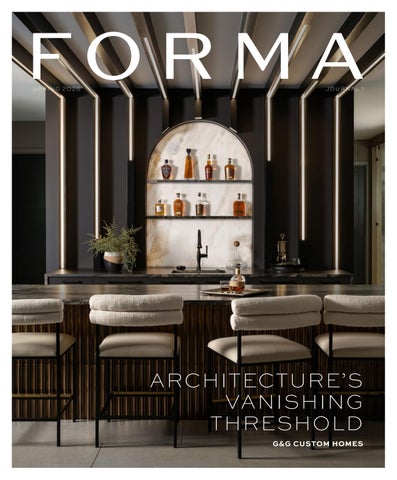
FORMA - Journal 1 | Spring 2026

Page 1


At ACo, we help homeowners create spaces that are as functional as they are beautiful, pairing thoughtful planning with refined material selections. Specializing in kitchen and bath remodeling, custom cabinetry, and curated flooring, we design around how you live. From the first conversation through final installation, our collaborative process and trusted relationships with builders and interior designers allow us to deliver results that align with each client’s vision and priorities, so they truly LOVE WHERE THEY LIVE.

PUBLISHER Adam Grubb

EDITORIAL

MANAGING EDITOR Stephanie Decker

SENIOR EDITOR Bailey Shelton

ART | PRODUCTION

DIRECTOR OF BRANDS Erik Anderson

DESIGN Molly Tippner

ADVERTISING | BUSINESS

CHIEF OPERATING OFFICER Jennifer Cisternino

CHIEF CREATIVE OFFICER Camila Schaefer

CONTRIBUTORS

WRITERS

Melanie Brewer, Iona Brannon, Darcie Duranceau, Carie McMichael, Bailey Shelton

PHOTOGRAPHERS

360 Tour Designs, The Addison Group, Ron Ball, Construct Creative, Graham Photography, The Home Aesthetic, Christy Kosnic Photography, Sarah Shields Photography

COVER PHOTO

Sarah Shields Photography

Advertising queries: sales@adamgrubbmedia.com

LETTER FROM THE STUDIO

Design today is about balance—between tradition and innovation, craft and technology, the local and the global. As our built environment continues to evolve, so does our responsibility—not just as designers and architects, but as makers of place.

In this issue of FORMA, we see that evolution unfold through stories of transformation, intention, and forward thinking. From the restoration of a pre–Civil War home to the thoughtful reinvention of a historic Capitol Hill townhouse, each project reflects a bigger question facing our industry: How do we honor what already exists while designing for the way we live now, and the way we’ll live next?

Wellness, for instance, is no longer a trend confined to finishes or amenities. It’s woven into the foundation of good design—how spaces function, how light moves through them, how materials age, and how a home supports both physical and emotional well-being.

And design doesn’t stop at the walls of a building. Regenerative landscapes, like the restoration of Indiana’s black oak savanna along the Tippecanoe River, remind us that place-making is also stewardship. The same is true for walkability, urban design, and the future of public space—how communities connect, move, and evolve.

As you move through these pages, I hope you’re inspired not just by what’s being built, but why, and the shared belief that intentional design can elevate how we live, gather, and experience the world around us.

Dani Kohl

WHEN MODERN ARCHITECTURE CAN’T PASS THE “SO WHAT?” TEST

DAN MORIARITY | Studio M Architecture and Planning

With every build, there should be a vision for how the new structure will benefit the urban fabric and serve people on a daily basis. Good architecture should enhance the lives of those who come in contact with the building, whether it be providing a comfortable place to talk with a friend or helping someone do their job more productively and enjoyably. While architecture is a chance to express design creativity, it should primarily be seen as a service to the clients.

Modern architecture, however, seems to have lost some of the principles that served mankind for millennia.

I may be an outlier when it comes to modern architecture. Growing up in a town of fewer than 2,000 people in rural Illinois, I wasn’t aware of architecture as a profession. There were barns and houses, but the only architectural marvel in my hometown was the courthouse. During my education at Notre Dame, I was given the opportunity to study the enduring qualities of architecture that survived the test of time.

Until World War II, building and planning was pragmatic, based on walkability, connectivity, and scale—practical, human-centered principles reflected in small towns and urban neighborhoods around the world. Suburban design, serving the car culture, sprang up in the ’50s and ’60s moving planning away from those time honored traditions. This has been well documented.

Dan Moriarity
“ I do remain optimistic about the future of modern architecture.”

I believe that since then, three major categories of architecture have built our modern world: iconic, institutional, and private. Challenges come when an architect does not know in which of these arenas they are operating.

Iconic architecture like that of Frank Gehry, where budget and function are secondary to design, highlights the vanity of some modern architects. It often does not pass what one of my professors used to call the “So What?” Test. Sure, the form may be interesting, but function takes a backseat, leading to a litany of complaints about the building. “It’s too cold. The roof leaks. It’s way over budget.” So what if the building looks interesting but the design does not serve the needs of the users? Like any artistic endeavor, there may be a cultural benefit to these projects, but most projects that serve the users do not fall in this category.

Institutional architecture such as hospitals, universities, and government buildings, often benefit from publicly funded or massive corporate budgets. The people driving the design have no personal stake in money being spent, other than pleasing their boss or board of directors, which can result in architects overbuilding in order to cover concerned keisters. In some hospitals, the terrazzo flooring is immaculate, there are soaring atriums with $500-per-lineal-foot railings, with beautiful materials throughout. But then they bring you toilet paper with the structural integrity of a moth’s wings, and a thimble’s worth of Jell-O, because they have to recoup the costs of these buildings somehow. The nurses tell you how layoffs have made their jobs even more difficult. So what if the facility is overbuilt to satisfy facility risk assessment when the quality of care suffers?

At Studio M, the majority of our projects reside in the private architecture category, where our clients are writing the checks. It is their idea, their home, their business, and their money. It is not about our ego, or our desire to create an iconic design. Our clients ask, “How much was the railing again? $500? Can’t we find one for $300?” They may think the grand sweeping curve of the glass atrium looks cool, but they have questions about how that will benefit the efficiency and productivity of their business.

In the private world, we must pass the “So What?” Test. Design should build on the time-proven, human-centric traditions of scale, walkability, and connectivity. Thoughtful decisions should be made based on real-world budgets and the ultimate effect of the design on the daily users.

As architects, we are facilitators, not tastemakers, and our ego cannot be part of the foundation.

There is a balance point; it doesn’t mean everything has to be cheap, or boring, or plain, but it does mean that it must be responsible and focused on the needs of the people being served. How we spend money in architecture says something about our values. It should be making somebody a better teacher, a better police officer, making someone’s life or job easier, not about an architect’s limiting arrogance—the air of “We know better than you do,” which is frankly nonsense.

As the spectre of retirement taps on my shoulder, I do remain optimistic about the future of modern architecture.

I have faith that society has the ability to return to its pre-WWII roots. The market that drives architecture in a post-pandemic world is going to push for communityoriented planning, because the places that become popular are those with good architecture and design; walkable communities that encourage socialization in an isolating world; businesses with multi-use spaces where worklife balance is accessible; institutions where the design maximizes its potential; architecture that passes the “So What?” Test.

RENDERING

ARCHITECTURE’S VANISHING THRESHOLD

Photos by Sarah Shields Photography and 360 Tour Designs Design boards courtesy of Hilari Goris

A PRESERVATION OF PLACE

Like the quiet equestrian, perched atop a sleek, athletic mount while listening to a soft breeze tickling the foliage of the surrounding trees, it’s easy to be struck by the profound environment and expectations beneath the canopy of the 260-acre legacy estate known as Wild Air. The former equestrian sanctuary of the Johnson family carries a “quiet gravity” which dictates that the architecture act as a bridge between its peaceful heritage and the buzz of modern life.

On this historic soil, Joe Garcia is deploying his handpicked team, many of whom have worked alongside him for over a decade, to deliver two distinct interpretations of what it means to truly live within the natural landscape of Zionsville: one modern home, and one traditional.

ONE VISION, TWO PERSONALITIES

The Modern Perimeter Home

Where oversized brick meets smooth, stark-white stucco, punctuated by deep charcoal gables that cut a sharp profile against the Indiana sky, G&G explores the beauty of restraint. Each step toward this pristine home creates a rhythmic play of light and shadow on its monotone color palette and palatial windows.

“In the modern home, we’re opting for thin trim casing,” says lead designer Hilari Goris of Hilari Goris Designs. She wanted the wooded tree line of Wild Air to become part of the indoor space. By removing the visual noise of casing and molding, the boundary between the interior and the forest essentially vanishes.

WALLPAPER

LOT 13 POWDER BATH

ARCHED WALL TILE

LOT 13 BED 2 BATH

COUNTERTOP: CALACATTA VIOLA
VANITY: HOMESTEAD BROWN SHOWER WALLS
FLOORING

To prevent minimalism from pulling away from the organic nature of the neighborhood, Goris introduced natural stone with black and brown veins, reminiscent of the nearby winding paths, and gold accents that capture the light, providing an unmistakable warmth to the space. The bathrooms are tiled in natural tones—soft whites like sandstone meet deep, rich mahogany that evokes memories of sunsets on a summer evening.

The Traditional Alley Home

A short walk away, the traditional alley home feels like nature’s welcoming embrace. At first glance, the dark green siding, white brick, stone facade, and solid wood columns appear to be an extension of the landscape. It is easy to imagine sipping a cup of coffee on the front steps of this home, on a cool morning, as the sun rises over the neighborhood. This home is undoubtedly about the return of the layered comfort of tradition.

“The classic elements are coming back,” says Goris of the home on Lot 22. “For this home, we are leaning into the ‘layered’ feel—arched doorways, curves, and intricate wood paneling.” According to Goris, the home features sophisticated color drenching to play with scale. In the kitchen, wainscotting and an apron sink meet beveled corners and an expensive wooden arch to conjure memories of Grandma’s homemade cookies.

THE SURPRISING COMMONALITIES: THE G&G BLUEPRINT

While the aesthetics of these two homes sit in opposition, they share a few similarities. Both are tied to a respect for the legacy of the Johnson family land, and a respect for the everyday needs of homeowners today.

An Invitation: the Legacy of the Land

While the two residences speak in different architectural dialects, they are unified by a singular obsession: the dissolution of the wall. After a busy day, either homeowner can look forward to look forward to modern amenities, tall ceilings, and picture windows opening up to the raw beauty of the surrounding landscape. To be home is to invite nature to sit at the dinner table.

For Guests and Gourmands:

The Prep Kitchen

The peace found on the grounds of Wild Air has shaped the architectural choices of these homes, with concerted efforts to preserve the serenity. Take, for instance, the scullery kitchens found within the walls of both G&G homes. Goris says, “I think my favorite areas to do, being a mom of two kids, are these kitchens and back pantries… I can’t help thinking how a family would come in and use them.”

She opted for a microwave and oven combo unit in both homes’ pantries, along with full-sized sinks, painted cabinets, and plenty of shelving to hide away kitchen gadgets.

Garcia describes the “dirty kitchen” as a “best kept secret.”

Friends and family can enjoy a meal together, while the mess remains invisible to guests. There is no push to get up and clean. The pantry door, as Goris says, can be used to shut out the stress, so the group can move from dinner at the oversized kitchen island to after-dinner cocktails at the wet bar in the basement.

PAINTED CABINETS: TAUPE TONE
LOT 13 | KITCHEN
PHOTO

The G&G Standard: Quality Behind the Walls

It’s not just what is seen at first glance that makes these homes feel at home in their surroundings. Much like the complex, unseen root systems that sustain the thirty acres of old-growth forest nearby, the true soul of the home exists in the “invisible architecture” behind the walls. It is felt in the silent, peaceful ambience—comfort achieved through a highperformance building envelope that acts as a thermal shield against the seasons; a precisely sized HVAC system that ensures optimal temperature and humidity; and adjustable lighting throughout. Goris has eliminated dark corners through soft, warm lighting fixtures of various shapes and sizes—feminine, curved sconces belted in gold; thin, pulled, antique bronze covered by classic lamp shades; dropping sconces covered by flowing gold metal ellipses.

VANITY: CARNELIAN

All of this so, as the day winds down at Wild Air, the comfort and connection to the land don’t fade, but simply shift. The massive windows that spend their days inviting sunlight and forest inside eventually yield to the interior’s carefully engineered glow. And still, even as this soft light fills the space, the homeowner can appreciate the beauty of star-filled skies above.

PHOTO BY 360 TOUR DESIGNS

THE FOREST FOR THE TREES

Written by Bailey Shelton / Photos courtesy of Department of Natural Resources
HOOSIER

Treetops soaring above lush meadow grasses and wildflowers. Ample space for wildlife to roam. The canopy above filters midday light into a kaleidoscope on the ground as a breeze sways the branches above. This is the pre-settlement landscape of Indiana, a scene soon returning to the banks of the Tippecanoe River.

As part of their 2026 “Plant America with Natives” initiative, the Garden Club of Indiana’s efforts to promote the use of native plants have coincided with a land trust grant for the re-establishment of a black oak savanna in Tippecanoe River State Park. Before pioneer settlement, hundreds of miles across the Midwest were blanketed in black oak savannas, a temperate-climate landscape defined by a sparse old-growth oak forest, with meadow grasses and plants covering the ground.

According to entomologist Doug Tallamy, a leader of the homegrown national park movement, “If half of American lawns were replaced with native plants, we would create the equivalent of a 20-million-acre national park, which is nine times bigger than Yellowstone or 100 times bigger than Shenandoah National Park.” This statistic is among the factors behind Indiana Garden Club President Wanda Zahrt’s recent initiative to support the growth of perennial natives.

TIPPECANOE RIVER STATE PARK

The Friends of the Tippecanoe River State Park are currently working to remove invasive species and replace them with prairie plants and meadow grasses native to the region. In phase two, black oak saplings will be re-established in the area.

Rewilding and reforestation are carving out a niche among landscape designers, and these movements also align with meadowscaping, in which meadows replace traditional lawns. Properly designed meadowscapes can reduce irrigation needs by 90% to 100%, eliminating the need for sprinkler systems or manual watering. This makes them a compelling option for environments prone to seasonal drought.

“Native plants are adapted to local conditions and require less water, which can save money and time. And I think biodiversity is the most important part,” Zahrt says. “Native plants provide food and shelter for native wildlife like birds, butterflies, and bees. It’s amazing; even for a plant like goldenrod, many insects and birds feed from this gorgeous weed that grows along the road each year.”

The Garden Club of Indiana primarily works with small towns, landscape designers, and independent gardeners to beautify public spaces and educate residents. Zahrt recently worked with landscape designer John Ruble on her own home to create a backyard gardenscape entirely using native plants.

“Just replace an annual with a perennial native and see what happens. Coreopsis is a great one because it’s hardy, and it’s beautiful,” says Zahrt.

As the landscape surrounding properties remains a major focus for architects and designers, this public works example may offer useful inspiration for landscape designers seeking a cottage among the trees. Black oak saplings are a long-term investment that, once fully established on a property, yields natural shade, clean air, and lasting beauty. Grasses and flowers like prairie dropseed, butterfly bergamot, and butterfly milkweed can create a gorgeous meadowscape without the daily maintenance and upkeep of non-natives or annuals.

THE EDIT Sanctuary

Your home should work as hard at restoring you as you do at everything else. The pieces gathered here are designed with that premise in mind, items that elevate daily routines into something more intentional. From textiles engineered for better sleep to hydration systems that actually improve air quality, each selection balances form with measurable function, bringing a quieter, more considered quality to the spaces where you live.

1.
Curated by Melanie Brewer

1. A SCULPTURAL HUMIDIFIER FOR MODERN RITUALS

Objecto Hybrid Humidifier

The wood-grain silhouette of this humidifier from Modern Rituals sits on a shelf like a small sculpture with its clean lines and organic form, it’s the kind of object that looks intentional wherever you place it. When you turn on the device, fine mist rises from the top, nearly invisible until light catches it. This humidifier can run for 20 hours of continuous use, operating so quietly you won’t remember it’s on. The practical benefits are straightforward: better air quality, easier breathing in dry climates, relief for skin that tends to become tight and dry in winter. But the design is what keeps it visible rather than hidden away, earning its place within your home design.

objecto.com

2. THE BREATHABLE WEIGHTED HUG

Bearaby Tree Napper — Cooling Weighted Blanket

The chunky hand-knit structure is the first thing you notice—TENCEL™ woven into thick loops with substantial negative space between them, allowing air to move freely through the blanket as it settles over you. When draped across your shoulders, lap, or body, the weight distributes evenly without trapping heat the way traditional blankets do. The texture is smooth and cool to the touch, with the right amount of weight to provide grounding pressure that helps your body relax and sleep better. It’s heavy enough to feel the calming weight but breathable enough not to feel too heavy and suffocating.

bearaby.com

3. BALANCED STILLNESS

Nodpod Weighted Sleep Mask

Four weighted pods sit at distinct pressure points, across your temples, brow, and the bridge of your nose, without any elastic strap pulled tight around your head and pulling at your hair. The weight is gentle but noticeable, applying pressure to areas that tend to hold tension. The microfiber fabric blocks light completely while staying cool against your skin. It’s the kind of design that makes sense once you try it: no adjustments needed, no sliding around during the night, just targeted weight that helps people fall asleep faster and stay asleep longer.

nodpod.com

4. A STUDY IN GREEN

Naturspire Moss Wall

Envision preserved moss in varying shades of green that creates a threedimensional wall installation showcasing surprising textural depth. Each frond is frozen at peak vitality, soft to the touch, slightly springy, with a natural variation that keeps the eye moving across the surface. The practical advantage is obvious: all the visual impact of living greenery without watering schedules, grow lights, or maintenance. The moss also absorbs sound, softening the acoustics in rooms with hard surfaces. This is biophilic design at its most straightforward—bringing organic forms indoors in a way that actually makes sense for how people live, rather than how they wish they lived. naturspire.com

5.

SUNRISE, REIMAGINED

Hatch Restore Alarm Clock

The alarm clock that’s not your average alarm clock. Twenty minutes before your alarm is scheduled, the Hatch begins to glow, gradually brightening from amber to a warm gold that simulates a natural sunrise. Gentle sounds (waves, birds, white noise) increase in volume alongside the light. The result, a wake-up that’s considerably less jarring than a traditional alarm. At night, the process reverses: you select a sunset sequence and wind-down sounds, creating a phone-free relaxing bedtime routine. The interface is simple and customizable through an app, with an aesthetic that is clean enough to live on a nightstand without competing with your other design choices.

hatch.co

6. ENERGETIC CLARITY, ELEVATED

Somavedic

Amber — EMF Mitigation Device

The Somavedic Amber addresses a relatively new concern: the cumulative effect of living surrounded by WiFi routers, smart devices, and constant connectivity. The device itself is designed to reduce the impact of electromagnetic fields. It uses a proprietary system involving precious and semi-precious stones to create what the company describes as a harmonizing field. Whether you’re convinced by the science or simply appreciate the concept, the design is considered enough to earn its place on a shelf, and some users report improvements in sleep quality and focus. somavedic.com

7. RITUAL, REIMAGINED

Kohler Statement Multi-Function Showerhead

Three settings define the Kohler Statement Multi-Function showerhead: a wide rainfall pattern that drenches, a softer mist that fills the space with steam, and concentrated massage jets with enough pressure to work out shoulder tension. The design strikes a balance—industrial without coldness, refined and elegant, but still practical and straightforward. Clean lines give it a substantial presence, while intuitive controls make switching between modes effortless. The spray quality is noticeably superior to standard fixtures, the kind of upgrade that transforms a functional routine into something worth waking up for.

kohler.com

8. THE SIGNATURE SCENT OF SERENITY

FORMA x Aura in the City — Coconut-Base Wooden-Wick Candle

Strike a match and touch it to the wooden wick, there’s an immediate, satisfying crackle, like a miniature fireplace. The coconutbase wax burns clean, no soot or artificial notes, just a warm, balanced scent that’s sophisticated without being overwhelming. The wooden wick continues its quiet crackling throughout the burn, adding sound to what would otherwise be purely visual and olfactory. Light it during your evening routine, the scent becoming a signal to the end of your workday, and the wind-down begins. The eyecatching container is minimal enough to keep after the wax is gone, making its usefulness extend beyond the initial purchase. aurainthecity.com

9. HEAT THERAPY, PERFECTED

KLAFS Valora Sauna

The door seals shut with a soft click, and suddenly you’re in a room made entirely of warm wood and deliberate heat. As you settle onto precision-milled hemlock or cedar benches, the heat builds gradually, measured and enveloping rather than aggressive. The Valora blends German engineering precision with Scandinavian restraint, resulting in seamless detailing, a glass door that filters light without sacrificing privacy, and controls that feel effortlessly intuitive. Twenty minutes at temperature and you emerge with muscles relaxed, circulation improved, and that particular clarity that comes from sitting still in heat. The health benefits of regular sauna use are well-documented; the Valora just makes the practice architecturally coherent with the rest of your home.

aetherwellness.com

10. DESIGN THAT NURTURES

Greenery Unlimited Self-Watering Pot

That trendy indoor tree with the large, violin-shaped leaves sits in the corner with glossy foliage and not a single brown edge; the difference is what it’s planted in. The Greenery Unlimited Self-Watering Pot is a minimal cylinder in matte white or charcoal that hides a reservoir system beneath the soil, drawing water upward as the plant needs it. Fill the base every few weeks, then forget about it. The plant regulates its own hydration, avoiding the two most common killers: drought stress and root rot. What you get are consistently healthier plants, vibrant growth, no crispy edges, and no guesswork about whether today is a watering day. The design disappears into any interior, but the practical payoff is significant: real greenery in your home without the daily maintenance routine. greeneryunlimited.co

11. CALM, IN MOTION

Aura Waterfalls Silver Mirror Wall Fountain

Water slides down six feet of polished steel in an unbroken sheet, turning your wall into a living surface. The Aura Waterfalls Silver Mirror Wall Fountain creates constant, gentle rushing that masks ambient noise from HVAC systems to street traffic. The visual effect is equally functional: light catches and moves across the water, creating shifting reflections that give the wall a sense of depth and movement. As a bonus, the fountain acts as a humidifier and releases negative ions, which some studies suggest can improve air quality. It’s a statement piece that earns its presence through sensory impact rather than just visual weight.

aurawaterfalls.com

TRANS FORMA TION

CAPITOL IDEA

GREYHUNT INTERIORS WRITES NEW CHAPTER IN REMODELING HISTORIC HOMES

Few homes in the United States have witnessed the landscape around them grow and change like those in Washington D.C. Scores of federalist and rowhouse style homes housed the great leaders and legislators who shaped 250 years of American history. With so much imbued in their foundations, how can these homes be refreshed while honoring their storied legacy?

Sallie Lord and her team at GreyHunt Interiors tackled these challenges with one of their latest projects: a Washington D.C. townhouse once owned by Charlie Wilson, the Democratic congressman from Texas who led the largest CIA operation in history. When an enthusiastic young professional couple reached out, Lord’s approach was dynamic yet demure.

“We wanted it to be your quintessential Capitol Hill feel,” Lord says. “Living and breathing the history but also making it modernized enough that it has all the conveniences and functions that they need as a young thriving couple in the community.”

Originally built in 1915 by German baker Julius Wenig, the townhouse has classical curb appeal with Romanesque revival influences—robust red masonry, rounded bay projections, a raised stoop and recessed entry serving as a porthole to the home’s historic interior. The original fireplace was preserved, including its jade green surround, as well as the original columns and woodwork. Lord worked within the cellular layout to create jewelbox rooms varnished with an avant-garde patina, layering over its bones with molding, accents, and curated antiques to recenter the interior.

Lord and her team married American symbology like bald eagles and red, white, and blue palettes with European influences to evoke the federal style of the founding fathers. Modern amenities and features are enmeshed with rippling echoes of history emitted by every antique and reclaimed piece of hardware.

Once across the threshold, guests are greeted by George Washington’s portrait in the vestibule. The sitting and dining rooms beyond resemble settings where Washington himself might have entertained; stately rooms populated by neoclassical furniture perfect for dinner parties, fundraisers, and policy salons, all against a backdrop of gravitasforward blue.

The Waterloo bathroom is a tableau of a throne fit for a French king. Across from a painting of the famous battle, gilded Fleur-de-lis mirrors juxtaposed over a basin bowl vanity create dramatic depth in a small space. The brass towel ring served as a door knocker in a former life, seamlessly blending with the pattern of the resonant red diamond wallpaper—one of contractor Walid Kraydi’s many ingenious contributions. “It was also a fun project, out of the ordinary,” Kraydi says. “The design felt like stepping back in time and bringing a bit of history to life, which made the build especially rewarding.”

Dubbed the Drunkard Tavern after one of Washington’s dogs, the basement is part club lounge, part social retreat—a downstairs for downtime. “I knew that was an area where we could have a little bit more fun, add a little bit more modernization,” Lord says. “I needed to have the contrast against the furnishings. I don’t want everything to be old, because it can look tired and dated.” Refined but comfortable case goods and a stunning bespoke copper bar encourage guests to linger and enjoy a game or a nightcap. The exposed brick anchors the space in tandem with the deep navy ceiling treatment to provide a sophisticated gravity that loosens tension from the shoulders.

The culmination of GreyHunt’s efforts is a palatial, contemporary home that outclasses any “House of Cards” set. Current owner Dan Schuberth says that every room of his remodeled home tells a story—preserving history with a vision for the future.

“Sallie has a uniquely creative mind and was a joy to work with,” Schuberth says. “She took what we shared about our love of history, the environments that bring us joy, and the types of art and furniture we appreciate, and weaved together a cohesive vision for our new home.”

When you step into your kitchen, what do you aspire to do? Master a new cooking technique? Serve food even your pickiest family member will eat with enthusiasm?

Sub-Zero, Wolf, and Cove appliances are meticulously crafted to achieve a higher standard of performance, dependability, and style—so you can raise the bar on every meal you make.

HOW A CARMEL COUPLE IS RESTORING A PRE-CIVIL WAR FARMHOUSE

FROM THEIR DINNER TABLE, THEY COULD SEE THE ABANDONED 1830S FARMHOUSE. NOW THEY’RE BRINGING IT BACK TO LIFE.

The Wilkinson-Hull House in Carmel, Indiana, shows its history in layers. Dating back to the mid-1830s, the house has a log cabin at its core. Over decades, additions and modifications were built on. After years of quiet decay, the historic Greek Revival is changing yet again, slowly coming back to life.

One of the largest remaining parcels in Carmel at the time, the property passed through multiple developers before being donated to Indiana Landmarks in the hopes that it would get into the right hands, says Mark Dollase, vice president of preservation services at Indiana Landmarks.

Photos courtesy of the Uber family

Those “right hands” were next door. Matt and Erin Uber live about 300 feet from the old historic property, separated by a small patch of woods but close enough to see a corner of the home when the leaves have fallen each winter.

“At our little kitchen table, we would see the animals, the animals would see the humans,” says Erin. “It was just really a beautiful little magical spot to raise children.”

The Ubers are working closely with Dollase and Indiana Landmarks to restore the home, prioritizing restoration and replication. The process has been intensive, with Matt opting to do much of the work on his own, but he’s never felt the restoration process to be a burden. He wanted to preserve as much of the brick, windows, and log core as he could, stripping paint and limewash from the exterior brick himself. The work was tedious and delicate, taking months to finish.

“It was yourself and a grinder and a few inches at a time,” he says, but that work revealed a soft, dense red brick underneath. Moments like that made him value the community effort that would have been required in the 1800s.

“I have a drill that helps me mix my mortar, and I just go to the store to get the components,” Matt says. “Someone locally fired this brick and brought this here and stacked it piece by piece… Each log in the cabin portion required tremendous effort to chop trees, and split into usable logs. They still bear visible ax marks!”

When the Ubers first bought the house, it had been boarded up for years. Erin remembers the musty smell, and the rooms filled with trash and signs of vandalism. Now, the house has been stripped down to what Matt calls its “glorious bones.” Thick brick walls and exposed logs, soaring ceiling heights. Original blacksmith spikes and thick timber let-in joists. And the light brings it all together, thanks to rows of shotgun-style windows.

On more complex parts, Matt worked with Zack Eden of Eden’s Unique Home Modifications. Eden recreated exterior details that could not be bought off the shelf, including trim profiles and crown details lost to weather and rot.

Even with specialized help, the project is still part of daily life for the Uber family. Erin describes the surreal overlap between the 1800s and the present, with Matt moving back and forth between their modern home and the historic site in the woods.

“At dinner, Matt’s over there,” Erin says. “I literally open up our back door and yell, ‘Matt, it’s time for dinner.’ Then he walks from the 1800s down a little path in the woods to our house here and is back in 2025.”

The work is ongoing, but Matt’s goal is to make the house livable by the fall of 2026. From the exterior, the house will largely look as it did throughout history. Inside, the Ubers are working within the original floorplan as much as possible, opening just one wall to create better flow.

They’re planning to add a fourth bedroom on the second floor and modernize the kitchen and bathroom, but always in service of the bones, as Matt likes to say. In the meantime, Indiana Landmarks has nominated the house to the National Register of Historic Places.

FROM DOCK TO TABLE – INDY’S CLOSEST TASTE OF THE COAST

Discover our rotating Off the Dock specials, now available in both Geist and Carmel. Each dish is chef-curated and inspired by seasonal ingredients and the freshest selections from Supreme Lobster, the same seafood supplier trusted by Michelin-star restaurants nationwide. Enjoy a different off-menu, coastal-inspired creation every time you dine with us.

SALT AT GEIST
SALT CARMEL CITY CENTER

MULTIMODAL TRANSPORT + MONON GREENWAY

CARMEL MIDTOWN’S MULTIYEAR PROJECT

BRINGS A LOCAL INTERPRETATION OF A GLOBAL TREND TOWARD DIVERSE PUBLIC THOROUGHFARES

THE MONON GREENWAY (PICTURED LEFT) USES THE SAME CONCEPTS AS SUPERKILEN PARK IN COPENHAGEN (PICTURED RIGHT) TO MARRY PUBLIC TRAILS, COMMUNITY LIFE, AND CAR CONNECTIVITY.

In downtown Carmel, a greenway project ten years in the making now sparks a sense of community where there once was a simple strip of pavement cutting through the overgrown backyard of factories and farmland.

With its third and final phase nearing completion, and two more connecting bikeways in proposal stages with the City of Carmel, it’s hard to believe that the section of the Monon Greenway stretching through Carmel Midtown went through two rounds of rejected proposals before getting off the ground. But then-Mayor Jim Brainard had a specific vision in mind—one where the trail could become more than a trail.

DESIGNING THE GREENWAY

The ultimate design began with city planner and bestselling author Jeff Speck, one of the leaders of the New Urbanism movement. In his tenure as the director of design at the National Endowment for the Arts in the early 2000s, he oversaw the Mayors’ Institute on City Design, where he met with hundreds of mayors across the United States to discuss the pain points facing their cities. For Speck, the walkable city (coincidentally the name of his book) is both a matter of public health and a building block of a thriving community. Carmel’s former Mayor Brainard tended to agree.

“I probably met him for the first time around 2008, ” says Speck. “He was already the roundabout king; he was already doing great things there. He presented me with a challenge… The downtown was in two parts and ne’er the twain shall meet.”

As Speck pointed out, the trail connecting Carmel’s Arts District and Carmel Midtown wasn’t used for anything other than exercise for the better part of the early 2000s. The brief for the Monon Greenway was a simple one: Transform an underutilized, overgrown section of Carmel Midtown into a space where people want to spend their time.

“Unlike the prior two plans, which respected the trail as a nature trail, I decided to frame it as an avenue. That was a very controversial idea,” says Speck. “It was hard for people to imagine how a street could make it nicer, but I knew from my experience that turning the trail from 10 feet of asphalt that passed through industrial noman’s-land into the centerpiece of a traditionally designed avenue could create a tremendous, multimodal, lively corridor.”

After the initial concept stage, the project became a collaborative effort with two other firms. Copenhagen-based international firm Gehl worked on the concept design and analysis, consulting on how this project would exist within the community. Indianapolis-based Rundell Ernstberger Associates (REA) then finalized the design and oversaw construction.

“I should say, the details now are vastly superior to what I drew up in the original design thanks to subsequent designers,” says Speck.

After conducting a public life survey surrounding the use of the trail and several other streets, Gehl ultimately recommended that the plan include buffered bike lanes and ample pedestrian spaces, which eventually became art installations and activities like table tennis and sport courts, complete with a green that becomes an outdoor cinema in the warmer months.

“We do this kind of ethnographic data collection on how people use space, and that became the basis of the designs that we did,” says Blaine Merker, senior project director and head of climate at Gehl. They’ve performed similar surveys and recommendations across the country and internationally, from a manufacturing campus in Illinois and transportation projects in Boise, to major projects in cities like Chicago, New York City, San Francisco, and beyond.

The beauty of this section of the Monon is in what its creative multi-functionality means for surrounding areas. In a state where, for better or worse, car culture is part of everyday life, communities like Carmel are coming around on the concept of greenways and walkable downtowns.

WALKABILITY AS A GLOBAL TREND

We’re nearly 15 years on from Speck’s original call to build pedestrian-friendly communities. Speck says in his book, Walkable City, and reiterates to anyone who asks, that although trails often come under fire in the court of public opinion, they also tend to raise property values and improve public health.

“I think we’ve certainly seen how trails make an area more successful, improve property values, and improve quality of life,” says Speck, adding examples from Utah, Arizona, and Boulder, Colorado, to the mix. “There needs to be more education about the benefit of having a trail near your home. It adds as much property value as having an extra bedroom.”

PHOTO COURTESY OF THE CITY OF CARMEL

Advocates in Indiana are seeing that difference in real time. Although Carmel came to Monon-centered redevelopment early, that thoroughfare stretches for over 27 miles, and many of the corridors in downtown Indianapolis are noticing the difference. Properties along the Monon through Broad Ripple and Indy’s near east side see higher property values than comps without a neighboring trail. Health by Design’s Communications and Policy Leader Andrea Watts says there’s a shift in values for younger residents that is leading the charge of pedestriancentered design.

“These projects aren’t just nice-to-haves, they’re really essential for growing, competitive regions,” says Watts. “But there is a bit of a cultural mindset shift… we’ve seen a battle of perception with neighborhoods opposing bike lanes, accusing advocates of creating a sort of war on cars.”

This pushback is one familiar to Merker. He says that some of the most passionate projects Gehl consults on are in smaller U.S. cities, especially when they’re experiencing population growth or aging infrastructure. But the same concerns are present in communities around the country—residents are worried that bike lanes will cut in on parking and potentially congest traffic in their downtowns.

PHOTO COURTESY OF THE CITY OF CARMEL

“We can realistically be ambitious in the American context and bring some big ideas in, but it is the United States, and we do have different expectations here in terms of parking and street widths,” says Merker. “The value of being an outsider firm in small towns is that you can come in and say things that maybe someone might not be offended at hearing. Through this different perspective you can hold the mirror up and make some obvious observations that maybe wouldn’t have made it into the conversation.”

Merker compared the Carmel Midtown project to Superkilen, a park and greenway in Copenhagen where a transit thoroughfare became a hub of neighborhoodoriented design. Similar to the Monon Greenway, activity stations and outdoor seating gave Copenhagen residents reason to spend more time out in the community beyond going from point A to point B.

“That’s certainly been an important part of our practice, to really test these ideas in more small to midsized American cities. These are often places that really have a strong interest in creating a high quality of life and understand the value of being able to get out and know your neighbor.”

But part of the uniqueness in the Carmel Midtown project came in the addition of traffic lanes and parking. Generally multimodal thoroughfares are designed the other way around. It’s an ironic state of affairs that in Carmel, adding cars actually improved foot traffic.

Watts says, “With really any major bus line, we advocate for something called Transit-Oriented Development. It’s about building housing, retail, and public spaces that connect to other transit networks. You’ll see increased foot traffic, and more vibrant neighborhoods when these places are treated as economic and social assets.”

One of Health by Design’s core tenets in their Indiana-based advocacy is that the choices people make are driven by the choices they have. The Carmel Midtown corridor of the Monon shows what can happen when pedestrians are presented with more choices. In one block, they can walk, cycle, ride, visit a brewery, see a movie, play table tennis, and the list goes on.

“What was needed was cars, but cars moving very slowly,” says Speck. This drove his choice to make the roads along the Monon narrow and brick. “I knew it wouldn’t be a successful mixed use corridor if it didn’t have fronts facing it, and it wouldn’t have fronts facing it if there weren’t cars.”

Although walkable cities are increasingly part of the conversation, the pushback comes from the statehouse as well as residents with parking concerns. Watts from Health by Design points to a recent proposal for a WaWa gas station to go in along the proposed Indianapolis Blue Line. Health by Design advocated against the proposal because of concerns for pedestrian safety heading to a nearby bus stop. Ultimately, the proposal went through as planned, and the Washington Street WaWa is set to open in early 2027, a full year before the Blue Line will begin operation. However, the statewide push for pedestrian-friendly corridors continues.

“In every corner of the state people are doing this work… when you make it convenient for everybody, Indiana could be a lot healthier,” says Watts. “The state loves to talk about talent attraction and avoiding brain drain but I will say in this administration we have cut the next level trail funding, so communities are sort of having to get really creative in how they finish projects or seek funding for this kind of development.”

That said, multimodal transit is expecting some regional wins in Central Indiana, with other Indianapolis suburbs prioritizing greenways and pedestrian-centered design in their city development plans. Fort Wayne’s downtown corridor is one example, with trails and waterways connecting to downtown business centers. REA, the same Indianapolis firm that oversaw the Carmel Midtown project, has also consulted with Greenfield on their roadmap to 2055, where walkability and connected communities are one of the big ideas for the next 25 years of development—a shift in perspective that no one could have predicted for Greenfield a decade ago.

In all likelihood, Carmel Midtown may be an early adopter of a style of city development that we’ll be seeing more of in the next 25 years. In the meantime, the key opponents to multimodal transport have made themselves known. Only time will tell who will win out in the end.

THE ART OF

Experience PROMONTORY OF ZIONSVILLE

KENT SHAFFER HOMES
PHOTO BY SARAH SHIELDS
PROMONTORY OF ZIONSVILLE

Between the trees and prairies of Zionsville, Promontory is quickly emerging as a destination for luxury new construction in Central Indiana. Defined by spacious homesites, refined architecture, and a sense of privacy that still feels connected, Promontory offers a lifestyle that feels elevated yet effortless—where every detail is anchored in the ideal life for homeowners.

The community has gained momentum for its blend of architecturally rich homes and warm community environment, drawing in homeowners with a refined eye and an appreciation of open spaces. Wide streets, generous setbacks, and a serene neighborhood atmosphere create a true sense of arrival, while still placing residents within a few miles of everything Zionsville is known for—its charming village, beloved local restaurants, and top-rated schools. Promontory features its own marina and lake access to residents, membership to nearby Chatham Hills and Holliday Farms, and plans for future stables and riding in the surrounding prairie grass.

G&G CUSTOM HOMES
PHOTO BY 360 TOUR DESIGNS

Promontory earned major attention during Home-A-Rama 2024, showcasing the caliber of craftsmanship and design buyers can expect here. 9730 Windy Hills Drive, built by Wedgewood Building Company, was created for clients represented by Traci Garontakos, luxury real estate advisor with The Agency Indy. Nearby, 9760 Windy Hills Drive, designed by Old Town Design Group, became home to buyers represented by Noelle Hans-Daniels, also a luxury agent with The Agency Indy. Both homes are a clear reflection of the community’s growing appeal among discerning clientele.

With 9825 Windy Hills Drive currently listed by Traci Garontakos, Promontory continues to build momentum as a neighborhood where custom design, enduring quality, and Zionsville living come together seamlessly. Set atop the

highest point in Boone County within Promontory, this 3-level home on almost 5 acres features lakeside views and more than 25,000 square feet of living space. Crafted by the renowned Gary Nance to be an entertainer’s dream come true, interiors encompass 3 kitchens, 2 theaters, a commercial-grade wet bar, generous ensuite bedrooms, a billiard/gaming area and a bowling alley. With 6 beds, 10 full plus 5 half-baths, this home is perfect for multi-generational families as well as gatherings small and large.

For buyers seeking a setting that feels private, refined, and truly custom, Promontory is quickly becoming the neighborhood to watch.

9825 WINDY HILLS DRIVE PHOTO BY THE HOME AESTHETIC
1445 CHATHAM RIDGE COURT
WESTFIELD, INDIANA
Agent: Brian Foreman of The Agency Indy
Photo: Sarah Shields Photography Built and Designed by aaNovo

WELLNESS BY DESIGN:

THE TRESSS ® SMART PLUNGE POOL WITH INTEGRATED MOVABLE POOL FLOOR

Home means having everything you need for a happy, healthy life. But design has to be intentional to make that goal a reality—the right tools for establishing a routine, the right format to put it all together.

WELLNESS BY DESIGN

The Grange home, designed and built by architecture, interior design, and construction team aaNovo, is a 7,325-square-foot case study in health and wellness at the center of architectural design. At the heart of the outdoor living space is a TRESSS® Smart Plunge Pool with an integrated Movable Pool Floor system, and the design of the back patio serves as a continuation of the wellness features inside—its adjustable height and matching stonework tile can serve a dual purpose.

Engineered with TRESSS®’s signature Movable Pool Floor technology, the Smart Plunge Pool allows the floor to lower and rise smoothly, offering selectable water depth while preserving valuable patio space when fully elevated.

A POOL WHEN YOU WANT, A PATIO WHEN YOU NEED

TRESSS® Aquatectural Designs is a U.S.-based manufacturer specializing in engineered Movable Pool Floor systems, Smart Plunge Pools with integrated floor technology, and Smart Hot Tubs. Headquartered in Indianapolis, TRESSS® designs and manufactures its luxury aquatic systems in the United States, creating environments engineered for year-round use, precise depth control, energy efficiency, and seamless integration into high-end residential architecture.

Photos by Sarah Shields Photography
Smart Plunge Pool with TRESSS® Movable Pool Floor open to full depth.

ARCHITECTURE IN MOTION.

EXPLORE THE ENGINEERING

BEHIND THE TRESSS® MOVABLE POOL FLOOR SYSTEMS.

“Working with our landscape architect allowed us to plan the back patio so that it functions beautifully even when the pool deck is closed,” says AJ Robertson, co-owner of aaNovo, of the TRESSS® Smart Plunge Pool with Movable Pool Floor. The patio offers a view off the back of the home via a dine-in area and covered terrace; when the pool floor is fully elevated, it becomes a seamless secondary seating area or flexible space for sunrise yoga. “It creates a very seamless look and feel. Without it, we would have had only about half of the outdoor hardscape we now have.”

The pool’s design is one-of-a-kind in North America. Engineered by Andrew Heard, a motorsports engineer and designer with more than 25 years of experience across IndyCar, the Indy 500, NASCAR, and Formula 1, the TRESSS® Smart Plunge Pool with integrated Movable Pool Floor that sits outside of the primary suite in this Chatham Ridge home is heated for year-round use. Its insulated structural system

features an R-30 insulation rating, supporting thermal retention and energy efficiency even in colder climates—allowing homeowners to swim comfortably in every season.

The system is also chlorine-free, offering a host of benefits for hair and skin while supporting a more sustainable aquatic environment.

“In this home, we’re really focusing on the health factor,” says Robertson. “We’re blending in this added health and wellness benefit to the home. It’s not just a pool, but it’s also a means to exercising all year round.”

The project was completed in collaboration with EARTH Landscape Architecture, aligning the outdoor environment with the home’s wellness-focused design.

Smart Plunge Pool with TRESSS® Movable Pool Floor fully raised.

MODERN FORMS, TRADITIONAL PROPORTIONS

/ Photos by Sarah Shields Photography

Away from the congestion of downtown Chicago, a couple moved to Indiana dreaming of a home that would provide uninterrupted views of nature, a worthwhile kitchen garden, and spaces to live their passions. The quiet rhythm of The Village neighborhood in Zionsville was about more than a change of address—it was about a desperate need to see the trees every day.

Yet there were dichotomies at play, which provided a unique challenge for Loren Wood Builders’ design principal, Ernesto Castañeda. Not only did he design something to suit a modern lifestyle in a historic neighborhood; he also had to meld the differing desires of husband and wife.

“We basically have two houses in one,” says the homeowner. “The front of the house is mine, and the back of the house is my husband’s.” Despite that, a walk through the home does not feel disjointed. There is a continuity from room to room, and from inside to outdoors, achieved through very intelligent architectural choices.

Every inch of the 3,000-square-foot, two-winged home is evidence of devotion to a craft. From the intricately laid brick driveway and pristinely tiled walk-in shower to the custom library shelving and elegant mahogany front door, every decision was made with the purpose of being appreciated today and serving as a piece of the neighborhood legacy for many tomorrows.

The front of the home was designed for a selfdescribed “library girl” who believes she probably should have been a librarian. While the library was originally envisioned to span three walls, the couple chose to preserve the massive, light-filled windows, opting instead for a single, full wall of books served by a custom rolling ladder. It is a place of comfort, says the homeowner, where she can curl up with a good book on a built-in bench seat that offers a view stretching all the way to downtown Main Street.

The “back” of the home belongs to her husband, and particularly to his culinary passions. While her prep kitchen would fit within most classic residential spaces, his is a high-functioning space fit for a five-star restaurant. It incorporates a commercialgrade fridge and freezer, Hestan cooktop, oversized rolling island, and a wall of glass that opens to lead seamlessly to the “outdoor” cooking and entertaining zone, where a massive fireplace houses an Argentinian grill with a barbecue spit. Though the space is “outdoors,” it is enclosed and heated. This allows the couple to leave the doors open and host dinner parties year-round. Serving all three cooking arenas is the kitchen garden, served by a customoutfitted greenhouse equipped with sink, grow lights, fans, and self-adjusting ventilation.

Every piece of the property was honored in this build. Although the home and surrounding landscape are defined by mature trees, one original maple did not survive the stresses of construction. On an arborist’s recommendation, Loren Wood Builders had the tree cut down. However, the removal was not the end of the tree’s story; instead, it became a new family heirloom. From its trunk, the team took slices—“cookies”—of material that were carefully kiln-dried. One of these history-laden pieces was transformed into a thick-slab, live-edge coffee table and gifted to the owners, marrying a modern room with the history of the property on which it sits.

While touching on trends, this home is about so much more for this design team. It’s about connecting to the history, and being true to the neighborhood, while meeting the needs of the homeowner. Castañeda and team made special efforts to keep the home consistent with the rest of the neighborhood in regards to size, placement, and roofline.

“We want it to be appreciated now, by the neighborhood and the historical committee, but also in the future,” says Wood. This home had to feel as though it belonged within the historic neighborhood, just as the separate spaces within the home needed to flow with uninterrupted consistency.

Wood went further: “You can’t put something in a neighborhood that has a lot of historical context that looks like it landed from Mars,” he says.

“A historic neighborhood carries memory in it—in the trees, the lot lines, the rhythm of the streetscape. We weren’t just building a house; we were adding a layer to that story. Everything from the massing to the brick detailing was designed to honor what was already here while giving this family a home that’s genuinely theirs,” says Castañeda.

In an era of fast construction, the “Modern Forms, Traditional Proportions” project stands as a reminder that architectural excellence often lives in the ability to provide balance. By reconciling the dichotomy of modern desire and historic preservation—and weaving together two distinct personal styles—the Loren Wood Builders team proved that contrast does not have to mean conflict. Whether it is the mature maple enduring within a contemporary room or the high-tech greenhouse nestled in a century-old neighborhood, this home honors every tension it holds. It doesn’t just occupy a lot; it serves as a lasting testament that when architecture is rooted in both respect for history and devotion to the client, even the most diverse perspectives can come together.

FROM SPACES TO FLAVORS

Explore

THE SHORT LIST

Four locals shaping design right now. If you don’t know them yet, you should.

Whittney Parkinson Design

PRINCIPAL + INTERIOR ARCHITECTURAL DESIGNER

Indianapolis

Whittney Parkinson is the founder and principal of Whittney Parkinson Design, an Indianapolis-based studio known for interiors that balance architectural integrity with a deeply personal point of view. Her work has been featured in The Wall Street Journal, Traditional Home, House Beautiful, House & Garden, and other leading design publications.

Parkinson grew up with parents in the industry, but it wasn’t until later that she continued with formal training in art and interior architecture. Her work is grounded in spaces that respect classic architecture while feeling collected, comfortable, and quietly expressive. She pulls in unique interior elements to accentuate architectural features. Her background in interior architecture shines through for us with her engaged approach to floor plans. She brings an architect’s discipline to every design decision, from structural changes to spatial flow.

Whittney’s interiors are detail-driven and enduring—defined by thoughtful materials, custom craftsmanship, and elements that age with grace. Through a deliberately small, hands-on practice, she creates homes that feel both timeless and lived-in.

WHITTNEY PARKINSON

HAUS | Architecture For Modern Lifestyles + WERK | Building Modern

PRINCIPAL ARCHITECT

Indianapolis

For more than 30 years, Chris Short has championed contemporary residential design, building a practice that stands apart in a market where traditional architecture dominates. As the founder of HAUS, his architecture firm, and WERK, his construction company, Short’s integrated design-build approach guides projects from initial sketches through final construction—ensuring that architectural intent carries through every detail.

His dedication to modern design is something to be admired—he’s earned state AIA awards for his efforts, along with international recognition, including a feature in Dezeen, an uncommon distinction for a Midwest residential architect. Our favorites from his portfolio include lakeside retreats, urban infill developments, and single-family residences that demonstrate how contemporary architecture can feel both refined and warmly livable within a regional context.

Sustainability is embedded in Short’s practice. Through HAUS and WERK, he delivers high-performance homes that meet rigorous energy standards while maintaining architectural clarity and craft.

Three decades into his career, Short and his team continue shaping the architectural landscape of Indianapolis and the Midwest, one thoughtfully detailed modern home at a time.

BRIAN BURTCH

NEON Architecture

FOUNDER & PRINCIPAL ARCHITECT

Indianapolis

If residential architecture is a platform for challenging assumptions, Brian Burtch is leading the conversation—particularly around where contemporary design belongs and how it can coexist within established neighborhoods. After earning his Master of Architecture from The Ohio State University, he founded NEON Architecture, where he’s been proving that modern homes can be progressive while remaining respectful of Indianapolis’ urban fabric.

Burtch focuses on compact residences that maximize space, light, and proportion. We love how his projects engage their surroundings through simplicity rather than contrast, introducing modern architecture with balance and intention. His work feels impactful without excess, an approach which has earned recognition from regional and national publications.

The NEON House, a 1,050-square-foot residence, exemplifies the philosophy behind this firm—demonstrating how thoughtful planning, refined detailing, and sustainable strategies can make small-scale living both functional and expressive.

Sustainability is embedded in every project from the outset. Through urban infill principles and environmentally responsible building methods, Burtch continues to shape a forward-looking vision for Indianapolis’s evolving residential landscape.

ANISSA ZAJAC

House Seven Design

FOUNDER & PRINCIPAL DESIGNER

Indianapolis

Since founding House Seven Design in 2017, Anissa Zajac has built a practice defined by restraint, intention, and an unwavering belief in timeless design. It’s no secret that her Indianapolis-based studio has grown into a nationally recognized name. Zajac has been working on residential projects across the United States and Europe while cultivating a highly engaged audience of more than 363,000 followers. We can’t help but be drawn to her measured, thoughtful approach.

Anissa designs interiors that feel collected rather than constructed— spaces shaped over time through natural materials, layered textures, and a disciplined color palette that allows architecture and art to lead. Her work balances visual clarity with real-world livability, creating rooms that feel as good to live in as they do to experience.

Her work has been featured by platforms such as Architectural Digest and The Expert, helping redefine expectations for interior design in the Midwest and beyond. Under her leadership, House Seven Design has evolved into a studio known for human-centered interiors—homes where materiality, function, and aesthetic intention converge into something enduring.

Turn static files into dynamic content formats.
Create a flipbook