INTERESTING NEWS Canada’s Oldest First Nations Newspaper - Serving Nuu-chah-nulth-aht since 1974 Canadian Publications Mail Product Vol. 53 - No. 20—October 22, 2026 haas^i>sa Sales Agreement No. 40047776
Nuchatlaht case heads to Supreme Court of Canada Tyee Ha’wilth Jordan Michael says First Nation has not claimed private land or the territory of their neighbours By Nora O’Malley & Eric Plummer Local Journalism Initiative Reporter & Ha-Shilth-Sa Editor A decade-long fight to win Aboriginal title over a portion of Nootka Island is not over for Nuchatlaht First Nation. The Supreme Court of Canada announced on Oct. 15 they will hear an appeal from the Province of B.C. to determine Aboriginal title to 201-squarekilometres of land on northern Nootka Island off the west coast of Vancouver Island. Is there evidence that proves Nuchatlaht’s historical occupation of the portions of Nootka Island they claim? Do the Nuchatlaht people continue to occupy the land? Can they prove exclusive use of the land before the British asserted sovereignty in 1846? A panel of judges on Canada’s highest court bench will deliberate these questions and vote on a final decision regarding Nuchatlaht’s Aboriginal title claim, likely in late summer or fall 2027, although no schedule has been set yet. “Nuchatlaht have not claimed private lands, or the territory of our neighbours. Our forests supported our culture for thousands of years. Our territories are not postage stamps. We look forward to proving our case before the highest court in the country,” said Nuchatlaht Tyee Ha’wilth (hereditary chief) Jordan Michael in a statement provided by his lawyer Jack Woodward. The Nuchatlaht title case has been weaving its way through the court system for nearly a decade, beginning in 2017. The small Nuu-chah-nulth nation, numbering less than 200 members at that time, were frustrated at the lack of progress and the financial cost at treaty table. They turned to the court system following the success of the 2014 Tsilhqot’in decision. In that historic case, the Supreme Court of Canada granted a declaration of Aboriginal title to over 1,700 square kilometres of land to the Tsilhqot’in Nation. Despite being considered a “seminomadic” tribe that did not occupy the land year-round, the court ruled in the Tsilhqot’in’s favour, citing historical use of the territory for sustenance. The court decided that title is not limited to specific, intensively occupied sites like villages, but can cover broader territories regularly used for hunting, fishing, and trapping. In 2023, the B.C. Supreme Court found the Nuchatlaht had established title over only portions of the claimed area. A follow-up ruling released the following year identified a scattering of less than
Inside this issue...
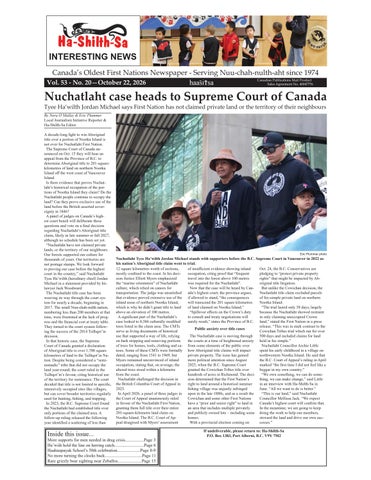
Eric Plummer photo
Nuchatlaht Tyee Ha’wilth Jordan Michael stands with supporters before the B.C. Supreme Court in Vancouver in 2022 as his nation’s Aboriginal title claim went to trial. 12 square kilometres worth of sections, of insufficient evidence showing inland Oct. 24, the B.C. Conservatives are mostly confined to the coast. In his decioccupation, citing proof that “frequent pledging to “protect private property sion Justice Elliott Myers emphasized travel into the forest above 100 metres rights” that might be impacted by Abthe “marine orientation” of Nuchatlaht was required for the Nuchatlaht”. original title litigation. culture, which relied on canoes for Now that the case will be heard by CanBut unlike the Cowichan decision, the transportation. The judge was unsatisfied ada’s highest court, the province argues, Nuchatlaht title claim excluded parcels that evidence proved extensive use of the if allowed to stand, “the consequences of fee-simple private land on northern inland areas of northern Nootka Island, will transcend the 201 square kilometres Nootka Island. which is why he didn’t grant title to land of land claimed on Nootka Island.” “The trial lasted only 58 days, largely above an elevation of 100 metres. “Spillover effects on the Crown’s duty because the Nuchatlaht showed restraint A significant part of the Nuchatlaht’s to consult and treaty negotiations will in only claiming unoccupied Crown case looked to 8,386 culturally modified surely result,” states the Province of B.C. land,” stated the First Nation in a press trees listed in the claim area. The CMTs release. “This was in stark contrast to the Public anxiety over title cases serve as living documents of historical Cowichan Tribes trial which ran for over use that supported a way of life, relying The Nuchatlaht case is moving through 500 days and included claims for land on bark stripping and removing portions the courts at a time of heightened anxiety held in fee simple.” of trees for homes, tools, clothing and ca- from some elements of the public over Nuchatlaht Councillor Archie Little noes. Some of these CMTs were formally how Aboriginal title claims will impact spent his early childhood in a village on dated, ranging from 1541 to 1969, but private property. The issue has gained northwestern Nootka Island. He said that Myers remained unconvinced of inland more political attention since August the B.C. Court of Appeal’s ruling in April occupation, stating that, on average, the 2025, when the B.C. Supreme Court marked “the first time I did not feel like a altered trees stood within a kilometre granted the Cowichan Tribes title over beggar in my own country.” from the coast. hundreds of acres in Richmond. The deci“We own something, we can do someNuchatlaht challenged the decision in sion determined that the First Nation’s thing, we can make change,” said Little the British Columbia Court of Appeal in right to land around a historical summer in an interview with Ha-Shilth-Sa in 2025. fishing village was unjustly infringed June. “All we want to do is better.” In April 2026, a panel of three judges in upon in the late 1880s, and as a result the “This is our land,” said Nuchatlaht the Court of Appeal unanimously ruled Cowichan and some other First Nations Councillor Mellissa Jack. “We expect in favour of the Nuchatlaht First Nation, have a “prior and senior right” to land in Canada’s highest court will confirm that. granting them full title over their entire an area that includes multiple privately In the meantime, we are going to keep 201-square-kilometre land claim on and publicly owned lots – including some doing the work to help our members, Nootka Island. The B.C. Court of Aphomes. steward the land and drive our own sucpeal disagreed with Myers’ assessment With a provincial election coming on cesses.”
More supports for men needed in drug crisis.................Page 3 Ha’wiih hold the line on herring catch...........................Page 6 Haahuupayak School’s 50th celebration.....................Page 8-9 No more turning the clocks back..................................Page 11 Rare grizzly bear sighting near Zeballos......................Page 15
If undeliverable, please return to: Ha-Shilth-Sa P.O. Box 1383, Port Alberni, B.C. V9Y 7M2
Page 2— Ha-Shilth-Sa—October 22, 2026
Bail denied for man charged in shooting death Derian Tate remains behind bars for the 2024 death of Patrick Charleson IV during a confrontation in Nitinaht By Denise Titian Ha-Shilth-Sa Reporter Nanaimo, BC – Derian Tate, the man charged with first degree murder in the September 28, 2024, death of Patrick ‘He Man’ Charleson IV, has been denied bail. It was his second application for bail to be denied in Nanaimo Law Courts. According to an RCMP statement issued October 2024, RCMP responded to an emergency call on Saturday, September 28, 2024, just before 7:00 a.m. “Lake Cowichan RCMP were called to a residence on Ditidaht First Nations. Upon arrival, police located a deceased man. Police support units were called to assist, including the Emergency Response Team (ERT) who took a man into custody without incident.” Charged with first degree murder, Derian Tate, 26, has remained in custody since his arrest. There was a strong family showing from both sides in the courtroom at the bail hearing, held in Nanaimo on Oct. 2, 2026. What was said in the courtroom cannot be reported due to a publication ban. Under the Criminal Code of Canada, a publication ban protects the accused’s rights to a fair trial. Like the April 15, 2026, bail hearing, a Nanaimo Supreme Court Justice heard arguments from both Crown counsel and defence attorneys about whether or not Derian Tate should be released on bail until trial. For a second time, the Supreme Court Justice denied bail in a decision released Oct. 9, 2026, to the relief of Charleson’s family. “It was a good decision for the court to
Denise Titian photo
Patrick ‘Man’ Charleson III and wife Tina (right) stand in front of the Nanaimo Law Courts with support of Hesquiaht Ha’wilth Thomas Ambrose and wife (left) attend a bail hearing for Derian Tate. uphold its responsibility to ensure public shared. Patrick ‘Man’ Charleson says his family safety so we can have confidence in the “The other family, they think they know is big and asks them to leave things in the justice system,” said Tina Charleson, loss, but they can see him…they can hear hands of Naas (Creator). “Naas will look stepmother of Patrick Charleson IV, who his voice,” he shared. For the grieving after things,” he stated. There will be a Voir Dire hearing in Nawas 23 when he died. father, it is important to be at every court Both families have shown their support hearing. “As parents, we have to be there naimo on November 30, 2026. In Canada, by showing up for court hearings and the for him,” said Charleson III. a Voir Dire is like a mini trial where victim’s father, Patrick ‘Man’ Charleson According to the Charlesons, this will things like admissibility of evidence, and be the last bail application ahead of the witness competence or qualifications are III, gets it. “Losing a kid…especially the oldest, is hard. All those milestones and trial. They will not have to travel from determined ahead of the trial. you wonder what it would be like if he Nitinaht to Nanaimo for bail hearings for The trial is scheduled for February was still here – it feels empty,” Charleson the rest of the year. 2027, in Duncan, BC.
October 22, 2026—Ha-Shilth-Sa—Page 3
‘We need more supports for men’: outreach worker Coroners Service reports drug deaths continue at three to four a day, with Aboriginal men dying at highest rate By Denise Titian Ha-Shilth-Sa Reporter The B.C. Coroners Service released their preliminary toxic illicit drug deaths report, showing that 113 people died in July, and 126 in August due to unregulated drug toxicity. It has been more than a decade since the Province of British Columbia declared a public health emergency over the toxic drug crisis. Since that time, more than 18,000 deaths in B.C. have been attributed to unregulated toxic drugs. That number is close to the population of Port Alberni, which stands is at 18,259. The number of toxic drug deaths in 2026 means that an average of three to four British Columbians die each day due from illicit drug use. And Vancouver Island ranks among the highest rates of unregulated drug deaths this year, along with the Northern health region. The City of Victoria ranks third, at 80 deaths, behind Surrey (82) and Vancouver (237) as the cities experiencing the highest number of unregulated drug deaths over the first eight months of 2026. According to the BC Coroners Service, the majority of those deaths, 76 per cent, were males. They say the crisis is driven by an unpredictable and volatile illicit supply containing potent fentanyl analogues, sedatives like medetomidine, and other dangerous contaminants. The BC Coroner Service reports Indigenous communities, men, and workers in trades, transport, as well as equipment operation continue to be severely impacted, with First Nations individuals dying at rates several times higher than other residents. Brianna Rai is the harm reduction outreach coordinator for the Nuu-chah-nulth Tribal Council. She concurs that males are being impacted by the drug crisis at a higher rate. “From our outreach team’s perspective, one of the factors contributing to the high number of First Nations men affected by the toxic drug crisis is that many men are carrying significant trauma but are often less likely to reach out for support. There can be a strong expectation for men to handle challenges on their own, and many may not seek help until they are already in crisis,” she noted. Shelly Hamilton lost her uncle, Jeremy Smith, 46, of Nuchatlaht just over a year ago. “When we look at these numbers, our family does not see statistics—we see our loved one. We don’t view his death as an ‘overdose’; it was toxic drug poisoning,”
Eric Plummer photo
Nuu-chah-nulth-aht sing on Fourth Avenue, considered Port Alberni’s poorest neighbourhood where drug use is prevalent, in 2022. she shared. recovery-focused housing. When men are Hamilton said Jeremy was the son of a experiencing homelessness, mental health residential school survivor - and much challenges, substance use issues, or more. family breakdown, there are often fewer “He was a proud man who took acsupport options available to them.” countability for his mistakes, loved the Rai says her team, who work on the children deeply, and was part of the first frontlines, see a need that is not being generation of residential school surviaddressed. vors. The institutionalization, stigma, and “We need more supports for men, labeling affected his self-esteem, but he including safe housing options, recovery was loved, valued, and remembered by and treatment services, mental health his family and community,” she said. supports, peer-led programs, and spaces During his life, Smith reached out for where men feel comfortable asking for support but would relapse. Hamilton said help before they reach a crisis point,” her uncle was aware of the dangers of the Jeremy Smith she said. “We need to recognize that men rather than the root cause itself,” said Rai. can be vulnerable too, and ensuring they illicit drug supply and took precautions. She went on to say that the toxic and un- have access to appropriate support is an “My uncle was an educated, responpredictable drug supply has also changed sible man who knew how to safely use important part of addressing the toxic the landscape dramatically. illicit drugs, regularly accessed Overdrug crisis.” “People who may have previously dose Prevention Services (OPS), carried Hamilton says before her uncle died, he survived their substance use are now at Narcan, and saved many lives himself,” found a soft place to land in his culture, said Hamilton. “Yet, because of systemic much greater risk of overdose and death,” and this approach is helping the family in Rai continued. “Combined with trauma, stigma, his death was treated as just their grief. During the summer the family another number, with key details ignored isolation, housing instability, and limited hosted a drying of the tears ceremony in support systems, this creates a situation and no real investigation into what hapCampbell River. where many people are falling through pened to him.” “For families going through this, the the cracks.” “What we are seeing in the field is that grief and trauma can make you feel “In 2026, fluorofentanyl has become many of the individuals struggling with trapped, stagnant, and unheard when trythe most common substance detected in substance use have experienced siging to fight for accountability,” Hamilton expedited toxicological testing, discovnificant trauma, loss, grief, and adverse shared. “What is helping our family ered in 68 per cent of unregulated drug life experiences. Substance use is often navigate this grief is leaning into our deaths,” states the most recent coroner’s a symptom of much deeper challenges culture, our ancestral teachings, and the report. “Cocaine (56 per cent) is the wisdom passed down by our grandparsecond most-detected substance in deceents. Grounding ourselves in traditional dents who underwent expedited testing, ways—like coming together through followed by methamphetamine (53 per potlatch—helps us redirect our focus cent), fentanyl (50 per cent) and desalkyl- from the trauma toward reclaiming who GATEWAY TO THE PACIFIC RIM gidazepam (21 per cent).” we are.” But what is in the latest supply of drugs “Our voices and our stories need to be is often unknown, until it is too late. heard, not just to highlight the systemic It is important to note that the data from failures, but to honor the dignity of the the report is preliminary and subject to lives we’ve lost and to support one anchange as additional toxicological results other in healing,” she added. are received and investigations conclude. In Port Alberni, the NTC’s Harm The Nuu-chah-nulth Tribal Council Reduction team works collaboratively provides support through their health with other service providers to support department’s Harm Reduction Team that the unhoused and those in need. They uses a cultural wellness approach that provide Naloxone training and distribute meets clients without judgement. harm reduction materials to community According to the team, there are many members. challenges. In addition, the team hosts group activiHours of operation - 7:00 am - 10:00 pm “In our community, there are also ties like picnics during the summer and Phone: 724-3944 limited supports specifically designed for other events to promote wellness and men,” said Rai. “While there are services safety. They work to ensure those battling E-mail: manager@tseshahtmarket.ca available, there is no men’s shelter, men’s addiction and mental health know they Find us on Facebook transition house, or dedicated men’s are important and supported.
TSESHAHT MARKET
Page 4— Ha-Shilth-Sa—October 22, 2026 Ha-Shilth-Sa newspaper is published by the Nuu-chah-nulth Tribal Council for distribution to the members of the contributing First Nations, as well as other interested groups and individuals. Information and original work contained in this newspaper is protected by copyright and may not be reproduced without written permission from: Nuu-chah-nulth Tribal Council P.O. Box 1383, Port Alberni, B.C. V9Y 7M2. Telephone: (250) 724-5757 Fax: (250) 723-0463 Web page: www.hashilthsa.com facebook: Hashilthsa Ntc
2026 Subscription rates: Non-Nuu-chah-nulth, Ahousaht, Ehattesaht,Toquaht and Ucluelet members are subject to a yearly subscription fee of $40 in Canada, $50 in the US and $60 for overseas. Payable to the Nuu-chah-nulth Tribal Council
Manager/Editor/Reporter Eric Plummer (Ext. 243) (250) 724-5757 Fax: (250) 723-0463 eric.plummer@nuuchahnulth.org Reporter Denise Titian (Ext. 240) (250) 724-5757 Fax: (250) 723-0463 denise.titian@nuuchahnulth.org Reporter Nora O’Malley (604) 353-8488 nora.omalley@nuuchahnulth.org Audio / Video Technician Mike Watts (Ext. 238) (250) 724-5757 Fax: (250) 723-0463 mike.watts@nuuchahnulth.org Editorial Assistant Holly Stocking (Ext. 302) (250) 724-5757 Fax: (250) 723-0463 holly.stocking@nuuchahnulth.org
DEADLINE: Please note that the deadline for submissions for our next issue is Oct 30, 2026 After that date, material submitted and judged appropriate cannot be guaranteed placement but, if material is still relevant, will be included in the following issue. In an ideal world, submissions would be typed rather than hand-written. Articles can be sent by e-mail to holly.stocking@nuuchahnulth.org (Windows PC). Submitted pictures must include a brief description of subject(s) and a return address. Pictures with no return address will remain on file. Allow two - four weeks for return. Photocopied or faxed photographs cannot be accepted.
LETTERS and KLECOS Ha-Shilth-Sa will include letters received from its readers. Letters MUST be signed by the writer and have the writer’s full name, address and phone number on them. Names can be withheld by request. Anonymous submissions will not be accepted. We reserve the right to edit submitted material for clarity, brevity, grammar and good taste. We will definitely not publish letters dealing with tribal or personal disputes or issues that are critical of Nuu-chah-nulth individuals or groups. All opinions expressed in letters to the editor are purely those of the writer and will not necessarily coincide with the views or policies of the Nuu-chah-nulth Tribal Council or its member First Nations. Ha-Shilth-Sa includes paid advertising, but this does not imply Ha-Shilth-Sa or Nuu-chah-nulth Tribal Council recommends or endorses the content of the ads.
B.C. rolls out this season’s vaccines First Nations people over 59 can get single-dose RSV shot for long-term protection By Keith Durocher Ha-Shilth-Sa Contributor Weather has finally begun to cool off, and that means comfortable clothes, plenty of indoor quality time with family - and of course cold and flu season. With that in mind, the Ministry of Health has rolled out its recommendations and guidelines for immunizations and preventative vaccines for viral respiratory season. Along with updated shots for influenza and COVID-19, seniors 75 and up and First Nations 60 and older are eligible for the RSV vaccine - a single-dose shot that can provide protection against respiratory syncytial virus. This common seasonal virus can introduce serious complications with anyone suffering from chronic health conditions such as asthma, COPD, or pre-existing heart conditions. This vaccine is free for those eligible as part of a time-limited program. Unlike influenza and COVID-19 shots, only one dose of the RSV vaccine is required for long-term protection; those who receive an RSV vaccine do not need another dose. The RSV vaccine is also available year-round, not strictly seasonally. Initial notifications to receive immunization shots for priority populations began on October 5th, with appointments starting on October 13th. These will continue to roll out to the rest of the population throughout November. “We’re starting to see influenza circulating in the province, and with the respiratory illness season officially starting, it’s an important time for people to book their appointment to get immunized,” said Dr. Bonnie Henry, B.C.’s provincial health officer. “Vaccines provide one of the best defences against respiratory illnesses, and they help keep you, your family and your community healthy and safe.” Influenza and COVID-19 are both indiscriminate, and anyone can contract these sicknesses, but some groups are particularly at risk. Infants and children under 5 are most vulnerable to influenza, while COVID-19 is a significant threat to adults over 65, anyone who is pregnant, those living with pre-existing conditions such as auto-immune diseases, as well as some Indigenous communities. “In addition to getting immunized,
Submitted photo
Greg Louie receives his vaccination for COVID-19 in the First Nation’s village in January 2021. cleaning your hands regularly, covering B.C. has secured nearly two million sneezes and coughs, and staying home doses of the 2026-27 influenza vaccine, when you’re sick are tried and true ways and 1.5 million doses of the updated COto move safely through this season when VID-19 vaccines: Moderna ‘Spikevax’, we’re seeing more viral transmission,” Pfizer ‘Comirnaty’, and Sanofi ‘NuHenry said. vaxovid’. All of these shots are Health B.C.’s viral respiratory illness immuniCanada approved. In addition to protectzation campaign aligns with recommening against SARS-Cov-2, new studies dations from Canada’s National Advisory are showing that these vaccines also Committee on Immunization, and aims help boost the effectiveness of certain to ensure priority for those most at risk. therapies used in treating skin and lung Vaccines are free, safe, easy to access and cancers, an unexpected but welcome side available to everyone six months old and benefit of the shots. older. If you would like further information Also, seniors will continue to receive regarding the immunization programs enhanced influenza vaccines for free. and the shots themselves, consult the folThese offer better protection against lowing links: influenza than standard-dose vaccines by B.C.’s immunization program and how stimulating stronger responses that help to get vaccinated this fall: https://www2. compensate for the natural weakening of gov.bc.ca/gov/content/health/managingthe immune system that comes with the your-health/immunizations wear-and-tear of time. A stronger immune More about influenza (flu) vaccines: response means better protection against https://www2.gov.bc.ca/gov/content/ influenza, which can still be every bit as health/managing-your-health/immunizadangerous as it was in 1918. tions/flu Vaccines are available through health To learn more about RSV, visit: https:// authority clinics and pharmacies, includwww.healthlinkbc.ca/healthlinkbc-files/ ing those located at Shoppers Drug Mart respiratory-syncytial-virus-rsv-vaccine (3717 10th Avenue) and No Frills (3455 Health information services in BC: https://www.healthlinkbc.ca/ Johnson Road) in Port Alberni.
Legal Information
COVERAGE: Although we would like to be able to cover all stories and events, we will only do so subject to: - Sufficient advance notice addressed specifically to Ha-Shilth-Sa. - Reporter availability at the time of the event. - Editorial space available in the paper. - Editorial deadlines being adhered to by contributors.
Ha-Shilth-Sa belongs to every Nuu-chah-nulth person including those who have passed on, and those who are not yet born. A community newspaper cannot exist without community involvement. If you have any great pictures you’ve taken, stories or poems you’ve written, or artwork you have done, please let us know so we can include it in your newspaper. E-mail holly.stocking@nuuchahnulth.org. This year is Ha-Shilth-Sa’s 52nd year of serving the Nuu-chah-nulth First Nations. We look forward to your continued input and support. Kleco! Kleco!
The advertiser agrees that the publisher shall not be liable for damages arising out of errors in advertisements beyond the amount paid for space actually occupied by the portion of the advertisement in which the error is due to the negligence of the servants or otherwise, and there shall be no liability for non-insertion of any advertisement beyond the amount paid for such advertisements
October 22, 2026—Ha-Shilth-Sa—Page 5
Leaders debate DRIPA as B.C. election approaches Conservatives pledge to repeal legislation, targeting anxiety among property owners from Cowichan decision By Eric Plummer Ha-Shilth-Sa Editor It’s been almost seven years since First Nations took to the red carpet in the B.C. legislature, celebrating in ceremony as MLAs stood on either side to mark a historic piece of legislation that put Indigenous rights into law. The Declaration on the Rights of Indigenous Peoples Act passed unanimously in Victoria on Nov. 28, 2019, making British Columbia Canada’s first province to legally recognize an international call to action. DRIPA is intended to align B.C.’s laws with the United Nations Declaration on the Rights of Indigenous Peoples, which stipulates that a government has the duty to gain the “free, prior and informed consent” from an Aboriginal community before development occurs on its land. But over recent years public and political sentiment over DRIPA has been far from unanimous, with the B.C. Conservatives pledging to kill the legislation if they are elected to lead the province on Oct. 24. “The reality is that DRIPA has to be repealed in this province,” said B.C. Conservative Party Leader Lorne Doerkson during a televised debate on Oct. 14. “It has not helped British Columbia. It has created more division on the landscape than I have ever seen in my life.” Even NDP Leader David Eby, who was attorney general when his party passed the legislation in 2019, has pointed to issues with DRIPA. In the spring he announced plans to suspend parts of the act for three years, allowing the government time to amend the legislation, as a flood court challenges were expected from First Nations seeking to exercise their rights under the law. Indigenous leaders opposed any amendments, and Eby backed down from this plan after members of his own party refused to support suspending parts of DRIPA. Since that time Cloy-e-iis, Judith Say-
CPAC video still
Green Party Leader Emily Lowan, NDP Leader David Eby and B.C. Conservative Party Leader Lorne Doerkson participate in a televised debate on Oct. 14, 10 days before the provincial election. ers, president of the Nuu-chah-nulth During the recent leaders’ debate Eby also protected in some way,” said DoerkTribal Council, has worked on a commit- referenced how this court ruling could son during the debate. “If we share in that tee of chiefs tasked with finding ways to impact British Columbia’s economy. wealth, that’s fantastic. But DRIPA is not better implement the legislation. “We cannot afford to have these major solving the issue in British Columbia.” “If we had to tweak DRIPA in order to projects tied up in the courts and not deSayers noted that even if DRIPA is do something, we would do that - but we livering jobs and opportunity for British repealed, Aboriginal title will still exist would not be repealing the key sections,” Columbians,” he said. “All of these projin B.C., as it is recognized in Section 35 she said. ects, the reason these things are happenof Canada’s 1982 Constitution Act. First Eby’s plans to amend the law came after ing is because we have entered into these Nations have also formally recognized a decision from the B.C. Court of Appeal projects that are enabled by [DRIPA]. their territory long before the country found that the province’s mineral tenure But another thing is true too. When you was founded. system failed to align with DRIPA comown your own private property, you need “Aboriginal title is not going to go mitments to First Nations. The Gitxaala to know what you have, and you need away if they repeal DRIPA,” said Sayers. and Ehattesaht First Nations challenged to know what you can do with it. This is “Aboriginal title has always existed in B.C.’s system of granting mineral rights, why we are appealing these court decithis province.” a process that did not require Indigenous sions.” During the debate Geen Party Leader consent before exploratory mining occurs Months before the Court of Appeal deci- Emily Lowan accused the two other parin their territory. sion, in August 2025 the B.C. Supreme ties of contributing to public confusion With adversarial trading relations south Court dropped a ruling that sparked a fire over how DRIPA will impact property of the border, this decision came at a of anxiety among property owners in the ownership. time of intensifying economic stressors. Lower Mainland. The ruling granted the “DRIPA has no bearing on private Cowichan Tribes title over approximately property,” she said. “The uncertainty that 300 hectares in Richmond, B.C., land has been sewn over the last year has been which was historically used around a from a premier who can’t seem make up fishing village before it was expropriated his mind, and it’s been from a Conservaby the government in the late 1880s. The tive party that is constantly pushing misjudge found that this Aboriginal title is a information and blatant fear mongering.” “prior and senior right” to land that has Reflecting on decades of provincial relasince been privately and publicly owned. tions with First Nations, Sayers has seen In response to public fears over what some progress since DRIPA was passed this will mean in the future for property in 2019, but she fears this work could be owners across the province, the B.C. lost if the NDP loses power. Conservative Party has pledged to “pro“There’s been some legislation that has tect private property rights by upholding been passed under UNDRIP that has the validity of the Land Title Act on all improved the situation,” she said. “We’ve fee-simple properties in B.C.” had different concepts come up from “We have to ensure private property different governments, but I don’t think rights for owners. We have to ensure that we’ve ever come as far as we have with tenures that exist on the landscape are DRIPA.”
Page 6— Ha-Shilth-Sa—October 22, 2026
Ha’wiih hold the line on commercial herring catch As industry pushes to open fisheries on the west coast, Nuu-chah-nulth hereditary chiefs say it’s still too soon By Nora O’Malley Local Journalism Initiative Reporter Port Alberni, BC – The Council of Ha’wiih (hereditary chiefs) and their representatives from 14 Nuu-chah-nulth Nations gathered at the Italian Hall in Port Alberni Oct. 7 and Oct. 8 to discuss several priority fisheries issues. The two-day Ha’wiih fisheries forum was hosted by Tla-o-qui-aht First Nation and chaired by Wickaninnish (Cliff Atleo Sr.) of Ahousaht First Nation. Once again, the Council of Ha’wiih responded to industry pressure to reopen the west coast herring fishery. “We have been the ones that have watched that slow progression to improvement. Yes, it’s starting to come back, but it needs to be like that every season. We are the ones that have been keeping the department to tow the line in terms of resource management. We are not opposed to it, we are just saying do it right. Manage it properly,” said Wickaninnish. Tla-o-qui-aht fisheries manager Andrew Jackson weighed in. “We need to continue to keep it closed. We need to hold the line. We can’t say it’s recovered yet because herring is just starting to show up in our territory,” said Jackson. Under the Department of Fisheries and Oceans Canada (DFO) management plans, the west coast of Vancouver Island has been closed for a commercial herring roe fishery since 2005 – with the exception of 2014 and 2015. In those respective years a Nuu-chah-nulth-led court injunction blocked the commercial catch, followed by a meagre season in 2015 that yielded no significant harvest. DFO’s Pacific Herring Science Team presented spawn data to the Council of Ha’wiih on Oct. 8. The department estimates 2027 will yield 44,300 tonnes of pre-fishery spawning biomass for a maximum Total Allowable Catch of 4,430 tonnes or a 10 per cent harvest rate. However, as Nuchatlaht elder and councillor Archie Little pointed out, El Niño events could disrupt how marine species are distributed along the entire west coast. Scientists at the National Oceanic and Atmospheric Administration (NOAA) are currently working to observe and forecast how the 2026–2027 El Niño event will impact fisheries and a team of researchers at the University of British Columbia found that extreme events, like marine heatwaves, can abruptly disrupt marine food webs and the productivity of fish stocks. DFO’s Pacific Herring Science Team was unable to clearly answer Little as to whether or not the departments’ west coast of Vancouver Island herring analysis factored in the forecasted El Niño, although they stated it was “definitely a consideration”.
Nora O’Malley photos
Council of Ha’wiih chair Wickaninnish (Cliff Atleo Sr.) takes five to dig into a fresh t̓ uc̓ ap (sea urchin) on Oct. 7 during the fisheries forum in Port Alberni. James LaFlamme, Tseshaht fisheries manager, spoke about rebuilding kelp forests to renew herring abundance. “One of the things we found is the urchins were the problem. The urchins are coming in and they are grazing down the kelp. Their predators are not prevalent in the (Broken Group Islands) and there is a large sea star die off up the coast as well,” said LaFlamme. “These urchins are perpetual problem for rebuilding these forests, and I think that rebuilding these forests helps not only the future of herring, the future of roe on kelp, but the future of the ocean as Tseshaht fishery manager James LaFlamme talks about rebuilding kelp forests. a whole,” he continued. “Increasing that ocean survivability is a Andy Webster, a lifetime fisher who Discussions on herring were paused big part of it. It all trickles back to kelp,” represented Ahousaht at the forum, thinks when Tseshaht fisheries delivered fresh ̓ said LaFlamme. it’s still too soon to open the commercial tuc̓ ap (sea urchin) from Useless Inlet near Acting Ahousaht tyee ha’wiih Hasheuherring fishery. the Broken Group Islands for the ha’wiih kumiss (Richard George) spoke about “I’ve seen the resource collapse three to feast on. revisiting traditional practices to rebuild times in my lifetime. That’s unacceptAt the tail end of the fisheries forum, the herring stocks. able,” said Webster. Hupačasath tyee ha’wiih Tsu-tsii-in (Al“That’s nation-to-nation, community “The big boys are starving that’s why ton Watts) spoke about connection. led harvest planning; a rebuilding plan. there’s a big push to open it. To me, it’s “Out of everything, we have to work These herring can be transplanted. not the time from what I’ve seen out on together to get to where we want to be Ahousaht has a really good herring stock the water,” he said. again,” said Tsu-tsii-in. at the moment. We had 20 days that were Larry Johnson, chair of the Maa-nulth Nuu-chah-nulth Uu-a-thluk director of completely flooded. Where we really Fisheries Committee and president of the fisheries Jim Lane is preparing a letter want to go forward to at the moment is Nuu-chah-nulth Seafood Development for DFO which outlines the Council of continuing our stewardship programs Corporation, suggested working towards Ha’wiih’s key messages regarding herwith other nations,” said Hasheukumiss. an open pond fishery. ring. Lane says it is up to the ministry He invited all Nuu-chah-nulth nations to make the call on whether to open or “If we are forced to make a decision, that don’t have an abundance of herring not, and a decision may come as early as I would recommend we support open in their territory to send their guardians pond,” said Johnson. January 2027. over. “We rebuild it ourselves. We want to gift to you the gift of herring to bring back to your territories to start our rebuilding and to show the government that this is possible,” he said.
October 22, 2026—Ha-Shilth-Sa—Page 7
Nations seek data sovereignty with genome project New initiative analyzes salmon DNA for five Nuu-chah-nulth nations, tracing fish origins, parentage and age By Antonella Medina Arias Ha-Shilth-Sa Contributor Vancouver Island, BC — A salmon genome testing project is in development to enable First Nations ownership over data testing tools, aiding in fisheries management and conservation decision-making. A multi-partner First Nations project is being developed on Vancouver Island’s west coast. After securing three years of funding, the Ahousaht, Ehattesaht, Mowachaht/Muchalaht, Hesquiaht, and Tla-o-qui-aht First Nations are building capacity in salmon genome testing technology and infrastructure. “The ultimate goal is true co-management between the five nations, being able to show their authority towards fisheries management and with the power to produce the data and own the data,” said Candace Picco, senior biologist at the Ha’oom Fisheries Society. Genomics studies an organism’s DNA, its functions and the specific genetic adaptations that improve survival in certain environments. Researchers use salmon genomics to identify a fish’s origins, the hatchery it was released from, its parentage and its age - data crucial to salmon management. “Genetics can inform your rebuilding strategies depending on what you find,” said Jared Dick (Whehs-Wiss-Sunup), Central Region fisheries biologist for Uua-thluk, adding that DNA analysis could reduce the number of fish originating from a hatchery, while provide data that helps to promote wild stocks. Currently the Canadian West Coast relies on a single lab for salmon genomics testing and analytics: the Molecular Genetics Laboratory at the Pacific Biological Station in Nanaimo, run by Fisheries and Oceans Canada (DFO). Over the decades, the Nanaimo lab has built an extensive library of salmon genomics data from populated streams along the coast. It can compare a sample against 550 genetic markers in the library to figure out a fish’s native region. However, demand for genomics analytics has long outpaced the lab’s capacity, resulting in long wait times since the early 2000s. Delays are worse in remote areas, where distance adds time, which is a problem for fisheries managers who need timely results for decision-making. To cut down wait times, the five nations are building their own genomics lab, which will allow them to test fewer samples in less time, reduce processing bottlenecks, and let users, especially First Nations organizations, set their own priorities to manage data independently. Picco reached out to Ben Sutherland, an adjunct professor at Vancouver Island University and founder of Sutherland Bioinformatics, to work out how to successfully genotype fish samples outside the DFO. There are two parts of the project. First is developing remote genotyping capability by using a hand-held Nanopore sequencer. A sequencer of any size is a tool to help humans read the data stored in a genome. The Nanopore sequencer is the size of a staple, needs to be connected to a laptop and costs under $10,000 to run — a cheaper and smaller option than the one used in the DFO labs. “We’ve started sequencing on the nanopore at VIU in a nice clean lab environment, and then we’ll slowly get closer and closer to genotyping in the field . . . [like] in Tofino [to] demonstrate that we
Robertson Creek Hatchery photos
Jared Dick of Uu-a-thluk, Keaton McCallum of Ha’oom, Josh Gillette of the Ka:’yu:’k’t’h’/Che:k’tles7et’h’ First Nations and Uu-a-thluk’s Vanessa Moll assess salmon in the Kaouk River, measuring the length of a chinook. can do it there,” said Sutherland. Buying a larger sequencer would require more funding, space, and trained personnel to run and maintain it, and it can’t be used outside the lab. One downside of the Nanopore sequencer is that it processes fewer samples than a larger one. Second, the team has to work on the sequencer to produce the same results as the DFO equipment, since different sequencers should yield the same data from the same sample as the genetic baseline doesn’t change. “We need to make sure that those results keep matching what we expect them to because if we can’t, it’s like apples to oranges,” said Sutherland. The second part of the project involves building analysis software that can successfully compare the results to the DFO library. The DFO fully supports the project by checking that results from the Nanopore sequencer are compatible with its existing database. However, the project has not yet shown that the Nanopore sequencer produces the same results as the DFO lab. Once the project is refined and ready for the field, the genomics analysis will focus Shane Johnson (left) releases a chinook back into the river, as Keaton McCallum carries one up to be sampled, as a school of chinook, chum and coho salmon pool on coho and chinook as the two main in a net. kinds of salmon harvested on the west coast of Vancouver Island. the lab has capacity.” developments with other First Nations The project began with a court case in Picco secured funding from the Inand fisheries organizations. which the five nations asserted their right digenous Stewardship Fund (providing “This helps develop genetic capacity to run the fisheries in their territories $365,000 for three years), the Pacific more broadly for all First Nations with a based on their own priorities. A judge Salmon Foundation and Genome B.C. common method and having our results required DFO and the nations to work The project has captured the attention be comparable with each other,” said Pictogether to manage fisheries based on the of other First Nations. The development co. “It will strengthen fisheries managenations’ needs. hopes that by the end of the three years, ment across the province and put more However, knowing which salmon stock Ha’oom scientists will be fully trained in agency in the hands of First Nations.” is being caught is key to running a fishprocessing and sample analysis, the hand“When you put the tool into more hands, ery. held Nanopore sequencer will support you never know what creative differ“Candace started this project with VIU remote genotyping within a few days, and ent ways that different groups are going and other partners to develop capacity the lab will produce results comparable to to use it for,” said Sutherland. “It really within the nations to run their own gethe DFO lab. shows the breadth of utilities. It’s one of netic samples,” said Dick. “Because if we Additionally, the team is considering the most valuable tools I’ve seen in my have the tools and the means to collect adding genetic processing capacity for career for application and conservation. samples and run them, we can get results First Nations fisheries programs across I’m just really excited to be a part of on any of the samples we collect... and the province to establish a First Nations this.” we don’t have to get permission to see if genetics network, prioritizing sharing
Page 8— Ha-Shilth-Sa—October 22, 2026
Haahuupayak School students sparkle at 50th yea Current students honour those who contributed to Nuu-chah-nulth school’s history with several spirited song and da By Nora O’Malley Local Journalism Initiative Reporter Port Alberni, BC – Wearing little light-up sneakers and shawls trimmed with silver and gold sequins, Haahuupayak Elementary School students sparkled with the spirits of their Ancestors as they performed the War Song on Oct. 8 for the 50th anniversary celebrations. Event co-emcee and cultural educator Trevor Little told the audience that nowadays, the War Song is preparing the children for another battlefield. “It’s for your education; it’s for your life,” said Little. “And we want to acknowledge the battles that got us to where we are today.” Founded in 1976, Haahuupayak, of the root haahuupa, which means “teaching with love” is a Nuu-chah-nulth school located in the Alberni Valley on Tseshaht First Nation reserve land. Today, the independent school has an average student enrolment of 155 and delivers the B.C. curriculum to its Kindergarten to Grade 7 – plus facilitates a Nuu-chah-nulth language and culture program. Richard Watts is one of the five original board members of the Haahuupayak Society. “It’s been a great journey. Our kids weren’t finishing school, they weren’t being treated fairly, and we wanted to do something about that,” said Watts during the Oct. 8 festivities at Haahuupayak gymnasium. “One of the things that residential schools did was to try to take the Indian out of the child, as it were. They worked on lowering our self-esteem about who we were and where we came from. That was one of the challenges we took on, and I have to say, it’s been really successful. Watching those kids this morning, watching the songs they sang, we succeeded in overcoming that,” he said. Tseshaht chief councillor Wahmeesh (Ken Watts) spoke to the crowd as the late George Watts’ son. George was instrumental in building Haahuupayak School. Wahmeesh shared he was brought to tears as he walked into the school lobby for the celebrations; he said he could feel the spirits of those who were no longer with us. “My late dad would be really proud of where this school is going and where they are right now,” said Wahmeesh. “It wasn’t that long ago that we had a residential school in our backyard. Just over 50 years ago there was a school that operated here and was shut down. My dad would always say the (elders) gave us direction to
Judith Sayers
Haahuupayak students fill the gymnasium with Nuu-chah-nulth songs and culture on Oct. 8, a celebration of the elementary schoo help build this school,” he continued. that the project was the largest Tseshaht has and grandparents here we say thank you, Wahmeesh attended Haahuupayak from thank you for caring for our children.” ever done to date and that it employed the Kindergarten to Grade 3 when it was run most Tseshaht members. Nuu-chah-nulth Tribal Council (NTC) out of the old Caldwell building. His son “I just want to acknowledge all those who president Cloy-e-iis (Dr. Judith Sayers) also attended Haahuupayak from Kindersat on the Haahuupayak School board not just pushed to get this building built garten to Grade 7. for a decade. Her daughter Alana attendbut who actually put their blood, sweat and “For a school that was completely undertears into building it and maintaining it,” ed Haahuupayak and went on to become funded for a very long time, it was able to said Wahmeesh. the first Indigenous person to earn a PhD do amazing things with the resources that “I think my dad would want to thank these from the University of Victoria (UVic) they had,” he said. teachers,” he continued. “There isn’t a staff English Department. Her son Cole, also Twenty-years ago, the Haahuupayak a Haahuupayak graduate, is the execumember, past or present, that came here for Society raised enough funding to build the money. None of them came here for the tive director for Clean Energy BC and the new school on Tseshaht lands at Santu money, they came here because they cared helps develop green energy solutions in Drive and Mission Road. Wahmeesh shared about the work. On behalf of all the parents remote Indigenous communities. “This is the difference our educated children can make; those that learn our culture and our voice,” said Cloy-e-iis. “They felt at home here on the reserve and were nurtured and loved by their teachers. Haahuupayak has been the backbone of education for so many years.” In the early days, Cloy-e-iis told the audience that Haahuupayak School operated under a tight budget, but they made
Students perform the war song in the Haahuupayak gym.
Richard Watts
October 22, 2026—Ha-Shilth-Sa—Page 9
ar milestone ance performances on Oct. 8
Ken Watts
Nora O’Malley photos
ol’s 50 years on the Tseshaht reserve. it work with what they had. “We had to do bingos, and fun fairs, we raised money any way we could for our culture programs because we weren’t given money for culture in those days,” she said. Elder Peggy Tatoosh volunteered as a librarian for several years. “If there wasn’t a Haahuupayak School, I wouldn’t have started my healing journey because I’m a product of the residential school because both my parents went to residential school. I was abused and had a
Cultural leaders Lena Ross and Trevor Little.
not healthy childhood,” she shared. “I was able to find strength to just be, and that is exactly the mandate of this school,” she said. Nowadays, both Wahmeesh and Cloy-e-iis said Haahuupayak School is thriving with full funding from the province and NTC. They said work is underway to expand Haahuupayak to Grade 12. “My children wished that they had Haahuupayak all the way to grade 12. Because here they were nurtured, they were loved, they were protected. How great would that be when we can have that in our community?” said Cloy-e-iis. Wahmeesh shared they are in discussion with Canada about going K to Grade 12, and that one of the first steps is to conduct a research analysis to prove the expansion is warranted. “I have no doubt in my mind that many of you would send your children here if it went K to 12. That work is underway. But let’s not end there. I think there is still a vision that maybe some day we will have that post-secondary program, our own university, our own college,” he said.
A student calls out to the Creator during the spiritual chant.
Shawls shimmer with gold and silver trim.
Community members who helped shape the school’s foundation for future generations are honoured.
Page 10— Ha-Shilth-Sa—October 22, 2026
VIU honors Sayers as second chancellor term ends Vancouver Island University position acts as an ambassador and champion, presiding over student convocation By Denise Titian Ha-Shilth-Sa Reporter Nanaimo, BC – NTC President Cloye-iis (Judith Sayers) has wrapped up her second term as chancellor at Vancouver Island University. The occasion was marked with a celebration held in her honour at VIU on Friday, October 9. According to VIU, a chancellor acts as an ambassador for and a champion of the University. “The chancellor is the titular head of the university, presiding over convocation ceremonies, conferring degrees, and providing advice to the president. The chancellor is a member of the Board of Governors and the Senate,” VIU says on their website. The VIU chancellor serves in a volunteer capacity. “I was honoured to be VIU’s chancellor for six years,” said Sayers. “Post secondary education is so important, and I was able to participate in the governance structure of the university. I learned how it worked and its financial challenges.” In her first term as VIU chancellor, Sayers was quoted in a June 2021 VIU newsletter. “Historically, many Indigenous students have struggled in university. Struggled to belong, struggled to feel safe and they have many issues facing them in university including racism, bias and not being able to do their research in the way they want to,” she wrote. She went on to say that education is about learning to think, to communicate, to write. “And it’s how we participate in the world that we establish. We need to encourage more students to come into the university. We need to make it a place where they want to come.” Big challenges came in her first year as chancellor as the COVID-19 pandemic created financial stress on all universities. “Advocating for both federal and provincial governments to assist with resources is key to the future (success),” she noted. Dr. Sayers is the third chancellor in VIU’s history. The first was Ahousaht Ha’wilth and former Assembly of First Nations national chief, Shawn Atleo, followed by Aboriginal rights lawyer, Louise Mandell, who served two terms.
Submitted photo
NTC President Cloy-e-iis (Judith Sayers) celebrated the closure of her second term as chancellor at Vancouver Island University on Friday, October 9. Cloy-e-iis was first appointed VIU chan- privilege of overseeing convocation. connections and her commitment to our cellor on October 24, 2020. She was and “My highlights are always convocation. communities to the position. She has repstill is president of the Nuu-chah-nulth Three days in June when I get to congrat- resented VIU with great enthusiasm and Tribal Council and holds both law and ulate personally over 1,200 students. The helped strengthen our relationships across business degrees. She is recognized as a energy and excitement from both students the island and beyond,” he said. prominent Indigenous leader, sustainable and family is so empowering,” she stated. In addition to her roles as VIU chanceldevelopment advocate, and educator. One of those days is Semelshun Indiglor and NTC president, Cloy-e-iis is a Of her opportunity to advance Indigenous Graduation Recognition ceremony. member of the Order of Canada since enous causes through her chancellorship, “We celebrated all the Indigenous grads 2019 and was awarded the Lifetime Sayers said, “institutions like UVic and within our protocols and ceremony. So Achievement Award by Clean Energy VIU are embracing those changes, and awesome to see Indigenous students from BC and was named to Canada’s 2016 we all play a role in making sure things lots of different First Nations graduate on Clean50 for being an outstanding conchange.” she said. many different fields of study. You imagtributor to clean capitalism. She has been “Reconciliation is just a word, UNDRIP ine leaders and scholars and different a finalist for the Buffett award for Indig[the United Nations Declaration on the professionals coming out of the grads,” enous leadership and was twice awarded Rights of Indigenous Peoples] is just a she shared. the Woman of Distinction from the document, it’s up to us to breathe life, to In a video statement, VIU President Dr. Alberni Chamber of Commerce. In 2009, breathe meaning into these concepts and Dennis Johnson thanked those that were the Canadian Council of Aboriginal Busidocuments. It’s an honour to have this there to celebrate Cloy-e-iis as she retires ness inducted Sayers into the Aboriginal role, it gives me a greater voice and the from her role as chancellor. Business Hall of Fame. opportunity to be part of the change with “As many of you know, Judith has been “We are very grateful for the time and all of you,” she said. an important part of the VIU community leadership she has given to the university. “One of the reasons I am attracted to since she was named our third chancelJudy, you’ve been a strong advocate for VIU and to this position is how closely lor.” VIU for our students and for our commuthe university has worked with the He went on to say that the chancellor nities, thank you for serving as our chanSnuneymuxw First Nation and other Naplays an important role as an ambassador cellor and my very best wishes for what tions,” said Sayers. “I would like to see for the university, and as a champion for comes next,” said Dr. Dennis Johnson. those kinds of partnerships continue to VIU and its students. VIU honoured Cloy-e-iis by establishing grow and flourish.” “Judith has embraced that role wholea scholarship in her name for an IndigAs chancellor at VIU, Cloy-e-iis had the heartedly, bringing her experience her enous student starting out at VIU.
Phrase of the week:hawii%a+niš %u%u%iih= yac^aa Pronounced ‘ha wee ult nish oo oo eeh ya chaa’, it means, ‘we are finished getting dog salmon ’ Supplied by ḥakaƛ.
Illustration by Joslyn Charlie
October 22, 2026—Ha-Shilth-Sa—Page 11
No more turning the clocks back for B.C. residents Elimination of Daylight Savings Time brings an extra hour of daylight this fall, after seasonal time change ends By Antonella Medina Arias Ha-Shilth-Sa Contributor British Columbia – The provincial government has adopted Pacific Time (PST) to add an extra hour of daylight during winter evenings. However, sleep experts raise concerns that the time change could cause potential health risks and other changes to the population. “British Columbians have been clear that seasonal time changes do not work for them,” said Premier David Eby. “This decision isn’t just about clocks. It’s about making life easier for families, reducing disruptions for businesses and supporting a stable, thriving economy.” During the summer of 2019, the provincial government conducted an online survey about the daylight saving time change. Out of 223,000 participants, 93 per cent supported using year-round Daylight Saving Time (DST), also known as Pacific time (PCT). Additionally, more than 90 per cent of industry and occupation groups supported the change to DST. Keeping the clock in the Pacific time zone eliminates the biannual disruptions to sleep patterns, school schedules and daily routines. More light during winter evenings would support commuting, socialization, leisure time, outdoor activities, and economic activity. In business, it reduces the need to reprogram systems, shift schedules, and perform an operational reset in spring and fall for small businesses and service providers. Additionally, it provides more consistent planning across transportation and technology services. “This shift offers more stability, supports public well-being and reduces twice-yearly, unnecessary disruptions to the routines of parents, shift workers, small businesses, pet owners and so many more,” said Niki Sharma, Attorney General. “I look forward to all of us enjoying an extra hour of sunlight after work and school for many winters to come.”
Wikimedia Commons photo
The sun sets over a Tofino beach at the end of the summer. The end of Daylight Savings Time means later light in the fall. issues. Inconsistent sleep can cause Even so, researchers in British Columchange will happen on Nov. 1 and last bia warn that keeping the clock on DST “social jet lag,” where someone’s life and until Mar. 14 of next year. instead of changing it back to permanent social calendar are out of sync with their “These adjustments in hours of operabiological clock. Standard Time (ST) could pose health tion will allow for better coordination risks and affect students’ performance “You’re actually waking up at an earlier between Canada and the U.S., including and productivity. circadian phase. Your clock may still in cases where a traveller is inadmissible Ralph Mistlberger, a psychology profes- be telling your brain and your body that and is directed to return immediately to sor at Simon Fraser University and sleep this is the sleep period. It’s not time to the country they came from. It will also expert, and other researchers released an wake up yet,” said Mistlberger in an mean greater clarity for all travellers as OHS Canada article. “The same is going analysis concluding that moving to perto when the ports of entry are operating,” manent Standard Time would be healthito happen in the evening. [Your internal said CBSA in a news release. er, as it better aligns with the body’s natu- clock is] going to be telling you this is People in northeastern B.C. (Peace still the wake period; it’s not time to go to River region and the northern Rocky ral rhythm. The study is published in the Canadian Medical Association Journal. bed yet.” Mountains) will continue to use MounMistlberger said darker mornings disWhile small amounts of sleep depritain Standard Time (MST) (UTC-7) rupt circadian rhythms (the body’s natural vation can be fixed with a long nap, if annually. 24-hour clock), potentially leading to the issue continues, it can develop into In southeastern B.C. (East Kootenay), a chronic condition and lead to other sleep deprivation and associated health people will switch between MST and health problems like metabolic disorders Mountain Daylight Time (MDT) in line (obesity and diabetes) and cardiovascular with Alberta. On Nov. 1, Alberta will not diseases. Epidemiological studies of large switch times and will use MDT. populations point to an increase in cancer The legislation to remove the twice-aand mood disorders. year change was first introduced in 2019 Patric Baylis, a professor at UBC’s by then-Premier John Horgan as the Vancouver School of Economics and Interpretation Amendment Act, the legal co-author of the analysis, said one of framework that allowed the province to the biggest concerns is how it will affect adopt the PCT. At the time, the provincial students going to school in the dark. government chose not to implement it to A study in Florida found that an extra coordinate the time change with neighhour of sunlight before school led to bouring U.S. states. higher math and reading scores among However, Premier David Eby brought adolescent students. Baylis said starting the amendment into effect on March 8 of school later or making schedules more this year, as part of the province’s plan flexible could help offset the lack of natu- to become more independent of the U.S. ral light in the morning. during the ongoing trade war. RCMP Reserve Cst. Gary O’Brien in “We’re also going to make decisions Nanaimo said the time change could lead right now where British Columbia deto more pedestrian crashes. In complete cides what’s best for us,” said Premier or partial darkness, children are expected David Eby. to wear bright, reflective clothing when The government is working closely heading to class to increase their visibilwith organizations, small businesses, and ity to drivers. public-sector partners to ensure a smooth, O’Brien says drivers should be more coordinated transition to PCT. attentive and drive more slowly, while While adopting the Pacific time zone pedestrians should wear reflective clothwill give British Columbians an extra ing and make eye contact with drivers hour in the winter evening for recreation when crossing the street, as both parties and outdoor activity, Mistlberger said are responsible for reducing potential educating people on the potential health accidents. risks is vital. Even if most of the province switches to “You want to get as much light exposure DST, some places will still turn back the as you can as early as possible on the day hour. when you go outside. So, even though the The Canada Border Services Agency sunrise is going to be later than usual, it’s (CBSA) announced that clocks at nine going to help you to get outside as soon border crossings in the province will as there is some sunrise,” said Mistlswitch to permanent Standard Time. The berger.
Page 12— Ha-Shilth-Sa—October 22, 2026
&
18-year-old joins Tofino Community Beyond council by acclamation Teen Rhys Walker-Shaw wants to increase community engagement and be a voice for the environment By Nora O’Malley Local Journalism Initiative Reporter Tofino, BC – He’s not old enough to legally buy cannabis and he can’t celebrate the new job over a Tofino Lager at the legion, but 18-year-old Rhys Walker-Shaw now has the power to cast a deciding vote on issues that impact one of Canada’s busiest tourist destinations. This October, Walker-Shaw was elected to Tofino council by acclamation. He will serve a four-year term alongside councillors Al Anderson, Susie Doré, Ali Sawyer, Sarah Sloman and Kat Thomas and newly elected mayor Tom Stere. “I’m not exactly looking forward to (being able to drink). Alcohol is the number one public health issue on the west coast. I’m mindful, being on council. I’m glad we have the Community Alcohol Strategy now,” said Walker-Shaw. A BC Green Party board member and Reynolds Secondary School graduate, Walker-Shaw grew up in Greater Victoria but his grandparents live in Tofino. He says he will live with them while he brings a “strong environmental perspective” to Tofino council. Plus, the teenager wants to increase community engagement. “I’ll rotate coffee places and then of course I’m always on the MUP (MultiUse Path) and the trail and the Co-op of course. I used to work at the Co-op,” said Walker-Shaw, who spent his summer working part-time at Tourism Tofino’s Cox Bay Visitor Centre. Tom Stere was elected as Tofino’s mayor by landslide and what is believed to be the highest per centage difference in the entire province. Stere received 553 votes, or roughly 92 per cent, while fellow mayoral candidate Eric Galarneau garnered 46 votes. Stere, who moved to Tofino in 1987 and started Tofino Sea Kayaking, brings eight years of council experience to the leadership role. Stere says he tried to rally more folks to put their name on the list for councillor positions but says the biggest challenge for a lot of people was timing. He says the “climate of government” was a factor too. “We are fortunate in Tofino in that we are pretty civil here, but there are challenges. You are putting yourself out there in a small community,” said Stere. He said Walker-Shaw is a unique 18-year-old in that he’s been thinking about running for council for a few years – he just couldn’t run in the last election because he was 14. “Full disclosure, his mom and I are best friends,” said Stere. “He’s actively engaged in the political process. He takes it seriously. He’ll be engaged, informed, he’ll do the work.” Straight out of the gate, both Stere and Walker-Shaw said water infrastructure and the zoning bylaw review are top priorities. “What I’m really looking at is there any district land that could have a zoning change into protected areas just to ensure we’re not developing into old growth areas,” said Walker-Shaw. The young politician is looking forward to working with Tla-o-qui-aht First Nation on the issues. “I think it’s going to be one of the defining things that the new council is going to get to do, is to work on that relationship
NCN Mental Health Counselling
Health Ability Fair
Tuesdays and Thursdays 8:30am – 4:30pm
October 28-29
4841 Redford Street, Port Alberni
Samuel Richard Johnson jr. mit. Memorial Potlatch
NCN Mental Health Services – DropIn Counselling with Margaret Bird, Registered Clinical Counsellor and Play Therapist. For on and off reserve members of all ages of the Nuu-chahnulth Tribal Council. Call (250) 724-3939 to book your appointment.
Rhys Walker-Shaw and make sure that we are collaborating for the best interests of the region,” said Walker-Shaw. “I was really happy to see the Friendship Accord that was signed recently. There is a lot of potential for good things to happen with the district. I think people are on board and I think everyone is slowly coming to the same page,” he continued. With that said, Walker-Shaw raised the fact that a new provincial government could potentially make changes to the Declaration on the Rights of Indigenous Peoples Act (DRIPA) and any progress made towards quashing the controversial mining exploration project in Clayoquot Sound could be hindered. “What Tofino needs to do now is we need to stand in solidarity with the Tla-oqui-aht First Nation in opposition to any level of government that tries to usurp their authority or show a lack of respect towards rights and title that the nation has,” said Walker-Shaw. Tla-o-qui-aht Chief Councillor Elmer Frank extended a sincere congratulations to Stere on behalf of the nation. “This election marks an important opportunity to continue strengthening the relationship between Tla-o-qui-aht and the District of Tofino. We look forward to working closely with Mayor Stere and Council on the many priorities we share, including housing, environmental stewardship, infrastructure, emergency preparedness, and advancing reconciliation in meaningful and practical ways,” said Frank. “Tla-o-qui-aht and Tofino are connected through shared territory, history, and future. Strong government-to-government relationships are essential to ensuring that our communities thrive together while honouring our rights, responsibilities, and values that guide us. We thank all those who put their names forward for public service and recognize the commitment required to lead and represent a community,” Frank continued. “We wish Mayor Stere every success in his new role and look forward to a productive partnership as we work together for the benefit of current and future generations,” said Tla-o-qui-aht’s elected chief. Voter turnout in Tofino municipal election increased to over 27 per cent, with 599 people casting votes out of 2,177 eligible voters. Stere said the 2022 election had the “worst voter turnout in Tofino’s history” with only about 17 per cent of eligible voters showing up to the polls. Tofino’s swearing-in ceremony and inaugural council meeting is set for Nov. 3 at 4:30 p.m.
Alberni Athletic Hall. All are welcome.
November 7th, 2026 Wahmeesh gym, tsaxana reserve Starting with lunch at 12:00pm Wahmeesh gym, tsaxana reserve. All welcome.
Les Sam Construction Residential . Commercial & Architectural Structures Construction Management & Consulting Forming & Framing Ph/Txt: 250.720.7334
les sam@shaw.ca
25 Years Ago in Ha-Shilth-Sa Vol. 28 – No. 20
October 18, 2001
Chief Walter goes on a journey In the summer of 2000 Chief Walter Michael from the Nuchatlaht First Nation started to plan a canoe journey that would facilitate healing and change in his life. The journey from Kakawis, the old Christie Residential School site, to his homeland of Oclucje was intended to put the negative experiences of his past behind him. Walter flew from Oclucje to Kakawis prior to starting his journey. While flying over Nuchatlaht territory he asked the pilot to take what would have been the canoe route. At Escalante point he saw whales. “Flying in a plane as a child I don’t remember seeing anything. All I remember is the bad memories that we were going to at Christie.” Chief Walter Michael said. “I was looking for something as I flew to Christie today.” Upon his arrival at Kakawis he was welcomed by Ray Seitcher Sr., JC Lucas, Phillip Lucas, Joe Tom and Dave Frank Sr. Michael’s sisters, Vera Ga-
briel, Florence Frank, Tanya Michael and Rista Johnson were also there for support. Tom Smith, who also attended Christie, was in attendance and provided the canoe with a support boat for the journey. Before the canoe’s departure, a cleansing ceremony in the gym at Kakawis was held, and all the branches used during the ceremony were then burned. Chief Walter Michael describes the journey home as “a powerful experience.” Upon his arrival home to Oclucje his family welcomed him. “I had a feeling of having my own power and had left behind me all the bad and negative things that happened at residential school. There was a sense of pride and accomplishment as well as relief,” describes Chief Walter Michael. The journey had marked the beginning of taking back pride and identity as well as the rediscovery of language and culture. Chief Michael was an example for not only his family, but the entire community.
October 22, 2026—Ha-Shilth-Sa—Page 13
Employment Opportunities
More jobs posted daily on hashilthsa.com
Page 14— Ha-Shilth-Sa—October 22, 2026
Employment Opportunities Port Alberni Friendship Centre Volunteers Needed Need work experience? The Port Alberni Friendship Centre is looking for interested applicants for various positions. Call 250-723-8281
Join the Farm Team | Krause Berry Farms Farm Labourer Overview: Wage: $18.25 / hour Location 1 : 6179- 248th st, Langley, BC V4W1C3 Location 2 : 24382 – 70th ave, Langley, BC V1M3K7 Dates: March – October 2027 Tasks: Clean the crops Cut agricultural crops Divide harvested produce into marketable and non-marketable lots Grade vegetables and fruits into different grades Hand harvesting vegetables Pack fruits and vegetables Pick row and orchard crops Plant, cultivate and irrigate crops Sort fruits and vegetables Tie and secure plants Weed and clean work area Load, unload and transfer crates, supplies and farm produce Operate and maintain farm machinery and equipment Examine product for quality and its readiness for the market Type of crops Asparagus, Blueberries Cauliflowers, Cucumbers Field berries, Garlic Raspberries, Sweet corn
Zucchinis Additional information Work conditions and physical capabilities Fast-paced environment Repetitive tasks Handling heavy loads Physically demanding Standing for extended periods Bending, crouching, kneeling Combination of sitting, standing, walking Farming experience an asset Must be legally able to work in Canada. Contact Info Contact email : Krausemployment@gmail.com
More jobs posted daily on hashilthsa.com
October 22, 2026—Ha-Shilth-Sa—Page 15
Rare grizzly bear sighting reported near Zeballos Ernie Smith saw the juvenile grizzly while he was heading home, indicating the bears are spreading westward By Nora O’Malley Local Journalism Initiative Reporter Zeballos, BC – A juvenile grizzly bear was spotted dashing across the Zeballos Logging Road on northern Vancouver Island, B.C. at the end of September. Ehattesaht-Chinehkint councillor Ernie Smith saw the young brown bear with a large hump on its back about six or seven kilometres down the logging road off Highway 19. “We were driving home and all of sudden this grizzly bear ran across the road in front of us. We got a quick little video of it, but it was really fast. The grizzly bear ran into the bush. It was very afraid of us,” said Smith. “We called conservation right away. They were glad it ran away so fast,” he said. Grizzly bear sightings on the east coast of northern Vancouver Island are becoming more common. This summer, the Village of Sayward issued a public warning after a grizzly was sighted within the community in early May. Sayward is accessed by Highway 19, roughly four hours driving distance from Victoria. In the summer of 2025, a wayward grizzly bear made Texada Island home after swimming to the island from Powell River. Texada Island is the largest of the Gulf Islands. The Texada grizzly was shot and killed illegally. Wildlife photographer Tia Laughington has also been documenting a North Island grizzly family for a few years. She is based in Port NcNeill, a town located about 140-kilometres northwest of Sayward. Smith shared that while he’s seen grizzlies close to Sayward in the past, he’s never spotted one that close to Ehattesaht-Chinehkint territory on Vancouver Island’s northwest. The traditional territories of Ehattesaht-Chinehkint include Esperanza Inlet, Zeballos Inlet and part of Espinosa Inlet. Smith said the top of his territory is in the mountains, flowing towards ‘Namgis territory, with boundaries meeting roughly around Mason’s Falls. “There are a lot of them moving over to the Island now. They are definitely coming over this way,” said Smith. “I think in the old days there used to be grizzly bears here because Ehatis has a grizzly bear song. It’s been in our nation for probably hundreds of years. The grizzly bear was probably here before contact; before colonizers came into our territory. They probably got hunted out, but they are slowly making their way back, I guess,” he said. Nicholas Scapillati is the executive director of the Grizzly Bear Foundation, a Canadian charity dedicated to the welfare of grizzly bears across North America. Historically, western scientists have said there were never grizzly bears on Vancouver Island according to Scapillati. “But I’ve always been interested in the other side of the story; what do the nations on the Island say? A lot of the nations in the Broughton Archipelago, they have songs about grizzlies,” said Scapillati, conceding that “maybe” western science has it wrong. Grizzlies are setting up shop on the Island because of the “great habitat”, including salmon streams and berries, said Scapillati. “Grizzly bears are very curious. They like to roam and they are great swimmers and they can travel great distances. Biologically they can expand their range,” he said.
Marcie Callewaert photos
Grizzly bears are known to roam in Vancouver Island’s northeast, but might be spreading westward. A Tofino-based wildlife photographer captured these grizzly bears doing grizzly things within Kwakwaka’wakw territory on a late-August tour. A keystone species, Scapillati says grizzly bears have a big impact on an ecosystem and could help with recovering Vancouver Island terrain. “Having grizzly bears on the Island means more salmon is going to get transported into the forest and the forest is going to get fertilized and produce bigger trees. They are going to cultivate the alpine because they love glacier lilies. They are going to eat 200,000 huckleberries in a day and then poop that out back into the landscape and basically creating massive habitats with berry fertilizer,” he shared. Grizzly bear hybrids While there are several incidences of grizzly bears mating with polar bears in the Arctic, producing hybrid offspring called ‘grolars’ or ‘pizzly’ bears, Scapillati says grizzlies can not mate with black bears. “They predate on black bears. There are no reports of grizzlies mating with black bears,” he said. He says since we don’t know how many grizzlies live on Vancouver Island, it’s hard to tell what sort of long-term presence they will have. “They are the slowest reproducing land mammal in North America other than the muskox,” Scapillati continued. “It takes them a long time between babies. Young ones stay with them for two to three years. The population grows very slowly.” The provincial government ended the grizzly bear hunt in 2017, but in some parts of British Columbia Scapillati says hunters haven’t been able to kill a grizzly since the 1960s. There are an estimated 15,000 grizzly bears in British Columbia, according to government records. Smith thinks the grizzly he saw was probably headed to wherever the fish are. “We were kind of worried he was com-
ing this way because they are dangerous, but then again, I wouldn’t want to see anyone hunt it. There aren’t too many of them here,” said Smith. Scapillati points out that a lot of the fear and misunderstanding tied to grizzly bears comes from folklore and myths perpetuated by Hollywood. “People shouldn’t be afraid of grizzlies because you already have the skills on how to be safe and how to co-exist if you live with black bears,” he said. “When you look at Indigenous stories and myths, the fear doesn’t exist. The western culture has made people afraid,” he continued. Mike Willie is the founder of Sea Wolf Adventures, an Indigenous-owned and operated ecotourism company based
in Port McNeil and Kwakwaka’wakw territory. In a blog post, Willie explains how Indigenous knowledge shapes every wildlife encounter with Sea Wolf Adventures: “In Kwakwaka’wakw culture, the grizzly bear holds a place of profound respect. The bear is not merely an animal to be observed; it is a being whose strength, patience, and seasonal rhythms carry teachings that apply to human life. To witness a grizzly in its territory is to receive something; it is not a transaction but a gift,” Willie writes. A grizzly query directed to the B.C. Conservation Officer Service could not be returned due to the ongoing provincial election campaign.
Page 16— Ha-Shilth-Sa—October 22, 2026