INTERESTING NEWS Canada’s Oldest First Nations Newspaper - Serving Nuu-chah-nulth-aht since 1974 Canadian Publications Mail Product Vol. 53 - No. 18—September 24, 2026 haas^i>sa Sales Agreement No. 40047776
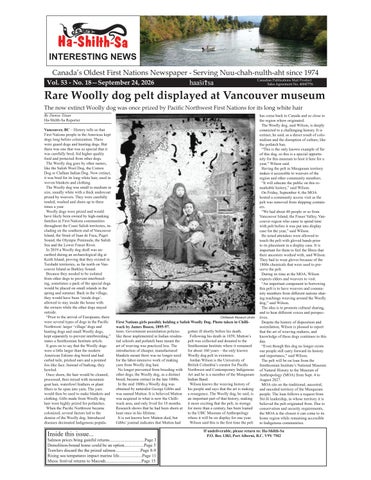
Rare Woolly dog pelt displayed at Vancouver museum The now extinct Woolly dog was once prized by Pacific Northwest First Nations for its long white hair By Denise Titian Ha-Shilth-Sa Reporter Vancouver, BC – History tells us that First Nations people in the Americas kept dogs long before colonization. There were guard dogs and hunting dogs. But there was one that was so special that it was carefully bred, fed higher quality food and protected from other dogs. The Woolly dog goes by other names, like the Salish Wool Dog, the Comox Dog or Clallam Indian Dog. Now extinct, it was bred for its long white hair, used in woven blankets and clothing. The Woolly dog was small to medium in size, usually white with a thick undercoat prized by weavers. They were carefully tended, washed and shorn up to three times a year. Woolly dogs were prized and would have likely been owned by high-ranking families in First Nations communities throughout the Coast Salish territories, including on the southern end of Vancouver Island, the Strait of Juan de Fuca, Puget Sound, the Olympic Peninsula, the Salish Sea and the Lower Fraser River. In 2019 a Woolly dog skull was unearthed during an archaeological dig at Keith Island, proving that they existed in Tseshaht territories, as far north on Vancouver Island as Barkley Sound. Because they needed to be isolated from other dogs to prevent interbreeding, sometimes a pack of the special dogs would be placed on small islands in the spring and summer. Back in the village, they would have been ‘inside dogs’, allowed to stay inside the house with the owners while the other dogs stayed outside. “Prior to the arrival of Europeans, there were several types of dogs in the Pacific Northwest: larger ‘village’ dogs and hunting dogs and small Woolly dogs, kept separately to prevent interbreeding,” states a Smithsonian Institute article. It goes on to say that the Woolly dogs were a little larger than the modern American Eskimo dog breed and had curled tails, pricked ears and a pointed fox-like face. Instead of barking, they howled. Once shorn, the hair would be cleaned, processed, then mixed with mountain goat hair, waterfowl feathers or plant fibers to be spun into yarn. The yarn would then be used to make blankets and clothing. Gifts made from Woolly dog hair were highly prized for potlatches. When the Pacific Northwest became colonized, several factors led to the demise of the Woolly dog. Introduced diseases decimated Indigenous popula-
Inside this issue...
Chilliwack Museum photo
First Nations girls possibly holding a Salish Woolly Dog. Photo taken in Chilliwack by James Booen, 1895-97. tions. Government assimilation policies gotten ill shortly before his death. like those implemented in Indian residenFollowing his death in 1859, Mutton’s tial schools and potlatch bans meant the pelt was collected and donated to the art of weaving was practiced less. The Smithsonian Institute where it remained introduction of cheaper, manufactured for about 160 years – the only known blankets meant there was no longer need Woolly dog pelt in existence. for the labor-intensive work of making Jordan Wilson is the University of yarn from Woolly dog hair. British Columbia’s curator for Pacific No longer prevented from breeding with Northwest and Contemporary Indigenous other dogs, the Woolly dog, as a distinct Art and he is a member of the Musqueam breed, became extinct in the late 1800s. Indian Band. In the mid 1800s a Woolly dog was Wilson knows the weaving history of obtained by naturalist George Gibbs and his people and says that the art is making was named Mutton. It is believed Mutton a resurgence. The Woolly dog, he said, is was acquired in what is now the Chillian important part of that history, making wack area, and only lived for 18 months. it more exciting that the pelt, in storage Research shows that he had been shorn at for more than a century, has been loaned least once in his lifetime. to the UBC Museum of Anthropology It is not known how Mutton died, but where it will be on display for one year. Gibbs’ journal indicates that Mutton had Wilson said this is the first time the pelt
Salmon prices bring gainful returns................................Page 3 Demolition-bound home could be an option..................Page 5 Trawlers discard the the prized salmon.......................Page 8-9 Rising sea tempatures impact marine life.....................Page 11 Music festival returns to Macoah.................................Page 15
has come back to Canada and so close to the region where originated. The Woolly dog, said Wilson, is deeply connected to a challenging history. It is extinct, he said, as a direct result of colonialism and the disruption of culture, like the potlatch ban. “This is the only known example of fur of this dog, so this is a special opportunity for this museum to host it here for a year,” Wilson said. Having the pelt in Musqueam territory makes it accessible to weavers of the region and other community members. “It will educate the public on this remarkable history,” said Wilson. On Friday, September 4, the MOA hosted a community access visit as the pelt was removed from shipping containers. “We had about 40 people or so from Vancouver Island, the Fraser Valley, Vancouver region who came to spend time with pelt before it was put into display case for the year,” said Wilson. He noted attendees were allowed to touch the pelt with gloved hands prior to its placement in a display case. It is important for them to feel the fibres that their ancestors worked with, said Wilson. They had to wear gloves because of the 1800s chemicals that were used to preserve the pelt. During its time at the MOA, Wilson expects elders and weavers to visit. “An important component to borrowing this pelt is to have weavers and community members from different nations sharing teachings weaving around the Woolly dog,” said Wilson. The idea is to promote cultural sharing, and to hear different voices and perspectives. Despite the history of disposition and assimilation, Wilson is pleased to report that the art of weaving endures, and knowledge of these dogs continues to this day. “Even though this dog no longer exists our people still carry forward its history and importance,” said Wilson. The pelt will be on loan from the Smithsonian Institute’s National Museum of Natural History to the Museum of Anthropology (MOA) from Sept. 4 to August 2027. MOA sits on the traditional, ancestral, and unceded territory of the Musqueam people. The loan follows a request from Stó:lō leadership, in whose territory it is believed the pelt originated from. Due to conservation and security requirements, the MOA is the closest it can come to its home region while remaining accessible to Indigenous communities.
If undeliverable, please return to: Ha-Shilth-Sa P.O. Box 1383, Port Alberni, B.C. V9Y 7M2
Page 2— Ha-Shilth-Sa—September 24, 2026
5,000-year-old evidence from Nuu-chah-nulth village sites A pelt from the extinct Wooly dog on display in Vancouver, valued throughout Vancouver Island’s west coast By Denise Titian Ha-Shilth-Sa Reporter Vancouver Island, BC – The news that a Woolly dog pelt is now on display at UBC’s Museum of Anthropology in Vancouver has drawn attention to the now extinct animal’s presence in pre-contact Nuu-chah-nulth villages. The Woolly dog was a small to mediumsized animal specially cared for and bred in pre-contact First Nations communities in what is now British Columbia’s Lower Mainland, the Pacific Northwest and Vancouver Island. Woolly dog bones have been found throughout Coast Salish and Makah territories, some dating as far back as 6,000 years according to a 2020 study published in the Journal of Archaeology. Described as spitz-like dogs with curly tails, the Woolly dog was prized by coastal First Nations for its thick, doublecoat, which was collected and spun, the yarn used in blankets and other woven items. In 1792 Captain George Vancouver of the British Royal Navy wrote, “The dogs belonging to this tribe of Indians were numerous and resembled those of Pomerania, though, in general, somewhat larger, they were all shorn as close to the skin as sheep are in England.” Studies show that the Woolly dogs of the Pacific Northwest descend from ancient wolf populations with deeper genetic ties to early Asian and American log lineages. The dog edged toward extinction at the time of colonization, and it is believed that the last known woolly dog died around 1940. This month the Smithsonian Institute loaned the University of British Columbia’s Museum of Anthropology the only known Woolly dog pelt collected from B.C. in the mid-1800s. The dog, in life, was named Mutton and live near presentday Chilliwack. According to the Canadian Encyclopedia, about 85 per cent of Mutton’s genome came from distinct pre-contact ancestry, proving it was a well-managed, pure breed developed long before European contact. Few know that the Woolly dog was an important part of Nuu-chah-nulth communities. They were known to be bred by the Makah, located on the northwestern tip of Washington State. The Makah are close relatives of the Nuu-chah-nulthaht on Vancouver Island, sharing the same language and whaling culture. So, it should not come as a surprise that the prized Woolly dogs would have made their way across the Juan de Fuca strait to Vancouver Island. Archaeological digs in Barclay Sound have unearthed several sets of dog remains. According to Audrey T. Lin, research associate in the American Museum of Natural History’s Department of Mammalogy, ancient dog remains from Nuuchah-nulth territories are being studied. “One large dog was recovered from T’ukw’aa, which is part of Toquaht territory in Barkley Sound. It was purposefully buried close to whale bones,” she told Ha-Shilth-Sa. It is inferred that the purposeful burial and its closeness to treasured whale bones indicates that the dog was important to the people who buried it. The other two sets of dog remains found on the west coast of Vancouver Island are from Tseshaht territory in the Broken Group Islands. “They were determined to be wool dogs by size, but I am hoping that with
Submitted photo
The skull of a West Coast Wool dog was found on Keith Island in 2019 during an archaeological dig. DNA we can actually confirm if they are by scavengers if left exposed on the midWoolly dogs (or not),” said Lin. den,” Dierks wrote. According to Lin, bone measurements She went to say that the remains of the alone is not a definitive way of determin- dog were positioned in a roughly northing species. south orientation, with the head facing “I’m doing genetic testing on the one south. ‘not a wool’ dog from T’ukw’aa, and two “The positioning of the remains has the dogs, (‘wool dog’ and ‘possible wool limbs tucked underneath the body,” she dog’) from Keith Island. I am hoping to noted. “Associated with the burial were have some results by the year’s end,” Lin several intact paired clamshell valves as wrote in an email. well as a hammerstone located directly An essay about the wool dog found underneath the left humerus. One large on Keith Island was written by Katie butter clam was nested in the ribcage of Dierks in 2020, titled Osteobiography of the dog. These paired clamshells located an Ancient Nuu-chah-nulth Wool Dog: Investigating the Life and Death of a Domestic Dog from Tseshaht Territory in Barkley Sound. Dierks wrote the paper in partial fulfillment of the requirements of the Honours Program in the University of Victoria’s Department of Anthropology. In her paper Dierks noted that the wool dogs found in archaeological sites in the territories of Nuu-chah-nulth First Nations on the west coast of Vancouver Island have received limited research attention. The dog excavated from ancient shell midden deposits from Tseshaht territory in Barkley Sound, she wrote, offers potential insight on how these dogs were treated and the relationships they had with Nuu-chah-nulth peoples prior to European contact. Early 19th century seamen observed that wool dogs in Makah villages were kept on isolated islands to prevent them from interbreeding with village dogs and losing their pure fur quality. The Kakmakimilh dog, unearthed on Keith Island, Tseshaht territory, was determined to be a male adult, at least 18 months of age at the time of death. It is apparent that the dog was buried with care. “The remains were determined to be purposefully buried based on the articulation and anatomical positioning of skeletal elements, otherwise the bones would have been damaged or dispersed
in the dog’s ribcage suggest they were purposefully placed into the burial rather than an accidental occurrence.” The condition of the skeletal remains show that the dog had been injured in life and cared for until its injuries healed. There was a healed broken rib, an injury to the tail and signs of osteoarthritis in a knee. But the dog survived past its injuries, being fed and protected from predators. Scientists suggest this shows that this wool dog had a strong social bond with the people at Kakmakimilh. There are two partial dog skeletons excavated from the Broken Group Islands that appear to be deliberate burials. These dog remains were located at a site that, according to researchers, indicates they were buried long before contact with Europeans. “(The) dogs were located at the earliest dated portion of the site, which means Tseshaht kept dogs there as early as 5,000 years ago,” Dierks wrote. Written descriptions of Nuu-chah-nulth wool dogs have described them as being large- or medium-sized with pointed ears and thick coats of white, brown, or blackcolored fur. Early ethnographers noted that wool dogs in Nuu-chah-nulth territories were larger than the ones on the east coast of Vancouver Island in Coast Salish territories. One source claims to have been told of a large-sized wool dog from the village of Yuquot on the south edge of Nootka Island. Another reference to wool dogs and Nuu-chah-nulth-aht comes from Dr. Nancy Turner, who wrote that the animal’s hair was often spun with yellow cedar bark in Nitinaht communities. The Kakmakimilh Archaeological Project is a collaboration between Tseshaht First Nation, UVic’s Department of Anthropology, Pacific Rim National Park Reserve and the Bamfield Marine Sciences Centre. Dr. Audrey Lin continues to pursue research with Nuu-chah-nulth communities on dogs, specifically from Toquaht and Tseshaht territories.
September 24, 2026—Ha-Shilth-Sa—Page 3
High Chinook salmon prices bring gainful returns Tsu-ma-uss fishers were getting over $7.00 per pound of Chinook at the start of the 2026 season Nora O’Malley Local Journalism Initiative Reporter Port Alberni, BC – With wild-caught Chinook salmon fetching as high as $7.75 per pound early in the season that opened mid-August, Hupacasath and Tseshaht First Nations commercial fishers are reeling with gratitude for the lucrative run. Tseshaht gill netter Nasimius Ross holds a licence for the Tsu-ma-uss (Somass) River fishery, an economic opportunity fishery collaboratively operated by the two Alberni Valley-based nations. Ross said they usually start selling at $3.50 per pound and the average weight of a Chinook is 15 pounds. “It’s good money. One of the openings caught 600 to 700 fish. That’s one night of fishing. It’s estimated that brought just about $5 million into the economy, and that’s locally. All that stays here,” said Ross. Fellow Tsu-ma-uss gill netter Martin Watts said it’s a win-win for both nations. “It’s nice to see that the wealth from the fish that come up has finally got to a point where our fishermen are making a good living,” said Watts. “Our fishery totally benefits Port Alberni. The money that comes is basically spent here. The kids are the beneficiary of our fishery when it comes to the fall fair or new school clothes. This is the perfect time of year for our Chinook fishery just for that fact,” said Watts. Tsu-ma-uss Fishery encompasses the Somass River watershed, Alberni Inlet and Barkley Sound. The First Nations economic opportunity fishery was established in 1992 in response to court decisions that affirmed an Indigenous right to fish under Section 35 of the Constitution. Section 35 is the part of the Constitution Act that recognizes and affirms Aboriginal rights. Four seasons ago in 2022, the Tseshaht and Hupacasath First Nations fisheries generated an estimated $1.5 million.
Eric Plummer photos
First Nations fishers work with the September tides on the Somass River in Port Alberni. “It’s been a great year. I’ve been spending a lot more time with my son; that’s better than all the fish in the Somass right now, just spending time and sharing the information that I’ve learnt over the years and teaching him. That’s worth everything to me,” said Ross, who also fishes with his daughters. 90 per cent goes to U.S. As of Sept. 18, French Creek Seafood, a Parksville-based Chinese-owned commercial fishery, was buying Chinook at $5 per pound, which is considered the “normal price”, according to French Creek Seafood president Brad McLean. “We’ve been working with the boys over there since they’ve been allowed to have commercial sales. We really enjoy
working with the local fishers,” said McLean. “The size of the fish is smaller (this season), but it’s been a good run and it’s been very good for the fishermen this year. I don’t know why the prices are so high this year. The start of the season there was a little less supply, but now it’s pretty good,” said McLean. He said the murky Canadian-U.S. trade climate has not impacted sales. “There is no tariff on seafood. Ninety per cent of our product goes into the U.S. Only about 10 per cent of seafood caught in Canada stays in Canada,” said McLean, noting that they are always looking around for different markets. “Never keep all your eggs in one basket,” he said. The high price of Chinook is also reflected in grocery stores across the country with the Stats Can Consumer Price Index (CPI) tracker showing the cost of canned salmon climbing 8.1 per cent in August compared with August last year. Fish in general was up six per cent. The 2026 pre-season forecast return of Somass River Chinook (Stamp River, Somass River and Robertson Creek Chinook), including both natural and hatchery-born Chinook to the terminal area
of Barkley Sound and Alberni Inlet, was 189,000 adults, according to Department of Fisheries and Oceans Canada (DFO). But by September 17, DFO dropped the in-season “reforecast” to 140,000. As of that date, Tsu-ma-uss First Nations had harvested 32,656 Chinook and 129,283 Sockeye. The department said Chinook escapement for the area “remains strong” for this point in the season and is tracking above the historical average. Escapement is the amount of salmon that return to a hatchery or stream to spawn. Over 90 per cent of the Chinook caught by the Tsu-ma-uss Fishery originated from the Robertson Creek Hatchery near Great Central Lake, according to Watts. “I think the survival rate has risen due to the closures up in the Queen Charlotte (Haida Gwaii). We have benefitted from that,” said Watts. Graham Murrell, fisheries manager and biologist for Hupacasath First Nation, said this years’ Robertson Creek Chinook forecast was the highest in the last decade. “Whether that return actually is realized is yet to be determined,” said Murrell. “I suspect in the end it won’t be the largest return of the decade.”
Page 4— Ha-Shilth-Sa—September 24, 2026 Ha-Shilth-Sa newspaper is published by the Nuu-chah-nulth Tribal Council for distribution to the members of the contributing First Nations, as well as other interested groups and individuals. Information and original work contained in this newspaper is protected by copyright and may not be reproduced without written permission from: Nuu-chah-nulth Tribal Council P.O. Box 1383, Port Alberni, B.C. V9Y 7M2. Telephone: (250) 724-5757 Fax: (250) 723-0463 Web page: www.hashilthsa.com facebook: Hashilthsa Ntc
2026 Subscription rates: Non-Nuu-chah-nulth, Ahousaht, Ehattesaht,Toquaht and Ucluelet members are subject to a yearly subscription fee of $40 in Canada, $50 in the US and $60 for overseas. Payable to the Nuu-chah-nulth Tribal Council
Manager/Editor/Reporter Eric Plummer (Ext. 243) (250) 724-5757 Fax: (250) 723-0463 eric.plummer@nuuchahnulth.org Reporter Denise Titian (Ext. 240) (250) 724-5757 Fax: (250) 723-0463 denise.titian@nuuchahnulth.org Reporter Nora O’Malley (604) 353-8488 nora.omalley@nuuchahnulth.org Audio / Video Technician Mike Watts (Ext. 238) (250) 724-5757 Fax: (250) 723-0463 mike.watts@nuuchahnulth.org Editorial Assistant Holly Stocking (Ext. 302) (250) 724-5757 Fax: (250) 723-0463 holly.stocking@nuuchahnulth.org
DEADLINE: Please note that the deadline for submissions for our next issue is Oct 2, 2026 After that date, material submitted and judged appropriate cannot be guaranteed placement but, if material is still relevant, will be included in the following issue. In an ideal world, submissions would be typed rather than hand-written. Articles can be sent by e-mail to holly.stocking@nuuchahnulth.org (Windows PC). Submitted pictures must include a brief description of subject(s) and a return address. Pictures with no return address will remain on file. Allow two - four weeks for return. Photocopied or faxed photographs cannot be accepted.
LETTERS and KLECOS Ha-Shilth-Sa will include letters received from its readers. Letters MUST be signed by the writer and have the writer’s full name, address and phone number on them. Names can be withheld by request. Anonymous submissions will not be accepted. We reserve the right to edit submitted material for clarity, brevity, grammar and good taste. We will definitely not publish letters dealing with tribal or personal disputes or issues that are critical of Nuu-chah-nulth individuals or groups. All opinions expressed in letters to the editor are purely those of the writer and will not necessarily coincide with the views or policies of the Nuu-chah-nulth Tribal Council or its member First Nations. Ha-Shilth-Sa includes paid advertising, but this does not imply Ha-Shilth-Sa or Nuu-chah-nulth Tribal Council recommends or endorses the content of the ads.
Haahuupayuk School to celebrate 50 years Students and staff preparing for potlatch style celebration and you’re invited! By Denise Titian Ha-Shilth-Sa Reporter Port Alberni, BC – Kids are happily skipping down the street as a school bus fills with kids. It’s 3:00 p.m. and Haahuupayuk School has finished another fun-filled school day. Inside the main entrance is a foyer, the walls adorned with children’s art. Paper shirts painted orange, commemorating the National Day for Truth and Reconciliation on September 30. The school, built in the shape of an eagle, is vibrant and filled with Nuuchah-nulth words, art and imagery. There is no mistaking what this school is about. It is a celebration and love of First Nations culture. And it’s hard to believe that the building is nearly 30 years old. But Haahuupayuk staff and students are preparing for preparing for something big – and they need your help. It has been 50 years since the original Haahuupayak school welcomed its first students on the Tseshaht First Nation reserve. Established in 1976, Nuu-chahnulth leaders of the day established a school that would address the systemic problem of racism in the public school system. The school was a place that not only taught the students the ‘three R’s’ – Reading, Riting and Rithmetic, but it also became a place where Nuu-chah-nulth children learned about their culture from the perspectives of their elders. It is place where Nuu-chah-nulth children learn language, stories and culture of their own in a way that builds self-esteem. Something very different from what their parents and grandparents experienced in residential or public schools. “That’s what the school was all about. To give them a good start and a good foundation,” Ann Robinson, former Haahuupayuk teacher, said in 2016. The original school started on the grounds of the former Alberni Indian Residential School, at Peake Hall. In later years it expanded to Ross Hall, with just under 100 students, more than half of whom were bused in from Port Alberni. In October 1997, Haahuupayak opened its beautiful new building in a new location on the Tseshaht First Nation Reserve. The children are proud of their school.
Denise Titian photo
Nuu-chah-nulth cultural educators Francine Frank, Lean Ross and Trevor Little. “Everyone is caring and make the students feel comfortable,” said Kessa. Todd says he loves to learn to dance and sing. Ander says learning the culture has become part of his life. “I feel relaxed, calm, it heals,” he said. Anitrea says she likes how she is treated at school and it feels like part of the community. Taisha also likes learning songs and dances and says there are no real mistakes, it is safe learning. “I like the school because we are taking back our culture,” said Kessa. When the language and academic lessons are done, the students get busy making gifts for guests they are inviting to the 50th anniversary celebration of Haahuupayak school. With donated materials, and volunteer teachers, the children are beading, sewing, carving and sanding. They plan to welcome everyone, Nuuchah-nulth style, at the main entrance of Haahuupayak School on October 8 at 8:30 a.m. where the celebration will begin. Throughout the day the hosts will
Legal Information
COVERAGE: Although we would like to be able to cover all stories and events, we will only do so subject to: - Sufficient advance notice addressed specifically to Ha-Shilth-Sa. - Reporter availability at the time of the event. - Editorial space available in the paper. - Editorial deadlines being adhered to by contributors.
honour those visionaries that helped to launch the school. Other people will be honoured and the students will be front and center. Francine Frank is the Nuu-chah-nulth studies coordinator and is helping to plan the event with cultural teachers, Lena Ross and Trevor Little. The celebration, they said, will be done potlatch style with songs, dances, acknowledgements, food and handmade gifts. Because everyone is invited, they expect the school to fill quickly. The Maht Mahs gym will be used to feed the people and, when the school fills, the event will be live-streamed so people can watch from anywhere. Organizers are looking for 50 years of photographs and stories from former staff and students. They are looking for volunteers that can help to teach crafts or maybe donate materials for crafts. If you can help in any way, contact Francine Frank by email at FFrank@Haahuupayak.com
Ha-Shilth-Sa belongs to every Nuu-chah-nulth person including those who have passed on, and those who are not yet born. A community newspaper cannot exist without community involvement. If you have any great pictures you’ve taken, stories or poems you’ve written, or artwork you have done, please let us know so we can include it in your newspaper. E-mail holly.stocking@nuuchahnulth.org. This year is Ha-Shilth-Sa’s 52nd year of serving the Nuu-chah-nulth First Nations. We look forward to your continued input and support. Kleco! Kleco!
The advertiser agrees that the publisher shall not be liable for damages arising out of errors in advertisements beyond the amount paid for space actually occupied by the portion of the advertisement in which the error is due to the negligence of the servants or otherwise, and there shall be no liability for non-insertion of any advertisement beyond the amount paid for such advertisements
September 24, 2026—Ha-Shilth-Sa—Page 5
Demolition-bound homes could be an option study says Could repurposing and moving old homes alleviate housing shortage for Canada’s First Nations? By Antonella Arias Ha-Shilth-Sa Contributor Vancouver, BC—A new study from Light House, a Canada-based non-profit focused on regenerative building practices, analyzed how demolition-bound homes could be relocated and repurposed as a housing alternative during the housing shortage crisis. According to the study, A Second Life for Canada’s Homes, approximately 90,000 single-family homes will be demolished across seven major Canadian cities over the next decade. The Assembly of First Nations estimates more than 108,000 additional housing units are needed nationally, with strong housing needs among First Nations communities in B.C., Alberta and Ontario — three provinces with the strongest potential source market for relocated homes. According to the Aboriginal Housing Management Association (AHMA), a housing authority that advocates broadly for Indigenous housing, several factors contribute to the housing shortage. For example, most government housing programs are designed with municipalities in mind, not non-profit or Indigenous housing providers. In addition, some programs require providers to cover 20–30 percent of a project’s cost themselves — municipalities can draw on tax revenue to cover that, but non-profit housing providers usually cannot. AHMA says that building more houses does not automatically help those facing housing insecurity, as units priced 20 percent “below market” are still out of reach for low-income families. Young people under 25 and older adults (aged over 55) face higher housing vulnerability. Housing insecurity tends to hit hardest for people with limited income, fixed income, or limited access to affordable housing. The study, in support of the Research Knowledge Initiative (RKI) by Housing, Infrastructure, Communities, explores home relocation options — physically moving existing homes from a redevelopment site to new locations to be renewed for continued use — across Vancouver, Victoria, Calgary, Edmonton, Hamilton, Toronto and Ottawa. Many of the homes slated for removal still have years of life, and some are abandoned or need to be removed to build multi-unit residential buildings. Using a conservative, industry-informed estimate, approximately 20 per cent of homes selected for demolition may be chosen for relocation after checking their quality and mobility, offering a potential supply of roughly 18,000 homes over the next decade. The criteria for considering a demolition-bound house for relocation include two factors: structural integrity and mobility. Cosmetic elements like appliances can be replaceable, but the structural aspects of the home, like the roof, framing, and foundations, should be solid enough for a home to qualify for a second chance. The second aspect is how accessible it is to move a house from one place to another, accounting for dense urban surroundings, whether the project is financially accessible after coordination costs are included, and whether the home matches First Nations housing needs. While some neighbourhoods are impossible to access, Vancouver Island has enough space to rescue homes, with several moving companies ready for the work.
Renewal Development photos
Three homes being relocated to the Shíshálh Nation by tug and barge.
Gil Yaron To move a house, the moving company needs multiple permits and approvals, depending on the city, involving utility companies, ecological protection measures, or police escorts. Usually, the moving company sells it to a buyer or stores it. However, Renewal Development (Renewal) — a Vancouver-based company specialized in relocating and repurposing homes — goes beyond the standard. Renewal matches homes slated for demolition in First Nations communities, prepares receiving sites by pouring foundations, installing utility connections, and overseeing the restoration process. “Any relocated homes to First Nations have to be Nation-driven. First Nations are [involved] in every aspect of the process. [They] select the homes, determine where they’re going to be located on their lands, and what kind of improvements are going to be made. There’s consultation with them all along the way,” said Gil Yaron, Managing Director of Light House. The model is technically feasible across all seven cities studied, with limitations for each city, but under the right circumstances it could provide practical housing at a reduced cost, reduce carbon emissions and waste and be faster than conventional construction. British Columbia is a prime example of the study’s effectiveness. Renewal has successfully delivered 32 relocated homes to four First Nations communities — shíshálh Nation, Sts’ailes Nation,
Port Moody home being relocated and moved through town by truck. ʼNa̱mǥis Nation and the Squamish Nation — at the request and expectation of each nation through the Home Relocation and Repurposing Program (HRRP). The model also offers environmental advantages. A typical 1300-square-foot home represents approximately 49 tonnes of building material and 23 tonnes of embodied carbon, the emissions generated from producing and transporting materials used to build it. Relocating existing homes allows material reuse, reduces demolition waste, and avoids new emissions from manufacturing materials for replacement housing. “We have a policy crisis that we’re facing today. We’ve a housing crisis, a waste crisis, and a climate crisis. Any strategies to preserve and provide housing that reduces waste and also addresses climate by reducing carbon emissions is something that we think is worthy of consideration by government and industry,” said Yaron. “We are bringing this forward as a strategy to incorporate into Canada’s National housing policy to provide housing, especially to rural communities and First Nations Communities.” All levels of government need to work collaboratively with Indigenous governments, municipalities, and communitybased housing organizations to address the housing shortage, as no single level of government can address the affordable
housing crisis on its own. AHMA calls on the government to root housing policy in a human-right-to-housing and Indigenous-governance approach. That means treating housing as a fundamental right; redirecting resources to those with the greatest need; recognizing Indigenous governance and jurisdiction at every stage of the process; designing funding that reflects the financial realities non-profit and Indigenous housing providers actually face; and ensuring governments protect the affordable housing that already exists. “From a social housing perspective, housing is a right and people should have access to quality homes. We are perpetuating a situation of inequality and disadvantage. When you don’t have adequate housing, you cannot move forward to other aspects of your life because you’re focused on meeting your basic needs,” said Yaron. The next step is for every party involved—government, the building industry and communities—to create the adequate conditions for home relocation on a wider scale. This involves identifying potential homes that still offer a second chance, matching them with the communities that need and want them, and addressing the permitting, financing and regulatory barriers.
Page 6— Ha-Shilth-Sa—September 24, 2026
First Nations bylaws to be challenged in Canadian court Can First Nations governments search members or have them banned in an effort to save lives? By Denise Titian Ha-Shilth-Sa Reporter Canada – Addictions, family violence, alcohol-related crime – these are issues faced by most First Nations across the nation. Most people say that the root of these problems can be traced back to colonialism, forced assimilation, trauma and the legacy of Canada’s residential school system. Regardless of where the problems started, First Nations governments have been working for decades to fix it. In 1974, leaders of Esk’etemc First Nation, then known as Alkali Lake Indian Band, made a bold move and banned alcohol on their reserves. Faced with what they say was a nearly 100 percent alcoholism rate in the early 1970s, the community’s social fabric was being torn to shreds with alcohol-induced violence and child neglect. Some called the place Alcohol Lake. During that time, Andy and Phylis Chelsea, community members, launched a grassroots campaign to stem the flow of alcohol coming into the community. With the help of the RCMP, liquor deliveries to the village were halted and bootleggers were arrested. Interventions took place and culture was reintroduced. Fifty years later, the nation claims a ‘roughly 95 percent sobriety rate’. Closer to home, there are Nuu-chahnulth First Nations that have used similar tactics. More than 20 years ago Ahousaht First Nation banned alcohol from the reserve. Other methods to save the people were tried along the way. Cultural leaders, with the support of the Ahousaht Ha’wiih confronted bootleggers in the village and asked them to take the offer of community-based cultural treatment or leave. Deterrents like fines and jail terms for bringing alcohol into the village were introduced, but that failed. In March 2025, at a Fisheries meeting, Hasheukumiss, sitting in for his father, Tyee Ha’wilth Maquinna, spoke about their by-laws, a $1,000 fine for the first offence of bringing liquor into the community, followed by a six-month jail term for a second offence. “It doesn’t’ matter how many bylaws we create, if we don’t have anybody to enforce it, those are for nothing,” he said back then. He went on to say that the nation wants to bring in an unbiased bylaw officer, to avoid nepotism. Hereditary and elected leadership stressed that this illicit flow of alcohol severely fueled local addictions, violence, and tragic, preventable deaths. According to Hasheukumiss, there have been 51 of his people that were lost to alcohol from 2015 to 2025. Ahousaht has been supported by both federal and provincial governments in their efforts. The RCMP, a federal policing agency has supported Ahousaht witwok in liquor searches and other efforts. In 2024 the Tofino governmentrun BC Liquor store imposed a limit of four bottles of liquor per customer at the request of Ahousaht Ha’wiih and the ministry. But what happens when there is pushback on punishments related to on-reserve liquor? Are searches, banishments, and monetary fines even legal? In other parts of Canada, band members are fighting the prohibitions and banishments that they say violate their rights as Canadians. In a news release dated September 8,
Submitted photo
extraordinary acts of violence and sex crimes would result in banishment from a First Nation community. Banishment was a last resort. Today, I have seen band councils use banishment and eviction as the first and only option to address interpersonal conflict,” said Louie, who is a lawyer and member of the Lower Kootenay Indian Band. “The power banishment gives band councils, without any recourse for their members, results in an enormous power imbalance,” he said. In early September 2026, the Justice Centre for Constitutional Freedoms filed four lawsuits in Calgary Alberta challenging banishment, search and detention provision in bylaws enacted by four indigenous governments in Alberta and Manitoba. “All four challenged bylaws regulate alcohol, illegal drugs, or other intoxicants on reserve lands,” said the JCCF in a statement. Punishments for the bylaws include fines, banishment, and imprisonment. According to the JCCF, the challenged provisions of the bylaws exceed the authority delegated under the Indian Act and deny procedural fairness. The Federal Court applications concern the Little Red River Cree Nation, Fisher River Cree Nation, Roseau River Anishinabe First Nation and the Little Grand Rapids First Nation. In their statement, the JCCF quotes Constitutional lawyer Phil Dunlop. “Band councils have every right to address substance abuse, but they must do so within the law. They cannot set up roadside checkpoints and search people and vehicles indiscriminately, authorize warrantless searches of homes and offices, or banish their own members without adequate procedural and constitutional safeguards.” “I am really hoping to see meaningful change respectful of members’ rights on this issue, and I think public information and discussion of this issue among First Nation communities will be centrally important to change,” said Marty Moore, Legal Director of Charter Advocates of Canada. According to Moore, the First Nations respondents will have 10 days to file a notice of appearance after being served if it wishes to contest the application. “Service was accomplished last week, and at least one First Nation has filed an appearance,” he wrote in an email to HaShilth-Sa.
Ahousaht security enforcing alcohol bylaws back in 2019, during COVID. 2026, the Justice Centre for ConstituAlberta’s Little Red River Cree Nation tional Freedoms (JCCF) said they would has a by-law, for example, according to be representing two plaintiffs in separate JCCF, related to the sale of illegal drugs provinces. The two men are challenging or bootleg alcohol on reserve. Contraventheir First Nations’ over what they say tion of the by-law could mean a fiveare warrantless searches and five-year year banishment for the member. “The banishments. By-law does not provide any prior notice In Northwestern Ontario, Doug Riffel, or a chance to be heard prior to Council former chief of Wabauskang First Nation making an initial banishment or removal (WFN) territory, was banished from his decision.” home territory in June 2025 by Band Rob Louie, President of the Band MemCouncil Resolution (BCR). Faced with bers Alliance and Advocacy Association criminal charges in 2024, Riffel’s banish- of Canada (BMAAAC), is supporting the ment was said to be based on public JCCF in filing of their four Federal Court safety. But the criminal charges were applications challenging banishment, withdrawn in March 2026. According search, and detention provisions in byto the Justice Centre, Mr. Riffel has no laws enacted by four indigenous governcriminal record. ments in Alberta and Manitoba. “Lawyers funded by the Justice Centre BMAAAC is a national organizapreviously sent a warning letter to WFN tion that helps indigenous people seek in February 2026, stating that the bantransparency, accountability, and justice ishment was “unlawful and unconstitufrom their indigenous governments. Its tional” and requesting that it be rescinded mandate is to help band members get acimmediately,” wrote the JCCF. In that let- cess to justice. ter, the JCCF asserts that, “a First Nation The JCCF is a registered charitable orband council cannot simply banish band ganization that defends the constitutional members at will,” and that a BCR, withrights and freedoms of all Canadians out a supporting bylaw enacted under the through litigation and education. Indian Act, “does not carry the authority “Historically, acts akin to treason and of the Indian Act, and is unenforceable.” In other cases, the JCCF have issued warning letters to First Nations in Alberta and Saskatchewan. The legal warning GATEWAY TO THE PACIFIC RIM letters concern five-year banishments of members – penalties for breaking band by-laws. One man faced a five-year ban after contraband was discovered during a roadside check. While the warning letters had the desired effect, and the banishments were rescinded, the legal challenge against the First Nations that issued the banishments remains. “The four new warning letters argue that these bylaws exceed the authority delegated under the Indian Act, deny affected individuals’ basic procedural fairness, and violate multiple protections guaranteed by the Canadian Charter Hours of operation - 7:00 am - 10:00 pm of Rights and Freedoms,” stated JCCF. Phone: 724-3944 At issue are the penalties some First E-mail: manager@tseshahtmarket.ca Nations are imposing and whether they violate the member’s rights as Canadians. Find us on Facebook
TSESHAHT MARKET
September 24, 2026—Ha-Shilth-Sa—Page 7
Fifteen local groups step up for Orange Shirt Day Demolition news of the former Caldwell Hall is expected at the event, which brought over 1,000 last year By Keith Durocher Ha-Shilth-Sa Contributor Port Alberni, BC - The sixth annual Orange Shirt Day walk, hosted by the Tseshaht nation, will take place on National Truth and Reconciliation Day, Wednesday, September 30th 2026. As it did last year, the walk will start at Maht Mahs Gym, one of the two remaining buildings from the original Alberni Indian Residential school which shut down 53 years ago. The walk concludes at the Alberni Athletic Hall, with a celebration including food, a drum circle, survivors stories, and vendors. Elected chief councillor for the Tseshaht First Nation, Ken Watts, said that last year’s walk was an outstanding success, and has high hopes that this year will be even bigger and better. “I’d say last year and the year before we had over a thousand,” he said. “Last year we switched it up and we actually walked from the residential school up to the high school and [then on] to the athletic halland I’d argue it was one of the best ones and best turn outs we’ve had. Well over a thousand people, a majority of them aren’t actually even Indigenous that walk with us. It’s pretty awesome to see the huge participation.” The open show of support from nonIndigenous residents of the Alberni Valley is one of the strongest signs that the Orange Shirt Every Child Matters campaign is having a real impact. Started in 2013, the symbol of the orange shirt is a reminder of everything taken from First Nations youth forced into the residential school system from 1879 through to 1997.
Eric Plummer photo
Hundreds took part in the Orange Shirt Day walk, Sept 30, 2025. The walk progressed along River Road after starting on the Tseshaht reserve. Water, juice and other treats were served to the walkers as they went. “For the first time we’ve got major “I think that’s what’s awesome - you donations to help organize the event and look at the athletic hall last year it’s like this sea of like hundreds and hundreds of help pay for the t shirts,” added Watts. “It’s kind of a logistical challenge, so people wearing orange,” said Watts. “It the city is helping make sure we have just shows the love and support we have here in the Alberni Valley.” flagging by working with the Ministry of Transportation, all logistical things.” During the 2025 event Tseshaht made Among the major sponsors of the event a public request for help shouldering the walk and gathering that follows, stressthis year are Unifor Locals 592 and 686. Ted Haggard, 1st vice president of Local ing that “reconciliation is a two-way street.” This year the City of Port Alberni 592, hopes the union can help the Sept. has picked up some of the responsibil30 walk become one of Canada’s biggest. “We believe this is an important event to ity of coordinating the event, as well as sponsor because of the work that is being the ACRD, Hupacasath, Mosaic and 12 others are working closely with Tseshaht done and still needs to be done around Truth and Reconciliation. We want to First Nation.
stand with the local nations as they navigate through this process and support them where we can,” he said. “Our goals are to help educate our members and everyone else on what happened in the past, we want to learn how to help navigate moving forward. It is important for us to support Tseshaht because of the AIRS being forced into their community, to support and walk with the survivors and help to hold them up while not forgetting those that didn’t make it out of that horrendous place.” “This event always gets great feed back and I believe that every year we all learn something that we weren’t aware of before,” added Haggard. The future of the Orange Shirt Day walk is looking bright indeed, with growing support from across the Alberni Valley and beyond. “I think, to be honest, that a lot of the weight of all of this day falls on us,” said Watts, “and really it should be the other way around - others should be helping to support our survivors and our community who’ve had to endure all the things that have happened over the years.” “That’s our end goal: one year it’ll actually be hosted by others, and they’ll organize all of it. I think we’ve already made a huge step [towards that] with the city stepping up,” noted Watts, with one last teaser to offer. “We’ll probably be giving people a bit of an update on the teardown of the Caldwell Hall at the event too we’ll be sharing some more details and some exciting news coming up!” All the more reason not to miss this years walk.
Page 8— Ha-Shilth-Sa—September 24, 2026
As B.C.’s fishers face Chinook closures, trawle In 2023, Chinook bycatch in the B.C. groundfish trawl fishery spiked to more than 26,000 fish. DFO introduced a fleetBy Nora O’Malley Local Journalism Initiative Reporter Vancouver Island, BC – The Government of Canada says the recovery of wild Pacific salmon stocks is a key priority, but both Indigenous and non-Indigenous harvesters call foul. They say if the government really wanted to rebuild wild salmon stocks, they would ban groundfish trawling. “No sports fisherman and even no commercial fisherman can figure out why the government still allows draggers to go offshore and drag up the bottom of the ocean,” said Sam Vandervalk, owner of Uclueletbased Salmon Eye Fishing Charters. “It’s completely barbaric. It doesn’t do the fishery any good,” he said. Hesquiaht commercial fisher Will Amos agrees. “It’s very clear what the problem is. Bottom trawling should be banned. They wreck the bottom,” said Amos. His dad Victor Amos (Vic), a longtime hook and line commercial fisher, showed him the ropes. “They’ve destroyed whole lingcod areas by dragging. As soon as one of the draggers come along, fishing turned right off. It decreased by 60 per cent in some areas,” said Vic. 100 per cent monitoring Bottom trawling is a non-selective fishing method that involves towing nets along the seafloor. It is also referred to as “dragging”. The B.C. commercial groundfish trawl fishery is a limited entry fishery; there are currently 133 commercial Groundfish Trawl (T) licences and four First Nations Groundfish Trawl (FT) licences, according to the Department of Fisheries and Oceans Canada (DFO). For the 2026 season from Feb. 21 to Sept. 8, DFO says there are 27 actively fishing trawl vessels, a number that could change as the season remains open. There are seven distinct commercial groundfish sectors: Groundfish trawl, Halibut, Sablefish, Inside Rockfish, Outside
For the 2026 season from Feb. 21 to Sept. 8, DFO says there are 27 actively fishing trawl vessels, a number that could change as th trawler off the West Coast. Rockfish, Lingcod, and Dogfish fisheries. “All monitoring footage is independently tions.” The groundfish fishery operates year-round; reviewed by a third party certified by DFO The Pacific groundfish trawl fishery is the season begins on February 21 and ends to ensure objective validation of catch now managed under a fleet-wide bycatch on February 20 of the following year. data,” states the Deep Sea Trawlers Assocap of 9,500 Chinook salmon as part The trawl fleet has 100 per cent at-sea ciation of BC. “This ensures that all catch, of the new management plan for the monitoring, meaning every fishing trip is including bycatch, is recorded accurately, 2024/24 fishery and 2026/27 groundfish supporting compliance, research, and fishing season. independently observed from the time the ecosystem-based management. Vessels are The Chinook salmon bycatch cap was vessel leaves the harbour until it returns developed after a DFO review of salmon also equipped with sensors to verify catch and the fish is validated at the offload with areas and ensure compliance with regulabycatch in the Pacific Region grounddockside observers.
Image by Joe G. Shoulak
Groundfish trawling or “dragging” is a non-selective fishing method that involves towing nets along the seafloor.
September 24, 2026—Ha-Shilth-Sa—Page 9
rs discard the prized salmon by the thousands -wide bycatch cap of 9,500 in 2024/25 to help reduce the number on unintentionally caught Chinook separately for each tow, with a maximum of ten heads loosely packed in each bag to facilitate efficient species identification and counting,” said DFO. “Chinook salmon heads were required to be bagged separately from other salmon species because they were the dominant species of salmon bycatch and the only species managed under a bycatch cap. At offload, bagged heads were examined and counted by dockside observers for independent validation of catch by species,” DFO continued. Orcas are starving
Mark Wunsch/Greencoast Media photo
e season remains open. Pictured is a fish trawl fishery. This review found that Chinook was the primary salmon species caught in the 2022/23 groundfish fishing year, with an estimated catch of 26,273 representing 93 per cent of the total salmon collected by the trawlers. Since the implementation of the Chinook bycatch cap, there was an estimated total of 7,527 salmon caught by the 2024/25 groundfish fishery, including 7,040 Chinook salmon, according to DFO. Chinook salmon that are intercepted by trawling cannot be sold or retained for commercial gain; any Chinook incidentally caught are recorded and surrendered to DFO and then used strictly for scientific research and data collection to inform ongoing conservation measures, according to the DSTA. “Vessels were required to bag heads
One of the casualties of our time are the endangered Southern Resident killer whales, or orcas, a species that rely heavily on Chinook salmon for food. With only about 75 individuals remaining, it has been widely reported that the orcas are starving – they don’t have enough Chinook salmon to keep calves alive and survive as adults. Researchers are calling the death of the Southern Residents “bright extinction”, a term coined to represent the discontinuation of the species in plain sight, despite being the best studied cetaceans in the world. In April 2026, DFO released management measures, including salmon fishing closures that apply to recreational and commercial fisheries, to support the recovery of Southern Resident orcas by protecting access to Chinook salmon. “The fishery closures to support Southern Resident killer whale recovery do not include the groundfish trawl fishery,” said DFO. “The yellow areas shown on the map are salmon fishing closures that apply to recreational and commercial salmon fisheries,” they said. “Groundfish trawl fisheries are managed separately and are not subject to these Southern Resident salmon fishing closures.” Research conducted by Pacific Wild indicates that over the last 13 years, nine trawlers have collectively fished an area larger than Ireland—totalling 89,700 square kilometres. “Within this vast total, some ecologically sensitive areas have been targeted multiple times, hit again and again, compounding the damage to habitats that are vital for marine biodiversity and ecosystem health, with repeated fishing activity preventing these areas from recovering,” said Pacific Wild. The Council of Haida Nation is fighting to permanently eliminate all commercial trawling (midwater and bottom) in Haida
Nora O’Malley photo
Hesquiaht fishing family Victor Amos with his grandson George and son Will.
Marcie Callewaert photo
A baby Bigg’s orca photographed near Tofino on Jan. 5, 2026, was malnourished and wounded.
DFO image
DFO map: The salmon fishery closures on the map to support Southern Resident killer whale recovery do not include the groundfish trawl fishery. waters, according to the National Oceanic Gwaii waters. The nation says trawling is and Atmospheric Administration’s National destructive to seafloors, impacts the susMarine Fisheries Service. tainability of fish stocks and poses a threat In August 2026, the B.C. groundfish trawl to community food security. They say the trawl fishery provides “no economic benefit received Marine Stewardship Council (MSC) certification for 16 commercially to Haida or Haida Gwaii’s communities.” harvested species. The MSC marketing In an act of solidarity with the Haida label suggests the fishery is “environmenNation, the B.C. Assembly of First Nations passed a resolution at the March 2026 tally sustainable”, but evidence suggests and many environmentalists argue that the Special Chiefs Assembly to ban trawling in MSC is a third-party certification scheme Pacific coast waters. that deceives customers. DFO acknowledged the calls to ban dragZoe Ahnert, executive manager of the gers but maintained that the Pacific groundfish trawl fisheries are managed with “regu- Deep Sea Trawlers Association of BC, defends this certification. latory and licensing tools which set out a “MSC certification strengthens market comprehensive management framework for the fishery that supports the conservation of opportunities for British Columbia seafood while recognizing the decades of colspecies and marine habitats.” laboration and innovation that have made “Decisions related to fisheries management are informed by the best available sci- our fishery a global leader in sustainable harvesting,” she stated. ence, Indigenous knowledge, conservation B.C. exports $1.3 billion worth of seaobjectives, and input received from rights holders and stakeholders,” said DFO. food to international markets each year, according to B.C. Government statistics, Up the coast in Alaska, the Alaskan with China and Japan being the secondLegislature is considering proposals to ban bottom trawling in state waters starting and third-largest export markets for B.C. seafood. January 1, 2028. Vic Amos calls the shot from the galley of The discard of salmon bycatch – and even killer whales – has long been a heated issue his fishing boat called Em-Ali. “DFO bends a knee to big corporations,” for Alaskans. In 2023, nine killer whales he says. died in trawl fishing gear in Alaska’s
Page 10— Ha-Shilth-Sa—September 24, 2026
Art as a pathway to healing for Hesquiaht artist Laura Graves recovers from serious injury with canvas and paint brushes By Olivia Thomas Ha-Shilth-Sa Contributor Trail, BC - For Hesquiaht artist Laura Lee Graves, painting has become more than a creative practice. It has been a way to heal, reconnect with herself, and share a story of resilience with others. Graves is one of four Indigenous artists featured in A Gathering of Indigenous Voices, an exhibition at the VISAC Gallery in Trail, B.C., running from Sept. 14 to Oct 8. The exhibition brings together artists of Hesquiaht, Metis, Anishinaabe, and Cree ancestry and explores connections to land, culture, community, and personal experiences. “I think this is a great achievement for myself,” Graves said. “It got me to step outside my comfort zone.” Graves’ maternal grandmother, Delores Bayne, and her mother, Doreen Ambrose, were both from the Hesquiaht First Nation. Her father was Jim Graves. Laura shared that both of her parents have passed away, on the same day one year apart. Graves spent approximately 30 years living in Nanaimo and Port Alberni. Her relationship with the West Coast continues to influence her artistic practice, particularly through her connection to water. “All of my art is water-element based,” she said. “I really miss home.” Her paintings are vibrant, eclectic, and personal, reflecting what Graves describes as a unique perspective on Indigenous art. Rather than attempting to fit into an established artistic style, she wanted to develop something that felt distinctly her own. She said she initially had not yet found her artistic style. That began to change through her involvement with the gallery and through connections she made with other people through painting. “I wanted it to be eclectic,” Graves said. “A new style that nobody has ever seen, vibrant colours, sentimental to not just myself, but the viewers.” Graves’ path to painting was also shaped by a traumatic experience in her professional life. She described that while working in specialized support care with people who have significant and complex needs, she was seriously injured after being physi-
Submitted photo
Laura Graves poses with Mark Anthony Jacobson and Johnny Mukwa on the opening night at the VISAC Gallery. cally attacked by a client. She describes the incident as so severe she “almost died.” The experience prompted Graves to dive into art. “I needed art therapy,” she said. Painting became part of her healing process, allowing her to work through what she had experienced while creating something that could ultimately be shared with others. “It was a significant journey,” she said. “I’m glad I pulled through it, found healing in the journey and I’m able to share that journey with others and have them look at my paintings and have some significance.” For Graves, however, she wants her art to inspire people. That sense of transformation is reflected in the exhibition itself. Graves has been working toward the show for approximately a year, investing her own money into canvases and other materials while developing a body of work that could be presented publicly. She has also shared some of her art-
work through monthly submissions to Ha-Shilth-Sa, continuing a relationship with the publication and its readers while developing her artistic practice. Now living in Castlegar, Graves is less than 20 minutes from the Trail gallery, making the exhibition an opportunity to participate in the local arts community while remaining connected to her West Coast roots. VISAC Gallery describes A Gathering of Indigenous Voices as an opportunity to celebrate Indigenous cultures, traditions, and stories while recognizing the land and waters of the Sinixt territory where the exhibition is being held. The gallery is located at 1501 Cedar Ave. in Trail, B.C., and is open Monday through Thursday from noon to 4 p.m. during the exhibition. For Graves, the show is also a step toward what she hopes will become a larger artistic journey. She would like to eventually bring her work back to the West Coast for another exhibition, reconnecting her art with the
landscapes and waters that have inspired it. “I would like to do a showing somewhere on the West Coast to feature art,” she said. She is also exploring opportunities through the BC Arts Council, which she hopes will create new possibilities for grants and future exhibitions. While Graves does not currently have a dedicated website, she is available by email for commissioned artwork, prints, and merchandise. Her work has also been reproduced on canvas bags, mousepads, hats, and other items. Those interested in contacting Graves can reach her at ZimmeranL805@gmail. com For an artist whose return to painting began as a response to injury, the canvases now represent something larger: a way to transform a difficult chapter into healing and creation. And maybe most importantly for Graves, a way to bring a piece of home with her wherever she goes.
Phrase of the week: %iih=%at%iš +~ac%ic^+ c^imsminh= %in %u%iic piiš Pronounced ‘eeh ut ish tluts ich tl chims min hh in oo eets peesh’, it means, ‘The bears are getting fat because they’re eating fish’ Supplied by ḥakaƛ.
Illustration by Christine Sparks
September 24, 2026—Ha-Shilth-Sa—Page 11
Sea temperature rise expected to impact marine life Global average sea surface temperature increased 0.88ºC since 1900, with more warming forecasted By Antonella Medina Arias Ha-Shilth-Sa Contributor Victoria, BC —A national climate assessment released on September 3 reveals that Canada’s coastline is being affected by rising ocean temperatures driven by human-caused greenhouse gas emissions. Canada’s Changing Climate Report 2026, an update on the previous report published in 2019, is a scientific assessment of the past and future changes in Canada’s climate system. The report shows that the global average sea surface temperature (SST) has increased by 0.88ºC since 1900, and it’s projected to rise through the 21st century. The largest annual temperature increase is projected for oceans around Atlantic Canada and British Columbia, with Hudson Bay and the Beaufort Sea projected to see higher temperatures during the summer. “The warming oceans have definitely changed a lot of what’s in [it]. We’re getting invasive species, [an] increasing number of whales and seals that have been found dead on beaches and some of our fish are decreasing,” said Dr. Judith Sayers, president of the Nuu-Chan-nulth Tribal Council. “We’re talking about fish which are so essential to the culture and lifestyle of the Nuu-Chah-Nulth that’s really critical to us.” The ocean can absorb large amounts of carbon dioxide from the atmosphere, but too much absorption is increasing acidity in Canada’s sea water. Sea creatures require an environment that isn’t very acidic. As carbon dioxide continues to dissolve into the ocean, pH drops and sea water becomes more acidic, making it harder for marine fauna to survive. Under the surface, deoxygenation—the decline in oxygen content of ocean and coastal waters—has been observed across the Canadian coasts. Deoxygenation negatively impacts marine life by reducing habitat quality, slowing growth, interfering with reproduction, and increasing disease susceptibility. While the causes of deoxygenation vary by region, the Pacific and Arctic oceans are expected to have higher acidity and lower oxygen levels in the future. The ocean’s surface has become fresher off the coast of British Columbia and southern Atlantic Canada since the mid20th century, while the deep water of the Gulf of St. Lawrence has become saltier because of the increase of subtropical water. This phenomenon hinders the transport of heat, carbon, oxygen, and nutrients between the surface and deeper ocean, which are essential to the marine ecosystem. Sea level rise across Canada’s coastline, mainly caused by warming oceans and melting ice, depends on how much the local land is moving up or down. Sea
William Bossen photo
Melting glacial ice in the Arctic is causing sea water to rise, affecting the coasts of British Columbia and Atlantic Canada, according to a new national report on the country’s changing climate. level in Atlantic Canada has risen more our voices more to the government in than 30 cm per over the past century in British Columbia and Canada, to decrease Halifax, with a smaller increase in British greenhouse gases, which they’re just not Columbia. In Churchill, Manitoba, on inclined to do,” said Sayers. “Everything Hudson Bay, local sea level actually fell that Canada and B.C. are doing now is to increase oil and gas, which are great “We’re talking about fish greenhouse gas emitters.” which are so essential to the The current political landscape has stalled progress on slowing ocean warmculture and lifestyle of the ing, with some nations backing away Nuu-Chah-Nulth that’s really from the Paris Agreement—an internacritical to us.” tional treaty to keep the global surface temperature from rising—which is crucial to climate change progress. ~ Dr. Judith Sayers, “To slow down temperature is a global effort,” said Xuebin Zhang, director of NTC president the Pacific Climate Impacts Consortium. nearly 100 cm this century because the “The fate of the future temperature is not land continues to rise. determined by what we do here … but by While global sea level won’t rise much how much we should reduce emissions, Judith Sayers higher than a meter, sea levels are exso we certainly need to do our part as pected to rise faster in parts of Atlantic ide. And if we do a really great job, we global citizens.” Canada and the western Arctic because can actually slow and stop this. It will be Political engagement and public eduthe land is sinking. Rising sea level is a permanently higher than it was before, cation go hand in hand in addressing major concern for coastal communities, but it will continue to go off if we can climate change. Educating the next as buildings and areas could face floodstop emissions,” said Roberta Hamme, generation on climate change, along with ing or severe storms that cause property professor and directors of the School of personal actions to reduce greenhouse gas damage. Earth and Ocean Sciences emissions, are crucial steps to slow down Since the 1980s, marine heatwaves— Researchers say the rise in temperature rising temperatures. similar to land heatwaves, where they is linked to human emissions of green“We live on a small planet, we might not involve house gases into the atmosphere, with think of it, but we really do affect one anextended periods of unusually high Canada emitting over one per cent of other. The term hi-shuk-ish-twalk means temperature—have doubled in frequency, total global emissions. ‘everything is one’. What’s happening in intensity and duration. When we burn fossil fuels—whether Europe with all the forest fires affects us Marine heatwaves tend to last longer, it’s the gas in our cars, oil in factories, or because everything moves around and develop more slowly, affect larger areas, power plants—it releases carbon dioxide everything is a part of us,” said Sayers. and can have severe impacts on marine into the atmosphere that was previously “We need to kind of band together to do ecosystems, such as decreases in fish buried underground. That added carbon it,” added Hamme. “We need to make a populations. Climate change caused by dioxide acts as an extra blanket of insula- choice about which things we want our human intervention is a significant driver tion around the planet, trapping heat and representatives to prioritize. Keeping of more frequent and intense marine heat- sending it back toward the earth’s surface climate change in mind as an imporwaves, particularly in the tropical oceans and warming the oceans. tant priority to protect the earth for our and the Arctic. “The question is how much more mitichildren is something people should be “Temperature will rise rapidly if we gation can we do, and how can we raise considering when they vote.” don’t continue to make further strides in reducing our emissions of carbon diox-
Page 12— Ha-Shilth-Sa—September 24, 2026
Community&Beyond
Usma News
NCN Mental Health Counselling
Tuesdays and Thursdays 8:30am – 4:30pm 4841 Redford Street, Port Alberni NCN Mental Health Services – DropIn Counselling with Margaret Bird, Registered Clinical Counsellor and Play Therapist. For on and off reserve members of all ages of the Nuu-chahnulth Tribal Council. Call (250) 724-3939 to book your appointment.
Usma photo
(From left to right) Usma Resource Team Leader, Julia Hunter, Out-of-Care Social Worker, Casey Edgar-George, and Out-of-Care Social Worker, Crystal Bailey, at last year’s Caregiver Appreciation Dinner in Port Alberni.
Honoring the Ripple Effect Usma to Celebrate Nuu-chah-nulth Caregivers with Appreciation Dinners By Rebecca Aldous Usma Communication Coordinator For many caregivers, opening their home to a child is simply seen as tradition— something “you just do.” But welcoming a child in a time of need creates ripple effects that resonate throughout that child’s life and the entire community, says Julia Hunter, Resource Team Lead for Usma Family and Child Services. “It is important to keep kids in community with family, in their schools; the continuity is so important,” Hunter says. To honor these dedicated individuals, this fall Usma is hosting its annual Caregiver Appreciation Dinners across the Nuu-chah-nulth territory. The events aim to recognize the profound difference caregivers make in the lives of youth and the broader community. “It is just an opportunity to take that bit of time to share a meal and acknowledge the hard work caregivers put in,” Hunter says. Currently, 155 caregivers look after youth across the nations. This year, Usma is supporting the wellbeing of 350 youth across a broad spectrum of care—including permanent care, temporary housing, and support for youth over 18 taking their first steps into independent living. Approximately 80% of these youth are housed with Nuu-chah-nulth families. Hunter notes that Usma is always striving to build on this number, emphasizing how vital it is for youth to stay connected to their family, culture and community. While the majority of caregivers live in and around Port Alberni, Usma hopes to find more families in other regions. Awareness and community support are growing. Last year marked the first
time Usma held an appreciation dinner in Nuu-chah-nulth’s northern region, a direct result of more families in that area opening their homes. For some families, welcoming a youth marks the beginning of a larger reconnection. Usma’s connections team traces family trees to ensure youth can stay within their own lineage, which Hunter notes often opens the door to rebuilding relationships. Usma is always looking for new caregivers to provide short-term, long-term, emergency, or respite care, and Hunter encourages anyone interested to come forward. She reassures prospective families that common worries about the screening process are often unfounded. Usma looks at a person’s life as a whole, which creates open dialogue. “It is about where you are at today,” she says. Currently, housing stands as the biggest obstacle for caregivers and communities alike. Finding a home—and one large enough for growing families—can be a challenge in many Nuu-chah-nulth communities. However, Hunter notes that Usma works closely with families to help find solutions. If you are a caregiver, Hunter urges you to sign your family up for an upcoming dinner. The events will feature activities for the whole family and special guests. “It’s one night where you don’t need to cook or do the dishes,” she jokes. Upcoming Caregiver Appreciation Dinners: • Campbell River: Friday, Sept. 25 • Tofino: Wednesday, Oct. 21 • Port Alberni: Tuesday, Nov. 17
Les Sam Construction Residential . Commercial & Architectural Structures Construction Management & Consulting Forming & Framing Ph/Txt: 250.720.7334
les sam@shaw.ca
12:00pm-3:00pm - Celebration @ Athletic Hall. We invite everyone to join us, walking to honour Survivors of AIRS & those that did not make it home followed by an afternoon of culture & celebration. Bring your drums and shawls! Wear Orange! Health Ability Fair
October 28-29 Alberni Athletic Hall. All are welcome.
Orange Shirt Day
Samuel Richard Johnson jr. mit. Memorial Potlatch
September 30
November 7th, 2026
10:00 am - Walk starts at Maht Mahs Parking at Athletic Hall; Shuttles from 7:45 am - 9:45 am to Maht Mahs
Starting with lunch at 12:00pm Wahmeesh gym, tsaxana reserve. All welcome.
September 24, 2026—Ha-Shilth-Sa—Page 13
Employment Opportunities Port Alberni Friendship Centre Volunteers Needed Need work experience? The Port Alberni Friendship Centre is looking for interested applicants for various positions. Call 250-723-8281
Page 14— Ha-Shilth-Sa—September 24, 2026
Coast Salish canoe racing featured in new docuseries Airing on APTN Sept.13, Racing Waters follows the Snuneymuxw First Nation’s Island Brave Canoe Club By Nora O’Malley Local Journalism Initiative Reporter Vancouver Island, BC – A nine-episode sport docuseries about Indigenous war canoe racing is sure to get kids pumped on canoe pulling. Racing Waters dropped on APTN at 8 p.m., Sunday, September 13. The series follows Snuneymuxw First Nation’s Island Brave Canoe Club on and off the water as they compete in elite war canoe and outrigger racing while several paddlers train for the 2025 International Va’a Federation (IVF) World Long Distance Championship in Brazil. IVF is the international governing body for the sport of outrigger canoe and the Tahitian word “Va’a” is the international term for the outrigger canoe. Island Brave, an All-Native team based out of Nanaimo on Vancouver Island, are four-time Canadian Outrigger National Champions in men’s division. They carry forward a canoe tradition grounded in “snawaylth” — the teachings and knowledge system passed down through generations – while representing Team Canada. “This is our people’s sport,” said Snuneymuxw Chief Mike Wyse (Xum’silum), coach and co-founder of Island Brave Canoe Club, in a media release. “Racing Waters gives people across the country a chance to see what happens beyond the races. It is about our teachings, our families, the past generations who have kept us on the water and the next generations that are inspired to continue our legacy,” said Wyse. Snuneymuxw First Nation’s Eli Wyse is the nephew of Chief Wyse. He is a former provincial boxing champion, former cage fighter and Island Brave puller. Now, Eli holds a leadership role as a councillor for the nation and is a mentor for youth. He grew up in Port Alberni and his mom is from Nitinaht. Eli shares his journey from fighter to mentor in Episode 5 of Racing Waters. “If I’m talking to the next generation, I just want to tell them hard work, dedication and sacrifice will take you places that you can’t even imagine. It’s all possible when you put in the time,” said Eli. “Talent only gets you to the door. Hard workers can outdo talent any day. I never left home. I trained here in Snuneymuxw. You can’t beat time put in. Whatever your goals are, stick to it and you can make it happen,” he said. Between a canoe war racing season that runs from May until the end of August and competing for Canada’s outrigger canoe team, Eli says there is little time left for multi-day tribal canoe journeys, like Paddle to Nisqually. But he’s in support of it all. “War canoe racing we are bumping each
APTN photos
Racing Waters, a new APTN docuseries, shines a spotlight on the Snuneymuxw First Nation’s Island Brave Canoe Club and the sport of war canoe racing. other; we are paddle fighting. It’s pretty rough. Tribal journeys are about travelling and culture. War canoe is travelling and culture, but we are going to war, we are racing,” he said. “Hopefully as people see the show, maybe more West Coasters will take it in and see how they can get that done. The more we can grow our sport, the more competition that’s out there, the more it will stay alive,” Eli continued. “I love canoe pulling. Canoe pulling has kept me straight and narrow and it has saved my life more than once. I know there are a lot of great athletes on the West Coast. It would be awesome to see,” Eli shared. On Sept. 19-20, Eli and an Island Brave crew will go for a fifth national title at the Canadian Outrigger Racing Association (CORA) National Championships in Fort Langley, B.C. “I talk to the team about composure and adversity. The water is super humbling too. The water is going to test you; the water is going to make you earn it. It’s never going to be given to you. It’s one of those things where you have to have composure. It’s all about who can stay calm, who is making adjustments to get the win,” said Eli. This October, Island Brave will travel to Hawai‘i to compete in the Molokaʻi Hoe World Championship, a prestigious openocean race across the Kaʻiwi Channel that brings together top outrigger canoe crews from around the world. “Tahiti has been winning it for years. Team Red Bull from Hawaii beat them, I believe it was last year, and that is unheard of,” said Eli.
Island Brave Canoe Club was founded in 2002 by Chief Mike Wyse. The AllNative club is in Nanaimo on the shores of Snuneymuxw. “We’re just going to beat our time from APTN has renewed Racing Waters the last time. We are trying to get under for a second season and will be there in six hours. For that it’s a six-man crew Hawai‘i to capture the action. and you get to bring nine guys. You can “I’d love to see the show take off. It’s switch out three guys as the race is going been an honour to represent our nation on. I’ve never done a six-hour race so I and making sure our teachings continue to have no idea what that will feel like,” he be practiced and passed on,” said Eli. said.
Mobile Hair Stylist 27 years as a licensed hair stylist. Able to go to elders/handicapped homes to cut, perm or color hair. Would also do in own home.
Doreen Ryan Little
250-723-4776
September 24, 2026—Ha-Shilth-Sa—Page 15
Nora O’Malley photo
Toquaht 2 Rivers Remix Movable Feast concert is set against the backdrop of Barkley Sound on Vancouver Island.
Free Indigenous music festival returns to Macoah Outdoor music festival will light up Macaoh Village in Toquaht Nation territory on Saturday, Sept. 26 By Nora O’Malley Local Journalism Initiative Reporter Vancouver Island, BC – After bringing the good medicine to Cache Creek on Sept. 12 and the remote mountain community of Shalalth on Sept. 19, the 2 Rivers Remix (2RMX) Movable Feast tour will be in the Toquaht Nation village of Macoah on Sept. 26. Accessible off Highway 4 along Kennedy Lake, Macoah Village is about a 45-minute drive from Ucluelet. Camping is available at Secret Beach Campground and the free Indigenous music festival is set against the breathtaking background of the ancient waters of Barkley Sound. “I just love going out to Toquaht. It’s such a beautiful location to work at,” said Brianna Underhill, 2RMX marketing manager. “It’s probably one of my top three locations that we’ve ever gone to. The camping there of course is just so beautiful. For me personally, the location is just spectacular. It’s going to be a great show. The line-up is really stacked.” Toquaht Movable Feast opens at noon with a Welcoming Ceremony from the Toquaht Nation and elders, as well as a special performance by Mexika-Tenochka artist Ana Cornejo. For the fourth year running, festivalgoers can expect a wide variety of contemporary music, alongside traditional Nuu-chah-nulth songs and dances, plus food and market vendors. The festival highlights beloved local Nuu-chah-nulth youth artists Hasaatuk (Kalilah Rampanen) and Kiva MH (Kiva Morgan-Hall). Hasaatuk’s music explores a diverse range of Indigenous, environmental and social horizons that combine a blend of acoustic, blues and alternative styles of expression. Morgan-Hall is a trained traditional cultural Nuu-chah-nulth dancer and performer, and his young wisdom shines through his verses relating to all generations. Other featured performers include the Anishnaabe poet, singer/songwriter and
MC from Little Saskatchewan First Nation Leonard Sumner, Toquaht’s own intergenerational healing roots-rhizome, hip-hop fusionists The Melawmen Collective, Juno award nominee Siibii, soulful pop heart-opening Hayley Wallis, and resident elder artist and Inuvialuit folk-rock legend Willie Thrasher and Linda Saddleback. The evening will close with a live DJ set; an epic collab between the Godfather of Powwow Step, Shub, and Anishinaabe/ Métis/North African global bass weaver, producer and DJ, Handsome Tiger. Once again, the Movable Feast tour is hauling all their gear with a fleet of electric trucks. “Charging is our passion,” laughed Underhill. “It’s quite the process for sure, just planning out how long we have to stop here and if there are electric chargers there. It definitely is a learning curve going to all these remote Indigenous communities; a
lot of them don’t have a charger, so we have to plan for that, but it’s all worth it,” Underhill shared. Folks are encouraged to pre-register for
the free Toquaht Movable Feast concert by visiting VirtualFeast.ca, where the performances will also be livestreamed to promote accessibility.
2 Rivers Remix photo
Toquaht’s own Intergenerational healing roots-rhizome, hip-hop fusionists The Melawmen Collective will bring the good medicine to Macoah on Sept. 26.
Inuk singer and songwriter Willie Thrasher with his partner Linda Saddleback.
Page 16— Ha-Shilth-Sa—September 24, 2026