INTERESTING NEWS Canada’s Oldest First Nations Newspaper - Serving Nuu-chah-nulth-aht since 1974 Canadian Publications Mail Product Vol. 53 - No. 17—September 10, 2026 haas^i>sa Sales Agreement No. 40047776
New study reveals evidence of whale malnutrition Grey whales are struggling to find enough food during their long migration from Baja Mexico to the Arctic By Denise Titian Ha-Shilth-Sa Reporter Ahousaht, BC – A new study on the diet of grey whales as they forage on the coast of Clayoquot Sound is indicating that the animals are making the long migration from Mexico on empty stomachs. The investigation is underway in the traditional territories (hahulthi) of Ahousaht. Ocean Wise Whales Initiative researchers say they are conducting research under the informed consent of Ahousaht Ha’wiih to learn what the local grey whale populations are feeding on as they migrate through the First Nation’s territory. Hanna Meyer is a biologist with Maaqutusiis Hahoulthee Stewardship Society. “Ahousaht was historically a whaling nation, and so the project holds cultural relevance for Ahousaht musčim (people),” Meyer stated. Meyer told Ha-Shilth-Sa that grey whales are listed as a Species of Special Concern under the Committee on the Status of Endangered Wildlife in Canada, and that the Pacific Coast Feeding Group (PCFG), the sub-population which spends much of its foraging season in Clayoquot Sound, is now listed as endangered. She went on to say that not a lot is known yet about the Pacific Coast Feeding Group. “The project poses an opportunity to deepen the understanding of the individual grey whales that return to feed in Clayoquot Sound year after year, and to uncover historic and emerging patterns to when and where feeding sources are available,” said Meyer. There are an estimated 60 grey whales from the Pacific Coast Feeding Group found within Ahousaht territory, according to researcher Dr. Chloe Robinson. Ahousaht Guardians have noticed areas that the whales frequent in search of food. In April 2026, Ha-Shilth-Sa reported that 30 dead grey whales had washed up on the coast of North America that spring. By mid-July the number had climbed to 145 on coastal North America, according to the National Oceanic and Atmospheric Administration (NOAA). In 2016 an estimated 27,000 eastern grey whales migrated from the Arctic to Baja California in Mexico. In 2025 that number dropped to 13,000, said Dr. Chloe Robinson. For every dead whale that washes up on beach, there are far more lost in the vast ocean. “What’s being found, multiply that by hundreds is probably the number of dead whales in the deep ocean,” said Robinson.
Inside this issue...
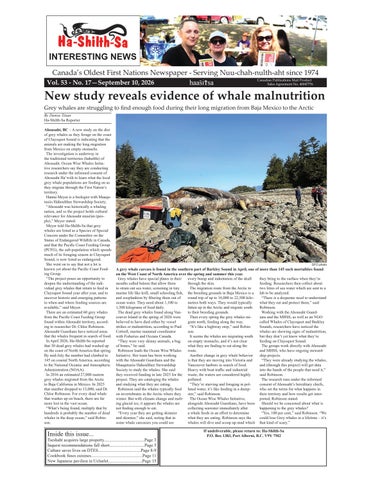
DFO photo
A grey whale carcass is found in the southern part of Barkley Sound in April, one of more than 145 such mortalities found on the West Coast of North America over the spring and summer this year. Grey whales have special plates in their every bump and indentation of the skull they bring to the surface when they’re mouths called baleen that allow them through the skin. feeding. Researchers then collect about to strain out sea water, screening in tiny The migration route from the Arctic to two litres of sea water which are sent to a marine life like krill, small schooling fish, the breeding grounds in Baja Mexico is a lab to be analyzed. and zooplankton by filtering them out of round trip of up to 16,000 to 22,500 kilo“There is a desperate need to understand ocean water. They need about 1,100 to metres both ways. They would typically what they eat and protect them,” said 1,300 kilograms of food daily. fatten up in the Arctic and migrate south Robinson. The dead grey whales found along Vanto their breeding grounds. Working with the Ahousaht Guardcouver Island in the spring of 2026 were Then every spring the grey whales miians and the MHSS, as well as an NGO believed to have died either by vessel grate north, feeding along the way. called Whales of Clayoquot and Barkley strikes or malnutrition, according to Paul “It’s like a highway stop,” said RobinSounds, researchers have noticed the Cottrell, marine mammal coordinator son. whales are showing signs of malnutrition, with Fisheries and Oceans Canada. It seems the whales are migrating south but they don’t yet know what they’re “They were very skinny animals, a bag on empty stomachs, and it’s not clear feeding on Clayoquot Sound. of bones,” he said. what they are finding to eat along the The groups work directly with Ahousaht Robinson leads the Ocean Wise Whales route. and MHSS, who have ongoing stewardInitiative. Her team has been working Another change in grey whale behavior ship projects. with the Ahousaht Guardians and the is that they are moving into Victoria and “They were already studying the whales, Maaqutusiis Hahoulthee Stewardship Vancouver harbors in search of food. and (through this project) will get data Society to study the whales. She said Heavy with boat traffic and industrial into the hands of the people that need it,” they received funding in late 2025 for the waste, the waters are considered highly said Robinson. project. They are cataloging the whales polluted. The research runs under the informed and studying what they are eating. “They’re starving and foraging in polconsent of Ahousaht’s hereditary chiefs, Robinson said the whales typically feed luted water, it’s like feeding in a dumpwho set the terms for what happens in on invertebrates in the Arctic where they ster,” said Robinson. their territory and how results get interwinter. But with climate change and meltThe Ocean Wise Whales Initiative, preted, Robinson stated. ing glacial ice, it appears the whales are alongside Ahousaht Guardians, have been Should we be concerned about what is not finding enough to eat. collecting seawater immediately after happening to the grey whales? “Every year they are getting skinnier a whale feeds in an effort to determine “Yes, 100 per cent,” said Robinson. “We and skinnier,” she said, noting that in what they are eating. Robinson says the could lose Grey whales in a lifetime – it’s some whale carcasses you could see whales will dive and scoop up mud which that kind of scary.”
Tseshaht acquires large property.....................................Page 3 Inquest recommendations fall short................................Page 5 Culture saves lives on DTES.......................................Page 8-9 Cookbook fuses cuisines...............................................Page 11 New Japanese pavilion in Ucluelet...............................Page 15
If undeliverable, please return to: Ha-Shilth-Sa P.O. Box 1383, Port Alberni, B.C. V9Y 7M2
Page 2— Ha-Shilth-Sa—September 10, 2026
Fires burn far less Vancouver Island forest in 2026 Just one tenth of the area has burned in the region this summer compared to last year’s busy wildfire season By Karly Blats Ha-Shilth-Sa Contributor Since April 1 of this year, 313.5 hectares have burned on Vancouver Island due to 154 wildfire incidents. So far, this year’s fire season has been significantly milder than last year’s. According to Rick van Kesteren, fire information officer with the Coastal Fire Centre, last year 4,174 hectares burnt on Vancouver Island. This included the significant Mount Underwood fire that erupted on Aug. 11, 2025 south of Port Alberni. At 3,518 hectares, it’s the biggest wildfire ever recorded in the Alberni Clayoquot Regional District (ACRD). Van Kesteren said although last year saw much more area burnt, particularity due to the Mount Underwood fire, there were less incidents at only 63. “Fifty of these were human-caused wildfires, nine lightning-caused and then four were undetermined,” Van Kesteren said. “This year, you’ll see that we have around a 50/50 split between human and natural or lightning caused wildfires. The amount of human-caused wildfires stands at 68 while lightning-caused wildfires stands at 77. There are five undetermined causes.” Reasons for human-caused wildfires could include open burning, industrial activity or downed power lines. “When a wildfire is suspected to be human-caused, we work together with the Natural Resource Officer Service (NROS) for the investigation,” Van Kesteren said. “Any findings are not released until the investigation is complete, which could take anywhere from weeks to
BC Wildfire Service photo
A 105-hectare wildfire east of Woss Lake is classified as “being held”, part of a relatively mild forest fire season for Vancouver Island this summer. months or even years. Once they are com- in the Interior and widespread evacuaplete, findings may be shared publicly tions in B.C. when appropriate and in accordance with The state of emergency was lifted on any legislation.” Aug. 27, which has no effect on current British Columbia was in a state of emer- evacuation orders, evacuation alerts or logency for most of August due to wildfire cal states of emergencies put in place by risk. The provincial government declared local governments or First Nations. a state of provincial emergency on Aug. 8 Most local governments and First Nain response to significant wildfire activity tions affected by wildfires are now shift-
ing into community-led recovery and the province continues to support that work. According to the province, while most people have returned home, but thousands of people in B.C. continue to be on evacuation alerts and orders, and wildfire risk in the Okanagan region and other parts of the province remains elevated due to warm and dry conditions. As of August 28, a partial ban on offroad vehicles on Crown land was lifted. The ban, beginning on Aug. 10, applied to all-terrain vehicles, motorcycles, and off-road side-by-side vehicles on public property in the backcountry, with fire officials citing engines as a source of potential fire ignition during a dry summer. Effective Sept. 3, Category 1 open fire (campfire) prohibitions in the Coastal Fire Centre’s jurisdiction were lifted in all areas. Category 2 and Category 3 open fires remain prohibited throughout the Coastal Fire Centre’s jurisdiction with the exception of the Haida Gwaii Forest District. Category 2 includes the following activities and equipment: binary exploding targets, fireworks, burn barrels, controlled air incinerators, air curtain burners and carbonizers. “While conditions have improved, we urge recreators to remain vigilant and follow all wildfire prevention regulations when engaging in any activity that could spark a wildfire,” the Coastal Fire Centre noted in a release. According to the BC Wildfire Service, as of September 4, there are nine wildfires burning on Vancouver Island, all of which are being held or under control.
September 10, 2026—Ha-Shilth-Sa—Page 3
Tseshaht acquires large property for housing complex First Nation plans for dozens of homes on the 37-acre site, adding to other recent land purchases for housing By Eric Plummer Ha-Shilth-Sa Editor Port Alberni, BC - The Tseshaht First Nation has acquired a large property on the edge of its reserve, with plans to attack its housing shortage through the building of dozens of homes. The purchase of 7444 Bell Road brings another 37 acres to the Tseshaht’s recent collection of land acquisitions. Located just on the other side of the First Nation’s reserve boundary north of the Tseshaht Market, the property used to be within the main reserve over 40 years ago, but was removed as the result of a land exchange. Currently in the Agricultural Land Reserve, Tseshaht is submitting an Additions to Reserve application to the federal government to bring the land back under the First Nation’s control, said Chief Councillor Ken Watts. Then it’s a matter of establishing water, sewer lines and electrical connections to the land so that Tseshaht members can build their own homes. Watts hopes that in two years building can begin on the much-needed homes. “We haven’t built a new home in our community in several years,” he said. “We have a list of over two dozen people, families that are waiting to build. Right now our problem on the reserve is we don’t have any developable lots. Once we open this up, we’ll have a ton of developable lots.” Currently the large Bell Road property has just one house, as this is a restriction for ALR land. There are also trails and a massive six-bay garage that the First Nation plans to use to house two departments, plus an empty foundation for a structure that was never built. Tseshaht plans to rent the 1,863-square-foot, three-bedroom, two-bathroom house to members as other lots on the property are being developed. The end goal is to build 45-50 living units on the property, plus more homes
Tseshaht First Nation photo
Tseshaht members cheer in a field that’s part of a large property the First Nation recently acquired for more housing. on Tseshaht’s existing reserve using the utility connections that would be established on the Bell Road land. “There’s three phases we’re planning on, each phase has at least 20 lots,” said Watts. The property was recently listed for $1,999,000. The purchase was possible through a $5 million compensation agreement committed by the B.C. Ministry of Indigenous Relations and Reconciliation in July 2023 for Tseshaht to buy property in Port Alberni for housing. This $5 million in provincial funds enabled the Bell Road purchase, plus two other acquisitions: a parking lot formerly used for the Alberni Pacific Division sawmill and a field behind the closed Mt. Klitsa Junior Secondary School. These three land purchases total approximately 45 acres. Tseshaht has designed a 128-unit residential building for the APD parking lot,
but so far progress on the development has hinged on support from BC Housing. The provincial agency declined to back the project this year, but Tseshaht hopes that support will come in 2027. “We’ll reconvene with BC Housing, hopefully they’ll fund it next fiscal year,” said Watts. The First Nation is having discussions with Island Health to build homes for medical professionals on the Mt. Klitsa school field, attending to a local doctor and nurse shortage that caused the West Coast General’s ICU to be closed last November for several months. “Our goal is to help out with medical housing,” said Watts. “We’re hoping to do a four-plex, that’s our goal.” A housing assessment conducted by the First Nation indicates that 200 units will be needed in the next decade. Be-
sides those who want to build their own homes on the reserve, another waiting list of “several dozen” await any First Nation-owned units to become available, explained Watts. Tseshaht hopes to take a chunk out of this need through a combination of privately built and First Nationowned homes. But expanded housing will clearly need upgrades to the sewer line that currently crosses the Somass River bridge en route to Port Alberni’s sewage lagoon, which is located down the river across from the sprawling Paper Excellence mill complex. “Now we’re meeting with Canada on simply having it not go across the bridge and just have it go through our reserve,” said Watts. “We own the property below that where the water and the sewer meets.”
Eric Plummer photo
“Right now our problem on the reserve is we don’t have any developable lots. Once we open this up, we’ll have a ton of developable lots,” says Tseshaht Chief Councillor Ken Watts.
Page 4— Ha-Shilth-Sa—September 10, 2026 Ha-Shilth-Sa newspaper is published by the Nuu-chah-nulth Tribal Council for distribution to the members of the contributing First Nations, as well as other interested groups and individuals. Information and original work contained in this newspaper is protected by copyright and may not be reproduced without written permission from: Nuu-chah-nulth Tribal Council P.O. Box 1383, Port Alberni, B.C. V9Y 7M2. Telephone: (250) 724-5757 Fax: (250) 723-0463 Web page: www.hashilthsa.com facebook: Hashilthsa Ntc
2026 Subscription rates: Non-Nuu-chah-nulth, Ahousaht, Ehattesaht,Toquaht and Ucluelet members are subject to a yearly subscription fee of $40 in Canada, $50 in the US and $60 for overseas. Payable to the Nuu-chah-nulth Tribal Council
Manager/Editor/Reporter Eric Plummer (Ext. 243) (250) 724-5757 Fax: (250) 723-0463 eric.plummer@nuuchahnulth.org Reporter Denise Titian (Ext. 240) (250) 724-5757 Fax: (250) 723-0463 denise.titian@nuuchahnulth.org Reporter Nora O’Malley (604) 353-8488 nora.omalley@nuuchahnulth.org Audio / Video Technician Mike Watts (Ext. 238) (250) 724-5757 Fax: (250) 723-0463 mike.watts@nuuchahnulth.org Editorial Assistant Holly Stocking (Ext. 302) (250) 724-5757 Fax: (250) 723-0463 holly.stocking@nuuchahnulth.org
DEADLINE: Please note that the deadline for submissions for our next issue is Sept. 18, 2026 After that date, material submitted and judged appropriate cannot be guaranteed placement but, if material is still relevant, will be included in the following issue. In an ideal world, submissions would be typed rather than hand-written. Articles can be sent by e-mail to holly.stocking@nuuchahnulth.org (Windows PC). Submitted pictures must include a brief description of subject(s) and a return address. Pictures with no return address will remain on file. Allow two - four weeks for return. Photocopied or faxed photographs cannot be accepted.
LETTERS and KLECOS Ha-Shilth-Sa will include letters received from its readers. Letters MUST be signed by the writer and have the writer’s full name, address and phone number on them. Names can be withheld by request. Anonymous submissions will not be accepted. We reserve the right to edit submitted material for clarity, brevity, grammar and good taste. We will definitely not publish letters dealing with tribal or personal disputes or issues that are critical of Nuu-chah-nulth individuals or groups. All opinions expressed in letters to the editor are purely those of the writer and will not necessarily coincide with the views or policies of the Nuu-chah-nulth Tribal Council or its member First Nations. Ha-Shilth-Sa includes paid advertising, but this does not imply Ha-Shilth-Sa or Nuu-chah-nulth Tribal Council recommends or endorses the content of the ads.
Jury recommends better water taxi access Inquest also urges police to wear body cameras, an initiative that is already in place By Eric Plummer Ha-Shilth-Sa Editor Port Alberni, BC - After six days of witness testimony and over a day of deliberation regarding the police-involved shooting death of Julian Jones, on Aug. 27 a coroners inquest jury announced their recommendations to prevent similar incidents from happening in the future. The RCMP is being advised to consider equipping all officers with tasers and body worn cameras, while acquiring an Indigenous liaison to work with Tofino’s detachment. The seven-member jury, who were selected from the general population, also recommends that B.C. Emergency Health Services secure more reliable contracts with water taxis to ensure marine transportation is readily available. Julian Jones of the Tla-o-qui-aht First Nation was fatally shot Feb. 27, 2021 when two police officers were attending a call at a home in Opitsaht on Meares Island. The members of the Tofino RCMP were responding to allegations that a woman was sexually assaulted and being held against her will at the residence. After a short boat ride across the bay to Meares Island, the pair arrived at the home at approximately 9:30 p.m. on a dark and foggy evening. Police testimony states that Jones’ brother, John Lucas Jr., was immediately arrested when the officers came to the door, prompting Jones to advance towards them with what were later determined to be two metal files 12-16 inches in length. Officer testimony states that Jones was initially tasered, causing him to fall to the floor. But he got up and continued to advance, which led to him being fatally shot by Const. David Robichaud, according to a statement from his partner during the call, Const. Dan McIntosh. One taser was with the RCMP officers, and this device needs five seconds to recharge after it is deployed, according to witness testimony. This led to the jury recommendation that all RCMP officers be equipped and trained to carry tasers, or conductive energy weapons, which can be used as a non-lethal alternative to a firearm. The police had been to house 141 in Opitsaht on other occasions, and knew the brothers. According to Const. Ma-
Julian Jones cIntosh, Jones would get combative if he feared his brother was being harmed. Considering such dynamics in the remote community, the jury recommended an Indigenous liaison at the Tofino detachment. “The jury heard evidence that the RCMP could do more to learn about and incorporate cultural aspects in their policing of Indigenous people,” stated the jury’s recommendations that were read to Coroner Larry Marzinzik on Aug. 27. There were also differing accounts from the scene, including testimony from John Lucas Jr. that his brother did not advance to the officers, and that Jones was tasered after he was shot. The jury’s suggestion for this issue is that all RCMP officers wear body cameras. This was not common practice in 2021, but has actually since been implemented by the RCMP. In November 2024 the RCMP started equipping front-line officers with body cameras, starting with police serving Ucluelet, Ahousaht, Tofino, Mission, Prince George, Cranbrook and Kamloops. As of July this year, 79 per cent of officers wear body cameras, a national deployment that is on track to be fully implemented by fall of 2027, according to the RCMP. Although Jones was killed on the scene, the jury also looked to shortcomings in medical response on that dark night in 2021. With no available water transportation, paramedics were left waiting at the
Legal Information
COVERAGE: Although we would like to be able to cover all stories and events, we will only do so subject to: - Sufficient advance notice addressed specifically to Ha-Shilth-Sa. - Reporter availability at the time of the event. - Editorial space available in the paper. - Editorial deadlines being adhered to by contributors.
Tofino dock for almost an hour, until they were informed to stand down. They were waiting for transport from the Canadian Coast Guard, but that national agency decided to not make the short trip to Opitsaht when communication was lost and danger at the scene was evident. “We were unable to establish communication with the officers on the scene,” said Nathan Webb, superintendent of the Canadian Coast Guard’s regional operations centre, during his testimony for the coroners inquest. “That raised a red flag for us, because we didn’t know what the scene was. We had the report of an officer-involved shooting, a death of a First Nations member, then we lost communications. That’s where the risk for the Canadian Coast Guard came up.” Opitsaht doesn’t have a helicopter landing pad, making boat transport the only viable means for paramedics to attend the remote community. BC Emergency Health Services doesn’t have its own boats, and instead hires local water taxis while venturing off Vancouver Island’s west coast. During his testimony Leslie William Cleverly, BCEHS’s senior provincial executive director, outlined the limitations in sending paramedics to remote coastal locations like Opitsaht. “It’s inherently difficult to deliver a timely and effective response, particularly in that geographical area,” he said, explaining why BCEHS doesn’t have boats in its fleet of vehicles. “To operate a marine vessel, we would need at least two people to operate that vessel, and that would be taking away the ability for us to provide patient care.” “We are passengers on these vessels, so we really rely on the operator of the vessel to convey us of where to go and when,” he added. After hearing these considerations, the jury looked to local water taxis as the means for paramedics to serve coastal locations. “Please consider contracts with water taxi services to be available 24 hours a day for the exclusive use of BCEHS paramedics in Tofino,” stated the jury. Proceedings for the coroners inquest into the death of Julian Jones were held Aug. 18 – 27 at the Port Alberni Law Courts.
Ha-Shilth-Sa belongs to every Nuu-chah-nulth person including those who have passed on, and those who are not yet born. A community newspaper cannot exist without community involvement. If you have any great pictures you’ve taken, stories or poems you’ve written, or artwork you have done, please let us know so we can include it in your newspaper. E-mail holly.stocking@nuuchahnulth.org. This year is Ha-Shilth-Sa’s 52nd year of serving the Nuu-chah-nulth First Nations. We look forward to your continued input and support. Kleco! Kleco!
The advertiser agrees that the publisher shall not be liable for damages arising out of errors in advertisements beyond the amount paid for space actually occupied by the portion of the advertisement in which the error is due to the negligence of the servants or otherwise, and there shall be no liability for non-insertion of any advertisement beyond the amount paid for such advertisements
September 10, 2026—Ha-Shilth-Sa—Page 5
Inquest recommendations fall short, says Sayers Over six days the coroner proceeding heard from dozens of witnesses, but not officer who fired the fatal shots By Eric Plummer Ha-Shilth-Sa Editor As Indigenous people continue to face a high rate of confrontations with police, a First Nations leader is disappointed that recent jury recommendations from a coroners inquest into a fatal shooting didn’t look further into the heart of the problem. “I was really hoping for stronger recommendations,” said Cloy-e-iis, Judith Sayers, president of the Nuu-chah-nulth Tribal Council. “As long as there’s First Nations people getting shot by the police, getting beat up by the police, we’re not making progress.” A coroners inquest was held in August at the Port Alberni Law Courts into the death of Julian Jones, a 28-year-old member of the Tla-o-qui-aht First Nation who was shot dead during a confrontation with police on Feb. 27, 2021. Two members of the Tofino RCMP were called that evening to a home in the Meares Island village of Opitsaht, responding to allegations from a female of sexual assault and being held against her will. After six days of witness testimony and over a day of deliberations, on Aug. 27 the jury released four recommendations to prevent similar tragedies from happening in the future. These included that the RCMP consider equipping all officers with tasers and body worn cameras, while acquiring an Indigenous liaison to work with Tofino’s detachment. The sevenmember jury, who were selected from the general population, also recommends that B.C. Emergency Health Services secure more reliable contracts with water taxis to ensure marine transportation is readily available. While Sayers agreed with most of these recommendations, she noted that officers at the Tofino RCMP are already equipped with body cameras, part of a national deployment that started in November 2024. This brings up the question of why the jurors weren’t informed of this.
Eric Plummer photo
“I was really hoping for stronger recommendations,” says Cloy-e-iis, Judith Sayers, president of the Nuu-chah-nulth Tribal Council, after a jury released its recommendations from a coroners inquest into the death of Julian Jones. other provinces so that they have to come them on community,” she said. “You “I suppose the jurors don’t know that,” just get close to somebody and they get back to B.C.” said Sayers. Another matter that the jury did not The jury did note that “the RCMP could shipped out. It’s just devastating.” Meanwhile those who repeatedly find touch on with their recommendations was do more to learn about and incorporate cultural aspects in their policing of Indig- themselves in conflict with the police the absence in the inquest of the officer are often inherently challenged in how who fired the fatal shots. David Robienous people” in its recommendations, they can fit into mainstream society. Last touching on a systemic issue that has chaud has since retired from the RCMP summer a video circulated online showprevailed for much of Canada’s history. and lives out of the province, and so is Aboriginal people are several times more ing Port Alberni police beating a man not legally obligated to give testimony on the ground while executing an arrest likely to die during police interactions under existing legislation. after a disturbance was reported from a that the general population, according to “Under the Coroners Act, the Coroner business. Shawn Hall, 33, was homeless Service’s ability to compel the attendance a report published in 2025 in the Interat the time, struggling with a longtime national Journal of Police Science and of out-of-province witnesses is limited,” addiction to drugs, according to his stated BC Coroners Service communicaManagement. sister Caroline Hall. Shawn Hall, who “Indigenous peoples make up 5.1 per tions. is believed to have Hesquiaht and Cree cent of Canada’s population and 112 “I think the law needs to be changed,” said Sayers. “Even if a person has retired, Indigenous people have died as a result of descent, had a history of criminal charges they should be able to compel them and police-involved death since 2000, or 16.2 going back to 2011, including incidents of break and enter and theft. per cent of the total number of policealso require B.C. to enter a protocol with Julian Jones also had a long criminal involved deaths,” stated the report. history, a record dating back to the time Less than a year before Jones’ death, he became an adult. During the coroners another Tla-o-qui-aht member died durinquest testimony described the chaling a police interaction on the other side lenges he faced throughout his short life, of the country. Chantel Moore was shot starting with acquiring fetal alcohol specdead during a late-night wellness check trum disorder while in the womb, a conin Edmunston, New Brunswick on June dition that can bring impulsive behaviour 4, 2020. Nearly two years later a corowith little consideration of consequences. ners inquest into that tragedy produced a Jones was in and out of foster care during recommendation that police have better his youth. access to “non-lethal tools” like tasers, “Julian had severe deficits,” said Prowhich was also recommended in the bation Officer David Paruk during his recent Julian Jones inquest. emotional testimony. But as the Tla-o-qui-aht community Last year the federal Department of reflects on the incidents, wondering what Justice released a strategy in an attempt could have been done to reach a differbridge the gap that continues to persist. ent outcome, the question arises if closer The Indigenous Justice Strategy stresses police relationships with those involved the need for “strengthening relationships could have helped in de-escalation atbetween police and communities”, while tempts. finding ways for law enforcement to “imSayers noted that often RCMP officers prove awareness of the histories, cultures aren’t stationed in a community long and circumstances of First Nation, Inuit enough to establish such connections. and Métis peoples, including the ongoing “That’s a high turnover rate to build a effects of colonialism.” relationship in order to really educate
Page 6— Ha-Shilth-Sa—September 10, 2026
Overdose site cancellation ‘discouraging’, says FNHA FNHA’s top doctor says loss of a harm reduction service is counter productive from a public health perspective By Nora O’Malley Local Journalism Initiative Reporter Vancouver, BC – The First Nations Health Authority (FNHA) has expressed “great disappointment” for the province’s decision to cancel the planned overdose prevention site slated for 900 Helmcken in Downtown Vancouver. First Nations individuals, families, and communities continue to be disproportionately affected by the toxic drug crisis, with First Nations people experiencing a toxic drug poisoning death rate that’s 10.2-times higher than other residents of the Vancouver Coastal region in 2025, according to FNHA data. “First Nations people in B.C. continue to be overrepresented within the toxic drug crisis public health emergency and each year provincially, we lose several hundred community members who were loved and valued,” Dr. Nel Wieman, FNHA chief medical officer, in a media release. “One life lost is too many. This is why reducing life-saving harm reduction services, including overdose prevention sites, is so discouraging from a public health perspective. Substance use disorder is a complex, chronic, relapsing condition that for some, having one episode of residential treatment will not result in life-long abstinence. We need the entire spectrum of substance use care: prevention, harm reduction, detox, treatment, aftercare and ongoing recovery supports as well as substantive aid in the social determinants of health including housing,” said Wieman. In early May, Vancouver Coastal Health announced that services would soon open for the proposed overdose prevention site in Vancouver’s city centre. But after pushback from residents, local businesses and the City of Vancouver, the Ministry of Health put the harm reduction site on pause. The B.C. government confirmed on Aug. 24 that the planned overdose prevention site was cancelled. Vancouver Mayor Ken Sim said he was “incredibly grateful” upon receiving official word that the harm reduction site in Vancouver’s downtown was not going ahead. “I want to thank the province for listening to Vancouverites,” said Mayor Sim in a media release. “I look forward to working personally with Minister Kahlon and the province as we move forward to increase secure treatment and involuntary care capacity, including 100 beds Vancouver desperate-
Nora O’Malley photos
People enter an overdose prevention site at 141 East Hastings. Another site planned for downtown Vancouver has been cancelled due to concerns from the business community and the City of Vancouver. ly needs, which we called for through the Public Safety Plebiscite,” Sim continued. Emily Lowan, Leader of the BC Greens, said Minister Kahlon “caved to pressure from Mayor Ken Sim.” “Ravi Kahlon’s first decision as Minister of Health is to put politics ahead of people,” said Lowan. “This out-of-sight, out-of-mind approach to a public health emergency will do the exact opposite: force people further onto the streets and break from the path to healing.” Following Brenda Bailey’s decision to take a leave from serving as minister of finance for cancer treatment and recovery, the B.C. Government appointed Kahlon as minister of Health on Aug. 14 and Josie Osborne moved to minister of Finance. Vancouver Coastal Health (VCH) said the lease for the space at 900 Helmcken Street began on June 1, 2026, and runs for a term of two years at a cost of $179,000 annually. “(We) will work with the Ministry of Health and the City of Vancouver to develop alternative programming for this location that meets the needs of the community, including treatment and recovery supports and long-term wellness programs,” said VCH in an email. “These services would support other ongoing work within VCH to expand access to evidence-based, timely, and quality
TSESHAHT MARKET GATEWAY TO THE PACIFIC RIM
Hours of operation - 7:00 am - 10:00 pm Phone: 724-3944 E-mail: manager@tseshahtmarket.ca Find us on Facebook
Jessica Campbell treatment and recovery services, such as Road to Recovery and Access Central,” said VCH. B.C.’s Road to Recovery initiative establishes a “seamless continuum of care for addictions from detox to treatment and after care.” Access Central is a phone line which enables same-day clinical assessment and a personalized substance use care plan for those living in the VCH area.
In 2025, over half (62 per cent) of the 87 First Nations people who died from toxic drug poisoning in the Vancouver Coastal region were male, according to FNHA data. Of the 821 toxic drug poisoning “events” experienced by First Nations people in 2025, 63 per cent were reported as being a First Nations male, according to FNHA. Most toxic drug poisoning “events” are non-fatal and represent instances where paramedics were called. First Nations people make up 2.1 per cent of the Vancouver Coastal region’s population, notes FNHA. Harm reduction leader Cody Hunt works at Culture Saves Lives in the Downtown Eastside. He says he’d like to see more investment in men and young boys to make sure they have access to mentorships and healthy connections. “It’s no secret, anybody that is dealing with addiction is dealing with severe trauma and they’re doing their best to cope with it. For the majority of people that are in abuse cycles, the majority of people that perpetuate them are men,” said Hunt. “We love our women and we want the best, but most people don’t understand that the way to support our women is to invest in the man. You are only as strong as the weakest link in our community,” he said.
September 10, 2026—Ha-Shilth-Sa—Page 7
Somber ceremony remembers those lost to drug crisis Front-line workers join grieving families to recognize toll of tragedies since public health emergency declared By Denise Titian Ha-Shilth-Sa Reporter Port Alberni, BC – A quiet, respectful gathering took place at Port Alberni’s Roger Creek Park on August 31, International Overdose Awareness Day. Organized by ADAPS (Alberni Valley Youth and Family Services), frontline workers joined grieving families to remember those lost in the decade since the provincial government declared a public health emergency over the opioid crisis in the spring of 2016. Keeping with cultural teachings, Hawktwo-Ahh Sutherland temporarily changed his name after losing his son last December. Tim Sutherland Jr. had legal troubles and was not allowed to live in Port Alberni at the time of his death in 2025. The 41 year old died alone in a Nanaimo shelter last December, just before his birthday, according to his father. “I think of it often – the things I could have said in the courtroom,” said Sutherland. He wondered if things would be different if his son lived closer to his father or his mother, who had a place for him. Sutherland was grateful for the small comfort that he was able to shake his hand and tell him that he loved him. Annie and Dave Watts sat under the gazebo with their dog, 10-year-old Peanut. He was their daughter Jen’s dog. Jennifer was alone at her home when she died of an overdose 2020. The couple lovingly care for the Jack Russell terrier, in memory of their beloved daughter. Another mother told Ha-Shilth-Sa that her family lost two of their own to the opioid crisis. She wiped her tears as she
Denise Titian photo
A small group of little girls paint rocks purple, the color of ribbon used universally to commemorate those lost to the opioid crisis, as part of activities on Aug. 31 for International Overdose Awareness Day. The gathering was held in Port Alberni’s Roger Creek Park. recalled how someone claimed to have address the overdose crisis and support that were close to him. He remembered held her daughter as she took her last mental health and addiction recovery, was Reg Sam and Chuck Doiron and said it breath. there to offer help. was important to say their names. “Why didn’t they get help?” she asked. Danielle Senft, CAT coordinator, said Watts also acknowledged CAT and other There were tables set up around Roger the purpose of the gathering was to refrontline workers who make the commuCreek Park where people could gather in- member those lost to the toxic drug crisis. nity a better place to live. formation or take part in activities. Some CAT was joined by members of Island “It takes a lot, a special kind of person, ate some pizza and watermelon. A small Health, the Salvation Army, Canadian to do that work,” he said. group of little girls painted rocks purple, Mental Health Association and the NTC’s He thanked them on behalf of Tseshaht. the color of ribbon used universally to Harm Reduction Team. He asked people to remember to tell their commemorate those lost to the opioid criWameesh, Ken Watts, elected chief for relatives that they are loved. sis. One of the girls lost her grandmother the Tseshaht First Nation, called for a The event was open to all in hope for a to opioids. moment of silence to remember those lost healthier, compassionate community. Port Alberni’s CAT (Community Action to the opioid crisis. He said that he has Team), a local initiative that works to delivered five or six eulogies for some
Page 8— Ha-Shilth-Sa—September 10, 2026
Connection to culture saves lives on the Downtow Located at 30 West Hastings, Culture Saves Lives is a program dedicated to connecting cultural support to the area’s m By Nora O’Malley Local Journalism Initiative Reporter Vancouver, BC – Across the street from Pigeon Park in Vancouver’s Downtown Eastside (DTES), a large orange feather pops into view from a storefront window. As one gets closer, the deep sound of traditional drumming bellows out the open door, inviting the country’s most marginalized in for a cup of coffee, a sandwich and a safe place for people to just sit and be. Welcome to Culture Saves Lives, a movement founded by Patrick Smith in response to the tragic death of a young Indigenous woman named Paige. Paige died in April 2013 of a drug overdose in a communal washroom adjacent to Oppenheimer Park in the DTES. She was just 19-years-old. A report entitled “Paige’s Story: Abuse, Indifference and a Young Life Discarded”, came out in 2015 that chronicles the years of neglect by the child protection system, health care system, social services agencies, the education system and police that led to her death. Between the ages of 16 and 19, Paige drifted through more than 50 locations, mostly in the DTES – among homeless shelters, safe houses, youth detox centres, temporary accommodations with relatives and friends, two ministry foster homes and various DTES SRO (single-room occupancy) hotels, according to the report. “The system in Canada failed her. Shortly after aging out, she ended up in the community here and passing away. It was really upsetting,” said harm reduction leader Cody Hunt, who is of Kwakiutl First Nation (Fort Rupert) descent. Hunt has been supporting people in the DTES community since 2018. “Our culture is really complicated and when it comes to supporting people down here, you can’t make things super complicated,” Hunt explained. “Really, when I boil our culture down at its most simplest form, absolutely every single part of our culture is all about connection; our connection to our Ancestors,
Cody Hunt, centre, with community support worker Aramis Hanuse and Cameron Webber, sing and drum on Aug. 26 at the Cultu the connection to the land, the connection and when you’re connected with everything When asked what would support Culto each other,” he continued. you are not alone and you have a support tural Saves Lives and the work they do, If Paige had known who she was and system,” Hunt said. Hunter took a long pause. had a strong foundation, Hunt thinks she During her years in the DTES, Paige had “Sometimes… sometimes it’s really, rewouldn’t have passed away so young. one very short period of attachment to a really sad. You’ll see a young girl show up “That’s one of the biggest things that com- source service called Young Wolves Lodge. across the street and she looks 15-yearsmunity members are missing is connection. The Young Wolves Lodge “appeared to old. They’ll come in and we’ll be able They don’t have a foundation of cultural understand (her) needs and be a positive feed them, and then they’ll want to go connection, which is why culture saves reflection of culture,” notes the report. The out and you’ll see them the next day all lives. It gives us the ability and the context program was a voluntary treatment centre strung out,” Hunter shared. to connect with everything at a deep level for young Indigenous women that em“It’s such a tough thing because why is braced First Nations ceremonies, traditions that girl running away from home? Are and teachings. It was closed in 2015 due to they running away from sexual abuse withdrawal of funding. at home that nobody stuck up for them? ‘We welcome all people, not just First Na- How do I support them? If we had a tions people’ proper channel of communication with Three weeks of the month, Culture Saves different nations, we could make contact Lives feeds the DTES community a meal, and get them out of here like right now,” like sockeye salmon, potato salad and bannock. The singing and drum circles occur daily and as winter sets in, they offer workshops in language, cedar weaving and more. They also give out clothing, shoes and bedding. Mary (Lo) Durocher volunteers with Cultural Saves Lives. She is an urban Nuuchah-nulth member from Ditidaht territory. “I understand what the people are going through because I was on the streets at the age of 17. I hung out on Hastings for six years. I know what it’s like to crave and to bury the actual feelings that you need to deal with,” she shared. “We welcome all people, not just First Nations people. We share our ears and we listen. If they want to know something, we give them feedback. If they want to clean up and go back home, we try to help them,” she said. Durocher has three of her own children living in addictions in the DTES. “There are so many young people down here, it’s scary,” she says. “Don’t ever give up on your children if they’re down here. I see a lot of Nuu-chah-nulth people every Mary Durocher greets people at the entra day.” A man receives shoes from Culture Saves Lives. Hastings.
September 10, 2026—Ha-Shilth-Sa—Page 9
n Eastside most marginalized people
Eric Plummer photo
The Downtown Eastside is part of Vancouver-Centre North, a local health area that has consistently presented by far the highest rate of overdose fatalities over the course of the opioid crisis. Data from the first half of this year shows the downtown neighbourhood with more than triple the fatality rate of Merrit, which ranks second in the province.
Keeping hope alive on Vancouver’s streets After a decade in Vancouver neighbourhood, outreach worker sees encouraging signs By Eric Plummer Ha-Shilth-Sa Editor
Nora O’Malley photos
ure Saves Lives’ downtown office. he said. “And that’s not something we need to ask for, really. It’s something everyone at home needs to look each other in the mirror and say, ‘How do I put my ego down to support people?” Hunter said. Culture Saves Lives is one of several services offered by the PHS Community Services Society. It is a partnership with Indigenous and Northern Affairs Canada, Vancouver Coastal Health, First Nations Health Authority and the City of Vancouver. Located at the tail end of the DTES at 30 West Hastings Street, Culture Saves Lives is 100 per cent Indigenous-run and open for drop-in Monday to Friday, 10 a.m. to 3 p.m. On Mondays, they serve pancakes.
ance of Culture Saves Lives at 30 West
Vancouver, BC - As Vancouver residents consider a tougher approach to drug use in a plebiscite vote this fall, a Downtown Eastside outreach worker cautions that the last thing substance users need is to be pushed into the shadows. Following recent direction from Vancouver City Council, an additional ballot will be available to voters during the upcoming municipal election on Oct. 17. “Vancouver has experienced unprecedented levels of street disorder, open-air hard drug use, and disruption to community safety and individual health,” states the city’s introduction to the plebiscite questions. The ballot asks if Vancouver should strengthen its laws to ban public drug use, and if the old St. Paul’s Hospital should open to voluntary and over 100 involuntary care beds for those at risk of harming themselves or others due to substance use and mental health disorders. Following the province’s decision in January to not continue with drug decriminalization and the cancellation of a downtown Vancouver safe consumption site early this summer, the plebiscite is the most recent example of a changing political approach to how the ongoing opioid crisis is dealt with. Somer McCarthy has worked in outreach in the Downtown Eastside for a decade, since she was 17. Currently serving as an DTES outreach worker for the Nuu-chahnulth Tribal Council, she disagrees with claims that drug users are being enabled to continue in their addiction. What is lost to many people is the harm inflicted by negative perceptions, she said. “They don’t see them as human,” said McCarthy. “It’s pulling away their hope for any type of sobriety.” “They need somewhere where they’ll feel safe and not judged,” she added. “They’re judged by everybody else in the world.” Aug. 31 marked International Overdose Awareness Day, recognizing a public health emergency that has become the most common cause of unnatural death in British Columbia, surpassing car crashes, suicide and homicide combined. The most recent statistics from the BC Coroners Service show an average of 4.6 deaths each day from illicit drug poisoning in June – an increase from the previous month but part of a downward trend across
Somer McCarthy the province since 2023, when overdose deaths peaked at over seven a day. Data from the first six months of 2026 shows 75 per cent of fatalities to be male. “With the men that I’ve seen it’s a lot of isolation, a lot of ‘I can tough it out on my own’,” observed McCarthy. “They don’t want to be a burden to their family, so they would rather have a home and family on the Downtown Eastside.” The DTES is part of Vancouver-Centre North, a local health area that has consistently presented by far the highest rate of overdose fatalities over the course of the opioid crisis. Data from the first half of this year shows the downtown neighbourhood with more than triple the fatality rate of Merrit, which ranks second in the province. But McCarthy has seen improvement in recent years. She spoke with Ha-Shilth-Sa while passing through Port Alberni, after transporting a client who was headed to her home Tla-o-qui-aht community for treatment in a transitional house near Tofino. McCarthy managed to get the client into an initial period of detox in Vancouver to begin the healing process. “She’s completely homeless sleeping in a tent when I found her,” said McCarthy. “I had gotten her sister, actually, in treatment within a week. Her other sister was still on the Downtown Eastside and reached out to me to ask if I could meet with her.” Within the last year the Nuu-chah-nulth Tribal Council introduced two DTES outreach positions, who work in partnership with the All Nations Outreach Society. McCarthy and her partner normally perform three hour-and-a-half “street sweeps” each
day, watching for those at risk of having a drug overdose. They help everyone at risk, including non-Indigenous users. “In the 10 years, this has been the least that I’ve seen it. Once every three days,” said McCarthy of the OD incidents. “I’ve seen multiple people who are struggling with their addiction have Narcan on them. If their friend is overdosing they’ll use it or they’ll call one of us outreach workers who they see walking by.” Along with NTC President Judith Sayers and Executive Director Florence Wylie, NTC Vice-President Les Doiron pushed for the DTES outreach positions to help the many who struggle on the streets. “I’ve watched so many young people die,” said Doiron. “The magnitude of the problem is 1,000 times bigger than what people really think it is.” Part of the problem comes from displacement, as many First Nations people leave their home communities due to a lack of housing and employment. “Eighty per cent of the Indigenous population in this country are urban,” said Doiron of people relocating to cities. “It removes you from family, it removes you from traditional food and it removes you from culture on who you are as an Indigenous person.” For Doiron the issue is deeply personal, after he lost his nephew, Charles Leslie Alexander Doiron, nearly five years ago to a drug overdose in Port Alberni. At the time young Charles was trying to detox himself, as Les struggled to find any help from the First Nations Health Authority or any other government agencies. “I tried at that point everything in my power to get him into detox,” said Les, who encountered waiting periods of months for his nephew. “At that time there was nothing. Have things changed really? If it has it’s not by very much at all.” All it took was for Charles to relapse once. “He used,” said Les. “What happens when you use the same amount you did a month ago, your heart can’t take it.” For McCarthy, maintaining a trusting connection is critical for keeping alive hope of a better life. “For my clients, If I stop showing up, where are they going to go?” she asked. “Basically, just being a friendly face has made a difference. I see people wanting to ask for help because they see that they’re cared for by somebody else.”
Page 10— Ha-Shilth-Sa—September 10, 2026
Lack of attention for ‘profound’ mental health issue End the Silence campaign launched to bring men out of isolation during Suicide Prevention Awareness Month By Denise Titian Ha-Shilth-Sa Reporter September is Suicide Prevention Awareness Month, and a new Canadian movement called End the Silence has launched a website with supports aimed at Indigenous males. According to Statistics Canada, 19.2 percent of Indigenous males ages 18 to 24 say they have seriously contemplated suicide. Another 12.2 percent of Indigenous males aged 15 to 17 have seriously considered it. “Indigenous men and boys in Canada face profound mental health challenges and remain significantly underrepresented in both research and programming,” states information from End the Silence. Deanna Dunham, director of Indigenous Initiatives at Kids Help Phone, notes that despite the alarming statistics of one in five young Aboriginal men seriously contemplating suicide, only 16 percent of the callers to the Kids Help Phone identified as Indigenous male. “It’s time to change that. That’s why we’re launching this campaign in partnership with Indigenous communities: to put a greater spotlight on this issue, and to let them know that support is here. It’s okay to reach out and you can talk to someone about how you’re feeling,” she said. Someone who knows first-hand the challenges faced by families dealing with suicide is April Lucas. The Hesquiaht grandmother not only lost her brother to suicide but also two of her sons. Lucas, the mother of seven now adult children, admits her family has faced many challenges over the decades, starting with the legacy of Indian residential schools. “Residential school trauma, how many generations will it take to heal from that? I don’t think we’ve even started,” she shared. The last of the residential school survivors are now elders. While at the institutions they were separated from family and denied access to their culture. With very little to healthy parenting styles to model themselves on, many children ended up in the foster care system. Add to that addiction, whether it be alcohol, drugs or even food. “I have many thoughts about mental health and men. We have a couple of
Nora O’Malley photo
Young boys watch waves crash on Pacheedaht Beach. generational traumas that surrounds gate life without her eldest son, who left suicide. My late brother Simon and his behind children of his own. Her children son both committed suicide, as well as had been placed in foster care a couple my oldest son and my third son,” shared of times and Lucas said she took all the Lucas. training required of her to get her chilIt was in 2016 that Lucas lost her eldest dren back home. son, Archie, to suicide when he was still “I fought so hard to save my boys,” she in his 20s. She vividly recalled the frantic said. trip she made from Campbell River to But she saw the decline in her sons’ Port Alberni when she got wind that he mental health after the passing of Archie. was contemplating suicide. For her, it Some of her children battled addictions. was imperative that she get to him in time In early 2024 she received that dreaded because she had learned the hard way, phone call – her son Simon had died by from her brother and nephew’s passing, suicide while intoxicated. that suicidal ideation needs to be taken The following year she went to wake seriously. her son Colin. She thought he had fallen But it was too late. When she arrived at asleep in a car outside her home, but he the hospital, Lucas was informed that her was deceased, a victim of the toxic drug son had died. epidemic. “Suicide, it is a very strong word. It Lucas says she now has 27 grandchilmeans evil to some, and I was once told dren and one great grandchild. Fourteen that my son is basking in hell for taking of those grandchildren are growing up his own life,” Lucas shared. without their fathers and one grandShe went on to say that there are a lot of daughter has lost both her parents. stigmas that surround suicide. Through her tears, Lucas described the “No one will ever know the truth of pain and the fear of coping with life after what led to what they thought was the such devastating losses. She admitted only way out,” said Lucas. that she had her own thoughts of escapWith her remaining four sons and two ing her pain. daughters, Lucas did her best to naviDespite all the trauma, the pain and the
constraints of the child welfare systems, Lucas says she lives for her children and grandchildren. “They keep me going, they need me” she smiled through her tears. She remembered that her mother crocheted a lot after Simon died. “It keeps your mind busy, so I would wake up in the middle of the night and would crochet,” Lucas shared. End the Silence launched August 18, 2026, celebrating the first annual day committed to breaking the silence and confronting the Indigenous mental health crisis. End the Silence invites young men and boys to take that first step towards support, some can be found on the www. EndtheSilence.com website. Notorious Cree, Michael Linklater and Joey Stylez are just a few of the prominent Indigenous males sharing their stories on the website. Besides finding stories and support, the website invites other community initiatives to join. “The campaign also shines a light on a longstanding gap: Indigenous boys and young men have received limited attention in research, programming, and resource development despite facing significant mental health challenges,” states the campaign. Go to the End the Silence website to explore free, confidential support options through Kids Help Phone and learn how to connect with someone by text, message online, or phone, anytime you’d like to talk. Despite her struggles and fears, Lucas points to the silver linings. A son and grandson are living sober lives. “My sons were hard workers. They built things, like the foundation of the school in Zeballos. I think of their goodness. I’m so proud of them,” she shared. To other families coping with the effects of suicide, Lucas says this, “Don’t stop trying.” There are a lot of us, she says, and there are many different ways to heal. “Do what’s comfortable for you,” she advised. Some people, she said, don’t know how to express their hurt and pain and that can lead to things like addiction. Being able to share openly, without judgement, is healing, she said.
Phrase of the week: tiipitši%a+%iš +aqapminh=i hiik#a>%a+ @ay~iic^h= Pronounced ‘tee pit she atl ish tla qap min hay hee kwalth atl aa yeech hh’, it means, ‘the leaves are falling, it’s nearly autumn’ Supplied by ḥakaƛ.
Illustration by Koyah Morgan-Banke
September 10, 2026—Ha-Shilth-Sa—Page 11
Cookbook fuses coast traditions with modern cuisine Gyetk, a new book written by Ts’msyen harvesters Rachel and Spencer Greening, means ‘to feed the people’ By Nora O’Malley Local Journalism Initiative Reporter Tofino, BC – Ts’msyen First Nations harvesters Rachel and Spencer Greening have a new Indigenous food knowledge cookbook, Gyetk (pronounced gy-e-tk and meaning “to feed the people”), that puts traditional food back on plates. From maple-caramelized beaver tail over baked beans to roasted seal ribs with wild berry barbecue sauce, clam fritters and baked salmon heads, the Greening’s cookbook features 60 seasonal recipes born from the Ts’msyen people of the Pacific Northwest Coast. “Up north, it’s a lot more common to trap beaver,” said Spencer. “Non-Indigenous and Indigenous folks who still do harvesting in that way will have beaver in their freezer. Some of these cuts of meats can be quite overlooked, even though they are nutritional powerhouses, and that’s why we highlighted specifically the beaver tail. Also, it’s really kind of comparable to pork belly,” he said. “I personally love baked fish heads. It’s a simple recipe,” said Rachel. Together, PhD graduates Rachel and Spencer are a perfect pair who devoted years of their lives to make Gyetk. Rachel, the dietician, works in clinical and community dietetics and as a diabetes educator with the Nuu-chah-nulth Nations while Spencer, the storyteller, is an anthropologist whose research centers on Ts’msyen ecological knowledge, stewardship, and governance, while dabbling in archaeology. They regularly facilitate food-based workshops with First Nations youth along the coast, emphasizing the role of harvesting in individual and collective well-being. “We just hope people can see the intention behind the book,” said Spencer. “How do we re-empower these Indigenous palates? Palates have been colonized. So how do we massage these old flavours into a modern world?” “It’s also about preserving this knowledge because if we don’t preserve it, it’s going to be gone. We want it down in text, so people can remember and get excited,” adds Rachel. They kick off a six-week book tour with a sold-out launch party at the Clayoquot Campus in Tofino, Tla-o-qui-aht First Nations territory, on Sept. 22. Scheduled Canadian stops include Nanaimo, Victo-
ria, Vancouver (Sept. 25 and Sept. 26), Prince George, Prince Rupert, Winnipeg and Toronto. They’ll also head to Seattle, Washington, the Gulf Islands and then up the coast to Haida Gwaii. The duo trialled every meal in the cookbook and will share complimentary food samples at most stops on the tour. Rachel says she’s excited to talk to people about eating different animal parts – like fish heads, venison tendons, moose hearts and mountain goat tongues. “(Elders) really used to like the gelatin and cartilage that aren’t really common in our food system anymore,” she said. “Part of it is people have been taught that those offcuts of animals are gross or dirty and we just prioritized the beautiful filets and discard all the rest. I get excited about talking to people about eating these different flavours and textures. They’re so nutritious and they’re also delicious and we used to celebrate them,” Rachel continued. Spencer’s favourite recipe happens to be one of the simplest. “One that comes to mind is salmonberries with seal grease,” he shared. “Seal grease coats your entire mouth and holds the flavour of berries in longer. It just makes it a more delicious experience. Those little tricks blow my mind. It’s such a simple recipe, berries mixed with seal grease, when you have the knowledge that comes with it,” he said. Throughout the book, Rachel and Spencer thoughtfully incorporate the Sm’alyga-x names of species, the endangered language of the Ts’msyen peoples, plus teachings on ethical harvest. “Indigenous communities have written a playbook of how to harvest in a sustainable way in these ecosystems,” said Spencer. “Through the plethora of things shared irresponsibly on social media, we just wanted to be a responsible voice.” They also share ‘how to’ steps on jarring salmon, wild berry jam and making broth. “There are so many different ways to (jar salmon), we just shared one way to do it. It’s not necessarily the Ts’msyen or the only way. I’m sure if some elders are reading it, they will say (otherwise),” said Rachel. Gyetk: Coastal Fusion and Ancestral Knowledge from a Ts’msyen Kitchen is officially released on Sept. 22, 2026. It can be pre-ordered for $40 through any independent book retailer and the larger online book shops.
Troy Moth photos
Rachel and Spencer Greening with their new cookbook Gyetk.
Rachel and Spencer Greening, with their child Maaya’ol, harvest seafood on the Pacific Northwest Coast.
CYPRESS RESTAURANT & LOUNGE 250.724.7629 rimrockcasino.ca
Page 12— Ha-Shilth-Sa—September 10, 2026
President’s Message Greetings Nuu-chah-nulth-aht. Another month has flown by. My condolences to all those families who have lost loved ones. I hope all of you were able to put away fish, berries, medicines, cedar bark and other things throughout the summer. August saw a lot of forest fires all over B.C. Extremely dry conditions contributed to these fires. Some were caused by lightning and others were human caused. Was good to see help from Mexican firefighters to fight the fires. Our thanks go out to all people fighting the forest fires whether they are ground crews or air crews. Planning for and being prepared for fires is a reality we all have to live with. We need more resources by government if we are to be fully prepared to prevent and fight fires. August started out with fun and friendly competition at the Tlu- piich games. Opening day started with canoe races and a barbecue with the ladies cooking up hamburgers and hot dogs. Bouncy castles were brought in for the children. It was a fun day that ended with the opening ceremonies and the parade of athletes. People were excited to be there and march. The next few days were filed with basketball and softball. The games ended with track and field, where there was fun for the young kids to the elders and all ages in between. It was well organized and our thanks goes out to Brevin Charleson and his team for coordinating the event. A special thanks goes to all the volunteers who carried out a lot of work for the games to go on. The month ended with the B.C. Elders Gathering. There was well over 1,200 elders and their support staff making a conference of around 2,000. It was also very well organized and elders were able to get self care, enjoy entertainment and connect with elders from all over the province. There were quite a few Nuu-chah-nulth nations there. The conference starts with the parade of elders so all the elders walk in under their nations’ banners and it is great to see so many different nations from all over the province. I got several comments from some of our Nuu-chahnulth elders that they didn’t know about the conference. This was the 50th. I know some nations do not send their elders as it is too expensive in Vancouver at this time of the year. In August there was an inquest over the police shooting of Julian Jones. An inquest is not a court of law but finds facts and makes recommendations on anything related to the shooting. A jury of six people listened for six days to what happened at the shooting. Many witnesses testified, including those who were in the house, police, doctors and the Independent Investigations Office of B.C. It was heartbreaking to listen to the lead up to the shooting, the shooting itself and after the shooting as to what happened. After hearing everything the jury comes up with recommendations. Their recommendations were not that strong. They were: 1. Police should wear body cameras. This is already the case. RCMP already have to wear them but right now they are waiting for supplies to get it to all their officers. 2. All officers should have tasers. This is a good recommendation as not all officers carry them. It is a good alternative to guns. RCMP need to put more money into buying more. I think the jury should have recommended that they bring tasers on wellness checks as you never know what can happen, as in this case, the case of Chantel Moore and many other well-
Community&Beyond NCN Mental Health Counselling
Tuesdays and Thursdays 8:30am – 4:30pm 4841 Redford Street, Port Alberni NCN Mental Health Services – DropIn Counselling with Margaret Bird, Registered Clinical Counsellor and Play Therapist. For on and off reserve members of all ages of the Nuu-chahnulth Tribal Council. Call (250) 724-3939 to book your appointment.
ness checks that went wrong. 3. Water taxis should be available all the time as a priority to medical services. In this case the medical personnel had to wait in Tofino for an hour to get across. Time is critical in medical situations. This also is a good recommendation. 4. That a liaison be appointed between the RCMP and the First Nation. While this is a good recommendation, it should have gone further that there be a protocol agreement between TFN and RCMP that sets out how they enter the reserve, how the liaison will help find someone in the community to be on hand to de-escalate the situation. A recommendation I would love to have seen was that RCMP must shoot to disarm and not shoot to kill. They should be trained to do that. There should also be more intense training for de-escalation and traumainformed conduct as well as cultural sensitivity. The protocol could address how RCMP officers would get this kind of training. The inquiry took five and a half years to happen. There should have been a recommendation that inquiries be held within a reasonable time. The officer who shot and killed Julian Jones did not appear. He has retired and lives out of province and could not be compelled to testify. This is not acceptable and the law must change, with B.C. required to enter into agreements with other provinces so they can enforce people to come testify. I realize that the jurors don’t know this, but we need to stop the shooting of First Nations people by police. Efforts have to be made by police to ensure their officers are free of bias or handle their bias in a better manner. RCMP should work with First Nations to address this issue. On Aug. 28 MLA Joan Phillip, wife of Grand Chief Stewart Phillip, passed away. She was from Tsleil-waututh, granddaughter of Dan George. She married into the Penticton Indian Band and she had been on the band council and had done so much in her life. She was so well loved and respected and the outpouring of love and support for the grand chief, his family and community was amazing. Rest in peace Joan. The term for the BC AFN regional chief is up and there was a call for nominations. Terry Teegee, the current regional chief who has held the position for two terms, was acclaimed to be regional chief for another three years. He has done a good job and people are happy to have his leadership. Cloy-e-iis, Judith Sayers
12:00pm-3:00pm - Celebration @ Athletic Hall. We invite everyone to join us, walking to honour Survivors of AIRS & those that did not make it home followed by an afternoon of culture & celebration. Bring your drums and shawls! Wear Orange! Health Ability Fair
October 28-29 Alberni Athletic Hall. All are welcome.
Orange Shirt Day
Samuel Richard Johnson jr. mit. Memorial Potlatch
September 30
November 7th, 2026
10:00 am - Walk starts at Maht Mahs Parking at Athletic Hall; Shuttles from 7:45 am - 9:45 am to Maht Mahs
Starting with lunch at 12:00pm Wahmeesh gym, tsaxana reserve. All welcome.
In memory The celebration of life for the late Benedict Peter Jack Sr has been postponed. The celebration of life was to be at The House of Cii-saat on October 10th 2026 at Tsaxana in Gold River. Due to another loss in the family and following our customs the Jack Family has decided to postpone the celebration of life for Late Ben Jack Sr. We thank you for you attention in this matter. Our family appreciates your understanding. A new date will be announced for 2027
25 Years Ago in Ha-Shilth-Sa Vol. 28 – No. 17
September 6, 2001
77th Annual Makah Days another success Approximately 4000 people were in attendance of the 77th annual Makah days hosted in Neah Bay. The event theme was “Unity to Eternity” which included the Makah Nation’s children and youth in the celebrations. Historically the Makah Days used to be centered around water sports, stated event MC Mr. Ed Clapanhoo. The canoe races and most recently the ocean-going canoes are one of the main attractions. Ed had been MC since 1965, and said, “One of my favorite things is being the MC for Makah
Days. When I see people walking, talking, eating and smiling at Makah Days, I feel really happy. That means that Makah Days has been another success.” Clapanhoo said that he wants to ensure that the younger generations understand and practice their culture. “It makes me feel good to see our young people sing and dance and carry on our traditions and teachings,” he said. “With their involvement we will ensure that there will always be a Makah Days.”
September 10, 2026—Ha-Shilth-Sa—Page 13
Employment Opportunities Executive Director Port Alberni Friendship Centre Volunteers Needed Need work experience? The Port Alberni Friendship Centre is looking for interested applicants for various positions. Call 250-723-8281
Ahousaht Nation Ahousaht, BC Full-Time | Permanent Posting Open Until Filled Position Overview The Ahousaht Nation is seeking an experienced and community-focused Executive Director to serve as the senior administrative leader of the Nation. Reporting directly to Chief and Council, the Executive Director will oversee the strategic and operational leadership of multiple departments, ensuring programs, services, and initiatives align with Ahousaht values, priorities, and long-term goals. Key Responsibilities • Serve as the senior administrative liaison between Chief and Council and organizational operations. • Implement Chief and Council directives, resolutions, and strategic priorities. • Foster strong relationships with community members, Hereditary Chiefs, governments, partner organizations, and funding agencies. • Promote transparent, accountable, and culturally grounded leadership. Strategic & Operational Management • Lead and oversee departments including: o Administration, CCHY - Health, Finance, Fisheries, Housing, Operations & Maintenance, Residential School Research Project, Social Development, Wellness Center • Coordinate and support Departmental Managers in achieving organizational goals. • Lead annual operational planning and support implementation of the Nation’s Strategic Plan. • Oversee organizational policies, procedures, performance management systems, andcontinuous improvement initiatives. Financial Stewardship • Lead annual budgeting processes and monitor financial performance. • Review financial statements and support annual audits. • Ensure effective use of resources and accountability for funding agreements. • Support grant applications, funding proposals, and reporting requirements. Community & Stakeholder Relations • Build and maintain positive relationships with federal, provincial, municipal, and Indigenous partners. • Represent Ahousaht Nation with professionalism and integrity. • Support community engagement and ensure services reflect community priorities and values. Qualifications Required • Degree or Certificate in Administration, Business Administration, or a related discipline, • Minimum 4 years of senior leadership experience working with First Nations communities and Chief and Council. • Strong understanding of governance, budgeting, financial reporting, and organizational management. • Demonstrated experience leading complex programs, projects, and teams. • Experience working with Indigenous governments and communities. Experience Preferred • Experience securing and managing grants and funding agreements. • Knowledge of DRIPA and UNDRIP. • Experience in all sectors related to First Nations Governance. • Capital project management experience. What You’ll Bring • Strong relationship-building and negotiation skills • Experience managing diverse stakeholders and partnerships. • Knowledge and respect for Ahousaht culture, traditions, and values • Strategic thinking combined with strong operational execution • Ability to inspire teams and achieve measurable results. How to Apply Please submit: • Resume • Cover Letter outlining why you are the ideal candidate for this role. • 3 References of Recent employers; written support and contact details • Criminal records check. Email your complete application package to: info@ahousaht.ca Only candidates selected for an interview will be contacted. Deadline to apply: September 21st at 4:00 PM Join Us, help shape the future of Ahousaht Nation by providing visionary leadership that honors culture, strengthens community, and creates lasting impact for current and future generations.
Page 14— Ha-Shilth-Sa—September 10, 2026
First Nations Fisheries Council gets funding boost $2 million over next three years will help FNFC remain at decision-making tables for rebuilding wild salmon By Antonella Medina Arias Ha-Shilth-Sa Contributor Victoria, BC — On August 26 the provincial government provided the First Nations Fisheries Council of British Columbia (FNFC) with $2 million in capacity funding over three years to support wild Pacific salmon recovery. The project funding—part of a longterm collaboration between First Nations and the province—will support FNFC’s province-wide organization and capacity work for the next three years, helping First Nations engage in important joint initiatives related to fish (including wild salmon), water, aquatic ecosystems, and coastal health. “Governments, and the people who work in them, change often. First Nations do not,” said Stu Barnes, executive director of the First Nations Fisheries Council of B.C. “This funding helps us build the kind of long-term capacity that lets Nations keep showing up at these tables year after year, so the momentum doesn’t reset every time there’s a change on the other side.” Though wild salmon recovery is a key goal of the work, especially with the Trilateral Salmon Accord, the $2 million is meant for project funding rather than individual on-the-ground salmon restoration projects. This supports FNFC’s capacity to assist First Nations’ involvement in all collaborative processes. “This isn’t funding for a single project; it’s funding for coordination and continuity, which is what these processes run on,” said Barnes. “It means our teams can stay engaged in the Water Table and Water Caucus, the Trilateral Salmon Accord and the Coastal Marine Strategy consistently, instead of scrambling to rebuild capacity every time a new process opens.” In 2025, the Pacific Salmon Foundation (PSF) State of Salmon Report—which tracks trends across all species of wild Pacific salmon and steelhead throughout B.C. and Yukon—found that 70 per cent of species are below their long-term average. While some species like chinook have seen promising recovery in southern regions, most salmon populations on
Eric Plummer photo
Tseshaht and Hupacasath boats fish for salmon on the Somass River by the Clutesi Haven Marina. the North and Central Coast remain in rather than being consulted afterwards. decline. “First Nations are at the forefront of Salmon are key to freshwater and forest conversations about the stewardship of ecosystems, carrying nutrients upstream fish, water and aquatic ecosystems within that feed the flora and fauna along the their territories,” said Barnes. “For that river while remaining central to the participation to be meaningful, co-ordieconomic and social life of coastal comnation and resources need to be in place, munities. and capacity funding from the governBeyond their ecological and economic ment allows us to provide that support to importance, salmon are fundamental for First Nations.” First Nations’ traditional practices and The Trilateral Salmon Accord—signed are key for their health. Research led in 2024 by the province, Fisheries and by FNFC indicates that the decline of Oceans Canada (DFO) and the FNFC—is wild salmon is both an ecological crisis a long-term collaborative commitment for and a public health emergency. When all three parties to work together towards salmon disappear, food insecurity grows, the protection, restoration and conservachronic disease risks among First Nations tion of wild salmon and its ecosystem. increase, stress rises, and cultural connec- They have identified several potential artion is disrupted. According to the FNFC, eas needed to aid the wild salmon populasalmon population restoration is health tion, such as climate adaptation, habitat equity work; when salmon thrive, people restoration, watershed security, ecosysthrive. tem monitoring, and rebuilding plans. Addressing the decline of salmon popuWhile the specific actions are still in lations requires coordinated action across development, the committee has identijurisdictions, ecosystems and all stages of fied First Nations priorities for salmon rethe salmon life cycle. The FNFC’s role is covery. More work with the province and to ensure First Nations are significantly DFO is needed to find common ground involved in decision-making that afand agree on shared priorities, which will fects salmon, their habitat, water, and the shape the action plan. ecosystem they depend on province-wide, Other initiatives are closely connected to
the wild salmon population recovery goal by focusing on salmon habitat health. In the B.C.-First Nations Water Table, First Nations and the province work together on freshwater and watershed security areas that affect the streams and rivers that salmon depend on for survival. Alternatively, the B.C. Coastal Marine Strategy does the same work for coastal and marine ecosystems that salmon depend on during other stages of their life cycle. In 2019, the province and the FNFC signed an MOU that supports First Nations involvement in provincial ministries to support healthy marine and freshwater species, build the resilience of aquatic ecosystems, and promote the sustainable use of natural resources. The PSF and the FNFC worked together to protect, conserve, and restore wild salmon abundance in B.C. by relying on science, Indigenous knowledge, and data to advance habitat restoration and climate adaptation. No initiative works in isolation, as Wild Pacific salmon depend on healthy freshwater, watershed, coastal, and marine environments throughout their life cycle; bringing all areas together in positive collaboration supports a more connected approach to the long-term health of salmon and their ecosystem. The multi-year funding helps long-term, complex initiatives that require constant engagement. With three years of support, the FNFC can maintain coordination and administrative capacity across each process. Sustained funding helps maintain continuity between meetings, so Nations can be better supported during long-term, technical, cross-government work, leading to better outcomes for fish and First Nations in B.C. “Working in partnership with the First Nations Fisheries Council of B.C. to increase our healthy fish populations benefits all British Columbians,” said Randene Neill, minister of Water, Land and Resource Stewardship. “This funding will help FNFC build on the work they have already done to restore and maintain aquatic and coastal ecosystems and promote sustainable use and conservation for future generations.”
FBI & RCMP arrest alleged child sex predator on boat By Nora O’Malley Local Journalism Initiative Reporter Ucluelet, BC – On August 22, Ucluelet RCMP received notification from Federal Policing – Pacific Region (Drugs and Organized Crime), in collaboration with the FBI, of a BOLO (Be on the lookout) alert for a sailing vessel associated to Donald Steven Lang. Lang, 62, is wanted by the FBI for Lewd Conduct with a Minor (three counts) and Sexual Battery of a Minor, according to the BC RCMP. Through investigative techniques and intelligence sharing, the Vancouver Island District General Investigation Section, West Coast Marine, Ucluelet RCMP and the Island District Emergency Response Team located the vessel and arrested Mr. Lang without incident, said the BC RCMP. “The partnership between Canadian and U.S. authorities has been key to obtaining a provisional arrest warrant for Mr. Lang and bring him before justice” said Corporal Alex Bérubé, spokesperson for the RCMP in British Columbia.
In an Aug. 25 press release from the U.S. Attorney’s Office, District of Hawaii, FBI Criminal Assistant Director Heith Janke stated: “Donald Lang has been accused by multiple victims of committing sexual abuse of a minor. Lang’s apprehension was the direct result of the collaboration of the FBI and the Royal Canadian Mounted Police (RCMP) Pacific Region.” FBI Honolulu is investigating the case, according to the U.S Department of Justice (DOJ). The department stated: “Lang’s apprehension was the direct result of the cooperation of the FBI and RCMP’s Tofino General Duty, Island District GIS, Nanaimo Detachment, and Island District ERT. The Department of Justice’s Office of International Affairs provided critical assistance in securing the apprehension.” According to court documents, Lang produced images of a minor engaged in sexually explicit conduct. Lang is accused of producing the images between September and December 2024 aboard his 52-foot sailboat, the Ishi. Lang is an amateur sailor who is known to venture
Submitted photo
Canadian law enforcement approach Donald Lang’s sailboat the Ishi on Aug. 22 in the Ucluelet harbour. around the world and frequently harbored U.S. DOJ. A federal district court judge in Hawaii, said the U.S. DOJ. will determine a sentence upon conviction after considering the U.S. Sentencing If convicted, the U.S. DOJ said Lang Guidelines and other statutory factors. faces a minimum penalty of 15 years in prison and a maximum penalty of 30 Anyone with information regarding this years in prison. He also faces a penalty of case may contact the FBI’s Honolulu Field Office at (808) 426-2534, the FBI’s between five years of supervised release and lifetime supervised release, along Toll-Free tipline at 1-800-CALL-FBI (1800-225-5324). with a fine of up to $250,000, said the
September 10, 2026—Ha-Shilth-Sa—Page 15
Japanese pavilion marks cross-cultural relationship An interpretive space showcases historical connection between Japanese, Yuu>u%i>%ath= and European settlers By Nora O’Malley Local Journalism Initiative Reporter Ucluelet, BC –The Ucluelet Japanese Canadian History Pavilion officially opened on a sun-soaked Aug. 29 when 103-year-old Frances Nakagawa cut the red ribbon alongside four women who were also held in internment camps during the Second World War. Nakagawa’s son Keith shared that his mom kept saying it was all “like a dream”. Located on the corner of Matterson Drive and Imperial Lane, the new interpretive site overlooks the Ucluelet Harbour; the very harbour where one of British Columbia’s most significant Japanese Canadian fishing communities once flourished. “During the 1930s, Japanese Canadian families made up half of Ucluelet’s population, living close to Yuułuʔiłʔatḥ (Ucluelet First Nation) families and European settlers in a community connected by work, friendship and a shared dependence on the sea,” wrote Ucluelet historian Phil Hood. The pavilion – created by Ucluelet & Area Historical Society (UAHS) and made possible through the support of the Japanese Canadian Legacies Society and the District of Ucluelet – celebrates those everyday cross-cultural relationships. “Before you even enter the pavilion, there is this beautiful interpretive panel talking about the First Nations, who of course were here long before the Japanese, and who share similarities about how they were treated by the government,” said Shirley Martin, a lifelong Ucluelet resident and author of Calm Harbour, Turbulent Seas: A History of Ucluelet. “During the war, the Japanese Canadians were supported really well by the First Nations. I mention on one of the boards that they actually used to share food; they would leave food for each other out on the dock sometimes,” said Martin. “There are so many families who left during the war and never had the opportunity to come back. They will be coming and visiting, plus it’s just education for everyone to learn about this whole story that is so important to the West Coast,” she continued. ‘I feel like my roots are here’ Japanese Canadian Cathy Babyak travelled from Ontario for the opening ceremony. She reunited with her cousin Britt Moberg from Victoria at the event. “I feel like my roots are here,” said Babyak. “Our grandfather was a fisherman. He came to Canada in the 1900s with his father. They were fishermen before World War Two,” she said. Following the attack on Pearl Harbor in December 1941, nearly 22,000 Japanese Canadians were forcibly removed from British Columbia’s coast. Babyak said her grandfather, Risuke Hamade, was detained at Vancouver’s Hastings Park temporary holding camp before being relocated to the Lemon Creek Internment Camp in B.C.’s Slocan Valley until the end of the war. After restrictions were lifted in 1949, he went to Winnipeg. “Obviously, they would have liked to have chosen to go back to their home and their fishing and community, but that wasn’t really a choice for them,” said
Geoff Johnson / UkeeTube photos
A fishing boat passes by, as hundreds show up for the opening of the Ucluelet Japanese Canadian History Pavilion at Imperial Lane and Matterson Drive in Ucluelet. Moberg. “When they came to Winnipeg, they were just in poverty. They couldn’t bring much with them to the internment sites. The boat, the house, were sold off by the government without their consent,” she shared. Almost half of the Ucluelet community disappeared over night, according to UAHS, and the loss was felt far beyond the Japanese Canadian community. Jeneva Touchie (Čakʷaasiqḥw̓ iłim) is the manager of language services with the Yuułuʔiłʔatḥ Government (YG). She worked on the interpretive panel that relates First Nations history to Japanese Canadian history with Carey Cunneyworth, Japanese Taiko drummers perform at Ucluelet’s Village Green on Aug. 29 after YG director of culture and heritage. the opening of the pavilion. “My late grandma Barb often talked about how she remembered when the The project attracted international atbeen so proud of Katsumi, her grandson, Japanese disappeared over night,” said tention, with TV Tokyo documenting the who was the master of ceremonies.” Touchie. project over several years and filming the Moberg says the pavilion is turning a “My grandmother was always willing really sad experience that her family went official opening ceremony for broadcast to share her knowledge, a trait which her to millions of viewers in Japan. through into something positive. daughter Vi took on after she had passed. Sarri says the project began with choos“This was not something that was taught It is amazing to see Vi’s picture (in the to me when I went to school. Beyond not ing trees from the Barkley Community pavilion), as Yuułuʔiłʔatḥ shares a similar really learning of residential schools and Forest. history of hardship for our people as well the Sixties Scoop, we also never learned “With each tree harvested, I performed as the Japanese,” said Touchie. about what happened to Japanese Canadi- the Shintō ritual of grafting the tree tip “It’s a dark part of history and (the back into its stump,” Sarri said. ans,” said Moberg. historical society) really did their best to The log beams were shaped and “They were just people trying to raise be true to it and not shy over the difficult smoothed with an ancient Japanese hand their family and work in a community parts,” she said. and be part of a community. They weren’t adze called a “chona”. In Winnipeg, Babyak said her grandfa“Nowadays, it is often used for an aesguilty about having actually committed ther went to work in a low-paying job at a any sort of crime,” she said. thetic purpose of texturing,” Sarri shared. concrete factory. Following the ribbon cutting ceremony Made with trees from Barkley “Coming to Ucluelet, I just think, ‘what at the pavilion, Japanese Taiko drumCommunity Forest could have been?’ I take a breath of mers led the crowd of over 200 down to reflection. You dream… If my grandfaUcluelet’s village green to continue the Master craftsman Jason Sarri constructther had been able to remain a fisherman, ed the pavilion using traditional Japanese celebrations. what would life be like?” said Babyak. timber joinery techniques. A small number of Japanese Canadian families were able to return home to the West Coast. Among them were Thomas and Mary Kimoto (formerly of Tofino), whose family became woven into the life of the Ucluelet community. Mary Kimoto devoted decades to preserving the history of Ucluelet’s Japanese Canadian community, serving as a founding member of the UAHS and continuing her work until her 100th birthday. Her vision inspired countless volunteers and supporters and ultimately helped make this pavilion possible, notes the UAHS. “I felt like Mary Kimoto was here in spirit,” said Shirley. “She would have
Page 16— Ha-Shilth-Sa—September 10, 2026