National think tank cautions that gains in recent years are at risk of fading under current economic conditions
By Olivia Thomas Ha-Shilth-Sa Contributor
A new report is raising concerns that progress made towards addressing the crisis of Missing and Murdered Indigenous Women, Girls, and Two-Spirit people (MMIWG2S+) could be at risk as federal funding commitments begin to expire.
Released by the Canadian Centre for Policy Alternatives (CCPA), the report examines federal spending tied to the National Inquiry into Missing and Murdered Indigenous Women and Girls’ Calls for Justice. While the report acknowledges significant investments since the inquiry concluded in 2019, researchers warn that many programs are approaching the end of their funding timelines, creating uncertainty about their future.
According to the report, annual federal spending connected to the Calls for Justice could decline by approximately 51 per cent over the next four years if expiring programs are not renewed.
Researchers estimate spending could fall from $3.7 billion in 2024-25 to roughly $1.8 billion by 2028-29.
The findings come seven years after the National Inquiry released its final report, which described violence against Indigenous women, girls, and Two-Spirit
people as a national crisis rooted in colonialism, racism, poverty, and systemic discrimination. The inquiry issued 231 Calls for Justice directed at governments, institutions, and Canadians, calling for transformative action to improve safety, justice, health, and social outcomes for Indigenous peoples.
While Ottawa has announced numerous initiatives in response to the Calls for Justice, the CCPA report suggests many of those commitments may not be guaranteed in the long term. The report argues that temporary funding structures can undermine long-term efforts to address systemic issues that have developed over generations.
For many Indigenous advocates, the concern is beyond just funding. It is about what that funding can support. Funding has helped expand Indigenousled services, support healing initiatives, improve community safety programs, and address social conditions that make people vulnerable to violence.
The report’s warning comes at a time when governments across Canada are facing growing fiscal pressures. Rising deficits, economic uncertainty, and competing budget priorities have led to increased scrutiny of public spending.
However, advocates argue that reconciliation commitments should not be viewed
as optional expenditures.
The National Inquiry’s Calls for Justice were intended to address long-standing systemic failures that continue to affect Indigenous women, girls and Two-Spirit people today. Families and advocacy organizations have repeatedly stressed that the crisis is ongoing and that meaningful change requires sustained investment.
Recent years have seen continued reports of violence against Indigenous women and girls across Canada, reinforcing concerns that the conditions identified by the inquiry remain present.
The Assembly of First Nations reports statistics showing the crisis remains urgent. Indigenous women are four times more likely than non-Indigenous women to experience violence and accounted for 16 per cent of all female homicide victims, despite Indigenous people making up just 4.3 per cent of Canada’s population. Indigenous women are also twice as likely to experience intimate partner violence, while more than half report experiencing physical assault, and nearly half experiencing sexual assault during their lifetime, according to the AFN stats.
The CCPA report notes that progress has been made in several areas since the National Inquiry was released in 2019. Federal investments have supported housing initiatives, health services, Indigenous-
led programming and community safety measures. Researchers say these efforts demonstrate what can be achieved when governments commit resources to implementing the Calls for Justice.
However, the report cautions that gains made over the past several years could be difficult to maintain if funding declines significantly.
For Indigenous families who have lost loved ones, this issue is deeply personal. Many have spent years advocating for greater accountability and action from governments, often stressing that the inquiry’s recommendations were never intended to be short-term projects.
As the government prepares future budgets, advocates are calling on decision-makers to ensure that commitments made in response to the National Inquiry remain a priority.
The report raises a broader question about reconciliation in Canada: whether commitments made during periods of political momentum will endure when economic conditions become more challenging.
For Indigenous leaders and families affected by the MMIWG2S+ crisis, the answer may determine whether progress continues or if critical efforts to prevent violence and support communities fades before the work is finished.
If undeliverable, please return to: Ha-Shilth-Sa P.O. Box 1383, Port Alberni, B.C. V9Y 7M2
Handful of homes on Klehkoot reserve can now benefit from Passive Membrane Potable Water Treatment Plant
By Denise Titian Ha-Shilth-Sa Reporter
Port Alberni, BC – Hupacasath’s Klehkoot reserve has about ten family homes and they have gone for about ten years without safe drinking water. The small size and remoteness of the reserve coupled with the high cost of building and maintaining water treatment systems were major hurdles to safe drinking water for the community.
“Hupacasath has always had issues with clean drinking water at our Klehkoot reserve and have looked at many options over the years. This passive membrane system has resolved a long-standing problem in getting our residents useable water. We were happy to work with UBC and NTC to pilot this project. We know more communities will also be able to use this system,” noted Chief Brandy Lauder Hupacasath First Nation, in a UBC publication.
According to UBC, it was in 2018 that they proposed a containerized Passive Membrane Potable Water Treatment Plant for the Klehkoot Reserve of the Hupacasath First Nation, supported in part by a Natural Science and Engineering Research Council grant; and a partnership with Indigenous Services Canada and the British Columbia First Nations Health Authority. The community had been without a reliable water treatment system for over a decade.
According to UBC, the system runs raw water through submerged ultrafiltration membranes, which removes bacteria, viruses and solids, without high pressure
Submitted photo
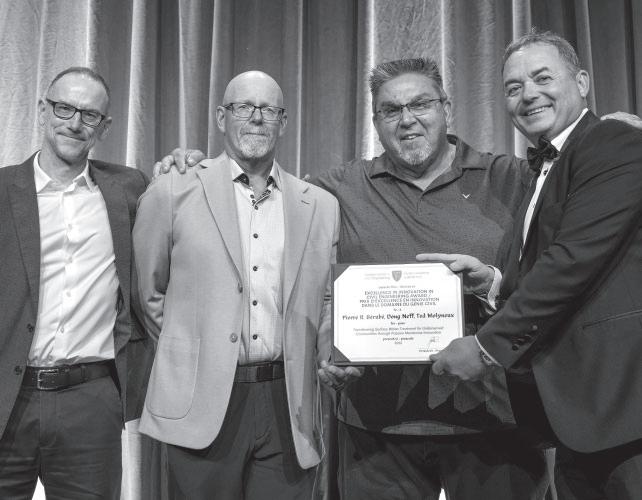
An award of Excellence in Innovation in Civil Engineering was given for the development of a water treatment system on the First Nation’s Klehkoot reserve. Those who worked on the project received the award, including UBC professor Dr. Pierre Berube (far left), NTC Director of Capital Programs Doug Neff and NTC Vice-President Les Doiron. Tony Begin (far right), vice-president of the award’s sponsor CANAM Engineering, presented the recognition in June.
pumps. It uses gravity to drain the tanks, which generates a vacuum to backwash the membranes and draw in air for sparging, eliminating the need for motorized backwash cycles.
The innovative new system is low maintenance. “By relying on passive cleaning cycles and beneficial bacteria to consume organic impurities, the plant requires very little operator intervention, making it
ideal for remote or marginalized communities,” said UBC in a newsletter. The training and technology were transferred to the Nuu-chah-nulth Tribal Council who have patented the technology. The new water treatment system at Hupacasath’s Klehkoot reserve has not only won a national award, but is also patented in both Canada and the U.S. by the Nuu-chah-nulth Tribal Council
Canadian Society of Civil Engineers presented the NTC, UBC and ISC with the annual Excellence in Innovation in Civil Engineering award at a gala earlier this month.
According to NTC Director of Capital Programs, Doug Neff, the award recognized the partnership work completed by NTC, UBC, and ISC for the planning, design and development of a new technology for a Passive Membrane Water Treatment system that was constructed at Hupacasath’s Klehkoot reserve.
Neff acknowledged Hupacasath Chief and Council for their leadership and planning to develop a sustainable water system in Klehkoot. He thanks Al McAnerin, Hupacasath water operator, Aaron Humen NTC Capital Operations Manager, Matt Seitcher, NTC Capital Project Advisor 1 for implementation lead and coordination with UBC staff to monitor and maintain the system and performance data collection.
Also noted for their contributions to the project are Stephen Munce, NTC Capital Project Advisor 3 for operational support to Al McAnerin on the plant.
“NTC would like to thank UBC Civil Engineering for transferring this valuable patent to us after working together for years in developing this water membrane system. Clean drinking water on reserve has long been an issue especially for rural and remote reserves. This system is a good solution to help NTC communities tackle clean drinking water,” shared Cloy-e-iis Judith Sayers, President Nuuchah-nulth Tribal Council.

First Nations Justice Council launches free legal service for Indigenous people affected by police misconduct
By Nora O’Malley Local Journalism Initiative Reporter
Indigenous people in British Columbia who have been affected by police violence, misconduct or negligence can now access free legal supports through the B.C. First Nations Justice Council.
First launched as a pilot program in 2024, the Police Accountability Unit (PAU) was created in effort to give Indigenous communities a more meaningful role in police oversight and accountability in the province.
“It’s great that they are trying to do something now. It only took so many Indigenous people to die in the hands of law enforcement and people custody. It’s sad that it’s taken this long for it to come,” said Tla-o-qui-aht First Nation’s Martha Martin.
Martin is the mother of Chantel Moore, the 26-year-old Tla-o-qui-aht woman who was shot and killed by Edmundston Police Force officer Jeremy Son in her New Brunswick home during a wellness check on June 4, 2020.
Five months after Chantel’s death, Martin’s son Mike Martin died while in custody at the Surrey Pretrial Centre.
“I hope that the (PAU) can respond to them in a timely fashion and not have the waiting. The hardest thing for me has been the waiting; waiting to have answers, waiting for the coroner,” she said. “To not have those answers just makes time drag.”
As of May 2026, the PAU had 83 active and 114 closed files. Among active files, nearly half involve use of force, while eight files involve illegal arrest and detention, 11 files involve illegal search and seizure, and six files involve wellness checks.
“Indigenous people are grossly, disproportionately overrepresented among people who are suffering violence at the hands of police misconduct,” said Alexander Kirby, the managing lawyer for the PAU, a team made up of both Indigenous and non-Indigenous staff members.
In 2024, nine Indigenous people were killed by police across Canada in a 20-day period (Aug. 29 – Sept. 18, 2024), according to the Justice Council. Research shows that while Indigenous people make up 5.1 per cent of Canada’s population, they comprise 16.2 per cent of the total number of police-involved deaths.
“We’re very excited to get this launched, finally. We’ve already had a huge demand for it. It’s an unfortunate reality, but we expect we’ll get a lot more and we will need to grow from here to meet that demand,” said Kirby.
On February 27, 2021, two RCMP officers responded to a call that alleged a female was sexually assaulted and being held against her will by two males at an address in Opitsaht on Meares Island, according to a report from the province’s police watchdog, the Independent Investigations Office (IIO). This visit resulted in the shooting death of 28-year-old Julian Jones.
On July 8, 2021, five months after the fatal shooting of Jones, Jared Lowndes, 38, a Wet’suwet’en man from the nation’s Laksilyu (Small Frog) Clan, was shot and killed by RCMP at a Tim Hortons parking lot in Campbell River.
In Jones’ case, the IIO found the police to not be at fault.
In Lowndes’ case, the IIO determined that “reasonable grounds” existed to consider charges against the three RCMP
o
fficers involved, however the B.C. Prosecution Service declined to pursue charges.
In 2023, the Alberta Serious Incident Response Team, a police watchdog agency, was hired by the B.C. Government to lead an investigation into allegations that some Prince George RCMP officers sexually abused Indigenous women and girls in the late 1990s and early 2000s.
Cloy-e-iis (Dr. Judith Sayers) is a Justice Council director and president of Nuu-chah-nulth Tribal Council. She said one of the most important aspects of the PAU will be to document an ongoing “pattern” of Indigenous people being harmed by police.
“We are looking to help people who have been abused by the police,” said Cloy-e-iis. “There are a lot of people who are scared to bring a complaint against the police in case there is backlash or they just don’t know how do to it or they don’t know what their rights are. Hopefully they or their families will encourage them to go to the Police Accountability Unit.”
She called the PAU a “trauma-informed and culturally sensitive” service.
“Now police know they can’t get away with behaviour that is unacceptable. I’m hoping it will make some of the police officers think a second or a third time about treating some of the people how they do,” Cloy-e-iis continued.
The launch of the PAU follows an effort from the Royal Canadian Mounted Police (RCMP), Canada’s federal police force, to increase transparency in policing and improve accountability by equipping officers with body-worn cameras.
As of February 2026, cameras have been deployed to officers at 90 of 185 detachments throughout the province with about 1,650 cameras now being used by frontline members, according to the BC RCMP.
Another positive development in policing came in 2023 out of a partnership between the Victoria Police Department and Island Health to create a Co-Response Team, where an officer and a psychiatric nurse work together to help de-escalate mental health-related incidents.
Martin said the Co-Response Team was
Kirby said the police accountability service is something that “absolutely” should be available to everyone, but he was unaware of any other non-profit championing this systematic legal approach. He said it’s uncommon for private sector lawyers to take on this type work because it doesn’t pay that well.
“The end result of that is that unless people represent themselves and advocate for themselves, there is a huge amount of police misconduct that simply goes unchallenged,” said Kirby.
“A disproportionate amount of that (police misconduct) is directed against Indigenous people, but it exists across the board,” he continued.
Any First Nations, Métis and Inuit individuals with a police-related issue can self-refer to the PAU at any time by completing the online intake form.
Kirby says the PAU team will help individuals “navigate legal tools” available, whether it be a civil case or a case with a criminal dimension.
“That could mean advocating to the
IIO (Independent Investigations Office) to investigate the matter thoroughly and possibly refer charges to the Crown. It could also involve pursuing some sort of civil action. It all depends on the facts of the case and what the family or individual wants to do,” he said.
Kirby shared that while there are time limits that apply to the legal process, there can be exceptions, so it’s always worth reaching out.
“As a general rule, the time limits are one year to file a police complaint, two years to file a lawsuit. It gets more complicated than that. If anyone has any doubts, the best thing to do would be to reach out to us. At bare minimum what we can do is give someone summary advice about what their rights are,” said Kirby.
The PAU is funded by a grant from the Law Foundation of BC. The Justice Council’s services include 16 Indigenous Justice Centres, an Indigenous Diversion Centre located in Prince George and Gladue writing services.

Anacla youth walk to raise awareness for men’s mental health, while drugs remain prevalent in Port Alberni
By Denise Titian Ha-Shilth-Sa Reporter
Anacla, BC – In mid June more than a dozen young people recently took part in a summer walk to raise awareness about men’s mental health and the lack of resources available for them. Organized by Huu-ay-aht mom Jacquie Dennis, the walk, for her, was about finding ways to support men who are in addictions and struggling to make a clean break.
Dennis shared her stories with HaShilth-Sa back in 2022. She spoke of her own journey to sobriety and what she does to help her children, and others, break the cycle of addiction.
In 2022 Dennis brought her son from the streets of Port Alberni to her Anacla home. He was hooked on heroin and needed medical support to get through withdrawals. Not able to get an appointment with the doctor for more than a month, Dennis improvised and, through unconventional methods, found the methadone he needed to safely withdraw.
Methadone is a long-acting drug used in Opioid Agonist Treatment to treat opioid dependence. It is an opioid but, when used as a maintenance treatment, allows the patient to get through withdrawal without pain and with less cravings.
But getting to sobriety is one thing.
Staying there is another story.
Dennis says that her son has relapsed many times. And each time he heads back to Port Alberni and when in contact with that old, familiar crowd, he is drawn back in. Each time Dennis will drive from her Anacla home to Port Alberni to bring him home, hoping that he will be done with the streets.
The DUDES Club is a communitybased health promotion program largely for Indigenous men in the Downtown Eastside neighbourhood of Vancouver. They have done the research, and their work is focused on building solidarity and brotherhood among vulnerable men.
According to DUDES Club research, Indigenous peoples in Canada continue to experience considerably higher rates of mortality, morbidity, and preventable diseases, with a disproportionate burden of mental health issues, compared to the general population.
“Further, men are generally less likely than women are to seek help with health issues and they face many barriers when accessing mental health services,” stated the group.
The Nuu-chah-nulth Tribal Council’s Teechuktl mental health programs offer support to Indigenous people through their Redford Street offices in Port Alberni. Hector Little is a Quu’asa wellness support worker with the department who
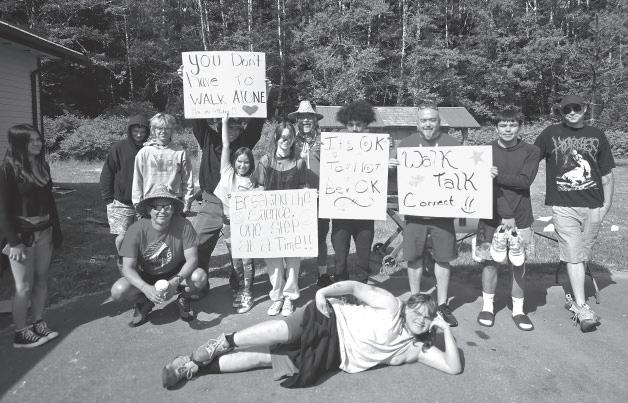
On June 23 more than a dozen young people took part in a summer walk to raise awareness about men’s mental health and the lack of resources available for them. Organized by Huu-ay-aht mom Jacquie Dennis, the walk, for her, was about finding ways to support men who are in addictions and struggling to make a clean break.
knows there’s a lack of resources for men seeking to escape addiction.
Little said he’s had conversations with brothers working hard to take care of themselves in sobriety.
“The hardest part is habitual need to use when emotions are hard to deal with. When things get tough it’s hard to stay away from (substances)…when everything is good for a little while,” he said.
Little believes that, in many cases, things like alcohol are woven into the fabric of a person’s life story.
“In my personal opinion, growing up in it (alcohol abuse), being a part of it, seeing leadership doing it, celebrations, always alcohol involved. It’s a challenge for them to let go of it…it’s like how I belong to the community without alcohol, so letting it go is a tough one,” he shared.
Little says he reminds clients that quitting alcohol is going to be painful and it’s going to be hard.
“Those old habits are gonna tap you on the shoulder a hundred times a day,” he said.
This is why it is important to have things like a peer support and group support that can help men learn how to support themselves.
“You need to replace that with another activity…like physical activity, mental activity,” Little said.
Workers at Quu’asa are developing supports at their Redford Street office.
“We have a men’s group at Redford Street every Friday night. We get guys together, share a meal, let them know they’re safe here,” said Little.
Little says it is important to provide safe, supportive places for men to help them maintain sobriety. The talking circle

awareness about men’s mental health issues was a success. On June 23, about 17 youth and other community members walked carrying placards, ending with a free barbecue. She hopes to arrange a similar walk in 2027 for Port Alberni.
Dennis vows to continue to do whatever it takes to help her son, no matter how many times she brings him back home.
Little says showing compassion and consistency is important.
“The first pitch may not land, but if you keep pitching, one is going land,” said Little.
If you are seeking help with addictions or mental health issues, you may reach out to the Mental Health Support Line: Call 310-6789 (do not add 604, 778 or 250 before the number). This number will connect you to your local B.C. crisis line without a wait or busy signal, 24 hours a day.
starts off with drumming, allowing the men to partake in some cultural teachings.
“The talking circle is safe place for them to be heard, and support one another,” said Little.
Others find that support through regular AA meetings held at the NTC health centre on Roger Street.
“I like to talk about the ‘future forecast’,” noted Little about the prospective life without alcohol and drugs. “I ask them, what would your future look like if you gave up?”
Dennis’ five-kilometre walk to raise
Crisis line workers are trained to help provide emotional support as well as mental health information and resources. Crisis Text Service (Vancouver Island): Call 250-800-3806 from your mobile. Available from 6 p.m. to 10 p.m. Pacific Time, seven days a week. If you have unlimited coverage for SMS text messages with your mobile service provider, the texting service will be free of charge.
In Port Alberni and neighbouring communities, you can call the NTC Quu’asa workers at 250-724-3939 and ask for Cherie Elliot or Hector Little, Lee Lucas, or Brianna Rai.
Large Port Alberni house is working through red tape to become a facility for men recovering from addiction
By Denise Titian Ha-Shilth-Sa Reporter
Port Alberni, BC – A beautiful home on Port Alberni’s River Road is getting a facelift as its new owners cut through red tape in their quest to open the city’s first men’s only second stage housing for those undergoing addictions recovery.
Headwaters Therapeutic Recovery Society, affiliated with Arrowsmith Baptist Church in Port Alberni, purchased the property that was known as Hummingbird Guest House, located at 5769 River Road in the summer of 2025. Once all the rezoning, permits, renovations and finances are in place, the plan is to welcome up to ten men, giving them a place to live temporarily so that they can build life skills that will help them succeed on their new path to sobriety.
George Koning, a retired local, said he and his friend Rod Grant were talking about what is happening on the city streets with people dying from addictions, and how awful it is. “It was the fall of 2024 when Rod called me and said he can’t stand it anymore – something has got to be done,” Koning shared.
When he asked his friend what he was thinking, Grant answered that a recovery house is what is needed. Wanting to help his friend, Koning began researching what a recovery house is. He said he and his friend would meet over breakfast every week or so, developing the idea, and they eventually formed the Headwaters Therapeutic Society.
Koning said other interested people joined in on the planning process, wanting the help in a big way. Koning said he couldn’t say who they are, for confidentiality reasons, but they bought the Hummingbird Guesthouse, a large, sprawling property on River Road, for the men’s recovery project.
Headwaters Therapeutic Society has spent the last year renovating the large house and grounds, complete with gardens, a large workshop and green house. They are in the process of applying to the City of Port Alberni to have the property rezoned. If successful, the rezoning would enable transitional housing to be operated at the site.
There is no supportive second stage housing for men in Port Alberni. There is a six-bed all female supportive housing just outside of Port Alberni called Therapeutic Recovery Community operated by Port Alberni Shelter Society.
The transitional housing for men, to be funded by the provincial government,

would provide second stage housing for up to ten men. The men, ages 19 and older, would be coming out of addictions treatment and live in the ‘dry’ home communal style where they will be supported for up to two years.
According to the Headwaters Board of Directors, their mission is to provide a supportive and Christ-centered environment for men seeking recovery from addiction through their residential program.
“At Headwaters, we (will) operate a recovery home that offers a safe, structured, and nurturing space exclusively for men committed to their sobriety journey. These men have already achieved at least three months of sobriety before entering this second-stage housing,” they stated.
Headwaters will take the residents through a program that blends Alcoholics Anonymous and Narcotics Anonymous with biblical teachings. The program will run for up to 18 months.
According to Koning, there will be strict guidelines for admittance centered around sobriety. For example, those using full
agonist treatment with drugs like Naloxone or Suboxone, or those using cannabis are ineligible for the program. In addition, those individuals that have a history of sexual violence, significant mental health, arson and violence are not eligible for the program.
When running, the program will be open to men aged 19 and older from Port Alberni and neighboring west coast communities including Bamfield and Tofino/ Ucluelet/Ahousaht. To be eligible, they will have been detoxed in a provincialapproved facility and have had at least 90 days of sobriety, with stable physical and mental health.
“This is faith-based,” said Koning. “I don’t know how to say this, but we are all born with a heart, a mind and a soul, and we want to help men develop new patterns of living so that they can heal their hearts, minds and souls.”
Headwaters is proud of its deep roots in the community and has formed connections with volunteers and local businesses who are contributing by helping with the


paperwork, renovations and donations to make the dream a reality.
“This is not someone else’s problem, it’s OUR problem,” said Koning. And the men who complete the program will have the skills to make it on their own and can give back to their communities.
Koning estimates that it will take at least four months to get through the rezoning process with the City of Port Alberni. The necessary government reviews and applications will take several more months.
The upgrades to the property are almost complete.
“We need to raise a chunk of change for operating costs, and we will probably begin a fundraising drive in the fall,” said Koning. In their application for rezoning to the City of Port Alberni, it is stated that funding to run the facility will come from the provincial government.
“Nothing can make me happier than sitting on the porch (of the Headwaters House) and seeing the first guy walk out and onto his new life – that’s worth it,”
said Koning

Ha-Shilth-Sa newspaper is published by the Nuu-chah-nulth Tribal Council for distribution to the members of the contributing First Nations, as well as other interested groups and individuals.
Information and original work contained in this newspaper is protected by copyright and may not be reproduced without written permission from:
Nuu-chah-nulth Tribal Council
P.O. Box 1383, Port Alberni, B.C. V9Y 7M2.
Telephone: (250) 724-5757
Fax: (250) 723-0463
Web page: www.hashilthsa.com facebook: Hashilthsa Ntc
Non-Nuu-chah-nulth, Ahousaht, Ehattesaht, Huu-ay-aht Toquaht and Ucluelet members are subject to a yearly subscription fee of $40 in Canada, $50 in the US and $60 for overseas. Payable to the Nuu-chah-nulth Tribal Council
Manager/Editor/Reporter
Eric Plummer (Ext. 243) (250) 724-5757 Fax: (250) 723-0463 eric.plummer@nuuchahnulth.org
Reporter
Denise Titian (Ext. 240) (250) 724-5757 Fax: (250) 723-0463 denise.titian@nuuchahnulth.org
Reporter Nora O’Malley (604) 353-8488 nora.omalley@nuuchahnulth.org

Audio / Video Technician
Mike Watts (Ext. 238) (250) 724-5757 Fax: (250) 723-0463 mike.watts@nuuchahnulth.org
Editorial Assistant
Holly Stocking (Ext. 302) (250) 724-5757 Fax: (250) 723-0463 holly.stocking@nuuchahnulth.org
Please note that the deadline for submissions for our next issue is July 10, 2025
After that date, material submitted and judged appropriate cannot be guaranteed placement but, if material is still relevant, will be included in the following issue.
In an ideal world, submissions would be typed rather than hand-written.
Articles can be sent by e-mail to holly.stocking@nuuchahnulth.org (Windows PC).
Submitted pictures must include a brief description of subject(s) and a return address.
Pictures with no return address will remain on file. Allow two - four weeks for return.
Photocopied or faxed photographs cannot be accepted.
Although we would like to be able to cover all stories and events, we will only do so subject to:
- Sufficient advance notice addressed specifically to Ha-Shilth-Sa.
- Reporter availability at the time of the event.
- Editorial space available in the paper.
- Editorial deadlines being adhered to by contributors.
Ha-Shilth-Sa will include letters received from its readers. Letters MUST be signed by the writer and have the writer’s full name, address and phone number on them. Names can be withheld by request. Anonymous submissions will not be accepted. We reserve the right to edit submitted material for clarity, brevity, grammar and good taste. We will definitely not publish letters dealing with tribal or personal disputes or issues that are critical of Nuu-chah-nulth individuals or groups. All opinions expressed in letters to the editor are purely those of the writer and will not necessarily coincide with the views or policies of the Nuu-chah-nulth Tribal Council or its member First Nations. Ha-Shilth-Sa includes paid advertising, but this does not imply Ha-Shilth-Sa or Nuu-chah-nulth Tribal Council recommends or endorses the content of the ads.
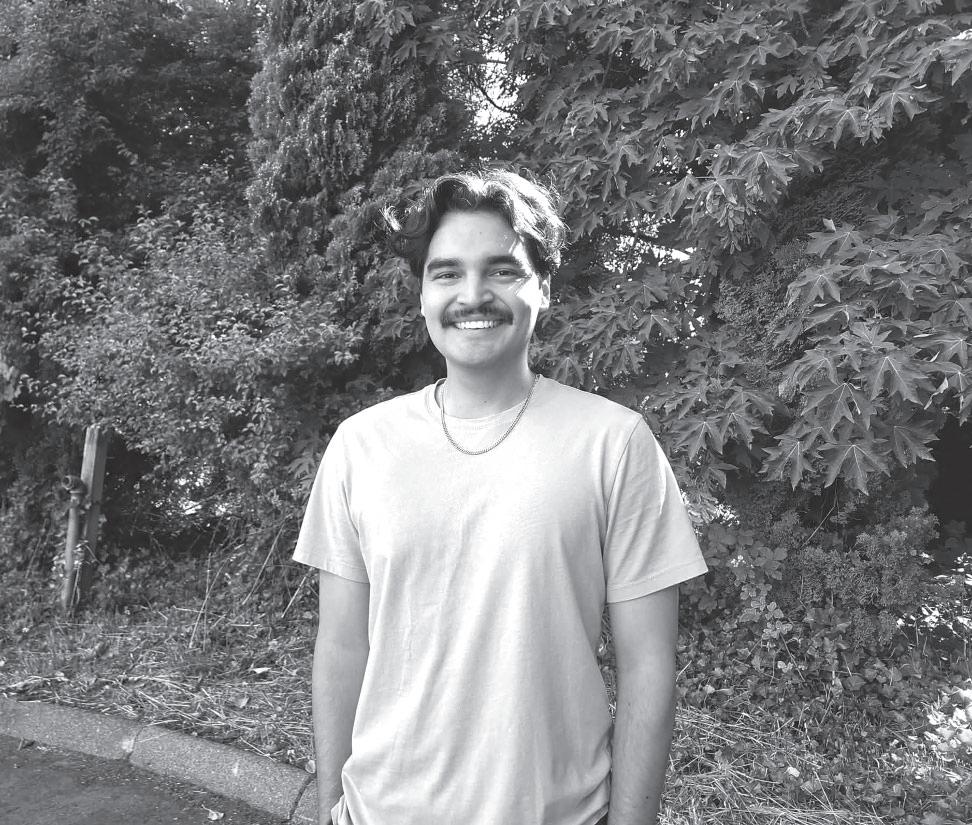
Brevin Charleson, this year’s Tlu-piich coordinator, hopes to bring back the traditions and culture of past games.
By Holly Stocking Ha-Shilth-Sa Editorial Assistant
Port Alberni, BC – The summertime tradition of the Tlu-piich games is back for 2026. New games Coordinator Brevin Charleson is excited to bring his take on the games to Port Alberni.
“No solid dates yet but I am hoping for four days in the second week of August,” Charleston tells Ha-Shilth-Sa. Track and field, basketball and canoe races are planned with the potential for more events as the planning progresses.
Charleson, a former camp counselor at the Tillicum Lelum Aboriginal Friendship Centre and former Hesquiaht chief
councillor is now attending law school at the University of Victoria.
“This is perfect for my summer between semesters,” he says, “I always want to be working in community, with the NTC or Hesquiaht.”
Charleson himself is a long-time competitor at the Tlu-piich games.
“The first event I ever competed was in the baby crawl. I also was the winner and still have the trophy to prove it.”
Charleson was an avid basketball player all through his youth, competing at Tlupiich, JANT and on his high school team, having a love for sport his whole life.
Charleson hopes to bring back traditional events like the baby crawl and possibly
Ha-Shilth-Sa belongs to every Nuu-chah-nulth person including those who have passed on, and those who are not yet born. A community newspaper cannot exist without community involvement. If you have any great pictures you’ve taken, stories or poems you’ve written, or artwork you have done, please let us know so we can include it in your newspaper. E-mail holly.stocking@nuuchahnulth.org. This year is Ha-Shilth-Sa’s 52nd year of serving the Nuu-chah-nulth First Nations. We look forward to your continued input and support. Kleco! Kleco!
the elder’s dash.
“I like the traditions of the games, that is what makes them really special. I really like the focus on culture and community.”
Lots of kiddie events and culturally focused events are in the works for this year’s Tlu-piich games.
As always, the games rely heavily on volunteer participation. Sign up for volunteers is now open and anyone interested can email brevin.charleson@ nuuchahnulth.org to sign up.
The NTC is also taking applications for the Tlu-piich Games assistant, Tlu-piich Games volunteer coordinator and assistant volunteer coordinator, starting immediately.
The advertiser agrees that the publisher shall not be liable for damages arising out of errors in advertisements beyond the amount paid for space actually occupied by the portion of the advertisement in which the error is due to the negligence of the servants or otherwise, and there shall be no liability for non-insertion of any advertisement beyond the amount paid for such advertisements
New mobile outreach program will supplement, not duplicate, existing taxpayer-funded services, says the city
By Nora O’Malley Local Journalism Initiative Reporter
Campbell River, BC – More overdose response services are coming to Campbell River and the surrounding area.
For 2026–27, Health Canada approved roughly $1.14 million in funding for a new Mobile Outreach Program, which partners the City of Campbell River (the City) and Lookout Housing and Health Society.
“The City remains deeply concerned about the tragic loss of life due to toxic drugs. These losses profoundly affect families, friends and colleagues across the community. This is why, when we noted the call for proposals for the Emergency Treatment Fund from Health Canada in the fall of 2025, we decided to submit an application under very tight timelines,” said Jeff Ford, the City’s director of community safety.
The opioid crisis continues to have a significant impact on Campbell River. In 2025, Greater Campbell River lost 43 souls to overdose and had the third highest unregulated drug death rate in the province, behind Vancouver – Centre North and Lillooet, according to the B.C. Coroners Service.
Located on the east coast of Vancouver Island, Campbell River is a growing port city of roughly 38,000 residents with a notably larger Indigenous population than neighbouring communities. A 2019 report published by the Campbell River Community Action Team showed that 12.2 per cent of Campbell River’s population is Indigenous, as compared to 5.9 per cent in the Comox Valley or 8.1 per cent in Nanaimo.
Many respondents involved with the Community Action Team report mentioned trauma as a reason they began using substances.
Laichwiltach Family Life Society (LFLS) is a multi-service organization for Indigenous people living in the Mid-Island region. They used to operate Kwesa Place and Hem’?aelas Community Kitchen, two vital drop-in centres for Campbell River’s most vulnerable, but were forced to close after the City purchased their downtown building for redevelopment.
Ford said the City has connected with LFLS on a number of occasions over the past year.
“Although community health services is a provincial role, we remain open to
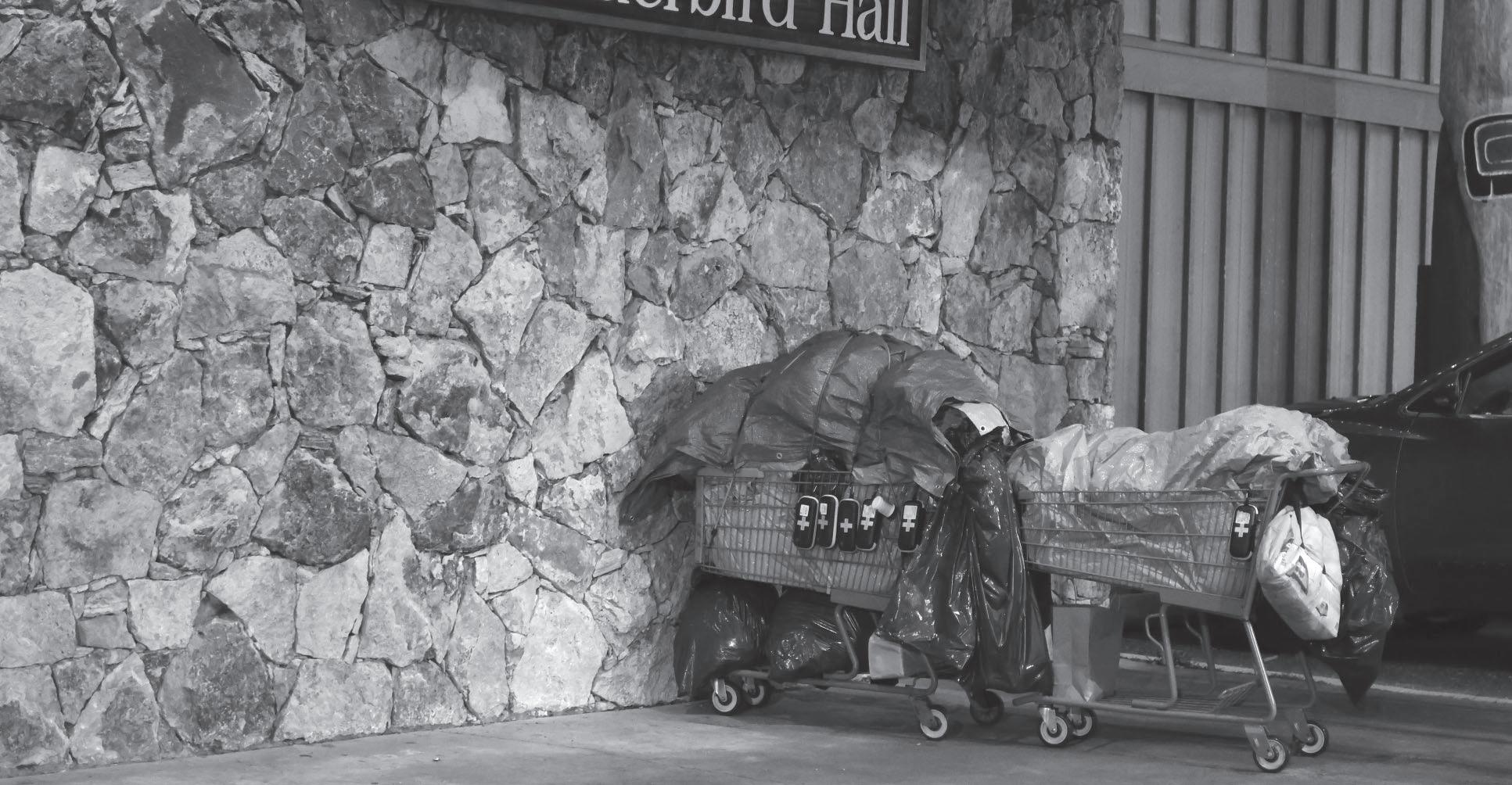
working with the Society and other community partners on emergency supports in the community,” said Ford.
He said the new mobile outreach program will be “grounded in traumainformed and culturally safe practices”.
“We will continue exploring opportunities to incorporate Indigenous perspectives and supports as the program evolves,” he said.
The funding from Health Canada will support an outreach team run by Lookout Housing and Health Society, including a program coordinator, two outreach workers, a mental health support worker/recreation therapist, and trained peer workers with lived experience.
Campbell River resident Sue Moen has been coordinating the Community Action Team for the past four years. She says she can’t wait for the Mobile Outreach Program to begin.
“I am thrilled Campbell River was awarded this grant. The partner, Lookout Housing and Health Society has decades of providing quality services to strategically disadvantaged folks. I sat at tables with them on the DTES in the 90’s and respect their work and expertise as well as their openness to employing people with lived and living expertise in homelessness, mental health and substance use,” said Moen.
The funding will also support three new positions including two community
support officers and a community safety coordinator, which the City will hire for.
“We will give strong consideration to local applicants, including those from Campbell River and nearby First Nations, while ensuring the hiring process remains consistent with City policies,” said Ford.
“These roles are not enforcement or policing positions. They will focus on community outreach, public education, and crisis response, working closely with Lookout Housing and Health Society and other service providers to support individuals and connect them to appropriate services,” he continued.
The new Mobile Outreach Program is intended to supplement, not duplicate, existing taxpayer-funded services, such as Island Health’s Substance Use Integrated Team and Mental Health & Substance Use program, by reaching people who struggle to access traditional health and social supports, Ford shared.
“The Mobile Outreach Program’s team will focus on mobile overdose response, outreach, transportation, and system navigation—not clinical treatment or other specialized supports. The program leads will connect with existing supports in the community and work to complement those initiatives and fill gaps in coverage as much as possible,” he said.
Need for after hours service
The City says the program will operate five days per week with weekend, eve-
ning and after-hours coverage as available. They plan on launching as soon as possible, pending the hiring process.
Moen hopes the City will “strongly consider prioritizing evening and very early morning outreach.” She says the Community Action Team and volunteers with CRASH Harm Reduction have consistently identified a need for after hours service.
“As people are more and more dispersed and isolated by bylaw enforcement and increasing community hostility, reaching them when no other agency is open is more critical than ever,” she said.
In a media release, Campbell River Mayor Kermit Dahl said the investment from Health Canada will “help connect people to care, reduce pressure on emergency services, and create more opportunities for individuals to stabilize and move forward in our community.”
“We will continue working with partners across all levels of government to advocate for expanded access to recovery and supportive housing, building on important steps like this program and the Homewood Temporary Housing initiative,” said Dahl.
The Ha-Shilth-Sa reached out to the LFLS for comment and will update this story as more information become available.

Students from Mexico, Hawaii and Aotearoa (New Zealand) are welcomed by Vancouver Island First Nations
By Jessie Levene Ha-Shilth-Sa Contributor
Courtenay, BC - North Island College
recently hosted its first-ever cohort of international field school students from Hawaiʻi, Aotearoa (New Zealand) and Mexico.
From May 25 to June 5, a group of 17 Indigenous students and their teachers from colleges and universities located around the Pacific Ocean were in the region to engage in various educational and cultural activities. The trip was the latest exchange as part of NIC’s international Indigenous field school program.
Kelly Shopland, NIC’s executive director of Indigenous Education, says the field school is part of the college’s “approach on the indigenization of international education” which began in 2021.
“So the Indigenous Education department was consulted, and we decided to do a completely Indigenous-led international field school, which was very different from prior NIC international field schools,” said Yawač, Ian Caplette, an Indigenous education instructor at NIC’s Port Alberni campus. “We created it, it wasn’t based on any model.”
With support from the office of Global Engagement to liaise with the international institutions, NIC established relationships with several colleges and universities around the Pacific, including in Hawaiʻi, Aotearoa (New Zealand), Mexico, Costa Rica, and Japan.
In 2022, a group of Indigenous NIC students travelled to Hawaiʻi. In 2024, another cohort of NIC students visited New Zealand, followed by a return trip to Hawaiʻi in 2025.
“Almost 90 Indigenous NIC students have been involved in the program over the course of the last four to five years,” said Shopland.
As Caplette explained, the students have to undertake a lot to be part of the field school.
“They have to get their passports, do the admin work, plus they have to be successful in school,” he said. “So it’s not a vacation, it’s a learning opportunity.”
Travelling abroad was often “transformative” for the NIC students, said Shopland.
“For some it was their first time on a plane, or their first time leaving the island, or their first time leaving their communities,” she said. “The learners came from a variety of backgrounds, but one of our key messages is that we’re not separated but connected by the Pacific. These were amazing cultural exchanges, which the students then shared back with their home communities.”
Another key message for the students in the field schools was about how to make the exchange grounded in Indigenous ways of being.
“How do we show up in another Nation’s territory?” said Caplette. “How do we do so in a respectful way? This was a learning process for us, but we followed the host’s own welcome protocols and we also practiced our own, and it worked really well.”
The program is also rooted in reciprocation, said Shopland. So, in 2026, after several successful trips abroad, “it was our time to host. We reached out to the colleges who had hosted us, and with the new Indigenous student housing at the NIC Courtenay campus, the stars started to align.”
Students from four institutions visited the region on the latest field school, in-
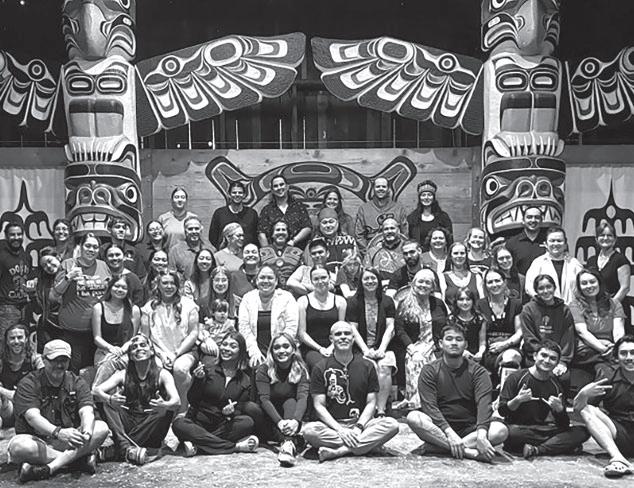
cluding the University of Hawai‘i’s Maui and Kapiʻolani Colleges, the University of Waikato in Aotearoa (New Zealand), and the University of Colima in Mexico.
One of the Colima students on the recent trip was Ana Paula Ruiz Arce, a 22-year-old Mexican journalism student.
“It was my first time in Canada and I was so impressed, you guys are so humble and nice to tourists like me,” said Ruiz Arce.
But this wasn’t her first contact with NIC.
“Since 2022 I have been part of an online journal project,” she added. “This was something more intimate than just a school project. We shared our culture, pictures, songs, and stories. We realised we had a lot of stuff in common.”
The group’s 10-day trip started in K’ómoks territory - and straight away hit a slight hiccup.
“We had to adjust to not canoeing in the harbour, because of the unfortunate recent sewage incident,” Shopland said.
“With K’ómoks First Nation’s support, they trailered out their canoe, and another canoe came down from Kwakiutl First Nation up in Fort Rupert, and another canoe came up from Qualicum, so we were able to have three traditional canoes out on Comox Lake. That was fabulous, and not something you see everyday.”
Group welcomed by Nuu-chah-nulth nations
Next, the group was off to Nuu-chahnulth territory for community visits to cišaaʔatḥ, Tla-o-qui-aht and Yuułuʔiłʔatḥ First Nations.
“When we arrived in Port Alberni, we were welcomed by the cišaaʔatḥ hereditary chief and elected chief at Somass Hall,” said Caplette. “We shared our histories, including pre-European contact, when there was contact between our tribes across the ocean. Then we went down to the river where our hosts told us about its history and sacred importance to cišaaʔatḥ, and how they are maintaining the health of the river and the salmon.”
The next day, the group travelled to the west coast to meet with mułaa Rising Tide, an Indigenous and community-led surfing initiative, for a dinner and surfing lesson.
“I was really nervous to surf, because I never surfed in my life,” said Ruiz Arce. “And it was my first time swimming in really cold water. But it was really connecting. I believe a lot in Mother Nature,
activities for this trip.
“NIC was the facilitator, but the learning happened in community. The generosity of the Nations, the time, how many members would come out to participate, was pretty phenomenal,” she said.
For Ruiz Arce, the experience has been life changing.
so I always ask the sea if I can swim, I always ask for permission, and thank Mother Nature for letting me be here with them.”
In Tofino, the group stayed at the Tin Wis Resort as guests of Tla-o-qui-aht First Nation, whose hospitality was amazing, said Ruiz Arce, who got to try oolichan grease.
“Actually I didn’t have a lot of salmon in my life until I came to B.C. I also tried something, some kind of oil, it tasted like a fishy strong flavour. It was a whole experience,” she said.
For their last day on the west coast, the group visited Yuułuʔiłʔatḥ for a tour of their museum and long house, and for more sharing of stories, songs, dances, and food.
“Our friends from Aotearoa shared a haka with the elders,” said Caplette. “The elders were so pleased to see it, and they taught the haka to everyone assembled who could get up and dance. It was a lot of fun, and after that the Hawaiians taught us hula.”
Back on the east coast, the last trip for the group was with Homalco Wildlife and Cultural Tours to Bute Inlet.
For Shopland, it’s important to highlight the support of the Nations - K’ómoks, cišaaʔatḥ, Tla-o-qui-aht, Yuułuʔiłʔatḥ, Kwagu’ł, Wei Wai Kum, We Wai Kai and Homalco - who hosted or supported
“Before coming to Canada, I had a very general understanding of Indigenous people. In Mexico, the government really doesn’t support Indigenous people,” reflected Ruiz Arce, who learned about the historically problematic relationship First Nations have had with Canada, but also recent efforts for cultural revitalization. “In Mexico, we need that. We need our people to be proud for who they are. So one thing that really stood out to me was the importance of cultural revitalization. I learned about efforts to preserve language, traditional and knowledge for future generations, and I found that really inspiring. I also took away from the experience the importance of listening to communities tell their own stories. As a future journalist, this is something I will carry with me.”
Funding discontinued
But despite such positive experiences, the future of the NIC international Indigenous field school is uncertain. The federal funding that allowed students to participate in the program at no cost was discontinued in March 2025. At present, NIC does not have plans or funding to support future international Indigenous field schools.
“So we have to become more creative,” said Caplette.
“The office of Global Engagement is always keeping an eye out for grants and proposals,” said Shopland. “There’s always new opportunities coming up, but they’re often one-offs.”
Many of the students are brought to tears, said Ian Caplette, when they think about how impactful this program has been on their lives.
“Those are gifts you can’t put money on, you can’t replicate that in a vacation package, you can only experience that through these types of opportunities,” he said. “To say that we’re connected allows us strength [in] how you feel about your place in this world, especially when we’re recovering from a lot of the challenges that have been placed upon us. It’s a way to strengthen our identities, and our resolve to overcome colonization.”
Nuu-chah-nulth’s Zakariyah Thomas and Marissa Tom-Charlie receive $11,000 as they look beyond Grade 12
By Nora O’Malley Local Journalism Initiative Reporter
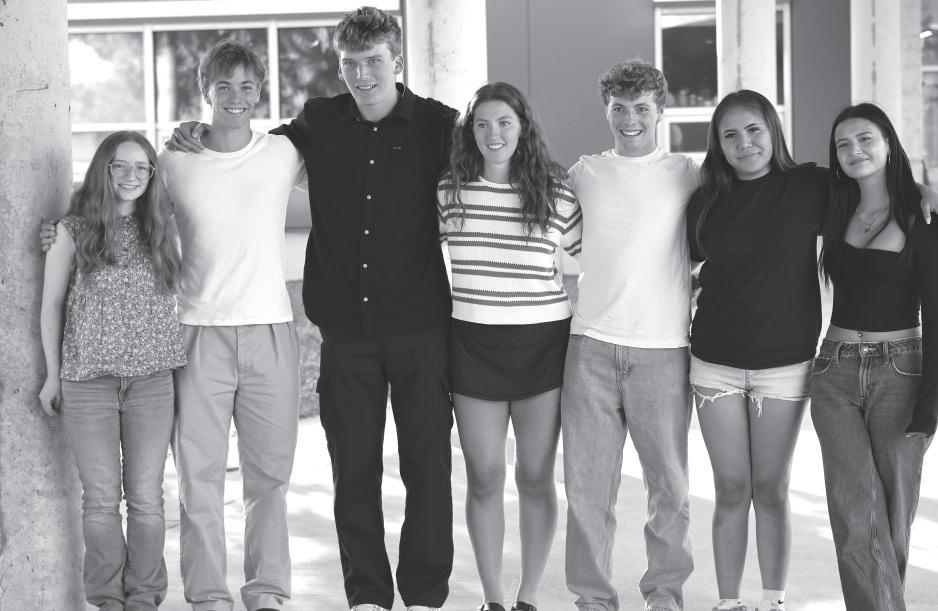
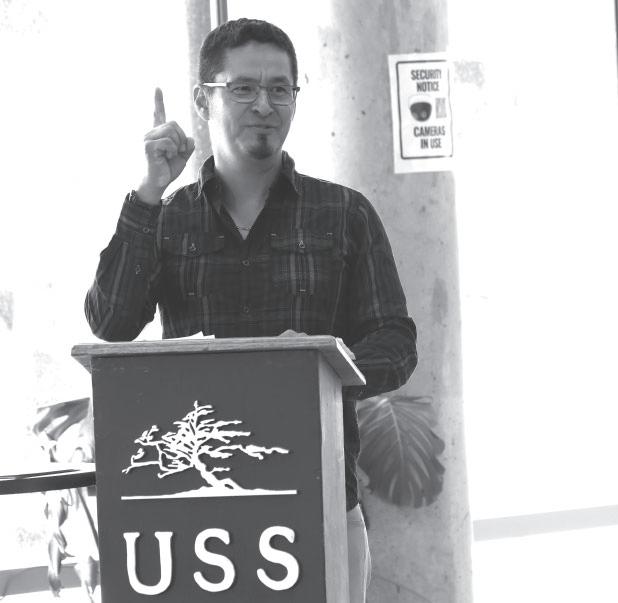
Ucluelet, BC – Seven communityminded Ucluelet Secondary grads were awarded seven giant cheques on June 18 at the Ucluelet Secondary School (USS).
Facilitated by the Clayoquot Biosphere Trust (CBT), program coordinator Jason
Sam said the 2026 education awards committee received a record number of 32 applicants for five scholarships. A total of $114,000 was handed out for postsecondary.
“All these recipients have been highly noted for their contributions for school and community,” said Sam.
“We find no better way to serve our community than to uplift and empower our youth to seek out their opportunities for higher education and to pursue their life goals,” he said.
This year, the $22,000 Central Region nuučaanuł Education Award was shared between Ahousaht First Nation’s Zakariyah Thomas and Tla-o-qui-aht First Nation’s Marissa Tom-Charlie.
“Honestly, the selection committee could not choose, so in order to avoid the stress, they evenly split it,” said Sam. Thomas will apply her $11,000 towards pursuing a sports and recreation management degree at Vancouver Island University (VIU).
“I feel really happy to get this scholarship. I’m a little rez girl that made it out of the rez. It means so much to me that my family is here by my side. Thank you to my family for pushing me to succeed and do better things in life,” said Thomas. Her mom, Freida Thomas, says the money will help in so many ways.
“As a single mom, I raised my children all on my own. This will help tremendously with her books and such. I was literally in tears when she showed me the envelop,” said Freida.
Thomas, a dedicated Ahousaht basketball player, says she will continue to play the sport while at VIU.
Tom-Charlie is also headed to VIU to study criminology. She was inspired to learn more about the Canadian justice system after studying law in Grade 12 with USS teacher Mr. Nixon.
“He was my favourite teacher. He did my reference letters,” said Tom-Charlie.
“This award means a lot for me. I hadn’t
planned on going to school in the fall, I made that decision to go recently. This takes off a lot of stress,” she said.
Originally from Port Alberni, TomCharlie moved to the west coast in Grade 10 and lives with her grandparents Deb Masso and Francesca Palazzolo.
“We are so proud of her. She gets up early every single morning. She’s an early bird. She’s so committed to her education, and she is only going further,” said Masso.
Masso works in Tla-o-qui-aht’s language department and teaches weekly Nuu-chah-nulth language classes. She translated two phrases from Barkley dialect and central Nuu-chah-nulth dialect for a grad banner: ‘you’ve all done something big’ and ‘always be kind-hearted’.
“There is such power in words, especially Nuu-chah-nulth words. All our words are rooted in the land, in the sky, in the stars, in everything, that’s why it’s so beautiful and so powerful,” said Masso.
Tofino surfer Clay Chiovitti received Tourism Tofino’s $10,000 scholarship,

which he will put towards a kinesiology degree.
Eli Morgan and Calla Hurwitz evenly split the CBT’s $22,000 Education Award. Morgan is heading to University of Victoria (UVic) to study engineering and Hurwitz is off to UVic as well to study kinesiology.
The Pacific Rim Foundation Dick Close Scholarship doubled down this year,
bestowing two recipients with lifechanging sums of money. Phoebe Forde received $20,000, which will support her journey at UVic as she studies physics. Hugh Clouthier, who likely had the biggest smile at the end of the day, was named the recipient of a $40,000 Pacific Rim Foundation Dick Close Scholarship. Clouthier plans to study kinesiology at UVic.

Ditidaht
Dakota Knighton Dogwood Diploma
Hailey Thompson Dogwood Diploma
Destiny Peltier Certificate Trades Skills Foundation - Construction
Port Hardy Secondary School
Ditihdaht Community School
Camosun College
Laura Peltier Post-Graduate Business Administration Accounting Camosun College
Levi Sutherland Certificate Welding Level B
Gregory Thomas Diploma Community Support Worker
Myra Jack Adult Dogwood
Felix Harry Leaving Certificate (Evergreen)
ḥ
akaƛ (Christina) John Masters Indigenous Language Revitalization
Selena Lord Certificate Indigenous Language Revitalization
Adrienne Michael Diploma Human Services
Tianna Michael Certificate Scuba Diver
Naani Johnson-Tom Dogwood Diploma
Destiny Lucas Dogwood Diploma
Linden Lucas Dogwood Diploma
Shannon Sabbas Dogwood Diploma
Zia Shaugnessy Dogwood Diploma
Gregory Lucas Leaving Certificate(Evergreen)
Malaya Lucas Leaving Certificate(Evergreen)
Morgan Wilhelmson Bachelors Arts
Hupacasath
Cyrus Unger-Sutherland Adult Dogwood
Teala McAnerin Dogwood Diploma
Shealynn McCarthy Dogwood Diploma
Blake Roy(Sayers) Dogwood Diploma
Lindsey Frank Diploma Practical Nursing
Alana Sayers Doctorate Doctor of Philosophy
Victoria Von Sacken Nash Masters Juris Doctorate
Hailey Dick Certificate Health Care Assistant
Huu-ay-aht
Jason Jack Adult Dogwood
Vancouver Island University
Edison College Canada
Gold River Secondary School
Robron Centre
University of Victoria
University of Victoria
North Island College
Divesafe International Commercial
St. Andrews Regional High School
Victoria High School
Alberni District Secondary School
Nanaimo District Secondary School
Nanaimo District Secondary School
Ditihdaht Community School
Ditihdaht Community School
McGill University
Learning Alternatives (Woodlands)
Alberni District Secondary School
Eighth Avenue Learning Centre
Alberni District Secondary School
Discovery Community College
University of Victoria
University of British Columbia, Peter A Allard School of Law
North Island College
Eighth Avenue Learning Centre Kyuquot
Blayke John Dogwood Diploma
Eian John Dogwood Diploma
Grayson Joseph Dogwood Diploma
Adeline Jules Dogwood Diploma
Caitlyn Smith Dogwood Diploma
Tanesha Clarke Diploma Practical Nursing
Sydney Joseph Oscar Certificate Aboriginal University Bridging Program
Mowachaht
John Amos Adult Dogwood
August (Samuel) Johnson Adult Dogwood
Aaron Amos Dogwood Diploma
Talishe Amos Dogwood Diploma
Jordanna Jack Dogwood Diploma
Kyloh James Dogwood Diploma
Rae-Lynn Thomas-Lord Dogwood Diploma
Collin Johnson Leaving Certificate (Evergreen)
John Amos Certificate Indigenous Language Revitalization
Margaret Amos Certificate Indigenous Language Revitalization
Tracy Amos Certificate Indigenous Language Revitalization
Michelle James Certificate Indigenous Language Revitalization
Joni Johnson Certificate Indigenous Language Revitalization
Sherry Mattice Certificate Indigenous Language Fluency
Sherry Mattice Certificate Indigenous Language Revitalization
Kayla Savey Certificate Indigenous Language Revitalization
Terry Frank-Tom Adult Dogwood
Sienna David Dogwood Diploma
Anneliese Jack Dogwood Diploma
Wiinuk Martin Dogwood Diploma
Chloe Moulton Dogwood Diploma
Vincent Thomas Dogwood Diploma
Carol Tom Dogwood Diploma
Marisa Tom Dogwood Diploma
Kaydance Tom-Frank Dogwood Diploma
Josephine Mark Adult Dogwood
Kyuquot Elementary Secondary School
Kyuquot Elementary Secondary School
Kyuquot Elementary Secondary School
Eighth Avenue Learning Centre
Captain Meares Elementary Secondary School
North Island College
Vancouver Island University
North Island College
Gold River Secondary School
Gold River Secondary School
Gold River Secondary School
Gold River Secondary School
Gold River Secondary School
Gold River Secondary School
Gold River Secondary School
University of Victoria
University of Victoria
University of Victoria
University of Victoria
University of Victoria
North Island College
University of Victoria
University of Victoria
Eighth Avenue Learning Centre
Ucluelet Secondary School
Eighth Avenue Learning Centre
Neah Bay High School
Ucluelet Secondary School
Alberni District Secondary School
Ucluelet Secondary School
Ucluelet Secondary School
John Barsby Secondary School
Eighth Avenue Learning Centre
High school completion rates continue to rise for Indigenous people as Nuu-chah-nulth students look forward
By Eric Plummer Ha-Shilth-Sa Editor
Port Alberni, BC - For Anika Jensen, graduating this June has been a family affair. The 17-year-old is allowed to invite half a dozen people to watch her cross the stage at the Alberni District Secondary on June 25 – but this month an earlier graduation event put on at the high school by the Nuu-chah-nulth Tribal Council allowed even more relatives.
“I got to have a lot of my family there because at my actual graduation for Alberni I can only have six people, so I tried to invite as much people as I could,” said Jensen after being recognized at the NTC event on June 6.
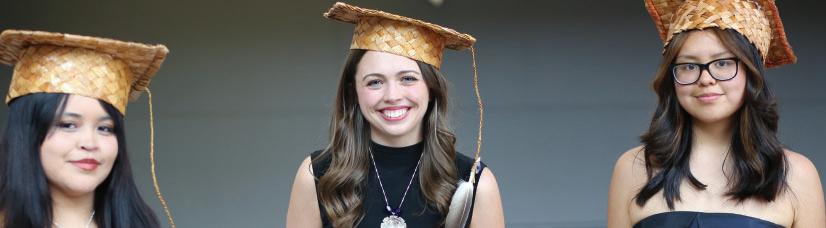
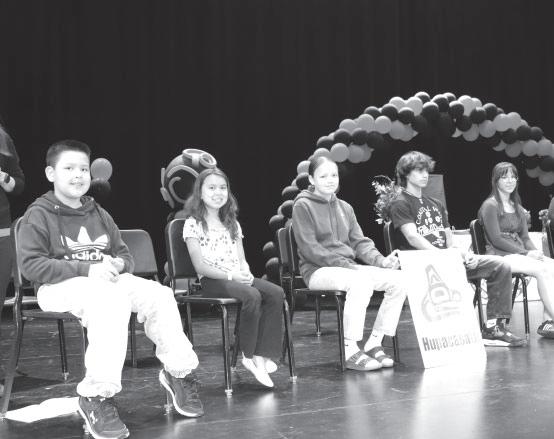
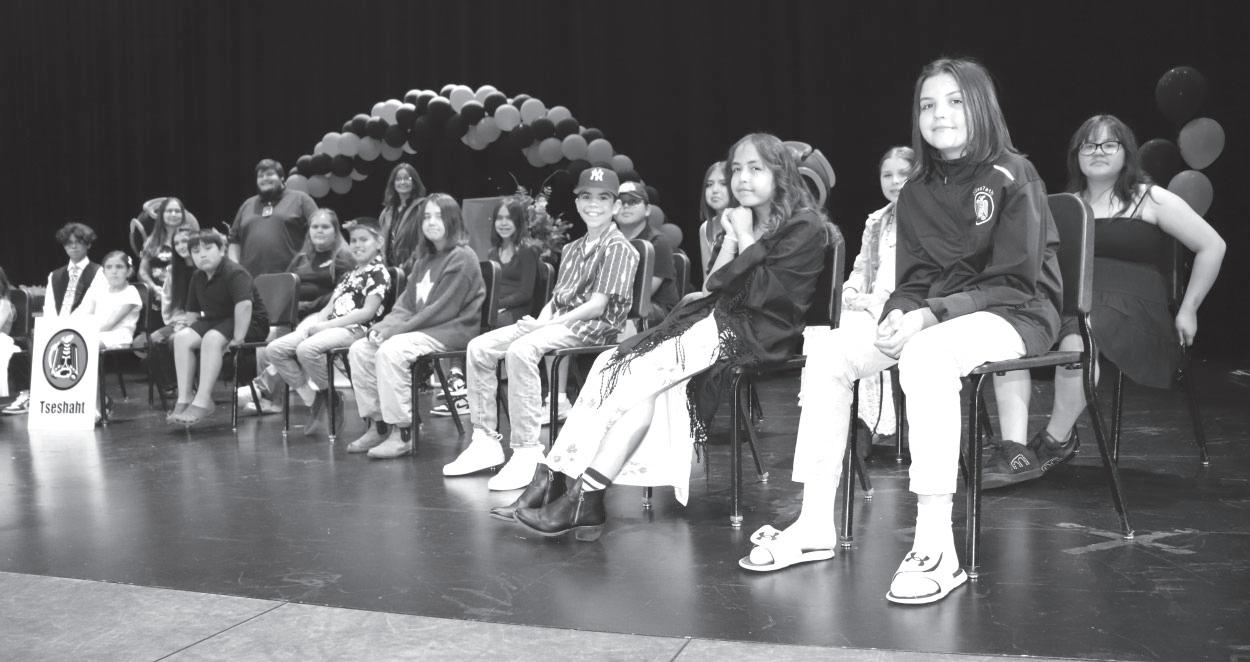
This year 56 graduates of high school and various forms of post-secondary studies were celebrated by the Nuuchah-nulth Tribal Council, encompassing adults of all ages from the Tseshaht, Hupacasath, Ditidaht, Tla-o-qui-aht, Hesquiaht, Ehattesaht, Toquaht, Mowachaht/ Muchalaht, Nuchatlaht, Yuułuʔiłʔatḥ and Ka:’yu:’k’t’h’/Che:k’tles7et’h’ First Nations – tribes that are connected to the NTC’s education program.
For those in high school, the June 6 celebration served as a lead-up to their graduation day on June 25. And data from recent years shows that a growing number of First Nations students are graduating, according to reports from the B.C. Ministry of Education. The ministry tracks high school completion rates, which is the percentage of students who finish their Grade 12 studies within six years of starting Grade 8. Back in 2010 this rate was a dismal 34 per cent for Indigenous students in the Pacific Rim School District, but this has since gradually risen to 83 per cent in 2025. Meanwhile the graduation rate of other students has gone up as well, from 64 per cent in 2010 to 89 per cent last year. The gap between Indigenous and nonIndigenous students completing high school has also been closing to a similar degree in the nearby Nanaimo-Ladysmith School District, but the historical disparity is undeniably important for Pacific Rim, where 37 per cent of its students identify as Aboriginal.
Toquaht
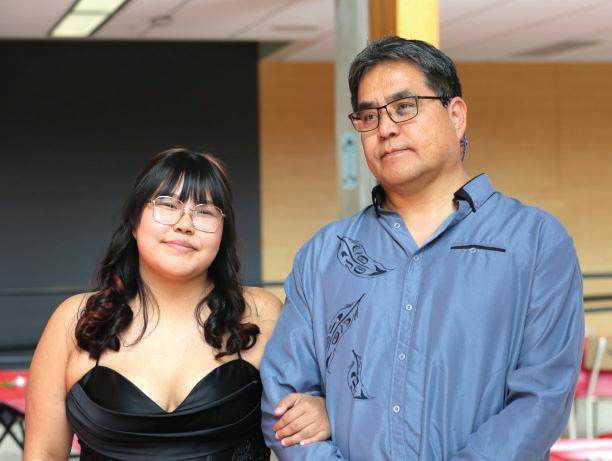
“Parents, your kids made it,” declared Tseshaht speaker Martin Watts during the NTC celebration on June 6.
Mentioning the rise of artificial intelligence and the online presence of material of a questionable authenticity, at the event NTC President Cloy-e-iis, Judith Sayers, stressed the need for Nuu-chahnulth voices to be heard in the future.
“We need our own people to write our own stories from our own perspective,” she said.
Watts reflected on the time when he was failing Grade 10, but he persevered through high school. He still remembers the words of Winston Joseph, his former teachers at ADSS.
“’Be the person you want to be’,” Watts recalled his teacher saying. “The words stuck in my mind when he told me.”
As she looks beyond high school, Anika Jensen sees herself as someone who takes care of others, which led her to secure a spot in North Island College’s healthcare assistant program.
“I just like helping people and taking care of people,” she said. “I feel good, I’m happy I get to go to college.”
Through high school she’s been most confident in English and social studies
classes, although the young Tseshaht member recalls a tough transition when she started at ADSS in Grade 8 after spending most of her prior school years at Haahuupayak elementary, where more of a focus was placed on learning Nuuchah-nulth culture.
“In eighth grade it was really hard because I went to Haahuupayak and we didn’t learn with much math and science, so I struggled in that,” said Jensen, who found it easier to focus on these areas during online studies offered through the high school, so that she would not be distracted by 30 other students in a classroom.
“Online was better for me,” she recalled. “I just talked to the teachers and they helped me. I figured it out on my own, but it was harder to do it in class.”
Despite these early challenges with her high school studies, Jensen come out on top, earning a $1,000 heecis award from the NTC. This is part of the over $45,000 in scholarships that the tribal council’s education department awarded to students this year, with winners ranging from early elementary grades to those in post graduate studies. Kindergarten to Grade 12 scholarships totalled $34,150, while
Congratulations to this year’s NTC
Ivan Mack Dogwood Diploma
Sophia Mack Dogwood Diploma
Davina Webber Dogwood Diploma
Linda Williams Dogwood Diploma
Tseshaht
Alec Fraser Dogwood Diploma
Juliann Fraser Dogwood Diploma
Mariah Gallic-Manson Dogwood Diploma
Lex (Cianna) Gregory Dogwood Diploma
Carsin Guzman Dogwood Diploma
Anika Jensen Dogwood Diploma
Deja McLaughlin Dogwood Diploma
Mary-Anne Napoleon Dogwood Diploma
Andrika Jade Robert Dogwood Diploma
Kelly Sam Dogwood Diploma
Bryan Watts Dogwood Diploma
Cici (Cicelia) Arsenault Masters Business Administration
Kiana Clutesi Bachelors Education Elementary Curriculum
Edward Fred Bachelors Social Work
Elissa Fred-Cranmer Diploma Practical Nursing
Chantelle Knighton Certificate Indigenous Language Revitalization
Gina Pearson Diploma Professional Counsellor
Christine Fred Adult Dogwood
Stephen Mack Adult Dogwood
Claudette Watts Certificate IHALP
those in post-secondary were awarded $11,750.
The tribal council also covers post secondary tuition for Tseshaht, Tla-o-quiaht, Hesquiaht, Hupacasath, Mowachaht/ Muchalaht, Nuchatlaht and Ditidaht members, and for full-time students a monthly living assistance is available that typically adds up to $1,600 for a single person with no dependents. This support comes from Canada’s Indigenous Post Secondary Student Supports Program.
Another scholarship winner is Kelcie Sam, who has just completed her second year at Simon Fraser University in Vancouver. She’s focusing on psychology, delving into her fascination with the dynamics that drive the human mind.
“I find a particular interest in how certain events in life affect behaviour,” said Sam.
Although she knows that she wants to help people, the psychology student has yet to decide which path in the field to take.
“Do I want to lean into the biopsychology of it and learn about the chemistry and give prescriptions to people?” pondered Sam. “Or do I want to go the counselling route and be like a therapist? Those are the two major paths that I’m in between, but thankfully I don’t have to choose just yet.”
After growing up in Port Alberni, transitioning to life in Vancouver hasn’t been easy, and a former teammate from the ADSS wrestling team was the only person she knew at the university when she started. At times mental health has been a challenge, admitted Sam, but she found support at SFU’s Indigenous Student Centre.
“There are some challenges, but with the resources at SFU and my friends here I’ve been able to figure it all out,” she said. “Thankfully now I have some really great friends and I have a partner now.”
For the time being, Sam is looking forward to coming home to cheer on her younger sister Kelly when she graduates from Alberni District Secondary on June 25.
“I can’t wait to go back home and swim in the river,” said Sam.
Ucluelet Secondary School
Eighth Avenue Learning Centre
Alberni District Secondary School
Alberni District Secondary School
Eighth Avenue Learning Centre
Alberni District Secondary School
Dover Bay Secondary School
Alberni District Secondary School
Eighth Avenue Learning Centre
Alberni District Secondary School
Alberni District Secondary School
Victoria High School
Alberni District Secondary School
Alberni District Secondary School
Alberni District Secondary School
Thompson Rivers University
University of Victoria
Vancouver Island University
North Island College
University of Victoria
Rhodes Wellness College
Eighth Avenue Learning Centre
Eighth Avenue Learning Centre
University of British Columbia




















On Aboriginal day a Haida delegation that included David Suzuki visited Tla-o-qui-aht members and friends
By Nora O’Malley Local Journalism Initiative Reporter
Tofino, BC – Wearing the same green velvet vest he wore 43 years ago when he took a stand against forestry companies from harvesting the old trees on Meares Island (Wanačas Hiłḥuuʔis), former elected Tla-o-qui-aht chief Moses Martin was excited to share June 21, National Indigenous Peoples Day, with so many friends, families and First Nations who joined him in the fight.
“We didn’t do it alone,” he said, inviting individuals who were there in 1984 to stand up and accept a thunder of applause from the crowd gathered at Tofino’s Wickaninnish Community School.
“Thank you all so much for being here today. Continue to be strong. We find ourselves facing the same struggle as before. Now, we face another challenge with the mining,” he said.
In February 2026, the B.C. provincial government renewed mineral exploration permits to Imperial Metals to dig for gold within the Tla-o-qui-aht Trabal Parks –against the wishes of the First Nation.
Miles Richardson, who was president of the Haida Nation during the Clayoquot logging protests, stood with Tla-o-quiaht in 1984 when they made the Meares Island Tribal Park Declaration. He spoke on behalf of the Haida delegation on June 21, expressing their continued support and admiration to Tla-o-qui-aht.
Moses honoured Richardson with a beautiful cedar canoe, carved by his nephew Joe Martin and finished by his son Mike.
“When we made the Meares Island Tribal Park Declaration in April 1984, Miles and many of his community members joined us in this gym to witness and support us on that momentous day. And because that day was so busy and so huge, I forgot to acknowledge and thank them,” said Moses.
“Canoes have carried our people and our treasures in and out of each other’s homes for over 10,000 years. For you and for your people, this one carries our apologies and our gratitude,” he said. Richardson said they would proudly paddle her home to Haida Gwaii.
“It’s important to go forward together,
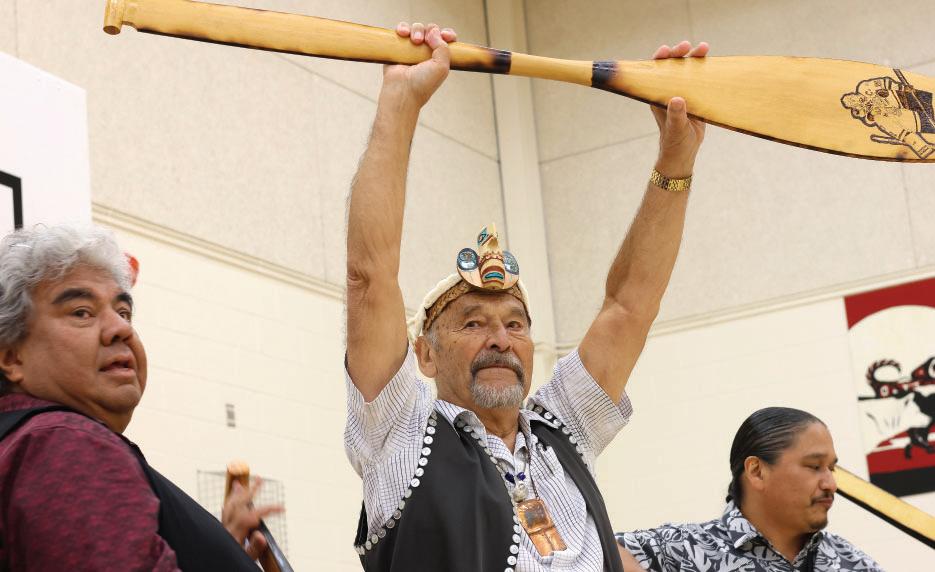
shoulder to shoulder, into the future united,” said Richardson. “We are standing on the shoulders of those who came before us and there are other generations who are going to come behind us that are going to need the clarity that we lived.”
“In many senses you have built a canoe for the young ones; for future generations. It’s going to help shine light on the changes we need to make as humankind so that we can properly deal with the challenges of climate change and biodiversity loss,” he said.
Haida delegate Derek Edenshaw spoke on behalf of Haida Hereditary Chief Guujaaw.
“Unfortunately, the fight is not over. There are more fights to happen on the water. That ocean that we look at, that we share, that ocean is affecting our villages. That high tide mark is getting higher,” said Edenshaw.
“We have to remind human beings on how to be human beings again and how to live with Mother Earth. I’m really grateful for the steps that everybody took
in Meares Island and Moresby, but that was 1980. Now we have to take more steps to protect the water,” he said on behalf of Guujaaw.
Canadian icon and lifelong environmental activist Dr. David Suzuki sat with the Haida delegation during the National Indigenous Peoples Day gathering. Suzuki’s family was married into the Haida Nation. He was invited to the microphone during the event.
“I’m just so grateful to you here and the fight over your land and what the Haida had done. In struggling to protect that land, you are sharing with us the way that you see your relationship with earth, and that is filled with responsibility,” said Suzuki.
“If we are the recipients of the generosity of Mother Earth, we have a responsibility that must come before everything else to ensure that it is passed on to future generations. So, I thank you, the Haida, for setting an example and I thank you for following that,” he said.
Carla Moss, Moses’s wife, honoured the
Phrase of the week: %iihmis%iš%a> huuhtikšiih
Pronounced ‘eeh mis ish ulth hooh tik sheeh’, it means ‘learning is valuable’. Supplied by ḥakaƛ
women who participated in the Clayoquot logging blockades.
“At times, systemic violence was directed at mothers. We heard, you were threatened to lose children if you went to the blockade lines,” said Carla.
Joined by Tla-o-qui-aht women, Carla led a song called Treasuring Our Children. The song is sung to small children and babies to express love.
June 21 was also the summer solstice and Father’s Day.
“Because it is Father’s Day, I want to thank all the men and the men from past generations for upholding our potlatch laws,” said Gisele Martin, who is the daughter of carver Joe.
She wished the Haida delegates smooth sailing.
“There is a lot of spirit in these canoes. These canoes are incredible allies and friends. I hope the spirit of our ancestors continue in your work on Haida Gwaii,” said Gisele.

Friendship centre opens its doors two days before National Indigenous Peoples Day for community celebration
By Denise Titian Ha-Shilth-Sa Reporter
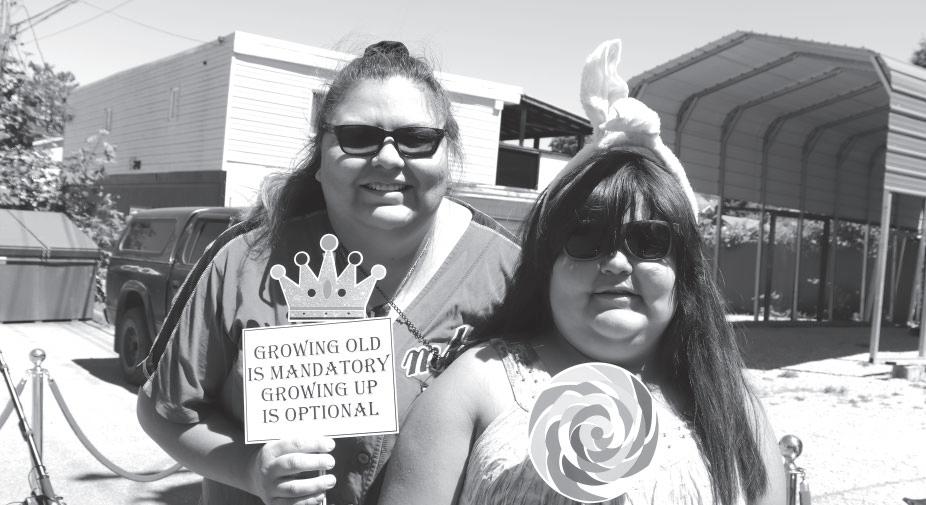
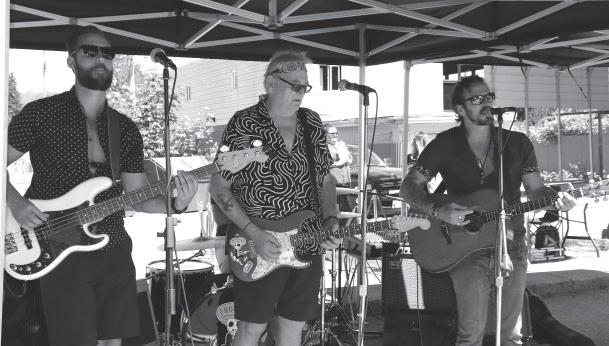
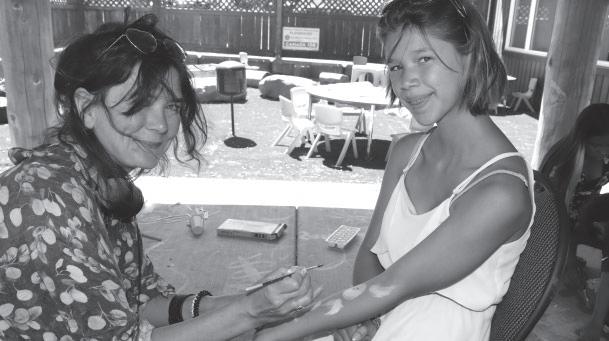
Port Alberni, BC – National Aboriginal Day, celebrated annually on June 21, falls on a Sunday in 2026 so the Port Alberni Friendship Center opened its doors to the public to celebrate a couple of days early. It was a festival-like atmosphere at the PAFC, located 3555 4th Avenue, on Friday, June 19, as the community took part in activities both inside and outside the building. There were vendors and cultural performances indoors while outside, there was a live band, more vendors and fun activities for the kiddies.
PAFC staff and volunteers served up a free barbeque salmon lunch in keeping with tradition. Outdoors volunteers gave out fresh popcorn and candy floss to the young and older guests as bubbles wafted by on a gentle summer breeze. The Center was open to the public for two hours, taking part in face painting, cultural activities or just visiting. And there were free door prizes to be had.
It was
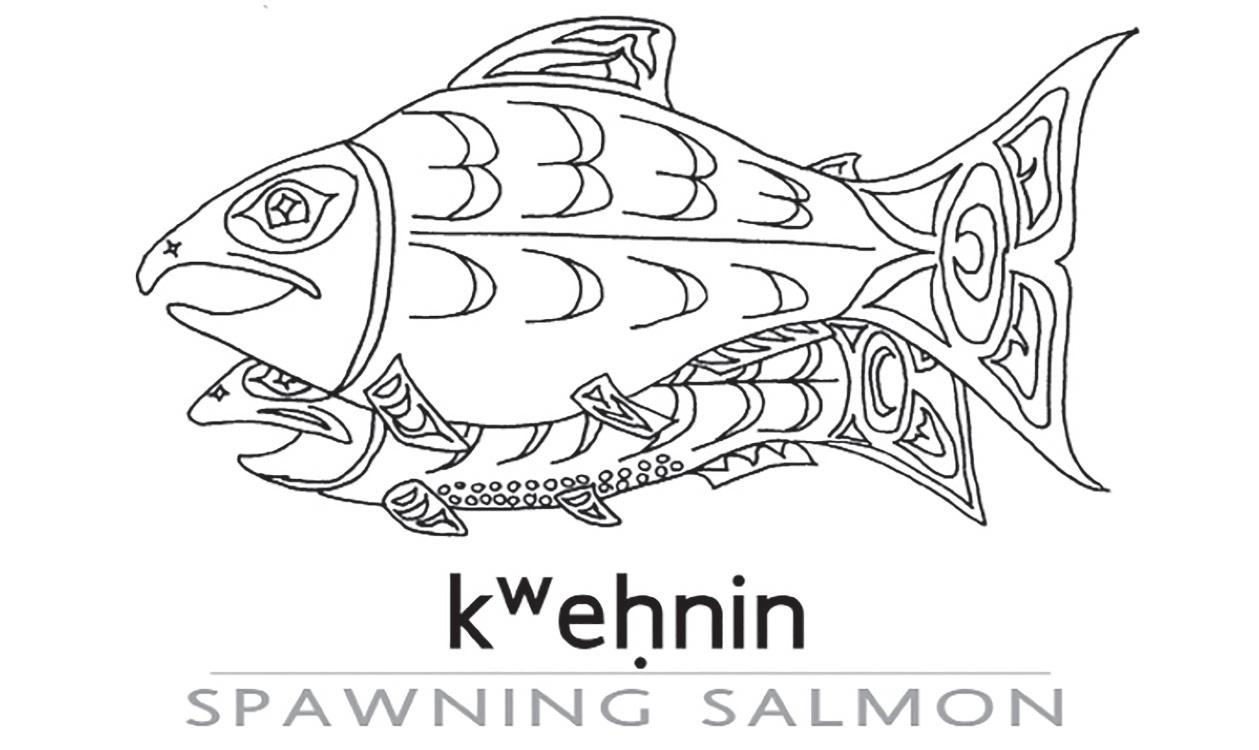
Some male adult salmon turn red when they are ready to spawn. This sends a signal to potential mates, telling female salmon that the males are of the same species and ready to fertilize the nixtin.
Ditidaht
K
K
K
3
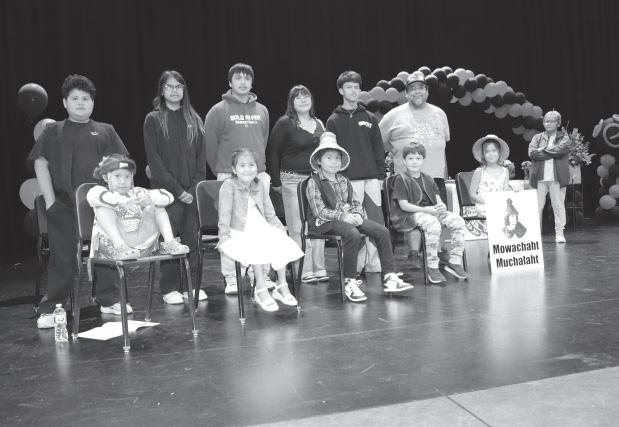
1 Grayson Smith K-3
2 Kaylyn Keim K-3 Athletic & K-3 Hahopchu
3 Tluupin John K-3
& K-3 Hahopchu
4 Roger Keim Academic & Athletic
5 Mason Michael Academic & Artistic
1 Ellie Blackbird K-3 Hahopchu
4 Lincoln Haugan-Martin Artistic
5 Tyrell Frank Artistic
6 Kyrie Frank Hahopchu
7 Tracey Amos-Frank Athletic
7 Rashawn Barker Academic & Hahopchu
8 Helen Martin Academic & Athletic
10 Bode Amos Athletic
10 Nathan Atleo Hahopchu
10 Evan Frank Academic
10 Jada Frank Exceptional
12 Wiinuk Martin Academic & Hahopchu
12 Carol Tom Hahopchu
9 Shaun Webber Artistic
12 Talon Morgan-Banke Athletic
12 Linda Williams Artistic
Tseshaht
1 Jordan Burnip K-3 Athletic
1 HarlowRampanen K-3 Athletic & K-3 Hahopchu
1 Adeline Stewart K-3 Hahopchu
1 Brea Taylor K-3 Athletic & K-3 Hahopchu
2 Lanaley Hassall K-3 Athletic & K-3 Exceptional
3 Davis (Nathan) Charlie K-3 Athletic
3 Emmett Rampanen K-3 Athletic & K-3 Hahopchu
3 Rhodes Vliegenthart K-3 Exceptional
6 Sarah Burnip Academic & Artistic
6 Riley Hassall Academic & Exceptional
6 Ander Lucas Academic & Hahopchu
6 Alannah Peters Artistic & Athletic
6 Kessa Watts Academic & Athletic
7 Dawson Bill Academic & Athletic
7 Haylee Dick-Tom Hahopchu
7 Tatianna Peters Hahopchu
7 Sadie Volodin Exceptional
8 Desiderio Gomez-Charles Academic & Artistic
8 Gertrude Lucas Academic & Athletic
8 River Poirier Exceptional
8 Kailand Watts Academic & Athletic
9 Anthony Holstag Artistic
10 Emery Auerbach Academic & Athletic
10 Danika Taylor-Charleson Academic & Hahopchu
11 Carmen Bill Academic & Artistic
12 Alec Fraser Exceptional & Heečis
12 Juliann Fraser Exceptional
12 Lex (Cianna) Gregory Academic
12 AnikaJensen Heečis
12 DejaMcLaughlin
12 KellySam
Academic
Exceptional & Hahopchu
Ditidaht
Kate Edgar NTC General
Maryna Macdonald Mathews Dinsdale & Clarke LLP Law
Lance Patterson NTC General
Amanda Proulx NTC Health Department
Ehattesaht
Elsie Vincent Striveworks Learning Institute—Charlene Smadello
Hesquiaht
Art Armitage-Point Tsahaheh Bank of Montreal
Brevin Charleson NTC Education
Paige Martin Budget Car & Truck Rental Company
Catherine Nicholson NTC Health Department
Seth Recalma Tsahaheh Bank of Montreal
Hupacasath
Gabriel Sayers NTC Education Mowachaht
Josephine Mark Strategic Marketing Services—Waide Ian Marshall Education Fund
Sierra Alexander Tsahaheh Bank of Montreal
Monica Amos NTC Education
Tla-o-qui-aht
Da’von Ekering NTC Education
Christina Enns NTC General
Amy Maclean NTC Health Department
Joenella Frank Striveworks Learning Institute—Charlene Smadello
Stephen Jack Create Your Success—Christine Anacleto
Tseshaht
Sophia Bill NTC Education
Theresa Burnip NTC General
Cienna DeGoesbriand NTC Education
Victoria Dick NTC Health Department
Chelsea Lamb NTC Health Department
William Merry NTC General
Cynthia Sieber Tsahaheh Bank of Montreal
Kaylen Poirier NTC Education
Della Preston McGorman & McLean Chartered Professional Accountants
Kelcie Sam Roy & Daisy Hayupis (&Family) Award
Shalaya Valenzuela NTC Education
Annie Watts Ha-shilth-sa Newspaper
Christine Fred Strategic Marketing Services—Waide Ian Marshall Education Fund
Stephen M. Mack Strategic Marketing Services—Waide Ian Marshall Education Fund
By Karly Blats Ha-Shilth-Sa Contributor
marina onto Highway 4 difficult.
The $8 million project remains on track, with traffic circle now in use as crews finish paving work by marina and adjustments, and work continues to move to completion.”
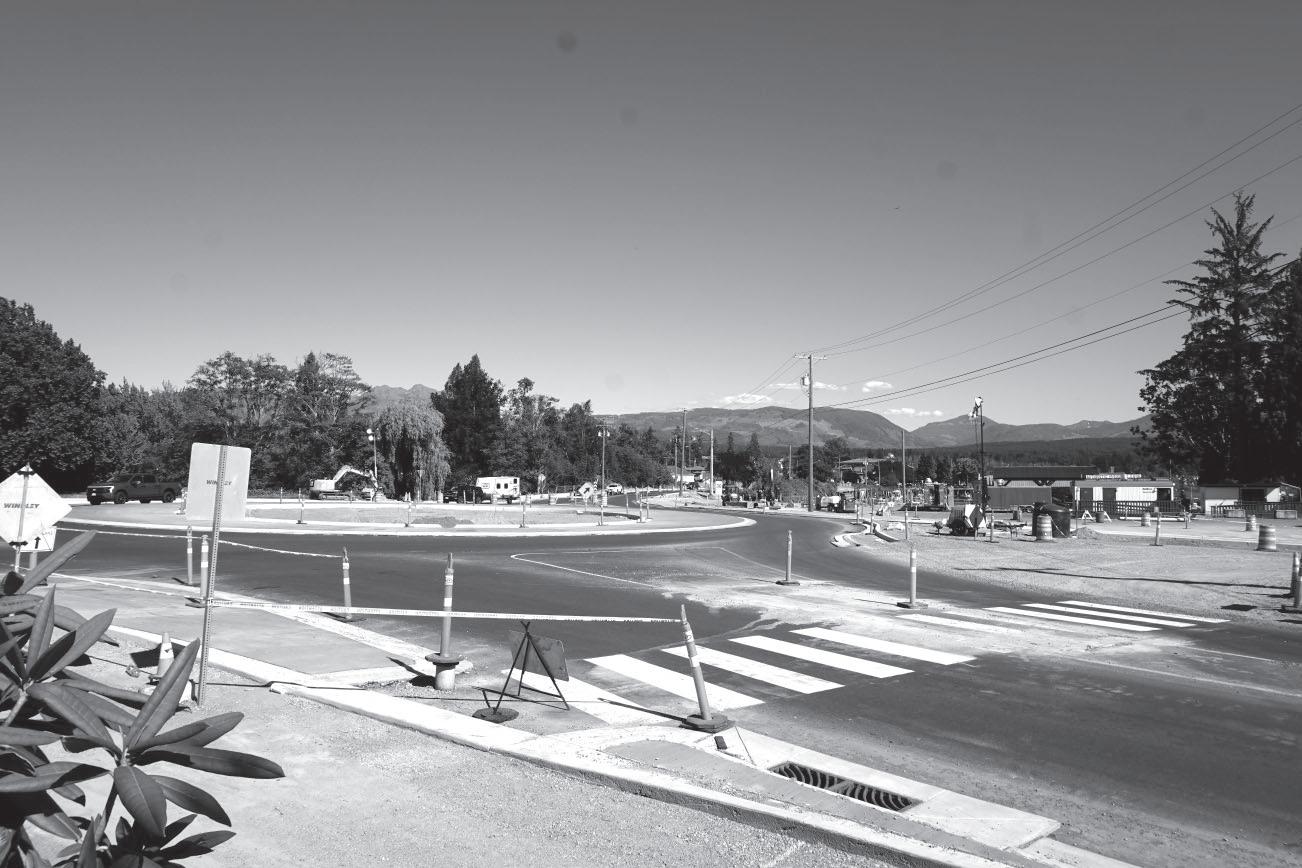
Port Alberni, BC - A new roundabout at the intersection of River Road and Beaver Creek Road in Port Alberni remains on track for completion this summer.
The roundabout, which is now operational for drivers, is a project of the BC Ministry of Transportation and Transit and was designed in consultation with the City of Port Alberni, the Alberni-Clayoquot Regional District, the Port Alberni Port Authority along with Hupacasath and Tseshaht First Nations.
The high-traffic intersection, which also includes access to Clutesi Haven Marina, was historically troublesome for travelers on the Highway 4 corridor. There are no traffic lights at the intersection, making left turns from Beaver Creek Road or the
“The ministry has worked closely with Hupacasath and Tseshaht First Nations throughout planning and construction,” said the Ministry of Transportation and Transit in an email. “This work has included ongoing engagement, information sharing and opportunities for input to help inform design and construction.”
The ministry stated that construction is progressing well at the roundabout and crews continue work on final project pieces, including paving.
“As with most infrastructure work of this scale, construction has involved typical challenges. These have not affected timelines and include coordinating with third-party utilities and responding to site conditions as they are confirmed,” said the ministry. “These challenges have been managed through ongoing planning
Benefits expected for the new roundabout include improving traffic flow along Highway 4, enhancing connections to Beaver Creek Road, better sight lines by eliminating the need for left turns and creating more space for cyclists and pedestrians. The new road will also improve access to Clutesi Haven Marina, which will reduce congestion on the highway. Project improvements will also include widening the western entrance for boat launch users, constructing a new eastern entrance and updating the exit into the roundabout to improve marina access. In addition, new transportation features such as multi-use paths, bicycle-accessible shoulders, sidewalks and shorter, more direct pedestrian crossing points will be added.
The ministry has received feedback from the public through the project website and dedicated email address.
“Overall, feedback has been positive, with many people recognizing the need to improve safety and traffic flow at this busy intersection,” states the ministry.
Valued at over $8 million, the project’s contract was awarded to Windley Contracting Ltd.
There are two key principles for entering an intersection controlled by a roundabout: before entering, look left and yield to all traffic in the roundabout. When entering the intersection controlled by a roundabout, continue moving counterclockwise and to the right of the rotary traffic island before exiting.

About half of world’s kelp forests in decline, with ocean warming and urchin overpopulation as the big factors
Antonella Medina Arias Ha-Shilth-Sa Contributor
A new study from the University of Victoria reveals that climate change has contributed to kelp decline in the Salish Sea longer than previously established, changing the timeline of kelp study forever.
“Kelp forests around the world are facing multiple problems. Sometimes it’s just pollution. Sometimes there are urchin barriers,” said Brian Timmer, a UVic PhD student and the lead author of the study, available in Ecological Applications. “So, it’s not that climate change is the only thing that’s affecting kelp forests. But it is a very big problem, and it’s expected to become more of a problem as the ocean keeps warming.”
According to Ocean Wise, 40 to 60 per cent of the world’s kelp forests are in decline, with ocean warming and urchin overpopulation as the main factors.
Usually, researchers focus on the loss of kelp forests caused by marine heat waves that stop the seaweed from growing. However, the question of how long climate change has contributed to the decline of kelp forests remained unanswered.
Researchers looked at around 52 species in the seaweed community, with kelps and red algae as the two dominant species that prefer cooler conditions which historically had been more abundant in the studied zones.
As the ocean warms, warm-water species would follow warm currents up north — a phenomenon called tropicalization — to replace the cold-water species that would move away to follow the colder currents.
However, researchers noted that when cold-water species left, they weren’t replaced by any warm-water species, resulting in habitat loss, a phenomenon known as deborealization.
The issue is not only that the ocean is warming too fast for seaweed to travel up the coastline towards cooler currents, but it’s also the complexity of the coastline itself.
Up the Strait of Georgia, multiple indents and fjords create microclimates – small areas of warm water that heat up quickly – but are surrounded by colder currents that block warm-water species from replacing the cold-water species that have left or died.
Without an accurate historical baseline to measure from, scientists risk falling for the shifting baseline syndrome, where the true effects of climate change associated with environmental degradation aren’t
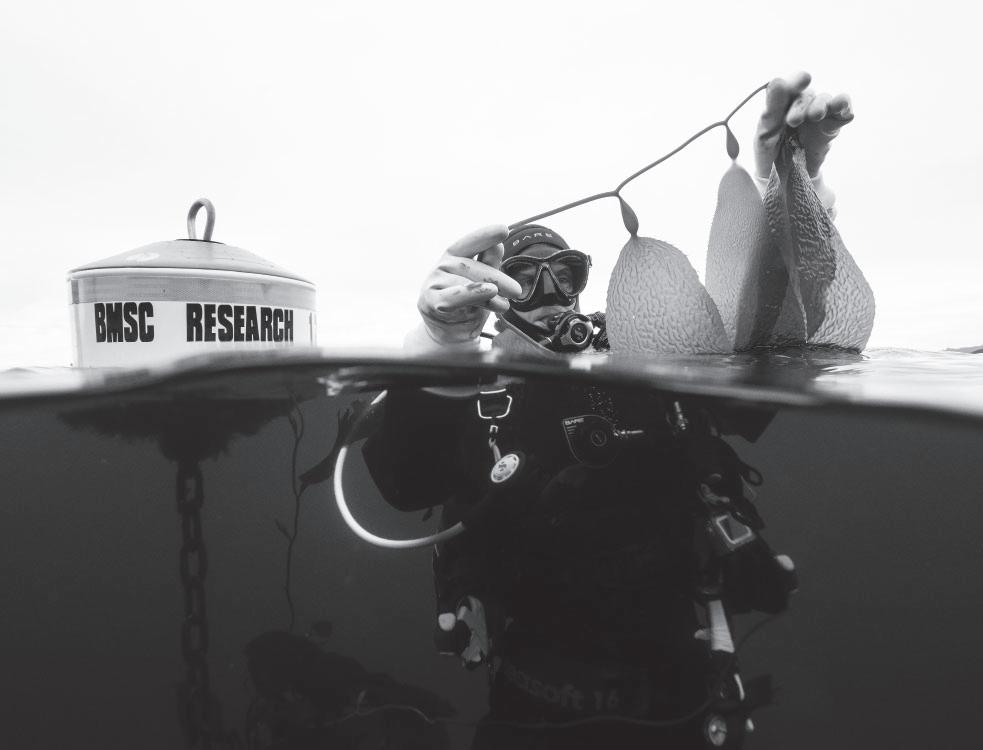
completely accounted for. This means that community-level chances for restoration aren’t as effective as originally intended.
Around 1972, the government conducted aerial scans and scuba surveys in the northern Salish Sea to map out a species of red algae for commercial harvesting. When the project didn’t continue, the data was shelved in the University of Victoria archives and across Canada. Even though kelp wasn’t the goal for the past study, Timmer said they could observe kelp in the photos and know exactly where the scuba surveys were taken.
Using the historical records, the research team, with the support of the Hakai Institute, replicated the photos and scuba surveys in 2023 to compare the presence of kelp forests in the past.
The result showed that decades ago, a massive size of kelp forest floated on the surface, spanning over 550 hectares on the Salish Sea near Comox and Denman Island. The previous baseline of kelp forest size in the region grew tenfold.
Today, none of those kelp forests remain, with satellite images showing most of the kelp was lost between 1972

and 1984. Timmer discovered that the dominant, cold-water species of kelp and red algae declined between 60 and 99 per cent, especially in shallow water.
Kelp is a foundational plant and one of the most diverse ecosystems in the world. Around 350 marine species rely on it for food, shelter and nursery grounds for fish like herring, salmon, rockfish and invertebrate species.
“A kelp blade is almost like a conveyor belt, continuously growing and putting off material into the water that other things will eat. So it’s not just homes for fish and invertebrates. It’s also food for everything that lives in these near-shore environments,” said Timmer. “And when you lose [the kelp], the productivity of the ecosystem goes way, way down.”
Kelp also forms a giant underwater carbon sink, helping to mitigate the impacts of global warming. A UVic study estimated that kelp forests on Canadian coasts capture and export between 40,000 and 400,000 metric tonnes of carbon into the deep ocean every year.
Yet, researchers warn that kelp alone is not enough to completely solve the climate crisis without implementing drastic reductions in fossil fuel consumption.
Another variable in kelp decline is the threat of marine grazers like sea urchins.
Sea otters are one of the main natural predators of sea urchins. But fur trade hunting in the 18th and 19th centuries caused a massive decline in the sea otter population. With no predators, sea urchins overgraze the ecosystem, leaving vast stretches of the seafloor to be stripped of kelp, affecting every species that relies on the plant.
After the reintroduction of sea otters on the B.C. coast over 50 years ago, it acted as a domino effect: the otters eat the urchins, so kelp can regrow and help restore balance in the ecosystem.
“A lot of that [kelp decline] in Nanwakolas territory was driven by the abundance of sea urchins. We’re learning from
Bryan’s research that the declines may have actually started much earlier in the southern part of the Nanwakolas territory, [where] the temperature might be driving the change,” said Rebecca Martone, a marine science adviser for the Nanwakolas community and part of the Marine Planning Partnership (MaPP).
“Kelp itself is a really important species from a cultural perspective. People have been using it for food, baskets and for other types of cultural uses. It’s also an important habitat for a lot of other species that are ecologically, culturally and economically important,” said Martone.
“[T]he nations didn’t want to just crush urchins because they are also important species that we wanted to respect,” added Martone, noting that the urchins were havrested for food.
One of the outcomes of the projects was successfully training around nine guardians for the dive team to harvest sea urchins in overgrazed zones. A woman in the community even turned the shellfish into urchin butter, freezing urchin meat and using it later as a food source.
Ocean Wise, in partnership with Tseshaht First Nations and the Pacific Urchin Harvesters Association (PUHA), plans to lead a community-led urchin removal program to give kelp forest room to recover from overgrazing.
Part of the program involves training Tseshaht community members to harvest urchins sustainably, as they are a traditional food source, and sell the extra specimens.
Additionally, Ocean Wise announced the opening of a kelp nursery at the Pacific Science Enterprise Centre in West Vancouver to test out the plant’s seed production.
The research received funding from Fisheries and Oceans Canada, the Natural Science and Engineering Research Council, the National Geographic Society and the Royal Canadian Society’s Trebek Initiative.
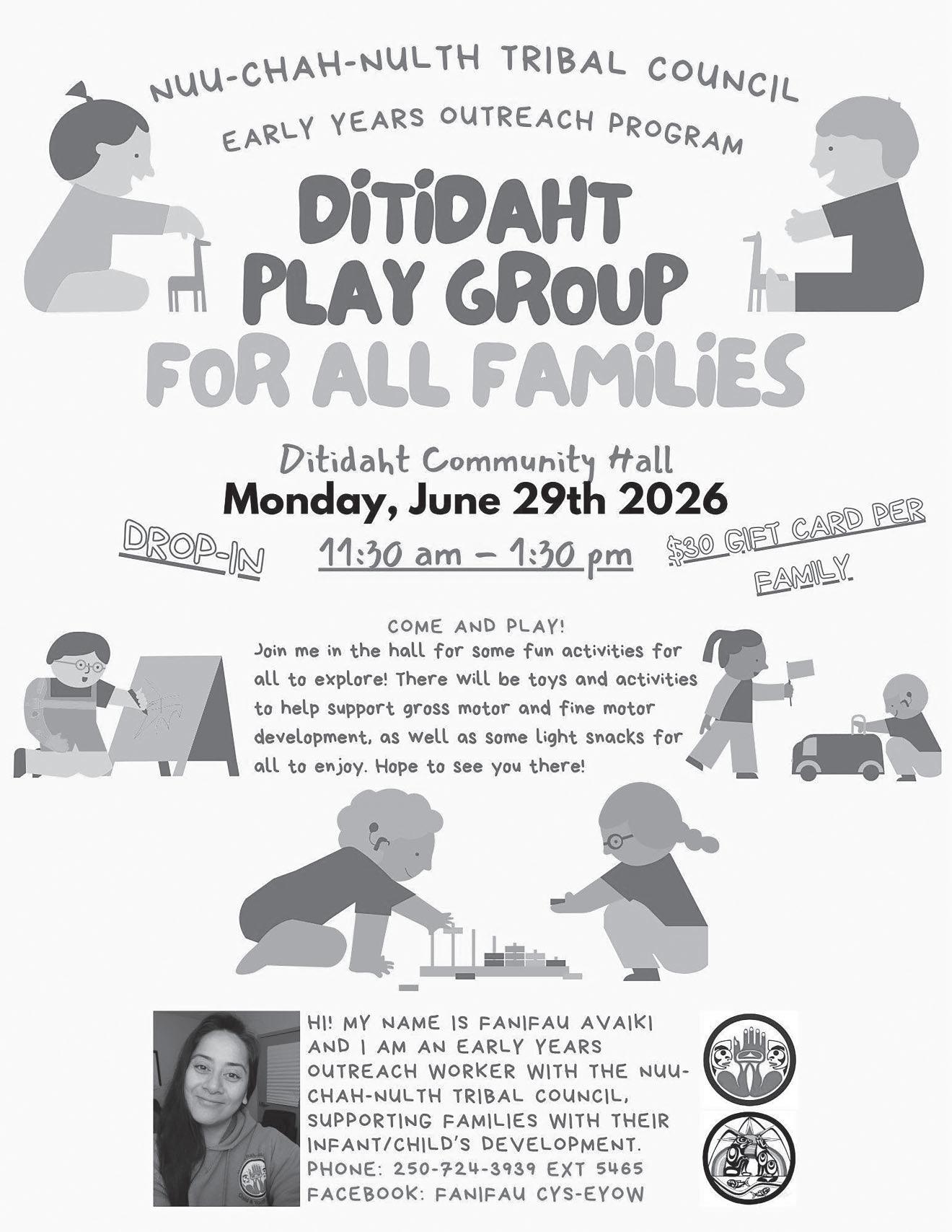
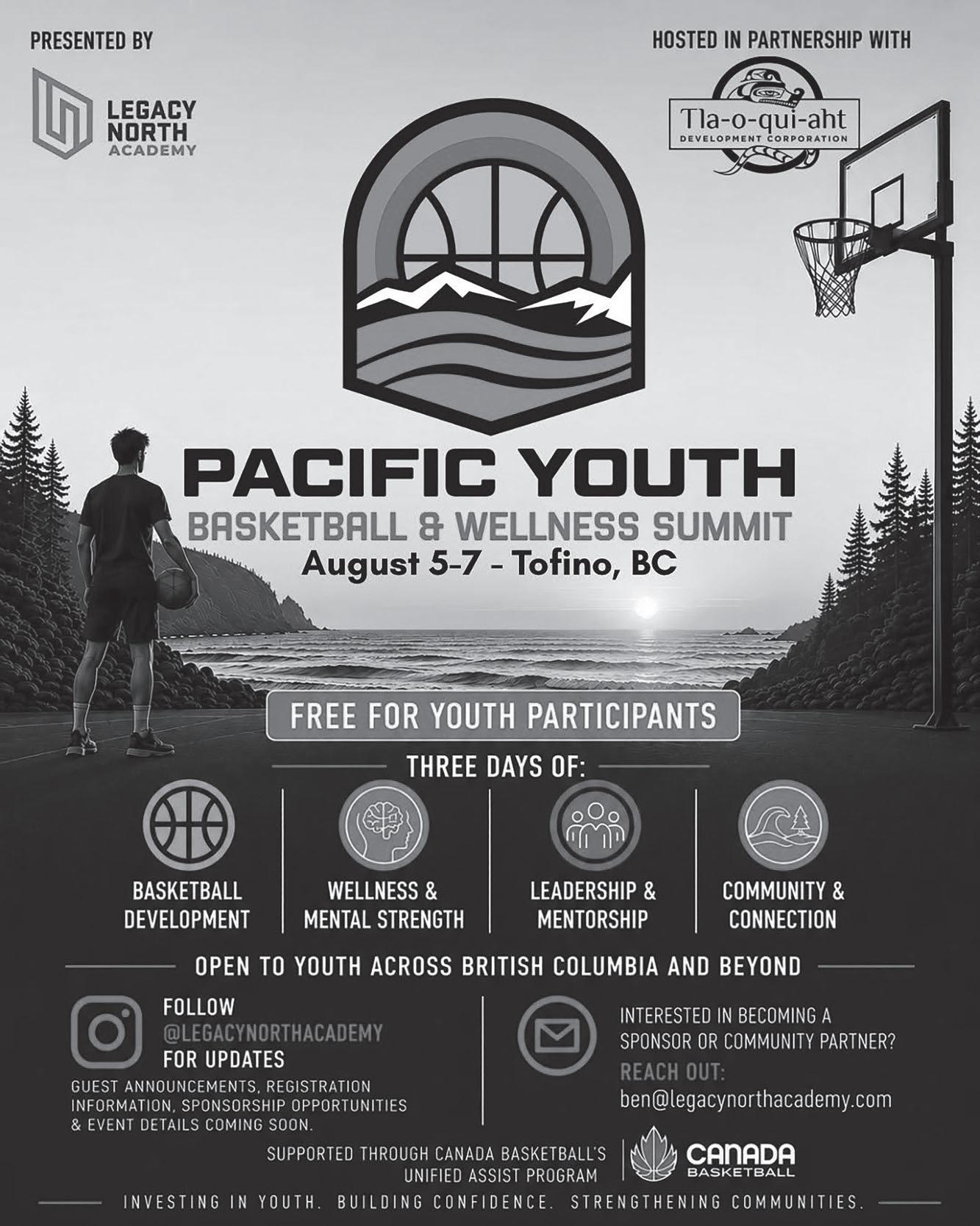
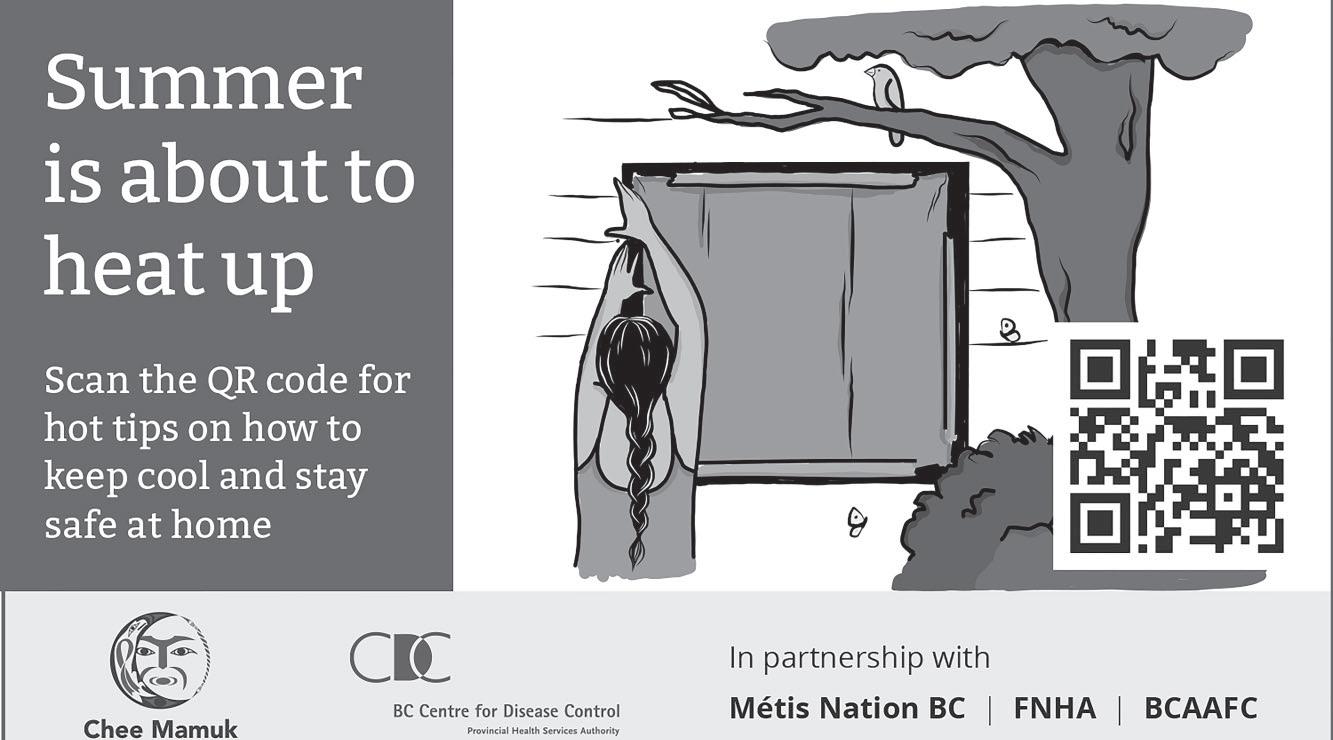

NCN Mental Health Counselling Tuesdays and Thursdays
8:30am – 4:30pm 4841 Redford Street, Port Alberni
NCN Mental Health Services – DropIn Counselling with Margaret Bird, Registered Clinical Counsellor and Play Therapist. For on and off reserve members of all ages of the Nuu-chahnulth Tribal Council. Call (250) 724-3939 to book your appointment.
Stirring up Connections
Every Friday 10am – 12:30pm



NTC Kitchen – 4841 Redford Street.
A warm and welcoming cooking group designed just for parents! Each session will feature: Easy, budget-friendly recipes; Tips for cooking with kids and picky eaters; Space to connect with other parents over food and family life. 1030 am-12:30 pm. Please register with Debbie @ 250-724-3939
Samuel Richard Johnson jr. mit. Memorial Potlatch
November 7th, 2026
Starting with lunch at 12:00pm Wahmeesh gym, tsaxana reserve. All welcome.

Years Ago in Ha-Shilth-Sa Vol. 28 – No. 12June 21, 2000
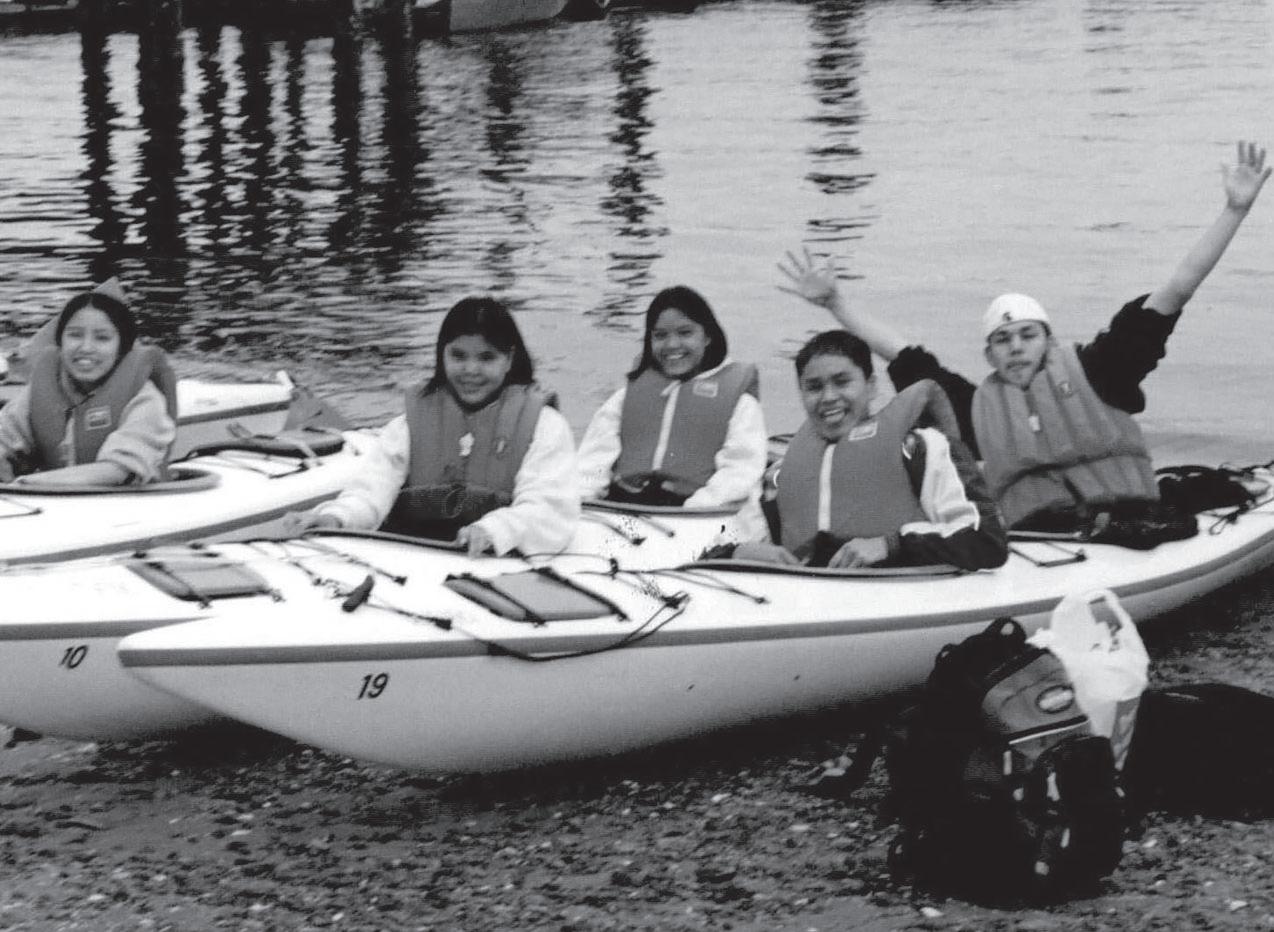
Tofino business teaches Ahousaht students kayaking tour, it was clear their newly taught skills were honed, proudly boasting that not one kayak rolled over during the trip. Business owner Dan Lewis had invited the students as a gesture of goodwill and to offer the opportunity of teaching a sport that he so enjoys to a younger generation.
Touring Meares Island and other places in the inlet for more than two hours, students from Maaqtusiis School in Ahousaht were being taught various kayaking skills by a Tofino business. Pre trip lessons included getting in and out of the kayak, safety equipment and procedures, and how to maneuver their kayaks. By the end of the two-hour

Need work experience? The Port Alberni Friendship Centre is looking for interested applicants for various positions. Call 250-723-8281


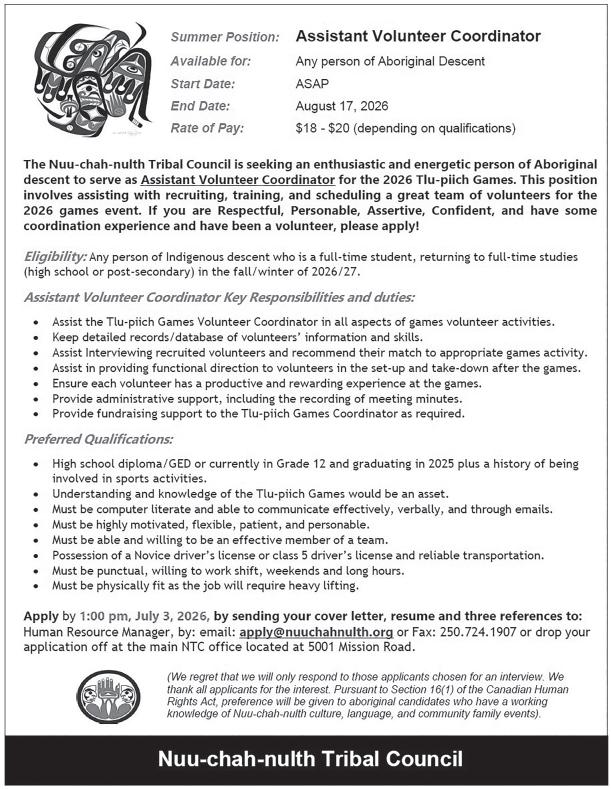
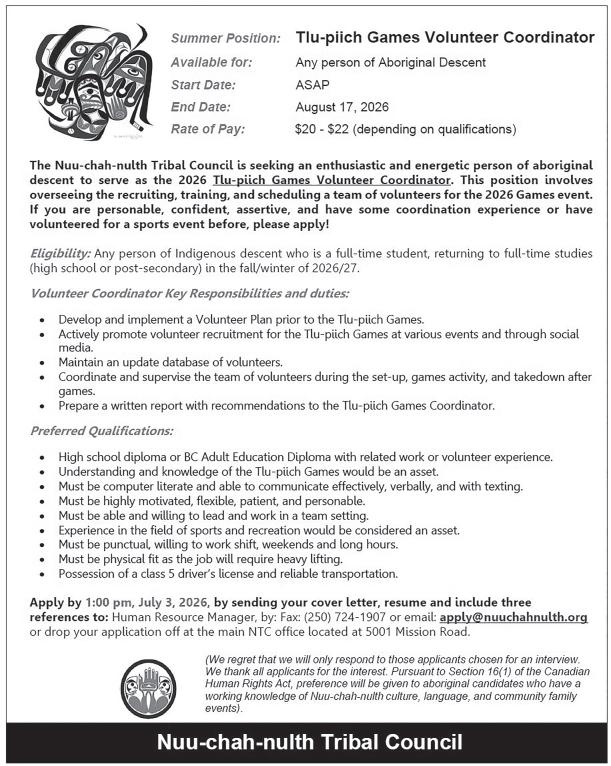
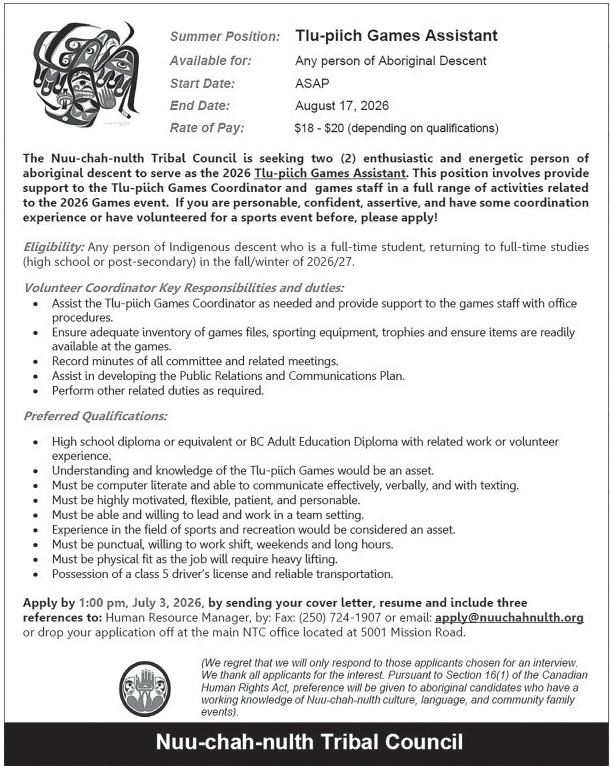
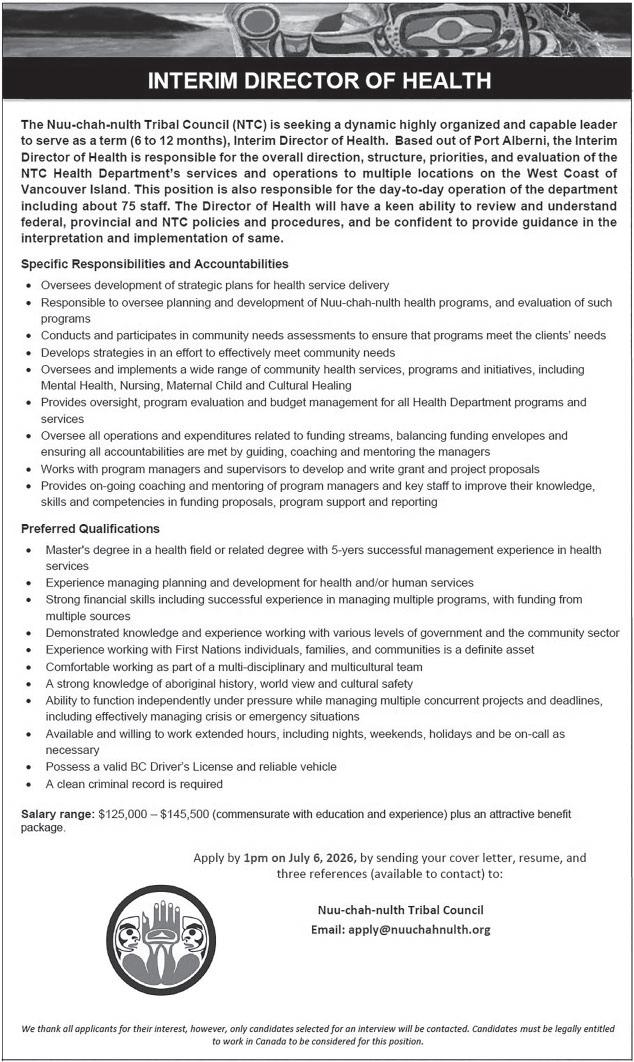
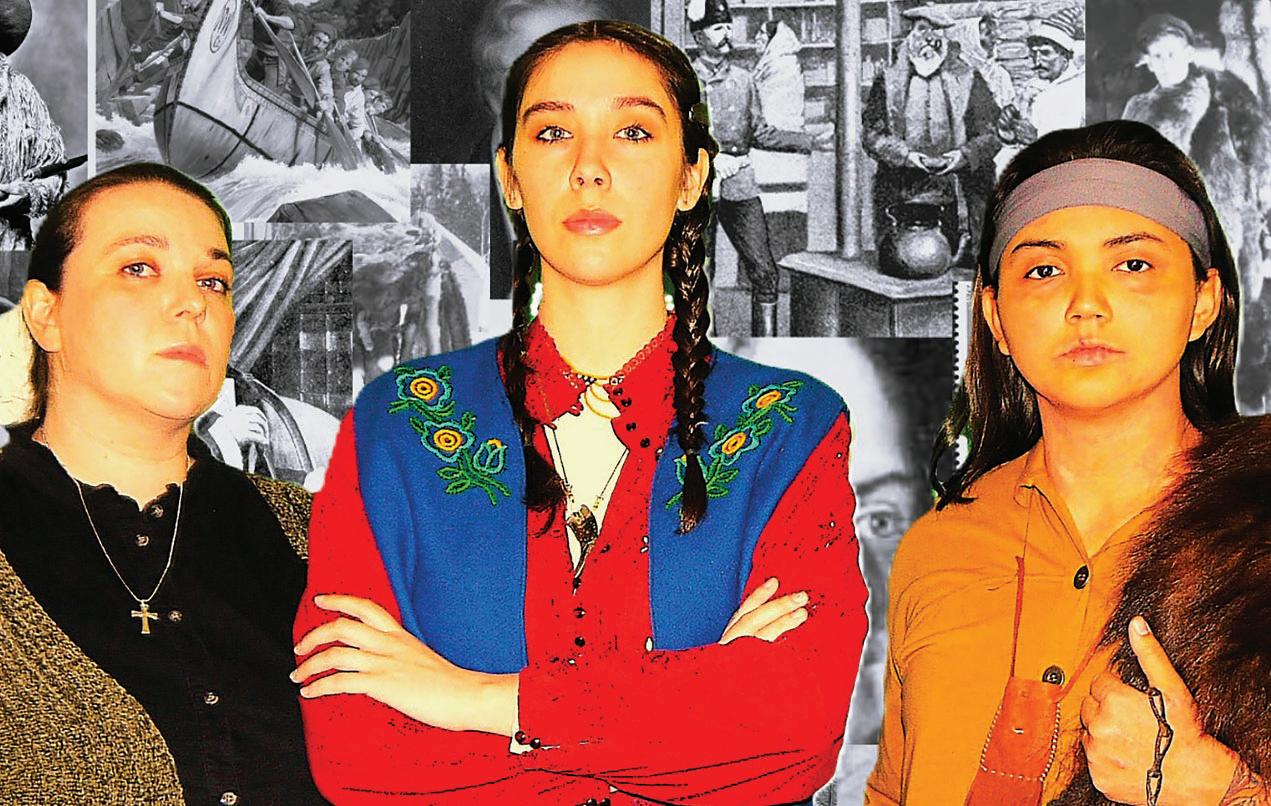
July tour of Vancouver Island includes stops in Nanaimo, Courtenay, Campbell River, Port Alberni & Ucluelet
By Nora O’Malley Local Journalism Initiative Reporter
Vancouver Island, BC – Reconciliation Theatre Society is launching a six-city tour throughout Vancouver Island this July with Women of the Fur Trade by Anishinaabe and Slovene playwright Frances Koncan.
Set in “eighteen hundred and something-something”, Women of the Fur Trade is described as a powerful satire that shifts perspective from the male gaze on history to the power of women and their place in the rapidly changing world of the Canadian fur trade.
Snuneymuxw and Tsleil Watuth actor Talela Manson plays “Eugenia”, an Ojibwe fur trapper. In the play, Eugenia becomes trapped in a fort on the banks of the “Reddish River” in Treaty One Territory with a Métis woman, who is determined to woo Louis Riel, and a pregnant British wife, who is anxiously waiting on her husband’s return from an expedition.
“Come check it out. It will be a really fun time. We’ve been working on this play for so long, but every time we have a new person come watch us or hear it for the first time, hearing their laughter really brings new energy. I’m excited to bring
it and feel that medicine when we come out,” said Manson.
Women of the Fur Trade marks the fourth annual summer tour of Vancouver Island for the Indigenous-led theatre company. The tour starts in Nanaimo with two dates on July 1 and July 2, heads to Courtenay for July 4, Campbell River July 5, Port Alberni July 11, Ucluelet July 12 and ends in Ladysmith on July 16.
Tickets to the Port Alberni show on Saturday, July 11 are free to audience members thanks to a grant from the City of Port Alberni. The Saturday, July 4 show in Courtenay is also free courtesy of the Sid Williams Theatre.
“To their credit, they’ve come up with (funds) to cover the costs so that we can open the doors and let everyone in. That’s been one of our goals. Our performing arts venues, our theatres in Canada, have a lot of segregated history to them. There are some people in their 20s and 30s in Reconciliation Theatre who talk about going to movie theaters when they were kids and their family automatically went to the balcony every time,” said Tom Rokeby, Reconciliation Theatre’s artistic director.
He brought up the story Canadian civil rights pioneer Viola Desmond, the young

black Nova Scotia woman who refused to leave the segregated “whites only” section of the Roseland movie theatre in New Glasgow, Nova Scotia. At the time in 1946, black people could only sit on the balcony.
Desmond was arrested, jailed for a night and convicted for a “tax offence”. She was pardoned posthumously in 2010 by the Nova Scotia government and selected by the minister of Finance to be on Canada’s $10 bill in 2018.
“She’s like our Rosa Parks,” said Tom.
“When I became a teacher at John Barsby, I worked with a lot of Indigenous students off of the No. 1 reserve. They really had nowhere to go when they finished high school. Starting (Reconciliation Theatre) just seemed like a pretty natural way to make my own community better,” he said.
Twenty-two-year-old Manson agrees. She says the theatre company has opened a path that wasn’t there before.
“Reconciliation Theatre has been a great opportunity for me to continue theatre outside of high school,” said Manson.
Director Lisa Rokeby shared that Reconciliation Theatre began in 2018 as a play reading circle, with a focus on reading Indigenous plays.
“We’ve hit some really tough subjects, but so many of them were told through
humour. It is such an accessible way to consume your history because you get to laugh and laugh and then suddenly it will stab you in the heart halfway through,” she said.
In Women of the Fur Trade, the character “Eugenia” deals with language loss, an issue that actor Manson holds dear to her heart, and the Métis character makes references to the Sixties Scoop.
“It’s a very complex play that is written in an accessible way,” said Lisa.
“It’s actually amazing how funny (the play) is for the material,” Tom adds.
Manson speaks the Hul’q’umi’num language in her community with her grandpa. She says her character in Women of the Fur Trade uses the Anishinaabe word for ‘thank you’.
“I’d like to see more (traditional) language in more plays. I’m excited to see how that can be implemented more in theatre,” said Manson.
Lisa brought up a quote she heard from Algonquin playwright Yvette Nolan:
“When you’re watching a comedy and you lean back to laugh, that’s when the good medicine gets in, and that’s exactly how this play is written,” said Lisa.
Tickets are $25/adults and $20/students, except for the Port Alberni and Courtenay shows, which are free. Go to Reconciliationtheatre.ca to save your seats.