
INTERESTING NEWS
Northern paddle group pushes off from Ahousaht
Paddlers head to Nisqually Tribe in Washington for a potlatch, but Trump-era politics are keeping some away
By Nora O’Malley Local Journalism Initiative Reporter
Hitacu, BC – Two Ahousaht dugout canoes and a support boat pushed off the shores of Flores Island in Clayoquot Sound on Monday morning (July 13) around 10 a.m. and by 6:20 p.m. that same day, the pullers had reached the Yuułuʔiłʔatḥ (Ucluelet First Nation) village of Hitacu.
The original schedule was advanced by a day after a stop in the Tla-o-qui-aht traditional territory of Opitsaht was cancelled due to a loss. The young Ahousaht group refuelled and took repose in Tofino as an alternative, then continued south to Hitacu.
Their goal is to reach the Nisqually Indian Tribe, east of Olympia, Washington, U.S.A., by July 31 for a five-day potlatch with over 100 tribal canoe families from all over the Pacific Northwest.
Hisaakʷista (Stephenie Charleson), who is of Hesquiaht and Ahousaht descent, is the skipper for Ahousaht’s 30-foot dugout chaputs (canoe) called Sumakawis. Ahousaht’s other chaputs on the voyage is the 26-foot Swan Family Canoe.
Last summer, Hisaakʷista was the lead puller in a Hesquiaht crew of mostly Indigenous women. Paddle to Nisqually is her third major canoe journey.
She said the crew size is about half of what they originally expected.
“Families are afraid to cross the boarder. I understand. It’s not safe out there, I feel, for two-spirit people,” said Hisaakʷista.
“Healing Through Our Waters by Honoring Our Ancestors” is the official name of the 2026 Paddle to Nisqually Canoe Journey.
Hisaakʷista shared that July 9, 2026, marked one year of sobriety for her.
“I’ll be paddling with a lot of people in my heart and in my mind. That will be my drive. There are a lot of family battling addictions or coming into their own sobriety. With a lot of losses to addictions or homelessness, I think that is what I am paddling for – better care for our people,” said Hisaakʷista.
“I wish I could take everyone and fill our own chaputs. I would fill it with all the people that need to be out there. I’m going out there with good intention and I hope safe journey for all our families,” she said.
Hisaakʷista explained there are generally at least 10 pullers (the preferred term because of the pulling motion on the paddle) in a chaputs. Depending on weather conditions, the pullers spend long days in the canoe, often paddling for five to eight hours.
“If it’s really too windy and not safe to be in the chaputs, then we’ll get a tow. Sometimes we’ll get a tow for an hour and then get back in the chaputs and continue paddling. Safety is definitely a priority,” said Hisaakʷista.
The Ahousaht chaputs were towed for a stint to safely get around Amphitrite Point, but the paddle crew jumped back in at the head of Ucluelet harbour to finish the pull to Hitacu.
Ahousaht First Nation member Terrance Sabbas Sr. (also known as ‘Slug Eyes’) is driving the support boat.
“It has bunks and a kitchen stove and a nice big deck to hang out on. If I’m not in the chaputs, I get a bunk on his boat as well,” said Hisaakʷista.
“I feel so safe with this crew, not even knowing everyone on it. I know they are well-practiced and very safe. They have been through a lot of canoe journeys and living on the coast, that’s how they live. They are so thoughtful and take good care of their people,” she said.
Yuułuʔiłʔatḥ’s canoe family of about 12 will travel the ancestral waterways as far south as Beecher Bay. Last summer, the nation had a crew preparing for the Paddle to Elwha journey, but Yuułuʔiłʔatḥ Government pulled their financial support two days before the crew was meant to depart citing “safety and liability concerns”.
“The forecast looks awesome. I’m stoked,” said Yuułuʔiłʔatḥ skipper Tyson
this issue... Society urges swimmers not to underestimate a river....Page 3 Fire risk remains due to low snowpack..........................Page 7
to know gorgeous Nitinaht........................Pages 10-11
amphitheatre at Tin Wis.......................................Page 12 Tlu-piich Games over the years....................................Page 19
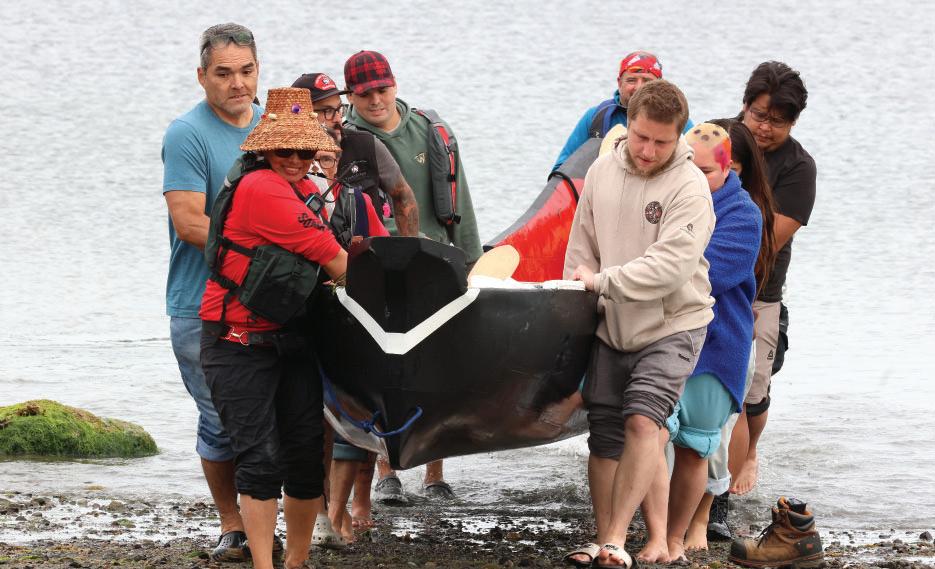
Touchie after helping Ahousaht carry their chaputs up to the high tide line.
“I feel there is a more community effort with this one. I feel there is more backing from YFN, and the amount of training that we’ve put in is crazy. All together we’ve put in about 10 tips. Everyone in our crew has gone through a tip and corrected the canoe,” he said.
“I’m pretty excited for them this year to be participating,” said Hisaakʷista. “They have a beautiful chaputs. It turns on a dime. It’s unreal.”
Touchie said Yuułuʔiłʔatḥ’s 18-person chaputs is a ‘Pacific Dancer’, a fibreglass hybrid model made by Clipper Canoes.
“It could literally do a 180. It almost feels like it’s skidding,” he said.
Tseshaht First Nation is doing a “mini canoe journey” this year for Tseshaht Days. The crew left from Port Alberni to the Broken Group Islands (BGI) on July 14. They will welcome Ahousaht canoes on July 15 to Keith Island in the BGI for an overnight stay.
On July 16, Yuułuʔiłʔatḥ’s canoe family departs Hitacu at 7 a.m. to catch up with Ahousaht. All three canoes will travel to Huu-ay-aht First Nations traditional territory (Pachena Bay) and then to Ditidaht on July 17 for a full rest day.
Touchie says they plan to be in Beecher Bay on July 21. He said they are not going any further south this year “because of Trump.”
Ahousaht’s team plans to push on into
Puget Sound and the United States.
“It’s like we are doing two canoe journeys in one,” said Hisaakʷista. “It feels like we are travelling the length of the Island at this point. We will be the northern group.”
It has been 10 years since Nisqually last hosted the Canoe Journey in 2016. The annual tribal journey in the Pacific Northwest region was sparked by the Paddle to Seattle in 1989 as part of Washington State’s Centennial celebration.
“The Nisqually Tribe believes that this will be a transformative and exciting journey, which will bring Indian nations together from throughout the region to celebrate, reconnect, and plan to go forward together. We look forward to welcoming you to our (ancestral) homelands,” wrote Nisqually Indian Tribe Council Chairman Ken Choke in a letter to canoe families.
Hisaakʷista says one of the greatest things about tribal canoe journeys is that nobody is going to be left behind. She said it’s common for people to spontaneously hop into chaputs and help with the pull.
“The last couple canoe journeys it was amazing when you could support another crew. We towed boats last year that had broke down. When you are supporting another support boat, you are taking the whole chaputs that they are supporting,” she said.
V9Y
Nora O’Malley photo
The Yuułuʔiłʔatḥ canoe family helps Ahousaht pullers carry their chaputs up to the high tide line on July 13 in Hitacu.
Late-June Somass sockeye run brings abundance
Hupačasath fisheries says cool weather saved the season, but low water levels in the river systems still persist
By Nora O’Malley Local Journalism Initiative Reporter
Port Alberni, BC – Canning jars are filled and freezers are stuffed with fresh sockeye salmon after a fortunate spell of cool weather sparked an abundant lateJune return up the Somass River.
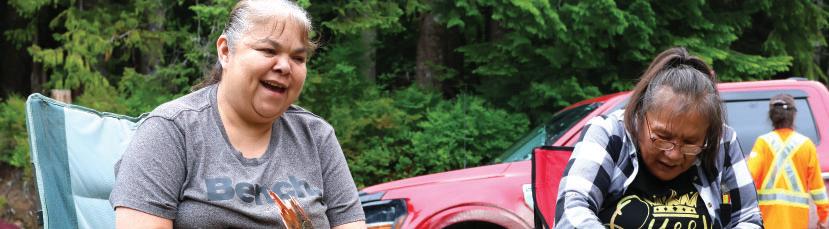
Tseshaht First Nation fisher Shae Doiron netted almost 1,000 fish in a single set with her father Chuck and two deckhands. The lifelong fisher said the June 28 catch was the best she’s ever had.
Chuck simply described the big pay day as “paradise”.
“Grateful and blessed,” Shae adds. “We are taken care of for the winter.”
Located in Port Alberni, Tseshaht and Hupačasath First Nations have an Economic Opportunity (EO) agreement with the Department of Fisheries and Oceans (DFO) to gill net in upper Alberni Inlet and the tidal portion of the Somass River.
During the month of June, DFO opened the EO fishery for two days at a time over the span of three weeks (June 28 to June 30, June 21 to June 23 and June 14 to June 16).
Shae slept in her truck at the Paper Mill
Dam to ensure her boat was the first in line for the Sunday, June 28 opening.
“That was a rush. It’s all hit or miss too, when the fish show-up. The lifestyle of us waiting to get to the rush was almost like we did it back in the day without DFO telling us when to go,” said Shae.
“I don’t like to fish anywhere else.
Sometimes we wait a week to get a set like that,” she continued. “We did not anticipate to catch that amount of fish.” The spot, which is locally known as ‘the
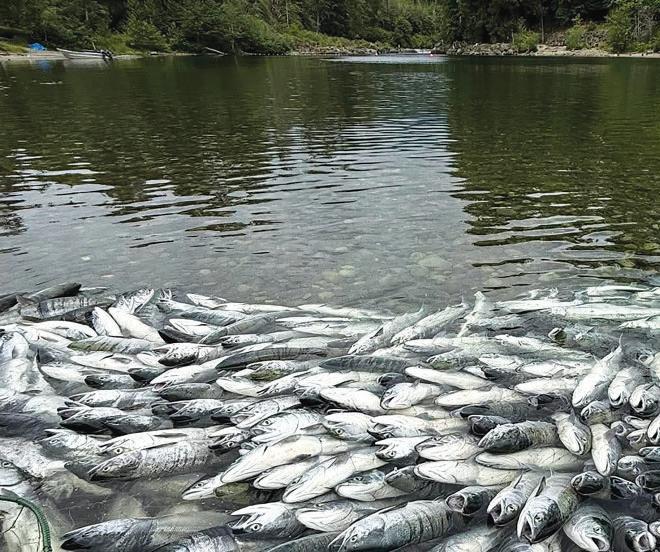
A late-June run of Somass River
brought abundance to First Nations in the Alberni Valley.
dam’, is dear to Shae. In 2022, a drug overdose claimed the life of her brother Charles. She shared that they scattered his ashes at the dam. Her sockeye net is also dedicated to his memory and overdose awareness with purple corks floating along the line.
This year’s pre-season forecast for the Great Central and Sproat Lake was ranked “high” with an estimated 700,000 to 1,000,000 sockeye returning. Hucuktlis Lake (formerly Henderson Lake) sockeye stock was forecast in the “low” zone with 15,000 to 25,000 returning.
With a low snow pack and hot weather, Graham Murrell, fisheries manager with the Hupačasath First Nation, says the two nations scaled back fishing efforts by “about half” early in the season, knowing the drought conditions could reduce the flow of fish.
“There were lots of sacrifices made by the nations among their fisheries. We wanted to make sure we were doing what we could,” said Murrell.
“We were expecting the worst this year, but we have been saved with the cool weather. I’d say we are in a good place
right now. Lots of fish are moving. We are in a lot better place than most thought we would be at this time,” he continued.
DFO closed EO fishery and hook and line food fishing at the Paper Mill Dam spot for a week from July 3 to July 9 in effort to boost the escapement to Sproat Lake.
“We still have big issue of river levels, but we are working the tools we have,” said Murrell.
He shared that Hupačasath worked with DFO to create on a temporary wall at Stamp falls after infrastructure that pushes the water towards the fishway was knocked out over the winter.
At the end of the day on June 29, Murrell said the count for adult sockeye swimming through the Sproat river fishway was 35,289 and 99, 632 swam through Stamp River. He noted that those numbers fluctuate daily.
Shae said it’s good move to close the Paper Mill Dam spot for a stint, even when it comes to hook and line fishing for community members.
“There is absolutely nothing wrong with closing for a week,” said Shae on July 2, a day before the closure came into effect.
“It’s not DFO saying (close it), it’s the weather. It’s lack of snow and overfishing. We get into this unhealthy mentality where we think we have to fight DFO. If the fish are struggling already, they are not going to get up,” she said.
Looking into July and August, Murrell says the chinook salmon forecast is “high” this year.
“Hopefully we will have good chinook fishing as well,” he said.
Shae Doiron photo
sockeye
Society urges people not to ‘underestimate’ a river
Drowning cases have already surpassed the 2025 totals, as search for a missing Stamp River swimmer is paused
By Alexandra Mehl Ha-Shilth-Sa Contributor
Port Alberni, BC - On July 9 search efforts for the missing swimmer who went over Stamp Falls were paused. Tragically, the female swimmer was swept away by the current when swimming at Stamp River Provincial Park near Port Alberni on Sunday, July 5.
“[July 10] was an incredibly difficult day for everyone involved, as search efforts are being paused for the time being,” reads a post on Alberni Valley Rescue Squad’s Facebook page. “Most importantly our thoughts are with the family and loved ones affected by this tragedy. We cannot imagine what they are going through and we are holding them in our thoughts during this devastating time.”
The swimmer was originally reported missing at 5:30 p.m. on July 5. Emergency responders conducted a search, but have not located her, according to Port Alberni RCMP.
The Rescue Squad’s post went on to acknowledge Arrowsmith Search and Rescue, RCMP Dive Team, Port Alberni Fire Department, Beaver Creek Volunteer Fire Department, [BC Emergency Health Services], Airspan, and the RCMP for supporting the search.
“We are also deeply grateful to every search and rescue volunteer who responded with professionalism, compassion, and teamwork,” the post reads. “Incidents like this have significant impact on responders and we are reminded of the importance of CISM, peer support and taking time to debrief and care for one another during difficult calls.”
“We’ve seen the news articles and are very concerned for this woman and her loved ones,” said Lenea Grace, executive director of the Lifesaving Society’s BC/ YK Branch, in an interview with HaShilth-Sa. “I think that the young people in this group had placed themselves in a dangerous situation.”
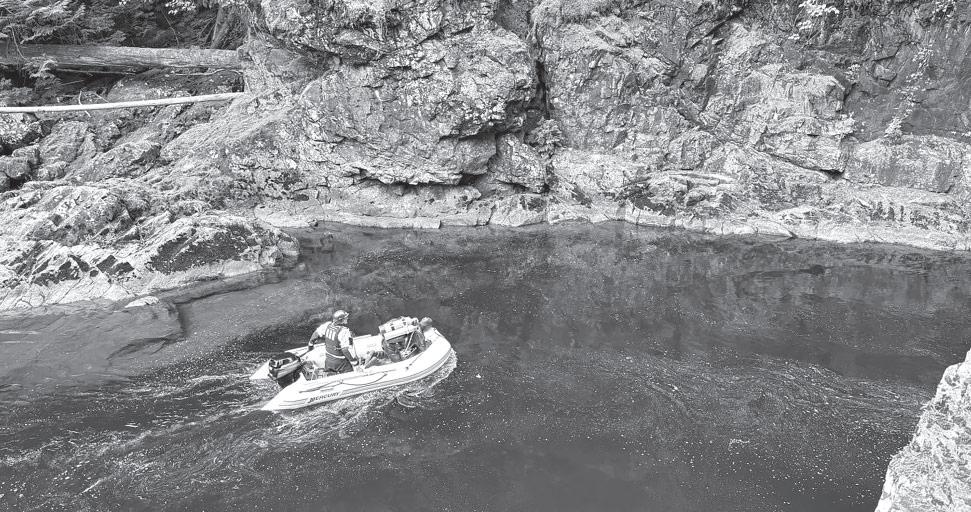
Members of the Alberni Valley Rescue Squad spent days searching for a missing swimmer who the group reported went over Stamp Falls. Arrowsmith Search and Rescue, the RCMP Dive Team, Port Alberni Fire Department, Beaver Creek Volunteer Fire Department, BC Emergency Health Services, Airspan, and the RCMP also supported the search.
“Unfortunately people often overestimate their abilities or they underestimate the power and the hazard of moving water,” she said. “It creates a very unsafe environment. Our hearts are really going out for this person’s family.”
Grace shared that though there are still some unconfirmed drowning fatalities, like with the situation at Stamp Falls, 2026 has so far seen 29 deaths in B.C. this year. The year before there were 21 drowning deaths.
“[Lifesaving Society’s] mission is to prevent drowning and aquatic related injury,” said Grace. “This is critical especially this year as we’ve seen an alarming spike in the number of drownings in British Columbia.”
According to Lifesaving Society B.C./ YK branch, 37 per cent of drownings happen in rivers, 24 per cent in lakes and ponds, and 14 per cent in the ocean. Sixty-one per cent of drownings happen
between the months of May through to September.
Grace advised that people choose swimming spots that are supervised by lifeguards, and to swim and boat with a buddy. Parents are advised to actively supervise their children, to keep small ones within arms reach, look for natural hazards such as steep drop offs and to stay close to shore.
“But when you are assessing your swim spot, is it an area that is commonly swam at?” Grace said. “Make sure you are not swimming in areas where there are warnings issued against swimming at that beach [or] park.”
“Avoid swimming in waterfalls or rivers that may have currents or other hazards,” she said. “One example of that could be a strainer, which is a log in the water that you could get caught under or different pockets that can suck you in.”
“Studies show that many people who
drown never had the intention of going in the water in the first place,” she added.
Starting on July 19, it is National Drowning Prevention Week. Lifesaving Society Branch BC/YK will be sharing water safety messaging throughout the week on their website, www.lifesaving. bc.ca.
The number one tip that Lifesaving Society B.C./YK branch is advising for this year is to wear a lifejacket when boating.
“That goes for all ages [and] all abilities, whether you are on a power boat, a kayak, a canoe, or a paddle board, wear your life jacket,” Grace said. “If you do get into trouble, seconds can matter and that life jacket can mean the difference between life and death.”
“We want them to keep themselves and their loved ones safe on the water,” she said. “Drowning is preventable and there are steps people can take to protect themselves.”
Campfire ban for central and south Vancouver Island
By Holly Stocking Ha-Shilth-Sa Editorial Assistant
Vancouver Island, BC – Effective at 12 p.m. on Thursday, July 16 campfires will be prohibited throughout southern and central Vancouver Island.
Announced by the Coastal Fire Centre on July 13, the ban covers the south half of Vancouver Island, Lower Mainland and the Fraser Valley. Campfires will still be permitted in the Sunshine Coast and the part of Vancouver Island that stretches north of Hesquiaht, Great Central Lake and Qualicum Beach (not including these areas). Campfires are also still permitted in Haida Gwaii and the Central Coast.
The BC Wildfire Service says the expanded prohibition is intended to reduce the risk of human-caused wildfires and protect public safety as fire danger increases in many coastal regions. The ban applies to all Category 1, 2 and 3 open fires, which includes campfires and larger burns.
Anyone found in contravention of an open fire prohibition may be issued a ticket for $1,150, required to pay an administrative penalty of $10,000, or, if convicted in court, fined up to $100,000 and/or sentenced to up to one year in jail. If it is proven that your fire causes or contributes to a wildfire, you may be
fined up to $1 million and/or sentenced to up to three years in jail, as well as be responsible for all firefighting and associated costs.
This prohibition also applies to the following types of land within municipal boundaries:
• Parks, conservancies and recreation areas (Park Act)
• Recreation sites, recreation trails, interpretive forest sites and trailbased recreation areas (Forest and Range Practices Act)
• Ecological reserves (Ecological Reserve Act)
• Wildlife management areas (Wildlife Act)
• Private managed forest land (Private Managed Forest Land Act)
Vancouver Island has had 49 wildfires with just over nine hectares burned total this year. Drought conditions remain an ongoing issue with the west side of the Island at Level 2 out of 5, while most of the east side of the Island and Port Alberni was rated Level 4 as of July 7. Vancouver Island also experienced below-normal precipitation percentages over the previous winter and spring, which increases the drought risk. This spring the region had 40 per cent to 60 per cent of average precipitation levels, heavily effecting the snow-pack in the mountains.
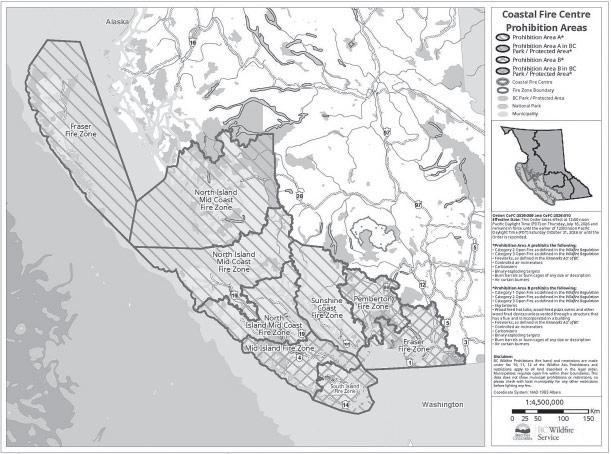
Coastal Fire Centre Map
Coastal Fires Centre’s map shows the prohibition areas. Find the latest information for your area at wildfiresituation.nrs.gov.bc.ca.
To report a wildfire, unattended campfire or open burning violation, call 1 800 663-5555 toll-free, *5555 on a cell phone or submit an electronic report through the BC Wildfire public mobile app.
For the latest information on current wildfire activity, burning restrictions and more:
Visit BCWildfire.ca
Download the free BC Wildfire Service
public mobile app or access the map and dashboard online
Follow the BC Wildfire Service on Facebook, Instagram or YouTube
Alberni Valley Rescue Squad photo
Overdose deaths decline to pre-pandemic level
BC Coroners Service reports a drug fatality rate of 3.5 a day – lowest the province has seen since February 2020
By Eric Plummer Ha-Shilth-Sa Editor
Recent provincial data shows that drug fatalities have declined to a level not seen since before the COVID-19 pandemic, but a former user cautions that western Vancouver Island’s services for those who want to get clean remain painfully lacking.
This month the B.C. Coroners Service reported 109 suspected deaths by illicit drug use in May – a low not seen since February 2020. This is part of a downward trend in overdose fatalities, putting the B.C. rate for May at 3.5 deaths a day – half of what the province faced when fatalities peaked in 2023.
Coroner’s data from the first five months of 2026 show that 76 of those who died were male, with 81 per cent of the deaths occurring inside in places like private homes, social housing and shelters.
Eighteen per cent of the deaths occurred outside of buildings, which includes in vehicles, on the street and in parks. At 71 per cent, smoking was the most common form of consumption that led to death, reports the Coroners Service.
Although the numbers have gone down, drug overdose remains the leading cause of unnatural death in B.C., more than homicide, suicide and car accidents combined. Since April 2016 the crisis has been declared a public health emergency in British Columbia – prompted by a rise in fatalities that coincided with the presence of fentanyl in illicit drugs.
Fentanyl is a powerful synthetic opioid, originally designed as a medical-grade painkiller. Over the years fentanyl and other painkillers became more prevalent in health care, an approach that the B.C. government sees as irresponsible, leading to a class-action lawsuit against drug companies and distributors. On July 6 the B.C. Court of Appeal confirmed the lawsuit can proceed, and a trial is expected in early 2028.
“Too many people in British Columbia have lost loved ones or continue to struggle because of the opioid crisis,” said B.C. Attorney General Niki Sharma in a recent statement. “Our goal was to recover the public health-care costs of treating opioid-related harms, and to hold opioid manufacturers, distributors and the consultants who advised them accountable for their alleged use of deceptive marketing to drive opioid sales, contributing to addiction and overdose.”
The B.C. Centre for Disease Control has been closely watching the downward trend in overdose deaths, citing a variety of factors that include the declining presence of fentanyl in the street supply. Although its dangerous analogues have increased, fentanyl content has steadily dropped among the seized drugs and fatal cases since late 2020.
Part of the reason for this could be a disruption in the international distribution of illicit fentanyl, according to an article published early this year by Science magazine.
“[W]e suggest there was a major disruption in the illicit fentanyl trade, possibly tied to Chinese government actions, that translated into sharp reductions in overdose mortality beginning in mid- or late2023 and continued into 2024 across both the US and Canada,” stated the study. Meanwhile, the availability of Naloxone kits, which reverse the effects of an opioid overdose, have increased since the public health emergency began a decade ago, according to analysis from the Pub-
lic Health Agency of Canada. Although fatalities have gone down, calls to emergency services have not. In fact, in March 2026 B.C. Emergency Health Services attended to a record 2,826 overdose calls.
“Although less people are dying from drug poisonings in B.C., paramedicattended overdoses have been increasing,” said Dr. Geoff McKee, the B.C. Centre for Disease Control’s medical director. “This shift happened around the same time that the veterinary tranquilizer medetomidine began to be detected in the unregulated drug supply. Medetomidine causes sedation, low heart rate (bradycardia), and changes to blood pressure.”
In its analysis, the national health agency adds that fatalities could also be declining due to the fact that many of those who face the highest risk have already lost their lives to drug poisoning.
“A declining population at risk is a likely factor in the recent decline in opioid-related deaths,” stated the health agency. “Population declines are in part because many lives were lost over previous years.”
Help needed to ground a person
The drug crisis has devastated many Indigenous families, and First Nations have faced a fatality rate more than six times that of the rest of B.C.’s population, reports the First Nations health authority.
In September 2024 the Nuu-chah-nulth Tribal Council declared a state of emergency on the matter, calling on government support for Nuu-chah-nulth communities to devise their own solutions on mental health issues and drug use.
Meetings with provincial representatives followed, but money to support an NTC plan did not, as the province cited a lack of funds to support such regionally driven initiatives. Vancouver Island’s western region is still without a drug detox facility, and for those in Port Alberni the closest detox centre is over 80 kilometres away in Nanaimo.
Meanwhile recovering from drug addiction remains a painful, uphill struggle, says Rose Chester, who used fentanyl, cocaine and heroin for seven years. She quit nearly three years ago when she decided to leave Vancouver’s Downtown
Eastside to return home to her Ditidaht First Nation community on Nitinaht Lake. The detox process was extremely painful, as Chester had to get regular hour-and-a-half rides to Port Alberni for her dose of methadone treatment. Her recovery eventually improved when Chester was able to instead get a monthly suboxone shot when she visited Port Alberni for medical attention.
Reflecting on her recovery, Chester believes that available supportive housing and a detox facility in the region would give more people a chance.
“I would like to see housing in like a camp with an elder, an elder that understood addiction, withdrawals,” said Chester, who adds that “getting help [in a] cultural way helps to ground a person and reclaim their spirituality.”
As a member of the Alberni Valley Community Action Team, for years Ron Merk has been advocating for those in the grip of the drug crisis.
“The real solution is recovery beds that are immediate,” said Merk, who regularly writes about the drug crisis and mental health issues on his Learning Moments website. “Governments across Canada just have not stepped through the real door for solutions.”
What governments have done over the past decade is introduce more harm reduction measures to help keep drug users alive, including supervised consump-
tion sites that are now available in cities across Canada. But in British Columbia the approach on how to best handle the drug crisis appears to be shifting, as indicated by an announcement from Health Minister Josie Osborne this spring to not open an overdose prevention site in downtown Vancouver due to concerns from the city, local businesses and community partners. This leaves the downtown with one less supervised consumption site than it had a year ago.
In January Osborne announced that the province would not be continuing with a drug decriminalization project. First initiated in January 2023 in the interest of bringing people out of the shadows and eliminating the stigma of drug use, this three-year exemption from Canada’s substance laws allowed users to carry and consume personal amounts of illicit substances in public spaces. But amid concerns of street disorder, less than halfway through the project the provincial government scaled back decriminalization, again prohibiting open use in public spaces.
“I think that there was such horrendous pressure from the other side of the political spectrum that the government had no choice,” said Merk.
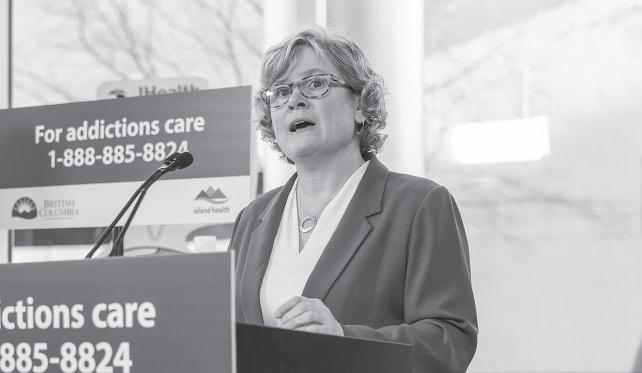
For those in the Island Health region, help is available through the Access Central hotline seven days a week, from 9 a.m. to 7:45 p.m. at 1-888-885-8824.
Eric Plummer photo
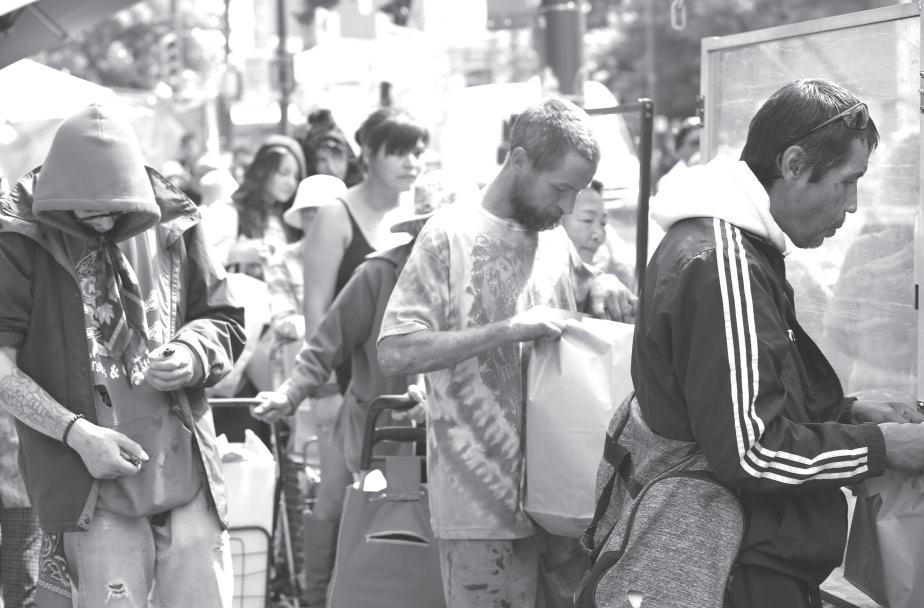
People line up for food on East Hastings Street in Vancouver’s Downtown Eastside. The area has consistently reported the highest rate of drug overdose fatalities in B.C.
Province of B.C. photo
On Jan. 14, 2026 Health Minister Josie Osborne announced that the province will not be extending the decriminalization of illicit drugs beyond Jan. 31.
Will B.C.’s plan change the lives of Indigenous kids?
Instead of measuring individual ministries, province says framework evaluates if children’s lives are improving
By Olivia Thomas Ha-Shilth-Sa Contributor
The B.C. government says its new Child and Youth Well-Being Action Plan marks a turning point in how children and families receive support, promising to replace fragmented, crisis-driven services with a coordinated system that focuses on prevention and early intervention. But for Indigenous children, who continue to experience disproportionately high rates of poverty and involvement with the child welfare system, the plan raises an important question: will this plan of action be different?
Announced on June 16, the five-year strategy is the province’s first attempt to organize child and family services around children’s well-being rather than individual government ministries. Instead of requiring families to navigate separate systems for housing, health care, education, and social services, the plan aims to improve coordination across government while measuring whether children are actually becoming safer, healthier, and better supported.
“We all want every child in B.C. to grow up safe, supported, and connected,” Minister of Children and Family Development Jodie Wickens said when announcing the plan. She said families should be able to access “a more coordinated system of supports that make a difference in their lives.”
The plan identifies five priorities: creating stronger foundations for families, preventing intimate partner and family violence, improving integrated services, advancing Indigenous self-determination and jurisdiction, and protecting children involved with the child welfare system. For many Indigenous leaders and child advocates, these commitments reflect recommendations that have been made for years.
The strategy was largely shaped by Don’t Look Away, the 2024 report by B.C.’s Representative for Child and Youth, Jennifer Charlesworth. The report examined the preventable death of a young boy known publicly as “Colby,” and concluded that disconnected government systems, delayed intervention, and insufficient support for families contributed to repeated failures. Charlesworth called for a government-wide approach that focused less on responding to crises and more on preventing them.
“This plan and outcomes framework are important foundational steps,” Charlesworth said following the province’s announcement. “I am hopeful… that with this announcement comes momentum to take concrete actions that will ensure all young people in the province thrive.”
Grand Chief Stewart Phillip of the Union of British Columbia Indian Chiefs also welcomed the plan while cautioning that actual implementation will determine whether Indigenous children benefit.
“The true test of this new approach, however, will be its implementation,” Phillip said. “Real accountability and better outcomes for First Nations children will depend on trust, relationships, and on every minister’s commitment to delivering on their promises.”
Although the number of children in provincial care has steadily declined over the past decade, Indigenous children remain dramatically overrepresented. Ministry of Children and Family development data show Indigenous children continue to make up the majority of children in care despite representing only a fraction of
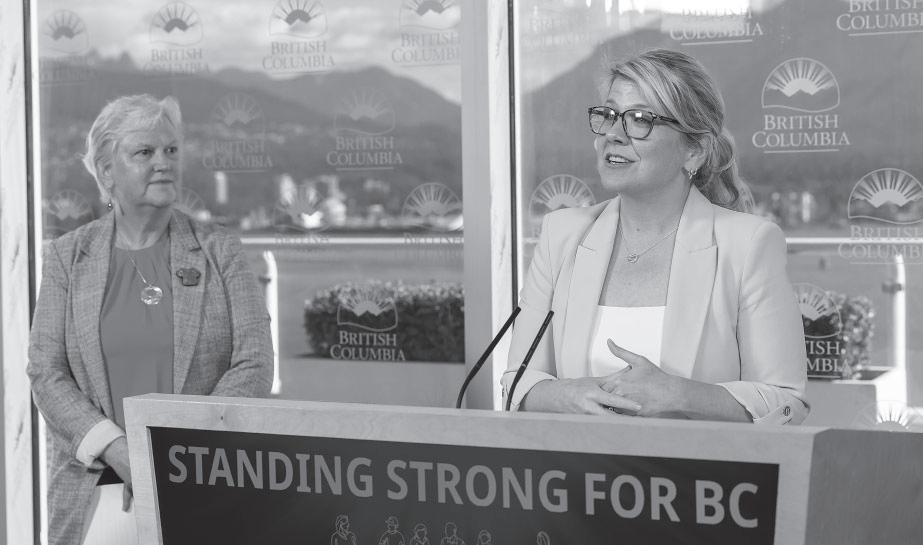
“We all want every child in B.C. to grow up safe, supported, and connected,” Minister of Children and Family Development Jodie Wickens said when announcing the plan on June 16.
British Columbia’s child population. This has persisted despite years of reforms aimed at reducing Indigenous involvement in child welfare.
Asked how the new Child and Youth Well-Being Action Plan will make a difference for Indigenous children, the Ministry of Children and Family Development said the strategy is intended to improve how government systems work together while advancing Indigenous self-determination. The ministry said Indigenous children “do better when they remain connected to family, community, and culture,” and described advancing Indigenous jurisdiction as “a major step forward on the path of lasting reconciliation” that is intended to improve outcomes and reduce the overrepresentation of Indigenous children in care.
The ministry also acknowledged that Indigenous youth remain overrepresented in both government care and the justice system.
“We know that needs to change,” they expressed. “We have hired an Indigenous Child Welfare Director who is providing leadership and advice on child welfare practice and how to support Indigenous jurisdiction; a position long advocated for by Indigenous partners. We are proud of the work we have done to advance this work so far, and we will continue to build on it with our Indigenous partners.”
The new action plan recognizes that history, committing government to advancing Indigenous self-determination and supporting Indigenous jurisdiction over child and family services. The province says strengthening Indigenous-led decision-making and culturally grounded services will improve outcomes for children while keeping more families connected to their communities.
Chief Shana Thomas of the First Nations Summit says the plan better reflects First Nations’ holistic understanding of child well-being.
“When our self-determination and jurisdiction are respected, our children grow up strong in their identity, connected to their culture, and supported by systems that are truly theirs,” she said.
Child poverty persists
However, child welfare represents only part of the challenge.
Poverty continues to shape many of the circumstances that place families at
greater risk of government intervention.
The First Call Child and Youth Advocacy Society warned in its 2025 B.C. Child Poverty Report Card that child poverty is deepening across the province, with Indigenous children remaining among those most affected. The report argues that housing costs, inadequate income supports, and growing food insecurity continue to leave many families struggling to meet their children’s basic needs.
The conditions of poverty matter because child advocates have long argued that poverty and family stress often become child protection issues when adequate supports are unavailable.
The province’s new plan acknowledges that children’s well-being depends on more than child protection services. It links housing, health care, education, violence prevention, and income supports into a single, measurable Outcomes Framework.
Instead of measuring how individual ministries perform, the province says the framework will evaluate whether children’s lives are actually improving.
The strategy also promises to reduce barriers by expanding Connected Services B.C., allowing families to access supports without repeatedly telling their stories to multiple agencies.
However, whether these changes will produce meaningful change remains uncertain.
Recent tragedies continue to raise difficult questions about the child welfare system’s ability to protect vulnerable
Indigenous children.
The deaths of Nuu-chah-nulth teen Chantelle Williams and six-year-old Don-Tay Lucas led to public scrutiny of how government systems respond when children are known to authorities or receiving services. While the circumstances surrounding each case differ, both have fueled ongoing concerns about accountability, communication between agencies, and whether warning signs are identified early enough to prevent tragedy.
Those are precisely the systemic failures the new action plan says it intends to address. However, plans alone do not change outcomes.
For Indigenous families who have experienced generations of government intervention, from residential schools and the Sixties Scoop to today’s child welfare system, the measure of success will not come from another government strategy or reporting framework. It will be whether fewer Indigenous children enter care, whether families receive help before reaching crisis, whether poverty declines, and whether Indigenous communities have the authority and resources to care for their own children.
The province has acknowledged that achieving those goals will require ongoing collaboration with Indigenous governments, community organizations, and families themselves. Whether the plan becomes another well-intentioned policy or the beginning of lasing systemic change will ultimately be measured by the lives of children it promises to serve.
Province of B.C. photo
Denise Titian photo
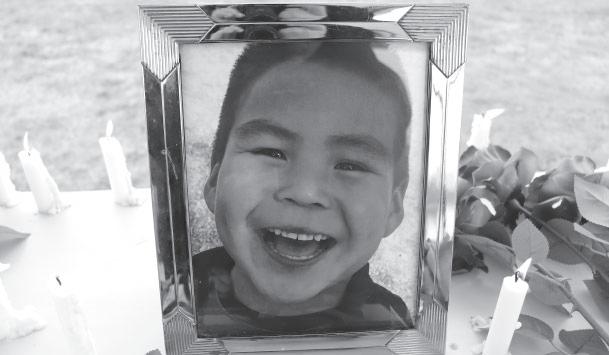
The death of six-year-old Don-Tay Lucas led to public scrutiny of how government systems respond when children are in danger.
Ha-Shilth-Sa newspaper is published by the Nuu-chah-nulth Tribal Council for distribution to the members of the contributing First Nations, as well as other interested groups and individuals.
Information and original work contained in this newspaper is protected by copyright and may not be reproduced without written permission from:
Nuu-chah-nulth Tribal Council P.O. Box 1383, Port Alberni, B.C. V9Y 7M2.
Telephone: (250) 724-5757
Fax: (250) 723-0463
Web page: www.hashilthsa.com facebook: Hashilthsa Ntc
2026 Subscription rates:
Non-Nuu-chah-nulth, Ahousaht, Ehattesaht,Toquaht and Ucluelet members are subject to a yearly subscription fee of $40 in Canada, $50 in the US and $60 for overseas. Payable to the Nuu-chah-nulth Tribal Council
Manager/Editor/Reporter
Eric Plummer (Ext. 243) (250) 724-5757 Fax: (250) 723-0463 eric.plummer@nuuchahnulth.org
Reporter
Denise Titian (Ext. 240) (250) 724-5757 Fax: (250) 723-0463 denise.titian@nuuchahnulth.org
Reporter Nora O’Malley (604) 353-8488 nora.omalley@nuuchahnulth.org

Audio / Video Technician
Mike Watts (Ext. 238) (250) 724-5757 Fax: (250) 723-0463 mike.watts@nuuchahnulth.org
Editorial Assistant
Holly Stocking (Ext. 302) (250) 724-5757 Fax: (250) 723-0463 holly.stocking@nuuchahnulth.org
DEADLINE:
Please note that the deadline for submissions for our next issue is August 7, 2026
After that date, material submitted and judged appropriate cannot be guaranteed placement but, if material is still relevant, will be included in the following issue.
In an ideal world, submissions would be typed rather than hand-written. Articles can be sent by e-mail to holly.stocking@nuuchahnulth.org (Windows PC).
Submitted pictures must include a brief description of subject(s) and a return address.
Pictures with no return address will remain on file. Allow two - four weeks for return.
Photocopied or faxed photographs cannot be accepted.
COVERAGE:
Although we would like to be able to cover all stories and events, we will only do so subject to:
- Sufficient advance notice addressed specifically to Ha-Shilth-Sa.
- Reporter availability at the time of the event.
- Editorial space available in the paper.
- Editorial deadlines being adhered to by contributors.
LETTERS and KLECOS
Ha-Shilth-Sa will include letters received from its readers. Letters MUST be signed by the writer and have the writer’s full name, address and phone number on them. Names can be withheld by request. Anonymous submissions will not be accepted. We reserve the right to edit submitted material for clarity, brevity, grammar and good taste. We will definitely not publish letters dealing with tribal or personal disputes or issues that are critical of Nuu-chah-nulth individuals or groups. All opinions expressed in letters to the editor are purely those of the writer and will not necessarily coincide with the views or policies of the Nuu-chah-nulth Tribal Council or its member First Nations. Ha-Shilth-Sa includes paid advertising, but this does not imply Ha-Shilth-Sa or Nuu-chah-nulth Tribal Council recommends or endorses the content of the ads.

Indigenous housing for the homeless
Wellness House offers 34 units, with around the clock staff, daily meals & supports
By Roniya Sahin Ha-Shilth-Sa Contributor
Victoria, BC - A new five-storey housing development supporting Indigenous peoples experiencing or at risk of homelessness is currently undergoing construction in downtown Victoria. The site will have 34 units, 33 of them being studios and one reserved for a two-bedroom family sized unit.
The Aboriginal Coalition to End Homelessness (ACEH) partnered with the BC Housing to develop the Wellness House currently being built at 938 Mason St. The House will focus on providing culturally supportive housing services for Indigenous peoples by providing 24/7 onsite staff, daily meals and access to health supports.
Each unit will have a private bathroom and kitchenette, and the building will have a communal dining room, amenity room, office space and a dedicated cultural room. The aim of supportive housing is to provide tenants with wraparound support. In the case of Indigenous peoples experiencing homelessness, the ACEH will provide support that helps strengthen both Indigenous identity and residents’ physical, emotional, mental and spiritual health.
“Many partners have worked for years to make this a reality, reflecting what’s possible when we come together to meet the needs of our neighbours and community,” said Victoria-Beacon Hill MLA Grace Lore. “Continued collaboration will help ensure more people can find stable homes along with culturally relevant care and support.”
Fran Hunt-Jinnouchi, CEO of the Aboriginal Coalition to End Homelessness Society, said that the initiative is eight years in the making.
“Groundbreaking of the Wellness House marks the realization of a vision that was first mandated during the Wisdom of the Elders Gathering in 2018,” said Hunt-Jinnouchi in a press release. “At that gathering, our elders provided clear direction: to create a light at the end of the tunnel through housing for those experiencing homelessness and substance use. Housing that is more than shelter, but a foundation for long-term wellness, centering land-based healing, family reunification,
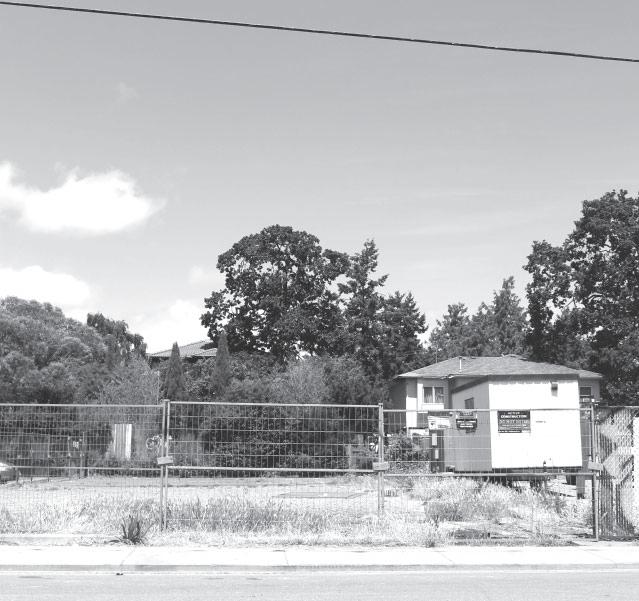
Wellness House is being built at 938 Mason St. in downtown Victoria. for people experiencing homelessness to access housing.
life-skills development and cultural connection.”
BC Housing provided both land and $9 million through the Building BC program from the Homelessness Action Plan Enhanced Fund. The federal government will also provide $9 million through the Canada Mortgage and Housing Corporation (CMHC).
The BC-based First Nation Health Authority provided $474,000. The City of Victoria has pledged $262,500 from its Housing Reserve Fund, and the local Victoria Native Friendship Centre will pitch in $150,000.
The 2025 Greater Victoria Point in Time Homelessness Count and Survey reported at least 1,749 individuals were experiencing homelessness out of about 400,000 people living in Greater Victoria. One in three, or 29.7 per cent, were Indigenous, which is disproportionately high considering the estimated Indigenous population in Greater Victoria is five per cent.
Victoria is one of the least affordable Canadian cities, with high rent prices and low income being the greatest barriers

Ha-Shilth-Sa belongs to every Nuu-chah-nulth person including those who have passed on, and those who are not yet born. A community newspaper cannot exist without community involvement. If you have any great pictures you’ve taken, stories or poems you’ve written, or artwork you have done, please let us know so we can include it in your newspaper. E-mail holly.stocking@nuuchahnulth.org. This year is Ha-Shilth-Sa’s 52nd year of serving the Nuu-chah-nulth First Nations. We look forward to your continued input and support. Kleco! Kleco!
According to the survey, 60.8 per cent of Indigenous respondents have applied for subsidized, supportive, or Indigenous culturally supportive housing.
The monthly rent for the studio units will cost $500, while the two-bedroom unit will be up to $695.
“At [the initial meeting for the project], our elders provided clear direction: to create a light at the end of the tunnel through housing for those experiencing homelessness and substance use,” said ACEH CEO Fran Hunt-Jinnouchi.
“Housing that is more than shelter, but a foundation for long-term wellness, centering land-based healing, family reunification, life-skills development and cultural connection.”
The development is set to open in 2028. Once the building opens, an advisory group consisting of elders and knowledge keepers will provide a name in the local Indigenous language for the Wellness House.
Legal Information
The advertiser agrees that the publisher shall not be liable for damages arising out of errors in advertisements beyond the amount paid for space actually occupied by the portion of the advertisement in which the error is due to the negligence of the servants or otherwise, and there shall be no liability for non-insertion of any advertisement beyond the amount paid for such advertisements
Roniya Sahin photo
Temps cool, but fire risk remains from low snowpack
Despite much of Vancouver Island in a ‘moderate’ danger rating, officials expect another active wildfire season
By Antonella Medina Arias & Eric Plummer Ha-Shilth-Sa Contributor & Editor
Vancouver Island, BC -The Coastal Fire Centre reports a shift from warm, dry conditions to cooler, wetter weather over the first week and a half of July. However, previous weather conditions point towards a drier summer season for Vancouver Island.
As of July 14 the Fire Danger Rating, a system that alerts the public to potential starts and spread of wildfire in a given area, shows central Vancouver Island at the ‘moderate’ level, which entails dry forest fuels and an increased risk of wildfires starting. Meanwhile the north Island sat at a ‘low’ danger rating, while the region’s southern part that includes Nanaimo and the area south of Nitinaht Lake was in a ‘high’ category, which means “the fire risk is serious”.
As of July 7 the province’s drought rating was just Level 2 for the western part of Vancouver Island, while the eastern portion – which includes Port Alberni –was rated Level 4 out of 5. Most streams on Vancouver Island are also reported to have below normal flows.
Many areas within the Coastal Fire Centre (CFC) and on Vancouver Island have been dealing with an extended drought over the last few years. Additionally, the Island experienced an unusually warm and dry spring, raising wildfire risk to levels higher than in the past and indicating potential for increased fire activity into the summer months and the Coastal Fire Centre’s lightning season, which is usually early August.
In July, Environment and Climate Change Canada (ECCC) noted rising temperatures, a typical change for the summer months, as ridges of high pressure begin to sit around the B.C. coast, bringing warmer and drier conditions.
For the 2026 wildfire season, fuel conditions across the province reflect a combination of last summer’s Drought Code (a measure of the moisture content of deep organic forest floor layers), winter precipitation events and recent warm and dry conditions. These factors influence moisture levels across the landscape and shape wildfire potential in B.C. over the coming months, generally indicating a more active wildfire season.
But so far, 2026 has been comparatively mild for forest fires, with just 25,000 hectares burned as of mid July. At the same time last year 700,000 hectares had burned, and in 2023, which was B.C.’s
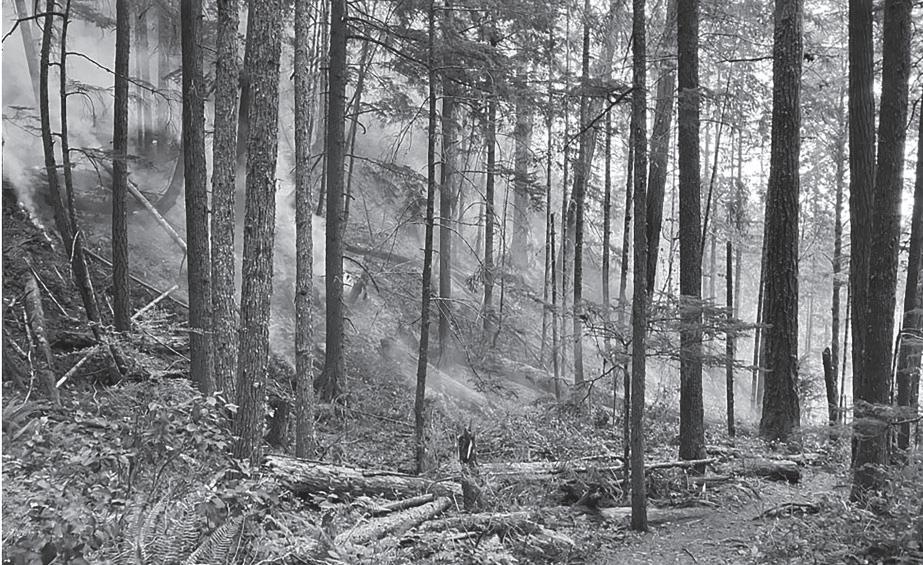
worst wildfire season on record, 1.2 million hectares had burned by mid July.
“This is not the time to get comfortable,” cautioned Minister of Forests Ravi Parmar during a press conference on July 14, noting a forecast of lightening in the coming days. “We are heading into a period of dry weather, wind and storms.”
The Alberni area has more interior influence than others on the Island. This means higher temperatures and lower relative humidity, which dry out wildfire fuels faster than in other areas like Tofino. Funnelling winds down the inlet can impact fire behaviour, as seen during the Mt. Underwood fire and previous wildfires near Port Alberni.
Additionally, the Alberni area has a higher number of recorded human-caused wildfires, which can be prevented through responsible recreation practices and the safe use of open fires.
The Coastal Fire Centre recorded 93 fires from April 1st to June 25, a significant increase from the 45 fires recorded last year. By late June over 170 hectares had burned, with eight fires caused by natural causes and 80 by human causes.
Vancouver Island and the Lower Mainland received 40 to 60 percent of normal monthly precipitation in May. The ECCC noted less than 20 millimetres of precipitation in May and June, a drastic reduc-


tion from the expected 70 millimetres in past climatological normals.
“We’re seeing below-normal precipitation occurring and … slightly warmerthan-normal conditions. So that’s going to continue to elevate and increase drying at that point,” said Ken Dosanjh,a meteorologist with Environmental and Climate Change Canada.
Rain and relative humidity can lower the fire danger rating and help rehydrate lighter forest fuels such as grasses, needles, and brush. However, the impact varies depending on the amount and duration of the rain, and whether it’s enough to dampen the deeper “duff” layers and medium-sized woody materials like logs. While the past couple of months didn’t receive as much precipitation, there was rainfall on June 25, June 26, July 2, 11 and 12, with Port Hardy seeing over 90 millimetres over the two days in June. Yet the recent rainfall may not be enough to compensate for the lack of precipitation in the spring months.
Warm and dry spring conditions resulted in early snowmelt and onset of drought conditions across the south, mostly in areas with already low snowpack levels. This occurred in the Okanagan, Nicola, Kettle and East Vancouver Island basins. Back during the winter months, Vancouver Island had a few atmospheric rivers in mid-December, at the end of January, and in early February. Atmospheric rivers are streams of moisture that crash into the coast and hit the Island. Originating in the subtropics, they bring rising freezing levels and moderate to heavy rain, resulting in precipitation over snow at higher elevations that leads to lower snowpacks earlier than they should be.
The entire province experienced abovenormal temperatures and drier-than-normal conditions in January and February of 2026. For several interior regions, it was the warmest winter recorded in history since the late 1800s. The fluctuating weekly temperatures, with extended heatwaves followed by lower temperatures, caused issues for agricultural growth and melted a significant portion of the snowpack needed to reduce wildfire risk.
The latest survey from the River Forecast Centre released on June 15 shows B.C.’s overall snowpack at 48 per cent normal. The combination of low snow-
pack, early snowmelt and warm seasonal weather forecast elevates drought hazards for the upcoming summer.
The Ministry of Water, Land and Resource Stewardship is monitoring drought and water scarcity conditions, supporting local governments and First Nations communities on response planning, investing in long-term water security and a $100-million Watershed Security Fund.
“It’s not even summer yet, but many watersheds are already under strain, signalling rising water scarcity risks,” said Randene Neill, Minister of Water, Land and Resource Stewardship in early June. “We have been working with First Nations, local governments, industry and farmers and using tools like our Drought Information Portal and a pilot system to better assess watershed-level conditions. When we all use water more efficiently and prepare early, we can reduce impacts and protect water for communities.”
Since 2017, the province has provided more than $580 million for about 2,940 disaster-preparedness and mitigation projects under the administration of the EMCR, along with supporting solutions informed by on-the-ground knowledge from local partners and boosting water storage with farmers.
The B.C. Wildfire Service (BCWS) is taking preventive measures, including the expansion of services on the ground, firefighting and mechanical equipment (pumps, saws and safety gear), additional camp infrastructure to help firefighters for easier deployment, multi-year investments in tools and technologies like wildfire camera networks and an advanced fire-behaviour prediction system.
The province encourages citizens to create or update their emergency plan, build grab-and-go bags or create an Emergency Support Services (ESS) profile in the BC Services Card app to check for insurance coverage.
Visitors to British Columbia are encouraged to have an emergency plan, understand the potential hazards in the areas they travel through, and consider travel insurance options.
BC Wildfire Service urges members of the public to download the BCWS mobile app for consistent wildfire information.
Please report wildfire by calling *5555 from a cellphone.
B.C. Wildfire Service photo
A wildfire was discovered this spring east of Port Alberni on Cold Creek, one of the first of what is expected to be an active fire season.
Lisa Marie memorial highlights the need for closure
Although he now lives oversees, police are keeping ‘appraised’ of the last person seen with the young woman
By Eric Plummer Ha-Shilth-Sa Editor
Nanaimo BC - Twenty-four years after her disappearance, the pain has not diminished for the family of Lisa Marie Young – although the continued showing of support from the Nanaimo community has sustained a hope that her loved ones will one day get answers.
The 21-year-old woman has been missing since the early hours of June 30, 2002, when she was out celebrating with friends in Nanaimo. What was once a missing person case is now considered by police to be a homicide investigation, as no signs have surfaced of Young’s whereabouts.
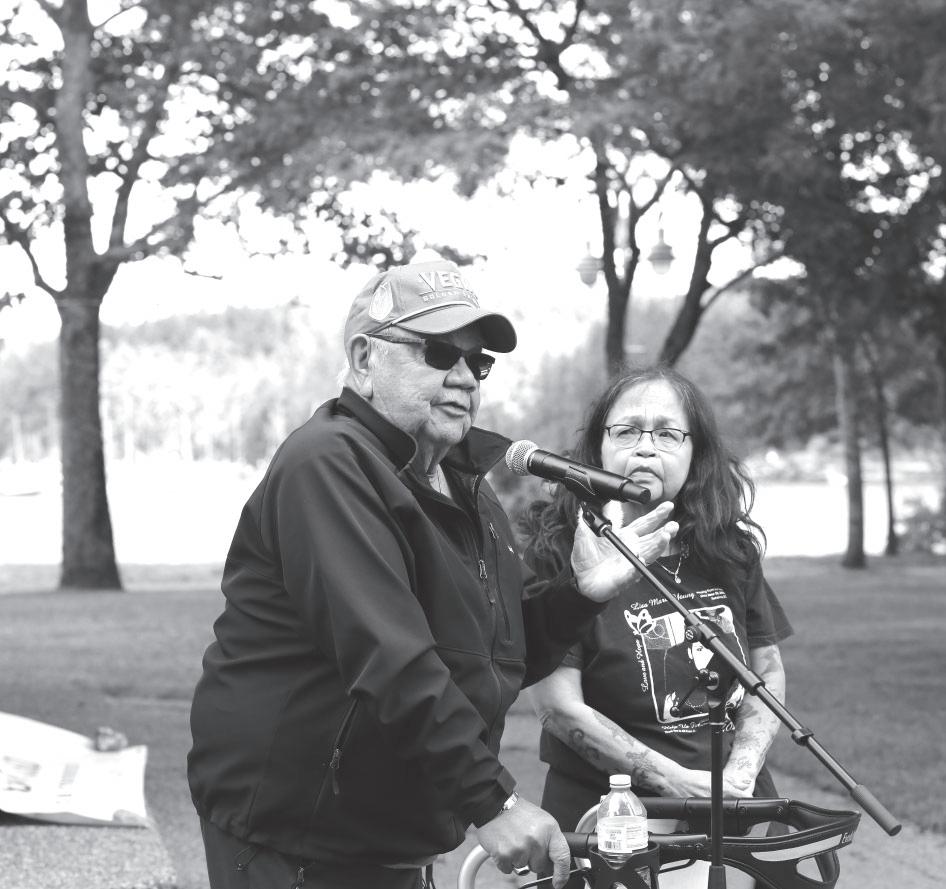
An annual event has been held in Nanaimo since the young Tla-o-qui-aht woman’s disappearance, most recently on June 28 in Maffeo Sutton Park. A cool breeze blew in from the ocean for the crowd gathered in the park on Sunday, where Tla-o-qui-aht elder Barney Williams spoke on behalf of the family.
“I know the sadness will never go away. We do our best day by day in the hope that we’ll hear something,” said Williams, thanking those in attendance for their ongoing support. “It gives us hope, it brings us some joy to see so many people.”
Born and raised in Nanaimo, during the event it was mentioned that Maffeo Sutton Park was once a place where Young rollerbladed and met with friends.
“Her personality shone bright,” said Young’s aunt Carol Frank. “She was a beautiful, independent, strong-willed woman who loved her family and friends.”
For those who knew her, the knowledge of a chilling text message remains that one of Young’s friends received from her phone at 4:30 a.m. on June 30, 2002: “Come get me, they won’t let me leave.” Young was last seen with Christopher William Adair, whom she and her friends had just met earlier in the evening in the parking lot of a nightclub they went to. Driving a red Jaguar, Adair offered to take the group to a house party. They accepted his offer, then soon went with him to another party in Nanaimo. At approximately 3 a.m. Young left the party with Adair to get something to eat. This was the last time she was reported to be seen. Since then, a police investigation has received hundreds of tips, interviewed hundreds of witnesses, conducted ground searches and amassed over 15,000 items related to Young’s disappearance.
Corp. Hayley Pinfold is among those currently handling the investigation with the Nanaimo RCMP. Although there have been no significant developments in the past year, she remains hopeful.
“The case is not cold, the case is still active,” said the investigator. “There are still people invested and working on the case regularly. I like to think that every time someone comes forward to us it might be that time when we get enough information to find what we need, to push this file forward.”
Since Young’s disappearance Adair has lived in Turkey for several years, including residing in the seaside resort location of Fethiye since 2017. While on the Turkish riviera it has been reported that Adair ran a consulting company specializing in immigration and residency matters. In recent years Turkish media has also reported that Adair has spent time living in the Philippines.
He has never been named by police as
a suspect in the Young investigation, nor charged for anything related to the case.
But court records connected to the name Christopher William Adair show a list of criminal convictions from the early 2000s, indicating that he had already been incarcerated before encountering Lisa Marie, and would serve jail time for another incident afterwards. Convictions listed include the unauthorized use of credit card data from an incident in Edmonton, Alberta from 2000, theft, fraud and assault in Kamloops B.C. from 2001, as well as assaulting a police officer in Yorkton, Saskatchewan in August 2002.
“Chris is someone whose name comes up in the community a lot for us and for our investigation,” said Corp. Pinfold.
“We are kept appraised of various aspects of what’s going on for him. He is obviously a part of our investigation in which the public is aware of, but he hasn’t been charged with anything at this point, so he is not somebody who we name in relation to our investigation and we do have other suspects in our investigation as well.”
While addressing the crowd at the recent event Carol Frank spoke of the difficulty of knowing her niece was “taken by someone who has not yet been brought to justice.”
“Someone knows something, someone told someone, someone heard something,” she said.
“It’s not just about criminal justice, it’s about getting closure for the family and us investigating everything we can so that we can provide those details and context to the family,” added Pinfold.
The disappearance of Lisa Marie Young has become ingrained into Nanaimo’s social fabric, and the city formally recog-
nizes her each June 30. Nanaimo-Lantzville MLA George Anderson said that the case serves as a message about the social obligations of men.
“Remember to ensure that we make space, we create safety for women and we be there as allies to ensure that what happened to Lisa Marie Young never happens again,” he said.
Those who have advocated for finding Lisa Marie have seen a change in the approach of the Nanaimo police department over the years. In the past a crowd gathered in front of the city’s RCMP detachment, marching in recognition of the missing woman through the streets to Maffeo Sutton Park. Now that is no longer necessary, according to event organizer Cindy Hall.
“When I first started advocating for Lisa we felt the police didn’t care about Lisa because we weren’t in contact with them,” she said, noting that over the years this has changed, as police now attend the memorial event. “The investigators attend the event every single year, they are super supportive, the file is active, police are doing searches, so we just decided we didn’t need to march this year.”
“I give thanks for the evolution of the policing system - that this used to be a protest at the RCMP station, and it is now a time that we gather together with the police,” said Nanaimo MLA Sheila Malcolmson. “It makes me think it might have been different for Lisa Marie if we had made those changes early enough to save her, to keep her safe.”

Eric Plummer photo
Standing next to her aunt Carol Frank, Barney Williams speaks on behalf of the family of Lisa Marie Young during a memorial event on June 28 at Nanaimo’s Maffeo Sutton Park.
A true Warrior Woman: Remembering Darleen Watts
Tseshaht leader introduced Declaration of Nuu-chah-nulth Women and advocated for the health of her people
By Denise Titian Ha-Shilth-Sa Reporter
Port Alberni, BC – She was a fearless trailblazer who worked tirelessly to improve the lives of others. Anchored by cultural teachings passed on to her by her parents Charlie and Minnie Watts, Darleen paved the way for women in leadership, not only in her own community but also for those in municipal, provincial and even federal agencies.
Born in the Alberni Valley on July 27, 1947, Darleen was raised by her parents alongside her six siblings. She was known to be a hard worker, fighting for Indigenous rights and helping others. Her family says she drew her inspiration from her father, Charlie Watts Sr.
Jeannette Watts shared a family story about her sister-in-law. When Darleen was a small child, she spent an extended period of time at Nanaimo Indian Hospital. With her mother busy caring for the other children at home, Darleen’s father, Charlie, would make the trip to Nanaimo to visit his little daughter. “He would tell her that you’re never too old to be corrected…you’re never too old to learn,” Jeannette shared.
Jeannette and Darleen met about 50 years ago, when the Nuu-chah-nulth Tribal Council was located at Peake Hall, a former outbuilding of Alberni Indian Residential School. Back then, Darleen was Tseshaht’s Community Health Representative (CHR).
Both Jeannette and her colleague, Jeanette Callahan, noted the aura of strength that Darleen exuded when they first met her. “She had such leadership, a voice… yet she was so welcoming,” said Callahan.
Darleen Watts not only knew her job, but she knew her community. Callahan said she was the doorway that allowed Callahan to understand the community.
In 2006 Port Alberni experienced a TB (tuberculosis) outbreak that was concentrated in Nuu-chah-nulth communities.
Health officials needed to figure out where the outbreak started and began contact tracing.
Callahan said it was Darleen and her knowledge of community that allowed them to reach people.
“Her relationship with people gave her access…she knew where they were and she really helped the nurses,” said Callahan.
“She would invite a Community Health Nurse to Tseshaht’s baby clinic (when nobody else was doing that). She was way ahead of her time,” Jeannette said. Darleen went on to other leadership roles, sometimes overlapping and many times, held positions for decades.
According to her daughters, Darleen began working at Alberni Indian Residential School in 1962, cooking and cleaning. She later worked as a housekeeper at King Ed Hotel before moving on to carpentry, working in construction for her Tseshaht First Nation.
She became Tseshaht’s Community Health Representative (CHR) in 1978, working for her nation and with other Nuu-chah-nulth CHRs. Eventually, she became president of the British Columbia CHR organization.
Ever the trailblazer, Darleen was elected to Tseshaht Chief & Council where she served for 27 years. It was in 1989 that Darleen, as a member of Tseshaht Council, stood up and read the Declaration of Nuu-chah-nulth Women, which spoke to the contributions of women to society
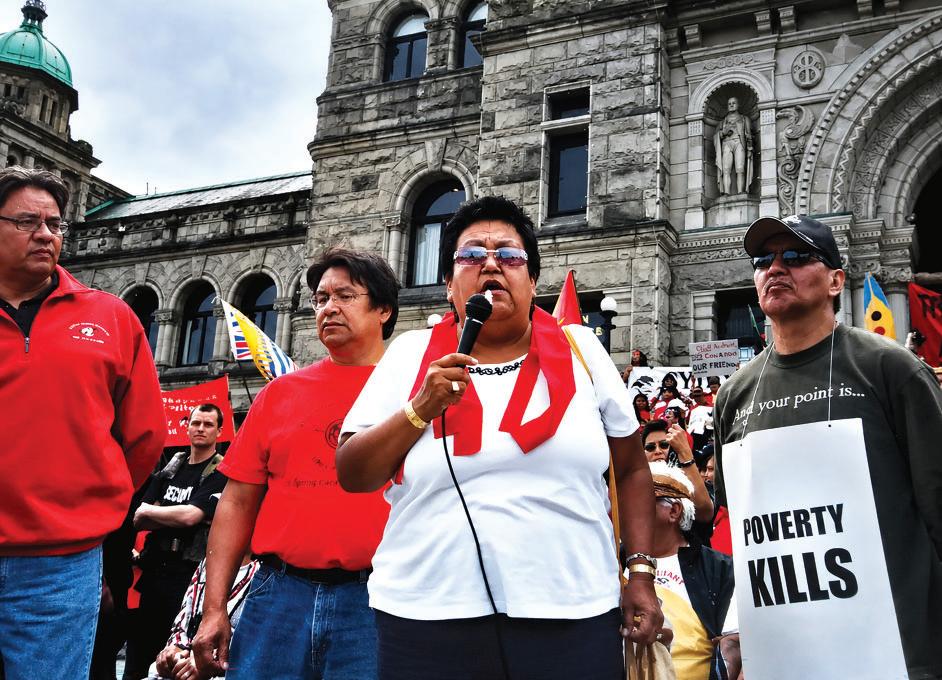
May 20, 2004, Darleen Watts speaks before B.C. legislature during the “Moving forward in Unity”
Tseshaht leader left a legacy of tireless advocacy for Indigenous rights and helping others. She passed on June
and how they should be treated.
“We have the right to be respected in spirit, mind, and body and to live free from sexual, physical, verbal and emotional abuse,” Darleen read to the crowd.
“Women are not always respected or protected from abuse, and she stood up so strong,” Callahan recalled.
The NTC Women’s Declaration went on to be adopted by NTC leadership that day in 1989.
While on Tseshaht Council, Darleen’s attention was drawn to the highway that cuts through Tseshaht’s main reserve.
Former Tseshaht elected Chief Hugh Braker recalls a time about 50 years ago when Darlene Watts called on Hupacasath Ha’wilth Hugh Watts to join her in a protest on Highway 4, which alienated about 3.3 kilometres of roadway from Tseshaht First Nation without consultation, consent or compensation to the nation.
According to Braker, the pair set up lawn chairs on the highway and sat there, blocking traffic. The protest, Braker recalled, slowed the traffic to one lane and the police eventually arrived, telling the pair to move off the road. According Braker, Darleen Watts responded, “Why the hell should we move? It’s our land!”
Tseshaht elected Chief Ken Watts praised his elder saying Tseshaht owes so much to Darleen.
“For not only being a changemaker in being the first Indigenous person in roles with the Alberni Valley with the City of Port Alberni, but for her years of service on our Tseshaht Council and also being one of the first women to enter the construction industry in our Nation’s history,” he stated. “At the end of the day Darleen always wanted our people to use their voices and exercise their rights.”
The 1980s saw Darleen spread her wings, moving on to other roles. She became the chairperson of the NTC Health Committee and then president of the National Indian & Inuit CHR’s.
In 1982 Darleen was elected as an SD 70 Trustee. The school district posted condolences on their website. “With
ʔiisaak (respect), the Pacific Rim School District extends its sincere condolences to the family, friends, and community members mourning the passing of former school trustee Darleen Watts.”
They went on to say that Ms. Watts was a trailblazer, both in community and in public education governance. “Elected as a School Trustee in 1982, she served the district for five years and holds the distinction of being the first Indigenous woman elected to the Board of Education. Her leadership helped pave the way for greater Indigenous representation in local government and educational decision-making,” they stated.
Starting in 1988 Darleen also served three years on Port Alberni City Council and ran for Mayor in 1990. That race was won by Gillian Trumper.
For the NTC Darleen served on the Personnel Committee, managed the NTC Mental Health Program and, for 23 years, chaired the Nuu-chah-nulth Economic Development Corporation Board.
The NEDC also paid tribute to Darleen.
“Darleen’s commitment to community was reflected in a lifetime of leadership,” they stated on their website. The NEDC listed her many accomplishments and praised Watts for her work.
“Widely respected for her governance skills, Darleen had a remarkable ability to keep discussions productive, navigate
complex issues with diplomacy, and ensure decisions were grounded in sound business principles. Her thoughtful and respectful communication style helped build consensus and move organizations forward,” they stated.
Her other jobs and activities included working at the Chiefs Summit Health Committee, the Chair of the National Aboriginal Capital Corporation, the BC Aboriginal Capital Corporation Association.
Finally, for 22 years, from 2001 to 2023, she was the president of the Tsawaayuus Rainbow Gardens Board of Directors.
Tsawaayuus Rainbow Gardens is a senior’s care facility operated with First Nations culture at the forefront.
“Darleen had such great respect for elders, and she wanted their care to be delivered in the Nuu-chah-nulth way,” said Callahan.
It was there that Watts spent her final years, as close to home as she could possibly be, being lovingly cared for in the place that she helped shape.
On June 11, 2026, with her daughters by her side, Darleen quietly passed away.
“Thank you, Darleen, for your leadership, your wisdom, and your lifelong dedication to Indigenous people and communities. Your legacy will continue to inspire those who follow,” stated the NEDC Board of Directors.
Ha-Shilth-Sa archive photo
rally. The
11, 2026.
Getting to know gorgeous Nitinaht by air a
Ditidaht Days on July 3 to 5 was a celebration of community and territory, with the First Nation offering free helicopte
By Nora O’Malley Local Journalism Initiative Reporter
Nitinaht Lake, BC – Most small communities tend to lean on ferris wheels and bouncy castles to amuse kids at summer fairs.
But the Ditidaht First Nation on the southwest coast of Vancouver Island took fun to a whole new level during their annual Ditidaht Days festivities on July 3 by providing free helicopter rides.
“It was awesome. We got to see the lake, the river and a couple of the beaches and then we went to little Nitinaht falls and we went swerving through the river,” said 19-year-old Ditidaht member Katrina Peter.
“It helps us know the area more. It was cool to be able to see the lake from up above,” she continued.
Craig Tate, 10, said the chopper ride was “like a rollercoaster”.
“To keep it simple, it was just beautiful,” said Evan Edgar.
“My daughter loved it,” said Melony Thomas, a Ditidaht family care worker.
Ditidaht traditional territory stretches inland from Cowichan Lake, down through Nitinaht Lake - which is one of the world’s top kite boarding and windsurfing destinations - and outwards to the coast between Bonilla Point and Pachena Point.
Canada’s iconic West Coast Trail (WCT) passes through Ditidaht territory. Last summer, the Ditidaht Economic Development Corporation celebrated the opening of a visitor centre and cultural information hub at the Nitinaht Lake Campground for hikers and campers.
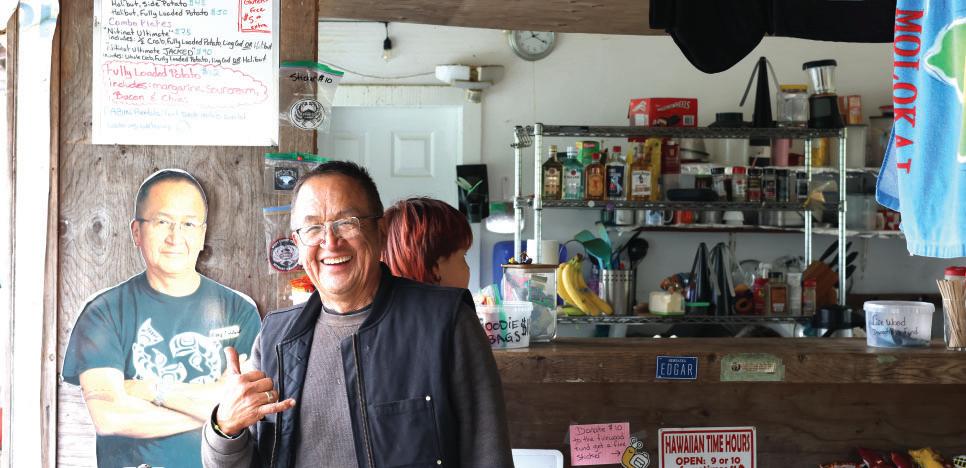
Nitinaht Narrows, a tidal waterway that bisects the WCT, is a third entrance to the trail; hikers picking up the trail in Nitinaht can say ‘hi’ to local legend Carl Edgar at the Crab Shack before opting to go north (32-kilometres) towards Pachena Bay or south (43-kilometres) to Port Renfrew.
A spray-painted piece of plywood shouting ‘Tire Repair’ greets drivers upon entering the remote village of about 175 residents – the two main access roads to the community are gravel and in dire need of maintenance.
“Chip-sealing our road is a huge need,” said Thomas.
In March, Ditidaht hired Roberta Martell to act as chief administrative officer (CAO). Martell brings over 25 years of community building experience to the Nuuchah-nulth First Nation, with an impressive CV that includes working for the Xeni Gwet’in First Nation in Nemiah Valley and building straw bale houses for the David Suzuki Foundation, as well as executive
and
director roles for Kluane First Nation in the Yukon and Fernwood Neighbourhood Resource Group in Victoria.
Amid signing up members for helicopter rides, Martell shared that she’s set-up shop
at the Nitinaht Lake Motel. She says her main priorities are to upgrade the community’s septic system to wastewater treatment and to build housing options.
“We’re buying back houses that are
private so that we can tear them down or renovate them and we are densifying where we have empty lots. We’ve got duplexes and fourplexes. We’re also looking at doing some tiny houses,” said

Craig Tate
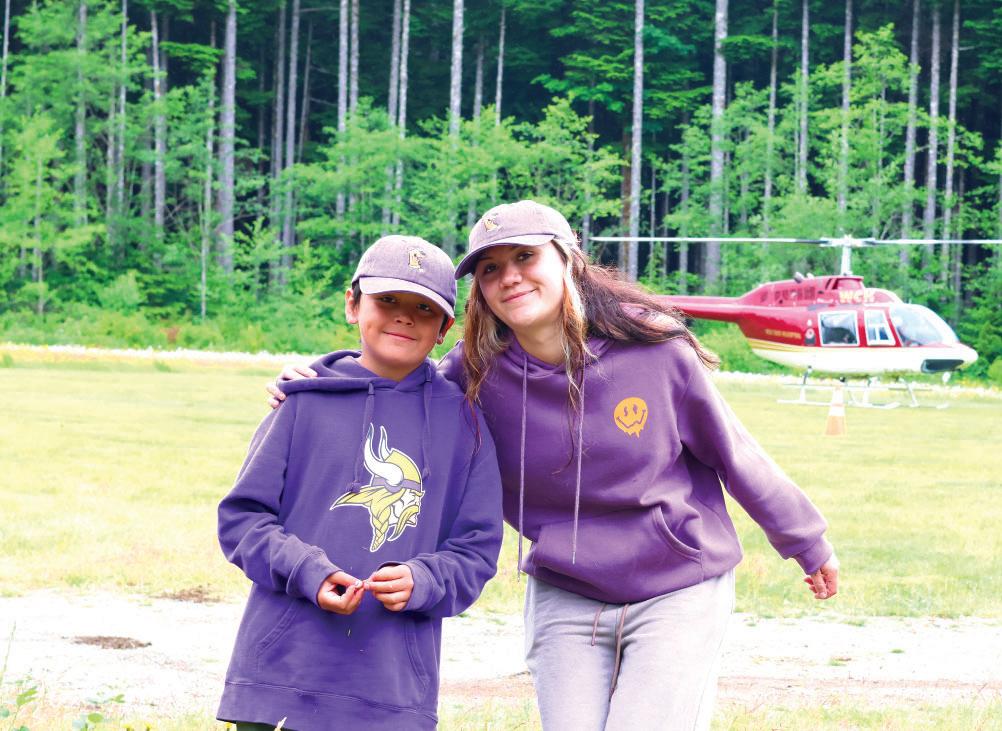
Katrina Peter got to see their First Nation’s territory from above with a helicopter ride during the Ditidaht Days co
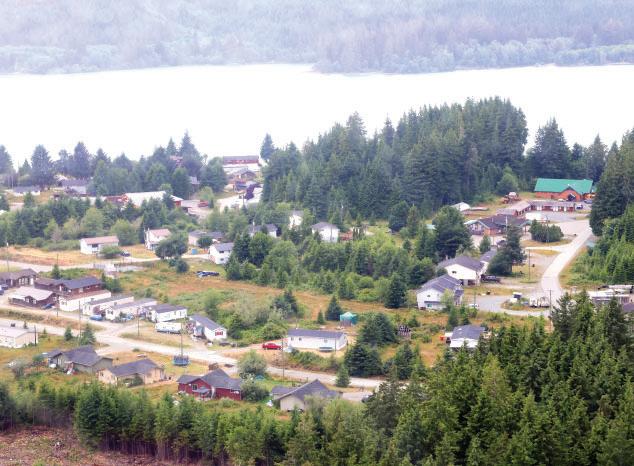
The remote village of Malachan has about 175 residents on Nitinaht Lake.
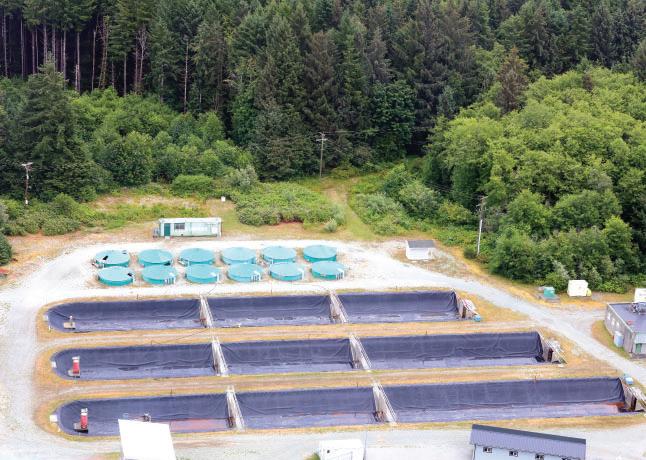
The Nitinat River Hatchery has a collection of open-water fish pens. The hatchery helps sustain salmon populations for local fisheries.
and boat

Nora O’Malley photos ommunity celebration in early July.
er rides and boat tours Martell.
She acknowledged the “not insubstantial amount of money” the sky tours are costing the nation, but says the goal is to “celebrate Ditidaht culture and to strengthen, re-affirm the connection to the land and to the territory”.
“Diditaht is at the final table of treaty. In September, we will be signing an environmental assessment side agreement, and we have some other agreements on the go,” said Martell.
“(The helicopter rides) are strengthening the relationship with the treaty team, and when it comes time to have a final vote, for people to know how gorgeous their territory is. Who gets to see it from the air? It’s massive and it’s gorgeous and it’s unreachable in a lot of ways. This is a pretty neat opportunity,” she said.
Ditidaht by boat
2013.
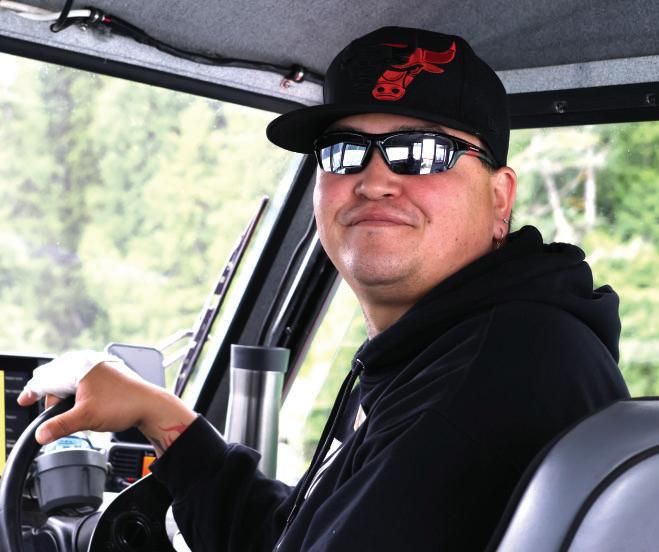
Ditidaht members could also view their territory from the water during Ditidaht Days, with WCT water taxi and ferry service skipper Leon Edgar taking folks out on the boat.
Leon took passengers up to the north end of the lake where the Nitinat River Hatchery has a collection of open-water fish pens. The hatchery opened in 1980 to help sustain salmon populations for local commercial, recreational and Ditidaht First Nations fisheries. According to Fisheries and Oceans Canada, the hatchery sees salmon returns that can range up to about 500,000 each year.
He says while Ditidaht members are always allowed to catch food fish, commercial fishing is prohibited due to overfishing.
“There hasn’t been commercial fishing opening inside the lake or outside the lake for almost 20 years,” said Leon.
Elder Charlie Elwood Thompson, 80, took advantage of Leon’s July 3 morning boat tour. Thompson grew up in “Whyac”, or waayaa, Ditidaht’s old village site overlooking the entrance to Nitinaht Lake.
“I missed out being a fisherman because I went to residential school. It would have been nice to be a fisherman,” said Thompson as the boat slapped the waves, passing by Hobiton River, a spot once used by gillnetters.
Thompson attended the Alberni Indian Residential School for 10 years. When he returned home in his twenties, he went to work at logging camps with his dad and uncle. He said he also worked on the whole WCT, building bridges and other features
in the ‘70s.
“You need really good boots to hike the trail, put calks on the bottom like the loggers used to wear,” Thompson recommends.
Leon took the boat tour all the way out to the lip of the tidal lake where it connects to the Pacific Ocean before making a pitstop at his family’s Crab Shack business. The Crab Shack is a welcome respite for WCT hikers, offering a place to dry boots, fill the belly with seafood and nurse a cold drink. Leon’s dad Carl is celebrating his 51st year as a water taxi operator for the WCT. He built the Crab Shack with the help of his son in 2013.
To operate the remote, floating restaurant, Carl says he’ll make a supply run to Costco once a week, which takes roughly 14 to 16 hours.
“It wears me out,” said Carl. “You need ambition. You need the drive. You have to want to do it. My family grew up doing all
this.”
Carl says his “succession plan has been in order forever”, with his kids and grandkids all involved with the business, from taking orders and preparing fish to driving the ferry service over the Nitinaht Narrows.
“I’ve been here since the very beginning of the trail and I’ve seen a glimpse of the future. Everything here is what hikers ask for. I built it for them,” said Carl.
As Leon rounded the tour group up to head back to the main dock, two Germans hiking south on the WCT started to hang wet clothes over the Crab Shack’s woodstove. Leon’s son Leon Jr., a Grade 9 student at Ditidaht Community School, hopped in the boat, so he could jump on a chopper tour.
There are currently a total of eight students in his class and 45 to 50 children in the entire K-12 student body.
“If everyone graduates from my class, that will be the most grads ever,” said Leon Jr.
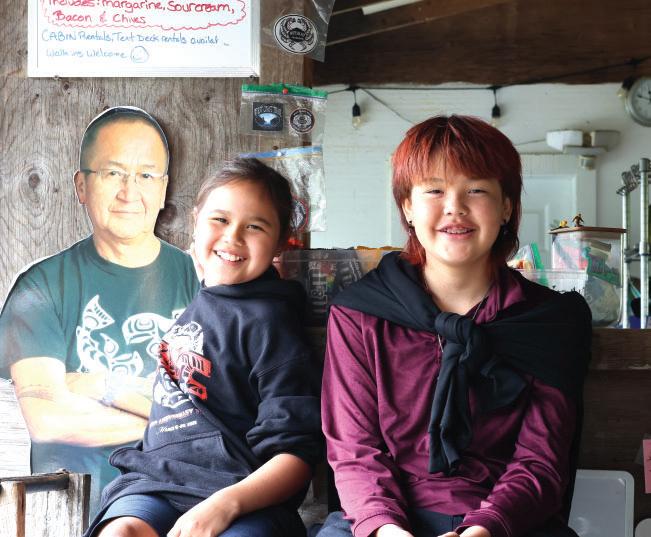
Carl Edgar is celebrating his 51st year as a water taxi operator for the West Coast Trail. He built the Crab Shack with the help of his son Leon in
Ditidaht members could also view their territory from the water during Ditidaht Days, with water taxi and ferry service skipper Leon Edgar (above) taking folks out on the boat.
New amphitheatre at Tofino’s Tin Wis Resort opens
Tin Wis Amphitheatre provides a gathering space for Tla-o-qui-aht members to share culture, food and stories
By Nora O’Malley Local Journalism Initiative Reporter
Tofino, B.C. – Tla-o-qui-aht First Nation has built a new open-air community and entertainment space for all to enjoy.
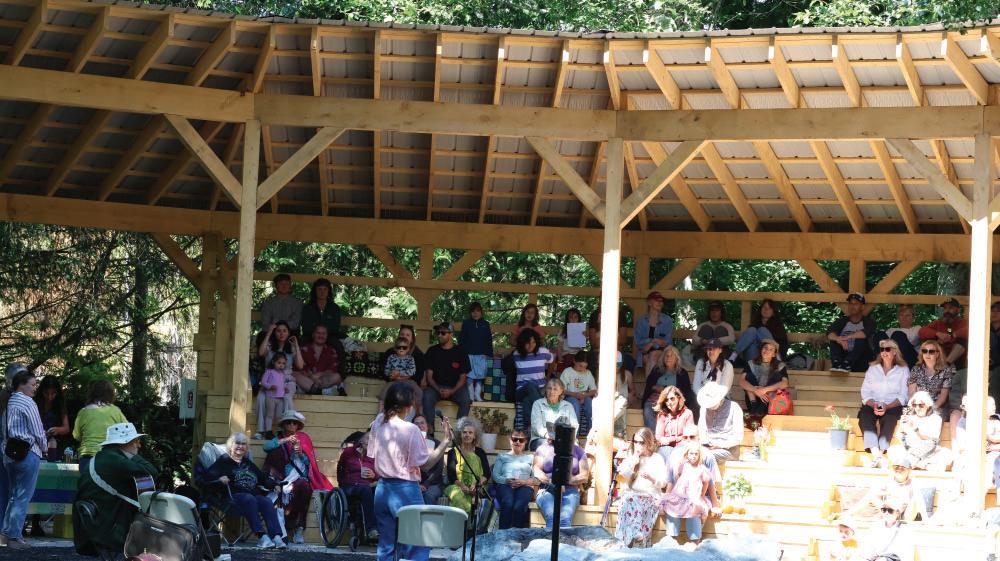
Nestled along the pathway between Tin Wis Resort and Tsawaak RV Resort, the Tin Wis Amphitheatre opened on Saturday, June 27, with a sun-soaked afternoon of poetry, song and delicious drinks and kebabs from Moss & Milk Cafe.
The inaugural public event raised $1,000 for the Wickaninnish Community School lunch program and Tribal Parks.
“The vision for this space is much bigger than a performance venue,” said Maria Clark, Tin Wis Resort’s assistant general manager.
“I imagine a place where our stories are told from our perspective. Where visitors gather to hear our history, share salmon and bannock kluupchass style (traditional salmon BBQ, listen to our songs, and experience Nuu-chah-nulth culture through the voices of the people who belong to that place). For generations, our stories have often been told about us. This is a place where we can tell them ourselves,” she said.
Constructed in a semi-circle shape with a covered top over bleacher-style seating and large fire pit in the middle, the facility has a capacity to host up to 70 people.
Tin Wis marketing manager Parker Scott says the amphitheatre will soon be open for community bookings. It’s also a rentable space for private events.
“It’s transforming Tin Wis into a learning resort for both Tla-o-qui-aht members and visitors,” said Scott.
“It’s integrated the two resorts really well. We have a large RV travelling group of about 30 people and they used the space for a large community fire,” she continued.
The new outdoor gathering space was funded with a grant from the National Aboriginal Capital Corporations Association (NACCA) ‘Signature Indigenous Tourism Experiences Stream’, according to Scott. NACCA is a network of over 50 Indigenous Financial Institutions dedicated to stimulating economic growth for all Indigenous people in Canada.
The creation of the amphitheatre aligns with the ‘Tin Wis 10 in 10’ plan of claiming 10 per cent of the local tourism
Phrase
economy over the next 10 years, by Tlao-qui-aht and for Tla-o-qui-aht.
In 2024, Tofino welcomed over 632,400 overnight guests and total visitor spending in the region reached about $430 million, according to a report published for Tourism Tofino.
Tin Wis Resort also built a new carving centre and wellness studio on the property for additional community programming.
“For example, when there is a funeral in the conference centre, the wellness space can be used for child programming or as a safe space for people that need a moment,” said Scott.
Scott shared that Tla-o-qui-aht has a future goal of bringing back an event like Naaʔuu, which celebrated Tla-o-qui-aht food and culture, to the outdoor space. In the meantime, she encouraged Nuu-chahnulth entrepreneurs with ideas for the venue to reach out at: sales@tinwis.ca.
The Amphitheatre offers corporate, local and Tla-o-qui-aht member rates. For more information or to inquire about bookings, contact: reservations@tinwis. ca.
Tla-o-qui-aht plans on hosting a gathering at a later date to formally open the outdoor venue.
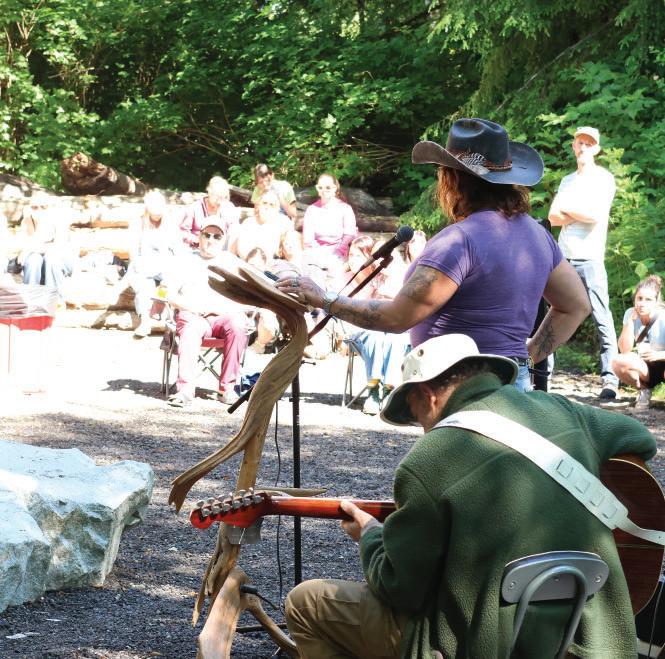
Pronounced ‘ha wi chuk suh puh tlin chah yah puts i’, it means, ‘Let’s get the canoes ready.’ Supplied by ḥakaƛ
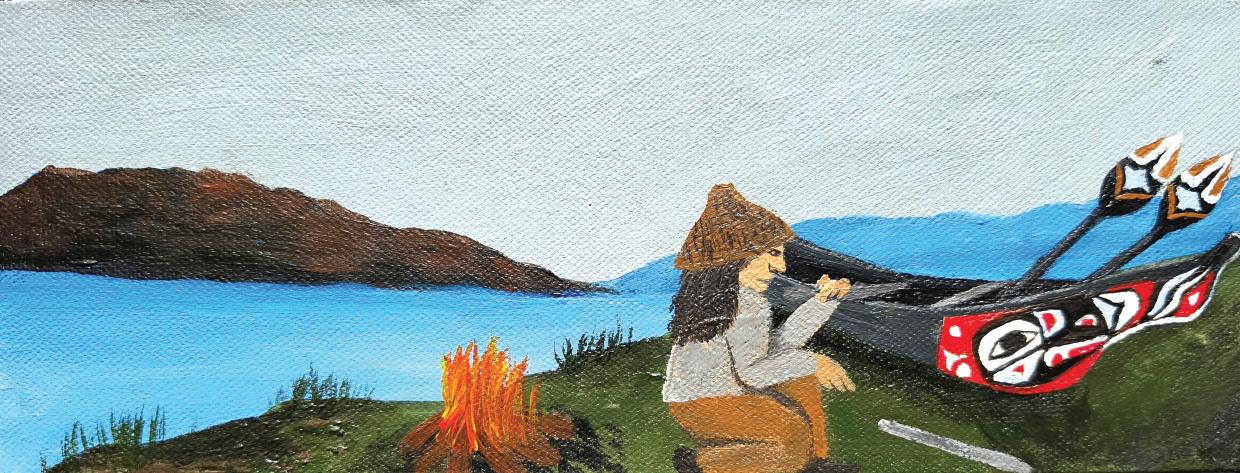
Nora O’Malley photos West Coasters fill the new Tin Wis Amphitheatre with joy during a poetry party on June 27, 2026.
Nuu-chah-nulth artist Nicki Love recites a heartwarming poem during the sunny June 27 event.
Fans pack Port Alberni venue to watch Canada play
Indigenous-led soccer watch party brings culture and stadium energy to Canada’s final FIFA World Cup game
By Nora O’Malley Local Journalism Initiative Reporter
Port Alberni, BC – Our boys fell just short, but what an unforgettable ride it has been.
Canada’s historic FIFA World Cup run came to an end on Saturday, July 4, after falling 3-0 to Morocco in the round of 16 in Houston, Texas.
About 200 fans packed Port Alberni’s The KCC (Kinsmen Community Centre) to watch Canada go toe-to-toe with a giant – Morocco were semi-finalists in the 2022 World Cup and entered the 2026 FIFA tournament ranked seventh, compared with Canada’s 30th ranking.
Tseshaht First Nation kicked off the free, family-friendly event with a welcome song and performance by Dancing Spirit dance troop.
“We sang high-energy songs for the game,” said Aaron Watts. “One spoke of moving forward in a good path, it was a celebration song, talking about our wealth.”
In effort to bring communities together, the provincial government provided $1.7 million through the Ministry of Tourism, Arts, Culture and Sport to 32 communities throughout British Columbia for multi-cultural watch parties.
In the Port Alberni region, the Hupacasath, Tseshaht, and Huu-ay-aht First Nations received $90,000 in provincial funding to host public match viewings over the course of the World Cup. The watch parties were organized in collaboration with the City of Port Alberni, Alberni-Clayoquot Regional District and the Alberni Athletics Soccer Club.
“We are thrilled to support Tseshaht First Nation and communities throughout B.C. to share in the excitement of the FIFA World Cup 2026™. This is the world’s largest single-sport event and events like this are one way we’re making sure everyone can share in the energy, pride and social benefits of hosting. The Province is pleased to be funding opportunities for people in B.C. to feel connected to the World Cup experience closer to home,” said Anne Kang, B.C. Minister of Tourism, Art, Culture and Sport.
World Cup co-host Canada won its
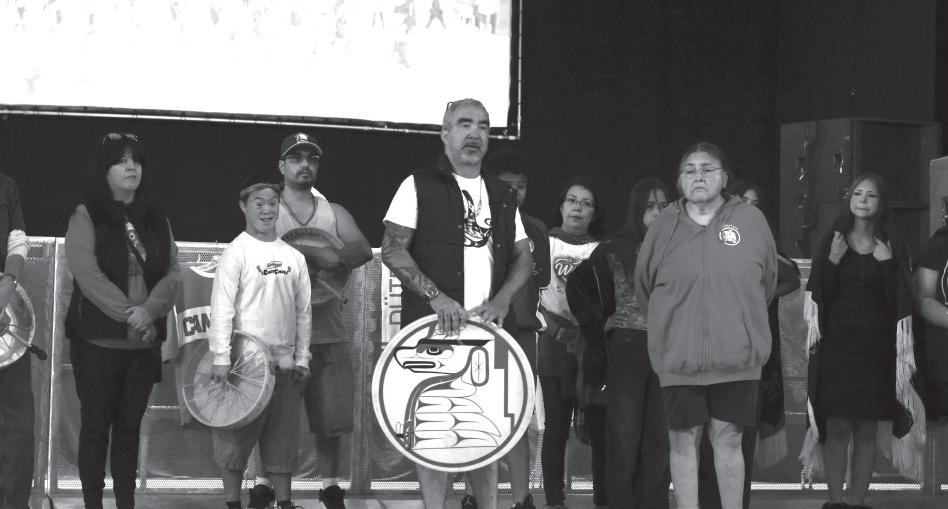
First
4 for a round of 16 World
first-ever knockout round game, beating South Africa 1-0 in the round of 32 after Canada midfielder and captain Stephen Eustacquio scored a last-minute goal.
Canada played an excellent first half against Morocco; it wasn’t until the 50th minute that Morocco midfielder Azzedine Ounahi stepped up to score. Ounahi scored a second time in the 82nd minute and Soufiane Rahimi grabbed a late third goal.
Eustacquio spoke to FIFA after the loss to Morocco.
“I think we did an amazing tournament. Until the half-time of this game we were outstanding. Everybody back home should be very proud. We felt we could have won this game especially in the first half. We were on top of them, we were fighting, we were creating chances, our set-pieces were on point. But from a setpiece we let that slip and then obviously we want to go after it and we got hurt on transitions,” said Eustacquio.
Canada coach Jesse Marsch told FIFA they were unlucky not to get the lead.
“(Morocco) made a couple more plays than us but cranking up the intensity was not the issue. It’s just they have a little
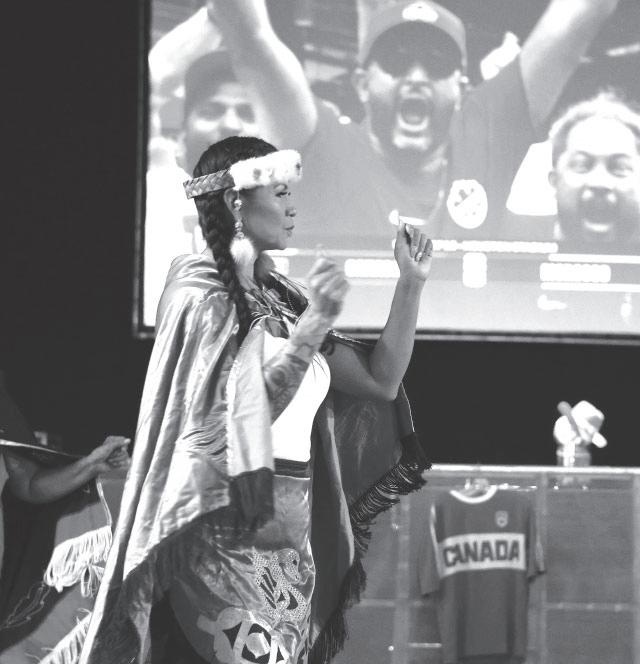
bit more quality in the final third and we lacked a bit of ability to make a play when we needed it. But in terms of the match plan and the idea of how we want to play football and the idea of a bunch of guys believing in themselves and going after it and taking on a top team that hasn’t lost for I don’t even know how long and taking them to the limit, we were the much better team in the first half and even the beginning of the second half. There was one play that made it 1-0… Across the pitch we had 11 incredible performances in the first half. We
were unlucky not to get the lead. Then it’s the fine details. [But] what a privilege our fans have had to root a team on like this that goes after the game,” said Marsch.
There will be one last community watch party on Sunday, July 19 at The KCC for soccer fans to cheer on their (second) favourite team in the FIFA World Cup final. Doors open at 10 a.m. and kickoff is at noon. Door prizes include buckets of candy, soccer balls and Team Canada jerseys. Parking is free.
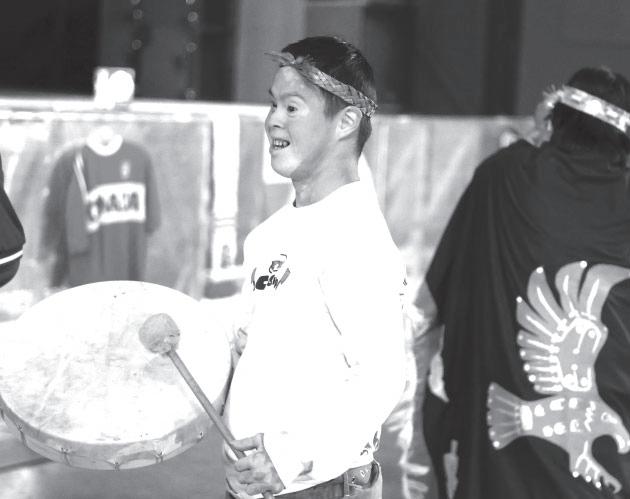
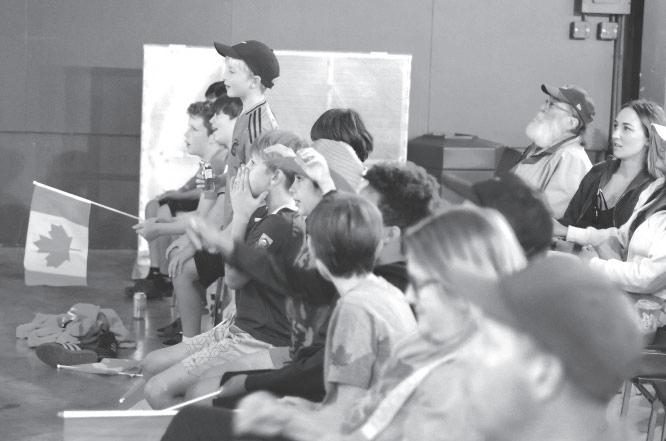
Nora O’Malley photos
Tseshaht
Nation drummers and the Dancing Spirit dance troop welcome fans to The KCC Fan Zone on Saturday, July
Cup match between Canada and Morocco.
About 200 fans packed Port Alberni’s The KCC venue for the community watch party.
Usma News
The Threads That Connect Us
Josie Watts has spent decades passing on her sewing skills to the next generation
By Rebecca Aldous Usma Communication Coordinator
Port Alberni, BC - When Josie Watts attends potlatches, she sees the past dancing before her.
Long shawls, children’s shawls, vests for parents, neat stitching, flowing fringe, and even the occasional project that wasn’t finished quite as perfectly as she would have liked all come together on the dance floor. Each piece represents a story, a memory, and years of work.
“That is always such a good feeling,” she says while attending the sewing club at Usma Nuu-chah-nulth Family and Child Services’ cultural space. “I saw one lady at Canoe Journeys wearing one of my first shawls. She said, ‘This is my favourite shawl ever.’” Watts is accustomed to giving much of her work away. She wants members of her community to have access to regalia and the opportunity to celebrate their culture.
Sewing has been part of her life for as long as she can remember. Growing up, she watched her mother create items for community members using a treadle sewing machine. One day, her mother stepped away and asked her to continue sewing tea towels while she was gone. By the time she returned, Josie had completed 35 of them.
“She said, ‘How did you do that?’” Watts recalls with a laugh. “I said, ‘I watched you.’”
Yet despite decades of experience, Watts says she will never be the sewer her
mother was.
“She never used measuring tapes,” she says. “She could just eye it and use her hands.”
For the past 25 years, Watts has organized and taught sewing clubs, helping community members learn skills while creating cultural regalia and other projects. One of her first sewing clubs for Tseshaht First Nation was held in the basement of the old elementary school.
Besides being accompanied by the ghost of a little girl while there, Josie taught a lot of people how to sew. One of Josie’s best friends, Tammy McEachern, attests to that.
“Josie has influenced every one of them,” McEachern says while working on placemats for her son’s wife.
Today, the sewing club gathers every Tuesday evening at the Usma Cultural Building. The dedication of Usma Cultural Coordinator April Charleson and Family Care Worker Ramona Mark helps create a welcoming space where participants can learn, share knowledge, and connect with one another.
Both women also spend countless hours creating regalia for youth and caregivers connected to Usma, helping ensure culture continues to be worn, shared, and celebrated.
For Josie and the other sewing club members, that is what makes all the hours behind a sewing machine worthwhile. Years later, they can attend a potlatch and see the stories, skills, and traditions they helped stitch together still being carried forward.

NCN Mental Health Counselling
Tuesdays and Thursdays 8:30am – 4:30pm
4841 Redford Street, Port Alberni
NCN Mental Health Services – DropIn Counselling with Margaret Bird, Registered Clinical Counsellor and Play Therapist. For on and off reserve members of all ages of the Nuu-chahnulth Tribal Council. Call (250) 724-3939 to book your appointment.

&Community Beyond



Samuel Richard Johnson jr. mit. Memorial Potlatch
November 7th, 2026
Starting with lunch at 12:00pm Wahmeesh gym, tsaxana reserve. All welcome.
In memory
Michael Thompson – Kwiibaalaah September 13, 1932 - July 13, 2026
Born at Waayaa and he passed away peacefully in the village of Balaats’adt where he spent most of his life as a fisherman, logger, choke setter, and as a respected elder, linguist and knowledge keeper.
Michael was the sole remaining fluent speaker of the diitiidʔaaʔtx dialect. He dedicated much of his life instructing and inspiring generations of Ditidaht to continue to breathe life into their language, culture and identity. He was the last of his generation coming from Mary (nee Chester) and George Thompson.
Michael survived the indignity of the Alberni Indian Residential School, and in spite of this affliction he made a conscious and thoughtful effort to live his life with a sense of devotion and worship to the word of God and the sacraments of the Indian Shaker Church. His many grandchildren, greatgrandchildren and numerous extended family members will honor his memory by upholding the truth of who we are and where we come from.
Michael was our oldest member of Ditidaht and in accordance with his wishes there will be a funeral held at the Duncan Indian Shaker Church and the interment at the village of Balaats’adt.
25 Years Ago in Ha-Shilth-Sa
Vol. 28 – No. 14
July 19, 2001
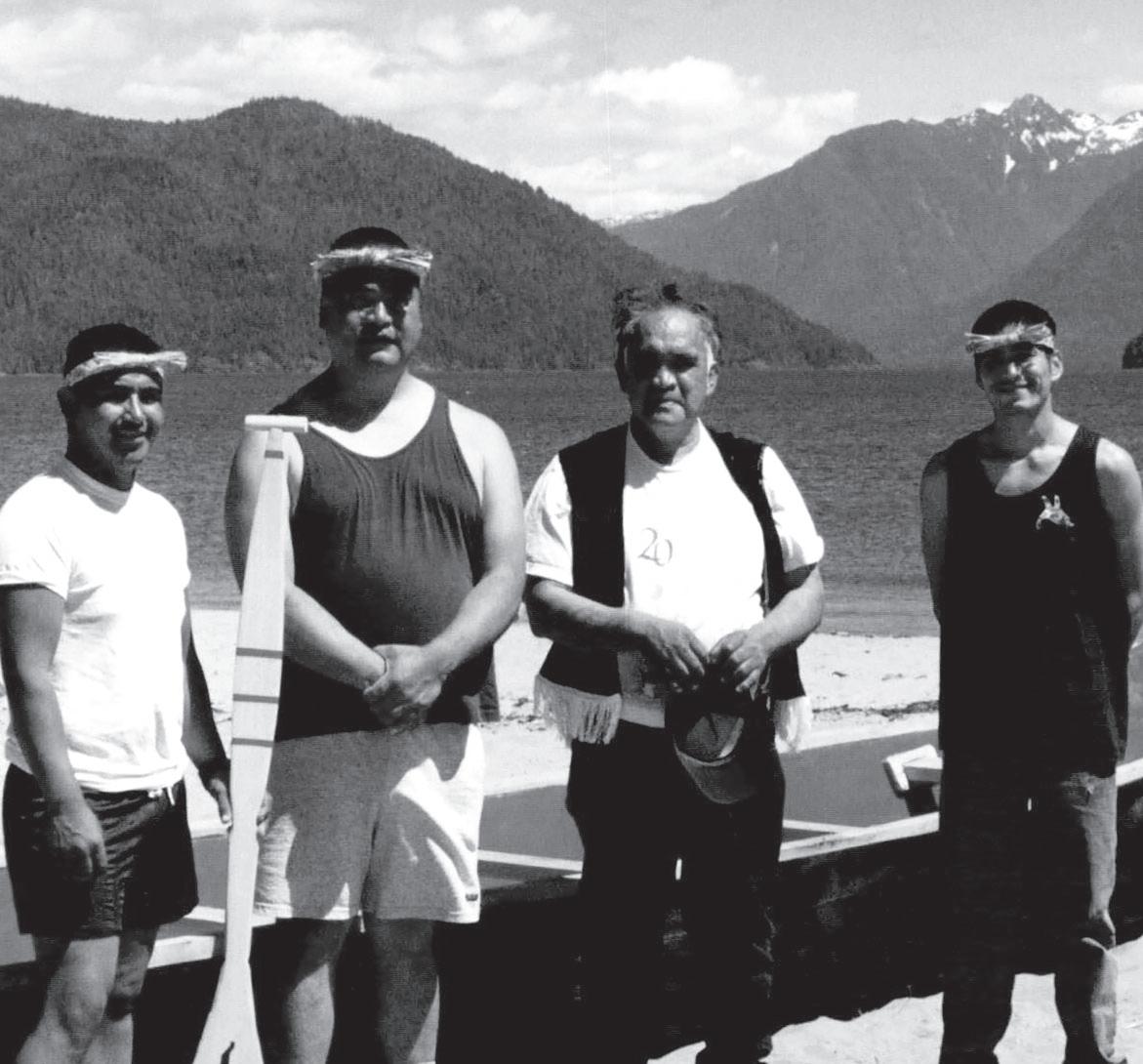
John Family Launches Ahousaht’s Newest Canoe
On July 5, 2001 the sun was shining as Murray John Jr., his family, community members and representatives of International Forest Products gathered on the beach in Ahousaht to witness the launching of a new traditional dugout cedar canoe, or chuputs. Blessed with a traditional prayer and named Kwahulth, also known as Kelthsmaht Queen, the canoe was launched and taken for a short paddling trip. Several years in the
making, two years previously Interfor agreed to harvest and donate three large cedar trees for the canoe making project. The logs were assigned to certain chief’s families, one of them to Murray John. Johnny John, brother to Murray John Sr. is an experienced canoe maker. He set to work on his nephew’s canoe on January 21, 2001. Working mostly by himself, for two to three hours a day, he finished the canoe June 23, 2001.
Rebecca Aldous photo
Josie Watts works on regalia during the sewing club at Usma’s cultural space.
Employment Opportunities



Port Alberni
Friendship Centre Volunteers Needed
Need work experience? The Port Alberni Friendship Centre is looking for interested applicants for various positions. Call 250-723-8281
Teenager competes at provincial lacrosse tournament
Jaxxon Gallic leads the Alberni Valley Tyees squad in their recent provincial-level competition in Prince George
By Sam Laskaris Ha-Shilth-Sa Contributor
Port Alberni, BC – Jaxxon Gallic was pleased he was able to participate in a provincial lacrosse tournament recently.
But Gallic, a member of Hupačasath First Nation, wishes more of his teammates with the Alberni Valley Tyees Under-17 boys’ lacrosse squad would have been available to join him at the B.C. championship tourney, which concluded on Sunday, July 12 in Prince George.
The Tyees’ roster this season featured 16 players. But only eight runners and one goalie from the team took part in the provincial tourney, which featured eight squads from across B.C.
Tyees’ head coach Darren Mannix said other commitments prevented a couple of players from participating at the provincials. And he believes financial costs hindered some others from showing up.
Gallic and his teammates who did take part lost all three of their round-robin matches at the provincial event, which featured B level teams.
Separate B.C. championships this year were organized for those at the higher calibre A level and for squads at the lower calibre C level.
The Tyees were blanked 13-0 by a West Kootenay squad in its opening game. That was followed by a 9-2 loss against Penticton. The Alberni Valley side was then edged 5-3 by Langley in its final match.
“It was a pretty good experience,” said Gallic, a 15-year-old who is also eligible to suit up for the Tyees’ Under-17 club in 2027. “You don’t get many opportunities to go to provincials. But to go with eight people is a lot different. We were shorthanded but it was pretty good though.”
Gallic said team members only found about two days before the tournament began just how short-staffed they would be.
“We were already too committed to kind of back out of it,” he said. “So, we kind of just went.”
Gallic and his teammates who did participate at the B.C. championship can only wonder what would have transpired if the Tyees had a full roster.
“I’d say we would have done a lot better, beat teams we should have beat and probably got a bit farther than we did,” he said. “But I’m pretty satisfied with how we did. We played a lot of good teams.”
Mannix was impressed with Gallic’s efforts in Prince George, adding due to the club’s short bench the teen was counted
on heavily to play both offence and defence.
“He was just an absolute warrior,” he said.
Mannix added Gallic’s play also caught the attention of various representatives from junior lacrosse squads throughout the province.
Mannix is confident Gallic is capable of playing junior lacrosse. He believes he might even be called upon to be an affiliate player for a Junior B squad as early as next year.
“If Jaxxin continues to progress, he definitely has a 100 per cent chance of playing junior lacrosse,” said the coach. “I can see him playing (Junior) A ball for sure.”
Whether Gallic does indeed go on to be a regular for a junior lacrosse club will in all likelihood depend on if he decides to focus on the sport.
Gallic, who is heading into Grade 10 at Alberni District Secondary School (ADSS), is also a talented basketball player.
Besides gearing up for another season with the ADSS junior boys’ basketball team, he’s also a member of the Port Alberni-based Tatuus club, which is comprised of Nuu-chah-nulth players that train year-round.
Gallic realizes the day is coming that he will probably have to concentrate on just one sport. As of now, he’s not sure what sport he might give up to focus reaching his full potential in the other.
“I’m kind of playing it by ear right now,” he said.
If he does stick with lacrosse, Mannix believes Gallic will not only play at the junior level but he also thinks he has the potential to make provincial Indigenous squads.
One thing that is certain is that Gallic will be wearing the C for the Tyees’ Under-17 club next season.
“He’ll return next year and he will be my captain of the team for sure,” Mannix said.
Gallic was one of four assistant captains for the squad this season.
Though the Tyees were winless at this year’s provincial tournament, Mannix believes his team was able to soak up the experience.
“Just having a taste of the provincials and the culture (was worth it),” he said.
“You are now facing the best lacrosse teams in the province, the best of the best, and you’re one of them. It was great to see what other associations are doing.

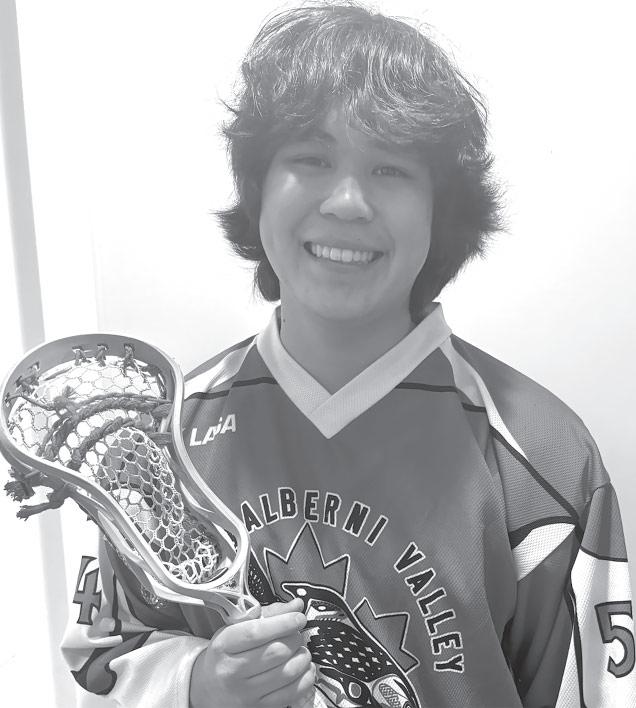
The competition is top notch.”
Mannix also praised the organizers of the B.C. championships.
“They had a great cultural event up in Prince George,” he said. “They had some wonderful dancers to open the ceremonies. It was just a very, very good vibe for kids to witness.”
Mannix was also content with some of his club’s results, particularly in their battle with the Langley team that the
Tyees squared off against in their final round-robin tilt.
“We did battle the (eventual) silver medalists and we lost 5-3,” he said.
The Tyees also played against Penticton, which went on to capture the gold medal.
Gallic is a Hupačasath member through his father Jeff. Meanwhile his mother Kaytlen Lucas is a member of Hesquiaht First Nation.

Kaytlen Lucas photo
Jaxxon Gallic competed at the B.C. Under-17 B box lacrosse championships with his team the Alberni Valley Tyees.
Electric marine hub in the works on Vancouver Island
The future is coming to Ucluelet as retired tech millionaire Avi Bryant invests in transforming WWII plane base
By Nora O’Malley Local Journalism Initiative Reporter
Ucluelet, BC – Retired Canadian tech millionaire Avi Bryant is transforming the site of Ucluelet’s Second World War seaplane base into a hub for building electric boats.
The company is called Rising Tide Boat Works, and Bryant’s vision for the sixacre waterfront industrial lot includes a boatyard, boatshed, electrified pier for a 100-ton travel lift, office space and solar electric parking.
Bryant says his dream is to build a marina similar to Boat Haven in Port Townsend, Washington – except for electric boats.
“I was really struck by Boat Haven in Port Townsend, Washington as a community and an ecosystem rather than just one business. I think that is very much our vision for Rising Tide Boat Works in Ucluelet,” said Bryant, who is a member of the Patriotic Millionaires, a group of wealthy Canadians who have registered as federal lobbyists to advocate for changes to the country’s taxation system.
“We want to make the capital investment to have the infrastructure there, but we’re not trying to build a factory where we’re doing everything. What we want instead is to welcome other businesses, other trades, DIYers, whoever want to work on electrification to come in and use the facility. We hope to build a community there that goes much beyond whatever activities we are doing on the site,” he said.
Vancouver-based Michael Green Architecture propelled Bryant’s dream through design, while Saltwater Building Co. out of Ucluelet is currently on site carrying out the roughly two-year build.
“We are moving quickly,” said Tamara Summers, vice-president of business development for Rising Tide Boat Works.
Over coffees at the local lunch spot Huckleberry’s Coffee Shop and Bakery, Summers shared that she met Bryant through the Centre for Ocean Applied Sustainable Technologies (COAST).
COAST is a Canadian non-profit that supports innovation and commercialization of Pacific Canada’s ocean economy.
“There’s been a lot of synergetic moments throughout this whole process. Avi is super progressive. We are looking to build an EV boating industry where one doesn’t exist,” said Summers.
She travelled from her home base in Victoria to Ucluelet on June 25 for a couple of site visits, with a surfboard strapped to the roof of her car.
From a structural, environmental and renovation cost perspective, Summers originally told Bryant he would be “crazy” to buy Ucluelet’s historical flying boat hangar and former fish processing plant.
“But it was perfect in many ways,” she said, noting that one of the key conditions on the property is foreshore access.
According to BC Assessment, the Rising Tide Boat Works lot at 1970 Harbour Crescent, Ucluelet, was sold in November 2025 for $6 million. Summers said the lease on the property still allows for seaplane use.
The catalyst for the project was Bryant’s personal vessel, a catamaran aptly called Catalyst. Summers shared that he was wanting to build an electric boat to “putter around the Gulf Islands”, which led to a journey to build a self-sufficient, solar-electric powered boat.
On Oct. 16, 2025, Bryant launched and
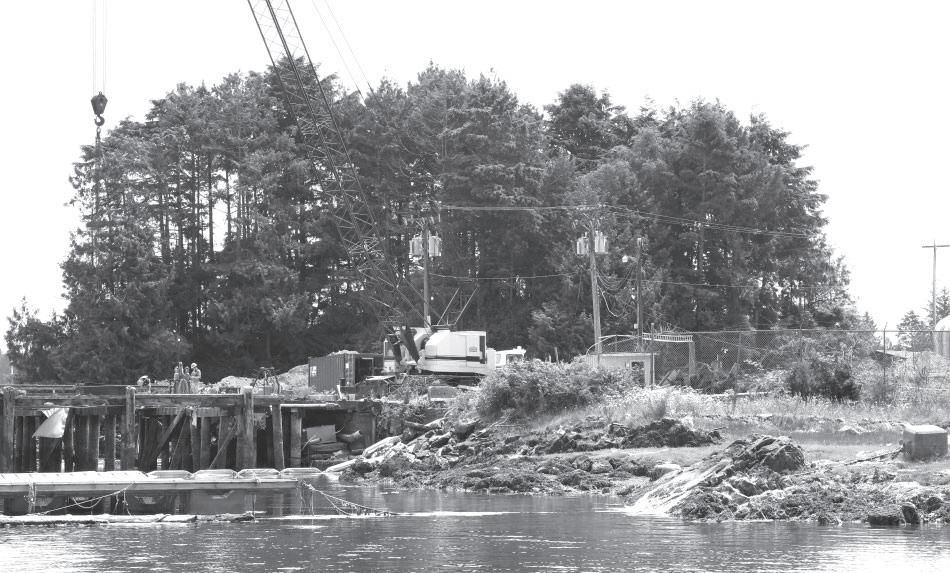
tested the Catalyst on a maiden voyage from Canoe Cove in North Saanich to Montague Harbour in Galiano Island. He said the battery charged to 100 per cent after mooring it at the dock for a day.
“It felt magical; just leaving (the vessel) there and the energy just gets magically restored,” said Bryant.
“After a few years of design iterations and working with various designers and engineers and builders and it still never seizes to be surprising and cool when something that you’ve worked on a computer, on drawings, you’re actually then inside and experiencing and seeing as a real-world physical object. That’s just a really cool feeling,” he continued.
As a software engineer, he said he “lived in abstractions” whereas everything he built before were pieces of software that “ephemerally exist”.
“To work on something that is physical and real and in an area that has an impact on our physical and natural world is really new for me and exciting,” he said.
Locals are on board
Seventy-three-year-old Keith Nakagawa says he’s the oldest fishing guide on the dock. He spent 18 years commercial fishing, 34 years running the Canadian Princess boats and is currently cruising into his 11th season as a guide for Salmon Eye Charters.
While Nakagawa has never driven an electric vehicle or vessel – although he has driven an electric golf cart – he thinks
new marine electri-
fication hub is going to be a “great thing for the community”.
“The travel lift will be really good. It will save a lot of money. We need more marina space too,” said Nakagawa, a third generation Japanese Canadian. “I’m glad they are restoring the old seaplane base. It’s part of our history.”
He says it’s common practice for guides to fill up jerry cans by the wheelbarrow at the Co-op gas bar to save the roughly 40cent premium charged at the fuel dock.
Depending on where he takes clients out fishing, Nakagawa says he burns at minimum about 500 litres of marine fuel in a week.
“I was talking to one friend of mine and he figures, in a season, he probably saves $5,000 from jerry canning,” said Nakagawa.
Owner of Salmon Eye Fishing Charters
Sam Vandervalk also thinks marine electrification is a good concept.
“It will hopefully get rid of petroleum products on the water. Unfortunately, some of them have diesel spill outs. It might actually clean some things up on the water which would be great for the environment,” said Vandervalk, who drives an electric truck.
But Vandervalk said there are still a lot of “unknowns” with electrification and he was curious about where the lithium batteries will be disposed of once they come to the end-of-life.
“Not having gas on the boat, you don’t have the possibility of blowing the boat up, but lithium battery fires are toxic,” said Vandervalk.
Rising Tide Boat Works purchased the Nootka Princess, a 13-metre-long former tourism vessel, and is converting the powertrain to electric. The company estimates the two, new 100kw electric motors and 400kWh battery will be able to travel 35 miles at 10 knots cruising speed or 70 miles at a seven knots cruising speed. The converted boat would have a roughly three-hour charge time.
Brent Baker, general manager of Tofinobased, Indigenous-owned Ahous Adventures, says the use of electric vessels is something the tour company has been exploring for a while, but there are logistical challenges that need to be worked through first.
“The primary challenges for a business such as ourselves aside from the cost of
equipment are battery life and distance that can be covered on a single charge, location of charging equipment, space required for the equipment and the general maintenance of the engines,” said Baker.
“With a tour schedule that can have the vessels running 10-12 hours per day with only minutes between trips to offload and reload passengers the opportunity for a recharge is very limited,” he continued. With regards to maintenance, Baker says they are currently able to service their own fleet, but if they were to make the switch to electric, there may be challenges finding local technicians.
“We have met with one or two distributors from the industry and would be very excited to continue to move forward at a time that we feel comfortable that the move can support the current and future needs of the business,” said Baker.
Passenger vessels like water taxis and whale watching boats can use electrical propulsion, as long as they meet Transport Canada policy and the electric standards as outlined in the Tier I Policy –Accepting alternative electrical standards for small electric and hybrid vessels.
“I think it’s fair to say that a repower to electric will be more expensive than repowering with a new diesel engine.
The flipside is the operational costs will be much, much less. Where you would be spending $100 on diesel fuel for one trip, you might be spending $5 or $10 in electricity and the maintenance costs are also a lot less,” said Bryant.
“We know that it’s a big upfront cost to put electric propulsion into a boat, but we believe it should more than pay for itself,” he said, adding that they’d like to figure out how to work with banks or governments to make converting to electric easier for boat operators.
Rising Tide Boat Works will have a booth at the Ukee Days fairgrounds on July 25-26.
“You can meet the whole team,” said Summers. “(The company) should help the local economy. It is the next evolution of a fishing and boating town that has historically supported boating and fishing.”
They will also exhibit the Catalyst solar-electric catamaran at the Vancouver International Boat Show on Sept. 18-20.
For more information on the project, visit: www.risingtideboatworks.com.
Vancouver Island’s
Nora O’Malley photos
The Rising Tide Boat Works construction site as seen from Ucluelet’s Pat Lesley Boat Launch on July 1, 2026.
Keith Nakagawa

Opitsaht welcomes calf
Fondly named ƛiiḥciip, or Flower, the new heifer calf was quick to her feet and ready to take on the world
By Chloe Wangler Ha-Shilth-Sa Assistant
Opitsaht, BC- On Meares Island off the west coast of Vancouver Island, lives a wild herd of cattle or muus muus. The herd roams free, grazing on everything from the eelgrass at the shoreline, to the lawns and forest around the village.
Born on June 21st, the heifer calf fondly named ƛiiḥciip, or Flower, was born to the strong mother Hip Spot who holds the matriarch position within the herd of 11. The herd is made up of 5 heifers, 3 bulls and 3 steers, so a female calf is a wel-
come addition.
Clay Weisschadel, a local of Opitsaht holds the title of wild cowhand technician for the Tla-o-qui-aht First Nation. He monitors the herd and helps to collect data for the Muus-Muus Research Project. Clay speaks fondly of the new calf, saying “she already has the zoomies”. Hip Spot is a great mother, with strong protective instincts. ƛiiḥciip is lucky to have an advantageous start, being born on the summer solstice in good weather with an abundant season of grazing ahead is sure to ready her for the many challenges a wild calf may face.

Clay Weisschadel photos Flower tests out her strength in Opitsaht. The calf was born June 21, 2026.
Tlu-piich games throughout the years
The 41st annual Tlu-piich games is fast approaching, lead by this year’s Tlu-piich Coordinator Brevin Charleson. Running from August 5 to 9 at a number of venues across Port Alberni, Nuu-chah-nulth athletes will be able to compete in track and field, canoe races, beach volleyball, basketball and softball. Ha-Shilth-Sa staff have dug into the archive files for a smattering of photos from over the years.

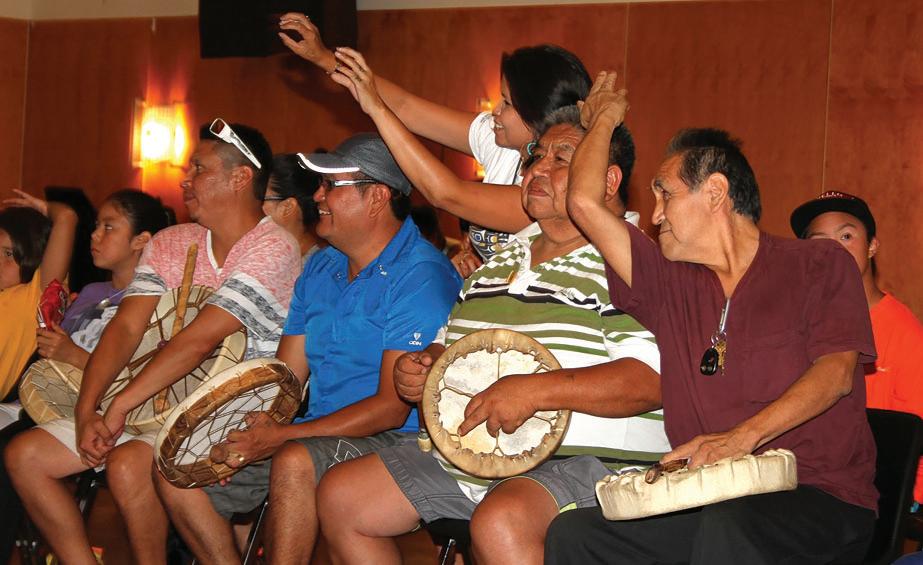

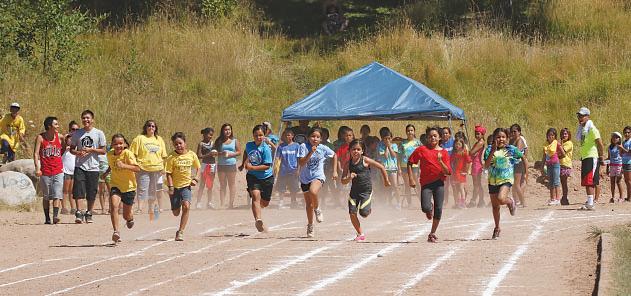
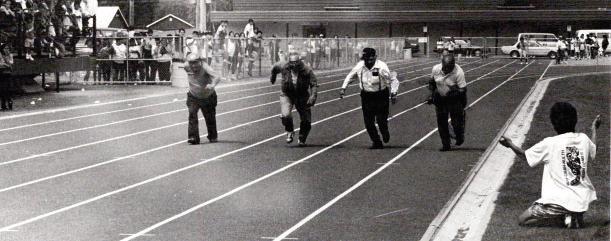


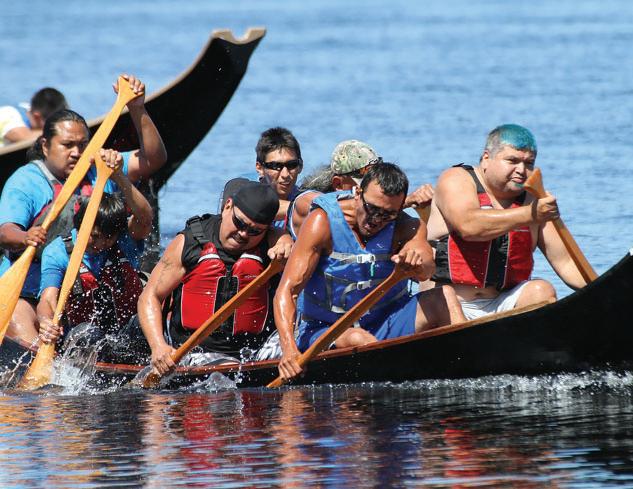
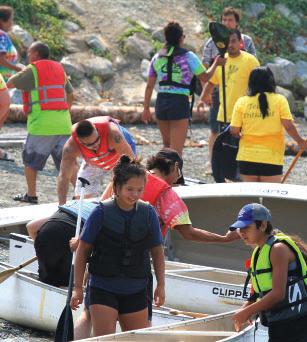


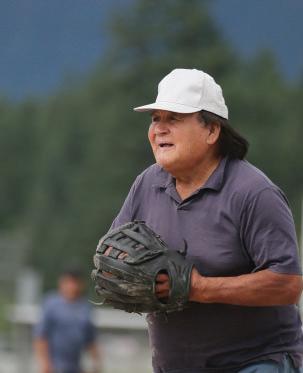
Ha-Shilth-Sa archive photos
Lahal at the Maht Mahs Gym, 2012
Track and field at Bob Dailey, 2018
Men’s basketball, 2002
Canoe races, 2012
Fastpitch, 2017
Track and field at EJ Dunn school, 2013
Elder’s race at Bob Dailey track, 1987
Toddler race at Bob Dailey track, 2010Willard Gallic pitching, 2019
T-ball, 2003Basketball at the Maht Mahs, 2016