INTERESTING NEWS Canada’s Oldest First Nations Newspaper - Serving Nuu-chah-nulth-aht since 1974 Canadian Publications Mail Product Vol. 53 - No. 01—January 8, 2026 haas^i>sa Sales Agreement No. 40047776
Cheewaht restoration brings promising salmon results United Nations award given for initiative, which has led to 1,300 sockeye counted in one day in restored stream By Antonella Medina Arias Ha-Shilth-Sa Contributor Cheewaht Lake, BC — A salmon restoration project involving the Ditidaht First Nation has received international recognition from the United Nations. In recent years work has continued to repair salmon habitat in a part of Ditidaht territory that falls within the Pacific Rim National Park Reserve. Recognized as part of a Parks Canada initiative, this work in the Cheewaht watershed has been selected for the UN World Restoration Flagship award. Restoration of the Cheewaht (čaaxwiyt) tributaries for sockeye (miʕaat) salmon was chosen in Parks Canada’s Respectful Return Salmon Restoration Project, part of a country-wide initiative to rehabilitate salmon populations in collaboration with Indigenous communities across Canada. The UN Flagship award recognizes the large-scale efforts at the Cheewaht Lake that contributed to biodiversity recovery, climate resilience and sustainable food systems. “So, the last two years, the sockeye salmon runs coming back to the streams at Cheewaht have been notably strong. That is a continuing positive note,” said Sarah Tyne, a resource officer at Parks Canada. Parks Canada reported a significant increase in the juvenile fish population. Their data, gathered through monitoring, show a 35 per cent rise in coho fry and a doubling of cutthroat trout fry population in the restored streams. Staff from Parks Canada noted an increase in bear activity on trails since the project began, a sign of its success. “Even though the restoration project is complete . . . [Parks Canada continues] to work with the Ditidaht First Nation to monitor the fish population, the water quality, and the habitat conditions to support this as a long-term recovery,” said Tyne. Not everything was smooth in the fall of 2024, at peak season for the sockeye salmon return, when access to the lake was impossible due to washed-out roads. However, the collaboration between Parks Canada and Ditidaht First Nation was key to overcoming this challenge, as they relied on boats to regain access to Cheewaht Lake and continue the restoration process. “Ultimately, the success of this project is about the collaboration with the Ditidaht Nation and other partners and the relationships as we continue to work together towards the future and maintain the salmon in the Cheewaht watershed,”
Inside this issue...
Alexandra Mehl photo
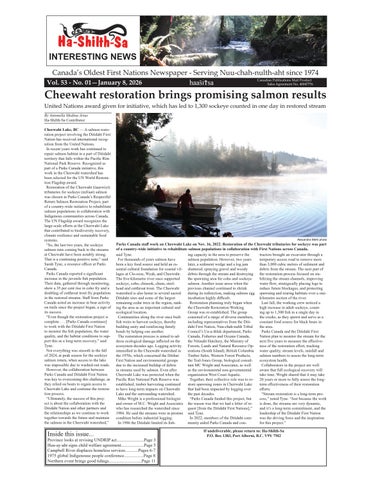
Parks Canada staff work on Cheewaht Lake on Nov. 16, 2022. Restoration of the Cheewaht tributaries for sockeye was part of a country-wide initiative to rehabilitate salmon populations in collaboration with First Nations across Canada. said Tyne. ing capacity in the area to preserve the tractors brought an excavator through a For thousands of years salmon have salmon population. However, two years temporary access road to remove more been a key food source and held an eslater, a sediment wedge and a log jam than 3,000 cubic metres of sediment and sential cultural foundation for coastal vil- shattered, spraying gravel and woody debris from the stream. The next part of lages at Clo-oose, Wyah, and Cheewaht. debris through the stream and destroying the restoration process focused on staThe five-kilometre river once supported the spawning area for coho and sockeye bilizing the stream channels, improving sockeye, coho, chinook, chum, steelsalmon. Another issue arose when the water flow, strategically placing logs to head and cutthroat trout. The Cheewaht previous channel continued to shrink reduce future blockages, and protecting watershed is also home to several sacred during its redirection, making salmon egg spawning and rearing habitats over a oneDitidaht sites and some of the largest incubation highly difficult. kilometre section of the river. remaining cedar trees in the region, rankRestoration planning truly began when Last fall, the working crew noticed a ing the area as an important cultural and the Cheewaht Restoration Working high increase in adult sockeye, countecological location. Group was re-established. The group ing up to 1,300 fish in a single day in Communities along the river once built consisted of a range of diverse members, the creeks, as they spawn and serve as a fish weirs to harvest sockeye, thereby including representatives from the Diticonstant food source for black bears in building unity and reinforcing family daht First Nation, Nuu-chah-nulth Tribal the area. bonds by helping one another. Council’s Uu-a-thluk department, Parks Parks Canada and the Ditidaht First The restoration process is aimed to adCanada, Fisheries and Oceans Canada, Nation plan to monitor the stream for the dress ecological damage inflicted on the the Nitinaht Hatchery, the Ministry of next five years to measure the effectiveecosystem decades ago. Logging activity Forests, Lands and Natural Resource Op- ness of the restoration effort, tracking intensified in the Cheewaht watershed in erations (South Island), British Columbia water quality, stream levels, rainfall and the 1970s, which concerned the Ditihat Timber Sales, Western Forest Products, salmon numbers to assess the long-term First Nation and environmental groups the Teal-Jones Group, biological consulecosystem health. due to the increased buildup of debris tant MC Wright and Associates, as well Collaborators in the project are well in streams used by salmon. Even after as the environmental non-governmental aware that full ecological recovery will Cheewaht Lake was protected when the organization West Coast Aquatic. take time. Wright shared that it may take Pacific Rim National Park Reserve was Together, their collective role was to re- 20 years or more to fully assess the longestablished, timber harvesting continued store spawning zones in Cheewaht Lake term effectiveness of their restoration to have long-term impacts on Cheewaht that had been impacted by logging over efforts. Lake and the surrounding watershed. the past decades. “Stream restoration is a long-term proMike Wright is a professional biologist “Parks Canada funded this project, but cess,” noted Tyne. “Just because the work and owner of M.C. Wright and Associates the reason was that we had a letter of reis done, the streams are very dynamic, who has researched the watershed since quest [from the Ditidaht First Nations],” and it’s a long-term commitment, and the 1984. He said the streams were in pristine said Tyne. leadership of the Ditidaht First Nation condition before industrial logging. In 2022, members of the Ditidaht comwas the driving force and the inspiration In 1986 the Ditidaht limited its fishmunity aided Parks Canada and confor this project.”
Province looks at revising UNDRIP act.........................Page 3 Huu-ay-aht signs child welfare agreement.....................Page 5 Campbell River displaces homeless services............Pages 6-7 1975 global Indigenouse people conference..................Page 8 Northern event brings good tidings..............................Page 11
If undeliverable, please return to: Ha-Shilth-Sa P.O. Box 1383, Port Alberni, B.C. V9Y 7M2
Page 2— Ha-Shilth-Sa—January 8, 2026
Court decision leads province to revise UNDRIP act Recent ruling clarifies that the United Nations Declaration on the Rights of Indigenous People is legally binding By Nora O’Malley Local Journalism Initiative Reporter First Nations in B.C. may be entitled to raise their UNDRIP rights if they are not adequately consulted on natural resource projects within their territory, following a precedent-setting B.C. Court of Appeal decision released on Dec. 5. Ehattesaht Chief Counsellor Simon John says the court decision “provides important legal recognition of UNDRIP as a tool to help ensure that First Nations’ interests are respected and their role in decision making is realized.” “We know our lands, our waters here at home and want to be respected in how the Crown approaches us and want decisions to be made with us,” said Chief John in a media release. “We want investment, we want jobs and to grow our community, but mining here was all in the bad days and we need to do better. We still have lasting impacts,” he said. “I like the fact that we are working towards consent. It will make everyone’s investments more certain and it will protect our waters and our lands better.” The ruling arose from a challenge by Ehattesaht, located north of Tofino in the Zeballos Inlet, and Gitxaala, located south of Prince Rupert, to B.C.’s mineral tenure system. They claimed the system is inconsistent with the rights recognized under UNDRIP, or the United Nations Declaration on the Rights of Indigenous People. This also applies to the Declaration on the Rights of Indigenous People Act, legislation passed by the B.C. government in 2019 which set a path for the province to align its laws with the United Nations declaration over a period of several years. Previously, under the Mineral Tenure Act, Free Miner Certificate holders could register mineral and placer claims for a $25 fee through Mineral Titles Online (MTO) without First Nations consultation. The B.C. Ministry of Mining and Critical Minerals introduced the Mineral Claims Consultation Framework (MCCF) in response to a 2023 B.C. Supreme Court ruling that the mineral claims system was in breach of the duty to consult. But the province also appealed the B.C. Supreme Court ruling, leading to the Dec. 5 decision in favour of the Ehattesaht and Gitxaala. In a statement on Dec. 8, BC Assembly of First Nations Regional Chief Terry Teegee said the legal victory “sends a ground-shaking message to the provincial government: the Declaration Act is legally binding and cannot be implemented or interpreted in a unilateral Crown approach.” Court documents state that: “UNDRIP is an international declaration of the individual and collective rights of the world’s Indigenous peoples. Adopted by the United Nations General Assembly in 2007, it identifies ‘the urgent need to respect and promote the inherent rights of
Eric Plummer photo
The area around Zeballos has a long history of gold mining and mineral claims, but this development occurred without the consultation of the local Ehattesaht First Nation, says Chief Councillor Simon John. indigenous peoples’ and provides that the rights it recognizes ‘constitute the minimum standards for the survival, dignity and well-being of indigenous peoples of the world’.” The federal government enacted UNDRIP in 2021. DRIPA was unanimously passed into law in the B.C. legislature on Nov. 26, 2019. A majority (two of three) judges decided the landmark appeal case. During an unrelated media event on Dec.8, Premier David Eby told reporters his government was looking into amending DRIPA to bring clarity to the legislation. Meanwhile, Trevor Halford, interim leader of the opposition B.C. Conservatives, sent a letter to Premier Eby requesting an “immediate recall of the Legislative Assembly for the sole purpose of repealing (DRIPA) and the related amendment to the Interpretation Act”. The Legislative Assembly is adjourned for the remainder of 2025 but may be recalled to deal with urgent legislation or other matters of public business. “Only a full repeal restores legislative supremacy and clarity for everyone involved,” wrote Halford, who cited another court decision from last summer that recognized Aboriginal title over a portion of Richmond – land that includes private properties. “As the Cowichan decision demonstrates, overlapping claims and rights are just the beginning of the frustration between competing Indigenous nations, citizens’ property rights, and the Interpretation Act.” The Interpretation Amendment Act, or Bill 29, requires that most provincial laws be interpreted in a manner consistent with section 35 of the Canadian Constitution rights and UNDRIP. Minister of Indigenous Relations and
Spencer Chandra Herbert Reconciliation Spencer Chandra Herbert said repealing DRIPA would be “fundamentally anti-human rights” and “blow up the economy”. “So much of the prosperity that is coming our way is because of leadership in First Nations communities,” Herbert told the Ha-Shilth-Sa, noting the years of work ahead in using DRIPA as a guide to re-align provincial laws. “I think we have to do more, not less. We’re not backing down here. We need to stick at this work. It’s life’s work for our future. It’s the one way where we get to a better future together,” he said. Western Forest Products stated in their 2025 Third Quarter Report that forestry service and other revenue increased by 82 per cent ($5.1 million from $2.8 million) compared to the same period last year due to the increase in the volume of approved projects with First Nation joint ventures. Herbert wholly agreed that the Mineral
Tenure Act needed to be updated, but expressed concerns that the Ehattesaht and Gitxaala Appeal Court decision would lead to a “scattergun” approach to legislated reconciliation led by court direction, rather than a methodical approach of partnering First Nations. “It could launch a whole bunch of lawsuits” that would “bring any forward movement and negotiation to a standstill,” he said of the recent ruling, noting how this could discourage investment in B.C. “My preference, and what I’ve heard from many leaders, is let’s do this piece by piece. We have a five-year action plan,” Herbert added. “I’d rather work where we have the majority of First Nations telling us where we need to go, rather than based on a court decision and many other court decisions.” He said they are studying the judgement to understand it better and confirmed that amendments to DRIPA are indeed being worked on by the Attorney General. He referred to DRIPA a “political act” and a “guide” for First Nations, government and industry to work together. “What we are looking at is putting clarity into the law,” said the minister. “Fundamentally, we just want to make sure the law that we introduced in 2019 is not changed in such a fundamental way by the court.” “Demands for instant change would paralyze the system,” he said. “[R]eal engagement before projects go ahead is the way, and an opportunity, to avoid driving First Nations to Aboriginal title and rights litigation,” said Chief John.
January 8, 2026—Ha-Shilth-Sa—Page 3
West Coast General hires nurses in effort to reopen Intensive care unit remains closed, but health care workers are being considered from Europe, US, Middle East By Eric Plummer Ha-Shilth-Sa Editor Port Alberni, BC - The West Coast General’s ICU remains closed a month a half after a staffing shortage forced the hospital to scale back critical care services - but three nurses have been hired to help with the situation, with several more candidates being considered. The intensive care unit at Port Alberni’s hospital has been indefinitely closed since Nov. 20, a measure undertaken after the West Coast General’s leading physicians determined that continuing to operate the three-bed life-support unit would compromise the safety of other health care delivered at the facility. For the last month and a half, ICU patients have been transferred to other facilities – in most cases to the Nanaimo Regional General Hospital, which has an intensive care capacity 10 times more than in Port Alberni. Over the first weeks of the ICU closure this amounted to an average of one transferred patient a day. It’s yet to be clear when the ICU will reopen, but Island Health contends that getting more nurses “with specialized training for critical care and emergency settings is a top priority” for the Port Alberni hospital. Since November three more registered nurses have been hired to work at the West Coast General’s ICU and emergency department. “The three nurses are expected to begin working at WCGH early this year, with start dates between January and March,” wrote Island Health in an email to HaShilth-Sa. “Recruitment activity remains strong, with four candidates completed interviews and five more in the interview stage. We are also seeing diverse interest, with candidates from the United States, United Kingdom, Egypt, Saudi Arabia and Nigeria.” The hospital’s staffing shortage led to more issues in December, when those admitted to West Coast General were limited to patients with a family doctor who works in the facility. Enacted on Dec. 10, this restriction meant that those needing to stay in West Coast General would be transferred elsewhere, unless the patient was connected to a general practitioner with hospital privileges. “This is due to a staffing shortage of hospitalists, the physicians who care for patients admitted to hospital who do not have a family doctor with admitting privileges,” stated Island Health when the
Tseshaht First Nation photos
During a particularly challenging Christmas season, Tseshaht members gathered in the West Coast General’s atrium on Dec. 18 to recognize health care workers for their ongoing efforts. The First Nation sang and danced for the hospital staff.
Ken Watts restriction was announced. Surgical, psychiatric and infant delivery services continued, and full hospitalist services resumed on Dec. 24. “Work is continuing to strengthen hospitalist coverage, but there is confidence that further prolonged interruptions to inpatient care are unlikely,” said Health Minister Josie Osborne on Dec. 24. The Port Alberni hospital is listed under the Provincial Rural Retention Incentives initiative, which offers health care professionals an annual bonus of up to $8,000 to work in the community. Island Health’s job postings for the hospital have also increased during the
ICU closure, from 60 on Nov. 25 to 81 as of Jan. 6. Some of these positions offer signing bonuses, including a $20,000 incentive for a general duty registered nurse position. Meanwhile, the West Coast General’s staffing issue is by no means unique, as communities across B.C. and Canada face a shortage of health care workers. Emergency departments have closed for periods of time, the most recent temporary shutdown hitting 100 Mile House’s hospital at the end of 2025, while Mission Memorial’s ED faced overnight closures for a week, starting Dec. 29. According to Island Health, measures are in place to ensure this doesn’t happen at West Coast General’s ED, which sees an average of over 50 patients a day from a large region that stretches across Vancouver Island’s western coastal communities. A team at the hospital coordinates consistent coverage for the emergency department. “They are continuously monitoring schedules for upcoming shift vacancies,” said Island Health. “When gaps in physician coverage are identified for upcoming shifts, the local team sends a call out to Island Health’s network of physicians. This includes physicians with Island Health, around B.C. and across Canada.”
“If initial call outs are not successful, the team coordinates further efforts to encourage shift coverage, which may include incentives consistent with provincial compensation agreements and guidelines,” continued the health authority. During a particularly challenging Christmas season, Tseshaht members gathered in the West Coast General’s atrium on Dec. 18 to recognize health care workers for their ongoing efforts. The First Nation sang and danced for the hospital staff, giving them Devil’s club necklaces for protection. “We know that it’s been challenging, we know we need more medical staff to come here and live here,” said Tseshaht Chief Councillor Ken Watts during the presentation. “We know it can be stressful, we know it can be heavy on your heart, but we also know that you guys walk in here with a big heart. You’re here because you care. You care about the people you provide service to in this community.” “We’re so grateful and thankful to all of you,” added Tseshaht member Martin Watts. “For those that are working here, our hearts are with you at a time when you want to be with your family but your first priority is looking after people here.”
CYPRESS RESTAURANT & LOUNGE 250.724.7629 rimrockcasino.ca
Page 4— Ha-Shilth-Sa—January 8, 2026 Ha-Shilth-Sa newspaper is published by the Nuu-chah-nulth Tribal Council for distribution to the members of the contributing First Nations, as well as other interested groups and individuals. Information and original work contained in this newspaper is protected by copyright and may not be reproduced without written permission from: Nuu-chah-nulth Tribal Council P.O. Box 1383, Port Alberni, B.C. V9Y 7M2. Telephone: (250) 724-5757 Fax: (250) 723-0463 Web page: www.hashilthsa.com facebook: Hashilthsa Ntc
2026 Subscription rates: Non-Nuu-chah-nulth, Ahousaht, Ehattesaht,Toquaht and Ucluelet members are subject to a yearly subscription fee of $40 in Canada, $50 in the US and $60 for overseas. Payable to the Nuu-chah-nulth Tribal Council
Manager/Editor/Reporter Eric Plummer (Ext. 243) (250) 724-5757 Fax: (250) 723-0463 eric.plummer@nuuchahnulth.org Reporter Denise Titian (Ext. 240) (250) 724-5757 Fax: (250) 723-0463 denise.titian@nuuchahnulth.org Reporter Nora O’Malley (604) 353-8488 nora.omalley@nuuchahnulth.org Audio / Video Technician Mike Watts (Ext. 238) (250) 724-5757 Fax: (250) 723-0463 mike.watts@nuuchahnulth.org Editorial Assistant Holly Stocking (Ext. 302) (250) 724-5757 Fax: (250) 723-0463 holly.stocking@nuuchahnulth.org
DEADLINE: Please note that the deadline for submissions for our next issue is Jan 16. 2026 After that date, material submitted and judged appropriate cannot be guaranteed placement but, if material is still relevant, will be included in the following issue. In an ideal world, submissions would be typed rather than hand-written. Articles can be sent by e-mail to holly.stocking@nuuchahnulth.org (Windows PC). Submitted pictures must include a brief description of subject(s) and a return address. Pictures with no return address will remain on file. Allow two - four weeks for return. Photocopied or faxed photographs cannot be accepted.
LETTERS and KLECOS Ha-Shilth-Sa will include letters received from its readers. Letters MUST be signed by the writer and have the writer’s full name, address and phone number on them. Names can be withheld by request. Anonymous submissions will not be accepted. We reserve the right to edit submitted material for clarity, brevity, grammar and good taste. We will definitely not publish letters dealing with tribal or personal disputes or issues that are critical of Nuu-chah-nulth individuals or groups. All opinions expressed in letters to the editor are purely those of the writer and will not necessarily coincide with the views or policies of the Nuu-chah-nulth Tribal Council or its member First Nations. Ha-Shilth-Sa includes paid advertising, but this does not imply Ha-Shilth-Sa or Nuu-chah-nulth Tribal Council recommends or endorses the content of the ads.
Sentence for murder of renowned carver George David case sat cold for eight years until a new unit joined the investigation By Eric Plummer Ha-Shilth-Sa Editor Port Angeles, Wash. - A Washington State judge delivered a 13-year sentence on Dec. 15 for the 2016 murder of George Cecil David, after the cold case investigation was reopened with new evidence that led to an arrest. Tina Marie Alcorn was handed more than 13 years in prison by a Clallam County Superior Court judge on Dec. 15. The Arkansas resident went on trial in August to plea guilty, after she was arrested in June by Port Angeles police and charged with second degree murder for the death of George David. David is from the Tla-o-qui-aht First Nation and lived in Neah Bay, Washington before his passing. The 65-year-old’s body was found in a Port Angeles apartment on March 28, 2016, where he had been temporarily staying with a friend. He had left his home in Neah Bay days earlier, and was headed to join family in British Columbia for a funeral, according to the Port Angeles Police Department. He died from blunt force trauma to the head. “It’s impossible to describe the pain of losing a loved one,” said Washinton State Attorney General Nick Brown in a press release. “We hope that bringing accountability and closure in this case can provide some measure of comfort to George’s family and friends.” David was a renowned carver, whose work was exhibited around the world, including being part of Norway’s royal collection and displayed at the city hall in Kobe, Japan. “My dad was a master carver,” said his daughter Maria David in a press release. “There are two half-finished puppets my dad was carving that were to be used as a means of Indian storytelling. But that never got to happen. I just have half-finished carvings that never got to become puppets and tell their stories. Indian artwork is a way for us to tell our stories.” Alcorn was identified as a suspect early in the homicide investigation, but police didn’t secure enough evidence to press charges at the time. Weeks after David’s body was found, she was even arrested in Mount Vernon, Washington on April 19, 2016 for unrelated charges. She was
Facebook photo
George Cecil David was a renowned carver, whose work was exhibited around the world, including being part of Norway’s royal collection and displayed at the city hall in Kobe, Japan. sent to Arkansas to serve this sentence for breaking parole conditions from a theft felony. The David case sat cold for years, until it was reopened in 2024 when Port Angeles police teamed up with the newly formed Missing and Murdered Indigenous Women and People Cold Case Team. “The cold case team supported the
Legal Information
COVERAGE: Although we would like to be able to cover all stories and events, we will only do so subject to: - Sufficient advance notice addressed specifically to Ha-Shilth-Sa. - Reporter availability at the time of the event. - Editorial space available in the paper. - Editorial deadlines being adhered to by contributors.
department in conducting additional investigation into evidence collected from 2016, including additional DNA analysis performed at the Washington State Patrol Crime Lab,” stated the press release from the Washington Attorney General’s office. This is the first conviction that the MMIWP Cold Case Unit has helped to secure since it was formed in 2023.
Ha-Shilth-Sa belongs to every Nuu-chah-nulth person including those who have passed on, and those who are not yet born. A community newspaper cannot exist without community involvement. If you have any great pictures you’ve taken, stories or poems you’ve written, or artwork you have done, please let us know so we can include it in your newspaper. E-mail holly.stocking@nuuchahnulth.org. This year is Ha-Shilth-Sa’s 52st year of serving the Nuu-chah-nulth First Nations. We look forward to your continued input and support. Kleco! Kleco!
The advertiser agrees that the publisher shall not be liable for damages arising out of errors in advertisements beyond the amount paid for space actually occupied by the portion of the advertisement in which the error is due to the negligence of the servants or otherwise, and there shall be no liability for non-insertion of any advertisement beyond the amount paid for such advertisements
January 8, 2026—Ha-Shilth-Sa—Page 5
Huu-ay-aht signs ‘enhanced’ child welfare agreement B.C. Ministry of Children works with the First Nation for ‘reclaiming jurisdiction of family and child services’ By Eric Plummer Ha-Shilth-Sa Editor Port Alberni, BC - Through an agreement with B.C.’s Ministry of Children and Family Development, the Huu-ay-aht are marking another step in ensuring that more of its youngsters stay with family and remain connected to the First Nation. On Dec. 16 Huu-ay-aht leaders sat down to sign the yaaʔak̓apʷin (we are embracing) agreement with Minister of Children Jodie Wickens at the First Nation’s Port Alberni office. Effective on March 16, 2026, the agreement was developed to help guide child welfare decisions between the First Nation and the province. Language within yaaʔak̓apʷin specifies that Huu-ay-aht kids are to remain connected to their community and culture, while outlining that the First Nation will have “an enhanced involvement in decision making regarding their children.” As part of the agreement, the province has committed $30,000 to support Huuay-aht jurisdiction in matters related to children in care. “What this agreement does is it outlines how we work together, and how the director must work with Huu-ay-aht to come to an understanding about what is the best situation for that child,” said Wickens. “This agreement really will ensure that Huu-ay-aht children and youth can remain safely connected to their families and to this community. That is so crucially important for them and for the community on a whole.” Before signing the document Huu-ayaht Chief Councillor John Jack noted that this enhanced involvement would also apply to instances when a child is removed from the parents. “In the event that it does occur, we want to make sure that we do those things to make sure that they stay supported, connected – not only to immediate family, but to their wider family and community as well,” he said. “No matter who they are, if they are citizens of this nation, no matter where they may live, no matter who may be taking care of them, we want them to be a part of our community. They’re our children, they’re our future.” The agreement is the latest chapter in years of work by the First Nation to keep more of its children with family. Back in March 2018 the Huu-ay-aht declared a public health emergency when 47 of its children – representing 20 per cent of all youngsters in the First Nation at the time – were in foster care. Thirty-five of these children in care were living in nonFirst Nation homes – a startling fact that led some Huu-ay-aht leaders to see the
Eric Plummer photo
On Dec. 16 the Huu-ay-aht signed an agreement with B.C.’s Ministry of Children and Family Development that pledges to give the First Nation a stronger voice in child welfare matters affecting its members. Pictured from the left are Jeremy Y’in Neduklhchulh Williams, B.C.’s assistant deputy minister and Indigenous Child Welfare director, Minister of Children Jodie Wickens, Huu-ay-aht Chief Councillor John Jack, Huu-ay-aht Ha’wilth Thlut’as aksup, Theresa Nookemus and (seated) Huu-ay-aht Councillor Edward Johnson Jr. workings of the child welfare system as a The case of Chantelle Williams weighed continuation of the historic removals that heavily on those who developed the characterized residential schools. agreement over the past four months. The In the previous year the Huu-ay-aht 18-year-old Huu-ay-aht member died had launched the Social Services Projon Jan. 28 this year after being found ect, which contained 30 recommendaunresponsive on a Port Alberni street at 5 tions from an independent panel. These a.m. that morning. At the time Williams stressed the need for “circles of protecwas under the guardianship of Usma and tion” around families to prevent issues living in a supervised group home run by from escalating that would result in their the Inside Out Corporation. children being put in care. After the According to her family, Williams had public health emergency was declared, in been in the hospital the day before with August of 2018 the federal government cirrhosis, an alcohol-related liver disease. pledged $4.2 million to help the Huu-ayShe was taken to the group home after aht implement the Social Services Projbeing discharged, and a staff member ect’s recommendations over five years. had checked on her at 11 p.m., but by 1 This funding supported initiatives like a a.m. she was missing with her bedroom pregnancy support and baby welcoming window open, said Williams’ family program, a family support liaison worker, members. a protection support worker, parental “That outcome that Chantelle Williams education, anti-violence intervention, had shouldn’t happen to any child,” said group conferencing for families in crisis, Wickens. as well as transitional living supports for “This is something that is heavy on our Chantelle Williams low income-households. minds to make sure that we do right by “It’s helped steer us to this moment, to our community – and by people who can dren and Family Wellness Department be able to push and advocate for those ostensibly slip through the cracks,” added equipped with 25 staff, including five changes,” said Huu-ay-aht Councillor positions specializing in measures to pre- Jack. Edward Johnson Jr., noting that the num- vent the removal of children from their Since 2002, the number of children in ber of the First Nation’s children in care care has dropped dramatically in B.C., parents. This team navigates a compliis currently 14. cated child welfare system, working with falling from 10,049 to 4,795 in early The Huu-ay-aht now have a Chil2025, according to ministry data. The Usma Nuu-chah-nulth Child and Family number of Indigenous children in care Services, which is an Aboriginal agency has also dropped – but not nearly as delegated by the Ministry of Child and Family Development to ensure the health much as others in the system. In 2002 the number of Aboriginal children in care and safety of youngsters. was 4,273, comprising 42.5 per cent of “There are some things that we need to the province’s total. This year this numdo to ensure that some work that’s being done on the MCFD side, on the delegated ber had declined to 3,260, but this now means that B.C.’s Indigenous youngsters agency side, is reflecting Huu-ay-aht now comprise 68 per cent of those in values,” said Jack. care. The chief councillor added that the new For this reason Wickens is calling the agreement will ensure that Huu-ay-aht yaaʔak̓apʷin agreement “an important staff can “advocate for both the children step in reclaiming jurisdiction of family and the family and the community,” and and child services.” that they “have a voice in and eyes into “This is really the most important work what’s going on.” “The best people to care for children are that the Ministry of Children and Famparents and aunties and uncles and grand- ily Development is doing and needs to do as we move forward to change the parents and community,” said Wickens. trajectory of child welfare services in this “A system where children and youth are province,” she said. “We have an incredtaken away from that means that there ibly colonial system that we have been will be outcomes that none of us want to upgrading.” see.”
Page 6— Ha-Shilth-Sa—January 8, 2026
Gentrification of downtown Campbell River displaces The City of Campbell River’s new zoning bylaws, plus a resistance from landlords, has made it challenging for Kwesa By Nora O’Malley Local Journalism Initiative Reporter Campbell River, BC – Campbell River’s Berwick by the Sea retirement community is lit up with holiday flair, while across the street a mural portraying the word L-O-VE fades on the side of boarded up building that was once a lifeline for the homeless. Six months ago, at the end of June 2025, Kwesa Place and Həm’?aelas Community Kitchen were forced to close after the City of Campbell River bought the properties for redevelopment. Kwesa Place and Həm’?aelas Kitchen first opened its doors during pandemic times. Kwesa, which means ‘a place of welcome’, offered laundry, shower, clothes, coffee and snacks, seven days a week. Həm’?aelas, which translates to ‘a place to eat’, provided a hearty dinner every night to at least 50 souls. Both organizations were operated by the Laichwiltach Family Life Society (LFLS), a multi-service community hub that primarily supports Aboriginal children and families in the Campbell River area. LFLS executive director Audrey Wilson said the society helped residents of the Pacific West low-income apartments after a fire tore through the building in April 2020, leaving 86 people homeless. “My staff were resilient and nobody got sick, thank God. We had clothes and everything donated for those people [who] lost everything,” he said. Located on the east coast of Vancouver Island about 220 kilometres north of Victoria, Campbell River resides on the unceded territory of the We Wai Kai, Wei Wai Kum and Kwiakah First Nations. Just east of Strathcona Provincial Park, the city sits at the gateway for the northern region Nuu-chah-nulth Nations of Ehattesaht, Ka:’yu:’k’t’h’/Che:k’tles7et’h’, Mowachaht/Muchalaht and Nuchatlaht. On April 30, 2025 the Homelessness Services Association of BC (HSABC) conducted a 24-hour Point-in-Time count, which identified 174 people who were experiencing homelessness in Campbell River. Of those 174 people, 125 - or 72 per cent - were “unsheltered”, which HSABC describes as “staying outside in alleys, doorways, parkades, parks and vehicles or staying temporarily at someone else’s place”. Fifty-eight per cent of the 174 respondents identified as Indigenous, according to HSABC. HSABC states that: “Disproportionate rates of homelessness are rooted in the ongoing structural violence of settler colonial
Nora O’Malley photos
The City of Campbell River purchased the select properties in the 1300-block of Shoppers Row for $10.6 million, using a portion of the $10.4 million in funding from the federal government’s Housing Accelerator Fund (HAF). The properties included the Harbourside Inn, which provided low-income shelter, a community kitchen and a drop-in centre. society that creates hierarchical systems of privilege and oppression. Indigenous people in Canada face racism, discrimination, and the impacts of intergenerational trauma which can limit safe and equitable access to services making it easier to lose, and harder to acquire, safe and stable housing.” Neither Kwesa Place nor Həm’?aelas Kitchen have been successful in their search for a new location. Wilson says new city zoning bylaws – and resistance from landlords – are making it a real challenge. “It’s so hard when you get told, ‘We don’t want your type of service in our buildings’. It’s very disappointing. I thought we were passed that. They are people too. That’s what people seem to forget,” said Wilson. Meanwhile at Berwick’s senior living complex in Campbell River, studio suites start at $3,400 a month for 329 to 470 square feet, and one-bedroom units go for $4,250. In effort to improve public safety in Campbell River’s downtown, the city adopted new zoning bylaws in 2024 that prohibit the use of social care facilities, overdose prevention sites, escort services, massage parlors. The city also passed
Campbell River Food Bank volunteers pause for a team photo during their busiest time of the year.
bylaws that discourage automobile-oriented businesses in the downtown area east of Dogwood Street, such as motels, gas stations, vehicle sales or car rental shops. The only permitted social services east of Dogwood are acquired injury clinics, child care facilities, a community living facility, extended care residences and hospice. “Until the bylaws change, we are going to be restricted as to where we can go. That has been proven over and over,” said Wilson. The city also sent a cease-and-desist letter to CRASH Harm Reduction in October for a meal distribution program in the downtown core. The letter cited “Public Nuisance Bylaw No. 3543, 2014” and threatened fines and/or other legal proceedings if the organization did not comply. Sue Moen works on the front lines with Campbell River’s most vulnerable residents. She is a Kwesa volunteer and coordinates the Campbell River Community
Action Team, a network that responds to the toxic drug poisoning crisis. “It doesn’t matter what (the city) does,” she said. “We will feed people and we will keep feeding people. You cannot criminalize or punish us for feeding people.” The city says the letter was issued because the group was operating without a permit. “As it is a public space, all users of Spirit Square must request a permit in advance and adhere to conditions of use,” the city said in an email. “Following these events, staff observed a number of safety concerns, including accumulation of garbage, public drinking and open drug use, and other incidents which reinforced the need for proper oversight.” It’s hard to know whether or not the closure of Kwesa Place has impacted Campbell River’s high rate of overdose
Kwesa volunteer and the coordinator for the Campbell River Community Action Team Sue Moen is part of a group of individuals committed to helping the area’s most vulnerable.
January 8, 2026—Ha-Shilth-Sa—Page 7
s services for the homeless a Place and Həm’?aelas Kitchen to find a new home
At the old Kwesa Place people were treated with “love and dignity”. deaths, notes Moen. “But what there isn’t is the opportunity to develop deep, meaningful long-term connections in the same way that you can when there is a place,” she said. “Where we are now is people are traumatized, they are pain, they are cold, they are wet, they are brutalized both verbally and physically,” continued Moen. “They have nowhere to sleep. They are all sleep deprived. It would be totally unreasonable to even offer sobriety to those people because they wouldn’t. They would not have the ability or capacity to make an informed choice because they are just coping. They are coping and the substances are their coping mechanisms.” As of August this year, data from the B.C. Coroners Service shows Campbell River with the highest rate of fatal overdoses on Vancouver Island, a local health are that ranks fifth in the province with 65.2 deaths per 100,000 residents. In 2024 this rate was 120 per 100,000, a year that saw paramedics respond to 952 calls in Campbell River for overdoses and drug poisonings. At the same time, RCMP crime statistics for January to November 2024 show property crime in the downtown dropped by 37.8 per cent, while violent crime in the area fell by 28.9 per cent. These numbers show that the city’s efforts are working, says Mayor Kermit Dahl. “A healthy and safe community has always been our top priority,” he said in a media release. “We listened to residents and businesses, took action to improve downtown safety, and invested in resources for RCMP, Bylaw and security, cleanliness programs, and supportive housing. These results—lower crime rates and fewer calls—show we’re on the right path, and we’ll keep building on this progress.”
cause of the cost of living,” said Rushton. “Birth is a lottery when you think about it.” The city set-up temporary services to support Laichwiltach as they search for a new home and say they will work with them on zoning compliance for any proposed relocation sites, and will even expedite applications if needed. The interim services, which are noted to expire at the end of February 2026, include takeaway dinners available through the Salvation Army Centre of Hope and free showers, laundry and hygiene supplies at the Campbell River Community Centre. But Moen says the community centre is “not a very welcoming space or safe space” for the homeless, who often face stigma and discrimination from other patrons. At Kwesa, Moen shared that people were treated with “love and dignity”. “You can see the horrible deterioration of their physical health since the kitchen and Kwesa closed. People have lost weight. They are not able any longer to take care of their stuff. So many people have foot issues right now because they have trench foot just from constantly being wet and have nowhere to dry off. They are moved along all the time,” she told the Ha-Shilth-Sa. The community centre also acts as an emergency warming centre, operated by the city when Environment Canada forecasts temperatures of -4°C or lower, or with a forecast low of 0°C or colder within 24 hours of a weather warning. Jeff Ford, Campbell River’s director of community safety, says the warming centre was operated 29 nights last winter with
City of Campbell River photo
The refreshed Shoppers Row features mixed-use buildings that include residential and commercial spaces. roughly 30 to 50 visitors each evening services,” said Ford. “Homewood currently “It’s a safe space for people experiencing houses 40 residents with integrated suphomelessness to sit down have a bite to eat, ports, and this number will soon increase have a hot drink and warm up,” said Ford, to 48.” adding that there are experienced contracIn the meantime, Laichwiltach has contors working with unhoused people on the verted an old food truck into an outreach site. vehicle, which is ready to hit the streets “Our firefighters also go around and do during the Christmas break. Kwesa’s mowellness checks on the streets during cold bile outreach team will offer sleeping bags, weather events,” said Ford. tents, tarps and whatever else is needed. He brought up Homewood, a temporary “We will move around. We won’t stay in housing initiative for low income or no one place,” said Wilson. income residents. Demolition of the old 1300-block of “The city is committed to a housing-first Shoppers Row is slated for early 2026 and model, demonstrated through projects like development plans include up to 200 resiHomewood, which provides housing and dential rental units, as well as commercial on-site supports such as food and hygiene and civic spaces.
‘Birth is a lottery when you think about it’ When Həm’?aelas Kitchen was up and running, the Campbell River (CR) Food Bank was the source of most of their supplies, according to CR Food Bank manager Sandra Rushton. “Now with money being so tight, we haven’t been able to do that,” said Rushton, adding that they serve many other agencies in the region and are in conversation with local First Nations to see how they can continue to work together. “Without community support we wouldn’t last,” she said. The CR Food Bank currently feeds 1,300 people a month with 30 per cent of their clients being seniors living on pensions. They had a net increase of 92 new people sign up in October. “There is no middle class anymore be-
On April 30, 2025 the Homelessness Services Association of BC (HSABC) conducted a 24-hour Point-in-Time count, which identified 174 people who were experiencing homelessness in Campbell River.
Page 8— Ha-Shilth-Sa—January 8, 2026
One year after diesel spill, clam digging has resumed Closure was lifted for Esperanza Inlet in August, but initial response could have been better, says Nuchatlaht By Eric Plummer Ha-Shilth-Sa Editor One year after more than 7,000 litres of diesel spilled from a fish farm site west of Vancouver Island, shellfish harvesting has resumed for those living in the coastal area – but with the hope that such a disaster will never happen again. On Dec. 14, 2024 between 7,000 and 8,000 litres of diesel fuel spilled from a barge operated by Grieg Seafood at its Lutes Creek salmon farm in Esperanza Inlet. The spill was due to human error during a fuel transfer on the floating concrete platform, which is off the north coast of Nootka Island and south of the village of Zeballos. Two days after the spill was reported, Fisheries and Oceans Canada closed all shellfish harvesting in Esperanza Inlet. Further analysis determined that the closure would be expanded to include Zeballos Inlet and Hecate Channel. This wasn’t lifted until Aug. 14, 2025 after Health Canada found no continued hazard in consuming shellfish or vegetation from the areas affected. By this fall those living in the region were back to picking clams, including Ehattesaht member Kyle Harry, who gathered several bags for eight families in Zeballos and Campbell River. On Dec. 10 DFO gave an update on the situation to the Nuu-chah-nulth Council of Ha’wiih Forum on Fisheries. “This incident here lasted for about 10 months,” said Cynthia Johnston of the federal department’s Spill Response Program, referencing the ongoing testing, monitoring and meetings that followed. “That’s a lot for folks to have to continue to engage on.” Canadian law requires Grieg Seafood to be responsible for clean-up costs, and the company retained the services of Strategic Natural Resource Consultants. This firm is majority owned by the Ehattesaht/ Chinehkint First Nation in whose territorial waters the spill originated. After the spill, sorbent and containment booms were spread around prioritized areas, but a storm hit coastal areas, spreading the fuel far and wide. “We had booms go across the clam beaches, that was our one priority,” noted Judae Smith, a fisheries technician with the Nuchatlaht First Nation. “They weren’t really effective because of the
Nuchatlaht First Nation photo
Judae Smith, a Nuchatlaht guardian and fisheries technician, drives a boat in her nation’s territory to assess the effects of a diesel spill that occurred Dec. 14, 2024. storm.” Johnston reflected that little diesel could be recovered due to the weather conditions. “In this instance, there wasn’t a lot of clean up in terms of vessels on the water actually cleaning it up,” she said. “There was storm weather and it spread to such a thin level that you couldn’t recover the oil. The oil has to be a certain thickness for you to be able to recover it.” By early April 2025 people were still advised not to eat shellfish from the region. Testing showed Polycyclic B.C. Ministry of Environment and Parks photo Aromatic Hydrocarbons, particularly in A Grieg Seafood fish farm in Esperanza Inlet is assessed from the air, after a oysters, which are cancer-causing agents diesel spill was reported from the site on Dec. 14. that are formed during the incomplete burning of things like coal, oil, gas, wood “We kind of had to react quick and get trained Grieg representative and manual and charbroiled meat. DFO and other contractors and everyequipment which is locked out when not Although shellfish in the affected areas thing up to Zeballos so that we could do in use,” stated the aquaculture company are now deemed safe to consume, Smith testing and monitoring,” said Smith. in an email to Ha-Shilth-Sa. “This equipreflects that the initial response could “There was a 12-hour time lapse before ment is now standard across all Grieg have been faster. it was reported. How do you correct farm operations.” “I think we didn’t react to the spill as that?” said Nuchatlaht Councillor Archie The spill occurred in Ehattesaht terriquickly as we could have,” she said. “We Little during the recent fisheries forum. tory, but spread to coastal areas that the observed the diesel right off the bat, just “All we really want is that it never hapNuchatlaht has in recent years gained outside the fish farms in the inlet.” pens again.” Aboriginal title to, according to a 2023 A Unified Command was established in After a full review of the incident, ruling from the B.C. Supreme Court. Zeballos, which included DFO officials Grieg Seafood has made “comprehensive “We want to manage better, we want to and representatives from Grieg Seafood changes” to how its employees handle protect better, and we want to own betas well as the Nuchatlaht, Ehattesaht and fuel. ter,” said Little. Mowachaht/Muchalaht First Nations. “All fuel handling now requires a
Phrase of the week: +ayah=u%aa> c^ušuki yucyuu%um mixtuk %iic^um Pronounced ‘Tla yah he alt chew shook i yut s yu i’m mit h took ee jim,’ it means ‘Welcome to the new, farewell to the old.’ Supplied by ciisma.
Illustration by Koyah Morgan-Banke
January 8, 2026—Ha-Shilth-Sa—Page 9
Indigenous peoples from across globe converge in ‘75 The 1975 gathering was the first for the World Council of Indigenous Peoples, which advocated for 60 million By Karly Blats Ha-Shilth-Sa Contributor It’s been just over fifty years since the 1975 International Conference of Indigenous Peoples was held on Tseshaht territory – a gathering for international Aboriginal solidarity that took place in the former Alberni Indian Residential School. Indigenous representatives from 19 countries attended the inaugural conference, which made up about 260 participants and 135 observers. George Manuel, who at the time was the chief of the National Indian Brotherhood (now the Assembly of First Nations) approached Tseshaht leader George Watts to host the conference in Port Alberni from Oct. 27 – 31, 1975. The conference was organized to bring together Indigenous peoples from across the world to discuss shared struggles of colonization and discrimination. The gathering also aimed to establish a global organization that would advocate for their self-determination, land rights and cultural integrity, particularly at the United Nations (UN). The World Council of Indigenous Peoples (WCIP) was formed following the conference. This was the first global Indigenous organization to present a unified voice for Indigenous peoples at the UN and other international forums. The WCIP was granted Non-Governmental Organization (NGO) status by the UN Economic and Social Council, allowing Indigenous representatives to participate and lobby at the UN. Prior to the 1975 conference, Nuu-chahnulth members were passionate about making changes towards self-governance, similar to many other Indigenous peoples around the world. “We needed to change things within, in terms of people exploiting resources and using or disregarding our rights in order to access those resources,” said Richard Watts from the Tseshaht First Nation in a documentary about the 1975 conference.
Ha-Shilth-Sa archive photo
In 1975 hundreds of Indigenous people from around the world gathered in Tseshaht territory to unite in solidarity against oppressive governments. Pictured is Willard Gallic standing in front of old AIRS building, welcoming the people. “It impacted us as First Nations and our rights were ignored, our livelihood, hunting or trapping were affected by those decisions.”
Port Alberni Friendship Centre Volunteers Needed Need work experience? The Port Alberni Friendship Centre is looking for interested applicants for various positions. Call 250-723-8281
TSESHAHT MARKET GATEWAY TO THE PACIFIC RIM
Watts said during the conference, the more the attendees talked amongst themselves, the more they realized they were all suffering from the same oppression. “Whether it be the Sami people (Norway) or the North American First Nations people, it was always the same; that people wanted to access the resources to stimulate their economies and they all saw us as being in the way,” Watts said in the video. “I remember people from South America who were afraid for their lives because they were afraid they would go home and be assassinated simply because they spoke up and talked about what was going on.”
Shared struggles became obvious to the large group of attendees and the idea of the World Council of Indigenous Peoples was born. The topics discussed and adopted at the conference, including the right to self-determination and the protection of traditional lands, laid the groundwork for future human rights efforts, most notably the United Nations Declaration on the Rights of Indigenous Peoples (UNDRIP), which was adopted more than three decades later. Bringing together hundreds of delegates was no easy task, but one organizer said it was a team effort. Dennis Durocher played an integral part in setting up the accommodations for the large group. “I was asked by George Watts at the time to help get the facility ready…it was the old (Alberni Indian) residential school that had been closed down for a couple years already,” Durocher said. “We had a big job trying to get the building ready.” Durocher said some delegates slept in the old dorm rooms that had been previously used by students of the residential school. Durocher was also a part of a team who helped organize all the meals, security, transportation and evening activities. Durocher and his wife, Sara, were a big help with offering translation services as they both speak Spanish. Being so involved in the organizing, Durocher was able to attend much of the conference. “This was the inaugural conference of the World Council of Indigenous People where they accepted and agreed upon a charter and they agreed that they would carry on,” Durocher said. “A part of that agenda was to achieve some sort of UN recognition for the legitimacy of this organization to represent Indigenous claims for justice at the United Nations and for reconciliation. They did achieve that.” Many strong and long-lasting relationships were built at the conference among the delegates, especially between some Nuu-chah-Nulth members and Indigenous peoples in Bolivia. The strong bond amongst the groups helped the Bolivian’s in their fight against colonialism and military dictatorship, contributing to a radical shift in politics for the South American country. Before dissolving in 1996, the WCIP was devoted to developing unity among Indigenous peoples around the world, strengthening their organizations and fighting against racism and injustice. The WCIP represented more than 60 million Indigenous people worldwide.
NOTICE TO REMOVE PRIVATE LAND FROM WOODLOT LICENCE W1878 Please be advised that the John and Susan Plensky are proposing to remove 2.8 ha of private land (DISTRICT LOT 1613, RUPERT LAND DISTRICT) from Woodlot Licence W1878 located in the vicinity of the Community of Kyuquot. Information about this proposal can be obtained by contacting Tom Younger RPF at 250-830-8474 or the email below. Inquiries/comments as to this proposal must be submitted to tom@youngerforest.com by February 8, 2026.
Hours of operation - 7:00 am - 10:00 pm Phone: 724-3944 E-mail: manager@tseshahtmarket.ca Find us on Facebook
To ensure consideration of comments or concerns, please respond by the above date.
Page 10— Ha-Shilth-Sa—January 8, 2026
Community&Beyond Netp’s Annual Career Fair
Thursday 9:00am – 3:00pm 3737 Roger Street, Port Alberni Free table registration. For further details contact Shan at shan.ross@nuuchahnulth. org or Kirunn at kirunn.sharma@ nuuchahnulth.org or call 250.723.1331or visit 4090 8th ave Port Alberni. BC Transit photo
Starting Jan. 4, 2026, the West Coast Transit System has more midday trips, and the late-night service will be reintroduced, leaving Ucluelet at 9:20 p.m. and Tofino at 10:25 p.m.
Bus service expands for Tofino and Ucluelet BC Transit riders will benefit from more midday trips and a late-night run across the Ucluelet-Tofino region By Nora O’Malley Local Journalism Initiative Reporter Ucluelet, BC – The public bus service connecting Tofino and Ucluelet is expanding in the new year. Starting Jan. 4, 2026, West Coast Transit riders will benefit from more frequent midday trips and a late-night service will also be reintroduced, with buses departing Ucluelet at 9:20 p.m. and Tofino at 10:25 p.m. Operated by BC Transit and the AlberniClayoquot Regional District (ACRD), the West Coast Transit System has stops in Tofino, Ucluelet, Long Beach, the Yuułuʔiłʔatḥ community of hitaću, and the Tla-o-qui-aht communities of Esowista and Ty-histanis. “This transit expansion is another win for West Coast communities,” said Samantha Hackett, Tourism Tofino’s newly appointed executive director. “For residents, it improves safety, accessibility and everyday mobility. For visitors, the reintroduced late-night service opens new possibilities – such as staying in Ucluelet while enjoying an evening meal or event in Tofino and returning safely without relying on a car. Reliable, well-funded public transit strengthens community wellbeing while supporting a more sustainable visitor economy,” she said. The service expansion to the West Coast Transit System was made possible by an increase in local government and provincial funding, according to BC Transit. “The operating grant provided in the
2025-26 provincial budget will allow BC Transit and its local government partners to continue to provide safe and reliable service and demonstrates that public transit remains a priority in our communities,” said BC Transit. Originally launched in April 2024 by the ACRD, the West Coast Transit System transitioned to BC Transit on March 1, 2025, with five brand new 2024 Chevrolet ARBOC buses decked in green livery to showcase the organization’s commitment to “modern, climate-friendly public transit options”. BC Transit incorporated Nuu-chah-nulth language on all new bus stop signs within the refreshed West Coast Transit System, which was a historical first for the province’s official transit service provider. The transportation company says their West Coast route has seen about 2,400 monthly passenger rides since it started operating the service in March. A single ride is $5 and a DayPass is $10. Children 12 and under are free. West Coast students are also free (with a student ID) and seniors 65 plus ride free too. Riders can pay their fare using cash, the Umo Mobility app or a reloadable Umo card. Reloadable Umo cards are available for purchase at the District of Tofino Municipal Office, Ucluelet Community Centre and the Tourism Ucluelet office located at the Junction. Buses are equipped with bike racks for daytime usage and some seats offer fivepoint seatbelts for passengers travelling with babies or toddlers. Surfboards are not permitted on the bus.
NCN Mental Health Counselling
Tuesdays and Thursdays 8:30am – 4:30pm 4841 Redford Street, Port Alberni NCN Mental Health Services – DropIn Counselling with Margaret Bird, Registered Clinical Counsellor and Play Therapist. For on and off reserve
members of all ages of the Nuu-chahnulth Tribal Council. Call (250) 724-3939 to book your appointment. Stirring up Connections
Every Friday 10am – 12:30pm NTC Kitchen – 4841 Redford Street. A warm and welcoming cooking group designed just for parents! Whether you’re a seasoned home chef or just learning how to boil water, this group is all about sharing recipes, laughter, and stories while preparing simple, nourishing meals together. Each session will feature: Easy, budget-friendly recipes; Tips for cooking with kids and picky eaters; Space to connect with other parents over food and family life. Contact 250-724-3939 for questions.
25 Years Ago in Ha-Shilth-Sa Vol. 28 – No. 1
January 18, 2001
Charlie Thompson and family fill cultural appetites In 1973 Charlie Thompson made a tape of his grandmother Ti-ty-bo singing, 27 years later it was shared at a dinner hosted at Tsow-tun-le-lum on December 21st 2000. Charlie and his family gathered their guests for dinner and song. Charlie and his friend Bob Chamberlain had lovingly transferred the original reel-to reel tape to a clearer digital format
on a compact disc. The CD entitled Thompson/Chester Family Songs and History, featuring the songs and words of Ti-ty-bo and Tuuk-biik as recorded by Bukwilla (Charlie Thompson), has a Tsa-qwa-supp (Art Thompson) design on the disc and various designs and pictures on the printed jacket, as well as a short story about the importance of the recording.
January 8, 2026—Ha-Shilth-Sa—Page 11
Northern event brings good tidings for unity & health Campbell River gathering attracts hope for less ‘in-fighting’ in 2026, with plenty of seafood for Nuu-chah-nulth By Nora O’Malley Local Journalism Initiative Reporter Campbell River, BC – The annual Nuuchah-nulth Tribal Council (NTC) Urban Community Holiday Gatherings tour wrapped with merriment and fruit čamas at a packed Thunderbird Hall in Campbell River on Dec 11. Looking forward to a new year and a fresh start, the unifying wish for many of the guests at the Thunderbird Hall was just that – to be more united in 2026. “I always think about all our nations and the troubles that we are having infighting,” said Tla-o-qui-aht elder Barney Williams, who moved to the northern region seven years ago to be closer to a major hospital. “I really hope we can go back to the way it was years ago. Everything was respected. There was no contest. We need to get together more and be able to sit across one another more without fighting,” said Williams. Ehattesaht member Harold Amos reiterated. “Let’s stand united and shake things up a bit,” said Amos. Ka:’yu:’k’t’h’/Che:k’tles7et’h’ First Nations’ Brandon Smith brought up the Nuu-chah-nulth teaching hišukʔiš c̓ awaak, which means ‘everything is one’. “I hope to see more people come together like this. I know culture has always been strong within the Nuu-chah-nulth territories, but I also want to see it get stronger. I hope to see Nuu-chah-nulth get stronger and come together as one,” said Smith. Good health and healing were also at the top of the wish list for Nuu-chah-nulthaht around the room. “My hope for the new year is health, connection through culture, healing and our youth reconnecting with our elders. And abundance of seafood!” said Molly Lucas, engagement coordinator for the First Nations Health Authority (FNHA). “I just want the Nuu-chah-nulth People to have access to high-quality healthcare every single day,” added FNHA senior
Nora O’Malley photos
Kelsey, left, gave birth to her daughter Ash Campbell-Senay on Christmas Eve. Ash celebrated 14 trips around the sun in December. advisor Krista Joseph. NTC Vice-President Les Doiron brought up the overdose crisis. “I’d love to see a decline in the losses in the opioid world,” he said. In September 2024 NTC leaders declared a state of emergency due to the ongoing drug crisis. NTC Executive Director Florence Wylie talked about healing. “There are a lot of people who are going through some very difficult times right now, whether it’s to deal with health issues or the loss of a loved one. For me, I think we need to be patient and kind because we don’t know what the other person could be dealing with,” said Kyuquot First Nation’s Brandon Smith sings his heart out during the Dec. 11 Wylie. Campbell River urban holiday gathering. “Lots of fish and more traditional the young people.” that, but they need more diversity in their foods,” Doiron adds. “And I’d like to Wearing reindeer antlers, a blinking red teachings.” see the youth, like we saw today, be as nose, a red shirt and Christmas socks, “I hope we get to see my family more powerful as they are when it comes to Ash Campbell-Senay will celebrate 14 too,” Ash said. practicing our culture.” trips around the sun on Christmas Eve. NTC’s northern regions include EhatAhousaht culture leader Quaya Sam “My hope is that schools stop just teach- tesaht, Ka:’yu:’k’t’h’/Che:k’tles7et’h’, led a drumming circle throughout the ing what is local and branch out a little,” Mowachaht/Muchalaht and Nuchatlaht. evening. said the Grade 9 student. “The only thing About 205 souls attended the northern While working on a cedar weaving region feast. project, Betty Nicolaye said she hopes for they teach in school is the cultures that are from here. I love that they are doing “peace, good health and success for all
Italian Hall packed for a holiday feast in Port Alberni By Eric Plummer Ha-Shilth-Sa Editor Port Alberni, BC - There was little doubt that Port Alberni is an urban hub for Nuu-chahnulth-aht when people packed the Italian Hall for a holiday feast on Dec. 10. At least 220 came to fill the venue wall to wall, the fourth of five such Urban Gatherings that were hosted month by the Nuu-chah-nulth Tribal Council. Besides the Christmas dinner and a chance to reconnect with family, participants were treated to door prizes, singing, cedar weaving, a photo booth, painted henna designs and a table for holiday crafts. Those interested in learning about their family history even had a chance to sit down and work on family trees through a project underway from Usma Nuu-chah-nulth Family and Child Services. Other Urban Gatherings were held in Victoria, Vancouver, Nanaimo and Campbell River.
Page 12— Ha-Shilth-Sa—January 8, 2026