
INTERESTING NEWS

Province ends 3-year drug decriminalization project
Trial fails to meet necessary results, says health minister, admitting the public discomfort around open drug use
By Eric Plummer Ha-Shilth-Sa Editor
Victoria, BC - The decriminalization of illicit drug use in B.C. will end Jan. 31, as Minister of Health Josie Osborne admits that the three-year project “hasn’t delivered the results we had hoped for.”
Osborne announced the decision Jan. 14, explaining that the province will not ask for an extension to the current exemption granted by Health Canada that affects B.C.’s adherence to the Controlled Drugs and Substances Act. Put into effect for a three-year period starting Jan. 31, 2023, the exemption freed people from criminal charges if caught with up to 2.5 grams of an illicit substance, including streets drugs like cocaine, methamphetamine and heroin.
British Columbia was Canada’s first jurisdiction to be given such an exemption, making the province a testing ground for the rest of the country to watch. The exemption was granted as part of a larger movement to help those struggling with addiction get the help they need.
“The decriminalization of people who are in possession of drugs for personal use is one additional step to save lives as we continue to tackle the toxic drug crisis in B.C.,” stated Provincial Health Officer Bonnie Henry when the exemption was granted in 2023. “This exemption will help reduce the stigma around substance use that leads people to use alone and will help connect people to the health and social supports they need.”
Drug overdose has become the most common cause of unnatural death in B.C., surpassing homicide, suicide and car accidents combined. First Nations are affected by the crisis at a rate six times that of the rest of the population, according to the First Nations Health Authority, and in September 2024 the Nuu-chahnulth Tribal Council declared a state of emergency over the issue.
Decriminalization came at the beginning of a year that would be the most deadly for British Columbia. Over 2023 an average for more than seven people died each day from illicit drug use, with fentanyl detected in 85 per cent of fatalities. But since 2023 deaths have declined.
The B.C. Coroners Service’s latest data from October 2025 shows an average of less than five fatalities a day across B.C., with fentanyl found in 69 per cent of deaths last year.
Despite this trend, during a press conference on Jan. 14 Osborne noted that not enough services were being accessed to justify continuing with a policy that allows public drug use, “something that
Inside this issue...
makes almost all of us feel uncomfortable.”
“Ultimately we were not seeing results in the way of a huge increase in selfreferrals to care, an increase in certain kinds of services, and the public awareness and understanding that’s necessary creating all the conditions for success,” said the health minister at Victoria’s Royal Jubilee Hospital.
As decriminalization unfolded, it became clear that the province was engaged in a politically risky balancing act: fostering a more welcoming environment for drug users in the hopes of promoting recovery, while managing the discomfort of the greater public in living alongside open-air substance use.
With a fall election on the horizon, the province scaled back its decriminalization policy less than halfway through the project. On May 7, 2024 B.C. received federal approval to again prohibit the consumption illicit drugs in public places, including hospitals, transit and parks, while the 2.5-gram exemption remained for homes, private vehicles and tents. Illicit drug use has always been banned near schools, playgrounds and skate parks.
This scaling back was criticized by the First Nations Health Authority, which cited an increase in arrests. B.C. had an average of 718 possession offences a month from 2019-2022, reported the FNHA, but this declined to 165 monthly arrests after decriminalization began in early 2023. But possession charges rose
Police acted appropriately in shooting, says IIO............Page 3
Storm causes outages across north island.......................Page 7
Lessons learned from recent wildfire seasons........Pages 10-11 Port Alberni warrior program looks to the future.........Page 12 Reporter looks back on 30 years...................................Page 16
in the months after May 2024 to an average of 450.
“Arresting people who use substances and putting them through the criminal justice system creates more harm because of the many consequences that make it more difficult to find a pathway to healing,” stated the FNHA in a report from January 2025. “A criminal record can impede the ability to seek employment, housing and may impact access to children and family.”
The end of decriminalization will not bring an aggressive crackdown on drug users, said the health minister, as police will, when appropriate, urge people to use their substances in provincially regulated overdose prevention sites rather than public spaces.
“With the end of the exemption, police officers can fully enforce and focus on the most serious offences within the Controlled Drugs and Substances Act,” stated Dwayne McDonald, deputy commissioner and commanding officer of the BC RCMP in a media release. “Police will continue to apply a measured approach to our enforcement efforts, while upholding the safety and security of the communities we live and serve in.”
Telephone service expands to offer rapid response
While addressing the end of the decriminalization project, Osborne announced that a successful telephone service launched in Vancouver over two years ago will now be available to those seek-
ing addictions treatment in other parts of the province. Available in Vancouver since October 2023, Access Central is a clinical telephone service that coordinates addictions treatment. The service offers an assessment from a nurse or clinician within 24 hours, arranging placement in a detox bed or “rapid connection to outpatient services”, said the province. When appropriate, Access Central initiates opioid agonist therapy, like methadone or hydromorphone, or anti-craving meds for alcoholics.
“There is a moment many people in recovery describe, a private, deeply personal turning point when they realize something in their life needs to change,” said Leah Hollins, chair of Island Health’s Board of directors, while announcing the telephone service. “It ensures that when someone reaches out for help, our care team is ready to provide support they need and deserve with dignity and respect.”
Kim Keats, a registered nurse with Access Central, believes that the service will be helpful to those in remote communities.
“I’ve seen people fall through the cracks when access is complicated,” she said. “They have told their stories so many times, and sometimes they’re exhausted before care even starts.”
For those in the Island Health region, Access Central is available seven days a week, from 9 a.m. to 7:45 p.m. at 1-888885-8824.
Province of B.C. photo
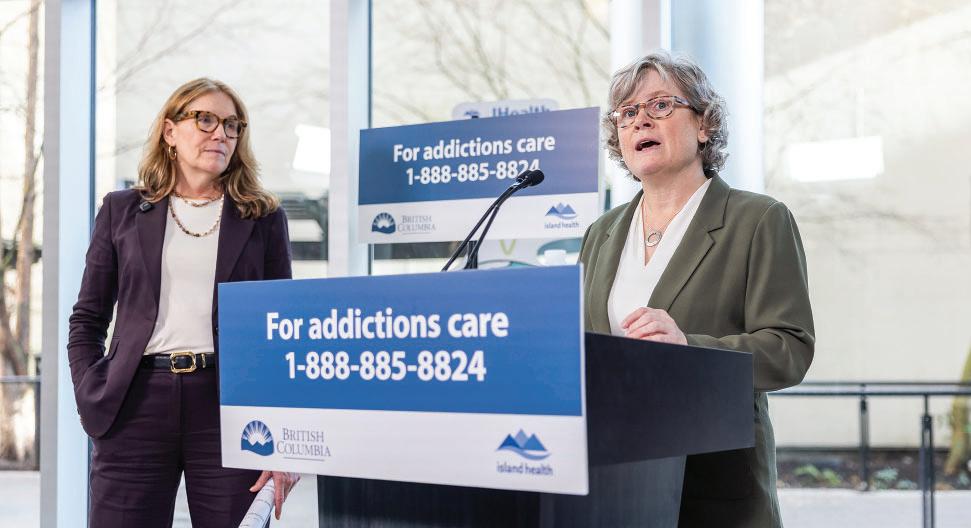
On Jan. 14 Health Minister Josie Osborne announced that the province will not be extending the decriminalization of illicit drugs beyond Jan. 31. She gave the announcement during a press conference at Victoria’s Royal Jubilee Hospital.
Baby Bigg’s orca spotted near Tofino is malnourished
Whale expert Jared Towers says the calf likely won’t make it due to a lack of fat reserves and an open wound
By Nora O’Malley Local Journalism Initiative Reporter
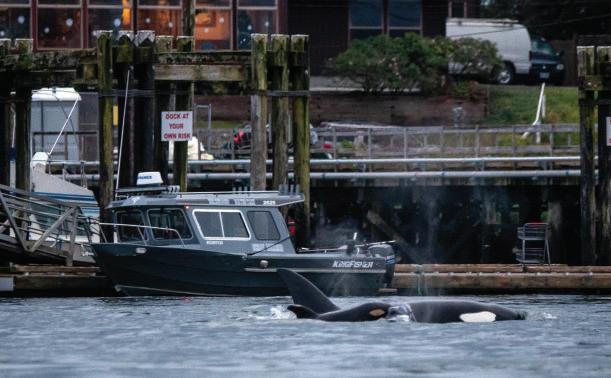
Clayoquot Sound, BC – A baby Bigg’s (Transient) orca photographed travelling with T068C pod near Tonquin Beach off
Tofino on Jan. 5 appears to be in poor health and will likely die, according to whale researcher and Executive Director of Bay Cetology Jared Towers.
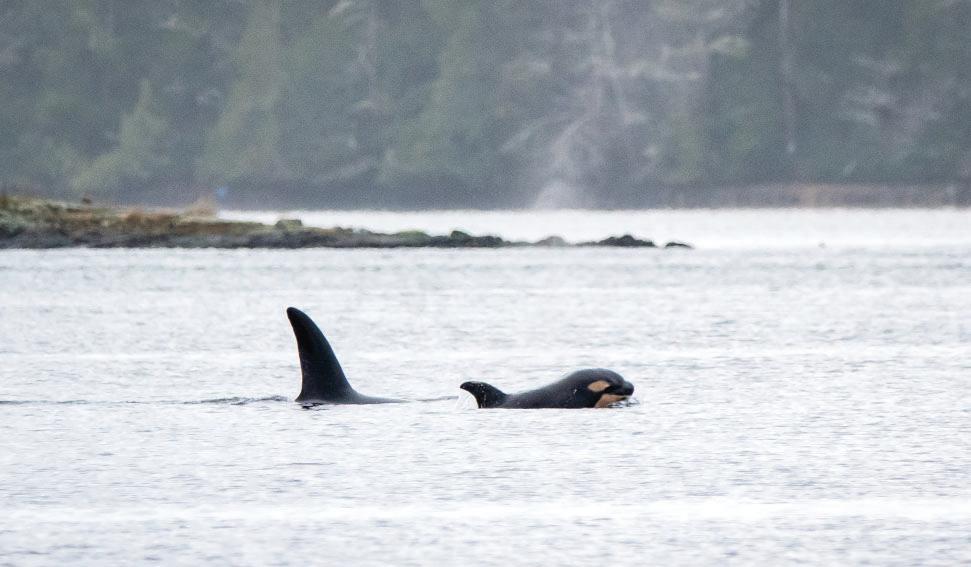
He said the little calf is very skinny, very young and has an open wound on its dorsal fin.
“The thing that is really concerning is, if you look at the head, the head is really pronounced compared to the back. The mom’s back is kind of convex, it’s kind of rounded, compared to the baby’s is kind of concave. It looks like a horse; you could get on top,” Towers explained.
“The calf isn’t nursing very well and not building fat reserves. It’s not far out from dying,” he continued. “It’s nice to see it’s right close to mom though. It looks like mom is trying.”
Towers suspects the wound on the calf’s dorsal fin is probably due to “clan specific aggression” from other killer whales.
The infant mortality rate for Bigg’s killer whales is “really low” compared to Southern Resident Killer Whales, says Towers.
“It’s very common for Residents’ killer whale calves to die within the first few weeks, months or year of life. In this population, Bigg’s killer whales, that’s really quite uncommon. We don’t see a lot of unhealthy babies. We might get one or two a year, but for the most part all the calves that are born end up surviving,” he said.
Bigg’s killer whales, known for primarily hunting harbour seal, harbour porpoise and Steller sea lion, are designated as “threatened” by the Committee on the Status of Endangered Wildlife in Canada (COSEWIC) while Southern residents, which eat primarily Chinook salmon, are listed as “endangered”.
The population of Bigg’s in the coastal subset of Vancouver Island is 385 and remains “steady”, according to the latest report released in Dec. 2025 by Towers and a team of researchers. Towers went on to say the population of Southern residents continues to slowly decline with just over 70 remaining.
Hesquiaht First Nation and Yuułuʔiłʔatḥ next-gen elder Nicki Love shared that orcas, or kakawin as they are called in Nuu-chah-nulth language, are viewed as chiefs returning home.
“kakawin is the keeper of all knowledge,” said Love.
“Each house has its own interpretation of the gift of what nature brings. The more you connect with nature the more you build a house for the soul to live in,” she said. “Long ago, we could speak to all of nature around us. When you are more connected you are more inclined to treat the environment differently. Sadly, our environmental indicators (show) that we are not treating our waters correctly.”
Towers was unsure as to why the baby Bigg’s killer whale is struggling to survive.
“There are so many little mysteries that we just don’t know about,” he said. “We see so little of their lives; even if we are on the water with them all day we are just getting less than five per cent of what they are doing because they spend so much time underwater.”
He went on to say that he is “95 per cent sure” that the calf is the seventh baby of matriarch T068C but is waiting on a second encounter for confirmation as there is a possibility it could belong to another mom.
Finwave photo-identification
Based in Tla-o-qui-aht First Nations territory, naturalist and wildlife photographer Marcie Callewaert received a tip from a local bird watcher that the kakawin were travelling up Tsapee Narrows heading towards Tonquin Beach.
“They stayed fairly active all the way to Tofino with some spy-hops, breaching and tail lobs, which is always exciting to see,” said Callewaert.
She photographed the orcas from the water with a 150 to 600 mm lens, from many different angles, while giving them the space they need to act normally.
Under Canada’s Fisheries Act, people must keep 200 metres away from all killer whales in B.C. and the Pacific Ocean, and under the Shipping Act, people must keep 400 metres away from all killer whales in southern B.C. coastal waters between Campbell River and just north of Ucluelet from June 1 to May 31.
“It’s hard to see details when you are on the water photographing. Every photo from a different angle gives us different information about the animals. It’s so important to capture as many photos as

we can,” Callewaert said.
She uploaded the orca photos to finwave.io, an online photo-identification database, which uses AI technology to help predict who the individual whales are – and where they were spotted last.
“For me, Finwave has been revolutionary in my understanding of our Bigg’s population on the coast,” said Callewaert.
In the past, Callewaert, like many other naturalists, would email photos to Towers and other organizations and wait weeks for a reply. Finwave.io, which was launched publicly in 2024, provides a much faster turnaround time for photoidentification.
“We all have our own login and it tracks all of our sightings. I can look at how many individual orcas I’ve seen and I can go to particular orca’s page of data,” said Callewaert.
She shared that pod T068C was last seen in November in Ketchikan, Alaska, prior to her Jan. 5 encounter in Tofino.
While AI makes the initial matches by comparing images of dorsal fins, saddle patches and eye patches, Callewaert says there is a whole team of experts behind Finwave, including Towers, that follows up with confirmation.
“It’s a citizen science approach to data collection,” said Towers. “Anybody with a good camera who knows how to take pictures of orcas can submit to that site and typically within 24-hours they get an email back about who the whales are.”
Callewaert also shared some of her photos of the orca encounter on social media.
“I like to share with our community the beauty of the nature around us. Not everyone gets a chance to get down to the waterfront when they pass through.
It’s really neat for people that live in front of the water to have a photo of this megafauna right in front of their house.
It’s nice to have that sense of community appreciation for the wildlife we share the area with,” she said.

Marcie Callewaert photos
This little Bigg’s killer whale calf photographed near Tofino on Jan. 5, 2026 is in poor health, according to whale researcher Jared Towers.
Police acted appropriately in shooting incident: IIO
Police acted justifiably in a Hitacu shooting incident from 2021, determines a provincial watchdog investigator
By Eric Plummer Ha-Shilth-Sa Editor
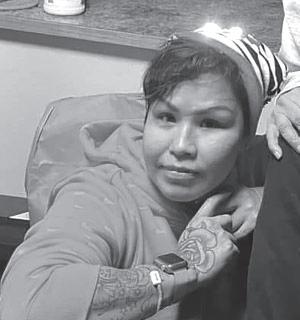
British Columbia’s police oversight agency has determined that officers acted appropriately when they shot a Tla-o-quiaht woman after responding to a domestic disturbance call in 2021.
Melinda Martin was shot several times by officers on May 8, 2021 when police entered a residence in the Yuułuʔiłʔath First Nation community of Hitacu, which is located next to Ucluelet. Court proceedings state that Martin brandished an imitation handgun before being shot by the two officers. Martin survived the incident, which resulted in her hospitalization for four months – plus two charges of assaulting peace officers and use of an imitation firearm. After serving prison time for several other crimes - including slashing a Port Alberni liquor store employee in the neck during a botched theft – on Nov. 6, 2025 Martin faced a judge to plead guilty to the charges from the Hitacu incident in 2021.
The Independent Investigations Office of B.C. describes itself as an “unbiased, civilian-led agency” that looks into incidents of death or serious harm that could be connected to interactions with the police. On Jan. 9 the IIO released its report on the Hitacu shooting, findings that were not publicly disclosed for almost two years as Martin’s court proceedings were underway. The IIO does not identify Martin in its report or her companion in the Hitacu residence, who sources have stated was Jonathan Thompson. Reports to Ha-Shilth-Sa indicate that Thompson died of a drug overdose shortly after the 2021 confrontation with police.
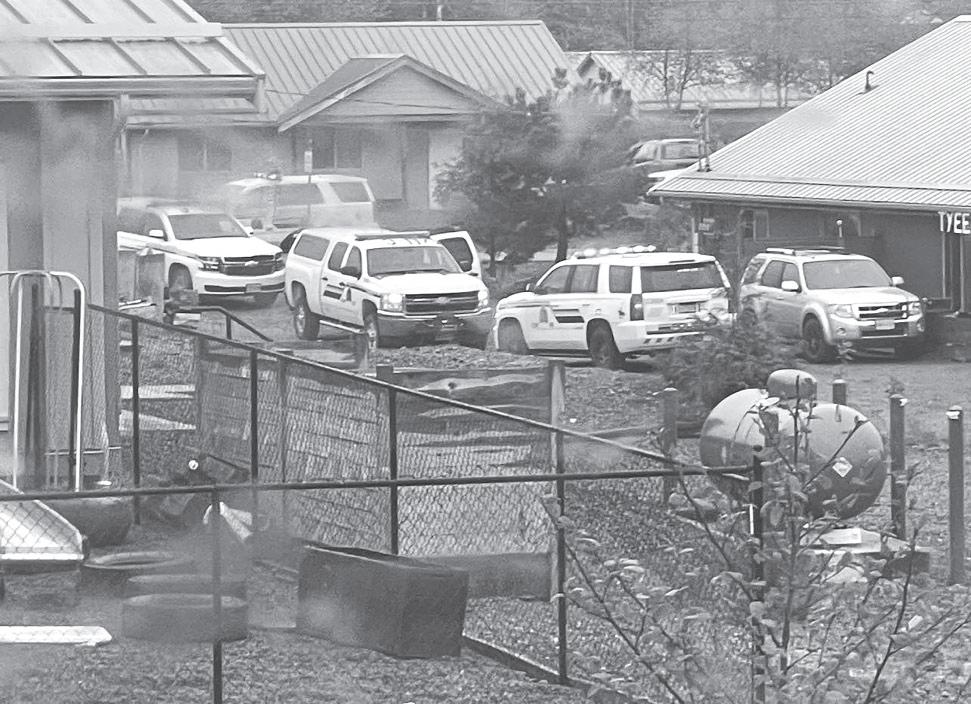
According to the IIO report, on May 8, 2021 the RCMP responded to 911 calls from the coastal community about a disturbance at a home that had attracted multiple reports of violent incidents in the proceeding weeks. Two officers were refused access to the home, which resulted in Thompson’s arrest.
As he was in the back of the police car, the officers entered the residence, telling Martin that she was in breach of conditions from another conviction, including a stipulation that she not be in that community. Martin was in the bathroom
“holding a realistic-looking replica handgun”, according to the report.
“She’s got a gun…she’s got a gun.
She’s right there,” said one of the officers, according to the IIO’s account of an audio recording of the incident that was provided by RCMP.
“Get the fuck out of the house!” said Martin in the IIO account of the record-
ing.
The officers backed out into the living room, telling Martin to drop the gun. She exited the bathroom, and moved through the kitchen to the north end of the living room.
The report included an account from one of the officers involved.
“The next time I see the gun like on her left side going towards where [the other officer] is and, uh, and then she gets to the end of the counter, goes towards the living room and then the gun is up,” said the officer in an interview cited by the IIO.

This is when both officers fired several shots, dropping Martin to the floor, according to the report.
Once of those shots shattered the glass door of Yuułuʔiłʔath Tyee Ha’wilth Wilson Jack’s home.
“Holy cow, you could hear the shots ricochet off the walls,” he said during an interview with Ha-Shilth-Sa in December.
“It was lucky nobody was working at the band office that day,” he added, as shots were fired in that general direction.
An ambulance was called.
“I’m dying,” Martin is reported to be heard saying in the recording analysed by the IIO.
The officers treated her before the paramedics came.
“Stay with me, stay with me,” said one of the officers in the recording. “Stay breathing. Can you hear me? Can you hear me? Stay with me, please, please stay with me…”
Martin suffered gunshot wounds to her midsection, and was in the hospital for at least four months. The IIO report includes her account of the incident, during which she admitted to being intoxicated.
“I opened the door. The police officer yelled at me to get on the ground, and I backed up to close the door. And I was shot. I remember the first three shots and those ones were the ones that hit my tummy,” she recalled. “I woke up in the hospital.”
Where Martin was shot IIO investigators found “a BB gun made as a replica of a Walther PPK/S compact pistol”.
The police officers said they believed
this was a real gun.
“Yes, of course. I had no reason to think otherwise,” said one of the RCMP members.
The IIO determined that police “were acting in lawful execution of their duty when they responded to the 911 call”, arrested Thompson and confronted Martin in the home.
“At that point, it was objectively reasonable for the officers to conclude that they faced a significant risk of imminent grievous bodily harm or death, which justified their deployment of lethal force,” stated the oversight agency. “It is worth noting, additionally, that the officers were aware of a history of alleged violence with respect to [Martin]”
The day after the shooting in Hitacu, a family was notified of the discovery of the body of Terrance Mack in a Port Alberni apartment. Believed by police to be the victim of homicide, the father of two had been deceased for up to two weeks before his body was found. Sources have told Ha-Shilt-Sa that Mack’s remains were discovered in a Third Avenue apartment that was being rented by Melinda Martin. No charges have been announced for Mack’s murder, and Martin has not been identified as a suspect in the case.
But although she has not been named by the IIO, the recently released report alludes to this possibility.
“RCMP members were also aware that there was suspicion about [Martin’s] possible involvement in a recent apparent murder,” stated the report.
Trisha Miller/Submitted photo
On May 8, 2021 RCMP responded to calls of a domestic disturbance in the Yuułuʔiłʔath First Nation community of Hitacu.
Melinda Martin
Injunction arrests continue amid logging blockades
RCMP investigate destruction of equipment in Walbran; Fairy Creek Blockade group denies any involvement
By Denise Titian Ha-Shilth-Sa Reporter
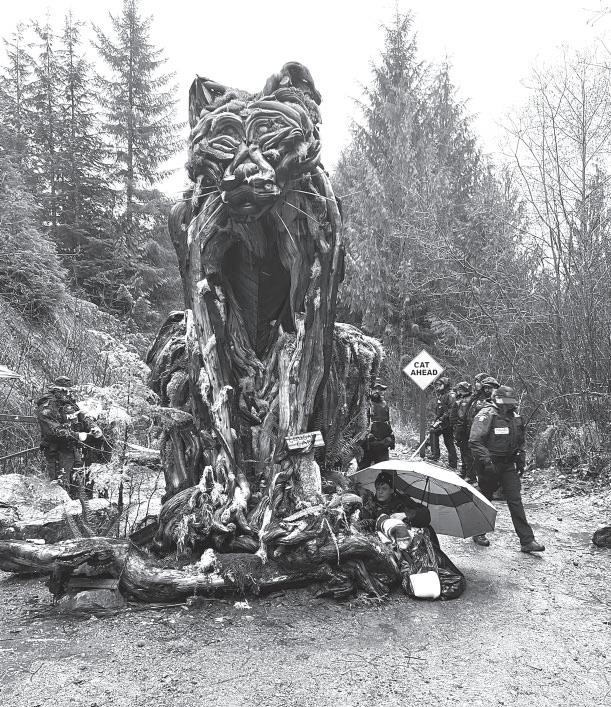
Walbran Valley, BC – RCMP are continuing enforcement of a B.C. Supreme Court Injunction that Cawak ʔqin Forestry Ltd, co-owned by Huu-ay-aht First Nation, was granted to prevent logging protestors from blocking access to their work areas within the Walbran Valley.
The B.C. Ministry of Forests says that harvesting in the upper Walbran Valley is being managed under an approved Forest Stewardship Plan. In an email to Ha-Shilth-Sa the ministry stated, “the Walbran contains 19,969 hectares (ha) of old growth, of which 17,105 ha (85 per cent) is protected through a combination of provincial parks, legally established Old Growth Management Areas and areas protected for animals (such as blacktailed deer, Roosevelt elk and the marbled murrelet).”
Cawak ʔqin Forestry Ltd says they comply with government regulations and is committed to sustainability and best practises, and they work with local First Nations.
“Cawak ʔqin Forestry respects the rights and perspective of local First Nations in the management of these lands and will continue to collaborate with all Nations whose territories overlap TFL 44, including Pacheedaht First Nation,” stated the company.
According to the Ministry of Forests, the stewardship plan sets objectives to protect key values, including old growth, riparian areas, wildlife habitat and areas of cultural significance to First Nations, and any harvesting must incorporate this into the operations plan.
But activists like the Walbran Forest Defenders are occupying and blocking access to cut blocks in an effort to prevent logging of old growth trees. They demand a moratorium on all old growth logging.
“Old growth forests are not ‘resources’. They are living ecosystems, climate stabilizers, wildlife habitat, and sacred places. Once they’re gone, they’re gone forever,” states Fairy Creek Blockade. “Walbran Camp exists because governments and industry refuse to stop. Because enforcement only shows up to protect logging interests — not ancient forests. Because people on the ground are still the last line of defense.”
The forestry company was granted an injunction to prevent these blockades in September 2025.
“The injunction prohibits anyone with notice of the order from, among other things, interfering with Cawak ʔqin Forestry or its contractors’ lawful forestry operations,” said Geoff Payne, general manager of Cawak ʔqin Forestry.
The one-year injunction authorizes the RCMP to arrest and remove any person who contravenes any provision of the court order.
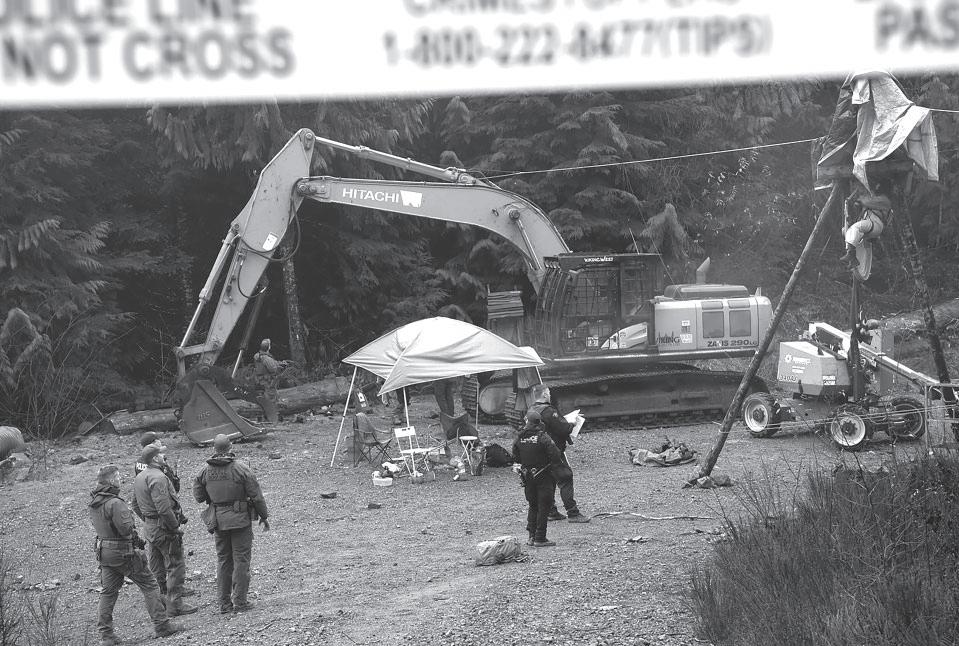
In December the RCMP arrested at least six individuals for breaching the court order. One was charged with criminal mischief. Those arrested were processed and released on conditions with a court date in January 2026, according to the RCMP.
In addition to the arrests, structures that were built by protestors to block access to the work area were dismantled and cleared. Shortly afterward, Huu-ay-aht leadership reported that they were inundated with private and public messages from anonymous individuals across their social media platforms. Some of the
messages contained threats and harassing language, according to Huu-ay-aht.
Then, on the morning of Friday, Jan. 2, 2026, the Lake Cowichan RCMP were summoned to a road leading into the cut block and encampment. Several logging vehicles that were parked in the area were destroyed by fire.
In a statement, police said the incident occurred along the Caycuse mainline, sometime overnight, and the equipment was found smoldering at approximately 7 a.m. that morning.
RCMP spokesman Corp. Alex Bérubé stated officers attended two different locations on the Caycuse forest service road, approximately 45 minutes from Lake Cowichan, locating three forest industry machines that had been damaged by fires.
“The machines, which included two grapple yarders and one log loader, are reported to have sustained over $530,000 in damages,” he noted.
A statement from Fairy Creek Blockade was made on social media four days later, denying any involvement in the arson and accusing the public of speculating that blockaders are responsible for the damage.
“Assigning blame before the facts are known serves to vilify forest protectors without grounds,” stated the group on social media. “Our community operates under a clear code of conduct grounded in peace, respect, and the well-being of all. That code explicitly prohibits violence and the damage or destruction of property.”
“We recognize the right for people to protest peacefully, but we also expect people in B.C. to follow the law and the directives of the RCMP,” stated the Ministry of Forests.
Both Cawak ʔqin Forestry Ltd. and Pacheedaht First Nations, in whose territory the company are operating, have asked blockaders to leave but they remain in the injunction area.
“It was concerning to see the vandalism and damage to forestry equipment that was operating in TFL 46 and not related to Cawak ʔqin Forestry activities,” said Geoff Payne. “We understand that the
incident is under investigation by the RCMP and hope that a determination is made as to who is responsible.”
Cawak ʔqin Forestry say they appreciate the RCMP’s work in enforcing the injunction, which is necessary to ensure the Court’s order is respected.
On January 8 Cawak ʔqin Forestry brought forward a Notice of Application seeking an order that the Attorney General assume conduct of contempt proceedings against all individuals arrested for breaching the injunction.
The company says the application was brought forward due to the ongoing breach of the injunction by blockaders. Justice Anthony Saunders granted the forestry company’s application, which allows the arrestees to be prosecuted
criminally rather than civilly.
The latest ruling means that the attorney general will review the arrests to determine whether there is evidence to prosecute those that continue to defy the injunction with criminal contempt.
“Cawak ʔqin Forestry is pleased that the Notice of Application was successful and look forward to resuming our operations in a timely manner so that members of the community may return to work,” said Payne.
The RCMP says the burning of the forestry equipment incident is still being investigated, and further information may be shared as it becomes available.
Anyone with any information about this incident are asked to call the Lake Cowichan RCMP at (250) 749-6668.
Ada’itsx/Fairy Creek Blockade/Facebook photos Police enforce a court injunction against logging blockades in the Walbran Valley in November. In September 2025 Cawak ʔqin Forestry Ltd., which is co-owned by the Huu-ay-aht and Western Forest Products, was granted the injunction to prevent the blockades.
Tofino council supports nation’s bid to change names
Tofino mayor and council voted unanimously in favour of Tla-o-qui-aht’s request to change three place names
By Nora O’Malley Local Journalism Initiative Reporter
Tofino, BC – Following the official renaming of Tofino’s Mackenzie Beach back to its traditional name tinwis (pronounced ti-nu-wis) in the fall, Tlao-qui-aht First Nation (TFN) has applied to the BC Geographical Names Office to change three additional place names: North Chesterman Beach, Kennedy Lake and Meares Island.
Tofino Mayor Dan Law and council expressed unanimous support for the name change proposals during the Jan. 20 regular council meeting.
“Just a reminder, we are not renaming necessarily, these placenames have been named these names for millennia,” said Law.
He directed district staff to confirm their support to the BC Geographical Names Office.
While in support of the proposed name changes, councillor Sarah Sloman raised concerns about safety when it comes to response from emergency services.
If the name changes are approved, the province will update all labels on provincial and federal maps and charts and databases. The request does not impact municipal street names.
Councillor Tom Stere, a rescue specialist with the Canadian Coast Guard, said he didn’t think the name changes would pose a problem. He said he was “comfortable” with the changes.
“Historically, there have been changes to place names on nautical charts as well as on provincial maps and that generally has not incurred any safety issue. I can only speak to the marine side of things, I can’t speak to air side,” said Stere.
“There are a number of local names in our area, you talk about whale watching companies, five different whale watching companies are going to give you five different place names,” Stere continued.
Councillor Ali Sawyer brought up Haida Gwaii.
“Everyone knows where Haida Gwaii is. Within my lifetime, within my schooltime, it was Queen Charlotte Islands, and that is what seemed like a monumental change and now everyone knows that it is Haida Gwaii,” said Sawyer.
Tla-o-qui-aht is asking to formally change the northern portion of Chesterman Beach back to the name “nanaquuʔa” (pronounced nah-nah-kuuah), which means and means “needlefish”, referencing the abundance of these fish on the point.
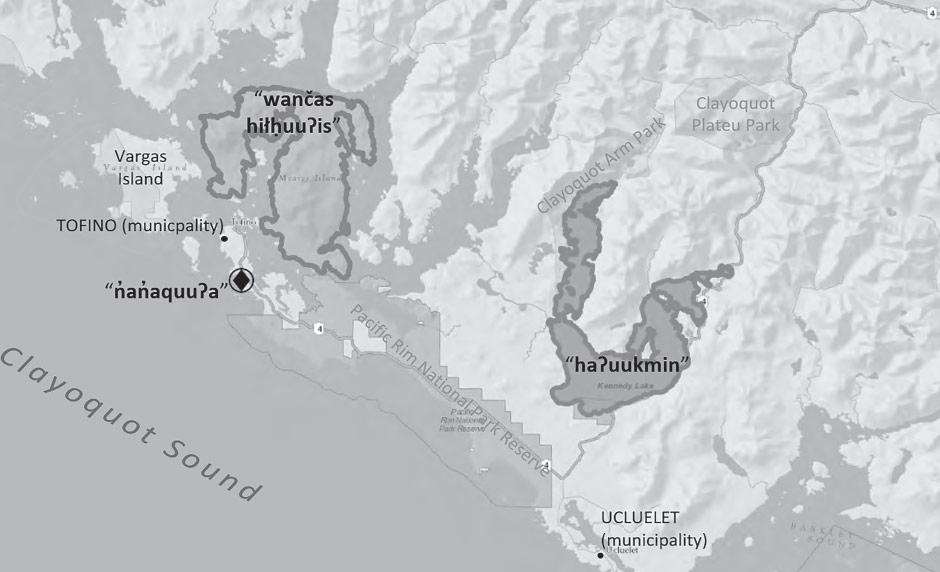
Province of B.C. map
Following the official renaming of Mackenzie Beach back to its traditional name tinwis in the fall, Tla-o-qui-aht has applied to the BC Geographical Names Office to change three others: North Chesterman Beach, Kennedy Lake and Meares Island.
Provincial records show that Chesterman Beach was named after two longtime settlers to Clayoquot Sound, Charles Allan Chesterman (1908 – 1968) and John Chesterman, who died in 1913 at the age of 46, according to the book Voices from the Sound by Margaret Horsfield.
If the name change for Chesterman Beach is approved, the southern portion of the beach would retain the official name Chesterman Beach.
“Tla-o-qui-aht have distinct names for the northern and southern parts of Chesterman Beach, separated by the sand tombolo to Frank Island,” notes the government document related to TFN’s name change proposal.
“Recognizing Indigenous place names is part of this government’s important work to advance truth and reconciliation in B.C. We acknowledge the deep cultural and historical significance of Indigenous place names,” said the B.C. Ministry of Tourism, Arts, Culture and Sport in an email statement.
“We are committed to working with the Tla-o-qui-aht First Nation, the District of Tofino and the community to ensure that any official name decisions are culturally respectful and reflective of the diverse histories and made in accordance with the Land Act and the associated Provincial Geographical Names Policy,” said the ministry.
TFN has also requested to officially change the name of Kennedy Lake to “haʔuukmin” (pronounced ha-uuk-min), which roughly means “feasting bowl” in Tla-o-qui-aht language.
Located between Tofino and Ucluelet along Highway 4 in the Alberni-Clayoquot Regional District (ACRD), Kennedy Lake is often mistaken by visitors for the ocean as it’s the first body of water drivers’ see after descending Sutton Pass towards the coast. At 65 kilometers square, Kennedy is recognized as Vancouver Island’s largest lake.
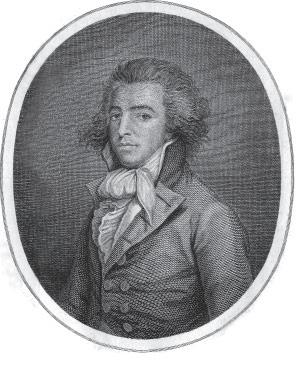
Historical records show that Meares Island was named in 1862 after John Meares, a European fur trader and sea captain with the British Royal Navy.
On Dec. 5, 2025, the BC Geographical Names Office distributed a letter, which outlined the name change requests and invited comment on the proposed name changes, to the following interestholders: District of Tofino Mayor and Council, Ahousaht First Nation, Friends of Clayoquot Sound, Alberni-Clayoquot Regional District, Indigenous Tourism BC, BC Parks, Royal Canadian Marine Search and Rescue, Canadian Coast Guard, Tourism Tofino, Destination BC and West Coast Inland Search and Rescue Society.
“Adoption of these names would not prejudice legitimate claims to the land,” states a letter from the BC Geographical Names Office.
The government letter requested for comments to be submitted before March 6, 2026.
A message to Tla-o-qui-aht Chief Elmer Frank was not returned by press time.
Government records show that Kennedy Lake was named after Arthur E. Kennedy, who was a Governor of Vancouver Island from 1864 to 1866. Meares Island in Clayoquot Sound is the third place on the First Nation’s current list of proposed name changes. TFN would like to change the name back to “wančas hiłḥuuʔis” (pronounced wana-chas hilth-huu-is). “wančas” means “flukes of a whale when diving” and “hiłḥuuʔis” means “as far as you can go” and “something below mountain”.
NOTICE TO REMOVE PRIVATE LAND FROM WOODLOT LICENCE W1878
Please be advised that the John and Susan Plensky are proposing to remove 2.8 ha of private land (DISTRICT LOT 1613, RUPERT LAND DISTRICT) from Woodlot Licence W1878 located in the vicinity of the Community of Kyuquot.
Information about this proposal can be obtained by contacting Tom Younger RPF at 250-830-8474 or the email below.
Inquiries/comments as to this proposal must be submitted to tom@youngerforest.com by February 8, 2026
To ensure consideration of comments or concerns, please respond by the above date.
John Meares
Ha-Shilth-Sa newspaper is published by the Nuu-chah-nulth Tribal Council for distribution to the members of the contributing First Nations, as well as other interested groups and individuals.
Information and original work contained in this newspaper is protected by copyright and may not be reproduced without written permission from:
Nuu-chah-nulth Tribal Council P.O. Box 1383, Port Alberni, B.C. V9Y 7M2.
Telephone: (250) 724-5757
Fax: (250) 723-0463
Web page: www.hashilthsa.com facebook: Hashilthsa Ntc
2026 Subscription rates:
Non-Nuu-chah-nulth, Ahousaht, Ehattesaht,Toquaht and Ucluelet members are subject to a yearly subscription fee of $40 in Canada, $50 in the US and $60 for overseas. Payable to the Nuu-chah-nulth Tribal Council
Manager/Editor/Reporter
Eric Plummer (Ext. 243) (250) 724-5757 Fax: (250) 723-0463 eric.plummer@nuuchahnulth.org
Reporter
Denise Titian (Ext. 240) (250) 724-5757 Fax: (250) 723-0463 denise.titian@nuuchahnulth.org
Reporter
Nora O’Malley (604) 353-8488 nora.omalley@nuuchahnulth.org

Audio / Video Technician
Mike Watts (Ext. 238) (250) 724-5757 Fax: (250) 723-0463 mike.watts@nuuchahnulth.org
Editorial Assistant
Holly Stocking (Ext. 302) (250) 724-5757 Fax: (250) 723-0463 holly.stocking@nuuchahnulth.org
DEADLINE:
Please note that the deadline for submissions for our next issue is Jan 30. 2026
After that date, material submitted and judged appropriate cannot be guaranteed placement but, if material is still relevant, will be included in the following issue.
In an ideal world, submissions would be typed rather than hand-written. Articles can be sent by e-mail to holly.stocking@nuuchahnulth.org (Windows PC).
Submitted pictures must include a brief description of subject(s) and a return address.
Pictures with no return address will remain on file. Allow two - four weeks for return.
Photocopied or faxed photographs cannot be accepted.
COVERAGE:
Although we would like to be able to cover all stories and events, we will only do so subject to:
- Sufficient advance notice addressed specifically to Ha-Shilth-Sa.
- Reporter availability at the time of the event.
- Editorial space available in the paper.
- Editorial deadlines being adhered to by contributors.
LETTERS and KLECOS
Ha-Shilth-Sa will include letters received from its readers. Letters MUST be signed by the writer and have the writer’s full name, address and phone number on them. Names can be withheld by request. Anonymous submissions will not be accepted. We reserve the right to edit submitted material for clarity, brevity, grammar and good taste. We will definitely not publish letters dealing with tribal or personal disputes or issues that are critical of Nuu-chah-nulth individuals or groups. All opinions expressed in letters to the editor are purely those of the writer and will not necessarily coincide with the views or policies of the Nuu-chah-nulth Tribal Council or its member First Nations. Ha-Shilth-Sa includes paid advertising, but this does not imply Ha-Shilth-Sa or Nuu-chah-nulth Tribal Council recommends or endorses the content of the ads.

Leadership acts quick to repair signage
Vandalism hits Orange Bridge slogan for third time since barricade was painted
By Denise Titian Ha-Shilth-Sa Reporter
Port Alberni, BC – The abutment leading to the Somass river ‘Orange Bridge’ has been vandalized with a racist slur twice in the span of a week.
The Somass River bridge was a prominent landmark that many Indigenous children recall seeing on their way to Alberni Indian Residential School (AIRS), which operated in Tseshaht territory for nearly 100 years.
The Tseshaht people have been working diligently to help people heal from the trauma suffered at the government and church-run AIRS institution. Part of the work included demolition of old AIRS buidlings and painting structures around the ‘Orange Bridge’ to honor residential school survivors and as a reminder that children matter – all children matter.
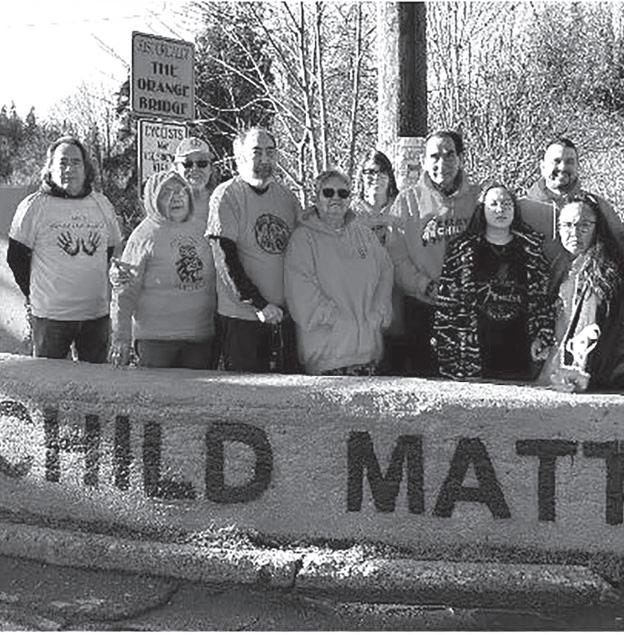
In 2022 the Tseshaht First Nation in partnership with the Ministry of Transportation and Transit painted barricades on each end of the Somass River Bridge orange, a color that has come to represent residential school survivors. Barricades on each end of the bridge were painted with the slogan ‘Every Child Matters’.
Only one day after the barricades were painted, they were vandalized in the same manner as the January 14, 2026 act, with black paint changing the letters to form a racial slur.
In a joint statement, the Tseshaht First Nation and the City of Port Alberni said they are “disgusted with the recent racist vandalism of ‘Every Child Matters’ barricade located at the ‘Orange Bridge’.”
Tseshaht First Nation reminds the public that AIRS was placed in their territory without consultation or their consent and that children from more than 70 First Nations were sent there when it operated. It closed in 1973 following a push from First Nations leadership.
Sometime during the late night of Wednesday, January 14, between the hours of 9 and 11 p.m., someone vandalized the ‘Every Child Matters’ barricade, painting black lettering over the message, changing it to a racial slur. It was immediately cleaned, but vandalism occurred again overnight on Jan. 20-21.
“We condemn these acts of hate and racism and declare that racist vandal-
ism such as this is not welcome in our territory, that includes the entire Alberni Valley,” said Tseshaht Elected Chief Wahmeesh (Ken Watts). “We will not allow these childish and racist acts to take away from the sacred work we continue to do for survivors, those who passed as students of AIRS and the reconciliation work; walking hand-in-hand with Canadians to help educate about the history of Indian Residential schools in Canada.”
In an admirable show of leadership, Watts himself was seen in a photograph cleaning up the damage within hours of it happening. He was joined by volunteers late on the night of January 14 to scrub the freshly painted slur off of the barricade.
The city also condemned the act of vandalism, saying it is unacceptable in their community.
“The City of Port Alberni stands in solidarity with the Tseshaht Frist Nation as we work together to promote healing and

Ha-Shilth-Sa belongs to every Nuu-chah-nulth person including those who have passed on, and those who are not yet born. A community newspaper cannot exist without community involvement. If you have any great pictures you’ve taken, stories or poems you’ve written, or artwork you have done, please let us know so we can include it in your newspaper. E-mail holly.stocking@nuuchahnulth.org. This year is Ha-Shilth-Sa’s 52st year of serving the Nuu-chah-nulth First Nations. We look forward to your continued input and support. Kleco! Kleco!
awareness,” Mayor Sharie Minions said it a written statement.
She called on people to create a respectful environment.
“Let us all join in this important journey toward recondilation and ensure that acts of hate do not define our community,” she added.
The Tseshaht, though saddened by what happened, take heart in knowing that many are in their corner.
“We also know that many Canadians condemn these acts and that is shown through the hundreds who walk with us every year on September 30th, Orange Shirt Day and the National Day for Truth and Reconciliation,” stated the First Nation.
If you have any information about this incident, please contact the Port Alberni RCMP at 250-723-2424. You may report information online at https://report.rcmp. ca/bc/en with case file number 2026-551.
Legal Information
The advertiser agrees that the publisher shall not be liable for damages arising out of errors in advertisements beyond the amount paid for space actually occupied by the portion of the advertisement in which the error is due to the negligence of the servants or otherwise, and there shall be no liability for non-insertion of any advertisement beyond the amount paid for such advertisements
Tseshaht First Nation photo
Former students of the Alberni Indian Residential School stand at the Orange Bridge on Jan. 15, after it had been vandalised then repaired the night before.
Storm causes outages across island’s northwest coast
Atmospheric river cut off power to Zeballos and Kyuquot on Jan. 11, leaving BC Hydro with a challenging fix
By Eric Plummer Ha-Shilth-Sa Editor
Vancouver Island, BC - Each winter
coastal Vancouver Island can count on periods of a steady deluge of rain – but as residents wait out the storms, there’s won’t always be electricity available to heat homes and refrigerate food.
On Sunday, Jan. 11 power was again cut off to the island’s northwest region, affecting the communities of Zeballos, Oclucje and Kyuquot as another atmospheric river washed through coastal B.C.
From Sunday to the morning of Tuesday, Jan. 13 up to 200 millimetres was expected to hit the west coast of Vancouver Island, more than anywhere else in the province.
“It was pretty windy last night,” said Kyle Harry on the morning of Jan. 12, who lives in the Ehattesaht village next to Zeballos.
His power went out at 10:20 p.m., according to BC Hydro, affecting over 200 people who live in Zeballos and adjacent First Nation community of Ehatis.
Electricity had only been on for a day before it went out Sunday evening, as the area lost power for three days the week before. Some supplies spoiled when freezers lost electricity.
“There’s about six families here in Zeballos that lost all of their food,” said Harry, adding that power was out of a week in December as well.
Like many in the remote community, Harry’s home is heated by wood, and he relies on a gas-powered generator to supply electricity to critical appliances during the outages that regularly occur each winter. Harry has been using a large 13,500-watt generator, which burns 20 litres of gasoline in 15 hours. In the last week he’s gone through 80 litres to power the home and keep his storage of seafood frozen.
“I just got a whole bunch,” said Harry. “I have one freezer just for all my seafood. But I plug both of my freezers in,
For residents of Vancouver
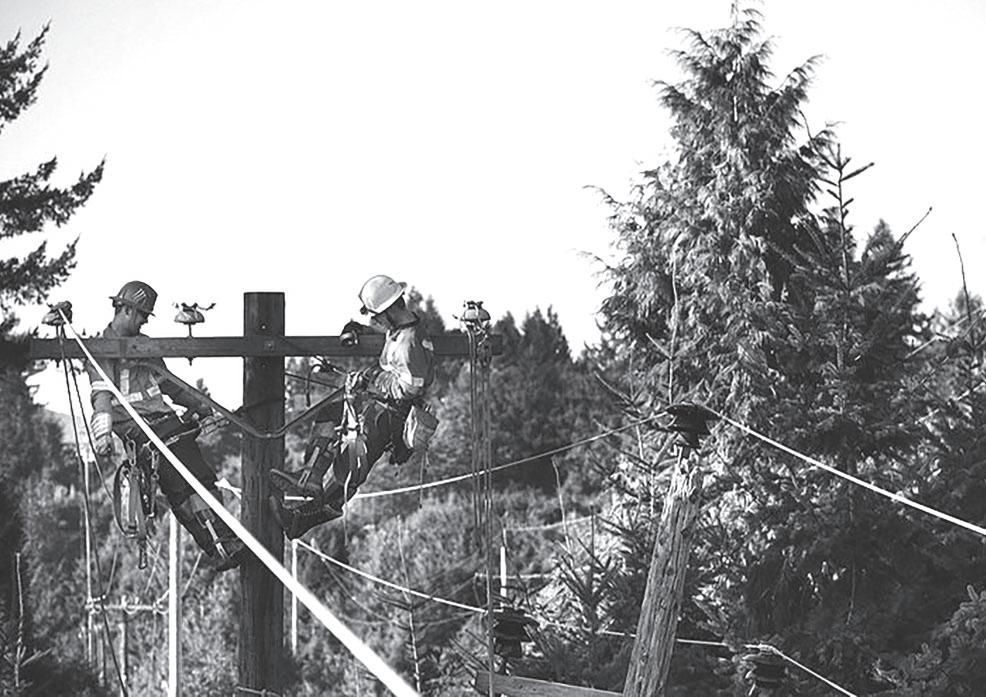
tured is a BC Hydro crew working on a power line.
and my fridge. Those are the main things I plug in right away.”
“The band has some for people who can’t afford their own,” he noted of the First Nation’s generators that it lends to members. “I bought my own. It lights up my whole house.”
A short drive on a logging road west leads to the tiny village of Oclucje, where less than two dozen Nuchatlaht First Nation members live at the end of the Espinosa Inlet. Oclucje lost power on Sunday as well, but fortunately most residents are prepared with a wood stove, while at least three households have their own generators. The First Nation has another

this year has so far brought days of power outages due to
four large generators situated near homes for members to plug into during power outages, said Nuchatlaht’s receptionist Florencia Michael.
“The office supplies fuel for them,” she said. “We have one for the office that keeps our office running and as a warming centre.”
The outage also hit further north in Kyuquot, which lost power about an hour before Zeballos. The coastal community often loses power along with Zeballos, although the 200-some residents living in the Ka:’yu:’k’t’h’/Che:k’tles7et’h’ village of Houpsitas get their power from a private company that buys electricity from BC Hydro. Kyuquot Power sends electricity from the BC Hydro grid through a single 52-kilometre line that runs over land and under the sea to reach Houpsitas.
“Kyuquot was out before us, I was getting messages from relatives out there,” said Harry.
After days of challenging weather, repair work to the power line resumed the morning of Jan. 15, and was restored by 3 p.m. that day.
“Crews were flown into the site this morning and are working on repairs to the extensive damage,” stated BC Hydro on Jan. 15.
Spokesperson Ted Olynyk says the previous week’s outage was likely caused by a tree falling on a power line, but details about the recent incident were not available. An aerial survey of the power line wasn’t possible during the heavy rain.
“We have to fly it to do a complete patrol, and they can’t do that today,” said

Olynyk on the morning of Jan. 12. “The rain is still heavy right now.”
Falling vegetation is the leading cause of power outages on the coast, and BC Hydro manages a four-year cycle of monitoring the state of trees near power lines to remove anything that appears hazardous and at risk of falling on a utility line during a storm.
“We have more trees per kilometre of utility line on Vancouver Island than any place else in North America,” said Olynyk. “We do a lot of trimming, but we don’t go as far as the biggest tree.”
Despite BC Hydro’s increased investment in recent years to mitigate danger trees, outages will be inevitable in coastal settlements, said Olynyk. The provincial utility encourages people to always be prepared with a plan and emergency kit.
“We’ll do our best to try and get everything, but we live on the edge of the Pacific,” said Olynyk of the vegetation mitigation work. “You’re going to get outages wherever you live on the island - it’s just a question of when, for how long.”
Even when the location of an outage is found, Vancouver Island’s coastal terrain can make it difficult for a crew to access the spot. At times BC Hydro personnel use an ATV, then hike in with snowshoes.
“It’s one of the most challenging places in the province for a line when we put it through many, many years ago,” said Olynyk. “It can be a real challenge to get into some areas. In the past the helicopter would winch [personnel] down to get to some areas.”
Port Alberni Friendship Centre Volunteers Needed
Need work experience? The Port Alberni Friendship Centre is looking for interested applicants for various positions. Call 250-723-8281
BC Hydro photo
Island’s northwest coast,
storms. Pic-
Cowichan and Fraser top B.C. Endangered Rivers List
Outdoor Recreation Council of B.C. pushes for political action for rivers threatened by ongoing development
By Antonella Medina Arias Ha-Shilth-Sa Contributor
North Vancouver, BC --- The Cowichan River and the Heart of Fraser are tied for first place in this year’s Endangered Rivers List, released by the Outdoor Recreation Council of B.C. (ORBC).
Other rivers made it to the list, including the Elk River in Kootenay, Kettle River in the Okanagan, Stikine River in the northwest region, the Similkameen River in the Southern Interior and the Thompson/Chilcotin rivers steelhead in the Interior.
“The list is not meant to be all-inclusive, but rather to highlight key issues and encourage action,” said Mark Angelo, ORCBC’s rivers chair and founder of both B.C. Rivers Day and World Rivers Day.
“We’re seeing some great positive action happening around the province when it comes to protecting rivers, water conservation and things like that. A lot of energy and focus is being put on [conservation],” said Ryan Stuart, community engagement lead from the Outdoors Recreation Council of B.C. “We also see some lingering concerns. With the list, we wanted to highlight rivers that sort of fit that mix.”
For over 30 years, the ORBC has released the B.C. Endangered Rivers List to raise public awareness about clean water conservation and the protection of rivers in the province. The ORBC advocates for access to land and water for recreation on behalf of more than 100 non-profit associations and clubs representing more than 200,000 British Columbians.
The list doesn’t have a fixed criterion for each river to “score”. Instead, the ORBC talks to its members and researches the current status of the rivers in the province, gathering information from visual observations and reported concerns. Thus, the list is a compilation of feedback from the ORBC’s receivers that establishes its theme.
In this year’s theme, “Glimmer of Hope”, the rivers mentioned are those whose conservation associations have made significant progress on for their protection. These rivers are also highlighted for needing provincial support, funding or more attention from the community to succeed in restoration efforts.
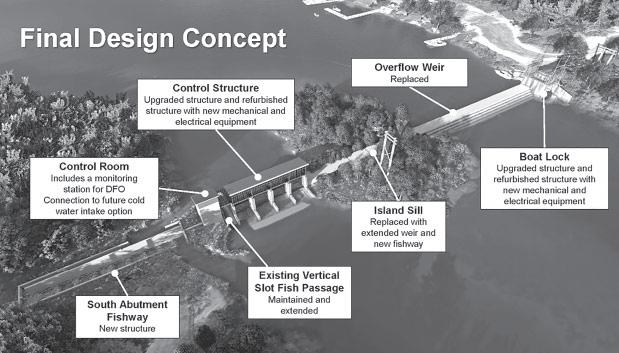
“The Cowichan . . . it’s got this great plan that could really make a big difference to the river’s health. There’s a plan to raise the weir and there’s a lot of support behind that. It’s been worked on for a long time and it just needs the fund-
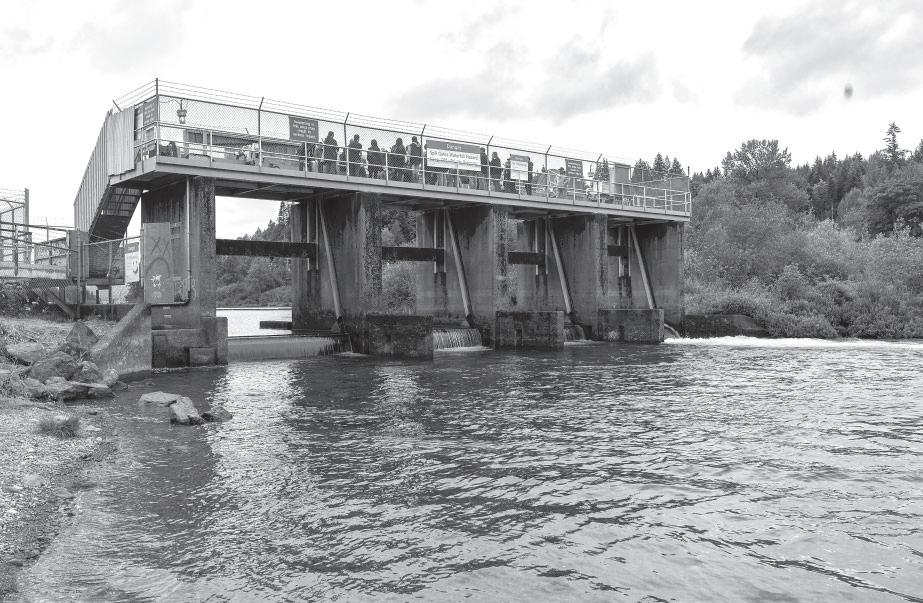
ing to be done at this point,” said Stuart. “We’re concerned that if the province doesn’t move quickly on this, [the plan] could get bogged down, and it could take a long time.”
Success on the Cowichan conservation project would positively translate to the river’s health, fish, recreation opportunities and the people living along the lake.
Climate change is the biggest issue for the Cowichan River, according to the ORBC. As temperatures rise, leading to a hotter summer season and less winter snowpack, water flow decreases significantly, placing pressure on rivers and the ecosystems they support.
The rising temperatures—becoming alarmingly common—result in algae blooms that kill fish, particularly juvenile salmon and steelhead. In 2023 around 85,000 juvenile steelhead died from the Cowichan’s changing conditions. Other concerns include waste and construction garbage dumping and toxic chemicals spilling into the river.
Stuart said that the Cowichan is highlighted due to the need for the provincial government to take action.
“We get the public’s attention, they push their members of the Legislative Assembly to act and get this done and move

it forward. It’s a similar story with the Heart of the Fraser river,” he said. Urban and industrial development is the biggest concern for the Heart of the Fraser River, which is the section between Mission and Hope. It’s one of the most important salmon habitats on earth, but construction continues to erode the ecosystem’s ecological health. Conservation groups continue to purchase land for preservation along the Fraser River, earning it a place at the top of the list. However, the lack of a coordinated conservation plan and the continued development throughout the area still pose a threat to the ecosystem.
“If we want salmon in our rivers, then we need to really think about what we can do to ensure that they have a sustainable future,” said Stuart.
Fortunately, in 2024 the Nature Conservancy of Canada purchased Carey Island, an important spawning area for white sturgeon and salmon near Chilliwack.
The BC Parks Foundation purchased a big riverfront farm near Agassiz with the intention of protecting and rewilding the species. The Nature Trust of B.C. succeeded in preserving half of the Nicomen Slough, protecting fish’s natural habitat and the migrating waterfowl.
Other conservation efforts by associated groups include investing in land and introducing more species of local
flora and fauna to aid the ecosystem. The ORBC aims to encourage the continuation of such efforts, secure the provincial government’s support, and develop a strategic plan for river preservation to make a greater impact.
Elsewhere in the province, the Mowachaht/Muchalaht First Nation is working to preserve multiple watersheds in the Nootka Sound area. With their Salmon Parks initiative they plan to manage the watersheds to increase salmon flow.
Stuart reported an increase in sustainable logging as good news for salmon, as it clears the spawning grounds they return to. First Nation restoration efforts leaned more toward a long-term solution by focusing on creating a biodiverse, more sustainable ecosystem that aligns with their cultural values. A recent collaboration between Parks Canada and First Nation communities across the country resulted in the rehabilitation of salmon habitat at Cheewaht Lake, with a reported increase in the juvenile fish population.
“When we take care of rivers, they take care of us, they provide us with fresh drinking water, they provide us with beautiful places to go and sit and listen to the water and watch the salmon return in the fall,” said Stuart.
Outdoor Recreation Council of B.C. photos
Climate change is the biggest issue for the Cowichan River, according to the ORBC. As temperatures rise, leading to a hotter summer season and less winter snowpack, water flow decreases significantly, placing pressure on rivers and the ecosystems they support.
A plan to raise the weir on the Cowichan River conservation project would positively translate to the river’s health, fish, recreation opportunities and the people living along the lake, say advocates for the project.
Bernice’s story highlights liver transplant changes
A disease affects coast First Nations at a higher rate than others, but transplant assessment didn’t consider this
By Nora O’Malley Local Journalism Initiative Reporter
Masset, Haida Gwaii – Widower Kimball Davidson says his wife Bernice is an unsung hero.
“Her weapon was kindness and her shield was compassion,” he says.
A chronic autoimmune disease called Primary Biliary Cholangitis (PBC), which is unrelated to alcohol, caused Bernice’s liver to slowly deteriorate over the course of a decade. She passed away on Oct. 16, 2022, at 4:15 a.m. in Vancouver General Hospital at the age of 71.
“When Bernice was feeling down her thoughts would turn to ‘who can I help’. Then somehow she would find a way to bring some light into someone’s life,” said Davidson.
“I was always surprised with her thoughtfulness of what would bring some happiness into one person’s life. She had a remarkable ability to know what person would like. She remembered everybody’s birthdate and also remembered the time of those who would be in sorrow,” he shared.
Bernice, who is of Huu-ay-aht and Toquaht First Nations descent, tried to access the liver transplant waitlist, but was turned away because her MELD (Model for End-Stage Liver Disease) score was too low.
Based on a series of blood tests, MELD is how healthcare professionals assess a patient’s need for a transplant, and influences their placement on waitlists. The score ranges from 6 to 40. The higher the score, the more urgently a patient needs a liver transplant.
Dr. Eric Yoshida, a professor of medicine at University of British Columbia and the former medical director of the BC Liver Transplant Program, says one of the biggest problems with MELD is that it is modeled off a heterogeneous patient population (Caucasians) and underestimates in some demographics.
“You have this constellation of women who are Indigenous who have liver disease, which causes wasting of muscle, so even though their serum creatinine might not be that high, it underestimates MELD score for them,” said Dr. Yoshida.
“I don’t personally like the MELD score that much. It does disadvantage patients with severe liver disease who just happen to have a low MELD score,” he said.
Davidson was prepared to testify on behalf of his deceased wife in a longstanding Human Rights Tribunal complaint between the Union of British Columbia Indian Chiefs (UBCIC) and the Provincial Health Services Authority (PHSA), British Columbia Transplant Society (BCTS) and Vancouver Coastal Health Authority (VCHA).
“It wasn’t meant to be discriminatory, it just was. They designed (MELD) and they thought it covered everybody, they weren’t targeting First Nations,” said Davidson.
On Nov. 1, 2025, roughly three years and a month after Bernice’s death, the class complaint was settled and PHSA, BCTS and VCHA made significant amendments to British Columbia’s liver transplant policy to remove barriers to eligibility and priority for liver transplants that Indigenous patients can receive.
One of the revisions to B.C.’s liver transplant guidelines ensured that MELD scores for patients with PBC will not impede their access to transplant eligibility. Grand Chief Stewart Phillip, UBCIC President, stated: “On behalf of the Union
Submitted photo
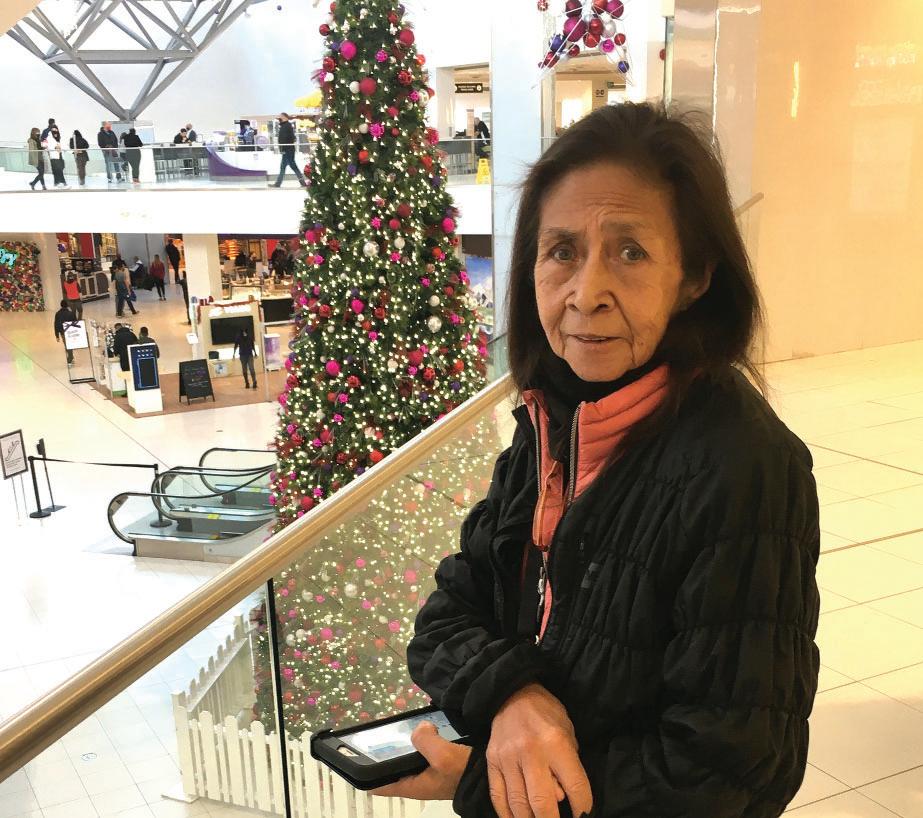
Bernice Davidson made people laugh. “There is always laughter when Bernice is around. I would come home from work and there would be laughter coming out of our house, she would have a friend or two over and the laughing would continue until the people headed out,” says her husband Kimball.
of B.C. Indian Chiefs, I want to express my deep sadness about the passing of Bernice Davidson in October, 2022. Our sincere hope is that the changes to the transplant policy that UBCIC advocated for, a fight that David Dennis began, will allow for greater access to liver transplant for Indigenous peoples.”
Elaine Yong is the manager of communications and community engagement for BC Transplant. She said as of April 2025, the province’s liver transplant program has an Indigenous Care Coordinator available to support any self-identified Aboriginal patients and their families who are receiving liver transplant care.
“The amendments made to clinical guidelines are intended to guide health care providers to better recognize and consider the historical experience and generational trauma of Indigenous peoples when supporting each Indigenous patient through their transplant care journey,” wrote Yong in an email statement, noting that some of the amendments were in place prior to the Human Rights Tribunal settlement.
“The amendments include aspects of pre-transplant care provided by healthcare teams outside the direct purview of the liver transplant program so it will take time to fully understand the health system challenges and how to continually adapt to better support Indigenous clients,” said Yong.
Coastal First Nations are more susceptible to PBC, research shows
PBC occurs more often in women than in men and most cases are diagnosed between ages 40 to 60. There is also ongoing research that suggests B.C. Coastal First Nations are more susceptible to PBC.
Dr. Laura Arbour is a professor in the Department of Medical Genetics at the University of British Columbia. Alongside Dr. Yoshida, Dr. Arbour has studied the prevalence of BPC in B.C. First Nations for nearly three decades.
A study of liver transplant need from 1989 to 1998 showed that although just 3.9 per cent of the population of B.C. was of First Nations descent, 25 per cent of those requiring transplantation for PBC were in this demographic.
“From this, it can be calculated that PBC is about eight times more common than in the non-native population,” coauthored Dr. Arbour in a medical journal from 2004.
In 2017, Dr. Arbour and a team of researchers expanded on the earlier study by analyzing family genome linkage and reviewing clinical histories of 105 individuals of First Nations origin, 44 affected with PBC and 61 unaffected relatives, from 32 different families.
“It took us literally 20 years to get that paper published,” said Dr. Arbour.
She said PBC in B.C. First Nations is a “multifactorial condition”, meaning there are certain environmental triggers (like bacterial and viral infections) in addition to genetic factors that may determine the disease.
PBC is not the only autoimmune disease that is common in B.C. First Nations. Studies have also shown lupus to be more prevalent as well as rheumatoid arthritis.
“Genetic conditions can disproportionally affect any ethnicity or group and not just Indigenous. It does not suggest that there is any type of genetic inferiority,” Dr. Arbour said.
She pointed out that Sickle Cell Anemia is more common amongst those of African origin and Cystic Fibrosis may be
more prevalent in people with European ancestry.
‘It’s a tragedy’
It’s hard to know whether getting her name on the liver transplant list would have saved Bernice’s life.
Dr. Yoshida calls organ transplants a “never-ending tragedy” with referrals steadily going up while the number of organs available remains stagnant.
“Every single time the indication for transplantation expands, that means that there is pressure on the existing pool because there is even more people that desperately need that. It’s a tragedy,” he said.
The best way to avoid end stage liver disease is through healthy lifestyle and diet choices, says Dr. Yoshida. There is also medicine available if PBC is diagnosed in the early stages that can prevent it from getting worse.
“Just simply go to your healthcare provider and say, ‘look I want to be tested for liver disease’. It’s easy,” said Dr. Yoshida.
“Bernice was a wonderful person. She was lovely. I wanted the best for her and I was extremely sad that she passed away. I have nothing but sympathy for her husband Kimball,” he said.
As of December 1, 2025, there are 69 people in BC waiting for a liver transplant match, according to recent BC Transplant statistics, and 92 people received liver transplants in 2024.
Davidson said watching his wife’s health deteriorate was horrible. He hopes Bernice’s story and the new amendments to liver transplant access will help keep loved ones together, longer.
Recent wildfire seasons highlight need for alternate la
Last year brought two major forest fires on either side of Port Alberni, reigniting calls for a better alternate land route
By Denise Titian Ha-Shilth-Sa Reporter
Vancouver Island, BC – While it wasn’t the worst fire season in B.C. history, the 2025 wildfires of central Vancouver Island impacted the lives of far more residents than in previous years.
The two wildfires near Port Alberni proved that west coast communities are vulnerable when it comes to road access.
While one fire burned at Cameron Lake another broke out on Franklin River Road, cutting Port Alberni off from the provincially-established emergency detour route.
In the end, Highway 4 remained open, allowing travellers to use the main route throughout the summer. And as the fired burned, the communities came together, proving that kindness and generosity among neighbors exists.
The region’s first major wildfire of summer 2025 started at Cameron Lake, across the water from another blaze that burned up the mountainside in 2023. The Wesley Ridge wildfire, as it was called, was discovered July 31, 2025. The wildfire spread on the north side of the lake to the east end, where it threatened to close Highway 4.
When the Wesley Ridge fire crested the mountain, nearby residents there were forced to evacuate. The growing fire raised fears of extended road closures similar to 2023, when the Cameron Bluffs wildfire burned on the opposite side of the lake.
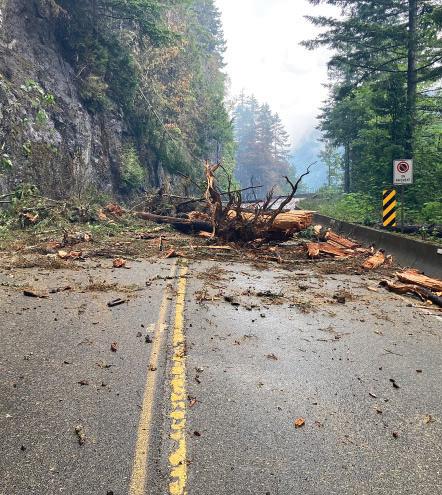
The Cameron Bluffs fire burnt the steep slopes above Highway 4, eventually reaching the roadway. Discovered June 3, 2023, the fire forced the closure of Highway 4 on June 6. It was difficult to extinguish due to the steep terrain. The road was closed for weeks, and significantly delayed for almost all of the summer due to the active fire and falling rocks and debris.
The closure cut Port Alberni and western communities off from the rest of Vancouver Island. Vehicle travel could only be done by detour through a long, winding, rough industrial road that runs through Youbou. The long trip over the rough road added three or more hours to a normal trip between Port Alberni and points south.
Two years later, the Wesley Ridge wildfire consumed sections of the railroad trestle, burning up the mountain and to the east end of Cameron Lake where it meets Highway 4. When the fire crested the ridge, 42 properties were evacuated while 91 others were issued evacuation alerts. Fortunately, there was no loss of life or property thanks to the efforts of fire fighters.
Mount Underwood’s explosive growth
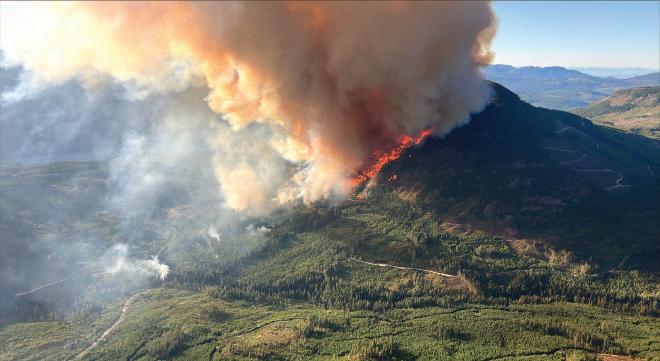
Less than two weeks after the start of Wesley Ridge, an explosive fire broke out near China Creek Marina on Franklin River Road on August 11, 2025. The fire grew
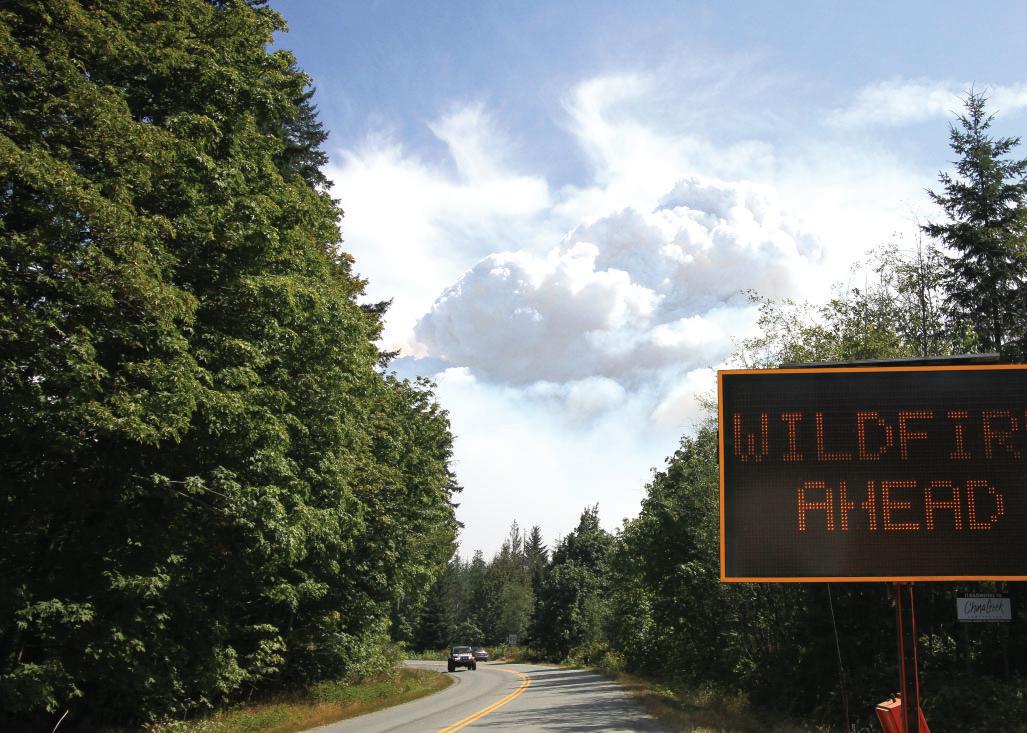
rapidly on the steep slopes of Mt. Underwood, just 12 kilometers from Port Alberni.
The fire quickly spread to the road leading to Bamfield, Nitinaht and Youbou, prompting the immediate evacuation of the China Creek Campground.
The Mt. Underwood wildfire exploded through the dry forest quickly – smoke could be seen and smelled from Port Alberni. Evacuation alerts were issued for residents at the southern end of the city, with some campers and south Port Alberni residents closest to the fire were directed to evacuate.
Wahmeesh, (Ken Watts), Tseshaht’s elected chief, said there are three Tseshaht families living at their reserve at Polly’s Point, probably the nearest residential neighborhood to the Mt. Underwood wildfire.
The people were evacuated but realized that there is nothing in place to house family pets during emergencies.
“What do we do with the family pets when they can’t go with their families,” Watts asked, adding that this is one thing that regional leaders need to plan for, among others.
The Alberni Clayoquot Regional District said it was the worst wildfire in their history. They credited the strong relationships the Emergency Operations Centre developed for bringing in help from around the
province and beyond.
In addition to the road closure, power to the western communities of Anacla, Bamfield and Nitinaht was cut for 12 days, as crews worked to safely access the area to repair the fire-damaged poles and power lines.
The Franklin River Road closure forced residents of these coastal communities to use the Youbou detour. But the road was so rough that the Ditidaht First Nation was denied propane delivery until road conditions improved. Without propane, Nitinaht residents faced the risk of losing water services.
With two fires burning south and east of Port Alberni, things could have gotten far worse for western communities than they were in 2023. The Mt. Underwood fire effectively cut access to the Youbou detour between Port Alberni and southern cities. Ditidaht, Huu-ay-aht and Bamfield communties relied on the Youbou detour between August 11 and October 24, 2025, when Franklin River Road finally reopened to the public.
Nuu-chah-nulth Tribal Council President Cloy-e-iis (Judith Sayers) warns things could get worse.
“This year is predicted to be the hottest one on record and NTC will work with the Nations to ensure they are prepared for any possible forest fires,” said Sayers.
Consideration of alternate land route
Highway 4 between Port Alberni and Parksville remained open despite the Wesley Ridge wildfire burning close to the road at the end of Cameron Lake. Had it closed like it did in 2023, supply lines for Port Alberni, Tofino, Ucluelet and offshore communities would have been severed completely.
Even before wildfires and road closures, Port Alberni residents and First Nations leadership have been calling for a secondary access route to the city for decades. Both Sayers and Ditidaht First Nation leaders have called on governments to make improvements to the
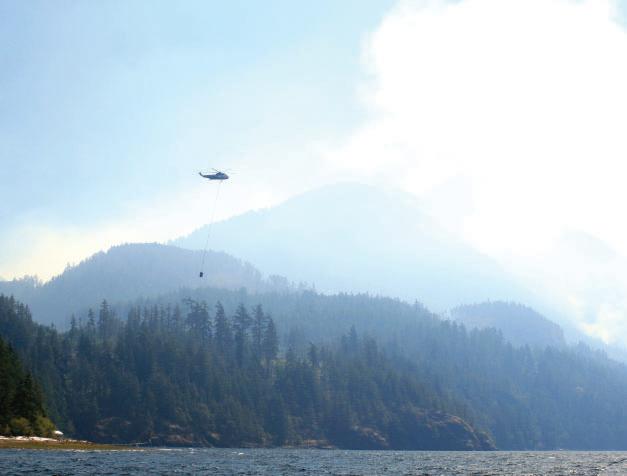
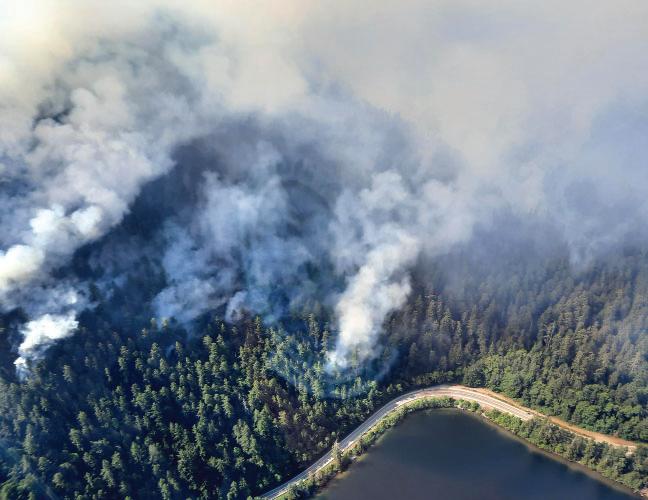
The Mount Underwood forest fire quickly grew to over 3,500 hectares, cutting off access from Port Alberni to Bamfield, Anacla an
B.C. Wildfire Service photo
On Aug. 11 the Mount Underwood wildfire erupted south of Port Alberni, rapidly growing to burn 3,518 hectares.
Holly Stocking photo
Mount Underwood’s smoke compromised Port Alberni’s air quality, forcing the Nuu-chah-nulth Tribal Council to call off the Tlu-piich Games on its second day.
and route to Alberni Valley
e than a detour of logging roads by Nitinaht Lake
Youbou detour route to make it safer.
The B.C. Ministry of Transportation and Transit is exploring alternate emergency routes out of Port Alberni. In their Highway 4 Emergency Detour Route Options report, last updated July 2025, the ministry presented findings for four routes that have been studied.
The options were assessed for safety and viability. Two routes that go from Port Albenri to Horne Lake and Comox Lake have been ruled out due to safety and poor road conditions.
The remaining routes run from Port Alberni to Cowichan Lake, with one on North Shore road running through Youbou and the other on South Shore road going through the village of Lake Cowichan. These are the preferred routes because they are in better condition and safer than the other industrial roads that are often inactive and therefore not maintained.
The report indicates that the Youbou and Lake Cowichan routes are favorable and can be activated during an emergency within three days. Does this mean the routes will be improved? Maybe even paved or chip-sealed? There is no indication from the Ministry of Transportation that major road improvements to the detour route are planned in the near future.
Wildfire Service buys more night vision helicopters
With two major fires in as many years, central island residents would welcome much-needed improvements to the alternate emergency route, as wildfires have become the norm.
With more than 1,350 wildfires last year, these incidents are a reality on the landscape in British Columbia and across Canada, says the B.C. Wildfire Service. In 2025 more than 886,360 hectares burned in the province. This isn’t even close to 2023, the worst season in the past five years, when 2,293 wildfires burnt 2,840,104 hectares.
But for Canada, 2025 was the secondworst wildfire season with more than eight million hectares burnt. In the Prairies the situation was so bad that the provinces
of Saskatchewan and Manitoba declared month-long states of emergency at the end of May.
“This wildfire season has been especially devastating for First Nations across the country, with at least three out of every five people evacuated from First Nations communities,” stated Mandy Gull-Masty, Canada’s minister of Indigenous Services on Oct. 30. “I witnessed courage and resolve in the face of extraordinary conditions.”
A national wildfire symposium was hosted in Vancouver on Dec. 5, bringing together government leaders, local and international experts, Indigenous partners and industry. Their goal was to improve wildfire resilience across Canada.
Besides exploring new technologies like fire growth modeling, the BCWS is increasing the number of year-round, permanent staff
“Ahead of the 2025 season, BC Wildfire Service had more than 600 year-round positions to enhance operational readiness,” they stated.
Watts notes that his community has had safety discussions and some in the community expressed an interest in training to become certified firefighters. Watts says there is one Tseshaht member on the Thunderbirds firefighting unit. In its early years, the Thunderbirds was an all-Indigenous wildfire-fighting team.
In addition, the province has purchased two more night-vision capable helicopters. The expanded fleet of four helicopters with Night Vision Imaging Systems will allow crews to safely carry out operations in the dark.
When it comes to risk reduction, last year the BCWS carried out 16 prescribed burns over 2, 440 hectares of land.
The Wildfire Service says last year was less destructive than in previous seasons. Still, it affected many of people, but community resilience is improving.
“We’re coming off our second-worst wildfire season in Canadian history,” said Ravi Parmar, B.C. Minister of Forests. “From technology to equipment and training, all to protect people and communities, the BC Wildfire Service has shown us that they are a global leader in wildfire work.”
And when smoke fills the Alberni Valley, the people always step up to help. With heavy smoke blanketing the Valley, some Nuu-chah-nulth nations supplied air purifiers to elders and people with breathing
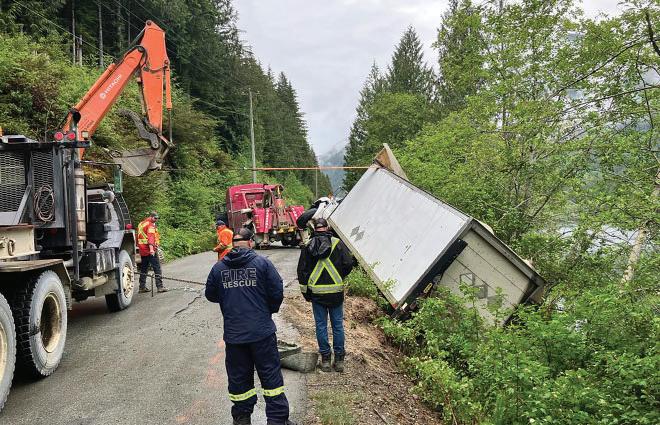
A truck fell into Francis Lake in June 2023, while a series of logging roads from Youbou were designated as the detour route for essential supplies .
difficulties.
Volunteers were there offering to move campers from danger areas, food and water were donated to firefighters, evacuation centres were prepared, while water taxis and other vessels brought people to Port Alberni from Bamfield.
Tseshaht is grateful for the collaboration and partnerships that have formed following the summer of 2025.
“The last fire was close, it was right in our backyard,” he recalled.
Speaking of climate change, Watts said we all need to prepare for what the world is throwing at us. Not just wildfires, but drought and flooding.
“The summers are hotter, the creeks dry up, rising sea levels, ocean temperatures are warming which is deadly for the fish. How do we prepare?” he asked.
While it’s dry in the summer, Port Alberni has been hit by floods in late fall. One particularly harsh flood saw Tseshaht members band together to fill sandbags and protect riverside homes.
Watts recalled that some tourists were stranded due to the flooding.
“The community came to help us and even the tourists stopped to help fill sandbags,” he recalled.
Sayers concurs. “NTC has to work with both Canada and B.C. to ensure climate mitigation strategies are in place to reduce greenhouse gases. This would include
working with the First Nations in ensuring any developments in their territories are not emitters of GHG,” she stated.
Watts says his people continue to plan for safety and are seeking out funding to prepare for emergencies.
“Working together and creating partnerships, continued collaboration is what is needed,” he said.
When it comes to emergency preparedness, Coy-e-iis says wildfire preparedness and dealing with emergencies is the jurisdiction of each Nuu-chah-nulth nation and that the NTC’s role is to politically support them in working with the governments to ensure they have the resources they need to prepare for natural disasters.
“We could also do a collective strategy in dealing with emergencies,” she said.
Like Watts, Sayers points to the importance of coordination of support services.
The NTC needs to work with all agencies and organizations to ensure they are coordinated and prepared to deal with an emergency.
“There have been times when NTC has not been alerted or involved in prevention and carrying out services,” she added.
“We also need to work with [Indigenous Services Canada] to sure that our building use materials that can be fire resistant or use sprinklers on roofs or whatever technologies avails to ensure our communities are safe.”
The NTC’s housing and capital staff work closely with Nuu-chah-nulth nations building capacity to deal with emergencies.
“Each nation has an emergency plan that NTC capital work with to ensure the nations are prepared as much as possible. They work with the executive to ensure we know if there are capacity or resource gaps that we can pursue politically,” said Cloy-e-iis.
B.C. Wildfire Service photo
In June 2023 a wildfire broke out by Cameron Lake, shuting down Highway 4.
Submitted photo
Eric Plummer photo
d Nitinaht from Aug. 11 to Oct. 24.
B.C. Ministry of Transportation photo
The 2023 Cameron Bluffs fire caused extensive damage to the cliffs over Cameron Lake, and stability work continues to this day, with highway delays in January 2026.
Port Alberni Warriors program looks to the future
A chapter is growing in the city for young First Nations men, adding to programs in other coastal communities
By Denise Titian Ha-Shilth-Sa Reporter
Port Alberni, BC – The Nuu-chah-nulth Youth Warrior Program has expanded in a big way, thanks to new funding from various government departments.
The program seeks to strengthen the confidence and capacity of young Nuuchah-nulth leaders by helping them prepare for the future through life skills and employment training. They work with elders and knowledge-keepers to guide the programs.
The first Nuu-chah-nulth Youth Warrior program launched in the summer of 2015 at the Yuułuʔiłʔatḥ community of Hitacu with a handful of teenagers from the village. What was supposed to be the start of a men’s group turned into a program for teens, because the men did not show up for the meetings.
Young Hitacu men showed up every week, planning their community activities. It was the start of a culturally based youth group for males with a goal of addictions prevention.
At their weekly meetings, the youth planned future activities – ones that allowed them to get back to the land and ocean and learn the cultural ways of their ancestors.
The Nuu-chah-nulth Youth Warrior Program is easily adaptable to other communities and turned out to be a wildly successful option for teenagers eager to learn from elders and peers. Young men spend time together learning about their culture, finding ways to support their communities and survival skills.
Ricardo Manmohan was working on his doctorate degree in 2015 when leadership of Yuułuʔiłʔatḥ Government invited him there to work with their men. Manmohan said his training was about leadership and traditional ways of teaching skills to young people.
“The health director asked me to look at a men’s program,” he told Ha-Shilth-Sa. Manmohan said he went out and spoke to individuals at Hitacu, looking for what they wanted in their men’s program. When it came time for the first meeting, the men did not show up.
“But the boys showed up,” Manmohan recalled.
The whole intent of the work is called “upstream prevention”. That is, they aim to get boys busy with wholesome, cul-
Phrase of the
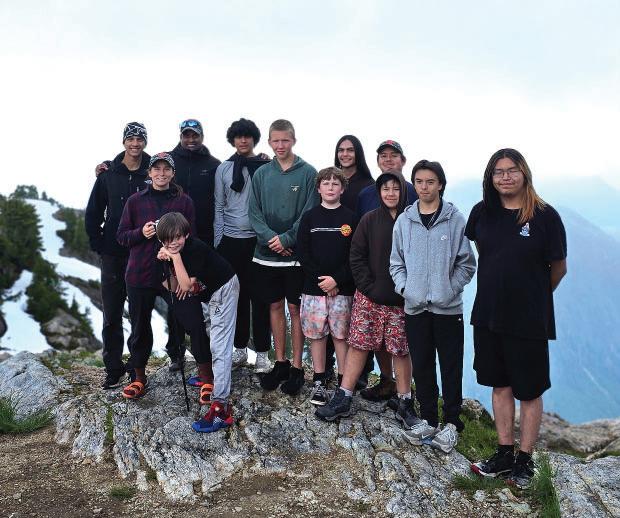
Submitted photo
The Nuu-chah-nulth Warrior Multi-Nation Program is open to Indigenous youth ages 13-20 in Port Alberni and is free of charge. Participants meet every week, planning one outdoor excursion a month.
tural activities before they ever become involved with nicotine, alcohol or drugs.
“We want to implement a youth program to help prevent substance abuse among young men. We want to engage the youth, give them a sense of purpose, something positive. And it is important for them to access their culture, to get in touch with their identity, their roots, as a path to health,” said Manmohan.
In the early days the youth learned about preparing food and would bring meals to the elders. They worked on projects like clearing brush or helping elders with firewood. The program grew to larger, community initiatives like small construction projects.
Eventually, the Nuu-chah-nulth Youth Warriors spread to neighboring communities, each applying to health authorities for funding to support their members in the programs.
In 2023 the Nuu-chah-nulth Youth Warrior Family Society was formed, opening the door for other groups to launch. As a society, there are more funding opportunities for interested communities.
“We could apply for grants,” said Manmohan.
And because of this past success, the Port Alberni Multi-Nation Programming
secured funding from the Public Health Agency of Canada (PHAC).
“We’ve secured their Icelandic Prevention Model (IPM) Stream 2 Funding to implement our own version of the IPM for the urban programs in Port Alberni,” said Everett Watson, a member of the Tseshaht First Nation.
He went on to say that the IPM funding program aims to enable programs that are community based, youth led, data-driven, and follows a process similar to the 10step Icelandic model that helped drastically reduce the rates of early substance use in the Scandinavian country.
Port Alberni is an urban centre with a diverse population of Indigenous youth. Previously, individual First Nations applied for financial assistance that could only be used for their own members, due to funding agency restrictions.
Port Alberni has young men not only from the local Tseshaht and Hupacasath First Nations, but also several other Nuuchah-nulth nations, other First Nations and Métis. Not wanting to turn anyone away, planners needed to find a funding arrangement that would support all the youth that are interested in the program.
Port Alberni now has a multi-nation Nuu-chah-nulth Youth Warrior program
open to all First Nations.
“In some cases, the youth are not as connected with their First Nations land and culture because they are growing up away from home,” said Manmohan.
Everett Watson says Port Alberni’s Multi-Nation Nuu-chah-nulth Youth Warrior program is the latest addition to versions already established at Ahousaht, Ditidaht, Huu-ay-aht, Uchucklesaht, Tla-o-qui-aht, Ehattesaht, Ka:’yu:’k’t’h’/ Che:k’tles7et’h’ and Yuułuʔiłʔatḥ
In Port Alberni the youth meet once a week all year long. They learn important life skills, including hunting, cooking, harvesting and marine safety. One weekend a month the group will go outdoors for hikes or camping trips where they put their newly acquired skills to the test.
At the end of January, the group plans to camp at Sarita Bay. Watson says about 12 youth will camp, rain or shine, and they will be doing some hunting or fishing.
“It’s important to listen to what the youth want to do and for them to have roles,” said Watson, adding that it was the young participants who decided where they wanted to camp.
The society has received funding to run the Port Alberni Multi-Nation Warrior Program for 30 months, up to March 2028. In addition, a women’s program has been launched in Port Alberni, with meetings every Tuesday night.
The Nuu-chah-nulth Warrior Multi-Nation Program is open to Indigenous youth ages 13-20 in Port Alberni and is free of charge.
Youth will plan hikes, learn safety and survival skills to help them when they are on the land. They may do things like plant identification and harvest, then learn how to prepare these materials for practical uses, like fire starter, glue or medicines.
“We have to make it interesting for the youth,” said Watson.
After a decade of operation, the teenagers who were involved in the first years of the program are now young adults who go to other communities to teach what they have learned.
To learn more the Nuu-chah-nulth Youth Warrior Family Society or if you want information about starting a new warrior program, you may request access to the online Warrior Toolkit at the website https://warriortoolkit.com/
week: c’ušuk%i nupq%inch tupswiici>%it%iš%a> +u>sup nupq%ic @aqkin
Pronounced ‘Chew shook in nupqkin tups we it ish alth tupalthi wik kit sup pish mis’ it means ‘With the new year it was a right to go dive into the water, to clean and get rid of bad vibes, to start the year in a new way’ Supplied by ciisma.

Illustration by Christine Sparks
Contamination still a concern for Muchalaht crabs
Dioxins are still found in the shellfish south of Gold River, although the jury is still out over if they’re safe to eat
By Eric Plummer Ha-Shilth-Sa Editor
Gold River, BC - While results are preliminary and more analysis is needed, contamination is still being detected in Muchalaht Inlet’s crabs, 26 years after the closure of the Gold River Pulp Mill.
Commercial crab harvesting has been closed in the area since 1995, due to lingering concerns about the levels of toxins in the shellfish. The issue first alarmed Canada’s fisheries department in 1990, when crab harvesting was closed on the Muchalaht Inlet due to high levels of contamination. By 1995 these levels had declined, but were still present to the degree that warranted a warning. Commercial harvested remained closed, while smaller-scale crabbing was permitted with an advisory to consume no more than 70 grams of the crustacean’s hepatopancreas in a week, which is the organ in the shellfish used for detoxification and digestion.
Meanwhile, the Gold River Pulp Mill continued to operate at the head of Muchalaht Inlet, where the salt water meets the Gold River. According to a pamphlet published by the Tahsis Company shortly after starting the mill in 1967, effluent waste was sent from the facility through a 1,700-foot tunnel into the main body of Muchalaht Inlet.
At the time Canada’s Department of Fisheries and Oceans considered the mixing of pulp effluent with the natural sea water safe, but monitoring in the area years later would suggest otherwise. By 1990 analysis of Muchalaht Inlet’s Dungeness crabs revealed a spike in dioxins, a chemical produced in pulp and paper manufacturing, leading DFO to close the area for harvesting the shellfish.
“When all pulp and paper mills were first operating there was a higher release of dioxins that resulted in the closure of many fisheries,” reflected Lisa Loseto, a research scientist with Fisheries and Oceans Canada, during a presentation to the Nuu-chah-nulth Council of Ha’wiih Forum on Fisheries in December.
Dioxins are highly toxic and can be detected in the environment decades after they are released, according to the World Health Organization. They can cause reproductive and developmental problems in humans, damage the immune system and lead to cancer, says the WHO.
Archie Little worked at the Gold River Pulp Mill for six years, and recalls seeing black effluent pouring out from the facility at all hours of the day and night.
“They drilled a tunnel to pour into the inlet, out of sight, out of mind,” said Little, who is now a councillor with the Nuchatlaht First Nation. “That stuff was going out 24-7, just pumping out. I often wondered where it went, how far it reached and what other resources it impacted, because we used to fish in the area. It makes you wonder what we were eating. Was it safe to eat?”
The pulp mill was built in the mid1960s, leading to the construction of settlements 13 kilometres north to house the mill’s workforce. As the village of Gold River was in its infancy, the Mowachaht/ Muchalaht First Nation’s main reserve was being moved from Yuquot at the southern shore of Nootka Island to Ahaminaquus on Muchalaht Bay – right across the road from the pulp mill. Under clouds of smoke and the screams of machinery, the First Nation would remain there until moving its main reserve to the current Tsaxana site north of Gold River.
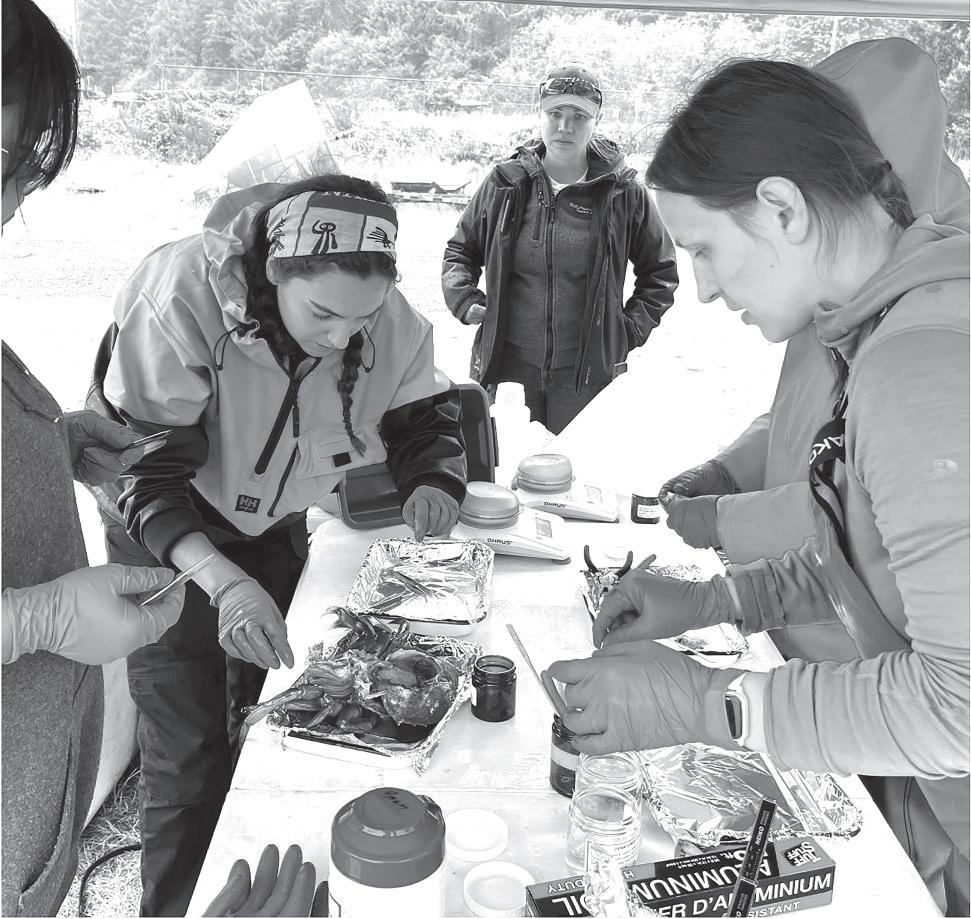
Now the Mowachaht/Muchalaht are working with Loseto to determine the extent to which its territory continues to be affected by the legacy of the pulp mill, which closed in 1999.
“I do know it’s been a long time, I don’t know how much longer it’s going to be,” said Tyee Ha’wilth Mike Maquinna of the inlet’s contamination. “That’s the problem.”
By the 1990s pulp mills had introduced technology to decrease the amount of dioxins they were releasing into the environment, progress that aligns with the drop in levels tracked at Muchalat Inlet sites after 1990.
“And then there was an adaptation where the approach used to prepare the pulp and paper was mitigated so that that amount of dioxin was decreasing over time,” explained Loseto.
Last summer samples were collected for analysis for the first time since 1998, a partnership undertaken by DFO, the Mowachaht/Muchalaht and Uu-a-thluk, the Nuu-chah-nulth Tribal Council’s fisheries department. In August 2025 the biologists set 14 traps along Muchalaht Inlet, at depths between 20 and 90 metres beneath the ocean’s surface.
After a few days in the water four samples of Dungeness crab hepatopancreas were selected for analysis. One of these yielded elevated levels of dioxins, although a direct comparison could not be made from what was recorded at the site in the 1990s. Another sample from August shows dioxins three times lower than what was last measured from the site in 1998. Then another two samples of the crab organ show levels that would have been below a Health Canada threshold
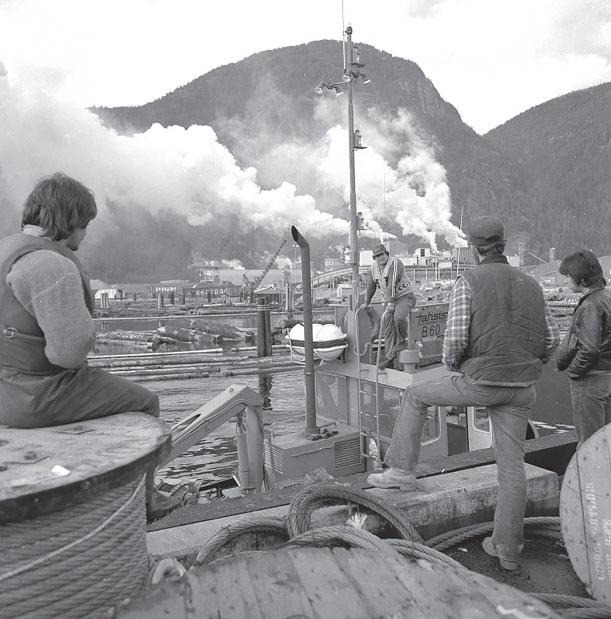
BC Archives photo
Located 13 kilometres south of the Village of Gold River, the Gold River Pulp Mill operated from 1966 to 1999.
for safe consumption. This threshold is now considered outdated, and is under review by Health Canada’s Bureau of Chemical Safety.
“These approaches of the past are not ideal to be used anymore,” said Loseto, noting that the samples analyzed were far from where the pulp mill dumped effluent. “It would be nice to access samples
closer to where the original source was.”
“We’re going to try to collect more samples again and do another test round, a little bit later in winter, probably in January, maybe in February to see if we have a greater chance of collecting more samples,” added Vanessa Moll, a biologist with the Mowachaht/Muchalaht First Nation.
DFO photo
After a few days in the water four samples of Dungeness crab hepatopancreas were selected for analysis, which is the organ in the shellfish used for detoxification and digestion.
President’s Message
The work continues on justice and policing and police oversight. Indigenous peoples are 20 times higher than the white population to be incarcerated. The work for diversion - that is find alternatives to jail for the less serious crimes through various community-led initiatives - is important. Prince George just opened up a diversion centre and it is proving to be successful. We need to expand more diversion centres throughout B.C. Also, the province just ended a decriminalization project. It was introduced to not bring charges for minor drug offenses like possession, but to focus on health programs. B.C. ended this pilot project without talking to First Nations even though we have the highest institutional rates and the highest rates of toxic drugs and mental health issues.
We want to focus on solutions and B.C. did not give us a chance to weigh in and decide what the solutions could be. This is not acceptable when we are trying to strengthen our relationships and work together. The number of Indigenous people in jail is increasing, according a Statistics Canada report on the rates of institutionalizations.
As you are aware, the ICU has been shut down indefinitely at the West Coast General Hospital. Meetings have been held to try and figure out what the community can do to help to restore the ICU. We held a meeting with community - almost 100 people from all parts of the PA community who came together to further brainstorm recruiting and retaining doctors and nurses and specialists we need . It was a good session and people are really committed to working together to do this. We heard from someone from Pitt Meadows, which also needed doctors. They have been so successful they now have 14 doctors that are looking for more patients. This group will continue to meet and add more sectors of the community, such as real estate, so we attract more professionals to Port Alberni.
I thought I would spend a bit of time talking about what I think will be priority work areas in the upcoming year. The federal budget was cut back to put more money into national defense. One area being drastically cut is specific claims research. Currently the budget is at $12 million and will fall to $4 million on April 1; that is $4 million available to approximately 633 First Nations. This is not sustainable or is it acceptable. The Union of BC Indian Chiefs has a letter writing campaign going across Canada to let the federal government know they need more money in research. Time will tell if they will be changing the budgeted amount. UBCIC is again asking other First Nations to sign onto their letter. NTC has signed on to support this initiative.
The premier did not like the court decision in the Musqueam/Cowichan court case which recognized Cowichan title to some lands in Richmond. The premier did not like what the court said about B.C.’s own law - the Declaration on the Rights of Indigenous Peoples Act (DRIPA), which works to implement the United Nations Declaration on the Rights of Indigenous Peoples. He unilaterally said he was going to amend DRIPA so the courts could never override the government again. He then instructed the Attorney General to do that. He should have went to the leadership council and the chiefs of B.C. and said, “I would like to amend DRIPA. Can we do this together?” He forgets that DRIPA was drafted by B.C. and First Nations
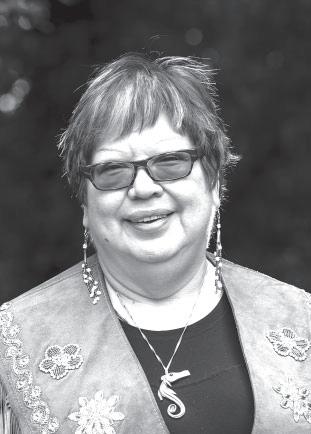
and that it was done in partnership. The leadership council has also circulated another letter with endorsement by chiefs to support DRIPA as it now is. NTC signed onto that letter. What we really need is a face-to-face meeting with B.C. to talk about this and decide together if amending DRIPA is needed.
This action by the premier will really affect the relationship between B.C. and First Nations and it will be a rocky road ahead. This will play a major role in relations as we go forward this year.
The coastal First Nations and B.C. stood together in December to keep in place the oil tanker ban on the north coast. They recently met with the Prime Minister and stood their ground to say no projects going through their territories would be allowed to have oil tankers or in any way endanger their oceans. We are very concerned as well that this ban be maintained as our chinook come through their waters and we would not want any oil spills affecting our salmon. We signed their declaration and will be doing a follow up letter to the Prime Minister as well.
Another priority item will be emergency preparedness. Flooding is happening now and possible forest fires with another hot and dry summer ahead. Are our communities ready? What do we need to be ready? We need to work with the federal government to ensure they provide us with the resources we need. Doing any research and lessons learned from last year’s fires is also important.
We also need to continue to work on the toxic drug and mental health crisis. We have a comprehensive strategy but unfortunately we don’t have the resources to do everything we want to do. We have asked both the federal and provincial governments for resources to carry out the strategy without success. We will continue trying to get resources and be innovative in implementing the strategy. Our people’s lives are at stake.
We will also work with several laws that are being revised to be in line with DRIPA. I am on the cultural heritage working group and will be working hard to get an amended law through this fall. Been working on it for over four years, so hoping we are in the home stretch. There is so much going on and our First Nations are stretched to the limit. Between NTC and our member nations we work on the issues important to us. This will be another year of achievements, trying to remove barriers to our self determination and doing everything we can for our citizens. I look forward to working with all of you in 2026.
Respectfully,
Cloy-e-iis
Judith Sayers
In memory
In Loving memory of Nessie (Mama) Watts
A very special person, a very special face
Someone we all loved, and can’t replace Never was she selfish, she was always kind
These are the memories, you left behind Your family always remembers. Lovingly remembered by, All her children
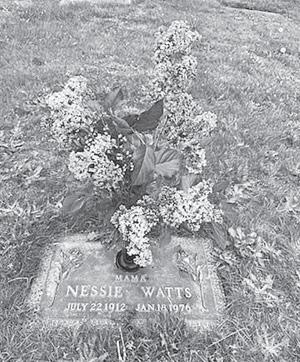
Birthdays
Happy 90th birthday to Juanita (Watts) Elliott, on January 22nd. From Sharean Van Volsen and family.
25 Years Ago in Ha-Shilth-Sa
Vol. 28 – No. 1
January 18, 2001
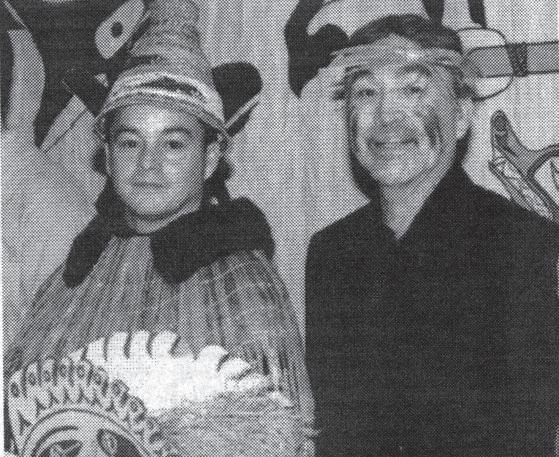
Umeek Passes
Maquinna Hat to his Son
Ahousaht Celebrates Newest Chief
Hundreds of people gathered in Ahousaht on December 29th and 30th, 2000 to witness an historic and culturally significant event, the seating of a new Hawilth, Shawn Atleo. Umeek, also known as Dr. Richard Atleo, chose this time to pass his chieftainship on to his eldest son.
The two-day event also included Coming-of-Age ceremonies for four young ladies from the Atleo family. The weekend commenced by guests following strict protocols and entering Thunderbird Hall one by one, having black paint applied and splitting the seating by the men sitting on one side of the hall and women on the other. The wolf ceremony began by stealing the seven to be honoured in the ceremonies, while the hall was submerged in darkness.
Early the next morning the wolf ceremony continued at the beach, where the
challenge between the men and wolves continued. After all seven people were retrieved from the wolves, they were led back to Thunderbird Hall where it was explained that Dr. Atleo had begun the process of transferring his seat to Shawn and the conclusion of the transfer would take place in the evening.
The evening was filled with singing, dancing and presentations and praise for the new chief. Shawn himself participated in many dances.
In a ceremony not seen in decades, four highest-ranking Ahousaht Chiefs publicly washed the feet of the four young ladies that were coming of age. It was explained that these ladies were highly treasured members of the family and as such, would be treated with the utmost respect and would receive the protection of their chiefs. The foot-washing ceremony was a demonstration of the respect that the chiefs have for their young women.
Reporter looks back on 30 Years at Ha-Shilth-Sa
Over her career Denise Titian has carved a role in documenting history from a Nuu-chah-nulth perspective
By Denise Titian Ha-Shilth-Sa Reporter
Port Alberni, BC - January 2026 marks the 30th year that I’ve worked at HaShilth-Sa Newspaper. I applied for the job in the summer of 1995, hoping that I would get the chance to work with the legendary Ha-Shilth-Sa Bob.
Popular, friendly and easy-going Bob Soderlund had already been working for the paper more than 20 years when I was hired. Annie Watts, his assistant, helped me navigate policy and procedures at the NTC.
My first day as a reporter for Ha-ShilthSa Newspaper was January 15, 1996. My kids were 13 and 14 at the time and I was in my early 30s.
It was near the start of the B.C. treaty process for Nuu-chah-nulth-aht and leaders at the time wanted to ensure that treaty news made it out to their people. At that time there was no internet and people relied on the Ha-Shilth-Sa Newspaper to get their local news.
The decision was made to hire two more reporters to cover treaty and community news in all three of the Nuu-chah-nulth Tribal Council’s regions.
I was hired as the Central Region reporter. Ahousaht, Hesquiaht, Tla-o-qui-aht, Toquaht and Ucluelet were in my region, and my office was based in Tofino.
When I reported to work that first day, I noticed that Bob Soderlund’s office at the NTC building was big. The double office was connected to a smaller office where Annie worked.
Bob’s office had a large drafting table pushed up against one wall. There was a mid-‘90s hulk of a computer on the desk and a darkroom in the corner. The rest of the large office space was taken up by filing cabinets stuffed with more than 20 years of back issues of Ha-Shilth-Sa Newspapers and boxes of unsorted photographs.
Bob, famous for his beautiful photography, used a Pentax K-1000 35mm film camera and processed his own photo prints in the darkroom.
He gave me a quick lesson on how to use the fully manual camera. I learned how to load and unload the film cartridges. My vision was perfect back then so focusing the camera wasn’t too difficult. I can’t imagine doing that today.
But those first months of using that camera were hard, especially when you’re trying to impress a seasoned photographer.
After you shot a roll of film, you brought it to the old mall for processing. It took up to a week to know if you had any salvageable images for your story.
Hundreds of photographs were produced each month. The process was expensive and took a lot of space. This is why there were very few photos with those early stories.
I remember being sent to Victoria for a cultural event that first year. It was in the Mungo Martin building at the Royal B.C. Museum. I snapped several shots of the cultural activities that day. Something about that day made me feel like I would get some amazing shots for the story. It just felt right. Then I went home, opened my camera and discovered that I forgot to put the film in. Very embarrassing! That was the first big mistake. There were plenty more over the next 30 years. Like the time I woke up late for a big meeting scheduled for a Saturday. I tried to sneak in through a side door but ran
Denise Titian began working at Ha-Shilth-Sa on Jan. 15, 1996, under former editor Bob Soderlund. Over her career she witnessed the introduction of digital technology, computer layout and electronic communication tools into the newspaper business. Pictured is Denise Titian at her office in 2000.
right into my boss. I decided honesty was the best policy and told him why I was late. He smirked, told me my story was amusing and then informed me that I wasn’t even supposed to be at the meeting that day.
As I lived in the Alberni Valley, commuting the Tofino highway twice daily for 14 years meant that I knew every crack, pothole and passing lane, and I made use of the passing lanes all the time. There was a time when one of the Ha’wiih was an RCMP officer. He happened to be patrolling the highway while I was on my way home from work. He was doing the speed limit when I caught up to him. Calling upon every ounce of patience I had within me, I slowed down and waited for a passing lane. I passed him at the first opportunity and tried to gain distance when he couldn’t see me. But he knew what I was up to and pulled me over. I was hoping he’d cut me some slack, being Nuuchah-nulth and all, but he was an equal opportunity warning-giver.
During the ‘90s our film cartridges were developed and made into prints at Port Alberni. Before we had internet and email, stories had to be saved on floppy discs and driven to the editor’s office in Port Alberni. There was a lot of traveling back then.
When it came time to layout the paper, Bob Soderlund was old school. Using scissors, he literally cut text from printed pages and glued them onto the story boards. The process took time and intense concentration, so Bob would do it after hours. He worked into wee hours of the morning, literally cutting and pasting the newspaper together before driving the story boards to the printer at the Alberni Valley Times.
After Bob retired, the darkroom was torn down to make more space, and the drafting table was disposed of.
Each new editor brought better technology. By the year 2000 we were using computer programs to layout the paper digitally. We moved to filing stories via email, and in the early 2000s we were introduced to digital photography. We now have a Ha-Shilth-Sa website where stories are posted most days, but we maintain a print copy because the people
like it.
Those boxes of printed photographs and digital images, more than 10,000 of them, were sent out to be digitized and are now accessible online to the public via our Flickr account.
Along with advances in technology, I’ve seen huge growth in the use of Nuu-chahnulth words over the past 30 years. With little exposure to the language, saying the words ‘Nuu-chah-nulth’ and ‘Ha-ShilthSa’ were intimidating to me in the ‘90s. I don’t even think about it when I say those words today.
Language revitalization became a priority for Nuu-chah-nulth-aht. With more people speaking and writing the language, I’ve been able to passively
pick up words and phrases over the years, learning as I’m going along.
While I never expected to make a career of writing, it has been very satisfying and has sparked a love for learning history. I’ve spoken to hundreds of elders who have enriched my knowledge of Nuu-chah-nulth history. And I’ve done my best to share their stories from a Nuu-chah-nulth perspective – something that was rare at the time in local history books.
Looking forward, we have so many of our people graduating high school, attending colleges and universities. We can be sure that some of them will carry on telling our stories.

Archive photo
High school wrestlers prepare for Alberni Invitational
Alberni continues its long history of fostering athletes, bringing further benefits to a teenager’s time in school
By Eric Plummer Ha-Shilth-Sa Reporter
Port Alberni, BC - TJ Hernandez is excited to hit the mat, as the Alberni Invitational approaches at the end of this month.
“I can’t wait,” said the Grade 10 student, an Ahousaht member in his second year of wrestling at Alberni District Secondary School. “I’m trying to work on techniques and learn a few different moves.”
Hosted by ADSS and the Alberni Wrestling Club on Jan. 30 and 31, this will be the 41st year that school teams from across B.C. converge for the invitational competition. Categories include junior (Grade 8 and 9) and senior (Grades 1012) boys and girls divisions, with weight classes ranging from 38 to 130 kilograms, which is equal to 286 pounds.
The sport is for all sizes of youth, and in Port Alberni the high school program benefits from numerous elementary schools offering years of introductory training in wrestling.
Hernandez’s teammate Liam Horbatch is in his first year of high school, but has already been wrestling for four years from his time at E.J. Dunn.
“I’m excited,” said Horbatch, who is also from the Ahousaht First Nation, as he prepares for the tournament.
The two teammates are standing outside a room full of athletes grappling, with ‘Armada Wrestling’ emblazoned on the wall high over the mats. They’re practicing techniques and strategy, after tumbling for a warm up.
“When they get in precarious positions when they’re on the wrestling mat, in all likelihood their body and their brain is going to be aware of where they are, so

they won’t hurt themselves,” explained coach John McDonald.
Horbatch is working to not rely on his arm throw, which entails grabbing the opponent’s arm to throw him over, landing on the back.
“I’m trying to not force it,” said the wrestler. “When I go into the arm throw I sometimes fail. I turn onto my back and lose points.”
Hernandez has lived in Ahousaht, Surrey and now, for the last six years, Port Alberni. Like Horbatch, he uses the sport as something to look forward to during the school year. Both boys also play rugby.
“Wrestling is considered individual, but you have people around,” said Hernandez. “I think joining any sport is good to make new friends.”
But involvement in the sport goes beyond that, says McDonald. After wrestling as a student at ADSS and going to compete in university, he returned to coach the Alberni team, where he has been for the last 35 years. McDonald even coached Travis Cross, who represented Canada at the 2008 Summer Olympics in Beijing. Cross now coaches the high school team alongside McDonald.
“It gives you a focus. You’re not excited to come to school to do math, but you’re excited to come to school to practice,” said McDonald. “I just know as an educator that always translates into good things at school.”
As an individual sport, wrestling also leaves an athlete with no goalie to blame if things don’t go well in a match.
“Winning is not the only success, you can have other types of successes,” notes the long-time coach. “It might be in the training that you’re doing, you’re wrestling somebody who’s older than you.”
Members of the team are also expected to represent themselves well when travelling to matches.
“If you’re standing in the McDonald’s line, be aware of what you say, be aware of what you do,” said McDonald. “Be aware that there might be a four-yearold with a parent behind you listening to what you’re saying.”
“It’s all connected to who they are and what they do in the school and after school,” he continued. “Really what we’re doing here is building human beings.”
Co-governance launched with region’s school board
By Karly Blats Ha-Shilth-Sa Contributor
Port Alberni, BC - The Pacific Rim School District has launched a co-governance model with local Nuu-chah-nulth nations, aiming to strengthen relationships, advance reconciliation and foster collaborative leadership in public education.
In December 2025, Nuu-chah-nulth representatives joined the school district’s governing body at school board and standing committee meetings to develop recommendations for future education opportunities in the region. Although Nuu-chah-nulth members are involved in discussions and recommendations, they are not currently able to vote on matters at board meetings.
The school district and nations have collaboratively chosen to move forward with a model that prioritizes participation, collaboration and relationship-building, with the hope that future legislative change may enable even more Indigenous representation, including voting roles.
Over the past two years, SD70’s board of education and senior staff have worked together with senior Nuu-chah-nulth leadership to come up with the framework for the co-governance model. The governance model is structured to honour Nuu-chah-nulth voices, value Indigenous knowledge and reflect a shared commitment to improving educational outcomes for all students, families and communities.
Provincial statistics for the Pacific
Rim School District show Indigenous students as having a lower graduation rate than non-Indigenous students. For the 2023/2024 school year, Indigenous students in SD70 show a high school completion rate of 81 per cent, compared to 90 per cent for non-Indigenous students. But this is a significant improvement from past results, as over the last five years Indigenous students in SD70 have shown a 16 per cent increase in completion rates, and 42 per cent over the past 10 years.
The district’s enrollment number from last school year show that 37 per cent of the student population identifies as Indigenous.
“Tseshaht views this milestone as one of many important steps toward full joint decision-making. Pacific Rim School District’s main office is situated in Tseshaht ḥ aḥ uułi (Chief’s territory) along with district schools; and additional resources are provided to the district because of our children attending these schools,” said Ken Watts, elected chief counsellor with Tseshaht First Nation, in a press release. “By providing a voice at the table we will collaboratively ensure that our children are looked after now and into the future.”
Selected representatives are chosen by their respective nations to participate in a consultative and advisory capacity, bringing their voices, lived experience and community perspectives directly to the school board table.
The district said the new model will continue to evolve through practice,
Stephen Mack Jr. stands amongst the crowd of other graduates on June 7, 2025, awaiting his call to the stage to be individually recognized during a celebration hosted by the Nuu-chah-nulth-Tribal Council at Alberni District Secondary School.
reflection and collaboration. As the cogovernance model is implemented and refined, SD70 hopes it may serve as an example for other school districts across the province.
“Having open communication, dialogue and understanding is incredibly important to Hupacasath,” said Brandy Lauder, elected chief councillor of Hupačasath First Nation, in a press release. “Although we are hopeful that legislation changes to allow a position to vote, our participation at the board level will allow understanding for everyone and every child in the district.”
Eric Plummer photo
Eric Plummer photo
Athletes on Alberni District Secondary’s wrestling team practice at the high school on Jan. 6, preparing for an upcoming provincial invitational tournament they will host at the end of the month.
Student reflects on Totem Spirit candidate journey
Mariella Huebner was one of seven to run for the award this year, which is given for promoting school spirit
By Nora O’Malley Local Journalism Initiative Reporter
Port Alberni, BC – Hesquiaht First Nation’s Mariella Huebner was one of seven Alberni District Secondary School (ADSS) Grade 12 students to run for the Totem Spirit award this year.
As part of her campaign, Huebner organized a Christmas community toy drive for the Salvation Army and volunteered at the hospital.
“We all have so much to offer in our own unique way. I didn’t really care about winning. Winning was giving the opportunity to be allowed to run for Totem Spirit,” said Huebner on Totem 70 finals day.
She said it took her and her campaign managers, Scarlett and Pallas, about 25 hours to make the giant poster next to the ADSS staircase and about nine hours to make her Totem Spirit ballot box and trifold display.
“I feel like I do really represent my family. I come from an Indigenous background, and I tried to incorporate that in my campaign,” said Huebner.
A member of the ADSS band and Leadership club, Huebner spent most of the Totem 70 tournament snapping photos for the high school yearbook.
After graduation, she says she wants to go to post-secondary to get a bachelor’s degree of science.
“I want to go to UBC and eventually become a pediatrician,” said Huebner.
Totem Spirit was originally called Totem Princess. The first Totem Princess crowned was Chris Roberts in 1966.
In 1994, the contest saw two male candidates run for top honours, and that’s when the school changed the name to Totem Spirit.
cheerleader and youth gymnastics coach Aslynd Mowat won the Totem 70 Spirit crown in front of a packed house on Jan.10.
“Huge shoutouts to the rest of the candidates, you guys made this so much more fun and I love that we got to be part of it all together,” Mowat posted on her social media. “I’m so proud of everything each one of you has accomplished. You’re all amazing and deserve to be proud of yourselves too.”

ADSS
Nora O’Malley photos
As part of Mariella Huebner’s campaign in running for the Totem Spirit award, she organized a Christmas community toy drive for the Salvation Army and volunteered at the hospital. She spent most of the Totem 70 tournament snapping photos for the high school yearbook.
Totem tourney brings electric atmosphere to ADSS
Dover
Bay girls and Edward Milne boys nab Totem titles in the 70th edition of B.C.’s oldest school tournament
By Nora O’Malley Local Journalism Initiative Reporter
Port Alberni, BC – Totem fans trickled in slowly, starting with the senior girls
final at 1 p.m. on Saturday, Jan. 10, which saw Nanaimo’s Dover Bay Dolphins outshoot Victoria’s Pacific Christian Pacers 88-73 to win a Totem 70 trophy.
Dolphins head coach Shayne Pfeiffer said his team pushed hard throughout the three-day basketball tournament. They opened with a 50-44 win over Alberni Storm girls on Thursday.
“We are really proud of them. It’s always a circled date on our calendar to be here at Totem and to go away with gold medals is just icing on the cake,” said coach Pfeiffer.
Tournament MVP Jessica Slater sunk five consecutive foul shots in the fourth quarter to help the Dolphins swim away with the victory.
“I wanted to slow down the pace a little bit, stay in control and keep us in a good position,” said Slater. “(Pacific Christian) did win Provincials last year so they are a really tough team and a respectful team. It was a really great tournament, super well-run and really fun to play in.”
Bleachers were being saved by the row at 3 p.m. during a close 70-66 semifinal game between the senior boys Ballenas Whalers and the Reynolds Roadrunners. Ballenas took third and Reynolds fourth. By 5 p.m., for the senior girls semifinal game between host team the Alberni Storm and Nanaimo’s Wellington Wildcats, the gymnasium was pushing capacity with roughly 1,800 roaring Totem fans rolling into the venue.
But the thunder of a hometown crowd couldn’t save the Storm girls from falling 57-54 to the Wildcats.
“It felt really sad at first, when the buzzer went, but then I reflected on the past three years of senior basketball and I couldn’t have had it any better. I put everything out there and I feel like even though we lost, we came out on top emotionally. We tried our best, we gave it our all and I’m really proud of us,” said Storm player Hayleigh Watts. Watts, who heads to Florida next year to play college softball, said the energy at Totem 70 was bigger than years before.
“The crowd really helped us in so many ways. Winning our games, losing our games, keeping our energy to keep us going,” she said.
Edward Milne Wolverines coach Trevor Bligh dedicated Saturday’s final game of B.C.’s longest running basketball tournament to Tseshaht elder Tom Watts.
Tom Watts is an Alberni District Secondary School (ADSS) Athletics and Nuu-chah-nulth Sports Hall of Fame inductee, and in 1962 he was awarded the

Lucas cartwheels past the
urday, for the senior girls semifinal
sium was pushing capacity with roughly 1,800
Tom Longboat Award, an annual accolade that recognizes Indigenous athletes for their contributions to sport in Canada.
“What a legend Tom Watts is. He really inspired me. I started to talk to him and I did some research and I got a photo with him. Ninety-three-years old? He looks better than me at 50,” said Bligh.
Bligh’s senior boys silenced the Storm 69-53 to nab back-to-back Totem titles.
“It means a lot. It’s super exciting. We count on this every year as a steppingstone to Provincials. Believe it or not, our Grade 11’s as Juniors were 24 and 2 last year. We’re actually better next year than we are this year,” he said.
Wolverine’s player Malakai Hills won Totem MVP for the second year in a row.
“He’s aging out. He’s in Grade 12. His next big decision is going to be how hard he going to play the rest of the season and what CIS university he chooses to go to,” said Bligh.
Alberni Storm’s Coen Erickson beamed with a gold All-Star medal around his neck as fans flushed out of the gym into a rainy night. The Grade 12 student also thought this year show the biggest surge of spectators he’s ever witnessed at Totem.
“It was a great atmosphere, especially for my senior year. I’ve been playing since Grade 10 and it’s gotten better every year. I feel like we were really connected this year. It really meant a lot to me to do that with my teammates. We did have success, I wish we won, but that’s okay. It’s been a good time,” said Erickson.


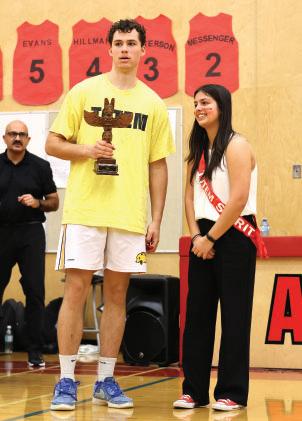


Nora O’Malley photos
Jamie-Leigh
packed bleachers at Alberni District Secondary School on Jan. 5. By 5 p.m. on Sat-
game between the host Alberni Storm and Nanaimo’s Wellington Wildcats, the gymna-
roaring Totem fans rolling into the venue.