INTERESTING NEWS
Salmon Allocation Policy revision faces scrutiny
‘Common property’ clause raises conflicting opinions, as DFO revises policy to allocate Paci
By Eric Plummer
Ha-Shilth-Sa Editor
A policy that guides how much salmon can be caught by various groups is due for revisions, and while the sports sector warns that “Your right to fish is in danger”, Nuu-chah-nulth organizations are pushing for more balanced allocations that reflect court-affirmed rights.
In late January the public input period closed for the next phase in how Fisheries and Oceans Canada will update its Salmon Allocation Policy. Next in the process is for various stakeholders to meet this winter to finalize recommendations to the minister of Fisheries and Oceans, Joanne Thompson. Involved in these discussions are representatives from DFO, commercial fleets, the sports fishing sector and the First Nations that call the waters under examination their ancestral home. Since it was introduced in 1999 the Salmon Allocation Policy has served as the guide for the DFO to determine harvest limits amongst commercial, recreational and First Nations fisheries. But since that time conservation concerns have intensified for certain West Coast stocks, while courts have determined that the policy wasn’t fair to Nuu-chah-nulth nations in the first place. In 2018 the B.C. Supreme Court ruled that the policy had unjustifiably given the sports sector priority to fish chinook and coho over the rights of five Nuu-chah-nulth nations to catch and sell salmon from their respective territories.
After the court upheld the commercial harvest rights of the Ahousaht, Ehattesaht/Chinehkint, Hesquiaht, Tla-o-qui-aht and Mowachaht/Muchalaht First Nations, Canada’s fisheries minister at the time directed staff to review the policy behind the catch limits. After years of meetings, DFO released a discussion paper in 2025, noting that First Nations recommend removing the language “common property resource” from the policy, “noting concerns that it is a colonial concept which has been harmful to First Nations, salmon, and ocean ecosystems.”
But the Sports Fishing Advisory Board wants the “common property” clause to remain, stressing that “salmon’s status as a common property resource remains an overarching principle informing allocation,” summarizes the DFO discussion paper. “Further, they indicate that the public right to fish continues to hold legal significance as a right of all Canadians.”
“Your right to fish is in danger,” warns a campaign launched by the B.C. Wildlife Federation.
The organization, which advocates for
hunters, anglers and outdoor recreationalists in the province, states that “while Aboriginal and treaty rights take priority, the public right to fish should not be infringed or extinguished by Aboriginal rights.”
“The public right to fish is cherished by Canadians,” stated BCWF Executive Director Jesse Zeman. “I cannot conceive of a world where I can’t take my children out to fish, let alone their children. A right lost will be lost forever.”
The Nuu-chah-nulth Tribal Council sees this rhetoric as inflammatory that could threaten public safety.
“Nobody is being shut out of the water,” stated a press release from the NTC. “Nuu-chah-nulth nations are seeking removal of outdated policy language that treats all user groups as if they hold equal rights, despite constitutional and courtaffirmed Indigenous priority.”
“First Nations have lived here for thousands of years. Fishing for salmon has always been a significant food source, a part of our economy and a part of who we are as people,” states the Ha’oom Fisheries Society, which advocates for the rights of the five nations. “DFO must make room for us – right the wrong and rebalance the fishery. Our families want a viable, sustainable fishing economy and the revival of coastal communities that supported it.”
With a complex system of coastal economies at stake, the DFO is now tasked with how to fairly revise its approach to managing harvest limits on a resource that has faced increasing threats over the last generation. Seventy per cent
of salmon stocks are below their longterm average abundance, according to the Pacific Salmon Foundation.
Rec fishery takes most of catch
In 2018, the year that the federal department’s staff were first tasked to look into changing the Pacific Salmon Policy, the recreational fishery on the west coast of Vancouver Island was given a larger chinook allocation than any other group. Back then a total allowable catch of 88,300 was set for the region, of which 50,000 chinook were allocated to the sports fishery. Commercial fleets got 20,132, Maa-nulth treaty nations had 3,447, the five nations’ rights-based fishery of T’aaq-wiihak were allotted 9,721 and 5,000 chinook were set for First Nations food, social and ceremonial purposes.
Recreational catches declined during the COVID-19 pandemic, but by 2024 the sport chinook harvest had rebounded to 47,656, out of a total of 96,128 caught off the west coast of Vancouver Island, according to the most recent numbers published by the Pacific Salmon Commission. Meanwhile 24,154 chinook were caught by the commercial troll fleets in 2024, 3,545 went to Maa-nulth, 3,545 were caught for First Nations food, social and ceremonial and 17,267 were harvested by the five nations’ rights-based fishery.
The Sports Fishing Advisory Board argues that this shouldn’t change, as the recreational sector “provides the highest level of economic, social and cultural benefits” to the public.
“It is clear that the recreational fishery represents the most effective use of Canada’s salmon resource as compared with the commercial salmon fishery,” stated the advisory board, citing thousands of jobs and over a billion in revenue each year. “The recreational fishery produces $693.31 of GDP per salmon caught as compared with the commercial fishery which produces $7.59 of GDP per salmon caught.”
But this isn’t the full story for coastal communities, says Gord Johns, NDP Member of Parliament for CourtenayAlberni.
“In places like Ucluelet, once one of the largest salmon landing ports in British Columbia, there is now just a single independent salmon troller left,” wrote Johns in a letter to constituents. “Federal allocation choices, including recreational priority and the failure to recognize rights-based Indigenous commercial fisheries, hollowed out small-boat fleets, closed processing plants and stripped economic stability from entire towns.”
Johns also noted that while the concerns of recreational fishers about access and economic impacts “are real and deserve to be heard,” these interests “cannot override court decisions, constitutional obligations, or the survival of the salmon itself.”
“Our nations have relied on salmon for thousands of years, and our rights and responsibilities to these waters are not up for debate,” said NTC President Cloye-iis, Judith Sayers. “Canada must bring policy in line with the law and protect salmon for all who depend on them.”
Uu-a-thluk photo
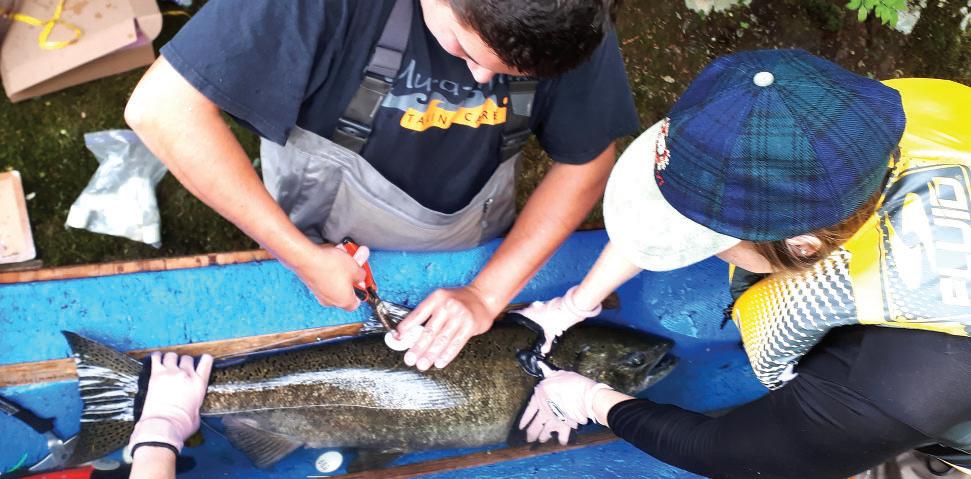
Employees of the NTC’s fisheries department, Uu-a-thluk, apply a radio tag on a Chinook salmon as part of a mark-recapture study.
Tla-o-qui-aht breaks ground on Ty-Histanis Phase 2
After over two decades of negotiations with Canada, First Nation begins clearing more reserve land for housing
By Nora O’Malley Local Journalism Initiative
Ty-Histanis, BC – After over two decades of negotiations with the federal government, Tla-o-qui-aht First Nation (TFN) broke ground on Phase Two of their community development plan for Ty-Histanis this January.
The path to reaching this milestone dates back more than 20 years to 2003 and the initial signing of an agreement between TFN and the Government of Canada.
In that agreement, Tla-o-qui-aht negotiated with the federal government to transfer two parcels of land from the Pacific Rim National Park Reserve (PRNPR) to expand residential capacity of the nations’ existing Esowista Reserve located at Long Beach near Tofino.
The first parcel of land, roughly 86 hectares, was transferred from the PRNP to TFN in 2003, and the community of Ty-Histanis (pronounced ta-yus-taa-nis) was created.
But many years later, the transfer of the second parcel of land remained unfulfilled, until the signing of Hisiikcumyin Memorandum of Understanding (MOU) in 2024 with Crown-Indigenous Relations, setting the framework to advance negotiations for the additions to the reserve.
“These negotiations were driven by a clear mandate from our people: to expand our communities in response to population growth, overcrowded housing, and the increasing need for space to support intergenerational family living,” said Tlao-qui-aht Chief Elmer Frank in a Jan. 14,
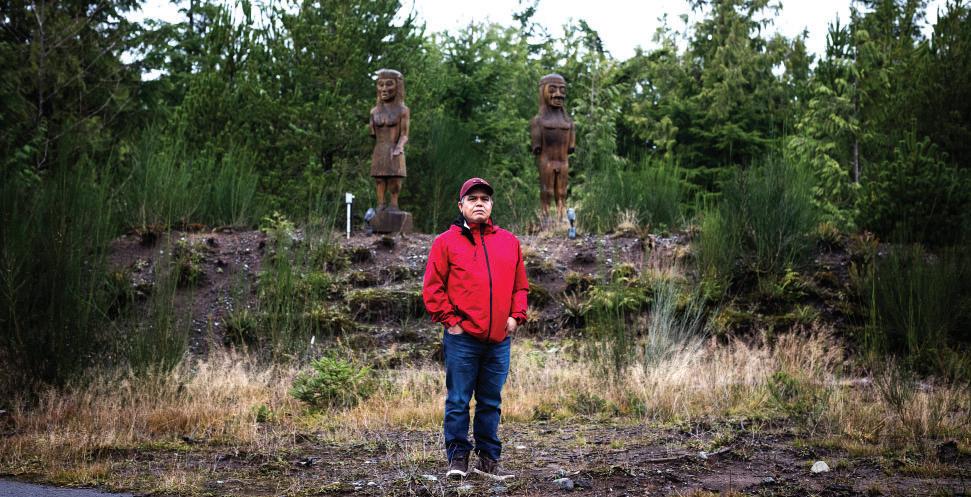
2026, community memo.
“Through the dedication and leadership of Moses Martin, Elmer Frank, Simon Tom, Francis Frank, and the late Bruce Frank, Tla-o-qui-aht successfully secured the Additions to Reserve that allowed for the expansion of Esowista,” said Frank.
“This achievement laid the foundation for what became Phase I of Ty-Histanis—a milestone in our long-term vision for sustainable community growth. Today, we continue to uphold the commitments outlined in the MoU with Indigenous Services Canada and with this accountability in place.”
Ty-Histanis is a Nuu-chah-nulth word that means “a place to anchor whales”.
Phase One includes 68 lots with over 90 housing units, elders’ accommodations, a children’s centre, a maintenance yard, a geothermal pump station, an administrative building and a health centre.
According to Ha-Shilth-Sa News archives from 2011, much of Ty-Histanis land was swampy prior to development. The area had to be drained and sediment ponds were created.
Chief Frank notes in his community memo that lot clearing in preparation for new home construction is underway seven days a week from 7 a.m. to 7 p.m.
“Thank you for your continued support, patience, and commitment as we move forward together in ensuring future generations have the space, homes, and community infrastructure they deserve,” said Frank.
Proposed development plans for TyHistanis Phase Two include an additional 34 lots and currently 36 housing units, but the nation says that number of units is not set and will depend on what the community decides to build moving forward.

Melissa Renwick photo
Chief Councillor Elmer Frank notes in his community memo that lot clearing in preparation for new home construction in Ty-Histanis is underway seven days a week from 7 a.m. to 7 p.m.
Ts’amiks Nisga’a community rallies to save Hoobiyee
After months of uncertainty, Vancouver’s First Nation dance community moves ahead with the popular event
By Nora O’Malley Local Journalism Initiative Reporter
Vancouver, BC – Hoobiyee 2026 will take place on Friday, Feb. 27 and Saturday, Feb. 28 at Vancouver’s PNE Forum. It was uncertain if the two-day celebration of Indigenous dance and culture would be a go this year, but the show will go on, according to Vancouver-based Ts’amiks Nisga’a Cultural Dancers.
“Things are in motion. It is happening,” said Jade Doolan, an executive member of the Ts’amiks Nisga’a Cultural Dancers.
The story of Hoobiyee (pronounced HOO-bee-yay) all starts back in the homeland of the Nisga’a people along the Nass River valley in northwest B.C.
The annual Nisga’a new year celebration is rooted to the harvest of oolichan or ‘candlefish’, a small silver fish that would return to the coastal rivers after winter, and is guided by the emergence of the
first crescent moon in late winter.
This year, Hoobiyee is being organized by the community.
“We the community are pooling together. We are calling it Git-Ts’amiks,” said Doolan, adding that the word ‘Git’ means community.
“We’re just trying to keep everything peaceful, loving and caring. This event is bigger than Hoobiyee. It’s not just for the Nisga’a people anymore it’s for all B.C. communities to come together to share their culture with the world,” said Doolan.
“Hoobiyee is a community event. It’s for the community. That’s why we wanted to make sure it definitely happened,” they said.
Any dance groups that would like to participate can call Doolan at 604-3769892 or email vnisgaadancers@gmail. com. The community is also actively looking for sponsors, donations and volunteers.
CYPRESS


Nora O’Malley photos
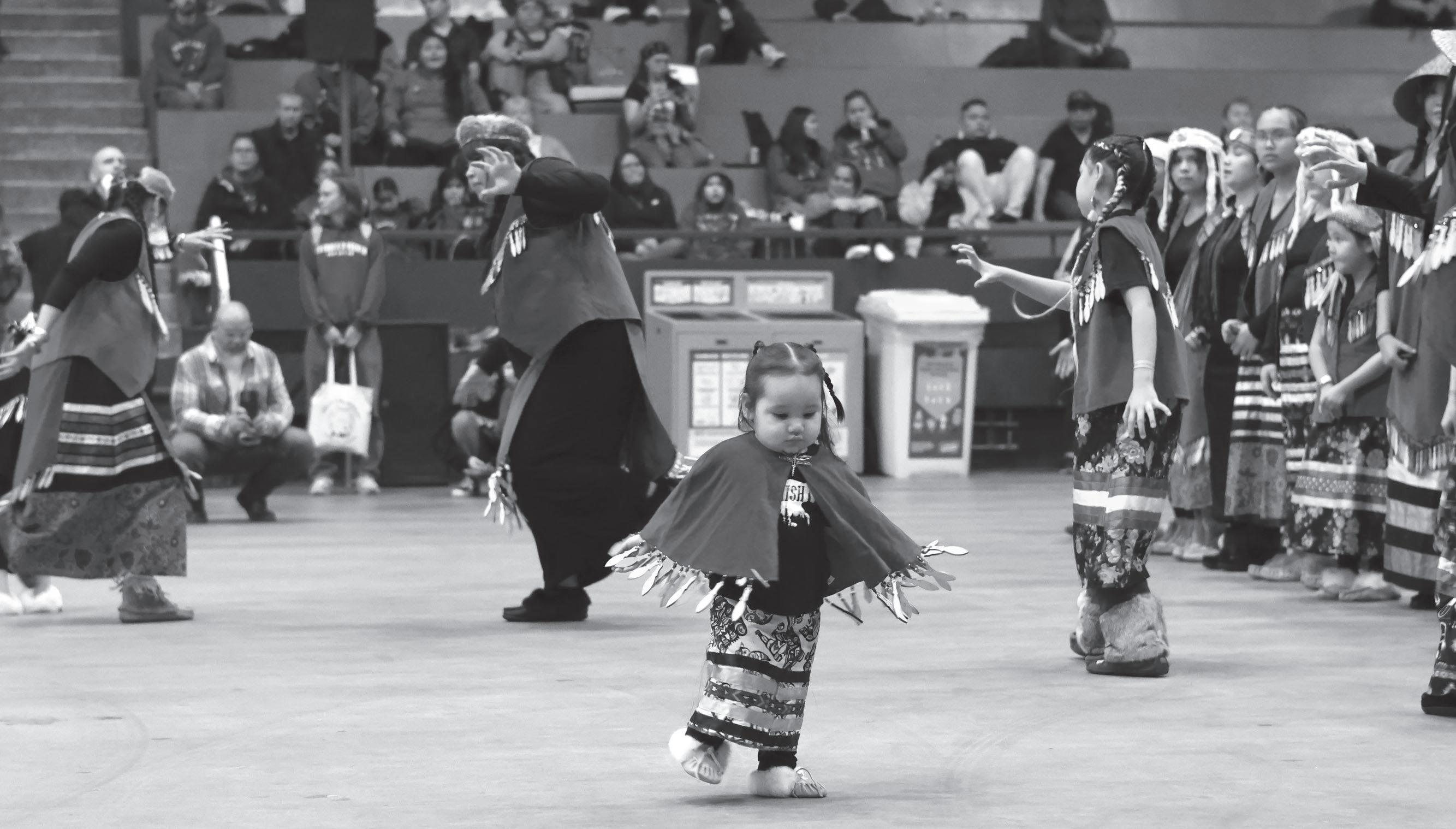
Over 10,000 from across British Columbia came to the two-day Hoobiyee celebration last year at Vancouver’s PNE Forum. Despite months of uncertainty, the event is planned to continue this year at the venue on Feb. 27 and 28.
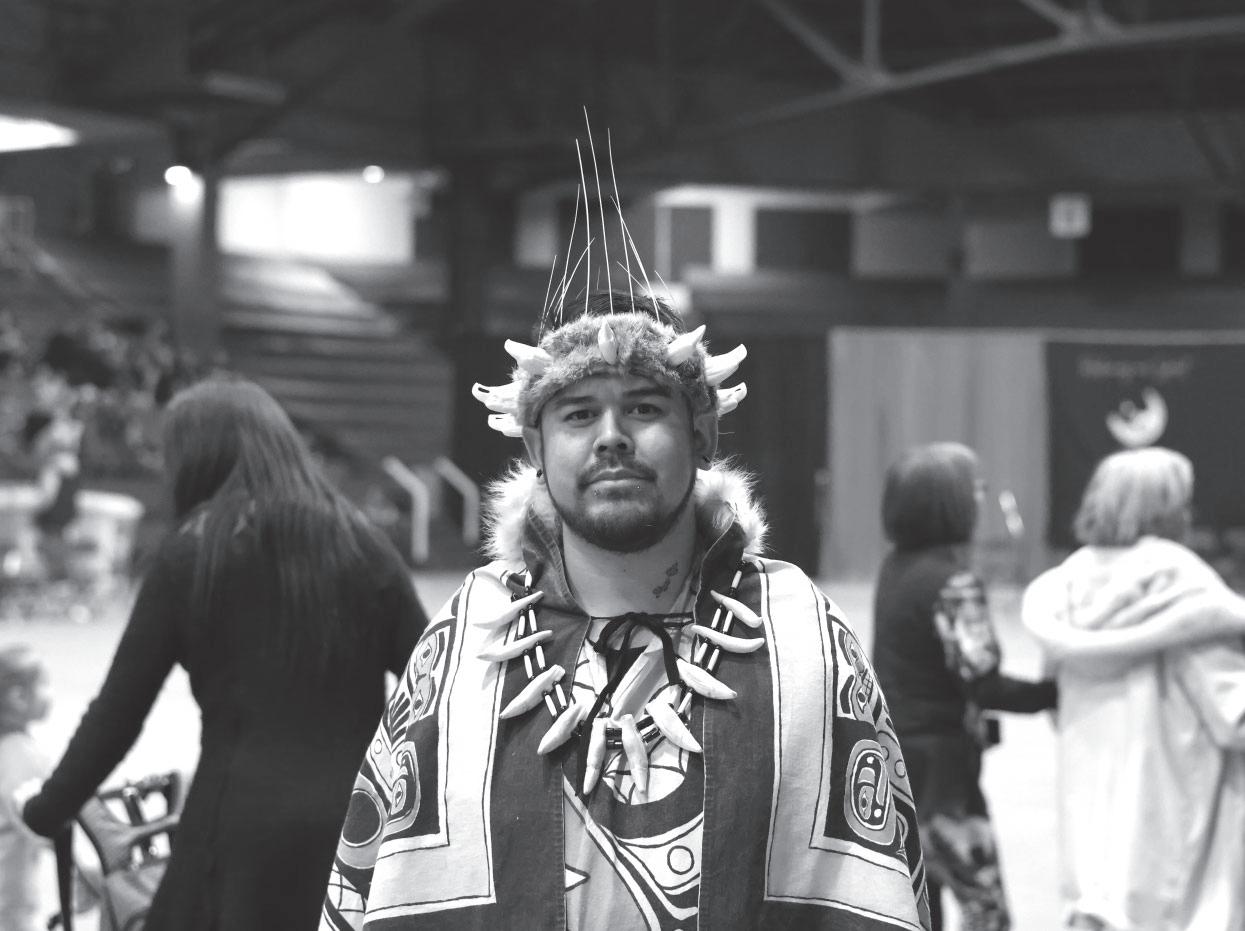
Ts’amiks Nisga’a Cultural Dancer Jade Doolan wore his uncle’s crown during the 2025 new year’s celebration.
Hateful graffiti found on Port Alberni Orange Bridge
Tseshaht asks Ministry of Transportation to install a highway camera after landmark defaced twice in one week
By Nora O’Malley and
Eric
Plummer Local Journalism Initiative Reporter and Editor
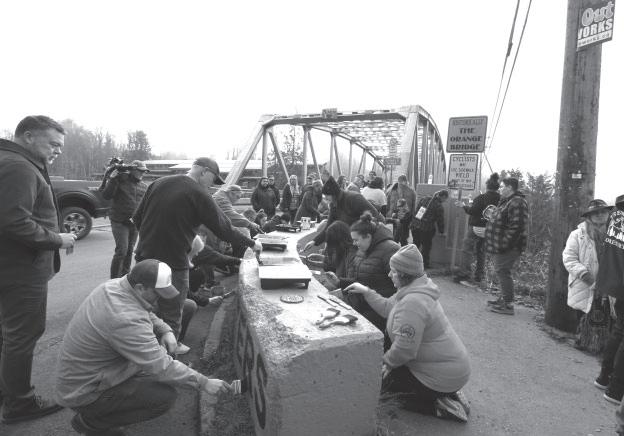
Port Alberni, BC – Port Alberni RCMP are investigating after the ‘Every Child Matters’ barrier at the Orange Bridge was vandalized for the second time in a week. Three swastikas were found spray-painted on the pillars of the bridge and the ‘Every Child Matters’ slogan was defaced with a racist slur on Jan. 21 between 1 a.m. and 2 a.m.
Just one week prior, on Jan. 14, the slogan was defaced with the same racist slur. The lettering of the ‘Every Child Matters’ slogan was also vandalized in September 2022 – only a day after it was originally painted in partnership with the Ministry of Transportation and Transit and Tseshaht First Nation.
Tseshaht Chief Councillor Wahmeesh, Ken Watts, said there is “no space for this type of hate” anywhere in the world.
“I woke up mad, sad, angry, and I get a little worried about where this world is headed,” said Watts. “I hope to see that people condemn what happened here.”
“We are, first and foremost, standing with Tseshaht,” stated Port Alberni Mayor Sharie Minions on Jan. 21.
“Myself, members of Council and staff helped repaint the ‘Every Child Matters’ sign today. Being there with Tseshaht and sending a firm message to the community that this is not tolerated is our first step. Following that, we will take the lead from Tseshaht on how we can help going forward.”
Courtenay-Alberni MP Gord Johns said he also stands in solidarity with Tseshaht First Nation, with residential school survivors, and with all those who are committed to ensuring that every child’s story is honoured and remembered.
“Along with the vast majority of our community, I am deeply disturbed and saddened by the repeated racist vandalism of the Orange Bridge in Port Alberni, especially the use of swastikas and hateful slurs targeting the Every Child Matters message. This is not only an act of vandalism, it is an attack on survivors, on Indigenous families, and on the truth of what happened at the Alberni Indian Residential School,” said Johns in an email.
“This bridge holds deep meaning for the entire community. Repainting it orange was an act of remembrance and education. It honours children taken without consent from more than 70 First Nations and acknowledges the enormous harm that resulted over many decades. Acts of hate will not erase this truth, nor will it stop the work of reconciliation. It only underscores how much work remains,” he said.
For decades, the Somass River bridge stood as a line of demarcation for many Indigenous children sent to the Alberni Indian Residential School that closed its doors in 1973. The bridge was painted
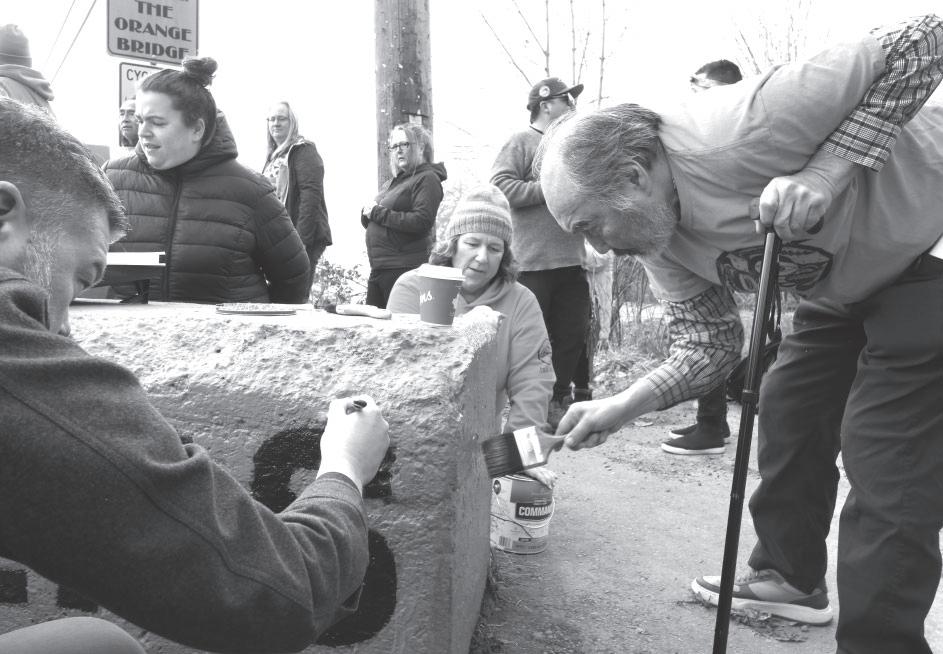
Je
orange in 2022, the same colour used on National Day for Truth and Reconciliation to “create a more positive and welcoming area for Survivors”, said Watts.
ff Cook, a former student of the Alberni Indian Residential School, joins others from the Port Alberni community in repainting the ‘Orange Bridge’ after the landmark was defaced with graffiti on Jan. 21. tor activity at the section of Highway 4. “If there was ever a need to keep an eye on something it’s right now,” said Watts. He noted that the ministry was quick to respond to Tseshaht’s request to limit highway traffic on the bridge to one alternating lane as the graffiti was painted over on the afternoon of Jan. 21. Dozens
This is the first time the hate-motivated graffiti at the Orange Bridge has included the antisemitic symbol of the swastika, a symbol of hate appropriated by the Nazi Party in the 20th century that is banned in many countries.
“Millions of people gave up their lives to fight against that type of hate in World War II, and even beyond,” said Watts.
“We’re doing our part to educate a better generation of Canadians. Unfortunately, there’s adults, parents and grandparents that feel this way.”
Under the Criminal Code of Canada, individuals who wilfully promote hatred against any identifiable group and who promote antisemitism could be sent to jail for up to two years if found guilty.
“There’s new Canadians who are worried about what their lives will be like here in Canada when they see things like this happen,” said Watts, who also acknowledged the graffiti’s impact on Jewish Canadians. “I hope that people who do things like this get to see the light, in what they’re doing is spreading hate.”
The RCMP were on the scene before daylight investigating.
“They had their forensic people out here looking at a bunch of different things, searching the area, looking at cameras from other places,” said Watts.
Tseshaht requested that the Ministry of Transportation install a DriveBC camera at the Orange Bridge, which would moni-

27
Mobile Hair Stylist
from the Port Alberni community came to participate in repainting the bridge, including representation from the Royal Canadian Legion, who Watts reached out to in recognition of Canada’s sacrifices to fight Nazism during the Second World War.
Eric Plummer photos
‘Cancer never met Rambo’: Hope sustains after 6 years
Mike Lambert has endured multiple cancer surgeries and two rounds of radiation and chemotherapy treatment
By Eric Plummer Ha-Shilth-Sa Editor
Port Alberni, BC - More than six years since his cancer diagnosis – a period that has included multiple surgeries and two rounds of radiation treatment and chemotherapy – Mike Lambert admits that he prays a lot more than he used to.
“Think positive,” said the 66-year-old Tseshaht member. “I’m not ready to go. I’m not done down here yet.”
The Port Alberni resident is currently on his second round of chemotherapy, bi-weekly treatments he has been getting from Nanaimo since June. For the time being, these will continue indefinitely – as long as a growth on his liver and numerous nodules in his lungs don’t considerably worsen.
It all started more than six years ago when tests were being done on a hernia infection to his right side. A colonoscopy didn’t detect any problems, but concerns arose when doctors investigated the inside of the stomach.
“They went in from the bottom end and everything was good there, but when they went in to check for the hernia through the stomach they bumped into some cancer,” said Lambert, who received his diagnosis on April 22, 2019.
The tumor was against a large blood vessel, which made surgical removal a hazardous procedure. Six months of chemotherapy ensued to shrink the tumor and pull it away from the blood vessel, enabling surgeons to then remove it.
By the beginning of the following year Lambert was ready for Whipple surgery, a procedure that removes the head of pancreas, the first part of the small intestine, gall bladder and bile duct. Performed on Jan. 10, 2020, the remaining organs were rejoined to allow food to pass through what remained of Lambert’s digestive system.
Then the COVID-19 pandemic took over, delaying the regular X-rays Lambert needed to monitor if the cancer was growing elsewhere. Eventually tests detected cancer in his left lung, which led to more surgery to remove the organ’s bottom lobe and part of the top.
But after radiation treatment cancer was found in the right lung, where it remains today.
“They were monitoring that one and it was staying stable for a few years. It still is, as far as I know,” said Lambert.
The disease also spread to a vertebrae in his spine.
“It was also pinching a nerve that was going into my hip and down my leg,” he said. “It was causing severe pain.”
And so, after another round of radiation treatment Lambert was on the operating table one more on Dec. 10, 2025.
Surgeons removed some cancer from his spine, injecting a cement-like substance to prevent the damaged vertebrae from collapsing further, while entombing what cancer remains. Lambert was told that any cancerous cells that remained would die due to the cement preventing oxygen from entering the affected area.
He was awake during the procedure, and recalls a doctor tapping at the cement on his spine after it dried.
“He was hammering on my spine with a little hammer like the gold diggers do,” said Lambert.
Watch for changes in your body, says cancer society
Lambert’s situation isn’t unusual, as 42 per cent of people will get cancer at some point in their life, according to the Canadian Cancer Society. For men, prostate cancer is the most common form of the disease, while breast cancer leads among women. Lung cancer comes in second for both sexes, and is the leading cause of the disease ending someone’s life. The cancer society estimates that 22 per cent of Canadians will die from some form of cancer.
PROPOSED WOODLOT LICENCE PLAN FOR WOODLOT LICENCE W1878
Notice is hereby given that a proposed Woodlot Licence Plan (WLP) has been prepared for Woodlot Licence W1878, located in Kyuquot Sound, BC. The WLP outlines management strategies, objectives, and standards for timber harvesting and forest stewardship within the licence area. The proposed plan, if accepted will have a 10-year term
The WLP and information about the proposal can be obtained by contacting Tom Younger RPF at 250-830-8474 or at the email below. Inquiries/comments as to the proposed plan must be submitted to tom@youngerforest.com by March 7, 2026.
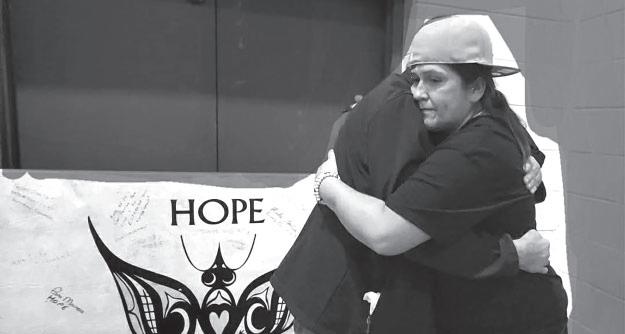
Lambert embraces Shae Doiron during a ball hockey tournament she has organized annually to generate funds for cancer patients.
Four in 10 cancer cases can be prevented by healthy life choices like not smoking, limiting overexposure to the sun, maintaining a healthy body weight, staying physically active, having a healthy diet and minimizing alcohol consumption, says the Canadian Cancer Society.
It’s also advisable to watch out for certain changes in your body.
“When you notice something different about your body – like a new growth or lump, increased fatigue or dramatic weight loss – it needs to be checked out,” stated the cancer society. “A change to your body might be nothing, but it might be serious. Always see a healthcare provider if there are any changes to how you’re feeling or you have new physical symptoms. Get changes checked sooner rather than later.”
“No one’s ever told me why I got it, if it’s from eating certain foods or what,” reflected Lambert, who is feeling the effects from years of cancer treatment. He has neuropathy below his knees, a cold sensation resulting from nerve damage.
“In my feet it feels like I’ve got sand in my socks all the time, in my toes,” he said. “I also lost some of my taste buds, where gravy doesn’t taste like gravy,
stuffing doesn’t taste like stuffing at Christmas time.”
But despite this toll on his body, Lambert remains hopeful.
“Never give up,” he said. “Take what you believe with Indian cultural medicine, stuff like that.”
“I’m glad my family has been there whenever I’m in Victoria for these surgeries because that’s my medicine,” he added. “It’s good to wake up to see someone you’re used to seeing.”
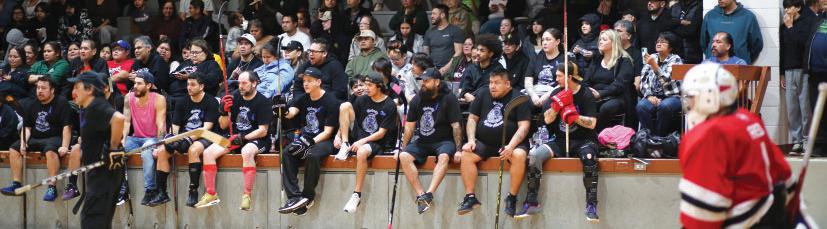
Over the last weekend of January a Port Alberni ball hockey team took to the floor of Maht Mahs to compete for Lambert, while wearing the name of his late sister Sandra who passed in 2020 from a cancer that started with a lump on her breast. The back of the team’s shirts display the caption ‘Mike’s a Warrior’.
Attracting 15 teams from across the coast, the tournament served as a fundraising event to help seven people in their struggles with cancer, including Lambert, who goes by the nick name “Rambo”.
“I’m not ready to go nowhere yet,” said Lambert. “Cancer never met Rambo.”
The Canadian Cancer Society has specialists available at 1-888-939-3333 to help people detect the disease early.
Submitted photos
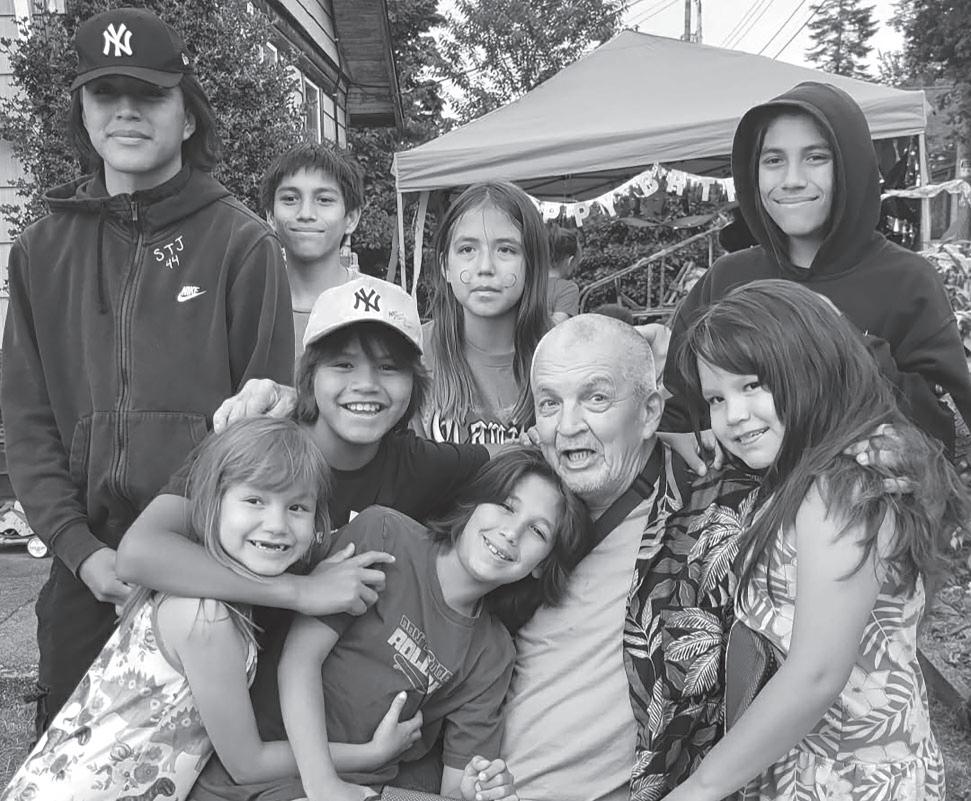
Pictured with his grandkids in 2025, Mike ‘Rambo’ Lambert is still fighting cancer after being diagnosed in 2019.
Ha-Shilth-Sa newspaper is published by the Nuu-chah-nulth Tribal Council for distribution to the members of the contributing First Nations, as well as other interested groups and individuals.
Information and original work contained in this newspaper is protected by copyright and may not be reproduced without written permission from:
Nuu-chah-nulth Tribal Council P.O. Box 1383, Port Alberni, B.C. V9Y 7M2.
Telephone: (250) 724-5757
Fax: (250) 723-0463
Web page: www.hashilthsa.com facebook: Hashilthsa Ntc
2026 Subscription rates:
Non-Nuu-chah-nulth, Ahousaht, Ehattesaht,Toquaht and Ucluelet members are subject to a yearly subscription fee of $40 in Canada, $50 in the US and $60 for overseas. Payable to the Nuu-chah-nulth Tribal Council
Manager/Editor/Reporter
Eric Plummer (Ext. 243) (250) 724-5757 Fax: (250) 723-0463 eric.plummer@nuuchahnulth.org
Reporter
Denise Titian (Ext. 240) (250) 724-5757 Fax: (250) 723-0463 denise.titian@nuuchahnulth.org
Reporter
Nora O’Malley (604) 353-8488 nora.omalley@nuuchahnulth.org

Audio / Video Technician
Mike Watts (Ext. 238) (250) 724-5757 Fax: (250) 723-0463 mike.watts@nuuchahnulth.org
Editorial Assistant
Holly Stocking (Ext. 302) (250) 724-5757 Fax: (250) 723-0463 holly.stocking@nuuchahnulth.org
DEADLINE:
Please note that the deadline for submissions for our next issue is Feb 13. 2026
After that date, material submitted and judged appropriate cannot be guaranteed placement but, if material is still relevant, will be included in the following issue.
In an ideal world, submissions would be typed rather than hand-written. Articles can be sent by e-mail to holly.stocking@nuuchahnulth.org (Windows PC).
Submitted pictures must include a brief description of subject(s) and a return address.
Pictures with no return address will remain on file. Allow two - four weeks for return.
Photocopied or faxed photographs cannot be accepted.
COVERAGE:
Although we would like to be able to cover all stories and events, we will only do so subject to:
- Sufficient advance notice addressed specifically to Ha-Shilth-Sa.
- Reporter availability at the time of the event.
- Editorial space available in the paper.
- Editorial deadlines being adhered to by contributors.
LETTERS and KLECOS
Ha-Shilth-Sa will include letters received from its readers. Letters MUST be signed by the writer and have the writer’s full name, address and phone number on them. Names can be withheld by request. Anonymous submissions will not be accepted. We reserve the right to edit submitted material for clarity, brevity, grammar and good taste. We will definitely not publish letters dealing with tribal or personal disputes or issues that are critical of Nuu-chah-nulth individuals or groups. All opinions expressed in letters to the editor are purely those of the writer and will not necessarily coincide with the views or policies of the Nuu-chah-nulth Tribal Council or its member First Nations. Ha-Shilth-Sa includes paid advertising, but this does not imply Ha-Shilth-Sa or Nuu-chah-nulth Tribal Council recommends or endorses the content of the ads.
Toxic drug poisoning alert for all of B.C.
Veterinary sedative detected in street supply, which can cause prolonged effects
By Denise Titian and Chloe Wangler Ha-Shilth-Sa Reporter and Editorial Assistant
British Columbia – The BC Centre for Disease Control has issued a warning about the increase in drug poisonings seen throughout the province of British Columbia. The warning was issued January 26 to people who use illicit substances.
The warning follows an alert issued for the Cowichan Valley on January 20, where health officials saw an increase in overdose events.
“Drug poisoning events have been increasing in British Columbia, and novel substances in the unregulated drug supply are putting people who use substances at risk province-wide,” said the BCCDC in a written statement.
Medetomidine, described as a potent non-opiod sedative used by veterinarians, has been detected in the unregulated, illicit drug supply. When combined with opioids such as fentanyl it can cause complex drug poisoning, including prolonged sedation and very low or no pulse. Prolonged sedation is especially
concerning because it can not be reversed by naloxone. The BCCDC harm reduction services states that the prolonged sedation can occur after opioid poisoning if the substances are contaminated with non-opioid sedatives.
This reaction creates further difficulty for responders, as naloxone will restore breathing that is stopped by opioids but not wake someone who is sedated. Sometimes, responders will administer too much naloxone because the person remains unresponsive. Referencing the BC Emergency Health Services handbook, they suggest a maximum of three to four initial doses, any more could trigger refractory reversal forcing instant and violent withdrawal. The BCCDC’s harm reduction services website towardtheheart.com has a naloxone 101 training course on how to recognize and respond to a drug poisoning, including proper use of naloxone.
According to FNHA data 28 First Nations people died from toxic drug poisonings between January and June 2025 on Vancouver Island. This is a 37.8 per cent decrease from the 45 deaths during the same period in 2024. This same period
Ha-Shilth-Sa belongs to every Nuu-chah-nulth person including those who have passed on, and those who are not yet born. A community newspaper cannot exist without community involvement. If you have any great pictures you’ve taken, stories or poems you’ve written, or artwork you have done, please let us know so we can include it in your newspaper. E-mail holly.stocking@nuuchahnulth.org. This year is Ha-Shilth-Sa’s 52st year of serving the Nuu-chah-nulth First Nations. We look forward to your continued input and support. Kleco! Kleco!
saw a province-wide decrease of 20.8 per cent in toxic drug poisoning events involving First Nations people. While the numbers are decreasing, the unregulated drug supply in B.C. remains highly potent and First Nations individuals continue to be disproportionately affected.
Health officials advise substance users to practice harm reduction measures to reduce the risk. That means having their drugs tested, never using alone and/or consuming at a supervisor consumption site. Users are cautioned to start with a low dose and go slow, carry naloxone and know how to use it.
For those that use alone there is the Connect app by Lifeguard. It prompts you to turn off an alarm and sends a notification to BCEHS dispatch if you don’t. There are downloadable applications that can keep people up to date on poisoning alerts such as Towards the Heart. The Towards the Heart app and website contain resource information and the app sends alerts about the toxic drug supply. Sign up for drug alerts by texting the word JOIN to 253787 (ALERTS).
Legal Information
The advertiser agrees that the publisher shall not be liable for damages arising out of errors in advertisements beyond the amount paid for space actually occupied by the portion of the advertisement in which the error is due to the negligence of the servants or otherwise, and there shall be no liability for non-insertion of any advertisement beyond the amount paid for such advertisements
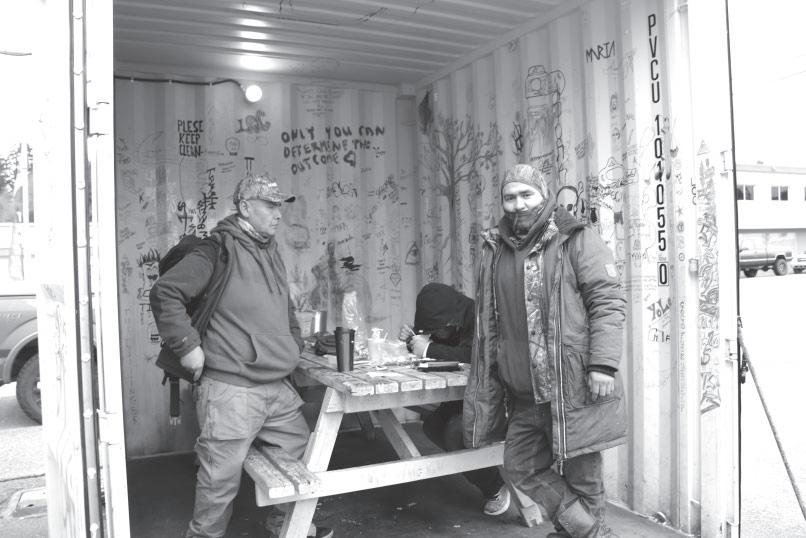
Leon Titian (right) stands with others behind the Safe Injection Site facility in Port Alberni. No deaths have been reported from the site.
90-year-old digs in own pockets to help less fortunate
Mr. Em is well known among the street community in Port Alberni for his generosity during extreme weather
By Denise Titian Ha-Shilth-Sa Reporter
Port Alberni, BC – From the warmth of Quality Foods’ cafeteria, an elderly man peers out at the school playing field across the street where hundreds of sea gulls scratch the srubby grass searching for worms.
“They know me, they get excited when they see me leaving the store,” says Mr. Em.
Because he’s a senior citizen known for his and his wife’s generosity, the man keeps his private information safe. For this story, he asked to be called Mr. Em. Even so, he is well-known amongst the street community where he is immediatly recognized and welcomed. He gives food and drink – whatever he has to offer from his own resources.
Mr. Em says he’s lived in the area for nearly 20 years and is known at the grocery store where they give him their old bread so that he can feed the sea gulls on his way home.
“They (the sea gulls) know where I live and sometimes, if I don’t have bread, I have to drive another way to town so they don’t see me and get excited,” he chuckled about the sea gulls.
Mr. Em even carries pet treats in his pocket for the dogs he sees in his travels. He was born in Germany in 1935, four years before the outbreak of the Second World War. With the war still raging across Europe and Pacific, in 1943 Mr. Em and his family moved to Montreal, where he attended school. He went to University at a time when it only took two years to earn a teaching degree.
Mr. Em always preferred to do things on his own time, so when he turned his photography skills into a business, it didn’t do well, because people liked getting their prints in a timely manner. He says the same thing about “professional volunteering” where you have to show up at certain times and work a set number of hours. That doesn’t work for him.
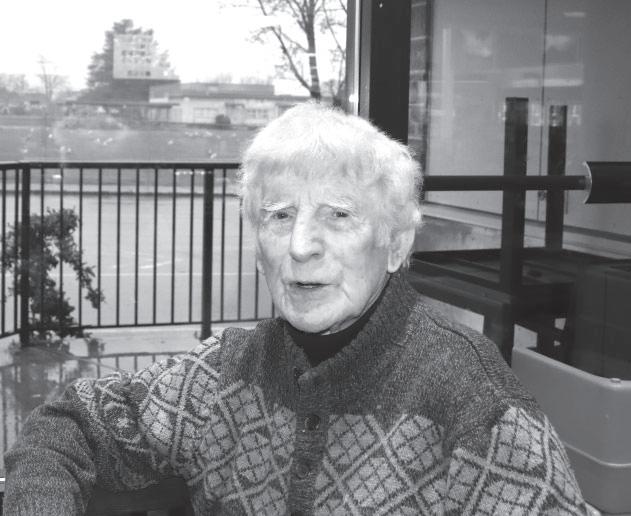
Mr. Em is well-known amongst the street community, where he is immediately recognized and welcomed. He gives food and drink – whatever he has to offer from his own resources.
So, Mr. Em likes to help people in his own way. He noted that there is help available for people struggling in Port Alberni, but Mr. Em noticed a gap. In extreme weather, for example, there’s places for people to go warm up or cool down, but for the most part, it’s on the condition of sobriety.
There are some people left outside on hot days or in extreme cold. There’s not a lot of those extreme temperature days, but when they happen, Mr. Em says he will be on the streets in his van or on his scooter, handing out refreshements.
In the summer, when the heat rises above 80 Fahrenheit, Mr. Em freezes about 80 cans of pop then delivers them to heat exhausted people around town. In the winter, when the temperature drops below freezing, he will pack a gas stove, some water and hot chocolate and hand out hot drinks from his van.

eled to places like India, England, and Africa where he taught for a short time, learning languages and customs.
“In some Scandinavian countries, if you’re out of work, you get a counsellor. Here, the government has programs to maintain people, but I think they should be more involved in helping people change their situation,” he shared.
When he returned to Canada, Mr. Em landed in northern Alberta, where he worked as a ground water technician. He would drill wells working for the government and Métis people. That is where he met his wife. They started their family in Alberta.
But Alberta Environment, he said, wanted to get rid of people so he retired a year early and the Em’s moved to Port Alberni where they could reconnect with family.
‘I feel a certain obligation’
After a lifetime working with his hands, Mr. Em became good at building and fixing anything mechanical, especially bicycles and scooters.
“I’ll go down to the Safe Injection Site, the Bread of Life, the Shelter on Eighth or the corner of 10th and Redford,” said Mr. Em.
He says people are so hot in the summer, walking up long hills or lying in the streets.
“I try to help people in difficult situations,” he said.
But since he has limited resources, he helps out only in extreme weather.
‘Everybody knows him’
Those down at the Safe Injection Site lite up when they hear Mr. Em’s name.
“Everybody knows him,” said Harold Tomren, adding that Mr. Em even helped his cousin with a mobility scooter. “He always helps out with hot chocolate and cookies, and in the summer he’ll bring plums and cherries from his trees.”
Mya Driver, a harm reduction outreach worker with the Nuu-chah-nulth Tribal Council, has known him for several years. She met him when Mr. Em fixed her son’s go-cart.
Driver spoke of his generosity and added that he’s been known to help people fix their mobility scooters. He’s even purchased a couple for people who were immobile but couldn’t afford their own scooters, said Driver.
In his early career as a teacher Mr. Em went to Churchill, Manitoba to work with Inuit high school students. It was a residential school, he said, but it was a voluntary one. The smaller villages had elementary schools but if you wanted higher grades, you had to send your teenagers to Churchill for high school or vocational school.
He recalled that teachers were encouraged to participate in extracurricular activities with the students. He said they would build snow forts or ride snowmobiles.
There was a period when Mr. Em trav-

“So I go to thrift stores and if there’s a scooter there that needs repair, I’ll buy it,” he said.
Mr. Em estimates he’s fixed 10 to 15 scooters over the past six years and he’s given them away, but he has conditions for his gift.
“They have to be able to look after it, they have to have a place to store and they cannot sell it,” he said.
He helped an elderly man acquire a repaired scooter. The man eventually ended up in a care home. Recently, the man passed away and his estate left Mr. Em a pair of scooters and a wheelchair.
“The wheelchair and a scooter were donated to the hospital,” said Mr. Em. He plans to give the other scooter to an 83-year-old who uses a walker. She can only walk on flat ground so he hopes that she will accept the scooter so she can improve her mobility, but she’s nervous about getting to know how to use one.
After fixing up his own house, Mr. Em helps his neighbors where he can with home maitenance. He has a 100-yearold neighbor who needed help with her siding.
“I enjoy being helpful. I like seeing people who are grateful for the help,” he told Ha-Shilth-Sa.
But it can be expensive, with $25 to $80 for supplying refreshments to people each trip, or more than $600 to replace a scooter battery.
Mr. Em says he and his wife have pensions and government benefits, along with enough savings to be comfortable. Both do what they can to support their community and its charitable causes.
“I feel a certain obligation to help others and I’m grateful for being able to feed the birds and dogs and to help people,” said Mr. Em.
He plans to continue doing what he’s doing for as long as he can and he’s happy because he can it whenever he wants to.
Port Alberni Friendship Centre Volunteers Needed
Need work experience? The Port Alberni Friendship Centre is looking for interested applicants for various positions. Call 250-723-8281
Denise Titian photo
Protesters involved in Walbran logging road accident
First Responders remind backroad users to drive cautiously, as blockade group continues with open invitation
By Denise Titian Ha-Shilth-Sa Reporter
Walbran Valley, BC – A truck carrying two people connected to a logging blockade went off the frozen logging road on the morning of Jan. 19 in same area where a camp has been established for those protesting against old growth harvesting.
Cawak ʔqin Forestry, co-owned by Huuay-aht First Nations and Western Forests Products, was made aware of a single vehicle incident that occurred the morning of Jan. 19 at the 14.5 km mark on the Walbran Main.
“It is Cawak ʔqin’s understanding that a private vehicle lost control, left the road, and ended up in Walbran Creek,” said Geoff Payne, general manager of the forestry company.
He went on to say that emergency services, including the RCMP, attended the scene.
Sources say that a pickup truck left the roadway and fell down an 80-foot embankment. The two people in the truck survived and were able to extricate themselves, making their way back up to the road where they were discovered by passing forestry workers.
The BC Ambulance Service received a call at 11:22 a.m. on Jan. 19 about a motor vehicle incident on a forest service road outside of Lake Cowichan.
“Two ambulances with primary care paramedics, an advanced care paramedic response unit and an air ambulance with critical care paramedics attended the scene,” stated the ambulance service.
“Paramedics provided emergency medical care for one patient who was transported by air ambulance to hospital in stable condition”, said Brian Twaites, B.C. Emergency Health Services paramedic public information officer.
The accident occurred on the route to an anti-old growth logging encampment near McLure Lake. Ada’itsx/Fairy Creek Blockade has confirmed that the two involved in the crash are connected to the protest camp.
“The people in the accident were from the blockade, they are both well and taken care of,” said the group via social media.
Proponents of the Ada’itsx Fairy Creek Blockade continue to invite people to join them at the remote camp, with route directions displayed on their social media pages.
“Everyone knows to stay safe and careful but accidents can happen to everyone, everywhere,” said Ada’itsx Fairy Creek
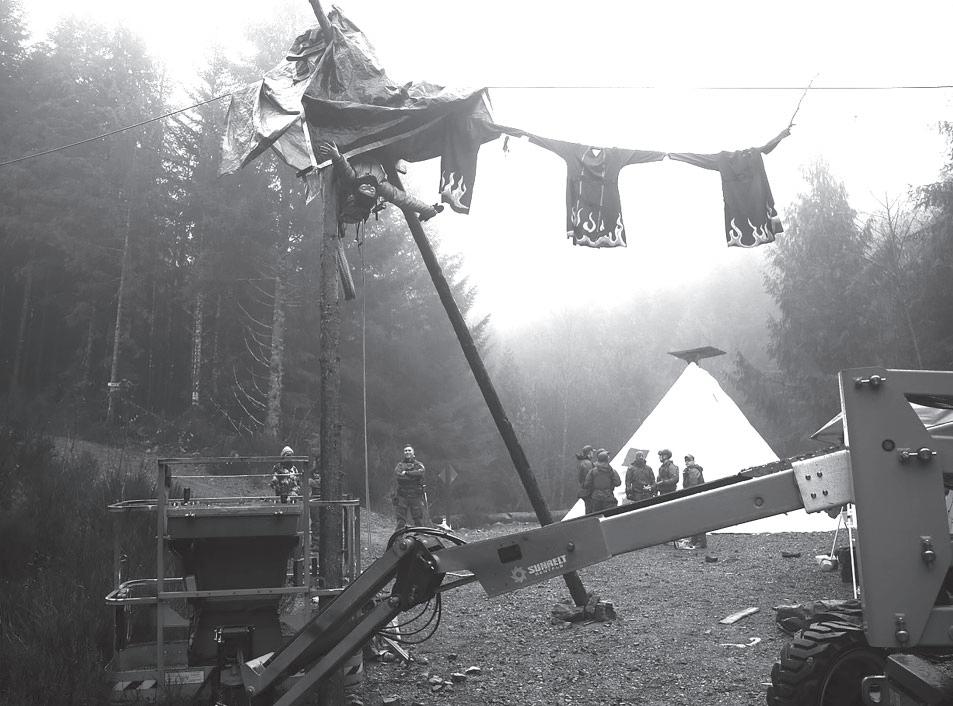
Ada’itsx/Fairy Creek Blockade photo Emergency personnel responded to a vehicle accident on Monday, after a truck fell down an embankment. The incident occurred in the Walbran Valley, on a logging road that leads to a protest camp. Pictured are police officers at the camp.
Blockade.
Protests have been underway on the logging roads of southwest Vancouver Island since the summer of 2020, when a group emerged to protect old growth forest in the Fairy Creek Valley near Port Renfrew from logging. At times alerts have been issued when members of the public went missing in the remote region, including the case of Kevin ‘Bear’ Henry. In February 2022 forestry industry workers came upon the 37-year-old, after he had been reported missing months earlier. Henry had planned to join a logging protest camp in the Walbran Valley. His family last spoke to Bear on November 27, 2021. He had been traveling alone with his camp supplies in an old van.
It was winter and the roads in the mountains of the Walbran Valley would have been frozen, with snow in some areas. Bear Henry reportedly went down a little-used spur road where his van broke down. He claims to have lived off his limited supply of food, inside his van until February 9, 2022, when he left the shelter and headed for the busier logging

road.
Forestry workers brought Henry to Lake Cowichan where he was medically treated and eventually reunited with his family.
Cawak ʔqin Forestry say that it is their understanding that the RCMP is investigating the Jan. 19 incident and that they are working with the B.C. Ministry of Environment and ICBC to ensure a prompt removal of the vehicle from Walbran Creek.
“This incident serves as a good reminder about being prepared for winter driving conditions on industrial roads, which can be subject to rapid change,” said Geoff Payne. “Industrial roads can have varying surface conditions and may not be suitable for all vehicles. Obey all posted speed limits, warning signs and closure restrictions.”
If you’re travelling on industrial roads in the winter, the BCEHS offers these general winter driving safety tips: Winter tires are required in many parts
of B.C. Winter tires provide better traction in snowy and icy conditions.
Along with winter snow tires, make sure you have enough fuel or battery life and plenty of windshield wiper fluid before heading out.
Avoid driving when tired
Don’t drive distracted
Leave your cell phone alone
Leave early - giving extra time for your trip so you’re not rushing.
Don’t drive impaired
Maintain a safe following distance behind other vehicles.
Don’t drive through large puddles or pools of water if you can safely avoid it.
If you’re going to be on the road, make sure to check current conditions and road closures before leaving. If conditions are poor, you may want to consider delaying your trip.
A court injunction remains in place, which enables police to arrest those interfering with forestry activities in the area.
Province delays revising Heritage Conservation Act
Changes are intended to help speed up development, but municipalities cite possible ‘negative public reactions’
By Karly Blats Ha-Shilth-Sa Contributor
The provincial government is postponing the introduction of proposed amendments to the Heritage Conservation Act (HCA) that had originally been anticipated for spring 2026.
Last year, it was announced that legislation determining how British Columbia’s heritage sites are protected would be updated. The Heritage Conservation Act applies to more than 64,000 protected sites on the provincial registry – 90 per cent of which are of First Nations origin. The act, that was last revised 30 years ago, regulates how these sites are protected when work is done at the locations.
Under current legislation, development often requires the need for multiple permits which can average 300 days for regulatory review. A hope for the new legislation is to speed up this process, which would allow for communities to rebuild faster after natural disasters like wildfires and floods. In addition, those involved in the revision process want to see the new act align with UNDRIP, the United Nations Declaration on the Rights of Indigenous Peoples.
The decision to postpone the proposed amendments to the act is a result of needing more time for engagement, after a request came from the Union of B.C. Municipalities.
“We were on a timeline to get legislation through this spring sitting,” said Judith Sayers, co-chair of the joint working group on First Nations heritage conservation. “When UBCM asked, and the minister granted an extension of the
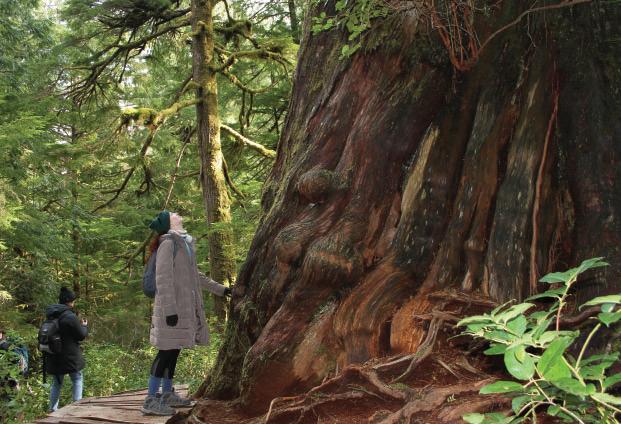
Plummer photo
The Heritage Conservation Act applies to more than 64,000 protected sites on the provincial registry – 90 per cent of which are of First Nations origin. The act, that was last revised 30 years ago, regulates how these sites are protected when work is done at the locations. Pictured is Meares Island in Tla-o-qui-aht territory.
engagement time period, we had to then target the fall sitting (2026).”
“There is near unanimous concern that the proposed changes are rushed, policies are underdeveloped, and future implementation processes potentially unfunded,” stated a submission from the UBCM to the Ministry of Forests in November about the proposed changes to the Heritage Conservation Act. “Local governments expressed deep concerns about financial burdens, private and public project delays, and the potential for negative public reactions regarding the impacts of the proposed changes on
private property rights.”
The UBCM submission noted that many of its municipalities “support shared governance and Indigenous-led protection frameworks,” but that some “worry that expanding First Nations’ authority, particularly over private or local government lands, could lead to jurisdictional conflict, legal challenges or duplicated permitting.”
Sayers said the B.C. legislative process is long and involved. She said the delay is a disappointment but that it’s better for everyone involved to get the chance to contribute feedback rather than “feeling
left out and objecting to the much-needed amendments to the legislation.”
The new legislation has been in development for several years with more than 300 organizations consulted to help inform how the act should be updated, including municipalities, the archeological branch, real estate associations, construction companies and resource industries.
In a press release from the provincial government, it was stated that input received to date has confirmed the importance of streamlining the permitting for major projects on Crown land and private residential development, ensuring quicker community rebuilds following a disaster.
Input has also stressed the need for better protection of heritage and significant First Nations cultural sites.
The working group and the province have agreed on 53 of the 57 items proposed.
“We agreed to put those four (remaining) items off until after we get these amendments through,” Sayers said. “We felt it better to get all these other items through and not be delayed further while we try and agree on the remaining four. Making wrongs right to heritage sites and objects is not part of this working group. We are focused on making the HCA consistent with UNDRIP.”
The Ministry of Forests will continue to engage with industry, project proponents, First Nations, local governments and other interested parties. Specifically, the province will be inviting industry partners to a cross-sector meeting in the coming weeks to discuss the permitting process.

Eric
Ball hockey action rocks Maht Mahs in cancer benefit
The eighth cancer fundraising event returned to Tseshaht territory to help seven individuals fighting the disease
By Eric Plummer Ha-Shilth-Sa Editor
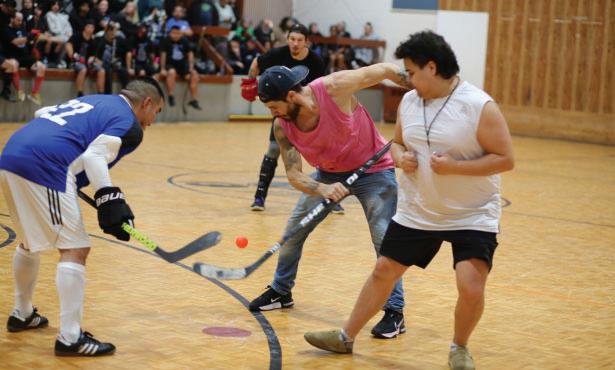
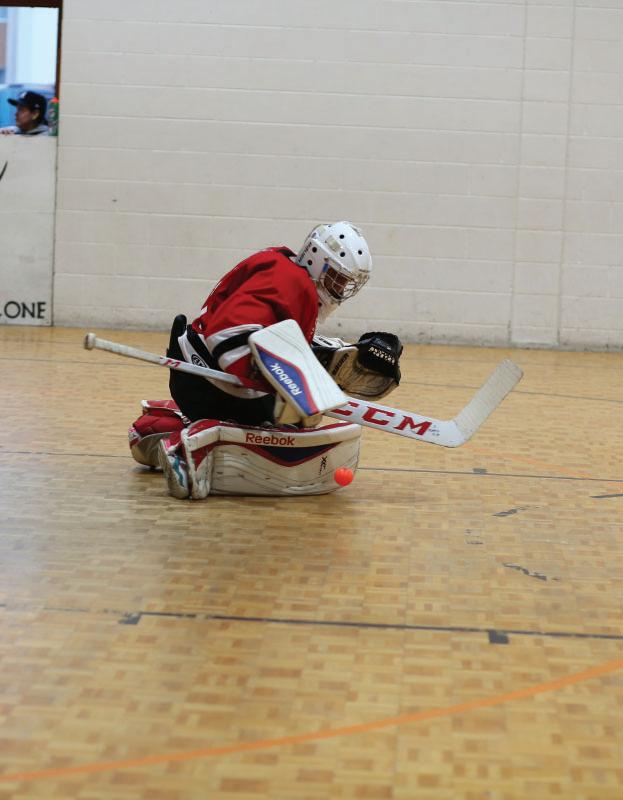
Port Alberni, BC - Ball hockey took over Maht Mahs on the last weekend of January, drawing 15 teams for a fundraising tournament to help seven individuals fighting cancer.
Ten men’s and five women’s teams took part in the eighth cancer benefit tournament on Tseshaht territory, a ball hockey event that took place annually until the COVID-19 pandemic hit in 2020. The fundraising tournament returned last year to help those struggling with the disease.
“Off the top of my head, $60,000 fundraised over the years given out to all stages of people fighting cancer,” said tournament organizer Shae Doiron.
This year over $15,000 was raised for seven cancer patients with diverse ages as young as 10 years old. A number of donations helped to make the event happen, including goods from Tseshaht Market, free use of the Tseshaht First Nation’s Maht Mahs gym and help from the Nuu-chah-nulth Tribal Council.
Several Port Alberni teams participated, plus competitive squads from Port Hardy, Alert Bay and the Chilliwap Warriors from east of the Lower Mainland.
Doiron’s father Chuck signed up to play with his grandson Kayden on Sandra’s Rack Pack, a local team named after the late Sandra Lambert. Shae is also a referee and playing on one of the Port Alberni teams in the women’s division.
“We’re just a bunch a free agents,” she said. “Ladies who have either played against each other, played with each other over a span of 25 years.”
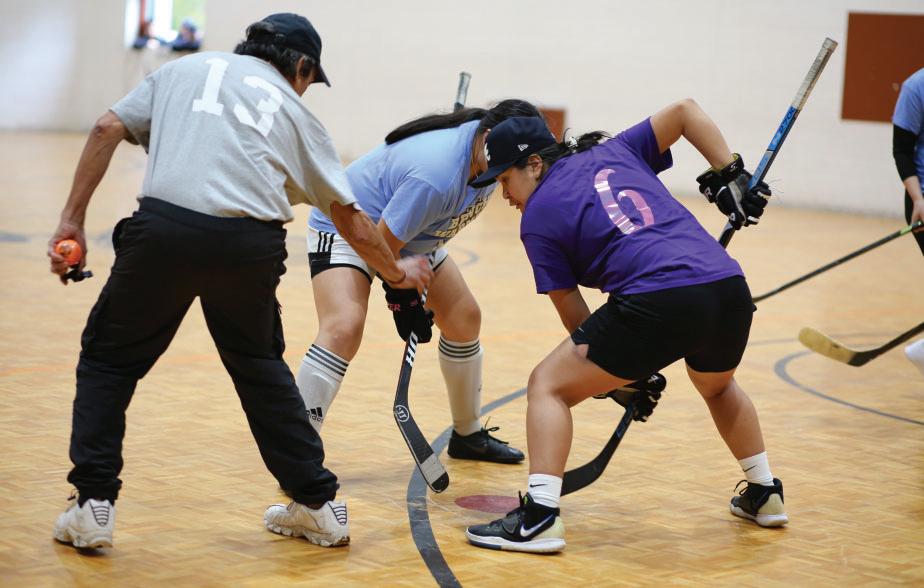
Scheduled Friday, Jan. 30 to Sunday, Feb. 1, the ball hockey tournament had a double elimination format, meaning that all teams play at least two games.
In the end EA Memorial from Campbell River claimed the men’s division, while Cougar Baits from Port Hardy took the women’s title.
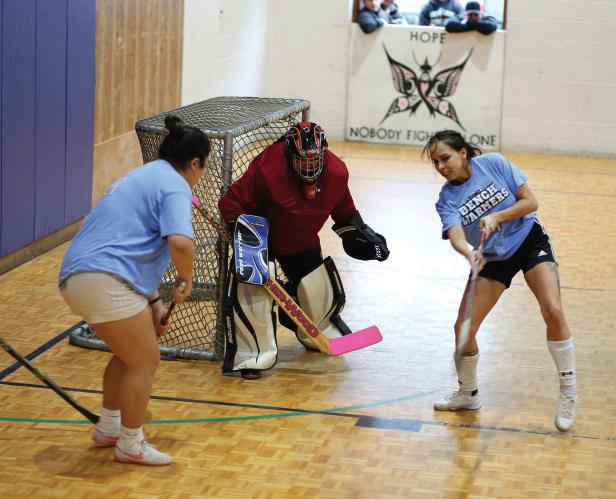
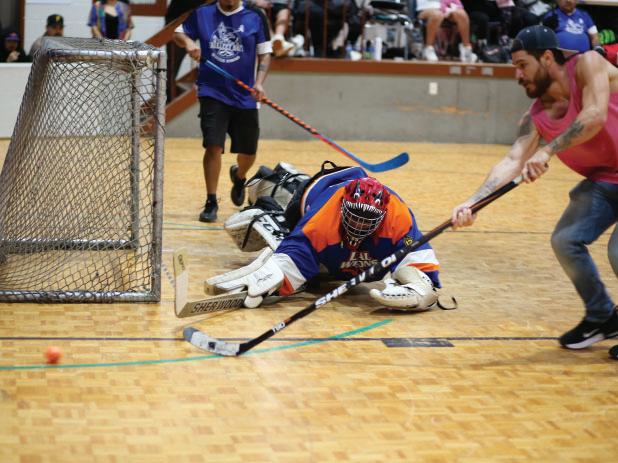
Eric Plummer photos
Alert Bay’s Bench Warmers (light blue) faceoff against Port Alberni’s All Nations on Jan. 31. Sandra’s Rack Pack, below and bottom right, were another Port Alberni team, who faced the Kuleet Bay Winter Hawks from Port Hardy on the second day of the three-day tournament (bottom left).
Only one Nuu-chah-nulth team heads to All Native
Hesquiaht Descendants women hit the courts at 1 p.m. on Feb. 14 for their first game against Lax Kw’alaams
By Nora O’Malley Local Journalism Initiative
Vancouver Island, BC – The 66th annual All Native Basketball Tournament (ANBT), which is always held in Prince Rupert, B.C., will run from Feb.14 to 21.
For the second year in a row, the Hesquiaht Descendants women’s team are the lone Nuu-chah-nulth sqad entered. Their first game is on Feb. 14 at 1 p.m. against Lax Kw’alaams
“It’s a difficult trip to make,” said Mariah Charleson, Hesquiaht’s team captain. “People have families, jobs, and it’s a long travel. Also Prince Rupert is a small town. If you don’t book your accommodation within the first few days that the tournament is announced, you will not have a place to stay.”
Elder Harvey Robinson went up many times as an Ahousaht coach for the Maaqtusiis Suns men’s squad and the Pacific Breeze women’s team. He says his three sons were all good players, but they’ve moved on to raising their own families and are coaching teams training for the Junior All Native Tournament (JANT) in mid-March.
“Nowadays it’s harder to get a team together. Ahousaht members are all over the place. I haven’t been (to ANBT) for years and years. It was expensive then; it’s probably three times as much now. When Ahousaht stopped going it wasn’t the same anymore,” said Robinson.
“We have our rooms booked for JANT,” he adds, noting that he’s excited to watch his granddaughter play.
Yuułuʔiłʔatḥ (Ucluelet) First Nation’s Tyson Touchie will be coaching the Hitacu Itty Bitty Ballers 10U team and the Yuułuʔiłʔatḥ 13U girls squad at JANT this year. Touchie shared that he went to the Rupert All Natives once in the late ‘90s as a player for the Hitacu Guardians when the tournament was “peaking” and a few times as a coach.
“There was so much interest. Less people are going now and there are less teams and less fans,” said Touchie. “Even in the final last year, there was emptiness in the gym. It’s such a strain, going up to Rupert, not only money-wise but time and work.”
“Our experience up there was, we met a lot of people who were curious about who we were because we look different. We’re shorter, our game was faster and more defensive. I think we were deceiving. A lot of people didn’t know that we could play because we didn’t have big guys. That was really typical for Nuuchah-nulth teams,” Touchie continued.
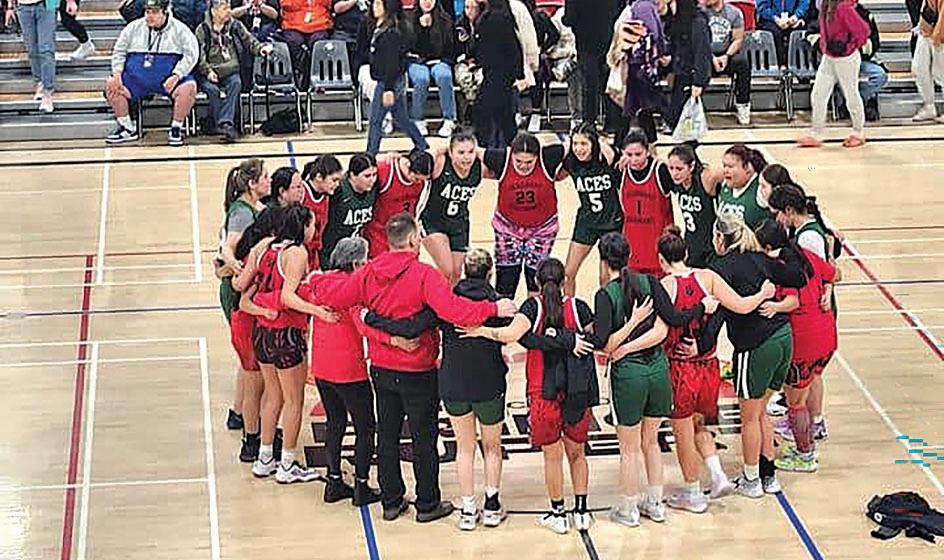
The Hesquiaht Descendants women’s team links arms with the opposition after the 64th ANBT final. The Descendants made history that year by becoming the first Hesquiaht team to ever make the top two.
Robinson correlates.
“(Ahousaht) was fast. We never had the height. We were always really strong,” he said. “We always won the sportsmanship trophy when we travelled up there. Our elders always said that was the most important trophy. People would come from everywhere to watch our teams play.”
Charleson, 38, has been playing in the ANBT since she was 18.
“I’ve played with a number of teams.
The first team I ever played for was Ahousaht; I have strong Ahousaht roots. I also played with Pacific Spirit and we were able to win a couple championships.
The true spirit and pride of the All Native Basketball Tournament is representing your home and your community and your village, so representing my nation of Hesquiaht has definitely been the most powerful and meaningful experience,” said Charleson.
She said the Hesquiaht Descendants play a style of basketball representative of the west coast.
“We’re outsized every year, but we’re tough. We’re physical. We’re able to run. That’s the style of basketball that we play. We play a tough and gritty way that we grew up playing. That is Hesquiaht basketball. That’s who we are,” she said.
Qualifier rule and pick-up rule
Robinson remembers a time when teams would have to qualify for the ANBT.

That’s a long round trip for Nuu-chahnulth players based on Vancouver Island, especially for those living in Maaqtusiis, Ahousaht’s main village on Flores Island about 30-minutes by boat from Tofino.
“We had to travel all the way up, qualify, and then come back home, then go back up again in February,” said Robinson.
The qualifying rule was changed a few years ago as was the pick-up player rule, which allowed teams to bring one player who wasn’t from their nation.
Robinson says potlatches and ANBT are one in the same.
“People come from all over and gather their family and friends. I wouldn’t say it saved culture, but it’s the same as culture,” he said.
The ANBT began in 1947 as the Northern British Columbia Coast Indian Championship Tournament. In 1959, the Native Basketball Association took over the organization of the tournament and moved the event from March to February so fisherman could participate and
“I’m always a big supporter of the village teams and I’m in support of taking out the pick-up rule,” said Charleson.
“It’s nice to see a full representation of each nation without the pick-up. You know you think about the people that live in a city like Vancouver with the amount of people they have to choose from,” she said.
Potlatches and three-pointers
Historically, the ANBT provided an arena for First Nations to gather and practice culture in spite of the Potlatch Ban, which made it illegal for communities to hold ceremonies. The federal government ended the ban on Potlatches in 1951 after the Second World War, but it would still take several decades for the potlatch to return to Indigenous communities.
be spectators. Fishermen were unable to commit to March as it is the roe herring season on the B.C. coast.
Touchie thinks if there had been no ANBT, a lot of traditional practices could have been lost.
“That’s front and centre when you go into that gym. That’s literally what that tournament is for so we can still gather.
I think basketball has helped save our people culturally. It allowed us to stay in touch,” said Touchie.
“It was almost like a reunion. You would see everyone from your childhood. To this day, it’s still like that,” he said.
But for most Nuu-chah-nulth-aht, the reunion will have to wait until March as everyone heads to JANT in Langley to cheer on the next generation of basketball players.
Submitted photos
Coach Tyson Touchie, left, and the Hitacu Itty Bitty Ballerz went undefeated at JANT 2025.
Ha-Shilth-Sa archive photo
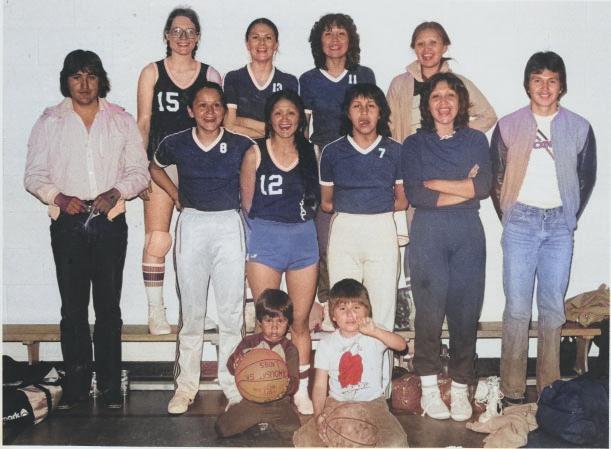
Coach Harvey Robinson, left, stands with the Ahousaht ladies Pacific Breeze ANBT championship team. His wife Doris is number 8.

Tseshaht sings to open Alberni Invitational wrestling
Teams from nearly 70 schools converge at Alberni District Secondary at the end of January for 41st annual event
By Eric Plummer Ha-Shilth-Sa Editor
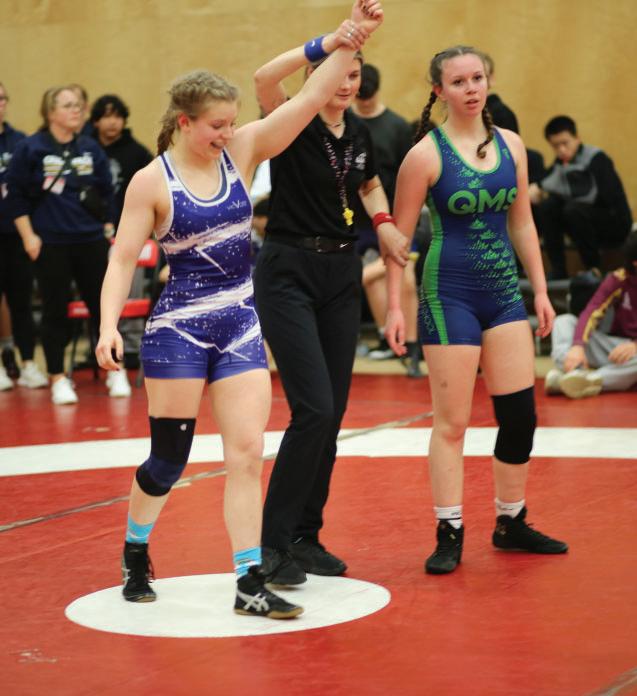
Port Alberni, BC - Nearly 70 schools from across British Columbia came to compete in an invitational wrestling tournament this weekend at Alberni District Secondary School.
Matches began this afternoon for the two-day tournament, which brought teams from as far as Salmon Arm in B.C.’s Shuswap region.
Opening festivities included a welcoming performance by members of the local
Tseshaht First Nation.
“We’re singing because we’re proud. We’re proud of this school,” shouted Tseshaht member Martin Watts to the packed gymnasium.
Hosted by ADSS and the Alberni Wrestling Club on Jan. 30 and 31, this is the 41st year that school teams from across B.C. converge for the invitational competition. Categories include junior (Grade 8 and 9) and senior (Grades 10-12) boys and girls divisions, with weight classes ranging from 38 to 130 kilograms.

Pronounced ‘Key alth ish ohc kuk weak mish ish clee haaalt kook’ it means ‘It’s very foggy. It’s been so foggy these days. It is hard to travel in.’ Supplied by ciisma.

Eric Plummer photo
Starting Jan. 30, wrestling action filled both gyms at the Alberni District Secondary, as the school hosted it’s annual two-day invitational wrestling tournament.
Ucluelet was deadliest community for bears in 2025
District working on a wildlife attractant bylaw and a communal garbage collection project to reduce conflicts
By Nora O’Malley Local Journalism Initiative Reporter
Ucluelet, BC – The BC Conservation Officer Service (COS) killed 13 black bears in Ucluelet last year, making the town of roughly 2,000 residents the deadliest community in British Columbia for the animals.
For the small tourist town nestled on the west coast of Vancouver Island, it’s not the kind of list you want to be at the top of.
“Protecting bears is really a shared responsibility. I think the fact Ucluelet is number one on the deadliest communities in B.C. for black bears list reflects poorly on the town, particularly when it is such a tourist destination,” said Lesley Fox, executive director of the Association for the Protection of Fur-Bearing Animals, a wildlife protection organization also known as Fur-Bearers.
Campbell River and Sechelt were ranked second on the government list with seven bears put down by COS while the neighbouring town of Tofino had two black bears shot dead.
“Ucluelet needs to invest – and that’s a key word, it’s going to cost some money – in education, infrastructure and enforcement. This all can’t just fall on the BC Conservation Officer Service. That agency is not resourced well enough to babysit Ucluelet,” said Fox.
“Investing and protecting wildlife should be a key pillar and a priority for Ucluelet because I think their reputation depends on it,” she continued.
Three of the 13 bears “dispatched” in the Ucluelet area were located at campgrounds out by the Tofino-Ucluelet Junction: one was in the Toquaht Nation community of Macoah and one was killed out at Mussel Beach, said COS Sgt. Daniel Eichstadter in a Nov. 25, 2025 presentation to Ucluelet council.
Eichstadter said out of the 268 black bear reports BC COS received within the Ucluelet area, 104 related to garbage.
Bob Hansen, WildSafe’s project lead for carts, says human-bear conflicts in Ucluelet have changed since the implementation of the residential cart system in the fall of 2022.
He stressed that a “very high” percentage of the carts are not anchored to the something stable, which leads to the start of the learning path to bears developing break-in skills.
“That single human behaviour is a big contributor I believe,” said Hansen during the Nov. 25 presentation to council. District of Ucluelet staff and council are working alongside WildSafe and BC

A black bear tips over an unanchored cart. A large volume of black bear incidents reported
Service from Ucluelet last year were related to garbage bins.
COS to transform Ucluelet into a Bear Smart Community.
“The District takes this issue very seriously,” said Abby Fortune, Ucluelet’s director of community planning.
She says they are currently drafting a wildlife attractant bylaw, which they will bring forward to council on Feb. 10. District staff are also in discussions with the developer of First Light, Ucluelet’s newest affordable housing complex on Marine Drive, and the Alberni-Clayoquot Regional District to create a pilot project for communal garbage collection.
“Additionally, we are exploring options to potentially contract a Wildlife Safety Response Officer to help educate the public as well as safety and environmental law enforcement,” said Fortune in an email statement.
Yuułuʔiłʔatḥ Government (Ucluelet First Nation) said they did not feel comfortable commenting on the issue as most of the black bears killed by COS were located outside of the nation’s Treaty Settlement Lands.
Fox hopes the community of Ucluelet can turn the situation around.
“I hope everyone can come together. There is reputational risk here. It is a tourist town and killing wildlife is not compatible with the values of Ucluelet.
It’s just not. People love the wildlife, they love nature and the forest, and that’s why they go there,” said Fox.
Across the province, conservation officers “dispatched” 178 black bears and


In August, red bears with wings were painted on crosswalks and storefronts along Ucluelet’s Peninsula Road. It’s uncertain as to why the “angel bears” appeared, but many locals think they serve as a public reminder to to be diligent with garbage… or more bears will end up dead.
euthanized 33 black bears last year, for a total of 211. BC COS says that is the lowest overall number since the BC COS predator statistics were first published online, in 2011.
BC COS says “they have shifted to using updated terminology to better reflect the response taken by officers”. ‘Dispatch’ refers to a bear killed for public safety reasons, such as a human-wildlife conflict, while ‘euthanize’ refers to a bear killed for welfare reasons, such as an animal critically injured by a vehicle,
says BC COS.
One bear was also struck and killed by a vehicle along Pacific Rim Highway 4 last summer, in the middle of the day, just north of the Tla-o-qui-aht First Nations community of Ty-Histanis.
Anyone that needs help securing bins or replacing carabiners is encouraged to email Chris Read at: pacrim@wildsafebc. com.
Report all wildlife conflicts to the COS RAPP line at 1-877-952-7277.

WildSafe BC surveillance photo
to the Conservation Officer
Nora O’Malley photo
Calls for police reform following shooting death
Chief calls for closure of Tobique First Nation’s RCMP detachment, after police fatally shoot man in his home
By Denise Titian Ha-Shilth-Sa Reporter
Neqotkuk, NB –A police watchdog agency is investigating the death of Bronson Paul, a member of Tobique First Nation, in an RCMP-involved shooting on Sunday, Jan. 18 in New Brunswick.
According to the RCMP, members from the Perth Andover detachment responded to a report of a domestic dispute at a residence on Main Street at the Neqotkuk First Nation (also known as the Tobique First Nation) at about 5:06 p.m. on the Sunday afternoon.
“As the situation quickly evolved, a man armed with an edged weapon advanced towards members. A Conducted Energy Weapon (taser) was deployed ineffectively, and a member discharged their firearm at the man,” stated the RCMP the day after the incident.
The RCMP went on to say that first aid was immediately administered at the scene, and the man was taken to hospital where he later died.
There is no mention of body cameras on any of the police officers.
Bronson Paul is the fourth Indigenous person killed by police in New Brunswick since 2020. Tla-o-qui-aht’s Chantel Moore, 26, was shot multiple times by an Edmunston Police Force officer during a wellness check on June 4, 2020.
That same year, Rodney Levi of Metpenagiag Mi’kmaq Nation was shot and killed by an RCMP officer. In 2024 Steven Dedam of Elsipogtog First Nation was also shot and killed by an RCMP officer.
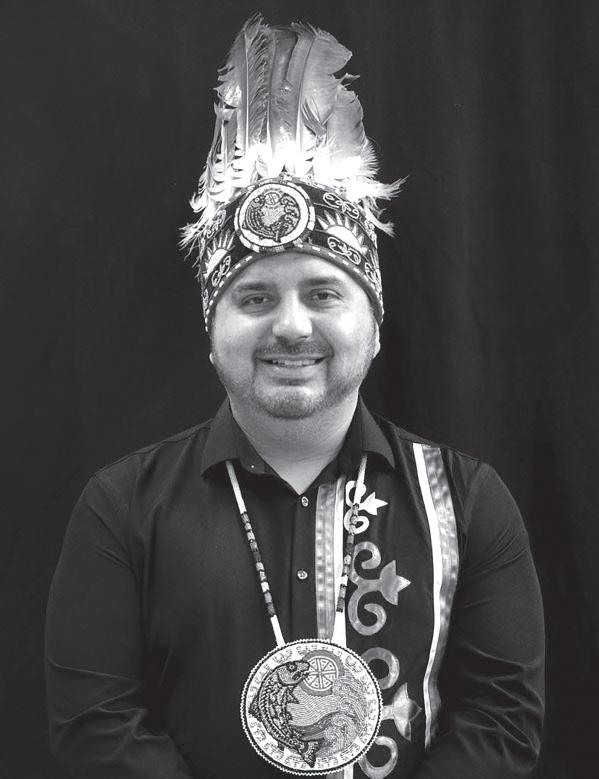
Neqotkuk Chief Ross Perley has called for the closure of the local RCMP detatchment located in Tobique First Nation’s territory, calling the actions of the police force “careless and reckless”.
“Bronson was murdered in his home by RCMP officers that shot him five times. All the while his children and their mother were in the next room,” states Perley on the Tobique First Nation website. “The trauma of this incident happening within their own home will live with them forever.”
Perley went to say that the communty and leadership are “angry, scared and frustrated, and trust with the RCMP has deteriorated”.
The RCMP has engaged the Serious Incident Response Team (SiRT), an independant agency to investigate the death. The New Brunswick RCMP says it’s committed to being accountable and transparent to the communities it serves.
“SiRT is responsible for investigating all matters that involve death, serious injury, sexual assault and intimate partner violence or other matters of a public interest that may have arisien from the actions of any police officer, on or off duty, in Nova Scotia or New Brunswick,” stated a SiRT press release from Jan. 19. “Investigations are under the direction and control of an independent civilian director, who has the sole authority to determine if charges should be laid at the conclusion of an investigation.”
But the Neqotkuk say they have found that SiRT is not completely independent.
“SiRT have put themselves in a perceived conflict of interest having MOUs with the RCMP,” stated the First Nation. Chief Perley and the Neqotkuk have issued a call to action.
“Our community needs safe and trustworthy community policing. Trust has been completely lost and it likely will never be regained under the status quo,” they stated, adding that they fear more violence, conflict and dead Indigenous people if the issue is not resolved.
The Tobique’s seven calls to action demand public officials, including the Prime Minister and the RCMP commissioner, to reform Indigenous policing, including the establishment of peacekeeping forces in the communities to respond to wellness checks, patrols and occurance reports.
Nuu-chah-nulth Tribal Council President Judith Sayers sends deepest condolences to Bronson’s family, friends and community on behalf of all Nuu-chahnulth people.
“It is a real shame the First Nation people continue to be shot and killed by RCMP despite First Nations effort to change this as a use of force,” she stated.
Canadian First Nations people, she said, have long been calling for police training to disarm, rather than kill.
Sayers noted that statistics show that Indigenous peoples are 10 times more likely to be shot and killed by a police officer than caucasion Canadians.
“Massive change is required and the public should be very concerned with these shootings and work with Indigenous peoples to change this so every person in Canada can feel safe,” she said.
The Assembly of First Nations (AFN) called Bronson Paul’s death a tragic loss.
“Our hearts go out to the family of Bronson Paul, his loved ones, and the entire Tobique First Nation during this time of profound grief,” said National Chief Cindy Woodhouse Nepinak.
Speaking in support of Tobique First Nation’s calls to action, Nepinak said the community deserves answers and accountablilty.
“We call for urgent action to address systemic issues that contribute to unequal and deadly outcomes for First Nations people in interactions with police services,” she stated. “It is not clear why Tobique First Nation’s council, outreach team and tribal security were not engaged as they have experience dealing with these matters and, when necessary, deescalating,”
Noting that there have been too many First Nations people losing their lives in police interactions, Nepinak said, “We stand with the people of Tobique First Nation, and extend our deepest condolences to Bronson’s family, friends and all those mourning his loss.”

Netp’s Annual Career Fair Thursday, April 9th 9:00am – 3:00pm
3737 Roger Street, Port Alberni
Free table registration. For further details contact Shan at shan.ross@nuuchahnulth. org or Kirunn at kirunn.sharma@ nuuchahnulth.org or call 250.723.1331or visit 4090 8th ave Port Alberni.
NCN Mental Health Counselling Tuesdays and Thursdays 8:30am – 4:30pm 4841 Redford Street, Port Alberni
NCN Mental Health Services – DropIn Counselling with Margaret Bird, Registered Clinical Counsellor and Play Therapist. For on and off reserve

&Community Beyond



members of all ages of the Nuu-chahnulth Tribal Council. Call (250) 724-3939 to book your appointment.
Stirring up Connections
Every Friday 10am – 12:30pm
NTC Kitchen – 4841 Redford Street.
A warm and welcoming cooking group designed just for parents! Whether you’re a seasoned home chef or just learning how to boil water, this group is all about sharing recipes, laughter, and stories while preparing simple, nourishing meals together. Each session will feature: Easy, budget-friendly recipes; Tips for cooking with kids and picky eaters; Space to connect with other parents over food and family life. Contact 250-724-3939 for questions.

Vol. 28 – No. 2 February 1, 2001
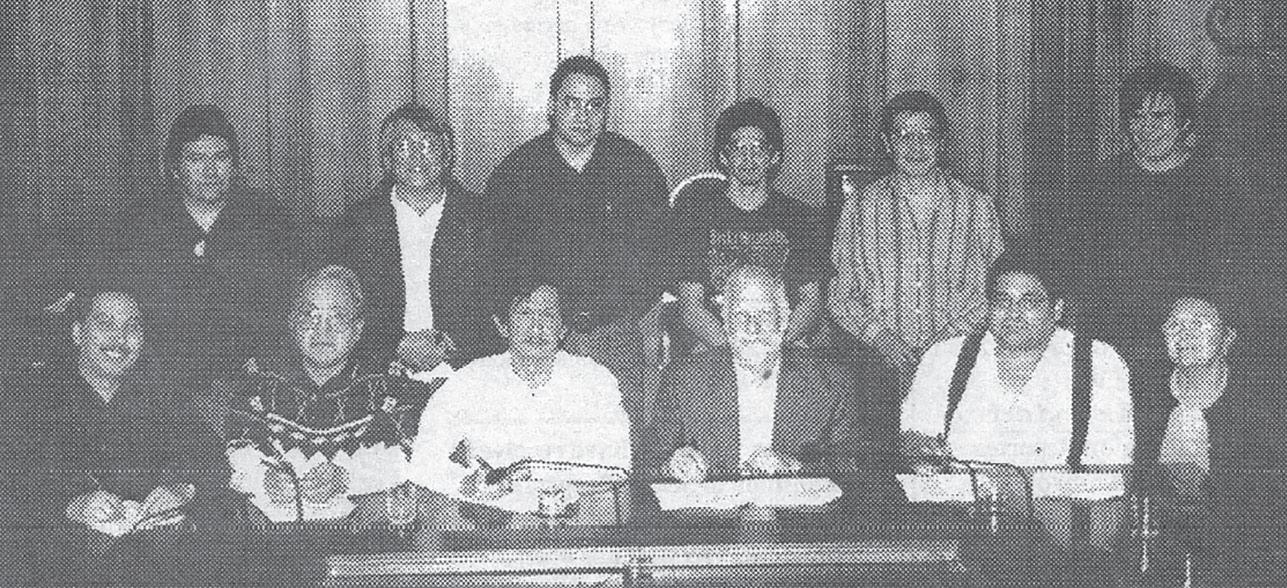
Uchucklesaht joins Huu-ay-aht Forestry I.M.A.
January 19, 2001, The Uchucklesaht Tribe had joined with the Huu-ay-aht First Nation in their Forestry Interim Measures Agreement with the Government of B.C.
“This is a historic day as it shows that First Nations, Governments and stakeholders can work cooperatively in the forest industry,” said Uchucklesaht Chief
Councillor Charlie Cootes Sr. Huu-ay-aht Chief Councillor Robert Dennis Sr. spoke of the significance of the two closely related nations beginning to work together.
“In terms of forest management, this allows our Nations to have a lot of say on how forestry practices are conducted in our ha’wiih’s hahoulthee.”
Ross Perley

Taking responsibility for our own health care
Reports show chronic conditions are higher among First Nations, but some can be prevented through lifestyle
By Holly Stocking Ha-Shilth-Sa Editorial Assistant
Today’s health care system is overburdened and struggling, as indicated by the temporary closure of the West Coast General Hospital’s ICU wing in late 2025. Meanwhile an estimated 700,000 to one million British Columbians still lack a family doctor, according to provincial estimates.
But expectations on the provincial system remain high, leading to the issue of how much should fall on the individual to better manage their own health.
In the 2025 Population Health Status Report, Island Health reported that 12.5 per cent of residents in large urban areas, 13.5 per cent in small and medium-sized towns and 10 per cent in rural communities reported zero days of getting any physical activity in a typical week.
Meanwhile women are 45 per cent more likely to consume fruit and vegetables daily, a dietary component that reduces risk of heart disease and other ailments, as men remain at higher risk for many chronic conditions, including hypertension, diabetes and cardiovascular disease, according to the health report.
“We need to acknowledge all the disruptions to not only traditional food systems but access to healthy foods, especially for remote communities, the cost of food, all these types of things,” said registered dietician Rachal Greening. “The economic barriers impact people’s ability to be well and be healthy.”
Obesity is the leading cause of most of the diseases cited in the report, but can be easily managed, says the World Health Organization. A healthy diet including regular fruit and vegetable consumption and physical activity supports overall well-being while reducing the risks of being overweight to an unhealthy degree. Is it a lack of resources, knowledge or drive that challenges people to improve their health? Food security has been recognized as an issue in many regions, with each First Nation working toward solutions for their people.
“If someone wanted to make one change that would impact their health specifically supporting diabetes, preventing diabetes, preventing obesity, it would be to stop consuming sugar-sweetened drinks,” said Greening, noting that this includes soda, juices, specialty coffees and energy drinks. “Essentially anything that’s sold in the gas station fridge section except water of bubbly water. Limiting those or finding alternation, going back to our traditional teas or water or infused waters, that would have the biggest impact on health.”
Greening recently worked with the Indigenous Food Wellness Advisory to create the website firstpeoplesfoodwellnesshub.ca. The site serves as a virtual knowledge basket, sharing resources about food wellness and holistic health to support the well-being of First Nations, Inuit, and Métis people in B.C. Diabetes Canada states that eight in 10 Indigenous people are projected to develop the condition over their lifetime.
But the good news is that the national organization also reports that regular exercise - 30 minutes five times a week - can help delay or even prevent diabetes from developing.
Many of the most common diseases like diabetes and hypertension are caused by a sedentary lifestyle and lack of proper nutrition. First Nations people in Canada
have significantly higher rates of these chronic diseases, with about half of adults reporting at least one condition, reports Diabetes Canada.
While it can be daunting to know where to start when trying to include movement into a regular lifestyle, Daly Forbes, a registered kinesiologist and athletic therapist, suggests walking.
“Start off with a ten-minute walk to the end of your block and back every day and build on that,” she said.
Walking offers significant benefits for physical and mental health, including reducing the risk of heart disease, stroke, diabetes, and some cancers, states the WHO. It also strengthens bones and muscles while improving mood and cognitive function, managing weight, boosting energy and enhancing sleep. These benefits increase with speed, distance, and frequency, even in short bursts. It’s a lowimpact, accessible exercise that strengthens the immune system, lubricates joints, and improves overall longevity.
“Chair squats, single leg balance and a wall push up, or plank are also excellent beginner exercises with high benefits,” said Forbes.
The Canadian Cancer Society’s 2016 meta-analysis shows regular physical activity significantly lowers the risk of many cancers by helping maintain a healthy weight, regulating hormones, reducing inflammation, and boosting the immune system.
Colorectal cancer and lung cancer are among the most common to be diagnosed, but can be prevented. The Cancer Society reports that just those two alone account for 25 per cent of all cancers diagnosed.
A focus on lifestyle changes like eating a diet rich in fruits, vegetables and whole grains, getting regular exercise, maintaining a healthy weight, limiting alcohol, and quitting smoking can prevent colorectal cancer.
The Cancer Council reports that more males (10.4%) than females (5.8%) report smoking tobacco, despite all the knowledge available in how this increases their risk of lung, mouth, throat and pancreas cancers as well as cardiovascular disease.
The Cancer Council reports that 90 per cent of people who smoke will contract
some form of cancer.
QuitNowBC is BC’s free smoking cessation program and offers smokers a variety of services to help residents to reduce or quit.
Island Health’s Population Health Status Report all shows that 64.6 per cent of island residents reported regular daily alcohol consumption in the past 12 months, above the provincial average of 60.7 per cent. More males reported regular drinking (71.1 per cent vs. 60 per cent), while more females reported occasional drinking (21.7 per cent vs. 11.7 per cent).
Modern health guidelines advise limiting intake to two or fewer standard drinks per week to minimize health risks.
Alcohol also accounts for the highest
rate of substance-related hospital admissions on Vancouver Island. Alcohol increases the risk of high blood pressure, heart and liver disease, stroke and extreme mental health issues.
Helpstartshere offers free and low-cost options to B.C. residents, with information, mental health supports and wellness tools.
Many First Nations are working towards improving the wellness of their members by offering access to exercise equipment. Maht Maht gym is available for Tseshaht members, while Huu-ay-aht has their fitness centre at 90 Emchiss Way in Anacla and Mowachaht-Muchalaht First Nation operates a well-equipped gym facility in Tsaxana.

Gail K Gus photo
Tseshaht youth work out with trainer Dale in the Maht Mahs gym, which is available to members of the First Nation.
Simon Fraser and FNHA sign health agreement
MOU aims to increase number of First Nation physicians, while supporting long-term improvements in health
By Antonella Medina Arias Ha-Shilth-Sa Contributor
Vancouver, BC — Simon Fraser University and the First Nations Health Authority have signed a three-year Memorandum of Understanding aimed at improving the wellness of First Nations across the province.
The memorandum was signed in the shared territories of the kʷikʷəƛəm (Kwikwetlem), xʷməθkʷəyəm (Musqueam), Sḵwxwú7mesh (Squamish) and səlilwətaɬ (Tsleil-Waututh) Nations.
“The MOU marks the beginning of our shared commitment to integrate First Nations’ ancestral knowledge, traditions and perspectives in medical education and increase the number of First Nations physicians,” said Monica McAlduff, chief executive officer of the First Nations Health Authority. “Together, we celebrate this significant milestone in advancing culturally safe, trauma-informed and team-based medical education for the next generation of physicians.”
A major catalyst for the MOU is the university’s new School of Medicine, the first of its kind in Western Canada in 50 years.
“The goal of the medical school was to [become] community-driven, [following] Indigenous ways of knowing and build relationships with underserved Indigenous communities,” said Syeta’xtn Lewis, SFU’s Indigenous executive lead.
The School of Medicine is part of SFU’s drive for Indigenous engagement and addressing systemic inequities that echo those of the FNHA. This aligns with FNHA’s 10-Year Strategy on the Social Determinants of Health, which focuses on culture, language, ceremony, and education, creating the right moment to formalize a partnership through the MOU.
“We’re really in a neat position in that we get to design a curriculum with Indigenous people right at the outset,

which means Indigenous ways of knowing are going to be woven throughout the entire medical school curriculum,” said Dr. Rebekah Eatmon, associate dean of Indigenous Health with SFU’s School of Medicine.
“Ultimately, this MOU should help contribute to improved wellness and better health outcomes for First Nations individuals, families, and communities across BC,” said McAlduff
The MOU aims to extend beyond the School of Medicine and the Faculty of Health Sciences. Lewis says the MOU creates an opportunity to establish new action plans that enable other faculties, such as science, education, and environment, to join the effort to improve health
and wellness indicators in First Nations communities and to create more partnerships.
“[The MOU] is a platform or a bridge that allows us to kind of come and collaborate and continue to work together,” said Lewis.
The 2024 report, First Nations Population Health and Wellness Agenda (PHWA): First Interim Update, provided by the FHNA and the British Columbia Office of the Provincial Health Officer, reported on health and wellness indicators for First Nations People in B.C., noting an improvement in education and infant mortality.
However, there were no changes in issues like avoidable hospitalization, the number of First Nation physicians, serious injuries and young adult suicide. The report highlighted worsening health indicators like birth weight, diabetes prevalence, weight-related diseases, drug overdoses and all-cause mortality. As a result, the average life expectancy of First Nations people in B.C. had declined from 73.3 years in 2017 to 67.2 in 2021 – a drop of 6.1 years, according to the report.
Amid this disturbing trend, McAlduff hopes that SFU’s School of Medicine can contribute to a new paradigm of medical training and education that includes traditions and practices, while building a deeper understanding of First Nations culture, history, and experiences.
“[With] every Indigenous medical student admitted to our school, they are supported through their medical journey from the time they apply until residency,” said Dr. Eatmon. “The secondary impact of that is to lead to a change in the healthcare system, which will be more culturally safe for Indigenous patients, and responsive to what the healthcare needs are.”
McAlduff hopes, through the partnership, to embed a holistic First Nations perspective on health and wellness so medical students appreciate the importance of supporting every aspect of a person’s well-being, not just their physical symptoms.
The strengthened research and datagovernance partnership supports better community-driven analysis and planning, with these changes helping to enhance cultural safety and humility within the
system, improve access to safe, effective care, and ultimately improve health outcomes for First Nations peoples.
“In these ways, the MOU between FNHA and SFU supports long-term improvements in health—not quick fixes, but lasting change,” said McAlduff Lewis notes that the MOU is set to follow the First Nation 7 Directives, a fundamental set of standards and instructions for the new health governance relationship shared by the FNHA, the First Nations Health Council, and the First Nations Health Directors Association.
The Faculty of Health and Sciences initiated the decolonization process into its course content to support several FNHAled health research projects, including the creation of the First Nations Health Authority Chair in Heart Health and Wellness at St. Paul’s Hospital.
Senior leads from both organizations, including SFU President Joy Johwnson and FNHA CEO Monica McAlduff, agreed to meet regularly to track progress and identify new areas of potential collaboration. This approach aligns with the governance principles in FNHA’s 10Year Strategy, emphasizing partnership, shared accountability, and collaborative decision-making across sectors.
“SFU is committed to upholding Truth and Reconciliation in all that we do,” said Joy Johnson, SFU’s president and vicechancellor. “This new partnership will help guide research, teaching and curriculum development university-wide, ensuring that SFU takes meaningful action in partnership with Indigenous peoples to advance the health and well-being of Indigenous communities across BC.”
“We expect this partnership to create meaningful, measurable improvements in how First Nations people experience healthcare and education,” said McAlduff. “Success means more First Nations leadership in medical education, research, and system planning. It means a new generation of physicians trained in culturally safe care. It means closer alignment with community priorities identified in the FNHA 10-Year Strategy for Social Determinants of Health, including cultural identity, education, and social inclusion.”
Submitted photo
Chief Executive Officer of the First Nations Health Authority, Monica McAlduff (left), stands with Dr. Joy Johnson, Simon Fraser University’s president and vice-chancellor, after signing a memorandum of understanding in January.
Kelp restoration aims to return salmon abundance
Tla-o-qui-aht First Nation is leading a large-scale effort to grow nearshore salmon habitat on the Pacific coast
By Nora O’Malley Local Journalism Initiative Reporter
Clayoquot Sound, BC – Tla-o-qui-aht
First Nation has partnered with Redd Fish Restoration Society (Redd Fish) and West Coast Kelp Ltd. to undertake a large-scale kelp restoration project on the Pacific Coast.
The total project budget is roughly $240,000 with a large portion of the funds coming from the provincial government, plus a patchwork of grants from the Pacific Salmon Foundation, World Wildlife Fund Canada, Sustainable Ocean Alliance, and Clayoquot Biosphere Trust, according to Redd Fish.
Federal and provincial permitting took less than a year; a timeline that Redd Fish says was fast-tracked due to their formal Letter of Agency (LOA) from Tla-o-quiaht.
“We are keen to see the haahuulthii (traditional territory) of the Tla-o-quiaht ha’wiih (hereditary chiefs) achieve a state of abundance,” said Saya Masso, Tla-o-qui-aht’s natural resources manager. “This means that we must have fully functioning ecosystems. Kelp is an important part of the salmon ecosystem.”
The first-of-its-kind kelp restoration project involves dropping four In Ocean Nursery Systems (IONS) within Tla-oqui-aht traditional waters. The IONS will be placed at Baxter Islets near Tofino to produce giant kelp that will enhance habitat for juvenile salmon, Pacific herring and a suite of other species.
“There are so many things that are impacting salmon populations,” said Emily Fulton, marine program manager with Redd Fish.
She explained that for the past 30 years, Redd Fish has been working to accelerate the recovery of west coast forest ecosystems and watersheds destroyed by decades of unbridled industrial logging.
“But salmon and salmon life cycle doesn’t end at the river mouth,” said Fulton. “That’s why we need to look further afield. We need to look at eelgrass ecosystems that are nurseries for salmon and we need to look at these other complex nearshore ecosystems like kelp forests.”
West Coast Kelp founder Tom Campbell and
up a beautiful bounty of giant kelp growing on a longline. that biomass in year two of the project.
“The goal behind our restoration approach isn’t simply a one and done quick fix. Ecosystem stewardship is a long game, and we work with First Nations to make sure that projects are designed and linked with their priorities,” said Campbell.
He predicts the salmon will indeed use the kelp restoration site as habitat.
“(Salmon) are a migratory species, so they don’t hangout anywhere for long, but I do suspect that our monitoring will show adult salmon feeding on smaller forage fish using the kelp as habitat and in the spring, when the juvenile salmon are out-migrating from their native streams, I suspect we’ll observe some juvenile salmon using the habitat as well,” he said.
The IONS — suspended mariculturelike structures that allow young kelp to grow above the seafloor – were designed and built by West Coast Kelp. They are scheduled to be deployed in early February and come spring, West Coast Kelp president and founder Tom Campbell says the restoration project will produce enough kelp habitat to fill 1,900 standard pickup trucks, or 2,900 cubic metres of habitat. He says they plan on doubling
The research team and Tla-o-qui-aht Guardians will also cultivate kelp from the IONS and strategically transplant them to the seafloor at a number of nearshore sites that are migration corridors for local salmon.
Redd Fish has been conducting drone surveys of wild kelp beds along the west coast of Vancouver Island for several years. The environmental non-profit says they’ve observed a decline in kelp, which
they say is due to “marine heat waves, climate change and disrupted trophic dynamics”.
“This project directly addresses those challenges by growing locally adapted kelp at a scale meaningful enough to deliver ecosystem-level benefits,” said Redd Fish.
Hourly camera monitoring and software trained to count fish
Along with the kelp restoration, Tla-oqui-aht, Redd Fish and West Coast Kelp are investing in underwater cameras to monitor and quantify the habitat provisioning benefits of kelp.
Campbell said they have hired an engineering co-op to assemble four special underwater cameras that will record five minutes of footage at the top of every hour. At the end of the first year, he estimates they will have 87,000 minutes of video data, which they will process with computer software trained to identify and count fish.
“We’ll get this really clean data set that show us what fish, how many fish are coming and using the habitat at differ-
ent times of the year,” said Campbell. “It will be really meaningful data to Tla-oqui-aht. It will allow for much stronger management decisions.”
“It really opens the door for a much deeper understanding of what’s happening in the ecosystem that until now has been much harder to observe,” he said. The IONS are not a patented system and camera monitoring technology is open access as well.
“We want to share this knowledge. There is so much potential for Indigenous-led kelp restoration projects on the west coast of Vancouver Island. Maybe in five or 10 years Nuu-chah-nulth territory will be the epicenter of kelp restoration in the world,” said Campbell.
For years, scientists have been researching the carbon sequestration potential of seaweed to mitigate climate change. Studies show that seaweed aquaculture can also help reduce the emissions from agriculture, improving soil quality by substituting synthetic fertilizer and when included in cattle fed, lowering methane emissions from cattle.
Graeme Owsianski photos
Redd Fish Restoration Society’s marine program manager Emily Fulton hold
Andrew McCurdy photo Divers will survey the kelp restoration sites and check cameras monthly.
The kelp restoration project includes cultivating kelp from the hub site at Baxter Islets and transplanting them to the seafloor at a number of nearshore sites that are migration corridors for local salmon.