
INTERESTING NEWS
Campus of Care proposed for PA’s doctor shortage
Initiative plans to attract health care professionals to the area through the use of city-owned agricultural land
By Denise Titian Ha-Shilth-Sa Reporter
Port Alberni, BC – Port Alberni has a shortage or health care workers, and as doctors retire more people are going without family physicians, adding to the strain at walk-in clinics and the emergency department at the West Coast General Hospital.
Reports suggest at least 8,000 Port Alberni residents don’t have a family doctor and the number is expected to increase as family physicians in the city head into retirement. According to information from Community Futures Alberni-Clayoquot, up to four doctors are expected to retire in the next six years, meaning that almost half of the Alberni Valley’s 25,000 residents could be without a family physician if more don’t settle in the area.
And a doctor shortage is felt at the local hospital and walk-in clinics, as more residents without a physician seek health care alternatives. This winter the West Coast Urgent Care Clinic was forced to reduce its hours due to lack of available doctors.
The shortage has affected operations at the West Coast General Hospital. In late November the hospital’s three-bed Intensive Care Unit closed indefinitely due to a staff shortage, then on Dec. 11 Island Health announced it was temporarily pausing the admission of certain inpatients in Port Alberni.
“This is due to a staffing shortage of hospitalists, the physicians who care for patients admitted to hospital who do not have a family doctor with admitting privileges,” stated Island Health.
The move allowed the hospital emergency room to remain open, while some patients who needed to be admitted were, in some cases, transferred to other hospitals. The pause on patient admission to WCGH was lifted on December 24, 2025, after the health authority secured commitments from enough physicians to resume services.
To address the strain on the health care system, the idea of a Campus of Care model has been introduced. Port Alberni residents were invited to the Campus of Care facilities information session on February 8 at the Capitol Theatre.
Hosted by the Community Futures Alberni-Clayoquot, a non-profit organization that supports economic development in the Alberni-Clayoquot region, the information session allowed residents to learn about the idea of Campus of Care and how it could improve healthcare services in the city.
Community Futures Alberni-Clayoquot
(CFAC), the Alberni Valley Healthcare Fund Society (AVHFS) and the Alberni Low Energy Housing Society (ALEHS) are working together to address the current and anticipated shortage of health care professionals in the Alberni Valley.
Dr. Marc Lambiotte is the medical lead for the initiative. He anticipates that up to six general practitioners could retire in the next few years, but this means that Port Alberni needs to secure more than this number, as young doctors are often looking for a more manageable workload.
“There has obviously been a generational shift,” he said. “A work-life balance is more important to them.”
The group’s goal is to build a Campus of Care facility that would bring together health care professionals, health services and supports in one place. The Campus of Care is proposed to be built on cityowned land behind the shopping centre that includes Staples on Johnston Road.
According to proponents, the Campus of Care will be, “a multidisciplinary community health centre with on-site specialists, laboratory and pharmacy including housing for medical professionals and a daycare. The Campus would serve residents of the Alberni Valley.”
Housing for health care professionals is important because it has already been identified as a factor in the doctor shortage.
“Visiting locums are often unable to find suitable short or long-term housing in Port Alberni,” said Community Futures.
“The Campus’ on-site housing offers a reliable place for locums to visit and cover shifts from local doctors.”
Further, many of the medical students that have worked in the valley say they
this issue... Tumbler Ridge shooting unites world............................Page 3 Health survey aims to find community data...................Page 5
growth declaration pledge...................................Pages 8-9 Dog ban for parts of Long Beach.................................Page 11 Band with NCN singers promotes album.....................Page 15
enjoy the quality of life, according to Community Futures.
“Their desire is to graduate to a group practice setting – something not available without building the campus,” stated the organization.
A group practice setting is a comprehensive clinic that offers professional services coupled with administrative support such as accounting, record keeping and patient oversight.
“Many new doctors today prefer to focus on their patients and not the rest of the responsibilities of running a small business,” said Reana Miller, marketing, communications and business development officer for Community Futures Alberni-Clayoquot. “They are looking for a smaller patient load than is the reality currently in Port Alberni. As well they want housing, at least until they are fully established and assured daycare for their children.”
The Campus of Care would have up to 10 family physicians, including on-site medical and surgical specialists. There would a laboratory and pharmacy as well as housing for medical practitioners and childcare.
The medical facility would be owned and operated by the Alberni Valley Healthcare Fund Society while the housing and daycare would be owned and run by the Alberni Low Energy Housing Society. The facility is designed to make Port Alberni a more attractive place to settle down for newly graduated health care professionals.
For residents, it would be a one-stop shop for health care services.
“We expect patients to be able to visit their family physician, nurse practitioner or specialist, have bloodwork done
and collect prescriptions all in one trip and under one roof,” reads the Alberni Healthcare Fund Society webpage. “This immediacy is especially critical for vulnerable persons who have reduced mobility and those who do not have access to private transportation.”
But the land being looked at for the project comes with a hitch. It’s in the Agricultural Land Reserve, currently designated for farming purposes. Port Alberni City Council has put in a request to the province’s Agricultural Land Commission to have their property removed from the ALR.
“Any community that can offer a medical clinic has a much better chance of being attractive to family doctors that are looking to relocate,” said Miller. “Recognizing that this is a very competitive environment that we’re in, if a community can offer a very comprehensive package it will be much more attractive to potential medical professionals.”
“There is a shortage of health care workers provincially, nationally, so we are competing against other communities,” noted Lambiotte. “Any initiative that’s happening in town should always be framed as, ‘Does this render the town attractive to health care workers, to anyone?’”
To learn more about the proposed Alberni Campus of Care, visit Community Futures Alberni-Clayoquot and click on the Community Development Tab at https://cfac.ca/community-development/ alberni-valley-healthcare-fund
At the bottom of the webpage are links to express support for the project and/or to sign a petition regarding the removal of the city-owned land from the ALR for the development of the project.
Eric Plummer photo
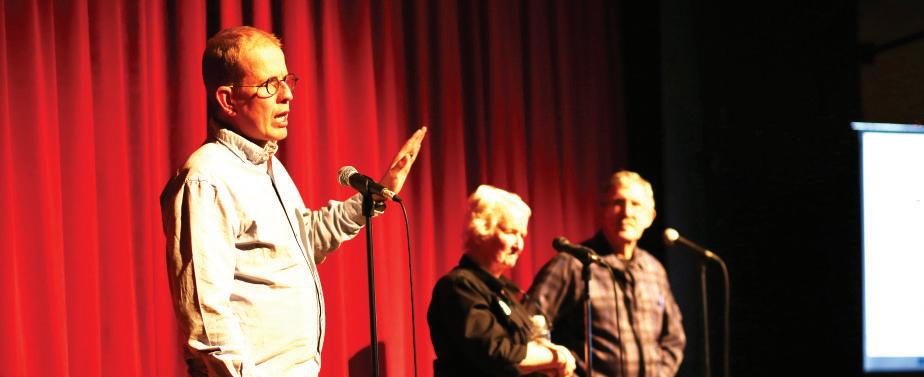
Dr. Marc Lambiotte speaks at the Capital Theatre on Feb. 8, during an event hosted by Community Futures AlberniClayoquot about a proposed campus for a medical clinic that would also house health care workers. Also pictured are Lori Camire, Community Futures’ executive director, and Mike Ruttan of the Alberni Low Energy Housing Society.
Wayward Taiga Bean geese sighted in Port Renfrew
Normally migrating between northern Europe and China, some speculate lost birds joined flock of Canada geese
By Denise Titian Ha-Shilth-Sa Reporter
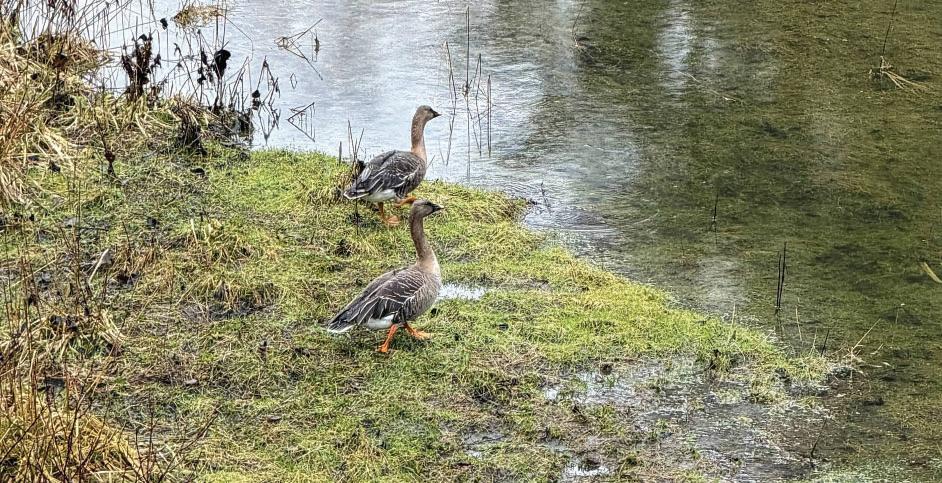
Port Renfrew, BC – The first-time sighting of European/Asian geese in British Columbia has drawn a gaggle of bird watchers to the tiny community of Port Renfrew in Pacheedaht First Nation territory.
The geese, with their orange markings, were spotted in Port Renfrew for the first time on February 2, 2026 and were identified by birders as Taiga Bean Geese.
Pacheedaht Chief Councillor Arliss Jones says the geese were spotted by her brother-in-law as they flew over his house on February 4.
“Geoff saw them and thought they looked strange with longer necks and orange legs,” Jones said.
Bird experts say the Taiga Bean goose (anser fabalis) is noted for its prominent orange bill and legs, and its long, swanlike neck.
Photos of the unusual geese appeared on a social media rare bird page and were identified as Taiga Bean geese. A photo of the two geese on the Gordon River estuary was included along with coordinates showing their proximity to the Pacheedaht reserve.
“They were by the park yesterday (February 4) but they’ve flown across the river,” said Jones.
The park she refers to is near the center of the Pacheedaht community where the children play.
The Taiga Bean goose normally ranges in northern Europe and Asia. It is migratory and winters further south in that region. It is a rare visitor to North America.
According to Canadian bird watching
the first time ever,
The
information found online, a pair of Taiga Bean geese have been spotted in Quebec, Yukon and Alberta in 2024 and 2025. It is believed the same pair was spotted in New York in 2024.
The 2026 sighting of Taiga Bean geese in Port Renfrew is the first recorded sighting for British Columbia. Jones says the geese can be observed on the Gordan River Estuary.
According to the American Birding Association’s Rare Bird Alert group on Facebook, a woman first noticed the geese near Deering Bridge on the mossy shores of Gordon River on February 2.
The post alerted Vancouver Island bird-
watchers who arrived in Port Renfrew on February 5, with their long lens scopes and cameras to take in the view of the unusual visitors.
It is believed that the northern European natives normally range from Scandinavia to Russia to China. They appear in arctic regions including the Aleutian Islands and Alaska. Birders speculate the geese may have lost their way during migration and may have joined a flock of Canada geese.
Another possibility is the geese may have been blown off course by storms or strong winds, possibly joining the wrong flocks in the confusion.
For now, the two Taiga Bean geese are foraging in the marshy estuary of Pacheedaht’s Gordon River, much to the delight of residents and bird watchers.
According to Birds of North America, Canada has Common Canada Goose along with the sub-species, Lesser Canada Goose, Richardson’s Canada Goose, Aleutian Canada Goose, Dusky Canada Goose. Other species of geese in Canada, in a class of their own, are the Cackling Goose, the Brant, the Greater White-fronted Goose, the Ross’s and the Snow Goose.
Geese have a lifespan of 10 to 24 years.

Emma Young-Wood photo
For
a pair of Taiga Bean geese have been reported in British Columbia this month, spotted in Port Renfrew.
geese normally migrate between northern Europe and China.
Tumbler Ridge mass shooting unites world in grief
Families seek reassurances on safety of their children in school following deaths of 9, including six school kids
By Denise Titian Ha-Shilth-Sa Reporter
Tumbler Ridge, BC – The world is reeling after hearing news of a mass school shooting in a remote town of Tumbler Ridge, B.C.
On February 10, 2026, Jesse Van Rootselaar entered the high school shooting a teacher and five students to death before turning the gun on herself. According to reports there are at least 25 others injured from the incident including a 12-year-old girl who is fighting for her life in Vancouver’s BC Children’s Hospital.
According to an update from the RCMP, the Tumbler Ridge RCMP received a report of an active shooter at Tumbler Ridge Secondary School at about 1:20 p.m. on Feb. 10.
Police from the small town near the Alberta border were on scene within two minutes of the initial call.
“Upon arrival, there was active gunfire, and as officers approached the school, rounds were fired in their direction,” reads the RCMP statement.
Upon entering the school, officers located the individual that was confirmed to be the shooter deceased from “what appeared to be a self-inflicted injury,” the statement continued.
“The suspect has been identified as 18-year-old, Jesse Van Rootselaar, who is a resident of Tumbler Ridge,” police stated.
Police recovered a long gun and a modified handgun at the scene.
Multiple victims were located throughout the school, along with approximately 25 individuals with possible injuries. Two other victims were found deceased at a nearby home.
The deceased victims from the school include 39-year-old female educator Shannda Aviugana-Durand, 12-year-old female students Ticaria Lampert, Zoey Benoit and Kylie Smith, as well as Abel Mwansa and Ezekiel Schofield, two male students, ages 12 and 13.
Two additional victims, Jennifer Jacobs, a 39-year-old female and Emmett Jacobs, an 11-year-old male, were located deceased in a local residence. These have been identified to be the mother and younger brother of the assailant, and the RCMP reported multiple calls to the residence in recent years, including for mental health-related matters. The RCMP confirmed that firearms were removed from the home, but were later returned by police after a petition from the owner of the weapons. It has not been confirmed if these are the guns used by Rootselaar for
Submitted photo
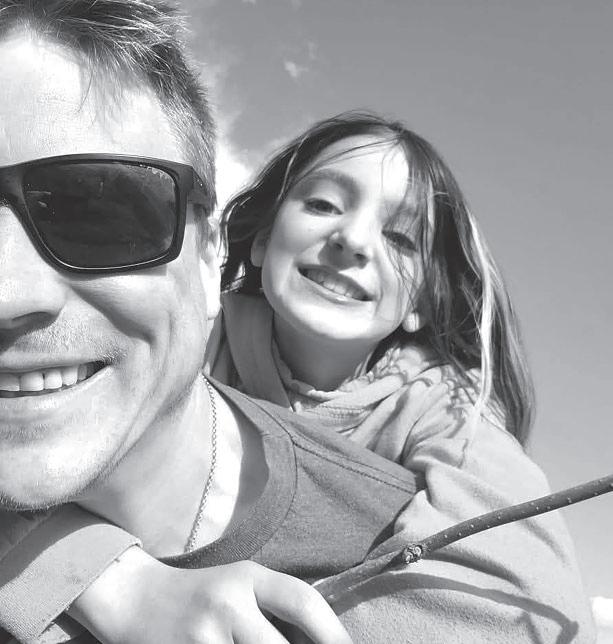
A Nuu-chah-nulth couple is grieving with the father of one of the victims, 12-year-old Kylie Smith. Port Alberni residents Don and Linda Pelech once called Tumbler Ridge home. During their years there they got to know Lance Younge, the father of Kylie Smith (both pictured).
the murders.
Two females, ages 12 and 19, were airlifted to hospital and remain in serious condition.
BC RCMP Major Crime is leading the investigation and is working to determine the full circumstances surrounding this tragic incident.
Police say that additional resources have been deployed to Tumbler Ridge to support both the investigation and day-to-day policing operations, and the RCMP are continuing with the assistance of neighbouring detachments. The public schools in Tumbler Ridge will remain closed for the remainder of the week.
“We understand the community has questions and wants to understand the motive behind this tragic incident. We do believe the suspect acted alone and there are currently no other outstanding suspects.,” says Deputy Commissioner Dwayne McDonald, commanding officer of the B.C. RCMP.
“This is a deeply distressing incident, where people have senselessly lost their lives. Our thoughts are with the families, loved ones, first responders, the greater
Tumbler Ridge community, and all those impacted by this tragic incident,” he went on to say.
As information trickles out about the shooter and victims, a Nuu-chah-nulth couple is grieving with the father of one of the victims, 12-year-old Kylie Smith. Port Alberni residents Don and Linda Pelech once called Tumbler Ridge home. During their years there they got to know Lance Younge, the father of Kylie Smith. Linda Pelech referred to Younge as a dear, close friend who was always there for the couple and their late son, Brandon.
“He didn’t deserve to lose Kylie,” she wrote on social media.
Kylie Smith’s mother, Desirae, lives in Port Alberni and is on her way to Tumbler Ridge to be with her son and other surviving family members. Kylie’s brother, Ethan, 15, was hiding in another part of the school during the incident.
A Go-Fund-Me page has been set up for Smith’s family and for at least one other survivor, Maya Edmunds, 12, who is in critical condition in BC Children’s Hospital. Maya was shot in the head and
neck as she attempted to barricade a door to protect others from the shooter. Other campaigns are underway for the victims, with hundreds of thousands pledged.
Closer to home, SD70, the Pacific Rim School District, offers tips to support and reassure children during such a traumatizing event.
“Children may experience a wide range of emotions in response to what they hear or see and they will look to the adults in their lives to help them feel safe and understand the world around them,” wrote the school district in a letter to parents.
“Over the coming days or weeks, we encourage families to remain attentive to any changes in their child’s behaviours that may indicate a need for additional support.”
Educators advise limiting exposure to news stories on traditional and social media channels, saying young children may become overwhelmed.
Age-appropriate communication is important in helping children process traumatic information and experts remind parents to spend more time listening to the children, and less time speaking.
Listen to your child’s concerns before offering any explanations, tell the truth and keep it age appropriate, advises the school district.
Maintaining daily routines can also provide a sense of stability and security for children and adults. Encourage empathy and compassion.
According to the school district, tragedies and times of grief can serve as meaningful moments to teach compassion, which can help children feel empowered as they find additional ways to be kind and caring.
“As school district staff, we recognize that our students may require additional support. We will continue to prioritize the mental health and well-being of our students,” stated SD70.
If you feel your child needs additional support, please reach out to your school and/or access the community supports identified in the following resources.
As for safety in Pacific Rim School District, educators want families to know that they put student and staff safety as a first priority.
“Staff are always very vigilant and act when any threats are identified. Schools practice ‘lockdowns’ and ‘secure and holds’ to ensure that students and staff are safe in any threatening situation,” said SD70.
If you have any questions regarding school security please reach out to your school administrator.
Hoobiyee delayed, culture group works to hold event
By Eric Plummer Ha-Shilth-Sa Editor
Vancouver, BC - A Vancouver-based dance group is working to ensure that one of B.C.’s largest First Nation cultural events happens this year, but Hoobiyee will not be held at the end of February as was previously announced.
A celebration of the Nisga’a New Year, Hoobiyee is usually held annually at the end of February or beginning of March.
Besides Nisga’a participants, the event attracts thousands from across B.C. to Vancouver’s PNE Forum, and has drawn a heavy Nuu-chah-nulth presence with several performances each year from multiple nations from Vancouver Island’s west coast.
In past years the large event has been organized by the Nisga’a Ts’amiks Vancouver Society, but uncertainty has surrounded Hoobiyee for the last several months, with no formal announcements from the society about when and if the event will happen.
In early February the Ts’amiks Nisga’a Cultural Dancers assumed organizing duties, announcing that Hoobiyee would happen after all on Feb. 27 and 28 at the PNE Forum. But on Feb. 12 the group retracted this date.
“Due to overwhelming response from fellow nations, vendors, sponsors, dance groups and many more people that want to get involved, we want to make sure that we do this event right and plan it right,” said Jade Doolan, an executive
member of the Ts’amiks Nisga’a Cultural Dancers, in a social media announcement with other members of the group.
“We would like to thank everyone for the support. As they say, it is better late than never.”
In an interview with Ha-Shilth-Sa, Doolan said the group is aiming to put Hoobiyee on at the end of March, although dates and a venue have not been specified.
“We are working tirelessly to make sure that this event is run smoothly as possible given the circumstances,” said Doolan. Hoobiyee is traditionally tied to the return of the oolichan to the Nass River Valley in northwestern British Columbia. The harvest of these silver fish in late winter marks a new year for the Nisga’a,
with the emergence of the season’s first crescent moon.
But the annual Vancouver event has made Hoobiyee important far beyond the Nisga’a community, said Doolan.
“We get people from all over the world that come to see it. It’s not just important for Nisgas, it’s important for all west coast cultures in B.C.,” he said. “As a Nisga’a, Hoobiyee is important because it represents culture, love and kindness, it brings our people together. Now it not only brings our people together, it brings multiple cultures together to share our culture with the world.”
Doolan said future announcements about the event will be coming.
Ha-Shilth-Sa newspaper is published by the Nuu-chah-nulth Tribal Council for distribution to the members of the contributing First Nations, as well as other interested groups and individuals.
Information and original work contained in this newspaper is protected by copyright and may not be reproduced without written permission from:
Nuu-chah-nulth Tribal Council P.O. Box 1383, Port Alberni, B.C. V9Y 7M2.
Telephone: (250) 724-5757
Fax: (250) 723-0463
Web page: www.hashilthsa.com facebook: Hashilthsa Ntc
2026 Subscription rates:
Non-Nuu-chah-nulth, Ahousaht, Ehattesaht,Toquaht and Ucluelet members are subject to a yearly subscription fee of $40 in Canada, $50 in the US and $60 for overseas. Payable to the Nuu-chah-nulth Tribal Council
Manager/Editor/Reporter
Eric Plummer (Ext. 243) (250) 724-5757 Fax: (250) 723-0463 eric.plummer@nuuchahnulth.org
Reporter
Denise Titian (Ext. 240) (250) 724-5757 Fax: (250) 723-0463 denise.titian@nuuchahnulth.org
Reporter
Nora O’Malley (604) 353-8488 nora.omalley@nuuchahnulth.org

Audio / Video Technician
Mike Watts (Ext. 238) (250) 724-5757 Fax: (250) 723-0463 mike.watts@nuuchahnulth.org
Editorial Assistant
Holly Stocking (Ext. 302) (250) 724-5757 Fax: (250) 723-0463 holly.stocking@nuuchahnulth.org
DEADLINE:
Please note that the deadline for submissions for our next issue is Feb 27. 2026
After that date, material submitted and judged appropriate cannot be guaranteed placement but, if material is still relevant, will be included in the following issue.
In an ideal world, submissions would be typed rather than hand-written. Articles can be sent by e-mail to holly.stocking@nuuchahnulth.org (Windows PC).
Submitted pictures must include a brief description of subject(s) and a return address.
Pictures with no return address will remain on file. Allow two - four weeks for return.
Photocopied or faxed photographs cannot be accepted.
COVERAGE:
Although we would like to be able to cover all stories and events, we will only do so subject to:
- Sufficient advance notice addressed specifically to Ha-Shilth-Sa.
- Reporter availability at the time of the event.
- Editorial space available in the paper.
- Editorial deadlines being adhered to by contributors.
LETTERS and KLECOS
Ha-Shilth-Sa will include letters received from its readers. Letters MUST be signed by the writer and have the writer’s full name, address and phone number on them. Names can be withheld by request. Anonymous submissions will not be accepted. We reserve the right to edit submitted material for clarity, brevity, grammar and good taste. We will definitely not publish letters dealing with tribal or personal disputes or issues that are critical of Nuu-chah-nulth individuals or groups. All opinions expressed in letters to the editor are purely those of the writer and will not necessarily coincide with the views or policies of the Nuu-chah-nulth Tribal Council or its member First Nations. Ha-Shilth-Sa includes paid advertising, but this does not imply Ha-Shilth-Sa or Nuu-chah-nulth Tribal Council recommends or endorses the content of the ads.


Search continues for Duncan woman
Mother Rosemarie Harry, 34, has long blonde hair, brown eyes and is five feet tall
By Nora O’Malley Local Journalism Initiative Reporter
North Cowichan/Duncan RCMP is asking for the community’s help finding a woman who was reported missing on Feb. 4, 2026.
Rosemarie Harry was last seen on Wednesday, Jan. 28 in the Duncan area on Vancouver Island. Her support worker at the Hiiye’yu Lelum-House of Friendship says she never returned to the friend’s house she was staying at.
“This is out of character for her and that’s worrisome,” said Harry’s support worker Myra Antoniuk. “She had a visible presence online, always posting 20 Facebook posts a day. There has been nothing since the 27th or 28th.”
Rosemarie Harry is 34-years-old, five feet tall, 141 pounds, black hair (although
recent photos show her hair is dyed blonde) and brown eyes, according to police.
“She has blonde hair right now. It’s longer than it looks in the picture. She has braids as well,” said Antoniuk.
Antoniuk believes she is of Malahat and Cowichan First Nation descent. She says Harry spent time in the Pauquachin First Nations area around Sidney and Saanich last year as well as the Victoria Friendship Centre.
“She has children and that’s why I don’t think this is just her (taking) off. She was doing visits with them. Nobody has heard from her,” Antoniuk said.
“She was excited about the possibility of things changing up. For her to just go offline… And I’ve looked around town. I’ve been looking for her, and I’ve not seen even a glimmer of her. It doesn’t

Ha-Shilth-Sa belongs to every Nuu-chah-nulth person including those who have passed on, and those who are not yet born. A community newspaper cannot exist without community involvement. If you have any great pictures you’ve taken, stories or poems you’ve written, or artwork you have done, please let us know so we can include it in your newspaper. E-mail holly.stocking@nuuchahnulth.org. This year is Ha-Shilth-Sa’s 52st year of serving the Nuu-chah-nulth First Nations. We look forward to your continued input and support. Kleco! Kleco!
feel right for me,” Antoniuk continued. Antoniuk shared that even when Harry lived in Pauquachin, she would hear from her or see her posts on social media.
“Even if she was hiding, she would try to find a way to let people who care about her to let her know she was ok. She’s always used the library,” she said, adding that Harry claimed to be clean of drugs for up to a year.
“She left all her belongings behind. I don’t think she even had a change of clothes. She was going for meeting with a social worker and that person who dropped her off expected her to come back later that day and she never did,” said Antoniuk.
Anyone with information on the whereabouts of Rosemarie Harry is urged to contact North Cowichan/Duncan RCMP immediately at 250-748-5522.
Legal Information
The advertiser agrees that the publisher shall not be liable for damages arising out of errors in advertisements beyond the amount paid for space actually occupied by the portion of the advertisement in which the error is due to the negligence of the servants or otherwise, and there shall be no liability for non-insertion of any advertisement beyond the amount paid for such advertisements
Facebook photo
Rosemarie Harry was last seen on Wednesday, January 28, 2026, in Duncan, British Columbia.
Health survey aims to find ‘community-specific
Years in development, a multi-million-dollar project intends to find the answers behind a person’s well-being
By Eric Plummer Ha-Shilth-Sa Editor
A detailed survey has been launched, with the aim of arming Nuu-chah-nulth communities with more data about the wellness of their members.
Those behind a long-term health research project expect results from the survey will be critical in getting government support for future initiatives. Available online, the survey takes 30 to 60 minutes to complete, covering a range of topics including the role of Nuu-chah-nulth culture in people’s lives, family relationships, screen time, community connections, income, housing, diet and questions about 50 diseases.
Available to members of the Nuu-chahnulth Tribal Council’s 14 nations who are 16 and older, the survey is part of the Hishuk-ish tsawalk Healthy Children, Healthy Futures research project. The survey is also open to non-Indigenous people living on a Nuu-chah-nulth nation’s reserve or treaty settlement land.
“What we hope to do with this large survey is give back nations community-specific data,” said Serene Kerpan, research associate lead for the Healthy Children, Healthy Futures project. “We need data that reflects their lives and their ways.”
Formally known as the Indigenous Healthy Life Trajectories Initiative, the Hishuk-ish tsawalk project has been in development since 2017. After two preliminary two-year phases funded by the Canadian Institutes of Health Research, the project received $16 million from the CIHR in late 2022 to proceed with the long-form study to determine the factors that give children resilience to face challenges in life. Besides the 14 NTC nations, the project also involves Cree and Dene First Nations from northeastern Alberta, as well as the Cree Nations of Maskwacis in the Prairie province. The tribal council’s researchers are joined by others from the University of Alberta and Simon Fraser University’s Faculty of Health Sciences.
According to the project’s summary, the intention is to eventually improve the health of Nuu-chah-nulth people by understanding the roots of chronic conditions like Type 2 diabetes, obesity, heart disease and mental health issues.
“This data will help communities understand health across the lifespan and guide future programs and policies,” states the project summary.
Data that accurately represents a Nuuchah-nulth community can also help to advocate for its needs, notes Kerpan.
“We can do more of a deeper dive, but unless you do a big, high-level survey like this, you don’t even know where to start digging in the sand,” she said.
The project aims to gain a deeper understanding than past provincial studies of First Nations in B.C., analysis that has often been marked by grim health outcomes.
One of the most recent of such wideranging reports was released by the First Nations Health Authority and the Provincial Health Officer in 2024. This health update indicated a diabetes prevalence of 8.5 per 1,000 among status First Nations in B.C., compared to the 6.4 rate for others that was tracked in 2021. In the report avoidable hospitalizations – which are incidents that could otherwise have been prevented through adequate primary care – affected First Nations at a rate of 72.6 per 10,000 annually in 2022, compared to 20.3 for others in B.C. Serious injuries were also higher among First Nations in that year, with a rate of 3.1 per cent compared to 1.3 per cent for other B.C.
residents. Healthy birth weights were also less common among First Nations at a rate of 72.1 per cent – 10 points lower than others tracked in 2019.
This all resulted in a lower life expectancy among First Nations, and by 2021 the standard lifespan of 67.2 showed a drop of six years since it was tracked in 2017. Meanwhile life expectancy at birth remained relatively unchanged for the rest of B.C. at 82.5 years, according to the 2024 report. The FNHA cited deaths from COVID-19 and the toxic drug crisis as factors, as First Nations people face an overdose fatality rate six times greater than the rest of the province.
Hishuk-ish Tsawalk seeks to find a fuller, more complex picture of Nuuchah-nulth communities through its data analysis. Besides the survey, another component of the project is to study the first two years of a Nuu-chah-nulth person’s life by engaging with young mothers before they give birth.
“We’ll be asking a lot of questions to mom on what she’s eating, supplements, how her health is, what her stress levels are like,” said Kerpan. “When does baby smile, when does baby sit up, when does baby take its first steps?”
This information will be provided back to the mothers, enabling them to be active partners in the study, and they will also be financially compensated.
“We know that the home environment, emotional support, the intellectual connection, all those things are really critical for how baby grows,” added Kerpan. “We want to ask some questions about that, but we want to do it in a good way that doesn’t perpetuate past harm.”
Since the early stages of the longitudinal study began years ago, data sovereignty has been a foremost concern for researchers in their engagements with participants, and the project is designed to be led by Nuu-chah-nulth. For some, distrust remains from the “bad blood” scandal, in which over 800 samples were taken from Nuu-chah-nulth-aht in the 1980s with the promise of finding a better treatment for rheumatoid arthritis. But it was later discovered that, without their knowledge or permission, these blood samples were taken to the United States and elsewhere to be used in genetic anthropology studies.
“We don’t ever want to appear that it’s surveillance or we’re some sort of colonial past ways of judging parents and the way that they raise their families,” said Kerpan. “If we want to share specific data and publish it, we have to go to those nations that have signed on as participating member nations and ask for permission.”
“Our team, partners, and communities are coming together to develop good data stewardship approaches that help to prevent unethical, extractive, and harmful research,” stated the Nuu-chah-nulth Tribal Council’s health research department on its website. “Hishuk-ish tsawalk Healthy Children, Healthy Futures provides an opportunity for communities to write their own stories of restoring healthy family systems.”
Those who complete the survey will be mailed a $40 Walmart gift card. The survey can be found here, and is available until November.
Information about the project can also be found on Facebook and Instagram.

Eric Plummer photo
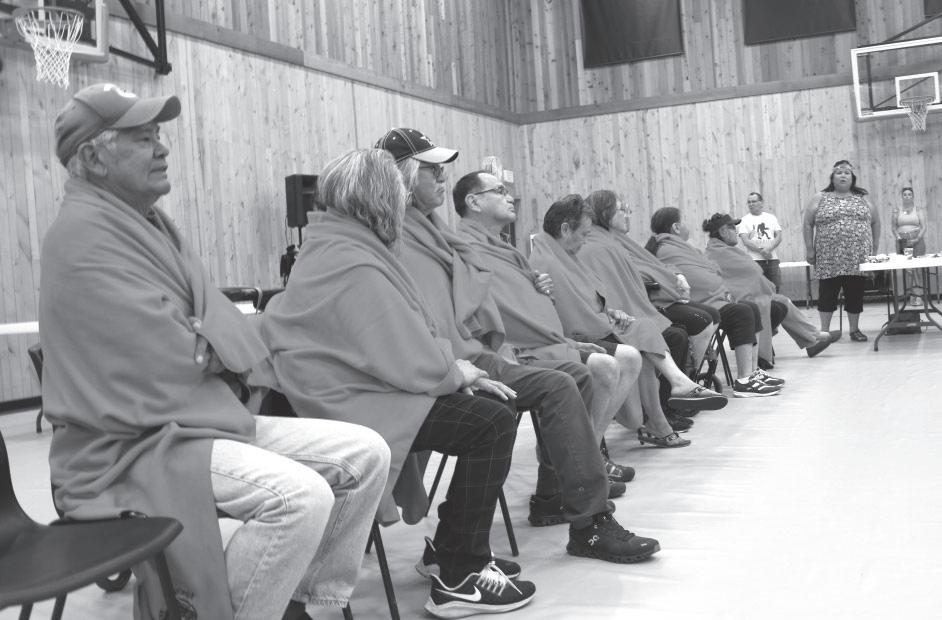
Residential school survivors were recognized at the Alberni Athletic Hall on Sept. 16, 2022 for their contributions to the early stages of a longitudinal study on the determinants of health.
Nora O’Malley photo
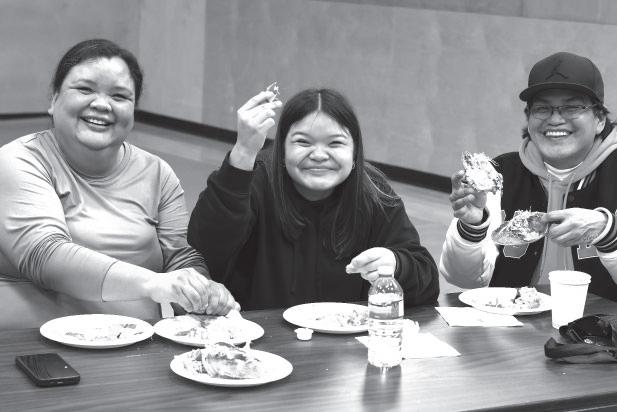
William Thomas, Devina Thomas and Erica Mack crack open delicious Dungeness crab during a Feb. 13 event hosted by Yuu
at
at Cix
atin Centre in Hitacu. The full day event called ‘Moving through trauma by connecting
Mercury and cumulative effects of pollution discussed
Indigenous reps from across Canada gathered in Tofino Feb. 10 to 12 to establish a network and offer guidance
By Nora O’Malley Local Journalism Initiative Reporter
Tofino, BC – Judy Da Silva’s eyes light up as she forks a piece of wild smoked salmon into her mouth.
“It’s like a privilege to me. To me, it’s like gold. It’s good medicine for our spirits when we have our traditional foods,” said Da Silva at the Tin Wis Resort on Feb. 11.
A Grassy Narrows First Nation elder, Da Silva travelled from northwestern Ontario to Tla-o-qui-aht First Nations territory on the west coast of B.C. to share her knowledge with Indigenous representatives from across Canada during an inaugural multi-day gathering hosted by the National Indigenous Centre for Cumulative Effects (NICCE) with support from Tla-o-qui-aht.
Da Silva has spent her whole life suffering from the effects of mercury poisoning.
Between 1962 and 1970, the Dryden Chemical Company’s pulp and paper mill discharged roughly 10 tonnes of mercury into the English-Wabigoon River system, which flows into Grassy Narrows, or Asubpeeschoseewagong Netum Anishinabek territorial waters. Research shows the water system is still polluted to this day.
Before the discharge of the mercury, Grassy Narrows was an active commercial and subsistence fishery. After the mercury was discovered, the Ontario government shut down the commercial fishery; unemployment rates in Grassy Narrows went from five to 95 per cent, according to a community advocacy site. Some members continued to fish for subsistence.
“We get poisoned by eating the fish. Mainstream society will say, ‘Why do you eat poisoned fish?’ It’s our traditional foods. It’s what we learned as a people,” said Da Silva.
Today, Da Silva says almost 90 per cent of the 800 members that reside in Grassy Narrows suffer from mercury poisoning symptoms.
“Mercury is a neurological toxin. It attacks the stem of the brain and it slowly eats away at the brain as you age,” she said. “There are all these hidden truths we never would have found without our advocates out there.”
In collaboration with the Tla-o-qui-aht Guardians program, NICCE gathered representatives from Tłıchǫ Government in the Northwest Territories, Athabasca Chipewyan First Nation in northern Alberta, Tŝilhqot’in National Government
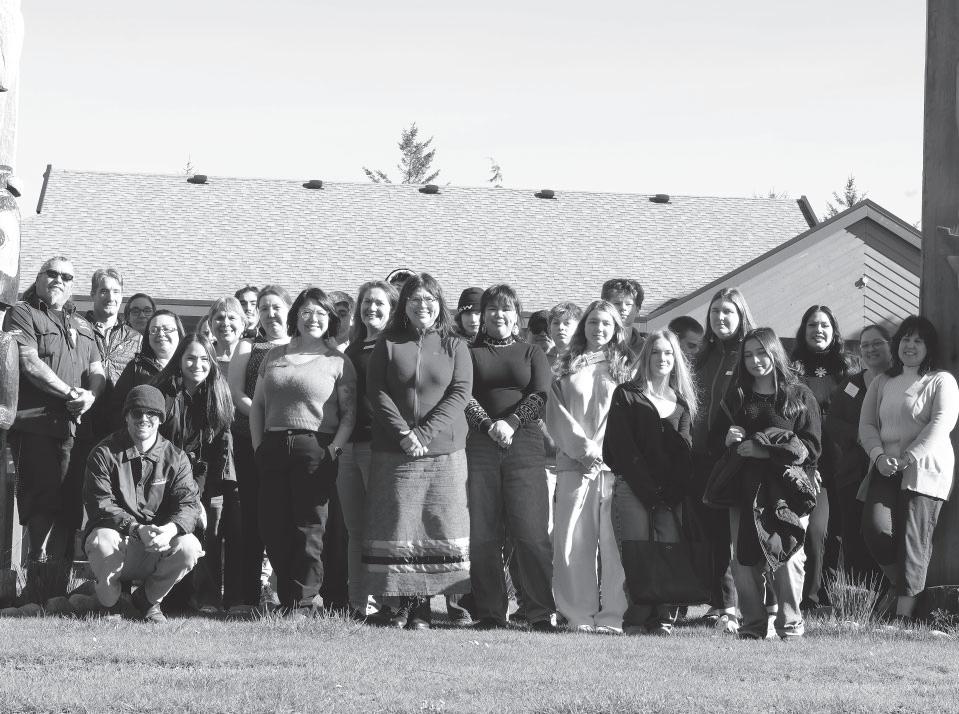
near Williams Lake, B.C., Wabun Tribal Council, Denesuline and York Factory First Nations, Arctic Eider Society and Grassy Narrows for the inaugural knowledge exchange.
One of the main goals for the gathering was to establish an Indigenous network of people working in the cumulative effects realm, says NICCE executive director and Tla-o-qui-aht member Danielle Wilson.
“Cumulative effects are unique to each community, but it’s ultimately that seven generations thinking. What are the means that we need to preserve to make sure that our future generations live and thrive in the same conditions that their ancestors did?” she said.
“I hope there are connections made and that communities can lean on one another for support and guidance,” Wilson continued.
Saya Masso, Tla-o-qui-aht’s natural resources manager, said the networking opportunity has been “amazing”.
“I’ve been enthralled to learn about what’s going on up North,” said Masso.
While the North is struggling with


declining Caribou herds, Masso said the West Coast is faced with the cumulative effects of over fishing, plastic pollution, forestry impacts and even tourism.
“It’s so important to try and understand impacts so that they can be managed better. Everyone should have the environment in mind and try and have the best plan to mitigate and manage for abundance regardless of what the industry or infrastructure is. It should always be done better,” said Masso.
A highlight of the NICCE gathering was the inclusion of the land-based learning cohort from Ucluelet Secondary School on Feb. 11.
“I was really excited with how much they were engaged,” said Sheena Charleson, an Indigenous support worker from the school. “I was overwhelmed with pride that they were so involved and willing to participate, and also just how powerful their voices are.”
Training more guardians to take care of the land and bringing more youth on the field was noted as a high-priority during
the knowledge exchange.
“The more immersed people can be in experiences and time on the land, the more they will be able to see the effects of what is happening,” said teacher Arran Jackson.
“You can’t want to save things you haven’t experienced or care about. You have to have that connection in order to draw a desire to care,” he said.
Da Silva offered some advice to the youth:
“Don’t take mainstream society’s answers as the golden truth,” she said. “Be able to question things and dig deeper into the truths. Listen to the elders, the hunters, the trappers and the land users.
They are the ones that are on the land and they see the indicators of something that is not right. They may not be doctors or lawyers or engineers, but they have true knowledge of the land, the water, the aireven bugs.”
To learn more about cumulative effects in Indigenous communities across Canada visit: www.icce-caec.ca.

Nora O’Malley photo
Participants in the first-ever National Indigenous Centre for Cumulative Effects knowledge exchange gather for a group photo between the two totem poles that stand in front of Tin Wis Resort.
Hundreds march in 17th Stolen Sisters Memorial
Relationship with Indigenous people has been ‘a very, very difficult one,’ says Victoria Police chief at the event
By Roniya Sahin Ha-Shilth-Sa Contributor
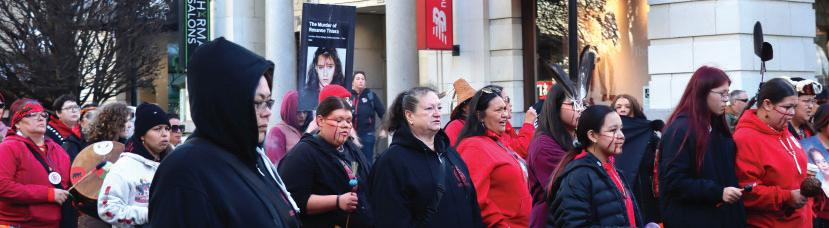
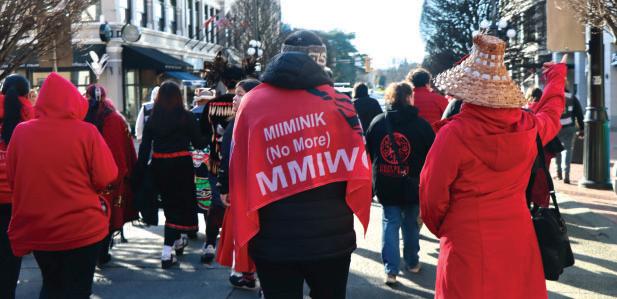
Victoria, BC – Hundreds dressed in red gathered in downtown Victoria on Feb. 14 to participate in the 17th annual Stolen Sisters Memorial March to honour missing and murdered Indigenous Peoples.
The WSÁNEĆ Wolf Pack led the march from Centennial Square through Government Street towards the legislature.
The march formed a large circle at each intersection along Government Street for song and dance performed by the Wolf Pack, each a tribute to the disproportionate number of Missing and Murdered Indigenous Women and Girls (MMIWG).
Patrick Leon, the leader of the Pack, accompanied each performance with calls to action, justice, and community building. At a certain point, Leon highlighted the important roles men play in protecting the women in their community from violence by turning towards love rather than anger.
“Truth be told: it starts with us men,” said Leon,” [men] need to learn to love themselves to care for the women in their lives and lead an example for [our] youth.”
The Assembly of First Nations (AFN) reports that despite Indigenous people making up only 4.3 per cent of the Canadian population, they make up 16 per cent of total homicide victims and 11 per cent of reported missing women. This makes Indigenous women four times more likely than non-Indigenous women to experience violence.
Aboriginal women are also more likely to be attacked by their intimate partners,
17th
according to the Survey of Safety in Public and Private Spaces.
“Indigenous women are overrepresented as victims of intimate partner violence in Canada,” stated the SSPPS. “About four in ten, or 45 per cent, Indigenous women are likely to experience or have experienced physical and/or sexual violence committed by their romantic partner in their lifetime. This greatly contrasts the fact that non-Indigenous women are 25 per cent likely to encounter physical or sexual violence across their lifetime.”
Since 2019, the federal government has only implemented two of the 231 calls for justice made by the AFN to bring justice to MMIWG.
“I want to be the last generation that is fighting for our girls, our Two Spirit, our 2SLGBTQIA+, our men and our boys,” event organizer Monique May said to the crowd.
The intersection between Government and Belleville Street saw a solemn tribute
to the families affected by the disappearances of Indigenous Peoples. Victims gathered in the centre of the circle to hold each other and grieve as the Wolf Pack performed their tribute to the victims.
The legislature marked the penultimate location of the march, where organizers Monique May and Sheila Jones both spoke and invited individual speakers to share their personal experiences related to missing and murdered Indigenous Peoples.
Victoria Police Chief Constable Fiona Wilson was invited to offer the closing speech. She did so out-of-uniform.
“It is not lost on me that the relationship between Indigenous people and the police has been a very, very difficult one,” Wilson said, “and I am absolutely – in my role – [trying] to do everything I can to try and repair some of those relationships as we move forward together.”
The disappearance of 34-year-old Rosemarie Harry of Quwut’sun Nation is still
being investigated. She was last seen in Duncan on Jan. 28, 2026 when she met with her social worker, and was reported missing on Feb. 4.
Rosemarie’s sudden disappearance is unnatural according to her family members and social worker. Her social worker, Myra Antoniuk, said Rosemarie was on track to gain custody of her children and that she regularly stayed in contact with those closest to her.
Rosemarie Harry is described to be five feet tall, 141 pounds, with dyed blonde hair. The North Cowichan/Duncan RCMP ask that any information regarding Harry’s disappearance be reported to 250748-5522 immediately.
June 29, 2026 will also mark 24 years since the disappearance of Tla-o-quiaht woman Lisa Marie Young. Lisa was 21-years-old when she was last seen celebrating a friend’s birthday at a nightclub in Nanaimo right before accepting a ride from a man driving an old red Jaguar. She was never heard from again.
The Nanaimo RCMP identified the Jaguar as belonging to a man named Christopher William Adair. He has since been named a person of interest in the case but has not been charged with Lisa’s disappearance. Adair was recently found to be living in the city of Fethiye, Türkiye, a popular holiday destination, since 2017.
Lisa Marie Young’s case is now being treated as a homicide. A $50,000 USD reward is currently being offered in exchange for Young’s remains. Any information about the ongoing case is to immediately be reported to the Nanaimo RCMP at 250-754-2345.

Roniya Sahin photo
The
annual Stolen Sisters Memorial March to honour missing and murdered Indigenous Peoples brought hundreds through downtown Victoria Feb. 14.
Estuary to Old Growth declaration brings ‘an opportunity
Pledge serves as another push towards a different way of managing forests, as the forestry industry faces continued d
By Eric Plummer Ha-Shilth-Sa Editor
Parksville, BC - “The best salmon-making machine is an ancient rainforest,” according to those behind an initiative to collectively find a more holistic approach to managing First Nations’ territories.
“We need to carefully manage the resources in such a way that it doesn’t deplete our resources, it doesn’t create that imbalance that’s in societies,” said Terry Dorward, board president of the IISAAK OLAM Foundation, which promotes the establishment of Indigenous protected conservation areas. “We have a common denominator, which is working to heal broken lands and broken communities.”
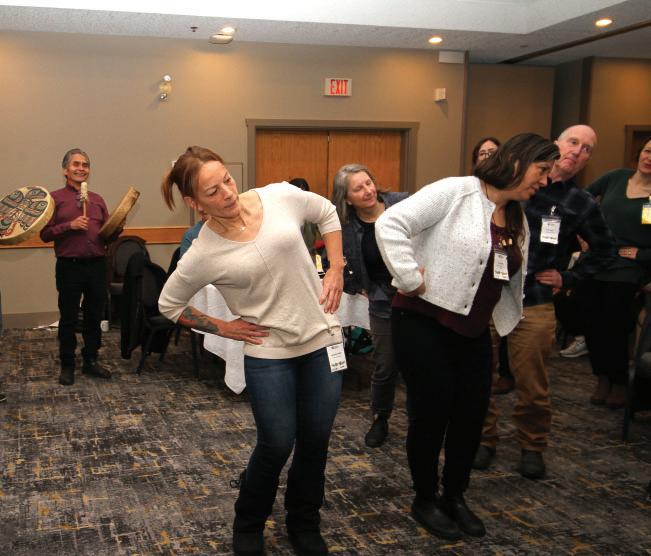
For a week in January the foundation hosted the Estuary to Old Growth Gathering in Parksville, bringing together a conference room full of representatives from Nuu-chah-nulth, Coast Salish, Kwakwaka’wakw and Haida nations. During the event delegates were presented with the Estuary to Old Growth Declaration, which outlines a commitment to protect and restore territories, as well as “care for cultural keystone species through shared stewardship and knowledge exchange”.
“We have an opportunity to start correcting course,” said Eli Enns, IISAAK OLAM’s CEO and board vice-president. “If we don’t do this, we’re just leaving a mess for our children and our grandchildren.”
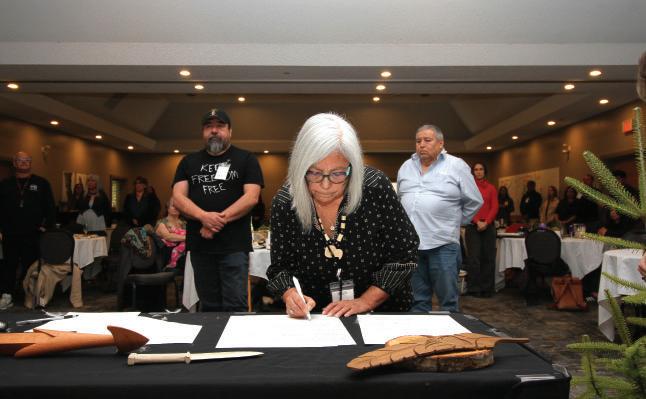
A handful at the gathering signed the declaration, but many more put their names to an “intention to stand with the declaration in principle.”
“The statement of intent is for them to go back home to their leadership and talk to them, present the declaration,” explained Dorward.
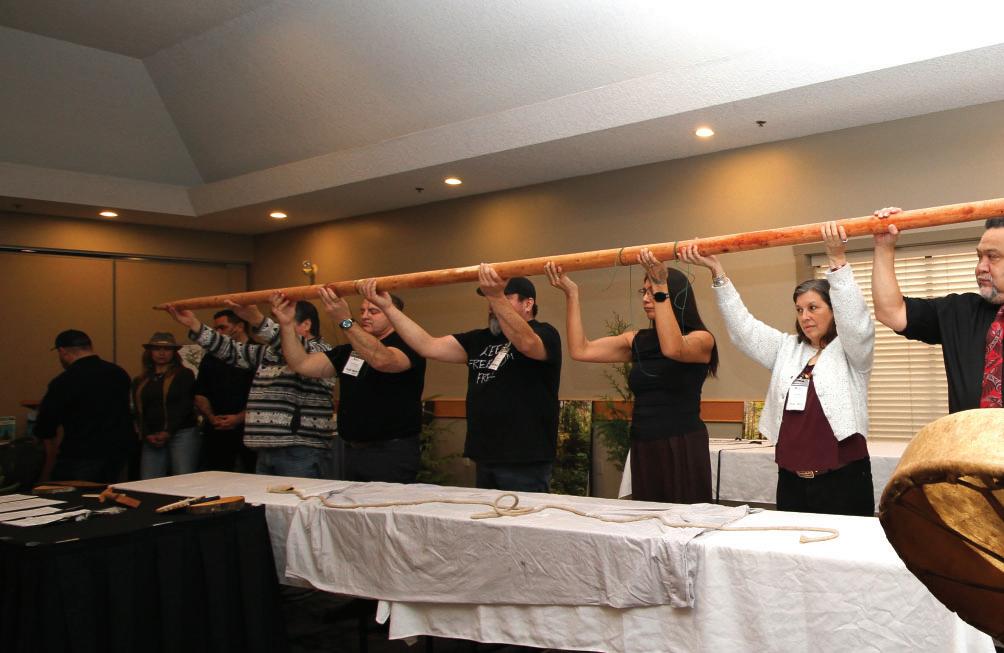
event delegates were presented with the Estuary to Old Growth Declaration, which outlines a commitment to protect and restore t and knowledge exchange”.
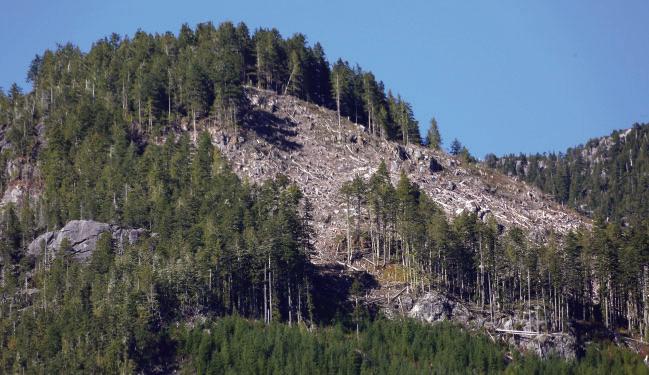
The declaration is intended to change the course from generations of unsustainable resource extraction that have left First Nations’ territories marked by large patches of clearcuts, while many of the salmon stocks they have long subsisted on have declined in abundance.
“We’ve suffered so much in boom-bust economies. I grew up when there wasn’t a
lot of jobs anymore in fishing, in logging,” said Dorward, noting that at lower, valleybottom elevations the remaining old growth represents three per cent of what was once stood on the B.C. coast.
“I think our people have always had a role in forestry, we will continue having a role in forestry - how we look at forestry needs to be considered,” he added. “There are other options, nature-based solutions, conservancies.”
A call to re-imagine forestry
But reconsidering forestry presents a challenge for many in British Columbia, which has long seen the industry as foundational
to the development of the province. While the Estuary to Old Growth Gathering was being held in Parksville, the B.C. Natural Resources Forum launched its “Forestry is a Solution” campaign in Prince George on Jan. 20. This push seeks support for the logging and manufacturing sector, stressing the need to “speed up access to economic wood by expediting permits and approvals”. Many of the industry’s leading associations are backing this campaign.
“The coalition is asking British Columbians to voice their support for the workers and families that depend
Joe Martin drums as people hold a traditional whale harpoon he made from yew wood, which was presented at the Estuary to Old
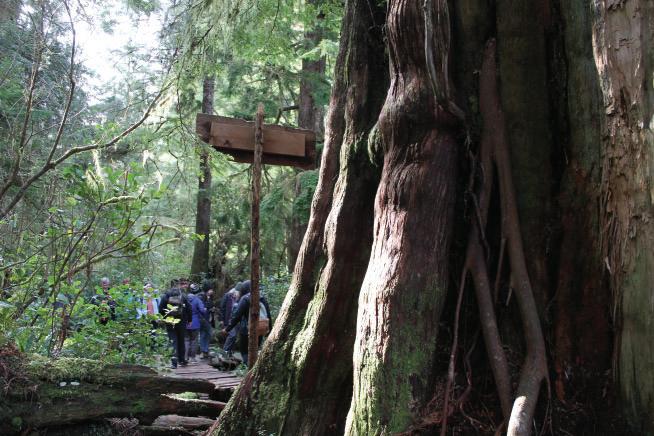
Toquaht Chief Anne Mack (above top) signs an intention paper to support, in principle, a declaration to protect territorial resources at the Tigh Na Mara Resort on Jan. 22. The Big Tree Trail on Meares Island (above) is part of the Tla-o-qui-aht First Nation’s Tribal Parks, a forest that has been protected since 1984.
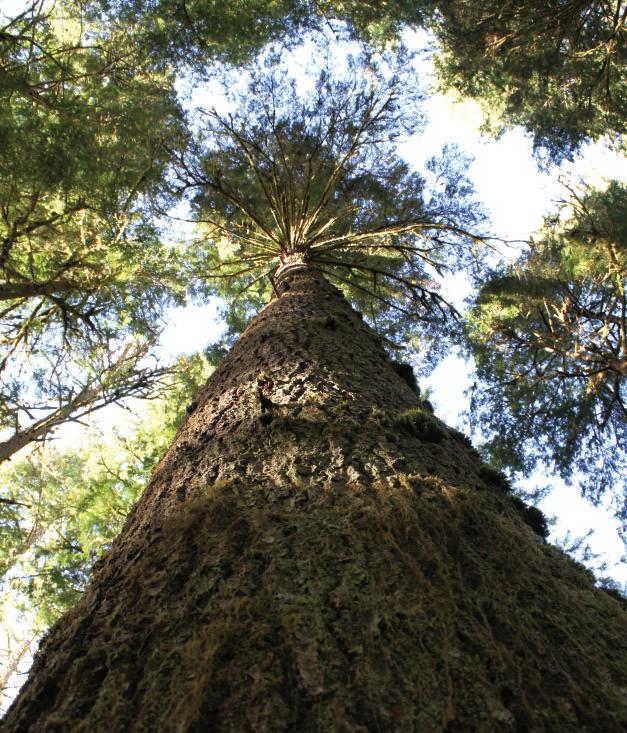
Mowachaht/Muchalaht’s Salmon Parks aim to have nearly 67,000 hectares –about one fifth of its territory – protected from disruptive industrial activity in four years.
y to start correcting course’
decline and mounting challenges on both sides of border
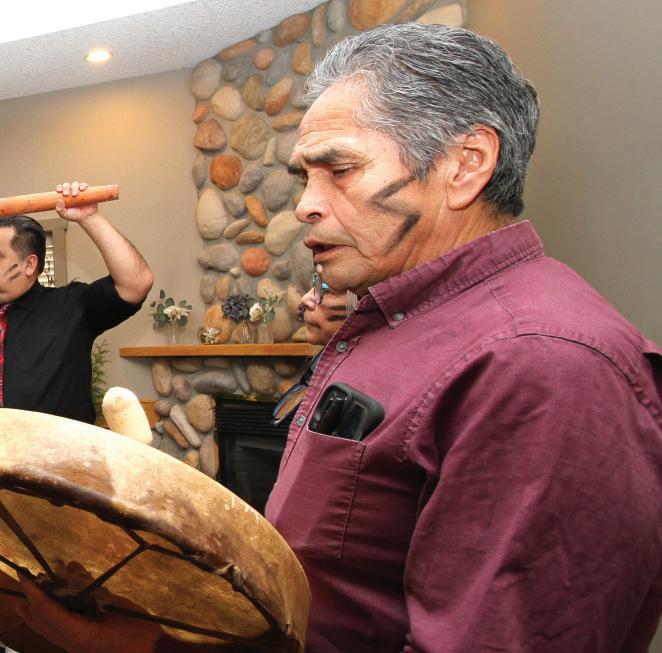
d Growth Gathering on Jan. 22 at the Tigh Na Mara Resort in Parksville. During the territories, as well as “care for cultural keystone species through shared stewardship
on forestry – a sector that is vital to the province’s heritage and its future,” stated the B.C. Council of Forest Industries.
Many First Nations also rely on the industry through revenue sharing agreements over what is harvested in their territories, as well as ownership stakes in forestry companies and members working on cutblocks or in mills.
But with over 70 per cent of B.C.’s lumber being exported to the United States, 2025 wasn’t a kind year for the province’s forestry sector. Over the course of last year US tariffs tripled to 45 per cent, while a succession of mill closures continued – the most recent casualty being the Crofton pulp mill in early December. Its owner cited a lack of available fibre and poor prices on the international market for the shutdown. B.C.’s forestry has been in decline for years, with the 49,230 employed in the industry in 2023 representing a 12 per cent decline from the workforce a decade earlier – and 40,000 fewer jobs than in the early 1990s. In the 2023 - the most recent data available from the Ministry of Forests – the province-wide harvest totaled under 40 million cubic metres, a sharp decline from the over 70 million cut 10 years before and the lowest volume harvested since the early 1960s.
Not surprisingly, a Feb. 2 report from the Provincial Forestry Advisory Council
stated that the days of “abundant access to low-cost fibre” are over. The report was presented as “a call to fundamentally reimagine our relationship with the land.”
“B.C.’s Forest Act—largely shaped during an era of industrial expansion— was designed for a reality that no longer exists,” wrote the advisory council. “The circumstances and approaches that once attracted investment and sustained large-scale operations are now outdated and insufficient to meet today’s complex ecological, social and economic realities.”
Finding a conservation economy
The Estuary to Old Growth declaration notes the intention to “heal our lands and waters through stewardship and restoration”, while First Nations “access naturebased solutions markets”.
This can be a viable alternative to resource extraction, says Steven Nitah, managing director of First 30 x 30 Canada.
The organization recently received a $10 million US (worth about $14 million CAD) grant from the BHP Foundation to support Indigenous-led conservation efforts.
“We use the financing to bring technical and financial capacity to support Indigenous-led initiatives for conservation and land management within their territories,” said Nitah, whose organization is named after Canada’s international commitment to
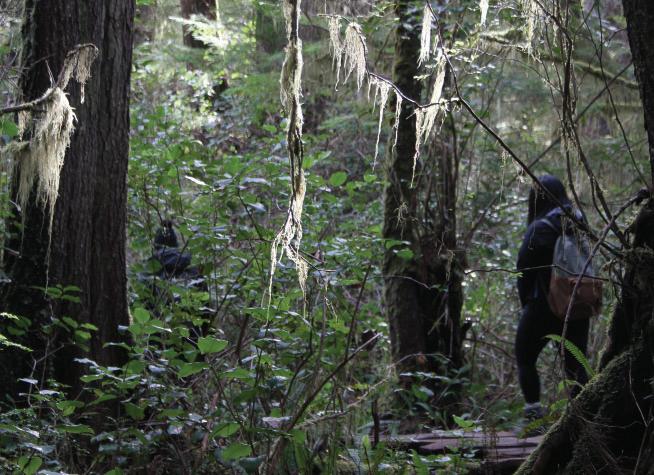
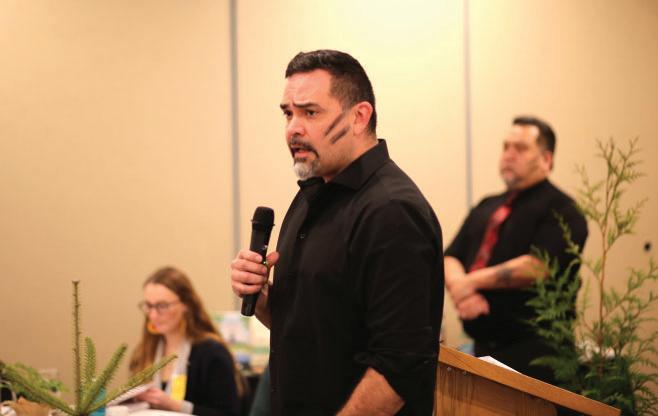
“We have an opportunity to start correcting course,” says Eli Enns, IISAAK OLAM’s CEO and board vice-president (above). This was the reason the Tla-o-qui-aht and others stood against logging on Meares Island (above top) back in 1984. Meares Island is the source of Tofino’s drinking water.
protect 30 per cent of its land and water by 2030. “In Canada, we’re about half ways there. The remaining 15 per cent represents the quantity of land the size of Manitoba and Saskatchewan.”
First 30 x 30 Canada is helping First Nations with feasibility studies for their conservation projects. The organization is currently working with Mowachaht/ Muchalaht’s Salmon Parks, which aims to have nearly 67,000 hectares – representing one fifth of its territory – protected from disruptive industrial activity in four years.
There is opportunity in the global effort to de-carbonize, including selling offsets to corporations that pollute above the limits set by their countries, says Nitah.
“They’re only allowed to emit a certain
amount of carbon annually,” explained Nitah. “Above that they have to pay a carbon tax. The alternative is to buy a carbon offset.”
Worth the equivalent of one tonne of carbon dioxide that would be emitted into the atmosphere, a carbon credit – or offset – is a tradeable commodity on the international market which acts like a permit for a company to release greenhouse gases. These credits are verified by lands stewards and technology before being sold to industrial emitters.
“Carbon offset is a competitive replacement of those revenues,” said Nitah. “It’s an opportunity for Indigenous peoples and public governments to use their processes to address the reconciliation agenda.”
Eric Plummer photos
A clearcut covers a slope side in Nootka Sound in Mowachaht/Muchalaht territory. The Estuary to Old Growth Gathering brought together representatives from Nuuchah-nulth, Coast Salish, Kwakwaka’wakw and Haida nations.
BC Parks increases camping fees at popular sites
Fee increase applies to high-demand locations to help accommodate a 30 per cent increase in visitors since 2019
By Sam Laskaris Ha-Shilth-Sa Contributor
It will soon cost more to enjoy parks throughout British Columbia, especially for out-of-province visitors.
The Ministry of Environment and Parks announced via a late January news release that new camping fees and a new surcharge would be introduced for users from outside of British Columbia on May 15.
Tamara Davidson, B.C.’s minister of Environment and Parks, believes the increased costs are justified.
“These are the first adjustments made to camping fees in a decade, and every dollar will be reinvested directly into maintaining facilities and services people expect when visiting popular parks,” Davidson said. “By creating a more sustainable operating model, we are strengthening our collective stewardship and ensuring B.C.’s natural treasures remain vibrant and accessible for generations to enjoy.”
These new fees will be at select highdemand parks as well at some backcountry sites.
“As a park user I understand the deep value of these shared spaces and the benefits they bring to our communities – culturally, economically and recreationally,” Davidson added. “At the same time, B.C.’s parks are facing significant pressures, from the impacts of extreme weather to the 30 per cent surge in visitors over the past six years.”
As a result, Davidson said it is necessary to increase fees at certain locations.
BC Parks last updated its camping fees in 2016.
Provincial figures show that the number of people visiting BC Parks sites has grown by about 30 per cent in the past six years. There are now about 27 million visits each year.
The list of busiest parks that will see increased fees includes Sproat Lake, Juan de Fuca and Strathcona Park, which are ones located in Nuu-chah-nulth territory. Sproat Lake had more than 212,000 visitors during its 2018-19 season. This figure increased to almost 255,000 for 2024-25.
Juan de Fuca Park had about 415,000 guests in 2018-19 and saw an increase to more than 615,000 for 2023-24. Attendance figures then dipped to about
586,000 the following year, in part because some areas of the park were closed due to an atmospheric river in 2024.
As for Strathcona Park, it had almost 240,000 visitors in 2018-19. But wildfire impacts from 2023 and ensuing issues with data tracking and reporting resulted in a visitors figure of about only 67,000 guests for the 2024-25 season.
There are plenty of reasons why people are spending an increasing amount of time at parks throughout B.C.
Results from a provincial survey indicated motivating factors to spending time outdoors included experiencing nature, keeping fit and healthy as well as spending time with family and friends.
The new provincial camping fees will be at 59 high-demand front-country parks and four backcountry parks.
Front-country refers to any area that is situated within one kilometre of a park road or a highway.
Meanwhile, fees will not change at 388 other parks.
For B.C. residents who visit front-country parks, they will see an increase of about 40 cents per night during shoulder season, resulting in an average nightly
rate of $30.81.
A significantly higher increase of $13.29 per night applies to summer use, bringing the nightly average to $42.91.
About 15 per cent of all BC Parks users are from out of province. Beginning in mid-May they will pay an additional $20 flat rate for staying in front-country campgrounds, visiting backcountry parks as well as renting cabins and using mooring buoys and docks.
Provincial officials plan to use the extra revenues generated from the increased fees to support sustainability of the services in its parks, allowing them to remain open, accessible and safe.
Parks representatives have also been taking some steps to ensure that some of the locations do not suffer from the additional usage in recent years.
For example, some high-use parks have seen the implementation of daily visitation caps to reduce crowding. Reservations and day-use passes monitor the number of daily users.
Also, for certain sensitive time frames, including during wildlife nesting or wet seasons, some parks are temporarily closed or there is limited access and
restricted parking.
Louise Pedersen, the executive director of the Outdoor Recreation Council of B.C., also believes the new fees are warranted.
“Parks and trails are vital public assets that support community health, wellbeing and local economies across British Columbia,” she said. “As use continues to grow, targeted reinvestment in the parks system helps ensure these benefits remain available to British Columbians, while supporting the infrastructure and stewardship needed to care for these places responsibly.”
Jamie Cox, the executive director of the B.C. Lodging and Camping Association, also has a similar thinking.
“Campgrounds across British Columbia are seeing unprecedented demand, and continued reinvestment is essential to maintaining the high-quality experiences campers expect,” Cox said. “Updating fees in the busiest parks helps ensure the entire system remains safe, well-maintained and able to support the growing number of people who rely on camping as an affordable way to connect with nature.”
Phrase of the week:Hiiqwa>%a>%iš hinin +’usmit yuuqwaa q’wakmis caamihta witnas ha%uk +iicuu
Pronounced ‘Hi qwałh alt ish he nin clues mit yuu qwa qwak mis ha ook wit tas nis ca mira,’ it means, ‘Herring season is coming and everybody feels excited. We will soon be feasting on this wonderful food.’ Supplied by ciisma.

Wikimedia Commons photo
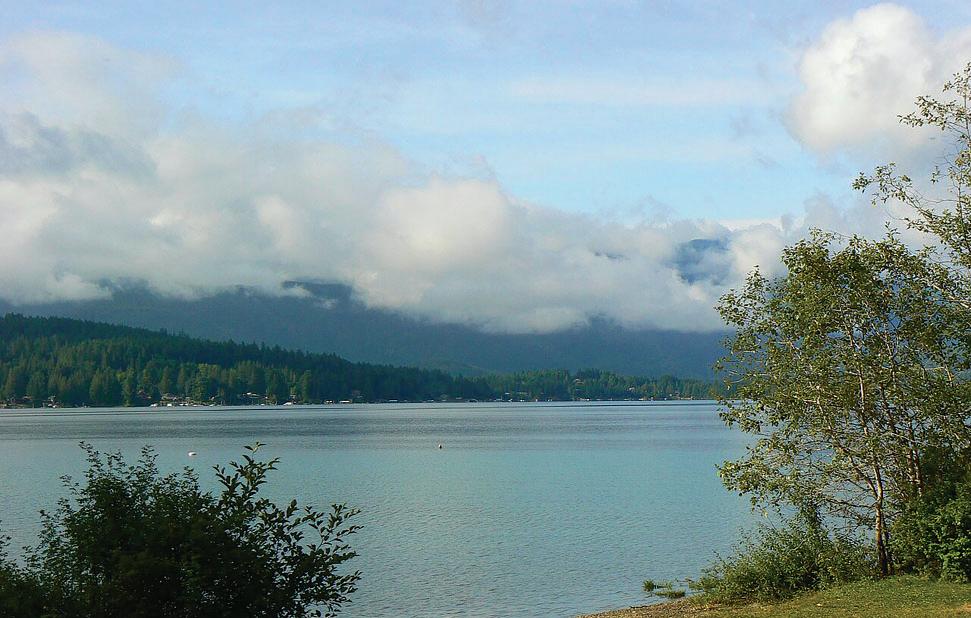
Sproat Lake had more than 212,000 visitors during its 2018-19 season. This figure increased to almost 255,000 for 2024-25.
Wolf clashes prompt dog ban for parts of Long Beach
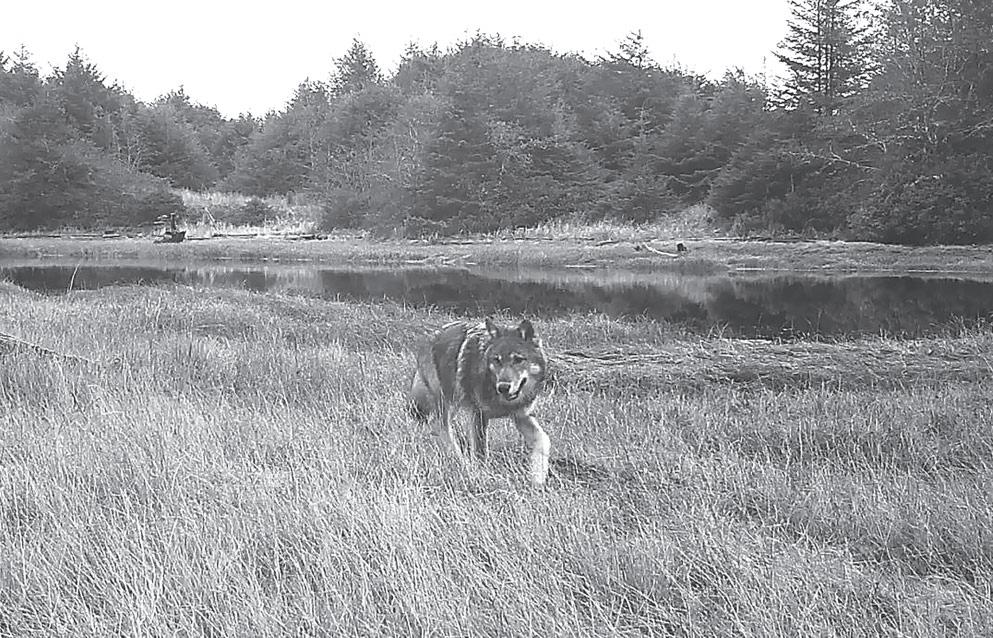
Two wolves attack a dog on the Willowbrae Trail Feb. 12, part of a rise in human encounters with the predators
By Sam Laskaris Ha-Shilth-Sa Contributor
Ucluelet, BC – Earlier this week Parks Canada officials announced that dogs are now banned from being on a part of Wickaninnish Beach, located on Nuuchah-nulth territory south of Tofino.
The ban, which came into effect on Feb. 11, prohibits dogs from being on the section of the beach from Beach Access E to Sandhill Creek. This area is in Ucluelet First Nation territory.
An incident just one day later led to an expansion of the ban. It was announced on Feb. 13 via the Pacific Rim National Park Reserve’s Facebook page that two wolves had attacked a dog on the Willowbrae Trail the day before.
This 2.8-kilometre trail begins south of the Ucluelet/Tofino junction.
As a result of this latest attack, dogs are now also prohibited on the stretch from Willowbrae Trail to Green Point Rocks.
Parks Canada officials said the Wickaninnish Beach ban was necessary because there has been an increase of interactions with wolves and humans, especially those who are with dogs.
An increase in aggressive behaviour from wolves has been noticed because they consider dogs as a competitor or prey.
Liam McNeil, the acting resource conservation manager for the Pacific Rim National Park Reserve, felt now was the appropriate time for Parks Canada to
implement the ban.
“Human and wildlife safety is of the utmost importance to Parks Canada,” he said. “And we take proactive action to promote safe co-existence between people and wildlife.”

The ban is a follow-up to a wolf warning Parks Canada had issued this past September, recommending that visitors leave their dogs at home because of an increase in the number of wolves and wolf encounters in the area.
McNeil felt it was vital to ramp up action from a warning to the ban of dogs in the area.
“This restricted activity order responds to a marked rise in human/wolf interactions in the Long Beach Unit since 2024, influenced in part by an increase in the number of wolves in the area,” he said. “Multiple recent incidents have involved wolves closely approaching or following dogs, and Parks Canada has implemented management actions to reduce these interactions.”
The latest ban is also a stepped-up increase in past proactive safety measures, including closures in the Wickaninnish Dunes and the former Gold Mine Trail.
McNeil said there were more than 40 reported wolf encounters in 2025 in the region. The majority of those occurred in the Long Beach Unit of the Pacific Rim National Park Reserve.
Other dog regulations have also been in existence in the Long Beach area.
For example, unless they are certified service pets, dogs are not permitted on the West Coast Trail or the Broken Group Islands at any time.
There is also a seasonal dog closure, from April 1 through Oct. 1, on Combers Beach. This particular closure is in place to protect migratory shorebirds during vital feeding and resting periods.
Disregarding leash laws, area closures or dog prohibited areas can result in charges, including a maximum fine of $25,000.
McNeil confirmed some individuals have indeed been charged under the Canada National Parks Act for violations related to dog regulations.
“We all have a shared responsibility to keep pets on leash and obey warnings and restrictions,” he said. “Where dogs are allowed, keeping pets on leash and under physical control at all times is the law. And it protects both your animal and the wildlife that live here.”
Parks Canada reps suggest those who are planning to visit area’s parks should
always seek out existing advisories and closures before they venture out.
McNeil added not having dogs on a leash can lead to problems.
“Off-leash dogs can trigger defensive or aggressive behaviour from wildlife or unintentionally harm smaller animals,” he said. “Compliance is something we are always working toward through education and enforcement.”
Parks Canada officials added the latest ban will remain in place until further notice. Also, wolf sightings and interactions will be closely monitored to get an indication how long the ban should last.
Besides having a valuable cultural significance for First Nations, wolves are also considered a vital part of the ecosystem.
Human behaviour can have a huge influence on wolf movements.
“Wolves in Pacific Rim National Park Reserve are highly aware of people, even when they appear calm or distant,” McNeil said. “Parks Canada monitors wolf activity using remote cameras and other research tools to better understand movement patterns and behaviour while minimizing disturbance.”
While humans might be rather curious upon spotting a wolf, McNeil suggests it is not ideal to follow them.
“Seeing a wolf in its natural habitat can feel like a once-in-a-lifetime experience,” he said. “But people should never try to watch, follow or observe wolves - even from afar. Repeated exposure to people can change wolf behaviour, leading to habituation or food conditioning. These outcomes significantly increase the risk of conflict.”
Several other Nuu-chah-nulth First Nations have territories in the Pacific Rim National Park Reserve.
They include Ditidaht, Hupačasath, Huu-ay-aht, Tseshaht, Toquaht, Tla-oqui-aht and Uchucklesaht.
Parks Canada undertook a six-year project, titled Wild About Wolves, which explores how humans can co-exist with wolves. The Wild About Wolves website can be viewed here:
https://parks.canada.ca/pn-np/bc/pacificrim/nature/recherche-research/loupssauvages-wild-wolves
Parks Canada video still
As a result of a recent wolf attack, dogs are now also prohibited on the stretch of the Pacific Rim National Park from Willowbrae Trail to Green Point Rocks.

How is AI impacting the environment?
International reports show massive amounts of water consumed by data centres - far more than small towns
By Holly Stocking Ha-Shilth-Sa Editorial Assistant
Artificial intelligence is becoming increasingly popular on social media platforms like Facebook, Instagram and Tik Tok, but what impacts are AI generated videos and images having in the environment?
AI requires massive, specialized data centers, often called ‘AI factories’, to train and run complex models. This brings a surge in demand for power and infrastructure dependent on fossil fuels, resulting in a high production of greenhouse gas emissions.
Morgan Stanley, a global financial services firm, reports that the worldwide data centre industry is responsible for a cumulative 2.5 billion tonnes of CO2 a year, and could spike as high as six billion metric tons by 2030.
The firm also reported some analyses suggest that actual emissions from major tech companies like Google, Microsoft, Meta, Amazon, Apple could be over 600 per cent higher than official corporations report, driven by the intense energy demands of AI. CO2 has been directly linked to rising global temperatures causing increased hurricane intensity, sea level rise, ocean acidification, environmental damage and social inequities.
The high CO2 emissions are only one facet of AI’s negative environmental impacts: AI data centres consume massive amounts of water, according to the International Energy Association. Individual data centres use up to five million gallons (approximately 19 million litres) daily for cooling. This is exponentially more than a small town like Ucluelet, which uses 10,000 to 50,000 gallons per day. Meanwhile, a single, 20–50 question chat with an AI model like ChatGPT can consume roughly 500 millilitres of water. A single picture can use up to several hundred milliliters (up to half a liter or more), depending on the model, data center efficiency, and location.
The IEA also states that water used for cooling AI data centers becomes contaminated and is often not returned to the local source. Cooling processes, particularly evaporation, leave behind concentrated contaminants like salts, chemicals, and minerals, while roughly 80 per cent of the water evaporates. The remaining
wastewater, often called ‘blow-down’, can contain high levels of heavy metals and chemicals that require treatment before disposal and can contaminate the ground around the centre.
“The use of AI has increased exponentially since first introduced and continues to grow,” said Judith Sayers, president of the Nuu-chah-nulth Tribal Council.
“The number of data centers is increasing and with it the need for water and power. Fresh water is used to cool the equipment used and there is no reusing of the water.
The world has 0.5 per cent clean drinking and usable water.”
British Columbia has 15 AI data centres operating, in various location as far north as Prince George. Hut8 operates two in Vancouver and one in Kelowna. Bell has two in Vancouver, as well as one in Burnaby, Surrey, Kamloops and Meritt. IREN has centres in Prince George, McKenzie and Canal Flats. Equinix has centres in Burnaby and Kamloops and Teraswitch has one in Vancouver.
The province and BC Hydro launched a competitive process for artificial intelligence and data centres to help manage the rising electricity demand AI brings.
“By managing demand carefully and directing power to projects that deliver the greatest long-term benefits, we will build our province, while protecting affordability and reliability for British Columbians,” said Adrian Dix, Minister of Energy and Climate Solutions in a press release.
“At the same time, we are creating a clear path for emerging industries, like AI, to quickly and efficiently get the power they need, positioning British Columbia as a leader in innovation and data sovereignty.”
Besides its environmental impact, AI has some positive attributes. AI in the health care sector is transforming medicine by accelerating drug discovery, enhancing diagnostic accuracy through imaging analysis, and enabling personalized treatment plans.
Should AI be restricted to beneficial applications like the health care system to reduce intense environmental impact?
“The time to act is now and we as First Nations must ensure our water supplies are safeguarded,” urged Sayers. “Water is our right and we are the stewards and we must act responsibility.”

Netp’s Annual Career Fair
Thursday, April 9th 9:00am – 3:00pm
3737 Roger Street, Port Alberni
Free table registration. For further details contact Shan at shan.ross@nuuchahnulth. org or Kirunn at kirunn.sharma@ nuuchahnulth.org or call 250.723.1331or
visit 4090 8th ave Port Alberni.
NCN Mental Health Counselling
Tuesdays and Thursdays 8:30am – 4:30pm
4841 Redford Street, Port Alberni
NCN Mental Health Services – DropIn Counselling with Margaret Bird, Registered Clinical Counsellor and Play Therapist. For on and off reserve

&Community Beyond



members of all ages of the Nuu-chahnulth Tribal Council. Call (250) 724-3939 to book your appointment.
Stirring up Connections
Every Friday 10am – 12:30pm
NTC Kitchen – 4841 Redford Street.
A warm and welcoming cooking group designed just for parents! Whether you’re a seasoned home chef or just learning how to boil water, this group is all about sharing recipes, laughter, and stories while preparing simple, nourishing meals together. Each session will feature: Easy, budget-friendly recipes; Tips for cooking with kids and picky eaters; Space to connect with other parents over food and family life. Contact 250-724-3939 for questions.

25 Years Ago in Ha-Shilth-Sa
Vol. 28 – No. 3
February 15, 2001
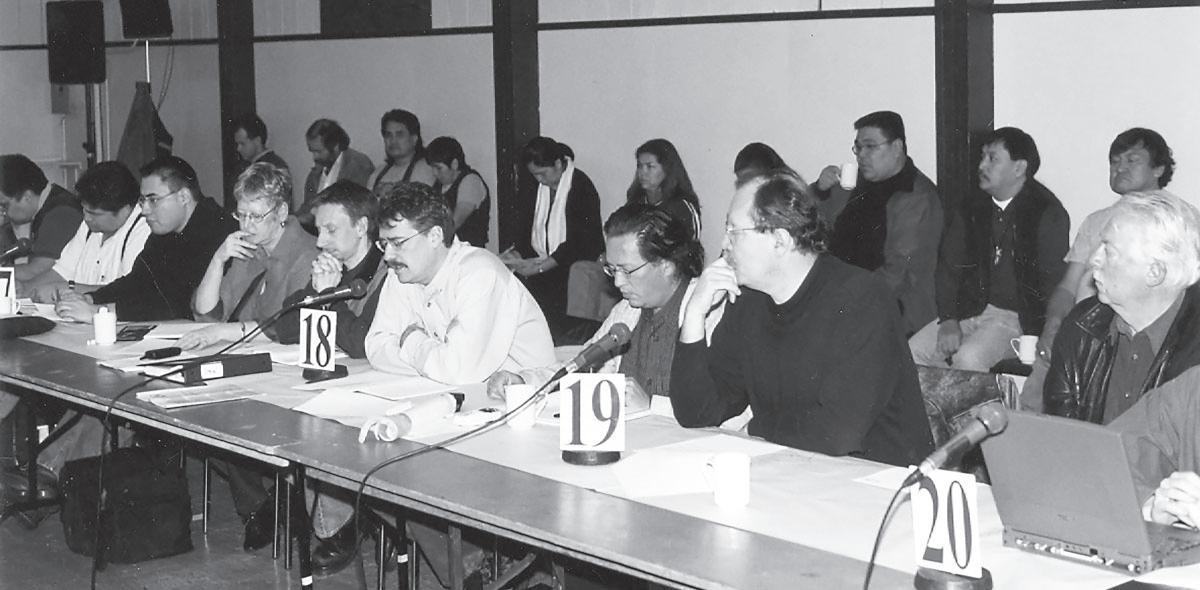
More than 100 people jammed into Somass Hall for the second day of the February 1st and 2nd 2001 Treaty Planning Meeting, as federal and provincial negotiators came to present Nuu-chahnulth with an updated offer.
Governments revise Nuu-chah-nulth treaty offer enues on Nuu-chah-nulth lands, which would see the provincial government getting 100 per cent of the stumpage revenue on all returned lands during the year following the agreements effective date, and decreasing by 3 per cent per year over 25 years, upon which time, Nuu-chah-nulth would receive the full amount of stumpage revenue harvested on their lands.
The Nuu-chah-nulth negotiators agreed to reduce the proposed monetary settlement if the provincial government brought more land to the table. The reduction in cash then encouraged the government to almost double the land quantum to 55,000 hectares. Over and above the additional 21,000 hectares, the province said it was prepared to negotiate the creation of a Meares Island Trust; where both the province and Nuuchah-nulth would own virtually 100 per cent of Meares Island, which would be turned into fee-simple land.
The revised offer also spelled out a plan for the sharing of stumpage rev-
“This is going to be a hard sell to our people,” said Cliff Atleo. “The idea that we are going to share the stumpage of our trees with the province is going to be a stretch. As far as we’re concerned, we’re already sharing most of our territories with the province, so this is going to be a real tough sell.”
“This offer is about short term pain for long term gain,” said Geroge Watts. “I am interested. I don’t see a lot of time in front of us in order to make a deal.”
Facebook video still
This screen grab from an AI-generated video is an example of an increasingly popular feature on Facebook and other social media platforms.




From agriculture to skin care, kelp brings opportunity
Markets abound for fast-growing ocean plant, and a new generation of coastal entrepreneurs are capitalizing
By Eric Plummer Ha-Shilth-Sa Editor
Parksville, BC - Entrepreneurs who come from a long line of commercial fishers are capitalizing on an ocean harvest that has nothing to do with catching fish.
Kelp is presenting growing possibilities on international markets, contributing a valuable, self-regenerating ingredient to agriculture, food products and even the skin care industry.
Stevie Dennis has been fishing on boats since the age of 14, when he learned from fellow Ahousaht member Lewis Frank. In 2021 he founded Naas Foods, which operates a store in Tofino as well as online sales. They process and sell fish caught from T’aaq-wiihak, a rights-based commercial fishery run by the Ahousaht, Tla-o-qui-aht, Hesquiaht, Ehattesaht/ Chinehkint and Mowachaht/Muchalaht First Nations, and process fish from the recreational sector as well.
For the last one and a half years Naas Foods have also operated a kelp farm. Encompassing 40 hectares in Ahousaht territory north of Tofino, Dennis says the kelp farm is the largest in British Columbia, and last year brought in one fifth of the company’s revenue.
“We did a 100 tonnes of kelp last year, we’re going to probably project to do the same this year, but building out our markets is where we’re at right now,” said Dennis. “I foresee kelp this year probably hitting 40-50 per cent of revenue for the business.”
The kelp is dried and smoked, sold in flakes for eating and seasoning dishes.
Besides the Naas Foods store in Tofino, the product is sold in over a dozen locations on the B.C. coast, as well as through online sales in North America.
“We make a dried and smoked line that we put into 52-gram tins,” added Dennis. “It’s a shelf-stable product.”
This year the business is looking to expand by opening a processing facility in Ahousaht, bringing a handful of valuable jobs to the remote community. Dennis expects that the operation will employ under 10 people over its first year, but could grow to 40 if the kelp farm reaches full operations.
“We’re choosing to do this in Ahousaht because it’s the right thing to do,” said the business owner. “That’s where my family comes from. We need economic development, people need something to wake up for.”
The processing facility will operate out of several shipping containers set up on the Flores Island community.
“It will be one for the product coming in, processing, one for drying and smoking, one for freezer storage and one for dry storage,” explained Dennis. “We just need to get going, it’s no more waiting. The reason we’re pushing so hard is I don’t want to start somewhere else. I don’t want to go to Ucluelet, Tofino already said no more industrial work.”
‘Like picking fruit from a tree’
On the other side of Vancouver Island at the northeast tip, Shaelynne Bood has been harvesting wild kelp in her home Kwagiulth First Nation’s territory for the last several years. Marc Peeler, her father and a commercial salmon and herring fisherman, picked kelp from the territory for decades, and convinced Bood to get into the Port Hardy-based operation after she finished high school.
Bood made a presentation about her
Shaelynne Bood/Instagram photo
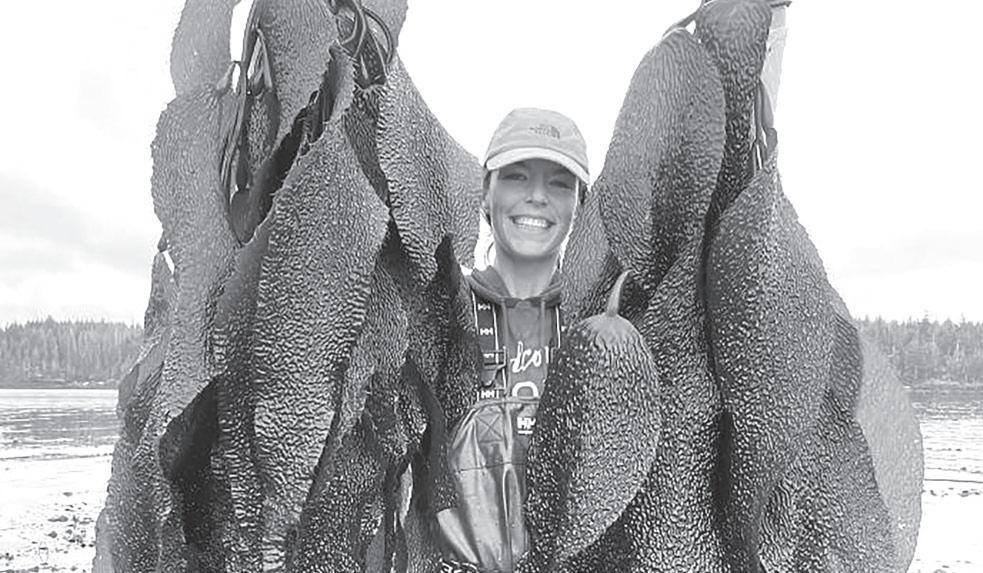
Shaelynne Bood stands with kelp harvested from her home Kwagiulth territory off the coast of Port Hardy. From April to October Bood’s operation picks kelp that is used to help agricultural and plant growth, as well as for skin care products.
kelp business at the Indigenous Seafood Conference, which was put on Feb. 3-5 in Parksville by the Nuu-chah-nulth Economic Development Corporation, the Native Fishing Association and the Ha’oom Fisheries Society.
“I took over his kelp harvesting operation, and now I’m managing it,” said Bood. “I love being on the water and I love being on boats, but I don’t think fishing is really where my passion lies. I joke that I’m a vegan fisherman because all of my catch, for the most part, is plant matter.”
The majority of Bood’s harvest is used for what the industry calls a “bio-stimulant”.
“It goes to vegetable farms all over the world,” she said. “It’s also marketed as plant food for house plants.”
The nutrient-rich plants have also gained a presence in the skin care industry, securing Bood a deal with La Mer, which makes beauty products under Estée Lauder. The Port Hardy boat captain even took a group of internet influencers and actors associated with the skin care product out on the water to show them where the ingredient comes from.
“The fact that this multibillion-dollar company still is putting in the effort to get kelp to put as the first ingredient in their product shows me that it works,” said Bood. “It’s causing plant cells to grow faster, it’s causing things to regenerate faster, why would it not do that to your skin cells?”
In B.C. aquatic plant harvesting is regulated by the provincial government, which requires a plan with maps of where kelp will be picked, plus a record of how much of each species is removed from the ocean.
While the commercial fishing industry is constrained by complex conservation measures and ever-tightening catch quotas, Bood sees kelp harvesting as a sustainable practice that actually promotes growth among the plants that are picked. She takes her boats and crew out at low tide to target the portion of the plant floating above the water’s surface where the kelp canopy spreads.
“We cut it right where it starts to go down so that we get as much of that canopy as we’re able,” said Bood, whose operation include two small skiff vessels and a larger boat. “In the places where
we’re harvesting our 10 per cent, we’re noticing a lot more fresh growth throughout the season.”
“We have to harvest 33 centimetres up from the stipe, that leaves a foot of blade so the kelp can keep growing,” explained Dennis. “Bull kelp grows 10 centimetres a day in summer conditions. In a month, you come back and it’s already a metre long. It has that opportunity to keep growing, reproduce and doing all the things it needs to do, just like picking fruit from a tree.”
Coastal economic diversification
The kelp industry isn’t new, in fact North America’s first farm was founded in 1982 in Bamfield, and Canadian Kelp Resources still sells its food products to this day. But growth over the last decade is noteworthy, according to a recent report from Greenwave, a network of ocean farmers. Greenwave reports that in 2015 there were only a handful of kelp farms on North America’s Atlantic and Pacific coasts, but this has since grown to almost 250 sites that cover a combined 2,535 hectares, with dozens more awaiting permits. Only 0.5 per cent of land farms around world use kelp as a bio-stimulant, but this is projected to grow by 10 per cent each year from 2022-30, according to a 2023 report from the World Bank. But getting behind ocean farming can still seem risky and unpredictable to some investors.
“Banks and traditional lenders are not
well-versed in the nuances of ocean farming, including its non-traditional collateral and seasonal cash flows, which don’t align with standard underwriting models,” cautioned the 2026 State of the Kelp Industry report. “Limited historical data and uncertain market pricing make lenders reluctant to offer flexible, affordable financing tailored to the realities of kelp farming.”
While some backers remain skeptical, a growing number of B.C. coastal operations are tapping into the kelp market, such as the Sydney-based Cascadia Seaweed. The company harvests through partnerships with several First Nations, including Tsawout, Uchucklesaht, Tseshaht, Ahousaht and the Metlakatla Development Corporation, and last year sold 100,000 litres of bio-stimulants for agriculture.
Greenwave states that First Nations have a stake in a significant share of B.C.’s kelp industry, part of an emerging trend in the economic diversification of coastal communities.
“Kelp is becoming less prominently featured on the package as a hero ingredient,” stated the report. “Instead, its role is shifting to a problem-solving functional ingredient behind the scenes, the starting point for a wide range of everyday food and personal care products, delivering health and performance benefits while often displacing legacy petroleum-based ingredients.”

Band with Nuu-chah-nulth singers promotes album
The Melawmen Collective heads to Vancouver Island venues this March to promote their first studio album
By Denise Titian Ha-Shilth-Sa Reporter
Port Alberni/Ucluelet, BC – The Melawmen Collective has released their first album and will be coming to town to play for local audiences.
Based in Ashcroft, B.C., the Melawmen Collective describes their music as contemporary Indigenous fusion “woven together with elements of hip hop, rock/ blues, country, global beats, righteous rhymes and rich harmonies, carried through with experience, manifestation and visions of intergenerational stories of pain and healing”.
According to their biography, ‘Melawmen’ means medicine in the Secwepemc language. Meeka Morgan and Kiva Morgan-Hall are vocalists for the group, and are Secwepemc and also Nuu-chahnulth-aht from Toquaht First Nation.
“The Melawmen Collective’s hub is in Secwepemc territory, where five of the members are from, and two of them are also Nuu-chah-nulth, and so it is a great honor for us to tour in, around and beside the beautiful territory of our peoples and the places we call home, to celebrate the release of our first studio recorded album here with our family, friends and communities during the coming of the spring blossoms and the returning of the whales,” said Meeka Morgan.
Their first studio album titled Fire in the Lake was released September 26, 2025.
“Fire in the Lake is an energetic crossgenre concept album that is a musical retelling of the band’s own journey of experience and an expression of their stories. It is a call back to the times when
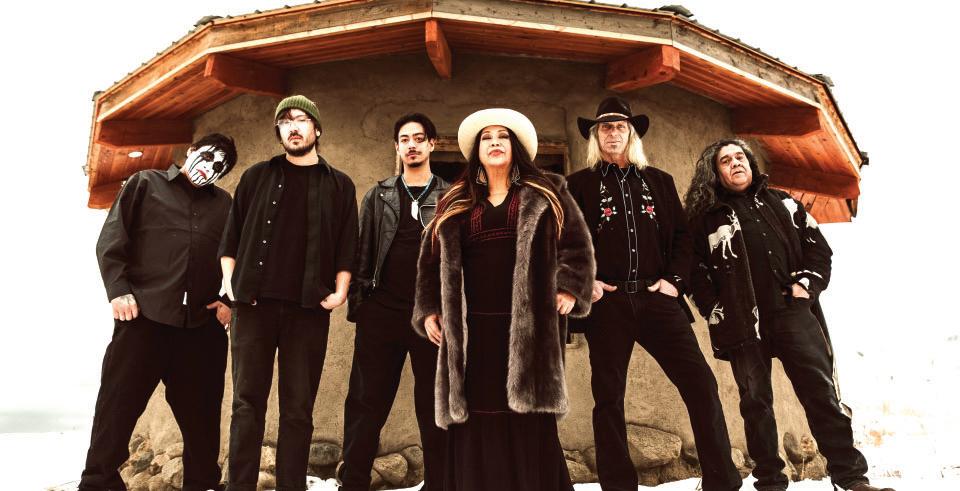
According to their biography, ‘Melawmen’ means medicine in the Secwepemc language. Meeka Morgan and Kiva MorganHall are vocalists for the group, and are Secwepemc and also Nuu-chah-nulth-aht from Toquaht First Nation.
entire albums were meant to be a connective and collective experience, a poetic reminder that you are not alone,” said the band in a statement.
The Melawmen Group are now on a six-town promotional tour with the first two stops on Vancouver Island. The first performance will be in Ucluelet, close to the homes of Meeka and Kiva. The group will move on to dates in Port Alberni, Victoria, and Duncan before they head back to the mainland for more shows.
The show will open with a performance by the young hip hop artist Kiva MH.
Included in the group are musicians
representing Secwepemc, Cree, and Tsilhqot’in First Nations. Their drummer, Victor Laso, is from Chile. John MacArthur Ellis, an award-winning B.C. Country Music Association Hall of Fame inductee who is originally from Port Alberni, is also in the band.
The Melawmen Collective’s music can be found on Spotify, Tik Tok, Facebook, Instagram and Apple Music. A ticket for the show are $20 and may be purchased online or at the door. For more information about tour dates, locations and prices, visit https://linktr.ee/TheMelawmenCollective.
Tour dates:
March 14 – Ucluelet, BC, Army & Navy Force Veterans Club
March 17 – Port Alberni, BC, Char’s Landing
March 19 – Victoria, BC – Garden City Grooves Festival
March 20 – Duncan, BC – Duncan Showroom
March 22 – Kamloops, BC – Blue Grotto
Mar 27-29 Penticton, BC – Ignite the Arts Festival

Submitted photo