INTERESTING NEWS Canada’s Oldest First Nations Newspaper - Serving Nuu-chah-nulth-aht since 1974 Canadian Publications Mail Product Vol. 53 - No. 16—August 27, 2026 haas^i>sa Sales Agreement No. 40047776
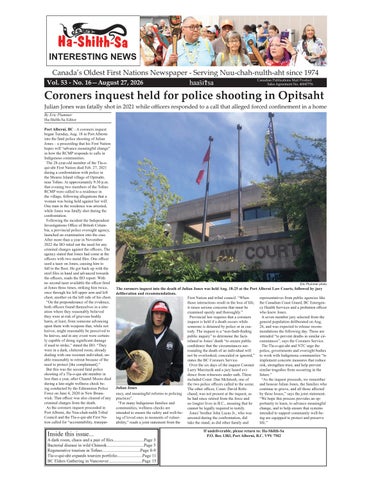
Coroners inquest held for police shooting in Opitsaht Julian Jones was fatally shot in 2021 while officers responded to a call that alleged forced confinement in a home By Eric Plummer Ha-Shilth-Sa Editor Port Alberni, BC - A coroners inquest began Tuesday, Aug. 18 in Port Alberni into the fatal police shooting of Julian Jones – a proceeding that his First Nation hopes will “advance meaningful change” in how the RCMP responds to calls in Indigenous communities. The 28-year-old member of the Tla-oqui-aht First Nation died Feb. 27, 2021 during a confrontation with police in the Meares Island village of Opitsaht, near Tofino. At approximately 9:30 p.m. that evening two members of the Tofino RCMP were called to a residence in the village, following allegations that a woman was being held against her will. One man in the residence was arrested, while Jones was fatally shot during the confrontation. Following the incident the Independent Investigations Office of British Columbia, a provincial police oversight agency, launched an examination into the case. After more than a year in November 2022 the IIO ruled out the need for any criminal charges against the officers. The agency stated that Jones had come at the officers with two metal files. One officer used a taser on Jones, causing him to fall to the floor. He got back up with the steel files in hand and advanced towards the officers, reads the IIO report. With no second taser available the officer fired at Jones three times, striking him twice, once through his left upper arm and left chest, another on the left side of his chest. “On the preponderance of the evidence, both officers found themselves in a situation where they reasonably believed they were at risk of grievous bodily harm, at least, from someone advancing upon them with weapons that, while not knives, might reasonably be perceived to be knives, and in any event were certainly capable of doing significant damage if used to strike,” stated the IIO. “They were in a dark, cluttered room, already dealing with one resistant individual, unable reasonably to retreat because of the need to protect [the complainant].” But this was the second fatal police shooting of a Tla-o-qui-aht member in less than a year, after Chantel Moore died during a late-night wellness check being conducted by the Edmunston Police Force on June 4, 2020 in New Brunswick. That officer was also cleared of any criminal charges from the death. As the coroners inquest proceeded in Port Alberni, the Nuu-chah-nulth Tribal Council and the Tla-o-qui-aht First Nation called for “accountability, transpar-
Inside this issue...
Eric Plummer photo
The coroners inquest into the death of Julian Jones was held Aug. 18-25 at the Port Alberni Law Courts, followed by jury deliberation and recommendations. First Nation and tribal council. “When representatives from public agencies like those interactions result in the loss of life, the Canadian Coast Guard, BC Emergenit raises serious concerns that must be cy Health Services and a probation officer examined openly and thoroughly.” who knew Jones. Provincial law requires that a coroners A seven member jury selected from the inquest is held if a death occurs while general population deliberated on Aug. someone is detained by police or in cus26, and was expected to release recomtody. The inquest is a “non-fault-finding mendations the following day. These are public inquiry” to determine the facts intended “to prevent deaths in similar cirrelated to Jones’ death “to ensure public cumstances”, says the Coroners Service. confidence that the circumstances surThe Tla-o-qui-aht and NTC urge the rounding the death of an individual will police, governments and oversight bodies not be overlooked, concealed or ignored,” to work with Indigenous communities “to states the BC Coroners Service. implement concrete measures that reduce Over the six days of the inquest Coroner risk, strengthen trust, and help prevent Larry Marzinzik and a jury heard evisimilar tragedies from occurring in the dence from witnesses under oath. These future.” included Const. Dan McIntosh, one of “As the inquest proceeds, we remember the two police officers called to the scene. and honour Julian Jones, the families who Julian Jones The other officer, Const. David Robicontinue to grieve, and all those affected ency, and meaningful reforms to policing chaud, was not present at the inquest, as by these losses,” says the joint statement. practices”. he had since retired from the force and “We hope this process provides an op“For many Indigenous families and no longter lives in B.C., meaning that he portunity to learn, to advance meaningful communities, wellness checks are cannot be legally required to testify. change, and to help ensure that systems intended to ensure the safety and well-beJones’ brother John Lucas Jr., who was intended to support community well-being of loved ones in moments of vulnerarrested during the confrontation, did ing are equipped to protect and preserve ability,” reads a joint statement from the take the stand, as did other family and life.”
A dark room, chaos and a pair of files............................Page 3 Bacterial disease in wild Chinook..................................Page 5 Regenerative tourism in Tofino...................................Page 8-9 Tla-o-qui-aht expands toursim portfolio.......................Page 11 BC Elders Gathering in Vancouver...............................Page 15
If undeliverable, please return to: Ha-Shilth-Sa P.O. Box 1383, Port Alberni, B.C. V9Y 7M2
Page 2— Ha-Shilth-Sa—August 27, 2026
Inquest starts with personal accounts of young man Officer who fired fatal shots is now retired and living out of province, he did not appear for coroner proceeding By Denise Titian Ha-Shilth-Sa Reporter Port Alberni, BC – A BC Coroner’s Inquest into the death of Julian Jones in February 2021 started with personal accounts of the challenges the young man faced in his short life. Jones, a 28-year-old Tla-o-qui-aht member, was shot and killed by an RCMP police officer following an altercation at a private home on the Opitsaht reserve on February 27, 2021. The incident started with a 911 call from a female alleging she had been sexually assaulted and was being held against her will at a private home on the Tla-o-quiaht reserve in Opitsaht on Meares Island. It was during the COVID-19 pandemic, at about 9:30 p.m. when two RCMP officers from the Tofino detachment responded to perform a wellness check at the home. Located across the inlet from Tofino, a boat trip from Tofino to Opitsaht takes about five minutes in good weather, according to RCMP Const. Daniel MacIntosh, who was there that night. Once at the house, officers arrested one male before being confronted by Jones, according to investigative reports. The report goes on to say that Mr. Jones advanced on the officers with two objects in hand. He fell to the floor after an officer deployed a taser. When Jones stood up and advanced on officers, he was shot and killed by one of the RCMP officers. It wasn’t until after Mr. Jones was shot the officers discovered that the objects in his hands were metal sharpening files. The police-involved shooting death immediately triggered a Coroner’s Inquest.
Under Section 18(2) of the Coroners Act, inquests are mandatory for any deaths that occur while a person was detained by or in the custody of a peace officer. It also launched an Independent Investigations Office investigation, which concluded in November 2022. The IIO, a civilian-led oversight agency, was on the scene the following day to begin their year-long investigation. To the dismay of the family and Tla-oqui-aht community, the IIO cleared the police officers of wrongdoing in death of Julian Jones. The BC Coroner’s inquest into the death of Julian Jones is not an adversarial, fault-finding inquiry. The inquest allows the seven-member jury to learn about Mr. Jones and the facts surrounding his death. After hearing witnesses, the jury will make recommendations aimed at preventing deaths in similar circumstances. The first person on the witness stand was Mr. Jones’ sister, Laura Manson, who was not a witness to the incident, but was there to tell the jurors about her brother and his life. Carrying a photo collage of her brother, Ms. Manson told the court that her brother was a human being, was known in the community and was loved. “He was kind, loving and never held a grudge…sure, he’d get mad but by morning it was water under the bridge,” she told the court. The next witness, Dr. Luke Williston, spoke about the challenges Julian Jones faced in life. From a young age, Julian Jones showed evidence of Fetal Alcohol Spectrum Disorder, a lifelong disability caused by alcohol exposure in the womb. His behaviour was described by Wil-
liston as impulsive, at times aggressive. There were complaints at the school about sexually inappropriate behaviours. Williston noted that Jones suffered a head injury as a small child when he fell off a bike. He had not been wearing a helmet. Sometime prior to 2003, Mr. Jones was formally diagnosed with FASD and received treatment in Victoria for his psychiatric issues. He was then followed by a pediatrician. Williston testified that Jones was prescribed medication that they hoped would help with attention, focus and disruptive behavior at school. Mr. Jones was in and out of foster care and continued to have difficulty. Williston said he was known to be erratic, showed poor judgment, impulsive behaviour, and wasn’t able to understand consequences. Williston noted that adding alcohol makes these behaviours worse. Williston said his impression of Jones is, “he was a young man with substance use disorder.” He went on to say that he sees quite a bit of that. “He was surrounded by it, he has a reduced capacity to say no,” he added. Probation Officer David Paruk told the court that Mr. Jones was very decent, friendly and open. But his ability to understand consequences was very limited. In addition, his IQ was in the very low 50s. Paruk said an IQ below 70 is considered significant. “Julian had severe deficits,” said an emotional Paruk. The court then heard emotional testimony from the woman that called 911 for help. They heard a recording of the 911 call in which she said she had been sexually taken advantage of. She named the
brothers and reported that they would not let her leave the house. The woman said she was in another room, with the door closed, when she heard the shots. The following day the court heard from Const. Daniel MacIntosh, who spoke at length and in detail about what happened that Feb. 27 evening. He noted that it was dark, foggy and tides were running for the boat ride to Opitsaht. Approaching the house, he recalled that there were no lights on outside or inside the main living areas. The officers used their flashlights as they made their way to the front door. MacIntosh said that he knew the brothers from other incidents. Mr. Jones, known by the police and others as J.J., was known to be initially combative when confronted, according to MacIntosh. He would make threats but then he’d calm down and become polite, said the officer. The court heard that Const. David Robichaud fired the fatal shots but that he would not be providing a statement at the inquest. Robichaud, the court heard, has retired from the police force and resides outside of British Columbia, therefore, cannot be compelled to make an appearance at the BC Coroner’s Service Inquest. Robichaud was cleared of criminal responsibility for the death by the IIO. Const. MacIntosh’s testimony continued for the remainder of day two. There were members from Mr. Jones’ family in attendance on the first day accompanied by supporters. Jones’ mother, Carol Manson, passed away in 2025. She is on the witness list. The court heard her statement would be read into the record.
August 27, 2026—Ha-Shilth-Sa—Page 3
Officer recounts a dark room, chaos and a pair of files The brothers were close, always together, and Julian Jones was protective of his younger sibling, says testimony By Denise Titian Ha-Shilth-Sa Reporter Port Alberni, BC – Corporal Daniel MacIntosh spent the entire second day of the inquest testifying and answering questions about the events leading up to the police shooting death of Julian Jones on February 27, 2021, at the 28-year-old’s Opitsaht home. After reviewing his police training up to February 2021, Daniel MacIntosh, who was a constable with the RCMP back then, was on call that night. He was summoned by Const. Robichaud to assist him on the call to Opitsaht. He stated that he and other officers had been on calls to house 141 on other occasions and were familiar with it and its occupants, including the two brothers, John Lucas Jr. and Julian Jones. According to testimony from at least two police officers, they knew from previous interactions with the brothers that they were close, always together and that Julian was protective of his younger brother, John. Const. MacIntosh stated that Julian would get combative or aggressive if he feared his brother was being harmed. They also knew that Julian had intellectual challenges. “He had a low IQ, he was different, quick to anger and he relied on his brother John a lot,” said MacIntosh. Due to the nature of the call for help, with a possible sexual assault and forced confinement, the two officers prepared to make more than one arrest and called on the Ahousaht satellite RCMP detachment for back-up. But it was a dark winter night and could take 40 minutes for Ahousaht officers to arrive at Opitsaht in their boat. The two Tofino constables, Robichaud and MacIntosh, proceeded in the dark to the house, electing not to wait for back-up from Ahousaht. The house, very near the Opitsaht dock, was dark. There were no outdoor lights on. The two officers approached the house by the light of their flashlights. Up a small flight of stairs and through the first door is a covered porch that was dark. The second door that leads into the house was locked. After loudly knocking on the door, John Lucas Jr. opened the door and was immediately pulled aside by Const. Robichaud and arrested. MacIntosh testified that prior to the door opening, they overheard Lucas talking about the female complainant before hearing a woman’s voice call out for help. He went on to say Lucas Jr. was compliant and that he asked officers to be careful of a wrist he had injured earlier as they placed him in handcuffs. At some point Const. MacIntosh turned to assist
Eric Plummer photo
Tla-o-qui-aht member Julian Jones was fatally shot during a confrontation with police on Feb. 27, 2021 in the Meares Island village of Opitsaht. Robichaud cuff Lucas’ left wrist. Carol and the female victim were still in “I believe my exact words were, With no lights on in the room, MacInthe small living room. ‘They’re fucking files!’,” he said. tosh used his flashlight to see who was Robichaud told John to tell Julian that MacIntosh said prior to the shooting in the room as Robichaud continued to he is okay, to which John responded, they did not know what Julian had in his handle Lucas Jr. He observed a young “Brother, calm down, everything’s okay.” hands but knew they were metal from woman seated in an armchair in the left “It seemed nothing registered with him,” when he clashed them together and offar corner of the room. MacIntosh testified. ficers assumed they were knives. Near the right corner of the room was a Julian clashed the objects together and “I wouldn’t have never guessed they hallway, partially obscured by a hanging advanced toward the officers at the front were files,” MacIntosh testified. cloth. It was there that he first noticed door from behind the sofa. By this time Immediately following the shooting, Julian Jones, standing, holding objects he Carol had been pushed to the floor. John Jr. became irate and began fighting estimated to be 12 to 18 inches long in When MacIntosh raised his pistol, Robichaud even though he had handeach hand. Julian stopped and went back around to cuffs on. The female victim, according With Lucas now handcuffed and being the front of the sofa. MacIntosh moved to MacIntosh, somehow got a hold of the held by Robichaud near the front door, a few feet from the front door to the left, taser and was pointing it forward as she Julian was heard to say, “Don’t hurt my away from the sofa and Jones. With Jones walked towards the door. MacIntosh said brother – I’ll fucking kill you!” advancing toward MacIntosh, Const. Ro- he took the taser from her and secured it. “I didn’t know what he had in his bichaud, still holding John in handcuffs, The officers radioed for help and MacInhands, but he clashed them together like deployed his taser, striking Jones, who tosh checked Julian for a pulse. swords and the still dark room filled with then fell to the floor. “He let out a long exhale and then his sparks,” MacIntosh stated. When Robichaud fired the taser, John body completely relaxed,” said MacInAt some point, Carol Manson apseemed to believe that the taser was a tosh. There was no pulse. proached Robichaud, asking what he was firearm and yelled, “You shot him!” On March 1, 2021, officers gave statedoing and saying that her son hadn’t done MacIntosh stated there was only one ments to IIO investigators. anything wrong. According to MacIntosh, taser and it takes five seconds for the MacIntosh told investigators that he she was pushing on the officer’s chest, device to recycle, meaning it could not be thought he had fired his weapon because trying to get to her son, John. immediately re-fired. he had it drawn and was pulling the trigMacIntosh said they yelled at Julian Seconds later Julian stood up, with the ger, but it never discharged. to drop the knives. They assumed the objects still in hand. “John was completely cooperative. It long metal objects he was holding were “I said, ‘Julian, don’t do this!’ but he was going textbook, until it was not,” knives. MacIntosh stated that Julian was turned and started walking towards me,” MacIntosh testified. pacing back and forth on the far side of said MacIntosh. “I raised my pistol and MacIntosh said Jones was standing the room, in front of the television which pulled the trigger when I heard a shot go across the room from the door, about 10 was less than 12 feet from the front door, off. He was still walking and then I saw to 12 feet away. The room was lit only with a sofa between the door and TV. two more shots.” by the 1,000-lumen police flashlight. MacIntosh said he drew his pistol but When MacIntosh said he saw the shots, Pointed in the dark, directly at a person didn’t aim it at anyone because both he was referring to the flash from the at that distance, they wouldn’t be able to muzzle of his partner’s gun. see anything, MacIntosh stated. MacIntosh explained that it is hard When asked why the Tofino RCMP to pull the trigger of a police service officers did not wait for back-up from weapon. It has a 12-pound trigger and Ahousaht RCMP, who were on their way, is very hard to pull. But, he said, his MacIntosh said, given the nature of the weapon was drawn and he was prepared complaint, they had a duty to protect the to use it because he feared for his life, he complainant. said in testimony. “It happened very quickly and he was When Julian fell, his mother Carol not responding to anything we or his screamed, “You shot my son!”, and she brother said to him,” said MacIntosh. “I crawled to Julian, cradling him in her don’t know what could have been done to arms. change the outcome. I feared for my life MacIntosh said he went over to Julian and my partner’s life, and in the afterwho was motionless and saw the items he math, I stood there shaking.” was carrying still in his hands, but Julian The Coroners Inquest heard witness was no longer tightly gripping them. testimony until Aug. 25, followed by jury MacIntosh tossed the items toward the deliberations for future recommendations kitchen. at the Port Alberni Law Courts.
Page 4— Ha-Shilth-Sa—August 27, 2026 Ha-Shilth-Sa newspaper is published by the Nuu-chah-nulth Tribal Council for distribution to the members of the contributing First Nations, as well as other interested groups and individuals. Information and original work contained in this newspaper is protected by copyright and may not be reproduced without written permission from: Nuu-chah-nulth Tribal Council P.O. Box 1383, Port Alberni, B.C. V9Y 7M2. Telephone: (250) 724-5757 Fax: (250) 723-0463 Web page: www.hashilthsa.com facebook: Hashilthsa Ntc
2026 Subscription rates: Non-Nuu-chah-nulth, Ahousaht, Ehattesaht,Toquaht and Ucluelet members are subject to a yearly subscription fee of $40 in Canada, $50 in the US and $60 for overseas. Payable to the Nuu-chah-nulth Tribal Council
Manager/Editor/Reporter Eric Plummer (Ext. 243) (250) 724-5757 Fax: (250) 723-0463 eric.plummer@nuuchahnulth.org Reporter Denise Titian (Ext. 240) (250) 724-5757 Fax: (250) 723-0463 denise.titian@nuuchahnulth.org Reporter Nora O’Malley (604) 353-8488 nora.omalley@nuuchahnulth.org Audio / Video Technician Mike Watts (Ext. 238) (250) 724-5757 Fax: (250) 723-0463 mike.watts@nuuchahnulth.org Editorial Assistant Holly Stocking (Ext. 302) (250) 724-5757 Fax: (250) 723-0463 holly.stocking@nuuchahnulth.org
DEADLINE: Please note that the deadline for submissions for our next issue is Sept. 4, 2026 After that date, material submitted and judged appropriate cannot be guaranteed placement but, if material is still relevant, will be included in the following issue. In an ideal world, submissions would be typed rather than hand-written. Articles can be sent by e-mail to holly.stocking@nuuchahnulth.org (Windows PC). Submitted pictures must include a brief description of subject(s) and a return address. Pictures with no return address will remain on file. Allow two - four weeks for return. Photocopied or faxed photographs cannot be accepted.
LETTERS and KLECOS Ha-Shilth-Sa will include letters received from its readers. Letters MUST be signed by the writer and have the writer’s full name, address and phone number on them. Names can be withheld by request. Anonymous submissions will not be accepted. We reserve the right to edit submitted material for clarity, brevity, grammar and good taste. We will definitely not publish letters dealing with tribal or personal disputes or issues that are critical of Nuu-chah-nulth individuals or groups. All opinions expressed in letters to the editor are purely those of the writer and will not necessarily coincide with the views or policies of the Nuu-chah-nulth Tribal Council or its member First Nations. Ha-Shilth-Sa includes paid advertising, but this does not imply Ha-Shilth-Sa or Nuu-chah-nulth Tribal Council recommends or endorses the content of the ads.
Julian Jones’ brother takes the stand John Lucas Jr.’s testimony says Jones came to his assistance as police grabbed him By Denise Titian Ha-Shilth-Sa Reporter Port Alberni, BC – The coroners inquest into the 2021 police shooting death of Tla-o-qui-aht’s Julian Jones continued for a fourth day in a Port Alberni courtroom on Aug. 21. The seven-member jury heard from a forensic toxicologist who testified regarding samples of blood and other body fluids collected from Mr. Jones during a March 4, 2021 autopsy. The results showed that Mr. Jones had both alcohol and cannabis in his system. The ethanol (alcohol from beverages) was slightly above the .08 BAC (Blood Alcohol Concentration), Canada’s legal limit for operating a vehicle. Mr. Jones, at .085 BAC, was said to have a moderate level of alcohol in his system at the time. Mr. Jones’ toxicology report showed that he had consumed cannabis sometime before his death. John Lucas Jr. confirmed that he and his brother had been hot knifing weed before the police arrived at the home on the night of the shooting. Dr. Aaron Shapiro, the expert forensic toxicologist, could not offer an opinion on how the substances at the levels found could have affected Mr. Jones’ behavior because there are so many variables to consider. Following Shapiro to the stand was John Lucas Jr., the brother of Julian Jones, who was in the room the night of the shooting. Mr. Lucas stated there were five people in the house before the RCMP officers arrived. His father was “passed out” in the bedroom, his mother Carol was passed out on the couch in the living room, and the female that called for help was seated in an armchair in the living room. Mr. Lucas stated that he and his older brother Julian had been in a bedroom hot knifing marijuana when they heard pounding on the front door. “I heard loud banging at the door, they were yelling, ‘Open the door!’,” Lucas stated. When he opened the door, Lucas said he was immediately pulled through the door and yanked down onto the floor porch. Lucas said he heard Julian say, “Hey, watch out, that’s my little brother.” According to Lucas, that’s when one of the officers pulled out a gun and fired five shots. Lucas stated that his brother JJ was not aggressive, was not approaching
Laura Manson photo
Julian Jones died Feb. 27, 2021 in Opitsaht during a confrontation with police. He is pictured with his mother Carol Manson. the officers, and he was not armed. After pathologist who conducted the autopsy his brother fell, dying on the floor, Lucas on Mr. Jones, noted gunshot wounds and claimed the same officer that fired the taser injuries present. There were six defatal shots went over and fired his taser at fects from gunshot wounds noted. These Jones. are visible injuries that can be entrance or “My mother was crying, asking why,” exit wounds. said Lucas. Mr. Jones had wounds on his upper left The response from one of the officers, arm that shattered his bone along with according to Lucas, was, “Carol, he had a chest wounds that severely damaged his weapon.” heart. Lucas denied that his brother had been She observed three gunshot pathways, holding files. He pointed out that they however, depending on the positionhad been hot knifing marijuana when the ing of Mr. Jones’ left arm when he was police arrived and had access to knives, shot, two of the pathways may have been but those were left on a table where they caused by one bullet. One of the bullets had been using. could have passed through his upper left Lucas claimed that there were indoor arm and then through his left chest and lights on in the living room, but the porch out his back, causing four defects. light was off. He also denied harming She estimated that death would be althe female victim or holding her against most instantaneous. her will. Lucas admitted to drinking There were two impact injuries from the alcohol that afternoon and evening but taser that were made while Mr. Jones was said he was not “wasted”. He said he was alive or very near the time of his death. “buzzed” but did not black-out. Dr. Brooks-Lim could not determine in He agreed that at the time of the shootwhat order the taser and gunshot wounds ing, the female complainant was seated occurred. in an armchair in the living room and that With the injury to his upper arm, Dr. his father, John Lucas Sr., was in a bedBrooks-Lim opined that it would have room and didn’t come to the living room been very difficult to hold something in until after shots were fired. His mother his hand after being shot. Carol was also in the living room. When asked if paramedics or other Lucas, while calm, showed frustration life-saving efforts would have helped Mr. when previous statements attributed to Jones with the injuries he sustained, Dr. him were presented. He alleged that some Brooks-Lim said, “It was an extremely of the information and statements attribserious injury. Even with an operating uted to him or from other witnesses were theatre and surgical team outside his either not true or were twisted. door, his chances would be very slim.” Dr. Elizabeth Brooks-Lim, a forensic
Legal Information
COVERAGE: Although we would like to be able to cover all stories and events, we will only do so subject to: - Sufficient advance notice addressed specifically to Ha-Shilth-Sa. - Reporter availability at the time of the event. - Editorial space available in the paper. - Editorial deadlines being adhered to by contributors.
Ha-Shilth-Sa belongs to every Nuu-chah-nulth person including those who have passed on, and those who are not yet born. A community newspaper cannot exist without community involvement. If you have any great pictures you’ve taken, stories or poems you’ve written, or artwork you have done, please let us know so we can include it in your newspaper. E-mail holly.stocking@nuuchahnulth.org. This year is Ha-Shilth-Sa’s 52nd year of serving the Nuu-chah-nulth First Nations. We look forward to your continued input and support. Kleco! Kleco!
The advertiser agrees that the publisher shall not be liable for damages arising out of errors in advertisements beyond the amount paid for space actually occupied by the portion of the advertisement in which the error is due to the negligence of the servants or otherwise, and there shall be no liability for non-insertion of any advertisement beyond the amount paid for such advertisements
August 27, 2026—Ha-Shilth-Sa—Page 5
First cases of deadly bacterial disease in wild chinook Sixteen per cent of 99 salmon sampled from Barkley Sound have a disease previously found among farmed fish By Antonella Medina Arias Ha-Shilth-Sa Contributor Vancouver, BC — A new study led by UBC and Pacific Salmon Foundation scientists has discovered the first case of tenacibaculosis disease present in wild Chinook salmon near Vancouver Island. The discovery was accidental, as the salmon caught in the Barkley Sound region were intended for a separate study assessing the effects of recreational catchand-release. However, of the 99 sampled fish, 16 percent showed signs of tenacibaculosis — a bacterial disease that causes ulcers on fins and skin and kills fish within days. The study, published in Scientific Reports, found the disease was likely caused by a common type of marine bacterium called Tenacibaculum dicentrarchi, found all around the world. “The disease itself is not new. It’s one of the most diffused diseases that occur in farm fish,” said Dr. Emiliano Di Cicco, a researcher and veterinarian for the Pacific Salmon Foundation, and lead author of the study. Fish farms are known to have a high concentration of tenacibaculosis disease, as it’s one of the major causes of fish mortality in aquaculture settings. Outbreaks occur in farms when juvenile fish are transferred from freshwater to saltwater, and the disease spreads quickly because of the high concentration of fish in an enclosed area. There has never been a confirmed case of the disease in wildcaught salmon, while “tenacibaculosis has never been diagnosed as a disease outbreak in farm-raised Chinook salmon in B.C.”, stated the B.C. Salmon Farmers Association. Diagnosing marine disease in wild fish has proved challenging for researchers. In the wild, infected fish rarely survive long enough to be observed. “Finding a sick fish in the ocean is very hard because usually, they either
UBC photo
Fish farms are known to have a high concentration of tenacibaculosis disease, as it’s one of the major causes of fish mortality in aquaculture settings. But the BC Salmon Farmers Association says the discovery does not show a direct link to farms. get picked up by predators or get weak trarchi), and concluded that the bacteria day of the holding period, Zinn noticed enough that eventually they cannot catch are unlikely to cause disease in wild fish some fish started developing lesions and their own prey and die of starvation or populations. ulcers, an unusual occurrence for wild die from the disease,” said Dr. Di Cicco. However, the species identified in this fish. While the disease itself doesn’t affect study, Tenacibaculum dicentrari, is not Dr. Di Cicco and his team were brought humans or other animals, understanding even considered in their existing assessin to sample the fish. The DFO’s Pacific disease in wild fish populations is key to ment, so the bacteria are not regulated in Biological Station, the University of effective fish management, conservation, B.C. as a risk to wild Pacific salmon. Toronto and the University of Califorand reassessing risk regulations. “The DFO is currently treating this bac- nia were also involved to determine the The findings provided recent evidence terium like it can only occur in farms,” cause. that is not accounted for in the Fisheries said Di Cicco. “But now we know that Using gill sampling, histology, moand Oceans Canada (DFO) risk assessthis disease can affect the wild fish, and lecular and genetic screening, the team ment for Tenacibaculum as a potential because the farms are probably the main diagnosed the tenacibaculosis disease and disease pathogen in the province, said contributor of this bacterium in the water, identified the Tenacibaculum dicentrarchi Kaitlyn Zinn, PhD candidate from UBC’s they need to be more indoor and reguas the causative bacterium. Pacific Salmon Ecology and Conservalated accordingly.” “Conservation depends on understandtion Lab, and co-author of the study. The specimens were not collected near a ing why salmon die, not just how many Currently, the disease risk assesssalmon farm. While many researchers be- die. So identifying this new bacterial ment for Tenacibaculum focuses on one lieve that farms affect wild salmon, more disease in wild salmon as a potential species, Tenacibaculum maritimum (a studies are needed for a consensus in the contributor gives us another mechanism close relative of Tenacibaculum dicenscientific community on the extent of the to investigate and gives us another opporimpact of finfish aquaculture. tunity to reduce any potential human cost The BC Salmon Farmers Associaimpacts on vulnerable salmon population says the discovery does not show a tions,” said Zinn. direct link to farms, as Tenacibaculum Human impacts on salmon’s health is common bacteria that is “widespread in the marine environment and can act In the original study, led by Zinn, the as opportunistic pathogens when fish are fish that did not have scale loss, mucus stressed or compromised.” loss or were not injured did not get the “This study describes fish that became disease even if they shared a tank with sick after they were caught, handled and fish that did. The mucus layer of a fish held in tanks – the authors say so themfunctions to keep pathogens like the Teselves,” said the association’s executive nacibaculum dicentrarchi outside the fish. director Brian Kingzett in a press release. Once damaged, the bacteria can enter the “That is not evidence that salmon farms body, make the fish sick, and kill them. are harming wild salmon, and it should During the study, the infected fish not be reported as though it were.” showed ulcers mostly around the mouth, The next steps for the research would be belly and the caudal peduncle. These figuring out where the wild fish picked were the areas where researchers touched up the disease, how they picked it up, the fish during collection, transportation, and replicating the disease in a lab for and observation. These are also the usual researchers to observe how the bacterium places where anglers grab fish for recreworks under controlled conditions. ational purposes. “Based on what we have found, there is Zinn’s recent research paper, published reason to think that DFO should update in Science Direct, shares the best pracand redo their assessment, including the tices for the public to follow to reduce the species we identified as T. dicentrarchi,” impact on fish health. said Zinn. One is avoiding putting fish in a net to not remove their mucus layer. When reThe accidental discovery leasing fish, it’s better to touch it as little In 2022, the UBC Pacific Salmon as possible and let it go while it’s still in Ecology and Conservation Laboratory the water over the side of the boat. sampled wild chinook salmon to study “There’s many things that the public can the impact of recreationally caught and do to reduce the odds of having an impact released salmon and improve the survival in that way,” Zinn said. “Just touching the of the fish that go back into the water. fish less, not disturbing their mucus coatThe observation period lasted 10 days, ing, keeping your hands off them.” which is longer than the usual time to observe fish in captivity. Around the fourth
Page 6— Ha-Shilth-Sa—August 27, 2026
Logging waste converted into packaging material Huu-ay-aht brothers work for DicinFoam plant in Vancouver, which is owned by Wet’suwet’en’s business arm By Sam Laskaris Ha-Shilth-Sa Contributor Vancouver, BC – Will Dennis was between jobs last year and contemplating varying opportunities of what to do next. Dennis, a member of Huu-ay-aht First Nations, couldn’t be happier with the path that he chose. He opted to become a technician for a company called DicinFoam. The company is a subsidiary of the Yinka Dene Economic Development Limited Partnership (YLP), the business arm of Wet’suwet’en First Nation. DicinFoam formed a partnership with the University of British Columbia. Though it has been operating since last year, it was only publicly announced in mid-August that the partners have been operating a pilot project plant in Vancouver turning forestry waste into biodegradable foam packaging. This concept is intended to help lessen the massive amount of plastic and Styrofoam waste that goes to the landfill. Dennis said he heard about the business turning wood waste into foam packaging through a relative. Dicin is the Wet’suwet’en word for wood. “I couldn’t get this out of my head,” he said. “I had to come down this path. I had to see where it led me. And it has been nothing but good things so far.” Dennis, who is 36, was hired as DicinFoam’s lead technician in June of 2025. “From the very first day I came in, my job has been the hands-on guy,” he said. “I’ve been manufacturing this insulation by my hand, by myself, for the first eight months that I was here.” Dennis said company officials would have frequent meetings and make minor changes in the foam. He considered this the research and development part of the process. Dennis originally started working with the company out of a temporary plant in Richmond. This past January the business moved to a new plant in Vancouver. And because of a heavy workload, Dennis brought in his 21-year-old brother Shawn to also work as a company technician this past February. “I kind of needed an extra pair of hands as we were expanding,” he said. “I could probably use a couple more hands. But we’re making it work, just us two right now.” The elder Dennis is thrilled the company is making giant strides. “In the very early days it was very unsure if this was going to be anything or not,” he said. “But we’ve got some
Will Dennis photo
Huu-ay-aht brothers Shawn (on left) and Will Dennis are technicians for DicinFoam working out of a plant in Vancouver. up in Burns Lake so the leadership can will have significant impacts. promising signs that we are going in the have a look at it and other communities “For the packaging it will really keep right direction now.” who can’t get down to Vancouver to have the Styrofoam out of the landfills and out The plant is currently producing 150a look at the product and see and feel of our streams,” he said. “It’s bad for the 200 kilograms of wood foam per day. what it is like.” fish. And also, we don’t have to go and Potential customers have had opportuniOgen added some potential clients have burn all of the piles and waste all of the ties to test the material and evaluate its shown interest in the product and he wood. There are thousands and thousands performance. hopes it will be available for sale soon. of piles that are burnt every year because Dennis said the company officials are “We’ve got a few interested few folks, the forest industry doesn’t know what to looking to expand and find a larger plant but nothing that is going to really generdo with what they call the garbage.” to work at. ate a whole lot of revenue,” he said. “But Ogen also believes if successful Dicin“We want to have a bigger place and Foam will have many spinoff effects. produce more, which is very much in our it’s a start.” Ogen added company officials will be “I think this will definitely create some sights now,” he said. writing letters to provincial and federal training opportunities and employment Dennis believes it won’t be long before officials to see what assistance, if any, for our people,” he said. “And not only many are aware of DicinFoam. they can provide. our people but Indigenous people in “I have a lot of high expectations that Ogen also said DicinFoam reps have general. If things work out well, then we it’s going to explode (in popularity),” he been doing numerous media interviews. can license this out and anybody could said. “We’re getting noticed. I’m very “Those are definitely going to help come in and get a program going in their excited. I think we’re going in the right people know who we are we,” he said. community.” direction. I didn’t think over a year ago “And they will ask more questions and Ogen said DicinFoam can be viewed as that it would get to this point this fast.” potentially create some excitement and a trailblazer. Reg Ogen, YLP’s president and CEO, some sales.” “It seems to me that we’re the only ones said what DicinFoam is doing is groundOgen said some communities have looking at this concept,” he said. “But I breaking. expressed plenty of interest in the comthink potentially it could go around the “It took a little while to get to the point pany and have signed non-disclosure world. If it does, then it’s great for the where we have a pilot program,” he said. “Next, we have a few big steps here - get agreements, which could lead to eventual environment and great for the people who want to clean up the waste. That’s always the numbers in order and get this thing to partnerships. He added some Nuu-chah-nulth First been our elders thinking. scale and look at doing some marketing. Nations have also had discussions with “It’s nice to have money and do things. We’ve already got a few folks interested DicinFoam officials but they haven’t But really the big thing is making sure in the product.” signed any agreements yet. that we have a good clean earth to live Ogen added none of the packaging that Ogen believes if successful his company with and work with.” has been produced thus far is being sold. “We’re still making sure that the machines are working properly,” he said. “We’ve sent some up to our community
TSESHAHT MARKET GATEWAY TO THE PACIFIC RIM
Hours of operation - 7:00 am - 10:00 pm Phone: 724-3944 E-mail: manager@tseshahtmarket.ca Find us on Facebook
Clare Kiernan/UBC photo
Reg Ogen and Dr. Yeling Zhu remove a freshly pressed block of wood foam at DicinFoam’s Vancouver pilot plant.
August 27, 2026—Ha-Shilth-Sa—Page 7
Humpback entanglements increase off Island’s coast DFO hears about one or two incidents a week, as humpbacks seek the same locations as prawn and crab fishers By Roniya Sahin Ha-Shilth-Sa Contributor Victoria, BC – Vancouver Island has seen an increase in humpback whale entanglements within the last month - a rate abnormally high according to researchers. A humpback whale calf was disentangled from 300 feet of rope one week ago in southern Vancouver Island waters. Two humpback whales were rescued on the same day in the Salisa Sea, between Lasqueti Island and French Creek. In June, Artemis the humpback whale was similarly entangled in heavy fishing gear and was freed in the Strait of Georgia. Disentanglements like these are becoming increasingly more common, says Paul Cottrell, a marine mammal co-ordinator with Fisheries and Oceans Canada (DFO). Cottrell says he receives a call reporting whale entanglements once or twice a week, a rate that continues to increase. “We’ve been hopping around,” says Cottrell, “and we’ve been really successful [in our disentanglements].” Cottrell was just recently in Port Renfrew working with the Pacheedaht First Nation on a call about a whale entanglement. He was also present for the previous disentanglements across the Island, and almost every single one since May. Both DFO and researchers trace whale movements by attaching a whale tag onto the buoys, while the DFO monitors humpback whales using drones. In the case of an entanglement a strategy is mapped out to free the whale, a process that has been successful thus far, according to Cottrell. However, according to preliminary
Strawberry Isle Marine Research Society photo
A humpback whale is entangled in a fishing line near Tofino, a problem that has increased off Vancouver Island’s coast. results from the Marine Education and “Seeing [humpback whales] come back Research Society (MERS) and collabora- is amazing and I think it is also a sign of tors, scarring has been observed on 50 per our productive ecosystems that are comcent of humpback whales from at least ing back as well,” said Cottrell. “But, the one entanglement in their lives. The long- flipside is we are seeing more interaction term effects of entanglements include with any [fishing] lines, ropes, or nets in deep punctures into the skin, restricting the water because they’re in areas where ways to eat and mobility – all detrimen20 years ago they weren’t.” tal to the humpback whale’s life. The The increase in whale entanglements is exact effects of entanglements, however, likely due to more humpbacks interacting remain a mystery. It is very rare to sight a with commercial and recreational fishing. whale after they’ve been disentangled. Dr. Rhonda Reidy, a researcher in Humpback whales have been making humpback whale feeding habits, identia comeback in Pacific inshore waters fied in her research that the whales are since the late 2000s. Previous whaling in revisiting summer feeding grounds. Juan the past century caused harmful, lasting de Fuca sees solitary whales averaging effects on humpback whales, but after a depth of 100 metres depth underwater, Canada added the cetaceans to the Spefor example. cies at Risk Act in 2005, more and more Science has yet to discover why whales whales have been appearing on Vancouare repeat visitors to the same location; ver Island coasts. whether whales have food preferences
or favour a certain hotspot for its abundance in various aquatic critters remains a mystery. However, both commercial and recreational prawn and crab fishing gear are being placed in the very same productive waters humpback whales frequent. “Commercial and recreational fishers are targeting the same productive areas that the humpback whales may already know to explore from previous experience,” said Reidy, “they’re overlapping.” Humpback whale researcher Jackie Hildering also identified the same overlap through her research. Hildering works as an Education and Communications director with MERS and studies entanglement scars left on humpback whales. She notes that whale entanglements have been happening, but the increase in incidents is caused by humpback whales returning in the dozens. As critical as disentanglements are, Hildering believes that learning why the whales are getting caught is more important. “You want to learn from every disentanglement. What was the source? What were the rafts like? What worked and didn’t work in terms of strategy … and did the whale survive?’” said Hildering. A disentanglement is never done alone. The DFO also trains coastal First Nations how to attach satellite whale tags onto whales in an effort to better prepare people to safely disentangle humpbacks. “It takes a community to do these rescues,” said Cottrell. If you witness an entanglement, please call the 24-hour DFO incident line at +1 800 465 4336 immediately.
Page 8— Ha-Shilth-Sa—August 27, 2026
Regenerative tourism in Tofino: Fostering This August, volunteers helped build a clam garden in Tla-o-qui-aht First Nation’s territory to support local food secu By Nora O’Malley Local Journalism Initiative Clayoquot Sound, BC – The volunteers showed up on time and in gumboots at Tofino’s First Street Dock for a 7 a.m. boat ride. After the Tofino Water Taxi dropped the humble group at the special location in Clayoquot Sound, Tla-o-qui-aht First Nation sisters Gisele and Tsimka Martin welcomed the 25 or so participants to their territory and thanked them for helping build the rock wall that would form a clam garden. Historically, rock walls, or arches as they are often called, represent an ancient system of mariculture in Nuu-chah-nulth First Nations culture. The rock walls help retain the clam spawn, which increases clam productivity. Over the past few years, the Nuu-chahnulth Youth Warrior Family Society alongside Tla-o-qui-aht Tribal Park Guardians have been developing clam gardens throughout coastal Vancouver Island to support food security. Tla-o-qui-aht’s village of Opitsaht, which is located across the harbour from Tofino, used to have over 200 longhouses, each home about 50 to 100 people, Gisele told the volunteers. “I’ve heard that the land was so wealthy we only had to work two or three days a week and the rest of the time was for spirituality, art and ceremony,” said Gisele. Opitsaht’s village was burned down in 1791-92 by American Captain Robert Gray. The smallpox epidemic would later decimate Tla-o-qui-aht’s population. Gisele shared with the volunteers that’s why she often feels “overwhelmed” by the amount of work there is to do; that it feels like she’s working the job of three or four people. “We all need the help, and the clams need the help,” said Gisele. Working with a low summer tide, the volunteers spent the next couple of hours constructing the rock wall within the intertidal zone of the special location. Some used shovels to dig out rocks from inside the wall to create space for the clams to breathe. Tourism Tofino’s brand manager Samantha Fyleris joined the mid-August clam gardening volunteer group. “I’d like to do it again. You can see the results,” said Fyleris. “I learned a lot about the history of Tla-o-
Julia Simmerling and son Cohan build-up the clam garden rock wall during a regenerative tourism adventure on Aug. 13 near Tofi qui-aht and how these gardens used to be is a living example of Indigenous environover many generations. very plentiful because people were consismental leadership for the world to follow.” Europeans Ondrej and Anna Sebestik tently taking care of them. That’s coming Tourism Tofino’s goal is by 2030, every planned their visit to Tofino around the back ever so slowly with the help of everyvisitor, resident and business will take the clam gardening morning with Gisele and one who can help,” she said. ʔiisaak Pledge. Tsimka. Stationed in Whistler, the Czech Regenerative tourism is a concept that The ʔiisaak Pledge introduces four Tla-oRepublic couple said they’re nearing the involves restoring ecosystems for future qui-aht teachings and laws that have helped tail end of a working holiday visa that generations to enjoy. In 2025, Tourism protect and shape this beautiful place, the expires in October. Tofino launched a destination stewardship “We wanted to be part of something haḥuułi (Territory) of the Tla-o-qui-aht plan, in partnership with Tla-o-qui-aht ḥaw̓ iiḥ (Hereditary Chiefs), and its people real, of a community, and also to help First Nation and the District of Tofino, that embraces this concept of giving back to the environment. Tourism Tofino’s stewardship plan called ‘ʔiisaak - Tofino Stands For Respect’ aims to transform Tofino into a “beacon of respect” and imagines a future where “Tofino
In her happy place, Tla-o-qui-aht Tribal Park Guardian Gisele Martin says she’s thankful for the help, and so are the clams.
Rachel Leghissa carried baby Mazzy on her back throughout the volunteer clam gard
August 27, 2026—Ha-Shilth-Sa—Page 9
g richer travel experiences by giving back urity in the west coast region
Volunteers waded through the muck and moved rocks, helping build a clam garden in Tla-o-qui-aht First Nation’s territory.
Nora O’Malley photos
fino. make this habitat real. Because as a tourist, I don’t know, I don’t feel that good as just a tourist on specifically on sites like Tofino there are a lot of people, and you see there could be a potential damage,” said Ondrej. “To be able to maybe help to grow something is interesting and it’s more real than just like wandering around and having a good sight and that’s it. So, this is for us is probably a good way how to participate and
dening event.
be part of something real,” he continued. “It’s an amazing place. It was so interesting to see all of the people come here and make such a big difference just within a couple of hours,” Anna said. Carrying her eight-month-old baby girl Mazzy on her back as she placed rocks along the arch, Rachel Leghissa said the clam gardening experience gave her a new understanding of the local ecosystem. “I had no idea that clam gardens were
even a thing, so to be able to see it in person and really understand their environment is really, really cool,” said Leghissa. “Seeing all the different animals that are here, the crabs, shrimps, and understanding that this is going to make a difference with climate change and food security, is really interesting,” she said. Leghissa loved having her baby along for the ride. “I can tell her one day that she participat-
Gisele Martin ed in restoration of the clam gardens. It was great having my mom here as well; three generations of women,” said Leghissa. Thanks to favourable tides, the August clam gardening experience was a unique addition to the annual Tla-o-qui-aht Days schedule of events. It was free to participate and Surfrider Foundation Canada provided snacks.
Tourism Tofino’s Samantha Fyleris spent her birthday morning helping with the clam garden.
Page 10— Ha-Shilth-Sa—August 27, 2026
Passing of sole fluent Ditidaht speaker leaves void Language keeper says the passing of Michael Thompson means children won’t hear the fluent Ditidaht dialect By Nora O’Malley Local Journalism Initiative Reporter Like a giant cedar tree cut down, the passing of Ditidaht elder Michael Thompson (Kwiibaalaah) this summer left a mark on the Nuu-chah-nulth landscape, leaving the younger generation with less. Thompson was the lone fluent speaker of the diitiidʔaaʔtx ̣ (Ditidaht) dialect. He was born in the village of Waaya, B.C. on September 13, 1932, and passed away on July 13, 2026, in Ditidaht’s main village of Balaats’adt on Nitinaht Lake. “With the last speaker going means that our children and grandchildren won’t hear actual fluent speech,” said Dr. Bernice Touchie. “Language changes all the time, but there will be drastic changes without hearing the original, everyday language; the pronunciation, the accent, the body language, all of that was part of communicating at one time. Now they won’t see the actual use of it,” she said. Touchie is a residential school survivor, an Aboriginal language specialist, Nuuchah-nulth language speaker and elderin-residence at the Qʷayac̓ iikʔiis Headstart Childcare Centre in the Yuułuʔiłatḥ (Ucluelet First Nation) community of Hitacu. She studied linguistics at University of Victoria and holds a PhD in curriculum development and instruction from University of British Columbia. Touchie’s parents, Bob Joseph and Edith Thomas, were both Ditidaht speakers. She married into Ucluelet First Nation, a nation that speaks Barkley Sound, or West Coast, Nuu-chah-nulth language, one of three closely related languages: Ditidaht, West Coast and Makah. Touchie explained that those three languages form a sub-group of the Wakashan Language Family. Ditidaht dialect is more connected to the Makah Tribe in Neah Bay, Washington, U.S.A., which is why the language in the nation south of the border is closer to Ditidaht dialect, says Touchie. Conversely, Touchie says Ditidaht dialect switches Ds where they have Ns and Bs and Ms. The Pacheedaht First Nation people in the town of Port Renfrew on south Vancouver Island also speak a dialect closely
Ditidaht First Nation photo
Ditidaht language speaker Michael Thompson passed away peacefully in the village of Balaats’adt (Nitinaht Lake) on July 13, 2026. He was 93. related to Ditidaht language, Touchie said. The Wakashan language family is one of three—along with Tsimshian and Salish—that is predominantly found in British Columbia, according to Statistics Canada. “Teaching (our) language now is even more difficult now than teaching a second language because the government ignored our language with the school systems. There is no curriculum and very little written about Ditidaht,” said Touchie. Thompson was a survivor of the Alberni Indian Residential School. His brother Charlie shared that he was punished for not knowing how to speak English. “He was slapped for speaking his language,” said Charlie. Despite this affliction, reads Thompson’s obituary, he made a conscious and
thoughtful effort to live his life with a sense of devotion and worship to the word of God and the sacraments of the Indian Shaker Church. Charlie says his brother taught language at the Ditidaht clinic and at the community school. He says some of Michael Thompson’s teachings are preserved on FirstVoices.com, the Indigenous language revitalization platform, and at the school. “We are all shocked by his passing. He was the oldest elder. Nobody else can say they are fluent in our language,” said Charlie. Todd Flaro, 59, from the Kuu-uus Crisis Line West Coast We Care Team, also captured about three hours of footage of Thompson sharing stories. “It’s just something I wanted to do. The next generation is losing out. I have pictures of my grandparents, but I can’t
remember how my grandmother talks anymore,” said Flaro. “We are already out in community at least once or twice a month, so I am just trying to snag some time with them. The goal is to build a catalogue of different topics with each person but also have edited videos of just that person and then put it online,” he continued. Flaro says it took a couple of years before Thompson would even talk to him. “I have to build bonds because of the way I look, and Michael was a bit of a hard nut to crack,” Flaro said. “Ninety-three-years-old, he could tell you months and years, like back to the ‘40s and ‘50s. In 1956, he moved from the ocean portion of Ditidaht to where the village is now. He talked about fishing in a dugout canoe. He had a lot of faith, so he talked a lot about God,” said Flaro. “There were couple of times I had to walk away,” said Flaro, choking back tears. “He got into residential school once or twice… Michael refused to be defeated and give up his language, and he paid the price for that.” Flaro shared that he will release the recordings to Thompson’s family if they do a Drying of the Tears ceremony next year. He says he did get some footage of Thompson speaking fluent Ditidaht. For Touchie, Thompson’s passing is “scary” because now the language keepers are left to do their own research to construct the language. “Sometimes it’s just a phone call away to ensure what is correct,” said Touchie. She says when it comes to teaching children Nuu-chah-nulth language, the first thing to do is build friendship and trust. “You have to relate the culture to their great grandparents and say, ‘this belongs to your great grandma and grandpa talked like this.’ Otherwise, it’s strange. They haven’t heard it before,” said Touchie. “Once they accept and own it, either songs or ditties in the language and just having fun with games; pointing at what they see outside,” she continued. The Nuu-chah-nulth Tribal Council serves about 10,000 members across 14 nations. In the 2021 Census of Population conducted by Statistics Canada, the number of people who reported Nuu-chahnulth as their mother tongue—that is, the language first learned as a child and still understood—was 325.
Phrase of the week: hu%ac%a+is^ suuh=aa mimi+y~aks^i%i Pronounced ‘hoo uts ulth ish soo haw mih mit yuck she ee’, it means, ‘The springs are back, go set your net!’ Supplied by ḥakaƛ.
Illustration by Rose-mary Lucas
August 27, 2026—Ha-Shilth-Sa—Page 11
Tla-o-qui-aht expands tourism options with Wildpods Historically, waterfront glamping site at the Tofino harbour was used by Tla-o-qui-aht guardians as a lookout By Nora O’Malley Local Journalism Initiative Reporter Tofino, BC –Tla-o-qui-aht Development Corporation has acquired the assets to Wildpod Glamping at Monks Point and they have established a ground lease with the private landowner. The economic drivetrain of the nation, Tla-o-qui-aht Development Corporation received unanimous approval from Tofino’s mayor and council for a Temporary Use Permit (TUP) on April 28 to continue operating the six geodesic dome structures for campground use for a three-year term. Previously, a campground TUP was issued for the property in 2018 to Wildpod founders Pete and Ashleigh Clarke. The permit was renewed in 2021, in accordance with the provisions of the Local Government Act, and the renewed permit expired in October 2024. While Local Government Act legislation contemplates a maximum continuous TUP period of six years, the district said Tla-o-qui-aht’s proposal represented a “shift in the existing, previously established use”, with the incorporations of cultural experiences and education. The current zoning permits a range of tourist oriented and marine related uses, including up to 25 tourist accommodation units, according to the district. “In three to six years when the temporary use permit expires, we are certainly going to explore acquiring the land,” said Nik Vischschraper, Chief Executive Officer of the Tla-o-qui-aht Development Corporation. The new addition expands Tla-o-quiaht’s tourism offerings, which include Tin Wis Resort and Tsawaak RV Resort & Campground. Tla-o-qui-aht Chief councillor Elmer Frank called the endeavour a “truly historic milestone” that brings the nation’s footprint directly into downtown Tofino. “This acquisition strengthens Tsawaak RV Resort’s long-term position and creates a meaningful opportunity to bring forward Tla-o-qui-aht values, identity, and presence in a highly visible location,” said Tla-o-qui-aht Chief councillor Elmer Frank. Situated on Tofino’s waterfront at the mouth of the inlet, Tla-o-qui-aht councillor Gisele Martin shared during the foggy Aug. 12 opening ceremony that the placename for the site is načiqs (pronounced na-chaks), meaning “looking out over the water.” “Strategically, n̓ ačiqs is a really important site. We’ve always had guardians here. On top of the hill, we’ve always had four guards watching day and night, day and night,” said Martin. “I’ve heard of people following special diets to have really great eyesight. Foggy time of the year is the most dangerous time of the year for war because we
Nora O’Malley photos
Tla-o-qui-aht Development Corporation now operates Tofino Wildpods as an extension of Tsawaak RV Resort & Campground. couldn’t see what’s coming, we would really have to listen for the warnings from the Great blue herons. When we saw a ship coming, we could send a message to our main village,” Martin shared. Overlooking the Wildpods glamping site is Monks Point Park, a public piece of land that is owned and preserved by the District of Tofino. Monks Point is also a place of reconciliation – in 2016, the district established a Declaration of Reconciliation with Tla-o-qui-aht, which outlines that the two parties will work together to make decisions about the use and management of the park. Tla-o-qui-aht councillor Terry Dorward said taking over the Wildpods is part of the nation’s land back strategy. “We’ve been dislocated from our own traditional territory living under the Tla-o-qui-aht elder Levi Martin led a cleansing ceremony at the Wildpods site Indian Act. This is a step towards empowering our nation building process, our known in Nuu-chah-nulth language as načiqs on Aug. 12. economies. In order for us to be politically sovereign, we need to be economically independent,” said Dorward during the fogust ceremony that involved cleansing the site with a chant and sprinkling baby eagle feathers. Tsawaak RV Resort assistant manager Gina Coon is managing the six luxury camping domes, that each include ensuite bathrooms and kitchenettes. “It’s a nice part of town. Personally, I haven’t stayed here yet; I’m hoping to one day. There are two pods here that get a really good view of sunset. One of them has a fire pit you can sit at and enjoy. Three of the pods as well get the sunrise,” she said.
Tla-o-qui-aht Guardians visit the Wildpods on Aug. 12. Historically, guardians would be stationed at the site night and day.
Page 12— Ha-Shilth-Sa—August 27, 2026
Community&Beyond
Usma News
NCN Mental Health Counselling
Tuesdays and Thursdays 8:30am – 4:30pm 4841 Redford Street, Port Alberni NCN Mental Health Services – DropIn Counselling with Margaret Bird, Registered Clinical Counsellor and Play Therapist. For on and off reserve members of all ages of the Nuu-chahnulth Tribal Council. Call (250) 724-3939 to book your appointment.
12:00pm-3:00pm - Celebration @ Athletic Hall. We invite everyone to join us, walking to honour Survivors of AIRS & those that did not make it home followed by an afternoon of culture & celebration. Bring your drums and shawls! Wear Orange! Health Ability Fair
October 28-29 Alberni Athletic Hall All welcome.
Tseshaht Canoe Family and the Chaputs Canoe Club travel to their campsite.
Orange Shirt Day
Samuel Richard Johnson jr. mit. Memorial Potlatch
The Journey Home
September 30
November 7th, 2026
10:00 am - Walk starts at Maht Mahs Parking at Athletic Hall; Shuttles from 7:45 am - 9:45 am to Maht Mahs
Starting with lunch at 12:00pm Wahmeesh gym, tsaxana reserve. All welcome.
Submitted photo
For the Chaputs Paddling Club and Tseshaht Canoe Family, the journey was about more than paddling By Rebecca Aldous Usma Communications Coordinator A loud cheer erupts from the rocky beach. Around the corner, a crowd of youth gathers. A chant begins. “Gus is GOAT! Gus is GOAT!” Gus, one of the youngest paddlers on the Broken Group Islands trip, stands proudly holding up a giant crab by its thick pincers—his prize from the afternoon’s crab hunt. “Gus is GOAT!” the youth continue, rallying around him and pleading with the adults to keep the crab for dinner. But the crab is returned to the shoreline, just as promised. Every creature found during their exploration would remain where it belonged. What stayed behind wasn’t the crab—it was Gus’s newfound confidence and the pride shining across his face. It’s day three of a four-night camping trip to qaqmaqimt (Keith Island). In three traditional canoes, Usma’s Chaputs Paddling Club and the Tseshaht Canoe Family set out from Secret Beach on a calm summer morning. They stopped at Hand Island for lunch, where the youth zigzagged across the beach, getting sand in their socks, searched tidal pools for tiny bullheads, and, after a bit of convincing, climbed back into the canoes for the final leg of the journey. The paddle to qaqmaqimt took about three hours. Some youth pulled more enthusiastically than others, but everyone did their part. Tseshaht Hereditary Chief Joshua Goodwill kept spirits high with playful paddling chants inspired by their growling stomachs. “KFC! KFC!” “Granny’s Chicken! Granny’s Chicken!” By the time they reached camp, everyone was smiling. Once ashore, tents quickly sprang up across the bay before the youth scattered to explore. Some splashed in the ocean. Others fashioned fishing rods from driftwood and old fishing line left on the dock, hoping for a bite. As daylight faded into brilliant neon sunsets, flashlights appeared, and the beaches and forests echoed with laughter during an energetic game of Mantracker. Sitting beside the propane fire that evening, Darci Doiron reflects on her first journey with the Tseshaht Canoe Family. She almost didn’t go. The trip came during one of the hardest seasons of her life. Newly separated and adjusting to life as a single mother
with her six-year-old daughter, she felt exhausted and overwhelmed. On top of everything else, it would be her daughter’s very first camping trip. But she climbed into the canoe anyway. For nearly 13 hours, they paddled from the Alberni Inlet toward the Broken Group Islands. There were moments of breathtaking beauty—sunshine dancing across water turned brilliant green by an algae bloom—but there were also aching shoulders and a persistent voice in the back of her mind questioning whether she was strong enough to keep going. “There were so many youth in the canoe that the adults just had to keep digging deep,” she recalls. “It was so hard.” There were moments when she wasn’t sure she could continue. But she did. When she finally stepped onto qaqmaqimt, something shifted. For the first time in a long time, she felt strong again. She had followed the same waterways her ancestors had traveled for thousands of years. “It felt almost spiritually ceremonial,” Darci says. “I tapped into a strength that I didn’t know I had.” Looking back, she sees that trip as the beginning of a new chapter. It introduced her to the kind of energy she wanted in her life. One positive change led to another, carrying her beyond simply coping with anxiety and trauma toward embracing the resilience that had always existed within her family and ancestors. “It might just sound like a canoe trip, but it’s really a journey inward,” she says. “A lot came from it.” Just as Gus’s giant crab became a moment he will never forget, Darci carried home something lasting too—a deep sense of accomplishment, belonging, and pride. That’s what makes these journeys so powerful. They are about far more than paddling or camping. They reconnect people with the land, with community, with culture, with their ancestors, and ultimately, with themselves. The fiery sunset has faded now. A small group of adults sits around one fire while the youth gather around another, laughing through endless rounds of Would You Rather. A quiet calm settles over the campsite, as though the island itself is resting before another day of adventure begins. More memories. More laughter. More moments quietly shaping lives.
25 Years Ago in Ha-Shilth-Sa Vol. 28 – No. 16
August 23, 2001
Nuu-chah-nulth canoes paddle to Squamish Over 40 sea-going canoes traveled from the northwest coast to take part in the 2001 Squamish Canoe Quest. Participating canoes paddled from Washington State, Vancouver Island and from along the B.C. Coast. The visitors from each tribal area were escorted to the beach at Ampleside Park in West Vancouver by the hosting Squamish people in their canoes. Upon arriving at the beach, the visitors all asked permission to land. In most cases, they used their native language and songs to
announce their arrival. The Squamish people replied with speeches and songs of welcome to all the tribes. Chief Jerry Jack from Mowachaht First Nation shared two memorable events, the first “when we went by Pachena a whale went right under our canoe and came up the other side,” and when arriving at Ahousaht “30 of their warriors walked into the water right up to their necks and put poles under the canoes, lifted us out of the water and carried us on the beach. It was unbelievable.”
August 27, 2026—Ha-Shilth-Sa—Page 13
Employment Opportunities Port Alberni Friendship Centre Volunteers Needed Need work experience? The Port Alberni Friendship Centre is looking for interested applicants for various positions. Call 250-723-8281
Page 14— Ha-Shilth-Sa—August 27, 2026
Port Alberni switches to smaller buses to save costs Transit transitions to the smaller, 18-seat vehicles to improve operational efficiency and reduce costs for the city By Keith Durocher Ha-Shilth-Sa Contributor Port Alberni, BC - BC Transit has announced plans to replace the five medium-duty buses that currently serve Port Alberni, with new light duty models. Starting with two later this month, the rollout is expected to have the entire fleet replaced by late fall. An overall reduction in operational costs, such as greater availability of replacement parts for maintenance and reduced fuel expenses, are motivating factors behind the decision. Tessa Humphries, speaking as a representative for BC Transit, explained. “BC Transit regularly reviews fleet requirements to ensure each community has the right type of bus for its service needs,” she said. “Following a 2025 assessment of our medium-duty fleet, we found that the market for new medium-duty buses is no longer viable. Continuing to purchase medium-duty buses would introduce significant risks related to services, cost, and long-term support.” Ease of maintenance and repair, reducing downtime and service interruptions are a net-positive for the residents of Port Alberni, however the updated light-duty models have a seating capacity of only 18 passengers. Some critics question the strain from smaller buses will have on a community that is reliant on public transit for day-to-day living. “The replacement assessment for Port Alberni considered several factors, including ridership levels, passenger demand, operating conditions, road infrastructure, maintenance requirements, financial costs, and the long-term sustain-
Holly Stocking photo
BC Transit plans to replace the five medium-duty buses that currently serve Port Alberni with new light duty models. ability of the fleet,” stated BC Transit. hours. indicating the annual numbers of confrontational incidents on Port Alberni transit “Based on that review, replacing the five “I think it will be hard for people to admedium-duty buses with five light-duty just to the limited space,” Louise Martin, routes, the potential for exacerbated conflict with delayed travel plans due to buses was identified as the best fit for the a Tla-o-qui-aht elder who is a weekly reduced seating availability is another Port Alberni Transit System.” transit rider. “A lot of people don’t like concern. Local residents see it a different way. each other, I have noticed that from “I think it will have effect on First Nariding the bus. People like space from The mayor’s office was unable to be reached for comment on the changes. tion residents,” said Tseshaht member people they don’t get along with.” “[We] will continue to monitor ridership Tammy Taylor. “A lot of people in town “I think it is better to keep the longer that use transit to get to appointments, buses instead of the shorter buses,” she and work with our local operating and government partners to make adjustments [to] go grocery shopping etc, what hapcontinued. “I am an elder and I don’t pens if there’s no room? I don’t think have problems with people. If I don’t like to service or fleet requirements if travel demand changes over time,” states BC they had the best interests of locals in them I will still respect them and give mind when they decided to do this.” them their space. I will be okay riding the Transit. This suggests that additional buses could Despite BC Transit’s statement that short, but not everyone is like that. The it extensively studied ridership before short bus will be okay for some routes be considered to shorten wait times, should these issues prove to be disruptive deciding to change the bus fleet to but people going on the exchange to the smaller models, it still leaves some locals mall, the Walmart, needs the bigger bus.” to the daily commutes of local residents. wondering what will happen during peak Although there are no public records
Nora O’Malley photo
Triple Peak seen from the 5040 trail in May. The hiking destinations will be inaccessible in September due to a bridge being repaired on the logging road to the spots.
Bridge repair shuts access to 5040 Peak for September By Nora O’Malley Local Journalism Initiative Reporter Vancouver Island, BC – Access to Vancouver Island’s popular 5040 Peak, Cobalt Lake and Triple Peak Lake will be closed from Sept. 1 until Oct. 3, 2026, while the Ministry of Forests replaces a bridge on the Marion Main Forest Service Road (FSR) that has reached the end of its service life. Located between Port Alberni and Ucluelet, the Marion Main (FSR) bridge
was built in 1988. The ministry said the bridge replacement is required to ensure continued safe access. “The road will be closed to hikers and vehicles during the replacement,” said the Ministry of Forests in an Aug. 14 information bulletin “The replacement has been scheduled in September 2026 to meet the requirements set by Fisheries and Oceans Canada to reduce effects on fish and fish habitat,” the ministry continued. The bridge closure starts at 6.3 kilometres up the Marion Creek FSR and
the 5040 trailhead is located about three kilometres further along the road from the bridge site, said the ministry. The ridges of 5040 Peak are considered shared territory for at least six Nuu-chahnulth First Nations including Yuułuʔiłʔatḥ (Ucluelet), Toquaht, Tla-o-qui-aht, Tseshaht, Hupačasath and Uchucklesaht. Alpine Club of Canada (ACC) – Vancouver Island Section operates a backcountry hut at the near the summit of 5040 Peak. Among the over 30 ACC huts across the Canadian Rockies and B.C., the 5040 Peak hut was the first to be
named by First Nations. In September 2019, the 5040 hut was officially named Hišimy̓ awiƛ (Hi-SHIMya-wit), which means “gather together.” “Like the hub of a wheel, 5040 Peak is a special nexus and an ideal location to bring together youth from the region. I do not know if there is a better single viewpoint than the summit of 5040 Peak to observe and appreciate the traditional territories of so many First Nations,” said Hišimy̓ awiƛ project lead Chris Jensen in an ACC blog post.
August 27, 2026—Ha-Shilth-Sa—Page 15
B.C. Elders Gathering reaches 50-year milstone About 2,340 elders and helpers from across the province descended on Vancouver Aug. 25-26 for the gathering By Nora O’Malley Local Journalism Initiative Reporter Vancouver, BC – Elders from First Nations across British Columbia descended on the Vancouver Convention Centre Aug. 25-26 for the 50th Annual First Nations Elders Gathering. About 2,340 participants joined this year, including a group from Saskatchewan and groups from the Yukon. On Day One, cultural hosts Líl̓ wat Nation set an uplifting tone for the event with a powerful drum and dance performance that got even elders with walkers on the floor. “We are in the most powerful library with wall-to-wall elders here,” said Líl̓ wat Nation Cultural Chief Ashley Joseph. During his welcome speech, longstanding Elders Gathering emcee John Henderson of the Wei Wai Kum First Nation acknowledged the First Nations communities who travelled through smoke and flames to get to Vancouver and reunite with friends. “Our way of life has changed as our resources have changed,” he said. “How do we preserve life to ensure our kids have the same opportunities we had?” Osoyoos Indian Band elder and healer Roger Hall journeyed from southern Okanagan Valley for the milestone gathering. “I had to get away from it; the smoke. With the pressures of today, which is happening in our world, is very concerning. Sometimes it builds up a lot of stress in your mind and your spirit, even your body feels it,” he said. Hall shared he hasn’t seen a spring run on the river in four years. A spring run is the annual surge of water caused by melting winter snow. He said the pressures of global warming is having a significant impact on Elders and family. “How are we going to deal with it? Maybe it’s too big to grasp. We’re trying to get away from a little bit of that, but it’s still on our mind,” said Hall. “We are losing the battle, I think. How as a people do we get everyone in the same canoe, paddling in the same direction?” Hall continued. Many participants, like Tla-o-qui-aht First Nation member Anna Masso, arrived at the Elders Gathering with language revitalization on the mind. “I hope to get some links to other communities, to see what they have to offer for our elders on information on language. I’m making my rounds here and talking to people about language,” said Masso. Eileen Touchie took the ferry over from Vancouver Island with a group of over 30 elders and elders-in-training from
Nora O’Malley photos
Líl̓ wat Nation Cultural Chief Ashley Joseph, in the back, belts out the Elders Song on Day One of the 50th annual BC Elders Gathering, which was held at the Vancouver Conference Centre Aug.25-26. Yuułuʔiłʔatḥ (Ucluelet First Nation). “I haven’t been to one in a long time. I’m looking forward to meeting a lot of people from all the Nations. It’s going to be a lot of fun,” said Touchie. She said the best part about being an elder is “freedom”. “Freedom to travel and not to ask anybody where I’m going,” said Touchie. Guest speaker Monica McAlduff, CEO of the First Nations Health Authority, said the event reminded her about how vital elders are. “They help to keep us grounded in who we are and inspire future generations to carry on those teachings forward,” said McAlduff, who is of mixed ancestry from Anna Masso stops by the First Peoples’ Cultural Council booth during the 2026 BC Elders Gathering. the Secwépemc Nation on her mother’s side and French Canadian on her father’s ture welcoming hugs. An annual tradition of the BC Elders side. Artist and University of B.C. student Gathering is to select a ‘King and Queen’ “This gathering is a celebration of that Jazmine (Ts̓ qáxa7) Andrew created the from the cultural host nation. Kings and wisdom and an opportunity to learn from Queens are chosen for their leadership logo for the 50th anniversary of the Elone another and to honour the contribuqualities and community spirit. For 2026, ders Gathering, which depicts two Líl̓ wat ̓ tions that elders make towards families, dancers. Lílwat Nation elders Russell (Razz) and nations and communities,” she said. “When I think about learning from our Gayle Andrews were named King and Organized by the B.C. Elders Comelders, I think about following in their Queen. ̓ munication Center Society, the 2026 BC footsteps, which is why I was drawn to Gayle is dedicated to the Lílwat Nation Elders Gathering featured a market with this concept of movement and telling Housing Department and continues to ̓ 64 information and craft vendors, plus our stories through cultural expression,” support the revitalization of the Lílwat elders could enjoy free haircuts, maniAndrew shared. Language and Culture. cures, a rest centre and therapeutic well“The dancers are facing different direcRazz spent many years logging and ness. Members of the Indian Residential tions to show that while sharing their truck driving, holds a Class 1 with air School Survivors Society were offering driver’s license, and is well known for his journeys, they are on different paths as healing brushings and there was also a they move around the sun,” she said. warmth, generosity, humour and signahealth centre, performing hearing and vision exams.
Page 16— Ha-Shilth-Sa—August 27, 2026