INTERESTING NEWS

The future of Indigenous youth bball looks bright
50th anniversary Junior All Native Tournament in Langley March 15th to 20th left a legacy and broke records
By Nora O’Malley Local Journalism Initiative Reporter
Langley, BC – A referee patiently pauses the action so little fingers can tie up little laces and there is a supernatural feeling in the gym that the Ancestors are watching with happy eyes.
Pull up a seat. Leave the past at the door. Only water, sports drinks and smiles allowed beyond this point.
This is co-ed U10 rez ball on the court at the 2026 Junior All Native Tournament (JANT).
This is the future of Indigenous youth basketball in British Columbia, and it shines with opportunity. These babies are receiving all the supports their grandparents never did, plus there’s a pizza party.
“When I was having a rough day, I went to the U10 gym and all my issues went away,” said Dylan Kular, Vancouver Bandits team president and JANT co-host.
“Those kids are playing so free and having fun and the parents were also that way. It was just about fun. And that is the goal. To make sure that kids make it to U17,” said Kular.
When the Vancouver Bandits professional basketball team, Kwantlen First Nation and Vancity Nation took over the JANT hosting duties, Kular says they set out to create a “legacy” for the tournament with the goal of bringing people together.
“I think for the most part we achieved that goal and shined a spotlight on the youth,” said Kular, humbly.
Finals day on March 20 was the highest attended championship day on record with 2,400 spectators strolling through the Langley Events Centre. CFNR Network had 373,000 total viewers tune-in to the livestreams, making the 50th anniversary JANT the most-watched JANT in history, and Kular says nearly 10,000 people and 2,000 players travelled to Langley for the event.
“Hotels sold out. This is a major event. On our social media channels, we had over five million impressions,” said Kular.
Shannon-Rose Vickers manages the U10 Vancity Vanguards, a mix team of west coast Indigenous players, Cree, Mohawk and other nations from across Turtle Island. As her littles dove into a hard-earned pizza party at Yorkson Creek Middle School in Langley, Vickers shared that the Vanguards didn’t even really know what a game was before they ran onto the court at JANT.
“This is their very first experience outside of the few practices we had,” she said.
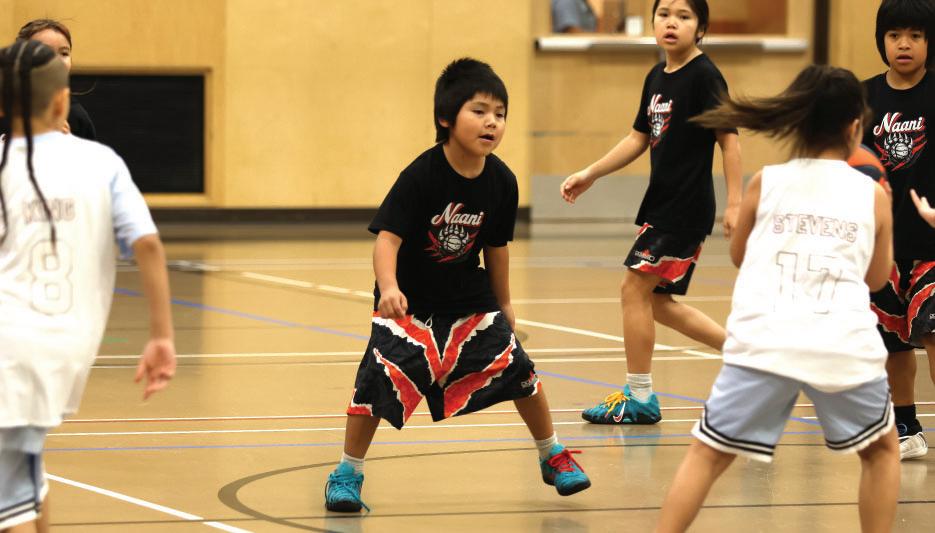
Tla-o-qui-aht’s Naani had fun battling it out with the
“It takes so much guts. It takes so much bravery,” said Vickers. “These little ones stepping into crowds like that where people are roaring and cheering, I really admire their bravery and tenacity. It’s moving. It’s a beautiful thing.”
Lil’wat Nation, located just north of Pemberton, B.C., brought two U10 squads to Langley for the five-day hoop tournament.
“This is our shortest drive we’ve ever done to JANT,” said coach Bah Boyz, also known as Bradley Peters.
“We’re bringing back basketball. It’s been mostly soccer on our rez. JANT is a good way to bring it back for the kids; to start younger and develop more and enjoy the game,” said Peters, adding that his grandson and his daughter play on the same U10 team.
He said they fundraised all year for the trip, with raffles and bingos plus support from the band, and had enough spare cash to treat the kids to something fun as a team after the tournament wrapped.
“I’m happy that we came to have fun. It’s all about the experience, for sure. I think they liked the adventure and just getting out of the rez,” said Peters.
Yuułuʔiłʔatḥ Itty Bitty Ballers U10 coach Tyson Touchie said he was happy for all the Nuu-chah-nulth teams.
“We are representing,” said Touchie. For the second year in a row, his Itty Bitties went undefeated in the U10 round robin.
“The Itties, man. They got challenged in the end by Haida and they stepped up and
did their Itty Bitty thing. We are super stoked about them,” said Touchie, who also coached the Yuułuʔiłʔatḥ Ravens U13 girls to a top two finish.
He shared his secret for developing players:
“You want to develop fundamentals and keep them coming out to the gym and making it fun. That’s the secret,” said
“I only have two rules: just be respectful and just play ball. These are the only two rules, always. And it permeates through their development,” he said.
Nations are already planning for next year when JANT heads north to Prince George.
Nora O’Malley photos
VanCity Vanguards. Touchie.
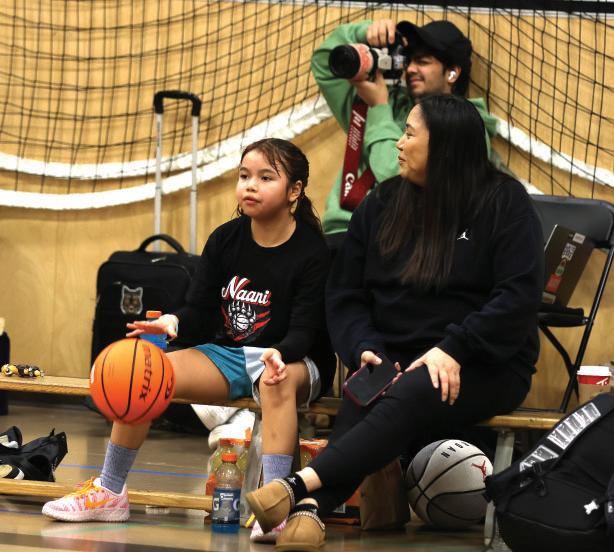
Tla-o-qui-aht Naani player and coach cheer from the bench as tiny shoes run the court with the VanCity Vanguards.

Online tool helps prevent accidental poisonings
Tips, statistics and advice on new online interactive dashboard helps parents and caregivers prevent accidents
By Jessie Levene Ha-Shilth-Sa Contributor
British Columbia – The BC Drug and Poison Information Centre (DPIC) has launched a new public, online and interactive dashboard to raise awareness about accidental poisonings caused by medications, drugs, and other toxic substances.
The DPIC Data Dashboard visualizes data on calls to the centre from 2012 onwards and is updated monthly. Call trends are shown across 41 different substance groups, ranging from prescription medications to recreational substances like alcohol, and everyday household items like cleaning products. The dashboard was launched at the start of National Poison Prevention Week (March 15-21, 2026), an annual campaign to draw attention to the causes of poisonings and how people can prevent them.
The new dashboard shows a summary of cases handled by DPIC. The seriousness of a poisoning event varies between people and situations, and depends on factors not shown in the dashboard, such as how much of the substance a person was exposed to and their medical history.
Health officials advise caregivers to seek immediate medical advice in cases of suspected poisonings. Timely medical assistance can be critical to prevent more serious outcomes.
The BC Drug and Poison Information Centre (DPIC) is a 24/7 clinical telephone service staffed by pharmacists, nurses, and medical toxicologists. The average time for a DPIC poison specialist to answer a call is only 40 seconds.
DPIC is one of five poison centres in Canada and supports around 28,000 cases of suspected or confirmed poisonings per year. DPIC helps both members of the public who are concerned about potential poisonings of themselves or others and assists healthcare professionals in the care of their patients.
If needed, DPIC advises callers to seek additional medical care, but sometimes, with guidance from DPIC, the caller can manage the poisoning event without any further medical care.
“We get calls from a wide range of people about all sorts of exposures, but one thing we’re particularly concerned about is unintentional poisonings among babies and young children,” said DPIC associate medical lead Dr. Jesse Godwin.
“Nearly 30 per cent of all our cases are

Protect curious little
ngers from poisons by installing child protection locks on cabinets dren include:
among children aged five and under. It’s important to store medications and all other potentially harmful products safely out of reach.”
Everyday household items can be a risk for poisoning among young children, and some of the most common cases DPIC responds to are children getting into cleaning products, medications, and house plants.
“Poison Prevention Week is a great time to look around your home and lock up any products that could potentially harm your children,” said Dr. Shelina Babul, director of the BC Injury Research and Prevention Unit (BCIRPU). “This can include cleaning products, over-the-counter medication, herbal supplements, cannabis, and button batteries frequently found in car fobs, toys, and watches. A good tip is to get down low, to the height of your children, and view the world as they see it - to identify anything that could be dangerous.”
Causes of poisoning among young chil-
• Medications, including prescription and non-prescription medicines, vitamins and natural health products
• Cannabis products, including edibles
• Cigarettes, nicotine and vape liquid
• Alcohol
• Household cleaners, laundry detergent, and bleach
• Cosmetic products, such as nail polish, mouth wash, creams, etc.
• Car supplies, like antifreeze and windshield washer fluid
• Pesticides
• Certain plants
To lower the accidental poisoning risk to children, store medications and potential poisons up high, out of sight and out of reach from children. Store dangerous items in a locked cabinet, drawer, or box.
Use child-resistant caps or packaging. Keep products in their original contain-

ers so you know what’s inside. Labels often contain important information about ingredients and medication dosage. Cannabis edibles can resemble snacks or candies. Follow the same storage practices with cannabis products as you do for other poisonous items.
Check for expired and unused medications, vitamins and natural health products at home and return to your pharmacy.
To see the new DPIC dashboard visit: https://bccdc.shinyapps.io/DPIC/
Add DPIC to your phone contact list and keep it in a visible location in your home such as on your fridge: 604-6825050 or 1-800-567-8911.
If you suspect someone has been poisoned by a medicine, chemical, or other substance, call DPIC at 604-682-5050 or 1-800-567-8911. If someone is unconscious, having a seizure, difficulty breathing or chest pain, immediately call 9-1-1.

Wikimedia Commons photo
Ha-Shilth-Sa newspaper is published by the Nuu-chah-nulth Tribal Council for distribution to the members of the contributing First Nations, as well as other interested groups and individuals.
Information and original work contained in this newspaper is protected by copyright and may not be reproduced without written permission from:
Nuu-chah-nulth Tribal Council P.O. Box 1383, Port Alberni, B.C. V9Y 7M2.
Telephone: (250) 724-5757
Fax: (250) 723-0463
Web page: www.hashilthsa.com facebook: Hashilthsa Ntc
2026 Subscription rates:
Non-Nuu-chah-nulth, Ahousaht, Ehattesaht,Toquaht and Ucluelet members are subject to a yearly subscription fee of $40 in Canada, $50 in the US and $60 for overseas. Payable to the Nuu-chah-nulth Tribal Council
Manager/Editor/Reporter
Eric Plummer (Ext. 243) (250) 724-5757 Fax: (250) 723-0463 eric.plummer@nuuchahnulth.org
Reporter
Denise Titian (Ext. 240) (250) 724-5757 Fax: (250) 723-0463 denise.titian@nuuchahnulth.org
Reporter
Nora O’Malley (604) 353-8488 nora.omalley@nuuchahnulth.org

Audio / Video Technician
Mike Watts (Ext. 238) (250) 724-5757 Fax: (250) 723-0463 mike.watts@nuuchahnulth.org
Editorial Assistant
Holly Stocking (Ext. 302) (250) 724-5757 Fax: (250) 723-0463 holly.stocking@nuuchahnulth.org
DEADLINE:
Please note that the deadline for submissions for our next issue is Apr. 10, 2026
After that date, material submitted and judged appropriate cannot be guaranteed placement but, if material is still relevant, will be included in the following issue.
In an ideal world, submissions would be typed rather than hand-written. Articles can be sent by e-mail to holly.stocking@nuuchahnulth.org (Windows PC).
Submitted pictures must include a brief description of subject(s) and a return address.
Pictures with no return address will remain on file. Allow two - four weeks for return.
Photocopied or faxed photographs cannot be accepted.
COVERAGE:
Although we would like to be able to cover all stories and events, we will only do so subject to:
- Sufficient advance notice addressed specifically to Ha-Shilth-Sa.
- Reporter availability at the time of the event.
- Editorial space available in the paper.
- Editorial deadlines being adhered to by contributors.
LETTERS and KLECOS
Ha-Shilth-Sa will include letters received from its readers. Letters MUST be signed by the writer and have the writer’s full name, address and phone number on them. Names can be withheld by request. Anonymous submissions will not be accepted. We reserve the right to edit submitted material for clarity, brevity, grammar and good taste. We will definitely not publish letters dealing with tribal or personal disputes or issues that are critical of Nuu-chah-nulth individuals or groups. All opinions expressed in letters to the editor are purely those of the writer and will not necessarily coincide with the views or policies of the Nuu-chah-nulth Tribal Council or its member First Nations. Ha-Shilth-Sa includes paid advertising, but this does not imply Ha-Shilth-Sa or Nuu-chah-nulth Tribal Council recommends or endorses the content of the ads.
Price of gas spikes due to Iran war
Climate change expert says the war highlights trend to shift away from fossil fuels
By Nora O’Malley Local Journalism Initiative Reporter
Ucluelet, BC – As the west coast kicked
off its annual Pacific Rim Whale Festival this month, the price of regular gas went up to $197.9 per litre at Tofino and Ucluelet pumps while images of oil tankers ablaze in the Persian Gulf circulated in international news.
The Strait of Hormuz, a key shipping route for nearly a fifth of the world’s oil supply, is in paralysis due to an ongoing war between Iran and U.S. and Israel, now entering its third week.
“The reduction in global supply causes prices to go up,” said Kathryn Harrison, a political science professor at the University of British Columbia specializing in environmental and climate change policy.
“There is an actual chokepoint there. It’s the only way out and it’s a pretty vulnerable chokepoint along that path that they all have to go through,” she said.
Countries that use the Strait of Hormuz as their primary export route for oil include: Saudi Arabia, the United Arab Emirates, Kuwait, Qatar, Iraq, Bahrain and Iran, according to the International Energy Agency (IEA).
Harrison says the length of the conflict in the Middle East is “as unpredictable as Donald Trump.”
“These are not soldiers on those ships. These are not military vessels. These are privately owned tankers with employees that did not sign up for this,” said Harrison.
“The Iranian regime is not a democracy. Its leadership has been working towards nuclear capability. It is a hostile regime. Yes, Donald Trump is unpredictable and seems to be driven by oil to some large degree, but this is not an allied regime for the world’s democracies either,” she said.
Tofino Chamber of Commerce executive director Graydon Clerk recalled the last time the price of fuel spiked to this degree was when Russia invaded Ukraine in February 2022.
“Tofino is a resilient community and we always make it work,” he said. “We were able to push through and not raise costs. It’s nothing new from their perspective.”
“It’s definitely a risk being a fossil fuel economy,” Clerk continued. “Tofino has made a lot of positive initiatives in the

past few years, so when you do get here, you don’t actually need to drive, or you can drive electric.”
Tofino Co-op recently installed several EV charging stations and most of the resorts have charging stations, says Clerk. Folks can also take the free beach shuttle that starts running at the end of June and the West Coast Transit system connects
Tofino and Ucluelet with daily trips.
“There are also plenty of bike options as well. I use my own e-bike, it’s easy to get around here. From downtown to Cox Bay, it’s under 20-minutes,” said Clerk.
Brent Baker, general manager of Ahous Adventures, says they are consolidating tours to “maximize efficiencies” as gas prices continue to rise. He said they paid $1.98 per litre for marine fuel last week, which is close to what the Indigenousowned eco and cultural adventure tour company was paying to gas up vessels when they opened in 2023.
“Our fourth season is off to an amazing start with absolutely incredible sightings so far,” said Baker in an email.
“We appreciate that our guests have been very flexible and open to adjusting some of the departure times allowing us to make smart decisions for the organization such as reducing some of the departures to ensure every boat that departs surpasses its minimum numbers, which enables us to cover our costs while still providing an amazing experience for our guests,” he said.
Harrison said the conflict in the Middle East highlights an underlying trend to
Ha-Shilth-Sa belongs to every Nuu-chah-nulth person including those who have passed on, and those who are not yet born. A community newspaper cannot exist without community involvement. If you have any great pictures you’ve taken, stories or poems you’ve written, or artwork you have done, please let us know so we can include it in your newspaper. E-mail holly.stocking@nuuchahnulth.org. This year is Ha-Shilth-Sa’s 52nd year of serving the Nuu-chah-nulth First Nations. We look forward to your continued input and support. Kleco! Kleco!
shift away from fossil fuels.
“Until we do, the world is just going to keep warming and that is going to be a source of a lot of pain and a lot of instability, in terms of unpredictable weather, wildfires, flooding, but also geopolitical instability,” said Harrison.
But she acknowledged that the upfront costs of purchasing a new electric vehicle or heat pump is a challenge for many Canadian households.
“Someone still has to be able to be able to pay for it in the first place. I think it’s encouraging that the federal government has reinstated incentives for the purchase of EV this year,” she said.
Canadians can benefit from a new federal EV rebate program, which offers incentives for the purchase or lease of an electric vehicle, starting at: up to $5,000 for battery-electric and fuel cell electric vehicles and up to $2,500 for plug-in hybrid vehicles.
For British Columbians, the CleanBC Go Electric Rebates program was paused in May 2025 due to high demand. The government says available funds have been fully allocated and new applications are not being accepted.
Developments in marine vessel electrification is also happening right on the west coast in Ucluelet First Nations traditional territory. Rising Tide Boatworks recently purchased the historic Second World War Royal Canadian Air Force hangar and is building critical infrastructure for boat electrification.
Legal Information
The advertiser agrees that the publisher shall not be liable for damages arising out of errors in advertisements beyond the amount paid for space actually occupied by the portion of the advertisement in which the error is due to the negligence of the servants or otherwise, and there shall be no liability for non-insertion of any advertisement beyond the amount paid for such advertisements
Nora O’Malley photo
A cyclist cruises by the Ucluelet Petro Canada as the price of regular gas hit 191.9 cents per litre on March 14.
Clayoquot Sound’s only tree farm licence subdivided
Ahousaht, Hesquiaht and Tla-o-qui-aht will now manage the newly created TFLs
By Nora O’Malley Local Journalism Initiative Reporter
Clayoquot Sound, BC – The logging tenure for a landscape made famous by the “War in the Woods” protests on the west coast of Vancouver Island has been divided up into three new Tree Farm Licences (TFL) to assert First Nations’ unique land-use visions.
TFL 54 in Clayoquot Sound was transferred from MaMook Natural Resources, which is owned by a partnership of five central region First Nations (Ahousaht, Tla-o-qui-aht, Hesquiaht, Toquaht and Yuułuʔiłʔatḥ), and reconfigured into TFL 66, TFL 67 and TFL 68.
According to the Ministry of Forests, Tla-o-qui-aht is now the holder of TFL 66 comprising over 13,000 hectares within their territory, TFL 67 is held by Ahousaht and comprises over 29,000 hectares in Ahousaht territory and Hesquiaht is now the holder of TFL 68 with an area size of over 9,165 hectares in their territory.
MaMook will continue to exist for the next few years with the legal obligation to clean up old logging infrastructure, including deactivating old logging roads, dryland sorts and log booming areas, but the company will dissolve once that work wraps, according to Toquaht appointed board member Ken Matthews.
The company will also have to ensure all areas previously logged areas are reforested adequately. They anticipate this will take up to three years to complete.
“All First Nation owners of MaMook see this a positive move forward to allow the individual Nations to manage the forests and lands in their traditional territories,” said Matthews.
TFL 54 was transferred from MaMook to the three Nations with compensation provided by Canadian charity Nature United after unanimous MaMook board approval.
“Nature United paid MaMook fair market value for the TFLs, on behalf of the three First Nations,” said Matthews.
“MaMook as a corporation has to pay for all of that deactivation legal clean we have to do and then ultimately whatever is leftover will be split amongst the five (Nations),” he continued.
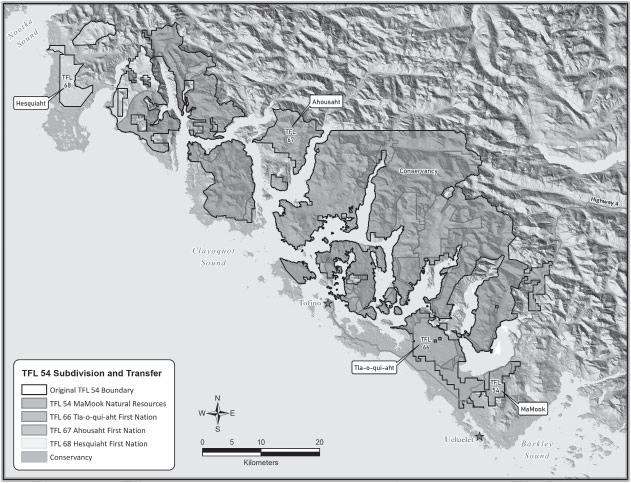
Natural Resources map
About 52,000 hectares from Tree Farm Licence (TFL) 54 have been removed from the licence area and divided into three new TFLs
This milestone for TFL 54 follows a June 2024 landmark agreement with the Province of B.C. and MaMook to remove roughly 77,000 hectares of land from the designated TFL area to be then designated as conservancies under B.C. legislation. These protected areas were primarily in Tla-o-qui-aht and Ahousaht territory.
“Nature United supported this (conservancies) agreement by contributing a one-time allotment of money to MaMook for these areas from the TFL,” said Matthews.
“The BC government agreed to contribute $8 million dollars under a grant to MaMook to be used to partially offset

costs of deactivating roads and other logging disturbance in the new conservancies and in TFL 54. This money had to be used for only those purposes,” he added.
Michael Reid is Nature United’s B.C. program director. He lives in Tofino.
“Nature United has raised and contributed more than $40 million to support the creation of new conservation and new forest management areas in the region as well as supporting new stewardship endowments,” said Reid.
About 20 non-profits, organizations and individuals contributed financial gifts to Nature United, or Nature United’s global affiliate The Nature Conservancy, to help reshape Clayoquot Sound’s forest management future, including billionaire Amazon founder Jeff Bezo’s, Bezos Earth Fund and Swiss billionaire Hansjörg Wyss’ the Wyss Foundation.
Lines on a map
Matthews said it took Ahousaht, Hesquiaht and Tla-o-qui-aht leaders four years to agree on the lines on the map that would make up the new TFL designations.
He said some of the decisions went “very easily”, but in other discussions, drawing lines on the map was “very difficult”.
Two small portions of TFL 54 still exist because of “historical disagreements”. Stewardson Inlet out by Hot Springs remains unresolved because of overlap between Hesquiaht and Ahousaht territory and an area south of Kennedy Lake that overlaps between Ahousaht and Tlao-qui-aht is still in limbo.
“It’s possible that these last pieces will just go into conservancies,” said Matthews.
Hesquiaht, Ahousaht and Tla-o-qui-aht leadership have all indicated a desire to create long-term, sustainable forest management plans for their territories that will ensure the prosperity of future generations.
“Throughout history governments and business have done everything in their power to limit our authority and jurisdiction over what is rightfully ours. Taking management back over a portion of our territory that we’ve managed for thousands of years is a step in the right direction,” said Hesquiaht First Nations Chief Councillor Mariah Charleson in a media release issued by Nature United.
All three Nations have shown an interest in pursuing carbon finance or carbon offsets, according to Reid. Carbon offsetting is when companies, governments or individuals compensate for emissions by taking part in activities that reduce the equivalent amount of carbon dioxide in the atmosphere.
“There are challenges within the existing tenure regime, but I am optimistic they will be able to work through with the province,” said Reid.
“(Carbon offsetting) was part of the conversation 10 years ago. It remains central to the broader conservation economy. Beyond carbon, it’s how can you do more with less and how can you realize the value that these forests provide beyond just the timber values,” he continued.
MaMook Natural Resources Ltd. was an amalgamation of Iisaak Forest Resources Ltd., previously TFL 57 obtained by Iisaak from MacMillan Bloedel/ Weyerhaeuser in 1999 and TFL 54 obtained by MaMook Natural Resources Ltd in a sale from Interfor in 2007.
According to the Ministry of Forests, TFL 66, 67 and 68 began on Jan. 12, 2026 and expire on May 31, 2047.
TJ Watt photo
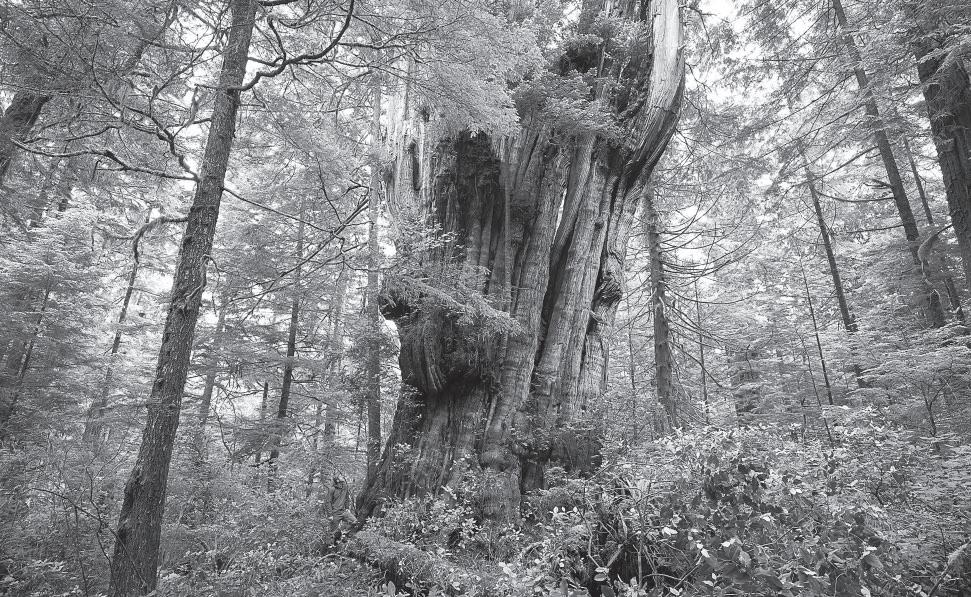
Ancient Forest Alliance photographer TJ Watt looks up at an ancient Western red cedar tree located in Ahousaht territory and the new TFL 67.
Mamook
Province plans to attract visitors with new action plan
First Nations tourism planners hope funding will follow after launch of Tourism Sector Action Plan
By Sam Laskaris Ha-Shilth-Sa Contributor
British Columbia – A couple of Indigenous tourism leaders in British Columbia are pleased provincial officials have released a new tourism plan.
But Paula Amos, the chief marketing and development officer for Indigenous Tourism BC (ITBC), and Maria Clark, the assistant general manager of the Tofino-based Tin Wis Resort, owned by the Tla-o-qui-aht First Nation, also have some concerns of what wasn’t in the plan
– specifically funding announcements.
On Mar. 4 the province launched an initiative titled Look West: Tourism Sector Action Plan. This plan, put out by the ministry of tourism, arts, culture and sport, notes that tourism is a key driver of economic diversification and growth.
Built on five pillars, the plan intends to help the province double its tourism revenues by the year 2036. Other goals of the plan are to attract more investment into the province and to generate lasting economic benefits.
The Look West: Tourism Sector Action Plan five pillars are:
• marketing B.C. as a top-tier destination
• improving access through expanded air services and provincial corridors
• leveraging events
• mobilizing private-sector investment
• creating a supportive business climate for tourism operators and investors
Amos, a Hesquiaht First Nation member, said ITBC officials were aware of some of the details in the plan before it was publicly released.
“We had some behind-the-scenes information on the five points that are in the plan,” she said.
Amos added she is for the most part content with the provincial plan. “I’m pleased with it,” she said. “I think there’s some great points in there around putting a big focus on inspiring the world to tour B.C.”
Amos is also happy to see the plan includes details of boosting domestic travel. “I think right now with the political climate, more people from British Columbia and Canada are wanting to travel in our own spaces,” she said. “So, I think it’s great that we’ll put some energy into that.”
The plan to leverage events was another plus for Amos. That starts with the fact some 2026 World Cup soccer matches will be staged in British Columbia. “I think events hosting is another big area that there hasn’t really been a plan on that,” she said. “So, it’s nice that we’re going to see a plan for Indigenous Tourism BC. We are involved with FIFA (soccer’s world governing body) mainly looking at it for the long-term benefits. We’ve been working on it for a few years, working on great stories, inspiring visitors through media to include Indig-
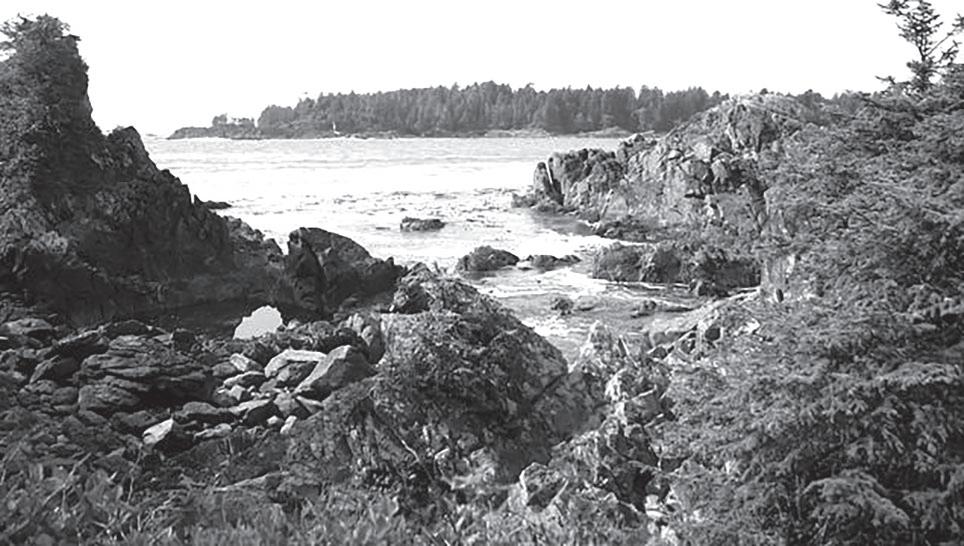
tourist attraction Hot Springs Cove in Maquinna Provincial Park, a remote, natural geothermal spa located near Tofino, BC. Accessible only by boat or seaplane. Visitors enjoy a boardwalk hike through old-growth forest, followed by natural, cascading hot pools overlooking the ocean.
enous tourism when you’re travelling here.”
Amos, however, was hoping the plan would include more details on how provincial officials plan to boost growth. She acknowledged the plan included some information about enabling growth and removing roadblocks to tourism growth.
“I’m hoping that we’ll see more information on how that growth will happen,” she said. “I think with Indigenous Tourism BC, we’ve been growing Indigenous tourism coming up to our 30th year. And we’ve had tremendous growth for Indigenous tourism in the last four to five years.
We’ve seen about a 30 per cent increase in Indigenous tourism businesses, which is great to see.
“We’ll see how the bigger picture is. I think we’re looking at some infrastructure growth. I know some of the remote communities in British Columbia, they’re
Les Sam Construction
looking at access. They’re looking at better road access into their communities. So, those are some of the pieces that are on our plate on how we can advocate.”
Amos added she would have liked to see specific funding information in the plan. “ITBC has been very fortunate over the last six years or so that we have had great funding for development,” she said. “So, we want to continue that momentum, which is going to take some funds. In B.C. we have over 200 (First) Nations. The majority are fairly remote. So, we’ve been able to build up a momentum there. We’re hoping that we’ll be able to continue with that momentum with some funding dollars.”
Amos, who has been with ITBC for about 25 years, added she’s confident the province will provide tourism funding news in the future. “I am very hopeful that the funds will come,” she said. “I think there’s an interesting item in the plan where they mention investment attraction - so bringing in some private investors,” she said. “I think that’s an interesting line item.
“ITBC does have a good comprehensive idea of which Nations are interested in tourism development. So, we’ll be able to work with the Nations and hopefully bring them together with if there is some private investment attraction happening soon.”
As for Clark, she said she had a recent lunch meeting in Tofino with Anne Kang, the provincial minister of tourism, arts, culture and sport. “We were talking about how effectively we can work together and what that means,” Clark said. “And basically, I was encouraged by Anne because she was really telling me that relationships are key and very important. And that’s why she wanted to have time here.”
Clark added Kang offered plenty of encouragement and support during their lunch and extended an offer to reach out whenever necessary. But she wondered how effective the province’s plan will be. She felt that the plan was more of a marketing pitch with not many concrete details included.
The plan, however, includes a mention that Indigenous tourism in the province is a vital connector and powerful driver of cultural integrity and economic opportunity. “I believe they can see the value, at least from our perspective, in Indigenous tourism,” Clark said.
“You would have to be blind to not acknowledge that. I don’t think that our Indigenous communities are benefitting enough and so I think (we need) strong partnerships, making sure there’s equity, both from visitors and from the industry and supporting every community on which Nation and territory they’re coming from.”

Facebook photo
Popular
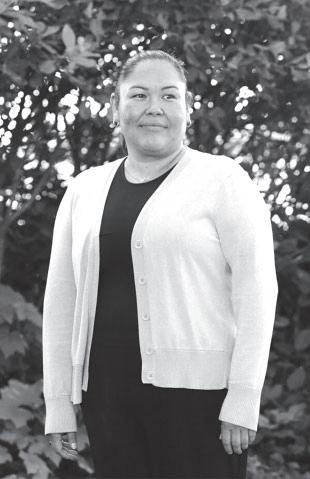
Maria Clark
Calls for accessible intercity bus service intensify
A movement is underway to provide a safe, affordable intercity bus service in central Vancouver Island
By Nora O’Malley Local Journalism Initiative Reporter
Vancouver Island, BC - As gas prices continue to climb due to the conflict in the Middle East, calls for a frequent and affordable bus service in the west coast and central Vancouver Island region are being amplified.
For west coast residents, there is no bus service to Port Alberni, leaving folks without vehicles dependent on family, friends, rideshares or hitchhiking. In Port Alberni, there is a privately operated bus service with daily service to Nanaimo Departure Bay ferry terminal, but it’s prohibitively expensive for many people, with round-trip tickets costing $90.
“We are in a bit of an oil shock now. We could wake up tomorrow and it could be even higher. And not to mention the environmental aspect, public safety and public health in terms of medical appointments,” said Mike Youds, president of the Alberni Valley Transition Town Society (AVTTS), a community hub that champions for a more sustainable, low-carbon future.
Ever since Tofino Bus and Vancouver Island Connector folded in 2023, central Vancouver Island has become a “missing link” for public transit. AVTTS launched a Fair Transit campaign last spring to advocate for affordable and accessible intercity bus services connecting Port Alberni with Nanaimo.
“Starting off with a bus out of Port Alberni would be a good start. Naturally, you’d have to forge those connections to the west coast as well,” said Youds.
“It’s not just the residents. It’s kind of crazy that we live on an Island where tourism is so prominent where tourists can’t get around unless they have a rental automobile. It’s not very accommodating or hospitable to say, hitchhike,” Youds continued.
Youds says when he sees Indigenous women hitchhiking, he recalls the Highway of Tears, or Highway 16, between Prince George and Prince Rupert in northern B.C.
“It doesn’t take any imagination to realize the degree of risk they are taking,” said Youds.
Ucluelet resident Darryl Cook, 57, went looking for a ride to Port Alberni from the Tofino/Ucluelet Junction on March 31.
“It scares me so deep,” said Cook, who is of Ojibway and Cree descent. “I don’t want to see an Indigenous person getting a ride hitchhiking. I don’t want anything to happen to anyone.”
He says he doesn’t drive because he’s an
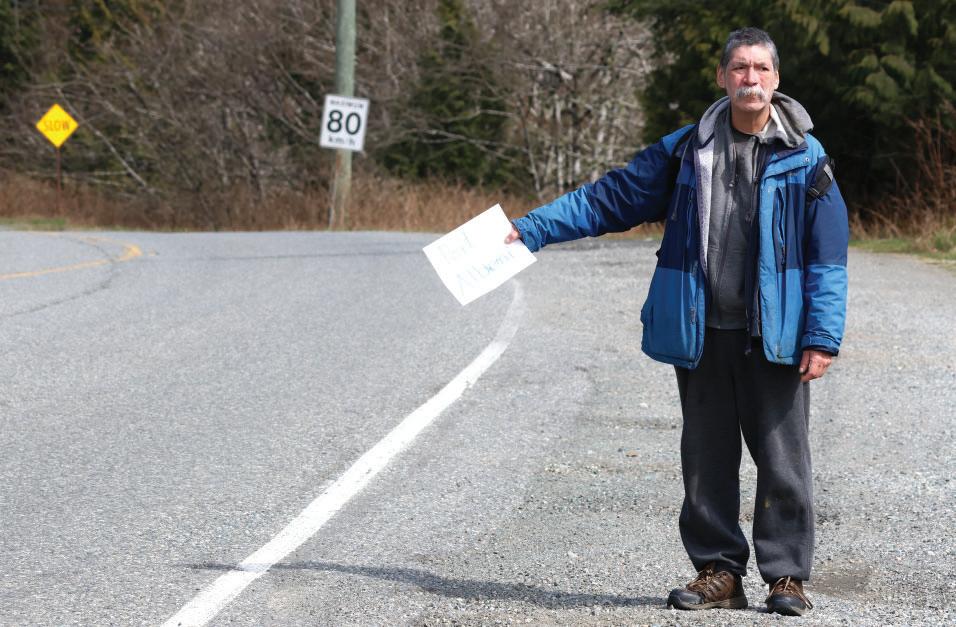
alcoholic and he doesn’t use social media, so he’s unaware of rideshare options.
“It’s rough. The transit should be here, but it’s not. I have to go to Port for medical reasons,” he said, adding that he has money to pay for a ride.
Tseshaht Chief Councillor Wahmeesh (Ken Watts) wrote a letter of support to AVTTS and the Fair Transit campaign.
In his letter, Wahmeesh points out that Port Alberni has one of the highest poverty rates in British Columbia, making car-ownership a struggle, especially for seniors, persons with disabilities and First Nations.
“Unaffordable and inaccessible transit creates additional hardships, forcing people to take extraordinary measures, including hitchhiking and issuing community appeals on social media for rides,” said Wahmeesh.
Port Alberni to Nanaimo feasibility study
The wheels on a central Island public transit initiative seem to be moving and all levels of government are quick to acknowledge that the Alberni Valley needs an intercity bus service.
Port Alberni Mayor Sharie Minions wrote in a letter of support for AVTTS that an enhanced bus service between Port Alberni and Nanaimo would “alleviate financial burdens on low-and moder-
ate-income individuals and families.”
Josie Osborne, MLA for Mid Island –Pacific Rim, stated: “Accessible transportation is essential for communities, and the Pacific Rim is no exception. For people in our region, it’s not just about getting from point A to point B, it’s about being able to get to medical appointments, stay connected with family, and access work and education opportunities. That kind of reliable, regional connectivity is critical to the health and wellbeing of our communities.”
The 2025 Port Alberni Transit Future Service Plan identified the local desire for BC Transit to investigate potential interregional transit service between Port Alberni and the Regional District of Nanaimo (RDN) as a service priority for the coming years, but BC Transit says the work has yet to begin.
BC Transit said it plans to “work with the Alberni-Clayoquot Regional District (ACRD) to develop a feasibility report and service plan, which will involve engagement with the RDN, First Nations, key stakeholders, and members of the public.”
ACRD operations manager Eddie Kunderman confirmed that the BC Transit feasibility study is a key step that will inform the cost and frequency of buses.
“It’s a challenge to provide transit along that stretch of corridor,” said Kunderman. “We need to get more of a realistic idea of the cost.”
In addition to producing a feasibility and service study to establish an intercity route between Port Alberni and Nanaimo, BC Transit is also investigating the potential of providing a dedicated service to
the Tseshaht Market or Tsuma-as Drive.
Tofino/Ucluelet to Port Alberni
In June 2025, IslandLinkBus nixed its service from Tofino/Ucluelet to Port Alberni – even though the bus stops in Port Alberni in front of the Casino en route to Nanaimo.
According to the Ministry of Transportation and Transit, IslandLink operates under a “connector bus” license whereas intercity buses are licensed under “Special Authorization by the Passenger Transportation Board”.
The ministry says they discussed alternative licensing options with IslandLink and explained that should they wish to make changes outside of the restrictions of their current license, such as one that would allow them to drop passengers off in Port Alberni, they must submit an application to the Registrar/Passenger Transportation Board (PTB).
Phillip Morgan, owner of IslandLink, says they have not applied to the PTB to change their operating license conditions nor do they plan on applying.
“I should point out though that plans can change if circumstances do,” said Morgan.
So for the foreseeable future, ACRD residents will continue to scroll past those familiar posts on Facebook: “I’m looking for a ride from Tofino to Nanaimo on Sunday/Monday (morning). I’m flexible with exact timing and happy to chip in for gas. Please let me know if you have a seat available.”
And for individuals like Cook, it’ll be a gut instinct as to whether to accept a ride to Port Alberni or wait for the next one.

Nora O’Malley photo
Ucluelet resident Darryl Cook waits for a ride to Port Alberni from the Ucluelet/Tofino Junction.
Tla-o-qui-aht girls fall shy of toppling Nuxalk JAN
By Nora O’Malley Local Journalism Initiative Reporter
Langley, BC – Tla-o-qui-aht West Coast
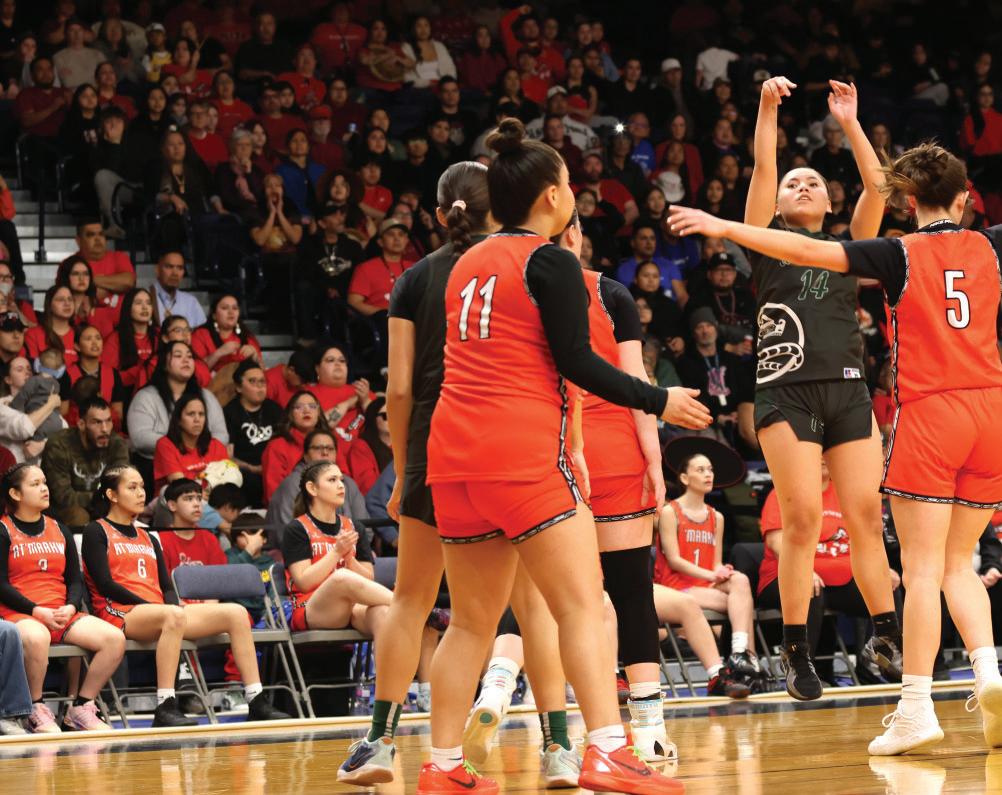
All Heart missed toppling the At’maakw Kingfishers dynasty by one bucket on March 20 during a thunderous U17 Girls Junior All Native basketball championship game at the Langley Events Centre.
At’maakw, from the Nuxalk Nation community of Bella Coola in the central coast region of British Columbia, hasn’t lost a U17 JANT title in five years.
“It was a crazy game,” said At’maakw player Kashlyn Mack, who picked up a JANT First Team All-Star.
At’maakw led by double digits for most of the game and heading into the final four minutes, they stretched the advantage by 17-points.
But the All Heart girls dug deep to pull off a wild fourth quarter comeback, reeling in the spread to two points as the clock drained to zero.
“That’s why I was scared. I feel like we would have done anything to not let them win,” said Mack.
The buzzer went off with a final score of 60-58 and At’maakw fans erupted with joy, spilling onto the court to celebrate with the team.
“It’s been a journey for us. This is all of our last year. Hopefully, our younger girls will step up and train as hard as we do. We put a lot into basketball. The work does show,” said Mack.
At’maakw’s Annika Parr led her team to victory with 27 points. She was named the U17 Girls top scorer and Most Valuable Player.
Tla-o-qui-aht dad Dwayne Martin was choking back tears after watching his daughters Wiinuk (NuNu) and Helen play in the JANT final.
“It’s a win no matter what that scoreboard said. There’s a lot of excitement at home,” said Martin.
Martin is a Christie Residential School survivor and lives in the Tla-o-qui-aht First Nations community of Ty-Histanis near Tofino on the west coast of Vancouver Island. His daughters are of Tla-o-quiaht and Makah Tribe ancestry. They both live in Neah Bay, Washington, with their mom Stephanie Martin. Even though the Makah Tribe is separated by the U.S. –Canada border, they share the same cultural foundation as Nuu-chah-nulth Nations. In favourable conditions, Martin says he can do the trip to Neah Bay from the west coast in a speed boat in about four hours.
The Martin’s residency stirred controversy
and lit up social media as JANT player eligibility rules state that: “all players must reside in the Province of British Columbia at least three months prior to tournament.”
“The rules on eligibility need to be explored,” said JANT co-host and Vancouver Bandits team president Dylan Kular.
He noted that no formal protest was submitted to the JANT committee and “all the coaches knew and were cool with it.”
The Martin family are descendants from the House of Iiwasaht and uupwinhnaasas, and Wiinuk was named after her grandmother, who held two seats in Tla-o-quiaht.
“They were Tla-o-qui-aht before they were Makah even though they were born in the states. I called my nation right away,” said Martin.
“I was talking to NuNu about developing the killer instinct and I could see it on the court. It brought tears to my eyes,” he said.
“My kids are ten times better than I ever

was at sports because I played sports to prove things. They can just be themselves and it shows how exceptional they are.”
Wiinuk earned a First Team All-Star alongside teammate Kionah Williams. Jaysen Touchie, who recently helped the Hesquiaht Descendants rally to second at the All Native Basketball Tournament, won Best Defensive player and a Second Team All-Star.
After the awards ceremony, an emotional West Coast All Heart coach Catherine Thomas shared that the meaning of “All Heart” comes from her cousin Travis Thomas. Travis is an Ahousaht member who went missing from the remote Bartlett Island in the summer of 2018.
“He’s been a huge inspiration in basketball. He used to go to the All Native and he used to coach the boys. He was like a brother to me,” said Thomas.
During her first year at the All Native tournament up in Prince Rupert over a decade ago, Thomas shared she was rep-
resenting the Wild Women, a small team from Tofino.
“I was so tired because we were game after game after game. My legs were tired. They were dead. I remember on the sidelines, Travis was going, “All heart, now. All heart. You gotta go.” I gave it my all. We left there happy,” said Thomas.
She said the player eligibility controversy made for a “difficult” week. The All Heart team also picked up a player with Tla-o-qui-aht roots who lives in Alberta. “Coming in knowing that we were at risk of being protested or disqualified, I was hurt. I was hurt that the two girls were being questioned because they played with us last year with no discouragement. I felt like it was very discriminating for our nation, for our bloodline,” said Thomas, who is of Ahousaht descent and partnered with a Tla-o-qui-aht member. They live in the Ty-Histanis with their family.
Zakariyah Thomas plays with all her heart during the championship game of the U17 girls Junior All Native Tournament on Marc
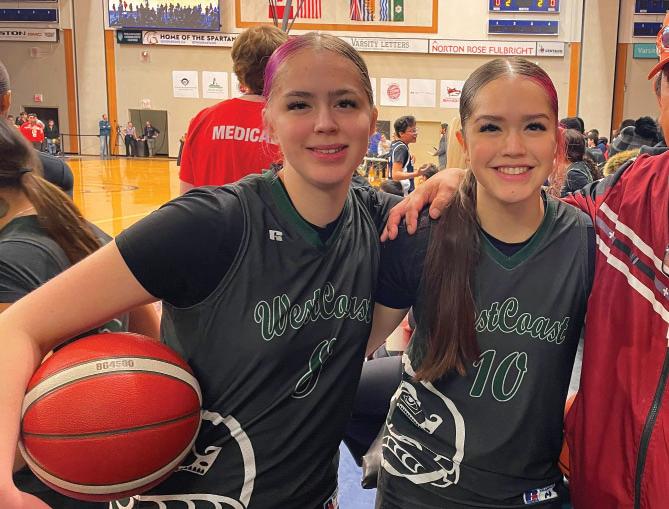
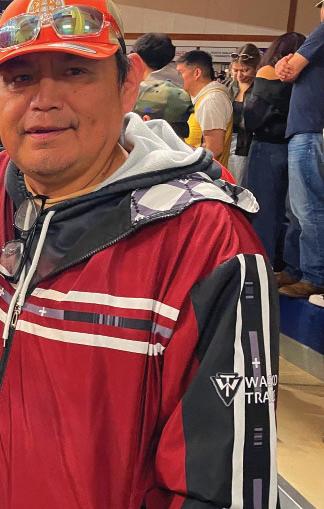
Dwayne Martin with his daughters Wiinuk (Nunu), left, and Helen right before the ch Jaysen Touchie was voted Best Defensive player and Second Team All-Star.

‘I would like a gym’
Tla-o-qui-aht First Nation is the only community nation at JANT that does not have a gymnasium, says Thomas. They are currently working towards building a gym in Ty-Histanis.
“I wish we had more support and of course, I would like a gym. We utilize what we have. We have a beach, we have Tofino and Ucluelet, but not consistent. We have an outside court in Esowista that we use.
Me and my girls were running the hills in Esowista,” said Thomas.
“There is a lot of talk at home about our community not having a gym,” said Martin. “Look at how far our kids are coming along without access to a gym.”
The At’maakw dynasty team has aged out of JANT now, leaving the door wide open for any U17 girls team to swoop in and nab the 2027 banner.
Maaqtusiis Suns girls narrowly defend JANT U13 Silver division title
Maaqtusiis Suns won the championship by a single point, defeating
By Nora O’Malley Local Journalism Initiative Reporter
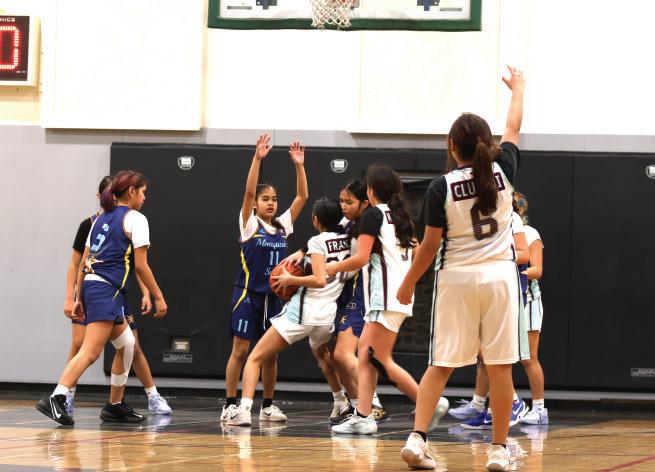
Langley, BC – Maaqtusiis Suns from Ahousaht held on to a back-and-forth basketball game with rival Nuu-chahnulth team Yuułuʔiłʔatḥ Ravens to clutch back-to-back titles in the Junior All Native Tournament (JANT) U13 Silver division.
Bellowing cheers and banging on traditional drums from packed bleachers at Langley’s Peter Ewart Middle School, Ahousaht fans might have given the Suns the edge they needed to narrowly defend their title by a score of 44-43.
“Thanks to the fans. It was amazing. Game changer for us. We’re not used to the loud crowds,” said Suns coach Robert Stanley.
He said his girls trained daily in preparation for JANT.
“We just be the adults in the gym and get them gym time. They do the work,” said Stanley. “It’s a great win. Thanks Ucluelet for the great battle. It was a more intense game than last year. They brought their A-game. My hats off to their girls. They improved a lot. The last time we played them, we beat them by quite a bit.”
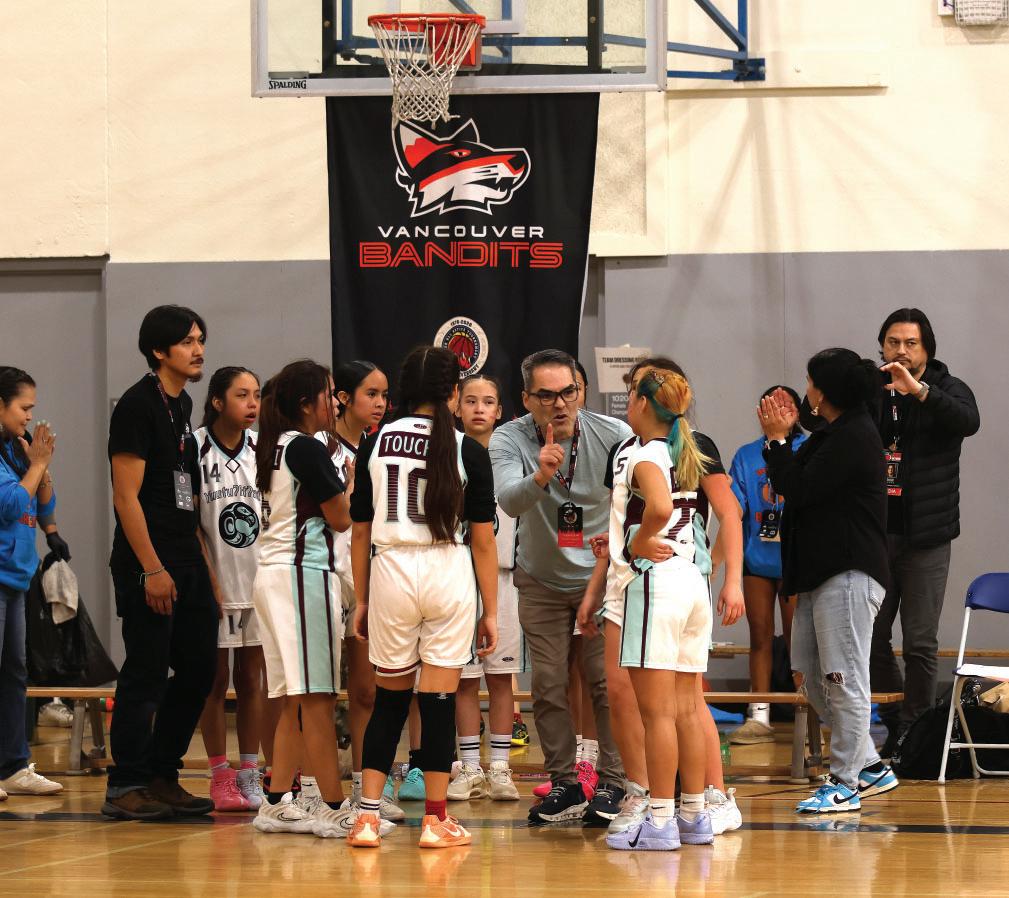
After the fans had cleared out and volunteers began sweeping Ravens’ tears off the court, Yuułuʔiłʔatḥ coach Tyson Touchie spoke about practice.
“I remember on our very first practice we were sitting in a circle and we didn’t know each other. They thought I was a grumpy old man with big bushy eyebrows. But I remember, when we sat there, the goal was to go to the finals. That was the goal from
i
u
our very first practice,” said Touchie.
“I think we just hit that emotional wall. As a guy, I felt bad because telling them to suck it up because we had 30 seconds left to get this hoop. I feel a little shortsighted because I didn’t think that two of these girls lost their parents, so they are dealing with grief. And they are coming in with some really strong emotions,” he continued.
Touchie said this final was just one of many games in what has become a “respectful rivalry” between the two teams.
“When we are running in the gym, I’m telling the girls that Ahousaht is running
right now. Ahousaht is getting ready for the game, and they would grit their teeth and start running harder,” said Touchie.
Stanley said he believes Ahousaht will merge their U13 teams next year and enter the U13 Gold division.
“We are in talks,” he said.
Suns player Ellenore John led all scorers with 20 points in the final and was named tournament MVP. Aulani John from the Suns won a First Team All-Star.
Ravens Chenoa McCarthy-Tom and Samantha Clutesi earned First Team All-Stars. Maaqtusiis Suns also won Most Sportsmanlike Team.
Nora O’Malley photos ch 20 at the Langley Events Centre.
Nora O’Malley photos
Down by one point with four seconds left on the clock, Yuułuʔiłʔatḥ Ravens coach Tyson Touchie calls a final timeout in the U13 Silver girls championship final at JANT in Langley.
Ahousaht and Yuuł
ʔ
łʔatḥ traded basket for basket in the U13 Silver division JANT championship game that went down to the wire.
Ditidaht’s Connor Logan wins Coach of the Year
Saskatchewan junior hockey league team Battleford North Stars head coach wins prestigious award
By Karly Blats Ha-Shilth-Sa Contributor
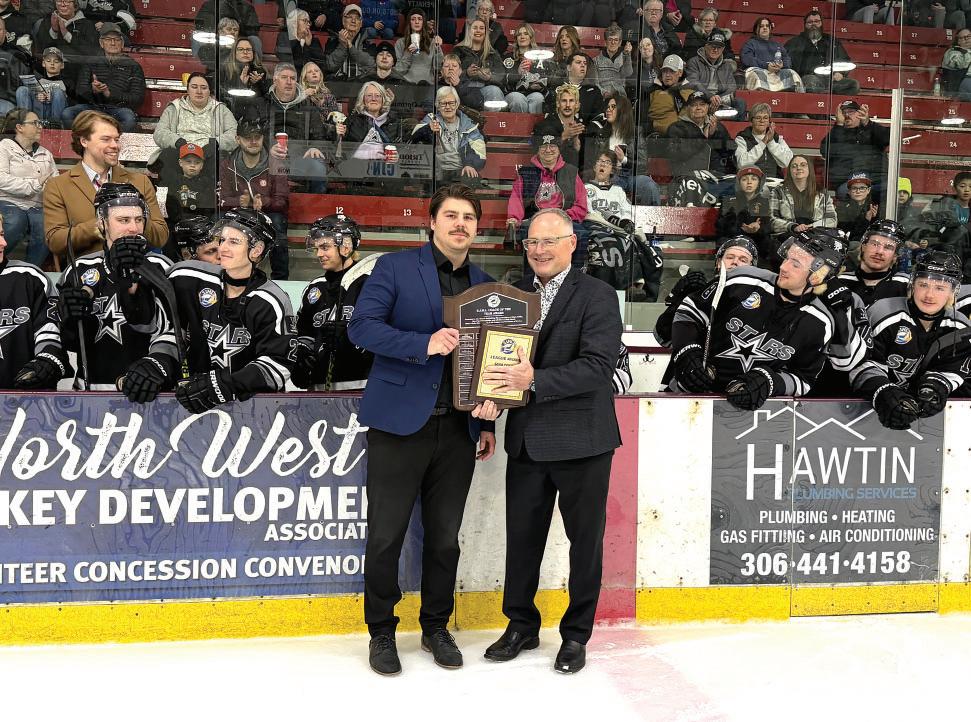
After only one year as head coach of the Battlefords North Stars, Connor Logan of the Ditidaht First Nation, was named Sask. Junior Hockey League (SJHL) Coach of the Year for the 2025-2026 season.
Logan,29, is the first rookie head coach to win the award since Kindersley Klippers head coach Clayton Jardine in 2018-19. In his first year, Logan led the North Stars to a 35-15-4-3 (W-L-OTLSOL) record and a third place finish in the regular season.
Winning coach of the year is a huge personal accomplishment for Logan, especially during his first year coaching Junior A hockey—and for a team he played for 10 years earlier. But Logan says none of it would be possible without his support system.
“Even when you’re in a position considered to get recognized at that capacity, you realize how hard it is to have success in Junior hockey as a coach. For me it was because I had such good support from my assistant coach, Owen Lamb, and assistant general manager, Wylie Riendeau,” Logan said. “Also the support of our board and our president, Kyle Kellgren. As great as it is to get recognized individually, I think it just shows how important it is to have good people around you.”
Logan grew up playing hockey. Both his grandma, Geraldine Tom, and father, Rod Logan, from the Ditidaht First Nation, were huge hockey fans, which rubbed off on a young Logan. He began playing hockey around five years old and hasn’t stopped since.
“I think my grandma was such an integral part of my hockey career in terms of the support,” Logan said. “She was with me a lot, came to a lot of tournaments and supported my career.”
Logan came up through the minor hockey system in Cowichan Valley and began his Junior hockey career at age 16 in the Vancouver Island Jr. Hockey Leage (VIJHL). After that he moved up to Junior B and later made Junior A at 19 years old, playing in Prince George for the BCHL. Logan finished his Junior hockey career with the Battlefords North Stars, where he helped the team win the championship for the 2016-2017 season.
After that, Logan went to the University
three years, while obtaining a degree.
Logan’s hockey career took a pause when the Covid-19 pandemic hit.
“I would have tried to pursue more opportunities professionally but obviously with travel and the prolonged time off…that was one of the more significant factors,” Logan said. “By the time you could go back to [hockey], I had been out of the game for three years.”
This allowed Logan to transition into sport performance coaching, both on and off the ice.
“Being exposed to the game (as a player) I kind of knew coaching was something I was interested in,” Logan said. “I got the opportunity to work with the Cowichan Capitals and sort of got dragged back into coaching. I was on the ice quite a bit with the Capitals…the head coach was a hockey mentor of mine and he really gave me the chance to get exposed to coaching without the title.”
Pronounced ‘oo oo ee hints tleeh tseep min-h in tlah ich-h shi
The exposure to coaching with the Capitals led to the opportunity to become the assistant coach of the Merritt Centennials in the BCHL.
“That was the beginning and kind of got me hooked,” Logan said. “I had a really great experience with Merritt and the BCHL.”
The next year brought on a big life change with the birth of Logan’s son, Gabrielle.
“I wanted to be closer to home so I spent a year with the Victoria Cougars as the head coach…I got exposure to what it was actually like to be a head coach,” Logan said. “I realized it’s a lot harder than being an assistant coach. A lot more stress but it was good. It was a tough transition but I was really grateful for it.”
After a year with the Cougars, Logan was presented with the opportunity to be the head coach of the Battlefords North Stars in Saskatchewan, where he was a player 10 years earlier.
As a coach, Logan believes his greatest
strength is communication and having a sense of relatability to the players.
“I think my ability to relate to what they’re going through and have meaningful dialogue with the players about navigating through some of the hardships… and some of the positives,” Logan said.
“I think you need to be constantly talking to your players. You need to have good rapport with all players. I think that’s important for their game.”
Logan said there is a strong Indigenous backing for the SJHL and most rinks where games are held are located on Treaty 6. He said at least three players on the Battlefords North Stars are First Nations or Metis.
Logan is able to get back to his Nuuchah-nulth roots by visiting family in summers in Port Alberni or Nitinaht. Hockey has run deep in Logan’s family and the young father is now passing that along to his son.
“We can’t get a hockey stick out of his hands,” Logan laughs.

Illustration by Joslyn Charlie
Submitted photo
Connor Logan of the Ditidaht First Nation, receives Coach of the Year award for the 2025-2026 season. of Windsor in Ontario where he played collegiate hockey for
Claims for Indian Hospitals Settlements Now Open
Indian Hospital survivors may now submit a claim for compensation
By Jessie Levene Ha-Shilth-Sa Contributor
Canada – The application period for those that were patients of a Federal Indian Hospital has now opened. In Canada, Federal Indian Hospitals were a network of facilities operated by the Government of Canada between 1936 and 1981. Racially segregated, Canadian Federal Indian Hospitals started out as a TB (tuberculosis) hospital for First Nations people, but many suffered abuses or were victims of medical experimentation there.
Thousands of First Nations, Inuit, and Métis were sent to Indian Hospitals.
In B.C. there were three Indian Hospitals: Nanaimo Indian Hospital on Vancouver Island (1946-1966), Miller Bay Indian Hospital on the North Coast (1946-1971), and Coqualeetza Indian Hospital in the Fraser Valley (19411969).
Hundreds of thousands of Indigenous patients across Canada were severely mistreated, neglected and abused at such facilities. As Ha-Shilth-Sa has previously reported, forced sterilizations, medical experimentation, physical and sexual abuse were rife at Indian Hospitals, which were part of the broader colonial system designed to control and assimilate Indigenous communities.
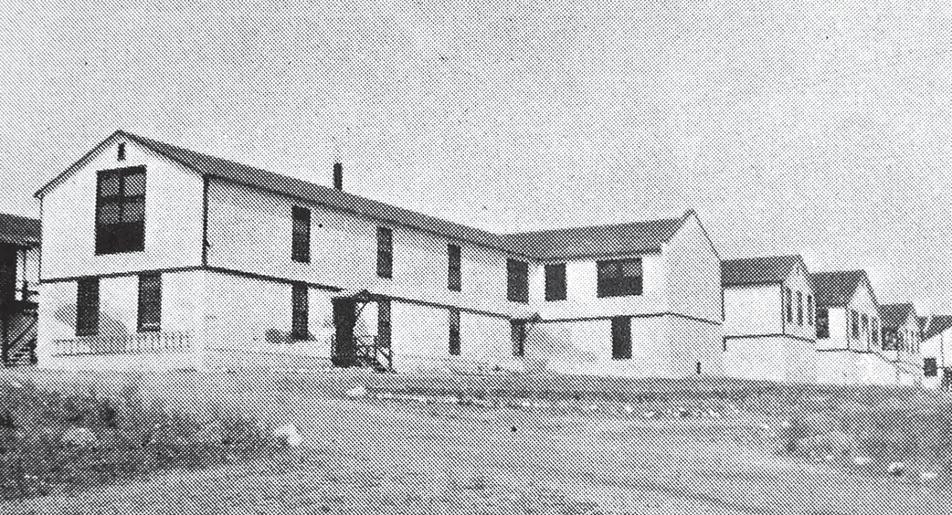
The site of the former Nanaimo Indian Hospital, located on Snuneymuxw First Nation territory, was once used by Western Forest Products and as an army hospital for the Department of National Defence, before becoming an Indian Hospital after World War II.
With 210 beds, it was the second largest Indian Hospital in Canada. Located next to what is now the Vancouver Island University campus, the hospital buildings were demolished in 2004. In 2021, Snuneymuxw announced it would search for unmarked graves at the site. In 2025, the lands were returned to Snuneymuxw as part of an 80.09-hectare addition to their reserve lands and renamed Te’tuxwtun in a land blessing ceremony.
There are numerous reports from the Nanaimo Hospital of sexual and physical abuse and malnourishment. Children were forcibly tied to their beds for days or even months, only untied to eat their meals or bathe. There are also reports that patients at Indian Hospitals were forced to stay there until they were discharged or given permission from the Indian superintendent or a medical officer. Those that resisted and left the hospital without permission were often arrested, taken back to the hospital and put in isolation.
Anne Atleo is an Ahousaht member and the manager of the Ahousaht Residential School Research Project. Her late mother Flossie was a patient at the Nanaimo Indian Hospital, sent there when she was in her mid-to-late twenties. “They found out she wasn’t sick right away, but she was still kept there for 18 months. It doesn’t make sense,” says Atleo.
“When she went there, she had two young children, so that experience impacted so much of the bonding period between her and her children. The damage that was done was so far reaching, but our mom reached 95 despite all the horrific things she experienced as a First Nations woman. She is where my strength originates.”
On March 6, 2025, the federal government announced a proposed settlement had been reached in the Hardy v. Attorney General of Canada class action lawsuit, which sought justice for survivors of the hospitals and to hold the Canadian government accountable. In the settlement, the government agreed to provide compensation to individual patients who suffered abuse at Indian Hospitals.
On January 27, 2026, the Claims Period for the Indian Hospitals Settlement opened. Eligible people have until July 27, 2028, to submit a Claim for compensation for psychological, verbal, physical, and/or sexual abuse experienced while admitted to a Federal Indian Hospital during the years it operated.
Compensation ranges from $10,000 to $200,000, based on the severity of the abuse experienced. The Settlement does

not include compensation for medical malpractice or claims connected to medical treatment. It also does not include claims connected to any hospital that is not one of the 33 listed in on the Indian Hospital Settlement website. Free support and resources are available to help people understand what’s included in the Settlement, how to submit a claim, how to access mental health and wellness supports, and to help people move through the claims process at their own pace.
These supports include Claims Helpers, who can help people understand the process and complete a Claim Form; a Claims Administrator, who can provide status updates on a Claim, answer questions about the Claims Portal, and connect to other resources; Class Counsel is also available, free of charge, to answer legal questions about the Settlement and the Claims Process.
Claimants may choose to hire a lawyer, although a lawyer is not required to submit a Claim for compensation. If a Claimant does hire a lawyer and receives compensation, the lawyer who assisted them can request their legal fees be paid by the Government of Canada.
Claims are independently administered by Deloitte, who will share claim files with the federal government.
Claims can be submitted on behalf of Indian Hospital patients who passed away on or after January 25, 2016.
Claimants must be a legally authorized estate representative or an heir (family member such as spouse, child, parent, for example). Settlements will be issued to one family member only.
The Settlement includes the creation
of a Foundation which will manage two separate funds:
A Healing Fund that will provide $150 million to support healing, wellness, reconciliation, protection of languages, education and commemoration activities; and
A Research and Commemoration Fund that will provide $235 million to support research, education and preservation of the history of Federal Indian Hospitals and locating burial sites associated with the Hospitals.
The Settlement also provides for a $150 million funding increase to existing Indigenous Services Canada programs to support the health and wellness of claimants through the implementation of the Settlement.
Emotional and mental health support is available 24 hours a day through the Hope for Wellness Helpline at 1-855242-3310 or www.HopeForWellness.ca.
Services are free, confidential, and available in English, French, Cree, Ojibway, and Inuktitut upon request.
For Anne Atleo, though she appreciates the funding and support, she says the 37-page claim form is highly daunting, and she questions the quality of the support that is available to claimants. “It’s like pulling off a bandaid from an old wound. A phone or video call is not good enough. That support should be on the ground. There are over 600 First Nations in Canada. That $300 million is not going to last very long.”
To see if you qualify, visit ihsettlement. ca or call 1-888-592-9101 and press #1 For more information about the claims process you can email GeneralInfo@ Contact.IHSettlement.ca

Nanaimo Community Archive/Facebook photo
The Nanaimo Military Hospital, which later became Nanaimo Indian Hospital.
President’s Message
Hello Everyone. Sending good thoughts to all Nuu-chah-nulth as we go about our lives which includes so many things. Again, my heart goes out to communities that have lost precious family members, community members, friends and so much more.
The past month has been a busy one as always. Never a shortage of challenges, and issues to face as well as to celebrate the good things that happen.
I was privileged to attend a couple of events. One was the celebration of Ha’oom, the company owned by five of our Nations who are doing commercial fisheries and making a successful business out of it. Their fishermen just completed a herring roe fishery and it was great to see pictures of those operations.
The feast held was to recognize the hard work of Ha’oom and the good things they have done and are doing.
I also attended an event that Usma held with the group the Saasin Sisters. These are young girls that are in care who gather regularly to learn our language and culture.
All the girls introduced themselves in our language and it was good to hear that. The girls helped prepare the lunch, greeted us and made sure we were well taken care of. I appreciate the invite and the opportunity to meet these inspiring girls and see what they are learning.
The premier continues to push forward to amend the Declaration on the Right of Indigenous Peoples Act (DRIPA) so I have attended an internal meeting with the chiefs and one with the Premier and his Ministers to have a dialogue on this. There are more meetings coming up. More than half the chiefs in BC have signed a letter stating they are opposed to any amendments to DRIPA. Chiefs and leaders in BC have had to sign non-disclosure agreements so discussion details cannot be shared.
The chiefs across Canada met to prepare for a meeting with the Prime Minister and Ministers about what issues for discussion. Several meetings are planned in the future while we get organized for this meeting which will be held later this year. This is the time of the year when budgets are set. The members of NTC will meet on March 31st to allocate the budget, most of which is allocated through existing motions.
ISC (Indigenous Services Canada) is providing a two per cent increase for the 2026 budget. Two per cent is not reflective of the cost of inflation or our growing populations.
NTC member Nations are never given money for their needs. The amount it receives is based on whatever the government allocates to ISC and then ISC determines what is given to NTC and then NTC disburses the funds.
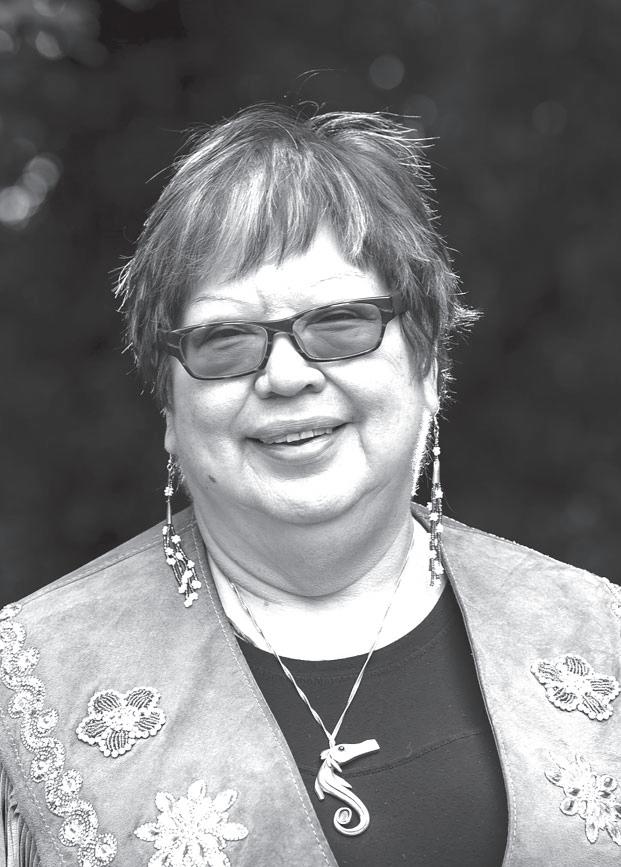
I would like to congratulate Dr. Asma Antoine who was recently appointed as the Director of Indigenous Research at UBC. Asma is from Toquaht and will play a lead role in helping to strengthen research, governance, ethics, protocols and training in support of the UBC strategic plan.
It’s great to see our Nuu-chah-nulth citi-


zens make a difference in academia.
Johnny Mack is the Academic Director at the Indian Residential School History and Dialogue center as well as being an assistant professor at UBC law. Great models for our Nuu-chah-nulth.
One issue that is affecting us all is the price of gas. We talked about this at our pre-budget workshop.
As we all know, patient travel mileage rates are very low. The First Nations Health Authority is working solutions.
The Vice President and I will also continue to advocate for more money for travel as it is difficult to travel to health appointments on very little money.
The Canadian Human Rights Tribunal recently came down with a ruling that found several RCMP officers discriminated against four out of six Indigenous witnesses during an investigation into serious abuses at residential schools. They allege that officers made them feel like they were disrespected, unheard and disbelieved and didn’t update them on the investigation.
It is believed this is the first time this kind of finding has been made on RCMP officers.
The four complainants were awarded $7500 in damages.
The Tribunal ordered the RCMP to review their policies to ensure they are culturally sensitive and trauma informed.
This is something NTC has been asking for. The RCMP claims their officers have been trained to be trauma informed and culturally sensitive, but instances keep occurring.
I was a witness with regard to a public remedy the complainants were pursuing. They were asking that a new investigative unit be established other than the RCMP.
On behalf of the BC First Nations Justice Council, we provided evidence on what that investigative unit could look like without the RCMP. The CHRT did not grant this. While it is something, the order could have been more effective.
We will continue to pursue this politically. There is a lot more work that needs to be done with the RCMP in changing their attitudes and policies and the way they treat our people.
Respectfully,
Cloy-e-iis, Judith Sayers
henna artist
By Aleesha Sharma

Book your henna session for community events, weddings, birthday parties, school events or any special event.
Phone: 250-730-1262 or 250-720-3096
E-mail: aleesha_sharma1@hotmail.com


Netp’s Annual Career Fair
Thursday, April 9th 9:00am – 3:00pm
3737 Roger Street, Port Alberni
Free table registration. For further details contact Shan at shan.ross@nuuchahnulth. org or Kirunn at kirunn.sharma@ nuuchahnulth.org or call 250.723.1331or
visit 4090 8th ave Port Alberni.
NCN Mental Health Counselling
Tuesdays and Thursdays 8:30am – 4:30pm
4841 Redford Street, Port Alberni
NCN Mental Health Services – DropIn Counselling with Margaret Bird,

&Community Beyond



Registered Clinical Counsellor and Play Therapist. For on and off reserve members of all ages of the Nuu-chahnulth Tribal Council. Call (250) 724-3939 to book your appointment.
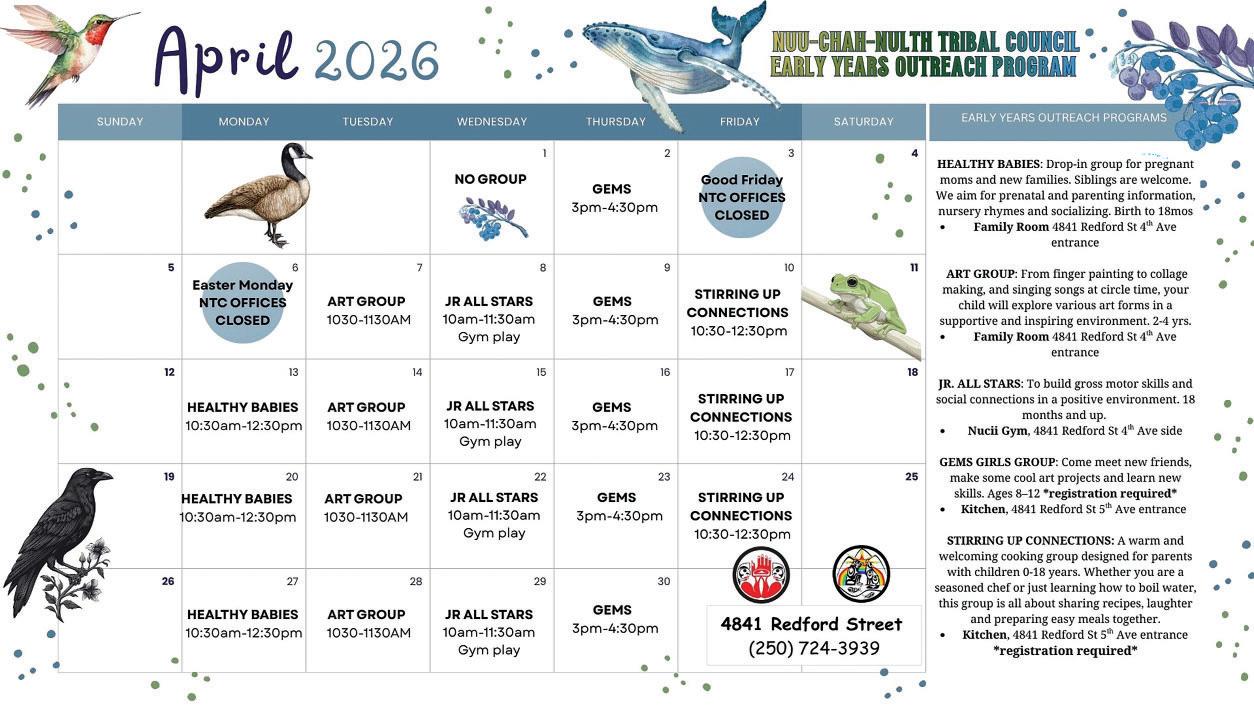
Stirring up Connections
Every Friday 10am – 12:30pm
NTC Kitchen – 4841 Redford Street.
A warm and welcoming cooking group designed just for parents! Each session will feature: Easy, budget-friendly recipes; Tips for cooking with kids and picky eaters; Space to connect with other parents over food and family life. Contact 250-724-3939 for questions.
Mobile Hair Stylist

27 years as a licensed hair stylist. Able to go to elders/handicapped homes to cut, perm or color hair. Would also do in own home.
25 Years Ago in Ha-Shilth-Sa
Vol. 28 – No. 6 March 29, 2001
Ancient Artifacts found in Alberni Valley
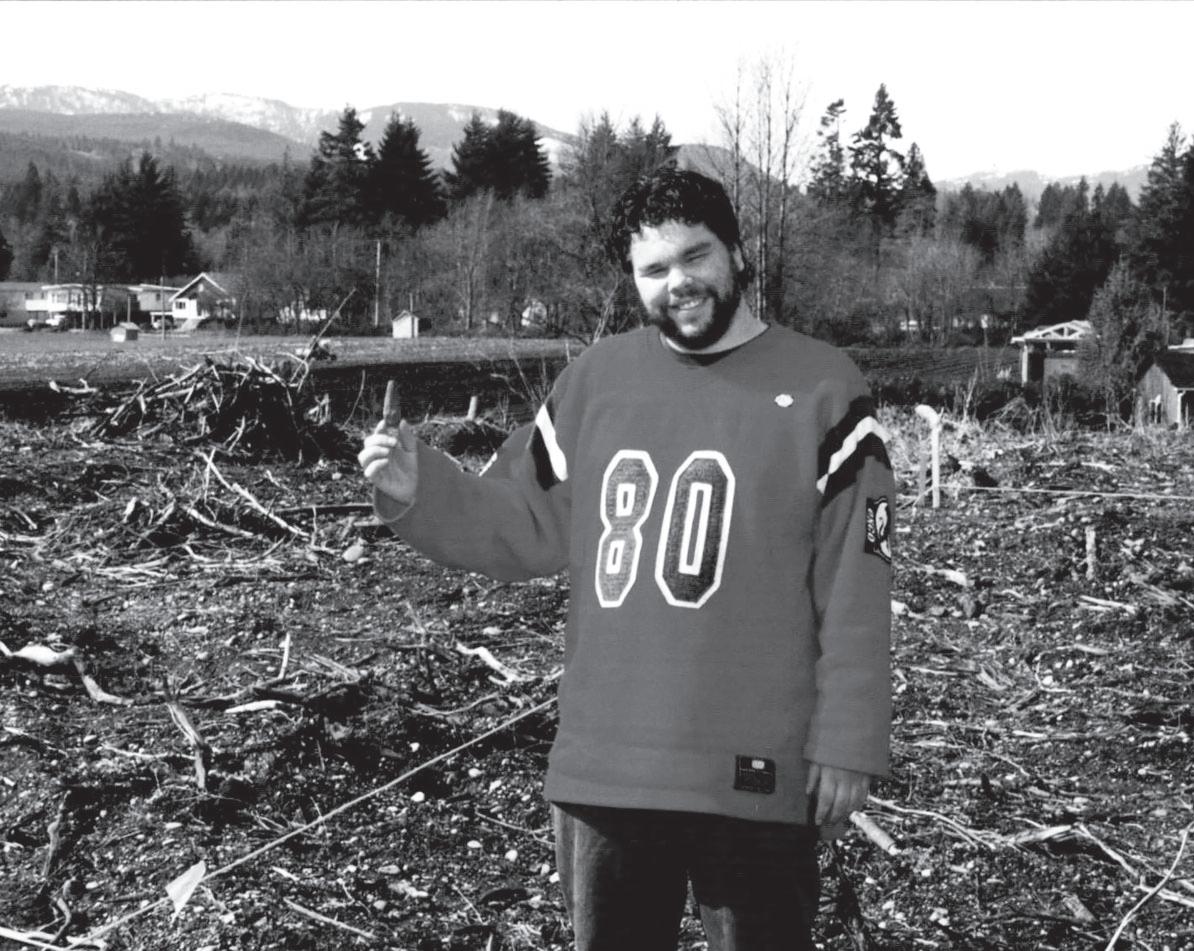
The combination of knowledge and luck led then 23-year-old Steven Tatoosh to one of the biggest archaeological finds in the Alberni Valley in years. Walking his dog through a newly cleared area off Josephine Road in Port Alberni September 2000, Tatoosh found a 3500-year-old spear point amid piles of dug up tree roots. Tatoosh, who had recently completed a series of archaeology courses, taught at Ditidaht to four Nuu-chah-nulth people through Forest Renewal B.C. funding, alerted Hupacasath and Tseshaht immediately of his find. Months later, once archaeologist John Maxwell and a crew of 18 volunteers surveyed the site, the extent of the finding would become known. The
area, which is a small plateau atop a 20foot rise behind Naesgaard’s farm was probably a paleo-shoreline according to Maxwell, meaning it was at the edge of the ancient path of the Somass River, now almost 600 metres away from its former location. After archaeologists had a chance to do an initial surface collection and small test-digs on the plateau, they were able to collect roughly 400 artefacts from stone flakes to stone tools that would be analyzed, assessed and studied by Maxwell, Tatoosh and Barry Watts from Tseshaht. A report would be written on the findings, and sent to the provincial archaeology branch, and the artefacts were to be stored at the Alberni Valley Museum.

Port Alberni Friendship Centre Volunteers Needed
Usma’s Parenting 101 is healing through culture
Nuučaanuł and Ńaańaačtuqḥsi guide the way by creating a safe space for parents to find courage and truth
By Rebecca Aldous Usma Communication Coordinator
Port Alberni, BC - Through the unravelling of pain and trauma, Ramona Mark has witnessed something powerful— grandmothers, mothers, daughters, and grandchildren coming together for the sake of family. She’s seen single fathers take meaningful steps toward stronger relationships and co-parents improve their communication. It’s heavy work, but it’s also filled with hope.
That’s what Usma Nuučaanuł Family and Child Services’s Ńaańaačtuqḥsi (Parenting 101) is all about. This traumainformed, culturally based, week-long program is open to all parents and caregivers and provides tools to unpack pain while building trust and healthy communication.
“It feels safe here” is something Mark, one of the program’s facilitators, often hears as she delivers the course across the 14 Nuu-chah-nulth communities.
“We create a safe space by using culture so that parents can find the courage to speak their sacred truth,” she shares. Mark has seen participants travel from as far as Victoria—and even Vancouver— to attend sessions in West Coast communities. No matter the group size, every participant is valued and supported.
Ńaańaačtuqḥsi draws on the teachings and expectations of parenting and family shared by Nuu-chah-nulth knowledge holders. David Jacobson, a father himself, shares that he has both met and fallen short of some of those expectations. As Usma’s Elder’s Navigator, he brings those lived experiences into the program, where he has supported participants as a facilitator for the past six years.
Along with his own teachings, Jacobson often refers to the book The Sayings of Our First People, which pulls together guidance and teachings from across Nuuchah-nulth territory. Its pages are filled with notes and yellow sticky tabs marking reflections he draws upon and shares with others.
“It’s a template,” he says, referring to Parenting 101. “It’s like finding a really nice piece of cedar, and then you get to interpret the final result.”
From Monday, April 13 to Friday, April 17, Ńaańaačtuqḥsi will be held in Port Alberni at Usma Nuučaanuł Family and Child Services’ Cultural Space (4227 6th
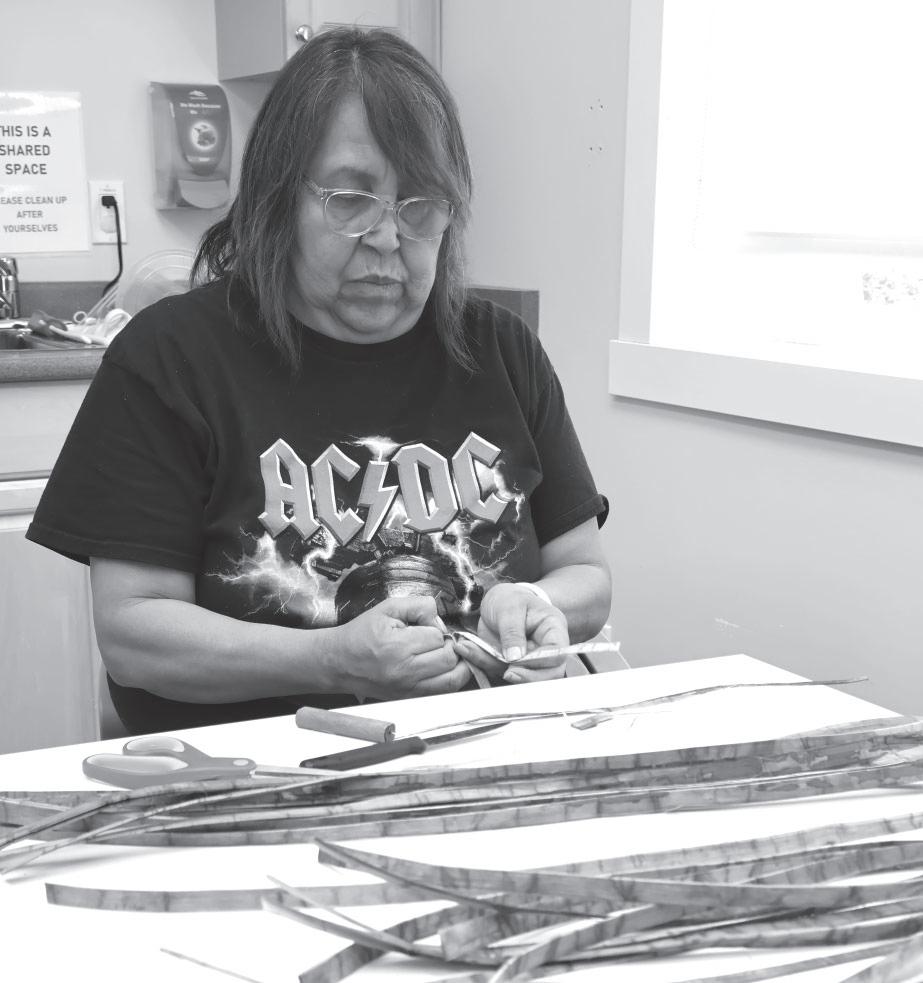
participants to create headbands and small projects.
Ave).
Upon completion, participants receive a certificate, and facilitators follow up to offer continued support and connection— but even more meaningful are the steps participants take toward their futures.
To learn more or register, contact Ramona Mark at ramona.mark@nuuchahnulth.org or call 250-724-3232.

Submitted photo
Usma Nuučaanuł Family and Child Services Ńaańaačtuqḥsi (Parenting 101) facilitator Ramona Mark prepares cedar strips for
Huu-ay-aht push for modern day treaty commissioner
A mechanism for accountability will keep things running smoothly provide impartial oversight
By Denise Titian Ha-Shilth-Sa Reporter
British Columbia – They are meant to provide certainty for all and keep governments out of the courtroom but with their relative newness, modern day treaties have gaps that are hindering progress. That is why Canada’s modern-day treaty first nations believe it is necessary to appoint a modern-day treaty commissioner and they hope that Bill C-10, a bill that would see the appointment of a commissioner, will pass.
In Nuu-chah-nulth territories, there are five Maa-nulth Treaty nations, including Huu-ay-aht, Ka:’yu:’k’t’h’/ Che:k’tles7et’h’, Toquaht, Uchucklesaht, and Yuułuʔiłʔatḥ (Ucluelet)
Huu-ay-aht elected Chief Councillor Sayaačatḥ, John Jack, addressed the Parliamentary Committee on Indigenous and Northern Affairs on February 26 to say that it is time for a Modern Treaty Commissioner (Bill C-10).
“After 15 years of the Maa-nulth Final Agreement, federal implementation remains inconsistent. By implementing a Modern Treaty Commissioner, we hope to provide impartial oversight across the whole federal government. Bill C-10 ensures that the thousands of obligations in the Maa-nulth Final Agreement are met,” he stated.
According to the federal government, modern day treaties are land and selfgovernment agreements, “designed to create legally binding, long-term frameworks that reduce the need for litigation by providing certainty regarding land rights, resource management, and selfgovernance.”
These agreements are constitutionally protected under Section 35 of the Constitution Act, 1982, and aim to shift the relationship from conflict to negotiation.
Huu-ay-aht signed their Maa-nulth treaty in 2011. Fifteen years later, Jack said that there are some things in the treaty regarding rights and governance in the treaty that maybe not be fully understood by all sides that could lead to misinterpretations and delays.
“Modern treaties are complicated, whole
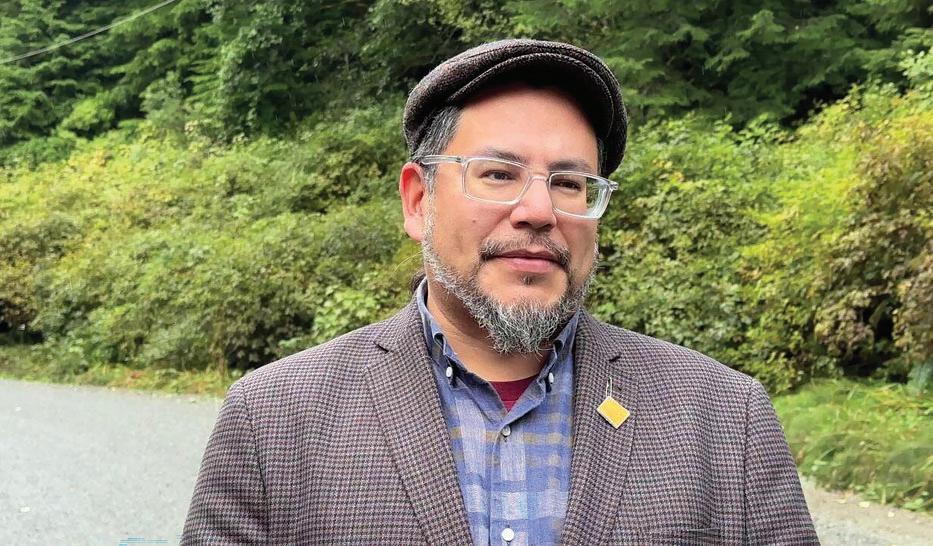
Sayaacath, Huu-ay-aht’s elected Chief John Jack says implementing a Modern Day Treaty Commissioner will keep governments out of the courts.
of government documents,” he told HaShilth-Sa. As things stand now, it takes a few ministers from federal and provincial governments meet obligations under a modern treaty, and that can cause confusion and delays or inaction. “We can’t just be presided over by one minister, it has to be the whole of government,” said Jack.
And when nothing happens, the nation must find other ways to make it happen. And that could mean the courts, the very thing that modern day treaties were meant to avoid.
“The only way that we can seek recourse is by going to the courts which costs money, costs time, and it costs the relationship by confidence. What we’d like to do is skip all of that,” said Jack.
“Treaty implementation is specialized and sophisticated enough that it just can’t be run off the side of the desk of anyone,” said Jack. He said there is a need for a dedicated civil servant who knows about how modern treaties work that and knows
about how the federal government works.
Enter Bill C-10, an Act that calls for the appointment of a Commissioner for Modern Treaty Implementation. 20 years in the making, Bill C-10 was presented to the House of Commons on Mar. 23, 2026.
According to information posted on federal websites, enacting Bill C10 would provide for the appointment of a Commissioner for Modern Treaty Implementation, “to conduct reviews and performance audits of the activities of government institutions related to the implementation of modern treaties.”
It also establishes the Office of the Commissioner for Modern Treaty Implementation for the purpose of assisting the Commissioner in the fulfillment of their mandate and the exercise of their powers and the performance of their duties and functions. Finally, it makes consequential amendments to other Acts.
“The idea is that we need a mechanism for accountability,” said Jack, adding that
it is an oversight that should be corrected so we don’t have to go to the courts every time that there’s a disagreement or misunderstanding that we can just get to a point where we ‘re actually making progress together.
“We see it as like the same kind of function that the auditor general does. The auditor general mostly focuses on the money, right? Where we also want to focus on their ability to actually get the work done, not just money,” said Jack.
According to the Parliament of Canada website, Bill C-10 has passed two of three readings in the House of Commons. There is no date indicated on the website for the third and final reading.
Jack says the Bill is more than 20 years in the making so he is hopeful it will finally pass.
“Together, we can deliver the results that modern treaties were meant to enable and enoble.” — Chief Councillor Sayaačatḥ, John Alan Jack.
Submitted photo