Sales Director, HK & International (+852) 9437 2779
sales@harvest-info com
Chua Chew Huat
Sales Director, Asia Pacific (+65) 9863 7382 sales-sg@harvest-info com The publisher of Payload Asia
EDITORIAL/PUBLISHER
Keen Whye Lee Publisher
Cath Isabedra Editor editor-afj@harvest-info.com
Danico Acosta Layout and Design OPERATIONS
SALES
Simon Lee Hong Kong, U.S.A. sales@harvest-info.com
Chua Chew Huat Asia Pacific sales-sg@harvest-info.com
Erhardt Eisenacher Europe info@eisanacher-medien.de
MARKETING
Lali Singson mktg@harvest-info.com
TECHNICAL SUPPORT
Michael Magsalin tech@harvest-info.com
Harvest Information Pte. Ltd. 531 Upper Cross Street,#04-16, Singapore 050531
AsiaFoodJournal
AsiaFoodJourna1
asia-food-journal-magazine
23
Ingredients News
Packaging News
Industry News
Automation News
Processing News
Cover Story: When the lights go out, who keeps the food safe?
Feature Story: When the lights go out, the proof must stay on
Feature Story: The semiautonomous factory: Why the real prize is the empowered worker
Feature Story: The factory that never sleeps: Why lights-out manufacturing demands more than automation
Feature Story: When the line runs itself: Inspection intelligence in the age of lights-out food production
Feature Story: When the brewer leaves the room: Inside Fujiwara Techno-Art’s case for autonomous fermentation
Feature Story: Why packaging is the missing piece in the lightsout beverage factory
NEWS | Ingredients
IFF opens Vanilla Innovation Center in Madagascar
IFF (NYSE: IFF)—a global leader in flavours, fragrances, food ingredients, health & bioscience— today announced the opening of its Vanilla Innovation Center in Madagascar, reinforcing vanilla as a strategic and priority tonality for IFF and strengthening its ability to innovate at origin.
“The opening of the center marks an important step in how we approach vanilla innovation,” said Adam Jańczuk, PhD, senior vice president, research, creation and design, Taste, IFF. “By strengthening our presence at origin, we connect science, creativity and sustainability more closely, responding to climate changes, safeguarding quality and creating value across the supply chain.”
Located in Toamasina, Madagascar’s principal seaport, near vanilla growing areas and post‑harvest processing activities, the 650‑square‑meter centre brings together lab analysis, extraction, scent and flavour creation, and application development in a single site. By embedding these capabilities close to the crop, IFF can better understand natural variability and translate on‑the‑ground insights into tailored solutions for customers globally. As one of the world’s most complex natural ingredients, vanilla
is shaped by climate, post‑harvest handling and curing methods. The innovation space supports IFF’s ability to follow the ingredient’s journey from origin extraction and in‑field testing, through advanced lab analysis to flavour creation— providing a seamless path that deepens material understanding, shortens development cycles and enables solutions informed by real crop conditions.
Innovating at origin strengthens sustainability and resilience across the vanilla supply and value chain. Proximity to growing areas enables closer collaboration with farmer networks, improved traceability and ethical sourcing, and a faster response to climate‑related changes. This direct connection between growing conditions and flavour design strengthens the foundation for innovation, delivering better‑tasting vanilla with greater consistency in quality and supply, while helping customers bring distinctive vanilla experiences to market with confidence.
The Vanilla Innovation Center features:
Lab analysis capabilities that apply contaminant and disease detection protocols to safeguard product integrity, alongside molecular
profiling to decode and develop distinctive IFF signatures
Extraction facilities with scalable rigs to explore vanilla types and optimise extraction and post harvest variables
Flavour creation unit that enables tailored regional profiles, including Application Lab capabilities for dairy, bakery and confectionery to validate performance in real market prototypes
The Bloomery, a research greenhouse showcasing diverse vanilla varieties and supporting future exploration of varietal performance and post harvest techniques
The Vanilla Innovation Center also serves as a hub for knowledge sharing and capability building. Together with the dedicated RE MASTER VANILLA™ team, it delivers hands‑on training, workshops and laboratory programs that bring together experts, customers and local teams—advancing best practices and strengthening vanilla innovation capabilities.
“This center is built to turn insight into action,” said Marcus Pesch, vice president, research and development, Taste, IFF. “By bringing science, flavor creation and application development together at origin, we can work more collaboratively with customers, improve speed and consistency, and deliver solutions that are market‑ready and grounded in the realities of vanilla production.”
Fully integrated into IFF’s global vanilla network, the Madagascar facility complements existing capabilities across sourcing, extraction, flavour design and application development. Discoveries generated at the hub will translate into new tools, insights and capabilities for IFF’s creation teams. This enables flavours to be crafted in each region according to local consumer preferences, while supporting a more resilient and sustainable future for one of the world’s most valued natural ingredients.
FrieslandCampina announces major investment programme to accelerate growth in high-value whey proteins
FrieslandCampina announces an investment programme of more than 90 million euros to strengthen its global position in high‑value whey proteins and further optimise its ingredients production network in the Netherlands. These investments include upgrades at the production sites in Bedum, Veghel, and Workum.
With this programme, the business group FrieslandCampina Ingredients is expanding its capacity to convert internally sourced whey – a natural by product of cheese production – into premium protein ingredients for performance and active nutrition, early life nutrition, and medical nutrition. It includes technological upgrades across multiple production sites to support the manufacture of advanced protein products such as WPC80, instantised whey proteins, and FrieslandCampina’s specialty Nutri WheyTM ProHeat microparticulated whey. These ingredients are used by food manufacturers in, among other applications, high‑protein drinks, bars and yoghurts.
Global demand for high value whey proteins continues to grow across sports nutrition, lifestyle nutrition and specialised medical applications. This dedicated
investment programme positions FrieslandCampina and its Ingredients business group to respond to this growth by increasing capacity and strengthening the flexibility of its whey valorisation chain.
Anne Peter Lindeboom, President FrieslandCampina Ingredients, said: “Global demand for advanced protein solutions continues to accelerate. This programme is the next step in our broader investment strategy to lead in high value proteins, building on recent investments to strengthen whey capacity and valorisation in the Netherlands such as in Borculo, and in the United States through the acquisition of Wisconsin Whey Protein. By investing across our ingredients network, we are strengthening our ability to serve customers worldwide and to create more value from our whey streams in a sustainable and future oriented way.”
These investments strengthen FrieslandCampina Ingredients’ position as a leading supplier of high value whey proteins, expand the company’s capacity to support customers worldwide with advanced nutrition solutions, and ensure that FrieslandCampina’s facilities in the
Netherlands remain competitive, technologically advanced and aligned with future market and customer needs. In doing so, FrieslandCampina is also putting its Doing Dairy Right motto into practice through focused choices for growth, stability and value creation across the value chain.
Sustainability
and operational excellence
The investments also contribute to FrieslandCampina’s broader environmental ambitions. The programme includes state of the art energy and water efficient technologies and the phase out of older production lines. As a result, Scope 1 greenhouse gas emissions are expected to be reduced by approximately 16 kilotonnes CO2e, while ensuring continued compliance with Dutch and EU environmental standards.
Timeline
FrieslandCampina will phase the investments over the coming years and expects to reach full operational capacity in 2028. The Works Councils will be kept informed in line with the usual processes as the interventions at various locations are further developed.
NEWS | Packaging
$444B food packaging market faces supply chain shake-up as Go-Pak launches global trading platform
SUSTAINABLE
packaging specialist
Go–Pak Group has launched a new global trading platform designed to simplify international procurement for foodservice brands and cut supply chain complexity across the rapidly expanding packaging sector.
The platform, Go Pak International, allows customers to consolidate orders from multiple suppliers into a single shipment, creating mixed containers that combine products from Go Pak’s own manufacturing network, its Thailand based parent company SCG Packaging and approved third party suppliers.
The launch comes as demand for foodservice packaging continues to surge worldwide. The global foodservice packaging market is expected to reach $444.9 billion in 2026, driven by the growth of takeaway dining, delivery platforms and quick service restaurants.
Against this backdrop, Go Pak says the new platform aims to help
operators streamline procurement while improving logistics efficiency.
Adam Anderson, group managing director at Go Pak Group, said: “Foodservice brands are operating in a fast moving global market where speed, flexibility and sustainability all matter. With Go Pak International, we’re enabling customers to source packaging more efficiently by consolidating products from across our own network, SCGP and trusted third party suppliers.
“Just as we have done with initiatives such as our closed loop cardboard recycling solution Go Recycle, we’re looking at the bigger picture of how packaging supply chains can evolve. By reducing complexity, improving logistics efficiency and helping cut waste across distribution, we’re supporting the industry’s transition towards a more circular future.”
Acting as a single point of contact for international orders, Go Pak International operates from its
facilities in Vietnam, enabling brands to consolidate smaller packaging products from multiple factories, suppliers or locations into a single container and shipment. By allowing mixed containers, the platform removes the need for businesses to manage multiple suppliers, shipments and procurement processes.
The model is designed to benefit both global quick service restaurant chains and smaller foodservice brands looking to scale internationally, with the option to include bespoke branding. By combining products from different suppliers within the same shipment, businesses can reduce freight costs while improving efficiencies. Customers can access a wider portfolio of packaging products through a single consolidated order, drawing on manufacturing capacity and supply networks across Vietnam and the wider SCGP group.
Karl Smith, Vietnam operations director at Go Pak Group, added: “Vietnam plays a critical role in our global supply model, allowing us to consolidate products closer to source, reduce complexity for our global customers and create a more efficient and scalable way to deliver packaging worldwide.”
The approach could also support sustainability goals across the industry. Consolidated shipments of products manufactured in Vietnam reduce the number of containers required across global trade routes, which can help lower freight emissions associated with international packaging supply chains.
At the same time, container consolidation can reduce the volume of secondary transport packaging such as pallets, protective materials, and shrink wrap used during distribution.
The platform is part of Go Pak’s wider strategy to support the evolving needs of the global foodservice sector, where demand for sustainable, scalable packaging solutions continues to rise.
Packaging
Tetra Pak® Advanced Agreements gain global recognition for delivering measurable business impact
ISSIP awards Tetra Pak® Plant Secure with Distinguished Recognition for Business Impact
Tetra Pak has received Distinguished Recognition from the International Society for Service Innovation Professionals (ISSIP) for Tetra Pak® Plant Secure, part of Tetra Pak® Advanced Agreements, for delivering measurable business impact in food and beverage production.
The recognition forms part of ISSIP’s annual Excellence in Service Innovation Awards. These awards celebrate pioneering solutions that reshape industries through service innovation, with the ‘Business Impact’ category recognising solutions that go beyond operational metrics to drive stronger financial performance.
Tetra Pak® Advanced Agreements
Advanced Agreements in helping food and beverage producers meet rising pressure to cut costs, boost output and maintain quality. Unlike traditional service models that address issues in isolation, Tetra Pak® Advanced Agreements take a whole factory view, with clear performance targets and shared accountability built in.
For food and beverage producers, this means high production efficiency, cost certainty and improved product quality and consistency. It also supports wider goals, from reducing waste and resource use, to improving long term business performance.
Sasha Ilyukhin, Senior Vice President, Global Processing Services and Services Solutions at Tetra Pak, comments: “Food and beverage producers are under pressure to improve performance, while managing rising costs and complexity across their operations. The ISSIP award underlines the value long term partnerships we built with our customers around measurable outcomes, shared accountability and continuous improvement.
are designed to optimise the entire factory with guaranteed cost and performance outcomes. They bring together digitally enabled World Class Manufacturing methodologies, workforce development and long term improvement initiatives to address operational gaps across the full factory. Through close partnership and a shared risk model, Tetra Pak® Advanced Agreements guarantee outcomes such as Overall Equipment Effectiveness (OEE), operational cost and uptime guarantees.
In recent months, Tetra Pak® Advanced Agreements delivered an average of 9% improvement in Overall Equipment Effectiveness and an 11% reduction in operational costs, alongside a 94% renewal rate reflecting long term customer value. This recognition highlights the growing role of Tetra Pak®
“With Tetra Pak® Advanced Agreements, we commit to clear and measurable deliverables and share the risk, which means our customers gain not just one off improvements, but long term confidence for their business performance.”
Haluk Demirkan, 2026 President of ISSIP, comments: “We are pleased to recognize the excellence of service innovation efforts underway in the ISSIP community. This year’s submissions represented the best of the ISSIP community across industry, academia, NGO and government entities, with initiatives calibrated to benefit people, business and/or society in meaningful ways”.
The ISSIP Excellence in Service Innovation Awards are judged by the ISSIP Award Committee – comprising the ISSIP Executive Committee and selected technical advisors – against criteria including uniqueness, creativity, technical merit, value generation and impact.
IF Brand invests multimillion THB in the only molecular-level EA-IRMS technology in the region to verify coconut water purity at source
• IF brand introduces EA IRMS technology, setting a new benchmark in Asia for molecular level authenticity testing in coconut water.
• The multi million THB investment enables source level testing, detecting adulteration before production, ensuring what consumers drink is truly from nature.
• A shift from industry standard post production checks to proactive “source verification,” reinforcing IF brand’s commitment to transparency, quality, and trust.
• Globally recognised EA IRMS technology acts as a molecular “truth detector,” identifying added sugar and water with precision to safeguard product integrity.
Amid rising global concerns
strengthens its end to end quality control system, ensuring that only authentic, unaltered ingredients proceed into manufacturing. This pre emptive approach moves beyond conventional quality checks, delivering assurance that is not only promised, but scientifically validated from the source.
What you drink, proven by science
At the heart of this initiative is IF brand’s commitment to what it calls “molecular integrity” ensuring that what goes into every bottle is exactly what nature intended, with nothing added or altered.
around food fraud, hidden sugars, and ingredient adulteration in the beverage industry, IF brand, the company behind the internationally recognised IF beverage portfolio, has announced the implementation of Elemental Analyzer Isotope Ratio Mass Spectrometry (EA IRMS) technology becoming the first coconut water brand in Asia to adopt molecular level authenticity verification for coconut water purity.
Backed by an investment of multi million THB , this initiative marks a significant shift in how beverage quality is assured. While most industry players rely on post production testing, IF has taken a proactive approach by implementing EA IRMS at the raw material receiving stage, enabling the detection of added sugar or water before production even begins.
Verifying purity at the point of origin
Widely recognised as a global gold standard in food authenticity testing, EA IRMS technology functions as a molecular “truth detector,” analysing isotopic composition to verify whether a product is truly natural or has been altered.
By integrating this technology at the earliest stage of production, IF
In an industry where concerns around hidden sugars and product tampering continue to surface, EA IRMS technology acts as a powerful verification tool, allowing IF to confirm the authenticity of its ingredients from the very start. By investing in advanced food technology, IF brand reinforces its belief that what consumers drink should stay true to its natural source, delivering transparency they can trust and quality they can taste.
“We believe that trust is built on visible transparency,” said the IF brand announcement . “At IF, we are committed to the highest quality standards. The implementation of EA IRMS is not only a response to market concerns, but also a step toward establishing a new benchmark for the coconut water industry where authenticity is no longer just a claim, but a fact supported by data.”
With the adoption of EA IRMS technology, IF brand reinforces its quality assurance framework and supports ongoing efforts to elevate industry standards in Asia. By moving beyond reactive testing to proactive verification, the company is redefining how product integrity can be safeguarded through science, innovation, and transparency. Through this initiative, IF brand continues to lead with purpose, demonstrating that true quality is not just claimed, but proven.
NEWS | Industry
Nearly two-thirds of Singapore’s top hotel groups now have cage-free egg sourcing policies, new report finds
Singapore’s hospitality sector is emerging as one of Asia Pacific’s most progressive markets for sustainable egg sourcing, with nearly two thirds of leading hotel groups now pledging to source only cage free eggs for their food operations, according to a comprehensive new assessment released by international NGO Lever Foundation. The 2026 Singapore Hospitality Industry Cage Free Egg Scorecard evaluated the largest hotel groups operating in the country and found that 63% of these groups have pledged to source only cage free eggs, thereby ensuring better animal welfare and enhancing food safety for guests. The scorecard assesses companies on a four tier scale: A for 100% global implementation, B for a global cage free egg policy with a timeline, C for a Singapore specific policy, and F for no policy at all.
“The widespread adoption of cage free egg commitments across Singapore’s hospitality sector demonstrates the industry’s recognition of animal welfare, food safety, and sustainability as critical business imperatives,” said Vilosha Sivaraman, Sustainability Regional Director at Lever Foundation, which works with companies in developing sourcing policies.
“With nearly two thirds of hotel groups already committed to cage
free transitions, we’re witnessing a meaningful transformation in how the sector approaches responsible sourcing.”
Capella Hotels & Resorts earned an A rating for having already completed its transition to 100% cage free egg sourcing across all global operations. An additional 17 hotel groups have set global cage free egg policies that will be fully implemented in the coming years, earning a B rating.
These include leading Singapore based brands such as The Ascott Limited and COMO Hotels and Resorts, as well as regional and international brands operating in Singapore, including Dorsett, Marriott, Hilton, InterContinental, Hyatt, Accor, Mandarin Oriental, and Wyndham, among others. Shangri La Singapore received a C rating for pledging to transition to 100% cage free egg sourcing across its Singapore properties.
However, not all hotel groups have set policies on this important food safety and animal welfare issue. Eleven hotel groups, representing 37% of those evaluated, have not yet adopted any cage free egg policy and have received an F rating, including Pan Pacific Hotels and Resorts, Frasers Hospitality, Far East Hospitality, Dusit International, Amara Singapore, Carlton Hotel Singapore, and Park Hotel Group.
“With the strong momentum built across Singapore’s hospitality sector, those groups without a cage free egg policy are well positioned to catch up with industry leaders and demonstrate their commitment to food safety and animal welfare. Lever Foundation is committed to providing guidance and resources to help Singapore hotel groups develop policies that work for their business while advancing animal welfare and food safety,” Sivaraman said.
Cage free eggs are laid by hens who can move around freely in barn or free range systems and engage in natural behaviours such as feeding, laying, resting, dust bathing, nesting, and flying. Dozens of peer reviewed scientific studies have found that hens raised outside of cages produce eggs with far greater food safety, higher nutritional value, and quality.
As awareness of these benefits grows, so does consumer pressure: a 2024 national survey by GMO Research found that 83% of Singaporean consumers believe food companies should source eggs exclusively from cage free farms, with 69% more inclined to support brands making this commitment. An increasing number of consumers are also choosing to leave eggs off their plates entirely as the most direct way to help laying hens.
13 – 15 / 05 / 2026
Saigon Exhibition & Convention Center (SECC), HCMC, Vietnam
799 Nguyen Van Linh Street, HCMC
300 exhibitors
9.000 attendees
40 countries 03 days of networking & learning
SHOW HIGHLIGHTS
・ Bev Hub
・ Ingredients Pavilions
・ International Conferences
・ Technical Seminars
・ Match & Meet
・ Sustainability Square *expected number
NEWS | Automation
Munters launches Speria, a commercial brand for its FoodTech business, to strengthen position in digital food systems
Munters launched Speria, a new commercial brand for its FoodTech business area. Speria brings together FoodTech’s technologies, software, and services into one connected offering, strengthening its capabilities as a global end to end technology and services partner across the food supply chain.
Speria delivers operational intelligence solutions for food systems, helping producers and integrators run more efficient, predictable, and productive operations.
“Speria represents the next phase of FoodTech’s transformation journey, where Munters has developed a business focused on digital solutions,” says Klas Forsström, President and CEO of Munters. “This enables us to capture a substantial growth opportunity. With our installed base, deep industry expertise and long standing relationships with producers and integrators, Speria is uniquely positioned to spearhead the continued digitalization of the food industry, helping our customers operate with greater efficiency, predictability and resilience.”
The global food system is under
increasing pressure from rising costs, labour shortages, and fragmented operations, while remaining one of the least digitalised industries. At the same time, advances in technology, including AI driven analytics, are accelerating and scaling the automation of food systems, enabling connected operations across farm and supply chain.
Speria builds on Munters’ role inside mission critical operations, where controllers, sensors, and gateways run and monitor farm level operations, capturing real time data directly from operations. This data is sent to optimisation software and expert services that plan and coordinate operations across the supply chain. Together, these capabilities connect planning, execution, and performance, turning fragmented data into clear, prioritised guidance and impact.
“In practice, this helps our customers anticipate disruptions earlier, improve consistency across operations, and deliver better production and business results,” says Pia Brantgärde Linder, President of FoodTech and Group Vice President of Munters. “By connecting these capabilities
across farm and supply chain, we enable producers and integrators to improve feed conversion, reduce waste and emissions, and support better animal health and welfare.” FoodTech currently operates through five brands: MTech Systems for supply chain optimisation software, and four differentiated controller brands, Hotraco, Rotem, InoBram and AEI. With the launch of Speria, FoodTech’s products and brands will be brought closer together to enable a more connected and unified offering. This will be a step by step journey to ensure continuity in the mission critical operations that customers rely on today.
Over time, MTech Systems will transition into Speria. Speria will also serve as the commercial brand for integrated offerings, meaning solutions that combine products and services from more than one brand. The four controller brands will continue to operate as product brands under the Speria umbrella.
What customers buy and the teams they work with in Munters FoodTech do not change. There are no changes to the legal structure, governance, or customer agreements as part of this launch.
Automation |NEWS
Trelleborg Sealing Solutions opens state-of-the-art European Service Center
Trelleborg Sealing Solutions inaugurates its advanced European Service Center, a highly automated facility setting new benchmarks in service quality, efficiency and technology for European and global markets and providing customers with state of the art logistics and value added services.
Core competencies of the facility in Gärtringen, Baden Wurttemberg, Germany, include highly automated functionality featuring innovative robotics right through the supply chain from goods receipt to shipping. The center provides space for 60,000 containers, all accessible by 32 robots which transport goods to one of the 26 ports. A pallet warehouse and a driverless transport system with ten automated forklifts complement the facility.
As the central heart of Trelleborg’s European logistics, the center goes far beyond traditional logistics processes. With an area of 16,000 sqm, the new building offers space for an expanded range of value added services such as kitting, various packaging solutions,
cutting, etc. In addition, it offers industry‑specific solutions including clean‑room handling, component assembly and coating processes. Various quality‑assurance services complete the portfolio.
“Our new European Service Center is not only a significant milestone for us as a global leader but also significantly to our customers and the local region,” says Dr. Thomas Uhlig, Managing Director & President Global Supply Chain Management. “It underscores our position as a service provider focused on our customers’ entire value chain and as a development partner for tailored polymer solutions focused on efficiency, sustainability and technical excellence that create durable and innovative solutions for industrial applications.”
Strategically located near the industrial hub of Stuttgart, the new facility is a centerpiece of Trelleborg’s evolving infrastructure. The ultra modern complex also accommodates an in house Material Innovation Center (MIC) for the development of
polymer formulations for a wide variety of sealing solutions and a recycling development area, which underpins the evolution and integration of sustainable material solutions. Engineers and specialists drive improvements that lower environmental impact including the development of material formulations that can be recovered and recycled without compromising application performance.
“We are excited to not only offer state of the art logistics to our customers but also to embrace them in our spirit of innovation. They can see firsthand how we create more value together with them for individual application requirements, from selecting suitable materials and developing the design of a sealing component to final delivery,” adds Prof. Dr. Konrad Saur, Vice President Innovation & Strategic Business Development. The new facility enhances the ServicePLUS capability, which makes Trelleborg a partner that creates added value along its customers’ entire value chain while addressing individual requirements.
NEWS | Processing
Cargill strengthens global specialty fats portfolio with expansion of Port Klang, Malaysia facility
Enabling innovative solutions for chocolate, bakery, and dairy customers
Cargill today announced the expansion of its edible oil plant in Port Klang, Malaysia with a new specialty fats production line. The multi million dollar investment will broaden Cargill’s global portfolio with more comprehensive specialty fat products and strengthen its overall food solutions offerings, enabling customers to develop chocolate confectionery, bakery and dairy products tailored to diverse market and consumer needs.
The expanded facility in Port Klang enables advanced palm oil processes, producing a broad and versatile range of cocoa butter equivalents, low trans fatty acid cocoa butter replacers, and specialty fats for chocolate confectionery, frying, baking or fillings applications.
Asia Pacific is the fastest growing region in the global chocolate market, with its share projected to rise from 19.6% in 2025 to 22.0% by 2030, while Europe remains the largest market and North America continues steady growth; the Middle East is also expanding significantly. This growth is supported by rising incomes, urbanization, and evolving consumer preferences, driving
demand for chocolate as well as bakery products such as pastries and baked goodsi.
At the same time, consumers are increasingly paying closer attention to ingredients and nutritional profiles, while continuing to expect high quality taste and texture in chocolate and bakery productsii. As delivery and takeaway grow, manufacturers and foodservice operators are looking for solutions that help products, from fried items to baked goods, maintain taste and texture from kitchen to consumer, with consistent performance during preparation, holding and transport.
“The new production line at our Port Klang facility supports customers with reliable access to high quality, versatile specialty fats. As food producers navigate evolving cocoa and ingredient markets, our expanded specialty fats portfolio provides an alternative solution with greater flexibility to optimize formulations while maintaining consistent taste and texture. This strengthens our ability to work with chocolate, confectionery, bakery and dairy customers as a trusted supplier and innovation partner,” said Kashan Rashid, Vice President and Managing Director, Cargill’s Food Southeast Asia, Australia and New Zealand. The plant expansion enhances Cargill’s specialty fats
portfolio with a broader range of solutions under its existing brands:
• Coconera™: Cargill’s cocoa butter equivalent designed for a wide range of chocolate applications, from coatings for praline shells, nuts, and wafers to molding chocolate. As a reliable alternative, Coconera™ helps manufacturers stabilize ingredient costs while ensuring consistent supply and performance across products.
• Olinera™ NH is Cargill’s non hydrogenated, non tempered cocoa butter replacer solution that delivers richer cocoa flavor through its compatibility with cocoa butter and other fats, offering both elevated sensory experiences and greater recipe flexibility.News Release
• Ocolna™ offers specialty fat for chocolate spreads and soft fillings. Ocolna™ delivers glossy appearance, smooth texture, and stable performance with excellent flavor release. With less than 1% trans fat and reduced risk of oil separation, it ensures soft, flowable spreads and fillings that remain consistent across a wide temperature range
• CremoFLEX™: Offers a versatile range of filling fats designed for bakery and confectionery with less than 1% trans fat, giving manufacturers the flexibility to create premium, indulgent recipes with consistent quality.
Beyond strengthening its existing portfolio, Cargill is introducing new brands with semi customized specialty fat blends to help customers respond to shifting market needs:
• Cargill Bakefry™, a high performance frying fat designed for foodservice and quick service restaurant operators, delivering excellent frying stability and reduced oil weeping to help fried products, such as donuts, maintain quality from fryer to consumer.
• Cargill Bakefill™, a specialty fat for fillings such as buttercream and bakery cream, helping cakes stay moist by keeping syrup and fat well emulsified, reducing separation and improving filling stability for consistent quality.
Cargill operates two edible oil facilities in Malaysia that play a central role in its global specialty fats operations, supplying customers across Asia Pacific and EMEA (Europe, Middle East and Africa). These operations are supported by global sourcing of palm based and specialty oils such as shea, which are further processed into high performance ingredients, ensuring a reliable and diversified supply.
The Port Klang site is the first within Cargill’s global edible oils network to deploy specialty fats processing technology, strengthening its capability to deliver a broader and more diverse product portfolio.
Cargill’s Lipid R&D center, also located at the Port Klang plant, enables rapid product and process development with customers, supported by analytical capabilities, performance evaluation, and optimisation. This expansion builds on a prior $20 million investment in 2020 to expand and modernize the same facility. Together, these investments strengthen Cargill’s position as a reliable specialty oil solution provider for key food industry segments, including foodservice, confectionery, and bakery, while reinforcing its ability to serve customers through its integrated global network.
GNT announces first dedicated China office for plant-based EXBERRY® colors
GNT has opened a sales and application office in Shanghai to meet demand for plant based EXBERRY® colors in China.
GNT offers a full spectrum of EXBERRY® color concentrates in China. They are made from non GMO fruits, vegetables, and plants using physical processing methods and water. Under China’s new official industry standard, these concentrates are classified as Coloring Foods and qualify for clean and clear label declarations such as “carrot coloring ingredient.”
GNT has now opened its first dedicated office in China to help the country’s food and beverages manufacturers create more natural products.
The application laboratory will enable GNT to offer Chinese customers faster and highly tailored application support. It will provide a space for customer training sessions and workshops as well as services including concept innovation, formulation support, and stability testing. Andreas Thiede, General Manager APAC at GNT Group, said:
“Together, this office and application lab demonstrate our commitment and long term strategic growth ambition in China.”
He added: “China is a dynamic market, with strong momentum behind natural and clean label food and beverage products. Customers here move fast – and they expect partners to be able to move with them. Now, with a local team in place, we can support this growth with faster decisions, closer collaboration, and tailored solutions.”
EXBERRY® colors are available in hundreds of shades from across the rainbow. They can be used to achieve vibrant, stable shades in almost any type of food and drink.
Victor Foo, GNT Group’s Head of Sales for China, said: “Our new application lab allows customers to visit us, collaborate face to face, and receive tailored training that supports their teams and applications. This helps us work faster together, strengthen relationships, and unlock new growth opportunities across China.”
COVER STORY
When the lights go out, who keeps the food safe?
By Cath Isabedra, Editor-in-Chief, Asia Food Journal
The rise of autonomous food factories promises efficiency gains that were unimaginable a decade ago. But as machines take over the floor, a harder question moves to the centre: can a system with no human presence govern its own safety, and who answers when it cannot? There is an old joke that circulates in automation circles. The perfect factory, it goes, runs with only two living things: one human and one dog. The human is there to feed the dog. The dog is there to stop
the human from touching anything. It is funny because it contains a truth that is still unfolding. Across the Asia Pacific region, the fastest growing market for food processing equipment in the world, valued at USD 22.33 billion in 2024 and projected to reach USD 34.70 billion by 2032, food manufacturers are accelerating their investment in automation at a pace that is making that joke feel less like a punchline and more like a strategic roadmap.
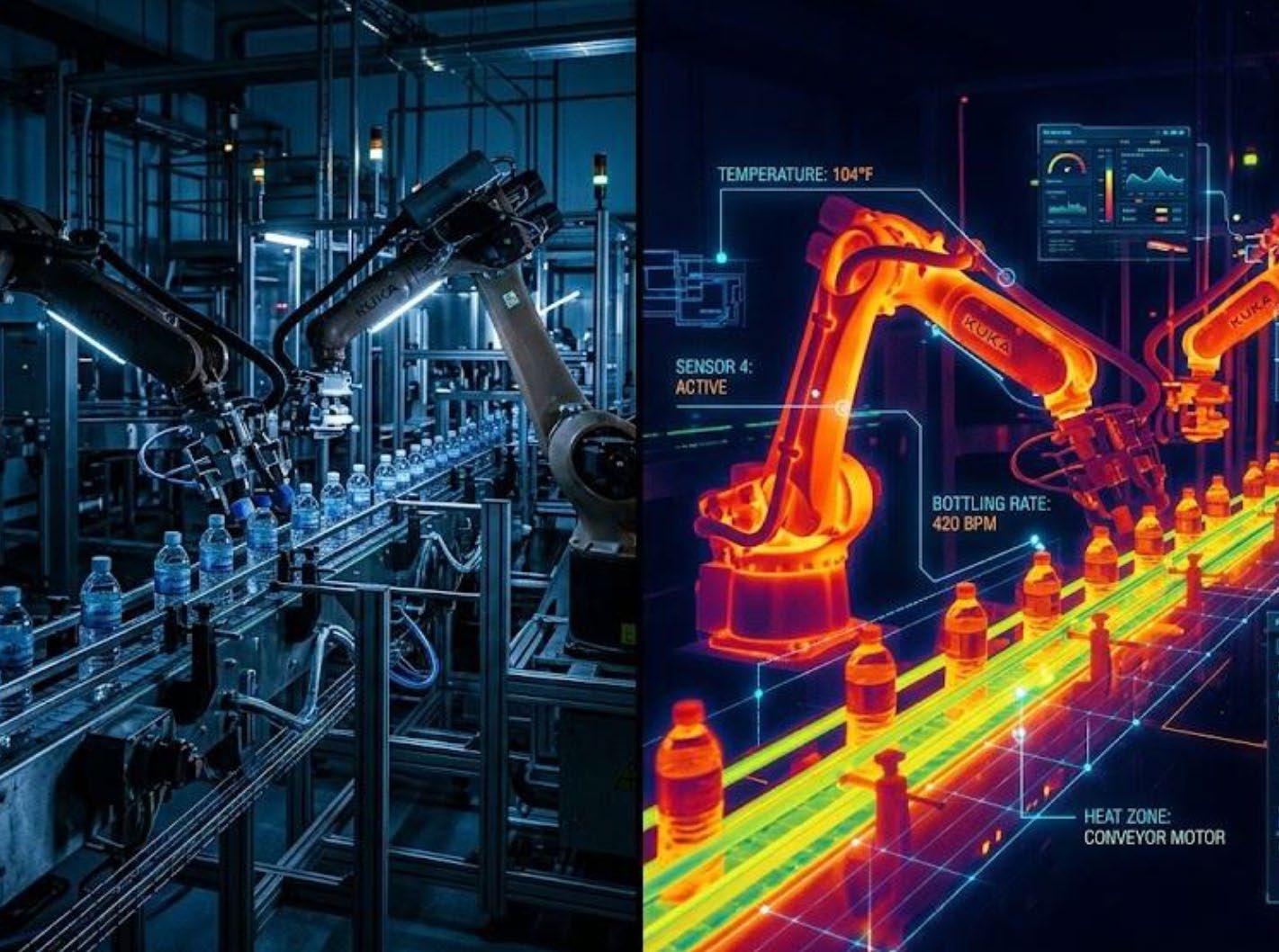
The promise of the “lights out” factory: absolute efficiency in environments that no longer require human centric infrastructure.
Labour shortages driven by ageing populations, rising operational costs, and the relentless pressure to deliver consistent, safe products at scale are pushing the industry towards a model where the lights, quite literally, can be switched off.
But food is not a semiconductor nor a smartphone. It is biological, variable, perishable, and consumed by people. The stakes of a failure in a lights out food factory are not a scratched casing or a misaligned circuit. They are a contamination event, a recall, or worst, a public health crisis.
In the Asia Pacific region alone, unsafe food causes more than 275 million illnesses and 225,000 deaths each year, according to the United Nations Food and Agriculture Organisation (FAO). The question the industry must now answer honestly, not in investor decks, but in operations rooms and regulatory filings, is whether autonomous systems can bear the weight of a responsibility that has always, until now, been shouldered by human judgment.
The pressure building behind the door
The drivers accelerating lights out adoption are structural and unlikely to reverse. The International Labour Organisation’s Asia Pacific Employment and Social Outlook 2024 identified the region’s rapidly ageing population as a deep seated constraint on its labour supply, compounding workforce gaps that already existed before the pandemic. In food manufacturing specifically, the challenge is acute: the work is physically demanding, often carried out in cold, wet, or high hygiene environments, and the next generation of workers is not entering the sector in sufficient numbers to replace those leaving it.
Market data tells a consistent story. The global food processing automation market was valued at USD 27.95 billion in 2025 and is forecast to reach USD 40.12 billion by 2030, reflecting a compound annual growth rate of 7.49%. Approximately 48% of capital expenditure by large food manufacturers in 2025 was directed at new or upgraded automation projects, according to Mordor Intelligence, a decisive shift from isolated machinery towards connected, data driven production lines.
In 2024, the sector grappled with over 615,000 unfilled manufacturing positions globally, compelling many facilities to run third shifts with minimal oversight. Industrial robotics alone contributed USD 8.22 billion to food processing automation revenues in 2024, growing at 9.8% annually.
The Asia Pacific region sits at the epicentre of this shift. China has operated fully autonomous “dark factories” since the early 2000s; FANUC, the Japanese robotics manufacturer, has famously run a lights out facility producing robots that build other robots, operating autonomously for up to 30 days without human intervention. These examples, however, exist primarily in the precision manufacturing sector. Food production is a different environment entirely.
The difficulty is not that the equipment is unsophisticated. But a food system still depends on exception handling under variable biological and operational conditions. Receiving, washing, peeling, cutting, cooking, packaging, and cold storage each carry their own hazard profile. The further upstream a processor goes, closer to the raw material, the harder it becomes to remove human judgment from the process.
This is the foundational tension. Lights out is not a binary switch. It is a spectrum, and where food safety sits on that spectrum matters enormously.
Redesigning safety for a system that never sleeps
HACCP has been the backbone of food safety governance since its origins in NASA’s space programme in the 1960s. Its logic is elegant and enduring: identify the points in a process where biological, chemical, or physical hazards can be introduced, establish controls at those points, and verify that the controls are working. HACCP based plans will be mandatory across all major food manufacturing jurisdictions, from the European Union’s General Food Law Regulation to equivalents in Australia, New Zealand, Japan, and, increasingly, across Southeast Asia.
HACCP was, however, designed for an environment where humans are present. Its monitoring cadence, periodic checks at defined intervals, corrective actions initiated by trained operators, verification through observation and record review presupposes a workforce on the floor.
In an autonomous production environment, that model does not simply become more efficient. It becomes structurally incompatible unless it is fundamentally redesigned. Critical control points that were once monitored at fixed intervals must now be monitored continuously. Corrective actions that once involved a supervisor making a judgment call must now be pre programmed responses triggered by sensor thresholds. The records that once demonstrated compliance were filled in by people; they are now generated by machines.
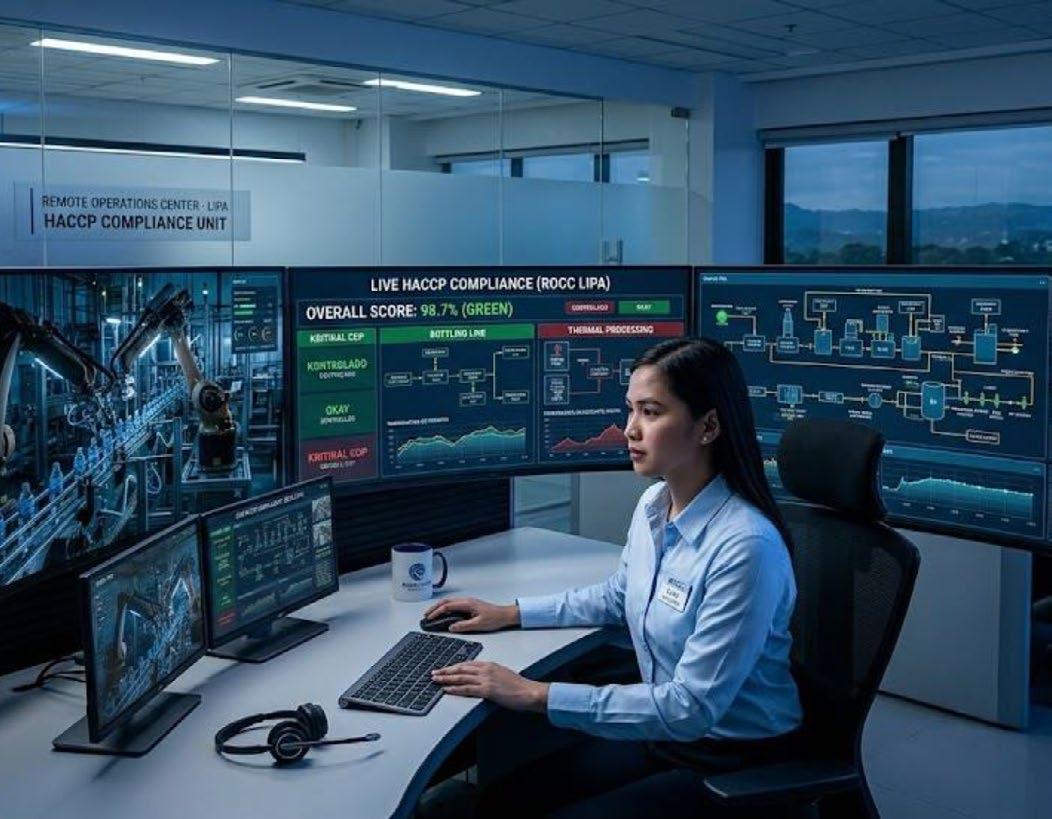
This shift has meaningful regulatory implications. As of 2025, over 60% of AI adoption in food manufacturing is focused on real time quality inspection and contamination detection, according to industry analysis, a decisive move from periodic testing to continuous monitoring. AI driven platforms can check in real time that all critical control points are being monitored at required frequencies and flag deviations instantaneously. Some systems provide a continuous compliance readiness score based on how live operational records align with regulatory and GFSI standard criteria.
The transformation is genuine. But it also creates a new and largely unresolved question: if no human is present to observe that a deviation occurred and
Cover Story
was correctly resolved, how is that verified? Who signs off on the corrective action? In a heavily regulated sector, the audit trail — the evidence chain that proves a safety system worked — has historically relied on human attestation. AI generated records are richer in volume and faster in production than any paper system. Whether they are trusted as primary evidence of compliance is a matter that regulators across the region are still actively working through.
The invisible inspector
Into this gap steps the technology that is increasingly framed as the answer: AI powered inspection systems operating at line speed, 24 hours a day, without fatigue, distraction, or shift handovers.
The commercial landscape has matured rapidly. Mettler Toledo Product Inspection, one of the sector’s most established suppliers, launched combination systems in late 2024 that integrate checkweighing, metal detection, X ray, and vision inspection in a single unit, offering multi hazard detection without multiple points of intervention. The company has been active across Asian markets, with its technology explicitly positioned to address rising food safety requirements and labour constraints simultaneously.
“In the right environment, AI inspection is not a supplement to human oversight. It is a credible replacement. But ‘in the right environment’ carries significant weight.”
Tetra Pak’s November 2025 launch of Factory OS, a modular, open standard automation and data integration platform developed in partnership with Accenture, Siemens, Rockwell Automation, and Inductive Automation, signals the direction of travel at the systems architecture level. Designed to unify data across equipment, including legacy machines, the platform aims to give food manufacturers real time plant visibility as the foundation for AI ready operations. For APAC manufacturers, Tetra Pak’s own published data from a WEF certified Mengniu dairy facility in China, where packaging efficiency increased by 67%, energy consumption dropped by 23%, and space utilisation fell by 37%, illustrates what an integrated, data driven autonomous environment can achieve.
The scientific community is catching up with the commercial reality. Research published in ScienceDirect in September 2025 documents how convolutional neural networks (CNNs) now enable real time, non invasive inspection of surface level spoilage and contamination at accuracies that consistently
Beyond human limits: Hyperspectral imaging allows AI to detect spoilage and contaminants invisible to even the most trained human eye.
outperform manual inspection in defined tasks.
A 2025 review in the Journal of Food Science reported that AI driven packaging inspection systems trained on spectral, gas, and image data achieved average accuracies above 94% under cross validation. Hyperspectral imaging, combined with AI, enables non destructive, high dimensional analysis of food products, detecting contaminants, spoilage indicators, and quality variables like moisture content or ripeness that are invisible to the human eye.
What emerges from this body of evidence is a technology that is, in specific and well defined contexts, genuinely impressive. High speed, full line inspection at production volumes no human team could sustain. Consistent detection of known defect categories. Continuous operation without fatigue degradation. In the right environment, AI inspection is not a supplement to human oversight. It is a credible replacement.
But “in the right environment” carries significant weight.
The limits no brochure mentions
The most important word in AI inspection is “known.” These systems detect what they have been trained to detect. Their performance is, as Mettler Toledo’s own digital marketing manager stated candidly in October 2025, dependent on the quality of training data. Rare defects may be underrepresented in training sets. Novel contamination scenarios: a new pathogen, an unusual packaging failure mode, or a supplier quality shift may fall entirely outside the model’s frame of reference.
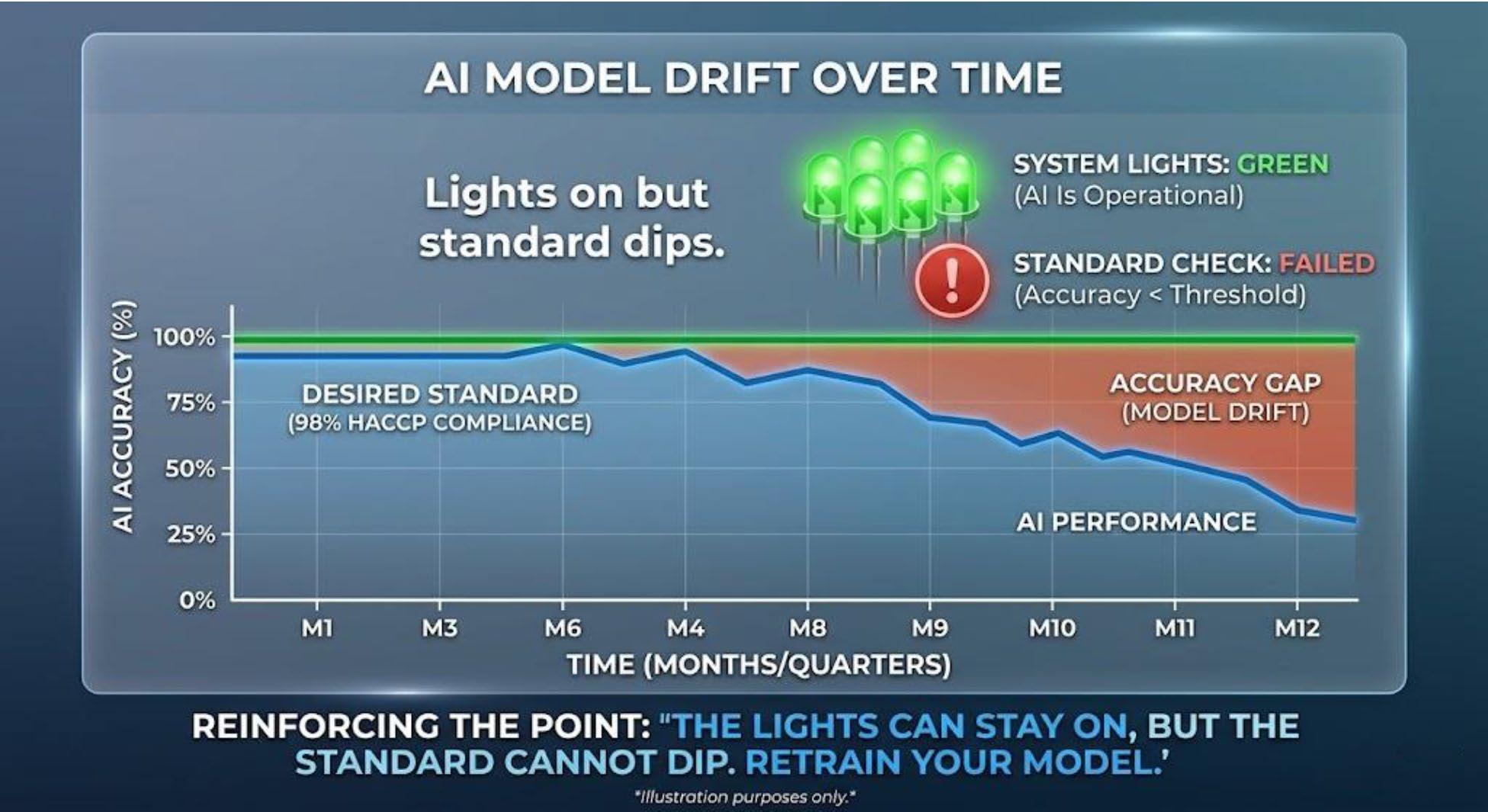
More troubling still is the problem of silent failure. Research published in 2024 on deep learning inspection systems identifies what engineers call “silent performance degradation,” a phenomenon where a model’s accuracy quietly deteriorates as production conditions shift away from the data distribution it
was trained on, without triggering any visible alarm. A miscalibrated human inspector looks uncertain, makes errors that colleagues can observe, or raises concerns. A miscalibrated AI model may simply continue producing outputs that appear confident and complete while its actual detection capability has eroded.
In a lights out environment, where there is no one on the floor to notice that something looks wrong, silent failure is not a theoretical risk. It is an operational design problem that must be engineered against. The mitigations are available, redundant sensor layers, continuous model validation against known reference samples, remote monitoring with escalation protocols, and scheduled retraining triggered by performance metrics, but they require investment and deliberate systems design. They are not defaults.
“A
miscalibrated human inspector looks uncertain, makes errors that colleagues can observe, or raises concerns. A miscalibrated A model may simply continue producing outputs that appear confident and complete while its actual detection capability has eroded.”
The interconnected architecture of a modern automated plant amplifies this risk further. AI inspection does not operate in isolation. It is woven into Manufacturing Execution Systems (MES), enterprise resource planning (ERP) platforms, and traceability databases. A failure or miscalibration in the inspection layer does not remain contained. It propagates across the data environment, producing compliance records, triggering downstream decisions, and influencing recall assessments, before anyone identifies that the source data was compromised.
GEA Group, which emphasises hygienic design and flexible modularity in its processing systems, and Bühler AG, whose milling and grinding systems serve some of the region’s highest throughput facilities, both operate in environments where process variable management is non negotiable. The question for manufacturers deploying their equipment in increasingly autonomous configurations is whether the AI governance layer is receiving the same engineering rigour as the physical processing systems themselves.
The evidence from 2025 suggests the answer is not yet consistently yes. Deloitte’s 2025 Smart Manufacturing and Operations Survey found that ambitious lights out or fully autonomous plant visions frequently stall, with the technical complexity of handling variable raw
materials, allergens, and hygiene constraints proving higher than anticipated and capital payback periods stretching beyond tolerable thresholds. The technology that performed in 2025, the same survey found, was tightly scoped, operations first, and practical, not grand and platform heavy.
Accountability in the absence of witnesses
Beyond the engineering challenges lies the question that decision makers in boardrooms and regulatory agencies are beginning to ask aloud: in an autonomous food facility, where does accountability reside?
Food safety law in every major jurisdiction is built on the concept of a responsible operator, a person, or an organisation with named individuals, who can be held accountable for the safety of what leaves a facility. In the United States, the Peanut Corporation of America case established that executives can face criminal liability for safety failures. In 2024, the recall of 11.76 million pounds of meat and poultry by BrucePac for Listeria risk demonstrated the scale of disruption that a single contamination event can generate. These consequences do not diminish because the inspection system was automated. They may, in fact, intensify because a failure in an autonomous system raises questions not just about a single decision, but about the design and governance of an entire system.
The regulatory environment is accelerating, not relaxing. The World Bank estimated that globally, unsafe food causes losses of USD 95 billion per year in low and middle income countries alone. The WHO’s mandate under World Health Assembly Resolution 73.5, to produce updated global estimates of foodborne disease burden by 2025, reflects a deepening international commitment to closing the gap between food safety aspiration and operational reality.
For APAC manufacturers, the regulatory picture is particularly complex. Food safety oversight varies
Cover Story
significantly across the region, from the Singapore Food Agency’s rigorous, science led framework to the evolving systems of ASEAN member states with less developed inspection infrastructure. FSANZ, which governs Australia and New Zealand, has been a regional leader in harmonising standards, while the Codex Committee on Food Import and Export Inspection and Certification Systems met in Cairns in September 2024 to advance international alignment. The question of whether AI generated compliance
records can serve as the primary evidence base for regulatory purposes remains unresolved across virtually all of these frameworks.
“The factory may be dark. The accountability cannot be.”
The human remains in the architecture
It would be a mistake, and an intellectually dishonest one, to conclude from this analysis that lights out food manufacturing is either inevitable or inadvisable. The evidence points in neither direction exclusively.
What it points towards, with considerable clarity, is a redesign of the human role rather than its elimination. The floor worker monitoring a conveyor is being replaced. That transition is already underway and will not reverse. What replaces that presence is not nothing. It is a more demanding, more technically sophisticated form of oversight: remote systems monitoring, data validation, exception management, and the governance of AI models whose performance must be continuously verified.
The food factory of 2030 across the Asia Pacific region will not be staffed as it was in 2010. But it will not be genuinely unmanned either. It will be differently manned, by smaller teams with higher skills, operating across
digital control environments that give them visibility into plants that may be thousands of kilometres away. The risk is not that humans disappear. The risk is that the accountability structures, the regulatory frameworks, and the investment in model governance do not keep pace with the speed of automation adoption.
Tetra Pak’s Factory OS vision, GEA’s commitment to hygienic modularity, Mettler Toledo’s combination inspection systems, and Bühler’s precision process control each represent credible contributions to a safer, more efficient food system. None of them, alone or in combination, resolves the accountability question. That question belongs to the operators who deploy these systems, the regulators who certify them, and the industry bodies that must move faster than they have historically done to define what “safe” means in a production environment where no one is watching.
The lights can go out. The standard cannot.
When the lights go out, the proof must stay on
By Cath Isabedra Certification, auditing, and verification in the age of automated food manufacturing
There is a persistent assumption embedded in how the food industry tends to discuss automation: that technology, by its very nature, is safer than people. The premise has surface level appeal. Machines don’t tire. Sensors don’t miss a shift. A programmatic alert doesn’t look the other way. But the logic only holds if the systems themselves are working correctly, and if someone, somewhere, can prove it.
That is the central tension now playing out across the Asia Pacific food manufacturing sector as investment in highly automated, and in some cases fully unmanned, production facilities continues to accelerate. The machinery may be impeccable on paper. The
software may be state of the art. But in the absence of human presence on the factory floor, the traditional mechanisms of food safety assurance: observation, judgment, and on the spot intervention are simply no longer available. Something else must fill the gap.
For Sutida Ketudut, Managing Director for APAC at NSF, the answer lies not in replacing human oversight with more technology, but in evolving the frameworks that verify whether technology is doing what it is supposed to do. The shift, she argues, is a fundamental one, from a world where food safety is mostly about managing people to one where it is increasingly about auditing systems.
Feature Story
“In
highly automated food factories, the absence of human operators makes data non-negotiable. When operators are not present to observe deviations, data becomes the primary tool for assurance, accountability and trust.”
— Sutida
Ketudut, Managing Director APAC, NSF.
The scale of the shift
To understand what is at stake, it helps to step back and consider the magnitude of the transition underway. Southeast Asia’s food processing sector, valued at USD 7.36 billion in 2025, is projected to nearly double to USD 13.28 billion by 2034, growing at a compound annual rate of 6.76%, according to Deep Market Insights. The region accounts for 2.58% of the global food processing market today, but that share is being built on increasingly automated production lines, and manufacturers exporting to developed markets are discovering that the regulatory and buyer expectations that come with those markets do not leave room for ambiguity about how products were made.
Simultaneously, the broader food automation market globally is on its own steep trajectory, from USD 27.95 billion in 2025 to USD 40.12 billion by 2030, per StartUs Insights. Food robotics alone is forecast to reach USD 14.93 billion by 2034 at a CAGR of over 20%. The adoption is being driven by well documented pressures: labour shortages, rising consistency demands, and the need to operate profitably in high cost environments. But as the capital is deployed and the lights are figuratively — and sometimes literally — turned off, the industry is arriving at a question it does not yet have uniform answers for: who audits the algorithm?
The answer matters more for Asian manufacturers than perhaps any other cohort. In 2024, global food certification adoption grew by 18% year on year, with Asia Pacific accounting for 35% of that market, according to Future Market Insights. The region’s manufacturers are not just producing for domestic consumption. They are feeding export markets that are tightening their traceability and systems level requirements, and in doing so, are increasingly demanding that the certifications and audit trails backing food safety claims are as credible as the products themselves.
The lights-out problem
The concept of a lights out factory is not new in manufacturing: automotive and semiconductor plants have been operating with minimal human presence
for years. But food is different. Raw materials are variable. Contamination risks are biological, chemical and physical. And the consequences of a failure are not a faulty component but a public health incident.
Ketudut is direct about the vulnerabilities. “While lights out food factories offer many benefits, helping to automate processes and reducing labour and overhead, these types of manufacturing facilities are not without risk,” she notes. “Without on site labour, early warning signs such as smoke, sparks, pests or system anomalies can go unnoticed, increasing the risks of equipment failure, production disruptions and operational losses.”
This is not a hypothetical concern. In the wider manufacturing sector, cyberattacks on operational technology (OT) systems have already demonstrated what can go wrong when digital infrastructure is not properly secured. A ransomware attack on a major beef supplier in 2021 disrupted production across at least six processing facilities in the United States, illustrating that a single breach in a connected system can ripple through an entire supply chain with immediate food safety and commercial consequences.
In the food factory context, the digital risk surface expands significantly as more control is handed to software. SCADA systems manage process conditions. MES platforms govern production sequences. ERP systems tie financial and operational decisions together. Cloud connectivity enables remote monitoring. Each integration point is also a potential vulnerability — and unlike a human operator who might notice a warning light and call for maintenance, a compromised or misconfigured automated system may simply continue producing, logging, and reporting without flagging the underlying problem.
Ketudut specifically highlights cybersecurity as a defining challenge for highly automated plants in APAC: “The increased use of cloud based technology in lights out factories can also increase cybersecurity risks, underscoring the importance of strong and comprehensive information security frameworks.” This is not a concern that can be deferred until after commissioning. By the time a facility is operational, its data governance architecture is essentially baked in.
Regulatory signals that can’t be ignored
The regulatory environment in Asia is sending clear signals that governments are not treating OT cybersecurity as a matter for manufacturers to address on their own timelines. Singapore’s updated OT Cybersecurity Masterplan, launched in August 2024 by the Cyber Security Agency (CSA), extends its remit beyond critical information infrastructure to cover the wider OT ecosystem, which includes manufacturing plants. The Masterplan promotes secure by deployment principles, meaning that cybersecurity is not an afterthought applied once a facility is built, but a discipline that must be embedded from product design through maintenance.
The document, co created with over 60 organisations spanning OEMs, cloud service providers, system integrators and sector regulators, sets expectations that have practical implications for any food manufacturer operating automated facilities in Singapore or seeking access to Singapore connected supply chains. “This is particularly important in some APAC countries, where compliance requirements demand robust governance of both data and operational technology systems,” Ketudut observes.
Thailand’s Personal Data Protection Act (PDPA) adds a parallel layer of obligation, requiring businesses to implement defined data privacy practices and cybersecurity measures for all personal data under management. While PDPA is not a food safety regulation per se, it shapes the governance environment in which food manufacturers operate, and auditors and certification bodies are increasingly expected to verify that digital compliance spans both operational and data protection dimensions.
The broader trajectory globally is towards continuous, data based assurance rather than periodic audit events. Authorities in the United States, the European Union, and elsewhere are shifting to frameworks that require manufacturers to maintain verifiable digital records and to provide them rapidly on demand. The FSMA 204 Traceability Rule, though its enforcement has been extended, is a marker of the direction of travel: traceability is moving from a best practice to a licence to operate.
The audit’s new object
Perhaps the most analytically significant observation in Ketudut’s account of the lights out challenge is what a food safety audit actually examines in a digital plant — and how fundamentally that differs from conventional audit practice.
In traditional manufacturing environments, third party audits have always leaned heavily on human
observation. An auditor walks the floor. They watch how a line operator handles a product, check whether procedures are posted and followed, and assess whether a deviation was recorded correctly. The focus, in other words, is on people, and the audit methodology, developed over decades of practice, is calibrated accordingly.
“In digital factories, the focus shifts from people to systems,” Ketudut explains. “Auditors must evaluate how production lines are configured, who has permission to make changes, and whether those changes are properly logged, controlled and traceable.” In a lights out plant, the question is not whether an operator followed a step correctly. It is whether the system that executed the step is configured correctly, whether it has been modified since commissioning, and whether any modifications were authorised, documented and traceable.
This is an audit of software logic. Of access controls. Of data integrity. Of whether an ERP or MES system’s audit trail is tamper resistant and complete. This requires not just food science expertise but proficiency in OT systems, data governance and cybersecurity, a combination that most traditional food safety auditors were not trained for, and which certification bodies are now under pressure to develop.
Ketudut describes the role NSF now plays in this context: “By auditing the systems such as ERP, MES and SCADA, NSF conducts gap analyses of data compliance frameworks, verifies that permissions for system changes are properly restricted and logged, and ensures audit trails are complete and tamper resistant.”
“Compliance therefore shifts from operator behaviour to data compliance and system compliance.”
— Sutida Ketudut
Feature Story
The implication is significant. If compliance is now defined by system behaviour rather than human behaviour, then the old model of auditing: showing up annually, observing the line, sampling records, is structurally inadequate. Automation doesn’t slow down for audit week. Systems that are misconfigured don’t automatically correct themselves because an auditor is present. The verification needs to be continuous, not episodic.
Data as the floor of assurance
At the heart of Ketudut’s argument is a point that deserves broader traction in the industry. Food safety programmes need to become data driven, not just in the operational sense, monitoring temperatures, logging yields, tracking batch numbers, but in the assurance sense. Data is not just an output of production. In a highly automated plant, it is the primary evidence that what happened on the line was safe, consistent and traceable.
“By putting data at the forefront, food safety programmes can shift from a reactive model to a proactive one, helping manufacturers to identify warning signs early on, intervening before risks materialise,” she says. The distinction between reactive and proactive is worth dwelling on. Reactive food safety, such as responding to contamination events, issuing recalls, and correcting deviations after the fact, has historically been the dominant mode, particularly in facilities where human oversight was assumed to catch most problems. In a lights out environment, the systems cannot wait to be told there is a problem. They have to be designed to surface problems before they become incidents.
This is where consolidation of compliance data becomes operationally meaningful. A tool like NSF Connect, as Ketudut describes, brings together audit records, compliance checks, performance tracking and gap identification into a single integrated view. The value is not just administrative efficiency. It is the ability to see patterns across time and production lines that no single audit event could reveal: a recurring anomaly in a particular sub process, a gradual drift in a critical control point, or a configuration change made but not documented.
For Asian manufacturers dealing with the complexity of multi market export requirements, each with its own traceability standards, certification expectations and audit protocols, that kind of consolidated visibility is not a luxury. It is what makes systems level compliance manageable at scale.
Preparing early, or catching up later
There is a timing dimension to all of this that manufacturers who are currently in the planning or early commissioning phases of automated facilities should take seriously. The regulatory and customer requirements bearing down on the sector are
tightening, and the window to build compliant systems from the start is considerably wider than the window to retrofit compliance into an already operational plant. “Manufacturers that prepare early will be better positioned to adapt to tightening requirements and maintain competitiveness in global markets,” Ketudut says. “Independent third party certifications, audits and system evaluations play a critical role in this transition, helping to ensure that traceability and recordkeeping practices not only meet regulatory expectations but are also robust, credible and trusted.”
The word ‘credible’ is worth unpacking. In a market where food certification adoption rose 32% across developed and emerging markets in 2024, per Future Market Insights, certifications are proliferating. But not all certifications carry the same weight with regulators and sophisticated buyers. The question increasingly being asked is not whether a facility holds a certificate, but what the certification process actually verified, and whether the underlying data systems that support the claim are sound. That is a harder question to answer when a facility’s food safety management relies on automated controls rather than documented human practice. It requires auditors who understand both domains. It requires data governance structures that were built with audit readiness in mind, not bolted on afterwards. And it requires manufacturers to treat third party assurance not as a compliance cost to be minimised but as a continuous verification function that adds real operational and commercial value.
The food industry in Asia is at an inflection point. The economics of automation are compelling, and the trajectory is not reversing. But as plants become more digital, and, in the extreme case, fully unmanned, the proof of safety burden does not diminish. It intensifies. The shift from managing people to auditing systems is not just a change in methodology. It is a change in what food safety fundamentally means in a technology driven facility. For manufacturers who want to compete in global markets, figuring out that shift before the auditors do is not optional.
With insights from Sutida Ketudut. Sutida Ketudut is Managing Director, APAC at NSF. NSF is a global public health organisation that provides certification, auditing, training and advisory services to the food and beverage industry.
The semi-autonomous factory: Why the real prize is the empowered worker
By Cath Isabedra
AVEVA’s Naveen Kumar has watched enough autonomous factory programmes stall, or collapse entirely, to know where the thinking goes wrong. His advice to food manufacturers is blunt: stop chasing the fully unmanned plant and start building the factory that actually knows itself.
The fully autonomous food plant, one that runs through the night with no hands on deck, no supervisor on call, no one to intervene when something goes sideways, remains, for the overwhelming majority of producers, a thought experiment rather than an operational blueprint. That is not a failure of ambition. It is a reflection of how genuinely hard the problem is.
Food manufacturing is not automotive. The raw materials vary. The biology of ingredients does not
behave the way stamped steel does. Regulatory obligations run deep, and the consequences of getting it wrong, whether in food safety, traceability, or quality, are not abstract. They are recalls, regulatory action, and reputational damage that can take years to undo.
Naveen Kumar has been working on these problems for long enough to know which questions matter. As VP of Business Development at AVEVA, whose industrial software sits at the intersection of operational technology and data intelligence, he is in the room when food manufacturers try to translate board level ambition into plant floor reality. Asia Food Journal put the hard questions to him, from the minimum digital prerequisites for unattended runtime to the leadership misconceptions that quietly kill transformation programmes before they reach their potential.
Feature Story
Where the realistic wins actually are
Kumar is not one for softening definitions. Lights out means fully autonomous operations with no humans on site. Full stop. What he pushes back on is the assumption that this is where food manufacturers should be pointing their investment.
His preferred framing is a crawl walk run journey, and the starting point is less glamorous than most boardroom presentations suggest. It begins with a granular examination of every process step across the receive make pack ship chain, looking specifically for where variability is lowest. Receiving lends itself to established warehouse automation. Secondary packaging: case packing, palletising, and wrapping are already heavily robotised in progressive facilities. But even in these more controlled environments, Kumar is clear eyed: “Humans must be on standby to intervene since micro stops readily occur in these processes.”
The processing phase, what AVEVA calls the “make” stage, is where the software company’s portfolio delivers the most measurable near term return. The goal in this phase is not to remove operators but to give them something they rarely have enough of: real time visibility, AI generated insights, and structured workflow guidance. Kumar calls this “smart manufacturing”, and the practical outcomes he points to are consistent — batches produced reliably under optimal conditions, a reduction in unplanned maintenance interventions, and operations that behave the same way whether the site is in Bangkok or Birmingham.
“AI and automation will empower the existing human workforce, rather than replace it.”
— Naveen Kumar, VP Business Development, AVEVA
What a plant needs before it can safely run itself
There is a version of this conversation that stays at the level of sensor counts and software licences. Kumar does not stay there. Before any manufacturer considers extending unattended runtime, he argues, a more fundamental rethinking is required — one that starts with how processes are designed in the first place.
Most industrial processes are designed on the assumption that things will go right. Lights out operations require the opposite discipline: designing explicitly for when things go wrong. The architecture Kumar describes is what he calls a “digital nervous system” built on a closed loop logic of see, know, and act. Seeing requires a comprehensive sensing infrastructure, including vision AI systems trained to diagnose anomalies. Acting requires that every
plausible corrective scenario has been thought through and automated in advance. The system, he is careful to emphasise, must be able to evolve as operational needs change rather than becoming a fixed installation that ages poorly.
Traceability is not an add on to this architecture. It is load bearing. In food manufacturing, the full material and process history across the value chain must be capturable and queryable on demand. Ingredient quality, equipment status, and workforce oversight — all of it must be trackable. For this to work at production speed, the ERP production strategy must be tightly aligned with the Manufacturing Execution System and the shop floor processes beneath it. That alignment sounds procedural. In practice, it is one of the more reliably difficult things to get right.
What changes first: Data, systems or the way people work
If a manufacturer wants to move from dashboards that inform to systems that decide, the sequencing question matters enormously. Does data infrastructure come first? Execution systems? Or the operating model that determines how people use any of it?
Kumar’s answer is unambiguous, and it tends to surprise people who are expecting a technology first response. The operating model must change in parallel with the technology, not after it. “The most successful projects see the going hand in hand with communication of changes and associated goals,” he says, referring to the four levers he considers essential: performance, process, policy, and people. When those levers are not pulled alongside the technology deployment, the result is a pattern that the industry knows well — dashboards that no one acts on, insights that never reach the floor, and a programme that eventually gets defunded without anyone being quite sure why.
He draws a clean technical distinction between the roles of AVEVA’s PI System historian and its MES offering, a distinction with direct implications for how programmes should be sequenced. PI deployments are, in his framing, highly effective at contextualising real time process data for short interval control. They are built to detect when things go wrong, operating from the moment an event occurs onwards. MES operates on a different axis entirely. It is about execution discipline: ensuring that things go right before a process event, working from the pre execution side of the timeline.
Successful deployments treat these not as alternatives but as complements. The integrating logic is the closed loop: MES plus control automation plus PI historian, working together to digitalise the full production cycle.
Canada’s Maple Leaf Foods, one of the country’s largest meat producers, illustrates what disciplined deployment looks like in practice. Rather than deploying new IoT sensors across its plant, the company used its
existing MES to feed data into advanced AI models, a decision that produced a three month return on investment. The programme was narrow by design: eight targeted use cases, including log dimensions and slicer machine parameters, chosen because waste reduction in those areas could be tracked and measured with precision.
“Stalled programmes often reflect a silo or technology-centric approach that fails to think through the operating model.”
— Naveen Kumar
Audit-ready by design, not by scramble
Regulatory traceability requirements are shifting from a problem manufacturers solve after the fact to one they are expected to have solved in advance. Under traceability rules from the US Food and Drug Administration, the industry benchmark of days is becoming untenable. The expectation is moving toward hours.
Kumar’s position is that the latency problem is, at its root, an architecture problem. In a properly instrumented automated environment, process data is generated in real time and stored in a historian. The bottleneck arises when contextualising that data is treated as a manual exercise to be undertaken after a request arrives. “Audit ready by design,” as he defines it, means that contextualisation occurs at the point of data generation, not at the point of inquiry.
F&N Dairies provides the clearest benchmark Kumar offers. By implementing automated, end to end monitoring across its operations, the company reduced product traceability time from four hours to one minute. That compression does not just change the experience of a regulatory audit. It changes the organisational posture toward compliance entirely, shifting it from crisis response to routine capability.
Food
safety monitoring and the limits of predictive confidence
The integration of food safety monitoring: critical control points, sanitation checks, inspection outcomes, with predictive analytics, is an area where Kumar chooses his words carefully. The technical capability to integrate these data streams exists. The risk he identifies is not failure of the technology but false confidence in its outputs: a system that appears to be working but whose data cannot, in practice, be trusted enough to be acted upon. His answer is to build trustworthiness into the data architecture from the beginning, across several layers simultaneously. Sensor accuracy
requires calibration, redundancy, and drift detection. Data integrity requires audit trails and completeness checks. The operations context requires state change tracking and batch linkage. Data integration requires cross referencing to orders and material tracking. Contextual intelligence requires subject matter expert validation and the ability to explain why a model produced a given output.
The Maple Leaf Foods bologna optimisation project demonstrates what this looks like in operation. By integrating AI with its existing AVEVA MES, the company was able to feed temperature probe data and cook cycle records directly into digital twin models. The output was the identification of an optimal “cumulative lethality” threshold, a point at which the product was fully cooked to both taste and food safety standards without suffering yield loss from excess moisture loss. The insight only became possible because the underlying data was of sufficient quality and contextualisation to be trusted.
“Trustworthiness
of
data is something that is designed and built into the system at multiple levels.”
— Naveen Kumar
When a human steps in, what does the system do with that
In an increasingly automated environment, the question of what happens when a human intervenes carries more weight than it might appear to. It is not just a procedural question. It is a data integrity question with regulatory implications, and one that becomes more consequential as the level of autonomy increases.
Kumar’s answer extends the unified data foundation concept directly to the human layer of operations. When an operator override is necessary, the system must digitally manage the rules governing that override and log the exact context of the intervention, not as an entry added retrospectively, but as a record that sits seamlessly within the same data fabric that captures automated events. The goal is a single, coherent account of what happened on the floor, regardless of whether the action was taken by a machine or a person.
Agropur, the North American dairy processor that manages 29 plants previously running on customised legacy systems, found itself unable to maintain enterprise wide visibility precisely because its version of operational truth was fragmented across those sites. Deploying AVEVA MES across its facilities broke down those silos. The outcome was not just visibility, it was the kind of consistent, auditable data foundation that makes both operational decisions and regulatory responses tractable at the speed they are increasingly required.
Cybersecurity has become a food safety issue
The convergence of operational technology and information technology in food manufacturing has created a cybersecurity exposure that the sector has been slower to address than utilities or pharmaceuticals. Kumar does not hedge on this. Alongside safety, cybersecurity is, in his view, the most critical area to address during digital transformation. As the number of connected devices increases, the attack surface grows in direct proportion.
AVEVA’s approach combines software development practices aligned with IEC 62443, the international
standard for industrial cybersecurity, with subscription based update mechanisms designed to keep software current post deployment. The flexibility of subscription plans is not primarily a commercial proposition. It is, in Kumar’s framing, a security mechanism that prevents environments from becoming stranded on vulnerable legacy versions over time.
The gaps he returns to are consistent with what the broader OT security community identifies: remote access controls, identity management, patch cadence, and third party connectivity. Each of these becomes more consequential as autonomy increases, and the potential impact of a breach on both production continuity and food safety expands.
How global manufacturers hold standardisation and flexibility at the same time
For manufacturers operating across multiple geographies, the tension between standardisation and site level flexibility is rarely resolved cleanly. Kumar’s framing reorients the question away from what to standardise and toward a more useful categorisation of variety. He distinguishes between essential variety that is inherent to the product mix and cannot be removed; unnecessary variety that has accumulated through organisational drift and can be rationalised; and unavoidable variety imposed by local regulation, infrastructure, or market conditions.
AVEVA’s response to this is a model driven, composable MES architecture designed to carry both requirements simultaneously. A templated core provides the standardisation that makes cross site comparability and traceability possible. Site specific adaptation is layered on top without disrupting the underlying data model or the audit chain that runs through it.
Barry Callebaut, the Swiss chocolate manufacturer with a global factory network, used AVEVA’s MES, System Platform, and Historian to manage complex data sources within a standardised single truth model. The modular approach was deployed across multiple factories, giving operators a consistent experience regardless of geographic location. Production line insights identified opportunities to improve capacity by 10 per cent, and predictive models now surface optimisation opportunities that allow lines to be adjusted in real time.
“The goal of autonomy should not be to remove the human; rather, it should empower the connected worker.” — Naveen Kumar
The misconception that quietly kills the most programmes
Ask Kumar what the most damaging misconception is when leaders fund an autonomous factory programme, and the answer arrives without hesitation.
“Many leaders treat the ‘autonomous factory’ as a massive experiment,” he says, “where the perceived solution is simply adding more measurement widgets, increasing technical sprawl, or assuming brand new AI and IoT sensors will act as a silver bullet.”
The corrective, in his view, is an incremental transformation aimed at specific, quantifiable business problems. The methodology starts at the level of the individual process step: understand the variability inherent in each step, identify which steps can be made more deterministic through technology, and accept that some steps will always require a human in the loop because their variability exceeds what current tools can reliably manage.
AI, in this framework, is a tool for capturing and encoding the tacit knowledge of experienced operators. It gradually reduces the organisation’s dependence on specific individuals and converts know how that lives in people’s heads into system behaviour that can be repeated, audited, and improved. The destination is not a factory without workers. It is what Kumar calls the “sweet spot” of the semi autonomous factory: one where connected workers have AI generated guidance delivered directly into their workflows, allowing them to make better decisions faster.
The lights out factory, fully realised, may eventually exist in food manufacturing for discrete process segments with genuinely low variability. But the more immediately tractable ambition, and arguably the more defensible one, is the plant that knows itself well enough to act on what it knows. One where data flows without friction, where variability is understood rather than feared, and where the intelligence to make the right call is always available to the person who needs to make it.
Naveen Kumar is the Vice President for Chemicals, Natural Resources and Manufacturing Industry Segments at AVEVA.
Naveen has 37+ years’ experience across the industry, supporting customers in their investment planning, profit improvement, digital transformation, and sustainability initiatives.
In his current role, Naveen is responsible for driving global growth for Chemicals, Natural Resources and Manufacturing industry segments for AVEVA. A key focus of his is to help AVEVA customers derive value and support them in their net zero journey through digital transformation. In recent years, Naveen has participated in and represented AVEVA at various Industry Forums and has provided thought leadership on how digital transformation can be used to achieve operational excellence.
Prior to AVEVA, Naveen was at KBC leading its consulting practice for Asia and at AspenTech in several roles, including Sales and Services Delivery.
Naveen is based in Singapore and holds a degree in Chemical Engineering from the Indian Institute of Technology, New Delhi, India.
ROCKWELL AUTOMATION
The factory that never sleeps: Why lights-out manufacturing demands more than automation
In conversation with Marcelo Tarkieltaub, Regional Vice President, Southeast Asia, Rockwell Automation
By Cath Isabedra
There is a persistent assumption in food and beverage manufacturing that automation is a destination. Commission the right equipment, integrate robotics, close a few production loops, and the operation runs itself. The lights out factory sits just over the horizon, waiting. The reality, as Marcelo Tarkieltaub of Rockwell Automation sees it, is more complex. Tarkieltaub oversees
the company’s Southeast Asian operations and works regularly with food and beverage manufacturers as they navigate the distance between having automation and achieving autonomy. These are not the same. The gap between them is where most manufacturers are stuck, and understanding what causes that gap is the first step to closing it.
The real bottleneck is not the machine Automated islands vs autonomous plants
When a food manufacturer’s push toward more autonomous operations stalls, the instinct is to blame technology: legacy equipment, fragmented data architectures, incompatible systems. Tarkieltaub’s diagnosis is often more uncomfortable.
“More often, what ‘breaks’ first is the alignment between technology, processes and people,” he says. “While legacy equipment integration and data architecture are common technical challenges, the more fundamental issue tends to be organisational readiness and process discipline.”
Rockwell Automation’s 10th Annual State of Smart Manufacturing Report found that 56% of manufacturers are currently piloting smart manufacturing, while only 20% have scaled it – a gap that reflects exactly this pattern: enthusiasm for transformation does not automatically translate into operational integration.
The underlying cause, Tarkieltaub explains, is a disconnected data landscape. ERP systems, manufacturing execution systems (MES), and manual inputs like spreadsheets operate in parallel, generating information that cannot be meaningfully reconciled.
“Without a single, standardised source of truth, it becomes difficult to generate reliable insights or scale automation effectively,” he says. Layering AI on top of these fragmented systems does not accelerate transformation; it exposes the deeper dysfunction beneath. Asia Pacific factories often operate with a mix of automation systems from different vendors across production lines, and integrating these platforms into a unified digital factory architecture remains complex and time consuming. The challenge is making existing systems communicate in a consistent, trustworthy way.
Most food manufacturers have what Tarkieltaub calls “automated islands”: individual machines or lines that perform well in isolation but are not connected to the broader production environment. A filling line may run with impressive precision. A filling line may run with impressive precision. A packaging station may log zero defects across multiple shifts. But if those lines do not share data, if a quality deviation on one line cannot trigger a response in another, the plant is not autonomous. It is a collection of well behaved machines.
“Automation does not equal autonomy,” Tarkieltaub states plainly. “Automating individual tasks improves efficiency, but without coordination across systems, plants remain heavily reliant on human intervention when conditions change.”
What separates an automated line from an autonomous ready plant is connectivity and context. In a genuinely autonomous ready environment, data flows continuously from the shop floor through MES, quality systems, and enterprise platforms, creating a unified, real time operational view. Data is not only collected but contextualised to support decision making. The plant does not just monitor what is happening. It understands what the data means and can act on it.
This is the architecture that closed loop systems depend on. Autonomous plants trigger adjustments automatically: optimising production parameters, flagging quality deviations early, and initiating maintenance before failures occur. Each of these capabilities requires data integration at a level most plants have not yet reached.
Manufacturing execution systems held the largest share of the Asia Pacific smart factory market in 2025, driven by their critical role in coordinating shop floor operations, enabling real time production monitoring, quality management, and traceability across large scale manufacturing facilities. The technology infrastructure exists. The challenge is deploying it in ways that are genuinely connected rather than merely sophisticated.
Why MES is more than a compliance tool
When food and beverage manufacturers invest in MES, the initial driver is almost always traceability and compliance. Regulatory pressure in the region is no longer abstract. Indonesia’s BPOM enacted comprehensive new recall and traceability requirements in January 2025, mandating that Class I recall action be initiated within 24 hours of discovering a product that poses a high health risk, a requirement that demands digital readiness rather than paper based systems. China updated its Good Manufacturing Practice standards for health foods (GB 17405 2025) in September 2025, adding safety management and recall and traceability provisions. The ASEAN Guidelines on Nutrition Labelling were formally endorsed in August 2025, creating further harmonisation pressure across member states.
Tarkieltaub acknowledges this regulatory context but pushes back on the idea that compliance is MES’s primary value. “MES should not be treated purely as a compliance tool but as a platform that connects production, quality, and maintenance workflows,” he says.
The transformation in value comes once real time production visibility is established. At that point, manufacturers can move beyond reactive compliance toward proactive optimisation. This involves identifying downtime patterns, addressing yield loss, and improving scheduling and labour productivity systematically rather than reactively. Traceability becomes a foundation, not a ceiling.
The urgency of this shift is not theoretical. According to the US PIRG Education Fund’s Food for Thought 2025 report, hospitalisations and deaths from foodborne illnesses doubled in 2024 compared to 2023, while recalls driven by Listeria, Salmonella, and E. coli increased by 41%. Manufacturers still relying on paper
based batch records or siloed quality systems face mounting exposure when investigations require rapid, cross system data retrieval.
Traceability as operational intelligence
The conventional framing of traceability is defensive: maintain records, satisfy auditors, manage recalls when they arise. Tarkieltaub sees a different and more operationally significant opportunity in the same data.
“The real opportunity is moving from reactive to proactive operations,” he says. “When traceability data is integrated with real time production and quality systems, it can be used not just to investigate issues, but to predict and prevent them.”
What this means operationally is that end to end traceability, properly integrated, allows manufacturers to quickly identify where and why a quality deviation occurred, whether it originates in a raw material, a process inconsistency, or a specific production stage. Investigation time compresses sharply. When that same data is linked to process conditions and equipment status in real time, patterns emerge before they become incidents. A particular supplier’s input consistently correlates with batch variability. A production shift shows higher deviation rates. A filling parameter drifts gradually before a fill weight complaint arrives.
The precision that traceability enables in recall management is a related and growing priority. Tight digital traceability allows manufacturers to isolate affected batches precisely rather than defaulting to broad, precautionary recalls. Pursuing lot level traceability can significantly reduce recall costs by narrowing recall scope and coordination expenditures. It also provides near real time monitoring of shelf life, temperature, and product routing, delivering value through simultaneous waste reduction and brand protection.
Predictive maintenance: the quality argument
Predictive maintenance is typically positioned as a strategy to reduce downtime. In food and beverage manufacturing, however, Tarkieltaub argues its most significant impact may be on product quality rather than machine availability.
“Many quality issues are not caused by sudden equipment failure, but by gradual process drift as machines wear over time,” he explains. Fill levels that shift imperceptibly over the course of weeks. Temperature inconsistencies that accumulate across thousands of batches. Changes in mixing performance that alter texture before any alarm activates. These are the failures most difficult to detect early and most damaging when they reach consumers or trigger investigations.
“By monitoring equipment conditions alongside process parameters, manufacturers can identify correlations between machine health and product quality,” he says. The shift is from reacting to failures or visible defects to intervening earlier by adjusting processes, scheduling maintenance, and recalibrating equipment before quality is affected. In an industry where batch consistency is brand identity, the operational stakes of this distinction are significant.
The connection between equipment condition and food safety risk is increasingly well documented. Under the Hazard Analysis and Critical Control Points (HACCP) system and the FDA’s Food Safety Modernization Act, manufacturers are required to have preventive controls in place for processes and equipment, and AI predictive maintenance transforms compliance posture, replacing time based maintenance schedules with auditable, time stamped data demonstrating that critical assets were operating within designated safety and quality parameters.
In beverage bottling plants, where conveyor belts and fillers are critical assets, predictive analytics enables maintenance scheduling during planned downtime, avoiding costly production disruptions and ensuring equipment operates within precise parameters for consistent, safe production.
AI in the plant: value and hype, side by side
Few topics in food manufacturing generate more heat than artificial intelligence. The claims are sweeping; the reality is more specific and more useful to understand clearly. Tarkieltaub is precise about where AI is currently delivering value. “AI enabled inspection and analytics are already delivering strong value in areas where quality issues are visual, repetitive and data rich.”
Packaging integrity checks, label verification, fill level accuracy, and detection of visible product defects are applications where machine vision, combined with AI, consistently identifies anomalies at high speed and with greater consistency than manual inspection. Quality control remains the top AI use case for the second consecutive year, with 50% of manufacturers planning to apply AI and machine learning to support product quality in 2025. AI is also effective at identifying patterns that are not visible to operators in real time, detecting early signals of process drift in historical and live production data before they escalate into quality events.
The overselling, Tarkieltaub argues, happens when AI is positioned as a fully autonomous replacement for human expertise across all quality control domains. AI models require high quality, well labelled data, stable processes, and ongoing calibration. In production environments with frequent product changeovers or inconsistent inputs, performance is less predictable.
“The most effective approach is to treat AI as an augmentation tool rather than a replacement. It works best when integrated into a broader quality strategy that combines automation, domain expertise and robust process control.”
The practical implication for food manufacturers is that a more deliberate approach to AI deployment is required. Rather than scattered pilots that demonstrate capability without delivering operational value, Tarkieltaub argues for anchoring AI initiatives to specific, measurable operational challenges. Use cases that generate the fastest returns are built on existing, high quality data and well understood processes, predictive maintenance, AI enabled visual inspection, and process optimisation, applied where the data infrastructure already exists and pain points are well defined.
Feature Story
The data hiding in plain sight
One of the most structurally important points in Tarkieltaub’s analysis is the scale of operational intelligence that food manufacturers are already generating and largely not using.
Machine condition data, including temperature, pressure, vibration, and cycle times, is often available at the equipment level but rarely linked to product quality or batch performance. Operator logs and manual quality checks contain detailed intelligence about recurring process variability and workarounds, but when captured on paper or in isolated systems, that intelligence cannot be aggregated or analysed at scale. Alarm and event data are generated continuously, but without proper structure and analysis, they become noise rather than signals.
“Plants generate large volumes of alarms, but without proper prioritisation and analysis, they can become noise rather than actionable signals,” he says. “When structured and analysed effectively, this data can highlight systemic issues, recurring bottlenecks, and opportunities to improve reliability.”
The strategic implication is significant: the path to smarter manufacturing does not always require investment in new data collection infrastructure. It often requires investment in connecting and contextualising data that already exists. For manufacturers managing capital budgets carefully, common in Asian markets where investment must be balanced against rapid expansion, this changes the return on investment conversation considerably.
The Asian context: speed, diversity, and dual pressures
The smart manufacturing journey in Southeast Asia has a character distinct from transformation narratives in North America or Europe. The differences are structural.
Regulatory diversity is perhaps the most under appreciated complexity. A food manufacturer operating across multiple Asian markets must navigate different food safety standards, different labelling requirements, different traceability expectations, and different enforcement approaches — all of which are actively and rapidly evolving. The 2025 BPOM recall
regulation in Indonesia, the updated Chinese food safety manufacturing standards, and the new ASEAN labelling guidelines represent the kind of regulatory flux that is now the norm rather than the exception. Systems that cannot adapt to diverse and changing requirements create compliance risk that scales with market presence.
Labour dynamics add another layer. While lower labour costs historically moderated the urgency of automation investment in some Asian markets, the calculus is shifting, workforce shortages are increasing, automation requirements are rising, and the skills needed to operate data driven manufacturing environments differ substantially from those of the previous operational generation. “This creates a dual challenge of investing in automation while also upskilling the workforce to manage more advanced, data driven operations,” Tarkieltaub says.
What is distinctive about the Asian context, however, is the pace at which manufacturers are expanding. The Asia Pacific smart factory market, valued at USD 40.24 billion in 2025, is projected to reach USD 88.47 billion by 2032, at a CAGR of 11.9%, driven by investment in automation, robotics, and digital factory technologies to support large scale production. Manufacturers scaling at that pace have the opportunity, and competitive pressure, to build connected operations natively rather than retrofitting legacy infrastructure. That window will not remain open indefinitely.
The compliance proof gap
Compliance in food manufacturing is increasingly about being able to prove, quickly and verifiably, that those standards have been met consistently. Tarkieltaub identifies a specific and practical gap between what regulators increasingly expect and what most plants can currently deliver.
End to end traceability with full contextual linkage remains elusive. Many manufacturers can trace raw materials to finished products, but cannot link that trace seamlessly to process conditions, operator actions, and quality checks in a single, time aligned view. Investigations and audits become more labour intensive and time consuming than necessary.
Proof of process adherence is a related challenge. Regulators increasingly expect evidence that critical control points and standard operating procedures were followed consistently, not simply documented after the fact. Manual records and fragmented systems raise legitimate questions about accuracy and completeness that automatically captured, time stamped digital records do not.
“The goal is to move towards real time, audit ready operations,” Tarkieltaub says. “This means capturing data automatically at the source, linking it across systems, and structuring it in a way that can be easily accessed and verified.” Digital batch records, automated reporting, and integrated quality systems
are the enabling infrastructure for this, not a future investment, but an increasingly urgent present one.
The next phase: from visibility to orchestration
Looking ahead, Tarkieltaub describes the next phase of smart manufacturing in food and beverage not as an incremental extension of current capabilities, but as a qualitative shift in what plants can do.
“The next phase of smart manufacturing in food and beverage will not be defined by a single dimension, but by the convergence of intelligence and autonomous optimisation across the plant,” he says. More automation alone will not deliver the next meaningful step change in performance. The real shift is towards intelligence: systems that do not merely monitor and report, but adjust dynamically in response to changing conditions — optimising production parameters in real time, balancing throughput with quality requirements, responding automatically to supply and demand signals.
The difference he draws is between visibility and orchestration. Visibility is the ability to see what is happening across the plant. Orchestration is the ability to coordinate and respond to it as an integrated system. Most manufacturers today are working towards the former. The latter is where meaningful competitive differentiation will be built.
The building blocks are available now: connected MES, integrated quality systems, predictive analytics, and AI enabled inspection. What separates manufacturers moving towards orchestration from those still managing automated islands is not access to technology. It is the discipline to build integration deliberately, the investment in change management alongside technical deployment, and the strategic clarity to treat data infrastructure as foundational rather than supplementary.
For food manufacturers in Southeast Asia, the opportunity to build that foundation during expansion — rather than retrofitting it later under operational and regulatory pressure — is one that narrows with every year of growth taken on without it.
With insights from Marcelo Tarkieltaub. Tarkieltaub is Regional Vice President, Southeast Asia, at Rockwell Automation. Based in Singapore, Tarkieltaub is responsible for sales and business operations across Singapore, Malaysia, Indonesia, the Philippines, Thailand, Pakistan and Vietnam.
Prior to Southeast Asia, Marcelo was Regional Director, Southern Cone, a portfolio within the Latin America region covering the markets of Argentina, Chile, Peru, Paraguay, Uruguay and Bolivia. He has over 20 years of experience at Rockwell Automation and possesses deep knowledge of driving high performance teamwork in multicultural environments.
Marcelo holds an MBA from Fundação Getulio Vargas and a Bachelor of Science, Electrical Engineering from Universidade de São Paulo.
?
Hard to picture ?
Come and experience it at SIAL Paris 2026
Take advantage of the Early Bird rate valid until June 16
Visit the world’s largest food innovation exhibition from 17 to 21 October at Paris Nord Villepinte
MINEBEA INTEC
When the line runs itself: Inspection intelligence in the age of lights-out food production
As food manufacturers push toward near-autonomous production, the inspection systems that once sat at the end of the line are being repositioned as active process intelligence. Willy-Sebastian Metzger of Minebea Intec explains what genuine lights-out readiness actually demands.
By Cath Isabedra
Picture a meat processing facility running a third shift at 2 am. No supervisor on the floor. A checkweigher flags an underweight pack, a rejection arm fires, and the pack disappears into a bin — or it should. What the system cannot easily tell you, unless it has been specifically designed to do so, is whether the arm actually fired in time, whether the bin is full, or whether that pack made it back onto the belt. By morning, the shift logs show clean. The problem, if there is one, is invisible until a customer complaint or an audit finds it.
This is not a hypothetical. It is the operating reality that
more food manufacturers are moving toward, faster than many of their inspection systems were designed to handle. According to market data published in late 2025, the food processing automation market was valued at USD 27.95 billion in 2025 and is forecast to reach USD 40.12 billion by 2030, driven by labour shortages, tightening food safety regulations, and the relentless pressure on margins. Workforce data from the same period shows the industry grappling with more than 615,000 unfilled positions globally, compelling many plants to run with scant staff across extended shifts.
Automation fills the gap. But it does not automatically fill the thinking gap: the judgement that an experienced operator applies when something feels wrong before it is measurably wrong.
Willy-Sebastian Metzger, Global Director of Product Management, MarCom and MEA Region at Minebea Intec, has spent his career in the machinery behind that problem. His read on where most manufacturers underestimate the transition to low touch production is specific, and it starts not with technology but with a flawed assumption about what technology can do on its own.
From gatekeeper to process partner
The end of line inspection checkpoint is one of the oldest conventions in food manufacturing. Product comes off the line, passes through a metal detector or a checkweigher, and what clears the threshold ships. What does not, get pulled. Simple, auditable, understood.
It also belongs to a world where people are present to notice the things the system misses.
“With increasing automation, the role of inspection shifts fundamentally. It is no longer just a ‘gatekeeper’ at the end of the line, but becomes an integral part of process control. Modern inspection systems deliver continuous data that can feed directly into line control, for example, enabling early detection of process deviations.”
The reframe is significant. In a closed loop setup, weight drift detected mid run does not just generate a rejection event. What it does is trigger a correction upstream, before a batch of out of spec product has accumulated. Fill level data feeds back into filling parameters. Foreign body detection trends flag equipment wear before it becomes a contamination. “Quality is not only checked at the end, but actively controlled throughout the process,” Metzger says. “Data on weight or foreign bodies can be used to optimise the process, leading to more output, less waste, and better quality.”
Inspection, in this model, is not a cost centre at the tail of the line. It is the line’s sensory system.
The assumption that amplifies
problems
Ask most plant managers why they invested in automation, and you will get a version of the same answer: consistency, throughput, reduced human error. What is less often examined is whether the underlying process those machines are automating was sound to begin with.
“A common misconception is the belief that automation automatically compensates for process weaknesses. In reality, without a robust control concept, automation often amplifies existing weaknesses rather than eliminating them.”
The failure mode rarely announces itself as a recall. It tends to arrive quietly: overestimated detection performance under challenging product conditions, inspection intervals that made sense for a staffed line but have never been recalibrated for a low touch one, escalation protocols that assume someone is watching. The line runs. The documentation looks clean. And if the control concept has gaps, the system produces evidence of normality while the actual problem compounds.
An operator on the floor catches things in their peripheral vision. Remove the operator, and that informal feedback loop disappears entirely. What replaces it has to be deliberate, validated, and built into the system architecture from the start, and not retrofitted after the first audit finding.
The false-reject problem nobody talks about enough
When Metzger lists the inspection points that become most critical as operator presence decreases: foreign body detection, checkweighing, pack integrity, fill level verification, and rejection verification — most manufacturers will nod along. These are familiar categories.
What is less familiar, and commercially more consequential than many operations teams acknowledge, is the false reject problem.
A false reject is a good product that the system incorrectly pulls from the line. One false reject on a low speed line running a premium product is a manageable nuisance. Scale that to a high throughput facility running hundreds of packs per minute across multiple shifts, and it becomes a material loss — product written off, waste figures elevated, cost per unit quietly inflated. In some categories, particularly those with pronounced product effects like moist, conductive, or dense foods, false reject rates on poorly tuned systems can run high enough to erode the efficiency gains that automation was meant to deliver.
“Well-tuned inspection systems can significantly reduce false rejects, lowering product loss and improving cost efficiency over time.”
The engineering challenge is to find a detection threshold that is genuinely protective against contamination without generating unnecessary waste. Too sensitive, and a good product is lost. Too tolerant, and the safety case weakens. Neither is free.
This is why technology selection and line specific tuning matter as much as hardware specification. Minebea Intec’s Mitus metal detector uses flexible MiWave modulation to analyse multiple frequencies simultaneously, specifically to handle fluctuating product effects without the sensitivity trade offs that conventional single frequency systems impose. For high variability product categories like meat, ready meals, or plant based alternatives, where the product effect is both pronounced and inconsistent, this stability directly translates to fewer false rejects and more reliable detection.
The broader point is that false reject reduction is not just an efficiency argument. It is a calibration argument. A line that rejects too aggressively is a line whose operators will eventually start questioning the system’s judgment, and that is where the real safety risk begins.
Rejection verification
The other underestimated point in Metzger’s list is rejection verification itself — not detection, but confirmation that the non conforming product was actually removed.
“It is not enough to detect a non-conforming product. Manufacturers must ensure that it is consistently removed from the process and that this removal is reliably monitored and documented.”
Common failure modes include mechanical wear on the rejection actuator, synchronisation lag between the detection signal and the physical rejection event, and the absence of closed loop feedback to confirm that the ejected product cleared the line. In a staffed environment, an operator would notice a reject bin at capacity, a jammed ejector, or a pack that bounced back onto the belt. In a lights out environment, none of those observations happens automatically unless the system is specifically designed for them. The line continues, the documentation records a rejection event, and the non conforming pack ships.
This is the 2 am scenario. And it sits at the intersection of food safety and legal liability in a way that most procurement conversations never quite reach.
CCPs in a world without spot checks
Critical Control Points, the backbone of HACCP compliance from FDA guidelines to ISO 22000, were conceived in an era of human oversight. The CCP framework assumes that a trained person is periodically checking, recording, and responding. Strip that person out, and the framework does not break, but its execution has to be rebuilt from scratch.
“In highly automated environments, CCPs must not only be defined but continuously validated through system supported routines. Verification moves from manual spot checks to an integrated, automated, ongoing task.”
Practically, this means automated test cycles, real time digital documentation, and escalation mechanisms that do not depend on someone reading a printout. It also means those checks must happen without stopping the line. In a high throughput facility, a production stop for verification is a cost that compounds across every shift it occurs.
Minebea Intec’s Dypipe X ray inspection system addresses this directly. Defined test bodies are introduced into the live product flow for verification without halting production and without requiring an operator to physically handle test pieces. Auditability, in this setup, is not a separate activity from production. It is a feature of production.
Choosing technology for the actual risk, not the familiar one
Metal detection or X ray? The question comes up in most capital equipment discussions, and the answer is almost always shaped more by budget and familiarity than by a structured assessment of the specific risk profile.
“The decision depends strongly on the specific risk profile, product properties, and line requirements. We do not deliver a ‘one size fits all’ setup, but design a concept tailored to the specific requirements — from product and packaging to line speed, space constraints, hygiene requirements, and audit specifications.”
Metal detectors deliver high sensitivity for metallic contaminants and are well understood, well validated in most regulatory frameworks, and cost effective for straightforward applications. X ray inspection covers a broader threat spectrum, including metal, glass, stone, bone, rubber, and certain plastics. It can simultaneously
verify fill levels, check mass distribution, assess product completeness, and evaluate seal integrity. For complex products or packaging formats where metal detection has physical limits, the additional capability often justifies the investment.
Where both precise weight control and contamination detection are required on the same line, combined solutions change the arithmetic of line design. The Flexus Combi checkweigher integrates dynamic checkweighing with metal detection in a single footprint, fewer interfaces, less floor space, lower maintenance overhead, and consolidating data from two functions previously managed separately. At throughput rates of up to 600 items per minute, it puts to rest the idea that inspection rigour and production speed are inherently in tension.
The data problem hiding in plain sight
Real time data capture is now standard in automated food production. The problem is that standards have produced a secondary dysfunction: facilities drowning in data that does not actually help anyone make a faster or better decisions.
“The most valuable data points are those that reveal true insights into process stability: detection rates, false reject rates, trends in checkweighing results, or
recurring rejection patterns. Less helpful are isolated raw data without context — they may increase data volume, but not decision quality.”
The difference matters most during audits and customer inspections, where the expectation is not just that records exist but that they can be rapidly retrieved, contextualised, and used to demonstrate that the control system was functioning correctly at the time a specific batch was produced. Inspection data linked to batch numbers, timestamps, and process parameters is evidence. Inspection data sitting in an unstructured archive is overhead.
Minebea Intec’s SPC@Enterprise software is built around this distinction, including centralising data collection across production sites, structuring it for real time quality KPI monitoring, and flagging trends before they become deviations. The point is not better reporting. It is an earlier intervention.
What separates the prepared from the automated
Metzger’s read on where the competitive divide in food manufacturing will open over the next few years is not about who has automated the most. Most manufacturers in this conversation have been automating for a decade. The divide will be between those who are generating inspection intelligence and those who are merely generating inspection data.
“The differentiator will no longer be automation alone, but the quality of inspection intelligence — and how effectively it is used. Manufacturers that systematically convert inspection data into actionable insights to actively control processes will gain a clear advantage in both productivity and safety.”
The two structural requirements he points to are specific. Genuine audit readiness — not documentation that can be assembled retrospectively, but traceable, continuously documented evidence accessible in real time. And scalability — systems that can absorb new product lines, higher speeds, and tightening regulatory requirements without needing to be rebuilt.
“Automation without this depth remains fragmented — and ultimately falls short of its potential.”
Back to the 2 am shift. The line is running. No one is watching. Whether that is a resilience story or a liability story depends almost entirely on decisions that were made long before the lights went out.
Willy Sebastian Metzger serves as Global Director Product Management, MarCom and MEA Region at Minebea Intec, a leading global manufacturer of industrial weighing and inspection technologies headquartered in Hamburg, Germany. Minebea Intec is part of the MinebeaMitsumi Group. For more information, visit www.minebea intec.com
FUJIWARA
When the brewer leaves the room: Inside Fujiwara Techno-Art’s case for autonomous fermentation
By Cath Isabedra
Fully unmanned koji and fermentation lines are no longer a concept paper. They are operational. But automating a living process raises harder questions than automating a conveyor belt. Senior Executive Director Masahiro Kariyama explains what it actually takes.
Ask any veteran brewer what he is doing when he leans over a koji bed in the early hours, and he will struggle to give you a precise answer. He is smelling, listening, and reading heat with the back of his hand. He is doing something that defies easy systemisation, and that is exactly why the lights out fermentation factory remains one of the more technically demanding frontiers in food manufacturing.
Fujiwara Techno-Art Co., Ltd., an Okayama based manufacturer of koji and fermentation equipment, has spent decades trying to close that gap. The company now operates fully unmanned solid state fermentation process and builds systems deployed across Japan’s fermentation industries. Masahiro Kariyama, Senior Executive Director in charge of manufacturing, technology, and quality control, gives Asia Food Journal a deeper insight into the process. Kariyama, who joined Fujiwara Techno Art in 1985 and has led its technology development since 2001, brings an engineering rigour to questions that the industry often treats as craft mysticism. What follows is less a product profile than a technical interrogation.
Redefining ‘control’ in a biological process
In conventional manufacturing, control means holding a variable within a defined band. In fermentation, the target keeps moving. Koji mould expresses different genes at different stages of fermentation; its metabolic state determines whether the final product will carry the enzyme profiles a brewer is after.
Kariyama frames the problem with clarity: you cannot directly manipulate gene expression or metabolism, so the objective is to manage what is physically accessible. “In practice, we achieve optimal production of target substances by appropriately managing physically controllable parameters such as fermentation temperature, humidity, substrate moisture, removal of fermentation heat, and stirring as needed,” he says.
But he does not frame this as a break from tradition. “Today’s industrial fermentation process control can be seen as a fusion of this traditional wisdom with insights obtained through the latest analytical technologies, reproduced and advanced using modern control technology.” That framing matters commercially. It signals that Fujiwara Techno Art is not abandoning craft knowledge. It is selling its translation into engineering, which is a more defensible proposition in Japan’s premium fermentation sector, where process authenticity carries significant brand weight.
The critical control point that traditional brewers always knew
In hazard analysis, a critical control point is the step at which a preventive measure can be applied to eliminate or reduce a food safety hazard to an acceptable level. In a living fermentation, those points are not always where you might expect.
Kariyama identifies heat generation progression as the central control indicator in automated koji systems. When koji mould is metabolising correctly, it generates heat in a characteristic and reproducible pattern. Deviation from that pattern is the earliest quantitative signal that something has gone wrong. “In koji fermentation, when the koji mould is appropriately expressing genes and advancing metabolism, a characteristic and desirable heat generation progress appears,” he explains. “Therefore, this heat generation progress is one of the critical control points in an automated koji or fermentation system.”
What automation adds is not a new critical control point. The heat curve was always what a skilled craftsman was reading. What changes is the ability to monitor it continuously and quantitatively. As Kariyama puts it: “In manual brewing, a craftsman identifies this based on experience, but the major difference in an automated system is the ability to grasp the progression of heat
generation continuously and quantitatively.” The operational implication is significant: an automated system can detect the onset of a deviation faster than a human doing periodic rounds, and without the variability that comes from different personnel interpreting the same sensory signals differently.
Where contamination risk is actually managed
The instinct in discussing lights out production is to worry about what happens when something goes wrong mid batch with no one present. Kariyama’s response suggests this is not the primary concern. In his framing, contamination control is fundamentally a design problem, not an operational one.
“The most important measure against contamination is ensuring that no sources of contamination are introduced at the start of the fermentation,” he says. Everything that follows is the management of a process that, if begun correctly under well designed physical conditions, should proceed reproducibly. The second vulnerability is the ventilation air. Solid state fermentation requires continuous airflow through the substrate for temperature and moisture management, and that air must be reliably cleaned and conditioned. “While closed systems can significantly reduce contamination risks, the key factors remain ensuring cleanliness at the start of fermentation and managing the quality of the air introduced during the process,” Kariyama notes.
“The cleaning and sterilisation of the ventilation air are extremely important.”
This has practical implications for food safety auditing. Regulators and buyers assessing an autonomous fermentation facility should be scrutinising inoculation procedures and air handling infrastructure, not just the control logic of the fermentation chamber itself.
Tacit knowledge as an engineering challenge
The harder question is not whether sensors can replace a brewer’s thermometer. They can, and more accurately. The question is whether they can replace the kind of pattern recognition that experienced brewers develop over the years, which they often cannot fully articulate.
Kariyama’s position is measured but directionally confident. “By continuously monitoring various physical quantities such as product temperature, it is possible to capture changes in fermentation faster and more quantitatively than humans can perceive through their senses.” But he is careful to distinguish data capture from intelligence. “By determining whether the detected minute changes are within the normal range or signs of an anomaly, we replace the craftsman’s tacit knowledge with measurable management indicators.”
That classification step, determining whether a minute change is biological variability or an early anomaly signature, is where the engineering is genuinely difficult. Kariyama acknowledges it as part of the unsolved problem space, and it points directly to where AI development becomes relevant to fermentation manufacturing.
Fail-safes and the limits of unmanned operation
A lights out factory is not a factory without human oversight. It is a factory where human oversight is exercised asynchronously and at a distance. Kariyama makes this distinction explicitly.
“We believe that unmanned operation does not mean making humans completely unnecessary, but rather designing the system in advance to distinguish between normal monitoring and abnormal states so that responses can be swift and certain in case of an emergency.”
— Masahiro Kariyama
In practice, this means continuous monitoring of key indicators with automatic alarm triggers when values fall outside defined ranges, and automated transitions to safe states when deviations are detected. The system is designed to contain deviation, not to resolve
it autonomously. A human is still required. They are summoned by data rather than by a scheduled shift pattern.
The more revealing part of Kariyama’s answer concerns the asymmetry between human and system error. “Human errors can occur relatively frequently, but skilled workers can sometimes notice an anomaly on the spot and recover flexibly.” System errors are a different problem. “System or algorithmic errors can be kept to a low frequency if properly designed and maintained, but once they occur, they can be difficult to see and may spread their impact.” His conclusion is a practical one: “For systems, daily inspections, proper maintenance, and condition checks of sensors and control systems are extremely important.”
Food safety embedded in design, not discipline
Kariyama is direct about where food safety responsibility sits in an automated system. “Food safety should not rely solely on operator attention but should be built into the system design itself.” This is a significant philosophical statement for a sector that has historically leaned heavily on human vigilance as the primary control mechanism.
“If the conditions at the start of fermentation are properly set and the subsequent fermentation process is automated, safety and reproducibility are greatly enhanced,” he says. The logic holds: automation removes the variability that comes from human attention being finite and inconsistently applied across shifts. Food safety, in this framing, becomes a design specification rather than an operational instruction.
Full automation also changes the traceability picture in ways that matter for quality assurance. “Full automation allows for the continuous recording of various indicators during fermentation, significantly improving traceability across the entire production cycle,” Kariyama observes. “Being able to track the conditions under which fermentation progressed in a time series manner is a major advantage from a quality assurance perspective.”
He is equally candid about the accompanying risk: “As dependence on data and sensors increases, maintaining sensor accuracy, calibration, and data validation becomes more important than ever.” A traceability record is only as good as the measurement instruments that produced it.
The brewer’s new job description
Perhaps the most commercially significant element of this conversation concerns what happens to the skilled workforce when fermentation execution is automated. Kariyama’s answer does not frame it as redundancy.
“As the fermentation process itself becomes automated, the brewer’s role shifts from day-to-day operations on the floor to higher-level quality assurance and process design.”
— Masahiro Kariyama
In practice, this means responsibilities for managing the microbial cultures, ensuring the quality of substrate raw materials such as rice and soybeans, and conducting analytical and sensory evaluation of the final product become more central, not less. The automation handles execution. The brewer handles judgment.
This matters for how F&B companies should think about workforce planning when evaluating lights out fermentation infrastructure. What automation changes are the skills profile required: less manual monitoring, more process engineering capability and quality science. For companies operating in markets where skilled fermentation workers are difficult to recruit and retain, this reframing of the automation case deserves attention in its own right.
The regulatory gap
Existing food safety frameworks, including Hazard Analysis and Critical Control Points (HACCP) and ISO 22000, were developed around processes where humans are present and where control is exercised through a combination of system design and operator intervention. Fully autonomous systems introduce a new category of challenge.
Kariyama is careful not to position automation as being at odds with regulation. “Fully autonomous fermentation systems are a means to achieve food safety and quality reproducibility at a higher level. Therefore, they are not inherently contradictory to the direction required by existing food safety regulations.” The practical gap he identifies is more specific: “In terms of practical evaluation, a new perspective becomes important: how to prove management, which previously relied on human skill and experience, through system design, data, and records.”
That is a real and unresolved tension. Auditors are trained to evaluate documented procedures and observe their execution by people. Evaluating algorithmic control logic, validating sensor networks, and assessing the completeness of automated records requires a different analytical approach, one that current audit frameworks are still developing.
The road to self-correction
The most candid part of the conversation concerns what is not yet solved. A fully autonomous, self correcting fermentation system, one that can not only
detect a deviation but determine its cause and adjust the process to compensate, remains a significant engineering challenge. Kariyama identifies the root of the difficulty precisely.
“A major challenge in realising a fully autonomous and self-correcting fermentation system in the future is the fact that fermentation is a non-linear process supported by the activity of microorganisms. Therefore, simple conventional control is not enough; more advanced non-linear control is required.”
— Masahiro Kariyama
On AI, his assessment is specific rather than promotional. “We believe it can contribute to further improvements in safety and quality reproducibility by being utilised for predicting process fluctuations, early detection of anomaly signs, and deriving optimal conditions.” The problem this points to is data. Training reliable models on fermentation processes requires longitudinal datasets of sufficient depth and quality. That data collection infrastructure is what companies investing in autonomous fermentation today are, whether they recognise it or not, also building for the next phase of process intelligence.
The equipment to run a lights out koji fermentation exists. The algorithmic intelligence to make it genuinely self correcting is the next frontier, and it will be trained on the fermentation data being generated right now. Kariyama’s answers, read carefully, amount to a quiet argument that companies not yet instrumenting their current processes comprehensively are already making a decision about where they will stand in that landscape.
Masahiro Kariyama is Senior Executive Director at Fujiwara Techno Art Co., Ltd., where he leads manufacturing, technology, and quality control. He joined the company in 1985 after completing his degree in Biophysical Engineering at the University of Osaka, and has led the Technology Development Department since 2001.
SIDEL
Why packaging is the missing piece in the lights-out beverage factory
By Cath Isabedra
Ask most beverage plant directors where their lights out ambitions hit a wall, and they will probably point somewhere in processing — fermentation, UHT treatment, or CIP scheduling. Packaging tends to get framed as the easy part: mechanical, repetitive, well suited to automation. That framing is precisely why so many facilities have stalled.
The packaging line is where the gap between theoretical autonomy and operational reality is widest. It runs at the highest speeds in the plant, carries the most quality critical touchpoints, and generates the most data, most of which, in the average beverage facility, never gets used. It is also where manual intervention is most persistent and most consequential, both for
product safety and for OEE. Industry benchmarking consistently places average OEE in food and beverage manufacturing around 53%, well below the 75 85% world class range cited for high speed filling and packaging operations. Much of that gap lives at the packaging end.
Sidel, which has over 40,000 machines running across roughly 170 countries, works on this problem daily. We spoke with their team about where the genuine progress is happening, where the hard constraints remain, and what separates plants that are moving toward autonomous packaging from those that are collecting automation equipment without achieving autonomous operation.
End-of-line has moved furthest toward autonomy
When Sidel’s team was asked which parts of beverage packaging are closest to full autonomy today, end of line was the answer. Robotic and cobotic palletising, automated reel loading for labellers, and digitally monitored quality inspection; these functions can already run with limited human intervention. The reasons why are worth examining, because they tell you something about what lights out packaging actually requires.
End of line is physically separable from the product contact zone. It operates in an environment where the food safety stakes of a mechanical intervention are lower than, say, a manual correction on a filler or an aseptic seal check. The tasks are also sufficiently repetitive and spatially defined that robotic systems can handle them reliably without the kind of contextual judgment that still trips up automation upstream. Robotic palletising eliminates not just the manual labour cost but the ergonomic injury risk and the inconsistency in pallet pattern quality that manual stacking produces over a long shift.
“As automation expands, repetitive manual work reduces and operator roles move towards supervision, problem solving and optimisation,” the Sidel team observes. “With robotic and cobotic solutions, such as automated palletisers and labelling reel loaders, teams spend more time tracking performance, managing quality and acting on insights from digital systems.”
The word “optimisation” is doing real work in that sentence. What Sidel is describing is not the elimination of skilled people from the line. It is a reallocation of their cognitive load toward the decisions that generate value. That distinction matters in an industry where operator experience is genuinely irreplaceable and also genuinely difficult to retain.
Why data integration changes the nature of line management
The more structurally significant shift underway in packaging automation is informational. Most beverage plants today run what are effectively data generating silos: the filler knows what the filler is doing, the labeller knows what the labeller is doing, and the quality inspection system accumulates results that someone reviews in a separate report at the end of the shift. When something goes wrong, root cause analysis becomes an archaeology exercise.
Connected systems change this fundamentally. When fillers, labellers, inspection and palletising assets share data through a unified platform, line behaviour becomes manageable as a system rather than as a collection of individual machines. Speed fluctuations
propagate logically rather than creating unexplained downstream queues. Changeovers can be coordinated across assets rather than executed sequentially. And emerging deviations, from a subtle fill level drift to a gradual shift in seal integrity readings, surface before they produce a quality event rather than after.
“Plants that benefit from data usually connect production, quality and laboratory information instead of leaving it in separate silos. They also define clear KPIs and give teams practical views, using dashboards that support faster, consistent decisions and continuous improvement.”
This is a harder organisational problem than it appears. The separation of production data, quality data, and laboratory data reflects organisational structures, legacy system architectures, and procurement decisions made over decades. Integrating them requires not just software but a fundamental change in how different functions in the plant understand their relationship to each other. Sidel’s Qual IS platform addresses the technical side of this by consolidating inspection outputs and connecting them to lab results. But the manufacturers who extract the most value from it are those who have also done the organisational work of deciding what questions they want to ask.
What
“closed-loop” means on a high-speed aseptic line
The phrase “closed loop control” appears frequently enough in automation literature that it risks losing its operational meaning. On a PET bottling line running at 90,000 bottles per hour, it has a very specific significance.
At that speed, by the time a wall thickness deviation becomes detectable to a human operator through visual or tactile inspection, several thousand bottles have already been produced with the same defect. The economics of a high volume PET line mean that even small quality excursions generate substantial waste, not just in rejected product but in the packaging material, water, energy, and compressed air embedded in every bottle that gets discarded. On an aseptic line, the implications extend further: a seal integrity issue that is not caught until end of line inspection can implicate entire production runs for food safety review.
Sidel’s IntelliADJUST addresses this at the blowing
Feature Story
stage. Using interferometric sensor technology, infrared sensors that measure bottle wall thickness at four points simultaneously, the system continuously compares real measurements against expected material distribution and corrects the heating and blowing parameters automatically when deviations occur. It operates across virgin and rPET preforms, including up to 100% rPET content, which matters given the material variability that comes with recycled feedstocks from multiple sources. The calibration free recipe integration means changeover does not reset the system to a neutral state; it adapts sensor positioning and process parameters according to the SKU being run.
“When blowing, filling and quality information is linked, deviations can be understood in context rather than as isolated events,” the team explains. “In parallel, quality systems can connect packaging inspection outputs with laboratory results — an important reinforcement for product safety, including on high speed aseptic lines.”
That connection to the lab is where the food safety architecture becomes coherent. On aseptic processing lines, equipment, packaging, and product must reach commercial sterility, a condition in which no microorganisms capable of growth under planned storage conditions remain, and any deviation from specified parameters requires immediate corrective action. Linking real time inspection data to laboratory results creates an evidence trail that supports both in process decision making and post production traceability, which is increasingly what regulators and major retail customers require.
SKU proliferation and autonomous production
There is a contradiction embedded in the current state of beverage manufacturing that most automation conversations understate. The commercial pressure to run more SKUs, shorter production runs, and more frequent changeovers is intensifying at precisely the moment when manufacturers are trying to extract more autonomous operation from their lines. These objectives pull in opposite directions.
In documented food production environments, low volume variants have consumed close to 10% of total available capacity through changeovers alone, not through machine failure, but through structural mix complexity. When batch sizes shrink, non productive time expands. When pallet pattern configurations multiply, facilities running more than four to six distinct pallet patterns across a week are especially vulnerable to changeover downtime that operations teams consistently undercount in their efficiency models. This is the context in which Sidel’s point about automation being “built with agility in mind, not only throughput” becomes operationally meaningful rather than just
commercially appealing. Modular line design and digital format management are not soft benefits. They are a structural response to a real capacity problem. IntelliADJUST’s calibration free changeover is one expression of this. The broader principle is that automation, which locks a line into a narrow operating envelope, may improve peak performance but worsen overall economics in a high SKU environment.
“Automation is increasingly built with agility in mind, not only throughput,” the Sidel team says. “Modular line design, rapid changeovers and digital format management help producers run multiple SKUs and shorter campaigns with less complexity.”
The brownfield problem
The lights out conversation is often framed around greenfield builds, which makes it somewhat academic for the majority of manufacturers. Most beverage producers are working with facilities that were designed around different assumptions, with control architectures that were not built to share data, floor layouts that were not planned for robotic cells, and production schedules that allow limited windows for major interventions.
Brownfield modernisation is constrained in ways that greenfield planning is not: floor space is fixed, legacy equipment integration is messy, and the cost of extended downtime is real. A line that stops producing for three weeks is not an abstraction but a contract risk, a retailer relationship risk, and a cash flow event.
The practical path through this is staged. Robotic palletising can be installed at end of line without disrupting upstream equipment. Digital monitoring layers connecting existing machines to a data platform can often be retrofitted without replacing the machines themselves. Predictive maintenance signals can be extracted from current condition monitoring without a complete controls overhaul. Each step creates value independently and builds toward a more connected and eventually more autonomous line.
“In brownfield upgrades, producers often face tight floor space, mismatches between legacy and new equipment, ageing control architectures, and the need to modernise without extended downtime,” the Sidel team acknowledges. “A staged approach, using modular, retrofit ready solutions, can help plants raise performance progressively without requiring a full greenfield rebuild.”
The investment timing dimension is underappreciated. Capital allocation decisions in a beverage plant compete with trade spend, brand investment, and input cost management. Automation projects that require all or nothing commitment at the line level will lose those arguments more often than those that can be phased around production cycles and financed incrementally.
Where human judgment remains genuinely irreplaceable
Lights out is a useful conceptual target, but it is worth being precise about which functions it realistically describes, and on what timescale. The Sidel team did not equivocate on this.
“Even with advanced automation, people remain essential for quality and food safety decisions, exceptionhandling and continuous improvement. Human judgment is still critical when conditions change unexpectedly, when complex trends need interpretation, or when trade-offs must be made between quality, efficiency and scheduling.”
The exception handling point is the one most often underweighted in automation planning. Automated systems are designed around expected operating envelopes. When conditions fall outside those envelopes, an unusual preform batch, an unexpected ambient temperature swing, or a supplier change that alters closure torque specifications, the response still requires someone who understands the line well enough to diagnose the situation and make a call. Automation narrows the frequency of those situations. It does not eliminate the need for people who can handle them. The next generation of beverage factories will run fewer people across more functions, with those people carrying more consequential responsibility for quality, safety, and line intelligence.
That is a different skill profile from the manual operator model, and building toward it requires investment in training and technical capability that sits alongside the capital investment in equipment. The manufacturers who treat these as separate problems will be the ones who find, several years from now, that they have automated lines they cannot fully leverage.
EVENT CALENDAR
JUNE 2 - JUNE 5 | TOKYO BIG SIGHT
JUNE 15 - JUNE 17 | NECC (SHANGHAI)
JUNE 16 - JUNE 18 | TANGERANG, INDONESIA JUNE 17 - JUNE 18 | FIL EXPO LISBON, PORTUGAL JUNE 18 - JUNE 19 | EXPO
MALAYSIAN INTERNATIONAL FOOD & BEVERAGE TRADE FAIR 2026
JULY 15-17 | KUALA LUMPUR CONVENTION CENTRE
FOOD MANUFACTURING INDONESIA
JULY 28 - JULY 30 | JIEXPO KEMAYORAN, JAKARTA, INDONESIA
WPE & WHPE 2026
AUGUST 24 - AUGUST 26 | XI ‘AN INTERNATIONAL CONVENTION AND EXHIBITION CENTER (XI ‘AN ICEC), CHINA
VITASHOW BY DUPHAT
AUGUST 25 - AUGUST 27 | DUBAI, UNITED ARAB EMIRATES
FOODEX CAMBODIA 2026
AUGUST 26 - AUGUST 28 | DIECC (KOH PICH), PHNOM PENH, CAMBODIA
SEAFOOD EXPO ASIA
SEPTEMBER 2 - SEPTEMBER 4 | SANDS EXPO AND CONVENTION CENTRE, SINGAPORE
AGRIFOOD TAIWAN
SEPTEMBER 8 - SEPTEMBER 10 | TAINEX 1, TAIPEI
Content Usage Disclaimer
All content in Asia Food Journal is subject to copyright. Unauthorized downloading, reproduction, reprinting, or republication without prior written permission is strictly prohibited. For inquiries, please contact editor-afj@harvest-info.com.
A D V E R T I S E A N D R E A C H
Y O U R A U D I E N C E T H R O U G H
O U R D I G I T A L C H A N N E L S
F o r a d v e r t i s i n g n e e d s e m a i l u s a t : m k t g @ h a r v e s t - i n f o . c o m
A s i a F o o d J o u r n a l A s i a F o o d J o u r n a l a s i a - f o o d - j o u r n a l - m a g a z i n e