HARVARD
FALL/WINTER 2025
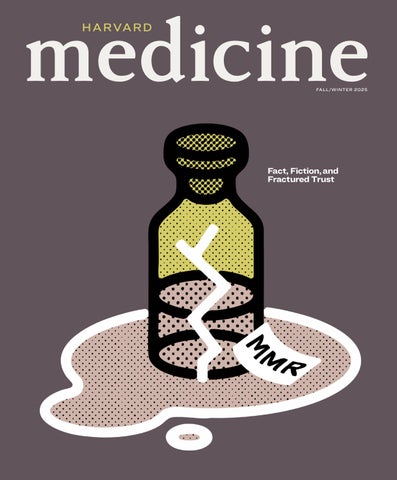
Fact, Fiction, and Fractured Trust
Contents FALL/WINTER 2025 VOLUME 98, NUMBER 2
Features
“ During my pediatric training in the 1980s, I never saw a case of measles. But in the spring of 2025, a measles epidemic was raging.” SEE PAGE 16
COVER ILLUSTRATION BY GIACOMO BAGNARA
16 A Most Difficult Year
34 Signals Crossed
BY PERRI KLASS, MD ’86
BY MOLLY MCDONOUGH
Pediatricians are adapting to a shift in the way many parents think about vaccines
Science sheds new light on a disorder that medicine forgot
22 Between Trial Data and TikTok BY SAMYUKTA MULLANGI, MD ’15
Practicing oncology in the age of misinformation
26 Trust in Numbers BY AMOS ESTY
Surveys of American attitudes toward science and medicine reveal both concerning and reassuring trends
40 Telling Children the Whole Story BY JAKE MILLER
For four alumni, the callings of medicine and storytelling are deeply connected
HARVARD
Editor Associate Editor Design Copyeditor Digital Art Direction
Amos Esty Molly McDonough Patrick Mitchell/MO–D April Poole Maya Rucinski-Szwec
Contributing Writers
Catherine Caruso Bobbie Collins Stephanie Dutchen Perri Klass, MD ’86 Jake Miller Samyukta Mullangi, MD ’15 Ekaterina Pesheva
Review
Rounds
Contributing Artists Timothy Archibald Giacomo Bagnara Blake Cale Catalogtree Valerie Chiang Nadia Hafid Matt Kalinowski Jonathan Kozowyk Oliver Munday John Soares Nate Williams Bryce Wymer Teng Yu
Dean of Harvard Medical School
4
An Alzheimer’s Breakthrough 9
Women Outlive Men — But Not in Medicine 10
The Heredity of Height 12
The Surprising Benefits of Low Oxygen 13
Campus News
48 ALUMNI PROFILE: CONSTANCE CHU MD ’92
Picking Up the Gauntlet 50 STUDENT LIFE
Writing Home 52 ALUMNI PROFILE: LAWRENCE WERU, MSC ’23
Making the Digital World Accessible to All 53 BOOKSHELF
Fighting Food Noise
14
5 Questions: Leila Agha
IN EVERY ISSUE
2 COMMENTARY 54 POP QUIZ 55 IN MEMORIAM 56 ALUMNI REPORT
Executive Dean for Administration Chief Communications Officer
George Q. Daley, MD ’91 Lisa Muto Laura DeCoste
Harvard Medical Alumni Association President
Louise Aronson, MD ’92
President-Elect Vice President
Tamara Fountain, MD ’88 Joanna Choi, MD ’09
Scott Aaronson, MD ’80 Amir Ameri, MD ’19 R. Sonia Batra, MD ’00 David Brown, MD ’97 Robert Daly, MD ’10 Tessa Gardner, MD ’72 Kalon Ho, MD ’87 Timothy Jenkins, MD ’92 Ben Robbins, MD ’16 Marc Sabatine, MD ’95 Kirstin Woody Scott, MD ’20 Ann Taylor, MD ’83 Laura Torres, MD ’88 Nancy Wei, MD ’06 Charmaine Smith Wright, MD ’03
Chair of Alumni Relations
A.W. Karchmer, MD ’64
Harvard Medicine magazine is published in print two times a year. Publishers: Harvard Medical Alumni Association and Harvard Medical School ©The President and Fellows of Harvard College Email: harvardmedicine@hms.harvard.edu Web: magazine.hms.harvard.edu
ISSN 2152-9957 PRINTED IN THE U.S.A.
CO M M E N TARY
Fact and Fiction in Science and Medicine
In the late 1950s, when measles struck about half a million Americans each year, John Enders and his colleagues at Harvard Medical School and Boston Children’s Hospital began clinical trials for a vaccine they had developed. By 1963, the vaccine was licensed for use, marking one of the great achievements in modern public health. Still, progress required more than scientific discovery. It was not until the late 1960s, when the CDC launched a nationwide campaign to inform families and encourage immunization, that the number of new measles cases dropped below 100,000 annually. Continued refinement of the vaccine — and persistent public engagement — led to the near eradication of measles in the United States by the turn of the century. Yet, as Perri Klass, MD ’86, reminds us in this issue, the story is not complete. Recent outbreaks underscore the fragility of public trust and the enduring challenge of communicating science in an age of pervasive media and misinformation. In this issue of Harvard Medicine, Klass and other HMS voices reflect on the power of communication in medicine — to enlighten or to mislead. Oncologist Samyukta Mullangi, MD ’15, describes battling misinformation in the clinic; psychiatrist Roy Perlis, MD ’97, examines shifting public trust in science. Alumni and faculty share how attentive listening deepened understanding of a misunderstood neurological condition, while alumni authors show how stories that inspire curiosity can awaken a child’s sense of scientific wonder. Together, their voices remind us that the story of medicine is written not only in discoveries but also in dialogue.
2
HARVARD MEDICINE
News & Research from Harvard Medical School
George Q. Daley Dean, Harvard Medical School
Review
Review
HARVARD MEDICINE
3
Review
N E U RO LOGY
An Alzheimer’s Breakthrough
What is the earliest spark that ignites the memory-robbing march of Alzheimer’s disease? Why do some people with Alzheimer’s-like changes in the brain never go on to develop dementia? These questions have bedeviled neuroscientists for decades. Now, a team of researchers at HMS may have found an answer: lithium deficiency in the brain. The work, published in August in Nature, shows for the first time that lithium occurs naturally in the brain, shields it from neurodegeneration, and maintains the normal function of all major brain cell types. The findings — 10 years in the making — are based on a series of experiments in mice and on analyses of human brain tissue and blood samples from individuals in various stages of cognitive health. The scientists found that lithium loss in the human brain is one of the earliest changes leading to Alzheimer’s, while in mice, similar lithium depletion accelerated brain pathology and memory decline. The team further found that reduced lithium levels stemmed from binding to amyloid plaques and impaired uptake in the brain. In a final 4
HARVARD MEDICINE
set of experiments, the team found that a novel lithium compound that avoids capture by amyloid plaques restored memory in mice. The results unify decades-long observations in patients, providing a new theory of the disease and a new strategy for early diagnosis, prevention, and treatment. Affecting between 50 million and 400 million people worldwide, Alzheimer’s disease involves an array of brain abnormalities — such as clumps of the protein amyloid beta, neurofibrillary tangles of the protein tau, and loss of a protective protein called REST — but these never explained the full story of the disease. For instance, some people with such abnormalities show no signs of cognitive decline. And recently developed treatments that target amyloid beta typically don’t reverse memory loss and only modestly reduce the rate of decline. It’s also clear that genetic and environmental factors affect risk of Alzheimer’s, but scientists haven’t figured out why some people with the same risk factors develop the disease while others don’t. Lithium, the study authors say, may be a critical missing link. ILLUSTRATION BY OLIVER MUNDAY
Review
YANKNER LAB
“The idea that lithium deficiency could be a cause of Alzheimer’s disease is new and suggests a different therapeutic approach,” says senior author Bruce Yankner, a professor of genetics and neurology in the Blavatnik Institute at HMS. The study raises hopes that one day lithium could be used to treat the disease in its entirety rather than focusing on a single facet such as amyloid beta or tau, he says. One of the main discoveries in the study is that as amyloid beta begins to form deposits in the early stages of dementia in both humans and mouse models, it binds to lithium, reducing lithium’s function in the brain. The lower lithium levels affect all major brain cell types and, in mice, give rise to changes recapitulating Alzheimer’s disease, including memory loss. The authors identified a class of lithium compounds that can evade capture by amyloid beta. Treating mice with the most potent amyloid-evading compound, called lithium orotate, reversed Alzheimer’s disease pathology, prevented brain cell damage, and restored memory. Although the findings need to be confirmed in humans through clinical trials, they suggest that measuring lithium levels could help screen for early Alzheimer’s. Moreover, the findings point to the importance of testing amyloid-evading lithium compounds for treatment or prevention. Other lithium compounds are already used to treat bipolar disorder and major depressive disorder, but they are given at much higher concentrations that can be toxic, especially to older people. Yankner’s team found that lithium orotate is effective at one-thousandth that dose — enough to mimic the natural level of lithium in the brain. Mice treated for nearly their entire adult lives showed no evidence of toxicity. “You have to be careful about extrapolating from mouse models, and you never know until you try it in a controlled human clinical trial,” Yankner says. “But so far the results are very encouraging.” Yankner became interested in lithium while using it to study the neuroprotective protein REST. But determining whether lithium is found in the human brain and whether its levels change as neurodegeneration develops and progresses required access to brain tissue, which generally can’t be accessed in living people. So the lab partnered with the Rush Memory and Aging Project, which has a bank of postmortem brain tissue donated by thousands of study participants across the full spectrum of cognitive health and disease. Having that range was critical, because trying to study the brain in the late stages of Alzheimer’s is like looking at a battlefield after a war, says Yankner; there’s a lot of damage and it’s hard to tell how it started. But in the early stages, “before the brain is badly
damaged, you can get important clues.” genes known to raise or lower risk of AlzheiLed by first author Liviu Aron, a senior mer’s, including the most well-known, APOE. research associate in the Yankner Lab, the Replenishing lithium by giving the mice lithteam used an advanced type of mass spec- ium orotate in their water reversed the distrometry to measure trace levels of about ease-related damage and restored memory 30 different metals in the brain and blood of function, even in older mice with advanced cognitively healthy people, those in an early disease. Notably, maintaining stable lithium stage of dementia called mild cognitive im- levels in early life prevented Alzheimer’s onpairment, and those with advanced Alzhei- set — a finding that confirmed that lithium mer’s. Lithium was the only metal that had fuels the disease process. markedly different levels across groups and “What impresses me the most about that changed at the earliest stages of memo- lithium is the widespread effect it has on ry loss. Its levels were high in the cognitive- the various manifestations of Alzheimer’s,” ly healthy donors but greatly diminished in says Yankner. “I really have not seen anything quite like it all those with mild impairment or full-blown my years of working Alzheimer’s. The team on this disease.” replicated its findings A few limited in samples obtained clinical trials of lithium for Alzheimer’s from multiple brain disease have shown banks nationwide. The observation some efficacy, but the aligned with previous lithium compounds population studies they used — such as that showed that highthe clinical standard, er lithium levels in the lithium carbonate — environment, includcan be toxic to aging ing in drinking water, In a mouse model of Alzheimer’s disease, people at the high doslithium deficiency dramatically increased es normally used in tracked with lower amyloid beta deposits in the brain (above) the clinic. The new rerates of dementia. But compared with mice that had normal search explains why: the new study went physiological levels of lithium. Amyloid beta was sebeyond earlier work questering these other by directly observing lithium in the brains of people who had not lithium compounds before they could work. received lithium as a treatment, establishing Yankner and colleagues found lithium oroa range that constitutes normal levels, and tate by developing a screening platform that demonstrating that lithium plays an essen- searches a library of compounds for those tial role in brain physiology. that might bypass amyloid beta. Other re“It’s the first time anyone’s shown that searchers can use the platform to seek addilithium exists at a natural level that’s biologi- tional amyloid-evading lithium compounds cally meaningful without giving it as a drug,” that might be even more effective. Yankner says. “One of the most galvanizing findings Then Yankner and colleagues took for us was that there were profound effects things a step further, demonstrating in mice at this exquisitely low dose,” Yankner says. that lithium depletion helps drive AlzheiIf replicated in further studies, the mer’s disease. The researchers found that researchers say lithium screening through feeding healthy mice a lithium-restricted diet routine blood tests may one day offer a way brought their brain lithium levels down to a to identify individuals at risk for Alzheimer’s level similar to that seen in patients with Alz- who would benefit from treatment to prevent heimer’s disease. This appeared to accelerate or delay disease onset. Studying lithium levthe aging process, giving rise to brain inflam- els in people who are resistant to Alzheimer’s mation, loss of synaptic connections between as they age might help scientists establish neurons, and cognitive decline. a target level that they could help patients In Alzheimer’s mouse models, lithium maintain to prevent onset of the disease, depletion dramatically accelerated the for- Yankner says. mation of amyloid-beta plaques and strucSince lithium has not yet been shown tures that resemble neurofibrillary tangles. to be safe or effective in protecting against It also activated inflammatory cells in the neurodegeneration in humans, Yankner embrain called microglia, impairing their abili- phasizes that people should not take lithium ty to degrade amyloid; caused the loss of syn- compounds on their own. But he expressed apses, axons, and neuron-protecting myelin; cautious optimism that lithium orotate or and accelerated cognitive decline and memo- a similar compound will move forward into ry loss — all hallmarks of Alzheimer’s disease. clinical trials in the near future and could The mouse experiments further re- ultimately change the story of Alzheimer’s vealed that lithium altered the activity of treatment. Stephanie Dutchen
FALL/WINTER 2025
HARVARD MEDICINE
5
Review R ES E A RC H SHORTS
Flu Fighters A group of nerve cells in the vagus nerve, called TRPV1 vagal nociceptors, are known for their role in sensing chemical irritation, tissue damage, heat, and pressure in the body. But a new study co-led by HMS scientists shows that in the setting of flu, these cells do much more: They rein in the immune system and avert the smoldering inflammation that often occurs in the aftermath of a viral infection. The research, conducted in mice, raises the possibility that vagus nerve function is one variable explaining why some people with the flu go on to develop long-lasting, immune-driven lung damage, while others recover following an initial infection. Instead of only targeting the flu virus or dampening immune activity, the researchers say, future treatments could mimic the function of nerve cells to help maintain the delicate balance between protective and damaging immune responses.
p ALMANZAR N ET AL., SCIENCE IMMUNOLOGY, AUGUST 2025
A blood vessel in the brain showing outlines of individual endothelial cells lining the vessel (left), gap junctions that tightly connect neighboring endothelial cells, allowing them to rapidly transmit signals (center), and smooth muscle cells that wrap around the vessel and produce the force needed to move blood (right).
Rapid Response To use its limited energy supply efficiently, the brain has evolved a system to deliver blood to areas of the brain that need it most. How this system operates has been somewhat of a mystery, but a team of HMS researchers has discovered that the brain uses specialized channels to communicate where oxygen and nutrients are needed. The analysis, conducted in mice, shows that the brain rapidly communicates those needs via endothelial cells that line blood vessels. These cells communicate efficiently via so-called gap junctions, tiny channels that physically connect neighboring cells. If replicated in humans, the study findings could improve interpretation of fMRI scans, which rely on the link between blood flow and neural activity. As regulation of blood supply is important for brain health, the insights could also advance the understanding of changes that occur in the brain during neurodegenerative disease.
p KROLAK T ET AL., CELL, JULY 2025
A Faster TB Fix Some patients with a form of tuberculosis called pre-extensively drug-resistant TB could benefit from a shorter treatment with fewer drugs, according to a study from an international collaboration that includes HMS scientists. In the first-ever clinical trial focusing exclusively on people with this hard-to-treat form of the disease, researchers compared an experimental drug regimen lasting six or nine months with a regimen lasting 18 to 24 months. The shorter regimen was 87 percent effective while the longer therapy was 89 percent effective, suggesting the shorter regimen is a promising alternative. But not all patients responded the same way; those with more advanced lung damage, for example, did not fare as well on the shorter regimen. While recent guidance recommends treatment regimens irrespective of disease severity, the researchers suggest that guidelines should be updated to consider stratified approaches to care based on resistance pattern and extent of disease.
Evaluating the extent of a trial participant’s pulmonary disease at a Socios En Salud study site in Peru.
Clusters of mouse vagus nerve sensory cells reveal the presence of TRPV1, a molecular sensor that detects irritants, heat, and inflammation. A recent study shows that nerve cells with this sensor play a central role in taming inflammation and tissue damage during flu infection.
6
HARVARD MEDICINE
FALL/WINTER 2025
CLOCKWISE FROM LEFT: CHIU LAB; GU LAB; JOANNA ARCOS/PIH
p GUGLIELMETTI L ET AL., THE LANCET RESPIRATORY MEDICINE, JULY 2025
Review
BY T HE NU M BERS
Care at a Cost What Happens When Private Equity Acquires a Hospital?
100%
Increase in surgical site infections³
38%
13%
Increase in central line-associated bloodstream infections³
Increase in emergency department deaths among Medicare beneficiaries¹
25% 7%
Increase in preventable adverse events in hospital inpatient wards³
27 %
Increase in hospital charges per hospitalized day⁴
Increase in hospital net income⁴
12%
Increase in transfers of hospitalized Medicare patients to other hospitals³
Zirui Song, MD ’14, an associate professor of health care policy in the Blavatnik Institute at HMS and HMS associate professor of medicine at Massachusetts General Hospital, has been combing through Medicare claims and cost report data to compare outcomes in hospitals that were acquired by private equity to similar hospitals that were not. Over the past several years, he and colleagues have found that acquisition by private equity firms was associated with a number of changes.
INFOGRAPHIC BY OLIVER MUNDAY
13–27 % Decrease in salary expenditures hospital-wide²
12%
Decrease in full-time employees hospital-wide¹
¹ KANNAN S ET AL., ANNALS OF INTERNAL MEDICINE, SEPTEMBER 2025; ² KANNAN S & SONG Z, HEALTH AFFAIRS, FEBRUARY 2025; ³ KANNAN S ET AL., JAMA, DECEMBER 2023; ⁴ BRUCH J ET AL., JAMA INTERNAL MEDICINE, AUGUST 2020
HARVARD MEDICINE
7
Review
New Ways To Supercharge Cancer Immunotherapy Scientists at HMS have identified a molecular brake that hinders the ability of T cells to attack tumors, a discovery that could expand the array of cancer immunotherapy treatments. The findings offer a new pathway to design treatments that help more patients — a welcome development given that current cancer immunotherapies work in less than half of those who receive them. Researchers in the lab of Arlene Sharpe, MD ’82 PhD ’81, the Kolokotrones University Professor in the Blavatnik Institute at HMS and senior author on the work, discovered that a protein called STUB1 restrains the immune system’s elite cancer-fighting CD8+ T cells. It does so by interfering with immune-signaling receptors that are crucial for T cells’ ability to mount a vigorous anti-tumor response. The team used CRISPR to screen nearly 900 genes before landing on STUB1. When they deleted this gene in CD8+ T cells, the cells got better at attacking tumors. Mice with STUB1-deficient T cells had slower-growing cancers and lived longer than those with unaltered T cells. The study showed that STUB1 dials down the ability of T cells to detect and respond to signals from immune-boosting molecules called cytokines by engaging with another protein called CHIC2. When STUB1 and CHIC2 interact, they remove key receptors from the surface of T cells, rendering these immune defenders less responsive to immune-activating signals sent by cytokines. While further research is needed to understand the promise, effectiveness, and safety of STUB1 inhibition in humans, the findings suggest that blocking the interplay between STUB1 and CHIC2 could strengthen the body’s natural responses against cancer.
Tiny Tweaks in Gut Bacteria Keep Inflammation at Bay
An AI Tool To Optimize Drug Discovery
One of the most captivating mysteries about the immune system is how it manages to keep its healthy equilibrium — staying on high alert and ready to react to harmful invaders or damaged cells, while remaining calm in the presence of innocent triggers such as food. When it comes to gut immunity, this delicate balance might hinge on a tiny molecule on the surface of gut bacteria, according to a new HMS-led study. The research, done in mice, reveals that a small structural tweak in lipid A — a fatty-sugar molecule that sits on the outer surface of many gut bacteria — can determine whether immune cells in the colon go on the offensive or remain in a state of peaceful vigilance. In most disease-causing bacteria, lipid A usually comes in a form with six fatty acid chains, which triggers a strong inflammatory response. The HMS-led team discovered that a rare four-chain version found in many bacteria that live in the intestine instead triggers gut cells to release interferon beta, a chemical that calms the immune system and helps sustain protective regulatory T cells. When a group of mice with a form of colitis that mimics human inflammatory bowel disease were given the four-fatty-acid chain version of the molecule with their food, these animals’ colons were shielded from inflammation and fared much better than mice with colitis that did not get the molecule as part of their diet. The treated group had minimal signs of inflammation and their colons remained healthier. By contrast, the untreated animals developed severe colitis. “Our findings highlight how subtle differences in microbial molecules can dramatically alter immune responses,” says senior author Dennis Kasper, the HMS William Ellery Channing Professor of Medicine at Brigham and Women’s Hospital and a professor of immunology in the Blavatnik Institute at HMS. “It’s not the mere presence of gut bacteria but the shape of their molecules that can alter immune behavior.” “These insights can help us think about new ways to modulate colon immunity via labmade bacterial molecules as a way to target gut inflammation,” Kasper adds.
In a move that could reshape drug discovery, HMS researchers have designed an AI model capable of identifying treatments that reverse disease states in cells. The new model, called PDGrapher, focuses on multiple drivers of disease and identifies the genes most likely to revert diseased cells back to healthy function. The tool also identifies the best single or combined targets for treatments that correct the disease process. A traditional drug-discovery approach, which usually focuses on activating or inhibiting a single protein, can fall short when diseases are fueled by the interplay of multiple signaling pathways and genes. The approach enabled by PDGrapher looks at the bigger picture to find compounds that can actually reverse signs of disease in cells, even if scientists don’t yet know exactly which molecules those compounds may be acting on. PDGrapher points to parts of a cell that might be driving disease and simulates what happens if these cellular parts are turned off or dialed down. The AI model then offers an answer as to whether a diseased cell would occur if certain targets were “hit.” Researchers trained the tool on a dataset of diseased cells before and after treatment so that it could figure out which genes to target to shift cells from a diseased state to a healthy one. Next, they tested it on 19 datasets spanning 11 types of cancer, using both genetic and drug-based experiments, asking the tool to predict various treatment options for cell samples it had not seen before and for cancer types it had not encountered. The tool accurately predicted drug targets already known to work but that were deliberately excluded during training. It also identified additional candidates supported by emerging evidence. The team is currently using this model to tackle brain diseases such as Parkinson’s and Alzheimer’s, looking at how cells behave in disease and spotting genes that could help restore them to health. The model is also freely available to other researchers. “Our ultimate goal is to create a clear road map of possible ways to reverse disease at the cellular level,” says study senior author Marinka Zitnik, an associate professor of biomedical informatics in the Blavatnik Institute at HMS.
p CHO HS ET AL., CELL, SEPTEMBER 2025
p GONZALEZ G ET AL., NATURE BIOMEDICAL ENGINEERING, SEPTEMBER 2025
p LAFLEUR MW ET AL., NATURE IMMUNOLOGY, AUGUST 2025
8
HARVARD MEDICINE
FALL/WINTER 2025
NATIONAL INSTITUTE OF ALLERGY AND INFECTIOUS DISEASES
R ES E ARC H SHORTS
Review
E P IDE MIOLOGY
Women Outlive Men — But Not in Medicine In every country in the world, demographic data show that women tend to live longer than men. But that pattern may not hold true among U.S. physicians, according to HMS researchers. “It’s beneficial to be a woman from a mortality perspective,” says Anupam Jena, the Joseph P. Newhouse Professor of Health Care Policy in the Blavatnik Institute at HMS and an HMS professor of medicine at Massachusetts General Hospital. “But that benefit doesn’t accrue if you’re a woman in medicine.” Jena and frequent collaborator Christopher Worsham, an HMS assistant professor of medicine at Mass General, often explore how circumstances and luck affect medical outcomes. In many cases they draw from publicly available datasets — so in 2020, when the Centers for Disease Control and Prevention began publishing statistics linking death certificates to occupational roles, they saw an enticing opportunity. “It was the first time that this data had been released on a very large scale,” Jena says. “It allowed us to study all sorts of interesting questions about occupational mortality hazards.” First, along with colleagues including lead author Vishal Patel, a surgery resident at Brigham and Women’s Hospital, the researchers revealed that taxi drivers — who frequently exercise the hippocampal regions of their brains for spatial navigation — were less likely to die of Alzheimer’s disease than people in any other profession. The work corroborated intriguing observations from a U.K. study that found increased hippocampal volume among cabbies 25 years ago. Next, they turned their lens on the medical profession. It had been decades since researchers had examined mortality rates among U.S. physicians, and most previous studies had only included men or explored single causes of death. In a recent study, they decided to compare the mortality rates of physicians and other health care workers with those of nonhealth-care workers across different income levels and to explore how variables like sex and race might come into play. The study, published in May in JAMA Internal Medicine, offers the first comprehensive national estimates of mortality rates among physicians and other health care workers. One takeaway is good news for doctors: ILLUSTRATION BY OLIVER MUNDAY
HARVARD MEDICINE
9
Review
10
HARVARD MEDICINE
GE NE TICS
The Heredity of Height
MATTHEW KOHASHI
Physicians had a lower mortality rate than haps the women who decide to become doctors those in other occupations, including in somehow have different health risk factors high-income professions like law, science, than women who become lawyers or engiand engineering. “Physicians have better ac- neers. cess to medical care, perhaps because of who Another is that there’s some effect of they are, what they’re plugged into,” says medicine itself that changes the experience Jena. “That might confer some health bene- of women in medicine versus in law or engifit — no surprises there.” neering. The most obvious, Jena suggests, is But the researchers were more sur- the concept of a “second shift.” prised when they zoomed in on how sex and “If you’re a woman in medicine, you race influenced physician mortality. work long hours in the hospital, you train for While females who did not work in many years, and then when you’re practicing, health care were 45 percent less likely to it can be very busy and stressful,” says Jena. die than their male counterparts during the “On top of that, you have additional work that three-year study period from 2020 through has to be done when you get home, the type 2022, that mortality advantage was almost of work that is disproportionately borne by entirely absent among female physicians, women — and that could be challenging for health.” who did not experience a statistically significant difference in morPrevious research from Jena tality as compared to male physibacks up this theory. In a 2017 study cians. For certain causes of death, published in Annals of Internal including cancer and chronic respiMedicine, he and colleagues used ratory diseases, female physicians census data to explore marriage actually experienced higher morpatterns among doctors. They tality rates than males — patterns found that 17 percent of male doctors in the sample had married fethat were not observed in the general population. male doctors, while 31 percent of “Another way to put it is female doctors had married male that even though women live lon“If you’re a doctors. Meanwhile, 46 percent of woman in male doctors were married to peoger in medicine than women in medicine, ple who didn’t work paid jobs outlaw or engineering or science,” Jena you’re less says, “they don’t live as long as you likely to side the home, compared to only 9 would’ve expected given what we have a spouse percent of female doctors. In anothdoing most er study, they revealed that among observe between women and men of the couples consisting of two physiin the rest of society.” household The findings were even more work.” cians, the women tended to spend stark for Black female physicians, ANUPAM JENA more time on household work than the men. who experienced higher mortality rates than all other physician The implication? “If you’re subgroups. While Black physia man in medicine, there is sort of cians of both sexes had more than a clear division of household and double the mortality rate of white non-household work, whereas if physicians, that difference was compound- you’re a woman in medicine, you’re less likely ed among Black female physicians, who were to have a spouse doing most of the household 128 percent more likely to die during the study work,” Jena says. period than white female physicians. Although any attempt to explain the “If you’re a Black woman physician, you mortality disparities is speculation at this actually do no better than a white woman in point, the research adds weight to a growing the general population,” Jena says. “That body of literature indicating that not all docmeans the benefit of being a physician be- tors have the same experiences or support. cause of your access to health care and your Other studies show that women physicians medical knowledge is wiped away.” experience higher rates of burnout and sexThe findings are striking because tra- ual harassment, for example, and that they’re ditional explanations for health disparities, paid less than male colleagues for similar like lack of education or economic opportu- work. Jena says that even without the mornity, are arguably less relevant to physicians. tality data, it’s clear that women physicians But Jena points out that there is substantial need to be better supported — both inside and evidence of workplace discrimination in med- outside the workplace. icine and that even doctors are not immune “The interventions that could help are from the broader effects of structural racism probably things we should do anyway,” he in society at large. says. “If the same problems are creating this As for the higher-than-expected mor- mortality effect, then that’s just another reatality rate among female doctors in general, son that we should want to improve the expethe researchers have a few ideas about what riences of women in medicine.” Molly McDonough could be going on. One is selection bias: Per-
Review
JOHN SOARES
What has made height so fascinating to geneticists? “Height is one of the first things you notice about people,” says Joel Hirschhorn, MD ’95 PhD ’95, an HMS professor of genetics, the HMS Concordia Professor of Pediatrics, and chief of the division of endocrinology at Boston Children’s Hospital. “It’s easy to measure. And it’s pretty obvious that tall parents tend to have tall children and short parents tend to have short children.” Although that link may be obvious, understanding its nuances has never been simple. That’s because height is a polygenic trait: Each person’s stature is shaped not by variation in a single gene, but by cumulative effects of many changes in the genetic code. It’s a con-
ILLUSTRATION BY OLIVER MUNDAY
cept that applies to countless human characteristics, from skin color and weight to the likelihood of developing cancer or heart disease. Hirschhorn originally got interested in the topic for personal reasons. Not because he’s unusually tall or short — “I am of average height, although I think I’ve shrunk,” he quips — but because of his daily experience in the clinic. Short stature is one of the most common reasons parents bring children to see a pediatric endocrinologist. During his fellowship in the field in the 1990s, Hirschhorn sometimes saw children who were growing more slowly than their peers — but a quick glimpse at the parents would indicate the slow growth was likely due to harmless genetic disposition. “I used to tell the parents, there’s a lot of genes that you carry, and you’ve passed some of the shorter ones to your child, but we don’t know what those genes are,” he recalls. After repeating “we don’t know” dozens of times, Hirschhorn realized it was something he might just be able to figure out. Over two decades, Hirschhorn, who is also an institute member and co-director of the metabolism program at the Broad Institute of MIT and Harvard, has leveraged huge datasets to pinpoint precise genetic variants that contribute to stature. He organized and worked in collaboration with the Genetic Investigation of Anthropometric Traits (GIANT) consortium, an international group of scientists who pool data to conduct genome-wide association studies (GWAS) related to height. “First we found one gene variant linked to height. Then we found ten. Then there were a couple hundred,” says Hirschhorn, who still chairs the GIANT consortium today. The more genomic data he and collaborators could access, and the more they refined the tools used to analyze it, the more variants they uncovered. By 2022, they were able to pinpoint more than 12,000 variants reliably associated with height. Along the way, they learned lessons and best practices that would go on to influence the study of other polygenic traits. While some researchers predicted that increasing the sample size beyond a few hundred thousand individuals would yield diminishing returns, Hirschhorn and colleagues demonstrated that increasing sample size into the millions directly increased the power of GWAS to detect important variants. By the time their 2022 study was published, which included genomic data from more than 5 million people, they had mapped all of the regions of the genome that contained common variants influencing height. Their work revealed that the heritability of a particular polygenic trait can be concentrated within a specific region of the genomic code, like a kind of hotspot. As an
FALL/WINTER 2025
HARVARD MEDICINE
11
Geneticist Joel Hirschhorn learns he’s five feet, nine inches tall — with shoes on.
endocrinologist focused on hormone-related conditions, Hirschhorn originally expected most variants influencing height to be those that control and regulate growth hormone. To his surprise, though, most height-related variants discovered are actually expressed in a different genomic region, one that controls the growth plate, a soft area of cartilage near the ends of children’s bones where cells divide to form new bone. “Nature is basically telling us the biology of growth,” Hirschhorn says. “It’s saying, ‘Hey, it’s the growth plate — that’s where most of the action is.’” The findings could have implications for future therapies, like those for yet-unexplained conditions of abnormal skeletal growth in children. Back in his clinic, Hirschhorn still encounters parents each day who are concerned about their children’s height. He does his best to use the tools available, like measurements of the hand, to predict what each child’s height should be and whether their growth is part of normal variation. But he hopes that the data he’s found can be incorporated into a new type of test to help doctors predict what a child’s height should be based on their genes — and therefore ascertain whether a case of slow growth is based on normal genetic variation or something more nefarious. When he set out to research height, Hirschhorn never imagined he’d glean enough data to make those kinds of predictions. “I had no idea we were going to get where we got,” he says. “I’m pleasantly surprised to have been proven wrong.” Molly McDonough
M O L ECUL AR BIOLOGY
The Surprising Benefits of Low Oxygen
Above: Vamsi Mootha. Top: La Paz, Bolivia, sits at an altitude of about 12,000 feet, making it the highest capital city in the world.
In 2016, Vamsi Mootha, MD ’98, an HMS professor of systems biology at Massachusetts General Hospital, made an intriguing discovery: Chronic hypoxia — that is, continuously breathing air with a lower than usual concentration of oxygen, akin to living at a very high altitude — could alleviate rare forms of mitochondrial disease in mice. At first, the finding seemed counterintuitive. Oxygen deprivation carries plenty of health risks, and at that time, many people thought that the key to tackling mitochondrial dysfunction was to give the body more oxygen. “But when we thought about it, there was a logic to it,” says Mootha, who is also an institute member and co-director of the metabolism program at the Broad Institute of MIT and Harvard. He reasoned that when mitochondria — tiny structures in cells that use oxygen to make energy — are fundamentally broken, the problem is not a lack of oxygen; rather, if anything, there is an excess of unused oxygen. Perhaps, he thought, adding oxygen to the body when mitochondria can’t consume it can overwhelm the system and cause damage. Mootha and colleagues went on to show that hypoxia improved motor function in a mouse model of Friedreich’s ataxia, the most 12
HARVARD MEDICINE
FALL/WINTER 2025
common mitochondrial disease caused by a single gene mutation. They also found that restricted oxygen could slow down aging in mice. Most recently, for a study published in August, Mootha teamed up with Fumito Ichinose, the HMS William Thomas Green Morton Professor of Anaesthesia at Mass General, and colleagues to show that hypoxia can slow or even reverse the progression of disease in a mouse model of Parkinson’s — which is associated with secondary mitochondrial dysfunction, and the second most common neurodegenerative disease. What mechanisms could be driving these findings? “I’m a car guy,” Mootha says, setting up a helpful analogy. Think of each mitochondrion like a shiny, new vehicle. Just as exposure to oxygen causes metal car components to rust, oxygen can “rust” the many biomolecules, notably metals and iron-sulfur clusters, that act like essential wires for the electricity in mitochondria. Healthy mitochondria can shield themselves from the corrosive effects of oxygen, but in mutated or damaged mitochondria those mechanisms may be faulty. When oxygen reacts with an iron molecule, it plucks off one of the molecule’s electrons, leaving behind a damaged form of the iron and producing a reactive oxygen molecule called a free radical. Scientists have known for a while that, elsewhere in the body, these damaging free radicals can typically be combated with antioxidants — but researchers have already tried using antioxidants to treat mitochondrial diseases in both mice and humans with no luck. Perhaps that’s because antioxidants only address one half of the equation, says Mootha; they tackle the byproducts but not the original damage. To use his metaphor, it may be that antioxidants are like trying to scrub rust off the car, while chronic, continuous hypoxia is like preventing the car from rusting in the first place. If Mootha is on the right track, the next challenge is clear: finding safe and practical ways to harness hypoxia’s protective effects in people. To that end, Mootha and collaborators recently successfully tested the safety of in-hospital hypoxic tents among healthy volunteers. They’re also pursuing promising evidence that hypoxia’s protective effects could be packaged in the form of a pill. To Mootha, what once felt like a paradox has started making sense. And it’s led to findings that offer much-needed hope to patients with diseases that as of yet have no effective treatments. “There’s been so much luck and serendipity in this entire discovery,” he says. “But sometimes you need that in science.” Molly McDonough
MASS GENERAL DEPARTMENT OF MOLECULAR BIOLOGY / EEJCC, CC BY-SA 4.0, VIA WIKIMEDIA COMMONS
Review
Review
CA M P US NEWS
Welcoming the Class of 2029 On August 4, nearly 200 new medical and dental students donned white coats and celebrated the start of their educational journeys at HMS and Harvard School of Dental Medicine. The day began with a deans’ welcome followed by ceremonies in four amphitheaters on the HMS campus, assigned by student academic society. After the festivities, students got down to the business of learning with the week-long Introduction to the Profession course. Faculty laid the foundation for the coursework, clinics, and research opportunities that the students will take part in over the next four or more years. This year’s entering MD
class is made up of 135 students in Pathways and 30 students in HST. Twenty-one medical students intend to pursue a dual MD-PhD degree.
K. Lisa Yang Brain Body Center Launches at HMS A $30 million gift to Harvard University from philanthropist Lisa Yang will establish the K. Lisa Yang Brain Body Center at HMS, bringing together experts from diverse disciplines to illuminate the mysteries of brain-body signaling and train the next generation of researchers. The center is part of the Yang Tan Collective, which includes six research centers at MIT and two at HMS. Scientists at the new HMS
center will collaborate with peer researchers at the sister K. Lisa Yang Brain-Body Center at MIT. Housed within the neurobiology department in the Blavatnik Institute at HMS, the center will include scientists with deep expertise in the physiology of the brain and organ systems. These scientists will collaborate internally and work together externally with investigators at the MIT center, which has pioneered novel tools and approaches for studying brainbody communication. The HMS center was established with a $10 million endowment, plus another $10 million in research funds to be used within five years. An additional $10 million endowment will provide fellowships and support to PhD students and postdocs interested in the field of brain-body communication.
David Ginty, the Edward R. and Anne G. Lefler Professor of Neurobiology and chair of the Department of Neurobiology, and Michael Greenberg, the Nathan Marsh Pusey Professor of Neurobiology, will serve as co-directors of the center. In addition to Ginty and Greenberg, core investigators include Mark Andermann, a professor of medicine at Beth Israel Deaconess Medical Center and an HMS professor of neurobiology; Chenghua Gu, a professor of neurobiology; Stephen Liberles, a professor of cell biology; and Dragana Rogulja, an associate professor of neurobiology. The researchers hope that their projects will provide a more holistic understanding of brainbody communication and illuminate the underlying mechanisms of diseases that occur when this communication breaks down.
A New Name for the New Research Building
STEVE LIPOFSKY (2)
In September, the New Research Building (NRB) was renamed the Veritas Science Center (VSC), in recognition of philanthropic support. The newly rechristened VSC opened in 2003 and is one of Harvard’s largest buildings, spanning 525,000 square feet. It provides a home for the Departments of Genetics, Immunology, and Microbiology in the Blavatnik Institute at HMS, comprising about 90 labs and 1,000 researchers, including some from Brigham and Women’s Hospital. Veritas Science Center
HARVARD MEDICINE
13
Review
CA M P US NEWS
5 QUESTIONS
“ There can be real trade-offs between spending more on health and spending more on education or on other things that people need.”
Resilience in an Unsettling Time “2025 has been, without a doubt, one of the most difficult and unsettling times in higher education, here at Harvard, and especially here at Harvard Medical School,” said Dean George Q. Daley, MD ’91, in his annual State of the School Address on September 17. But, he added, “I can promise this: The current crisis will not be our undoing, and through it all I remain optimistic about our future prospects.” Daley detailed some of the challenges HMS faces in light of actions taken by the federal government against Harvard. He noted that federal funding represents 75 percent of the School’s research funding and 30 percent of its annual revenue — and that even before federal grant terminations, HMS was already operating at a deficit. Daley thanked School leaders, department chairs, and administrators for carefully managing costs through actions such as reducing spending, deferring capital projects, and heeding pauses on hiring and merit increases. For the current fiscal year, Daley explained, HMS put in place a stopgap measure composed of rescue funding from the University and matching funds from HMS to partially offset the loss of federal funding. Longer term, Daley emphasized, HMS must reduce operating costs and become less reliant on federal funding. At the same time, he highlighted positive news, including the development of new industry partnerships, the success of companies incubated in the Blavatnik Harvard Life Lab Longwood, and fundraising. Daley also discussed an update to the HMS strategic plan. The update, referred to with the acronym BEACON, focuses on six key priorities: belonging, culture, and community; excellence in academics and education; artificial intelligence; collaborative and transformative science; outcomes and translation; and newfound resilience. As Daley looked ahead, he said he hopes HMS can continue to be a school that financially supports its students; a key part of a biomedical ecosystem full of opportunity for all; and an institution that maintains academic freedom, makes transparent, data-driven funding decisions, and invests in equitable, patient-centered research. “I am so proud that Harvard has defended its principles and is standing up for what is just and what is in the public interest,” he said. “The current crisis is testing us, no doubt about it. But we must remain true to our mission.”
A CONVERSATION WITH LEIL A AGHA, HEALTH ECONOMIST AND ASSOCIATE PROFESSOR OF HEALTH CARE P OLICY IN THE BLAVATNIK INSTITUTE AT HMS
What drew you to economics, and to the economics of health care in particular? As an undergraduate, I realized that economics was at the intersection of my interests in math and policy. Then, as a graduate student in economics, I became interested in how digitization might reshape the nature of work. There was a unique opportunity to study that question in health care, because we could see what doctors were doing, measure when IT systems were implemented, and consider how that changed the nature of work and the care that was delivered. I pivoted into health economics in order to be able to look at that question and never left. Are there common misconceptions that people have about health economics? One is that health economists only care about how much care costs. It’s really bigger than that. However much we’re spending, we want to make sure that we’re getting the most benefit for people from that spending. There can be real trade-offs between spending more on health and spending more on education or on other things that people need. So the question is, how do we organize a health care system to maximize benefit? You’re coming at this with an economic background. What is it like to talk to clinicians about your research? One of the great things about working at HMS is that there are many smart doctors who are often considering the same problems that I’m interested in but coming at them from a different perspective. I’ve found a lot of value in collaborating and discussing ideas with them. In many cases, getting their understanding of clinical decision-making and the medical science is really important to informing the research and making sure that I am measuring the right outcomes and focused on aspects of the problem that are important to practitioners. What is one book you’d recommend to someone who wants to gain a better understanding of health economics? There are a lot of great books. But one that I would recommend is Random Acts of Medicine by some of my colleagues in health care policy, Anupam Jena and Christopher Worsham. It’s a really nice introduction to how we can use some of the tools of empirical economics to think about questions in health care. What’s the last thing you watched, read, or listened to that stayed with you? I recently read Colm Tóibín’s Brooklyn and his new sequel, Long Island. They’re beautiful books, highlighting the sort of slidingdoor choices that people make in life and the way that those choices and the consequences are shaped by social constraints and a good deal of chance. Amos Esty
14
HARVARD MEDICINE
PHOTOGRAPH BY TONY LUONG
Review
Pediatrics
A Most Difficult Year PEDIATRICIANS ARE ADAPTING TO A SHIFT IN THE WAY MANY PARENTS THINK ABOUT VACCINES BY PERRI KLASS ILLUSTRATIONS BY BLAKE CALE
16
HARVARD MEDICINE
FALL/WINTER 2025
Pediatrics
Let me give you two pediatric moments from 2025.
Moment number one: a spring afternoon. I was sitting in the teaching area of the pediatric clinic at Bellevue Hospital in New York City with a group of faculty colleagues, all of us waiting for the residents to come and tell us about the children they were seeing. A news flash came in on someone’s phone: A child in Texas had just died of measles. Every pediatrician in the room felt it as a blow: The thing that must not happen has just happened. During my pediatric training at Boston Children’s Hospital in the 1980s, I never saw a case of measles. I saw children die from many different diseases but never from measles. Measles was gone, not eliminated from the face of the Earth, like smallpox, but no longer endemic in the United States. It did not threaten our patients in Boston. Our patients were vaccinated. But in the spring of 2025, a measles epidemic was raging in Texas. And yes, children died. Moment number two: the opening plenary session of the National Conference of the American Academy of Pediatrics (AAP) in September. We had just sat down after listening to the Denver Children’s Chorus sing the National Anthem. Susan Kressly, a pediatrician and the current president of the AAP, asked us all to stand up again and scream. Some 5,000 pediatricians, in a giant conference center auditorium, let loose and howled. We all understood why we were screaming — in grief, in pain, in outrage, in anxiety. “It’s not been an easy year for our members,” Kressly said. But in addition to that cathartic stand-and-scream, the national pediatric meeting was notable for moments when we applauded like we would never stop. Here are some of the big applause lines for an audience of pediatricians in the fall of 2025: a video of the next AAP president, Andrew Racine, a pediatrician at Montefiore Einstein in New York, saying, “Vaccines don’t save lives, vaccinations save lives.” We cheered so loudly that we drowned out the next lines of the video. And you should have seen the moment when Kressly thanked the AAP infectious diseases committee and called them “guardians of truth.” It stopped the show. I started my pediatric residency in July 1986 and almost immediately began to identify as a pediatrician, well before I could claim any real skill or experience. In pediatrics, I had found my people. I wanted to be part of that particular us — and I still do. I worked for years at a neighborhood health center in Boston, 18
HARVARD MEDICINE
with a population made up of new arrivals (Vietnamese refugees, Haitian immigrants) and longtime Bostonians. I worked in the refugee clinic at Boston City Hospital. Now I work at Bellevue, the oldest public hospital in the United States. The people who came to those places wanted vaccines. In many cases, they were downright eager to have their children vaccinated. They were grandmothers who remembered bad diseases in the old country, wherever that was, or parents who remembered systems in which vaccines cost money. They were the descendants of longtime neighborhood activists who had fought to bring the health center to the community so that kids could get their shots close to home. They were refugees eager to send their children to school in their new city who looked at the completed school health forms as tickets of opportunity. I knew there were people out there who didn’t trust vaccines, and to be honest, I was grateful not to be taking care of them. I remember, more than a decade ago, speaking with a woman from Marin County, California, who had given birth to very premature twins. After a long and difficult few months in the newborn intensive care unit, she had finally brought home her precious, delicate babies, but it was flu season, and she worried obsessively that they would catch a respiratory virus, that they would be rehospitalized, that they might even die — all perfectly reasonable worries for a parent in her situation. She, of course, had gotten her flu shot as soon as it was available, as had every other member of her family, but the twins were under six months old, too young to get the vaccine, and she was aware every day that she lived in an area where many people refused vaccines. How could she tell which neighbor might casually bring disease into her house, which passing stranger who admired her babies in the park might be breathing death? I remember this conversation because I agreed with her, and because I felt a mix of disapproval and scorn: Rich Californians, what can you expect? That was, to be honest, the way I had always thought of what we now call either “anti-vaxxers” or even “vaccine-hesitant” parents: They were entitled and overprivileged people who felt that other people’s children should be vaccinated, which would then protect their own precious and entitled offspring. They thought they ought to be, if you will pardon the expression, immune. In contrast, the patients I took care of had parents who really got it. Some came from parts of the world where they had seen the diseases we were vaccinating against — measles, polio, neonatal tetanus — which was certainly more than I had ever done. But whether they were immigrants or born in the United States, the parents I worked with only very rarely expressed any anxiety about immunizations. When stories about vaccine hesitancy came up, my colleagues and I would look at one another and shake our heads, feeling fortunate that we worked with sensible parents, parents who wanted to protect their children and their communities, parents who trusted us.
But now, the stories I hear from old friends and colleagues in pediatrics across the country make clear that something has changed. Terri McFadden, a professor of pediatrics at Emory School of Medicine, started practicing in 1991 and has worked with the same population ever since — “an urban underserved population, mostly people of
FALL/WINTER 2025
Pediatrics
A boy gets a measles vaccination at a school in Georgia in the early 1960s.
color.” Like me, she remembers a time when it was very infrequent to have a parent who decided not to vaccinate, she says, “and even then, you could have a conversation. Now, I find, there is a group that is just not going to vaccinate. ... They’re just angry.” Amy Shriver, a general pediatrician in Des Moines, Iowa, has been in practice for 17 years, working with an urban population, mostly children on Medicaid. Recently she saw a family two days after their baby had been discharged from the newborn nursery, and she read in the baby’s chart that the parents had refused to have the newborn screen done. This blood test checks for a large number of genetic problems, many of which can be treated much more effectively if they’re found early. There’s no shot involved, no injection of any kind, just a blood test to look for danger. She asked why they had refused the screen, and “they said they just didn’t trust the system, they didn’t trust any of the testing, and no matter what I said I couldn’t explain why it was so important.” We are seeing more of those angry families, who come into the exam room knowing that vaccines are dangerous, that greedy pediatricians are in league with maleficent pharmaceutical companies. “I’ve had conversations about how vaccines are coming up where people will appear to be vaccine hesitant with good questions and then the questions devolve into an anti-vaccine attack on pediatricians — in my exam room!” Shriver says. “One new family came to me with a 2-week-old baby and the dad wanted to know why there is no mechanism for people to sue the vaccine companies and why we give so many vaccines at the same time.” Conversations like this, she says, “leave me feeling tired, defeated, and mistrusted.” So what happens with a family like that? “I almost didn’t want to see them again. I said, ‘I’m happy to provide you with evidence-based information, and please ask me more questions,’ but in my heart, I didn’t want more questions.” She pauses, then adds, “They didn’t vaccinate at the two-month visit, but they saw me again.” And she adds that she feels strongly that all children deserve high-quality care, whether their parents decide to vaccinate or not, and therefore “I will continue to see all children and work on relationships, hoping that things might change.” McFadden points out that families are bombarded by misinformation, and that our medical system does not make it easy to maintain the relationships between patients and doctors that build trust over time. “I feel like it’s harder and harder to have the continuity with families that builds that trust,” she says. And the lack of trust extends beyond vaccines, to the recommendations that we make about how to protect children from other dangers, about safe sleep, about limiting screen time. “Families are feeling that we don’t understand their lived experience,” she says, “that we don’t understand what it’s like to be a parent in 2025.” Parents are also being targeted by purveyors of disinformation, with scare tactics often aimed specifically at vulnerable com-
munities. At Bellevue, we have lots of parents who refuse the COVID vaccine and the flu vaccine. We don’t often see the angry parents, but more and more, we see parents who say they don’t want vaccines. We don’t turn away unvaccinated children (we don’t turn anyone away), but we do point out that they will need to be vaccinated for HeadStart and for school. We encourage the residents to have these conversations, over and over again, and we congratulate them when a hesitant family agrees to vaccinate. It used to be something that came up once in a while in the clinic, an interesting “teaching case.” Now it’s every day. It’s something of a burden — these conversations do take time — but it’s a skill that the residents need to practice. For my part, I find that now, I talk about vaccination in every class I teach. I have come to feel that it is something that everyone needs to understand, this incredibly clever human trick, in which people learned to turn on an immune system so complicated that when you diagram it, it quickly comes to look like a parody. Vaccination is named for the cowpox virus, vaccinia, the mild virus which reliably sets off the smallpox immune response, triggering the development of a false memory. It’s a name — and a process — that celebrates human cleverness.
20
HARVARD MEDICINE
Paula Prezioso, a pediatrician who works in what she describes as a “diverse private practice” in New York City, with offices in Manhattan, Brooklyn, and Queens, has been in practice since 1991. She points out that anxieties about vaccines are nothing new. When she started in practice, she says, people were worried about the pertussis vaccine, which protects against whooping cough; instead of the DPT, they wanted a DT. Then, some years later, there was a furor over the measles vaccine. And then there was the COVID vaccine. “Every few years we have this conversation about vaccines,” she says. Prezioso tries to emphasize that the conversation about vaccines is important but also part of the bigger conversation about a baby’s health. “We have the conversation about feeding and growing well and eating well and sleeping well and making sure they’re protected against ever-present diseases,” she says. She offers parents sources for reliable information, and she tells them to go home and talk about it and come back with questions. And very few parents, after having the full discussion, refuse to vaccinate. If they do, I ask, if they do come back and they still refuse? “I tell them we have children in the practice who are immune compromised, parents in the practice who are immune compromised, children who are cancer patients, liver transplant patients,” Prezioso says. “I tell them, ‘I can’t have you bring measles into my waiting room.’ And most of them say, ‘I didn’t think of that.’ ” So if it’s still no, the family is told that this is not the place for them. “And 99 percent of the time, they say, ‘Let us think about it,’ and they come back and do the vaccines.”
FALL/WINTER 2025
SMITH COLLECTION/GADO/GETTY IMAGES (2)
“Vaccines don’t save lives, vaccinations save lives.”
Pediatrics
A poster distributed by the CDC in the mid-1980s to promote immunization
But most clinics and health centers can’t turn patients away. Marny Dunlap has been practicing pediatric primary care for 25 years in a community clinic in Oklahoma City that serves Latino families, 90 percent of whom are on Medicaid. “In our community over time, more and more of our private practices have been not accepting unvaccinated children, and so that means we are starting to see more of those families,” she says. People tell her that her clinic is on a list they got from Facebook of practices that will see children who have not had all their shots: “I’ve definitely had moms say, ‘I still appreciate your taking care of my children even though I choose not to vaccinate them.’ ” So how does she frame the discussion with those parents? “I still say, ‘As a pediatrician, I highly recommend vaccines. I think they’re safe and effective, and I understand you’re not interested, but I’m going to recommend them every time you come.’” She asks them to sign a waiver, documenting that the subject has been discussed. The clinic has signs up asking if anyone has a rash or fever. Her own standards have changed, she says, and she has become much more willing to give vaccines on altered schedules: “Giving any vaccine, even if not all on the recommended schedule, if I can get some and then all over time, I now consider this a win, where five years ago I wouldn’t.” Like Shriver, she has learned to sort the patients, distinguishing between those who are vaccine hesitant, with genuine questions, and those she calls “vigilant,” determined to allow no vaccines. “With the truly vigilant ones, I make the recommendation at every visit, but I haven’t had a single one that I’ve ever changed their mind.” Marsha Spitzer, a general pediatrician at a community clinic in San Diego, was quizzed by one family about why a polio vaccine would be necessary for a 2-month-old. They wanted to know all about the transmission and symptoms of polio, she says, “and I realized I don’t know that, because in my lifetime, I’ve never had to worry about diagnosing polio, and I had to explain, these diseases were eliminated.” None of the doctors I’m quoting are giving up. All of them feel that the relationships they’ve built with families over time can help protect children. Shriver says that a family she knew well just had a new baby and refused the hepatitis B vaccine. She had cared for all three of their previous children, and they had never before seemed troubled by vaccines. “The mother said, ‘I was just really scared by what I was reading online — I wanted to talk to you,’ ” Shriver recalls. The mother ended up deciding to give the baby the vaccine. Spitzer says, “What I’ve always done that feels comfortable to me is, I say, ‘I want what’s best for your child, and you as the parents also want what’s best. It sounds like we might not agree, but let’s continue talking. I am here to support you and your child.’ ” That takes the antagonism down a notch, she says, and though some of her patients are absolutely adamant, an equal number say they’ll think about it, or they’ll start next visit.
So where does that leave us? At the national conference, I went to a session on talking with vaccine-hesitant parents. Perhaps not surprisingly under the circumstances, the room was overcrowded and many of us had to sit in an overflow room. Sean O’Leary, a pediatrician and chair of the AAP’s Committee on Infectious Diseases, exhorted us not to normalize vaccine hesitancy. The vast majority of parents in this country are still immunizing their children, he said. Although he encourages clinicians to address parents’ concerns about vaccines, he advised pediatricians to start conversations in a presumptive fashion when talking with parents — that is, to say, “Suzy is due for three vaccines today,” rather than, for example, “How are you feeling about vaccinations today?” We also heard the roar of applause when O’Leary said, “Vaccines are not an appropriate place for shared decision-making — they are the standard of care.” Another big-time applause line, at least for this particular audience. Meanwhile, pediatricians and practices are coping with a new reality. I do have some colleagues and friends who have stopped practicing primary care pediatrics in part because those conversations were making them crazy. Dunlap says that during the measles epidemic, her clinic was screening all patients for fever and rash by phone before deciding whether to schedule a telehealth or in-person visit. Spitzer is telling parents who don’t immunize their children that if they go to an emergency room or an urgent care center, they should let the doctors and nurses know this, “so they will know to think about some of the things we don’t usually see in pediatrics.” Closer to home, Prezioso, the doctor in private practice in New York City, is also the PERRI KLASS, MD ’86, pediatrician taking care of the small child IS PROFESSOR OF whose welfare I take most personally — my JOURNALISM AND 2-and-a-half-year-old grandson, Felix. And PEDIATRICS AT NEW although Felix is, of course, now vaccinated YORK UNIVERSITY, WHERE SHE DIRECTS against measles, I have to tell you that I found THE MEDICAL HUit retrospectively comforting to know that MANITIES MINOR. HER when he was under a year — too young for the MOST RECENT BOOK, THE BEST MEDICINE: measles vaccine but also at the age where meaHOW SCIENCE AND sles is most likely to be really dangerous — his PUBLIC HEALTH GAVE pediatrician’s office was trying to keep chilCHILDREN A FUTURE, IS AN ACCOUNT OF dren who were more likely to have measles out HOW CHANGES IN of the waiting room. They were trying to keep INFANT AND CHILD my grandson safe until he was old enough to MORTALITY HAVE be immunized — and very unfortunately, that AFFECTED SOCIETY, PEDIATRICS, AND meant protecting him from other children who PARENTING. were, themselves, not protected.
“I can’t have you bring measles into my waiting room.”
FALL/WINTER 2025
HARVARD MEDICINE
21
Misinformation
Misinformation
Between Trial Data and TikTok PRACTICING ONCOLOGY IN THE AGE OF MISINFORMATION BY SAMYUKTA MULLANGI ILLUSTRATION BY TENG YU
FALL/WINTER 2025
HARVARD MEDICINE
23
The man sitting across from me in clinic was only 58,
24
HARVARD MEDICINE
but he had been smoking two packs per day since his teenage years and was exposed to potential environmental hazards in his job in construction. He had come into the emergency department with acute chest pain, thinking that he was experiencing a heart attack. Instead, his scans revealed a large mass in the upper lobe of his right lung, with enlarged lymph nodes in his thorax. A biopsy of the lung mass confirmed that he had small cell lung cancer. In oncology, these clinical situations demand urgency. Small cell lung cancer is an aggressive diagnosis, so it’s critical to move quickly. The next steps in this type of care are to complete staging by ordering more scans, such as a PET scan of his body and an MRI scan of his brain, and to create a treatment plan in collaboration with colleagues from surgery or radiation oncology. Patients with limited stage disease may not need systemic drug therapy, only local control with surgery and/or radiation. Despite the fact that my actual role is to provide systemic drug therapy, I take on the task of quarterbacking their journey to ensure that they make it through without getting lost in a fragmented and complex medical system. The clock matters. Each delay risks the cancer growing beyond the window where curative treatment is possible. In the midst of that urgency, I was surprised when the patient asked us to pause. He wanted to consider what I was telling him and think over his options. He had seen a video on social media about ivermectin and fenbendazole. These antiparasitic drugs, often used to treat livestock, took off in popularity after the actor Mel Gibson appeared on The Joe Rogan Experience and touted the experiences of several friends who were supposedly cured of their stage IV cancer after taking them. My patient shared that multiple members of his church had “come back” from their cancer after trying such alternative treatments. He also wasn’t sure about Big Pharma and its profit-seeking motives. He felt like I was hurrying him. I read in his face a mixture of emotions: fear, confusion, resentment, suspicion. In that moment, I felt the collision between the way I was trained — on papers, on guidelines, on expert reviews — and the social reality of practicing medicine today. Everything I knew about staging, prognosis, trials, and evidence mattered less than whether I could earn my patient’s trust enough to start treatment on time. I know well that patients are not monolithic. During my training at HMS and Memorial Sloan Kettering Cancer Center, many of my patients were highly educated and well-resourced, coming to appointments armed with binders of medical articles; lists of trials pulled
FALL/WINTER 2025
KOTO_FEJA/GETTY IMAGES
Misinformation
Misinformation
“ Everything I knew about staging, prognosis, trials, and evidence mattered less than whether I could earn my patient’s trust enough to start treatment on time.” from ClinicalTrials.gov; and sometimes even spreadsheets of their lab values, symptoms, and vital signs over time. These patients asked hard questions, but their skepticism was directed at whether they were getting the best cutting-edge treatment. They were not challenging the very premise of FDA-approved systemic drug therapy, nor did they question the motives of their physicians or the pharmaceutical and biotech industries. In my current practice in exurban Tennessee, I often encounter a different set of realities. Many of my patients live paycheck to paycheck, and I’m not infrequently asked to postpone a treatment date to the first of the next month, after a patient gets paid. Sometimes patients decline a referral to a specialist surgeon in Nashville because they cannot afford the gas money to make the trip. There are varying levels of health literacy and social support. At the moment, I am pondering what to do with a patient who needs a bone marrow biopsy but requested sedation due to a phobia of needles and does not have anyone to call on to serve as his designated driver home. Through these vulnerabilities seeps misinformation. When someone in the community or an online personality promises cures that feel more natural, affordable, and empowering, it is easy to understand the appeal. By contrast, the treatments I offer — infusions, radiation, surgery — are intimidating, disruptive, and toxic. If you already feel left out of a health system that seems distant, confusing, and expensive, why not place your trust in the person on YouTube who seems to get it? I find it fascinating that the rise of misinformation and distrust appears to have coincided with the advent of artificial intelligence tools, which are considered to be particularly potent for flattening the information divide between physician and patient. But while ChatGPT and other chatbots are empowering a certain subset of patient-customers, others are worse off today than they have ever been — mired in conspiracy theories and pure quackery, despite living within striking distance of the most sophisticated science and medicine in all of human history. Confronting this landscape has reshaped my work as a physician. My education gave me fluency in scientific jargon — overall survival, progression-free survival — but delved less into the importance of mastering narratives, which are as much cultural as they are scientific. Recently, several colleagues and I discussed how much this wave of misinformation is contributing to burnout: The impulse for doctors is to ask, Why can’t you just trust me? While my instinct is
FALL/WINTER 2025
to correct mistaken beliefs with facts, the only viable response is to lift the lid and uncover the emotions underneath. The deeper and truer task is to build trust, to acknowledge fears, and to make medicine feel like something more than an impersonal machine. For my patient with new lung cancer, we spent extra time together, which squeezed the rest of my morning schedule but was needed. We aligned on a plan — I would continue with the workup and start him on treatment. He would take ivermectin in addition to whatever regimen I recommended. I’ll note that not every contretemps can be resolved so harmoniously — and in this case, there does remain a worry of some kind of drug-drug interaction or liver toxicity. But this alignment felt like the best negotiated outcome that I could reach with him. The experience left me reflecting on how fragile these decisions can be, and how easily misinformation could have changed the outcome. I also strongly believe in implementing systemic solutions rather than relying on physicians to shoulder the responsibility of serving as all things — physician, counselor, guide — for the patient. On my non-clinic days, I serve as a senior medical director at Thyme Care, a cancer navigation company. We staff teams of nurses, social workers, and community health workers, all organized in pods and led by a medical director, to partner with patients in navigating their diagnosis, treatment, and eventual survivorship. These teams offer what the influencers on TikTok often promise but cannot truly deliver: time, continuity, compassion, and practical help. In an era where misinformation thrives on isolation and mistrust, this kind of true partnership can make patients feel less adrift and more in control of their decisions. This is the practice of oncology in 2025: evidence and empathy, urgency and uncerSAMYUKTA tainty, trial data and TikTok. The questions MULLANGI, MD ’15, patients ask me about vitamin infusions and IS AN ONCOLOGIST AT TENNESSEE raw food diets are, at their core, about trust. ONCOLOGY AND A My job is not only to treat their cancer but also SENIOR MEDICAL to answer those questions in a way that they DIRECTOR AT THYME CARE, A VALUErealize that decisions are mutual and respectBASED CANCER ful and that the power and potential of mediCARE ENABLEMENT cine are theirs to claim. COMPANY.
HARVARD MEDICINE
25
Trust
Trust in Numbers SINCE THE ONSET OF THE COVID-19 PANDEMIC, THE CIVIC HEALTH AND INSTITUTIONS PROJECT HAS TRACKED AMERICAN ATTITUDES TOWARD SCIENCE AND MEDICINE, WITH BOTH CONCERNING AND REASSURING RESULTS BY AMOS ESTY ILLUSTRATION BY GIACOMO BAGNARA
26
HARVARD MEDICINE
FALL/WINTER 2025
Trust
In April 2020, just a few months after the first documented case of COVID-19 in the United States,
a survey conducted by a newly formed research group called the COVID States Project found that about 70 percent of Americans had a great deal of trust in doctors and hospitals to handle the pandemic. Yet over the course of the pandemic, the researchers found, that confidence steadily declined, even as the COVID-19 vaccines made their way through clinical trials and into the arms of most Americans. By January 2022, when about three-quarters of Americans had received at least one dose of a COVID-19 vaccine, the percentage of Americans who said they had a lot of confidence in doctors and hospitals had dropped to 57 percent, and confidence continued to decline from there. In the most recent survey conducted by the research group (which is now called the Civic Health and Institutions Project, or CHIP50), in April 2025, confidence in hospitals and doctors stood at just over 40 percent. The decline in trust in scientists and researchers has been only slightly less dramatic, from 58 percent in April 2020 to about 36 percent in April 2025. Figure 1: A Decline in Trust Starting in April 2020, the Civic Health and Institutions Project (CHIP50) periodically surveyed Americans to gauge their trust in a range of institutions, asking “How much do you trust the following people and organizations to do the right thing to best handle the current coronavirus (COVID-19) outbreak?” In August 2022, the question was changed to “How much do you trust the following people and organizations to do what is right?” Over the five years of the survey, the percentage of Americans who responded, “A lot” dropped when asked about institutions related to science and medicine, including both “hospitals and doctors” and “scientists and researchers.” 70
70 70 70 70
70
60
60 60 60 60
60
50
50 50 50 50
50
40
40 40 40 40
40
30
30 30 30 30
30
20
20 20 20 20
20
10
10 10 10 10
10
0
0 0 0 0 2020
0 2020 2020 2021 2021 2020 2020 2020 2021 2021 2022 2021
50
50 50 50 50
50
40
40 40 40 40
40
30
30 30 30 30
30
20
20 20 20 20
20
10
10 10 10 10
10
0
0 0 0 0 2020
70 70 70 70
70
60
60 60 60 60
60
50
50 50 50 50
50
40
40 40 40 40
40
30
30 30 30 30
30
20
20 20 20 20
20
10
10 10 10 10
10
0 2021 2022 2022 2022 2023 2022
2022 2023 2023 20242025 20252024 2023 2024 20232024 2024 2024 2025 2025 2023 2025
0 2020 2020 2021 2021 2020 2020 2020 2021 2021 2022 2021
70
2020
0 2020 2020 2021 2021 2020 2020 2020 2021 2021 2022 2021
50
50 50 50 50
50
40
40 40 40 40
40
30
30 30 30 30
30
20
20 20 20 20
20
10
10 10 10 10
10
0 2021 2022 2022 2022 2023 2022
0 0 0 0 2025
2022 2023 2023 20242025 20252024 2023 2024 20232024 2024 2024 2025 2025 2023 2025
0 0 0 0 2025
2020
2021 2022 2022 2022 2023 2022
2022 2023 2023 20242025 20252024 2023 2024 20232024 2024 2024 2025 2025 2023 2025
2025
2021 2022 2022 2022 2023 2022
2022 2023 2023 20242025 20252024 2023 2024 20232024 2024 2024 2025 2025 2023 2025
2025
0 2020 2020 2021 2021 2020 2020 2020 2021 2021 2022 2021
HOSPITALS SCIENTISTS PHARMACEUTICAL HOSPITALS HOSPITALS HOSPITALS SCIENTISTS SCIENTISTSSCIENTISTSCDC CDC PHARMACEUTICAL PHARMACEUTICAL CDC PHARMACEUTICAL HOSPITALS HOSPITALS SCIENTISTS SCIENTISTS CDC PHARMACEUTICAL HOSPITALS SCIENTISTSCDC CDC PHARMACEUTICAL PHARMACEUTICAL AND DOCTORS RESEARCHERS AND DOCTORS DOCTORS AND DOCTORS AND AND RESEARCHERS RESEARCHERS AND RESEARCHERS COMPANIES COMPANIES COMPANIESCOMPANIES AND DOCTORS AND DOCTORS AND RESEARCHERS AND RESEARCHERS COMPANIES AND DOCTORS AND RESEARCHERS COMPANIES COMPANIES
28
HARVARD MEDICINE
INFOGRAPHICS BY CATALOGTREE
Trust
Roy Perlis
PHOTOGRAPH BY MATT KALINOWSKI
HARVARD MEDICINE
29
Trust
Roy Perlis, MD ’97, one of the principal investigators of the project, says the initial goal of this research was to gauge how reactions to the pandemic varied from state to state. “Individual states were handling the pandemic very differently,” he says. “We wanted to understand how people in different states were responding to all aspects of the pandemic.” Over time, the researchers expanded their scope, but much of their work remained focused on understanding issues related to public health, including vaccination, the spread of misinformation, and trust in science and medicine. “A lot of what this project has been trying to understand is, first, what are people’s beliefs and behaviors, and, second, what are the factors that influence those beliefs and behaviors,” says Perlis, an HMS professor of psychiatry and vice chair for research in the Department of Psychiatry at Massachusetts General Hospital and editor in chief of JAMA + AI. “Why are levels of trust low? Why is it so easy for people to believe what is in many cases obvious misinformation?”
In the following interview, Perlis discusses what the project has revealed about the attitudes of Americans toward science and medicine. The interview has been edited for length and clarity. After all the work you’ve done with the Civic Health and Institutions Project, do you think there is a crisis of public trust in science and medicine? I’m not sure it’s just a crisis of trust in science and medicine. It’s a crisis of trust in institutions more generally. What we found during the pandemic was that levels of trust in institutions overall declined after some initial increases very early on. Still, most people trust hospitals and physicians more than almost any other institution. But it is disconcerting, especially as a doctor myself, to see how much trust has declined. I think that is in large part a result of the spread of misinformation during the pandemic. There has been a concerted effort to cause people not to trust science and not to trust
Figure 2: Trust in Science and Medicine by Political Party Over the course of the pandemic, the gap between Democrats (blue) and Republicans (red) in their trust in science and medicine grew significantly, even as overall trust declined among both groups. DEMOCRAT DEMOCRAT
REPUBLICAN
DEMOCRAT
DEMOCRAT DEMOCRAT DEMOCRAT REPUBLICAN REPUBLICAN REPUBLICAN
10 10
10 10
REPUBLICAN
DEMOCRAT DEMOCRAT DEMOCRAT REPUBLICAN REPUBLICAN REPUBLICAN
REPUBLICAN
2020 2020 2020 2020 2020 2020
DEMOCRAT
REPUBLICAN REPUBLICAN
DEMOCRAT
70 70
60 60
50 50
40 40
30 30
20 20
20 20
30 30
40 40
50 50
60 60
70 70
70 70
60 60
50 50
40 40
30 30
20 20
20 20
30 30
40 40
50 50
70
60
50
40
30
20 10 10 20 HOSPITALS AND AND DOCTORS DOCTORS HOSPITALS
30
40
50
60
70
70
60
50
40
30
20 10 10 20 SCIENTISTS AND AND RESEARCHERS RESEARCHERS SCIENTISTS
30
40
50
HOSPITALS AND DOCTORS 70 70 70 60 60 60 50 50 50 40 40 40 30 30 30 20 20 20 101010 101010 20 20 20 30 30 30 40 40 40 50 50 50 60 60 60 70 70 70 70
60
50
40
30
20 10 10 20 HOSPITALS HOSPITALS HOSPITALS AND AND AND DOCTORS DOCTORS DOCTORS
30
40
50
60
70
10 10
REPUBLICAN
2020 2020 2020 2020 2020 2020
DEMOCRAT
2021 2022 2023 2024 2025 2021 2022 2023 20242025 2025 2021 2021 2021 2022 2022 2022 2023 2023 2023 2024 20242025 2024 2025 2021 2022 2023 2024 2025
REPUBLICAN REPUBLICAN
2021 2022 2023 2024 2025 2021 2022 2023 20242025 2025 2021 2021 2021 2022 2022 2022 2023 2023 2023 2024 20242025 2024 2025 2021 2022 2023 2024 2025
DEMOCRAT DEMOCRAT
10 10
SCIENTISTS 70 70 70 60 60 60 50 50 50 40 40 40 30 30 30 20 20 20 101010 AND RESEARCHERS 101010 20 20 20 30 30 30 40 40 40 50 50 50 70
60
50
HOSPITALS AND DOCTORS
40
30
20 10 30 10 20 SCIENTISTS SCIENTISTS SCIENTISTS AND AND AND RESEARCHERS RESEARCHERS RESEARCHERS SCIENTISTS AND RESEARCHERS
30
HARVARD MEDICINE
FALL/WINTER 2025
40
50
Trust
medicine. It has undermined people’s willingness to go along with public health recommendations, for example, and we’ll be living with the consequences of that for many years to come.
“There has been a concerted effort to cause people not to trust science and not to trust medicine … and we’ll be living with the consequences of that for many years to come.”
Was the pandemic a turning point? Well, we were not surveying before the pandemic, but in general we’ve seen a decline in trust compared to historical norms, and I do think the pandemic was a turning point. The reasons for that are complex. In part it was, as I said, an effort to undermine mainstream ideas about science and health. I also think we in the public health community did not help our cause by making very definitive statements that we then had to walk back. It is normal in science for hypotheses to change, but COVID was, for many people, their first exposure to how science works. I do believe you
get to the truth, you get to the reality, but it’s not always an easy path. People saw — many of them for the first time — how science and medicine can really struggle to establish the best treatment or the best public health policy when we are scrambling to learn about a new disease.
A lot of the analysis of the decline in trust has focused on the growing politicization of science and medicine. Do you agree with that interpretation? I think one of the many tragic things about the pandemic is the way science and medicine became politicized. There’s nothing about vaccines that is inherently Republican or Democratic. But suddenly how you felt about things like vaccines or wearing masks became a test of your political affiliation. It didn’t need to be that way. Science really is science. But politics became a shorthand for beliefs about COVID.
Figure 3: Historical Levels of Trust in Science and Medicine The partisan divide in trust in science and medicine is a relatively recent phenomenon. The General Social Survey has found that until the 2010s, Republicans often reported higher levels of trust than Democrats in science and medicine in response to the question, “I am going to name some institutions in this country. As far as the people running these institutions are concerned, would you say you have a great deal of confidence, only some confidence, or hardly any confidence at all in them?” DEMOCRAT
60
DEMOCRAT
40
20
0 70s
80s
90s
00s
10s
20s
70s
80s
REPUBLICAN
60
90s
00s
10s
20s
00s
10s
20s
00s
10s
20s
REPUBLICAN
40
20
0 70s
80s
90s
00s
10s
20s
70s
80s
ALL
60
90s
ALL
40
20
0 70s
80s
90s
00s
10s
20s
70s
80s
S C IENTIFI C C O M M U N IT Y
90s M ED I C IN E
FALL/WINTER 2025
HARVARD MEDICINE
31
Trust
“The lack of trust really came more out into the open, which isn’t necessarily a bad thing. If we acknowledge it, we can at least work on it.”
In an analysis based on General Social Survey data, you noted that there are longstanding differences in trust by demographic group. D you think that is a different problem than the more recent issue of the partisan gap in trust in science?
There is huge variability in trust across different communities that long predates the pandemic. If anything, the pandemic just catalyzed people’s anxieties about medicine and about scientists. The lack of trust really came more out into the open, which isn’t necessarily a bad thing. If we acknowledge it, we can at least work on it. In one of our papers we asked people who indicated low levels of trust why that was. What was eye-opening was that a lot of the responses had to do with a fairly small number of themes. One theme was that they didn’t trust doctors because something bad had happened to them or a family member. Another set of reasons had to do with mistrust of the institutions — doctors and hospitals are just in it for the money, so I can’t trust what they say. Regarding that first answer — people’s loss of trust because of something specific — it is really on the entire medical community to think about how we handle it when we make mistakes or when we have a bad outcome. The second answer — that doctors have ulterior motives — is in many ways more complicated. Why is it that so many people believe that doctors are motivated by something other than concern for the patient? There are a lot of possible reasons that have nothing to do with the pandemic. I suspect a lot of it has to do with the fact that now it’s not me and the patient in the room; it’s me and the patient and the insurance company. Patients perceive that. I wish there were straightforward answers, because it would be much easier for us to address the problem of trust, but this is a case that really defies a simple black-and-white answer. I think it has to do with a lot of juxtaposed changes over time. I would add that one of the interesting things I’ve noted in our studies, and also anecdotally, is that a lot of people say, “Well, I don’t like doctors, but I like my doctor.” You also found that people are not very good at estimating how much trust those in a different political party have in science and medicine. For Democrats, in particular, there was a huge gap in perception — they tended to think that Republicans have much less trust in science than Republicans actually reported. What did you take away from that finding? It really highlights for me how people’s beliefs about other people with different political beliefs have become very hardened. We tend to exaggerate those differences. We have these very fixed ideas about how different other people are. And when you actually do the study, you find out their ideas aren’t that different. You have also looked at reactions to recent federal government actions related to science, showing that far more Americans disapprove than approve of these actions and that far more Americans favor increases in medical and scientific research 32
HARVARD MEDICINE
funding than favor decreases. How do you think those findings fit with the overall decrease in trust?
I think it’s another illustration of our tendency to caricature groups that we see as different from ourselves. I would venture to say that if you ask most Democrats, they’d say that Republicans don’t support research. But what our survey shows is that even in very red states there’s strong support for funding medical research. Many people believe we should fund more medical research and strongly disapprove of cutting funding for medical research. It is true that in general there are lower levels of disapproval for cutting funding among Republicans than Democrats. But by and large, across states and across politics, Americans support increasing funding for medical research. I was surprised to see that there was only one state where even 10 percent of respondents strongly approved of the government actions to cut funding for medical research. When you get down to it, everybody has friends and family that they worry about, and most people recognize that the only way we’re going to get better treatments is to invest in research. What’s heartening to me, is when you slice and dice these numbers by age, by gender, by race, by geography, by political affiliation, levels of support for funding medical research are quite high across those groups. What’s the role for scientists and physicians in the current climate? That’s a really hard question. I don’t think we know the answer. The U.S. scientific community has not found the right way to respond to clear threats to science and health. We know we have to do something, but it’s not clear what we can do that’s not going to make it worse. To take a step back, I’m a psychiatrist, and I know that you can’t just talk people out of ideas. If someone comes in to see me and they’re depressed, I can’t just tell them, “No, you’re not depressed. Your life is actually pretty good.” If someone comes in with delusions, I can’t just tell them, “No, you’re wrong. Actually, this is true.” It’s far more valuable to try to understand why someone thinks the way they do. I am not saying we shouldn’t correct misinformation, but we also need to understand why people get so attached to certain ideas. How much does social media matter? It turns out social media matters a lot. Does your community matter? It matters a great deal. How much does misinformation matter? It turns out misinformation mattered a lot during the pandemic, and there’s no reason to think it matters any less now. I would say again that while we certainly see political differences in a lot of measures, there are many areas where there is a fair amount of consensus about what people would like to see happen, including investing in medical research and science. That is both reassuring and heartening. AMOS ESTY IS THE EDITOR OF HARVARD MEDICINE.
FALL/WINTER 2025
Trust
Figure 4: Reactions to Federal Actions Related to Science and Medicine In June 2025, CHIP50 reported on Americans’ reactions to government interventions in science, such as suspending grant funding by the National Institutes of Health and firing thousands of employees at the Department of Health and Human Services. Overall, more than twice as many Americans disapproved or strongly disapproved of the actions than approved or strongly approved of them. Republicans were the only group with a higher rate of approval than disapproval, but even among Republicans the approval rate did not reach 50 percent.
DISAPPROVE OR STRONGLY DISAPPROVE NEITHER APPROVE NOR DISAPPROVE APPROVE OR STRONGLY APPROVE TOTA L
F EM A L E
MALE
H I G H S C H O O L G R A D UATE
C O L L EG E D EG R EE
G R A D UATE D EG R EE
D EM O C R AT
R EP U B LI CA N
Figure 5: Support for Federal Funding of Medical Research CHIP50 also asked Americans about how much the government should invest in medical research, with most respondents favoring an increase over 2024 funding levels. “Overall, the results show widespread, bipartisan, and cross-demographic support for medical research, positioning it as a rare point of consensus in American public opinion,” the researchers wrote.
LESS THAN IN 2024 SAME AS IN 2024 MORE THAN IN 2024
TOTA L
F EM A L E
MALE
H I G H S C H O O L G R A D UATE
C O L L EG E D EG R EE
G R A D UATE D EG R EE
D EM O C R AT
R EP U B LI CA N
FALL/WINTER 2025
HARVARD MEDICINE
33
Neurology/Psychiatry
Signals Crossed SCIENCE SHEDS NEW LIGHT ON A DISORDER THAT MEDICINE FORGOT BY MOLLY MCDONOUGH ILLUSTRATION BY VALERIE CHIANG
FALL/WINTER 2025
HARVARD MEDICINE
35
Like any neurologist, Mark Hallett, MD ’69, often encountered symp“These are all cutting-edge, deeply meaningful issues,” says toms he couldn’t easily explain. David Perez, MMSc ’16, an HMS associate professor of neurology and A patient might show up in his clinic with one-sided limb weak- psychiatry and the founding director of the Functional Neurological ness that came and went, or a hand tremor that varied in frequency Disorder Unit at Mass General. “They are intrinsically interesting and speed. Another would develop an unusual gait or be suddenly and fundamental neuroscience themes. And they all sit in this one unable to walk. Still others experienced slurred speech patterns and patient population.” involuntary movements. Then there were the convulsive episodes: scary events involving full-body shaking that resembled seizures. These symptoms could be debilitating and endure for years. But rou- Lost in the System tine tests like MRI or EEG appeared normal. FND wasn’t an official diagnosis until 2013, when it was added to the By the early 2000s, Hallett calculated that around a third of the fifth edition of the Diagnostic and Statistical Manual of Mental Dispatients presenting in his movement disorders clinic at the National orders (DSM-5). But “this disorder has been described for centuries,” Institutes of Health were experiencing such unexplained symptoms. says Barbara Dworetzky, an HMS professor of neurology and the A.J. “I said, ‘Gee, that seems to be a pretty important consideration,’” he Trustey Endowed Chair in Neurology at Brigham and Women’s. recalls. “But no one was really taking an interest in these patients. In the late 1800s, French neurologist Jean-Martin Charcot They never really got an idea of what their diagnosis was, and there chronicled FND-like symptoms among women institutionalized at was no research going on.” Salpêtrière Hospital in Paris. But back then the preferred diagnosis The patients were suffering from what’s now known as func- was “hysteria.” That label — originating in hystera, the Greek word tional neurological disorder, or FND, a condition that manifests in for womb — grew out of an ancient belief in a “wandering uterus” and a range of neurological symptoms, from limb weakness to tremors endured for centuries as a catchall diagnosis for symptoms in womto trouble walking and speaking. Its symptoms can resemble those en that doctors couldn’t explain. Charcot suspected that many of his of other neurological diseases such as epilepsy and Parkinson’s but patients’ symptoms had neurological rather than uterine origins. But can’t be explained by structural abnormalities on brain scans or other he couldn’t find any evidence of brain abnormalities with the tools routine medical tests. available at the time. FND is not rare. So-called functional symptoms are among the Over the course of the 20th century, “the condition fell off the most common reasons for patients to visit a neurology clinic, while map because it was neglected,” says Dworetzky, an expert on funcresearch suggests that anywhere from a quarter million to five mil- tional seizures who co-leads the Functional Neurological Disorder lion people live with FND in the United States. It’s also not benign. Studies have found that patients with FND report levels of physical disability and mental distress comparable to those reported by patients with Parkinson’s and multiple sclerosis. One paper found that only around a fifth of patients achieve remission after seven years of treatment. Another calculated that people with functional seizures have a mortality rate 2.5 times higher than that of the general population. Falling somewhere between neurology and psychiatry, FND has long occupied a gray area in medicine, its patients marginalized and misdiagnosed. Today that is starting to change as doctors like Hallett — as well as HMS researchers in specialized clinics at Massachusetts General Hospital and Brigham and Women’s Hospital — work to bring the condition out of the shadows. Their research is revealing quantifiable brain changes in patients with FND. And it’s illuminating new insights into the brain, from how we sense what’s happening in our bodies and feel agency over our movements, to the role In this 1887 painting by André Brouillet, Charcot lectures doctors at Paris’s Salpêtrière Hospital usso-called “hysterical” patient Marie Wittman as a demonstration. During her episodes, Wittman of attention, to how emotions are constructed ing would jerk her limbs, mumble incomprehensibly, or foam at the mouth — behavior that resembled — and how individual life experiences shape a seizure but didn’t meet the criteria for epilepsy. Some contemporary neurologists speculate that all of this. Wittman was experiencing functional seizures, one of the most common manifestations of FND. 36
HARVARD MEDICINE
FALL/WINTER 2025
WIKIMEDIA COMMONS
Neurology/Psychiatry
Neurology/Psychiatry
“ Doctors really did want to do the right thing, but this problem was complex and misunderstood.”
that people with FND could have three to four times higher odds of identifying a prior psychological stressor or childhood adversity as compared to healthy controls. But these factors alone can’t explain the condition. Fewer than half of FND patients can identify a psychological trigger, and most people with psychiatric issues do not develop the neurological symptoms seen in FND. So the patients would move on, but they wouldn’t get better. “They were lost in the system,” says Dworetzky. “Psychiatrists didn’t want to see them; neurologists didn’t want to see them.” Some charted their own course, collecting medications and diagnoses. Others lost trust in conventional medicine. “I think doctors really did want to do the right thing, but this problem was complex and misunderstood,” Dworetzky adds. “It wasn’t being taught and it wasn’t in curricula.” The situation started changing when some doctors acknowledged their blind spots and began taking cues from patients. “The people with lived experience are really helping us,” says Dworetzky, “because they’re the ones with the disorder. For so long, we got it wrong.”
Program at Brigham and Women’s. In part, that’s due to the legacy of the wandering womb. FND symptoms are more likely to afflict young women, whose medical concerns have so often been dismissed — although they can appear in men, too. In any case, Dworetzky adds, researchers really lost interest as new imaging technologies emerged, revealing no evidence of a mysterious brain lesion Charcot had hypothesized was involved. “People didn’t see anything on scans,” she says. “And seeing is believing, I guess.” Instead, a different theory of the condition came to dominate, one first advanced by Sigmund Freud. A student of Charcot, Freud argued that hysteria was a psychiatric issue “converted” into somatic symptoms. That idea spawned the terms “psychogenic symptom disorder” and “conversion disorder,” which persisted until recently. The result was that most neurologists tended to refer patients with these symptoms to psychiatrists. They were correct to suspect psychiatry could help; FND frequently overlaps with conditions like depression and post-traumatic stress disorder, and studies indicate
Agency, Interrupted Hallett was one of those doctors. He knew that researchers had not found evidence of quantifiable interruptions, such as lesions, in the brain and spinal cord pathways that control voluntary muscle movement in these patients. But he believed his patients when they told him they didn’t feel in control of what was happening to their bodies. If the movements were not “involuntary” in the traditional sense of a motor pathway interruption, he wondered, could something be hampering the patients’ sense of control? Until scientists started studying people with FND, Hallett says, there hadn’t been much research into agency, the brain’s sense that “I did that.” Agency relies on complex feedback loops. Say you want to move your hand. Your brain needs to send a command not only to the muscles but also to sensory brain regions that predict what the results of the movement will be. When your hand moves, your brain receives signals based on what you sensed — “I saw it move,” “I felt it move” — to confirm it happened. If what you expected matches what you sensed, you get the feeling that you controlled the movement. Hallett began recruiting patients with functional tremors. “Their arm would go like this,” he says, hand trembling as he demonstrates the symptom. The patients described their tremors, which could come and go, as involuntary. But they could also intentionally mimic the movements on cue. Hallett put the patients in an MRI machine and asked them
PHOTOGRAPH BY MATT KALINOWSKI
HARVARD MEDICINE
Barbara Dworetzky
37
Neurology/Psychiatry
“It was the first evidence we had showing that there are brain abnormalities in these patients, that it isn’t all just something that they make up.”
Noise in the Network According to Perez, Hallett’s work was instrumental in bringing FND out of the fringes. “To have somebody of his stature and rigor and international regard identify FND among the most interesting problems that he could roll up his sleeves and tackle was tremendous,” he says. The intersections between neurology and psychiatry have always fascinated Perez. At the time of his training — which included residencies in both specialties at HMS-affiliated hospitals — so-called conversion disorder was a diagnosis of exclusion. Neurologists would say they’d found no evidence of stroke, epilepsy, or multiple sclerosis; psychiatrists would rule out acute suicidality, PTSD, or major depression. Perez wondered, what do these patients have? He’s now spent more than a decade trying to answer that question. His team uses advanced techniques like resting-state fMRI and diffusion tensor imaging, which follows the movement of water in the brain to see how different brain regions communicate. In addition to patients with FND and healthy controls, their studies include psychiatric controls with mood or anxiety disorders to tease apart what FND shares with mental health conditions and what’s distinct. The hints they’ve uncovered point to parts of the brain like the insula, the amygdala, and the cingulate gyrus. These are parts of the salience network: regions that help us detect what’s important inside our bodies and around us. FND patients, they’ve observed, tend to have increased crosstalk between these regions and areas involved 38
HARVARD MEDICINE
Mark Hallett
in motor control. Perez’s team has also found that this relationship is dose dependent; the more severe the symptoms, the greater the abnormal connectivity. They’ve also found that people with FND tend to have subtle structural differences, like small alterations in volume or thickness of particular regions, in parts of that network. In other words, FND may involve some tiny hardware alterations, too. These microstructural changes are significant enough that a machine-learning model Perez’s team developed last year successfully distinguished brain MRI scans of people with functional motor symptoms from healthy controls with 80 percent specificity. Perez speculates that the differences he’s observed point to “increased noise in the system” and a hijacking of normal abilities that impairs movements that would otherwise be relatively automatic. The brain regions involved may vary somewhat from patient to patient: “If we have a software-crashing problem, there are many ways to scramble the system to get a crash.” Training in both neurology and psychiatry gives Perez a helpful vantage point to untangle why this might happen. He suspects that psychological triggers like traumatic events or physical triggers like concussions can thwart the brain’s ability to control and sense the body. When it’s predicting what we are about to feel, do, or sense, the brain draws from our past experiences. If those predictions are thrown off by emotional stress, a previous injury, or other factors, the brain can misinterpret normal signals, leading a person to experience movement they don’t feel in control of. Each patient has to be treated with a “biopsychosocial” approach, Perez says, to untangle unique triggers and risk factors. “When we think about software crashing, we want to individualize that,” he says. “Why might you be more at risk for glitches in con-
FALL/WINTER 2025
© EUROPEAN ACADEMY OF NEUROLOGY
to imitate their tremors. But as their brains were being scanned, they sometimes also experienced the involuntary tremors. Hallett was struck by what he saw: Different brain patterns occurred depending on whether patients intentionally produced the symptoms. Those differences pointed to the right temporoparietal junction, which showed altered activity and crosstalk with regions involved in motor control. It’s a part of the brain network involved in integrating predictions with sensory feedback — which helps us distinguish “I moved my hand” from “my hand moved.” “When we reported that paper in 2010, investigators were very excited,” Hallett recalls. “It was the first evidence we had showing that there are brain abnormalities in these patients, that it isn’t all just something that they make up.” Hallett, who went on to found the Functional Neurological Disorder Society in 2018, devoted the later stages of his NIH career to researching and advocating for patients with FND. His work encouraged the rebranding of “conversion disorder” into “functional neurological disorder.” The new name reflects what scientists have started to understand: While the structure of the brain appears generally intact, the way it functions may be disrupted. It’s less of a hardware problem and more of a software glitch.
Neurology/Psychiatry
nectivity patterns in your brain, or instances of brain-mind-body overload that result in physical symptoms?” Signs of Progress Describing this to patients isn’t always easy. But it’s an important first step in treating them. “The brain’s primary role is to keep us safe,” Dworetzky explains to her patients with functional seizures. In FND, the brain is “in an overwhelmed state, and the nervous system is getting too many inputs.” To return to a safe baseline, she tells them, the brain invokes reflexive adjustments, such as a fight-or-flight response that can manifest as a seizure-like event. She’s careful to add that scientists don’t fully understand why this happens, but they’re learning more. Dworetzky, who is now president of the Functional Neurological Disorder Society, also knows that many of her patients have been dismissed or misunderstood. “I make sure that I say, this is not your fault. You are not faking it,” she says. “I clearly say those things because they may have heard it implied in the emergency department or somewhere else. That implicit language can be really harmful — it not only gets patients away from care but it can also make them worse.” It helps that FND is no longer a diagnosis of exclusion; today it’s based on positive signs. For example, if a patient has a tremor, a neurologist might ask them to move a different body part, like tap their fingers. If the tremor disappears or changes in rhythm when the patient directs their attention away, that suggests the movement is linked to the voluntary motor system rather than to structural nervous system damage. Or, a patient with one-sided leg weakness might not be able to push down their leg when prompted — but if asked to lift the opposite leg, the weak leg will push downward quite well, revealing it does
have strength. These features are not only helpful clues for doctors. They also serve as evidence for patients that recovery can be possible. The most effective approaches to recovery, says Dworetzky, combine cognitive behavioral therapy with physical, occupational, and/or speech rehabilitation to identify personal triggers, teach coping strategies, and retrain the brain’s responses. It’s also important to treat any other comorbidities, like migraines or PTSD, that may trigger or worsen FND symptoms. The approach needs to be multidisciplinary. At both Mass General and Brigham and Women’s, for example, the FND clinics include neurologists, mental health professionals, psychiatrists, rehab doctors, physical and occupational therapists, speech therapists, and social workers. With a solid diagnosis and individually tailored treatment plans, many patients who would have otherwise fallen through the cracks are seeing improvements. Perez says that in his clinic, he sees patients get better on a regular basis. “But we also need to be humbled that there are patients who are having suboptimal responses to the latest evidence-based treatments,” he adds. “There’s much more work to be done.” The Great Disconnect Indeed, recent studies suggest it still takes an average of two years for most FND patients to get a diagnosis. Those delays, misdiagnoses, and ineffective treatments strain health care resources. One study found that annual costs per U.S. patient in medical bills and lost productivity could reach $86,000, while another calculated that FND creates a $2 billion per year burden on the U.S. health care system. Perez points out that for other complex brain disorders, there is a closer match between health care expenditures and the amount of government research funding invested. In contrast, funding for FND is minimal. “It’s fallen through the cracks beDavid Perez cause it’s at the borderlands,” he says. “There’s this enormous clinical and research gap between neurology and psychiatry that we still need to close. Who should receive the grant? Is it a grant for mental health or neurology?” That divide wasn’t always so huge. Back at Salpêtrière, Perez says, neurologists and psychiatrists worked side-by-side and learned from one another. Charcot had described “the neurological tree” with psychiatric problems and neurological diseases as different branches. The disciplines diverged over time, but FND can’t be understood using the framework of just one or the other. “This is exactly the kind of condition that teaches us that the brain doesn’t separate into neurologic circuits and psychiatric circuits,” Perez says. “It challenges the artificial dualism between psychiatry and neurology and between physical health and mental health as robustly and directly as any condition.” MOLLY MCDONOUGH IS THE ASSOCIATE EDITOR OF HARVARD MEDICINE.
PHOTOGRAPH BY MATT KALINOWSKI
HARVARD MEDICINE
39
Books
Telling Children the Whole Story THE WORLDS OF SURGERY, PSYCHIATRY, PRIMARY CARE, AND EMERGENCY MEDICINE SEEM FAR REMOVED FROM THE PAGES OF A CHILDREN’S BOOK. BUT FOR FOUR HMS ALUMNI WHO ARE ALSO CHILDREN’S BOOK AUTHORS, THE CALLINGS OF MEDICINE AND STORYTELLING ARE DEEPLY CONNECTED. BY JAKE MILLER ILLUSTRATION BY NATE WILLIAMS
40
HARVARD MEDICINE
FALL/WINTER 2025
FALL/WINTER 2025
HARVARD MEDICINE
41
Books
Rajani LaRocca’s picture books include works intended to help children learn about science and medicine, such as The Secret Code Inside You: All About Your DNA.
EXCERPTED FROM THE SECRET CODE INSIDE YOU BY RAJANI LAROCCA. ILLUSTRATED BY STEVEN SALERNO.
When young Reha looks at her life, she sees disconnected fragments. Reha, an Indian-American middleschooler, is the protagonist in Red, White, and Whole, a 2021 verse novel by Rajani LaRocca, MD ’96, a primary care physician at Massachusetts General Hospital. LaRocca uses snippets of Indian mythology, medical reports, scenes from a school dance, and other sources to tell the story of Reha’s attempt to navigate between the different worlds her family and friends inhabit. By the end of the book, Reha begins to see, in one of many evocative metaphors woven through the fabric of the story, that what she thought of as the distinct streams of her life were really a single body of water. Reha’s story is a reflection of LaRocca’s own life growing up in Kentucky in the 1980s as an immigrant from Bangalore, India. The idea that all of the pieces of a person’s life coalesce into a complex but unified whole is a running theme in LaRocca’s work as a primary care physician and Newbury-Honor-winning author. “Both of these careers — passions, really — involve loving and being very curious about people,” LaRocca says. “It’s all about storytelling.” 42
HARVARD MEDICINE
“My job as a physician is to help my patients live the life that they want to live for as long as they can,” LaRocca says. “Listening is an important part of that.” Physicians are trained to meet their patients where they are and to understand how all the different pieces of someone’s life relate to their health and well-being, LaRocca says. Approaching that work without judgment is key to helping patients meet their health goals. It’s also an important skill for writing realistic characters. “The thing about writing books for kids is that you have to tell the truth,” LaRocca says. “It’s hard and scary to do but there’s nothing as wonderful as when you get it right.” LaRocca, who has published more than a dozen books, says she gravitated toward writing books for children because reading was such an important part of growing up for her. As she writes, she thinks about writing for her children and for the child she used to be. The books she didn’t read are just as important as the books she read, she says, noting that she never saw someone who looked like her as the main character in a book she read until she was an adult. But as important as it is to her to reflect her own specific experiences in her books, she says that she really wants to highlight the things that people everywhere have in common.
FALL/WINTER 2025
CARTER HASEGAWA
Rajani LaRocca, MD ’96: Telling the Truth
Books
Shan Woo Liu, MD ’00: Family Matters
Masked Hero started as a school project for Shan Woo Liu’s daughter Kaili, before they realized they should try to publish it as a children’s book.
KENDAL BUSH
EXCERPTED FROM MASKED HERO. COPYRIGHT © 2023 SHAN WOO LIU. ILLUSTRATIONS COPYRIGHT © 2023 BY LISA WEE ENG CHENG. REPRODUCED BY PERMISSION OF THE PUBLISHER, CANDLEWICK PRESS, SOMERVILLE, MA.
In the early months of the pandemic, Shan Woo Liu, MD ’00, was bewildered by the reluctance she saw from the public and from public health authorities to embrace masking. As an HMS associate professor of emergency medicine and an emergency medicine physician at Mass General, she wondered why no one was looking to Asia, where the outbreak started, for inspiration or guidance. And she was shocked at the wave of anti- Asian sentiment she witnessed. She asked herself how she could protect her family from the SARS-CoV2 virus and from the fear and racism that flared up alongside the virus. At the same time, she was struggling to keep her kids engaged in learning. She signed her first-grade daughter, Kaili, up for an online writing class. One assignment called for the children to write a story about a hero. Liu and her daughter set out to find an East Asian hero, as a kind of antidote to the anti-Chinese sentiment that was prevalent in the early days of the pandemic, but the only Asian hero they could find in a children’s book was Bruce Lee. Family members suggested that Liu tell Kaili about her great-great grandfather, Wu Lien-teh.
FALL/WINTER 2025
Wu Lien-teh was the first student of Chinese descent to study medicine at the University of Cambridge. Shortly after completing his studies, the young physician was called to help fight the 1910 outbreak of pneumonic plague in northeast China. To keep the disease from infecting all of the doctors and nurses, and ultimately the public, Lien-teh developed a multilayer cloth face mask that is the forerunner of the N95 masks that became the gold standard for preventing transmission of COVID-19. Just as in 2020, many of his colleagues were reluctant to use the masks until they saw that the people who wore them were not getting sick. As Kaili started writing up Lien-teh’s story for her assignment, Liu realized they should turn the story into a book they could share with children everywhere. The result was Masked Hero: How Wu Lien-teh Invented the Mask That Ended an Epidemic. Liu says that the process of writing, publishing, and sharing the book with readers across the country brought her closer to her daughter and helped her recover from the traumatic times that inspired them to write the book. “Writing that book and working on it with my family was an outlet for all of my fears and frustrations and stress,” Liu said. “It gave me the hope I needed to hang on.”
HARVARD MEDICINE
43
Books
P. Oneeka Williams, MD ’93: Empowering Children
P. Oneeka Williams created the character of Dr. Dee Dee Dynamo to inspire children to pursue STEM fields.
EXCERPTED FROM DR. DEE DEE DYNAMO’S ICE WORM INTERVENTION BY P. ONEEKA WILLIAMS. ILLUSTRATED BY VALERIE BOUTHYETTE.
After completing her residency and starting as an attending urologic surgeon, P. Oneeka Williams, MD ’93, was eager to do the most complicated surgeries possible. But as much as she enjoyed the mental, physical, and technical challenges of surgery, she felt like something was missing. Williams started volunteering at Myrtle Baptist Church in Newton, Massachusetts, leading activities with the Science Club for Girls. One day, as the girls were working on a cow heart dissection, she described how the circulatory system works using the analogy of the New York transit system. The heart was Grand Central Station, the veins and arteries were train tracks, and the passengers were oxygen and carbon dioxide molecules coming and going. “I could see the light bulbs of understanding going on,” Williams says. “Half the girls were freaked out by the heart and half were very engaged with what they were learning.” Inspired by how using a simple metaphor brought the anatomy and physiology to life, Williams started to think about ways she could integrate her love of storytelling, literacy, and science to excite young people, especially girls, about science and later encourage them 44
HARVARD MEDICINE
to take charge of their health. Growing up in Guyana with no TV, Williams understood that reading is foundational to all learning. In 2012, she created a character named Dr. Dee Dee Dynamo, a girl super-surgeon on the go. Since then, Dr. Dee Dee and her friends have explored the rings and moons of Saturn; gotten to know the ice worms of Alaska; and taken on high blood pressure in Williams’ latest book, Hyper Tension Take Down! Williams is also a frequent speaker in classrooms across New England and beyond. Her STEM books are used in science curricula in the United States and the Caribbean, and she dreams of expanding into school systems across the world to empower children with a positive mindset and excitement about science and equip them to take a role in their own health and the health of their families. Whether she is taking care of patients in the clinic or performing a surgery as director of female urology at Emerson Hospital in Concord, Massachusetts, Williams says, she is filled with joy. However, when she combines her medical work with storytelling, making complex ideas simple, she feels as if she’s using all of the gifts that she’s been given, reaching across continents and generations to make a difference in people’s lives.
FALL/WINTER 2025
Books
Justin Richardson, MD ’90: The Right to Read
And Tango Makes Three was published 20 years ago, but it remains a subject of controversy in some areas.
PETER PARNELL
EXCERPTED FROM AND TANGO MAKES THREE BY JUSTIN RICHARDSON AND PETER PARNELL, ILLUSTRATED BY HENRY COLE. TEXT COPYRIGHT © 2005 JUSTIN RICHARDSON AND PETER PARNELL. ILLUSTRATIONS COPYRIGHT © 2005 HENRY COLE. REPRINTED WITH THE PERMISSION OF SIMON & SCHUSTER BOOKS FOR YOUNG READERS, AN IMPRINT OF SIMON & SCHUSTER CHILDREN’S PUBLISHING DIVISION. ALL RIGHTS RESERVED.
One morning in 2004, Justin Richardson, MD ’90, and his husband, Peter Parnell, noticed a story in the New York Times about two male chinstrap penguins at the Central Park Zoo who had paired off, even attempting to incubate an egg-shaped rock they had found. A caretaker at the zoo gave them an abandoned egg. When the egg hatched, they raised the penguin — named Tango by the caretakers — together. Richardson founded the Center for Lesbian, Gay, and Bisexual Mental Health at Columbia and now directs the Columbia University Center for Psychoanalytic Training and Research. Parnell is a playwright and television writer. Both knew immediately that the news story would make a charming picture book that could help people see the love at the center of a gay family. That’s how the couple came to write And Tango Makes Three. Although the book has been warmly received by many families and educators and won numerous awards, it has also been the subject of controversy that continues even today. In fact, over the past two decades, it has been one of the most banned books in the United
FALL/WINTER 2025
States. “The right to read is under threat in America right now,” Richardson says. “As the fathers of a now16-year-old girl, we are determined to defend our daughter’s right to read and write and say what she wishes.” Richardson and Parnell were honored with the Eleanor Roosevelt Award for Bravery in Literature on October 11, along with fellow honorees Margaret Atwood and Malinda Lo, among others. Richardson knows firsthand what an important role children’s books can play in children’s development. His parents read The Story of Ferdinand to him many times when he was growing up. The book is about a gentle bull named Ferdinand who would rather smell flowers while the other bulls are smashing their heads together. “I was a lot like Ferdinand, but my father was not,” Richardson recalls. The book helped him feel accepted for who he was. “You don’t need to be trained as a psychoanalyst to understand that children need to feel seen and valued to grow up and be able to find love and live healthy lives,” Richardson says.
JAKE MILLER IS A SCIENCE WRITER IN THE HMS OFFICE OF COMMUNICATIONS AND EXTERNAL RELATIONS.
HARVARD MEDICINE
45
Rounds
46
HARVARD MEDICINE
FALL/WINTER 2025
Updates & Observations from the HMS Community
I see too many veterans and athletes cut down in the prime of life by osteoarthritis with chronic pain and mobility issues.” SEE PAGE 48
BSIP/GETTY IMAGES
FALL/WINTER 2025
HARVARD MEDICINE
47
Rounds
ALU M N I P ROF ILE
Picking Up the Gauntlet
W HO
CONSTA N CE CH U, M D ’ 92 A F F I L I AT IO N
P ROFESSO R A N D V I CE C H A I R , RES EARCH , D E PA RT M E N T O F ORT H O P E DI C SURG E RY, STANFO R D UN I V ERS I TY DIRECTO R , JO I N T P R ES E RVAT I ON CENTER , A N D CH I E F O F SP ORTS MEDICI N E , VA PA LO A LTO
Constance Chu’s future in medicine was sealed during a memorable moment in the operating room. The late Henry Mankin, then chief of orthopedic surgery at Massachusetts General Hospital, had invited her to join him on a case before she had even done her surgery rotation. Chu remembers Mankin unwrapping a femur taken from a cadaver. It looked to her like something out of The Flintstones. He proudly showed it to her as he raved about the smooth, pristine expanse of cartilage on the end that forms the knee joint. Then Mankin turned serious. He quietly stressed to Chu a critical limitation of cartilage: It doesn’t heal. “He told me that nobody had been able to figure out how to heal cartilage, looked at me intently right in the face, and added ‘yet,’” Chu recalls. “Then he smiled, and I felt the gauntlet drop at my feet.” Chu, who was a third-year medical student at the time, took Mankin’s words as a welcome challenge and became an orthopedic surgeon. Today, as a physician-scientist, she divides her time between helping patients with knee injuries and conducting research on how to better repair and rejuvenate joints. “As a surgeon, I go into the operating room, fix what’s broken, and know that I solved a patient’s immediate problem — and the things I can’t solve with surgery provide the inspiration and motivation for my research,” says Chu, a professor and vice chair of research in the Department of Orthopedic Surgery at Stanford University and the director of the Joint Preservation Center and chief of sports medicine at the VA Palo Alto. “I feel fortunate to be able to put these two very different skill sets together.” Drawn to service at a young age, Chu completed her undergraduate degree at West Point. There she gained leadership skills that have served her well in medicine. After West Point, she spent five years as an intelligence officer in the Army. As commander of an imaging intelligence unit, Chu used computational tools to identify important features of detailed images, skills she now uses to advance quantitative interpretation of MRIs. Chu wasn’t planning on being a physician until she unexpectedly lost her father to lung cancer in her first year of military service. As Chu stepped up to support and mentor her younger sister — a first-year biology major at Harvard College — she became intrigued by medical school. “I felt that as a physician, I could have a more direct positive impact on people. I really liked the idea of going home each day and knowing that I helped someone improve their health,” she says. At HMS, the pull to orthopedics began during a rotation in the pediatric emergency room at Mass General. Chu brought a boy with a broken arm to orthopedics, serendipitously located right across the hall, and was impressed by how quickly the team fixed the 48
HARVARD MEDICINE
arm and sent him on his way with a sticker and a smile. Soon, she was popping over to orthopedics regularly to peek at interesting cases. She was captivated by the passion and enthusiasm of Mankin and his fellow surgeon-scientists for their work and drawn in by their camaraderie. “It just clicked,” she says. “I was like, why would I not want to be a physician-scientist?” Chu recalls. “I get the joy of treating patients day to day and the long-term satisfaction of working on unsolved problems through research.” Chu describes herself as a “bench to bedside” scientist who works on projects with clear clinical applications. Inspired by Mankin’s zeal for cartilage, her early research centered on figuring out how to grow it. She was able to engineer cartilage in the lab, but cartilage repair in patients still did not bring back that pristine joint surface Mankin had shown her. Now, she focuses on preserving the joint surface and preventing other problems that emerge over time after major knee injuries, such as an ACL tear. Chu explains that while she can reconstruct a patient’s torn ACL to help them in the short term, “that’s not the end of the story.” Within 10 years, many patients develop osteoarthritis as their cartilage breaks down, leaving them with a knee that’s essentially decades older than they are. This is especially common among veterans and athletes who have sustained joint injuries — a population she works with regularly. “I see too many veterans and athletes cut down in the prime of life by osteoarthritis with chronic pain and mobility issues. These things are difficult to treat, so I’m focusing on prevention,” Chu says. Chu developed imaging techniques to better detect what she calls “invisible cartilage damage” after an ACL injury. On MRI scans, she says, the cartilage looks completely normal, but it has undergone subtle damage that will ultimately lead to osteoarthritis. “The only way to prevent osteoarthritis is to intervene before it develops, so we need to be able to see those early changes to identify pre-osteoarthritis,” she says. She adds that there aren’t good treatments for osteoarthritis, much less ways to prevent it, which is the focus of her research. She is investigating a range of possible interventions, including gene therapy, physical therapy, regenerative medicine, and anti-inflammatory strategies. Seeing patients suffer from joint pain she can’t fix evokes pain, empathy, and frustration in Chu — emotions that she channels directly into her research, as she attacks joint problems from multiple angles. “Service is doing what you can to make the world a better place,” she says. “At this point in my life, my work as a surgeon-scientist is how I can do the most good for the greatest number of people.” Catherine Caruso PHOTOGRAPH BY TIMOTHY ARCHIBALD
Rounds
FALL/WINTER 2025
HARVARD MEDICINE
49
Rounds
I remember being shocked that something as apolitical and, I hope, non-divisive as medical research was coming under attack. CLAIRE BROWN
ST U D E NT LIFE
Writing Home
As students in the Harvard/MIT MD-PhD program, Claire Brown and Ronak Desai have spent a lot of time talking with classmates about threats to federal research funding. But as funding cuts went into effect this spring, they noticed that the issue wasn’t getting a lot of attention in many communities outside academia, including in their hometowns. “A lot of people didn’t understand exactly what the research funding cuts entailed,” says Desai, who grew up in the small, rural town of Lindale, Texas. “In fact, when I would mention that the MD-PhD program funding was cut, I don’t think there was a single person who wasn’t surprised.” 50
HARVARD MEDICINE
“I remember being shocked that something as apolitical and, I hope, non-divisive as medical research was coming under attack,” says Brown, who is from Waukee, Iowa. “I wanted to help people in my community at home understand why this is so important.” To that end, Brown and Desai decided to speak out, writing opinion pieces for publications in their home states. Brown, a second-year student, shared her experiences as both a scientist and a cancer survivor in an op-ed in the Des Moines Register. “I care about the funding of science, medicine, and education not just as a scientist and future physician, but as a patient myPHOTOGRAPHS BY JONATHAN KOZOWYK
Rounds
I think people truly do appreciate the importance of research and the lifesaving breakthroughs that it can make. RONAK DESAI
self,” she wrote. “Science saved my life, and I want to use it to help others. It is my aspiration that one day the treatments I engineer in the lab will change the lives of patients like me — whether they are receiving treatment at Massachusetts General Hospital or Iowa Methodist Medical Center.” Growing up, Desai says, Harvard seemed out of reach. “It felt like a place in my imagination,” he says. “Not a place where I would end up.” He’s now in his fourth year in the program and working to develop new antibiotics as a member of the lab led by MIT engineering professor James Collins. In an article in the Texas Observer, he
thanked his hometown. “My path to medicine began in Lindale,” he wrote. “I never dreamed these experiences would take me to Harvard Medical School. But my teachers did.” Now, he said, the future of his work was at stake: “Terminating those grants threatens our ability to do this research, and, with it, the promise of making discoveries that will one day improve and save lives.” Both Brown and Desai say they’ve gotten positive feedback from people back home about their articles. They plan to continue to advocate for science and to bridge the gap between researchers and the general public. “I genuinely believe that a lot of the rea-
FALL/WINTER 2025
HARVARD MEDICINE
51
son that there is so much pushback to funding for research is because people just don’t understand what it means to do research, how much of an iterative process it is, and why it’s so expensive,” says Brown, who has talked to local and national media outlets about the importance of scientific research. “If we can do more to connect with people and explain this to them, that could go a really long way.” Desai adds, “I think people truly do appreciate the importance of research and the lifesaving breakthroughs that it can make. So I’m hopeful that things will come around and that understanding will once again translate to continued, stable funding.” Amos Esty
ALUMNI P ROFILE
Making the Digital World Accessible to All WH O
L AWRE NC E WE RU, MSC ’23 AFFI L I AT I ON
IT ACC ESSIBIL ITY O F F ICER , E XECUTIV E O F F IC E O F T ECHNOLOGY SE RV IC ES AND SECURITY , STATE O F MASSAC HUSETTS
52
HARVARD MEDICINE
PHOTOGRAPH BY MATT KALINOWSKI
Rounds
Lawrence Weru has devoted his career to building digital tools. But even with his technical expertise, he sometimes finds himself denied service when navigating life online. As someone with a speech impediment, he has struggled to use voice assistants and found some social media platforms inhospitable. Then there’s the time his debit card was frozen because resolving a fraud alert required speaking to a bot that didn’t recognize his voice and didn’t offer an option to talk to a human. These sorts of frustrations are widely shared. More than 40 million Americans have some type of disability, yet a recent study found that almost 95 percent of the top 1 million homepages had at least one accessibility failure, and many had dozens. These statistics don’t surprise Weru. During his career as a web developer he heard again and again from clients and colleagues that accessibility is an afterthought, despite evidence that designing with accessibility in mind leads to better experiences for all users. So Weru decided to pursue a master’s degree in media, medicine, and health at HMS. “I wanted to understand why accessibility wasn’t even part of the discussion,” he says, “and I wanted to see if there are ways we can leverage the media to raise awareness.” Courses in disability law, social medicine, and related fields gave Weru “a holistic understanding of how social systems result in inaccessibility.” The program also expanded his view of accessibility’s implications. “This really is a health issue, and I hadn’t seen that perspective before coming here,” he says. During the COVID-19 pandemic, he notes as an example, some of the websites used for making vaccine appointments weren’t accessible for people with a visual disability, preventing them from being able to sign up. Today, Weru conducts research and helps organizations create more accessible experiences for their users. He spent two years as an associate in biomedical informatics at HMS, where his work focused on finding ways to make biomedical research tools more accessible. “If those materials aren’t accessible, you’re telling someone they don’t belong in the life sciences,” Weru says. Currently, Weru is an accessibility officer in the Executive Office of Technology Services and Security for the State of Massachusetts, leading the development and implementation of a digital accessibility and equity program in alignment with the state’s accessibility goals. With each project, Weru is helping expand access to digital tools that are now an essential part of everyday life. Accessibility, he says, is not a “nice-to-have,” but a necessary form of care, rooted in the principle that access is a human right. Amos Esty
BOOKSH E LF
Fighting Food Noise
David Kessler, MD ’79, recalls the moment he realized that GLP-1 drugs like Ozempic and Zepbound could be game changers for public health. It was 2023, and Kessler was at the dinner table with a plate of ricotta-stuffed chicken breast in front of him. In the past, he would have dug into the meal eagerly. But Kessler had recently begun taking a GLP-1 agonist: an anti-obesity medication that suppresses food cravings by mimicking the effects of a gut hormone called glucagon-like peptide-1. “I could hardly eat a bite,” he writes in his new book Diet, Drugs, and Dopamine: The New Science of Achieving a Healthy Weight. “I almost had to fake eating altogether.” Like many Americans, Kessler had long struggled to control what he describes as “the food noise of daily existence”: the cravings for fat, sugar, and salt, driven by biological instinct, that provoke overeating in a world of foods designed to be addictive. But Kessler also has a unique vantage point. He’s a physician with a nuanced understanding of how ultraprocessed foods hijack the brain’s reward system and of how accumulating fat in the abdomen can contribute to chronic disease. He’s also the former commissioner of the U.S. Food and Drug Administration who, in the 1990s, led the agency’s fight against Big Tobacco. Kessler’s new book weaves insights from these experiences with the latest research to explore obesity, food addiction, and the potential of GLP-1 medications to improve health. Read an interview with Kessler — and see interviews with other alumni authors — at magazine.hms.harvard.edu/interviews.
FALL/WINTER 2025
HARVARD MEDICINE
53
Rounds
P O P QUIZ
What’s your favorite memory from Countway Library?
Michael Droller
Toshi Uchida
At my 55th HMS reunion, I took my wife to the Countway to view the exhibits. A painting depicting the first renal transplant was hanging. As a surgical resident at the Brigham, I had worked with some who were pictured: Joe Murray, MD ’43, John Merrill, MD ’42, Hartwell Harrison, and Leroy Vandam. As I explained everything to my wife, I noticed a woman listening and smiling. When I asked what her interest was, she broke into an even broader smile and said, “Joe Murray was my father.” We reminisced enjoyably for the next half hour.
When I was an undergraduate in the early ’90s, I did a year of research at the Boston Children’s Hospital. My PI sent me to Countway Library to locate and photocopy a large number of articles. I spent hours in the stacks tracking down the exact volumes, but I was concerned about the amount of paper used in the copies, so I decided to copy the articles and leave off the references!
MD ’68
Michael Quiñones MD ’86
While perusing a Charles Street antique store, I came across leaflets which looked like original prints by Andreas Vesalius. It was revealed to me that this was a republication done in the early 20th century from the original wood blocks that were found in a Munich library. I noticed that some of the edges of the drawings appeared defective, thus I took it upon myself to look at the original 16th-century Vesalius prints in the Countway and make a comparison to my prints from the early 20th century. It was amazing!
MD ’98
Ann Durbin PhD ’16
As a first-year PhD student in the Division of Medical Sciences, I remember exploring the fifth-floor exhibit of artifacts from the Warren Anatomical Museum and being stunned to find the skull of Phineas Gage. I learned about Phineas Gage in my high school psychology course, and the connection between biology (brain structures) and personality was part of what drove me to pursue biology for a career. That day in the library as a new student solidified my resolution that I was meant to be here, on this journey.
THANKS FOR SHARING MEMORIES OF COUNTWAY LIBRARY. WE HOPE YOU WILL SHARE YOUR THOUGHTS ON OUR NEW QUESTION: WHAT HAS BEEN THE MOST SIGNIFICANT CHANGE TO THE PRACTICE OF MEDICINE SO FAR IN THE 21ST CENTURY? WE WELCOME RESPONSES AT ALUMNI. HMS.HARVARD.EDU/ROUNDS OR VIA EMAIL TO HARVARDMEDICINE@HMS.HARVARD.EDU. SUBMISSIONS WILL APPEAR IN PRINT, ONLINE, OR BOTH IN THE NEXT ISSUE OF HARVARD MEDICINE.
54
HARVARD MEDICINE
Charles Karaian MD ’77
I was overwhelmed when I first walked into the Countway Library as a first-year medical student. I suddenly realized that its contents represented everything that can go wrong with the human body. Talk about providing perspective for the journey ahead.
Kenneth Dardick MD ’71
I was not there, but I believe in 1968, New England Journal of Medicine editorial offices were in the Countway. Imagine this scene, described in a journal editorial from that year: “Journal editors … retired to a darkened men’s room to watch each other munch Wint-O-Green Life Savers,” where they were surprised to confirm that “wintergreen wafers briefly glow when they are fractured by the dental impact … but not as surprised as a stranger who ‘for usual and customary’ purposes happened to burst onto this incredible scene.” [For the editors’ full story of this illuminating effect, see: The Challenge of the Checkerberry, or Safe in Space with Wintergreen. N Engl J Med. 1968;279:322.]
ILLUSTRATIONS BY NADIA HAFID
In Memoriam
1940s
1959
1967
1947
JUNE 30, 2025
JUNE 24, 2025
Lucian L. Leape, MD
Thomas Licciardello, MD OCTOBER 3, 2023
Richard S. Rivlin, MD JUNE 30, 2025
1948
William S. Hatt, MD JUNE 27, 2025
1950s 1950
Kenneth F. Walker, MD JULY 1, 2025
James E. McKittrick, MD OCTOBER 25, 2024
George M. Ryan Jr., MD MD ’00
Surrounded by the smell of old texts, looking out from the study carrels into the open air at the center of the library, I felt like I was looking at a past vision of the future of medicine — it was a unique mix of feelings. Peter Dean MD ’71
During the summer after my first year, I applied for permission (and was somewhat reluctantly allowed) to retake my failed biochemistry final exam so that I could continue with the Class of 1970. So, I was at the front doors of the Countway every morning at 8 a.m. and went straight to a cubicle overlooking the atrium. There I memorized Peter Karlson’s Introduction to Modern Biochemistry textbook and passed the exam. At my 55th Reunion, I was told that the cubicles are now used by staff, regrettably no longer by HMS students.
MAY 8, 2025 1954
Giles B. Hamlin, MD JULY 13, 2024
James R. Morton, MD APRIL 6, 2025
Gerold L. Schiebler, MD MARCH 2, 2024 1956
Marc F. Hansen, MD FEBRUARY 5, 2025
Hershel Jick, MD OCTOBER 16, 2023
Edward Y. Liang, MD FEBRUARY 22, 2025 1957
Thomas W. Adams, MD AUGUST 11, 2025
William D. McKee, MD DECEMBER 2, 2024
Robert Moore Oneal, MD APRIL 22, 2025
Lloyd B. Tepper, MD JANUARY 29, 2025 1958
Howard A. Corwin, MD OCTOBER 5, 2025
Seymour Rabinowitz, MD MARCH 22, 2025
Adrianne E. Rogers (Adrianne T. Ellefson), MD FEBRUARY 1, 2024
David G. Satin, MD AUGUST 2, 2025
Lawrence R. Muroff, MD MARCH 27, 2025
Vincent R. Sites, MD JUNE 6, 2025
1960
1968
Roger J. Bulger, MD
David D. Oakes, MD
JUNE 13, 2025
MAY 25, 2025
Julian Burd Fleischman, PhD
1969
JANUARY 18, 2025
1953
Anthony Chen
1960s
Eugene J. Mark, MD
J.L. Holm, MD
John S. Macdonald, MD JULY 14, 2025
MAY 29, 2025
1970s
Sirgay Sanger, MD
1970
1962
FEBRUARY 19, 2025
APRIL 10, 2025
James W. Benson Jr., MD
Thomas G. Magill, MD
1971
Matthew Menken, MD
JUNE 7, 2025
MARCH 26, 2025 AUGUST 8, 2024
Robert L. Pyles, MD APRIL 17, 2025
Albert E. Bothe Jr., MD Peter D. Echeverria, MD
JULY 27, 2025 1973
Leroy S. Wirthlin, MD
Robert F. Asbury, MD
SEPTEMBER 12, 2024
JUNE 13, 2025
1963
1974
Francis C. Evans, MD
James T. Higgins, MD
MAY 14, 2025
MAY 11, 2025
Jon E. Gudeman, MD
Albert J. Hudspeth, MD, PhD
AUGUST 24, 2025
Albert R. Martin, MD
AUGUST 16, 2025
Richard R. Monson, MD
APRIL 4, 2018
MAY 21, 2025
JANUARY 14, 2025
Stuart W. Lewis, MD 1976
1964
Phyllis I. Gardner, MD
MAY 2, 2025
1978
John R. Bookwalter, MD
SEPTEMBER 10, 2025
1965
Paula Pinkston, MD
William W. Babson Jr., MD
JUNE 4, 2025
MAY 14, 2025
1990s
Barry W. Levine, MD
1990
Ambrose P. McLaughlin III, MD
SEPTEMBER 28, 2025
JULY 20, 2025
Elisabeth P. Frost, MD 1991
Jeffrey A. Stein, MD
James L. Plews-Ogan, MD
MAY 3, 2025
JULY 3, 2024
1966
1992
SEPTEMBER 12, 2025
MARCH 24, 2025
JUNE 2, 2025
Timothy E. Guiney, MD
Craig R. Suchin, MD
Edward F.X. Hughes, MD JANUARY 23, 2022
THIS LISTING OF DECEASED ALUMNI INCLUDES THOSE WHOSE NOTICES OF DEATH WERE RECEIVED BETWEEN APRIL 5 AND OCTOBER 21, 2025. FALL/WINTER 2025
HARVARD MEDICINE
55
Rounds
ALU M N I RE P ORT
ANNOUNCE ME NTS
Fall 2025 Meeting Louise Aronson Alumni Council President
Given everything that has happened to Harvard over the past year, you might imagine that it’s all doom and gloom at HMS these days. In fact, the upshot of the 2025 fall HMS Alumni Council meeting was that with crisis comes opportunity. Yes, the School’s traditional structures, resources, flora, and fauna have been disrupted, but its mission of excellence in medical science and health care remains unchanged. This message was relayed with passion and eloquence, both directly by the School’s leaders, including Dean George Q. Daley, and indirectly by current students, whose casual brilliance and enthusiasm for medicine offered the perfect antidote to stories in the media about Harvard’s recent fiscal, political, and legal challenges. Although Harvard is indeed facing external threats, it’s also clear that some of the critiques of Harvard are valid and must be addressed. For example, a recent survey by the Harvard Alumni Association, the umbrella organization of all the university’s alumni groups, revealed that the primary concern across schools is alienation of some members of the alumni community. These members feel that their point of view is unwelcome and devalued when it diverges from the dominant or official stance. The fact that conflicts arising from divergent perspectives reflect national struggles does not undermine their importance here. As HMAA council president, I want to make two things clear: First, advocating for certain forms of free speech at the expense of others is an inherently flawed enterprise; and second, the council cannot do its job with integrity unless we represent the viewpoints of all HMS alumni. In both scientific and clinical arenas, discussions centered on making up fiscal shortfalls as the funding landscape changes by exploring academic-industry partnerships and through use of novel technologies, particularly artificial intelligence. Although neither strategy is original in the 2025 health care landscape, ethical innovations in both sectors are needed, and Harvard is well-positioned to lead those efforts. Educationally, the school is exploring how best to deliver clinical education when both funding and attending time are in short supply. Among the potential approaches are reinstitution of the teaching service, student immersion on teams without being pulled out for clinic and didactics, and making outpatient training primary since that’s where most medical care takes place. There are so many ways to reimagine medical science and care. To close, I offer a divergent perspective of my own. For at least the last half century, the United States has led the world in medical innovation but consistently performed poorly in health access and outcomes. Might the national health care crisis offer a different sort of opportunity for HMS — the opportunity to reform the health care system so it meets the needs of patients nationwide? 56
HARVARD MEDICINE
Nominate a Deserving Alum Do you know an alum who goes above and beyond for HMS? Nominate them for the 2026 Distinguished Service Award for HMS Alumni! This honor recognizes MD alumni who have demonstrated exceptional loyalty, service, and commitment to HMS through volunteering, community building, or serving as ambassadors. Help us celebrate those who strengthen our community. Submit your nomination by Dec. 31 at alumni.hms.harvard.edu/nomination. Let’s MD Connect Join MD Connect, the dynamic platform where alumni and students support each other through mentorship, networking, and shared experiences. MD Connect provides a trusted space to seek or offer guidance on topics like residency and fellowship planning, career exploration and transitions, specialty changes, and building professional networks. Get started today at aad.hms.harvard.edu. Digital Reunion Reports Are Open Reunion Reports are now open for MD classes ending in “1” and “6.” Our new digital platform offers a private space where you can share updates, explore classmates’ news, and manage your contact information — all year long. Be sure to save the dates: June 4-6 for the 20th through 60th Reunions and June 5-6 for the 5th through 15th. Find instructions on the reunion website at alumni.hms.harvard.edu/reunion. MD Alumni Honor Roll of Donors Thank you to the 2,339 alumni whose generous support in fiscal year 2025 enabled HMS to advance its mission of alleviating suffering and improving global health, even amid federal funding challenges. Your collective commitment empowered students and faculty to drive scientific discovery, uphold academic freedom, and pursue new frontiers in medicine. MD alumni can view the Honor Roll of Donors — a list of those who made donations between July 1, 2024, and June 30, 2025 — broken down by class at alumni.hms.harvard.edu/honor-roll. Alumni Council Welcomes Seven New Members MD graduates elected new members to the Alumni Council by acclamation during the Harvard Medical Alumni Association’s Annual Meeting in June. They also approved constitutional changes that grant voting rights to the chairs of alumni relations and alumni giving. New council members include President-elect Tamara R. Fountain, MD ’88; Chair of Alumni Giving Martin Burke, PhD ’04, MD ’05 (Class of 2002); and HAA Graduate School Director (representing HMS) Jay Chyung, AB ’99, PhD ’04, MD ’06 (Class of 2003). Representing the Third Pentad (classes of 2010–2014) is Robert “Bobby” Daly, MBA ’10, MD ’10. David J. Brown, MD ’97 (Class of 1996), will represent the Sixth Pentad (classes of 1995– 1999). Tessa Gardner, MD ’72, will represent the Tenth and Beyond Pentads (classes of 1979 and earlier). R. Sonia Batra, AB ’94, MD ’00, MPH ’00, will serve as a councilor-at-large representing all classes. Learn more about the new representatives at alumni.hms.harvard.edu/election. FALL/WINTER 2025
PROTECT
Rounds
THE FUTURE OF MEDICINE Bold ideas, transformative education, and lifesaving breakthroughs begin with you.
At Harvard Medical School, philanthropy makes it possible. To pursue urgent and unexpected ideas. To spark breakthroughs. To launch the next great discovery. To train tomorrow’s physician-leaders to heal, innovate, and serve.
Your gift funds more than medicine. It unlocks the next generation of learning, discovery, and leadership.
JOIN US. hms.harvard.edu/give-now Explore other ways to give—pledges, stocks, wills, trusts, donor-advised funds, and more at hms.harvard.edu/giving.
Nonprofit Organization U.S. Postage PAID Burlington, VT 05401 Permit No. 391
25 Shattuck Street Boston, Massachusetts 02115 Electronic Service Requested
“The thing about writing books for kids is that you have to tell the truth. It’s hard and scary to do but there’s nothing as wonderful as when you get it right.” R A JA N I L A R O C CA , M D ’ 9 6 ( T U R N T O PA G E 4 0 F O R M O R E )