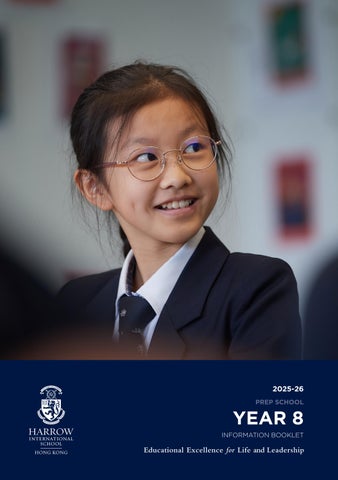
2025-26 PREP SCHOOL
YEAR 8 INFORMATION BOOKLET 1
2
CONTENTS WELCOME TO YEAR 8
4
CURRICULUM OVERVIEW
6
USEFUL INFORMATION
51
THE SCHOOL DAY
51
HOUSE ETHOS
53
KEY PERSONNEL
54
COMMUNICATION WITH THE SCHOOL
55
AUTHORISED ABSENCE
58
PREP
58
CONFIDENTIALITY AND CONSENT
59
MEDICAL CARE
60
HARROW HORIZONS PROGRAMME
61
REPORTS TO PARENTS
62
PARENT CONSULTATION EVENTS
62
1:1 DEVICE PROGRAMME
63
SPEECH DAY
63
BUS ROUTES
63
WEATHER
64
INDIVIDUAL MUSIC LESSONS
64
FOOD
65
OVERSEAS SCHOOLS’ ENTRANCE EXAMINATIONS
65
SCHOOL UNIFORM AND DRESS CODE
66
GOVERNANCE
66
RELATIONSHIP STATEMENT
67
STAFF LIST
69
MESSAGE FROM THE HEAD
WELCOME TO YEAR 8 In Year 8, pupils enter their third year as part of the Upper School at Harrow Hong Kong, an exciting and enriching phase in your child’s educational journey. This journey will, of course, culminate in them being launched into the world: fully competent, learned and well-rounded individuals, equipped not only with outstanding academic outcomes but, crucially, with the self-knowledge and character to thrive in the world beyond school. During the Prep School years, our aim is to instil in our pupils the habits and behaviours for life-long success while allowing them space and opportunity to grow as individuals. In Year 8, we will continue to encourage them to make the most of this special phase in their school journey; we want them to explore everything that a Harrow Hong Kong education has to offer and to reflect on what they learn about themselves in the process. The Harrow values, the hallmarks of a Harrow education, Courage, Honour, Humility and Fellowship sit at the heart of this. Courage fosters intellectual curiosity. The Harrow Horizons programme provides opportunities to explore new interests and develop essential skills for future success. This year, following our Whole School Review, we are delighted to introduce the Harrow Diploma: through dedicated time in the week, pupils will explore pathways designed to develop leadership skills and essential competencies for life beyond school. The seven essential skills of collaborative problem-solving, cultural competency, digital literacy, critical thinking, creativity, and effective communication are integrated into every aspect of our curriculum and will also be drawn out more explicitly through the new Harrow Diploma. All pupils in Year 8 will take the LAMDA Grade 5 course, ensuring that the skills of oracy are honed and developed, skills we believe are essential for life and leadership. The fellowship that lies at the heart of our school community is embodied by our House system, a traditional pastoral structure that promotes a strong sense of belonging. This year, we have increased the amount of time your child will spend with their house tutor, allowing for an extra level of pastoral support and that all-important space for self-reflection. In partnership with this, we have reimagined our PSHE curriculum and created a dedicated team of expert House Masters and Assistant House Masters to deliver the programme. By enhancing the pastoral structures around your child, we hope they will develop the courage to try new things and the humility to hold themselves to account when things do not go to plan. As the new head of Harrow International School Hong Kong, I am excited to be joining your child as they begin Year 8 and I look forward to seeing them flourish as they move through the school.
Rosie McColl Head 4
5
CURRICULUM OVERVIEW ART “Every child is an artist. The problem is how to remain one once we grow up” Pablo Picasso The Art curriculum is designed to help pupils develop the essential skills necessary for success at GCSE and A Level. We strive to inspire our pupils in their pursuit of artistic excellence and nurture their creative spirit by fostering a passion for the subject. Our curriculum promotes independent inquiry and empowers pupils with freedom of choice, encouraging them to take risks and embrace problem-solving in their artistic journey. The curriculum is based on four key areas: developing ideas; exploring materials; recording ideas, observations and insights; and ultimately demonstrating the ability to realise ideas with purpose and intent. Through these, we aim to cultivate independence and autonomy, allowing pupils to develop confidence in their artistic abilities and express their unique perspectives. In Year 8, pupils will build on the skills developed in Year 7 by making purposeful artistic decisions and mastering the properties of various materials. They will work with a 6
range of pencils, charcoal, and pastels, as well as exploring advanced techniques in 3D construction and mixed media. Pupils will create larger, more detailed works, deepening their understanding of concepts such as tints, hues, opacity, and translucency, while also considering composition and the impact of their choices on the artwork’s mood. This year emphasises critical thinking and self-expression, allowing pupils to take greater ownership of their projects and artistic direction. By critiquing their own work and that of others, they will refine their techniques and make informed decisions, further enhancing their creative practice. TERM
Autumn
TOPIC Draw/Mixed Media Technical Portraiture
ESSENTIAL SKILLS Collaborative Problem Solving: Group exploration encourages pupils to work together to solve complex artistic problems. Critical Thinking:
Spring
3D building Figures
Developed through the analysis of artworks, and exploration of various artistic techniques and concepts. Cultural Competency: The study of diverse artistic traditions and practices worldwide helps pupils understand and appreciate different cultural perspectives. Digital Literacy: Taught using digital tools and technologies for the creation and presentation of art. Creativity:
Summer
Draw/Paint Shoes
Development of original artistic ideas is emphasised and creativity is encouraged through the exploration of different media and techniques. Leadership Skills: Developed through projects that encourage pupils to use their artistic voices. Effective Communication: Ability to articulate and explain artistic concepts and ideas is developed.
7
ASSESSMENT By providing regular feedback and opportunities for improvement, we aim to help pupils develop their artistic skills and reach their full potential. Pupils’ learning, progress, and skills development will be monitored throughout and at the end of each project, pupils will produce a final piece of work that will demonstrate the skills, knowledge, and creative ideas they have explored. Pupils receive detailed feedback and the opportunity to address the feedback on this extended piece through tailored Stepping Up activities. This feedback will help pupils identify areas where they have excelled and areas where they can improve, allowing them to reflect on their learning and progress.
INTERCULTURAL LEARNING Intercultural learning is a key component of the Art curriculum, as pupils explore the cultural, social, and historical contexts of art. By studying diverse artistic traditions from around the world, pupils gain a deeper understanding of how art reflects and shapes society. They learn to appreciate the richness of different cultures and recognise how their own backgrounds influence their artistic perspectives. This learning occurs through various approaches, including the analysis of artworks, research into cultural contexts, and engagement with artists from diverse backgrounds.
8
COMPUTER SCIENCE “Coding is today’s language of creativity. All our children deserve a chance to become creators instead of consumers of computer science.” Maria Klawe, president of Harvey Mudd College In Year 8, pupils continue to build upon the foundation of knowledge and skills they acquired in Year 7. The primary aim of the Year 8 Computer Science course is to further expand pupils’ understanding of the diverse aspects of this field. By nurturing a problem-solving mindset that is both creative and collaborative, pupils develop the essential qualities of responsibility, competence, confidence, and creativity when it comes to using technology. Through a curriculum that revolves around real-world problems, Year 8 pupils explore an extensive range of experiences and challenges that are integral to the study of Computer Science. TERM
Autumn
KEY CONCEPTS
TOPICS
Creative Physical Computing
•
AI and Prompt Engineering.
Computational Thinking and
•
Introduction to Programming
Programming Spring
Concepts
Digital Literacy and Information
•
Financial Literacy
Technology
•
App Development using Microbits
•
Introduction to Python
Summer
ASSESSMENT Formative assessment will take the form of quizzes, short coding tasks, multiplechoice questions, checking of books, oral questioning, etc. This will help examine pupils’ understanding and application of their computational thinking skills. Each term will end with a summative assessment which will consist of a paired/group project that enables pupils to showcase the skills learned during the term.
ESSENTIAL SKILLS Through financial literacy, pupils gain knowledge and practical skills related to using spreadsheets, budgeting, and making informed financial decisions. Exploring AI principles will equip them with an understanding of how artificial intelligence works and its applications in various fields. In prompt engineering, pupils develop the ability to generate effective prompts for machine learning models, enhancing their creativity and problem-solving skills. Additionally, the exploration of circuit playgrounds provides hands-on experience in electronics and physical computing, fostering skills in circuitry, prototyping, and tinkering and developing their critical thinking skills. 9
INTERCULTURAL LEARNING In Year 8, the Computer Science curriculum continues to prioritise intercultural learning by fostering an inclusive and diverse environment . The curriculum is designed to expand pupils’ understanding of how technology can be used to celebrate diverse traditions and address global issues. Pupils are tasked with developing websites or mobile applications that highlight and promote cultural diversity, or tackle realworld problems with a global impact. By actively engaging with different cultural perspectives and encouraging respectful dialogue, the Computer Science class in Year 8 continues to nurture an atmosphere of mutual understanding, appreciation for diversity, and intercultural learning.
10
DRAMA ‘All the world’s a stage’ William Shakespeare Our vision is to ignite creativity, foster self-expression, and cultivate a lifelong appreciation for the performing arts. We strive to create a dynamic and inclusive environment where pupils can explore the transformative power of drama, develop their artistic skills, and grow into confident, empathetic individuals. By integrating theoretical knowledge with practical experience, we aim to empower our pupils to become skilled performers, critical thinkers, and collaborative team players. TERM
TOPIC
PERFORMANCE SKILLS
Pupils will learn how to commit dialogue to Exploring stimuli and Devising Drama: Trapped Autumn
memory for devised performances and/or learn text they are performing for text-based performances
Texts in practice:
Pupils will develop a range of vocal skills and
Trainers by Deborah
techniques
Keiller
Pupils will develop a range of physical skills and techniques Pupils will develop an appropriate performer/ audience relationship and ensure sustained
Texts in practice: Lord Spring
engagement throughout the performance
of the Flies by Nigel Williams Explorative Strategies
Texts in practice: Selfie by Bradley Hayward Summer
Understanding Drama and Devising Drama: Theatre in Education
•
Still image
•
Narration
•
Mime
•
Flashback
•
Slow motion
•
Hot seating
•
Physical theatre
•
Cross cutting
•
Monologue
11
ESSENTIAL SKILLS Pupils will develop creativity through innovative character performances, collaborative problem-solving by effectively contributing to group work, and critical thinking by articulating respectful opinions. They will enhance cultural competency by understanding various contexts and appreciating diverse beliefs. Digital literacy will be fostered through technical theatre skills and self-evaluation of performances. Effective communication will be practised through respectful feedback and clear articulation of ideas. Finally, leadership skills will be cultivated by guiding peers in group activities and by having the opportunity to direct.
INTERCULTURAL LEARNING Cultural competency refers to the ability to understand, appreciate, and effectively interact with people from diverse cultural backgrounds. In Drama, cultural competency involves exposing pupils to different cultural perspectives, beliefs, and practices through various stimuli and texts. For instance, in Year 8, pupils are introduced to the ideas and beliefs of various cultures through the ‘Trapped’ topic, which explores Caged Housing in Hong Kong. This topic helps pupils to understand the living conditions and struggles faced by some people in the pupils’ home city. Additionally, the text ‘Trainers’, a satirical script based on child exploitation, further develops pupils’ cultural competency by exposing them to the complex issues surrounding child labour. Through the ‘Selfie’ and ‘Theatre in Education’ topics, pupils explore a range of themes such as bullying, peer pressure, and managing stress. By engaging with these topics, pupils learn to appreciate and respect different perspectives and develop the skills needed to communicate and collaborate effectively with people from different cultural backgrounds.
ASSESSMENT In Drama assessments from Year 6 to Year 9, practical skills are formally assessed using criteria adapted from the grade descriptors for GCSE Drama. Our Schemes of Learning are designed to allow pupils to experience and develop the skills of the three main components of the GCSE course: •
Understanding Drama
•
Devising Drama
•
Texts in practice
•
Throughout their lessons they will be given verbal and written feedback from their teacher. At the end of each topic they will share a live performance which is filmed and formally assessed.
12
13
ENGLISH ‘Reading is the sole means by which we slip, involuntarily, often helplessly, into another’s skin, another’s voice, another’s soul.’ Joyce Carol Oates In Year 8, pupils aim to become more assured readers and writers by studying more varied and challenging texts from different time periods, including a Shakespeare play in the Summer Term. They learn to recognise and use a wider range of persuasive and creative writing techniques to engage and entertain the reader or audience. Pupils are taught to develop their discussion and debating skills and begin to develop more detailed arguments in their reading responses. In their writing, pupils will aim to master their ability to use varied punctuation and well-crafted sentences to sustain the reader’s interest. In the Spring Term, pupils further develop their understanding of how themes and characterisation are developed for meaning and effect and further develop their essay writing skills. 14
TERM
Autumn
KEY CONCEPTS The Art of Rhetoric
•
Read and understand how meaning and effects are created in a variety of texts, selecting and interpreting
Poetry Novel
Spring
TOPICS
information, ideas and perspectives. •
Communicate effectively and imaginatively, adapting form, tone
Gothic Literature: prose (short
and register of writing for specific
stories and extracts)
purposes and audiences; write with increasing accuracy, using a varied
Summer
vocabulary.
Imaginative Writing Drama: Shakespeare
•
Talk with increasing confidence and clarity; listen and respond appropriately to spoken language.
ESSENTIAL SKILLS Learning to communicate effectively, both in writing and speech is at the heart of English teaching in the Prep School, and pupils develop their ability to do this in a variety of digital ways too. Pupils are also encouraged to use their creativity to develop ideas for writing and think critically by building on and challenging ideas that are presented to them in the classroom. There are also plenty of opportunities for pupils to develop their leadership skills through taking risks when participating in discussion and presenting their views to the class.
INTERCULTURAL LEARNING Pupils study texts about different cultures from a variety of texts throughout the year, and different time periods with some poetry, Gothic Literature, and the Shakespeare play. By exploring different beliefs, values and attitudes in texts, pupils begin to better understand various perspectives and their own identity, learn about the context of their place in the world, and imagine what the world might look like in the future.
ASSESSMENT During the year, pupils have a summative reading assessment for the poetry and novel units, and a summative writing assessment for the Art of Rhetoric (a speech) and imaginative writing. They are also continually assessed in class by their teacher who provides regular written and verbal feedback. Pupils also develop their oracy skills, and this will be formally assessed by the teacher.
15
GEOGRAPHY “The world is not in your books and maps, it’s out there.” J.R.R. Tolkien Year 8 geographers embark on an exciting journey to explore a range of topics that expand their understanding of the world. From investigating the impacts of globalisation to delving into the dynamics of rivers, population, and sustainability, pupils develop essential geographical skills and gain insights into various environmental and societal issues as well as developing a deeper appreciation of the interconnectedness of our planet and their role as informed global citizens.
16
UNITS OF STUDY TERM
TOPIC
GEOGRAPHICAL CONTENT •
Challenging the perceptions of the geographies and cultures of Africa
• Autumn
Africa
Looking at education, economic development and economic sector shifts across the continent.
•
Exploring the biodiversity, flora and fauna and climate across the continent.
Spring
Rivers
•
Famous rivers of the world
•
Understanding the drainage basin
•
Investigating river long profiles
•
Studying flooding and hydrographs to interpret flood events
•
Water security for sustainable development
•
Understanding the Sustainable Development Goals related to water
•
Exploring globalisation and its impact on daily life
•
How global are you? Pupil investigation into their connections to other countries
Globalisation
•
Analysing factors that contribute to globalisation
•
The role of TNCs and Glocalisation to increase their global influence
•
Summer
Investigating sweatshops and their social and environmental impacts
Fieldwork designed to embed key skills, namely: •
Data collection using Survey 123
•
Data presentation using ArcGIS
How global is Hong
•
Data analysis
Kong?
•
Conclusion
•
Evaluation
•
Pupils will critically evaluate Hong Kong’s level of globalisation.
17
ESSENTIAL SKILLS Year 8 geographers will develop map reading, fieldwork data collection, data analysis, and communication skills. They will enhance creativity by solving complex spatial problems and presenting their findings. The curriculum emphasises collaborative problem-solving and critical thinking, enabling pupils to analyse diverse information sources and perspectives. Cultural competency will be fostered through an appreciation of global diversity and respectful communication of research findings. Digital literacy will be strengthened via GIS tools and digital mapping. Overall, geography promotes intercultural learning, encouraging empathy and global citizenship as pupils explore interconnected societal challenges.
INTERCULTURAL LEARNING Geography fosters intercultural learning by exposing pupils to diverse regions, cultures, and global issues. Through topics like globalisation, population dynamics, and sustainable development, pupils develop cultural awareness, empathy, and a sense of global citizenship. They explore the interconnectedness of societies, appreciate different perspectives, and recognise the importance of addressing global challenges collaboratively. Intercultural learning in geography promotes understanding and empathy for people and environments across the globe.
ASSESSMENT Throughout the year, pupils’ progress in Geography will be assessed through a combination of formative and summative methods. Formative assessment includes class discussions, group work, and teacher feedback, while summative assessment may include tests, presentations, and project-based assessments. These assessments aim to evaluate pupils’ understanding of substantive knowledge, their application of geographical skills, and their ability to analyse and evaluate geographic concepts.
18
HISTORY “History is not the past – it is the method we have evolved of organising our ignorance of the past.” Hilary Mantel The aim of the History Department in Year 8 is to continue to develop the core historical skills and to encourage pupils to consider their own environment in the context of the course. TERM
TOPIC Tudor and Elizabethan England
Autumn
Why did Henry break with Rome What was life like in Elizabethan England? Changing Britain
Spring
Breadth study: How did Britain change from 1500-1800? Why were Europeans mad about Empires (early British empire) African Kingdoms Industrial Britain
Summer
What was it like to be involved in the Slave Trade? How should historians tell us about abolition? What was the impact of the Industrial Revolution on Britain?
ASSESSMENT Pupils are assessed formally and informally with a continued emphasis on the Leadership Attributes and deployment of core skills. A written checkpoint takes place every term and is an opportunity for pupils to practise the skills they are developing. The checkpoint could take the form of source analysis or questions with commands linked to the core skills, for example, asking why an event happened or what the effects of an event were. As part of familiarisation with History higher up the School, pupils are now introduced to question stems that are used at IGCSE. Pupils are encouraged to reflect upon their own learning and that of others.
ESSENTIAL SKILLS The pupils will gain cultural competency from engaging with different historical settings. Lessons will regularly involve collaborative discussions, in pairs or small groups. Pupils will engage with technology via One Note, but also to privately research for historical projects, which will develop digital literacy. Developing oracy and literacy will help pupils effectively communicate. 19
INTERCULTURAL LEARNING Year 8 focuses on two important changes in UK society, the break with Rome and the industrial revolution. Culturally these demonstrate both the importance of religion and economic transformation upon society. The consequences of the industrial revolution were particularly global.
20
LANGUAGE AND LEARNING (L&L) “The limits of my language are the limits of my world.” Ludwig Wittgenstein The Year 8 course consists of academic reading, writing, use of English (grammar and vocabulary), speaking, pronunciation and listening and aims to extend pupils’ Academic English language resources in ways that support increasingly complex learning throughout the school years. Textbooks for multilingual learners are utilised to allow our pupils to consider global issues and explore exciting cultures whilst developing their English language skills. In addition, we use linguistically graded, ageappropriate novels to provide a motivating context upon which to develop academic language use in a meaningful, enjoyable and productive way. TERM
KEY CONCEPTS
TOPICS •
Autumn
Read, understand and interpret
•
Jump for joy
meaning and effects in various
•
Global culture
texts, selecting and interpreting information, ideas and perspectives.
Spring
•
Novel study
•
Communicate imaginatively and effectively, adapting writing for specific purposes and audiences with accuracy and varied vocabulary.
Summer
•
Role models
•
City living
•
Speak with increasing confidence and clarity.
•
Listen and respond appropriately to spoken language.
ASSESSMENT Assessment in Year 8 may take a variety of forms and will cover all aspects of academic English language development. There will be termly summative assessments in the four skills of speaking, listening, reading, and writing; pupils will also begin working towards the Cambridge B2 First for Schools examination, which they will sit on-site in School in Year 9. As our pupils move through the years at Harrow, they progress to the C1 Cambridge examinations, which is equivalent to IELTS. For more information on the Cambridge examinations, please visit the Cambridge assessments website.
ESSENTIAL SKILLS Essential skills are embedded into our lessons, particularly Effective Communication. Pupils are expected to enunciate, and to convey ideas and information clearly and appropriately in various contexts. This involves using language accurately and fluently 21
and listening actively to others. Pupils often work collaboratively to complete tasks and to think critically and creatively about texts and various situations.
INTERCULTURAL LEARNING Units in the Prep school cover cultural competency through looking at different cultures based on the topics or texts they are studying. Pupils compare their own culture with that of another country enabling them to recognise, respect and appreciate diverse cultures.
22
CHINESE “They who love it are better than those who know it and they who delight in it are better than those who love it. To complete a good task, an artisan needs the best tools.” Confucian Analects The Year 8 Chinese curriculum is a continuation of the Year 6 and 7 curricula. It builds upon all the skills that pupils have learned so far, while preparing them for the demands of the IGCSE Chinese course in Year 9. The core skills in Year 8 are still based around reading, writing, speaking and listening. Based on pupils’ prior knowledge of the language, three streams of Chinese are offered - native, near-native and non-native (foreign). Pupils in each stream will be introduced to the appropriate level of Chinese materials. Building upon the critical foundations of vocabulary and key phrases, as well as the correct characters, writing skills are the focus in all three streams. Alongside language study, pupils will engage in a range of activities for developing their intercultural competency as well as global awareness. NATIVE STREAM TERM
TOPIC
CONTENT AND FOCUS •
Describing, commenting on, and expressing views about surroundings
Autumn
Me and the World
•
What is imagery in poetry?
•
Description of scenery
•
Descriptive writing
•
Constructing effective arguments in essay
Appreciation of Spring
differences & self-
writing •
strengthening
Summer
Outside world and proactive exploration
Self-affirmation, tolerance and accepting differences
•
Vocabulary and useful expressions
•
Reading classical descriptive essays
•
Vocabulary and useful expressions
•
Celebration of reading week
ESSENTIAL SKILLS In the native stream of Chinese, pupils will continue to study an increasing variety of genres, including prose, poetry, legends and non-fiction. Pupils in Year 8 will start exploring more complex ideas and issues through a variety of spoken and written texts to develop their reading and listening skills. They will study how writers convey opinion and emotion through word choice and sentence construction. They explore the connotations and effects of specific words and structural choices. Pupils will continue to develop knowledge of argumentative writing, focusing on expressing 23
their opinions and comments by using formal language, and enhance their narrative and descriptive essay writing skills. Cultural competency is nurtured through these activities, and effective collaboration and digital literacy are also emphasised.
INTERCULTURAL LEARNING Pupils have the opportunity to learn about various aspects of Chinese culture, both traditional and contemporary. They will learn about the cultural conventions associated with the texts studied and try to understand the changes that have occurred over time. Through classroom activities, pupils will have opportunities to demonstrate their cultural awareness and their appreciation of Chinese traditions.
ASSESSMENT Pupils in the Year 8 native stream will take a summative assessment per term in reading, writing, listening or speaking. In particular, pupils will be assessed on the fundamental skills of vocabulary mastery as well as of oral and written fluency. Formative assessments, such as vocabulary dictation and individual and group presentations will also help pupils to receive feedback from their teachers. NEAR-NATIVE STREAM TERM
Autumn
TOPIC
Me and the World
Appreciation of Spring
differences & selfstrengthening
Summer
Outside world and proactive exploration
CONTENT AND FOCUS •
Relationship with family
•
People who have influenced me
•
My ideal university
•
Vocabulary and useful expressions
•
Travel and discovery – from Hong Kong to Shanghai
•
The advantages of the two sides of the strait and the three regions.
•
Leverage your strengths.
•
Vocabulary and useful expressions
•
Chinese Study Tour Group
•
Chinese Language Training Class
•
Celebration of reading week
ESSENTIAL SKILLS In the near-native stream of Chinese, pupils will continue to develop their reading skills, including how to infer and deduce meaning using evidence from a text. They understand and respond to a variety of spoken and written texts. In speaking, they will communicate substantial information containing relevant and developed ideas and offer opinions confidently on events, experiences and some concepts related to 24
Chinese culture. They will engage in conversations and learn how to write a structured text to share informative and organised ideas on topics and cultural contexts. Cultural competency is nurtured through these activities, and effective collaboration and digital literacy are also emphasised.
INTERCULTURAL LEARNING Pupils have the opportunity to learn about various aspects of Chinese culture, both traditional and contemporary. They will learn about the cultural conventions associated with the texts studied and try to understand the changes that have occurred over time. Through classroom activities, pupils will have opportunities to demonstrate their cultural awareness and their appreciation of Chinese traditions.
ASSESSMENT Pupils in the near-native stream will take a summative assessment per term in reading, writing, listening or speaking. In particular, pupils will be assessed on the fundamental skills of vocabulary mastery as well as oral fluency. Formative assessments, such as vocabulary dictation and individual and group presentations will also help pupils to receive feedback from their teacher. NON-NATIVE STREAM TERM
Autumn
TOPIC •
Holiday experience
•
Ideal living place
•
Healthy lifestyle
•
Vocabulary and useful expressions
•
Sports day
•
Charity day
•
Different “days” around the world
•
Vocabulary and useful expressions
•
The Media & Entertainment
Outside world and
•
Cultural shock and its value
proactive exploration
•
Vocabulary and useful expressions
•
Celebration of reading week
Me and the World
Appreciation of Spring
differences & selfstrengthening
Summer
CONTENT AND FOCUS
ESSENTIAL SKILLS Pupils’ learning in the Year 8 Non-native stream will continue to be based around the four skills of reading, writing, speaking and listening. Pupils will further their competence and proficiency in the core language and develop their communication skills. They will be able to understand longer passages and recognise people’s basic points of view. They will link sentences and paragraphs, structure ideas and adapt previously learnt language for their own purposes. They will continue to develop the 25
ability to edit and redraft their work, using reference sources to improve their quality of expression. Cultural competency is nurtured through these activities, and effective collaboration and digital literacy are also emphasised.
INTERCULTURAL LEARNING Pupils have the opportunity to learn about various aspects of Chinese culture, both traditional and contemporary. They will learn about the cultural conventions associated with the texts studied and try to understand the changes that have occurred over time. Through classroom activities, pupils will have opportunities to demonstrate their cultural awareness and their appreciation of Chinese traditions.
ASSESSMENT Pupils in the non-native stream will take a summative assessment per term in reading, writing, listening or speaking. In particular, pupils will be assessed on the fundamental skills of vocabulary mastery and oral fluency. Formative assessments, such as vocabulary dictation and individual and group presentations will also help pupils to receive feedback from their teacher.
26
FRENCH “If you talk to a man in a language he understands, that goes to his head. If you talk to him in his language, that goes to his heart.” Nelson Mandela Pupils in Year 8 may be complete beginners, relatively new to French or more experienced language learners. They will build on previously learned topics with increasingly complex vocabulary and grammatical structures. The topics studied are all linked to the IGCSE course content in order to lay the critical foundations of core vocabulary, key phrases and basic grammar for French in the Senior School. Pupils will be exposed to increasingly complex grammar and will learn to express themselves in three time frames. 27
TERM
TOPIC
Paris Autumn
Holiday accommodation and past holidays
CONTENT AND FOCUS •
Saying what you can do in Paris
•
Identifying and describing places in Paris
•
Saying what I did
•
Booking a room
•
Making a complaint
•
Describing a past hotel stay
•
Describing what I did on my holiday
•
Saying what they do depending on the weather
Spring
Summer
Leisure
Health
•
Talking about free time activities
•
Saying what they are going to do
•
Talking about future plans
•
Saying what they did recently
•
Talking about my diet
•
Saying what they do to stay healthy
•
Making health complaints
•
Giving health advice
ESSENTIAL SKILLS Pupils engage in group activities where they work together to solve language-related challenges, fostering teamwork and problem-solving abilities. Cultural competency is nurtured through activities that expose pupils to various aspects of French-speaking cultures, promoting understanding and appreciation of different perspectives. Additionally, digital literacy is integrated by incorporating technology and online resources, equipping pupils with the skills to navigate and communicate effectively in a digital world.
INTERCULTURAL LEARNING In Year 8, pupils have the opportunity to learn about various aspects of French culture, including a unit of work learning about Paris and discussing travel in France. They will also have the opportunity to broaden their cultural awareness through an independent cultural project in the Summer Term.
ASSESSMENT There will be formal summative assessments at the end of each term, assessing all four skills, as well as formative assessments throughout each half-term such as quizzes, vocabulary tests and projects so that pupils can demonstrate their learning in a range of different ways. Helpful feedback and opportunities for pupils to ‘Step Up’ their work follow both formative and summative assessment. 28
SPANISH “If you talk to a man in a language he understands, that goes to his head. If you talk to him in his language, that goes to his heart.” Nelson Mandela Pupils in Year 8 may be complete beginners, relatively new to Spanish or more experienced learners of Spanish and they will be exposed to a range of age-appropriate topics. Topics pupils may study could range from introducing self, family and friends to the topics of school, healthy lifestyle or the media depending on their level of experience. They may be building on their prior knowledge of Spanish and beginning to develop fluency in their written and spoken responses, or as beginners still in the early stages of their study of Spanish they will be laying the critical foundations of core vocabulary, key phrases and basic grammar. They will also be introduced to the past and future tenses. TERM
TOPIC
Module 1 Free time Autumn
Module 2 The world of work
Spring
Summer
Module 3 Health and diet
Module 5 An adventure in Madrid
CONTENT AND FOCUS •
Talking about things you like
•
Using irregular verbs in the present tense
•
Talking about your week
•
Using regular verbs in the present tense
•
Talking about films
•
Using the near future tense
•
Talking about a birthday
•
Using the preterite
•
Talking about life as a celebrity
•
Using three tenses together
•
Understanding descriptions of days out
•
Saying what you have to do at work
•
Saying what job they would like to do
•
Talking about the future
•
Describing jobs
•
Talking about diet
•
Talking about an active lifestyle
•
Talking about your daily routine
•
Talking about getting fit
•
Talking about ailments
•
Meeting and greeting people
•
Talking about a treasure hunt
•
Discussing buying souvenirs
•
Saying what they might do
•
Saying the right thing in different situations 29
ESSENTIAL SKILLS Pupils engage in group activities where they work together to solve language-related challenges, fostering teamwork and problem-solving abilities. Cultural competency is nurtured through activities that expose pupils to various aspects of Spanish-speaking cultures, promoting understanding and appreciation of different perspectives. Additionally, digital literacy is integrated by incorporating technology and online resources, equipping pupils with the skills to navigate and communicate effectively in a digital world.
INTERCULTURAL LEARNING Year 8 pupils deepen their intercultural understanding by exploring more specific aspects of Spanish culture. They gain insight into Peruvian folklore through the study of a folk tale and its cultural significance. They also learn about the capital city of Spain, Madrid, examining its history, landmarks, and cultural contributions.
ASSESSMENT There will be summative assessments throughout the course on all four skills of speaking, listening, reading and writing, and formative assessments such as quizzes, vocabulary tests and projects so that pupils can demonstrate their learning in a range of different ways. Helpful feedback and opportunities for pupils to ‘Step Up’ their work follow both formative and summative assessment.
30
MATHEMATICS “Mathematics is not just about numbers, equations, and computations. It is about understanding the world around us and uncovering the hidden patterns that shape our universe.” Maryam Mirzakhani In Year 8 Mathematics at Harrow Hong Kong, pupils will deepen their understanding of number, algebra, geometry, and statistics, while exploring exciting new concepts such as the volume of 3D shapes, Pythagoras’ theorem, standard index form, and set theory. This year aims to solidify the fundamentals necessary for the start of the IGCSE course in Year 9. Building on prior knowledge, we employ a cumulative learning approach to reinforce concepts from Year 7, deepening their understanding and fostering a genuine appreciation for this diverse and fascinating subject. Pupils will continue to enhance their problem-solving skills through specially designed, thought-provoking, and challenging lessons. We are dedicated to cultivating a collaborative environment that fosters creativity, critical thinking, and perseverance, while instilling the values of courage, honour, humility, and fellowship. This approach prepares our pupils to excel in a rapidly changing, interconnected, and diverse world. In our Mathematics lessons, we will continue to prioritise the development of a growth mindset in our pupils, encouraging them to embrace challenges and view mistakes as integral to the learning process. Through engaging teaching strategies and a collaborative learning environment, we aim to ignite enthusiasm for mathematics with a rigorous and stimulating curriculum, empowering pupils to reach their fullest potential. Teachers will continue to promote the use of non-calculator methods across various areas of mathematics, while also helping pupils discern when these methods are most appropriate. Pupils will also develop their calculator skills as they engage with more complex mathematical concepts. 31
MAIN TOPICS OF STUDY FOR YEAR 8 AUTUMN TERM • • • • • • •
Substitution Rounding and estimation Area and perimeter Simplifying expressions Angles Averages and range Indices and standard form
SPRING TERM
• • • • • •
Solving equations Pythagoras’ theorem Sequences Presenting data Measures Fractions, decimals and percentages
SUMMER TERM
• • • •
Volume and surface area Graphs Probability Sets
All pupils in the Prep School are split into two bands for their learning of Mathematics, with further division by ability within these bands. Movement between groups occurs as appropriate to ensure optimal learning for every pupil. All sets will cover the same core content, with slight variations in challenge and pace. At Harrow Hong Kong, we take pride in the outstanding results that we achieve, which is made possible by placing pupils in sets that are specifically tailored to their individual needs. All pupils will start the Edexcel IGCSE curriculum in Year 9 and will be prepared to sit the examination at the end of Year 11. We strongly advise against pupils independently undertaking external examinations early or outside of school, as this can adversely impact their university applications.
ESSENTIAL SKILLS Every mathematics lesson in the Prep School provides pupils with the opportunity to develop the seven essential skills. One key area of focus is digital literacy, where pupils continue to develop their note taking and organisation skills on their iPads using OneNote. In addition, pupils will develop their collaborative problem-solving abilities through a variety of group tasks designed to elicit higher-order thinking. These activities encourage teamwork and meaningful discussions as they tackle complex mathematical challenges, fostering a supportive learning environment. Pupils can express their creativity in Mathematics by exploring multiple methods for solving problems and considering the most elegant solutions. This creative exploration deepens their understanding of mathematical concepts and promotes innovative thinking. Effective communication is emphasised throughout all classroom activities, with a strong focus in Year 8 on helping pupils articulate their mathematical understanding in writing, which aids in conveying their thought processes effectively. Leadership skills are cultivated as pupils take on roles that involve guiding their peers, fostering collaboration, and ensuring the successful execution of investigations. 32
Finally, pupils develop cultural competency by learning about various aspects of the history of Mathematics, allowing them to appreciate the diverse contributions to the field. By integrating these essential skills into each lesson, we ensure that pupils not only excel in Mathematics but also acquire valuable skills for their future academic and personal success.
INTERCULTURAL LEARNING In the Prep School, we integrate intercultural learning in Mathematics by embedding diverse cultural contexts into problem-solving activities and exploring the historical contributions of various civilizations to mathematical concepts. We discuss how different cultures apply mathematics in daily life, enriching our pupils’ understanding. Through collaborative projects, our pupils research and present on mathematical practices from around the world, fostering a global perspective. By encouraging reflection and discussion about their own cultural backgrounds, we help our pupils appreciate the global significance of mathematics thus enriching their educational experience.
ASSESSMENT The Mathematics Department believe that cumulative assessments not only enhance factual retention but also improve problem-solving skills, which are crucial for success in the subject. Each teacher utilises a variety of methods to regularly assess their pupils’ understanding during lessons and encourage pupils to engage in regular review of their work rather than relying on last-minute cramming, which is ineffective in the long term. The assessments and feedback provided are intentionally designed to be formative, ensuring that pupils gain valuable insights into their understanding and can identify areas for improvement. This approach helps pupils to develop a deeper comprehension of mathematical concepts and fosters continuous academic growth.
33
MUSIC “Where Words Fail, Music Speaks” Hans Christian Andersen In Year 8 Music, pupils will delve into a variety of musical styles and traditions, building their creativity, collaboration, and performance skills. The year begins with Unit 1: African Music, where pupils explore the rich rhythms and textures of traditional African musical forms. In Unit 2: Pop Music, they examine the structure and characteristics of popular genres, followed by Unit 3: Rock n Roll, which highlights the energy and historical impact of this iconic style. Unit 4: Samba introduces the vibrant rhythms and ensemble techniques of Brazilian carnival music. The year concludes with Unit 5: Composition Competition, allowing pupils to showcase their creativity through original compositions.
34
ESSENTIAL SKILLS The school music curriculum develops seven essential skills through engaging activities. Collaboration is fostered in group performances and ensemble work. Creativity shines in composition and improvisation. Critical thinking is honed by analysing world music and solving musical challenges. Digital literacy is integrated via tools like OneNote, GarageBand, and iPads, enhancing production and collaboration. Effective communication is practiced in performances and written reflections, while problem solving is embedded throughout, encouraging innovative solutions. Together, these skills create a well-rounded musical education. Every pupil has to take responsibility (hence, adopt a leadership mentality) in performances and in learning a variety of music styles. This involves suggesting solutions for specific problems, sharing ideas, and listening to others. Pupils work collaboratively in teams/pairs to analyse, evaluate and assess a variety of world music. All pupils also have access to the vibrant co-curricular music programme which runs throughout the year. Individual music tuition is available in a variety of studies from the trombone to the guitar, and lessons are delivered by a team of experienced and specialised visiting music teachers. There are also many opportunities for pupils to engage with group music-making: various orchestras, choirs, and bands rehearse on a weekly basis and perform in frequent internal and external concerts.
INTERCULTURAL LEARNING The Year 6 Music scheme incorporates intercultural learning by exposing pupils to a variety of musical traditions and styles. From exploring rhythmic patterns inspired by global influences in Rhythm and Ostinato to understanding the role of storytelling in Programme Music, pupils develop an appreciation for diverse cultural expressions. Through these units, they gain insight into how music connects people across cultures and enhances their understanding of the world.
ASSESSMENT Summative assessment is based on several performances and compositional projects undertaken through the year. This includes several group composition and performance projects in both analogue and digital contexts. Singing and listening skills are also assessed throughout the course of the year.
35
PHYSICAL EDUCATION & HEALTH “An active mind cannot exist in an inactive body” George S Patton Jr Our curriculum aims to establish Harrow International School Hong Kong as a leading independent coeducational sports school in Asia. We provide equal opportunities for all pupils to participate in various sports at appropriate levels. Our primary goal is to develop a structure that helps each pupil reach their physical potential while promoting lifelong commitment to health, fitness, and overall well-being. We strive to foster a positive sporting attitude based on leadership, excellence, sportsmanship, and fair play. While we value success in competitions, we also emphasise using sports as a platform for learning important life lessons. We recognise that winning, although important, is not the sole focus but a means to develop essential skills and values. This curriculum aims to provide a well-rounded sports education that equips our pupils with the skills and mindset for success in both sporting endeavours and all areas of their lives. Our vision through PE is to give every pupil a wide variety of opportunities to develop and strengthen their values, physical competence and confidence. This will ensure our pupils have the tools to lead a long and healthy lifestyle in a complex world. At Harrow Hong Kong, pupils in Years 6 to 8 have one PE lesson per fortnight, a double Games lesson every week and a single hybrid games/PE (PEx) lesson every week. In Year 9 they have a double Games lesson every week and a single hybrid games/PE lesson (PEx) per week. In the hybrid lesson they will cover several different units of work to increase physical competence and develop the confidence to be able to participate in sport and live a long and healthy lifestyle. This structure is unique to Harrow Hong Kong and sets us apart as a world leader in innovation in physical education by truly combining the deeper educational aspects of sport with opportunities of participation and competitive pathways. The premise of the programme is to enable every pupil to flourish and to establish the appropriate pathway that best suits the individual and the skills they possess. The programme aims to develop the pupil first and foremost as an athlete. From this point onwards it allows each pupil to experience and engage in a wide range of sports, allowing them to develop, display and transfer their skills. 36
GAMES The PE department is continuously striving to ensure we are delivering the most relevant programme. The main drive behind games is to ensure we have a programme which places pupil development at the centre and ensures it enables all our pupils to flourish. It is important to acknowledge that all pupils associate with sport and physical activities in different ways. We aim to tailor a programme that suits the needs of our pupils whilst allowing them to experience a wide range of sporting activities. We want our pupils, as they move up through the school, to think of themselves as ‘pupil athletes’ and to understand that so many of the fundamental skills they have learnt in the Lower School are transferable across sports. As pupils enter the Prep School, the Games Curriculum expands. The consistency of sports being offered remains the same, in relation to the ISSFHK seasons,. This allows staff to have the ability to further advance co-curricular teams within the Games setting as well as SCAs and CCAs. Pupils who compete for the school teams have opportunity to train within Games time. If pupils do not wish to be involved with team training, they have the option to pick different sports and these can be changed on a seasonal basis. At this stage we also feel it is important to broaden the pupils’ horizons to experience some leisure-based activities which allow the pupils to build positive relationships with activities which may feature in their lives after their time at School. Pupils are asked to choose their games options from the following sports: Badminton
Volleyball
Basketball
Table Tennis
Football
Rugby
Tennis
Gymnastics
Harrow Fit
Golf (off site)
Cross Country
Athletics
Netball
Pickleball
GOLF As part of the games provision, pupils have opportunity to opt into golf lessons during games. Golf activities occur off site and are led by external coaches. Pupils have opportunity to experience this activity throughout the year. Golf is placed in Games to offer another new experience to pupils and is not designed to develop the elite performer. These are paid lessons and therefore have a cost attached.
PHYSICAL EDUCATION & HEALTH LESSONS Physical Education classes offer pupils diverse experiences in a range of activities and environments, such as fields, pools, courts, sports halls, and tracks. These classes not only provide opportunities for pupils to engage in sports both on and off the field but also serve as a gateway to various career paths. Careers in fields like physiotherapy, law, player representation, sports organisation management, medicine, and more can be pursued through Physical Education. 37
HOUSE SPORT At Harrow International School Hong Kong we have an inclusive House Sports Competition that allows our pupils to have another opportunity to play sport and wear their House colours with pride. House sport is a hotly contested competition, and you can see the passion in every House when they compete against one another. All Houses take part, and the following sports may be offered: Sports Day (Track & Field), Cross Country, Netball, Football, Touch Rugby, Basketball, Dodgeball and Badminton. House Sport Competitions are opportunities to:
• • • • • •
Build a cohesive house culture Develop camaraderie, friendships & trust Provide leadership opportunities Represent a team and contribute to competition Stay active Take part in a variety of sports
COMPETITIVE SPORTS PROGRAMME Participating in sports is part of our culture here at Harrow Hong Kong. Recreation and competitive sport are catered for in twenty sports codes across the academic year. Our competitive sports programme offers regular opportunities to play fixtures against other International and local schools in Hong Kong. We compete mainly in the International Schools Sports Federation Hong Kong (ISSFHK) and some School Sports Federation of Hong Kong China (SSFHKC) leagues, in addition to annual friendly fixtures. Fixtures take place mostly mid-week and on occasional weekends, depending on the sport. Harrow Hong Kong also hosts several tournaments throughout the year in various sports, and these are well attended by other schools. Competitive sports leagues start in Year 6 (U12) and reach their pinnacle at Year 13 (U20). Harrovians who do not consider themselves athletes when they arrive at our school often discover new sports and the talent to play them with great skill and flair. Many continue to enjoy the sporting abilities they discovered at Harrow Hong Kong long after leaving us and take the life lessons they have learnt with them into the world beyond School. Overseas sports tours are an important part of our sports programme. Tours provide the opportunity for our pupils to bond as a team and measure their progress against schools from around the world. The experience and the memories that our pupils gain will be with them for the rest of their lives. The Physical Education Department are hugely experienced in high performance sport. Pupils who aspire to achieve honours in their chosen sport are well supported by the department as pathways are available for our pupils who choose to compete at the highest level and achieve academically at same time. 38
All fixtures, results and team details can be found at sport.harrowschool.hk
SUPER CURRICULUM ACTIVITIES (SCA) Sports Super Curriculum Activities give pupils more opportunity to explore and challenge themselves in a sporting context. Pupils can enjoy extra time taking part in their favourite sports which will allow them to have more time on task to accelerate their learning. Pupils will apply the skills learned in SCAs in competitive fixtures and tournaments. SCAs vary according to sports seasons and facility availability. The following sports are usually offered with additional SCAs being added when opportunities arise. Rugby
Harrow Fit
Tennis
Volleyball
Basketball
Football
Athletics
Cross Country
Netball
Badminton
Touch Rugby
Gymnastics
Pickleball
Swimming
CO-CURRICULAR ACTIVITIES (CCA) The Co-curricular programme delivers extra lessons for pupils to polish their sporting skills or play recreationally. It allows pupils to stay active after a day of academic study and get in the extra work if pupils are pursuing academic and sporting goals. Co-curricular activities supplement our PEH and SCAs if pupils need to work on their skills to get ahead and achieve the targets they have been set by their teachers. The following sports are delivered throughout the year: Rugby
Fitness Room
Tennis
Gymnastics
Volleyball
Basketball
Football
Touch Rugby
Athletics
Cross Country
Netball
Badminton
Swimming
Table Tennis
For the latest photo updates follow us on Instagram: @harrowhksport
39
40
PHILOSOPHY & RELIGIOUS STUDIES (PRS) “It is the mark of an educated mind to be able to entertain a thought without accepting it.” Aristotle In the Upper School, Philosophy and Religious Studies is a multidisciplinary subject, looking through the lenses of Philosophy, Theology and Social-Anthropology. Each discipline is a significant academic field in its own right and the topics studied in Year 8 will allow pupils to further their philosophical skills by engaging with theories of perception, questioning how we can come to know a physical world and whether we can be sure that one exists. They will further enhance their religious knowledge, studying the dharmic faiths, and improve their evaluative skills. With global citizenship at the heart of the PRS curriculum, pupils are introduced to a diverse range of ideas and beliefs, learning about groups and thinkers that may have been academically marginalised in the past. TERM
DISCIPLINARY ‘LENS’ AND TOPIC
Philosophy
Autumn
Epistemology - How do we gain knowledge of the world? Explaining theories of knowledge Social Anthropology Social justice - What are our rights and responsibilities? What does it mean to be a global citizen?
Theology Spring
Hinduism - What is Hinduism? How did Hinduism emerge? What are Hindu beliefs and practices? Buddhism - What is Buddhism? How did Buddhism emerge?
SUBSTANTIVE KNOWLEDGE • • • • • •
Theories of knowledge Direct Realism Indirect Realism Idealism Maslow’s hierarchy of needs Human rights and responsibilities • The social contract • Diversity and community cohesion • Multi-faith society • The origins of Hinduism • Brahman (different beliefs about God/s) • The Samsara Cycle • The Path to Moksha • The life of the Buddha • The three marks of Existence
Theology Summer
Buddhism (continued) - What are Buddhist beliefs and practices? Social Anthropology Religious Practices - How do beliefs influence practices?
• The four Noble Truths • The path to enlightenment • Religious practices, including prayer and pilgrimage from a variety of religions 41
ESSENTIAL SKILLS Broadly, all disciplinary approaches in PRS encourage pupils to develop the essential skill of critical thinking, not only nurturing the ability to explain and analyse theories and beliefs, but also to comment on them and reach their own justified conclusions. However, each disciplinary ‘lens’ requires the development and application of unique skills. In the Philosophy topic, pupils will continue to hone their understanding of the concepts of validity and soundness and make judgements about theories based on this. Philosophy can also help pupils develop a critical approach to the use of digital technologies, by encouraging them to think deeply about the ethical, social, and political implications of digital technologies. In the Theology topics, pupils will be able to explain religious beliefs in detail and understand how these influence believers. Pupils develop cultural competency through gaining a deeper understanding of values, customs and traditions of different groups, helping to have greater empathy and respect for those holding beliefs different from their own. In the Social Anthropology topic, pupils will analyse sociological ideas and identify the implications of different approaches in society. Philosophy can help pupils develop a critical approach to the use of digital technologies, by encouraging them to think deeply about the ethical, social, and political implications of digital technologies. The study of theology can help develop leadership by fostering critical thinking, promoting empathy and understanding for diverse beliefs and practices, encouraging ethical reflection and including reflection on ways in which service and outreach benefit others. Communication skills are developed through debates and discussions, focusing on argumentation and persuasion. Pupils work collaboratively to research and share knowledge on religious beliefs and practices, as well as developing creativity through imaginative responses to religious beliefs, stories and customs.
INTERCULTURAL LEARNING Philosophy and religious studies can be a powerful tool for intercultural learning through the study of diverse religious and philosophical traditions, examining the intersection of philosophy, religion, and culture, engaging with diverse perspectives, reflecting on personal biases and assumptions, and providing opportunities for crosscultural dialogue.
ASSESSMENT Pupils’ progress will be monitored formatively throughout each topic using informal checking of knowledge (such as quizzes and marking of books). Pupils’ progress in each topic will be summatively assessed using a variety of multiple-choice knowledge questions, short-answer questions and essays. Helpful feedback and opportunities for pupils to ‘Step Up’ their work follow both formative and summative assessment.
42
43
PSHE “Intelligence plus character — that is the goal of true education.” Martin Luther King Jr. There is strong evidence supporting the positive impact of a robust PSHE (Personal, Social, Health and Economic education) curriculum on pupils’ academic outcomes. At Harrow, PSHE is more than just learning about relationships and health: it is about creating resilient, confident young leaders who are prepared to thrive both academically and personally. At this important stage of transition and growth, we focus on developing the fundamental skills our pupils need to succeed in an ever-changing world. During lessons, pupils explore topics from media, to money, to digital literacy, while also learning the importance of maintaining good physical and mental wellbeing. During sessions, pupils are encouraged to share ideas, express opinions, and reflect on their own experiences. Lessons are designed to be pupil-led, with opportunities for discussion and collaboration embedded throughout the curriculum. TERM
TOPICS
Clear Communication and Listening
Autumn
Spring
Summer
44
KEY SKILLS
Mental Health and Wellbeing
Working Well with Others
Managing Relationships
Staying Safe Online
Living in the Wider World
Solving Problems and Making Decisions Setting Goals and Staying Motivated
ESSENTIAL SKILLS PSHE sessions help pupils build the skills they need to feel confident and to excel during their time at Harrow. In our sessions, pupils learn how to think independently, share their thoughts, ask questions, and listen to others with respect. We focus on helping pupils become more resilient, flexible, and comfortable talking about important or tricky topics. Our aim is to support young people as they grow, helping them to communicate clearly, solve problems collaboratively understand their own emotions, communicate effectively and build strong, healthy relationships.
INTERCULTURAL LEARNING In our PSHE lessons, pupils have the chance to explore and embrace different ideas, experiences, and ways of life. Through topics like community and global citizenship, pupils are challenged to think critically about the world beyond their own experiences, while also reflecting on and celebrating their own cultures in the process. Our lessons help pupils stay curious and empathetic, showing them how their choices can make a difference to others. This helps them grow into thoughtful, respectful young people who are ready to live in a world where everyone is connected.
ASSESSMENT Despite there being no formal examinations in PSHE, pupils are given regular opportunities to showcase what they have learned during sessions, through personal presentations and group work. Teachers and tutors will provide regular feedback on engagement and understanding to ensure pupils are benefitting from the curriculum.
45
SCIENCE “The important thing is not to stop questioning. Curiosity has its own reason for existing.” Albert Einstein Science is the study of the world around us. Biology investigates the wonders of life, and the Science Department is alive with animals and plants of different varieties. Chemistry offers the bangs and the bubbles, while Physics applies the laws and the theories to explain the many mysteries of the ever-expanding universe. The Prep School Science curriculum is largely based on the UK Key Stage Three curriculum, although it is tailored to meet the needs of our pupils at Harrow Hong Kong. The curriculum has been designed to enthuse pupils and to encourage them to develop a love of science, while also gaining the knowledge and skills that they can take forward into their IGCSE studies. Pupils are taught an integrated Science curriculum, with an equal weighting given to each of the sciences across the three years of Prep School (six lessons per fortnight). The Year 8 programme of study is as follows: SCIENCE INDUCTION - Pupils will be introduced to all the excitement of Science practicals in a laboratory. They will learn how to handle equipment and chemicals safely and how to draw scientific diagrams of common equipment found in a laboratory. Pupils will become familiar with measuring devices such as thermometers, measuring cylinders and balances as well as considering appropriate units of measurement. They will learn how to light a Bunsen burner safely and will carry out their first scientific practical in the Prep School. Term
Biology
Autumn Term Spring Term
Growing Our Food
Summer Term
Diet and Nutrition
Chemistry
Physics
Combustion
Space
Metals and Their Uses Light
Each year Harrow Hong Kong holds Science Week. A different theme is chosen annually, and pupils join in fun and exciting activities around the School and participate in outside trips such as visiting the Science Museum or Hong Kong Wetlands. Speakers are invited to inspire our pupils from charities and universities and House Competitions lead to an exciting feeling around the School. Pupils take part in projects in lessons such as Harrow Off-Grid, planning for a sustainable future.
46
ESSENTIAL SKILLS The Prep Science curriculum develops essential skills including effective communication, critical thinking, problem solving, creativity cultural competency, leadership and collaborative learning through practical work and projects. Key scientific skills such as defining variables and drawing graphs are secured. Pupils present their findings to their class and record videos practising key presentation skills. They analyse data and develop critical thinking skills when reviewing results. Using digital literacy the pupils research, use simulations and create animations. In Year 8, the pupils complete a project in groups, requiring each pupil to take a leadership role, use teamwork and creativity to create a video and present to their peers. This allows the development of their effective communication.
INTERCULTURAL LEARNING Prep Science explores science in various cultures and societies around the world. It covers crucial topics such as renewable energy, climate change and matter behaviour linking these topics to future careers.
ASSESSMENT Internal assessment takes place throughout Year 8, with end of topic tests used to track pupil progress. These assessments are made up of multiple choice and short answer questions. There is also a summative end of year assessment which takes place in the Summer Term, and this covers all the content taught up to that point. Pupils use their own personal tracking document to record their progress and targets, such as Stepping Up activities. Pupils will also be assessed on different skills, through Common Assessed Tasks, such as investigative skills, e.g., drawing graphs and identifying variables.
47
INDIVIDUAL NEEDS “Pupils don’t care how much you know until they know how much you care.” Theodore Roosevelt The Individual Needs Department at Harrow Hong Kong works alongside Language & Learning, Counselling and House Pastoral Teams to ensure that the academic, social, and pastoral needs of pupils are met through quality differentiation, effective collaboration between educational stakeholders, and impactful staff development. The Individual Needs Department works with pupils who require extra support or extension beyond regular classroom differentiation in order to meet their learning needs. The Individual Needs Department supports pupils who enter the School with existing reports of individual needs and those who are later identified through the School’s referral system. Depending on the level of support needed, pupils may receive short-term or long-term intervention from an individual needs staff member within their regular lessons in collaboration with the class teacher, in small groups, or 1:1. The department also works with members of staff by identifying and sharing differentiation strategies based on specific pupil profiles, monitoring pupil progress, and providing professional development. 48
Examples of the Individual Needs Provision for pupils in Year 8 are in-class support in English and Mathematics, and small group sessions focused on Literacy, Mathematics, and Science.
ASSESSMENT AND PUPIL PROGRESS Access arrangements for both internal and external assessments are facilitated by the department in partnership with the Examinations Officer and Deputy Head Academic in accordance with the guidelines from the Joint Council for Qualifications. The department is able to conduct internal assessments to aid the understanding of a pupil’s profile, and may also refer pupils to external specialists, including Occupational Therapists, Speech and Language Therapists, and Educational Psychologists if further information is required. Pupil progress is determined using teacher feedback and observations, subject tracking and reports, internal assessments, and communication with educational stakeholders. There are no set formal assessments used by the Individual Needs Department as pupil needs are diverse. Pupils who receive support from the Individual Needs Department and have a reduced academic load may also have an Individualised Education Programme that is used to measure and monitor progress.
ESSENTIAL SKILLS All pupils supported by the Individual Needs Department are encouraged to use critical thinking and creativity in order to reflect on their learning and how their individual needs and profile impact and shape their learning approaches, revision strategies, and interests. Pupil input is valued when identifying effective strategies to be implemented. In Year 8, pupils are supported in learning and in practising their social and communication and collaborative problem solving skills. Pupils are encouraged to express their own needs and unique perspectives and experience.
INTERCULTURAL LEARNING Intercultural learning takes place within the various contexts that the Individual Needs Department supports pupils in, such as within the curriculum of other subjects as part of in class support. The relationship between cultures and perspectives is also explored through reflection time with pupils and when considering communication with various educational stakeholders.
49
50
USEFUL INFORMATION THE SCHOOL DAY CALL OVER Houses have a roll call known as ‘Call-over’ after breakfast, at lunchtime, after supper and at lights out every day, at which one of the House Pastoral Team is present. In addition to the registration of pupils, School and House notices are read.
PERIODS Lessons are called ‘periods’ at Harrow Hong Kong; they include activities in the SCA programme as well as academic lessons. There are five periods in the morning, each lasting 50 minutes, with a 20-minute break between the second and third periods. There is a five-minute break between each period to allow pupils time to move from one department to another. 8.00 AM - 8.10 AM
Morning Call-over in Houses (start of the day)
8.15 AM - 9.05 AM
Period 1
9.10 AM - 10.00 AM
Period 2
10.00 AM - 10.20 AM
Break
10.25 AM - 11.15 AM
Period 3
11.20 AM - 12.10 PM
Period 4
12.15 PM - 1.05 PM
Period 5
1.10 PM - 2.00 PM
Lunch (Period 6)
2.05 PM - 2.55 PM
Period 7
3.00 PM - 3.50 PM
Period 8
3.55 PM - 4.30 PM
Period 9 (tutor and House time, the Futures programme and SCA+)
4.45 PM
Co-Curricular Activities begin / Buses for Day Pupils depart
51
MID-MORNING BREAK All pupils are able to return to Houses at break for a snack and to change their books for the two periods after break.
LUNCH Lunch is a formal meal when the House Master or House Mistress, usually accompanied by one or more of the House Pastoral Team, eats with the House in their designated area in the Dining Hall. High standards of behaviour and manners are expected, but lunch is an important break in the middle of the day and an opportunity for building the strong sense of House community with both boarders and day pupils. Occasionally, lunch is ‘free-seating’ which allows pupils to socialise with friends from other Houses and Year Groups.
ASSEMBLY On Monday morning, there is an Assembly for the Upper School at 8.20am in the Queen Elizabeth II Hall. There is a shortened Tutor time before this.
52
HOUSE ETHOS The House’s primary function is to provide a secure, happy and nurturing environment, in which all pupils thrive. Under the House Master’s/ House Mistress’ (HMs) leadership, and with the support of other pastoral specialists, the House underpins a pupil’s personal and academic development so that they are prepared to enjoy life and contribute to their community. They keep a watchful eye over the welfare, personal and academic development of every pupil in their care. For parents, their child’s tutor and House Master/ House Mistress are their main point of contact, and their child’s development is very much a partnership between pupil, parent and School. We encourage regular communication via phone and email, and parents receive a House newsletter every fortnight with an update of recent events and forthcoming dates.
THE HOUSES At Harrow Hong Kong, pupils in Years 6-8 are allocated to one of the seven Prep School Houses and in Years 9-13, pupils are allocated to one of the eight Senior School Houses. Alongside the House Master/House Mistress and Assistant HMs, we have a Matrons to help boarding pupils, and prep Houses also have resident gap tutors.
PREP HOUSES YEAR 6-8 BOYS HOUSES
DARWIN BANKS LYON SHACKLETON
GIRLS HOUSES
PARKS FRY NIGHTINGALE 53
KEY PERSONNEL HOUSE MASTER/HOUSE MISTRESS Whilst keeping accurate records and ensuring the smooth running of the House is an essential element of the role, much of what a House Master or House Mistress does is unquantifiable. It is about building strong relationships with each of the pupils in their care, spending time with them and guiding them through the challenges they face in these important years. They aim to develop a House environment that inspires a love of learning, encourages independence of thought, insists on good manners and helps pupils to appreciate the positive effect that their actions can have on others.
ASSISTANT HOUSE MASTER/HOUSE MISTRESS Each House has an AHM who supports the House Master or House Mistress in keeping pupils safe and supporting their progress and wellbeing. They will deputise for the HM as needed.
HOUSE TUTOR Most teachers in the Upper School have a role as a House Tutor in one of the Houses as part of the broader House Pastoral Team (HPT), which supports the HMs in their roles. All House Tutors play a role in the supervision and running of the House during the course of a week (including eating meals with pupils, helping with running evening prep and activities, and helping to facilitate House discussion meetings).
SCHOOL PSYCHOLOGIST Dr. Rachel Gregory is an experienced clinical psychologist who leads parenting workshops and programmes, group programmes for pupils to promote resilience, and training for staff on developing their own pastoral care of pupils. Through the School’s pastoral system, she advises, consults and supports staff and parents in addition to providing support to pupils individually and in small groups. Dr Gregory is the mental health lead for the School and oversees the counselling team.
SCHOOL COUNSELLOR As part of the wider Pastoral team the School Counsellors work with the School Psychologist, HMs and pastoral SLT to ensure pupils are receiving the highest level of pastoral support. The School Counsellor helps pupils in the areas of academic achievement, career and social / emotional development, assisting the wider Pastoral team to ensure today’s pupils become productive, well-adjusted adults of tomorrow. Pupils are able to self-refer, or alternatively, parents and staff can refer pupils through the HM in order to see the School Counsellor.
54
COMMUNICATION WITH THE SCHOOL There are a number of ways in which parents can communicate with the School in order to work together in the best interests of their child and the School community.
THE HOUSE MASTER/HOUSE MISTRESS The first point of contact for a parent should be the tutor or HM. The School operates on an ‘open door’ policy and parents should feel comfortable with contacting their child’s HM about any questions or queries that they have by phone, email or by arranging an appointment through the Upper School Office. Parents should keep their child’s HM fully informed of any observations they have made at home or changes to the family situation so that they can support them accordingly in School. Parents can also make enquiries to the Health Care Centre (hcc@harrowhongkong.hk.)
EMAIL A significant proportion of the School’s communication with parents is by email and there are two Consolidated Communications to parents each week (on Mondays and Thursdays). It is, therefore, essential for every parent and guardian to have access to email and to ensure that the School has the current email address of all parents. Parents must ensure that the School holds accurate contact details so no correspondence is missed. Any problems with email should be addressed to the Director of ICT, Mr Dinesh Alwani (dalwani@harrowhongkong.hk)
55
56
SCHOOL WEBSITE AND PARENT PORTAL Important information for parents is available through the Parent Portal. Amongst others, this includes your child’s reports, timetable and class information, the School calendar, registration for Super Curriculum and Co-Curricular activities and parents’ evenings, communications with parents and a facility for you to update your contact details. The School website, www.harrowhongkong.hk, has a link to the Parent Portal at the top of the first page. All parents are issued with a username and password for access to these secure areas. For any technical queries regarding access, please email our IT Services team on its@harrowhongkong.hk Facebook Page Harrow International School Hong Kong /HarrowHK
Instagram /harrowhongkong
/harrowhksport
CALENDAR The calendar can also be accessed through the Parent Portal.
57
AUTHORISED ABSENCE Any absence from School affects the pattern of a child’s schooling and regular absence will seriously affect their learning: there is a proven link between absence and underperformance in public examinations. Some universities and prospective schools also require us to share information about a pupil’s attendance. If requesting absence for a period of one day or less, parents should contact the HM. For periods more than one day parents should contact the Principal Deputy Head (Whole School), Laura Yandell (lyandell@harrowhongkong.hk), who will liaise with the Head. Parents should not expect permission to be automatically granted and should not make travel arrangements before receiving permission.
PREP Prep is the work set by teachers to support the academic work completed in class and to help prepare for the work in future lessons. Prep should be able to be completed independently (without adult support) and should be appropriately challenging, whilst also being manageable within the time suggested. Prep is set on Teams, but pupils should use a physical or digital planner to track prep deadlines and completion. Physical planners are provided to pupils in Years 6-8. The amount of time that a pupil is expected to spend on prep varies by year group and by day of the week. Pupils are encouraged to work without distractions and to stick to the allocated time but may sometimes need to and/or want to find extra time to develop or finish their work. They are discouraged from working late at night or regularly spending more time on prep than is suggested. If they find that this is often the case, they should speak to their tutor or House Master / Mistress who can help them identify strategies for managing their workload. Prep School Pupils in Year 6-8 have no prep on a Wednesday evening, when there is Tuesday afternoon extended school or when there is a Parents’ Evening for their year group. Otherwise, prep is set as follows: •
Year 6 - 40 minutes.
Pupils will be set prep for two subjects per night and should spend around 20 minutes per prep. This time should be focused and free from distractions. •
Year 7 - 60 minutes.
Pupils will be set prep for three subjects per night and should spend around 20 minutes per prep. This time should be focused and free from distractions. •
Year 8 - 75 minutes.
Pupils will be set prep for three subjects per night and should spend around 25 minutes per prep. This time should be focused and free from distractions. Independent reading is very important for developing a range of skills and, as a result, is incorporated into the schedule in the Prep School. 58
Years 9 to 11 Pupils in Year 9 and above are set daily prep. •
Year 9 - 90 minutes
Pupils will be set prep for three subjects per night from Monday to Friday and should spend around 30 minutes per prep. The time spent on each prep should be focused and free from distractions. •
Years 10 and 11 - 90 minutes
Pupils will be set prep for three subjects per night and should spend around 30 minutes per prep. They are also set an additional 90 minutes of weekend prep. The time spent on each prep should be focused and free from distractions. Sixth Form: independently guided In the Sixth Form, pupils are expected to spend between 2 and 4 hours per week on set prep for each subject. In addition to this, pupils should dedicate two more hours to wider reading, reviewing and consolidating notes for each subject, as well as further research when time permits. This independent study is crucial for achieving success in A level courses.
CONFIDENTIALITY AND CONSENT During a pupil’s time at Harrow Hong Kong, the School will inevitably receive and hold quite a lot of information about them and their family. As a general principle, this information will be treated as confidential, only discussed or shared among professionals at Harrow Hong Kong on a “need to know” basis and not passed on to anybody outside the School (including other parents) without good reason (i.e. as part of our duty of care and with parents’ explicit consent). The School will normally share all relevant information with the parents of a pupil who is having academic, disciplinary or personal difficulties. However, while pupils are legally children until the age of 18, they have many rights of their own to confidentiality. It may be, therefore, that pupils have control over the confidentiality of certain medical or personal matters that they choose to share with people such as their Class Teacher, the Consultant School Psychologist and the School Health Care staff. However, the School will always encourage pupils to consent to the sharing of such information and concerns with parents.
RECORDS A written record is kept of the following: • All medication, treatment and first aid administered to pupils, giving the name, date, medication/treatment, reason for administering (if not prescribed) and signed by the member of staff responsible. 59
• All significant illnesses, accidents or injuries to pupils (either as part of the above medical records or separately). • Major behavioural incidents showing the pupil’s name, reason for the sanction and the person administering the reflective work. • Any safeguarding allegations or suspicions of abuse. • Any incidents of bullying (either as the victim or the perpetrator.) • All fire drills and the regular testing of emergency lighting, fire alarms and firefighting equipment.
CHANGE IN DETAILS If any of your or your child’s personal details change, it is the parents’ responsibility to inform the HM and Upper School Office at us-info@harrowhongkong.hk to ensure these details are up to date. This is vital to ensure we send letters and any other information to the correct email or postal address. The School will then update all the relevant information on our management information system. It is also essential we have the correct contact phone number of both parents and a guardian in the event of an emergency.
MEDICAL CARE The School Health Care Centre is open at all times pupils are in school and is staffed by a team of experienced and dedicated bilingual nurses. If your child is unwell, please contact the School and let us know about the absence by phone on 2298 9099 or by email to us-info@harrowhongkong.hk Parents must also inform their HM of any illnesses, injuries or other medical matters that have arisen whilst at home, during weekends or holidays. If a pupil is ill during a weekend or holiday, he or she should not return to school until fully recovered and is deemed no longer infectious. Children who have had a temperature (higher than 37.5 degrees) should remain at home and not return to School until 24 hours with a normal temperature, without any medication. Children who have had diarrhoea or who have been vomiting should not return to School until 48 hours after the final bout of vomiting or diarrhoea. If a pupil is away from School through illness, an operation or any other cause, parents should communicate this with the HM concerning the pupil’s likely return date and any restrictions on his or participation in School life. The School would be happy to support pupils with School work or activities should there be long periods of unavoidable absence. Parents are required to complete a Medical Form for their child on entry to the School and provide relevant health information, including details of drug reactions, major allergies and notable medical conditions. When a child makes a visit to the Health Care Centre, the visit is noted in the child’s medical record along with any treatment given. The Health Care Centre will call the child’s parents to explain what has happened and the treatment that was given; they will also inform their HM of any concerns. 60
MEDICATION Prescribed and ‘household’ medications are kept securely in a locked cabinet in the Health Care Centre. Pupils with medical conditions such as asthma, diabetes or severe allergic reactions are permitted to keep possession of their medication, but parents should inform the HM and the Health Care Centre. A spare inhaler, Epipen, Jext etc. should be given to the Health Care Centre in case of emergencies. Any medication prescribed by a doctor, however, should not be kept by the child or in school bags, but should be given to the HM to hand to the Health Care Centre. Only the Health Care Centre dispenses prescribed medicines, which should be in a clearly labelled medical bottle with the child’s name and dosage on it. If the details on the label are not written in English, parents are requested to provide an accurate and detailed translation. Nonprescribed medicines cannot be given by our Health Care Centre and should not be sent into school.
WELLBEING Our PSHE programme is led by Mr Philip Arnold and is taught by HMs, AHMs and by Mr Arnold. In the 6th Form, Facing Challenges is replaced by the Beyond Harrow programme, with a shift in emphasis towards the needs of older pupils and with an eye on life beyond school, including careers and university advice. There is a weekly designated university preparation programme for all 6th formers in the school timetable.
HARROW HORIZONS PROGRAMME The third pillar of a Harrow education is a varied and rich co-curricular programme, encouraging pupils to explore a broad range of experiences, as well as the opportunity to thrive in areas of passion and talent. Within the programme, pupils work towards the Harrow Diploma, gaining credits as they hone their essential skills, gain accreditations, and develop leadership attributes. Harrow Horizons SCAs and CCAs incorporate activities and experiences that fall within and across the four components of the Harrow Diploma: Active, Academic, Artistic and Altruistic. Our extensive programme of over 300 activities includes everything from music ensembles, to sports teams, drama productions to debate coaching. Alongside the SCA and CCA programme, Harrow Horizons also encompasses the following annual events and opportunities: •
Leadership in Action Week, where pupils develop leadership skills and contribute to service projects in Hong Kong and over 14 other international destinations from Fiji to Mongolia
•
Our full programme of trips and expeditions throughout the year
•
Our regular work with our School Charities, culminating in Long Ducker 61
•
Our pupil-led Societies
•
The Duke of Edinburgh Award, offered at Bronze and Silver levels
•
Our Speakers’ Forum series, where prominent experts in their fields – economics, medicine, art, sustainability and more.
•
Our School Publications, edited, designed and written by pupils
More information on Harrow Horizons is available on the School website.
REPORTS TO PARENTS We are committed to ensuring that all our pupils are given every chance to achieve their very best in all areas of their education. Effective feedback plays a vital part in ensuring this happens. We intend feedback to be accessible, achievable and motivating, and to take into account all aspects of the pupils we educate. We aim to deliver timely and accurate verbal and written feedback that is communicated in a positive, straightforward and supportive manner, so that pupils and their parents understand how best they can make progress, and the areas they need to develop. Pupils will receive two types of report: •
Progress Report (PR): In the Prep School, this contains Attainment and Engagement in Learning Grades, and in the Senior School, this contains Current Achievement Grades (CAG), Current Aspirational Grades (CASG) and Engagement in Learning Grades
•
Full Report: This contains Attainment and Engagement in Learning Grades, Subject Reports, House Tutor Targets, a comment from the House Master or House Mistress and information on attendance and rewards.
Full Reports and Progress Reports will be issued at different points in the academic year, with one set of Full Reports published for each year group each year. Details of dates are sent out in September.
PARENT CONSULTATION EVENTS These events (held online during the School day) are an opportunity for parents to discuss in detail their child’s academic attainment and engagement in learning. They should be consultative and constructive; parents and pupils should feel supported; they should also gain a clear understanding of targets and next steps. These events are positioned at strategic points during the academic year to ensure teachers are providing effective feedback at appropriate or critical times in a pupil’s education. We encourage pupils to attend along with parents.
62
1:1 DEVICE PROGRAMME (YEAR 6, 7 AND 8) The School requires all pupils in Year 6, Year 7 and Year 8 to have their own Apple iPad computer to access the curriculum effectively. The research is clear and compelling; continuously improving technologies are profoundly changing what, how, when, and where people learn. We aim for our pupils to become increasingly sophisticated users of technology and to support and enhance their learning in doing so while encouraging them to be responsible for all aspects of its use. There are two schemes available: Purchasing an iPad through the School - we will provide fully configured and ready-to-use Apple iPads available for purchase at a discounted rate. Reconfiguring an existing Apple iPad that meets certain specifications. More information can be received by contacting the IT Department at its@harrowhongkong.hk
SPEECH DAY Speech Day (also known as ‘Speeches & Prizes’) is held on the final day of the Summer Term and is a formal celebration of pupils’ achievements over the course of the year. The Upper School Speeches & Prizes programme consists of a series of short drama and musical pieces from pupils, a prize-giving ceremony, a speech from the Head, and a reenactment of the traditional Harrow School Bill ceremony. Every pupil files past the Head, raising their hat and saying “Here, Ma’am!” as their name is called. Academic Prizes are awarded to Prep and Senior School pupils in a range of subjects. These prizes recognise outstanding academic progress and a noteworthy level of effort and commitment. Prizes for Leadership are awarded to pupils in both Prep and Senior Schools and are given to the pupils who have most consistently demonstrated the School’s Values and Leadership Attributes in their school life over the year.
BUS ROUTES The School runs an extensive bus routes system for all pupils. The service is operated by Chun Wo Bus, who were appointed in 2021. The services cover most areas of Hong Kong and the New Territories and should be used by all day pupils. There is also a weekly service for boarding pupils. The School has a strict Mandatory Bus Policy to follow. All Upper School pupils should travel to School by bus or on foot. Upper School pupils are not eligible for car permits for morning drop off and cars should not approach the School at drop off or collection times without a permit. There is no parking along Tsing Ying Road. 63
WEATHER The rainy season in Hong Kong usually runs from April to September, and in severe weather conditions the School adheres to official public announcements from the Hong Kong Observatory and the Education Bureau. Broadcasts are usually announced by the Observatory by 6.15am and are repeated at regular and frequent intervals throughout the day. The updates will also be posted on the website and the School will contact parents directly about any changes to school routines. Parents are advised to refer to the parent portal about the arrangements, which apply in all cases except when pupils are taking external examinations. Pupils, parents and staff should check the government’s announcements regularly, but if you have any enquiries, please contact the respective House Masters/House Mistresses if needed. The School’s Severe Weather Policy can be found on our website.
INDIVIDUAL MUSIC LESSONS All individual instrumental music lessons take place during the school day on a rotating schedule in order that children do not have to be excused from the same class lesson each week. Hence, the lesson time is different every week. There are 30 lessons taught over the whole academic year and the termly invoices are separated into three groups – 13 lessons for the Autumn Term, 10 lessons for the Spring Term and 7 lessons for the Summer Term. Should you have any questions, please contact the Music Department by email at music.enquiries@harrowhongkong.hk. Music lessons are given for the following instruments: Acoustic Guitar
French Horn
Bass Guitar
Harp (for up to ABRSM Grade 5 level) Singing
Cello Classical Guitar Clarinet
Orchestral Percussion
Saxophone Trombone Trumpet
Electric Guitar
Tuba Organ (Pupil must have passed ABRSM Piano Grade 5 at the time of Ukulele application.) Viola
Flute
Piano
Drum Kit
64
Violin
FOOD The School’s catering company is Epicure who were appointed in 2024. They provide a morning and afternoon snack, plus a full lunch buffet in the Dining Halls every day, as well as lunch and dinner for our Boarders. There are three choices of hot food at lunch and dinner each day (one western, one Asian and one vegetarian), as well as a salad bar, soup and sandwich option. The children choose which option they would like and may have second helpings if they wish. Fresh fruit is always available. All lunch menus are available for parents to view on the School website. The School caters for special dietary requirements and these should be made clear to the HM and to the Admissions department when the pupil first enters the School via the Pupil Medical Form. In order to protect those members of the School community who have serious food allergies, we ask that no food or snacks are brought from home.
OVERSEAS SCHOOLS’ ENTRANCE EXAMINATIONS We understand that due to the nature of the work of some of our parent body, it is necessary to look at options to relocate abroad, sometimes at short notice. We help a few families each year by arranging testing for the schools to which they have applied. Parents normally pay an invigilation and administration fee for this service. In order to streamline this process and ensure families, as well as the School, have plenty of time to organise the entrance examinations for schools overseas, we have set dates in the termly calendar when these tests take place. These dates have been fixed around our Admissions schedule and the timelines of overseas schools and are given below. Friday 27 September 2024
Friday 28 March 2025
Friday 18 October 2024
Friday 25 April 2025
Friday 28 February 2025
Friday 30 May 2025
If, for any reason, your child is unable to make any of the above dates, we recommend you contact the British Council in Hong Kong or other established organisations (the overseas school you are applying to may have some recommendations) to help you make similar testing arrangements. Should you be considering moving, please do contact Ms McColl at rmccoll@harrrowschool.hk who will be happy to meet with you to discuss your child’s future education.
65
SCHOOL UNIFORM School uniform is compulsory for all pupils. Through their dress and appearance, as well as in other respects, all pupils should ensure that they are a credit to Harrow Hong Kong and themselves at all times. This includes the journey to and from School and when representing the School off the campus. A full uniform list can be found on the school website. School uniform can be purchased from the online store (https://www.collegepro.cn), the School Shop or the shop in Lai Chi Kok: LAI CHI KOK UNIFORM SHOP 10.00AM - 6.00PM (Monday to Saturday) Unit 1901, Orient International Tower, 1016-1018 Tai Nan West Street, Lai Chi Kok, Kowloon Tel: +852 2116 0674 SCHOOL SHOP Normal school days: 8.30AM - 2.30PM (Mondays, Wednesdays & Fridays) (Closed for lunch from 12.15PM to 1.15PM, and on Tuesdays, Thursdays, Saturdays, Sundays and Public Holidays)
PUPIL DRESS CODE Uniform is one of the obvious links with Harrow School in the UK. Pupils are reminded of the history and tradition that comes with wearing the Bluer and Hat: they are expected to wear the uniform with pride and respect for what it represents. School uniform should be worn to all periods during the School day, apart from PE and Games periods or other prior arrangements. Pupils should change into or out of sports kit at break or lunch and not remain in it all day. For boarders, “home clothes” may be worn after the end of the formal School day.
GOVERNANCE Hon Kenneth Lau, Chairman Address: Asia International Schools Limited (AISL), 35/F, Office Tower, Convention Plaza, 1 Harbour Road, Wan Chai, Hong Kong Tel: +852 2583 3109
66
RELATIONSHIP STATEMENT The Harrow International Schools, Harrow Hong Kong Children School, Harrow LiDe Schools and Harrow Little Lions (Early Years Centres) use Harrow School’s Name and Badge under a sub-licence granted by Harrow International Schools Limited (HISL), a trading subsidiary of the charity registered in England and Wales with charity number 310033 which owns Harrow School and its trademark, in return for a fee. The educational, administrative, financial and other operational responsibilities of the Harrow International Schools, Harrow Hong Kong Children School, Harrow LiDe Schools and Harrow Little Lions (Early Years Centres) are separate from those of Harrow School and rest with their owners and operators. The schools’ fees are paid to their owners and operators and not to Harrow School or HISL. Under the sub-licence, these schools are required to reflect Harrow School’s educational purpose, practice, strategy and philosophy and each is regularly evaluated by representatives of HISL. The schools’ Governing Boards include two representatives of HISL.
67
68
STAFF LIST HEAD
Ms Rosie McColl
RAC
rmccoll@harrowhongkong.hk
Senior Deputy Head (Whole School)
Ms Laura Yandell
LMY
lyandell@harrowhongkong.hk
Deputy Head (Academic)
Mr James Brewer
JCB
jbrewer@harrowhongkong.hk
Deputy Head (Curriculum, Teaching and Learning)
Ms Freya Crofton
FXC
fcrofton@harrowhongkong.hk
Deputy Head (Co-Curricular and Organisation)
Mrs Sabrina Peck
SLP
speck@harrowhongkong.hk
Assistant Head (Digital Strategy, Assessment and Tracking)
Mr Darren Bastyan
DB
dbastyan@harrowhongkong.hk
Assistant Head (Sixth Form)
Mr Jonny Franks
JMF
jfranks@harrowhongkong.hk
Assistant Head (Prep School, Pastoral and Wellbeing)
Ms Kim Gration
KG
kgration@harrowhongkong.hk
Assistant Head (Continuing Professional Development)
Mrs Victoria Marshall
VLM
vmarshall@harrowhongkong.hk
Assistant Head (Senior School, Pastoral and Wellbeing) and Teacher of English
Ms Naina Nightingale
NRN
nnightingale@harrowhongkong.hk
Head of Lower School
Mr Brendan Shanahan BS
SENIOR LEADERSHIP TEAM
Deputy Head of Lower School (Pastoral, Co-
bshanahan@harrowhongkong.hk
Mrs Lauren Berner
LMB
lberner@harrowhongkong.hk
Deputy Head of Lower School (Academic)
Mr Gary Hancock
GMH
ghancock@harrowhongkong.hk
Assistant Head of Lower School (Pupil Progress)
Ms Dawn Chambers
DC
dchambers@harrowhongkong.hk
Assistant Head (Early Years)
Ms Roxanne Clark
Assistant Head of Lower School (Continuing Professional Development)
Mrs Hannah Davies
HLD
hdavies@harrowhongkong.hk
Assistant Head of Lower School (Digital Strategy and Technology)
Mr James Rose
JR
jrose@harrowhongkong.hk
Director of Marketing and Admissions
Ms Shirmy Li
shli@harrowhongkong.hk
Director of Finance
Ms Miranda Ng
sfng@harrowhongkong.hk
Director of Operations
Mr Jim Nightingale
jnightingale@harrowhongkong.hk
Director of Human Resources
Ms Denise West
dwest@harrowhongkong.hk
Curricular and Organisation)
rclark@harrowhongkong.hk
69
THE HOUSES PREP HOUSES BANKS House Master
Mr Nick Weinberg
NW
nweinberg@harrowhongkong.hk
Assistant House Mistress
Ms Megan Smith
MVS
msmith@harrowhongkong.hk
House Master
Mr Tom Cameron
TXC
tcameron@harrowhongkong.hk
Assistant House Mistress
Mrs Melanie Cameron MEC
DARWIN
mcameron@harrowhongkong.hk
FRY House Mistress
Mrs Holly De Vies
HDV
hdevies@harrowhongkong.hk
Assistant House Master
Mr Manoo Murthy
MMM
mmurthy@harrowhongkong.hk
House Mistress
Mrs Kirsty Wilson
KHW
kwilson@harrowhongkong.hk
Assistant House Master
Mr Chris Mclnnes
CPM
cmcinnes@harrowhongkong.hk
House Mistress
Ms Connie Hu
CMH
chu@harrowhongkong.hk
Assistant House Master/Mistress
Ms Rebekah Flynn
RFS
rflynn@harrowhongkong.hk
LYON
NIGHTINGALE
PARKS ctownsend@harrowhongkong.hk
House Mistress
Ms Charlotte TownsendCFT
Assistant House Mistress
Mr Matthew Pettit
MJP
mpettit@harrowhongkong.hk
House Master
Mr Will Bussey
WDB
wbussey@harrowhongkong.hk
Assistant House Master
Mr Conor Hartley
CRH
chartley@harrowhongkong.hk
House Mistress
Ms Swati Ray
SRA
sray@harrowhongkong.hk
Assistant House Mistress
Ms Amanda Lam
AM
amlam@harrowhongkong.hk
SHACKLETON
SENIOR HOUSES ANDERSON
70
CHURCHILL House Master
Mr Ross Stokley
RAS
rstokley@harrowhongkong.hk
Assistant House Mistress
Mr Philip Arnold
PJA
parnold@harrowhongkong.hk
House Mistress
Ms Naina Nightingale
NRN
nnightingale@harrowhongkong.hk
Assistant House Mistress
Mrs Georgia Barker
GAB
gbarker@harrowhongkong.hk
GELLHORN
KELLER House Mistress
Mrs Gillian Nightingale GEN
gnightingale@harrowhongkong.hk
Assistant House Mistress
Ms Rachel Chicken
RLC
rchicken@harrowhongkong.hk
House Master
Mr Dom Berner
DEB
dberner@harrowhongkong.hk
Assistant House Master
Mr Dan Moss
DM
dmoss@harrowhongkong.hk
House Master
Mr Robert Powell
RTP
rpowell@harrowhongkong.hk
Assistant House Master
Mr Milo Bellamy
MLB
mbellamy@harrowhongkong.hk
House Master
Mr Oliver Paulin
OP
opaulin@harrowhongkong.hk
Assistant House Master
Mr Reece Hamon
RNH
rhamon@harrowhongkong.hk
House Mistress
Ms Lee Collins
LSC
lcollins@harrowhongkong.hk
Assistant Day House Mistress
Mrs Ella Loosmore
ELL
eloosmore@harrowhongkong.hk
Mrs Valerie Timsit-
VTP
vtimsitpaulin@harrowhongkong.hk
MAE
medward@harrowhongkong.hk
Mrs Melanie Cameron MEC
mcameron@harrowhongkong.hk
PEEL
SHAFTESBURY
SUN
WU
MATRONS
Paulin Mr Mark Edwards
Ms Michelle Gedge
MSG
mgedge@harrowhongkong.hk
71
PUPIL DEVELOPMENT & WELLBEING TEAM Head of Individual Needs
Ms Amanda Lam
ALH
amlam@harrowhongkong.hk
Teacher of Individual Needs
Ms Kim Gration
KG
kgration@harrowhongkong.hk
Teacher of Individual Needs
Ms Leanne Chu
LXC
lchu@harrowhongkong.hk
Head of Language and Learning
Ms Elaine Shek
EYS
eshek@harrowhongkong.hk
Teacher of Language and Learning
Ms Siobhan Heuston
SIH
sheuston@harrowhongkong.hk
Language and Learning Support Teacher
Ms Yee To
SYT
syto@harrowhongkong.hk
The School Psychologist
Dr Rachel Gregory
RCG
rgregory@harrowhongkong.hk
School Counsellor
Mr Wing Kong
WXK
wkong@harrowhongkong.hk
School Counsellor
Mr Jeffrey Man
JSM
jman@harrowhongkong.hk
KEY EDUCATIONAL SUPPORT General Enquiries
info@harrowhongkong.hk
Lower School Office
ls-info@harrowhongkong.hk
Upper School Office
us-info@harrowhongkong.hk
Bus Information
bus-info@harrowhongkong.hk
Accounts
account@harrowhongkong.hk
Admissions
admissions@harrowhongkong.hk
Human Resources
hr@harrowhongkong.hk
ICT
its@harrowhongkong.hk
HEADS OF DEPARTMENT ART
Mrs Gemma Myles
COMPUTER SCIENCE
Mr Michael O'Gorman MXO
GEM
gmyles@harrowhongkong.hk
DRAMA
Ms Vicky Courtis
VLC
vcourtis@harrowhongkong.hk
ENGLISH
Mr Dom Rapley
DR
drapley@harrowhongkong.hk
ECONOMICS
Mr Mark Gardiner
MRG
mgardiner@harrowhongkong.hk
GEOGRAPHY
Mrs Letitia Weinberg
LPW
lweinberg@harrowhongkong.hk
HISTORY AND POLITICS
Mr David Tuck
DPT
dtuck@harrowhongkong.hk
mgorman@harrowhongkong.hk
HUMANITIES
72
PRS
Mr Milo Bellamy
MLB
mbellamy@harrowhongkong.hk
LANGUAGES
Mr Graham Simms
GS
gsimms@harrowhongkong.hk
CHINESE
Mr Levi Gao
LXG
lgao@harrowhongkong.hk
FRENCH
Mr Elias Valdueza
EVG
evalduezagarcia@ harrowhongkong.hk
Garcia SPANISH
Mrs Yolanda Homs
YH
yhoms@harrowhongkong.hk
MATHEMATICS
Ms Louise Ackroyd
LEA
lackroyd@harrowhongkong.hk
MUSIC
Mr Tom Wiggall
TW
twiggall@harrowhongkong.hk
Director of Sport
Mr Ian Williams
ILW
iwilliams@harrowhongkong.hk
Head of Upper School Sport
Mr Ben Loosmore
BL
bloosmore@harrowhongkong.hk
Head of Lower School Sport
Ms Hannah Minty
HLM
hminty@harrowhongkong.hk
Academic PE
Mr Huw Alexander
HJA
halexander@harrowhongkong.hk
Athletics
Mrs Sarah McMillan
SMC
smcmillan@harrowhongkong.hk
Gymnastics
Mrs Shannon Hobbins SXH
shhobbins@harrowhongkong.hk
Netball
Ms Hannah Minty
HLM
hminty@harrowhongkong.hk
Rugby
Mr Chris Kinloch
CRK
ckinloch@harrowhongkong.hk
Swimming
Mr Malcolm Green
MJG
mgreen@harrowhongkong.hk
EPQ
Ms Sheriza Samtani
SWS
ssamtani@harrowhongkong.hk
STEAM Coordinator
Mr Phil Harwood
PAH
pharwood@harrowhongkong.hk
Lower School Chinese
Mrs Yuchen Li-Bell
YCL
yli@harrowhongkong.hk
Upper School Chinese
Ms Charlene Gu
LGU
cgu@harrowhongkong.hk
Coordinator of Chinese Cultural Centre
Ms Jessica Chan
LWC
lwchan@harrowhongkong.hk
Prep School Chinese Coordinator
Ms Danni Wu
DW
dwu@harrowhongkong.hk
LCC
lcockeram@harrowhongkong.hk
PHYSICAL EDUCATION
Football
Prep School English Curriculum Coordinator
Ms Lily CoulstockCockeram
Upper School Music
Mr Jonathan Davies
JPD
jdavies@harrowhongkong.hk
Lower School Music
Ms Rachel Lee
RAL
rklee@harrowhongkong.hk
Tennis
Mr Ross Stokley
RAS
rstokley@harrowhongkong.hk
73
PSYCHOLOGY
Ms Sharin Sikka
SSI
ssikka@harrowhongkong.hk
Head of STEAM
Mr Phil Harwood
PAH
pharwood@harrowhongkong.hk
Prep School Science Coordinator
Ms Tiffany Searle
TLS
tsearle@harrowhongkong.hk
Biology
Ms Siobhan McCrohan SOM
Chemistry
Mr Andrew Davies
AJD
ajdavies@harrowhongkong.hk
Physics
Ms Julia Davidson
JLD
jdavidson@harrowhongkong.hk
LIBRARY & LEARNING LOUNGE
Ms Julia Besnard
JAB
jbesnard@harrowhongkong.hk
Assistant Head (Sixth Form)
Mr Jonny Franks
JMF
jfranks@harrowhongkong.hk
Head of Year 12/13 and Sixth Form Guidance Coordinator
Mr James Roscoe
JRO
jroscoe@harrowhongkong.hk
Head of Year 12/13
Ms Jess Darke
JAD
jdarke@harrowhongkong.hk
Examinations Officer
Dr Catherine Clerc
CC
cclerc@harrowhongkong.hk
Assistant Examinations Officer
Mrs Sioned Ralph
SCR
sralph@harrowhongkong.hk
Head of Scholars and Academic Extension
Ms Olivia Coady
OC
ocoady@harrowhongkong.hk
Head of Bursaries
Ms Jenny Mitchell
JEM
jmitchell@harrowhongkong.hk
Head of Pupil Leadership
Mr Tom Carter
TCA
tcarter@harrowhongkong.hk
Duke of Edinburgh’s Award Coordinator
Mr Phil Harwood
PAH
pharwood@harrowhongkong.hk
Ms Wen-Ju Yang
WJY
wjyang@harrowhongkong.hk
SCIENCE
smccrohan@harrowhongkong.hk
SIXTH FORM & CAREERS
EXAMINATIONS
SCHOLARSHIPS
TRIPS & EXPEDITIONS
CHARITIES & COMMUNITY Head of Charities & Community Service
74
75
HARROW INTERNATIONAL SCHOOL HONG KONG 38 Tsing Ying Road, Tuen Mun, New Territories, Hong Kong Tel: (+852) 2824 9099 Fax: (+852) 2824 9928
harrowhongkong.hk
76