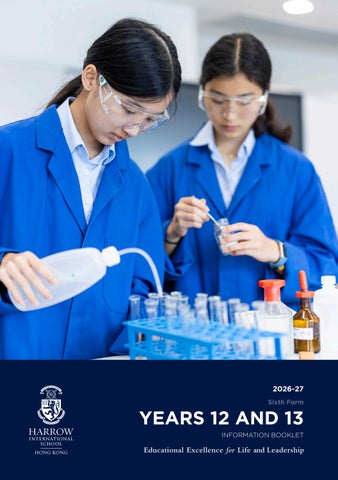
2026-27 Sixth Form
YEARS 12 AND 13 INFORMATION BOOKLET
1
2
CONTENTS WELCOME TO YEARS 12 AND 13
4
INTRODUCTION TO THE SIXTH FORM
5
THE SIXTH FORM TEAM
6
UNIVERSITY PREPARATION
13
CURRICULUM OVERVIEW
14
USEFUL INFORMATION
87
THE SCHOOL DAY
87
HOUSE ETHOS
89
KEY PERSONNEL
90
COMMUNICATION WITH THE SCHOOL
91
AUTHORISED ABSENCE
92
PREP
92
CONFIDENTIALITY AND CONSENT
94
MEDICAL CARE
95
HARROW HORIZONS PROGRAMME
96
REPORTS TO PARENTS
97
PARENT CONSULTATION EVENTS
97
1:1 DEVICE PROGRAMME
98
MOBILE PHONES AND SMARTWATCHES
98
SPEECH DAY
99
BUS ROUTES
99
WEATHER
100
INDIVIDUAL MUSIC LESSONS
100
FOOD
101
OVERSEAS SCHOOLS’ ENTRANCE EXAMINATIONS
101
SCHOOL UNIFORM AND PUPIL DRESS CODE
102
GOVERNANCE
103
RELATIONSHIP STATEMENT
103
STAFF LIST
105
MESSAGE FROM THE HEAD
WELCOME TO YEARS 12 AND 13 Welcome to the Sixth Form at Harrow Hong Kong. Over these two years, pupils prepare for university and future careers while developing independence and maturity. The Harrow values remain central, connecting pupils to tradition while preparing them for future success. The Harrow Horizons programme continues to offer extensive opportunities alongside academic study. Last year, we introduced the Harrow Diploma, which now enables pupils to further develop leadership and essential competencies. LAMDA Grade 8 and wider opportunities support oracy, confidence and leadership. ‘Beyond Harrow’ and University Preparation programmes provide valuable insight into future pathways and enrich the Sixth Form experience. As Head of Harrow International School Hong Kong, I look forward to seeing pupils lead, shape the school community and lay the foundations for success beyond school.
Rosie McColl Head
4
INTRODUCTION TO THE SIXTH FORM What might the world look like in five, ten or twenty years’ time? Will the phenomenal pace of technological development – artificial intelligence, autonomous vehicles, genetic modification – improve our lives for the better or present new ethical and societal challenges? How can our political and economic institutions combat misinformation, reduce inequality, and care for an ageing population? Can we prevent the worst effects of climate change? These are some of the questions that your generation will be asked to answer. The Sixth Form at Harrow Hong Kong will help you build strong academic foundations and develop your personal qualities so that you can succeed, lead and find fulfilment in the future, no matter what challenges lie ahead. The Sixth Form years are the most exciting of your school career. You have the satisfaction of choosing the subjects that you want to study, and the confidence gained by taking your first public examinations. Lessons are different in the Sixth Form: you will be taking the lead in discussion; you will be conducting your own research outside of the classroom; and you will be active – questioning, thinking, taking responsibility – not passively receiving information. Naturally we hope that you enjoy your chosen subjects and that you achieve the very best grades you can, but studying A Levels isn’t all about the final result. It is about igniting a love of learning in your lessons, SCAs and CCAs, the EPQ, societies, the Harrow Diploma, essay competitions, lectures and conferences – and that stays with you for the rest of your life. Your responsibilities in House and in school change too. You will take the lead running aspects of the House, organising sports teams, music groups and societies, and co-ordinating major events. You set the tone, acting as role models and mentors for younger pupils. Your support and enthusiasm matter and you have real influence throughout the School. One of the most rewarding aspects of your time in the Sixth Form is the friendships you will build. With smaller classes, the Sixth Form Zone, and a greater range of activities designed just for Sixth Formers, you’ll find that you will engage more closely with a diverse group of peers, forge new connections, and deepen those friendships of many years. At some point you will also turn your thoughts to your future beyond Harrow Hong Kong. This may mean a course at a leading university in the UK, US, Europe, Hong Kong, mainland China, Canada or Australia. Some of you may want to attend a leading Art, Music or Drama school, or prefer to take a gap year before committing to a course. Whatever your plans, the Sixth Form team is hugely experienced in helping you navigate this range of options and create the strongest possible application. The opportunities in the Sixth Form are vast. Your academic achievement is of course important, but we want you to be so much more than a string of impressive grades. We want you to be leaders in your House, in the School, and ultimately in your own fields. We want you to have the intellectual curiosity to understand the world’s problems, the ambition to solve them, and the confidence to go out and do it. In short, the Sixth Form is about realising the vision of all Harrow Schools, of Educational Excellence for Life and Leadership.
Mr Jonny Franks Assistant Head (Sixth Form)
5
THE SIXTH FORM TEAM Our experienced Sixth Form team has supported thousands of pupils over the years. The team consists of: •
Mr Jonny Franks, Head of Sixth Form A Level subject combinations, University applications and guidance
•
Ms Jess Darke, Deputy Head of Sixth Form University applications and guidance, Beyond Harrow and Tutor programmes
•
Dr Simon Case, Head of EPQ EPQ guidance
•
Each House has two Sixth Form Tutors, who provide further academic, pastoral and university support, guiding the same cohort of pupils through both Year 12 and Year 13.
We are fortunate to have a wealth of experience and expertise relevant to the Sixth Form across our staff body. The following members of staff also contribute to our provision. •
Mr James Brewer, Deputy Head (Academic) A level option choices, Academic guidance
•
Mrs Sabrina Peck, Deputy Head (Co-curricular and Organisation) SCA and CCA guidance
•
Heads of Department and Subject Teachers Subject-specific guidance
•
Housemasters / Housemistresses and HPTs Academic and pastoral guidance
6
CHOOSING A LEVEL SUBJECTS Universities worldwide base their offers on applicants presenting three A Levels, which is considered the standard expectation. All Harrow Hong Kong pupils take three A Levels plus the EPQ (worth half an A Level), so exceed this expectation. Universities prefer to see high grades in three A Levels than a range of grades in four A Levels. A*A*A is a far stronger profile than A*AAB, for example. US colleges understand that our pupils must narrow down their choices at A Level. Therefore, there are no required A Levels for US applicants. Some pupils choose to study subjects across the Arts, Humanities and Sciences; others prefer to specialise in one area. Only in a small number of cases should a pupil be advised to study four A Levels: If two of a pupil’s A Level choices are Maths and Further Maths, they should study two additional A Level subjects - four in total - to meet universities’ requirements. If a pupil wishes to apply to HKU or CUHK for Medicine, or to HKU for Global Engineering and Business, they should study four A Level subjects since this is the minimum requirement for these courses. Note that CUHK does not recognise Maths and Further Maths as two separate A Levels. Choosing four A Levels must be agreed in advance with the Deputy Head (Academic) and Assistant Head (Sixth Form). The most important factors to consider when choosing your A Level subjects are: Do I enjoy these subjects? Am I likely to do well in these subjects? What university courses or careers are open to me with this combination of subjects?
DO I ENJOY THESE SUBJECTS? You should choose to study A Level subjects that genuinely interest you and that you have enjoyed thus far in your academic journey. A Levels are more challenging than GCSEs, and so a strong and sustained interest in the subject content is essential for success and fulfilment over the full two-year course. For new options, like Business Studies, Economics, Psychology or Politics, you will need to undertake additional research through reading, talking to teachers and pupils, 7
and attending taster sessions, in order to be as confident as you can be that you will enjoy the subject at A Level. Consider not only the content of your A Level subjects but also how they are assessed: extended writing, coursework, practicals, etc. Remember, no A Levels are any easier or harder than any others, but some will suit you better than others.
AM I LIKELY TO DO WELL IN THESE SUBJECTS? For many A Level courses, the content assumes a strong foundation in the GCSE knowledge and skills in the same subject. This is obviously not the case for subjects that are new at A Level; however, certain fundamental knowledge will still be required for success. It is for these reasons that we have a set of entry requirements for all A Level subjects at Harrow Hong Kong. These requirements are based on historical data and on our teachers’ years of experience. They reflect our knowledge of the level of achievement that needs to be evidenced in order to succeed at A Level. A pupil must pass six GCSEs at a Grade 6 or above, including Grade 7 in English Language GCSE and Mathematics GCSE. In addition, there are specific requirements for each A Level course. Please see the A Level Entry Requirements section for more detail.
WHAT UNIVERSITY COURSES OR CAREERS ARE OPEN TO ME WITH THIS COMBINATION OF SUBJECTS? Even if you do not know what you want to study at university yet (and many pupils do not early in Year 12), it is important that you understand that your A Level choices can significantly influence your university course. In the UK and Hong Kong, Science, Engineering and Maths-related degrees have more specific A Level requirements than degrees in the Arts and Humanities. Science courses require at least one, usually two, and in some cases three Science A Level subjects directly relevant to the degree: Biology, Chemistry, Physics, Maths or Further Maths. Psychology usually counts as a Science A Level only in applications for a Psychology degree or Psychology-related degrees. If you wish to take two Science A Levels, you can keep more options open by choosing two closely related Science subjects: e.g. Biology and Chemistry, Chemistry and Physics, or Physics and Maths / Further Maths.
8
Arts and Humanities courses offer more flexibility. An English Literature, History or Modern Foreign Language degree usually requires the corresponding A Level. A degree that will cover material new to all undergraduates – Anthropology, Law or Philosophy, for example – generally has no specific A Level requirements, though some universities suggest helpful combinations. If you don’t find yourself drawn especially to the Arts or to the Sciences, there are several degree courses at leading universities that span this traditional divide, such as Liberal Arts or Arts and Sciences. The excellent Informed Choices site contains more information about A Level choices for Russell Group universities: informedchoices.ac.uk Further guidance on A Levels and university options can be found here or by scanning the QR code below. The advice for the UK above also holds for Hong Kong university courses. For applications to the US, candidates do not need to declare a major or concentration until their second year of a four-year degree, in most cases. Applicants to Schools within a university system (e.g. the School of Engineering) or to specialist Art, Music or Drama schools will likely have specific requirements or recommendations for A Level choices.
9
A LEVEL ENTRY REQUIREMENTS A Level study is more rigorous and challenging than GCSE. For pupils to be successful at A Level they require a prior level of subject understanding and demonstrate a grasp of subject content and evidence of skills throughout the GCSE course and in their GCSE exam results. A Level entry requirements ensure pupils have the requisite skills and knowledge to succeed in their A Level studies. The general entry requirement for A Level candidates at Harrow Hong Kong is six GCSEs at Grade 6 or above (or equivalent), including Grade 7 in English Language GCSE and in Mathematics GCSE. In addition to the general entry requirements successful candidates must achieve the minimum Grades in the subjects that they wish to undertake at A Level. Below is a list of the A Level subject entry requirements that must be met before commencement of study in that subject. For Arts and Humanities A Level subjects, a Grade 7 in the corresponding GCSE, though note: For A Level English Literature, a Grade 7 in English Literature GCSE For A Level Chinese, a Grade 8 in Chinese Foreign Language GCSE or a B in Chinese Second Language GCSE For Science A Level subjects, a Grade 8 in the corresponding GCSE or a 9-9 in Double Award Science GCSE, though note: For A Level Physics, a Grade 8 in Physics GCSE and a Grade 8 in Mathematics GCSE For A Level Psychology, a Grade 7 in Biology GCSE (or 7-7 in Double Award Science GCSE) For Mathematics A Level, a Grade 8 in Mathematics GCSE For Further Mathematics A Level, a Grade 9 in Mathematics and Grade 9 in Physics GCSE Please note that for the study of A Level Further Mathematics, we require pupils to demonstrate their understanding by achieving a Grade 9 in their Year 11 Mathematics Mock Exam. Pupils must achieve a Grade 9 in Mathematics and Physics GCSE and pass a subsequent test early in Year 12. Further Maths is a demanding A Level. The Maths department will continue to monitor pupils throughout the course to ensure they are making the necessary progress. We do not offer Further Maths as a discrete A Level subject; if a pupil is accepted onto the Further Maths A Level course, this is in addition to three other A Levels (including Maths A Level) and an EPQ.
10
A LEVEL
ENTRY REQUIREMENT
Art & Design
Art GCSE Grade 7
Biology Business Studies Chemistry
Chinese
Biology GCSE Grade 8 Double Award Science Grade 9 n/a Chemistry GCSE Grade 8 or Double Award Science GCSE Grade 9-9 Chinese Second Language GCSE Grade B or Chinese Foreign Language GCSE Grade 8
Computer Science
Computer Science GCSE Grade 7
Economics
n/a
English Literature
English Literature GCSE Grade 7
EPQ
n/a
French
French GCSE Grade 7
Geography
Geography GCSE Grade 7
History
History GCSE Grade 7
Mathematics
Mathematics GCSE Grade 8
Further Mathematics Music
Mathematics GCSE Grade 9 and Physics GCSE Grade 9 Music GCSE Grade 7 Physics GCSE Grade 8 or
Physics
Double Award Science GCSE Grade 9-9 and Mathematics GCSE Grade 8
Politics
n/a
PRS
Religious Studies GCSE Grade 7
Psychology Spanish
Biology GCSE Grade 7 or Double Award Science GCSE Grade 7-7 Spanish GCSE Grade 7
Please note Further Mathematics can only be taken in addition to three other A Level subjects, one of which must be Mathemtatics. 11
THE EPQ All pupils at Harrow Hong Kong undertake the EPQ (Extended Project Qualification). The EPQ is a core part of our curriculum and a unique opportunity to step away from traditional A Level work and study a topic you are genuinely interested in. You’ll start the EPQ process at the beginning of Year 12 and aim to finish it by the start of Year 13. Whether you want to explore a specific scientific theory, a historical event, or a creative concept, the EPQ gives you the freedom to choose your own focus. Through this project, you will naturally develop key skills in independent research, critical thinking, and project management, which will stand you in excellent stead for university. You will also become an expert in a specialist area, and perhaps even discover a lifelong passion or a future career path along the way. Indeed, the EPQ is highly respected by university admissions teams worldwide precisely because it demonstrates that you are ready for higher education. Some UK universities will offer lower A Level entry requirements for certain courses if you achieve an A grade or higher in your EPQ, and US admissions officers value the qualification as evidence of academic integrity, scholarly depth, and your ability to handle a demanding workload. In a competitive pool of applicants, a strong EPQ can be the deciding factor that helps your application stand out. You will be guided throughout the process with dedicated lessons on time management, project planning, research methods and presentation skills. You will also be paired with a staff mentor who will meet with you regularly, help you develop your ideas, and provide constructive feedback on your progress. The EPQ is a rewarding way to build university-level skills while becoming an expert in a subject you care about. We look forward to seeing where your project takes you. Previous EPQ project titles include: Is Generative AI (GenAI) secure and to what extent can it enhance social engineering attacks? To what extent can formalist accounts explain the experience of beauty in Western classical music? Between a Rock and a Hard Place: The Young Victims of China’s Economic Miracle. To what extent is financial fair play the most important socioeconomic factor that determines the extent of profit maximisation of English Premier League Football Clubs? Is Universal Basic Income a viable solution to alleviate poverty in the United Kingdom? To what extent is gender bias the main factor in the wrongful conviction of women in the US? 12
UNIVERSITY PREPARATION AND BEYOND HARROW Our bespoke University Preparation Programme is delivered over two lessons each week. It includes talks from Admissions Officers from leading universities around the world, guidance on how to conduct meaningful research into universities, colleges and courses, and dedicated time to prepare high-quality application materials well ahead of deadlines. The programme is designed to maximise your chances of success wherever you apply. All pupils and parents have access to Unifrog, a fantastic resource for university application information, research, and preparation. Beyond Harrow is the Sixth Form equivalent of PSHE, taught for one period a week. Built around major themes including Relationships, Career Preparation, Academic Enrichment and Global Citizenship, the course equips you with the essential skills needed for success and fulfilment after the completion of a Harrow education. In addition, we run two SCAs for Year 12 and Year 13 only: Oxbridge Preparation, where students are guided through the application process to Oxford and Cambridge in greater detail, and Applying to the US, with a focus on college application strategy and preparation.
STUDY PERIODS You will find that you have several Study Periods on your timetable once you join the Sixth Form. You will be given guidance at the beginning of Year 12 about how to maximise the use of this time to support your A Level studies, your EPQ research and your academic enrichment. The Sixth Form Zone has a silent working area, a collaborative working area and space to socialise, as well as a regular supply of snacks and coffee.
13
CURRICULUM OVERVIEW ART “Every child is an artist. The problem is how to remain one once we grow up” Pablo Picasso At Harrow Hong Kong we follow the A Level (Linear) Edexcel GCE Art and Design qualification within the ‘Fine Art’ pathway. The course builds on the skills learnt at GCSE and encourages deeper study of a wider range of creative pathways and outcomes within Fine Art including photography, 3D Design, mixed-media, installation and digital media, textiles and printmaking, as well as revisiting more traditional painting and drawing disciplines. The Year 12 Foundation Course aims to prepare pupils for the rigour of A Level Art by ensuring they develop fundamental skills necessary for academic success and establish sound study habits and routines that will enable them to succeed academically. Building on the skills acquired at GCSE, pupils will engage in a series of shortform projects during the first term, introducing a variety of media, techniques, and processes that reinforce their foundational abilities and expand their artistic horizons. These projects focus on enhancing routines, commitment, and pace as well as nurturing risk-taking and encouraging pupils to step beyond their comfort zone. This creative spirit and endeavour continues as they commence work on their main Component 1 project in the second half of the Spring term. This long form project will continue until January of Year 13 and will create opportunities for pupils to develop independent projects and outcomes that explore ideas, medium and concepts personal to them. At the end of this project, pupils will produce a final piece for this project under exam conditions during a 15-hour period of sustained focus in their Year 13 mock exam. 14
In addition to their practical portfolio, pupils are required to produce a ‘Personal Study’ which is an essay of at least 1500 - 3000 words of continuous prose that highlights aspects of their own work and how it relates to the artwork produced by past and contemporary artists. The personal study creates an opportunity for pupils to look beyond their immediate project work and identify how the work of their selected artists and themselves sits within the wider world context of art history. Through exploration of wider reading and the development of personal insights pupils are encouraged to identify a topic or theme about which they are passionate and use their personal study as a means to deepen their knowledge and understanding of it within the context of art and design. Component 2, in the form of an externally set assignment, is released to pupils at the start of February and takes the form of a theme designated by the exam board, this acts as a starting point for their personal ideas and investigations and pupils are encouraged to pursue techniques, processes and ideas that inspire them personally. This project culminates in a 15-hour period of sustained focused at the end of the Year 13 course where pupils produce the final piece for this project. YEAR 12
PROJECT THEME
Autumn
Spring
Sculpture Foundation Course:
Mixed Media Articulation Drawing
Summer
YEAR 13
Autumn
Spring
Summer
Personal Investigation
COURSEWORK TOPIC
Personal investigation
Personal portfolio inspired by a theme of their choice, guided and supported by teachers Personal study section 1 MATERIALS EXPLORED Continuation of personal portfolio started in Year 12 culminating in a final piece produced during the Year 13 mock exam Personal study sections 2 and 3
Externally Set assignment Released on 2nd February Final exam session
15
COMPONENT 1: PERSONAL PORTFOLIO (INTERNALLY SET ASSIGNMENT) This comprises all work produced from the start of Year 12 to the end of the January in Year 13.
60% of the qualification 90 marks (18 marks for each of the four Assessment Objectives and 18 for the Personal study)
COMPONENT 2: EXTERNALLY SET ASSIGNMENT This comprises all work produced from the January of Year 13 until their final exam session at the start of the Summer term.
40% of the qualification 72 marks (18 marks for each of the four Assessment Objectives)
ASSESSMENT The A Level Art course is marked holistically across each component, with work being reviewed against the below assessment objectives. COMPONENT 2: EXTERNALLY SET ASSIGNMENT AO1: Developing ideas through investigations
AO2: Refine work, exploring ideas
AO3: Record ideas, observations and insights
AO4: Present a personal and meaningful response
16
Pupils must demonstrate critical understanding by exploring and developing ideas informed by relevant sources. Pupils are required to select and experiment with appropriate media, materials, techniques, and processes. This refining process involves critically evaluating their experiments, adjusting based on outcomes, and integrating feedback to enhance the quality and depth of their creative work. Pupils should effectively document their thoughts and reflections throughout the creative process, showing relevance to their intentions. Pupils must produce work that realises their intentions, demonstrating a clear understanding of visual language and its application. This refers to the creation of final outcomes to projects, where identifying intentions and planning the production process is as crucial as the technical execution of the work.
Due to the nature of the assessment criteria, no individual piece of work can be an indicator of overall performance, instead, pupils will be marked on the work accumulated in their personal portfolio via periodic sketchbook review. This process will assess all work created to date within a given project against AO1, AO2 and AO3 with summative assessment of the whole project being undertaken at the end of each section of the foundation course and after the mock exam session in Year 13 when pupils will have made their final piece and generated the evidence required for AO4.
INTERCULTURAL LEARNING Intercultural learning is a key component of the A Level Art curriculum as it encourages pupils to explore the cultural, social, and historical contexts in which art is created. Through the study of diverse artistic traditions and practices from around the world, pupils will develop a deeper understanding of the ways in which art reflects and shapes society. They will also learn to appreciate the richness and diversity of different cultures, and to recognise the ways in which their own cultural background influences their artistic perspective.
ACADEMIC HONESTY Academic honesty is an essential component of the A Level Art curriculum. As part of the qualification, pupils will be expected to produce original work that reflects their own ideas and abilities. It is important that they do not plagiarise or copy the work of others, as this goes against the principles of academic integrity and can have serious consequences for their grades and future academic pursuits. Pupils must also ensure that any sources used within their work are properly cited and referenced, and that all work submitted has been seen to be worked on during class time. The Art Department takes academic honesty very seriously, and any instances of plagiarism or academic misconduct will be dealt with in accordance with school policy.
17
BIOLOGY “Only if we understand, will we care. Only if we care, will we help. Only if we help, shall all be saved” Jane Goodall The Edexcel A (Salters-Nuffield) A Level Biology course is a broad and varied, exciting, challenging, and rigorous exploration of the living world. It covers essential biological principles and emphasises the way in which scientists work and their contributions to modern society. The course is context-led, using real-life scenarios and investigative methods to form the basis of learning. This allows pupils to learn new skills and develop others. The course is also challenging, requiring pupils to think critically and solve problems. Pupils who study Biology will gain a deep understanding of the living world and the scientific method. They will also develop skills that are essential for further study or employment in science-related fields. During the two-year A Level course, pupils complete the following: Year 12 TERM
TOPICS COVERED 1.
Autumn 2.
3. Spring
4.
Lifestyle, Health and Risk Genes and Health
Voice of the Genome Biodiversity and Natural Resources
CORE PRACTICALS •
Investigate the effect of caffeine on heart rate in Daphnia
•
Investigate the vitamin C content of food and drink
•
Investigate membrane structure, including the effect of alcohol concentration or temperature on membrane
•
Investigate the effect of enzyme and substrate concentrations on the initial rates of reactions
•
Prepare and stain a root tip squash to observe the stages of mitosis
•
Identify sclerenchyma fibres, phloem sieve tubes and xylem vessels and their location within stems through a light microscope
•
Investigate plant mineral deficiencies
•
Determine the tensile strength of plant fibres
•
Investigate photosynthesis using isolated chloroplasts (the Hill reaction)
Summer
5.
On the Wild Side
6.
Immunity, Infection and Forensics
•
Investigate the antimicrobial properties of plants, including aseptic techniques for the safe handling of bacteria
•
Use gel electrophoresis to separate DNA fragments of different lengths
•
Investigate the effect of different antibiotics on bacteria
18
Year 13 TERM
TOPICS COVERED
CORE PRACTICALS •
Autumn
1.
On the Wild Side (continued)
2.
Immunity, Infection and Forensics (continued)
Carry out a study on the ecology of a habitat, such as using quadrats and transects to determine distribution and abundance of organisms, and measuring abiotic factors appropriate to the habitat
•
Investigate the effect of temperature on the rate of an enzyme-catalysed reaction (to include Q10)
•
Investigate the effects of temperature on the development of organisms (seedling growth rate, brine shrimp hatch rates etc.)
3.
Run for your Life
4.
Grey Matter
Spring
•
Investigate the rate of respiration
•
Investigate the effects of exercise on tidal volume, breathing rate, respiratory minute ventilation and oxygen consumption using data from spirometer traces
• Summer
Investigate habituation to a stimulus
Exam preparation
Pupils complete 18 core practical activities and are assessed against 11 Core Practical Assessment Criteria (CPAC) statements. If they complete 12/18 core practicals and show evidence of meeting the 11 skills statements, they will pass their Practical Endorsement.
ESSENTIAL SCIENTIFIC SKILLS Pupils develop strong investigative skills, such as: •
Devising a method to test an investigative question
•
Identifying variables
•
Collecting data
•
Analysing results
•
Drawing conclusions
Pupils also develop critical thinking and collaborative problem-solving skills throughout the course and mathematical skills through accurate graphing, describing results, and carrying out calculations, including statistical analysis.
INTERCULTURAL LEARNING Biology is taught through a multicultural lens. For example, when studying cystic fibrosis, pupils learn about the genetic disorder and how it affects people from different cultures. 19
ASSESSMENT Pupils are assessed through informal knowledge and skills checks, end of topic tests, and examinations. Both formative and summative assessments will be followed up with Stepping Up activities to ensure further progress is made. The final grade awarded at the end of the course is 100% externally assessed through examinations (three papers).
ENTRY REQUIREMENTS FOR A LEVEL BIOLOGY Triple Award Biology: 8 or 9 Double Award Science: 9,9
20
BUSINESS “I’m convinced that about half of what separates the successful entrepreneurs from the non-successful ones is pure perseverance.” Steve Jobs Business is about innovation, leadership and making decisions in an ever-evolving landscape. It explores how organisations operate, adapt and thrive in competitive markets. It’s about understanding human behaviour within companies, crafting strategies for success and balancing the pursuit of profit with ethical practices and societal impact. From startups to multinational corporations, studying business opens a window into the mechanisms that drive our world, preparing you to shape and influence the future of industries globally. •
Here are some of the key questions and topics that will be explored:
•
Why do some businesses succeed while others fail?
•
What role does innovation play in the competitive landscape?
•
How do economic policies impact businesses?
•
What marketing strategies can companies use to drive sustainable growth?
•
How do efficient operations contribute to business success?
•
How do we measure business performance?
•
How do human resource practices affect employee satisfaction and productivity?
•
How do firms calculate profit and what incomes and costs are involved in the calculation?
Summary of the course The course is linear and divided into four themes, covering a range of business concepts and issues from local to global perspectives. Theme 1 - Marketing and People
Theme 2 - Managing Business Activities
•
Meeting customer needs
•
Raising finance
•
The market
•
Financial planning
•
Marketing mix and strategy
•
Managing finance
•
Managing people
•
Resource management
•
Entrepreneurs and leaders
•
External influences
21
Theme 3 - Business Decisions and Strategy •
Business objectives and strategy
•
Business growth
•
Decision-making techniques
•
Influences on business decisions
•
Assessing competitiveness
•
Managing change
Theme 4 - Global Business
•
Globalisation
•
Global markets and business expansion
•
Global marketing
•
Global industries and companies (multinational corporations)
ESSENTIAL SKILLS The course cultivates a mindset characterised by strategic thinking and logical reasoning. By analysing business models, pupils learn to make informed decisions and justify them based on evidence and analysis, developing critical thinking skills and collaborating to solve problems.
INTERCULTURAL LEARNING While the course primarily emphasises the UK, gaining a global perspective on business is crucial. Pupils will delve into international case studies, exploring why certain companies achieve success while others face challenges. For example, analysing business practices in countries like Japan, Germany and China will offer valuable insights into varied management styles and market dynamics. In Year 13, the curriculum highlights global business, using case studies to deepen understanding of diverse business environments worldwide.
ASSESSMENT Throughout the course, pupils will develop essential skills in critical analysis, evaluation and decision-making, checked through regular assessments which prepare pupils for the three 2-hour long papers at the end of Year 13. Paper 1 Marketing, People and Global Businesses: 35% of the total grade. Paper 2 Business Activities, Decisions and Strategy: 35% of the total grade. Paper 3 Investigating Business in a Competitive Environment: 30% of the total grade.
22
23
CHEMISTRY “I would rather have questions that can’t be answered than answers that can’t be questioned.” Jules Verne Chemistry Edexcel A Level is a challenging but immensely interesting and rewarding course. Many of the concepts already introduced at IGCSE are developed further throughout the two years as pupils delve deeper into the world of chemistry. A successful chemist is inquisitive, logical, practical, and highly motivated. Pupils need to be resilient and independent learners as they approach more complex ideas and have to apply them to novel situations. TERM
Y12 TOPICS COVERED
Y13 TOPICS COVERED
Topic 5: Formulae, Equations and Amounts of Substance
Topic 6a/b/c: Organic Chemistry I
Topic 13: Energetics II (continued) Topic 12: Acid-Base Equilibria Topic 17: Organic Chemistry II Topic 18A: Organic Chemistry III Arenes Topic 18B: Organic Chemistry III Amines, amides, amino acids and proteins
Topic 3: Redox I
Topic 14: Redox II
Topic 4: Inorganic Chemistry and the Periodic Table
Topic 15: Transition Metals
Topic 2: Bonding and Structure Autumn
Topic 1: Atomic Structure and the Periodic Table Topic 8: Energetics I
Spring
Topic 6d/e: Organic Chemistry I Topic 7: Modern Analytical Techniques I Topic 10: Equilibrium I Topic 11: Equilibrium II
Summer
Topic 13: Energetics II (BornHaber) Topic 9: Kinetics I Topic 16: Kinetics II
24
Topic 19: Modern Analytical Techniques II Topic 18C: Organic Chemistry III Organic Synthesis
ESSENTIAL SKILLS Throughout the course, pupils learn about chemical themes and concepts and they will need to be able to apply their knowledge and understanding in familiar and unfamiliar contexts. Following on from the calculations studied at IGCSE, the pupils will continue to develop their mathematical skills through the lens of Chemistry. A Level Chemistry learning builds on fundamental chemical concepts and develops essential skills, including collaborative problem-solving, creativity, critical thinking, cultural competency, digital literacy, effective communication, and leadership. Group work and lab experiments foster collaboration, while designing experiments and interpreting results promotes creativity. A Level Chemistry challenges pupils to analyse complex data and information, evaluate evidence, and draw logical conclusions, promoting critical thinking skills. The subject covers chemical concepts and principles with global relevance, promoting cultural competency and understanding of chemistry’s impact on different cultures and societies. Pupils learn to use digital tools and resources for research, data analysis, and simulation modelling, promoting digital literacy. Effective communication skills are developed through writing reports and delivering oral presentations. Group work and lab experiments foster leadership skills through effective communication and decision-making.
INTERCULTURAL LEARNING A Level Chemistry involves the study of chemical concepts and principles that have global relevance, making it a subject that promotes global citizenship and cultural competency. Through the study of chemistry, pupils gain a deeper understanding of the global challenges related to energy, food, health, and the environment, and how chemical solutions can help address them. Additionally, pupils learn about the cultural contexts in which chemical applications have been developed and used and the ethical considerations related to these applications. The study of A Level Chemistry promotes intercultural awareness and understanding, helping pupils become responsible global citizens who can contribute positively to the world.
PRACTICAL SKILLS A number of core practical activities, such as determining the enthalpy change of a reaction using Hess’s Law and using organic synthetic routes to prepare aspirin, are embedded within the topics. Additional demonstrations and experiments will supplement the core practicals and encourage pupils to build upon their experimental and investigative skills whilst further developing their understanding of the areas being studied. Within one of the synoptic papers taken at the end of the course, pupils will be required to draw upon their theoretical knowledge and conceptual understanding of the practical procedures and techniques covered throughout the course.
25
ASSESSMENT Regular internal assessment takes place throughout the two years of study, enabling close tracking of every pupil’s progress. The final grade awarded at the end of the course is 100% externally assessed through examinations. The three papers will consist of a mixture of multiple-choice questions, short questions, open-response and extended writing questions, with a minimum of 20% of each paper being based around mathematical skills. In addition to practical knowledge being assessed on the written papers, the assessment of personal physical practical skills throughout the course is a compulsory requirement for the A Level qualification and it will appear on pupils’ certificates as a separate reported result. To achieve the practical endorsement, pupils must carry out a minimum of 12 practical activities, which must meet a range of Common Practical Assessment Criteria (CPAC).
ENTRY REQUIREMENTS FOR A LEVEL CHEMISTRY Triple Award Chemistry: 8 or 9 Double Award Science: 9,9 Recommended: Physics 8, Biology 8, Maths 8 and English 8
26
COMPUTER SCIENCE “Coding is today’s language of creativity. All our children deserve a chance to become creators instead of consumers of computer science.” Maria Klawe
CIE A LEVEL COMPUTER SCIENCE (9618) The aim of this course is to enable pupils to develop: •
An understanding of the main principles of solving problems using computers.
•
An understanding of the component parts of computer systems and how they interrelate, including software, data, hardware, communication and people.
•
An understanding of the different methods of communication and the functionality of networks and the internet.
•
The skills necessary to apply this understanding to develop computer-based solutions to problems. 27
YEAR 12
KEY CONCEPTS Information Representation Communication Hardware and Software
Autumn
Security, Privacy and Data Integrity Databases Algorithm Design and Problem Solving Data Types and Data Structures Programming Software development
Spring
Communication and Internet Technologies
System Software Security Artificial Intelligence Computational thinking and Problem Solving Further Programming
28
• • • • • • • • •
KEY CONCEPTS
Hardware and Virtual Machines
Spring
• • • • • • • • • •
•
Data Representation Autumn
•
•
Summer
YEAR 13
TOPICS Data Representation, Multimedia, Compression Networks and the Internet Computers and their Components Logic Gates and Logic Circuits CPU Architecture Assembly Language Bit manipulation Computational Thinking Skills Algorithms Programming Basics Data types, Records, Arrays and Constructs Structured Programming Programming Development Life Cycle Program Testing and Maintenance Operating Systems and Language Translators Data Security and Integrity Ethics and Ownership Database Concepts Database Management Systems File Handling and Structured Programming Abstract Data Types and Structured Programming Paper 2 Theory Consolidation TOPICS • • • • • • • • • • • •
User defined data types and FloatingPoint Representation File Organisation and Access Communication Protocols Circuit and Packet Switching Parallel Processing and Virtual Machines Boolean Algebra and Logic Circuits Operating Systems Translation Software Encryption, Protocols and Digital Signatures Algorithms Recursion Programming Paradigms File Processing and Exception Handling
ASSESSMENT STRUCTURE Paper 1: Written - Theory Fundamentals (1h 30m) Paper 2: Written - Fundamental Problem-solving and Programming Skills (2hrs) Paper 3: Written - Advanced Theory (1h 30m) Paper 4: Practical - Program Coding and Testing (2hrs 30 mins)
POTENTIAL CAREERS Studying Computer Science helps gain many technical and non-technical skills which are highly valued by employers, from leadership to programming. Some careers where a Computer Science degree would be a perfect fit are Data Scientist, Web Developer, Systems Analyst, Network Architect, Software Engineer, Database Administrator, Cloud Computing Engineer, Artificial Intelligence & Machine Learning engineer and more. As the world becomes even more reliant on technology, every industry will need Computer Science experts.
ESSENTIAL SKILLS Taking an A Level Computer Science class allows pupils to develop a wide range of valuable skills. Firstly, they gain a strong foundation in programming languages, such as Python, enabling them to write efficient and effective code. They learn how to analyse problems and break them down into smaller, more manageable parts, enhancing their problem-solving and critical thinking abilities. Furthermore, they acquire the skills necessary to design and develop algorithms, allowing them to solve complex tasks and improve their logical reasoning skills. Additionally, pupils learn about computer hardware and software, enabling them to understand the inner workings of computers and make informed decisions when it comes to technology. Finally, the class fosters creativity and innovation by encouraging pupils to develop their own software and experiment with different programming concepts.
INTERCULTURAL LEARNING The A Level curriculum is designed to incorporate diverse perspectives, ensuring that pupils are exposed to different cultures and their contributions to the field of Computer Science. This includes studying the work of computer scientists from various cultural backgrounds and exploring the impact of different cultures on technological advancements. Additionally, collaborative projects are structured in a way that encourages pupils to work in diverse teams, bringing together individuals with different cultural backgrounds, experiences, and perspectives. Through these projects, pupils gain insights into how culture influences problem-solving approaches, communication styles, and decision-making processes. Classroom discussions and activities further encourage pupils to share their cultural perspectives and engage in respectful dialogue, fostering empathy and understanding among classmates. By integrating intercultural learning into the Computer Science curriculum, pupils develop not only technical skills but also a global mindset that prepares them to navigate an increasingly interconnected world. 29
DRAMA AND THEATRE STUDIES ‘All the world’s a stage’ William Shakespeare Our vision is to ignite creativity, foster self-expression, and cultivate a lifelong appreciation for the performing arts. We strive to create a dynamic and inclusive environment where pupils can explore the transformative power of drama, develop their artistic skills, and grow into confident, empathetic individuals. By integrating theoretical knowledge with practical experience, we aim to empower our pupils to become skilled performers, critical thinkers, and collaborative team players. The A Level Drama and Theatre specification we follow is AQA. •
Component 1: Drama and Theatre
•
Component 2: Creating original Drama (Devising)
•
Component 3: Making Theatre (Scripted)
Throughout their lessons they will be given verbal and written feedback from their teacher. Pupils will be assessed formatively on a range of practical and written work. Pupils will complete Component 2 in year 12. 30
TERM
TOPIC
ESSENTIAL SKILLS
Introduction to A Level Drama and Theatre Theatre History, Genre, Styles and Practitioners Component 2 - Creating Original Drama: Remembrance Day Assembly performance Autumn
Pupils will perform in the Remembrance Day assembly. This has become a tradition at Harrow Hong Kong where each Year 12 class devises a new piece of theatre based on the themes of the assembly. In previous years this has included WW1 letters and Hong Kong in WW2. Component 1 - Drama and Theatre (Section C) Component 2 Creating Original Drama: Worth 30% of the overall GCSE Drama grade.
Spring
•
Working Notebook
•
Devised performance
Pupils will be given a range of stimuli to create a devised Drama performance in the style of their chosen practitioner. This will be performed to a live audience.
Pupils will learn how to commit dialogue to memory for devised performances and/or learn text they are performing for textbased performances Pupils will develop a range of vocal skills and techniques Pupils will develop a range of physical skills and techniques Pupils
will
develop
an
appropriate performer/audience relationship and ensure sustained engagement
throughout
the
performance
They will write Section 1 of their Working Notebook. Component 1 - Drama and Theatre (Section C) Component 2 Creating Original Drama: They will write Section 2 of their Working Summer
Notebook. Component 1 - Drama and Theatre (Section C) Component 3 - Making Theatre (Scene Lab)
31
ESSENTIAL SKILLS Pupils develop creativity by creating and performing innovative characters, considering elements like the role of designers and directors. Collaborative problemsolving is enhanced through effective teamwork and idea articulation. Critical thinking is fostered by forming respectful opinions based on context. Cultural competency grows from understanding diverse social and historical backgrounds. Digital literacy is built through technical theatre skills and self-evaluation of performances. Effective communication is practiced via respectful feedback and clear expression of ideas, while leadership skills are developed by guiding peers and taking the opportunity to direct.
INTERCULTURAL LEARNING Through the exploration of diverse cultural stimuli and texts, pupils develop their cultural competency and gain exposure to a range of ideas, customs, and beliefs from various cultures. In Year 12 this cultural competency is specifically developed through the resources used as stimuli to inspire Devised Drama pieces. The Drama department selects current affairs and culturally diverse stimuli to suit each year group and class, thereby providing opportunities for pupils to explore and engage with different cultural perspectives. This not only broadens the pupils’ understanding of the world but also fosters empathy and respect for people and communities from different cultural backgrounds.
32
The A Level Drama and Theatre specification we follow is AQA. There are three main components of the A Level Drama and Theatre qualification: •
Component 1: Drama and Theatre
•
Component 2: Creating original Drama (Devising)
•
Component 3: Making Theatre (Scripted)
Throughout their lessons they will be given verbal and written feedback from their teacher. Pupils will be assessed formatively on a range of practical and written work. TERM
TOPIC
ESSENTIAL SKILLS
Component 2 Creating Original Drama: Final draft of Autumn
Working Notebook
Pupils will learn how to commit
Component 3 - Making Theatre
dialogue to memory for devised
Extract 1 & 2 and Reflective Reports
performances and/or learn text
Component 1 - Drama and Theatre (Section C) Component 3 - Making Theatre (30% of A Level) Extract 3 - live performance to external Spring
examiner Finish Reflective reports Component 1 - Drama and Theatre (Section A, B & C)
Summer
Component 1 - Drama and Theatre
they are performing for textbased performances Pupils will develop a range of vocal skills and techniques Pupils will develop a range of physical skills and techniques Pupils will develop an appropriate performer/ audience relationship and ensure sustained engagement throughout the performance
(Section A, B & C) (40% of A Level)
INTERCULTURAL LEARNING Through the exploration of diverse cultural stimuli and texts, pupils develop their cultural competency and gain exposure to a range of ideas, customs, and beliefs from various cultures. In Year 13, this cultural competency is particularly emphasised through the range of texts which pupils explore for Component 1 and 3, where they engage with texts from different cultures. This not only broadens the pupils’ understanding of the world but also fosters empathy and respect for people and communities from different cultural backgrounds. By developing cultural competency, pupils are better equipped to critically analyse and understand the complexities of literary and linguistic expression across cultures, and to navigate an increasingly diverse and interconnected world.
33
ECONOMICS ‘’Economics is about questioning everything - questioning assumptions you don’t even know are assumptions.’’ Esther Duflo Economics is not just about money. It is about weighing different choices or alternatives. Some of those important choices involve money, but most do not. Most of your daily, monthly or life choices have nothing to do with money, yet they are still the subject of economics. Economics is about plumbing the depths of why we sometimes do and sometimes don’t make what seem like the most rational or economical choices. It aims to provide the tools to understand personal, national and international issues, including: •
Why do some countries remain poor?
•
How does an economist measure what is meant by ‘poor’?
•
Why did an attempt to reduce the cobra population result in the opposite happening?
•
Why do footballers get paid more than nurses?
•
Are Facebook, Google and Amazon good for society?
•
How big a role should the government play in the economy?
•
How does a trade war between the US and China impact Germany?
Summary of the course The course is linear and split into four themes: two dealing with micro-economic issues and two dealing with macro-economic issues. Theme 1 - Introduction to markets and market failure •
Nature of economics
•
Economic systems
•
How markets work
•
Market failure
•
Government intervention
Theme 2 - The UK economy - performance and policies •
Measures of economic performance
•
Aggregate demand
•
Aggregate supply
•
National income
•
Economic growth
•
Macroeconomic objectives
•
Macroeconomic policy making
34
Theme 3 - Business behaviour and the labour market •
Business growth
•
Business objectives
•
Revenues, costs and profits
•
Market structures
•
Government competition policy
•
The labour market
Theme 4 - A Global perspective •
International economics
•
Poverty and Inequality
•
Emerging and developing economies
•
The financial sector
•
The role of the state in the macroeconomy
Beyond the classroom, pupils will be encouraged to engage actively with current affairs, participate in co-curricular discussions, and to compete in prestigious competitions like the International Economics Olympiad or World Economics Challenge. Whether pondering the impact of AI or exploring the significance of microfinance, they will be equipped to navigate the complexities of the modern economic landscape with confidence.
ESSENTIAL SKILLS Proficiency in both mathematical and linguistic aptitudes is essential for A Level Economics, necessitating satisfactory grades in Mathematics and English Language GCSEs. The course fosters a mindset characterised by critical thinking and meticulous logical reasoning. Engaging in constructing and analysing models within defined parameters encourages aspiring economists to deliberate thoughtfully before reaching conclusions. Collaborative problem solving and critical thinking are key.
INTERCULTURAL LEARNING While the course primarily emphasises the UK and the EU, it is imperative to draw insights from a global perspective. Exploring diverse international examples is essential for a comprehensive understanding of the subject matter. For instance, we analyse why nations such as Singapore and Hong Kong, despite limited natural resources, have achieved economic prosperity, while the Democratic Republic of Congo, abundant in resources, grapples with poverty. Year 13 delves into Development Economics, with regular case studies enriching pupils’ comprehension. Recent investigations have included countries like Chile, Indonesia, Rwanda and Zambia, offering multifaceted insights into economic dynamics. As Harrow economists, we are not training pupils to decide what is right or wrong but rather to consider the issues, both positive and negative, of choices. 35
ASSESSMENT Throughout the course, pupils will hone essential skills in critical analysis and evaluation through regular assessments, preparing them for the rigorous three 2-hour long papers at the end of Year 13. Paper 1 Markets and Business Behaviour: 35% of the total grade. Paper 2 The National and Global Economy: 35% of the total grade. Paper 3 Microeconomics and Macroeconomics: 30% of the total grade.
36
ENGLISH ‘Reading is the sole means by which we slip, involuntarily, often helplessly, into another’s skin, another’s voice, another’s soul.’ Joyce Carol Oates Pupils take the Edexcel A Level in English Literature. It is a linear course and includes a coursework component. The course requires pupils to learn how to respond critically to literature, producing original interpretations of texts informed by critics and their understanding of the impact of contextual factors. It also focuses on comparing and evaluating literature. Pupils are expected to use a wide range of terminology in their analysis and to write coherently and analytically. All examinations are open book and pupils are provided with clean copies of the texts.
37
YEAR
TERM
TOPIC
12
Autumn
Shakespeare (e.g. Othello or Hamlet) - 1 Post-2000 Poetry (compare prepared and unseen) - Paper 3
12
Spring
Other Drama (e.g. A Streetcar Named Desire) - Paper 1 Non-examined Assessment – Paper 4
12
Summer
Revision Prose comparison - Paper 2 Non-examined Assessment – Paper 4
13
Autumn
Prose comparison Paper 2 Pre- or post-19th Century Poetry - Paper 3 Non-examined Assessment – Paper 4
13
Spring
Prose comparison - Paper 2 Pre- or post-19th Century Poetry - Paper 3 Revision
13
Summer
Revision and examinations
ESSENTIAL SKILLS Critical thinking, effective communication and collaborative problem solving are further developed through learning how to evaluate different critical perspectives. Pupils are encouraged to share their ideas, experiences and knowledge through discussion and writing, balancing the ability to work independently and collaboratively when appropriate. Pupils will use digital technology with confidence to evaluate the reliability of sources, research and create controlled arguments and increasingly sophisticated essays.
INTERCULTURAL LEARNING Throughout the course, pupils study texts from different cultures and different time periods with the Shakespeare play and some classic poetry. By exploring different beliefs, values and attitudes in texts, pupils develop their ability to evaluate the social and cultural contextual factors in the production and reception of texts.
ASSESSMENT Pupils will complete an extended non-examination assessment (coursework) worth 20% and will sit three exams in Year 13. Paper 1 includes a Shakespeare play (often Hamlet or Othello) and another tragedy or comedy. Paper 2 is comparative, based on a theme and texts chosen can include, for example, Never Let Me Go and Frankenstein or The Picture of Dorian Gray and Dracula. Paper 3 requires pupils to analyse a range of poetry from a selected period and to compare unseen poetry with selected poems from the Poems of the Decade anthology. 38
UNIT 1: Drama
UNIT 2: Prose
Pupils study one Shakespeare play and one other Tragedy or Comedy. Section A - SHAKESPEARE One essay question, incorporating ideas from wider critical reading. Section B - OTHER DRAMA One essay question. In both sections, pupils answer one question from a choice of two on their studied text.
Pupils study two prose texts from a chosen theme. At least one of the prose texts must be pre-1900. Pupils answer one comparative essay question from a choice of two on their studied theme.
2 hours and 15 minutes.
1 hour and 15 minutes.
30%
20%
UNIT 3: Poetry
UNIT 4: Non-examined Assessment
Pupils study: • poetic form, meaning and language • a selection of post-2000 specified poetry • a specified range of poetry from a literary period (either pre- or post1900) or a named poet from within a literary period Section A – Post-2000 Specified Poetry: one comparative essay question on an unseen modern poem written post-2000 and one named poem from the studied contemporary text.
The coursework component is comparative. Pupils will study texts linked by theme, movement, author or period. These may be poetry, drama, prose or literary non-fiction. Pupils produce one extended comparative essay of 2500-3000 words referring to two texts.
Section B – Specified Poetry Pre- or Post-1900: one essay question. 2 hours and 15 minutes. 30%
20%
39
GEOGRAPHY “The world is not in your books and maps, it’s out there.” J.R.R. Tolkien In Years 12 and 13, pupils embark on the study of the Edexcel International A Level (IAL) syllabus in Geography. This comprehensive course deepens pupils’ understanding of places, processes, and people-environment interactions, highlighting the key challenges faced by the world today. The A Level syllabus equips pupils with the knowledge and skills necessary to analyse and address these global issues effectively. ASSESSMENT: Edexcel International A Level AS Unit 1 - 30 %
Global Challenges 1 hour 45 minutes examination
AS Unit 2 - 20 %
Geographical Investigations 1 hour 30 minutes examination
A2 Unit 3 - 30 %
Contested Planet 2 hour examination
A2 Unit 4 - 20 %
Researching Geography 1 hour 30 minutes examination
Assessment in the subject of Geography at the A Level comprises both formative and summative methods to evaluate pupils’ progress and understanding. These assessments aim to assess pupils’ knowledge, critical thinking skills, application of geographical concepts, research abilities, and effective communication of findings. The assessments include: Formative Assessment: •
Ongoing class activities, discussions, and quizzes to assess understanding, reinforce learning, and identify areas of improvement.
•
Peer assessments and feedback to foster collaboration, critical thinking, and reflection.
Summative Assessment: •
Written examinations that test pupils’ knowledge, understanding, and application of geographical concepts and theories.
•
Geographical investigations that require pupils to research, collect data, analyse findings, and present their conclusions.
•
Research-based assessments that evaluate pupils’ ability to apply geographical theories, conduct in-depth analysis, and support arguments with evidence.
•
Fieldwork-related questions that assess pupils’ fieldwork planning, data collection, and analysis skills.
40
YEAR
UNIT
Unit 1: Global Challenges
TOPIC World At Risk
Investigating physical geography and people-environment interactions, particularly focusing on natural hazards and their relationship to global warming.
Going Global
Exploring themes related to human geography, including globalisation, migration, and urbanisation.
Crowded Coasts
Studying the physical and human characteristics of coastal environments, with a particular focus on Hong Kong’s coasts.
Urban Problems
Investigating the challenges of urbanisation and regeneration, including an international field trip to practice fieldwork skills.
Atmosphere and Weather Systems
Exploring the generation of climate zones and weather systems across the Earth’s surface.
Biodiversity Under Threat
Examining how our urban world poses threats to ecosystems and global biodiversity.
Energy Security
Analysing the challenges and considerations related to meeting future energy demands while minimising environmental damage.
Bridging The Development Gap
Investigating the concept of development, the causes, consequences and solutions for uneven development worldwide.
Tectonic Activity and Hazards
Undertaking individual research to build a portfolio of material about tectonic activity and hazards. This includes detailed knowledge of processes and case studies from countries at different stages of development.
12
Unit 2: Geographical Investigations
Unit 3: Contested Planet 13
Unit 4: Researching Geography
GEOGRAPHICAL CONTENT
41
ESSENTIAL SKILLS The study of Geography develops essential skills that are valuable for pupils’ academic and personal growth. Pupils develop critical thinking and analysis skills alongside research skills and the ability to evaluate information and analyse data. They enhance their ability to effectively communicate their findings, arguments, and ideas using appropriate language and presentation methods and, through fieldwork experiences, pupils acquire skills in planning, conducting, and analysing field investigations. Pupils continue to develop their leadership skills and collaborative problem-solving skills as they work together on research tasks and a variety of case studies are covered developing pupils’ understanding of different cultures.
INTERCULTURAL LEARNING Geography promotes intercultural learning by exposing pupils to diverse regions, perspectives, and global issues. Through the study of global challenges, pupils gain cultural awareness, empathy, and a broader understanding of global interconnectedness. They recognise the importance of sustainable development, reflect on the impact of human activities on the environment and societies worldwide, and develop a global mindset.
THE FUTURE The combination of physical and social sciences, data skills and real-world application make geography a highly relevant subject, which develops attributes that are held in high regard by universities and employers alike. Due to the multidisciplinary nature of the subject, a geography degree opens up a variety of career paths. Many geographers work in the field of cartography, in government agencies responsible for hazard management, in weather forecasting or urban development. Geography is also an obvious choice for pupils who are interested in sustainability and green issues, but the subject is also an ideal entry point for those wishing to pursue careers in fields such as law, international relations and welfare.
42
HISTORY “History is not the past – it is the method we have evolved of organising our ignorance of the past.” Hilary Mantel
EXAMINATION BOARD - Edexcel (9HI0, 2015) TERMS
Autumn
TOPICS Breadth Study: Russia, 1917-1991: From Lenin to Yeltsin Communist government in the USSR Industrial and agricultural change
Spring
Summer
Breadth Study Control of the People Breadth Study Social Developments.
TOPICS Depth Study: Mao’s China 1949-76 Establishing Communist Rule Agriculture and Industry 1949-1965 Depth Study The Cultural Revolution and its aftermath 1966-1976 Depth Study Social and Cultural Changes 1949-1976
43
Themes in Breadth with aspects of depth: Poverty, public health and the state in Britain, c1780-1939 Paupers and Pauperism 1780-1832 Autumn
Less Eligibility: the Poor Law Amendment Act and its impact.
Independent Study
The Government Self Help and Charity 1832-47 Social Welfare Reforms and Action 1880-1914 Themes in Breadth with aspects of depth Spring
Depression and the dole: poverty in the interwar years 1920-1939
Independent Study
The impetus for public health reforms Changes in public health.
ASSESSMENT Breadth study with interpretations (30% of total A Level). Paper 1
2 hours 15 minutes examination at the end of the two-year course.
Paper 2
Depth study (20% of total A Level). 1 hour and 30 minutes examination at the end of the two-year course.
Paper 3
Themes in breadth with aspects in depth (30% of total A Level). 2 hours 15 minutes examination at the end of the two-year course.
Coursework Enquiry (20% of total A Level). No examination.
ESSENTIAL SKILLS The pupils will gain cultural competency from engaging with different historical settings. Lessons will regularly involve collaborative discussions, in pairs or small groups. Pupils will engage with technology via OneNote, but also to privately research for historical projects, which will develop digital literacy. Developing oracy and literacy will help pupils effectively communicate. Pupils’ critical thinking will develop as they learn how to answer short and long form answers and learn to work with historical sources.
INTERCULTURAL LEARNING The course covers several very different cultural histories. It will give pupils an understanding of Chinese history; the difficulties of statecraft in the United Kingdom and societies living through revolution. 44
LANGUAGES “If you talk to a man in a language he understands, that goes to his head. If you talk to him in his language, that goes to his heart.” Nelson Mandela At Harrow Hong Kong, we love languages and our mission is to develop excellent linguists and confident communicators who are passionate about learning languages. Our pupils will be able to express themselves effectively, both orally and in writing, and reach their potential in the target language. They will cultivate the necessary skills to grow as linguists and have an excellent understanding and appreciation of the language, culture and customs of the countries of the French, Spanish and Chinese speaking worlds. In the Prep School, all pupils study two languages: French or Spanish and Chinese, with all levels of Chinese catered for. Pupils moving up from the Lower School continue with the languages they had been studying lower down the School. New pupils will join a group that is best suited to their needs and interests. In Years 10 and 11 all pupils are strongly encouraged to opt to take at least one of Chinese, French or Spanish at IGCSE level, and some pupils opt to take two (Chinese and a European Language). At A Level, all three languages are offered and any pupil who has studied the language at IGCSE is free to take the A Level course provided they achieve grade 7 or above.
45
CHINESE “They who love it are better than those who know it and they who delight in it are better than those who love it. To complete a good task, an artisan needs the best tools.” Confucian Analects In Year 12 and 13 A Level pupils follow the Pearson Edexcel Level 3 Advanced GCE in Chinese (9CN0). Course Overview A Level Chinese (9CN0) is a linear 2-year course. The course is designed to enable pupils to develop an advanced knowledge and understanding of the Chinese language and culture, to inspire pupils to appreciate the Chinese language, literature, film and culture of the Chinese-speaking world, and to learn and apply important practical and analytical skills and transferable skills in critical thinking. Pupils also practise presenting and justifying viewpoints, developing logical arguments using a wide range of terminology and carry out in-depth textual study. They will study four engaging themes and two literary texts. The final examinations are open book. 46
YEAR
TOPCS
CONTENT AND COVERAGE •
Y12 Autumn
Change of society and its literature representation
Y12 - Spring
Independent research on pre-1949 texts and cultural understanding/appreciation
Y12 Summer
Y13 Autumn
Y13 - Spring
• • •
• • • •
《故乡》 Study of prose Reading comprehension Writing responses and viewpoint justification
Tradition, social transformation and today’s world: discussion of social issues, political and artistic culture as well as trends
• • • •
Textual interpretation Translation and accuracy Group project and presentation Revision
Story comparison Paper 1-3
• • • •
Detailed reading and response Appreciation of literary features Translation and accuracy Non-examined course work
•
Structure, grammar, vocabulary and presentation Critical analysis and logical arguments Convincing interpretations and persuasive ideas
Prose comparison and detailed study Paper 1-3
• •
Y13 Summer
Contemporary short story and comparative study 《城南旧事》 《一只叫凤的鸽子》 Critical reading, personal interpretation and detailed analysis
Revision
•
Revision
ESSENTIAL SKILLS Pupils will continue to improve their level of reading, writing, listening and speaking. The course further develops pupils’ ability to communicate accurately, appropriately and effectively in speech and writing. Critical thinking and collaborative problem solving are the focus of the course. Pupils are encouraged to share their perspectives and ideas independently and appropriately with convincing evidence. They will also use digital technology to conduct research and to make their arguments more sophisticated. 47
INTERCULTURAL LEARNING Throughout the course, pupils will study a combination of selected texts to expand their knowledge about Chinese culture, history and literature. Through research and project-based study, pupils will further their language skills as well as their cultural awareness, especially their understanding of the rapid social transformation in contemporary China. By exploring different beliefs and ideas in texts, pupils will understand the importance of cultural contextual factors when examining social and cultural issues.
ASSESSMENT There will be summative assessments throughout the course in all four skills of speaking, listening, reading and writing. Final examinations will include 3 papers. Paper 1: Listening, reading and translation from Chinese to English (2 hours) 40% (80 marks) (Paper 1 tasks will be based on contents from the four themes studied) Paper 2: Written response to works and translation from English to Chinese (2 hours and 40 minutes) 30% (120 marks) (Written response to works will be based on the literature studied and the content of the translation will be a passage based on one of the four themes.) Paper 3: Speaking 30% (21-23 minutes, includes 5 minutes’ formal preparation time) (72 marks) Task 1: discussion on a theme Task 2: presentation and discussion on pupil’s independent research project (Paper 3 tasks will be based on content from the four themes studied)
48
FRENCH “If you talk to a man in a language he understands, that goes to his head. If you talk to him in his language, that goes to his heart.” Nelson Mandela Pupils in Years 12 and 13 have chosen to study the language to Advanced Level and will be following the AQA Advanced Level in French. They will have two class teachers, each delivering six topics. Additionally, pupils will study one literary text and one film in French. Year 12 TERM
Autumn
TOPIC
•
Cyber-society
•
Changing families
CONTENT AND FOCUS •
How technology facilitates daily life
•
What dangers does cyber-society pose?
•
Life as a couple – new tendencies
•
Single-parent families, same-sex families
•
The diversity of contemporary Francophone music
•
Contemporary Francophone music
•
Who listens to and appreciates Francophone music?
•
How to save Francophone music
•
The role of volunteer work
•
Who volunteers and what do they do
•
What is the value of volunteer work for those who are helped
•
What is the value for those who help
•
Why the « seventh art »?
•
The evolution of cinema
•
Cinema – a national passion
•
National, regional and local heritage
•
Heritage and tourism
•
How heritage reflects culture
Spring
•
Cinema
•
Cultural heritage
•
Film: La haine
Summer
49
Year 13 TERM
TOPIC
•
• Autumn
Enrichment due to ethnic diversity
•
Diversity, tolerance and respect
•
Diversity – lifelong learning
•
Who is marginalised?
•
What help is there for the marginalised?
•
Attitudes towards marginalised groups
•
The power of syndicates, protests and strikes
•
Different attitudes towards political tension
Young people, the right to vote and political engagement
•
For or against the right to vote?
•
Young people and political engagement
•
The future of politics
•
Political solutions to immigration
Politics and immigration
•
Immigration and political parties
•
The political engagement of immigrants
•
All modules
Marginalised social groups Protests and strikes
•
Text: Un sac de billes
Spring •
Summer
• Positive aspects of a diverse society
•
•
•
CONTENT AND FOCUS
Revision and exam prep
ESSENTIAL SKILLS The A Level course constitutes an integrated study with a focus on language, culture and society. It fosters a range of transferable skills including communication, critical thinking, research skills and creativity, which are valuable to the individual and society.
INTERCULTURAL LEARNING In Year 12, aspects of the social context and artistic culture of Francophone countries are studied. In Year 13, there is a focus on current social and political issues in the Francophone world.
ASSESSMENT Pupils will be assessed by means of a Listening, Reading and Writing test (worth 50% of the A Level course), a Writing test based on one text and one film from the list set in the specification (worth 20% of the A Level course) and a Speaking test (worth 30% of the A Level course).
50
SPANISH “If you talk to a man in a language he understands, that goes to his head. If you talk to him in his language, that goes to his heart.” Nelson Mandela Pupils in Year 12 have chosen to study the language to Advanced Level and will be following the AQA Advanced Level in Spanish. Pupils will continue to build on the knowledge, understanding and skills gained at IGCSE level in speaking, listening, reading and writing. This is a linear course, and the pupils will be assessed at the end of Year 13. YEAR 12 TERM
TOPIC AREA
TOPIC AREA COVERAGE
Autumn
Aspects of Hispanic society
• • •
Modern and traditional values Cyberspace Equal rights
Spring
Artistic culture in the Hispanic world
• • •
Modern day idols Spanish regional identity Cultural heritage
Cinema dossier: “A case study of El laberinto del Fauno”.
•
Writing an essay about a movie.
Summer
IRP preparation YEAR 13 TERM
Autumn
Spring
Summer
TOPIC AREA Multiculturalism in Hispanic society Aspects of political life in the Hispanic world Literature dossier: “La casa de Bernarda Alba” Past papers and revision
TOPIC AREA COVERAGE • • •
Immigration Racism Integration
•
Today’s youth, tomorrow’s citizens Monarchies and dictatorships Popular movements Writing an essay about a literary work.
• • • •
Past papers and general revision of all past topics
51
ESSENTIAL SKILLS The A Level course constitutes an integrated and in-depth study of Spanish language with a focus on culture and society. It fosters a range of transferable skills including communication, critical thinking, research skills and creativity, which are valuable to the individual and society.
INTERCULTURAL LEARNING In the first year, aspects of the social context are studied, together with aspects of the artistic and cultural life of the Spanish-speaking countries. In the second year, further aspects of the social background are covered, this time focusing on matters associated with multiculturalism. Pupils also study aspects of the political landscape including the future of political life in the Hispanic world by focusing on young people and their political engagement.
ASSESSMENT Pupils will be assessed by means of a Listening, Reading and Writing test (worth 50% of the A Level course), a Writing test based on one text and one film or two texts from the list set in the specification (worth 20% of the A Level course) and a Speaking test (worth 30% of the A Level course)
52
A LEVEL MATHEMATICS “Mathematics is not just about numbers, equations, and computations. It is about understanding the world around us and uncovering the hidden patterns that shape our universe.” Maryam Mirzakhani Pupils study either A Level Mathematics or A Level Mathematics and A Level Further Mathematics. Both courses follow the Edexcel Linear A Level (GCE) specification. Within the first month in Year 12, the Mathematics Department will test all pupils and provide guidance as to their suitability for the course.
MATHEMATICS Mathematics at A Level is a rigorous course that cultivates a deep foundational understanding and enhances problem-solving skills essential for addressing a wide range of challenges across various fields. This course prioritises the development of the ability to construct mathematical arguments and prove results, moving beyond the mere memorisation of formulae. A significant emphasis is placed on comprehending underlying principles; critically questioning why a method works and exploring the connections between different topic areas are vital skills for achieving success in this discipline. EXTERNAL ASSESSMENT 1. Proof
Paper 1 - Pure Mathematics (33.33%)
9MA0/01
2-hour written examination
2. Algebra and functions 3. Coordinate geometry in the (x, y) plane 4. Sequences and series 5. Trigonometry
Paper 2 - Pure Mathematics (33.33%) 2-hour written examination
6. Exponentials and logarithms 9MA0/02
7. Differentiation 8. Integration 9. Numerical methods 10. Vectors
53
Section A: Statistics
Paper 3 - Statistics and Mechanics (33.33%)
9MA0/03
2-hour written examination
1.
Statistical sampling
2.
Data presentation and interpretation
3.
Probability
4.
Statistical distributions
5.
Statistical hypothesis testing
Section B: Mechanics 1.
Quantities and units in mechanics
2.
Kinematics
3.
Forces and Newton’s laws
4.
Moments
In Mathematics, we believe that cumulative assessments not only enhance factual retention but also improve problem-solving skills, which are crucial for success in the subject. Each teacher utilises a variety of methods to regularly assess their pupils’ understanding during lessons and encourage pupils to engage in regular review of their work rather than relying on last-minute cramming, which is ineffective in the long term. The assessments and feedback provided are intentionally designed to be formative, ensuring that pupils gain valuable insights into their understanding and can identify areas for improvement. This approach helps pupils to develop a deeper comprehension of mathematical concepts and fosters continuous academic growth.
TEXTBOOKS Pupils will receive copies of the Pearson textbooks, which serve as a solid foundation for developing a comprehensive understanding of the subject, as well as an excellent resource for practice material. Please note that these textbooks will be purchased by the School; each pupil will be issued with and charged for relevant textbooks.
CALCULATORS All pupils must have a scientific calculator with the ability to compute summary statistics and access probabilities from standard statistical distributions. We recommend that all pupils have one of the following two calculators: •
Casio fx-991ex CLASSWIZ
•
Casio fx-991CW CLASSWIZ
54
The use of graphical calculators is not necessary for A Level Mathematics and can act as a hindrance to developing depth in understanding. However, some pupils opt for them, and for these pupils we would recommend either the Numworks calculator or the Casio FX-CG50.
ESSENTIAL SKILLS Effective communication is emphasised throughout all classroom activities, enhancing pupils’ ability to convey their thought processes clearly and effectively. Throughout the A Level programme, pupils continue to refine their critical thinking and problemsolving abilities by making connections between different topics and evaluating various approaches in unfamiliar contexts. They will also develop their digital literacy skills by learning to use technology to analyse the Large Data Set and employ statistics to substantiate their conclusions. Numerous opportunities exist for collaborative work and resilience development through group tasks that promote higher-order thinking. These activities encourage teamwork and meaningful discussions as pupils tackle complex mathematical challenges, fostering a supportive learning environment. Pupils will express their creativity in mathematics by exploring multiple methods for solving problems and identifying the most elegant solutions. This creative exploration deepens their understanding of mathematical concepts and promotes innovative thinking. Leadership skills are nurtured as pupils assume roles that involve guiding peers, fostering collaboration, and ensuring the successful execution of investigations. Finally, pupils develop cultural competency by exploring various aspects of the history of mathematics, allowing them to appreciate the diverse contributions to the field. By integrating these essential skills into each lesson, we ensure that pupils not only excel in mathematics but also acquire valuable skills for their future academic and personal success.
INTERCULTURAL LEARNING Throughout the year, we will endeavour to recognise and respect the diverse cultural backgrounds and experiences inherent in mathematics. By exploring and valuing various mathematical perspectives and appreciating contributions from different cultural and ethnic backgrounds, we aim to enrich global awareness and intercultural competence.
55
FURTHER MATHEMATICS Further Mathematics is an exceptionally challenging course that delves into advanced mathematical concepts beyond the scope of the standard Mathematics A Level. Pupils are expected to assimilate ideas rapidly, with a heightened emphasis on algebraic fluency, speed, derivation of concepts, and the recall of key principles. The course also focuses on the application of these principles to unfamiliar and complex problems, providing a rigorous and enriching mathematical experience. ASSESSMENT
Core Pure Mathematics (25%) 1-hour 30 minutes written examination
Core Pure Mathematics (25%) 1-hour 30 minutes written examination
9FM0/01
9FM0/02
1.
Proof
2.
Complex numbers
3.
Matrices
4.
Further algebra and functions
5.
Further calculus
6.
Further vectors
7.
Polar coordinates
8.
Hyperbolic functions
9.
Differential equations
1.
Discrete probability distributions
2.
Poisson & binomial distributions
3.
Geometric and negative binomial distributions
4.
Hypothesis testing
5.
Central limit theorem
6.
Chi squared tests
7.
Probability generating functions
8.
Quality of tests
1.
Momentum and impulse
2.
Work, energy and power
3.
Elastic string and springs
4.
Elastic collisions in one dimension
5.
Elastic collisions in two dimensions
Further Statistics 1 (25%) 1-hour 30 minutes written examination
Further Mechanics 1 (25%) 1-hour 30 minutes written examination
56
9FM0/3C
9FM0/4D
The Mathematics Department believes that cumulative assessments not only enhance factual retention but also improve problem-solving skills, which are crucial for success in the subject. Each teacher utilises a variety of methods to regularly assess their pupils’ understanding during lessons and encourage pupils to engage in regular review of their work rather than relying on last-minute cramming, which is ineffective in the long term. The assessments and feedback provided are intentionally designed to be formative, ensuring that pupils gain valuable insights into their understanding and can identify areas for improvement. This approach helps pupils to develop a deeper comprehension of mathematical concepts and fosters continuous academic growth.
CALCULATORS All pupils must have a scientific calculator with the ability to compute summary statistics, access probabilities from standard statistical distributions and also the ability to perform calculations with matrices up to 3 x 3. We recommend that all pupils have one of the following two calculators: •
Casio fx-991EX CLASSWIZ
•
Casio fx-991CW CLASSWIZ
The use of graphical calculators is not necessary for A Level Mathematics and can act as a hindrance to developing depth in understanding. However, some pupils opt for them, and for these pupils we would recommend either the Numworks calculator or the Casio FX-CG50.
TEXTBOOKS Pupils will receive copies of the Pearson textbooks, which serve as a solid foundation for developing a comprehensive understanding of the subject, as well as an excellent resource for practice material. Please note that these textbooks will be purchased by the School; each pupil will be issued with and charged for relevant textbooks.
ESSENTIAL SKILLS In the Sixth Form, we build upon the skills developed in Prep School and IGCSE. Effective communication is emphasised throughout all classroom activities, enhancing pupils’ ability to convey their thought processes clearly and effectively. Throughout the A Level programme, pupils continue to refine their critical thinking and problemsolving abilities by making connections between different topics and evaluating various approaches in unfamiliar contexts. They will also develop their digital literacy skills by learning to use technology to analyse the Large Data Set and employ statistics to substantiate their conclusions. Numerous opportunities exist for collaborative work and resilience development through group tasks that promote higher-order thinking. These activities encourage
57
teamwork and meaningful discussions as pupils tackle complex mathematical challenges, fostering a supportive learning environment. Pupils will express their creativity in mathematics by exploring multiple methods for solving problems and identifying the most elegant solutions. This creative exploration deepens their understanding of mathematical concepts and promotes innovative thinking. Leadership skills are nurtured as pupils assume roles that involve guiding peers, fostering collaboration, and ensuring the successful execution of investigations. Finally, pupils develop cultural competency by exploring various aspects of the history of mathematics, allowing them to appreciate the diverse contributions to the field. By integrating these essential skills into each lesson, we ensure that pupils not only excel in mathematics but also acquire valuable skills for their future academic and personal success.
INTERCULTURAL LEARNING Throughout the year, we will endeavour to recognise and respect the diverse cultural backgrounds and experiences inherent in mathematics. By exploring and valuing various mathematical perspectives and appreciating contributions from different cultural and ethnic backgrounds, we aim to enrich global awareness and intercultural competence.
58
MUSIC “Where Words Fail, Music Speaks” Hans Christian Andersen The A Level Music course is divided into three strands – Performing (30%), Composing and Compositional Technique (30%) and Appraising (40%). It is a linear course with no formal assessment completed in Year 12. Pupils considering Music A Level should be playing at a minimum of Grade 6 on instrument or voice by the end of Year 11. Performing: The assessed performance is based on a recital of at least 8 minutes in length, which will be delivered in front of an audience at the end of Year 13. The music played for this performance can be of any style and pupils are able to perform using any instrument or voice. Composing: Through both years of the course pupils will work on a free composition, using Sibelius Ultimate, which will be at least four minutes in length. Pupils also learn to harmonise a melody in the style of Bach and the method for this will be taught through Years 12 and 13. Pupils sit a controlled assessment in this discipline, which takes place in the Summer Term of Year 13. Appraising: The examination takes place in the Summer Term in Year 13. The appraising part of the course is based on six Areas of Study: Instrumental Music; Vocal Music; Music for Film; Popular Music and Jazz; 20th/21st Century Art Music; and Fusion Music. Pupils study set works from each area and learn about the context and musical features associated with the different styles and composers. All pupils also have access to the vibrant co-curricular Music programme which runs throughout the year, and A Level pupils are expected to take part in at least two ensembles. Individual music tuition is available in a variety of studies and lessons are delivered by a team of experienced and specialised visiting music teachers. There are also many opportunities for pupils to engage with group music-making: various orchestras, choirs and bands rehearse on a weekly basis and perform in frequent internal and external concerts. 59
YEAR 12
COMPOSITION
Autumn
Introduction to Bach Chorales and advanced harmony and counterpoint. Pupils to undertake Bach Chorale harmonisations. In addition, introduction to series of ‘restrictive’ short compositional challenges (eg. Must use non-regular time sig. can only use one note, can only use one note value etc.). Dry run of short composition to a brief by end of term.
Spring
Continued work on Bach Chorale harmonisation exercises. Work on extended compositional techniques such as form, structure, development of material, orchestration, idiomatic instrumental writing etc. Second free composition to be completed by end of term.
APPRAISING (SET WORKS)
PERFORMANCE
• Pupils working with instrumental teachers.
• • •
• Pupils working with instrumental teachers.
• •
•
Summer
60
Continued work on Bach Chorale harmonisation exercises. Assessed longer form composition to be completed to previous year’s briefs as part of Yr 12 End of Year Exam (30%).
Pupils working with instrumental teachers. Assessed performance in class as part of Yr 12 End of Year Exam (30%).
• • •
•
J. S. Bach, Cantata, Ein feste Burg Beatles, Revolver Stravinsky, The Rite of Spring Courtney Pine, Back in the Day
Kate Bush, Hounds of Love Vaughan Williams, On Wenlock Edge Clara WieckSchumann, Piano Trio in G minor, Op. 17: movement 1
Danny Elfman, Batman Returns Berlioz, Symphonie Fantastique Bernard Herrmann, Psycho Yr 12 Listening and Appraising Exam (40%) Kaija Saariaho, Petals for Violoncello and Live Electronics
YEAR 13
COMPOSITION
PERFORMANCE
Autumn
Continued work on Bach Chorale harmonisation exercises. Free choice composition to be completed by end of term.
Pupils choose a performance programme and work toward a mock performance in class time.
Spring
Refinement and continued stylistic honing of Bach Chorale harmonisations. Timed assessments from past papers to practise working under pressure.
A2 Performance Recital after March (deadline 15 May)
Summer
Technical Study Controlled Assessment
APPRAISING (SET WORKS)
• •
Debussy, Estampes Anoushka Shankar, Breathing Under Water
Revision of Set Works & Exam Practice
Revision of Set Works & Exam Practice Listening and Appraising Exam
ESSENTIAL SKILLS Edexcel A Level Music develops essential skills such as collaboration, creativity, critical thinking, digital literacy, effective communication, and problem-solving through its rigorous and varied curriculum. Pupils refine collaboration and communication skills through ensemble performances, working with others to achieve technical accuracy and musical expression. Creativity is fostered through advanced composition tasks, where pupils develop their own musical ideas while exploring a range of techniques and styles. Critical thinking and problem-solving are integral to the analysis of set works, requiring pupils to engage with complex musical concepts and historical contexts. Digital literacy is enhanced through the use of music technology for composition, recording, and analysis, preparing pupils for the demands of the contemporary music industry. These skills are not only essential for musical excellence but also for broader academic and professional success.
61
INTERCULTURAL LEARNING Edexcel A Level Music promotes intercultural learning by engaging pupils with an extensive repertoire of set works that span multiple genres, cultures, and historical contexts.This rich diversity fosters an appreciation for the interconnectedness of musical cultures and traditions, equipping pupils with a global perspective on music.
INDIVIDUAL MUSIC LESSONS All individual instrumental music lessons take place during the school day on a rotating schedule in order that children do not have to be excused from the same class lesson each week. Hence, the lesson time is different every week. There are 30 lessons taught over the whole academic year and the termly invoices are separated equally into three groups of 10. Should you have any questions, please contact the Music Department by email at music.enquiries@harrowhongkong.hk. Music lessons are given for the following instruments:
Acoustic Guitar
French Horn
Singing
Bass Guitar
Harp (for up to ABRSM Grade 5 level)
Trombone
Cello Classical Guitar Clarinet
Orchestral Percussion Organ (Pupil must have passed ABRSM Piano
Trumpet Tuba Ukulele
Drum Kit
Grade 5 at the time of application.)
Electric Guitar
Piano
Viola
Flute
Saxophone
Violin
62
PHILOSOPHY & RELIGIOUS STUDIES “It is the mark of an educated mind to be able to entertain a thought without accepting it.” Albert Einstein The AQA A Level Religious Studies course ensures that pupils have a thorough understanding of diverse philosophical and ethical viewpoints. The course incorporates thought-provoking content, prompting engaging classroom discussions. Pupils will gain an appreciation of how religion, philosophy and ethics form the basis of global culture.
A LEVEL COURSE COMPONENTS A: Philosophy of religion
B: Ethics and religion
C: Study of religion Christianity
D: Dialogues
•
Arguments for the existence of God
•
Evil and suffering
•
Religious experience
•
Religious language
•
Miracles
•
Self, death and the afterlife
•
Ethical theories
•
Issues of life and death
•
Meta-ethics
•
Free will and moral responsibility
•
Conscience
•
Bentham and Kant
•
Sources of wisdom and authority
•
Good conduct and key moral principles
•
Expressions of religious identity
•
Gender and sexuality
•
Religion and science
•
Secularisation
•
Religious pluralism
•
Dialogues between religion and ethics
•
Dialogues between religion and philosophy
63
RELIGIOUS STUDIES SKILLS The course encourages pupils to develop analytical and critical thinking skills, the ability to work with abstract ideas, show leadership, debate issues and research independently. Pupils also gain critical and evaluative skills sought by higher education and employers – particularly in law, education, social work, politics, medicine, administration and the media.
RELIGIOUS STUDIES ASSESSMENT Pupils are formatively assessed using a variety of quizzes, presentations, essays and creative tasks. Pupils will be summatively assessed via in-class timed answers for each topic. All assessment is followed by ‘Stepping Up’ activities, which encourage pupils to address misconceptions and build theory skills further. Final assessment is through two 3-hour exams, each worth 50% of the A Level and taken in the Summer Term of Year 13. Component 1: Philosophy of religion and ethics What’s assessed? •
Section A: Philosophy of religion
•
Section B: Ethics and religion
Component 2: Study of religion and dialogues What’s assessed •
Section A: Study of religion – Christianity
•
Section B: The dialogue between philosophy of religion and religion
•
Section C: The dialogue between ethical studies and religion
64
PHYSICAL EDUCATION (From 2027) “To be the best, you must understand the machine, the mind, and the moment.” Dr. Costas Karageorghis (Sport Psychologist) In Years 12 and 13, pupils undertake the A Level Physical Education course, a rigorous and multifaceted qualification that integrates the biological, psychological, and sociological foundations of sport and physical activity. This syllabus moves beyond participation to develop pupils as critical analysts of human performance, from the subcellular resynthesis of ATP to the global geopolitics of the Olympic Games. The course prepares students for university degrees in sport and exercise science, physiotherapy, psychology, and education, while also developing highly transferable analytical and evaluative skills.
ASSESSMENT FRAMEWORK ASSESSMENT: A Level (AQA specification framework, delivered at Harrow Hong Kong) COMPONENT Paper 1: Factors Affecting Participation Paper 2: Factors Affecting Optimal Performance Non-Exam Assessment (NEA)
WEIGHTING
FORMAT
FOCUS
35%
2-hour exam (multiple choice, short answer, extended writing)
Applied Anatomy & Physiology, Skill Acquisition, Sport & Society
35%
2-hour exam (multiple choice, short answer, extended writing)
Exercise Physiology, Biomechanics, Sport Psychology, Technology in Sport, Sport & Society
30%
Practical performance (15%) + Written EAP (15%)
Performance in one sport (player/coach) + Evaluation and Analysis of Performance (EAP)
The NEA requires students to perform as a player or coach in one sport, alongside a written analysis that identifies strengths and weaknesses, applies theoretical principles, and designs an 8–12 week development plan.
ASSESSMENT METHODS Assessment in A Level PE employs both formative and summative strategies to evaluate depth of knowledge, application to performance, and critical evaluation.
65
Formative Assessment •
Practical observation and verbal questioning during skill acquisition and biomechanics labs.
•
Data response tasks (e.g., interpreting spirometry traces, force-time graphs, VO2 max data).
•
Peer and self-assessment against AQA mark schemes for extended writing.
•
Flipped learning quizzes and retrieval practice tasks.
Summative Assessment •
Timed examination papers replicating AQA conditions (multiple choice, short answer, 8-mark and 15-mark extended writing).
•
Modelled practical performance assessment against AQA NEA criteria.
•
Formal written EAP submission, including justification of a priority weakness and a periodised development plan.
•
Data analysis and evaluation tasks (e.g., evaluating the use of ergogenic aids or the impact of technology on fair outcomes).
CURRICULUM SEQUENCE Year 12: Foundations of Performance and Participation TERM
PAPER
KEY CONTENT (AO1, AO2, AO3 FOCUS)
Paper 1
Joint types, movement analysis (agonist/antagonist), muscle contraction Applied Anatomy: (concentric/eccentric/isometric), motor Skeletal & Muscular unit recruitment, muscle fibre types Systems (SO, FOG, FG). Application to sporting examples (e.g., quadriceps in a football kick).
Paper 1
Skill Acquisition: Classification & Learning Theories
Skill continua (gross/fine, open/closed). Operant conditioning, cognitive theory, social learning. Stages of learning (cognitive/associative/autonomous).
Paper 2
Sport Psychology: Personality & Motivation
Personality theories (trait/situational). Intrinsic/extrinsic motivation. Selfefficacy and confidence in performance.
Term 1
66
TOPIC
TERM
PAPER
TOPIC
KEY CONTENT (AO1, AO2, AO3 FOCUS)
Paper 1
Applied Anatomy: Cardiovascular & Respiratory Systems
Heart rate, stroke volume, cardiac output. Neural/hormonal control. Vascular shunt mechanism. Mechanics of breathing, gaseous exchange. Interpreting graphical data.
Paper 2
Biomechanics: Newton’s Laws & Force
Newton’s 1st, 2nd, 3rd laws. Net force, balanced/unbalanced forces. Free body diagrams. Force plates and limb kinematics.
Paper 1
Sport & Society: Emergence of Modern Sport
Pre-industrial to post-industrial Britain (class, amateurism/professionalism). Public school influence.
Paper 2
Exercise Physiology: Diet, Nutrition & Ergogenic Aids
Energy balance, macronutrients. Pharmacological (steroids, EPO), physiological (blood doping, IHT), and nutritional (glycogen loading, creatine, caffeine) aids. Evaluation of benefits and risks.
Paper 2
Biomechanics: Stability & Lever Systems
Centre of mass, base of support, stability. 1st, 2nd, 3rd class levers. Mechanical advantage/disadvantage.
Paper 1
Sport & Society: 21st Century & Olympic Exploitation
Contemporary factors in sport. Political exploitation (Berlin 1936, Mexico 1968, etc.). Hosting global events (economic, social, sporting, political impacts).
NEA
EAP Initiation
Initial recording of performance. Identification of skill, tactical, and physical strengths and weaknesses.
Term 2
Term 3
67
Year 13: Optimising Performance and Advanced Analysis TERM
Term 1
Term 2
PAPER
TOPIC
KEY CONTENT (AO1, AO2, AO3 FOCUS)
Paper 2
Energy for Exercise
ATP resynthesis. ATP-PC, glycolytic, and aerobic systems. The energy continuum. Interpreting energy system contribution in different sports (e.g., 100m vs marathon).
Paper 2
Recovery, Altitude & Heat
EPOC (fast/slow components). Altitude acclimatisation. Cardiovascular drift, thermoregulation, heat illness. Training and performance implications.
Paper 2
Advanced Biomechanics: Linear & Angular Motion
Distance/displacement, speed/velocity, acceleration. Graphs of motion. Moment of inertia, angular velocity, conservation of angular momentum. Application to diving, gymnastics, and spinning balls.
Paper 2
Injury Prevention & Rehabilitation
Acute/chronic injuries (hard/soft tissue, concussion). Intrinsic/extrinsic risk factors. SALTAPS, PRICE, 6 Rs for concussion. Rehabilitation methods (stretching, massage, cryotherapy, physiotherapy, surgery).
Paper 2
Fluid Mechanics & Projectile Motion
Air resistance, drag. Factors affecting horizontal distance. Parabolic flight paths. Bernoulli principle, lift force, angle of attack. Magnus effect (spin).
Paper 2
Technology in Sport
FAMES framework: Fairer outcomes, Accountability, Monitoring/measurement, Entertainment, Spectatorship. Evaluation of technology (e.g., VAR, Hawk-Eye, video analysis, doping control).
Papers 1 and 2
Revision & Examination Technique
Past paper practice under timed conditions. 8-mark and 15-mark question structures. AO3 evaluation of competing concepts (e.g., commercialisation vs integrity). Synoptic links across papers.
NEA
EAP Completion & Submission
ustification of priority weakness. 8-12 week periodised development plan with sport-specific drills. Rehearsal and final submission.
Term 3
68
ESSENTIAL SKILLS DEVELOPED The study of A Level PE systematically develops a suite of transferable skills: SKILL DOMAIN
SPECIFIC COMPETENCIES
Critical Analysis
Deconstructing movement patterns, evaluating training methods, critiquing research evidence (e.g., on ergogenic aids).
Data Interpretation
Analysing graphs of cardiac output, spirometry traces, force-time curves, velocity-time graphs, and energy system contribution.
Scientific Writing
Structuring extended answers (8 and 15 marks) with clear chains of reasoning, application to sport, and balanced evaluation.
Practical Application
Transferring theoretical knowledge (e.g., levers, fibre types, motivation) to enhance real-world performance or coaching.
Reflective Practice
Using the EAP to self-diagnose strengths and weaknesses, justify priorities, and design evidence-based interventions.
Leadership & Collaboration
Peer coaching, group data collection, and collaborative analysis of performance.
INTERCULTURAL LEARNING THROUGH PE PE at Harrow Hong Kong embeds intercultural learning by examining how sport reflects and shapes societies globally. •
Historical Context: Pupils analyse the evolution of sport from pre-industrial folk games (class-based, regional) to globalised professional sport, exploring how industrialisation, empire, and public schools systematised and exported British games worldwide.
•
Political Exploitation: Case studies of the 1936 Berlin Olympics (Nazi propaganda), 1968 Mexico City (Black Power salute), and 1980/1984 boycotts reveal how sport becomes a theatre for political ideology and resistance.
•
Global Sporting Events: Pupils evaluate the complex socio-economic impacts of hosting events like the Olympics and FIFA World Cup, considering legacy, displacement, nationalism, and soft power.
•
Contemporary Issues: Debates on amateurism vs professionalism, gender equity, and the commercialisation of sport are examined across different cultural contexts.
Through this, pupils develop cultural awareness, ethical reasoning, and a sophisticated understanding of sport as a global, contested, and unifying phenomenon. 69
FUTURE PATHWAYS: BEYOND A LEVEL PE The unique integration of biological science (anatomy, physiology, biomechanics), social science (psychology, sociology), and practical application makes A Level PE a highly respected foundation for university study and careers. PATHWAY
EXAMPLES
University Degrees
Sport and Exercise Science, Physiotherapy, Sports Therapy, Sports Psychology, Physical Education Teacher Training (PEITT), Strength and Conditioning, Sports Management, Public Health.
Health & Science
Physiotherapist, Cardiac Rehabilitation Specialist, Exercise Physiologist, Biomechanist, Nutritionist.
Coaching & Performance
High-performance coach, Academy talent identification lead, Sports scientist (e.g., at UK Sport, Hong Kong Sports Institute).
Leadership & Management
Sports development officer, National governing body administrator, Event manager.
Cross-Sector Careers
The analytical and evaluative skills are highly prized in law, the armed forces, emergency services (paramedic/fire service), data analytics, and management consulting.
For pupils passionate about human performance, scientific inquiry, and the role of sport in society, A Level PE provides both depth and breadth—an ideal launchpad for future excellence.
70
71
PHYSICS “The most incomprehensible thing about the universe is that it is comprehensible” Albert Einstein This is the subject for pupils who want to understand the physical laws governing the world around them.
ESSENTIAL SKILLS There will be a focus on developing pupils’ practical, analytical and problem-solving skills. They will also be able to use data loggers, video capturing and analysis software and then learn to manipulate the software to achieve the desired aim of the experiment they are conducting. Pupils will follow the Edexcel linear A Level specification 9PH0.
YEAR 12 TERM
TOPICS COVERED 1.
How Science works (uncertainties, measurement techniques)
2.
Mechanics, ‘suvat’, vectors, determining g by freefall
3.
Waves, types of wave, superposition, interference, standing waves, polarisation, scanning
4.
Nature of Light (photon energy, photoelectric effect, line spectra)
Autumn
Spring
5.
Electricity (I-V graphs, transport Equation, Potential dividers,
6.
Materials (fluids, types of flow, Stokes’ Law, Hooke’s law, Young modulus
7.
Further Mechanics (momentum, circular motion)
Summer
72
SKILLS COVERED
Video analysis, software analysis, data analysis, practical skills, designing experiments.
Modelling, data analysis, building electrical circuits, following instructions, use of data loggers and sensors.
Data analysis, practical skills, designing experiments, calculations, graph drawing and interpretation.
YEAR 13 TERM
TOPICS COVERED 1.
Autumn
2.
Thermodynamics (specific heat capacity, Latent heat, Wien’s law, Stefan-Boltzmann law, Gas laws)
3.
Nuclear Radiation (type of radiation, ionising ability, half thickness, half life)
4.
Nuclear and particle particles (alpha scattering, types of particles, accelerators, particle detectors, standard model)
5.
Oscillations (Simple, Harmonic Motion, Damping)
6.
Gravitational fields and Space (Newton’s Law of gravitation, kepler’s laws, Gravitational potential, orbits, lifecycle of a star, fate of the universe)
Spring
Summer
Electric and Magnetic fields (electric fields, electrical potential, Capacitors, Magnetic fields, Motor Effect, Faradays law, Lenz’s law)
Revision
SKILLS COVERED
Data analysis, practical skills, designing experiments, exponential and logarithm calculations, graph drawing and interpretation, measuring techniques; safe use of nuclear materials.
Calculations, forming models data analysis, practical skills, designing experiments, calculations, graph drawing and interpretation, use of data loggers,
Revision
Advanced Physics I involves the study of Mechanics, Electric Circuits, Further Mechanics, Electric and Magnetic Fields, Nuclear and Particle Physics and Working as a Physicist. Advanced Physics II involves the study of Materials, Waves and Particle Nature of Light, Thermodynamics, Space, Nuclear Radiation, Gravitational Fields, Oscillations and Working as a Physicist. General and Practical Principles in Physics involves the conceptual and theoretical understanding of experimental methods (indirect practical skills) that will draw upon pupils’ experiences of the 12 core practicals. It may draw upon any of the topics listed in Advanced Physics I or II.
73
ASSESSMENT Regular internal assessment takes place throughout the two years of study, after each topic, enabling close tracking of every pupil’s progress. Pupils will sit a paper in each of Advanced Physics I, Advanced Physics II and General and Practical Principles in Physics at the end of Year 13. Advanced Physics I – 9PH0/01 (30% of the total qualification) Advanced Physics II – 9PH0/02 (30% of the total qualification) General and Practical Principles in Physics – 9PH0/03 (40% of the total qualification)
INTERCULTURAL LEARNING The A Level Physics syllabus actively promotes and includes elements of global citizenship. By fostering an understanding of global interconnectedness, addressing global issues, encouraging ethical considerations, and promoting collaborative learning experiences, it equips pupils with the knowledge, skills, and attitudes necessary to become responsible global citizens who are aware of their impact on the world and actively contribute towards positive change.
POTENTIAL CAREERS It is not just rocket science: Physics is widely respected and a route to many careers from predicting climate change to engineering to designing computer games. Any career that requires lateral thinking, analysis and technical innovation would benefit from an A Level in Physics. Such skills will also help pupils future-proof themselves for those jobs that don’t yet exist. IGCSE Entry requirements for A level Physics Triple GCSE Award Physics: 8 or 9 Double Award Science: 9,9 Mathematics: 8 or 9
74
POLITICS “Liberty cannot be preserved without a general knowledge among the people, who, have a right …and a desire to know” John Adams Years 12-13 (AQA Politics - Specification Code 7152) Politics is a contemporarily focused course concerning both the ideas and structures of government as well as the political ideas that underpin political behaviour. TERMS
TOPICS UK Politics + UK Government
Autumn
Democracy and Participation; Political Parties; The Constitution; Parliament
SUBSTANTIVE KNOWLEDGE
An understanding of constitutional arrangements of the UK and UK politics.
Spring
Electoral Systems; Voting Behaviour and the Media; Prime Minister and the Executive; Relations between other branches
An understanding of constitutional arrangements of the UK and UK politics.
Summer
Liberalism; Socialism; Conservatism; Ecologism
An understanding of four political ideas and 21 specific key philosophical thinkers.
US Politics + US Government Autumn
Spring
An understanding of constitutional arrangements of the USA and USA politics.
US Constitution; Constitutional Comparisons Comparative similarities and differences with UK; US Supreme Court; between the USA and the UK’s political Judicial Comparisons with UK systems. US Presidency; US Congress; US Democracy and Participation; Comparison with UK
An understanding of constitutional arrangements of the USA and USA politics. Comparative similarities and differences between the political systems of the USA and the UK
75
ASSESSMENT Pupils take the AQA Politics qualification. It is taught as a linear course with all examinations in the summer of Year 13. Pupils sit three exams. Each is equally weighted at 33% of the total A Level and there is no coursework / NEA. Pupils study three main modules – UK Government and Politics; US and Comparative Politics; and Political Ideologies.
ESSENTIAL SKILLS Pupils will gain cultural competency from engaging with two political systems and four different political ideas.
INTERCULTURAL LEARNING The comparative nature of A-Level politics means that pupils will understand the cultural differences between the UK and USA. Moreover, the study of the four dominant political ideas will give them a global understanding of modern political thought.
76
PSYCHOLOGY “The purpose of Psychology is to give us a completely different idea of the things we know best” Paul Valery Pupils take the linear Pearson Edexcel Psychology qualification with all three examinations taken at the end of Year 13. All units are assessed by examination and there is no coursework element. Paper 1 focuses on the key approaches in Psychology, including the social, biological, cognitive and learning approaches. Paper 2 focuses on the Clinical and Criminological approach and Paper 3 consists of a synoptic paper which covers research methods, classic studies and Issues and Debates. The exam structure consists of short and long questions which test knowledge and understanding of the content, application of knowledge and the ability to evaluate theories and studies in the approaches. Year 12 - Foundations in Psychology (Paper 1) TERMS
APPROACH Social Approach
Autumn
TOPIC •
This approach looks at how the environment and groups influence our • behaviour. Cognitive Approach This approach focuses on memory processes and • how they affect recall. Biological Approach
•
This looks at the role of the brain as well as the idea of survival and hormones in explaining aggression. • Spring
Learning Approach This looks at how individuals may develop • a phobia and theories of learning which look at association, reward and punishment and learning • through others.
Theories and factors affecting obedience and prejudice. Knowledge of self-reports, data, sampling and ethics. Memory models, brain damage patients and studies within the cognitive approach. Experiments, case studies, variables and statistics. Key question relevant to today’s society and practical investigation. Central nervous system and recreational drugs, Structure of the brain, evolution and aggression, hormones and Freud’s psychodynamic explanation of aggression. Correlational research, brain scanning techniques, statistics, twin and adoption studies. Operant Conditioning, Classical Conditioning and Social Learning theory. Observations, animal research, and statistics. Key question relevant to today’s society and practical investigation.
77
Issues and Debates
Summer
Covers a range of issues and debates which will be used in all 3 papers.
•
Ethics, practical issues, socially sensitive research, social control, psychological knowledge, development over time, culture and gender issues, nature and nurture, reductionism and holism and Psychology: a science.
Year 13 - Applications in Psychology (Paper 2) and Psychological Skills (Paper 3) TERMS
APPROACH
TOPIC
Clinical Psychology (Paper 2)
Autumn
This approach looks at different ways of explaining and treating mental health issues. Individual differences and developmental psychology are considered, and nature and nurture explanations are looked at in relation to mental disorders.
•
Symptoms and features of schizophrenia and depression, explanations of both and treatments. Classification systems and studies as well as research methods within the Clinical Approach.
•
Explanations of crime, case formulation, factors affecting eye-witness testimony and jury decision making, treatments and research methods within criminology. Key questions and practical projects within both approaches.
•
Research methods and a review of classic studies and approaches in relation to issues and debates.
•
Timed practice, knowledge retrieval exercises, exam papers.
Criminology (Paper 2)
Spring
This approach looks at causes of crime and anti-social behaviour as well as treatments for offenders. Individual differences and developmental psychology are also considered when looking at causes of criminal behaviour. Psychological Skills (Paper 3)
Summer
78
Revision of all 3 papers
ESSENTIAL SKILLS In Psychology, pupils will demonstrate collaborative problem-solving where they brainstorm topics and go through exam questions together. This will also help them critically analyse the topics within Psychology. Effective communication and leadership can be further shown through presentations and discussing psychological ideas in class as well as writing model answers and explaining them to the class. Creativity is also encouraged by role-playing studies and treatments as well as displaying content in a variety of different ways.
INTERCULTURAL LEARNING Pupils learn about cross-cultural research within topics such as obedience, prejudice, mental disorders and criminology. This helps them evaluate theories and studies from a variety of perspectives.
ASSESSMENT •
A Level Paper 1 - Foundations in Psychology (35% - 2 hours)
•
A Level Paper 2 - Applications of Psychology (35% - 2 hours)
•
A Level Paper 3 - Psychological Skills (30% - 2 hours)
Pupils will be tested after completing each topic in class through examination-style questions which are short and long. They will also have mock examinations on all 3 papers as part of their summative assessments. They will be regularly assessed through quizzes, examination-style questions in class and timed essays on the topic as part of their formative assessment. Feedback and the opportunity for pupils to ‘step up’ will be provided at each stage.
79
UPPER SCHOOL SPORT AND PHYSICAL EDUCATION “An active mind cannot exist in an inactive body” George S Patton Jr Our curriculum aims to establish Harrow International School Hong Kong as a leading independent coeducational sports school in Asia. We provide equal opportunities for all pupils to participate in various sports at appropriate levels. Our primary goal is to develop a structure that helps each pupil reach their physical potential while promoting lifelong commitment to health, fitness, and overall well-being. We strive to foster a positive sporting attitude based on leadership, excellence, sportsmanship, and fair play. While we value success in competitions, we also emphasise using sports as a platform for learning important life lessons. We recognise that winning, although important, is not the sole focus but a means to develop essential skills and values. This curriculum aims to provide a well-rounded sports education that equips our pupils with the skills and mindset for success in both sporting endeavours and all areas of their lives. Our vision through Physical Education is to give every pupil a wide variety of opportunities to develop and strengthen their values, physical competence and confidence. This will ensure our pupils have the tools to lead a long and healthy lifestyle in a complex world. The Physical Education experience is integral to a Harrow Hong Kong education and is accessed in several ways. Pupils in Years 10-13 have a double Games lesson each week. If pupils choose GCSE Sports Science, then they will have access to 5 single theory lessons in addition to games. The premise of the programme is to enable every pupil to flourish. To establish the appropriate pathway that best suits the individual and the skills they possess. The programme aims to develop the pupil first and foremost as an athlete. From this point onwards it allows each pupil to experience and engage in a wide range of sports which allows them to develop, display and transfer their skills.
80
GAMES As pupils progress into the Senior School, the consistency of sports being offered, in relation to the ISSFHK seasons, remains the same as in the Prep School. Pupils who compete for the school teams have the opportunity to train within Games time. If pupils do not wish to be involved with team training, they have the option to pick different sports and these can be changed in line with the four competitive seasons. At this stage we also feel it is important to broaden the pupils’ horizons to some more leisure-based activities, enabling pupils to build positive relationships with activities which may feature in their lives after School. The pupils are asked to choose their Games options from the following sports: Badminton
Volleyball
Basketball
Table Tennis
Football
Rugby
Tennis
Netball
Harrow Fit
Golf (off site)
Pickleball
Athletics/XC
Gymnastics
Touch Rugby
81
HOUSE SPORT At Harrow International School Hong Kong, we have an all-inclusive House Sports Competition that allows our pupils to have another opportunity to play sport and wear their house colours with pride. House sport is a hotly contested competition, and you can see the passion in every House when they compete against one another. All Houses take part in the following sports: Sports Day (Track & Field), Cross Country, Netball, Football, Touch Rugby, Basketball, Swimming, Dodgeball and Badminton. House Sport Competitions are opportunities to:
• • • • • •
Build a cohesive house culture Develop camaraderie, friendships & trust Develop leadership skills Represent and contribute to competition. Stay active Take part in a variety of sports
COMPETITIVE SPORTS PROGRAMME Participating in sports is part of our culture here at Harrow Hong Kong. Recreation and competitive sport are catered for in twenty sports codes across the academic year. Our competitive sports programme offers regular opportunities to play fixtures against other international and local schools in Hong Kong. We compete mainly in the International Schools Sports Federation Hong Kong Leagues (ISSFHK) and some Schools Sports Federation of Hong Kong China (SSFHKC) leagues in addition to annual friendly fixtures. Fixtures take place mostly mid-week with occasional weekends, depending on the sport. Harrow Hong Kong also hosts a number of tournaments throughout the year in various sports, and these are well attended by other schools. Competitive sports leagues start in Year 6 (U12) and reach their pinnacle at Year 13 (U20). Harrovians who do not consider themselves athletes when they arrive at our school discover new sports and the talent to play them with great skill and flair. Many continue to enjoy the sporting abilities they discovered at Harrow Hong Kong long after leaving us and take the life lessons they have learnt with them into the world beyond school. Overseas sports tours are an important part of our sports programme. They provide the opportunity for our pupils to bond as a team and measure their progress against schools from around the world. The experience and the memories that our pupils gain will be with them for the rest of their lives. The Physical Education Department is highly experienced in high performance sport. Pupils who aspire to achieve honours in their chosen sport are well supported by the department as pathways are available for our pupils who choose to compete at the
82
highest level and achieve academically at the same time. All fixtures, results and team details can be found at sport.harrowhongkong.hk
SUPER CURRICULUM ACTIVITIES (SCA) Sports Super Curricular Activities give pupils more opportunities to explore and challenge themselves in a sporting context. Pupils can enjoy extra time taking part in their favourite sports which will allow them to have more time on task to accelerate their learning. Pupils will apply the skills learned in SCAs in competitive fixtures and tournaments. Rugby
Harrow Fit
Tennis
Volleyball
Basketball
Football
Athletics
Cross Country
Netball
Badminton
Touch Rugby
Gymnastics
Pickleball
Table Tennis
Swimming
CO-CURRICULAR ACTIVITIES (CCA) The Co-curricular programme delivers extra lessons for pupils to polish their sporting skills or play recreationally. It allows pupils to stay active after a day of academic study and get in the extra work if pupils are pursuing academic and sporting goals. Cocurricular activities supplement our PE and SCAs if pupils need to work on their skills to get ahead and achieve the targets they have been set by their teachers. Rugby
Use of Fitness Room
Volleyball
Basketball
Football
Athletics
Cross Country
Netball
Badminton
Toch Rugby
Gymnastics
Swimming
Table Tennis
Pickleball
For the latest photo updates follow us on Instagram: @harrowhksport
83
LANGUAGE AND LEARNING (LAL) “The limits of my language are the limits of my world.” Ludwig Wittgenstein In the Sixth Form, the Language and Learning department provides support to all pupils who require English language support. The timetabled lessons focus on IELTS, with emphasis on grammar and writing, and the clinics and enrichment are open to pupils for drop-in sessions.
IELTS An IELTS certificate is recognised as evidence of proficiency in English by most of the university destinations of our pupils, including the UK, the US, Canada, Australia and Hong Kong. It is also accepted by the UK Visas and Immigration (UKVI) as proof of English proficiency for our pupils wishing to study in the UK.
FORMAT The IELTS test assesses abilities in listening, reading, writing and speaking. The listening, reading and writing components of all IELTS tests are completed on the same day, while the speaking component can be completed up to a week before or after the other tests. The total test time is 2 hours and 45 minutes. Test takers will be given a score from 1 to 9 for each part of the test - listening, reading, writing and speaking. The average produces an overall band score. Typically, the more competitive UK universities require Band 7.0 in all four components. For more information on the IELTS, please visit the British Council IELTS website.
84
INDIVIDUAL NEEDS “Pupils don’t care how much you know until they know how much you care.” Theodore Roosevelt The Individual Needs Department at Harrow Hong Kong works alongside Language & Learning, Counselling and House Pastoral Teams to ensure that the academic, social, and pastoral needs of pupils are met through quality differentiation, effective collaboration between educational stakeholders, and impactful staff development. The Individual Needs Department works with pupils who require extra support or extension beyond regular classroom differentiation to meet their learning needs. The Individual Needs Department supports pupils who enter the School with existing reports of individual needs and those who are later identified through the School’s referral system. Depending on the level of support needed, pupils may receive short-term or long-term intervention from an individual needs staff member within their regular lessons in collaboration with the class teacher, in small groups, or 1:1. The department also works with members of staff by identifying and sharing differentiation strategies based on specific pupil profiles, monitoring student progress, and providing professional development. Examples of the Individual Needs Provision for pupils in Year 12 and 13 are regular 1:1 or small group sessions focused on revision strategies, organisation, time management, reflection, review, and consolidation.
85
ASSESSMENTS AND PUPIL PROGRESS Access arrangements for both internal and external assessments are facilitated by the department in partnership with the Examinations Officer and Deputy Head Academic in accordance with the guidelines from the Joint Council for Qualifications and Cambridge. As pupils prepare for their external examinations, new or updated specialist documentation may be requested to understand pupil needs and formally put in place access arrangements. Pupil and teacher input are an integral part of this process to ensure that pupils are given appropriate accommodations. The department can conduct internal assessments to aid the understanding of a pupil’s profile, and may also refer pupils to external specialists, including Occupational Therapists, Speech and Language Therapists, and Educational Psychologists if further information is required. Pupil progress is determined using teacher feedback and observations, subject tracking and reports, internal assessments, and communication with educational stakeholders. There are no set formal assessments used by the Individual Needs Department as pupil needs are diverse. Pupils who receive support from the Individual Needs Department and have a reduced academic load may also have an Individualised Education Programme that is used to measure and monitor progress.
ESSENTIAL SKILLS All pupils supported by the Individual Needs Department are encouraged to use critical thinking and creativity to reflect on their learning and how their individual needs and profile impact and shape their learning approaches, revision strategies, and interests. Pupil input is valued when identifying effective strategies to be implemented. In Year 12 and 13, pupils are expected to take ownership of their learning by actively reviewing and consolidating what they have learned, seeking help when needed, and communicating effectively. Pupils are supported in developing the skills needed for them to serve as global citizens such as managing their leadership roles and balancing their commitments.
INTERCULTURAL LEARNING Intercultural learning takes place within the various contexts in which the Individual Needs Department supports pupils. The relationship between cultures and perspectives is also explored through reflection time with pupils and when considering communication with various educational stakeholders.
86
USEFUL INFORMATION THE SCHOOL DAY CALL OVER Houses have a roll call known as ‘Call-over’ after breakfast, at lunchtime, after supper and at lights out every day, at which one of the House Pastoral Team is present. In addition to the registration of pupils, School and House notices are read.
PERIODS Lessons are called ‘periods’ at Harrow Hong Kong; they include activities in the SCA programme as well as academic lessons. There are five periods in the morning, each lasting 50 minutes, with a 20-minute break between the second and third periods. There is a five-minute break between each period to allow pupils time to move from one department to another. 8.00 AM - 8.10 AM
Morning Call-over in Houses (start of the day)
8.15 AM - 9.05 AM
Period 1
9.10 AM - 10.00 AM
Period 2
10.00 AM - 10.20 AM
Break
10.25 AM - 11.15 AM
Period 3
11.20 AM - 12.10 PM
Period 4
12.15 PM - 1.05 PM
Period 5
1.10 PM - 2.00 PM
Lunch (Period 6)
2.05 PM - 2.55 PM
Period 7
3.00 PM - 3.50 PM
Period 8
3.55 PM - 4.30 PM
Period 9 (tutor and House time, the Futures programme and SCA+)
4.45 PM
Co-Curricular Activities begin / Buses for Day Pupils depart
87
MID-MORNING BREAK All pupils are able to return to Houses at break for a snack and to change their books for the two periods after break. We encourage pupils to use their lockers in House to prevent them from carrying around a heavy bag.
LUNCH Lunch is a formal meal when the House Master or House Mistress, usually accompanied by one or more of the House Pastoral Team, eats with the House in their designated area in the Dining Hall. High standards of behaviour and manners are expected, but lunch is an important break in the middle of the day and an opportunity for building the strong sense of House community with both boarders and day pupils. Occasionally, lunch is ‘free-seating’ which allows pupils to socialise with friends from other Houses and Year Groups.
ASSEMBLY On Monday morning, there is an Assembly for the Upper School at 8.20am in the Queen Elizabeth II Hall. There is a shortened Tutor time before this.
88
HOUSE ETHOS The House’s primary function is to provide a secure, happy and nurturing environment, in which all pupils thrive. Under the House Master or House Mistress’ (HMs) leadership, and with the support of other pastoral specialists, the House underpins a pupil’s personal and academic development so that they are prepared to enjoy life and contribute to their community. They keep a watchful eye over the welfare, personal and academic development of every pupil in their care. For parents, their child’s tutor, House Master/ House Mistress and Assistant House Master/ Assistant House Mistress are their main point of contact, and their child’s development is very much a partnership between pupil, parent and School. We encourage regular communication via phone and email, and parents receive a House newsletter every fortnight with an update of recent events and forthcoming dates.
THE HOUSES At Harrow Hong Kong, pupils in Years 6-8 are allocated to one of the seven Prep School Houses and in Years 9-13, pupils are allocated to one of the eight Senior School Houses. Alongside the House Master/House Mistress and Assistant HMs, we have Matrons to help boarding pupils, and prep Houses also have resident gap tutors.
SENIOR HOUSES YEAR 9-13 BOYS HOUSES
CHURCHILL PEEL SHAFTESBURY SUN
GIRLS HOUSES
KELLER GELLHORN WU ANDERSON 89
KEY PERSONNEL HOUSE MASTER/HOUSE MISTRESS Whilst keeping accurate records and ensuring the smooth running of the House is an essential element of the role, much of what a House Master or House Mistress does is unquantifiable. It is about building strong relationships with each of the pupils in their care, spending time with them and guiding them through the challenges they face in these important years. They aim to develop a House environment that inspires a love of learning, encourages independence of thought, insists on good manners and helps pupils to appreciate the positive effect that their actions can have on others.
ASSISTANT HOUSE MASTER/HOUSE MISTRESS Each House has an ASSISTANT HOUSE MASTER/HOUSE MISTRESS (AHM) who supports the House Master or House Mistress in keeping pupils safe and supporting their progress and wellbeing. They will deputise for the HM as needed.
HOUSE TUTOR Pupils enjoy tutor time each morning where they are registered by their Tutor during Call-over. They also have two extended tutor periods twice a week of 35 minutes, where tutors follow a bespoke programme for each phase of the school. Tutors meet with each of their tutees for a one-on-one conversation half termly and continually monitor their tutees’ academic achievements, wellbeing, co-curricular engagement, behaviour, achievements, attendance and their progress towards the Harrow Diploma. They are the primary point of contact between home and school. Most teachers in the Upper School have a role as a House Tutor in one of the Houses as part of the broader House Pastoral Team (HPT), which supports the HMs in their roles. All House Tutors play a role in the supervision and running of the House during the course of a week (including eating meals with pupils, helping with running evening prep and activities, and helping to facilitate House discussion meetings).
SCHOOL PSYCHOLOGIST Dr. Rachel Gregory is an experienced clinical psychologist who leads parenting workshops and programmes, group programmes for pupils to promote resilience, and training for staff on developing their own pastoral care of pupils. Through the School’s pastoral system, she advises, consults and supports staff and parents in addition to providing support to pupils individually and in small groups. Dr Gregory is the mental health lead for the School and oversees the counselling team.
SCHOOL COUNSELLOR As part of the wider Pastoral team the School Counsellors work with the School Psychologist, HMs and pastoral SLT to ensure pupils are receiving the highest level of pastoral support. The School Counsellor helps pupils in the areas of academic achievement, career and social/emotional development, assisting the wider Pastoral team to ensure today’s pupils become productive, well-adjusted adults of tomorrow. Pupils are able to self-refer, or alternatively, parents and staff can refer pupils through the HM in order to see the School Counsellor. 90
COMMUNICATION WITH THE SCHOOL There are a number of ways in which parents can communicate with the School in order to work together in the best interests of their child and the School community.
THE TUTOR or HOUSE MASTER / HOUSE MISTRESS The first point of contact for a parent should be the tutor or HM. The School operates on an ‘open door’ policy and parents should feel comfortable with contacting their child’s HM about any questions or queries that they have by phone, email or by arranging an appointment through the Upper School Office. Parents should keep their child’s HM fully informed of any observations they have made at home or changes to the family situation so that they can support them accordingly in School. Parents can also make enquiries to the Health Care Centre (hcc@harrowhongkong.hk.)
EMAIL A significant proportion of the School’s communication with parents is by email and there are two Consolidated Communications which are our school letters, sent to parents each week (on Mondays and Thursdays). It is important that parents read the letters which are sent to them weekly from the school to ensure they stay fully informed. It is, therefore, essential for every parent and guardian to have access to email and to ensure that the School has the current email address of all parents. Parents must ensure that the School holds accurate contact details so no correspondence is missed. Any problems with email should be addressed to the Director of ICT, Mr Dinesh Alwani (dalwani@harrowhongkong.hk).
91
AUTHORISED ABSENCE Any absence from School affects the pattern of a child’s schooling and regular absence will seriously affect their learning: there is a proven link between absence and underperformance in public examinations. Some universities and prospective schools also require us to share information about a pupil’s attendance. If requesting absence for a period of one day or less, parents should contact the HM. For periods of more than one day parents should contact the Senior Deputy Head (Whole School), Ms Laura Yandell (lyandell@harrowhongkong.hk) copying the HM and Tutor into the email. Parents should not expect permission to be automatically granted and should not make travel arrangements before receiving permission. If the absence is related to an elite co-curricular opportunity, parents should contact Mrs Sabrina Peck (speck@harrowhongkong.hk) copying in the HM and Tutor. All requests should be emailed to the School at least 5 working days before the planned absence, to give enough time for this to be approved. The School expects pupils to maintain 95% attendance or more. Any attendance that drops lower than 95% will be dealt with according to our attendance policy which can be accessed on our website. In exceptional circumstances, parents may request regular early leave from school so that their child may attend elite co-curricular training. Only absences that do not affect academic lessons (Games, SCA, Futures or pastoral time) may be considered. All applications for early leave should be submitted to Mrs Sabrina Peck (speck@harrowhongkong.hk) copying in the HM and Tutor.
PREP Prep is the work set by teachers to support the academic work completed in class and to help prepare for the work in future lessons. Prep should be able to be completed independently (without adult support) and should be appropriately challenging, whilst also being manageable within the time suggested. Prep is set on Teams, but pupils should use a physical or digital planner to track prep deadlines and completion. Physical planners are provided to pupils in Years 6-10 and are an important part of maintaining contact between home and school. Parents of pupils in Year 6-10 are required to sign the planner at the end of each week. The amount of time that a pupil is expected to spend on prep varies by year group and by day of the week. Pupils are encouraged to work without distractions and to stick to the allocated time but may sometimes need to and/or want to find extra time to develop or finish their work. They are discouraged from working late at night or regularly spending more time on prep than is suggested. If they find that this is often the case, they should speak to their tutor or House Master / Mistress who can help them identify strategies for managing their workload.
92
Prep School Pupils in Year 6-8 have no prep on a Wednesday evening or when there are major evening events (e.g. the termly Tuesday afternoon extended school). Otherwise, prep is set as follows: •
Year 6 - 40 minutes.
Pupils will be set prep for two subjects per night and should spend around 20 minutes per prep. This time should be focused and free from distractions. •
Year 7 - 60 minutes.
Pupils will be set prep for three subjects per night and should spend around 20 minutes per prep. This time should be focused and free from distractions. •
Year 8 - 75 minutes.
Pupils will be set prep for three subjects per night and should spend around 25 minutes per prep. This time should be focused and free from distractions. Independent reading is very important for developing a range of skills and, as a result, is incorporated into the schedule in the Prep School. Years 9 to 11 Pupils in Year 9 and above are set daily prep. •
Year 9 - 90 minutes
Pupils will be set prep for three subjects per night from Monday to Friday and should spend around 30 minutes per prep. The time spent on each prep should be focused and free from distractions. •
Years 10 and 11 - 90 minutes
Pupils will be set prep for three subjects per night and should spend around 30 minutes per prep. They are also set an additional 90 minutes of weekend prep. The time spent on each prep should be focused and free from distractions. Sixth Form: independently guided In the Sixth Form, pupils are expected to spend between 2 and 4 hours per week on set prep for each subject. In addition to this, pupils should dedicate two more hours to wider reading, reviewing and consolidating notes for each subject, as well as further research when time permits. This independent study is crucial for achieving success in A level courses.
93
CONFIDENTIALITY AND CONSENT During a pupil’s time at Harrow Hong Kong, the School will inevitably receive and hold quite a lot of information about them and their family. As a general principle, this information will be treated as confidential, only discussed or shared among professionals at Harrow Hong Kong on a “need to know” basis and not passed on to anybody outside the School (including other parents) without good reason (i.e. as part of our duty of care and with parents’ explicit consent). The School will normally share all relevant information with the parents of a pupil who is having academic, disciplinary or personal difficulties. However, while pupils are legally children until the age of 18, they have many rights of their own to confidentiality. It may be, therefore, that pupils have control over the confidentiality of certain medical or personal matters that they choose to share with people such as their Class Teacher, the Consultant School Psychologist and the School Health Care staff. However, the School will always encourage pupils to consent to the sharing of such information and concerns with parents.
RECORDS A written record is kept of the following: • All medication, treatment and first aid administered to pupils, giving the name, date, medication/treatment, reason for administering (if not prescribed) and signed by the member of staff responsible. • All significant illnesses, accidents or injuries to pupils (either as part of the above medical records or separately). • Major behavioural incidents showing the pupil’s name, reason for the sanction and the person administering the reflective work. • Any safeguarding allegations or suspicions of abuse. • Any incidents of bullying (either as the victim or the perpetrator.) • All fire drills and the regular testing of emergency lighting, fire alarms and firefighting equipment.
CHANGE IN DETAILS If any of your or your child’s personal details change, it is the parents’ responsibility to inform the HM and Upper School Office at us-info@harrowhongkong.hk to ensure these details are up to date. This is vital to ensure we send letters and any other information to the correct email or postal address. The School will then update all the relevant information on our management information system. It is also essential we have the correct contact phone number of both parents and a guardian in the event of an emergency.
94
MEDICAL CARE The School Health Care Centre is open at all times pupils are in school and is staffed by a team of experienced and dedicated bilingual nurses. If your child is unwell, please contact the School and let us know about the absence by phone on 2298 9099 or by email to us-info@harrowhongkong.hk Parents must also inform their HM of any illnesses, injuries or other medical matters that have arisen whilst at home, during weekends or holidays. If a pupil is ill during a weekend or holiday, he or she should not return to school until fully recovered and is deemed no longer infectious. Children who have had a temperature (higher than 37.5 degrees) should remain at home and not return to School until 24 hours with a normal temperature, without any medication. Children who have had diarrhoea or who have been vomiting should not return to School until 48 hours after the final bout of vomiting or diarrhoea. If a pupil is away from School through illness, an operation or any other cause, parents should communicate this with the HM concerning the pupil’s likely return date and any restrictions on his or her participation in School life. The School would be happy to support pupils with School work or activities should there be long periods of unavoidable absence. The School does not offer online learning for pupils who are absent from school. Parents are required to complete a Medical Form for their child on entry to the School and provide relevant health information, including details of drug reactions, major allergies and notable medical conditions. When a child makes a visit to the Health Care Centre, the visit is noted in the child’s medical record along with any treatment given. The Health Care Centre will call the child’s parents to explain what has happened and the treatment that was given; they will also inform their HM of any concerns.
MEDICATION Prescribed and ‘household’ medications are kept securely in a locked cabinet in the Health Care Centre. Pupils with medical conditions such as asthma, diabetes or severe allergic reactions are permitted to keep possession of their medication, but parents should inform the HM and the Health Care Centre. A spare inhaler, EpiPen, Jext etc. should be given to the Health Care Centre in case of emergencies. Any medication prescribed by a doctor, however, should not be kept by the child or in school bags, but should be given to the HM to hand to the Health Care Centre. Only the Health Care Centre dispenses prescribed medicines, which should be in a clearly labelled medical bottle with the child’s name and dosage on it. If the details on the label are not written in English, parents are requested to provide an accurate and detailed translation. Nonprescribed medicines cannot be given by our Health Care Centre and should not be sent into school.
95
WELLBEING Our PSHE programme is led by Mr Philip Arnold and is taught by HMs, AHMs and by Mr Arnold. In the Sixth Form, PSHE is replaced by the Beyond Harrow programme, with a shift in emphasis towards the needs of older pupils and with an eye on life beyond school, including careers and university advice. There is a weekly designated university preparation programme for all Sixth Formers in the school timetable.
HARROW HORIZONS PROGRAMME The third pillar of a Harrow education is a varied and rich co-curricular programme, encouraging pupils to explore a broad range of experiences, as well as the opportunity to thrive in areas of passion and talent. Within the programme, pupils work towards the Harrow Diploma, gaining credits as they hone their essential skills, gain accreditations, and develop leadership attributes. Harrow Horizons SCAs and CCAs incorporate activities and experiences that fall within and across the four components of the Harrow Diploma: Active, Academic, Artistic and Altruistic. Our extensive programme of over 300 activities includes everything from music ensembles, to sports teams, drama productions to debate coaching. Alongside the SCA and CCA programme, Harrow Horizons also encompasses the following annual events and opportunities: •
Leadership in Action Week, where pupils develop leadership skills and contribute to service projects in Hong Kong and over 14 other international destinations from Fiji to Mongolia
•
Our full programme of trips and expeditions throughout the year
•
Our regular work with our School Charities, culminating in Long Ducker
•
Our pupil-led Societies
•
The Duke of Edinburgh Award, offered at Bronze and Silver levels
•
Our Speakers’ Forum series, with speeches from prominent experts in their fields
•
Our School Publications, edited, designed and written by pupils
More information on Harrow Horizons is available on the School website.
96
REPORTS TO PARENTS We are committed to ensuring that all our pupils are given every chance to achieve their very best in all areas of their education. Effective feedback plays a vital part in ensuring this happens. We intend feedback to be accessible, achievable and motivating, and to take into account all aspects of the pupils we educate. We aim to deliver timely and accurate verbal and written feedback that is communicated in a positive, straightforward and supportive manner, so that pupils and their parents understand how best they can make progress, and the areas they need to develop. Pupils will receive two types of report: •
Progress Report (PR): In the Prep School, this contains Attainment and Engagement in Learning Grades, and in the Senior School, this contains Current Achievement Grades (CAG), Current Aspirational Grades (CASG) and Engagement in Learning Grades
•
Full Report: This contains Attainment and Engagement in Learning Grades, Subject Reports, House Tutor Targets, a comment from the House Master or House Mistress and information on attendance and rewards.
Full Reports and Progress Reports will be issued at different points in the academic year, with one set of Full Reports published for each year group each year. Details of dates are sent out in September.
PARENT CONSULTATION EVENTS These events (held online during the School day) are an opportunity for parents to discuss in detail their child’s academic attainment and engagement in learning. They should be consultative and constructive; parents and pupils should feel supported; they should also gain a clear understanding of targets and next steps. These events are positioned at strategic points during the academic year to ensure teachers are providing effective feedback at appropriate or critical times in a pupil’s education. We encourage pupils to attend along with parents.
97
1:1 DEVICE PROGRAMME The School requires all pupils from Year 9 to have their own Apple MacBook computer to access the curriculum effectively. We also support iPads as an alternative. The research is clear and compelling; continuously improving technologies are profoundly changing what, how, when, and where people learn. We aim for our pupils to become increasingly sophisticated users of technology and to support and enhance their learning in doing so while encouraging them to be responsible for all aspects of its use. There are two schemes available: Purchasing a MacBook through the School - we will provide fully configured and ready-touse devices available for purchase at a discounted rate. Reconfiguring an existing Apple MacBook that meets certain specifications. More information can be received by contacting the IT Department at its@harrowhongkong.hk
MOBILE PHONES AND SMARTWATCHES Harrow Hong Kong operates as a no-phone campus during the school day to ensure we provide the best possible learning environment for our pupils. The aim is not to remove technology from pupils’ lives, but rather to protect learning time, reduce social media pressures during the school day, and support pupils in developing positive interpersonal skills and healthy digital habits. This approach helps create a focused, respectful, and distraction-free environment. Each pupil is issued with a phone pouch, which is sealed during the day and checked by their tutor. Pupils are able to unlock their pouch at the end of the day using a special magnet. Smartwatches and other smart technology, such as smart glasses, are not permitted in school to ensure pupils can learn in a distraction-free environment. The expectations for pupil use of mobile phones are outlined below: •
Pupils must bring their mobile phone to school switched off or ‘on silent’ before placing it in their phone pouch.
•
Phones must be secured in the phone pouch at the designated time each morning, or immediately on arrival if a pupil is late.
•
The pouch must remain locked for the duration of the school day unless access is authorised by a member of staff.
•
Pupils are responsible for bringing their phone pouch to school each day in good condition and for keeping it with them unless another school procedure applies.
•
Pupils must not damage, tamper with, force open, swap, or misuse the pouch in any way.
•
Pupils must follow staff instructions promptly and respectfully in relation to the phone system.
98
SPEECH DAY Speech Day (also known as ‘Speeches & Prizes’) is held on the final day of the Summer Term and is a formal celebration of pupils’ achievements over the course of the year. The Upper School Speeches & Prizes programme consists of a series of short drama and musical pieces from pupils, a prize-giving ceremony, a speech from the Head, and a re-enactment of the traditional Harrow School Bill ceremony. Every pupil files past the Head, raising their hat and saying “Here, Ma’am!” as their name is called. Academic Prizes are awarded to Prep and Senior School pupils in a range of subjects. These prizes recognise outstanding academic progress and a noteworthy level of effort and commitment. Prizes for Leadership are awarded to pupils in both Prep and Senior Schools and are given to the pupils who have most consistently demonstrated the School’s Values and Leadership Attributes in their school life over the year.
BUS ROUTES The School runs an extensive bus routes system for all pupils. The service is operated by Chun Wo Bus, who were appointed in 2021. The services cover most areas of Hong Kong and the New Territories and should be used by all day pupils. There is also a weekly service for boarding students. The School has a strict Mandatory Bus Policy to follow. There are three ways to travel to the School, by bus, by foot or to board with us. Upper School pupils are not eligible for car permits for morning drop off and cars should not approach the School at drop off or collection times without a permit. There is no parking along Tsing Ying Road.
99
WEATHER The rainy season in Hong Kong usually runs from April to September, and in severe weather conditions the School adheres to official public announcements from the Hong Kong Observatory and the Education Bureau. Broadcasts are usually announced by the Observatory by 6.15am and are repeated at regular and frequent intervals throughout the day. The updates will also be posted on the website and the School will contact parents directly about any changes to school routines. Parents are advised to refer to the Parent Portal about the arrangements, which apply in all cases except when pupils are taking external examinations. Pupils, parents and staff should check the government’s announcements regularly, but if you have any enquiries, please contact the respective House Masters/House Mistresses if needed. The School’s Severe Weather Policy can be found on our website.
INDIVIDUAL MUSIC LESSONS All individual instrumental music lessons take place during the school day on a rotating schedule in order that children do not have to be excused from the same class lesson each week. Hence, the lesson time is different every week. There are 30 lessons taught over the whole academic year and the termly invoices are separated into three groups – 13 lessons for the Autumn Term, 10 lessons for the Spring Term and 7 lessons for the Summer Term. Should you have any questions, please contact the Music Department by email at music.enquiries@harrowhongkong.hk. Music lessons are given for the following instruments: Acoustic Guitar
French Horn
Bass Guitar
Harp (for up to ABRSM Grade 5 level) Singing
Cello Classical Guitar Clarinet
Orchestral Percussion
Saxophone Trombone Trumpet
Electric Guitar
Tuba Organ (Pupil must have passed ABRSM Piano Grade 5 at the time of Ukulele application.) Viola
Flute
Piano
Drum Kit
100
Violin
FOOD The School’s catering company is Epicure who were appointed in 2024. They provide a morning and afternoon snack, plus a full lunch buffet in the Dining Halls every day, as well as lunch and dinner for our Boarders. There are three choices of hot food at lunch and dinner each day (one western, one Asian and one vegetarian), as well as a salad bar, soup and sandwich option. The children choose which option they would like and may have second helpings if they wish. Fresh fruit is always available. All lunch menus are available for parents to view on the School website. The School caters for special dietary requirements and these should be made clear to the HM and to the Admissions department when the pupil first enters the School via the Pupil Medical Form. In order to protect those members of the School community who have serious food allergies, we ask that no food or snacks are brought from home.
OVERSEAS SCHOOLS’ ENTRANCE EXAMINATIONS We understand that due to the nature of the work of some of our parent body, it is necessary to look at options to relocate abroad, sometimes at short notice. We help a few families each year by arranging testing for the schools to which they have applied. Parents normally pay an invigilation and administration fee for this service. In order to streamline this process and ensure families, as well as the School, have plenty of time to organise the entrance examinations for schools overseas, we have set dates in the termly calendar when these tests take place. These dates have been fixed around our Admissions schedule and the timelines of overseas schools and are given below. Friday 25th September 2026
Friday 30th April 2027
Friday 28th February 2027
Friday 28th May 2027
Friday 19th March 2027 If, for any reason, your child is unable to make any of the above dates, we recommend you contact the British Council in Hong Kong or other established organisations (the overseas school you are applying to may have some recommendations) to help you make similar testing arrangements. Should you be considering moving, please do contact Ms McColl at rmccoll@harrowhongkong.hk who will be happy to meet with you to discuss your child’s future education.
101
SCHOOL UNIFORM School uniform is compulsory for all pupils. Through their dress and appearance, as well as in other respects, all pupils should ensure that they are a credit to Harrow Hong Kong and themselves at all times. This includes the journey to and from School and when representing the School off the campus. A full uniform list can be found on the school website. School uniform can be purchased from the online store (https://www.collegepro.cn), the School Shop or the shop in Lai Chi Kok: LAI CHI KOK UNIFORM SHOP 10.00AM - 6.00PM (Monday to Saturday) Unit 1901, Orient International Tower, 1016-1018 Tai Nan West Street, Lai Chi Kok, Kowloon Tel: +852 2116 0674 SCHOOL SHOP Normal school days: 8.30AM - 2.30PM (Mondays, Wednesdays & Fridays) (Closed for lunch from 12.15PM to 1.15PM, and on Tuesdays, Thursdays, Saturdays, Sundays and Public Holidays)
PUPIL DRESS CODE Uniform is one of the obvious links with Harrow School in the UK. Pupils are reminded of the history and tradition that comes with wearing the Bluer and Hat: they are expected to wear the uniform with pride and respect for what it represents. School uniform should be worn to all periods during the School day, apart from PE and Games periods or other prior arrangements. Pupils should change into or out of sports kit at break or lunch and not remain in it all day. For boarders, “home clothes” may be worn after the end of the formal School day. No visible jewelleryis to be worn other than one pair of earrings (plain studs only). Hair should always be neat and tidy in appearance and pupils are not allowed any form of haircut, length or style that makes them stand out and may attract unnecessary attention. Pupils in Year 11 and below should tie their hair back if it is longer than shoulder length. Uniform which is damaged, or has become too small should be replaced accordingly. Please consult the School Website for more information about pupil dress code. 102
GOVERNANCE Hon Kenneth Lau, Chairman Address: Asia International Schools Limited (AISL), 35/F, Office Tower, Convention Plaza, 1 Harbour Road, Wan Chai, Hong Kong Tel: +852 2583 3109
RELATIONSHIP STATEMENT The Harrow International Schools, Harrow Hong Kong Children School, Harrow LiDe Schools and Harrow Little Lions (Early Years Centres) use Harrow School’s Name and Badge under a sub-licence granted by Harrow International Schools Limited (HISL), a trading subsidiary of the charity registered in England and Wales with charity number 310033 which owns Harrow School and its trademark, in return for a fee. The educational, administrative, financial and other operational responsibilities of the Harrow International Schools, Harrow Hong Kong Children School, Harrow LiDe Schools and Harrow Little Lions (Early Years Centres) are separate from those of Harrow School and rest with their owners and operators. The schools’ fees are paid to their owners and operators and not to Harrow School or HISL. Under the sub-licence, these schools are required to reflect Harrow School’s educational purpose, practice, strategy and philosophy and each is regularly evaluated by representatives of HISL. The schools’ Governing Boards include two representatives of HISL.
103
104
STAFF LIST HEAD
Ms Rosie McColl
RAC
rmccoll@harrowhongkong.hk
Senior Deputy Head (Whole School)
Ms Laura Yandell
LMY
lyandell@harrowhongkong.hk
Head of Upper School
Ms Hannah Lowe
HML
hlowe@harrowhongkong.hk
Deputy Head (Academic)
Mr James Brewer
JCB
jbrewer@harrowhongkong.hk
Deputy Head (Co-Curricular and Organisation)
Mrs Sabrina Peck
SLP
speck@harrowhongkong.hk
Deputy Head (Curriculum, Teaching and Learning)
Ms Freya Crofton
FXC
fcrofton@harrowhongkong.hk
AJS
aspillman@harrowhongkong.hk
Ms Kim Gration
KG
kgration@harrowhongkong.hk
Ms Naina Nightingale
NRN
nnightingale@harrowhongkong.hk
Mrs Victoria Marshall
VLM
vmarshall@harrowhongkong.hk
Mrs Sioned Ralph
SCR
sralph@harrowhongkong.hk
Head of Sixth Form
Mr Jonny Franks
JMF
jfranks@harrowhongkong.hk
Head of Lower School
Mr Brendan Shanahan BS
bshanahan@harrowhongkong.hk
Deputy Head of Lower School (Academic)
Ms Dawn Chambers
DC
dchambers@harrowhongkong.hk
Mrs Lauren Berner
LMB
lberner@harrowhongkong.hk
Mr Sam Hobbins
SDH
shobbins@harrowhongkong.hk
Mrs Hannah Davies
HLD
hdavies@harrowhongkong.hk
Mrs Hannah Russell
HAR
hrussell@harrowhongkong.hk
Mr James Rose
JR
jrose@harrowhongkong.hk
Head of Early Years
Mrs Sophie Purnell
SCP
spurnell@harrowhongkong.hk
Director of Operations
Ms Bonnie Hung
bhung@harrowhongkong.hk
Director of Human Resources
Ms Denise West
dwest@harrowhongkong.hk
Director of Finance
Ms Miranda Ng
sfng@harrowhongkong.hk
Director of Marketing and Admissions
Ms Shirmy Li
shli@harrowhongkong.hk
SENIOR LEADERSHIP TEAM
Deputy Head (Pastoral, Boarding and Safeguarding) Ms Allison Spillman Assistant Head (Prep School, Pastoral and Wellbeing) Assistant Head (Senior School, Pastoral and Wellbeing) Assistant Head (Teaching, Learning and Continuing Professional Development) Associate Assistant Head (Teaching, Learning and Continuing Professional Development) (From 28 Sep 2026 to 22 Mar 2027)
Deputy Head of Lower School (Pastoral, Co-Curricular and Organisation) Assistant Head of Lower School (Pupil Progress) Assistant Head of Lower School (Continuing Professional Development) Associate Assistant Head of Lower School (Continuing Professional Development) (From 17 Aug 2026 to 23 Jun 2027) Assistant Head of Lower School (Digital Strategy and Technology)
105
THE HOUSES PREP HOUSES BANKS House Master
Mr Nick Weinberg
NW
nweinberg@harrowhongkong.hk
Assistant House Master
Mr Philip Stott
PRS
pstott@harrowhongkong.hk
House Master
Mr Tom Cameron
TXC
tcameron@harrowhongkong.hk
Assistant House Mistress
Mrs Melanie Cameron
MEC
mcameron@harrowhongkong.hk
House Mistress
Mrs Holly De Vies
HDV
hdevies@harrowhongkong.hk
Assistant House Mistress
Ms Megan Smith
DARWIN
FRY
msmith@harrowhongkong.hk
LYON House Master
Mr Chris Mclnnes
Assistant House Master
Mr Eugene Sze
CPM
cmcinnes@harrowhongkong.hk esze@harrowhongkong.hk
NIGHTINGALE House Mistress
Ms Connie Hu
CMH
chu@harrowhongkong.hk
Assistant House Mistress
Mrs Shannon Hobbins
SXH
shhobbins@harrowhongkong.hk
(From AugustDecember 2026)
PARKS House Mistress
Ms Bridget Laatz
BEL
blaatz@harrowhongkong.hk
Assistant House Mistress
Mr Matthew Pettit
MJP
mpettit@harrowhongkong.hk
House Master
Mr Will Bussey
WDB
wbussey@harrowhongkong.hk
Assistant House Master
Mr Conor Hartley
CRH
chartley@harrowhongkong.hk
House Master
Mr Manoo Murthy
MMM
mmurthy@harrowhongkong.hk
Assistant House Mistress
Ms Amanda Lam
AM
amlam@harrowhongkong.hk
SHACKLETON
SENIOR HOUSES ANDERSON
106
CHURCHILL House Mistress
Ms Rachel Chicken
RAS
rchicken@harrowhongkong.hk
Assistant House Master
Mr Philip Arnold
PJA
parnold@harrowhongkong.hk
House Mistress
Mrs Kirsty Wilson
KHW
kwilson@harrowhongkong.hk
Assistant House Mistress
Mrs Georgia Barker
GAB
gbarker@harrowhongkong.hk
GELLHORN
KELLER House Mistress
Mrs Gillian Nightingale GEN
gnightingale@harrowhongkong.hk
Assistant House Mistress
Mrs Zarina Long
ZKL
zlong@harrowhongkong.hk
House Master
Mr Dom Berner
DEB
dberner@harrowhongkong.hk
Assistant House Mistress
Ms Helen Cook
HXC
hcook@harrowhongkong.hk
House Master
Mr Robert Powell
RTP
rpowell@harrowhongkong.hk
Assistant House Master
Mr Milo Bellamy
MLB
mbellamy@harrowhongkong.hk
House Master
Mr Reece Hamon
RNH
rhamon@harrowhongkong.hk
Assistant House Mistress
Ms Charlotte Townsend CFT
Assistant House Master
Mr Oliver Paulin
OP
opaulin@harrowhongkong.hk
House Mistress
Ms Lee Collins
LSC
lcollins@harrowhongkong.hk
Assistant Day House Mistress
Mrs Ella Loosmore
ELL
eloosmore@harrowhongkong.hk
Mr Mark Edwards
MAE
medward@harrowhongkong.hk
Mrs Melanie Cameron MEC
mcameron@harrowhongkong.hk
PEEL
SHAFTESBURY
SUN
ctownsend@harrowhongkong.hk
(Aug 2026 - Jun 2027 maternity cover)
WU
MATRONS
Ms Michelle Gedge
MSG
mgedge@harrowhongkong.hk
Mr Paul Hubbard
PXH
phubbard@harrowhongkong.hk
107
PUPIL DEVELOPMENT & WELLBEING TEAM Head of Individual Needs
Ms Amanda Lam
ALH
amlam@harrowhongkong.hk
Teacher of Individual Needs
Ms Kim Gration
KG
kgration@harrowhongkong.hk
Teacher of Individual Needs
Ms Leanne Chu
LXC
lchu@harrowhongkong.hk
Head of Language and Learning
Ms Elaine Shek
EYS
eshek@harrowhongkong.hk
Teacher of Language and Learning
Ms Siobhan Heuston
SIH
sheuston@harrowhongkong.hk
Language and Learning Support Teacher
Ms Yee To
SYT
syto@harrowhongkong.hk
The School Psychologist
Dr Rachel Gregory
RCG
rgregory@harrowhongkong.hk
School Counsellor
Ms Lauren Liu
RL
lliu@harrowhongkong.hk
School Counsellor
Mr Wing Kong
WXK
wkong@harrowhongkong.hk
KEY EDUCATIONAL SUPPORT General Enquiries
info@harrowhongkong.hk
Lower School Office
ls-info@harrowhongkong.hk
Upper School Office
us-info@harrowhongkong.hk
Bus Information
bus-info@harrowhongkong.hk
Accounts
account@harrowhongkong.hk
Admissions
admissions@harrowhongkong.hk
Human Resources
hr@harrowhongkong.hk
ICT
its@harrowhongkong.hk
HEADS OF DEPARTMENT ART
Mrs Gemma Myles
GEM
gmyles@harrowhongkong.hk
CHINESE
Ms Charlene Gu
LGU
cgu@harrowhongkong.hk
COMPUTER SCIENCE
Mr Michael O'Gorman MXO
DRAMA
Ms Vicky Courtis
VLC
vcourtis@harrowhongkong.hk
ENGLISH
Mr Dom Rapley
DR
drapley@harrowhongkong.hk
SPANISH
Mrs Yolanda Homs
YH
yhoms@harrowhongkong.hk
FRENCH
Mr Elias Valdueza
EVG
evalduezagarcia@harrowhongkong.
Garcia ECONOMICS AND BUSINESS
108
Mr Mark Gardiner
mgorman@harrowhongkong.hk
hk MRG
mgardiner@harrowhongkong.hk
EPQ
Mr Simon Case
SJC
scase@harrowhongkong.hk
GEOGRAPHY
Mrs Letitia Weinberg
LPW
lweinberg@harrowhongkong.hk
HISTORY AND POLITICS
Mr David Tuck
DPT
dtuck@harrowhongkong.hk
PRS
Mr Milo Bellamy
MLB
mbellamy@harrowhongkong.hk
MATHEMATICS
Ms Louise Ackroyd
LEA
lackroyd@harrowhongkong.hk
MUSIC
Mr Tom Wiggall
TW
twiggall@harrowhongkong.hk
Mr Jonathan Davies
JPD
jdavies@harrowhongkong.hk
Director of Sport
Mr Ian Williams
ILW
iwilliams@harrowhongkong.hk
Assistant Director of Sports (Upper School)
Mr Ben Loosmore
BL
bloosmore@harrowhongkong.hk
Head of PE (Upper School)
Mr Huw Alexander
HJA
halexander@harrowhongkong.hk
Academic PE
Mr Huw Alexander
HJA
halexander@harrowhongkong.hk
Athletics
Mrs Sarah McMillan
SMC
smcmillan@harrowhongkong.hk
Gymnastics
Mrs Shannon Hobbins SXH
shhobbins@harrowhongkong.hk
Netball
Ms Hannah Minty
HLM
hminty@harrowhongkong.hk
Rugby
Mr Chris Kinloch
CRK
ckinloch@harrowhongkong.hk
Swimming
Mr Malcolm Green
MJG
mgreen@harrowhongkong.hk
Tennis
Mr Ross Stokley
RAS
rstokley@harrowhongkong.hk
PSYCHOLOGY
Mr Tom Roegele
TMR
troegele@harrowhongkong.hk
Director of Science
Ms Zara Holliday
ZRH
zholliday@harrowhongkong.hk
Prep School Science Coordinator
Mr Philip Stott
PRS
pstott@harrowhongkong.hk
Biology
Ms Tiffany Searle
TLS
tsearle@harrowhongkong.hk
Chemistry
Mr Andrew Davies
AJD
ajdavies@harrowhongkong.hk
Physics
Ms Julia Davidson
JLD
jdavidson@harrowhongkong.hk
STEAM Coordinator
Ms Leanne Johnston
LKJ
ljohnston@harrowhongkong.hk
LIBRARY & LEARNING LOUNGE
Ms Julia Besnard
JAB
jbesnard@harrowhongkong.hk
PHYSICAL EDUCATION
Football
SCIENCE
109
SIXTH FORM & CAREERS Head of Sixth Form
Mr Jonny Franks
JMF
jfranks@harrowhongkong.hk
Deputy Head of Sixth Form
Ms Jess Darke
JAD
jdarke@harrowhongkong.hk
Examinations Officer
Dr Catherine Clerc
CC
cclerc@harrowhongkong.hk
Assistant Examinations Officer
Mrs Sioned Ralph
SCR
sralph@harrowhongkong.hk
Head of Scholars and Academic Extension
Ms Olivia Coady
OC
ocoady@harrowhongkong.hk
Head of Bursaries
Ms Jenny Mitchell
JEM
jmitchell@harrowhongkong.hk
Head of Pupil Leadership
Mr Phil Harwood
PAH
pharwood@harrowhongkong.hk
Duke of Edinburgh Award Coordinator
Ms Sinead Healey
SMH
shealey@harrowhongkong.hk
Ms Wen-Ju Yang
WJY
wjyang@harrowhongkong.hk
EXAMINATIONS
SCHOLARSHIPS
TRIPS & EXPEDITIONS
CHARITIES & COMMUNITY Head of Charities & Community Service
110
111
HARROW INTERNATIONAL SCHOOL HONG KONG 38 Tsing Ying Road, Tuen Mun, New Territories, Hong Kong Tel: (+852) 2824 9099 Fax: (+852) 2824 9928
harrowhongkong.hk
112