The Reconciler - ULSHS | Vol. LV | Issue 1

Page 1


“Ang

VENDOR STORIES

THE RECONCILER

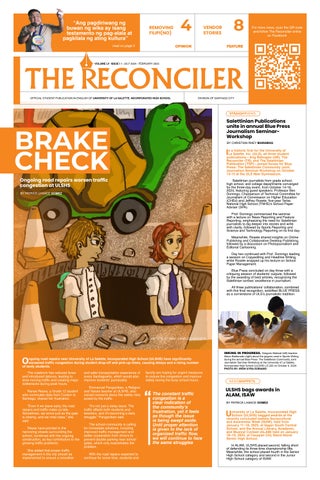
BRAKE CHECK

Ongoing road repairs worsen traffic congestion at ULSHS

Ongoing road repairs near University of La Salette, Incorporated High School (ULSHS) have significantly worsened traffic congestion during student drop-off and pick-up times, causing delays and a rising number of tardy students.

The roadwork has reduced lanes and introduced detours, leading to slow-moving traffic and creating major bottlenecks during peak hours.

Ranae Reyes, a Grade 12 student who commutes daily from Cordon to Santiago, shared her frustration.

“Even if we leave early, the road repairs and traffic make us late. Sometimes, we arrive just as the gate is closing, and we miss class,” she said.

Reyes have pointed to the narrowing streets surrounding the school, combined with the ongoing construction, as key contributors to the growing traffic problems.

STRAIGHTNEWS

Salettinian Publications unite in annual Blue Press Journalism SeminarWorkshop

In a historic first for the University of La Salette, Inc. (ULS), all three student publications—Ang Batingaw (AB), The Reconciler (TR), and The Salettinian Publication (TSP)—joined forces for Blue Press: The Salettinian Community Joint Journalism Seminar-Workshop on October 14-15 at the ULS New Gymnasium.

Salettinian journalists from grade school, high school, and college departments converged for the three-day event, from October 14-16, 2024, featuring guest speakers: Professor Ben Domingo, Chairperson of Technical Committee for Journalism of Commission on Higher Education (CHEd) and Jeffrey Rosete, five-year Tarlac National High School (TNHS)’s School Paper Adviser (SPA).

Prof. Domingo commenced the seminar with a lecture on News Reporting and Feature Reporting, emphasizing the need for Salettinian journalists to dig deeper into stories and write with clarity, followed by Sports Reporting and Science and Technology Reporting on its first day. Meanwhile, Rosete shared insights on Online Publishing and Collaborative Desktop Publishing, followed by a discussion on Photojournalism and Editorial Cartooning.

Day two continued with Prof. Domingo leading a session on Copyediting and Headline Writing, while Rosete wrapped up his lecture on School

faculty are hoping for urgent measures to reduce the congestion and improve safety during the busy school hours.

Emmanuel Panganiban, a Religion and Values teacher at ULSHS, also voiced concerns about the safety risks posed by the traffic.

“It’s not just a delay issue. The traffic affects both students and teachers, and it’s becoming a daily struggle,” Panganiban said.

The school community is calling for immediate solutions, including improved traffic management and better cooperation from drivers to prevent double parking near school gates, which only exacerbates the problem.

With the road repairs expected to continue for some time, students and

She added that proper traffic management in the city should be implemented to ensure a smoother and safer transportation experience of every Santiagueño, which would also improve students’ punctuality.

The constant traffic congestion is a clear indication of the community’s frustration, yet it feels as though the issue is being swept aside. Until proper attention is given to the lack of organized traffic flow, we will continue to face the same struggles

NEWSSNIPPETS

ULSHS bags awards in ALAM, ISAW

U

niversity of La Salette, Incorporated High School (ULSHS) bagged awards at the recently concluded Isabela Sociocultural and Awareness Week (ISAW), held from January 11–18, 2025, at Ilagan South Central School, and the Annual Literary, Academic, and Musical Contest (ALAM) held on January 18–19, 2025, at Cauayan City Stand Alone Senior High School.

In ALAM, ULSHS placed second, falling short of defending its three-time championship title. Meanwhile, the school placed fourth in the Senior High School category and second in the Junior High School category of ISAW.

INKING IN PROGRESS. Gregorio Maliwat (left) teaches Alison Baldonado (right) about the jargons used in Sports Writing during the annual Blue Press: The Salettinian Community Joint Journalism Seminar-Workshop at the University of La Salette, Incorporated High School (ULSHS) LS 220 on October 9, 2024.
PHOTO BY: IRISH XYRA SORIANO
CARTOON BY KENT CHARLES ANCHETA

Salettinian Math wizards shine in the National Math Challenge

Students from Grade 7 to Grade 12 showcased their impressive mathematical skills, earning various awards at the National Mathletics Challenge organized by the Philippine Education Nexus (PEN) Inc. via Zoom on October 20, 2024.

Overall, the math wizards earned one gold and one silver medal, two bronze medals, eight achiever marks, and 10 merit awards.

HARD WORK PAID OFF?

2024 unemployment rate in PH notices 0.3% decrease, youth unemployment inflates

According to the latest available Labor Force Survey report by the Philippine Statistics Authority (PSA) as of October 2024, unemployment rate in the Philippines has noticed improvements from last year of the same month, recording behind the annual unemployment rate goal of 4.4%.

The employment rate in the Philippines has increased from 95.8% to 96.1%, also indicating that the number of employees in the labor force has increased from 47.79 million to 48.16 million.

This indicates that the unemployment rate dropped to 3.9% from 2023’s record of 4.2%, also showing that the number of unemployed people dropped from 2.09 million to 1.97 million.

The report notes that the service sector is the top sector of employment, covering 61% of employees nationwide, followed by agriculture and industry sectors with 21.2% and 17.9%, respectively.

Amidst the positive trends, the report noted that the employment rate in the youth expressed a decline from 2023, dropping from 88.6% to 87.5%.

One of the leading causes as expressed by President Ferdinand Marcos Jr. links to the ineffective implementation of the K-12 Curriculum, positing that the employability of Filipino students has not improved despite the curriculum’s intent.

The PSA reports that despite the steady increase of employment rate in the Philippines, measures should still be taken to consistently improve the state of employment in the country.

For instance, the Department of Labor and Employment (DOLE) stated that they would implement youth employability programs, which aim to provide the youth opportunities to search for jobs that best suit them.

The Department of Education (DepEd) also works with Technical Education Skills Development Authority (TESDA) to bolster the current education curriculum, improving employability of senior high school graduates as their response to the call for schools to take measures in improving skill development among students such as conducting career guidance, orientations, and seminars.

BYTHENUMBERS

A COMMEMORATION SPOKEN AGAIN

Buwan ng Wikang Pambansa Celebration marks return in ULSHS

Four years after the COVID-19 pandemic affected the Philippines, the Buwan ng Wikang Pambansa celebration spearheaded by the KALATAS Filipino Club recovered its way back in the University of La Salette, Incorporated High School (ULSHS) with the theme, “Filipino: Wikang Mapagpalaya” last August 2024.

The celebration was revived due to the adjustments made this school year 2024-2025, wherein it started in July compared to last school year 2023-2024, which began in August.

deep participation in planning and conducting the events,” he stated.

Despite Flores’ concerns about the short time and interruptions happening throughout the month, the event’s success was evident as students and teachers commended the performance in managing and hosting various activities from the event entrance to the culminating activity.

Salletinians worry over kidnapping cases in Santiago City — survey says

The celebration featured various activities including poem writing, radio broadcasting, spoken poetry, debate, quiz bee, songwriting, impromptu speaking, video presentation, and daily trivia.

MJ Flores, the club president, shared his insights about the event arrangements, expressing happiness and relief on the return of the celebration and its execution.

“Joy and pride are what fills me that we can celebrate Buwan ng Wika again this school year. Despite the short time we had to prepare, it was successful because of everyone’s help and

Xyrille Sison, a Grade 12 student shared, “The Filipino month was a success. The activities were fun, and adjustments were quickly thought of instead of canceling the entire event. Despite the interruptions, the planned activities were successfully hosted.”

Jonas Dumon, a Filipino teacher, shared his sentiments about the school’s participation in the month-long celebration.

“Ang pagdiriwang ng Buwan ng Wika ay isang testamento ng pag-alala at pagkilala ng ating kultura,” Dumon underscored.

The Buwan ng Wikang Pambansa Celebration is an annual month-long celebration held every August that seeks to value and celebrate the history and culture embedded in the Filipino language.

PhilHealth faces budget challenges amid gov’t funding cuts

The Philippine Health Insurance Corporation (PhilHealth) is confronting significant financial challenges following the government’s decision to eliminate its subsidy for 2025.

This move has raised concerns about the corporation’s ability to maintain and expand its healthcare services.

In December 2024, Congress approved a national budget that excludes the traditional government subsidy for PhilHealth.

Despite the absence of a government subsidy, PhilHealth’s board of directors approved a corporate operating budget of ₱284 billion for 2025.

This budget is nearly 10% higher than the previous year’s allocation and is primarily funded through member premium contributions and interest.

President Ferdinand R. Marcos Jr. has directed the Department of Health (DOH) to ensure the uninterrupted delivery of services by PhilHealth, despite the funding challenges.

Health advocates have expressed apprehension that the removal of the government subsidy could affect coverage for informal sector workers who depend on funding from the General Appropriations Act (GAA).

Senator Loren Legarda emphasized the need for PhilHealth to explore alternative funding sources to ensure that regular contributors do not bear the burden of subsidizing health insurance for the informal sector.

As PhilHealth navigates these financial challenges, stakeholders are closely monitoring the situation to ensure that the health insurance program continues to serve the needs of all Filipinos effectively.

DThe corporation’s ability to adapt to these changes will be crucial in sustaining the progress made in the country’s healthcare system.

“ The substantial reductions in the 2025 budget for social services, such as education and health, may undermine the government’s commitment to uplifting the lives of its people

espite the reported 36.52% decrease of index crimes in Region 2 during the second quarter of 2024, a survey conducted by The Reconciler at the University of La Salette, Incorporated High School (ULSHS) in Santiago City has raised concerns about the prevalence of kidnapping incidents.

Out of 100 respondents, 78 Saletinians expressed apprehension regarding the high number of kidnapping cases in the city. Amid lower crime rates, residents, particularly students, still feel vulnerable, calling for focused efforts to address public fear and prevent abductions.

One respondent, Lyra Llantada, shared her personal fear, “As a girl, I am afraid to go home every night because I constantly worry about being abducted. The thought that something could happen to me makes me feel vulnerable and unsafe.”

Additionally, Llantada said that the Local Government Unit (LGU), together with the Santiago Police Office, should take action regarding the kidnapping cases, emphasizing the importance of reassuring the public about their safety.

WORDS IGNITE CULTURE. Jonas Dumon launches Buwan ng Wika on August 5, 2024, celebrating the power of language and heritage through his speech at the University of La Salette, Incorporated High School (ULSHS) during the flag assembly.
Photo from: Metro News Central

In recent years, the University of La Salette, Incorporated High School (ULSHS) has witnessed a significant rise in the number of students enrolling in the Science, Technology, Engineering, and Mathematics (STEM) strand, surpassing the combined population of students in the Humanities and Social Sciences (HUMSS) and Accountancy, Business, and Management (ABM) strands.

This growing trend has positioned ULS as a STEM-centered institution, prompting adjustments in its priorities and resources.

According to data provided by the school administration, STEM students now account for over 67.8% of the total senior high school population, with HUMSS and ABM combined make up only 32.2%, with their numbers steadily declining over the

past three academic years.

Principal Priscilla Ilagan acknowledged the shift and emphasized the institution’s commitment to adapting to the needs of its students.

“The demand for STEM education has grown exponentially, reflecting the interests of students and the opportunities available in STEM-related fields. As an institution, we aim to nurture this potential,” she said.

However, the growing emphasis on STEM has raised concerns among students and faculty in the HUMSS and ABM strands, who fear their programs may receive less attention.

In response, Ilagan assured the school community that the institution remains committed to providing quality education

STEM SURGE

ULSHS shifts focus as STEM enrollment surges

Strong Arguments and Sharp Minds

ULSHS Debate Society holds Debate Competition

I

n an effort to showcase the talents and critical thinking of the Salettinians, the University of La Salette, Incorporated High School (ULSHS)’s Debate Society held a Debate Seminar and Competition last October 21, 2024.

The seminar was conducted at the university’s library, where Geneveive Ingaran was the Master of the Ceremony.

The seminar was then presided over by the Resource Speaker, Joe Hanzen Ingaran.

In the afternoon, the debate competition happened, where the mateightch 1-8 chose the motion “THW use Thor as an alternative source,” match 3-6 also chose the same motion.

Team eight battled with team one at the Canteen Extension during the elimination round, where team eight has the government side, while team one has the opposition side.

Meanwhile, at the LS 223, team two and team seven faced each other, where team two has the government side and team seven has the opposition side.

to not allow the debaters a reply speech because of the poor performance of the students, whose speech did not last for even three minutes, later on characterized the match as below average as he announced the government team’s victory.

During the final round consisting of Prime Minister Mark Brylle Gutierrez, Deputy Prime Minister Decerheyn Robillos, and Government Whip Trixa Quistoria, battled against the Opposition House, led by Opposition Leader Julianne Conde, Deputy Leader Ashley Lungub, and Opposition Whip Donnae Tumaut, the match became intense, filled with serious exchange of arguments among the teams.

After minutes of argumentation, they reached a decision where the opposition team was hailed as the winner of the round.

“Participating in debate seminars and competitions enhance my critical thinking, communication, and confidence [that will] also help me to express my ideas more clearly and effectively,” Laurence Kimmayong said, a Grade 12 student and also a participant of the event.

AKAP Program commences: Aid

In support of students affected by the Typhoon Pepito, students from the University of La Salette, Incorporated High School (ULSHS), spearheaded by the Kalatas Filipino Club (KFC), launched Alay sa Kuwaderno at Panulat (AKAP) in collaboration with the Filipino Department on December 28, 2024, at Mabini Elementary School.

This initiative aimed to assist students whose school supplies were damaged due to flooding. Donations came from university students, and was spearheaded by Kalatas Filipino Club officers, their moderator, and student volunteers.

According to MJ Flores, President of the Kalatas Filipino Club, the AKAP Program serves as an educational support while encouraging continued relief efforts in affected communities.

Flores emphasized, “Sa pamamagitan ng proyektong ito, nais naming ipasa ang diwa ng bayanihan at hikayatin ang susunod

na henerasyon na maging bahagi ng pagbibigay pagasa sa kapwa.”

AKAP Program is an annual initiative of the Kalatas Filipino Club, conducted in partnership with the Filipino Department, to support the students’ access to education.

Salettinians overwhelmed amid reduced school days

ue to the Department of Education (DepEd)’s decision to reduce school days from 220 to 165-180 for the 2024-2025 school year, students and teachers are struggling to cope with the tighter schedule.

The adjustment was made to account for extreme heat in April and May 2025 while attempting to bring back the old calendar.

Xerlean Madrid, a Grade 12 Science, Technology, Engineering, and Mathematics (STEM) student at the institution, shared that the reduced school days make workloads feel overwhelming, with little time to properly discuss lessons before exams.

This rushed pace has made reviewing subjects difficult, leading to requests for extended deadlines.

Similarly, Mark Louisse Cruz, a Grade 12 Accountancy and Business Management (ABM) student, has experienced stress and lack of sleep due to the heavy workload and tight deadlines.

He also struggled to balance academic and nonacademic responsibilities.

From a teacher’s perspective, Wendel Andres, a science teacher, noted that the shortened school year has forced him to omit certain topics, creating potential learning gaps despite modifications to performance-based tasks.

Andres highlights that he understands the students’ struggles and strives to support them, reminding them to work with excellence despite

STEM STARTS HERE. A student officially enrolling in the Science, Technology, Engineering, and Mathematics (STEM) strand at the Registrar’s Office of the University of La Salette, Incorporated High School (ULSHS), Santiago City, taking the first step toward a future in STEM.
PHOTO BY: IRISH XYRA SORIANO
BATTLE OF MINDS. Debate Society officers showcase their argumentative skills as they lay out the guidelines and procedures for the tournament held at University of La Salette, Incorporated High School (ULSHS) LS 220 on October 21, 2024. PHOTO BY: KURT RAGUAL
HANDLE WITH CARE. Mark Cruz, a dedicated student volunteer for the AKAP Program, gently hands a tumbler to a child during an outreach initiative at Mabini Elementary School on December 28, 2024.
PHOTO BY: KHAITH DE LEON
WHISPERS OF WORRY. Jocelyn Tomboc of the University of La Salette, Incorporated High School (ULSHS), her expression filled with worry, reflects the tension of the moment and the weight of the situation at hand.
PHOTO BY: IRISH XYRA SORIANO
students

language—where the heart of our identity is slowly being erased. That future is not some distant possibility; it is happening right now.

Bonifacio?

In a discussion last October of the Department of Education (DepEd), it was reiterated that the removal of Filipino subjects from the Senior High School (SHS) Curriculum, just like how it was taken out of college in 2018. Just recently, a local university implemented an English-Only Policy, which threatens the Filipino language as a medium of communication, despite its protection under the 1987 Constitution.

If this happens, what will be left of our language in formal education? Where will students truly learn about the richness of the stories that have shaped our nation? Are we really willing to let our own language disappear in the name of globalization?

A Language that Unites Us Filipino is more than just a subject in school—it is the thread that ties us together as a people. It is the language of our struggles and our triumphs. It is the language of our national heroes who fought for our freedom, and of the artists and writers who continue to shape our culture today.

If we take Filipino out of Senior High School, we are not just removing a subject; we are stripping students of the chance to understand their own roots. Without Filipino, how will they learn the power of balagtasan, the depth of kundiman, or the fire in Dekada ‘70? How will they truly appreciate the works of Francisco Balagtas, Lope K. Santos, Lualhati Bautista, and Andres

A study from the University of the Philippines (UP)’s Sentro ng Wikang Filipino has shown that students who study Filipino develop stronger critical thinking skills and a deeper sense of national identity. Language is not just about words—it shapes the way we think and the way we see the world. If we allow Filipino to be erased from our schools, we are allowing our sense of self to weaken.

Progress Should Not Mean Forgetting Ourselves

The decision to remove Filipino from senior high school is not just an academic change—it is an attack on our identity as a people. “

Some argue that removing Filipino will allow students to focus on English and technical subjects, making them more competitive in the global market. But look at Japan, South Korea, France, and Germany—these nations have protected their languages while still excelling globally. Progress does not mean abandoning our identity; it means strengthening it while growing with the world.

How can we call ourselves

globally competitive if we do not even know who we are?

A Fight for the Future

Many have already spoken out against the removal of Filipino from education. Advocacy groups like Tanggol Wika have fought to keep our language alive. Even our own Constitution mandates the development and use of Filipino as the national language. If we allow it to be erased, what message are we sending to future generations?

Education shapes the heart and soul of a nation. If we take Filipino away from schools, we are telling young Filipinos that their own language is not worth learning and is not worth preserving. We are telling them that to succeed, they must let go of who they are.

Our Language, Our Identity

The decision to remove Filipino from Senior High School is not just an academic change— it is an attack on our identity as a people. We must not let this happen. We must stand up for our language, for our history, for our identity, and for the generations that will come after us.

As Jose Rizal once said, “Ang hindi marunong magmahal sa sariling wika ay mas masahol pa sa malansang isda.”

Together, we shall prove that we have not forgotten his words. Let us fight for Filipino—because to lose our language is to lose ourselves.

AND DO NOT NECESSARILY REFLECT THE OFFICIAL STANCE OF THE SCHOOL ADMINISTRATION, FACULTY, STAFF OR ANY AFFILIATED INSTITUTION.

Dairymilk

In Sync

Is inflation a good thing? As long as wages keep pace with it.

Inflation—the general increase in prices for goods and services over time—affects every aspect of the economy. While inflation can have benefits in a growing economy, it threatens economic stability and reduces workers’ purchasing power when wages fail to keep up. Wages should rise alongside inflation to maintain balance.

For instance, last October 2024, wages grew by 4.6% and experienced an inflation rate of 2.6% in the U.S., meaning the wages improved during the increase of inflation (Statista, 2024). Moreover, last year, nominal wages for middle- and low-wage workers rose by 4.2%, while inflation stood at 3.3%, resulting in real wage gains of 0.9% (White House, 2024). These instances demonstrate how maintaining wage growth above inflation supports workers’ financial well-being and sustains consumer spending.

However, when businesses’ expenses rise, companies often prioritize profits, leaving little room for wage increase. Small businesses may find it particularly challenging to adjust salaries, while larger corporations might allocate resources toward investments rather than wage growth.

The failure to raise wages in line with inflation has serious consequences. Workers experience a decline in purchasing power as the cost of living increases, reducing their ability to afford basic necessities. This can lead to decreased consumer spending, which slows economic growth. Contrary, when wages rise alongside inflation, workers maintain their purchasing power, and the economy maintains. Higher wages ensure that employees can meet their basic needs, preventing a decline in their quality of life.

Raising wages during inflation is essential to protecting workers’ financial well-being, supporting consumer spending, and maintaining social stability. However, these increases must align with productivity growth to ensure business sustainability. Companies experiencing higher profits during inflation should reinvest in their workforce, recognizing that employees drive productivity and reduce turnover.

Inflation can be a manageable and even beneficial part of a growing economy if wages rise alongside it. Balancing wage increases with business growth and productivity is key to ensuring both worker satisfaction and economic vitality. The government has to focus on raising the minimum wage, creating more job opportunities, offering tax incentives to businesses that maintain or increase wages, and providing targeted subsidies to vulnerable groups during times of rising inflation. Business owners and the government must collaborate enough to ensure wages and inflation remain in sync, driving economic stability and growth.

National Gameshow

”Gumawa ako ng mabuti; gagawa ako ng mabuti. Ano ba ang qualification?” A candidate once stated on an interview. One who threatens to curse the Commission on Elections (Comelec) if she is not allowed in the senatorial posts.

The Comelec has officially closed the filing of Certificates of Candidacy (COC) on October 8, 2024, and we are left with wannabe candidates.

The 1987 Constitution on the Senate Electoral Tribunal, Article 6, Section 3 states, “No person shall be a Senator unless he is a natural-born citizen of the Philippines and, on the day of the election, is at least thirty-five years of age, able to read and write, a registered voter, and a resident of the Philippines for not less than two years immediately preceding the day of the election.”

These qualifications are undeniably minimal, and frankly, underwhelming. It is as if the qualifications for holding office have become a matter of checking off a simple to-do list instead of being rooted in competence and integrity.

It is embarrassing that we are still treating leadership positions as mere stepping stones for those who can afford to be famous. The emphasis is placed on name recognition, wealth, or social media influence, rather than any genuine capacity to lead, serve, or even understand the needs of the country.

We have seen it time and time again: celebrities and socialites, whose primary qualification seems to be their ability to capture attention on national television or social media, suddenly thrust into roles of rigid responsibility. Worse, those who run because they can.

The public votes for them, not because they believe in their platform, but because they are good at getting people to like them.

The truth too will mute and break to a mic forged from sharpened blades.

United Nations (UN) Special Rapporteur Irene Khan’s visit to the Philippines explicitly highlighted the persistent impunity against Filipino journalists. She exclaimed that the government lacks systematized procedures in ensuring journalists’ safety, as evident in the dreadful killings–a blatant form of censorship.

In bridging the truth towards the people, journalists play a pivotal role in achieving this cause. However, if the truth seekers and truth-tellers are made to curb in doubt, fear, and harassment, can justice and our right to freedom of expression truly prevail, or will the culture of impunity build itself robustly in our society? This calls for proper, institutionalized government measures where protection is championed among media practitioners.

The Pen that Pierce Pretense

1.9%

A journalist’s work should never be undermined. They are the people’s watch and sight among the pressing issues that concern the country and the state’s overall welfare; those who sweep the streets of dangers just to write for truth, awareness, and peace. However, with the continuous harassment and fear imposed among them along with lack of accountability, it may result to a threatening domino effect.

For one, current and aspiring journalists may

It is worrying that the qualifications for being a senator or president are so lax. Age provides some life experience, but it is not a guarantee of wisdom. Literacy is essential for functionality, but it does not equate to the ability to govern. Residency is a formality that does not reflect an understanding of the country’s issues. A registered voter? Well, we all vote—does that define someone’s ability to lead a nation?

We are essentially asking a surgeon to perform a life-saving operation based solely on their ability to read a medical journal and their popularity.

Consider the case of Rodrigo Duterte, the 16th President of the Philippines, who was elected largely because of his tough-talking persona and his appeal to voters frustrated with the government’s inefficiency.

A significant portion of the electorate, motivated by anger over crime and corruption, voted for a man who promised swift, uncompromising action despite his controversial rhetoric and lack of policy specifics. The subsequent political environment reflected the consequences of this vote. His presidency saw numerous accusations of human rights violations, with over 27,000 deaths linked to his anti-narcotics campaign.

us—the people. We continue to place our trust in those who know how to sell themselves.

This cycle of mediocrity will persist as long as we allow ourselves to be swayed by popularity and empty promises. Change cannot happen in the halls of power unless it first starts within the minds of the electorate.

A leader should be someone who has demonstrated the ability to act in the best interest of the public; someone who understands the complexities of governance; and someone who can lead a nation through difficult times with clarity, decisiveness, and genuine empathy.

A true leader would not just dance to entertain the people; a true leader would not make punchlines involving sex now and then; and a true leader is not just someone who do pranks or vlogs on YouTube, especially those with running propaganda lang.

A truly qualified leader does not simply “make good.” They make a change. And right now, that was exactly what we need.

The truth is, the problem starts with

fear the profession and the work it entails. Many people, particularly students, view journalism not just as a profession but as a social responsibility where every stroke of ink matters. If the job continues to be connoted with unlawful acts, fear and a loss of passion will engulf the dreams of many to write and report information to the public.

An atmosphere dominated by fear violently questions the freedom of speech of individuals. When the people hesitate to speak out, increased exposure to deception and disinformation is expected. Moreover, these situations will tarnish the people’s perception that the justice system in the country is unreliable and ineffective, leading to a constant feeling of unsafeness. Thus, the Filipinos are subject to vulnerability to wrongful actions where their safety is written in inkless pens.

Page and Power

Influence streams where power exists. The occurrence of attacks among journalists primarily root on power: the power to commit the deed and the power to turn a blind eye. This poses a question to the government to where their actions truly lie as there are little to no actions taken to ameliorate this gruesome situation.

If only the justice system works for the people and not against them, accountability will be a reality and not just a dream. “

Impunity towards journalists significantly affects the students and the public in general. This final stage of the domino is where people lose their trust in their leaders for the lack of counter-measures to solve the problem at hand, and a country that lives only to survive in chaos.

It is notable that truth writers excuse no one in reporting; no matter the status, they stand courageous with their principles and objectives. This is why journalism is despised by people with a corrupt and questionable background, as it presents viable threats to exposing their dirty work. Consequently, this is evident by the fact that most occurrences are initiated by police officers, politicians, and people with authority and money. Accountability, from this point onwards, present impossibility from ever being achieved as power is manipulated to ensure that a single record will never stain their clear yet cunning page of credibility.

If only the justice system works for the people and not against them, accountability will be a reality and not just a dream.

Effective and urgent government interventions are called upon to ameliorate the state of journalists in the country. They should stop dismissing this crucial case and focus on implementing and amending laws that would prioritize the welfare of these people. It is their duty and responsibility to hold culprits that inscribe this culture of impunity accountable for their actions and punish them rightfully.

Ultimately, a new law that the government can legislate and implement should focus on media protection. This enactment should explicitly define and penalize violence and threats against journalists to establish grounds for when it is violated. On the other hand, they should reform the current defamation law in order to prevent its use against media workers.

Pens and paper are all that journalists need in order to champion a fair and just Philippines that everyone deserves and aspires for. Their role in the community continues to be pivotal, yet it should not just be realized but actually be experienced without the hindrance from entities that hide the truth. Both the government and the community’s effort towards this plight remains crucial in order to break the uprising culture of impunity where the truth is suppressed and justice is politicized. Afterall, no Filipino should ever live in fear and with fear–a welfare safeguarded by the truth that works for the people, by the people, and of the people.

Toblerone (FEAR)lippines

Nutella Revamped Educational Assurance

Education Secretary Sonny Angara emphasized the Department of Education (DepEd)’s priorities: to fast-track and simplify the Senior High School (SHS) Curriculum to let learners focus on work immersion. Secretary Angara’s statement regarding revamping the said curriculum, which would reduce core subjects to five or six in favor of more on-the-job training, is a bold step in the right direction.

The main goal of this curriculum shift is to better prepare students for the workforce. In an increasingly competitive job market, employers seek individuals with practical, hands-on skills alongside academic knowledge. Work immersion programs offer students real-world

Their Ignorance, A Whole Generation Suffering

experience and insights into the demands of the industries they will soon enter.

This approach mirrors global educational trends, where many countries have placed greater emphasis on vocational training and work readiness to address the needs of their evolving economies. For example, countries like Germany, Switzerland, and Singapore have successfully integrated work-based learning into their secondary education models, contributing to strong labor markets where graduates enter the workforce with both academic credentials and practical expertise.

By reducing core subjects and focusing more on industry immersion, the Philippines is aligning its educational system with labor market demands and better preparing students for the challenges of a global economy.

Addressing the “Overcrowded”

Curriculum

Angara’s comments about the overloaded basic education curriculum are supported by research. Studies show that students in the Philippines often struggle with an overcrowded curriculum, which leaves them with little time to engage deeply with any single subject. “The curriculum is overcrowded, putting a lot of pressure on teachers and learners to master it,”

Pam Robertson said, a Senior Research Fellow at the Assessment Research Centre, University of Melbourne. The vast number of subjects forces students to skim through materials without fully mastering core content.

Research by the Philippine Business for Education (PBEd) highlights that students in the country are often burdened by an excessive number of subjects, leading to cognitive overload and reduced academic performance.

Reducing the number of core subjects would allow students to focus on developing key competencies, improving learning outcomes, and ultimately making education more relevant to their future careers.

Education + Training = Well-rounded Individuals

Students engaged in internships or work placements are more likely to develop a practical understanding of

Unintended pregnancies. Sexually transmitted infections. These are the realities that countless Filipino youth are facing. The current system of sex education is heavily influenced by the Catholic Church’s abstinence. But in reality, it only leads to failure to protect a generation.

The current system’s failure to provide comprehensive sex education leaves Filipino youth vulnerable. The resulting high rates of teenage pregnancies and sexually transmitted infections (STIs), demonstrate the urgent need for change.

The Church’s Harmful Influence

The Church’s stance on sex education is not just outdated—it is actively destructive. Their teachings about the “sanctity of marriage,” yet leaves young people to deal with the problems of unplanned pregnancies and STIs. This blatant contradiction exposes the hollowness of their pronouncements. It not only perpetuates harmful inequalities, but also leaves them vulnerable. The idea that shielding children from accurate information protects them is a dangerous delusion. In reality, it only leaves them prey to misinformation, exploitation, and the devastating health consequences of unprotected sex. It is not education; this is plain negligence.

Their opposition against the Adolescent Pregnancy Bill, with its absurd accusations of promoting “child masturbation,” exposes their deep-seated fear and profound misunderstanding of adolescent sexuality. This fear-mongering is not only counterproductive; it is actively harming young Filipinos. Abstinence-only education fails to recognize the natural curiosity of young people, leaving them tragically unprepared to make informed decisions about their bodies and their futures. Is this what they call “care?” This is clearly an attempt to control by hiding behind the religious beliefs.

The Urgent Need for Comprehensive Sex Education

Comprehensive Sex Education (CSE) is essential for the well-being and progress of our country. It empowers young people to say “no” to unwanted

sexual advances, to understand their rights, and to seek help when they need it. It is about breaking down the stigma surrounding sex and sexuality, creating a society where young people can have open and honest conversations about these important topics without fear of judgment or shame. Stop peddling the myth that CSE promotes promiscuity; it is far from reality. In fact, this myth is often perpetuated by those who oppose CSE, but the evidence clearly demonstrates that it leads to better sexual and reproductive health outcomes.

The Promising Change of Hontiveros’ Bill

Senator Hontiveros’ bill offers Filipino youth something they’ve been denied for far too long: agency. This is a crucial opportunity to modernize sex education in the Philippines—a chance to finally move beyond the failed and ineffective abstinence-only approach. This bill gives young people the knowledge they need to make informed, responsible choices about their own bodies and their own lives. We are empowering them to protect themselves, to build healthy relationships, and to control their destinies. This bill empowers youth to make responsible choices about their health, fostering critical thinking and informed decision-making. We are not promoting promiscuity; we are empowering young people to protect themselves. The Church’s opposition is not just irresponsible; it’s a shameful betrayal of their duty to young people and a moral failing. They cling to outdated beliefs while a generation suffers the consequences. We cannot allow their narrow ideology to dictate the future of Filipino youth. The passage of this bill is a moral imperative, a matter of justice. We cannot stand idly by while a generation suffers due to a lack of essential information. Let us prioritize the wellbeing of our youth and embrace comprehensive sex education. Their future—our future—depends on it.

Too many young people make lifealtering mistakes because they don’t have the right information. CSE isn’t just about sex—it’s about health and safety. Knowledge is protection, and education is empowerment.

-Andrea Villanueva

Some topics are too personal for schools to handle. Parents should be the ones to educate their children about value and boundaries and beliefs.

-Benedick Gacusan

complex concepts, improving both their academic and cognitive skills. A study by the World Bank found that work-based learning programs improve both student engagement and academic performance when students can see the direct application of their learning.

By combining academic learning with hands-on experience, students better grasp abstract ideas by seeing them applied in real-world settings. This holistic approach fosters well-rounded, capable individuals, who are not only knowledgeable but also skilled and adaptable.

It is indeed possible—and beneficial—to prepare students for the challenges of life and work without sacrificing core educational values. By combining the best of academic learning with real-world experience, we create more adaptable, capable, and thoughtful individuals. Work immersion programs do not replace the need for critical thinking or deep understanding; rather, they complement and enhance these skills, ensuring that students are ready for the workforce and equipped to think critically, engage meaningfully, and contribute to society.

This is the promise of a reimagined education—a future where learning and experience go hand in hand, and students are not just workers, but thinkers, creators, and leaders of tomorrow.

LETTER TO THE EDITOR

Your unwavering commitment to providing accurate and well-researched information has greatly contributed to the betterment of our society. In times when misinformation runs rampant, your dedication to truth and fairness remains a beacon of hope for those seeking reliable news sources.

As a concerned member of the community, I commend your efforts in upholding the highest standards of journalism. It is through your hard work that many of us are able to make informed decisions and contribute to the progress of our nation.

I encourage you to continue championing the values of integrity in your reporting. Your work plays an indispensable role in shaping a society that is educated and empowered. Thank you once again for your exceptional service to the public.

Sincerely, Miko Dela Cruz

RESPONSE OF THE EDITOR

Dear Miko,

We are delighted to present to you the latest edition of our publication. Our mission is to provide insightful and engaging content that resonates with our diverse readership. In this issue, we have curated a selection of articles that explore a wide range of topics, from current events to in-depth analyses, all crafted to inform and inspire.

We value your continued support and encourage you to share your thoughts and feedback with us. Your perspective is invaluable as we strive to improve and cater to your interests. Thank you for being a part of our community.

Warm regards, The Reconciler

I understand both perspectives. The key is to find a middle ground— one that informs, but doesn’t impose.

Aligning Education with Industry Needs
Cloudnine

F

lashlight, check! Canned food, check!

First aid kit, check! All that is left is… getting pending schoolworks done and keeping up with backlogs? How are you going to balance your projects and survive a typhoon at the same time?

Surviving a typhoon is not just about having the right equipment ready in case of an emergency; often, it is the strength and hope one possesses that saves them from life-threatening events like typhoons. For students, it is not only the typhoon that they have to worry about. In many cases, we also have to think of academic life while suffering during the aftermath of a violent storm. As young students trying to make it out of typhoons while managing student activities, how do you beat a catastrophe?

How will you beat something you are not aware of? First, we must be active in watching the daily news to stay updated on incoming disasters. Alertness is crucial. Your emergency kit must include flashlights with extra batteries, canned food, power banks, a battery-operated radio, candles, and important documents. As young students, proper communication and preparation with the family are a must.

Students should also inspect their homes for any needed repairs to prevent severe damage. Vulnerable items—like academic materials—must be placed on higher ground or in plastic bags to avoid water damage. Mobile data is important for staying connected during and after the typhoon. Surviving frequent typhoons does not mean we are always safe from future storms. It is always better to be safe and dry than soaked and sorry.

Remember the golden rule: stay calm and do not panic. Families must stay indoors and secure all windows, doors, or anything that could be damaged. Keep up with updates in the news, social media, or the radio. Save your device’s battery for emergencies.

Helping secure the house or caring for pets can support the adults. However, if the situation worsens, prioritize safety over schoolwork. Students must manage their time wisely but should never sacrifice their welfare for academics.

Now, focus on recovery. Check your surroundings for hazards and leave only when safe. Inspect any damage to your home and belongings, especially school materials. Reconnect with teachers, fellow students, and relatives. Keep up with social media or news for school updates.

If able, volunteering in donation drives or relief efforts can help the community. The typhoon may have also caused emotional stress, so checking in with family and friends is vital.

We, Filipinos, are no strangers to typhoons. With resilience, we recover and move forward. Students are not just bystanders—helping others, no matter how small, contributes to the community’s recovery.

An average of 20 Tropical Cyclones (TC) hits the Philippine Area of Responsibility (PAR), with 8-9 TC make landfall across the region (PAGASA, 2023)

Field of Tears

The sun was setting, and the wind was whistling; the greenery never felt so alive. It felt like yesterday when a little boy was walking home from school, beaming with so much hope and enthusiasm to feel the embrace of comfort after a long, tiring day. He came home to a table that was filled with little food that his father brought home from the fields, yet it was full of love and laughter for everyone around.

Suddenly, a heavy feeling dawned on the household. It was a glimpse of a nightmare that no one would not want to behold. The little boy stared at the fields that once defined countless lives, turned into scenes of devastation.

As Typhoon Nika tore across different parts of the country, its howling and untamed fury were undeniable. The trees swayed relentlessly, and water flooded the streets uncontrollably. It came with no warning and swept the town in a second, leaving the people trembling. Slowly, the sky turned into a silhouette of dreams that were wrecked, hopes that were crushed, and lives that were ruined.

The fields were a symbol of relentless hard work that were poured to nourish each delicate crop. It was their home—their greenery of solace. Now it was left with almost nothing, but a portrayal of dreams that were swept and destroyed.

The storm had not only damaged the land, but had stolen a piece of hope for the victims of the typhoon, leaving behind a grieving community. In the aftermath, there was no sense of safety, only the quiet grief of what had been torn away, leaving nothing but the aching question: how do you rebuild a home when the very ground beneath you feels like it has been taken?

For his father, along with all the farmers that were victims of the typhoon, this catastrophe did not just uproot their crops, but their dreams as well. Along with the fields that were

washed away, it had also taken away their months of hard work and deprived them of the capacity to provide something for their families. Echoes of dismay and devastation are displayed in their faces that were once filled with hope. Eyes are brimming with tears as they try to picture the thriving greenery it once was before the typhoon washed everything away.

A heavy feeling weighs on their shoulders as they get lost in devastation, not knowing where to begin or how to start again. A surreal moment of the catastrophic events that transpired. The winds have calmed and the rains have stopped, but the farmers carry the burden of having to start from one crop to another yet again.

Amidst the wreckage, moments of resilience emerged—individuals lending a hand, communities rebuilding lost homes together, and acts of kindness between shattered homes. As one community, they embody solidarity in the face of adversity, triumphing over every challenge along the way and continuously hoping for a better tomorrow.

In the quiet corners of the community slowly returning back to normal, he tightly held his father’s hand. The rising of the sun is a symbol of new opportunities and new beginnings. The typhoon may have ruined the fields, but it did not take away the essence of hope. One that he would carry as he took another step to the institution to rebuild his dreams and his father’s.

A STUDENT’S

STORM

Iheard my alarm clock started buzzing. The typhoon was gone, but its effects were far from over. Our house is still a mess, some of our belongings were swept away by the flood. The roads are still blocked in some places. Without electricity and running water, even basic things were a struggle. Getting into school seemed like an insurmountable task.

That day began as a typical rainy day; however, the rain intensified quickly, catching everyone off guard. The wind howled like a wounded beast, tearing through trees and shattering windows. The relentless onslaught of these storms has left our city battered and bruised.

As a student, this recent typhoon profoundly altered my life. I watched in horror

as the floodwaters crept higher and higher, swallowing our homes, schools, and cherished belongings. My home, once a place of comfort and security, is now a shell of its former self. My heart sank as I realized the extent of the damage. The floodwaters, relentless and destructive, swept away.

My textbooks, notebooks, and projects—the fruits of countless hours of hard work,

were lost to the flood. Not just material possessions but also sentimental items, including my hard-earned diploma and certificates of honor.

But the material losses were just the beginning.

The emotional toll has been immense. The fear, the uncertainty, the anxiety – they have consumed me. I’ve lost sleep, I’ve lost my appetite, and I’ve lost my sense of normalcy.The alarm’s insistent

buzzing felt like a cruel joke. How could I possibly concentrate on my piling schoolworks when the trauma of the storm still pulsed beneath my skin?

The expectation to just move on and to pretend everything was normal lingered. The thought of facing another day, another challenge, seemed overwhelming.

CARTOON BY ALLAN EMMANUEL ABELLA

Retail sale of fresh meat has been an industry where Leonardo has been actively engaging for more than 30 years now. However, the road has not been smooth for him.

He remained steadfast despite facing multiple challenges, such as getting injured from chopping off meat to betrayal from partners leading to financial breakdown. He had to experience the harsh side too of having lean months of sales and living on the edge. “The meat spoils quickly,” he explained, “and when sales are slow, it is a constant battle against loss.”

He has faced bankruptcy twice, a devastating blow that wiped out years of hard work and savings. “You build something up, and then it is gone,” he recalled, his voice heavy

with the weight of those experiences.

Yet, even in the face of such setbacks, he found the strength to rebuild, with the unwavering support of his wife. “She is the one who pulled us through,” he said with a grateful smile. Their resilience is a testament to their commitment, not just to their business, but to their family, whom they have managed to feed and educate through the years. Today, Leonardo stands tall, his debts slowly being paid off, and his business steadily recovering, a symbol of hope and determination.

E

veryday, countless vendors from our markets work tirelessly to provide for their morning hours to the late afternoon, they stand behind their stalls. Behind every a story; a story of hard work, sacrifice, and their resilience. These are the stories facing countless challenges, continue to strive and survive.

One of the biggest challenges she faces is dealing with customers.

“Sometimes, customers can be grumpy, but you just have to be patient and kind. A smile can go a long way,” she admitted.

Within the span of nine months, her experience has taught her the importance of good customer service. She had to deal with all sorts of people, from the friendly to the demanding. Through it all, she has developed the skills to stay calm and positive.

A Smile and a Sweet Treat: Reynabel’s Story

Reynabel’s day starts early. She sets up her stall, arranging her freshly baked pastries. From the moment she sets up her small stall, she is ready to attract passersbys with the delicious smell pastries.

Tricycle drivers, no matter how often we see them in school streets, remain overlooked and labelled as inferior and of low worth. No matter how many articles or essays are created, the narrative of all tricycle drivers being perverts and greedy nobodies remains adamant in the conversations of our society. However, no one seems to talk about their hidden role in every person’s success.

Despite the challenges, Reynabel remains optimistic. She loves interacting with and seeing the joy on their when they taste her pastries. She is determined to make living, one sweet treat at a Her story is a testament to resilience and adaptability street vendors, highlighting importance of interpersonal and positive attitude in navigating the challenges of the trade.

Heroes of the

Take Mr. Ricardo Pascual, for example, a tricycle driver with 15 years of experience, who is one of the many tricycle drivers of the University of La Salette, Incorporated High School (ULSHS). Like many of us, his inspiration is sourced

Santiago City to drive them to school. Like bridges to where need to go, many tricycle drivers like Mr. Pascual make going to school convenient and accessible.

Mr. Pascual started off his tricycle driver journey at the age 18, but after a few years, he landed a different job. However, when the pandemic hit, he was one of the many working citizens that got affected by the isolation caused by it. Due to this, he had to find another way to provide passive income for his family. is where he went back to being tricycle driver. Even through times of hardship and hopelessness, still wanted to make use of himself and go back home with something to give to his family.

To Mr. Pascual, having that job was nothing to be ashamed of—and rightfully so. As per every tricycle driver, having the job was not purely laughs and enjoyment. Some people, especially students, tend to recognize him and crack few jokes together. It is 7:00 AM and Mr. Pascual drops off his first passenger–one many different stories from people all over the city, filling To him, being a tricycle driver is not just a job to earn

PATRICK LHANCE

their families. From the early every product that they sell, there is stories of ordinary people who, despite

her small of her challenges, optimistic. people their faces pastries. make a time. the of highlighting the interpersonal skills navigating trade.

the Road

LHANCE GOMEZ

There are days when sales are slow, and she worries about how she will provide for her family. Her days are a relentless cycle of work, from preparing the corn to selling it on the streets. With six children to support, the unpredictability of her income creates constant stress. “It

who juggle the demands of their children and families with the uncertainty of their work. Despite the challenges, they persevere, driven by love and hope. Their resilience, their unwavering spirit, and their unwavering dedication to their families inspire us all.

VendorStories

passenger–one of many. From elders to teenagers, he encounters filling him with heartwarming insights and unique experiences. money from, but a job of passion in helping others.

we drivers to accessible.

No One Left Behind

“Being a trans person does not make you less human.” This powerful quote, shared with me by Kramie, is one that she not only continuously holds onto, but also uses it to inspire others like her. It serves as a constant reminder of her worth and humanity, something that she wishes for everyone to understand.

has never experienced bullying.

with different people through his profession.

Kramie’s journey has been anything but easy. She has endured bullying and prejudice because of her identity, often feeling unseen and left behind. Yet, in the face of these challenges, she has found strength in the unwavering support of her family, who have been her anchor throughout it all.

Their trust and compassion have been fundamental in shaping her resilience, the compassion they showed her was built by the trust they placed, they had given in her, trust that she has never taken lightly.

age However, was citizens isolation had a That being a times hopelessness, he himself something that ashamed every was enjoyment. students, crack a together. to

moments were one of which he treasured. The simple moments of appreciation, big or small, struck his heart. “It brings joy to my heart [when people interact with me kindly], because many people think of tricycle drivers as perverts or deviants,” Mr. Pascual said. Despite many heartwarming encounters with other people, there were also many instances where Mr. Pascual, alongside many other tricycle drivers, were judged and seen as lowlifes. Very few even take their job seriously and see them as servants—not people who have the same level of worth as other people. Becoming a tricycle driver did not only limit their worth in other’s eyes, but also put them through a pool of stereotypes that caused many people to avoid them as if every tricycle driver was awful and perverted. Everyday, people like Mr. Pascual fall victim to the harsh judgements of people that depend on baseless stereotypes.

“What breaks my heart is that other people think of us tricycle drivers lowly, but they do not know the help we bring to others,” Mr. Pascual said. Everyday, these tricycle drivers are the people that allow us to reach our destinations–whether it be a job interview, an important meeting, or even simply going to school. They are the ones who drive future lawyers to their review centers, future directors to their shoots, and future entrepreneurs to their schools.

Although it is a Catholic institution, Kramie has seen growing acceptance of the LGBTQIA+ individuals like her. Teachers actively asked for her pronouns, and she was allowed to grow her hair. This shift reflects a broader movement towards inclusivity, reminding us that no one should ever feel different or excluded because of their identity.

Kramie has always strived to prove herself worthy of that trust, working tirelessly to become the best version of herself.

At her university, a Catholic institution, Kramie bravely advocated for the recognition of her identity, as she initiated a formal process by writing a letter to the highest of administrators.

To these tricycle drivers, it did not matter if it was sunny or rainy, they were determined to drive these passengers to their rightful destination. Their role has been undermined by our society for years. It is time that they are given a spotlight and the appreciation they deserve.

Mr. Pascual is not the only hero of the road. Many other tricycle drivers like him strive to put an end to the narrative of all tricycle drivers being thought of negatively. They are not just drivers we see everyday, but bridges us to success that, like heroes, will do everything in their power to get us to our destination.

She had to undergo a due process, wherein she had to write a formal letter to initiate this process, advocating for being herself without stepping on anyone else.

In her conversation with Rev. Fr. Franklin, he assured her that bullying would not be tolerated at school. True to his word, throughout her journey as a Salettinian, Kramie

“As long as there are chances, grab them,” Kramie said, encouraging her fellow Salettinians to seize opportunities and communicate openly. She believes in the importance of respecting the administration, the institution, and most importantly, ourselves. Her message for the future of the institution is simple yet profound: all genders should be accepted, loved, and free from discrimination.

“Be who you are and love yourself. At the end of the day, the only ally you have is yourself.” This is Kramie’s advice, a testament to her inner strength she has cultivated throughout her journey.

Until this day, she encourages students to be who they are, to be the best version of themselves, “As long as it does not harm anyone or imposes anyone, always be yourself—the

HELLWEAK

In the depths of night, when the world is hushed and even the stars seem to weep, Hell Week descends like a storm of emotions that shatter the silence. It’s in those raw, unguarded moments—the trembling hands, the choked-back sobs, and the heavy, aching hearts—that we truly understand the price of dreams. Every tick of the clock echoes the pressure of exams and deadlines, but more than that, it echoes the resilience hidden deep within us

Imagine a quiet room illuminated only by the soft glow of a desk lamp, where countless pages and scribbled notes blur into one overwhelming sea of effort. Here, the weight of expectation and self-doubt presses down on every soul, as if the very air were a tangible reminder of the struggles to come. Yet, amid this oppressive atmosphere, there is an undeniable beauty—a shared understanding that every tear shed is a tribute to the it takes to fight for a better tomorrow.

In the midst of that heart-wrenching solitude, when exhaustion makes every there is a warmth that blossoms from unexpected places. It could be the friend who, with silent solidarity, offers a hand to steady a wavering spirit. It might quiet nod of someone who’s been where you are, their eyes reflecting the same hope. In these moments, Hell Week transforms from a solitary fight into a testament of shared human spirit—a tapestry woven from fragments of pain, perseverance, and an undying belief in the possibility of a

The journey is not just about enduring tests and deadlines. It is about surrendering raw vulnerability of being human— embracing the fear, the loneliness, and the despair, while also finding the strength to rise above them. Every challenge, every moment of overwhelming pressure, leaves an indelible mark on our souls. These marks are not signs of defeat but of an inner

that writes our stories of triumph over the darkest hours.

For every student, Hell Week is a crucible where dreams are refined and hearts are emboldened. It’s the bittersweet symphony of late-night struggles and early morning resolve, where every tear is both a farewell to an old self and a welcome to a new beginning. In the quiet aftermath, as the storm finally gives way to the calm of a new day, there lingers a deep, unspoken gratitude for the trials that have shaped us. We emerge not unscathed, but more alive, more connected, and more capable of facing whatever comes next.

This is the story of Hell Week—a time when every drop of sweat and every tear carries the weight of our hopes. It is a painful yet beautiful reminder that our journeys are defined not by the absence of hardship, but by the courage to keep moving forward, even when every step feels like walking through fire. And in that fire, we find our strength, our unity, and the unwavering promise that after the storm, we will rise again, transformed and unbreakable.

journey is not just about enduring tests and deadlines. It is about surrendering to the raw vulnerability of being human “

The

Bits and Pieces

In recent years, collecting toys and collectibles has surged, with many individuals turning to items reminiscent of their childhood. From vibrant figures like Hirono to “curious little creatures that love hiding in small spaces and corners of your room”, Smiskis, these collectibles are more than just decorative pieces; they serve as a conduit for emotional healing and self-discovery often termed off as “healing ones’ inner child.”

The concept of the inner child refers to the emotional and psychological remnants of our childhood. It embodies our playful spirit, creativity, and innate curiosity. However, life experiences can sometimes lead to the inner child feeling neglected or wounded. Healing this aspect of ourselves often involves reconnecting with those childhood feelings of joy, wonder, and safety.

As a student and avid Hot Wheels collector for two and a half years, Veniz has embraced the hobby as a way to reconnect with his inner child. “When I was younger, I didn’t have much interest in these cars, nor was I given the chance to buy them. But as I grew older, I developed a deep appreciation for collecting them.”

Hironos, on the other hand, has recently been Carmela’s favorite collectible. “Each figurine carries its own meaning, capturing the emotions of a person,” she explains. Like many collectors, she believes that the act of collecting nurtures the

inner child—the excitement of making a purchase, the thrill of unboxing, and the joy of growing a collection. Collecting is not merely about acquiring items; it encompasses the entire experience involved in the process. From hunting for rare pieces at conventions to unboxing blind boxes in the hopes of getting the preferred variety, the journey of collecting can be deeply fulfilling. Searching for specific items can feel like a quest, reigniting the thrill of childhood adventures. Curating a collection and showcasing it can unleash creativity, transforming a simple display into a personal art space. Moreover, each collectible has a story, and sharing these tales can foster connections with others who have similar experiences.

In conclusion, healing the inner child through the act of collecting toys and collectibles is a powerful reminder that it is never too late to embrace our playful side. Just like Veniz and Carmela, people turn to items alike, they find not only joy but also a means of emotional expression and healing. By

Thawing Eden

Agreener planet may seem like paradise—until Antarctica, the Earth’s frozen sentinel, starts to bloom, turning nature’s warning into a vivid, unsettling reality.

Antarctica, traditionally a frozen and barren continent, is undergoing a transformation as climate change accelerates ice melt and fosters plant growth. Rising temperatures have created favorable conditions for mosses, algae, and other greenery to expand along the continent’s edges. This “greening” of Antarctica highlights the profound effects of global warming and raises critical concerns about its implications for rising sea levels, biodiversity, and the balance of Earth’s climate systems that can lead to further calamities.

A feedback loop of warming and melting, Antarctica’s shift from ice to green accelerates global warming through the albedo effect. Ice and snow, being highly reflective, bounce much of the Sun’s energy back into space, helping to keep global temperatures in check. In contrast, exposed land and plant-covered surfaces absorb more heat, causing local temperatures to rise.

This creates a dangerous feedback loop—as temperatures rise, more ice melts, exposing more land and vegetation, which absorbs even more heat, further accelerating warming. The consequences of this cycle extend far beyond Antarctica, as increased warming in polar regions can have a cascading effect on global climate systems, amplifying the effects of climate change worldwide.

As glaciers and ice sheets melt, they contribute directly to rising sea levels. Antarctica contains enough ice to raise global sea levels by several meters if it were to melt completely. Even partial melting could result in significant increases, threatening coastal cities and low-lying regions. The risk is not just one of gradual sea-level rise, but also of sudden events—if large ice shelves collapse, they could trigger rapid surges in sea levels, overwhelming infrastructure and displacing millions of people.

The risk is not just one of gradual sea-level rise, but also of sudden events. If large ice shelves were to collapse, they could trigger rapid surges in sea levels. This would overwhelm existing infrastructure, forcing communities to relocate and creating economic and humanitarian crises. The displacement of millions of people from coastal areas could

lead to large-scale migration and strain resources in inland regions, sparking new geopolitical challenges.

Disruption of Antarctic ecosystems, Antarctica’s ecosystems, though sparse, are finely tuned to the extreme cold. Microscopic organisms living in icecovered lakes, cold-adapted invertebrates, and seabirds that depend on stable ice for nesting are all at risk as their habitat changes. The introduction of plant life disrupts these delicate ecosystems, altering nutrient cycles and potentially making conditions inhospitable for native species.

Beyond Antarctica, these changes could affect marine ecosystems in the Southern Ocean. Many marine species, including krill, depend on the cold, nutrientrich waters generated by Antarctic ice. If the balance of nutrients and temperature is disrupted, it could lead to declines in fish populations, affecting marine food webs that extend far beyond the polar region.

Antarctica’s greening is a stark and vivid indicator of how deeply climate change is reshaping the planet. This transformation, driven by warming temperatures and receding ice, is altering one of Earth’s most extreme and pristine environments. The implications extend beyond the continent, influencing global systems in ways that could affect ecosystems, economies, and human life across the world.

As the ice melts and green takes hold, Antarctica serves as a powerful reminder that even the most remote corners of the Earth are not immune to human influence. This transformation challenges us to reconsider our relationship with the natural world and to confront the farreaching consequences of a warming planet. Whether the story of Antarctica’s greening becomes a cautionary tale or a call for greater understanding, it marks a pivotal moment in the unfolding narrative of climate change—a moment when the fragility of Earth’s balance becomes impossible to ignore. Although the greening of Antarctica is a stark indicator of an accelerating climate crisis, there are several ways to mitigate its impacts.

At the global level, the most direct and essential solution is a significant reduction

in greenhouse gas emissions. Since the rising temperatures responsible for the melting of Antarctica’s glaciers and the spread of vegetation are largely driven by human activities, addressing this underlying cause is critical. A concerted international effort to transition from fossil fuels to renewable energy sources such as wind, solar, and geothermal power is key. This would significantly decrease the amount of carbon dioxide and methane released into the atmosphere, slowing the rate of global warming.

Beyond curbing emissions, the Antarctic Treaty System provides a vital framework for protecting the continent. Signed in 1959, the treaty has preserved Antarctica as a zone dedicated to peace and scientific research. However, as the continent undergoes rapid ecological change, there is a pressing need to enhance its environmental safeguards. One critical step would be to establish stricter biosecurity protocols for research stations and tourist expeditions to prevent the introduction of non-native species. The warming environment makes Antarctica increasingly vulnerable to biological invasions, and stronger regulations could reduce this risk. Additionally, expanding the network of protected zones where human activity is strictly limited would help conserve vulnerable ecosystems. Enhanced international collaboration on monitoring climate impacts in Antarctica would also provide valuable data, helping scientists and policymakers develop more effective conservation strategies. By tightening regulations and improving oversight, the treaty system can play a pivotal role in minimizing human impact on this fragile region.

While emission reductions and strengthened environmental protections offer long-term solutions, advanced scientific research into climate engineering could provide temporary relief. Climate engineering, though controversial, involves techniques aimed at cooling the planet or directly stabilizing vulnerable ice sheets. One potential method is Solar Radiation Management (SRM), which seeks to reflect a portion of the Sun’s energy back into space, thereby lowering global temperatures. Another approach could involve glacier stabilization projects, where technologies are deployed to prevent the collapse of major ice sheets, reducing the

risk of sudden sea-level rise. Although these methods carry inherent risks and ethical concerns, continued research is necessary to assess their feasibility. If carefully managed and subjected to strict international oversight, climate engineering could serve as a temporary stopgap while broader carbon reduction efforts take effect.

Ultimately, mitigating the greening of Antarctica requires a holistic approach that addresses both the immediate and long-term aspects of the crisis. Reducing greenhouse gas emissions remains the most important priority, as it directly targets the cause of the warming. Strengthened international protections under the Antarctic Treaty can limit ecological disruption and prevent invasive species from establishing themselves in newly exposed areas. At the same time, advancing scientific research into innovative climate solutions offers hope for managing the most immediate threats. The challenge posed by Antarctica’s transformation is complex, but with a combination of foresight, collaboration, and sustained effort, it may be possible to preserve this unique and vital region for future generations.

However, while the situation is grave, it is not without hope. The solutions to mitigate the greening of Antarctica— chiefly reducing greenhouse gas emissions, strengthening international agreements like the Antarctic Treaty, and exploring innovative climate engineering technologies—offer pathways to slow down or even reverse some of the damage. Yet, these solutions require global cooperation, forward-thinking, and a unified commitment to preserving the delicate balance of Earth’s ecosystems.

The future of Antarctica, and by extension the future of our planet, hinges on our collective ability to respond to the unprecedented changes we are witnessing today. With concerted effort and a comprehensive approach, there is still time to protect this vital region and ensure that the greening of Antarctica does not become a permanent marker of irreversible change. Ultimately, the actions we take now will shape the world that future generations inherit, and the greening of Antarctica may become either a testament to our success or a dire reminder of what was lost.

BYJOSIAH SOLOMON

STRAIGHTNEWS

Salettinian competes in Philippine Biology Olympiad 2025 Eliminations

In the spirit of the science clubbing movement, 54 Salettinian students and teachers embarked on the National Youth Science, Technology, and Environment Summer Camp (NYSTESC) 2024, held at La Virginia Leisure Park, Hotel, and Resort in Batangas on August 14-18.

With 724 participants from all over the country, Salettinians faced a rigorous 200-point examination, consisting of 100 theoretical and 100 practical questions. Themed “Siklab,” the competition aimed to ignite passion for biological sciences and research among young Filipinos.

Only the top 55 scorers have advance to the semifinals, competing for a spot among the top 20 finalists in the championship round.

Salettinians shine at NYSTESC 2024

In the spirit of the science clubbing movement, 54 Salettinian students and teachers embarked on the National Youth Science, Technology, and Environment Summer Camp (NYSTESC) 2024, held at La Virginia Leisure Park, Hotel, and Resort in Batangas fromAugust 14-18.

Students competed in various contests advocating for science and technology, bringing home medals from the recently concluded four-day camp.

Meanwhile, the National Leadership Enhancement and Development Program was also held at the same venue and time as the NYSTESC.

Clarisse Ines was elected as a member of the National Congregation and took the position as the Chairperson of Region 2 Council of the Philippine Society of Youth Science Clubs(PSYSC).

Aroma of Dilemma

CLIMACTERIC: A Crucial Event to Prevent

Awarm atmosphere may seem like a natural occurrence—until climate change, our world faces a drastic shift, turning warnings vividly into an alarming reality

The Philippines are one of the world’s most typhoon-impacted places. The National Aeronautics and Space Administration (NASA) called the simultaneous formation of four tropical storms in the Western Pacific Ocean that hit the Philippines in November 2024 as an “unusual sight.” It is said to be the first time since the records began in 1951 that such a phenomenon was documented.

In addition, the Japan Meteorological Agency confirmed that tropical cyclones “Marce” (Yinxing), “Nika” (Toraji), “Ofel” (Usagi), and “Pepito” (Man-Yi) were actively impacting the region based on its Earth Polychromatic Imaging Camera (EPIC) imager on Nov. 11, 2024.

The Philippines is one of the countries that have been greatly affected by the recent typhoons that occurred during the year 2024; six tropical storms in a span of 5 weeks have threatened the Philippines, putting the country on successive alerts. These powerful storms have impacted more than 12 million individuals throughout the country. Nearly 150 people have been injured, and at least 160 have been killed.

Electronic cigarettes, commonly known as e-cigarettes or vapes, have revolutionized the smoking industry over the past decade. Originally developed as a safer alternative to traditional cigarettes, these devices have rapidly evolved into a cultural phenomenon, particularly among young people, including students. With sleek designs, enticing flavors, and the perception of reduced harm, e-cigarettes have become a staple of modern student life.

E-cigarettes are battery-powered devices designed to mimic traditional smoking. They heat a liquid (often containing nicotine) to produce an aerosol that users inhale. Over the years, the designs have transformed, from “cigalikes” to sophisticated podbased systems like JUUL. Their appeal lies in their portability, sleek aesthetics, and the notion of being a “safer” alternative. However, with each new product, excitement builds, prompting a deeper examination of the anticipation and risks associated with these devices.

Students have been one of the most prominent consumer groups drawn to e-cigarettes, and their popularity in

this demographic is no coincidence. For many, the appeal lies in the variety of flavors offered, ranging from fruity options like mango and watermelon to sweet concoctions like cotton candy. These flavors are marketed in ways that resonate strongly with younger audiences, making vaping seem more appealing than traditional smoking. The excitement surrounding new e-cigarette products mirrors the anticipation for tech gadgets. For students, this anticipation revolves around factors like innovative features, extended battery life, customizable settings, or advanced heating mechanisms. These innovations create curiosity and drive interest.

Moreover, it has been supplemented for many years by scientists, including a group of more than 15,000, creating sounded alarms regarding the impending threats of climate

change driven; it is driven by increasing greenhouse gas emissions and ecosystem change. For half a century, global warming has been correctly predicted even before it was observed — and not only by independent academic scientists but also fossil fuel

Limited-edition flavors or collaborations with popular brands generate buzz and excitement. Aggressive marketing strategies—often seen on social media—play a significant role. Teasers, influencer endorsements, and countdown campaigns build hype before the launch of new products, drawing in students eager to try the “latest and greatest.” The social element of vaping cannot be ignored. Many students anticipate new products because their friends or peers discuss or plan to purchase them.

However, while the excitement surrounding new e-cigarette products might appear harmless at first glance, it is crucial to address the risks associated with this trend. Many students perceive vaping as a safer alternative to smoking, but research increasingly challenges this notion. E-cigarettes still contain nicotine, a highly addictive substance, and their long-term health effects are not yet fully understood. Studies have linked vaping to respiratory issues, and there is growing concern about its impact on brain development in young people.

The aggressive marketing strategies of e-cigarette companies also deserve scrutiny. By targeting younger demographics through social media

companies (Supran et al. 2023). Despite these warnings, according to Guterres 2024, we are still moving in the wrong direction; fossil fuel emissions have increased to an all-time high, the 3 hottest days ever occurred in July of 2024.

Climate change is widely known to be a seed for growing problems that must be mitigated and acknowledged. As an individual, it is crucial to be aware of the uncertainties of what might happen to humans regarding our environment, making it vital to aid the government policies and take action in order to foster greater results in preventing the harmful effects of climate change.

In today’s world, we are witnessing the grim reality of the forecasts as climate impacts escalate, bringing forth scenes of unprecedented disasters around the world and human and nonhuman suffering. In order to address this progressive concern; we must acknowledge what we have now brought the planet into climatic conditions never witnessed by us or our prehistoric individuals within our genus.

campaigns and influencer endorsements, these companies have created a culture where vaping is seen as both trendy and harmless. This marketing often downplays the health risks, leaving students vulnerable to misinformation.

To address the growing popularity of e-cigarettes and the anticipation surrounding new products, education and awareness are key. Schools and public health organizations can play a vital role in offering preventative programs and resources tailored to young people. Students should be encouraged to question the marketing tactics used by e-cigarette companies. By recognizing the ways these products are promoted, young people can make more informed decisions about their health and wellbeing.

In conclusion, the rise of e-cigarettes and the excitement surrounding new products have created a unique cultural phenomenon among students. With their innovative designs, new aroma, and mischievous advertising, these devices have captured the attention of young people worldwide. However, as the anticipation for new products continues to grow, so does the need for critical thinking and education on the risks associated with vaping.

BYTHENUMBERS

or 1 in every seven students aged 13-15 years old is already using e-cigarettes daily

Opening a Christmas Present: the Modern Way

As the Christmas season rolls in, we find ourselves anticipating surprises— both in the form of neatly wrapped presents under the tree and the muchawaited Spotify Wrapped. One offers a tangible, sentimental experience, while the other delivers a personalized reflection of our year in music. But in an age of rapid modernization and technology, how does Spotify Wrapped continue to resonate with people?

Since its launch in 2016, Spotify Wrapped has become a yearend tradition for music lovers, offering a glimpse into their most played songs, favorite artists, listening habits and even the minutes they listen to music for the whole year. Spotify wrapped is powered by AI and big data, where it tracks user interactions and even predicts emerging music trends. But beyond the numbers and algorithms, it is an experience that feels deeply personal— like flipping through a scrapbook of memories set to the soundtrack of the past year.

The anticipation

and nostalgia Spotify Wrapped creates are not just about statistics; they tap into the same dopamine-driven excitement we feel when unwrapping gifts. It is a digital surprise, revealing songs that got us through tough times, albums that defined our best moments, and guilty pleasures we did not realize we streamed on repeat. And just like how Christmas brings people together, Spotify Wrapped thrives on social connection, as millions share their results online—celebrating their music taste and discovering new song habits.

On the other hand, traditional gift-wrapping

carries a different kind of warmth. It is about the thoughtfulness of picking a present and the joy of seeing someone’s face light up when they open it. While Spotify Wrapped offers a look into our personal world, a physical gift represents love, effort, and human connection— things that technology, no matter how advanced, can never fully replace. At the end of the day, both Spotify Wrapped and traditional gifts serve the same purpose—they make us feel something. Whether it is the warmth of a physical present or the sentimental reflection of a year in music, both remind us of what truly matters: the memories we create and the emotions we cherish.

Mental HELP

The Philippines is descending to depression. What is the meaning of this? Or rather, what is the meaning of life?

Numerous studies have highlighted this particular question to be one of the roots that proggressively escalated through absence of concern, contributing to the rise of mental health challenges observed among students in the Philippines and around the world.

Mental health is the emotional, social, and psychological well-being of a person. It is an integral component of health that underpins our individual and collective abilities to make decisions, build relationships and shape the world we live in.

Most people feign ignorance that mental illness is not something to be worried about due to a reason that it happens to someone else, for instance, “that won’t affect me; I am not like a mentally retarded person” and that’s the root of this problem. People are considering the symptoms as normal in which it should not be seen as through.

According to latest figures from the Department of Education, 404 students died by suicide during the 2021-2022 school year, with a staggering 2,147 attempting suicide during the same time period. Mental health problems can affect a student’s energy level, concentration, dependability, mental ability, and optimism, hindering performance. Over the past few decades, mental illness has been extensively increased among students. Additionally, according to mental health research

play a critical role in preventing these outcomes.

Lastly, in a world that is full of stigmatized concepts; change remains to be a challenge. However, with profound solutions and unity, a safe space is created and a life is saved.

Now Scanning: E-ducation

Papers underway are now just one scan away!

Hands are eased where inks in red and green have prominently bled less in papers as the first semester comes to an end.

Majority of teachers have recently adapted to a more simplified checking process with the utilization of an application called “ZipGrade.” This tool involves scanning embedded barcodes on printed answer sheets that, once recognized, registers the results of the paper in an instant.

As this new practice shows promising benefits towards teachers, it is best to continue the use of the system, and to utilize it widely, in order to maximize the app’s potential in redefining aspects of multiple practices in the university, where student development is explored and recognized.

E-fficiency

Educators undeniably have a lot of tasks to accomplish on their plates. A task multiplied by the number of students they govern in multiple classrooms. As the utilization of this technological advancement lessens the workload of teachers, efficiency is achieved better with accomplishing tasks quicker than usual. This encourages redirecting conserved time to other productive duties such as

creating lesson plans, providing meaningful feedback to students, and/or simply just taking personal time for rest and leisure.

Further, the use of an automated method mitigates human errors that usually occur with the manual process of checking and grading. It ensures that fair and accurate results are obtained once the papers of students are scanned. This shows how integrating modern tools in the educational sector can enhance learning with responsible use of technology.

Consequently, in implementing this system in the long run, it is crucial that all educators are knowledgeable in using the digital checking tool. The school administration is recommended to initiate a seminar training that will promote and enhance their understanding in accurately and responsibly using the app. This will guarantee that they will be able to address technical challenges that may arise, effectively.

E-yes Up Front

Does shading circles in an answer sheet sound familiar?

College entrance tests and licensure examinations ring the bell for a similar system of

automatic answer sheet checkers. In the professional world, where this kind of procedure is widely utilized, ZipGrade-based test papers can gradually train and prepare the students for these practices awaiting them in the future. Training them young will help them become accustomed to shading techniques, common things to avoid, and other essential information necessary for taking professional exams.

In achieving this goal, it is crucial for learning to remain interdependent from the stakeholders. While many students have embraced independence through selfpaced learning, educators still play a vital role in guiding and supporting them in familiarizing themselves with proper shading. This ensures that the goal of preparing them in the future is realized and deeply ingrained in their learning exercises.

E-rror Terror

Mistakes are a testament of our active engagement with learning. It is essential in letting our experiences recognize areas of improvement, and it drives us to be better next time. While ZipGrade may provide instant results by a simple scan of an answer sheet, it does

not necessarily show which of the items were correct and incorrect. This scenario dents the surface of utilizing this app as it closes doors of opportunities for potential learnings.

This lack of detailed feedback may hinder the students from rectifying their mistakes and augmenting their knowledge, which is pivotal for holistic learning.

ZipGrade, a dynamic and supportive learning environment is created for teachers and students to benefit from. It underscores how embracing modernity can be advantageous to many as it promotes responsible usage and a new perspective with technology. These are circumstances where advancement meets education to refine current practices— enhancing the quality of learning and experiences, where a scan

Panganiban comes home with great pride

University of La Salette, Incorporated High School (ULSHS) Taekwondoin Paul Benedict Panganiban clinched several medals at the 1st Congressman Joseph Salvador Tan “PKTS Cagayan Valley” Taekwondo Championship 2024, held at Robinson’s Place in Santiago City, August 18.

Panganiban showcased powerful kicks, precise footwork, and a strategic approach in each match, earning top honors with a gold medal in Intermediate Kata and silver medals in Advanced Kata, Intermediate Team Kata, and Open Komite, after a tight competition with the nation’s best taekwondoin.

Despite narrowly missing first place in some events, Panganiban’s overall performance solidified his reputation as one of the top young karateka in Region 02.

Motivated by his family, coach, and friends, Panganiban found inspiration to compete at a high level, emphasizing the support system that drives him forward.

He expressed pride in representing his school and city, particularly enjoying the challenge of competing alongside the Philippine Team and athletes from other cities.

Reflecting on his experiences, Panganiban noted that overcoming his fear of the Philippine Team was pivotal, as he learned to see them as colleagues rather than insurmountable opponents,

Further, Panganiban plans to continue training rigorously as he prepares for future competitions, including the Batang Pinoy and the Shureido Cup in Manila.

Lim secures 2025 CaVRAA spot in SCAA Table Tennis Tournament

Zoe Lim displays poise under pressure to secure a spot in the 2025 Cagayan Valley Regional Athletic Association (CaVRAA) Meet after finishing Rank 4 in the Santiago City Athletic Association (SCAA) Secondary Girls Division Table Tennis Tournament, held at the Table Tennis Club in Buenavista, Santiago City, on September 7.

Lim faced a challenging start in the Singles Match of the Table Tennis Tournament as she squared off against Dana Talaver of Cagayan Valley Computer and Information Technology College (CVCITC).

Talaver dominated the opening set, winning 11-1, but Lim showed resilience in the second set, fighting back before Talaver sealed the win.

With steely determination, Lim clawed her way back in the second set, delivering precise forehand smashes and calculated defensive blocks outsmarting Aguila in an evenly match, 2-1.

Over the next four games, Lim’s momentum fluctuated as she won two matches and lost two, keeping her performance unpredictable but determined.

The final match saw Lim pitted against Sisalvo, who took an early lead with aggressive attacks, winning the first set, 7-11.

Lim fought back in the second set, showcasing her defensive skills and aggressive play, but Sisalvo regained momentum to clinch the final win, 9-11.

In an interview, Lim said, “I faced a lot of challenges during the competition, but despite all those, I bravely faced them by staying focused, maintaining positive thoughts, and thinking about my strategy. I also asked God for guidance and hope.”

Lim finished with a 0.77 total score, securing the 4th seed and earning her place as one of Santiago City’s representatives for table tennis women in the upcoming CaVRAA.

She also thanked her loved ones for the support, and promised to improve and attend more trainings to prepare for the upcoming CaVRAA.

West Cluster shines in SCAA 2024 Meet

The West Cluster has once again proven their athletic supremacy at the 2024 Santiago City Athletic Association (SCAA) Meet, showcasing their all-around excellence in various sports and capturing a significant number of gold medals.

With impressive performances across a wide range of events, the cluster has extended its commanding lead in the overall medal standings.

UNLEASHING THE POWER

In the heart of the bustling community of Blue-blooded kickers, a force unlike any other has emerged—a powerhouse igniting passion and fostering camaraderie among its athletes. The University of La Salette, Incorporated High School unwavering dedication, stands as a beacon of excellence in the world of Taekwondo.

As the sun rises over the training grounds, the rhythmic thuds of feet striking the mat resonate like a heartbeat, pulsating with the energy of aspiring Taekwondo practitioners. ULSHS has cultivated an environment where talent flourishes and dreams take flight. Here, the sweet scent of perseverance mingles with the adrenaline that courses through the veins of young athletes, each one striving to carve their name into the annals of sporting glory. The school’s commitment to nurturing not just skilled fighters but well-rounded individuals, is a testament to its holistic approach to education and athletics.

The journey of ULSHS in Taekwondo is marked by a series of remarkable achievements, each one a stepping stone towards greatness. With a coaching staff that blends experience with innovative training methodologies, the school has produced a slew of champions who have dominated

local, regional, and even national competitions. These warriors do not simply train; they embody the spirit of Taekwondo—an art that teaches respect, perseverance, and the importance of community. Each victory is not just a personal triumph, but a celebration of the collective effort that defines the ULSHS Taekwondo team.

Despite hardships, the camaraderie among the athletes remained palpable, creating an atmosphere that is as much about friendship as it is about competition. In the training halls, rivals transform into allies, supporting one another through the rigors of training and the pressures of competition. This brotherhood and sisterhood foster an environment where athletes push each other to reach new heights, embodying the essence of sportsmanship. Every sparring session, every shared laugh, and every moment of encouragement contributed to a culture that thrives on unity and respect, shaping not just

SERVES UP VICTORY

ULSHS sweeps IJMS in PRISAA Volleyball Girls

skilled martial artists but also lifelong friendships.

Yet, the tale of ULSHS is not merely one of victories and medals; it is a narrative woven with the threads of resilience and determination. The path to success is fraught with challenges, and the athletes of ULSHS have faced their fair share of obstacles. However, it is in these moments of adversity that their true character shines. Each setback is a lesson, each defeat a motivation to rise stronger. The ethos “never give up” reverberates throughout the training halls, instilling a mindset that transforms challenges into stepping stones for future success.

As ULSHS continues to forge ahead, the legacy of its Taekwondo program promises to inspire generations to come. The echoes of success resonate far beyond the mats, instilling values that transcend the realm of sports. The athletes emerge not just as champions

University of La Salette, Incorporated High School (ULSHS) triumphed over Infant Jesus Montessori School (IJMS) victory in Volleyball Girls in City Private Schools Athletic Association (PRISAA) at ULSHS Gymnasium on January

Adrienne Marcos of ULSHS started strong with an early 8-0 lead, highlighted by a stunning service ace that caught IJMS off guard.

Controversy erupted when a scoring error led to a reset, leaving IJMS momentarily stunned, while players from IJMS rallied back but faced persistent errors, allowing ULSHS to maintain control of the pace.

Marcos emerged as a key player, delivering a series of powerful spikes and keeps the pressure on that kept

IJMS on the defensive.

As Kimberly Ulep towers over the offensive attacks of IJMS, ULSHS secured a the first set with 25-14 victory.

Second set started with 10-6 lead of ULSHS with another defenseless attacks from Marcos and continous Service Ace by Ulep.

The tension mounted as both teams exchanged points, allowing IJMS to catch up, 13-12.

However, ULSHS’ coach, Ms. Jaya Dumlao called a time-out after she noticed that JMS tried to break their stride, and to let her players rest and guide them with strategic plays.

ULSHS seized the last momentum they turned the heat up back as Marcos sent spikes and dropped balls while Ulep delivered service aces, sealing second set, 25-14.

Despite the loss, IJMS displayed commendable resilience and sportsmanship, with players shaking

ULSHS Beyond the Mat

SCAA

NORTH: 19

WEST: 15

SOUTH: 37

EAST: 14

NORTH: 14

WEST: 26

SOUTH: 23

EAST: 10

NORTH: 16

WEST: 19

SOUTH: 12

EAST: 23

GOLD SILVER BRONZE

FOCUSED AND DETERMINED

University of L a Salette, Incorporated High School (ULSHS) Taekwondo participants is aiming to hone their skills througth their training at the school’s covered court

powerhouse that transcends mere competition, School (ULSHS), with its vibrant spirit and

From Court to Community: Big Volleyball as a Beacon of Diversity

In the diverse world of sports, inclusivity and gender sensitivity have become essential principles in fostering an environment where everyone feels welcomed. Big Volleyball, a unique variant of traditional volleyball, has emerged as a leading sport in promoting these values, particularly within the LGBTQIA+ community, because it allows two genders to play at the same time in the same court. With its larger ball and expanded court, Big Volleyball not only provides a new twist on the game, but also serves as a powerful symbol of acceptance and diversity.

Big Volleyball’s journey from a casual game to a symbol of inclusivity is remarkable. Initially designed to be more accessible and enjoyable for players of all skill levels, it quickly gained popularity among the LGBTQIA+ community. The sport’s emphasis on teamwork, communication, and respect aligns perfectly with the values of gender sensitivity and inclusivity, making it a natural fit for those seeking a welcoming sports environment.

regardless of their gender identity or sexual orientation.

It serves as a powerful reminder that sports can be a vehicle for social change, promoting equality and understanding in our communities. The lessons learned from this game can inform practices in other sports, leading to more inclusive environments for all athletes.

merely path challenges, faced However, ethos of throughout stepping ahead, resonate The champions in Taekwondo, but as leaders in their communities, ambassadors of discipline, and respect. Every kick, every punch, and every moment of triumph served as a reminder that the journey is just as important as the destination, and in this journey, ULSHS stood tall as a lighthouse guiding the way.

At the core of Big Volleyball’s appeal is its commitment to gender sensitivity. Unlike many traditional sports that are strictly divided along gender lines, Big Volleyball encourages mixedgender teams. This inclusive approach breaks down barriers and fosters a sense of unity and respect among players. In Big Volleyball, everyone is valued for their skills and contributions,

Creating safe spaces for the LGBTQIA+ athletes is one of Big Volleyball’s most significant achievements. Many individuals in this community have experienced discrimination and exclusion in other sports settings. Big Volleyball offers a refuge where they can express themselves freely and form meaningful connections with others who share similar experiences. This sense of belonging is crucial for the mental and emotional well-being of LGBTQIA+ athletes.

Moreover, the impact of Big Volleyball extends beyond the court. By championing inclusivity and gender sensitivity, the sport challenges societal stereotypes and encourages broader acceptance of diverse identities.

Furthermore, the participants’ stories highlight Big Volleyball’s transformative power. Many of the LGBTQIA+ athletes have found a sense of belonging and increased confidence through the sport. For some, it has even been a lifeline, helping them navigate personal challenges and find a supportive community. These personal victories underscore the importance of creating inclusive spaces in all areas of life, including sports.

Despite the progress made, challenges remain. Continued

advocacy and education are essential to ensure that the principles of gender sensitivity and inclusivity become deeply ingrained in the culture of all sports. This requires commitment from athletes, organizers, and supporters alike. By promoting these values, we can create a more accepting and compassionate society.

Ultimately, Big Volleyball is more than just a game; it is a movement toward a more inclusive and empathetic world. By providing a safe and supportive environment for the LGBTQIA+ athletes, it sets a shining example for other sports to follow. As we celebrate the successes of Big Volleyball, let us also commit to supporting and expanding these efforts, ensuring that every athlete can play, thrive, and feel celebrated for who they are.

The University of La Salette, Incorporated High School is more than just an institution; it is a crucible of champions, a sanctuary for those who dare to dream. The Taekwondo program, with its rich history and unwavering spirit, has painted a picture of what can be achieved through dedication and teamwork. As the athletes lace up their gis and step onto the mats, they carry with them the dreams of their school, ready to etch their names into the legacy of greatness. In the world of Taekwondo, ULSHS is not just a participant; it is a powerhouse poised to leave an indelible mark on the sport.

BY: KHAITH DE LEON (IJMS) with a convincing winning both sets, 2-0

25.

hands and bowing to their opponents post-match.

At the same day in the afternoon, ULSHS will face against Northeastern College (NC) in Volleyball Girls SemiFinals Round at University of La Salette’s Gymnasium.

The match will undoubtedly be remembered for its intense moments and the spirit of competition, leaving fans eager for future encounters between these two talented teams.

I

n an exhilarating display of talent and spirit, the Malugtem Katinunan emerged victorious in a fierce competition against Asylum Padayon, Batu Dihamin, and Darag Paglaum during the University of La Salette, Incorporated High School (ULSHS)’s 78th Founding Anniversary on September 19-20, 2024.

The team claimed first place in group activities after gathering a total of 1105 points, the Malugtem dominated Giant Volleyball Competition and Orienteering. While they placed second in Short Documentary, Creative Presentation, and Banderitas Competition.

Laro ng Lahi (Games of the People), became a close fight between Batu Dihamin and Malugtem Katinunan after Dihamin edged Malugtem by 2.5 points.

Malugtem dominated the Limbo Rock Competition as they claimed three out of four titles, while also placing second in all categories of Sack Race Competition. The team finished second in Laro ng Lahi garnering a total of 680 points.

Meanwhile in the Litmus Competition, a platform for literary and musical talents, Batu Dihamin take the lead, amassing the highest points with 580 points. While Malugtem Katinunan and Darag Paglaum ended in a tie for second place with 560 points.

In addition, Malugtem brought home

the crown in Agarang Pagtatalumpati, Extemporaneous Speaking, Vocal Duet, and Pagsulat ng Sanaysay.

It was highlighted that during the 1st day of the Foundation Day, the Batu Dihamin gathered the most points placing them in the number one position while the Malugtem Katinunan placed second, but the latter quickly bounced back on the second day, dominating artistic competitions such as the Chalk Art, Mural Painting, and Kite Painting contests.

Their remarkable performance continued with a stellar show in the Battle of the Bands, where they clinched the championship title, earning accolades for Best Vocal and Best Drummer.

With that, the Malugtem Katinunan rose to the top, claiming the Overall Champion title for the Foundation Day 2024 with an outstanding 2345 points.

In an interview with Kaith De Leon, a student from Malugtem, she highlighted the importance of teamwork and making

everyone proud especially during and before the said competition.

“It was a moment of pride for me because this had been my wish during the whole preparation for foundation day. It’s not about everything going perfectly, but it’s about giving your best and making the most out of the moment” De Leon stated.

In the final standings, Batu Dihamin secured the position of Overall First RunnerUp with 2235.5, followed by Darag Paglaum in third with 2249.5, and Aslum Padayon in fourth with 2119.05 points.

As the celebrations concluded, the spirit of camaraderie and competition shone brightly, marking yet another successful Foundation Day at the University of La Salette, Incorporated High School.

PHOTO
Malugtem Katinunan triumphs Foundation Day 2024
THE GAUNTLET HAND. Andrienne Marcos (center) unleashes a powerful spike against their opponent, Infant Jesus Montessori School at the Private Schools Athletic Association Meet on January 24, 2025, held at Northeastern College. PHOTO BY: GIO BASCOS
A CROWN FOR BLUE. Team manager of Malugtem Katinunan, Kennedy Gabot, celebrates as they are hailed as the overall champion during the 74th founding anniversary of the ULSHS at the covered court on September 19, 2024..
PHOTO BY: GIO BASCOS

CELEBRATION MARKS RETURN IN ULSHS

ULSHS BEYOND THE MAT 6 OPINION REVAMPED EDUCATIONAL ASSURANCE 3 NEWS BUWAN NG WIKANG PAMBANSA

SPORTS

TRIUMPHANT COMEBACK

ULSHS Basketball Team wins gold over SNHS, bounces back from last-place finish in 2023 SCAA

response, ULSHS maintained control with Selmo and Lapada’s pick and roll, finishing the first half with a commanding 56-40 advantage.

ULSHS started strong in the second quarter after a 12-4 run by Lapada’s layup shots and one three point shot to extend their lead, 68-44.

However, the team suffered a massive depletion on its defense, giving SNHS a chance to bounce back with multiple three point shots and floater shots cutting the lead from 24

shared, “We focused on endurance and running plays during our practices, but we were a bit pressed for time. Despite that, we made it to the finals and won the gold medal.” Team Captain Lapada led the charge, scoring 38 points and earning the coveted Most Valuable Player (MVP) title.

Recently, it was highlighted that the ULSHS failed to capture the title last year’s SCAA after finishing last place during its knockout match.

now shifts its focus to preparing for the upcoming CAVRAA Meet, eager to

The greatest glory in living lies not in never falling, but in rising every time we fall. It’s the courage to rise again, with a new perspective, and show everyone you can turn it all around “

Bartido, Datu clinch gold at 2024 SCAA Meet, advances to 2025 CaVRAA

Windy Bartido and Janine Datu of Santiago South Cluster claimed the gold medal in Women’s Doubles Lawn Tennis against Holli Villanueva and Ysabela Soriano of Santiago East Cluster in a thrilling three-set match, 6-2, 6-4, and 7-5, at the 2024 Santiago City Athletic Association (SCAA) Meet held at the National Food Authority (NFA) Tennis Court, September 28.

Bartido and Datu began strong, with Bartido’s quick volleys at the net and Datu’s well-placed cross-court forehands overwhelming their opponents, 6-2.

However, Naggasican National High School (NNHS)’s Villanueva and Soriano adjusted their strategy with deep lobs and angled shots, but Datu’s precise drop shots and Bartido’s sharp net intercepts helped the duo regain control and close the set, 6-4.

The final set saw intense back-and-forth rallies, with Datu’s impressive defensive return of a powerful forehand and Bartido’s winning downthe-line serve, 7-5.

Reflecting on their victory, Bartido expressed the honor of representing her school in her last year and their supporters throughout the event.

“The feeling of wearing the school colors and knowing I was representing everyone who pushed and supported me in this event was truly special,” Bartido said.

Moreover, Datu admits that she felt pressured from the high-level competition, but later on overcame her nerves with encouragement from her partner.

“Dealing with the pressure of competing at such a high level, I felt nervous, but I was able to overcome it because of my partner who encouraged me,” Datu mentioned.

Bartido and Datu are set to focus on continuing their training for the upcoming 2025 CaVRAA Meet after a 3-0 run, defeating all other clusters in the city.

Lim Secures 2025 CaVRAA Spot in SCAA Table Tennis Tournament

Zoe Lim displays poise under pressure to secure a spot in the 2025 Cagayan Valley Regional Athletic Association (CaVRAA) Meet after finishing Rank 4 in the Santiago City Athletic Association (SCAA) Secondary Girls Division Table Tennis Tournament held at the Table Tennis Club in Buenavista, Santiago City, on September 7.

CAUGHT OF GUARD Nestor Garabillo III (left), the shooting guard of the University of La Salette Incorporated High School (ULSHS) 5v5 basketball team, secures the ball from their opponent during the Santiago City Athletic Association (SCAA) at West Central Elementary School (WCES), October 5, 2024. PHOTO BY: GIO BASCOS

Turn static files into dynamic content formats.

Create a flipbook