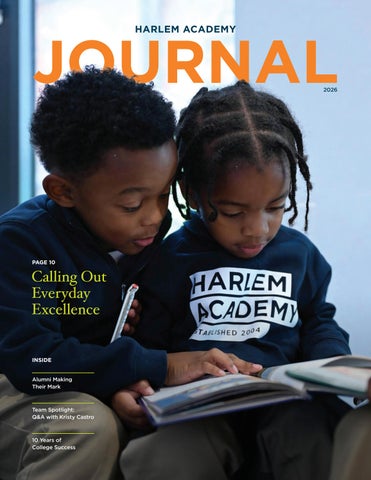
JOURNAL HARLEM ACADEMY
2026
PAGE 10
Calling Out Everyday Excellence INSIDE Alumni Making Their Mark
Team Spotlight: Q&A with Kristy Castro
10 Years of College Success 2026 Journal | 1
2 | Harlem Academy
FROM THE HEAD OF SCHOOL
While there are many reminders of how far we’ve come over the past five years, one of the most tangible involves my Subaru – or rather, the fact that it no longer can fit all the eighth graders interested in visiting boarding schools now that we’ve doubled middle school enrollment. These days, I’m on my way to the Bronx by 5 a.m. to rent a van before heading to Harlem Academy to greet up to a dozen sleepy-eyed students. Anticipation kicks in quickly, and we spend time sharing research about what to look for at each school and how to get the most out of interviews. These trips end up being special in lots of ways: students see new possibilities for their future and alumni welcome them warmly, sharing the kind of authentic window into life at their schools you can’t get from a brochure. The transition from our tight-knit Harlem Academy community to elite secondary schools can feel like a leap. We intentionally prepare our students with the rigorous academics they need to thrive, alongside the confidence and character to navigate new spaces with purpose. It’s why we dedicate time every week to commending exemplary habits (p. 1011), why we explicitly teach skill development in a weekly seminar (p. 12-13), and why the growing network of alumni who support their younger peers is so valuable. From Church Farm to Deerfield, it’s inspiring to know that twice as many Harlem Academy eighth graders will be making their mark at campuses throughout the region. I may have traded my Subaru for a 15-passenger van, but being part of this ride with our students at such a pivotal moment is a privilege I’d never trade!
Vinny Dotoli
2026 Journal | 3
SCHOOL CREED
I am bold and creative. I take opportunities to lead. I seek help when I need it. I am honest and reflective. I choose to do what is right, Even when it is hard or no one is watching. I listen carefully. I speak kindly. I care for my community. I make the most of each day. I learn from my mistakes. I don't give up.
WELCOME TO THE BOARD
We are pleased to welcome Samantha Lipton to the board of trustees. Samantha Lipton most recently served as Deputy General Counsel at MacAndrews & Forbes, a holding company with interests in a diversified portfolio of public and private companies. In that role, she focused on investment opportunities and strategic transactions. Earlier in her career, she practiced corporate law at Paul, Weiss and Sullivan & Cromwell, and clerked for the Chief Justice of the Delaware Court of Chancery. “Our city’s excellent educational opportunities should be accessible to every promising child. Harlem Academy’s commitment to equity of opportunity embodies that foundational principle by offering its students a superb education that will prepare them for the most rigorous high schools,” she says. “I’m honored to serve on the board at a time when the school’s mission is as critical as ever.” Samantha graduated from The Brearley School and holds a B.A. from the University of Pennsylvania and a J.D. from Harvard Law School.
Contents 6
Making Their Mark
8
16
Team Spotlight: Kristy Castro
A Story of Growth
10
Calling Out Everyday Excellence
18
�� Years of College Success
19 12
A Foundation for Academic Success
14
A Legacy of Opportunity: Llewellyn Family Foundation
Alumni Spotlight: Next Stop, U Penn
Making Their Mark CHASING BIG QUESTIONS
Sedina Okudzeto ’20 Spence ’24 Skidmore ’28
A love of big questions has shaped Sedina Okudzeto’s path from Harlem Academy to Spence and now to Skidmore, where she is preparing for a future in constitutional law. At Spence, Sedina gravitated toward leadership rooted in ideas. She served as co-president of Highlighting the Hidden, which brings attention to untold stories of everyday people and historical figures, and co-founder of the Philosophy Club. “I loved creating spaces where people could think deeply together,” she shared. Her interest in law developed through hands-on experience. A summer internship at a private law firm introduced her to estate planning and legal research, while a position with Judge Waterman at Brooklyn Civil Court gave her the opportunity to draft judicial decisions, a challenge that affirmed her goal of becoming a law professor. Now at Skidmore, Sedina was unanimously appointed to the student government’s Judicial Board. “HA taught me to reflect, to take opportunities, and to seek help when I need it,” she shared, reflecting on how those habits remain central as she works toward a career grounded in knowledge, integrity, and service.
ALWAYS A STUDENT Commitment defines the way Joshua Sibblies approaches everything he cares about, from chess to community service to the classroom. Now a junior at Fieldston, Josh splits his time between varsity football, music, and serving as the captain of a chess team that has won its division for three straight years. “I’ve loved chess since first grade,” he said. “Now I get to build the program and make it better for the next group.”
Joshua Sibblies ’23
Service plays an equally central role. Last year, Josh volunteered at Riverdale Neighborhood House, supporting younger students with homework and problem-solving. This year, he’s teaching chess tactics over Zoom to students in Africa, an opportunity that still amazes him. Josh credits Harlem Academy with instilling curiosity and humility. “I’m always going to be a student. That mindset came from HA, and it still guides me.” As he considers a future in dentistry, that commitment to learning paired with a desire to serve remains at the center of his journey.
6 | Harlem Academy
Fieldston ’27
We caught up with graduates to hear how they are making their mark. From secondary school to college and beyond, they’re building on the foundation Harlem Academy helped set. Whether they’re pursuing big questions, stepping into leadership, or serving quietly behind the scenes, their impact is already taking shape.
Jayden Clemons ’24 Lawrenceville ’28
LEADING BY EXAMPLE Jayden Clemons may be a high school sophomore, but he already has a clear goal: to become a chemical engineer. The spark started in sixth grade, where he first saw the connection between science and everyday life. “Something as simple as boiling an egg is chemical engineering,” he says. At Lawrenceville, Jayden is challenging himself on multiple fronts, from an ambitious goal to learn Chinese (“probably my hardest class”) to a full slate beyond the classroom: football, the investment club, church service, and chess tournaments. Jayden is also shaping school culture. He was selected to join the head of school on stage at commencement, an honor given to one exceptional freshman known for “unwavering positivity” and “profound community engagement that uplifts the collective spirit of their peers.” Even with Lawrenceville’s larger student body, the sense of community feels familiar. “Everybody knows each other, and teachers are always checking in to make sure you’re okay,” he shared. It’s the kind of community he learned to count on at Harlem Academy, and one he’s helping strengthen wherever he goes.
ROOTED IN REFLECTION For Arielle Benjamin, storytelling is more than a craft; it’s how she explores identity and community. A recent Georgetown graduate, Arielle found a defining moment in her capstone film on motherhood. The project was inspired by a poem she wrote years earlier at Harlem Academy. “As an Afro-Caribbean girl from the Bronx, born to immigrant parents, I’ve always carried the weight and wonder of what ‘mother’ means. This film was my way of piecing that meaning together,” she says. “Seeing it on screen and sharing it with mentors felt like everything coming full circle.”
Arielle Benjamin ’17
At Georgetown, Arielle’s impact extended beyond the classroom. She revived the BRAVE Summit, a celebration of Black women’s leadership, and undertook a consulting residency in Ghana, helping a sustainable cocoa company strategize for growth. As she finishes Bloomingdale’s Leadership Development Program and considers her next chapter, she carries Harlem Academy’s values with her. “Reflection was such a big part of our culture,” she says. “It still guides how I move through the world.”
Spence ’21 Georgetown ’25
2026 Journal | 7
A Story of Growth From our inaugural class of 12 first-graders whose parents took a leap of faith in 2004 to the teachers and supporters who turned possibility into reality, our focus has never wavered: to unlock the potential of future leaders whose promise might otherwise go unrealized. Since moving to our permanent campus with 100 students in 2021, our growth has been intentional and anchored in our mission. We launched kindergarten in 2022, added a second section of sixth grade in 2023, and reached full enrollment in the fall. Today, 212 students benefit from a rigorous academic program and a joyful community that inspires them to reach their full potential. Thank you to all who remain part of this journey!
September 7, 2004: Our first opening day.
COMMENDATIONS
Calling Out Everyday Excellence If you visit Harlem Academy for a community meeting, you’ll see it happen. A teacher begins to speak, everyone’s ears perk up, and a student stands a little taller. What’s being lifted up isn’t a grand act, but something smaller and more powerful: a daily choice or habit that contributes to a strong culture of learning and growth. At Harlem Academy, we pause to name those choices through commendations – prepared, division-wide recognition given when a student’s choices reflect real growth or excellence in living out our School Creed and community pillars. Each one is delivered as a short story. The teacher sets the scene and shares a brief vignette of what they observed. They explain why the choice mattered, name the value it reflects, and only at the end reveal the student’s name.
At that meeting, you might hear something like this: “In middle school, it’s easy to keep quiet when you’re confused and hope things will become clearer later. But real learning often depends on noticing when you don’t understand something and doing something about it. Over the past few weeks, I’ve observed one student who consistently pauses during class discussions to ask a clarifying question that helps not just them but everyone in the room. For showing initiative by asking for help rather than hiding uncertainty, I commend Jayden.” The student stands, the community gives kudos, and dozens of classmates know exactly what success looks like. And the structure does something powerful: everyone listens. Commendations are one of the ways Harlem Academy makes character development visible, teachable, and joyful. They are public moments of praise, carefully crafted and intentionally delivered, that help students understand what they did well, why it matters, and how they can do it again. Praise, in other words, becomes pedagogy.
More Than “Good Job” Teachers praise students all day long. A quick “thank you for getting started right away” or “nice job helping your partner” keeps classrooms running smoothly. Commendations serve a different purpose; they shift praise from reactive to proactive. Teachers step back to ask what habits they want students thinking about right now and which examples will help make those expectations concrete. Shared during weekly, division-wide community meetings, they allow students to hear and learn from examples beyond their own classrooms, reinforcing a shared language and set of values as members of a larger learning community. The public recognition and the shared language around it sticks. One fifthgrade parent, Monica De La Cruz, reflected on her son’s experience after he received a commendation early in the year. “When asked about it, his
10 | Harlem Academy
What Makes a Commendation Work? INTENTIONALITY Because commendations happen weekly, they carry weight. Teachers step back and ask, What habit do I really want students thinking about right now? The student being recognized knows their actions stood out across an entire week, reinforcing that character is built through repeated choices.
CONTEXT
Classmates give silent applause as a fourth grader is recognized.
response made me proud of him and of HA’s school culture,” she said. “He told me, ‘That’s just what we do, Mom. We look out for each other at HA and in life, period.’”
where positive behavior is noticed, named, and celebrated.
Commendations don’t just affirm behavior in the moment; they shape how students see themselves and their role in the community.
This practice doesn’t just affect student behavior; it influences the entire community. Teachers are constantly on the lookout for moments worth celebrating. Students know their choices matter, even when no one is watching. Families become partners when these stories are shared at home, sparking conversations rooted in pride and growth.
What Research Tells Us Research consistently shows that praise is most powerful when it is specific, focused on process, and tied to effort rather than ability. When students hear exactly what they did and why it matters, they’re more likely to stay engaged, persist through challenges, and repeat the behavior. In fact, studies on behavior-specific praise link clear, specific recognition to stronger academic engagement and fewer disruptive behaviors. At Harlem Academy, research-driven practices are always the foundation. What brings this approach to life as an integral part of school culture, however, is what we see each week: students listening closely, teachers watching intentionally, and a school culture
A Virtuous Cycle
Students who receive commendations are featured on digital displays in the lobby, another reminder that character matters here. At the end of the year, every student receives a final commendation from their teachers, a tradition that honors a year of effort, progress, and character development. At Harlem Academy, we believe praise should do more than feel good in the moment. It should teach. It should clarify expectations. It should help students build the habits they’ll need long after they leave our classrooms. Commendations are one way we make that belief visible: one story, one student, one good decision at a time.
Commendations give teachers time to explain the “why.” Why does asking for help matter? Why does listening respectfully strengthen a community? Students learn that the goal isn’t simply to please adults, it’s to grow into capable, disciplined, thoughtful people.
HABIT-BUILDING Our School Creed is aspirational by design. Commendations connect those big ideas to small, repeatable actions. Over time, students begin to see how everyday decisions, like helping a peer, speaking kindly, and persevering through challenge, add up to character.
PEER MODELING Each week, students hear concrete examples of classmates’ success. The message is clear: this is achievable, and you can do it too. As Head of School Vinny Dotoli explains, “When students hear commendations week after week, they start to internalize what we value, not because it’s written on the wall, but because they see it lived out by their peers.”
GROWTH, NOT PERFECTION Commendations often recognize improvement. They highlight effort, reflection, and follow-through, reinforcing the idea that growth is something you practice, not something you’re born with.
2026 Journal | 11
SKILLS SEMINAR
A Foundation for Academic Success Skills Seminar is built on a simple idea: if students can unlock the structure of a sentence and the meaning of the words inside it, they can unlock the doors to history, science, and math, too. That’s the focus of our new Skills Seminar, led by Middle School Director Will Beller. Grounded in the science of learning, the course strengthens the foundation students need to thrive across the curriculum. “The goal is transfer,” says Mr. Beller. “We want students to walk into any class and feel more confident breaking down what they’re learning and expressing what they know.”
A Cornerstone of Learning For sixth and seventh graders, a central pillar of Skills Seminar is language development, with a systematic focus on grammar and vocabulary. By understanding how words are constructed and how they relate to one another, students build background knowledge that supports success across disciplines. When students encounter a new word, they analyze it in context before seeing a definition. They examine sample sentences, infer meaning from clues, and compare the word to related terms to refine their understanding. A word like elusive, for example, might be introduced alongside evasive, with sentences describing animals avoiding capture. Students grapple with the similarities and differences between the two words before applying them in their own writing. Grammar instruction follows a similar approach. By diagramming and unpacking sentences, students see how syntax shapes meaning. This work strengthens not only reading comprehension and writing clarity, but also students’ ability to engage deeply with content across the program.
Making Learning Stick Skills Seminar also creates new opportunities to revisit material over time. Students regularly return to words and grammar concepts from previous weeks through brief questions or warm-up exercises. This reflects a core principle of the science of learning: forgetting is part of learning, and retrieval strengthens memory more effectively than simply rereading. But this practice goes beyond simply reinforcing direct instruction from Skills Seminar. The sentences students analyze are drawn from texts they are reading in English, history, and science. For instance, students may be asked to demonstrate their understanding of the word waned by completing a sentence related to what they are learning in history: “Many colonists’ support for 12 | Harlem Academy
Parliament waned after the Stamp Act because…” The task pushes students to do more than memorize a definition; it asks them to apply the new word to real ideas, strengthening both content knowledge and vocabulary. Similarly, a comma lesson might ask students to correct the sentence, “While Odysseus shows great cleverness his pride sometimes causes new problems,” drawn from their English unit. Even when the focus is on punctuation, the work keeps students thinking about character, theme, and cause-and-effect.
If students understand how words work and how ideas fit together, they can learn anything.” Will Beller, Middle School Director
“You remember what you think about,” Mr. Beller explains. “Skills Seminar is really about making sure students are thinking about words, sentences, and ideas that show up in their classes.”
Preparing for Secondary School
NYU Dean and Harlem Academy trustee Liz McHenry speaks with students about working with primary sources.
dedicated time to focus on research and writing, students are able to dive deeper than would otherwise be possible within their history class alone. Students begin with a primary source from Reconstruction through the Great Depression, such as a newspaper article about Jack Johnson’s boxing match in 1910 or coverage of Duke Ellington’s touring band from 1927. They read closely within a document and compare multiple sources, considering who wrote each piece, why it was written, and how it fits into the broader historical context.
In eighth grade, Skills Seminar takes on an expanded role. During the fall, students receive targeted preparation for placement exams, with an emphasis on math. The primary focus is a systematic review of core content before jumping into practice questions and test-taking strategies.
Students are then challenged to transform their research into an essay that blends narrative and analysis, telling a historical story while advancing a thesis. To prepare for this capstone project, they study The Warmth of Other Suns by Isabel Wilkerson as a model, analyzing how she used research and narrative storytelling to provide a visceral window into the Great Migration.
Later in the year, students engage in a high-school-level research project. With
“Finding information, evaluating credibility, turning research into
writing, and then presenting it are skills students will need not only in history class, but throughout their academic careers,” says Mr. Beller.
Ready for What Comes Next By design, Skills Seminar is not about mastering a single subject. Whether students are analyzing a historical document, tackling a challenging science article, or navigating the demands of secondary school, the foundation built in Skills Seminar continues to support their growth. Long after Harlem Academy students leave middle school and specific assignments fade from their memories, the ability to break down complex texts, make sense of unfamiliar material, and express ideas with clarity will endure. As Mr. Beller puts it, “If students understand how words work and how ideas fit together, they can learn anything.” 2026 Journal | 13
A Legacy of Opportunity: Llewellyn Family Foundation On any given day, Harlem Academy’s entry commons hums with the rhythm of school life: students arriving with backpacks and big plans, a first-grader helping tie a friend’s shoe on the way to recess, teachers sharing informal updates with parents at dismissal, and the energy of a community committed to excellence. This signature space and heart of the school now bears the name of J. Bruce Llewellyn, a Harlem-born entrepreneur and philanthropist whose life reflected the values our students practice every day.
A Historic Commitment As the Llewellyn Family Foundation considered how best to carry Bruce Llewellyn’s legacy forward as it concluded its work, the trustees asked a defining question: Where can we make a truly transformational difference? In December, the Foundation answered that question with a landmark grant to Harlem Academy, a commitment that honors the life and values of Mr. Llewellyn while expanding opportunity for generations of students to come. “Harlem Academy has a serious vision and a total commitment to educational excellence, and that was deeply aligned with my father’s values,” says Alexandra Clancy, Mr. Llewellyn’s daughter and president and chairperson of the Foundation. “We have deep faith that Harlem Academy will continue to have an impact over the years.” The gift builds on a partnership years in the making. Over the past decade, the Llewellyn Family Foundation has been one of Harlem Academy’s most significant and consistent supporters, investing deeply in the long-term strength of the school.
Living the Creed Bruce Llewellyn’s commitment to education was shaped early in life. The son of Jamaican immigrants, he grew up with a clear understanding that hard work, perseverance, and opportunity were inextricably linked, and that education was the surest path forward. Throughout his career, he used the success he built to expand access for others, investing in institutions that nurture talent, character, and leadership.
J. Bruce Llewellyn, Harlem-born entrepreneur and philanthropist
14 | Harlem Academy
“My father’s life is a testament to the fact that hard work mattered and lifting other people up mattered,” Ms. Clancy reflects. “But in order to ensure that happened, he believed that getting the most wonderful education was critical. He attended City College on the G.I. Bill and later earned his law degree from New
Llewellyn Commons is a central gathering place for our community and a lasting tribute to Mr. Llewellyn’s commitment to empowering future generations.
York Law School. Education was the one thing he believed no one could ever take away from you.” She adds that he held himself and others to an equally high standard of character: “He always said integrity matters, even above education.” Head of School Vinny Dotoli describes the Foundation’s investment as pivotal. “We are deeply honored that Harlem Academy was chosen for this investment,” he says. “Bruce Llewellyn believed in initiative, determination, compassion, and integrity not just as ideals, but as daily practice. This gift ensures that those values will shape our school and our students for generations, and we are honored to name the J. Bruce Llewellyn Commons to recognize its impact.”
Opportunity Today, Stability Tomorrow The grant includes two complementary components. First, it funds 16 Llewellyn
Scholars annually over the next five years, ensuring promising students can access Harlem Academy regardless of financial need. Second, an endowment gift establishes the J. Bruce Llewellyn Impact Fund and launches a matching challenge as a lasting investment in the school’s future. Pairing immediate stability with long-term sustainability is an intentional choice that strengthens Harlem Academy today while building a permanent foundation for students who will walk through the J. Bruce Llewellyn Commons decades from now. Reflecting on the message her father would share with Harlem Academy students, Ms. Clancy offers powerful advice: “Don’t lose your confidence. Don’t lose your character. Be grounded in what you’re trying to accomplish. Stay committed to your community, your fellow students, and your family. And stay true to yourself.”
Harlem Academy has a serious vision and a total commitment to educational excellence, and that was deeply aligned with my father’s values.” Alexandra Clancy, Bruce Llewellyn’s daughter and president and chairperson of the Llewellyn Family Foundation 2026 Journal | 15
TEAM SPOTLIGHT
Kristy Castro As primary and elementary school director, Kristy Castro brings her own journey and her deep commitment to building confidence and community to the work of helping students see themselves as leaders in any space they enter. Q: What first drew you to education? A: Growing up, everyone assumed I was going to be an educator … except me. I went to college thinking I’d go into sports law, imagining a career working with contracts and numbers in a very different way. But the summer after graduation, while I was studying for the LSAT, I worked at a camp, and it completely changed my trajectory. The way the students were curious, hungry to learn, and eager to soak up knowledge left a lasting impression on me. That energy and openness made me realize I wanted to be in their world, to guide and learn alongside them. That’s when I shifted my focus from law to education, and I’ve never looked back. Q: What made Harlem Academy the right fit? A: I grew up attending independent schools, and I was always grateful for that education. But it was clear early on that very few people at those schools looked like me, shared my culture, or came from my neighborhoods. That stayed with me when I got into education. I wanted to make sure students of color could see themselves reflected in the adults guiding them. When I was looking for the right school, Harlem Academy stood out. It combines the independent school values I admire – student-centered learning, autonomy, and high standards – with a focus on serving students who share similar backgrounds and experiences as me. Professionally, it 16 | Harlem Academy
gives me the opportunity to lead in a space that values innovation and student growth. Personally, it allows me to support and empower students to see themselves in leadership and achievement. Q: What’s your favorite line of the School Creed, and why? A: My favorite line is “I seek help when I need it.” Leadership isn’t about having all the answers; it’s about knowing when to ask for support, guidance, or perspective. In my role, whether I’m collaborating with teachers to design curriculum, problem-solving challenges in the classroom, or supporting families, leaning on others ensures that our students receive the best possible experience. It also sets a powerful example, showing our students that growth and learning happen when we’re willing to reach out, ask questions, and learn from each other. This line embodies the culture I strive to nurture, where collaboration, curiosity, and support are at the center of everything we do. Q: We’ve noticed you’re in the library a lot lately. What’s going on there? A: I’ve been working with all of our primary school students during library time, and it’s been such a joyful part of my week. Our time together is
I want students to know they belong in any space they enter and that their voices and actions matter.” Kristy Castro, Primary and Elementary School Director
designed to build excitement around reading and to help students see themselves as readers in a really positive way. We read together, play games that support phonics, grammar, and early literacy skills, and engage with language in ways that feel fun and meaningful. It’s very much a shared experience where students are active participants, learning from one another and building confidence along the way. Q: Can you talk a little about the special role families play? A: I’ve always believed it takes a village to raise a child. Through my work in schools, that belief has only grown stronger. I’ve seen that students do best when teachers, administrators, and families are working together and aligned around supporting the whole child, not just academics. What really stands out about Harlem Academy is the way families are welcomed into the life of the school. Families are engaged, informed, and deeply invested in their children’s growth, and the school makes space for ongoing communication and collaboration. That shared commitment creates a strong foundation of trust that I have not experienced in the same way at other schools.
community of adults who know them, believe in them, and are working together on their behalf. It not only strengthens academic outcomes but also reinforces a sense of belonging, accountability, and pride in our community. Q: What is your hope for our students after graduation? A: My hope is that students leave not only academically prepared, but deeply confident in who they are and what they’re capable of. I want students to know they belong in any space they enter and that their voices and actions matter. I hope they carry our pillars with them and stay true to their authentic selves. Ultimately, I want them to see education not just as a pathway to opportunity, but as a tool for purpose, responsibility, and positive impact in the world.
That partnership sends a powerful message to students: there is a
Library time with Ms. Castro is all about sparking a love of reading and growing confident young readers. 2026 Journal | 17
�� Years of College Success Our first class of eighth graders graduated in 2012 and forged the way to college in the fall of 2016. This year, we celebrate 10 years of Harlem Academy students making their mark at colleges and universities across the country.
American University (2)
John Jay College
Spelman College (2)
Berry College
Juniata College
St. John’s College
Binghamton University
Lafayette College
St. John’s University (2)
Boston University (3)
Lehigh University
St. Joseph’s University
Bowie State University
Lehman College
Stanford University
Brown University
Manhattanville University
Suffolk University
Carnegie Mellon University
Mercy University
SUNY Albany (2)
Case Western Reserve University
Monroe University
SUNY Canton (2)
Catholic University
Morehouse College
SUNY Maritime
City College (3)
Morgan State University
SUNY Oneonta
College of the Holy Cross (2)
New York University (4)
SUNY Oswego
Cornell University
North Carolina A&T University
SUNY Plattsburgh
CUNY - Baruch College (2)
Northeastern University (2)
SUNY Purchase (3)
Dartmouth College
Northwestern University
Syracuse University (4)
Delaware State University
Oberlin College
Tufts University (2)
DePauw University
Pace University (3)
Union College (3)
Fordham University
Penn State University
University at Buffalo
George Washington University (3)
Princeton University
University College London
Georgetown University
Quinnipiac University
University of Miami
Hamilton College
Rensselaer Polytechnic Institute (2)
University of Nevada, Las Vegas
Hampton University
Rice University
University of Pennsylvania
Haverford College
Rutgers University
University of Rochester (3)
Hobart and William Smith Colleges (3)
Saint Anselm College
University of West Georgia
Howard University (4)
Salve Regina University (2)
Wesleyan University (2)
Ithaca College
Skidmore College
Wilkes University
Jackson State University
Smith College
Yale University (2)
18 | Harlem Academy
ALUMNI SPOTLIGHT
Next Stop: University of Pennsylvania As he prepares to head to the University of Pennsylvania to study biochemistry, Rasan Hoskins carries forward the values of leadership, service, and community first cultivated at Harlem Academy.
Rasan is someone who shows up for his teammates, for younger students, and for his community. Now a senior at Riverdale Country School, he describes himself as “around everywhere,” an intentional presence shaped by a desire to build supportive spaces and make sure people feel seen wherever he goes.
Finding Purpose Through Science Rasan’s love for science and math began early and was solidified at Riverdale, where he participated as a summer research intern at Lisman Laboratories, studying the connections between genes, neurons, and neurological systems. At Penn, Rasan plans to continue that work in a biochemistry lab, exploring the intersection of biochemistry and neuroscience. His motivation is to help people: “I want to do research where there’s added value,” he says, “like helping in the production of new drugs to treat Alzheimer’s and depression.”
Leading Through Service Rasan’s desire for real-world impact extends beyond the lab. At Riverdale, he has led with intention and sought out opportunities to serve others, both on campus and beyond. He helped organize and lead domestic servicelearning trips to Alabama and Georgia, supporting faculty and guiding
Rasan ’22
younger students. He also volunteered with Habitat for Humanity, building homes in New York City and Alabama and helped women-led businesses in underdeveloped countries secure loans through a school-based organization called Zawadi by Youth. “These experiences give you a broader perspective on what’s going on in the world,” Rasan explains. “You realize how privileged we are and how the work we do, even as students, can make a difference.”
A Foundation Built on Community This sense of purpose and commitment to community was first cultivated when he joined Harlem Academy in second grade. As an educator, his mother, Tyiesha Hoskins, quickly recognized that her son was not being challenged at his previous school. She was drawn to Harlem Academy for its high expectations and location in the heart of Harlem. With a diverse student body and faculty, she immediately saw it as a place where Rasan could grow academically and personally. At Harlem Academy, community was built into daily life. “It wasn’t just a school where everyone happened to be in the same building,” Rasan recalls. “It was a place where people really knew each other.” Ms. Hoskins recognized the impact of that environment. “I don’t think he ever questioned whether he belonged,” she says. “That confidence stayed with him, and now he knows to seek it wherever he goes.”
Riverdale Country School ’26 University of Pennsylvania ’30
Living the Creed As he prepares for his next stop at Penn, Rasan carries the lessons that first shaped him at Harlem Academy. Chief among them is the School Creed, which he views as a guidepost for life. “Integrity, initiative, compassion, determination—those are things you carry with you everywhere,” Rasan says. “Compassion doesn’t end when you leave Harlem Academy. It’s something you need in every space you’re in.”
Rasan starting his Harlem Academy journey in second grade.
2026 Journal | 19
655 St. Nicholas Avenue New York, NY 10030 harlemacademy.org 212.348.2600
Board of Trustees
Trustees Emeriti
David B. Peterson, Chair
Mark H. Johnston
Rodney Pope, Secretary
Laura B. Sillerman
Carol B. Kenney, Treasurer Tony Asnes Richard A. Axilrod Avi Banyasz W. Graham Cole Vincent Dotoli, Ex-Officio Ty Elie P’16 Robert L. Harteveldt Valarie A. Hing Thomas Klein Samantha Lipton Ann MacRae Elizabeth McHenry Betsy S. Michel Hank Prybylski Tom Reycraft Kristofer Rodgers Richard Schaps Hillary Thomas Melissa C. Thomas-Hunt Alan Washington
Printing and mailing generously donated by Benchmark Education.
Advisory Council John Belizaire Jane Bierwirth Will Cook Joshua Easterly Duncan Edwards Mary Ganzenmuller James V. Gemus Doug Griebel Shirley A. Jackson, Ph.D. Neal Kamsler Ben Lavely Michael Levine Rashanna Lynch, M.D. Lauren W. Marrus William E. Mayer Alice Quinn Jeremy Raccio David R. Salomon Hunter Serenbetz