STATION
DATE: 01.16.2025 - 05.29.2025 - SITE LOCATION: Chico Basin Ranch
PROMPT: Design a bird banding station suitable to host k-12 field trips and safe overnight volunteer shelter.
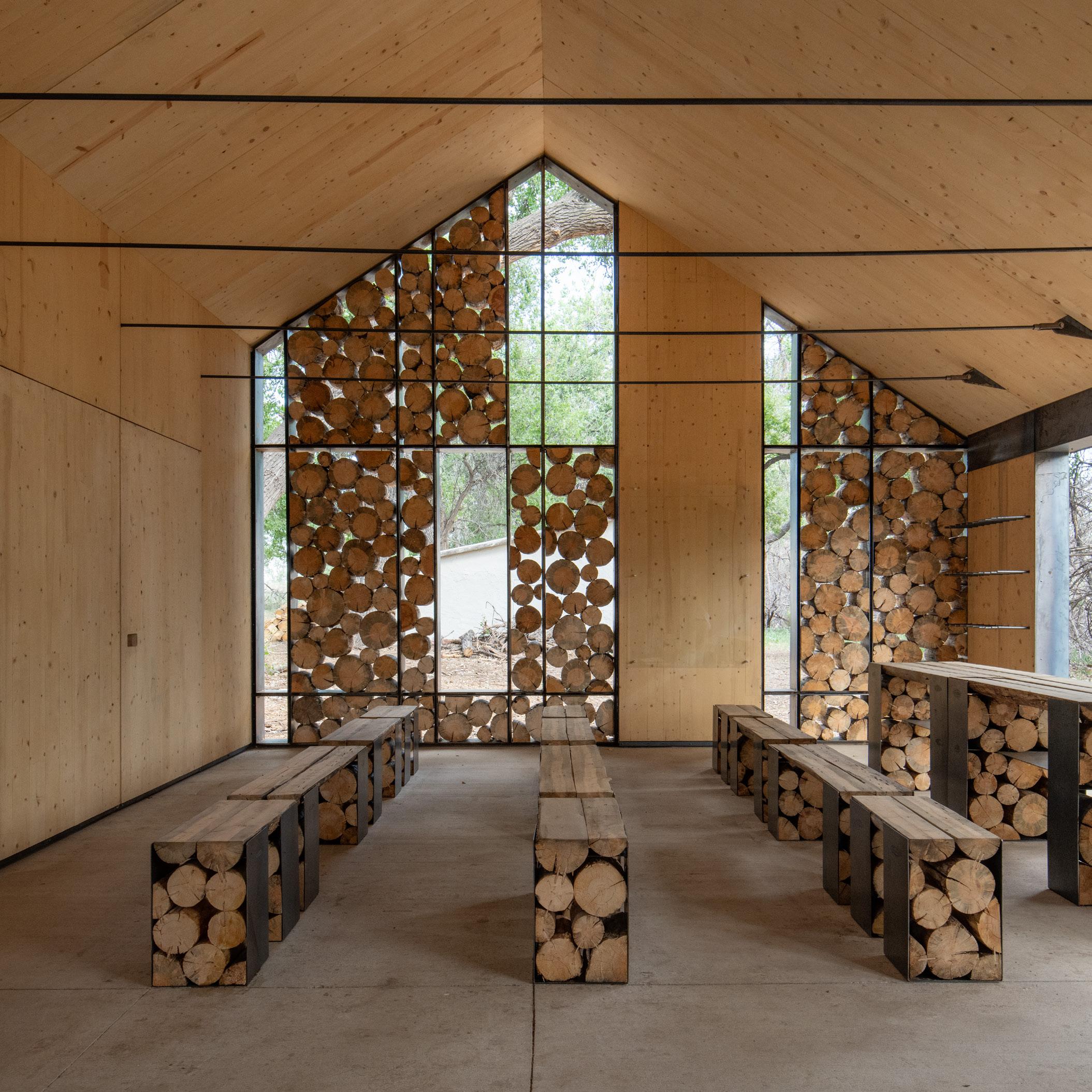
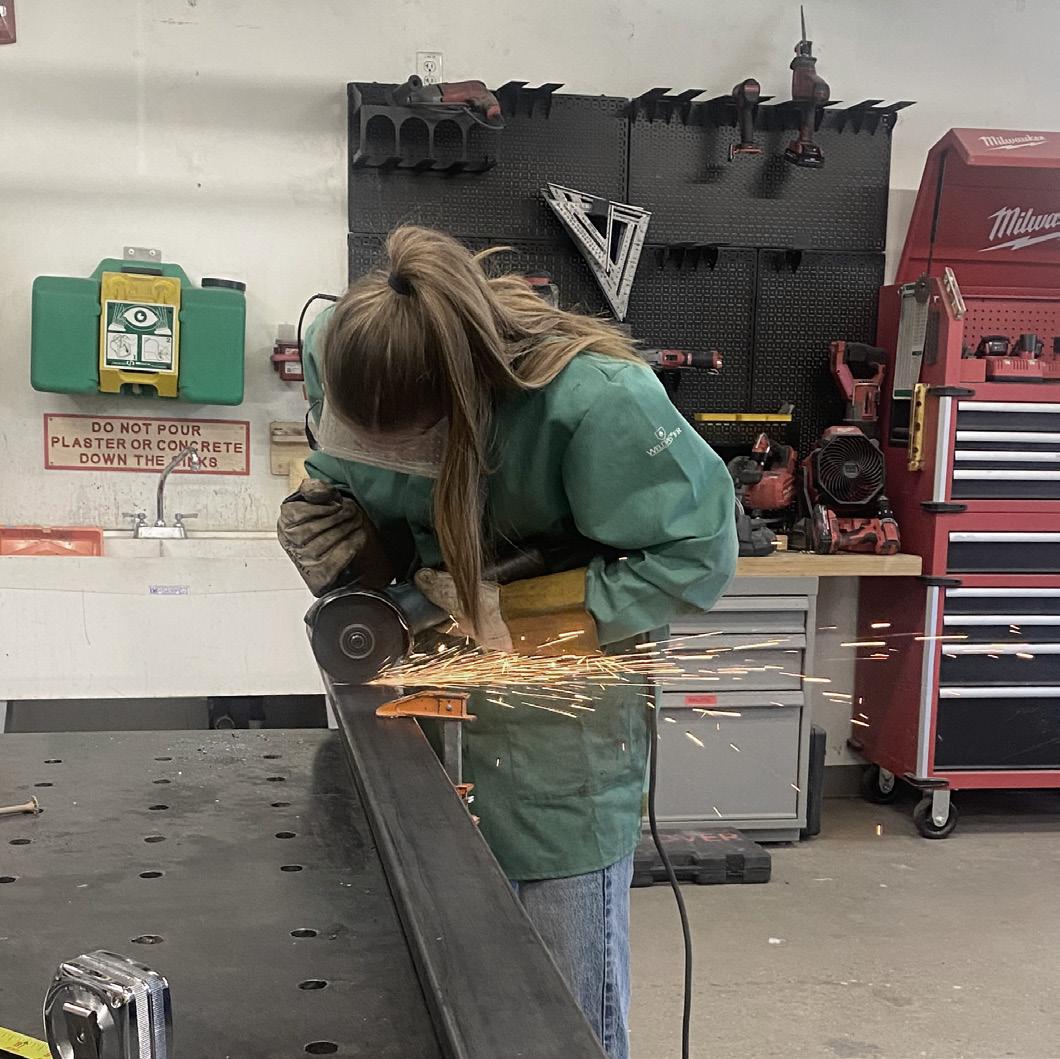
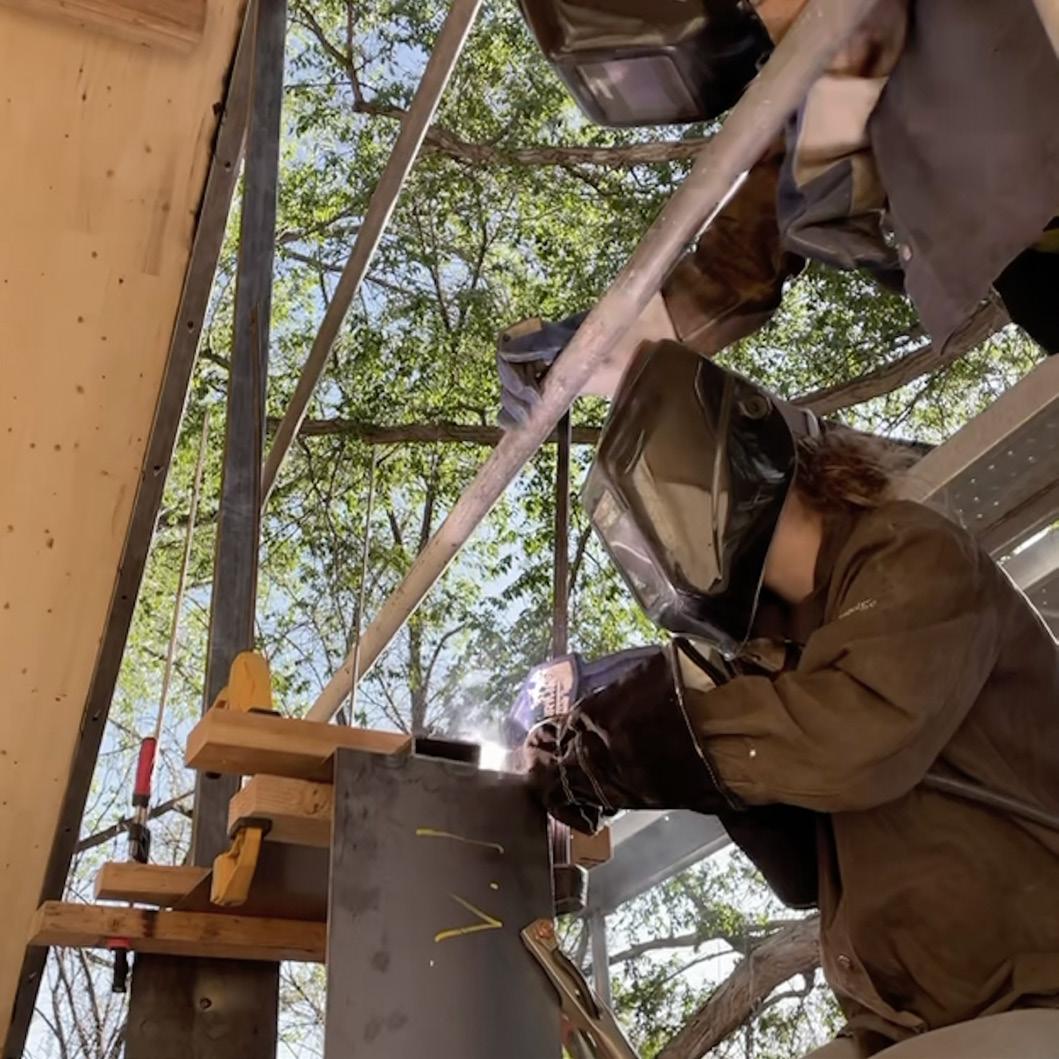
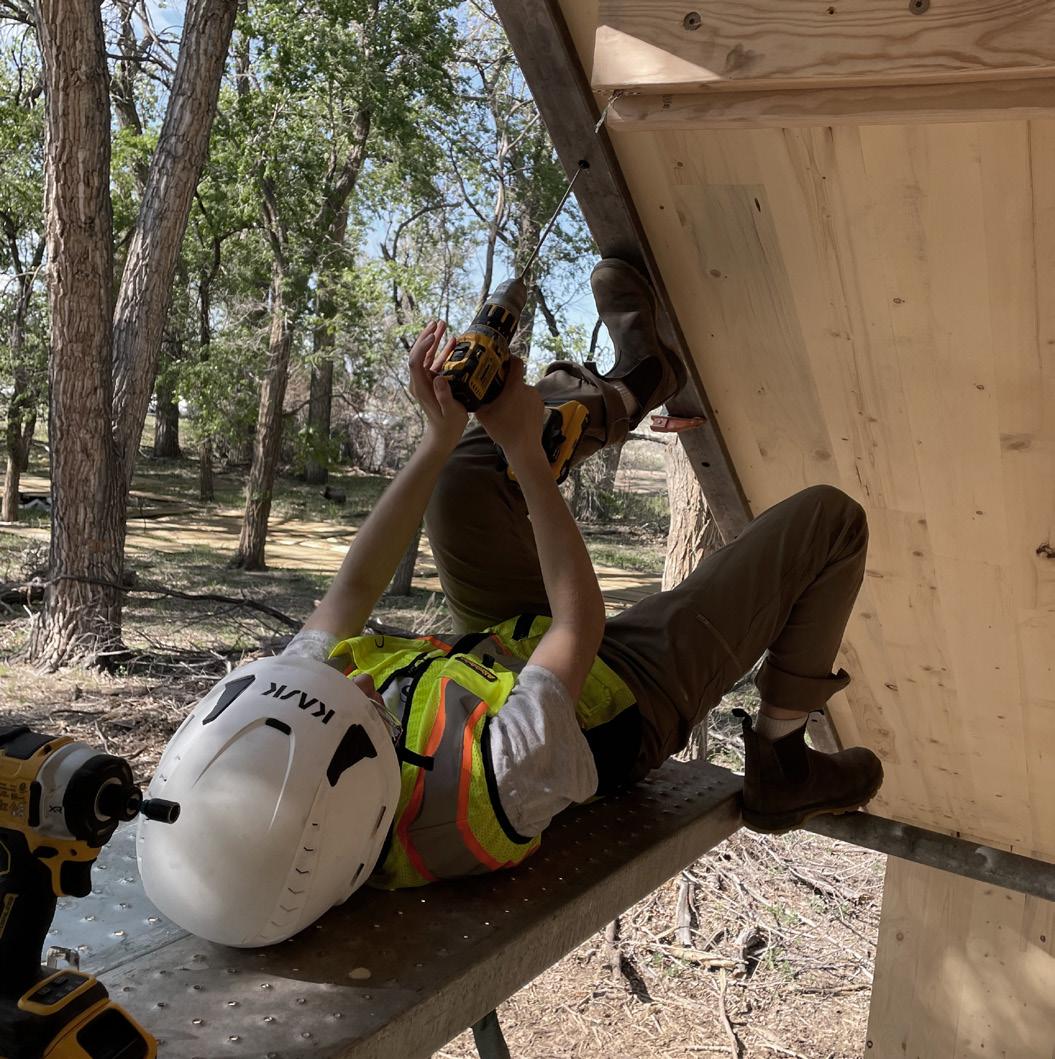
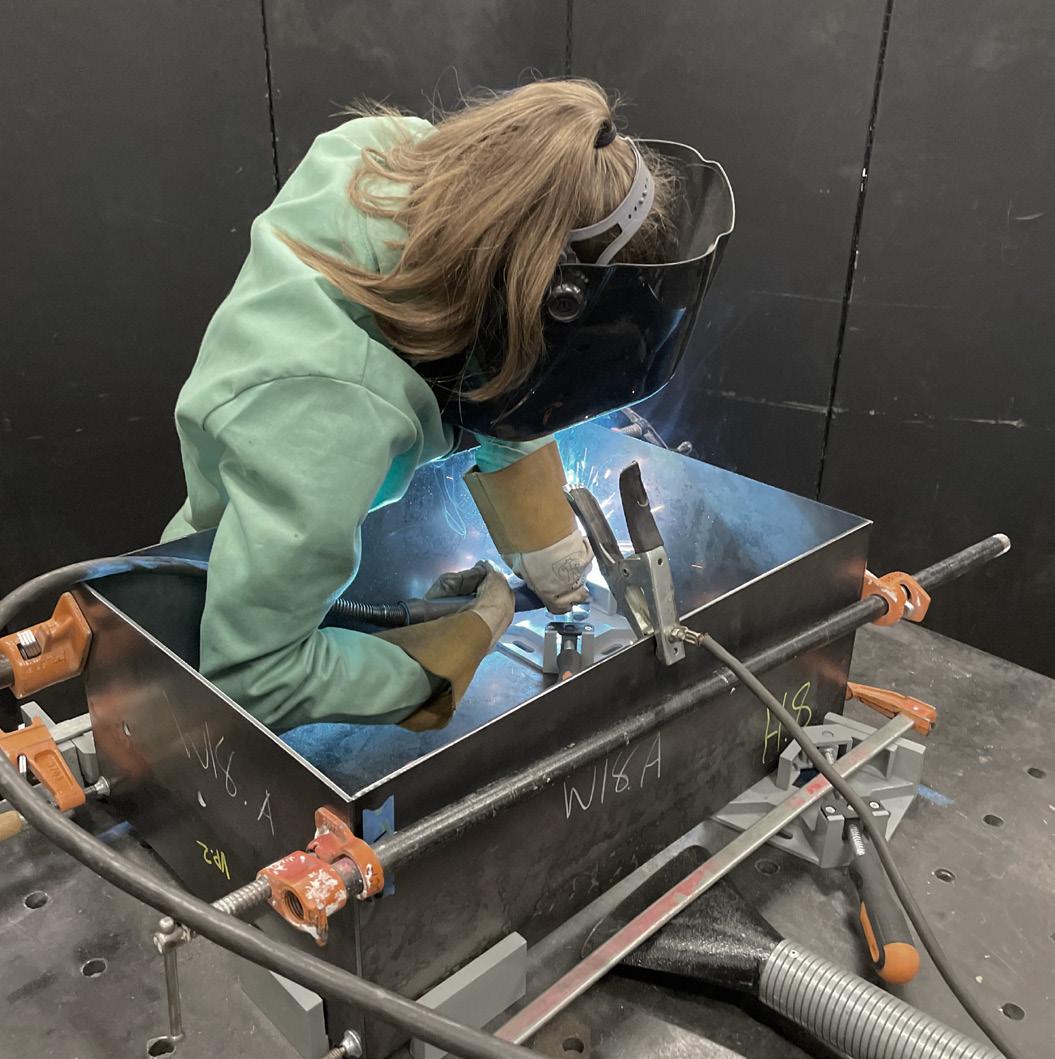
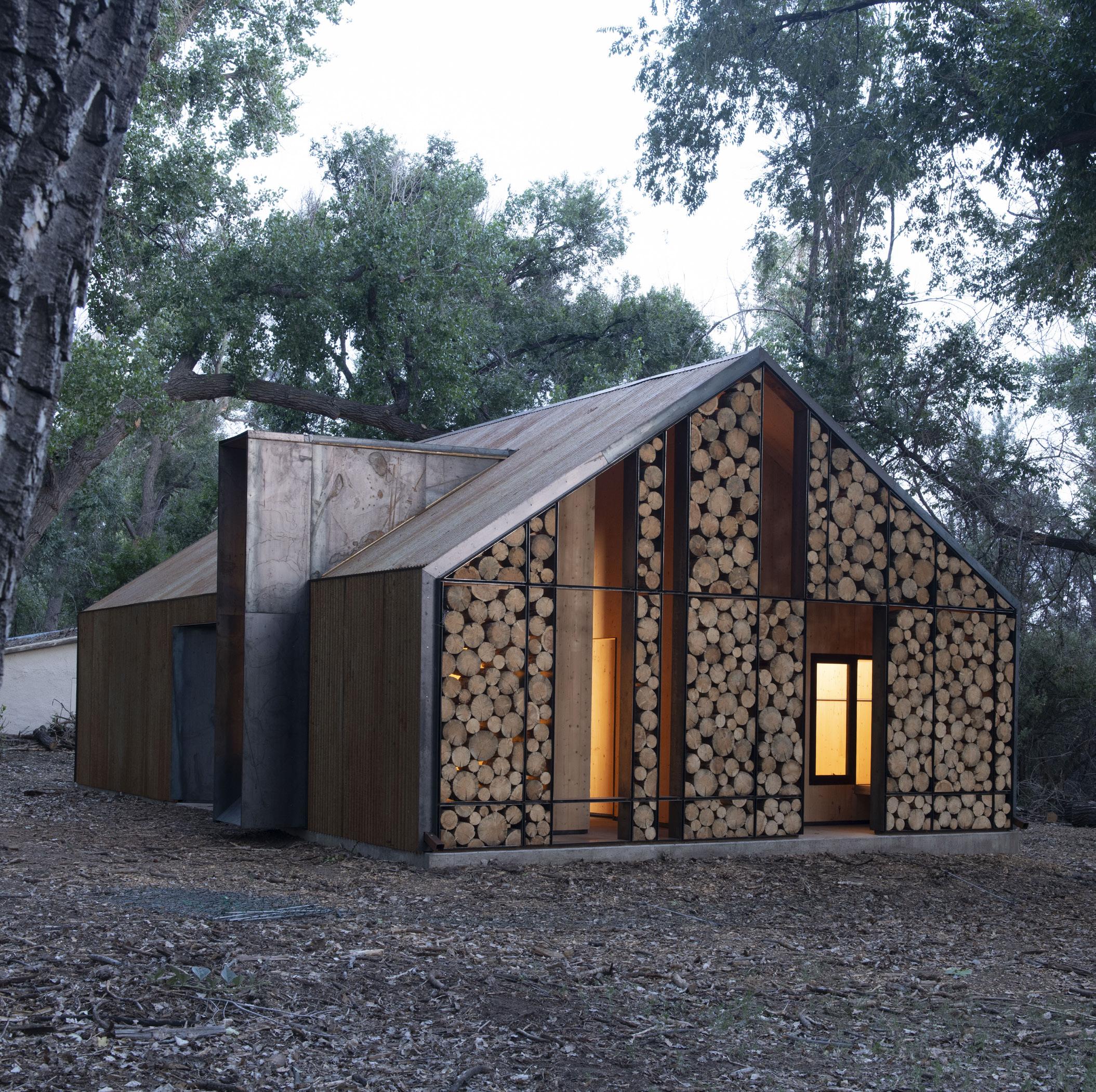
PROPOSAL: One of six students on the screen team within a twenty-six person cohort, I contributed to the design and construction of this open-air classroom constructed from CLT and screened by a cordwood wall. The screen provides shade and visual comfort for volunteers while reducing glare and reflections that could endanger nearby birds. By filtering light and framing views outward, the structure maintains a close connection to the surrounding landscape, supporting both research activity and environmental awareness.
The screen’s grid aligns with key architectural elements such as furniture, windows, and circulation paths. This alignment was central to the design process, reinforcing the project’s organized gable typology while allowing certain cells to remain open or filled intentionally for visual and functional relationships. DIAGRAMMATIC PLAN
16’-3-5/16”
8’-3-5/16”
1’-5-1/2”
8:12 PITCH
EAST EXTERIOR ELEVATION
1’ = 1/4”
8’-3-5/16”
6’-9-5/16” 1/2”
8:12 PITCH
WEST EXTERIOR ELEVATION 1’ = 1/4”
1’-5-1/2”
1’
2: SCREW HSS FRAME INTO CLT ROOF PANEL
FAB ON SITE BOXES FOR HORIZONTAL TOLERANCE
SHEAR STRUCTURAL SHADOW BOX WALL, FAB ON SITE
DIRECTION OF CONSTRUCTION
9: CLAMP BOX C INTO PLACE, PLUG WELD TO TALLER VERTICAL HSS + TOP HSS FRAME, FILLET WELD TO SHORTER VERTICAL HSS
8: WELD THE NEXT HORIZONTAL HSS TO BOX B + BOTH VERTICAL HSS
A + B BOXES PREFAB, C BOXES PARTIALLY PREFAB, ANGLE WELDS DONE ON SITE FOR VERTICAL TOLERANCE
HOLES PUNCHED FOR PLUG WELDING ON SIDE NEAREST GABLE PEAK
DIAGONALS MUST MEASURE EQUALLY TO ACHIEVE TRUE 90°ANGLES
VERTICAL SHEETS WELDED OUTSIDE THE HORIZONTALS
7: CLAMP BOX B INTO PLACE, PLUG WELD TO TALLER VERTICAL HSS, FILLET WELD TO SHORTER VERTICAL HSS
6: WELD THE FIRST HORIZONTAL HSS TO BOX A + BOTH VERTICAL HSS
5: WELD THE SHORTER VERTICAL HSS ONTO BOTH FRAMES + BOX A
4: CLAMP BOX A INTO PLACE, PLUG WELD TO VERTICAL HSS
3: WELD THE TALLER VERTICAL HSS ONTO BOTH FRAMES
1: SCREW HSS FRAME INTO CONCRETE
16’-3-5/16”
8’ 8:12 ROOF
CORRUGATED WEATHERING STEEL ROOF PANEL
VAPROSHIELD WATER RESISTIVE MEMBRANE
1/4” x 1-1/2” GALVANIZED WOODGRIP SCREW
11 GA HRS CUSTOM ANGLE
ENGLEWOOD CROSS LAMINATED TIMBER ROOF PANEL
1/4” x 3-1/2” SDS GALVANIZED SCREW
3X1, 11 GA HSS
9” D, 11GA HOT ROLLED STEEL, PLUG ELDED TO HSS
9” D LODGEPOLE & PONDEROSA CORDWOOD
9” D, 11GA HOT ROLLED STEEL
3X1, 11 GA HSS
SPOT WELD
EPOXIED WOOD BISCUIT
PLUG WELD
FILLET WELD
BISCUIT JOINERY
AXON DETAIL
WELD JOINERY
AXON DETAIL
9” D LODGEPOLE & PONDEROSA CORDWOOD
9” D, 11GA HOT ROLLED STEEL
3X1, 11 GA HSS
SPOT WELD
9” D LODGEPOLE & PONDEROSA CORDWOOD
9” D, 11GA HOT ROLLED STEEL
3X1, 11 GA HSS
1/2” SHIM SPACE
1/4” x 4” TITEN SS CONCRETE & MASONRY SCREW
CONCRETE RAFT FOUNDATION
SCREEN WALL SECTION
SCALE: 1’ = 1”
CENTER
STUDIO III DIRECTED BY ERIKA SWEIGERT NAVA
DATE: 09.13.2024 - 12.14.2024 - SITE LOCATION: Chatfield State Park & Reservoir
PROMPT: Design a nature center that teaches visitors about one defining ecological aspect of the state park.
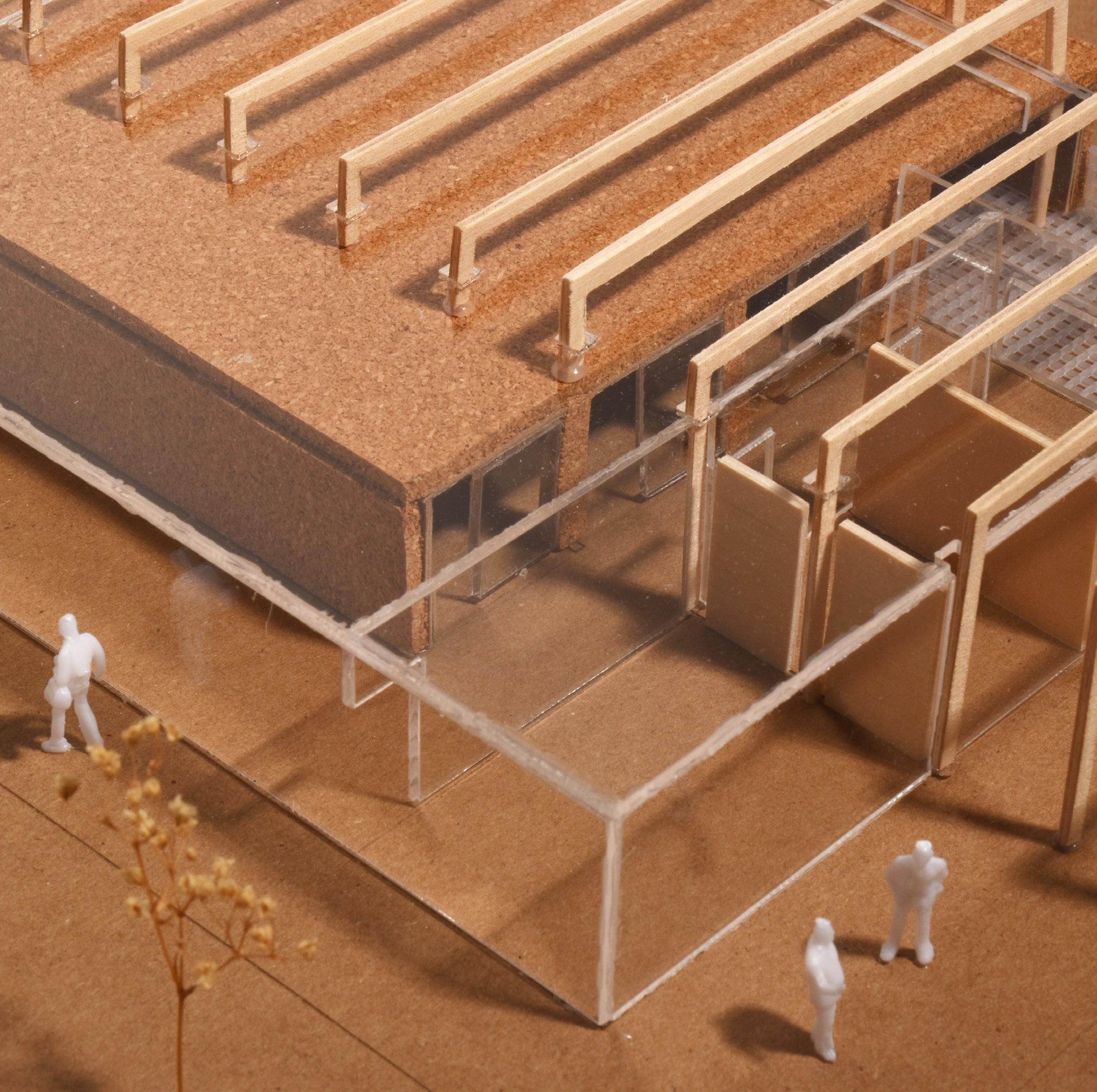
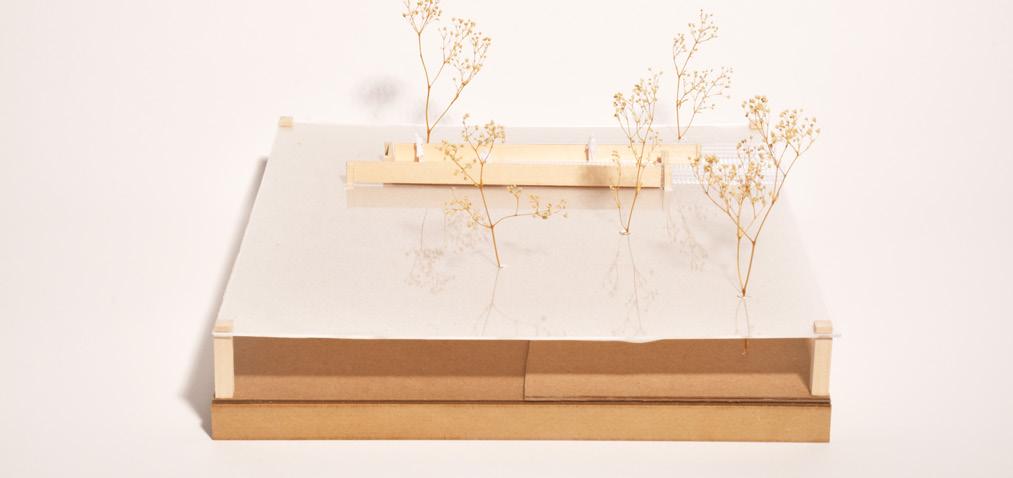
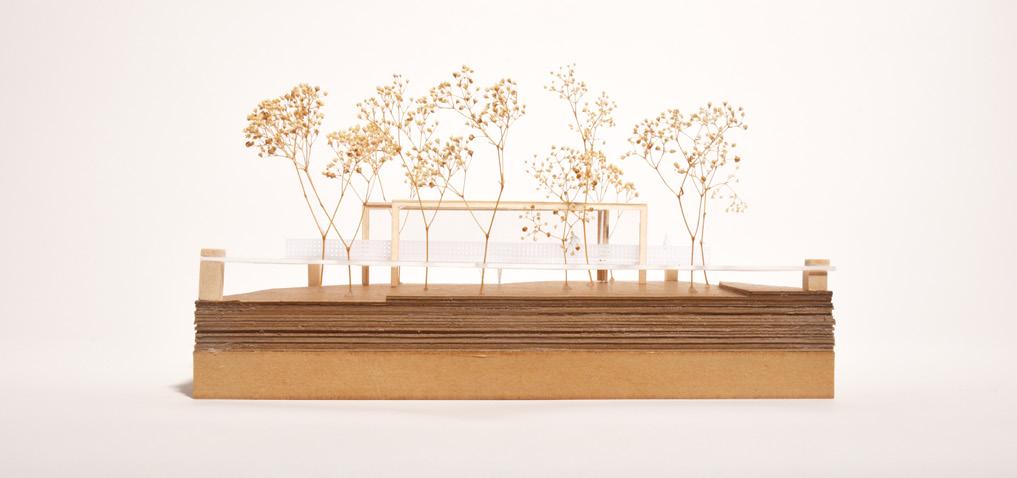
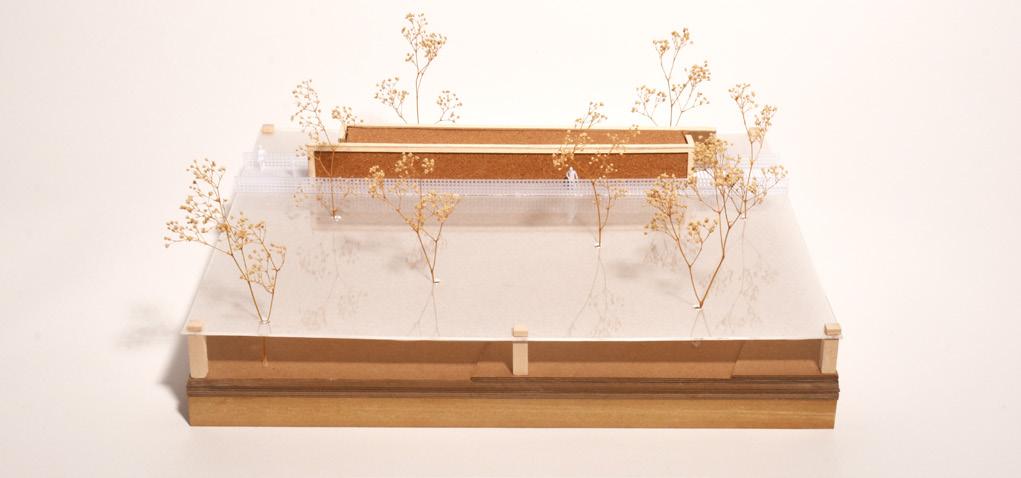
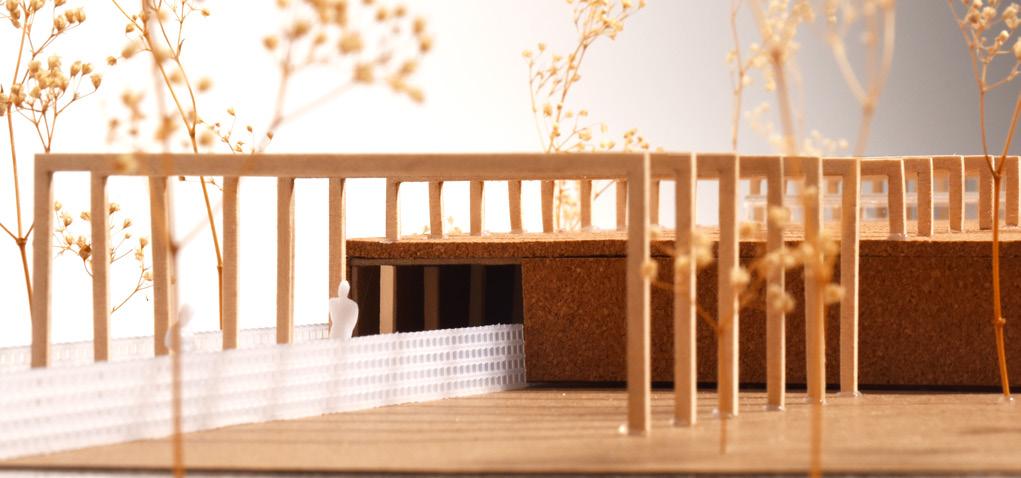
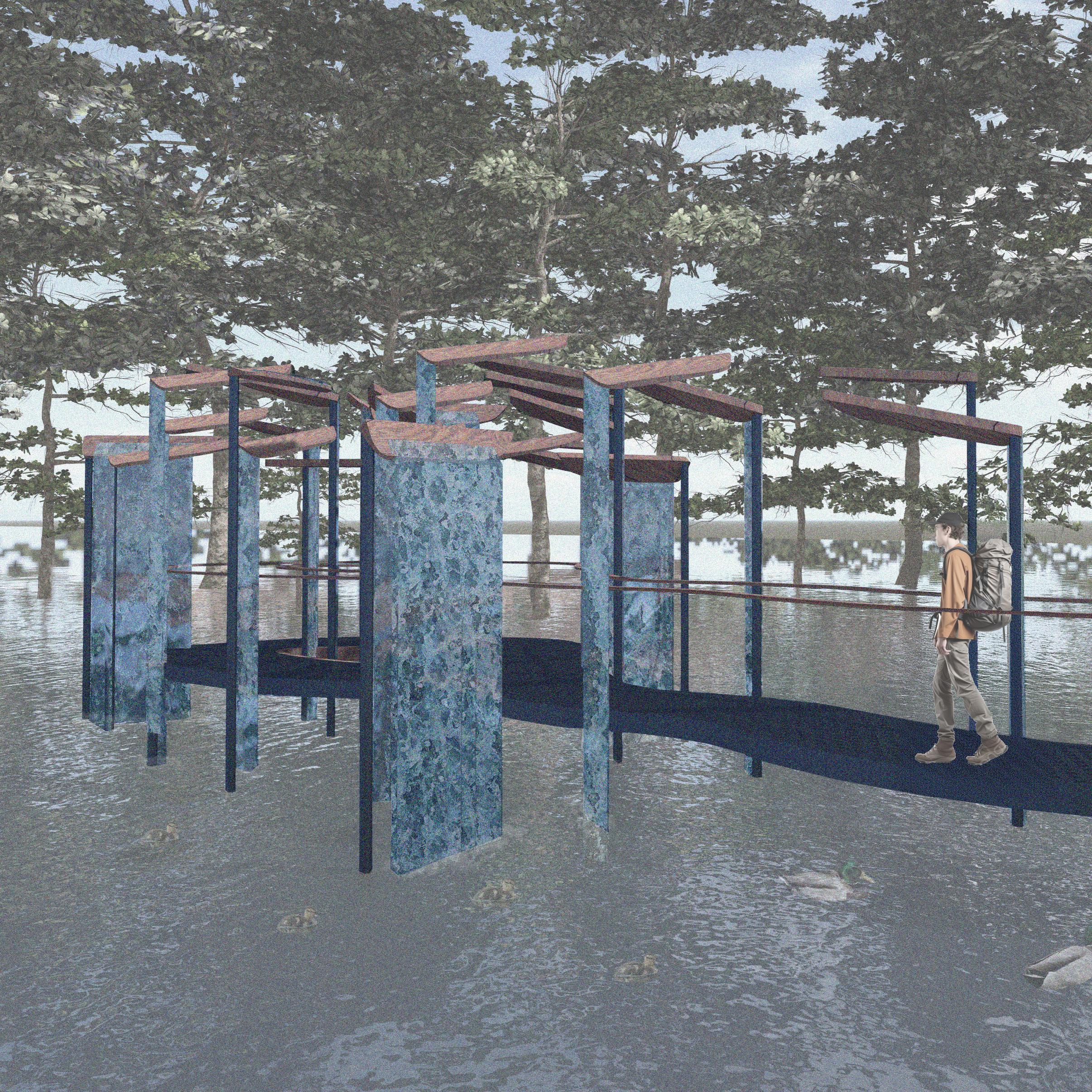
PROPOSAL: Nature center with a primary building in wood, stone, and glass, paired with three material pavilions along a boardwalk into the reservoir. Each pavilion: glass, stone, and wood, stands in the water and is designed to weather over time. Their gradual deterioration makes the force of the reservoir visible, revealing water as both a sustaining resource for Denver and a powerful agent that shapes the landscape.
STRUCTURAL GLASS FINS
GLASS PARTITIONS SEPARATING AUDITORIUM
WOOD COLUMNS SEPARATING AUDITORIUM
= 1/16”
The auditorium forms a self-guided learning space divided into four zones, where wood, stone, and glass intersect to define these boundaries. Visitors can sit, watch, and move at their own pace, gaining context before proceeding to the pavilions to encounter the reservoir.
7: MEN’S RESTROOM
8: WOMEN’S RESTROOM 9: BOARDWALK
10: TIMBER COLUMN
11: STONE WALL CONSTRUCTION
12: GLASS WALL CONSTRUCTION
PRIMARY
STONE PAVILION
Timber-capped supports bring water to the stone walls, increasing porosity and eroding the material.
GLASS PAVILION
Warping timber supports transfer pressure to the glass, causing cracks and gradual fragmentation.
WOOD PAVILION
Continuous reservoir water exposure softens and warps the wood until it deteriorates and breaks away.
STONE
GLASS WOOD
REFUGE
1: LOBBY
2: DINING
3: AUDITORIUM
4: SUITES
5: FITNESS
6: POOL
7: LAUNDRY
8: HOUSEKEEPING
9: MAINTENANCE
10: ADMIN
11: STAFF BREAK
DECREASESOUTWARD
PUBLICACCESS
CORRAL 1 (NEW GROWTH)
CORRAL 2 (YOUNG FOREST)
CORRAL 3 (MATURE FOREST)
DATE: 08.18.2025 - 12.03.2025 - SITE LOCATION: Estes Park, Colorado
PROMPT: Architecturally respond to a geologic phenomenon to protect people, land, or built environments.
PROPOSAL: This boutique resort is situated in Estes Park, where increasing wildfire intensity has reshaped the surrounding forests. The project promotes forest stewardship as a destination for visitors to observe prescribed burns, subsequent fire cycles, and their ecological role in the Rocky Mountains. In times of unplanned wildfire, the resort transitions into an evacuation hub, providing safety and support for displaced communities. The hotel intends to foster understanding and resilience, encouraging a culture that lives with the fire rather than against.
FIRE BREAK WIND SPARSE FUEL DENSE FOREST SLOPE
barriers like roads, rivers, or rocks stop the spread pushes heat embers ahead, spreading fire
cleared or spaced vegetation slows fire
ample fuel leads to fast, intense spread fire moves uphill as rising heat preheats fuels
Illustration of how fire moves and can be controlled. Understanding fire behavior informs the design of live burn demonstrations within three burn corrals starting at the base of the slope, guiding a path to the resort above. Concrete walls act as fire breaks, establishing controlled burn conditions. Defined boundaries and reduced burn scales allow visitors to observe destructive potential of fire and methods for responsibly guiding it.
FOREST FIRE EARLY RECOVERY NEW GROWTH YOUNG FOREST MATURE FOREST
hours - weeks ignited by lighting or human activity, fuels burn rapidly weeks-months ash covers ground, rains erode, grasses and fungi emerge
1 - 5 years plants establish, soil stabilizes, ground cover thickens
5 - 25 years tree saplings thrive, species compete for light and space
25 - 100 years ecosystem stabilizes until the next fire cycle begins again
Illustration of the natural fire cycle. Wildfire is a regenerative process that maintains forest health, but increased dryness and fuel accumulation have intensified fire severity in recent years, disrupting natural forest cycles. At the community scale, reducing forest fuel through prescribed burns helps restore balance and resilience in local ecosystems. The three burn corrals are ignited at staggered intervals so each represents a different stage of the cycle. Visitors move from corral to corral, experiencing each phase of forest regeneration in sequence.
1: CONCRETE FOOTING 2: CONCRETE STEM STELL
3: COMPACTED CRUSHED STONE
4: RIGID INSULATION
5: REINFORCED CONCRETE SLAB
6: MORTAR FILLED CMU
7: CEMENT PLASTER FINISH
8: CMU BOND BEAM
9: SOLID CMU BLOCK 10: PRECAST CONCRETE PLANK 11: POURED CONCRETE LAYER
REBAR
STEEL PIER CAP
STEEL CENTRAL PIER
UNREINFORCED CONCRETE
The combined suite and walkway section creates a unified spatial experience that contrasts protection and exposure within the fire landscape. On the suite side, CMU walls filled with mortar and rebar form a structural concrete assembly finished in smooth white cement. Opposite this, the walkway side is constructed with layered unreinforced concrete behind the same cement finish, allowing the surface to crack and crumble under exposure to prescribed burns. This non-structural wall visually registers the effects of fire without compromising the building’s integrity. A central pier supports the observational bridge, separating the suite structure from the deteriorating burn corral surface. Above, the occupiable roof connects suite and walkway, allowing visitors to move between spaces and witness the contrast between destruction and preservation.
PAVILION
STUDIO III DIRECTED BY ERIKA SWEIGERT NAVA
DATE: 08.22.2024 - 09.12.2024 - SITE LOCATION: Chatfield State Park & Reservoir
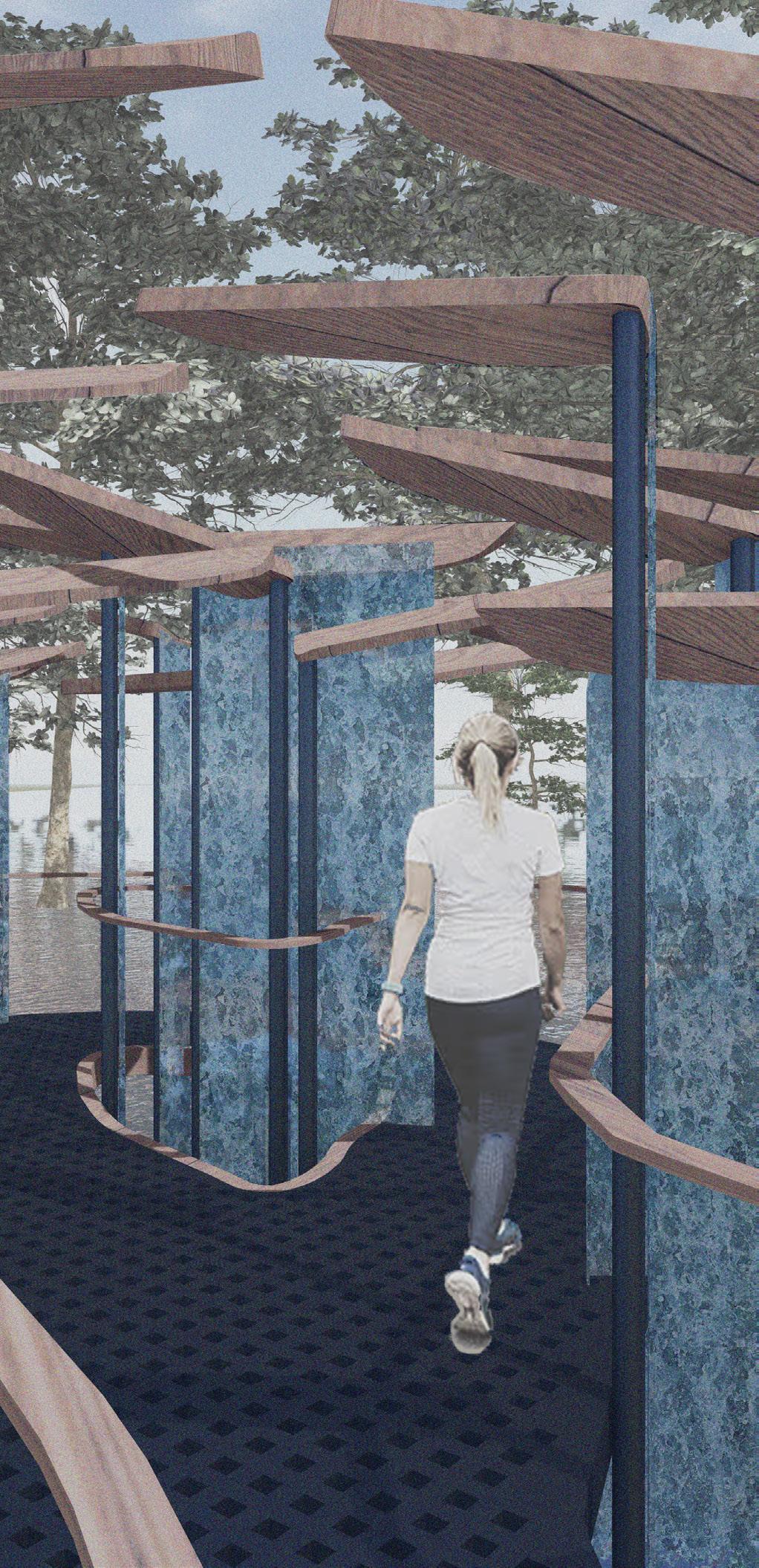
1. Leaf component swivels horizontally as wind gusts through composition
2. Pump pushes water up hollow pole, through filter, into leaf bed
3. Filled leaf bed tilts forward, releasing filtered water
4. Water splashes viewers, then drains through floor back to reservoir Enlarged Leaf Component Detail showing hinge, swivel, hose pieces
BLUE GRAMA FORM SKETCH
ELEVATION
1’ = 1/8”
SECTION
1’ = 1/8”
SITE PLAN 1’ = 1/32”