2.1 review process
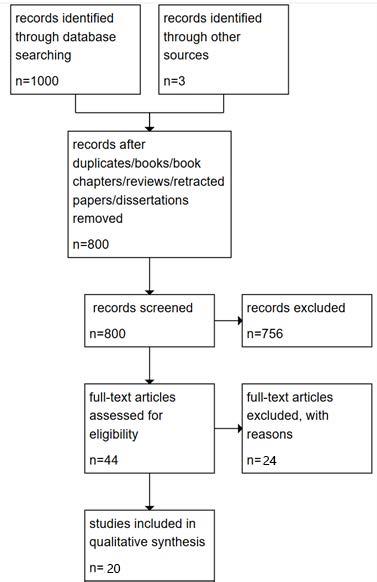
Every stage is displayed in Fig1. Three steps make up the review process: title screening, abstract screening, and full text screening. Initially, the Zotero citation manager was used to obtain and manage the database output. 1000 studies in all were included, 3 more were added via snow-balling. Books, book chapters (n=103), reviews (n=19), and retracted papers (n=1) were eliminated along with duplicates (n=80). After reading the abstracts one more time to filter the remaining literature (n = 800), a total of 44 were found to be pertinent to the subject. Ultimately, 20 documents remained for additional assessment after impertinent articles were excluded after full-text reading(n=24). The inclusion criteria for selecting articles were: (a) the study included empirical results associated with the restoration of cognitive, emotional, behavioral or social resources through nature exposure;(b)the study had been peer-reviewed; (c) the study was published in English;(d)eliminated sources including presentations, posters, book chapters,reviews, magazine articles, encyclopedias, and conference proceedings.
Table 3 displays the data for every piece of chosen literature that has been registered and examined. This contains the article's publication year, the name(s) of the author(s), the region, sample characteristics (such as age and gender), the study methodology (such as sample size and data collection method), the type of green way (such as natural trail), the type of restorative outcomes (such mental outcomes), data analysis.
2.3 quality assessment
To examine the quality of the literature, the National Heart, Lung, and Blood Institute (NHLBI) quality evaluation technique was chosen, drawing from a prior systematic review of the restorative consequences of green space9. Several quality assessment guidelines are provided by the assessment tool according to various study designs (e.g. observational cohort, pre-post). Two writers evaluated the quality of the included studies independently using this technique; conversations were held when their conclusions did not align. The percentage of criteria that are met determines the ultimate risk of bias. Reliability is defined as > 75% good, >
Fig. 1. PRISMA flow diagram selection process
50% acceptable, and < 50% poor. The above proportion is based on a prior systematic review9, as the NHLBI does not provide a precise number.
3. Results
Of the 21 articles included, 2 were conducted in the United States, 2 in Canada, 1 in Italy, 2 in Northern Ireland, and 14 in China. (Table3)
There are various types of greenways included, such as mountainous trail, natural trail, urban riverside trail, were discussed in these studies. Greenway types were categorised based on the results of previous literature. 14 (1)freeway-to-greenway;(2)rail-to-trail;(3)waterfront; (4)active travel corridor;(5)nature trail. Nevertheless, the existing categorization is restricted solely to urban greenways, while encouraging research on greenways in rural locations has been proposed18. Furthermore, the existing classification fails to consider greenways on a broader scope. Various studies, particularly those focused on regional greenways, included several categories of greenways, such as waterfronts and active travel routes. Hence, other from the aforementioned five classifications, this research relies on Little's definition of greenways17, add (6) comprehensive greenway systems or networks,that is greenways that are formed by linking different kinds of open areas to greenways in urban and regional scale, into the categories, aside with (7) rural greenways. Many studies looked into the restorative effects of exposure to simulated greenway environment such as soundscapes radio (e.g., bird songs, fountains, etc.) and visual stimuli (e.g., images of natural landscapes). These studies will be labelled as Simulated greenway.
Twenty research were divided into one of seven groups based on the sorts of greenways that were previously discussed. However, the included research only addressed four types of greenways. (1) Active travel corridors, or pathways for bicyclists and pedestrians next to or inside of roadways, are the subject of three studies: one from China, one from Canada, and one from the United States. (2) Natural trails are those that wind through undeveloped, preserved areas and have paved or gravel paths suitable for bicyclists, hikers, and/or pedestrians. two studies in total, both from China. (3) Comprehensive greenway networks, or greenways created by connecting various types of open spaces to greenways at the urban and regional levels; China leads the way in this type of greenway, which has the greatest number of articles 11. The other 2 studies were conducted in Northern Ireland. (4) Greenways situated in rural areas are referred to as rural greenways. There is just one Italian article. In the end, we included(5) Undefined. This type cannot be characterized since it lacks a written or visual description of the greenways that are being researched. There was just one article in all.
Based on previous synthesized studies, the restorative outcome variables were classified in 1 of 5 categories. 9 The first category was cognitive outcomes (registered in 4 papers), including mental processes or functions, such as attention. The second category was emotional outcomes (registered in 3 papers). These outcomes were captured through emotional variables, such as mood or positive emotions, including well-being. The third category was behavioral outcomes (registered in 15 papers) and included variables registering participants’ behaviour,mainly physical activity. The fourth category was social outcomes (registered in 2 papers). It included variables registering direct interaction with other people (e.g., social interaction, social capital). Last, we included a fifth category called complex outcomes (registered in 5 papers). This
category contained variables that fit in multiple categories (e.g., mental health contemplates cognitive, emotional, and behavioural aspects), thus being a multidimensional outcomes category. Table 3 shows the number of studies included in each category classified according to their risk of bias. As some studies examined more than one outcome variable, there are more than 20 entries (a total of 33 entries).
Each study provided a description of the characteristics of their sample. Several studies used samples consisting of individuals who use greenways (35%) or residents of the community (35%). Out of all articles, recruiters were utilized in 20% of them. These recruiters were mostly sourced from the Internet or college students. The research typically utilized simulated reality as the mode of exposure, which made it impractical to enroll actual users. Out of the total number of articles, only 2 (10%) were studies that contained reliable information obtained from VGI. VGI stands for Volunteered Geographic Information.
Regarding data collection, 13 (65 %) studies used the quantitative method such as the rating system or physiological measurement, 1 (5 %) used qualitative methods such as focus group, group interviews, individual interviews, and observations, 4 (20 %) employed the mixedmethods approach. 2 studies (10%) referred to secondary data as an additional source,mainly rich volunteered geographic information (VGI) from a self-tracking application was used in studies.
3.1 Greenway exposure
All studies revealed significant associations, except for two. Researchers found that various categories of greenways led to distinct outcomes in terms of restoration. Urban parktype greenways offer the most significant physical and mental restorative advantages, followed by urban river-type greenways. 19
The most common type of greenway in restorative studies is comprehensive greenway systems or networks, which account for 60% of the studies included. The studies included a total of 20 reported outcomes, consisting of 8 behavioral, 4 emotional, 2 social, 2 cognitive, and the other outcomes were classified as complicated. Three outcomes, two behavioral result and one emotional outcome, showed non-significant associations, whereas the remaining outcomes showed substantial relationships.
Out of the researches conducted on the active travel corridor, two of them (66%) focused on physical activity, while only one explored another restorative outcome. All three studies reported substantial results. Three participants in the study were from the United States, China, and Canada. Out of the research conducted on natural trail, two focused on physical activity, and both of them reported significant connections. Both of these researches originated from China.
3.2Outcomes of restoration
3.2.1 Cognitive outcomes
We discovered four findings pertaining to cognitive outcomes, all of which focused on the examination of attention restoration. All of these results were significant, suggesting that
being exposed to greenways had a positive association with cognitive recovery. All the articles that were included were assessed to have an fair rating in quality assessment.
3.2.2 Emotional outcomes
We recorded a grand total of four results regarding the effects of emotional rehabilitation. The primary factors analyzed in this category were positive affect and well-being. Among the four outcomes, three showed a statistically significant positive effect, while one was found to be statistically insignificant. Both items were evaluated to have a fair ranking in quality assessment. Two studies with significant findings examine the mediators between greenway interventions and emotional outcomes. The findings indicate that place attachment, which refers to an individual's relationship, emotions, and purpose toward an environment, as well as environmental stressors like air pollution, garbage, and traffic noise, are important mediators. 20,21
3.2.3
Behavioral outcomes
There were a total of 12 investigations conducted on this particular variable. We observed a total of 14 outcomes pertaining to the impact of behavioral recovery. Out of them, there were 12 notable results and only two detected effects were found to be insignificant. The variable most frequently examined in this category was physical activity. The other two studies focused on health-promoting behavior compared to healthy travel, one study examined moderate-tovigorous physical activity, and one study explored sedentary behavior. Out of the 12 studies, nine were assessed to have a good or fair accessing ranking. After excluding the three studies
that were determined to have a poor quality, all of the remaining studies yielded meaningful results.
Significant results show that greenway interventions can be successful in promoting physical activity22(includes walking time25, moderate-to-vigorous physical activity23), physical activity diversity24 while reducing sedentary behavior25. However, the effects are restricted to distance 23,25,26 and destinations(when individuals utilize greenways as travel routes)22.
3.2.4
Social outcomes
Out of the 20 studies that were chosen, 2 social outcomes were recorded, and both of them were found to be statistically significant. The results encompassed social capital and social interaction. Both trials had an fair ranking. There were mixed findings for social capital. The research conducted by Hunter et al. demonstrated a marginal enhancement in local aera trust, as well as a slight decline in social networks, such as contact with friends, family, and neighbors.
3.2.5.
Complicated outcomes
We have defined six outcomes, which cover many components within a broader notion. For example, mental health has cognitive, affective, and behavioral aspects, making it applicable to more than one category. Statistically significant effects were observed in seven instances. The variables most frequently examined in this category were quality of life and mental health. All the publications included in the study were assessed to be fair in rank. However, a clear distance-decay effect of this intervention was demonstrated in the study. One
study point out that large-scale greenway mainly promoted the mental health of residents living within 2 km of the greenway.28
3.3 Quality Assessment
The quality assessment process (Tables 4, 5, and 6) show that 2 studies were categorized as being of good quality, 15 studies were categorized as being of fair quality, and 3 studies were categorized as being of poor quality. Twenty papers yielded a total of thirty results. After excluding results from the studies rated as poor quality, there were 24 significant results (previously 27) and 2 non-significant results (previously 3). The results suggest that greenways have a positive impact on restoration.
4. Discussion
This literature examines studies conducted in various global areas that investigate the restorative effects of greenways and the factors that impact these effects. The main objective is to thoroughly investigate the distinct regenerative effects of greenways and the related limitations. Another objective is to offer greenway planners suggestions for enhancing the restorative results of greenways.
This systematic review is conducted on a sample of 20 papers with diverse study designs. The review identifies five distinct types of outcomes (cognitive, emotional, behavioral, social, and complex outcomes) that result from exposure to greenways for restorativeness. Based on a prior analysis of research regarding the advantages of being in natural environments, it has been found that green spaces have a restorative effect29,30. Additionally, there are numerous
aspects that can impact the outcomes of this restorative experience.31–33 Our research contributes to this finding by demonstrating the positive effects that greenways, a distinct type of linear green space, have on restoration, as well as the elements that determine these effects.
Our findings indicate that greenways have a variety of restorative advantages. In addition, all studies found no significant adverse effects of greenway exposure on restorative results. Only three research reported insignificant effects. 18,27 Specifically, West & Shores et al. (2015) found that there was no significant relationship between greenways and physical activity (walking, moderate activity, or vigorous activity)18. According to previous reports, certain characteristics of green spaces may be negatively restorative for people. 34 However, the insignificant results reported in this study could also be due to a loophole in the experimental setup, which was also mentioned by the researcher. The trial was done at a temperature below the reported average, despite previous research discovered that physical activity can be influenced greatly by weather.35 In addition, the length of the greenway in this study was less than 2 miles, whereas previous studies have pointed out the size that greenways need to reach in order to be of greater use.
The other research found that the greenway intervention did not influence physical activity. 27It is probable that because the research began examining the greenway six months after its completion, the investigation was too early to detect changes in population levels. A significant body of research indicates that studies conducted over longer periods of time are necessary to establish the enduring impacts of green spaces on individuals.12
Subsequent studies are suggested to determine a reasonable greenway length and conduct the study in appropriate weather. There are no present studies that quantify the size of greenways needed to have an restorative impact, but most of the studies have been conducted on greenway lengths greater than 4 miles. For the weather in which the study was conducted, previous studies have shown that the number of activities in the green space peaks at 84 °F and begins to decrease at a rate of 0.045 counts for every 1 °F increase in temperature above 84 °F. 35
Additionally, there was one study suggest that there is no intervention effect on the improvement of mental wellbeing.27 The authors propose that this phenomenon could be attributed to the relatively brief interval between the assessment and the conclusion of construction (the assessment commenced 6 months after construction was finished), an argument that is reasonable. This is due to the fact that, out of the 20 research, excluding the 3 virtual situations and the 10 articles that did not define the duration of the intervention, 9 out of the remaining 10 articles had an intervention period exceeding 6 months and shown significant outcomes. The full extent of the public health benefits of urban greenways may require a longer time to become apparent. Therefore, when investigating the beneficial results of greenways, it is advisable to choose subjects that have been fully constructed for an extended duration. It is necessary to enhance the evaluation methods in order to accurately measure the intricate nature of urban restorativeness.
Out of the 20 articles, only 3 demonstrated a link that was not statistically significant, and no detrimental consequences were observed in any of the investigations. Given the limited
number of greenway restorative studies, it is important for future research to investigate whether our findings are an anomaly. Greenways may have a detrimental impact on restorativeness. Research has demonstrated that both human and traffic noise have a detrimental effect on mental rejuvenation20,36, which is a major drawback of greenways. This is likely because greenways, being linear pathways with driveways and sparse vegetation, do not effectively block the noise from passing vehicles. Additionally, certain types of greenways, such as active travel corridors, are located next to roads and therefore inevitably expose users to road noise. Greenways that include many adverse aspects have the potential to become hazardous and perilous areas within a community.
Our findings also show that the majority of greenway restoration research has focused on comprehensive greenway systems or networks, accounting for 60% of the papers reviewed. This makes sense given that greenways of a certain size often have a variety of topologies. Furthermore, while examining the restorative impacts of different greenways, researchers discovered that different categories of greenways yielded varying outcomes in terms of restorativeness. Urban park-type greenways provide the most substantial physical and mental restorative benefits, with urban river-type greenways ranking second. 19 This illustrates that the most advantageous approach for restoring greenways is to develop park-like greenways and incorporate water elements, provided that the circumstances permit. However, the lack of uniform criteria for categorizing greenways prevented the standardization of restorability assessments across various types. It is advisable for future studies to strive for a consistent classification criterion for greenways.
Few studies examine the restorative experience of this active perspective. Out of 20 studies, only one considered the traveller’s movement, applying virtual scenarios simulating bikers moving along a greenway at 25 km/h. Greenways are often used for cycling.37and studies have shown that that roadside configurations have an effect on driver behaviour.38 It is recommended that restorative experiences through motion be promoted, especially in travel active greenways, such as active transportation corridors, due to the nature of this activity.
In summary, the greenway has a beneficial effect on restorativeness. This is in line with prior research results.29 However, multiple research have demonstrated a clear distancedecay effect of this intervention. 25,28 This systematic review encourages the application of these findings to other forms of policy, such as revamping and retrofitting greenways to promote people's restorative activities and improve their benefits. By advocating for such legislation, entire communities can reap the advantages of engaging with greenways and experiencing their restorative impacts.
The literature on greenways is broad, but there are fewer publications addressing restorative research, and only 20 were selected for this analysis, therefore the systematic review's results may be skewed. Furthermore, due to the adoption of a comprehensive understanding of restorativeness, the studies included in the analysis naturally differed significantly in terms of their study design, population and data analysis. This variation may have resulted in increased diversity of outcomes, thus impacting the conclusions drawn from the systematic review. In addition, despite the utilization of a standardized quality assessment method to categorize and appraise various study designs, there remains a certain level of
subjectivity in the evaluation process. Moreover, this review exclusively focused on English literature, thus disregarding relevant research conducted in other languages, thereby introducing potential bias into the conclusions.
5. Conclusion
Current information on the impacts of being exposed to greenway environments on cognitive, emotional, social, and behavioral well-being. In summary, our findings indicate that being exposed to greenways has a diverse restorative impact. Additionally, we have observed a scarcity of studies that compare the restorative benefits of exposure to different types of greenways. Furthermore, there is a dearth of research on the enduring impacts of greenway exposure on restorative outcomes. Enhancing scientific knowledge and formulating precise instructions for health practitioners and policy makers necessitates a more profound comprehension of these traits.
Author, Year Country Sample Characteristics Respondent Sample Size(N) Data Collection
cohort 1.93 miles of greenway (no specific description) 1 year physical activity(B) P Repeated measures analyses of variance
Mixed-effects models, rank tests and Pearson's chisquared tests, Mixed-effects logistic regression models
West & Shores, 2015 USA randomly selected residents 207 mail survey
cohort active transportation corridor 1-3 years moderate-to- vigorous physical activity(B) and sedentary behavior(B) F
Franket al., 2019 Canada randomly selected residents 524 the International Physical Activity Questionnaire
Fitzhughet al., 2010 USA randomly selected residentsDirect Field Observation of Physical Activity cohort active travel corridor 14 months physical activity(B) P Fisher’s exact tests
Shanet al., 2022 China participants 1212 a photograph-survey cross-sectional active travel corridorperceived health benefits(O), stress recovery(O), attention restoration(C) F linear regression analysis
Wanget al., 2024 Northern Ireland randomly selected residents 892 Recreational PA was evaluated with the Global Physical Activity Questionnaire and PA stages of change measure. cohort comprehensive greenway systems or networks 6 months physical activity(B) F multilevel linear and logistic regressions
F a mixed-effect difference-in- difference (DID) regression model
mental heath(O)
physical activity(B) F Mixed-effects difference-in- difference regressions; Twostep analysis
6-18 months physical activity(B), quality of life(O), mental well being(E), social capital(S) F multilevel model logistic regression
Xieet al., 2022 China randomly selected residents 1020 on-site survey cohort comprehensive greenway systems or networks
Xieet al., 2021 China randomly selected residents 1020 mental outcomes were measured using the 12-item Chinese Short-Form Health Survey (SF12);5Ds framework were used to capture the built environment, , GIS to measure 5Ds factors; cohort comprehensive greenway systems or networks
3 years physical activity(B) F Difference-in- difference (DID) estimations, structural equation models
Semi-structured interviews: Physical activity was measured using the Global Physical Activity Questionnaire (GPAQ); mental wellbeing was measured using the Warwick-Edinburgh Mental Wellbeing Scale ; Social capital was measured using the instrument employed in the UK General Household Survey. Assessment of change in the local built environment and walkability used data from GIS cohort comprehensive greenway systems or networks
1037
Hunteret al., 2021 Northern Ireland adult residents (aged ≥16 years)
F a structural equation model
well-being(E)
1090 the International Physical Activity Questionnaire (IPAQ), the 36item Short-Form Health Survey (SF-36) cohort comprehensive greenway systems or networks
users(age>18) from multistage stratified sampling
769 on-site evaluation(a revised version of the Environment Assessment of Public Recreation Scale, EAPRS) to measure greenways’ environmental quality, and questionnaires to evaluate older adults’ experiences cross-sectional comprehensive greenway systems or networks
Heet al., 2021 China
Changet al., 2020 china senior users(age>55)from convenience and snowball sampling
well-being(E) social interaction(S) F descriptive, multistep regression models
multilevel model
Sample Size(N)
Sample Characteristics Respondent
Country
Author, Year
Main
cross-sectional comprehensive greenway systems or networks
china senior users(age>55)from convenience and snowball sampling 769 on-site evaluation (a revised version of the Environment Assessment of Public Recreation Scale, EAPRS) to measure greenways’ environmental quality,and questionnaires to evaluate older adults’ experiences
Han等, 2021
multiple linear regression.
F Difference-in- difference (DID)
physical activity(B)
cross-sectional comprehensive greenway systems or networks
Chang, 2020 china senior users(age>55)from convenience and snowball sampling 769 neighbourhood social capital and neighbourhood social cohesion-were suggested by the model developed by Carpiano, Outdoor activities at the greenways were measured based on frequency of participation
Kriging (a regression algorithm),t test
F Structural equation modeling (SEM)
Liu等, 2016 China valid records of physical activity from self-tracking application 941 rich volunteered geographic information (VGI), from a selftracking application named codoon. case-series comprehensive greenway systems or networks
He等, 2022 China adults users 1020 Baseline and follow-up survey. MVPA was assessed with International Physical Activity Questionnaire (IPAQ), mental health was assessed with the 36item Short-For Health Survey (SF-36) cohort comprehensive greenway systems or networks 3 years
cross-sectional comprehensive greenway systems or networkshealth-promoting behaviour(B); healthy travel(B)
Xu等, 2022 china users 201 a questionnaire investigation
Guo等, 2022 China participants (college students) 149 Mental restoration was investigated by short-version revised restoration scale (SRRS);place attachment using three items developed by Raymond et al.(nature bonding,place identity,place dependence) cohort comprehensive greenway systems or networks(virtual scenarios) 15seconds restoration(C)
5minutes mental health(O) restoration(C) , positive and negative affect (E) F stepwise regression analysis.; paired ttests, one-way ANOVA, Wilcoxon signed-rank tests, and Kruskal-Wallis tests
cross-sectional comprehensive greenway systems or networks(virtual scenarios)
93 physiological measurement (systolic blood pressure [SBP], diastolic blood pressure [DBP], and pulse) and questionnaire( perceived restorativeness scale [PRS], positive and negative affect schedule [PANAS])
Cao等, 2024 china participants(age18- 30)
cross-sectional natural trailphysical activity(B) F multiple regressions
1019 on-site intercept surveys
1314 rich volunteered geographic information (VGI), from a selftracking application named keep. case-series natural trailphysical activity(B) G two-step linear regression model
60seconds restoration(C) F One-way ANOVA, Pearson correlation coefficient
297 a questionnaire made up of: (1) the Perceived Restorativeness Scale-11 with additional items; (2) a list of physical and aesthetic attributes; and (3) information on bicycle use pre-post rural greenways(virtual scenarios)
China users
Wang等, 2022
Ma等, 2021 China valid records of physical activity from self-tracking application
Italy participants ( age19-78)
Fumagalli等, 2020
Xie
等 , 2021
等 , 2022
Xie
Hunter
等 , 2021
He 等 , 2021
Chang, 2020
等 , 2022
Guo
等 , 2024
Cao
等 , 2022
Xu
等 , 2022
Shan
等 , 2021
Han
等 , 2020
Chang
等 , 2022
Wang
等 , 2019
Frank
West & Shores, 2015
等 , 2024
Wang
He 等 , 2022
Fitzhugh 等 2010
Criteria
Was the research question or objective in this paper clearly stated?
2. Was the study population clearly specified and defined?
3. Was the participation rate of eligible persons at least 50%? NA
4. Were all the subjects selected or recruited from the same or similar populations (including the same time period)? Were inclusion and exclusion criteria for being in the study prespecified and applied uniformly to all participants?
5. Was a sample size justification, power description, or variance and effect estimates provided?
6. For the analyses in this paper, were the exposure(s) of interest measured prior to the outcome(s) being measured?
7. Was the timeframe sufficient so that one could reasonably expect to see an association between exposure and outcome if it existed?
8. For exposures that can vary in amount or level, did the study examine different levels of the exposure as related to the outcome (e.g., categories of exposure, or exposure measured as continuous variable)?
9. Were the exposure measures (independent variables) clearly defined, valid, reliable, and implemented consistently across all study participants?
10. Was the exposure(s) assessed more than once over time?
11. Were the outcome measures (dependent variables) clearly defined, valid, reliable, and implemented consistently across all study participants?
12. Were the outcome assessors blinded to the exposure status of participants?
13. Was loss to follow-up after baseline 20% or less?
14. Were key potential confounding variables measured and adjusted statistically for their impact on the relationship between exposure(s) and outcome(s)?
1. Was the study question or objective clearly stated?
2. Was the study population clearly and fully described, including a case definition?
3. Were the cases consecutive?
4. Were the subjects comparable?
5. Was the intervention clearly described?
6. Were the outcome measures clearly defined, valid, reliable, and implemented consistently across all study participants?
7. Was the length of follow-up adequate?
8. Were the statistical methods welldescribed?
9. Were the results well-described?
accessing quality
1. Was the study question or objective clearly stated? Y 2. Were eligibility/selection criteria for the study population prespecified and clearly described? Y 3. Were the participants in the study representative of those who would be eligible for the test/service/intervention in the general or clinical
4. Were all eligible participants that met the prespecified entry criteria enrolled?
5. Was the sample size sufficiently large to provide confidence in the findings?
6. Was the test/service/intervention clearly described and delivered consistently across the study population?
7. Were the outcome measures prespecified, clearly defined, valid, reliable, and assessed consistently across all study participants?
8. Were the people assessing the outcomes blinded to the participants' exposures/interventions?
9. Was the loss to follow-up after baseline 20% or less? Were those lost to follow-up accounted for in the analysis?
10. Did the statistical methods examine changes in outcome measures from before to after the intervention? Were statistical tests done that provided p values for the pre-to-post changes?
11. Were outcome measures of interest taken multiple times before the intervention and multiple times after the intervention (i.e., did they use an interrupted timeseries design)?
12. If the intervention was conducted at a group level (e.g., a whole hospital, a community, etc.) did the statistical analysis take into account the use of individual-level data to determine effects at the group level?
accessing quality
References
1. World Urbanization Prospects: The 2018 Revision. United Nations; 2019.
2. Hidaka BH. Depression as a disease of modernity: Explanations for increasing prevalence. J Affect Disord. 2012;140(3):205-214. doi:10.1016/j.jad.2011.12.036
3. Gupta S, Bansal S. Effect of Urbanization, Sedentary Lifestyle and Consumption Pattern on Obesity: An Evidence From India. SSRN Electron J. Published online January 1, 2020. doi:10.2139/ssrn.3741382
4. Hartig T. Restorative Environments. In: ; 2004. https://api.semanticscholar.org/CorpusID:195324555
5. Kaplan RSW, Kaplan S. The Experience of Nature: A Psychological Perspective. In: ; 1989. https://api.semanticscholar.org/CorpusID:49578015
6. Kaplan S. The restorative benefits of nature: Toward an integrative framework. J Environ Psychol. 1995;15(3):169-182. doi:https://doi.org/10.1016/0272-4944(95)90001-2
7. Ulrich RS. Aesthetic and Affective Response to Natural Environment. In: Altman I, Wohlwill JF, eds. Behavior and the Natural Environment. Springer US; 1983:85-125. doi:10.1007/978-1-4613-3539-9_4
8. Hartig T, Korpela K, Evans G, Gärling T. A Measure of restorative quality in environments. Hous Theory Soc - HOUS THEORY SOC. 1997;14:175-194.
doi:10.1080/02815739708730435
9. Restorative effects of exposure to nature on children and adolescents: A systematic review. J Environ Psychol. 2022;84:101884. doi:10.1016/j.jenvp.2022.101884
10. Sadeghian MM. The health benefits of urban green spaces, A literature review. In: ; 2018. https://api.semanticscholar.org/CorpusID:212554138
11. Willis K, Crabtree B. Measuring Health Benefits of Green Space in Economic Terms. In: ; 2011. https://api.semanticscholar.org/CorpusID:68448241
12. Van Den Berg AE, Jorgensen A, Wilson ER. Evaluating restoration in urban green spaces: Does setting type make a difference? Landsc Urban Plan. 2014;127:173-181. doi:10.1016/j.landurbplan.2014.04.012
13. Beute F, Marselle MR, Olszewska‐Guizzo A, et al. How do different types and characteristics of green space impact mental health? A scoping review. People Nat. 2023;5(6):1839-1876. doi:10.1002/pan3.10529
14. Horte O, Eisenman T. Urban Greenways: A Systematic Review and Typology. Land 2020;9(2):40. doi:10.3390/land9020040
15. Keith SJ, Larson LR, Shafer CS, Hallo JC, Fernandez M. Greenway use and preferences in diverse urban communities: Implications for trail design and management. Landsc URBAN Plan. 2018;172:47-59. doi:10.1016/j.landurbplan.2017.12.007
16. Rosenberg KV, Rohrbaugh RW, Barker SE, Hames RS, Lowe JD, Dhondt AA. A land
manager’s guide to improving habitat for scarlet tanagers and other forest-interior birds.
In: ; 1999. https://api.semanticscholar.org/CorpusID:15533822
17. Little CE. Greenways for America. In: ; 1990. https://api.semanticscholar.org/CorpusID:128974239
18. West ST, Shores KA. Does Building a Greenway Promote Physical Activity Among Proximate Residents? J Phys Act Health. 2015;12(1):52-57. doi:10.1123/jpah.2012-0411
19. Cao S, Song C, Jiang S, et al. Effects of Urban Greenway Environmental Types and Landscape Characteristics on Physical and Mental Health Restoration. FORESTS. 2024;15(4):679. doi:10.3390/f15040679
20. Han B, Li D, Chang PJ. The effect of place attachment and greenway attributes on wellbeing among older adults in Taiwan. URBAN For URBAN Green. 2021;65:127306.
doi:10.1016/j.ufug.2021.127306
21. Chang PJ. Effects of the built and social features of urban greenways on the outdoor activity of older adults. Landsc URBAN Plan. 2020;204:103929.
doi:10.1016/j.landurbplan.2020.103929
22. Fitzhugh EC, Bassett DR, Evans MF. Urban Trails and Physical Activity A Natural Experiment. Am J Prev Med. 2010;39(3):259-262. doi:10.1016/j.amepre.2010.05.010
23. Xie B, Lu Y, Wu L, An Z. Dose-response effect of a large-scale greenway intervention on physical activities: The first natural experimental study in China. Health PLACE.
2021;67:102502. doi:10.1016/j.healthplace.2020.102502
24. Liu K, Siu KWM, Gong XY, Gao Y, Lu D. Where do networks really work? The effects of the Shenzhen greenway network on supporting physical activities. Landsc URBAN Plan 2016;152:49-58. doi:10.1016/j.landurbplan.2016.04.001
25. Frank LD, Hong A, Ngo VD. Causal evaluation of urban greenway retrofit: A longitudinal study on physical activity and sedentary behavior. Prev Med. 2019;123:109-116. doi:10.1016/j.ypmed.2019.01.011
26. He D, Lu Y, Xie B, Helbich M. Large-scale greenway intervention promotes walking behaviors: A natural experiment in China. Transp Res PART -Transp Environ. 2021;101:103095. doi:10.1016/j.trd.2021.103095
27. Hunter RF, Adlakha D, Cardwell C, et al. Investigating the physical activity, health, wellbeing, social and environmental effects of a new urban greenway: a natural experiment (the PARC study). Int J Behav Nutr Phys Act. 2021;18(1):142. doi:10.1186/s12966-02101213-9
28. Xie B, Lu Y, Zheng Y. Casual evaluation of the effects of a large-scale greenway intervention on physical and mental health: A natural experimental study in China. URBAN For URBAN Green. 2022;67:127419. doi:10.1016/j.ufug.2021.127419
29. Liu L, Qu H, Ma Y, Wang K, Qu H. Restorative benefits of urban green space: Physiological, psychological restoration and eye movement analysis. J Environ Manage 2022;301:113930. doi:10.1016/j.jenvman.2021.113930
30. Li J, Chang Y, Cai X, et al. Health perception and restorative experience in the therapeutic landscape of urban wetland parks during the COVID-19 pandemic. Front Public Health. 2023;11:1272347. doi:10.3389/fpubh.2023.1272347
31. Hoyle HE, Hitchmough JD, Jorgensen A. All about the ‘wow factor’? The relationships between aesthetics, restorative effect and perceived biodiversity in designed urban planting. Landsc Urban Plan. 2017;164:109-123.
32. Wang R, Zhao J. Effects of evergreen trees on landscape preference and perceived restorativeness across seasons. Landsc Res. 2020;45(5):649-661. doi:10.1080/01426397.2019.1699507
33. Carrus G, Lafortezza R, Colangelo G, Dentamaro I, Scopelliti M, Sanesi G. Relations between naturalness and perceived restorativeness of different urban green spaces. PsyEcology. 2013;4(3):227-244. doi:10.1174/217119713807749869
34. Akpınar A. How perceived sensory dimensions of urban green spaces are associated with teenagers’ perceived restoration, stress, and mental health? Landsc Urban Plan. 2021;214:104185. doi:10.1016/j.landurbplan.2021.104185
35. Wolff D, Fitzhugh EC. The relationships between weather-related factors and daily outdoor physical activity counts on an urban greenway. Int J Environ Res Public Health. 2011;8(2):579-589. doi:10.3390/ijerph8020579
36. Guo S, Zhou Y, Yu J, Yang L. Effects of the Combination of Audio and Visual Factors on Mental Restoration in a Large-Scale Urban Greenway: Perspectives from Wuhan, China.
LAND. 2022;11(11):2017. doi:10.3390/land11112017
37. Berto R, Massaccesi S, Pasini M. Do eye movements measured across high and low fascination photographs differ? Addressing Kaplan’s fascination hypothesis. J Environ Psychol. 2008;28(2):185-191. doi:10.1016/j.jenvp.2007.11.004
38. Naderi JR, Dr BSK, Mr PM. Simulating Impacts of Curbside Street Trees on Driver Performance and Perception. In: ; 2006. https://api.semanticscholar.org/CorpusID:106923169