THE DAILY PUZZLE READER
A quarterly for people who play puzzles in the morning INSIDE THIS ISSUE
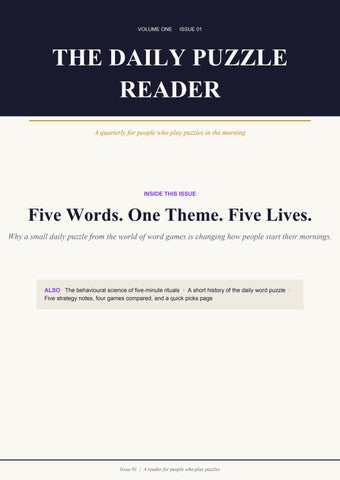
A quarterly for people who play puzzles in the morning INSIDE THIS ISSUE
Why a small daily puzzle from the world of word games is changing how people start their mornings.
ALSO The behavioural science of five-minute rituals A short history of the daily word puzzle Five strategy notes, four games compared, and a quick picks page
From the crossword to Wordle to the wave of themed games that followed, the format keeps reinventing itself for the same essential reason.
By the staff
The first crossword puzzle was published in the New York World newspaper in December 1913, and it was an immediate sensation. Within a decade, every major paper carried one. The format worked because it offered exactly the right amount of difficulty for the time available: solvable in a commute, hard enough to feel earned, easy enough to attempt again tomorrow.
What is notable, looking back, is how little the basic shape changed for almost a century. The crossword remained the dominant daily word puzzle format from the 1920s right through to the early 2020s. There were innovations in puzzle design, certainly, and a parallel tradition of Sudoku grew alongside it. But the daily word puzzle as a cultural object barely moved.
Then in late 2021, a software engineer named Josh Wardle released a small five-letter guessing game from a personal website. He had built it for his partner. Within six months, two million people were playing it every day. The New York Times bought the game and folded it into their growing puzzle portfolio. The daily word puzzle had its first major reinvention in a hundred years.
“The format works because it offers exactly the right amount of difficulty for the time available.”
What followed was a small flood of variants. Connections built a game around grouping. Strands added a theme to a search. Quordle multiplied the words. And further out from the New York Times franchise, smaller independent developers began experimenting with the shape of the daily puzzle in their own ways. One of those entrants, hang five, took the logic of hangman and the daily-puzzle ritual of Wordle and built something with five connected words at once.
The common thread across all of these is restraint. One puzzle per day. Same puzzle for everyone. Short enough that you can finish before your coffee cools. The format keeps reinventing itself because the underlying appetite is real and durable. We are willing to spend five minutes thinking carefully if we know there is an end in sight and a clean exit.
A closer look at hang five, a small daily puzzle that has built a quiet audience by asking players to solve five connected words before their shared lives run out.
By the staff
Hang five is a free daily themed word puzzle that runs in any web browser. The premise is simple to state and slower to master. Every day at midnight a new puzzle drops with five hidden words. All five words share a single secret theme. You guess one letter at a time. Correct letters fill in across all five words at once. Wrong letters cost a life from a shared pool of five. Solve all five words before lives run out and the day's theme is revealed.
The shared life pool is the design choice that gives hang five its particular texture. In Wordle, a wrong guess costs you one of six tries for one word. The consequence is local. In hang five, a wrong guess anywhere on the board reduces your ability to finish anywhere else on the board. The consequence is global. Players who come to hang five from Wordle often describe the first few days as a recalibration. The rhythm of guessing freely does not work. Each letter has to earn its place.
The theme is the second design choice that matters. Because all five words share one theme, partial letters across multiple words often reveal the theme before any single word is fully solved. Once you have the theme, you can predict missing letters with much higher confidence. This is why experienced hang five players develop the habit of reading all five words together rather than focusing on whichever word is closest to complete.
“The shared life pool turns every guess into a real decision.”
There is also an Unlimited Mode, which most daily puzzle games do not offer. Players who finish the daily puzzle and want more can continue into an unlimited stream of rounds with no overnight wait. The Unlimited Mode is what keeps the game open for the players who treat it as more than a five-minute ritual.
Five steps. About a minute to read. Long enough to know what you are walking into.
One. See the five hidden words.
Each word appears as a row of blank squares. All five words share one hidden theme that stays secret until you solve the puzzle. There are no clues. The shape of the words is the only information you have to begin with.
Two. Guess a letter.
Tap any letter on the keyboard. Correct letters fill in across all five words simultaneously. A single good guess can light up two or three words at once. Wrong letters cost one life from the shared pool of five.
Three. Handle vowels with care.
Vowels appear in a different colour on the keyboard. Guessing a vowel while consonants are still unfilled costs you a life, even if the vowel is correct. Once only vowels remain unfilled, the rule shifts and vowels become free to guess.
You start the round with five lives shared across all five words. One wrong letter anywhere drops the shared count. The arithmetic forces conservative play in a way that single-word puzzles do not. Players quickly learn that a clean grid is more about restraint than about vocabulary.
Five. Reveal the theme.
Complete all five words before lives run out and the day's hidden theme is revealed. Share your spoiler-free result grid with friends and come back at midnight for the next puzzle.
Most days, instinct is enough. On the harder days, a small playbook is what separates a clean grid from a near miss.
R, S, T, L, and N are the letters that statistically appear in the highest share of common English words. Opening with these gives the broadest possible coverage across five words before you risk a life on anything more speculative. Most players who hold long streaks open with the same letter or two every single day for exactly this reason. The early game is not the time to be creative.
The vowel rule in hang five exists to prevent the obvious solve of spending A, E, I, O, U on every round. Players who lose grids on the daily are almost always players who spent vowels too early. The discipline is to let consonants build the shape of each word first. Once the shape is clear, vowels become predictable. And once only vowels remain unfilled, the rule lifts and they become free.
Partial letters across multiple words often reveal the theme faster than focusing on the word closest to complete. This is the single biggest skill jump in hang five. New players see five separate puzzles. Experienced players see one puzzle in five frames. Once you guess the theme, the remaining letters predict themselves.
With two lives left, only guess letters you have strong evidence for. Random guesses in the final stage are the fastest way to lose a puzzle you nearly had. The right move is to stop and re-read every partial word. Often the theme will reveal itself in the final pause, and the last two letters will become obvious.
The category has grown enough that the differences between titles now matter. Here is how four of the most-played daily word puzzles compare on the things readers ask about most.
The clearest pattern in the table is that the newer entrants are doing more in roughly the same time. Wordle remains the cleanest of the four and the easiest to recommend to a new player. Connections is the most verbal and the most divisive on any given day. Hang five sits between the two and adds the design feature most players who graduate from Wordle ask for, which is unlimited play once the daily puzzle is done. Strands rewards readers who enjoy theme work and tolerate longer sessions.
The right answer is usually to play more than one of them. The morning puzzle hour is generous enough to hold two or three short games before the day begins.
The most common questions we received while preparing this issue, with short answers for new players.
Is hang five free to play?
Yes. Free with no signup, no app install, no paywall. The game runs in any modern browser. Both the daily puzzle and Unlimited Mode are free.
How many lives does a round start with?
Five lives, shared across all five words on the board. One wrong consonant guess anywhere drops the count by one. Vowels guessed too early also cost a life under the vowel rule.
What is Unlimited Mode?
An always-available alternate mode where players can play unlimited rounds with no overnight wait. The ruleset is identical to the daily puzzle. Most readers use it for practice or to keep playing after they finish the daily.
Why do vowels cost a life?
Without the vowel rule, the puzzle could be solved trivially by guessing A, E, I, O, U every round. The rule keeps vowels expensive until the consonants are mostly resolved, at which point it lifts and they become free.
Does the puzzle change every day?
Yes. A new puzzle drops at midnight in each player's local timezone. The same puzzle is served to every player worldwide on a given day, which is what makes the spoiler-free share grid useful.
What happens if lives run out?
The round ends and the theme stays hidden. Any streak resets. The next daily puzzle drops at midnight. Unlimited Mode is available immediately for another attempt.
Is it harder than Wordle?
Different rather than strictly harder. The first three or four rounds usually feel harder because five words and shared lives demand more planning. Once players internalise the rhythm, sessions settle around five to eight minutes.
Short notes on five additional daily puzzles our staff plays regularly. All are free to play and run in a browser.
The original modern daily word puzzle and the cleanest entry point to the category. One five-letter word, six guesses, two-minute session. If you have not played in a while, the editorial standard has improved since the New York Times acquisition. Recommended for everyone.
Sixteen words, four hidden groups. The puzzle rewards lateral thinking and punishes overconfidence. The difficulty curve across a week is the most variable in the daily puzzle field, which is a feature for some readers and a frustration for others.
Featured in this issue. Five words, one shared theme, five shared lives, plus an Unlimited Mode for after the daily is done. Recommended for Wordle graduates who want a longer session and more strategic weight in their morning ritual.
Eight themed words hidden in a letter grid, plus a longer spangram that crosses the board. Sessions run a little longer than the others on this list. Reads as a calmer puzzle, closer in feel to a leisurely crossword than to the time-pressured guessing games.
Build as many words as possible from a seven-letter hex. Not strictly a one-and-done daily, but the daily reset gives it the same morning habit shape. Recommended for readers who enjoy vocabulary breadth more than puzzle architecture.
Notes on contributors, sources, and how to reach the editors.
The Daily Puzzle Reader is an independent quarterly about the small but growing world of daily puzzle games. We cover word games, number games, and theme games with an editorial eye and a player's interest. Issues focus on one featured game at length, with shorter notes on the wider field.
Issue 01 features hang five, a free daily themed word puzzle. The game is playable in any browser. You can play hang five here.
Thanks to the readers who answered our short survey on morning puzzle habits, to the players who shared their streak data and strategy notes, and to the small community of daily puzzle designers who continue to keep the category honest.
Historical notes on the crossword draw on standard reference sources. The behavioural science section draws on contemporary research on habit formation and short-form daily rituals. Comparative data on session lengths and ruleset details was confirmed against publicly available documentation from each game.
Reader questions, corrections, and quick-pick suggestions for the next issue are welcome. Corrections, when needed, will be acknowledged in the following issue.