THE ECONOMICS DIGEST


Hello, and welcome to the fifth edition of The Hampton Economics Digest!
This edition marks an exciting transition for our team: as our Upper Sixth writers shift their focus onto A Level preparation, we’ve invited a new cohort of Lower Sixth students to take up the mantle! In this edition, they’ve delved into topics ranging from debt-trap diplomacy in Sri Lanka and Japan’s population crisis, to more theoretical ideas such as open borders.
The new team have done an excellent job stepping into the big shoes left by last year’s writers, who set a high bar and enjoyed a superb run. My thanks go out to the entire writing team, Mrs Mullan, and the Media Team at Hampton. With that done, all that’s left to say is enjoy!
Charlie Childs Founder and Managing Editor
Writers: Ryan Crowther (Co-Editor), Luca Knowles (Co-Editor), Dominic Stenning, Gabriel Ho, Albert Simpson, Poyraz Evkuran, Agalyan Sathiyamoorthy
Hyperinflation, as seen in Rome and Germany, leads to the destruction of political parties, empires, and populations.
‘to repair a broken window cost more than the whole house had formerly cost’
Stefan Zweig on hyperinflation in Weimar Germany
Hyperinflationiswhenthepriceofgoods and services increases at a significant rateofover50%amonth.Hyperinflation occurred in Rome throughout the third century, and famously in Germany in 1923, and is occurring today in some countriessuchasVenezuelaandSudan.
The main currency in Rome for the first 220yearsofitsempirewasthedenarius, which consisted of coins made with 4.5 gramsofpuresilver.Itallowedcitizensto tradeacrossthewholeempire.
Rome faced astronomical financial pressuresasitconqueredmorelandand became involved in wars. The cost of maintaining their large military and providing welfare to the sizeable population, among other issues, was significant for the government. By the time of Diocletian’s reign, from 284 to 305AD,thearmywasmadeupofroughly 600,000 legionaries, a large increase comparedto250,000inthefirstcentury.
The legionaries also demanded higher salaries and bonuses, so more silver coinswererequiredinordertomatchthe increasedpay.Romanemperorsneeded to create more of the currency, as
although their main income came from taxes and the spoils of war, that wasn’t sufficient. Roman officials therefore decided to reduce the silver content in coins, allowing them to produce more, whilst using the same amount of silver. The government began to use this as its mainmethodofincreasingitsfunds,and by the time of Marcus Aurelius’ reign (161-180 AD) the denarius was only about75%silver.
More coins were added into the economy, causing hyperinflation, and in lessthanacentury,by265AD,thesilver content of the denarius fell to 0.5%. In response to the significant increase in coin quantity, prices of goods skyrocketed, and by the end of the third century money had become worthless, therefore people began to barter as the main method of trade (this is also seen lateroninGermany).
The rich in Rome could protect themselves during the hyperinflation by buying assets, such as land or precious metals, but the poor were affected significantly,wideninginequality.
Romes’ inflation reached a peak between AD 200-300 with the rate of inflation being 15000%, a level far beyondanythingexperiencedbymodern economies.
In post-war Germany, inflation was already on the rise due to the Weimar Government needing money to distribute welfare benefits and pay reparationstotheAllies.Thegovernment had little money, as much of their territoryandresourceswereseizedinthe Treaty of Versailles, with 75% of Germany’s iron ore, 26% of its coal and 13% of their territory being taken. They werealsoreluctanttoraisetaxes,asthis would make the newfound government unpopular.
By January 1923, Germany had fallen behind on its reparation payments, hence the Weimar Republic implemented ‘passive resistance’; workers in the German industrial heartland went on strike, with the governmentstillpayingtheirwages.This led to large-scale money printing, and hyperinflation tore through Germany. One egg was 0.08 marks in 1913, however by November 1923 it was 80 billion marks. Children played with money as it had become worthless, and people began to barter, just as the Romans had done during their hyperinflationcrisis.
Hyperinflation contributed to the rise of extremist parties, as people remembered the hyperinflation which occurred during the Weimar government’s time, eventually contributingtoHitler’srisetopower.
Hyperinflation still occurs today in countriessuchasVenezuela,whichhad a172%inflationrateinApril2025.
Today, Germany’s currency is the euro, which is quite strong, with one euro being 1.17 US dollars, and the inflation rateofGermanybeing2.3%inNovember 2025 measured by the Consumer Price Index(CPI).
The Roman empire, however, collapsed in476AD.
In both cases of hyperinflation, the governments attempted to solve hyperinflation by introducing a new currency.
In Rome, new coins such as the solidus (a pure gold coin weighing 4.5 grams) were introduced to try to stop inflation, however this failed and led to the Edict onMaximumPrices,whichwasdesigned tocapthepricesofover1000goodsand services.Italsofailed.
Much violence and chaos occurred due to this hyperinflation in Germany, with people from the city invading farms to steal food, and some even killing the farmers.
In Germany, the Rentenmark was introduced to replace the worthless marks. One Rentenmark was worth one trillion marks. It was supported by mortgages on all industrial and agricultural land, as the government did not have sufficient gold resources to back the currency. The government kept tight control over the money in circulation to prevent inflation
reappearing, andthe old,inflatedmarks were gradually cashed in. By August 1924, the reichsmark was introduced, backed by German gold reserves, which hadtobemaintainedat30%ofthevalue of the reichsmarks in circulation. Inflationceasedtobeaproblemandthe value of the new currency was establishedinGermany.
Hyperinflation is a serious problem. Although it has some benefits, such as allowing businesses to take out loans to expand (with those loans becoming easilypaidoffastheirvaluediminishes), there are many significant drawbacks, withmanylosingoutandthegovernment or political system potentially facing collapse.
Ryan Crowther
By 2060 Japan’s population is projected to have fallen by 36 million, a loss equivalent to wiping out a city the size of London, four times over. This dramatic population decline, coupled with enormous public debt, does not bode well for Japan’s future economy.
After World War II, Japan experienced a baby boom, just as many of the other warring countries did, with fertility rates rising by an unprecedented amount. After the initial boom it was inevitable there would be a bust in line with advanced economies, where women were receiving greater education and entering the workforce in higher numbers. However, the decline in Japanese fertility rates (baby bust) commenced earlier in Japan than in other countries and has continued for many years. This has meant that one in every three Japanese citizens are over the age of 65, the legal retirement age. This ageing of the population causes government debt to rise, since the government is paying pensions and spending more on medical services, funded by fewer taxpayers. Japan’s population challenges are exacerbated by lower immigration, due to cultural resistancetoimmigrationandthebarrier of the Japanese language. Notably 71% of Japanese people, most of whom are elderly citizens, believe there should be either fewer immigrants allowed in, or immigration numbers should stay the same. The Japanese hostility towards immigrants has meant politicians have heldanti-immigrationstancesinorderto gain votes and popularity, resulting in what are widely considered to be strict immigrationlaws.
While the post-war population boom largely contributed towards the rapid industrialisation and extraordinary growth of the Japanese economy, many structural problems also emerged in its wake.AnnualGDPgrowthwasat0.1%in 2024. This was caused by low numbers of workers in the labour force and emphasises how Japanese GDP growth hasstagnated.Theseprotractedperiods of stagnation are detrimental for Japan considering the country’s debt is 235% ofitsGDP,secondonlytoLebanon.This means the debt becomes harder to repay, as the government must service the debt (i.e. pay interest) using tax revenue.Ifthereisminimalgrowth,there is less tax revenue. Japan may then be unable to reimburse its creditors, as interest rates exceed the GDP growth rate, prompting increased borrowing to pay off interest, thus aggravating the debtburden.Forthefirsttimein17years Japanese interest rates increased to 0.5%, which may further reduce the likelihood of Japan being able to pay off debt, because borrowing must increase inordertopayoffhigherinterest.
Japan’s future is certainly not bright; however, there are a small number of potential solutions to its ageing populationanddebtcrises.Anextremely unpopular solution that has been implementedacrosstheglobe,israising the retirement age. This would increase the number of workers per retiree,
potentially leading to productivity gains andhigherGDPgrowth,whichmayallow theJapanesegovernmenttobegintopay downdebt.Thesociallysensitiveideaof expanding immigration would also improve productivity, as skilled workers are offered permanent residency. Japan must also capitalise on female labour participation as only 55.3% of Japanese women work. In comparison 71.8% of women in the UK work. Despite the unpopularity and backlash against politicians which these solutions may cause, these are the best options Japan has to attempt to save itself from the impending economic crisis. If all else were tofail, onefinalremedyremains. If interest rates increase, Japan would be unable to pay for their high debt, but Japan would be able to partially default on it, as roughly 90% of debt is held domestically, which means the risk of a loss of access to international markets would be very low. This means Japan could theoretically default on its domestic debt; however, this would cause a banking crisis and a ripple effect,whichmaytakeJapandecadesto recover from. Therefore, this conclusion would be far from optimal for the Japanese economy, however, it may be inevitable that Japan must utilise a solutionlikethis.
Luca Knowles
“Mass deportations” is what Trump has promised, but will this make America great again or will his policies lead to more future problems, such as economic stagnation?
Since Trump first became president in 2016, he has aimed to prevent people moving into the USA illegally and has tried to restrict people entering the country legally. One of his efforts has beenthehugespendingontheinfamous wall along the US and Mexico border, which is currently in construction. Around $15 billion dollars was spent constructing it during his first term and an additional $46.5 billion dollars has been authorised to use for the border wall build, until September 2029, under the‘One Big Beautiful Bill Act’. Although the wall will create lots of jobs for the low-skilled workers involved in construction, this extremely high net costcouldposeramificationsfortheUS economy’s future, as it prevents this money being spent elsewhere, such as investing in US citizens, by improving educationandinfrastructure.
In addition, it is predicted that over the next 10 years, US output is expected to decline by $12.1 trillion due to Trump’s harsh migration polices, resulting in weaker GDP growth. This may cause businessconfidencetoseverelydecline, whichcouldleadtoaspiralling
decline in future growth. Moreover, the main impact of Trump’s migration policiesistheshrinkingoftheworkforce, where it is predicted that by 2028 there willbe6.8millionlessworkersthanthere were in 2025, due to immigrants not being able to fill crucial gaps in the US workforce.
Adding to this, a decline in workforce numbers could also be a result of an ageing population, caused by stronger migrationpolicies,wheretherearefewer young migrant workers to bolster the working population. Without these young, eager migrants and due to the birth rate falling to 1.6 children per womanintheUSin2024(wellunderthe 2.1 level needed for replacement), the workingpopulationisexpectedtoshrink, as people reach retirement age without the presence of enough younger people to replace them. This problem could potentially spiral out of control, as by 2050 around one quarter of the US population is expected to be older than 65, so there will be a much smaller workforce that has to support a much larger number of elderly dependants, causing more issues such as the US economystagnating.
However,Trump’smigrationpoliciesmay potentially bring a plethora of positive effects.Forexample,itisestimatedthat migrantswhodogainaccessintotheUS will be higher skilled than previous immigrants, because they will need to meet stronger visa requirements, requiring better qualifications. This could help the US economy to grow, as these workers fillgapsinthe technology sectors and therefore encouraging furtherinnovation.
Another positive impact of the president’s policies could be potential wage growth for the domestic lowerskilled workers. Some believe that before Trump’s second term, the rise in undocumented migrants arriving in the US, meant that more workers would be willingtoworkforlowerwages.Theyfeel that this supressed the salaries of domestic workers doing the same job. Therefore, due to the lower number of undocumented migrants, the average wage of a manufacturing worker could increase. However, most academic research finds little long run effect on Americans’wages.
Whilst it’s certain that Trump’s stricter migration policies may bring some positive impacts to the US, such as the demand for lower-skilled domestic workers increasing (although AI may undermine this), the potential negative effects outweigh these, as it could hold America back from potential economic growth. The net result is that many believe that harsh migration policies are not the perfect solution for Making AmericaGreatAgain.
Dominic Stenning
“We are taking the sign out of the window. We know the old order is not coming back. We shouldn't mourn it. Nostalgia is not a strategy, but we believe that from the fracture, we can build something bigger, better, stronger, more just. This is the task of the middle powers, the countries that have the most to lose from a world of fortresses and most to gain from genuine cooperation”. – Mark Carney, Prime minister of Canada.
This article seeks to discuss alternative solutions to promote further globalisation.
Recently, the world has begun to shift back to the isolationism that was prevalent a century ago. However, countries and organisations have begun to recognise the growing rift between the US and the rest of the world. They are now establishing a new global alliance and advocating for global cooperation. As we lie on the precipice of this shift, I raise the question of how, independent of the trade giants that are the USA and China, we can progress the global economy further.
There are many possibilities to explore. For example,freetrade,whichistheexchangeof goods and services between countries without tariffs, quotas, or subsidies. There is a plethora of economic research and literature that explores the benefits of eliminating trade barriers.
There is one other global barrier that has an extremely high potential for growth, if lifted, and that is the barrier to migration around the world.
There are five potential worldwide impacts that having open borders would have, and the most significant impact that this article will focus on is the effect that open borders could have on global GDP. According to the paper, “Economics and Emigration: TrillionDollar Bills on the Sidewalk”, by Michael Clemens, world GDP would double as a consequence of open borders. How is this possible? Firstly, a simple theoretical model will illustrate how this would come about.
Let us divide the world into two regions, one consistingofabillionpeoplewithanaverage wage of $60,000, which we will call the‘rich’ region, and the other holding seven billion people with an average wage of $10,000, which will be called the ‘poor’ region. Now the simple earnings gap between these two wages is $50,000 a year. Many studies, such as Clemens-Montenegro-Pritchett 2019, shows that large productivity gaps between countries arise from the place itself, rather thantheworkerswithinit Therefore,workers who migrate from poor to rich regions could take up to 60% of the simple earnings gap, purely fromtheir changein location, causing their wages to increase by roughly $30,000 a year. Considering the marginal gains (where every additional migrant adds less and less to total output, and thus they will earn a lower wage) the average gain to their wage becomes $15,000 as migration continues. If roughly half of the population emigrates to a ‘rich’ country, migrants would gain $52.5 trillion. This would lead to a 45% increase in global GDP (based on 2025 IMF statistics)
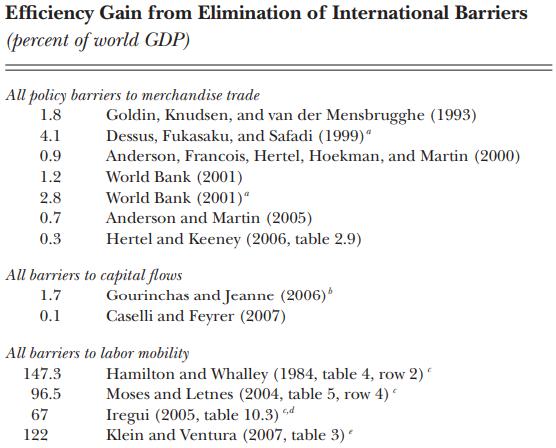
(Clemens 2011) Outlining the significant benefits of open borders comparative to free trade.
Putting the economic significance of open borders into perspective, by removing all labour barriers, the world’s GDP would double, bringing the world GDP per capita to the equivalent of Greece. A different perspective is that of the time it would take for the global GDP to double naturally. In 2026 the global economy is predicted to grow by roughly 3.1% according to the IMF and OECD. Using this statistic for GDP growth means that it would take roughly 22 years for GDP to double. Hence closed borders lead to slower growth.
The most recent applicable example of the effect of open borders is after we allowed migration from the A8 countries in 2004. Between 2004 to 2009 Britian took in roughly 1.5 million migrants, which accounted for 5% of the GDP growth in this period. Studies on their impact revealed that these migrants often paid more in taxes than they consumed in public services, generating an overall net positive impact for the UK.
migrants returned to their home countries (only700,000ofthe1.5millionthatmigrated to Britainfrom 2004-2009stayed).Moreover, the remittances sent over by these migrants helped boost the local economies.
The impact this mass migration had on the A8 countries was significant, showing a significant decline in the youth population in Poland and Hungary. However, this initial brain drain of migrants was resolved, as with research from the Institute for Public Policy Researchshowingthatroughly50%oftheA8
The extent to which completely open borders is politically and economically feasible is substantially limited in our current global environment. Moreover, it is unrealistic to implement this globally. A far easier and more approachable solution would be to reverse the events of Brexit and allow the UK to reestablish itself as a desirable and prosperous country, with freedom of movement with the EU and possibly with other countries across the world, in order to return to the higher, 2-3% GDP growth we saw pre-Brexit.
Gabriel Ho
National economies have always thrived under democracy, making life better for the people and improving the quality of the state. But should we apply this democracy into the world of business, or is it a step away from productivity?
Democracy provides numerous benefits to a society: the right to franchise, individual liberties and increased civil rights; it is also assumed to bring economic development and therefore higher living standards. Conversely, it could easily be argued that economic development mobilises democratisation. Economic growth serves to provide citizens (who are essentialinthemeansofproductionand consumption, within an economically expanding society) with more influence. Ultimately, both serve to expand each other, therefore, creating a democratisation-growth interdependence.Moreover,culturaland systemic political factors also serve an important role in determining economic strength. Exploring this idea, we can attempt to understand whether this positivecorrelationbetweendemocracy and growth can be implemented at a micro level. This more targeted idea couldcomplementthecurrentmodel.
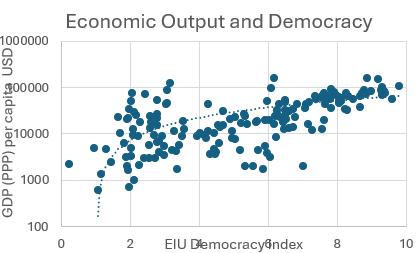
The positive correlation between democracyandoutputisbestvisualised through comparing the Economist’s Democracy Index against Real GDP per capita; here there is clearly a positive correlation, which suggests democracy allows for an increase in economic prosperity. The three most democratic countries, Norway, New Zealand, and Sweden(accordingtotheEconomist)all outperform most other nations, within numerous metrics of economic growth. These countries are all in the top 17 of the HDI. They rank in the top 12 in happiness;althoughrealGDPpercapita is more varied, with New Zealand being outside the top 30. However, this aggregate has limitations in determining living standards across society. Take Brunei, for example, with the eighth highest GDP per capita ($94,472); however, those benefitting from the output, are concentratedwithinaselect few, due to high inequality and output primarilybeinggeneratedthroughoiland gas. Natural resource advantages are also a reason for other positive regression anomalies, such as Qatar. Fundamentally, democracy and output are associated, with theory supporting thisisacircularcorrelation.
Despitethepositivetrendseeing45%of countries benefit from democracy, very
few firms have adopted democratic models, as there are doubts over whether this positive correlation would be maintained in business. There are concerns for efficiency and clarity of a non-autocratic system, yet these problems are not unique to firms. Firms implementing workplace democracy alsolargelydoperformbetter,evenwhen scaled up. For example, The Mondragon Corporation, a Basque-based cooperative federation (a group of firms designed to advance a shared interest) currently implements a system comparable to parliamentary democracy. Alongside its ‘Ten Basic Cooperative Principles’it adheres to the willofthemajorityofitsemployees,who have the power to set wages. There is a maximumwageratioofthemanagerand the lowest-paid employee, of 9:1; although in practice, the ratio is 5:1, comparedtoaround119:1intheaverage FTSE 100 firm. This drives up the wages of most of their 70,000 employees, althoughmanagerearnings are reported at13% less thanaverage. Outputis also considerably higher, with its strong solidarity and worker-based leadership catalysing productivity increases. Mondragon’s turnover also rose 5.1% in 2023 and it is currently the seventh highest firm in Spain, by asset turnover. Moreover, they are set to grow further, due to their focus on innovation. Finally, due to the dynamic action of their democratic system, Mondragon have effectively navigated crises without compromising workers. No employees were made redundant after the 2008 Financial Crisis and Euro Area Crisis,
withallworkersabsorbingtheimpacton the company through wage cuts and reduced hours. This reduced worker resistance,duetotheunifiedcommunity andrelativewagesremainingsimilarand occurred against a backdrop of 20-27% unemployment in Spain, from 2011 to 2016, and ‘double dip’ recessions in 2009 and from 2011-2013. This demonstratesthepotentialresistanceof democratic firms to crises, through cooperation, worker-led decisions, and investmentinhumancapital.
Atawiderlevel,largelythroughabilityto adapt, democratic firms are more productive on average, with a US study findingtheywere9-19%moreproductive thanregularfirms. Theywere alsofound to roughly halve business failure rate in developed countries, with 87% of democratic-based firms surviving 3 years, compared to just 48% for regular firms in Italy. Intuitively, democratic firms also have higher worker satisfaction and further positive externalities including increased communityengagement.
Ultimately, we can argue democracy drives output and thus should be expanded among countries and firms. It is important to recognise this must be done correctly ensuring the minimisation of excessive bureaucracy andinternalconflict,aswellestablishing systems to maximise welfare for workers, to allow firms to further succeed.
Albert Simpson
How a small island in the middle of the ocean went from being one of the richest countries in the world to one of the most vulnerable.
Nauru is a tiny tropical island located in the western Pacific Ocean. Nauru's economy is ranked 73rd in the world for GDP per capita, with Australia contributing 20% of Nauru’s GDP through aid, in return for accommodating asylum seekers there.
However, during the 1970s Nauru boastedoneofthestrongesteconomies in the world, having a GDP per capita of $50,000 (adjusted for inflation). Nauru’s dramatic fall from economic prosperity tells the relevant tale of the economic problem, which can be described as humanity’s infinite wants but finite resources. It is also an important warning to countries whose economies are primary product dependent, due to overreliance on a single natural resource.
Nauru's vast wealth in the 20th century began with the discovery of Nauru's phosphate reserves in 1900, which is usedforfertilisers.Thisledtotheisland, which was previously overlooked, receiving heavy investment from Germany, for modern machinery, along with a massive influx of labour (Naurus populationwaslessthan1,000in1906).
The exploitationof this island continued until 1968, when Nauru gained independence, having gone through three‘owners’oftheisland.
By 1968, Nauru already felt the side effects of a primary product dependent economy,withphosphatereservesbeing depleted and a third of the island forest cover gone. However, this was overlooked by the people of Nauru, as they were finally enjoying their independence and celebrating how phosphateminingwasbringinginA$120 million annually, allowing the government to provide free public services.
This brief sliver of time was seen as a golden age by everyone. The economic boominNauruledtothecountryhaving one of the largest economies for luxury cars.Theensuingfrenzyinconsumption, which reached $28.7 million in 1979, saw the locals enjoy their Lamborghinis and Ferraris on Nauru's only main road, whichwasjust19kmlong.
By the end of the 1900s, Nauru had experiencedminimalinvestmentinother infrastructure, along with the complete annihilationoftheirphosphatereserves. The people were soon left with 80% of theislandbeinguninhabitable,whichled toanotherseriousproblem,astherewas insufficient land to grow food. This forcedNaurutoimportmuchofitsfood, much of which was unhealthy and cheap,causingtheobesityratetoriseto 70%. Once phosphate reserves had run
out,thecountryfaceditsworstproblem, which was a rapid surge in unemployment, due to the mining industryshuttingdown.
Thisdemisewasmetwithhastyplansto diversify Nauru’s economy, by opening itsdoorstooffshorebanks,whilecutting taxes and deregulating. This led to its emergence asataxhavenandcauseda subsequent increase in money laundering activities. As a result, banks haltedtransactionsinUSdollars,forcing an end to this short-lived source of economic growth. The nation also put their faith in The Phosphate Royalties Trust, which peaked at A$1 billion. However, due to poor investments and general mismanagement due to corruption, most of the money was subsequentlylost.
Overall, Nauru can show us the dangers of an economy that has been built around primary product dependency, especially when that primary product is afinite resource. In the modernworld,it doesseemthatcountrieshavebegunto acknowledge the dangers of relying on rawmaterials.Forexample,SaudiArabia has now started to shift from being oil dependent to expanding into other sectors such as tourism and entertainment.
An introduction to debt-trap diplomacy and how it relates to the Sri Lankan economic crisis.
‘There are two ways to enslave a nation. Oneisbythesword.Theotherisbydebt’. Though this quote, traditionally attributed to President John Adams (1735-1826), may be of apocryphal origin, the words are certainly true amidst the rapidly developing world of internationalfinance.
When considering the causes and consequences of the Sri Lankan economic crisis, the concept of ‘debttrapdiplomacy’becomesafamiliarone. Ironically, the phrase was coined largely in reference to the Belt and Road Initiative introduced under the leadership of President Xi Jinping. The BeltandRoadInitiativeproposesitselfto be an economic cooperation scheme, supported by Chinese investment into various international infrastructure projects. The ultimate goal of such an initiative would be the establishment of moreextensiveglobaltraderoutes,most importantlythroughthefoundationsofa maritime Silk Road. What is also surprising is how the political strategist BrahmaChellaney(founderofthe‘debttrap diplomacy’ theory) was inspired, in his findings, by the poor fiscal policy of developing countries in receipt of Chineseloans.
On the whole, perhaps the most notorious of these economic crises was the Sri Lankan economic crisis 20192024. In an article from 2023, the BBC reported that the island nation owed staggering figures to nearby regional powers:around$7bntoChinaandabout $1bn to India. Despite the President Gotabaya Rajapaksa administration outright denying the severity of the economiccrisis,togetherwithitsrefusal to accept any financial aid, the withdrawalof the Rajapaksafamily from Sri Lankan politics was followed by the receipt of the $3bn International Monetary Fund loan and a prior $600m WorldBankloan.
So,howdidasmallislandnationendup with a Current Account deficit of $3bn everyyear?Howdida3Geconomycome to face the brutal force of 50% inflation per annum? And which aspect of Sri Lanka’s financial situation forced it to receiveinternationalloansthatitwasso reluctanttoaccept?
At first glance, the more general causes oftheeconomiccrisissuggestthatitwas a result of the more visible issues with the Sri Lankan economy. The long-term implications of the three-decade-long civilwarontheeconomy,combinedwith the more recent fiscal mismanagement,
tax cuts and corruption, were detrimental to government revenue and the economy as a whole. Alongside the external shocks of the 2019 Easter Bombings and the Russian invasion of Ukraine,these veryoutwardissueswere surely enough to undermine the Sri Lankaneconomy?
Wrong. Without the ongoing and underlying issue of debt, the Sri Lankan economyhadlittlereasontocollapseas quickly as it did. Yes, these factors contributed heavily to the crisis that ensued past the turn of the decade. To put it simply, the unmanageable burden ofdebtenslavedthe nation,byforcingit to pay high interest charges and cut spending, whilst disincentivising the investmentneededtodrivegrowth.
And China’s primary motivation to expanditsBeltandRoadInitiativecomes through economic growth. It is basic macroeconomics: if a country wants economic growth, then injections into the circular flow of income must be greater than its leakages. In this case, Chinese exports must reach international markets to extend the Current Account surplus of the People’s RepublicofChina.Theunfortunatenews is that this policy causes developing countries receiving Belt and Road infrastructure loans from China to inch closer and closer towards sovereign default.
proportionbyloansprovidedbyJapanor theAsianDevelopmentBank.
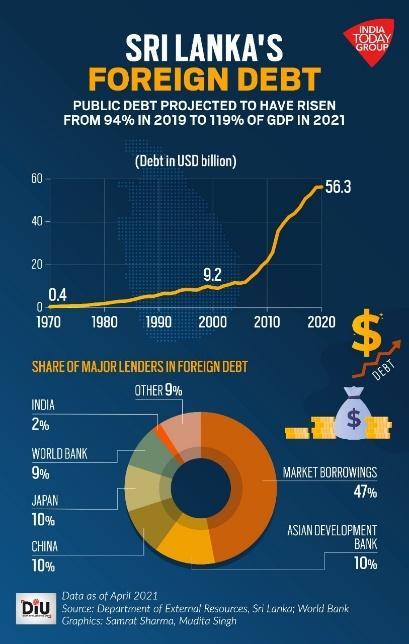
The graph below provides a visual demonstrationofSriLankanforeigndebt by2021.Whatismostnotableishowthe proportion of Chinese-lent loans out of the total sum is 10%, which is greatly overshadowed by the presence of loans from other nations – and mirrored in
This is where debt-trap diplomacy steps in. The reason why Chinese loans are usually the most detrimental to developing-nationrecipients,isbecause there are usually ‘strings attached’. These terms and conditions remain undisclosed to outsiders, but they most likely involve huge collateral requirements.Withsuchhigh-riskloans, the lender gradually assumes greater influence to dictate the economic policiesoftherecipient.Theunfortunate truth is that the debtor country only beginstorealisethegreaterimplications oftheseloansoncerepaymentsbecome excessive. Particularly after crises such aspandemicorcivilwar,itisnotdifficult toimaginewhyadevelopingcountrymay acceptloanssoreadilyofferedtothem.
The debt-trap diplomacy policies pursued by China have already won the countrycrucialassetsaroundtheworld.
Sri Lanka’s 99-year Hambantota Port leasetoChinaisoneofthem,butitcould also be argued that China’s overwhelminginfluenceoverTajikistan’s gold resources, proves to be another example. Former Maldivian President Mohamed Nasheed, amongst various politicians and media across the globe, complained of China’s increasing political leverage comprising the national sovereignty of vulnerable borrowingcountries.
As such, the foreign policy of excessive moneylending furthers the influence of the lender nation, over the economy of the debtor country. For now, debt-trap diplomacy is here to stay. This everexpanding dominance of regional powersovernationstatessusceptibleto financial instability, may also be increasingly adopted by other powerful statesinthenearfuture.
Agalyan Sathiyamoorthy