

Susanna Heikkinen, new Commercial Director of Port of HaminaKotka Ltd p. 4
Shoreside power project of Port of HaminaKotka Ltd p. 5
Photograph: Vesa Hovi

Susanna Heikkinen, new Commercial Director of Port of HaminaKotka Ltd p. 4
Shoreside power project of Port of HaminaKotka Ltd p. 5
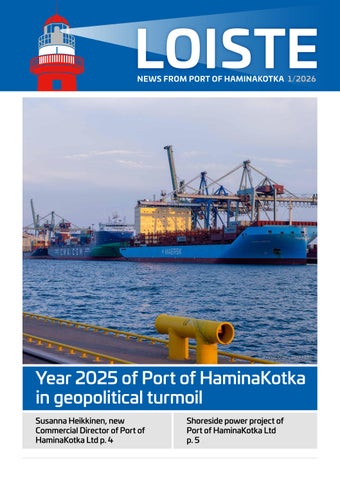
The year 2025 was a period of expectation of growth, but at the Port of HaminaKotka, the attitude towards growth expectations was more moderate than the expectations of financial institutions and the business sector, among others. The volume of freight transport for the whole year was 13.2 million tonnes, which is 0.25% more than in the previous year.
The transport of exports via the Port of HaminaKotka increased by 8.4% last year, with the biggest growth experienced in dry bulk (+45.5%) and liquid bulk (+29.1%). On the other hand, there was a decrease in the category “other goods” (-32.9%) and in general cargo (-30.2%). The transport of imports decreased by 15.3 per cent, and the biggest decline was in round wood, which decreased by 42.2%. On the other hand, the import volumes of dry bulk (+31.8%) and liquid bulk (+13.3%) increased. Transit traffic grew by 36.6% and container traffic by 7.4% compared to the previous year. Four international cruise ships visited the Port.
The growth expectations of the Port of HaminaKotka last year were overshadowed by factors such as the continued Russian war of aggression and the erratic trade policy of the United States, which further increased market uncertainty. Increased fairway dues, on the other hand, significantly raised the
already high logistics costs of Finnish exporting industries. The increase in the fairway dues had the greatest impact on the transport of fertilisers, and customers said that they seriously considered alternative routes instead of the route via Finland.
Last year, the tightened security situation due to issues such as the movements of the Russian shadow fleet increased the resource needs and costs of the security department of the Port in many ways. As in previous years, Port of HaminaKotka Ltd continued to prepare for various threats. Exercises were carried out in co-operation with port operators and authorities, and the Port participated in the Karelian Stronghold 25 local defence exercise, the KAAKKO25 readiness exercise and a major accident exercise in accordance with the Seveso III Directive.
In 2025, the investments by Port of HaminaKotka Ltd were mainly maintenance investments in asphalting and railway tracks, among other things. The Port company also continued the renewal of the Port’s lighting towers as in the previous years. In this project,
old lamps were converted to work with LED technology and at the same time the lighting control system was renewed. The project study on shoreside power was completed at the beginning of the year, and EU support for the project was applied for from the CEF 2 Transport AFIF facility. The project was successful in the evaluation by the Commission, and at the end of the year it was granted 30% of the approved project costs.
As the past few years have shown, geopolitical turmoil has a significant impact on the business of Port of HaminaKotka Ltd, and the current situation does not seem to change that. The prolonged war in Ukraine and the resulting sanctions imposed on Russia have reduced cargo transport via the Port of HaminaKotka, and even sanctionfree products cannot move across the border between Finland and Russia. The end of the
war and the opening of the border would enable transit transport to resume, but the war has left deep scars and it remains to be seen when trade relations with Russia can be established again, just as long as peace is achieved.
The actions of the United States in customs policy and now also in Iran pose very great challenges to international trade. The conflict between the USA and Iran affects world trade, especially through the energy market and maritime transport. Disturbances in the Strait of Hormuz are a key risk factor that increases costs and uncertainty, and for Finland the effects are particularly visible in the price of energy, logistics costs and possible delays in supply chains. The Port of HaminaKotka is the biggest export port in Finland, and Finnish exports are dependent on stable sea routes and reasonable freight prices, which is why competitiveness is eroded as freight costs rise and delivery times get longer.
According to the interim forecast by the Bank of Finland in March, the Finnish economy turned to growth at the end of 2025, and the growth has continued at the beginning of 2026. However, the great uncertainty caused by the war in Iran is weakening and clouding the economic outlook, and the interim forecast projects GDP growth at a pace slower than expected in the December forecast. Despite the economic uncertainty, Port of HaminaKotka Ltd hopes that investment projects in the battery industry and projects related to future fuels will be launched at the Port. Port of HaminaKotka Ltd will continue to work actively to promote the location of these and any other similar projects in the region.

*Also includes export transit **Also includes import transit


For Susanna Heikkinen, who started as the Commercial Director of Port of HaminaKotka Ltd on 18 February 2026, the first few months have been about building both internal and external networks of the organisation and understanding the needs of customers. According to Susanna Heikkinen, the Port of HaminaKotka has managed to renew itself over the years in just the right proportion to the changing needs of its customers. It is important to consolidate this adaptability also in the future so that the Port retains its significant position among the ports of the Baltic Sea.
What has surprised you positively during the first few months?
I have felt welcome since day one. People have been eager to talk about their work, and I am impressed by the ability of the Port organisation to operate in a difficult global situation. I have been away from Southeastern Finland for over six years, but I still have a lot of old acquaintances both on the personal side and among the Port’s operators. The new things to me in the Port are the extension of the D-area and the cruise business. It is great to see how things have made progress!
What are the things on which you have paid particular attention when getting to know both the organisation of the Port of HaminaKotka and its operating environment?
The Port’s organisation has undergone changes lately, but the organisation seems to adapt well and have a positive attitude towards change. The personnel are experienced and work with a professional approach and a big heart. The organisation is quite compact, but still manages to run the different parts of the leading general port in Finland efficiently. Co-operation with the
owner towns of Hamina and Kotka comprises continuous communication.
The Port lives with the times, and the current world situation is reflected in a change in the operating environment. This change is likely to continue in the future, which makes planning for the future challenging. The market is in a faster cycle of change and the effects of the changes are more difficult to predict than before. The structural change in the Finnish wood-processing industry, the decline in trade with Russia and geopolitical tensions are clearly visible. The ever-changing security situation adds its own extra aspect to the work. New EU regulations and directives also strongly guide the operations of the Port – one example is the new shoreside power project for container ships.
What kinds of goals do you have in the early stages of your work and why?
My first goal is to get to know the organisation and understand the duties and corporate culture of the Port more deeply. I feel that in order to be able to move things forward, it is good to know the operating environment and the personnel as well as possible. I have already talked to many people and I have also been able to join the ship service in unmooring and mooring ships. My next goal is to get to know the most important stakeholders and the customers of the Port. Networking and understanding the business needs of customers are high priorities – without customers there is no Port.
Where do you think Port of HaminaKotka Ltd has opportunities for growth and development?
The strengths of the Port of HaminaKotka are its versatility and adaptability. Over the years, the Port has lived with changing market situations, and has it been able to provide a well-functioning platform for the logistics needs of a wide range of businesses. Even though shipping and the port industry are sectors that traditionally evolve very moderately, HaminaKotka has managed to renew itself in a suitable proportion to the needs of its customers. This adaptability must be maintained and developed so that HaminaKotka can continue to shine among the ports of the Baltic Sea. The versatility of HaminaKotka must also be enhanced, and it must be open to new business in the future as well. New technologies and changes in Finland’s exporting industries are both a challenge and an opportunity – the Port of HaminaKotka has a strong foundation to respond to this challenge and create conditions for growing flows of goods.
Sustainable development goes hand in hand with growth. The Port supports operators from the perspective of sustainable development and environmental issues in many complementary ways and creates conditions in which economic activity and environmental responsibility make way together. Sustainable development is therefore not a separate requirement, but a natural part of competitive and forward-looking port operations.
Which factors of your previous experience will you utilise and bring with you to your current position?
My most recent experience in the service of a large employer has given me different perspectives on Finnish logistics. We in the Nordic countries have a lot of special expertise that does not exist anywhere else. You could say that despite the difficult conditions, we are able to operate efficiently and safely. As a result of my previous employer, I am also interested in the role of ports enabling the use of alternative fuels by providing infrastructure and piloting environments in co-operation with port operators. Alternative fuels are a key means to reduce the environmental impact of shipping and port operations, and ports have a crucial role in enabling their deployment. My experience of well-organised managerial work and personnel management as well as networking supports the organisation of the Port in the face of changes. I have received tools for the development of the Port from the development of new traffic and the related influencing. I have previous experience of the operating environment of the ports of Hamina and Kotka for more than 16 years, and it helps me understand the needs and expectations of the customers of the Port.
What kind of a message do you want to send to the readers of Loiste?
The Port has always been more than infrastructure – it is a meeting place, an enabler and a platform for business growth. The Port is looking ahead in a determined manner: we focus on fluency, accountability and solutions to make our customers’ everyday lives more efficient and predictable. The world around us keeps changing, but one thing remains: the power of partnership. Together with our customers and stakeholders, we are building a Port that supports competitiveness, sustainable growth and new opportunities. Let’s turn our eyes to the horizon – together. I wish everyone a particularly sunny summer!

The FuelEU Maritime Regulation, which aims to reduce emissions from shipping, sets specific requirements for container ships and passenger ships arriving at EU ports, obliging them to use a shoreside electricity system for their energy needs while in port. From 2030, container and passenger ships of more than 5,000 gross tonnes must use shoreside electricity or other equivalent zero-emission technologies when entering EU ports, unless separately specified exemptions can apply.
Port of HaminaKotka Ltd launched its own shoreside power project last year by making an application to the CEF Transport Alternative Fuels Infrastructure Facility (AFIF) for EU funding for a shoreside power investment at the Mussalo Harbour. The objective of AFIF is to promote the deployment of distribution infrastructure for alternative fuels and to reduce carbon dioxide emissions from transport along the TEN-T network. Port of HaminaKotka Ltd
was granted just over 3 million euros for the construction of a shoreside power supply system for container ships.
In the project, six berths at the B and C quays at Mussalo will be equipped with shoreside power connections in accordance with the international container ship standard. A new technical facility will be built for the shoreside power equipment, accommodating the transformers, medium voltage switchgear and frequency converters, and shoreside supply units with outlets will be installed on the quays. Moreover, a new 20 kV electricity connection will be acquired for the shoreside power system. The project covers the construction, installation and commissioning of all necessary infrastructure as well as any necessary cabling and earthing.
Once completed, the shoreside power
system will provide each berth with an electrical output of 4 megavolt-amperes (MVA) at a voltage of 6.6 kV at two different frequencies (50 and 60 Hz). The total capacity of the system will be 10 MVA, which will allow six vessels to be connected to shoreside power at the same time.
The project will enable container ships to use shoreside power instead of auxiliary machinery while in port. This will significantly reduce greenhouse gas and particulate emissions as well as noise. At the same time, the project promotes the development of low-emission and zero-emission shipping on the Baltic Sea and responds to the EU’s emission reduction targets and increased use of shoreside electricity in maritime transport.

International cruise traffic in the Baltic Sea region has undergone significant changes in recent years due to the COVID-19 pandemic and geopolitical disruptions. After the worst phase of the pandemic eased in 2022, it appeared that the international cruise business was set for a strong recovery. The Port of HaminaKotka had confirmed bookings for 47 cruise ships for the 2022 season, which would have brought more than 100,000 cruise passengers to the region. However, Russia’s invasion of Ukraine significantly altered the market situation.
St. Petersburg, which had previously been a marque destination in Baltic cruise itineraries, was removed from routes due to the war. As a result, a completely new market area has gradually had to be developed for international cruise traffic in the Gulf of Finland. Years of cooperation with neighboring ports such as Helsinki and Tallinn, as well as with cruise operators, have yielded positive results in developing this new market. The Port of HaminaKotka is conveniently located along cruise routes near major cruise ports, particularly for multi-country itineraries lasting at least a week.
This summer, three large cruise ships are scheduled to call at the Port of HaminaKotka.
Cruise ships due to arrive at the Port of HaminaKotka in 2026:
31 May AIDAbella, Hamina
16 June AIDAdiva, Hamina
22 July Marina, Mussalo
By 2027, the number is expected to grow to 10 cruise calls based on current projections, which is a strong achievement in the Finnish context. The outlook for 2028 is also promising. According to expert estimates, within a few years the Port of HaminaKotka could once again reach around 20 cruise ship visits annually.
Significant efforts have been made to promote international cruise traffic at the Port of HaminaKotka. Equally invaluable has been the strong international network built over the years with key industry stakeholders, as well as seamless cooperation with the cities of Hamina and Kotka and local service providers.
The profile of cruise passengers has changed in recent years. In addition to more mature travelers, there are now many families with children and young adults. Tour operators arrange a variety of guided tours for cruise visitors, and the diverse range of excursions
has received very positive feedback. Ships stay in port for the entire day, from morning until late evening, enabling both passengers and crew members to explore destinations independently.
In June this year, AIDAdiva, part of the Carnival Corporation group and belonging to the brand AIDA Cruises, will make its maiden call at the Hamina harbour. A cruise line’s first visit is always particularly significant, as introducing a new destination is a major investment for the operator and typically involves several years of preparation. Additional first-time visits are expected in the coming years.
In 2028, the Kotka–Hamina region will also welcome an expedition-class vessel making its first visit during the off-season. Year-round cruising is emerging as a future trend in Finland.
The Port of HaminaKotka’s location near unique Finnish natural and cultural attractions, its well-functioning infrastructure, and its suitability for cruise ships of all sizes are widely recognized strengths in international cruise traffic. Cruise activity in the Baltic Sea is forecast to grow by approximately 10% annually, creating strong opportunities for the future development of cruise operations in HaminaKotka.
On 1 May 2026, 15 years had passed since the merger of the ports of Hamina and Kotka. The merger of the ports was an important strategic decision that came from economic pressures, the competitive situation and the need to strengthen the logistics position of the region. Port of HaminaKotka Ltd was created as a result of the merger, and it became Finland’s

leading general port and a significant logistics hub in the Baltic Sea region.
The port company’s 15th anniversary was celebrated at the end of April by its personnel, customers, partners and stakeholders. In addition, the grand flag of Port of HaminaKotka Ltd was flown on the grand flagpole of Hamina in honour of the port company’s anniversary.
Eija Rossi , CEO of Port of HaminaKotka Ltd, is leading the port company with a positive mindset:
“It is an honour to do this work, to continue the company’s great journey and to take the port to the future together with the personnel and customers,” she says.


The changed security environment and the various threats that have emerged with it have increased the need to protect the critical infrastructure in society and reinforce the resilience of critical parties. The CER (Critical Entities Resilience) Directive entered into force in 2023 and aims to improve the resilience and reliability of critical services in the EU. The Directive harmonises procedures for the identification and resilience of critical entities in the EU and establishes clear procedures for co-operation between Member States.
As part of the implementation of the CER Directive, the following provisions were drawn up concerning security clearances: the Act amending Section 19 of the Finnish Security Clearance Act and the Act amending the Act on the Security of Certain Ships and Associated Port Facilities and on Monitoring Maritime Security, i.e. the so-called Security Measures Act. The changes came into force
less than a year ago on 1 July 2025. The amendments to the Security Measures Act imposed an obligation on port authorities engaged in international transport to ensure the integrity and reliability of certain categories of employees by means of personnel security clearance and to maintain the clearance in force. In other words, the port authority must apply for security clearance of persons who have access to confidential port security information or access to such a cargo handling or port surveillance information system critical to port security that enables the reading and changing of the information for purposes other than for individual work task or technical maintenance of the information system. In addition, the Finnish Transport and Communications Agency may decide that the obligation also applies to other port duties for which a security clearance can be applied for in accordance with sections
19–21 of the Security Clearance Act and where ensuring the integrity and reliability of the person working is very important for the protection of national security or the prevention of organised crime. The port authority applies for security clearances on its own personnel as well as on the personnel of other companies operating in the port.
The security clearance process has been partially started by Port of HaminaKotka Ltd, but according to the assessment given by the authorities, it is still in its early stages. HaminaKotka is a large port with many operators, which has an effect on the speed of the process. According to the situation update issued by the authorities in April, the security clearance decision has already been completed for some ports, but the process is still ongoing in most ports. According to the authorities’ estimate, the process is expected to be completed by early 2027.
The world’s biggest relay orienteering event will be arranged in Kotka this summer, and Port of HaminaKotka Ltd is one of the partners of this hugely popular event.
The slogan of Kotka-Jukola 2026 “Life from the forest” highlights the core of Jukola – the significance of the forest and orienteering as a physical, mental and communal experience. The forest is not only a place of competition, but it is a life-giving, developing and deeply experienced environment. The slogan also connects to the forest industry, export revenues and employment. Its meaning expands, bringing together the forest’s diversity. It also refers to the role of the forest not only as a physical competition environment and a source of well-being, but as an economic pillar through which the forest provides livelihoods, jobs and international visibility for Finland.
The forest is also essentially linked to the operations of the Port of HaminaKotka, as the Port of HaminaKotka is the biggest export port in Finland, and a wide range of forest industry products, such as paper, board, pulp and sawn timber, pass through it to the world. As much as 45% of the exports of Finnish sawn timber are carried through the Port of HaminaKotka.
At the core of the partnership between Port of HaminaKotka Ltd and Kotka-Jukola is the desire to support the vitality of the region of Kymenlaakso and to enable a successful
major event that will bring tens of thousands of visitors to the region.
“We are proud to be involved in supporting an event that brings the Kotka and Hamina region to the world map. It is natural for us to be involved wherever the people and visitors of our region are. Jukola is a huge effort, and we want to make sure that the arrangements go smoothly and that the guests enjoy themselves in the port city of Kotka,” says Eija Rossi, CEO of Port of HaminaKotka Ltd.
For Kotka-Jukola, co-operation with a significant local operator is an important step towards the summer of 2026.
“The Port of HaminaKotka is one of the cornerstones of our region’s economy and logistics. It is great that we share a common goal in building a responsible and impactful event. For us, this partnership is also one indication that the whole region is working together,” say Jyrki Metsola and Toni Häkämies, who are responsible for the sales and marketing of Kotka-Jukola.
The partnership will be reflected in event communications and at the competition centre, but above all, it is a promise of co-operation aimed at creating a better and smoother major event. Welcome to Kotka-Jukola 13–14 June 2026!
Port of HaminaKotka will again participate in the international Breakbulk Europe fair this year. The event will take place in Rotterdam Ahoy from 16 to 18 June 2026.
BreakBulk Europe is the most important international event in the project transport and heavy cargo industry. The event has grown in popularity year by year. Last year, more than 11,400 participants from over 121 countries took part in the event.


