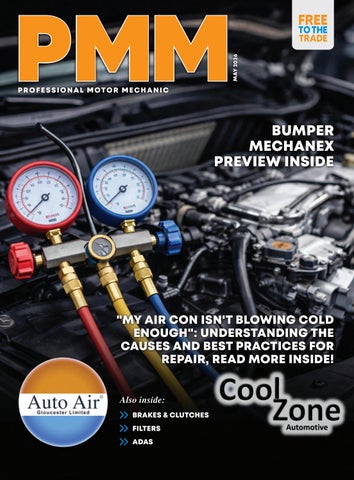
Welcome to the May issue of Professional Motor Mechanic magazine! The team at PMM have been busy recently organising and promoting our Mechanex North trade show which takes place on the 14th and 15th this month in Harrogate – turn to page 15 to find out about our seminars, exhibitors and hear from our show supporters YMF about why they think garages in the region need to be there. We’ve got some fascinating insights on ADAS and its growing role in workshops, turn to page 42 for that. Enjoy the issue!
Editor
KIERAN NEE
Digital Manager
KELLY NEWSTEAD
Group Manager
ALEX DILLEIGH
Senior Account Manager
MATTHEW BOASE
Magazine Designer
GEMMA WATSON
Group Production Manager
CAROL PADGETT
Production Assistant
CLAIRE SWENDELL
Distribution Manager
KARL CLARK
Subscriptions
PROFESSIONAL MOTOR MECHANIC is a business magazine for firms and individuals involved in all aspects of the motor trade. It is published eleven times a year and is available nationally FREE to the trade through leading motor factors. It is also available through the post at a cost of £30.
The small business owner faces an issue which is far less noticeable for their corporate counterparts: Finding and hiring the right person. Those of you reading this will most likely fall into the former category and will no doubt already be aware of the difficulty of finding new employees – not to mention the pain of getting it wrong. Hiring new staff is, generally speaking, an unpleasant process. It costs a lot, it requires a mammoth amount of effort, can be emotionally draining and you risk ending by making the wrong decision.
‘‘ When you add someone new to a team of five, however, you need to acknowledge that you are altering the dynamic for better or for worse. ”
For a small business with only a handful of employees, every new recruit makes a big difference. This isn’t so with a larger company, with different teams and structures in place. One new hire is unlikely to rock the boat too much when you’re talking about a company of 50 people, as there are places to move them around to in order to find a better fit, or simply find a corner somewhere for them where they can fritter away their time, or just get rid of them and start looking again. The truth is that larger companies are never too far away from posting an advert on Indeed anyway. When you add someone new to a team of five, however, you need to acknowledge that you are altering the dynamic for better or for worse.
Too often, the only requirement that small business owners have in mind is whether the person they are about to hire can do the job they’re applying for. That should be the bare minimum for even getting in the door. Equally important is attitude, adaptability and whether they will be the right fit for the pre-existing team. There have always been a certain amount of people who see work as a 9-5 thing, a simple trade of time and effort for money. I am one of them. Work should not cost you your leisure time, it should not dictate your life and you should remember that outside of the time-wage transaction, you don’t owe your employer anything.
That does not mean, however, that you don’t owe something to those you work alongside. No person is an island, we all have to work together and interact and inhabit the same space every day. The team around you existed before you and will outlive you, but whilst you are there you are part of that team and your attitude has a very real impact on your fellow team members. When hiring, you should not merely be looking for someone to do the job, but someone to play their part in the team. After all, your team might work, but does your team work together?
KieranNee Editor
PMM NEWS
Fake parts fight still ongoing –PMM speaks to IPO
The IGA has recently applauded the Intellectual Property Office’s (IPO) decision to continue funding the battle against counterfeit goods, with automotive parts highlighted as a particular problem.
The funding, which supports the Police Intellectual Property Crime Unit, has been safeguarded for the next three years, ending in March 2029. The news comes after a mammoth raid last year uncovered more than £100,000 worth of fake automotive parts. The South Gloucestershire Trading Standardsled raid on a self-storage unit in Bristol revealed more than 3,600 components which had been falsely branded to purposefully mislead both garages and drivers.
The situation, the scale of which has “grown significantly in recent years”, according to Commissioner of the City of London police, Pete O’Doherty, is particularly pernicious to garages which regularly accept customer-supplied parts. Counterfeits of spark plugs, oil filters and even sensors were discovered in the Bristol raid, raising concerns that should failure occur whilst the vehicle is driving at high speed, there could be a real risk of danger.
This was thrown into stark relief earlier this year when the BBC spoke to one garage owner who claimed he was asked “on a weekly basis” to fit dubious parts, including fake airbags. Paul Jones, owner of PC Automotve in Lincoln, told a BBC reporter that the idea made him “wince”, adding “you can imagine an explosive device five inches from your face. If that goes off, it doesn’t bear thinking about.”
Jones, 35 years in the trade, refuses to fit customer parts: "It's not about garages making money. We
don't want someone behind us when we've got the kids in the back seat, whose got a faulty car or one that's been bodged up."
Customer-supplied parts would appear to be where the weak link in the supply chain is. With the vast majority of garages buying components from reputable factors –whether in-store or online – or from the main dealer, it is usually through the customer that cheap, untested parts make their way into the hands of garage technicians.
The problem is, as the raid in Bristol shows, many of these parts are no longer simply dispatched in white boxes, but in fact mimic genuine OE parts. PMM has in the past been shown fake components side-by-side with genuine ones and it often takes more than a hard look to decide which is the genuine one.
Jon Douglass, director of the IGA, singled out customer-supplied parts in his response to the IPO news: “The IPO’s leadership in tackling intellectual property crime and supporting enforcement activity is essential in protecting consumers and legitimate businesses. It also helps address the growing issue of customer-supplied parts, which too often originate from unknown sources.”
So what can we expect to see from the £3m funding each year? We got in contact with the IPO to ask just that and were told by their spokesperson:
"Counterfeit vehicle parts pose a genuine safety risk to road users and a serious threat to legitimate traders. Our continued funding of the Police Intellectual Property Crime Unit (PIPCU) at approximately £3 million per year means we can sustain and
build upon the vital enforcement work that protects consumers from unsafe and substandard goods. The IPO and PIPCU are currently working to identify priorities for this next phase of enforcement activity, with measures that strengthen law enforcement expected to benefit sectors including automotive.
"Our recent 'Fake Always Breaks' campaign has been working closely with major automotive brands and independent garages to raise awareness of the dangers of counterfeit vehicle parts. The campaign includes updated guidance for businesses and consumers about how to identify and report these. We encourage anyone with information about the supply of counterfeit vehicle parts to report it through our dedicated Clue Webform. Reports are referred to PIPCU for further action where appropriate.
"From next year, we are piloting a new collaborative co-funding model with industry. This will test how a public-private partnership approach could expand the scope of enforcement activity, with a view to scaling the model in future years. We will be reaching out to industry partners in the coming months and very much welcome engagement from across the automotive sector. We encourage anyone wanting to find out more to get in touch with the IPO directly, or through the IP Crime Group - a network of government, law enforcement and industry partners committed to tackling infringement."
For more information WWW.RDR.LINK/ACE001
FOR UP-TO-DATE NEWS, SIGN UP FOR OUR WEEKLY E-NEWSLETTER. SIMPLY SCAN THE QR CODE
Embracing neurodiversity in the workshop
Autotech Group has recently highlighted the work it’s done as an organisation to “better understand neurodiversity and its role in addressing the automotive industry’s ongoing workforce challenges.”
Over the past six months, the group has worked with specialists to train its teams to better understand how neurodivergence can appear in the workplace and how businesses can create environments where individuals are able to thrive.
The training has focused on practical ways to support people while also helping teams recognise the strengths neurodivergent individuals can bring to technical and operational roles, including problem-solving, creativity, strong focus and attention to detail.
For more information
WWW.RDR.LINK/ACE002
How carbon friendly are EVs really?
It’s been a longstanding debate – how carbon friendly are EVs when you take into account their manufacture?
Finding an accurate answer has been frustrating. That may be set to change, however, now that Polestar has taken the innovative step to publish the full carbon footprint of all of its models – including the Polestar 5. The manufacturer sees this as a step “toward greater climate transparency”, hoping that other car makers will follow suit. The cradle-to-gate carbon footprint of Polestar 5 is 23.8 tCO ₂ e, covering emissions from raw material extraction through production and delivery to the customer.
NEWSIN BRIEF
CHAMPIONS TOUR
Compressor company Champion is heading on tour across the UK and Ireland until the end of August. They will be displaying the FM11 compact compressor to any garage who signs up.
THE JET SET
Ebay is claiming that 200,000 vehicles failed their MOT last year for something they argue could have been easily and cheaply prevented. According to the online marketplace, a FOI request to the DVSA revealed the humble washer jet to be the cause of the failures – something they helpfully sell for as little as £1.99.
PUTTING THE AI IN ‘GARAGE AID’
Schaeffler has launched a new AIpowered PartFinder system, designed to quickly and accurately aid garages in identifying the correct replacement parts they need. The tool has been introduced in response to the growing number of calls coming into their helpline.
ON THE SCRAPHEAP
Materials are at the root of emission reduction. Aluminium is one of the most carbon-intensive inputs in vehicle manufacturing, so Polestar has
fundamentally changed how it is sourced for Polestar 5. 13% of the aluminium used is recycled and 83% comes from smelters powered by renewable electricity, avoiding more than 14 tCO₂e per car compared with conventional aluminium sourcing.
For more information
WWW.RDR.LINK/ACE003
The number crunchers at Car.co.uk have come up with the top ten most scrapped cars in the UK between 2021 and 2026. At the top spot is the Vauxhall Corsa, with 64,860 vehicles scrapped in that time. This is followed closely by the Ford Focus and Volkswagen Golf.
KNOW YOUR PARTS
Fluid testing device
Febi discusses its new intelligent testing device for operating fluids.
Workshops have long relied on either visual inspection or costly, slow laboratory services to understand fluid condition. We saw a clear gap: professionals needed fast, accurate, on site diagnostics without the time delay. The new febi Fluid Testing Device gives workshops advanced, data‑driven insight into vital fluids such as engine oil, brake fluid, transmission fluid, hydraulic oil, and power steering oil – all in-house and in under two hours. This bridges the gap between convenience and technical accuracy while empowering workshops to make confident service decisions.
The device uses a unique test strip combined with an AI-driven Online Diagnostic System. After applying a small sample of fluid to the strip and allowing it to dry, the strip is scanned by the device, which captures high‑resolution images. These are uploaded to an intelligent cloud-based platform that analyses indicators like soot density and coking to metal abrasion patterns and contamination markers such as water, coolant or fuel. Within minutes, the workshop receives a PDF report detailing the condition of the fluid and the likely causes of any abnormalities.
What makes this device different from traditional lab testing?
Speed and accessibility. Traditional lab analysis can take days and is significantly more expensive. With febi’s device, workshops get results up to 10x faster, using test strips that are far more cost‑effective than third‑party services. The process requires no specialist training – it’s simply drop, dry, scan, and the device handles the rest. This allows workshops to offer premium diagnostics without outsourcing or delaying customer approvals.
What can the test results reveal about a vehicle’s health?
The system identifies:
•Soot buildup
•Coking and sludge
•Metal abrasion (a warning sign of component wear)
•Fuel contamination
•Water or condensation
•Coolant presence
•Overall fluid degradation
These indicators help prevent engine or system damage long before it becomes a costly failure. Workshops can show customers visual evidence of issues, supporting service recommendations with clear, measurable data.
How can this benefit workshops?
First, it allows workshops to reinforce trust by showing customers transparent, visual, third‑party analysis. Second, it opens new revenue opportunities by enabling fluid diagnostics as part of routine servicing. Because the process is quick and affordable, workshops can test more often and identify more service needs earlier. The result is increased efficiency, improved customer satisfaction and stronger long term relationships – all backed by professional evidence rather than opinion.
What does the setup process look like for workshops?
The system is designed to be plug‑and‑play.
Workshops simply:
•Register the device using its unique QR code.
•Connect via USB and install the software (Windows 7, 10 & 11 compatible).
•Register the test strip, again using its QR code.
•Apply the fluid and allow it to dry (2 hours minimum for engine oil; approx. 30 minutes for other fluids).
•Scan the strip using the device.
•Receive a PDF report directly by email within minutes.
Once set up, workshops can also use Wi Fi or Bluetooth for fully cable free operation.
Is the device tested or recognised?
Yes. The effectiveness and functional accuracy of the device has been examined under strict conditions by the automotive industry association (Germany). This means workshops can trust that the technology delivers dependable results aligned with industry expectations.
How does this technology support technicians in discussing repairs with customers?
Vehicle owners often struggle to visualise internal engine problems. The febi system turns complex data into clear, intuitive graphics: fuel traces, soot levels, wear particles and contamination are all shown visually. This makes it easy for technicians to justify recommended repairs or fluid changes, backed by tangible evidence rather than subjective judgement. It’s especially useful when dealing with used vehicle assessments or diagnosing potential engine damage early.
What types of vehicles can the device be used on?
It’s suitable for:
•Passenger cars
•Light commercial vehicles
•Heavy commercial vehicles
•Vans
•Agricultural machinery
Any workshop dealing with these can benefit from the tool’s comprehensive diagnostics.
BEST PRACTICE
A/C system maintenance
All workshops have at one point or another been told by a customer, “my air con isn’t blowing cold enough”. Well, that’s a problem this month’s cover star Auto Air Gloucester is seeking to help garages solve.
It’s a phrase almost every automotive technician hears on a regular basis: “My air con isn’t blowing cold enough.” While it may sound like a simple complaint, diagnosing the root cause of poor airconditioning performance can be surprisingly complex. Modern vehicle A/C systems rely on a network of components that must all work together in harmony. When even one part begins to fail, the result can be warm air, intermittent cooling, or a system that doesn’t operate at all.
Here, let’s take a detailed look at the most common causes of weak A/C performance, along with bestpractice guidance for servicing and maintaining vehicle air conditioning systems.
Low refrigerant levels
One of the most frequent causes of poor cooling is low refrigerant. Even a small loss, sometimes as little as 10-15 per cent, can significantly reduce the temperature coming through the vents. Refrigerant doesn’t get “used up,” so if levels are low, there is always a leak somewhere in the system. Signs of low refrigerant:
• The compressor clutch rapidly cycles on and off
• Reduced cooling, especially at idle
• Bubbles visible in the sight glass (if fitted)
Technicians often look for oil stains on the condenser, compressor body, hoses, or fittings. These stains can indicate where refrigerant and oil have escaped. However, leaks can be extremely small and difficult to locate, even for experienced professionals. Always remember to inspect the service ports, as Schrader valves, caps, and O‑rings are common leak points.
A quick visual inspection can often reveal external blockages. Ensuring the cooling fans activate when the A/C is running is essential, if they don’t, the system will struggle to remove heat.
Compressor and clutch problems
Cooling fans and problems
Even with the correct refrigerant charge, the A/C system cannot function properly without adequate airflow across the condenser. When airflow is restricted, refrigerant pressures rise, temperatures increase, and cooling performance drops.
Common airflow issues:
• Cooling fans not operating when the A/C is switched on
• Leaves, dirt, or debris blocking the condenser
• Bent or damaged cooling fins
• Blocked cabin air filter restricting airflow inside the vehicle
The compressor is the heart of the A/C system, and if it isn’t functioning correctly, cooling will be compromised. With the engine running, blower on maximum, and A/C set to the coldest setting, the compressor clutch should engage. You may hear a click or notice a slight change in engine tone when it does.
If the clutch does not engage, possible causes include:
• Extremely low refrigerant
• Failed clutch assembly
• Electrical issues such as blown fuses, faulty relays, or damaged wiring
• Faulty pressure or temperature sensors preventing activation
A non-engaging clutch is often a symptom rather than the root cause, so proper diagnosis is essential.
The importance of the accumulator/receiver drier
Many people underestimate the role of the accumulator or receiver drier. These components contain desiccant bags designed to absorb moisture within the A/C system. Moisture is the enemy of air‑conditioning systems: It reacts with refrigerant to form corrosive acids and sludge. What happens when the desiccant becomes oversaturated?
• Desiccant material can break down and spread through the system
• Blockages form in the expansion valve, orifice tube, or condenser
• Compressor damage becomes likely
• Overall system performance drops dramatically
Despite being relatively inexpensive, driers are often overlooked during repairs. In reality, they should be replaced every time the system is opened or whenever a new compressor is installed.
Contaminated refrigerant and the need for flushing
Contaminated refrigerant, often caused by internal corrosion or previous poorquality repairs, can cause major damage. Metal particles, sludge, and degraded oil can circulate through the system, blocking components and eventually destroying the compressor.
This is why flushing the system is essential whenever:
• A major component has failed
• The system has been open to the atmosphere
• Contamination is suspected
Skipping this step risks immediate failure of new components.
Electrical and sensor‑related issues
Modern A/C systems rely heavily on electronics. A single faulty sensor can
prevent the system from operating correctly.
Potential electrical causes of poor cooling:
• Blown fuses
• Faulty pressure switches
• Temperature sensors sending incorrect readings
• Loose, corroded, or damaged wiring
• Engine control module (ECM) intervention
The ECM can disable the A/C under certain conditions, such as engine overheating or low voltage. Always ensure electrical connections are clean, tight, and secure.
The overlooked cabin air filter
One of the simplest, yet most overlooked, causes of weak cooling is a dirty cabin air filter. When the filter becomes clogged, airflow through the evaporator is restricted, reducing cooling output dramatically.
Replacing the cabin filter is quick, inexpensive, and should be part of routine maintenance.
Best practice advice
Encouraging drivers to run the A/C for around 10 minutes each week, even during winter, helps keep the system lubricated. This circulates refrigerant oil, conditions O rings and seals, and reduces the likelihood of leaks developing during long periods of inactivity.
Working on vehicle A/C systems requires skill, knowledge, and the correct equipment. To ensure safe, reliable, and long‑lasting repairs, technicians should always follow industry best practices.
1. Only qualified technicians should service A/C systems
A/C systems operate under high pressure and require specialist tools. A trained technician can correctly diagnose faults, handle
refrigerant safely, and ensure the system is restored to full working order.
2. Use high ‑quality components
Cheap parts often lead to repeat failures. Using reputable brands ensures reliability, performance, and customer satisfaction. Fit once, fit right.
3. Prepare the system properly before installing new parts
This includes:
• Flushing the system
• Replacing the drier/accumulator
• Installing a new expansion valve or orifice tube
• Ensuring all lines and components are clean and free from debris
These parts act as filters and are essential for protecting the compressor and maintaining correct system operation.
4. Follow manufacturer instructions
Always use the correct type and quantity of oil, torque settings, and installation procedures. Incorrect oil levels are a leading cause of compressor failure.
It’s important to use reliable parts you can trust. Coolzone quality components are available from reputable motor factors across the UK. Choosing high quality parts gives technicians confidence in the repairs they carry out and ensures customers receive the cooling performance they expect.
TROUBLESHOOTER
Why was the Porsche 911 Carrera 4S misfiring following spark plug replacement?
Why would a Porsche 911 Carrera 4S start misfiring on cylinder four following a routine spark plug replacement? ALLDATA and Porsche’s OEM repair data can provide an answer.
Problem
Following a standard spark plug change, a Porsche 911 Carrera 4S (Type 992, 3.0L) returned to the workshop after the driver noticed poor engine performance. The fault code was P0304 – Misfire Cylinder 4. At first glance, it appeared the ‘routine service’ was conducted correctly – but the issue turned out to be an underlying one.
The technician consulted the ALLDATA Info Centre to review all manufacturerspecific installation procedures for the spark plugs. The documentation showed that Porsche provides strict guidelines for this job, especially regarding installation orientation, lubrication and handling of the delicate ceramic insulators.
Solution
According to Porsche specifications, spark plugs need to be installed with the electrode positioned at ‘12 o’clock’. This precise
alignment ensures uniform flame front distribution, resulting in clean and efficient engine operation. Additionally, a specified lubricant must be applied to the ceramic insulator to reduce friction during threading and prevent microcracks.
Using the correct tools is equally important; even slight deviations in the threading angle or excessive lateral force can cause fine hairline cracks in the ceramic body – often invisible but with noticeable consequences.
In this case, upon inspection of the removed spark plug from cylinder 4, the technician noticed a barely visible crack in the insulator. This minor damage triggered the misfires and rough engine performance. With a new, correctly installed spark plug, the issue was resolved. The six-cylinder engine ran smoothly and evenly once again.
Simple tasks require maximum precision
This example illustrates that even simple maintenance tasks today require maximum precision, care and accurate technical information. Small deviations can lead to consequences – from minor misfires to catastrophic engine damage.
With access to original data and practical support, ALLDATA helps workshops avoid mistakes, identify root causes and carry out repairs confidently.
With data from 44 VMs, over 106 million technical articles and more than nine-and-ahalf million wiring diagrams and drawings, ALLDATA Repair covers over 165,000 vehicle combinations – that's around 97 per cent of all vehicles on Europe's roads.
In 2026, ALLDATA is celebrating 40 years in business.
WHO NEEDS TRADE SHOWS THESE DAYS?
This year we thought we’d let the chronically online intern Sheriff put together the show preview for Mechanex North and the first question he asked was “a trade show in 2026 – seriously?” As you’ll see over the next few pages, he’s been well and truly told on that front!
You sound cool, so I’ll start with you Turbo Guy. You’re coming to Mechanex North this month. We already do a show in the South, isn’t one enough?
Turbo Guy: Well, we operate from our new distribution facility in Elland, West Yorkshire, which provides UK-wide next day delivery. Mechanex North presents a great opportunity for us to connect with workshops and factors in the North and promote the advantages of quality remanufactured turbochargers, which can save customers as much as 40 per cent.
Ok, fair enough, but do people really still buy garage equipment at trade shows?
Think Car: Absolutely – workshops aren’t spending thousands and thousands of pounds based on an image on a website or in a magazine alone. In many cases, trade shows are where the buying journey actually begins. While not every purchase is completed on the day, events like Mechanex give technicians the opportunity to see, touch and test equipment in a real-world setting, which is still hugely important for high-value investments like diagnostic tools or ADAS equipment. Workshops want confidence before they commit, and that comes from live
“Face-to-face
demonstrations, asking technical questions and comparing tools side-by-side. We often see strong post-show conversions because those face-to-face conversations build trust and remove uncertainty.
JHM Butt: Yes, Sheriff, they do, but not in the same way as before. People still buy (or at least commit to buying) garage equipment at trade shows. We find that a lot of visitors have buying authority, but the interest isn't always there when we follow up.
Trade shows now act more as leadgeneration and relationship-building channels, with sales often completed afterwards. It's also a good branding exercise for us to get JHM Butt, Supalign out there in people’s faces.
So yes, people still “buy,” but the real value is starting high-quality deals, not instant transactions.
I do all of my meetings over videocall because the editor says I’m not allowed any travel expenses, but I read somewhere that doing business face-to-face is dead anyway.
Alldata: Far from it! Face-to-face business remains incredibly valuable. At ALLDATA, in-person events and exhibitions are a major part of our yearly calendar. They are the ideal
events allow for deeper conversations, handson learning and immediate problem-solving, which simply can’t be replicated online.” Think Car
arena to raise awareness of our brand, products and people, as well as connect with our key demographic – in this case, workshop owners and technicians. They’re as relevant as ever.
Thinkcar: Not at all, Sheriff – if anything, it’s become more valuable! The industry is more digital than ever, but that makes inperson interaction stand out even more. When you’re dealing with complex products like diagnostics, secure gateway access or ADAS calibration, customers want to speak to real people who understand their day-to-day challenges. Face-to-face events allow for deeper conversations, handson learning and immediate problem-solving, which simply can’t be replicated online. It’s also an opportunity to build long-term relationships, not just transactions.
Arnott: Face-to-face business isn’t dead; it’s essential in the automotive world. As a mechanic, you’re not just buying a part; you’re trusting it to perform. With so many products online, it’s often unclear who’s behind them or if the quality holds up.
Bardahl: Absolutely not. Face-to-face interaction remains invaluable: Building trust, demonstrating products in real time and having meaningful conversations simply can’t be replicated online.
I won’t be at the show, thank God! Again, the editor said he couldn’t bear to have me around for two whole days. But I’m not bothered, two days stuck in an exhibition hall –sounds a bit boring, doesn’t it?
Pro-Align: Well, we are thoroughly looking forward to two days in an exhibition hall where we hope to have many ‘in person’ discussions. In an environment where time is precious, customers want the saliant details immediately and a clear understanding of how their purchase is going to make their business more
productive! In addition, the number of points of communication has increased, driven essentially by the social media explosion. ‘Rocking up’ at a customer’s premises and doing a demonstration once is no longer sufficient. The foundational work is done remotely, but the final piece is concluded in person.
If there’s one thing we Gen Zers know, it’s that life is all about making bread, and by bread I mean dough – not crumbs! – So wouldn’t it be better to like, you know, stay at work instead of going to a trade show??
Topdon: A visit to a trade show can spark new ideas you can take straight back to the workshop. They give you the chance to see what’s new in the industry, all in one place, get hands-on with tools, compare different options and ask questions to the people behind the products.
IGA: Taking time away from the workshop can be difficult, but trade shows provide a valuable opportunity to step back and look at the bigger picture. Events like Mechanex bring together the latest tools, technology, training and industry expertise all under one roof. It’s a chance to discover new solutions, learn from experts, and speak directly with organisations that support independent garages. Just as importantly, it offers the opportunity to connect with other workshop owners, share experiences, and gain fresh ideas that can help improve efficiency, profitability and long-term business success. Hmm, all of this has got me dangerously close to thinking and, even worse, it’s almost made me feel that I, a university graduate, might actually have been wrong about something… C’mon Sheriff, get it together, you do this!
“IF YOU DON'T CLOSE FOR A MORNING AND LEARN WHAT’S HAPPENING NOW, THEN IN TEN YEARS’ TIME YOU WON’T BE OPENING AT ALL.”
The PMM Team – minus Sheriff, of course, whose mum wouldn’t let him come –went up to Yorkshire earlier in the year to speak to the director of this year’s show supporter York Motor Factor’s, Matthew Pope.
Is there a need for a trade show in the North?
Without a doubt there is a need for a trade show in the North. I understand there's a strong one at Sandown in the south which is well attended. The one in the north should be better attended and hopefully this year it will be
What do garages need from a trade show in the North?
Technology is moving very, very quickly in the motor trade. We've got secure gateway built into cars since 2020 and a lot of garages still don't understand the concept of that. We’ve got SERMI coming in, which garages will need to repair vehicles. There's a lot happening and it's moving quicker than ever.
How important is training in a trade show?
Training gets mentioned to me every day, we get phone calls requesting training: Aircon training, F-gas training, diagnostic training and for sure in the North technical training would definitely help people to understand where we're going.
Is the show a good place to socialise?
It’s great to go to a show and bump into people you might not have seen for a year and I've got to a stage where I’ll ask people “Are you going to the show, I've not seen you in a while?” and you meet up with them at the show and there's a bit of a buzz about it.
Should local garages make the effort to come to the show this month?
I recommend anybody involved in the aftermarket to go to the show without a shadow of a doubt.
What are you looking forward to seeing at the show?
The show is good for garages to get together, which is a starting point. We can learn about the things we're struggling on.
What about seeing new products?
People don't know what’s out there until they go to a show. They go to the show, the tyre machine's there, the new diagnostic machine's there and they didn't know about it. They don't have an hour in the day normally to look at something. They've got an hour there specifically to say, “that's what I'm looking for, I didn't know that existed, I do now” and that's how it works.
Is it worth taking the time out of the workshop to attend?
Yes, and it's fantastic to get everybody in the same environment. It’s brilliant, the days go so quickly. Two days last year in Harrogate just flew by. We thought we'd
maybe pop in for two, three hours and have a look and time ran away with us, it's fantastic.
Garage owners will say they can't afford to close for a morning. Well, if you don't close for a morning and learn what’s happening now, then in ten years’ time you won’t be opening at all.
MEET OTHER GARAGES AT THE SHOW
Whilst we were up there, we also popped our heads into Sherburn Rubber & MOT Centre to see what they thought of coming to the show this year – and it turns out, they’ve even been before!
Editor Kieran spoke to directors Dale and Brian
Why do you attend trade shows?
They’re a good place to learn about new products, meet other people in the same boat as us and learn new things from them – it helps us improve. We’ve done Mechanex North both times it’s been on, as well as the show at the NEC, OneTec and the Blend.
Is there a need for trade show specifically for the North?
Yeah there is, because you do find you're travelling a lot for the other ones. Yours is very local – less than an hour away, so it's nice to have less travelling.
How did you spend your time at Mechanex North last time?
We went around a few of the stands, mainly tooling. We actually bought a gearbox flushing machine from Launch. You see new things like that and then think whether it's going to work in your garage.
What would you like to learn at Mechanex North?
I’d like to see more of the diagnostic side of things, such as new tools and new procedures and things like that. I believe if you haven't seen the business seminar yet, they're great, but when you've watched a lot of them, you tend to hear the same ones over and over across all the shows.
What benefit is there to garage owners from the show?
I think one thing we really like is meeting other garage owners. We like to try and meet as many of the area owners as we can because you all should work together and shouldn't work against each other. We've learnt a lot of our procedures from other garages who had been doing it better than us and we'll put our
LIVE DEMOS FOR THE FIRST TIME
hands up and say they were. It's great to have a community to have a good chat and we all have the same headaches and the same problems don't we.
Is it worth taking a morning out of the garage?
What’s one morning? You get out of it what you put it, plus you get free bacon roll and a t-shirt!
Mechanex North will feature two learning areas across two separate stages for the first time – meaning double the technical and business expertise on offer to visitors to both days of the show.
Brand new to the Mechanex line-up is the PMM Live Technical Demo Area, where we will have a live, working vehicle on display throughout the two days, enabling more engaging and interactive technical demonstrations than ever before.
There is no better way to upskill than by seeing processes carried out in a real-world setting, with the opportunity to ask questions and get involved yourself.
Stop by the PMM Live Technical Demo area to see demonstrations of vehicle data from ALLDATA, live wheel alignment from Pro-Align as well as more displays of diagnostics and fault-finding equipment using the live vehicle, typical of what might appear in your workshop on a daily basis.
As every garage owner knows, technical skills are just one aspect of their busy job. Running the business and turning a profit remains critical and is now harder than ever.
We have committed to running our Mechanex Learning Lounge alongside the live demo area, bringing you industry insights and business solutions from industry players including ALLDATA and the IGA.
As ever, all of our demos and learning seminars are CPD-accredited, meaning you will come away with useful information as well as a tangible learning credit to put towards any professional register you are a part of.
ARNOTT
With over 35 years of experience, Arnott will bring its expertise in suspension systems to the Mechanex audience. Arnott offers a complete range of suspension parts and will display and provide you with information on its air springs, (electronic) air struts and shocks, compressors, ride height sensors, valve blocks, and LCV air helper kits. Arnott’s products are crafted with high-quality OE components, ensuring perfect form, fit, and function.
ALLDATA
ALLDATA is excited to present on the PMM Live stage for the first time. To bring ALLDATA to life, in front of an audience of workshop professionals, is an excellent opportunity – too good to turn down! Back on our stand (CC60), our team of experts will talk all things OEM repair data. Among show offers will be a ‘bundle’ subscription – part of ALLDATA’s 40-year anniversary offer –whereby new customers can make a saving of 10 per cent by signing up to 12 months of ALLDATARepair, Labour Times and recently-released Maintenance Schedules.
AUTEL
Autel will be presenting an exciting range of solutions designed for the modern workshop. Discover the latest IWA500 3D Wheel Alignment system, our all-new alignment solution for 2026. We’ll also be introducing the S2 range, featuring enhanced live data capabilities, improved graphical data displays and an updated topology mapping system with clear module locations. In addition, we’ll be demonstrating our TPMS, Security Gateway’s and ADAS solutions, giving you a complete look at the latest technology available to support your workshop.
BARDAHL
Bardahl UK will be showcasing our latest range of high-performance additives, lubricants, and professional workshop solutions at Mechanex Harrogate. We’re so confident in our products that we’ll be offering 25 per cent off all items at the show, giving visitors the chance to see the results for themselves. Attendees who sign up for a Bardahl trade account on the day will also unlock even greater ongoing savings.
COMMA OIL
Everything Comma does is made for mechanics. Any make and model of vehicle, any day of the week, plus constantly changing regulations and emerging technologies continue to make the job more complicated. For six decades, Comma has been supporting mechanics with quality engine oils, lubricants and chemicals for passenger and commercial vehicles. Come and visit Comma, sign up to myComma and receive a free Greggs Sausage Roll Voucher!
JHM BUTT
From a JHM Butt perspective, we’re bringing a strong mix of hands-on product demonstrations, exclusive show pricing, and expert advice tailored to garages and workshops. Visitors can see our latest equipment in action, including a Supalign Computerised Wheel Aligner, Digital Wheel Balancer, Teco Tyre Machine, Supalift Mobile Mid-rise Scissor Lift and many crucial workshop tools. We’re also offering exclusive show-only discounts and bundle deals (you'll have to wait 'n' see), making it a great opportunity for businesses to invest and save.
THE IGA
The IGA, HEVRA and the RMI Academy of Automotive Skills will be at the show to support independent workshops with practical guidance, training pathways and industry insight. Visitors can learn more about the wide range of support available through the IGA, from business advice and industry representation to member benefits and resources designed to help garages thrive. We’ll also be highlighting the specialist EV expertise within HEVRA and the technical training opportunities delivered through the RMI Academy.
FREE TO ATTEND LIVE TECHNICAL DEMOS
ORBIA
Orbia Fluor & Energy Materials brings over 50 years of expertise across the refrigerants sector. With a strong focus on innovation, sustainability and customer needs, its refrigerants business is leading the shift towards development of next‑generation, lower‑impact refrigerants for the automotive aftermarket. At Mechanex, Orbia F&EM and will be demonstrating a live retrofit of its next-generation refrigerant Klea Edge 444A, a new direct replacement for R-1234yf, offering a more economical solution with improved performance.
PNEUFLO
PneuFlo Supply, in partnership with Universal Air Tools, will be showcasing a wide range of high-performance compressed air solutions. Visitors can explore our latest air tools, durable hose reels and essential workshop equipment designed to improve efficiency and reliability in demanding environments. We’ll also be running exclusive show-only offers, with special pricing across selected air tools, hose reels, and workshop equipment making it the perfect opportunity to upgrade your setup.
PRO-ALIGN
We pride ourselves on bringing solutions, not just products. So, we are very much looking forward to discussing these with our customers. Whether it be the Hunter dynamic duo, the development of ‘Three R’s’, the potential reduction in insurance costs or the opportunity to increase revenue we like to think we are bringing a whole load to the show and we look forward, very much, to having those conversations.
RECOTURBO
At Mechanex North we’ll be showcasing our range of quality, engineered turbochargers and parts you can rely on – backed by the support to keep things moving. From our technical support helpline (on 0800 433 7056) to warranties and online guidance, we’re here to keep jobs on track and cars off the ramp. Please visit us on stand DD80.
ROADRUNNER INSURANCE
We are Road Runner, the original motor trade insurance specialists with 30 years of experience offering Road Risks and Liability cover to the independent motor trade professional. Join us on stand DD44 to meet the team and ask us anything about your motor trade insurance and grab some goodies. Plus, making its debut will be the star of our nutty project masterminded by Edd China… the one and only, fully furred up Road Runner van!
THINK CAR
Think Car returns to Mechanex to showcase its latest diagnostic tools, mobile ADAS calibration solution, tread readers, TPMS equipment and DPF gun, giving technicians and garage owners the opportunity to see its growing product range in action. As the official bacon roll sponsor, Think Car will kick off each day of the exhibition with complimentary breakfast and Think Car merch for show visitors.
TOPDON
TOPDON UK will be showcasing the new TOPDON ONE, alongside our latest diagnostic, battery, and workshop solutions designed to help technicians work smarter and more efficiently. Visitors can get hands-on with our newest tools, see live demonstrations, and speak directly with the team about their workshop needs. Whether you’re looking to improve diagnostics or streamline day-to-day jobs, our team will be on hand throughout the event with advice and support.
THE TURBO GUY
The Turbo Guy team will be in force at Mechanex North for the first time, exhibiting a number of popular units from its comprehensive range of premium remanufactured turbochargers, which cover over 90 per cent of the UK’s car and van market. It will also showcase turbos from its new and fast-moving Kiiro brand, which launched in January. Providing garage workshops with best value new turbos that deliver OE-matching performance, Kiiro units are available exclusively from The Turbo Guy’s network of motor factors and parts distributors.
Cabin filters basically filter out all the particulates and any debris that is coming into your air cabin from the outside environment. They're normally located somewhere around the glove box, around a scuttle and in some of the later EVs they are even in the engine bay.
The reason they're really good is because they filter out all the kinds of emissions, like the smoke coming out of vehicles, ozone gases and pollen and anything that's harmful to the driver or the passenger inside the vehicle.
How bad is air pollution inside the cabin?
Well, did you know that your cabin air is five times more polluted than the air outside you? Bet you never thought about that. So that's why it's really important to have a high quality, high performing filter fitted in your
vehicle and changed frequently.
But also they do help the actual HVAC system because if these become blocked, it puts the blower motors and all the aircon system under extra strain. So that can actually shorten the lifespan of all the equipment in a HVAC system. Another interesting fact is, do you know how much air is being pumped into the cabin every hour? It could be up to 540,000 litres per hour that's circulating around your vehicle, especially if you have the windows closed, it'll just be circulating all those germs, all those particulates, all the mould spores, all the dust, all the emissions from off the road will just be pumping around there.
So what cabin filters are available?
MANN do three levels of filters. They all have various different protections. You've got the basic one, which we'll take a look at next.
You've got the activated charcoal one and then you've got the top of the line one, which is their Frecious Plus cabin filter.
The good thing about the charcoal activated product is it eliminates 90 per cent of all odours coming into the vehicle, which will make the cabin smell a hell of a lot nicer, which is always pleasant, but also it blocks out some really harmful gases like ozone gases, nitrogen oxide, and sulphur dioxide.
The Frecious Plus does exactly the same as all the other filters I've previously shown you, but it also provides up to 95 per cent protection against all the particulate matter coming into your cabin. It also protects against 95 per cent of all allergens. But most importantly, it stops mould and bacteria actually growing on the filter itself, which is really important. So, if you want a top of the range filter that's going to filter the air coming into your cabin really, really well, the Frecious Plus is the one.
The verdict
I'm a big advocate for them. I fit, well my company fits, thousands and I mean thousands, of MANN filters a year. And we haven't had one comeback in all the years that we've been using MANN filters. So, I can vouch for how good they are.
OSRAM Better Sight Multi-Fit Beam Blades.
So, here it is, the OSRAM Better Sight Multi-Fit Beam Blade.
Who is OSRAM?
If you don't even know much about OSRAM, they're a fantastic company. A lot of their products are all about vision on the road and this fits in perfectly with what they do.
What are some of the great features of this product?
One of my favourites is the fact that they cover 95 per cent of the vehicle parc in this country. For us that's brilliant because years ago, we’d keep a range of blades in stock –anything from twelve to thirty inches – and we would just go and grab the one we needed off the shelf.
These days there are so many different types of clips for all the various types of wiper blades and different makes of vehicles that we just don't keep them in stock. We lose out on profit because of that, because we used to be able to buy them in bulk. But with these, knowing that they fit 95 per cent of the
vehicle parc in this country, we'll be able to keep these in stock and get the job done straight away for the customer.
Another great feature is that they're made out of nanotech composite rubber, which means all year round, whether it's hot or cold, they're durable, the rubber's going to last, they're not going to split. Also, another bit of material that's in there is a high carbon steel inlay, which guarantees they go around the curve and keep a decent pressure on the windscreen, so you get streak free cleaning. They're also aerodynamically designed. They've got a spoiler and vents on them, which prevents wind lift at high speeds.
Let’s get onto fitment
OSRAM have really nailed it with this multi-fit system. What's great is there are literally five clips in the box, as well as the wiper blade. They have a great instruction manual which
Another bit of material that's in there is a high carbon steel inlay, which guarantees they go around the curve and keep a decent pressure on the windscreen, so you get streak free cleaning.
clearly shows you the multi-fit clip you need for the various system on your vehicle. It also doesn't need any tools, which is always really good. A really great feature, which I love, is the fact that they've got a ruler on the side of the box, so you can measure the wiper blade and know which one you want.
Verdict?
It's a good quality product. We use lots of OSRAM products. Be it bulbs that we fit in the cars to the lighting that we use around the workshop. All the products are good quality. So, we can guarantee that these wiper blades are going to be what they say on the tin. They're going to be good
TO WATCH THESE VIDEOS AND THE OTHERS ON THE PMM YOUTUBE CHANNEL SIMPLY SCAN THE QR CODE
Event preview. Schaeffler REPXPERT Conference
The experts are back!
Following last year’s successful conference, Schaeffler has decided to go for round two with a star-studded line-up.
Schaeffler has announced the hosts of its four breakout rooms at the REPXPERT Conference on 14th May.
Bringing back one of its most popular features of its last REPXPERT Conference, Schaeffler has announced the presenters for its afternoon breakout sessions. Included in the line-up is Louise Baker, Colin Denton, Tim Guidotti, Quentin Le Hetet and Alistair Mason.
Louise Baker, AKA ‘Womanic’, is cohosting a session with Colin Denton on automotive aftermarket apprenticeships and training opportunities. She commented: “I’m incredibly proud to be involved in the Schaeffler REPXPERT Conference. The aftermarket is evolving at a rapid pace, and independent garages are under more pressure than ever — from advancing technology in diagnostics access to training and representation. Events like this are vital in giving technicians the knowledge, confidence and support they need to future proof their businesses. I’m really looking forward to having honest conversations with the delegates and helping to show that the motor trade is an exciting, inclusive industry with space for anyone willing to get stuck in.”
Colin Denton agrees with Louise, saying: “I've had the pleasure of working
with Schaeffler for a few years now, and what is clear to me is how much the team cares about the industry. They show this by hosting events such as the REPXPERT Conference, and by providing free training opportunities for students and apprentices through their Wrenches & Wisdom campaign. The REPXPERT app also shows the commitment they have to supporting garages, everything is designed not only to help mechanics do their job effectively, but to also grow in their career. The REPXPERT Conference is bound to be good, because it's Schaeffler that’s behind it. There will be learning opportunities, interesting speakers and the chance to network with other likeminded people, so it's worth its weight in gold.”
Tim Guidotti, who is also taking part in the Garage Forum during the morning conference, said: “I am very excited to be speaking at the Schaeffler REPXPERT Conference, where I will be sharing my successes with fleet work and helping garages understand this often misunderstood, but rapidly growing area of the industry. The automotive industry is changing fast and as independent garages we have to be able to adapt and change to secure our future. The REPXPERT Conference is a great way for garages to get informed, updated and ready for what lies ahead.”
Finally, Quentin Le Hetet commented: “I was involved in the REPXPERT Conference last time and it was such a success, I'm pleased to be presenting again this year. I found the last time Schaeffler hosted this event, the attendees were very engaged and willing to adapt and learn, so I'm sure we'll have a similar atmosphere this year, with a lot of enthusiastic technicians!”
Youngsters welcome!
LASER Tools has donated the cost of 50 tickets to allow students and apprentices to broaden their knowledge at the conference. A great initiative, we say, as the money not only provides new learners with a fantastic opportunity to learn but all proceeds go towards Ben, the automotive charity – win-win!
Tim Guidotti
Colin Denton
Louise Baker
Quentin Le Hetet
Company profile: Automotive Brands
Automotive parts supplier Automotive Brands outlines the journey its products make from the race paddock to the workshop, in its own words.
At the centre of the automotive industry, the value of a supplier goes far beyond competitive pricing but is measured by the ability to provide quality products, consistent service and ultimately increase workshop efficiency. These pillars define our business group, Power Maxed, Steel Seal and Power Maxed Racing.
Our products are created on a Track to Trade integration. By aligning the technical precision of the British Touring Car Championship (BTCC) paddock with the chemicals we supply to the shelf, we ensure our products are not just lab tested but tested under the most extreme thermal and mechanical conditions. Following the fire on August 9th, 2025, when our entire business infrastructure was reduced to ash in a matter of hours, we demonstrated our resilience by getting two new cars ready within seven days to race at Knockhill in the BTCC championship. This milestone has proved, more than any brochure could, that our commitment to performance and the automotive trade is stronger than any catastrophe. This integration is the core of our business, as we are able to utilise our technical accuracy from the BTCC paddock directly with the chemicals we bring to the shelf.
For the professional workshop, Steel Seal provides a straightforward, pour-in-head gasket fix that saves customers significant repair costs. We understand that in many cases, a full head gasket teardown simply doesn't align with the current market value of the vehicle. Steel Seal is designed to
seal leaks in the head gasket or cracked cylinder blocks without the need to dismantle the engine. By saving hours of labour and minimising costs for the customer, it acts as an essential tool to improve overall shop efficiency.
Where Steel Seal provides a solution once a failure has occurred, the Power Maxed additive range focuses on preventative maintenance to avoid those costly problems in the future. In an era of complex emissions sensors and sensitive exhaust systems, these additives are not
just optional extras but essential maintenance steps. Products such as our DPF cleaner, Petrol injector cleaner and catalytic cleaner are engineered to remove harmful carbon deposits and contaminants from the engine and exhaust system. By doing so, they help improve fuel economy, restore performance and prevent the need for expensive component replacement. Providing a higher level of service to the end user.
For a technician, a routine job can quickly turn into a headache when fighting against poor-quality aerosols and ineffective degreasers. This is why the ‘small’ details matter. We’ve extended our technical expertise into our professional range of workshop cleaners and lubricants, focusing on high-performance formulations and high-quality delivery systems. A clogged nozzle or flimsy container doesn’t just waste product; it eats away at the technician's time. By focusing on industrialgrade containers and fast-acting chemical formulas, we ensure that simple tasks remain quick and efficient. Our workshop range is designed to work first time, every time, allowing the technician to focus on the repair rather than fighting the tools.
Beyond the quality of the chemicals themselves, a priority for a busy garage is the logistics. If the product isn’t on the shelf, the job may be delayed, causing the customer an inconvenience and damaging the workshop's reputation. Following the fire last August, our primary focus was simple: getting back to the trade that relies on us. Despite losing our entire
infrastructure, we were fulfilling orders again within two weeks, showcasing our dedication to our partners.
In December, we officially moved into our new HQ in Studley, marking the final stage of recovery. Our purpose-built facility has enabled us to rebuild our operations from the ground up, making our logistics faster, smoother and more efficient than before.
This site isn’t just a warehouse but is a central hub designed to support the modern workshop with quick turnaround and high stock availability.
Technical expertise
However, our after sales support goes beyond just delivery. We pride ourselves in technical availability, with a dedicated team readily available for after sale support. If you ever have a question about an application or a product compatibility query, you are talking to a team that is trained and understands the technicalities of the workshop environment.
The combination of our companies (racing, car maintenance and repair
FOR MORE INFORMATION ON AUTOMOTIVE BRANDS go to www.rdr.link/ace008 or scan the QR code
products) is what allows us to maintain our trusted and reliable reputation. We aren’t just selling standalone products but providing a complete technical system that allows your garage to be more profitable and more efficient.
As we look ahead, our mission remains the same, to help technicians keep vehicles moving, reliable and affordable. No matter what car you are working with, our goal is to provide the chemical tool that allows you to work smarter, not harder, backed by the resilience and performance of a team that lives and breathes the automotive industry.
BEST PRACTICE
REDUCING NOISE, VIBRATION AND HARSHNESS IN BRAKING
Febi gives PMM readers its best practice advice on reducing NVH in brakes.
The phenomena of noise, vibration and harshness can affect the pleasant driving experience of any vehicle. Brake noise is created by a high pitch vibration which you can hear. Imagine tracing the rim of a wineglass containing water with a wet finger. The glass resonates and a sound is generated. The vibration is created by the friction caused by your finger tracing around the rim of the wineglass. This, in turn, resonates within the glass containing the water, therefore producing a sound.
This is the same principle that is applied to the noises and vibrations that are generated by the friction between brake pads and discs. These are transmitted to the brake calipers. As a result, the entire brake system resonates to produce an unpleasant noise.
Noise suppression
There are many factors that must be considered to suppress brake noise and vibrations. These include the quality of materials, the shape and torsion of the components, the driving environment, vehicle speed and brake temperature.
Noise is often caused by the vibration of the pad against the disc where full contact is not being made. It can also be caused by failing or faulty parts such as shims and pins that have lost their tension, therefore creating sound waves. These sound waves can either be the high-pitched vibrations you are able to hear or a low pitch vibration which you can feel.
Minimising vibrations and noise
During the development of a new febi brake pad, many technologies are used in order to improve the comfort for both the driver and passengers by minimising these unpleasant vibrations and noises.
febi matches or exceeds the specifications of the OE brake pad, therefore retaining the original manufacturer’s benefits and features – such as chamfering and/or the addition of
“When fitting new brake pads, make sure all corrosion is removed from the pad and caliper abutment points and fit the new brake hardware.”
slots to ‘tune’ the pad so it makes less noise. The chamfers and slots change the natural frequency at which the brake pad oscillates so it runs quieter than a brake pad without these features.
There are also various types of shims which may also be fitted to the steel backing plate to dampen vibrations between the pad and caliper. These shims act like a cushion; they absorb noise-producing vibrations. Some shims may have a halfmoon cut-out present, which allows the piston to push the brake pad at a desired angle, thus reducing noise and creating a more unified and even pad wear. These are generally fitted to directional brake pads which can only be installed in one direction.
Brake pads may also come supplied with anti-rattle clips or springs that minimise play between the pads and caliper to further dampen vibrations during the initial engagement of the pad. There are pads with additional weights: these are added during the development phase to minimise vibrations and noise.
Servicing the brake system
When servicing and replacing friction components of a brake system, there are several important parts that need to be checked to both ensure for correct functionality and to minimise unwanted brake noise.
These include the condition of the brake calipers and carriers, plus any other hardware, to see if they are worn, seized, or corroded. When fitting new brake pads, make sure all corrosion is removed from the pad and caliper abutment points and fit the new brake hardware.
Lubricate the abutment points to ensure free movement and efficient braking by using the febi anti-seize ceramic paste. Avoid the use of copper grease as this can potentially affect ABS signals and encourages galvanic corrosion. It also prevents the brake pad from moving freely, which can also be a source of noise.
If the brake discs are heavily scored or lipped, they too will need replacing as the rough surfaces cause noise. Also make sure the hubs are clean and check for lateral runout by using a dial test indicator. Then, check the tolerances with the vehicle manufacturer’s data before fitting the new discs. It is important to clean the hub surfaces before replacing the brake discs, otherwise brake judder could occur.
For quiet, effective brakes, make sure you fit quality braking parts and the appropriate accessories from febi‘s extensive range whenever you service the braking system.
QUALITY BRAKES
Meyle highlights the importance of good quality brakes, especially given the woeful state of UK roads.
As a safety-critical component, a well-maintained and functional braking system is essential. The scale of road damage in the UK at the moment is significant. Recent research from the Asphalt Industry Alliance reported the cost of fixing the potholes on local roads in England Wales is anticipated to cost a staggering £18.6 billion. And it is estimated that there are more than one million potholes across the road network, with defects now a leading cause of vehicle damage and workshop visits. In early 2025 alone, the RAC attended more than 9,000 pothole-related breakdowns in a single quarter, highlighting the growing impact of poor road conditions on vehicle reliability.
For workshops, this makes Spring a critical opportunity to assess brake condition, identify early-stage faults and carry out preventative maintenance.
Hitting a pothole can cause significant –and sometimes hidden – damage by impact loads that travel through the wheel hub and into the braking system. This can lead to disc thickness variation, lateral runout and uneven pad wear, often presenting as vibration or pedal pulsation. Repeated impacts may also contribute to disc distortion, while exposure to road salt and moisture accelerates corrosion. All of this over time can lead to reduced braking efficiency, increased stopping distance and premature wear.
Modern braking systems face increasing demands, making material quality essential. High-carbon brake discs offer improved resistance to heat distortion and more consistent performance, while protective coatings help prevent corrosion and simplify installation. Brake pad performance is equally critical, with a stable friction coefficient required to ensure reliable, predictable braking across varying conditions.
With over 25 years in the industry, leading German parts manufacturer, Meyle, offers a range of 3,000 brake pads and discs combined, covering 95 per cent of the European car parc.
The brand’s development approach focuses on tailoring friction compounds to specific vehicle applications, balancing braking performance with noise comfort, wear resistance and reduced dust generation. Noise, in particular, remains a key concern for both workshops and customers, as highfrequency vibrations between pad and disc can result in brake squeal.
Exceeding OE standards
To counter this, Meyle develops braking components designed to meet or exceed original equipment standards, providing workshops with reliable, right-first-time repair solutions. A central element is its reengineering process, where OE parts are analysed and optimised to create a highquality aftermarket alternative.
The result is the Meyle braking range, which is engineered to deliver enhanced braking performance, long service life and improved driving comfort. Given the safetycritical role of braking systems, quality assurance is essential. All Meyle brake discs and pads are manufactured in accordance with ECE R90 quality standards, ensuring compliance with European safety regulations –even exceeding these standards within the scope of legal approval to offer workshops the ultimate in peace of mind.
Components also undergo extensive validation, including durability testing, realworld braking simulations and independent assessments. Testing has demonstrated strong performance in friction stability, wear resistance and noise behaviour, highlighting the importance of material quality and precision engineering.
Meyle brake pads incorporate a number of engineered features designed to control vibration and reduce noise. These include vehicle-specific shims that act as vibration dampers, chamfers that optimise the transition between pad and disc during initial contact and slots that help dissipate heat and brake dust, while preventing cracking under thermal expansion. A vibration-decoupling adhesive layer between the shim and carrier plate further enhances damping characteristics, contributing to quieter operation without compromising braking performance.
Even the most advanced braking components rely on correct installation to perform as intended. Clean – dust and debris free – mounting surfaces, correct torque application, proper handling and component prep, plus bedding-in and replacing pads and discs in pairs are all essential to prevent issues such as runout or imbalance.
Precision manufacturing plays a key role in supporting this too. Meyle brake discs are produced to tight tolerances to minimise deviations in runout, helping to ensure smooth operation from the outset. Pre-coated discs and included fittings further support efficient installation, reducing preparation time and lowering the risk of installation-related faults.
With pothole-related damage increasing and road conditions continuing to deteriorate, spring servicing provides a valuable opportunity for workshops and garages to identify brake system issues early. Many drivers remain unaware of the impact winter has had on their vehicle, particularly on components that are not immediately visible.
By carrying out thorough inspections and fitting high-quality replacement components, workshops can help improve vehicle safety, reduce the likelihood of repeat repairs – and high costs –and strengthen customer confidence.
SPRING INTO ACTION!
Winter may be over, but the effects on the road are long-lasting. Delphi explores what the woeful state of British highways means for drivers and the garages they depend upon.
Every year, as the UK transitions from winter into spring, workshops are called upon to deal with the aftermath of those months of harsh road conditions. Cold temperatures, standing water and repeated freeze-thaw cycles leave roads scarred with potholes and uneven surfaces – all of which place additional stress on critical vehicle systems, including brakes.
Although spring brings improved weather and better visibility for drivers, the damage caused during winter hardly disappears overnight. Repeated pothole impacts can accelerate wear across the braking system, while corrosion accumulated during colder months can contribute to increased noise, vibration and uneven braking performance.
At the same time, the aftermarket undergoes a crucial MOT period. According to GiPA data, more than 3.3 million MOTs expired in March 2026, representing an 8.1 per cent increase compared with the same month in 2025. This seasonal spike inevitably places renewed focus on safety-critical systems, with braking components among the most frequently inspected items.
Coming to a halt
Stopping distance is influenced by far more than tyre condition alone. Brake pad material quality, friction stability, heat management and noise control all play a key role in how quickly and consistently a vehicle can slow down – particularly on uneven or unpredictable road surfaces.
Lower-quality components may meet minimum regulatory requirements but can struggle to maintain consistent performance across different temperatures, driving styles and road
“Corrosion accumulated during colder months can contribute to increased noise, vibration and uneven braking performance.”
conditions. Premium braking components, by contrast, are engineered to provide stable performance throughout their service life. Reduced noise and dust are not simply comfort benefits; they are indicators of controlled friction and stable material behaviour – both essential for safe braking.
With road conditions placing increasing stress on vehicles, workshops have an important role to play in helping drivers understand how braking performance can be affected. Choosing high-quality components helps ensure consistent braking behaviour and reduces
the risk of noise, premature wear or performance issues.
As MOT volumes continue to rise and road conditions remain a challenge for drivers, Spring presents a clear opportunity for workshops to carry out important Spring vehicle checks and have a conversation with customers. Explaining how winter road damage can influence stopping distances and why high-quality braking components matter, not only to improve safety but also helps build trust, reduce comebacks and strengthen longterm customer relationships.
FILTERS OF THE FUTURE
Vehicle filtration is changing quickly, and the UK has a front row seat. The car parc is ageing in places, yet electrification is accelerating, urban air-quality rules are tightening and drivers expect quieter, cleaner cabins. All of that is reshaping what “a filter” needs to do. Filtration is no longer just a service item that protects an engine; it is increasingly a performance, health and reliability component across powertrains –ICE, hybrid and battery electric alike. For traditional petrol and diesel vehicles, the direction of travel is clear: higher efficiency, longer service intervals and better protection against ever-finer contaminants. Modern engine air filters must balance low restriction (to support efficiency) with high dust-holding capacity (to protect turbochargers and sensitive sensors). Oil and fuel filtration face similar pressures as tolerances tighten and injection systems operate at higher pressures. In the UK, where stop-start driving, short journeys and damp conditions are common, robust filtration
helps reduce wear and supports consistent performance between services.
Electrification doesn’t remove filtration –it shifts the focus. Battery electric vehicles still need cabin air filtration and often more of it: heat-pump HVAC systems, higher recirculation rates and the expectation of “premium” interior air make cabin filters more important than ever. Meanwhile, hybrids and EVs introduce new filtration needs around thermal management and component protection, including filtration in cooling circuits and protection of sensitive electronics from particulate ingress. As the UK charging network expands and vehicles spend more time in urban environments, the cabin becomes a key “wellbeing zone”, and high-performing particulate and activated carbon media are increasingly relevant.
This is where Mann-Filter is ideally positioned for the UK aftermarket. First, the brand’s core strength is OE-level engineering translated into dependable IAM parts –critical when workshops need fit-and-forget confidence and customers want tangible
value. Second, breadth matters: a strong range across engine air, oil, fuel and cabin air allows factors and garages to cover mixed fleets efficiently, from older ICE vehicles to the newest hybrids. Third, quality consistency is a differentiator in a market where price pressure can tempt buyers toward unknown brands; filtration is not the place to gamble, because the cost of poor protection is rarely immediate – but often expensive.
Finally, UK motorists are increasingly aware of air quality. A high-quality cabin filter is one of the few upgrades that can be felt straight away: reduced odours, less dust and a cleaner in-car environment. The threetier cabin filter range, with the rangetopping FreciousPlus anti-allergen filter is a perfect example of where Mann-Filter claims to lead the way.
As vehicle technology evolves, MannFilter’s focus on performance, protection and trusted fit makes it a natural choice for the UK’s changing parc – today’s vehicles and tomorrow’s.
WHAT HAPPENS IF THE OIL FILTER IS NEVER REPLACED?
Why does the oil filter, an apparently ordinary component, become the ‘main character’ whenever maintenance is carried out? How do thousands of driving miles affect it? UFI, a global leader in filtration and thermal management solutions as well as green hydrogen technologies, explains the life cycle of the oil filter – from new to 30,000 kilometres on the road.
0 km: Brand new
In a newly replaced oil filter, the structure of the filter paper and the internal components are in the same condition as when they left the production line. Inside, there is a non-return valve, whose function is to prevent oil from draining out of the filter when the engine is switched off, ensuring a perfect seal. The bypass valve only operates during cold starts, while under normal conditions it remains closed. When oil passes through the filter, any mechanical impurities and colloids inside can be effectively removed. The oil flows easily through the filtering media, encountering low resistance. This means it reaches components such as the crankshaft and camshaft surfaces precisely, forming a complete film. This creates a contaminantfree lubricating environment for the engine, thereby preventing premature wear of its internal parts.
0 km–30,000 km: Highefficiency operation
As the vehicle’s mileage increases, in the oil filter the surface of the filtering media gradually traps impurities such as metal fragments and colloids. During this process, due to the constant absorption of these particles, the filtration pores gradually become blocked. However, filtration efficiency actually ‘improves’ until it reaches peak performance.
At this stage, the filter can effectively remove impurities from the oil. The bypass valve remains ‘inactive’, and the oil flow resistance slowly increases while remaining within a safe and controllable range.
Over 30,000 km: A critical period for failures
With further mileage, however, the filtration precision of the oil filter drops significantly. At this stage, the filter media accumulates a large number of impurities, and oil flow resistance increases considerably. The bypass valve starts to activate occasionally, allowing unfiltered oil to flow directly into the engine, causing serious wear to its internal components. With prolonged use, the nonreturn valve tends to lose its elasticity,
reducing its hydraulic seal. This phenomenon causes oil to return to the sump, resulting in the filter being emptied.
When starting the engine, the oil hydraulic circuit also takes longer to reach operating pressure, leading to noncontinuous or delayed lubrication of mechanical parts. This accelerates component wear and increases the risk of overheating and potential engine damage.
At this stage, the only thing to do is to replace both the oil and the filter promptly, to ensure the proper functioning of the vehicle.
Next stage: Breakdown failures
What happens if the oil filter is not replaced when necessary? If it is not changed, the internal filtering media can become damaged or collapse. The filtration effect becomes virtually nil, and unfiltered oil flows straight into the engine, with serious consequences for all lubricated components.
For example, lubrication with unfiltered oil can have an abrasive effect on the walls of the combustion chamber. This allows oil to enter the combustion chamber and causes blue smoke to be emitted from the exhaust. Maintenance costs will rise significantly. In mild cases, replacing the piston rings and regrinding the cylinder might be enough, though costly; while in more serious cases the engine may need to be replaced.
Regular maintenance and replacement of the oil filter are essential, not only to effectively extend the engine’s lifespan but also to ensure driving safety.
When replacing the oil filter, it is crucial to choose a reliable brand. Using a poorquality filter not only fails to achieve the intended filtration effect but also significantly reduces its service life.
UFI oil filters feature cutting-edge solutions to keep up with the ever-evolving automotive industry, and to respond appropriately to technological advances such as engine downsizing, the adoption of start-stop systems, the integration of hybrid technologies, and the adoption of Euro 6
and forthcoming Euro 7 engines.
UFI can also boast in-house production of innovative filtering materials, branded FormulaUFI. Among other advances, the company has developed a revolutionary filtering media called FormulaUFI.Micron, which is based on glass fibres (sometimes mixed with synthetic fibres) to maximise filter lifespan, optimise efficiency and reduce pressure drop. The efficiency of the filter is related to the size and distribution of the fibres: very small fibres increase filtration efficiency, while the gradient size extends the element’s service life. Furthermore, in oil modules, UFI uses reinforced plastic, which improves durability and performance. This innovation contributes to the overall efficiency and longevity of the filtration system.
UFI’s commitment to innovation
includes the use of novel materials for oil filters and multifunctional integration within the modules. This not only reduces weight but also simplifies the design, making the filters more efficient and compact. They are designed to ensure optimal resistance to high operating pressures, thus guaranteeing consistent performance even in tough conditions, as well as providing reliable protection for the engine.
The filtering material used by UFI for its oil filters goes beyond simple filtration – it also ensures the highest engine performance. This is particularly important with the introduction of new, long-life lubricants, additives and oils – both mineral and non-mineral – which can cause lubricant degradation over time.
The structure of UFI’s filtering media, both traditional and the FormulaUFI.Micron, ensures high permeability. This results in minimal pressure loss within the engine’s lubrication system, contributing to overall engine efficiency and longevity.
UFI is also committed to environmental sustainability, and its filters reflect this commitment. The company’s ‘green’ modules – with no metal parts – are designed for minimal environmental impact, in line with the automotive industry’s growing focus on eco-friendliness.
UFI’s oil filters are a testament to its commitment to innovation, performance and environmental responsibility, in a constantly evolving automotive landscape.
Fig 2: Normal operating status of the oil filter
Fig 3: Severely clogged oil filter
Fig 4: Oil filter completely blocked
BREATHE RIGHT
Denso argues you can extend the life of your customers’ air conditioning system with its new ClearAir+ cabin air filter.
Regularly replacing the cabin air filter is a simple, but effective way to improve the air quality inside a vehicle, as well as to extend the life of its air conditioning system
Denso, a world leader in air conditioning and thermal management technology, is keen to help owners and professional technicians understand the key issues, by clearly explaining how the system works and what can go wrong.
Unfiltered air, particularly when driving in a city or heavy traffic, can contain harmful particulate matter. This can not only affect the health of the occupants, but also have a heavy, negative impact of the efficiency of the vehicle’s A/C system.
The vehicle’s entire heating and ventilation system is designed to operate with a clean and unrestricted air flow, which is what a new Denso cabin air filter provides. Without this filter, the particulate matter that is naturally suspended in the air outside the vehicle would be drawn through the system and stick to the leading edges of the fan and the surfaces within the unit, which affects the performance of the system. This phenomenon can often be seen on the surfaces over which the air flows, as the example below clearly shows.
However, even if the vehicle is fitted with an OE-quality cabin air filter, it will over time become less effective due to the quantity of dirt it stops and collects as the air passes through it. So, just like the bag in a vacuum cleaner needs to be regularly emptied and the filter cleaned, the cabin air filter will need to be replaced, every 1015,000 km, annually or at the very least, in line with VM service schedules.
A clogged or dirty cabin air filter (like the one below) can restrict airflow, causing a drop in air pressure, which will make the A/C
system have to work harder and that can potentially damage its internal components and reduce its cooling efficiency, increasing energy consumption and causing premature wear on the A/C components.
So, a clean and efficient cabin air filter is vital to maintain the performance of the A/C system and in keeping with Denso’s drive for product innovation and continuous development, instead of being content with offering two highly effective cabin air filter designs (designated as Particle and Combination), the company has now introduced a new premium cabin air filter, which raises the bar and sets new standards when it comes to its filtration capability.
The new Denso ClearAir+ cabin air filter utilises five active layers that incorporate the latest developments in filtration technology, delivering unmatched purification to ensure optimal airflow, reduce strain and help prevent component damage.
Through the ultra-efficient removal of pollutants, Denso ClearAir+ cabin air filters ensure the cabin is free of airborne pollution, and because it forms part of the vehicle’s OE
A/C system, its compatibility is guaranteed and performance seamless, as the sealed filtration system maintains a clean air flow, which prevents potential damage.
The cabin air filter helps prevent dust, pollen, and debris from reaching the evaporator core. If the core gets dirty, it can reduce its heat exchange efficiency, cause unpleasant odours and, as a result, lead to costly repairs.
When the A/C system runs efficiently, it puts less strain on the engine, which can help reduce fuel consumption and lower exhaust emissions.
Regularly replacing the cabin air filter also reduces the workload on the blower motor and other A/C components, helping to prevent overheating, avoid breakdown and extend the life of the entire A/C system
Not only is the Denso ClearAir+ range a major advance for vehicle owners, it’s a great opportunity for workshops to offer their customers a superior cabin air filter solution, developed by a world leader in filtration technology and with the knowledge and experience to ensure its widest possible vehicle parc coverage.
WHAT DO THINNER OILS MEAN FOR FILTERS?
Choosing a high-quality filter could be the most effective way of preventing catastrophic engine failure, strengthening a workshop’s hard-earned reputation and saving motorists from unnecessarily spending their hard-earned cash, according to the experts at Comline Group.
Not all filters are created equal; a premium oil filter will shield an engine from harmful contaminants and keep oil flowing smoothly, but a poorly made filter? Thin or uneven filter media, weak bonding or shoddy construction can let tiny metal particles, dirt and sludge slip through.
Worse still, if the filter collapses or clogs early, oil flow is restricted and abrasive particles start circulating through bearings, pistons and camshafts. The result is accelerated wear, potential engine seizure and the nightmare scenario: total engine replacement. For workshops, the fallout isn’t just a hefty repair bill for the customer. There’s also the risk of long-term reputational damage if questions are raised about the quality of parts used.
Why thinner oils demand premium filters
Vehicle manufacturers worldwide are under pressure to meet ever-stricter emissions standards, such as Euro 6 and 7. One solution has been the move to low-viscosity oils, like 0W-8 and 0W-12, to boost fuel efficiency. But these ultra-thin oils create a much narrower protective film between moving parts. Suddenly, even microscopic contaminants, once considered harmless, can breach the oil film and cause direct metal-to-metal contact. That’s where premium filters come into
their own. Using synthetic or multi-layered media, they trap particles as small as 10 microns, protecting vital engine components from wear. With service intervals stretching up to 20,000 miles, these filters are built with a large dirt-holding capacity to prevent oil bypassing and ensure only clean oil circulates. Features like silicone anti-drain back valves, which stay flexible in extreme temperatures, guarantee instant lubrication at start-up and reduce the risk of dry starts. Ultimately, premium filters, like those from Comline, are indispensable for maintaining engine performance, efficiency and longevity.
Premium versus low-quality oil filters: Key differences
Filter media: Premium filters use advanced synthetic or blended media to trap finer contaminants (10-20 microns) and last longer. Substandard filters use basic cellulose that breaks down quickly and lets more debris through.
Filtration efficiency: High-end filters reach 95-99 per cent efficiency at standard particle sizes, ensuring better contaminant removal. Lower-tier filters seldom meet these levels, allowing harmful debris into the engine.
Construction: Quality filters feature strong metal components and reinforced designs that maintain shape under pressure. Budget filters use weaker materials prone to collapse, risking unfiltered oil flow.
Valves: Premium versions have silicone anti-drain back valves and precisely tuned bypass valves for
reliable lubrication. Substandard ones use lower-grade rubber that deteriorates faster and unreliable bypass valves.
Seals: Quality filters include durable, high-temperature seals for leak-free performance. Lesser filters may use inferior rubber that degrades quickly, causing leaks and reduced protection.
What should workshops look out for in the future?
Comline has picked out three potential trends for the near future:
Rise of renewable diesels: With hydrotreated vegetable oil and higher biodiesel blends becoming more common, fuel filters are facing new challenges. These renewable fuels can act as solvents, loosening deposits in older tanks and potentially causing first-time blockages. Be ready for increased filter demand as a result.
Smart filtration: While not yet widespread in the aftermarket, smart filtration is on the way. Newer vehicles are starting to feature sensors that monitor filter pressure in real time, moving beyond the old mileage sticker or service interval. This shift will require new diagnostic skills and extra attention during service.
Cleaner replacement: Euro 7 standards are raising the bar for cleanliness – even when changing the filter! There’s a clear move towards sealed cartridge systems, which are cleaner and reduce the risk of contamination compared to traditional spin-on filters. Expect to see more of these in workshops soon.
TOP AUTOMOTIVE BRANDS ● LATEST PRODUCTS AND INNOVATIONS
● SPECIAL SHOW DISCOUNTS ● FREE CPD TECHNICAL SEMINARS ● FREE ENTRY
● FREE PARKING ● FREE PROFESSIONAL MOTOR MECHANIC T-SHIRT ● FREE BACON ROLL
AN EVOLVING SECTOR
Emma Carrigy, head of research, careers and inclusion at the Institute of the Motor Industry, looks at how the increasing complexity of modern vehicle technologies is driving the requirement for a new level of continuous professional development in the automotive workforce.
Technology within modern vehicles is evolving at an unprecedented pace with software and integrated vehicle systems now standard. Alongside electrification and greater connectivity, advanced driver assistance systems (ADAS) are becoming increasingly common across the UK vehicle parc, bringing clear safety and performance benefits for drivers. Modern vehicles increasingly rely on sensors, software and connectivity working together and this means how faults are diagnosed and repaired is changing.
This growing sophistication also means the demands on technicians are changing rapidly. Systems such as automatic emergency braking, adaptive cruise control
and lane-keeping assistance are safetycritical. They, therefore, require the correct knowledge, equipment and processes to diagnose, repair and recalibrate properly. Indeed, as vehicles become more softwareenabled, technicians are increasingly required to interpret diagnostic information and understand how different systems interact, rather than simply replacing mechanical components. As the technologies develop, the need for technicians to continually update their skills becomes ever more critical.
The growing ADAS vehicle parc ADAS is just one example of how vehicle technology is transforming the role of the technician, with quite significant connotations for skills going forward.
IMI ADAS research has identified that around 27 per cent of cars currently on UK roads already feature some degree of Level
2 driver assistance, with forecasts indicating this could rise to around 40 per cent by the late 2020s. With Level 2 driver assistance systems, which support the driver but still require full driver engagement, now de facto in all new build models, this is a critical area of growth for which the workforce needs to be prepared.
Many ADAS and safety systems rely on precise calibration following repair or replacement. Incorrect calibration can affect the performance of safety-critical systems, underlining the importance of technicians having the appropriate training, equipment and competence when working on these technologies.
Looking ahead, achieving competence in working on ADAS has longer-term relevance for technicians too. As autonomous driving starts to come into mainstream road usage, incorporating higher levels of vehicle automation, the complexity of the underlying vehicle technologies will continue to increase. The importance of technicians maintaining up-to-date knowledge and competence cannot, therefore, be under-stated.
“IMI data has identified that green-linked roles are expected to grow from about 14 per cent of today’s workforce to nearly 30 per cent by 2032.”
The
new automotive technician
Today’s professionals must be comfortable working not only with mechanical systems, but also with electronics, software and complex integrated vehicle systems. Technologies such as electrification, digital diagnostics and connected vehicle systems are increasingly intersecting within workshops, requiring a blend of mechanical, electrical and digital skills.
Technicians also need to consider their long-term career opportunities as green skills in automotive expand rapidly.
IMI data has identified that green-linked roles are expected to grow from about 14 per cent of today’s workforce to nearly 30 per cent by 2032. With around 60 per cent of technicians expected to retire or exit by 2032, replacement demand alone will create thousands of entry points for new, diverse talent as well as career-growth opportunities for those already in the workforce.
Priority green occupations and skills
Some occupations already exist but are acquiring new green competencies; others are emerging for the first time. Together they form the core of the UK’s green automotive workforce, people who make low-carbon mobility safe, reliable and commercially viable:
• EV and energy-systems technicians
The largest and most urgent area of growth. Technicians who can diagnose and repair high-voltage vehicles safely are the foundation of the transition to electrified transport. IMI forecasts that the UK will need around 155,000 EVqualified technicians by 2035, compared with about 66,000 today.
• Circular-economy and end-of-life specialists
As regulation and consumer expectations push manufacturers toward closed-loop systems, new technical and compliance roles are expanding rapidly. Battery dismantlers, parts-remanufacturing technicians and materials-recovery operatives combine engineering skill with environmental awareness. These roles underpin the UK’s progress toward net zero waste and resource efficiency.
• Sustainability and carbon officers
Sustainability is no longer a back-office function. ESG managers and carbon analysts are appearing in dealer groups,
logistics firms and manufacturers alike, tracking emissions, energy use and waste, and turning data into operational change. Skills include carbon accounting, ISO 14001 management, supply-chain auditing and communication of environmental impact.
• Hydrogen and alternative-energy engineers
Hydrogen and other low-carbon fuels are gaining traction in heavy-vehicle and fleet operations. Engineers in this space must blend mechanical and chemical expertise, handling pressurised gases safely, maintaining fuel cells and calibrating energy systems. Though small today, this field will become strategically important post-2027 as pilot fleets scale.
• Digital-green hybrids
Across every sub-sector, data and sustainability are converging. Batterydata analysts, telematics specialists and predictive-maintenance engineers use analytics to reduce downtime, extend component life and cut emissions. These hybrid roles link workshops with control rooms, requiring fluency in diagnostics, coding and environmental data.
The multi-discipline workforce
The technician profession is becoming increasingly multidisciplinary, combining mechanical expertise with electronics, diagnostics and software understanding. Maintaining competence across all the evolving technologies through ongoing professional development has, therefore, never been more important. And workshops and employers must play a key role in ensuring technicians have access to the training, tools and information needed to keep pace. By investing in skills and supporting technicians to maintain professional standards, the industry can ensure the workforce remains confident and capable as vehicle technology continues to advance.
GOING MOBILE
Thinkcar is highlighting the increasing importance of ADAS calibration in the workshop environment – and how its mobile ADAS platform delivers value for money for independent garages, workshops and technicians by combining a portable calibration frame with fully compatible professional diagnostic scan tools.
With ADAS systems now standard on most modern vehicles, workshops face a critical challenge: Offering accurate and compliant calibration services without high capital outlay or dedicated space for static rigs. Thinkcar’s Mobile ADAS responds directly to this need, combining portability, performance and affordability to give workshops a practical solution that keeps more work in-house.
As driver assistance technology continues to evolve, so too does customer expectation. Calibration is required after operations such as windscreens replacement, suspension work, wheel alignment and collision repairs. However, many independent garages lack the space or budget for large, stationary calibration bays.
Thinkcar’s Mobile ADAS platform is designed for portability as it’s easy to set up and move between bays – ideal for workshops where space is at a premium. It’s cost-effective thanks to its lower upfront investment compared to traditional fixed rigs and its intuitive setup and guided calibration workflows help technicians complete jobs quickly and with confidence.
Unlike expensive static setups, mobile ADAS solutions can be used wherever they are needed within the workshop and adapted to different vehicle types. This flexibility means technicians can take on more calibration jobs, reduce reliance on thirdparty providers and increase profitability.
Other key features include a five-wire cross-laser system for precise positioning, mobile base with 360° wheels for use on uneven surfaces and quick setup options so experienced technicians can assemble the system in approximately 30 minutes.
The system supports calibration for adaptive cruise control, lane departure warning, around view monitor and blind spot detection.
Alex Gillbanks, owner of Thinkcar UK, commented: “ADAS calibration is no longer optional – it’s a core service expected by customers. Our mobile ADAS solution is designed to give workshops real choice. You don’t have to invest tens of thousands in a static system to deliver compliant calibrations.
“ADAS calibration is no longer optional – it’s a core service expected by customers.”
Alex Gillbanks, owner, Thinkcar UK
Thinkcar helps technicians capture value on day one, without compromise.”
Unlike standalone calibration frames, Thinkcar’s system is designed to work seamlessly with its professional scan tool range – meaning workshops benefit from a fully integrated solution rather than purchasing separate systems.
The ADAS software operates with any of Thinkcar’s PRO diagnostic range and comes supplied with the EURO 195 scan tool as standard. Compact yet powerful, the EURO 195 delivers professional diagnostic capability in a portable format, giving technicians the essential functions needed to carry out ADAS calibration efficiently while maintaining excellent value for workshops.
By combining hardware and diagnostics in one ecosystem, Thinkcar provides what many consider the ultimate value proposition: ADAS calibration capability supported by a professional-grade scan tool.
In addition to the hardware, Thinkcar provides technical support and training resources to help technicians get the most out of their investment. From initial setup to troubleshooting specific calibration routines, Think Car’s support structure ensures workshops can operate efficiently and confidently.
Finding the RIGHT RIG for ADAS CALIBRATION
Bringing ADAS calibration in-house is a decision many workshops are now considering, but choosing the right equipment can be the difference between a profitable service offering and a liability risk. We spoke to Matt Hume at A1 ADAS Group about the calibration rig he uses in-house himself.
The Autel IA600 is one of the latest fully digital ADAS calibration rigs available. It’s also the only digital mobile system on the market, using camerabased positioning to remove the need for manual measurements. Matt Hume at A1 ADAS Group uses the IA600 for a lot of the company’s own workshop and mobile calibration work, so we asked him to talk through what it’s really like to use, from setup and prechecks to reporting and speed.
What makes the IA600 different from other ADAS rigs on the market?
The biggest difference is that the IA600 is a fully digital camera-based system. It uses six cameras mounted on the crossbeam to position the rig and check the vehicle before calibration even starts. It knows exactly where the vehicle is, exactly where the rig is, and whether everything is within tolerance before it allows you to continue.
With more manual systems, you’re relying on lasers and measurements to find the vehicle’s centreline, which can involve guesswork. With this, the thrust angle and alignment are measured electronically, which makes the setup far more accurate and repeatable. It’s also the only digital mobile ADAS rig on the market, which makes it practical for technicians working in different environments and for workshops that don’t want a rig permanently set up on the floor.
You mentioned alignment pre-checks. How important are those before calibration?
They’re critical, and it’s something that’s often overlooked. The IA600 can carry out a pre-alignment check using wheel clamps and the cameras on the frame, so you can see straight away whether the vehicle geometry is correct before you even attempt a calibration. If the vehicle isn’t within tolerance, then technically, you shouldn’t calibrate it because most manufacturers specify that alignment must be correct first.
With this system, you can prove that check has been done. It’s especially useful for workshops that don’t have wheel alignment equipment on site, because they can confirm the vehicle is within tolerance before continuing with the calibration, rather than just assuming everything is straight. It helps make sure the repair process is being followed properly.
Does carrying out those extra checks slow the job down?
Not with this system, because the setup is so fast. One of the biggest strengths of the IA600 is how quickly the rig can be positioned. Because the cameras measure everything digitally, you can place the rig in minutes instead of spending time lining it up manually.
On a typical job, including the diagnostic pre-scan, the alignment precheck, the calibration itself and the postscan, you can be done in around 15 minutes if the vehicle is within tolerance. That’s the full process from start to finish, not just the calibration on its own. The crucial thing is it’s not just quick, it’s precise.
How important is reporting when it comes to ADAS work?
It’s absolutely vital. Aside from the obvious liability implications, ADAS is
an ‘invisible’ process, and the customer can’t see what you’ve done. You need something that proves the work was necessary and shows it was carried out correctly.
The IA600 produces one clear report that includes the pre-scan, postscan, alignment check, calibration results and confirmation of the setup. Some systems give you separate reports or data that only a technician can understand, but with this, the information is easy to follow. That also makes it easier for front-of-house staff to explain the work and justify a cost the customer may not have seen before.
Is the IA600 suitable for workshops where space is limited?
Yes, and that’s one of the reasons it’s so popular. The rig doesn’t need to stay set up all the time, so it suits workshops where space is tight and the floor area has to be used for different jobs during the day. You can move it into position when you need it, carry out the calibration, and move it out of the way again. Because the positioning is digital, the system confirms everything is correct each time you set it up, so you’re not relying on it being fixed in one place. It provides practicality as well as reliability for real workshop conditions.
What comes with the IA600 as standard?
The IA600 is supplied as a complete bundle with the frame, camera kit, wheel clamps, radar plates and a selection of the most commonly used calibration boards, so it covers the majority of vehicles you’re likely to see. Through A1, the package also includes software activation, installation, an IMI training course and ongoing support. These are important additions because
this isn’t equipment you should just be left to figure out yourself.
As standard, the system will calibrate multiple ADAS functions including cameras, radar, lane departure, adaptive cruise and collision systems. Extra targets can be added if needed – Alfa Romeo, for example, is quite specialist – but most workshops find the standard kit covers the bulk of their work.
Do technicians need specific training to use a system like this?
Yes, absolutely. ADAS is a potentially life-saving safety system, so you must be able to prove competence. That’s why when we supply this equipment, we include the training course for IMI AOM230 accreditation as part of the package.
That level of qualification protects the workshop too. If something happened to the vehicle and its ADAS was questioned, you can demonstrate your calibration work was carried out by someone trained and qualified, using the right equipment and following the correct process.
What
about return on investment? Can workshops really make ADAS pay?
Yes, and most are surprised how quickly it adds up. A typical calibration might be charged at around £250 depending on the vehicle and the system involved, and some jobs will need more than one calibration.
If you’re doing a few a week, the equipment can pay for itself in just a few months. You’re also saving the time involved in sending the vehicle out to a dealer, which we all know can take weeks. And even for workshops that use mobile calibration services like ours, there comes a point where bringing it in-house can be a very worthwhile investment.
What’s new IN THE WORKSHOP?
EV immobiliser from Laser Tools
The EVIP 2 (part number 9303) from Laser Tools immobilises electric vehicles by plugging directly into the Type 2 charge socket. This tricks the vehicle into waiting for charge, meaning that even with the vehicle turned on, it cannot be driven. This makes it perfect for repair and service procedures requiring the car to be turned on.
The Laser EVIP 2 has applications for vehicles fitted with a Type 2 charge port including Audi, BMW, BYD, Ford, Hyundai, Jaguar, Kia, Lucid Air, Mercedes-Benz, MINI, Nissan Leaf (2018), Polestar, Porsche, Range Rover P400e, Renault, Smart, Tesla, Toyota, Volkswagen & Volvo vehicle models.
FOR MORE INFORMATION
WWW.RDR.LINK/ACE019
Remote diagnostics from Mahle
The new RemotePRO Air diagnostics feature for the TechPRO 2 diagnostic tool from Mahle is now available in Europe. It is the first solution on the market that allows independent workshops to access the data interfaces of modern, interconnected vehicles. This enables them to take full advantage of remote diagnostics options by using the data transfer that was previously reserved for OEM workshops only. The solution does not require any additional equipment, and the vehicle does not need to be in the same place as the technician for diagnosis.
FOR MORE INFORMATION
Wiper blades from OSRAM
The WIPERblade BETTER SIGHT range from OSRAM aims to provide maximum coverage with minimal effort with 29 SKUs. Split into two ranges, multi fit beam blades and conventional blades, both have a third generation nano technology coating, which makes the blade waterproof, robust, silent and streak free, making it the ideal upgrade for MOT season.
The conventional blades have a pre fit adapter that includes five of the most popular traditional arm types, including bayonet, hook 9x3, hook 9x4, pin 3/16” and pin 1/4”.
The blades have been independently tested for 500,000 cycles to maintain their market leading performance.
STILL manufactured in Sheffield
PCL Products, specialists in tyre inflation and air compression tools, is celebrating its long history with the Steel City – i.e. Sheffield – with a new brochure. The Sheffield Product Brochure shines a spotlight on the city that helped shape the company, its people and its globally recognised products.
“Highest battery capacity in the market”
Exide’s latest generation of 12V AGM batteries claims to provide the highest capacity currently available, bringing “identical” OE quality to the aftermarket. The latest generation support ADAS functions, have lower failure rates and are designed to handle high-energy throughput, frequent cycling and rapid charge recovery.
WANT TO KNOW MORE?
Shock absorbers
WWW.RDR.LINK/ACE022
febi has now launched a range of shock absorbers for passenger cars, marking the next logical step in its long-established expertise in Steering and Suspension. Developed specifically for the independent aftermarket, the shock absorbers are designed to meet real workshop needs – combining OE-matching performance with reliable fit accuracy and durable quality.
FRAM Filters partner with GSF
GSF has announced it will be the major UK aftermarket supplier of FRAM filtration range, manufactured by Purflex Group. The filters draw on 70 years of OE and aftermarket experience to deliver OE-Quality filtration.
TO KNOW MORE?
Duckhams now on Autodoc
A new partnership with D2P Autoparts has brought Duckhams Oils to Autodoc and eBay. A range of the engine oils available in 1L and 5L packs, including the Classic Q line, will be available.
FOR MORE INFORMATION
WWW.RDR.LINK/ACE026
Plug and play compressed air station launched
Champion compressors has launched its new ELITE series, a plug and play compressed air station that can save up to half a day of installation time.
The new air station is ideal for garages, repair shops and small industrial units that require a reliable, dependable compressed air supply where available floorspace is at a premium and affordability is a priority.
Conventional compressed air systems require separate downstream equipment that needs to be specified and installed. In contrast, the Champion ELITE series includes all components in a single, easily integrated unit, requiring up to 30 percent less footprint.
FOR MORE INFORMATION
ADVERTISEMENT INDEX
WWW.RDR.LINK/ACE027
Here is a useful summary of all the adverts that appear in this issue of Professional Motor Mechanic Each is listed with its page number and a direct URL that will get you straight to the relevant online information