Professional Motor Factor March 2026

Page 1


MOTOR FACTOR

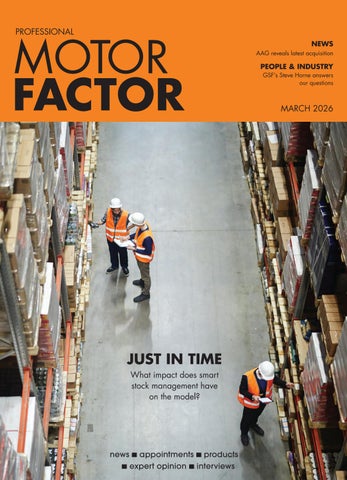
JUST IN TIME

What impact does smart stock management have on the model?

& SUSPENSION

Editor TOM HENMAN

Group Editor

KIERAN NEE

Digital Manager

KELLY NEWSTEAD

Group Manager

ALEX DILLEIGH

Senior Account Manager

MATTHEW BOASE

Design

ADEEL QADRI

Group Production Manager

CAROL PADGETT

Production Assistant

KERRI SMITH

Professional Motor Factor is an essential business magazine for those with decision-making responsibilities within motor factors.

To be removed from this magazine’s circulation, please call 01923 237799 or email circulation@hamerville.co.uk.

Printed by Stephens & George Ltd

Published by

HAMERVILLE MEDIA GROUP

Regal House, Regal Way; Watford, Herts; WD24 4YF

Tel: (01923) 237799

Copyright © 2026

Professional Motor Factor:

Certificate of Average Net Circulation for the issues distributed between July 2025 and December 2025

Net total: 4,977

United Kingdom: 4,977

The publishers and editor do not necessarily agree with the views expressed by contributors, nor do they accept responsibility for any errors of translation in the subject matter in this publication.

©pressmaster/AdobeStock (FC)

©Alexander/AdobeStock (Pg 22)

©F8 \ Suport Ukraine/AdobeStock (Pg 27)

©puckillustrations/AdobeStock (Pg 34)

POTHOLE PANDEMONIUM AND PRESSURE

In my local town, I have been fortunate enough to welcome major road projects over recent years. The A14 Cambridge to Huntingdon improvement scheme opened in May 2020 – eight months early – with the focal point a 12-mile bypass. The scheme cost a reported £1.5 billion. The road, as well as improvements to Huntingdon and new local access routes, has made a significant difference to me. It has made a journey to Cambridge, for example, significantly quicker.

The A428 Black Cat to Caxton Gibbet project, including a new three-tier junction, an underpass for the A1 and a new A421 flyover, is expected to be finished in 2027. For those that are navigating roadworks and taking curious diversions in a desperate attempt to avoid congestion regularly, the chequered flag for this project is in sight. Despite the frustrations and delays, I am in awe of the engineering feat. Every time I creep forward in stop-start traffic, I bore my wife and children with: “Wow, look at that!”

The hope is to improve traffic flow between the three roads, providing a new 10-mile dual carriageway to improve connectivity between Cambridge and Milton Keynes.

Despite a few disgruntled, fed-up voices on local social media community pages, I am incredibly grateful to be living in an area where significant investments have been made in road projects.

That being said, despite the enhancements and phenomenal engineering, quite a few roads in my local town are disintegrating – potholes are appearing at a rapid pace! Considering I’ve just bought a new car, in ‘frozen white’, the timing of these potholes and the dire weather couldn’t be worse.

It’s not just in Cambridgeshire, though, where pothole pandemonium is wreaking havoc. In one search on the BBC website, I read headlines of ‘I’ve counted 150 potholes in 200 yards’, ‘Northamptonshire council pays £120,000 in pothole claims since 2022’ and ‘Why short-term pothole repairs in Nottinghamshire are not lasting’.

More potholes on our roads mean more stress on steering and suspension components and, ultimately, more repair work. First Line has told PMF (page 34) workshops are seeing an increase in component wear, premature failures and noise/vibration concerns, particularly on EVs and heavier hybrid vehicles where additional weight intensifies impact loads.

Comline, meanwhile, believes you are the best conduit between supplier and workshop to reinforce best practice at the point of sale and offer technical support if it is required, specifically on top strut mounts (page 33).

A top strut mount connects the suspension strut to the vehicle’s body, shielding the cabin from road noise and vibrations while acting as the steering system’s pivot point. It uses rubber to absorb shocks and an integrated bearing (if required) to facilitate smooth rotation.

Comline says if a top strut mount is fitted incorrectly, it can lead to excessive noise, poor handling, an uncomfortable ride – but, more importantly, it can lead to worn or damaged parts that can have a knock-on effect on other parts of the steering and suspension system.

Away from potholes, elsewhere in your March issue, there are several articles that assess the importance of stock management. I urge you to pay close attention to Autoelectro (page 20) and the latest columns from workshop owner, Tim, and factor owner, Sanjiv (page 12) on the subject. I hope you find these as enlightening as I did.

Have a great month.

AAG REVEALS LATEST ACQUISITION | NAPA RACING RAISES MONEY FOR DEMENTIA CHARITY NEWS

Alliance Automotive Group UK and Ireland (AAG) has announced the acquisition of GC Auto Parts, a two-branch factor with annual sales of approximately €3.4m. It employs 14 people.

Operating out of Mitchelstown and Fermoy in the south of the Republic of Ireland, with over 40 years’ experience in serving the local community, AAG is “excited” to welcome the team to its family.

Meanwhile, NAPA Racing UK raised over £56,000 in support of Race Against Dementia during 2025.

Since 2023, NAPA Racing UK has been committed to supporting the charity founded by racing legend Sir Jackie Stewart OBE. e organisation focuses on “using the mindset of motorsport” to accelerate critical research into preventing and curing dementia.

During this time, the team has raised over £75,000 for the charity, contributing directly to research initiatives that seek to better understand dementia and develop effective treatments, helping to improve the lives of those affected by this condition.

AAG Managing Director, Steve Richardson, said, “We extend our heartfelt thanks to everyone who generously donated throughout the season.

e Knockhill race weekend is always a special one for the team, and this year we hosted a track walk with fans and offered limited edition merchandise to support our fundraising efforts.

“ese activations, alongside the continued support of our fans and partners, have been instrumental in driving progress in the fight against dementia.”

Building on this success, NAPA Racing UK has revealed that the partnership with Race Against Dementia will continue into 2026. e team is

planning several fundraising activations throughout the year to accelerate efforts and further support the charity’s vital work.

KLIPBOARD REVEALS NEW INTEGRATED PAYMENTS SOLUTION

Klipboard has launched Klipboard Money, a payments solution to help businesses get paid “faster, reduce operational friction and save time”.

Klipboard Money integrates into Klipboard’s business management platforms to simplify payments and account reconciliation, with the company taking a different stance to standalone payment providers that focus solely on taking payments.

Klipboard VP Payments, Lochan Sim, said: “For too long, payments have been treated as a separate function, something businesses have had to bolt on and work around.

“at approach has quietly eroded margins, created costly workarounds and slowed growth. Klipboard Money changes that. By embedding payments into the heart

of business operations, we turn payments from a source of friction into a genuine growth engine – helping customers get paid faster, operate more efficiently and scale without added complexity.”

For distributors handling account pricing and trade customers, Klipboard says its new solution supports complex, real-world payment scenarios. Whether at the counter, on an invoice, online or on the move, every payment can be connected into a single, sector-specific workflow.

Klipboard says early adopters are seeing the benefits of a simpler, more connected approach to payments.

Clarkins Car Accessories, for example, now has payments fully embedded into its

operational systems – claiming it to be a key advantage: “It’s so easy and it’s great it’s all inside Autopart. We have one place to go, one tool to use.”

LKQ ACADEMY EXPANDS EV, HYBRID AND ADAS TRAINING

LKQ Academy is increasing the number of seats available on its electric and hybrid vehicle training courses by 50% this year. e training provider is adding 500 spots across its EV courses, bringing the total to 1,500.

Research from the Institute of the Motor Industry (IMI) found that only one in four (26%) UK technicians are qualified to work on EVs, with skills spread unevenly across the regions. It also found the number of technicians gaining an EV qualification in Q3 2025 fell by around 13% compared to Q1 of the same period.

LKQ Academy offers EV training programmes at different skill levels. Among the courses available are the Level 2 and 3 IMI Award in Electric/Hybrid (covering routine maintenance activities, repair and replacement), the Level 4 Award (diagnosis, testing and repair of electric and hybrid vehicles and components), and the Becoming an EV Workshop course,

which prepares office staff and the workshop for EV servicing.

LKQ Academy says the trade faces a similar challenge when it comes to ADAS, with two-thirds of garages lacking a technician qualified to carry out ADAS calibration and repair work.

To address this, LKQ Academy’s IMIaccredited ADAS AOM230 course is now available at £499. e one-day course equips technicians with the knowledge and practical skills required to carry out ADAS calibrations and correctly interpret vehiclespecific system data.

UK GARAGE & BODYSHOP EVENT TO EMPHASISE LONG-TERM CAREER PROSPECTS

With UK unemployment on the rise, the organisers behind UK Garage & Bodyshop Event (UKGBE) believe the automotive aermarket has an opportunity to be part of the solution –by making it easier for jobseekers, school leavers and career changers to see the sector as a long-term option.

Between August and October 2025, 1.83 million people were unemployed in the UK, with the unemployment rate climbing to 5.1%. Youth unemployment is also increasing, with 735,000 people aged 16-24 out of work during the same period – an unemployment rate of 16%.

At the same time, UKGBE says professionals across the country continue to report persistent skills gaps. e issue is not a shortage of work, but the pace of change within the sector. EV technology, ADAS and calibration readiness, advanced materials, modern paint systems, structural repair and digital estimating are all “raising the bar” in terms of capability and technical knowledge.

Against this backdrop, UKGBE is placing skills, training and career development at the centre of its 2026 agenda.

Returning to the NEC Birmingham between 3 and 4 June, the event will bring together 200 suppliers and expects more than 5,000 professionals from across the trade to attend. e show combines an “interactive exhibition with live demonstrations, handson workshops and expert-led sessions”.

e 2026 edition will feature more than 80 hours of free training and practical content, designed to help technicians and business owners build confidence in both current and emerging skillsets.

Messe Frankfurt UK Event Director, Joanne Knowles, said: “ose unemployment figures are a reminder that there are thousands of people, especially

young people, who want a real opportunity. e aermarket can offer exactly that: a practical, skilled career with progression, purpose and long-term security.

“UKGBE is designed to bring the industry together around skills, not just to showcase innovation, but to make training more accessible, build confidence through hands-on learning, and help garages and bodyshops connect with the next generation of talent.”

PMF introduces this month’s movers and shakers as they begin a new stage of their career in the UK aftermarket.

Movers & Shakers

LKQ SYNETIQ

LKQ SYNETIQ, a dismantling and recycling specialist, has appointed Justin Elliot as sales director to “drive forward the business’ sales strategy and market development”.

Justin steps into the role at the joint venture with more than 13 years of experience at LKQ, having held a number of senior director-level positions within the group’s bodyshop division.

Alongside his appointment at LKQ SYNETIQ, Justin continues his wider European responsibilities as LKQ Europe’s head of collision and coating – strategy and innovation.

LKQ SYNETIQ, forged between LKQ Europe and SYNETIQ Ltd, combines LKQ’s distribution network and aftermarket expertise with SYNETIQ’s dismantling, reuse and remanufacturing capability, with approximately 27,000 vehicles dismantled annually across four UK sites in 2024.

Justin leads the execution of LKQ SYNETIQ’s sales strategy, with a focus on “strengthening customer partnerships, supporting market expansion and identifying new commercial opportunities” across the repair and insurance sectors.

Justin said: “LKQ SYNETIQ has a significant opportunity to reshape how recycled OE parts are brought to market, supporting customers with solutions that are both commercially competitive and sustainable at scale.

“I’m looking forward to getting started in this role, with a focus on strengthening our sales execution and ensuring we are fully leveraging the capabilities across LKQ and SYNETIQ to expand our reach, unlock new customer segments and deliver a consistent approach to market.”

MOTUL

Motul has announced the appointment of Mike Hansford as its UK and Ireland national sales manager for PCMO, motorsport and HD products.

Mike’s first involvement in the aftermarket came with Apec, where he worked in both marketing and sales, before taking up the role of territory sales manager in Southwest England at Schaeffler. In his 11-year tenure with the company, he progressed to regional sales manager for Southwest England, before moving to a key accounts role.

As national sales manager at Motul, his role includes spearheading Motul’s drive to acquire buying group business and increasing the brand’s presence in the general service and repair sector. He works in parallel with Jason Davies, Motul’s national sales manager for motorcycle and other powersport applications.

Mike said: “Joining Motul is a really exciting opportunity for me. The brand has an incredible history, having brought the industry every major breakthrough in engine oils in the last 75 years, and I believe that, with the quality of Motul products, our breadth of range and the competitive nature of the Motul product offer, we have a bright future ahead of us.”

FRASLE MOBILITY

Frasle Mobility, whose UK brands include Juratek, Abtex, Fras-le and Nakata, has strengthened its marketing team with the appointment of Olivia Naden as digital content executive.

Olivia is responsible for all aspects of digital marketing across Frasle Mobility’s house of brands, including developing social media content, email campaigns, web content and SEO to support brand development and customer engagement.

Olivia joins the business at a time of “continued investment and expansion”. Having launched the Nakata brand into the UK market last year with a wheel bearing range, the company is now set to launch a range of steering and suspension components in the first half of the year.

The new recruit said: “The expanding product portfolio and the creative opportunities this presents to help bring the brands to life in meaningful and engaging ways is very exciting. It’s one of the things that attracted me to this role, along with the company’s ethos for sustainability, social causes, and employee recognition, which aligns with my own values.”

IGNITION POINT

JUST IN TIME? WHAT’S THE MODEL’S ROLE IN TODAY’S AFTERMARKET?

TIM BENSON OLDFIELDS GARAGE OWNER

The idea of ‘just in time’ still has a place in the aftermarket, but only when it is anchored in local knowledge and honest communication. If the vehicle parc is understood and planned for, a well-run supply chain can keep pace. We hold very little stock of our own – our parts department is our factor partners. The friction arrives when reduced stockholding is paired with optimistic delivery promises. That is when you see a car sat on a ramp, a technician waiting, and a service advisor taking heat that belongs with the process rather than the people. In most cases this doesn’t become an issue with our suppliers.

We expect factor suppliers to profile the vehicle parc properly. They have access to data; it should be used to minimise disruption to customers they supply. If a supplier knows what is in an area, they have a good idea of what rolls through our doors week in and week out. This means the fast movers live within reach and the rest is scheduled with confidence. This should be the first duty of a partner who wants to help workshops protect productivity.

If VMs are having supply issues that impact workshops, our experience is that this is not the same with parts factors. The gap is information. When upstream pressure is shared early and clearly, we can plan around it. When it is not, timelines slip and a productive ramp becomes an expensive parking space. We are not interested in blame. We are interested in early sight of risk and practical workarounds.

At Oldfields Garage, we treat availability as a shared responsibility. We like to work closely with a main supplier because consistency matters, but we never rely on a single route. We can’t. Most garages have more than one factor supplier, as it enables them to keep technicians productive and the workshop flowing. A strong panel of options protects the day’s plan when a warehouse miss or a courier delay crops up. If a delivery is slipping, we want to know early so we can plan.

Customers only blame the workshop when we look surprised, so we explain the path their part travels, we keep them updated, and we offer an alternative. The model still works, provided the partnership works first.

SANJIV SHAH CAR SPARES FACTORS OWNER

The ‘just in time’ model has always been a balancing act. Workshops quite rightly expect parts to arrive exactly when they need them. At Car Spares Factors, we recognise that pressure and we believe the model still works in today’s aftermarket – provided it’s supported by the right stock strategy, transparency and systems. Speed of delivery remains central to our service. Our priority is simple: get the right parts to our customers in time for them to complete the job for their own customers; however, the reality of an everexpanding vehicle parc means stock ranges are growing daily. No supplier or factor can physically hold every part in every depot. Where parts aren’t available for immediate delivery, clear communication is essential. Customers need to know delivery times upfront, so they can decide whether to wait or source an alternative. That openness helps avoid frustration and misplaced blame when delays occur.

Importantly, the model hasn’t caused difficulties for CSF because we haven’t reduced our stockholding. Instead, we constantly review and refine it. Core, fast-moving lines – service kits, braking components and everyday maintenance parts – are always on the shelf. That ensures the majority of ‘run-of-the-mill’ jobs can be completed without delay. More specialist or slower-moving parts may not be stocked everywhere, but we can still deliver to the garage within one to two days maximum.

Space is one of the biggest challenges. With ranges increasing, it’s not practical to expand every depot indefinitely. Our solution is a ‘huband-spoke’ approach: larger branches support smaller depots, backed up by inter-branch vans running up to four times-a-day. This allows us to offer two to two-and-a-half-hour delivery on many lines, rather than our usual one-hour service, even when stock isn’t held locally.

Behind the scenes, sophisticated stock management plays a critical role. Lost sales are logged and analysed by our procurement manager, Richard, who oversees purchasing, stockholding and supplier relationships. By understanding why a sale was lost, we can adjust future orders and get the right parts onto the shelves faster. Our stock lines are lean and purposeful – what we hold is moving, selling and supporting our customers’ businesses.

The just in time model works for us – but only because it’s combined with active stock monitoring, honest communication and investment in operations and logistics.

GSF CEO AIMING TO HIT £1 BILLION ANNUAL TURNOVER IN QUEST TO BECOME NUMBER

ONE UK DISTRIBUTOR

GSF Car Parts plans to open 20 new branches in 2026 after delivering more than 20% annual growth for three consecutive years. Despite industry challenges, the company says strong legacy branch performance, supply chain investment and a customer-first approach are driving profitable expansion, as it works toward its ambition of becoming the UK’s number one aftermarket distributor with a £1 billion turnover target.

GSF plans to open 20 new branches in 2026, following a challenging year for the wider industry and the opening of 27 branches over the past two years –what gives GSF the confidence to accelerate its branch expansion at this pace?

A Q A Q

We believe our relentless focus on “the customer is king” and “being the easiest to trade with” is the reason GSF has grown more than 20%, year-on-year, for the last three years. We know we have many more locations in the UK that we still can’t provide that great GSF service to because we don’t have a local branch. Every new branch we have opened to date

has exceeded its business plan, so this gives us the confidence to continue our momentum.

GSF says it has achieved growth of more than 20% in each of the last three years despite industry pressures – what have been the key drivers behind this?

The common misconception is that our 20%-plus growth is from new branches – of course, they are a key driver – however, almost three quarters of that growth is from our legacy branches.

I believe it’s our customer relationships that power growth. Every day, our branches go above and

beyond to ensure the customer is king. It’s a competitive market, and we relish that. We always have to remember “we’re only ever as good as our last order”.

We aim to be the easiest supplier to trade with and prioritise availability. We also trust and empower local teams to make decisions. They know what the customer wants and are incredibly motivated to succeed.

Everything at GSF revolves around the customer. You can see that through our ‘DirecTour’ and ‘DirectFloor’ initiatives where we get senior leaders out of the offices and into the network. And just look at how far TechFest has

come: in just over 12 months it went from an idea to running our fourth TechFest with 5,000 people joining us last time in Wembley.

With each new branch bringing additional costs, such as premises, utilities and staffing, how is GSF balancing continued investment with maintaining profitability?

We are and will always drive to be a high service, low-cost operator.

A A Q Q

We invest to fuel profitable growth and will look at all opportunities. GSF has the agility to make decisions and move quickly. We don’t have layers of bureaucracy slowing us down.

Our NDC in Wolverhampton has become fully operational in record time, delivering huge benefits in terms of supply chain efficiencies and availability. Last year we launched a record number of new products, and we increasingly have the scale to fully realise the benefits of global sourcing.

What criteria is GSF using to identify and select locations for new branches?

When Sukhpal and I acquired GSF, one of the first tasks we completed was a strategic network review. We built a complex gravity model using internal and external data to identify where the best locations are for GSF to open branches and the size of the opportunity.

Of course, these models are never absolute; they require input from local knowledge. There also must be availability of trade units and the ability to recruit the best colleagues.

Last year we trialled an incredibly successful ‘satellite’ concept that allows GSF to open in locations that otherwise would not be possible. This means we will be able to service even more hardworking IMT customers.

Q

GSF has stated its ambition to be the “employer of choice, offering the best rewards and opportunities for success” –what practical steps is the business taking to achieve this?

AI want everyone to realise their potential at GSF and be rewarded for success. I’m proud of the culture we’ve built at GSF – our latest employee engagement survey backed this up. We’ve hired 1,500 new colleagues since 2023 and now have more than 4,000 colleagues on our team.

We’ve also committed to raising standards, with over 7,000 hours of training and development completed. Promotions are also commonplace, with a record number of internal promotions across the business.

A combination of fantastic people who have been here a long time and hiring highly motivated individuals makes us “the winning team”.

A Q

What milestones or KPIs will GSF use to measure progress toward its goal of becoming the UK’s number one aftermarket distributor?

My personal challenge and the milestone I have challenged the business is to grow GSF to a £1 billion annual turnover.

We don’t focus on the competition; we only focus on what we need to achieve. We have so many opportunities and plans to keep growing, one being the re-launch of our Servicesure National garage network. I have every confidence GSF will be the number one aftermarket provider in the UK.

A Q

How does GSF’s continued expansion fit into its longterm ownership and investment strategy?

We are the fastest-growing European aftermarket provider and will continue to invest heavily to achieve our potential. All our investments are funded from our own cash. Our investors are 100% behind us and trust us to deliver what we promised.

And for anyone wondering, Sukhpal and I are going nowhere.

L-R: John Williams (Divisional Director); Steve Horne (CEO); Rebecca Fensome (Bedford Branch Manager); Sukhpal Ahluwalia (Executive Chairman); Rob DeAngelis (Luton Branch Manager)

FROM PARTS COUNTER TO OEM REPAIR DATA: DAMIAN MILLING LEADING ALLDATA’S UK AND IRELAND GROWTH

Since joining ALLDATA Europe as UK Sales Director in September 2025, Damian Milling has worked closely with colleagues across sales, marketing, training and support to accelerate growth across the UK and Ireland. With more than 30 years’ experience in the automotive aftermarket, Damian’s journey from cutting cardboard boxes in a Devon motor factor to leading commercial teams within major OEM-aligned organisations gives him a unique perspective on what automotive businesses need to succeed.

“I’ve always believed in representing a product I truly believe in,” Damian began. “What excites me about ALLDATA is how the teams across Europe have built a complete solution for automotive professionals. It completes the triangle: OEMquality products, trained technicians and, through ALLDATA Repair, the process guidance to enable the technician to do the job right every time. Without that, there may be gaps that could compromise quality, efficiency and warranty.”

FROM OEM EXPERTISE TO INDEPENDENT AFTERMARKET SUPPORT

Before joining ALLDATA, Damian gained extensive OEM insight through roles developing a strong grounding in product

quality, manufacturing, sales and marketing. His roots, however, remain firmly in the independent aftermarket. Over 22 years working across Devon and Cornwall, covering 18 branches within a motor factor network, he held virtually every role required.

Damian believes that blend of hands-on experience and OEM understanding reflects the ethos his new employer brings to the aftermarket.

Damian explained: “My career means I can relate directly to the daily challenges technicians, in particular, face – from frozen knuckles to hard-to-find parts. But what really makes the difference is having a product and support structure behind you that genuinely helps solve those problems. The way ALLDATA teams work together

means we can clearly demonstrate how OEM repair data saves time, reduces errors and adds real value to businesses.

“If I don’t believe in something, I can’t represent it honestly. The investment ALLDATA continues to make in its people, product and customers gives me total confidence in what we’re offering.”

WHAT’S BEHIND ALLDATA?

ALLDATA Repair provides access to over 106 million technical articles, including more than nine and a half million wiring diagrams across 44 vehicle brands, all sourced directly from OEMs.

Damian continued: “We give workshops everything they need in one place –diagnostics, technical service bulletins, fault codes, repair and maintenance procedures –all straight from the manufacturer. Crucially, ALLDATA Repair allows workshops to quote, diagnose, repair and service a vehicle, supported by local sales, training and customer support teams.” While the scale and volume of information is significant, Damian sees this as a major strength: “Doing the job right first time is critical. With UK labour rates averaging £75-85 per hour, the efficiency gains quickly outweigh the cost.

Accurate OEM data means fewer

misdiagnoses, fewer incorrect parts and far fewer costly comebacks.”

LEADERSHIP, LOYALTY AND LONGEVITY

For Damian, success at ALLDATA is driven by people and culture as much as technology: “At ALLDATA, leadership is built around empathy, trust and respect,” he said. “My role is to enable teams to thrive, not to control how they work. We communicate daily, embrace different personalities and approaches, and stay united around one goal: delivering the best possible experience for our customers.”

Damian says that customer-first mindset extends to how ALLDATA approaches growth: “We’re confident we have one of the strongest products in the market, and it continues to grow in value after purchase because of ongoing investment. But if the solution isn’t right for a customer, we’d rather not sell it. We’re focused on long-term partnerships, not short-term wins.”

MAINTENANCE SCHEDULES: THE ONE-STOP-SHOP COMPANION

Damian believes the recent rollout of ALLDATA Maintenance Schedules adds further value, delivering vehicle-specific, OEM-based servicing plans across 61 brands. For you, the triangle of maintenance schedules, labour times and repair means you can offer an all-in-one solution to your workshop customers.

“Maintenance Schedules removes uncertainty,” Damian said. “When workshops follow this OEM-based guidance, it takes away the ‘have I done it right?’ question and gives them confidence that the job has been completed correctly.”

CHANGE IN THE AFTERMARKET? CHANGE IS ALREADY HERE!

Looking ahead, Damian believes ongoing collaboration between technology, data specialists and the aftermarket will be essential as EVs, ADAS and vehicle complexity continue to grow.

“Technicians can’t rely on guesswork anymore,” he said. “They need accurate, up-to-date technical information to work safely, efficiently and profitably. That’s exactly what ALLDATA Repair is designed to deliver – helping independent businesses keep pace with technology while remaining competitive.”

By combining OEM data expertise with strong teams, customer-focused culture and continuous investment, Damian is confident ALLDATA is not just a data provider – but a long-term partner.

His message is clear: “Accurate OEM repair data strengthens workshop performance and supplier relationships –so offering ALLDATA subscriptions becomes a natural extension of a motor factor’s value proposition. It reinforces technical credibility, reduces returns and builds longer-term customer loyalty.”

BACK TO BASICS: CSF’S NEW BRANCH MANAGER WANTS TO

MAKE CSF

NUMBER

ONE IN WELWYN GARDEN CITY

Hakan Inal is the new branch manager at Car Spares Factors’ Welwyn Garden City branch. With long-standing experience in the area and a hands-on approach to customer service, he has already implemented early-morning deliveries and reinstated direct branch phone lines to strengthen relationships and drive growth. Responsible for a team of six, it is a role he is clearly relishing – whether delivering parts, talking to customers or leading the team.

Congratulations on the promotion – was it a surprise?

Yes, it really was – I wasn’t expecting it at all! I got a call asking me to come to head office to discuss a proposition. Usually, when you’re called to head office, you think you’re in trouble, but it turned out to be an opportunity I couldn’t say no to.

Before this role, where were you working?

depot, working alongside Yusuf, the branch manager there. We worked very well as a team, and I gained a lot of knowledge from that experience, ready to take on this new challenge.

How did your career in the motor trade begin?

A Q A Q A Q A Q A Q

I was the assistant manager at the Waltham Abbey

I’ve been in the industry since I left school at 16 on an NVQ scheme. Over the years, I’ve worked my way up from picking stock and answering phones to assistant manager – now branch manager.

When you were told about the promotion, what was your first thought?

Generate some ideas! I’d previously worked in Hatfield, so I knew the customer base already. It was about walking back in, rebuilding relationships and letting customers know we’re here, fully operational and ready to deliver an outstanding service.

How did customers react to your return and promotion?

Many were surprised and pleased –I think! We reopened the phones

directly to the branch rather than diverting to head office, which customers really appreciated. They prefer speaking to someone they know.

What immediate changes did you implement?

I spent the first month visiting customers face-to-face to build trust. I also created a WhatsApp group for special offers and quick communication, as well as a 7:30am delivery service, so garages receive parts before 8am. That early delivery has been a big success because it reduces lost labour time for our customers.

Have you introduced any inbranch changes?

Yes, we improved the counter area with promotional screens and a ‘bargain trolley’, featuring older tools and special offers. It’s increased impulse purchases – customers often come in for a filter and leave with a tool as well.

Do you get much retail footfall?

Yes, quite a bit actually. We’ve been around for a long time, so people know us. We also come up well in Google searches, and sometimes

A Q A Q A A Q A Q A Q A Q Q

customers confuse us with competitors nearby – but we often end up offering a stronger value proposition, so we win the business.

There’s strong competition in the area – many familiar national names – does that concern you?

It’s a challenge, but I thrive on that. My focus is making us the number one supplier in the area. I believe in faceto-face relationships and old-school service. That’s how you win loyalty.

How important is technical knowledge in your role?

Very important! Factors need to understand components to avoid incorrect parts being supplied or warranty issues. Between myself, my assistant manager – a former mechanic – and trusted contacts, we ensure customers get accurate support. We even help with main dealer part numbers when needed – that builds trust.

What do modern garages expect from a factor?

Speed and efficiency. They don’t hold stock like they used to. If they need brake pads, they need them immediately. As soon as an invoice prints here, the part is picked and ready for dispatch. Time is money for garages.

Finally, what part of the job do you enjoy most?

Sales and customer interaction. Every call is different. Helping someone out and earning back their business is very satisfying. Word of mouth is powerful in this trade.

Excellent stock management is crucial when it is increasingly improbable to have all the stock you need for today’s vehicle parc, insists Autoelectro, emphasising the importance of choosing a supplier with a wide vehicle range and availability to match.

SMART STOCK MANAGEMENT PIVOTAL IN TODAY’S DIVERSE

AND EXTENSIVE VEHICLE PARC, INSISTS AUTOELECTRO

Autoelectro, celebrating 40 years in business in 2026, is feeling the impact of the growing complexity of the vehicle parc. From modern 48V MHEV technology and start/stop systems to CVs and the ageing population of older models still in daily use, the remanufacturer of starter motors and alternators says it is continuing to stock units to cover every enquiry.

The rotating electrics specialist says it has the capacity to remanufacture and stock virtually every part number in its portfolio, despite the number consistently increasing and showing no sign of slowing. As a result, the remanufacturer believes it is supporting the motor factors that are finding it increasingly difficult to choose which units to stock in-house.

To complicate matters further, there is often more than one starter motor or alternator that can be fitted to the same model – dependent on the specification of that particular vehicle, including if it has start/stop or not.

Autoelectro’s Harnek Bhogal believes the factors that possess the best analytical resources and are able to use that data will have a competitive advantage.

He said: “For motor factors, it’s very difficult because they have a lot of product categories to account for, and they only

have limited space. Expecting them to be able to stock everything is unrealistic, but the factors that are able to analyse historic sales data by part number, vehicle application etc to identify genuine fastmoving units, as opposed to occasional or one-off sales, will be in a strong position.

“They should also be able to track seasonal sales data, recognising that it may be worth increasing stock holding during peak times of year.”

RELY ON QUALITY

To cater demands, Autoelectro, with its remanufacturing knowledge and equipment, states it can react to changes in the external environment. There are no shipping delays or exchange rate fluctuations, for example, so it can fill gaps and respond when factor stock isn’t available.

Harnek continued: “We don’t do back orders; our UK-based remanufacturing

facility means our availability is second-tonone. In the current competitive environment, whereby a lot of factors are competing for the same sale, being able to say “yes” to every enquiry is worth its weight in gold because it builds trust. Factors know that they can rely on us.”

MHEV 48V UNITS AVAILABLE IN THE AFTERMARKET – NOT A DEALER-ONLY PRODUCT!

Autoelectro reports one of these shifts is the increasing number of enquiries and orders of its 48V MHEV units. A belted starter generator is an electric-motor generator integrated with aspects of traditional starter motors and alternators. It is a single belt-driven unit mounted to the engine that can both start the engine, generate electrical power, bolster fuel efficiency and reduce emissions.

Autoelectro claims it has received plaudits from customers for the breadth and availability of its 48V MHEV range. Specifically, when dealer stock is nonexistent and the vehicle is only two or threeyears-old – an increasingly common scenario – customers don’t expect these units to be available in the aftermarket. Discovering that Autoelectro lists the correct part number and is available from stock for next-day delivery is often a surprise.

Harnek added: “This availability can be the difference between winning and losing a sale.”

DUAL STOCKING FOR SUCCESS

Autoelectro believes there is a compelling case for dual-stock rotating brands. While a ‘value’ option may appeal to price-focused customers, relying solely on this range can “limit the ability to answer every enquiry”.

The company says premium brands offer a wider vehicle parc coverage, excellent product quality and the reassurance that when availability or application accuracy really matters, there is a trusted solution to fall back on.

Harnek concluded: “In a zero-sum market, this is a critical consideration. A garage customer with a vehicle on the ramp needs an alternator or starter motor quickly. If one motor factor can’t supply it, the enquiry doesn’t disappear – it simply goes to a competitor who can.”

By combining strong data analysis with the right suppliers, Autoelectro is confident you can maximise availability, protect sales and build long-term customer trust.

WHAT TO DO WHEN SOMEONE REQUESTS THEIR DATA

What happens when someone asks for the data held about them? In her latest column, Mandy Huntley, a data protection specialist, explains the process and how you can be supported if a request is made.

In data protection law, the people about whom we hold data are called ‘data subjects’; therefore, when they request access to the data held about them it’s called a Data Subject Access Request (DSAR). In my experience, these requests are normally made when there’s a dispute, commonly an employment dispute. DSARs have become more common in recent years, as people are becoming more aware of their rights and a change in the law prevented businesses from charging people in most cases.

Once a request is received, generally the business has one calendar month in which to respond. This can be hard to meet if the volume of information exceeds the resource available to collate and prepare it. Sadly, people know this, and what is intended to be a useful right enshrined in law is sometimes misused as a way of causing disruption.

CASE IN POINT

A business owner contacted me, as they had received a DSAR from an outgoing member of staff requesting everything which identifies them. There was very limited capacity to pull the information together. As the law states that companies need only undertake a reasonable search for information and can seek to scale back the request where it is excessive, I advised them to write to the data subject and explain that a reasonable search may not provide them with everything and, therefore, it may not provide them with the information they required. I suggested asking the data subject to narrow their request allowing the company to focus on a specific area or type of record. Unfortunately, they took conflicting advice and offered a one-off payment as

final settlement with the person on the condition that they drop the DSAR. Of course, soon after, the next DSAR landed from another former employee who is quite friendly with the first.

This is an area where the Information Commissioners Office, the UK data protection regulator, has acted against owners of businesses of all sizes. It’s vital to have a process and follow it if a request is received.

If you would like to arrange a call with Mandy to talk through DSARs or any other aspect of data protection, please email mandy@mandyhuntley.co.uk

TOP TIPS FOR DATA SUBJECT ACCESS REQUESTS

1.Identify it and don’t ignore it: It’s unlikely to go away. Think of any request where a person is asking for information in which they are identifiable as a DSAR. Some requests can be dealt with informally and quickly, but you should have a process nevertheless.

2.Confirm the identity of the person: If it’s a customer, ask them to prove their identity. In the case of a member of staff, speak to them directly if necessary. If the request is from a third-party, take some advice from a professional as it can be more complex.

3.Assess the request: You will need to redact (blank out or obscure) information about other people so consider the resource available within your one-month timeframe. You can’t refuse a reasonable request because you don’t have the resource available. You would be expected to find resource or bring it in. A client of mine recently brought in a virtual assistant for a defined number of hours to compile the information for a DSAR. If the request is excessive, you can go back and ask the person to narrow it down.

4.Collate the data: Search electronic and paper-based systems. Have a process for this and ensure you have somewhere secure to store all the collated information.

5.Redact information which cannot be disclosed: There are certain circumstances where information cannot be

disclosed: firstly, information relating to another person; for example, if it’s a disciplinary record, you would redact the name of the person who made an allegation. Likewise, you might want to redact commercially sensitive data which a former employee is no longer entitled to.

6.Preparation for disclosure: Your final preparations should include a full copy of the data so that you can see what was disclosed in the future if necessary. Consider how you are disclosing the data. If by post and the data is sensitive (relating to health, race or ethnic origin, political opinions, religious or philosophical beliefs, trade union membership, genetic or biometric data, sex life or sexual orientation) send it by special delivery or courier so that it is tracked end-to-end. If sending electronically, get the informed consent of the person and password to protect the data. If possible, hand the data to the data subject personally and ask them to sign to confirm receipt.

7.Send it: Once you are sure it’s ready, complete and secure send it. Confirm receipt of the information with the recipient.

To connect with Mandy on LinkedIn, www.rdr.link/FAZ008

OSRAM has revealed that its sales of HID bulbs are growing – with some customers seeing a reported 50% increase in sales themselves – what does the OEM put it down to?

WHAT’S BEHIND THE SURGE IN OSRAM’S HID BULB SALES?

First introduced in 1991, HID bulbs quickly became a common bulb to use in vehicle headlights, with the BMW 7 Series the first to debut the world’s first xenon headlamp system. While technology has evolved since then and factory-fitted lighting in new cars are now typically moving towards LED, notes OSRAM, there are still millions of cars that have HID bulbs fitted as standard and many more that will require replacement because of failure and end of life.

OSRAM claims its HIDs typically use less energy and have a longer lifespan than halogen bulbs. Throughout the 1990s and 2000s, HID lighting rapidly

spread from luxury flagships to mainstream models. Manufacturers and lighting specialists worked in tandem to refine the technology, developing compact bulb formats and advanced electronic ballasts that would soon become industry standards. As demand increased, OSRAM played a “pivotal role” in delivering HID solutions.

WHAT’S INSIDE OSRAM’S HID RANGE?

Today, OSRAM’s XENARC HID range comprises innovation backed by decades of expertise and a reputation as an OEM. Products that are prominent in this portfolio

While OSRAM is unsure what’s driving the demand, have customers offered any suggestions themselves?

We are currently in a phase of change when it comes to lighting.

OE LED homologated units are being fitted as standard to lots of new vehicles; however, the HID revolution started in the 1990s and continued to grow into the 2010s. When LEDs started to become more popular and vehicle designers and

include the XENARC NIGHT BREAKER 220, which is OSRAM’s brightest HID upgrade bulb. It has a 250m long beam and up to 20% whiter light, allowing drivers to see further and, therefore, respond to the conditions on the road earlier.

If a driver is looking for more, whiter light, OSRAM offers the XENARC COOL BLUE INTENSE range, which offers up to 150% more brightness than the minimum legal standard; however, if a driver is focused on a reliable bulb that will last a very long time, OSRAM’s XENARC ULTRA LIFE has a 10-year guarantee. This is up to four times longer than a standard HID bulb.

Finally, OSRAM has the XENARC ORIGINAL range, which has a four-year guarantee and is OE quality. These bulbs fit a variety of vehicles, are manufactured in Germany and are the same as those fitted at point of manufacturing.

Terri Clark, OSRAM’s marketing manager, admitted the company is unsure if the winter selling period has grown this year or is a general lifecycle trend. Nevertheless, PMF put some questions to Terri to find out more about OSRAM’s HID range and trends the company is seeing:

manufacturers preferred the LED alternative, HID fell away, but the numbers of HIDs in use were still much larger than LEDs.

With an ageing car parc, this would mean there are cars dating back to 2016

and beyond with HIDs. Combined with the fact that HID bulbs tend to last five years, we are seeing that cycle of replacement for vehicles made in 2016 up to 2021. Probably the last years of HIDs being fitted in large numbers – before LED headlight units really took off.

Another reason – and we don’t sell these, so difficult to understand – is that HID conversion kits could have come back in popularity. These are used and fitted to

replicate the LED look. While not road legal, for many motorists who want the LED look, fitting an HID conversion kit is cheaper than replacing headlights with OE LED light units. To reiterate, we don’t sell conversions kits so don’t have data to test this.

Over the 20-plus years of HIDs in the market, the technology has become familiar, and more and more workshops understand how to work with HID systems.

This could also be another reason for the growth. No longer are the workshops sending customers back to main dealers and HIDs being pulled through the OE supply chain. Instead, the aftermarket is now pulling the product through.

Which vehicles are seeing high HID replacement demand?

A Q A A Q Q

Whilst we don’t have access to detailed replacement numbers, as a guide we would say the most common vehicles that have xenon/HID bulbs fitted are the premium German and Japanese car brands, like BMW 3 Series, 5 Series, 7 Series; Audi A4, A6, Q5; Mercedes Benz C Class, E Class; Lexus IS/GS and Mazda 6/CX 5.

Are there any common fitting issues or misconceptions factors should advise workshops about?

When HIDs were first introduced, many people mistakenly believed they were dangerous because they operated at high voltage. Often, independent garages would refer them back to main dealers, but as explained in answer one, HIDs and the technology are now familiar systems.

How can factors best utilise OSRAM’s support or promotions to boost HID sales?

We have a complete SKU offering of all the different HID types, including some more recently launched types: D5S and the D8S. There is a wide range of upgrade options to maximise choice and profit (www.rdr.link/FAZ009), as well as a useful vehicle application look-up service for correct fitment (www.rdr.link/FAZ010).

For more information about OSRAM, www.rdr.link/FAZ011

EEC PUSHES AHEAD WITH TRAINING PROGRAMME

European Exhaust and Catalyst

offers training to factor staff to increase their confidence and knowledge – ultimately, help grow their emissions business. Stuart Still, the company’s technical trainer, has recently carried out an “intensive” two-day session for one of its distributors.

EEC supports its customers with technical advice, fitting assistance, data analysis, stock guidance and industry knowledge. This is part of a dedicated education and training curriculum to help EEC’s customers understand, evaluate and diagnose emissions issues.

EEC’s technical trainer has just finished a lengthy training course, held in support of a significant distributor of the company’s products. This took place at the head office of one of the distributor’s largest garage networks, with the aim of “dispelling the notion that aftermarket emission products are substandard in comparison with OE”. EEC acknowledges this is a point of debate in the sector.

Eight sessions were held across two days, with 31 employees enrolling – some

travelling long distances to attend. The attendees represented each of the customer’s 17 locations. EEC believes the sessions were well-received and both the customer and EEC’s distributor were grateful for the support shown.

EEC says a handful of candidates were eager to delve into a technical depth too great for the allocated time –but an additional workshop may follow at a later date. Nevertheless, everyone left with a training certificate (valid for two years) which ensures they have the capability to identify some of the “common misconceptions” around aftermarket products, as well as a

COURSE DETAILS

greater understanding of the role catalytic converters, DPFs and the exhaust system play.

With the emergence of European emission control guidelines (Euro I, II, III, IV, V and VI), the exhaust system and all its elements have become “more important than ever” due to their direct impact on the engine’s emissions. Consequently, EEC reports it will continue to develop and evolve its training programmes to meet ongoing trends and developments.

To discuss a training programme for your staff, EEC requests that you email sales@eurocats.co.uk

EEC says its emissions training courses are delivered by highly experienced technical experts, with the main functions of the exhaust system, as well as engine performance, fuel consumption and control sound reduction, key focus areas.

The catalytic converter is also a topic of interest; training participants are taught how each element works, with particular concentration on the various components of coating applied. Another aspect is fault-finding using a four-gas analyser, which EEC believes is one of the most important diagnostic tools in the engine repair sector.

EEC notes that its trainers are often surprised how little information the technician retrieves from a four-gas analyser during an emissions test.

DPFs are also covered; information relating to functionality, fitting and fault diagnosis is included in the training – did you know that the DPF is a service item? When it reaches the end of its service will vary by VM and by how the vehicle is maintained.

For more information about European Exhaust and Catalyst, www.rdr.link/FAZ012

MANN-FILTER AND VEHICLE EMISSIONS: WHAT UK DISTRIBUTORS SHOULD KNOW

Amodern engine’s air path is calibrated around a defined airflow and pressure drop. Consistent air filtration helps maintain the intended air-fuel ratio control, supporting stable combustion and reducing the risk of soot formation that can increase particulate loading downstream. What’s more, high-quality air filtration helps reduce the ingress of abrasive dust that accelerates wear in turbochargers, piston rings and cylinder walls, says MANNFILTER. These are “wear mechanisms” that can increase oil consumption and, in turn, particulate emissions and aftertreatment stress over time.

The key point is not “more power” claims, but “repeatable filtration efficiency and dust-holding capacity” that supports predictable service intervals and reduces the likelihood of comebacks linked to drivability or sensor-related fault codes.

WHAT DOES THIS MEAN IN REALITY?

MANN-FILTER positions its emissions impact not simply in terms of compliance, but as a matter of risk reduction and longterm performance stability.

By helping to minimise airflow deviation, injector contamination and

REDUCING OIL-DERIVED PARTICULATES AND PROTECTING AFTERTREATMENT

Oil condition is a major contributor to real-world emissions performance, reports MANN-FILTER. Effective oil filtration helps control soot, wear metals and sludge, supporting stable lubrication and reducing the probability of elevated oil consumption. Lower oil consumption reduces the risk of oil ash accumulation in exhaust aftertreatment components, which can contribute to increased backpressure and reduced system efficiency over time.

If you’re supplying fleets, MANN-FILTER says this translates into lower risk of premature aftertreatment issues and more consistent emissions behaviour between services.

SUPPORTING INJECTOR HEALTH AND CLEAN COMBUSTION

High-pressure injection systems are highly sensitive to water and fine particulates, notes MANN-FILTER. Fuel filtration that reliably separates contaminants helps protect injector spray patterns, which are critical for complete combustion. Poor atomisation can increase soot and unburned hydrocarbons, raising the burden on DPF regeneration strategies and potentially increasing fuel consumption – both of which influence carbon dioxide and tailpipe emissions outcomes in real operation.

CABIN AIR FILTRATION: INDIRECT EMISSIONS AND COMPLIANCE VALUE

Cabin air filters don’t change tailpipe emissions, but they matter because in-cabin air quality is increasingly part of fleet and corporate ESG expectations. Supplying premium cabin filtration supports your value proposition around “clean air” packages and scheduled maintenance bundles.

While filters are not necessarily emissions devices in the same way as catalysts, DPFs or SCR systems, according to MANN-FILTER, filtration quality has a measurable enabling effect on emissions stability. This is particularly true of engines, aftertreatment systems and onboard diagnostics, which are more sensitive to contamination, airflow deviation and fuel quality variation.

accelerated component wear, effective filtration can reduce the likelihood of emission-related comebacks. This means fewer repeat visits linked to drivability issues or warning lights triggered by underlying contamination problems.

Consistent filtration efficiency and strong dirt-holding capacity also contribute to improved service interval reliability. Maintaining stable performance between services is critical, particularly as modern engines and aftertreatment systems operate within increasingly tight tolerances.

In addition, protecting high-value components – including turbochargers, injectors and aftertreatment systems –plays a direct role in sustaining emissions performance over the life of the vehicle. Failure or degradation in any of these areas can have a measurable impact on output and compliance.

As UK emissions scrutiny shifts towards real-world durability, protection and consistency is not just desirable, but essential.

KALIMEX: SERVICING DELAYS CONTRIBUTING TO DRIVE IN ADDITIVES

Kalimex reveals what is driving the rise in additives and why trade customers are reaching for them more than ever. From delayed servicing to stricter emissions standards, drivers are looking for ways to keep vehicles running efficiently, pass MOTs and reduce their environmental footprint.

You hold the cards when it comes to recommending trade customers the products you consider best in class. That same goes for motorists, often faced with too much choice, but little idea which product to choose, according to Kalimex.

Kalimex is the sole UK distributor of JLM Lubricants’ range, and in the last 12 months, it says there has been a rise in demand from motor factors for products within the portfolio. The company puts this down to workshops wanting products that reduce emissions, do the job when servicing a vehicle or need something to assist a vehicle pass its MOT.

These products are a good repeat purchase, explains Kalimex Managing Director, Mike Schlup, who says trade customers buy in big numbers.

Mike told PMF: “Technicians are now actively promoting our emission-reducing products for many reasons, including being socially responsible and reducing the requirement for new parts.”

Mike cited 2025 research from York University that found that passenger cars with left-side exhausts – common in the UK – contribute 40% higher pollution concentrations at the kerbside.

Furthermore, DEFRA says traffic congestion, stop/start driving, road gradient and driving style can have a significant impact on emissions.

Mike continued: “Naturally, to meet Euro standards, technologies like DPFs were created to reduce regulated pollutants –but a DPF can quickly become blocked, even damaged beyond repair, if driving style and driving conditions are less than optimal for DPF health.

“You have an important role to play when advising customers of the additives they should use at the first sign of a DPF becoming blocked or simply to maintain it in good health. The same applies when talking to customers about products designed to reduce harmful emissions and how they can do their bit, beyond buying the best additives.

“Of course, buying the right products is crucial – no-one wants to buy twice. If motor factors can educate their customers that doing their bit for the environment can be accomplished with, for example, a few changes in driving style, it all adds up to a much healthier environmental picture.”

WHY FLEET OPERATORS STILL LOVE DIESEL

Kalimex says fleet operators are potentially profitable customers, given there remains a healthy demand for using products over parts, wherever possible.

Mike continued: “The very nature of the vehicle fleet means that operators are maintaining vehicles with a range of different exhaust control technologies. Between 1990 and 2015, we saw a spike in demand from fleet operators for diesel vehicles. Whilst we are seeing a rise in hybrid and electric vehicles from fleet operators, many are holding on to their trusty diesel vehicles with a firm focus on servicing, prevention and maintenance.

“We know from speaking to our motor factors that the potential for selling premium additives to fleet operators is huge. Anecdotally, we have seen this with our home-grown product, K-Seal Permanent Coolant Leak Repair.

“There’s a reason why it is a number one bestseller in the USA, growing by 7% in the last year alone, in a shrinking market: Motor factors – or counter men as they’re called in America – sell carton loads to technicians. But back to emissions, and it is no coincidence that with JLM Lubricants, we’re offering motor factors a product range

devoted to exhausts and emissions – with each high-margin product developed for the trade and tested by the trade, before placed in the hands of motor factors.”

SERVICE DECLINE LEADING TO FACTOR SALES

Multiple surveys suggest that a substantial minority of motorists in the UK are delaying servicing or reducing how often they maintain their vehicles in an effort to save money. Kalimex believes this is a false economy and organisations, including Motor Ombudsman Bureau, are making a rallying

THE JLM LUBRICANTS PRODUCT BUNDLES

Petrol Pre Test Emission Fix: A dedicated formula for the entire fuel and emissions system. Designed to reduce emissions, improve fuel consumption and prevent MOT failure.

Petrol Fuel System Cleaner: Cleans the fuel system and intake system on all old and new petrol engines, including flex-fuel and E10 engines. Meant to improve power, performance

and reduce harmful exhaust gases.

Diesel Pre Test Emission Fix: A dedicated formula for the entire fuel system designed to improve emissions. Also contains cerium to promote DPF regeneration and a cetane booster to help performance and economy.

Diesel Particulate Filter Cleaner: Use both cerium and platinum to help burn trapped soot at a lower temperature,

cry for motorists not to neglect their vehicle.

“Every cloud has a silver lining,” said Mike. “In this case, there is a real opportunity to promote additives that can keep a customer’s vehicle in good condition and on the road for longer.

“Grouping several products from the same brand will grab the attention of those customers that may be avoiding having their vehicle serviced but nevertheless they want to keep it in as good a shape as possible. We’ve seen how customers will be willing to spend upwards of £100 on additives if the tangible benefits are explained.”

protecting the DPF core, extending DPF life and producing less ash.

Diesel Fuel System Cleaner: Cleans the entire fuel system, including the intake valves and injectors. The formula is intended to reduce soot deposits in the DPF and improve power and consumption.

For more information about Kalimex, www.rdr.link/FAZ014

SMALL PART. BIG RESPONSIBILITY: COMLINE REVEALS WHY STRUT MOUNT BEST PRACTICE MATTERS

Strut mount replacement should be a routine job for a professional technician; however, it is one that carries safety and performance implications if it is not handled correctly – this is where you play a pivotal role, according to Comline.

Comline believes you are best placed to be the conduit between supplier and workshop to reinforce best practice at the point of sale and offer technical support if it is required.

WHY THE TOP STRUT MOUNT MATTERS

A top strut mount connects the suspension strut to the vehicle’s body, shielding the cabin from road noise and vibrations while acting as the steering system’s pivot point. It uses rubber to absorb shocks and an integrated bearing (if required) to facilitate smooth rotation. If fitted incorrectly, it can lead to excessive noise, poor handling, an uncomfortable ride – but, more importantly, it can lead to worn or damaged parts that can have a knock-on effect on other parts of the steering and suspension system.

FOUR INSTALLATION PRINCIPLES TO SHARE WITH TECHNICIANS

Use a spring compressor: Compress the coil spring during assembly and reassembly. A suspension spring holds a significant amount of stored energy, so if the top mount is removed without correctly compressing the spring, it can release with explosive force. Highlighting this advice is important to ensure a professional fit, says Comline. The company encourages the upsell of spring compressors when selling strut mounts.

Torque to manufacturer specifications: Use a calibrated torque wrench and follow OEM values to avoid premature wear, mount failure, noise complaints and returns. Incorrect torque – irrespective of over or under – can compromise both bearing integrity and suspension geometry, notes Comline. By providing access to torque data via technical support channels, catalogues or workshop portals, Comline is confident this will strengthen your value proposition.

WHAT’S INSIDE COMLINE’S PORTFOLIO?

Match the mount to the strut type: Not all mounts are the same… Bearing-type mounts allow rotation with steering input, while nonbearing mounts are a fixed design. Supplying the incorrect type can lead to stiffness, noise or even early failure, so confirming the right one is important. Over the phone or at the counter, you can confirm the VIN or specific details of the vehicle. Precise identification should reduce comebacks and show excellent customer service.

Replace mounts in pairs: Replacing both sides balances the suspension’s response, should improve ride quality, reduce strain on new components and extend the overall service life of the mounts. Comline says encouraging the replacement, using a simple prompt at the point of sale, demonstrates professional courtesy and increases basket value.

Although a small part, strut mounts make a big impact. To maximise this opportunity, Comline urges you to stock a range built around vehicle demand. Its top strut mounts are manufactured in Europe using what Comline describes as premium raw materials. This makes them durable, resilient against environmental conditions and helps prevent corrosion.

Comline’s offering also comprises rubber-to-metal bonding, which absorbs vibration and reduces noise. It says, where required, integrated bearings are manufactured to OE standards.

Comline has 212 top strut references in its all-makes range, with a three-year/36,000mile warranty accompanying every one.

In its latest range update, Comline included a new rack end and stabiliser link for the Honda Civic (2016-onwards), tie rod end for the Toyota Hilux (2015-onwards) and suspension arm for several vehicles (Volvo XC90, X40 and V90, Hyundai Accent (2017-onwards), BMW 3 Series and X5).

For more information about Comline, www.rdr.link/FAZ015

The lasting effects of winter weather are making themselves felt this spring. Successive periods of heavy rainfall, repeated freeze-thaw cycles and worsening road degradation have accelerated pothole formation, according to First Line, contributing to more repair work.

FIRST LINE: HOW TODAY’S ROAD CONDITIONS ARE ACCELERATING WEAR

With steering and suspension systems bearing the brunt of this damage, First Line believes workshops are seeing an increase in component wear, premature failures and noise/vibration concerns, particularly on EVs and heavier hybrid vehicles where additional weight intensifies impact loads.

With the effect of winter persisting into spring, First Line says it’s crucial that technicians carry out comprehensive inspections. It also argues that quality, OEmatching replacement parts remain essential, citing performance, longevity and maintaining vehicle safety systems that increasingly rely on suspension geometry, stability and correct dynamic feedback.

VERSATILE PORTFOLIO

references, including highly requested EV components for BYD and MG models.

First Line offers an extensive steering and suspension range comprising more than 8,700 references. The portfolio includes suspension arms, tie rod ends, rack ends, stabiliser links, engine mounts, top strut mounts and bushes, covering popular car parc applications, including the continually expanding hybrid and EV segments.

Building on this coverage, the company now offers over 1,700 part numbers specifically for hybrid and EV vehicles, including applications for Tesla, VAG, BMW and Mercedes. In the past year, First Line has added more than 165 new

The company notes its components undergo a quality approval process to ensure they meet or exceed OE performance characteristics. This includes rigorous dimensional checks, material testing and lifecycle durability assessments.

Certain parts, like trailing arm bushes, require specialist fitting tools to avoid premature failure; therefore, First Line recommends components are installed by trained professionals with the correct equipment. Proper fitting not only extends service life but helps ensure that vital safety systems, such as ADAS, operate correctly following suspension work.

Alongside correct installation, workshops should adopt a “holistic inspection approach”. After replacing steering or suspension components, First Line reports that it’s good practice to check complementary parts for early signs of wear and perform wheel alignment.

Addressing potential issues while the vehicle is already in the workshop saves customers time and reduces future repair costs.

Steering and suspension components are available in both First Line and Borg & Beck brands.

MORRIS LUBRICANTS UNVEILS

NEW TRIO OF ADDITIVES

Morris Lubricants has expanded its product portfolio with the launch of three new high-performance fuel additives, designed to support cleaner combustion, improved efficiency and reliable performance in petrol and diesel engines.

The new additive range includes a DPF cleaner, petrol fuel treatment and diesel fuel treatment. These new fuel additives are supplied in 250ml

long neck bottles for direct application into a fuel tank and have a “strong brand design” for easy identification on a crowded shelf.

As a multi-functional diesel fuel treatment, Morris Lubricants’ DPF Cleaner is formulated to counteract issues surrounding the regeneration of DPFs that are fitted to the latest emission compliant car diesel engines.

DPF regeneration issues are commonly associated with vehicles that operate in start/stop conditions, such as urban driving, where exhaust temperatures may not reach the levels required for effective regeneration. Over time, if the DPF fails to regenerate, it can lead to reduced performance, increased emissions and even put the engine management system into ‘limp home’ mode or complete shutdown.

Morris Lubricants says its new solution aids regeneration by lowering the ‘burn off’ temperature of soot – to assist in purging the DPF. The company says the product will also help control ash and soot build-up on valves and injectors, therefore reducing exhaust emissions. DPF Cleaner is suitable for all types of diesel fuel, including biodiesel, and it also contains a cetane booster additive to promote smoother combustion.

Morris Lubricants’ new Petrol Fuel Treatment is a highly concentrated multifunctional fuel additive that helps clean petrol fuel systems. It is designed to strengthen combustion efficiency, improve cold starting and combat pinking and pre-ignition in petrol fuelled engines.

Formulated as a low-toxicity solution, it inhibits ethanol-related corrosion and is suitable for use in different makes and models of petrol cars. Morris Lubricants’ Petrol Fuel Treatment promotes clean combustion chambers, valve seats and injectors. Also, in older and classic cars not fitted with fuel injectors, this new product helps to reduce carburettor icing.

Diesel Fuel Treatment is designed to enhance combustion efficiency, clean injectors, improve starting and resist wear and corrosion in diesel fuelled engines.

Specially formulated to be a lowtoxicity solution, it is suitable for use in many different makes and models of car fitted with a diesel engine. Suitable for all diesel fuels, Diesel Fuel Treatment promotes clean combustion chambers, valve seats and injectors, as well as help reduce smoke emissions and residual ash. It also combats corrosion, plus it does not contain lead.

Morris Lubricants Technology Manager, Adrian Hill, said: “At Morris Lubricants, we’ve always been committed to developing practical, technically excellent solutions that reflect the realities of modern engines and driving conditions. These new additives do exactly that – helping car users maintain performance and efficiency whether they use petrol or diesel.”

ECOMOTIVE REVEALS IMPROVEMENTS TO TYRE FIX

EcoMotive’s Tyre Fix, which provides a protective coating to the inner liner of the tyre and is formulated to prevent punctures, has recently been revamped to deliver a “sleeker and more

Tyre Fix is a permanent, gel-like tyre sealant that requires just a single application for the full legal life of the tyre, with no need for topping up. EcoMotive claims it prevents flats caused by punctures, sealing holes up to 6mm in the tread area from nails, screws, glass, stones and other sharp objects. Compatible with all tyre types, including run-flat and tubeless tyres, it provides long-lasting protection throughout the tyre’s lifespan.

EcoMotive says every driver should have a solution to a flat tyre in their vehicle – and Tyre Fix has been a popular product in its portfolio. Despite this, it has recently undergone a transformation with an upgrade to its formula, contents and packaging.

WHAT’S NEW?

EcoMotive says the new version has a more effective formula for high-speed puncture sealing. It also has a fully automated

installation system, where the user doesn’t need to squeeze the bottle – simply attach and let the bottle do the work.

Application takes around two minutes per tyre and everything that’s needed is in the box, which includes the liquid sealant, valve core, valve core remover, tube, spout and compressor – the latter has been upgraded to support quick and hassle-free reinflation.

JRP Distribution is the exclusive UK and Ireland distributor for EcoMotive, with all its products stored in a 60,000sqft warehouse in Chichester. JRP supplies more than 4,000 products to various markets, with its core business the automotive sector.

As well as EcoMotive, JRP’s brands include Autobar, Simply Brands, Svitol, J-B Weld, Tecniks, Frsh Scents, Petronas, Stoner Car Care, Quixx and Invisible Glass, amongst others.

What's New?

SUBSTANTIAL NEW-TO-RANGE UPDATE

Delivering a significant expansion to Delphi’s product portfolio, in 2025 it offered wide vehicle coverage and parts designed to support workshops, distributors and technicians across the sector.

In 2025, Delphi delivered comprehensive updates to its diverse product portfolio, including steering and suspension, braking, engine management and electronics, fuel systems and diagnostics product groups.

Delphi has added lots of new part numbers to help the aftermarket meet “evolving repair demand, increase first-time fix rates and grow business opportunities”.

Across its steering and suspension range, for example, Delphi introduced more than 450 new SKUs. Tie rods, ball joints, control arms, wishbones and stabiliser links were all included, with continued development planned to support high-growth Chinese brands and wider portfolio growth.

Delphi’s braking portfolio also grew with over 380 new part numbers, including two accessory ranges and more than 75 first-to-market parts spanning Chinese brands, LCVs, EVs and premium European applications.

WWW.RDR.LINK/FAZ019

MEETING EUROPEAN AND JAPANESE LCV DEMANDS

FAI Automotive kicked off 2026 with the addition of over 70 parts to its range. Highlights included 48 new steering and suspension references – further strengthening its EV coverage – and additions across engine sealing and lubrication, valve train, pumps and pulleys.

To meet the demands of European and Japanese LCV applications, the FAI product team has introduced a new crankshaft pulley kit for Citroën/DS, Opel/Vauxhall, Peugeot and Toyota models with 1.5 diesel engines (2018-onwards). This covers 333,000 UK vehicles.

FAI’s engine sealing category sees a new head gasket, suitable for a wide range of Citroen/DS, Fiat, Jeep, Opel/Vauxhall, Peugeot and Toyota 1.3 petrol engines (2018-onwards), supporting a UK car parc of 494,000 vehicles. FAI also has a new timing chain kit available for a range of Hyundai and Kia 1.2 petrol engines (20082021). This covers 260,000 UK vehicles.

An addition to FAI’s internal engine portfolio is a new con rod for 164,000 vehicles across Mercedes, Nissan and Renault 1.6 petrol engines (2008-2021). All FAI con rods are available in long style, without oil hole, and with oil hole configurations.

WWW.RDR.LINK/FAZ020

ENGINE MANAGEMENT ROUND-UP

Intermotor Group has unveiled 55 new additions, providing workshops and technicians with an array of engine management and ignition components.

This new-to-range expansion includes 17 new wheel speed sensors, 13 cam sensors, 11 fuel additive pumps, eight crank sensors, four electric thermostats and new additions to its EGR coolers and urea injectors product portfolios.

Intermotor has added wheel speed sensors for a variety of Citroën, DS and Peugeot engines (2014-2024). Introductions to the brand’s cam sensors category fit Chrysler, Dodge and Jeep 3.0, 3.2 and 3.6 engines (2017-onwards).

Intermotor’s product team has also highlighted new references in its fuel additive pump category, covering Citroën Berlingo and DS5, and Peugeot 5008 and Partner 1.6 and 2.0 engines (2016-onwards).

There are also crank sensors for the Audi Q5, and Volkswagen Beetle, Golf, Jetta, Passat, Tiguan 1.8 and 2.0 engines (2013-onwards).

WWW.RDR.LINK/FAZ021

TOWING EQUIPMENT

While Ring is primarily known for its lighting, the company also covers an array of accessories and components –emphasised with the launch of towing equipment, with plugs and sockets, cables, mirrors, towbars and reflectors all available.

For vehicles that are towing trailers, the trailer must have two red sidelights, two red stop lamps, an illuminated number plate and two triangular red reflectors, plus amber indicators on the back. Drivers can be fined up to £2,500, be banned from driving and get three penalty points for using a vehicle in a dangerous condition, which would include faulty lights.

Ring has introduced LED four and six-foot trailer boards with dynamic indicators. Both are PVC trailer boards with two fourfunction LED trailer lamps that include dynamic indicators, brake lights, taillights and licence plate mounting. Both have two reflectors, one LED fog lamp and come with a 6m cable and seven-pin plug. The products have E4/E11 approval.

Alternatively, if there’s already a trailer board, or similar, available, Ring has a new magnetic LED lighting kit, which is held on by two magnets. The kit has two five-function LED trailer lamps, including regular indicator, brake light, taillight, licence plate and reflectors. The kit comes with a 12m cable and a seven-pin plug with a 4m cable between lamps. It has E4 approval and can be installed without complex wiring.

Finally, Ring has launched an 8/13 pin alignment cap, which ensures correct alignment of a 13-pin plug. It creates a watertight seal for when a caravan is stored away.

WWW.RDR.LINK/FAZ022

BRAKE BLEED WRENCH SET

Laser Tools has introduced a compact two-piece brake bleed wrench set for German vehicles, enabling technicians to bleed brakes on many Volkswagen Group, BMW, Mercedes-Benz and MINI models without removing the wheels. Using extended pass-through sockets with integrated bleed nipples, the set allows a bleed bottle to be connected directly at the wheel, reducing ramp time and, in many cases, eliminating the need to work beneath the vehicle. This helps workshops improve efficiency and throughput, particularly in busy bays and fleet depots.

The kit includes a 7mm hex pass-through socket (60mm length) with bleed nipple and dedicated wrench, along with an 11mm hex version of the same length, also supplied with its own wrench. Clear colour coding enables quick size identification, while chrome vanadium construction ensures durability and long service life in demanding commercial environments.

WWW.RDR.LINK/FAZ023

Alexander Duckham & Co. ..................................................page 17

www.rdr.link/FAZ100

Ben ..........................................................................................page 35

www.rdr.link/FAZ101

Carwood Motor Units Ltd ..................................................page 25

www.rdr.link/FAZ102

ELTA Automotive Ltd | VXPRO ........................inside back cover

www.rdr.link/FAZ103

European Exhaust and Catalyst Ltd ................................page 29

www.rdr.link/FAZ104

Ferdinand Bilstein UK Ltd ....................................................page 13

www.rdr.link/FAZ105

Jack Sealey Ltd ......................................................................page 21

www.rdr.link/FAZ106

JLM Lubricants ......................................................................page 39

www.rdr.link/FAZ107

KYB Europe ............................................................................page 39

www.rdr.link/FAZ108

MANN+HUMMEL (UK) Ltd ..................................................page 10

www.rdr.link/FAZ109

Mechanex ..............................................................................page 32

www.rdr.link/FAZ110

NTN Europe ..........................................................inside front cover

www.rdr.link/FAZ111

Saxon ......................................................................................page 23

www.rdr.link/FAZ112

SIP Industrial Products Ltd ..................................................page 31

www.rdr.link/FAZ113

The Professional Motor Mechanic Podcast ..................page 36 www.rdr.link/FAZ114

TotalEnergies Marketing UK Ltd ......................................page 26

www.rdr.link/FAZ115

Valeo Service ..........................................................................page 4

www.rdr.link/FAZ116

Valeo Service ....................................................outside back cover

www.rdr.link/FAZ117

Turn static files into dynamic content formats.

Create a flipbook