PROFESSIONAL HEATING & PLUMBING INSTALLER is a business journal for those involved in the installation, maintenance and repair of heating and plumbing systems. It is available to the trade at leading heating and plumbing merchants and specialist outlets throughout the UK.
The publishers and editor do not necessarily agree with the views expressed by contributors, nor do they accept responsibility for any errors of translation in the subject matter in this publication.
Subscriptions to PHPI are available for 1 year (11 issues) at the following rates:
UK £30 post paid
Airmail £99 post paid
Europe £70 post paid
60,213
(Certificate of Average Distribution for the issues between January and December 2025)
Digital deadline
Admin and paperwork are often a drain on a business. Not only do they take professionals away from the trade in which they are trained and skilled, it can also mean professionals cannot help as many customers as they might like, as they wade through piles of paperwork and forms.
A variety of solutions are available that promise to help installers reduce the admin burden, and now changes being brought in by HMRC may also have an impact.
Any plumbing and heating businesses operating as sole traders may (or may not) be aware that a change to the way tax and income is reported to HMRC is fast approaching.
From April 6th, self-employed, sole traders with a qualifying income of over £50,000 per year will need to report on tax and income digitally.
Pen, paper and print-outs are being replaced by the requirement of providing four quarterly submissions on earnings using software that works with HMRC’s Making Tax Digital for Income Tax.
There are a variety of options available for providing quarterly updates, and the HMRC has guidance on these, along with wider advice on Making Tax Digital for Income Tax on its website. Please visit www.rdr.link/pby001
To help those affected, in this issue we hear from job management software provider Powered Now, which provides some thoughts on the transition, along with useful advice for plumbing and heating professionals. The company’s Founder and CEO, Benjamin Dyer notes: “From April onwards, all income and expenses will need to be recorded digitally using HMRC-recognised software and tools. Handwritten job notes, paper invoices and receipts will no longer be sufficient.”
However, installers beginning to feel concerned by this change can be reassured that assistance is available. Benjamin notes: “MTD IT is yet another way that the tax system is becoming more and more digitalised. Whilst it may feel like an extra burden in the first instance, it is designed to reduce errors, make cash flow easier to manage, and to make tax reporting simpler over time.” To find out more please turn to page 10
Any alteration to familiar ways of operating can be concerning. The hope is that over time, the Making Tax Digital for Income Tax process, with four quarterly submissions done digitally, will both help streamline the process and simplify it.
Jonathan Cole EDITOR
UK HEAT PUMP SALES REACH RECORD HIGH IN 2025
New data published by the Heat Pump Association UK shows that heat pump sales reached a record high in 2025, with over 125,000 units sold in the UK, a 27% increase on the previous year. HPA UK data indicates that 36% of heat pump sales are manufactured in the UK.
All types of heat pumps saw a steady increase in sales when comparing 2025 to 2024, with a 26% rise in Air to Water Monobloc heat pumps, a 32% increase in Ground and Water source heat pumps and 36% increase in Domestic Hot Water heat pump sales. Commenting on the data, Charlotte Lee, HPA UK, Chief Executive, said: “Following the publication of the Warm Homes Plan, it’s evident that heat pumps remain a pivotal technology to decarbonise heat in the UK. The continued growth of the UK heat pump market is extremely positive, but to meet the Government’s target of 450,000 heat pump installations annually by 2030, momentum must be maintained.
“The sector eagerly awaits the publication of the Future Homes and Building Standard Regulations and calls on the Government to urgently publish a consultation which sets out options to reduce the price of electricity relative to gas. Both are needed to provide the sector with confidence that the main barriers to accelerate heat pump deployment are being unlocked.”
To see HPA UK’s full statistics please www.rdr.link/pby002
Share your thoughts with us on the industry via X (@PHPI), Facebook (@ProfessionalPlumber), or by emailing phpi@hamerville.co.uk
POWERED NOW LAUNCHESFREE ‘MAKING TAX DIGITAL FOR INCOME TAX’ TOOLKIT
Powered Now has announced the launch of its Making Tax Digital for Income Tax (MTD IT) toolkit of free online resources designed to help self-employed heating and plumbing tradespeople navigate the changes to tax reporting.
Research conducted by the job management software company found that only 27% of those surveyed knew anything about MTD IT, and just 23% have taken preparatory action. The new, free-to-download toolkit aims to provide clear, practical guidance tailored specifically to the trades.
MTD IT will come into force from April 2026, with sole traders earning over £50,000 annually required to keep digital financial records and send tax updates online every quarter. The online toolkit of resources walks users through what MTD IT is, who it applies to, and what steps tradespeople need to take before the new rules come into force. Speaking on the launch of the toolkit, Benjamin Dyer, Founder and CEO of Powered Now, said: “The team at Powered Now works with great tradespeople who are brilliant at what they do on-site. But let’s be honest, paperwork and admin are usually the last thing they want to deal with.
“That’s where we come in. We’ve built tools that actually make sense, without drowning people in rules or confusing language. The goal is simple: help trades handle the changes coming with MTD IT in April, stay compliant, and get back to doing work they actually enjoy.”
To find out more about more about MTD IT please turn to page 10
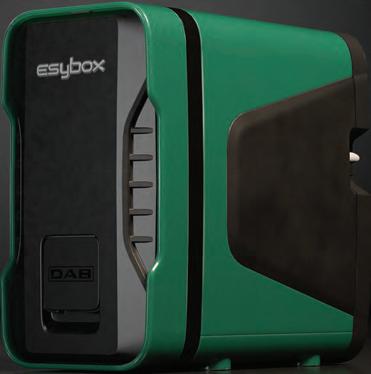
DAB PUMPS UNVEILS REFRESHED BRAND IDENTITY
DAB Pumps has launched a refreshed brand identity, Making Water Easy.
The company says that, Making Water Easy reflects its mission to make the experience of using and handling water smarter, more sustainable, and more accessible – for installers, specifiers, merchants and end users alike. DAB Pumps says the changes will be introduced gradually in the coming months and are designed to better reflect DAB’s values and forward-thinking approach.
“Our promise to make water easy goes beyond product performance,” said Adam Ferneyhough Country Director for the UK & Ireland at DAB Pumps. “It’s about removing complexity at every stage – from selection and installation to operation and maintenance. This refreshed identity allows us to communicate who we are and what we stand for, with greater clarity and purpose.”
LG LAUNCHES DERBYTRAINING FACILITY
LG Electronics (LG) has expanded its Air Conditioning and Energy Solutions Academy with the launch of a new training location in Derby, delivered in collaboration with the Heat Pump Central Training Academy. The company says the expansion will increase access to hands on heat pump and HVAC training, supporting the development of a skilled workforce needed to scale low-carbon heating in the UK.
Sachin Vibhute, Technical Consultant and Product Training Manager at LG, said: “Manufacturers are already playing their part in driving long-term momentum, helping to train a skilled workforce prepared to meet the evolving demands of HVAC installation and maintenance. But to scale heat pump installations, we need continued focus on training installers, clearer consumer guidance and long-term policy support. Without this, we risk losing momentum at a critical point in the UK’s energy transition.”
“Heat pumps only deliver efficient heating when systems are correctly specified and installed, which is why training is essential to ensure engineers have the skills needed to match the right to help deliver reliable performance.”
IDEAL HEATING PARTNERS WITH WARMUR ACADEMY
Ideal Heating’s Expert Academy has partnered with Warmur Academy to support the launch of Hydronics Unlocked, a new digital training programme designed to help heating professionals apply modern system design principles in the real world, on any job.
Andrew Johnson, Training Director at Ideal Heating, said: “I’m delighted to be working with the team at Warmur Academy. We share the same vision: to make good system design the norm, not the exception. Helping people make better, more confident engineering decisions every day is exactly what our Expert Academy is about.”
Hydronics Unlocked is built around Warmur Academy’s 10-step process, turning hydronic theory into a practical, repeatable method engineers can use to design and set up systems. The new programme will combine the current in-person 1-day course with an interactive digital course to offer flexible routes for learners while working towards a recognised Low Temperature qualification.
Jo Alsop, Founder of Warmur Academy, said: “This partnership shows what’s possible when two organisations are aligned on raising the bar for the whole industry. Warmur Academy exists to make high-quality system design standard practice, not specialist knowledge. Ideal’s support enables us to get this training into the hands of thousands more engineers and drive the step-change in competency the sector has been asking for.”
GLOW-WORM ANNOUNCES BAND OF BUILDERS SPONSORSHIP
Glow-worm has announced a new 12-month corporate sponsorship agreement with construction industry charity, Band of Builders. The company says the move will give installers opportunities to help others in the trade and raise awareness of where to reach out should they need support themselves.
James Fowler, Marketing and Strategy Director at Glow-worm, commented: “Our partnership with Band of Builders allows us to extend that support to those in the construction industry who are facing both professional and personal challenges. By working together, we can help ensure more tradespeople know where to turn when times get tough, while also encouraging others to get involved and support this important work.”
Gavin Crane, CEO of Band of Builders, added: “We are delighted to welcome Glow-worm as a sponsorship partner for 2026. With demand for our services continuing to grow, it is vital that more companies across the industry work alongside us.
“Glow-worm’s support will help us extend the reach and impact of our work, ensuring more people within the construction community receive help when they need it most.”
INSTANTOR CELEBRATES
100-YEAR MILESTONE
Instantor officially celebrated its 100th anniversary on 4th February 2026, marking a century of operating in the plumbing and heating industry.
Founded in 1926, Instantor began operations from a foundry at St James’s Gate in Dublin. The same year, Instantor patented the brass compression fitting.
Alan Hogan, Managing Director –Plumbing, Heating & Kitchen Division at Sanbra Group, Instantor’s parent company, comments: “Reaching our 100th year is a remarkable milestone for Instantor, but what truly defines our success is the impact we’ve made along the way. In recent years alone, the business has evolved at pace – entering new markets, delivering industry changing innovations and earning prestigious awards. This progress is driven by an exceptional team, and as we look ahead to the next century, our focus remains firmly on continuing to lead and transform the market.”
To mark its centenary, Instantor has planned a full programme of celebrations throughout 2026. The company says that activities will include exclusive product promotions for installers and merchants; customer, employee and community engagement initiatives and new merchandise and brochures.
DRIVE PROFIT WITHSOFTWARE
jobmate, a UK-based provider of end-to-end job management software, is highlighting the role operational software can play in improving business profitability. It says that customers typically are able to unlock up to 15% additional profit through better control of time, resources and cash flow, according to jobmate’s own analysis.
Designed for trades, maintenance, field service, logistics and SME environments, jobmate combines planning, inventory, invoicing and subcontractor management into a single platform.
“Many service-led businesses are working hard but not seeing the financial return they expect,” said Chris Dalton, Co-Founder and CEO of jobmate. “Our focus has always been on practical software that translates directly into financial outcomes. By tightening everyday processes, businesses can recover costs that would otherwise be written off as unavoidable.”
Capabilities include drag-and-drop job planning, designed to optimise routes and reduce wasted time, integrated inventory management to control stock levels and instant invoicing that allows completed jobs to move quickly from order to payment.
According to jobmate, the combined impact of these features can deliver measurable improvements in operational efficiency and cash flow.
“We describe jobmate as ‘software for hard profit’,” Dalton added. “It’s not about dashboards for the sake of it. It’s about giving business owners clear control over jobs, people, stock and money, so they can see the difference on their bottom line.”
DRAYTON REVEALS NEW DATA INDICATING BENEFITS OF HEATING CONTROLS
Drayton has revealed how upgrading heating controls is one of the most cost-effective ways to cut carbon emissions and reduce bills, according to the latest analysis of Marginal Abatement Cost Curve (MACC) data. MACC evaluates which energy-saving measures provide the highest carbon reduction at the lowest setup cost. Drayton’s updated review compares heating controls such as auto-balancing TRVs, and programmable thermostats against other methods, such as loft and wall insulation.
Drayton says that across the board, heating controls, such as those offered by the company, provide significant carbon reductions, with TRVs one of the most cost-effective ways for UK households to cut carbon emissions and minimise energy bills. Nick Hunt, UK Sales and Marketing Director at Drayton, commented: “With the pressures of the cost-of-living crisis, combined with the demand for low-carbon solutions, the MACC findings demonstrate clear advantages for installers and homeowners.
“In comparison to insulation, upgrading heating controls offers a quick, low-disruption solutions. They deliver immediate benefits through reduced energy bills and improved heating comfort, with high upsell potential, particularly with auto-balancing TRVs. As more and more customers are looking for ways they can reduce their carbon-foot, implementing these heating solutions can also contribute to achieving Net Zero goals.”
Chris Dalton, Co-Founder and CEO of jobmate
(Left to right) Brian Murphy - Group Chairman, Brian Tighe - Divisional Finance Director, Neil Gaffney - Instantor Managing Director, Shane O’Neill - Group Finance Director, Alan Hogan - Divisional Managing Director and Martin Murphy - Group Managing Director (Instantor)
MITSUBISHI ELECTRIC EXPANDS HEAT PUMP TRAINING
Mitsubishi Electric has announced the availability of three qualifications delivered at its Hatfield Training Centre: Level 3 Low Temperature Heating and Hot Water Systems in Dwellings, Level 3 Award in the Installation and Maintenance of Heat Pump Systems (Non-Refrigerant Circuits), and LCL Award – Water Regulations Certificate.
The company says the courses have been designed to equip experienced heating professionals with the knowledge, confidence and competency required to design, install and maintain low temperature heating and heat pump systems in domestic dwellings, in line with current and emerging industry standards.
“As the industry moves rapidly towards low-carbon heating, it is essential that installers are equipped with the right skills, knowledge and confidence to design and deliver high-quality systems,” said Katie Webb, Customer Training Manager, Mitsubishi Electric. “By delivering LCL Awards–certified, Ofqual-accredited training at our Hatfield Training Centre, we are ensuring professionals have access to rigorous, industry-led qualifications that reflect real-world installation standards.”
PLUG HOT WATER GAP IN WARMHOMES PLAN, SAYS NEWREPORT
A new whitepaper is urging the government to integrate hot water decarbonisation into its long-term housing and net-zero strategies, warning that hot water will soon become the dominant domestic energy load.
“Hot Water Down the Drain: Unlocking Hot Water Decarbonisation Through the Warm Homes Plan”, published by Triton Showers in response to the recently launched roadmap, reveals that hot water use, particularly showering, is a significant but overlooked opportunity to cut household energy consumption, carbon emissions and water use.
The report calls on the government to include instantaneous electric showers (IES) and a new category of high-efficiency models (IES-HE) designed to connect to waste water heat recovery systems (WWHRS) within major retrofit and energy efficiency funding schemes, namely the Warm Homes: Social Housing Fund (WH:SHF) and Warm Homes: Local Grant (WH:LG).
Paul Ravnbo-West, Market Development Manager at Triton Showers, said: “The current policy landscape is heavily weighted towards space heating, but as that decarbonises, hot water will make up a significant share of household energy use. If this isn’t addressed in the Warm Homes Plan, we risk missing a major opportunity to cut emissions and help households manage rising utility costs.
To download “Hot Water Down the Drain: Unlocking Hot Water Decarbonisation Through the Warm Homes Plan”, please www.rdr.link/pby004
VAN THEFT HAS SIGNIFICANT IMPACTON TRADESPEOPLE
New research from Direct Line business insurance reveals that 9,522 vans were stolen across the UK in 2025, equivalent to a van stolen every 55 minutes. It says that the majority were never recovered, with around three in five stolen vans remaining missing.
Van theft has a significant impact on tradespeople who rely on their vehicles for their livelihoods. Further research by Direct Line shows that two thirds (64%) of tradespeople surveyed say their ability to work would be significantly affected if their van were stolen, written off or badly damaged, while a further 26% say it would slightly hinder their ability to do their job.
Negative impact
The financial repercussions are also stark. Even short periods without a van can be damaging, with one in three (33%) tradespeople saying that losing access to their van even for a day, or less, would have a negative impact on their business.
Eva Sandstra-Bennett, Van Product Manager at Direct Line Business Insurance, commented: “Van theft continues to destroy livelihoods across the UK. When a van is stolen, tradespeople aren’t just faced with the cost and stress of replacing their van, many also face almost immediate loss of income if they can’t work. With a van stolen every 55 minutes, the impact on hardworking professionals is severe.
“When choosing van insurance, it’s a good idea to look for cover that includes a courtesy van should your van be stolen, written off or damaged. This can help keep your business moving and protect your livelihood until you’re back on the road again.”
DIGITAL REPORTING
– a new way many sole traders may need to use to report tax and income digitally.
Let’s be honest, most of us didn’t get into plumbing and heating because we love admin and paperwork. Despite this, Making Tax Digital for Income Tax (MTD IT) is on the horizon, which will revolutionise the way plumbers and heating installers report on their earnings.
Coming into force from April 2026, the changes will mandate all self-employed, non-VAT registered sole traders with an income of over £50,000 per year to report on tax and income digitally.
Ultimately, this means that glove boxes full of receipts, pens and paper will no longer be enough to comply with HMRC’s updated rules. However, the changes don’t have to cause any headaches, and with the correct tools, MTD IT can be key in streamlining your business.
What is MTD IT
Digital tax reporting isn’t new, with countries like Italy, Estonia and Spain having already rolled out their own versions of the scheme.
In essence, MTD IT aims to modernise and simplify the UK’s existing tax system.
From April onwards, tax reporting will be completed through HMRC via four quarterly submissions on earnings. Importantly, this will still require only one annual tax
payment, which will go unchanged despite MTD IT coming into force.
The threshold for MTD IT will expand to include non-VAT registered businesses with annual earnings of £50,000. This means that a significant number of plumbing and heating businesses operating as sole traders will be brought into scope. Across the UK, more than 850,000 sole traders are expected to be affected from April 2026 alone, with many more to follow as the threshold is expected to be lowered in the years after.
Key dates include:
● 6th April 2026 –
Non-VAT registered sole traders earning over £50,000 per year
● 6th April 2027 –
Non-VAT registered sole traders earning over £30,000 per year
● 6th April 2028 –
Non-VAT registered sole traders earning over £20,000 per year
By 2028, over 2.9 million sole traders are expected to be impacted across the UK’s trades. Therefore, there’s never been a better time to get ahead of MTD IT, even if April’s changes don’t apply to you.
Dyer, Founder and CEO of Powered Now
What changes to expect?
Whilst MTD IT is being introduced primarily to streamline the tax return process, naturally, it will require some rethinking –especially for those that are still reliant on spreadsheets, paper and pen.
The most important changes to note include:
● Shifting all job and cost records online
From April onwards, all income and expenses will need to be recorded digitally using HMRC-recognised software and tools. Handwritten job notes, paper invoices and receipts will no longer be sufficient. Everything from subcontractor, materials, tools and fuel costs will all need to be recorded digitally.
● Keeping records up to date throughout the year
Whilst the one annual tax payment remains unchanged, businesses and sole traders will be required to submit quarterly updates to HMRC, summarising both expenses and income. This ensures that heating and plumbing engineers will now need to stay on top of records year-round.
Benjamin
● Opting for software which fits the way your business works
MTD IT requires the use of HMRC-recognised software. Whilst few tools are tailored to the specific needs of the trades, Powered Now is both recognised by HMRC and designed to help the trades juggle jobs, invoices and records in one place. By removing the need for multiple, disconnected apps, tradespeople can also benefit from reduced operational costs.
How to get MTD IT-ready?
Small changes and habits can make a world of difference in the approach to MTD IT, for example, regularly monitoring outgoings and raising invoices promptly through a single platform. Clearly separating personal and business expenditure is also a wise step. By having separate bank accounts, cards and statements, the likelihood of time-consuming, costly errors is reduced and can make digital record-keeping much simpler in the long term.
Job management software
Powered Now is an all-in-one job management software designed specifically for trade businesses. With a UK-based support team, the software allows businesses to quote, invoice and schedule jobs and teams – all from one interface. To find out more and to begin a 14-day free trial please www.rdr.link/pby005
Overall, a ‘little but often’ approach to admin and bookkeeping is always advised, especially in the approach to MTD IT. Keeping track of supplier invoices, outgoings and sales throughout the year can save hours of guesswork once tax reports are due on a quarterly basis, in line with MTD IT changes.
MTD IT is yet another way that the tax system is becoming more and more digitalised. Whilst it may feel like an extra burden in the first instance, it is designed to reduce errors, make cash flow easier to manage, and to make tax reporting simpler over time.
To access Powered Now’s guide to MTD IT please www.rdr.link/pby006
40YEARS OF TRANSFORMATION
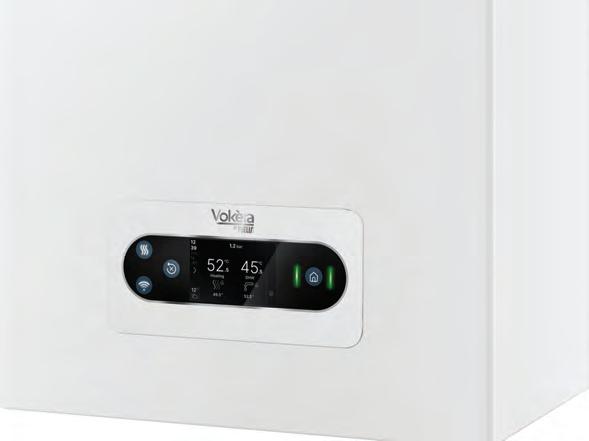
Marking over 40 years manufacturing heating solutions, Neil Mattock, Marketing Director at Vokèra, takes a look at the transition from an industry once reliant on fossil fuel boilers to today’s highly regulated, lower carbon sector shaped by technological progress, stricter standards and changing consumer expectations. Vokèra is part of Riello, a provider of high efficiency heating and climate solutions.
By the mid-1980s, gas central heating had become the dominant form of heating in the UK. Penetration rose from around 5% of households in 1960 to nearly 50% by 1977, eventually exceeding 90% by the mid 1980s. During this period, combination boilers began gaining momentum. Although introduced in the late 1960s, early versions often struggled with inconsistent water hardness, variable weather conditions, pressure loss, and insufficient hot water performance. More powerful models existed but were typically too large or expensive for most homes.
The Efficiency Shift
Condensing boiler technology remained optional for more than 20 years. This changed in 2005, when regulations required all new and replacement gas boilers to be condensing models, representing a significant improvement in seasonal efficiency performance.
Technological improvements in efficiency and reliability throughout the 1980s transformed the combination boiler into a practical and mainstream solution. This evolution reduced installation complexity, saved space and reshaped domestic heating practices. It was during this “combi revolution” that the Vokèra brand was introduced in 1983.
The latter part of the decade also brought structural changes. The privatisation of the gas industry created a competitive market regulated by Ofgem. Meanwhile,
The shift from typical efficiencies of 60-70% to efficiencies above 90% marked a substantial regulatory milestone. Initially, this raised concerns among installers and consumers due to higher installation costs, the need for additional training and more complex system requirements. Over time, however, installers adapted, and condensing boilers became the standard across UK homes.
Recent Regulatory Developments
In 2018, the Boiler Plus standards introduced the first major update since 2005. These requirements set a minimum ErP efficiency of 92% and mandated the installation of time and temperature controls when replacing or adding a boiler, unless already present.
2018
These changes reflected broader environmental priorities. In 2019, the UK generated more electricity from zerocarbon sources than from fossil fuels for the first time. That same year, the government set a legally binding target of achieving NetZero greenhouse gas emissions by 2050, accelerating the pace of innovation in the heating sector.
A New Generation of Heating Solutions
Today’s heating technologies reflect decades of incremental efficiency and performance improvements. Modern combination boilers, including those in Vokèra’s current range, deliver high efficiency and are increasingly compatible
Neil Mattock
with smart controls and connected home ecosystems. These systems typically achieve ErP A rated performance while enabling homeowners to manage heating more precisely through digital interfaces.
At the same time, the industry is expanding beyond gas boiler optimisation. As the UK progresses toward its decarbonisation objectives, alternative low carbon heating solutions are gaining prominence. Heat pumps are becoming more widely adopted, and Vokèra’s entry into this market aligns with the broader industry transition toward lower carbon technologies.
Hydrogen ready boilers represent another possible pathway, designed to operate on natural gas today but capable of being adapted for future hydrogen blends. The government may provide further clarity on the potential role of hydrogen in heat decarbonisation, although both the timeline and scope remain uncertain.
The sector now faces a transitional period in which multiple heating technologies coexist
The sector now faces a transitional period in which multiple heating technologies coexist. The best option for each property depends on building type, existing infrastructure and specific user requirements. Installers therefore require a broader technical skill set, while manufacturers must balance current market needs with evolving long term sustainability considerations.
Looking Ahead
As of 2026, modern condensing boilers demonstrate notable advances in performance, with many models exceeding the minimum ErP efficiency. Vokèra’s Pinnacle and Synergy ranges, for example, achieve efficiencies of up to 94%. Smart connectivity, advanced diagnostics and more intuitive controls –far beyond what was imaginable forty years ago –are now common features.
Looking forward, the decarbonisation conversation includes several potential routes: hydrogen ready boilers for properties suited to gas infrastructure, heat pumps for buildings compatible with low temperature systems and hybrid solutions that combine both technologies. This diversification reflects the industry’s commitment to providing practical options suited to different property types and consumer needs. Government initiatives continue to influence decision-making. The Boiler Upgrade Scheme encourages homeowners to consider heat pumps, while the recently announced Warm Homes Plan includes significant investment in upgrading homes with energy efficient heating solutions, including heat pumps, solar panels and batteries, with additional support for low income households.
The sector stands at an important moment. Manufacturers are continuing to develop advanced gas boiler technologies while also investing in lower carbon alternatives. Progress over the next decade will depend on collaboration among manufacturers, installers, policymakers and consumers to deliver heating solutions that support long term sustainability without compromising reliability, performance or comfort.
For more information on Vokèra please www.rdr.link/pby007
HEAT PUMPS & UFH
Ben Perris, Sales Director for Indoor Climate Solutions at Wavin, explores how UFH can strengthen heat pump performance.
Following the announcement of the Warm Homes Plan, the UK’s heating market is rapidly shifting away from fossil fuels toward more low-carbon alternatives – with heat pumps at the forefront of that transition. According to data from the Microgeneration Certification Scheme (MCS), more than 60,000 MCS certified heat pumps were installed in the UK in 2024 –the most installations for a single year.
This data demonstrates a clear indication of increased demand, driven by government’s continued focus on new regulation – from Future Homes Standard to Warm Homes Plan –designed to cut carbon emissions in homes and position heat pumps at the centre of the solution in the UK’s new heating ecosystem.
Crucially for installers, it’s important to understand that a large factor driving
consumer demand for low-carbon heating alternatives in the home is price. In 2025, new research conducted by Wavin revealed that amongst consumers seeking sustainable heating solutions, cost savings emerged as the leading consideration, with nearly a quarter (22%) prioritising it, closely followed by energy efficiency at 21%. With heat pumps operating at lower flow temperatures, homeowners will only start to realise the savings on offer if systems are designed to work at their most efficient.
UFH systems free up wall space and offer greater flexibility over room layouts and interior design
Efficiency
Heat pumps have earned their reputation as a sustainable, cost-effective and energy efficient heating solution. However, it’s important to recognise that the vast majority of UK homes aren’t built to work with these systems yet, with them working at much lower temperatures than conventional systems such as boilers and radiators.
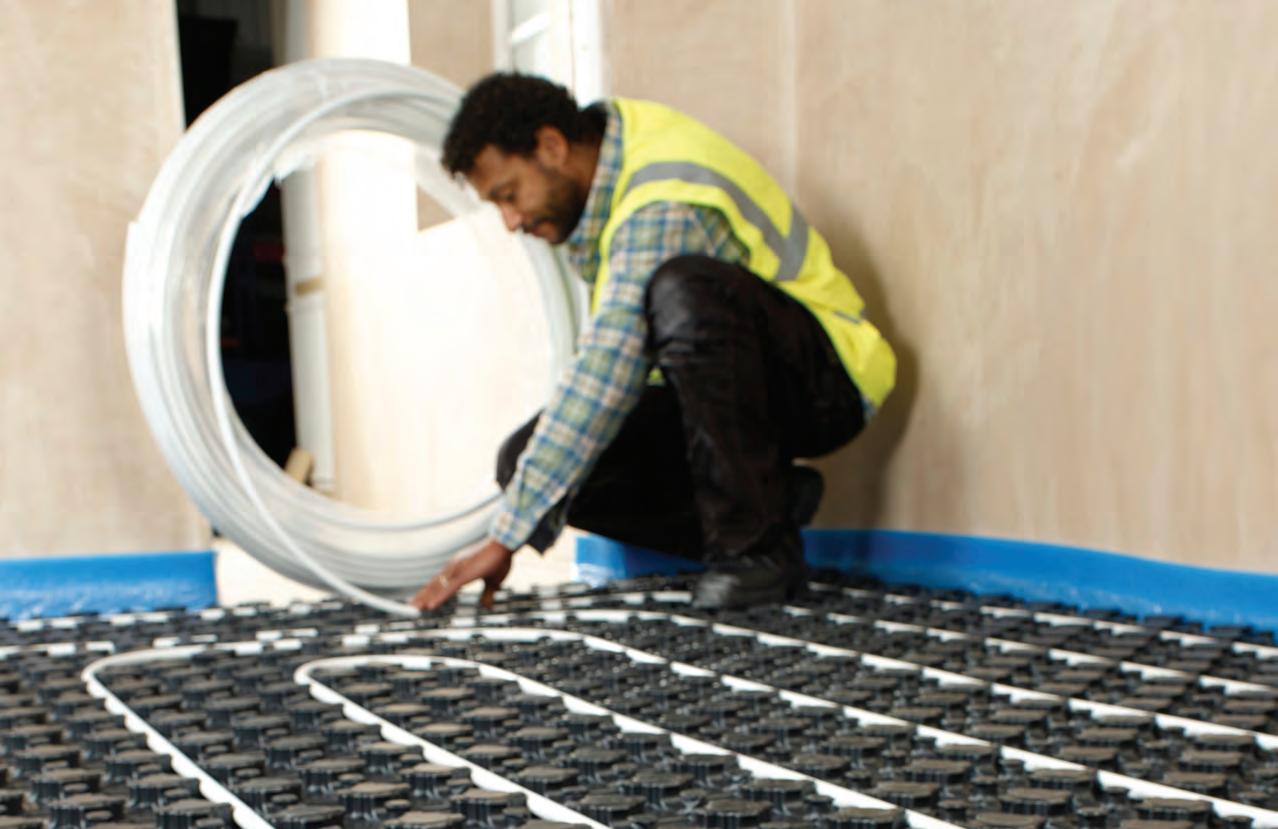
As a result, to get the best from heat pumps, we need to look to technology such as UFH which runs at a lower temperature, allowing a heat pump to run within its optimal temperature range. For example, Wavin’s Comfia system runs between 30 and 50°C, as opposed to the 60 and 70°C required for traditional radiators.
Pairing a heat pump with UFH ensures the system can deliver comfortable temperatures without placing excessive demand on the heat pump. By optimising the way these technologies work together, homeowners can benefit from a more balanced and energy efficient heating solution that allows the heat pump to operate at its highest sustainable performance.
However, the benefits of UFH solutions don't stop there. UFH systems free up wall space and offer greater flexibility over room layouts and interior design. Alternatives to wall-fixed heating solutions can also be also quieter, providing a more comfortable experience for residents and homeowners alike.
Future-ready solutions
Promoting the pairing of UFH and heat pumps isn’t just a technically sound way to enhance comfort and reduce running costs for homeowners –it also makes strong commercial sense for installers. As regulations continue to tighten, those who
Pairing a heat pump with UFH ensures the system can deliver comfortable temperatures without placing excessive demand on the heat pump.
proactively offer solutions that deliver both immediate benefits and long-term value can position themselves ahead of market and policy shifts.
Rather than reacting to changes, forward thinking installers can differentiate themselves by effectively articulating the potentially powerful long-term savings that high efficiency systems bring; at a time when energy performance is becoming increasingly important to both homeowners and policymakers.
To support installers and meet the
growing demand for flexible, high-performing UFH, manufacturers like Wavin are offering comprehensive system solutions that cater to a wide range of build types. Applications like Wavin’s WarmDeck, provide integration with existing heating systems for more complex installations –including upstairs spaces and retrofitting.
But support doesn’t stop at the product. Wavin is also investing in installer expertise through its Wavin Installer Network (WIN) –a free-to-join initiative offering tailored training, practical support, and priority technical guidance across UFH, ventilation, and heat recovery systems.
Smarter heating
The case for pairing heat pumps and UFH together is no longer one that can be considered ‘a nice idea’ – it’s practical, profitable and aligned with the direction in which the market is heading.
For more information please www.rdr.link/pby008
LOW CARBON HEATING
FULL SUPPORT
Baxi’s new MCS umbrella service includes nationwide on-site support from the company’s network of ASHP engineers.
Baxi has launched a Microgeneration Certification Scheme (MCS) umbrella service for air source heat pump (ASHP) installers. The company says the scheme makes the MCS journey for installers straightforward by taking care of the design, compliance and paperwork, so the installer can focus on delivering efficient, low carbon heating.
The scheme offers nationwide on-site support from Baxi’s network of experienced ASHP engineers, designed to help installers stay compliant and save time. The company says installers that take advantage of the scheme can save approximately eight hours of admin time for every ASHP installation.
How it works
When a customer is interested in an ASHP, installers can contact Baxi who will provide an estimation of the size of the heat pump needed to deliver comfort to the homeowner in readiness for the installer to build their quote. Once the homeowner is happy to progress further, Baxi’s engineers then carry out an in-person site survey leading to a comprehensive heat loss report.
The company says this includes everything from radiator sizes to pipework calculations, so that the installer can provide a final project proposal for the customer. Baxi will advise on the necessary kit and provide a complete parts list for installers to source from their preferred merchant. If accepted, Baxi administers the MCS paperwork on the installer’s behalf, freeing them up to move forward with the installation work itself.
Boiler Upgrade Scheme
As part of the service, Baxi checks the property’s eligibility for the Boiler Upgrade Scheme (BUS), taking care of the
We want to make installing ASHPs attractive and easy for engineers –to do this, we’re putting the power back in their hands and taking the stress out of delivery
compliance and MCS paperwork needed to access the grant funding.
The BUS provides grants of up to £7,500 towards qualifying air source and ground source heat pump installations in England and Wales. Baxi can also help facilitate access to ASHP funding available from Home Energy Scotland.
Expert guidance
Scott Riley, Baxi‘s Head of Technical Solutions – Residential, said: “We know that many installers feel like admin is a real obstacle that takes them away from the job at hand and adds a layer of frustration to their daily work. We want to make installing ASHPs attractive and easy for engineers — to do this, we’re putting the power back in their hands and taking the stress out of delivery.
“The idea is simple; we’ll do the surveying and the design, take care of the paperwork and return to commission the job so the installer can focus on what matters most for their customers — comfort at home. Installers that choose Baxi to support their ASHP installs will receive expert guidance at every step.”
For more information please www.rdr.link/pby009
TRANSFORM
homeheating
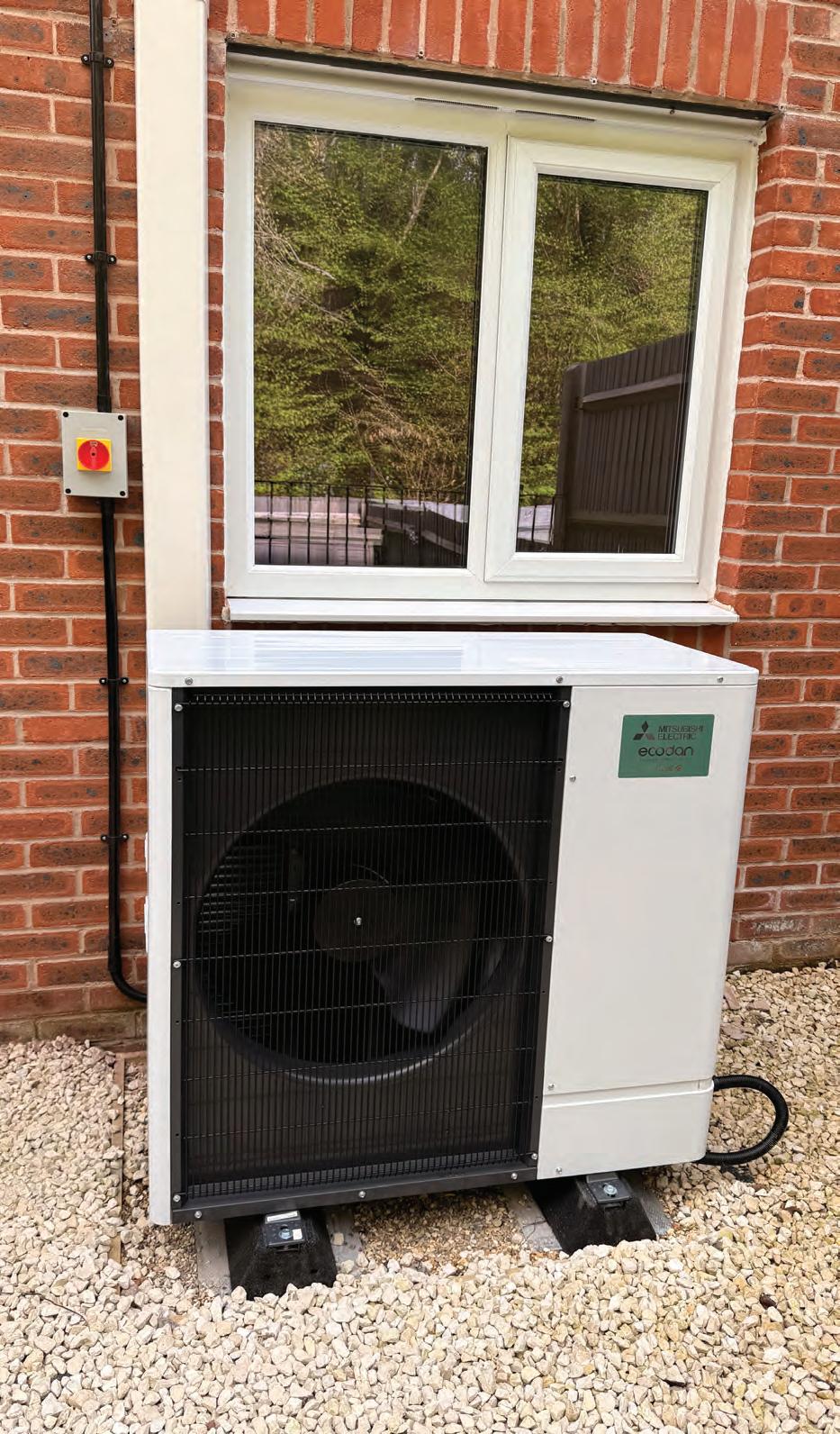
Achilleas Georgiou, Public Affairs and Communications Manager, Mitsubishi Electric, examines how heat pumps can transform home heating and highlights some of the company’s reports into heat pump adoption.
Almost a quarter (22%) of carbon emissions in the UK come from our homes (Energy Savings Trust), and around 80% of households still rely on gas and oil boilers as their primary heating source. With the government confronting the twin crises of rising energy costs and climate change, the urgency to decarbonise home heating has never been clearer.
The technology to support this transition is already available in the form of air to water heat pumps. These are practical, energy-efficient and suitable for a wide range of buildings. Nowadays, they are also relatively easy and straightforward to install, thanks to new innovations in the technology that have made them compatible with existing pipes and radiators.
Pilots such as those by Sovereign Network Group are already demonstrating the benefits an Ecodan high temperature heat pump could bring to people’s homes (see below). Now it’s about raising awareness, making heat pumps economically accessible and accelerating adoption across the UK.
Energy-efficient
Around half (52%) of UK homes have an Energy Performance Certificate (EPC) of C or above. However, energy efficiency alone is not enough if we are to reach net zero. The decarbonisation of heat – specifically the removal of gas, oil and solid-fuel boilers –and the transition to renewable alternatives such as heat pumps must be a priority.
Heat pumps operate at around 300% efficiency. This is because they are able to deliver up to three kilowatts of heat energy per kilowatt of energy consumed, significantly reducing operating costs. Certain models also use an R290 refrigerant
Challenging ongoing perceptions of installation difficulty and suitability will therefore be key to accelerating adoption. This starts with developing government-led targeted awareness campaigns and communicating their proven benefits
with a Global Warming Potential (GWP) of just 0.02, making heat pumps one of the most climate-friendly options on the market. Policies such as the government’s Warm Homes Plan are already providing
significant support for domestic manufacturing and workforce upskilling. Yet several barriers to nationwide roll-out remain. This includes affordability and ongoing perceptions around heat pumps being difficult to install, with a quarter (25%) of homeowners believing their home isn’t suitable for one.
Installation
High temperature heat pumps, such the Ecodan R290, work effectively in most types of property without the need for extensive retrofitting. This includes older homes, social housing and new builds. This is due to compatibility with microbore pipework. Many homes built in the 1970s and 1980s use narrow pipes, which were long thought unsuitable for low-flow temperature systems like heat pumps. However, new research has shown that with correct system design and temperature control, these heat pump models can work effectively with existing pipework and radiators. (To read ‘The Mitsubishi Electric Guide to Residential Air Source Heat Pumps and Microbore Pipework’ please visit www.rdr.link/pby010) This can significantly reduce capital costs by eliminating the need to replace radiators or valves, or to tear up floorboards – key considerations in retrofitting and installation projects.
Heat pumps can be installed with minimal disruption in a cost-effective way. Challenging ongoing perceptions of installation difficulty and suitability will therefore be key to accelerating adoption. This starts with developing government-led targeted awareness campaigns and communicating their proven benefits.
Now it’s about raising awareness, making heat pumps economically accessible and accelerating adoption across the UK
In practice
One example of this is Sovereign Network Group (SNG), which manages over 84,000 homes across London and southern England. To help achieve its target of net zero across its housing stock by 2050, the housing association is piloting the use of high-temperature heat pumps with legacy microbore systems in people’s homes.
The contractors adopted a holistic approach to installation, balancing resident wellbeing and operational costs to provide a smart, scalable and eco-friendly solution to decarbonising heating. The pilot found that using existing pipework means a heat pump can be fitted in under two days – around 40% quicker on average. This also led to substantial reductions in operational and maintenance costs. One resident, who previously relied on a single electric storage heater, saved around £700 per year after making the switch – making a substantial difference for those experiencing fuel poverty, and households nationwide if scaled out further. (To read ‘The Mitsubishi Electric Guide to Delivering Net Zero in Social , which includes the experience of SNG please visit www.rdr.link/pby011)
Changing the way we heat our homes will play a vital role in decarbonising the UK’s housing stock and achieving net zero by 2050. Ecodan heat pumps are already making this a reality, and shifting perceptions around their suitability and ease of installation will be key to accelerating adoption. Doing so will accelerate deployment in people’s homes and support the transition to renewable heating.
To read Mitsubishi Electric’s ‘Heat Pumps: Accelerating the Switch’, please www.rdr.link/pby012
RURAL DECARBONISATION
Malcolm Farrow, Director of Marketing and External Affairs at OFTEC provides his thoughts on the government’s approach to rural decarbonisation and the recent Alternative Clean Heating consultation.
The government's current approach to decarbonising rural communities is very similar to a train speeding down the tracks. It has one destination which is electrification. There have been multiple stops along the way from the Clean Growth Strategy in 2017, the Heat and Buildings Strategy in 2021 and now the Warm Homes Plan in 2026.
During this time, new governments and ministers have got on and off the train, but it's still heading in the same policy direction. But now, through the recent Alternative Clean Heating consultation, thousands of people are demanding to be let on board, calling on the government to avoid further delays by diverting course and heading towards a new destination.
A clear signal
The sheer volume of engagement with the government’s recent Alternative Clean Heating consultation represents a significant turning point for the off-gas grid
sector. Despite a limited window for submissions that coincided with the busy holiday period, the response was unprecedented. Over 16,000 people, from households, heating technicians to fuel distributors, submitted evidence in support of renewable liquid heating fuels.
These voices spread the length and breadth of the UK, representing constituencies across more than 400 Westminster seats, as well as spanning Scotland, Wales, and Northern Ireland.
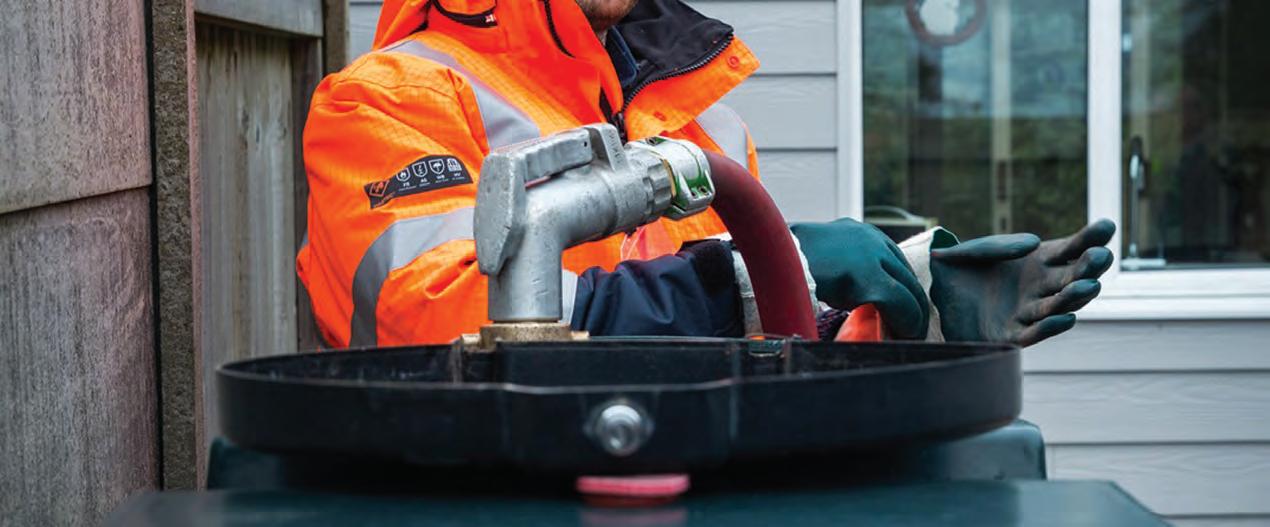
A successful three-year industry project involving 150 properties across the UK has proven that Hydrotreated Vegetable Oil (HVO) is a viable solution
This level of participation is a loud and clear message to policymakers that rural communities are no longer willing to be left behind on the decarbonisation journey. There is a frustration regarding the lack of clarity and fairness in the current approach.
The affordability gap
While electrification is a central part of the UK’s transition to cleaner heating, it is becoming increasingly clear that alternative solutions are needed for harder to treat homes. The economic and political landscape has changed significantly in the past 10 years when this approach was originally conceived. However, the policy has not fully evolved to reflect this.
Malcolm Farrow, OFTEC
More recently, the government has started taking initial steps in recognising a new approach is needed with this latest consultation. The document itself highlights the problem and states that the cost of switching an oil heated home to a heat pump is approximately £17,000.
In reality, for many older properties, this figure often rises when factoring in the necessary energy efficiency upgrades for a heat pump to work effectively. Even with the current £7,500 Boiler Upgrade Scheme grant, the remaining financial gap is a huge barrier.
Renewable liquid fuels
As an industry, we have already demonstrated that a more affordable, less disruptive way forward is available. A successful three-year industry project involving 150 properties across the UK has proven that Hydrotreated Vegetable Oil (HVO) is a viable solution. Independent research has shown there is more than enough sustainably sourced HVO
it is becoming increasingly clear that alternative solutions are needed for harder to treat homes
available to meet the needs of the UK’s 1.7 million oil-heated homes.
HVO by Christmas
It’s a bit early to be talking about Christmas but, following the overwhelming response to the latest consultation, we are calling on the government to deliver policy support for renewable liquid fuels by the end of the year. This is an opportunity for the government to deliver a quick win for rural voters and show that it is listening to rural communities. Specifically, our HVO by Christmas campaign is calling for three key policy shifts:
● The implementation of Section 159 of the Energy Act: This will enable a market mechanism for renewable liquid fuels to drive down costs for the consumer.
● Duty equalisation: The duty on renewable heating fuels needs to be equalised with the current duty on kerosene, ensuring a level playing field for those wanting to switch
● A multi-technology approach: The government must move away from a technology-exclusive approach with electrification and embrace the role that renewable liquid heating fuels can play off the gas grid.
The liquid fuel sector already has an established network of skilled technicians, manufacturers, and distributors who are ready to support this transition today.
For more information on OFTEC please www.rdr.link/pby013
HEAT PUMPMOUNTING SOLUTIONS
Paul Greengrass, Product Development Director from DiversiTech International, answers some questions on mounting an ASHP unit.
Correct siting and mounting of an ASHP unit is a critical factor influencing system performance, customer satisfaction, and long-term reliability.
QWhat are some of the key considerations when deciding how to place an ASHP unit?
ASHPs must be allowed to breathe to allow the unit to perform efficiently. If the airflow is restricted, this will lead to inefficiency and unnecessary wear on the compressor. Maintain manufacturer’s recommended clearance to sides and rear and allow a discharge zone in front of the fan. Planning compliance should be considered during initial survey and not left to paperwork at the end.
Q What kind of base is required to ensure stability?
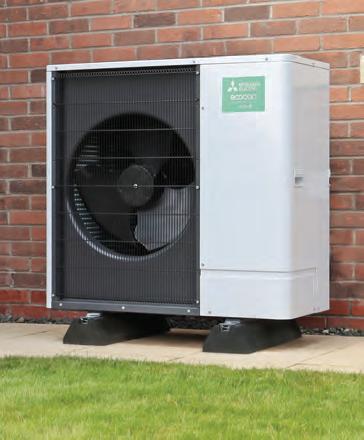
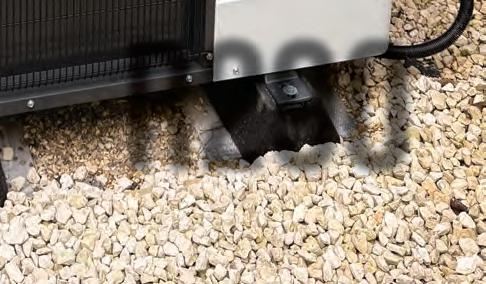
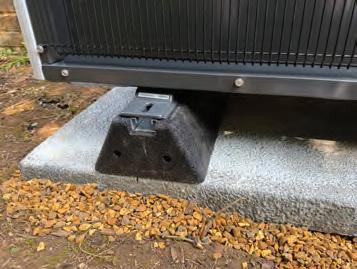
Get the base right. The mounting base must support the unit through its operational life. Movement will lead to vibration, refrigerant stress and noise transfer. A concrete slab (minimum 100mm thickness) on compacted hardcore needs to be installed level. It needs to be raised slightly above surrounding ground to prevent pooling water. Anti-vibration feet will greatly reduce any noise that the unit makes. DiversiTech recommends the FLEXI Lite Slab kit as it is a cost (and time) effective alternative to a concrete base.
This solution comes complete with rubber mounting anti-vibration feet (2 or 3-foot options) and is available in a range of sizes (175mm thickness inclusive foot). This kit can be delivered to site and constructed easily, and is a fibre reinforced concrete coated slab independently tested to varying weather conditions and exposure to chemicals.
QCan ASHPs be mounted on a wall?
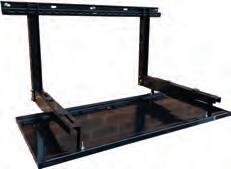
Wall brackets can work well on sites with limited space –or when you need to raise the unit. The wall must be structurally sound and load bearing. DiversiTech brackets are flat packed and easy to assemble. The crossbar (complete with spirit level) allows the uprights to be spaced exactly as required and include wall spacers to help level the unit.
These brackets are powder coated in a scratch resistant textured finish and undergo a complex weather protection process to combat corrosive environments. Condensate trays are available to fit most standard units when considering a drainage strategy. They are available in a range of sizes and colours with two or three-arm versions – with different load capacities.
Q What can you do if an uneven ground mount surface is the only option?
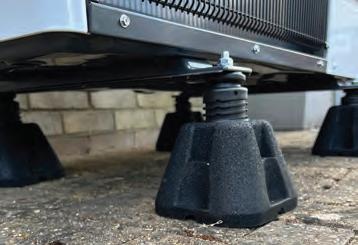
In some cases, structurally sound wall mounting and a flat level ground mounting surface is not available. The Baby Sumo adjustable rubber support anti-vibration feet are the ideal solution when you need to support units on uneven or sloping surfaces. They have an adjustable height between 160-210mm and are made of SBR vulcanised UV-stabilised recycled rubber
compound with internal glass fibre-reinforced polypropylene.
The support surface features a substantial contact area offering a stable and secure base which prevents water stagnation and seepage.
QAnd after the mount?
External pipework needs to correctly insulated in a tough UV-stable PVC-coated external grade product. This will ensure that heat loss is at a minimum, and that the efficiency of the heat pump is maintained. Pipework running from an externally placed heat pump into a property is equally vulnerable to cold bridging and heat loss and should be insulated adequately.
In summary
For contractors, air source heat pump installation is as much about positioning and mounting as it is about pipework and wiring. A well-sited unit delivers quieter operation, better efficiency, easier servicing, and fewer call-backs –all of which protect reputation, profitability and lower electricity consumption for the homeowner.
Treat the outdoor unit as a critical piece of plant infrastructure, not an afterthought. Get the base right, give it space, manage noise, and plan pipework intelligently... and the system will perform as designed.
For more information please www.rdr.link/pby014
WHERE DOMESTIC & LIGHT COMMERCIAL OVERLAP
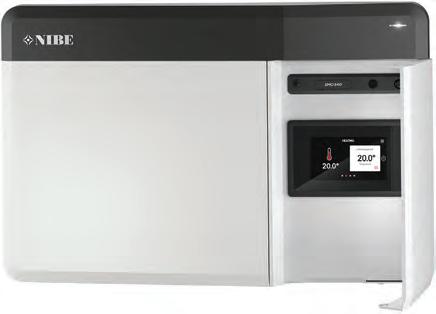
Rick Clarke, Product Manager, NIBE UK takes a look at single appliances through to complete HVAC systems assessing where domestic and light commercial
As low-carbon technologies become more widely adopted, homes are often no longer served by a single heating appliance. They are increasingly made up of integrated systems that combine heating, ventilation, controls and, in many cases, cooling. The complexity of domestic HVAC is beginning to resemble what has long been common in light commercial and commercial projects.
The shift is not from domestic to light commercial. It is from single appliances to complete HVAC systems.
System thinking
Heat pumps have been a major driver of this change. It is critical to ensure correct system design, hydraulic balance and appropriate controls for heat pumps to operate at maximum efficiency. Performance is no longer determined by
the appliance alone, but by how well every part of the system works together.
Add mechanical ventilation, smart controls and the growing conversation around comfort cooling, and the modern home begins to look very different from what installers were working on a decade ago.
This is where the skills required start to mirror those needed in larger projects. Understanding how multiple components interact, how to manage flow
As systems become more integrated, the relationship between installer and manufacturer becomes even more important
temperatures, how to balance systems correctly and how to set up controls for long-term performance becomes critical.
System performance
When projects move beyond a single unit and into integrated heating and cooling systems, the focus naturally shifts. The questions are no longer simply, “Is the unit correctly sized?” and “Is it installed according to the manufacturer’s guidance?” Instead, they also include “How do the heating, ventilation and controls work together?” “Is the hydraulic design supporting long-term efficiency?” and “Will the system remain stable and easy to maintain over time?”
In these scenarios, controls move from being an accessory to being central to performance. Commissioning becomes far more important. Small oversights that
might have had minimal impact on simpler systems can significantly affect comfort and efficiency when multiple components are working together.
Details matter
Industry experience continues to show that underperformance in low-carbon systems is often linked to design, commissioning and operation. As systems become more complex, this effect is magnified. Incorrect settings, poor balancing or a lack of understanding of how controls should be configured can reduce performance significantly. The installer’s role therefore becomes not simply about fitting equipment but also about delivering a correctly functioning system.
This is a natural evolution of the installer’s skillset. Those already working with heat pumps are becoming increasingly familiar with these requirements: attention to system design, careful commissioning and an understanding of how systems behave over time.
These are precisely the same disciplines that have long been required in light commercial and commercial HVAC projects.
Beyond heating
As homes become more airtight and energy efficient, ventilation and indoor air quality are playing a larger role in overall comfort. At the same time, customer expectations are changing. Conversations about overheating and cooling are becoming more common, particularly in new-build properties and apartments.
This means installers are no longer dealing purely with heating. They are working with complete indoor climate systems, where heating, ventilation and cooling need to be considered together.
The expertise required to manage these elements is increasingly aligned with what has traditionally been seen in larger, more complex projects.
Successful HVAC installations, whether domestic or light commercial, rely on the same fundamentals: sound system design, careful commissioning and the confidence that every component will work together as intended
System-level backing
With greater complexity comes a greater need for support. Installers moving into this type of work benefit from access to system design advice, technical guidance and clear commissioning support.
Understanding how components are intended to work together, having confidence in compatibility and being able to access expert assistance when needed all contribute to successful outcomes. As systems become more integrated, the relationship between installer and manufacturer becomes even more important. This is particularly true when projects move beyond individual dwellings into apartment blocks, shared systems or light commercial environments such as schools or offices, where multiple units and controls need to operate in harmony.
An evolution of skills
For installers already trained in heat pumps, many of the foundations are already in place:
● An understanding of low-temperature heating
● Familiarity with system design and emitters
● Experience with commissioning and controls
● Awareness of the importance of hydraulic balance
Building on these skills to work with more integrated HVAC systems is less of a leap than it may first appear. The principles remain the same; the scale and level of integration simply increase.
Spending time understanding how ventilation, cooling and controls interact with heating systems and working closely with manufacturers who can offer system-level support, makes this transition far more straightforward.
Complete systems
As low-carbon heating continues to become standard in UK homes, the role of the installer is evolving. The focus is shifting from fitting individual appliances to delivering complete indoor climate systems that must perform reliably for many years.
This is not a move away from domestic work, but an evolution of it.
The skills required to deliver high-performing systems in modern homes are increasingly similar to those needed in light commercial and commercial environments. Installers who are already developing expertise in heat pumps, controls and system design are well placed for this future.
Successful HVAC installations, whether domestic or light commercial, rely on the same fundamentals: sound system design, careful commissioning and the confidence that every component will work together as intended.
For more information please www.rdr.link/pby015
Q&A
CLIVET EDGE PROL
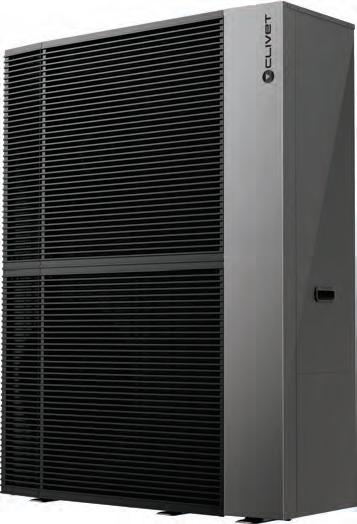
Following the expansion of the Clivet EDGE PRO L range of air/water heat pumps, PHPI caught up with Emma-Louise Bennett, Sales Support Engineer for Clivet, to find out more details.
QWhat types of projects has the new EDGE PRO L been designed for?
The EDGE PRO L has been developed to meet the growing demand for higher-capacity heat pump solutions across both large residential and light commercial environments. This includes properties such as luxury homes, multi-zone dwellings and renovation projects where heat loss requirements exceed the limits of traditional domestic units.
In the light commercial space, the system is well suited to applications such as office buildings, schools, leisure centres and small hospitality venues, where consistent heating performance and system resilience are essential.
These are the types of projects that Clivet UK is regularly asked to specify as electrification accelerates across these sectors and the installer looks for a heat pump solution that can bridge the gap between domestic and commercial while remaining compact and straightforward to install.
Q What are the key features of the new range?
One of the standout features of the EDGE PRO L range is its high seasonal efficiency, delivering a SCOP of close to 5 at 35°C. This level of performance delivers low running costs as well as supporting carbon reduction, which are key decision drivers for both homeowners and commercial building operators.
The unit has also received international recognition for its design, including the iF Design Award 2025 and Red Dot Design Award 2025. Good looks aside, the awards also focus on the quiet operation
and smaller footprint of the unit. For light commercial sites such as schools or offices, this balance of performance and design is increasingly important.
QWhich refrigerant is used in the EDGE PRO L?
The EDGE PRO L utilises R290 refrigerant, a natural solution with an extremely low Global Warming Potential (GWP). As the industry moves through ongoing F-Gas phase-down requirements, the adoption of natural refrigerants is becoming increasingly important in futureproofing system installations.
For installers and specifiers, R290 offers the reassurance of long-term regulatory compliance while aligning with wider sustainability targets across both residential and commercial developments.
QAcross what temperature range are the units designed to operate?
Designed for year-round reliability, the EDGE PRO L operates across a wide outdoor temperature range from -25°C to +43°C. This ensures dependable performance even in challenging winter conditions. The ability to produce water temperatures up to 85°C is particularly significant for renovation and retrofit projects. Higher flow temperatures mean the unit can be installed alongside existing emitters such as radiators, reducing the need for multiple system upgrades. This makes the range an attractive solution for older buildings and light commercial sites seeking to decarbonise without major internal disruption.
QWhat controls are available with the units?
The system is supported by Clivet Smart Living controls alongside the CLIVET EYE App, enabling intuitive monitoring and management both on-site and remotely. This level of connectivity is particularly valuable within light commercial environments, where facilities managers and building operators require visibility over system performance, energy consumption and maintenance alerts. Remote optimisation also supports improved efficiency and faster diagnostic response.
QCan the units be combined for larger projects?
For larger projects, the EDGE PRO L benefits from advanced cascade control logic,
allowing up to six units to be combined to achieve capacities of up to 180kW.
Cascade functionality not only increases total output but also provides built-in system resilience –this is critical for commercial buildings where heating downtime must be avoided.
QDoes the system carry a warranty?
Extended warranties are becoming an increasingly important factor in system selection within commercial projects where aftersales backup is a big consideration. Clivet UK is known for the level of support we provide both our domestic and commercial customers and this is reflected in the comprehensive ten-year parts and labour warranty (subject to terms and conditions) available for this range of heat pumps.
For more information please www.rdr.link/pby016
STEP-BY-STEP
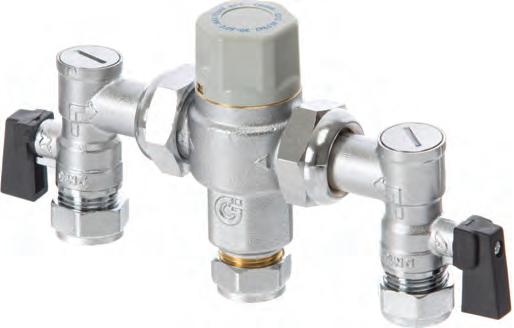
THERMOSTATIC MIXING VALVE (TMV)
Ed Morris, Technical Manager at Altecnic, takes a look at how to install and commission a Thermostatic Mixing Valve (TMV).
The Thermostatic Mixing Valve (TMV) is a critical component in modern plumbing systems, designed to blend hot and cold water to a controlled, pre-set temperature before it reaches the outlet. By limiting the maximum delivery temperature, TMVs help protect users from the risk of scalding while also ensuring consistent comfort and compliance with current water safety standards.
Correct installation and commissioning of a TMV are essential to ensure reliable performance, accurate temperature control, and long-term durability. Poor installation or incorrect setup can compromise safety, reduce efficiency, and lead to premature wear or failure of the valve.
General principles
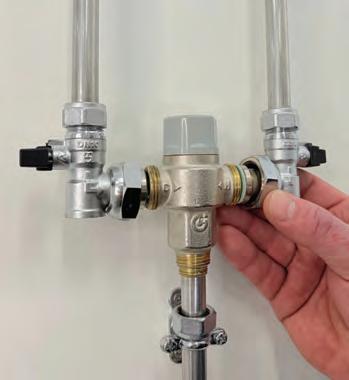
This guide provides an overview of how to install and commission a Thermostatic Mixing Valve using a typical under-basin arrangement with the Series 5213 Merchant Mixing Valve from Altecnic. While installation requirements may vary depending on application and local regulations, the principles outlined here can be applied across a wide range of domestic and commercial installations.
Step-by-step
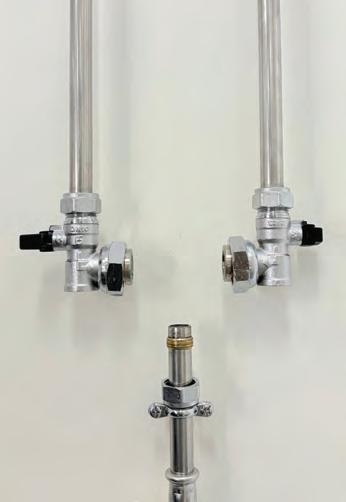
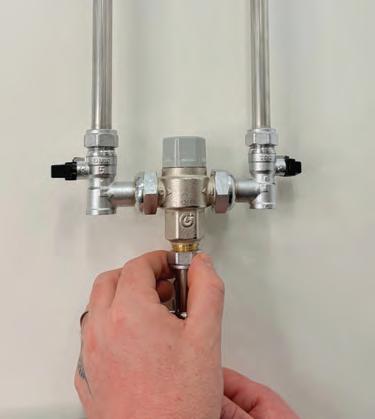
1 I Prepare the Pipework & Fit Isolation Valves
Begin by isolating the hot and cold water supplies. Ensure the pipework is correctly set out:
● Hot supply on one side
● Cold supply on the opposite side
● Mixed outlet pipework below the valve
1
2
Follow this with installing isolation valves to both the hot and cold inlet pipes to allow for safe commissioning and future service without having to drain the system.
Top Tip: Pipe runs should be flushed before installation to remove debris that could damage internal components.
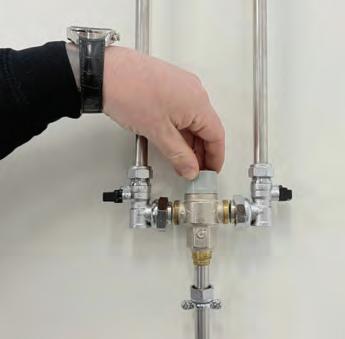
2 I Position the TMV
Mount the TMV between the hot and cold supplies, aligning it according to the directional arrows cast into the valve body.
Key points:
● Hot inlet is marked “H”
● Cold inlet is marked “C”
● Mixed outlet should be downward facing
Correct orientation is critical for accurate temperature control.
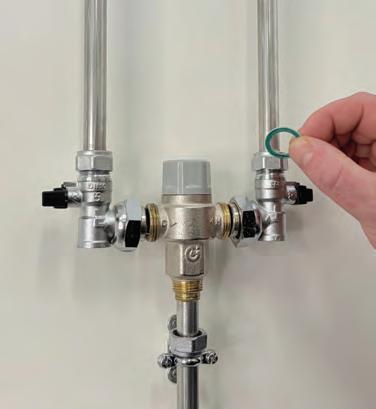
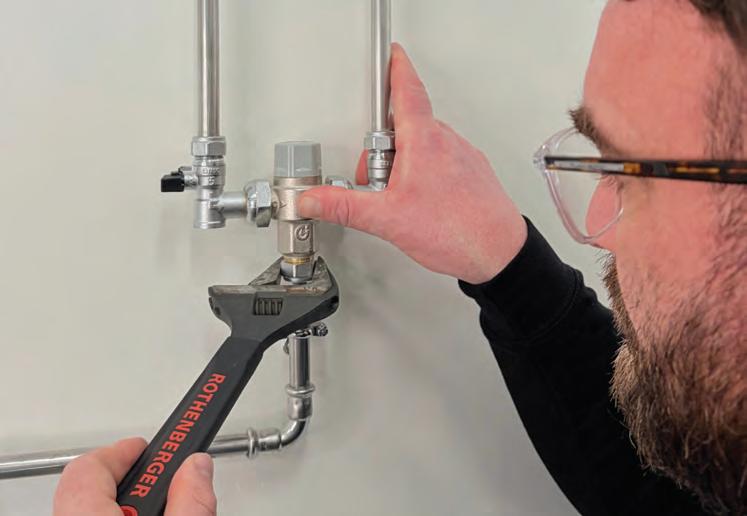
3 I Fit Seals and Connections
Install the supplied sealing washers into the union connections. Carefully bring the TMV into position and hand-tighten the union nuts to both inlet valves. Ensure seals are seated correctly to prevent leaks.
4 I Connect the Mixed Outlet
3 5 4 6
Attach the mixed water outlet pipework to the bottom connection of the TMV.
Ensure:
● The outlet pipework is supported
● All joints are secure
● Any wall clips or brackets are fixed in place
This prevents movement and strain during operation.
5 I Secure the Valve & Check for Leaks
Once aligned, tighten the union nuts using suitable spanners. Support the valve body while tightening to avoid stress on the pipework. The TMV should sit square and stable between the inlets. Slowly open the cold and hot isolation valves.
Inspect all joints:
● Inlet unions
● Outlet connection
Rectify any leaks before proceeding to commissioning.
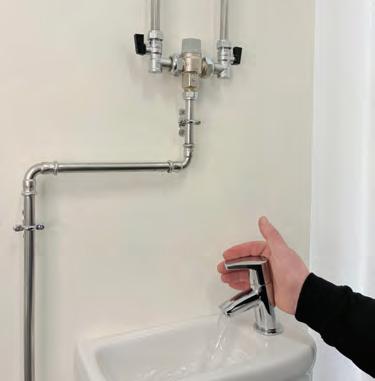
6 I Commission & Test the TMV
With the system pressurised, turn on the tap or outlet supplied by the TMV. Using the adjustment cap on top of the valve:
Remove or loosen the cap if required
Adjust the temperature to the desired set point
Measure the outlet temperature with a thermometer
Typical recommended outlet temperatures:
● Wash basins: 38-41°C
● Healthcare or safety-critical applications: follow local regulations
Once set, refit the adjustment cap to lock the temperature. Then test the TMV by operating the outlet fully to confirm:
● Stable mixed temperature
● Smooth operation
● Correct flow rate
When installed correctly, a TMV plays a vital role in protecting end users, improving comfort, and supporting compliance with relevant standards and best practice guidance
7 I Installation Complete
Installation and commissioning of the Thermostatic Mixing Valve are now complete, and the system is ready to deliver safe, stable, and accurately controlled mixed water temperatures at the outlet. When installed correctly, a TMV plays a vital role in protecting end users, improving comfort, and supporting compliance with relevant standards and best practice guidance.
To maintain optimal performance, TMVs should be inspected periodically and checked as part of routine system maintenance. Regular temperature verification helps ensure the valve continues to operate within the intended parameters and provides ongoing protection throughout its service life.
For additional technical guidance, maintenance advice, or product information, please www.rdr.link/pby017
This guide is an overview. Please contact the manufacturer for full details of the full installation process.
A LOOK INSIDE
POLYPLUMB ® ENHANCED
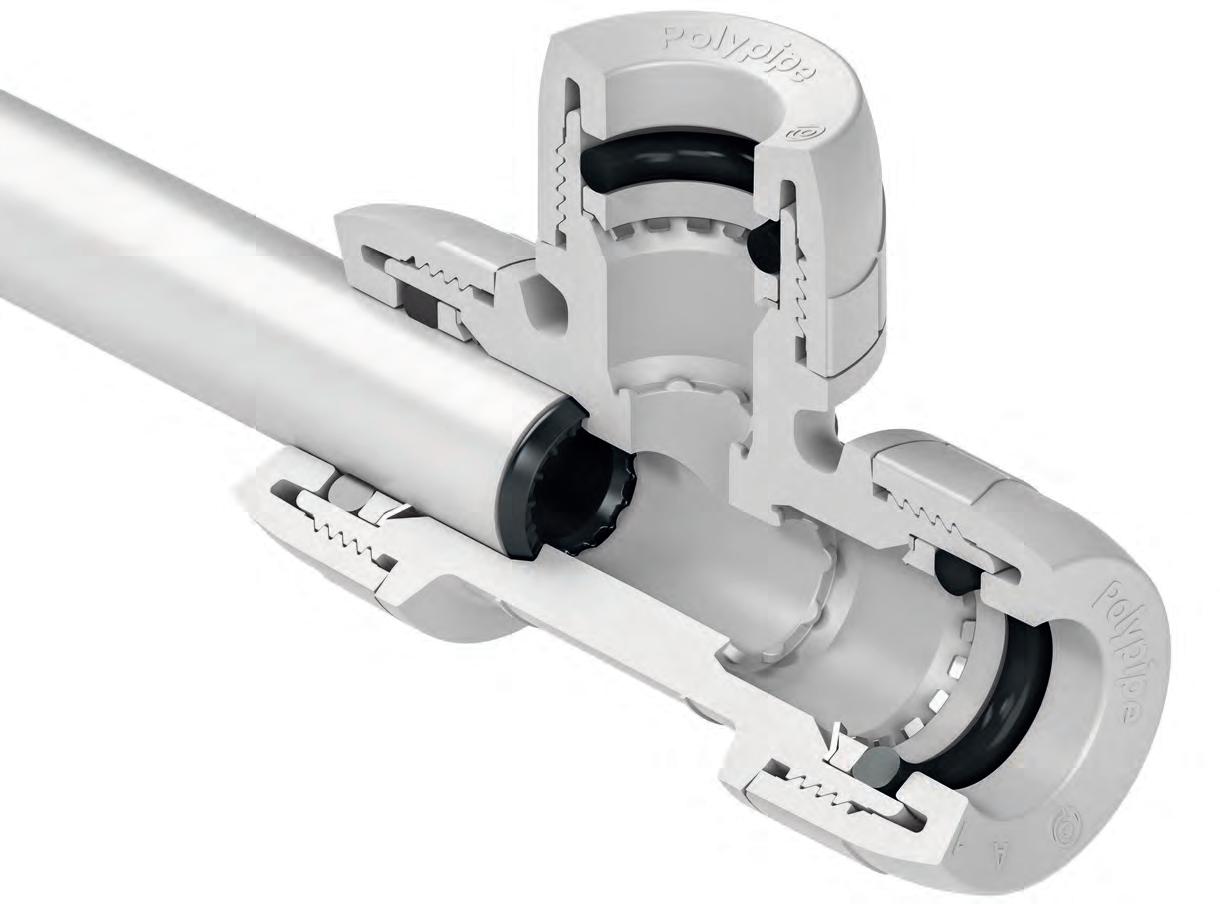
Featuring a fresh new look and available in white and grey, the new PolyPlumb® Enhanced fitting features patented In-Cert® feedback technology designed to provide added confidence when installing. PHPI takes a look inside the new fitting to reveal some of its main features.
New Cap Nut
Helping to provide a fresh new look, the Cap Nut has a sleek new design.
The grab ring is manufactured from stainless steel and designed to ensure joint integrity.
In-Cert Pipe Stiffener
The In-Cert® Pipe Stiffener is manufactured from a high specification engineering polymer incorporating a 360˚ wave feature in its head which engages with projections within the socket and helps to align and centralise the pipe.
Secure Push-Fit Jointing
When combined with the In-Cert® Pipe Stiffener, the fitting body centralises the pipe and with a twist provides haptic feedback, to give the installer confidence that the joint has been made.
For more information please www.rdr.link/pby018
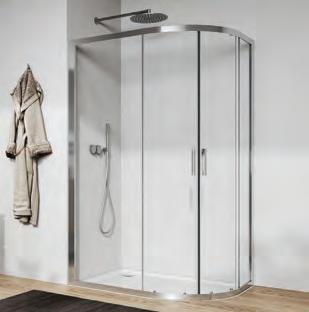
LAKES EXPANDS WaveCollection
Lakes has expanded its range going into 2026.
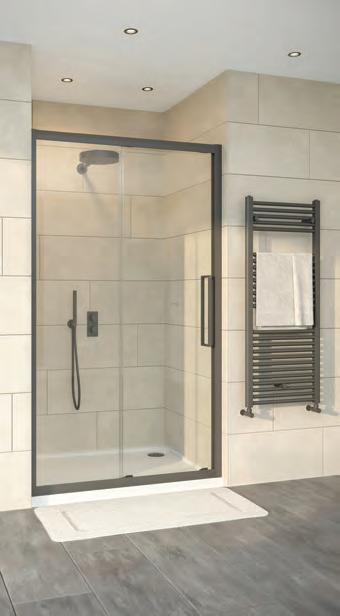
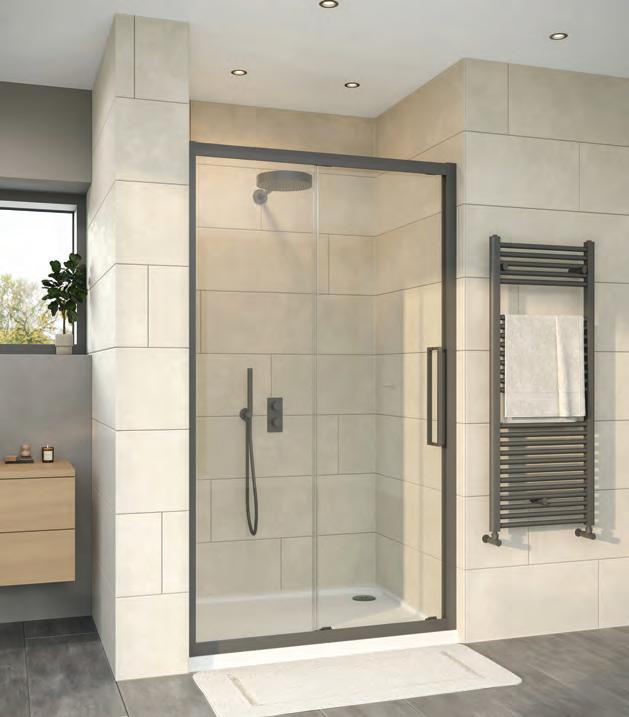
Two new colour additions have been added to Lakes Wave Collection – Gunmetal and Brushed Nickel finishes are now available across the range. Engineered with 8mm glass, the Wave Collection includes hinged, quadrant, slider and bi-fold doors, along with a side panel compatible with hinged, slider and bi-fold configurations.
Mike Gahir, Managing Director at Lakes Showering Spaces, said: “The Wave Collection is a great example of how we take emerging design trends and engineer them into products that are practical, reliable and commercially viable.
“Our approach to expanding our product portfolio has always been to listen closely to the market and act quickly, but adding new finishes is just one part of a much wider strategy.
“In the last few years Lakes have looked to disrupt the market with bold product additions, strengthened our service proposition, improved availability throughout our collections and achieved B Corp certification.
“All of this reflects a cultural shift within Lakes, one that firmly re-establishes Lakes within the Shower Enclosure Sector and allows our customers to stay ahead of changing demands.”
The Wave Collection features AllClear® technology on both sides of the glass and is backed by a lifetime guarantee.
For more information please www.rdr.link/pby019
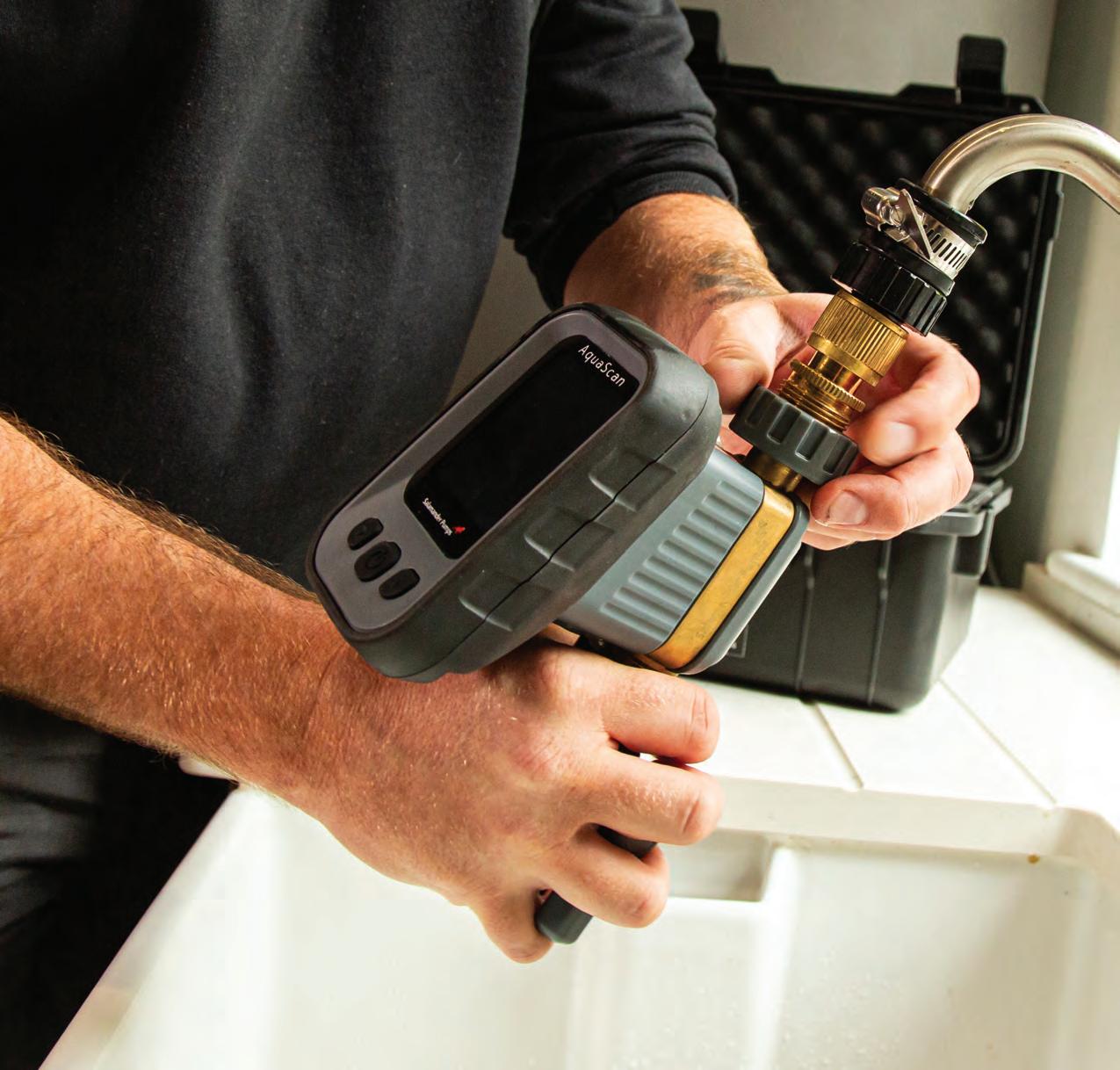
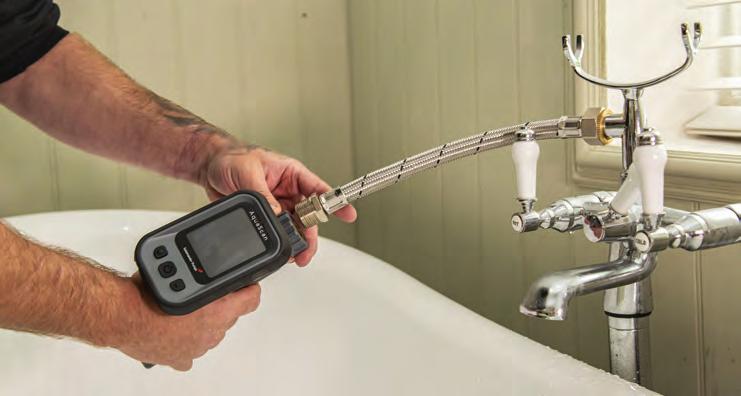
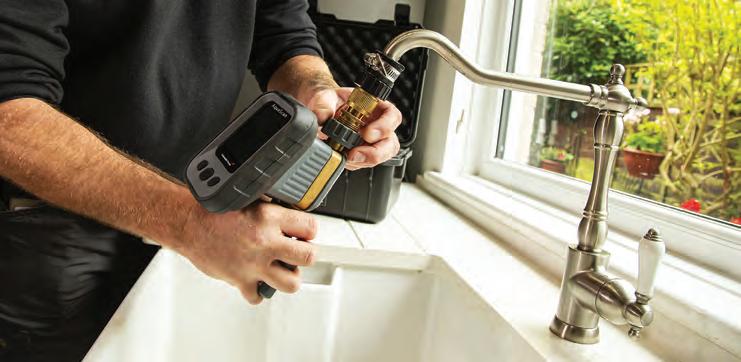
Andrew Carver, R&D Manager at Salamander Pumps, answers some of PHPI’s questions about the AquaScan digital water multimeter.
Q&A
AQUASCAN
QWhy was AquaScan developed?
Getting accurate water measurements is hugely important in modern plumbing. It helps installers diagnose problems faster and choose the right solution first time, keeping systems running smoothly and customers happy.
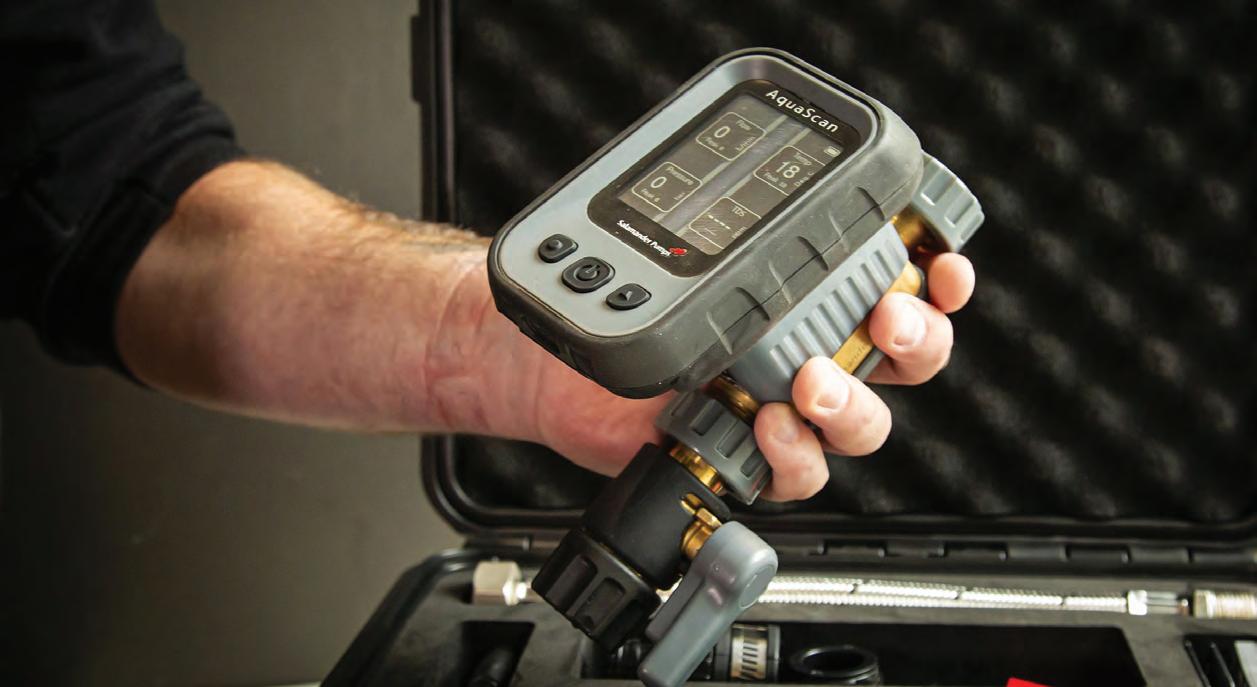
That’s why Salamander Pumps developed AquaScan, a 4-in-1 digital water multimeter. It allows installers to work quicker, more accurately and professionally by combining four key readings in one digital device. AquaScan measures water pressure, flow,
temperature and hardness via total dissolved solids (TDS).
Installers using AquaScan say that replacing multiple tools with one simple, versatile device, helps them work more efficiently on-site, giving clear, reliable measurements and to quickly diagnose issues. One installer called Stephen, who we surveyed around their use of AquaScan, said: “Instead of checking water pressure with numerous bits of kit and logging everything separately, I simply hook up AquaScan and within seconds I’ve got all the information I need on one screen.”
According to installers, having accurate measurements available at the same time allows them to confidently specify the right solution first time, reducing the risk of unsuitable products being installed and avoiding issues later on.
Installers also highlight that traditional tools and testing methods can slow down the diagnostic process and introduce uncertainty, leading to extra checks and wasted time. Travis, another member of our installer community said: “Problems with showers used to be guesswork and a process of elimination, but AquaScan really helps identify issues straight away and removes that uncertainty.”
Using a digital-first tool like AquaScan also boosts professionalism, showing customers you’re a modern installer who uses smart technology to spot issues and fix them fast. That builds trust, helps win new work and keeps customers coming back.
QWhat aspects of the plumbing system does the unit measure?
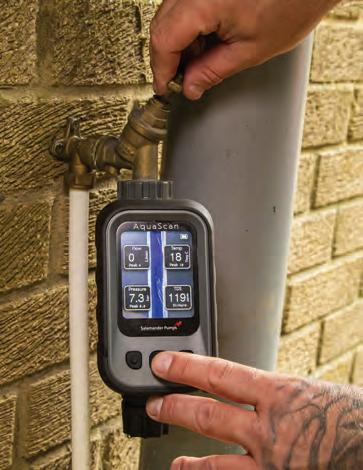
AquaScan attaches directly to a water outlet and is supplied with the necessary accessories to ensure simple setup and accurate measurement across a range of applications.
The multimeter provides live readings for pressure, flow, temperature and hardness (via TDS), as well as showing ‘peak’ readings when taking a measurement to identify any fluctuations when testing.
Installers working in leak detection have found this particularly useful as Martin, one of the installers from our survey, explained: “I use AquaScan for
pressure testing main water supplies when we are tracing leaks. There will be a drop in pressure due to the leak, so I take a reading before and after the repair.”
To measure the incoming flow rate, a garden tap is the best location to measure from as they are commonly the close to the incoming mains supply and are often unrestricted.
QHow can these measurements help plumbers?
With modern heating and hot water systems becoming increasingly sophisticated, understanding and implementing accurate measurements is crucial for ensuring optimal performance and customer satisfaction.
Accurate pressure and flow measurements are vital for pre-installation checks, serving as the cornerstone for system design and appliance selection. Without adequate checks even the highest quality appliances may underperform, leading to customer dissatisfaction and potential system failures.
AquaScan delivers clear, practical data to support correct specification, preventing potential issues before they arise, and ensuring customer satisfaction.
Ryan, an installer from our survey, said: “I recently went to quote a combination boiler installation. The customer had already been quoted a 38kw boiler which just wouldn’t work under an eight litres per minute flow rate. I was able to show the customer this result using AquaScan quite clearly and advise on the correct sized boiler for the job.”
Monitoring water temperature is a must
for installers too.
Temperature regulations set by both the Department of Health and the Health and Safety Executive exist to ensure both public safety and system efficiency.
Installers can win a Salamander Pumps AquaScan digital water multimeter in this month’s competition. Please turn to page 48
These legal requirements not only cover hot and cold water temperatures, but also for water passing through thermostatic mixing valves (TMVs). These safety devices are commonly used in sensitive environments such as care homes and hospitals, so it is critical that the mixed water temperature doesn’t exceed the regulatory level.
We understand that not all jobs are the same, which is why installers need the right accessories to hand to ensure they can effectively and efficiently use AquaScan.
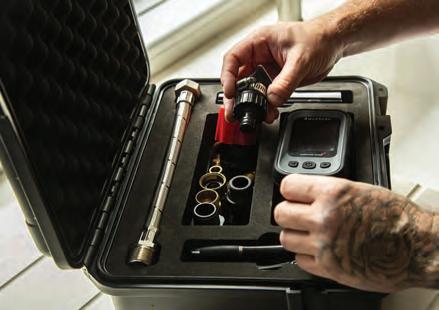
The unit comes with a range of different connectors, hoses and adaptors to meet the requirements of the scenario at hand.
These accessories allow installers to easily use AquaScan for common connections, such as garden taps, mixer taps, single taps, washing machines, as well as shower hoses and arms.
Adopting a more scientific approach to diagnostics allows installers to be more efficient, finding solutions for their customers’ problems quicker. Combining measurements means that key aspects of a system can be evaluated together, so issues can be pinpointed and overcome.
QThere are many kinds of plumbing installations across the country. Are any accessories available to ensure connection to multiple outlets?
We supply 15mm and 22mm push-fit connectors, allowing AquaScan to easily be fitted to pipework.
Q How is the unit powered?
AquaScan is powered through an integral rechargeable battery that is charged via a USB-C cable which is supplied with the tool.
Q How robust is the AquaScan unit?
Installers require tools and equipment which are tough enough to meet the demands of their everyday jobs. That’s why we’ve designed AquaScan with robustness front of mind.
The unit is built with a brass body, concealed in rubber casing to ensure it is highly protected. AquaScan also comes with a IPX5 waterproof rating.
Complete with a robust carry case, installers also have peace of mind when they are transporting the unit from job to job.
For more information please www.rdr.link/pby020
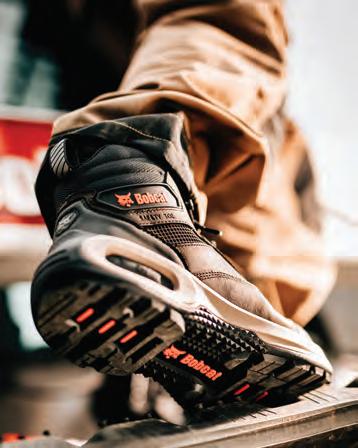
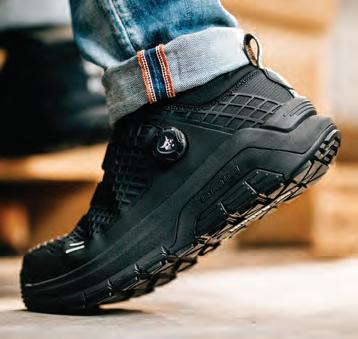
Peter Lawson, Brand Manager at Overland Shoes, reveals how the latest safety footwear technology is advancing comfort, protection and performance for installers.
PUTA S pring IN YOUR STEP
Mpeak periods, perhaps up to 12. That’s a huge amount of time spent upright, usually on unforgiving surfaces, day in, day out, often five days a week. But the impact goes beyond simple tiredness. Prolonged standing and walking can place sustained strain on the muscles, ligaments and joints in the feet, increasing the risk of further problems if not properly supported with the right footwear.
What often makes matters worse is poor footwear choice. For many installers, the irony is that the very safety footwear meant to protect their feet from physical hazards on the job site can, if poorly fitted or inappropriate, actually cause pain and possibly increase the risk of injury.
Smarter ergonmics
Growing awareness of workplace health among professional tradespeople has driven the modern safety footwear category to respond with smarter ergonomics, lighter materials and thoughtful design, in a bid to better protect installers’ feet while also safeguarding long-term health.
‘Optimum’ balance
This can be found in the recent introduction of Bobcat Safety Footwear.
The right safety footwear isn’t just about ticking compliance boxes – it’s a key part of workplace risk management
Engineered with insights from leading sports footwear technology and extensive research into the needs of modern workers, this new range – spanning over 20 distinct styles – has been purposefully designed to deliver the optimal balance of safety, comfort, all-day wearability and style for installers across all industries.
At the heart of the collection is a breakthrough in comfort technology, the Redbacks cushioning system, that redefines how safety footwear supports the wearer throughout a demanding working day.
Every Bobcat Safety Footwear design features energy-returning Leaf-Spring Technology that actively disperses pressure across the foot with every step. The Leaf-Spring mechanism retains its structure and performance for the life of the boot or shoe, helping reduce the risk of strain injuries, foot pain and long-term musculoskeletal issues.
Independent testing by the Shoe and Allied Trades Research Association (SATRA) has shown that Redbacks® improves impact shock absorption by up to 46%. The result is reduced fatigue, improved posture, and all-day comfort.
Protection & style
Meanwhile, features such as lightweight materials, composite safety toe caps, metal-free construction and puncture-resistant midsoles ensure maximum protection without sacrificing flexibility or comfort.
Style is accounted for too. From aggressive tread patterns to angular toe shapes and operator cab “cage” uppers, every detail is inspired by the iconic Bobcat machinery that gives the boots their name, resulting in a bold, modern range that looks as tough and professional as the equipment itself.
Outsole options
To ensure a suitable option for everyone, the range boasts five different outsole series to meet the real-world needs of different trades. Whether it’s the Delta series for indoor agility, the rugged Bastion series for outdoor graft or the Forge series with ladder grip zones on the sole, the collection spans 45 SKUs across S3 to S7 safety ratings. It also includes purpose-built women’s styles that properly fit and support the female foot.
The right safety footwear isn’t just about ticking compliance boxes – it’s a key part of
workplace risk management. Poor choices can cause injuries, slow productivity and drive up overall operational costs. On the other hand, investing in high-quality, reliable safety footwear not only offer better safety and ease on the job, but can also help installers protect their long-term foot health.
For more videos check out the PHPIchannelYouTube
www.rdr.link/ pby022
WATCH CONEX BÄNNINGER <A>PRESS FITTINGS
With Conex Bänninger recently announcing the introduction of its new <A> press fittings, Peter Finlay from Gas-Spec Heating & Plumbing in Edinburgh, took a look at the new solution.
In this video, Peter Finlay from Gas-Spec Heating & Plumbing in Edinburgh, tries out the new <A> press fittings from Conex Bänninger, which uses M profile jaws. Peter uses the fittings on two installations, one, a new heating system, and the other to upgrade some pipework near an existing boiler. In the video Peter explains how to use the fittings and comments: “I like the fitting, I think it’s solid. I like the O ring as well, so when we put it in, I know it’s solid. We can mark it and also we can see if it is leaking from the leak seal.”
Available in 15–54 mm sizes, the product uses an unpressed-joint indicator
it’s a really good service and a really good product
O-ring, which indicates if a joint has not been pressed. The fitting is backed by a 25-year guarantee.
Technical Support
Peter goes on to explain how the technical support team from Conex is available to assist with any queries or advice he needs. He says, “with the 25year guarantee and also with the customer support from Conex, everything, for me, doing big installations, it’s a really good service and a really good product.”
WRAS approved
<A> Press Copper has a maximum operating pressure of 16 bar at a maximum operating temperature of 110°C. WRAS approved, the range also holds DVGW certification.
To watch the video please www.rdr.link/pby023
FLAIR SHOWERS VERVE PRO SHOWER SCREEN WATCH
Fitting shower screens is a familiar process for many installers and with Flair Showers Verve Pro Click-fit systems promising a one-person installation, James from J.W. Watters Plumbing & Heating tried out the system.
The Verve Pro from Flair comes in two colours – silver or black – allowing installers to match the screen to the chosen bathroom design. It is 1.9 meters high and has 6mm toughened glass. James notes: “Usually, when I fit a shower screen, I bring someone with me. However, on this installation, I can fit this on my own... or that's what they say! So, let's see how we get on.”
Click-fit
James goes on to work through the installation process, demonstrating the way the screen fits together. He notes: “So this
In this video, James from J.W. Watters Plumbing & Heating, fits the Verve Pro shower screen from Flair Showers which features a click-fit design.
is the new click fit design from Flair. As you can see, that's as easy as it is. It slots in and this little mechanism here, clicks into the profile. It all fits together seamlessly... just like that. This is actually really simple.”
James continues: “You can really tell that Flair have got the installer in mind. I've opened the box, maybe two minutes, had a quick read through the instructions, and the screen's together.”
Extra support
Next, James moves onto the shower door. He notes: “So now I'm going to put the shower door together. Again, you can see
that Flair have the installer in mind because the installation manual is so clear and easy to follow. I'm just going to screw the wheels into place and just feeling them, they seem really good quality.”
During the installation, James highlights the extra support bar, which can be fitted in three different places, depending on where the shower outlet is. He explains: “Having the stability bar in on such a large enclosure just gives you a bit of peace of mind, with it being so big, that if anyone does fall into it, that the screen's not going to shatter or smash.”
Summing up at the conclusion of the installation, James says: “So, there we go. We've just finished the installation of the shower door and it's gone absolutely seamlessly. The click fit mechanism is really, really good to use and it makes life so much easier when you fit in a shower door on your own. I actually did manage to fit it by myself, so Flair weren't wrong.”
To watch the video please www.rdr.link/pby024
The Gas App UK Horror Show showcases some of the ‘finest’ work spotted by installers across the countr y. If you spot any masterpieces to rival these, please submit them to the good people at Gas App UK or email us: phpi@hamerville.co.uk
YOUR SHOWS,NEAR YOU...
Throughout 2026 plumbers and heating engineers can get closer to the brands you use at SIX venues across the UK. The Toolfair and Professional Builder LIVE events will be coming to a location near you with an enticing mix of products, tools, workwear and solutions to keep professional installers productive every working day.
It is a fantastic opportunity for trades professionals to discover the latest solutions in the sector, get hands-on with equipment, and meet the people behind the products. Best of all, the shows are free to attend for trades professionals.
Demos & deals
Free entry
Across two days
3 events in 1
Free parking (van friendly)
Free T-Shirt or Free bacon roll
Show deals
Hands-on demos
Meet manufacturers
ALEXANDRA PALACE, LONDON
26th & 27th March 2026
WESTPOINT, EXETER
23rd & 24th April 2026
Taking place across two days at ‘van-friendly’ venues, each show features hands-on product demos, a huge array of tools and equipment, a chance to meet and quiz manufacturers on the products you use, and the opportunity to grab some special ‘show deals’ on the kit you need.
Co-located with the popular and established electrical sector event ‘Elex’, Toolfair and Professional Builder LIVE will also give visitors the chance to network with fellow industry professionals and discover new products and solutions.
Across two days, at a venue near you, and free-to attend, Toolfair and Professional Builder LIVE is a must-visit event for professionals across the trades.
YEC, HARROGATE 14th & 15th May 2026
STONELEIGH PARK, WEST MIDLANDS
22nd & 23rd October 2026
SANDOWN PARK, SURREY 18th & 19th November 2026
phpionline.co.uk features the latest industry news, video reviews, technical updates and exclusive competitions, giving you instant access to all things heating and plumbing on your desktop, laptop, tablet or phone.
WHALE SENSE
Whale Sense is a solenoid controller for mixer shower installations designed to reduce the risk of flooding.
Enabling independent living often requires consideration of a number of factors, more than level access trays and grab rails. True bathroom safety means mitigating risk, protecting property assets and supporting vulnerable individuals without compromising dignity.
Whale Sense is a solenoid controller for mixer shower installations designed to reduce the risk of flooding. The company says it brings the safety benefits traditionally associated with electric showers into mixer-based systems –which can be a major advantage for refurbishment programmes where mixer showers are preferred or already installed.
Shut-off
The system has been designed to automatically shut off the water supply after a preset period, helping to prevent incidents where showers are inadvertently left running. This can be particularly relevant in properties occupied by residents living with dementia, ADHD or other cognitive conditions.
For housing providers managing
Whale Sense has been designed to deliver both resident-centred and asset-protection benefits
multiple dwellings, preventing even a small number of flooding events can result in substantial cost avoidance and reduced disruption.
Whale Sense can be used with both gravity drainage and pumped drainage systems. In installations incorporating a Whale pump, the system provides an additional layer of protection: in the event of a power failure to the pump, the shower recognises this instantly and initiates its controlled shut-down sequence.
Reducing risk
By preventing continued water flow when drainage capacity is compromised, the risk of overflow and property damage is further reduced. This intelligent response can be
particularly valuable in retrofit environments where pumped drainage solutions are necessary to achieve step-free access.
Water flow is controlled via electrically operated solenoids, with automatic shut-off protection in the unlikely event of solenoid failure.
Supporting accessibility
When paired with a Passive Infrared Sensor (PIR), the system also enables hands-free activation, supporting accessibility while maintaining compliance with UK water regulations when installed with WRAS-approved components and appropriate TMV2 or TMV3 mixers.
For refurbishment projects focused on enabling step-free showering and independent living, Whale Sense has been designed to deliver both resident-centred and asset-protection benefits. It allows specifiers to retain the familiarity and flexibility of mixer showers while introducing intelligent water control.
For more information please www.rdr.link/pby025
SPIROTECH INTRODUCES SP IROTRAP HPF
The SpiroTrap HPF is designed to protect heat pump systems against both magnetic and non-magnetic contamination.
Spirotech has announced the introduction of its SpiroTrap Heat Pump Filter (HPF), a new dirt filter designed to protect heat pumps against both magnetic and non-magnetic contamination. Heat pumps can be more sensitive to contamination than traditional heating systems. The finer components, lower flow rates, and precise control can make them vulnerable to particles such as rust, sludge, sand, and magnetite. This contamination can cause loss of performance, malfunctions, and repairs to components such as heat exchangers, pumps, and valves.
Core components
The company says the SpiroTrap HPF is designed to protect heat pump systems featuring a design based on extensive field research in residential installations across several European countries, combined with Spirotech’s many years of expertise in water quality and dirt separation.
The core consists of three components:
● Fine mesh filter – captures high-risk particles larger than 160 µm.
● Powerful magnet – removes magnetic dirt particles.
● Patented Spirotube – slows the flow and directs particles toward the collection zone
Spirotech says that thanks to this combination, the filter is relieved of excess load, the flow remains optimal, and the system is protected over the long term –without a bypass, ensuring that no particle can escape filtration.
Service visits
According to the company, the SpiroTrap HPF has been developed with the heat pump’s maintenance interval in mind (on average every two years). It says the integrated backflush function makes filter cleaning simple: with a single turn, the flow direction is reversed, and
The SpiroTrap HPF is available in multiple connection sizes
accumulated dirt is discharged via the drain valve –no disassembly, tools, or spillage required. The SpiroTrap HPF is available in multiple connection sizes (22 mm, 28 mm, ¾”, 1” and 1¼”) and suitable for systems up to 2m³/h. Spirotech provides a 10-year warranty.
The SpiroTrap HPF will be available from April 2026.
For more information please www.rdr.link/pby026
SCHLÜTER SYSTEMS BATHROOM SOLUTIONS
Schlüter-Systems outlines its solutions to help installers deliver high-quality bathrooms.
together, reducing guesswork on site and helping to avoid call-backs.
At the heart of any tiled bathroom is effective waterproofing. Schlüter’s KERDI membrane system offers a simple, bonded waterproofing solution that sits directly beneath the tiles, protecting the substrate from moisture damage.
Designed to be lightweight and easy to cut due to gridline markings, it can be applied quickly using tile adhesive. The addition of KERDI-BAND sealing strips and pre-formed corners makes detailing around junctions more straightforward. For installers, that means less on-site confusion and more confidence that the job is watertight.
eliminates the need to marry up components from different manufacturers and reduces the risk of weak spots at critical junctions.
Tile backerboard
Preparation work can often eat into installation time, but Schlüter’s KERDI-BOARD has been designed to help streamline the process. The lightweight tile backerboard is easy to handle and can be cut with a knife, making it suited for tight spaces and retrofit projects. Once installed, it forms part of the waterproof assembly, cutting down on additional layers and helping keep the installation efficient.
Uncoupling membrane
Beyond the core waterproofing and drainage elements, Schlüter also offers solutions that add value without complicating installation. DITRA-PS and DITRA-HEAT-PS (Peel & Stick) have been designed with the installer in mind, combining uncoupling, crack bridging and, in the case of DITRA-HEAT-PS, integrated electric heating in one easy-to-use Peel & Stick system.
The pressure-sensitive adhesive backing means the mat can be fixed directly to a clean, flat substrate without spreading tile adhesive first, reducing installation time and on-site mess.
With DITRA-HEAT-PS, the heating cable slots neatly into the membrane studs, designed for correct spacing and easy positioning, while the mat’s low profile keeps floor build-up minimal. Once installed and tested, tiles can be laid directly over the mat, giving installers a reliable, efficient system that protects the tile covering, and, where heat is included, delivers responsive, evenly distributed warmth.
For heating and plumbing professionals, the real advantage lies in installing a complete system. Compatibility between components, clear technical guidance and a structured approach to bathroom construction all contribute to smoother installations.
For more information please www.rdr.link/pby027
SUBSCRIBE
DABPUMPS ESYBOXPOPGETSWRAS APPROVAL
As the latest addition to the EsyBox range of automatic water boosters, the EsyBox Pop is a compact, all-in-one solution for homes where space is limited but water pressure expectations are high. WRAS approval means installers can be confident it has passed rigorous tests and meets the high standards set by the Water Regulations Advisory Scheme.
Adam Ferneyhough, Country Director for the UK & Ireland at DAB Pumps, commented: “Achieving WRAS approval for EsyBox Pop is an important milestone for us and for installers. It gives complete confidence that the product not only delivers strong, reliable pressure boosting performance, but also meets the required regulatory standards for use on wholesome water supplies. For contractors, that reassurance is essential when specifying and fitting equipment in domestic environments.”
The company says EsyBox Pop is small, lightweight and supplied ready to work straight out of the box, and is suited to installation in tight corners, cupboards or utility spaces. It features a variable frequency drive designed to reduce energy consumption by automatically adjusting motor speed to match demand. Connectivity is built in as standard, allowing installers or homeowners to configure, monitor and troubleshoot the system via the DAB H2D app. The unit also includes a built-in non-return valve to prevent backflow and ensure water flows in the correct direction.
For more information please www.rdr.link/pby028
WIN AN AQUASCAN MULTIMETER
PHPI has teamed up with Salamander Pumps to offer one installer the chance to win an AquaScan digital water multimeter.
Getting accurate water measurements is hugely important in modern plumbing. It helps installers diagnose problems faster and choose the right solution first time, keeping systems running smoothly and customers happy.
Salamander Pumps’ AquaScan is a 4-in-1 digital water multimeter that measures water pressure, flow, temperature and hardness via total dissolved solids (TDS). This versatile device has been designed to help installers work more efficiently on-site, giving clear, reliable measurements and to quickly diagnose issues.
AquaScan attaches directly to a water outlet and is supplied with the necessary accessories to ensure simple setup and accurate measurement across a range of applications. The multimeter provides live readings for pressure, flow, temperature and hardness (via TDS), as well as showing ‘peak’ readings when taking a measurement to identify any fluctuations when testing.
Range of connectors
The unit comes with a range of different connectors, hoses and adaptors to meet the requirements of the scenario at hand. The accessories allow installers to use
AquaScan for common connections, such as garden taps, mixer taps, single taps, washing machines, as well as shower hoses and arms.
AquaScan is powered through an integral rechargeable battery that is charged via a USB-C cable which is supplied with the tool. The unit is built with a brass body, concealed in rubber casing. It comes with a IPX5 waterproof rating and a one-year warranty.
More details on the AquaScan digital water multimeter can be found on page 32
To enter the competition please www.rdr.link/pby029
MAKITA LAUNCHES NEW VACUUM CLEANER
Makita has added a new 40VMax cordless vacuum cleaner to its XGT range. The company says the VC013G is a highly portable L-Class dust extractor with automatic operation functionality as well as a site vacuum with impressive suction power, air flow volume, and runtimes.
KUDOS D-LITESHOWERENCLOSURES
Among the latest additions to Makita’s 40VMax XGT battery platform, the VC013G delivers a maximum sealed suction of 15 kilopascals (kPa) and an airflow volume of up to 2.0 cubic metres per minute (m3/min). The company says it operates at no more than 75 decibels due to the design of the motor housing and supports and includes both a pre-filter and HEPA filter.
The VC013G features a brushless motor. The company says it has a runtime of between 22 and 120 minutes using a 5.0Ah battery depending on the power setting. For extended runtimes, the vacuum is compatible with the 8.0Ah XGT batteries.
D-Lite is a new range of shower enclosures offered by Kudos. Produced with 6mm glass, the collection provides a variety of sizes and door configurations, including pivot, sliding, bifold, and quadrant designs. All D-Lite shower enclosures are 1950mm high and feature 6mm toughened safety glass throughout, treated with a protective glass coating for easy cleaning. The profiles have a chrome finish, and the company says the fixings, included in each pack, are designed for easy installation. There is also a 30mm adjustment for each wall post to accommodate uneven walls. They can be installed on either a tray or a wetroom floor and come with a 10-year guarantee against manufacturing defects.
For more information please www.rdr.link/pby030
CARHARTT HOODIE RANGE
As spring approaches and coats start to feel too warm, workwear company Carhartt says its hoodie range is a warm, hard-wearing alternative designed for those in-between conditions, giving tradespeople layers that work hard on site and stay comfortable once the day winds down. The company says that for those who build up heat quickly, the Carhartt Force™ Logo Sweatshirt (107064) offers lightweight warmth with FastDry™ technology. This hoody is designed to wick sweat away from the body and dry quickly, helping regulate temperature during active work. Available colours include asphalt, black, teal and cobblestone. Or, for those who prefer the flexibility of a zip, the company says the Marquette Full-Zip Sweatshirt (K122) is an option.
For more information please www.rdr.link/pby031
The VC013G has a 4.5 litre wet capacity and a 7.5 litre dry capacity with the option to use with or without cloth filter or paper bags. Accessories. including a hose extension set and telescopic pipe, allow the vacuum to be tailored to meet the user’s requirements. The unit has an integrated carry handle and removeable shoulder strap. Commenting on the launch, Kevin Brannigan, Marketing Manager at Makita said: “The new VC013G offers a powerful and compact option for Class-L dust extraction and site cleaning. Its portability means simple dust extraction can be achieved in a wide range of locations and as a 40VMax XGT vacuum, it delivers the power that professionals require.”
For more information please www.rdr.link/pby032
STELRAD TURNAROUND SERVICE
Last year, radiator manufacturer Stelrad introduced a new quicker turnaround service for the supply of some of its radiators in colour. Initially this new rapid turnaround service applied to the Column and Concord ranges, and to the Classic Towel Rail, Caliente and Concord towel rail products when ordered in one of the 55 standard RAL colours and finishes within the company’s range of radiators.
Now Stelrad has announced phase two of the rollout of the same rapid turnaround for coloured radiators from a wider range of its options to include models in its Compact with Style, Planar, Vita Silhouette, Vita Deco, Vita Plan, Vita Vertical, Softline Silhouette, Softline Deco, Softline Plan, Softline Vertical, Henrad Silhouette, Henrad Everest Line, Henrad Plan, Henrad Vertical, Henrad Arno Towel Rail and Henrad Verona Towel Rail products.
For more information please www.rdr.link/pby033
SHOWERWALL INTERACTIVE VISUALISER
Wall panel brand Showerwall has launched an interactive visualiser, allowing users to preview how a chosen décor could look in a bathroom. The tool enables users to experiment with designs across five pre-set room settings or upload an image of their own bathroom to see how Showerwall panels would look once installed. Now live on the Showerwall website, the visualiser features the brand’s full panel range, including the recently launched slatted wood-effect Arcade Collection. Katie Cope, Head of Showerwall, said: “We know today’s consumers want to visualise how a panel will work in their own space and explore multiple décor options before making a decision - this new tool allows them to do exactly that.”
For more information please www.rdr.link/pby034
AKW Medi-Care ............................(page 52 outside back cover) www.rdr.link/ PBY100
Head over to the PHPI YouTube Channel to view videos on everything plumbing & heating: from fittings to filters – press tools to pumps. The videos have been put together with input from both manufacturers and installers to bring you the latest details. Just type in the rdr.link codes listed to watch... & don’t forget the popcorn!
ZILMET Intafil Expansion Vessel
In this video Chirag from CP Utility Solutions installs a Zilmet Intafil Expansion Vessel whilst running through some of the benefits of the slim-line solution. During the installation he highlights the slim-line design and points out that it comes with a number of additional parts in the box. Chirag says: “So you’ve got the expansion vessel itself. It also comes with a new filling loop kit, you’ve got your pressure relief valve, you’ve got your pressure gauge, and in this box we also have our multifunction valve. And there is no reason to source separate parts.” Summing up towards the end of the installation Chirag notes: “It is highly durable and it’s built for reliability and longevity.”
To watch the video… www.rdr.link/pby035
CONEX BÄNNINGER <A> Press fittings
In this video, Peter Finlay from Gas-Spec Heating & Plumbing in Edinburgh, tries out the new <A> press fittings from Conex Banninger, which use M profile jaws. Peter uses the fittings on two installations, one, a new heating system, and the other to upgrade some pipework near an existing boiler.
He explains how to use the fittings and comments: “I like the fitting, I think it’s solid. I like the O ring as well, so when we put it in, I know it’s solid. We can mark it and also we can see if it is leaking from the leak seal.”
To watch the video… www.rdr.link/pby036
FLAIR SHOWERS Verve Pro Shower Screen
In this new video, James from J.W. Watters Plumbing & Heating, fits the Verve Pro shower screen from Flair Showers which features a click-fit design. Working through the installation, James notes: “So this is the new click fit design from Flair. As you can see, that's as easy as it is. It slots in and this little mechanism here, clicks into the profile. It all fits together seamlessly... just like that. This is, actually, really simple.”
James continues: “You can really tell that Flair have got the installer in mind. I've opened the box, maybe two minutes, had a quick read through the instructions, and the screen's together.”