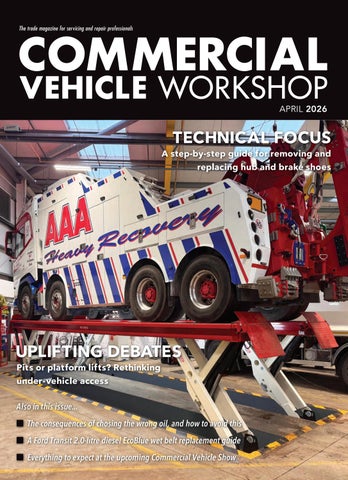
Commercial Vehicle Workshop April 2026

Page 1


COMMERCIAL VEHICLE WORKSHOP

A step-by-stepguide for removing and replacing hub and brake shoes

UPLIFTING DEBATES

Pits or platform lifts? Rethinking under-vehicle access

The consequences of chosing the wrong oil, and how to avoid this

■ A Ford Transit 2.0-litre diesel EcoBlue wet belt replacement guide

■ Everything to expect at the upcoming Commercial Vehicle Show

CV SHOW PREVIEW

With the Commercial Vehicle Show returning once again to the NEC in Birmingham this month, we take a look at what you should expect at this revamped event.

BRAKES

26 febi shares a common fault when it comes to air tanks, a safety-critical component within the braking system.

28 Workshop welfare often focuses on vehicles, but equipment is just as crucial, says MAHA UK.

30 SAF Holland provides us with a best practice guide for removing and replacing SAF Instradrum hub and brake shoes and associated components.

33 ZF Aftermarket explores the reason modern commercial vehicle braking requires a fresh approach to engineering.

36 Diesel Technic shares some practical tips to help you diagnose faults and get brake caliper and cylinder repairs right the first time.

BODY REPAIRS & REFINISHING

39 Esprit Windscreen Repair Equipment makes a case for bringing windscreen crack repairs in-house.

40 Mirka argues that investing in the right tools and empowering your staff with the right knowledge will boost workshop efficiency.

42 Details of three new topcoat launches from Axalta brands Cromax, Spies Hecker and Standox.

LIGHT COMMERCIAL VEHICLES

Landsail presents its tyre solution for light commercial vehicles, arriving just in time to support your spring reset with reliable performance and everyday practicality.

Follow along with a Ford Transit 2.0-litre diesel EcoBlue wet belt replacement from Dayco, following the launch of a new video from the brand.

Why effective thermal management is essential for keeping light commercial vehicles reliable and efficient, from AVA.

VIEWPOINT

Editor

FREYA COLEMAN

cvw@hamerville.co.uk

Group Editor

KIERAN NEE

Digital Manager

KELLY NEWSTEAD

Digital Assistant

JOE CLARKE

Group Manager

ALEX DILLEIGH

Senior Account Manager

MATTHEW BOASE

Graphic Designer

GEMMA WATSON

Group Production Manager

CAROL PADGETT

Subscriptions

Commercial Vehicle Workshop is a business magazine for companies and individuals involved in all aspects of commercial vehicle servicing.

It is published 11 times a year and is available on free subscription to qualified readers.

Subscription rates:

UK £30 post paid

Airmail £99 post paid

Europe £70 post paid

To be removed from this magazine’s circulation, please call 01923 237799 or email circulation@hamerville.co.uk.

Printed by Stephens and George

Published by

HAMERVILLE MEDIA GROUP

Regal House, Regal Way, Watford, Herts WD24 4YF

Tel: (01923) 237799

Website: www.hamerville.co.uk

Copyright © 2026 10,190

OUT OF HIBERNATION

There’s always a moment, usually just as the weather starts to behave itself, when it becomes clear: winter has left its mark. For me, the tan from last summer has well and truly faded and mood is generally significantly worse. And just like me, through the colder months, commercial vehicles don’t get an easy ride. Between road salt, potholes, stop-start driving and the general push to “just keep things moving,” fleets take a bit of a battering. And fair enough as when the pressure’s on, uptime comes first. But now spring is creeping in, those little compromises start coming back for attention. Suddenly, you’ll find your workshop diary fills up with jobs that all feel oddly familiar.

Brake wear that’s gone a bit further than planned. Suspension components that have had enough of dodging craters disguised as roads. Batteries that made it through winter, just about, but clearly aren’t keen on another cold snap. It’s not that these issues are surprising. It’s more that they’ve all decided to show up at once.

Then there are the vehicles that have been doing less over winter –backup units, seasonal trucks, or anything that’s been parked up more than usual. On paper, they should be the easy jobs. In reality, they’re often the ones that need the most persuasion. Flat batteries, seized components, warning lights making a dramatic return –it’s less “ready to go” and more “gentle reintroduction required.”

Of course, this is also the time of year when good intentions make an appearance. Talk of preventative maintenance, proper scheduling, maybe even a bit of a workshop tidy-up. And to be fair, spring is the ideal moment to reset. For me this comes in the form of spring cleaning but for you it could be catching up on the jobs that were deferred, giving vehicles a proper once-over, and getting ahead before the next busy period hits. Because it will hit.

If winter is about survival, spring is about recovery and preparation. The fleets that come out of this period in good shape are usually the ones that treat it as more than just a change in weather. It’s a chance to deal with the wear and tear properly, rather than carrying it forward.

That said, no matter how organised things are, there will always be that one job. The “quick check” that turns into something much bigger. The fault that didn’t exist yesterday. The vehicle that clearly didn’t get the memo about spring.

Some things, it seems, don’t change with the seasons. Now, it’s time to dust off the cobwebs!

FreyaColeman

Editor

CVW NEWS

NEWSIN BRIEF

■ Scotland’s roads amongst UK’s most dangerous. RAM Tracking analysis of over 1,500 vehicle alerts names the A698 in the Scottish Borders and the A6 through the Peak District as the UK’s worst roads for dangerous driving.

■ Women’s health training courses launched. The automotive charity Ben has launched these courses, aiming to provide the industry with a better understanding of the health challenges affecting women’s physical, emotional and psychological wellbeing.

■ More sleep needed for UK transport workers. 2 million of these workers are functioning on as little as four hours’ sleep per night, making it one of the most sleep-deprived industries in the UK. This is according to the latest study from Hillarys.

Commercial Vehicle Workshop magazine launches LinkedIn page

CVW has launched a new LinkedIn page aimed at bringing together professionals from across the commercial vehicle industry.

Designed to complement the magazine, the platform will serve as a hub for workshop technicians, engineers, fleet managers, operators, suppliers, and industry leaders to connect and share insights. The page will feature a range of content, including industry news, technical advice, workshop best practices, fleet management perspectives, and product developments. CVW says the initiative is focused on

building a stronger sense of community within the sector, creating a space where professionals can stay informed and exchange ideas on the challenges and opportunities shaping the industry. Audience engagement will play a key role, with followers encouraged to suggest topics, share experiences, and highlight important developments.

The launch marks a step toward a more collaborative and connected commercial vehicle network, supporting the people who keep the sector moving. Make sure to scan the QR code to follow us over there!

Wales unveils its first trial with hydrogen refuse vehicles

Wales unveiled its first comparative demonstration of hydrogen and electric refuse collection vehicles, marking a major milestone in the nation’s ambition to accelerate greener transport solutions. The trials will be delivered in partnership with Ricardo, Hyppo, Caerphilly County Borough Council and Rhondda Cynon Taf County Borough Council. Welsh Government’s Climate Innovation scheme and Circular Economy are supporting this important feasibility and demonstrator work to the value of over

£420,000. This demonstration is part of a whole systems “challenge” which brings both zero emission technologies together side by side for the first time, marking a significant step towards cleaner, more sustainable fleet operations across the country. Throughout the trial, engineers and fleet managers will examine energy usage, range, operational performance and suitability for different terrains and routes. Insights from the trial will help shape the next phase of zero emission fleet planning across Wales.

CoolKit has delivered the first part of a major deal with food and water testing company Eurofins, supplying 22 refrigerated vehicles as the first instalment of a major partnership, with more expected in the future.

CVW NEWS

DATES FOR THE DIARY

■ COMMERCIAL VEHICLE SHOW

The Commercial Vehicle Show will return to the NEC Birmingham from 21st- 23rd April and will include the Bus & Coach Expo for the first time.

Welcoming 320 exhibitors, commercial vehicle manufacturers will also be in attendance with their latest products and new launches, including Chery for the first time as it prepares for its expansion across the UK, IVECO with their eJolly and eSuperJolly, as well as the returning Farizon, Ford, Isuzu, KIA, and Renault.

■ MECHANEX NORTH

Taking place in the Yorkshire Events Centre in Harrogate on the 14th and 15th of May, Mechanex PMM Live is well known within the independent aftermarket for offering visitors a hands-on experience, bringing them the latest updates and expertise from across the industry and providing an exciting day away from the workshop.

Registration to visit the show is free and so is parking, so register your attendance now!

■ ROAD TRANSPORT EXPO

Road Transport Expo (RTX) returns from 30th June - 2nd July at NAEC Stoneleigh, and this year’s edition is set to be the largest and most ambitious to date. RTX 2026 will bring together leading voices and innovators from across the haulage and road transport sector, offering your readers valuable insight into the latest industry developments, technology, and best practice.

Neurodiversity in the industry explored

Autotech Group has highlighted the steps it has taken over the past six months to better understand neurodiversity and its role in addressing the automotive industry’s ongoing workforce challenges.

The theme for this year’s Neurodiversity Week – From Awareness to Action – aims to encourage organisations to move beyond discussion and instead implement meaningful change. For the automotive sector, where employers continue to face significant pressure to attract and retain skilled people, the message is said to be particularly relevant.

Working with specialists

Over the past six months, Autotech Group has been working with neurodiversity specialists to deliver training across its teams, helping consultants, trainers and its wider teams better understand how neurodivergence can present in the workplace and how businesses can create environments where individuals are able to thrive. In parallel, the company has also

been developing and applying technology designed to support different ways of learning and working, helping clients create more inclusive and accessible environments for neurodivergent individuals.

Training

The training has focused on practical ways to support candidates, contractors, clients and interns, while also helping teams recognise the strengths neurodivergent individuals can bring to technical and operational roles, including problemsolving, creativity, strong focus and attention to detail. With around one in seven people in the UK estimated to be neurodivergent, recognising and supporting these strengths represents an opportunity for employers across the sector.

Autotech Group is launching a survey to better understand how neurodiversity is experienced across automotive workplaces.

WWW.RDR.LINK/VCE001 to fill it out.

Witham Group, a leading UK manufacturer of lubricants and paints, and Lincolnshire established family business, successfully hosted its annual charity event in January, raising a fantastic £10,000 for their three charities of the year.

Damage the wrong oil can cause BEST PRACTICE TIPS

Adrian

Hill, Morris Lubricants’ technology manager, explains the consequences on downtime, income and repair bills if

the wrong oils are used in commercial vehicles.

In the commercial vehicle sector, you need to be aware of the potential damage that can be caused by using the wrong oil. There is no merit to cutting corners, so yes, you should take correct oil choice and use very seriously.

The world of commercial vehicle oils is continually evolving and there are lots of different formulations available. Therefore, selecting then using the correct oil is critical to the operational efficiency and longevity of commercial vehicle engines and drivelines. One of the biggest challenges for commercial vehicle oils today is to provide maximum component protection. Sounds simple, but these oils need to function correctly to protect the commercial vehicle when it operates under a variety of loads and duty cycles, as well as maintaining the integrity of any aftertreatment devices fitted to the exhaust system.

Why should you use the correct engine oil?

Not replacing the engine oil at the correct service interval, or even using the wrong engine oil, can have a big impact on fuel efficiency, cause poor oil circulation as well as give rise to a lack of sludge and deposit

control. These factors can cause major issues leading to the possibility of the engine overheating and at worse severe engine component damage. The use of the wrong engine oil can cause poor soot control that can lead to accelerated wear, due to its abrasive nature, as well as oil thickening, that can inhibit oil flow resulting in oil starvation and engine failure. Ring soot compaction is another consequence of using the wrong engine oil, that can prematurely wear piston rings and polish cylinder liners, leading to excessive blow-by and reduced power output. Throw into the equation that the wrong oil can lead to poor corrosion control, and you soon can have sticking valves that can also reduce engine efficiency. In a commercial vehicle, where high mileage can be achieved in a very short time, the wrong oil can cause engine components such as bearings, camshafts and pistons, for example, to break or wear out prematurely.

The potential worry does not stop with the engine and its internal components. The correct oil must work with aftertreatment devices that are required to control NOx emissions and particulate matter. These aftertreatment devices are highly sensitive

to engine lubricant chemistry. The wrong oil can contain too much sulphur and phosphorous (for anti-wear performance for example) that can poison catalysts used in AdBlue systems and if the lubricant creates too much ash, it can prematurely block DPFs. When the AdBlue systems and DPFs go wrong, they are expensive to replace, and the vehicle will need to be taken off the road.

The consequences of any of these engine problems means that the commercial vehicle will need to be fixed and it will also be off the road. When a commercial vehicle is being fixed, this downtime costs money and as highlighted this can affect a company’s reputation.

What about antifreeze coolants?

Antifreeze coolant choice is also very important, and selection should be based on its chemical make-up and antifreeze coolant specifications set by the OEM. Problems also arise if too much antifreeze coolant is used in the system as it can cause overheating. Likewise, if too much water is added to the mixture the antifreeze coolant mix will not prevent freezing and you risk damaging the engine due to the formation of ice crystals.

As highlighted the antifreeze coolant chemistry is important. The compounds used in the formulations are developed to cope with corrosion and rusting, maintaining pH, preventing cavitation erosion, controlling foam and oxidation. Poor antifreeze coolant choice could impair engine operation and may influence fuel efficiency. So, to put simply use the correct antifreeze coolant at the correct water mix ratio.

Remember to use the correct oil in the driveline

Transferring power from the engine to the wheels of a commercial vehicle without energy losses is essential if we want to reduce fuel consumption and reduce harmful emissions. There are of course options when it comes to transmission types, but in the UK and Europe automatics, whether full Auto Transmissions (ATs) or Automated Manual Transmissions (AMTs) dominate. ATs rely on the positive engagement of brake bands and clutch packs. Slippage saps energy and creates faster rates of wear.

It can also generate higher running temperatures that once again will have a negative impact on operational efficiency. The correct oil use helps to combat these issues. AMTs are more robust, but the oil needs to circulate rapidly from cold, an essential requirement to help ensure bearings are protected, especially if they are splash-fed by the oil. The necessary levels of extreme pressure performance in oil formulations are needed to protect the meshing gear sets and to reduce wear, particular under high loads at slow speeds. If there isn’t enough protection from correct oil use, then the transmission can be subjected to excessive wear and tear. Under prolonged driving conditions we will see a heat soak that may cause the oil to thermally degrade and form deposits. Deposits will have an impact on the integrity of transmission components that can cause a fuel efficiency deficit. The oils used in transmissions must be stable at high temperatures. The same applies to differentials that have the final job of power transfer to the wheels. They also use meshing gear sets and will be subjected to heavily loaded, slow work or high road speeds with the associated heat soak.

A helping hand

Morris Lubricants understands this level of choice can be a minefield and do provide quick advice via its online oil, lubricant and functional fluid look up tool, WhatOil. This is a fully interrogatable database that provides a full set of oil, lubricant, grease and antifreeze coolant requirements for a wide range of makes and models of commercial vehicles. Morris Lubricants’ Whatoil can be found by scanning the QR code below.

WhatOil takes away the guess work. By either entering the commercial vehicle’s make and model details or a truck registration number, the exact oils, lubricants and functional fluids are displayed to avoid these pitfalls of using the wrong product. The data is quick to access and provides peace of mind.

The data contained in WhatOil has been painstakingly collated through liaison with the OEMs and has been vetted and verified to help ensure accuracy. Each of the oil, lubricant and functional fluid recommendations have been selected against OEM requirements by an experienced technical team, that has thorough understanding of oil technology and vehicle manufacturer specifications. This information involves real people with real world knowledge. You may be tempted to do a simple internet search or use artificial intelligence tools to find the correct oil to use. But be aware, as these may provide unverified and possibly inaccurate recommendations and may not be fully trusted.

A range of oils

Morris Lubricants provides a wide range of high-quality heavy-duty diesel engine oils that are designed for the commercial vehicle sector and are suitable for use in a wide variety of manufacturers, including Volvo, MAN, Mack, Scania, Cummins, Caterpillar, Mercedes Benz, DAF, Renault and many more.

These engine oils have been manufactured for use in previous and current generation diesel engines, including those that utilise aftertreatment devices. The range provides maximum rationalisation potential in mixed fleets where several manufacturers, models and engine technologies are being used.

BEST PRACTICE TIPS

Why CV braking safety depends on filtration

The highly specialised, powerful pneumatic braking systems fitted to almost all heavy-duty trucks and buses are their most critical safety feature. Controlling the immense weight and momentum of such large moving vehicles, across many thousands of miles and in all weathers, takes exceptional force. Air brake reliability therefore depends not only on the system that is fitted, but also on the protection and maintenance of the sensitivebrake components.

One particular enemy can reduce that reliability: moisture. In pneumatic braking systems, compressed air always contains a certain amount of moisture, whatever the weather. Cold snaps can cause this to condense and freeze, leading to issues including loss of braking power. Warmer months in turn can bring higher humidity, meaning the air intake draws in extra moisture that condenses to cause rust, corrosion and reduced braking efficiency.

Braking bodyguards

Step forward the air dryer filter – the unassuming but essential component that eliminates the danger of dampness, for optimum performance each time the driverbrakes.

Air dryer filters are positioned at the heart of the pneumatic brake system, between the air compressor and the fourway protection valve. Here they remove any moisture, micron-sized particles and airborne oil droplets around the

If a build-up of water is found in the air tank, further away from the air dryer filter, this indicates that the filter is about to lose effectiveness and must be replaced immediately

compressor, using chemical desiccants and separators. This protects the braking system from harmful impurities that could corrode air reservoirs, valves and other parts, leading to component failure. In this way, air dryer filters help to ensure a stable, dependable braking system, as well as the safety of drivers and other road users.

Replacing for reliability

Like all filters, however, it’s not a case of ‘fit and forget’. UFI Filters underlines the following guidelines for CV workshops: Always strictly follow the manufacturer's recommended maintenance schedule for replacing air dryer filters. Regular checks are vital to maintain braking reliability and avoid costly breakdowns

Be aware that at lower temperatures, including spring, the filter material has less ability to absorb moisture. To optimise condensation removal, ensure any clogged air dryer filters are replaced

Choose wisely

The choice of filter brand is an equally important consideration. UFI Filters’ air dehydrators offer advanced features such as high-quality gaskets; a galvanised steel shell and thread plate with high resistance to both pressure and corrosion; molecular sieves; and multi-layer absorbent filter paper that effectively mops up oil residues in the compressed air. These design elements guarantee not only outstanding drying capacity to prevent moisture damage to the brake system, but also prolonged filter life. By supporting stable, reliable pneumatic braking performance, air dryer filters are therefore directly related to road safety, summarises UFI. They also help fleet operators to reduce their long-term vehicle operating costs, save on repairs and avoid costly downtime. Timely workshop maintenance of air dryer filters is essential to ensure that compressed air is always clean and moisture-free, for optimum heavy-duty stopping power even in extreme conditions. Air dryer filters available in the UFI Filters aftermarket catalogue include a vast selection of part numbers covering all major makes of commercial vehicles and buses, including DAF, Scania, Volvo, Mercedes Benz, MAN, Iveco, Renault Trucks, Ginaf and Irisbus.

ICE EXTENSION?

In December 2025, the European Union announced a significant policy change, modifying its 2035 ban on the sale of new internal combustion engine vehicles. The 100 per cent emission ban has been reduced to 90 per cent, allowing for the use of synthetic fuels in hybrid, petrol and diesel vehicles past 2035 and considering green steel in the manufacturing process.

and synthetic fuels from the proposed ban in 2035, bringing the UK into line with the EU. A Government consultation is underway on a New Heavy Goods Vehicle CO₂ Emissions Regulatory Framework for the United Kingdom to identify a viable path towards an ICE ban for all heavy goods vehicles by 2040.

As the EU waters down its ICE ban plans, VLS chairman Darren Frogson examines how the commercial vehicle parc will change over the next decade and the vital role lubricants will play in the transition.

Changes were also announced for the LCV sector, with the 2030 CO₂ target being reduced from 50 per cent to 40 per cent. CO₂ emission standards for HDVs have been amended to provide manufacturers with an additional flexibility to ease compliance with applicable 2030 targets.

The changes come in response to several market factors, including lower uptake of battery electric vehicles and a lack of charging infrastructure.

Pressure is already mounting on the UK to follow suit, with the current government still set to ban sales of pure petrol and diesel cars from 2030, and for all new cars and vans to be 100 per cent zero emission by 2035. The United Kingdom Lubricants Association (UKLA) has already written to the secretary of state, calling on the government to permit the exemption for ICE vehicles running on green hydrogen

There is no doubt that electric vehicles will be part of the future automotive transport mix and will help reduce emissions, particularly in urban settings. However, they are not the only solution.

The automotive industry is already delivering emissions reduction Stricter emissions regulations for road transport have already led to reductions in nitrogen oxides, NMVOCs, and ammonia. Government statistics report that between 2014 and 2024, emissions of nitrogen oxides and NMVOCs from road transport decreased by 54 per cent and 51 per cent, respectively, largely driven by the introduction of tighter emissions standards for petrol and diesel cars and the uptake of electric vehicles.

Whilst cars have driven much of the decrease, commercial vehicles have also played a significant part. According to the UK Government's “Domestic air pollution

emissions from transport in 2023” report, since 1990, NOx emissions from HGVs decreased by 216.5 kilo tonnes (93 per cent decrease from 1990), and NOx emissions from buses and coaches decreased by 50.7 kilo tonnes (88 per cent decrease from 1990). This emissions reduction has been driven by regulations including Euro 7.

To meet government requirements for reduced emissions and owner needs for economy and performance, smaller engines are running at higher temperatures to maximise efficiency, power output and fuel economy. Longer oil drain intervals, combined with smaller sumps and the need to minimise emissions, have created a need for less viscous, synthetic or semi-synthetic oils to provide the lubrication required in these challenging conditions. Lubricant companies have innovated to develop new products that address these challenges and help deliver emissions reductions.

This ageing vehicle parc

Using the right oil is just as important for a 20-year-old vehicle as it is for a two-yearold one, as older vehicles are just as susceptible to problems if the wrong oil is used. Workshops should always check and use the correct product, regardless of the vehicle or its typical usage.

Diesel still dominates new HGV registrations

According to the SMMT, diesel accounts for the majority of fuel type for new HDV registrations. Zero emission vehicles accounted for just 2.4 per cent of new heavy duty vehicle registrations in Q3 2025.

Combine that with the ageing vehicle parc, and diesel commercial vehicles will be on our roads and in our workshops for many years to come. The ACEA Vehicles in Use 2026 report highlights that the overall vehicle parc continues to age, with the average UK van now 9.9 years old, the average UK truck now 11.8 years old, and the average UK bus now 15.9 years old. In the 2021 report, UK light commercial vehicles were on average 7.8 years old, medium and heavy commercial vehicles were 7.3 years old, and buses were 9.9 years old. That’s a stark difference in just 5 years. Owners and fleet operators are holding on to vehicles for longer, driven by economic pressures and the increased reliability of older vehicles.

Traditionally, when newer oils were developed, some were designed to be ‘backwards compatible’. However, with an increasingly complex range of industry and OEM specifications, backwards compatibility cannot be assumed. Subtle yet important differences concerning viscosity characteristics and/or additive chemistries are reflected in specifications that must be acknowledged during regular servicing.

Generally speaking, using the wrong oil risks damage to emission control systems, accelerated wear in gears and bearings and the formation of piston deposits, leading to increased maintenance costs. Left unchecked, it could lead to eventual engine failure.

It could be tempting to use cheaper oils to offset rising workshop costs. However, the cheapest possible oil could be a full Sulphated Ash, Phosphorus and Sulphur oil intended for older vehicles. This could have a negative impact on the exhaust emission system, poison the catalyst, or block the diesel or gasoline particulate filters, reduce overall efficiency, and result in failure of the particulate filter or catalyst, both of

which are expensive to replace.

For mechanics selecting oils for the vehicles in their workshops, online lubricant databases operated by most lubricant companies provide a recommendation as a starting point for the correct oil based on a vehicle’s registration. Technicians should verify this recommendation by direct reference to the vehicle manual and the actual product claims in marketing literature, technical data sheets and product labelling provided by their supplier. Looking beyond the viscosity to specific performance claims, such as the ACEA sequences and OEM standards, should ensure that the lubricant is fit for purpose in that specific vehicle.

Workshops must be careful with generic OEM claims, such as ‘Suitable for Use’, without verifying the underlying technical data that supports them. Many of the cases VLS has investigated over the past 12 years have related to misleading marketing claims and companies making product claims they cannot substantiate.

RETHINKING UNDER-VEHICLEACCESS

Stertil Koni asks the important question when it comes to tackling under-vehicle access: pit or lift?

Ensuring technicians can work safely and efficiently beneath commercial vehicles is fundamental to workshop productivity. Traditionally, inspection pits have been the go-to solution. However, advances in heavy-duty lifting technology mean that more workshops are reassessing whether a platform lift may offer a better long-term fit. Both approaches provide access to the vehicle underside, but they differ significantly in terms of installation, flexibility and day-to-day operation.

Inspection pits

Inspection pits have been a familiar feature in commercial vehicle workshops for decades. Installed below floor level, they allow technicians to stand beneath the vehicle while carrying out servicing and inspection tasks such as brake checks, driveline maintenance and suspension work.

For many operators, pits offer simplicity. Once built into the workshop floor, they can accommodate a wide range of vehicle types without requiring lifting equipment. This can make them attractive where space is limited or where the workshop has historically been designed around fixed bays.

However, installing a pit involves substantial groundwork, along with drainage, ventilation and structural considerations. Once in place, the location is permanent. If workshop layouts need to change, or if the business relocates, that infrastructure remains behind.

Safety management is also an ongoing consideration. Adequate lighting, edge protection and safe access points are essential, while ventilation must be carefully managed to prevent the build-up of fumes below floor level.

Raising the vehicle

Platform lifts approach under-vehicle access differently by raising the vehicle to a comfortable working height. This allows technicians to work upright, which can improve ergonomics and reduce physical strain over time.

Unlike pits, most heavy-duty platform lifts do not require deep excavation. Many systems can be surface mounted or installed with minimal recessing, helping to simplify installation and reduce disruption during workshop upgrades.

Because the lift is installed as equipment rather than built into the structure of the building, it remains a workshop asset. If layouts evolve or the business moves premises, the lift can typically move with it.

Designed for heavy vehicles

Heavy-duty platform lifts used in commercial vehicle workshops must provide stable lifting, reliable operation and clear access to the underside of large vehicles.

Modern designs typically use electrohydraulic lifting systems to raise vehicles smoothly to a comfortable working height, while synchronised platforms support the vehicle evenly along its length. Some systems also adopt a clear-floor configuration, allowing the lift to rise vertically without horizontal offset. This helps maximise usable workshop space and maintain access around the vehicle during servicing.

One example is the Stertil Koni SKYLIFT platform lift, which is designed specifically for buses, trucks and other heavy

commercial vehicles. Using a clear-floor, vertical lifting approach, the system delivers full under-vehicle access while keeping the lifting structure above ground –effectively providing “pit-style” access without the need for major excavation.

Safety remains central to modern lift design. The SKYLIFT features an independent mechanical locking system, synchronised lifting controls and intuitive operator interface ensuring stable, controlled lifting during inspection and maintenance work.

Making the right assessment

The decision between inspection pits and platform lifts ultimately depends on the individual workshop. Building constraints, vehicle mix, future expansion plans and health and safety priorities will all influence the outcome. While pits remain a practical solution in some settings, many modern workshops are exploring lifting systems that offer improved flexibility, enhanced ergonomics and the ability to adapt as operational requirements change.

As workshops continue to evolve, the question is no longer simply how to access the underside of a vehicle, but how to do so in a way that supports safety, efficiency and long-term operational resilience.

Returning this month to the NEC in Birmingham is the Commercial Vehicle Show.
Here, have a look at what’s new and why you should be attending.

TTHE COMMERCIAL VEHICLE SHOW 2026 EVENT DETAILS

he UK’s commercial road transport sector will once again come together this spring for the Commercial Vehicle Show 2026, taking place 21st - 23rd April 2026 at the NEC Birmingham. Widely recognised as the UK’s leading event for road freight transport, distribution, logistics and fleet operations, the show continues to evolve in scale and scope, reflecting the rapid transformation taking place across the industry.

With 300+ exhibitors, 15,000+ visitors and hundreds of senior fleet decisionmakers in attendance, the Commercial Vehicle Show aims to provide a unique platform for operators, manufacturers, engineers and workshop professionals to

● DATES: 21ST – 23RD APRIL 2026

● LOCATION: NEC BIRMINGHAM

● COST: FREE TO ATTEND

Register now FOR FREE and start planning your visit. Be part of the show that will shape the future of road transport.

explore the technologies and services shaping the future of commercial mobility.

For workshop professionals in particular, this year’s event promises to be one of the most relevant yet. From handson maintenance technology to diagnostics, electrification, and workshop equipment, the show will offer practical insights alongside product launches, live demonstrations and expert-led content.

Across three packed days, visitors will be able to explore 10 UK vehicle launches, the launch of the Bus & Coach Expo, the dedicated Workshop Zone, six content stages delivering 62 hours of expert sessions, and a diverse exhibitor mix spanning the entire commercial vehicle ecosystem.

A hub for the entire commercial vehicle industry

Since launching in 2000, the Commercial Vehicle Show has grown into the UK’s largest gathering of commercial vehicle manufacturers, operators, suppliers and service providers. The event has become the key meeting place for the industry’s decision-makers, from fleet directors and procurement managers to workshop engineers and service managers.

Visitor data from the most recent show highlights the strong buying power and seniority of the audience. 87 per cent of attendees are key decision makers or influencers within their organisations, while 88 per cent report an active purchasing requirement within the next 18 months.

The breadth of sectors represented also demonstrates the event’s importance across the wider economy. Attendees come from logistics and supply chain operations, retail distribution, utilities, manufacturing, waste management, public transport and government fleets. Major organisations represented at previous shows include

Amazon, DHL, Royal Mail, Tesco, Network Rail, Ocado, Veolia, and the Department for Transport, underlining the show’s strategic importance to large fleet operators.

For exhibitors and visitors alike, the show offers the rare opportunity to connect with such a concentrated audience in one place.

Spotlight on manufacturers and major vehicle launches

Vehicle manufacturers remain at the heart of the Commercial Vehicle Show, and 2026 will feature 10 UK vehicle launches, giving visitors the opportunity to see the latest trucks, vans and specialist vehicles unveiled to the British market.

Major OEMs and manufacturers are expected to showcase new models reflecting the sector’s accelerating shift toward electrification, alternative fuels and advanced safety technologies. Alongside established brands, the show will also highlight emerging manufacturers and innovative mobility providers entering the commercial vehicle market.

The presence of these launches is particularly significant for fleet engineers and workshop professionals, as the latest vehicles introduce new maintenance requirements, diagnostic systems and powertrain technologies. From electric vans and hydrogen-ready platforms to next-generation diesel efficiency improvements, visitors will gain first-hand insight into the vehicles that will soon enter fleets across the UK.

Manufacturers also use the event to demonstrate new service models, including

predictive maintenance platforms, telematics integration and digital fleet management tools, all of which are reshaping how fleets maintain vehicle uptime and efficiency.

Read oil about it

Included in the launches planned at the show, Comma Oil has announced the launch of its new Comma Commercial Lubricants range, marking the arrival of a complete lubrication offering for commercial vehicles and machinery.

The new Commercial Lubricants portfolio includes engine oils, gear oils, transmission fluids, greases, antifreeze and

coolants, delivering a complete solution for fleets, workshops and operators across onhighway, off-highway and agricultural applications.

Built on Comma’s established expertise, the portfolio delivers OEM-aligned performance and meets major commercial vehicle manufacturer requirements including Mercedes-Benz, Volvo, Renault Trucks, MAN, Cummins, Mack, Detroit Diesel and Iveco.

Engineered to perform under pressure, Comma Commercial Lubricants provide strong protection against wear, deposits and soot build-up, supporting fuel efficiency and reliable operation in demanding conditions. The range covers both modern low-emission engines and legacy fleets, making it suitable for mixed European and global applications. To support confident product selection, Comma has also launched a new OnHighway VRN look-up tool, making it quick and simple for workshops and operators to identify the correct product.

With the launch of its new Commercial Vehicle range and supporting tools, Comma is set to be a real force in the commercial lubricants sector. Reinforcing this focus on strength and performance, Comma will sponsor Giants Live –The Official Strongman World Tour throughout 2026 –a natural fit for a range made to keep you moving.

Visitors to the Commercial Vehicle Show can explore the new range on Stand 4B10 and speak with Comma’s technical experts.

A focus on maintenance and repair

One of the highlights will be the dedicated Workshop Zone, designed specifically for maintenance professionals, technicians and workshop managers. As fleet technology becomes increasingly sophisticated, the role of the workshop is evolving rapidly. Electric powertrains, ADAS, connected diagnostics and digital fleet monitoring tools are changing the way vehicles are maintained and repaired. The Workshop Zone will bring together suppliers of:

● Garage workshop equipment.

● Diagnostic and testing systems.

● Repair and maintenance tools.

designed for high-voltage servicing, battery management and EV safety procedures.

This focus on the service and maintenance sector reflects the growing importance of workshop operations within fleet management strategies. With uptime critical to logistics and distribution networks, the ability to diagnose and repair vehicles quickly has become a key competitive advantage.

● Workshop consumables.

● Oils, lubricants and coolants.

● Vehicle safety and inspection equipment.

Visitors will have the opportunity to explore new workshop technologies through live demonstrations and product showcases. Diagnostic specialists, tooling manufacturers and workshop equipment providers will demonstrate how modern service environments can improve efficiency, accuracy and technician productivity.

For workshops adapting to the growing number of electric vehicles entering fleets, the zone will also highlight equipment

The launch of the Bus & Coach Expo

Another major feature of the 2026 event is the launch of the Bus & Coach Expo, which will run alongside the main exhibition. The co-located event provides a dedicated platform for the passenger transport sector, bringing together manufacturers, operators and suppliers from across the bus and coach industry. Visitors will be able to explore the latest developments in:

● Electric and zero-emission buses.

● Coach fleet technology.

● Passenger safety systems.

● Charging infrastructure.

● Depot and fleet management solutions.

The inclusion of the Bus & Coach Expo reflects the growing overlap between passenger transport and commercial vehicle technology. Electrification, alternative fuels and digital fleet management are now shared challenges across both sectors.

For workshop operators servicing mixed fleets, including buses, coaches and commercial vehicles, the expo provides valuable insight into the maintenance requirements of next-generation passenger vehicles.

A diverse exhibitor mix

The strength of the Commercial Vehicle Show lies in its broad exhibitor mix, covering every aspect of the commercial transport ecosystem.

In addition to vehicle manufacturers, exhibitors represent a wide range of product and service categories including:

● Trailers and bodybuilders.

● Telematics and fleet management systems.

● Vehicle diagnostics and safety equipment.

● Workshop equipment and maintenance tools.

● Charging systems and alternative fuels.

● Logistics and supply chain technology.

● Insurance, finance and consultancy services.

Data from previous shows highlights the strong presence of manufacturers and vehicle technology providers, followed by telematics, diagnostics, trailers and safety equipment.

This diversity ensures that visitors can explore everything from complete vehicles to the smallest components and services needed to keep fleets running efficiently.

For workshop professionals, this range of exhibitors makes the show a valuable sourcing platform, enabling maintenance teams to compare equipment, evaluate tools and meet suppliers face-to-face.

Six content stages

Beyond the exhibition floor, the Commercial Vehicle Show 2026 will feature an extensive conference and seminar programme spanning six content stages and delivering 62 hours of expert-led sessions.

The content programme will address many of the key issues facing the commercial vehicle sector today, including:

● Fleet decarbonisation strategies.

● Transition to electric and alternative fuel vehicles.

● Workshop readiness for EVs.

● Compliance and regulatory changes.

● Fleet safety and driver technology.

● Logistics efficiency and digital transformation.

Industry experts, fleet operators, government representatives and technology specialists will share practical insights into the challenges and opportunities facing the sector.

For workshop managers and technicians, these sessions provide valuable guidance on preparing for new vehicle technologies, maintaining compliance with evolving regulations, and adapting service operations to support increasingly complex vehicles. With over 175 speakers expected across the programme, the sessions will offer both strategic insights and practical advice relevant to fleets and service providers alike.

Alternative fuels and electrification

One of the defining themes of the show in recent years has been the rapid shift toward alternative fuels and electrified powertrains. With government decarbonisation targets and increasing pressure on fleets to reduce emissions, manufacturers and technology providers are accelerating the development of low- and zero-emission commercial vehicles.

REGISTERFOR YOUR FREEPASS TODAY!

The Commercial Vehicle Show 2025 is an unmissable event for road transport, logistics, and distribution professionals. Whether you’re looking to explore the latest innovations, meet with key suppliers, or gain expert insights, the show offers everything you need to drive your business forward.

Registration is now live, and tickets are free. Don’t miss out on this essential event. Secure your free pass today and be part of the most important gathering of the year for the commercial vehicle sector.

These developments have significant implications for workshop operations. Electric vehicles equire new maintenance procedures, specialised training and updated safety protocols, while hydrogen and alternative fuels introduce additional servicing considerations. The show therefore provides an essential opportunity for workshop teams to understand how these technologies will impact service operations in the coming years.

A meeting place

Beyond product launches and technology demonstrations, the Commercial Vehicle Show has always served as a major networking platform for the industry.

from logistics and supply chain organisations and from manufacturing sectors.

This strong operational audience ensures that discussions at the show remain grounded in real-world fleet challenges, from vehicle uptime and driver safety to workshop efficiency and cost management.

Why workshop professionals should attend

For workshop managers, technicians and service engineers, the Commercial Vehicle Show offers a valuable opportunity to stay ahead of industry change.

The increasing complexity of commercial vehicles means that workshops must continually update their knowledge, tools and procedures to remain effective.

Attending the show allows workshop professionals to:

● Discover the latest diagnostic and maintenance technology.

Visitors can expect to see innovations in:

● Battery electric vans and trucks.

● Hydrogen fuel cell technology.

● Charging infrastructure.

● Energy management systems.

● Alternative fuels and hybrid powertrains.

With thousands of fleet operators, suppliers and service providers attending, the event enables businesses to build relationships, explore partnerships and exchange ideas. The visitor profile reflects the show’s strong representation of logistics and distribution companies, with visitors coming

● Understand the servicing requirements of new vehicle platforms.

● Explore equipment designed for EV maintenance and safety

● Learn from industry experts through the seminar programme.

● Meet suppliers and evaluate new workshop tools.

With the introduction of the Workshop Zone, the 2026 event places even greater emphasis on the service and repair sector, recognising the crucial role workshops play in keeping fleets operational.

Looking Ahead

As the commercial vehicle industry continues to evolve at pace, events like the Commercial Vehicle Show provide a vital platform for knowledge sharing, innovation and collaboration.

From vehicle launches and workshop technology to electrification strategies and fleet management solutions, the CV Show promises three days packed with insight, innovation and industry connection.

KNOW YOUR PARTS Under pressure

Brake specialist febi shares everything you need to know about air tanks, and some common reasons for failure.

Air tanks are a safety-critical component within the braking system. They are closely examined during inspections and MOTs for corrosion, leaks and to ensure they are securely fastened in place.

Cause of failures

The surface coating plays an important role in preventing corrosion on both the inside and outside of the air tank (Fig. 1). If the protective paint layer is too thin, rust can easily take effect (Fig. 2). The service life of the tank is then reduced and the risk of leaks increases – even with the possibility of bursting.

Leaks

Air Tanks must withstand temperatures ranging from -50 °C to +100 °C and up to 15 bars of maximum operating pressure. This makes perfect processing all the more important (Fig. 3). Seams that have not been properly welded can suffer from air leaks or can even experience bursting. The material used also plays an important role: only the use of high-quality steel with a certain yield strength ensures safe operation.

Secure fastening

febi also supplies the corresponding mounting brackets to match our air tanks. The mounting brackets can be used universally on nearly every truck and trailer. Don’t forget this forms a key part of the inspection.

Testing

To ensure that only top quality products are stocked, the air tanks have been subject to testing using state-of-the-art equipment and software. These tests showed the tanks had at least 200 times longer durability than the maximum limit specified in the standard (Fig. 4).

Protection and labelling

All febi air tanks are protected by a plastic mesh which is there to prevent any damages or scratches to the surface of the tank’s coating. A ‘type’ label (Fig. 5) for a tank is vital as it must be readable at all times for the authorities. It cannot be taken off or painted over so febi ensure no branded labels are on the tank itself and are only attached via a cable tie (Fig. 6).

febi air tanks offer a long-lasting solution, providing optimal corrosion protection from the surface coating, both on the inside and outside of the air tank.

OE quality from the manufacturer Frauenthal Automotive

● Coverage of all common European brands and models of truck (“BIG 7”), trailer, buses and agricultural vehicles.

● Highest material quality.

● Long lifespan.

● Optimal corrosion protection.

● Manufactured according to DIN EN 286-2.

● Accessories, such as matching mounting brackets, drain valves, and compressed air connections, are also available from febi.

PROACTIVE MAINTENANCE

Regular maintenance of workshop equipment is good practice, but it also aligns with the Health and Safety Executive and the Provision and Use of Work Equipment Regulations (PUWER) 1998. While PUWER doesn’t prescribe exact intervals for maintenance, it expects employers to have a suitable and sufficient plan based on risk assessment, manufacturer guidance and intensity of usage to keep equipment in working order.

Regarding lifts specifically, the Lifting Operations and Lifting Equipment Regulations 1998 – enforced by the Health and Safety Executive – states that unless an “examination scheme” specifies different intervals, thorough examinations should be carried out by a competent individual every six months for lifting equipment used to lift people and all lifting accessories.

Checks not consigned to lifts

While lifts are often the first piece of equipment considered for maintenance, MAHA UK is adamant that a comprehensive approach should extend to all workshop equipment. This includes brake testers, emissions equipment, axle

play detectors, wheel alignment systems and headlight testers.

On a brake tester, for instance, routine checks and good upkeep should help extend its life and ensure repeated and accurate results. One of those techniques is ensuring the brake tester is reset to zero daily, as not doing so could distort results.

Furthermore, it is good practice to keep the brake tester clean, tidy and free from debris. Doing so should prevent dust and

When it comes to workshop welfare, vehicles often take centre stage –but the equipment used to service, repair and test them are just as important, according to MAHA UK, a workshop equipment provider. By adopting a proactive culture for all equipment, this will help protect both the technicians and vehicles they’re working on.

dirt from mixing with rubber, which, if the frame is wet inside, can set like concrete. This could cause inaccuracies.

MAHA UK aims to provide comprehensive operating instructions with every piece of workshop equipment installed and encourages on-site training. Furthermore, it offers full maintenance packages to ensure equipment remains serviceable.

A proactive maintenance culture benefits staff too; it should provide them with confidence and knowledge to spot and understand sudden equipment issues and use equipment competently. This culture should minimise downtime caused by breakdowns. Importantly, it also reinforces professional standards.

MAHA UK managing director, Neil Ebbs, said: “Preventative maintenance is essential to keeping workshops compliant, productive and protected. Every piece of workshop equipment should be subject to regular inspection and servicing.

“By adopting a proactive approach, businesses can reduce the risk of incident, improve operational reliability, and create a better environment for everyone.”

HUB AND BRAKE SHOE REMOVAL

A ND REPLACEMENT

As always when working on SAF Holland products, please observe the correct health and safety protocols. Work should only be undertaken by trained technicians using OE parts and using factory-approved tooling in a controlled environment.

Start by removing the plastic hub cap and then remove the hub nuts with hand tools only, never use air powered tools as this can cause damage to the threads. Remember that the offside is right-hand threads and the nearside left-hand threads. If you require a hub socket, the part number is 4.434.3828.00.

It should be possible to remove the hub and drum components with ease, if you’re having difficulty, use the SAF Holland hub puller part number 3.434.3822.00. To protect the threads during this process, it’s advisable to use the SAF Holland thread protector part number 4.434.1068.00. Once this is screwed over the threads, it will protect them from any damage.

Once the hub and drum are removed, it’s time to remove the brake shoes. This is done by removing the spring clip with a lever and then pulling the top brake shoe sideways over the S cam and away from the ball.

This guide sets out the best practice for removing and replacing SAF Intradrum hub and brake shoes and associated components, in an easy-to-understand, step-by-step process.

Once the brake shoes are away, you can then inspect the cam shaft bearing and replace if necessary. Also remove the balls and clean out the sockets as there can be a build-up of rust under there which will make the balls sit up in the socket and the brake shoes will be tight on the drum once fitted.

Before refitting the new brake shoes, clean the axle tube with a brake cleaner and remove any corrosion with an emery cloth. Fit new balls if required into the sockets and cam rollers if required and then refit the brake shoes ensuring that shoes are seated correctly on the cam rollers and balls.

Before refitting the hub apply anti-fret paste part number 5.387.0042.01 to the stub end and ensure that the ABS sensor is in the correct position. Refit O ring to stub end and check the bearing clip is located between the bearing races. Now lift the hub and drum back onto the axle and remove the thread protector if used.

“Before refitting the new brake shoes, clean the axle tube with a brake cleaner and remove any corrosion with an emery cloth.”

Refit hub nut hand tight again, not using air tools. Hub torquing sequence, torque the hub not to 150 nm then rotate the hub 5 times to make sure the bearing is seated correctly. On the hub nut there are marks showing 30degree segments, marking a point on the axle tube and tightening the hub nut 30 degrees. This is now the how hub correctly torqued and you can now replace the hub cap.

UNDER PRESSURE

ZF Aftermarket examines how and why modern commercial vehicle braking demands a new engineering mindset.

Commercial vehicle braking is no longer a simple wear-andreplace category. Across today’s truck, trailer and bus parc, braking systems are operating under greater stress, and the engineering required to keep fleets safe has evolved accordingly. Heavier loads, denser traffic, longer duty cycles and the growing influence of electrification are reshaping how brakes wear, behave and interact with a vehicle’s wider safety architecture. What was once considered a mature technology area is now a precision discipline where thermal management, machining accuracy, friction stability and electronic compatibility must work in harmony.

Thermal load – the defining challenge

Precision

ZF Aftermarket, through its TRW braking portfolio, aims to sit at the centre of this shift. With OE heritage and a comprehensive commercial vehicle range, the company has a clear view of how braking demands are changing and what workshops must prioritise to keep vehicles compliant and operational.

One of the biggest pressures facing modern heavy vehicle braking systems is heat. When a fully laden HGV decelerates from motorway speeds, enormous kinetic energy is converted into thermal energy at the brake interface. Under repeated heavy braking, temperatures can rise dramatically, accelerating wear mechanisms such as fade, glazing and material fatigue. Managing this thermal stress is now fundamental to braking system reliability.

ZF’s TRW commercial vehicle brake discs are engineered with high carbon content to improve thermal capacity and wear resistance. This material structure supports improved rigidity and resistance to heat-related deformation.

Modern commercial vehicles rely heavily on electronically controlled braking systems such as ABS and advanced stability technologies, which depend on predictable mechanical performance.

Even small deviations in disc parallelism, pad geometry or mounting accuracy can alter braking torque and cause issues such as judder, drag or inconsistent pedal feel.

To address this, TRW brake rotors are manufactured on CNC production lines capable of maintaining strict flatness and parallelism tolerances. Sophisticated measuring systems ensure accurate positioning of central and radial holes, helping to minimise Disc Thickness Variation (DTV) that aims to deliver smooth, consistent braking.

For workshops, this level of precision is increasingly important as modern vehicles are far less tolerant of component variation.

Friction materials

Brake pad formulation has also become critical. Heavy commercial vehicles place far tougher demands on friction materials than passenger cars. Pads must maintain stable torque across wide temperature ranges, recover quickly in wet conditions and resist fade during repeated heavy stops.

ZF Aftermarket highlights that TRW CV brake pads use advanced friction materials developed through extensive research to meet the needs of major commercial vehicle platforms worldwide. Independent testing has demonstrated strong resistance to brake fade and consistent braking force

proportional to pedal pressure.

TRW CV brake pads are also designed with a number of engineering features that help maintain consistent braking performance under demanding conditions. These include carefully engineered slotting and chamfer profiles, which help reduce noise and vibration while supporting efficient heat dissipation. In addition, the pads undergo a scorching process during production, which helps accelerate the bedding-in phase and ensures more stable braking performance from the first installation.

Backing plate design also plays a crucial role. TRW has developed LockSys technology to address the extreme thermal loads experienced in heavy-duty braking systems. This design incorporates precision perforations within the backing plate, allowing improved airflow and heat dissipation. By helping pads cool faster under heavy braking, LockSys technology supports greater thermal stability and helps maintain braking performance in the most demanding operating environments.

Testing beyond real-world limits

Because braking systems are safety critical, validation processes have become more rigorous than ever.

TRW brake components undergo extensive testing programmes including high-performance dynamometer assessments, Alpine downhill simulations and ECE R90 homologation procedures. These tests deliberately push components beyond normal operating conditions to verify durability and performance margins Independent evaluations referenced by

ZF have shown TRW pads and discs delivering longer life, greater stability and reduced wear compared with competing products, including some OE service parts.

For fleets, this translates directly into improved uptime and reduced risk of inservice braking issues.

Electrification impact

The gradual shift toward electric and hybrid commercial vehicles is introducing new braking challenges.

Regenerative braking systems now absorb a significant portion of routine deceleration. While beneficial for efficiency, friction brakes may operate less frequently, increasing the risk of corrosion, uneven wear or glazing.

Heavy vehicles also commonly rely on retarder systems to assist braking during long descents and sustained deceleration. While retarders reduce friction brake wear, they also change the braking load profile, meaning friction brakes may be called upon suddenly under high load. In these situations, the braking system must still deliver full performance instantly.

ZF engineers are therefore developing friction materials and disc formulations designed to maintain torque predictability even when braking events are irregular or intermittent.

Trailer braking remains a challenge

While tractor units have seen significant technological advances, trailer braking performance continues to present challenges across the industry.

Variable loading, long periods of inactivity and harsh operating

environments can lead to imbalance and uneven wear. Trailer brake performance continues to feature prominently in MOT inspection data, underlining the importance of high-quality replacement components and correct maintenance practices.

A new mindset

The message for the commercial vehicle sector is clear: braking systems can no longer be treated as commodity components. They are now part of an advanced vehicle safety ecosystem where materials science, thermal management, precision manufacturing and electronic compatibility must align.

As payloads increase, duty cycles intensify and electrification gathers pace, the technical demands on CV braking will continue to grow. Suppliers able to match OE engineering sophistication, while supporting workshops with fit-right-first solutions, will be best placed to support the fleets of tomorrow.

‘BRAKING’ POINT

behind those repairs can make the difference between a reliable fix and a repeat visit. Drawing on technical guidance from Diesel Technic’s parts specialists, here are several practical tips to help technicians diagnose faults and get brake caliper and cylinder repairs right first time.

function, and recognising common failure patterns, can help workshops prevent brake imbalance, reduce uneven pad wear and avoid workshop comebacks. With that in mind, here are several practical tips for workshops carrying out brake repairs.

1

Understand how the brake caliper distributes braking force

In disc brake systems, the caliper converts braking input into mechanical force by pressing the brake pads against the disc. When the brake cylinder is actuated, pistons inside the caliper extend and push the pads onto the disc surface. The floating design of the caliper ensures that both inner and outer pads are pressed evenly against the disc.

If this floating movement becomes restricted due to corrosion or wear, braking force can become uneven. Workshops should always inspect guide pins, bushings and sliding surfaces during brake servicing to ensure the caliper can move freely.

2

Watch for early signs of uneven pad wear

Uneven brake pad wear is often the first indication that something is wrong within the braking system. One common cause is a piston that has become stiff or partially seized on one side of the caliper.

This issue frequently appears on axles that are used less often, such as trailing axles, where components may not cycle regularly. If left unresolved, uneven pad pressure can reduce braking efficiency and accelerate wear on both pads and discs.

Workshop tip: when a stuck piston or damaged sleeve is discovered, it is best practice to replace the full repair kit rather than individual components. Repair kits typically include pistons, bushings, boots and pins to ensure the caliper returns to full functionality.

3

Set the air gap correctly after pad replacement

Replacing brake pads is routine work, but incorrect adjustment afterwards can cause braking issues later. After new pads are installed, they must first be pressed against the brake disc so the air gap can be set correctly. The pistons then need to be reset according to the manufacturer’s specifications. If this step is skipped or done incorrectly, the brakes may drag or fail to apply evenly. Taking a few extra minutes to perform the adjustment correctly can prevent premature wear and unnecessary heat build-up in the braking system.

4

Pay attention to brake cylinder connections and installation

Brake cylinders convert compressed air pressure into the mechanical force required to apply the brakes. In many commercial vehicles, they combine both service braking and parking brake functions within one component.

During installation, technicians must ensure that all air lines are connected correctly. Pipes are typically marked with identification numbers –such as 11 and 12 –which correspond to the service brake and spring brake connections on many brake cylinders. Mixing these up during installation can cause operational issues or prevent the braking system from functioning correctly. Marking the pipes during removal is a simple but effective step that helps prevent confusion during reassembly.

“Workshops should always inspect guide pins, bushings and sliding surfaces during brake servicing.”

5

Inspect membranes and seals for moisture damage

Brake cylinder performance depends heavily on the integrity of internal membranes and sealing components. If sleeves or seals become damaged, water can enter the system and compromise the cylinder’s function. Moisture contamination can lead to internal corrosion, air leaks or reduced braking force. Regular inspection of these parts during servicing can help identify problems before they lead to system failure.

6

Always complete a final brake system check

After any repair involving brake calipers, cylinders or related components, a full system check should be carried out before the vehicle returns to service. Testing the braking system on a brake test bench confirms that braking force is balanced and that the system is operating as intended. A proper final check helps prevent brake imbalance, reduces uneven pad wear and avoids workshop comebacks, while also ensuring the vehicle passes inspection tests without issue.

WANT TO KNOW MORE?

Make sure to scan the QR code!

CRACKING REPAIRS

Victoria Evans from Esprit

Windscreen Repair

Equipment argues how repairing windscreen cracks in-house is a cost-saving opportunity for fleets.

If you’re running a fleet of vehicles, you’re probably already carrying out chip repair. Undertaking your repairs in-house ensures that your vehicles can be back on the road the same day, minimising both the cost and down time of using an external repairer.

However, when a vehicle arrives with a cracked windscreen, the usual response is often replacement. Cracks are widely assumed to be beyond the capability of standard repair kits, leading to unnecessary expense and additional vehicle downtime. In reality, some repair systems are designed to handle cracks as well as chips.

Esprit’s windscreen repair equipment system was developed with crack repair in mind from the start. When we first designed the kit, we made the curing lamp long enough to repair cracks up to 300mm, many of our customers wanted to repair cracks as well as chips, particularly those working with larger bus and coach windscreens where cracks are common.

Although the company considered producing a smaller lamp in the past, the decision was made to retain the larger design to maintain this crack repair capability.

Repairing cracks vs repairing chips

Repairing a crack is not necessarily more difficult than repairing a chip. In most cases it will be easier and quicker than a replacement.

With modern vehicles, replacing a windscreen can often require ADAS recalibration. That adds both time and cost. Repairing a crack can avoid that entirely. While the process differs slightly from chip repair, the results can be equally effective when the correct technique is used.

Cracks are generally divided into two categories:

Short cracks (up to 150mm)

These are repaired by slowly and carefully filling the crack with resin along its length.

Long cracks (150–300mm)

These are stabilised by drilling the end of the crack before the repair is carried out, preventing further spreading during the repair process.

The full procedure for both types of crack repair is outlined in the Esprit training manual, which is available free on the company’s website.

Training for fleet maintenance teams

For operators who have not previously carried out crack repairs, or for technicians who want a refresher, Esprit offers training either at its facilities or on-site at customer premises. The company also ensured that crack repair was included when its system received TÜV accreditation.

We know that many repair kits on the market don’t recommend repairing cracks. But when the correct process is followed, crack repairs can produce excellent results.

What fleet operators should check

If one of your vehicles arrives with a cracked windscreen, the first step is to assess the length of the crack.

If the crack is 300mm or less, it may be suitable for repair rather than replacement. Following the correct repair process can restore the screen quickly and at a fraction of the cost of installing a new one. There is also a compliance advantage: while a cracked windscreen will fail an MOT, a properly repaired screen can still pass inspection.

For fleet operators looking to reduce costs, minimise downtime and avoid unnecessary replacements, adding crack repair to in-house windscreen maintenance could provide significant operational savings.

EFFICIENCY AND INVESTMENT

Mirka argues that efficiency isn’t optional in the workshop anymore.

In today’s workshop, efficiency is no longer a ‘nice to have’; it is fundamental to survival. With rising material costs, the increasing price of consumables and tools, the ongoing skills shortages, and continued pressure on margins, bodyshops are under constant strain and at times they feel like they are having to do more with less. To combat this, the instinctive reaction for businesses is to cut costs by switching to cheaper alternatives or looking at other ways to reduce outgoings that do not bear thinking about.

However, by going down this route, what businesses, no matter their size discover, is that it is often a false economy, leading to added pressure on the business and on an already squeezed workshop. With this in mind, Steve Smith national sales manager, Collision Repair, Mirka UK Ltd, discusses the importance of efficiency and investing in the correct tools and training to address this issue.

At Mirka, when it comes to efficiency, we understand the importance of maximising every stage of the process because inefficiencies often hide in plain sight. They can include inconsistent abrasive selection, incorrect grit progression, poor dust extraction, or time lost to unnecessary reworks. If you think of these individually, they may not be big issues, but when combined, they have a significant impact on efficiency, productivity, material usage and ultimately

“By investing in the right tools and empowering people with the right knowledge, bodyshops can protect margins today while building a more sustainable, competitive operation for the future.”

profitability. To combat this, our team of experienced technical experts takes a very strategic approach, which comes in the form of a full evaluation. You might wonder whether it is worth having it done, and the simple answer is yes.

This is because it leads to a practical action plan tailored to the individual workshop. This may include optimised abrasive recommendations based on the types of repairs being completed, adjustments to sanding processes, or guidance on ensuring tools are operating at their optimal performance level. In addition, these recommendations are supported by hands-on training to ensure the technicians have the necessary knowledge and skills to use the tools and abrasives at an optimal level. The training Mirka offers can either be on-site and at our training centre in Milton Keynes, depending on what is most appropriate for the customer.

For on-site, the customer has the familiarity of their usual surroundings, which enables Mirka’s experienced technicians to highlight how their own specific products or processes would work in an environment they are familiar with. When the training is taken away from the workshop floor to our training centre in Milton Keynes, there is a definite change because participants can take part in elearning and classroom-based learning in advance of the course, before having their hands-on experience with the relevant tools, abrasives and solutions. This leads to a distinct difference compared to on-site because attendees ask a lot more questions about the tools and abrasives, so they can get more insights into the benefits they deliver.

Training apprentices

As an added value to the training, the technical team also trains apprentices. This is done to ensure the new kids on the block have access to knowledge and skills that will aid in their growth and development in the industry. We also conduct something that stands out from the crowd, called ‘Train the Trainer’. This has been designed so that the technical team trains a member of a bodyshop so that they can then train new starters on specific Mirka tools and processes, and also carry out refreshers for any staff that need it, so there is increased efficiency from a training angle as well as not having to wait for a Mirka representative to be on site.

When it comes to tools, our portfolio is

constantly growing to meet the needs of the end user, and we know that tools can be seen as a significant outlay of capital. However, it is important to remember that these items are a long-term investment. This is because our tools deliver outstanding performance, adaptability, and sustained reliability, so we’re not just meeting the demands of today’s workshops, we’re helping them futureproof their operations by ensuring they have the right tool for the job at hand, both now and in future.

Overall, by investing in the right tools and empowering people with the right knowledge, bodyshops can protect margins today while building a more sustainable, competitive operation for the future.

Axalta has launched three new topcoats across its Cromax, Spies Hecker and Standox brand portfolios for commercial vehicle and industrial refinishers in Europe.

TIP-TOP COATS

Axalta Coating Systems, a leading global coatings company, has introduced three new topcoats tailored specifically for the commercial vehicle and industrial sectors in Europe. The products –Cromax Imron Fleet Line Elite Performance Topcoat, Spies Hecker Permafleet HS Race Topcoat 690 and Standox Standofleet HS Pro Topcoat –reflect the company’s commitment to bringing passenger-car-grade productivity and finish quality to the demands of large-scale vehicle and industrial refinishers across the region.

Fabien Boschetti, sales vice president for Axalta Refinish in Europe, says: “We want to bring our professional CV and industrial refinishers the same opportunities for productivity and profitability that we offer through our top-range passenger car products.”

Cromax Imron fleet line elite performance topcoat

Designed for large-scale vehicles and industrial applications, the new Cromax Imron Fleet Line Elite Performance Topcoat combines versatility with simple application and flexible drying options. The system works alongside existing Cromax toners and activators, complemented by two new binders: Elite Performance Binder EL590 and EL595 as well as two new additives: ET770

Performance Additive and ET775 Performance Additive Slow.

Mixing at a ratio of three parts colour to one part activator with 10–15 per cent additive, the product requires just a 10-to15-minute flash-off between coats. A standard two-coat application or an optional 1.5-coat process for time-pressed workshops delivers strong hiding power and a high-gloss, durable finish. Drying can be achieved via bake or economical overnight air-drying, giving businesses flexibility to suit their workflow.

Spies Hecker permafleet

HS race topcoat 690

Aimed squarely at refinishers handling commercial vehicles, buses, coaches, large vans and truck cabs, Permafleet HS Race Topcoat 690 has been engineered for speed without compromising quality. The complete topcoat system pairs existing Spies Hecker toners and hardeners with two dedicated binders; Permafleet HS Race Binder 690 and 691 and two additives: Permafleet Race Additive 6160 and 6165 Slow.

selling point is its energy efficiency: in a shortened bake cycle, energy consumption is reduced, cutting costs while maintaining throughput. Overnight drying is also available for added flexibility.

Standox

Standofleet HS pro topcoat

The Standox Standofleet HS Pro Topcoat is positioned for CV and industrial refinishers who prioritise technology and precision performance. It integrates with existing Standox toners and hardeners alongside two innovative new binders;

Standofleet MIX 720 Binder

HS Pro and MIX 725 Binder

HS Pro plus Standofleet Pro Additive 5160 and 5165 Slow.

Suitable for a broad range of applications, from buses and coaches to concrete mixers and tank trucks, the Standofleet HS Pro Topcoat features innovative drying technology enabling rapid baking or overnight air-drying, with reduced bake times and temperatures that lower energy consumption and save costs. The result is a cutting-edge formula that delivers glossy, durable results with seamless application.

Configurable between a standard two-coat or 1.5-coat application, the product offers reliable hiding power with user-friendly flow. A key

Boschetti concludes, “These new topcoats have been created with users in mind. By combining professional, consistent results with options tailored to a business’ needs, we enable them to work faster and boost their productivity.”

TYRED’AND TESTED

Landsail offers its tyre solution for light commercial vehicles, just in time for your spring reset.

Spending hours on the roads with delivery pressures every day, van and light commercial vehicle drivers need to be able to take on every journey with the peace of mind that their tyres will offer excellent performance, handling and reliability.

As we head into spring and start seeing drier, warmer weather, it is a good time for commercial vehicle drivers or fleet managers to review their tyre choice to ensure they have the right tyre for their fleet. For commercial drivers, it's important that the tyre can cover thousands of miles whilst offering control in a mix of conditions.

Thanks to the expertise at Landsail – one

As we head into spring and start seeing drier, warmer weather, it is a good time to review tyre choice.

of the most well-established tyre brands worldwide – it offers commercial van tyres that have been created with performance and reliability at the core, so that drivers can meet the delivery pressures they face all year round, whatever the weather.

The LSV88 has been developed for durability and handling in commercial van applications. Engineered to perform in the most demanding conditions, the LSV88 features:

● Reinforced casing to offer optimal carrying capacity for those carrying heavier loads.

● Deep grooves that provide traction on demanding surfaces and high wear resistance.

● Staggered sipe configuration for improved handling and braking in wet conditions.

Sean Maddocks, Landsail sales director for UK and Ireland, comments: “With the pressures growing year on year for light commercial vehicle drivers and fleets, we

must continue to meet demand and provide reliable and safe tyres for the hundreds of miles commercial drivers cover over the course of a year. The Landsail LSV88 is a great example of that and a tyre that continues to be popular for fleets across the country.”

WET BELT ON FILM

Dayco launches a Ford Transit 2.0-litre diesel EcoBllue wet belt replacement video.

Irrespective of any industry debate over the use of wet belts to drive the timing control of modern combustion engines, Dayco continues to equip independents with both the original equipment replacement belt kits they need, and to provide the technical support required to fit them correctly.

With the launch of its latest installation video, alongside timing belt kit KBIO017, oil pump belt 941121 and auxiliary belt 6PK1410S, Dayco is again demonstrating its commitment to independent workshops and its resolve to help technicians carry out this important, vehicle manufacturer specified, scheduled replacement procedure, quickly, easily, and crucially, reliably.

The Ford Transit remains a popular light commercial workhorse for both private individuals and large organisations, and many commercial vehicle operators also have them as part of their wider fleet. So, carrying out a timing belt replacement should not be uncommon.

However, there are still some important steps that can be overlooked, and so in addition to its desire to provide technicians with the valuable information they need to make the replacement procedure easier, another reason for producing the video is to highlight these issues and to help those doing the work complete it successfully, without any come back.

Contamination of oil

As the OE supplier of the timing and auxiliary drive systems for the 2.0-litre EcoBlue engine used in the Transit from 2016, Dayco is not only able to provide a genuine like-for-like aftermarket replacement, it’s also well positioned to highlight potential operational and installation problems.

Although the timing belt is designed to withstand the environment in which it runs, one of the potential issues with this application is contamination of the oil, with diesel from the vehicle’s fuel system. Should this reach a level beyond those specified by Ford’s design parameters, then the belt becomes vulnerable to the detrimental consequences that a higher concentration of diesel contamination can cause.

For example, in extreme cases of prolonged exposure to higher than specified contamination, material can dislodge from the belt’s surface, which further affects the integrity of the oil and potentially causes problems such as blocking the oil pump strainer. As a result, in addition to adhering to the VM’s replacement interval, Dayco recommends that technicians check the condition of both the oil and the belt, every time one of these vehicles enters the workshop.

In the case of the oil, this is easier than it might first thought, as the presence of diesel in the oil is generally noticeable by its smell.

So, rather than undoing the drainplug and walking away, whenever carrying out a scheduled oil and filter change, technicians should smell it for diesel fumes and check the strainer that the oil will have passed through, because it’s possible that fragments of the belt, or deposits of material that have been dislodged, will be left behind.

Time to replace

When it comes to the belt, although a little trickier, it is possible to assess the condition of the back of the belt by viewing it through the oil filler, a check that Ford also states should be regularly made.

Following these checks, if any evidence of diesel or debris is found in the oil, and if there is any visible damage whatsoever to the back of the belt, then belt replacement is necessary because the failure of the belt will have catastrophic consequences to the engine.

No matter what the condition however, Ford’s scheduled belt replacement interval must be taken as an absolute maximum, and that the oil pump belt is always also changed, along with the timing belt and tensioner.

In addition to demonstrating the correct removal and replacement procedures, the video also highlights some best practice principles, which are important to carry out to ensure the best possible outcome.

The first concerns the tensioner, which, in contrast to most belt tensioners, is a slipper, rather than a wheel, but it too must be replaced along with the belt. However, it

must be positioned correctly, with its location tab in the corresponding recess, before the bolt is tightened and the pin retaining the spring, removed.

The second is to smear oil on the back of the belt once it is fitted, which will lubricate the contact point between the belt and the tensioner when the engine is being turned over by hand to check the timing is correct, as well as on its initial start-up, once the replacement is complete.

The third concerns the oil pump pick up, which must be checked for debris and cleaned. However, if it is found to be excessively worn, it must be replaced.

The final point is the timing belt cover, which is a relatively thin metal sheet, that is not reusable, so a replacement, along with the appropriate sealant, must be sourced from Ford before the work is started.

In addition, Dayco naturally recommends technicians refer to a reputable source of service and repair data, such as that supplied by Autodata or HaynesPro, for the full repair instructions, as well as for the VM’s specified tightening sequences and torque values.

Technicians installing Dayco’s products and applying its sound technical advice as presented in this new video, should have few problems successfully and uneventfully replacing the timing drive system of this popular vehicle, allowing it to return to its daily duties, performing reliably, until its next scheduled timing belt replacement.

With light commercial vehicles playing a crucial support role in many fleets, AVA highlights why effective thermal management, from expansion tanks to oil coolers, is essential for keeping LCVs reliable, efficient and workshop ready.

COOLING THAT COUNTS

With the constant pressure to deliver their loads on time, it’s very easy for commercial vehicle fleet operators and workshops to overlook their light commercial vehicles when concentrating on keeping the larger vehicles in good working order. However, LCVs also need to be well maintained to be reliable and able to fulfil the support function they generally provide.

Despite the growth in the number of electric LCVs now on the road, the vast majority of those used by fleet operators still have a combustion engine and each needs effective thermal control, not only for cooling to prevent overheating, but also to achieve the quickest possible temperature build up to reach, and then maintain, the optimum level.

Naturally, the combustion process causes very high temperature ranges, exposing the engine’s block and associated parts to extremely high thermal stress. Furthermore, turbocharged combustion systems also need sufficient air cooling to obtain the right charge performance, and gearboxes also need active thermal

management to ensure they operate at their design temperature to ensure the optimum performance of the whole powertrain.

Although the expansion tank may look like a relatively unimportant component within the system, it plays a vital role in maintaining optimum engine cooling performance, as it acts as a reservoir for the coolant, managing its volume as it changes due to fluctuations in its temperature.

As the cooling system becomes pressurised as the coolant heats up and expands, the expansion tank provides the space the fluid needs to prevent the radiator from becoming over-pressurised and potentially damaging the cooling system. It also allows coolant to return to the radiator as the engine cools and

contracts, ensuring a continuous flow and therefore helps to maintain the engine’s optimal cooling performance.

Helpfully, the tank is usually translucent, which allows for easy visual inspection of the coolant level and simplifies the topping up process, should more fluid be required.

Bearing in mind their role, it’s understandable that a damaged or faulty expansion tank can lead to serious issues within the cooling system, so fitting a premium quality replacement, is the wisest option.

AVA aims to provide workshops with the clever choice for their replacement parts needs, and recently added expansion tanks to it growing range, making it easier for them to rely on a single supplier for high performing thermal components.

The initial range of 120 references covers more than 490 original equipment numbers, providing strong coverage of Europe’s most common passenger car and LCV applications. These new expansion tanks complement AVA’s existing engine cooling programme.

In addition, most of these expansion tanks are developed under AVA’s clever fit concept, which is a complete plug and play solution that includes pressure caps, sensors, and all the parts needed for quick and easy installation. This approach

delivers fast installation in the workshop and smooth logistics for distributors, making it truly the clever choice for the entire supply chain.

In tandem with expansion tanks, oil coolers are an often overlooked part of the cooling system, but keeping the engine’s oil at a stable, defined temperature is as important as managing the temperature of the engine and gearbox, as consistent internal lubrication is critical.

AVA oil coolers are now available as complete assemblies, including both housing and oil filters. This is another clever fit solution that simplifies installation,

making it easier, faster, and less risky. Each component, as well as the entire assembly, undergoes rigorous testing to ensure optimal performance and durability. Currently, AVA offers 35 oil coolers with housings, with more in the pipeline, covering more than 425 OE part numbers. However, its total range encompasses 270 units, WANT TO KNOW MORE? Make sure to scan the QR code!

MOBILE BRAKE TESTER RYME

When it comes to mobile brake testing, the biggest challenge has always been finding the right balance between build quality and manoeuvrability, and that’s exactly what Ryme have aimed to do. There are plenty of reasons why businesses choose a mobile brake tester: You don’t own the building and can’t carry out excavation for a fixed roller brake tester; water table issues make installation difficult; short-term maintenance contracts require equipment that can move with you; limited workshop or yard space.

A mobile option gives you the flexibility to pack the unit away when not in use, or even transport it between multiple sites –giving you complete control.

With the FRU-Mobile, Ryme have aimed to build a machine that adapts to the user’s needs without compromising on strength or quality. Depending on the model, the range can test between 20 and 26 tonnes per axle, making it suitable not only for the usual HGVs and PSVs found in commercial workshops and VMUs, but also roadgoing cranes and specialist vehicles.

WANT TO KNOW MORE?

WWW.RDR.LINK/VCE018 GOTO

IMMOBILISER TOOL LASER TOOLS

The Laser EVIP 2 – (part number 9303) –is designed to immobilise an electric vehicle by plugging directly into the Type 2 charge socket, tricking the vehicle into thinking it is waiting for charge. Once connected, even with the ignition on, the car cannot be driven, making it ideal for workshops working on systems that require the ignition to be on. The Laser EVIP 2 has also been developed for use by roadside recovery and emergency services, helping, where necessary, to immobilise an accident-damaged or stranded vehicle.

SPRING/SUMMER CATALOGUE

MACHINE MART

Machine Mart's Spring/Summer 2026 catalogue has finally arrived –its pages are simply packed to the brim with new products and price cuts. Boasting over 400 brand new products and more than a thousand price cuts, the new catalogue is bound to whet your engineering appetite!

The Laser EVIP 2 has applications for vehicles fitted with a Type 2 charge port including Audi, BMW, BYD, Ford, Hyundai, Jaguar, Kia, Lucid Air, Mercedes-Benz, MINI, Nissan Leaf (2018), Polestar, Porsche, Range Rover P400e, Renault, Smart, Tesla, Toyota, Volkswagen & Volvo vehicle models.

The Auto Workshop and Autocentres, based in Aston, Birmingham and an EV specialist, were one of the independent garages to see the Laser EVIP 2 live in action.

Steve Todd, director at The Auto Workshop and Autocentres, said: “The Laser Tools Live team visited our workshop to demonstrate the Laser EVIP2 tool, and everyone was really impressed by it.

“One issue we have had is EVs dropping into gear when they are being worked on. The Laser EVIP 2 helps prevent that by disabling the car and stop it moving forward, so it was good to see it in the vehicle bay doing exactly that.

“I think it’s going to make a positive contribution to the safety protocols we have in place here and is a really useful addition to everyone’s toolbox.”

The new catalogue features additional lines added to the everpopular SSSH Air Max Air Compressor range, as well as Vertical air compressors for those garages where space is in short supply.

As always, the Machine Mart catalogue represents incredible value for money. Featuring 484 pages, it’s bursting at the seams with power tools, workshop machinery and even gardening tools to tackle those spring projects now that lighter days are finally here! Follow the reader link below or pop into a Machine Mart store to order your free copy today.

WANT TO KNOW MORE?

WWW.RDR.LINK/VCE020 GOTO

DIGITAL DIGEST

4 5 3

MARCH’S TOPFIVE

business tips, it’s a great source of information right at your fingertips. If you’re not already convinced, this month, CVW takes a look back at the most popular articles on the website from the past month.

1 UK TYRE SUSTAINABILITY

Kicking off this month’s list of popular online articles, managing director at Vaculug Jorge Crespo asks the burning question: why is the UK lagging behind the US and EU on tyre sustainability?

WWW.RDR.LINK/ VCE021

2 PINS ARE KING

Diesel Technic looks at why king pin condition and installation quality matter in everyday workshop practice, and how minor errors or missed wear points can quickly undermine steering accuracy.

WWW.RDR.LINK/ VCE022

3

CRACKING THE NUT

Looking for some top tips when it comes to hub and nut removal? Then look no further than this next popular online article from SAF Holland, including helpful tips such as avoiding the use of air impact wrenches.

WWW.RDR.LINK/ VCE023

1 2

4

WHEELY GOOD SECURITY

Next up, Steve Howat, general manager of technical services at Continental Tyres, takes us through why wheel security remains a critical safety issue for commercial vehicle operators and technicians.

WWW.RDR.LINK/ VCE024

5

LCV TYRES

Rounding off this month’s list of popular online articles, CVW looks at how Davanti’s LCV tyres are developed to meet the demands of highmileage, load-bearing commercial use.

WWW.RDR.LINK/ VCE025

Here is a useful summary of all the adverts that appear in this issue of Commercial Vehicle Workshop. Each is listed with its page number and a direct URL that will get you straight to the relevant online information.

Automotive Equipment Services ............................(page 47)

www.rdr.link/VCE100

Borg Warner Aftermarket Europe ............................(page 9)

www.rdr.link/VCE101

Cosan Lubricants ............................................(page 18/19)

www.rdr.link/VCE102

Eminox ..................................................................(page 38)

www.rdr.link/VCE103

EMS ......................................................................(page 41)

www.rdr.link/VCE104

Febi ........................................................................(page 4)

www.rdr.link/VCE105

Garage Equipment Association ............................(page 43)

www.rdr.link/VCE106

Lumag ..............................................................(page 24/25)

www.rdr.link/VCE107

MAHA UK ................................................................(page 6)

www.rdr.link/VCE108

Mann+Hummel (UK) Ltd ........................................(page 12)

www.rdr.link/VCE109

Mechanex ..............................................................(page 48)

www.rdr.link/VCE110

Mirka (UK) Ltd ......................................................(page 37) www.rdr.link/VCE111

Morris Lubricants ..................................................(page 16) www.rdr.link/VCE112

Nineteen Group Ltd ..............................................(page 29) www.rdr.link/VCE113

Premier Pits ..........................................................(page 38) www.rdr.link/VCE114

Road Transport Expo ............................................(page 35) www.rdr.link/VCE115

Schaeffler Vehicle Lifetime Solutions UK Ltd ........(page 27) www.rdr.link/VCE116

SIP Industrial Products ..........................................(page 32) www.rdr.link/VCE117

Stertil UK Ltd ..........................................................(page 2) www.rdr.link/VCE118

Totalkare ................................(page 52 outside back cover) www.rdr.link/VCE119

Witham Group ......................................................(page 32) www.rdr.link/VCE120

Turn static files into dynamic content formats.

Create a flipbook