Commercial Vehicle Workshop

Page 1


COMMERCIAL VEHICLE WORKSHOP

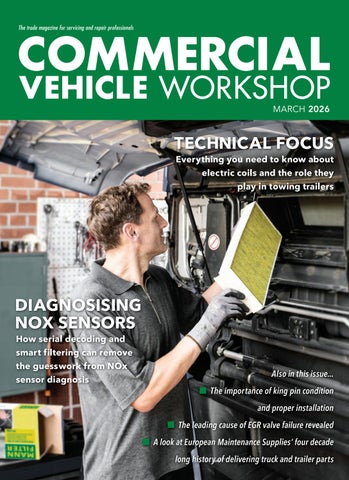
TECHNICALFOCUS

Everything you need to know about electric coils and the role they play in towing trailers

DIAGNOSISING NOX SENSORS

How serial decoding and smart filtering can remove the guesswork from NOx sensor diagnosis

Also in this issue...

■ The importance of king pin condition and proper installation

■ The leading cause of EGR valve failure revealed

■ A look at European Maintenance Supplies’four decade long history of delivering truck and trailer parts

DIAGNOSTICS & SOFTWARE

20 With the nature of heavy-duty diagnostics being everchanging and rapidly evolving, Phil Mitchell from Delphi talks us through its offerings and the support behind them.

22 Ben Martins from Pico Technology demonstrates how using serial decoding and intelligent filtering with an oscilloscope eliminates the guesswork in diagnosing NOx sensors.

25 Bosch outlines the details of its modular diagnostic solutions that are designed to speed up repairs, helping workshops minimise downtime and keep customers satisfied.

FUELS, LUBRICANTS & ADDITIVES

28 Morris Lubricants has reunited with brand ambassador Guy Martin for an exciting new behind-the-scenes video series showcasing the manufacture, filling and global distribution of its oils and lubricants.

30 Exol Lubricants argues that as winter transitions into spring, reviewing oil choices is a simple yet effective step fleets can take to ensure their vehicles remain productive, and ready for the miles ahead.

Cataclean highlights how its 8-in-1 fuel and exhaust system cleaner can revitalise vehicles and restore performance as the warmer months approach.

Castrol has launched a new range of premium VECTON Long Drain engine oils meeting the latest diesel-engine specifications. Furthermore, fleet operators can also now benefit from enhanced national expertise and support through Kernow Oils, Castrol’s Official Partner for the CV

takes a closer look at how Motul is overhauling its heavy-duty range for 2026.

36 As compliance demands tighten and replacement costs rise, Xpurge provides fleet operators with a trusted, OEM-approved solution to restore DPFs to peak performance.

38 Nissens Automotive explores a leading cause of EGR valve failure and highlights the vital role the component plays in keeping ICE vehicles running efficiently.

40 Mann+Hummel highlights the crucial role of filtration in cutting emissions and showcases how its MANN-FILTER range helps maintain fuel efficiency.

VIEWPOINT

Editor

FREYA COLEMAN

cvw@hamerville.co.uk

Group Editor

KIERAN NEE

Digital Manager

KELLY NEWSTEAD

Digital Assistant

JOE CLARKE

Senior Account Manager

MATTHEW BOASE

Group Manager

ALEX DILLEIGH

Graphic Designer

GEMMA WATSON

Group Production Manager

CAROL PADGETT

Subscriptions

Commercial Vehicle Workshop is a business magazine for companies and individuals involved in all aspects of commercial vehicle servicing.

It is published 11 times a year and is available on free subscription to qualified readers.

Subscription rates:

UK £30 post paid

Airmail £99 post paid

Europe £70 post paid

To be removed from this magazine’s circulation, please call 01923 237799 or email circulation@hamerville.co.uk.

Printed by Stephens and George

Published by

HAMERVILLE MEDIA GROUP

Regal House, Regal Way, Watford, Herts WD24 4YF

Tel: (01923) 237799

Website: www.hamerville.co.uk

Copyright © 2026

A SIGN OF THE TIMES

Irecently found myself behind more than 400,000 people in an online queue, all hoping to spend hundreds of pounds on Harry Styles tickets. The demand was undeniable. The supply? Not so much. Within minutes, dates sold out and resale prices surged.

It struck me that our industry faces a similar imbalance –not in pop concerts, but in skilled technicians, workshop capacity, and specialist services.

Demand for commercial vehicle maintenance has never been higher. Fleets are running longer hours, delivery expectations are tighter, and compliance requirements continue to grow. At the same time, the supply of qualified technicians is shrinking. Recruitment struggles, an ageing workforce, and the increasing complexity of modern vehicles have created a bottleneck every CV workshop owner recognises.

Yet, unlike those determined fans refreshing their browsers, many operators still expect front-row expertise at bargain-bin prices.

The economics are simple: scarcity drives value. When something is limited and essential, the market adjusts –or at least, it should. We see this clearly in specialist services such as ADAS calibration, high-voltage EV repairs, and advanced diagnostics. Workshops that invested early in equipment and training can command premium rates –not because they are profiteering, but because the skills and tools are scarce.

General labour, however, is often still priced as if technicians are interchangeable and training is optional. They are not. Today’s commercial vehicle technician is as much a software troubleshooter as a mechanical engineer. Expecting yesterday’s rates for today’s expertise is like expecting a resale ticket at face value when the stadium is sold out.

Fans will pay hundreds for a two-hour concert because they understand the value of the experience. In contrast, fleets often see only the invoice, not the uptime it protects, the compliance it ensures, or the breakdown it prevents.

Scarcity drives value. The question for workshops is simple: are we prepared to price like it?

And for anyone wondering, because I’m sure you are, yes, I did manage to secure Harry Styles tickets! See you in June, Wembley.

Editor

CVW NEWS

NEWSIN BRIEF

■ Fast-track training for young people. Young people will gain quicker access to skilled jobs on major national projects as the government moves to streamline training requirements and accelerate the development of new courses under new skills reform.

■ Waste oil collection launch. TotalEnergies has launched a waste oil collection, packaged waste and recycling service for its UK customers, in partnership with Enva. The offering aims to provide TotalEnergies’ customers across all markets, including automotive and industrial, with access to a fully licensed waste-oil collection service, helping them reduce their carbon footprint through enhanced recycling.

■ Major fleet upgrade for Bunzl Retail Supplies. TIP Group has partnered with Bunzl Retail Supplies on a wide‑ranging fleet upgrade that includes new trucks and trailers as well as a programme to refurbish existing assets in support of Bunzl’s sustainability goals.

■ Oil and Rugby partnership announced. World Rugby announces Liqui Moly as official partner of Men’s Rugby World Cup 2027 and the Women’s in 2029, both to be hosted in Australia.

Is

it time to fast track van legislation

Logistics UK has said the draft legislation published following the zero-emission vans consultation, will encourage the adoption of cleaner electric vehicles and is the next step in the process for electric vans to stop being treated as HGVs.

Commenting on the legislation, senior policy manager – Road Freight Regulation Chris Yarsley, has urged for approval of the new regulations as a matter of urgency.

He said: “The electric van legislation is finally catching up with operational reality and needs to be approved as quickly as possible. The current situation where standard size electric vans are treated as HGVs, in terms of MOT and driver hours requirements, is outdated and penalises logistics operators who are trying to clean up their fleets and help the UK meet its decarbonisation objectives. Electric vans are

used for the same jobs as diesel and petrol vehicles, and it is only the extra weight from the batteries that moves them into the same category as HGVs.

“The new legislation removes this false equivalence and will speed up the adoption of cleaner vehicles as operators will not have the unnecessary expense and paperwork of complying with rules designed for much heavier lorries.

“As part of the Zero-Emission Van Plan coalition, Logistics UK has long been campaigning for full regulatory alignment between 4.25 tonne electricvans and 3.5 tonne diesel, and improved fiscal support for adopting electric vehicles. The draft legislation is a clear indication that the governmentis listeningtothesector’s concerns, and it is now essential for the legislation to become law as a matter of urgency.”

Engine oils claiming Stellantis specification update

In 2025, the Verification of Lubricant Specifications, an independent and impartial body which investigates lubricant product complaints, announced a market-wide investigation into engine oils making claims against the Stellantis FPW 9.55535/03 specification.

The Stellantis FPW9.55535/03 5W 30 engine oil specification is mandated for a broad range of modern Stellantis vehicles.

The specification is designed specifically for engines with “wet belts” to prevent premature wear, degradation, and the formation of debris that can clog oil strainers. It was introduced by Stellantis in 2023/2024 as a mandatory requirement for many vehicles to address reliability issues with wet timing belt systems, as well as engines fitted with external dry belts.

Two versions of the specification have been released so far. In July 2023, Version 1 of the specification was issued. In June 2024, Version 2 of the specification wasreleased. Oils making claims against Version 1 have until June 2026 to be reapproved.

At present, the marketplace contains oils claiming compliance with Version 1, while those already approved or meeting

Version 1 requirements are undergoing a series of engine tests to demonstrate suitability for approval against Version 2. This approval process is expected to conclude before June 2026.

VLS understands that market general technology to meet Version 2 is being developed so that end users will have a choice of products that are either approved or meet the requirements of Version 2 when Version 1 is withdrawn in June 2026. To verify products currently making marketing claims against this specification, VLS opened investigations into 12 engine oils. Responses from the lubricant marketers involved have included updates on progress toward passing the Version 2 engine tests which prompted VLS to examine these marketing claims.

Nine of the twelve cases have been closed, and three remain outstanding. VLS has found the majority of claims to be valid. In case VLS 010236, when challenged about the evidence supporting the specification, the lubricant marketer chose to withdraw the claim. The remaining cases are expected to be closed within the next four weeks, and details will be published.

CVW NEWS

NEWSIN NUMBERS

830

the amount of newly qualified vehicle technicians that are actively seeking work across the UK according to figures released by Autotech Academy. This is despite thousands of unfilled vacancies, service delays for drivers and a looming retirement wave.

1 in 4

of UK technicians are qualified to work on electric vehicles at the end of quarter 3 of 2025. This is according to the latest IMI TechSafe data. Furthermore, the distribution of skills across the UK is geographically uneven and concentrated in the franchise dealer network.

25 %

of van drivers feel lonely at work according to a survey by Opinium, making it in the top four loneliest careers. Following this, Mercedes-Benz Vans is encouraging conversations in the workplace, with the average van driving spending 13.7 hours alone during a work week.

AES offers wheel alignment support

WST Commercials has strengthened its wheel alignment offering after investing in a Josam Laser AM supplied by AES UK.

The independent commercial vehicle specialist purchased the system approximately two years ago to address ongoing challenges with its previous alignment equipment which had led to customer complaints around vehicle pull and tracking accuracy. WST also said with limited training on the older system, technicians were often left to self-diagnose issues.

According to Jamie Cotterill, director at WST Commercials, the decision to switch to AES UK was driven by a desire to invest in a professional wheel alignment system and provide a higher standard of service.

Since installation, WST Commercials has carried out around 200 wheel alignments using the Josam Laser AM system. The equipment is used across a broad mix of commercial vehicles and is also effective on tractor units, HGV trailers and light commercial vehicles, allowing the workshop to maximise utilisation of the system.

DATE FOR THEDIARY

COMMERCIAL VEHICLE SHOW 2026

WHEN? 21st –23rd April 2026 WHERE? NEC, Birmingham

Welcoming 320 exhibitors, and colocated with the new Bus & Coach Expo, the CV show is returning to the NEC this April.

Some of the biggest commercial vehicle manufacturers will be in attendance with their latest products and new launches, including Chery for the first time as it prepares for its expansion across the UK, IVECO with their eJolly and eSuperJolly, as well as the returning Farizon, Ford, Isuzu, KIA, and Renault.

With the theme ‘Fuelling Change: the route to decarbonising road transport’, this year’s show arrives at a critical point for the industry. As operators across LCV, and HGV navigate the transition to net zero, the CV Show provides a view of what the future holds.

Beyond decarbonisation, the 2026 show will place a strong spotlight on AI, emerging vehicle and fleet technologies, the future workforce and skills development, and driver welfare. Together, these themes reflect the full spectrum of change reshaping the sector.

FridgeXpress has delivered its first-ever converted 18-tonne refrigerated HGV, marking a major milestone for the business as it expands its capabilities beyond light commercial vehicles and into the heavy goods vehicle market.

King pins BEST PRACTICE TIPS

Diesel Technic looks at why king pin condition and installation quality matter in everyday workshop practice, and how minor errors or missed wear points can quickly undermine steering accuracy and accelerate tyre and chassis wear.

King pins may look simple, but they are a powerhouse –carrying load, controlling movement and translating every steering input directly into axle articulation.

King pin wear often shows itself through changes in vehicle behaviour rather than obvious visual damage. Stiff steering, knocking noises on lock, or irregular tyre wear can all point to a problem developing in the steering pivot –not necessarily in the steering gear itself.

Before committing to strip-down, technicians should carry out basic checks. With the axle unloaded, levering the wheel or rim can reveal play between the steering knuckle and axle eye. On some designs, adjustment may be possible; on others, any measurable play points towards removal and inspection. It’s also worth checking protective caps and seals, particularly on the lower bearing area. Damaged seals allow water and dirt into the bearing surfaces, accelerating wear long before the king pin itself shows obvious damage.

Lubrication is critical and often overlooked

Insufficient lubrication remains one of the

most common causes of premature king pin failure. Needle bearings rely on consistent grease supply, and blocked or neglected grease nipples can quickly lead to stiffness and corrosion.

Technicians should check whether stiffness improves after lubrication before dismantling. On trailing or leading axles, which see less steering movement than front axles, more frequent greasing than standard service intervals is often advisable.

If corrosion residue or contamination is already present, however, lubrication alone is unlikely to be a long-term fix.

Strip-down demands the right tools

Removing a king pin is not a job for improvised methods. Attempting to knock out a pressed-in king pin with a hammer can distort the pin, damage bearing seats, or even crack the steering knuckle or axle eye, turning a routine repair into a costly replacement job.

Specialist tools exist for a reason. Purpose-designed king pin press or extractor tools allow the pin to be removed and installed squarely and under controlled force, reducing the risk of damage to surrounding components. If these tools are not available in-house, borrowing or hiring them is far cheaper than replacing major chassis parts damaged by incorrect removal techniques. Once dismantled, all mounting surfaces must be thoroughly cleaned before inspection. Damage to the axle eye or steering knuckle often only becomes visible once grease, corrosion and debris are removed.

Installation accuracy matters

Reassembly is where many king pin repairs fail. Components should never be installed dry; bearings and pins must be pre-

lubricated, and seals fitted in the correct orientation to prevent future contamination.

Some technicians use temperature to their advantage, chilling the king pin while gently warming the axle eye to ease installation. This can be effective provided heating is controlled and does not alter material properties. Where shims are used to control clearance, correct thickness is critical. Steering stiffness and free movement should always be checked after assembly, with adjustments made if necessary before the vehicle returns to service.

Replace systems, not single parts

A king pin repair is rarely about one component alone. Bearings, thrust washers, seals, grease nipples and retaining rings all work together, and reusing worn ancillaries can undermine an otherwise careful installation.

From a workshop perspective, complete repair kits reduce the risk of missed components and comebacks –and help ensure the steering knuckle is overhauled as a system, not patched as a single fault.

Precision pays off

King pins may be small and largely hidden from view, but their role in steering precision is significant. As a true

powerhouse within the axle assembly, their condition and correct installation directly influence vehicle stability, tyre life and long-term reliability. For workshops, taking the time to diagnose accurately and follow disciplined repair practices helps ensure steering systems perform exactly as intended, mile after mile. WANT TO KNOW MORE? Make sure to scan the QR code!

BEST PRACTICE TIPS

Hub nut removal

To ensure your SAF INTRADISC axles consistently perform at their peak, regular yet straightforward maintenance is essential. Workshop Insights is designed to help technicians and engineers work quickly and effectively when servicing SAF INTRADISC products. When removing the axle nut an impact wrench should never be used as this can lead to the axle threads being damaged.

Please note that on the left side of the trailer, the axle nut is a left-hand thread while the right side of the trailer the axle nut uses a right-hand thread. The left-hand nut can be identified by a milled groove (see photo on right). (This applies to all SAF-HOLLAND axle types).

Hub nuts can become stuck if the incorrect tools are used e.g. air impact wrench. Or, a hub nut could stick after being over-tightened inadvertently as a result of forgetting that the left-hand axle nut is reverse threaded.

In the unlikely event of having to remove a stuck hub nut, please carefully follow the procedure outlined below:-

Removal of the hub nut

● If the hub nut cannot be removed with manual tools, air impact wrenches must not be used.

● Drill the hub nut as shown in the picture below, being careful not to damage the threads.

● Once the hub nut has been drilled, use a chisel to split the nut away from the threads.

● Check the threads for damage once the nut has been removed.

Re-fitting new hub nut

● Make sure the threads are clean and free from damage.

● Re-fit the new hub nut follow the correct SAF-HOLLAND torque procedure, air impact wrenches must not be used.

Hub nut after removal
Milled groove on a left hand axle nut

KNOW YOUR PARTS

Electric coils

febi shares everything you need to know about electric coils.

Electrical coils are necessary to provide a flexible connection between the electric and electronic systems of the trailer and the towing vehicle. Not only does this include the lighting of the trailer, but also tail lifts and other electrical components are supplied with power by the towing vehicle. The ABS or EBS system must also communicate signals with the towing vehicle via the data bus system. For all these systems to function, they need a secure connection. While the distance between the electrical coil connections between the cab and trailer is relatively small when driving straight ahead, the situation is quite different when driving around curves. This is because the towing vehicle swings out strongly in tight curves and the coils are therefore stretched. Different coil lengths are required depending on the type of vehicle. A distinction is made between the working length of the spirals and the maximum length.

Ideally, the maximum distance corresponds approximately to the working length of the coil. Under no circumstances should the maximum working length be exceeded, otherwise the coil may be

damaged. Without a functioning electrical connection to the trailer, it is not possible to continue the journey for the time being.

In order to check the quality of replacement parts in the market, more than just febi products are regularly examined at febi. Since most defects in electrical coils are caused by plug connections, we have taken a closer look at them. In addition, the mechanical load capacity, which is relevant for practical applications, was also examined.

Plugs

The connection points of electrical circuits are the most common sources of error in electrical coils. Poor contact due to loose contacts or moisture are typically the causes. Sometimes the quality can already be seen in the processing of the plug.

Poor processing of the connector housing can lead to insufficient fitting accuracy and problems when inserting the connector. The position of the contacts is not optimal. They can be damaged by the mating part of the socket or pressed backwards out of the plug. Inserting the plug can be problematic if the contacts collide. (Fig. 1)

The febi plug (Fig. 2) is well manufactured and offers an optimal fit. The contacts are in the correct position so that plugging in the connector is easy.

Mistakes can already be made during production. Here, you can see the damaged insulation of the cables of a new plug. (Fig. 3) This can lead to short circuits that disable the electrical system.

The cables of the febi plug are properly processed and show no signs of damage. (Fig. 4). The kink protector of the plug

Fig.
Fig.
Fig.
Fig.

should be stable and firmly connected to the plug and give the cable support. In this case (Fig. 5), the kink protector can be pulled out of the plug by hand, and the cable is not sufficiently protected by the soft material. Both of these factors severely limit the service life.

The kink protection of the febi plug (Fig. 6) is firmly attached to the housing and cannot be pulled out. It is stable, gives the cable a good stability, and protects it.

If the sealing of the cable to the plug is poorly constructed, moisture can penetrate the plug. Corrosion can then occur, which in turn can lead to poor electrical contact. Here, you can see the overly large gap between the cable andthe seal, through which water can penetrate. (Fig. 7)

If special requirements are placed on waterproofness, febi offers a plug for retrofitting (Fig. 8). It has a screwed seal which presses the sealing rubber firmly against the cable and effectively seals the plug.In addition to these possible differences in quality, other aspects also play a major role when it comes to durability and safe functioning. For example, in the case of very inexpensive

electric coils, cables with wire crosssections that are too small are sometimes used. This is because the expensive copper in the cables is a cost factor. However, a wire cross-section that is too small can lead to the heating of the cables when the current flow is high. If the cable becomes extremely hot, the insulation can melt and cause a short circuit. Sometimes, savings are also made on the processing of the

“If the cable becomes extremely hot, the insulation can melt and cause a short circuit.”

contacts in the connector. A poor connection between the contact and the cable can quickly lead to problems in the electrical system, which can result in timeconsuming troubleshooting.

Tensile test

In order to check the mechanical load capacity of electrical coils, tensile tests were carried out on state-of-the-art test equipment. The force at which the cable is pulled out of the plug was measured. The 15-pole and 7-pole electrical coils were compared. In each case, the febi product and two competitive samples were put to the test. The strain relief in the 15-pole coils plug already gave way at 1090N and 1320N in the competition samples. The febi electrical coil withstood tensile forces up to 2160N. (Fig. 9)

Fig.
Fig.
Fig.
Fig.

The deviation of the tensile forces of the 7-pole coils is not as large as with the15pole coils, since the connection between plug and cable held for all test candidates. In the end, the weak point was the cable, which withstood 1703N and 1930N in the competition samples. The cable of the febi electric coil only broke at over 2000N. (Fig. 10)

A closer look at the construction and processing of the various electrical coils will explain the results of the tensile tests. The high mechanical load capacity of febi electrical coils is due to the well thoughtout design of the plugs and the quality of the production and the components used. In practice, all these factors put together ensure a permanently reliable electrical connection.

Electrical coils specific to Euro 6 Vehicles?

Vehicles that meet the Euro 6 emission standard are very efficiently designed. The engine and its surroundings have a modern thermal management system, which ensures smart control of the water pump and cooling water temperature. Also, the air flow of the engine waste heat has been optimized. For example, when driving slowly in traffic jams or in the city in combination with high outside temperatures, the air temperature in the

area between the driver‘s cab and trailer can rise to as much as 125°C due to heat waste from the engine. For this reason, there are electrical coils that can withstand these temperatures without damage.

We conducted a test and compared a coil that is suitable for temperatures of

125°C with a standard coil. ( both coils, the restoring force was measured at room temperature (RT) and when heated up to 125°C.

The following picture (Fig. 12) shows the dimensional stability of both coils after the tensile test in the heated state. The 125°C coil still has sufficient restoring force to retract. The coil, which is not heatresistant, remains elongated and cannot be used any further, as it will sag and could come into contact with other vehicle parts.

The result of the tensile test clearly shows that Euro 6 vehicles should definitely be equipped with heat-resistant electrical coils.febi Truck offers a comprehensive range of electrical coils, plugs, sockets, and adapters in OE matching quality for all common applications in the commercial vehicle sector.

The entire range of Electric coils can be found at: WWW.RDR.LINK/VCD003

Fig
Fig
Fig.

COMPANY PROFILE: EUROPEAN MAINTENANCE SUPP LIES

With more than four decades of experience, EMS has become a trusted partner to the UK commercial vehicle industry. Combining nationwide availability, technical know-how and the backing of the BPW Group, EMS aims to deliver high-quality truck and trailer parts to fleets, operators and workshops where uptime matters most. CVW finds out more.

European Maintenance Supplies (EMS) are the UK’s leading supplier of best-in-class OEM & Aftermarket products to the truck and trailer industry in the UK, supporting commercial vehicle operators, fleet owners and workshops nationwide.

Established in 1982, EMS has built a strong reputation for reliability, technical expertise and scope of product offering. Today, as a proud member of the BPW Group since 2016, EMS brings decades of know-how and expertise in the commercial vehicle market.

A nationwide operation

EMS Truck & Trailer Parts provide the widest range of commercial vehicle parts in the industry. This extensive product range is supported by a national network, including 19 strategically located branches, and a Central Distribution Centre based in Northampton. Together, this network allows EMS to deliver high levels of product availability, speed of service and technical support to customers across the country.

The Northampton CDC plays a central role in EMS’s logistical capabilities, providing overnight trunking across the branch network. This ensures consistently high levels of stock availability at branch level and across more than 350 Imprest stock rooms located within customer sites. Overnight trunking, same day / next day replenishment deliveries are supported by pallet network services, providing excellent availability and enabling stock movement for customers with larger or more complex requirements. EMS supplies some of the biggest companies, fleet asset managers and fleet operators in the UK, with an infrastructure designed to support customers operating in time-critical environments where up-time matters.

Customer support

While high quality product availability is the priority, EMS differentiates itself through its commitment to service and customer support. The UK-wide branch network is backed by a combination of EMS’s own delivery fleet and carefully selected third-party logistics partners. This approach provides customers with flexible delivery options and rapid response times, ensuring that parts and technical advice are available when and where they are needed.

The goal of EMS is to support its’ trade partners to get their job done quickly, efficiently and in a cost-effective manner –without compromising on quality or safety. This underpins every aspect of the business, from product selection and stock profiling to account management and technical support.

Many EMS products carry a 2-year manufacturer’s warranty, providing additional confidence for customers operating in high-mileage, high-load environments. Their service offering also extends to cover break down situations, helping customer to minimise downtime and keep vehicles on the road.

Strength through BPW Group ownership

As a fully owned member of the BPW Group, EMS benefits from being part of the leading European manufacturer of axles and running gear for trailers. This relationship delivers many advantages for EMS customers, including strong buying power, ensuring EMS can offer competitive prices for the highest quality products on the market.

In addition to the BPW relationship, EMS also partner with the highest quality brands, putting their suppliers through a rigorous quality assurance process to ensure they supply only the best solutions and products.

Flexible partner arrangements allow EMS to service businesses of all sizes, from single-site operators to large national fleets, while maintaining a consistent level of service and product reliability.

Product range

EMS typically holds over £7m of stock, representing approximately 800,000 individual items across 25,000+ SKUs sourced from more than 600 suppliers. This product portfolio spans truck, trailer, LCV, tools, garage equipment and consumables, delivering a genuine one stop shop solution for commercial vehicle operators and workshops. By consolidating supply across multiple product categories, EMS helps customers streamline procurement, reduce administrative complexity and improve operational efficiency.

Beyond product range alone, EMS focuses on delivering transparency across OEM and approved alternative parts, allowing customers to make informed decisions based on performance, cost and application requirements. This approach is supported by BI / MI data-driven stock profiling, dedicated account management, and a strong focus on integrity and long-term partnership.

Data-led stock management

EMS places a strong emphasis on intelligent stock management. Through the use of business intelligence and management information systems, EMS can profile stock at branch, imprest and customer levels, ensuring that the right parts are available in the right place at the right time.

Part of the bigger picture

EMS forms part of the BPW Aftermarket Group, which is the largest Commercial Vehicle parts provider in Europe with branch networks throughout the UK and across the continent. The wider BPW Group comprises approximately 60 companies in 31 countries, employing over 7,000 people worldwide.

Being part of this international network provides EMS with significant buying power, access to shared expertise, product development and best practice from across the global commercial vehicle industry. These benefits are passed directly to EMS customers through improved availability, consistent service standards and ongoing investment in product and operational capability.

“The commercial vehicle aftermarket is becoming increasingly complex, and our role is to simplify it for our customers. EMS continues to invest in availability, transparency and technical expertise to ensure we remain a trusted partner as the

A trusted partner

With over 40 years of experience, a nationwide infrastructure and the backing of a global manufacturing group, EMS has established itself as a trusted partner within the UK commercial vehicle aftermarket.

The company’s focus on quality, service integrity and long-term relationships has earned it a strong reputation across fleets, workshops and transport operators alike. By combining outstanding availability, technical expertise and competitive pricing with a commitment to transparency and customer support, EMS continues to set the standard for commercial vehicle parts supply in the UK. As the industry evolves, EMS remains focused on supporting its partners with dependable solutions that keep vehicles moving and businesses operating efficiently.

industry evolves.” Mark Lynch, managing director, EMS

UP TOTHE TASK

Phil Mitchell, workshop solutions lead at Delphi, takes us through its heavy-duty offerings.

Commercial vehicles are evolving rapidly. From advanced emissions control systems to ADAS, electrification and increasingly complex electronics, today’s vans and HGVs demand a higher level of diagnostic capability than ever before. For fleet workshops, having the right tools is no longer optional –it’s essential to maintaining uptime, accuracy and customer confidence.

Delphi’s Heavy-Duty diagnostics solutions are designed to meet this challenge, offering broad system coverage, intuitive workflows and the technical support that workshops need when facing complex faults.

Modern light and heavy commercial vehicles rely on integrated systems spanning engine management, braking, transmission, body control, emissions and safety technologies. Delphi’s diagnostic platforms offer workshops access to multibrand coverage across European and global CV applications.

Technicians can perform guided diagnostics, read and clear fault codes, access live data, carry out actuator tests and perform system calibrations. Key systems supported include ABS, EBS, engine control, aftertreatment systems such as DPF and SCR, steering angle sensors, service resets and more. As emissions regulations tighten and aftertreatment systems become more sophisticated, accurate diagnostics are critical - not only to fix faults but to prevent repeat visits, unnecessary parts replacement and fleet downtime.

For CV workshops, downtime equals lost revenue for fleet customers. Delphi’s diagnostic workflow is designed to help technicians identify faults quickly and logically. Clear menus, guided test routines and access to technical information reduce guesswork and support first-time fixes.

Cloud-based functionality and report storage also allow workshops to document work carried out, supporting customer communication and helping build trust with fleet operators who require transparency and traceability.

Masters of Motion

One of the key differentiators in CV diagnostics is not just tool capability, but the support behind it. Delphi provides workshops with access to a dedicated technical support team who can assist with complex diagnostic challenges, fault-finding queries and product-related questions. This is complemented by Delphi’s wider technical ecosystem, including Masters of Motion digital resources and training through the Delphi Academy. Workshops can access how-to videos, technical articles and structured training that help technicians stay up to date with evolving CV systems, including emissions, electronics and ADAS-related technologies. As commercial vehicles continue to adopt more advanced electronics, hybridisation and safety systems, diagnostic demands will only increase. Workshops that invest in capable, well-supported diagnostic platforms position themselves to handle both today’s repairs and tomorrow’s technologies. By combining comprehensive CV coverage, efficient workflows and strong technical support, Delphi helps workshops reduce downtime, improve repair accuracy and deliver the professional service fleet customers expect.

FILTERING THE NOISE: DECODING NOX SENSORS

As emissions systems become more complex and components more expensive, traditional scan-tool diagnostics are no longer enough. In this article, Ben Martins of Pico Technology explains how serial decoding and smart filtering with a scope can remove the guesswork from NOx sensor diagnosis.

There is a growing trend that as vehicles and machines get more complicated, we need different tools to help diagnose and troubleshoot. A scope is one such tool that allows us to go beyond a fault code and bring justification and evidence to support repairs. From relative compression tests to serial decoding, it all sounds rather impressive but how can this help in the real world?

One of the big questions we often get asked about is how we can diagnose NOx sensors. Realistically there is little output for these controllers as they typically only have 4 wires –power, ground, CAN H and CAN L. So providing you have a good power supply, good ground and messaging is happening, what else can we do?

In the modern commercial vehicle workshop, the NOx sensor is often seen as a "black box" of mystery. When a truck, or machine, rolls into the bay with an SCRrelated limp-mode fault, the pressure is on.

At £500 to £800 a unit, the "guess and replace" method is an expensive gamble that no fleet manager wants to pay for –especially if the fault returns ten miles down the road.

The challenge is that a scan tool only gives you an interpreted value, it doesn't show you the conversation that is happening on the J1939 network.

Serial decoding

This is where a scope, like a PicoScope, can reveal hidden details as it looks directly at the raw voltage signal. We can then apply a feature called Serial decoding which turns that raw voltage into a data stream. This is what is used by the serial tool to convert into meaningful data. With so much data available it can sometimes be difficult to see the wood for the trees but a new feature in PicoScope 7 software allows us to filter out the noise and only focus on what is important.

Filters

Enter filters within the serial decode tables in PicoScope 7. Think of this as a digital sieve. Instead of being overwhelmed by every message on the network and an entire 8-byte message, we can now tell the scope to ignore the noise and only show us the specific information we are interested in. NOx sensors are pretty standardised across HD and OHW machinery and normally have to retain the same source address for up and downstream sensors. This makes it easy for us to filter out those sensors from all the other data. The introduction of the J1939 decoder really helped with splitting up the header part of the message and so separating out the priority, PGN (parameter group number) and Source address.

Digital sieve

By connecting a PicoScope to CANH and CANL on just one NOx sensor, we can

capture the raw signals and then start to apply our decoder. To make things easier there are built in guided tests that help setup and configure the software so all you would need to do is connect the probes to the sensor.

With the data on the screen, we can create our decode tables and then using the filter function, our digital sieve, so we can only display the individual PGN’s for up and downstream NOx sensors. For upstream the PGN of interest is 0xF00E and for downstream 0xF00F.

What is quite nice is that when applying filters to the decode table you can see in the waveform how often the messages are being sent. Using data found online we find that the first 4 bytes of these PGN’s are important. The first two provide information on NOx levels and the next two bytes of information give the O2 content. Whilst we can’t apply the scale or offset or have it showing the actual values, what we can do is quickly see if the data is changing.

Index of filter

You could simply leave the tables but to help clean up what we are looking for we can use the Index of filter, you can highlight these essential bytes to see if there is activity.

In the above image you can see the filtered data separating out bytes 0 and 1 and bytes 2 & 3 for the upstream and downstream NOx sensor.

When comparing the data, it looks like the upstream NOx sensor may have a fault compared to the downstream sensor. We can see the data is fixed at the value FF FF

for both NOx and O2 levels and it doesn’t change, whereas data is changing for the downstream where we have different values. This takes out the guessing when trying to determine if a NOx sensor is at fault or if there are other issues at play. Here we have the evidence to back up a replacement sensor. If you would like to find out more on this feature and to have a play with the software, please download the latest version of PicoScope 7 Automotive from our website. It’s free to download and the guided tests are built in to take a look at. If you do own an automotive PicoScope, you should also have access to the waveform library where you find the file used and try out the filter functions on the serial decode table. Copy and paste the file into the waveform library - fac253a1-daa6-4ec2adc9-58d3fd4cc789.

One thing is clear that as parts get more expensive and faults get trickier, we are going to have to test not guess!

HEAVY-DUTY DIAGNOSTICS

Bosch shares details on its modular diagnostic solutions for fast repairs, aiming to help workshops reduce downtime and keep their customers happy.

The modular Bosch diagnostic test devices for commercial vehicles and off-highway machinery allow workshops to put their customers back on the road quickly. With the easy to upgrade entry-level solution KTS Truck or the future-proof all-in-one solution KTS 900 Truck, workshops can perform diagnostic and maintenance tasks on nearly all common electronic systems. The ESI[tronic] software with the packages Truck, agricultural vehicles (OHW 1), construction vehicles and engines (OHW 2) and material handling (OHW 3) provides the necessary functions and information.

ESI[Tronic] truck package

The intelligent diagnostic software ESI[tronic] with package Truck from Bosch supports workshops in reliable diagnosis, complete maintenance and efficient repair of all common light and heavy commercial vehicles, trailers, transporters and buses in Europe, Asia and North and South America. In addition to the ECU diagnosis,

the software also contains technical information such as wiring diagrams, service and repair instructions as well as system information for a wide range of vehicles. The Knorr-Bremse Diagnostics can be accessed through the new 2026 Truck Master unlimited subscription.

Vehicle information: The software includes important basic information on commercial vehicles, e.g. model series, output, engine designation and axle configuration, thereby forming the basis for in-depth diagnosis at the commercial vehicle workshop.

Diagnosis: The software reads out diagnostic trouble codes, providing an option to delete them, and it selects actual values, enables actuators, resets service intervals and teaches in components.

Diagrams: The intuitive user guidance with dynamic component description makes the system quick and easy to use.

Maintenance: Semi-annual and annual inspections with additional check points can be accessed at any time.

Technical data: Component details with default values, output voltages, characteristic curves, etc. assist in troubleshooting.

Parts catalogue: Access to the full parts catalogue of Bosch and ZF Services, including service information and assembly instructions for the brands Sachs, Lemförder, Boge and ZF Parts.

Knorr-Bremse diagnostics available with truck master subscription: Truck Master provides access to the latest systems from Knorr-Bremse and manufacturer-specific information for comprehensive diagnostics.

KTS Truck

A versatile diagnostic solution for commercial and off-highway vehicles, KTS Truck from Bosch is a modular diagnostic device for commercial vehicles, connects to the DCU 220 or a PC via USB or Bluetooth. With the ESI[tronic] packages Truck, OHW 1, OHW 2 and/or OHW 3, it offers extensive diagnostic options and supports workshops in repair, maintenance and service. The new generation of the KTS Truck improves performance thanks to a powerful microcontroller. Developed for current and future models, the extended protocol coverage and the modernized universal cable with 4-PIN connector increase efficiency through faster diagnostic start. Additional adapters and PassThru technology allow access to manufacturer data for updates.

Features include:

11.6" touchscreen, an integrated camera and its long runtime ensured by two lithium-ion batteries, the DCU 220 makes workshops future-proof for control unit diagnosis. Bosch Connected Repair allows this diagnostic solution to be connected to further diagnostic devices to speed up workshop procedures.

Features include:

● KTS Truck module for light and heavy commercial vehicles, trailers, transporters and buses as well as agricultural and construction machinery and engines as well as material handling.

● Clear communication via multiplexer and cable adapter identification: K- and L-Line, SAE and CAN switchable to any terminal of the OBD connector.

● Integrated long-range Bluetooth module for high flexibility in the workshop.

● Bluetooth USB adapter for the connection to the Bosch DCU 220 or a computer.

● Rugged housing suitable for workshop use.

● Supports Pass-Thru Technology.

● Compatible with Bosch connected repair.

KTS 900 Truck

The mobile comprehensive solution Bosch KTS 900 Truck comprises the universal KTS Truck module and the flexible Diagnostic Control Unit DCU 220 as well as the diagnostic software ESI[tronic] with the packages Truck, OHW 1,OHW 2 and OHW 3, which are available separately. With this equipment, workshops are set up to effectively diagnose light and heavy commercial vehicles, buses as well as agricultural and construction machinery and engines.

The rugged Convertible-PC DCU 220 is a notebook and tablet in one and can be used flexibly and anywhere. Thanks to its easy handling, the rugged housing with an

● Mobility through integrated powerful radio technology

● The adapter concept “Easy Connect” with its approx. 90 vehicle-specific adapters and three cable sets (available separately) simplifies the connection to different brands and models and saves time.

● DCU 220 with rugged housing and 11.6" touchscreen for easy and intuitive operation.

● Highly flexible thanks to dual use as tablet or computer.

● Handy: an integrated camera for the documentation of vehicle details and recording of necessary spare parts.

● Supports Pass-Thru Technology.

● Compatible with Bosch Connected Repair.

OIL ON TAPE

Guy Martin revisits Morris Lubricants’ factory for new video series.

UK manufacturer Morris Lubricants has reunited with brand ambassador Guy Martin – the popular lorry mechanic, motorbike racer, tractor lover, TV presenter, and engineering enthusiast – for a new video series covering the manufacture, filling, and distribution of its high-quality range of oils and lubricants.

The new videos follow the previous 2022 series about how oil is made, which proved a stunning success, with an immense number of views across the Morris Lubricants’ social media platforms.

What’s inside?

Designed to provide important information before choosing a lubricant brand, the videos show Guy and Morris Lubricants’ Technology Manager, Adrian Hill, inspect the new £6 million operational developments that have been made at Morris Lubricants’ factory and facilities in Shrewsbury.

This video series also provides a rare behind-the-scenes look at how Morris Lubricants manufactures and distributes its high-quality products around the world.

These episodes include details of a new stainless-steel tank farm to meet the increased demand for various product formulations; an updated pigging system that minimises waste between production runs; and a new bulk blending tank with

ultrasonic blending capabilities for faster, more flexible and sustainable bulk manufacture of oils and lubricants.

Distribution centre

Adrian then shows Guy the Morris Lubricants’ new Worldwide Distribution Centre, where they look at how the company distributes its high-quality oils, lubricants, and greases throughout the UK and to over 100 countries across the globe.

Guy comments: “It was so impressive to see everything Morris Lubricants have done since I was last at the factory. They’ve clearly spent money in all the right places, and what shines through is how the aim is always to produce the best, get it done right, and never cut corners. It’s great to see a British manufacturer investing like this.”

Adrian adds: “It was brilliant to invite Guy back to show him the boost we’ve had in our manufacturing, production, storage, and logistics capabilities. Once again, his enthusiasm was infectious. The new video series makes a perfect resource and insight for mechanics, service engineers, maintenance technicians, end users plus anyone else interested in our oils, lubricants and greases and the vehicles and equipment that use them.”

SPRING INTO ACTION

As winter gives way to spring, reassessing oil selection is a straightforward but impactful way for fleets to keep vehicles productive, compliant, and prepared for the road ahead, argues Exol Lubricants.

As winter conditions ease and temperatures begin to climb, the operating environment for commercial vehicles changes significantly. For fleet operators, this seasonal transition brings new stresses on engines, making lubricant quality a critical factor in maintaining reliability, efficiency and uptime. While winter operation focuses on coldstart protection, the move into spring introduces different challenges. Engines reach operating temperature more quickly and are more likely to run under sustained load, particularly in urban distribution, stop-start traffic and long-haul motorway use, which places increased thermal stress on engine oil.

Under warmer conditions, oil must maintain viscosity and film strength to protect critical components such as bearings, camshafts and turbochargers. In heavy-duty diesel engines, prolonged idling, high load cycles and variable duty patterns can accelerate oil degradation.

Lower-quality lubricants may suffer viscosity breakdown and oxidation under these conditions, reducing protection and increasing wear rates. For fleets, this can mean higher component wear, increased risk of turbocharger issues, reduced drain interval performance and greater likelihood of unplanned downtime.

Making the right choice

High-performance synthetic engine oils are formulated to resist thermal breakdown, maintain stable viscosity and protect components across a wide operating temperature range. Engines not protected by high quality lubricants are more prone to sludge and deposit formation.Deposits can restrict oil flow, impair heat dissipation and contribute to issues such as piston ring sticking or turbocharger inefficiency. This directly affects fuel consumption, emissions performance and engine longevity.

Quality lubricants help maintain internal cleanliness, support optimal combustion

and contribute to sustained fuel efficiency.

Many fleets operate on extended drain intervals to maximise productivity. As ambient temperatures rise, oil oxidation rates can increase, placing additional demand on the lubricant’s additive system.

Using high-quality oils that meet the latest OEM specifications ensures protection is maintained throughout the full-service interval, reducing the risk of premature oil degradation and helping fleets avoid unnecessary maintenance stops.

For fleet operators, lubricant selection is not just a maintenance item, it is a reliability strategy. As seasonal conditions change, ensuring engines are protected with the correct, high-quality oil helps maintain uptime, protect high-value components, support fuel efficiency, safeguard emissions systems and control total cost of ownership.

As engines continue to evolve and operate under tighter tolerances and higher temperatures, the importance of specification-led, premium lubricants becomes even greater. In the transition from winter to spring, reviewing oil choice is a simple yet effective step fleets can take to ensure vehicles remain productive, compliant and ready for the demands ahead.

ITALL ADDS UP

Cataclean details how is 8-in-1 fuel and exhaust system cleaner can help dust off the cobwebs as we head into warmer months.

While spring signals a return to peak utilisation, it also exposes the carbon build-up left behind by winter duty cycles –a key contributor to rising fuel costs, emissions issues and unplanned downtime. This is where fuel and exhaust system additives play an important role, and why Cataclean’s 8-in-1 Fuel and Exhaust System Cleaner is a valuable addition to spring fleet maintenance programmes.

Cold-weather operation often prevents engines from reaching consistent operating

temperatures. The result is incomplete combustion and accelerated carbon accumulation in injectors, combustion chambers, EGR valves, oxygen sensors, catalytic converters and DPF systems.

As fleets transition into spring workloads, these deposits can lead to rough idling, poor throttle response, reduced fuel efficiency and elevated emissions.

Added directly to the fuel tank, its patented 8-in-1 formula works through the entire fuel and exhaust system. During combustion, the formula creates an acidic

WANT TO KNOW MORE? Make sure to scan the QR code!

vapour, travelling with the exhaust emissions removing carbon deposits from the entire exhaust system. This helps maintain DPF flow, supports EGR and sensor function, and keeps catalytic converters operating efficiently.

Benefits include improved fuel economy, smoother engine performance, lower emissions and reduced strain on high-value components.

HEAVYDUTY OILS

Castrol has introduced a new range of top-tier VECTON Long Drain engine oils that meet the latest commercial vehicle diesel-engine technical specification set out by OEMs including Daimler Truck, Mack Trucks, MAN Trucks, Renault, Scania, and Volvo.

Castrol VECTON Long Drain 5W-30 FA-4/F01 has been approved to meet Volvo VDS-5, Renault Truck RLD-5 and MAC EOS-5 specifications, while Castrol VECTON Long Drain 0W-20 meets Daimler Truck DTFR 15C140 requirements. Castrol VECTON Long Drain 5W-20 SLD5 meets MAN M3977 and Scania LDF-5 approved specifications.

Designed to strike a balance between fuel efficiency and engine protection, the new range fights oil breakdown by neutralising harmful acids, controlling oxidation, reducing deposits, and protecting against viscosity loss through thermal and mechanical shear. With up to 45 per cent Extra Performance Reserve (EPR), these oils are said to enable a longer lifespan to confidently meet maximum drain intervals.

Another key factor in the effective operation of high performance and fuelefficient heavy-duty diesel engines is the use of a low HTHS (high temperature high shear) viscosity engine oil. Heavy-duty engines generate significant heat during their operation, while their moving parts experience high shear rates due to the rotation and interaction of components. A low HTHS viscosity reduces friction and

requirements, while supporting efficient operations.

The new range of fully synthetic lubricants also claim to adapt to higher temperatures and pressures, ensuring sustained performance, fuel savings and a longer useful oil life, even under the most demanding of conditions. The products are compatible with most engines fitted with EGR and SCR NOx reduction systems and are strongly recommended for engines fitted with particulate filters and for vehicles that use low sulphur diesel fuel.

Henning Von Rheden, PU growth unit manager – EMEA at Castrol, said: “We’re committed to developing innovative products that help businesses optimise their operations while reducing their environmental impact. The new VECTON lubricant range embodies this commitment by delivering enhanced fuel efficiency and long-lasting engine protection, ensuring fleet operators can meet evolving industry standards with confidence.”

Delivering engine protection

Modern trucks use new technologies to make as much as 30 per cent higher torque, but this also brings higher engine temperatures and pressures. This can push the oil closer to breakdown and reducing its useful life.

Castrol VECTON Long Drain’s advanced, full synthetic low HTHS viscosity has been developed specifically for the latest generation of truck engines and represent the culmination of decades of expertise in oil formulation and category expertise.

The new Castrol VECTON products also feature a low-SAPS (sulphated ash, phosphorus and sulphur) approach that helps to protect the exhaust system catalysts and filters that are currently used on the latest commercial vehicles. This enables vehicles to comply with legislative

The new Castrol VECTON Long Drain range is available now in a variety of pack sizes, including 5L, 20L, 60L and 208L variants.

Kernow Oils

Fleet operators can also now benefit from enhanced national expertise and support through Kernow Oils, Castrol’s Official Partner for the Commercial Vehicle Sector. This partnership gives Kernow Oils unique and direct access to selected Castrol CV products, as well as dedicated technical support, product insight and service resources to help operators maximise uptime, optimise drain intervals and simplify lubricant management across mixed fleets.

For tailored advice on fleet maintenance strategies, lubricant consolidation programmes or product selection guidance, customers can contact Kernow Oils directly via their sales team, who are available to provide practical, application-led support to help keep vehicles operating efficiently and reliably.

CVW hears all about how Motul is

FUELLING THE FUTURE

For over 170 years, Motul has been reducing friction to enhance motion –and this is as evident in the Heavy Duty sector as it is in its general automotive, and market-leading motorcycle product ranges.

Today, as always, Motul is focused on delivering what professionals need most: power, performance, and reliability, under extreme conditions – keeping commercial vehicles working optimally while reducing costly and frustrating down-time.

For heavy duty applications, Motul is proud that its products continue to be built on innovation, protecting the whole drive train with proven efficiency –even in the toughest environments, thereby reducing costs while extending durability.

To aid its overall product offer Motul has taken the decision to revamp its Heavy Duty product range for 2026, and this it has

done in various different ways. Firstly, the whole engine oil range for Commercial Vehicles now comes under the TEKMA brand. This new TEKMA engine oil range has been completely redesigned in its key areas and it incorporates three technology lines into one range: SUPRA, its mineral-oil based engine lubricants; MEGA-X with Motul’s trade-marked Technosynthese (effectively fulfilling the role of semi-synthetic oils in the PCMO sector, but with technology specially designed for heavy duty requirements) and ULTIMA which is the fully Synthetic product line within the TEKMA range.

levels comes with both its own dedicated name and colour –thereby making the range easier to understand: There is improved readability, across the TEKMA range, with a clearer display of key information (applications, specifications, viscosity grades) and revised visual symbols. This refreshed visual identity, as well as the revised messaging it brings with it, is aimed at making product selection easier, thereby better meeting operators’ needs.

Motul has given the TEKMA range a new visual identity, so that each of the performance

Technically, it features further optimised formulations, as Motul has designed new formulations across the range –oils that have been enhanced for even greater performance and protection.

FUELS, LUBRICANTS & ADDITIVES

Motul products are designed to maintain engines at their best – looking to optimise various key performance criteria.

Their low-friction formulation is aimed at reducing energy loss, helping to maximise fuel economy –saving fuel to lower the total cost of ownership.

High-quality base oils and additives ensure maximum protection against wear, heat and deposits –keeping engines reliable even under extreme conditions.

Drain intervals are another key factor, and Motul is able to extended these by using formulations that are extremely stable at high temperatures, which therefore slow oil ageing. This enables longer drain intervals and obviously, with them, reduced maintenance costs.

About emissions

Motul TEKMA products are compliant to the various emission requirements. They are fully compatible with DPF, SCR and EGR systems, and meet the latest industrial standards, including Euro VI, thereby supporting cleaner performance.

Motul also boasts OEM Approvals across its range, so Motul products are tested and approved by leading engine manufacturers worldwide.

The brand brings complete solutions to market: from engine oils to transmission fluids, coolants and additives, Motul aims to be a one-stop provider for heavy duty fluids, offering one of the widest ranges gathered together under a single supplier in order to simplify the selection process for commercial vehicle operators.

are engineered for reliable performance across all heavy-duty systems (gearboxes, axles, differentials, and final drives). Again, they adhere to OEM specifications and are engineered to meet and exceed requirements for broad system compatibility. With their advanced formulations they are able to ensure exceptional defence against wear and component stress.

Motul aims to be a one-stop provider for heavy duty fluids, offering one of the widest ranges gathered together under a single supplier.

Motul DRIVE offers premium thermal stability, maintaining performance and integrity even under the most demanding, high-temperature conditions. This is combined with smoothness under operating conditions, facilitating optimised efficiency by reducing energy loss and friction.

The range of Motul HD COOL fluids deliver stable thermal management, corrosion protection, and engine efficiency. They are specifically designed for heavy duty conditions, and help reduce overheating risks, thereby minimising maintenance requirements.With its fully synthetic air-over-hydraulic brake fluid range, Motul offers products that are able to provide consistent pressure response, combined with strong corrosion resistance,

and reliable braking performance. They maintain efficiency and safety in the most demanding operating conditions.

Likewise, for hydraulic applications, Motul RUBRIC products perform impeccably under high pressures and across wide temperature ranges. They protect components, reduce wear, and support long-term reliability – in order to minimise both maintenance and downtime across modern hydraulic systems.

In addition

Motul also has a wide range of additives, which are formulated to reduce wear, control friction, and prevent deposits.

Whether the function of the additive is preventive or corrective, each Motul additive optimises engine performance, extends service life, and ensures smoother, more reliable operation under all conditions.

Motul backs up its product range with the security of a more than 170 years of expertise and a high level of dedicated support. Motul’s technical staff are trained through the Motul School system, which provides them with invaluable knowledge on oil diagnostics, whilst at the same time giving them knowledge and understanding of what customers need by way of dedicated support, to help customers optimise performance and reduce downtime.

There is also the opportunity for Motul customers who want to know how their drivetrains are faring over the course of a working life, to have oil and fluid analysis, which, like a blood test in humans, picks up trace elements within samples provided, to

Motul’s DRIVE transmission fluids

show up issues that are there, or even that are likely to be future problems. Motul encourages operators to take advantage of this facility, as it can often pre-empt expensive repairs and save both the inconvenience and cost of downtime, as well as removing the huge expense of repairing a catastrophic failure.

In 2023 Motul introduced its NGEN range of lubricants, which brought the market a dramatic leap forward in sustainable engine oils.

Motul had decided to pioneer a sustainable oil range in every key aspect. Vitally, however, it developed lubricants that do not sacrifice performance in any respect to achieve this sustainability – in fact quite the opposite, as oils with what is now referred to as “NGEN Core technology” actually deliver enhanced aspects of performance over their

Although waste oil is being reused and, therefore recycled, the ethos of NGEN Core technology is light years away from what people think of as ‘recycled oil’.

traditional counterparts.

At the heart of NGEN Core technology is Re-refined Oil. This is waste oil that has been recycled, but not through the conventional methods. “Recycled Oil” is a term people have become familiar with, but the image is one of a low-quality final product, with performance to match. Motul has turned this on its head with NGEN Core technology.

So, although waste oil is being reused

WANT TO KNOW MORE? Make sure to scan the QR code!

and, therefore recycled, the ethos of NGEN Core technology is light years away from what people think of as “recycled oil” and the re-refining process involved features some of the most cutting-edge tech around. The waste oil – which is all high quality in its origins –is subjected to more than 10 different processes, several different stages of distillation and various different filtration treatments, in order to produce new base oils of outstanding quality. This allows Motul to achieve the levels of performance it expects from all its products –and then, in many respects, surpass them.

Motul’s thinking is that this will be the future of lubricants, moving forward and so NGEN Core technology will be introduced over the coming months and years across its ranges – including the heavy-duty ranges.

Watch this space...

INCREASED DPF PERFORMANCE

With compliance under pressure and replacement costs soaring, Xpurge aims to offer fleet operators a proven, OEMapproved way to restore DPFs to peak performance –cutting costs, extending service life and keeping fleets on the road.

Keeping fleets running efficiently, and legally, has never been so important. That’s why major fleet operators are turning to Xpurge, Ceramex’s patented Advanced DPF cleaning service, to extend the life of their DPFs, cut avoidable downtime, and stay ahead of tightening emissions regulations.

Designed specifically for the heavy-duty demands of many industries including onroad transport, the Xpurge process goes far beyond alternative DPF cleaning. It’s a proven, manufacturer-approved solution trusted by leading global OEMs and equipment suppliers which gives operators total confidence that their fleets are protected, compliant and performing optimally.

Optimum working order

Aa a serviceable component, a DPF should be maintained on a regular basis to ensure the vehicle maintains emissions compliance. Doing so, will help ensure efficiency in performance and reduce total cost of ownership, however, dashboard lights can appear at other times, primarily when a DPF becomes blocked. This is most typically evident through compromised vehicle performance, black exhaust fumes and unusual engine smells, and all can have a negative impact on achieving essential emissions compliance. Choosing to clean and remanufacture over replacement is beneficial to fleet operators requiring minimal downtime and affordability.

A critical component in a vehicle’s exhaust system, a DPF is designed to capture and store soot particles emitted from the engine. These soot particles, also known as PM, are harmful pollutants that contribute to air quality degradation and public health issues.

Ignoring DPF issues can lead to costly repairs including the replacement of the DPF itself, which can cost thousands of pounds. Regular cleaning can prevent these expenses and therefore reduce the TCO.

Tried and tested

Xpurge delivers unrivalled cleaning efficiency due to its unique process of using deionised water and compressed air in a closed-loop process. The technology removes stubborn soot and ash deposits more effectively than alternative methods, restoring filters to an as-new condition, with over 95 per cent original filter performance achieved: all while reducing downtime and increasing operational uptime.

With the capacity to process tens of thousands of DPFs annually, Ceramex dedicated facilities are designed for efficiency, utilising patented cleaning

technologies Xpurge and Flexpurge for LCVs, along with advanced inspection tools Veritex, Veritrap and Vericat.

Every DPF processed at Ceramex undergoes a traceable, repeatable and OEM-compliant procedure meaning we can assure performance, longevity, safety and compliance. These processes and technologies result in:

● Up to 30 per cent more contaminant removal.

● Rapid, repeatable cleaning cycles.

● High yield with outstanding first-pass success rates.

● No thermal damage to filter components.

● Preserving and extending catalytic coatings by using deionised water

Xpurge is part of Ceramex’s wider portfolio of emissions aftertreatment solutions, including remanufacturing, filter inspection, and diagnostics. All services are delivered at scale, with full traceability and technical assurance giving our technologiesthe capabilities to transfer across a range of applications.

Ceramex is part of the Eminox Group of Companies which offers additional services pertaining to emissions control and compliance, and heavy-duty vehicular acoustic and thermal insulation solutions.

THE VALUE IN EGR VALVES

Nissens Automotive examines a key reason for EGR valve failure and the importance in the part for helping ICE vehicles run efficiently.

With the environment and related issues clearly in the sights of governments around the world, there is a collective responsibility to ensure that all the internal combustion engines currently in the vehicle parc are operating to their optimum efficiency. Central to this objective is the exhaust gas recirculation (EGR) system, as it actively reduces the emissions that these engines naturally produce, keeping unwanted pollution to a minimum.

Although many will be familiar with how the system operates, others will find it useful to understand the fundamentals in order to help them recognise the priorities when diagnosing faults and replacing failed components.

About the valves

To achieve the necessary high rates of EGR, regulating throttles are used in the intake air system as they generate the pressure difference required between the exhaust gas side and intake side. After the fuel/air mixture has been burned, some of the exhaust gas is taken through the EGR valve, which regulates the subsequent mixing of the exhaust gas with the intake air. This means that less oxygen reaches the cylinder and less oxygen means a lower combustion temperature, which significantly reduces the quantity of nitrogen oxide (NOx) the engine produces because the higher the temperature, the more harmful NOx is produced.

The valve is, therefore, a key component within the EGR system as it regulates the quantity of exhaust gas that is returned.

“Of the issues that can affect the EGR valve itself, excessive carbon build up is the most significant.”

EGR valves come in various designs and models, both pneumatic and electrical and, since simple EGR is often not sufficient to fulfil emissions standards, some come with connections for cooling. This is because cooled exhaust gas further reduces the combustion temperature, which once more lowers the amount of NOx that is produced.

In common with all the components in the EGR system, coolers are exposed to the extreme heat, pressure and corrosive nature of exhaust gas, so must be manufactured from materials highly resistant to these conditions.

Many EGR coolers now feature an

electrical or pneumatic bypass flap, which allows the exhaust gases to be directed past the EGR cooler in the warm up phase, to bring the engine and catalytic converter to operating temperature as quickly as possible. This also reduces noise and the raw emission of hydrocarbons in the warm up phase. Bypassing the valve is also possible if high exhaust gas temperatures are required to regenerate the diesel particulate filter, for example.

The temperature of the exhaust gases passing through the EGR system is a critical factor. It determines the overall system performance and its ability to reduce harmful gas formation in the exhaust. Due to harsh operating conditions, natural wear, or the effects of common faults within the engine efficiency system, the cooler is one of the EGR system associated parts that can suffer from failures, resulting in a reduction in the performance of the system, and hence the need for the cooler’s replacement.

Common problems

Of the issues that can affect the EGR valve itself, excessive carbon build up is the most significant, as it often links to other major engine equipment failures and/or inefficient combustion.

This is because carbon build up can cause the valve to stick open or closed, or at the very least, become slow or unresponsive. This results is poor combustion, excessive oil intake/burning and ECU management errors, and is exacerbated by frequent short trips in cold running because the higher air humidity affects crankcase ventilation, which can directly lead to the build up of sludge, soot, and carbon.

Thermal stress is another issue because excessively high exhaust temperatures can cause the engine to overheat, which may

result in a crack in the housing or damage to the internal components. As is a leak in the system caused by a split in the ducts, hoses or connections. Such leaks on either the exhaust gas or coolant side of the system can create abnormal working conditions that will accelerate valve failure.

Complete aftermarket solution

Heavy duty EGR valves and coolers from Nissens Automotive (Nissens) provide an excellent replacement solution because, in common with the other parts in its growing range of products, these EGR coolers equally conform to the company’s recognised Genuine Nissens Quality standards. These benchmarks include undergoing advanced validation and a series of tests carried out both internally and externally. In addition,

whenever needed, they incorporate design and material improvements that contribute to the component’s high thermal performance and overall durability.

As a result, Nissens EGR coolers are premium aftermarket products that perfectly replicate the performance and fitment of the original equipment (OE) component. Furthermore, the range also includes installation relevant parts, such as stop valves for specific applications, providing a complete repair solution.

The Nissens range consists of 15 SKUs catering for 37 OE part numbers, covering many of Europe’s most popular applications.

Engine efficiency experts

Nissens is a highly respected aftermarket manufacturer, offering a wide range of premium quality components across thermal and engine efficiency systems for all vehicle segments, including many Euro 6 truck applications. The entire Engine Efficiency system parts range caters for more than 7.5k OE numbers within six product lines, including almost 90 truck turbo models. With these and its EGR valves and coolers, Nissens can offer heavy duty parts distributors, and the network of specialist workshops thank undertake the work, an extended one stop shop solution for all critical system replacement parts.

FILTRATION FUN

Mann+Hummel argues how important filtration is when it comes to reducing emissions, and the benefits its MANN-FILTER range offers when sustaining fuel efficiency.

Commercial vehicles operate under intense conditions –long hours, high loads, variable fuel quality and harsh environments. As such, filtration is not just a maintenance item; it is a practical lever to help fleets reduce emissions and sustain fuel efficiency.

Quality filters, such as MANN-FILTER, are engineered to support cleaner combustion, stable engine operation, and reliable performance of modern emissionscontrol technologies across trucks, buses, and off-highway commercial applications.

Cleaner combustion starts with clean air

Engine air filtration has a direct influence on combustion quality. When intake air is contaminated with dust and soot, engines experience increased wear, altered air–fuel ratios, and degraded turbocharger and sensor performance. This can lead to higher particulate emissions and increased fuel consumption.

MANN-FILTER engine air filters are designed to deliver high separation efficiency with low flow resistance, helping engines maintain the intended air mass flow and supporting more complete combustion. In real conditions –construction sites, unpaved roads, winter gritting –robust air filtration helps keep emissions performance consistent between service intervals.

Protecting fuel systems to reduce smoke and particulates

Modern diesel injection systems operate at extremely high pressures and tight tolerances. Contamination or water in fuel can cause injector wear, poor spray patterns, and incomplete combustion –often visible as increased smoke and linked to higher particulate output. MANNFILTER fuel filters and help remove harmful particles and water, supporting stable injection quality. The result is consistent combustion, which can contribute to lower soot formation and reduced stress on emissions components.

Supporting aftertreatment durability (DPF, SCR, EGR)

Commercial vehicle emissions compliance depends heavily on aftertreatment systems such as diesel particulate filters (DPF) and selective catalytic reduction (SCR), as well as exhaust gas recirculation (EGR).

Filtration plays a key role here:

● Lower engine-out soot (supported by clean air and fuel) can reduce DPF loading rates, helping extend time between regenerations and lowering fuel penalties associated with active regeneration.

● Cleaner oil management (via highperformance oil filtration) helps limit

ash-forming residues that can contribute to irreversible DPF ash accumulation over long service life.

● Stable engine operation reduces the likelihood of sensor drift and control deviations that can impair SCR dosing accuracy and overall NOx conversion efficiency.

Cabin air filtration: emissions exposure where it matters

While exhaust emissions are regulated, driver exposure is a daily reality. In urban delivery and depots, drivers face elevated levels of NO2 and fine particles. Quality cabin filters –especially activated carbon and bio-functional variants –help reduce the ingress of particulates and gaseous pollutants, improving in-cab air quality and supporting occupational health.

Fleet impact

Emissions benefits are strongest when filtration is treated as part of a system strategy. By helping engines run as intended and protecting expensive components, MANN-FILTER can support:

● Sustained fuel efficiency (less restriction, fewer combustion issues).

● Reduced unplanned downtime (fewer contamination-related failures).

● More stable emissions performance across long service intervals.

For commercial vehicles, emissions performance is not only about meeting certification standards, but also about maintaining clean operation in the real world. Filtration helps reduce emissions risk by enabling cleaner combustion, protecting precision fuel systems, and supporting the durability and effectiveness of DPF/SCR/EGR technologies. The outcome is a combination of lower emissions, improved efficiency, and less downtime –exactly what modern fleet operations demand.

WANT TO KNOW MORE? Make sure to scan the QR code!

APEC TRUCK

WHEEL STUDS AND NUTS

Apec Truck has introduced a brand-new range of OE+ quality Wheel Studs and Nuts, offering:

● Extensive coverage across all major commercial vehicle manufacturers.

● Quality that meets or exceeds OE standards.

● Strong resistance to corrosion, elevated temperatures, and challenging environmental conditions.

● Assurance with a 1-year warranty guarantee.

Manufactured from high-grade steel, every stud and nut in the range is engineered to maintain consistent performance under demanding conditions. Surface finishes including chrome, zinc coating, black oxide and anodising provide added corrosion protection and a premium appearance.

Fully REACH compliant and rigorously tested, the Apec Truck Wheel Studs and Nuts range ensures durable, long-term reliability.

Backed by the trusted heritage of Apec, the new offering gives fleets highquality components that help minimise downtime and keep vehicles operating efficiently.

WANT TO KNOW MORE?

GOTO

WWW.RDR.LINK/VCD017

VEHICLE LIFT SUPERTRACKER

Supertracker has announced the launch of its new vehicle lift range, aiming to bring a deliberately simplified, specification-led approach to a market increasingly frustrated by over-engineered and impractical workshop equipment. The new range expands Supertracker’s portfolio to include twopost lifts, scissor lifts and EV battery handling solutions, designed to meet modern workshop demands without unnecessary complexity.

All lifts are UKCA and CE certified and conform to BS EN 1493:2022, reinforcing Supertracker’s commitment to safety and compliance. Furthermore, rather than adding layers of technology for technology’s sake, Supertracker has taken a K.I.S (Keep It Simple) approach to lift design.

The range includes:

● 4t capacity JLC509 two-post lift for cars and LCVs.

● 4.5t capacity JCL410 two-post lift for larger LCVs.

● Transportable JMR08 3.5t capacity medium rise scissor lifts for tyre bays.

● Fixed 3.5t capacity FFR08L full height surface mounted scissor lift.

● 1.5t capacity JEV033 powered engine / battery lifting trolley.

WANT TO KNOW MORE?

BEACON HELLA

HELLA has unveiled its KLED QUADRA, a warning beacon that breaks conventional design standards to offer a bold new look for modern commercial vehicles, emergency fleets, construction machinery, and agricultural equipment. Featuring a distinctive square profile and rounded corners, the streamlined form helps reduce wind resistance while staying strong and durable, so it can handle vibrations without compromising performance.

The beacon combines an aluminium base with a polycarbonate mounting lens and is available in two variants: an amber lens with 16 high-intensity LEDs at 48W, and a dark lens with 32 LEDs at 96W. Both are multi-voltage (10–30V) compatible and rated for 12V and 24V systems.

WANT TO KNOW MORE?

WWW.RDR.LINK/VCD019 GOTO

Here is a useful summary of all the adverts that appear in this issue of Commercial Vehicle Workshop. Each is listed with its page number and a direct URL that will get you straight to the relevant online information.

Autolift Ltd ..............................................................(page 31)

www.rdr.link/VCD100

Eminox ....................................................................(page 41)

www.rdr.link/VCD101

Esprit ........................................................................(page 11)

www.rdr.link/VCD102

Febi ..........................................................................(page 13)

www.rdr.link/VCD103

Febi ............................................................................(page 4)

www.rdr.link/VCD104

Jack Sealey Ltd ........................................................(page 17)

www.rdr.link/VCD105

MAHA UK ..................................................................(page 6)

www.rdr.link/VCD106

Mann+Hummel (UK) Ltd ............................................(page 9)

www.rdr.link/VCD107

Mechanex ................................................................(page 27)

www.rdr.link/VCD108

Morris Lubricants ....................................................(page 21) www.rdr.link/VCD109

Nineteen Group Ltd ..................................................(page 24) www.rdr.link/VCD110

Nissens ....................................................................(page 37) www.rdr.link/VCD111

Premier Pits ..............................................................(page 35) www.rdr.link/VCD112

Stertil UK Ltd ................................(page 2 inside front cover) www.rdr.link/VCD113

Totalkare ..................................................................(page 37) www.rdr.link/VCD114

Totalkare ..................................(page 44 outside back cover) www.rdr.link/VCD115

Turn static files into dynamic content formats.

Create a flipbook