
Willowcliff Case Study
Executive Summary
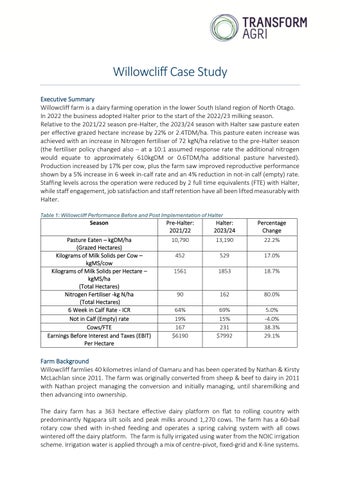
Willowcliff farm is a dairy farming operation in the lower South Island region of North Otago In 2022 the business adopted Halter prior to the start of the 2022/23 milking season. Relative to the 2021/22 season pre-Halter, the 2023/24 season with Halter saw pasture eaten per effective grazed hectare increase by 22% or 2.4TDM/ha. This pasture eaten increase was achieved with an increase in Nitrogen fertiliser of 72 kgN/ha relative to the pre-Halter season (the fertiliser policy changed also – at a 10:1 assumed response rate the additional nitrogen would equate to approximately 610kgDM or 0.6TDM/ha additional pasture harvested) Production increased by 17% per cow, plus the farm saw improved reproductive performance shown by a 5% increase in 6 week in-calf rate and an 4% reduction in not-in calf (empty) rate. Staffing levels across the operation were reduced by 2 full time equivalents (FTE) with Halter, while staff engagement, job satisfaction and staff retention have all been lifted measurably with Halter
Table 1: Willowcliff Performance Before and Post Implementation of Halter Season
Farm
Background
Willowcliff farmlies 40 kilometres inland of Oamaru and has been operated by Nathan & Kirsty McLachlan since 2011. The farm was originally converted from sheep & beef to dairy in 2011 with Nathan project managing the conversion and initially managing, until sharemilking and then advancing into ownership.
The dairy farm has a 363 hectare effective dairy platform on flat to rolling country with predominantly Ngapara silt soils and peak milks around 1,270 cows The farm has a 60-bail rotary cow shed with in-shed feeding and operates a spring calving system with all cows wintered off the dairy platform. The farm is fully irrigated using water from the NOIC irrigation scheme Irrigation water is applied through a mix of centre-pivot, fixed-grid and K-line systems
Soil moisture monitoring and irrigation scheduling are used to optimally utilise the irrigation water resource.
Operating as a System 4, the farming system leverages in-shed meal feeding using grain, palm kernel and dried distillers grain (DDG) to maximise cow intakes, leverage optimal cow potential and generate profitable production in a pasture-based system. Around 30 hectares of fodderbeet are grown on the dairy farm platform for autumn feeding, pre-wintering transition and spring feeding to cows. The Friesian cross herd have an average BW of around 280 and produce over 110% of liveweight as milksolids.
Reasons for Halter
Nathan & Kirsty are strong proponents of technology in dairy systems and initially saw the potential of Halter to assist with staffing efficiency and retention as well as supporting higher pasture harvested. With 2 ½ seasons of experience of using Halter, Nathan has found multiple other benefits that Halter has bought to the farm system and their whole operation, including improved mental clarity on farm operations and performance, and less worry about staff.
Management Changes Made
In the 2 ½+ seasons with Halter Nathan has extended management changes enabled by Halter well beyond what he thought was initially possible, changes made have included:
GRAZING MANAGEMENT
The previous grazing regime management had centred around using information from weekly pasture walks and some time using pastureio which targeted matching round lengths to growth rate. Nathan is finding that the accuracy of Halter data in the pasture module is improving rapidly. He has found that pre-grazing covers and residuals plated are ending up within +/50kgDM/ha of the Halter predicted covers. As such he has good trust in Halter data now – to the extent that in the current milking season in spring he had the confidence to open cows up onto a spring rotation around 16-18th September on Willowcliff, which flowed through to holding better pasture quality into second and third grazing rounds. In terms of breaks per day Nathan now sets up more breaks in longer covers but in general operates on 6-8 breaks per day per herd as standard operating practice, and he believes this is an important driver in lifting cows total feed intakes.
In terms of virtual fencing and paddocks – the platform still has all fences in place - Nathan may still remove some, but is still considering this opportunity and how best to do it One of the challenges with creating larger paddocks is paddock limitations – currently being able to only graze one herd per paddock so consideration is needed.
TRANSITION AND WINTERING
Wintering has been completely re-engineered through the capabilities of the Halter system –Nathan is able to make sure 2,500 cows on crop are fed from the breakfast table – this doesn’t remove the need to go and physically observe and assess conditions on the ground, but removes the time pressure and a lot of the stress of being out for long periods in challenging winter conditions. There is more control on fodderbeet using Halter – with ability to take animals off crop as and when is needed to manage intakes and ground conditions. The use of a portable tower unit at the grazing block allows these benefits to be gained. Cows are block
grazed initially to open crop paddocks up until long feeding faces are established, so a combination of area and time are used initially
For transition colostrum cow management and the ability to run extra herds is much easier Calving recovery data is being used but baseline data based on pre-calving baseline means you do have to interpret data to get the best outcomes. Regular shifts for colostrum cows are driving rumination data recovery well by 2-3 days. Break management includes two hourly day breaks and bigger night breaks.
ENVIRONMENTAL
Nathan is not using grazing heat map data yet but can see this data building up - which could in the future be used with selective grid soil testing to better manage fertiliser and nutrient use efficiency. Pugging damage has been reduced massively with it being easier to manage & move cows as needed in adverse conditions – cows can also be spread out onto bigger areas and bought back onto the same break areas when rainfall has subsided to get grazing residuals tidy. Nathan has utilised Halter to keep cows out of critical source areas (CSA’s) when conditions have dictated this need so that soil disturbance and loss to waterways can be significantly reduced
LABOUR
One of the primary motivations for using Halter was to gain some labour efficiencies on a 1200+ cow farm – Halter has enabled a permanent reduction of two FTE’s (pre-Halter had 7.5 FTE’s vs 5.5 FTE’s with Halter) as well as freeing up time for the staff to do higher value tasks.
One of the key benefits found from using Halter is less pressure on staff – this flows through to staff retention being very good. The farm does employ seasonal staff (backpackers) and the core staff have remained unchanged (with the exception of a 2IC who has progressed to contract milking on another farm). Nathan believes that Halter is driving better work satisfaction with staff – as evidenced by the minimal turnover.
Staff are more engaged in the farming operation and performance – the pasture module has been a significant factor in this There have been improvements in quality of decision makingdespite there being less people on farm every person has more responsibility and access to real time information. Typically, there is only one person in the milking shed, the cows come in, and the staff member only calls in support if needed. The dairy shed is well tech-equipped with ACRs, protrack drafting, automatic teat spraying and an automatic backing gate
Nathan has found one main challenge of less time observing out on farm as Halter reduces time needed in the paddock. They have overcome this by having a strong communication of tasks through a group chat. Another observation (not fully quantified yet) is that mileage and maintenance requirements of motorbikes have been reduced.
REPRODUCTION & ANIMAL HEALTH
Prior to Halter the mating program was using conventional heat detection with tail paint and scratchies. Halter has enabled some significant gains in reproductive performance with a 5% increase in 6 week in-calf rate and a 4% reduction in not-in calf (empty) rate. Typically, the program was always to continue mating until New Year- last year Nathan stopped at Christmas due to confidence in the results to that date.
In regards to animal health, lameness rates have so far not reduced with Halter but have been stable. Mastitis has not improved under Halter yet and overall death rate has remained at the same level.
INTANGIBLE BENEFITS
Mentally the technology is good - it helps you at all times to see where you are at. Nathan has strong trust in the data – and can make good decisions based on good data. Overall, there has been less worry about staff and less issues It is easier to replace staff as being a Halter farm is a strong drawcard.
The investment in Halter was weighed up against converting more K-line irrigation area to fixed grid irrigation. Halter for Nathan & Kirsty has created returns which increases options for other capital development – a strong cash business which Halter underpins.
Financial
Financial results are modelled using a standardised approach across all case studies. The overall change in EBIT between the 2021/22 season (pre-halter) and the 2023/24 season (with halter) showed an increase in Earnings Before Interest and Tax (EBIT) of 29%. Pre-Halter EBIT was $6190 per hectare while post implementation of Halter saw an increase to $7992 per hectare.
Conclusion
The adoption of Halter at Willowcliff Farm has led to substantial improvements across key operational metrics, demonstrating the impact of this technology on an intensive irrigated dairy system. Increased pasture harvested per hectare, enhanced milk production per cow, and improved reproductive performance have solidified the farm’s efficiency gains. Additionally, a reduction in staffing requirements while simultaneously improving engagement and job satisfaction highlights the broader benefits Halter has introduced. Beyond the measurable improvements, the integration of Halter has redefined grazing management, wintering strategies, and environmental stewardship, offering greater control and adaptability in daily operations. These changes have not only optimized resource use but also reduced stress levels for both farm owners and staff, contributing to a more sustainable and productive farming environment.
Looking ahead, continued refinement of management practices using Halter data will likely unlock further efficiencies. As technology continues to evolve, Willowcliff Farm is wellpositioned to build on its success, leveraging digital insights for even greater productivity and operational clarity.
Appendix: Farmax Modelling Summaries

(*) feed eaten by females > 20 months old / peak cows milked
Compare Physical Summary Jun 21 - May 22 Farmax Dairy 8.3.4.17
Jun 21 - May 22
Jun 21 - May 22
Jun 21 - May 22
Pre-Halter – Milker feeding Post-Halter – Milker feeding
Feed Offered for Cows at home
Willowcliff : Dairy , Jun 23 - May 24
Pre-Halter - Base Growth rates
Potential Pasture Growth for Platform
Compare Physical Summary Jun 21 - May 22
(*) feed eaten by females > 20 months old / peak cows milked
Compare Forecast Profit and Loss
Jun 21 - May 22