
Waimakariri Farm Case Study
Executive Summary
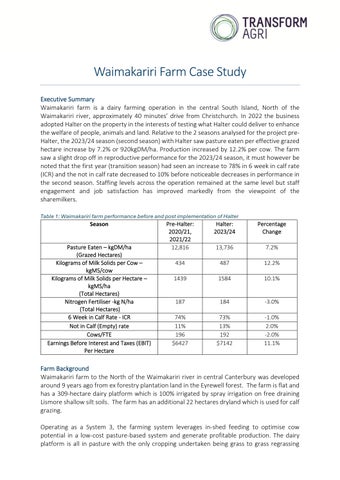
Waimakariri farm is a dairy farming operation in the central South Island, North of the Waimakariri river, approximately 40 minutes’ drive from Christchurch. In 2022 the business adopted Halter on the property in the interests of testing what Halter could deliver to enhance the welfare of people, animals and land Relative to the 2 seasons analysed for the project preHalter, the 2023/24 season (second season) with Halter saw pasture eaten per effective grazed hectare increase by 7.2% or 920kgDM/ha. Production increased by 12.2% per cow. The farm saw a slight drop off in reproductive performance for the 2023/24 season, it must however be noted that the first year (transition season) had seen an increase to 78% in 6 week in calf rate (ICR) and the not in calf rate decreased to 10% before noticeable decreases in performance in the second season. Staffing levels across the operation remained at the same level but staff engagement and job satisfaction has improved markedly from the viewpoint of the sharemilkers
Table 1: Waimakariri farm performance before and post implementation of Halter Season
Farm Background
Waimakariri farm to the North of the Waimakariri river in central Canterbury was developed around 9 years ago from ex forestry plantation land in the Eyrewell forest. The farm is flat and has a 309-hectare dairy platform which is 100% irrigated by spray irrigation on free draining Lismore shallow silt soils. The farm has an additional 22 hectares dryland which is used for calf grazing.
Operating as a System 3, the farming system leverages in-shed feeding to optimise cow potential in a low-cost pasture-based system and generate profitable production. The dairy platform is all in pasture with the only cropping undertaken being grass to grass regrassing
which for the past 5 seasons has been at a rate of 20%. All cows are wintered off the dairy platform on other dairy support blocks and are returned back to the platform in calving groups from 20th July through to the end of August for late calvers. The Kiwi cross herd have an average BW above 280 with planned start of calving (PSC) dates of 25th July for first calvers and 1st August for mixed age cows. Replacements kept are at the 26-27% level and calves go off to grazing at 100kg liveweight typically in November/December each year. The farm is presently operated by variable order sharemilkers.
Management Changes Made
Halter has been a game changer for the management and staff of Waimakariri dairy farm in enabling various efficiencies across physical KPI’s to be enhanced as well as reducing people fatigue and stress through Halter’s unique animal management capabilities.
GRAZING MANAGEMENT
Grazing management prior to Halter was a basic ‘set and forget’ two breaks per day. Feeding consistency has been improved – Halter removes the personal factor of getting break placement and area allocation set right and enables the manager to have more time monitoring cow feeding. Less time needs to be spent training staff on feed allocation physically – just need to train them how to use Halter with which they quickly become competent allocating pasture or cows to pasture available. There is greater awareness of grazing residuals now amongst the staff – using a group chat they are more agile in reacting to pasture feeding variations. The farm has 57 paddocks overall – being able to go to the top 5 paddocks and reassess them for immediate grazing decisions is a very powerful capability enabled by Halter It is easy to set long angle breaks to add in the second trough in the paddock – this helps reduce the water demand and competition for one trough. The farm was originally setup for 800 cows but is now stocked with 1000 cows at peak, and Halter allows grazing mob sizes to be set and easily changed as required based on paddock areas.
TRANSITION AND WINTERING
Wintering has become simplified across a number of areas with Halter. Staff time and travel to shift breaks and check cows has reduced with once a day checks now common compared to twice a day travel and checks on cows – this alone saves 50 minutes driving time per day. Staff are less stressed with less time needing to be spent outdoors in sometimes challenging winter conditions doing manual tasks like break cutting and fencing. There is also a gain in winter crop utilisation without cut break lines which aren’t utilised as well as grazed crop. Cow resting time can be monitored and management changes made if needed including multiple break shifts or moving cows back off grazed breaks once grazing activity drops
For calving and the associated transition period, Halter has enabled the farm to run multiple herds over the calving period and check cow allocation, activity and rumination as needed and tailor feeding and movements to suit the herd.
ENVIRONMENTAL
Grazing heat maps are observed but have not been used yet for any management changes, but they may be combined with grid soil testing in the future to tailor key nutrient inputs to improve nutrient utilisation and reduce nutrient loss risk Nitrogen fertiliser is already spread using Topcon N-sensor technology at variable rates and this could utilise grazing heat map information in the future. For night breaks cows have been set on breaks at sides of paddocks to reduce normal nutrient transfer patterns from the back to front of paddocks Halter is also
used to exclude cows from paddock corners where they congregate during poor weather. Back fencing is also used strategically to minimise pugging risk.
LABOUR
The sharemilkers have found there is a reduced need to have highly skilled or experienced staff on farm with Halter – the second-in-charge does not need to be at the same level as previously as for example less oversight is required at mating. When hiring staff, they have found that they can hire more on the personality traits rather than on their specific skill set – if a particular skill area is light this can be overcome due to less pressure for initial training on some of the basics that Halter takes care of. In addition, they have been able to pay slightly less salary rates for lesser skilled people when employed. The sharemilkers have been freed up to focus on higher value tasks as less time is needed to train staff on physical feed allocation – the managers just need to train them on how to use Halter. Despite massive challenges in the 2024 spring the farm still managed to stay in the top quartile of Ngai Tahu dairy farms for measures including death rate, mastitis and somatic cell count (SCC) which the sharemilkers attribute to Halter
REPRODUCTION
Halter is used to monitor and intervene where needed to ensure all cows have at least one cycle prior to PSM. Changes made include using PG early two cycles pre-PSM this season compared to 3 days pre-PSM last season, with a focus on using the tool to lift reproductive performance. Average 3-week submission rates have seen a lift from 84% & 89% for the two seasons prior (which had 5 weeks AI followed by bulls) and 92% & 93% for the two Halter seasons (10 weeks AI only) Not in-calf rate reduced in season one but increased in the second Halter season compared to the two seasons prior.
INTANGIBLE BENEFITS
It has been noticed that herd milking timing is able to be better synchronised with Halter to allow less cow time standing on concrete resulting in less non-productive time overall as well as positive impacts on cow hooves. Work satisfaction has also improved, with staff happier and more content with their day – they think more about farming and performance rather than just the next manual task to be done. Incidences of human error have been reduced – staff are trained up on why and how the numbers are set in Halter so they can then be more engaged in the management process and make better decisions.
Financial
Financial results are modelled using a standardised approach across all case studies. The overall change in EBIT between the 2020/21, 2022/23 seasons (pre-halter) and the 2023/24 season (with halter) showed an increase in Earnings Before Interest and Tax (EBIT) of 11%. Pre-Halter EBIT was $6427 per hectare while post implementation of Halter saw an increase to $7142 per hectare.
Conclusion
The introduction of Halter technology at Waimakariri farm has resulted in measurable improvements across key areas of farm management, productivity, and staff satisfaction. The adoption of Halter has seen a 7.2% increase in pasture harvested per grazed hectare, contributing to improved feed efficiency and reduced reliance on supplemental feeding. Milk production per cow increased by 12.2%, reflecting improved overall cow and pasture management and improved total feed intakes.
Additionally, the impact on labour efficiency and staff engagement has been significant, allowing farm operators to streamline tasks, reduce physical workload, and focus on highervalue activities. The use of Halter has reduced human error, simplified grazing and herd management, and enhanced staff morale, which has translated into a more engaged workforce and improved farm performance.
From an environmental standpoint, the ability to implement strategic grazing management through Halter provides opportunities to minimise soil damage and reduce potential nutrient loss. The success observed on Waimakariri farm is a positive story of technology adoption which will be monitored closely over the coming seasons to further validate the outcomes.
Appendix: Farmax Modelling Summaries

Pre-Halter - Base Growth rates
Potential Pasture Growth for Block 1
Potential Pasture Growth for Block 1
Post-Halter - Base Growth rates
Potential Pasture Growth for Block 1
Potential Pasture Growth for Block 1
Ngai Tahu - Halter ROI project : Pastoral, Jun 23 - May 24
Compare Physical Summary Jun 20 - May 21
Compare Forecast Profit and Loss Jun 20 - May 21 Farmax Dairy 8.3.5.26