
Ovation Farms Ltd
Executive Summary
Ovation Farms is a dairy farm operation at Paewhenua Southwest Waikato. The property is 300 ha in total, including 80 ha used for pine trees, growing 10 – 12 ha of maize annually and supporting some of the young stock. The maize ground also allows for some winter grazing.
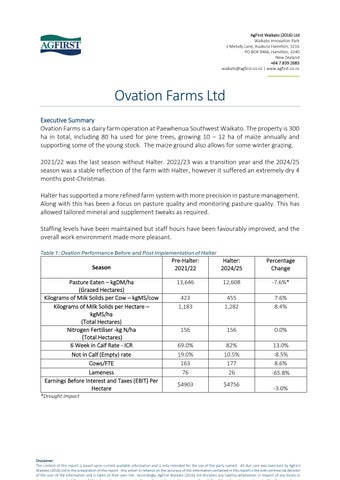
2021/22 was the last season without Halter. 2022/23 was a transition year and the 2024/25 season was a stable reflection of the farm with Halter, however it suffered an extremely dry 4 months post-Christmas
Halter has supported a more refined farm system with more precision in pasture management. Along with this has been a focus on pasture quality and monitoring pasture quality. This has allowed tailored mineral and supplement tweaks as required.
Staffing levels have been maintained but staff hours have been favourably improved, and the overall work environment made more pleasant.
Table 1: Ovation Performance Before and Post Implementation of Halter
*Drought Impact
Farm Background
The farm was purchased in 2013 and has been performing reasonably well since then. Around 610 cows have been peak milked historically and production was 260,238 kgMS in the last season without Halter. The farm is a system 4, making use of home grown and purchased maize silage and a variety of supplement feed through the shed. Staffing has remained largely constant with a 2IC, a farm assistant and a casual calf rearer Staff had typically been working 55-60 hours per week.
The Why
The farm has had a policy of 100% AI for a number of years. The 6-week in-calf rate had been hovering around the 68 – 71% range with 16 – 18% empties typical. This relatively poor reproductive performance was a key motivator in the change. Lameness has also been an issue. Their vet steered them towards a technological solution and while they could have gone with a number of suppliers with collar options, the decision was made to pay the extra and get the bonus of virtual fencing The high number of hours worked per staff member was also a motivating factor. It was hoped technology may help reduce hours worked.
Management Changes Made
Installing Halter has been a revelation in terms of management information available and is presented in a way that allowed them to make informed decisions Initially Halter wasn't drafting some cows that staff saw being ridden on the yard, but would pick them up the next milking. The team now have the confidence to rely completely on Halter to draft bulling cows, and it has become apparent the team may have been putting cows up too early previously. The system is now never second guessed.
The team now monitor premating heats closely. If a cow shows at least three premating heats, she is selected for sexed semen. Without Halter, it is difficult to accurately and consistently detect heats from three to four weeks post-calving. By targeting sexed semen only to cows with a reliable premating heat history, the farm has improved conception rates while also saving approximately $5,000 on tail paint and scratchies.
In 2024, the final cow calved on September 6th, and mating began on October 5th. This ensured that every cow in the herd had at least one month between calving and the start AB. Most heifer replacements are now born within the first three weeks of the calving period, which allows for earlier calf rearing and results in higher calf weights. By December 1st, calves are typically about two weeks older on average compared with previous seasons. As a result, AB for heifer replacements is limited to a three-week period. After this, only beef and short gestation straws are used, which has increased the sales of beef calves.
The rate of improvement in Herd BW has noticeably improved through a reduction in empties, allowing greater culling but also the tight calving means they can actively select heifer calves to rear. There has also been a big reduction in lameness
➢ Staffing
The staff have commented they don’t have to get up so early and are getting home earlier. It is estimated that average savings are a half hour at each end of the day across the team. Weekly hours worked have decreased from 55-60 hours per week down to 45 hours. The roster used to be 12/2 but has been improved to 11/3, simply because of Halter. The farm team used to
spend 2 – 2.5 hours a day on break fencing, now it's only a couple of minutes in the winter. The farm is also now running an extra mob to preferentially manage animals.
There is no tail paint to apply and continually touch up.
The 2IC was pleasantly surprised how quickly staff adapted - “You need staff with an interest in pasture management to get the most from the control you now have over grazing.”
➢ Pasture Management
Pasture walks every 10 days from mid-august through to summer before Halter was the normal Now with the extra time farm walks are happening every 10 days throughout the season. The farm is rolling contour with a big range in paddock sizes. Pre Halter allocations tended to be whole or half paddocks. Now it is usual to leave 10 – 20% of a paddock and pick it up at the next grazing. Feed allocation is certainly much more precise.
In previous winters, two to three paddocks were often badly damaged and required re-grassing. During periods of heavy rain, the stress of potential damage meant sleepless nights. Now, with the ability to move cows remotely in just a couple of minutes using a phone, the issue is quickly addressed. Last winter, no grass seed was needed to repair any paddocks.
In summer sacrifice paddocks are used to avoid overgrazing. This was used pre-Halter also, but there is now a half an hour time saving every day.
Pasture sampling starts around September 1st , minerals and supplementation are tweaked in response to the provided data.
➢ Herd Management
During calving the farm runs a colostrum mob, springer mob, a mid-calving mob a late mob and a heifer mob. That simply wasn’t possible with conventional grazing. Smaller mobs mean pasture allowance can be tailored to each mob and the smaller mobs do less damage in the wet
There have been big gains with the colostrum mob. The farm used to have to break feed and back fence which was time consuming. Despite best efforts paddocks were often damaged With Halter, they don’t break out and can be controlled near gates and water troughs. Shifts are made 3 –4 times a day.
Cow condition was always good on the farm but there has been another lift with Halter
➢ Unexpected Gains
One of the areas that the owners hadn’t appreciated gains to be made, has been in utilising the rumination data. Colostrum cows are milked once a day (OAD) for the first 4 days. Any animal that has less than 400min rumination time at that point stays on OAD but get fed properly. They are switched over to twice a day (TAD) milking at 500 minutes or 10 days.
Financial
Financial results are modelled using a standardised approach across all case studies. The overall change in EBIT between the 2021/22 season (pre-halter) and the 2024/25 season (with halter) showed a decrease in Earnings Before Interest and Tax (EBIT) of -3%. Pre-Halter EBIT was $4903 per hectare while post implementation of Halter saw an increase to $4756 per hectare.
Conclusion
The driver for the adoption of technology was originally concerns around reproductive performance. The decision was made to adopt technology as part of the solution. Halter has had quite profound advantages. The reproductive performance has significantly improved but so have several other animal health indicators including a noticeable reduction in lameness.
Having access to rumination data has been an eyeopener and has allowed far better management of the colostrum mob and cows in early lactation in general.
The farm was well on track for 300,000 kgMS before the very tough summer had a significant impact. The 2024/25 year has seen total pasture eaten decrease with supplement use increasing largely due to the impacts of drought. However, pre-Christmas, Halter was allowing pasture to be utilised more efficiently as well as less pasture damage being made over the winter.
Creating an attractive work environment has been a key feature and staff have gone from 55 to 60 hour weeks to 45-hour weeks and an improvement in the roster from 10/2 to 11/3.
Appendix: Farmax Modelling Summaries
DM Offered Per Grazed Hectares

DM Eaten per Grazed Hectares
Compare Physical Summary
Compare Forecast Profit and Loss
Jun 21 - May 22