Otamatahae Case Study
Executive Summary
Otamatahae farm near Whakamaru is living proof that the future of dairy farming lies not necessarily in new infrastructure, more inputs or more hours – but in better information, timely decisions and smarter systems.
Since adopting Halter, the well performing farm has increased pasture eaten by nearly a tonne per hectare while using less nitrogen and lifted per-cow production – all while reducing hours worked. This case study is a story about redefining what is possible when technology does not just collect data but translates it into opportunity.
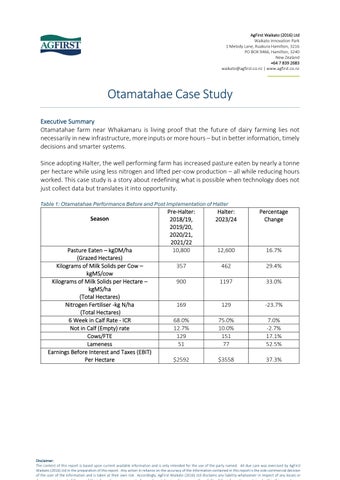
Table 1: Otamatahae Performance Before and Post Implementation of Halter
2018/19, 2019/20, 2020/21, 2021/22
Earnings Before Interest and Taxes (EBIT)
Farm Background
The family-owned dairy operation near Whakamaru has been owned by Steve and Donna Hines since 2006 It comprises of the 273 effective hectare dairy farm and a leased support block The farm peak milks 700 cows through a 50-bale rotary cow shed. The dairy platform is rolling too steep in parts, subdivided into paddocks up to 4.5 hectares in size.
The team, including 5 full-time staff, operate a system 3 feed system, feeding palm kernel in the shoulder months of the season and importing forage from the run-off. Cows are wintered on kale, and turnips are grown most years to fill a summer feed deficit. Since the adoption of Halter, their cross-bred herd achieved 462kg MS/cow for the 2023/24 season, producing 1,197 kg MS/ha.
The Why
The Otamatahae operation has a strong history of staff retention, using technology to support decision making and embracing cow wearables, but when Halter entered the market in 2020 they could see clear benefits for their operation. In 2022 Halter was set up on the farm with three clear goals in mind:
• Reducing workload pressure while better utilising their existing infrastructure
• Growing and harvesting more pasture while reducing reliance on synthetic nitrogen
• Increasing milk production.
In addition, their hope was to improve mating performance and increase everyone’s confidence around decision making.
Management Changes Made
Once the stock and the staff had been trained in the use of Halter, the team went to work, teaching Halter about their farm. Rather than relying on predicted growth and pasture cover data, significant time was invested into accurately assessing every pre-grazing cover, residual and accurately allocating feed every time. Over time, this discipline has improved the pasture model to the point where the time spent on pasture management could be reduced without impacting outcomes. At the same time, the regular assessment of previous decisions has finetuned daily decision making and increased confidence.
Deploying virtual fencing on large paddocks with, in parts, steep hillsides brought rapid pasture growth improvements and labour savings. The team have always used tools including tow behind pasture meters and spring rotation planners to support their daily decision making. In the past, the herds were generally not back-fenced and could be going into the same paddock up to three days in a row. The change to Halter has not only freed up time in the day but has also turned accurate pasture allocation into a job that takes seconds, rather than hours. Now cows are consistently back-fenced in large paddocks, eliminating back grazing and increasing growth rates. Steep paddocks are break fenced with ease, increasing their productivity.
A limiting shed size and long hours in the shed for staff were restricting the team’s ability to increase pasture harvested through grazing pressure. “We always felt the shed was our bottle neck. Halter took that constraint away. We can now milk more cows more easily and suddenly shed size isn’t an issue anymore,” explained Steve The stocking rate was lifted from 2.5 to 2.6 cows/ha, with a further increase planned in the 2025 season.
“Halter has made us more conscious about what we are doing, when and why. Decisions now come from a more high-quality set of data. If a decision is wrong, it will be highlighted immediately.” This also applies to transition and animal health management.
During the busy time of the season, including calving and mating, the changes that Halter has enabled are particularly evident. Despite a reduction in FTE by 0.25, running several mobs on farm, crop feeding, pre-mating and mating management have become significantly easier for the team. At mating time, the improved insights allow for more targeted intervention for anoestrus cows increasing the chance of stock to get pregnant in the first six weeks of mating. The improvement in performance have given the team confidence in moving to all AB without tail paint or scratchies. Regular monitoring of predicted reproductive performance gives confidence that good results can be repeated and improved further.
The Numbers
The farm’s performance has improved across multiple areas, including pasture management, production, reproduction, people, and environmental outcomes. It is important to note that significant gains in milk solids per cow and per grazed hectare were already occurring prior to the implementation of Halter. In 2018/19, production per cow was 338 kgMS, dropping to 312 kgMS in 2019/20. This then increased to 370 kgMS in 2020/21 and 407 kgMS in 2021/22. With the introduction of Halter, further gains were realised, reaching 423 kgMS per cow in 2022/23 and 462 kgMS in 2023/24. While performance was clearly trending upward before Halter’s adoption, its implementation contributed to accelerated improvements.
The amount of pasture harvested has increased from 10.8 to 12.6t DM/ha, a 16.7% increase. The increase in stocking rate was supported by an intensification in feeding system from system 2 to 3. Between the increased offering of pasture and supplements, the total feed intake per cow increased by 19.6% to 6.1t DM/cow/year. The improved feed quality improved the feed conversion efficiency from 14.4 to 13.2 kg DM/kg MS.
Milk production per cow lifted by 105kg MS. The 6 week in-calf rate lifted by 7%, and the notin-calf rate reduced by 2.7%. The change in mating strategy has allowed the business to save $9,000 in cost.
Despite the significant improvements in performance, Steve Hines was able to step away from the day-to-day management more, while retaining full visibility over the operation. The general day to day workload for the team was reduced by 1 hour per person per day, while during calving, the workload has reduced by 3 hours per person. Staff start later, work fewer hours and are more involved in decision making.
The environmental wins are significant too. Nitrogen fertiliser use has reduced by 23.8% The use of petrol and motorbike associated maintenance has reduced by 40%.
Financial
Financial results are modelled using a standardised approach across all case studies. The overall change in EBIT from the 2018-19 until 2021/22 seasons (pre-halter) and the 2023/24 season (with halter) showed an increase in Earnings Before Interest and Tax (EBIT) of 37%. Pre-Halter EBIT was $2592 per hectare while post implementation of Halter saw an increase to $3558 per hectare.
Conclusion
The adoption of Halter has been a journey from constraints to confidence for Steve and Donna Hines. Halter allows the team to achieve better performance and outcomes with the same infrastructure, the same large paddocks and less staff.
The cow shed is no longer the bottleneck of the operation and work hours are no longer maxed out. Every part of the operation - pastures, stock, people and environment – has improved through data driven decision making and increased confidence in decisions. “The technology was designed in New Zealand, for New Zealand farms. It fits our system and our business.”
Appendix: Farmax Modelling Summaries
DM eaten per grazed hectares

DM offered per grazed hectares
Compare Physical Summary Jun 18 - May 19
(*) feed eaten byfemales > 20 months old / peak cows milked
Compare Physical Summary Jun 18 - May 19 Farmax Dairy 8.3.4.17
Compare
Forecast Profit and Loss
Jun 18 - May 19
EFS is a measure of farm business profitability independent of ownership or funding, used to compare performance between farms. EFS should include an adjustment for unpaid family labour and management. This can be added to the expense database as management wage.