Mountview Farming Trust
Executive Summary
Mountview Farming Trust is a dairy operation located near Reporoa in the Bay of Plenty. The total farm area is 163 hectares, including 11 hectares of ineffective areas such as gullies and races. The farm annually grows 13.4 hectares of lucerne, 7–10 hectares of maize silage, and 7.5 hectares of kale/swedes (used for winter grazing). It is an autumn-calving system supported by a feed pad and a small runoff block used for supplementary feeding and rearing young stock.
The 2021/22 season was the last without Halter. The 2022/23 season was a transition year (cows collared in September 2022). This was too late for that year’s mating season. However, this period allowed the team to become familiar with the system prior to dry-off in December 2023/January 2024. Halter was fully utilised in the 2023/24 season, which included working through some expected teething issues, such as the farm’s shift to 100% artificial breeding (AB) during mating.
Halter has enabled more refined and precise pasture management, complemented by improved monitoring of pasture quality. Crop management over the winter months has also become much easier with Halter, coupled with much better utilisation as a result of better control and ease of management.
Halter has enabled staffing requirements to be maintained, without Halter an additional staff member would have needed to be employed. Current staff are also now working fewer hours, and the overall work environment has become more efficient and pleasant.
Overall, Halter has complemented the farm as it has allowed for the sharemilker to focus on off farm work (contracting) at key times of the year whilst being able to keep on top of what is happening on farm. This has provided the business with a level of accountability that they were not able to enjoy prior to Halter. This is making for a better work environment, where more proactive decisions are being made leading to better outcomes on farm as a result.
Table 1: Mountview Farming Trust Performance
6 Week in Calf Rate - ICR Unavailable UnavailableNot in Calf (Empty) rate Unavailable Unavailable -
Farm
Background
The farm is a family-owned operation with Alastair Neville and Tamzyn Coady operating as 50/50 Sharemilkers on the property. The farm historically has peak milked 340-350 cows with production of 161,000 kgMS in the last season without Halter.
Operating under a System 4 model, the farm utilises a combination of homegrown and purchased maize silage, along with other supplementary feeds delivered on the feed pad.
Prior to Halter labour on farm consisted of Alastair, plus two farm assistants. With Halter, this has reduced to Alastair, one farm assistant and one casual calf rearer. Prior to Halter staff had been doing 60–70-hour weeks
The Why
Historically, two full-time staff were employed to allow Alastair the flexibility to undertake contracting work off-farm at various times throughout the year. When a long-standing employee chose to leave, a review was undertaken to evaluate whether the role should be refilled or if the farm should invest in Halter technology. The decision was made to adopt Halter, as it could automate many of the daily tasks previously managed by that staff member. Additionally, finding a reliable employee was proving difficult.
Time management was another critical factor. The team frequently struggled to keep up with jobs around the farm, especially during busy periods that required frequent break fencing. This led to fatigue and at times poor decision-making.
Winter was especially demanding, as break fences had to be done around milking schedules. The terrain, which ranges from rolling to steep in some areas, made these jobs even more timeconsuming. With staff hours consistently reaching 60 – 70 hour weeks, it was hoped that Halter would help reduce hours worked.
Management Changes Made
Installing Halter has been a revelation in terms of the information available. This is presented in a way that allows informed decisions to be made. Significant time savings have been made meaning that animal health issues can be dealt with earlier and basic farm jobs such as fencing and weed management are now getting done. This makes the farm easier to run and more efficient.
➢ Reproduction
Halter has enabled the farm to move to 100% artificial insemination (AI), which has yielded several benefits. These include improved mating performance (actual figures unavailable) fewer interventions, and earlier identification of non-cycling cows, now recognized as early as Day 1 of mating instead of Day 21. With more accurate heat detection, the team has been able to make strategic decisions, such as implementing synchronization programs for cows that cycled in the 10 days before mating. This has helped condense the calving spread.
Given that the farm’s milking shed lacks auto-drafting capabilities due to its age, Halter's collar lights have made a big difference to how the shed is operated during mating. This is making it easier to identify on heat cows as they leave the shed. Alastair does not have to be in the shed all the time during mating, as the farm is reliant on the data from the collar to identify cows so all that the people milking need to do is draft the cow out for mating.
➢ Staffing
Since implementing Halter, the farm has seen significant improvements in labour efficiency, reduced stress, and overall productivity. The business is saving 1 to 1.5 hours daily by no longer needing to follow cows to the shed, resulting in earlier start and finish times. Weekly hours have dropped to 55 – 62.5 hour weeks without compromising output - if anything, productivity has increased. Tasks that used to take hours, like fencing or marking lines in winter crops, now take minutes. Another time saver is that there is no longer a need for tail paint maintenance.
Alastair was pleasantly surprised by how quickly the team adapted, with Halter introducing a new level of accountability that had not previously been seen, enabling him to monitor operations remotely. The team now have time to complete more jobs as part of their daily routine, reducing stress and making the farm easier to manage. As a result, better decisions are being made, outcomes have improved, and farm owners are happier especially with issues like weed control, which had been neglected before.
Due to additional demands of the contracting work, it was getting to the point that an additional staff member would have been required if Halter was not introduced. Therefore, the farm has been able to maintain the current number of staff due to Halter
➢ Pasture Management
Pasture management has significantly improved with the daily insights provided by the app. Previously minimal pasture monitoring was being undertaken due to limited time. Access to real-time data is enabling the farm to make more informed decisions, accurately identifying genuine pasture surpluses and capturing them without compromising cow feed intakes. This proactive approach has resulted in more frequent and earlier silage cuts compared to previous years without Halter.
Prior to Halter, the farm would have two cuts of silage. This would be in November and then late December to maintain quality especially as cows were drying off. Surpluses are now being identified much earlier in the season (September) and harvested accordingly.
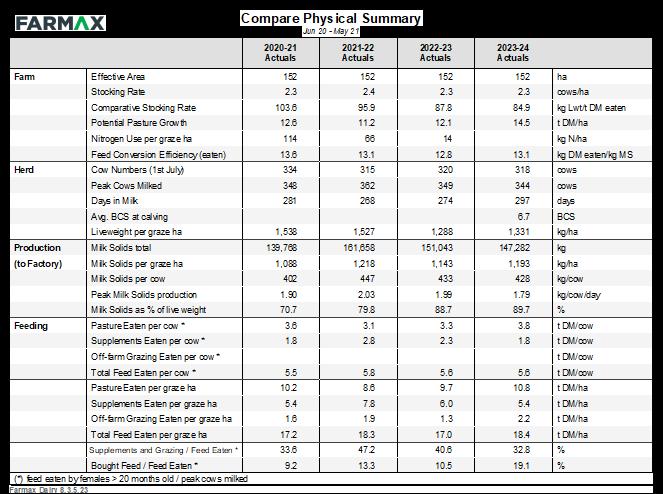
Nitrogen Fertiliser have seen a steady decrease each year as observed since the 2020/21 year, with steady decreases year on year. This has decreased to a level with no nitrogen applied to pasture in 2023/24. Any nitrogen that is used is typically on crop. This management change is not directly corelated to Halter.
➢
Wintering and Crop Management
Halter has made a significant difference to wintering and crop management, allowing the farm to run more smoothly and efficiently. By removing the need to shift break fences daily, time and labour can be reallocated to other important areas of the operation. Before Halter, staff were spending up to three hours a day setting up break fences across rolling country, often through tracks pushed over in the crop by bikes or tractors. Traditional break fencing is usually in large square blocks resulting in higher levels of trampling, reducing overall crop utilisation.
With Halter, the team can set up long, narrow breaks in each paddock, which minimises trampling and improves utilisation of the crop. It also enables more strategic grazing setups, helping to reduce the risk of sediment loss to waterways and nutrient runoff from critical source areas. If parts of a paddock become too wet after rainfall, they can easily be fenced off in the app and grazed later when conditions improve.
This has made managing winter crops far easier for the team. Staff no longer have to wade through waist-high crop in the middle of winter to set up the next day’s break, keeping them drier and making the process much more efficient and enjoyable.
➢ Herd Management
Calving time is always a challenge – Alastair is off farm a lot contracting so are reliant on the team to keep a close eye on what is going on. Halter has helped with this immensely as it is identifying problems much earlier, allowing the staff to rectify them early. The farm had approximately 10 down cows in the 2023-24 calving. The 2024-25 calving was well underway at the time of the interview and there had only been 2 cases at that point.
Rumination minutes are now playing a major part in decisions made pre and post calving in order to have the cow hit the ground running. The farm is targeting 480 rumination minutes every 24 hours for three consecutive days before a cow is allowed to move into the milking mob.
Financial
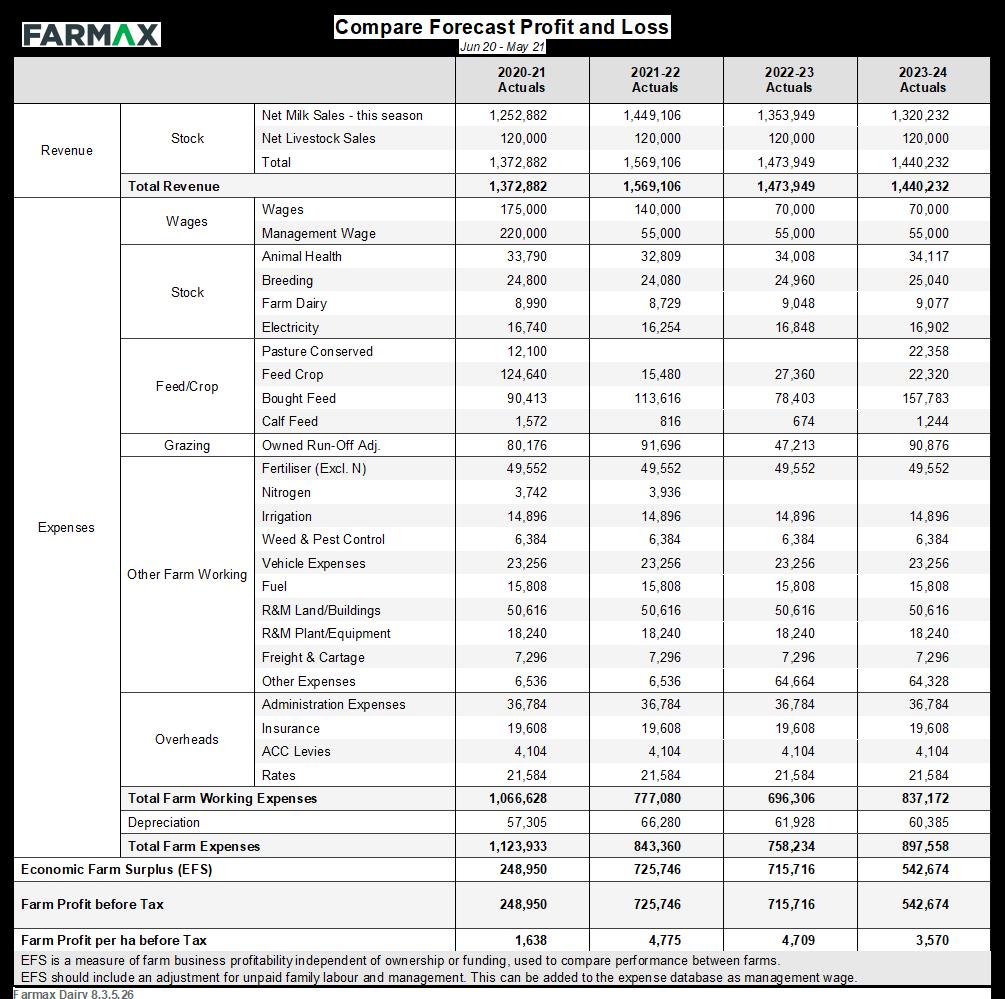
Financial results are modelled using a standardised approach across all case studies. The overall change in EBIT between the 2020/21 and 2021/22 season (pre-halter) and the 2023/24 season (with halter) showed an increase in Earnings Before Interest and Tax (EBIT) of 11%. Pre-Halter EBIT was $3207 per hectare while post implementation of Halter saw an increase to $3570 per hectare.
Conclusion
The driver for the adoption of technology was originally concern around the cost of replacing a long-term staff member leaving the farm The decision was made to adopt technology as part of the solution.
Halter has had quite profound advantages. It has allowed for the farm to maintain the same number of staff even though there has been increased contracting work taking time away from the dairy farm. This also gives Alastair more oversight of what is happening on farm in real time, even when he is off farm doing contracting work. This has also provided a level of accountability that the business has been able to leverage off to improve the team environment, which has led to a more engaged team and a happier workplace.
Adopting Halter has made winter management much easier. Daily break fence shifts on crops were time consuming and exhausting, taking up to 3 hours but are now done in 10-15 minutes. The fencing is also set up in a way that better ultilises the crop whilst protecting the environment allowing the farm to extract more out the investment made into winter crops
Mating policies have changed on farm because of Halter. The farm now does 100% AI and is increasing the use of dairy beef. This will improve returns from calf sales (still being sold as 4day old calves) but are able to sell these animals throughout the calving period This is also reducing the need to purchase bulls which is a cost that has been incurred annually by the farm This will remove a risk on the farm as staff will not have to deal with temperamental bulls.
Access to rumination data has led to better management of colostrum cows and early lactation mobs, improving animal health and performance during critical periods. The adoption of Halter by the sharemilker has also significantly reduced race and fencing maintenance. Major race work is now only needed every three to four years, and the reduced strain on physical fencing is expected to extend its lifespan. Time saved in these areas has been redirected to other essential tasks around the farm, such as weed management.
While on the surface it might appear that there have been minimal gains to the farm following the installation of Halter, the benefits to Alastair and the team have been substantial. The full benefits of Halter will become even clearer over time. However, it is already evident that the system has fundamentally changed how the farm operates. For Alastair and Tam, Halter has created greater independence and flexibility
Appendix: Farmax Modelling Summaries
Total Hectares, Feed Eaten
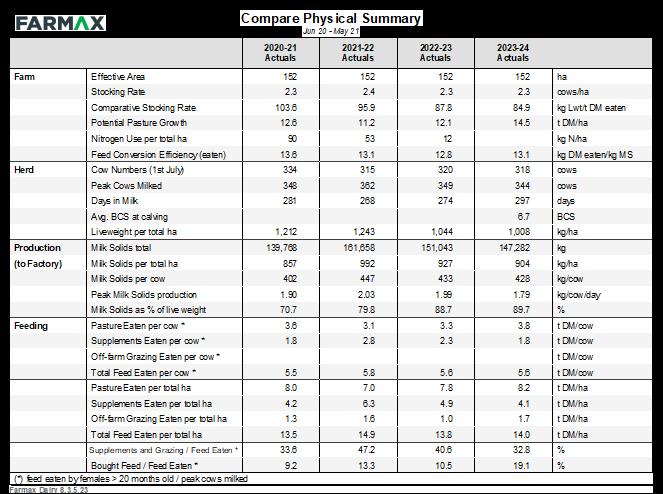
Grazed Hectares, Feed Eaten