
Maronan Case Study
Executive Summary
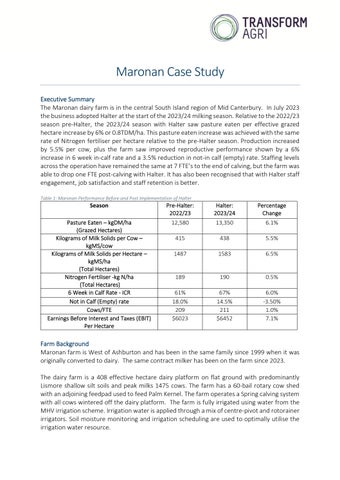
The Maronan dairy farm is in the central South Island region of Mid Canterbury In July 2023 the business adopted Halter at the start of the 2023/24 milking season. Relative to the 2022/23 season pre-Halter, the 2023/24 season with Halter saw pasture eaten per effective grazed hectare increase by 6% or 0.8TDM/ha. This pasture eaten increase was achieved with the same rate of Nitrogen fertiliser per hectare relative to the pre-Halter season. Production increased by 5.5% per cow, plus the farm saw improved reproductive performance shown by a 6% increase in 6 week in-calf rate and a 3.5% reduction in not-in calf (empty) rate. Staffing levels across the operation have remained the same at 7 FTE’s to the end of calving, but the farm was able to drop one FTE post-calving with Halter It has also been recognised that with Halter staff engagement, job satisfaction and staff retention is better.
Table 1: Maronan Performance Before and Post Implementation of Halter Season
Farm Background
Maronan farm is West of Ashburton and has been in the same family since 1999 when it was originally converted to dairy. The same contract milker has been on the farm since 2023.
The dairy farm is a 408 effective hectare dairy platform on flat ground with predominantly Lismore shallow silt soils and peak milks 1475 cows. The farm has a 60-bail rotary cow shed with an adjoining feedpad used to feed Palm Kernel. The farm operates a Spring calving system with all cows wintered off the dairy platform. The farm is fully irrigated using water from the MHV irrigation scheme Irrigation water is applied through a mix of centre-pivot and rotorainer irrigators. Soil moisture monitoring and irrigation scheduling are used to optimally utilise the irrigation water resource.
Operating as a System 3, the farming system feeds palm kernel, grass silage and maize silage predominantly on the shoulders of the milking season in order to maximise pasture intakes on all grass through the peak grass growth months of October to February Around 3.5% of the platform grows fodderbeet for autumn feeding and pre-wintering transition of cows. The Friesian – kiwi cross herd have an average BW of around 215 and produce close to 100% of liveweight as milk solids
Management Changes Made
The farm is close to finishing its second full season with Halter, the management changes noted are reflective of the first season and a half with Halter
GRAZING MANAGEMENT
Prior to Halter the system was from calving time to use a spring rotation planner (SRP) and feed budget with the first grazing round finishing around the 27th of September. With Halter live pasture information is used to adjust feeding. The SRP is now a secondary tool as the live information and forward forecasts allow more dynamic management of the first grazing round, which was advanced to a 17th September finish in the 2023/24 season and a 13th September finish for the 2024/25 season.
In terms of general in-season pasture management pre and post Halter, the data gives confidence to be more aggressive, handle more variability and ultimately have better grazing management which is believed to be building year on year Key grazing management with Halter includes back fencing every break in every paddock for the grazing regime of three breaks per paddock per 24 hours Halter also gives management the ability to have more herds as needed. The farm was set up for two big herds originally which always resulted in a large tail end in condition and subsequent performance. Now the farm is run with three main herds (four herds are run at calving). The three main herds are:
• Younger cows (first & second calvers)
• Older & mixed age cows that have been healthy – capable of more walking
• Older cows that may have had lame or mastitis treatment in the prior season
Less cows in herds means more space on tracks & less pressure on certain cow groups - Halter is very useful also for autumn management – the ability to have more herds if needed.
TRANSITION AND WINTERING
Cow transition management pre and post calving has been improved using Halter – in the preHalter season rates of metabolic issues were high with around 3-4 cows per day needing treatment, post Halter changes made to colostrum cow management and springer feeding have reduced this number to one cow every second day. Colostrum cows and milkers get 10 days minimum OAD milked and aren’t progressed to twice a day (TAD) milking until they reach 500 minutes rumination. From mid-September calved cows get 15 days on OAD.
It is believed that being able to look at live cow data helps a lot – when feeding cows on fodderbeet Halter can help ID cows before they become sick using rumination changes – in one case 50 sick cows showed up on Halter and were drafted and checked, 15 were drenched for sub-clinical acidosis and the next day were all fine.
On the dairy platform a fodderbeet feeding regime is run which is designed to minimise risk of acidosis – and as such still uses hotwire fences on the crop - Halter is used to shift cows on and off crop only. This keeps the management simpler for staff also with crop breaks setup so that 1 row = 1 kg of dry-matter per cow Once the cows go off platform for winter grazing, they are
transitioned up to a full ration over 10-14 days behind a wire -after this they are allocated breaks with Halter only. If alerts show up – you can monitor on Halter and decide if the cow needs to be removed or not- with their system of moving fences on fodderbeet manually still means they can see those at sick cows and manage them.
ENVIRONMENTAL
The farm is not using grazing heat map data yet but this data is building up for later use– the break setting regime of three breaks per 24 hours and constant backfencing is expected to result in less nutrient transfer across paddocks than pre-Halter. The Lismore soil are relatively free draining, but pugging risk is easier to minimise by moving cows as needed in adverse conditions. There are no critical source areas (CSA’s) on the property.
LABOUR
One of the key benefits found from using Halter is less pressure on staff – this flows through to staff retention being very good. The farm does employ some seasonal staff (backpackers) and in the first season with Halter was able to drop the 7th staff member at the end of September resulting in labour cost savings for the contract milker.
Positive changes for staff on the farm with Halter are more sleep in’s as two people aren’t required first thing. The reduced manual requirements for pasture break fencing and fetching cows allows the contract milker to fill the day in for staff with additional higher value tasks. Another significant benefit found from using Halter has been to shorten the Roto Rainer irrigator return time from 10 to 7 days – this has increased pasture growth rates on the Roto Rainer irrigated are relative to the centre pivot. This is due to increased labour availability.
In terms of work satisfaction the staff do like Halter, but one outcome is to have more milking time once the extra FTE goes at the end of calving It is found that staff have had varying levels of engagement with Halter but this may come down more to the person rather than the system, the staff have all the Halter information available on their phones but can be less inclined to go out to the paddock now which may impact learning other farming skills. Overall, it has been seen that staff have had to change their mindsets – they thought it would make everything easier which it does to some degree, but it also makes everything different which takes some adapting to, having a tool that enables a better result is very positive for team morale though. A key observation of changes in the quality of decision making has been rapid improvement in pasture allocation and getting it right – both in accuracy and consistency
REPRODUCTION & ANIMAL HEALTH
Prior to Halter the mating program was using conventional heat detection with tailpaint and scratchies, Halter has enabled some significant gains in reproductive performance with a 6% increase in 6 week in-calf rate and an 3.5% reduction in not-in calf (empty) rate. The contract milker has found that using short-gestation and sexed-semen has been simplified, it is easy to select right cow to right bull – you just type the cow number in and get all data so can make sexed semen decisions on the spot.
In regard to animal health average SCC has been lower, but it is believed that this isn’t attributed to Halter as there have been other system changes including in-bail teat sprayers. The improvements in metabolic issues and transition and cow monitoring have been outlined under transition and wintering.
OTHER BENEFITS
Having a clear view and high levels of information over all important details for a dairy cow –pasture/records/heats/info are all there and accurate. The feedpad use for feeding Palm
Kernel has been made simpler with Halter which had been fed in bins in the paddock – this has reduced the need for and maintenance costs of feed bins. It has been found that less reels now need to be purchased - three new reels for winter + 150 hot standards, this has resulted in $1,700 saved per year. Time freed up is of huge value for the contract milkertime for family events, time to do essential repairs as they happen (which do regularly on a 25 year old farm) Overall, Halter creates more efficiency in running the farm, better results for people and animals and helps to guarantee a profit.
Financial
Financial results are modelled using a standardised approach across all case studies. The overall change in EBIT between the 2022/23 season (pre-halter) and the 2023/24 season (with halter) showed an increase in Earnings Before Interest and Tax (EBIT) of 7%. Pre-Halter EBIT was $6023 per hectare while post implementation of Halter saw an increase to $6452 per hectare.
CONCLUSION
The adoption of Halter technology at Maronan farm has resulted in significant improvements across multiple operational metrics. Enhanced pasture utilization, increased milk production per cow, and improved reproductive performance highlight the positive impact of precision livestock management. Additionally, staffing efficiency has been optimized, allowing the farm to operate with one fewer full-time equivalent post-calving while simultaneously improving staff engagement, retention, and job satisfaction. These benefits demonstrate how integrating technology into traditional dairy farming can lead to sustainable improvements in both productivity and employee well-being.
Beyond production and labour efficiencies, Halter has enabled more refined grazing management and health monitoring, leading to better cow welfare and proactive intervention strategies. Advancements in pasture rotation planning, herd structuring, and metabolic health management have reduced variability and improved consistency in farm performance. The ability to monitor real-time cow data has strengthened decision-making, allowing for early identification of health concerns and more precise allocation of resources. These changes underscore the farm’s commitment to improving animal welfare and optimizing herd performance through technology-driven strategies.
Appendix: Farmax Modelling Summaries

feed eaten by females > 20 months old / peak cows milked Compare Physical Summary Jun 22 - May 23
Milk Solids
Pre-Halter – Milker feeding
Feed Offered for Cows at home
Feed Offered for Cows at
Pre-Halter - Base Growth rates
Potential Pasture Growth for Block 2
Maronan : Pastoral, Jun 22 - May 23
Post-Halter - Base Growth rates
Potential Pasture Growth for Block 2
Cloverdale
Cloverdale Maronan : Pastoral, Jun 23 - May 24
Farmax
Compare Physical Summary
Jun 22 - May 23
Compare Forecast
Profit and Loss
Jun 22 - May 23