
Kokoamo Case Study
Executive Summary
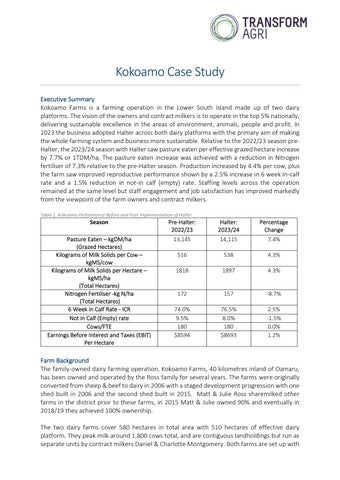
Kokoamo Farms is a farming operation in the Lower South Island made up of two dairy platforms The vision of the owners and contract milkers is to operate in the top 5% nationally, delivering sustainable excellence in the areas of environment, animals, people and profit In 2023 the business adopted Halter across both dairy platforms with the primary aim of making the whole farming system and business more sustainable. Relative to the 2022/23 season preHalter, the 2023/24 season with Halter saw pasture eaten per effective grazed hectare increase by 7.7% or 1TDM/ha. The pasture eaten increase was achieved with a reduction in Nitrogen fertiliser of 7.3% relative to the pre-Halter season. Production increased by 4.4% per cow, plus the farm saw improved reproductive performance shown by a 2.5% increase in 6 week in-calf rate and a 1.5% reduction in not-in calf (empty) rate. Staffing levels across the operation remained at the same level but staff engagement and job satisfaction has improved markedly from the viewpoint of the farm owners and contract milkers
Table 1: Kokoamo Performance Before and Post Implementation of Halter Season
Farm Background
The family-owned dairy farming operation, Kokoamo Farms, 40 kilometres inland of Oamaru, has been owned and operated by the Ross family for several years. The farms were originally converted from sheep & beef to dairy in 2006 with a staged development progression with one shed built in 2006 and the second shed built in 2015. Matt & Julie Ross sharemilked other farms in the district prior to these farms, in 2015 Matt & Julie owned 90% and eventually in 2018/19 they achieved 100% ownership
The two dairy farms cover 580 hectares in total area with 510 hectares of effective dairy platform. They peak milk around 1,800 cows total, and are contiguous landholdings but run as separate units by contract milkers Daniel & Charlotte Montgomery. Both farms are set up with
54-bale & 60-bail rotary cow sheds with in-shed feeding and operate on spring calving systems with all cows wintered off the dairy platforms. The farms are fully irrigated using water from a private river take as well as the Maerewhenua District Water Resource Company (MDWRC) and the North Otago Irrigation Company (NOIC) irrigation schemes which all source water from the Waitaki river, New Zealand’s 4th largest river by water flow. Irrigation water is applied through a mix of centre-pivot, fixed-grid and K-line systems and state of the art soil moisture monitoring and irrigation scheduling are used to optimally utilise the irrigation water resource.
Operating as a System 4, the farming system leverages in-shed meal feeding using grain, palm kernel and blended feeds incorporating palm kernel with starch to maximise cow intakes, optimise cow potential in a pasture-based system and generate profitable production. For autumn feeding, pre-wintering transition and spring feeding to calved cows around 20 hectares of fodderbeet are grown on each farm. The Friesian cross herd have an average BW over 300 and consistently produce higher than 510 kgMS/cow and 1,800 kgMS/ha.
In September 2023, the team deployed Halter across stock on both farms. “Halter is like Googletranslate for new staff – it allows different people from different backgrounds who operate differently to run on the same operating system across the farms”.
The Why
Kokoamo farms has always been a strong, early adopter of technology – Halter was a logical next step in precision dairy farming technology progression, but not primarily for the benefit of the cows – the primary driver was for supporting staff in an ‘intense farming system’. In consideration of the adoption of Halter, the main goals were to make the whole system more sustainable for people first, then cows, then pastures, to drive better physical performancewhich should flow through to the financials. Long term retention of top performing operators like Monty & Charlotte is important for long term sustainability of the business.
Creating more value from individuals and the team as a whole through removing manual tasks such as shifting break fences and fetching cows at 4:00 or 5:00AM and enabling them to have more time on higher value tasks. This could be time in the paddock focusing on interpretation of real-time data around pastures and feeding, or doing essential R&M or weed control work which benefit whole farm performance. These were important drivers for the owners and contract milkers with the uptake of Halter
Whole system sustainability for the farm owners starts primarily with people. For Matt & Julie, the longer term retention of Monty & Charlotte as contract milkers is driven by how successful they are in recruiting, engaging and retaining high quality people. Halter and its potential impact on people’s enjoyment and satisfaction of dairy farming was seen as a possible enabler of longer term retention of the contract milkers and staff for the Ross’s. “Engagement by staff feels like it is 200% of pre-Halter – we have the same people in number, but they are so much more engaged”.
Management Changes Made
The full capabilities of Halter extend well beyond just cow shifting and monitoring. The Kokoamo farms team have implemented several key management changes which have changed the way they operate, monitor and manage farm performance.
GRAZING MANAGEMENT
While the same basic feed principles have been maintained, grazing management has been intensified majorly with a shift from 2 breaks per day pre-Halter going to a minimum of 5 and up to 7 breaks per 24 hours now being the standard. Real time pasture data is monitored closely with the leaf emergence indicator being used as a relative guide to when paddocks are hitting their optimum grazing time. The real time growth data has enabled subtle grazing management changes to be made from changing growth trends within 3 days instead of 1-3 weeks historically. Rumination data and resting times are monitored to guide driving higher feed intakes to optimise cow grazing potential. Overall, some of the extra time available from eliminating manual tasks along with access to accurate real-time data has allowed the team to improve grazing management, leading to improved pasture harvested.
TRANSITION AND WINTERING
Wintering changes have included a significant reduction in the winter roster for staff, going from 5-6 people on the daily roster to 2 people for 3 hours per day. This change has been driven by the removal of physical break setting which in intensive crop grazing wintering systems is a very labour intensive task. Halter is used to shift cows onto fresh breaks and can be done so ‘from the kitchen table’ with time and staff resource freed up to do more monitoring of animal welfare and physical conditions in paddock. Feeding of supplement is done when cows are shifted onto the previous day’s break area and is fed under a wire to drive less wastage and better supplement utilisation. In wet weather conditions Halter is used to shift cows as required to minimise pugging. One of the intangible benefits to staff is a reduction of time spent outdoors in sometimes miserable and challenging winter conditions doing menial tasks.
Transition has also been more effectively managed with Halter. Cows are bought home from the support blocks where they are wintered to the dairy farms a minimum of 10 days precalving in early, mid and late calving groups. Halter has significantly improved transition management by enabling the effective running of multiple individual mobs. In wet conditions, staff can implement a flexible open grazing script where square metre allocations per cow are tallied, allowing cows to access a broader grazing area across a block. This approach is particularly beneficial on challenging contours where conventional square or parallel breaks become less effective. As a result, staff are now more proactively thinking about wet weather management focusing not just on pasture preservation, but also on cow welfare, and adjusting strategies accordingly. The main support farm which is owned by Kokoamo farms has now been completely de-fenced which Halter has enabled, so the only limitations on break size or location are stockwater trough locations.
ENVIRONMENTAL
Halter has enabled easily keeping cows away from critical source areas (CSA) and reducing the risk of pugging damage during wet conditions. In the event of heavy rainfall cows are shifted off recently grazed areas and higher risk sloped areas can be deferred for grazing and grazed at a later time when ground conditions suit. A picture of paddock grazing intensity through grazing heat maps is still being built up and the objective is to use this information in the future in combination with precision grid soil testing and variable rate precision fertiliser spreading to improve nutrient use efficiency and minimise nutrient loss risk.
LABOUR
Halter has enabled positive changes to in-milking season rosters (not reliant on a fixed staff requirement per day – helped by having larger scale and ability to shift resource as needed) and greatly reduced wintering fatigue on staff, also enabling more time off and leave to be taken over the winter months. The total labour resource in terms of numbers has not changed but the ability to bring on less experienced but motivated individuals (such as Lincoln graduates) and get them ‘operational’ and understanding the farming system in a short space of time has been greatly enabled by Halter. The shed manager who has been in NZ for 8+ years is taking leave back to Philippines for two months – this was not achievable without Halter. People with less experience but with tech ability and enthusiasm are able to advance into management much sooner.
REPRODUCTION
The farms were using technology pre-Halter with in-shed heat detection cameras used with stickers and scratchies on cows. With Halter the farms have seen a 2.5% increase in 6 week incalf rate and a 1.5% reduction in not-in calf (empty) rate. There has anecdotally been a reduction in lameness cases attributed to cows being able to walk at their own pace Cow movement is best monitored with side to side across a paddock being more effective to see if cows haven’t moved. In contrast, straight conventional creep breaks don’t show this. If a cow doesn’t move, it is an indicator that a cow is more likely to be sick – actual alerts are when cow is very unwell and close to death.
INTANGIBLE BENEFITS
The contract milker was able to go to his children’s school camp this season - during one of the busiest periods of the season – this was not able to happen before Halter. Over time the ability to take on less experienced but well qualified people who can learn the farm operating system more effectively enables a differing perspective on staff structure and options.
Financial
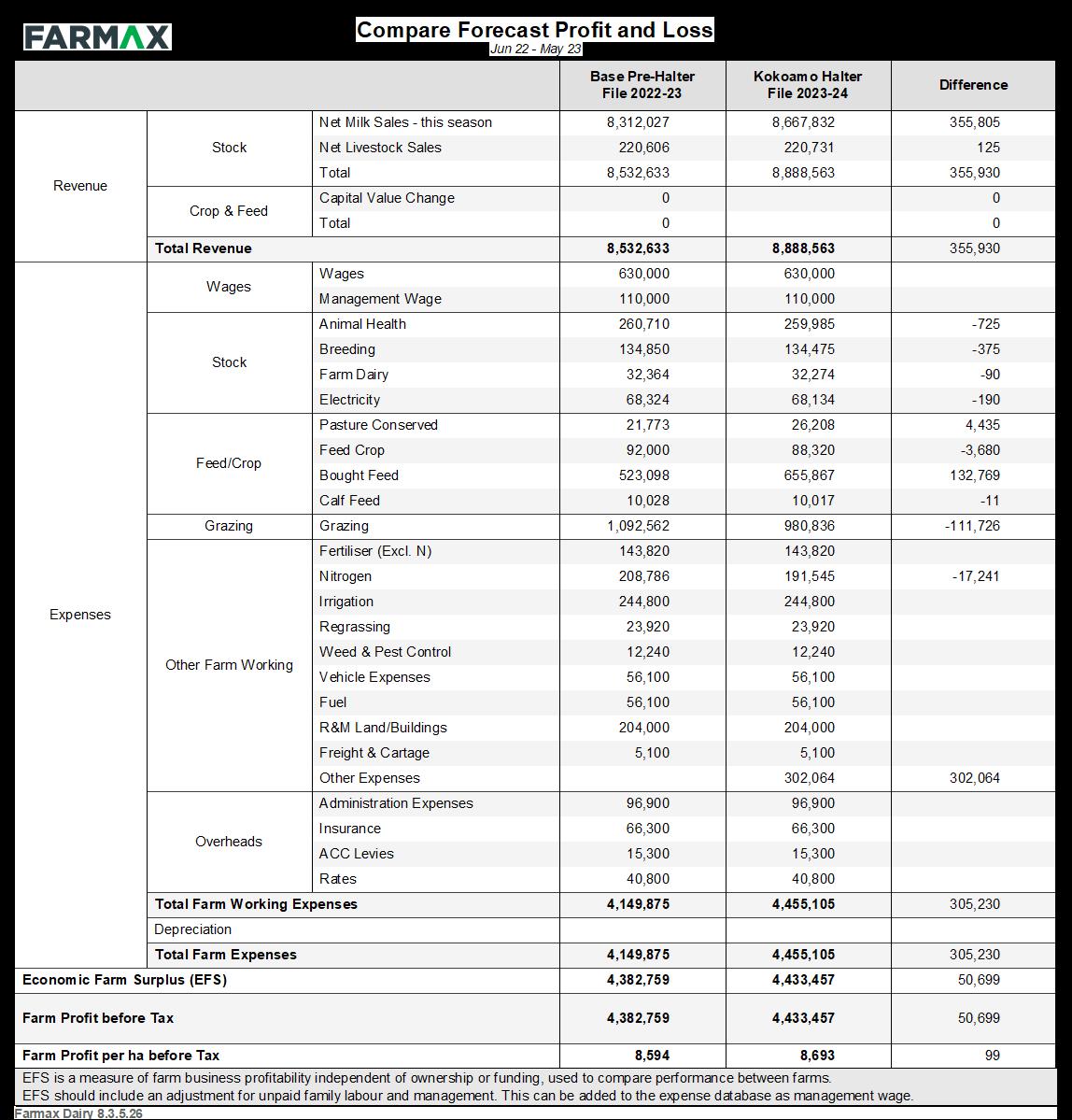
Financial results are modelled using a standardised approach across all case studies. The overall change in EBIT between the 2022/23 season (pre-halter) and the 2023/24 season (with halter) showed an increase in Earnings Before Interest and Tax (EBIT) of 1%. Pre-Halter EBIT was $8594 per hectare while post implementation of Halter saw an increase to $8693 per hectare.
Conclusion
Matt’s thought process is that three seasons will be needed to fully evaluate the whole farm system’s benefits as Halter is a complete change in your operating system – after one season you cannot capture or see all benefits. For Matt this is how you create the understanding of how the ‘old world’ and ‘new world’ fit together.
Appendix: Farmax Modelling Summaries

Compare Physical Summary Jun 22 - May 23
Jun 22 - May 23
Pre-Halter – Milker feeding Post-Halter – Milker feeding
Feed Offered for Cows at home Kokoamo - Halter ROI : Dairy , Jun 23 - May 24
Farmax
Pre-Halter - Base Growth rates
Post-Halter - Base Growth rates
Compare Physical Summary Jun 22 - May 23
(*) feed eaten by females > 20 months old / peak cows milked