
Harakeke Case Study
Executive Summary
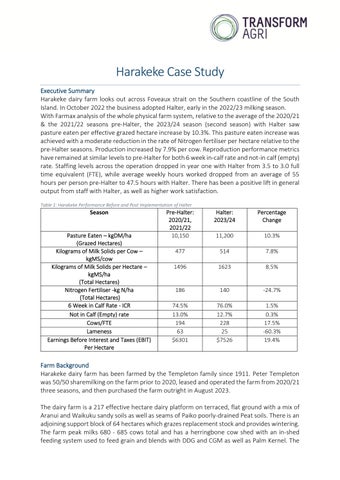
Harakeke dairy farm looks out across Foveaux strait on the Southern coastline of the South Island In October 2022 the business adopted Halter, early in the 2022/23 milking season. With Farmax analysis of the whole physical farm system, relative to the average of the 2020/21 & the 2021/22 seasons pre-Halter, the 2023/24 season (second season) with Halter saw pasture eaten per effective grazed hectare increase by 10.3% This pasture eaten increase was achieved with a moderate reduction in the rate of Nitrogen fertiliser per hectare relative to the pre-Halter seasons Production increased by 7.9% per cow. Reproduction performance metrics have remained at similar levels to pre-Halter for both 6 week in-calf rate and not-in calf (empty) rate. Staffing levels across the operation dropped in year one with Halter from 3.5 to 3.0 full time equivalent (FTE), while average weekly hours worked dropped from an average of 55 hours per person pre-Halter to 47.5 hours with Halter. There has been a positive lift in general output from staff with Halter, as well as higher work satisfaction.
Table 1: Harakeke Performance Before and Post Implementation of Halter Season Pre-Halter: 2020/21, 2021/22
Farm Background
Harakeke dairy farm has been farmed by the Templeton family since 1911. Peter Templeton was 50/50 sharemilking on the farm prior to 2020, leased and operated the farm from 2020/21 three seasons, and then purchased the farm outright in August 2023.
The dairy farm is a 217 effective hectare dairy platform on terraced, flat ground with a mix of Aranui and Waikuku sandy soils as well as seams of Paiko poorly-drained Peat soils There is an adjoining support block of 64 hectares which grazes replacement stock and provides wintering The farm peak milks 680 - 685 cows total and has a herringbone cow shed with an in-shed feeding system used to feed grain and blends with DDG and CGM as well as Palm Kernel. The
farm operates a spring calving system with all cows wintered off the dairy platform. The farm is not irrigated and has an annual rainfall level of around 1100 mm.
Operating as a System 3, the farming system feeds grain and blends with DDG (dried distillers grain) and CGM (corn gluten meal) as well as Palm Kernel and molasses. Pasture silage is fed on the shoulders of the season and around 4.5% of the platform grows turnips for summer feeding. The Jersey cross herd have an average BW just under 300, PW of 335 and produce close to 110% of liveweight as Milksolids.
Reasons for Halter
Peter first opted to install Halter with a view to gain efficiencies right across the farming operation, with primary motivations being to harvest more pasture and to ease pressure on staff through intensive calving and mating periods.
Management Changes Made
The farm is close to finishing its third full season with Halter, the management changes are reflective of the first two and a half seasons with Halter
GRAZING MANAGEMENT
Pasture management changes pre and post Halter were initially intensive and then softened somewhat- Peter operates similar allocation principles as pre-Halter with 60%/40% splits of daily area allocation night & day. He started with lots of breaks through a 24 hour period but has gone back to one break per 12 hours unless there are bad weather conditions when more breaks are used. All fences on the dairy platform remain intact – the main changes made have consisted of 2 posts plus an 26 additional troughs to provide 2 troughs per paddock. Peter has found that ranking of paddocks on performance is easier to use and has better visuals compared to other systems He has also found that the pasture predication models are improving and finds the MJME calculator very helpful and is using this feature more and more in the current season.
Herd changes enabled by Halter have been a key benefit Previously Peter ran a one herd system plus a second sick cow herd. Now Peter runs two main herds plus a sick cow herd and believes this is helping consistency of milk yield and reduces competition impacts on younger and less dominant cows within the herd. A once a day (OAD) mob is able to be used more strategically and this year Peter has lifted the OAD herd size.
TRANSITION AND WINTERING
Wintering has been simplified somewhat with Halter, although a key challenge with the technology is that coastal drift impacting GPS accuracy can be significant up to 1-2M/cow in rough weather so needs to be allowed for in management. Feed allocation is more consistent, and Peter has found that he is able to react faster to changes with Halter The cows spend the first two months on crop which has changed from swedes pre-Halter to Kale. In late July mid and late calvers are fed grass and silage in a ‘bale grazing’ system Halter makes the switching and transition from crop to grass wintering easy to manage Peter has also found that for wintering the efficiency of each labour unit is twice that of pre-Halter, as the removal of physical fence and break setting allows more time for observation and fine tuning – this is vital as there is greater potential for poorer visual monitoring of animal physical conditions and health when there is less time spent out in the paddock.
ENVIRONMENTAL
Grazing heat maps are being used to be more selective with maintenance fertiliser applicationsmanagement changes so far include excluding the first third of paddocks, gateways and grazing hotspots, and strategic fertiliser placement which should drive better nutrient use efficiency, reduce metabolic risk for animals and minimise nutrient loss risk.
Another key environmental benefit found from using Halter has been better management of critical source areas (CSA), by grazing close to waterways or CSA’s for a short time of around 1 hour on and then shifting animals away so dung and urine are less likely to be deposited in high amounts, and the nutrient are effectively exported away from CSA’s. In adverse weather conditions Peter will typically use 4-8 breaks per day on paddocks to minimise pugging damage and has used up to 16 breaks in extreme conditions. In the future Peter is hopeful that regional councils may allow no fencing around critical source areas (CSA’s) on the property with the use of technology like Halter.
Nitrogen fertiliser use has also been reduced with Halter by close to 50 kgN per hectare and the farm has had a higher level of pasture harvested with similar levels of imported supplementary feed.
LABOUR
Peter believes that the most labour time gains come from not following cows into the shed or other shifts on farm, with a secondary gain being 0.5 - 1 hour per day saved on not shifting fences. FTE were reduced in the first season with Halter. Following this, in the second season Peter employed more FTE’s, but this was due to him spending significant time away overseas undertaking a Nuffield scholarship – something that he believes would not have been feasible to do if he did not have Halter on the farm.
In terms of work satisfaction, it is a lot higher – Halter supports the ability for staff to make more consistent decisions like a manager, and they are less likely to have repeated mistakes which Peter believes are where performance is always negatively impacted. As far as observed changes in quality of decision making – Halter helps saves time but they do have to spend more time on their phone. The positive is that when staff are engaged and know how to operate Halter, this does give them the ability to make 95% of the decisions of a farm owner. From a broader perspective Peter sees that Halter doesn’t necessarily save a staff member- it ‘retains’ a staff member.
REPRODUCTION & ANIMAL HEALTH
Prior to Halter the mating program was using conventional heat detection with tail-paint and multiple hours for several weeks manually identifying cows on heat Halter has greatly simplified and refined the heat detection process and has seen consistent rates of reproductive performance with no effective change in 6 week in-calf rate or not-in calf (empty) rate. Peter is planning to only do 8 weeks mating in the current season – based on personal philosophy, and believes that Halter gives him the confidence by putting accurate numbers in front of you to make accurate decisions and the right call on a shorter total mating period.
Regarding animal health, there has been an ability to notice sick animals faster with alerts and the trend has been more animal health interventions because there is more data.
The flipside is that cow wastage is reducing – so culling pressure can be higher because cows are lasting longer - this will only improve the standard of the herd over time, or allow a lower replacement rate. Due to confidence in the Halter rumination and animal recovery data Peter has gone to 3 weekly metri-cures now, cows are drafted through Protrack utilising rumination data – low rumination cows are also drafted into the OAD Mob and more frequent metrichecking is done in the OAD mob.
OTHER BENEFITS / IMPACTS
Peter is saving an estimated 3-4 hours in his day due to using Halter, differences he is now observing are: more consistency in management decisions and actions and 2: general output from farm staff has increased exponentially - it is easier for staff to be more accurate and consistent now. There is a drive towards the type of farm staff being more technical types of people also. Peter sees Halter being unique as a tool to lift both the bottom and top of the performance curve. Peters role has had to become more focused on visual observation of the farm and system – less of production and numbers as that is taken care of.
Some disadvantages that Peter has dealt with are stockwater issues becoming more commonplace and fence power maintenance – both are impacted by staff needing to be in the paddocks less often than prior to Halter, so you have to make changes to get people out there – getting staff back measuring residuals is one way he has driven this.
Financial
Financial results are modelled using a standardised approach across all case studies. The overall change in EBIT between the 2020/21, 2022/23 seasons (pre-halter) and the 2023/24 season (with halter) showed an increase in Earnings Before Interest and Tax (EBIT) of 19%. Pre-Halter EBIT was $6301 per hectare while post implementation of Halter saw an increase to $7526 per hectare.
Conclusion
The implementation of Halter at Harakeke dairy farm has resulted in significant improvements across the operation. By increasing pasture harvested per hectare while simultaneously reducing nitrogen fertiliser, the farm has achieved a more sustainable approach to pasture management. Additionally, the rise in per-cow production showcases the efficiency gains facilitated by Halter, contributing to a more productive dairy operation. Labour efficiencies have also been notable, with a reduction in full-time equivalent staff and fewer weekly hours worked per person, while staff satisfaction and output have improved. These changes demonstrate the effectiveness of Halter in optimizing farm management without compromising animal welfare, reproductive performance, or workforce well-being. Beyond productivity and labour advantages, Halter has supported critical environmental and herd management advancements. The technology has enabled strategic fertiliser application, better CSA management, and enhanced flexibility in wintering practices, ensuring improved sustainability. Changes in herd structure have supported consistent milk yield and reduced competitive pressures, while advancements in reproductive monitoring and animal health interventions have led to more efficient management decisions. Overall, Halter has delivered a more precise and responsive farming system, freeing up time for the farm operator while simultaneously elevating the performance and resilience of the operation. The farm's experience highlights the transformative potential of technology-driven solutions in modern dairy farming.
Appendix: Farmax Modelling Summaries

Compare Physical Summary Jun 20 - May 21 Farmax Dairy 8.3.4.17
Pre-Halter -
Post-Halter -
Post-Halter
Post-Halter -
Compare Pasture Growth Jun 20 - May 21
Pre-Halter -
Post-Halter - 2023-24
Farmax Dairy
Pre-Halter – Milker feeding
Feed Offered for Cows at
Feed Offered for Cows at home Haraheke - Halter ROI : Dairy , Jun 21 - May 22
Post-Halter – Milker feeding
Feed Offered for Cows at home
Haraheke - Halter ROI : Dairy , Jun 23 - May 24
Pre-Halter - Base Growth rates
Potential Pasture Growth for Block Haraheke - Halter ROI : Pastoral, Jun 20 - May 21
Potential Pasture Growth for Block Haraheke - Halter ROI : Pastoral, Jun 21 - May 22
Farmax Dairy
Farmax Dairy
Post-Halter - Base Growth rates
Potential Pasture Growth for Block
Potential Pasture Growth for
Compare Supply-Demand Jun 20 - May 21
(*) feed eaten by females > 20 months old / peak cows milked
Compare Physical Summary Jun 20 - May 21 Farmax Dairy 8.3.4.17
Compare Forecast Profit and Loss
Jun 20 - May 21
Expenses