Grassmere Case Study
Executive Summary
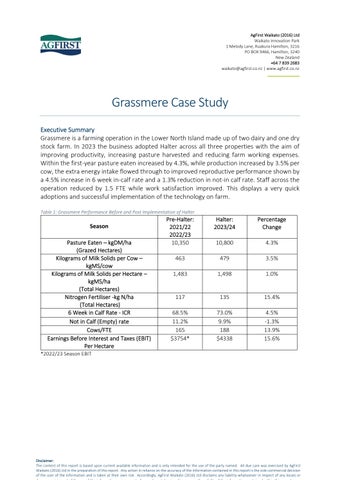
Grassmere is a farming operation in the Lower North Island made up of two dairy and one dry stock farm. In 2023 the business adopted Halter across all three properties with the aim of improving productivity, increasing pasture harvested and reducing farm working expenses. Within the first-year pasture eaten increased by 4.3%, while production increased by 3.5% per cow, the extra energy intake flowed through to improved reproductive performance shown by a 4.5% increase in 6 week in-calf rate and a 1.3% reduction in not-in calf rate. Staff across the operation reduced by 1.5 FTE while work satisfaction improved. This displays a very quick adoptions and successful implementation of the technology on farm.
Table 1: Grassmere Performance Before and Post Implementation of Halter Season Pre-Halter: 2021/22 2022/23
Farm Background
The family-owned dairy farming operation, Grassmere, near Feilding, has been in the Hocken family for over 130 years. It comprises of two similar sized dairy farms - Grassmere and Bodmin – and the dry stock unit Longmere, all working together seamlessly.
The two dairy farms, peak milking around 900 cows, are connected by an underpass, enabling efficient integration of their systems. Bodmin spans 153 effective hectares. All cows are calved here and the farm milks all heifers alongside a portion of mixed-aged cows. Grassmere, covering 132 effective hectares with freshwater irrigation, takes in the mixed-aged cows from Bodmin from mid-August. Both farms are set up with a 50-bale rotary cow shed and adjoining feed pad.
Operating as a System 4, the team utilise in-shed meal feeding and the feed pad to maximise profitable production. For summer 13 hectares of turnips are grown on each farm and maize is brought in from Longmere.
The Why
In winter 2023, the team deployed Halter across stock on all three properties. The team at Grassmere have a strong history of embracing technology as part of their daily operation to drive efficiency “The technology fits well with our business strategy to cut out waste from the system,” said Mat. When considering the adoption of Halter, the main goals were to increase pasture harvested and reduce staffing.
“It was very important to us to define why we wanted Halter and focus on achieving this.” For the team, pasture management was a priority. Halter’s live data and insights enable quicker and more informed decision making. The technology gives the team the opportunity to eliminate time consuming tasks from their workday, such as break fencing in the spring, while freeing up time to consider the presented information and make better management decisions.
The business prides itself with exceptional staff retention. By streamlining operations with the help of Halter, they aimed to further improve their staff’s work life balance and lift work satisfaction by reducing the number of repetitive and often times frustrating tasks. The goal was to reduce staff requirements, hours worked and create a more efficient workplace that lets staff focus on higher value activities. “Interesting, rather than dumbing down our decision making, Halter has democratised the information flow in our business, allowing all team members to understand why decisions are being made. “
Management Changes Made
To capitalise on the full capabilities of Halter, the Grassmere team implemented several key management changes, revolutionising how they operate day-to-day. “You have to be able to change your mindset on how things are done when taking on new technology”, emphasised Mat. The team use a combination of rumination, resting, moving time, production and weight data to inform system changes and check past decisions were to the benefit of cows and the business.
➢ Grazing Management
Using Halter, the team optimised their grazing schedule, shifting the break 5 to 6 times per day for the milking herds. This approach enables more consistent feed intake throughout the day and night. Through monitoring of the rumination data at cow and herd level the team is aiming to achieve both higher feed intake and good rest times
The time saved from not putting up physical break fences is used to focus on hitting target grazing residuals and allocating feed correctly every day. The extra time available along with access to accurate data has allowed the team to make better grazing decisions, leading to improved pasture harvested.
➢
Calving Policy and Animal Health
Policies were implemented during calving that ensure colostrum cows and those close to calving always have access to fresh grass and support their health and recovery. Turning collars off for calving cows allows them to graze fresh pasture outside the break and calve in cleaner conditions. Around 2am every morning the break for the colostrum cows is dropped automatically. This proactive approach is increasing feed intake post-calving and allows identification of possible milk fever cases before a physical check of the mob. “On a busy calving day where you can’t get to all mobs first thing in the morning Halter gives some peace of mind that all cows have access to fresh feed and no cows are down in the colostrum mob”, they explained.
Managing critical source areas (CSA’s) and reducing the risk of pugging damage during wet conditions has becomes easier too with Halter. During heavy rain events cows can be shifted by the click of a button if an alternative paddock has been set up in preparation. The team’s ideal grazing practice in winter has always been to graze paddocks from the back to walk cows over long grass and reduce soil damage and compaction by cows crossing over grazed out areas. However, with daily feed pad use for dry cows and springers this can be a frustrating and time-consuming task without Halter The changes in management that Halter allows not only enhance productivity but also align with the team’s commitment to efficient and sustainable farming practices.
➢ Labour
Labour efficiency also saw substantial gains. Despite a reduction in head count by 1.5 full-time equivalents (FTE’s) between the three properties, increasing cows per FTE by 13.9%, staff are working shorter days on a 5 on 2 off roster. This was achieved by cows reliably coming to the shed automatically and eliminating time-intensive tasks, enabling staff to focus on higher-value jobs. Despite significant wage increases across the industry during the same period, labour costs fell by 7.2% for Grassmere. The reduction in hours worked and change in daily tasks also contributed to a reduction in motorbike maintenance cost by 13.9%.
Operational improvements extended beyond feed and labour savings. The improvements in energy balance in the cows flowed through to a 4.5% lift in 6 week in-calf rate as well as a 1.3% reduction in not-in-calf rate. The 12.4% reduction in lameness cases was attributed to cows being able to walk at their own pace.
“One of the unforeseen benefits of Halter is that with a more timely flow of information, we are making faster and bolder decisions. For example, with daily pasture growth rate information we became more accurate in how much surplus feed we could conserve as pasture silage,” highlighted Mat. The strong focus on efficiency within the business will allow the team to achieve further performance increases while maintaining or reducing the use of resources with the use of Halter in the future.
The Numbers
When asked how their farming system has changed with Halter the answer was “where do we start”. The biggest notable change on farm was the reduction of 1.5 FTE across the three properties while everyone’s workdays got shorter.
Before deploying Halter collars, a lot of numbers were crunched to ensure the investment would be positively contributing to the overall business. “Our original expectations have been exceeded” , said Mat. The changes implemented within the operation, enabled by Halter, have delivered significant and measurable results across productivity, efficiency, cow wellbeing and farm working expenses.
Pasture eaten increased by 0.4 tDM/grazed ha, equating to a 4.3% improvement, while supplement use reduced by 8.9% This lift was driven by a combination of increased total feed intake and a higher percentage of pasture as part of the diet. Total feed eaten per cow has remained relatively stable with a 0.66% increase The team strongly feel that the increased accuracy of allocating pasture has driven the result of increased pasture eaten.
Financial
Financial results are modelled using a standardised approach across all case studies The overall change in EBIT between the 2022/23 season (pre-halter) and the 2023/24 season (with halter) showed an increase in Earnings Before Interest and Tax (EBIT) of 16%. Pre-Halter EBIT was $3754 per hectare while post implementation of Halter saw an increase to $4338 per hectare.
Conclusion
Grassmere’s experience with Halter highlights how targeted use of technology, coupled with a willingness to adapt management practices, can lead to meaningful operational improvements With a 4.3% increase in pasture eaten, improved reproductive performance, and a 1.5 FTE reduction across the three properties, the business has achieved a more efficient system without compromising staff wellbeing or animal health.
The cumulative impact across labour efficiency, pasture utilisation, and herd performance illustrates the value of using accurate, real-time data to inform day-to-day decisions. Importantly, the improvements in work-life balance and reduced physical task load also reflect broader benefits Grassmere’s journey underscores the practical realities of adopting farm technology highlighting both the opportunities and the adjustments required to make it work effectively.
Appendix: Farmax Modelling Summaries
Grazed Hectares – DM Eaten
(*) feed eaten by females > 20 months old / peak cows milked
(*) feed eaten by females > 20 months old / peak cows milked Farmax Dairy 8.3.4.17
Grazing
Feed / Feed Offered
(*) feed offered to females > 20 months old / peak cows milked (*) feed offered to females > 20 months old / peak cows milked
(*) feed eaten by females > 20 months old / peak cows milked
(*) feed eaten by females > 20 months old / peak cows milked
Farmax Dairy 8.3.4.17

Compare Forecast Profit and Loss
Jun 23 - May 24