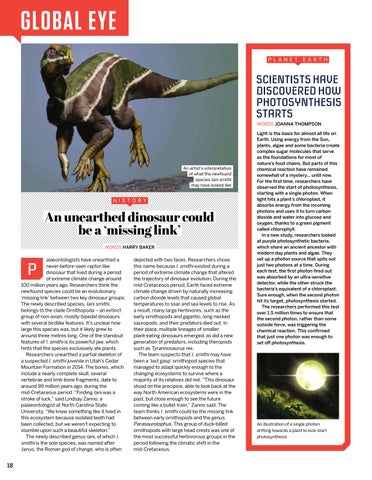
ar tist s interpretation

PWORDS HARRY BAKER
alaeontologists have unear thed a never-before-seen raptor-like dinosaur that lived during a period of extreme climate change around 100 million years ago Researchers think the new found species could be an evolutionar y ‘missing link’ between two key dinosaur groups The newly described species, Iani smithi, belongs to the clade Ornithopoda – an extinct group of non-avian, mostly bipedal dinosaurs with several birdlike features It’s unclear how large this species was, but it likely grew to around three metres long. One of the standout features of I smithi is its power ful jaw, which hints that the species exclusively ate plants
Researchers unear thed a par tial skeleton of a suspected I smithi juvenile in Utah’s Cedar Mountain Formation in 2014 The bones, which include a nearly complete skull, several ver tebrae and limb bone fragments, date to around 99 million years ago, during the mid-Cretaceous period “Finding Iani was a stroke of luck,” said Lindsay Zanno, a palaeontologist at Nor th Carolina State University “We knew something like it lived in this ecosystem because isolated teeth had been collected, but we weren’t expecting to stumble upon such a beautiful skeleton ”
The newly described genus Iani, of which I smithi is the sole species, was named af ter Janus, the Roman god of change, who is of ten
depicted with two faces Researchers chose this name because I smithi existed during a period of extreme climate change that altered the trajector y of dinosaur evolution During the mid-Cretaceous period, Ear th faced extreme climate change driven by naturally increasing carbon dioxide levels that caused global temperatures to soar and sea levels to rise As a result, many large herbivores, such as the early ornithopods and gigantic, long-necked sauropods, and their predators died out In their place, multiple lineages of smaller plant-eating dinosaurs emerged, as did a new generation of predators, including theropods such as Tyrannosaurus rex
The team suspects that I smithi may have been a ‘last gasp ’ ornithopod species that managed to adapt quickly enough to the changing ecosystems to sur vive where a majority of its relatives did not “This dinosaur stood on the precipice, able to look back at the way Nor th American ecosystems were in the past, but close enough to see the future coming like a bullet train,” Zanno said The team thinks I smithi could be the missing link between early ornithopods and the genus Parasaurolophus This group of duck-billed ornithopods with large head crests was one of the most successful herbivorous groups in the period following the climatic shif t in the mid-Cretaceous