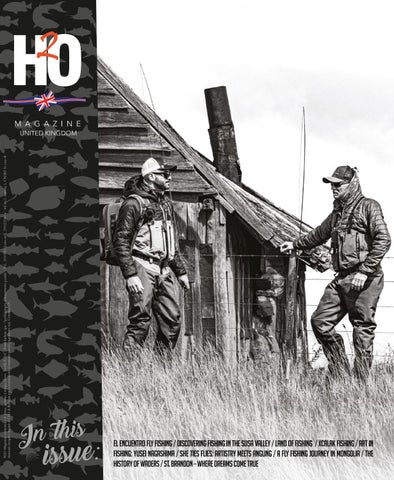
H2O Magazine-trimestrale di pesca, turismo e tempo libero. Tariffa R.O.C.: Poste Italiane spa - Spedizione in abbonamento postale - D.L. 353/2003 (conv.in L. 27/02/2004 n° 46) art.1, comma 1, CN/BO In caso di mancato recapito inviare al CPO di Bologna per la restituzione al mittente previo pagamento resi. Contiene I.P..
EL ENCUENTRO FLY FISHING / DISCOVERING FISHING IN THE SUSA VALLEY / LAND OF FISHING / XCALAK FISHING / ART IN FISHING: YUSEI NAGASHIMA / SHE TIES FLIES: ARTISTRY MEETS ANGLING / A FLY FISHING JOURNEY IN MONGOLIA / THE HISTORY OF WADERS / ST. BRANDON – WHERE DREAMS COME TRUE
H2O year III • number 1 • SPRING 2026 Director Responsable Sara Ballotta Director Editorial GIORGIO CAVATORTI Editorial board Giorgio Cavatorti Via Verdi, 30 42027 Montecchio Emilia (RE) COVER PHOTO: ALBERTO ZANGHIERI collaborators on this issue: Guido Sesani , Javier Peña, Barry Langley, Bob Mole, YUSEI NAGASHIMA, Erin Hyde, Alex Burnett, RASMUS OVESEN, Anders Ovesen, Ricardo De Stabile, Alberto Zanghieri Art Director AND GRAPHICS: OMAR GADE, VALENTINA SCARABELLI, ANGLINGCONSULTING.ONE Press: Tipografia Bona Digital Print, Torino Editorial Photographer: Alessandro Seletti, ALBERTO ZANGHIERI Social Media Manager: Fulvio Oliva Translators: Rossella Catellani, Elisabetta Longhi Authorization of the Court of Bologna No. 8157 of 01/02/2011 Poste Italiane S.p.A. – Subscription Postal Delivery – 70% – ROC authorization No. 20825 of 10/03/2011 – DCB Bologna Single copy: €14.00 - Back issue: €14.00 Copyright © 2008. All rights reserved. Reproduction, even in part, is prohibited without prior authorization from the Editorial Office. Unsolicited photographs and manuscripts will not be returned. For any information regarding the trips featured in the magazine, please contact the Editorial Office: INFO@h2oflyfishing.com info@cavatortigiorgio.it
Editor note
Giorgio
T
his Winter issue marks the UK edition of our magazine, created specifically for British readers and inspired by the endless appeal of fishing travel. Inside, you’ll find a carefully curated selection of destinations that capture the true spirit of international angling – from the remote rivers of Mongolia to the pristine flats of Saint Brandon’s Atoll, with Mexico in between. While you’re turning these pages, our team is already looking ahead. The 2026 season is fast approaching and the calendar is starting to fill up. Over the coming months we’ll be attending a number of shows and events, meeting anglers, sharing ideas and talking about future projects and trips. Below you’ll find our show calendar. Do come and see us at the shows: it’s the best place to pick up our international destination catalogues and the new Best Lodge 2026. Very often, lodge owners and guides will be with us too, offering a great chance to talk directly with the people who might be hosting your next fishing adventure. 2026 Show Calendar • 31 January – 1 February – Fly Fishing Show, Charleroi, Belgium • 7–8 February – BFFI Fly Show, England • 7–8 February – Occitane Fly Show, France • 13–15 February – Rimini Show, Italy • 13–15 March – Fly Fishing Show, Sweden • 18–19 April – EWF Fly Show, Germany • 20–21 June – SIM Festival, Italy Enjoy the read.
let's keep in touch: www.h2oflyfishing.com info@h2oflyfishing.com • info@cavatortigiorgio.it
5
8
20
30
42
54
60
66
82
76
Contents
8
EL ENCUENTRO FLY FISHING
20
DISCOVERING FISHING IN THE SUSA VALLEY
30
Land of fishing LEGENDS
42
Xcalak Fishing
54
ART IN FISHING: YUSEI NAGASHIMA
60
SHE TIES FLIES: ARTISTRY MEETS ANGLING
66
A FLY FISHING JOURNEY IN MONGOLIA
76
THE HISTORY OF WADERS
82
ST. BRANDON – WHERE DREAMS COME TRUE
Venture into an Alpine valley where crystal-clear rivers, wild trout, and breathtaking...
If you're a passionate angler or simply someone who appreciates the art of fly...
Fly fishing is more than just a sport-it’s an art, a craft, and for some, a way of life...
One of the greatest innovations in fly fishing has been the advent of waders...
It has been difficult to condense into fewer lines the sensations and impressions...
It was the mid-eighties. I was dating this blue-eyed beauty who accompanied me on...
Is a contemporary Japanese watercolor artist who has mastered the delicate art of...
Dreaming of witnessing some of the most remote and pristine rivers on the planet...
Imagine yourself at the edge of the world, where the ocean is painted in shades of...
El Encuentro FLY FISHING
8
Guido Sesani
ALBERTO ZANGHIERI
9
I
t has been difficult to condense into fewer lines the sensations and impressions that I have taken home after spending 12 days in Argentina last March. I will try anyway, starting
10
from the airport of Esquel, province of Chubut, “el corazon de la Patagonia,” as it is described in the advertisement of the Argentine tourist board. The team, made up of 10 friendly
fishermen of various ages and origins, all Italian except one English, was welcomed by the guides and their assistants (you read that right, guides and assistants!) and taken to the Valle del Carrileufu Lodge
"... el corazon de la Patagonia..." ."
11
12
in the surroundings of Cholila, the first stop on the trip. The second will be in the Trevelin area where El Encuentro Lodge is located and the third at the Brook Trout Base Camp, located about 50 kilometers south of Corcovado. There were three different lodges all extremely comfortable, welcoming, and well equipped. The photos will describe them better than many words. As this article is published on H2o, I will immediately talk about the waters where we fished. All three lodges are located on the banks of three beautiful rivers with crystal clear water, namely the Rio Carrileufu, the Rio Futaleufu and the Rio Corcovado, all fed by lakes and populated by rainbow trout, brown trout and char. The first two are quite similar: they are wide,
quite deep in some places, with a mixed bottom of gravel and sand and flow in fairly wide valleys along the Andes Mountain range that forms the border between Argentina and Chile. On the other hand, the Rio Corcovado, which originates from Lake Vinter and whose western part borders Chile, flows in a flat territory used for pasture, at least in the initial part. It is fenced for kilometers and kilometers, a characteristic that has distinguished every watercourse in which we fished, whether it was a river or a lake, and could only be accessed by opening and closing the fences whose padlocks were available to the guides. The bizarre thing is that all the waters in Argentina are public, but often, to access them, you have to make an agreement with the owners of the various lands that border them. Access is usually paid for, subject to the mood
of the gaucho who takes care of its maintenance and the breeding of the livestock. But let's get back to the waters and the fish that populate them. Nine days are dedicated to fishing and every day, in rotation, you can fish in the river or in waterways that resemble springs that flow through the pastures and in lakes which, in addition to the two species mentioned, often host char of a size that we can only dream of, at least in Europe. Every day, I was saying that you have the opportunity to catch fish in terms of species and size in different situations, dry-footed or from the boat. In my opinion, variety is the winning trump card of the Encuentro Flyfishing offer. From the large river to the lake, to the canal in the middle of the pastures, five-kilo brown trout or rainbow trout jump out. Giorgio defined as “science fiction” the two hours spent on the Rio
13
Tecka after having caught three or four brown trout as long as an arm (see photo). There are essentially three techniques for catching fish: streamer, nymph with dropper and dry fly. The last is less profitable than the first two techniques, at least in this period of the year (end of the southern summer), even if I did get some satisfaction by landing two rainbow
14
trout between 65 and 70 cm using a sort of brush fly mounted on a 2/0 hook. As for the record, the day before in the Futaleufu the trout that came to the surface were eating on 20” small flies!!!! So don't leave home the boxes of cul-de-canard or small flies - nymphs included that we use in our area, as they can always come in handy. As for equipment, it must be said that
the guides are always available to indicate the right fly for the moment, the leader to use, and the best technique. With the exception of the very small flies mentioned, I could even say that you can get to Patagonia bringing along rods for # 5/6 tails, floats, sinking tips and Teeny and related reels, leaving flies, leaders and spools of tippet material at home. The guides take care
of it, except when you are on a boat. They always travel in pairs so that all fishermen are personally assisted, and they are all equipped with a radio transmitter. In strict alphabetical order, Alberto, Angelo, Fulvio, Giuseppe, Giorgio, Marco, Michele, Stefano, Tim and myself, have all had the opportunity to be photographed with beautiful fish caught with the techniques just described, even with bamboo rods!! And what about the wind? We are in Patagonia and like the choiche (small ostriches), the condors and the cara-cara, the wind is part of the environment. Therefore, WF tails and a bit of double traction do not do any harm. The transfers from the lodges to the various fishing sites are made in comfortable pick-ups used to transport fishing equipment, boats, tables where you eat and the relative chairs that are also used to put on and take off waders and boots comfortably seated, without having to do the usual acrobatics. Everything is done to make the day as comfortable and pleasant as possible for us fishermen, with a thousand attentions that contribute to further appreciating the service offered. I left the comments relating to the logistics and accommodations in the three lodges visited for last. As I was saying, the daily transfers are done on board of comfortable pick-ups and distances to reach the waterways can vary from a few minutes to a maximum of just under two hours between lodges. The service staff are always very friendly and helpful, food is excellent and varied, not to mention the wine, red in particular, which is offered without any limitation both during the aperitif and at dinner, as well as all the drinks. The rooms where you sleep are also very comfortable, including the Brook Trout Base Camp, which is a bit more spartan than the other two; in short, I can't find anything, absolutely anything negative. It probably happens to all fishermen. Since I've returned home, almost every night I dream of Central Patagonia fish: with a dry fly, of course!
15
DISCOVERING
Fishing in the
SUSA VALLEY
18
Javier Peña
19
Venture into an Alpine valley where crystal-clear rivers, wild trout, and breathtaking landscapes turn ever fishing day into an unforgettable experience
20
T
he Susa Valley, in the Piedmont region of northwest Italy, is one of the great natural gateways to the Alps. Stretching about 80 kilometers, it connects the city of Turin with the French border. The Dora Riparia River runs through the entire valley, fed by alpine streams that flow down from the mountains through forests of oaks, chestnuts,
ash, and maples, all watched over by peaks exceeding 3,000 meters, inspiring both awe and admiration. Although mountain tourism and winter sports are the valley’s most well-known attractions, it also offers another, lesser-known gem: fishing. Here, the scenery is breathtaking,
the fish completely wild, and fishing pressure remarkably low, making the Susa Valley an ideal destination for those seeking peace, nature, and authentic catches. Following the invitation of our friend Luigi Mautino from Spacefishingaventures, we entrusted ourselves to his guidance and spent
21
22
a few days exploring some of the valley’s most representative rivers and lakes. The experience was unforgettable—not only for the warmth of the locals and the excellent cuisine, but, of course, for the fishing. In just a few days, we went from small mountain
streams—straight out of a fairy tale, hidden in almost inaccessible gorges—to larger, more technical rivers that tested both our physical endurance and mental skills due to strong currents and the challenge of fooling the valley’s fierce trout.
The valley is a dynamic and versatile destination, suitable for any fly fisher, regardless of style or preference. From dry fly enthusiasts to those who like to alternate techniques in diverse settings, everyone can find challenges as demanding as they are rewarding.
23
In our case, we began in the beautiful Argentera Valley, fishing trout and char in crystal-clear turquoise waters. Dry fly fishing stole the show, producing visual and exciting catches, but delicate ones: any noise or sudden movement sent the fish rushing upstream, spooking the rest of the school. On the second day, Luigi took us to target trout in a lovely lake near Bardonecchia. Here, we fished in a style similar to stalking barbel in reservoirs: moving slowly along the shore, observing good-sized trout feeding near the surface. Although it was not the peak season—the trout had eaten well over the summer—they were persuaded to take our small winged ants with long casts and fine tippets. To top it off, we followed the small stream feeding the lake, fishing among waterfalls and wild trout in one of the most spectacular spots we had ever seen. Another highlight was the wild Torrente Ripa, a river with strong currents, deep pools, and fish that were difficult to tempt.
24
Here, euro-nymphing was the technique of choice, perfect for trout hugging the riverbed or hiding under rocks. It was demanding fishing—physically and mentally—but immensely satisfying: the purity of the fish and the untamed environment make it an unforgettable challenge. Indeed, on this river, we managed, with persistence and patience, to land the largest and most beautiful trout of our trip, on our last day, accompanied by Andrea, a young local guide with a promising future who, along with Luigi, showed us the valley’s most authentic corners. In short, the Susa Valley is much more than a mountain destination: it is a paradise for anglers, where each day brings a new challenge and every river hides a different adventure.
Here, fishing, nature, and Italian hospitality combine to offer an experience that is truly unforgettable.
25
Land of fishing legends
28
Barry Langley
29
t was the mid-eighties. I was dating this blue-eyed beauty who accompanied me on a nine-hour drive from our suburban homes in New
I
Jersey to the western edge of Maine’s North Woods. Turning off the macadam and onto dirt and gravel, we caught glimpses of a lake, mist swirling over
its surface. I navigated around exposed rock, over rusted culverts, and through potholes deep enough to hold a school of largemouth bass while bumping and
grinding up thirteen miles of logging road that led to Bosebuck Mountain Camps. On that first visit to western Maine, we hiked into bogs and around
deadfalls, canoed across tannin-stained ponds, and swung streamers through rapids that broke over boulders as large as a moose’s shoulder. I’d been looking for
some good fishing, but found a whole lot more. So much so that we returned the following year. By then, I’d married the woman who to this day would rather
30
31
wear blue jeans than dresses and prefers hiking boots to heels. We were hooked as good and true as her first landlocked salmon, a fish that leaped across the pool below Keenan Dam not once but four times. Some might think it was
the brook trout that captured our imagination, those big-kyped phantoms willing to teach you the value of checking your tippet before casting into a dark pool, or perhaps one of those little six-inch bully boys that streak across the surface
"...See that mountain over there? Well, it was jest a hill when I began guidin’..."
32
of a forest stream like a star fallen from the sky. Others would say it was the terrain as wild as the fish swimming in its rivers and the moose lumbering through the shadowy coves of its lakes and ponds. Like so many others before us,
all of that is true. But there is something more about this land back of beyond. I could tell you about Metallak, a member of the Abenaki tribe reputed to have lived for 120 years and who came to be known by the settlers he’d helped
as the Lone Indian of the Magalloway. Then there’s the story of how Johnny Danforth and Fred Barker, two young men, spent the winter of 1882/83 hunting and trapping the region above Parmachenee Lake. You might wish to
learn about Ed “Ned” Grant. Known as the Sage of Beaver Pond Camps, he once told a sport, “See that mountain over there? Well, it was jest a hill when I began guidin’.” Then again, you might ask about those three Belles of the North
33
Woods—Cornelia Crosby, Carrie Stevens, and Louise Dickinson Rich. And what about the accomplishments of fly-fishing’s Renaissance man, Herbert Welch? And those of Carrie’s husband, Wallace, and Colonel Joseph Bates, or perhaps any one of the many other UpperDam notables. Maybe you’d rather hear about the Barrett brothers and Herbert Ellis, and how they built their Rangeley boats. You’d certainly get a chuckle at Shang Wheeler’s tale about White Nose Pete or the brook trout known as
34
Salmo Polaris lined with fur rather than scales. You might also be interested in the men who guided those “from away” during the “golden years” such as Walter “Skeet” Davenport, Harland Kidder, and Kenneth Crocker. But although the Rangeley Lakes Region of western Maine deserves to be called The Land of Fishing Legends, it’s the folks my wife and I met along the way—the guides, wardens, lodge owners, store keepers, and sports—all those men and women living today that make
this part of Northern New England The Land of Living Legends. I can assure you that Tom Rideout, the owner and operator of Bosebuck Mountain Camps when we first visited, knew the Parmachenee Lake Region as well as Johnny Danforth, as does Mike Yates, the lodge’s present owner. I mustn’t forget outfitter and Registered Maine Guide, Bob Duport, whose wanderlust matches that of Fred Barker. And you just know that Maine’s first registered guide, Cornelia “FlyRod” Crosby, would be
35
36
proud of Bonnie Holden, the first woman to win Maine’s Legendary Guide Award. Former executive director of Rangeley’s Outdoor Heritage Museum Bill Pierce and retired warden Charlie Atkins can tell tales as tall as any spun by Shang Wheeler or Ned Grant. And although Carrie Stevens is gone, Selene Dumaine carries on her tradition of tying exquisite streamers. Herb Ellis may no longer build Rangeley Boats, but you can talk to John Blunt about the fleet of Rangeleys he maintains at Grant’s Camps, the sporting lodge located on Kennebago Lake he and his wife, Carolyn, have owned and operated for more than forty years. I imagine Walter “Skeet” Davenport might be smiling down from the Great Beyond upon his friend’s grandson, Steve Kidder, who as a young guide is carrying on his grandfather’s tradition. George Fletcher’s Sport Shop is in Brett and Susan Damm’s capable hands. And although the music hall at Upper Dam is long gone, Moose Alley continues to rock and roll along Route 16. Sadly, Herbert Welch’s shop, once located at Haines Landing, has been closed for many years. But Gerry and Sally White continue to outfit sports from River’s Edge, their store just up the road, and I can assure you, Fern Bosse’s Sneeka is a streamer pattern every bit as effective as Herb’s Black Ghost. Yes, there’s much to be said about the Rangeley Lakes Region. But as this new year unwinds, I’d like to simply thank all those folks Trish and I have had the pleasure to meet on our backwoods adventures.
37
38
Bob Mole
Xcalak Fishing 40
41
I
f you're a passionate angler or simply someone who appreciates the art of fly fishing, Xcalak, Mexico, is a destination you should absolutely consider. Located at the southernmost tip of the Costa Maya, this pristine area offers an unmatched fishing experience
42
that combines breathtaking natural beauty with world-class angling opportunities. This hidden gem is a must-visit for any fly fishing enthusiast. Located along a truly unique stretch of the southern Caribbean coast of Mexico, Xcalak boasts some of the most pristine waters
in the world and an extraordinary variety of fish species. It offers unique opportunities both for beginners who want to approach this style of fishing and for seasoned anglers in search of particular tropical species. Xcalak is also one of the few places where you can attempt the famous
"... you can attempt the famous "grand slam"..."
43
44
"grand slam": you might have the chance to catch a Permit, a Tarpon, and a Bonefish in a single day. But to have a successful fly fishing trip, there are a few things you need to prepare before boarding the plane. Keep reading to find out what to check off your list to enjoy an unforgettable fly fishing experience in Xcalak. The Region: Xcalak At the southernmost point of the Yucatán Peninsula, just a few kilometers north of Belize, Xcalak is still an untouched paradise. Compared to the more touristy areas to the north, development here is minimal. The
beaches remain wild, and the water is a brilliant turquoise. Off the coast lies the Mesoamerican Barrier Reef, the second-largest coral reef in the world. This reef protects the area from waves and rough seas, creating a perfect refuge for the fish and wildlife that inhabit the flats. The town’s position on a peninsula that separates the Caribbean Sea from the Bay of Chetumal makes it an ideal base camp. From here, you can fish the saltwater flats, the edge of the bay, and the mangrove lagoons—three dream environments for any fly angler. Fishing the flats of Xcalak is a dream come true, but arriving prepared is essential. Bringing the
right rods, reels, and fly lines is only half the battle. Practicing your casting before the trip is crucial—you could miss the fish of a lifetime due to poor technique. It’s recommended to practice casts between 40 and 70 feet (12 to 21 meters) with minimal false casts. Additionally, having the right flies can make or break the success of your trip. Target Species 1. Bonefish – Known for their speed and agility, they are among the most beloved fish for fly anglers. The flats of Xcalak are ideal
45
bonefish habitat and offer many opportunities to test your skills. 2. Permit – Considered one of the most challenging fish to catch on the fly, permit are abundant in the waters around Xcalak. It’s said that Permit is “the fish of a thousand casts”: if
46
you see one, it’s already a great day. If you catch one, it’s a true milestone. 3. Tarpon – Whether you’re chasing juvenile tarpon in the mangroves or the larger specimens in deeper waters, Xcalak offers some of the best tarpon fishing in the region. Their acrobatics
and powerful runs provide an unforgettable thrill. 4. Snook – Aggressive predators found in mangroves and estuarine areas. Known for their strong fighting ability, they are a rewarding catch for any angler.
47
Xcalak Paradise Fishing Lodge This is the perfect accommodation in this marine paradise. The lodge offers top-level fly fishing for Permit, Bonefish, and Tarpon. With space for up to 8 guests, you’ll enjoy personalized service, all-inclusive comfort, a swimming pool, and expert guides. It’s an experience that blends adventure and relaxation in one unforgettable destination. For those who want to take a break from fishing or explore other experiences, the lodge also offers alternative activities to discover the wonders of Xcalak and its surroundings—from nature tours to total relaxation, there's something for everyone.
48
50
ART IN FISHING:
YUSEI NAGASHIMA
51
Y
usei Nagashima is a contemporary Japanese watercolor artist who has mastered the delicate art of capturing the essence of aquatic life. With a singular focus on fish, his works transcend mere representation, delving into the depths of nature’s elegance and
52
mystery. Nagashima's paintings are more than just portraits of marine creatures; they are windows into an underwater world where each brushstroke reveals a story of fluidity, movement, and life. Growing up near the coast, Nagashima developed a deep connection
with the sea from an early age. This bond is vividly reflected in his art, where he meticulously studies the shapes, colors, and behaviors of different species, bringing them to life on paper. His unique style combines traditional Japanese watercolor techniques with a modern
sensibility, creating works that are both timeless and contemporary. Nagashima’s fish are not merely subjects; they are muses that inspire him to explore the relationship between nature and human emotion. Through his art, he invites viewers to experience the tranquility and
53
beauty of the aquatic world, while also contemplating the fragile balance that sustains it. His work has been exhibited in galleries across Japan and internationally, garnering attention for its serene yet powerful imagery.
54
55
58
SHE TIES FLIES: Artistry Meets
Angling
59
F
ly fishing is more than just a sport—it’s an art, a craft, and for some, a way of life. Few embody this fusion of artistry and angling as uniquely as Erin Hyde and Alex Burnett, the creative forces behind She Ties Flies. With Erin's deep-rooted passion for fiber arts and newfound love for fly tying, and Alex's experience in professional videography and editing, they have captivated audiences with their mesmerizing ASMR-style fly-tying videos. But their journey into fly fishing is anything but conventional. A Lifelong Love of Fiber & Fishing Erin has spent over a decade immersed in
60
the world of fiber arts—knitting, weaving, sewing, spinning, and felting—developing an appreciation for natural materials, especially wool. But long before she ever held a tying vise, she was an enthusiastic (if not always successful) angler. Fishing with her grandfather until dusk on ancient spinner rods and reels, Erin learned to love the rhythm and ritual of being on the water. That passion continued into adulthood, though it wasn’t until meeting her partner, Alex Burnett, that her interest in fly fishing truly took off. Alex, an experienced angler and videographer, introduced Erin to the world of saltwater fly fishing in Tampa Bay. While she took to the
water with a spinning rod, the intricacies of fly fishing remained elusive—until one moment changed everything. Discovering the Art of Fly Tying The pivotal moment came when Alex handed Erin a c-clamp vise and a bag of fly-tying materials. The realization struck immediately: fly tying is fiber art. With that, she was hooked— both literally and figuratively. What started as a casual curiosity quickly became an obsession, and before long, Erin was on a mission to gather materials and refine her craft. One of her early influences came unexpectedly through a retired fly fishing guide she met
on Facebook Marketplace. In search of used fly-tying materials, Erin connected with a former instructor who had spent 30 years guiding and had even developed a fly sold in the Orvis catalog. He generously sent her a box of supplies—complete with extra materials not included in the original deal. To show her appreciation, Erin set out to tie his signature fly, an act that unknowingly set the foundation for She Ties Flies. The Birth of She Ties Flies With Alex’s background in videography and editing, they decided to capture Erin’s tying process on film. What started as a simple
gesture quickly evolved into a full-fledged creative project. The natural rhythms of tying, the delicate sounds of the materials, and Erin’s meticulous technique created a mesmerizing experience—one that resonated deeply with viewers. Combining fly tying with ASMR-style videography turned out to be a match made in heaven, drawing in an audience that appreciated both the craftsmanship and the soothing nature of the content. Today, She Ties Flies has cultivated a dedicated following, with thousands tuning in to watch Erin craft everything from saltwater streamers to intricate crab patterns. The overwhelmingly positive response has been both humbling and
inspiring, reaffirming her belief that fly tying is not just a fishing necessity—it’s an art form in its own right. Materials, Mentors & Creative Process When it comes to fly ingredients, Erin gravitates toward natural fibers—particularly wool and feather selections that lend authenticity to her flies - but also enjoys trying new and often unorthodox materials. While she is largely selftaught, she draws particular inspiration from female fly-tying pioneers like Megan Boyd, whose dedication to the craft was legendary, and Carrie Stevens, whose innovative construction techniques revolutionized fly tying. Erin’s
61
62
approach is meticulous, ensuring each fly is both visually stunning and functionally effective. She Ties Flies is a true collaboration. Every video is a labor of love, requiring hours of tying, filming, and editing to achieve the high-quality production values that set their content apart. With Erin at the vise and Alex shaping the visual storytelling, the duo has created something truly unique in the fly fishing community.
What’s Next? Looking ahead, the pair has big plans for She Ties Flies. Erin recently picked up her first fly rod and is actively learning to cast—a new challenge that she’s embracing with the same enthusiasm she brought to fly tying. Future projects include expanding their video library, collaborating with brands, and possibly launching educational content to help more people discover the joys
of tying flies. Through it all, one thing remains clear: She Ties Flies is more than just a digital project—it’s a celebration of craftsmanship, creativity, and the endless possibilities that come when artistry meets angling. As Erin continues to refine her skills at the vise and on the water, one can only imagine what’s in store for this dynamic duo.
63
Sean H. & Omar G
MAURO BARBACCI
A Fly Fishing Journey in 66
RASMUS OVESEN
RASMUS OVESEN- Anders Ovesen
MONGOLIA 67
Dreaming of witnessing some of the most remote and pristine rivers on the planet, and experiencing fishing – frozen in time – for salmonids of epic proportions? Then Mongolia might just be your place. But you might have to hurry...
J
ust north lies the border with Russia. Further downstream, the river flows into Russian territory before splitting through desolate, mountainous plateaus. However, we won’t venture that far. We have about 100 kilometers of widely branching river to drift
68
over the next six days, and even if we continued another 100 kilometers downstream, we would still be in Mongolia; the world’s least densely populated country, squeezed geopolitically between the superpowers Russia and China. We are in the upper reaches of this remote,
picturesque river, born in the mountainous region where Genghis Khan – the great Mongol leader – is said to be buried. At the height of his power, in the 13th century, Genghis Khan controlled most of the Far East, ruling over a territory as large as the African continent –
about 30 million square kilometers. His empire was the largest in history, collapsing only after being divided among his four sons. Escape from Civilization It was a liberating relief when our group left the capital, Ulaanbaatar, crossing vast, endless
plains to reach the deep, serpentine, prehistoric bed of our destination river. Today, about 1.7 million people – nearly half of Mongolia’s population – live in Ulaanbaatar; a fastgrowing, bustling metropolis, modernized in places, that many Mongolians see as a beacon of
hope for a glorious future. But from a distance, Ulaanbaatar feels to me like just another dirty, cynical metropolis – alienating, dissonant, and close to collapsing under its own excessive weight. I have no doubts: Mongolia’s true greatness lies
69
in its extraordinary nature. And it’s precisely here that we find ourselves. Our river merges with other larger rivers further downstream, becoming the Amur – one of the ten longest rivers in the world, spanning over 4,500 km. As it twists and winds, it grows
70
in width and power; at its mouth in Siberia, across from Sakhalin Island, it stretches over 10 kilometers wide. Muddy Waters I imagine that much further downstream, the Amur is perpetually swollen and laden with
sediment. However, for months, I had dreamed of a crystal-clear river, as is often the case at this time of year in the starting area of the "Buryat Expeditions" organized by Mongolia River Outfitters. But now, that’s not the case! It has rained non-stop for weeks.
The river is swollen, the color of strong Sunday morning coffee, and the guides battle against fierce currents. Banks have eroded, trees uprooted, new branches and channels formed. In some sections, the river is unrecognizable. We cannot afford despair. Instead, we look
for small favorable windows: areas where the current, depth, and cover offer a chance for a catch. We’ll cast our flies close to the banks, under overhanging trees, eroded shores, and among submerged roots. Extreme Sport
It’s a high-stakes game! It’s like trying to sink a basketball shot from the back of a pickup truck driving on a bumpy road. One misplaced cast and you're hopelessly snagged. Rowing upstream to retrieve a stuck fly is nearly impossible; most times, you just
71
have to pull and hope something breaks free (with a LOUD snap!). At that point, you can only forget the hours spent tying that giant fly. Vivid Memories The last time I was here, I caught a taimen almost 125 cm long – a primitive, perfect fish I will never forget.
But what I remember just as intensely are other moments: Deep, ghostly stretches of river under sculpted rock walls; the crystalline white snow on the banks; the crackling of the fire in the yurt’s stove in the morning; the aroma of coffee promising immediate warmth; the deep conversations by flickering candlelight and the lively faces, like
those of two elderly Americans – well into their 80s – who fished harder than anyone during the day and laughed louder than everyone in the evening. I wonder if they are still alive, ten years later. I realize it’s not just about the fish. The places, the cultural experiences, and the people we share them with are just as important.
"... the aroma of coffee promising immediate warmth; the deep conversations by flickering candlelight and the lively faces..."
Great Company This time, my brother and I are joined by two Norwegian entrepreneurs: wonderful, fun guys who would probably fish more often if they weren’t so entangled in board meetings, investments, and strategic decisions. Evenings in the dining tent are filled with laughter and Mongolian folk and rock music played via
Spotify. Wine, beer, and Ghingis vodka are plentiful. Yet, even here, we can't escape emails, messages, and social media. Internet connection reaches even these remote corners – a clear sign that Mongolia is changing. A River in Flux During the week, the nighttime frosts intensify
the autumn colors. The larches and birches blaze gold under a deep blue sky, blueberry bushes blush red among still-green meadows. This landscape, more hypnotic than a Van Gogh painting, completely envelops us. The presence of ancient trout as big as a human being is just a bonus.
73
Fishing in Slow Currents My first fish of the trip is not a taimen but a big Amur trout, about 65 cm, caught in a side current. Admiring its magenta fins and olive-green flanks, I quickly release it. The river hosts many species: lenok trout, Amur pike, grayling, whitefish, catfish, asp, burbot, and of course taimen. We find taimen more easily in dead currents. Strikes are sporadic; we land fish between 60 and 90 cm, as the difficult conditions make it unlikely to catch giants over 1.5 meters. My biggest taimen comes three days later, in a small side channel among scattered rocks. The strike is fierce, and I immediately feel the fish’s weight. After a tough battle, I manage to bring it to the net. Fish to Remember When the fish slides into the net, it seems both big and small at the same time. A salmonid over a meter long is always impressive, but compared to the giants of past trips, it feels smaller. Peter Fong, our guide, is by my side again, just as he was ten years ago. We release the fish, and a wave of mixed emotions hits me. I wish everything could stay frozen in time, but I know that’s impossible. The forces of change are blowing even here. The river will remain one of the most remote and wildest on Earth, but it will no longer be immune to the changes affecting Mongolian society. The silence has been broken. When I make the final cast of the trip and start mentally preparing for the long journey back, it feels like slowly waking from a dream. It has been another magnificent, educational, and fun journey – full of magical moments, new friendships, and unforgettable memories. And with my senses still sharpened, I know I must return to this river – sooner rather than later.
74
75
76
Riccardo De Stabile
THE HISTORY OF WADERS
77
O
ne of the greatest innovations in fly fishing has been the advent of waders. These high waterproof boots allow anglers to stand waist-deep in cold water while staying dry—and even reasonably warm, if properly dressed. Without waders, a fisherman could still wade into a river, much like characters in Hemingway’s novels, but humans wouldn’t last more than an hour in the waters of most flyfishing rivers. Take a look at lithographs and illustrations of
78
fly fishing from any period before the mid-20th century, and you won’t see anglers standing in the water. They fished from the riverbank, sometimes perched on large overhanging rocks to cast farther. Before waders, there was a wide variety of similar accessories, mostly designed to keep a fisherman’s legs dry, at least in shallow waters. In England, the wealthier fishermen even had a precious additional resource: the gillie wetfoot—a servant who would carry the fisherman across the river on his shoulders.
Then Europeans discovered rubber, which had already been used for centuries by South Americans who extracted it from the Hevea tree that grew naturally in the rainforest. According to legend—likely true—Christopher Columbus introduced rubber to Europe after seeing the people of Haiti playing with rubber balls. However, rubber was not commercially used until 1823, when Scottish chemist Charles Macintosh used it to produce a waterproof fabric, which he employed—among other things— to make waist-high fishing pants held up by
suspenders. Then in 1839, Charles Goodyear discovered the process of vulcanization, which led to the industrial production of rubber. Rubber overshoes or boots—galoshes—began to be produced in the 1850s, their name derived from the Latin word for the footwear worn by the Gauls. The first chest-high waterproof garments— what we now call waders—appeared around 1850, manufactured by the Hodgman Rubber Company of New York. The idea of standing in rivers to fish didn’t catch on immediately. Sir Humphry Davy said it wasn’t healthy. Thomas Tod Stoddart, author of the 1847 volume The Angler’s Companion to the Rivers and Lochs of Scotland, complained that rubber boots didn’t hold up well in rivers. By the end of the 19th century, however, fishing magazines began writing about a new breed of fly fishermen who waded into rivers. In the 1930s, lighter and more durable waterproof materials appeared. In 1931, DuPont developed a synthetic rubber called Duprene, now known as neoprene—a material not only lighter and
79
stronger than rubber but also insulating against the cold. However, it wasn’t until 1970 that the first neoprene waders were manufactured: warmer, lighter, and tougher, they made it safer and more comfortable to fish in wide, cold rivers. At the start of the 21st century, 1.4 million pairs of waders were sold each year in the United States. Wading—fishing while standing in the water—has become a standard technique. One reason anglers wade is to gain better access to fish, but often what they enjoy most
80
is the experience itself: standing in the river, observing the ripples on its surface, feeling the current pulling downstream. When you’re standing in a river fishing, you feel like you’re participating in the life of the river itself. For a moment, you become a creature of the river. Haig-Brown wrote: “Wading makes you a part of the current more than anything else.” Joan Wulff wrote of wading: “It makes me feel more connected to the creatures living in the river, to the fish I’m trying to catch.”
ST. BRANDON WHERE DREAMS COME TRUE
82
Alberto Zanghieri
83
I
magine yourself at the edge of the world, where the ocean is painted in shades of blue and green, and the air is filled with the thrill of adventure. In this remote corner of the Indian Ocean lies a hidden paradise called Saint Brandon, a place where fly fishing becomes a dance between man and nature. Saint Brandon is a group of atolls located 268 nautical miles north of Mauritius. This 10-night trip, with 7
full days of fishing, is designed for enthusiasts seeking an unparalleled experience of fishing in close contact with unspoiled nature. But first, let’s talk about the journey and logistics, which are certainly not for everyone. The trip begins in Bologna with a direct flight to Dubai. After about six hours of flying, you’ll land in the capital of the Emirates. Here, you’ll have a short layover before catching your connecting
"...a place where fly fishing becomes a dance between man and nature..."
84
flight to Mauritius. Once you arrive at Sir Seewoosagur Ramgoolam International Airport, a taxi will take you to the capital, Port Louis, where you'll have an entire day to rest and spend the night at the excellent Le Suffren Hotel, located in the main port's marina area. The next morning, a transfer will take you to the port, where the most demanding part of the journey begins: a sea crossing of over 30
hours. Let's not sugarcoat it — your patience and endurance will be put to the test. The boat is sturdy but by no means a yacht; the onboard comfort is basic at best. You'll need unwavering determination — and a few seasickness tablets if you’re not used to rough seas. I recommend preparing a good playlist or podcast for the crossing, packing an extra power bank, a bag of snacks, and a waterproof
jacket. Finally, after a long night, a makeshift breakfast and lunch, Saint Brandon’s atoll will appear on the horizon, and you’ll immediately realize this is no ordinary place. Upon landing at Raphael Island, tenders brought us ashore. We were shown our accommodations, met the team, and held a safety meeting, during which the guides checked all our gear. The first night
was spent in a temporary structure because the main lodge was still occupied by the previous group of anglers. Raphael Island looks like a classic pirate island: it has a chapel, a cemetery, it is filled with seabirds, and the ground is made up of crushed coral. The atmosphere is thick with history and epic tales. For the next seven days, wakeup calls would come early, and after a hit-or-
85
miss breakfast, we'd set out full of energy for our fishing day. More than 80 km of untouched atolls are reserved for just 8 anglers per week, with threemonth intervals between groups. This carefully managed fishing pressure makes the atoll truly unique. Here, the crystal-clear waters hide living treasures: Bonefish, fast and explosive like the wind, challenge anglers with their incredible speed. But they are not alone. IndoPacific Permit, elegant and powerful creatures, stand as guardians of the vast coral flats, ready to challenge anyone daring enough to cast a crab fly before them. And then there are the GTs, along with the Bluefin Trevallies (which reach impressive sizes here), prowling the waters with the majesty of true "neighborhood bad boys," always ready to start a fight. With their impressive size and explosive strength, every catch becomes an epic battle, a story to tell for generations. You’ll also encounter various reef species like groupers, emperor fish, and many others that will give you moments of pure action! The fishing here is exceptional. It's not unusual to land a trophy Bonefish over 9 pounds — even 12 pounds! You'll have clean shots at tailing Permit almost every day, and there’s always the chance to complete the slam with a big GT or Bluefin. Of course, easier said than done, but having the chance to chase these trophies in such a setting is simply incredible. Tough conditions caused by a warm tide entering the atoll made it difficult to get any clean shots at GTs for almost the entire group, except for Giles, a great English angler specialized in catching these giants. The Bluefin, however, were more cooperative, with some trophy-sized specimens successfully landed — truly a spectacle! Almost all of us had chances with the Permit, but the "yellow devil" remained undefeated: 9 encounters, 9 losses, only adding to its legendary status. But it’s not just the fishing — strictly wading, with occasional "relaxing" boat sessions along the reef — that makes St. Brandon magical. It's the guides, the true guardians of this paradise, who turn the trip into an unforgettable story. With their deep knowledge of the waters and the passion burning in their eyes, they lead you on a journey of discovery, chasing the dream of the catch of a lifetime. Thanks to their help, professionalism, and
86
87
"...Welcome to Saint Brandon, where dreams come true....."
88
experience, every fish caught becomes a dream come true — a moment to frame and treasure forever. There are always laughs and good times, especially in the evenings, when everyone gathers for dinner to share stories of the day's catches and adventures. Being able to laugh about mistakes or funny moments strengthens the bond between anglers and guides. Sometimes a hearty laugh is the best remedy. The evenings also offer a great opportunity to listen, learn, and exchange experiences. It's impossible to forget David's stories about Permit — beautiful and inspiring. Conclusion and Personal Reflection: A trip to Saint Brandon is a unique experience for lovers of wading fly fishing, in an environment that feels almost unreal. It’s an adventure recommended for those who prioritize the quality of the fishing experience over comfort — which I still found acceptable, though improvable. The uniqueness of the place, the beauty of untouched nature, and the expertise of the guides make this trip unforgettable, despite the high costs and the long boat crossing. If you’re an angler looking for an extraordinary adventure, Saint Brandon might just be the perfect destination for you. Even if the boat ride seems long, remember: every mile brings you closer to a life-changing experience. Because in Saint Brandon, you're not just fishing. You're living a dream. So get ready to dive into a world where every wave tells a story, and every catch is a chapter in an endless adventure. Welcome to Saint Brandon, where dreams come true.
89