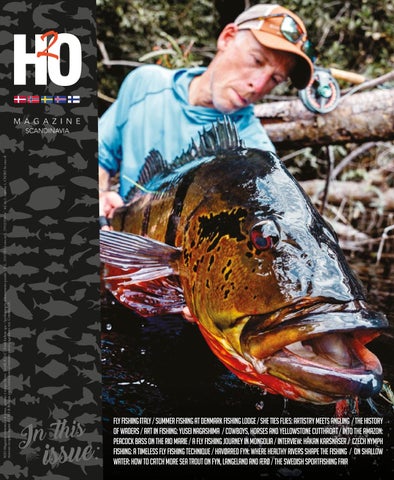
H2O Magazine-trimestrale di pesca, turismo e tempo libero. Tariffa R.O.C.: Poste Italiane spa - Spedizione in abbonamento postale - D.L. 353/2003 (conv.in L. 27/02/2004 n° 46) art.1, comma 1, CN/BO In caso di mancato recapito inviare al CPO di Bologna per la restituzione al mittente previo pagamento resi. Contiene I.P..
SCANDINAVIA
FLY FISHING ITALY / Summer fishing at Denmark Fishing Lodge / SHE TIES FLIES: ARTISTRY MEETS ANGLING / THE HISTORY OF WADERS / ART IN FISHING: YUSEI NAGASHIMA / COWBOYS, HORSES and Yellowstone Cutthroat / INTO THE AMAZON: Peacock Bass on the Rio Marie / A FLY FISHING JOURNEY IN MONGOLIA / Interview: HÅKAN KARSNÄSER / CZECH NYMPH FISHING: A TIMELESS FLY FISHING TECHNIQUE / HAVØRRED FYN: Where Healthy Rivers Shape the Fishing / On Shallow Water: How to Catch More Sea Trout on Fyn, Langeland and Ærø / THE SWEDISH SPORTFISHING FAIR
H2O year I • n° 1 • winter-SPRING 2026 Director Responsable Sara Ballotta Director Editorial GIORGIO CAVATORTI Editorial board Giorgio Cavatorti Via Verdi, 30 42027 Montecchio Emilia (RE) COVER PHOTO: rafael marques collaborators on this issue: OMAR GADE, JAN NACHTIGAL, Morten Valeur, ERIN HYDE, ALEX BURNETT, RICARDO DE STABILE, YUSEI NAGASHIMA, JESS MCGLOTHLIN, RASMUS OVESEN, ANDERS OVESEN, HÅKAN KARSNÄSER, CHRISTIAN THOMSEN, CLAUS ERIKSEN, AGNETA BRUNELL, ALBERTO ZANGHIERI Art Director AND GRAPHICS: OMAR GADE, VALENTINA SCARABELLI, ANGLINGCONSULTING.ONE Press: Tipografia Bona Digital Print Torino - ITALY Editorial Photographer: Alessandro Seletti, ALBERTO ZANGHIERI Social Media Manager: Fulvio Oliva Translators: Rossella Catellani, Elisabetta Longhi Authorization of the Court of Bologna No. 8157 of 01/02/2011 Poste Italiane S.p.A. – Subscription Postal Delivery – 70% – ROC authorization No. 20825 of 10/03/2011 – DCB Bologna Copyright © 2008. All rights reserved. Reproduction, even in part, is prohibited without prior authorization from the Editorial Office. Unsolicited photographs and manuscripts will not be returned. For any information regarding the trips featured in the magazine, please contact: INFO@DENMARKFISHINGLODGE.COM
Editor note
D
Omar
ear readers, as we step into 2026, we are proud to present the first-ever Scandinavian edition of H2O magazine opening a new chapter in our ongoing search for stories, territories, and voices in the world of fly fishing. Published twice a year, this semiannual edition is conceived as a thoughtful and enduring publication, an adaptation of the magazine shaped for a Scandinavian and Northern European audience, while remaining open to stories and voices from the wider world of fly fishing. Founded in Italy in 2008, H2O Magazine has grown into an international platform, with editions in Italy, France, the UK, the USA, and Spain, each addressing its own fly-fishing community while sharing the same values: attentive storytelling, refined aesthetics, and respect for places and people. H2O is a unique printed publication, with it's headquarter in Italy, distributed free of charge at major fly-fishing shows in Europe and the USA, as well as through tourist offices, hotels, specialist shops, clubs, and fishing lodges worldwide, designed to be read slowly, collected, and revisited. May this first Scandinavian issue inspire your next adventure, spark curiosity, and deepen your passion for the art of fly fishing. Tight lines!
Giorgio
I
n this first issue of H2O Scandinavia, we take you from the coasts of Denmark to the breathtaking landscapes of Mongolia and Montana. Through reports, interviews, and travel stories, you will discover authentic tips and the most effective techniques to craft artificial flies perfectly suited to these waters. Each article is designed to inspire and guide you, connecting places, people, and the traditions of fly fishing, turning every outing into a unique journey. I invite you to browse these pages with curiosity and passion, ready to be amazed by the wonders that the world of fly fishing has to offer. Within these pages, you will discover journeys to some of the world’s most evocative waters, encounters with influential voices in fly fishing, and reflections on the craftsmanship and passion that transform this sport into a lifelong pursuit. Throughout the season, we will be present at numerous international events, where you can meet us in person, explore our destination catalogues, discover the new Best Lodge 2026, and meet lodge owners and guides in person. Welcome aboard this new adventure! Giorgio Cavatorti Editorial Director, H2O Magazine
Omar Gade H2O Scandinavia Liaison
We are just getting started. The first issue will be available at the Swedish Sportfishing Fair h2o magazine stand, in tourist offices, and in some of the best fishing tackle shops across Scandinavia, as well as at the Denmark Fishing Outdoor Lodge. The second issue, “Summer–Autumn,” will be published in the summer of 2026. let's keep in touch: www.h2oflyfishing.com info@denmarkfishinglodge.com
5
8
16
24
30
34
38
46
52
58
62
68
74
80
SCANDINAVIA
Contents 8
FLY FISHING ITALY
Italy is home to some of Europe’s most prized trout species, including both...
16
Summer fishing at Denmark Fishing lodge
24
SHE TIES FLIES: ARTISTRY MEETS ANGLING
30
THE HISTORY OF WADERS
34
ART THE FISHING: YUSEI NAGASHIMA
38
COWBOYS, HORSES AND YELLOWSTONE CUTTHROAT
46
INTO THE AMAZON: PEACOCK BASS ON THE RIO MARIE
52
A FLY FISHING JOURNEY IN MONGOLIA
58
Interview WITH HÅKAN KARSNÄSER
62
CZECH NYMPH FISHING: A TIMELESS TECHNIQUE
68
HAVØRRED FYN: Where Healthy Rivers Shape the Fishing
74
On Shallow Water:
80
THE SWEDISH SPORTFISHING FAIR
As part of my daily work at the Lodge during the fishing season, I often find myselfy...
One of the greatest innovations in fly fishing has been the advent of waders...
Cameron Mayo patiently rigs the panniers on an ornerylooking...
Dreaming of witnessing some of the most remote and pristine rivers on the planet...
Czech nymph fishing has become a staple in fly fishing. The technique originated in....
How to catch more Sea Trout on Fyn, Langeland and Ærø...
Fly fishing is more than just a sport-it’s an art, a craft, and for some, a way of life...
Is a contemporary Japanese watercolor artist who has mastered the delicate art of...
In November 2025, my journey led me deep into the Brazilian...
Hi Håkan, tell us a little about yourself and what led you to start tying flies...
On Fyn, sea trout are not treated as a passing opportunity, but as a longterm...
Are you curious about fishing or already a passionate angler? The Sportfishing Fair is...
8
OMAR GADE
FLY FISHING Italy
9
Italy is home to some of Europe’s most prized trout species, including both native and introduced varieties that live in its pristine rivers and lakes. The country’s diverse geography, ranging from the rugged Alps to the Mediterranean coasts, creates the perfect environment for trout.
A
mong Italy’s most special native species is the “trota marmorata” (marble trout, Salmo marmoratus), found in the northern regions of the Alps. As a lifelong angler who has grown up in Italy and spent countless hours fishing here, and as someone who has long promoted Italy as a great fishing destination, I can confidently say that the northern regions, particularly Piedmont, Trentino and Alto Adige, are today among the most interesting destinations for trout fishing
10
in the country. From the crystal-clear rivers and lakes of the Alps to the rugged beauty of the Piedmontese valleys, these areas offer some of the most thrilling and picturesque fishing experiences. The marble trout, in particular, is a highlight of these regions, and it is a species that anglers always dream of catching… but do not dream too much, as the marble trout is not an easy fish to catch, and there are not millions of them. In Italy, trout populations are a mix of native
species and stocked fish, much like in most parts of Europe today. These populations are supported by dedicated angling associations that work tirelessly to maintain the health of the rivers, often battling against policies that show little regard for aquatic environments or against absurd regulations crafted by Italian and European policymakers disconnected from nature. Generally, in higher and more torrential small waters, you can often find wild, autochthonous
Italian brown trout. These fish, while generally smaller in size, are adorned with stunningly beautiful markings that make them a true delight to encounter. Smaller fish are generally more aggressive and inexperienced. The marble trout, on the other hand, tends to feed deeper and is not constantly active, making it much more difficult to encounter. In Italy, fishing is often a technical and challenging experience, and catches may not always be numerous, but every fish landed is truly rewarding. The most successful technique is often nymph fishing, which can be very technical in order to convince fish that are sometimes extremely selective, especially in the best-known and most frequently visited stretches. What makes Italy such a special destination is not only the fishing itself, but also the stunning landscapes, rich culture, and of
course the cuisine and good wine that enhance every moment spent off the water. In Piedmont, the rivers are renowned for their natural beauty and healthy trout populations. In recent years, I have had the pleasure of accompanying and supporting several anglers and enthusiasts from all over the world, introducing them to this beautiful area and helping them by connecting them with local people and guides. Every time I am there, I am reminded of how special this part of Italy is for fishing and how beautiful the nature is. The Mastallone River, for example, with its clear, cool waters and rugged surroundings, offers an authentic and challenging fishing experience. It is home to a population of marble trout which can grow to impressive sizes. The Sesia River, with its flowing waters and breathtaking scenery, is another prime location for anglers
and is also very technical. These rivers offer both private stretches that are inaccessible to the public and day-permit zones open to everyone with different regulations. Other trout species here include brown and rainbow trout, which are naturally far more abundant than marble trout. It is also worth mentioning that, due to their natural conformation, the rivers of this area tend to clear quickly after rainfall. What makes fishing in this part of Piedmont so special is its rustic and unspoiled charm. Unlike some of the more touristy areas, this region remains largely untouched, with rivers flowing through deep valleys and dense forests. This raw natural beauty adds to the sense of adventure when fishing here, and it is a feeling that stays with you long after you have packed up your gear. The experience is further enriched by the region’s cultural heritage and fine cuisine. After
11
a long day on the river, you can enjoy some of Italy’s finest wines and local dishes, such as the famous Alba truffle. For a deeper dive into the history of fly fishing in this region, when I invite or accompany someone to this area, I always suggest a visit to the Italian Fly Fishing Museum in the town of Varallo. The museum is not open daily, but Andrea, the president of the museum, is a kind and passionate person and has always been available to welcome me when I call him to arrange a visit. This year, I had guests visiting Europe from the USA fly fishing industry, and twice I arranged a visit to the museum. They were amazed by Andrea’s passion and the overall experience. This small and unique museum, located in the heart of
12
the Sesia Valley, showcases everything from antique gear to historic fly patterns. It offers a fascinating glimpse into the rich tradition of the Valsesiana fly fishing technique, which is similar to the Tenkara style. It is a perfect stop for those who want to understand the evolution of fly fishing and how local anglers have refined their craft over generations. Italy is truly a land of craftsmanship and culture. Trentino, including Alto Adige, offers a much greater number of waters, with more than 300 km of rivers. Thanks to its economic prosperity, the region is able to maintain pristine natural beauty and excellent facilities. In the last decade, local institutions have done a remarkable job in developing fly fishing tourism. There is sometimes more fishing pressure today, so
13
it is important to know exactly where to go. While this area may feel more tourist-oriented than Piedmont, it is certainly not lacking in charm. The waters here are equally stunning, and the marble trout (the biggest marble trout I have personally seen in my life was from this area), along with other species like brown trout, rainbow trout and grayling, thrive in the region’s crystal-clear rivers. The larger valley rivers of Trentino are more prone to becoming murky after rainfall, and they can take longer to clear. This region is ideal for those who enjoy a combination of fishing and a well-rounded tourist experience. After a day on the water, you can enjoy excellent Italian cuisine, from hearty mountain dishes such as Canederli, Speck, Carne Salada and Polenta, to exceptional local wines. Many hotels offer great spas and wellness facilities, and Lake Garda and its attractions are also located in the region. While Piedmont and Trentino have become the two most popular regions for trout fishing in Italy, there are other regions with trout as well. Almost all regions of Italy have some trout waters. Even in the warm and far south, there are mountain creeks with cold waters and trout. Most of these areas are not particularly interesting for fishing, but it is fascinating to see how many environments trout can inhabit.
14
Sardinia, for example, is home to its own unique strain of native trout, Salmo macrostigma, which can be found in the island's small inland creeks. At the time of writing, my Sardinian friend and biologist Francesco Curreli is conducting a two-year study for a university in Sardinia to assess how many of these fish are left in the region. By mentioning Sardinia, I am not promoting trout fishing there, and in fact it is something I do not recommend. These are small trout, not abundant in numbers, but still interesting from both a biological and cultural perspective. Tuscany, Marche and Emilia Romagna also offer fishing opportunities, with rivers that are often less crowded than the more famous destinations. In these areas, it is highly advisable to rely on local knowledge and local support when arranging a fishing day. What makes Italy such a remarkable destination for trout anglers is not just the fishing itself, but the chance to immerse yourself in the country’s rich culture, stunning landscapes and worldrenowned food. Whether you are targeting marble trout in the wild rivers of Piedmont or casting in the waters of Trentino, Italy offers an experience that combines the thrill of fishing with the beauty of the landscape and the pleasures of Italian cuisine and culture. In general, the trout season in Italy begins in spring and ends in autumn, and most trout
rivers are closed during the winter. Although fishing in some parts of Italy can be done independently, it is always recommended to hire a local guide who knows the waters and the required techniques. In Italy, having local contacts is also invaluable, since they can recommend authentic places to visit and eat, instead of tourist traps. Using guides and local organizations is also a fundamental contribution to the local economy, and Italians are always happy to share not only their knowledge during the guided session but also great stories and, not rarely, a good glass of wine after fishing. Often, permits are not easy to obtain and are not always available digitally, so a local guide can help. In recent years, I personally have been involved in the development of the first truly professional organization in Italy dedicated to promoting and developing fly fishing in the country, connecting anglers with trusted local guides and accommodations. To be in good hands to combine a great fishing trip and make your wife happy at the same time I highly recommend visiting and take contact to: www.italianflyfishingtours.com info@italianflyfishingtours.com
Summer fishing at Denmark Fishing Lodge
16
Jan Nachtigal, OMAR GADE
Morten Valeur
17
s part of my daily work at the Lodge during the fishing season, I often find myself driving through our beautiful Danish
A
countryside: roads winding between green fields, hedgerows, and centuriesold cottages. Even after so many years here on the southwestern coast of Fyn,
the landscape still fascinates me. This is the place where I spend many summers guiding guests from all over Europe and the rest of the world to experience the
magic of sea trout fishing. And contrary to what many might think, summer is far from a quiet season; it is, in fact, one of the most exciting and among the lodge
staff’s favorite parts of the year. Yes, beaches...we talk about dry fly fishing in the sea during daytime, something that others might have tried here and there
sometimes, but that we, as Denmark Fishing Lodge staff, have proudly been the ones that developed it over many years.
18
19
Conditions can shift dramatically within a single day. One morning may begin at +15 degrees with a brisk west wind and short choppy waves, the kind of water where sea trout turn aggressive and strike boldly at big, flashy flies. In these moments we often use 6 weight rods, long leaders, and bigger foam fly patterns designed to be seen and provoke
a reaction on the surface. When the water is stirred up, the fish are active, and the takes can be sudden and violent. But then, almost without warning, the wind can drop, the sea can flatten, the temperature rises up to +25 and everything changes. The same flies that worked so well are now ignored. This is when we switch tactics: lighter 5 weight
rods, very long leaders, and small natural imitations. I remember a day last summer when we left behind the crashing waves and moved south to a high cliff. From up there, we could see shoals of trout circling just below the surface of the glassy water. One of my colleagues pointed them out from above as I cast from below. The first cast was too short,
"... summer is far from a quiet season..."
20
but on the second a fish broke away from the group and rose quietly to a tiny beetle imitation on a size 14 hook. A delicate sip, a sudden burst of energy, and the reel screamed as the trout bolted. After a brief fight I released the silver fish back into its element, carrying with me the thrill of that perfect summer moment. This is what makes summer so special: it forces
you to adapt, to read the water, to change your approach constantly. We are privileged, as this is our daily work for several months every year. We have learned to understand behaviors that are not possible to grasp during just a few days of holiday. The sea trout adjust to the conditions, and we must do the same if we want to succeed. And that is also why having a
base like the Lodge makes such a difference. It is not just a place to stay or to eat, it is where, for many years, information has been shared and updated every day among the staff and the guests, which is priceless. Which flies worked this morning, which stretch of coast is alive, where the wind has turned the water just enough... all of this flows naturally among staff
21
and guests. Without that support, it might take weeks or seasons of trial and error to discover what here you can learn in a single evening conversation or a guiding session. After a long day, coming back to the Lodge is part of the rhythm. Sitting on the wooden terrace overlooking the sea with a cold beer as the sun sets, or gathering in the common room where fishing photos line the walls, you feel the day settle in. Dinner is another surprise: Italian dishes prepared by our international staff, flavors that seem almost improbable in a small
22
Danish fishing lodge but have become part of our tradition. Stories are exchanged across the table, sometimes accompanied by a glass of Nocino, and friendships are forged as easily as knots on a leader. Working here means living this balance every day: a sea that constantly changes, fish that demand patience and creativity, and people who come from far away to share the experience. Summer on Fyn is never monotonous. And we are not talking about night fishing, we do not do that.
One moment you are casting heavy streamers into rolling waves, the next you are presenting a tiny dry fly to a cautious trout sipping at the surface. What remains is not just the fish landed, but the lessons learned, the memories made, and the certainty that here, along Denmark’s shores, the sea trout will never cease to surprise you. Get in touch, if you want to experience something special: the summer hunt for sea trout, with us: www.denmarkfishinglodge.com
CAPITAL OF SEA TROUT "Pssst…
Isn’t it about time you headed out yourself, instead of just reading about other people’s catches? You’ve seen the photos. You know the stories. And you know this: Sea trout don’t catch themselves. So — pack the car, call your fishing buddy, book the accommodation — and finally start the trip you’ve been talking about for far too long. Fyn and the islands are waiting for you, with more than 1,100 km of varied coastline, everything you could ever imagine — and sea trout fishing at the absolute top level!"
www.en.seatrout.dk
24
SHE TIES FLIES: Artistry Meets
Angling
25
F
ly fishing is more than just a sport—it’s an art, a craft, and for some, a way of life. Few embody this fusion of artistry and angling as uniquely as Erin Hyde and Alex Burnett, the creative forces behind She Ties Flies. With Erin's deep-rooted passion for fiber arts and newfound love for fly tying, and Alex's experience in professional videography and editing, they have captivated audiences with their mesmerizing ASMR-style fly-tying videos. But their journey into fly fishing is anything but conventional. A Lifelong Love of Fiber & Fishing Erin has spent over a decade immersed in
26
the world of fiber arts—knitting, weaving, sewing, spinning, and felting—developing an appreciation for natural materials, especially wool. But long before she ever held a tying vise, she was an enthusiastic (if not always successful) angler. Fishing with her grandfather until dusk on ancient spinner rods and reels, Erin learned to love the rhythm and ritual of being on the water. That passion continued into adulthood, though it wasn’t until meeting her partner, Alex Burnett, that her interest in fly fishing truly took off. Alex, an experienced angler and videographer, introduced Erin to the world of saltwater fly fishing in Tampa Bay. While she took to the
water with a spinning rod, the intricacies of fly fishing remained elusive—until one moment changed everything. Discovering the Art of Fly Tying The pivotal moment came when Alex handed Erin a c-clamp vise and a bag of fly-tying materials. The realization struck immediately: fly tying is fiber art. With that, she was hooked— both literally and figuratively. What started as a casual curiosity quickly became an obsession, and before long, Erin was on a mission to gather materials and refine her craft. One of her early influences came unexpectedly through a retired fly fishing guide she met
on Facebook Marketplace. In search of used fly-tying materials, Erin connected with a former instructor who had spent 30 years guiding and had even developed a fly sold in the Orvis catalog. He generously sent her a box of supplies—complete with extra materials not included in the original deal. To show her appreciation, Erin set out to tie his signature fly, an act that unknowingly set the foundation for She Ties Flies. The Birth of She Ties Flies With Alex’s background in videography and editing, they decided to capture Erin’s tying process on film. What started as a simple
gesture quickly evolved into a full-fledged creative project. The natural rhythms of tying, the delicate sounds of the materials, and Erin’s meticulous technique created a mesmerizing experience—one that resonated deeply with viewers. Combining fly tying with ASMR-style videography turned out to be a match made in heaven, drawing in an audience that appreciated both the craftsmanship and the soothing nature of the content. Today, She Ties Flies has cultivated a dedicated following, with thousands tuning in to watch Erin craft everything from saltwater streamers to intricate crab patterns. The overwhelmingly positive response has been both humbling and
inspiring, reaffirming her belief that fly tying is not just a fishing necessity—it’s an art form in its own right. Materials, Mentors & Creative Process When it comes to fly ingredients, Erin gravitates toward natural fibers—particularly wool and feather selections that lend authenticity to her flies - but also enjoys trying new and often unorthodox materials. While she is largely selftaught, she draws particular inspiration from female fly-tying pioneers like Megan Boyd, whose dedication to the craft was legendary, and Carrie Stevens, whose innovative construction techniques revolutionized fly tying. Erin’s
27
28
approach is meticulous, ensuring each fly is both visually stunning and functionally effective. She Ties Flies is a true collaboration. Every video is a labor of love, requiring hours of tying, filming, and editing to achieve the high-quality production values that set their content apart. With Erin at the vise and Alex shaping the visual storytelling, the duo has created something truly unique in the fly fishing community.
What’s Next? Looking ahead, the pair has big plans for She Ties Flies. Erin recently picked up her first fly rod and is actively learning to cast—a new challenge that she’s embracing with the same enthusiasm she brought to fly tying. Future projects include expanding their video library, collaborating with brands, and possibly launching educational content to help more people discover the joys
of tying flies. Through it all, one thing remains clear: She Ties Flies is more than just a digital project—it’s a celebration of craftsmanship, creativity, and the endless possibilities that come when artistry meets angling. As Erin continues to refine her skills at the vise and on the water, one can only imagine what’s in store for this dynamic duo.
29
Riccardo De Stabile
THE HISTORY OF WADERS
31
O
ne of the greatest innovations in fly fishing has been the advent of waders. These high waterproof boots allow anglers to stand waist-deep in cold water while staying dry—and even reasonably warm, if properly dressed. Without waders, a fisherman could still wade into a river, much like characters in Hemingway’s novels, but humans wouldn’t last more than an hour in the waters of most flyfishing rivers. Take a look at lithographs and illustrations of
32
fly fishing from any period before the mid-20th century, and you won’t see anglers standing in the water. They fished from the riverbank, sometimes perched on large overhanging rocks to cast farther. Before waders, there was a wide variety of similar accessories, mostly designed to keep a fisherman’s legs dry, at least in shallow waters. In England, the wealthier fishermen even had a precious additional resource: the gillie wetfoot—a servant who would carry the fisherman across the river on his shoulders.
Then Europeans discovered rubber, which had already been used for centuries by South Americans who extracted it from the Hevea tree that grew naturally in the rainforest. According to legend—likely true—Christopher Columbus introduced rubber to Europe after seeing the people of Haiti playing with rubber balls. However, rubber was not commercially used until 1823, when Scottish chemist Charles Macintosh used it to produce a waterproof fabric, which he employed—among other things— to make waist-high fishing pants held up by
suspenders. Then in 1839, Charles Goodyear discovered the process of vulcanization, which led to the industrial production of rubber. Rubber overshoes or boots—galoshes—began to be produced in the 1850s, their name derived from the Latin word for the footwear worn by the Gauls. The first chest-high waterproof garments— what we now call waders—appeared around 1850, manufactured by the Hodgman Rubber Company of New York. The idea of standing in rivers to fish didn’t catch on immediately. Sir Humphry Davy said it wasn’t healthy. Thomas Tod Stoddart, author of the 1847 volume The Angler’s Companion to the Rivers and Lochs of Scotland, complained that rubber boots didn’t hold up well in rivers. By the end of the 19th century, however, fishing magazines began writing about a new breed of fly fishermen who waded into rivers. In the 1930s, lighter and more durable waterproof materials appeared. In 1931, DuPont developed a synthetic rubber called Duprene, now known as neoprene—a material not only lighter and stronger than rubber but also insulating against the cold. However, it wasn’t until 1970 that the first neoprene waders were manufactured: warmer, lighter, and tougher, they made it safer and more comfortable to fish in wide, cold rivers. At the start of the 21st century, 1.4 million pairs of waders were sold each year in the United States. Wading—fishing while standing in the water—has become a standard technique. One reason anglers wade is to gain better access to fish, but often what they enjoy most is the experience itself: standing in the river, observing the ripples on its surface, feeling the current pulling downstream. When you’re standing in a river fishing, you feel like you’re participating in the life of the river itself. For a moment, you become a creature of the river. Haig-Brown wrote: “Wading makes you a part of the current more than anything else.” Joan Wulff wrote of wading: “It makes me feel more connected to the creatures living in the river, to the fish I’m trying to catch.”
33
34
ART IN FISHING:
YUSEI NAGASHIMA
35
Y
usei Nagashima is a contemporary Japanese watercolor artist who has mastered the delicate art of capturing the essence of aquatic life. With a singular focus on fish, his works transcend mere representation, delving into the depths of nature’s elegance and mystery. Nagashima's paintings are more than just portraits of marine creatures; they are windows into an underwater world where each brushstroke reveals a story of fluidity, movement, and life. Growing up near the coast, Nagashima developed a deep connection with the sea from an early age. This bond is vividly reflected in his art, where he meticulously studies the shapes, colors, and behaviors of different species, bringing them to life on paper. His unique style combines traditional Japanese watercolor techniques with a modern sensibility, creating works that are both timeless and contemporary. Nagashima’s fish are not merely subjects; they are muses that inspire him to explore the relationship between nature and human emotion. Through his art, he invites viewers to experience the tranquility and beauty of the aquatic world, while also contemplating the fragile balance that sustains it. His work has been exhibited in galleries across Japan and internationally, garnering attention for its serene yet powerful imagery.
36
37
COWBOYS, HORSES and Yellowstone Cutthroat
38
Jess McGlothlin
39
These are old mountains; home to history and myth, and it’s easy to let one’s imagination run wild while the gentle one-two sway of a long-striding horse moves beneath.
C
ameron Mayo patiently rigs the panniers on an ornery-looking buckskin pack mule, dust kicking up around his feet under the heat of a summer day. It’s nearing noon and the sun is high, temperatures pushing into the high 80s, and the air is heavy with the signature scent of horses, dust, and sweat. It’s the scent of a Montana summer. For Cameron, this is a normal day at work. When he’s not leading groups of anglers of
40
hunters into the backcountry of southern Montana, he’s working the family ranch near Big Timber, Montana. Big Timber isn’t much; the county seat of Sweet Grass County boasts less than 2,000 residents, most of whom are in the ranching or agricultural industries. It’s the quintessential Western town; the main drag is a combination of bars, cafes, feed stores, and gas stations, designed to offer everything needed for life on a working ranch—and not much more. During the warm summer months, Cameron
and his wife Lonny spend many of their days in the high country of the Absaroka-Beartooth Wilderness, one of the wildest swaths of land remaining in Montana. Just to the south of the wilderness lies Yellowstone National Park in all its summer-tourism glory, but in in the backcountry where Cameron and Lonny make their second home, it’s easy to imagine the “bison jams” and tourist buses crowding the roads in the park don’t even exist. Just north of the remote reaches of America’s first national park, the vast Absaroka-Beartooth
Wilderness is a land where lush green plateaus give way to craggy granite spires; where bears still roam freely and it’s easy to imagine oneself a century in the past. Among the mountains dotting the wilderness is Montana’s tallest peak, Granite Peak, reaching nearly 13,000 feet into the famed Montana Big Sky. Rivers trickle, animals range freely and native Yellowstone cutthroat trout thrive in the rivers. It’s paradise, seemingly untouched save for the small outpost of Bull Moose Camp, where Lonny and Cameron base their summertime operations.
Scenes like this, however, don’t come easily. The day-long ride into Bull Moose Camp is not for the faint-hearted; riders canvas miles of Big Sky Country, climbing sharply uphill to cross over the Great Divide at Hellroaring Divide before dropping into bowl-like valleys that make it easy to imagine glaciers occupying thousands of years ago. These are old mountains; home to history and myth, and it’s easy to let one’s imagination run wild while the gentle one-two sway of a long-striding horse moves beneath. Descend further and the scene takes on the qualities of a Zane Grey
novel; broad, sweeping meadows nestle in the valleys, lined by trees burned 31 years ago in the great Yellowstone fires of 1988. The land has recovered remarkably, but the burned trees remain, sentinels serving as a reminder of the harshness of this landscape. A congregation of wall tents becomes visible in the midst of a stand of tall pines. This is Bull Moose camp, situated strategically at the confluence of the three forks of Hellroaring Creek—the same Hellroaring that meanders into Yellowstone National Park a mere eight
41
miles south and eventually feeds into the mighty Yellowstone River. There are no moose in Bull Moose camp. They were chased out by wolves and have been absent four years. There are, however, plenty of fish in the nearby creek, which is of more interest to those riding into the camp during the dusty summer months. A fishing session in the creek can easily turn into an impromptu bath after the long ride, and soon life succumbs to the rhythm of the camp. Eat, hike, ride, fish, sleep, talk by the fire… things are simple here. Things are good. The camp is ruled by Pat, the steadfast camp cook. Charged with providing three hearty meals a day for both guests and wranglers, Pat leverages ingenuity developed in many years of travel into ensuring life runs as smoothly as possible at Bull Moose. Her nonsense tolerance is low, and I make a point to spend a bit of time with Pat my first morning in camp. In the early mornings, the sun not yet peeking over the mountains and the air frosty, Pat rules Bull Moose. The camp cook is 70 but looks 15 years younger, with the gravelly voice of a lifelong smoker. The temp hovers near 30F, but she's making cowboy coffee and prepping breakfast in a battered tank top, seemingly
42
impervious to the cold. We hunker in front of the fire, coffee in hand, watching the sun finally climb over the horizon and begin to warm the tents. Talk moves meanderingly as we both feel each other out. She’s the eldest of 12; I’m the eldest of two. We both are ambitious (perhaps overly-so) world travelers and share an appreciation for the remote corners of the world. Things are gloriously companionable and quiet; then camp begins to wake up. After all, the sun is rising, eggs are ready to be cooked and the heavy smell of cowboy coffee and woodsmoke hangs in the air. It’s a new day, and in the backcountry there’s no shortage of ways to fill it. I grab the camera and join Patrick and Jacob, two of the wranglers, as they bring the horses in. The simple morning activity is a glorious cacophony of whinnying horses, spraying dew, golden morning sunlight, and dusty air. There are more than twenty horses and mules in camp with us; allowed to range in the nearby meadow at night and brought into camp each morning for the day’s work. It’s a good living for any equine, as the shimmering coats and healthy physiques of these mounts prove. Today, the horses’ job is simple: ferry a handful of anglers a few miles south along Hellroaring Creek, then
bring us safely back to camp. Most anglers are used to accessing waterways via the traditional modes of transportation: some form of vehicle or occasionally one’s own feet. As I load my reel and fly boxes into the saddlebags and tie my rod tube onto the saddle, I realize this is likely the first time I’ve relied on a horse to get me to the river. The bigboned bay gelding doesn’t seem to really care much about what I’m putting on his back, ears flicking back patiently to listen when I mount, hooves trailing steadily along the rough terrain surrounding Hellroaring as we ride south. I eye the airspace to the south. Not far lie the northern reaches of Yellowstone, and as we ride through groves of trees burned in the 1988 fires, I think about what hell it must have been here when the world was on fire. Hell in heaven… it’s an odd juxtaposition, and hard to imagine the green hillsides and meadows chocked with fire, smoke, and ash. Fires roar—anyone who has been close to a running forest fire will tell you as much—and I realize just how fitting the place’s name is. Hellroaring, indeed. Eventually we stop next to a quiet, bubbling stretch of Hellroaring and I drop from the bay,
tying him before working to assemble my rod. He’s not too invested in the endeavor; instead more intent on the tall, lush grass directly in front of his face, and with a look around the meadow, I decide I couldn't blame him. The grassy meadow is only beginning to surrender to midsummer Montana heat, turning crunchy under our footsteps, and the branches of a large tree offer shade from what promises to be another unseasonably warm day. The trickling sound of nearby Hellroaring Creek draws my attention as I rig a Royal Wulff. It’s a classic dry fly; a “prospecting” pattern that typically produces well. Yellowstone cutthroat trout are native to these waters and, according to the National Park Service, “… are the most widespread native trout of the park and were the dominant fish species prior to Euro-American settlement… Genetically pure Yellowstone cutthroat trout populations have declined throughout their natural range in the Intermountain West, succumbing to competition with and predation by nonnative fish species, a loss of genetic integrity through hybridization, habitat degradation, predation, and angling harvest. State and federal wildlife agencies classify the Yellowstone cutthroat trout as a sensitive species.”
The fish themselves look like something out of a coloring book; prominent crimson slashes marked their lower jaws, lean light brown, silver, and even yellow-tinted bodies were dotted with an artist's splatter of dark spots, the concentration heavier toward the fish's posterior. There was no mistaking these trout with their Montana kin, and even a child could easily identify the differences between a Yellowstone cutthroat and a rainbow or brown trout. True locals of any sort are becoming a rare thing in Montana, and the reverence felt for native fish is a tangible thing. And while Yellowstone cutthroat currently range throughout parts of Montana, Wyoming, the upper Snake River drainage in Idaho and even into Utah and Nevada , the fish in the drainage are special… they are native here, a pure, unhybridized population. They face extremely low fishing pressure—very few anglers make it this far into the backcountry—and therefore they are keen to rise to any flies that look remotely interesting. The clean, cold water flowing through the Absaroka-Beartooth Wilderness is well-suited for the species, providing a steady diet of aquatic insects and, in the summer months, a plethora of terrestrials that fall into the water from the grassy banks.
The combination of small water and eager fish makes Hellroaring a stellar fishery for new anglers. It’s not technical; at one point I go eight fish for all eight casts (all fish under 12 inches, but who’s counting?) before deciding to give the little eddy a rest and move on to other water. Beginners will find great success with obvious, aggressive dry fly takes, while more advanced anglers can ply undercut banks for larger fish. It’s dry fly fishing at its finest. Light rods (I brought a 3-weight fiberglass rod and my old trusty five-weight), floating lines, and attractor dry flies are the program. Foamy terrestrials, Royal Wulffs and Stimulators were the obvious options, and worked so well there was no reason to change. A well-placed cast in “fishy” water will almost always raise a fish, and there’s no shortage of promising water to explore. If lingering saddle-soreness makes a ride out of camp sound a bit less romantic, the three forks of Hellroaring, which convene conveniently at the camp, offer plenty of easy-access fishing less than five minutes from the cook tent. They also present a delicious decision each morning: which way to go? What water to fish? Each stem of Hellroaring is home to the Yellowstone cutthroat, so there’s really no
43
wrong decision. Mountain lakes also dot the high-altitude countryside, offering a cold respite from the afternoon heat or a fresh fishing venue. Stripping a streamer through these lakes presented several opportunities at larger trout and, when coupled with an afternoon swim, makes for a delightful afternoon diversion. Whatever water is on the day’s menu, Cameron joins the adventure. In his ever-present, weather-worn cowboy hat and ancient Simms fishing vest, Cameron is a jovial, endearing friend in the mountains. He’s keen to share his favorite fishing spots and point out productive undercut banks, and isn’t shy about picking up a rod and joining in the fun. At one point he’s quick to give directions around the next few bends of the river before backtracking, jogging into the trees like a whirling dervish in a cowboy hat to retrieve the horses from where we’d left them and meet us further down the river. Several miles later, we round a bend and there he is, relaxing with the horses underneath a copse of pine, the mounts lined up like so many cars in a posh parking lot. It’s like an odd sort of backcountry valet service, and I’m admittedly happy to bypass the long afternoon hike back to our starting point. Back at camp, life is surprisingly luxe. Large wall tents with roomy cots provide comfortable housing against cold mountain nights, and Pat’s well-stocked kitchen is complete with a bear-proof snack cabinet that houses a healthy emergency supply of chocolate. An outdoor shower provides a bit of privacy for those who prefer not to rinse off in the river, and the tented pit toilet has a lovely view of a meadow. The real magic of camp, however, lies around the campfire. This is the soul of Bull Moose; where we gather around after a long day of adventuring to trade stories and tell tales. Whiskey and s’mores are traded liberally, and we sit in companionable conversation as the late afternoon light fades into dusk, then twilight and then, finally, the dark velvet of a Montana summer night. Sitting around the fire, comfortably ensconced on a dusty bed of dried pine needles, I look around at my companions. Most could have readily stepped from the screen of a John
44
Wayne movie. Cameron and Lonny sit comfortably in their camp chairs, Cameron in the midst of telling some grand ranching tale, hand gestures and all. Lonny looks remarkably at home, and it’s no wonder, really. Her family has been running sheep in these mountains for generations, and she has the stories to prove it. For her, this is as much home as anywhere. The wranglers are a wild bunch all their own; good guys who I would want by my side at any adventure. Seasoned ranch hand Patrick also runs a small-town bar (the Grizzly Bar in Roscoe, Montana) with his wife. Tall Jacob is a third-generation Montanan who competes in rodeo events when he’s not working the family ranch or in the backcountry. And young Jeremiah brings a quick whit and good tales from the annual Miles City Bucking Horse Sale. It’s a motley crew, but the conversation is real, flowing freely around the flickering fire. We laugh when a mouse jumps from the log behind me into my lap before scurrying off into the blackness surrounding us. Just another creature that calls this place home, and will continue to do so long after we make the long ride back to civilization. But for the moment, we grin and laugh in the darkness, eyes flashing and the bottle of whiskey catching the firelight as it’s passed around. For the moment, the rest of the world fades away and we’re newfound friends on an adventure; breathing clean air and watching the stars wheel overhead, tucked safely in the wilderness. And perhaps that’s the odd magic of it all… we’ve all gathered to chase fish, to stalk through a high mountain creek and ply clear waters for cutthroat. Once again, angling brought together an unexpected group of people and made an improbable clan of them. There are no moose in Bull Moose Camp. There are, however, plenty of cowboys, horses, mules, and a curious supply of rather good boxed wine.
INTO THE
AMAZON:
46
OMAR GADE
Peacock Bass on the
Rio Marie
47
The river requires commitment and confidence. When a peacock bass decides to strike, the moment is violent, visual, and pure adrenaline.
48
I
n November 2025, my journey led me deep into the Brazilian Amazon, to one of the most exclusive and pristine fly fishing destinations in the world: the Rio Marie. A remote tributary of the Rio Negro, the Marie is a river that still feels untouched, a place where nature dictates the rhythm and where peacock bass grow big, powerful, and truly wild. The adventure began well before the first cast. Flying over the Amazon rainforest is an unforgettable experience. From the air, the forest appears endless, an uninterrupted green ocean cut only by dark, winding rivers. As we descended toward the landing strip, the sense of isolation became tangible. Reaching the Rio Marie is part of the experience, and the remoteness immediately sets the tone for what lies ahead. The week spent at Untamed Angling’s Rio Marie Lodge exceeded expectations in every way. Considering the extreme location, the level of organization was great. Transfers, daily routines, meals, and fishing logistics were handled with precision and efficiency, allowing guests to focus entirely on the river. The floating lodge itself is comfortable and thoughtfully designed for anglers, providing a welcoming place to recharge after long, demanding days on the water. Fishing on the Rio Marie is not about numbers. Even though we caught fish every single day, the experience is defined by intensity, patience, and the quality of each encounter rather than sheer quantity. Some days yielded only a few fish, but every take was explosive and unforgettable. The river requires commitment and confidence. When a peacock bass decides to strike, the moment is violent, visual, and pure adrenaline. My personal highlight of the trip came with a true trophy: an 88 cm peacock bass weighing 23 lb, caught in its darker coloration. Known locally as an “Açu”, this coloration appears when the fish is aggressively defending its nest and fry. Hooking such a fish is chaos in its purest form, blistering runs, head shaking power, and total disorder at boatside. The peacock bass in its “paca” phase was another highlight of the trip. This is not a different species, but rather a behavioral phase and coloration of the same peacock bass, when the
49
fish is actively hunting and highly aggressive. On one unforgettable day, we encountered a group of paca in the 10 lb range feeding in a calm river bend. We jumped out of the boat and began wade fishing for them, and what followed was pure chaos. In just a few minutes, we landed four fish, with explosive strikes and nonstop action. Equally memorable was the fishing for butterfly peacock bass, a smaller
50
green subspecies with vivid orange eyes. While they lack the sheer size of the “Açu”, they compensate with extreme aggression. These fish attack flies with speed and violence often on poppers. On lighter tackle, they provided constant action and a welcome contrast during the week. What makes the Rio Marie truly special is its balance. The fish are wild and unpressured, the environment remains intact, and the experience feels authentic from start to finish. Combined with flawless logistics and a respectful operation run by Untamed Angling,
the Rio Marie offers something increasingly rare in modern fly fishing: a genuine Amazon adventure without compromise. For anglers seeking a once-in-a-lifetime experience in one of the last great wild fisheries on the planet, the Rio Marie remains unmatched. For further information, Denmark Fishing Lodge organizes hosted trips. Contact: info@denmarkfishinglodge.com Untamed Angling website: www.uangling.com
Sean H. & Omar G
MAURO BARBACCI
A Fly Fishing Journey in 52
RASMUS OVESEN
RASMUS OVESEN- Anders Ovesen
MONGOLIA 53
Dreaming of witnessing some of the most remote and pristine rivers on the planet, and experiencing fishing – frozen in time – for salmonids of epic proportions? Then Mongolia might just be your place. But you might have to hurry...
J
ust north lies the border with Russia. Further downstream, the river flows into Russian territory before splitting through desolate, mountainous plateaus. However, we won’t venture that far. We have about 100 kilometers of widely branching river to drift over the next six days, and even if we continued another 100 kilometers downstream, we would
54
still be in Mongolia; the world’s least densely populated country, squeezed geopolitically between the superpowers Russia and China. We are in the upper reaches of this remote, picturesque river, born in the mountainous region where Genghis Khan – the great Mongol leader – is said to be buried. At the height of his power, in the 13th century, Genghis Khan
controlled most of the Far East, ruling over a territory as large as the African continent – about 30 million square kilometers. His empire was the largest in history, collapsing only after being divided among his four sons. Escape from Civilization It was a liberating relief when our group left the capital, Ulaanbaatar, crossing vast, endless plains
to reach the deep, serpentine, prehistoric bed of our destination river. Today, about 1.7 million people – nearly half of Mongolia’s population – live in Ulaanbaatar; a fast-growing, bustling metropolis, modernized in places, that many Mongolians see as a beacon of hope for a glorious future. But from a distance, Ulaanbaatar feels to me like just another dirty, cynical metropolis
– alienating, dissonant, and close to collapsing under its own excessive weight. I have no doubts: Mongolia’s true greatness lies in its extraordinary nature. And it’s precisely here that we find ourselves. Our river merges with other larger rivers further downstream, becoming the Amur – one of the ten longest rivers in the world, spanning
over 4,500 km. As it twists and winds, it grows in width and power; at its mouth in Siberia, across from Sakhalin Island, it stretches over 10 kilometers wide. Muddy Waters I imagine that much further downstream, the Amur is perpetually swollen and laden with sediment. However, for months, I had dreamed
55
"... the aroma of coffee promising immediate warmth; the deep conversations by flickering candlelight and the lively faces..."
56
of a crystal-clear river, as is often the case at this time of year in the starting area of the "Buryat Expeditions" organized by Mongolia River Outfitters. But now, that’s not the case! It has rained non-stop for weeks. The river is swollen, the color of strong Sunday morning coffee, and the guides battle against fierce currents. Banks have eroded, trees uprooted, new branches and channels formed. In some sections, the river is unrecognizable. We cannot afford despair. Instead, we look for small favorable windows: areas where the current, depth, and cover offer a chance for a catch. We’ll cast our flies close to the banks, under overhanging trees, eroded shores, and among submerged roots. Extreme Sport It’s a high-stakes game! It’s like trying to sink a basketball shot from the back of a pickup truck driving on a bumpy road. One misplaced cast and you're hopelessly snagged. Rowing upstream to retrieve a stuck fly is nearly impossible; most times, you just have to pull and hope something breaks free (with a LOUD snap!). At that point, you can only forget the hours spent tying that giant fly. Vivid Memories The last time I was here, I caught a taimen almost 125 cm long – a primitive, perfect fish I will never forget. But what I remember just as intensely are other moments: Deep, ghostly stretches of river under sculpted rock walls; the crystalline white snow on the banks; the crackling of the fire in the yurt’s stove in the morning; the aroma of coffee promising immediate warmth; the deep conversations by flickering candlelight and the lively faces, like those of two elderly
Americans – well into their 80s – who fished harder than anyone during the day and laughed louder than everyone in the evening. I wonder if they are still alive, ten years later. I realize it’s not just about the fish. The places, the cultural experiences, and the people we share them with are just as important. Great Company This time, my brother and I are joined by two Norwegian entrepreneurs: wonderful, fun guys who would probably fish more often if they weren’t so entangled in board meetings, investments, and strategic decisions. Evenings in the dining tent are filled with laughter and Mongolian folk and rock music played via Spotify. Wine, beer, and Ghingis vodka are plentiful. Yet, even here, we can't escape emails, messages, and social media. Internet connection reaches even these remote corners – a clear sign that Mongolia is changing. A River in Flux During the week, the nighttime frosts intensify the autumn colors. The larches and birches blaze gold under a deep blue sky, blueberry bushes blush red among still-green meadows. This landscape, more hypnotic than a Van Gogh painting, completely envelops us. The presence of ancient trout as big as a human being is just a bonus. Fishing in Slow Currents My first fish of the trip is not a taimen but a big Amur trout, about 65 cm, caught in a side current. Admiring its magenta fins and olive-green flanks, I quickly release it. The river hosts many species: lenok trout, Amur pike, grayling, whitefish, catfish,
asp, burbot, and of course taimen. We find taimen more easily in dead currents. Strikes are sporadic; we land fish between 60 and 90 cm, as the difficult conditions make it unlikely to catch giants over 1.5 meters. My biggest taimen comes three days later, in a small side channel among scattered rocks. The strike is fierce, and I immediately feel the fish’s weight. After a tough battle, I manage to bring it to the net. Fish to Remember When the fish slides into the net, it seems both big and small at the same time. A salmonid over a meter long is always impressive, but compared to the giants of past trips, it feels smaller. Peter Fong, our guide, is by my side again, just as he was ten years ago. We release the fish, and a wave of mixed emotions hits me. I wish everything could stay frozen in time, but I know that’s impossible. The forces of change are blowing even here. The river will remain one of the most remote and wildest on Earth, but it will no longer be immune to the changes affecting Mongolian society. The silence has been broken. When I make the final cast of the trip and start mentally preparing for the long journey back, it feels like slowly waking from a dream. It has been another magnificent, educational, and fun journey – full of magical moments, new friendships, and unforgettable memories. And with my senses still sharpened, I know I must return to this river – sooner rather than later.
57
Interview
WITH HÅKAN
58
KARSNÄSER
59
Hi Håkan, tell us a little about yourself and what led you to start tying flies. I have been tying flies for almost 40 years. It all started when I found a small box of wet flies in the sports section of the supermarket where I grew up. I was immediately fascinated by their
shapes and colours. The flies were three Royal Coachmen, and from there I began reading everything I could about fly fishing and fly tying. I had never actually seen anyone cast a fly rod, but I later discovered that my best friend at school did a bit of fly fishing and that
his father was a passionate fly angler. He taught me how to cast and took me to an area where rainbow trout could be fished. He also gave me my very first lessons in tying flies—and from that moment on, I completely lost myself in fly tying.
Can you share some insights into your creative process when designing new fly patterns? Where do you find inspiration, and which flies are your favourites? I love tying all kinds of flies and I am always eager to learn about new patterns and materials. Even
if I never end up fishing some of the flies I tie, I find it incredibly stimulating to experiment with new materials and techniques. There is always something useful to be learned from every new thing you try. Inspiration can come from many different sources: for my fully dressed salmon
flies it might be a particular material or a special colour combination, while for my fishing flies it mostly comes from what I am looking for in a specific pattern. For example, I hate it when my dry flies start sinking too quickly. That is why I began using more deer hair, tying in a
60
more Southern European style, and eventually developed a whole series of very effective flies for my rainbow trout fishing. Fly fishing trips often involve encountering different fish species and environments. How do you adapt your fly patterns to different locations and fishing conditions? The more different types of fishing you try, and the longer you fly fish, the more your experience tells you which flies actually work. Of course, talking to local anglers and reading about fishing and fly patterns is also an important part of being successful away from your home waters. As an experienced angler, you must have had some memorable moments on the water. Could you share one of your most unforgettable fishing experiences and the fly pattern that made it special? When I was living in northern Sweden about 20 years ago, there was a dam fairly close to where we lived. During the summer, brown trout would make their way up to the dam but could not pass beyond it. I went looking for these trout just below the dam wall. I had tied a special streamer specifically for this kind of fishing, and it had already proven very successful. After only a few casts, I hooked a large fish. Even though I was using a fairly heavy tippet, the fish took the fly and managed to break off. I tied on a new fly—exactly the same pattern—and on the very first cast I hooked another fish. This time I was lucky enough to land it and bring it to the net. When I removed the fly from the fish’s mouth, I noticed another fly stuck just behind the pelvic fin. It was my streamer—the very one I had lost less than a minute earlier. Many fly anglers aspire to improve their flytying skills. What advice would you give to beginners who want to refine their techniques and develop their own unique patterns? The key to achieving correct proportions and using materials properly is practice. People often ask about the consistency of my flies, and the secret is simply tying a lot of them. It is the only way to truly learn the techniques and understand how different materials behave. Fly-tying materials can vary greatly in quality and availability. What are some essential
materials you always make sure to have in your tying kit, regardless of where you fish? I use a lot of soft hackle feathers, and my absolute favourites are partridge feathers. The body feathers are perfect for nymphs, spiders and wet flies, while the wing feathers work beautifully for my caddis patterns. I also love using hare’s ear dubbing. Sustainability is becoming increasingly important in fly fishing. What is your approach to sustainability in fly tying, from sourcing materials to designing patterns? When it comes to sourcing materials, I have collected so much over the years that I probably have a lifetime supply. One of the great things about today’s social media is how easy it is to connect with like-minded people who can help you or point you in the right direction. Another factor that really makes a good fly tier is a deep understanding of materials and how to use them correctly—and that is something you only gain through experience. Technology has influenced many aspects of fly fishing, including fly tying. Are there any technological advances or tools that have had a significant impact on your tying process? Not really. I am a simple man, and if I have a really good pair of scissors, a bobbin holder and a pair of hackle pliers, I can tie most of my flies. Finally, many fly anglers dream of travelling to exotic destinations. Can you recommend a destination that should be on every fly angler’s bucket list, perhaps along with a fly pattern to use there? Since I haven’t travelled much, I don’t really have any exotic destinations to recommend. However, my home waters here in Sweden might seem quite exotic to some people. The area includes more than 40 lakes of various sizes, over 20 of which hold rainbow trout, offering a great diversity of fishing opportunities. The landscape resembles the wild northern forests, which is one of the reasons the area is so popular. Even though the fish are stocked, they are not easy to fool, and sometimes it takes all of your experience to make a fish take the fly. My favourite patterns here are soft-hackle flies, especially the Black & Peacock Spider and the March Brown Flymph.
61
CZECH NYMPH FISHING: A TIMELESS FLY FISHING TECHNIQUE 62
Håkan Karsnäse
63
C
zech nymph fishing has become a staple in fly fishing. The technique originated in Eastern Europe, particularly in the Czech Republic, Slovakia, and the Balkan countries. This method involves using long rods, extended leaders, multiple dropper flies, and heavy nymphs. The flies are fished by casting upstream, using only the leader, and allowing the flies to drift naturally with the current. This approach lets the flies sink quickly to the bottom without being dragged upward by the current pulling the line and leader. Anglers keep the rod tip downstream, carefully tracking the leader, and strike at any
64
unusual movement—a tug, tension, or lift— often resulting in a hooked fish. This technique offers an exciting way to fish, though it has its detractors. Some argue it’s not “true” fly fishing since it involves minimal casting and little use of the fly line. Nonetheless, Czech nymphing is highly effective when fish aren’t feeding on the surface or when fishing fast-flowing waters with deep holes and eddies. The Role of Heavy Flies Heavy flies are crucial in Czech nymphing to ensure the nymphs quickly reach the riverbed. Some claim nymph fishing is simple, but this
couldn’t be further from the truth. Dry fly fishing is often easier because you can see the line, leader, and fly. While casting dry flies requires skill to achieve a natural drift, you can always observe your fly’s position. Fishing below the surface is far more complex. The leader and fly are affected by varying currents at different depths, requiring anglers to read the water carefully to locate deep holes and seams where fish are likely holding. It’s tempting to think that heavily weighting the fly is enough to make it sink quickly, but other factors also play a role. For instance, tying the fly to be sleek and streamlined helps
it cut through the water. Avoid hackles or tails that could slow the descent. Additionally, the thickness of the leader is critical—Czech nymphing often employs ultra-thin leaders of 0.10–0.12 mm, or even thinner. A thin leader slices through the water more efficiently, allowing the fly to reach the fish faster. Czech Nymphs: Characteristics Czech nymphs are typically slim, heavy flies with a shellback, tied on curved hooks. Jig nymphs have also gained popularity for their simplicity and ability to sink quickly, often weighted with colorful tungsten beads.
One fly that has become increasingly popular in recent years is the Dubbelmackan, originating from the Baltak and Tidan rivers. Marcus Hermansson-Thorvald, a well-known angler from Hökensås, developed this fly based on the Peeping Caddis, a weighted caddis larva imitation. Hermansson-Thorvald enhanced the design by adding two tungsten beads—one at each end of the fly—a partridge hackle, and a dubbed body. To secure the rear bead, he threaded it onto a piece of nylon, burning the end to keep the bead from slipping off. When the rear bead occasionally came loose, he folded the
nylon and tied both ends to the hook, solving the problem. The rear bead is often brightly colored, such as fluorescent orange, chartreuse, or white. The Dubbelmackan quickly became a favorite for its effectiveness and versatility. The fly can be tied in various colors, sizes, and weights. For added weight, you can wrap the body with lead wire; for a lighter version, substitute one or both tungsten beads with brass. The fly has also proven successful in northern Sweden for grayling fishing, tied on long-shank hooks in sizes 8 or 10.
65
Variations of the Dubbelmackan This fly can be customized in numerous ways to suit different fishing conditions. You can adjust the bead colors, body materials, or hook size to target specific species or adapt to varying water conditions. The Dubbelmackan is a practical and versatile fly that continues to deliver excellent results in various fishing environments, from southern rivers to northern grayling waters.
Dubbelmackan Materials: • Hook: Ahrex FW550, sizes 10–12 • Thread: Brown 8/0 • "Head": Fluorescent orange tungsten bead and nylon line • Hackle: Partridge • Body: Hare's ear dubbing • Weight: Copper tungsten bead
Step-by-Step Instructions
Step 1: Slide the copper bead onto the hook and position it near the eye. Secure the thread and wrap it back to the bend.
Step 2: Cut a piece of nylon line and thread the orange bead onto it. Fold the nylon and tie both ends securely to the rear of the hook.
Step 3: Select a partridge hackle with fibers approximately the length of the hook shank. Tie it in by the tip near the nylon.
Step 4: Wrap the hackle 2–3 turns in front of the orange bead and secure it.
Step 5: Dub the thread and form a thick, slightly tapered body toward the copper bead.
Step 6: Finish the fly with a whip finish near the bead and trim the thread.
66
SPECIAL
Christian Thomsen 68
FEATURE
HAVØRRED FYN: Where Healthy Rivers Shape the Fishing 69
SPECIAL
On Fyn, sea trout are not treated as a passing opportunity, but as a longterm responsibility — and that perspective has shaped one of Northern Europe’s most recognised coastal destinations for sea trout angling. Havørred Fyn is the framework behind this development: a sustained collaboration that connects river restoration, local commitment, and practical management to the quality of the sea trout fishing along Fyn’s coastline. The project is built on a simple reality experienced anglers understand well: the strength of a coastal sea trout population is decided upstream. Spawning and nursery habitats in streams and brooks determine recruitment, resilience, and ultimately what happens along the shore. For more than three decades, Havørred Fyn has worked to improve those conditions — and the results are reflected in the fishing that we love.
70
S
FEATURE
ea Trout Fishing Built From the Rivers Up. From the beginning, the objective of Havørred Fyn has been to strengthen sea trout angling by strengthening the environment sea trout depend on. This work has focused on restoring watercourses, reopening access to spawning grounds, and improving habitat quality in streams and nursery areas. The purpose is to increase the productivity of the wild population by supporting natural recruitment.
71
SPECIAL
FEATURE
Releases of stock-smolt are used as a supportive measure, helping to stabilise the population while long-term restoration work takes effect. The sea trout on Fyn remain a naturally migrating coastal stock, shaped primarily by the rivers that feed the surrounding waters — and on Fyn, many of the people improving those rivers are sport anglers themselves, contributing
72
practical restoration work that ultimately strengthens the fishing along the coast. From Fragmented Streams to a Shared Direction The foundations of Havørred Fyn were laid in 1990, when the former County of Fyn launched Havørredeldorado Fyns Amt — Sea Trout El
Dorado. At the time, many of Fyn’s watercourses were heavily modified in favour of agriculture. Migration barriers from old water mills and irrigation systems were common, long sections were piped, and suitable spawning substrate was often absent. Sea trout were present, but encounters were often unpredictable and, for many anglers, relatively rare.
habitats has been restored — the kind of work that rarely looks dramatic in the moment, but changes everything over time. For anglers, those gains translate directly into a coastline that consistently produces opportunity. Fyn has earned its reputation as a top-class destination for coastal sea trout angling not through a single “secret” method or a brief seasonal surge, but through the steady quality of the stock behind the fishing. Spring and autumn remain the strongest periods, yet excellent fish are taken throughout the year by anglers who read conditions well and keep moving. And it is not a finished story. Streams still carry constraints that can be improved, and further restoration remains possible. Progress relies on close cooperation between municipalities, associations, landowners, and a highly committed volunteer network — the long-term commitment that has made Havørred Fyn what it is.
The project set out to reverse these conditions by addressing physical constraints in streams while recognising the broader value of a healthy coastal sea trout population. Over the years, the initiative evolved into Havørred Fyn, bringing all ten municipalities on Fyn into a coordinated effort that works across administrative boundaries and short-term planning horizons.
Building a Sea Trout Paradise, One Stream at a Time More than three decades later, the difference is tangible across Fyn. Barriers have been removed or bypassed, spawning gravel has been reintroduced, and structural complexity rebuilt where it had been stripped away. Step by step, access to upstream spawning and nursery
For visiting anglers, the outcome is straightforward and compelling: extensive, varied coastline, shifting conditions, and sea trout shaped by natural processes — strengthened through sustained restoration and supportive management. Havørred Fyn shows what is possible when the quality of the angling is allowed to grow from the health of the waters the fish return to.
73
On Shallow Water: SPECIAL
Christian Thomsen, Claus Eriksen
74
FEATURE
How to Catch More Sea Trout on Fyn, Langeland and Ærø 75
SPECIAL
M
FEATURE
any sea trout anglers believe that success comes from casting far. Even many experienced anglers who have fished their whole lives. But that is not always the case – and certainly not on Fyn and the surrounding islands. Here, the trout are
76
right under your feet! The sea trout are often in much shallower water than you would expect. So shallow that your waders are mostly for decoration – or simply to keep you warm. It’s not uncommon to return
home with boots just as dry as when you put them on – simply because you never needed to step into deep water. To understand why, we spoke with Claus Eriksen, one of Fyn’s most experienced fly anglers – and the creator of the legendary
fly pattern, the “Pattegrisen”. He has spent thousands of hours on the coasts of Fyn and knows sea trout behaviour better than most. Claus Eriksen explains: “When I began my coastal fishing career, the definition of a good sea trout spot was that it had to be deep. At least one metre, preferably more. If you couldn’t reach that depth from the shore, you had to wade out to your navel and start fishing from there. That’s what the books said – and that’s what we all did.” Over time, Claus began questioning that old truth, because countless hours on the coast and growing experience painted a very different picture in his head. “I discovered that sea trout actually preferred shallow water far more than I thought. Today, I rarely fish beyond the deeper water. I see fish – even large fish – right in close, where there’s barely water covering their backs.” Three Zones – and 80% of the Fish in the Middle One According to Claus, the coastal water can be divided into three zones: 1. From zero to knee-deep water – around 30% of the fish 2. From knee-deep to navel-deep – roughly 50% of the fish 3. From navel-deep and deeper – the remaining 20% During winter, nearly all the fish move into zones 1 and 2, while in the warmest months they tend to stand slightly further out. “Over the years, I have filmed hundreds of sea trout with underwater cameras, and almost all of them were in shallow water. I’ve often seen the biggest fish where the water barely reached halfway up my boots,” Claus says. How Low Can You Go? When you wade too far out, you walk over the fish you’re trying to catch. Instead, Claus recommends staying in shallow water, covering ground systematically and casting into all three zones – especially into zone 2, where the majority of the fish hold.
77
SPECIAL
FEATURE
“I wade along the coast in water just below my knees and cast diagonally outward. But before moving, I always fish the water directly in front of me – because fish can be right up close. It’s about fishing first - and then wading afterwards. It sounds simple – but it requires patience, focus and calmness. The reward is far more intense fishing when the strike comes in water you could almost walk through in dry boots.”
78
Fyn, Langeland and Ærø – A ShallowWater Sea Trout Paradise Along the more than 1,100 kilometres of coastline surrounding Fyn, Langeland and Ærø, a true sea trout paradise awaits. Here you’ll find countless fishing spots – from quiet bays and sheltered coves to open stretches exposed to wind and waves – each with its own character and potential. Many of these places are defined
by shallow water, where the sea trout thrive, hunt and often surprise even the most seasoned anglers. Here, factors such as current, temperature and tide play a significant role. It’s under these conditions that the small details matter – where you can immerse yourself in reading the water and planning your approach. Where should
you wade into the water? Which areas can you cast to without snagging? And which prey species are already hiding among the seaweed? This is exactly the kind of fishing that makes Fyn and the islands unique. It’s not about deep channels or large holes, but about understanding, precision and timing. It requires that you read the water, feel the wind and understand how season and temperature
influence the fish’s movements. The reward is the feeling of becoming one with the coast – and the experience of fooling a sea trout in water barely reaching your knees. So next time you stand on the shore, remember: Don’t wade too far out. Fish first – wade afterwards. Often the sea trout are right under your feet, sneaking between seaweed patches
and stones in search of food. And when you suddenly see the pressure wave of a fish following your lure in the shallows – that’s when you feel the true thrill of coastal fishing on Fyn and the islands. Find inspiration for fishing spots, guides and accommodation at www.seatrout.dk
79
Agneta Brunell
THE SWEDISH SPORTFISHING FAIR
“THE NORDIC REGION’S BIGGEST FISHING ADVENTURE”
80
A
re you curious about fishing or already a passionate angler? The Sportfishing Fair is the place where fishing dreams come true. Since its start in 2005, the fair has grown into the Nordic region’s largest meeting place for sportfishing, offering inspiration, new products, and engaging activities for the whole family. The Sportfishing Fair began as a small part of the Wilderness Fair, but it quickly became clear that sportfishing deserved its own dedicated stage. Together with Swedish Sportfishing Trade and Sportfiskarna, the first standalone fair was held in 2005 at Sollentunamässan in Stockholm. Thousands of visitors attended during the very first year, marking the birth of a true success story, with interest continuing to grow steadily ever since. Today, the fair is designed to engage all the senses and offers something for everyone. Visitors can explore the latest products and gear, including rods, reels, lures, and boats, while also finding inspiration for fishing trips in Sweden, Norway, Iceland, and destinations around the world. Knowledge sharing plays a central role, with lectures, live shows, and practical tips from some of the leading fishing experts in the industry. Families are an important part of the experience as well, with activities that allow children to try fly tying, learn the basics of fishing, and discover more about nature in a fun and educational way. Even beginners will feel welcome, making the fair an ideal event for the entire family. Over the years, the fair has continued to grow and eventually moved to Elmia in Jönköping, improving accessibility for visitors from across the country. This development is clearly reflected in its attendance figures. Attendance records 2013: 12,849 visitors 2023: 19,604 visitors at the Stockholm Fair The Sportfishing Fair is organized by Easyfairs Nordic AB, together with Swedish Sportfishing Trade, Sportfiskarna, and several industry organizations, ensuring strong collaboration and a high-quality event. The fair attracts both beginners and experienced anglers alike, many of whom attend to meet their fishing idols and learn the techniques behind the catches they dream of achieving. Environmental responsibility and sustainability are also key themes of the Sportfishing Fair. Important topics include free migration routes for fish, restoration of waterways, and the protection of endangered species. As Sportfiskarna often emphasize, fishing is not just a sport, but also a commitment to caring for the natural environments that anglers love. Looking ahead, the next major highlight will be the 20th edition of the Sportfishing Fair, scheduled to take place at Elmia in Jönköping from 13 to 15 March 2026. The upcoming edition promises more activities, more exhibitors, and even more inspiration for visitors of all ages and experience levels. info: www.sportfiskemassan.se
81
CAPITAL OF SEA TROUT "Pssst…
Isn’t it about time you headed out yourself, instead of just reading about other people’s catches? You’ve seen the photos. You know the stories. And you know this: Sea trout don’t catch themselves. So — pack the car, call your fishing buddy, book the accommodation — and finally start the trip you’ve been talking about for far too long. Fyn and the islands are waiting for you, with more than 1,100 km of varied coastline, everything you could ever imagine — and sea trout fishing at the absolute top level!"
www.en.seatrout.dk