CHOCHOY MALLIN / NUOVA ZELANDA KIWI LIFE NELL’ISOLA DEL NORD / Intervista: IGOR GORTAN - LA GESTIONE DELLE
ACQUE IN CARNIA / LA SCOPERTA DI VANCOUVER ISLAND / GIANT TROUT IN SPAIN / AMAZZONIA / INTERVISTA: MARCOS
HLACE / ARTE NELLA PESCA - CARLOTTA Gariboldi / FARASAN BANKS
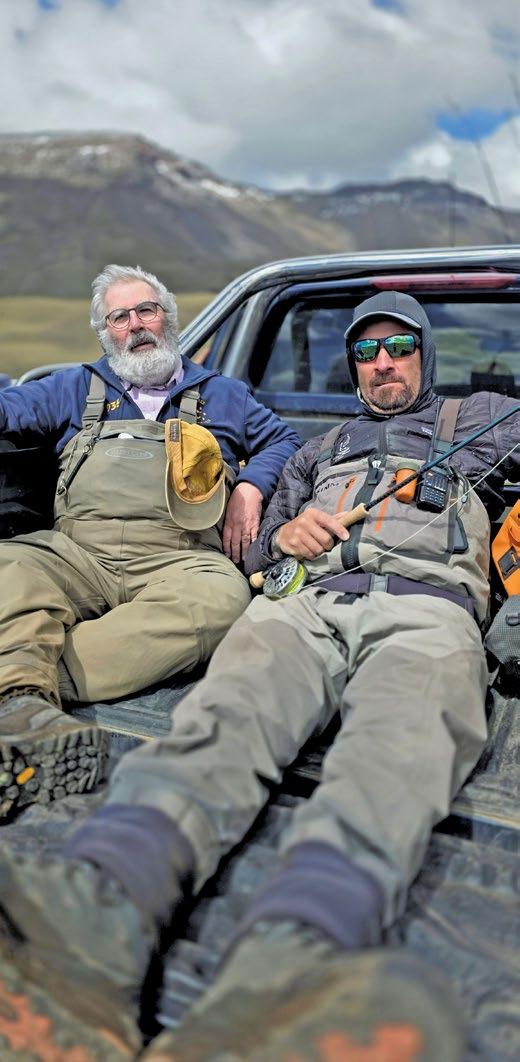
Qualcuno parla di “mal di Patagonia”, forse. Eppure, dopo oltre trenta viaggi in queste terre, qualcosa sembra essersi scolpito nell’anima, indelebile. Non sono solo le trote gigantesche a lasciare il segno, ma il legame profondo che si costruisce negli anni con gli amici e con ogni istante condiviso lungo fiumi e montagne. Forse è per questo che, ogni anno, il richiamo di questo angolo sperduto del mondo diventa irresistibile.
Hanno collaborato a questo numero: Guido Sesani, Lorenzo Natarelli, IGOR GORTAN, Riccardo De Stabile, MARCOS HLACE, CARLOTTA Gariboldi, VALENTINA DARIO, Andrea Bianchi, Ralph Prost
Art Director E GRAFICA: OMAR GADE, VALENTINA SCARABELLI, ANGLINGCONSULTING.ONE
Stampa:
“Tipografifia Bertani” Cavriago (RE)
Fotografi di Redazione: Alessandro Seletti, ALBERTO ZANGHIERI
Social Media Manager: Fulvio Oliva
Traduzioni: Rossella Catellani, Elisabetta Longhi
Autorizzazione Tribunale di Bologna n°8157 del 01/02/2011 Poste Italiane spa- Spedizione in Abbonamento Postale - 70% - aut. Roc N°20825 del 10/03/2011 - DCB Bologna
Per qualsiasi informazione inerente i viaggi trattati nel magazine, vi invitiamo a contattare la Redazione: INFO@ h2oflyfishing.com info@cavatortigiorgio.it
Editor note
Although we are in the middle of the season, we are always thinking ahead to the coming months and future travels. In autumn, we will be in Ireland fishing for sea bass and photographing new areas in the south of the country, before moving on to South Tyrol together with groups of American friends who will be visiting us for the grayling season. November is now considered Patagonia’s month, and toward the end of the year we will head to Mexico, back to the sea.
In this issue, we talk about a new estancia in Patagonia, Chochoy Mallín, in the Argentine province of Neuquén, which is entering the market with a very appealing offering. We then continue with an interview with our friend Marcos Hlace, a well-known Argentine guide.
After that, we move between the Amazon and Spain, where we were recently with our friend Javier Peña.
Other topics include an article on Carnia, an excellent Italian destination, and a feature on New Zealand with Lorenzo Natarelli. Art and history bring this issue to a close.
Enjoy the read.
Anche se siamo nel pieno della stagione, pensiamo sempre ai prossimi mesi e ai viaggi futuri. In autunno saremo in Irlanda a pescare spigole e a fotografare nuove zone nel sud del Paese, per poi spostarci in Sud Tirolo insieme ad alcuni gruppi di amici americani che ci faranno visita per la stagione dei temoli.
Novembre è ormai considerato il mese della Patagonia, e verso la fine dell’anno ci dirigeremo in Messico, di nuovo verso il mare.
In questo numero parliamo di una nuova estancia in Patagonia, Chochoy Mallín, nella provincia argentina di Neuquén, che si affaccia sul mercato con un’offerta molto interessante. Proseguiamo poi con un’intervista all’amico Marcos Hlace, guida argentina molto conosciuta.
Successivamente ci spostiamo tra Amazzonia e Spagna, dove siamo stati recentemente con l’amico Javier Peña. Altri argomenti includono un articolo sulla Carnia, ottima meta italiana, e un approfondimento sulla Nuova Zelanda con Lorenzo Natarelli. Arte e storia chiudono il numero.
Buona lettura
let's keep in touch: www.h2oflyfishing.com info@h2oflyfishing.com • info@cavatortigiorgio.it
Giorgio
8... CHOCHOY MALLIN ....CHOCHOY MALLIN
18 NUOVA ZELANDA - KIWI LIFE NELL’ISOLA DEL NORD
NEW ZEALAND - KIWI LIFE IN THE NORTH ISLAND
36
INTERVISTA: IGOR GORTAN - LA GESTIONE DELLE ACQUE IN CARNIA
INTERVIEW WITH IGOR GORTAN - WATER MANAGEMENT IN CARNIA
46
LA SCOPERTA DI VANCOUVER ISLAND THE DISCOVERY OF VANCOUVER ISLAND
52 GIANT TROUT IN SPAIN GIANT TROUT IN SPAIN
62..AMAZZONIA AMAZON
74
INTERVISTA: MARCOS HLACE
INTERVIEW WITH MARCOS HLACE
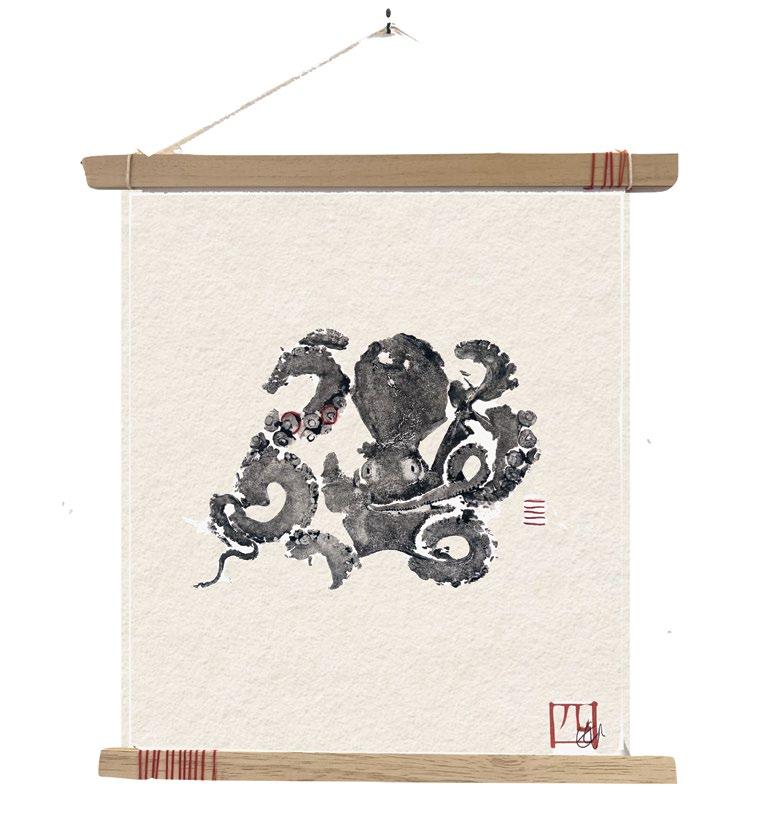
82 ARTE NELLA PESCA - CARLOTTA GARIBOLDI
ART IN FISHING - CARLOTTA GARIBOLDI
90 FARASAN BANKS FARASAN BANKS
Guido
Chochoy MALLIN
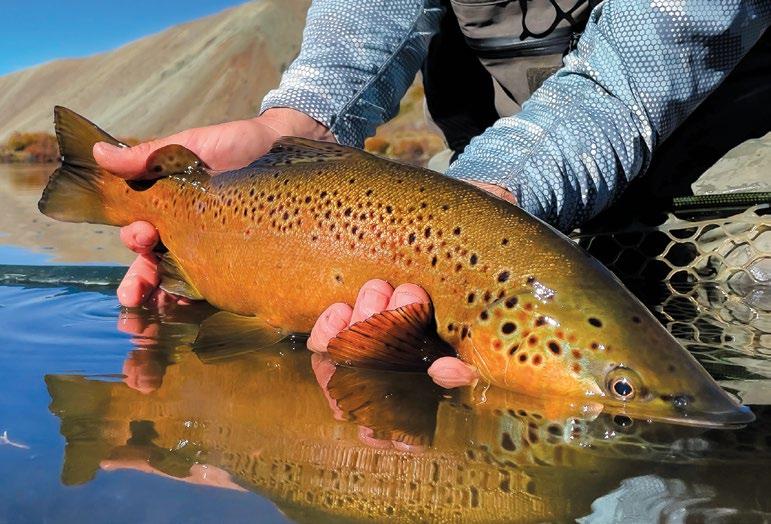
...L’indomani, fattosi giorno, siamo rimasti a bocca aperta...
Da quasi vent’anni, Roberto Alba e suo figlio Luciano sono sinonimi di pesca a mosca di categoria superiore. Tra le varie destinazioni da loro proposte, basti citare quella più famosa e celebrata ovvero l’Estancia Laguna Verde, Patagonia, che dispone dei diritti di pesca nel lago Strobel, meglio conosciuto come Jurassic Lake, che ospita una popolazione di trote iridee che non ha letteralmente eguali al mondo.
Negli anni gli Alba hanno aperto un ulteriore lodge sempre in riva allo Strobel, quindi il Golden Dorado River Cruiser sul fiume Paraná, in Argentina, e da quest’anno gestiscono l’Estancia Chochoy Mallin, situata nella remota provincia di Neuquén a ridosso della Cordillera del Viento e ad un tiro di schioppo dal confine cileno (Paso Pichachen).
Dallo Spey cast al lancio normale. Terminata la settimana a El Rincon, Giorgio ed io siamo atterrati a Neuquén via Buenos Aires e di lì, dopo sei ore di macchina, in parte percorse su asfalto ed in parte su terra battuta, siamo
For nearly twenty years, Roberto Alba and his son Luciano have been synonymous with top-tier fly fishing. Among the various destinations they offer, the most famous and celebrated is undoubtedly Estancia Laguna Verde in Patagonia, which holds fishing rights on Lake Strobel, better known as Jurassic Lake, home to a population of rainbow trout that is quite literally unmatched anywhere in the world.
Over the years, the Albas have opened another lodge on the shores of Lake Strobel, as well as the Golden Dorado River Cruiser on Argentina’s Paraná River. This year, they have also taken over the management of Estancia Chochoy Mallín, located in the remote province of Neuquén, at the foothills of the Cordillera del Viento and just a stone’s throw from the Chilean border (Paso Pichachén).
From Spey casting to traditional casting. After finishing our week at El Rincón, Giorgio and I flew to Neuquén via Buenos Aires and from there, after a six-hour drive—partly on paved roads and partly on dirt tracks—
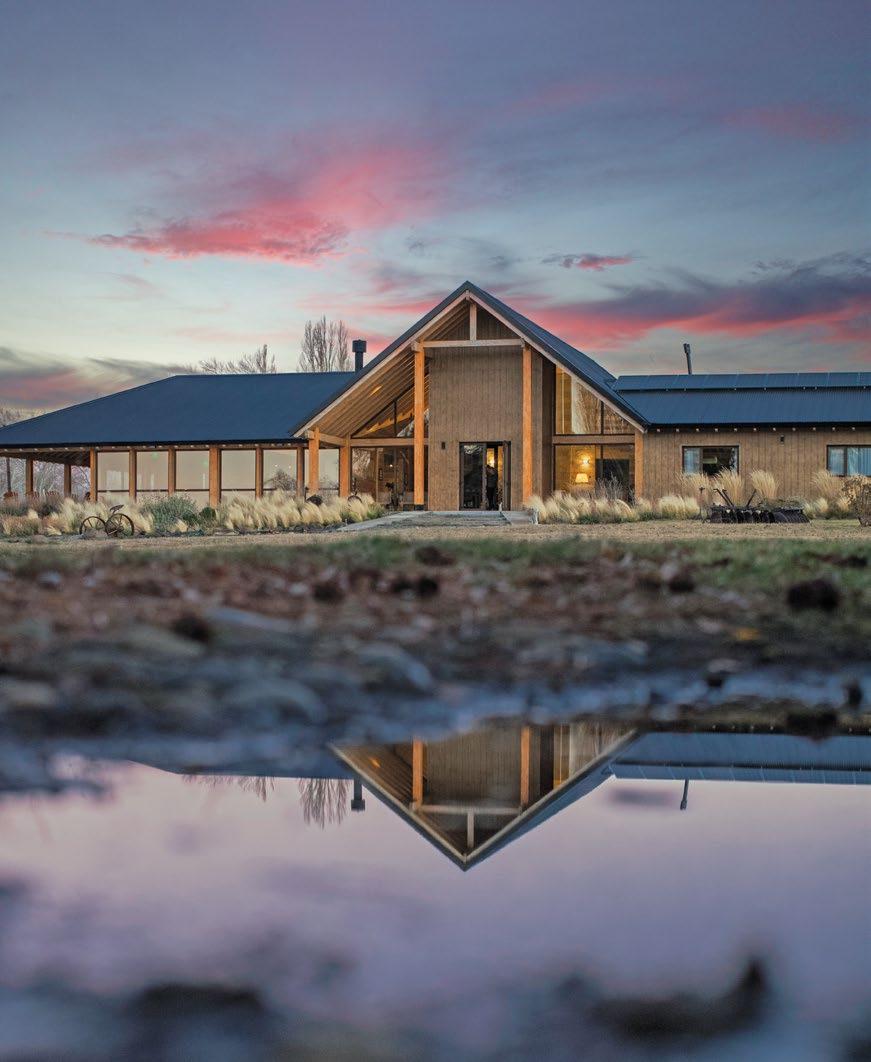
arrivati all’Estancia a notte fonda. L’indomani, fattosi giorno, siamo rimasti a bocca aperta. Il lodge, costruito di recente, senza timore di esagerare, lo definirei lussuoso, elegante, ben arredato, molto accogliente e dotato di ogni comfort: grandi stanze per gli ospiti con altrettanto grandi letti, ampio soggiorno con un banco bar molto fornito per non parlare della cantina che offre una notevole varietà di vini argentini di ottima qualità.
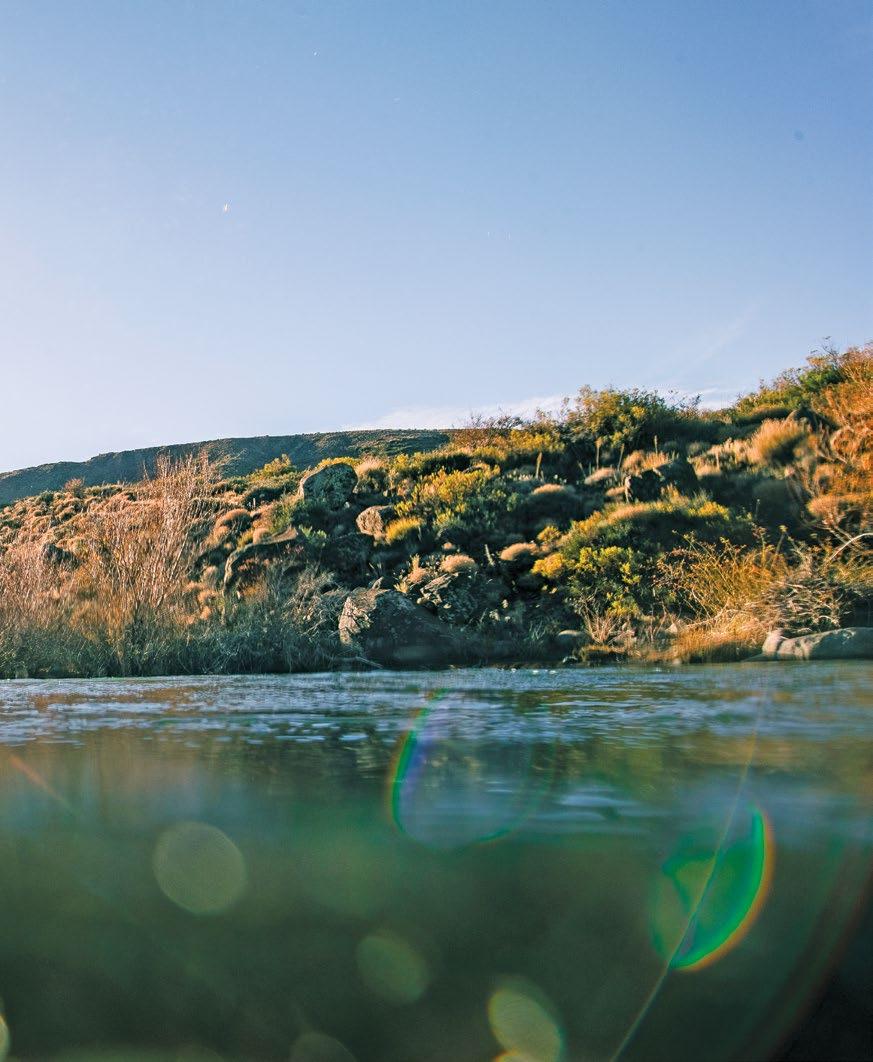
Varcata la soglia del lodge, tutto intorno un paesaggio inusuale, affascinante per la varietà e la conformazione. Siamo a 1200 metri di altitudine e da un lato c’è la cordigliera andina già abbondantemente innevata, dall’altra ampie valli in cui scorrono i fiumi dove pescheremo nei giorni a venire: Trocoman, Reñileuvu, Ñireco. Il tutto decisamente selvaggio, ma ripeto, vario ed affascinante.
Data l’estensione delle zone di pesca ci si muove in pick-up ed ogni giorno si pesca in posti diversi; la scelta dicevo non manca di certo. A poca distanza dal lodge scorre il torrente Ñireco, molto infrascato ahimè, ma ricco di trote di taglia piccola che salgono sia sulla secca che a ninfa. Il torrente si immette nel Rio Reñileuvú, tributario a sua volta del Trocoman, entrambi bellissimi e vergini, nel senso che nessuno o quasi ci ha mai pescato. Nel Reñileuvú in particolare abbiamo avuto la possibilità di pescare sia nella parte bassa che in quella alta che scorre in mezzo a pascoli di mucche e pecore. Se nella notte è nevicato o piovuto e l’acqua si è sporcata, c’è la possibilità di pescare in quella che gli argentini chiamano “laguna”, che in realtà è un lago che ospita trote di dimensioni assai più grandi di quelle che abbiamo catturato nei vari corsi d’acqua.
Già, le dimensioni delle trote, la maggioranza delle quali iridee, è abbastanza modesta e non è chiaro se ciò dipenda dal periodo (inizi dell’autunno), dal livello dell’acqua o da cos’altro. Charlie e Maxi, le due guide che ci hanno assistito per tutta la settimana con professionalità, disponibilità e cortesia, ci hanno assicurato che in altri periodi dell’anno le dimensioni delle catture sono maggiori.
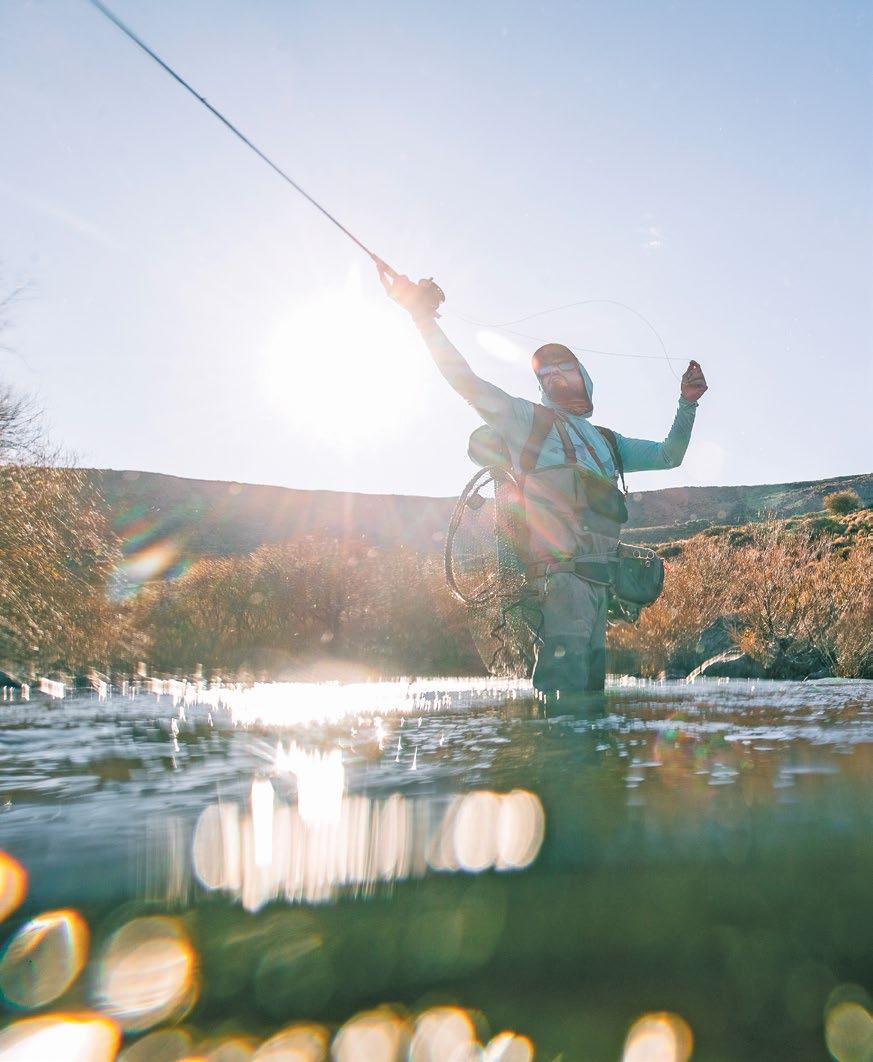
Si utilizzano piccoli wooly bugger neri o verdi, ninfe di vario tipo, anche minuscole ed in genere piombate, funzionano a dovere, canne da 8/9 piedi per code WF 5 galleggianti per contrastare il vento che ogni tanto si fa sentire. Grazie a Melina, temibile quanto efficiente coordinatrice dello staff del lodge, guide incluse, sia io che Giorgio, sia i due americani che con noi condividevano il soggiorno all’Estancia, ogni giorno siamo stati soddisfatti di ciò che
we arrived at the estancia late at night. The following morning, at first light, we were left speechless. The lodge, recently built, can without exaggeration be described as luxurious: elegant, tastefully furnished, extremely welcoming, and equipped with every comfort. Spacious guest rooms with equally large beds, a wide living area with a well-stocked bar, not to mention a wine cellar offering an impressive selection of high-quality Argentine wines.
Stepping outside the lodge, we found ourselves surrounded by an unusual landscape, fascinating for its variety and shape. We are at 1,200 meters above sea level: on one side rises the Andean range, already heavily snow-covered, and on the other stretch wide valleys crossed by the rivers where we would fish in the days ahead— Trocomán, Reñileuvú, and Ñireco. The setting is truly wild, yet, as I said, diverse and captivating.
Given the vast fishing areas, we traveled by pickup truck, fishing in different locations each day—the choice is certainly abundant. Not far from the lodge flows the Ñireco stream, heavily overgrown with vegetation, unfortunately, but rich in small trout that readily take both dry flies and nymphs. The stream flows into the Río Reñileuvú, itself a tributary of the Trocomán— both stunning and virtually untouched, meaning few, if any, have ever fished them.
On the Reñileuvú in particular, we had the opportunity to fish both the lower and upper sections, the latter running through pastures dotted with cattle and sheep.
If overnight snowfall or rain caused the water to become murky, there was always the option of fishing in what Argentinians call a “laguna,” which is actually a lake hosting trout significantly larger than those we caught in the rivers. As for trout size, most of which are rainbow trout,
it was somewhat modest. It’s unclear whether this was due to the season (early autumn), water levels, or other factors. Charlie and Maxi, the two guides who assisted us throughout the week with professionalism, kindness, and availability, assured us that at other times of the year, fish sizes are considerably larger.
We used small black or green Woolly Buggers, as well as various types of nymphs—even tiny, weighted ones—which proved very effective. Rods of 8–9 feet with floating WF5 lines were ideal to cope with the occasional wind.
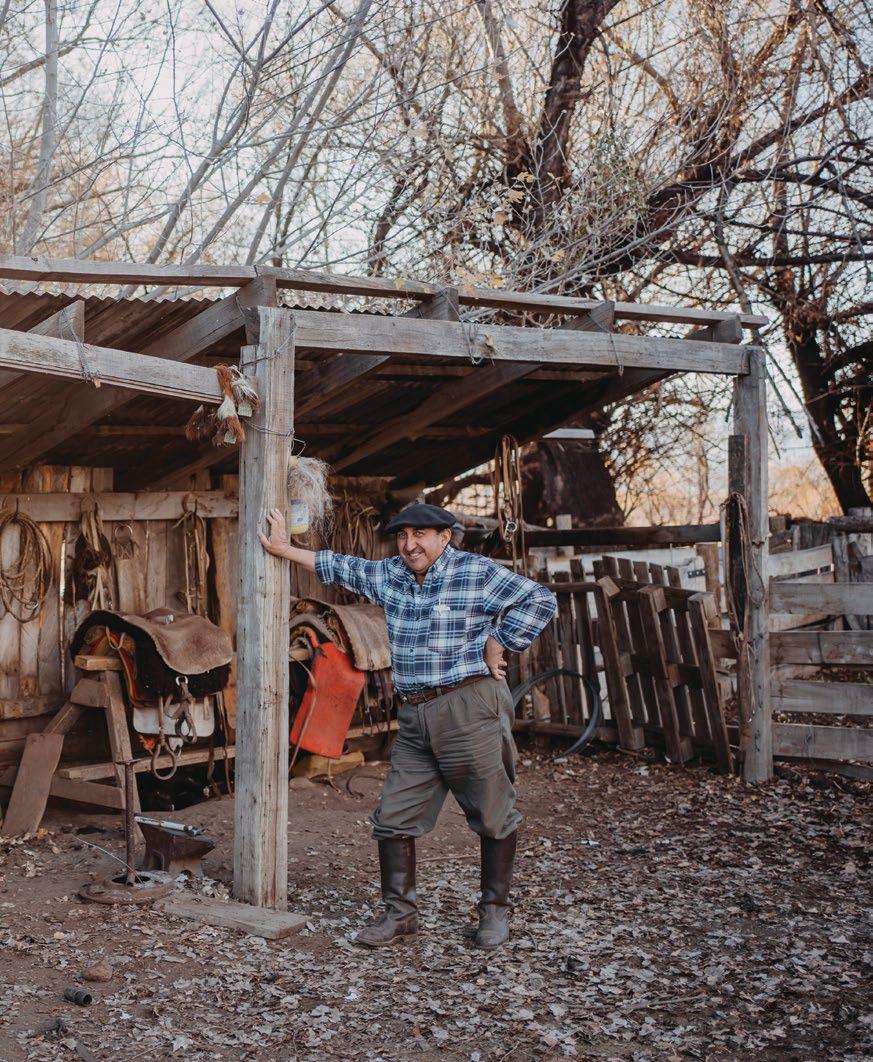
Thanks to Melina, the daunting yet highly efficient coordinator of the lodge staff, guides included, both Giorgio and I—as well as the two Americans who shared the estancia with us—were each day fully satisfied with what we caught, what we saw, and the experiences we lived. One in particular stands out: the day we were guests of the gauchos.
avevamo pescato, di ciò che avevamo visto e delle esperienze vissute, una in particolare il giorno in cui siamo stati ospitati dai gauchos.
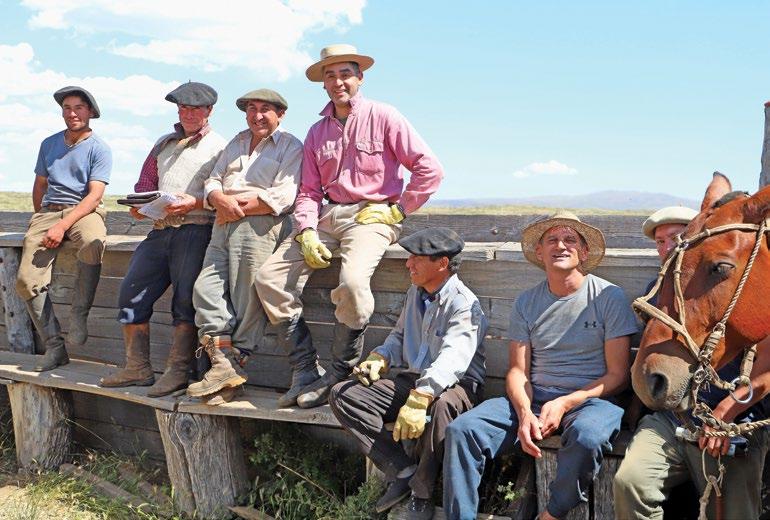
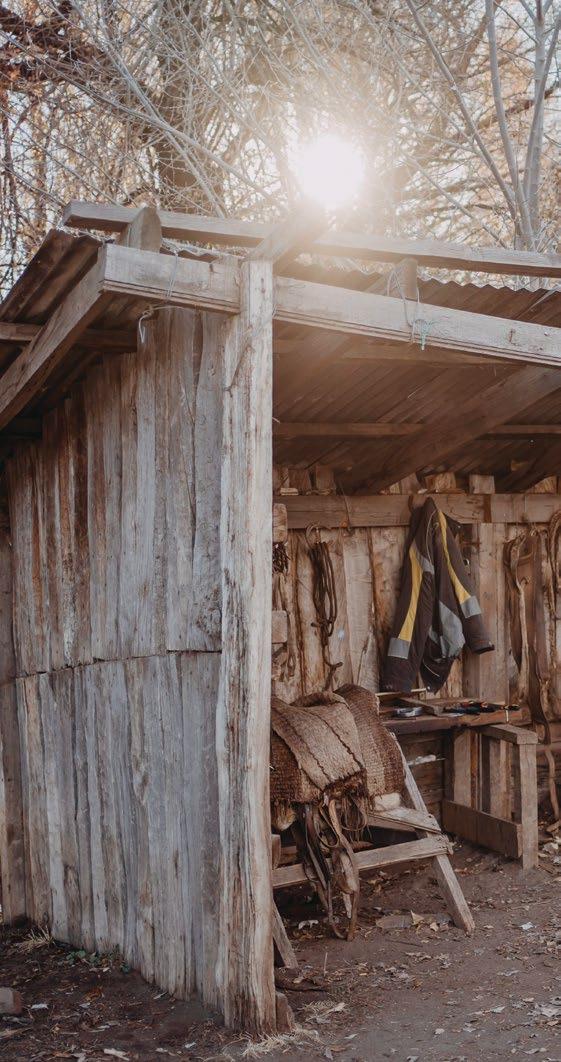
Letteralmente in mezzo al nulla, a ridosso della cordigliera, c’era un rifugio che ospitava quattro gattini, due gauchos ed altrettanti cavalli e gli immancabili cani senza i quali non sarebbe possibile governare le mandrie che pascolano in un’estancia di 15.000 ettari, 150 chilometri quadrati!
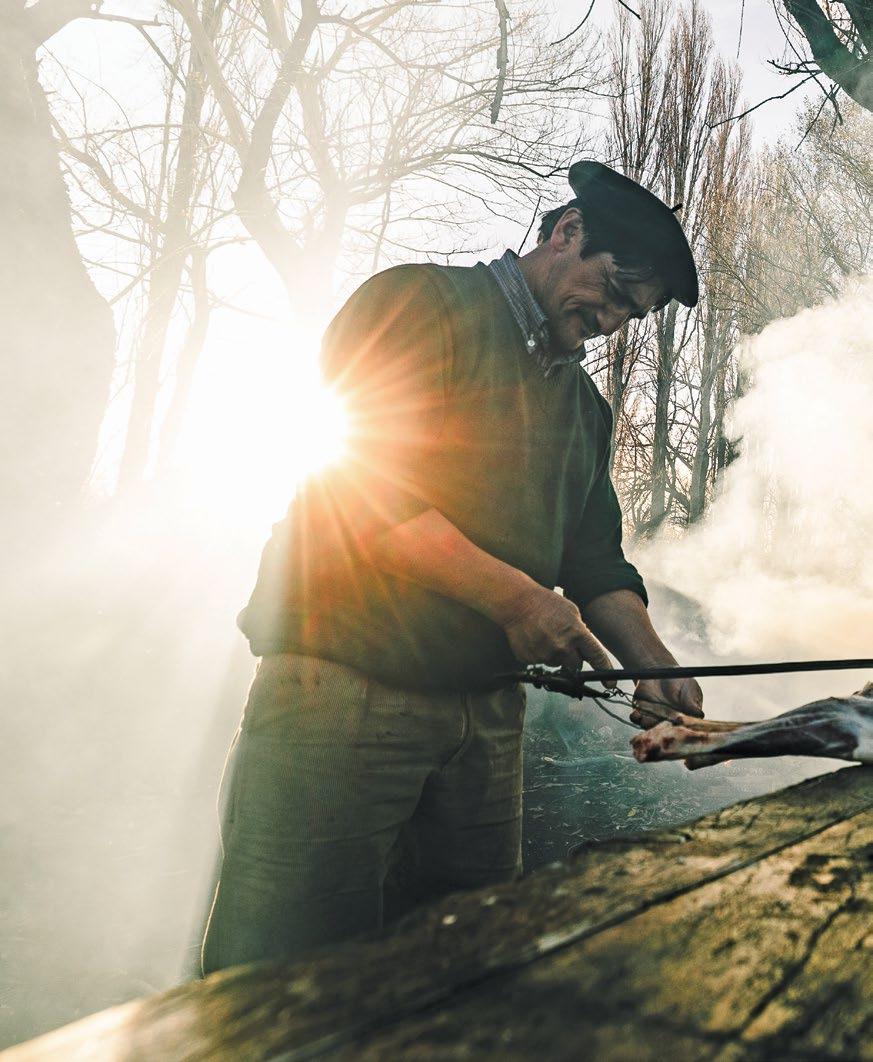
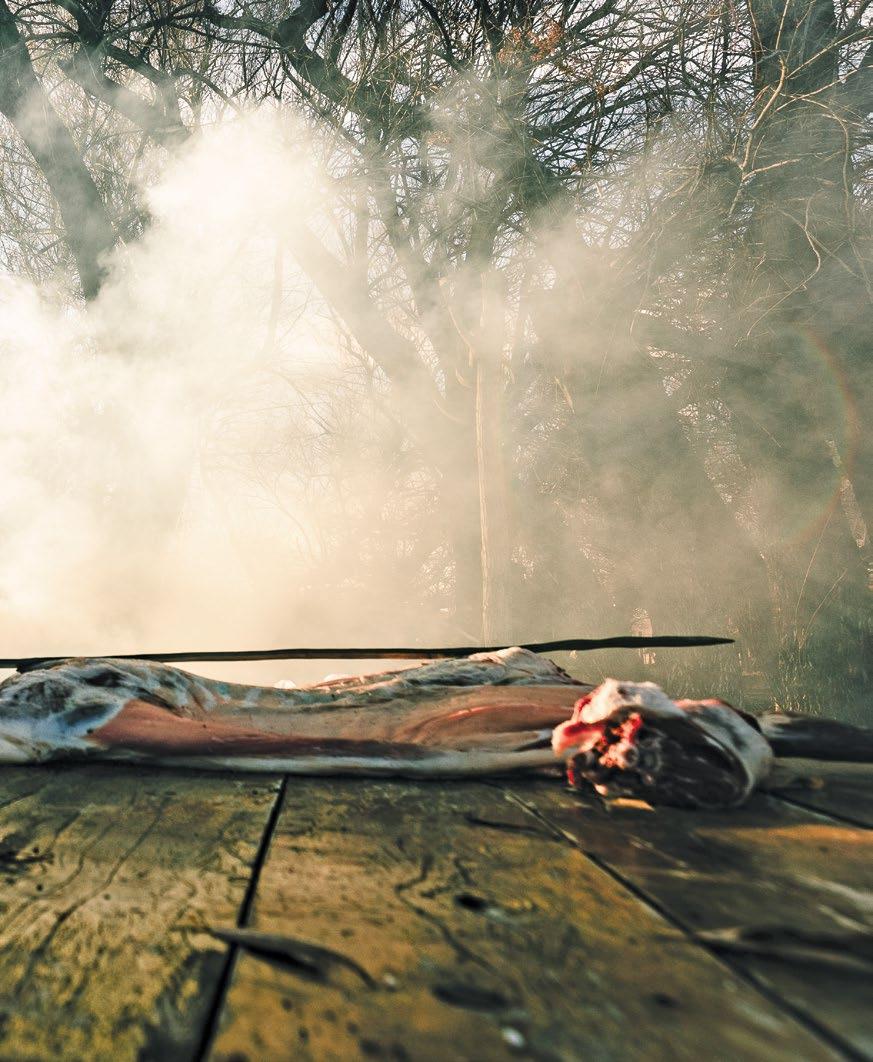
Manco a dirlo, avevano preparato il classico asado di cordero (agnello) intero. L’asado consiste nel posizionare per terra uno spiedo verticale a forma di croce su cui viene infilzata la carne che cuoce con il calore delle braci che arriva da sottovento ed è protetto generalmente da una lamiera curva disposta in maniera da evitare che si disperda. È una tecnica di cottura lenta che necessita da 4 a 6 ore e che consente alla carne di perdere grasso e di rimanere morbida. Esperienza indimenticabile, a lungo ricorderò il sapore delle costine che abbiamo mangiato innaffiate dal malbec prodotto in Patagonia dal
Literally in the middle of nowhere, at the foot of the mountains, stood a shelter inhabited by four kittens, two gauchos, a couple of horses, and, of course, the indispensable dogs without which it would be impossible to manage the herds grazing across a 15,000-hectare estancia—150 square kilometers!
Needless to say, they had prepared a classic whole lamb asado. The asado consists of placing a vertical cross-shaped spit in the ground, onto which the meat is fixed, slowly cooked by the heat of embers placed upwind and usually shielded by a curved metal sheet to retain the heat. It is a slow cooking method requiring 4 to 6 hours, allowing the meat to render its fat while remaining tender. An unforgettable experience—I will long remember the taste of the ribs we ate, paired with a Malbec produced in Patagonia by the estancia owner, Carlos Mabellini, just as I will not easily forget the empanadas served to us at the lodge on the evening before departure.
... c’era un rifugio che ospitava quattro gattini, due gauchos ed
proprietario dell’estancia, Carlos Mabellini, così come mi sarà difficile dimenticare le empanadas che ci sono state servite all’Estancia la sera prima di partire.
Lascio per ultimo Luciano, the boss, il nostro anfitrione, che avevo incontrato l’ultima volta 14 anni fa all’Estancia Laguna Verde, sempre allegro, ospitale e generoso, e che ha reso la
Finally, a word about Luciano, “the boss,” our host, whom I had last met 14 years ago at Estancia Laguna Verde. Always cheerful, generous, and welcoming, he made our stay
nostra permanenza al lodge ancor più piacevole. Grazie e….hasta la vista!
even more enjoyable. Thank you—and… hasta la vista!
Grazie e….hasta la vista!
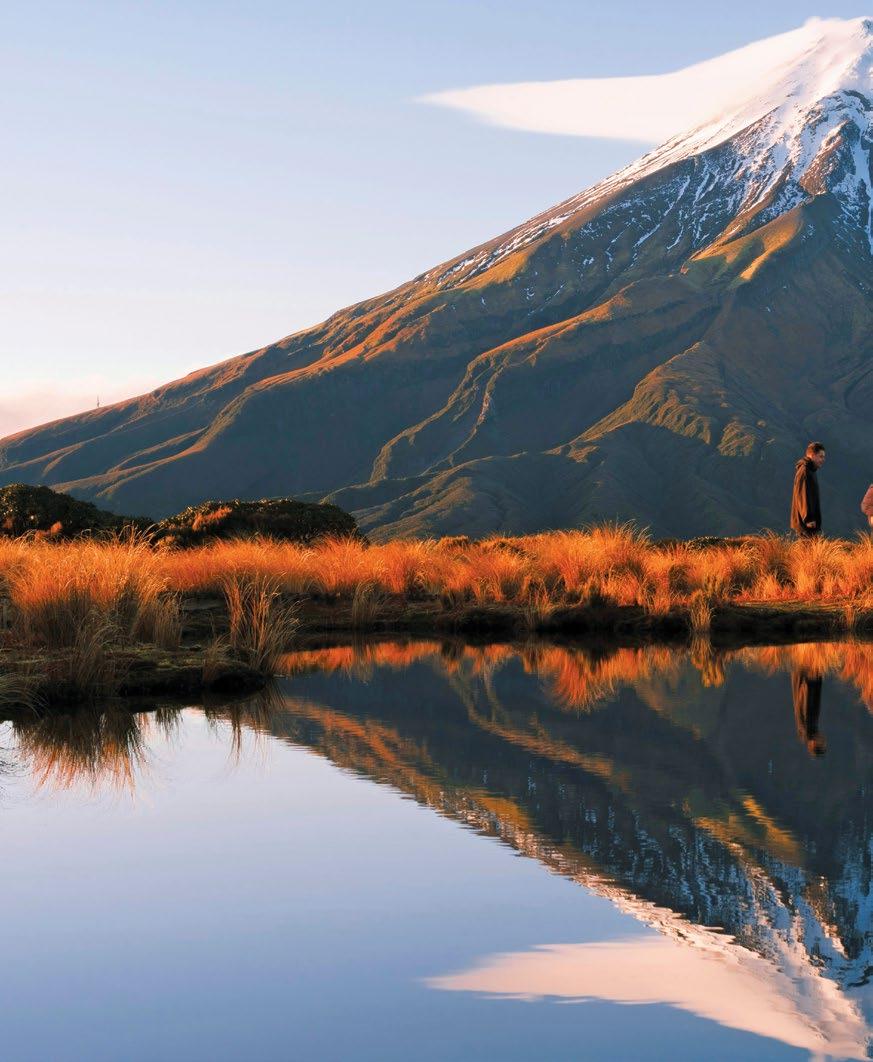
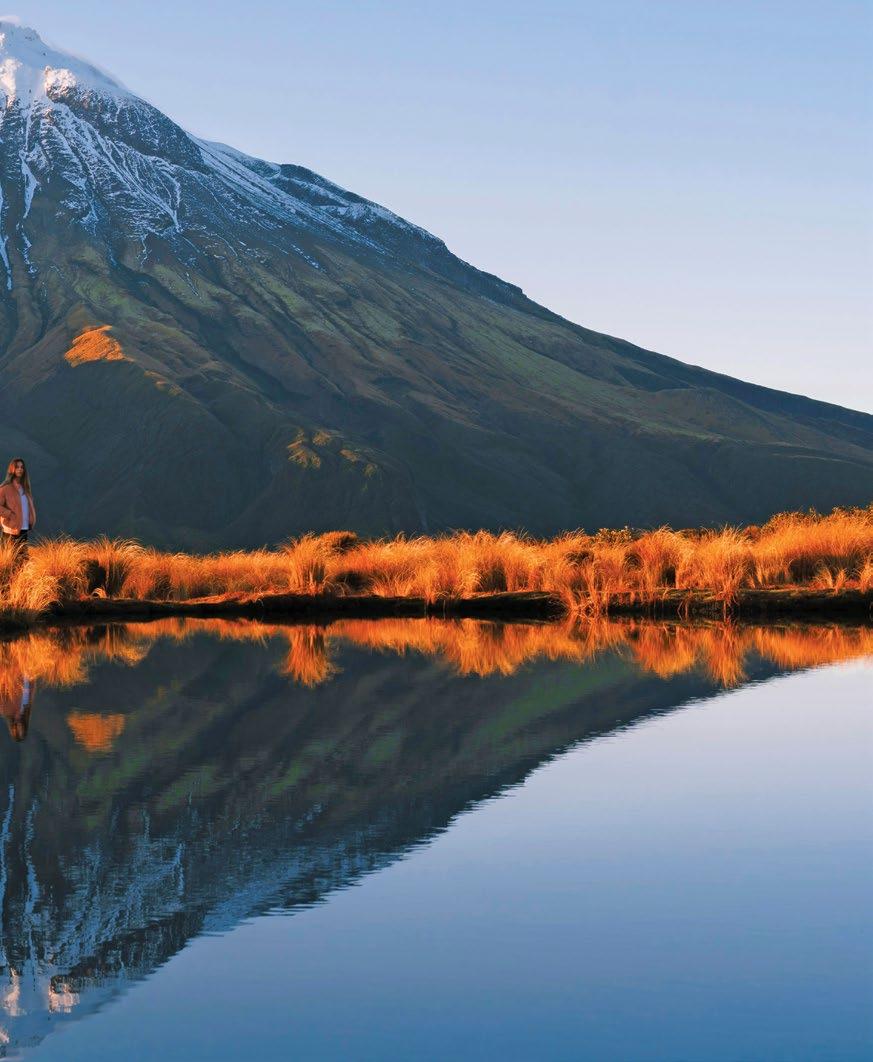
NEW ZEALAND : KIWI LIFE IN THE NORTH ISLAND
Lorenzo Natarelli
NUOVA ZELANDA
Kiwi Life nell’Isola del Nord
...mi ha aperto le porte di alcuni dei luoghi più spettacolari del pianeta...
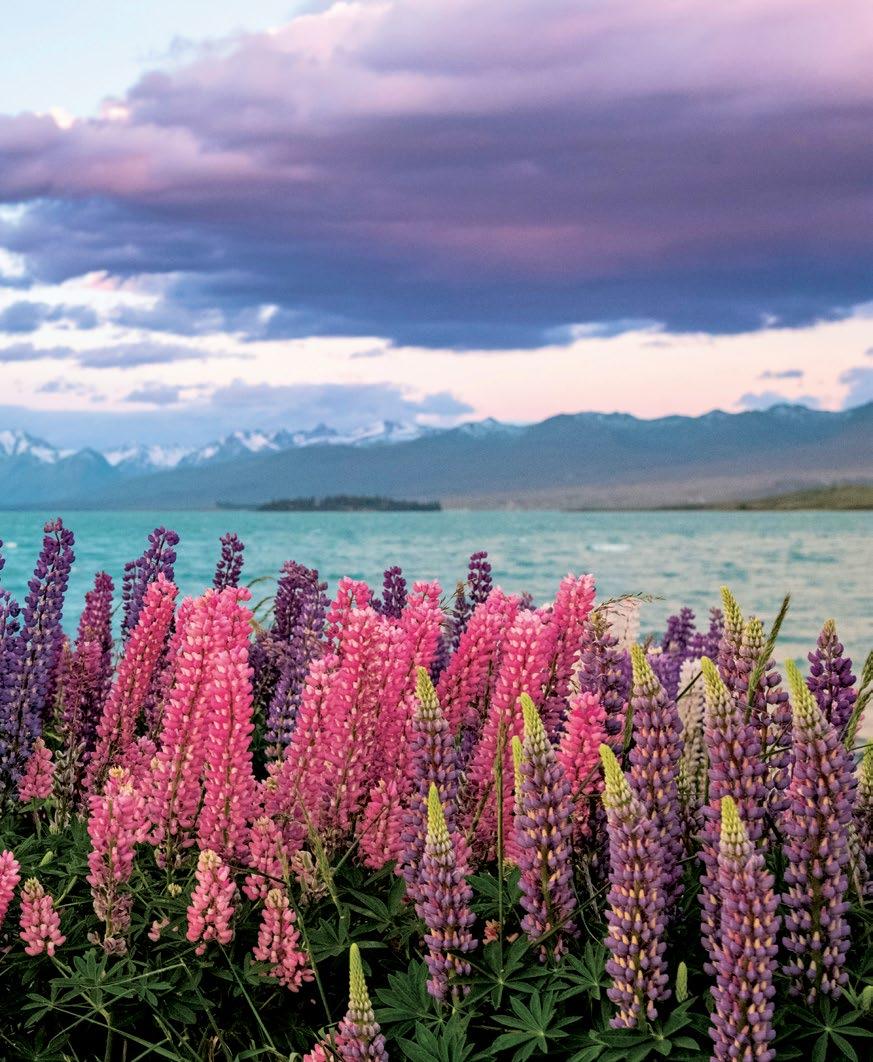
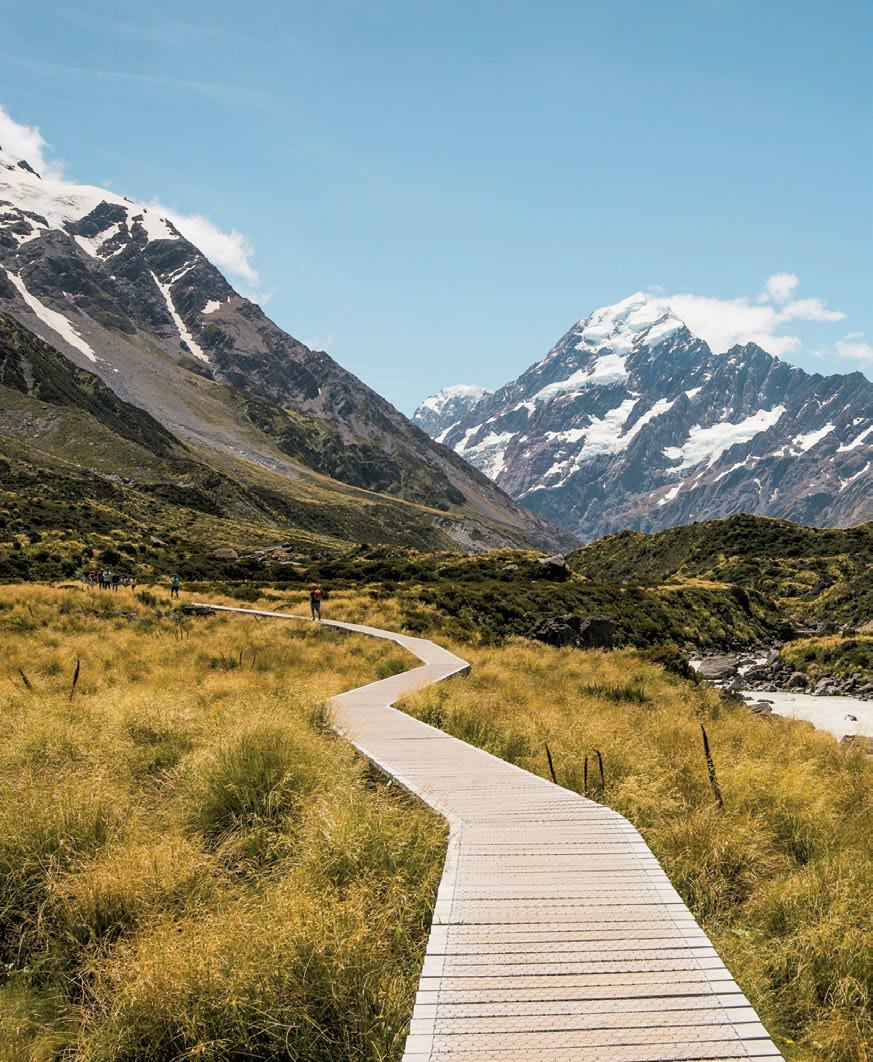
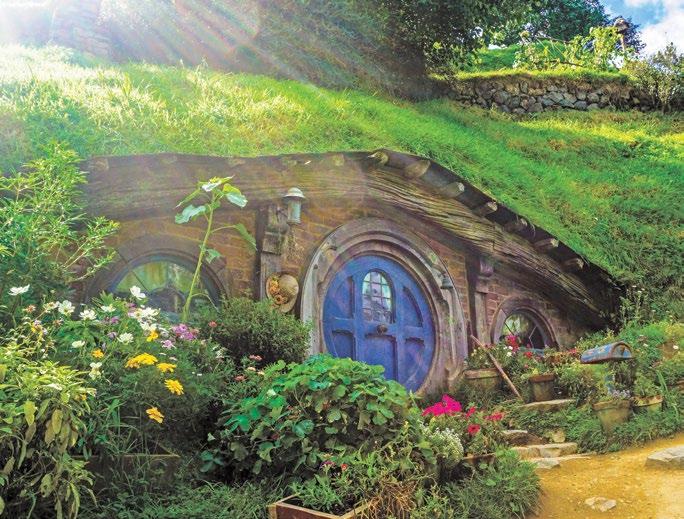
Negli ultimi anni la pesca mi ha regalato qualcosa di più delle semplici catture: mi ha aperto le porte di alcuni dei luoghi più spettacolari del pianeta. Quest’anno la mia ultima destinazione è l’Isola del Nord della Nuova Zelanda, ospite di un caro amico e guida locale, Ollie Bassett. L’8 dicembre, dopo circa quaranta ore di viaggio, atterro finalmente in Nuova
Zelanda. Sono forse in uno dei Paesi più ambiti dai pescatori a mosca di tutto il mondo? Probabilmente sì.
Il tempo qui è prezioso e non c’è spazio per riprendersi dal viaggio: è subito il momento di partire per una delle forme di pesca più iconiche della Nuova Zelanda, il backcountry. Cinque ore di cammino con gli zaini in spalla, carichi di attrezzatura e
materiale di sopravvivenza, sono il prezzo da pagare per poter raggiungere quei luoghi remoti e incontaminati che tanto ho sognato.
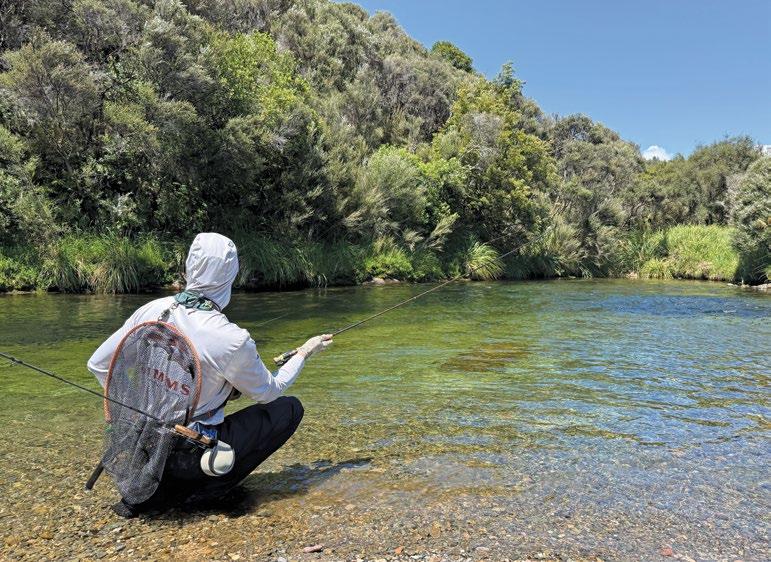
Ci siamo: siamo nel mezzo del nulla. Peschiamo quasi esclusivamente a vista, in fiumi di media-piccola portata che alternano raschi, lame e buche, passando da tratti aperti a tratti chiusi nel fitto del
In recent years, fishing has given me something more than just catches: it has opened the doors to some of the most spectacular places on the planet. This year, my latest destination is New Zealand’s North Island, hosted by a close friend and local guide, Ollie Bassett.
On December 8th, after around forty hours of travel, I finally land in New Zealand. Am I in perhaps one of the most desired countries for fly anglers worldwide? Most likely yes. Time here is precious, and there is no space to recover from the journey: it’s immediately time to set off for one of New Zealand’s most
iconic forms of fishing, the backcountry. Five hours of hiking with backpacks on, loaded with gear and survival equipment, is the price to pay to reach those remote and untouched places I have long dreamed of.
Here we are: we are in the middle of
bosco. Preparo una canna da secca/ dropper e una da ninfa: amo adattarmi al fiume e al modo in cui i pesci stanno mangiando in quel momento.
Parlando con Ollie, capisco subito quanto l’approccio sia fondamentale: i pesci vanno individuati, avvicinati con estrema cautela e i lanci devono essere precisi. Le mangiate in
superficie sulle grosse sedge sono adrenalina pura: le trote salgono lente, lasciandoti sospeso in un momento di tensione incredibile. Magia.
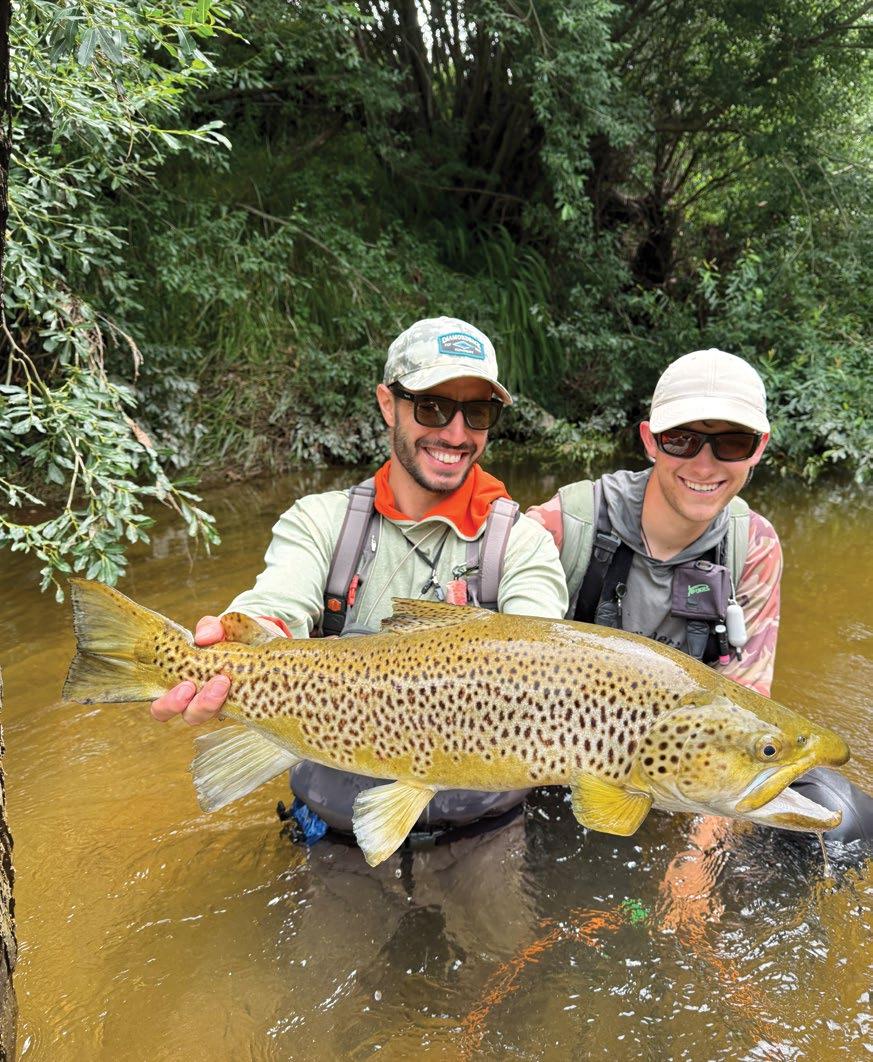
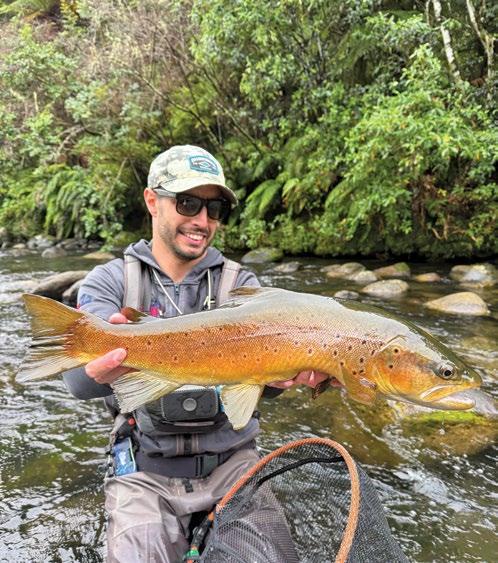
È passata una settimana e il vento inizia a soffiare forte su gran parte dell’isola. Cerchiamo riparo nei chalk stream, protetti dalla fitta vegetazione. Ci aspettano le grandi fario: a volte si possono incrociare esemplari superiori alle dieci libbre, vera definizione di pesce trofeo in Nuova Zelanda.
Affrontiamo il fiume a turni, uno alla volta,
mentre entrambi cerchiamo di spottare i pesci. Anche qui è fondamentale approcciare il fiume nel modo corretto: muoversi lentamente, senza far rumore, è la vera chiave. Basta un passo errato per giocarsi metri e metri di fiume.
In zone così infrascate e ricche di vegetazione in acqua la regola è solo una: tirare senza tregua. O va bene o va male. I combattimenti sono da cardiopalmo. Avere un buon compagno in pesca è fondamentale per riuscire a guadinare i pesci. Qui, dopo più di quindici anni di pesca
nowhere. We fish almost exclusively sight fishing, in medium-small rivers that alternate riffles, runs, and pools, moving from open sections
to stretches enclosed in dense bush. I set up a dry/ dropper rod and a nymph rod: I love adapting to the river and to how the fish are feeding at that moment. Talking with Ollie, I immediately understand how crucial the approach is: fish must be spotted, approached with extreme caution, and casts must be precise. Surface takes on large sedges are pure adrenaline: trout rise slowly, leaving you suspended in an incredible moment of tension. Magic.
A week has passed and strong winds begin to blow across much of the island. We seek shelter in chalk streams, protected by thick vegetation.
Big brown trout await us: sometimes you can encounter fish over ten pounds, the true definition of a trophy fish in New Zealand. We work the river in turns, one at a time, both of us trying to spot fish. Here too, the right approach is essential: moving slowly and silently is the real key. One wrong step can cost you metres and metres of river.
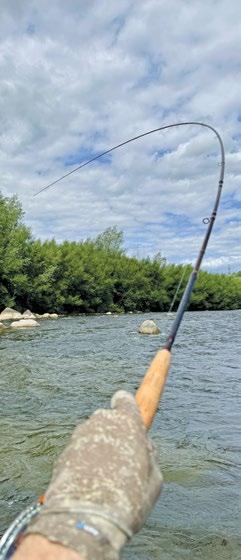
In such overgrown, vegetation-rich waters, there is only one rule: keep pulling until the end. It either works or it doesn’t. The fights are heart-stopping. Having a good fishing partner is essential to land fish. Here, after more than
a mosca, rompo la mia prima canna: una 9’ #6. Non credo di dover aggiungere altro.
I giorni passano e ho ancora due obiettivi: pescare i grandi fiumi della zona Taupo e affrontare uno dei laghi dell’isola. Per quanto ne abbia sentito parlare negli anni, noi europei associamo quasi esclusivamente la Nuova Zelanda alla pesca in fiume; parlando però con gli amici kiwi, capisco che anche la pesca in lago è davvero speciale. Devo provarla. Attendiamo dunque che le condizioni migliorino.
Mi sposto a sud del Lago Taupo, più precisamente a Turangi, dove alloggio in un classico motel per pescatori. Qui i fiumi cambiano volto: sono acque di fondovalle di media-grande portata, dove lame d’acqua bassa
si alternano a buche profonde e correnti veloci. Ad accompagnarmi in queste acque trovo Noah Shapiro, caro amico americano con il quale ho avuto la fortuna di pescare in diverse parti del mondo, tra cui Italia, Colorado e ora Nuova Zelanda. Sono forse tra i tre punti più lontani tra loro sulla Terra? Forse sì, magari la prossima volta ci rincontreremo su Marte. Noah vive qui da qualche anno e conosce bene gli spot dell’isola.
Peschiamo per lo più a ninfa in stile europeo, tecnica più efficace su questi fiumi a inizio estate. La taglia dei pesci è notevole e i combattimenti sono davvero impegnativi: capita spesso di ritrovarsi con parte del backing fuori dal mulinello. Controllare nodi e giunzioni prima di un viaggio simile non è un consiglio, è una necessità.
Siamo quasi alla fine ed è tempo dell’ultima sfida: il lago. Mi ricongiungo con Ollie e, viste le condizioni meteo ancora incerte, optiamo per pescare da riva.
Il titolo di questo capitolo: I bonefish della Nuova Zelanda.
Sì, avete capito bene. La pesca nel lago Rotorua ricorda incredibilmente quella al bonefish: si pesca da riva sulle flats, distese di acqua bassa che si estendono per centinaia di metri lungo le rive. L’obiettivo, ovviamente, non sono i bonefish, ma le grandi fario del lago. La pesca è sempre a vista: i pesci vanno individuati a debita distanza e intercettati con gli streamer mentre pascolano in cerca di cibo.Amo le sfide
fifteen years of fly fishing, I break my first rod: a 9’ #6. I don’t think I need to add anything else.
The days go by and I still have two goals: fish the large rivers of the Taupō area and explore one of the island’s lakes. Although we often associate New Zealand almost exclusively with river fishing, after hearing about it over the years and speaking with local “Kiwis”, I understand that lake fishing is also truly special. I have to try it. We wait for conditions to improve.
I move south of Lake Taupō, more precisely to Tūrangi, where I stay in a classic fisherman’s motel. Here the rivers change character: they are medium-to-large valley rivers, where shallow runs alternate with deep pools and fast currents.
Joining me in these waters is Noah Shapiro, a close American friend with whom I have been fortunate to fish in different parts of the world, including Italy, Colorado, and now New Zealand. Are these perhaps three of the most distant points on Earth from one another? Maybe yes—perhaps next time we’ll meet on Mars. Noah has been living here for a few years and knows the island’s spots well.
We mostly fish European-style nymphing, the most effective technique on these rivers in early summer. The size of the fish is impressive, and the fights are truly demanding: it is common to find yourself with part of the backing out of the reel. Checking knots and connections before a trip like this is not advice—it is a necessity.
We are almost at the end, and it’s time for the final challenge: the lake. I reunite with Ollie and, given the still uncertain weather conditions, we choose to fish from the shore.
The title of this chapter: The bonefish of New Zealand.
Yes, you read that right. Fishing in Lake Rotorua is remarkably similar to bonefishing: you fish from shore on the flats, shallow water expanses stretching for hundreds of metres along the shoreline.
The target, of course, is not bonefish, but large brown trout from the lake. It is always sight fishing: fish must be spotted at a distance and intercepted with streamers while they cruise and feed.
e le situazioni difficili: questa è senza dubbio una delle tecniche di pesca più complesse e frustranti che abbia mai provato, ma proprio per questo anche una delle più gratificanti.
Catturare una fario trofeo in un contesto simile è il sigillo perfetto su un viaggio indimenticabile.
Il tempo a disposizione purtroppo è terminato: torno a casa con ricordi indelebili e tanta nuova esperienza nel mio bagaglio.
Grazie a Ollie e Noah per aver reso questo viaggio speciale.
I love challenges and difficult situations: this is without doubt one of the most complex and frustrating fishing techniques I have ever tried, but precisely for that reason also one of the most rewarding. Catching a trophy brown trout in such a context is the perfect seal on an unforgettable trip.
is up: I return home with lasting memories and a lot of new experience added to my bag.
Thank you to Ollie and Noah for making this trip special.
Unfortunately, my time
Kia ora, Aotearoa!
INTERVISTA A VALENTINA DARIO EXHIBITION MANAGER
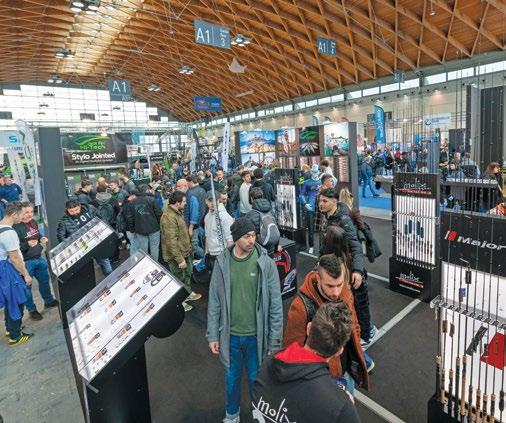
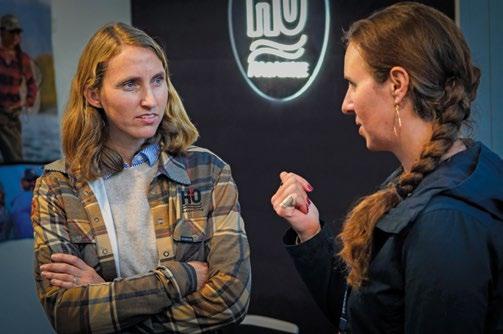
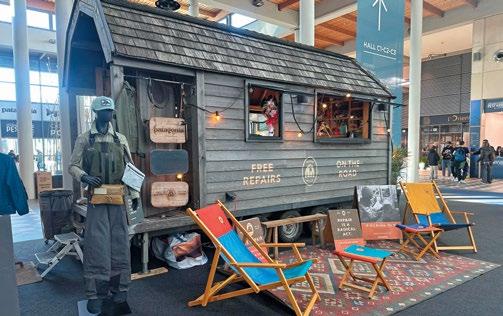
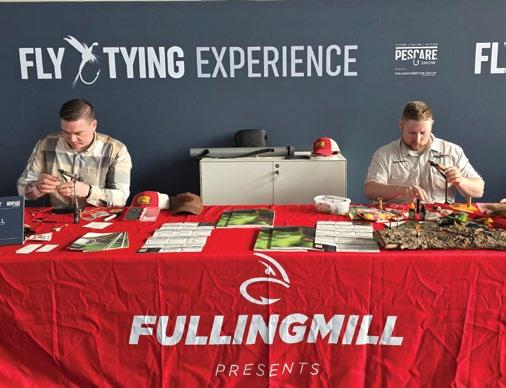
Dopo aver consolidato il proprio ruolo di principale manifestazione italiana dedicata alla pesca sportiva e alla nautica da diporto, Pescare Show guarda al futuro con rinnovata ambizione. Abbiamo incontrato Valentina Dario Exhibition Manager della FIERA per approfondire le ragioni di una crescita che negli ultimi anni ha portato l'evento a una dimensione sempre più internazionale, tra nuove sfide, innovazione e progetti per le prossime edizioni.
Un team quasi tutto al femminile in un settore prettamente maschile, sarà questo il motivo del grande successo del Pescareshow?
Un Team quasi tutto al femminile è senza dubbio uno degli ingredienti fondamentali del successo di Pescare Show. Post-Covid, abbiamo affrontato momenti davvero difficili ma attraverso la nostra determinazione abbiamo provato a riportare una visione fresca, empatica e innovativa in un mercato che aveva bisogno di essere ascoltato. Abbiamo instaurato relazioni solide con stakeholder e aziende leader, realizzando così un evento più internazionale che nella passata edizione ha attratto espositori e visitatori da tutta Europa. Ovviamente non è l'unico motivo – conta sicuramente la nuova location, unica nella sua struttura come il Polo Fieristico di Rimini , quartier generale di IEG SPA. Non dimentichiamo, però, per par condicio che il team Marketing è composto “anche” da uomini. Sicuramente in minoranza, ma ci sono!
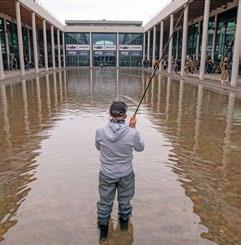
Credete abbia contribuito al successo la location di Rimini, che con queste vasche di lancio spaziali non ha rivali in Europa? Assolutamente sì, la location di Rimini è un fattore chiave del nostro successo e rappresenta un vantaggio competitivo unico. Le sue strutture moderne, con vasche centrali che sembrano studiate appositamente per le prove di lancio e le
demo – tra le più grandi e tecnologiche in Europa – permettono esperienze immersive che in nessun’altra location possono essere replicate. Rimini, con il suo appeal turistico e grazie alla comoda fermata dei treni Regionali e Alta Velocità direttamente in Fiera, facilitano l'accesso per espositori e visitatori, catalizzando un vasto pubblico proveniente anche dal Sud, dalle Isole e internazionale. Inoltre, nel territorio si respira cultura di mare e conoscenza del mondo della nautica; la pesca sportiva, inoltre, è una pratica molto diffusa, anche a livello quotidiano e cittadino. Questa sede ha sicuramente amplificato il rilancio, rendendo la Manifestazione un punto di riferimento per il settore e la sua grandissima Community.
Come vedete il futuro del mercato della pesca in Europa?
Il mercato della pesca sportiva in Europa è in una fase di crescita promettente, trainata da trend come la sostenibilità ambientale, l'innovazione tecnologica nelle attrezzature e un rinnovato interesse per il benessere e il mondo outdoor. Nonostante le sfide economiche e normative (come le restrizioni sulle acque), i giovani che si avvicinano alle discipline della pesca sportiva ma anche a quella ricreativa fatta di appassionati, sono sicuramente in aumento, specialmente nelle nazioni del Nord e dell'Est Europa. In particolare Pescare Show vuole posizionarsi al centro di questa evoluzione, promuovendone le best practice e contribuendo come HUB per la divulgazione e perché no, per l’innovazione. Grazie anche alla collaborazione e supporto della FEDERAZIONE ITALIANA PESCA SPORTIVA E ATTIVITA’ SUBACQUEE e con associazioni e stakeholders internazionali come EFTTA, EFFA e IGFA che ci aiutano a rendere il nostro messaggio ancora più globale.
Progetti per il futuro?
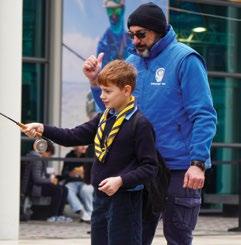
Guardiamo al futuro con ambizione: per l'edizione 2027 puntiamo ad ampliare la nostra offerta merceologica dando maggiore spazio all’outdoor lifestyle e agli accessori legati al mondo della Pesca a Mosca oltre che a prove di lancio, ospiti internazionali, laboratori e talks. Andremo ad implementare il settore della nautica, dell’elettronica e della motoristica, inserendo anche la motonautica, che sempre più creano forti sinergie con i brand della pesca sportiva, cercando di completare con novità e spunti, senza dimenticare però il consumatore finale: andremo ad inserire anche un livello più accessibile al pubblico, ossia l’usato. Stiamo già lavorando a nuove aree speciali ed esperienziali che saranno ovviamente la cornice perfetta per ospitare le performance nelle vasche all’esterno e in ACQUADEMO di ambassador e prostaff ospitati da noi e dalle aziende. Siamo soddisfatte del percorso che stiamo seguendo ma consapevoli che il lavoro da fare è ancora tanto: l’obiettivo è quello di rendere la fiera un evento imperdibile al fine di tenere ingaggiata la community per l’intero fine settimana.
Rimini e il suo territorio in questo ambito ci aiutano per l’importante vocazione turistica e per l’ immensa accoglienza. L’appuntamento è a Rimini il 12, 13, 14 Febbraio 2027
Interview with Valentina Dario, Exhibition Manager
Following its consolidation as Italy’s leading trade show dedicated to sport fishing and recreational boating, Pescare Show is looking to the future with renewed ambition. We met with Valentina Dario Exhibition Manager to discuss the factors behind its recent growth, which has transformed the show into an increasingly international gathering, and to explore the challenges, innovations and projects shaping its future editions.
A predominantly female team in what has traditionally been a male-dominated sector. Could this be one of the reasons behind Pescare Show’s success?
A predominantly female team is certainly one of the key ingredients behind the success of Pescare Show. In the postCovid period, we faced significant challenges, but through determination and commitment we brought a fresh, empathetic and innovative vision to a market that needed to be heard. We built strong relationships with stakeholders and leading companies, helping to create a more international event that now attracts exhibitors and visitors from across Europe. Of course, this is not the only reason for our success. The new venue has also played a major role, while, for the sake of fairness, we should mention that the marketing team includes a few men as well—although they remain a minority.
Do you believe the Rimini venue has contributed to the show’s success, particularly with its outstanding casting pools, which have few rivals in Europe?
Absolutely. The Rimini venue has been a key factor in our success and provides a unique competitive advantage. Its modern facilities, featuring some of the largest and most advanced demonstration pools in Europe, allow for immersive experiences that are difficult to replicate elsewhere. Combined with excellent transport links, a strong maritime culture and a large community of anglers, Rimini has helped establish the show as a leading reference point for the industry.
How do you see the future of the sport fishing market in Europe?
The European sport fishing market is entering a promising phase of growth, driven by trends such as environmental sustainability, technological innovation in equipment and a renewed interest in wellbeing and outdoor activities. Despite economic and regulatory challenges, including restrictions affecting certain fisheries, participation among younger generations continues to grow, particularly in Northern and Eastern Europe. Pescare Show aims to position itself at the centre of this evolution by promoting best practices and serving as a hub for knowledge sharing and innovation.
This mission is supported by our collaboration with the Italian Federation of Sport Fishing and Underwater Activities, as well as international organisations and stakeholders such as EFTTA, EFFA and IGFA, whose contribution helps us deliver an increasingly global message.
What are your plans for the future?
We look to the future with ambition. For the 2027 edition, we plan to expand our product offering by giving greater visibility to outdoor lifestyle activities and accessories connected to the world of fly fishing, while also increasing casting
demonstrations, international guests, workshops and talks.
We will further develop the boating, electronics and engine sectors, including powerboating, which is creating everstronger synergies with sport fishing brands. At the same time, we are committed to serving end consumers by introducing a dedicated pre-owned equipment area, making the event even more accessible to the public.
We are already working on new experiential and themed areas that will provide the perfect setting for performances and demonstrations in the outdoor casting pools and in the Acquademo area, featuring ambassadors and pro staff hosted by both the show and participating companies.
We are pleased with the direction we are taking, while fully aware that there is still much work ahead. Our goal is to make the show an unmissable event and keep the community engaged throughout the entire weekend.
In this respect, Rimini and its surrounding area offer invaluable support thanks to their strong tourism vocation and renowned hospitality.
The next appointment is in Rimini on 12–14 February 2027.
INTERVIEW WITH IGOR GORTAN - WATER MANAGEMENT IN CARNIA
Intervista IGOR GORTAN
LA GESTIONE DELLE ACQUE IN CARNIA
Intervista
LA GESTIONE DELLE ACQUE IN CARNIA
Sono Igor Gortan, nato in Carnia, dove attualmente vivo e pesco. La Carnia è la zona montana della provincia di Udine, situata a nord-ovest del Friuli Venezia Giulia.
Le acque dei suoi torrenti mi hanno formato sotto il profilo della pesca. Negli anni ho abbracciato diverse tecniche, per
poi approdare alla pesca a mosca.
Proprio la passione per la pesca, la natura e l’amore per la mia terra mi spingono a un forte senso di protezione e salvaguardia delle acque della Carnia, sostenendo e proponendo progetti di sviluppo ambientale legati alla valorizzazione delle acque e dei loro abitanti.
Allora Igor, innanzitutto parlaci della tua passioneperlapescaamosca?
Ho iniziato grazie a mio padre. Era la fine degli anni Ottanta quando, una sera, mi portò nel prato dietro casa e mi mise in mano una canna da mosca. Pescavo già da diversi anni con esche naturali e spinning. Conoscevo la pesca a mosca
perché, durante le uscite estive, mio padre mi accompagnava con la sua attrezzatura. Poco dopo mi mise davanti a un morsetto e, sotto i suoi insegnamenti, costruii la mia prima Red Spinner. Il morsetto era artigianale, costruito da mio padre con pezzi di rame, ottone e una valvola da termosifone; la base era parte di un
calamaio. Purtroppo non so che fine abbia fatto. Le piume che utilizzavamo in quel periodo provenivano da vecchi cuscini e da uccelli cacciati da mio padre. Nel corso degli anni ho alternato diverse tecniche di pesca, per poi passare stabilmente alla pesca a mosca, cercando di approfondire e imparare il più possibile.
My name is Igor Gortan. I was born in Carnia, where I currently live and fish. Carnia is the mountainous area of the province of Udine, located in the north-west of Friuli Venezia Giulia. The waters of its streams have shaped me as an angler. Over the years, I have embraced different fishing techniques before eventually focusing on fly
fishing. My passion for fishing, nature, and my homeland drives a strong sense of responsibility to protect and preserve Carnia’s waters, supporting and proposing environmental development projects aimed at enhancing aquatic ecosystems and their inhabitants.
I started thanks to my father. It was the late 1980s when one evening he took me to the field behind our house and put a fly rod in my hands. I had already been fishing for several years using natural bait and spinning
techniques. I was familiar with fly fishing because during our summer outings my father would fish with his fly rod. Soon after, he introduced me to fly tying: under his guidance, I tied my first Red Spinner. The vise was handmade, built by my father using pieces of copper, brass, and a radiator valve, with a base
made from part of an inkwell. Unfortunately, I don’t know what happened to it. The feathers we used at that time came from old pillows and birds hunted by my father. Over the years, I alternated between different fishing techniques before settling permanently on fly fishing, always trying to learn and improve. Today, I
Attualmente preferisco la mosca secca, anche se pratico tranquillamente anche le altre tecniche.
Sappiamo che, oltre alla passione per la pesca a mosca, hai un incarico nelle amministrazioni locali
Esatto, mi occupo dell’amministrazione. Questo per dare un’impronta di innovazione e portare avanti nuovi progetti, oltre alla gestione ordinaria e straordinaria della polis. In un paese
di montagna è un impegno che richiede molto tempo ed energie. Ci sono equilibri fragili e delicati che vanno rispettati e che si intrecciano con tradizione, ruralità, innovazione e ambiente naturale.
Parlaci del progetto appena partito in Carnia
Da un paio di anni è partito un progetto turistico legato alla pesca. Si è formata una rete
Lapescainquestezonecomevienegestita?
In tutto il Friuli Venezia Giulia la pesca è gestita dall’Ente Tutela Patrimonio Ittico, un ente regionale; di fatto, le acque interne sono gestite dal settore pubblico. Per esercitare l’attività di pesca è necessario essere in possesso di una licenza rilasciata dall’E.T.P.I., oppure acquistare permessi giornalieri. Attualmente è
di sette comuni: Forni Avoltri, Paularo, Forni di Sopra, Sauris, Arta Terme, Forni di Sotto e Sappada.
Il progetto prevede la promozione del territorio e delle sue bellezze naturali.
Si propongono viaggi di pesca sia sul mercato nazionale sia su quello internazionale.
Oltre alla pesca, è possibile svolgere altre attività all’aria aperta, visitare musei, aziende e vivere esperienze enogastronomiche.
possibile acquistare un massimo di 16 permessi giornalieri all’anno. Oltre al rilascio dei permessi, reperibili online tramite l’app APPesca.FVG o presso i centri convenzionati, l’ente gestisce le acque e gli impianti di ripopolamento.
Sappiamochelaqualitàdellevostreacque è molto alta
Si dice che le acque della Carnia siano tra le più pure d’Italia. Oltre a un’elevata estensione di sponde pescabili, si trovano importanti popolazioni di pesce selvatico di varie taglie. Il progetto turistico in corso offre la possibilità di pescare pesci completamente selvatici. Questo è stato possibile grazie a una gestione adeguata delle acque negli ultimi anni, con immissioni
prefer dry fly fishing, although I also practice other methods.
Weknowthat,besidesyourpassionforfly fishing, you also hold a role in local administration
That’s right, I work in public administration. My goal is to bring innovation and develop new projects, alongside managing ordinary and extraordinary administrative activities. In a
mountain village, this requires a great deal of time and energy. There are delicate and fragile balances that must be respected, intertwining tradition, rural life, innovation, and the natural environment.
Tellusabouttheprojectrecentlylaunched in Carnia
Over the past couple of years, a tourism project linked to fishing has been launched. A network
Howisfishingmanagedintheseareas?
In the entire Friuli Venezia Giulia region, fishing is managed by the Regional Fish Resources Authority (E.T.P.I.), meaning that inland waters are publicly managed. To fish, it is necessary to hold a license issued by E.T.P.I., or to purchase daily permits. Currently, up to 16 daily permits per year can be purchased.
of seven municipalities has been formed: Forni Avoltri, Paularo, Forni di Sopra, Sauris, Arta Terme, Forni di Sotto, and Sappada. The project focuses on promoting the area and its natural beauty. Fishing trips are offered both on the national and international markets. In addition to fishing, visitors can enjoy outdoor activities, visit museums and local businesses, and experience a wide range of food and wine traditions.
Permits are available online via the APPesca. FVG app or through authorized centers. The authority also manages water bodies and fish stocking facilities.
We’veheardthatthequalityofyourwaters isveryhigh
It is said that Carnia’s waters are among the
purest in Italy. In addition to a vast number of fishable riverbanks, there are strong populations of wild fish of various sizes. The ongoing tourism project offers the opportunity to catch truly wild fish. This has been made possible thanks to careful water management in recent years, including the introduction of fertilized eggs, fry, and juvenile fish. Species currently
di uova embrionate, avannotti e materiale giovanile. Le specie attualmente pescabili sono trote marmorate, trote fario e ibridi; nei laghi alpini si trovano anche salmerini alpini e salmerini di fonte. Per quanto riguarda il temolo, la regione sta sviluppando un progetto di recupero del temolo padano, utilizzando popolazioni locali per preservarne il genotipo.
Avete anche un’associazione guide locale, giusto?
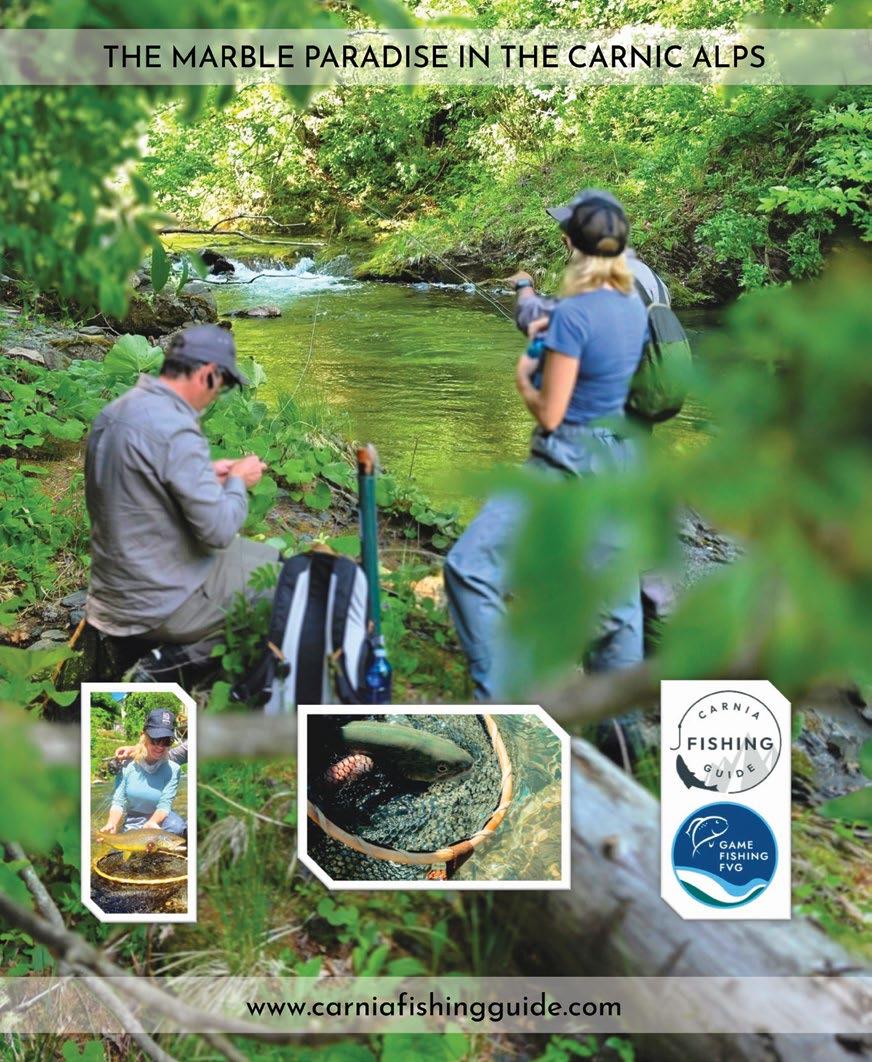
Da due anni è nata la Carnia Fishing Guide, che riunisce le guide di pesca operanti in Carnia. Lo scopo principale è promuovere il territorio attraverso materiale divulgativo distribuito nelle fiere di settore e l’organizzazione di eventi locali. L’associazione collabora con diversi consorzi turistici che propongono pacchetti di viaggio dedicati alla pesca. Grazie a questa collaborazione è possibile offrire un servizio completo, includendo il rilascio dei permessi e integrando i pacchetti con attività per tutta la famiglia. Inoltre, l’associazione collabora con l’E.T.P.I. nella gestione delle acque, intervenendo su base volontaria per la semina di uova e avannotti e per il monitoraggio degli ambienti fluviali.
Progettiperilfuturo?
Per il futuro si intende proseguire e ampliare il lavoro svolto finora, continuando a promuovere il territorio anche sul mercato internazionale e partecipando a fiere di settore in Europa e oltre. Nel 2026 siamo stati presenti al Pescare Show di Rimini, una delle principali fiere internazionali in Italia. Abbiamo presentato la nostra terra con uno stand dell’associazione, parlando di pesca, trote selvatiche e di taglia, ma anche di escursioni, ciclismo, equitazione, sci, B&B, alberghi, complessi termali e molto altro. Il mio sogno nel cassetto è riuscire a portare la gestione delle acque a un livello locale, per migliorarne ulteriormente la qualità, che, a detta dei visitatori, è già molto alta.
available include marble trout, brown trout, and hybrids; alpine lakes are home to Arctic char and brook trout. As for grayling, the region is developing a recovery project for the native Adriatic grayling, using local populations to preserve its genetic identity.
You also have a local fishing guide association,right?
Yes, two years ago Carnia Fishing Guide was established, bringing together fishing guides operating in the area. Its main goal is to promote the region through educational materials distributed at trade fairs and by organizing local events. The association collaborates with several local tourism consortia that offer fishing travel packages. Thanks to this collaboration, a fullservice experience can be provided, including fishing permits and additional activities for the whole family. The association also works with E.T.P.I. in water management, contributing on a voluntary basis to fish stocking and monitoring river environments.
Whatareyourplansforthefuture?
For the future, we would like to continue and expand the work started so far, promoting the area internationally and participating in trade fairs across Europe and beyond. In 2026, we were at Pescare Show in Rimini, one of the most important international fishing exhibitions in Italy. We showcase our region with an association stand, talking about fishing, wild trout, and trophy-sized fish, as well as hiking, cycling, horseback riding, skiing, B&Bs, hotels, spa facilities, and much more.
My dream is to achieve a locally managed water system, in order to further improve water quality, which visitors already consider to be very high.
LA SCOPERTA DI VANCOUVER ISLAND
THE DISCOVERY OF VANCOUVER ISLAND
Lungo la costa orientale dell’isola di Vancouver, di fronte alla provincia canadese della British Columbia, scorre il Campbell River, il selvaggio fiume che dà il
nome all’omonima cittadina. Questo centro vive di pesca commerciale e sportiva e, nei mesi di settembre, ottobre e novembre, diventa meta di numerosi pescatori locali e stranieri.
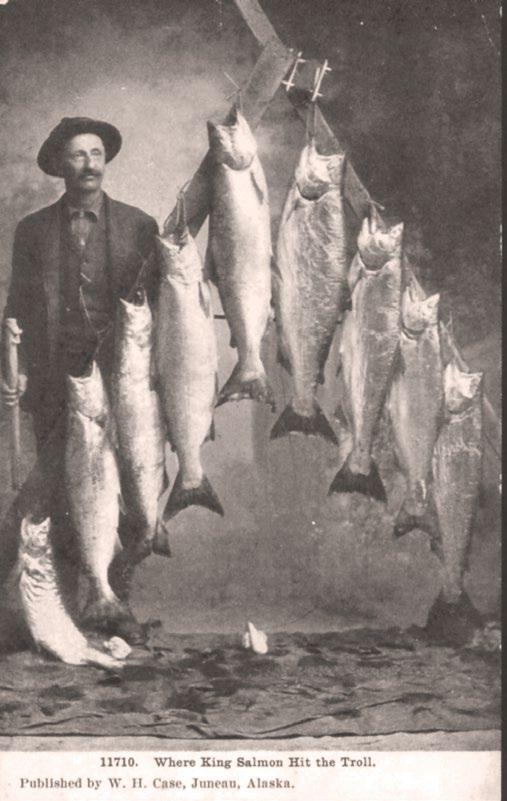
Con un grande bacino a monte che ne regola il flusso pressoché costante, il fiume ha una lunghezza di circa 5 km e sfocia in mare senza grandi dislivelli. Questo lo rende famoso per le importanti risalite di tutte e cinque le specie di salmoni del Pacifico: il Red, detto anche Sockeye o salmone rosso; il Pink o salmone rosa; il Dog, o Chum, detto anche salmone cane; il Silver, o Coho; e il King, il salmone reale, chiamato anche Spring o Tyee. Oltre a questi, anche la Steelhead è presente in discreta quantità, con esemplari che possono raggiungere le 14–16 libbre.
La notorietà del Campbell River è dovuta anche alla sua storia: già nei primi anni del ’900 troviamo riferimenti a questo splendido fiume. Nei primi articoli dedicati alla pesca del salmone del Pacifico, apparsi nei cataloghi Hardy intorno al 1900, si trovano riferimenti ad attrezzature appositamente costruite per questa tecnica di pesca e per la cattura di un portentoso pesce chiamato “Tyee”.
La passione inglese per la pesca portò, intorno al 1898, alla fondazione del “Tyee Club” della British Columbia. Il primo racconto dedicato alla pesca del Tyee apparve sulla rivista londinese Field nel 1896. Fu scritto da Sir Richard Musgrave, che descrisse l’eccellente pesca sul
Along the eastern coast of Vancouver Island, facing the Canadian province of British Columbia, flows the Campbell River, the wild river that gives its name to the town of the same name. This town lives on commercial and sport fishing and, during the months of September, October, and November, becomes a destination for numerous local and international anglers.
With a large upstream reservoir regulating its almost constant flow, the river is about 5 km long and flows into the ocean without major elevation changes. This makes it famous for the strong runs of all five species of Pacific salmon: the Red, also known as Sockeye or red salmon; the Pink, or pink salmon; the Dog, or Chum salmon; the Silver, or Coho salmon; and the King salmon, also called Spring or Tyee.
In addition to these species, Steelhead are also present in good numbers, with specimens reaching 14–16 pounds. The fame of the Campbell River is also tied to its history: references to this remarkable river can already be found in the early 1900s. In the first articles about Pacific salmon fishing published in Hardy catalogs around 1900, there were references to tackle specifically designed for this fishing technique and for the capture of a powerful fish called the “Tyee.”
British passion for fishing led, around 1898, to the founding of the “Tyee Club” of British Columbia. The first account of Tyee fishing appeared in the London magazine *Field* in 1896. It was written by Sir Richard Musgrave, who described the excellent fishing on the Campbell River in September of that year.
Musgrave used a canoe guided by an Indigenous guide from Cape Mudge; in one week, he and his friend W.H. Gordon caught nineteen Tyee, the largest weighing 70 pounds. Mr. A. Fanning of the Royal Victoria Museum created a model of this fish, which was displayed in Piccadilly and considered for many years the largest salmon ever caught in the world on rod and reel.
Musgrave’s salmon was caught using a 12foot greenheart rod and a wooden-and-brass Nottingham-style reel; the lure was reportedly a copper spoon. A photograph of the salmon caught by Musgrave is now preserved at the Natural History Museum in South Kensington, London.
Naturally, fishing soon spread throughout British Columbia, and King salmon became the cornerstone of the region’s fishing tradition. Some of the most important and experienced
anglers have fished the Campbell River: Zane Grey, Lord Astor, the King of Siam, the Hardy brothers, and many others.
Zane Grey first fished the Campbell in 1919, as described in his book *Tales of Fresh Water Fishing*. At that time, anglers fished from canoes using very heavy rods, but Zane Grey instead chose to fish with lighter tackle.
In 1924, the Tyee Club was officially established, and certain restrictions were introduced regarding equipment in order to make the fishing more sporting. To become members of the club, anglers had to catch a Tyee weighing at least 30 pounds using specific tackle and land it without assistance; motorized boats were prohibited.
The president of the Tyee Club from 1940 to 1945 was Wallace McMillan, holder of the catch record in 1939, 1940, 1943, and 1945.
In the following years, the Campbell River experienced a major increase in tourism, both from North America and Europe, becoming today a must-visit destination for anglers who travel through the Vancouver area.
Campbell River nel settembre di quell’anno.
Musgrave utilizzò una canoa guidata da una guida indigena di Cape Mudge; in una settimana, lui e il suo amico W.H. Gordon catturarono diciannove Tyee, il più grande dei quali pesava 70 libbre. A. Fanning, del Royal Victoria Museum, realizzò un modello di questo pesce, che venne esposto a Piccadilly e considerato per molto tempo il salmone più grande mai pescato al mondo con una canna.
Il salmone di Musgrave fu catturato con una canna in greenheart lunga 12 piedi e un mulinello tipo “Nottingham” in legno e ottone; l’esca pare fosse un cucchiaino in rame. Una fotografia del salmone catturato da Musgrave è oggi custodita al Museo di Storia Naturale di South Kensington, a Londra.
Naturalmente, la pesca si diffuse presto in tutta la British Columbia e il King salmon divenne l’elemento fondamentale della tradizione alieutica della regione. Alcuni dei più importanti ed esperti pescatori hanno pescato nel Campbell River: Zane Grey, Lord Astor, il re del Siam, i fratelli Hardy e molti altri.
Zane Grey pescò nel Campbell per la prima volta nel 1919, come racconta nel suo libro Tales of Fresh Water Fishing. A quei tempi si pescava in canoa con canne molto pesanti, ma Zane Grey decise invece di utilizzare un’attrezzatura più leggera.
Nel 1924 venne ufficialmente costituito il Tyee Club e furono introdotte alcune restrizioni sull’uso dell’attrezzatura per rendere la pesca più sportiva. Per diventare membri del club,
i pescatori dovevano catturare un Tyee di almeno 30 libbre con un’attrezzatura specifica e portarlo a riva senza assistenza; le barche a motore erano vietate.
Il presidente del Tyee Club dal 1940 al 1945 fu Wallace McMillan, detentore del record di catture negli anni 1939, 1940, 1943 e 1945.
Negli anni successivi il Campbell River vide un forte incremento del turismo, sia americano e canadese sia europeo, diventando oggi una meta obbligata per tutti i pescatori che frequentano i dintorni di Vancouver.
GIANT TROUT SPAIN
IN
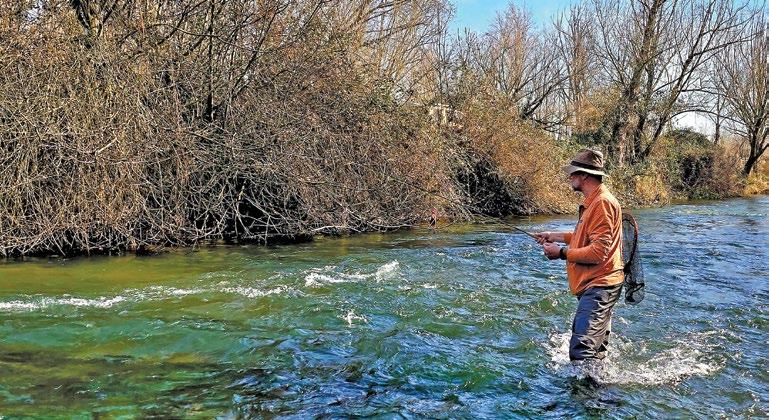
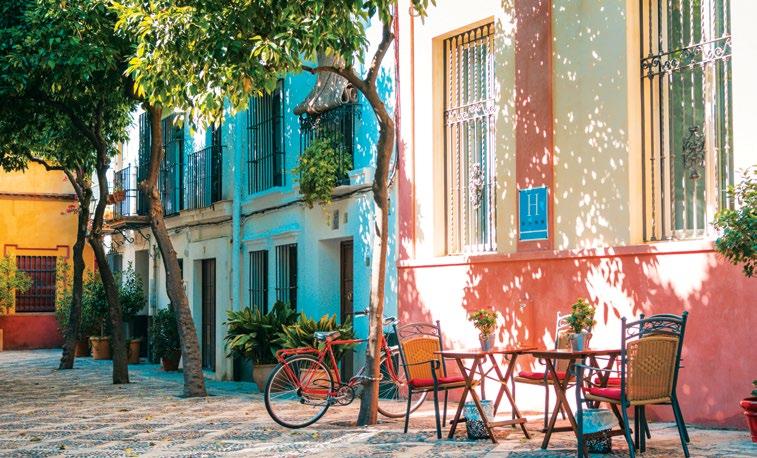
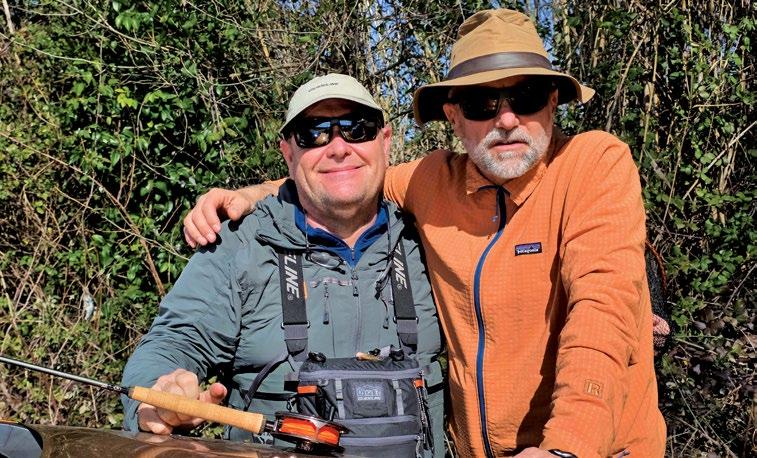
Il lancio di H2O Magazine Spagna e l’evento organizzato dagli amici Chano e Daniel del negozio The Fly Center di Madrid sono stati una buona occasione per me e per l’amico Mario per trascorrere alcune giornate di pesca con i maestri spagnoli della pesca a ninfa: Javier Peña, la sua compagna Iris e Dany García. La partenza per una battuta di pesca in Spagna avviene spesso da Madrid: la capitale è il cuore della Comunità Autonoma omonima, una metropoli vibrante e cosmopolita. Il suo centro storico ospita monumenti come il Palazzo Reale, la Puerta del Sol, Plaza Mayor, il Museo
del Prado e il Parque del Retiro. È una città ricca di cultura, arte, gastronomia e vita notturna. Ma Madrid ha anche un lato naturale: il Parco Regionale della Cuenca Alta del Manzanares, nel settore nord, con ambienti forestali e acquatici, ospita fauna ittica come barbi, carpe, lucci e trote nei bacini e nello stesso fiume Manzanares. Questo equilibrio tra città e natura rende Madrid una destinazione interessante anche per chi vuole praticare la pesca sportiva nei dintorni, grazie a una buona rete di bacini e fiumi facilmente raggiungibili.
La destinazione di questo viaggio si trova a circa quattro ore di auto da Madrid, nei pressi del paese di Alfarràs. Nel cuore dei Pirenei spagnoli, tra le montagne della Catalogna occidentale, scorre uno dei fiumi più interessanti d’Europa per la pesca a mosca alla trota: il fiume Noguera Ribagorzana.
Nel tratto che attraversa il piccolo paese di Alfarràs, questo corso d’acqua si trasforma in un vero paradiso per gli appassionati di pesca a ninfa, offrendo acque cristalline, trote combattive e condizioni tecniche di altissimo livello. Il tratto controllato del Noguera
The launch of H2O Magazine Spain and the event organized by our friends Chano and Daniel from The Fly Center in Madrid provided a great opportunity for my friend Mario and me to spend a few days fishing with some of Spain’s masters of nymph fishing: Javier Peña, his partner Iris, and Dany García.
Fishing trips in Spain often begin in Madrid. The capital is the heart of its autonomous community, a vibrant and cosmopolitan metropolis. Its historic center is home to landmarks such as the Royal Palace, Puerta
del Sol, Plaza Mayor, the Prado Museum, and Retiro Park. It is a city rich in culture, art, gastronomy, and nightlife.
But Madrid also has a natural side: the Cuenca Alta del Manzanares Regional Park, to the north, with its forested and aquatic environments, is home to fish species such as barbel, carp, pike, and trout in its reservoirs and in the Manzanares River itself. This balance between city and nature makes Madrid an interesting destination for sport fishing in the surrounding area, thanks to a well-developed network of easily accessible rivers and reservoirs.
The destination of this trip is located about four hours by car from Madrid, near the town of Alfarràs. In the heart of the Spanish Pyrenees, among the mountains of western Catalonia, flows one of Europe’s most interesting rivers for trout fly fishing: the Noguera Ribagorçana River.
In the stretch that runs through the small town of Alfarràs, this river becomes a true paradise for nymph-fishing enthusiasts, offering crystalclear water, hard-fighting trout, and highly technical fishing conditions. The regulated section of the Noguera Ribagorçana at Alfarràs
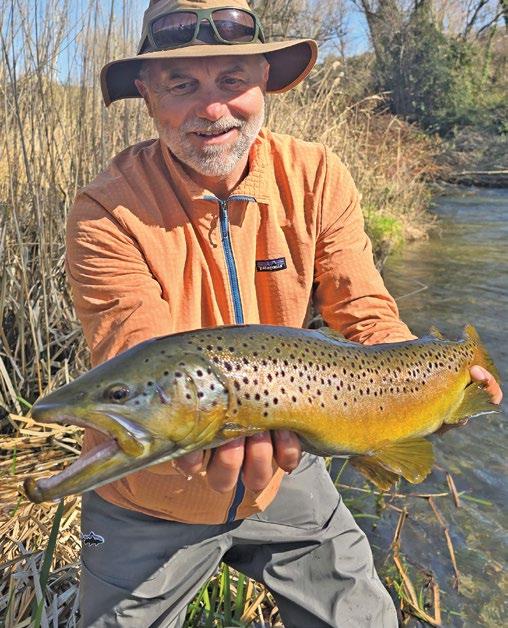
Ribagorzana ad Alfarràs è considerato da molti pescatori uno dei migliori spot spagnoli per la pesca alla trota. Ogni anno pescatori provenienti da tutta Europa arrivano qui per tentare la cattura di grandi trote fario e iridee, specie che popolano stabilmente queste acque fredde e ossigenate.
Il tratto di pesca si estende per circa 12 chilometri, suddivisi in diversi settori. Il segmento più interessante per la pesca tecnica è quello a monte, lungo circa 3 km, dove la presenza di trote di taglia è particolarmente elevata. Il fiume qui presenta una larghezza media compresa tra 8 e 12 metri, con profondità generalmente inferiori a 1,5 metri: condizioni ideali per la pesca a ninfa al tocco o con tecnica europea.
Se nei Pirenei la pesca a mosca secca regala momenti spettacolari durante le schiuse estive, ad Alfarràs la tecnica regina è senza dubbio la pesca a ninfa, spesso praticata con canne lunghe e finali sottili. Le correnti veloci, i raschi e le buche profonde creano habitat perfetti per insetti acquatici come efemerotteri, plecotteri e tricotteri, di cui le trote si nutrono costantemente.
I pescatori più esperti utilizzano ninfe leggere o perdigones molto affondanti per raggiungere rapidamente il fondo, dove le trote sostano in attesa del cibo trasportato dalla corrente. La pesca è estremamente tecnica: deriva naturale, controllo della linea e lettura dell’acqua diventano elementi decisivi per avere successo. Le acque del Noguera Ribagorzana sono note
is considered by many anglers to be one of the best trout-fishing destinations in Spain. Every year, anglers from all over Europe come here in search of large brown and rainbow trout, species that thrive in these cold, oxygen-rich waters.
The fishery extends for approximately 12 kilometers and is divided into several sectors. The most interesting section for technical fishing is the upper stretch, about 3 km long, where the presence of larger trout is particularly high. Here, the river averages between 8 and 12 meters in width, with depths generally under 1.5 meters—ideal conditions for European nymphing.
While dry-fly fishing in the Pyrenees can provide spectacular moments during summer hatches, in Alfarràs the dominant technique is undoubtedly nymph fishing, often practiced with long rods and fine leaders. Fast currents, riffles, and deep pools create the perfect habitat for aquatic insects such as mayflies, stoneflies, and caddisflies, which trout feed on continuously.Experienced anglers use light nymphs or heavily weighted perdigones to reach the bottom quickly, where trout hold while waiting for food carried by the current. The fishing is extremely technical: natural drift, line control, and water reading are decisive elements for success.The waters of the Noguera Ribagorçana are known for their high fish density and the presence of impressive specimens. During competitive events held in the Alfarràs section, hundreds of trout have been caught in just a few days, all released in accordance with a strict catch-and-release philosophy. It is not uncommon to encounter trout exceeding 50–60 cm, powerful fish that use the current for long, strong runs. The fights are often spectacular and test even very experienced anglers.
In the Spanish Pyrenees, the Alfarràs stretch of the Noguera Ribagorçana is a must-visit destination for anyone who loves technical fly fishing. Perfect currents, crystal-clear water, and high-quality trout make this river one of the most fascinating nymph-fishing destinations in Europe.
Here, anglers find not only fish, but also an authentic environment where technique, observation, and respect for the river become an integral part of the experience. Above all, we realized just how much Spaniards have mastered a highly evolved fishing technique.
per l’alta densità di pesce e per la presenza di esemplari di dimensioni notevoli. In competizioni sportive organizzate nel tratto di Alfarràs sono state catturate centinaia di trote in pochi giorni, tutte rilasciate nel rispetto della filosofia catch & release. Non è raro incontrare trote che superano i 50–60 cm, pesci potenti che sfruttano la corrente del fiume per lunghe
fughe. I combattimenti sono spesso spettacolari e mettono alla prova anche pescatori molto esperti.
Tra le montagne dei Pirenei spagnoli, il tratto del Noguera Ribagorzana ad Alfarràs rappresenta una destinazione imperdibile per chi ama la pesca a mosca tecnica. Qui il pescatore non trova soltanto pesce, ma un ambiente autentico
dove tecnica, osservazione e rispetto del fiume diventano parte integrante dell’esperienza.
Soprattutto, ci siamo resi conto di quanto gli spagnoli siano padroni di una tecnica di pesca estremamente evoluta.
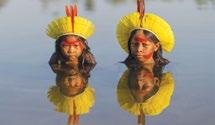
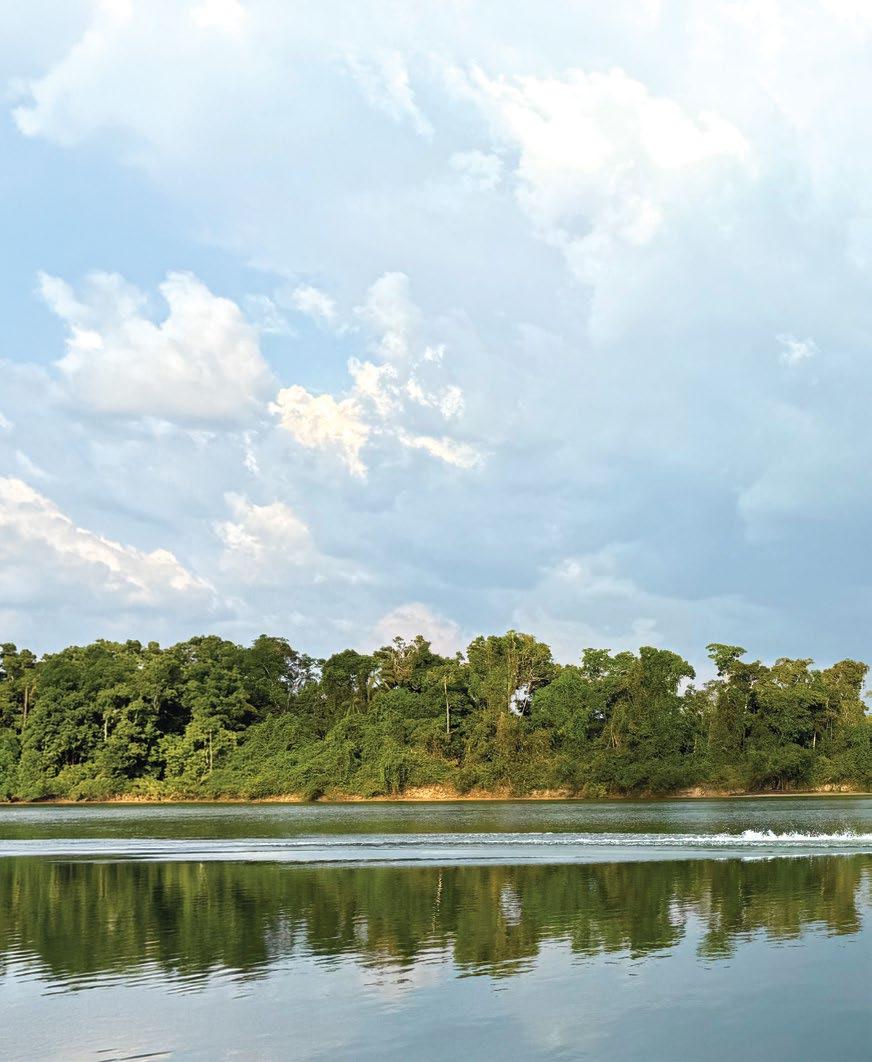
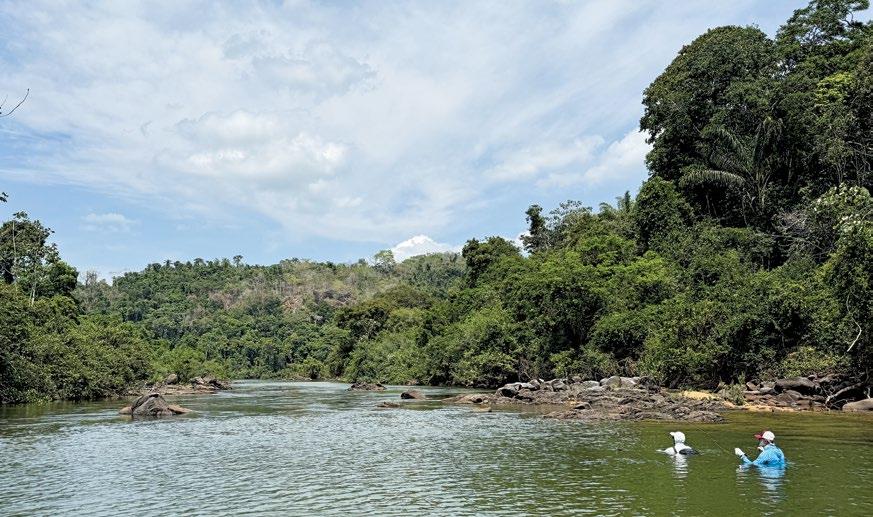
Sono partito dalla Tanzania solo qualche giorno fa e mi trovo di nuovo immerso in una foresta tropicale. È una foresta nuova, diversa, immensa. È una foresta fatta di colori diversi, di suoni diversi, di profumi diversi. Allo stesso modo sono diversi (e numerosissimi!) i pesci che popolano le acque di questi fiumi: alcuni dalle acque fangose, altri con acque tanniniche, del colore del tè, altri ancora con
acque cristalline, simili a quelle dei fiumi da trote. Questa grande varietà di fiumi e habitat si riflette nel fatto che la più grande foresta pluviale del mondo, l’Amazzonia, ospiti la più grande diversità ittica al mondo: basti pensare che nel solo bacino del Rio delle Amazzoni si possano trovare più specie di pesci che in tutto l’Oceano Atlantico. Sono inoltre numerose le specie che ogni anno vengono descritte come
...È una foresta nuova, diversa, immensa...
nuove per la scienza e sono ancora di più, indubbiamente, quelle che attendono ancora un nome scientifico.
È con questi pensieri che, assieme a mio padre, mi accingo a salire su un piccolo Cessna da undici posti che ci porterà, dopo quattro ore di volo sopra lo stato di Amazonas e quello del Pará, alla piccola ed erbosa pista di atterraggio
Ileft Tanzania only a few days ago, and I already find myself immersed once again in a tropical forest. But this is a new forest, different, immense. It’s a forest of different colors, different sounds, different scents. And just as diverse (and incredibly numerous!) are the fish inhabiting these rivers: some in muddy waters, others in dark, tannin-stained streams the color of tea, and others still in crystal-clear
creeks reminiscent of trout rivers. This immense variety of waterways and habitats reflects the fact that the largest rainforest on Earth—the Amazon—hosts the world’s greatest freshwater fish diversity: the Amazon Basin alone contains more fish species than the entire Atlantic Ocean. Every year, numerous species are described as new to science—and undoubtedly many more still await a name.
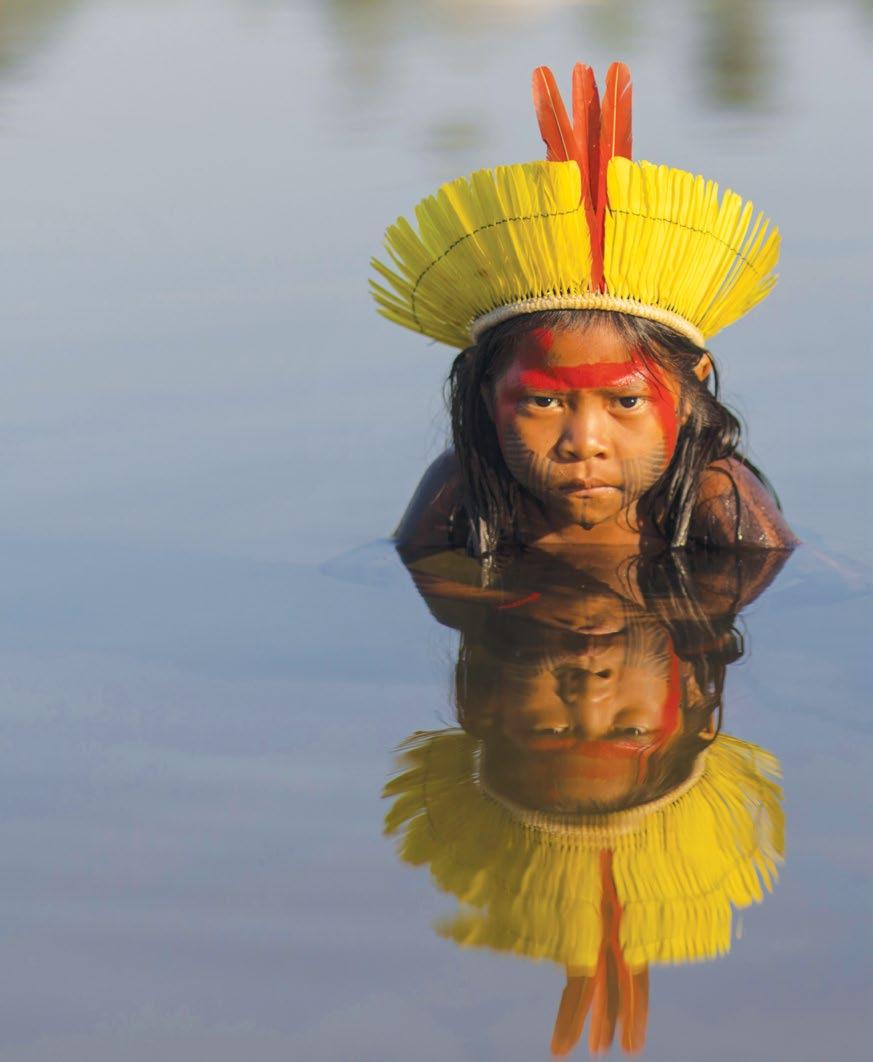
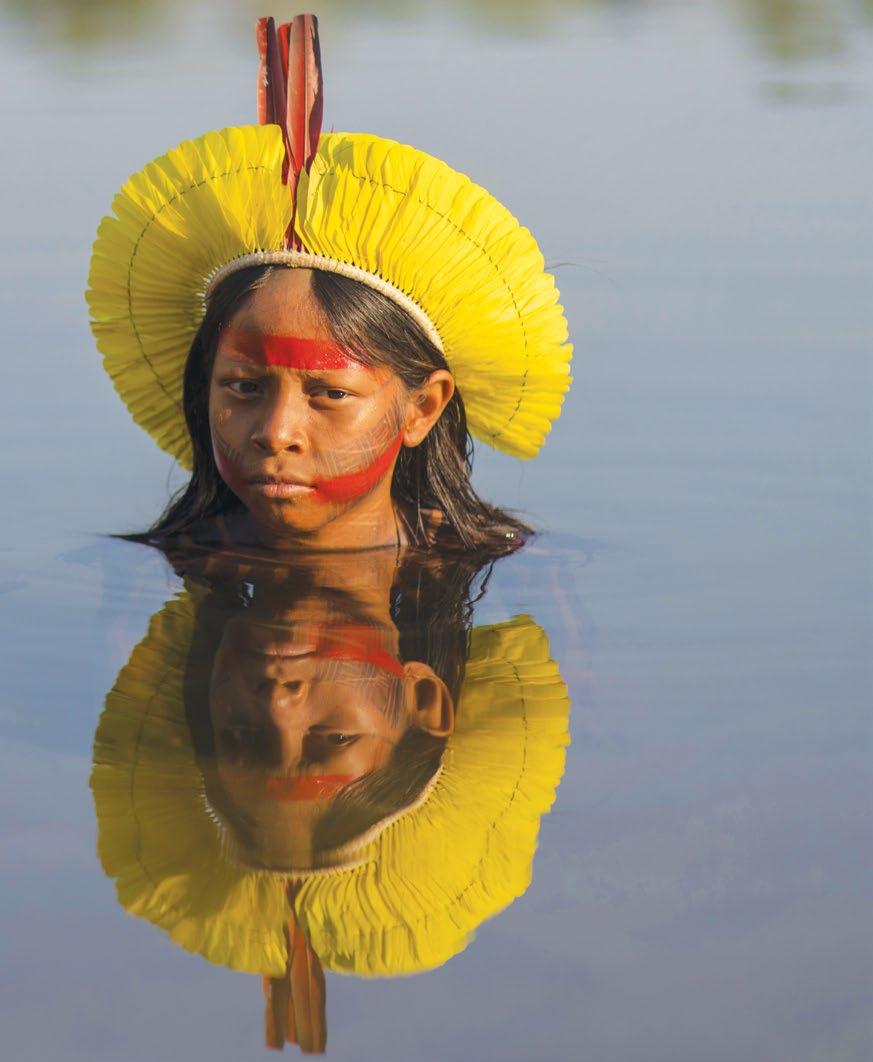
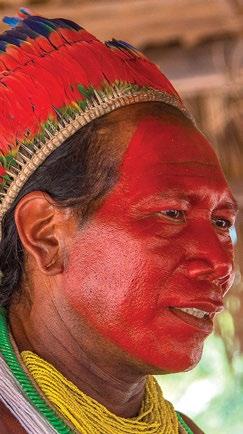
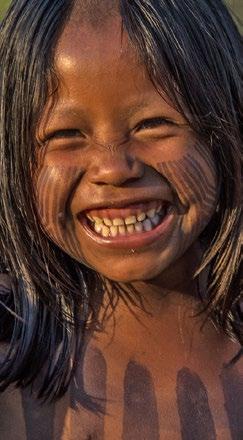
With these thoughts in mind, my father and I board a small eleven-seat Cessna for a four-hour flight over the states of Amazonas and Pará, bound for the small grassy airstrip at Kendjam village, inside the Menkragnoti Indigenous Territory. Established in 1994, Menkragnoti is home to 626 Kayapó people across 5 million hectares—50,000 km². The Kayapó are doing a remarkable job of safeguarding the rainforest
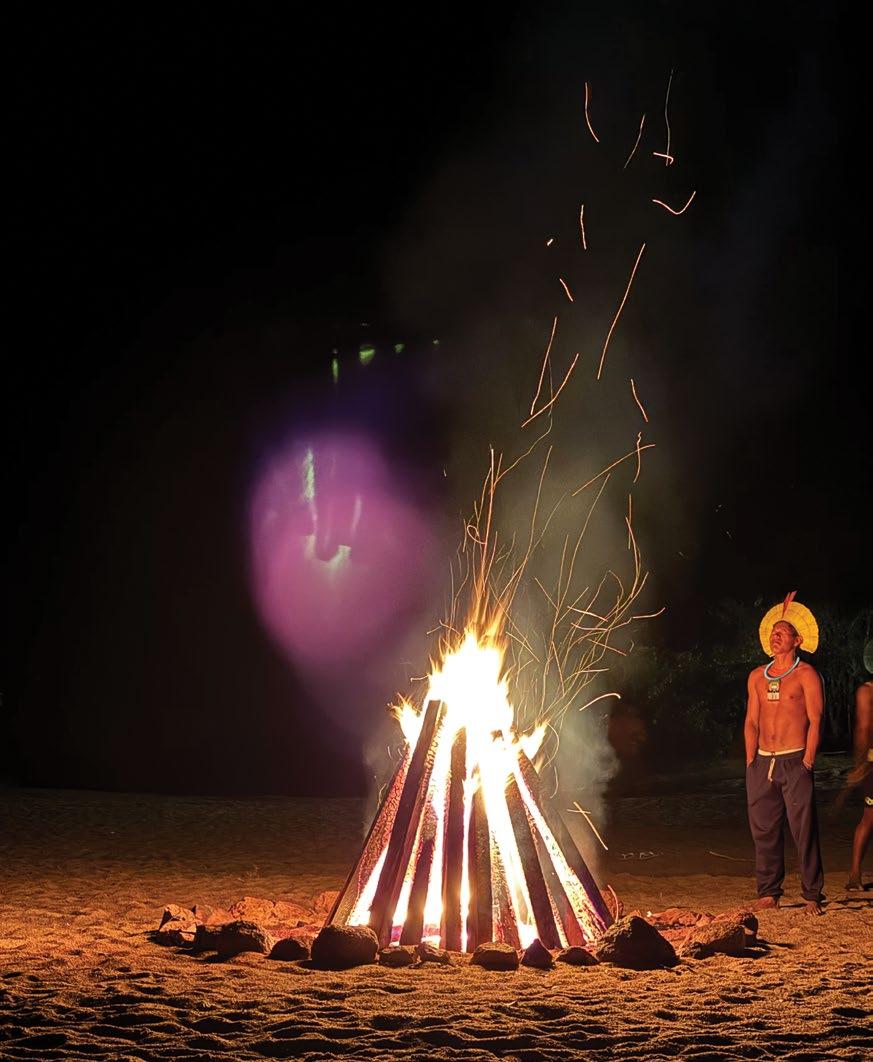
del villaggio di Kendjam, nel Territorio Indigeno Menkragnoti. Istituito nel 1994, il territorio Menkragnoti ospita 626 Kayapó, su una superficie di 5 milioni di ettari, pari a 50 mila km². I Kayapó stanno facendo un ottimo lavoro nel conservare la foresta pluviale in cui vivono, mentre tutto intorno attività più o meno legali tagliano foresta, dragano e inquinano fiumi con mercurio alla ricerca dell’ultima pagliuzza d’oro e coltivano in maniera insostenibile vaste porzioni di territorio che erano, fino a non tanto tempo fa, ricoperte da foresta vergine.
Ma atterrare a Kendjam è come fare un salto indietro nel tempo, e sono alcuni pannelli solari, un quad e le barche di alluminio a ricordarci di non essere a metà del ventesimo secolo, quando molti dei sottogruppi Kayapó sono stati contattati per la prima volta dagli occidentali. Nonostante ora sia diventato d’uso comune anche tra loro stessi, Kayapó è un nome improprio, che deriva dal nome spregiativo con cui le comunità confinanti si riferivano a loro: Kayapó significa infatti “coloro che
they depend on, while all around them legal and illegal activities clear land, dredge and contaminate rivers with mercury in search of gold, and convert once-virgin rainforest into unsustainable farmland.
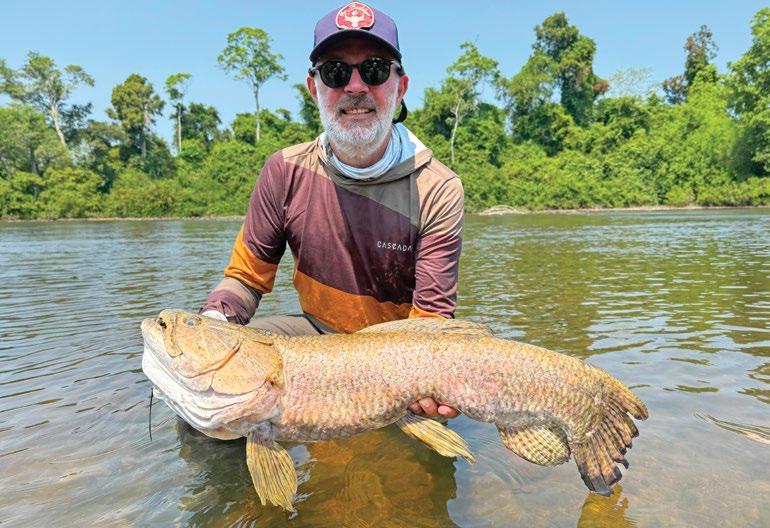
Landing in Kendjam feels like stepping back in time; only a few solar panels, an ATV, and aluminum boats remind us that we are not in the mid-1900s, when many Kayapó subgroups first encountered the outside world. Although now widely used, “Kayapó” is actually a misnomer, originally a derogatory label from neighboring groups meaning “those who resemble monkeys,” likely referring to what was perceived as a prehistoric lifestyle (the Kayapó historically had neither iron nor pottery). They called themselves “Mebêngôkre,” meaning “the people from the water”—a name that could not be more fitting for this extraordinary tribe.
They are a people of few words and gestures, but with a deep, meticulous, ancient knowledge of their rivers and everything living in them. They know exactly where turtles have buried their
assomigliano alle scimmie”, probabilmente per via dello stile di vita ritenuto preistorico (sotto tanti punti di vista; infatti i Kayapó non hanno mai sviluppato la conoscenza del ferro né della terracotta). I Kayapó erano soliti chiamarsi “Mebêngôkre”, ossia “il popolo che viene dall’acqua”, e non penso che ci potesse essere un nome più adatto per questa fantastica tribù.
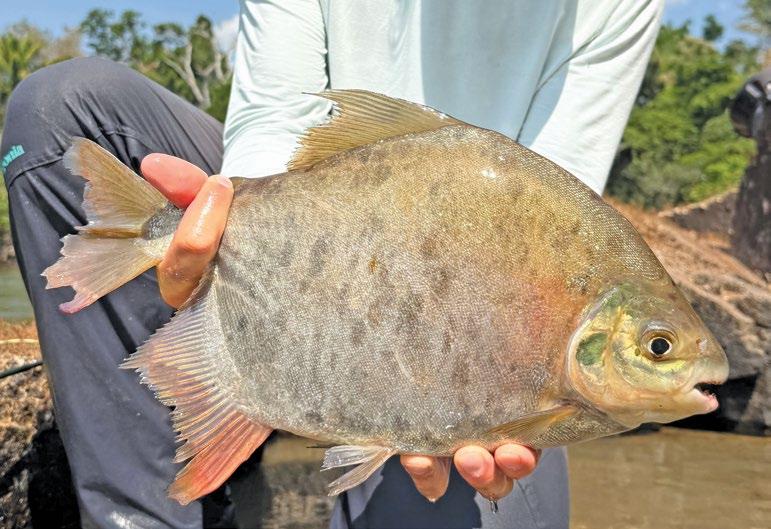
Sono persone di poche parole e pochi gesti, ma con una conoscenza profonda, minuziosa, antica dei loro fiumi e dei loro abitanti. Conoscono il banco di sabbia nel quale sicuramente le testuggini hanno deposto le uova (una prelibatezza stagionale per i Kayapó, crude e sbattute con zucchero), la corrente che passa sotto un fico in maturazione dove sicuramente i Pacu sono aggregati in attesa della caduta del loro prossimo pasto, le anse del fiume dove risiedono gli spiriti maligni (una sorta di combinazione tra lontre giganti e grosse anaconde), dove è meglio non avventurarsi o bagnarsi per rinfrescarsi durante una torrida giornata di pesca.
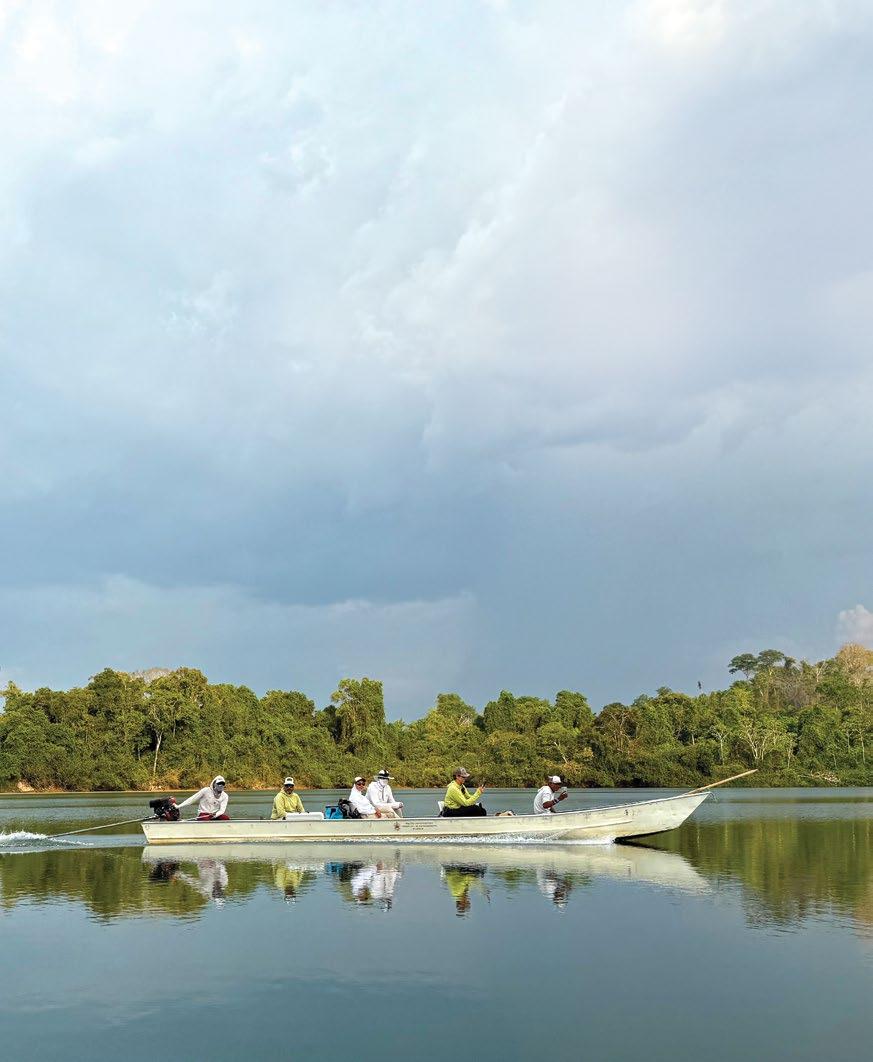
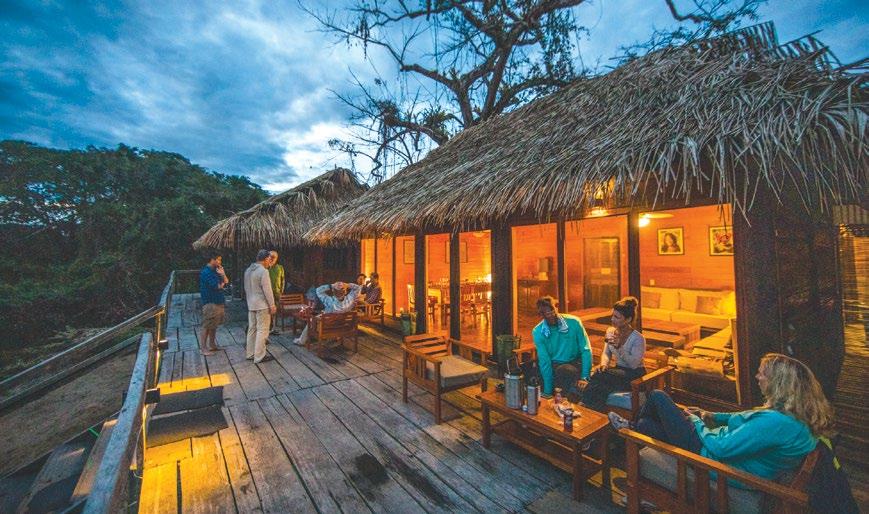
eggs in the sandbanks (a seasonal delicacy eaten raw and whipped with sugar), where Pacu stack up in the shadowy current beneath a fruiting fig tree, awaiting their next meal to drop, and which river bends are haunted by evil spirits—a mythical blend of giant otters and anacondas—where it’s best not to swim or cool off on a sweltering day out fishing. Sharing a boat for a week with Kemú, Teptchore, and others has been a privilege— being guided by them in the pursuit of a powerful Matrinxã or a prehistoric wolf-fish hidden beneath a boulder. We are guests of Kendjam Lodge, a highly regarded operation run by Untamed Angling, which brings around eighty fly anglers each year—over a short, three-month season—into the heart of Menkragnoti territory to target a dozen species of wild Amazonian sport fish.
The fly fishing here is extremely diverse, starting with Peacock Bass (a possible new species closely related to Cichla melaniae of the nearby Xingu). We target them with 6- to 8-weight rods, floating or intermediate lines,
È quindi un grande privilegio aver condiviso per una settimana la barca con Kemú, Teptchore e gli altri, e farsi guidare nella ricerca di una grossa Matrinxa o di un preistorico pesce lupo nascosto per tre quarti sotto un sasso. Siamo ospiti del Kendjam Lodge, una rodata operazione di Untamed Angling che ogni anno porta circa un’ottantina di pescatori a mosca, in una stagione di circa tre mesi, nel cuore del territorio Menkragnoti, per pescare con la mosca (ninfa, secca, streamer, popper!) una dozzina di specie di pesci tropicali.
La pesca è quindi molto varia e passa dalla ricerca dei Peacock Bass (qui si trova una possibile nuova specie affine a Cichla melaniae del vicino fiume Xingu) con canne dalla 6 alla 8, code galleggianti o intermedie e streamer o popper (principalmente bianchi e/o chartreuse) strippati il più velocemente possibile. Le
cacciate sono fulminee, inaspettate, fragorose e quasi sempre tutto avviene alla vista del pescatore. Io mi sono divertito con una vecchia Sage, la mia fidata XP 9’6” #8, che con la sua azione parabolica mi permetteva sia di godermi il lancio sia il combattimento con questi forti pesci.
Più raro del peacock è il bicuda, un predatore d’agguato del tutto simile a un barracuda. Quando ci si stanca di lanciare e strippare (o di combattere peacock bass), basta sostituire la coda 8 con una 4 o 5 e concentrarsi sulle altre numerose specie che il fiume Iriri ospita. Nelle acque correnti, così come in ombra sotto la folta vegetazione ripariale, è facile trovare grossi banchi di Matrinxa, un pesce della famiglia dei Characidae riconoscibile anche da lontano per la caratteristica coda nera. Le Matrinxa si pescano con grossi grilli e cicale,
cercando di non far dragare la mosca e talvolta muovendola un poco, come farebbe appunto una cavalletta caduta in acqua. La bollata è decisa e fragorosa, ma è importante ferrare con forza per evitare continue slamature: sono infatti pesci dotati di denti affilati e parti ossee molto dure. Non bisogna temere di rompere il finale con la ferrata: si pesca infatti con tip dello 0,35 e, talvolta, addirittura con sottili fili di acciaio per avere più chance di portare a riva grosse Matrinxa o Pacu, con denti ancora più affilati. Quest’ultima specie si trova spesso con le Matrinxa, ma è caratterizzata da una bollata molto più lenta, gentile e dalla sua propensione per le ninfe; infatti spesso peschiamo in New Zealand dropper per aumentare le possibilità di cattura.
Ultima menzione necessaria per il “bulldog” del fiume, il Wolf-Fish. Non ho infatti mai
and streamers or poppers (mostly white and/ or chartreuse), stripped back as fast as possible. Strikes are explosive, unexpected, and almost always visual. I had a blast fishing an old Sage— my trusted XP 9’6” #8—whose moderate-fast, parabolic action let me enjoy both the cast and the fight with these powerful fish.
Less common than Peacock Bass is the Bicuda, a long, razor-toothed ambush predator reminiscent of a barracuda. When you tire of nonstop casting and stripping (or of battling Peacock Bass!), you can downsize to a 4- or 5-weight and focus on other abundant species inhabiting the Iriri River. In flowing runs or shaded under thick gallery forest, large schools of Matrinxã are easy to spot—characins with a distinctive black-tipped tail. We fished them with large terrestrial dries—grasshoppers and cicadas—aiming for a dead-drift presentation,
occasionally adding subtle movement like a struggling insect. The takes are loud and aggressive, but a firm set is crucial; these fish have sharp teeth and extremely hard, bony mouths. There’s no need to care about the tippet breaking—leaders are typically around 0.35 mm, and sometimes we even add thin wire bite guards to avoid being cut off by hefty Matrinxã or Pacu, whose dentition is even more formidable. Pacu often mix with Matrinxã but display much slower, more deliberate rises and frequently take nymphs, so we often fish a dry-dropper or New Zealand-style dropper to double our chances.
A special mention must go to the “bulldog” of the river: the Wolf-Fish. I have never encountered a game fish so utterly unfazed by humans. Kayapó guides often spot trophy fish at the last second, just a few meters away
(sometimes literally at our feet!). Here, large poppers or big articulated streamers are the ticket, provoking their territorial aggression. The smash-take is immediate, and you must drive the hook home multiple times—first with a strip-set, then lifting hard with the rod butt to punch the hook into their rock-hard jaws. The fight is short but chaotic: head-shakes, violent lunges, and wild, frothing jumps. In Kendjam, the days run at full throttle and seem to end far too soon, despite the heat and the blistering sun. Nights are serenaded by the forest, and each dawn—coffee in hand, watching Peacock Bass blitz bait in the shallows in front of the lodge—brims with anticipation for what’s to come. Now I’m back on a plane, headed toward what people call “civilization,” and I already miss the moments spent in the forest—rushing mysterious and fast below me, below my window.
potuto pescare un pesce così poco spaventato dalla presenza dell’uomo. Spesso infatti le guide Kayapó vedono grossi esemplari di questo pesce all’ultimo momento, a pochi metri (a volte proprio sotto i piedi!) da noi. A questo punto è necessario pescare con grossi popper o streamer, con i quali infastidire la territorialità di questi pesci. L’attacco solitamente non tarda ad arrivare ed è necessario ferrare più volte,
prima di coda e poi con il butt della canna, per assicurarsi che l’amo faccia presa nella loro bocca ossea. Il combattimento è veloce, ma con salti, potenti ma corte fughe e continui colpi di testa.
Insomma, a Kendjam le giornate corrono a pieno ritmo e spesso finiscono prima del tempo, nonostante le alte temperature e il sole feroce. Le notti sono cullate dai suoni della foresta e
ogni alba, con una buona tazza di caffè in mano, guardando i peacock cacciare nelle acque basse di fronte al lodge, è carica dell’eccitazione della giornata a venire. Ora sono di nuovo su un aereo verso quella che viene chiamata la “civiltà” e già rimpiango i momenti passati nella foresta, che vedo scorrere veloce e misteriosa, qualche migliaio di metri là sotto, fuori dal mio finestrino.
MARCOS HLACE Intervista
Marcos,parlaciditeediquandohaiiniziato a pescare.
Pesco da quando ero un bambino nella fattoria dei miei nonni a Las Flores, nella provincia di Buenos Aires. Ricordo ancora quando andavo a pescare chatas e dientudos con una canna di bambù, un galleggiante e, naturalmente, dei vermi come esca. Il passo successivo furono le tarariras, e questo significò passare a esche più sofisticate, fino a quando iniziai a usare la mia prima esca artificiale. Mio padre mi portava spesso in campeggio in posti come la zona del Paraná–Zárate. Ho ricordi bellissimi di quei primi anni. La pesca a mosca è entrata nella mia vita solo durante l’adolescenza.
Avevo iniziato a incuriosirmi dopo aver preso dei pesci con la mia canna da spinning, usando un galleggiante di plastica e un finale con la famosa
Bitch Creek, poi i miei amici Juan Bengochea e Pablo Calo hanno cambiato completamente il mio modo di pescare. Eravamo all’università a studiare acquacoltura e approfittavamo di ogni occasione per pescare nel maestoso Limay e in torrenti come il Pichileufú. In quegli anni i miei studi erano strettamente legati alla biologia e alla pesca, e mi fecero appassionare a questo sport. Dopo un po’, ricordo chiaramente il momento in cui Pablo venne da me e mi disse che avremmo dovuto sostenere l’esame per diventare guide. Ed eccomi qui, vent’anni dopo.
pressione sulle attività di pesca? C’è qualcosa nell’ambiente o nella gestione che aiuta a proteggere e mantenere le popolazioni ittiche nonostante l’aumento della pressione? Nel complesso, credo che la qualità della pesca sia influenzata sia dalle persone sia dalla gestione, ma il mio percorso mi aiuta a vedere questo settore da diverse prospettive, con i suoi aspetti positivi e negativi. Cominciamo dalla pesca alla trota in Patagonia, dove ho iniziato a lavorare e dove trascorro ancora la maggior parte del mio
Lavori nel settore dei viaggi di pesca da molti anni. Pensi che la qualità della pesca stiamigliorandoopeggiorando?
Questa è una domanda molto interessante, e porta con sé altre domande: oggi peschiamo in modo diverso? Come sta cambiando la
tempo. Come dappertutto, sempre più persone si avvicinano a questo sport. Anche i social media hanno cambiato tutto: oggi la gente condivide e rende pubblici luoghi che un tempo erano quasi segreti. Di conseguenza, ci sono molti più pescatori nelle acque della Patagonia. Allo stesso tempo, un numero crescente di attività private sta cambiando l’accesso a queste aree, con aziende che stipulano accordi con i proprietari terrieri per evitare le zone troppo affollate. Il modo in cui i fiumi vengono gestiti e
protetti fa una grande differenza. Oggi, inoltre, è molto più facile avere accesso all’attrezzatura. Quando ho iniziato, comprare una canna era molto costoso. Ricordo di essermi immerso con una muta presa in prestito alla foce del Limay, sperando di trovare una coda da lancio persa incastrata tra le rocce, immaginando che fosse stata lasciata lì dal pesce della vita. Oggi quasi tutti possono avere attrezzature che offrono la possibilità di catturare pesci con una canna da mosca. Quindi, la pressione della pesca influisce sulla qualità della pesca? Certamente sì. Prendiamo il Limay come esempio. Molte persone ricordano di aver catturato enormi pesci da 10 kg. Non sono più comuni, ma quella pesca — soprattutto nell’alto Limay — offre ancora esperienze straordinarie. Questo è un esempio che riguarda un ambiente che conosco bene, e rappresenta soltanto una parte del problema. Negli ultimi anni abbiamo anche vissuto inverni poveri di precipitazioni ed estati molto secche a causa del cambiamento climatico. I bassi livelli dell’acqua e i deboli cicli riproduttivi stanno già influenzando la pesca e continueranno a farlo, rendendo la gestione e la conservazione sempre più importanti. Questo si collega anche ad altri luoghi in cui ho lavorato, come il Brasile. Lì esiste una forte cultura della pesca, ma anche un’enorme pressione esercitata dall’industria della pesca commerciale. Molti brasiliani oggi affermano che gli unici luoghi davvero buoni per pescare rimasti sono le aree protette, spesso territori indigeni. Per questo uno dei miei principali obiettivi in questo settore è sensibilizzare le persone sulla conservazione: proteggere ciò che abbiamo ancora e lottare per
So Marcos, tell us about yourself and whenyoustartedfishing.
I’ve been fishing since I was a little kid on my grantparents farm in Las Flores, Provincia de Buenos Aires.
I still remember going fishing for chatas and dientudos with a bamboo cane, a bobber, and worms, of course. The next step was tarariras, and that meant more sophisticated bait fishing until I set up my first artificial lure. My dad used to take me to places like the Paraná–Zárate area to camp.
I have great memories of those early days. Fly fishing didn’t come into my life until I was a teenager.
I was getting curious after catching fish with my spinning rod, using a plastic bobber and a leader with the famous Bitch Creek, when two friends made a big difference in my fishing: Juan Bengochea and Pablo Calo.
We were at university studying aquaculture, and we took every opportunity we had to fish the mighty Limay and creeks like Pichileufú. In those years, my studies were closely related to biology and fishing, which together really hooked me into the sport.
now? How is pressure on fisheries changing? Is something in the environment or in management helping to protect and sustain fish populations despite the increased pressure? Overall, I think the quality of fishing is influenced by both people and management, but my background helps me see the industry from several different perspectives, including both its advantages and disadvantages.Let’s start with trout fishing in Patagonia, where I began working and where I still spend most of
The way rivers are managed and protected makes a huge difference.There is also much better access to equipment nowadays. When I started, getting a rod was very expensive. I remember diving with a borrowed wetsuit at the mouth of the Limay, hoping to find a lost shooting head stuck on a rock, imagining it had been left there by the fish of a lifetime.
After a while, I clearly remember when Pablo came to me and said we should take the guiding exam, encouraging me to do it together.
And here I am, 20 years later.
You’ve been in the fishing trip industry for many years. Do you think the quality offishingisgoingupordown?
That’s a very interesting question, and it leads to other questions: are we fishing differently
my time.Like everywhere else, more and more people are getting involved in the sport. Social media has also changed everything—people now share and expose places that used to be almost secret.
As a result, there are many more anglers on Patagonian waters.
At the same time, an increasing number of private operations are changing access to these areas, with companies making agreements with landowners to avoid crowded spots.
Nowadays, almost everyone has access to equipment that gives them a real chance of catching fish with a fly rod.So, does fishing pressure affect the quality of fishing? Of course it does. Take the Limay as an example. Many people remember catching huge 10 kg fish. They are no longer common, but that fishery—especially the upper Limay—still offers incredible fishing opportunities. That’s one example from an environment I know well, and it represents only one part of the problem.We have also experienced years of poor winters and very dry summers as a result of climate change. Low water levels and weak spawning cycles are already affecting fisheries and will continue to do so, making management and conservation increasingly important. This connects to other places where I’ve worked, such as Brazil. There, there is a strong fishing culture, but also intense pressure from the commercial fishing industry. Many Brazilians now say that the only truly good fishing spots left are protected areas, often Indigenous territories. That is why one of my main goals in this industry is to raise awareness about conservation—to protect what we still have and fight for what is fair, first for fish and river ecosystems, and then for the sport we all love.
ciò che è giusto, prima di tutto per i pesci e gli ecosistemi fluviali, e poi per lo sport che tutti amiamo.
Oraparlacideltuolavoro.
Ho una laurea in acquacoltura, ma la vita mi ha portato in una direzione diversa. Col tempo sono diventato guida di pesca a mosca, istruttore di lancio e fotografo. Attualmente lavoro come guida con El Encuentro Fly Fishing, nella provincia meridionale di Chubut, dove il turismo locale ha un impatto minore.Sono anche il responsabile e la guida principale di un’operazione nell’Amazzonia brasiliana che opera esclusivamente in territori indigeni. Inoltre, faccio da guida per la pesca al salmone atlantico in Islanda.
Abbiamo visto le tue foto straordinarie
La fotografia è arrivata dopo, quasi per caso. Man mano che mi sono dedicato sempre di più alla guida di pesca, ho iniziato a portare con me una macchina fotografica per documentare i viaggi, catturare paesaggi, fauna selvatica, luce e quei momenti che gli ospiti portano a casa come ricordi. Col tempo, mi sono reso conto che la stessa intuizione che uso per leggere un fiume— come la luce, il tempismo, il movimento—mi aiuta anche a fare scatti migliori. In un certo senso, la guida e la fotografia sono cresciute insieme, rafforzandosi a vicenda. Ora sono completamente intrecciate. Una mi mantiene radicato nel presente, l’altra mi permette di congelarlo nel tempo. Sono sempre stato una persona curiosa, ed è questo che mi ha portato inizialmente alla pesca a mosca. È una disciplina che non si padroneggia mai del tutto. C’è sempre qualcosa di nuovo da imparare, qualcosa da perfezionare. Il lancio,
in particolare, sembra inseguire una perfezione che è sempre appena fuori portata, e questa è parte della sua bellezza. La fotografia mi ha reso più attento ai dettagli, anche nel lancio. Ho iniziato a notare la forma dei loop e il percorso della coda nell’aria. Mentre guardo, penso subito: quello è bello… quello non è ancora del tutto corretto. Mi ha reso più osservatore e mi ha insegnato la pazienza, aiutandomi a rallentare e a vedere davvero: la luce sull’acqua, il movimento sottile della corrente, il modo in
cui un pesce si posiziona in una corrente. Sono gli stessi momenti che inseguo quando faccio uno scatto. E funziona anche al contrario. La fotografia influisce sulla mia pesca, affinando il mio sguardo e rendendomi più sensibile al ritmo, alla composizione e ai piccoli dettagli che spesso passano inosservati. Sia la pesca a mosca sia la fotografia richiedono le stesse cose: attenzione, presenza e fluidità.
Sappiamo che stai lavorando a un grande progettonellagiungla.Cenepuoiparlare?
Oggi sono coinvolto in un progetto chiamato Bàkra: Kayapo Forest School. Bàkra integra la conoscenza ecologica tradizionale con tecnologie per la conservazione, per sviluppare capacità di leadership e competenze interculturali. L’obiettivo è aiutare le comunità indigene a orientarsi tra le complesse sfide politiche, ecologiche ed economiche che affrontano in Amazzonia. Il progetto prepara i giovani Kayapó (dai 14 ai 20 anni) a diventare la prossima generazione di guardiani del territorio e custodi della cultura. La terra e la cultura Kayapó sono profondamente connesse e attualmente minacciate. Invasioni illegali da parte di taglialegna, minatori, interessi agricoli e pescatori mettono a rischio le loro terre e le loro acque. Allo stesso tempo, la globalizzazione espone le nuove generazioni a influenze esterne che possono indebolire i valori e la cultura tradizionali. L’istruzione è una delle soluzioni chiave. Gli anziani e i leader Kayapó vogliono che la nuova generazione impari la conoscenza tradizionale e i valori culturali insieme a competenze tecniche, così da poter continuare la loro eredità di protezione del territorio, identità culturale e indipendenza economica.
Progettiperilfuturo?
Mi piacerebbe essere più coinvolto nella pesca in mare. La fotografia e l’istruzione stanno diventando una parte sempre più importante della mia vita, soprattutto con il passare degli anni e i remi iniziano a pesare. Vorrei anche essere maggiormente coinvolto in progetti di conservazione e sostenibilità. Ci sono molte cose interessanti davanti a me— però non voglio esagerare.
Nowtellusaboutyourjob.
I have a degree in aquaculture, but life took me in a different direction.
I developed myself as a fly-fishing guide, casting instructor, and photographer. When we talk about impacted fisheries, I’ve always been drawn to exploring wild waters. Currently, I work as a guide with El Encuentro Fly Fishing in southern Chubut Province, where local tourism has a lower impact. I’m also the manager and head guide of an operation in the Amazon in Brazil that operates exclusively in Indigenous territories.
I also guide for Atlantic salmon in Iceland.
We’ve seen amazing pictures you take many compliments…
Photography came later, almost by accident. As I got more involved in guiding, I started carrying a camera to document trips, capturing landscapes, wildlife, light, and those in-between moments that guests take home as memories.
Over time, I realized that the same intuition I use to read a river, like light, timing, movement, all helps me frame better shots.
In a way, guiding and photography grew together, each sharpening the other. Now they are completely intertwined. One keeps me grounded in the present moment, and the other allows me to freeze it in time.
details, even in casting. I started noticing the shape of loops and the line’s path through the air. I can look and instantly think: that one is beautiful… that one is not quite right.
It made me more observant, more intentional, and taught me patience, made me learn how to slow down and truly see: the light on the water, the subtle movement of a current, the way a fish holds in a seam. These are the same moments I chase when framing a shot.
Nowadays, I’m involved in a project called Bàkra: Kayapo Forest School.
Bàkra integrates traditional ecological knowledge with conservation technologies to develop leadership capacity and cross-cultural skills.
The goal is to help Indigenous communities navigate the complex political, ecological, and economic challenges they face in the Amazon. The project focuses on preparing Kayapó youth (ages 14–20) to become the next generation of territorial guardians and cultural
Kayapó land and culture are deeply connected and currently under threat. Illegal invasions from loggers, miners, agricultural interests, and fishers put their land and waters at risk.
At the same time, globalization exposes younger generations to outside influences that can weaken traditional values and culture.
Education is one of the key solutions.
Kayapó elders and leaders want the next generation to learn traditional knowledge and cultural values alongside technical skills—so they can continue their legacy of territorial protection, cultural identity, and economic independence.
I’ve always been curious by nature, and that’s what first drew me to fly fishing.
It’s a craft you never fully master. There’s always something new to learn, something to refine. Casting, especially, feels like chasing perfection that’s always just out of reach, and that’s part of the beauty.
Photography has made me more aware of
And it works both ways. Photography feeds back into my fishing. It sharpens my eye and makes me more attuned to rhythm, composition, and small details that often go unnoticed. Both fly fishing and photography demand the same things: attention, presence, and flow. When I’m fully immersed, whether with a rod or a camera, it all feels like the same language.
We know you’re working on a great projectinthejungle.Canyoutellusabout it?
Projects for the future?
I’d like to get more involved in saltwater fishing. Photography and education are becoming a bigger part of my life—especially as the years go by and the oars start to feel heavier.
I also want to be more involved in conservation and sustainability projects.
There are a lot of exciting things ahead—I just don’t want to burn out.
CARLOTTA GARIBOLDI ARTE NELLA PESCA
ART IN FISHING
Nata a Milano nel 2001, sono un’artista laureata in Decorazione presso l’Accademia di Belle Arti di Brera, dove sto conseguendo anche la laurea magistrale nello stesso indirizzo. Dal 2023 mi dedico alla tecnica giapponese del Gyotaku, un’antica forma di stampa che utilizza pesci
reali e inchiostro per registrarne l’impronta. Per me non è solo una tecnica, ma un gesto rituale e narrativo. Questa pratica nasce da un legame profondo con il mondo della pesca, radicato nella storia della mia famiglia: Garue, la nostra bottega storica, è attiva a Milano dal 1885 ed è nata come negozio di pesca a mosca. Nel 2024 ho presentato la mia prima
Born in Milan in 2001, I am an artist with a degree in Decoration from the Brera Academy of Fine Arts, where I am also pursuing a master’s degree in the same field. Since 2023, I have been dedicated to the Japanese technique of Gyotaku, an ancient form of printing that uses real fish and ink to capture their imprint.
For me, it is not just a technique, but a ritualistic and narrative gesture. This practice stems from a deep connection with the world of fishing, rooted in my family’s history: Garue, our historic workshop, has been operating in Milan since 1885 and was originally founded as a fly-fishing shop. In 2024, I presented my first solo exhibition, CONTROCORRENTE, at Piero Manzoni’s former studio in Brera, Milan. Today, my works are gradually entering private collections, homes, and hospitality spaces in various parts of the world.
mostra personale, CONTROCORRENTE, presso l’ex studio di Piero Manzoni in Brera, a Milano. Oggi le mie opere stanno entrando gradualmente in collezioni private, case e strutture alberghiere in diverse parti del mondo.
BANKS Farasan
Ho sempre creduto che la vera bellezza della pesca a mosca non risieda solo nell’emozione della cattura, ma nelle storie che si sviluppano con ogni lancio, ogni lotta e ogni vittoria guadagnata con fatica. Questa convinzione è stata confermata durante una recente spedizione alle remote Farasan Banks, in Arabia Saudita, dove ho avuto il privilegio di accompagnare Katka Svagrova, una pescatrice a mosca incredibilmente determinata e abile, in un viaggio che avrebbe messo entrambi alla prova.
I’ve always believed that the true beauty of fly fishing lies not just in the thrill of the catch, but in the stories that unfold with every cast, every struggle, and every hard-earned victory. This belief was reaffirmed during a recent expedition to the remote Farasan Banks in Saudi Arabia, where I had the privilege of accompanying Katka Svagrova, an incredibly determined and skilled fly fisher, on a journey that would push both of us to our limits.
My role on this trip was twofold: I was there
Il mio ruolo in questo viaggio era duplice: da un lato pescare anch’io, ovviamente, ma anche documentare l’esperienza come fotografo di Katka. Era una prospettiva unica, che mi ha permesso di osservare da vicino la sua passione, le sue difficoltà e i suoi successi. Ma oltre a questo avevo anche un obiettivo personale: catturare un Indo-Pacific permit, uno dei pesci più elusivi e ambiti nel mondo della pesca a mosca. Era un obiettivo molto ambizioso, soprattutto in acque a me sconosciute, ma ero determinato a riuscirci.
to do a bit of fishing, of course, but I had also agreed to document the experience as Katka’s photographer. It was a unique perspective, allowing me to witness her passion, her struggles, and her triumphs up close. But beyond that, I had a personal goal of my ownto catch an Indo-Pacific permit, one of the most elusive and sought-after fish in the fly fishing world. It was a lofty ambition, especially in these unfamiliar waters, but I was determined to make it happen.
The Farasan Banks are a place few have
Le Farasan Banks sono un luogo che pochi hanno esplorato, figuriamoci pescato. Situate nel cuore del Mar Rosso, rappresentano una fauna marina incontaminata, ricca di vita ma ancora in gran parte inesplorata dai pescatori. Il viaggio era organizzato da Arabian Fly e Fly Castaway, due realtà note per la loro capacità di spingersi oltre i limiti della pesca a mosca. La nostra base era una comoda nave madre che navigava durante la notte, portandoci ogni mattina in nuove zone di pesca vergini. L’idea di svegliarsi ogni giorno con la promessa
ventured to, let alone fished. Located in the heart of the Red Sea, this area is an unspoiled wilderness, teeming with marine life yet largely unexplored by anglers. The trip was organized by Arabian Fly and Fly Castaway, two outfits known for their commitment to pushing the boundaries of what’s possible in the world of fly fishing. Our base of operations was a comfortable mothership that sailed through the night, bringing us to new, untouched fishing grounds each morning. The idea of waking up each day with the promise of exploring waters
di esplorare acque mai viste da una mosca era entusiasmante.
Fin dall’inizio era chiaro che questo viaggio significava molto più di una semplice avventura di pesca per Katka. Aveva pescato in alcune delle destinazioni più famose al mondo, dall’Australia alle Maldive, ma il giant trevally — noto per la sua potenza e ferocia — le era sempre sfuggito. Questo viaggio alle Farasan Banks era la sua occasione.
L’inizio…
Il primo giorno siamo stati accolti da un caldo tale che sembrava potesse sciogliere la pelle. Il sole era già alto quando siamo saliti sulle piccole imbarcazioni dirette al primo spot. Katka, indifferente alle condizioni meteorologiche, preparava la sua attrezzatura con estrema precisione. La sua concentrazione era assoluta: era evidente che era arrivata in Arabia Saudita con un unico obiettivo. Avvicinandoci all’isola, una scogliera imponente a forma di piramide si è stagliata davanti a noi, creando un’ombra
sull’acqua. La guida, che stava scrutando la superficie, ha improvvisamente indicato l’acqua. Un branco di giant trevally è apparso dal nulla, le sagome scure tagliavano le acque basse e limpide. Ho afferrato rapidamente la macchina fotografica, ma era difficile distogliere lo sguardo dall’azione. La reazione di Katka è stata immediata. Con un rapido colpo di polso ha fatto volare la sua mosca verso il pesce. Non c’era esitazione: era il momento per cui si era preparata per tutta la vita. La mosca aveva appena toccato l’acqua quando uno dei GT è scattato in avanti, inghiottendola in un lampo. Il mulinello ha iniziato a urlare mentre il pesce è scattato via, e Katka si è preparata alla lotta. Dal mio punto di osservazione ho assistito alla potenza pura del pesce mentre cercava di fuggire, tirando la coda con una forza incredibile. Katka ha reagito con tutte le sue energie, mentre cercava di impedire al pesce di infilarsi tra i coralli. Scattavo foto il più velocemente possibile, catturando l’intensità del combattimento, e nell’aria si percepiva chiaramente la tensione.
that had never seen a fly was exhilarating. From the moment we embarked, it was clear that this trip meant more to Katka than just a fishing adventure. She had fished some of the world’s most renowned saltwater locations, from Australia to the Maldives, but the giant trevally - a fish widely known for its sheer power and ferocity – had, somehow, always eluded her. This trip to the Farasan Banks was her chance to change that, to finally land the fish that had haunted her dreams. Meanwhile, I kept my permit rod within reach at all times, hoping for a shot at a fish that had equally captured my imagination.
Beginnings…
On our first day, we were greeted by the kind of heat that feels like it could melt the skin right off your bones. The sun was already high as we boarded the small boats that would take us to our first fishing spot. I watched as Katka, undeterred by the conditions, prepared her gear with meticulous care. Her focus was absolute; it was clear she had come to Saudi Arabia with a single goal in mind.
As we approached the island, a towering,
pyramid-like cliff came into view, casting a cool shadow over the water. The guide, who had been scanning the area, suddenly gestured towards the water. A school of giant trevally appeared out of nowhere, their dark shapes cutting through the clear, shallow water. I quickly grabbed my camera, but it was hard to keep my eyes off the action.
Katka’s reaction was immediate. With a quick flick of her wrist, she sent her fly sailing towards the fish. There was no hesitation - this was the moment she had been preparing for her entire life. The fly barely hit the water before one of the GTs surged forward, inhaling it in a flash. The reel screamed as the fish took off, and Katka braced herself for the fight.
From my vantage point, I witnessed the sheer power of the fish as it tried to escape, pulling line with a force that seemed almost impossible. Katka fought back with everything she had, her muscles straining as she worked to keep the fish from diving into the coral. I snapped photos as quickly as I could, capturing the intensity of the battle, but I could feel the tension in the air as everyone watched to see how it would end. After what felt like an eternity, Katka managed
Dopo quella che sembrò un’eternità, Katka riuscì finalmente a portare il GT a guadino. Era un pesce splendido, di circa 80 cm — non un gigante, ma un ottimo esemplare. L’espressione di trionfo sul suo volto è qualcosa che non dimenticherò mai. In quel momento capii che tutto il caldo, il sudore e la fatica erano valsi la pena. Aveva catturato il suo primo giant trevally e, anche se il viaggio era appena iniziato, quella vittoria aveva già qualcosa di epico.
Le distrazioni dei batfish
In una giornata particolarmente memorabile stavamo pescando su un’isola remota e sabbiosa quando Katka ha notato qualcosa di insolito in acqua. Era un batfish — uno dei pochi esemplari che pattugliavano la riva, una creatura rara e dall’aspetto bizzarro, quasi fuori luogo in quelle acque incontaminate. Katka ne è rimasta subito incuriosita e ho potuto vedere gli ingranaggi della sua mente mettersi in moto mentre decideva di insidiarlo. La osservavo attraverso il mio obiettivo mentre iniziava a lanciare verso il batfish, ma ogni tentativo veniva respinto. Era una sfida
to bring the GT to hand. It was a stunning fish, measuring around 80 cm – not a monster fish, but a damn nice fish to start out with. The look of triumph on her face was something I’ll never forget. In that moment, I knew that all the heat, the sweat, and the hard work had been worth it for her. She had caught her first giant trevally, and though the trip had only just begun, the victory felt monumental.
Batfish distractions
On one particularly memorable day, we were fishing on a remote, sandy island when Katka spotted something unusual in the water. It was a batfish – one out of a handful cruising the shoreline, and a rare and strangelooking creature that seemed almost out of place in these pristine waters. Katka was intrigued, and I could see the gears turning in her mind as she decided to target this fish.
I watched through my lens as she began casting to the batfish, each attempt met with a refusal. This was a different kind of challenge - more technical, more about patience and cunning than mere reflexes. Hours passed as she
diversa: più tecnica, più basata su pazienza e astuzia che sui semplici riflessi. Passavano le ore mentre provava mosche diverse e approcci diversi, ma il batfish continuava a essere sfuggente. Il sole iniziava a calare e si percepiva crescere la frustrazione. Ma Katka non era il tipo da arrendersi facilmente. Infine, con l’ultimo lancio, il batfish si è girato e ha preso la mosca. La lotta che ne è seguita è stata intensa, ma diversa da quelle con i GT affrontati fino a quel momento. Era una battaglia di volontà con attrezzatura leggera, e quando una Katka stoicamente paziente è riuscita finalmente a guadinare il batfish, l’espressione di soddisfazione sul suo volto era impagabile. Non ho potuto fare a meno di provare un senso di orgoglio mentre immortalavo il momento con la macchina fotografica.
Mosche speciali – pesci speciali
La settimana stava lentamente giungendo al termine e stavamo scandagliando una flat monumentale quando la guida si irrigidì improvvisamente. «GT», sussurrò, indicando un’enorme ombra che si muoveva verso di noi. Sentivo crescere l’eccitazione mentre Katka
tried different flies, different approaches, but the batfish remained elusive. The sun was beginning to set, and I could see the frustration starting to build. But Katka wasn’t one to give up easily. Finally, with one last cast, the batfish turned and took the fly.
The fight that followed was intense, but in a different way than the GTs we had been targeting so far. It was a battle of wills with light gear involved, and when a stoically patient Katka finally landed the batfish, the look of satisfaction on her face was priceless. I couldn’t help but feel a sense of pride as I captured the moment on camera.
Special flies – special fish
The week was slowly coming to an end, and we were surverying a monumental flat as the guide, suddenly tensed. “GT,” he whispered, pointing to an immense shadow moving towards us. I could feel the excitement building as Katka prepared her line. She had already tied on her rat fly earlier that morning, and her hands were steadily prepared to make the cast despite the adrenaline coursing through her veins.
preparava la sua coda. Aveva già montato la rat fly quella mattina e le sue mani erano pronte a lanciare, nonostante l’adrenalina che le scorreva nel corpo. Il lancio fu perfetto. La mosca cadde sull’acqua con un piccolo splash a pochi metri dal pesce e, per un istante, il tempo sembrò fermarsi. Poi, mentre Katka iniziava a recuperare, il giant trevally esplose in avanti.
Inghiottì la mosca in un’esplosione assordante di schiuma e acqua così violenta che quasi lasciai cadere la macchina fotografica per la sorpresa. Il pesce schizzò via e il volto di Katka si trasformò in una maschera di concentrazione mentre lottava per controllarlo. La tensione era palpabile mentre Katka faceva tutto il possibile per impedire al pesce di infilarsi tra i coralli. Ogni secondo sembrava un’eternità, ma lei non
The cast was perfect. The fly landed with a splash on the surface a few meters ahead of the fish, and for a moment time stood still. Then, as Katka started retrieving the fly, the giant trevally surged forward. It
cedette mai. Infine, dopo quello che parve un tempo infinito, riuscì a portare il GT a guadino. Misurava 97 cm — un pesce enorme sotto ogni punto di vista — e lo sguardo sul volto di Katka diceva tutto. Ce l’aveva fatta. Aveva catturato un giant trevally a mosca in superficie, realizzando un sogno che si era costruita lungo il percorso. Mentre immortalavo il momento, provai un misto di emozioni: orgoglio e ammirazione.
took the fly in a deafening explosion of foam of water, so forcefully that I nearly dropped my camera in surprise. The reel screamed as the fish bolted, and Katka’s face was a mask of concentration as she fought to control it. The tension was palpable as Katka did her best to keep the fish from diving into the coral. Every second felt like an eternity, but she never wavered. Finally, after what seemed like forever, she brought the GT to hand. It measured 97cm - a massive fish by any standard—and the look on Katka’s face said it all. She had done it. She had caught a giant trevally on a surface fly, fulfilling a dream that she has dreamed up along the way.
As I captured the moment, I felt a mix of emotionspride, admiration, and a deep sense of accomplishment. But there was still one more challenge ahead. And this one was mine.
Ma c’era ancora un’ultima sfida davanti a noi. E questa era la mia.
Un momento di riflessione
Mentre navigavamo verso la terraferma, con la nave che tagliava le acque calme del Mar Rosso, ebbi il tempo di riflettere sul viaggio appena concluso. Le Farasan Banks erano state molto più di una semplice battuta di pesca: erano state un’avventura che ci aveva messi alla prova in modi che non avevamo previsto. Per Katka era
And a time for reflection
As we sailed back to the mainland, the ship cutting through the calm waters of the Red Sea, I had time to reflect on the journey we had
stato un percorso di trionfo, finalmente coronato dalla cattura del pesce che le era sfuggito per così tanto tempo. Per me, era stato un percorso di riscatto, il raggiungimento del mio obiettivo personale dopo giorni di fallimenti e occasioni mancate per un soffio. Durante l’ultima sera, mentre il sole scompariva oltre l’orizzonte, provai un profondo senso di pace. Il viaggio era stato lungo e le sfide numerose, ma alla fine era stato tutto ampiamente ripagato. Avevamo pescato in acque inesplorate, affrontato l’ignoto
just completed. The Farasan Banks had been more than just a fishing trip; it had been an adventure that tested us both in ways we hadn’t anticipated. For Katka, it was a journey of triumph, of finally landing the fish that had eluded her for so long. For me, it was a journey of redemption, of finally achieving my own personal goal after days of setbacks and near misses.
On our final evening, as the sun dipped below the horizon, I felt a profound sense of peace. The journey had been long, and the challenges were many, but in the end, it had all been worth
e ne eravamo usciti con storie che sarebbero state raccontate per anni. E mentre riponevo la macchina fotografica per l’ultima volta, capii che le immagini che avevo catturato non erano semplici fotografie, ma lo spirito di un’avventura e la ricerca di un’emozione.
Per informazioni sulla pesca a mosca in Arabia Saudita: www.arabianfly.com www.flycastaway.com
it. We had ventured into uncharted waters, faced the unknown, and come out the other side with stories that would be told and retold for years to come.
And as I put away my camera for the last time, I knew that the images I had captured were more than just photographs - they were memories of a journey that had been as much about the spirit of adventure as it was about the thrill of the catch.
For inquiries about fly fishing in Saudi Arabia, please refer to: www.arabianfly.com and www.flycastaway.com