
H2O Magazine-trimestrale di pesca, turismo e tempo libero. Tarifa R.O.C.: Poste Italiane spaSpedizione in abbonamento postaleD.L. 353/2003 (conv.in L. 27/02/2004 n° 46) art.1, comma 1, CN/BO In caso di mancato recapito inviare al CPO di Bologna per la restituzione al mittente previo pagamento resi. Contiene I.P..
Dans cette’

/
LE
PÊCHE À LA MOUCHE DANS LES PETITS COURS D'EAU / ENTRETIEN AVEC ROBERT KNIGHT LES COUVERTURES DU "THE NEW YORKER" / TRUITE DE TASMANIE / ENTRETIEN AVEC VAL KROPIWNICKI DE L’AUTRE COTE DU MIROIR
LE CHARME DU LAITON / VOYAGER DANS LE MONTANA / L’ATOLL DE FARQUHAR: APPRIVOISER
GÉANT AQUATIQUE
edition:

2








Fürstenfeldbruck near Munich Event Forum Fürstenfeld Saturday 9:00 am to 6:00 pm, Sunday to 5:00 pm Visit us on facebook or on our Website: www.experience-world-flyfishing.com 18th International Experience the
of Fly Fishing 22 and 23 April 2023
World
Fotograf di Redazione: Alessandro Seletti Traduzioni: Rossella Catellani, Elisabetta Longhi Autorizzazione Tribunale di Bologna n°8157 del 01/02/2011 Poste Italiane spa- Spedizione in Abbonamento Postale - 70% - aut. Roc N°20825 del 10/03/2011 - DCB Bologna Una copia € 8, 00 Arretrato € 10,00 Copyright © 2008 Tutti i diritti sono riservati, è vietata la riproduzione anche parziale senza l’autorizzazione della Redazione. Fotografe e manoscritti non richiesti non vengono restituiti.
Per qualsiasi informazione inerente i viaggi trattati nel magazine, vi invitiamo a contattare la Redazione.

H2O anno XV GENNAIO 2023
Giorgio
Montecchio
Direttore Responsabile Sara Ballotta Direttore Editoriale Giorgio Cavatorti Redazione
Cavatorti Via Verdi, 30 42027
Emilia (RE) e-mail: info@ cavatortigiorgio.it FOTO COPERTINA Montana Tourist Board Hanno collaborato a questo numero: EDOARDO PELLIGOTTI , ROBERT KNIGHT, RICCARDO DE STABILE, LARA SILVERTON, JEAN LOUIS TEYSSIÉ, PAUL BUCKLEY, MONTANA TOURIST BOARD, RASMUS OVESEN, MARTIN EJLER OLSEN Art Director E GRAFICA: OMAR GADE, VALENTINA SCARABELLI, ANGLINGCONSULTING.ONE Stampa: “Tipograffa Bertani” Cavriago (RE)
4
Il s'agit du dernier numéro de 2022 et cela fait maintenant une quinzaine d'années que ce magazine a été publié. Malgré le déclin inexorable de la qualité de la pêche dans presque tous les endroits où nous avons voyagé depuis des années, de plus en plus de pêcheurs prévoient dans leur budget de partir loin pour s'adonner à leur passion. Voyager à l'autre bout du monde pour pêcher, autrefois l'apanage de quelques privilégiés, est devenu une habitude pour de nombreux passionnés. Les gens se sont probablement rendu compte qu'il vaut peut-être mieux pêcher quelques jours de moins mais rechercher la qualité, en concentrant sa passion sur quelques semaines par an afn d'effectuer un voyage important et utile à la recherche de vrais poissons. C'est un choix que nous faisons depuis des années, car nous croyons fermement au "peu mais bien". Ce magazine sort pendant que nous sommes au salon de la pêche à la mouche d'Edison (USA) pour promouvoir certaines de nos destinations et lodges de pêche partenaires, après quoi vous pouvez nous trouver aux meilleurs salons de pêche européens.


This is the last issue of 2022 and this magazine has been in print for about ffteen years now. Despite the inexorable decline in the quality of fshing in almost all the places where we have been traveling for years, more and more fshermen are planning to go far to satisfy their passion. Traveling halfway across the world to fsh, once the prerogative of a select few, is becoming a habit of many enthusiasts. It has probably been realized that perhaps it is better to go fshing a few days less but look for quality, concentrating one's passion in a few weeks a year to make an important journey, which is worth it, in search of real fsh. It is a choice that we have made for years, being frmly convinced of the "little but good". This magazine comes out while we are at the Edison fy fshing fair (USA) to promote some of our partner fshing destinations and lodges, then you can fnd us in the best European fshing fairs.
Enjoy the reading.
Editor
note
Adrien
5
Giorgio





8 51 16 32 44 58 68 26 80 6
Contents 8... PÊCHE À LA MOUCHE DANS LES PETITS COURS D'EAU ......FLY FISHING IN SMALL STREAMS 26 LES COUVERTURES DU "THE NEW YORKER" THE COVERS OF "THE NEW YORKER" 16 ENTRETIEN AVEC ROBERT KNIGHT - GUIDE’ PAR LA PASSION INTERVIEW TO ROBERT KNIGHT - DRIVEN BY PASSION AND FOCUSED ON A FEELING 32 TRUITE DE TASMANIE TASMANIA TROUT 58 LE CHARME DU LAITON THE CHARM OF THE BRASS 68 VOYAGER DANS LE MONTANA MONTANA TRIP 80 L'ATOLL DE FARQUHAR: APPRIVOISER LE GÉANT AQUATIQUE FARQUHAR ATOLL: TAMING THE AQUA HULK 44 ENTRETIEN AVEC VAL KROPIWNICKI INTERVIEW TO VAL KROPIWNICKI 51..DE L’AUTRE COTE DU MIROIR ON THE OTHER SIDE OF THE MIRROR 7
Edoardo Pelligotti
Pêche à la mouche dans les

petits cours d'eau
8
FLY FISHING IN SMALL STREAMS

Dans les petits cours d'eau de montagne, caractérisés par des fonds pierreux avec des eaux rapides mais à débit modeste, de manière à former des bassins dont la profondeur dépasse rarement un mètre, entourés d'une épaisse végétation ou encastrés dans la roche, dans tous les cas des milieux restreints et imperméables, la pêche à la mouche sèche est la plus efcace.
Les truites qui vivent dans ces endroits sont aussi sauvages et craintives que possible ; elles représentent pour le pêcheur un déf qui va audelà de leur modeste taille.
Dans les petits cours d'eau, les truites de 30 centimètres sont des prises importantes et désirables ; une fois piquées, elles déclenchent des défenses vigoureuses et imprévisibles, avec des sauts et des rush qui nous rappellent à juste titre combien la vraie truite est une combattante sauvage et irréductible.
En utilisant des cannes très courtes, moins de 7
Fishing with a dry fy is most efective in narrow and inaccessible environments such as small mountain streams characterized by a stony bottom with a fast but modest water fow, so as to form pools where the depth rarely exceeds one meter, surrounded by thick vegetation or embedded in the rocks.
The trout that live in these places are the wildest and most fearful things we can deal with; they represent for the fsherman a challenge that goes beyond their modest size.

In the smaller streams, trout of 30 cm are important and desired catches. Once hooked, they defend themselves in a vigorous and unpredictable way, with jumps and raids in the den that worthily remind us how wild and irreducible fghters the real trout are.
Operating with very short rods less than 7 feet loaded with Fly Line weighing no bigger than number 3, perhaps in silk, with Fly Leaders not exceeding 9ft. in length and using fies on bar-
9
pieds, chargées d'une soie pas plus numéro 3, avec des bas de ligne ne dépassant pas 9 pieds de long, et en utilisant des hameçons sans ardillon, nous causons le moins de dommages possibles aux truites. Le vrai problème de la pêche dans les petits cours d'eau et les ruisseaux couverts de mauvaises herbes est de pouvoir s'approcher des bons spots sans être repéré ou entendu. La pêche doit toujours se faire vers l’amont, en restant bas et en avançant protégé par les obstacles naturels, mais cela peut parfois être insufsant, car les truites peuvent se tapir sur les
côtés du pool et tourner leur attention vers le centre et l'extrémité de celui-ci. Il est également nécessaire d'éviter que notre ombre se projette sur l'eau et que toute action que nous entreprenons perturbe le moins possible ces micro-environnements. À des niveaux inférieurs à la normale, le modeste débit de l'eau transmet les sons et les vibrations de nos pas à une distance considérable et les pools peu profonds avec une surface essentiellement plate exigent des présentations silencieuses ; nos lancers doivent toujours se terminer par le "shoot",

avec des mouvements de canne aussi limités et proches du sol que possible, des lancers courbes sont parfois nécessaires et les diférents Roll Casts ou Bow Casts résolvent facilement des situations souvent difciles.
Des vêtements de camoufage sont préférables, et une paire de bottes en caoutchouc à hauteur de cuisse, ou mieux encore, des bottes en matériau moderne et respirant avec des semelles à bonne adhérence nous aideront dans l'ascension de ces endroits souvent inaccessibles. Une dernière recommandation est de faire attention
10
bless hooks, we will do the least possible damage to the trout.

The real problem of fshing in the smaller watercourses surrounded by tree branches is to be able to get close to good pools without being seen or heard. The fshing action must always be carried out upstream, keeping low and advancing while being protected by natural obstacles. However, this can sometimes be insuffcient, since the trout can lurk on the sides of the hole and then turn their attention towards
the center and the end of the hole. We should avoid projecting our shadow into the water, as any action we take causes the slightest disturbance to these microenvironments. With lower levels than normal, the modest water fow transmits the sounds and vibrations of our footsteps at a considerable distance and the shallow holes with a mostly fat surface require silent presentations. Our casts must always end with the "shoot", with movements of the rod as sober and close to the ground as possible. The curved casts are sometimes necessary and the
various Roll Cast or Bow Cast easily solve often difcult situations.
Camoufage clothing is the most suitable, with a pair of rubber boots as high as the thighs or, even better, in modern breathable material with good grip soles that will help us in the ascent of these often inaccessible places. A fnal recommendation is to pay attention not only to the fshing action, but also to where we put our hands and feet, as vipers are omnipresent.
The choice of the fy is certainly not problem-
11
non seulement à l'action de pêche, mais aussi à l'endroit où nous posons nos mains et nos pieds, les vipères sont omniprésentes.
Le choix de la mouche dans ces cours d'eau n'est certainement pas problématique. Les modèles couramment utilisés comprennent des mouches polyvalentes américaines telles que Adams Wulf, Yellow Humpy, Royal Wulf, Royal Trude, Madam X, Elk Hair Caddis, des
atic in these streams. Successfully used among the models commonly on the market, are the American all-purpose ones, such as Adams Wulf, Yellow Humpy, Royal Wulf, Royal Trude, Madam X, the Elk Hair Caddis, and the stonefies like the Stimulator Orange or Yellow, which are excellent imitations of beetles and grasshoppers in both foam and deer hair. The size of the aforementioned lures varies on hooks

mouches de pierre telles que Stimulator Orange ou Yellow, et d'excellentes imitations de coléoptères et de sauterelles en mousse et en poils de cerf. La taille des artifciels varie sur des hameçons de numéros 10, 12 et 14.
En plus de ces mouches de prospection, il n'est pas idiot d'avoir aussi quelques imitations, à utiliser en présence d'une activité de surface plus ou moins clairsemée et plus ou moins violente,
of numbers 10, 12 and 14.
In addition to these research fies, it would be useful to have some imitations, to be used in the presence of more or less sparse and violent surface activity, especially upstream and downstream of artifcial structures, where wider plateaus and holes are formed. It is not uncommon for trout to circle specifc insects, for example: winged ants, small and medium-sized stone-
surtout en amont et en aval des structures artifcielles, là où il y a de plus grands plats et trous. Il n'est pas rare que les truites sélectionnent des insectes spécifques, par exemple : des fourmis ailées, des perles petites et moyennes ains que la Peute que j'utilise souvent au petit matin.
fies, spinners and spent spinners with mayfies, or in the presence of sedge, which sometimes are rather small: size 10 to 16 hooks.I often use Good classic Peute in summer, at dawn and early in the morning, also as a research fy, and fnally some "Parachutes Hi-Vis" with poly or silk mounting body, with colors of yellow, black, brown, olive and gray, on sizes 14 to 18.
12

13

La gamme Arcane est composée de 7 modèles spécifquement développés pour la pêche en sèche et en nymphe à vue. Une prise en main immédiate et un confort inégalé pour un maximum de plaisir et de sensations.


| Action semi rapide à rapide | Poignée liège pleine feur | Carbone 40/46T Nano résine | Blank verni gris foncé | Wrapping carbone tressé | Anneaux SIC Titanium | Porte-moulinet alu usiné Cross Wrap | Insert loupe de bois | Étui Cordura compartimenté
Prix public : 439 €

#jmcfyfshing
ROBERT KNIGHT GUIDE’ PAR LA PASSION
16
ROBERT
KNIGHT DRIVEN BY PASSION AND FOCUSED ON A FEELING

17
Basé à Denver, dans le Colorado, Robert Knight a une approche très personnelle, tant en tant que pêcheur à la mouche qu'en tant que photographe. Chacune de ses photos provoque des émotions, même chez ceux qui ne sont pas concernés ou qui ne connais-
sent rien à la pêche à la mouche. Il est un pêcheur à la mouche et un photographe passionné depuis toujours et croit que les meilleures choses de la vie viennent d'un travail acharné, d'une réfexion approfondie et d'un objectif sincère. Avec un tel état d'esprit et un talent inné, Robert
était destiné à devenir un grand photographe et un véritable amoureux de la nature. Pour ce numéro de H2O Magazine, il a été heureux de répondre à nos questions et de partager certaines de ses magnifques photographies.
Based in Denver, Colorado, Robert Knight has a slightly diferent approach both as a fy angler and as a photographer. His work is bursting with emotions and every single photograph he takes will evoke some feelings, even if for someone who is not involved
or knows nothing about fy fshing. He has been an avid fy angler and a photographer since his young age and he believes that the best things in life are created with hard work, careful thought and heartfelt purpose. With a mindset like that and some inborn talent, Robert was
meant to be a great photographer and a true nature lover. For this issue of H2O Magazine he was more than happy to answer some questions and share some of his brilliant photographs.

18

19
Mike, Vous souvenez-vous de votre première expérience de la photographie ?
Mon père avait un boîtier d'appareil photo 35 mm Canon EOS AF avec quelques objectifs. Quand j'étais enfant, ma mère nous faisait monter, mes trois frères et moi, dans une vieille Ford Econoline et nous conduisait vers l'ouest jusqu'à sa ville natale dans le Wyoming (environ 1200 miles en voiture). Je prenais des photos de ma famille lorsque nous campions, pêchions ou chassions dans les montagnes. Finalement, j'ai économisé sufsamment pour obtenir mon propre Canon AE1. C'est là que tout a commencé.
Quand avez-vous commencé à vous intéresser à la pêche à la mouche ?
Quand j'étais enfant, lors de ces voyages dans le Wyoming, j'avais un oncle qui pêchait à la mouche dans les lacs de la chaîne de Wind River. Je l'ai vu attraper une truite de loin quand on campait un été. J'y ai pensé depuis. J'ai pêché pendant un certain temps avec du matériel conventionnel pour l'achigan, le brochet et le sandre avant de me mettre à la pêche à la mouche. Si vous vivez dans le Colorado, vous fnirez tôt ou tard par prendre une canne à mouche et vous en deviendrez rapidement dépendant.
Qu'est-ce que la pêche à la mouche a de si inspirant ?
Pour moi, ce sont les endroits où elle m'emmène et les moments qu'elle me fait vivre. J'ai eu des rencontres rapprochées avec des lions des montagnes et des élans, j'ai attrapé des truites de lac à 12 000 pieds d'altitude et j'ai eu quelques-uns des meilleurs fous rires de ma vie avec une canne à mouche à la main.
Dans la littérature moderne, la pêche à la mouche est souvent décrite comme un art. Qu'est-ce que vous en pensez ?
Cela me semble entièrement subjectif. Je pense qu'il y a une différence entre "un art" et "l'art". Je pense que tout ce qui demande de l'ingéniosité et de la créativité trouve le moyen de devenir un "art". Les arts médiatiques traditionnels (peintures, gravures, sculptures, musique, etc.) sont des objets, des images ou des événements créés dans le seul but d'exprimer une émotion ou un concept à un public. Lorsque vous pêchez à la mouche, votre objectif en tant que pêcheur est d'attraper des poissons et d'apprendre, et non de fournir des commentaires à un public. C'est pourquoi, à mon avis, il peut s'agir d'un "art", mais pas d'"art" en soi.
Quels sont vos sujets préférés en matière de photographie de pêche à la mouche ?
J'aime beaucoup l'approche impressionniste de la photographie de pêche à la mouche. Je pense que beaucoup de gens se concentrent sur les photos "héroïques" ou sur les poissons et le beau matériel. J'essaie de me concentrer sur la "sensation" de la pêche. Chaque quête est diférente et a une ambiance diférente.
Do you remember your frst experience with photography?
My father had a Canon EOS AF 35mm Film Body with a couple lenses. When I was a kid my Mom would load my 3 siblings and I up in an old Ford Econoline and drive us out west to Wyoming to her home town (about a 1200 mile drive). I would shoot photos of my family while we were out camping/fshing/hunting in the mountains. Eventually I saved enough to get my own Canon AE1. Of to the races from there.
When did you get interested in fy fshing?
When I was a kid on those Wyoming trips, I had an Uncle who would fy fsh the lakes in the Wind River Range. I watched him catch a trout from a distance when we were camping one summer. Had it in my head since then. It took me fshing with conventional tackle for bass, pike and walleye for quite a while before picking up a fy rod. Live in Colorado long enough and you’ll probably end up picking one up and then you are addicted.
What is so inspirational about fy fshing?
For me, it’s the places it takes me and the moments it provides me. I’ve had close calls with mountain lions and moose, caught lake trout at 12 thousand feet and had some of the best laughs of my life with a fy rod in my hand.
In modern literature, fy fshing is often described as art. What are your thoughts on that?
I feel like it’s entirely subjective. I think there is a diference between “an art” and “art”. I think anything that requires ingenuity and creativity fnd a way into becoming “an art”. The “art” of tradition mediums (paintings, prints, sculptures, music etc.) are objects, images or happenings that are solely created with the intention of expressing an emotion or concept to an audience. When you’re fy fshing your goal as an angler is to catch fsh, and learn. Not to deliver a commentary to an audience. For that reason, in my opinion, it can be “an art” but not “art” itself.
What are your favorite subjects in fy fshing photography?
I really enjoy an impressionistic take on shooting fy fshing. I think a lot of folks focus on the “hero” shots or the fsh and the beautiful tackle. I try to focus on the “feeling” fshing at hand. Every pursuit is diferent and has a diferent mood to it.
20

21

22
D'après votre style et votre expérience, quels sont les éléments qui rendent une photographie exceptionnelle ? Bonne lumière. Bonne position. Bonne composition.
Based on your style and experience, what are the elements that make for a great photograph?
Good light. Good Location. Good Composition

23
En quoi la photographie de plein air ou de pêche à la mouche est-elle différente de la prise de portraits ou de la photographie de produits ?

Elle est diférente de tous les points de vue. Vous rampez dans l'herbe, la boue et la neige pour essayer d'obtenir la photo que vous avez en tête. Vous essayez constamment de prédire ce qui va se passer et vous espérez que le moment que vous attendez arrivera. Pour les produits et les portraits, il s'agit surtout de composer l'éclairage. C'est un peu plus comme un artisanat ou un commerce.
Vous êtes photographe depuis de nombreuses années et vous vous souvenez certainement de l'époque des pellicules analogiques. La photographie a-t-elle changé au fl des ans et en quoi est-elle diférente aujourd'hui?
Elle a tellement changé tout en restant reconnaissable. Je pense que la façon dont NOUS, le public, interagissons avec la photographie est le plus grand changement depuis l'époque de l'analogique. Il y avait toujours un peu plus de mystère dans le processus. La tangibilité du support ayant disparu (ou diminué), le processus analogique est plus savouré que pratiqué.
Pourriez-vous décrire une journée parfaite passée à pêcher à la mouche ?
Je ne sais pas si je peux décrire une journée absolument parfaite, car ce concept évolue constamment pour moi. Mais si je me trouvais sur un ruisseau de montagne à l'automne avec mon chien Blue et des poissons gobeurs, je pense que je pourrais dire que je passe une journée parfaite.
Quel a été votre voyage le plus mémorable en matière de photographie de pêche à la mouche?
J'ai fait un voyage jusqu'à la rivière North Platte avec des gars qui possèdent une entreprise de chapeaux et de vêtements. J'ai vu un puma, attrapé l'une des plus grosses truites arc-en-ciel de ma vie et pris de superbes photos!
24
How is outdoor or fy fshing photography diferent from taking portraits or shooting products?
It feels diferent in every way. You’re crawling around in grass and mud and snow trying to line up a shot you have in your mind. You are constantly trying to predict what is going to happen next and hoping for that moment you are waiting for to happen. With product and portrait it’s all about dialing your lighting and look in. It’s a little more like a craft or trade in comparison to the combat of fy fshing photography.
You’ve been a photographer for many years and you must remember analog times and flms. Has photography changed through the years and how is it diferent today?
It has changed so much while still remaining recognizable. I think the way WE, the audience, interact with photography has been the biggest thing to change since the analog days. There was always a little more mystery to the process. The tangibility of the medium being gone (or at least lessened) has made the analog process something that is savored rather than practiced.
Could you describe a perfect day spent fy fshing?
I don’t know if I could describe a perfect day, I feel like the defnition of that is always changing. But if I were on a mountain stream in autumn with my dog Blue, the fsh were rising and I had a few of the right pattern I think I could say that I was having a perfect day.

What has been your most memorable trip regarding fy fshing photography?
I took a trip up to The North Platte River with some guys that have a hat and apparel company. I saw a mountain lion on that trip, caught one of the biggest rainbow trout of my life and captured some great images!
25

26
LES COUVERTURES DU THE COVERS OF


27
Riccardo De Stabile
La pêche à la mouche a probablement été décrite, documentée et montrée plus que tout autre sport halieutique. Le musée américain de la pêche à la mouche contient à lui seul plus de 5 800 livres, et des centaines d'artistes ont tenté d'en capturer l'essence dans diférents styles et médias. De 1936 à 1954, la pêche à la mouche a été périodiquement illustrée sur les couvertures du magazine New Yorker. Au cours de ces années, dix-sept couvertures (sur un total de plus de 4 500) dessinées par certains des plus grands dessinateurs américains ont été consacrées à la pêche à la mouche. Le "New Yorker" a été fondé en 1925 par Harold Ross en tant qu'hebdomadaire humoristique similaire à "Judice" et "Vanity Fair", ses prédécesseurs. Il a été publié dans le but de créer un "magazine humoristique intelligent qui ne plairait qu'à une élite sophistiquée et éduquée et dans une zone géographique étroitement circonscrite". Ross était très habile pour attirer et retenir les meilleurs humoristes de son époque. C'est ce qu'il a décidé : "Le New Yorker sera un refet en mots et en images de la vie métropolitaine. Ce sera de l'humour. Sa teneur générale sera faite d'humour, d'esprit et de satire, mais ce sera plus qu'un divertissement". Il voulait qu'il soit "si divertissant et informatif qu'il devienne une nécessité pour la personne qui veut savoir". Ross

Fly fshing has been depicted, documented, and displayed in more ways and in more forms than perhaps any other sport. The American Museum of Fly Fishing alone contains more than 5800 books related to the sport, and hundreds of artists have attempted to capture its essence in many styles and media. From 1936 through 1954, fy fshing was periodically shown on the covers of the New Yorker magazine. During that narrow eighteen-year segment of the magazine’s ninetyplus-year span, seventeen covers (out of a total of more than 4500) drawn by some of America’s greatest cartoonist were devoted to fy fshing. The “New Yorker” was founded in 1925 by Harold Ross as a weekly humor magazine similar to “ Judge” and “ Vanity Fair”, its predecessors. It was published with Ross’s goal of creating a “ Smart humor magazine that would appeal only to a sophisticated and educated elite and in a narrowly circumscribed geographical area. However Ross was so adept attracting and retaining in the best humorists of his time. He planned that “the New Yorker will be a refection in word and picture of metropolitan life. It will be humor. Its general tenor will be one of gaiety, wit and satire but it will be more than a jester”. He also wanted it to be “ so entertaining and informative as to be a necessity for the person who knows his way about

28
est resté rédacteur en chef du magazine depuis sa création jusqu'à sa mort en 1951, et Mary Corey a écrit dans "The World Through the Monocle" que "Ross a créé un magazine résolument moderne qui a modifé le style et le contenu de la fction américaine contemporaine, perfectionné une nouvelle forme de journalisme littéraire, établi de nouvelles normes en matière d'humour et de comédie, et infuencé de nombreux programmes culturels". À l'époque, le "New Yorker" est devenu un modèle et un arbitre social pour la classe moyenne supérieure émergente et, comme le souligne J.W. Krutch dans la "Saturday Review" du 30 janvier 1954 que ses lecteurs "prenaient leurs repères dans ses pages". Il s'agissait également de choisir et de promouvoir les "bonnes" activités de loisirs pour ses lecteurs, et dans les années 1940 et 1950, la pêche à la mouche a fait l'afaire. L'un des moyens les plus efcaces dont disposait The New Yorker pour infuencer la pensée de ses lecteurs était l'utilisation de dessins humoristiques, tant en couverture qu'à l'intérieur du magazine. Au cours de la première décennie (1925-1935), les sports (golf, baseball, chasse et surtout aviron) sont souvent représentés à raison de trois à quatre couvertures par an. Ces sports refétaient les intérêts du New-Yorkais "sophistiqué". L'apparition de la pêche à la mouche sur la couverture a commencé au
or wants to”. Ross remained editor from the inception of the magazine until his death in 1951, and Mary Corey noted in “ The world through Monocle that the magazine was widely read and widely talked about and came to have serious social cachet. She also noted that “ Ross created a distinctly modern magazine that altered the style and content of contemporary American fction, perfected a new form of literary journalism, established new standard for humor and comic art, and shaped numerous social and cultural agendas”. During that era the “ New Yorker” became a standard setter and social arbiter for the emerging wealthy upper middle class and, as J.W. Krutch noted in the “ Saturday Review “ on 30th January 1954, its readers “ took their every cue from its pages”. This included identifying and promoting the “right” recreational pursuits for this avid readers, and in the 1940s and 1950s fy fshing ft the bill. One of the most efective ways that the “New Yorker” found to infuence thinking and behavior was through the use of cartoons, both on the cover and throughout the magazine. Its covers in particular came to clearly portray Ross’s picture of metropolitan life. During the frst decade (1925-1935), sporting activities (golf, baseball, hunting, and especially boating of all sorts) were frequently depicted at a rate of three to four


29
printemps 1936 et s'est poursuivie chaque année en avril, coïncidant avec le début de la saison de pêche, dans les années 1940 et 1950, refétant la popularité croissante de ce sport au cours de ces deux décennies. Presque aussi rapidement qu'elle s'était développée après la Seconde Guerre mondiale, la popularité de la pêche à la mouche a diminué avec le développement des équipements de flage et les progrès techniques des années 1950. L'historien Shullery souligne la croissance exponentielle des loisirs de plein air aux États-Unis au cours de cette décennie et note que "l'engouement pour le spinning a amené de nombreuses personnes qui n'avaient aucune connaissance des traditions de la pêche à la mouche ; il y avait beaucoup de débutants maladroits. À cette époque, non seulement le moulinet à mouche a été remplacé par le moulinet à tambour, mais les cannes en bambou ont été remplacées par des cannes en fbre de verre et, plus tard, par des cannes en graphite, les mouches ont été remplacées par des cuillère et le fl de soie par du fl synthétique. En conséquence, la pêche est devenue accessible à tous, la fascination intellectuelle de la pêche à la mouche traditionnelle a disparu et, après 1959, elle n'a fait que deux fois la couverture du "New Yorker" (en 1970 et 1972). Cette disparition de la pêche à la mouche des couvertures de magazines signifait que ce sport avait perdu son attrait pour l'élite sophistiquée.

covers per year. These sports refected the interests of the “sophisticated” New Yorker. The appearance of fy fshing as a cover topic began in the spring of 1936 and returned frequently- typically each April, concurrent with the opening of fshing season – throughout the 1940s and 1950s, refecting the rising popularity of the sport during those two decades, particularly among the magazine’s intended audience. Almost as quickly as fy fshing’s popularity rose after World War II, it faded with the development of spinning tackle and other technical advances in the 1950s. The historical Mr Shullery points to the substantial growth of outdoor recreation in the United States during that decade and emphasizes that “the spinning craze brought many to fshing who had no knowledge at all of the traditions of fy fshing; all they given by many clumsy beginners”. Not only was the fy reel replaced by the spinning reel during this time, but bamboo rods were replaced by fberglass and later graphite ones, fies were replaced by spinners, and silk line was replaced by one made of synthetic material. As a result, fshing became available to everyman, the highbrow allure of traditional fy fshing faded, and, after 1959, fy fshing was only depicted twice again on a “New Yorker” cover (in 1970 and 1972). This disappearance of fy fshing from the magazine covers may not have been only the sport had lost his allure to the sophisticated set.

30

Truite de Tasmanie

TASMANIA TROUT 32
Lara Silverton

33
Le 4 mai 1864, après trois tentatives de transport d'œufs de poisson depuis l'Angleterre, un lot d'œufs de truite fario a éclos dans la froide rivière Plenty, dans le sud de la Tasmanie. Ces truites, qui deviendront plus tard des truites arc-en-ciel, se sont acclimatées et continuent aujourd'hui à vivre dans les eaux fraîches de l'île, qui sont si claires qu'elles permettent une des meilleures pêches à vue du monde.
Pour une aventure de pêche inoubliable, engagez un guide expérimenté et découvrez toutes les possibilités que la Tasmanie a à ofrir. Que l'on utilise des mouches sèches ou non, que l'on patauge ou que l'on dérive en bateau, la diversité, la beauté de ses cours d'eau et la vigueur des poissons récompensent les débutants comme les professionnels. La truite fario peut être capturée pendant la saison d'août à avril ; la truite arc-enciel d'octobre à mai. Il existe également des réserves de pêche privées où vous pouvez pêcher en dehors de la saison. La Tasmanie abrite des créatures folkloriques : l'ornithorynque à bec de canard, des wallabies espiègles, des wombats qui traversent les Midlands comme des chars
poilus et même les diables homonymes de l'île, rarement observés. En outre, la Tasmanie abrite 8,5 millions de moutons et seulement 500 000 habitants. Peu de gens savent cependant que l'île de l'inspiration abrite l'une des pêcheries de truites brunes les plus vierges du monde. Avec seulement 300 permis de pêche internationaux vendus chaque année (dont près d'un tiers sont vendus à des Américains), la Tasmanie regorge de pêcheurs à la mouche passionnés qui veillent à maintenir et à accroître les précieuses populations de poissons. À bien des égards, The Land Down Under (c'est ainsi que l'on appelle le continent australien) est le rêve de tout pêcheur à la mouche : un endroit magnifque, isolé, avec une

34
On 4 May 1864, after a third attempt to transport fsh eggs from England, a batch of brown trout eggs hatched in the cold Plenty River, in southern Tasmania. Tese brown trout, and later rainbow trout, acclimatised and continue to live in the island’s cold, fresh waters, so clear that some of the world’s best sight fshing is found here.

. For the ultimate angling adventure, hook up with an expert Tasmanian fshing guide and tap into a deep well of local knowledge. Whether using dry fies or wet, wading or walking or drifting by boat, the diversity and beauty of Tasmania’s waterways and the vigour of the fsh reward novices and pros. Brown trout can be caught with a license in season from August until April; rainbow trout from October to May. Tasmania also has private fsheries that can be fshed out of season. Tasmania is home to creatures of lore: the duck-billed platypus, playful wallabies, wombats trudging across the midlands like furry tanks, and even the island’s rarely sighted namesake devils. On top of that, Tasma-
nia houses 8.5 million sheep and a mere 500,000 residents. Few know, however, that the “Island of Inspiration” is also home to one of the world’s most pristine brown trout fsheries. With barely 300 international fshing licenses sold each year (nearly a third of those to Americans), Tasmania teems with passionate fy-fshermen who are carefully sustaining and growing the precious fsh populations. And they are certainly worth sustaining. In many ways The Land Down Under is a fy-angler’s dream: an isolated and stunning location with a variety of fsheries within close proximity of one another, fne dining and lodges, plus a friendly populace willing to share the best of the island state with visitors. Small
35
variété de lieux de pêche à proximité, des restaurants et des lodges de qualité, et une population amicale prête à partager le meilleur de l'île avec les visiteurs.

De petits lodges tels que Driftwater, une ferme de trois chambres gérée par les guides de pêche Peter et Karen Brooks, s'adressent tout particulièrement aux pêcheurs itinérants. D'autres,
dont le lointain Thousand Lakes Lodge (situé dans une région sauvage classée au patrimoine mondial de l'UNESCO et autrefois utilisée comme site d'entraînement pour le personnel se rendant en Antarctique), proposent la pêche à la mouche ainsi que des activités plus populaires comme la randonnée, le kayak et la dégustation de la cuisine locale. Des lodges élégants comme le Stillwater Seven à Launceston, qui abrite sept
chambres exclusives dans un moulin des années 1830, ofrent un répit luxueux après de longues journées sur l'eau. Les habitants sont plus que désireux de partager leurs voies navigables. Daniel Hackett de RiverFly 1864 dirige son entreprise familiale qui guide les visiteurs à travers les ruisseaux, lacs et rivières de Tasmanie. Habile et intelligent, Hackett a créé les RiverFly Wilderness Huts, un établissement situé dans la célèbre
36
lodges such as Driftwater, a three-bedroom homestead run by fshing guides Peter and Karen Brooks, cater specially to traveling anglers. Others, including the remote Thousand Lakes Lodge (located in a UNESCO-listed wilderness World Heritage Area and once used as a site for training Antarctica-bound personnel), feature fy-fshing as an activity alongside more popular pursuits such as bushwalking, kayaking, and
sampling the local cuisine. For culture-seekers, fne lodges such as Launceston’s Stillwater Seven, home to seven high-end rooms in an 1830s four mill, ofer a boutique respite after long days on the water. The locals are more than willing to share their waters. Daniel Hackett of RiverFly 1864 runs his family-owned business guiding visitors on Tasmania’s plethora of streams, lakes, and rivers. Intense and intel-
ligent, Hackett has embodied typical Tasmanian ingenuity in creating RiverFly Wilderness Huts, a remote, conservation-minded, fsh-frst destination located in the island’s famed Western Lakes region. The wild brown trout fshery is home to fsh averaging 18 inches (meaning Vover 2 pounds). The largest Western Lakes brown caught in recent years weighed in at a stunning 17 pounds. In the wilderness camp and


37

38
région des Western Lakes de l'île, dont le principal objectif est la conservation des poissons. Cette zone ofre des truites farios sauvages et

abrite des poissons de 18 pouces en moyenne (ce qui signife plus de deux livres!). La plus grosse truite brune capturée dans les lacs de l'ouest ces
dernières années pesait un poids énorme de 17 livres. Hackett travaille avec sa femme Simon et une équipe de guides qui organisent des expéri-
39

40
ences immersives de pêche à la mouche pour les pêcheurs de tous niveaux. La Tasmanie regorge de personnages de plein air qui vivent sous le soleil du sud : de Hackett, à l'esprit d'entreprise, à Brooks, de Driftwater, aubergistes et guides charismatiques qui ont parcouru le monde pour pêcher à la mouche, en passant par Chris "Wiz"
Wisniewski, membre du Tasmanian Inland Fisheries Service, qui poursuit avec passion la truite fario sauvage dans la neige. Pour tous, la "Tassie", comme on l'appelle afectueusement, abrite des pêcheurs enthousiastes, volontaires et expérimentés, prêts à vous indiquer une myriade d'eaux forissantes. La truite fario de Tasmanie
est saine, dynamique et forte. D'innombrables truites farios parcourent les cours d'eau accidentés de l'île, qu'il s'agisse de petits poissons dans les ruisseaux de montagne ou de gros spécimens dans les nombreux lacs de l'île. La pêche au coucher du soleil sur le feuve Meander est une expérience unique : cette région abrite de nom-
on regional rivers, Hackett works with his wife Simone and a team of guides to craft immersive Tasmanian fy-fshing experiences for anglers of all skill levels. Tasmania is full of characters who live outside, working under the southern sun to carve a niche for themselves. From the business-minded Hacketts, to the Brooks from
Driftwater—charismatic innkeepers and guides who traveled the world, fy-fshing along the way—to Tasmania Inland Fisheries Service stafer Chris “Wiz” Wisniewski, passionately chasing wild browns in the snow, “Tassie” is home to excited and willing, savvy anglers ready to point you to thriving myriad waters.
The brown trout of Tasmania are healthy, vibrant, and strong. Plenty of browns roam the rugged island’s waterways, from smaller fsh in mountain streams to larger specimens in the island’s many lakes. This brown, caught on the Meander River at last light, marks a prime example of Tassie’s strong fsh populations. Tas-

41
breux petits ruisseaux, la plupart éloignés, intacts et peuplés de nombreuses truites farios. Avec une
mania is home to a plethora of small streams, most of them remote, pristine, and supporting strong populations of brown trout. With slight-

eau légèrement tannique, des lits mixtes de sable et de gravier et une nourriture abondante, ces
ly tannin-colored water, mixed sand and gravel bottoms, and plenty of food, these small creeks ofer an ideal setting for trout to thrive—and for
petits ruisseaux ofrent un environnement idéal pour le développement des truites.
anglers to spot and stalk fsh.

Guyane Amazonie


La pêche sportive… où passion rime avec plaisir !

wwww.guyane-amazonie.fr
© Jean-Emmanuel Hay
Entetien avec
interview to
44
Kropiwnicki Val

45
Depuis combien de temps êtes-vous impliqué dans cette forme d'art ?
Ayant grandi en Nouvelle-Angleterre, j'ai appris très tôt à chasser et à pêcher. Mon père aimait les activités de plein air et nous a appris, à mon frère et moi, à connaître le monde naturel. En plus de la chasse au faisan avec un épagneul breton et de la pêche à la truite et à l'achigan, une partie de cette éducation comprenait l'apprentissage de la fabrication de mouches pour la truite. Mais ce n'est qu'en février 2010 que j'ai commencé à m'intéresser sérieusement à la fabrication de mouches créatives. C'est alors qu'un ami m'a fait découvrir un forum en ligne spécialisé dans la fabrication de mouches à saumon classiques et artistiques. Grâce aux commentaires et aux conversations publiés sur le site, j'ai appris à connaître les modèles, les proportions et les techniques utilisés pour fabriquer les mouches classiques à saumon Atlantique. À cette époque, le forum était un mélange sain de monteurs strictement classiques et de monteurs très artistiques, et si je me suis plongé dans l'étude traditionnelle de cette forme d'art, ce sont des monteurs créatifs comme Dave Gotzmer, Paul Rossman, Ronn Lucas et Mike Boyer qui ont inspiré et infuencé mon style personnel. Le gourou de la confection de mouches, John McLain, a joué un rôle déterminant dans mon “éducation” et m'a aidé à développer un état d'esprit qui m'a permis d'adopter une attitude "et pourquoi pas ?" envers le montage. J'ai appris les règles, mais je les ai gardées sous les yeux. C'est également à cette époque, grâce à une suggestion de mon ami et monteur Ben Bilello, que j'ai commencé à ajouter aux mouches des éléments métalliques issus de mes autres activités créatives (fabrication de bijoux, meubles et sculptures en acier). J'ai alors décidé de construire 200 mouches originales et uniques. Onze ans plus tard, j'ai atteint cet objectif.
Qui étaient vos maîtres ou qui vous ont inspiré ?
J'essaie de donner une histoire à chaque mouche que je fais. L'histoire, ou la raison de la réaliser, peut être inspirée par une interaction que j'ai eue avec une autre personne, un événement actuel ou historique, une chanson, un poisson ou une mouche particulière. Je donne un nom à mes mouches pour tenter d'amener les gens à penser à autre chose qu'à des plumes et des fls. En ce qui concerne les matériaux, j'essaie de ne pas imposer de limites à ce que je peux utiliser sur une mouche, tant que la pièce fnie refète au minimum la tradition de cette forme d'art et de ce sport.
How long have you been involved in art related to fshing?
When I was a child growing up in New England I learned how to hunt and fsh at a very early age. My father was an avid outdoorsman and taught me and my brother about the natural world.
Along with learning how to hunt pheasant while running a Brittany Spaniel and fshing for trout and striped bass, part of this education also included learning how to tie trout fies. But it wasn’t until February 2010 that I became serious about creative fy tying. It was then that a friend introduced me to an online forum that specialized in classic and artistic salmon fy tying.
Within the critiques and conversations posted on the site I learned about patterns, proportions and techniques used in tying classic Atlantic salmon fies.
At that time the forum was a healthy mix of strict classic and wildly artistic fy tiers, and while I dove into the study of the traditional side of the artform, it was creative tiers like Dave Gotzmer, Paul Rossman, Ronn Lucas and Mike Boyer that inspired and infuenced my personal tying.


Fly materials guru John McLain was also instrumental in helping me develop a mindset that allowed for a “and why not” attitude toward tying.
I learned the rules but kept them just barely in my sight. It was during that time, too, through a suggestion by friend and fy tyer Ben Bilello, that I started to add metal elements from my other creative endeavors ( jewellery making, steel furniture and sculpture) into the fies I was making. I then set out to tie 200 original and unique fies.
Eleven years later I reached that goal.
Chi sono stati i tuoi maestri o a chi ti sei ispirato?
I try to incorporate at least one backstory into each fy I make. This story, or reason to tie, could be inspired by an interaction I had with another person, a current or historical event, a song, a particular fsh or fshery, or even another fy.
I name my fies in an efort to get people to think a bit deeper than the feathers tinsel and foss presented. Materialwise I try to impose no barriers on what I can use on a fy as long as the fnished piece minimally harks the tradition of this artform and sport.
46


47
Vos crochets sont extrêmement spéciaux, combien de temps y consacrez-vous ?
Je fabrique les hameçons de deux façons. Premièrement, le “concept” de la mouche détermine la forme de l'hameçon. La "Johnny Morris Fly.222.SSP", est une mouche destinée à symboliser l'œuvre de son homonyme. Ici, l'élément métallique en forme de queue de serpent est censé symboliser une rivière spécifque dans laquelle Johnny Morris a pêché dans ses jeunes années.
La deuxième façon consiste à fabriquer pour augmenter la forme et l'échelle d'une plume spécifque.
La mouche "Flow.322.SSP" en est un exemple. À l'origine, la tige de l'hameçon était beaucoup plus longue, mais avant d'attacher le moindre matériau sur l'hameçon, je l'ai meulée vers l'arrière, de plus en plus courte.


Mes crochets sont fabriqués avec du fl Tig 316L et il faut environ une heure entre le soudage et le meulage de la fnition.
I tuoi ami sono estremamente particolari, quanto tempo dedichi a questi lavori?
There are two ways I can take when making my hooks. The frst is theme- based where the concept behind the fy dictates the hook shape. An example of this route can be seen in the “Johnny Morris Fly.222.SSP '', a fy meant to symbolize the life work of the fy’s namesake. Here the serpentine metal tail element is meant to symbolize a specifc river Johnny Morris fshed while growing up. The second way involves fabricating to augment the shape and scale of a specifc feather. An example of this can be found in the “Flow.322.SSP” fy. Originally, the hook shank was a lot longer but before I tied any materials onto the hook, I kept grinding it back, shorter and shorter, until the back edge of the large wing feather sat tight “in the pocket” with its trailing wing edge falling just in front of the ribboning steel on the hook. My hooks are fabricated from 316L Tig wire and timewise it usually takes just about an hour to fabricate a hook from welding to fnish grinding.

48
Parlez-nous de vos bobines
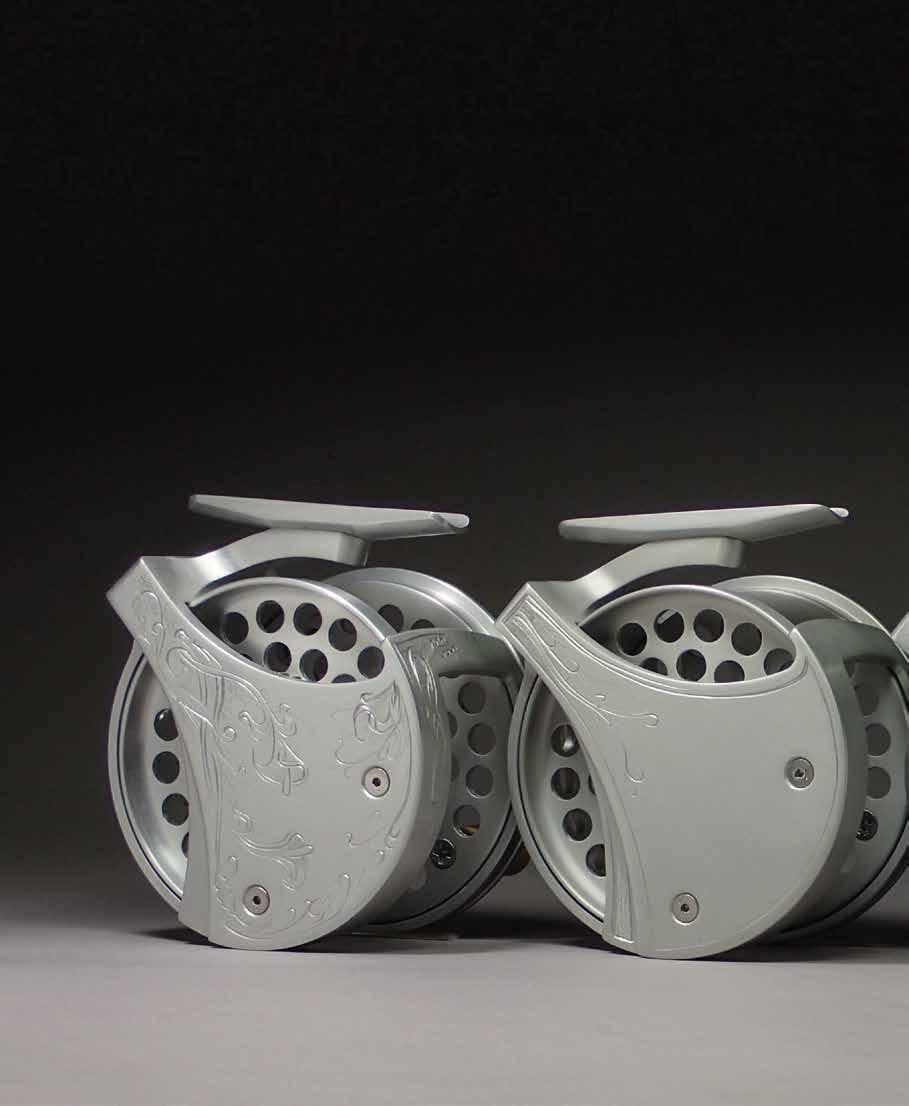
Le VK-S5.RF est un moulinet de 28 pièces de ma propre invention. Il y a 14 moulinets avec des bobines étroites et 14 avec des bobines larges qui conviennent aux cannes à une main de 5 à 8 et aux cannes à deux mains de poids léger à moyen. Les moulinets sont dotés d'une manivelle à gauche, d'un bâti en 6061-T6, d'un pied de moulinet, d'un axe et de vis en acier inoxydable 316, d'un cliquet, d'un roulement et d'un engrenage en bronze, de poignées en Delrin ou en acrylique et sont livrés avec un étui en cuir. Les fnitions de la série comprennent des fnitions Cerakote, anodisées de type 2 et anodisées à revêtement dur. Chaque moulinet de la série possède une fnition et une confguration de roulement uniques, ce qui en fait des créations exceptionnelles. Six bobines de la série comportent également une gravure à la main réalisée par mes soins. Toutes les pièces du moulinet ont été fabriquées dans mon État natal, le Connecticut.

Quels sont vos endroits préférés pour pêcher ?
Je pêche à la mouche toute l'année, principalement la truite ou l'achigan, mais j'aime aussi les autres poissons. Je ne suis certainement pas un pêcheur qui recherche le nombre ou la taille, mais je suis simplement reconnaissant d'être sur l'eau dans la nature et de regarder un monde moins agité se dérouler devant moi.
Val Kropiwnicki
www.vksteelworks.com | Email - vksteelworks@gmail.com Fb -@val.kropiwnicki | Ig - @vksteelworks
Parlaci dei tuoi mulinelli
The VK-S5.RF is a one time 28 piece run click-pawl reel of my design. There are 14 narrow spool and 14 wide spool reels suitable for 5wt-8wt single handed rods and light to medium weight two-handed rod set ups. The reels are left hand wind, 6061-T6 frame, spools, reel foot with 316 Stainless Steel drag plate, spindle and screws, a bronze pawl, bearing and gear, Delrin or acrylic handles, and come with a leather reel case. Finishes for the series include Cerakote, type 2 anodized and hardcoat anodized fnishes.
Each reel in the series has a unique fnish and porting confguration making them all one-of-a-kind creations. Six reels in the series also incorporate hand engraving by myself. All parts for the reels were manufactured in my home state, Connecticut.

Quali sono i tuoi luoghi migliori per pescare?
I fy fsh all year long, mostly for trout or striped bass, but other fsh fnd their way to my attention, too.
I’m defnitely not a numbers or size fsherman but instead just a fsherman who is grateful to be standing in water somewhere out in nature watching a less hectic world unfold before me at any chance I can fnd.
Val Kropiwnicki www.vksteelworks.com | Email - vksteelworks@gmail.com
Fb -@val.kropiwnicki | Ig - @vksteelworks
49

 Jean Louis Teyssié
DE L’AUTRE COTE du miroir
ON THE OTHER SIDE OF THE MIRROR

51
Penser diféremment, j’aime bien. Présenter des mouches artifcielles de l’autre coté du miroir: j’adore!
Que voient et comment voient les poissons: que de mystères! Les créateurs de mouches artifcielles présentent leur modèle en habit aérien. Ils leurrent plus les pêcheurs que les poissons! J’essaie de travailler mes modèles en les observant de l’autre coté du miroir. Les structures anatomiques peuvent être ainsi optimisées pour tromper le poisson sauvage quelquefois difcile à convaincre. Dimensions, harmonies, matières, lumières doivent être travaillées en pensant diféremment. La photographie macro, la plongée dans
les bulles permettent d’apporter des informations amusantes quant aux comportements des mouches, des soies, des bas de ligne, des noeuds de bas de ligne en sub-surface.
J’ai toujours considéré que la plongée en apnée dans nos eaux douces ou salées étaient les avenirs des pêches à la mouche. Je pêche souvent en combinaison, avec mon appareil photo dans son caisson et je photographie les évènements de manière opportuniste en prenant des notes un peu folles. Les ombres projetées d’une soie, d’un bas de ligne sur le fond peuvent paraitre comme des traces d’avion sur le sol des cours d’eau. Le bruit des posés de soie est également incroyable et le pire, l’approche du pêcheur en cuissarde ou wader s’entend de plusieurs pools.
Qui ne plonge pas, n’observe pas ce qui peut se passer sous l’eau en action de pêche et n’optimise pas son approche. Vous pouvez découvrir mes observations en plongée sur mon ancien site: http://teyssie.free.fr/index.htm à la page: http://teyssie.free.fr/Ecosystemes/Miroir/ Miroir.htm Je ne suis pas un crac en informatique ni en création de site mais si vous surfez sur les pages de cet ancien site, vous pouvez découvrir des « helps » à la compréhension d’une autre approche de la pêche à la mouche. Revenons à nos mouches et à leurs présentations bullaires.

Vous décidez d’une couleur en aérien, vous photographiez sous l’eau cette superbe mouche et au lieu d’être brune, elle est rose! Ok, vous

Tinking diferently, I like it. Presenting artifcial fies on the other side of the mirror: I love it!
What and how fsh see: what a mystery! Artifcial fy creators present their models in “airy” (out of the water) clothes. They lure the fshermen more than the fsh! I try to work on my models by observing them from the other side of the mirror. The anatomical structures can be optimised to deceive wild fsh, which are sometimes difcult to convince.
Dimensions, harmonies, materials, lights must be worked on by thinking diferently. Macro photography and snorkelling can bring us amusing information about the behaviour of fies, lines, leaders, and knots in sub-surface. I have always considered snorkelling in our fresh or salt waters to be the future of fy fshing. I often fsh in a wetsuit, with my camera in its housing and I photograph events opportunistically while taking crazy notes. The shadows cast by a line or a leader on the bottom can appear like airplane tracks on the river foor. The noise of the lines is also incredible
and the worst, the approach of the fsherman in waders is heard from several pools. He who doesn't dive doesn't observe what can happen underwater while fshing and doesn't optimize his approach. You can discover my diving observations on my old site: http://teyssie.free. fr/index.htm at the page: http://teyssie.free. fr/Ecosystemes/Miroir/Miroir.htm I'm not a computer expert nor a website developer but if you surf on the pages of this old site, you can discover "tips" to the understanding of another approach of fy fshing.
Let's get back to our fies and their bubbly pre-
52
pêchez sur un sol de pélite rouge et le refet du fond sous le miroir change la gamme colorimétrique de cette belle mouche. Ainsi, une mouche qui prend bien dans une rivière, peut être ignorée dans une autre géologie même si elle imite le même insecte sur le même montage. C’est une hypothèse qui se colle à bien d’autres… mais qui peut avoir son infuence en action de pêche.

Pierre Miramont, un entomologiste autodidacte, un poète, un grand pêcheur philosophe, savait parler de la lumière, des structures, de la mouche inexacte. Il est d’ailleurs resté dans l’ombre médiatique malgré ses observations novatrices. L’ombre n’aime pas la lumière! Je vous conseille de lire son ouvrage « L’éphémère et la
truite »: http://peche-mouche-seche.com/pmiramont.htm
Sa rencontre fut sensible et m’a fait évoluer sur les protocoles de montage, la perception de la lumière, son importance dans les recherches des matières, leurs applications spécifques. J’ai compris l’infuence chromatique des lumières aquatiques, sur la matière, sur la perception des mouches artifcielles par les poissons. Miramont pensait aérien, j’ai rajouté des options aquatiques.
Pour bien gérer les lumières réféchies de l’incidence photonique sur les mouches sèches, il a fallu trouver des matières fottantes qui absorbaient ou réféchissaient objectivement cette lumière pour ne pas la laisser se contam-
iner par d’autres paramètres. Certains matériaux synthétiques ont aidé et les naturels se sont exprimés diféremment sous l’eau. La position, la hauteur du modèle dans la sub-surface étaient importants pour l’expression lumineuse du modèle. J’ai pu ainsi recombiner matières synthétiques et naturelles pour créer des robes colorimétriques vues par les poissons et les plus objectives possibles car elles étaient convaincantes dans de nombreuses rivières à diférents moments de la journée, à diférentes saisons. Cependant rien n’est aussi simple. En plongée, les mouches avaient des comportements différents en sub-surface bullaire qu’en sub-surface lisse. Je pêche souvent dans les Alpes, dans les bouillons des ravins, des cheminées où les
sentations
You decide on a color in the air, you take a picture of this beautiful fy underwater and instead of being brown, it is pink! Ok, you are fshing on a red pelite ground and the refection of the bottom under the mirror changes the color range of this beautiful fy. So a fy that takes well in one river, may be ignored in another geology even though it imitates the same insect on the same rig. This is a hypothesis that fts with many others... but that can have its infuence while fshing.
Pierre Miramont, a self-taught entomolo-

gist, a poet, a great angler-philosopher, knew how to talk about light, structures, the inexact fy. He remained in the media shadow despite his innovative observations. The shadow does not like the light! I advise you to read his book "L'éphémère et la truite": http://pechemouche-seche.com/pmiramont.htm Meeting him made me evolve on the protocols of fy tying, the perception of the light, its importance in the research of the materials, their specifc applications. I understood the chromatic infuence of aquatic lights, on the material, on the perception of artifcial fies by fsh. Mi-
ramont thought aerial (out of the water), I just added the aquatic option.
In order to manage the refected light of the photonic incidence on the dry fies, it was necessary to fnd foating materials that would objectively absorb or refect this light so as not to let it be contaminated by other parameters. Some synthetic materials helped and the naturals expressed themselves diferently underwater. The position, the height of the fy in sub-surface was important for the light expression of the pattern. I was able to recombine synthetic and natural materials to create colo-
53
salmonidés voient parfaitement dans ces écosystèmes. Les mouches sont perturbées par les mouvements d’air et d’eau et présentent des robes chromatiques encore diférentes. Elles sont chahutées, combinées, collées à des enveloppes bullaires et elles nagent dans des centaines de micro-refets: un vrai casse tête. Donc, à nouveau photographies sous l’eau pour observer cela et améliorer surtout la stabilité, la fottaison des mouches sèches. Vous avez compris, j’adore pêcher en mouche sèche dans les écosystèmes noyés.
Une fois la stabilité, les chromas fxés dans diférentes géologies, dans des écosystèmes
agités ou calmes, je reviens et travaille précisément les silhouettes ventrales des trois tagmes (céphalique, thoracique, abdominal), les segments de l’abdomen, les appendices, les organes génitaux, les pattes, les ailes, les antennes des insectes. La mouche artifcielle doit donner envie au poisson de la croquer.
Les mousses fnes permettent d’imiter correctement les segments, les sternites abdominaux. Je peux les dessiner en les cerclant avec une soie de montage fne ou en tissant des bandes fnes de mousse de diférents tons. De teintes claires, je peux les feutrer en permanent noir. Les mousses optimisent la fottaison positive du leurre donc
sa stabilité.
Les tubes bodiz fabriqués en fbre de dubbing me permettent de réaliser des abdomens segmentés et détachés ou des faces ventrales des têtes assez réalistes.
Avec les poils de balais, de pinceaux, de brosse, j’imite des antennes, des pattes que je peux aplatir à la pince pour former les segments ou découper aux ciseaux pour réaliser les grifes.
Les ailes synthétiques ou naturelles sont les stabilisateurs de la mouche artifcielle. A plat en subsurface, elles se mélangent bien aux bulles. Elles ofrent des surfaces de contact importantes en épousant le plissage de la pellicule de surface.

Les fbres naturelles des plumes de coq et surtout des plumes de cul de canard épousent la masse bullaire pour s’y fondre. La micro-structure d’une plume de cul de canard est en spirale. Elle est recouverte de micro-gouttelettes de graisse de la glande uropygienne du canard. Les bulles d’air s’y emprisonnent et restent collées à la micro couche de graisse. La plume devient parfaite pour se fondre dans la masse bullaire et proposer des ailes stables assez réalistes en eaux agitées.
J’avais réalisé à l’extrême des montages à plat pour profter au maximum des qualités de cette plume. Vous pouvez les découvrir sur: http:// teyssie.free.fr/Artificielles/insectesaquatiques/

ephemeres/EP40.htm
Pour un voyage au centre d’une plume de cul de canard, je vous conseille de surfer sur mon site H2O teyssie.free.fr à la page suivante: http:// teyssie.free.fr/Artificielles/insectesaquatiques/ ephemeres/EP20.htm et sur mon nouveau site jeanlouisteyssie.com à: https://jeanlouisteyssie. com/fr/portfolio-55275-cdc
Et bien voila la fn du texte arrive. Nous pourrions parler montage pendant des heures. Je suis zen derrière un étau. J’aime rêver, imaginer, créer et essayer mes montages dans tous les écosystèmes. Je vais plus à la pêche pour essayer mes artifcielles, prendre des notes, les optimiser que pour prendre du poisson. Je ne suis
pas un pêcheur mais un monteur de mouches artifcielles marginales si possible! J’apprécie la rencontre avec le poisson et je suis en contradiction avec cet instinct du pêcheur et la morale écologique du respect de l’animal. Alors, je me réfugie derrière un étau!
Surfaces lisses ou perturbées, lumières avec différents angles d’incidence, refets géologiques, matières naturelles, synthétiques, protocoles de montage marginaux, optimisation des silhouettes ventrales, le voyage derrière l’étau est de proximité. La plongée en apnée permet le full contact avec la Nature, les poissons, les réalités du terrain, les découvertes des écosystèmes
54
rimetric dresses seen by the fsh and as objective as possible because they were convincing in many rivers at diferent times of the day, in diferent seasons.
However, nothing is that simple. Seen while diving, the fies had diferent behaviors in bubble sub-surfaces and smooth sub-surfaces. I often fsh in the Alps, in the brooks of the gorges, in the “water chimneys”, and salmonids see perfectly in these ecosystems. The fies are disturbed by the air and the water movements and present diferent chromatic dresses. They are heckled, combined, stuck to bubbles and they swim with hundreds of micro-refections: a
real headache. So, once again, I took photographs underwater to observe this and to improve the stability and the buoyancy of the dry fies. You surely have understood, I love dry fy fshing in drowned ecosystems.
Once the stability and the chromas are fxed in diferent geologies, in agitated or calm ecosystems, I come back and work precisely on the ventral silhouettes of the three tagmas (cephalic, thoracic, abdominal), the segments of the abdomen, the appendages, the genital organs, the legs, the wings, the antennas of the insects. The artifcial fy must make the fsh want to bite it. Today’s fne foams allow us to imitate correct-
ly the segments, the abdominal sternites. I can design them by tying them with a fne thread or by weaving fne strips of foam in diferent shades. From light shades, I can change and color them with permanent black markers. Foam optimises the buoyancy of the lure and therefore its stability.
“Bodiz” tubes made of dubbing fbre allow me to make segmented and detached abdomens or ventral faces of heads quite realistic.
With the bristles of brushes and else, I imitate antennas, legs that I can fatten with pliers to form the segments or cut with scissors to make the claws.
The synthetic or natural wings are the stabilizers of the artifcial fy. Flat on the subsurface, they mix well with the bubbles. They ofer important contact surfaces by following the pleating of the surface flm.

The natural fbers of rooster feathers and especially of cul de canard feathers blend into the bubble mass. The micro-structure of a cul de canard feather is spiral. It is covered with micro-droplets of fat from the duck's oil gland. The air bubbles get trapped and stick to the micro layer of fat. The feather becomes perfect to mix in the bubble mass and ofer stable wings which are quite realistic in rough waters. I have made extreme fy patterns to take full ad-
vantage of the qualities of this feather. You can discover them on: http://teyssie.free.fr/Artifcielles/insectesaquatiques/ephemeres/EP40.htm
For a trip to the center of a cul de canard feather, I advise you to surf on my “H2O” site teyssie.free.fr at the following page: http://teyssie. free.fr/Artifcielles/insectesaquatiques/ephemeres/EP20.htm

And on my new site jeanlouisteyssie.com at: https://jeanlouisteyssie.com/fr/portfolio-55275-cdc
Well, the end of this text arrives. We could talk about fy tying for hours. I become zen behind a vise. I like to dream, imagine, create and try my patterns in all ecosystems. I go fshing a
bit more to try my fies, take notes, optimize them… than to catch fsh. I am not a fsherman but a tyer of marginal fies, if such a thing exists! I appreciate the encounter with the fsh and I am in contradiction with the fsherman's instinct and the ecological morality of respect for the animal. So I take refuge behind a vise! Smooth or disturbed surfaces, lights with diferent angles of incidence, geological refections, natural, synthetic materials, marginal tying protocols, optimization of the belly silhouettes, the journey behind the vise is one of proximity. Snorkelling allows full contact with nature, fsh, the realities of the feld, the discovery of aquatic ecosystems where the fsherman evolves. It
55
aquatiques où le pêcheur évolue. Elle permet aussi de découvrir les silhouettes des mouches, des soies des bas de ligne sous l’eau. Loin de la gravité terrestre, poissons et êtres humains se mélangent dans l’aventure des mouches artifcielles.


Je laisse la parole aux photographies. Regardez quelques uns de mes modèles dans les bulles, c’est amusant. Pour les plus curieux, sachez que vous pouvez tous les deviner en vues aériennes sur : https://jeanlouisteyssie.com/fr/galerie-12553-artifcielles
Amitiés à vous tous. jeanlouisteyssie.com teyssie.free.fr
also allows you to discover the silhouettes of fies and leaders under water. Far from terrestrial gravity, fsh and human beings mix in the adventure of artifcial fies.

I leave the foor to the photographs. Look at some of my patterns in the bubbles, it's fun. For the more curious, you can guess them all in aerial views on : https://jeanlouisteyssie.com/fr/ galerie-12553-artifcielles
Best wishes to all of you. jeanlouisteyssie.com teyssie.free.fr

56


58
LE CHARME DU LAITON
THE CHARM OF THE BRASS

59
Riccardo De Stabile


60
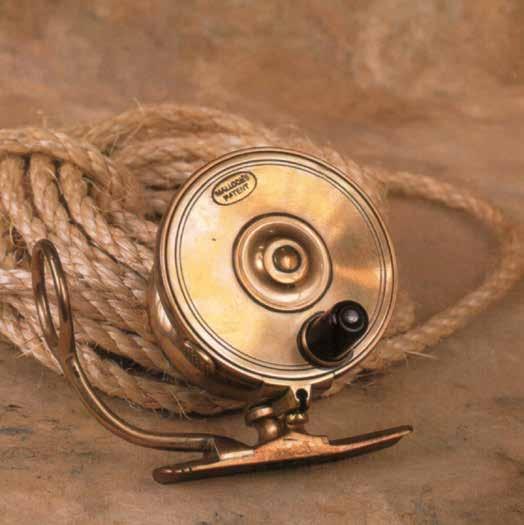
Le laiton, ductile et facilement usinable, a été l'un des premiers matériaux utilisés par les artisans qui ont écrit l'histoire des équipements de pêche. Sa couleur jaune intense qui, avec le temps, prend une patine difcilement reproductible, sa conservation, souvent excellente car difcilement attaquable par les agents atmosphériques, et surtout l'épo-
que à laquelle il a été utilisé, font que chaque fois que nous lisons le nom "laiton" dans un catalogue de vente aux enchères ou que nous parlons avec des collectionneurs, nous avons déjà l'oreille tendue. Le laiton a été largement utilisé à partir du début des années 1800 pour la construction de moulinets, à commencer par la famille Ustonson, les fabricants de moulinets
et d'équipements de pêche de la maison royale. Leur histoire commence vers 1760 avec Onesimus Ustonson qui rachète la boutique Fish and Crown dans la rue Bell Yard à Londres au célèbre John Herro, qui existait depuis 1700. La boutique acquiert rapidement une clientèle prestigieuse, il existe encore une facture datée du 10 juin 1775 faisant référence aux achats
Being ductile and easily workable, brass was one of the frst materials used by craftsmen who made the history of fshing equipment. With the passing of time the intense yellow color takes on a patina that is difcult to replicate. Its conservation is often excellent as it is difcult for atmospheric agents

to attack it. Above all you prick up your ears every time you read the name “Brass” in some auction catalog or while talking to collectors. Brass was used extensively for the construction of reels from the early 1800s onwards, starting with the Ustonson family, who produced reels and fshing equipment of the Royal House.
Their story began around 1760 with Onesimus Ustonson, who bought from the famous John Herro, the Fish and Crown shop in Bell Yard Street in London, in business since 1700. The shop quickly acquired a prestigious clientele, and there is still an invoice dated 10th June 1775 which refers to purchases made by the
61


62
efectués par le comte de Winterton, un noble amateur de pêche. La boutique a continué à prospérer avec les descendants d'Onesimus jusqu'en 1855, produisant des moulinets et d'autres équipements entrés dans l'histoire et désormais introuvables, sauf à des prix insensés. Plus tard, la société anglaise Hardy a également utilisé du laiton pour son moulinet le plus célèbre, le modèle "Perfect". Les premiers modèles, à partir de 1880, étaient entièrement en laiton, les plus récents n'en avaient qu'une partie, et les derniers, des années 1930, n'avaient que le pied dans ce matériau. Plus de 170 variantes ont

été fabriquées, y compris les tailles et les séries, et aucun collectionneur connu ne les possède toutes. Le laiton a également été utilisé pendant longtemps dans la construction des célèbres moulinets en bois de type "Nottingham", dans la partie appelée "starback" et dans la partie intérieure de l'embrayage, qui était généralement circulaire ; il a également été utilisé par de nombreux artisans, souvent inconnus, pour la fabrication de divers accessoires tels que des pièces pour les gafes, les joints de gué et les viroles. Le laiton était également largement utilisé dans les cannes à pêche, et il est impossible de ne pas
ries, and no collector owns them all. Brass was also used for a long time in the construction of the famous "Nottingham" wooden reels, in the part called "starback," and in the internal, usually circular part of the clutch. Moreover, it was used by many often unknown artisans, for the manufacture of various accessories such as parts for gafs, landing net joints and ferrules. Even in fshing rods there was a great use of brass even in fshing rods. It is impossible not to be fascinated by the wonderful reel seats of the late 19th century built by some American

and Scottish craftsmen. William Garden was certainly among the frst to fnish rods in brass. With his salmon rods in cedar wood and greenheart, he made innovations that were later adopted by important producers. Charles Playfair was another craftsman who gave collectors notable pieces in this material. His famous model of salmon rod, Grants Vibration, produced in greenheart in various sizes at the end of the 19th century became a cult object, with collectors who collect many pieces of this model only to compare the small changes that were
être fasciné par les merveilleux porte-moulinet de la fn du XIXe siècle fabriqués par certains artisans américains et écossais. Parmi les premiers à fnir leurs cannes en laiton, il y a certainement William Garden qui, avec ses cannes à saumon en bois de cèdre et en cœur vert, a fait des innovations adoptées plus tard par d'importants fabricants. Un autre artisan qui a donné des pièces remarquables aux collectionneurs en employant ce matériau est Charles Playfair. Son célèbre modèle de canne à saumon Grants Vibration, produit en cœur vert dans diférentes tailles à la fn du 19e siècle, est devenu un objet Earl of Winterton, a nobleman fond of fshing. The shop continued to thrive with the descendants of Onesimus until 1855, producing reels and other equipment that have gone down in history and are nowhere to be found except at crazy prices. Subsequently, the English frm Hardy also used brass for its most famous reel, the "Perfect" model. The frst models of 1880 were completely built in brass, the later ones with only a part, and the last ones of the 1930s had only the foot in this material. More than 170 variants were made, counting sizes and se-
63
culte, les collectionneurs rassemblant de nombreuses pièces de ce modèle juste pour comparer les petites modifcations apportées au fl des ans. Comme le laiton était facile à trouver et à usiner, il a été utilisé pour des travaux très complexes. C'est le cas de certains leurres articulés d'une précision incroyable, créés par des maîtres artisans qui ont tiré pleinement parti des possibilités extraordinaires de ce matériau. Plus tard, le laiton a été mis de côté et remplacé par des matériaux plus performants (par exemple, certains alliages d'aluminium), plus légers et moins chers, mais le charme et l'éclat d'un vieux moulinet en laiton ne sont pas comparables à ce que l'on trouve aujourd'hui sur le marché.
made during the years. Since brass was readily available and easily workable, it was used in some very complex processes. This is the case of some articulated and incredibly precise spinning lures, created by master craftsmen who made the most of the extraordinary possibilities of this material. Later the brass was set aside and replaced by materials with better performance (for example some aluminum alloys), and were lighter and less expensive. But the charm and luster of an old brass reel is not comparable to anything that we fnd on the market today.

64


65


68
MONTANA TRIP
LE MONTANA Voyager dans

69
Paul Buckley Montana Tourist Board
La pêche à la mouche dans le Montana est fantastique, et planifer un voyage de pêche à la mouche dans notre État est certainement amusant et excitant.
Mais comment organiser le voyage parfait dans un État où la pêche est d'une telle qualité ?
La pêche à la mouche dans le Montana est fantastique, et planifer un voyage de pêche à la mouche dans notre État est certainement amusant et excitant. Mais comment organiser
le voyage parfait dans un État où la pêche est d'une telle qualité ?
Après avoir décidé où pêcher dans le Montana, il est tout aussi important de choisir la période de l'année. Examinons la géographie de l'État tout en analysant l'étendue de ses possibilités de pêche à la mouche. Large de plus de six cents miles, l'État du Trésor, comme on l'appelle, est

70
Fly fshing in Montana is grand and planning your fy-fshing trip in our home state should be fun and exciting, not a challenge.

But how do you plan the perfect trip to a state that is home to a lifetime’s worth of amazing fy fshing?

As you decide where to fsh in Montana, choosing when to make a trip is equally as important. Let’s look at the state’s geography as we break down the vastness of Montana’s fy-fshing trip
options. Over six hundred miles wide the Treasure State is massive in terms of waters accessible to fy fshing. Within those waters there are options to choose from as well—larger rivers best suited to fshing from a boat, smaller waters explored on foot, crystal clear spring creeks, multi-day backcountry river foat trips, alpine lakes, and private access waters.
71
immense en termes d'eaux accessibles à la pêche à la mouche. Dans ces eaux, vous pouvez choisir entre : de grandes rivières plus adaptées à la pêche en bateau, des ruisseaux à explorer à pied, de petits ruisseaux alimentés par des sources et aux eaux cristallines, des excursions de plusieurs jours dans des zones reculées, des lacs alpins et des eaux d'accès privé. Les lieux de pêche se lisent comme une liste du

Hall of Fame de la pêche : Madison, Missouri, Bighorn, Smith, Big Hole, Yellowstone, Bozeman, Missoula, Twin Bridges et bien d'autres endroits moins connus. Il y a des petites villes près de la rivière, des villes plus grandes avec des restaurants, des lieux d'art et de divertissement, des lodges isolés avec divers programmes de pêche et des chefs professionnels, et enfn des excursions de plusieurs jours sur les voies navi-
gables, avec des tentes en remorque. Pour les non-pêcheurs, le Montana ofre plusieurs activités à pratiquer pendant que les autres pêchent. Nos deux parcs nationaux, Yellowstone et Glacier, sont proches de certaines activités de pêche importantes. Nous sommes connus pour nos magnifques paysages, nos grands espaces et nos habitants accueillants. Missoula et Bozeman sont des villes dynamiques

72
The places to fsh read like a fshing Hall of Fame ballot: Madison, Missouri, Bighorn, Smith, Big Hole, Yellowstone, Bozeman, Missoula, Twin Bridges, and many other places well-known and some other places of-the-radar. We’ve got small towns near a particular river, larger towns with a variety of dining, arts, and entertainment options, secluded lodges with diverse fshing programs and professionally trained chefs, and
overnight multi-day foat and pack trips.
For non-anglers Montana has plenty to keep them engaged while others are fshing. Our two national parks, Yellowstone and Glacier, are located near some remarkable fshing. We are known for great scenery, wide-open spaces, and friendly locals. Missoula and Bozeman are vibrant towns with thriving arts and dining scenes. Helena and Great Falls, jumping
of points for our Smith River trips, are steeped in Montana history and home such highlights as the Montana Historical Society Museum, the Lewis and Clark National Historic Trail Interpretive Center, and more. Knowing the geography and the towns near our waters is important, but so is understanding the many ways to consider deciding where to make a trip. The Missouri and Bighorn Rivers are fa-

73
avec des arts forissants et de nombreuses activités gastronomiques. Helena et Great Falls, points de départ de nos excursions sur la Smith River, abritent des centres d'intérêt historique et culturel tels que le musée de la Montana Historical Society et le centre d'interprétation de la piste historique nationale Lewis et Clark. Il est important de connaître la géographie et les villes proches de nos eaux pour décider de la destination d'un voyage. Les rivières Missouri et Bighorn sont célèbres pour leurs truites, servies par des lodges à la clientèle internationale et plusieurs hôtels.
Les excursions de pêche dans ces rivières, basées aux carrefours de Craig ou Fort Smith, ont les saisons de pêche les plus longues du Montana et accueillent généralement les éclosions les plus régulières et les grands nombres de poissons. Toutes les techniques de pêche à la mouche peuvent être pratiquées ici, mais les services qui ne sont pas strictement liés à la pêche sont limités. Le Montana ofre sufsamment de variété et d'accessibilité pour pêcher des eaux diférentes chaque jour. Le Big Hole un jour, le Madison le lendemain, un petit ruisseau le

mous tailwater rivers serviced by world-class destination lodges and local hotels and motels.
Fishing trips to these rivers typically have you fshing one river and fshing it intimately, basing in or near the angling-centric crossroads of Craig or Fort Smith. These rivers have the longest angling seasons of our Montana waters and usually harbor the most consistent hatches and fsh numbers and cater well to all angling abilities, yet non-angling amenities are limited. Montana ofers variety and accessibility to fsh multiple waters in multiple days. The Big Hole one day, the Madison the next, a small creek on a day three, and so on. With its network of lodges and outftters, a local travel company can arrange a trip to sample all of Montana’s great waters. Montana’s Smith River fows for sixty miles through a spectacular backcountry canyon. The Smith River is home to limestone clifs rising a thousand feet above the river, Native American petroglyphs, wild rainbow and brown trout, and a few native cutthroat trout. If you desire native cutthroat eating large dry fies, a multi-day wilderness style foat trip on the South Fork of the Flathead is a blend of

74
troisième jour, et ainsi de suite. Avec son réseau de lodges et de magasins d'articles de pêche, une agence locale peut organiser un voyage pour essayer toutes les grandes eaux du Montana. La Smith River du Montana coule sur soixante miles dans un canyon intérieur spectaculaire. Cette rivière abrite des falaises de calcaire qui
s'élèvent au-dessus de la rivière, des pétroglyphes amérindiens, des truites arc-en-ciel et farios sauvages et quelques truites cutthroat indigènes. Si vous voulez attraper l'une de ces truites indigènes, une excursion en rivière dans les zones reculées de la South Fork de la Flathead s'impose. De l'extrême nord-ouest du Montana
à la région sauvage d'Absaroka-Beartooth, en passant par le parc national de Yellowstone, vous vous trouverez immergé dans la nature, dans des eaux peu fréquentées qui vous procureront des sensations uniques.
Décider de ce qu'il faut emporter pour un voyage de pêche à la mouche dans le Montana peut
comfort and class we can book that for you as well. From Montana’s extreme northwest corner to the Absaroka-Beartooth Wilderness and Yellowstone National Park in between, the desire to get-away-from-it-all exists in fshing less crowded waters.

Deciding what to pack for a Montana fy fsh-
ing trip can be an exciting, yet difcult task. Time of year, variable weather, and the waters an angler will be fshing all need to be considered when choosing the appropriate gear. Having proper gear for the time of year and waters fshed will make the trip and experience much more pleasurable! Fly fshing Montana is one of
the most beautiful and memorable experiences. To capture the trip and hopefully get a quick shot of the massive Yellowstone cutthroat trout just landed, bring a camera! The right gear and preparation for a Montana fy fshing trip will make that trip all that it is talked up to be!
75
être une tâche passionnante, mais il faut faire attention. Le bon équipement doit tenir compte de la période de l'année où vous partez, de la météo variable et du type de voies navigables. Pour capturer des images uniques et espérer attraper l'énorme truite de Yellowstone que vous venez de pêcher, n'oubliez pas votre appareil photo ! Un équipement et une préparation adéquats rendront le voyage inoubliable.

76

77


L'ATOLL DE FARQUHAR :
FARQUHAR ATOLL: TAMING THE AQUA HULK

80
APPRIVOISER LE GÉANT AQUATIQUE

81
Rasmus Ovesen Rasmus Ovesen, Martin Ejler Olsen
Dans cet article, Rasmus Ovesen nous emmène sur l'atoll de Farquhar, un atoll légendaire au nord de Madagascar connu pour son incroyable diversité d'espèces.
Une énorme diversité d'espèces
L'atoll de Farquhar abrite une quantité incroyable d'espèces de poissons. Chaque petit micro-habitat le long des récifs de l'atoll abrite ses propres espèces de poissons, et si vous vous dirigez vers le large, vous pourrez également rencontrer d'innombrables espèces
d'eau profonde. La plupart des espèces sont incroyablement puissantes et extraordinairement belles. Et ils sont difciles et amusants à attraper. Seuls quelques-uns d'entre eux sont considérés comme des poissons de sport. Sur les fats, il s'agit principalement de carangues blues & ignobilis (GT), de perroquets à bosse, de bonefsh, de trigger fsh et de permits indo-pacifques. Pour ceux qui visent principalement à attraper le gangster incontesté des fat, la GT, l'atoll de Farquhar est une véritable Mecque. C'est ici qu'a été tourné le documentaire de la BBC "The Blue Planet II", dans lequel on voit des
GT sortir de l'eau et intercepter des oiseaux en plein vol. En attraper une avec un popper sur l'île Goelette avec des sternes noires tourbillonnant dans le vent est une expérience qui, à elle seule, vaut tout le voyage.
Le poisson perroquet à bosse est peut-être l'espèce la plus recherchée. Les populations ont décliné de manière spectaculaire dans le monde entier et il ne reste plus qu'une poignée d'atolls où l'on peut pêcher ce poisson avec succès. L'atoll de Farquhar est l'un d'entre eux. Vous y trouverez de grands bancs rudement puissants qui atteignent le bord du récif et sur les fats
In this article, Rasmus Ovesen takes you to Farquhar Atoll – a fabled and far-fung atoll just north of Madagascar known for its incredible species diversity.
Dramatic species diversity
Farquhar Atoll is home to an acutely stress-provoking amount of exciting fsh species. The species diversity here is
staggering, and as a visiting fy fsherman it can be difcult to stay focused.
Every little microhabitat within- and along the atoll outer reefs houses its own, carefully adapted fsh species, and when the weather permits and one heads ofshore, countless bluewater species may be encountered. Most of the fsh species are both incredibly powerful and strikingly beautiful. And they are challenging and fun to catch. Even so, only a select few of them
are considered game fsh worthy of being specifcally targeted. On the fats these are mainly giant trevally, bumphead parrotfsh, bonefsh, triggerfsh, and Indo-pacifc permit.
For those, mostly preoccupied with catching the undisputed gangster of the fats – the giant trevally, Farquhar Atoll is a veritable Mecca. This is where the BBC documentary, ”The Blue Planet II”, in which giant trevally are seen charging out of the water and intercept-

82
pour mâcher, écraser et extraire leur nourriture des coraux.
Omniprésent sur les fats et sur les plages de sable nacré de l'atoll de Farquhar, que ce soit en grands bancs de petits poissons ou en petits groupes de spécimens adultes, le " fantôme des falts " : le bonefsh. Ce poisson de sport formidable, souvent négligé est un adversaire dynamique et frénétique, connu pour ses touches suivies de rush explosifs. Partout, le bonefsh fait une partie de la liste des moucheurs tropicaux. Sur Farquhar, cependant, il s'agit plutôt d'un poisson que l’on recherche désespérément pour
réaliser un grand chelem des fats.
Le trigger fsh moustaches se trouve dans des zones peu profondes parmi un mélange de coraux, d'algues et de sable, généralement le long des récifs extérieurs de l'atoll de Farquhar. Ces poissons à l'allure maladroite, ridés et mangeurs de crabes se camoufent étonnamment bien. Cependant, à marée basse, on peut parfois les voir agiter leur queue de manière alléchante alors qu'ils creusent le fond à la recherche de nourriture.
Le trigger est une espèce de poisson qui a désespérément besoin d'un psychologue. Ils
sont bipolaires : d'un côté, ils sont incroyablement territoriaux, agressifs et féroces, de l'autre, ils sont extrêmement capricieux, méfants et pointilleux. Ils mordent aussi comme peu d'autres poissons, capables de démolir un hameçon fort de fer (ou de mordre un doigt), et une fois que vous en avez accroché un, il est probable qu'il se dirige directement vers une patate de corail et se cale sous ou à l'intérieur en utilisant sa nageoire dorsale en forme de "gâchette" comme mécanisme de verrouillage. C'est sans nul doute un poisson intéressant !
Les permits se trouvent sur la plupart des fats
ing birds in mid-air - was flmed, and catching one on a popper at Goelette Island, with lots of black terns awhirl in the wind, is an experience which – in and of itself – is worth the whole trip.
Bumphead parrotfsh is perhaps the most immediately pressing and urgent species to catch at Farquhar Atoll. Populations have dramatically declined worldwide and there are now only a handful of atolls left where one can successfully

fy fsh for them. Farquhar Atoll is one of them. Here, you’ll fnd big schools of these grossly powerful and alien-like parrotfsh as they come onto the reef edges and fats to chew-, crushand derive nutrients from the corals that grow here.
Ever-present on Farquhar Atoll’s pearlescent sandy fats and beaches, whether in big schools of smaller fsh or in small nervous groups of full-grown specimens, is the ‘ghost of the fats’:
the bonefsh. This formidable- but oftentimes overlooked gamefsh is a high-octane and furiously paced adversary that is known for gentle takes followed by explosive runs. Anywhere else on this planet, bonefsh are a prominent part of the main cast. On Farquhar, however, it’s more of a peripheral extra that doesn’t shine with its absence until you desperately need one to complete a fats- or grand slam.
Yellow-margin- and moustache triggerfsh are
83
qui abritent le bonefsh. Ces poissons à la robe dorée, qui peuvent déconcerter même le pêcheur à la mouche le plus expérimenté, sont parmi les plus tatillons et les plus difciles à attraper. Ils sont généralement solitaires ou en petits groupes et il faut à la fois des compétences techniques et de la chance pour les inciter à prendre votre mouche. Lorsqu'il mord enfn, un combat long et ardu attend le moucheur. L'atoll de Farquhar n'est pas largement reconnu comme une destination pour les permits, mais ne vous y trompez pas, ils sont présents en nombre surprenant et beaucoup de poissons sont GROS !
"Le chaos va régner"
Mon premier lancer fait mouche : juste au bord du banc de poissons. Je reste en contact avec la mouche, puis je ressens une légère tension et je regarde avec émerveillement une surface de la taille d'un salon exploser en cascades d'eau. Surpris, tout le banc se dirige vers le bord du récif et je me penche en arrière et applique toute la pression que je peux pour empêcher les poissons que j'ai attirés de faire la même chose. C'est faire ou mourir !
Les 10 minutes suivantes sont chaotiques. Je peux à peine séparer le poisson que j'ai attiré du reste du banc, mais je n'ai toujours pas réussi à l'apprivoiser. Il s'agite rageusement devant les vagues de plusieurs mètres de haut qui s'écrasent aveuglément contre le bord du récif - et je me retrouve dans l'eau jusqu'au cou à attaquer le poisson, en essayant de l'empêcher de me faire tomber sur des bombes de corail.

Puisqu'il est le responsable de toute l'épreuve, Shaun saute maintenant dans les vagues, patauge, nage, plonge vers le poisson et, après avoir disparu complètement de la vue pendant un très long moment, éclabousse fnalement le récif, trempé et essoufé, avec un tibia en sang et un poisson bleu-vert géant sortant de sa pataugeoire. Des scènes exaltantes s'ensuivent. Mon rêve est devenu réalité !
Un pêcheur à la mouche en liberté Le reste de la journée, je me sens libéré, sans autres attentes ni tensions. Un carangidae géant apparaît dans les vagues. Je lance comme un dieu dans le vent, place la mouche parfaitement devant le poisson, regarde le poisson clairement agité avaler la mouche, retire l'hameçon avec force et procède à l'atterrissage du poisson d'une
84
found in shallow areas with a mixture of corals, turtle grass, and sand – typically along the outer reefs of Farquhar Atoll. These awkward-looking, gnarly, crab-eating fsh are surprisingly well-camoufaged. However, at low tide, they are occasionally found waving their tails enticingly as they dig in the bottom for food.
Triggerfsh are a species of fsh in dire need of a psychologist. They are quite bi-polar; on the one hand incredibly territorial, aggressive and ferocious, on the other hand extremely skittish, ambivalent, and fnicky. They also happen to pack a bite like few other fsh, capable as they are of completely demolishing hooks (or biting a fnger clean of for that matter), and once you hook one, it’s likely to surge directly towards a coral bommie or similar and wedge itself under- or inside it using its “trigger”-shaped dorsal fn as a locking mechanism. It’s an interesting fsh to say the least!
Permit are found on many of the same fats that house bonefsh. These gilt-edged fsh, which can turn even the most experienced fy fsherman with saltwater in his veins into a fumbling nerve-wreck, are among the most edgy and picky fsh on the fats – and thus one of the most challenging to catch. They typically show up solitary or in small schools, and both technical skill and luck are required to lure one into striking. When it fnally happens, you’re in for a long and arduous fght. Farquhar Atoll isn’t widely recognized as a permit destination but make no mistake! They are there in surprising numbers, and many of the fsh are BIG!
”Chaos Will Reign”
My frst cast is right on the money: Just on the edge of the school. I keep contact with the fy, then feel a slight tautness and watch in awe as an area, the size of an uptown living room, explodes in cascades of water. As a startled herd of bufaloes the whole school now charges towards the edge of the reef, and I lean back and apply as much pressure as I possibly dare in order to prevent the fsh I’ve hooked from doing the same thing. This is make or break!
The next 10 minutes are chaotic and – for the most part – look completely hopeless. I barely manage to separate the fsh I’ve hooked from the remainder of the school, but I haven’t yet

85
main ferme et disciplinée. Comme un patron ! Plus tard dans l'après-midi, un permis se matérialise sur le dos d'une grande raie pastenague, qui part à la chasse aux crustacés sous la vase d'un grand plat nacré. Je sers un Alphlexo Crab blanc, suspendu au bout d'un bas de ligne de 6 mètres de long qui se termine par une pointe de 15 livres. Le poisson réagit immédiatement et suit la mouche sur quelques mètres avant qu'une poussée ne se propage dans la queue. Je résiste à la tentation de soulever la canne et de poursuivre le dépouillement, et peu après, tout se passe comme dans le manuel. C'est fait ! Le poisson monte irrésistiblement vers l'extérieur et traverse le plat pour tenter de dérouler le reste de mon backing, mais il n'a aucune chance. Je prends mon temps, je joue patiemment avec le poisson et j'utilise la canne à pêche pour atténuer les nombreuses montées et les brusques secousses. Finalement, Shaun réussit à attraper un poisson couvert de poussière d'or
scintillante.
Puisque nous sommes déjà sur un grand plat miroitant, autant chercher un bonefsh. Il prend la forme d'un faible fantôme dans l'eau laiteuse près de l'estran, et je réussis à placer un autre lancer parfait qui se traduit immédiatement par une morsure. Puis une série de montées rapides comme l'éclair. Fantastique !

Un tir trop rapide Shaun m'ordonne de me rendre sur la plateforme de lancement à l'avant du bateau. Il reste moins d'une demi-heure de la journée et nous la passons dans une petite baie peu profonde qui semble jusqu'à présent dépourvue de poissons.
Puis, moins de cinq minutes après le début de la sortie de pêche, un baliste adulte à marge jaune émerge soudainement au sommet d'une bommie de corail, juste devant le bateau.
La veille, j'avais déjà attrapé un baliste de la taille d'un trophée et, par conséquent, je ne suis
que légèrement déçu lorsque le poisson, après avoir suivi la mouche sur une courte distance, s'efraie et disparaît. Je ne sais que trop bien que c'est la règle plutôt que l'exception, et cela n'enlève rien à une journée autrement incroyable. Shaun, quant à lui, est un peu démoralisé. Et c'est avec un ton de déception dans la voix qu'il annonce qu'il est temps de faire ses bagages. "C'était si près !" Je l'entends marmonner d'une voix chuchotée et résignée alors qu'il saute dans le bateau.
"Ce n'était qu'un baliste", dis-je d'un ton désinvolte après avoir rangé mon matériel et préparé le retour au chalet. Shaun lève les yeux de la poupe du bateau, me fxe un instant et afche un énorme sourire.
Un grand chelem en or ?
Nous étions à deux doigts de réaliser quelque chose d'unique, révèle aujourd'hui Shaun. Avec l'ajout d'un baliste, nous aurions réalisé ce que
86
come close to breaking its spirit. It thrashes angrily about somewhere out there – beyond meter-high waves that collide blindly against the edge of the reef – and I fnd myself in neckdeep water high-sticking the fsh, trying to prevent it from cutting me of on coral bommies and random volcanic structure. Fittingly, since he is to blame for this whole ordeal, Shaun now gets a workout of his own. With death defying determination, he jumps into the waves, wades, swims, and dives for the fsh and – after being completely gone for a disturbingly long while – he fnally washes up onto the reef drenched and short of breath, with a bleeding shin and a giant blue-green fsh sticking out of his impossibly small landing net. Jubilant scenes now play out. My dream has come true!
liberated fy fshermanThe rest of the day I feel liberated without further expectations or nerves. A giant trevally reveals itself in the waves. I cast like a god into the wind, place the fy perfectly ahead of the fsh, watch as the clearly agitated fsh inhales the fy, strip-set the hook with raw power and proceed to land the fsh with a frm and disciplinary hand. Like a boss!
Later, in the afternoon, a permit materializes on the back of a big stingray mudding for crustaceans on an expansive, pearlescent fat. I serve up a white Alphlexo Crab - dangling at the end of a 6-metre-long leader tapering into a 15lb tippet. The fsh reacts immediately and follows the fy a couple of meters before an ever-so-subtle tug propagates through the line. I resist the temptation to lift the rod, continue stripping, and shortly after everything comes taught. Masterfully done!
The fsh surges irresistible outwards and across the fat in an attempt to clear out the rest of my
backing, but it doesn’t stand a chance. I take my time; play the fsh patiently and use the rod to mitigate the many runs and abrupt pulls. Ultimately, Shaun is able to net a pristine-looking fsh covered with sparkly gold dust.
Seeing as we are already on a big, gleaming fat, we might as well look for a bonefsh. It takes shape like a faint ghost in milky water close to the shoreline, and I manage to place another perfect cast that instantly results in a take. Then a series of lightning-quick runs. Of course!

Too fast on the trigger
It isn’t until we wrap up for the day that Shaun confesses. For a long while I have sat in the boat and watched as my friend and boat partner, Martin, has cast (to no avail) into a big school of permit that kept getting terrorized and spooked by a massive GT. We have now relocated and Shaun has commanded me to the casting plat-
87
A
l'on appelle un "golden grand slam". Un tel exploit n'a été réalisé que deux fois au cours des plus de 25 ans d'histoire de l'Alphonse Fishing Company et ne s'est jamais produit sur l'atoll de Farquhar. Shaun a même entendu des rumeurs selon lesquelles quiconque réussit un " super grand chelem " gagne un voyage gratuit, mais

il ne peut pas le vérifer...
Quoi qu'il en soit, je suis loin d'obtenir un grand chelem d'or pendant le reste du voyage. Et ça n'a pas d'importance. Je pêche avec un esprit ouvert, développant progressivement une compréhension plus profonde de la pêche diversifée de l'atoll : son rythme et son caractère.
Et dans le processus, j'attrape beaucoup de poissons.
Un autre pêcheur à la mouche parviendra un beau jour à réaliser un grand chelem en or sur l'atoll de Farquhar. Cela doit arriver et je parie qu'il fera partie de ces invités qui viennent avec un esprit ouvert et font ce que leur dit leur guide.
form in the front of the boat. Less than half an hour remains of the day and we’re spending it in a small, shallow bay that so far looks devoid of fsh.
Then, with less than fve minutes left to fsh, a full-grown yellow-margin triggerfsh suddenly emerges on top of a coral bommie – right in
front of the boat.
I have already landed a trophy-sized titan triggerfsh the day before, and – as a result – I am only moderately disappointed when the fsh, after having followed the fy over a short distance, spooks and disappears. I know all too well that this is the rule rather than the exception, and
it doesn’t detract anything from an otherwise incredible day.
Shaun, on the other hand, seems a lot more affected. Shaken even. And it is with a tone of disappointment in his voice that he announces that it’s time to pack up.


