Emancipation Magazine
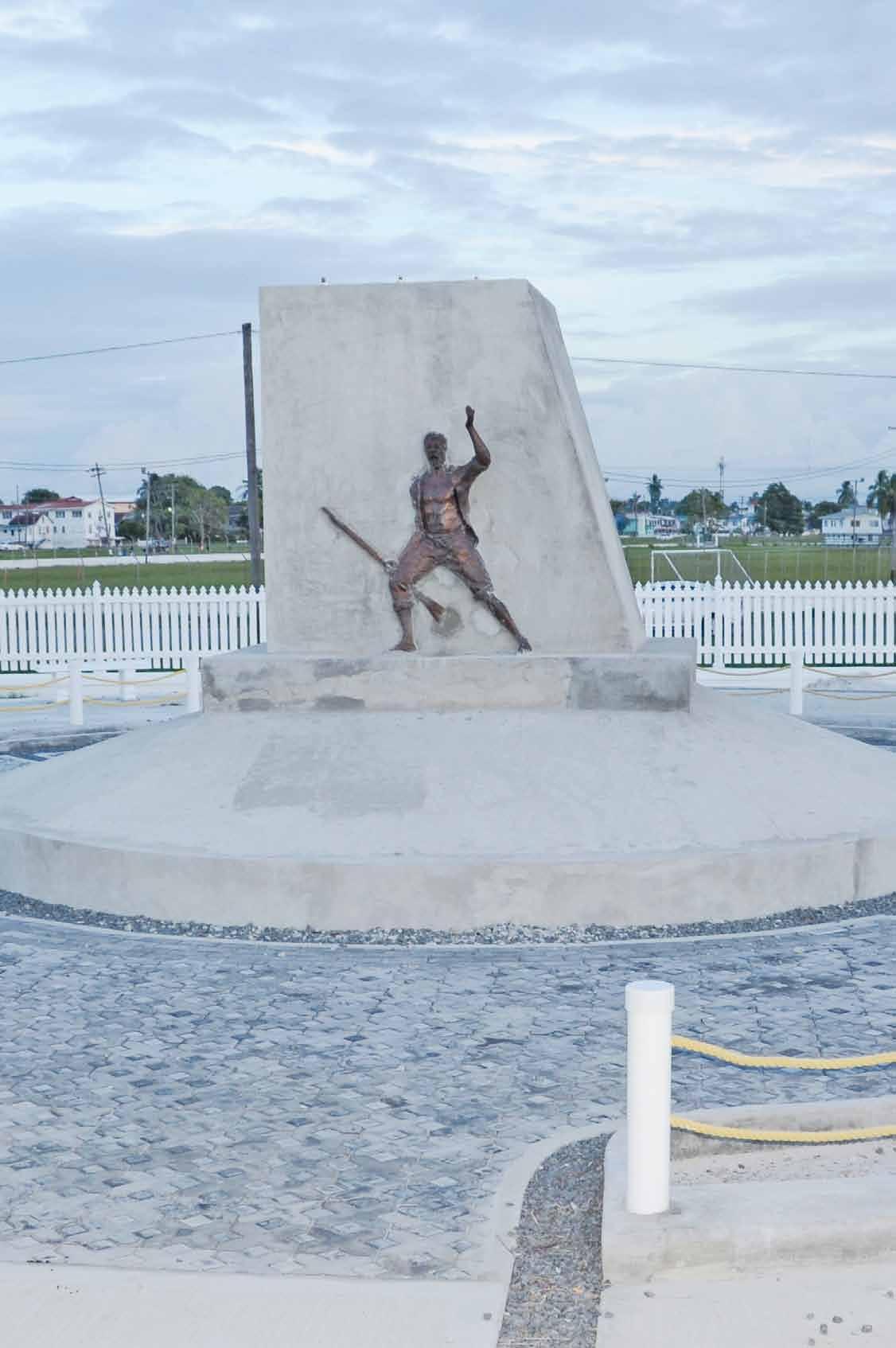





As part of the African Cultural and Development Association’s (ACDA) theme for Emancipation 2013, “Honouring our Heroes of 1823”, the association commemorates Quamina, a historical figure of the 1823 Demerara Rebellion.
Ambassador Odeen Ishmael, currently Guyana’s Ambassador to the State of Kuwait and the State of Qatar, shares his research on Quamina with Guyana Times Sunday Magazine, from his book “The Guyana Story”.
The slaves in East Demerara were convinced that the governor and their masters were withholding their freedom from them, and many felt they had no other option than to rise up against those who were not carrying out the king’s orders.
On the morning of Sunday Aug 17, 1823, Mahaica slaves met at Plantation Success and three of them, Jack Gladstone, a cooper on that plantation, Joseph Packwood and Manuel, assumed some kind of leadership of the group.
They began planning an uprising, but Gladstone’s father, Quamina, who arrived at the meeting later, objected to any bloody revolt and suggested that the slaves should go on strike. When someone asked if they should get guns to protect themselves, Quamina, a senior deacon at Rev. John Smith's church, said he would have to seek the advice of the missionary on this matter.
Quamina departed for Bethel Chapel at Le Resouvenir, and after the Sunday service, he and two other slaves, Manuel and Seaton, went to Smith's home. There they told the priest that the managers of the plantation should go to Georgetown to “fetch up the new law.” Smith rebuked them and advised against speaking to any of the managers about this, saying if they did so they would provoke the governor. He begged them to wait until the governor and their mas-
ters tell them about the new regulations.
When Quamina told Smith of the uprising being planned, the priest asked them to tell the other slaves, particularly the Christians, not to rebel. Quamina promised to obey Smith and he sent his two companions to urge other slaves not to rebel. He also told Smith he would send a message in the evening to the Mahaica slaves not to rise up against their masters.
But despite Quamina's efforts, the slaves were determined to rebel from the following evening. Their plan was to seize all guns on the plantations, lock up the whites during the night and then send them to the governor the following morning to bring the “New Law.” Quamina urged them not to be violent in the process.
But on the morning of Monday August 18, the plan was leaked by Joseph Packwood, a house slave, who revealed it to his master John Simpson, of Le Reduit plantation, located about five miles east of Georgetown.
Simpson immediately gave this information to Governor Murray who, with a group of soldiers, rode up to the area of Le Resouvenir and La Bonne Intention where he met a large group of armed Africans on the road. He asked them what they wanted and they replied, “Our right.” He then ordered them to surrender their weapons, and after they refused, he warned that their disobedience would cause them to lose whatever new benefits the new regulations aimed to provide. Further, Murray told them to go home and to meet with him at Plantation Felicity the next morning. But the slaves refused this invitation and the governor later that day proclaimed martial law.
It was very late that afternoon when Rev. John Smith first heard of the uprising. In a note to his informant, Jackey Reed, a slave who attended his church, he stated that hasty, violent measures were contrary
to Christianity and begged Reed not to participate in the revolt.
Shortly after, while Smith and his wife were walking on the plantation, they saw a large group of African slaves outside the home of Hamilton, the manager of Le Resouvenir. Smith begged them not to harm Hamilton, but they told him to go home.
That night the slaves seized and locked up white managers and overseers on 37 plantations between Georgetown and Mahaica on East Demerara. They searched their houses for weapons and ammunition; but there was very little violence since the slaves apparently heeded the request made by Quamina.
However, some slaves took revenge on their masters or overseers by putting them in stocks; this action resulted in some violence and a few whites were killed. The white population naturally were very terrified and feared they would be killed. But the slaves, who were mainly Christians, did not want to lose their religious character so they proclaimed that their action was a strike and not a rebellion. At the same time, not all slaves joined the rebels and these remained loyal to their masters.
The next day Anglican priest, Wiltshire Austin, suggested to Governor Murray that he and Smith be allowed to meet with the slaves to urge them to return to work. But the governor refused to accept this suggestion and immediately declared martial law.
The 21st Fusiliers and the 1st West Indian Regiment under the command of Lieutenant-Colonel Leahy, aided by a volunteer battalion, were dispatched to combat the rebels, who were armed mainly with cutlasses and bayonets on poles, and a small number of stands of rifles captured from plantations. At first, the movement of the troops was hampered since many of the wooden bridges across the various plantation canals were destroyed by the

rebels.
The suppression of the rebellion saw much violence.
On Tuesday, August 19, there were major confrontations at Dochfour estate where 10 to 15 of the 800 rebels were killed; and at Good Hope where six were shot dead. On the morning of August 20, six were killed at Bee Hive plantation and 40 at Elizabeth Hall.
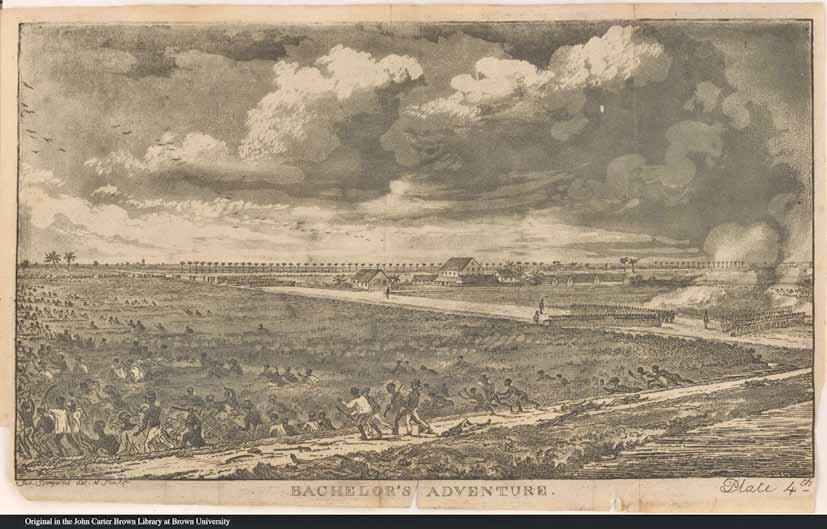
There was also a major battle on the same day at Bachelor's Adventure where roughly 2,000 slaves confronted the military. Lieutenant-Colonel John Thomas Leahy, who had about 300 men under his command, asked them what they wanted. They responded that they wanted to work for only two or three days a week. Leahy told them if they lay down their arms and returned home he would tell the governor what they wanted.
But perceiving that they were not interested in surrendering their arms Leahy, accompanied by one of his officers, Captain John Croal, went up to them and again enquired what they wanted. They shouted that they wanted their freedom which the king had granted to them. Leahy then read the proclamation of the martial law to them. When he completed the reading, Jack Gladstone, one of the slave leaders, showed him a copy of a letter signed by many plantation owners that they were not abused by the rebels.
One of the other leaders then suggested that they should hold Leahy and Croal as hostages, but Jack Gladstone objected strongly and prevented such an occurrence. Many other rebels suggested that all the slaves should march to Georgetown to present their demands to the Governor, but Leahy discouraged this saying that if they did so they would all be hanged, and suggested that they should communicate to the governor through him. He then gave them half an hour to decide to surrender their arms, failing which he would order his soldiers to shoot.
However, the rebels remained defiant, and Leahy ordered his troops to open fire. Many of the slaves fled in confusion while some oth-
ers quickly surrendered their weapons to the troops. In this savage, crushing military action, more than 250 were killed. A report prepared by Governor Murray two days later praised Leahy and his troops, and noted that only one soldier was slightly injured while noting that “100 to 150” slaves were shot dead.
The uprising collapsed very quickly since the slaves, despite being armed, were poorly organised. After their defeat at Bachelor's Adventure, the governor proclaimed a full and free pardon to all slaves who surrendered within 48 hours, provided that they were not ringleaders of the rebellion. He also offered a reward of 1,000 guineas for the capture of Quamina whom he regarded as the main leader of the rebellion.
In the military sweepingup exercises that followed, there were impromptu court-martials of captured slaves, and those regarded as ringleaders were immediately executed by firingsquad or by hanging. Many of the corpses were also decapitated and the heads nailed on posts along the public road. Among those hanged was Telemachus of Bachelor's Adventure who was regarded as a “ringleader” of the uprising at that location.
Some of the rebels who escaped were hunted down and shot by Amerindian slave-catchers. Quamina himself was shot dead by these Amerindian slavecatchers in the back lands of Chateau Margot and his body was later hung by the side of the public road at Success. Jack Gladstone was later arrested and later sentenced to be hanged; however, his sentence was commuted, but he was sold and deported to St. Lucia in the British West Indies.
Out of an estimated 74,000 slaves in the united colony of EssequiboDemerara, about 13,000 took part in the uprising. And of the 350 plantations estates in the colony, only 37 were involved. No doubt, many who did not take part sympathised with the rebels and shared their suspicion that the planters would spare no efforts to prevent them from obtaining their
freedom.
On August 25, Governor Murray set up a “court-martial” headed by Lieutenant Colonel Stephen Arthur Goodman, for the trials of the arrested rebel slaves who were considered to be “ringleaders”. The trials, which continued into early 1824, were conducted at different plantations, and the prisoners were executed by shooting or hanging, and their heads cut off and nailed to posts.
More than 200 Africans were beheaded and their heads placed on stakes at Parade Ground in Georgetown and from Plaisance to Mahaica in East Demerara. Of those condemned to death, 14 had their sentences commuted but, like Jack Gladstone, they were sold to other slave owners in the British West Indies.
In addition, there were other sentences, including solitary confinement and flogging of up to 1,000 lashes each. Some were also condemned to be chained for the rest of their servitude.
On the day of the Bachelor's Adventure battle, the situation took a strange turn when Rev. John Smith was arrested and charged for encouraging the slaves to rebel. While awaiting trial, he was imprisoned in Colony House. His arrest, undoubtedly encouraged by many of the planters, was seen as an act of revenge against the priest for preaching to the slaves.
Before a court-martial presided by Lieutenant Colonel Goodman from October 13 to November 24, 1823, Smith was tried for promoting discontent and dissatisfaction in the minds of the slaves towards their masters, overseers and managers, inciting rebellion; advising, consulting and corresponding with Quamina, and aiding and abetting him in the revolt; failure to make known the planned rebellion to the proper authorities; and not making efforts to suppress, detain and restrain Quamina once the rebellion was under way.
Smith denied the charges but, nevertheless, he was imprisoned for seven weeks in Colony House before being tried by a court mar-
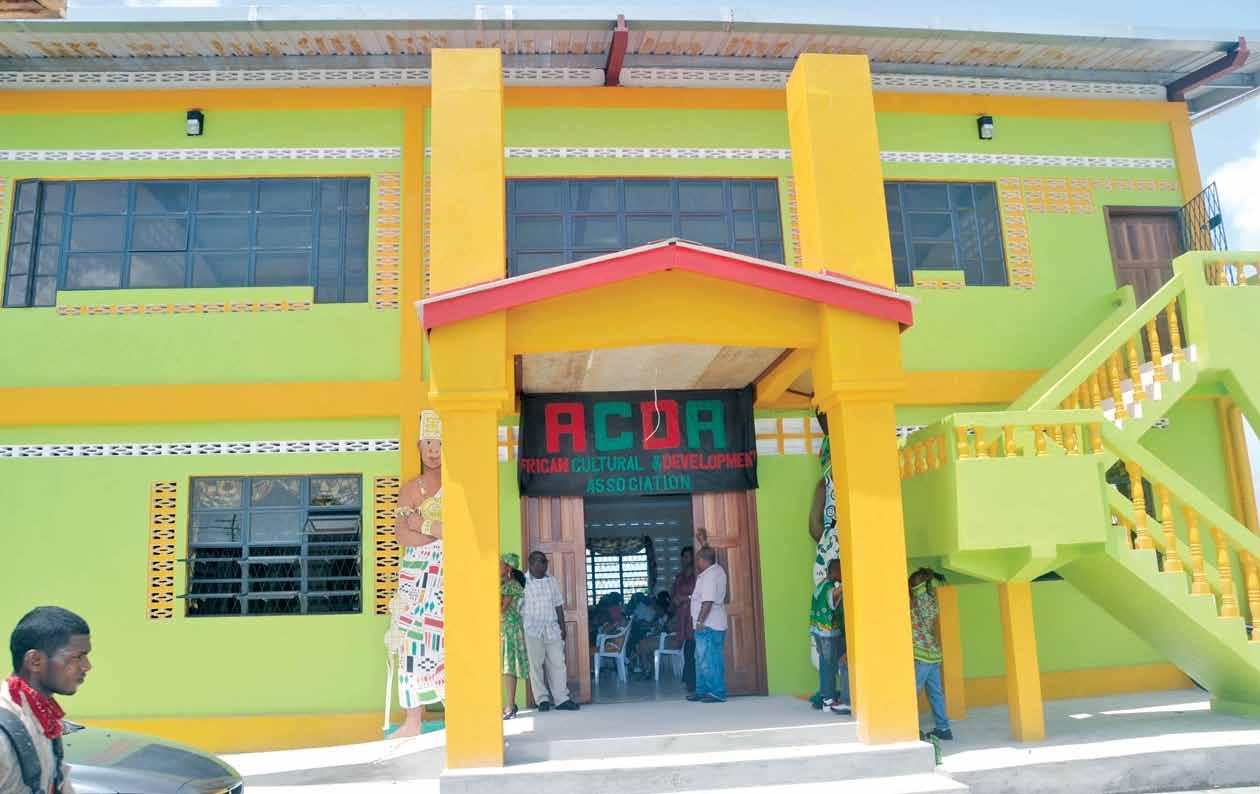
The African Cultural and Development Association (ACDA) is celebrating its 20th anniversary this year, and since its establishment plays a pivotal role in the preservation of Guyanese African culture.
Founded in 1993 as a non-governmental organisation constituted to promote equity, equal access, accountability, shared governance and citizen’s participation at the local and national levels, the organisation was officially registered under the Friendly
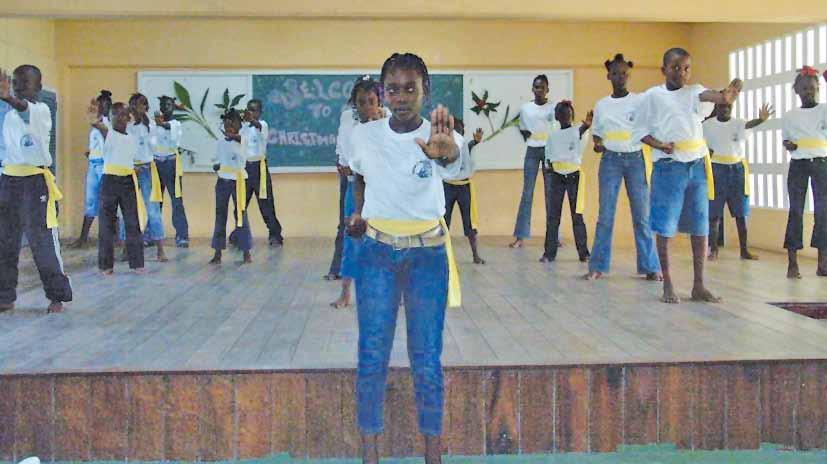
and concerned individuals, is committed to making a difference in the lives of African Guyanese by assisting in implementing a solid well balanced academic programme that includes cultural, emotional and moral education. The goal is to ensure the Guyana curriculum is met and far exceeded by ACDA students through experienced teachers and a student teacher ratio of 10 to 1.
ACDA is focused on AfroGuyanese youths and provides a solid value-driv-
essary skills to make them excellent productive citizens who are well-balanced socially, emotionally, intellectually, physically and morally.
The vision for COLAACO is to build an institution that will be a centre of excellence in providing the highest quality education and Afro-centric education and life skills in Guyana and the Caribbean.
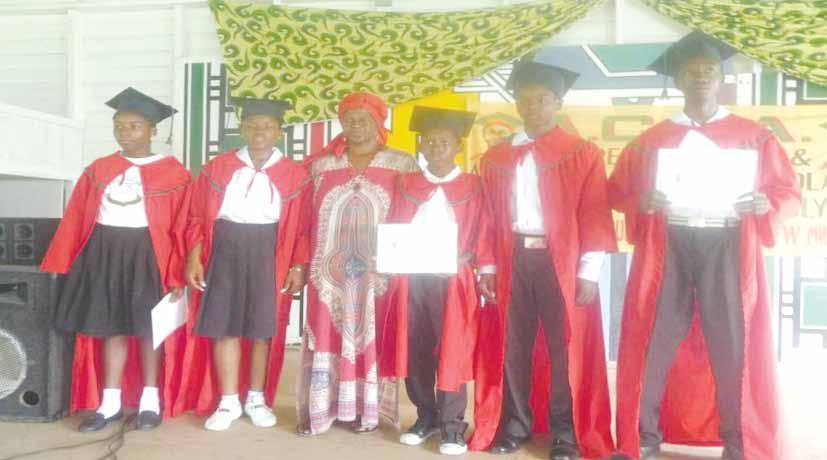
Over the last 17 years, ACDA has been providing the top Afro-Guyanese student at CXC with prizes, all
Societies Act of Guyana in 1995.
All Guyanese of African descent, regardless of class, religion or political affiliation, are eligible to be members of ACDA. ACDA has members in all parts of Guyana as well as in the Guyanese diaspora. ACDA also is very active in African diaspora organizations. The society’s mission at its inception was to “empower African Guyanese to become more productive citizens through cultural, social, economic, educational and vocational enhancement”.
The centre’s primary goal is to improve the well-being of African Guyanese and to seek sustainable improvement in their quality of life. Another important goal is to seek national reconciliation through “shared and good” governance through which there is genuine reconciliation with other ethnic and cultural groups in Guyana.
ACDA, located on Thomas Lands, is governed by an executive steering committee that meets on a weekly basis. This committee comprises founding and select active members, and by the heads of each of five operational committees.
The education management committee of ACDA, comprising experienced educators, parents
en education through its Centre of Learning and Afro-centric Orientation (COLAACO) which is designed to equip young children from early childhood to primary school with the nec-
in its efforts to encouraging youths to excel academically.
ACDA has sponsored over the years The Ronald Waddell Reading Room- the Inter-American Bank (IDB)
Social Inclusion Program entitled “Improving access to Opportunities for At Risk Youth Of Afro-Descendant Communities in Guyana”, a 2008-2009 eighteen-month partnership that saw 30 students from Buxton, Agricola and Albouystown benefit from five 6-month courses in leadership and community development, small business management, agriculture and the environment, and media and communications.
Additionally, it also partnered with the African Renaissance to provide a free six-month course in leadership that was taught by Guyanese Eric Phillips, a 1990-91 White House Fellow. ACDA also partnered with Dance Alive to offer a free course in
HIV & AIDS Life Cycle Management. It also produces a monthly newsletter entitled Unchained Voice, edited by AYA, the youth arm of ACDA.
Recently, ACDA launched its Akwaaba Youth Centre. Akwaaba, a Ghanaian word meaning ‘welcome’, will be the heart of ACDA’s continual development of cultural, educational, economic, Information technology and sports programmes for young people.
Apart from these tailored activities, the youth centre will also be available for conferences, meetings, seminars, birthdays, weddings, thanksgiving services, award ceremonies, graduations and anniversaries.
The Akwaaba Centre will be
the key facility for outreaching to African Guyanese and those in the diaspora.
The future projects of Akwaaba will include a heritage tour in partnership with the Sankofa Group, and will also include entrepreneurship and business development programmes; ICT training in COLAACO; dance; drama; poetry; judo and karate training. It also plans to build a memorial monument for the arrival of Africans in Guyana and a drum museum and creativity centre. Akwaaba is an extension of ACDA’s educational philosophy of academic and cultural excellence. It will re-focus on the mission and goals of ACDA as emphasized in its founding documents.
One of the greatest entrepreneurial acts by freed Africans in world history was the ‘Village Movement’ which started in 1839. Freed Africans combined their resources to buy villages so that they did not have to return to plantation life and cheap punitive labour.
For Emancipation 2013, the African Cultural and Development Association honours Farm Village located on East Bank of Essequibo, which was bought by 26 freed men and women. Today, there is an elder who speaks Congolese, presumably, ACDA notes indicating the village was bought by Africans who had roots in Congo.
This excerpted historical overview of Farm Village was drawn from church records, works of authors again, church related and from oral history by Faustina Ward Osborne, which she shares with Guyana Times Sunday Magazine
While a student of the Government Teachers Training College in 1969, gathering data for a research project on her community, Faustina was startled by facts revealed. This record of historical events in the villages is therefore interspersed with her personal reflections on the information acquired from prominent members of the community during informal discussions; and members of her extended family. It is Faustina’s view that this historical overview could be used as a basis for in depth historical research which could add to, or correct any information gleaned from the oral history which forms the basis for the documentation which follows.
On a clear sunny day, one may stand on the shores that border Farm and see Leguan and other islands which lie at the mouth of the Essequibo River. Farm Village is located along the West Coast Demerara Highway between Vergenogen on the east and Parika on the west about four miles equidistant. Its immediate neighbours are the communities of Greenwich Park, Plantation Good Hope and Plantation Ruby on its east
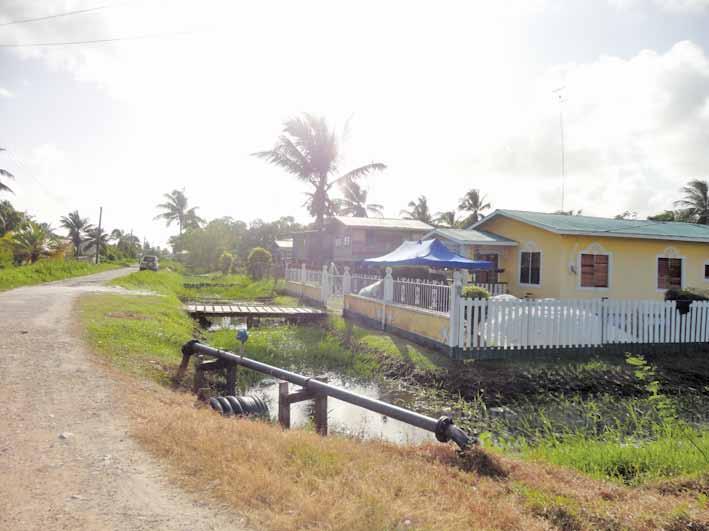
and Le Destin, Kywari and Orangestein on the west. Prior to changes in the Local Government system in Guyana in 1994; Farm, Vergenoegen, and Parika were the only local authorities in that geographical location.
The simplicity of the name, Farm Village belies the rich history, culture and tradition that resided in the village; which has produced significant numbers of professionals, semi-professionals and skilled craftsmen/ women. The name highlights the vision of the original proprietors who purchased a well-designed plantation which was like an oasis when compared to its surrounding neighbours. The ancestry of Farm Village has its roots in the resolve of men and women who pooled their resources and bought Plantation Farm. It is believed that the purchase was made in 1840 following upon a block survey (from the East Bank of Essequibo to the Cross Dam in the backlands) conducted by Hugh Mc Tavish, Sworn Land Surveyor. In 1877, another survey was conducted showing the plan of the village, indicating lots apportioned to each land owner by name, and signed by E.E. Wight, Sworn Land Surveyor. This plan was deposited in the Deeds Registry in 1879.
Many of the people, who comprised this ear-
ly post-emancipation community, identified themselves as Africans from the Congo; and were called 'Farm Congo' by residents from other villages. These were all people who revered their ancestors and retained a number of their traditional practices. Also in the village were a group of people referred to as Oku. Whether this was a tribal group or a name for those who were not from the Congo, is not known.
John “Olde” King (Faustina’s maternal greatgrand father) was from the Congo and one of the 26 purchasers of Plantation Farm. He was the overseer and leader of the formerly enslaved people, on the East Bank Essequibo and the West Coast of Demerara. John “Olde” King and one of his sisters were captured from their village in the Congo on the same day. Not until their arrival in Guyana did they know the fate of each other. Unknowingly, they walked together on the same routes from their homeland in Africa and voyaged on the same ships, each believing that each other were alone. Apparently, more of their siblings were also captured, and brought to British Guiana; but did not discover one another until much later. There is a story told about one sister who grieved to death after discovering that the man she met, fell in love with
the community meeting was held with “Olde” King to discuss current events and find solutions to problems, including illnesses, and even legal issues facing individuals and groups. He led and guided these fledging communities and villages in a hostile post-slavery era. Looking at church records there is no evidence that “Olde” King himself was a member. Yet he seemed to have had a deep spiritual impact on the community which encompassed the church and stretched for miles on either side of Good Hope. He led and guided these fledging communi-
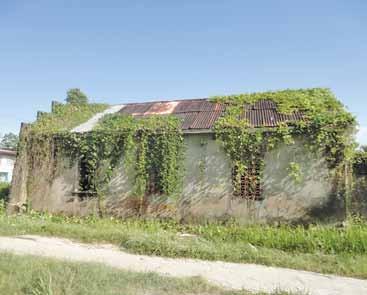
and married was her brother. These are potent examples of the pain and tragedy of slavery, which cut to the very soul of the enslaved. Farm, for many years, was the hub of the postslavery community. Faustina’s paternal grandmother, Victoria Otto Ward told her that the post-emancipation population each Sunday at 4 a.m. gathered under the silk cotton tree at Good Hope to meet with their leader, “Olde” King. According to her story, they braved the elements and the hazards of dirt roads, no lights, snakes and other animals and walked or were conveyed by donkey drawn carts, through largely unpopulated areas.
For many of those gathered it was an all-night journey beginning early Saturday evening. The silk cotton tree was located across the road from the St. Luke Anglican Church. Each week, before attending church and Sunday school

ties and villages in a hostile post-slavery era.
Farm was a local authority managed by a village council. Unlike the proprietors in neighbouring communities by which it is sandwiched, the proprietors of Farm Village were taxed. This placed a severe burden on the post-emancipation populace and on what was for many years a subsistence economy. The difficulties were more stringent on single parent families, mostly women, the aged and the infirmed. However, there were some among the villagers who were cattle
tial. He was found guilty, sentenced to be hanged and was transferred from Colony House to the local prison. He appealed to the British government which subsequently ordered a commutation of the death sentence and restored his freedom. However, while awaiting the results of his appeal to arrive from England, he died from pneumonia in the prison on Feb 6, 1824. To avoid the risk of stirring sentiment against the slave owners, the colonial authorities buried his body before daybreak but deliberately did not mark his grave.
The information that he was acquitted actually arrived in Georgetown on
farmers who sold milk and some of their herds which allowed a greater level of self-reliance.
Then there were an even smaller group of professionals, entrepreneurs and skilled craftsmen and women who had a higher standard of living. Collecting rates and taxes was a challenge. When Faustina was younger she recalled the Bell Crier, Lloyd Lancaster, walking through the village, bell in tow, calling on ratepayers to, “Pay up their rates.”
Faustina stated that the fact that the early ancestors survived slavery is a testament to their spiritual and cultural values and their unswerving faith in a higher divine power. Throughout the torturous enslavement they endured, they maintained their faith in the divine to sustain and keep them. She added that their faith, resilience, and spirituality- possibly imbedded in them from their homeland- were the assets the post-emancipation population used to lead and build their community.
From the stories told, Faustina found out that the pioneers who shaped and built the village of Farm and other communities chose not to return to the plantations despite hardship. They were unafraid to be human and to be vulnerable, or to demonstrate care for one another. They did not withhold their resources from each other; nor did they reject the help of another for fear of exploitation. Their leadership held no pretentions; there was no personal gain to be had except the responsibility for and the respect of the people.
Today, although the Farm Village continues to face various challenges, its residents are proud knowing that they live in a historically rich village.
March 30, weeks after his funeral. (Significantly, the appeals court in repealing his sentence also banned him from residing in Guiana and any other British Caribbean territory, and ordered to post a bond of 2,000 pounds.) News of his death was later published in British newspapers. It caused great outrage throughout Great Britain, and 200 petitions denouncing the actions of the colonial authorities were sent to the British Parliament.
In Guyana, the slaves regarded Rev. Smith’s death as a sacrifice which was made on their behalf. Soon after, they began referring to him as the “Demerara Martyr”.
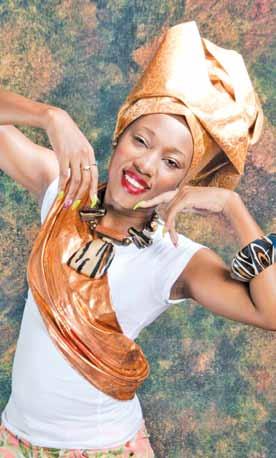
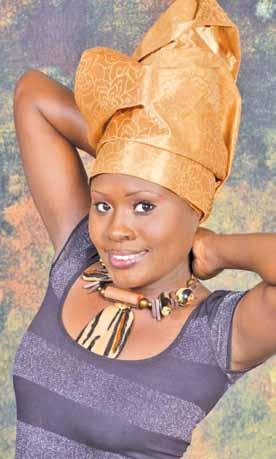
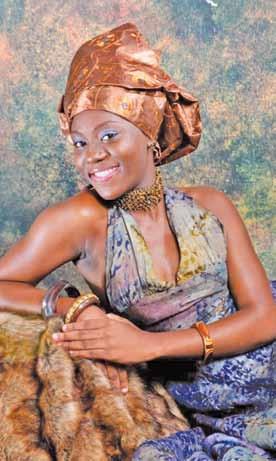
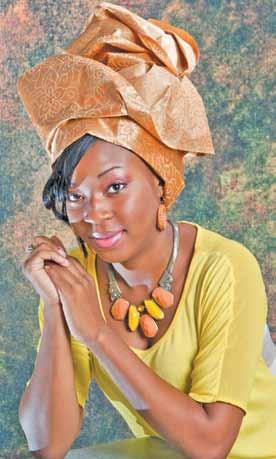
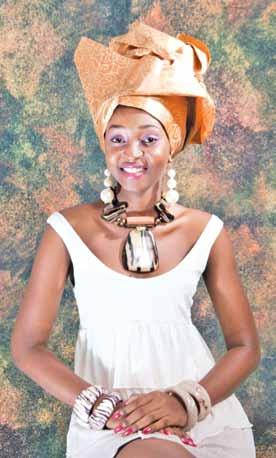
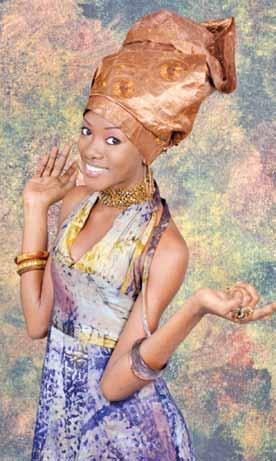
On August 11, eight Afro-Guyanese beauties possessing elegance, charm and graceful exuberance, would be competing for the title of Miss Guyana African Queen 2013 at the National Cultural Centre.
The pageant is said to be a journey for the young ladies to learn “all things African”. It is the brainchild of Shauna Jemmott, a former Miss Guyana African Heritage title holder, who has produced several village pageants in the past. She has since relinquished its production to a committee.
Miss Guyana African Pageant showcases rich African culture, and at the same time provides the eight delegates an opportunity to add new things to the culture. The Afro-Guyanese beauties have already engaged in talent workshops and are brushing up on their public speaking skills.
On the ‘Miss Guyana African Queen’ Facebook page, the delegates are presented to the public who have the opportuni-
ty to vote for their choice. The delegate with the most ‘likes’ would be awarded the ‘Miss Guyana African Queen - Facebook Beautiful’.
This year, according to Public Relations Officer, Shabakie Fernandes, in keeping with the United Nations Day of Woman, the delegates will choose a notable woman of African descent to speak on as their platform.
Additionally, the pageant will be promoting STEM: Science, Technology Engineering and Math. STEM ensures the development of world-class talent in science, technology, engineering, and mathematics- an organisation based in the U.S. which has many Guyanese top achievers as part of its membership.
Moreover, Fernandes stated that through the Guyanese Girls Unite Project, 12 girls from Mali, where the education for girls is not free, will be sent to school. This year, the country of Mali is recognized and honoured for Emancipation in
Guyana. She added that the intention is that, through this initiative, the Mali girls will be given much-needed facilities to explore their senses and skills.
The delegates will also be giving back to the elderly, as it is customary in the African tradition, and so have been involved in numerous philanthropy activities.
The Guyana African Queen Pageant’s contestants are: Franale Holder, born April 16, 1990, is an aspiring pilot and believes that there is nothing common to man that she cannot do; Jennel Lovell, born August 10, 1994, is an aspiring medical doctor and believes that “there are no secrets to success. It is the result of preparation, hard work, and learning from failure”; Shanice Alancia Bourne, born September 21, 1994, is currently a secondyear Marketing student at the University of Guyana who views herself as a “optimistic and pragmatic person whose greatest goal is to build a better future for the
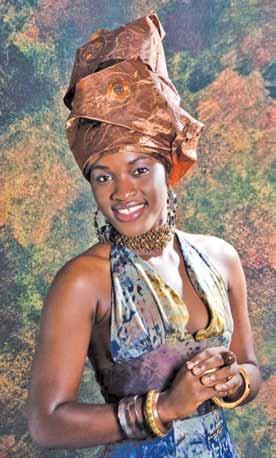
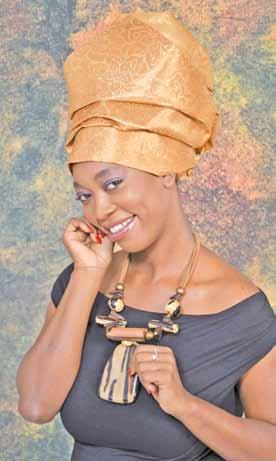
succeeding generation”; Shevona Jerrick, born September 23, 1992, is presently a Business Management student at Nations University; Sunaika Adolphus, born April 22, 1995, is a second-year International Relations Student at the University of Guyana; Miracle Hilliman, born May 11, 1992, is a final year Public Communication student at the University of Guyana; Joelly Ann Valentine, born May 24, 1994 is a second-year Public Communication student at the University of Guyana; and Makida Latoya Blake, born August 4, 1990, is another aspiring doctor.
The Miss Guyana African Queen pageant provides a platform for the empowerment of young Afro-Guyanese women and gives them an opportunity to connect with their ancestry.
Tickets are available at Nigel's Supermarket, Ashmin's, Upscale Restaurant and Bar and Joan's Salon of Durban St. Lodge; or call 682-6741 for more information.
By PetamBer Persaud
The year 2013 is replete with significant anniversaries for all Guyanese, and especially for African and Indian descendants. But as usual, “big” events overshadow the lesser known historic moments. Already there are some plans to commemorate the 250th anniversary of the Berbice Slave Uprising; the 190th anniversary of the 1823 Demerara Revolt and the 175th anniversary of emancipation.
Scholarships on the abovementioned events are in abundance, so there is little need to repeat details here. However, while going through my library, I was attracted to a slim booklet published since our 1966 independence year – another historic occasion in the history of Guyana. It seemed
as if it was by design that the booklet surfaced at such a historic period – both the book and independence are about freedom. R. E. Cheeks (then minister of local government) described the advent of the book as coming, “at a time when the youthful nation is searching for its personality and is awake to the value of its own recorded past.”
The book, “History of Victoria Village”, written by William N. Arno, (first published in 1966, reprinted by the Guyana Heritage Society 2000) tells the inspiring story of how a group of recently emancipated Africans pooled their resources together in order to make an unprecedented purchase of a sizable village on the East Coast of Demerara.
The purchase was one aspect of that inspiring story. The other aspect was that
those ‘intrepid’ ex-slaves were able to draft rules and regulations to preserve their investment. There were 20 articles in that agreement “for the good regulation and general benefit of said estate” that tell us that the ex-slaves knew what they wanted out of the investment; and two of the first things they wanted were a church and a school house “which shall be used and devoted to the purposes of Religion as a School House and Church where our children may be taught to read their Bibles and learn their several duties, and where we may ...offer up to Almighty God our humble prayers and thanks for the mercies we have received and the benefits we are enjoying.”
Education and church worship were given premium priority in their plans.
According to the book, in November of 1839, 83 per-

sons, including two women, bought what was then Plantation Northbrook for the sum of 30,000 guilders ($10, 284, 63c.). It is mentioned here and in other
dices are pregnant with relevant information. For instance, in Appendix I, there is a list of the “Proprietors of Victoria Village, East Coast Demerara, August 21,
lage well: “(o)ver a period of years, the village developed into one of the most thriving communities of the Colony, so much so that it came to be known as the “Sweet Auburn” of the Coast and Sanatorium of British Guiana on account of its excellent health conditions.”
Appendix II is also replete with relevant information. Again, in flowery language, the villagers sought approval of the queen to use her name in renaming the village from Plantation Northbrook to Victoria.
In a Nov 30, 1839 petition to the queen through the Governor Henry Light, entreating him to represent them in such a way as to “obtain her royal consent,” the villagers wrote:
“We would fain band down to posterity some token of our gratitude, and some memento of the emancipation which we have witnessed, partaken of, and enjoyed; and we conceive that we cannot do so more effectually ....than by being allowed to name our plantation after our good and gracious young Queen Victoria.”
“History of Victoria
places that two women were involved in that transaction, but the list of names revealed there were more than two.
That succinct “History of Victoria Village” was well supported by “a note from his [Arno] daughter”, a word from the Guyana Heritage Society, a foreword by R. E. Cheeks, a tribute to Arno by G. H. A. Bunyan, and two appendices.
All of these parts add to the story, but the two appen-
1854”, the 20-point agreement; “John Smith, Noble Congregational Martyr”; notes on public meetings on the way forward, a historical review of the community centre aided self-help project and a beautifully worded petition to His Excellency Sir Gordon James Lethem in 1944, seeking a “Community Centre and a Recreation Ground for our youths”, among other facilities.
In that petition, the villagers marketed the vil-
Village” by William N. Arno is a slim book, but it is full of inspirational stories for modern Guyana – somehow we have lost that community spirit and we have abandoned the act of cherishing what we have and to build on what we have; things exslaves were able to do just after emancipation. When will we learn!
Responses to this author telephone (592) 226-0065 or email: oraltradition2002@ yahoo.com

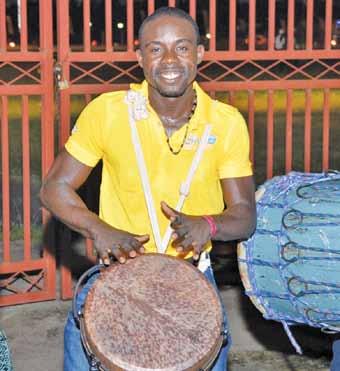
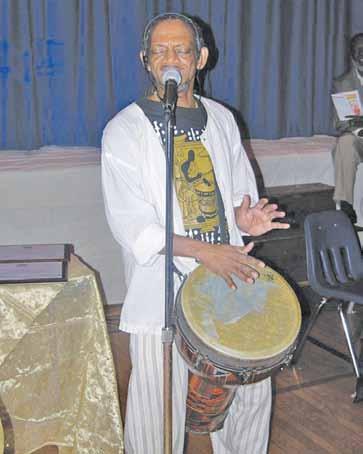
As a young boy growing up, Orlando Randolph Primo did not envision the life he now lives. At 26, he is founder and owner of Majek Fingers Drumming School, an institution dedicated to teaching the art of drumming, and preserving the African culture through music.
Primo grew up in Lodge in Georgetown, and recalled that for most of his childhood he was a playful person. He began playing drums at the age of seven, but at the time was not interested in it.
“I never really liked the drums period, but my brother [Kurt Primo] was the driving force behind me playing drums. So one day he called me and another brother to teach us how to play; and I was like ‘I don’t want to do this; I ain’t able with all the drama.’ But he was persistent,” he recalled.
Primo said they began playing at a church and then gradually, he began developing a liking for the art form, and was soon playing at functions and events. He recalled that he was around 11-years-old when he fell in love with drumming. “I fell in love with it at the time when I was developing my skills, and I learned to control myself on the drum.”
He recalled that his drumming career rapidly “sky-rocketed to the roof”. He noted that while he did not attend a drumming school, whatever he knows was taught to him by his brother, Kurt, and together the two, along with another brother, formed a group calling themselves the “Primo Brothers”.
“I know this was a gift that God had given to me, and I started to think bigger. My vision for drumming developed on a wider scale…the art form was dying slowly, the culture was dying. I remember when I was younger and used to see the senior drummers playing, and I told myself that I will be better than them.”
The artist disclosed that he began putting more effort into learning more extensively about drumming, and even went to other countries to develop his skills. It was at this stage that Primo began toying with the idea of opening a drumming school.
“I was sitting with my mom one night and we were talking; then I turned to say to her that I think it is time I give back to the community and pass on this culture and amazing art form, because we need to revitalize it…I cannot stand and watch my culture die; and so I told my mother I will open a drumming school.”
Talking about the name of the school, Primo recalled that his first published story was in 2006 and was titled “Creating magic on the drums”; then after performing at an event, he was told by a pastor that he has magical fingers, and so he came up with the name “Majek Fingers Drumming School”.
In February 2010, Primo launched the drumming school at the age of 23. In addition to the school, there is also a drumming website (majekfingers.gy.com). Currently the school has some 30 students enrolled, while they have already graduated hundreds of students. Primo is also the founder of the Drumming and Dance Festival, which will be held later this year for the third time.
Primo noted that the journey to get where he is was not an easy one; there were ups and downs as every other venture. However, this did not deter him from excelling and striving to have the best drumming school. His dream is to establish branches of his school across Guyana so that everyone can have access to learning this art form.
Primo is advising those who are ignorant of the African culture, especially the younger generation, to learn more about the culture. “The African culture and drumming dates back centuries, and it’s our charge to keep our culture alive… if we do not do this then it will pass us by and all that our ancestors passed onto us will go to waste.”

Guyanese pro cricketer Christopher Barnwell, born January 6, 1987, is a rightarm fast bowler in the hit-the-deck mould who can also contribute with the bat. In his first season of domestic cricket, he served notice of both his skills, with a five-wicket haul and half-centuries in the first-class and List A formats. While spinners formed the crux of Guyana’s attack in their victorious 2010 Caribbean T20 campaign, Barnwell was their most consistent seamer, impressing with his nagging lengths and clever changes of pace. His spell of 1 for 19 in four overs in the final proved crucial in swinging the momentum Guyana’s way after a wayward start. This evening (August 4), the Guyana all-rounder will once again showcase his skills, along with his team the Guyana Amazon Warriors, at the Limacol Caribbean Premier League (CPL) T20 cricket tournament at Providence Stadium as they play against the St Lucia Zouks. (ESPN Cricinfo)
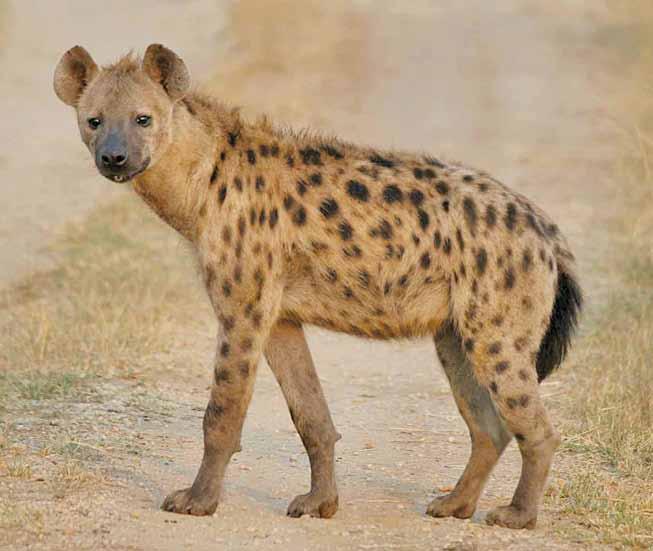
The Spotted Hyena (Crocuta Crocuta) ranges over the African savannah south of the Sahara Desert, and lives in large groups called clans that may include up to 80 individuals, led by females. The female spotted hyena is considerably larger than the male.
Spotted hyenas live in dens or dips in the ground with shelter, and are pack animals, hunting in packs during the night.
Although dog-like in appearance, the spotted hyena is more closely related to cats, civets, and genets. Spotted hyenas have good hearing and sharp eyesight at night. They are fast and can run for long distances without tiring. They choose their prey and chase it until it is exhausted. Once exhausted they attack the animal and feed.
It is also called the laughing hyena because it is quite vocal and makes a wide variety of sounds, including the "laughing" sound that gives them their name. They make this "laughing” sound when they are defending their territory.

The objective of the game is to fill all the blank squares in a game with the correct numbers. Every row of 9 numbers must include all digits 1 through 9 in any order. Every column of 9 numbers must include all digits 1 through 9 in any order. Every 3 by 3 subsection of the 9 by 9 square must include all digits 1 through 9.
One long standing myth is that hyenas are scavengers. This is incorrect; they can in fact bring down prey as large as a zebra and hunt their own food, but will also feed on carrion. They also kill and eat birds, lizards, snakes, and insects.
According to the National Geographic, the Maasai people of Kenya and Tanzania leave their dead to be consumed by hyenas. Spotted hyenas are the largest of three hyena species. Brown and striped hyenas are the other two.


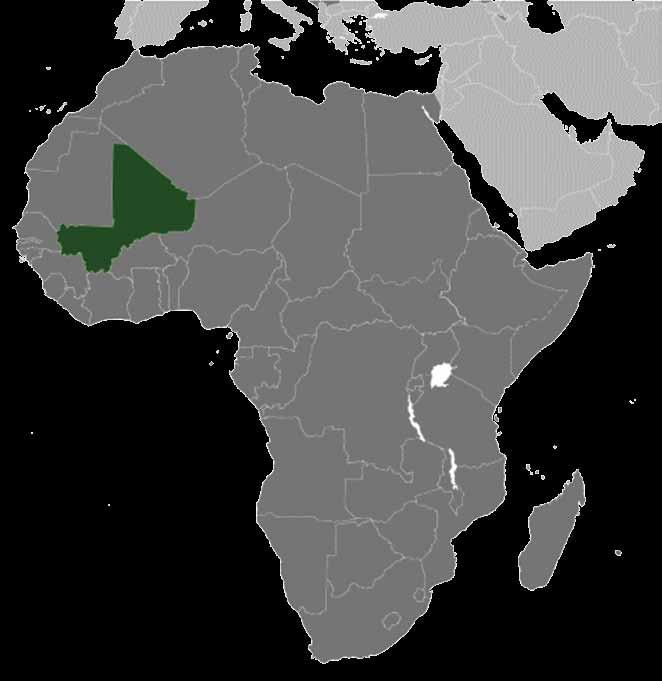
The Sudanese Republic and Senegal became independent of France in 1960 as the Mali Federation. When Senegal withdrew after only a few months, what formerly made up the Sudanese Republic was renamed Mali. Mali is located in the interior Western Africa; southwest of Algeria, north of Guinea, Cote d'Ivoire and Burkina Faso, and west of Niger.
Full name: The Republic of Mali
Population: 16.3 million (UN, 2012)
Capital: Bamako
Area: 1.25 million sq km (482,077 sq miles)
Geography: landlocked; divided into three natural zones: the southern, cultivated Sudanese; the central, semiarid Sahelian; and the northern, arid Saharan
Major languages: French, Bambara, Berber, Arabic
Major religions: Islam, indigenous beliefs
Natural resources: gold, phosphates, kaolin, salt, limestone, uranium, gypsum, granite, hydropower

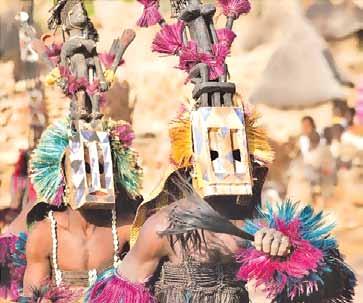
The people of the Dogon live in the little-known Bandiagara Cliffs of southern Mali. The Dogon have survived for centuries, withstanding constant slave raiding parties of the successive empires of Ghana, the Sonrai, the Mossi, the Sao, the Fulani, and the Muslims from the north.
Today, some 300,000 Dogon live along a roughly 125-mile-long (200-kilometer) swath of land against the Badiagara Cliffs. Many live among 700 or so small villages with populations of less than 500.
The Dogon have been the centre of anthropological debate, for they have knowledge of the Sirius Star system that western scientists were able to confirm only by using high powered telescopes.
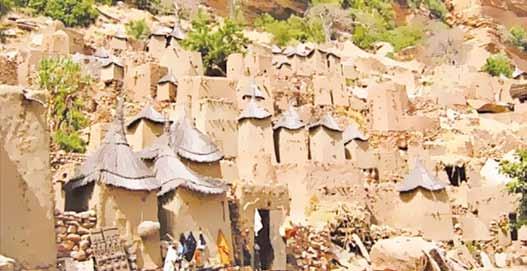
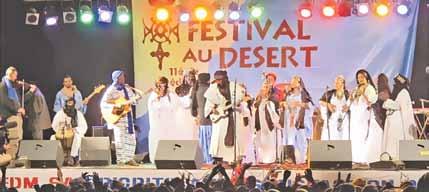
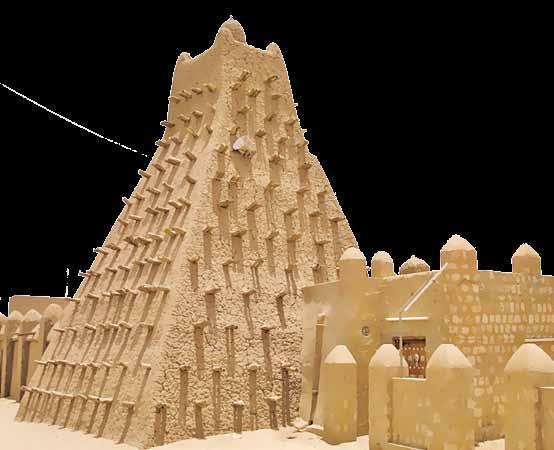
Timbuktu is populated by Songhay, Tuareg, Fulani, and Mandé people and is about 15 km north from the Niger River.
Timbuktu was founded by nomads in the twelfth century and it rapidly became a major trading depot for the caravans of the Sahara Desert. Located near the edge the Niger River during the rainy season but about 8 miles from the river during much of the year, the legend of Timbuktu as a rich cultural centre developed during the fourteenth century.
When the Emperor of Mali made his pilgrimage to Mecca via Cairo, the merchants and traders were impressed by the amount of gold carried by the emperor, who claimed that the gold was from Timbuktu.
Furthermore, in 1354 the
great Muslim explorer Ibn Batuta wrote of his visit to Timbuktu and told of the wealth and gold of the region. Thus, Timbuktu became renowned as an African El Dorado, a city made of gold.
During the fifteenth century, Timbuktu grew in importance and produced few of its own goods, but served as the major trading centre for salt trade across the desert region. The city also became a centre of Islamic study and the home of a university and extensive library.
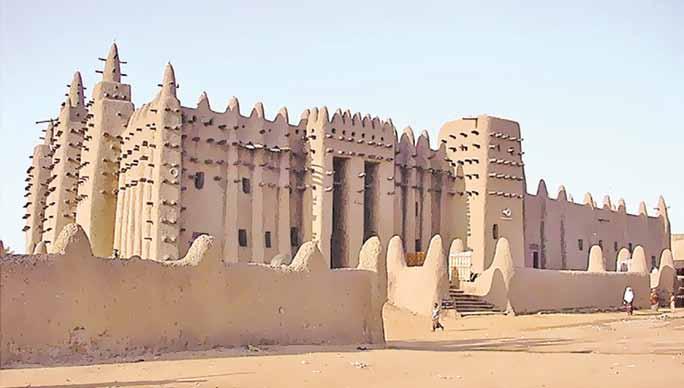
The city's maximum population during the 1400s probably numbered somewhere between 50,000 to 100,000, with approximately one-quarter of the population composed of scholars and students. In 1988, Timbuktu was designated a United Nations World Heritage Site, and efforts are underway to preserve and protect the city and especially its centuries-old mosques.

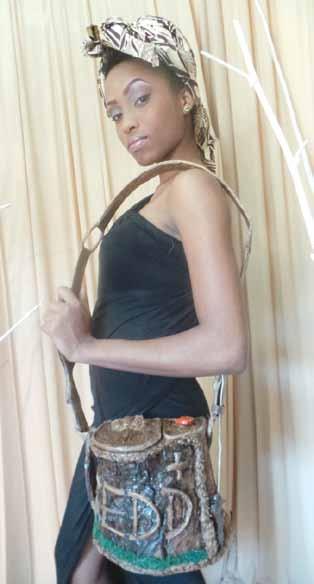
U.S.-based Guyanese designer Myrna Dale Petterson will be showcasing her modern African collection at the upcoming Guyana Fashion Weekend (GFW) 2013. She brings more than 15 years of experience in the fashion industry, and countless creative and chic collections. Complementing Petterson’s pieces will be ‘Fibration’, a bag collection by Luise Jordon. These creative bags are made from coconuts and discarded cane peel. For more information call 226-3099.





Marsha Thomason is a British television and film actress popularly known for her roles in the NBC series “Las Vegas”, for her recurring role on ABC's “Lost” as Naomi Dorrit, and for presently playing FBI agent Diana Berrigan on USA Network's “White Collar”. She also appeared in Disney's “The Haunted Mansion”, playing Eddie Murphy's wife. She played Brandy in the film “My Baby's Daddy”, and played Victoria in “Black Knight”. Thomason was born in Moston, Manchester, the daughter of Phyllis (née McCrae), a Jamaican electronics company employee and Peter Thomason, who worked in politics. She attended Holy Trinity Primary School in Blackley and North Manchester High School for Girls, before attending Oldham Sixth Form College to study for A levels in Media Studies, Theatre Studies and Performing Arts. Thomason attended the Manchester Metropolitan University, receiving a Bachelor of Arts degree in English. From the age of 13, Marsha attended Oldham Theatre Workshop where she was able to participate within youth theatre productions which contributed to her becoming a professional actress.
Use of the N-word tends to draw a lot of controversy, but there's no question where Oprah Winfrey stands on the subject.
The media mogul covers Parade magazine with her Lee Daniels' The Butler co-star Forest Whitaker and gets into detail about her views on race relations. "You cannot be my friend and use that word around me," Winfrey says. "It shows my age, but I feel strongly about it. I always think of the millions of people who heard that as their last word as they were hanging from a tree."
Lee Daniels, who directs Winfrey and Whitaker in the film, admits that he used the word "quite a bit" until Winfrey sat him down "and talked about its power."

The OWN boss also concludes that young people today "don't know diddlysquat" about the civil rights movement.
"Do we live in a land where Martin Luther King's dream has been ultimately fulfilled? No. Are more people
judged by the content of their character than by the color of their skin? Yes. Is everybody judged by the content of their character? Absolutely not."
Suffice it to say, Winfrey won't be breaking bread with The Color Purple co-star Rae Dawn Chong anytime soon. The actress recently made some shocking comments about Winfrey, implying that the mogul would have been a "field n*****" had she lived during slavery. Chong tried to walk back her comments after the understandable backlash, claiming she intended to "compliment" her former friend.
Though her Parade comments make it clear where her relationship with Chong stands, Winfrey has not directly responded to the outrageous comments. (BET)
Aguest stint by "America's Next Top Model" host Tyra Banks on BET's "106 & Park" Wednesday episode co-hosted by Bow Wow turned out to be the setting for their second on-screen lip lock. The 39-year-old supermodel and the 26-yearold rapper were reminiscing about a kiss they had back in 2009 on Banks' own talk show, "The Tyra Banks Show", when the idea for a reenactment came up.
"We have serious history. He had a little crush on me and was hitting me up on Twitter nonstop. I think he was talking about wanting to know what my lips taste like and stuff," Banks said before playing a file video of their first PDA four years ago. That somehow inspired
Mr. 106 & Park to spray on some breath freshener, that got his longtime crush to ask, "You tryna do the remix?"
Without any hesitation, Bow Wow slid closer to Banks who propped up her long legs across the host's lap before planting not just one but two kisses on her consistent admirer. A visibly flustered Bow Wow staggered around rubber-legged after the sweet smooch, and later during a commercial break, admitted, "I had to really walk backstage to really get myself together. I'm rattled right now."
Still excited even after the show, Bow Wow posted a video on Instagram captioned, "TYRA KISS MY LIPS TWICE", where he shrieks, "Tyra touched

these lips!" He also tweeted, "Im the man," to 2.6
million Twitter followers. (AceShowbiz)
Matthew Vaughn has found villain of his latest directing gig in Samuel L. Jackson. Variety reports that the "Pulp Fiction" actor, who starred alongside Jamie Foxx in "Django Unchained", has been tapped to villainize "The Secret Service", a feature adaptation of Mark Millar and Dave Gibbons' comic that's been developed since 2011.
Vaughn has already secured two actors to be the leads, "The King's Speech" actor Colin Firth and newcomer Taron Egerton who will be the nephew whom Firth's character mentors to become a secret agent. The only homework for Vaughn now is to find the female lead. He reportedly eyes Emma Watson and "Dark Shadows"
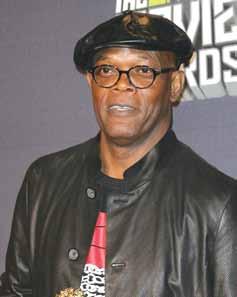
star Bella Heathcote, but no official offer has been made.
Vaughn has always envisioned a high-profile actor taking on the villainous role. Prior to the inclusion of Jackson in the project, he pursued Oscar-nominated actors Leonardo DiCaprio and Tom Cruise. Marv Films will finance and produce the film, which is expected to start its production this fall.
Jackson will next be seen in "Oldboy", Spike Lee's remake of the 2003 South Korean film which also stars Josh Brolin. In 2014, he will grace big screens with two hotlyanticipated action pics, "Robocop" and "Captain America: The Winter Soldier". (AceShowbiz)
Would anyone object if we changed the name of this site to the Rihanna Hair Chronicles? It feels as though every week we’ve got a new update on the star’s ever-changing strands. Her latest look is a short, curly crop that ends just below her ears. She ditched her blonde bangs and long gray waves for her natural dark brunette hue.
Most surprising of all: For a star that’s had pretty much every hairstyle under the sun, she hasn’t really ever rocked natural, tight curls like these. At first, she seemed skeptical of the cut, posting on Instagram, “Still tryna get used to my hurr.” But judging by the many subsequent pics she’s posted since, she’s definitely more into it now. (People)

"American Idol" season six grand champion Jordin Sparks is back with a new single after four long years since her 2009 sophomore album "Battlefield". Entitled "Skipping a Beat", the track got released on Thursday, August 1, after a week-long teasing done by the 23-yearold singer on her Instagram and Twitter accounts.
With such lyrics as, "Hope I'm the one that you wanna put the rock on," and, "You're my lover, you're my friend, you're my gangsta," it is safe to assume that the love song is about her boyfriend and fellow R'n'B/pop star Jason Derulo. Sparks' Instagram video post where she is seen singing the love anthem to Derulo is also the obvious giveaway.
During the four-year gap between her last album and her new single, Sparks recorded for the soundtrack of her 2012 movie "Sparkle" where she starred opposite the late great singer Whitney Houston. Apart from "Skipping a Beat", she is set to do a duet with Derulo entitled "Before It Breaks".
Sparks is not the only

one being inspired and creating music out of her flourishing romance, with Derulo debuting his own "The Other Side" on Ryan Seacrest's radio show back in April. The song appeared as the lead single off his forthcoming third studio album "Tattoos" and it was admittedly about her relationship with Sparks. "We love being able to support each other in what we do," Sparks said about their hit-making partnership. (AceShowbiz)

Nick Cannon and Amanda Bynes started their careers together on the Nickelodeon show All That, but ended up in very different places. Now, Cannon has penned an open letter to his troubled former co-star, offering her support and encouragement.
In the letter, posted to Tumblr, Cannon refers to Bynes as his "sister," and says she is "someone I consider family, someone I watched grow up, and someone I genuinely feel is one of the most pleasant human beings I have had the pleasure of meeting."
While Bynes' increasingly bizarre behavior — including strange tweets about Drake, Kid Cudi and Rihanna — has made her the butt of many jokes, Cannon says, "after recent events of Amanda being admitted under psychiatric care and reported as 5150 [involuntary hold], I see this as no laughing matter."
He continues, "I tweeted a few weeks [ago] about how the entertainment industry just consumes people and spits them out like flavorless
bubblegum. A few chews of enjoyment, then they're under a city bus bench."
"Don't get me wrong; this is not a pity for the popular statement," Cannon clarifies. "I am always the first to say that fame and entertainment is one of the best and easiest occupations to ever have, but one must know how to navigate through the matrix or you may find yourself in a very dark hole."
The actor and entrepreneur goes on to warn against the dangers of excess in Hollywood, and ends on a sympathetic note. "We all end up alone in that dark hole at some point in our lives, and if you don't have a foundation of friends and family to help bring you up and out, it makes that journey long and detrimental," he continues. "So I say to my sister Amanda Bynes, you're not alone. I'm here for you. I understand. I care and I appreciate you, because that's what family does and that's what family is for."
Hopefully, Cannon's note will reach Bynes and she'll take him up on his offer. (BET)

Pat Attah is a popular Nigerian actor. He is the last child in a family of six. His father was a former Federal Pay Officer who was transferred frequently to different locations in the country. This accounts for Pat attending several primary and secondary schools. The actor completed a course in Basic Sports Management at the Nigerian Institute of Sports. Pat, who started acting in Rivers State, Nigeria, got his breakthrough in the soap opera “Fortunes” which was aired on the National Television Authority (NTA). The talented thespian made his debut into the Nigerian movie industry in 1994 when he acted in “Glamour Girls”. He has since been featured in over 60 Nollywood movies. His upcoming movie, “The Same Day”, is said to be releasing soon. In it he plays the character of Mario a drug baron.
Omotola Ekeinde Jalade has kicked against the passing of the child marriage section of the constitution, which is currently passing through some changes. The sexy actress vented her anger on the Nigerian Senators for voting the section of the constitution.
She said this at the MBGN beauty contest and emphatically made her stand known on the issue. Omosexy, as she is also called, stated in her speech that she is against child marriage.
“I am today one of the most influential person/people in the world because I wasn't given off to marriage before the age of 18. It scares and totally shocks me that the Senate in Nigeria (the most populous black nation in the world and giant of Africa) would not be passing in a law ensuring that every child should compulsorily be enrolled in school.”
She continued, "A very alarming number of children today are on the streets hawking or have been abused, raped or are married to men/women who should be protecting them. Who protects the children of Nigeria? Would we wait for another Milala before we act? Should we now remove the parental caution on movies that say 'Not for persons below 18'? This is a call for justice and equity for children especially the Nigerian girl child, who has the right to quality educa-

tion, a childhood and the decision of whom and when to marry. My Name is Omotola Jalade Ekeinde and I say No to phedophilia and No to the Senate bill endorsing child marriage in Nigeria.” (Nigeria Films)

In April 2012, the entertainment industry, especially the movie fraternity, was agog. Everything was almost brought to a standstill at that time for the superlative wedding of Stephanie Okereke to Linus Idahosa. The prayers to get the
wedding IV started within some people, but only few had the privilege to have it.
At last, the 'chosen' ones were airlifted to Paris, the French capital, for the ‘fairy tale’ wedding, which is still one of the most glamorous weddings in the entertainment industry. The only recent wedding that is closely at par with that is the 2Face/Annie Macaulay wedding held in Dubai in 2013.
But 14 months after the wedding, the couple has not yet produced a child. In late 2012 and early 2013, there were rumours that the actress was pregnant, but her tummy in recent times has not suggested such.
In a recent interview, the former MBGN pageant runner-up disclosed that she is happy with the fact that Nigerians, especially her fans wish her well, but she was quick to say she would have babies at the right time.
According to her, “the little ones are coming soon, but you know, everything is in God’s hands and I’ll have a baby when I’m supposed to have a baby. I am definitely not under any kind of pressure. We wish for it to happen and of course it’s going to happen.” (Nigeria Films)
The news currently making the round is that popular film maker Kunle Afolayan has been dropped as a Glo ambassador. News has it that the wavemaking director was removed because of his dalliance with Hafiz Oyetoro popularly known as Saka.
According to reports, Afolayan was allegedly booted out when Globacom found out that one of the main characters in his Phone Swap movie (which was sponsored by Globacom) was Saka, an Etisalat face before he ported to MTN. Today Vnolly ran into Afolayan and asked him to comment on the rumor and all the talented actor said was, “No comment.” (Vnolly)
Some members of the Musicians Union of Ghana (MUSIGA) in the Central region have defected from the union accusing the musicians' body of neglecting them.
The members, who call themselves Concerned Members of MUSIGA in the region, expressed their displeasure at national executives for failing to address several challenges facing them.
The concerned members in a statement signed by their Press Secretary, Oti Faaben Kakra and copied Myjoyonline.com Friday, announced their defection from MUSIGA to the Musicians and Dancers Association of Ghana (MUDAG), to help address their challenges.
"We have defected from the Musicians Union of Ghana (MUSIGA) to the Musicians and Dancers Association of Ghana (MUDAG) which is a member of the Music Council of Ghana of the International Music Council of UNESCO and subsequently cease to be members of MUSIGA," the statement said.
They claimed that executives of MUSIGA are "not ready at all to hear to our cry," and that "it is sad to note that vibrant members who are not popular are not counted among the lot. Secondly those in the rural and the remote areas are not recognized in any activity and service of the union."
According to them, the musicians' union has failed to deliver on several expectations to members including; "support in times of Launching of Album, Loss of Parents, Loss of Two Children below the age of 18, Outdooring, among others, but this turned out to be for only a selected few."
"This makes our welfare unsecured and discriminatory since we are all active members who pay membership dues of Fifty-four Ghana Cedis (GH 54.00) and Sixty Ghana Cedis (GH 60.00) annually, as welfare dues per member," the concerned musicians added.
The group lamented that they are hurt about the situation and noted that a letter they wrote in June 2013 to the President of MUSIGA, Bice Osei Kuffour asking him not to accept the resignation of their chairman in the Central Region, did not receive any response.
"Although most of us were not in executive meetings, we are totally aware about the issues that were raised by the C/R chairman of the union during the Ghana Music Week that resulted in his resignation, and believe that the President together with the National Executives could have solved the issue amicably to calm down the members, but it wasn't so."
The concerned musicians accused national executives of MUSIGA of remunerating themselves "from Five
hundred Ghana Cedis (GH 500.00) to Two thousand, Eight hundred Cedis (GH 2,800.00) monthly without thinking of the members welfare."
They further lamented that their neglect could be the result of the fact that most of them are unpopular and geographically dislocated. They however, clarified that "music is not about only those who sing and are popular but consider the song writers, the composers, instrumentalists, sound engineers, producers among the lot, therefore we believe all must be recognized."
The concerned musicians were of the view that, MUDAG has well organized structures which will help polish the music and dancing industry "and help most of us realize our dreams."
"We want to make it clear to all that we are not doing this to create any chaos in MUSIGA but to make sure that the plight and concern of both musicians and dancers are well addressed, while the show goes on in the arts struggle," the statement concluded. (Modern Ghana)
Pendo is one of the hottest female singers in Kenya today that has a pool of followers. Recently, the lady confessed that her flighty night with Davido was the best in her entire life. Though, Davido has denied ever having anything to do with the artiste, however, the lady has confirmed that they actually have a pleasurable night together.
“If people had done even a little research, they would Davido does not even have a Facebook account. I NEVER said I was in touch with him through Facebook. I got in touch with him through a good friend of his redacted and that's where everything started. He did the intro,” she said.
On if she actually slept with him and if the reason was to obtain money from him, she was too incoherent and couldn't answer the question straight. “Errrrrrrrrrrm (laughs cheekily) No, I didn't get money from him.

“I didn't WANT money from him. I did it simply because I find him hot and he is pretty legit in the music industry in Africa. Yeah, I am attracted by his talent, his fame, his power, but honestly, who isn't? And people are talking so much because a lot of women wanted to be in my shoes, but were not. I'm not afraid to go after what I want.” (Modern Ghana)
The Trans Atlantic slave trade is usually divided into two eras historians call the First and Second Atlantic Systems, which lasted from the 16th century into the 19th century.
The First Atlantic System is said to have begun after the 1492 discovery of the “New World” by Christopher Columbus. Colonizing new territory, particularly from 1502, the Portuguese and the Spanish, who were among the first group of Europeans to arrive in these regions, began their own systems of slavery. While the Portuguese themselves engaged in trading both indigenous Indian and African slaves, the Spanish developed an asiento system where they licensed merchants from other countries (Dutch, French and British traders) to trade enslaved peoples to their new colonies.
The Second Atlantic System generally took place after Spain lost control of most of its New World colonies, and British, Portuguese, French and Dutch traders began trading chiefly enslaved Africans in larger numbers to these regions, now under their control, during the 17th and 18th centuries. Estimates suggest that more than half of the slave trade occurred in the 18th century, with the British conducting most of the trade across the Atlantic for their New World colonies.
Why the Atlantic slave trade?
Many theories have been put forward why the Europeans began what would become one of humankind’s biggest tragedies.
According to Charles C. Mann in his 2011 bestseller book, “1493”, the domestication of sugarcane in New Guinea some 10,000 years ago would later lead to an explosion of sugar plantations around the world because of its escalating demand. Reaching China and India, by about 800 AD, sugar plantations became common on the Mediterranean coast of what are now Lebanon and Israel where the European Crusaders first experienced sweet “reeds filled with a kind of honey known as Zucar.”
Sugar was a rarity in Europe and in high demand at the time; the Crusaders eventually eyed Islamic sugar plantations which, after the First Crusade, European Catholics eventually seized as part of their anti-Muslim campaigns; but could not keep up with European demand.
Running out of warm, wet areas – in which cane grows best – in a relatively dry region,(Islamic empires eventually retook their estates) it was Portugal that
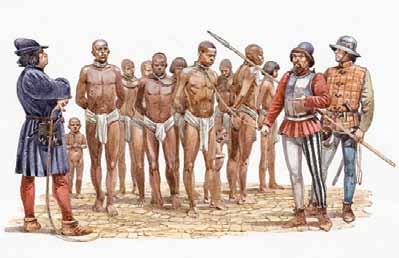
It is said that the Spanish took the first African slaves to the New World as early as 1503, and the first direct shipment of African slaves to the Americas occurred by 1518. According to historians Linda Heywood and John Thornton, Central Africans insisted Europeans refer to slaves as negro and free Africans as preto; both Portuguese words for “black”
first looked overseas to the Atlantic island chains of Madeira, the Azores, Cape Verde Islands and São Tomé to establish plantations. Spanish plantations arrived on the Canary Islands.
On Madeira, considered a significant island as it “set precedents and established patterns” of what was to follow, Portuguese settlers cleared land, and sugar production grew more than a thousand-fold between 1472 and 1493. Prices eventually fell and planters began increasing their production to make up for lost profits. Labour became an extremely urgent and necessary commodity; the cheaper the better for profits.
Although Iberian slavery was common, according to Mann, the Portuguese transformed it on Madeira. Initially, Madeira slaves were captive convicts, Canary Island natives (Guanches), Berbers (a northwest African group and historical adversary of the Portuguese) and perhaps the conversos Iberian Jews and Muslims forcibly converted to Christianity but considered traitors by the Portuguese and Spanish. Eventually these groups were replaced by west-central Africans, to usher in the world of plantation slavery, which would soon include tobacco and cotton industries. The island became what Madeira historian Alberto Vieira called Atlantic slavery’s “social, political and economic starting point”.
Why were the original slaves replaced by Africans? Besides a cheaper and easily replenished labour force, Mann notes that two key elements must also be known: “the organisms responsible for malaria and yellow fever.”
The islands’ lush vegetation, warm climates and abundant water made them ideal for sugar production – and Anopheles gambiae and Aedes aegypti , Africa’s malaria carrier and yellow fever vector respectively. In São Tomé and Principé, settlers and their Iberian slaves were dying in
droves to disease caused by these vectors. This eventually led to the importation of African slaves, seemingly immune or less susceptible to the diseases.
As a result of these diseases and economic ruin when Brazilian sugar became a cheaper alternative, by 1600, the island of São Tomé was left with a population in which African slaves outnumbered Europeans by some one hundred to one. This made it an unpopular and therefore neglected region for the Portuguese, as it also became prone to slave uprisings and runawayslave raids.
Madeira on the other hand, contained no such vectors, and with the competition of Brazilian sugar, was able to switch to winemaking, which required less labour. By the end of the 19th century the island’s infrastructure and climate made it a tourist destination.
Unlike São Tomé, at the height of its sugar boom
in 1552, three out of ten of Madeira’s inhabitants were slaves; forty years later, that figure dropped to one in twenty. Madeira was able to free its slaves since sugarcane was no longer being cultivated, and many slaves, with no way of returning home, became tenant farmers and sharecroppers, though more often than not in poverty.
Race and slavery
No discussion about the origin of the slave trade could be dealt with without mentioning the race factor. A bitterly controversial discussion to this day, it is too extensive a topic to cover satisfactorily here.
It is left to Mann to apply contemporary knowledge and opinion in discussing the link between race and slavery in his book “1493”; though no doubt his attempts would also bring disagreement (he calls dis-
cussions of race, defined by genetics and socially, “often dialogues to the deaf”). Here is an excerpt from the book: ...at the dawn of globalization modern concepts of race didn’t exist. Fighting off the yoke of African Islamic empires, the inhabitants of the Iberian Peninsula didn’t, as a rule, kill or enslave “blacks,” they killed and enslaved “Moors”, or “infidels” or “idolaters”. At the beginning, slavery had little racial baggage; the question that preoccupied Spaniards was not whether “black” or “red” people could be enslaved but whether Christians could be put into bondage; heathens, heretics, and criminals of any color were fair game.(p.514) It would be these early Portuguese and Spanish experiences that would later guide the following Atlantic Systems in the New World.



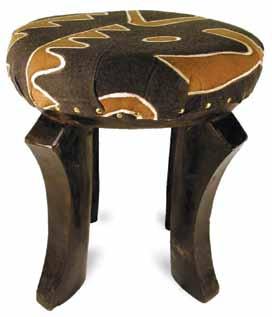
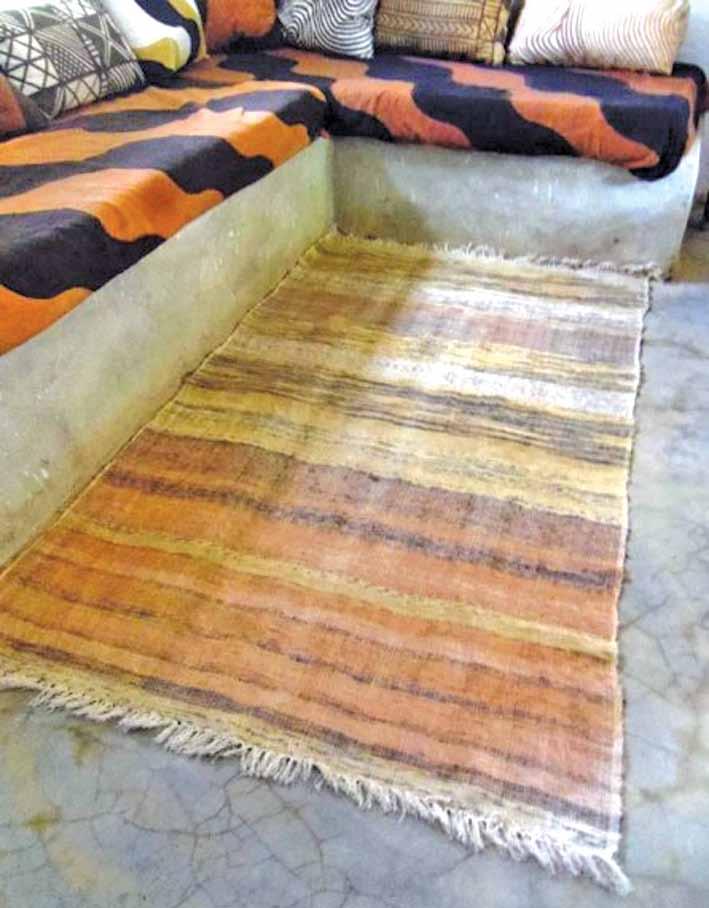
Bogolan means “made from mud” in Bambara, the main language of Mali. Considered the quintessential West African textile, bogolan fabric is used to make from handbags, shoes and clothing to home decor items found in Mali and around the world.
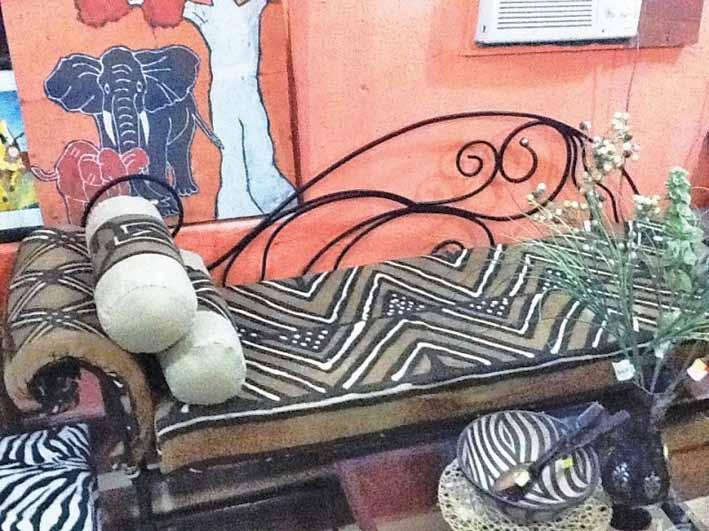
Through a process of oxidisation the mud reacts with the natural dyes, producing a rich black when it dries and has been washed off the fabric

Ingredients
1/4 cup oil
1 1/2 lbs chicken, cut into pieces 5 cups water or stock
2 onions, chopped 1 red or green bell pepper, chopped 3-4 cloves garlic, minced
Method
Heat the oil over medium-high flame in a large pot. Working in batches, add the chicken and brown on all sides. Remove the chicken to another large pot and add the water or stock. Bring to a boil, reduce heat to low and simmer for 20 minutes.
While the chicken simmers, pour all but 2-3 tablespoons of oil out of the first pot. Heat the oil over medium flame; add the onions and peppers and sauté until the onions are wilted and translucent, 4-5 minutes. Add the garlic and sauté for another 1-2 minutes.
Stir the rice into the onions and peppers and heat through for another 1-2 minutes. Stir in the tomato paste to coat the rice and give it a reddish hue. Add the chopped tomatoes and let them cook down for 2-3 minutes.

Pour in the chicken and its simmering liquid into the rice pot and add the carrots, green beans and cabbage. Season well with salt and pepper. Bring to a boil, reduce heat to low, cover tightly and simmer for 20 minutes.
Remove from heat, let rest another 10 minutes. Remove to a serving platter and serve with fried plantain, fried meat/fish etc.
Ingredients
2 very ripe plantains
1 onion, finely minced
1 ⁄ 2 teaspoon ground ginger
Method
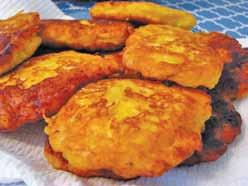
Peel plantains. Slice into pieces 2 inches or so, and then mash in a large bowl, using a potato masher. You can also pulse them in the food processor un-
1 ⁄ 2 teaspoon ground red pepper
1 ⁄ 2 teaspoon salt
3 ⁄ 4 cup yellow cornmeal
6 tablespoons peanut or vegetable oil for frying
til they are ground up but not completely pureed.
Add the onions, ginger, red pepper, salt and cornmeal to the plantain and mix well .In a larger bowl, toss the plantain pieces with the lemon juice. Add spice mixture and toss to coat.
Heat oil in a heavy (cast iron is good) skillet, at least 10 1 ⁄ 2 inch. You can drop a small piece of plantain in the oil to check the hotness. When the plantain sizzles and starts to brown, your oil is ready.
Form golf ball-sized pieces of the plantain mixture into patties, and drop into hot oil. Fry on both sides until golden brown. Drain on paper towels. (Makes 20)
Ingredients
2 cups flour 1 cup warm water 1 tablespoon dry yeast baking
Method
Dissolve yeast in warm water and pour over the flour. Mix really well. Add the sugar, salt, vanilla sugar and mix well with the flour. Cover with a towel and let the dough rest for 2 hours.
Heat the oil over medium heat, not too hot to prevent the cake burning without being cooked.
Use your hand or a spoon to drop the mixture into the oil; be extremely careful when doing this step.
Fry the fritters until each side is brown.
½ cup sugar
1 teaspoon salt
Tablespoon vanilla sugar
Vegetable oil for frying
Serve hot with chilli sauce or alone. (20-30 donuts)

If a light oxygen tank were tied to a bird so that it can breathe on the moon, would the bird fly faster, slower or the same speed as it does on earth? (Remember that there is less gravity on the moon)



AFRICAN FOLKTALES
In the olden days when Effiong was king of Calabar, it was customary at that time for rulers to give big feasts, to which all the subjects and all the birds of the air and animals of the forest, also the fish and other things that lived in the water, were invited. All the people, birds, animals, and fish, were under the king, and had to obey him. His favourite messenger was the hawk, as he could travel so quickly.
The hawk served the king faithfully for several years, and when he wanted to retire, he asked what the king proposed to do for him, as very soon he would be too old to work anymore.
So the king told the hawk to bring any living creature, bird or animal, to him, and he would allow the hawk for the future to live on that particular species without any trouble.
And the hawk replied that the father and mother owls kept quite quiet, and never said anything. The hawk's friend then advised him to return the owlet to his parents, as he could never tell
he saw a lot of fowls near a house, basking in the sun and scratching in the dust. There were also several small chickens running about and chasing insects, or picking up anything they

The hawk then flew over a lot of country, and went from forest to forest, until at last he found a young owl which had tumbled out of its nest. This the hawk brought to the king, who told him that for the future he might eat owls. The hawk then carried the owlet away, and told his friends what the king had said.
One of the wisest of them said, "Tell me when you seized the young owlet, what did the parents say?"
what the owls would do to him in the night-time, and as they had made no noise, they were no doubt plotting in their minds some deep and cruel revenge.
The next day the hawk carried the owlet back to his parents and left him near the nest. He then flew about, trying to find some other bird which would do as his food; but as all the birds had heard that the hawk had seized the owlet, they hid themselves, and would not come out when the hawk was near. He therefore could not catch any birds.
As he was flying home
could find to eat, with the old hen following them and clucking and calling to them from time to time.
When the hawk saw the chickens, he made up his mind that he would take one, so he swooped down and caught the smallest in his strong claws.
Immediately he had seized the chicken the cocks began to make a great noise, and the hen ran after him and tried to make him drop her child, calling loudly, with her feathers fluffed out and making dashes at him.
But he carried it off, and all the fowls and chickens at
once ran screaming into the houses, some taking shelter under bushes and others trying to hide themselves in the long grass. He then carried the chicken to the king, telling him that he had returned the owlet to his parents, as he did not want him for food; so the king told the hawk that for the future he could always feed on chickens.
The hawk then took the chicken home, and his friend who dropped in to see him, asked him what the parents of the chicken had done when they saw their child taken away; so the hawk said— "They all made a lot of noise, and the old hen chased me, but although there was a great disturbance amongst the fowls, nothing happened."
His friend then said as the fowls had made much palaver, he was quite safe to kill and eat the chickens, as the people who made plenty of noise in the daytime would go to sleep at night and not disturb him, or do him any injury; the only people to be afraid of were those who when they were injured, kept quite silent; you might be certain then that they were plotting mischief, and would do harm in the night-time.
Many years ago the sun and water were great friends, and both lived on the earth together. The sun very often used to visit the water, but the water never returned his visits. At last the sun asked the water why it was that he never came to see him in his house, the water replied that the sun's house was not big enough, and that if he came with his people he would drive the sun out.
He then said, "If you wish me to visit you, you must build a very large compound; but I warn you that it will have to be a tremendous place, as my people are very numerous, and take up a lot of room."
The sun promised to build a very big compound, and soon afterwards he returned home to his wife, the moon, who greeted him with a broad smile when he opened the door. The sun told the moon what he had promised the water, and the next day commenced building a huge compound in which to entertain his friend.
When it was completed, he asked the water to come and visit him the next day.
When the water arrived, he called out to the sun, and asked him whether it would be safe for him to enter, and the sun answered, "Yes, come in, my friend."

The water then began to flow in, accompanied by the fish and all the water animals.
Very soon the water was knee-deep, so he asked the sun if it was still safe, and the sun again said, "Yes," so more water came in.
When the water was level with the top of a man's head, the water said to the sun, "Do you want more of my people to come?" and the sun and moon
both answered, "Yes," not knowing any better, so the water flowed on, until the sun and moon had to perch themselves on the top of the roof.
Again the water addressed the sun, but receiving the same answer, and more of his people rushing in, the water very soon overflowed the top of the roof, and the sun and moon were forced to go up into the sky, where they have remained ever since.

Here on this Public Square I Stand
I sell My Song for those with ears to buy It is to a tree that a bull is tied
You do not bypass the palm’s branches to tap its wine
The things I have to say I say them now I shall stand aside from those who care to clear their throat and dress their shame in lies
When you meet a poorly-dressed neighbour at a great durbar you do not spit on the ground and roll your eyes to the skies
The umbrella I bought You stole from my rooms at dawn Now I walk in the early morning rain
You point at me to our young maidens And they join you in laughter
Think My People Think Think well before you laugh at those who walk in the rain.
The gifts that bestows at birth Some had some splendid things What was mine? I sing. They laugh.
Still I sell My Song for those with ears to buy
My cloth is torn, I know But I shall learn to wear it well
My voice is hoarse, I know But I shall learn to wear it well.
Kofi Anyidoho
They sneaked into the limbo of time
But could not muffle the gay jingling Brass bells on the frothy necks Of the sacrificial sheep that limped and nodded after them; They could not hide the moss on the bald pate Of their reverent heads; And the gnarled backs of the wawa tree; Nor the rust on the ancient state-swords; Nor the skulls studded with grinning cowries; They could not silence the drums, The fibre of their souls and oursThe drums that whisper to us behind black sinewy hands. They gazed And sweeping like white locusts through the forests Saw the same men, slightly wizened, Shuffle their sandaled feet to the same rhythms, They heard the same words of wisdom uttered Between puffs of pale blue smoke: They saw us, And said: They have not changed!
Kwesi Brew
Before the discovery of the “New World”, the Spanish and Portuguese already kept slaves who were initially captives of Islamic wars, as well as other Iberian and Berber slaves, to serve on sugar plantations, at home or other places of work.
When Christopher Columbus sailed into the New World in 1492, it is suggested that blacks were onboard and landed on the island of Hispaniola. The pilot of the Niña of 1492 is said to have been a mulatto called Alonso Pietro, and, during Columbus’ voyages he had a personal African slave. In 1502 his cabin boy was a black named Diego.
That same year, a black slave was sent to Hispaniola along with Spanish agents to conduct Spanish trade, and the newly appointed governor of Hispaniola, Nicolas de Ovando, took a number of Iberian- born black slaves from Spain to the island not only to work but to help control the native population whom the
sation in the New World.
In addition, Diego Velasquez used black auxiliaries in his 1511-1512 conquest of Cuba. In 1513, Vasco Núñez de Balboa became the first European to see the Pacific Ocean from a summit in Panama; with him was Nuflo de Olano, an enslaved African; the pair became the first men from the Old World to see the Pacific from the Americas side. de Balboa would later carry 30 black workers to build ships on the Pacific Coast. Hernando Cortés, in his 1519-1521 conquest of Mexico, also utilised black military support.
Throughout the 16th century and into the 17th and 18th centuries, Africans continued to take part in Spanish conquest and settlement. Between 1522 and 1523, a conquest expedition led by Gil Gonzalez up the Pacific coasts of Costa Rica and Honduras comprised several Africans, and some 200 of them accompanied Pedro de Alvaro to Peru in 1534, beginning a peri-
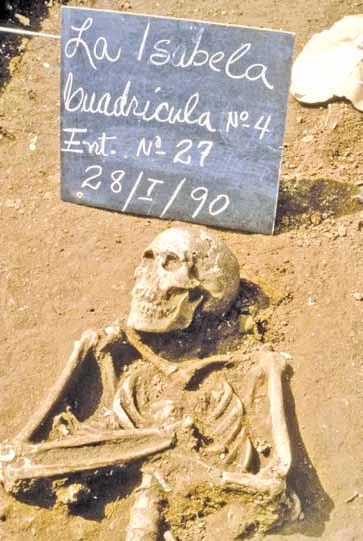
31, 2013, from http:// www.sciencedaily.com /releases/2009/03/090319132954.htm)
Spanish would call Indians.
In 1508, Spanish explorer Ponce de León took armed Africans to Puerto Rico to conquer that island, and Spanish King Ferdinand in 1510 authorised the transport of some 250 African slaves to the island of Hispaniola to begin clearing forests, building shelters and planting as the start of Spanish coloni-
od of intense importation of Africans to Peru that amounted to about 3,000 by the 1540s. Some became overseers for Chinese labourers in Peru.
African slaves were also part of the first European colony of San Miguel de Gualdape in what is now the U.S.A, said to have been established by Spain in 1526 on the coast of
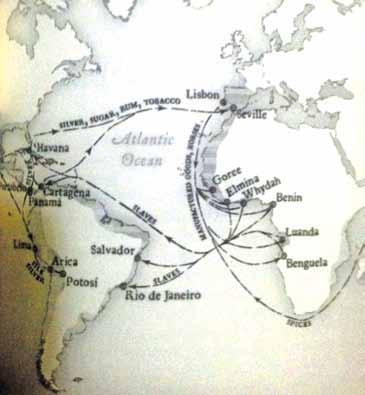
Georgia. The colony would become the first site of slave revolt “north of the Rio Grande”, which put an end to the settlement within a few months of its establishment; many slaves were said to have run away, and some assimilated into local Guale Indian societies.
This would make them the first “long-term residents” of the region “from across the Atlantic since the Vikings.”
Black military forces played a role in the 1627 conquest of the Itza Mayans in what is now northern Guatemala. A similar military force had already reached the region during Cortes’ 1525 excursion, and records show at least one had deserted the Spaniard to remain in the region’s capital.
It has been suggested that at the beginning of the slave trade, most of the slaves were either captured during Islamic wars or sold to the Spanish and Portuguese as African tribal war captives; as such, there were many African slaves skilled in warfare and therefore useful for Spanish military purposes.
Possibly more likely to survive the transatlantic voyages because of their military training, these slaves were considered more eager to be soldiers than slaves, thereby more willing to join Spanish conquest expeditions since they could not return home.
This usefulness would often however ultimately turn against the Spanish. As early as the fledgling settlement on Hispaniola, where black slaves were taken by Ovando to help quell native raids in 1510, the slaves were later accused of inciting native rebellions, and further importation of slaves was banned by the island’s governor for some time.
By 1515, after Velasquez’s Cuban con-
quest, few blacks were left on the island. Velasquez advised King Ferdinand against keeping them there because he doubted their loyalty to the crown and obviously realized how effective they could be if they turned their military skills against the Spanish on Cuba. In addition, it is suggested that he also saw their value in further con-
quests for Spain.
As Spain’s European rivals intensified their attacks on Spanish New World settlements, the construction of forts and in some instances the security of these forts were left to black militias as look-outs or patrols.
Black soldiers would soon begin fighting alongside the Spanish against these European nations such as in the 1655 English invasion of Jamaica; in Florida in 1585 against what is called the “Drake attack” by English royal-sponsored privateer Sir Francis Drake, and the 1663 and 1665 attacks on Campeche, Mexico by English, Dutch and French pirates.
But as an enslaved group, Africans in the New World did not always fight alongside the Spanish. Many ran away from Spanish and Portuguese settlements to form early Maroon societies in the as yet unexplored regions of the colony, harassing colonial armies and settlers from time to time.
When de Balboa was attempting to reach the Pacific, he found blacks in an Indian village he had destroyed. A community of es-
caped Africans lay just two days’ walk from where he would first seen the Pacific. Having escaped early Spanish settlements in the region to form their own societies, blacks lived an uneasy existence among native Indians in several New World regions. But blacks also remained in the New World not as slaves, runaways or Maroons, or soldiers; some became pirates, joining the lawless trade that flourished in the New World at the time. They turned to piracy as a way of freedom from any kind of colonial master. At least three were infamous enough in the 17th century to warrant records conveying serious Spanish attention.
However, most Africans arrived in the New World as sugar plantation slaves first in Mexico and Brazil for the Spanish and Portuguese; British, Dutch and French slavery was yet to begin en masse.
Between 1550 and 1650, more than 650,000 enslaved Africans were shipped to Spanish and Portuguese American colonies, often outnumbering the European populations by more than two to one.


ntroducing an entirely new kind of textbook that’s dynamic, current, engrossing, and truly interactive. A textbook created by publishers using a new authoring tool from Apple. A textbook brought to life by iPad.
The textbook dilemma.
For hundreds of years, textbooks have put a world of knowledge in the hands of students. But while the way people learn has changed dramatically, the traditional textbook has stayed the same.
Some things don’t get better with age.
Paper textbooks are ex pensive to produce and ex pensive for schools to buy. Which is why schools are forced to use a book for sev eral years to make the fi nances work. But informa tion changes so quickly that some textbooks are out of date almost before they’re published. And as books are passed along from one student to the next, they get more highlight ed, dog-eared, tattered, and worn.
Heavy back packs. Weigheddown students.
It’s no secret that paper text books are heavy. But what you may not know is that backpack weight is an increasing problem among kids. Studies show that heavy back
packs can lead to both chronic back pain and poor posture — and many kids are carrying a quarter of their body weight in textbooks.
The textbook transformation. Today’s students have grown up completely immersed in technology. iPod, iPad, computer — these
are the ways they interact with their world. They need a textbook made for the way they learn.
Textbooks they won’t want to put down.
iBooks textbooks on iPad offer a gorgeous, full-screen experience full of interactive diagrams, photos, and videos. No longer limited
lustrate the text, now students can dive into an image with interactive captions, rotate a 3D object, or have
can even get alerts when publishers update content, and download new updates to textbooks, at no additional charge.
Textbooks that go way beyond the printed page.
With the Multi-Touch magic of iBooks textbooks, interactive photo galleries bring images to life. Animations burst off the page. And 3D objects rotate with a swipe of a finger. See them in action
3D Images
Readers can manipulate 3D objects with a touch — so instead of seeing a cross sec-
the option to adjust the background, allow readers to rotate the object freely, or constrain its movement to horizontal or vertical rotation.
Interactive Images
Pictures tell a bigger story when they’re interactive. Callouts and pan-and-zoom features add even more to the experience.
Interactive Galleries Instead of seeing just one image on the page, readers can swipe through an entire collection of interactive photos and captions with their fingertips. They can navigate the gallery using photo

the answer spring to life in a chapter review. They can flip through a book by simply sliding a finger along the bottom of the screen. Highlighting text, taking notes, searching for content, and finding definitions in the glossary are just as easy. And with all their books on a single iPad, students will have no problem carrying them wherever they go.
Top K-12 publishers are creating textbooks now. McGraw-Hill, Pearson Education, and Houghton Mifflin Harcourt — the publishers responsible for the majority of K-12 content in the US — have created Multi-Touch textbooks available now from the iBookstore.
Available with a tap. From the iBookstore on any iPad.
Students can find these Multi-Touch books in the Textbook section of the iBookstore. They can download a sample or purchase the entire book with one tap for a fraction of the price of a paper textbook. Textbooks purchased from the iBookstore are immediately available on their bookshelf, right alongside their other books. They

tion of a brain, they can see all sections. iBooks Author gives book creators
thumbnails or step through images one at a time.

pple has acquired online city transit guide, HopStop.com, Bloomberg reports. Founded in 2005, by Nigerian tech entrepreneur, Chinedu Echeruo, HopStop.com makes mobile applications for both iOS and Android that covers over 300 cities and that helps people get directions or find nearby subway stations and bus stops. Terms of the deal have not been disclosed as at the time of this publication. HopStop has oft been compared to Israel’s Waze which was recently acquired by Google for $1.1 billion. The move is seen as Apple’s plan to bolster its map offering especially given Google’s recent acquisition of Waze. A serial entrepreneur, Chinedu Echeruo grew up in Eastern Nigeria and attended King’s College, Lagos. He attended Syracuse University and the Harvard Business School in the United States and founded HopStop. com after working for several years in the Mergers
& Acquisitions and Leveraged Finance groups of J.P Morgan Chase where he was involved in a broad range of M&A, Financing and Private Equity transactions. He also worked at AM Investment Partners, a $500 million volatility-driven convertible bond arbitrage hedge fund. He founded and raised nearly $8 million for his two U.S based internet companies; Hopstop.com and Tripology.com. Tripology.com was acquired in 2010 by American travel and navigation information company, Rand McNally. He was named Black Enterprise Magazine’s Small Business Innovator of the year and listed in the magazine’s Top 40 under 40 and is currently a partner and head of the Principal Investing group at Constant Capital, a West Africa based investment bank.
True to form, Echeruo is working on yet another venture but this time, focused on small businesses in Africa.
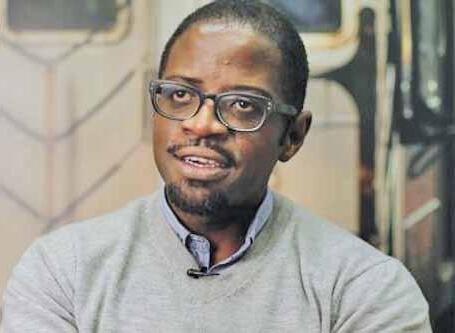
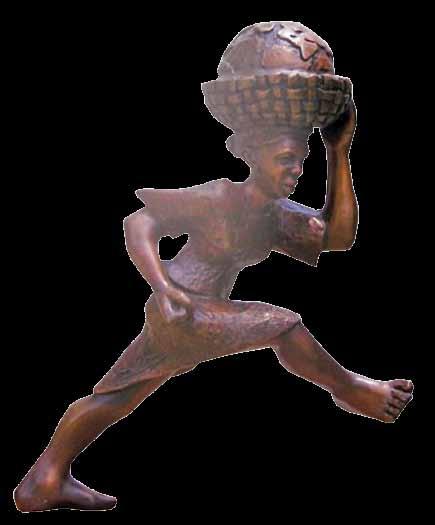
Guyanese Ian Ivor Thom is a celebrated artist who enjoys creating beautiful art inspired by historical events and personal experiences, with hopes they serve as re minders of our valuable heritage for upcoming generations.
In an interview with Guyana Times Sunday Magazine, the artist re lated he was born, and grew up, in Victoria village, East Coast Demerara. He recalled that since childhood he developed a pas sion for art and the value of it taught by his mother.
“One thing I remember as a child is that whenever I draw something, I would discard of them; but my mother would pick them up and put them away. As I got older I realised that what my mother did was her way of telling me that whatever I do is valuable and I shouldn’t just discard of my work,” Thom reminisced.
do so in art. I post my experiences either in drawing or sculpture. My art is conceptualised by my experiences, a story, or something that has influenced me. I’m inspired by life.”
For Thom, art makes him feel alive, and so he dances and sings while he is creating his pieces. He pointed out that he is most comfortable when into his art, and even forgets to eat sometimes.
turned, Thom went back to the National Service where he served until 1990. He then migrated to Canada and then to the U.S., all the while continuing to create artistic pieces.
His sculptures are full of life and reflect his deepest thoughts. One recurring theme in his work is slavery. He explains, “I listen to a lot of stories about slavery and saw movies, and I
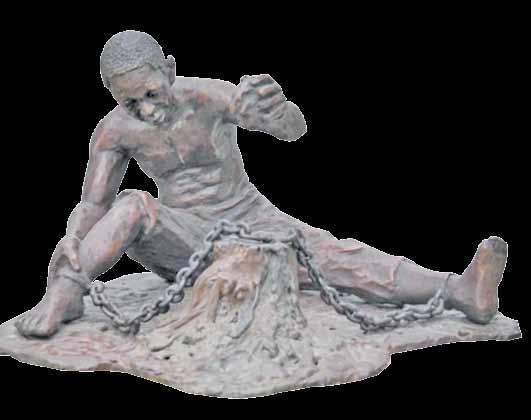
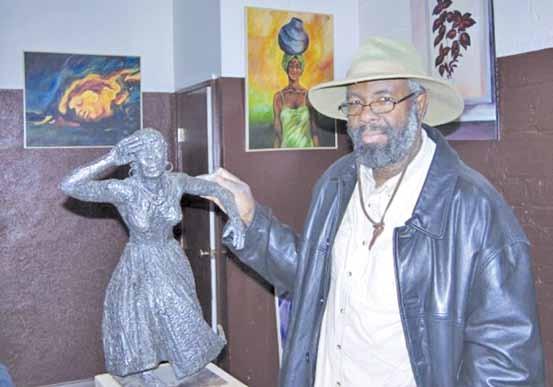
do my sculpture in the U.S., but the cost of doing it was so expensive. That’s when I proposed to Minister Frank Anthony to set up a found ry in Guyana and cast my piece here, which worked out way cheaper. He ac cepted my proposal and now Burrowes has an art foundry, which I be lieve is the only one of its kind in the English-speaking Caribbean,” he re vealed.
are a cross and chain showing that freedom was not just from slavery but
male with a musket showing he is moving forward and his hand is beckoning others to join him. It is completed and is located at Carifesta Avenue. The message I wanted to communicate through this sculpture is that whatever situation we’re in if we work together we can fight for what we want and stand firm for our demands,” expressed Thom.
Thom also remembered that while working on a Madhia/Annai road project in the 1970s chopping trees down – he was about 14 years old at that time – he came across a piece of wood and was moved to carve a face on it.
“At that time, to me it was a masterpiece, but looking back it seems like nothing at all. However, when I did it, a lot of people were fascinated with it, and that encouraged me to develop as an artist. From then on I started working with clay and other art medium. What also motivated me to practice my art is experiencing appreciation by others for my art work. As a member of the National Service, I was at the Papaya Centre, and former President Burnham was visiting. We wanted to get him a gift but we couldn’t travel out. Everyone encouraged me to do something and so I volunteered to carve a piece for him. Seeing how people appreciated my art really motivated me to keep on practicing and to develop myself as an artist,”
technique. A method used to cast metal. Thom also worked in many art foundries and was able to do so in every section of a foundry, after becoming very skilled in his area of art. His artistic abilities may have been hereditary, although he is described as a self-taught artist. “I don’t know if anybody else in my family is artistic, but I know while growing up, seeing a lot of sledge hammers and anvils. At that time I didn’t know what it was being used for but as I got older, and getting into metal work, I realised those tools are used for such work; and so I asked an older cousin who told me that our foreparents were not field slaves but were artisans,” he related.
Thom is famously known locally for his 1988 Damon monument sculpture. The next year he was awarded the Medal of Service for his contribution to art in Guyana. He was also given numerous medals and certificates for his work locally and internationally.
Speaking on what inspires him, Thom disclosed, “Something within me compels me. Sometimes I may have an experience, whether good or bad, and I want to share it. I found that if I can’t really share this in words I
Demerara rebellion shows his resilience in continuing to create pieces that speak of slavery and the rich history we share in Guyana. He won a competition held by the Ministry of Culture, Youth and Sport calling on artists to create a sculpture reflecting the history of 1823 rebellion. Thom’s winning entry also gave birth to an art foundry at the Burrowes School of art.
“I was finding out about art foundries where I can
After do ing much re search on the Demerara slave rebellion, Thom noted that it gave him a more in-depth understanding of what his sculpture should depict. The main figon the monuhe described, is a male carrying a cutlass – a tool for day-to-day work and probably was their only weapon of de fence. Symbols he also uses
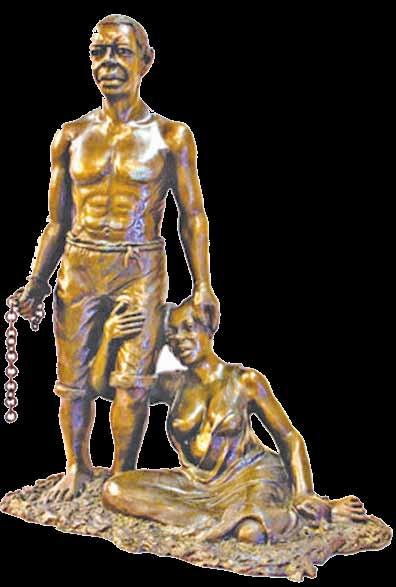
Thom wants to encourage artists to take advantage of the art foundry at Burrowes. He noted that there is a need for persons to manage and capitalize on it. The artist added that there is an urgent need also for youths to get involved.
“A lot of what I learnt about my work is from reading books, which I still do. So my advice to young artists is to read and keep practicing everyday, because that’s the only way you’ll get better. I made a promise that I would do something with art everyday, even if it’s just a small sketch and so I encourage young artists to do the same.”

In the centuries of both eras of the slave trade, thousands of slaves successfully fled the inhuman system to begin a new life either in newly formed communities or mixing with native groups. From North America through the Caribbean and Central America to South America, Africans and their descendants dispersed throughout the hemisphere.
No one wants to be enslaved, and that included the Spanish and Portuguese slaves recently transported to newly discovered colonies of the two Europeans nations. Little is known of the thousands of black societies living free throughout the Americas by the time of the Second Atlantic System.
According to modern research, many formed Afro-Indian polities and microstates to win “de facto” independence from Spain. In Ecuador, Colombia, Panama and Mexico, Spain is said to have recognised these autonomous communities made up of people variously called quilombos, mocambos, palenques, cumbes, and in English, “maroons”. Others remained constantly involved in wars against European armies and settlements.
Calabar
Lying at the edge of Salvador de Bahia in Brazil’s northeast territory, Calabar became one of Brazil’s most inhabited communities of slaves who had escaped from what would only have been a life of misery on the plantations. As many as 20,000 escaped slaves would live in Calabar at its height.
The town and another called Liberdade just a few miles further, were known as quilombos, the Brazilian name for these established fugitive communities. Many quilombos
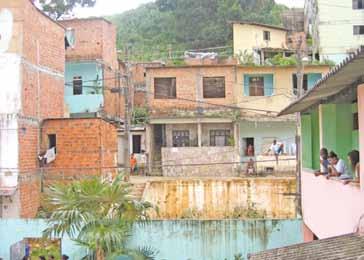
were in existence for decades and even centuries.
According to historical records, since 1650 Calabar was a colonial concern, but local historians say the community was established decades earlier. Hidden from view by dense forests and mostly inaccessible by its steep terrain and dangerous rivers, Calabar remained protected from Portuguese slave hunters, and was also a haven for native Indians also fleeing the Portuguese.
By the time Brazil abolished slavery in 1888, the community was trading with Portuguese exchanging dried fish, cassava (manioc), rice and palm oil for knives, guns and cloth.
Today several modern settlements have grown around the former quilombo.
Haiti
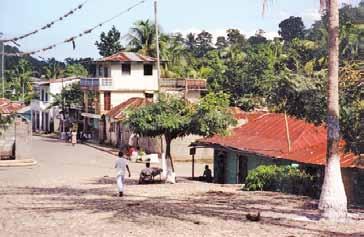
The successful fight for freedom by Haitian slaves sent waves of pure terror through many 18th century slaveholders. An independent maroon nation that could galvanise similar uprisings throughout the new world slave plantations led to these a severe economic embargo on Haiti for decades that made the once wealthiest Caribbean island into its poorest.
Eighteenth century Haiti comprised some 8,000 profitable sugar and coffee plantations that made its French owners extremely wealthy on the backs of some half a million slaves. When the 1789 French Revolution rallied for Liberté, egalité, fraternité, its call was heard among the island planters who focused on freedom without government interference in their enslavement activities.
Inspired too by the rally and fearing planter rule, the slaves, led by Toussaint L’Ouverture, would revolt and defend the island first against the British who had by 1793 seized Haiti’s main cities during their own war with the
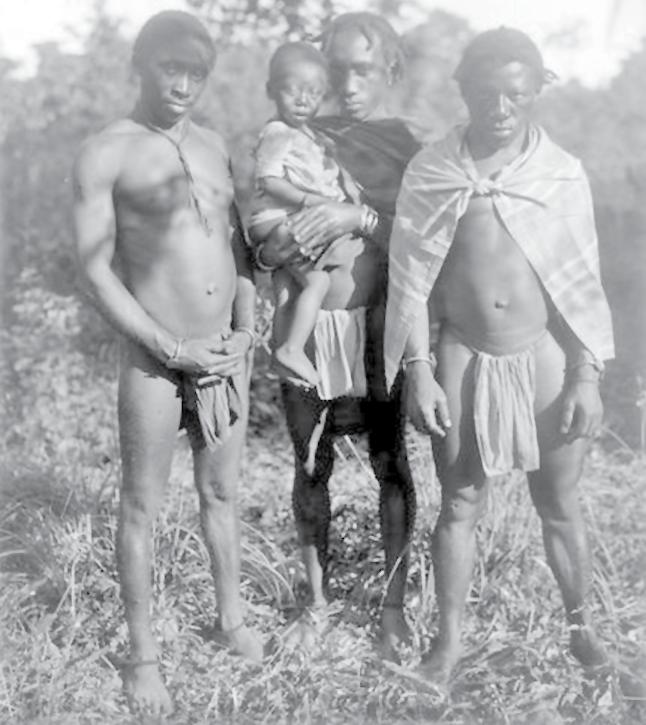
French. Facing fierce resistance and mounting deaths by war and disease, the British left Haiti in 1798.
By 1802, a French force of about 65,000, sent by Napoleon who had earlier staged a coup in France, landed to wrest the island, now considered a maroon community, from the slaves. But by Nov 1803 France too withdrew heavily defeated, leaving an independent Haitian state.
Transported to Suriname after the Dutch won the territory from the English in 1667, 300, 000 African slaves arrived to begin work on European-owned plantations. But malaria and yellow fever would decimate European populations, making it easy for slaves to escape as they outnumbered the former 25 to 1.
Just three years after their arrival on mainland South America, thousands of maroons would wage guerrilla warfare for almost a century against the Europeans, rescuing more slaves from Dutch plantations during their raids. Unable to subdue the maroons, the Dutch government in 1762 eventually agreed to recognize the autonomy of six maroon groups.
It did not stop the arrival of more slaves for Suriname plantations, or more slaves escaping, but the constant conflict led to absentee owners who remitted all profits home without reinvesting in colony institutions and infrastructure. This led to Suriname becoming one of the poorest countries in the world by the time of its 1975 independence.
Today, descendants of the maroons, also called, Djukas, Bushmen or bush Negroes, still live in the heavily forested regions of Suriname.
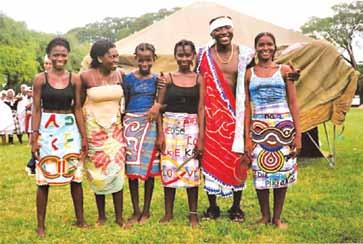


This year, the African Heritage Museum will celebrate its 19th anniversary preserving and promoting Africa’s cultures
The Museum of Arts and Ethnology was founded in 1985, with the purchase of collections of African art from anthropologist Hubert Nicholson and Desiree Malik. It was officially declared open July 31, 1994, by former president, Janet Jagan, and serves under the management of the Ministry of Culture, Youth and Sports.
Its collections were annotated and accessioned through UNESCO by Dr William Seligman, curator of African and Oceanic Art, Brooklyn Museum.
Since then, other donations have been made from persons within the local community such as pieces from the Burrowes School of Art and art and craft done by local artists within Guyana.
In 2001, the museum of African Art and Ethnology changed its name to the Museum of African Heritage, located in Barima Avenue. This was done to attract a wider audience and address African influence in Guyana. This allows the museum to explore research and solicit donations from the community so that they can be able to share their knowledge and provide programs that will educate visitors on African heritage and origins of their lifestyles in Guyana.
At the museum, the collection consists of African art (West Africa) from wooden masks to the carved door of secret societies. These help us to understand the
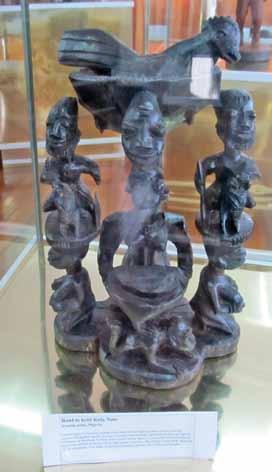
meaning and reasons behind African art and tradition. There are also collections of
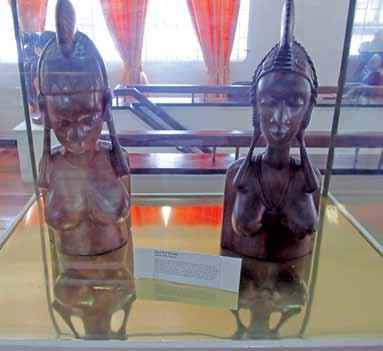
brass weights, drums, musical instruments, games and clothing. There is also a wooden replica of the 1763 monument.
Visitors will also see the “Bust of a Fulani Woman”, which is an artistic representation of a female Fulani. The Fulani are pastoralists who migrate with their cattle all across the savannah regions of West Africa. The women are famous for their beauty. They wear distinctive hairstyles and jewellery. This figure is a modern carving made for the commercial trade. It is made from a very hard, dense, red, Mahogany-type wood. It does not grow in the area where the Fulani live, but closer to the coast. The carvers are likely to be from an ethnic group other than the Fulani since they rarely carve.
There is also the nut bowl from the Yoruba tribe, Nigeria. Bowls like this one was used to hold Kola nuts which were cast on the ground as part of a divination ritual. One of the figures is a female worshiper holding her breasts which is a sign of respect. The other is a male figure holding a double-bladed axe carried by priests and worshipers of Shango, the ruler of thunder and lightning and is much feared in West Africa. The central figure is a kneeling woman with a child on her back. Carved above them is a figure of Shango horse’s back. In front of the central female figure is a man lying on his stomach with his arms and knees on the ground, his feet in the air. On his back stands the body of a chicken whose
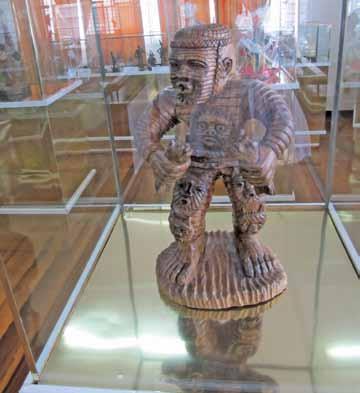
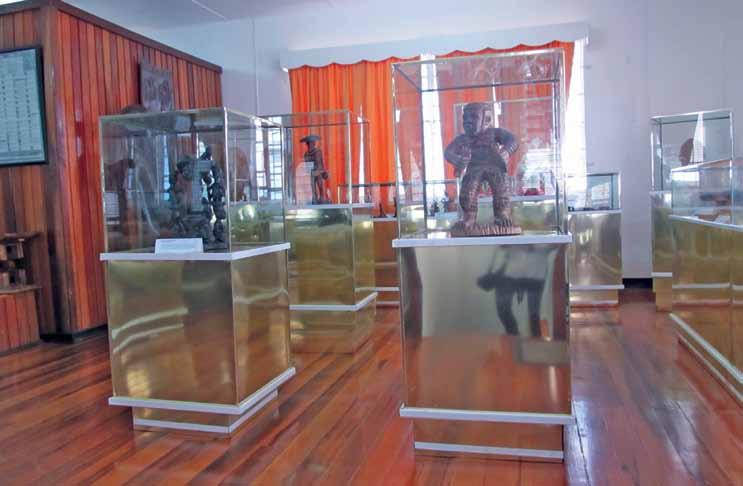
head, neck, back and tail are detached. Two heads on the bowl probably represent the Orisha or God Eshu/Elegba.
Some interesting artefacts include the African hut door from the Senufo Tribe, Mali (Ivory Coast, Burkina Faso). In Senufo, country doors to houses are frequently carved from a buttress root of a large tree. Normal houses doors are usually plain or decorated only with geometric designs. More elaborate designs are usually reserved for the doors of the houses used as meeting places for the secret societies. Such societies have a variety of purposes. Some exist as anti-witchcraft associations. Others exist to train young men and women separately in their respective roles in the community. The symbols on this door include lizards, crocodiles and hornbill birds which are all thought of as among the first animals created before man came into existence. The horse, seen on the door, does not breed south of the Sahara Desert and thus must be imported at great costs. A horse rider, therefore, represents a man of great wealth and power. The masks on the door are Kpelige masks associated with the Poro society.
The museum continues to collect, preserve, exhibit and research arts and artifacts relating to Africa and the African experience in Guyana. It is also mandated with disseminating this knowledge through its outreach programmes.
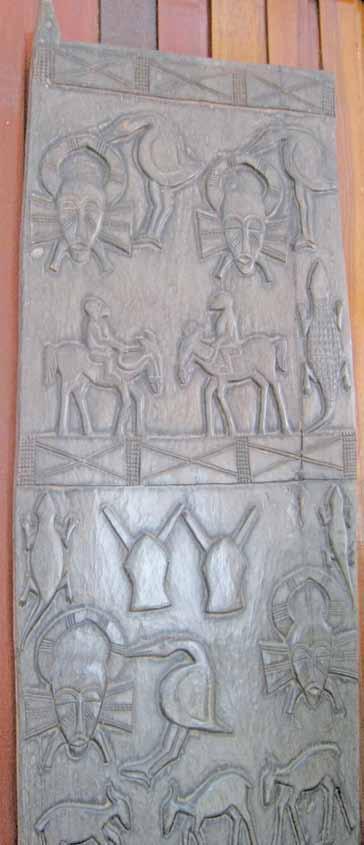
Juan Garrido
According to some historians, Juan Garrido was born in 1487 on the west coast of Africa and moved to Lisbon, Portugal as a young man. His African name is unknown.
Other historians claim he was the son of an African king who traded with the Portuguese, and had sent him to receive a Christian and Portuguese education that made him valuable to the Portuguese court.
He is said to have moved to Spain at the time of Columbus’ first voyage to the Americas, where he spent seven years in Seville before journeying across the Atlantic in the early 16th century to land at Hispaniola. He immediately joined the sub-governor Juan Ponce de León y Figueroa’s expedition party to capture Puerto Rico.
Others claim he was a slave who was granted his freedom. Records show a 15-year-old African slave travelled from Lisbon to Seville, Spain, and in 1503 joined the convoy to Hispaniola with the island's newly appointed governor. A Spaniard on the ship with him was named Pedro Garrido. Pedro might have been Juan's master and Christian namesake.
Yet other researchers suggest Juan Garrido was son, nephew or former slave of a former slave who was granted his freedom by Portuguese regent Joaõ II in 1477 and named himself Joaõ Garrido. Joaõ II made Joaõ Garrido “...ab-
solutely free...like any other Christian Portuguese” on the condition that he continue working in the slave trade.
Whoever he was, it would be the start of Garrido’s active role in Spanish conquest for years to come.
Arriving in Hispaniola to join the military campaigns of de León, Garrido
part of the party that met the famed Motecuhzoma (Montezuma).
It was Garrido who built a small chapel on the western highway out of Mexico which became known as the Chapel of the Martyrs or the Chapel of the Eleven Thousand Martyrs. It is considered to perhaps be the first Christian church on mainland America.
Indian and African slaves, and farmed the land near what is now Mexico City where he had a plantation exporting flour to the Spanish. He is considered the first person to grow wheat in the Americas.
He would also later marry a Spanish woman and have three children, during which time he was appointed several posi-
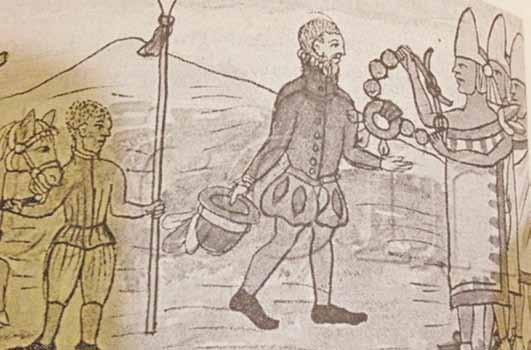
even joined de León’s outrageous quest for the Fountain of Youth, touching the Florida coast as the first people from the other side of the Atlantic to do so along the way. He was also present when Spain raided Carib Caribbean territories. When Hernán Cortés seized the triple alliance of the Aztec empire, Juan Garrido, who had joined Cortés after the death of de León, was
The story of Estevanico, the first black conquistador in the New World, begins with the Portuguese conquest of the port city of Azemmour, Morocco, in 1513, when Estevanico was only 10 years old. Sold into slavery in Spain, Estevanico became the personal servant and good friend of Andres de Dorantes of Bejar del Castanar.
In 1527, both Dorantes and Estevanico joined the Narvaez expedition to conquer Florida. Out of 80 men, only Estevanico and Dorantes survived after capsizing near the Galveston shore.
At first the natives were friendly, but later, Estevanico was enslaved for 5 years. He escaped from captivity and joined Dorantes, Alonso Castillo, and Cabeza de Vaca to try to return to the Spanish colonies in the New World.
Estevanico was excellent at learning the languages of the various Indian groups. With Cabeza de Vaca, he worked as a healer among the Indians and carried a medicine rattle and a beaded gourd with owl feathers on it as his symbol.
Garrido also took part in an experiment to grow wheat near the chapel. According to the 1552 report of historian Francisco Lopez de Gomara, “Two of them grew and one of them produced 180 kernels. They later turned around and planted those kernels and little by little there was boundless wheat...To a black man and slave is owed so much benefit!”
Garrido would acquire
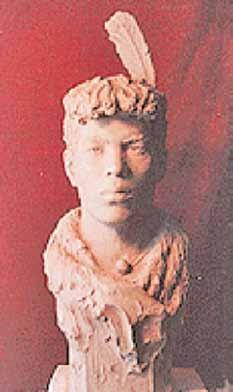
Three years after completing the journey with Cabeza de Vaca in February 1539, Estevanico agreed to lead an expedition north into New Mexico to prepare the way for
tions by Cortés: doorkeeper, town crier, guardian of the Chapultepec aqueduct and city manager.
Later in his life he petitioned the Spanish court in 1538 to reward him for his efforts in the Spanish conquest. The plea was ignored and little is known of his fate after the petition was denied. Sometime between 1539 -1547 he is said to have died in his sixties.
Coronado, who was considering going to look for the "Seven Golden Cities of Cibola." Estevanico was the advance scout for Friar Marcos de Niza.
He went ahead and sent back runners every day with information and wooden crosses, which were supposed to indicate the excellence of the country. A small cross would mean that things were going well, but nothing important had been found. A larger cross would indicate a land better than Mexico. Estevanico only sent back immense crosses.
Estevanico was extremely popular with the Indians he met. Hundreds of admirers, especially women, would follow him along the way.
Finally, in northwest New Mexico, Estevanico came to an impressive Zuni pueblo called Hawikuh. The Zuni people immediately distrusted Estevanico when they saw that his medicine gourd was decorated with owl feathers, which symbolized death to the Zunis.
Estevanico was killed there and some reports say his body was cut up into little pieces and sent to all the neighbouring villages to show that Estevanico was not superhuman. (PBS)
A number of black Africans entered Spanish society not as slaves but soldiers for Spanish expansion throughout the New World, either in exchange for their freedom or for financial compensation. They became known as the black conquistadors, who marched in formation or at the side of Spanish leaders during military conquest expeditions into the New World.
Juan Valiente was born in West Africa around 1505 and purchased at a very young age by a Portuguese trader. He was later purchased by Alonso Valiente, a Spaniard, and baptized. Juan convinced his owner to let him pursue a career as a conquistador for four years providing that he kept an account of the earnings and bring them back to his owner. In order for his agreement to stand, he had to keep a notarized record of the agreement on his person at all times "in order to avoid being arrested as a slave in flight."
Juan participated in many expeditions, including the Pedro de Alvarado expedition in Guatemala and the Juan de Valdivia expedition in Chile in which he was a captain and horseman.
He subsequently earned an estate in Santiago and an encomienda in which he received tribute from Indians. He married Juana de Valdivia who is cited as possibly being a native servant of a former African slave of Governor Juan de Valdivia.
Alonso Valiente soon sought a return on his investment and sent out an updated version of the agreement he had with Juan but Juan did not initially receive it. He had, in fact, attempted to purchase his freedom by way of a royal officer in 1550 but the officer ran off with his money. Five years after the first attempt to contact Juan, Alonso Valiente attempted to contact him again, but Juan had been killed in the 1553 Battle of Tucapel. There have been reports that suggest that in an effort to retrieve his money, Alonso sued the widow Juana de Valdivia for the estate left by her husband (Restall 2003:53–54).